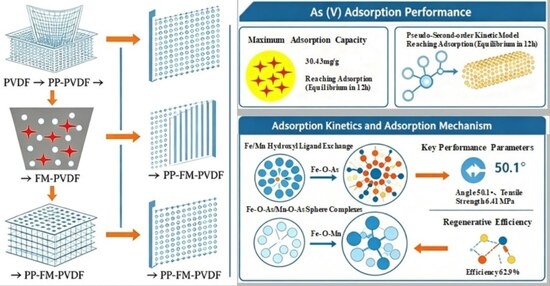
Synergistic PEDOT:PSS/Fe-Mn Oxide Functional Coating on PVDF Membrane for Enhanced Arsenate Removal: Surface Properties, Interfacial Adsorption Behavior, and Ligand Exchange Mechanism


Abstract
Share and Cite
Luo, M.; Yang, H.; Zhang, W. Synergistic PEDOT:PSS/Fe-Mn Oxide Functional Coating on PVDF Membrane for Enhanced Arsenate Removal: Surface Properties, Interfacial Adsorption Behavior, and Ligand Exchange Mechanism. Coatings 2026, 16, 671. https://doi.org/10.3390/coatings16060671
Luo M, Yang H, Zhang W. Synergistic PEDOT:PSS/Fe-Mn Oxide Functional Coating on PVDF Membrane for Enhanced Arsenate Removal: Surface Properties, Interfacial Adsorption Behavior, and Ligand Exchange Mechanism. Coatings. 2026; 16(6):671. https://doi.org/10.3390/coatings16060671
Chicago/Turabian StyleLuo, Mingyu, Haiyan Yang, and Wei Zhang. 2026. "Synergistic PEDOT:PSS/Fe-Mn Oxide Functional Coating on PVDF Membrane for Enhanced Arsenate Removal: Surface Properties, Interfacial Adsorption Behavior, and Ligand Exchange Mechanism" Coatings 16, no. 6: 671. https://doi.org/10.3390/coatings16060671
APA StyleLuo, M., Yang, H., & Zhang, W. (2026). Synergistic PEDOT:PSS/Fe-Mn Oxide Functional Coating on PVDF Membrane for Enhanced Arsenate Removal: Surface Properties, Interfacial Adsorption Behavior, and Ligand Exchange Mechanism. Coatings, 16(6), 671. https://doi.org/10.3390/coatings16060671