Article

Development of Antimicrobial Textile Coatings Through Encapsulation of ZnO in Electrospun PLA Fibers

by
Anna Pirouni
1,
Christina Drosou
1,
Sokratis Emmanouil Koskinakis
1,
Chrysanthos Stergiopoulos
1,*,
Isabel Rodríguez Amado
2,
Pablo Fuciños
2,
Lorenzo Pastrana
2,
Pulkit Mishra
3 and
Magdalini Krokida
1
1
Laboratory of Process Analysis and Design, School of Chemical Engineering, National Technical University of Athens, 9 Iroon Polytechneiou St. Zografou Campus, 15780 Athens, Greece
2
International Iberian Nanotechnology Laboratory (INL), Av. Mestre José Veiga s/n, 4715-330 Braga, Portugal
3
Textile Research Institute Thuringia-Vogtland e.V. (TITV e.V.), Zeulenrodaer Str. 42, 07973 Greiz, Germany
*
Author to whom correspondence should be addressed.
Coatings 2026, 16(6), 672; https://doi.org/10.3390/coatings16060672
Submission received: 29 April 2026 / Revised: 29 May 2026 / Accepted: 31 May 2026 / Published: 3 June 2026
(This article belongs to the Special Issue Functional Coatings for Smart Textiles)

Highlights

What are the main findings?
  • ZnO incorporation reduced viscosity and increased solution conductivity.
  • Electrospun PLA/ZnO fibers showed uniform morphology and smaller diameters.
  • High ZnO encapsulation efficiency (~95%) achieved via electrospinning.
  • ZnO reduced Tg and slightly weakened the mechanical properties of PLA fibers.
  • PLA/ZnO coatings exhibited strong antimicrobial activity and exposure-dependent ZnO retention.
What are the implications of the main findings?
  • ZnO-loaded PLA fibers show potential as antimicrobial textile coatings.
  • Electrospinning enables controlled ZnO encapsulation and release.
  • Coatings showed limited ZnO release under sweat conditions and partial ZnO retention under washing conditions.
  • The system shows potential for wearable applications involving skin-contact exposure.

Abstract

The present study investigates the development of antimicrobial textile coatings by encapsulating zinc oxide (ZnO) particles within electrospun polylactic acid (PLA) fibers. Electrospinning was used to produce uniform fibrous coatings with effective incorporation of ZnO. ZnO reduced solution viscosity and increased conductivity, resulting in thinner and more homogeneous fibers. Thermogravimetric analysis confirmed high encapsulation efficiency (up to 95%) and a significant loading capacity (47.71 ± 1 mg ZnO/g fiber), while scanning electron microscopy revealed uniform fiber structures with high-contrast regions that are qualitatively consistent with the presence of ZnO-rich domains. The release behavior of ZnO was assessed under simulated washing and perspiration conditions. Results showed limited release under sweat conditions (R < 0.07), indicating strong ZnO retention under perspiration-related exposure, whereas washing increased release from the free-standing coatings (up to 0.32), indicating partial ZnO retention under more aggressive aqueous surfactant conditions. Kinetic modeling using first-order, Higuchi, and Korsmeyer–Peppas models indicated that ZnO release was predominantly diffusion-controlled, with the Higuchi and Korsmeyer–Peppas models showing the best fit to the experimental data. Following thermal bonding onto textile substrates, the coatings achieved successful macroscopic integration; however, washing simulation of the bonded coatings resulted in more pronounced ZnO loss, while sweat exposure caused only limited release. The antimicrobial activity of the coatings was assessed against Staphylococcus aureus and Klebsiella pneumoniae (ISO 20743:2021). The PLA/ZnO (5% w/v) system showed strong broad-spectrum antibacterial activity, with values of 4.71 and 3.37, respectively. Overall, electrospun PLA/ZnO coatings show potential as antimicrobial textile coatings, offering controlled release behavior, strong antibacterial activity, and condition-dependent ZnO retention.

1. Introduction

The increasing demand for advanced functional textiles has spurred significant research interest in developing materials with enhanced antimicrobial properties, particularly for healthcare, hygiene, and active packaging applications. Microbial contamination of textile surfaces can lead to the proliferation of pathogenic microorganisms, unpleasant odors, and material degradation, thus necessitating the incorporation of effective antimicrobial agents into textile systems. In this context, nanotechnology-based approaches have emerged as promising strategies for designing multifunctional coatings with improved performance and durability [1].
Among the various fabrication techniques, electrospinning has gained considerable attention as a versatile and efficient method to produce ultrafine polymeric fibers with a high surface area-to-volume ratio and tunable morphology [2,3]. The process involves applying a high-voltage electric field to a polymer solution or melt, thereby inducing a charged jet to form at the spinneret tip. As electrostatic forces overcome the liquid’s surface tension, the jet elongates and thins as the solvent evaporates, resulting in the deposition of continuous solid fibers onto a collector. In conventional electrospinning configurations, this collector is typically grounded. However, alternative configurations, including bipolar electrospinning, may also be used depending on the equipment design and processing requirements. This technique enables the incorporation of active compounds into the fiber matrix, allowing the development of functional materials with controlled-release behavior and enhanced surface activity [4]. The structural characteristics of electrospun fibers, including their high porosity and interconnected network, make them particularly suitable for applications that require enhanced interaction with the surrounding environment, such as antimicrobial coatings for textiles [2,5].
Encapsulation of active agents within electrospun fibers represents a key strategy for enhancing the stability and functionality of antimicrobial systems [6]. By embedding active compounds within the polymeric matrix, it becomes possible to protect them from premature degradation, control their release profile, and improve their interaction with the surrounding environment [7,8]. This approach is particularly advantageous in textile applications, where prolonged activity and resistance to environmental stresses, such as washing and perspiration, are critical requirements. The high surface area and porous structure of electrospun mats facilitate the diffusion of active agents, while the fiber architecture acts as a reservoir, enabling sustained release over time [6,9,10].
Zinc oxide (ZnO) has been extensively investigated as an antimicrobial agent due to its broad-spectrum activity, chemical stability, and relatively low toxicity. Its antimicrobial mechanism is mainly attributed to the generation of reactive oxygen species, the release of Zn2+ ions, and the disruption of microbial cell membranes. These properties make ZnO a highly attractive candidate for incorporation into polymeric matrices to develop durable antimicrobial coatings. Furthermore, ZnO particles can influence the physicochemical properties of polymer solutions, such as viscosity and electrical conductivity, thereby affecting the electrospinning process and the morphology of the resulting fibers [11].
Polylactic acid (PLA) is a biodegradable and biocompatible polymer widely used in electrospinning applications due to its favorable mechanical properties and processability. The combination of PLA with ZnO offers a promising route to developing environmentally friendly antimicrobial materials, in which the polymer matrix serves as a carrier for the active agent and contributes to the coating’s structural integrity. Previous studies have demonstrated that incorporating ZnO into PLA fibers can yield uniform fibrous structures with effective encapsulation and sustained antimicrobial activity [12,13].
Despite the growing interest in ZnO-based antimicrobial systems, challenges remain in the efficient encapsulation of ZnO within electrospun fibers, the retention of the active agent under real-world use conditions, and the effective integration of such coatings onto textile substrates. Ensuring strong adhesion to fabrics and resistance to washing and perspiration is critical for practical applications. Textile materials are frequently subjected to washing cycles, mechanical wear, and contact with biological fluids such as sweat, which may affect both the coating’s structural integrity and the availability of the active agent. Consequently, evaluating the durability of electrospun coatings under simulated conditions is essential for assessing their practical applicability. In this context, the study of release mechanisms and the stability of ZnO within the fibrous network becomes particularly relevant [14].
Conventional approaches for the development of antimicrobial textiles mainly rely on surface finishing techniques, such as pad–dry–cure processing, dip-coating, spraying, exhaustion, and direct nanoparticle deposition onto textile substrates [15,16,17]. These methods have been widely investigated for incorporating metal oxides, silver nanoparticles, quaternary ammonium compounds, and other antimicrobial agents to impart antibacterial functionality to fabrics. However, in many cases, the active compounds are primarily immobilized on the textile surface, resulting in limited durability and progressive loss of activity during washing or prolonged use conditions [5,15]. In addition, several conventional finishing treatments involve synthetic binders or intensive wet-processing methods associated with increased chemical consumption and environmental burden [16]. In contrast, electrospinning offers the possibility of encapsulating antimicrobial agents within ultrafine polymeric fibers, enabling higher surface area, controlled release behavior, and improved retention of the active compound within the fibrous matrix [3,18]. The use of biodegradable PLA as a carrier material further contributes to the development of more sustainable functional textile systems [12]. Nevertheless, studies combining ZnO encapsulation in electrospun PLA fibers with evaluation under simulated sweat and washing conditions remain limited in the literature.
Therefore, the present study focuses on developing antimicrobial textile coatings by encapsulating ZnO particles within electrospun PLA fibers. Emphasis is placed on the relationships among solution properties, electrospinning parameters, and resulting fiber morphology, as well as on the successful deposition and adhesion of coatings onto textile substrates. Furthermore, the antimicrobial performance of the developed systems is evaluated, along with their durability under simulated washing and perspiration conditions. Through this approach, the study aims to contribute to the design of effective, stable, and sustainable antimicrobial textile materials suitable for real-world applications.

2. Materials and Methods

2.1. Materials

Acetone (≥99%, laboratory reagent grade) was purchased from Fisher Scientific, Loughborough, UK. Poly (lactic acid) (PLA) pellets (Ingeo™ 4043D) were supplied by NatureWorks LLC, Minnetonka, MN, USA. Zinc oxide (ZnO, 99.9% purity, metal basis) and polysorbate 80 (Tween 80) were obtained from Thermo Fisher Scientific, Waltham, MA, USA. The polyamide 11 (PA11) textile substrate was prepared from PA11 yarn (78 dtex f24×1; RadiciGroup, Gandino, Bergamo, Italy) and was provided by the Textile Research Institute Thuringia-Vogtland e.V. (TITV e.V.), Greiz, Germany. Staphylococcus aureus ATCC 6538 and Klebsiella pneumoniae ATCC 4352 were obtained from the American Type Culture Collection (ATCC), Manassas, VA, USA, and were used for antimicrobial testing. All other chemicals used in this study were of analytical grade.

2.2. Preparation of Polymer Solutions

Initially, poly(lactic acid) (PLA) was dissolved in acetone to prepare a PLA–acetone solution (10% w/v). Specifically, 20 g of PLA (Ingeo™ 4043D pellets, NatureWorks LLC, Minnetonka, MN, USA) were weighed and mixed with 200 mL of acetone in a conical flask. The mixture was then subjected to continuous magnetic stirring and heating at 65 °C for 3–4 days to ensure complete polymer dissolution and formation of a homogeneous solution.
Polymer solutions containing zinc oxide (ZnO) were subsequently prepared at concentrations of 1% and 5% w/v relative to the polymer solution volume. For the preparation of the PLA/ZnO 5% w/v formulation, 0.1 g of ZnO was weighed and added to a 20 mL vial containing 1 mL of acetone and 0.5 mL of Tween 80 (2.5% v/v) as a plasticizer. After mild stirring, the suspension was ultrasonicated for 30 min to facilitate the initial dispersion of ZnO particles. Subsequently, 20 mL of the previously prepared PLA solution (10% w/v) was added to the suspension, which was then stirred again, placed in an ultrasonic bath, and heated at 60 °C for 1 h to achieve uniform dispersion of the particles within the polymeric matrix. The same procedure was followed to prepare the 1% w/v PLA/ZnO solution, using 0.02 g of ZnO.

2.3. Characterization of the Polymer Solutions

2.3.1. Apparent Viscosity

The viscosity of the solutions was measured using a rotational viscometer (ATAGO VISCO™-895 digital viscometer, ATAGO Co., Ltd., Tokyo, Japan) equipped with an A1 spindle, suitable for low- to medium-viscosity ranges (50–200 mPa·s), in accordance with the manufacturer’s specifications. The samples were transferred into a dedicated viscometer sample cup (15 mL), ensuring that the filling level corresponded to the A1 spindle marking. The measurements were performed at rotational speeds of 100, 150, 200, and 250 rpm.

2.3.2. Conductivity

The electrical conductivity of the solutions was measured using a portable conductivity meter (COND 7 Vio, XS Instruments, Giorgio Bormac S.r.l., Carpi, MO, Italy) equipped with an appropriate conductivity electrode and automatic temperature compensation (ATC). For each measurement, the electrode was immersed directly in the sample in a beaker. All measurements were performed at room temperature (25 °C), and the stabilized conductivity value was recorded after sufficient equilibration time.

2.4. Electrospinning Process

The TL-Pro-BM electrospinning system (Tongli Tech Co., Ltd., Shenzhen, China) was used to encapsulate ZnO in the polymer fibers. The polymer solutions were placed in a 20 mL plastic syringe connected to a 19-gauge electrospinning needle via a PTFE tube. The syringe was positioned horizontally on a digitally controlled syringe pump to ensure a constant feed rate of 10 mL/h. At the same time, the needle was connected to the positive electrode and directed towards the collector, which was connected to the negative electrode. Electrospinning was carried out in a bipolar configuration at an applied potential difference of 22 kV, generated by applying +11 kV to the positive electrode and −11 kV to the negative electrode. The fibers were deposited on a rotating cylindrical drum collector placed at 13 cm from the needle tip and operated at 100 rpm. Environmental conditions were continuously monitored using the electrospinning system’s integrated sensors. At the same time, relative humidity was maintained at approximately 31.2% using a dehumidifier (OJ-212E, Eurgeen, Hangzhou, Zhejiang, China), and the ambient temperature ranged between 35 and 40 °C for all experiments. The starting point and scanning range were set at 140 mm and 150 mm, respectively, to ensure uniform fiber deposition on the collector surface. Electrospinning was performed for 30 min, 1 h, and 2 h to produce coatings of different thicknesses. The same electrospinning conditions were applied to all formulations.

2.5. Characterization of PLA/ZnO Electrospun Fibers

2.5.1. TGA-Based Determination of ZnO Loading and Encapsulation Efficiency

The encapsulation efficiency, loading capacity, and thermal properties of the PLA/ZnO coatings produced were evaluated by thermogravimetric analysis (TGA). The analysis was performed using a thermogravimetric analyzer (TGA/SDTA 851e, Mettler Toledo, Greifensee, Switzerland). Approximately 10 mg of each sample was heated in an alumina crucible from 25 to 600 °C at a heating rate of 10 °C/min under an air atmosphere at a flow rate of 50 mL/min.

2.5.2. Scanning Electron Microscopy (SEM)

The morphology of the electrospun fibers was examined using scanning electron microscopy (SEM) with a Quanta 200 microscope (FEI Company, Hillsboro, OR, USA). The analyzed samples included pure PLA fibers and PLA fibers containing 1% and 5% w/v ZnO. Before observation, the samples were mounted on appropriate SEM stubs and sputter-coated with gold using a Mini Sputter Coater/Glow Discharge System (SC7620, Quorum Technologies Ltd., Laughton, East Sussex, UK) to improve their electrical conductivity. All SEM experiments were performed at an accelerating voltage of 12.5 kV. Fiber diameters were measured from the obtained SEM images using ImageJ softwareversion 1.53t, with 40 fibers analyzed per sample; results were expressed as mean values with corresponding standard deviations.

2.5.3. Differential Scanning Calorimetry (DSC)

Thermal analysis of the samples was performed using a differential scanning calorimeter (DSC) (Pyris DSC-6, Perkin Elmer Ltd., Norwalk, CT, USA). Approximately 5–10 mg of each sample was placed in an aluminum sample pan and hermetically sealed using a standard pan crimper press (Perkin Elmer Ltd., Norwalk, CT, USA). An identical empty aluminum pan was used as the reference. The sample and reference pans were positioned in the corresponding compartments of the DSC cell before analysis. The sample and reference pan were placed inside the calorimeter, and a heating rate of 5 °C/min was used to scan the samples under a continuous flow of dry N2 at 20 mL/min.

2.5.4. ATR–FTIR Screening

Fourier-transform infrared spectroscopy (FTIR) was performed to evaluate the characteristic functional groups of PLA and to assess possible spectral changes after ZnO incorporation. Spectra were recorded using a JASCO FT/IR-4200 spectrometer (JASCO Corporation, Hachioji, Tokyo, Japan) equipped with an ATR accessory. Samples of neat PLA and PLA/ZnO electrospun fibers were placed directly onto the ATR crystal and analyzed over the accessible spectral range of 4000–700 cm−1 at a spectral resolution of 4 cm−1. Background spectra were recorded before each measurement and automatically subtracted. It should be noted that the characteristic Zn–O stretching vibration is typically reported at lower wavenumbers, approximately 430–500 cm−1, which was outside the accessible range of the ATR setup used in the present study. Therefore, FTIR analysis was used primarily to evaluate the PLA matrix and potential changes in PLA-related absorption bands, rather than to confirm the Zn–O vibration directly.

2.5.5. Tensile Test

The mechanical properties of the films, including tensile strength, elongation at break, and elastic modulus, were determined using a universal testing machine in accordance with ASTM D882 [19] for thin films (<1 mm). Before testing, the films were cut into rectangular specimens (30 × 15 mm), and their thickness was measured using a digital caliper (approximately 19–22 μm). The specimens were mounted between the grips of the testing machine and stretched at a controlled rate until failure, while the applied force and elongation were continuously recorded. Five replicates were tested for each formulation, including PLA fibers containing 0 and 5% w/v ZnO, and the results were expressed as mean values.

2.6. Release of ZnO

The release behavior of ZnO from PLA/ZnO electrospun coatings and ZnO-coated textiles under washing and sweat-simulation conditions was analyzed using Higuchi, Korsmeyer–Peppas, and first-order kinetic models to elucidate the underlying release mechanisms. The cumulative release fraction of ZnO was expressed as:
R = C o   C t C o ,
where Co is the initial ZnO content in the sample and C t is the ZnO content remaining in the sample at time t, as determined by TGA. Therefore, R represents the fraction of ZnO released at each sampling time. The applied kinetic models are described as follows:
First-order model: The first-order model assumes that the release rate depends on the remaining amount of active compound:
R = 1 e k 1 t
where k1 is the first-order release constant.
Higuchi model: The Higuchi model describes diffusion-controlled release from a porous matrix:
R = k H t 1 / 2
where kH is the Higuchi release constant.
Korsmeyer–Peppas model: The Korsmeyer–Peppas model is used to describe release from polymeric systems, particularly at the initial stage (<60% release):
R = k t n
where k is a kinetic constant, and n is the release exponent indicating the release mechanism. Values of n ≤ 0.45 indicate Fickian diffusion-controlled release, while 0.45 < n < 0.89 corresponds to anomalous transport. Kinetic parameters were obtained by regression analysis using the mean values of triplicate measurements. The goodness of fit was evaluated using the coefficient of determination (R2). For datasets with insufficient experimental points, only the apparent first-order and Higuchi constants were calculated, and Korsmeyer–Peppas fitting was not performed.

2.6.1. Simulated Perspiration Exposure Protocol

A preliminary laboratory-scale perspiration simulation was performed to evaluate the retention and release behavior of ZnO under representative sweat-related conditions. An artificial sweat solution was prepared by dissolving 5 g of sodium chloride (NaCl) and 2.2 g of lactic acid in 1 L of deionized water. The pH of the solution was adjusted to 5.5, which is typical for human skin. A piece of the PLA/ZnO (5% w/v) coating was then placed in a hermetically sealed polyethylene bag containing 15 mL of the artificial sweat solution. The sealed samples were incubated in an oven at 37 °C to simulate perspiration conditions. After the exposure period, the samples were analyzed by thermogravimetric analysis (TGA) to determine the amount of ZnO particles remaining encapsulated within the polymer matrix. Before thermogravimetric analysis, the film samples were briefly rinsed with distilled water to remove residual sodium chloride from the artificial sweat solution, then dried.

2.6.2. Simulated Washing Exposure Protocol

A preliminary laboratory-scale washing simulation was conducted to evaluate the durability and retention behavior of ZnO in electrospun PLA coatings under exposure to aqueous surfactants. For the washing simulation, 0.31 g of PLA/ZnO coating (5% w/v) was added to a solution containing 2.88 g of green soap dissolved in 310 mL of deionized water. The mixture was placed on a magnetic stirrer and maintained at 40 °C under continuous agitation at 300 rpm to simulate washing conditions. After the designated treatment time, the samples were collected and analyzed by thermogravimetric analysis (TGA) to determine the percentage of ZnO particles remaining encapsulated within the polymer matrix.

2.7. Thermal Bonding of Electrospun PLA/ZnO Coatings onto PA11 Textiles

The electrospun PLA coatings, containing 5% w/v ZnO as well as neat PLA, were bonded onto a knitted polyamide 11 (PA11) fabric using a hot-press technique. A copolymer polyurethane adhesive film (40 g/m2) with a melting point of 102 °C was used as an intermediate bonding layer. The bonding was carried out at 110 °C for 60 s under a pressure of approximately 350 g/cm2 to ensure sufficient adhesion between the coating and the textile substrate.
Following bonding, thermogravimetric analysis (TGA) was performed to determine the amount of antimicrobial agent remaining encapsulated within the polymer matrix. In addition, washing and sweat simulation tests were conducted on the bonded samples to evaluate their durability under simulated use conditions.

2.8. Antimicrobial Activity Assessment

Antimicrobial activity was evaluated in accordance with ISO 20743:2021 [20] (absorption method and plate count). Two types of polyamide 11 textile specimens were tested: PA11 coated with neat PLA electrospun (control) and PLA electrospun with 5% (w/w) ZnO. Test specimens (0.40 g ± 0.05 g) were used without prior sterilization.
Staphylococcus aureus (ATCC 6538) and Klebsiella pneumoniae (ATCC 4352) were selected as representative Gram-positive and Gram-negative test organisms, respectively, in accordance with the recommendations of ISO 20743:2021. K. pneumoniae was specifically chosen over Escherichia coli due to its thick polysaccharide capsule and enhanced resistance mechanisms, providing a more stringent assessment of antimicrobial efficacy against clinically relevant, encapsulated Gram-negative pathogens commonly associated with healthcare textile contamination.
Staphylococcus aureus and Klebsiella pneumoniae were cultured in nutrient broth at 37 °C with shaking (120 min−1) for 18 h and diluted to 1.0–3.0 × 10⁵ CFU/mL. Six specimens per material (three for t = 0 h, three for t = 24 h) were inoculated with 0.2 mL bacterial suspension. Specimens at t = 0 h were immediately extracted into 20 mL of SCDLP (Soya Casein Digest Lecithin Polysorbate; Millipore/Sigma-Aldrich, Merck KGaA, Darmstadt, Germany) broth by shake-out; the remaining specimens were incubated at 37 °C for 24 h before extraction. Plate count quantified viable bacteria after 24–48 h incubation at 37 °C.
Growth values for control (F) and treated (G) specimens were calculated as F = log Cₜ − log C0 and G = log Tₜ − log T0, where C and T represent control and treated bacterial counts at times 0 and t. The antibacterial activity value was calculated as A = F − G. Tests were considered valid when the inoculum was 1.0–3.0 × 10⁵ CFU/mL, the log difference between triplicates was <1.0 (control) and <2.0 (treated), and F ≥ 1.0. Efficacy was classified as low (A < 2), significant (2 ≤ A < 3), or strong (A ≥ 3).

2.9. Statistical Analysis

One-way analysis of variance (ANOVA) was performed using the GNU PSPP statistical software version 2.1.1 (GNU Project, Free Software Foundation, Boston, MA, USA). Differences between means were evaluated using Tukey’s test at a significance level of p < 0.05.

3. Results and Discussion

3.1. Characterization of the Electrospinning Solutions

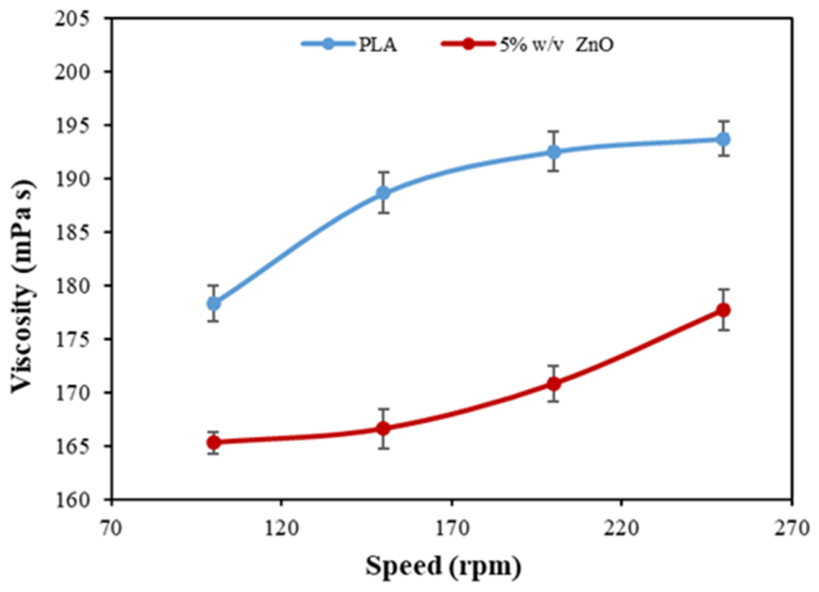
As shown in Figure 1 and Table 1, the addition of 5% w/v ZnO resulted in a slight decrease in the viscosity of the PLA solution compared to neat PLA. Although the exact mechanism responsible for this behavior has not yet been fully elucidated, it has been suggested that ZnO particles may disrupt polymer chain entanglements, thereby increasing free volume and consequently lowering viscosity. In addition, the presence of ZnO may promote the formation of less entangled, shorter polymer chains around the particles, reducing intermolecular friction during flow, particularly at higher shear rates [21]. Statistical analysis using ANOVA followed by Tukey’s test showed that the viscosity of the PLA/ZnO solution was significantly lower than that of neat PLA at all tested rotational speeds (p < 0.05), as indicated by the different superscript letters in Table 1. The conductivity of the PLA/ZnO solution was also significantly higher than that of neat PLA (p < 0.05), supporting the effect of ZnO on the electrical properties of the electrospinning solution. This behavior can be attributed to the higher charge density introduced by metal oxide particles, as zinc ions facilitate ionic transport in the solution, creating a more conductive environment [22].

3.2. Characterization of Electrospun PLA/ZnO Coatings

3.2.1. ZnO Loading and Encapsulation Efficiency in Electrospun PLA Fibers

TGA indicated that the PLA/ZnO coating containing 5% w/v ZnO exhibited a high encapsulation efficiency of 95% and a loading capacity of 47.71 ± 1 mg ZnO/g fiber, confirming the effective incorporation of ZnO particles within the electrospun PLA fibers. In contrast, the ZnO content in the 1% w/v samples was below the reliable quantification capability of the applied TGA-based method. This result should not be interpreted as evidence of complete ZnO absence, but rather as a limitation associated with the low expected inorganic residue, possible processing losses, sample-mass variability, and the practical sensitivity of residual-mass determination by TGA. Therefore, quantitative loading and release analysis were focused on the 5% w/v ZnO formulation, for which ZnO was reliably quantified. More sensitive elemental techniques, such as SEM–EDS or ICP-based analysis, could be used in future work to confirm and quantify ZnO incorporation at lower loading levels.

3.2.2. Morphology Analysis

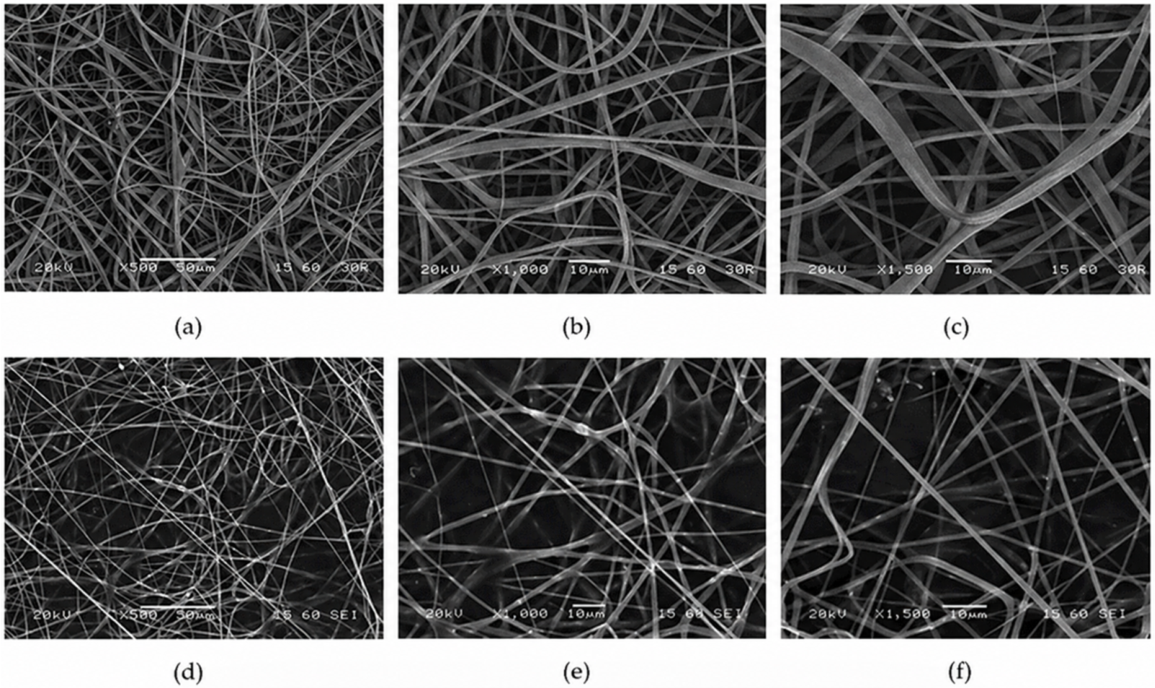
SEM observations in Figure 2 revealed that the PLA/ZnO (5% w/v) fibers exhibited a uniform, continuous fibrous structure with minimal bead formation, indicating a stable electrospinning process. The use of pure acetone as a solvent further contributed to this outcome, as its high volatility and good PLA solubility promote rapid jet solidification while amplifying the conductivity-driven effect of ZnO on fiber thinning. Bright spots were also observed along the fibers, which may be associated with ZnO-rich domains or local particle accumulation [23]. However, since SEM imaging alone does not provide direct elemental confirmation, this interpretation should be considered qualitative. In the present study, ZnO incorporation was supported by the combined evidence from SEM morphology, TGA residual mass and encapsulation efficiency, ZnO release behavior, and antimicrobial activity. Future work should include SEM–EDS elemental mapping or complementary elemental analysis to directly confirm the spatial distribution of ZnO particles within the electrospun PLA fibers.
The feed rate of 10 mL/h is relatively high compared with many conventional single-needle electrospinning systems. It may influence fiber morphology by increasing the amount of solution supplied to the Taylor cone. If the electrostatic stretching force and solvent evaporation are insufficient, high feed rates can lead to thicker fibers, incomplete solvent removal, fiber fusion, or bead formation. In the present study, stable fiber formation was achieved under the selected conditions, attributed to the bipolar electrospinning configuration and the total applied potential difference of 22 kV, which enhanced jet stretching. In addition, the reduced viscosity and increased conductivity of the PLA/ZnO solution further supported jet elongation. This is consistent with the SEM observations, which showed continuous fibers with minimal bead formation under the applied processing conditions.
A statistically significant decrease in the average fiber diameter was observed after ZnO incorporation, from 2.376 ± 0.679 μm for neat PLA to 1.153 ± 0.311 μm for PLA/ZnO coatings (p < 0.05), accompanied by a narrower diameter distribution, suggesting improved uniformity. This behavior can be attributed to the increased electrical conductivity of the solution in the presence of ZnO, which enhances jet stability and more controlled fiber stretching during electrospinning [24]. Additionally, the combined effect of increased conductivity and reduced viscosity contributes to the formation of thinner fibers. Overall, the morphological results are consistent with the rheological and conductivity data, supporting the role of ZnO in modifying solution properties and promoting the formation of thinner PLA-based fibers [25].
Complementary ATR–FTIR screening was performed to assess whether ZnO incorporation caused major changes in the PLA matrix. Within the accessible spectral range of the available ATR accessory, 700–4000 cm−1, the characteristic PLA absorption bands were observed, including the carbonyl stretching band of PLA and bands associated with C–O–C/C–O stretching and C–H vibrations. No major new bands or pronounced spectral shifts were observed after ZnO incorporation, suggesting that ZnO was mainly physically incorporated within the PLA fibrous matrix rather than forming new covalent bonds with PLA. However, direct spectroscopic confirmation of the Zn–O bond was not feasible because the characteristic Zn–O stretching vibration typically occurs at lower wavenumbers (approximately 430–500 cm−1), outside the detection range of the available ATR–FTIR setup. Therefore, ZnO incorporation was interpreted based on combined evidence from SEM morphology, TGA residual mass, encapsulation efficiency, release behavior, and antimicrobial activity.

3.2.3. Thermal Properties

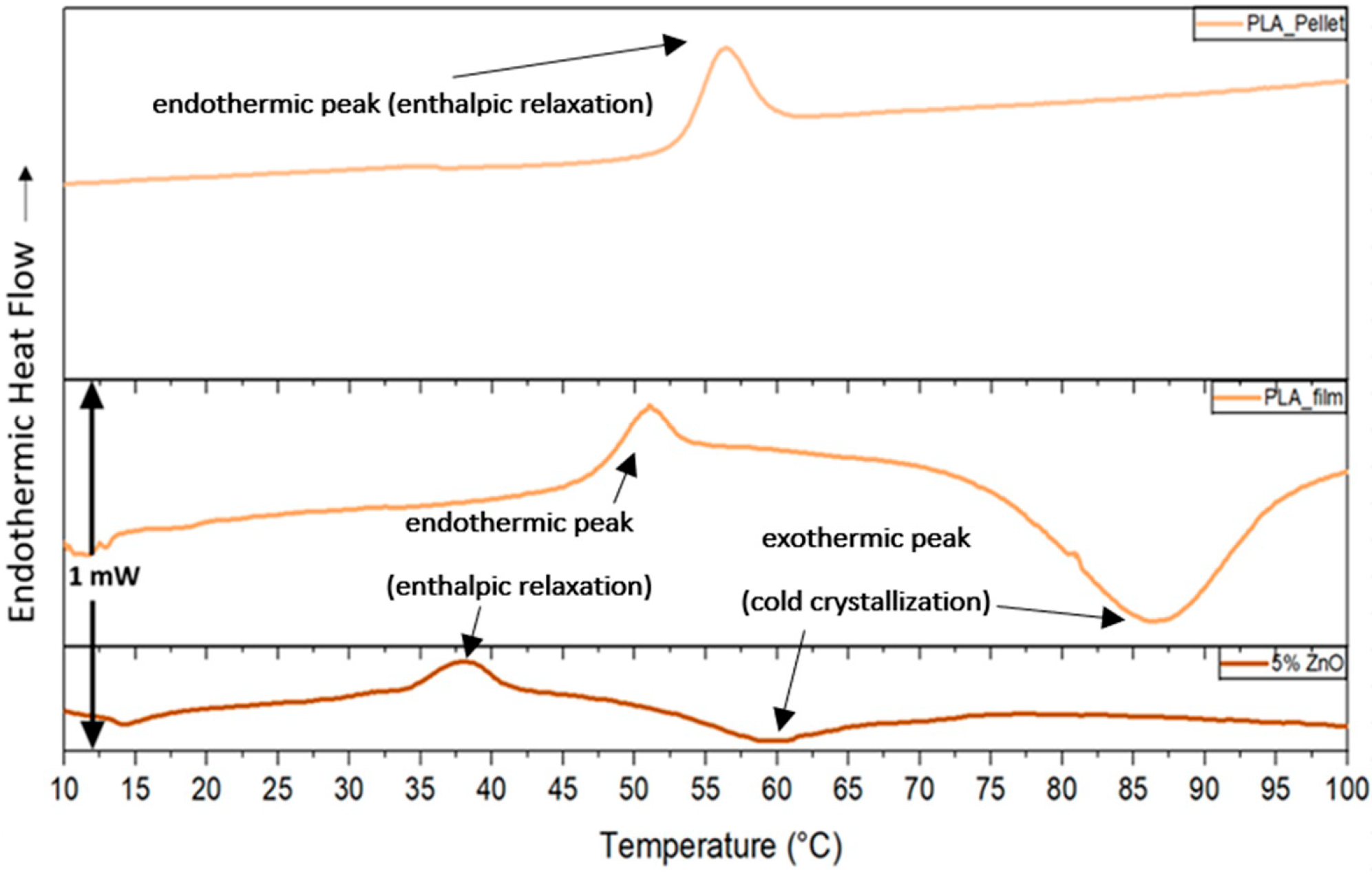
As shown in Figure 3, the DSC thermograms of the PLA/ZnO (5% w/v) fibers during the first heating scan exhibit a characteristic endothermic peak in the temperature range of 35–40 °C, which is attributed to enthalpic relaxation associated with the physical aging of the amorphous phase and the relaxation of PLA polymer chains [2]. In addition, an exothermic peak corresponding to cold crystallization is observed, indicating that the amorphous fraction of the polymer becomes sufficiently mobile upon heating to crystallize [26]. Compared to neat PLA, the presence of ZnO reduces the intensities of both the endothermic and exothermic transitions and shifts them towards lower temperatures. This behavior suggests that ZnO promotes chain scission and reduces PLA molecular weight, while simultaneously restricting some polymer chains via interfacial interactions. This leads to increased chain mobility within the amorphous phase. Consequently, the thermal transitions occur at lower temperatures [13].
This effect is further supported by the decrease in glass transition temperature (Tg), which dropped from 48.46 °C for neat PLA to 36.19 °C for PLA/ZnO, as presented in Table 2. According to the statistical analysis (p < 0.05), the Tg value of PLA/ZnO differed significantly from those of neat PLA samples, as indicated by the different superscript letters in Table 2. The reduction in Tg can be attributed to ZnO-induced degradation of PLA chains during processing, leading to lower-molecular-weight species and degradation products that act as plasticizers. Overall, these results indicate that ZnO significantly affects the thermal behavior of PLA by enhancing chain mobility and accelerating thermal transitions [27,28].
As shown in Figure 3, the DSC thermograms revealed distinct thermal transitions for the PLA pellet, PLA film, and PLA/ZnO fibers. The PLA pellet and PLA film exhibited endothermic peaks associated with enthalpic relaxation, commonly attributed to physical aging and relaxation of the amorphous PLA phase. In the PLA film, an additional exothermic transition was observed at higher temperature, corresponding to cold crystallization, indicating that amorphous PLA chains gained sufficient mobility during heating to rearrange into more ordered crystalline regions. In the PLA/ZnO sample, the enthalpic relaxation peak shifted to a lower temperature, and the cold crystallization-related transition also appeared at a lower temperature compared with the neat PLA film. This behavior suggests that ZnO affected the mobility of PLA chains, possibly by promoting chain rearrangement and reducing the energy required for thermal transitions. This interpretation is also consistent with the lower Tg value measured for the PLA/ZnO fibers.
It should be noted that the DSC analysis in the present study was focused on the low-temperature region between 10 and 100 °C, where glass transition, enthalpic relaxation, and cold crystallization-related events were observed. Therefore, the PLA melting transition was not included in the analyzed temperature range, and the melting enthalpy and crystallinity could not be reliably calculated from the available data. Although the shift in the cold crystallization-related transition toward lower temperature suggests that ZnO influenced PLA chain mobility and may have facilitated chain rearrangement during heating, the present data do not allow for a definitive conclusion regarding the nucleating efficiency of ZnO. Therefore, ZnO is discussed here as affecting PLA thermal transitions and chain mobility rather than as a confirmed nucleating agent.

3.2.4. Mechanical Properties

As shown in Table 3, the PLA/ZnO (5% w/v) samples exhibited lower mechanical performance compared to neat PLA, as indicated by the reduced tensile strength, maximum force, Young’s modulus, and elongation at break. According to the statistical analysis, all mechanical parameters differed significantly between neat PLA and PLA/ZnO samples (p < 0.05), as indicated by the different superscript letters in Table 3. Based on Salaris et al., 2023 [25], this behavior can be attributed to structural differences in the electrospun fibrous network, where the incorporation of ZnO is associated with increased porosity, leading to fewer load-bearing regions and enhanced stress concentration points. Additionally, the presence of ZnO has been reported to promote chain degradation and reduce the glass transition temperature, resulting in lower molecular weight and the formation of plasticizing degradation products [13]. This reduction in molecular weight is directly related to the observed decrease in stiffness and strength. Furthermore, the decrease in viscosity caused by ZnO, due to disrupted polymer chain interactions and increased free volume, may also contribute to changes in fiber morphology and, consequently, to the mechanical behavior of the electrospun materials [21].
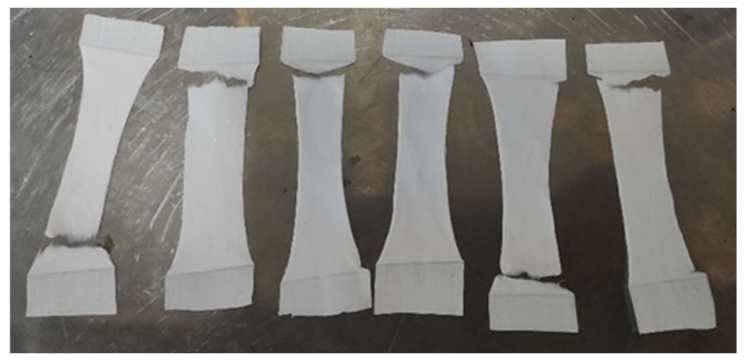
Figure 4 presents representative fracture morphologies of the PLA/ZnO (5% w/v) samples after tensile testing. Fracture at or near the clamped regions may be associated with stress concentration near the grip region during tensile testing of ultrathin electrospun fibrous mats. This effect can be more pronounced in porous electrospun structures, where localized stress at the grip interface may contribute to edge failure during testing [25]. The images reveal pronounced fracture regions and limited overall deformation, indicating a more brittle mechanical response. These observations are consistent with the reduced mechanical performance obtained from the tensile measurements. The reduction in mechanical performance after ZnO incorporation is consistent with the SEM results, which showed thinner fibers and possible structural heterogeneity, and with the DSC results, which indicated increased chain mobility through the reduction in Tg. Overall, the qualitative assessment of the fracture behavior corroborates the trends observed in the quantitative mechanical analysis of the PLA/ZnO samples.

3.3. Release Behavior and Durability of Electrospun PLA/ZnO

3.3.1. ZnO Retention Under Simulated Perspiration Conditions

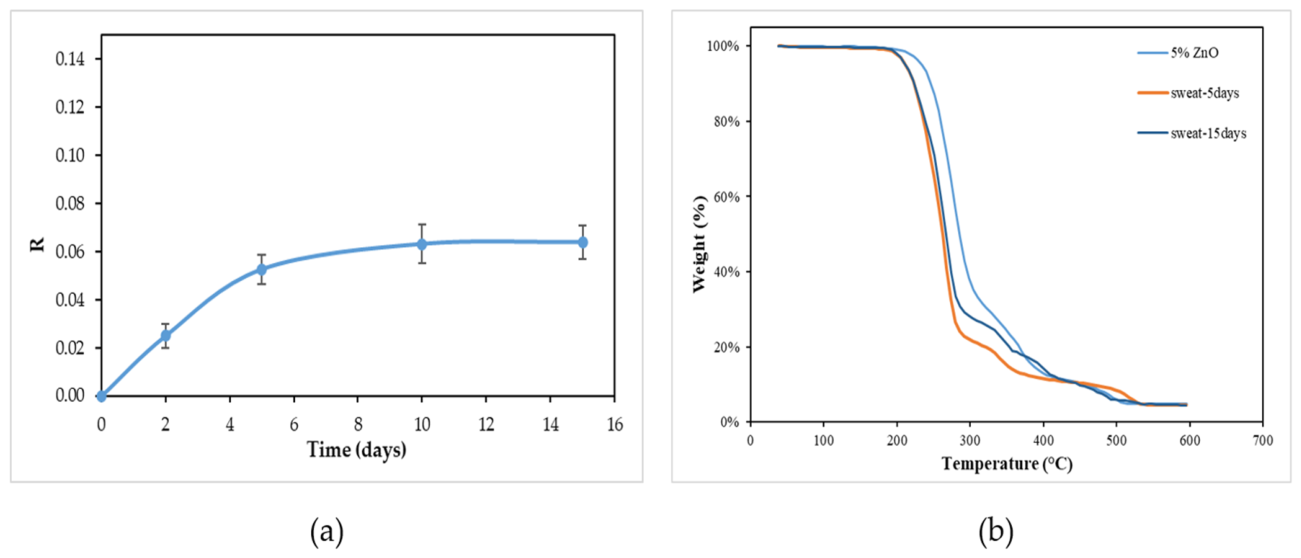
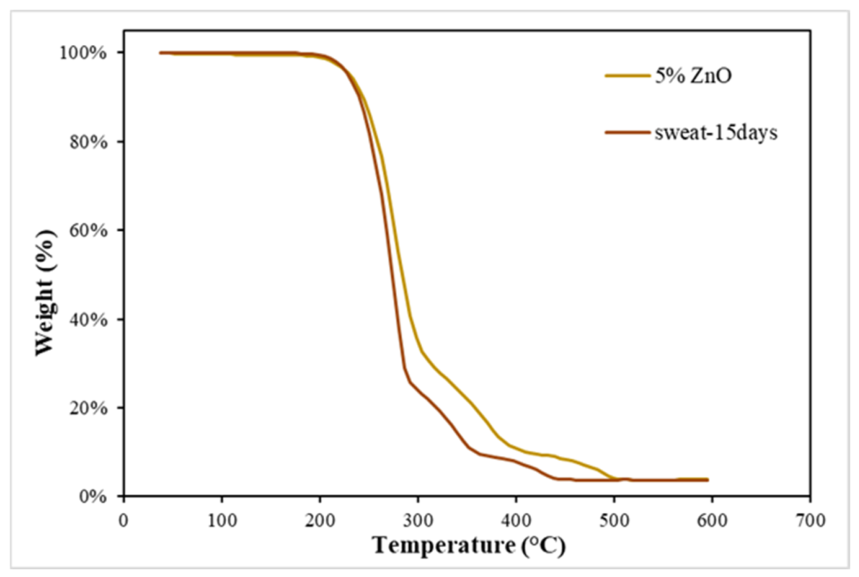
As shown in Figure 5, the sweat simulation results for the electrospun PLA/ZnO coatings indicate strong retention of the inorganic antimicrobial agent within the polymer matrix under sweat-simulation conditions. The release reached a maximum of approximately 0.064, indicating limited ZnO release over the tested period. The release profile is characterized by an initial increase over the first 5 days, followed by a plateau, indicating a typical burst release of ZnO particles near the fiber surface, with minimal further release. This behavior suggests that ZnO particles are effectively retained within the PLA fibers, with only slow diffusion occurring from the fiber interior.
The corresponding TGA thermograms show that the thermal degradation profiles of the coatings remain largely unchanged after sweat exposure, with the main degradation steps occurring within similar temperature ranges. The minimal changes in residual mass further confirm the limited loss of ZnO during the simulation.
These findings indicate strong ZnO retention in PLA/ZnO coatings under sweat-simulation conditions, highlighting their suitability for textile applications requiring prolonged skin contact.

3.3.2. ZnO Release Under Simulated Washing Conditions

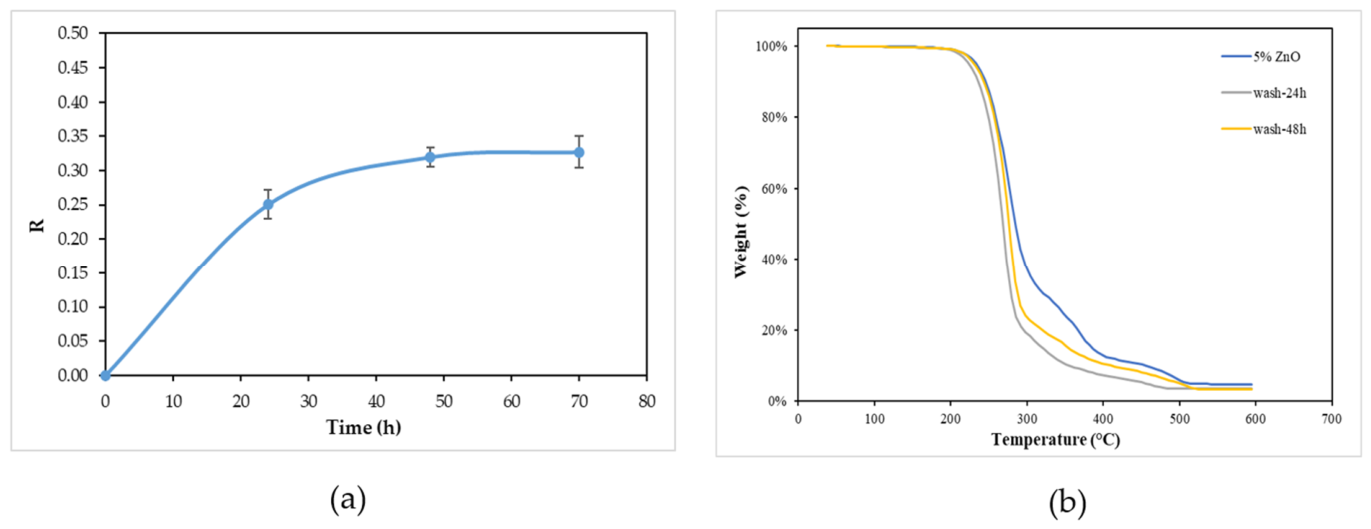
The washing simulation results in Figure 6 show that the release of the active agent reached approximately 0.32, indicating that although washing is an aggressive treatment, a fraction of ZnO particles remains retained within the PLA matrix after prolonged exposure to washing. The higher release observed compared to the sweat simulation can be attributed to the presence of surfactants in the detergent and the combined effect of agitation and elevated temperature [29,30]. The release profile exhibits an initial rapid increase, corresponding to a burst release of ZnO particles located near or at the fiber surface, followed by a slower stage governed by diffusion from the fiber interior. After approximately 50 h, the release tends to level off, suggesting stabilization of the remaining encapsulated fraction.
The corresponding TGA thermograms further support these findings, as more pronounced changes in residual mass are observed compared to sweat-treated samples, confirming the greater extent of ZnO removal during washing.

3.3.3. Kinetic Modeling of ZnO Release

The release data obtained for the electrospun PLA/ZnO coatings under sweat and washing simulation conditions were fitted using first-order, Higuchi, and Korsmeyer–Peppas kinetic models to better elucidate the release mechanism of ZnO from the fibrous matrix. The corresponding kinetic parameters and coefficients of determination (R2) are presented in Table 4.
For the PLA/ZnO coatings under sweat-simulation conditions, the Korsmeyer–Peppas model exhibited the highest coefficient of determination (R2 = 0.992), while the Higuchi model also showed excellent agreement with the experimental data (R2 = 0.988). The Peppas exponent value of n = 0.503 indicates diffusion-dominated anomalous transport, close to the transition between Fickian diffusion and anomalous release. This suggests that ZnO release under sweat exposure is mainly governed by diffusion from the PLA fibrous matrix, with a limited contribution from polymer relaxation or matrix-related effects. This interpretation is consistent with the low cumulative release and gradual plateau observed during sweat simulation.
Under washing conditions, the release profiles of the PLA/ZnO coatings were also well described by the Higuchi (R2 = 0.992) and Korsmeyer–Peppas (R2 = 0.997) models. The lower Peppas exponent, n = 0.312, indicates a stronger Fickian diffusion contribution. In this case, the release mechanism likely consists of an initial burst release of ZnO particles located near or at the fiber surface, followed by slower diffusion-controlled release from the fiber interior. The more pronounced release under washing conditions can be attributed to the combined effects of surfactant exposure, elevated temperature, and agitation, which facilitate the removal of surface-accessible ZnO and enhance mass transfer from the fibrous matrix.

3.4. Performance of Bonded Antimicrobial Textiles

3.4.1. Bonding of ZnO Antimicrobial Coatings onto Textiles

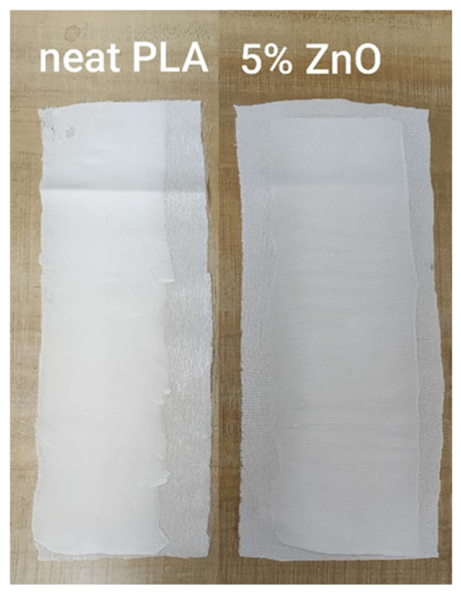
The antimicrobial coatings were successfully bonded onto textiles via hot pressing. As shown in Figure 7, the neat PLA-coated sample exhibits continuous uniform coverage across the textile surface. Similarly, the PLA/ZnO (5% w/v) sample maintains a continuous coating, with slight variations in surface texture, likely due to the presence of inorganic particles. Overall, the observations confirm that the bonding process was effective for all coatings, resulting in continuous coating coverage after bonding and uniform coverage of the substrate.
Thermogravimetric analysis (TGA) showed that the 5% w/v PLA/ZnO bonded coatings exhibited a particularly high encapsulation efficiency of 74%. This indicates that a substantial fraction of ZnO remained retained within the electrospun polymer matrix after bonding.
The bonded textile samples were evaluated for macroscopic coating continuity, ZnO retention after bonding, release behavior under simulated sweat and wash conditions, and antimicrobial performance. Further textile-level characterization, such as surface morphology after bonding, coating thickness, adhesion strength, air permeability, flexibility, and abrasion resistance, would be valuable in future studies to more fully assess end-use performance.

3.4.2. Sweat and Washing Simulation of Bonded Antimicrobial Coatings

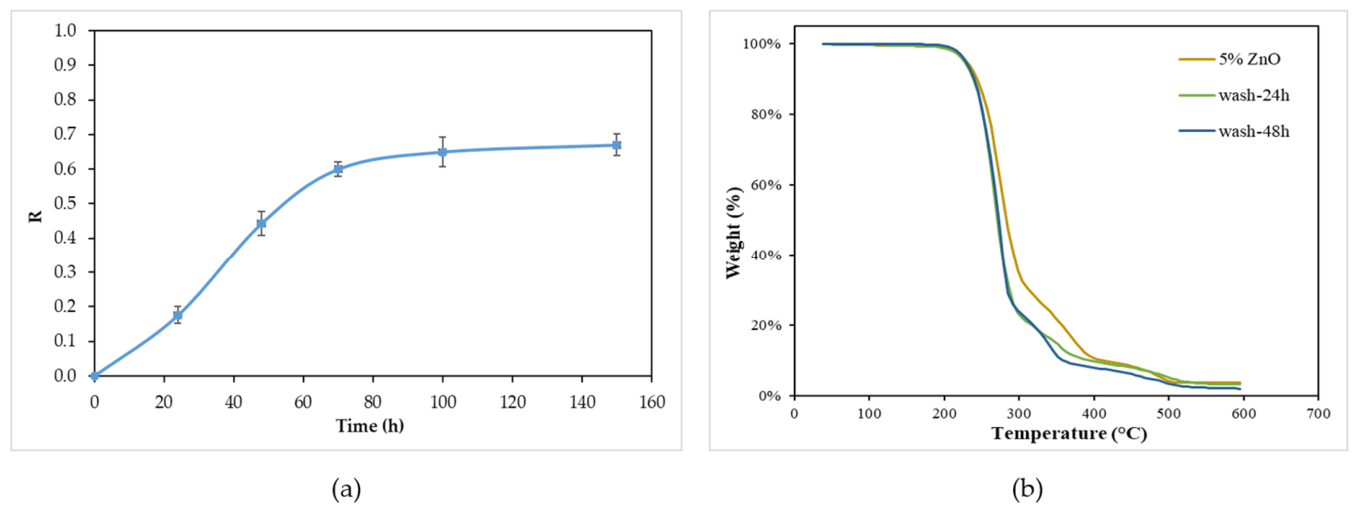
As shown in Figure 8, the washing simulation of the bonded PLA/ZnO coatings reveals a progressive, yet relatively pronounced, release of the inorganic content. The release profile follows the trend observed in the previously presented case, consisting of an initial burst release attributed to the removal of ZnO particles near the fiber surface. This is followed by a slower, diffusion-controlled stage corresponding to the gradual release of particles embedded within the fiber interior. After approximately 80 h, the release reaches a plateau at around 0.67, indicating that, despite the pronounced ZnO loss, a fraction of the antimicrobial agent remains entrapped within the polymer matrix.
Compared to the non-bonded coatings, the overall ZnO loss during washing is slightly higher for the bonded samples. This behavior suggests that the thermal bonding process and the presence of the adhesive layer do not significantly enhance ZnO retention and may induce minor alterations in the fibrous microstructure. This can, to a limited extent, facilitate the removal of inorganic content during washing. These results indicate that washing represents a significantly more aggressive exposure condition than sweat simulation for the developed coatings. Nevertheless, in both cases, partial ZnO retention was still observed after exposure to washing, indicating moderate stability of the coatings under the investigated washing conditions. In contrast, the sweat simulation results (Table 5) for the bonded PLA/ZnO coatings show a markedly limited release of the inorganic phase, with the R value remaining at 0.014 after 15 days. A similar behavior is observed for the non-bonded coatings, with comparable encapsulation efficiency under the same conditions. These findings indicate that the thermal bonding process does not significantly affect the controlled-release mechanism of ZnO under sweat exposure, thereby preserving the system’s stability and antimicrobial functionality after incorporation into textile substrates.
The corresponding TGA thermograms of the bonded coatings (Figure 8 and Figure 9) exhibit degradation profiles like those of the free-standing coatings, with the main mass loss occurring in the temperature range of PLA decomposition (approximately 250–350 °C) and a residual mass at higher temperatures associated with the inorganic ZnO content. The residual weight percentages confirm the gradual removal of ZnO during washing, whereas only minor changes are observed after sweat exposure, indicating that sweat is a milder condition than washing.
The results demonstrate that, despite partial ZnO loss, a significant fraction of the antimicrobial compound remains embedded within the PLA matrix after bonding, supporting partial ZnO retention and moderate stability under the investigated washing conditions.
The durability discussed here refers to the functional retention and release behavior of ZnO from the PLA/ZnO coating after bonding onto the PA11 textile substrate. Under sweat simulation, ZnO release remained limited. In contrast, washing resulted in a more pronounced loss of ZnO, indicating that the coating is more stable under perspiration exposure than under prolonged washing.
The present durability assessment focused on liquid-exposure conditions, namely simulated sweat and washing, which directly affect ZnO leaching and retention within the PLA matrix. Mechanical wear and abrasion resistance were not evaluated in this study, although they are important for practical textile applications. Future work should therefore include standardized abrasion or wear testing to assess further the long-term durability of the developed antimicrobial coatings under realistic use conditions.

3.4.3. Kinetic Modeling of ZnO Release from Bonded Textiles

The release behavior of ZnO from the bonded antimicrobial textiles was further evaluated using first-order, Higuchi, and Korsmeyer–Peppas kinetic models. The calculated kinetic parameters and fitting coefficients are also presented in Table 4. For the ZnO-coated textiles under washing-simulation conditions, the Higuchi model provided a satisfactory fit to the experimental data (R2 = 0.989), indicating that diffusion remained an important release mechanism after bonding to the textile substrate. However, the higher Korsmeyer–Peppas exponent, n = 0.742, suggests anomalous transport rather than purely Fickian diffusion. This indicates that ZnO release from the bonded coatings may involve both diffusion through the PLA fibrous matrix and matrix-related relaxation or structural effects. These effects may be associated with the thermal bonding process and the presence of the adhesive interlayer, which can modify the coating structure and influence ZnO mobility during exposure to washing.
In contrast, the sweat simulation of the bonded ZnO-coated textiles resulted in extremely limited ZnO release. Consequently, only the apparent first-order and Higuchi constants could be estimated from the limited experimental dataset, whereas reliable fitting to the Korsmeyer–Peppas model was not feasible. The very low release observed under perspiration-related conditions further supports the strong retention of ZnO within the bonded electrospun coatings during sweat exposure.

3.4.4. Antimicrobial Activity

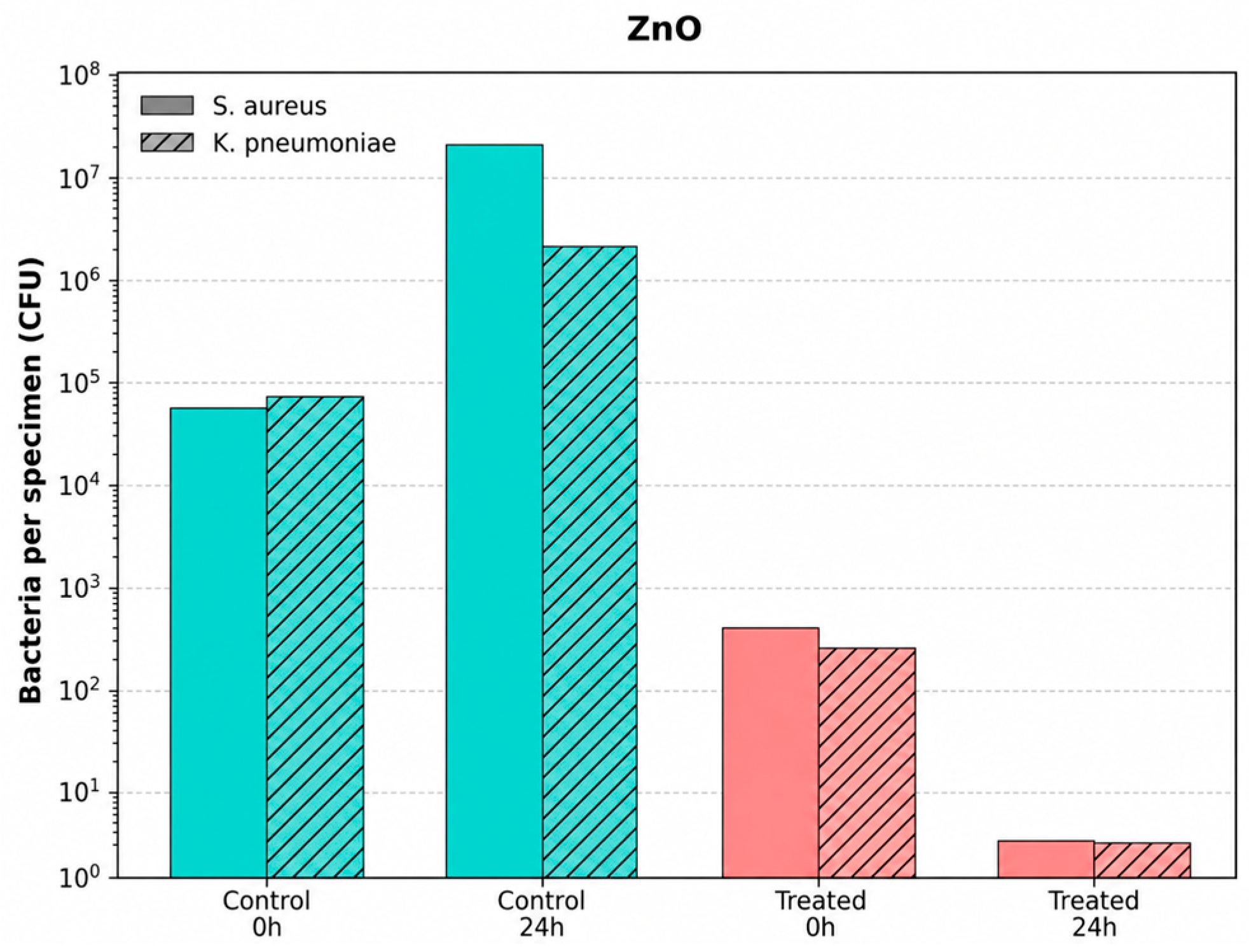
The antimicrobial performance of the electrospun PLA/ZnO coatings was evaluated against Staphylococcus aureus and Klebsiella pneumoniae in accordance with ISO 20743:2021. All experiments met standard validity criteria, as evidenced by sufficient bacterial growth in the control samples (F ≥ 1.0), indicating the absence of intrinsic antimicrobial activity in neat PLA coatings. As shown in Table 6 and Figure 10, incorporating ZnO (5% w/v) into electrospun PLA fibers resulted in pronounced antibacterial activity against both tested microorganisms. Specifically, activity values of 4.71 for S. aureus and 3.37 for K. pneumoniae were obtained, corresponding to strong antimicrobial efficacy (A ≥ 3) and demonstrating broad-spectrum performance. The results further reveal a higher susceptibility of the Gram-positive strain, as reflected by the greater activity observed for S. aureus compared to K. pneumoniae.
The differential antimicrobial activity observed between the two bacterial species can be attributed to fundamental differences in cell wall architecture. S. aureus, as a Gram-positive bacterium, possesses a thick peptidoglycan layer (20–80 nm) with no outer membrane barrier, allowing Zn2+ ions and reactive oxygen species (ROS) direct access to the cell wall and cytoplasmic membrane. In contrast, K. pneumoniae presents multiple protective barriers: a thin peptidoglycan layer (2–3 nm), an outer membrane containing lipopolysaccharides that restricts ion penetration, and a thick polysaccharide capsule that further impedes contact with antimicrobial agents.
Despite these inherent resistance mechanisms, the PLA/ZnO coatings achieved strong antimicrobial efficacy (A ≥ 3) against both strains, demonstrating broad-spectrum activity. This performance can be attributed to the effective incorporation and sustained release of ZnO from the electrospun PLA matrix, which maintains prolonged bacterial contact with the active agent. The higher activity against S. aureus (A = 4.71) compared to K. pneumoniae (A = 3.37) reflects the greater intrinsic susceptibility of Gram-positive bacteria to ZnO-mediated antimicrobial mechanisms, consistent with previous studies on metal oxide nanoparticles [31,32].
Since neat PLA-coated PA11 did not show intrinsic antimicrobial activity, the antibacterial effect of the PLA/ZnO-coated textiles can be attributed mainly to the presence of ZnO within the electrospun coating. This activity is associated with Zn2+ release, reactive oxygen species generation, and interactions with bacterial cell membranes.

4. Conclusions

Electrospun PLA fibers incorporating ZnO particles were successfully developed as functional antimicrobial coatings for textile applications. The incorporation of ZnO significantly affected the physicochemical properties of the electrospinning solutions by reducing viscosity and increasing electrical conductivity, resulting in thinner and more homogeneous fibers with effective particle incorporation. SEM analysis showed the formation of uniform fibrous structures, while TGA supported high encapsulation efficiency and effective retention of ZnO within the PLA matrix.
The developed systems exhibited controlled ZnO release behavior under simulated perspiration and washing conditions. Sweat exposure resulted in limited ZnO release, indicating relatively stable ZnO retention under conditions representative of skin contact, whereas washing promoted more pronounced release due to the combined effects of surfactants, agitation, and elevated temperature. Kinetic modeling using first-order, Higuchi, and Korsmeyer–Peppas models demonstrated that ZnO release was predominantly diffusion-controlled, with the Higuchi and Korsmeyer–Peppas models providing the best fit to the experimental data. The kinetic analysis further indicated that the release mechanism was influenced by both the exposure medium and the incorporation of the electrospun coatings onto textile substrates.
Following thermal bonding onto PA11 fabrics, the electrospun coatings achieved successful macroscopic integration with the textile substrate while preserving antimicrobial functionality. Although the bonded systems exhibited higher ZnO release under washing conditions than the free-standing coatings, partial retention of the antimicrobial agent within the polymer matrix was still observed after prolonged exposure to washing. In contrast, only minimal ZnO release occurred under sweat-simulation conditions, demonstrating the relative stability of the bonded coatings during exposure to perspiration.
The antimicrobial assessment confirmed that the PLA/ZnO coatings exhibited strong, broad-spectrum antibacterial activity against Staphylococcus aureus and Klebsiella pneumoniae, highlighting the effectiveness of ZnO incorporation into the electrospun PLA fibers. Overall, the results demonstrate that electrospinning combined with ZnO incorporation and subsequent textile lamination represents a promising strategy for developing antimicrobial textile coatings with controlled-release behavior and potential applications in wearable, hygienic, and protective textiles. Future work should include standardized wear, abrasion, and textile-performance testing to further evaluate the long-term durability and end-use applicability of the developed antimicrobial coatings under realistic use conditions.

Author Contributions

Conceptualization, M.K. and C.D.; methodology, C.D., A.P., S.E.K., C.S., I.R.A., P.F., L.P. and P.M.; validation, C.D., A.P. and C.S.; formal analysis, C.D., A.P., C.S., S.E.K., I.R.A., P.F., L.P. and P.M.; investigation, A.P., S.E.K., C.S., I.R.A., P.F., L.P. and P.M.; data curation, A.P., C.D. and C.S.; writing—original draft preparation, A.P. and C.D.; writing—review and editing, M.K., C.D., C.S., A.P., S.E.K., I.R.A., P.F., L.P. and P.M.; visualization, A.P. and C.D.; supervision, M.K. and C.D.; project administration, M.K.; funding acquisition, M.K. All authors have read and agreed to the published version of the manuscript.

Funding

This work was supported by the European Union’s Horizon Europe research and innovation programme under grant agreement No. 101092347, Convert2Green.

Institutional Review Board Statement

Not applicable.

Informed Consent Statement

Not applicable.

Data Availability Statement

The data supporting the findings of this study are included within the manuscript.

Acknowledgments

The authors would like to thank Katerina Mikedi for her assistance with the thermogravimetric analysis (TGA) measurements.

Conflicts of Interest

The authors declare no conflicts of interest.

References

  1. Morais, D.; Guedes, R.; Lopes, M. Antimicrobial Approaches for Textiles: From Research to Market. Materials 2016, 9, 498. [Google Scholar] [CrossRef] [Scilit]
  2. Drosou, C.; Krokida, M.; Biliaderis, C.G. Composite pullulan-whey protein nanofibers made by electrospinning: Impact of process parameters on fiber morphology and physical properties. Food Hydrocoll. 2018, 77, 726–735. [Google Scholar] [CrossRef] [Scilit]
  3. Cho, Y.; Baek, J.W.; Sagong, M.; Ahn, S.; Nam, J.S.; Kim, I. Electrospinning and Nanofiber Technology: Fundamentals, Innovations, and Applications. Adv. Mater. 2025, 37, 2500162. [Google Scholar] [CrossRef] [Scilit] [PubMed]
  4. Nikmaram, N.; Roohinejad, S.; Hashemi, S.; Koubaa, M.; Barba, F.J.; Abbaspourrad, A.; Greiner, R. Emulsion-based systems for fabrication of electrospun nanofibers: Food, pharmaceutical and biomedical applications. RSC Adv. 2017, 7, 28951–28964. [Google Scholar] [CrossRef] [Scilit]
  5. Ahmadi Bonakdar, M.; Rodrigue, D. Electrospinning: Processes, Structures, and Materials. Macromol 2024, 4, 58–103. [Google Scholar] [CrossRef] [Scilit]
  6. Maliszewska, I.; Czapka, T. Electrospun Polymer Nanofibers with Antimicrobial Activity. Polymers 2022, 14, 1661. [Google Scholar] [CrossRef] [Scilit]
  7. Zabot, G.L.; Schaefer Rodrigues, F.; Polano Ody, L.; Vinícius Tres, M.; Herrera, E.; Palacin, H.; Córdova-Ramos, J.S.; Best, I.; Olivera-Montenegro, L. Encapsulation of Bioactive Compounds for Food and Agricultural Applications. Polymers 2022, 14, 4194. [Google Scholar] [CrossRef] [Scilit]
  8. Kielholz, T.; Rohde, F.; Jung, N.; Windbergs, M. Bacteriophage-loaded functional nanofibers for treatment of P. aeruginosa and S. aureus wound infections. Sci. Rep. 2023, 13, 8330. [Google Scholar] [CrossRef] [Scilit]
  9. Akpo, E.; Colin, C.; Perrin, A.; Cambedouzou, J.; Cornu, D. Encapsulation of Active Substances in Natural Polymer Coatings. Materials 2024, 17, 2774. [Google Scholar] [CrossRef] [Scilit]
  10. Drosou, C.; Krokida, M.; Biliaderis, C.G. Encapsulation of β-carotene into food-grade nanofibers via coaxial electrospinning of hydrocolloids: Enhancement of oxidative stability and photoprotection. Food Hydrocoll. 2022, 133, 107949. [Google Scholar] [CrossRef] [Scilit]
  11. Giedraitienė, A.; Ružauskas, M.; Šiugždinienė, R.; Tučkutė, S.; Grigonis, K.; Milčius, D. ZnO Nanoparticles Enhance the Antimicrobial Properties of Two-Sided-Coated Cotton Textile. Nanomaterials 2024, 14, 1264. [Google Scholar] [CrossRef] [Scilit]
  12. Shekhar, N.; Mondal, A. Synthesis, properties, environmental degradation, processing, and applications of Polylactic Acid (PLA): An overview. Polym. Bull. 2024, 81, 11421–11457. [Google Scholar] [CrossRef] [Scilit]
  13. Lu, W.; Jiang, K.; Chu, Z.; Yuan, M.; Tang, Z.; Qin, Y. Changes of thermal properties and microstructure of nano-ZnO/polylactic acid composite films during Zn migration. Packag. Technol. Sci. 2021, 34, 3–10. [Google Scholar] [CrossRef] [Scilit]
  14. El Kalaaoui, K.; Bili, O.; Boukhriss, A.; Jamoudi Sbai, S.; El Messoudi, M.; Ait Chaoui, M.; Majid, S.; El Hajaji, M.; Gmouh, S. Development of antibacterial and hydrophobic PVDF@ZnO coating on cotton fabrics by electrospinning method. Results Surf. Interfaces 2024, 16, 100273. [Google Scholar] [CrossRef] [Scilit]
  15. Gulati, R.; Sharma, S.; Sharma, R.K. Antimicrobial textile: Recent developments and functional perspective. Polym. Bull. 2022, 79, 5747–5771. [Google Scholar] [CrossRef] [Scilit]
  16. Naebe, M.; Haque, A.N.M.A.; Haji, A. Plasma-Assisted Antimicrobial Finishing of Textiles: A Review. Engineering 2022, 12, 145–163. [Google Scholar] [CrossRef] [Scilit]
  17. Bhandari, V.; Jose, S.; Badanayak, P.; Sankaran, A.; Anandan, V. Antimicrobial Finishing of Metals, Metal Oxides, and Metal Composites on Textiles: A Systematic Review. Ind. Eng. Chem. Res. 2022, 61, 86–101. [Google Scholar] [CrossRef] [Scilit]
  18. Luraghi, A.; Peri, F.; Moroni, L. Electrospinning for drug delivery applications: A review. J. Control. Release 2021, 334, 463–484. [Google Scholar] [CrossRef] [Scilit]
  19. ASTM D882-18; Standard Test Method for Tensile Properties of Thin Plastic Sheeting. ASTM: West Conshohocken, PA, USA, 2026.
  20. ISO 20743:2021; Textiles—Determination of Antibacterial Activity of Textile Products. ISO: Geneva, Switzerland, 2021.
  21. Voorhis, C.; González-Benito, J.; Kramar, A. “Nano in Nano”—Incorporation of ZnO Nanoparticles into Cellulose Acetate–Poly(Ethylene Oxide) Composite Nanofibers Using Solution Blow Spinning. Polymers 2024, 16, 341. [Google Scholar] [CrossRef] [Scilit] [PubMed]
  22. Ojur Dennis, J.; Ali, M.K.M.; Ibnaouf, K.H.; Aldaghri, O.; Abdel All, N.F.M.; Adam, A.A.; Usman, F.; Hassan, Y.M.; Abdulkadir, B.A. Effect of ZnO Nanofiller on Structural and Electrochemical Performance Improvement of Solid Polymer Electrolytes Based on Polyvinyl Alcohol–Cellulose Acetate–Potassium Carbonate Composites. Molecules 2022, 27, 5528. [Google Scholar] [CrossRef] [Scilit]
  23. Cherubini, F.; Riberti, N.; Schiavone, A.M.; Davì, F.; Furlani, M.; Giuliani, A.; Barucca, G.; Cassani, M.C.; Rinaldi, D.; Montalto, L. Production of Composite Zinc Oxide–Polylactic Acid Radiopaque Filaments for Fused Deposition Modeling: First Stage of a Feasibility Study. Materials 2024, 17, 2892. [Google Scholar] [CrossRef] [Scilit] [PubMed]
  24. Al Saif, Y.; Cselkó, R. Revolutionizing Electrospinning: A Review of Alternating Current and Pulsed Voltage Techniques for Nanofiber Production. Processes 2025, 13, 2048. [Google Scholar] [CrossRef] [Scilit]
  25. Salaris, V.; San Félix García-Obregón, I.; López, D.; Peponi, L. Fabrication of PLA-Based Electrospun Nanofibers Reinforced with ZnO Nanoparticles and In Vitro Degradation Study. Nanomaterials 2023, 13, 2236. [Google Scholar] [CrossRef] [Scilit]
  26. Echeverría, C.; Limón, I.; Muñoz-Bonilla, A.; Fernández-García, M.; López, D. Development of Highly Crystalline Polylactic Acid with β-Crystalline Phase from the Induced Alignment of Electrospun Fibers. Polymers 2021, 13, 2860. [Google Scholar] [CrossRef] [Scilit]
  27. Ghozali, M.; Triwulandari, E.; Meliana, Y.; Fahmiati, S.; Fatriasari, W.; Laksana, R.P.B.; Masruchin, N.; Suryanegara, L. Thermal properties of polylactic acid/zinc oxide biocomposite films. AIP Conf. Proc. 2018, 2024, 020032. [Google Scholar] [CrossRef] [Scilit]
  28. Boro, U.; Kashyap, N.; Moholkar, V.S. Sonochemical Synthesis of Poly(lactic acid) Nanocomposites with ZnO Nanoflowers: Effect of Nanofiller Morphology on Physical Properties. ACS Eng. Au 2022, 2, 46–60. [Google Scholar] [CrossRef] [Scilit]
  29. Laha, S.; Tansel, B.; Ussawarujikulchai, A. Surfactant–soil interactions during surfactant-amended remediation of contaminated soils by hydrophobic organic compounds: A review. J. Environ. Manag. 2009, 90, 95–100. [Google Scholar] [CrossRef] [Scilit]
  30. Lichtenberg, D.; Robson, R.J.; Dennis, E.A. Solubilization of phospholipids by detergents structural and kinetic aspects. Biochim. Et Biophys. Acta (BBA)-Rev. Biomembr. 1983, 737, 285–304. [Google Scholar] [CrossRef] [Scilit]
  31. Preda, M.D.; Popa, M.L.; Neacșu, I.A.; Grumezescu, A.M.; Ginghină, O. Antimicrobial Clothing Based on Electrospun Fibers with ZnO Nanoparticles. Int. J. Mol. Sci. 2023, 24, 1629. [Google Scholar] [CrossRef] [Scilit]
  32. Su, X.; Zhai, Y.; Jia, C.; Xu, Z.; Luo, D.; Pan, Z.; Xiang, H.; Yu, S.; Zhu, L.; Zhu, M. Improved Antibacterial Properties of Polylactic Acid-Based Nanofibers Loaded with ZnO–Ag Nanoparticles through Pore Engineering. ACS Appl. Mater. Interfaces 2023, 15, 42920–42929. [Google Scholar] [CrossRef] [Scilit]
Figure 1. Apparent viscosity of PLA and PLA/ZnO solutions as a function of rotational speed.
Coatings 16 00672 g001
Figure 2. SEM images of electrospun PLA fibers: (ac) neat PLA at magnifications of ×500, ×1000, and ×1500, respectively; (df) PLA/ZnO (5% w/v) at magnifications of ×500, ×1000, and ×1500, respectively. Process conditions: 10 mL/h feed rate, 22 kV total applied potential difference (+11/−11 kV), and 13 cm needle-to-collector distance. Scale bar: 10 μm.
Coatings 16 00672 g002
Figure 3. DSC thermograms of the first heating cycle of PLA pellet, neat PLA film, and PLA/ZnO 5% (w/v) electrospun fibers. The characteristic endothermic peaks associated with enthalpic relaxation and the exothermic peak corresponding to cold crystallization are indicated.
Coatings 16 00672 g003
Figure 4. Representative PLA/ZnO 5% (w/v) samples after tensile testing.
Coatings 16 00672 g004
Figure 5. (a) Release profile for PLA/ZnO coatings under sweat simulation conditions; (b) representative TGA thermograms of PLA/ZnO coatings before and after sweat exposure (5 and 15 days), illustrating the effect of simulated perspiration on thermal degradation behavior and residual ZnO content.
Coatings 16 00672 g005
Figure 6. (a) Release profile for PLA/ZnO coatings under washing simulation conditions; (b) representative TGA thermograms of PLA/ZnO coatings before and after washing treatment (24 and 48 h), illustrating the effect of washing exposure on thermal degradation behavior and residual ZnO content.
Coatings 16 00672 g006
Figure 7. Textile samples with bonded antimicrobial coatings, neat PLA, and 5% (w/v) ZnO.
Coatings 16 00672 g007
Figure 8. (a) Release profile for ZnO-coated fabrics under washing simulation conditions; (b) representative TGA thermograms of ZnO-coated fabrics before and after washing treatment (24 and 48 h), illustrating the effect of washing on the thermal stability and residual mass of the bonded coatings.
Coatings 16 00672 g008
Figure 9. Indicative TGA thermograms of sweat simulation of bonded ZnO coatings on textiles.
Coatings 16 00672 g009
Figure 10. Antimicrobial activity of PLA-coated PA11 textiles against S. aureus and K. pneumoniae. Bacterial counts are expressed as CFU per specimen at 0 h and 24 h for control and PLA/ZnO-treated samples. Values represent the mean of three replicates.
Coatings 16 00672 g010
Table 1. Viscosity values at different speeds and conductivities.
Viscosity (mPa·s)Speed (rpm)Conductivity (μS/cm)
Solution100150200250
PLA178.3 ± 1.7 a188.6 ± 1.9 a192.5 ± 1.9 a193.7 ± 1.9 a16.72 ± 0.25 a
5% w/v ZnO165.3 ± 1.7 b166.6 ± 1.7 b170.8 ± 1.7 b177.7 ± 1.8 b58.20 ± 0.98 b
Values with different letters within the same column differ significantly, p < 0.05.
Table 2. Values of glass transition temperature.
SampleTg (°C)
PLA pellet49.09 ± 2.07 a
PLA film48.46 ± 1.55 a
5% w/v ZnO36.19 ± 1.34 b
Values with different letters differ significantly, p < 0.05.
Table 3. Values of the mechanical properties of ZnO coatings.
SampleEt (MPa)εB (%)σM (MPa)F (Ν)
PLA68.70 ± 4.28 a46.05 ± 10.14 a1.89 ± 0.16 a8.18 ± 0.94 a
PLA/ZnO 5% w/v46.70 ± 10.32 b30.09 ± 4.46 b1.04 ± 0.16 b4.18 ± 0.40 b
Values with different letters within the same column differ significantly, p < 0.05.
Table 4. Kinetic parameters of ZnO release from PLA/ZnO coatings and ZnO-coated textiles under washing and sweat simulations.
SampleFirst-Order (k1)Higuchi (kH)Peppas (k)Peppas (n)
PLA/ZnO coating—sweat0.0044 ± 0.0003
(0.954)
0.0171 ± 0.0011
(0.988)
0.0168 ± 0.0013
(0.992)
0.503 ± 0.021
PLA/ZnO coating—washing0.0058 ± 0.0004
(0.973)
0.0416 ± 0.0024
(0.992)
0.094 ± 0.006
(0.997)
0.312 ± 0.018
ZnO-coated textile—washing0.0079 ± 0.0005
(0.981)
0.0578 ± 0.0031
(0.989)
0.021 ± 0.002
(0.964)
0.742 ± 0.034
ZnO-coated textile—sweat0.00094 ± 0.00007 (1.000) *0.00361 ± 0.00026 (1.000) *n.f.n.f.
Values are mean ± SD. Values in parentheses correspond to the coefficient of determination (R2). n.f.: not fitted due to insufficient experimental points. * Apparent constants calculated from limited experimental points. Time was expressed in days for sweat simulations and hours for washing simulations; therefore, kinetic constants should be compared only within the same exposure condition.
Table 5. Weight residue, encapsulation efficiency, and release of ZnO antimicrobial bonded coatings after sweat simulation.
Time (Days)Weight Residue %Encapsulation Efficiency %Release
03.77740.000
153.65730.014
Table 6. Antimicrobial activity and test validation parameters for PLA-coated PA11 textiles.
Coating MaterialBacterial StrainInoculum (CFU/mL)F ValueControl Log DiffTreated Log DiffActivity Value (A)ClassificationTest Validity
PLA + 5% ZnOS. aureus1.2 × 1052.58<1.01.304.71StrongValid
K. pneumoniae1.2 × 1051.39<1.01.303.37StrongValid
Disclaimer/Publisher’s Note: The statements, opinions and data contained in all publications are solely those of the individual author(s) and contributor(s) and not of MDPI and/or the editor(s). MDPI and/or the editor(s) disclaim responsibility for any injury to people or property resulting from any ideas, methods, instructions or products referred to in the content.