Article

Synergistic PEDOT:PSS/Fe-Mn Oxide Functional Coating on PVDF Membrane for Enhanced Arsenate Removal: Surface Properties, Interfacial Adsorption Behavior, and Ligand Exchange Mechanism


Research Center for Eco-Environmental Engineering, Dongguan University of Technology, Dongguan 523808, China
*
Authors to whom correspondence should be addressed.
Coatings 2026, 16(6), 671; https://doi.org/10.3390/coatings16060671

Submission received: 3 May 2026 / Revised: 31 May 2026 / Accepted: 1 June 2026 / Published: 2 June 2026
(This article belongs to the Section Environmental Aspects in Colloid and Interface Science)

Abstract

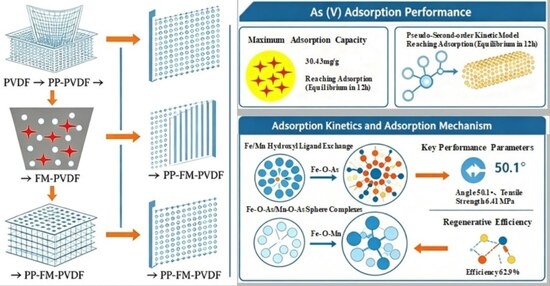
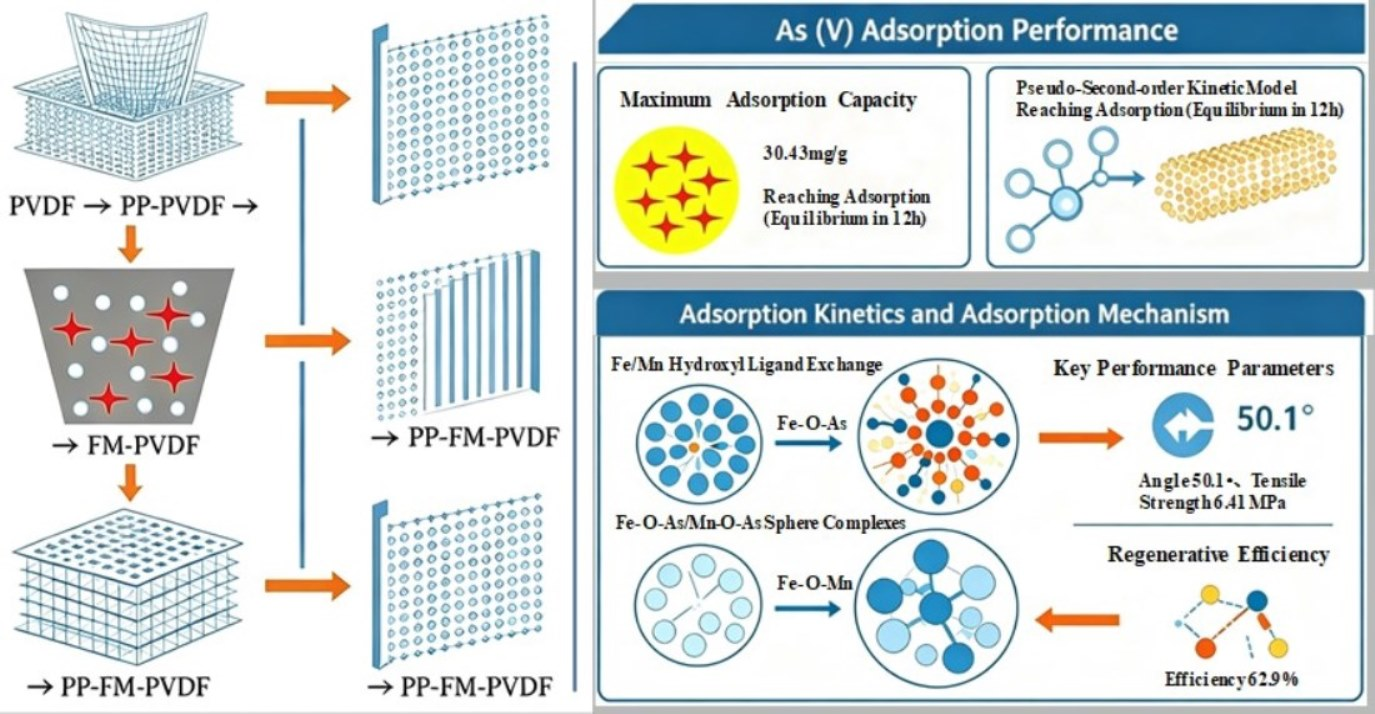
In this study, a functional surface coating composed of Fe-Mn binary oxide (FM) and poly(3,4-ethylenedioxythiophene):poly(styrenesulfonate) (PEDOT:PSS, PP) was applied to a PVDF membrane (PP-FM-PVDF) for efficient arsenate (As(V)) removal. PP acts as a dispersant and hydrophilic modifier, ensuring uniform FM distribution and reducing the water contact angle to 50.1°. The PP-FM-PVDF membrane achieves a maximum As(V) adsorption capacity of 30.43 mg/g, outperforming pristine and singly modified membranes. The batch adsorption data fit the Langmuir isotherm (R2 = 0.999) and pseudo-second-order kinetic model (R2 = 0.99), indicating monolayer chemisorption. The coating increases the specific surface area to 27.33 m2/g and the tensile strength to 6.41 MPa. Dynamic filtration shows that 2.70 L (2149.7 L/m2) of 100 μg/L As(V) solution can be treated before the permeate concentration exceeds the WHO guideline of 10 μg/L. After alkaline regeneration (pH 11), 62.9% of the initial capacity is retained. Complementary surface-sensitive analyses (zeta potential, XPS, and EXAFS) reveal that arsenate adsorption occurs primarily through ligand exchange between arsenate oxyanions and Fe/Mn surface hydroxyl groups on the coating, forming inner-sphere bidentate complexes (Fe–O–As and Mn–O–As), while electrostatic interactions play a secondary, pH-dependent role. This surface engineering strategy—synergistically integrating a conductive hydrophilic polymer with a metal oxide as a functional coating on PVDF—offers a reusable, high-performance platform for arsenate remediation, underscoring the critical role of interface design in environmental membrane applications.

Graphical Abstract

1. Introduction

Arsenic contamination in water resources poses a serious global environmental and public health threat due to its high toxicity and carcinogenicity. In aerobic aquatic environments such as surface water and oxygen-rich groundwater, arsenate (As(V)) is the predominant arsenic species. Chronic exposure to As(V), even at trace levels, can cause severe health issues, including skin lesions, cardiovascular diseases, and various cancers [1,2]. Consequently, the World Health Organization (WHO) has set a stringent guideline value of 10 μg/L for arsenic in drinking water, driving the development of efficient and cost-effective remediation technologies [3].
Among the various methods explored for As(V) removal, including coagulation–precipitation, ion exchange, and reverse osmosis [4,5,6,7], adsorption is widely recognized for its simplicity, low cost, and suitability for decentralized water treatment. However, conventional powdery adsorbents face practical challenges in post-separation and reusability [8,9]. Membrane filtration, particularly using polymeric membranes like polyvinylidene fluoride (PVDF), offers advantages such as ease of scaling, high separation efficiency, and continuous operation [10,11,12]. Nevertheless, neat PVDF membranes are inherently hydrophobic and lack specific binding sites for As(V), leading to low water permeability and poor contaminant rejection [13,14,15,16]. Therefore, engineering the membrane surface to simultaneously enhance hydrophilicity and introduce selective adsorption functionality remains a key research direction.
A promising strategy to address these limitations is the surface immobilization or bulk incorporation of functional inorganic nanomaterials into the polymer matrix, creating a reactive “adsorptive coating” or functional surface layer [17,18]. However, conventional coating approaches often suffer from poor nanoparticle dispersion and weak interfacial adhesion within hydrophobic polymer matrices, which significantly reduces coating effectiveness and active site accessibility. Iron–manganese binary oxide (FM) has attracted considerable attention due to its strong affinity for As(V) by surface hydroxyl groups [19,20]. Nevertheless, FM nanoparticles tend to aggregate within the hydrophobic PVDF matrix, reducing the effective surface area and undermining membrane performance [21,22]. In this context, the use of a hydrophilic polymeric dispersant is critical to achieve a uniform and stable functional coating. Conductive polymers such as poly(3,4-ethylenedioxythiophene):poly(styrenesulfonate) (PEDOT:PSS, PP) possess excellent hydrophilicity, good film-forming properties, and a remarkable ability to disperse nanoparticles, which can facilitate the homogeneous distribution of FM within the PVDF matrix and significantly improve membrane wettability [23,24]. Importantly, using PP as a dispersant eliminates the need for additional surfactant additives, thereby reducing chemical consumption and potential secondary pollution [25,26,27,28].
In this work, we present a surface engineering strategy to fabricate a novel adsorptive PVDF-based composite membrane by synergistically incorporating a functional coating composed of Fe-Mn binary oxide (FM) and PEDOT:PSS (PP) onto the PVDF substrate (denoted as PP-FM-PVDF). The core focus is on interfacial design: we systematically investigate how PP and FM synergistically tailor the surface properties of the PVDF membrane—including hydrophilicity, surface charge, topography, porosity, and mechanical stability—to construct an effective functional interface for As(V) capture. Unlike conventional bulk modification approaches, our coating strategy leverages PP as a dispersant to achieve uniform FM distribution and enhance surface wettability, while FM provides abundant surface hydroxyl groups for ligand exchange. The engineered membrane surface was comprehensively characterized for its physicochemical and topographical properties using SEM, AFM, FTIR, XPS, and contact angle measurements. Furthermore, we elucidate the surface-mediated adsorption mechanism through batch isotherms and kinetics, dynamic filtration performance, regenerability, and spectroscopic analyses (XPS and EXAFS) combined with zeta-potential measurements. Ultimately, this work highlights the critical role of surface/interface engineering in designing reusable membrane coatings for efficient arsenate remediation, offering insights that extend to the broader field of functional surfaces for environmental applications. Thus, this study integrates adsorption chemistry into a membrane filtration platform, where adsorption serves as the primary removal mechanism and filtration enables continuous-flow operation.

2. Materials and Methods

2.1. Reagents

All chemical reagents were obtained from commercial sources and used without further purification. The polyvinylidene fluoride (PVDF) membrane was supplied by Sigma-Aldrich (St. Louis, MO, USA). Xilong Chemical (Shantou, China) provided ammonium acetate and ethylene glycol. Key materials including poly(3,4-ethylenedioxythiophene), poly(styrenesulfonate) (PEDOT:PSS), N-methyl pyrrolidone (NMP), polyvinyl pyrrolidone (PVP), polyethylene glycol 4000 (PEG), ferrous sulfate heptahydrate (FeSO4·7H2O), potassium permanganate (KMnO4), and sodium arsenate dodecahydrate (Na3AsO4·12H2O) were purchased from Sinopharm Chemical Reagent (Shanghai, China). Deionized (DI) water was used for all solution preparations and washing steps.

2.2. Preparation of Adsorbent and Composite Membranes

2.2.1. Preparation of Fe-Mn Binary Oxide (FM)

The Fe-Mn binary oxide was prepared using a hydrothermal procedure adapted from earlier work [29]. In a typical synthesis, 4.17 g of FeSO4·7H2O, 0.79 g of KMnO4, 1.5 g of ammonium acetate, and 0.15 g of PVP were dissolved in 55 mL of ethylene glycol under stirring. After complete dissolution, 1.0 g of PEG was added, and the mixture was subjected to ultrasonication for 1 h followed by magnetic stirring to ensure homogeneity. The resulting solution was then transferred into a 100 mL stainless steel autoclave and heated at 160 °C for 22 h in an oven. After the hydrothermal reaction, the autoclave was cooled naturally to ambient temperature. The solid product was collected by vacuum filtration, washed several times with ethanol and DI water, and finally dried at 60 °C for 12 h. The dried material was ground into a fine powder and designated as FM.

2.2.2. Fabrication of Composite Membranes

Membrane fabrication was carried out using a phase inversion method. First, PEG was dissolved in NMP solvent under ultrasonication at 50 °C for 1 h. Subsequently, PVDF powder was added to the solution together with different additives according to the formulations listed in Table 1: PP alone for PP-PVDF, FM alone for FM-PVDF, or both PP and FM for PP-FM-PVDF. The mixture was stirred vigorously at 60 °C for 12 h to form a homogeneous casting solution. After vacuum degassing to remove trapped air bubbles, the solution was spread onto a clean glass plate using a doctor blade set at a thickness of 200 μm and a casting speed of 5 cm/s. The cast film was immediately immersed in a DI water bath at 25 °C to trigger phase inversion. The resulting membrane was then transferred to fresh DI water and allowed to soak for 12 h to fully leach out residual solvent and PEG. Finally, the membrane was removed and dried under vacuum at room temperature. Four types of membranes were obtained: PVDF, PP-PVDF, FM-PVDF, and PP-FM-PVDF.

2.3. Characterization of Adsorbents and Membranes

Transmission electron microscopy (TEM, TALOS F200, TALOS, Hillsboro, OR, USA) was used to observe the morphology and particle size distribution of the synthesized FM nanoparticles. The surface and cross-sectional microstructures of the pristine and modified membranes were examined using scanning electron microscopy (SEM, Hitachi S-4800, Hitachi, Tokyo, Japan). The functional groups present on the membrane surfaces were identified by Fourier transform infrared spectroscopy (FTIR, Nicolet 380, Nicolet, Madison, WI, USA) over the relevant wavenumber range. The specific surface area of the membranes was measured by nitrogen physisorption in cryogenic conditions using an automatic surface area analyzer (ASAP2460, ASAP, Norcross, GA, USA). The Brunauer–Emmett–Teller (BET) method was applied for surface area calculation based on the adsorption branch of the isotherm [30]. The mechanical performance of the membranes, including tensile strength and elongation at break, was assessed using an electronic universal testing machine (Instron 5948, Instron, Norwood, MA, USA). The X-ray diffraction (XRD) patterns of the FM nanoparticles were obtained using an X-ray diffractometer (SmartLab-SE, manufactured in Tokyo, Japan). Thermal stability was analyzed by thermogravimetric analysis (TGA, SDT Q600, SDT, New Castle, DE, USA) under a nitrogen atmosphere, heating the samples from room temperature to 800 °C. X-ray photoelectron spectroscopy (XPS, Physical Electronics Quantum-2000, Physical Electronics, Chanhassen, MN, USA) with a monochromatized Al Kα X-ray source (1486.60 eV, 25 W, 15 kV) was employed to determine the chemical states of Fe, Mn, and As on the membrane surfaces before and after As(V) adsorption. Zeta-potential measurements were conducted to characterize the surface charge behavior of the PP-FM-PVDF membrane as a function of pH. X-ray absorption fine structure (EXAFS) measurements at the As K-edge (11,867 eV) were performed at the BL14W1 beamline of the Shanghai Synchrotron Radiation Facility (SSRF, Shanghai, China), operating at 3.5 GeV with a maximum current of 250 mA. EXAFS data processing was carried out using the Athena and Artemis programs in the Demeter software package 0.9.26. Water contact angles were measured with a contact angle goniometer (DO4222Mk1, Hamburg, Germany) to evaluate surface hydrophilicity. Pure water flux (PWF) tests were carried out in a stirred ultrafiltration cell (Model 8050, Millipore, Burlington, MA, USA) with an effective membrane area of 12.56 cm2. The membrane weight is approximately 0.366 g. The transmembrane pressure was maintained at 1 bar under steady-state flow conditions. The flux was calculated using the formula
J w = Q A × t
where JW = PWF (L/m2 h), Q = volume of permeated water (L), A = the membrane area (m2), and t = filtration time (h).
In order to determine the overall porosity of the membrane, the membrane was first immersed in water for 24 h. After removal, surface water was gently wiped off using tissue paper. The thickness, area, and wet weight of the membrane were then measured. Subsequently, the same membrane was dried in an oven at 50 °C, and the dry weight was recorded. The overall porosity was calculated using the following equation:
O v e r a l l   p o r o s i t y ( % ) = M 1 M 2 d w a t e r × V × 100
where M1 = weight of the wet membrane, M2 = dry membrane, V = membrane volume, and dwater = density of pure water at 20 °C.

2.4. Batch and Dynamic Adsorption Evaluation

To assess the influence of solution pH on As(V) adsorption, pH-dependent batch experiments were conducted using the PP-FM-PVDF membrane, which exhibited the highest adsorption capacity in preliminary isotherm tests. The initial As(V) concentration was fixed at 1.0 mg/L.
For isotherm measurements, As(V) solutions with concentrations of 5, 10, 15, 20, 30, and 40 mg/L were prepared. The pH of each solution was adjusted to 6.0, followed by the addition of 0.1 g of membrane. The mixtures were then shaken at 200 rpm and 25 °C for 24h to reach equilibrium.
Kinetic experiments were performed by placing 0.1 g of membrane into 100 mL of As(V) solution at an initial concentration of 20 mg/L and pH 6.0. Samples were taken at predetermined time points: 0.25, 0.5, 1, 2, 4, 8, 12, 16, 20, and 24 h, to determine the time-dependent adsorption capacity.
The concentration of arsenic remaining in the solution after adsorption was measured using atomic fluorescence spectrometry (AFS-8220, Jitian, Beijing, China). The amount of As(V) adsorbed per unit mass of membrane at equilibrium was calculated using the following formula:
q e = ( C 0 C e ) V m
where qe = equilibrium adsorption capacity (mg/g), C0 = initial As(V) concentration (mg/L), Ce = equilibrium As(V) concentration (mg/L), V = volume of As(V) solution (L), and m = mass of dry membrane (g).
The dynamic adsorption behavior of the PP-FM-PVDF membrane was evaluated under continuous-flow conditions using feed solutions containing As(V) at three different concentrations: 50, 100, and 150 μg/L. These experiments were carried out in a stirred ultrafiltration cell pressurized with nitrogen at 1 bar (see Figure S1 in the Supporting Information). After the membrane became saturated, regeneration was performed by flushing the cell with 20 mL of NaOH solution adjusted to pH 11. Subsequently, another filtration cycle was initiated to evaluate the reusability of the membrane.

2.5. Modeling of Adsorption Isotherms and Kinetics

To quantitatively describe the adsorption behavior of As(V) on the membrane sur-faces, two widely used isotherm models—Langmuir and Freundlich—were applied.
The Langmuir model assumes monolayer coverage on a homogeneous surface with finite identical sites, and is expressed as
q = q m K L C 1 + K L C
In this equation: q = amount of As(V) adsorbed per unit mass of membrane (mg/g), qm = maximum adsorption capacity (mg/g), KL = Langmuir constant related to adsorption affinity (L/mg), and C = equilibrium concentration of As(V) in solution (mg/L).
The Freundlich model is an empirical equation suitable for heterogeneous surfaces and multilayer adsorption, given by
q e = K F × C e 1 n
where KF = Freundlich constant indicating relative adsorption capacity. n = heterogeneity factor (indicating favorability of adsorption).
For kinetic analysis, the adsorption rate was examined using two common models: pseudo-first-order and pseudo-second-order.
L n q e q t = L n q e k 1 t
t q t = 1 k 2 q e 2 + t q e
where qe = equilibrium adsorption capacity (mg/g), qt = amount of As(V) adsorbed at time t (mg/g), k1 = pseudo-first-order rate constant (min−1), k2 = pseudo-second-order rate constant (g·mg−1·min−1), and t = time (min).

3. Results and Discussion

3.1. Characterization of the Functional Surface Coating

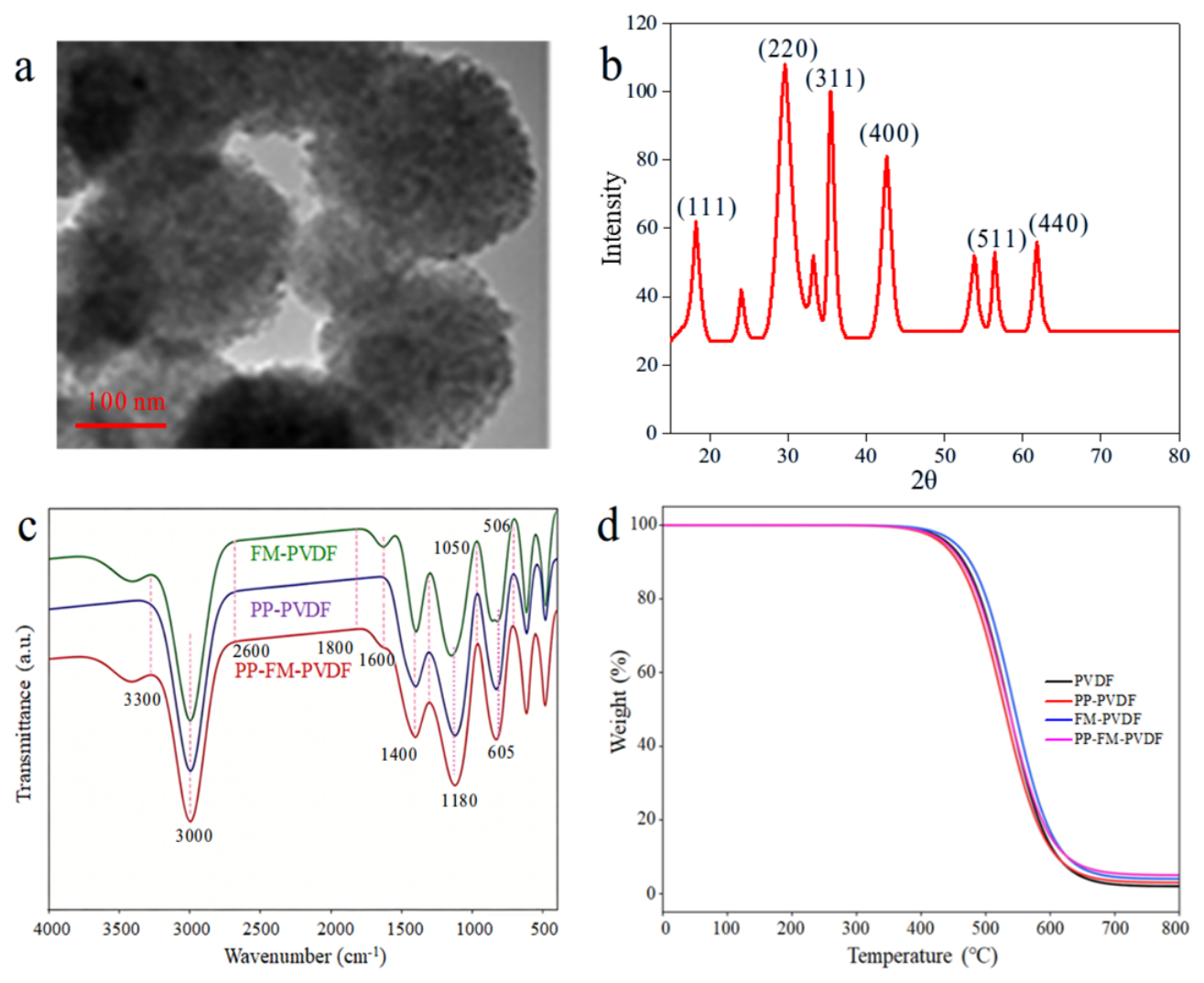
The TEM image in Figure 1a reveals that the FM nanoparticles, which serve as the active component of the surface coating, exhibit a spherical morphology with a uniform size distribution of 100–200 nm [31]. This homogeneous nanostructure is favorable for providing abundant surface-active sites on the coating layer, thereby enhancing the interfacial adsorption capacity for arsenate [32].
The XRD pattern of the FM (Figure 1b) exhibits broad diffraction peaks at 2θ = 18.2°, 29.7°, 35.3°, 42.6°, 56.3°, and 61.8°, corresponding to the (111), (220), (311), (400), (511), and (440) planes. The broadened reflections indicate a nanocrystalline structure, consistent with TEM observations. No distinct Fe2O3 or MnO2 phases are separately resolved, suggesting a well-mixed amorphous-to-poorly crystalline binary oxide framework that is favorable for arsenate adsorption.
Figure 1c presents the FTIR spectra of the different membrane surfaces. The pristine PVDF membrane shows characteristic C–F stretching vibrations. In the PP-PVDF membrane, characteristic peaks of PP emerge (S=O and C–O–C at ~1050 cm−1), confirming successful incorporation of PP into the surface layer [33]. The FM-PVDF membrane exhibits distinct peaks at ~605 cm−1 (Fe–O) and ~506 cm−1 (Mn–O), verifying the presence of Fe–Mn oxide on the surface. The PP-FM-PVDF membrane retains the characteristic peaks of both PP and FM without significant shifts, indicating that the interaction between PP and FM is primarily physical mixing rather than strong chemical bonding [34]. Notably, no new functional groups appear, confirming that each component maintains its chemical integrity within the functional surface coating.
The TGA curves in Figure 1d show that the PP-FM-PVDF membrane displays the highest residual mass (5.1%) at 800 °C, demonstrating that the combined surface modification with PP and FM not only preserves the thermal stability of the PVDF substrate but also enhances the overall thermal robustness of the coated membrane [35].
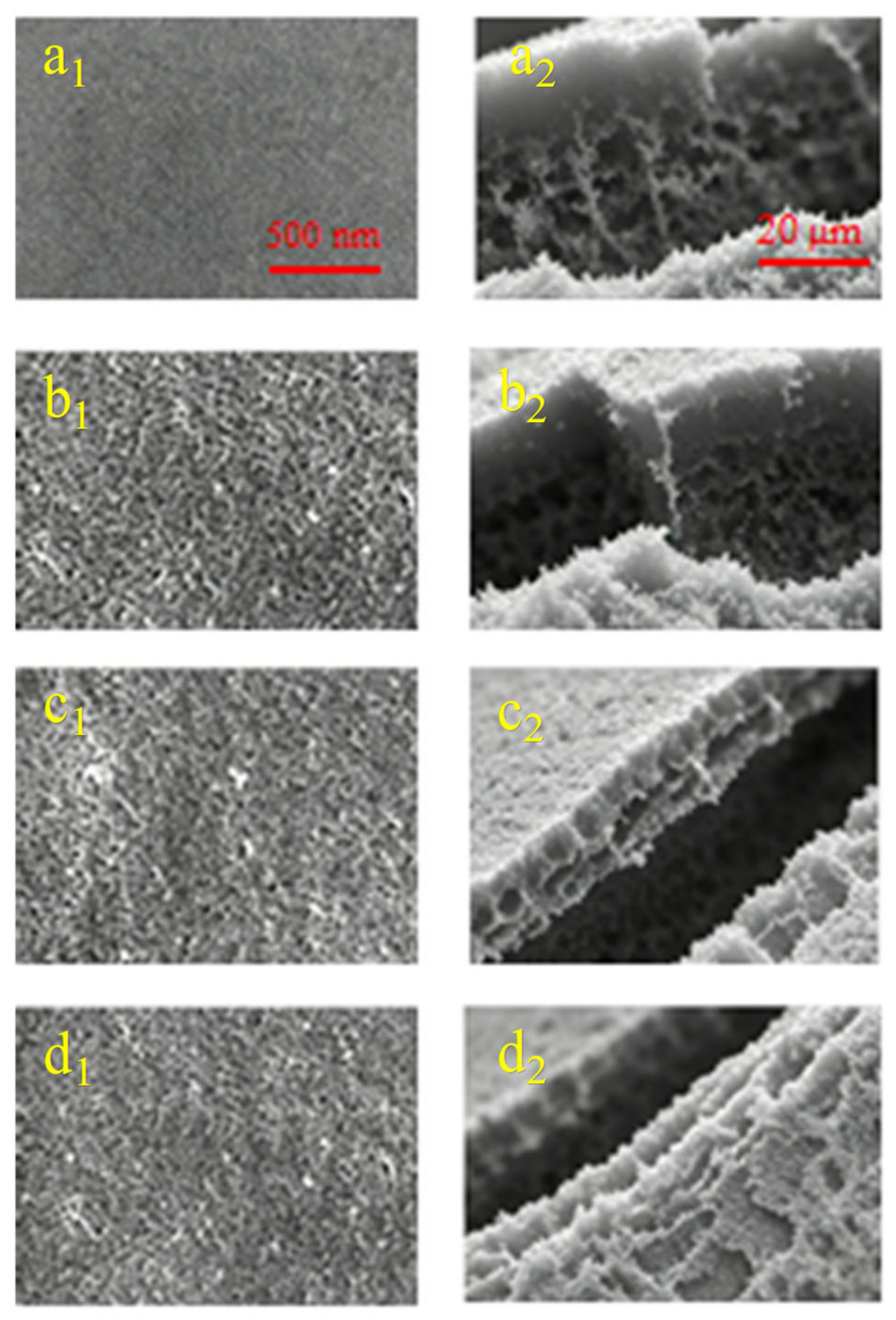
The SEM surface morphologies (Figure 2, left panels) reveal that the pristine PVDF membrane exhibits a relatively smooth and sparsely porous surface. After PP modification, the surface becomes slightly denser yet remains porous, while FM-PVDF shows increased surface pore density and interconnectivity [36]. The dual-modified PP-FM-PVDF membrane displays the most pronounced surface structural complexity, with highly porous and uniformly distributed microscale features. Cross-sectional views (Figure 2, right panels) show that the finger-like pore structures become finer and more uniform upon PP introduction, and the FM-PVDF membrane develops additional sponge-like structures beneath the surface. The PP-FM-PVDF membrane combines slender finger-like pores with a dense sponge-like sublayer, indicating that the dual-modifier surface coating effectively tailors the near-surface pore architecture, which is beneficial for improving active site accessibility and water permeability [37].
Table 2 and Figure S2 collectively demonstrate the synergistic effects of PP and FM on the surface wettability, porosity, and hydraulic performance of PVDF membranes. The water contact angle drops sharply from 86.3° for pristine PVDF to 50.1° for PP-FM-PVDF, confirming remarkably enhanced hydrophilicity. Meanwhile, the overall porosity increases from 67.2% to 80.2%. The improved hydrophilicity stems from the sulfonate groups in PP and abundant hydroxyl groups in FM [38]. PP also serves as a dispersant to suppress the aggregation of FM nanoparticles, facilitating uniform distribution within the PVDF matrix. PWF follows the order PVDF < PP-PVDF < FM-PVDF < PP-FM-PVDF. However, the flux improvement is not fully proportional to hydrophilicity enhancement, owing to slight pore obstruction and increased pore tortuosity caused by nanoparticle incorporation. The dual modification achieves a desirable balance between hydrophilicity, pore structure, and permeability, providing more accessible active sites for As(V) adsorption while maintaining satisfactory filtration capacity [39]. These optimized properties contribute to the superior arsenate removal efficiency and practical applicability of the composite membrane. The enhanced hydrophilicity of the PP-FM-PVDF membrane not only improves water permeability but also facilitates better wetting of the functional coating surface, thereby increasing the accessibility of Fe/Mn hydroxyl active sites for arsenate binding. This explains the positive correlation between lower water contact angle and higher As(V) adsorption capacity observed across the four membranes.
Table S1 demonstrates that the PP-FM-PVDF membrane achieves a tensile strength of 6.41 MPa and a Young’s modulus increase of approximately 97% and 96%, respectively, compared to the pristine PVDF membrane, along with a significantly higher elongation at break (52.6%) than that of FM-PVDF (36.7%). The incorporation of PP improves the dispersion of FM nanoparticles within the PVDF matrix, mitigating stress concentration defects. Concurrently, hydrogen bonding interactions between PP and PVDF enhance interfacial adhesion [40]. These results indicate that PP acts not only as a dispersant but also as a toughening and reinforcing agent, endowing the composite membrane with robust mechanical stability while retaining adequate flexibility for practical filtration operations.

3.2. Surface-Mediated Adsorption Performance of the Functional Coating

3.2.1. Batch Adsorption at the Functional Interface

The As(V) removal efficiency of the PP-FM-PVDF membrane was evaluated as a function of pH, with the results shown in Figure S3. The membrane achieved >90% As(V) removal across pH 3–8, indicating excellent pH adaptability of the functional coating surface [41]. This behavior is rationalized by considering both As(V) speciation and the surface charge properties of the coating layer. Under weakly acidic to neutral conditions (pH 3–8), the dominant As(V) species (H2AsO4 and HAsO42−) interact with partially protonated surface hydroxyl groups (≡Fe–OH2+, ≡Mn–OH2+) by ligand exchange. At pH > 9, deprotonation of surface hydroxyl groups renders the coating surface negatively charged, increasing electrostatic repulsion and reducing removal efficiency [42]. The maintenance of ~70% removal at pH 10 despite negative surface charge confirms that ligand exchange, not electrostatic attraction, is the dominant surface-mediated mechanism.
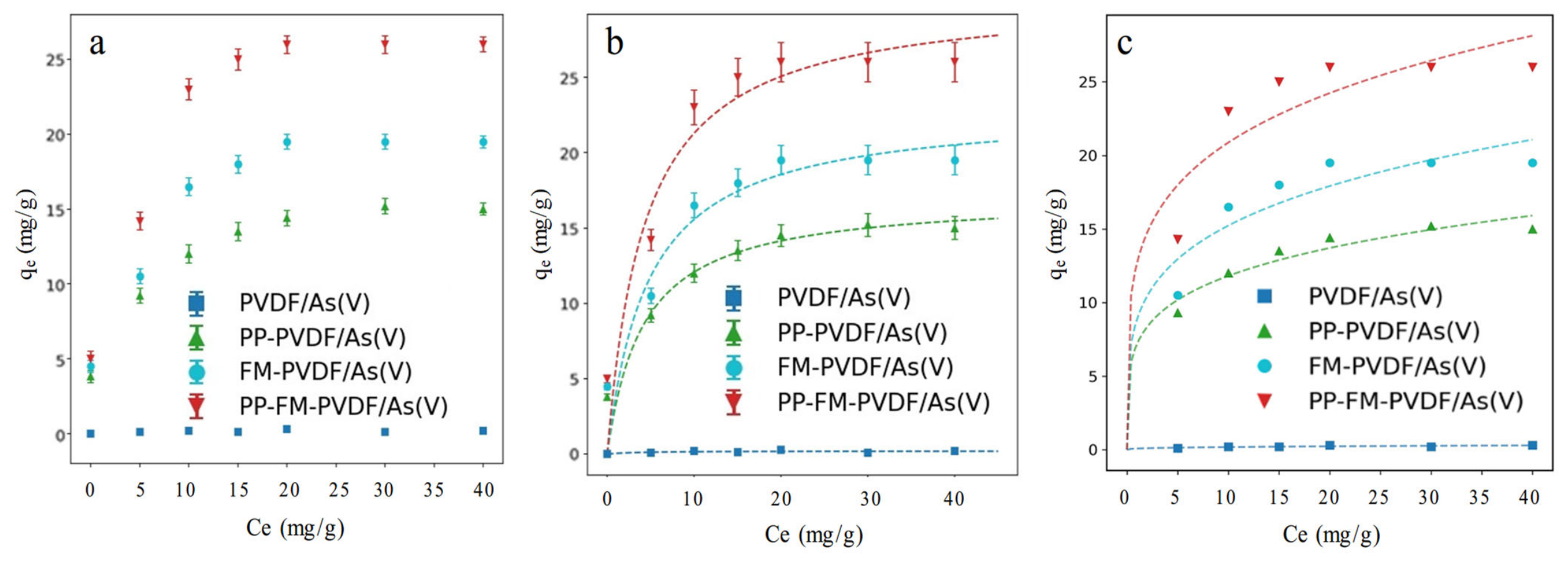
Figure 3 shows that the PP-FM-PVDF membrane exhibits the highest equilibrium As(V) uptake among all tested membranes. The Langmuir model provides an excellent fit (R2 = 0.999), indicating monolayer adsorption on homogeneous surface sites within the coating. The maximum surface-normalized adsorption capacity reaches 30.43 mg/g, which is 1.33 and 1.78 times higher than FM-PVDF and PP-PVDF, respectively. The pristine PVDF membrane shows negligible capacity (0.21 mg/g), confirming that the functional coating is essential for As(V) capture. The Langmuir constant KL = 0.23 L/mg indicates moderate affinity (Table S2), consistent with the formation of stable inner-sphere complexes (Fe–O–As, Mn–O–As) by ligand exchange at the coating–solution interface. The Freundlich exponent 1/n = 0.22 (<0.5) further supports a favorable chemisorption-dominated process [43].
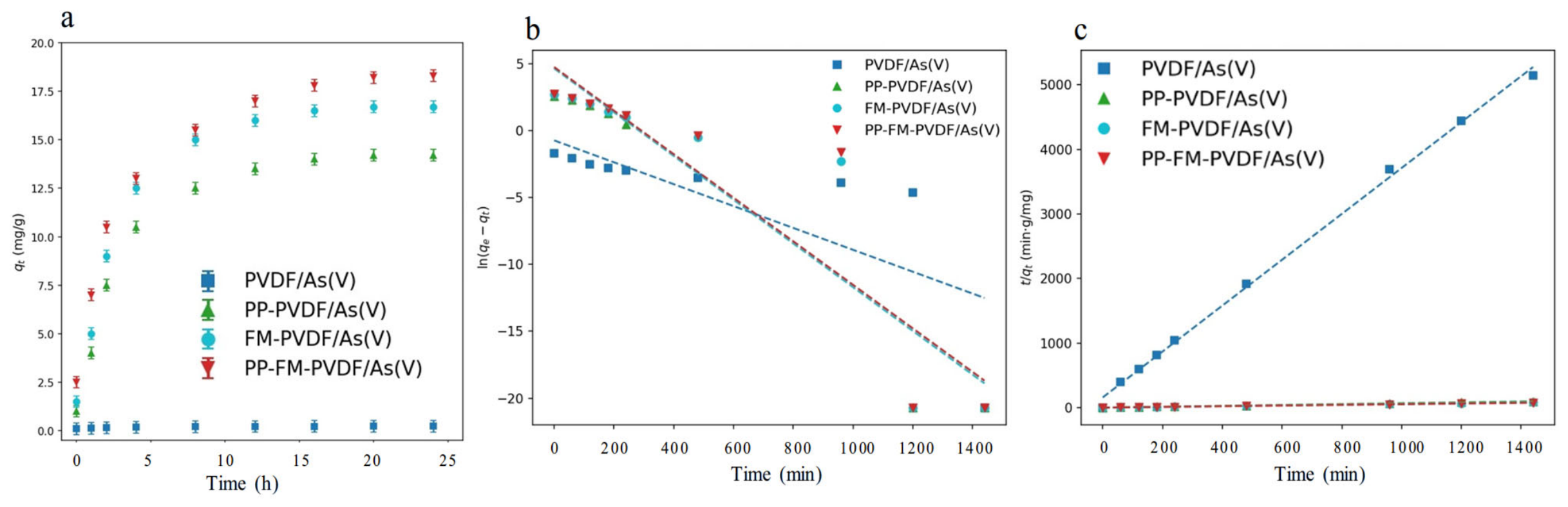
Figure 4 illustrates the adsorption kinetics at the PP-FM-PVDF coating interface. The uptake is rapid within the first 2 h, gradually slowing and reaching equilibrium at ~12 h. The pseudo-second-order kinetic model yielded a significantly higher R2 (0.99) than the pseudo-first-order model (0.93), with the calculated equilibrium capacity (18.7 mg/g) matching the experimental value well. This confirms that the rate-limiting step occurs at the surface by chemisorption rather than physical diffusion. The rapid initial stage is attributed to the abundant accessible hydroxyl groups on the coating surface, where As(V) is promptly bound through ligand exchange. The pseudo-second-order rate constant (k2 = 0.001 g·mg−1·min−1) of PP-FM-PVDF is comparable to FM-PVDF (Table S3), but the equilibrium capacity is higher, indicating that PP improves the dispersion of FM within the coating, thereby increasing the density of surface hydroxyl groups without altering the intrinsic adsorption rate [44]. The pseudo-second-order model was used because it is widely accepted for chemisorption systems involving ligand exchange and inner-sphere complexation, and it provided an excellent fit (R2 = 0.99) to our experimental data.

3.2.2. Dynamic Filtration Performance and Surface Regeneration of the Functional Coating

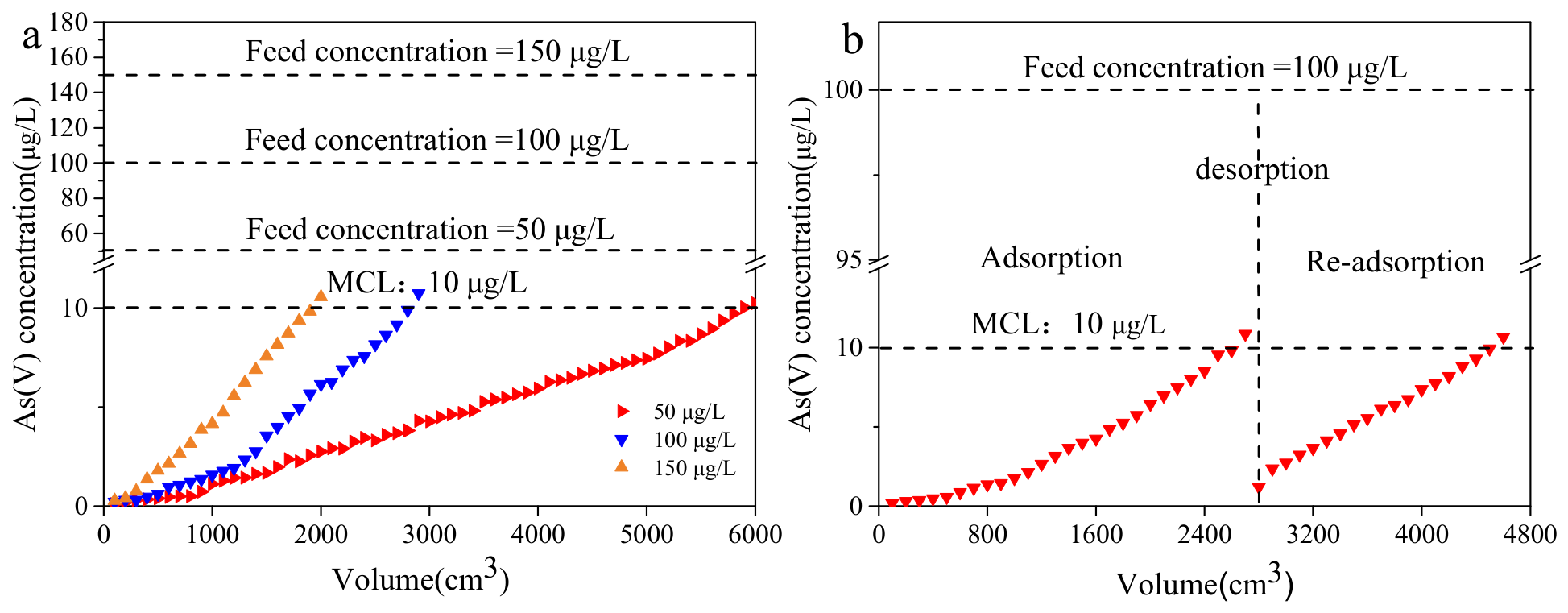
Figure 5a presents the continuous-filtration performance of the PP-FM-PVDF membrane. The surface coating effectively removes As(V) from flowing solution, with breakthrough behavior strongly dependent on feed concentration. For initial As(V) concentrations of 50, 100, and 150 μg/L, the treatable volumes before the permeate exceeds the WHO MCL of 10 μg/L are approximately 6 L, 2.70 L, and 1.70 L, respectively. At higher concentrations, the accelerated saturation of surface-active sites and reduced effective contact time lead to earlier breakthrough. Nevertheless, even at 150 μg/L, the membrane maintains effluent below 10 μg/L for the first 1.70 L, confirming the coating’s ability to meet regulatory standards under realistic contamination scenarios [45].
Figure 5b shows the regeneration performance of the PP-FM-PVDF coating. After the first cycle (2.70 L treatable volume), the spent membrane was regenerated using pH 11 NaOH, which disrupts the inner-sphere complexes at the coating surface and desorbs bound arsenate. The regenerated membrane treats 1.70 L of 100 μg/L As(V) solution, corresponding to 62.9% capacity recovery. This demonstrates that the functional surface coating can be effectively regenerated without irreversible fouling or structural degradation, highlighting the reusability of the surface-engineered membrane.

3.3. Surface Chemistry and Ligand Exchange Mechanism at the Coating Interface

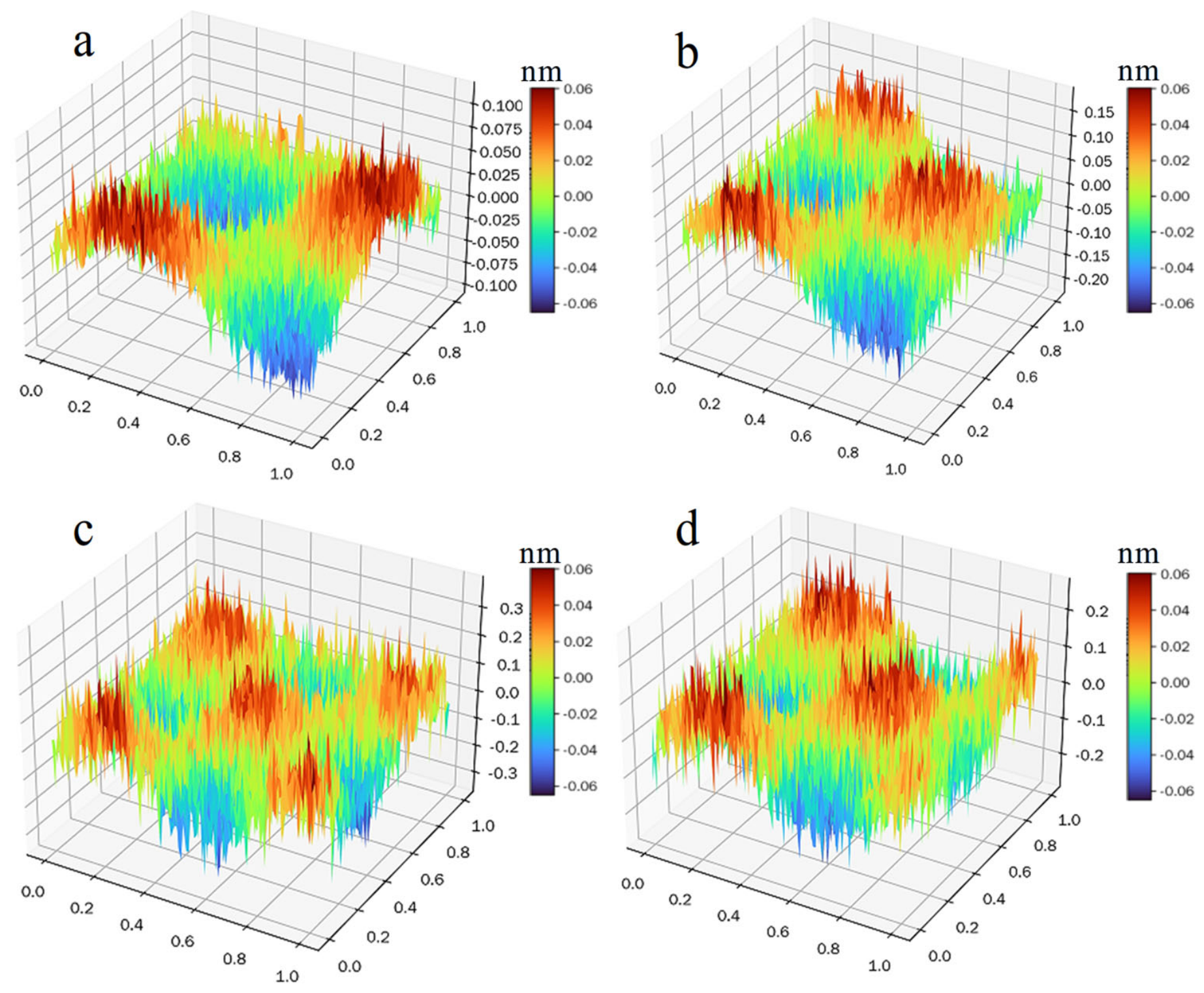
The PP-FM-PVDF membrane exhibits a specific surface area of 27.33 m2/g (Table S4), which is ~6.3 times higher than that of pristine PVDF. This substantial enhancement is attributed to the PP-facilitated uniform dispersion of FM nanoparticles within the surface coating, which suppresses particle agglomeration and promotes a well-developed porous structure near the surface [46]. The 3D-AFM surface morphologies (Figure 6) further confirm this: the PP-FM-PVDF membrane displays the highest surface roughness and most complex three-dimensional topography, featuring dense and uniformly distributed peak–valley patterns. This nanoscale surface architecture maximizes the exposure of Fe–O and Mn–O active sites at the solid–liquid interface, directly accounting for the superior As(V) adsorption capacity.
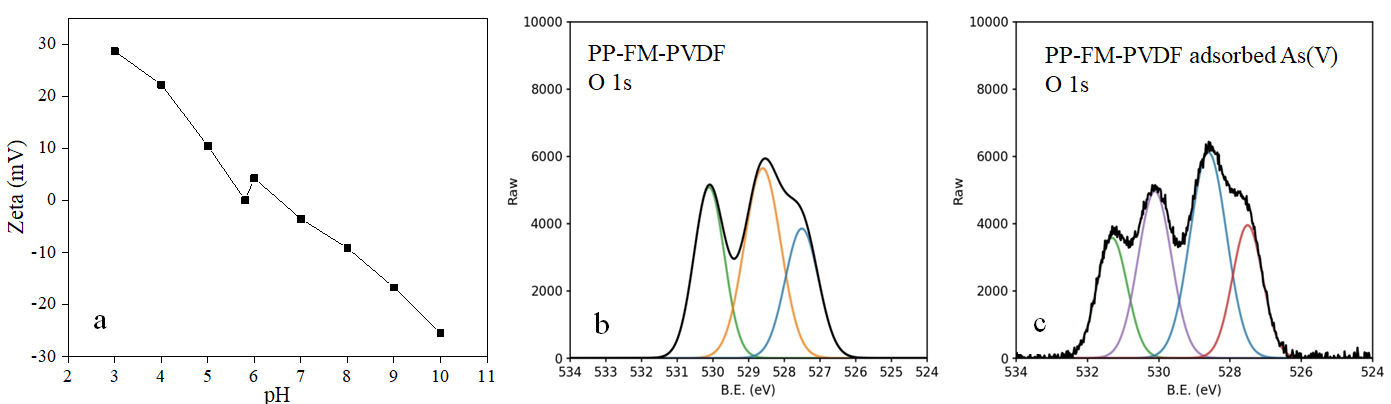
Figure 7a presents the zeta potential of the PP-FM-PVDF coating surface as a function of pH. The isoelectric point (IEP) lies around pH 5.5–6.0. Below the IEP, the surface is positively charged (protonated surface hydroxyl groups, ≡Fe–OH2+, ≡Mn–OH2+), favoring electrostatic attraction toward anionic As(V) species [47]. Above pH 8, the negative surface charge explains the decline in removal efficiency (Figure S3), confirming that electrostatic interaction plays a secondary, pH-dependent role.
XPS O1s spectra before (Figure 7b) and after (Figure 7c) As(V) adsorption provide direct evidence of surface-mediated ligand exchange. Prior to adsorption, three peaks are deconvoluted at 529.8 eV (Fe–O), 531.2 eV (Mn–O), and 532.5 eV (C–O/C–OH from PP). After adsorption, a new peak emerges at 530.5 eV, corresponding to As–O bond formation, while the relative intensities of Fe–O and Mn–O peaks decrease noticeably. This unequivocally demonstrates that arsenate replaces surface hydroxyl groups by ligand exchange at the coating interface [48]. The conserved C–O peak intensity indicates that PP primarily improves FM dispersion and surface hydrophilicity rather than directly binding As(V).
The EXAFS fitting parameters (Table S5) further confirm the surface complexation mechanism. The As–O coordination number is 4.0 with a bond length of 1.71 Å, indicating a stable inner-sphere complex. The coordination numbers for As–Fe and As–Mn are both 2.0, with bond lengths of 3.29 Å and 3.36 Å, respectively. This directly proves the formation of bidentate binuclear surface complexes (Fe–O–As and Mn–O–As) at the coating interface, fully consistent with the ligand exchange mechanism observed by XPS. No As(III) species are detected, confirming a direct chemisorption pathway without redox transformation [49].

4. Conclusions

In this work, we successfully demonstrate a surface engineering approach for fabricating a PP-FM-PVDF composite membrane by applying a synergistic functional coating of PEDOT:PSS and Fe-Mn binary oxide onto a PVDF substrate. The surface modification strategy significantly enhanced the membrane’s interfacial properties: the water contact angle decreased from 86.3° to 50.1°, the surface porosity increased to 80.2%, and the surface roughness and active site density were substantially improved, as evidenced by AFM and BET analyses. Notably, the surface coating also contributed to enhanced mechanical stability, with a tensile strength reaching 6.41 MPa, indicating strong interfacial adhesion between the coating and the PVDF substrate. The surface-functionalized membrane exhibited excellent As(V) removal performance across pH 3–8, achieving a maximum adsorption capacity of 30.43 mg/g, which follows the Langmuir isotherm and pseudo-second-order kinetic model—consistent with a surface-mediated chemisorption process. In continuous-filtration mode, the coated membrane treated approximately 2.70 L (2149.7 L/m2) of As(V) solution at an initial concentration of 100 μg/L while maintaining effluent levels below the WHO drinking water standard of 10 μg/L. After alkaline regeneration at pH 11, the membrane retained 62.9% of its original capacity, demonstrating good reusability of the functional surface coating. Mechanistic analyses using XPS, EXAFS, and zeta potential confirmed that As(V) removal is primarily driven by ligand exchange between arsenate oxyanions and Fe/Mn surface hydroxyl groups on the coating, forming stable inner-sphere complexes (Fe–O–As and Mn–O–As), with electrostatic attraction playing a secondary, pH-dependent role. No reduction of As(V) to As(III) was observed. Collectively, this work establishes that rational surface/interface engineering—through the synergistic combination of a conductive hydrophilic polymer (PP) and a metal oxide (FM)—can transform a conventional PVDF membrane into a high-performance, reusable functional coating for arsenate-contaminated water treatment. The design principles and mechanistic insights presented herein are broadly applicable to the development of advanced functional surfaces for environmental remediation.

Supplementary Materials

The following supporting information can be downloaded at: https://www.mdpi.com/article/10.3390/coatings16060671/s1, Figure S1. The filtration device consists of a nitrogen gas cylinder, a feed solution tank, a stirred ultrafiltration unit, and a permeate collection system. Figure S2. Water Contact Angle and Pure Water Flux of four membranes. Figure S3. Effect of pH on the adsorption of As(V) on the PP-FM-PVDF, Conditions: As(V) concentration = 1.0 mg/L, m = 1.0 g/L, T = 298 K, contact time = 24 h. Table S1. Tensile strength, Elongation at break and Young’s modulus of four types of membranes. Table S2. Langmuir and Freundlich isotherm parameters. Table S3. Adsorption kinetic parameters. Table S4. Specific surface area, Total pore volume and Average aperture of four types of membranes. Table S5. EXAFS fitting parameters for As(V) adsorption on PP-FM-PVDF membrane.

Author Contributions

M.L.: Conceptualization, Investigation, Methodology, Writing—original draft, Visualization, Validation, Data curation, Funding acquisition, Formal analysis. H.Y.: Visualization, Validation, Data curation. W.Z.: Resources, Conceptualization, Writing—review and editing. All authors have read and agreed to the published version of the manuscript.

Funding

This work was supported by the National Natural Science Foundation of China (No. 22508045) and the Dongguan University of Technology Talent Start-up Funding Project (No. 221110356011).

Institutional Review Board Statement

Not applicable.

Informed Consent Statement

Not applicable.

Data Availability Statement

The original contributions presented in this study are included in the article. Further inquiries can be directed to the corresponding author.

Conflicts of Interest

The authors declare that they have no known competing financial interests or personal relationships that could have appeared to influence the work reported in this paper.

References

  1. Abdulla, H.A.; Al-Ghouti, M.A.; Soubra, L. Arsenic contamination in rice: A DPSIR analysis with a focus on top rice producers. Sci. Total Environ. 2025, 978, 179425. [Google Scholar] [CrossRef]
  2. Sadee, B.A.; Zebari, S.M.S.; Galali, Y.; Saleem, M.F. A review on arsenic contamination in drinking water: Sources, health impacts, and remediation approaches. RSC Adv. 2025, 15, 2684–2703. [Google Scholar] [CrossRef]
  3. Dönmez Öztel, M.; Alver, A.; Akbal, F.; Altaş, L.; Kuleyin, A. Predictive insights into arsenic remediation: Advancing electro and chemical coagulation through machine learning models. J. Water Process Eng. 2025, 72, 107498. [Google Scholar] [CrossRef]
  4. Yoshioka, S.; Endo, M.; Takekuma, M.; Rahman, S.; Watanabe, S.; Wong, K.H.; Mashio, A.S.; Nishimura, T.; Maeda, K.; Hasegawa, H. Dithiocarbamate-modified cellulose--assisted ternary coagulation--flocculation system for selective removal of arsenite and multiple heavy metals from aquatic environments. J. Hazard. Mater. 2026, 504, 141364. [Google Scholar] [CrossRef]
  5. Pessoa-Lopes, M.; Crespo, J.G.; Velizarov, S. Arsenate removal from sulphate-containing water streams by an ion-exchange membrane process. Sep. Purif. Technol. 2016, 166, 125–134. [Google Scholar] [CrossRef]
  6. Pezeshki, H.; Hashemi, M.; Rajabi, S. Removal of arsenic as a potentially toxic element from drinking water by filtration: A mini review of nanofiltration and reverse osmosis techniques. Heliyon 2023, 9, e14246. [Google Scholar] [CrossRef] [PubMed]
  7. Priyadarshni, N.; Nath, P.; Nagahanumaiah Chanda, N. Sustainable removal of arsenate, arsenite and bacterial contamination from water using biochar stabilized iron and copper oxide nanoparticles and associated mechanism of the remediation process. J. Water Process Eng. 2020, 37, 101495. [Google Scholar] [CrossRef]
  8. Nikkhah, H.; Ipekçi, D.; Xiang, W.; Stoll, Z.; Xu, P.; Li, B.; McCutcheon, J.R.; Beykal, B. Challenges and opportunities of recovering lithium from seawater, produced water, geothermal brines, and salt lakes using conventional and emerging technologies. Chem. Eng. J. 2024, 498, 155349. [Google Scholar] [CrossRef]
  9. Hu, B.; Wang, S.; Qiu, L.; Wang, Z.; Wang, J.; Yan, J.; Shen, J.; Zhang, T.; Shi, C. Review of typical gaseous pollutants removal techniques: Conventional removal and chemical looping removal. J. Environ. Chem. Eng. 2025, 13, 117038. [Google Scholar] [CrossRef]
  10. Ren, H.; Labidi, A.; Zhao, Y.; Miao, Z.; Feng, X.; He, Z.; Wang, C. Advances in polyvinylidene fluoride-based photocatalytic membranes for cooperative wastewater treatment and H2 production. Chem. Eng. J. 2025, 525, 170447. [Google Scholar] [CrossRef]
  11. Mokhtari, F.; Samadi, A.; Rashed, A.O.; Li, X.; Razal, J.M.; Kong, L.; Varley, R.J.; Zhao, S. Recent progress in electrospun polyvinylidene fluoride (PVDF)-based nanofibers for sustainable energy and environmental applications. Prog. Mater. Sci. 2025, 148, 101376. [Google Scholar] [CrossRef]
  12. Hossain, M.E.; Azeem, M.Z.; Azeem, M.A.; Ahmad, H.; Patel, F.; Drmosh, Q.A.; Baroud, T.N. Nanostructured hydrophilic interfaces of PVDF Janus membranes for high salinity water treatment: A combined theoretical and experimental analysis. J. Membr. Sci. 2026, 746, 125273. [Google Scholar] [CrossRef]
  13. Wan, P.; Yuan, M.; Yu, X.; Zhang, Z.; Deng, B. Arsenate removal by reactive mixed matrix PVDF hollow fiber membranes with UIO-66 metal organic frameworks. Chem. Eng. J. 2020, 382, 122921. [Google Scholar] [CrossRef]
  14. Mehanathan, S.; Jaafar, J.; Sato, S.; Nasir, A.M.; Ismail, A.F.; Matsuura, T.; Othman, M.H.D.; Rahman, M.A.; Aziz, F.; Ahmad, S.N.A. Dual-layered ultrafiltration membrane with MgO nanoparticles by co-casting technique for arsenate removal. Sci. Total Environ. 2025, 990, 179908. [Google Scholar] [CrossRef]
  15. Kumar, A.; Ghosh, U.K. Polyvinylidene fluoride/boehmite nanocomposite membrane for effective removal of arsenate ion from water. J. Water Process Eng. 2022, 47, 102652. [Google Scholar] [CrossRef]
  16. Salazar, H.; Martins, P.M.; Fernandes, M.M.; Costa, P.; Ferdov, S.; Botelho, G.; Lanceros-Mendez, S. Reusable nanocomposite-filters for arsenite and arsenate dual real effluents remediation in an up-scaled membrane reactor. J. Hazard. Mater. 2022, 440, 129756. [Google Scholar] [CrossRef]
  17. Gaudel, P.; Kandel, D.R.; Lee, J. In situ polymerization of PDA with the simultaneous incorporation of La-EDTA MOFs to endow polysulfone membranes with UF-level water permeance and NF-level lead removal efficiency. Sep. Purif. Technol. 2026, 396, 137801. [Google Scholar] [CrossRef]
  18. Li, J.; Xia, F.; Liu, Y.; Wang, J.; Su, X.; Li, Z.; Peng, H. Synthesis of MXene-Based functional coatings on rigid polyurethane foam surfaces: A comparative study of layer-by-layer self-assembly and hydrothermal methods. Polym. Degrad. Stab. 2024, 220, 110665. [Google Scholar] [CrossRef]
  19. Han, W.; Wei, C.; Lai, Y.; Wang, M.; Zhang, M.; Ji, H.; Li, Z. Synergistic adsorption-oxidation mechanisms of Fe−Mn modified humin for enhanced As(III) and As(V) removal: Experimental and density functional theory study. Sep. Purif. Technol. 2026, 382, 135818. [Google Scholar] [CrossRef]
  20. Younas, M.; Bacha, A.U.R.; Khan, K.; Nabi, I.; Ullah, Z.; Humayun, M.; Hou, J. Application of manganese oxide-based materials for arsenic removal: A review. Sci. Total Environ. 2024, 918, 170269. [Google Scholar] [CrossRef] [PubMed]
  21. Li, M.; Zhang, X.; Zhang, Y.; Xu, X.; Liu, Y.; Zhang, Y.; He, Z.; Wang, J.; Liang, Y. Effect of interaction between dissolved organic matter and iron/manganese (hydrogen) oxides on the degradation of organic pollutants by in-situ advanced oxidation techniques. Sci. Total Environ. 2024, 918, 170351. [Google Scholar] [CrossRef]
  22. Anand Raj, M.K.; Rathanasamy, R.; Manoj Kumar, P.; Dharmaraj, M.; Kaliyannan, G.V.; Alam, M.M.; Keçebaş, A. Synergistic integration of transition metal oxides and conducting polymers for high-performance supercapacitors: Advances, challenges, and future prospects. Surf. Interfaces 2025, 78, 108117. [Google Scholar] [CrossRef]
  23. Liu, G.; Yang, S.; Lin, H.; Li, Y.; Lei, J.; Li, Z.-M. PEDOT:PSS and AgNW synergistically contributed high electromagnetic shielding performance for polyurethane-based composite coating. Compos. Part A 2023, 175, 107769. [Google Scholar] [CrossRef]
  24. Yan, Q.; Li, H.; Fei, T.; Liu, Z.; Chen, H.; Lian, H.; Chen, Y.; Zheng, H.; Bao, B.; Zhao, X.; et al. Anisotropic stimuli-responsive hydrogel enabling tunable electromagnetic interference shielding and strain sensing. Chem. Eng. J. 2026, 537, 176213. [Google Scholar] [CrossRef]
  25. Guo, J.; Zhang, K.; Luo, P.; Wu, N.; Peng, S.; Wei, L.; Liu, Y.; He, M.; Yu, J.; Qin, S.; et al. Influence of protonic acid on the structure and properties of poly(3,4-ethylenedioxythiophene):poly(styrenesulfonate) in oxidation polymerization. RSC Adv. 2024, 14, 1602–1611. [Google Scholar] [CrossRef] [PubMed]
  26. Wang, C.; Tang, S.; Li, B.; Fan, J.; Zhou, J. Construction of hierarchical and porous cellulosic wood with high mechanical strength towards directional Evaporation-driven electrical generation. Chem. Eng. J. 2023, 455, 140568. [Google Scholar] [CrossRef]
  27. Yusuf, B.O.; Aliyu, M.; Azeez, M.O.; Taialla, O.A.; Lateef, S.; Sulaimon, R.; Akinpelu, A.A.; Ganiyu, S.A. Comprehensive technologies for heavy metal remediation: Adsorption, membrane processes, photocatalysis, and AI-driven design. Desalination 2025, 615, 119261. [Google Scholar] [CrossRef]
  28. Moharrami, M.; Maleh, M.S.; Omidkhah, M.R. A review on catalytic ceramic membranes for pharmaceutical wastewater treatment: Integration with advanced oxidation processes. J. Water Process Eng. 2025, 78, 108726. [Google Scholar] [CrossRef]
  29. Yang, K.; Zhou, J.; Lou, Z.; Zhou, X.; Liu, Y.; Li, Y.; Baig, S.A.; Xu, X. Removal of Sb(V) from aqueous solutions using Fe-Mn binary oxides: The influence of iron oxides forms and the role of manganese oxides. Chem. Eng. J. 2018, 354, 577–588. [Google Scholar] [CrossRef]
  30. Baskaran, D.; Natarajan, A.A.P.; Byun, H.-S. Potential of palm husk powder in the treatment of real tannery wastewater: Performance comparison between response surface methodology and artificial neural network-particle swarm optimization. J. Water Process Eng. 2024, 67, 106101. [Google Scholar] [CrossRef]
  31. Sreelakshmi, T.; Joseph, A. Sustainable and eco-philic method for the detoxification arsenic from polluted water using green synthesised cubic ceria nanoparticles. Appl. Surf. Sci. 2026, 735, 166691. [Google Scholar] [CrossRef]
  32. Li, W.; Fang, J.; Mao, Z.; Lu, S.; Xiang, Y. Dispersion engineering of ethylenediamine tetramethylene phosphonic acid in composite Membranes: Toward enhanced proton conductivity and phosphoric acid retention for high-temperature proton exchange membranes. J. Membr. Sci. 2025, 734, 124388. [Google Scholar] [CrossRef]
  33. Taktak, S.; Ghorbel, N.; Fakhfakh, S.; Rondot, S.; Jbara, O.; Arous, M. Organoclay-filled PP/PBS polymer blends: Insights into morphology, thermal stability, and dielectric behavior. J. Mol. Liq. 2025, 437, 128338. [Google Scholar] [CrossRef]
  34. Yadav, S.K.; Kumar, A.; Mehta, N. Beyond graphene basics: A holistic review of electronic structure, synthesis strategies, properties, and graphene-based electrode materials for supercapacitor applications. Prog. Solid State Chem. 2025, 78, 100519. [Google Scholar] [CrossRef]
  35. Khalid, R.; Shah, A.; Javed, M.; Hussain, H. Progress and obstacles in electrode materials for lithium-ion batteries: A journey towards enhanced energy storage efficiency. RSC Adv. 2025, 15, 15951–15998. [Google Scholar] [CrossRef]
  36. He, Z.; Gu, Y.; Wang, H.; Lu, X.; Fan, W.; Li, Y. Chemical modification of PEDOT:PSS-based materials for multifunctional electromagnetic interference shielding. Chem. Commun. 2026, 62, 5603–5624. [Google Scholar] [CrossRef] [PubMed]
  37. Xu, Y.; Zhao, Y.; Liu, F.; Que, Y.; Wei, J. Sequential interpenetrating polymer networks decoupling pore interconnectivity and mechanical resilience in polyimide/polybenzoxazine aerogels for robust oil-water separation. Chem. Eng. J. 2026, 537, 176122. [Google Scholar] [CrossRef]
  38. Pereira, P.H.F.; Costa, S.A.; Costa, S.M.; Arantes, V. Efficient production of lignin nanoparticle colloids and their feasibility for eco-friendly dyeing of natural and synthetic textile fabrics. Ind. Crops Prod. 2025, 225, 120390. [Google Scholar] [CrossRef]
  39. Saleem, H.; Trabzon, L.; Kilic, A.; Zaidi, S.J. Recent advances in nanofibrous membranes: Production and applications in water treatment and desalination. Desalination 2020, 478, 114178. [Google Scholar] [CrossRef]
  40. Li, W.; Zhou, W.; Lin, N.; Liu, M.; Liu, J.; Wang, Y.; Wang, B.; Liu, D.; Yuan, M. Interfacial engineering of ZnO/PVDF-PP nanocomposites by Al2O3 as an interlayer towards elevated dielectric properties. Ceram. Int. 2024, 50, 20209–20223. [Google Scholar] [CrossRef]
  41. Ai, Y.; Chen, H.; Chen, M.; Zhang, W.; Jia, Y.; Han, L.; Li, J.; Luo, Y. Characteristics and mechanism of effectively capturing arsenate by sulfate intercalated and self-doping layered double hydroxide derived from field acid mine drainage. Sep. Purif. Technol. 2024, 331, 125763. [Google Scholar] [CrossRef]
  42. Mosaffa, E.; Jamshidi, E.; Patel, H.; Manteghi, F.; Ghafuri, H.; Kikani, B.A.; Banerjee, A. Enhanced adsorption removal of levofloxacin using antibacterial LDH-biochar cross-linked chitosan/PVA beads through batch and column approaches; comprehensive isothermal and kinetic study. Desalination 2025, 599, 118452. [Google Scholar] [CrossRef]
  43. Wang, H.; Qu, G.; Cai, Y.; Yin, C.; Tian, Y.; Xu, R.; Liu, X.; He, M.; He, C.; Wei, J. Recent advances in manganese-based materials for water remediation: Multipollutant adsorption and catalytic oxidation. Environ. Res. 2025, 286, 122802. [Google Scholar] [CrossRef] [PubMed]
  44. Liu, B.; Dai, S.; Zhang, Q.; Zhang, S.; Wu, G. Enhanced adsorption removal of fluoride by multifunctional polymer-based hydrated neodymium oxide: Capacity evaluation and mechanism. J. Hazard. Mater. 2026, 509, 141995. [Google Scholar] [CrossRef]
  45. Xu, R.; Kim, S.; Ahn, H.; Kim, S.; Kim, H.S.; Kang, Y.T. Carbon nanotube-assisted self-assembly of monolithic CO2 adsorbent: Evaluating the optimum pellet diameter for enhanced mass transfer. Chem. Eng. J. 2025, 513, 162718. [Google Scholar] [CrossRef]
  46. Liu, Y.; Zhang, X.; Han, Z.; Wu, Y.; Bai, J.; Li, D.; Qi, H. A review of biomimetic microporous surfaces with adaptive wettable properties: From design principles to advanced applications in oil--water separation. J. Environ. Chem. Eng. 2026, 14, 122170. [Google Scholar] [CrossRef]
  47. Liu, H.; Xie, X.; Wang, Y. Selective arsenic removal in complex aquatic environments: Mechanistic insights, sorbent design, and environmental regulation. J. Hazard. Mater. 2026, 501, 140761. [Google Scholar] [CrossRef]
  48. Mo, W.; Liu, X.; Yang, Y.; Wei, C.; Huang, Y.; Yang, J.; He, A.; Liao, J.; Su, X.; Feng, J.; et al. Fe/Mn-MOF@PDA sponges: A hydrolytically stable and facilely recoverable material for arsenic removal through polydopamine-mediated homogeneous MOF immobilization. J. Environ. Chem. Eng. 2025, 13, 119724. [Google Scholar] [CrossRef]
  49. Cao, S.; Yin, Y.; Zheng, S.; Song, C.; Gan, X.; Zhang, W.; Feng, D.; Shang, J.; Cheng, X. Peroxymonosulfate activation by Ni--Co nanoparticles encapsulated in nitrogen-doped carbon derived from Co-doped Ni metal--organic frameworks for efficient enrofloxacin degradation. Chem. Eng. J. 2025, 503, 158281. [Google Scholar] [CrossRef]
Figure 1. (a) TEM images of the FM NPs, (b) XRD pattern of the FM NPs, (c) FTIR spectra of FM- PVDF, PP-PVDF and PP-FM-PVDF, (d) TGA analysis curves of pure PVDF membrane, PP-PVDF, FM-PVDF, and PP-FM-PVDF composite membranes.
Coatings 16 00671 g001
Figure 2. SEM images of top surface (left) and cross-section (right) of membranes. (a) PVDF, (b) PP-PVDF, (c) FM-PVDF, and (d) PP-FM-PVDF.
Coatings 16 00671 g002
Figure 3. Adsorption isotherms of As(V) on the different membranes: (a) adsorption isotherms; (b) Langmuir adsorption isotherms; (c) Freundlich adsorption isotherms. Experimental conditions: 1.0 g/L, 298 K, pH 6, 24 h.
Coatings 16 00671 g003
Figure 4. Adsorption kinetics of As(V) on the PP-FM-PVDF membrane: (a) adsorption kinetics; (b) pseudo-first-order model; (c) pseudo-second-order model. Experimental conditions: [As(V)]0 20 mg/L, 1.0 g/L, 298 K, pH 6.
Coatings 16 00671 g004
Figure 5. (a) As(V) removal from aqueous solution by the PP-FM-PVDF membrane in dead-end filtration, (b) regeneration performance of the PP-FM-PVDF membrane.
Coatings 16 00671 g005
Figure 6. 3D-AFM images of membranes. (a) PVDF, (b) PP-PVDF, (c) FM-PVDF, and (d) PP-FM-PVDF.
Coatings 16 00671 g006
Figure 7. (a) The curve of zeta potential varying with pH, (b,c) XPS O1s analysis of PP-FM-PVDF before and after As(V) adsorption.
Coatings 16 00671 g007
Table 1. Casting solution composition of membranes.
MembranePVDF (wt.%)PEG (wt.%)NMP (wt.%)PP (wt.%)FM (wt.%)PP-FM (wt.%)
PVDF18280---
PP-PVDF18279.100.90--
FM-PVDF18279.10-0.90-
PP-FM-PVDF18279.10--0.90
Table 2. Contact angles, pure water flux and overall porosity of four types of membranes.
MembraneOverall Porosity (%)Water Contact Angle (°)PWF (L/m2 h)
PVDF67.2 ± 3.186.3 ± 4.8133.3 ± 7.2
PP-PVDF70.3 ± 5.170.1 ± 6.2225.6 ± 20.1
FM-PVDF76.5 ± 3.966.3 ± 4.3273.5 ± 26.6
PP-FM-PVDF80.2 ± 4.950.1 ± 5.7366.4 ± 20.4
Disclaimer/Publisher’s Note: The statements, opinions and data contained in all publications are solely those of the individual author(s) and contributor(s) and not of MDPI and/or the editor(s). MDPI and/or the editor(s) disclaim responsibility for any injury to people or property resulting from any ideas, methods, instructions or products referred to in the content.