Article

Carbon Microsphere-Coated Composites via Layer-by-Layer Self-Assembly with Enhanced Dye Adsorption Performance

1
State Key Laboratory of Metastable Materials Science and Technology, Hebei Key Laboratory of Applied Chemistry, Hebei Key Laboratory of Nanobiotechnology, Hebei Key Laboratory of Heavy Metal Deep-Remediation in Water and Resource Reuse, Yanshan University, Qinhuangdao 066004, China
2
Qinhuangdao Huaheng Bioengineering Co., Ltd., Qinhuangdao 066200, China
3
Department of Critical Care Medicine, The First Hospital of Qinhuangdao, Qinhuangdao 066000, China
*
Authors to whom correspondence should be addressed.
Coatings 2026, 16(6), 668; https://doi.org/10.3390/coatings16060668
Submission received: 9 May 2026 / Revised: 29 May 2026 / Accepted: 30 May 2026 / Published: 2 June 2026

Abstract

In this work, monodisperse carbon microspheres with an average diameter of approximately 900 nm were successfully synthesized via a hydrothermal method. To further tailor their surface properties, the layer-by-layer (LbL) self-assembly technique was employed, where the cationic polyelectrolyte poly(diallyldimethylammonium chloride) (PDDA) and the anionic polyelectrolyte poly(styrene sulfonate) (PSS) were alternately deposited on the microsphere surface, forming two and four bilayer assemblies, respectively. The resulting composite microspheres exhibited remarkable adsorption performance toward representative dyes in water solution, such as rhodamine B (RhB) and methylene blue (MB). Experimental results demonstrated that the incorporation of a single bilayer significantly reduced the specific surface area but introduced additional active adsorption sites, thereby enhancing dye removal efficiency. However, when the number of bilayers was further increased to two, partial pore coverage and blockage occurred, leading to a reduced surface area and consequently diminished adsorption capacity. These findings highlight that in LbL surface modification, more layers do not necessarily yield better performance, but rather an optimal assembly thickness exists. This insight provides valuable guidance for the rational design of advanced adsorbent materials for wastewater treatment.

1. Introduction

With the continuous expansion of textile, dyeing, papermaking, and chemical industries, substantial volumes of dye-laden wastewater are released into aquatic environments, creating significant risks to ecosystems and public health [1,2]. Owing to their strong stability and recalcitrant nature, dye molecules are difficult to degrade by conventional physical, chemical, and biological methods, which often fail to achieve efficient removal [3,4]. Among the various methods of wastewater treatment, the adsorption method has attracted much attention due to its advantages of being convenient and efficient [5,6], and not generating other harmful by-products, thus becoming an important method for wastewater treatment. Consequently, the development of highly efficient, low-cost, and tunable adsorbent materials has become a research hotspot in the field of environmental materials [7]. In recent years, increasing attention has been paid to integrating these adsorbents into membrane platforms, such as thin-film composite membranes, for dynamic filtration and practical wastewater treatment [8].
Carbon-based materials, particularly due to their large surface area, structural stability, and tunable surface chemistry, have been widely employed for the adsorption of organic pollutants [9]. Carbon microspheres (CMSs), in particular, exhibit excellent dispersibility, well-defined spherical morphology, and abundant active surface sites, thereby showing great potential in dye adsorption. The hydrothermal method has emerged as a common and green strategy for synthesizing CMSs, typically using glucose, sucrose, or phenolic resins as carbon precursors. This method allows for the formation of uniform microspheres with controlled particle size and uniform morphology [10,11]. Previous studies have demonstrated that extensive research has been devoted to the hydrothermal synthesis of CMSs and their applications in various fields [12]. For instance, Sun and Li [11] pioneered the synthesis of colloidal carbon spheres from glucose via hydrothermal treatment, demonstrating their tunable size and core–shell structures with noble metal nanoparticles. Subsequently, Sevilla and Fuertes [12] systematically investigated the hydrothermal carbonization of cellulose, revealing the formation mechanism and surface chemistry of CMSs. In the field of adsorption, homogeneous carbon sub-microspheres (~700 nm) synthesized from glucose have been shown to be effective and low-cost adsorbents for methylene blue removal. More recently, amine-functionalized carbon microspheres derived from glucose via hydrothermal synthesis exhibited an ultrahigh adsorption capacity of 1487.3 mg·g−1 for methyl orange, with rapid equilibrium within 30 min. Beyond adsorption, hydrothermal CMSs have found applications in supercapacitors as electrode materials, in catalysis as catalyst supports, and in heavy metal remediation via electrostatic attraction and complexation mechanisms [13,14]. Furthermore, by adjusting hydrothermal parameters such as temperature (160–200 °C) and initial pH (2–8), the morphology, particle size, and surface functional groups of CMSs can be finely tuned to meet specific requirements [15].
Nevertheless, pristine CMSs still exhibit limitations in surface functionalization, restricting their adsorption efficiency and selectivity in complex wastewater environments. The LbL self-assembly technique offers a promising strategy to overcome this limitation. Originally proposed by Decher [16,17], the principle of this method is based on the fact that oppositely charged polyelectrolytes can alternately deposit due to electrostatic forces, thereby generating multilayer films with controllable thickness. Common polyelectrolytes such as PDDA and PSS are widely utilized due to their good solubility and stability [18,19]. By adjusting the number of deposited layers, the surface charge density and specific surface area of CMSs can be effectively tuned, thereby enhancing their adsorption capacity for different dye molecules [20,21]. However, the relationship between the number of polyelectrolyte layers and the resulting adsorption performance remains poorly understood. In particular, it is not yet clear how excessive deposition of flexible polyelectrolytes such as PDDA and PSS onto micro-mesoporous carbon microspheres affects pore accessibility, mass transfer resistance, and the diffusion of larger dye molecules like rhodamine B. A systematic correlation between the bilayer number and key parameters such as specific surface area, pore size distribution, and dye removal efficiency is still lacking.
Based on this strategy, in this study, uniform CMSs with an average diameter of 900 nm were synthesized via the hydrothermal method using 3-fluorophenol as a less common carbon precursor. The obtained CMSs were subsequently functionalized with PDDA and PSS using the LbL assembly approach. Two types of composite materials were prepared, consisting of one bilayer and two bilayers of PDDA/PSS, respectively. The pristine CMSs had a specific surface area of 757.2 m2·g−1 and an average pore size of 3.0 nm. The one-bilayer sample showed a reduced specific surface area of 616.2 m2·g−1, but its RhB adsorption capacity increased from 55.6 to 57.6 mg·g−1, indicating that the thin polyelectrolyte layer introduced additional active sites. For the two-bilayer sample, the specific surface area drastically decreased to 88.1 m2·g−1, and the pore volume dropped from 0.075 to 0.010 cm3·g−1, accompanied by a near-complete loss of RhB adsorption capacity and a significant decline in MB adsorption kinetics. These findings provide experimental evidence for the existence of an “optimal layer number” in LbL surface modification, offering new insights and design strategies for the development of efficient adsorbent materials for wastewater treatment [22].

2. Materials and Methodology

2.1. Materials

Hexamethylene tetramine (C6H12N4) was purchased from the Tianjin Damao Chemicals Regent Factory (Tianjin, China). 3-Fluorophenol was obtained from the Shanghai Macklin Biochemical Technology Co., Ltd. (Shanghai, China). Potassium hydroxide, Poly (sodium 4-styrene sulfonate) (PSS, average Mw~1,000,000) and Poly(diallyldimethylammonium chloride) (PDDA, 20 wt% in water) were purchased from Shanghai Aladdin Biochemical Technology Co., Ltd. (Shanghai, China).

2.2. Characterization

The morphology of the prepared samples was examined using field emission scanning electron microscopy (FE-SEM, SUPRA 55, ZEISS, Oberkochen, Germany) together with transmission electron microscopy (TEM, HT7700, Hitachi, Tokyo, Japan). Structural characteristics and phase identification were determined by X-ray diffraction analysis (XRD, SmartLab, Rigaku Corporation, Tokyo, Japan) in the 2θ range of 5–90°. The surface chemical composition and valence states of the elements were further analyzed by X-ray photoelectron spectroscopy (XPS, ESCALAB, Thermo Fisher Scientific, Waltham, MA, USA). Nitrogen adsorption–desorption isotherms were obtained with a surface area and porosity analyzer (ASAP 2020 HD88, Micromeritics, Norcross, GA, USA) to calculate the Brunauer–Emmett–Teller (BET) surface area, pore size distribution, and pore volume. The concentrations of MB and RhB remaining in solution were quantified by UV–Vis spectrophotometry (UV-2550, Shimadzu, Kyoto, Japan) with a scanning wavelength range of 200–800 nm.

2.3. Synthesis of CMS

First, 93.5 mg of hexamethylenetetramine was dissolved in 80 mL of deionized water, followed by the dropwise addition of 181.1 μL of 3-fluorophenol. The solution was stirred at 30 °C for 1 h and subsequently transferred into a Teflon-lined autoclave for hydrothermal treatment at 160 °C for 4 h. After the reaction had finished, the solid product was collected and then centrifuged. It was then washed three times with deionized water and dried for 12 h. The obtained solid was subsequently annealed under a nitrogen atmosphere by heating to 800 °C at a ramping rate of 5 °C·min−1, followed by isothermal treatment at 800 °C for 4 h. Once the solution had cooled down, we collected the resulting solid, which were the CMSs.

2.4. Activation of the CMSs

The as-prepared CMSs were ground thoroughly with KOH at a mass ratio of 1:2 (CMS:KOH) using a mortar and pestle. The resultant mixture was then placed into an alumina crucible and underwent thermal activation in a high-purity N2 atmosphere. The sample was subjected to a heating process at a rate of 10 °C·min−1, reaching a final temperature of 700 °C and kept at this temperature for a duration of 1 h. Subsequently, the solid material was allowed to cool to room temperature and then underwent a series of washing steps with deionized water. This process was repeated three times, with the aim of achieving a neutral pH level in the filtrate. Following the aforementioned steps, activated CMSs were obtained.

2.5. Layer-by-Layer Assembly of Polyelectrolytes on CMSs

A total of 100 mg of CMS powder was dissolved in 15 mL of a PDDA aqueous solution with a concentration of 5 mg·mL−1, and the mixture was stirred using a magnet in a beaker for 30 min. Afterward, the sediment was washed twice with deionized water to remove unbound PDDA. At this stage, a positively charged PDDA layer was successfully deposited on the CMS surface, yielding CMS@PDDA. The washed CMS@PDDA was subsequently introduced into 15 mL of a PSS aqueous solution with a concentration of 1 mg·mL−1 and stirred magnetically for 30 min, resulting in the formation of a single bilayer-modified sample, denoted as CMS@(PDDA/PSS)2. By repeating the above procedures, a sample with two bilayers was obtained, designated as CMS@(PDDA/PSS)4. The thickness of the polyelectrolyte multilayers was controlled by fixing the polymer concentrations, deposition time, and the rinsing procedure.

2.6. Adsorption Kinetic Experimental

A stock solution of methylene blue (MB, 20 mg·L−1, 100 mL) was prepared, to which 10 mg of the adsorbent was introduced and subjected to magnetic stirring for 1 h. Throughout the adsorption process, 5 mL samples were taken at 5 min intervals and stored in sample tubes for further measurement. In a similar procedure, a rhodamine B (RhB) solution (6 mg·L−1, 100 mL) was prepared, followed by the addition of 10 mg adsorbent and continuous stirring for 1 h. During this period, 5 mL aliquots were likewise collected every 5 min. After the adsorption experiments were completed, all collected samples were transferred into quartz cuvettes and analyzed using a UV–Vis spectrophotometer. All experiments were independently performed in triplicate to ensure reproducibility, and the reported values represent the average of three measurements.

2.7. Adsorption Thermodynamic Experimental

The composite material demonstrating the optimal adsorption performance in the previous steps was further analyzed. A series of methylene blue (MB) solutions with initial concentrations of 25, 30, 35, 40, and 45 mg/L, and rhodamine B (RhB) solutions with initial concentrations of 5, 6, 7, 8, and 9 mg/L were prepared. For each solution, 10 mg of adsorbent was added, and adsorption experiments were conducted at 298 K, 308 K, and 318 K until adsorption equilibrium was reached. The absorbance of each solution at its respective maximum absorption wavelength was then measured using a UV–Vis spectrophotometer. All experiments were independently performed in triplicate to ensure reproducibility, and the reported values represent the average of three measurements.

2.8. pH- and Dosage-Dependent Adsorption Experimental

To investigate the effects of solution pH and adsorbent dosage on the adsorption behavior of CMSs and modified samples, batch adsorption experiments were conducted using methylene blue (MB, 20 mg·L−1) and rhodamine B (RhB, 6 mg·L−1) as model pollutants. For the pH study, the initial pH values of the dye solutions were adjusted to 1.5, 7.0, and 11.5 using 0.1 mol·L−1 HCl or NaOH solutions. Each experiment was performed by adding 10 mg of adsorbent into 100 mL of dye solution and magnetically stirring for 60 min at room temperature. After equilibrium was reached, the suspensions were centrifuged, and the supernatant was analyzed by UV–Vis spectrophotometry to determine the residual dye concentration. For the adsorbent dosage study, the adsorbent mass was varied as 5 mg, 10 mg, and 20 mg while keeping the dye concentration and solution volume constant. The adsorption experiments were conducted under neutral pH (pH ≈ 7) at room temperature for 60 min. All experiments were independently performed in triplicate to ensure reproducibility, and the reported values represent the average of three measurements.

2.9. Adsorption–Desorption Cycle Experimental

After the adsorption process, the adsorbent was collected by centrifugation at 3000 r/min and washed 2–3 times with deionized water. The adsorbent was then transferred into 40 mL of ethanol and allowed to stand for 2 h to facilitate effective desorption of the dye. Following desorption, the supernatant was removed, and the adsorbent was dried in an oven at 60 °C for 12 h for subsequent cyclic adsorption experiments. All experiments were independently performed in triplicate to ensure reproducibility, and the reported values represent the average of three measurements. Ethanol was selected as the desorption agent because it effectively dissolves both methylene blue and rhodamine B while preserving the structural integrity of the PDDA/PSS multilayers.

3. Results and Discussion

3.1. Morphological Analysis

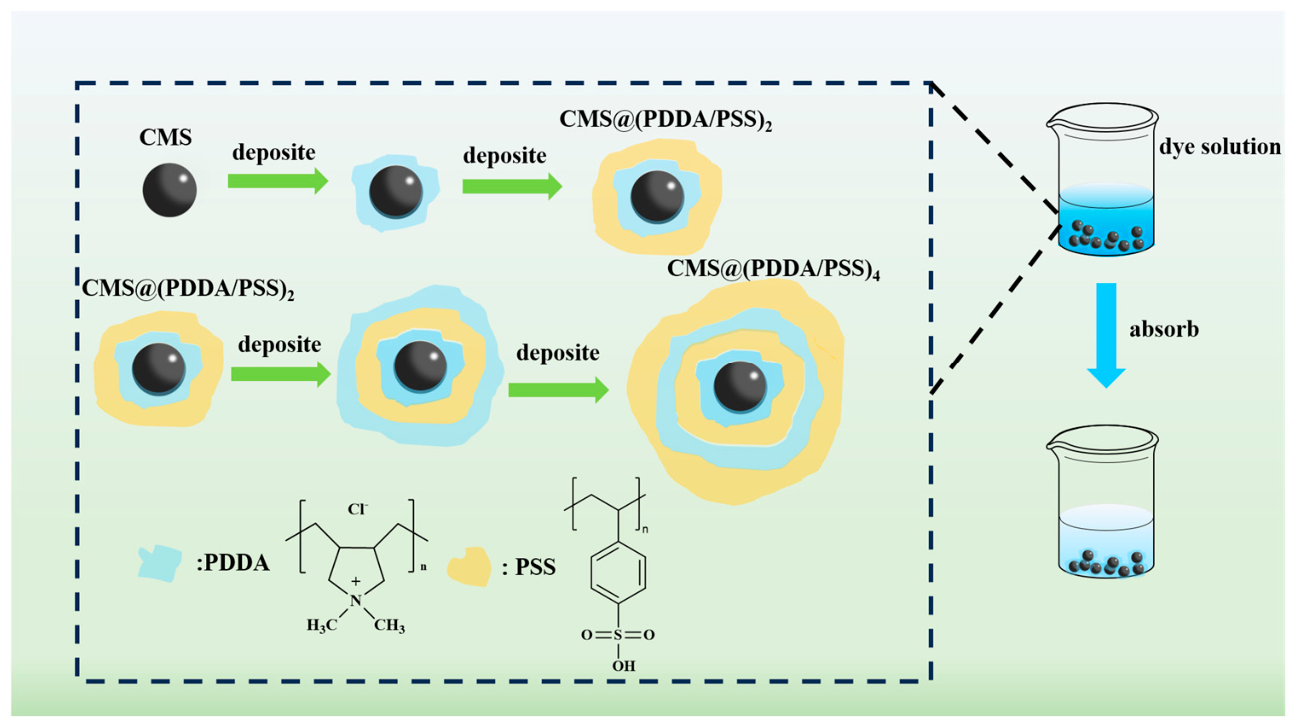
The experimental procedure is illustrated in Figure 1. First, CMSs with smooth surfaces and negative surface charges were synthesized via a hydrothermal method. Subsequently, under the influence of electrostatic interactions, positively charged PDDA and negatively charged PSS were alternately deposited onto the CMS surface through a layer-by-layer self-assembly process, yielding carbon microspheres modified with either one-bilayer (CMS@(PDDA/PSS)2) or two-bilayers (CMS@(PDDA/PSS)4). These materials were then introduced into dye solutions to evaluate their adsorption performance.
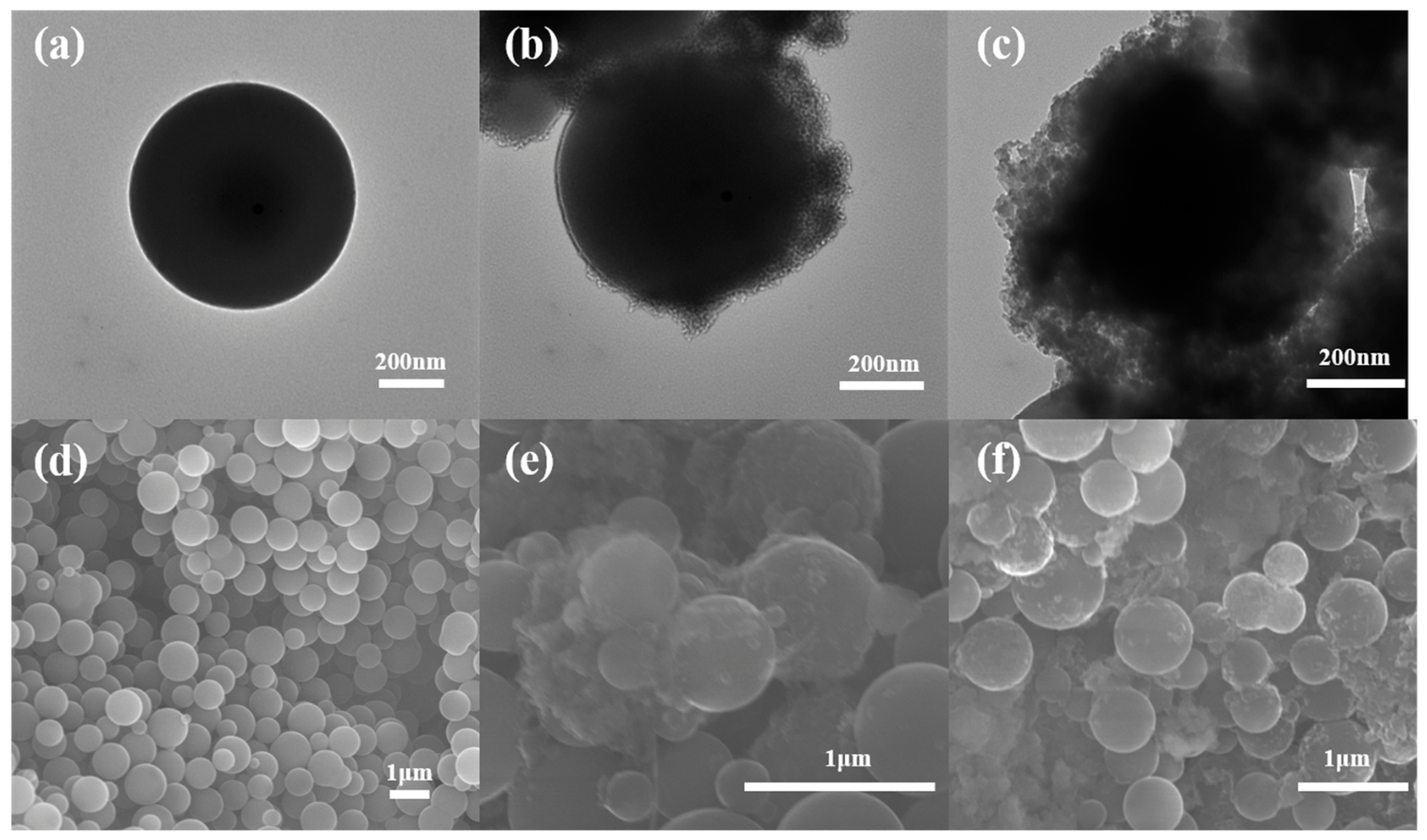
Figure 2 presents the TEM images of pristine CMSs, CMS@(PDDA/PSS)2, and CMS@(PDDA/PSS)4. As shown in Figure 2a, the hydrothermal reaction followed by calcination in a tubular furnace yielded a batch of carbon microspheres with uniform morphology, smooth surfaces, and an average diameter of approximately 900 nm. After the subsequent layer-by-layer modification, the successful deposition of PDDA and PSS onto the CMS surface can be clearly observed (Figure 2b), indicating that oppositely charged polyelectrolytes were effectively anchored on the microsphere surface through electrostatic interactions. Upon the further assembly of two bilayers (Figure 2c), the surface of the microspheres became rougher, and the edges appeared less defined, accompanied by a slight increase in particle diameter. These observations provide direct evidence that the polyelectrolyte multilayers were successfully assembled onto the carbon microspheres.
Figure 2d–f shows the SEM images of pristine CMSs, CMS@(PDDA/PSS)2, and CMS@(PDDA/PSS)4. As illustrated in Figure 2d, the as-synthesized carbon microspheres exhibited a smooth surface and uniform spherical morphology. In contrast, the composite microspheres obtained after the assembly of one bilayer (Figure 2e) and two bilayers (Figure 2f) displayed noticeable surface roughness, accompanied by a slight increase in particle diameter. These morphological changes provide clear evidence that the polyelectrolyte multilayers were successfully assembled onto the CMS surface via the LbL technique.

3.2. X-Ray Diffraction Analysis

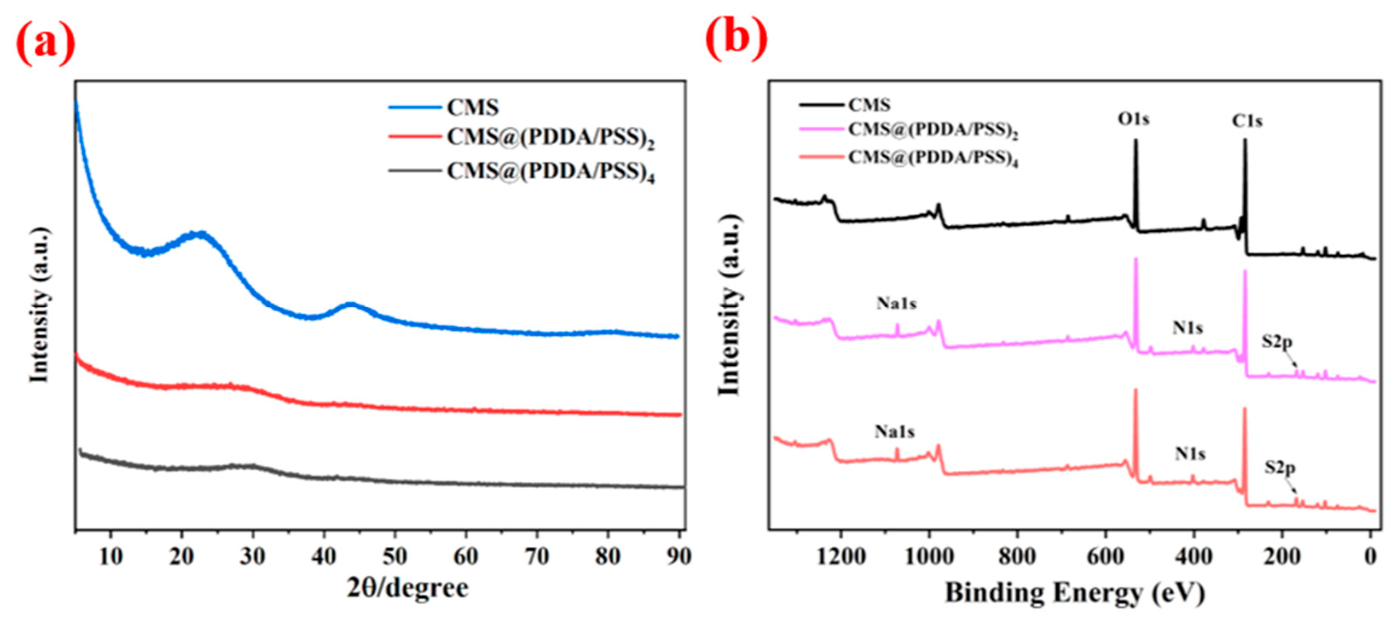
Figure 3a presents the XRD patterns of pristine CMSs, CMS@(PDDA/PSS)2, and CMS@(PDDA/PSS)4. As shown, none of the samples exhibited sharp diffraction peaks; instead, broad peaks were observed at approximately 2θ = 20–25° and 2θ = 40–45° [23], which are characteristic of amorphous carbon materials. For the pristine CMSs, two relatively pronounced broad peaks could be identified, corresponding to the (002) and (101) reflections of disordered graphitic layers typically found in hydrothermally derived carbon microspheres. After the layer-by-layer assembly, the diffraction intensity of CMS@(PDDA/PSS)2 and CMS@(PDDA/PSS)4 became weaker, and the peaks appeared more flattened, indicating that the deposition of polyelectrolyte multilayers reduces the structural order of the carbon surface and introduces additional amorphous organic layers [24], thereby masking the intrinsic diffraction features of the carbon spheres. With the increase in bilayer number to two, the diffraction signals are further attenuated, eventually approaching an almost featureless pattern, which confirms the progressive shielding of carbon signals by the thicker polymer coating. Therefore, the XRD analysis demonstrates that the synthesized carbon microspheres possess typical amorphous carbon structures, and the subsequent PDDA/PSS multilayer modification gradually diminishes their diffraction peak intensity, suggesting successful deposition and increased coverage of the polyelectrolyte layers with higher assembly numbers.

3.3. X-Ray Photoelectron Spectroscopy Analysis

Figure 3b presents the XPS survey spectra of CMSs, CMS@(PDDA/PSS)2 and CMS@(PDDA/PSS)4. For the unmodified CMS sample, only two prominent characteristic peaks were observed, namely C 1s (~284.8 eV) and O 1s (~532 eV), indicating that the carbon microspheres were primarily composed of carbon and oxygen. This is in line with the typical chemical constitution of carbon materials synthesized via the hydrothermal method [25,26,27]. After PDDA/PSS layer-by-layer assembly, additional peaks appeared in the spectra of CMS@(PDDA/PSS)2 and CMS@(PDDA/PSS)4: N 1s (~400 eV), which originates from the quaternary ammonium groups in the cationic polymer PDDA, confirming the successful modification of PDDA on the carbon microsphere surface; S 2p (~168 eV) [28], attributed to the sulfonic groups in the anionic polymer PSS, further validating the deposition of PSS; and Na 1s (~1071 eV) [29], likely arising from the Na+ in the sodium salt structure of PSS [30], also supporting the presence of PSS on the surface. Notably, as the assembly layers increased from one to two bilayers, the intensities of both the N 1s and S 2p peaks were significantly enhanced based on the element distribution of each sample in Table 1, suggesting a more complete deposition and stronger coverage of the polyelectrolyte multilayers on the carbon microspheres. These findings are consistent with the XRD results, where the attenuation of diffraction signals further indicates that the layer-by-layer assembly leads to the progressive formation of organic multilayers on the carbon microsphere surface.

3.4. Pore Size and Surface Area Analysis

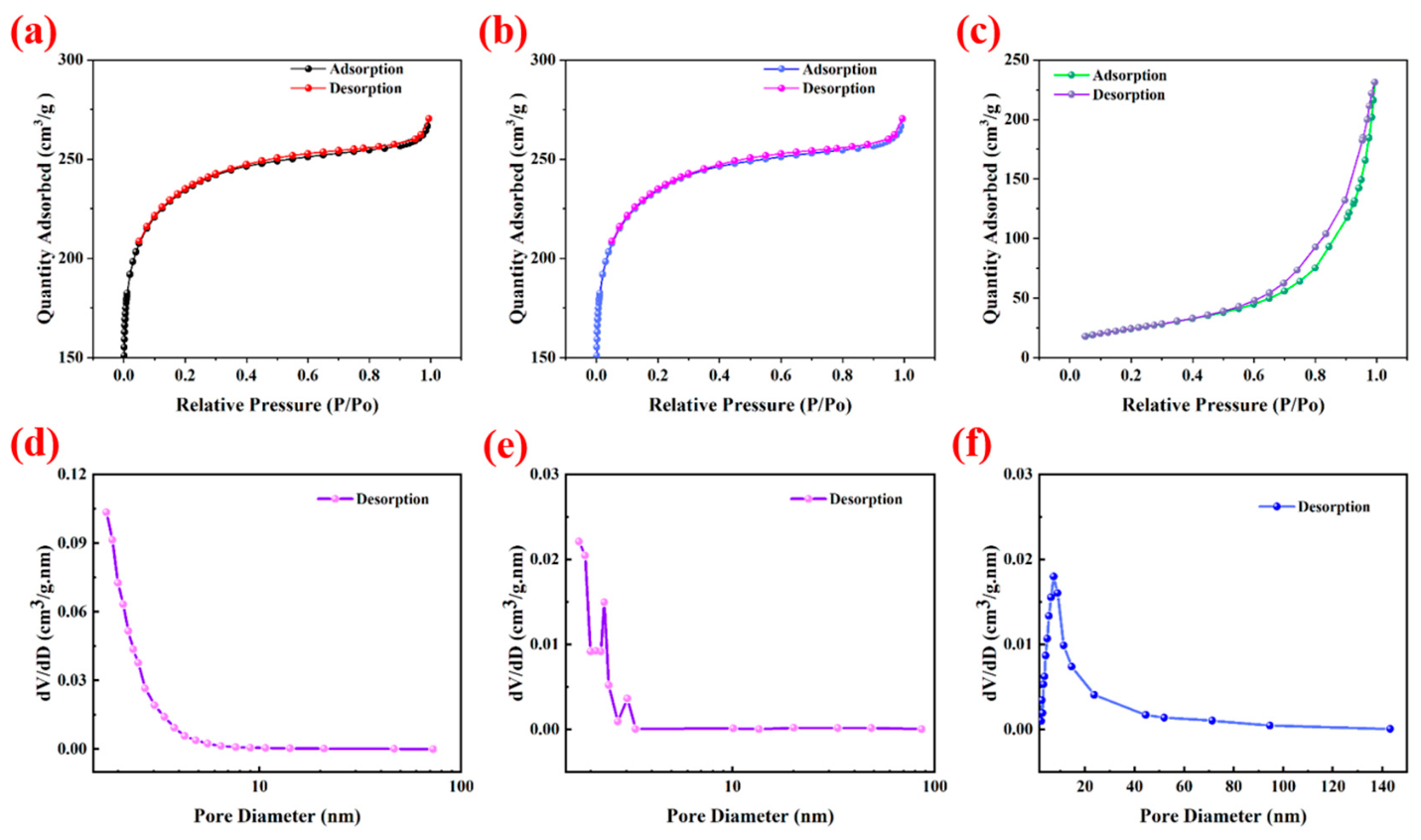
The pore size distribution curves and nitrogen adsorption–desorption isotherms of CMSs, CMS@(PDDA/PSS)2, and CMS@(PDDA/PSS)4 are presented in Figure 4, with the corresponding specific surface areas, average pore sizes, and pore volumes summarized in Table 2. All three materials exhibited typical type IV isotherms with a pronounced H4-type hysteresis loop at medium-to-high relative pressures [31,32], indicating that their porous structures were predominantly mesoporous. However, distinct differences in pore characteristics were observed among the samples. In Table 2, pristine CMS displayed the highest specific surface area (757.22 m2·g−1) and the largest pore volume (0.0748 cm3·g−1), with an average pore size of 3.02 nm, suggesting that its pore structure is mainly distributed within the small mesopore range. For CMS@(PDDA/PSS)2, the specific surface area decreased to 616.20 m2·g−1 and the pore volume was reduced to 0.0325 cm3·g−1, while the average pore size increased to 6.05 nm. Combined with its isotherm and pore size distribution profile, this indicates that the partial blockage of micropores occurred during the surface modification process. In contrast, CMS@(PDDA/PSS)4 exhibited a drastic reduction in surface area (88.10 m2·g−1) and pore volume (0.0101 cm3·g−1), whereas the average pore size significantly increased to 13.18 nm. This suggests that with the further increase in assembly layers, most of the original pores were blocked and pore structure collapsed, leaving only a small fraction of larger pores, thereby shifting the pore size distribution toward the macropore region. It should be noted that the apparent increase in average pore size after polyelectrolyte deposition does not indicate the creation of new larger mesopores. Instead, the deposited PDDA/PSS layers preferentially block the small pores of the pristine CMSs, making them inaccessible to nitrogen molecules during BET measurement. Since the signals from these small pores disappear, the remaining larger mesopores contribute more significantly to the statistical average calculated. Consequently, the calculated average pore size increased from 3.0 nm to 6.1 nm for CMS@(PDDA/PSS)2 and further to 13.2 nm for CMS@(PDDA/PSS)4. Thus, the observed increase in average pore size is a statistical artifact caused by the preferential loss of small pore accessibility, not the formation of new mesopores.

3.5. Kinetic Analysis

This study investigated the adsorption using the pseudo-first-order (1) and pseudo-second-order (2) kinetic equations [33,34]
l n q e q t = log e K 1 t
t q t = t q e + 1 K 2
Here, qt represents the amount of dye adsorbed at time t; qe refers to the adsorption amount when equilibrium is reached after the adsorption process is completed; K1 and K2 respectively represent the pseudo-first-order kinetic rate constant and the pseudo-second-order kinetic rate constant.
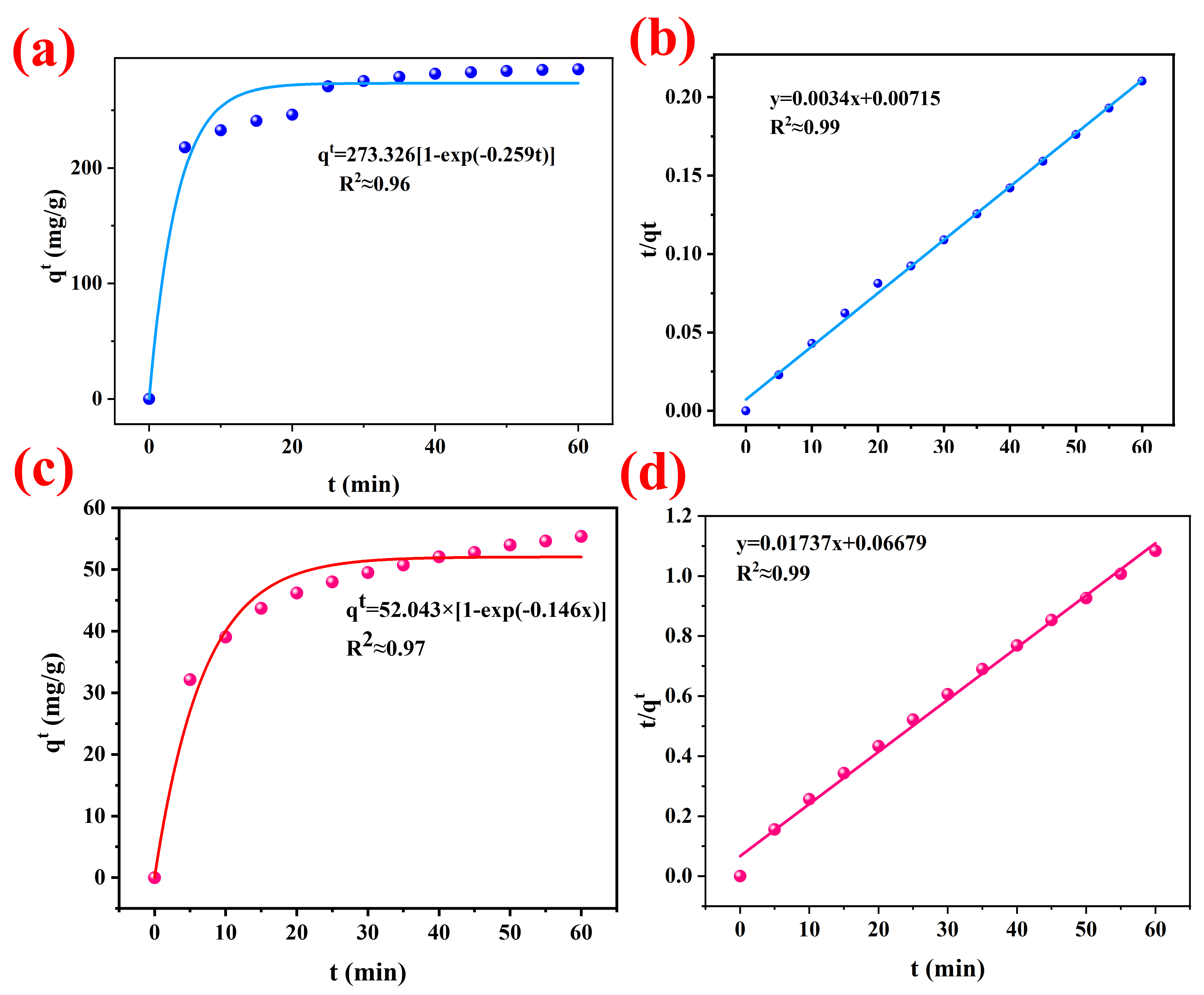
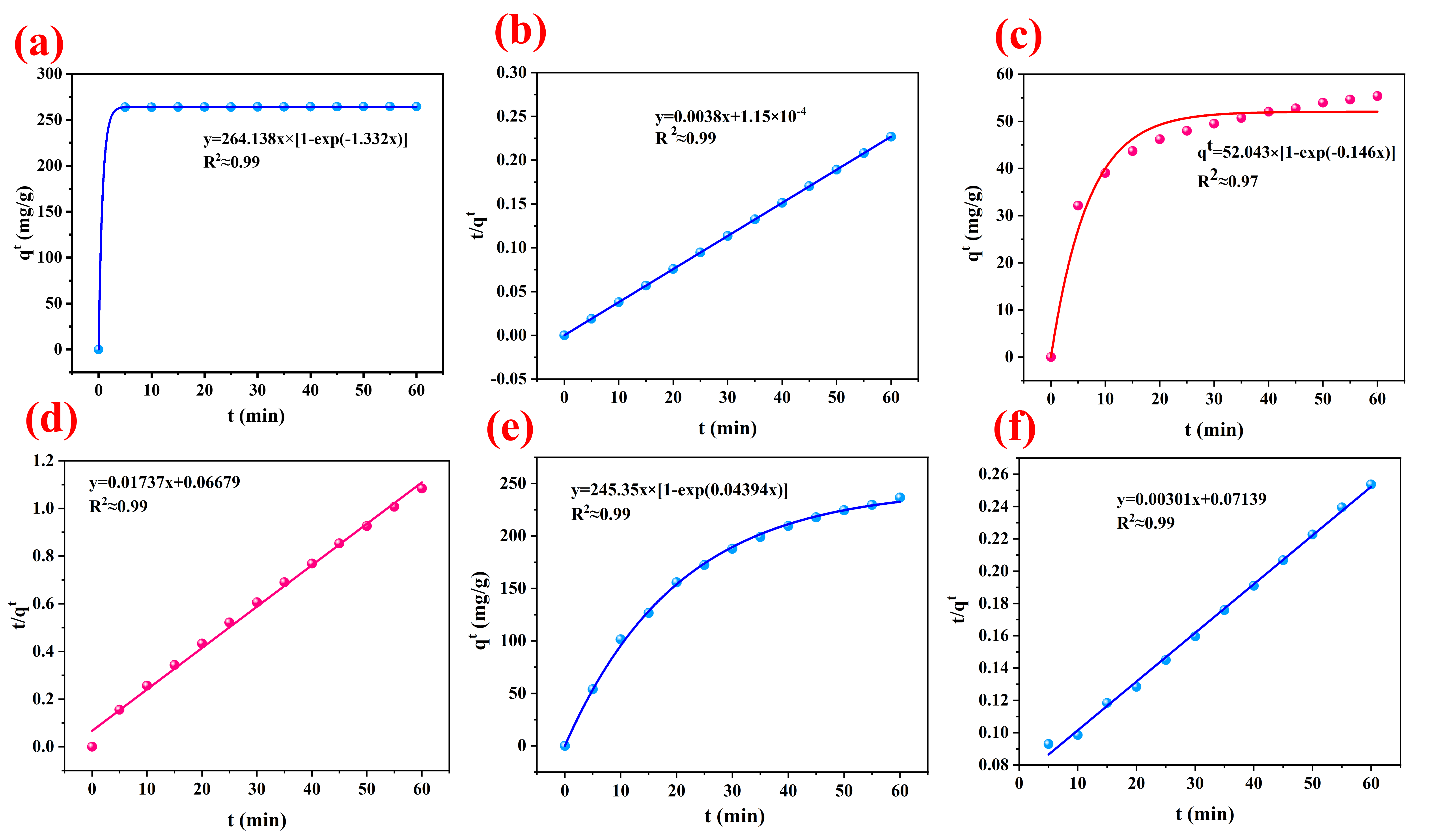
A thorough examination of the kinetic fitting data (Figure 5) indicated that the adsorption behaviors of MB and RhB on CMSs and the modified samples exhibited a higher degree of consistency with the pseudo-second-order model (R2 ≈ 0.99). This finding suggests that chemisorption is the predominant mechanism controlling the process. As shown in Figure 6, for MB, pristine CMSs exhibited a relatively high equilibrium adsorption capacity of 294.12 mg·g−1, whereas for RhB the capacity was only 55.56 mg·g−1. This pronounced difference is closely associated with the molecular size of the dyes and the pore size distribution of the CMSs. The pore structure of the CMSs was dominated by micropores (average pore size ≈ 3.0 nm), which facilitated the diffusion and adsorption of the smaller MB molecules, while the larger RhB molecules suffered from steric hindrance and restricted pore accessibility, resulting in a comparatively lower adsorption capacity. After modification with PDDA and PSS, CMS@(PDDA/PSS)2 showed an improved adsorption capacity for RhB (57.57 mg·g−1) compared with pristine CMSs, suggesting that moderate surface modification introduces additional electrostatic binding sites, thereby enhancing RhB uptake. However, for CMS@(PDDA/PSS)4, the thicker polyelectrolyte multilayers led to significant pore blockage and increased mass transfer resistance, causing its RhB adsorption capacity to become almost negligible. In contrast, MB adsorption remained relatively high across all three materials. CMS@(PDDA/PSS)2 exhibited an equilibrium adsorption capacity of 263.16 mg·g−1, which was comparable to that of pristine CMSs, while CMS@(PDDA/PSS)4 achieved an even higher adsorption capacity of 332.23 mg·g−1, indicating that for small MB molecules, moderate surface modification can further enhance the adsorption performance. According to the kinetic fitting results summarized in Table 3 and Table 4, the overall adsorption performance of the three materials followed the trend: CMS@(PDDA/PSS)2 > CMS > CMS@(PDDA/PSS)4. For CMS@(PDDA/PSS)2, the introduction of moderately thick polyelectrolyte layers created more active sites and strengthened the electrostatic interactions with dye molecules, thus enhancing the adsorption performance of both RhB and MB compared to the pristine CMSs. For example, its equilibrium adsorption capacity for RhB (qe = 57.57 mg·g−1) was higher than that of CMSs (qe = 55.56 mg·g−1). Furthermore, the MB adsorption process also showed a higher correlation coefficient and faster adsorption rate constant, confirming that CMS@(PDDA/PSS)2 exhibits enhanced kinetic efficiency. In comparison, pristine CMSs, with their high surface area (757.2 m2·g−1) and narrow pore size (3.0 nm), favored the adsorption of smaller MB molecules (qe = 294.12 mg·g−1), but their adsorption of larger RhB molecules is limited by steric effects and pore size mismatch, making them slightly inferior to CMS@(PDDA/PSS)2. When the assembly layers were further increased to CMS@(PDDA/PSS)4, excessive deposition of polyelectrolyte films caused severe pore blockage, leading to a sharp reduction in surface area (88.1 m2·g−1) and pore volume (0.01 cm3·g−1). The occurrence of severe pore blockage after the deposition of the second bilayer can be attributed to the cumulative polyelectrolyte thickness, which, when combined with the extended electrical double layer (Debye length of ~2.3 nm under our experimental conditions), becomes comparable to the pore aperture size. Consequently, dye diffusion and mass transfer are significantly hindered. This structural limitation nearly eliminates RhB adsorption, while for MB, although a higher equilibrium adsorption capacity was observed (qe = 332.23 mg·g−1), the corresponding rate constant decreased markedly (K2 = 1.27 × 10⁻⁴), indicating that the adsorption process is considerably restricted by mass transfer resistance.

3.6. Thermomechanical Analysis

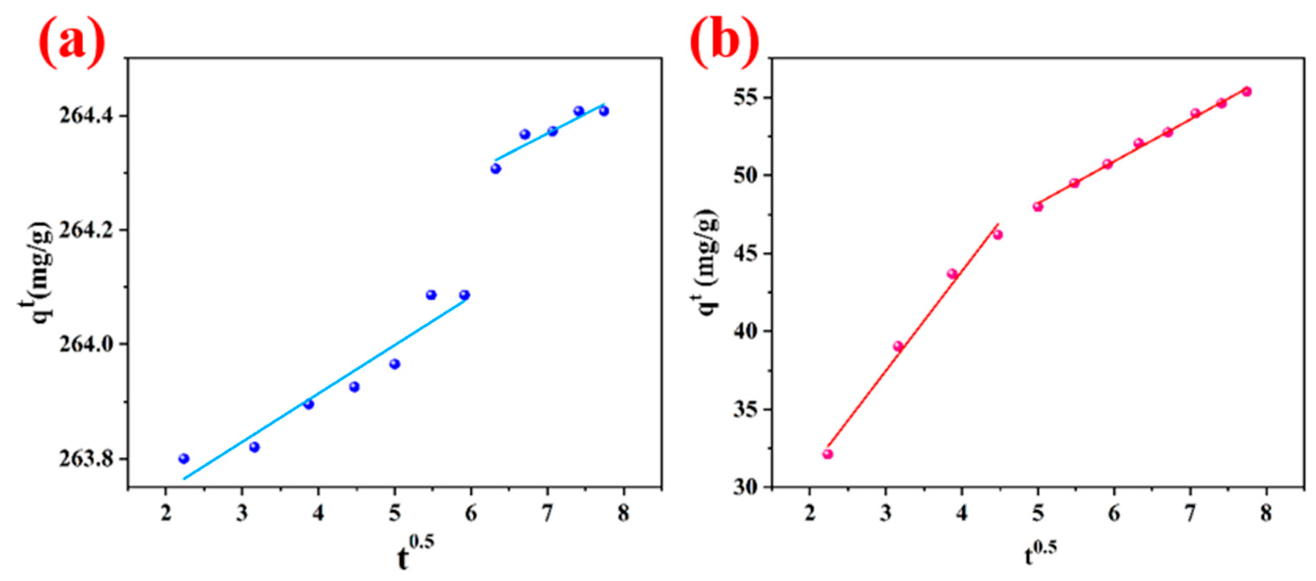
As shown in Figure 7, the adsorption of MB and RhB on CMS@(PDDA/PSS)2 followed the intraparticle diffusion model to a certain extent, and the fitting curves exhibited two distinct linear regions. This indicates that the adsorption process consists of multiple stages: rapid external surface adsorption followed by a slower intraparticle diffusion process. The absence of the fitted lines passing through the origin suggests that intraparticle diffusion is not the only rate-controlling step, although it plays a dominant role in determining the overall adsorption rate. This result supports the previous conclusion that excessive layer-by-layer assembly may lead to partial pore blockage, thereby hindering dye molecule diffusion into the inner pores and causing a reduction in adsorption performance.
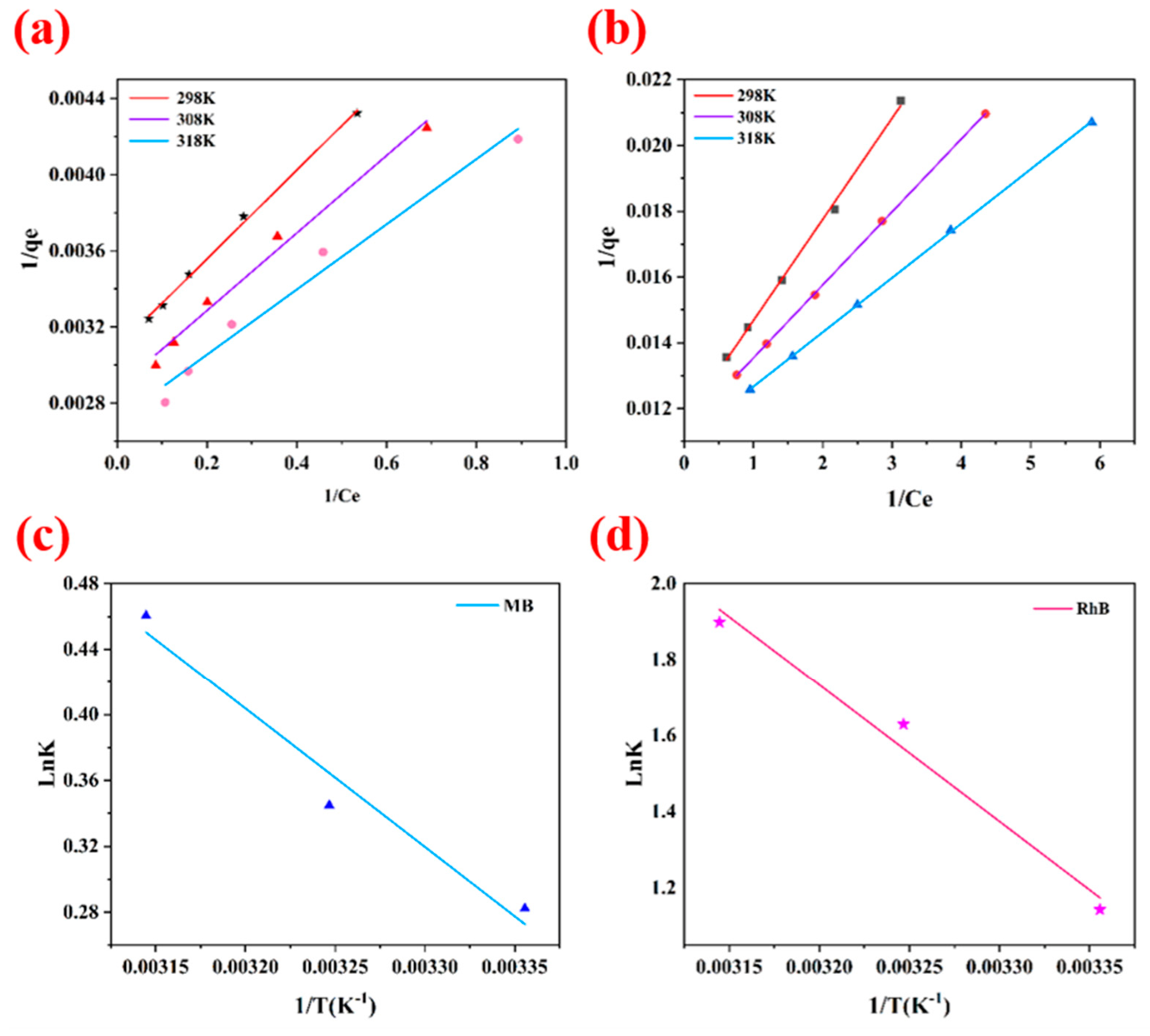
To further explore the adsorption behavior, the equilibrium data of MB and RhB were fitted using the Langmuir isotherm model (Figure 8). The excellent correlation coefficients (R2 > 0.99) confirm that the adsorption of both dyes follows a homogeneous monolayer adsorption mechanism. As shown in Table 5, the maximum adsorption capacities (qmax) of MB and RhB increased with rising temperature, indicating that the adsorption is endothermic in nature. Moreover, the higher qmax values for MB compared to RhB suggest stronger interactions between MB molecules and the surface functional groups of CMS@(PDDA/PSS)2.
The thermodynamic parameters (ΔG, ΔH, and ΔS), obtained from the van’t Hoff plots (Figure 8) and summarized in Table 6, provide further insight into the adsorption mechanism. The negative ΔG values at all tested temperatures confirm that the adsorption processes of MB and RhB are spontaneous. The positive ΔH values (6.993 and 29.839 kJ·mol−1 for MB and RhB, respectively) indicate that both adsorption processes are endothermic, while the positive ΔS values (25.734 and 109.895 J·mol−1·K−1) reveal an increase in randomness at the solid–liquid interface during adsorption. These results suggest that the adsorption is primarily driven by physical interactions, accompanied by some degree of electrostatic attraction and diffusion effects. Therefore, the adsorption of MB and RhB on CMS@(PDDA/PSS)2 can be described as a spontaneous, endothermic, and diffusion-influenced monolayer adsorption process.

3.7. pH and Dosage-Dependent Adsorption Characteristics

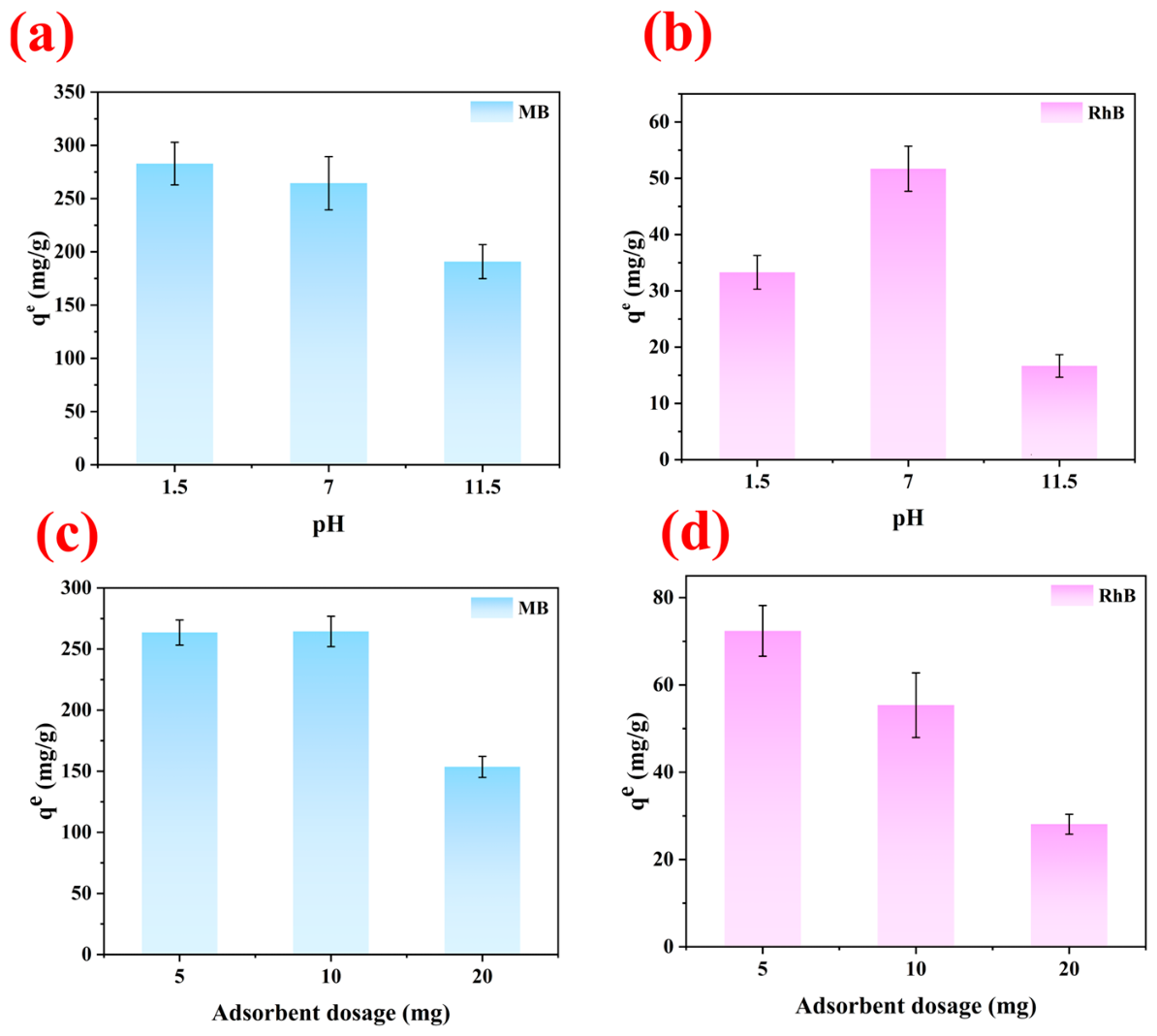
As shown in Figure 9, the adsorption behavior of CMS@(PDDA/PSS)2 toward MB and RhB exhibited distinct trends under varying pH values and adsorbent dosages. With increasing pH, the adsorption capacity (qe) for MB continuously decreased, while that for RhB first increased and then decreased, reaching a maximum around neutral pH (≈7). This difference arises mainly from the distinct molecular structures and ionic properties of the two dyes. For the cationic dye MB, although a higher pH enhances the negative charge on the adsorbent surface, the increased concentration of hydroxyl ions (OH) in alkaline media leads to competitive adsorption, thus lowering qe. In contrast, RhB predominantly exists in molecular form at neutral pH, where both electrostatic attraction with positively charged sites and π–π interactions contribute to enhanced adsorption. However, under strongly acidic or basic conditions, molecular dissociation or surface charge alteration weakens RhB adsorption.
Regarding the effect of adsorbent dosage, as the amount of CMS@(PDDA/PSS)2 increased from 5 mg to 20 mg, the qe of MB first rose and then decreased, while that of RhB decreased monotonically. For MB, the initial increase in adsorption capacity can be attributed to the higher number of available active sites. When the adsorbent dosage becomes excessive, the dye concentration gradient in solution diminishes, leading to lower utilization efficiency of adsorption sites and a reduction in qe. In the case of RhB, the adsorption is more sensitive to the dye concentration gradient, resulting in a continuous decline in adsorption capacity per gram of adsorbent with increasing dosage (Table 7).

3.8. Reusability and Regeneration of the Adsorbent

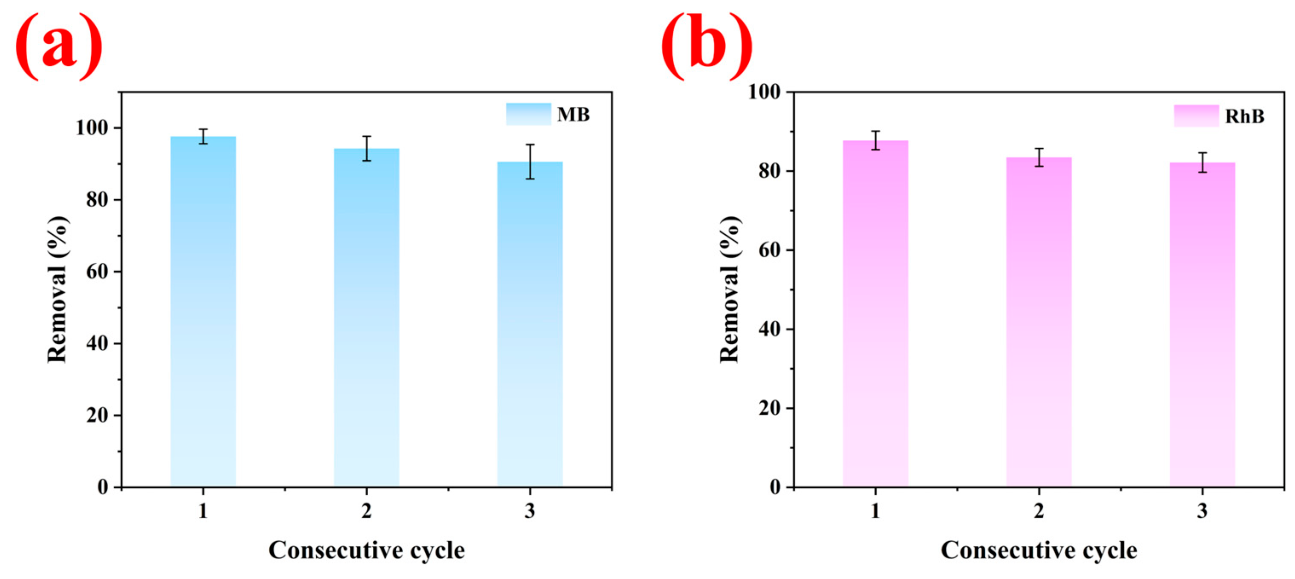
The reusability of the adsorbent is a crucial factor for its practical application in wastewater treatment. To evaluate the regeneration performance of the CMS@(PDDA/PSS)2 composite, three consecutive adsorption–desorption cycles were conducted for both MB and RhB. As shown in Figure 10, the removal efficiency for MB decreased slightly from 99.1% in the first cycle to 98.62% and 95.31% in the second and third cycles, respectively. Similarly, the removal efficiency for RhB was 90.27% in the first run, followed by 85.61% and 87.39% in the subsequent cycles. The slight decline in adsorption efficiency after multiple uses can be attributed to the partial occupation or deactivation of active sites and possible structural changes during regeneration. Nevertheless, the adsorbent retained over 95% of its initial capacity for MB and more than 85% for RhB after three cycles, indicating excellent structural stability and regeneration capability. These results demonstrate that the CMS@(PDDA/PSS)2 composite possesses good reusability and potential for long-term practical application in dye wastewater treatment.

3.9. Comparative Evaluation of Adsorption Performance

To further evaluate the adsorption performance of the synthesized materials, a comparative analysis was conducted between CMS@(PDDA/PSS)2 and other reported adsorbents for methylene blue (MB) removal, as summarized in Table 8. It can be observed that the obtained CMS@(PDDA/PSS)2 exhibited a remarkably high adsorption capacity compared with many conventional carbon-based or polymeric adsorbents reported in the literature. This superior performance can be attributed to the synergistic effects of the porous carbon framework and the electrostatically active polyelectrolyte layers, which not only provide abundant adsorption sites but also enhance dye–adsorbent interactions. Furthermore, the adsorption process occurs efficiently under mild conditions (neutral pH, room temperature, and low adsorbent dosage), demonstrating the practical applicability and cost-effectiveness of the synthesized material. Therefore, CMS@(PDDA/PSS)2 can be considered a promising candidate for the efficient removal of cationic dyes such as MB from aqueous environments.

4. Conclusions

In summary, the present research work involved a systematic investigation of the adsorption performance of pristine CMSs and their composites, which were modified with various numbers of PDDA/PSS polyelectrolyte bilayers, toward MB and RhB dyes. The results indicate that the sample modified with a single bilayer of PDDA and PSS exhibited the best adsorption performance, with a RhB adsorption capacity of 57.6 mg·g−1, slightly higher than that of pristine CMSs. However, when the number of bilayers was increased to two, the pore volume decreased, leading to a significant deterioration in adsorption performance, even lower than that of pristine CMSs. Therefore, moderate polyelectrolyte modification effectively enhanced electrostatic interactions and increased the quantity of adsorption active sites, thereby improving both the adsorption kinetics and equilibrium capacities. In contrast, excessive modification led to a significant reduction in surface area and pore volume, severe pore blockage, and consequently restricted dye diffusion and adsorption, which ultimately resulted in decreased adsorption performance. This work not only elucidates the structure–performance relationship of CMS@(PDDA/PSS) composites but also provides valuable insights for the design of efficient adsorbents for wastewater treatment. Furthermore, the size of the prepared carbon microspheres makes them suitable for membrane embedding or packed-column applications. Future work will explore their performance under dynamic adsorption modes. For example, the composites can be incorporated into ultrafiltration membranes or packed fixed-bed columns. This will allow for an evaluation of their scalability and long-term operational stability for practical industrial wastewater treatment.

Author Contributions

Conceptualization, W.Z. and T.J.; Methodology, S.S. and N.X.; Software, X.L. (Xinyu Li); Validation, W.Z., X.L. (Xinyu Li), N.X. and X.L. (Xiujuan Liu); Formal analysis, X.L. (Xinyu Li), X.L. (Xiujuan Liu) and T.J.; Investigation, D.N. and T.J.; Resources, W.Z., S.S., D.N. and N.X.; Data curation, W.Z., S.S., N.X. and X.L. (Xiujuan Liu); Writing—original draft, W.Z.; Writing—review & editing, T.J.; Supervision, T.J.; Project administration, T.J.; Funding acquisition, T.J. All authors have read and agreed to the published version of the manuscript.

Funding

We greatly appreciate the financial support of the National Natural Science Foundation of China (No. 22372143), the Hebei Natural Science Foundation (No. B2025203050), the Science Research Project of Hebei Education Department (No. JCZX2026028), the Special Project for Local Science and Technology Development Guided by the Central Government of China (No. 246Z1407G), and the Medical Science Research Project of Hebei (No. 20261133).

Institutional Review Board Statement

Not applicable.

Informed Consent Statement

Not applicable.

Data Availability Statement

The original contributions presented in this study are included in the article. Further inquiries can be directed to the corresponding authors.

Conflicts of Interest

Author Dongxue Ning was employed by the Qinhuangdao Huaheng Bioengineering Co., Ltd. The remaining authors declare that the research was conducted in the absence of any commercial or financial relationships that could be construed as a potential conflict of interest.

References

  1. Robinson, T.; McMullan, G.; Marchant, R.; Nigam, P. Remediation of dyes in textile effluent: A critical review on current treatment technologies with a proposed alternative. Bioresour. Technol. 2001, 77, 247–255. [Google Scholar] [CrossRef] [PubMed]
  2. Li, Q.; Dong, K.; Tu, Y.; Jiang, L.; Li, X.; Li, H. Current Situation and Problems of MBR Treatment Process in Dye Wastewater. IOP Conf. Ser. Earth Environ. Sci. 2019, 358, 022043. [Google Scholar] [CrossRef]
  3. Forgacs, E.; Cserháti, T.; Oros, G. Removal of synthetic dyes from wastewaters: A review. Environ. Int. 2004, 30, 953–971. [Google Scholar] [CrossRef]
  4. Kumar, G.; Ahlawat, A.; Bhardwaj, H.; Sahu, G.K.; Rana, P.S.; Solanki, P.R. Ultrasonication-assisted synthesis of transition metal carbide of MXene: An efficient and promising material for photocatalytic organic dyes degradation of rhodamine B and methylene blue in wastewater. Environ. Sci. Pollut. Res. 2024, 31, 38232–38250. [Google Scholar] [CrossRef] [PubMed]
  5. Crini, G.; Lichtfouse, E. Advantages and disadvantages of techniques used for wastewater treatment. Environ. Chem. Lett. 2019, 17, 145–155. [Google Scholar] [CrossRef]
  6. Mutegoa, E. Efficient techniques and practices for wastewater treatment: An update. Discov. Water 2024, 4, 69. [Google Scholar] [CrossRef]
  7. Wang, S.; Peng, Y. Natural zeolites as effective adsorbents in water and wastewater treatment. Chem. Eng. J. 2010, 156, 11–24. [Google Scholar] [CrossRef]
  8. Lim, Y.J.; Goh, K.; Nadzri, N.; Wang, R. Thin-film composite (TFC) membranes for sustainable desalination and water reuse: A perspective. Desalination 2025, 599, 118451. [Google Scholar] [CrossRef]
  9. Li, Y.; Du, Q.; Liu, T.; Sun, J.; Jiao, Y.; Xia, Y.; Xia, L.; Wang, Z.; Zhang, W.; Wang, K.; et al. Equilibrium, kinetic and thermodynamic studies on the adsorption of phenol onto graphene. Mater. Res. Bull. 2012, 47, 1898–1904. [Google Scholar] [CrossRef]
  10. Hu, B.; Wang, K.; Wu, L.; Yu, S.-H.; Antonietti, M.; Titirici, M.-M. Engineering Carbon Materials from the Hydrothermal Carbonization Process of Biomass. Adv. Mater. 2010, 22, 813–828. [Google Scholar] [CrossRef]
  11. Sun, X.; Li, Y. Colloidal Carbon Spheres and Their Core/Shell Structures with Noble-Metal Nanoparticles. Angew. Chem. Int. Ed. Engl. 2004, 43, 597–601. [Google Scholar] [CrossRef] [PubMed]
  12. Sevilla, M.; Fuertes, A. The production of carbon materials by hydrothermal carbonization of cellulose. Carbon 2009, 47, 2281–2289. [Google Scholar] [CrossRef]
  13. Fang, Y.; Liu, L.; Xiang, H.; Wang, Y.; Sun, X. Biomass-based carbon microspheres for removing heavy metals from the environment: A review. Mater. Today Sustain. 2022, 18, 100136. [Google Scholar] [CrossRef]
  14. Kettum, W.; Tran, T.T.V.; Kongparakul, S.; Reubroycharoen, P.; Guan, G.; Chanlek, N.; Samart, C. Heavy metal sequestration with a boronic acid-functionalized carbon-based adsorbent. J. Environ. Chem. Eng. 2018, 6, 1147–1154. [Google Scholar] [CrossRef]
  15. Sanchez-Sanchez, A.; Braghiroli, F.L.; Izquierdo, M.T.; Parmentier, J.; Celzard, A.; Fierro, V. Synthesis and properties of carbon microspheres based on tannin–sucrose mixtures treated in hydrothermal conditions. Ind. Crops Prod. 2020, 154, 112564. [Google Scholar] [CrossRef]
  16. Decher, G. Fuzzy Nanoassemblies: Toward Layered Polymeric Multicomposites. Science 1997, 277, 1232–1237. [Google Scholar] [CrossRef]
  17. Decher, G.; Hong, J.-D. Buildup of ultrathin multilayer films by a self-assembly process, 1 consecutive adsorption of anionic and cationic bipolar amphiphiles on charged surfaces. Makromol. Chem. Macromol. Symp. 1991, 46, 321–327. [Google Scholar] [CrossRef]
  18. Caruso, F.; Caruso, R.A.; Möhwald, H. Nanoengineering of Inorganic and Hybrid Hollow Spheres by Colloidal Templating. Science 1998, 282, 1111–1114. [Google Scholar] [CrossRef]
  19. Jiang, C.; Markutsya, S.; Pikus, Y.; Tsukruk, V.V. Freely suspended nanocomposite membranes as highly sensitive sensors. Nat. Mater. 2004, 3, 721–728. [Google Scholar] [CrossRef]
  20. Ai, L.; Zhang, C.; Chen, Z. Removal of methylene blue from aqueous solution by a solvothermal-synthesized graphene/magnetite composite. J. Hazard. Mater. 2011, 192, 1515–1524. [Google Scholar] [CrossRef]
  21. Yang, K.; Wu, W.; Jing, Q.; Zhu, L. Aqueous Adsorption of Aniline, Phenol, and their Substitutes by Multi-Walled Carbon Nanotubes. Environ. Sci. Technol. 2008, 42, 7931–7936. [Google Scholar] [CrossRef]
  22. Wang, H.; Yuan, X.; Wu, Y.; Huang, H.; Zeng, G.; Liu, Y.; Wang, X.; Lin, N.; Qi, Y. Adsorption characteristics and behaviors of graphene oxide for Zn(II) removal from aqueous solution. Appl. Surf. Sci. 2013, 279, 432–440. [Google Scholar] [CrossRef]
  23. Sun, Z.; Zhang, M.; Yin, H.; Hu, Q.; Krishnan, S.; Huang, Z.; Qi, H.; Wang, X. Tailoring hierarchically porous structure of biomass-derived carbon for high-performance supercapacitors. Renew. Energy 2023, 219, 119375. [Google Scholar] [CrossRef]
  24. Su, F.; Zhao, X.; Lv, L.; Zhou, Z. Synthesis and characterization of microporous carbons templated by ammonium-form zeolite Y. Carbon 2004, 42, 2821–2831. [Google Scholar] [CrossRef]
  25. Liu, M.; Man, G.; Yu, Z.; Zhao, J.; Song, Y.; Sun, L.; Yang, Y.; Zhang, F. Synergistic effect of carbon sphere size and activation temperature on electrochemical performance of porous carbon spheres for supercapacitors. Diam. Relat. Mater. 2025, 153, 112076. [Google Scholar] [CrossRef]
  26. Sewwandi, B.; Kumarasinghe, A.; Wu, Z.; Bandara, P.; Jayarathne, L.; Bandara, A.; Wijekoon, H.; Chen, X.; Weerasooriya, R. Size-tunable graphitized carbon spheres for water defluoridation. Colloids Surf. A Physicochem. Eng. Asp. 2023, 670, 131582. [Google Scholar] [CrossRef]
  27. Staciwa, P.; Narkiewicz, U.; Sibera, D.; Moszyński, D.; Wróbel, R.J.; Cormia, R.D. Carbon Spheres as CO2 Sorbents. Appl. Sci. 2019, 9, 3349. [Google Scholar] [CrossRef]
  28. Chen, D.; Nan, Z. Layer-by-Layer Assembly of Polyelectrolytes on Urchin-like MnO2 for Extraction of Zn2+, Cu2+ and Pb2+ from Alkaline Solutions. Crystals 2022, 12, 358. [Google Scholar] [CrossRef]
  29. Zhang, H.; Yu, L.; Han, L.; Liu, X.; Ruan, S.; Hu, J. Fast Modulation of Surface Amphiphobicity/Amphiphilicity via Bidirectional Substitution between Perfluorinated Surfactants and Polyanions throughout Pre-Assembled Polyelectrolyte Multilayers. Langmuir 2019, 35, 17122–17131. [Google Scholar] [CrossRef]
  30. Kuroda, Y.; Kuroda, K. Layer-by-layer assembly of imogolite nanotubes and polyelectrolytes into core-shell particles and their conversion to hierarchically porous spheres. Sci. Technol. Adv. Mater. 2008, 9, 025018. [Google Scholar] [CrossRef]
  31. Zou, J.; Fan, C.; Jiang, Y.; Liu, X.; Zhou, W.; Xu, H.; Huang, L. A preliminary study on assessing the Brunauer-Emmett-Teller analysis for disordered carbonaceous materials. Microporous Mesoporous Mater. 2021, 327, 111411. [Google Scholar] [CrossRef]
  32. Wi, S.; Chang, S.J.; Jeong, S.-G.; Lee, J.; Kim, T.; Park, K.-W.; Lee, D.R.; Kim, S. Evaluation of Toluene Adsorption Performance of Mortar Adhesives Using Porous Carbon Material as Adsorbent. Materials 2017, 10, 853. [Google Scholar] [CrossRef]
  33. Li, X.; Qi, Y.; Li, Y.; Zhang, Y.; He, X.; Wang, Y. Novel magnetic beads based on sodium alginate gel crosslinked by zirconium(IV) and their effective removal for Pb2+ in aqueous solutions by using a batch and continuous systems. Bioresour. Technol. 2013, 142, 611–619. [Google Scholar] [CrossRef] [PubMed]
  34. Song, Y.; Zhang, M.; Chen, Z.; Jian, M.; Ling, C.; Zhang, Q. Sustainable Pb(II) Removal and Recovery from Wastewater Using a Bioinspired Metal-Phenolic Hybrid Membrane with Efficient Regeneration. ChemSusChem 2024, 18, e202401770. [Google Scholar] [CrossRef] [PubMed]
  35. Sherugar, P.; Padaki, M.; Naik, N.S.; George, S.D.; Murthy, D.H.K. Biomass-derived versatile activated carbon removes both heavy metals and dye molecules from wastewater with near-unity efficiency: Mechanism and kinetics. Chemosphere 2022, 287, 132085. [Google Scholar] [CrossRef] [PubMed]
  36. Chen, L.; Ji, T.; Mu, L.; Shi, Y.; Wang, H.; Zhu, J. Pore size dependent molecular adsorption of cationic dye in biomass derived hierarchically porous carbon. J. Environ. Manag. 2017, 196, 168–177. [Google Scholar] [CrossRef]
  37. Bedin, K.C.; Souza, I.P.A.F.; Cazetta, A.L.; Spessato, L.; Ronix, A.; Almeida, V.C. CO2-spherical activated carbon as a new adsorbent for Methylene Blue removal: Kinetic, equilibrium and thermodynamic studies. J. Mol. Liq. 2018, 269, 132–139. [Google Scholar] [CrossRef]
Figure 1. Scheme of the forming mechanism for CMS@(PDDA/PSS)2 and CMS@(PDDA/PSS)4 through the layer-by-layer self-assembly of polyelectrolytes onto CMSs.
Coatings 16 00668 g001
Figure 2. TEM images of CMSs (a), CMS@(PDDA/PSS)2 (b), and CMS@(PDDA/PSS)4 (c). SEM images of the CMSs (d), CMS@(PDDA/PSS)2 (e), and CMS@(PDDA/PSS)4 (f).
Coatings 16 00668 g002
Figure 3. XRD curves (a) and XPS spectra (b) of CMSs, CMS@(PDDA/PSS)2, and CMS@(PDDA/PSS)4.
Coatings 16 00668 g003
Figure 4. Nitrogen adsorption–desorption isotherms curves of CMSs (a), CMS@(PDDA/PSS)2 (b), and CMS@(PDDA/PSS)4 (c). Pore size distribution curves of CMSs (d), CMS@(PDDA/PSS)2 (e), and CMS@(PDDA/PSS)4 (f).
Coatings 16 00668 g004
Figure 5. The first-order kinetic fitting curve (a) and the second-order kinetic fitting curve (b) of CMSs for the adsorption of MB. The first-order kinetic fitting curve (c) and the second-order kinetic fitting curve (d) of CMSs for the adsorption of RhB.
Coatings 16 00668 g005
Figure 6. The first-order kinetic fitting curve (a) and the second-order kinetic fitting curve (b) of CMS@(PDDA/PSS)2 for the adsorption of MB. The first-order kinetic fitting curve (c) and the second-order kinetic fitting curve (d) of CMS@(PDDA/PSS)2 for the adsorption of RhB. The first-order kinetic fitting curve (e) and the second-order kinetic fitting curve (f) of CMS@(PDDA/PSS)4 for the adsorption of MB.
Coatings 16 00668 g006
Figure 7. The intraparticle diffusion model of CMS@(PDDA/PSS)2 for MB (a) and RhB (b).
Coatings 16 00668 g007
Figure 8. Langmuir adsorption isotherms of MB (a) and RhB (b) on CMS@(PDDA/PSS)2 and Langmuir adsorption isotherm plots for MB (c) and RhB (d) adsorption onto CMS@(PDDA/PSS)2 at 298 K.
Coatings 16 00668 g008
Figure 9. Effect of pH and adsorbent dosage on the adsorption capacities of MB (a,c) and RhB (b,d) over CMS@(PDDA/PSS)2.
Coatings 16 00668 g009
Figure 10. Adsorption–desorption cycling performance of CMS@(PDDA/PSS)2 for MB (a) and RhB (b) removal.
Coatings 16 00668 g010
Table 1. The atomic percentages of the samples.
SampleC (wt%)O (wt%)N (wt%)S (wt%)Na (wt%)
CMS79.2820.72---
CMS@(PDDA/PSS)267.1926.62.961.881.37
CMS@(PDDA/PSS)463.527.065.282.471.69
Table 2. Different samples of BET surface area, average pore size, and pore volume.
SampleBET Surface Area (m2·g−1)Average Pore Size (nm)Pore Volume (cm3·g−1)R2
CMSs757.22133.01740.0748360.9974118
CMS@(PDDA/PSS)2616.20376.05440.0325470.9962309
CMS@(PDDA/PSS)488.101513.18020.0101140.9999511
Table 3. The kinetic fitting parameters of MB adsorption for samples with different coating layers.
SamplePseudo-First-Order Kinetic FittingPseudo-Second-Order Kinetic Fitting
qe
(mg/g)
R2K1qe
(mg/g)
R2K2qe (exp, mg/g)
CMSs273.3260.962.59 × 10−1294.1180.991.62 × 10−3285.346
CMS@(PDDA/PSS)2264.1680.991.332263.1580.991.26 × 10−1264.467
CMS@(PDDA/PSS)4248.350.994.39 × 10−2332.2260.991.27 × 10−4247.533
Table 4. The kinetic fitting parameters of RhB adsorption for samples with different coating layers.
SamplePseudo-First-Order Kinetic FittingPseudo-Second-Order Kinetic Fitting
qe
(mg/g)
R2K1qe
(mg/g)
R2K2qe (exp, mg/g)
CMSs48.3580.961.45 × 10−155.5560.993.21 × 10−347.873
CMS@(PDDA/PSS)252.0430.971.46 × 10−157.5710.994.52 × 10−355.368
CMS@(PDDA/PSS)4-------
Table 5. Langmuir isothermal adsorption model of CMS@(PDDA/PSS)2.
Temperature
(K)
MBRhB
qmax (mg/g)KR2qmax (mg/g)KR2
298 K323.6251.3260.9986.1323.1380.99
308 K347.2221.4120.9988.3295.0990.99
318 K369.0041.5850.9890.7436.6790.99
Table 6. Thermodynamic parameters of CMS@(PDDA/PSS)2 for the adsorption of MB and RhB.
Temperature
(K)
MBRhB
ΔG (kJ·mol−1)ΔH (kJ·mol−1)ΔS (J·(mol·K−1))ΔG (kJ·mol−1)ΔH (kJ·mol−1)ΔS (J·(mol·K−1))
298 K−0.6996.99325.734−2.83329.839109.895
308 K−0.883 −4.172
318 K−1.217 −5.021
Table 7. Effect of pH and adsorbent dosage on the adsorption capacities (qe) of MB and RhB onto CMS@(PDDA/PSS)2.
DyepHAdsorbent Dosage (mg)
1.5711.551020
qe (MB, mg/g)282.868264.468190.771263.514264.468153.542
qe (RhB, mg/g)33.29151.70816.67472.39155.36828.091
Table 8. Comparison of dye adsorption performance of different materials.
AdsorbentTemperature (K)pHDosage (mg)qe (mg·g−1)Ref
Karanj fruit hulls activated carbon298710154.8[35]
Cotton-derived porous carbon303710242[36]
CO2-spherical activated carbon303725211[37]
CMS@(PDDA/PSS)2298710285.35This work
Disclaimer/Publisher’s Note: The statements, opinions and data contained in all publications are solely those of the individual author(s) and contributor(s) and not of MDPI and/or the editor(s). MDPI and/or the editor(s) disclaim responsibility for any injury to people or property resulting from any ideas, methods, instructions or products referred to in the content.