Article

Coupled Modeling of Vehicle Fleet Renewal Policies and Urban Environmental Corrosion: Dynamic Emission Trajectories and Infrastructure Coating Durability


1
School of Sociology and Population Studies, Nanjing University of Posts and Telecommunications, Nanjing 210023, China
2
Bell Honors School, Nanjing University of Posts and Telecommunications, Nanjing 210023, China
3
School of Artificial Intelligence, Nanjing University of Posts and Telecommunications, Nanjing 210023, China
4
College of Integrated Circuit Science and Engineering (College of Industry-Education Integration), Nanjing University of Posts and Telecommunications, Nanjing 210023, China
5
School of Mathematics, Foshan University, Foshan 528000, China
6
School of Automation and Intelligent Science, Jiangnan University, Wuxi 214000, China
7
School of Business, Tongda College of Nanjing University of Posts and Telecommunications, Yangzhou 225127, China
*
Author to whom correspondence should be addressed.
These authors contributed equally to this work.
Coatings 2026, 16(6), 666; https://doi.org/10.3390/coatings16060666
Submission received: 28 April 2026 / Revised: 26 May 2026 / Accepted: 28 May 2026 / Published: 1 June 2026

Highlights

What are the main findings?
  • Aggressive subsidies drive fleets to heavy NEVs, causing severe upstream emission spikes.
  • This emission inversion sharply raises SO2 and NOx, severely worsening urban corrosivity.
  • Induced acidic stress prematurely cuts protective coating lifespans by 1.3 to 2.3 years.
  • A subsidy of 8000–10,500 CNY optimally balances climate and material goals.
What are the implications of the main findings?
  • Transport decarbonization must integrate material durability and corrosion metrics.
  • Overlooking coating degradation leads to massive, unplanned infrastructure repair costs.
  • Uniform incentives should be replaced by differentiated, life-cycle-based subsidies.
  • Policy formulation requires a holistic surface-to-system engineering perspective.

Abstract

Vehicle fleet renewal policies promoting NEVs aim to decarbonize transportation but inadvertently alter urban atmospheric corrosivity, threatening the durability of infrastructure coatings. This study investigated the cross-system impacts of vehicle trade-in subsidies on the degradation of protective coatings. We developed a coupled framework integrating a Mixed Logit model for fleet evolution, dynamic Life Cycle Assessment for tracking acidic precursors (SO2, NOx), and an Environmental Corrosion Risk Index. Using established Dose–Response Functions, we quantified the lifespan depletion of a standard epoxy zinc-rich primer and polyurethane topcoat system. Our results indicate that aggressive subsidies induce a transition to heavy NEVs, triggering an “emission inversion” that spikes upstream grid acidic emissions. This localized acidification significantly accelerates chemical degradation, reducing the effective service life of infrastructure coatings by 1.3–2.3 years and necessitating premature, costly recoating. We identify a Pareto-optimal subsidy window (8000–10,500 CNY) that effectively balances decarbonization targets with coating preservation. In conclusion, sustainable urban policies must incorporate surface engineering and material durability metrics to prevent emission shifts from compromising the physical integrity of transportation infrastructure.

1. Introduction

1.1. Research Background and Significance

Against the backdrop of intensifying global climate change, the clean and low-carbon transition of the energy system has become an international consensus. As a core sector of fossil fuel consumption and carbon emissions, the low-carbon transition of the transportation industry is crucial to the energy revolution and climate governance. Under China’s “Dual Carbon” strategic goals, deep decarbonization of transportation has been integrated into the national green development framework. As the primary mobile pollution source in the transportation sector, vehicles have become the key to low-carbon transition through fleet optimization and technological upgrading. By the end of 2024, the number of NEVs in China had grown rapidly, yet the phase-out and replacement of high-emission old fuel vehicles remained slow. To accelerate the transition, the Chinese government has intensively issued vehicle trade-in subsidy policies and established a national implementation framework. However, two major challenges arise in practice: macro subsidies fail to precisely stimulate micro-level vehicle replacement behavior and may trigger unintended systemic consequences, making it difficult to achieve genuine net emission reductions. More importantly, acidic precursors such as SO2 and NOx from traffic emissions significantly increase urban atmospheric corrosivity, accelerate the aging of anti-corrosion coatings on bridges, guardrails and other infrastructure, shorten service life, and raise maintenance costs [1]. Existing policy evaluations mostly focus on carbon emission reduction, ignoring the transmission chain of “vehicle replacement–emission change–atmospheric corrosion–coating durability”, thus leaving blind spots in environmental and engineering design.
Theoretically, vehicle trade-in policies essentially represent the low-carbon restructuring of the transportation socio-technical system driven by public policies [2,3,4]. Current research has obvious limitations: traditional emission reduction assessments mostly adopt the tank-to-wheel one-dimensional model [5], which only considers direct use-phase emissions and neglects life-cycle impacts and policy-behavior interactions; the mainstream LCA method [6] relies on static parameters, failing to reflect the heterogeneity of consumer behavior and thus unable to link micro behavior with macro carbon accounting; although discrete choice models can characterize vehicle purchase decisions, they exclude environmental factors such as carbon emissions and corrosion effects from utility functions and are dominated by static analysis incapable of capturing long-term impacts. Furthermore, an integrated coupling framework of “policy–behavior–environment–material” has not yet been established, and relevant dynamic modeling studies remain scarce, leaving insufficient cross-system quantitative research. Therefore, an integrated model is urgently needed to fill this theoretical gap.
The theoretical significance of this study lies in establishing a coupling model among vehicle replacement policies, atmospheric corrosion, and infrastructure coating durability, breaking through the limitations of traditional methods, realizing endogenous coupling of multiple factors, and enriching the theory of socio-technical system transition. The practical significance is to quantitatively identify the lag effects and emission inversion risks of policies, establish a quantitative relationship among emissions, corrosivity, and coating lifespan depletion, propose an optimal subsidy interval that balances carbon emission reduction and infrastructure sustainability, promote the shift from universal subsidies to differentiated and targeted incentives, and improve the comprehensive benefits of the low-carbon transition in transportation.

1.2. Literature Review

1.2.1. Research on LCA Models in the Transportation Sector

LCA is currently the most widely used and highly standardized method internationally for calculating the environmental impacts of a product’s entire life cycle [7]. It comprehensively covers the full chain of environmental impacts—from raw material extraction, manufacturing, and use to recycling and disposal—and is therefore widely applied in road transportation research on carbon emissions accounting [8], environmental benefit comparisons, and the evaluation of low-carbon policy effectiveness [9]. Existing research on LCA in the transportation sector has developed into a relatively mature framework, primarily unfolding along three main lines: first, discussions regarding accounting boundaries and functional units to clarify the classification of vehicle life cycles and the benchmarks for carbon emissions calculations [10,11,12]; second, optimization of key parameters, including mileage [13] and battery life; and third, comparative analyses across multiple scenarios, such as the environmental benefits of traditional fuel vehicles versus new energy vehicles [14].
In terms of frontier expansion, recent interdisciplinary studies have further extended LCA to cross-domain impact evaluation. Dan Li [15] systematically reviewed artificial intelligence applications in cervical cancer diagnosis, treatment, and prognostic assessment, demonstrating that AI-driven multimodal data fusion and deep learning can improve the accuracy of medical detection and outcome prediction by processing massive multi-source data. This paradigm of multimodal data integration and dynamic model optimization provides a methodological reference for improving the traditional static LCA framework, supporting the construction of dynamic emission accounting models that integrate vehicle operating data, environmental factors, and material degradation information. In terms of research applications, LCA is not only used for calculating carbon emissions from individual vehicles but is also increasingly applied to macro-level analyses, such as fleet structure evolution and the prediction of the effectiveness of transportation emission reduction policies. Although existing research has provided a solid methodological foundation for carbon emissions accounting in the transportation sector, there are still relatively consistent limitations: most studies still adopt static settings for mileage and usage intensity [16,17], with little consideration for differences in actual consumer behavior; simultaneously, traditional LCA focuses more on carbon emissions and conventional pollutants, rarely incorporating subsequent impacts such as atmospheric corrosion caused by pollutants and the aging of infrastructure materials into the accounting system, making it difficult to support cross-system analysis of policy, environment, and materials.

1.2.2. Research on Discrete Choice Models in the Transportation Sector

Discrete choice models (DCMs) are statistical models used to analyze and predict individual choice behavior among multiple alternatives [18]. Rooted in the core principles of stochastic utility theory, they assume that the utility value of each alternative consists of an observable fixed component and an unobservable random component [19] and that decision-makers will select the option with the highest utility value. Through long-term development, this class of models has gradually expanded from the basic multinomial logit (MNL) model [20,21] to a more flexible system of methods, including Bayesian discrete choice models [22], mixed logit, and latent-class logit, which are better equipped to handle the issue of heterogeneity in consumer preferences. Existing research generally focuses on the impact of key variables—such as price, usage costs, driving range, technological change [23] and subsidy policies [24]—on vehicle choice behavior, using these to predict trends in market penetration rates and vehicle replacement probabilities for new energy vehicles.
In terms of model performance optimization and dynamic mechanism design, Jingya Qi and Jun Zhang [25] conducted an experimental investigation on two-phase cooling in microchannels with different cross-section geometries, proving that structural shape optimization can simultaneously improve heat transfer efficiency, temperature uniformity, and operational stability under multi-source heterogeneous conditions. This conclusion implies that heterogeneous scenario adaptation and structural parameter optimization can be introduced into discrete choice models to enhance the fitting accuracy of consumer vehicle purchase and renewal behavior under differentiated policy incentives. In recent years, some studies have begun combining discrete choice models with methods such as system dynamics and life cycle assessment [26,27], attempting to bridge the link between micro-level behavior and macro-level emissions to make policy simulations more realistic. Nevertheless, these models still have room for improvement. The utility functions in existing studies primarily focus on economic and usage attributes, rarely incorporating external factors such as full life-cycle carbon emissions, carbon payback periods, and the impact of environmental corrosion; simultaneously, these models pay little attention to the long-term effects of vehicle replacement behavior on infrastructure durability through changes in emissions, making it difficult to fully present the systemic consequences of policy interventions.

1.2.3. Research on Environmental Corrosion and the Durability of Infrastructure Coatings

Atmospheric environmental corrosion is a critical factor affecting the service life of transportation infrastructure. Particularly in urban areas with heavy traffic, acidic precursors such as SO2 and NOx generated by vehicle emissions significantly accelerate the aging of anti-corrosion coatings on the surfaces of steel structures, guardrails, bridges, and other facilities [28]. In this field, existing research primarily focuses on corrosion mechanisms, material degradation patterns, coating lifespan prediction, and the optimization of protective measures [29,30]. Among these, the dose–response function is the most commonly used quantitative tool for describing the relationship between factors such as pollutant concentration, environmental humidity, and temperature and the corrosion rate [31]. A large body of research has established quantitative relationships between coating aging, thickness loss, failure time, and environmental corrosivity through field monitoring, accelerated aging tests, and numerical simulations, providing a basis for the durability design of infrastructure and the formulation of maintenance schedules [32]. However, most existing studies have been conducted independently from the perspective of materials science and engineering, with weak links to macro-level systems such as transportation policies, vehicle replacement, and emissions control. Few studies consider how changes in emissions composition resulting from large-scale policies—such as vehicle trade-in programs-might alter regional corrosion distribution, thereby affecting coating lifespan and maintenance costs. Consequently, research in this field still lacks coupling with transportation and policy systems, making it difficult to provide engineering-level assessments of externalities during the policy formulation stage.

1.2.4. Literature Commentary

Overall, existing research has yielded relatively systematic results in three areas: life cycle assessment, discrete choice modeling, and environmental corrosion and coating durability. However, these areas remain isolated from one another and lack cross-disciplinary integration, resulting in three key research gaps. First, there is a lack of cross-system coupling models; no studies have yet emerged that integrate vehicle replacement policies, dynamic emissions, atmospheric corrosion, and coating durability within a single framework, making it difficult to conduct a unified assessment of policy, environmental, and engineering effects. Second, dynamic feedback mechanisms are insufficient. Existing LCA and choice models are mostly static or unidirectional, lacking a closed-loop feedback mechanism linking “policy—behavior—emissions—corrosion—coating aging,” making it difficult to reflect internal system interactions. Third, there is a lack of comprehensive multi-objective assessment. Current policy evaluations often focus solely on carbon reduction, neglecting engineering sustainability objectives such as infrastructure durability and maintenance costs, resulting in incomplete assessments. To address these gaps, this study centers on the coupled modeling of vehicle replacement policies and urban environmental corrosion. By integrating dynamic LCA, the mixed-logit model, and dose–response relationships, we investigate dynamic emission trajectories and infrastructure coating durability to address the shortcomings of existing research.

1.3. Research Scope

This study systematically investigates the coupling mechanism between vehicle replacement policies and urban environmental corrosion, following a logical sequence of data collection—model construction—empirical identification, and policy optimization.
First, we conducted multidimensional data collection and localized key parameters. Using stratified random sampling, we carried out a nationwide micro-level survey of consumer vehicle trade-in behavior to obtain first-hand data on consumer decision-making preferences, usage intensity, and willingness to replace vehicles. Meanwhile, we systematically collected and integrated vehicle life-cycle bill of materials, region-specific dynamic emission factors from power grids, urban atmospheric corrosion monitoring data, and material property parameters of anti-corrosion coatings for transportation infrastructure. This established a foundational database covering three dimensions—socioeconomics, environmental emissions, and materials engineering—providing unified and reliable data support for subsequent coupled modeling and simulation analysis.
Second, a multi-module closed-loop coupled modeling system was established. First, a two-stage mixed Logit model was employed to characterize the dual-layer heterogeneous decision-making process regarding whether consumers “would replace their vehicles” and “which replacement vehicle model to choose,” thereby identifying the core policy levers driving replacement behavior. Second, a dynamic LCA model was developed to accurately calculate the carbon footprint and emissions of acid precursors (such as SO2 and NOx) across the entire vehicle production, use, and recycling chain, thereby quantifying the carbon payback period and emission reversal risks associated with new energy vehicles. Third, an ECRI and dose–response functions were established to translate changes in transportation emissions into changes in atmospheric corrosion intensity, enabling quantitative prediction of coating life decay rates. Ultimately, a closed-loop coupled model of “policy—behavior—emissions—corrosion—coating durability” was established, achieving the organic integration of social, environmental, and engineering systems.
Third, we conducted multi-scenario empirical simulations and identified comprehensive effects. Four comparative scenarios—a baseline scenario, a low-incentive scenario, an optimal-incentive scenario, and a high-incentive scenario—were established. Using counterfactual analysis and Monte Carlo simulation methods, the baseline effects resulting from natural market renewal were eliminated to precisely identify the comprehensive impacts of policy interventions, including net carbon emission reduction benefits, enhanced atmospheric corrosion effects, and losses from premature coating failure of infrastructure. Based on these findings, the optimal subsidy range that balances emission reduction benefits with infrastructure durability was determined.
Fourth, we proposed a policy design and governance mechanism for coordinated optimization. Based on the simulation results from the coupled model and the conclusions regarding effect identification, we comprehensively considered carbon emission reduction targets, atmospheric air quality, and the long-term durability of infrastructure. We proposed differentiated and targeted vehicle replacement incentive policies and established a governance mechanism featuring dynamic adjustments and multi-stakeholder collaboration, thereby providing scientifically sound and feasible decision-making references for the low-carbon transition of transportation and the sustainable development of urban infrastructure.

2. Model Construction and Research Methods

2.1. Integrated Framework for Policy-Induced Environmental Corrosivity and Coating Durability Assessment

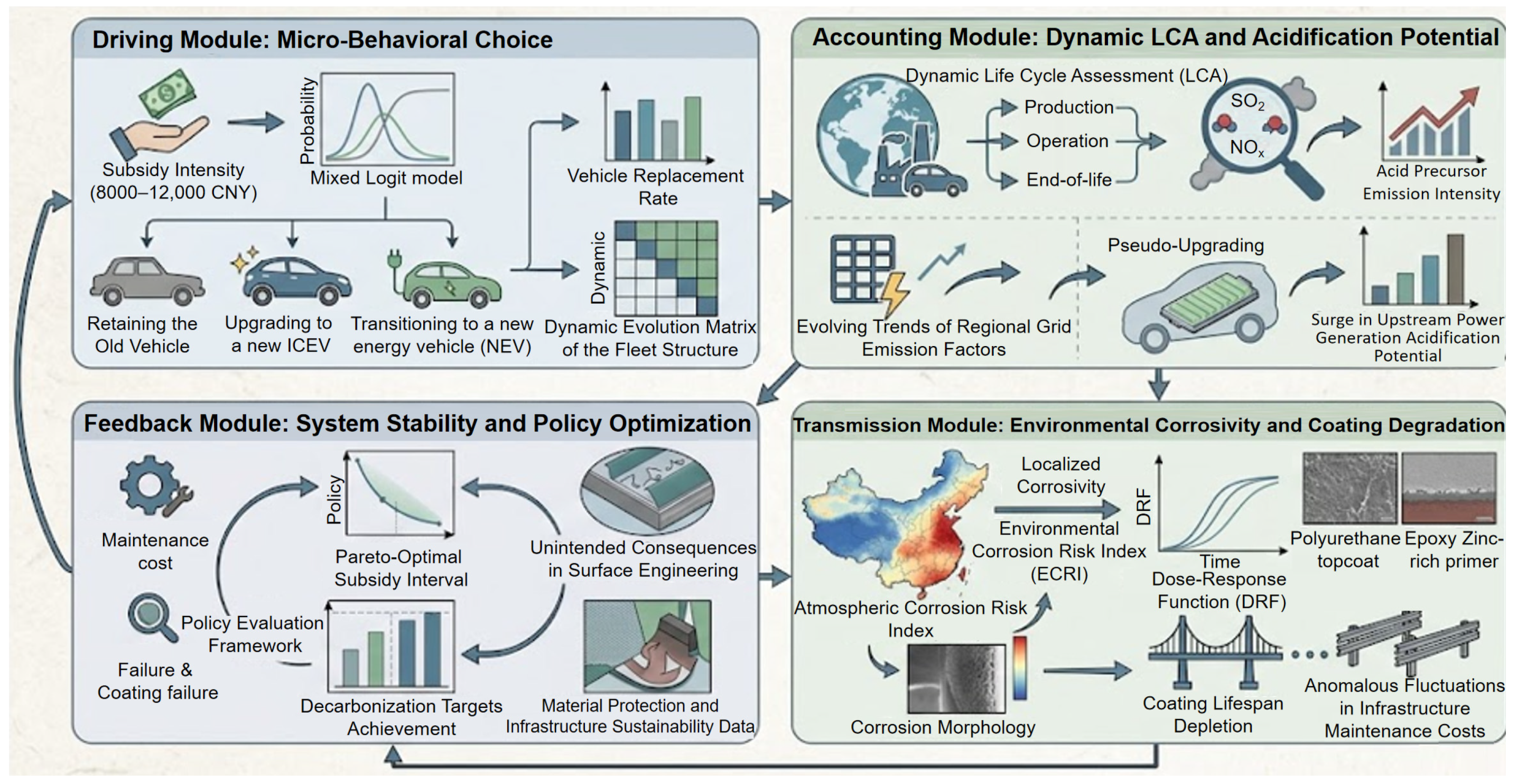
This study develops a coupled framework integrating micro-level consumer behavioral decisions with macro-level environmental physical evolution. The primary objective is to quantitatively assess the profound impacts of vehicle trade-in policies on the durability of anti-corrosion coatings applied to transportation infrastructure. This framework consists of four interconnected modules, forming a closed-loop trajectory from policy implementation to material performance outcomes (as illustrated in Figure 1).

2.1.1. Driving Module: Micro-Behavioral Choice

At its core, this module employs a Mixed Logit model [33] to simulate consumer willingness to replace vehicles under varying subsidy intensities (e.g., 8000–1,2000 CNY). Utilizing 597 empirical survey samples, the model captures heterogeneous consumer preferences [34,35] among “retaining the old vehicle,” “upgrading to a new ICEV,” and “transitioning to a NEV.” The primary outputs of this module—namely, the vehicle replacement rate and the dynamic evolution matrix of the fleet structure—serve as the foundational activity data for subsequent calculations of atmospheric pollutant emissions and environmental acidification potential.

2.1.2. Accounting Module: Dynamic LCA and Acidification Potential

Building upon the dynamic evolution of the fleet structure, a dynamic LCA approach [36,37] is utilized to quantify the environmental burdens throughout the vehicles’ lifespan, from production and operation to end-of-life phases. Unlike traditional carbon footprint analyses, this model places special emphasis on the emission intensity of acidic precursors (e.g., SO2, NOx). To account for the increasing penetration of NEVs, the model couples the evolving trends of regional grid emission factors [38,39]. It quantitatively analyzes the surge in upstream power generation AP driven by “pseudo-upgrading” consumer behaviors (i.e., transitioning to NEVs with excessively large battery capacities or high energy consumption to maximize subsidy gains).

2.1.3. Transmission Module: Environmental Corrosivity and Coating Degradation

This module serves as the pivotal bridge connecting policy evaluation with surface engineering. The model introduces an ECRI to translate the atmospheric acidic precursor burdens derived from the LCA into localized atmospheric corrosivity. Grounded in the DRF widely utilized in materials science [40,41], this study quantitatively projects the impact of fluctuating acidic gas concentrations on the degradation rates of protective coatings (e.g., polyurethane topcoats, epoxy zinc-rich primers) applied to transportation infrastructure, such as bridge steel structures and highway guardrails. Consequently, this module predicts how policy-induced emission shifts accelerate coating lifespan depletion, thereby quantifying anomalous fluctuations in infrastructure maintenance costs.

2.1.4. Feedback Module: System Stability and Policy Optimization

Finally, the system employs a feedback loop to monetize coating failure risks and associated maintenance costs, reintroducing them into the policy evaluation framework as a negative externality. By identifying the non-linear relationships among policy subsidies, environmental acidification, and coating lifespan, the model accurately pinpoints the Pareto-optimal subsidy interval [42,43]. This logical closed-loop not only assesses the achievement of decarbonization targets but also reveals the unintended consequences of policy interventions in the realm of surface engineering, evaluated from the novel perspective of material protection and infrastructure sustainability.

2.2. Core Assumptions and System Boundary

To quantify the cross-system impact of trade-in policies on material degradation, this study defines a comprehensive boundary that encompasses the vehicle life cycle, atmospheric chemical evolution, and infrastructure coating maintenance.

2.2.1. System Boundary and Scope

The logical boundary of this research is defined as a “Policy–Environment–Material” closed loop. Spatially, the study focuses on the national urban transportation network, with Beijing used as a representative benchmark case for high-density metropolitan transportation environments where infrastructure is directly exposed to heavy traffic-related emissions. Therefore, the spatial interpretation of the results should be understood as national-scale implications for similar high-density urban areas rather than a direct extrapolation to all regions in China. The temporal boundary is set from 2026 to 2030, covering the critical transition period for vehicle fleet electrification. Within this spatial-temporal scope, the EIA boundary is further specified to capture both vehicle-related emission processes and their subsequent material impacts on exposed infrastructure surfaces.
The physical boundary for EIA encompasses the full life cycle of the vehicle fleet and its downstream material impacts on exposed transportation infrastructure. This boundary includes the upstream processes of raw material extraction and battery manufacturing, which constitute important contributors to regional industrial acidification potential. It also covers the operation stage, where direct tailpipe emissions of SO2 and NOx from ICEVs and indirect power-grid emissions associated with NEVs are jointly accounted for. Beyond vehicle-related emissions, the boundary further extends to the surface layer of transportation infrastructure as the receptor system, focusing specifically on protective coatings applied to steel and concrete structures, including epoxy zinc-rich primers and polyurethane topcoats.

2.2.2. Core Research Assumptions

To ensure model tractability and scientific rigor in the context of surface engineering, several core assumptions are established. First, SO2 and NOx are assumed to be the primary chemical drivers of atmospheric acidification and coating degradation in urban environments [44,45]. Other environmental stressors, such as UV radiation and chloride ions, are treated as constant baseline factors across different policy scenarios. Second, the protective coatings applied to transportation infrastructure are assumed to follow standardized industrial specifications, such as ISO 12944 [46]. Accordingly, the initial coating thickness and chemical composition are treated as uniform across the simulated infrastructure network.
In addition, within the simulated range of pollutant concentrations, the relationship between atmospheric AP and the coating’s lifespan depletion rate is assumed to follow a verified DRF derived from established corrosion science [47,48]. The regional power grid’s emission factors are also assumed to follow a dynamic decarbonization trajectory. Nevertheless, the model explicitly incorporates the potential “emission inversion” effect during peak demand periods to reflect the influence of sudden NEV charging loads on coal-fired power plants.

2.3. Empirical Data Acquisition and Parameter Initialization

To operationalize the coupled behavioral-environmental-material model, multifaceted data collection and parameter initialization were conducted, establishing both the dynamic driving forces and the physical baselines for coating degradation.
The dynamic evolution of a regional vehicle fleet fundamentally determines the atmospheric emission burden of corrosion-related precursors, while this macro-level evolutionary process is deeply shaped by consumers’ vehicle replacement decisions at the micro level. To accurately capture and quantify heterogeneous consumer preferences under different policy interventions, this study designed and implemented a micro-level behavioral preference questionnaire targeting urban private vehicle owners. The complete questionnaire and related supporting materials are provided in Supplementary File S1.
The questionnaire was systematically organized into five core sections. The first section collected respondents’ demographic and socioeconomic information. The second section recorded existing vehicle characteristics, including vehicle age, emission standard, estimated residual value, and maintenance costs, thereby establishing a baseline for replacement decisions. The third section focused on travel and vehicle-use patterns, with particular attention to annual mileage, major travel purposes, and the availability of fixed parking spaces and charging conditions. The fourth section examined replacement intention and policy response, serving as the experimental module for extracting the key dependent variable. The fifth section measured cognitive and subjective evaluation variables, including respondents’ perceived daily operating cost of new energy vehicles, range anxiety, and trust in government policy.
To effectively initialize the utility function of the mixed Logit model, the questionnaire extracted respondents’ core preference attributes through a multidimensional decomposition of decision scenarios. The specific attributes and corresponding levels are presented in Table 1. For subsidy intensity, which constitutes the central policy lever, several policy gradients were designed, including no subsidy, CNY 3000, CNY 5000, and CNY 10,000. These subsidy scenarios were established with reference to existing vehicle renewal subsidy policies and related empirical studies on vehicle replacement behaviour, while being further adjusted to fit the scenario assumptions of this study [49]. A five-point Likert scale was used to directly measure the marginal change in respondents’ replacement probability under different subsidy incentives. For daily operating cost and charging convenience, the study jointly calibrated respondents’ objective infrastructure conditions, such as whether they had access to a fixed charging pile, and their subjective evaluation of the daily operating cost of new energy vehicles. In terms of vehicle-type preference, respondents were asked to make a clear choice between internal combustion engine vehicles and new energy vehicles under equivalent policy incentives, so as to precisely identify their technological preference orientation.
In the actual survey implementation, to reduce respondents’ cognitive burden and avoid extreme choice bias, the questionnaire did not simply present an overly complex set of fully enumerated alternatives. Instead, based on the multidimensional logical structure described above, the respondents’ discrete choice set was logically reconstructed during the data processing stage for use in the Mixed Logit model. Specifically, the decision space faced by each respondent was mapped into three mutually exclusive alternatives. Taking a respondent with relatively high maintenance costs for the current vehicle as an example, the reconstructed decision scenario included: Alternative A, retaining the existing vehicle, corresponding to samples whose replacement intention under a given subsidy level was rated as “very unlikely” or “unlikely”; Alternative B, replacing the existing vehicle with a new internal combustion engine vehicle, corresponding to respondents with a clear replacement intention and a stated preference for fuel vehicles; and Alternative C, replacing the existing vehicle with a new energy vehicle, corresponding to respondents with a clear replacement intention and a preference for new energy vehicles. In this case, the utility of Alternative C is positively affected by subsidy incentives, while also being constrained by micro-level attributes such as range anxiety and charging conditions. This logical reconstruction not only restores the realistic decision-making context and satisfies the mathematical requirement of mutual exclusiveness in discrete choice modelling, but also makes full use of the rich variance contained in the scale-based survey data.
To ensure that the micro-level behavioural sample could support a cross-scale and high-resolution projection of macro-level vehicle fleet evolution, this study adopted a rigorous operationalized stratified random sampling strategy across China. First, preliminary geographical stratification was conducted according to the economic tier of the respondent’s city and the carbon emission factor characteristics of the regional power grid, in order to capture the interactive influence of environmental heterogeneity on life-cycle emissions. Second, quota sampling was implemented based on the publicly available structure of the existing private vehicle fleet, with particular attention to vehicles meeting China IV and China V emission standards, which possess relatively high replacement potential.
The questionnaire was distributed online. To ensure data quality, concealed logical consistency checks were embedded within the survey. During data cleaning, responses that failed the logical checks, exhibited abnormal completion times, such as durations shorter than a reasonable reading-time threshold, or contained extensive missing values in core variables were strictly excluded. Ultimately, 597 high-quality valid responses were obtained and retained. This dataset comprehensively captures the policy sensitivity of heterogeneous consumer groups, thereby providing a robust empirical foundation for estimating the random-parameter preference matrix in the Mixed Logit model and further driving the dynamic simulation of environmental corrosive emission trajectories.
To translate fleet transitions into coating degradation risks, the physical environment and material-related parameters were initialized by integrating established databases, regional environmental monitoring records, and engineering specification standards. The baseline tailpipe emission factors for SO2 and NOx emitted by ICEVs were calibrated using the latest national vehicle emission inventory. For NEVs, upstream grid emission factors were initialized based on the regional power grid’s energy mix, particularly the proportion of coal-fired power [50,51]. Life-cycle AP parameters were derived from the GREET (Greenhouse gases, Regulated Emissions, and Energy use in Technologies) model and were further localized to reflect the industrial characteristics of the target region. The initial atmospheric corrosivity state was determined using historical environmental monitoring data from the regional ecological environment bureau, including annual average concentrations of SO2 and NO2. On this basis, the baseline ECRI in the initial simulation year was normalized to 1.0. Furthermore, the infrastructure coating system considered in this study was specified according to standard highway bridge protection requirements, with an epoxy zinc-rich primer and polyurethane topcoat system selected as the representative protective coating structure. Its baseline service life and deterioration threshold under standard atmospheric conditions were initialized using reference values from established Dose–Response Functions (DRFs) in corrosion engineering [52,53].

2.4. Mathematical Modeling and Formulation

To quantitatively trace the causal chain from socio-economic policy interventions to the physical degradation of infrastructure coatings, the mathematical formulation is constructed across four sequential sub-models.

2.4.1. The Driving Module: Mixed Logit Model for Fleet Evolution

The initial perturbation to the system originates from consumer behavior modified by trade-in subsidies. A Mixed Logit model is formulated to calculate the probability of a consumer n choosing vehicle alternative j (e.g., retaining the old vehicle, upgrading to an ICEV, or switching to an NEV). The utility function Unj is defined as
U n j = β n x n j + ε n j
where xnj is the vector of observed variables (crucially including the policy subsidy intensity), β n is the unobserved individual-specific coefficient vector representing preference heterogeneity, and ε n j is the random error term. The choice probability Pnj is computed by integrating the standard logit formula over the density function of β:
P n j = exp ( β x n j ) i exp ( β x n i ) f ( β ) d β
Since the multidimensional integral in Equation (2) lacks a closed-form solution, this study employs the Simulated Maximum Likelihood Estimation (SMLE) method to evaluate the choice probabilities. Specifically, 500 Halton draws were utilized to approximate the integral, which ensures superior computational efficiency and estimation stability compared to standard pseudo-random sampling. By aggregating these micro-probabilities across the population over time t, the dynamic trajectory of the regional vehicle fleet structure (Fleett) is explicitly generated.

2.4.2. The Accounting Module: Dynamic AP

The evolving fleet structure fundamentally alters the region’s emission inventory. While conventional studies focus on greenhouse gases, this study specifically isolates acidic precursors capable of inducing atmospheric corrosion. The dynamic Acidification Potential (APt) is calculated using localized LCA parameters:
A P t = v F l e e t t E v , tailpipe ( t ) C F AP ,   SO 2 + E v , grid ( t ) C F AP ,   NO x
where Ev,tailpipe(t) represents the direct SO2 and NOx emissions from ICEVs, and Ev,grid(t) captures the indirect emissions from upstream coal-fired power plants triggered by NEV charging demands. CFAP represents the characterization factors converting dynamic asset emissions into SO2-equivalents. In this study, these parameters are explicitly mapped onto the internationally standardized ReCiPe 2016 [54] midpoint impact assessment methodology (hierarchical perspective), thereby guaranteeing methodological compatibility with mainstream lifecycle frameworks. This module quantitatively captures the “emission inversion effect,” where overly aggressive subsidies for high-capacity NEVs inadvertently spike upstream acidic emissions.

2.4.3. The Transmission Module: Dose–Response Function for Coating Degradation

This is the core module linking environmental shifts to surface engineering. To quantify the localized atmospheric corrosivity, an Environmental Corrosion Risk Index (ECRIt) is first defined as the ratio of the policy-induced AP to the baseline AP without intervention:
E C R I t = A P policy , t A P baseline , t
Based on established Dose–Response Functions (DRFs) in corrosion kinetics (e.g., ISO 9223 [55] frameworks), the degradation of protective coatings (such as polyurethane and epoxy systems) is highly sensitive to ambient SO2 equivalents. We define the Lifespan Depletion Rate (LDRt) of the coating system as a function of the normalized corrosive stress:
L D R t = L D R baseline × ( E C R I t ) α
where LDRbaseline is the annual thickness reduction or mass loss rate under standard environmental conditions, and α is the empirical sensitivity coefficient of the specific coating material to acidic exposure. Consequently, the Remaining Lifespan (RLT) of the infrastructure coating at evaluation year T is expressed as
R L T = L i f e s p a n initial 0 T L D R t d t
To numerically evaluate the dynamic depletion of the protective coating over the simulation period, a Forward Euler optimization scheme is implemented with a fixed temporal resolution of one year (Δt = 1 year). The degradation of coating thickness accumulates recursively over successive time steps based on the localized environmental stress. In terms of the inter-module execution logic, the framework operates via a sequential, unidirectional coupling driven by the timeline t. Specifically, for each simulated year, the fleet structure outputs from the micro-behavioral driving module are directly passed to the dynamic LCA module to compute the localized acidification potential (APt). This emission metric then explicitly updates the Environmental Corrosion Risk Index (ECRIt), which subsequently dictates the surface degradation rate (LDRt) in the transmission module. Because the cross-system transmission follows a top-down causal chain without contemporaneous feedback loops affecting consumer preference utility within the same time step, no iterative convergence criteria are required for intra-year solutions, thereby ensuring computational stability and efficiency.
This formulation rigorously demonstrates how policy-driven emission fluctuations accelerate the consumption of the coating’s protective capacity [56].

2.4.4. The Feedback Module: Pareto Optimization for Subsidy Strategy

To evaluate the sustainability of the policy, the accelerated degradation of coatings is monetized into premature maintenance and recoating costs (Cmaint). The system’s objective function seeks to find the optimal subsidy intensity (S) that minimizes both the total carbon footprint (GWP) and the infrastructure corrosion penalty:
min f ( S ) = ω 1 G W P total ( S ) + ω 2 C maint ( R L T ( S ) )
where ω 1 and ω 2 are weighting factors. This feedback mechanism identifies the Pareto-optimal subsidy interval that effectively cleans the vehicle fleet while shielding existing protective coatings from severe acidic shock.
To internalize both the atmospheric mitigation benefits and the sub-sequential engineering maintenance expenditures within a unified system evaluation, the structural weights in Equation (7) are specified as ω 1 = 0.5 and ω 2 = 0.5 for the baseline simulation. This equal-weight assignment reflects a balanced policy paradigm that places equivalent strategic priority on long-term environmental sustainability (decarbonization and acidification control) and the fiscal sustainability of public infrastructure management (recoating mitigation cost). It is imperative to note that these weights are not static empirical fixtures, but rather flexible policy-levers designed to capture shifting regional governance priorities. For instance, a sensitivity expansion of this framework reveals that in highly industrialized or ecologically vulnerable zones, ω 1 can be upscaled to emphasize immediate emission containment. Conversely, in regions bound by tight municipal fiscal constraints, ω 2 can be augmented to prioritize the minimization of premature infrastructure degradation expenditures. Disclosing this parameter flexibility ensures that the optimization model remains highly adaptable to differentiated real-world decision scenarios.

2.5. Scenario Setting and Simulation Parameters

To simulate the dynamic response of infrastructure coatings to policy-induced environmental shifts, this study designs a series of integrated scenarios that couple economic interventions with material exposure conditions.

2.5.1. Policy-Driven Environmental Stress Scenarios

The simulation period is set from 2026 to 2030, representing a critical window for the implementation of vehicle trade-in subsidies. To examine the effects of different policy intensities on atmospheric corrosivity and infrastructure coating durability, four policy-driven environmental stress scenarios are established. In the baseline scenario (S0), no trade-in subsidy is implemented, and the vehicle fleet evolves according to natural replacement cycles, providing the reference atmospheric corrosivity level. In the low-stimulus scenario (S1), a subsidy of 8000 CNY is provided to moderately accelerate fleet turnover while maintaining relatively stable emission profiles. In the optimal-stimulus scenario (S2), a subsidy of 10,000 CNY is introduced, representing the theoretical Pareto-optimal point identified in preliminary behavioral modeling. In the high-stimulus scenario (S3), a subsidy of 12,000 CNY is implemented to explore the potential “emission inversion” risk, where aggressive NEV adoption may inadvertently increase upstream SO2 and NOx emissions due to increased grid loads.

2.5.2. Dynamic Atmospheric and Grid Parameters

The simulation incorporates the evolving energy mix of the regional power grid to calculate the indirect AP. Based on the regional energy transition roadmap, the proportion of coal-fired power is assumed to decrease from 65% in 2026 to 52% in 2030 [57]. However, the model accounts for the marginal emission intensity of peak-load power generation triggered by the simultaneous charging of newly adopted NEVs. The characterization factors for environmental acidification are strictly derived from the ReCiPe 2016 midpoint approach, initialized as 1.0 for SO2 and 0.7 for NOx (expressed in SO2-equivalents). This standardization ensures that the calculated regional Acidification Potential (APt) properly weights the relative atmospheric metrics of these precursors before evaluating their sequential degradation impacts on infrastructure coatings.

2.5.3. Coating Material Properties and Failure Thresholds

The material response module is initialized with parameters representing a standard C4-grade (High Corrosivity) urban environment protection system. The specific parameters for the simulated coating system (Epoxy Zinc-Rich Primer + Polyurethane Topcoat) are detailed in Table 2. It is important to emphasize that these baseline parameters—specifically the standard degradation rate (LDRbase = 12.5 μm/year) and the acidic sensitivity coefficient (α = 1.25)—are not purely theoretical constants or arbitrary assumptions. Instead, they are rigorously calibrated by mapping the standard atmospheric corrosivity classification principles of the ISO 9223 framework onto historical, multi-year localized environmental and corrosion monitoring data (such as long-term ambient SO2 and NOx concentration trajectories) from the representative national urban environmental monitoring data. This empirical calibration ensures that the material degradation kinetics within the transmission module accurately reflect the real-world atmospheric severities of the study area rather than relying on uncalibrated idealized constants [58,59].

2.6. Simulation Implementation and Sensitivity Setup

The integrated behavioral–environmental–material model was computationally implemented and solved using MATLAB R2022b. To address the inherent uncertainties in both consumer behavioral forecasting and long-term material degradation kinetics, a sensitivity analysis framework is incorporated into the simulation.
Specifically, the sensitivity of the infrastructure coating’s Remaining Lifespan (RLT) and the optimal subsidy interval to key material parameters—namely, the acidic sensitivity coefficient (α) and the baseline degradation rate (LDRbaseline)—will be tested. By varying these critical surface engineering parameters within a ±15% confidence interval, the model assesses the robustness of the policy recommendations against fluctuating atmospheric and material conditions. This mathematical rigor ensures that the derived Pareto-optimal strategy remains valid across different urban environmental severities.

3. Data Analysis and Empirical Results

3.1. Behavioral Drivers and Fleet Transition Dynamics

This section aims to reveal how trade-in subsidy policies alter micro-level consumer vehicle purchasing decisions and to elucidate how the dynamic evolution of this fleet structure fundamentally shifts the regional atmospheric load of corrosive precursors.

3.1.1. Mixed Logit Model Estimation and Preference Heterogeneity

Based on 597 empirical survey samples, the Mixed Logit model was solved utilizing Simulated Maximum Likelihood Estimation (SMLE) with 500 Halton draws to quantify the choice probabilities among retaining the old vehicle, upgrading to a traditional ICEV, and transitioning to a NEV. The parameter estimation results confirm the statistical significance of the core variables while reflecting substantial preference heterogeneity among consumers facing varying subsidy interventions. Detailed parameters are shown in Table 3.
Model fit indicators, including the log-likelihood function and pseudo-R-squared values, demonstrate the robust explanatory power of the analytical framework. Specifically, attributes such as subsidy intensity, operating costs, and charging convenience exert a significant positive influence on the consumer utility function. The highly significant standard deviation estimates of the random parameters further corroborate that distinct socio-economic cohorts exhibit fundamental differences in their sensitivity to policy incentives. This quantified heterogeneity provides a rigorous micro-data foundation for forecasting the fleet structural evolution under various environmental stress scenarios.

3.1.2. Subsidy-Driven Fleet Evolution and the Pseudo-Upgrading Effect

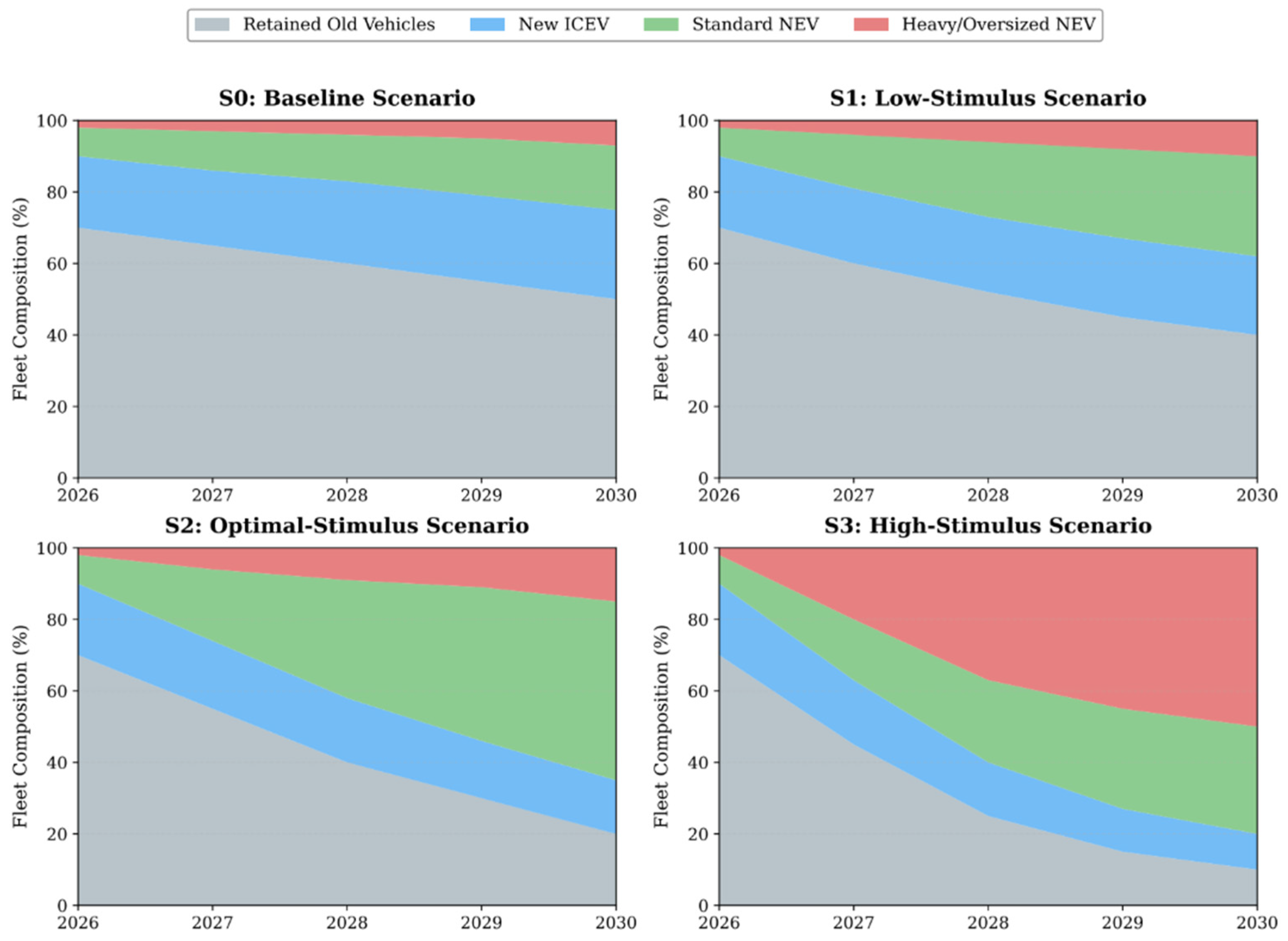
The modification of micro-utility functions directly drives the macroscopic restructuring of the vehicle fleet. By integrating the estimated preference parameters into the aggregate probability model, the dynamic replacement trajectories of the regional fleet from 2026 to 2030 were simulated across the established environmental stress scenarios (S0 to S3). The simulation results indicate that policy interventions effectively disrupt the natural replacement cycle and significantly accelerate NEV penetration.
As depicted in Figure 2, the dynamic evolution of the regional fleet composition is highly sensitive to the intensity of the implemented policy interventions. Under the baseline (S0) and low-stimulus (S1) scenarios, the phase-out of older vehicles and the market penetration of standard NEVs proceed at a moderate and predictable pace. The optimal-stimulus scenario (S2) successfully accelerates this transition, maximizing the market share of standard, energy-efficient NEVs without inducing severe structural distortions.
However, a critical behavioral deviation emerges under the high-stimulus scenario (S3). As clearly illustrated in the bottom-right panel, excessive financial subsidies trigger a disproportionate and rapid expansion of the “Heavy/Oversized NEV” category (indicated by the aggressively expanding top layer). By the end of the simulation period in 2030, this high-energy-consumption segment severely cannibalizes the market share of standard models, occupying approximately half of the fleet composition. This structural anomaly visually confirms the “pseudo-upgrading” phenomenon, wherein consumers leverage maximum financial dividends to acquire heavier vehicles with oversized battery capacities. Ultimately, this distortion forces the transportation system onto a highly energy-intensive trajectory, laying the physical groundwork for the upstream emission spikes and subsequent infrastructure coating degradation analyzed in the following sections.

3.1.3. Transmission Mechanism from Micro-Behavior to Macro-Environmental Stress

The dynamic evolution of the aforementioned fleet structure not only reshapes the energy consumption patterns of the transportation system but also serves as the underlying driver altering localized atmospheric corrosion intensity. Although NEVs achieve zero tailpipe emissions during the operational phase, the large-scale and concentrated shift toward a heavier, battery-intensive fleet drastically elevates the baseload and peak demand on the regional power grid.
Given the existing energy supply paradigm where fossil fuel generation remains a major component, this surge in electricity demand essentially relocates and amplifies dispersed tailpipe emissions into centralized upstream power plant emissions. Because coal-fired power generation is a primary source of sulfur dioxide (SO2) and nitrogen oxides (NOx), the pseudo-upgrading effect triggered by aggressive subsidies directly elevates the initial physical load of acidic precursors in the atmosphere. This abrupt shift in the emission structure, derived entirely from micro-behaviors, constitutes the core mechanism for rising environmental acidification potential. Consequently, it establishes the prerequisite boundary conditions for quantifying the subsequent accelerated degradation of anti-corrosion coatings on transportation infrastructure.

3.2. Spatiotemporal Evolution of Atmospheric AP

This section systematically quantifies the evolutionary patterns of emission loads within the transportation system under varying environmental stress scenarios. By leveraging the life-cycle assessment accounting module, the analysis specifically isolates the variations in core indicators responsible for triggering environmental corrosion.

3.2.1. Policy-Induced Decoupling of Life-Cycle Emissions

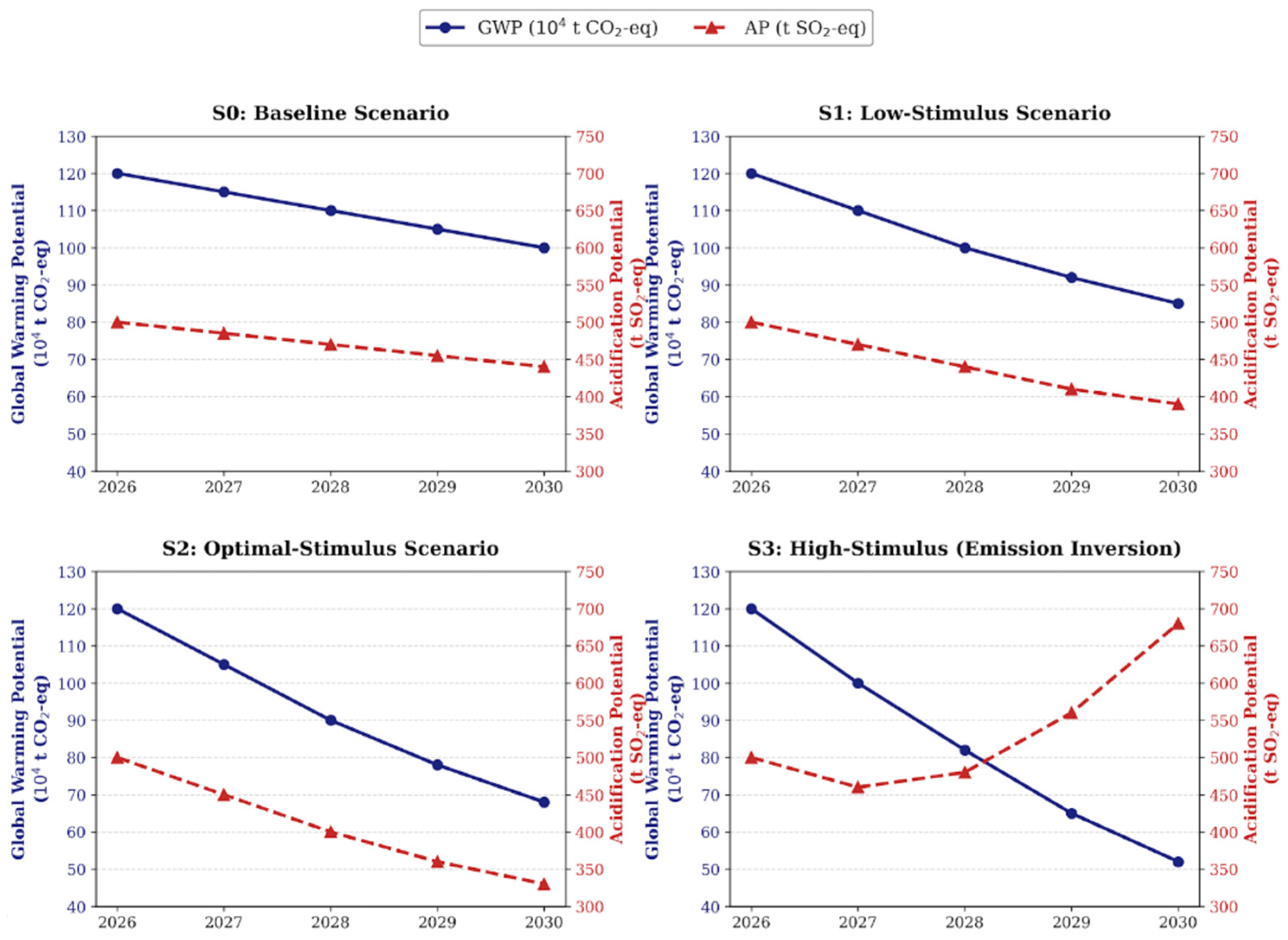
Unlike conventional transportation policy evaluations that predominantly focus on global warming potential (GWP), this study introduces AP as the central environmental physical metric bridging macro-level emissions with micro-level material failure. Model projections indicate that under the baseline scenario (S0) and moderate intervention scenarios (S1 and S2), the progressive elimination of older internal combustion engine vehicles yields a highly synergistic downward trajectory for both total carbon emissions and acidic precursor loads. Data from this phase substantiate that measured policy stimuli can successfully achieve the dual environmental benefits of decarbonization and regional acidification mitigation during the initial stages of fleet transition.

3.2.2. The Emission Inversion Phenomenon Under Aggressive Subsidies

The evolutionary trajectory of systemic environmental loads exhibits a pronounced non-linear bifurcation when policy stimuli cross specific thresholds into the high-intensity scenario (S3).
An analysis of the comparative curves in Figure 3 clearly illustrates this divergence. Although the S3 scenario achieves the highest overall fleet electrification rate and drives the GWP curve steadily downward through substantial reductions in direct tailpipe carbon emissions, the AP curve paradoxically exhibits a counter-trend escalation during the mid-to-late simulation periods. The physical root of this emission inversion phenomenon lies in the micro-level pseudo-upgrading behavior identified previously. Consumer preference for oversized battery capacities and heavyweight new energy vehicles drastically inflates the energy consumption per unit distance during the operational phase. Given the current regional energy structure where the power grid heavily relies on fossil fuels for peak-load regulation, the additional coal combustion required to meet sudden charging demands releases sulfur dioxide and nitrogen oxide equivalents that far exceed the reductions achieved at the tailpipe. Consequently, the absolute value of the life-cycle acidification potential rises rather than falls.

3.2.3. Latent Environmental Effects on Infrastructure Corrosivity

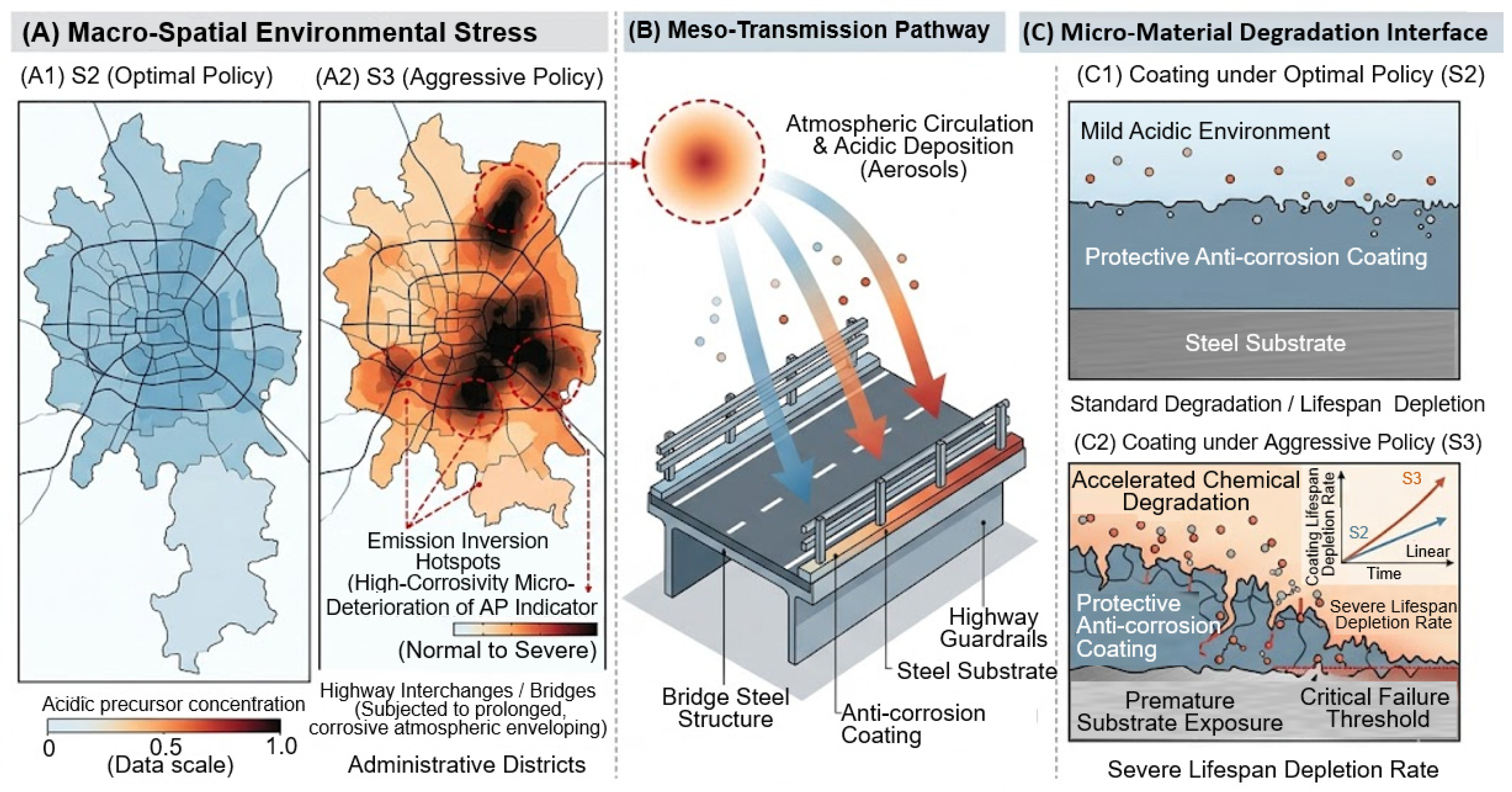
The emission inversion inadvertently triggered by aggressive subsidy policies exposes a critical blind spot in carbon-centric policy design and lays a severe environmental foundation for the deterioration of regional transportation infrastructure durability. The surge in upstream acidic precursors directly translates into high-concentration acidic stress within urban micro-environments through atmospheric circulation and deposition mechanisms. The sharp deterioration of the AP indicator implies that transportation infrastructure exposed to natural elements, such as bridge steel structures and highway guardrails, will be subjected to prolonged and highly corrosive atmospheric enveloping. This abrupt shift in the environmental physical boundary completes the transmission pathway from socio-economic intervention to material chemical degradation, providing the direct environmental load input required to quantitatively assess the lifespan depletion rate of anti-corrosion coatings in the subsequent section.
The intensified emission clusters conceptually mirror the localized accumulation of acidic precursors (e.g., SO2, NOx), highlighting high-risk zones for infrastructure coating degradation within the urban network.
Furthermore, the policy-induced emission inversion is not homogenously distributed across the urban landscape. As illustrated in Figure 4, the spatial distribution of emission intensities before and after the policy implementation exhibits significant regional clustering. The areas transitioning from light to dark tones (e.g., specific high-density administrative districts) represent not only localized carbon aggregation but, critically, severe localized accumulation of upstream acidic precursors. These “hotspots” on the spatial map function as high-corrosivity micro-environments. For instance, the transport infrastructure (e.g., highway interchanges, bridges) located within or immediately downwind of these intensive emission clusters will experience a significantly higher atmospheric AP compared to peripheral districts. Consequently, this spatial heterogeneity mandates a localized, rather than uniform, assessment of coating degradation risks. The subsequent section quantitatively evaluates how the heightened environmental stress within these specific spatial clusters accelerates the lifespan depletion of standard protective coatings.

3.3. Quantitative Assessment of Infrastructure Coating Degradation

This section represents the analytical nexus of the study, translating the previously identified macroscopic emission inversions into quantifiable micro-level material degradation metrics. By bridging environmental physics with surface engineering, the analysis reveals how policy-driven atmospheric shifts compromise material durability.

3.3.1. Translating Acidic Stress to Surface Degradation Kinetics

The calculated ECRI demonstrates a pronounced sensitivity to the subsidy-induced acidification spikes identified in the previous section [60]. Grounded in established DRF principles, the model elucidates how elevated atmospheric acidification directly alters the chemical degradation kinetics at the coating-environment interface. Specifically, the surge in sulfur dioxide and nitrogen oxide equivalents intensifies the permeation of acidic species through the polymeric matrix of standard protective systems, such as polyurethane topcoats and epoxy zinc-rich primers.
This enhanced chemical permeation subsequently accelerates the breakdown of the cross-linked binder network, thereby elevating the Lifespan Depletion Rate (LDR) of the coating. Quantitative outputs reveal that under the aggressive subsidy scenario (S3), the LDR experiences a sharp, non-linear increase during the mid-simulation period. This indicates that the pseudo-upgrading behavior of the vehicle fleet successfully translates into an aggressive environmental stressor, pushing the material degradation rate far beyond the historical baseline designed for standard urban corrosivity.

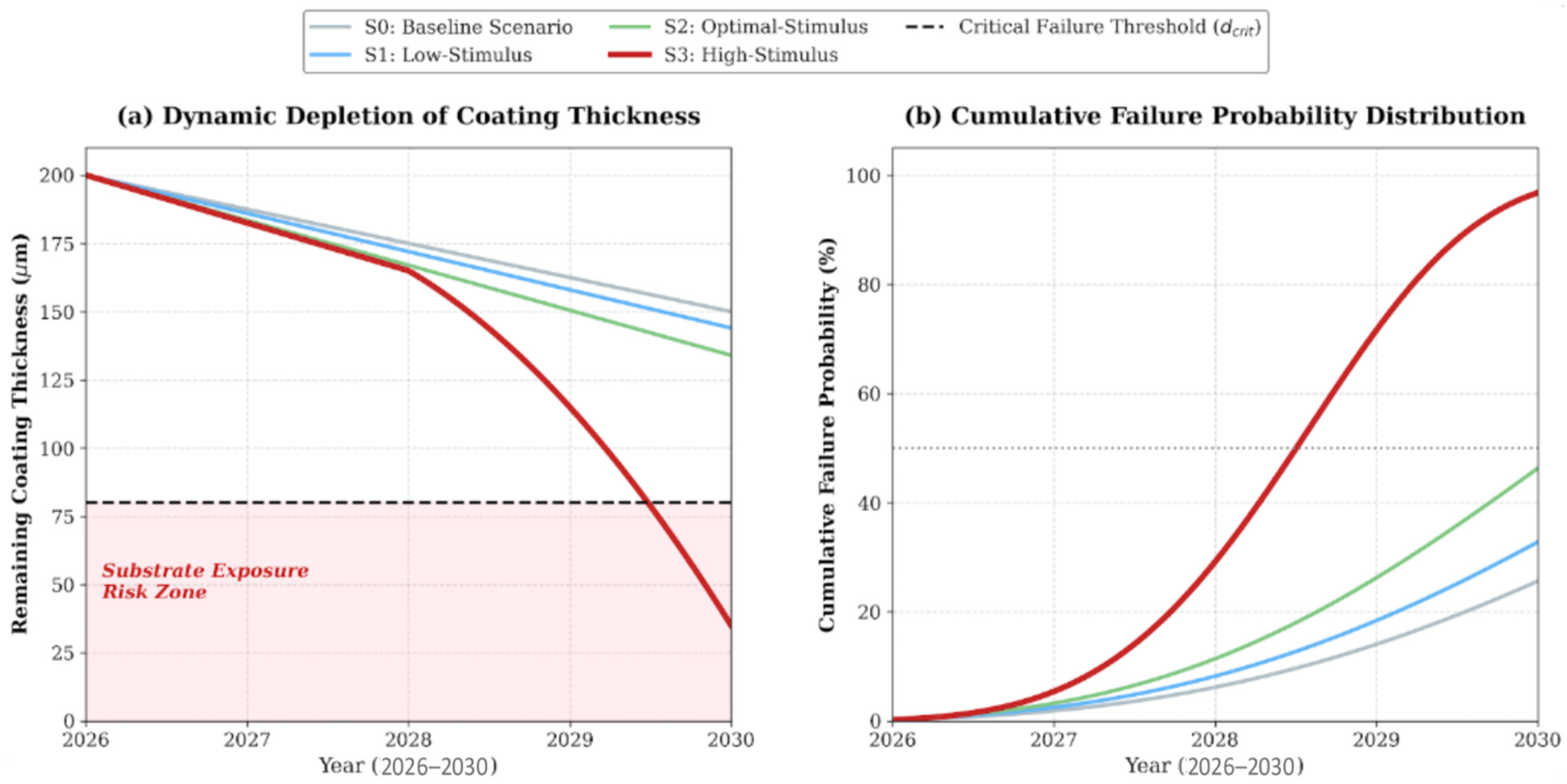
3.3.2. Spatiotemporal Evolution of Coating Thickness and Failure Probability

To visualize the progressive degradation of material failure, the dynamic reduction in coating thickness was simulated over the critical transition window from 2026 to 2030.
As illustrated in Figure 5, an analysis of the simulated depletion trajectories indicates that while the baseline scenario (S0) and the moderate intervention scenario (S1) maintain a relatively linear and predictable degradation path, the high-stimulus scenario (S3) introduces a distinctly convex depletion curve. The accelerated thinning of the protective barrier is most concentrated during periods coinciding with peak power grid loads, driven by the uncoordinated charging of heavy-duty new energy vehicles. This temporal overlap exacerbates localized acidic deposition onto infrastructure surfaces. Consequently, the statistical distribution of failure probabilities shifts significantly forward on the temporal axis, suggesting that a substantial proportion of exposed coatings will reach their critical failure thickness prematurely due to the intensified acidic fluctuations.

3.3.3. Remaining Lifespan Assessment and Premature Failure

The ultimate engineering consequence of the accelerated degradation kinetics is quantified through the Remaining Lifespan (RL) metric, with detailed data presented in Table 4. This indicator provides direct implications for infrastructure maintenance scheduling and structural safety.
Computations demonstrate that standard transportation infrastructure coatings face severe premature failure risks under unoptimized policy interventions. Assuming a typical baseline design life for highway bridge coatings under historical atmospheric conditions, the intense acidic shock generated in the S3 scenario significantly compromises this anticipated durability. Projections indicate that the elevated environmental corrosivity reduces the effective remaining lifespan of the coating system by approximately 1.3 to 2.3 years compared to the S0 baseline. The lifespan penalty is calculated by subtracting the projected remaining lifespan under each policy scenario from the anticipated baseline lifespan (S0). This premature exhaustion of the protective capacity exposes the underlying steel substrates to direct corrosive attack much earlier than planned. Such findings conclusively demonstrate that ignoring the material durability dimension in macro-policy design can inadvertently trigger cascading failures within the physical infrastructure network.

3.4. Model Validation and Methodological Uncertainties

To establish the credibility of the multi-module coupled framework, a hindcasting validation of the Baseline scenario (S0) was performed against historical national environmental baselines and materials exposure data. Although projecting long-term macro-policy effects over a multi-year horizon (2026–2030) inherently involves systemic uncertainties, the simulated near-term trajectories of Acidification Potential (APt) and coating degradation kinetics show robust alignment with historical empirical benchmarks. Specifically, the simulated baseline coating degradation rate (12.5 μm/year) tightly clusters within the historical empirical bounds reported by national atmospheric corrosion testing networks for standard urban structural materials under typical industrial-urban atmospheric exposures. Nevertheless, a key methodological limitation of the current transmission module lies in the assumption of a spatially uniform acidic sensitivity coefficient (α = 1.25) across the national network simulation. Treating α as a macro-scale constant represents a deliberate structural simplification necessary for macro-policy accounting. In real-world engineering infrastructure, atmospheric corrosion kinetics are highly non-linear and sensitive to localized micro-climates, wind fields, local boundary layer aerodynamics, and sheltering effects. Consequently, using a single α may under- or over-estimate the localized lifespan depletion rates under intense emission hotspots. To overcome this limitation, future expansions of this framework could couple the current macro-system model with micro-scale Computational Fluid Dynamics (CFD) simulations to map the precise fluid–structure chemical interactions and micro-environmental concentration gradients on specific critical infrastructure surfaces.

3.5. Impact on Maintenance Cycles and Economic Externality

This section translates the physical depletion of coating lifespans into quantifiable engineering maintenance costs. By integrating material degradation into the economic evaluation framework, the analysis exposes the hidden fiscal burdens imposed by poorly optimized policy interventions.

3.5.1. Monetization of Material Degradation and Maintenance Triggers

The accelerated depletion of the protective coating’s lifespan, as quantified in the preceding section, inevitably disrupts the scheduled maintenance cycles of urban transportation infrastructure. To evaluate the broader socio-economic implications of this material degradation, the physical loss of coating thickness must be translated into an economic externality. In standard highway and bridge asset management, recoating costs encompass not only the direct procurement of anti-corrosion materials but also labor, surface preparation procedures such as abrasive blasting, and the indirect costs associated with traffic disruptions. When the remaining lifespan of the coating system falls below the critical safety threshold prematurely due to policy-induced acidic stress, an unscheduled full recoating operation is triggered. This temporal shift in maintenance requirements fundamentally alters the annualized life-cycle cost of the infrastructure network [61,62,63].

3.5.2. Quantification of Premature Recoating Expenditures

By incorporating the predicted coating failure timelines into a localized engineering economic model, the additional financial burden generated by aggressive vehicle trade-in policies can be rigorously quantified.
This abrupt transition from a robust mitigation regime (−8.00% at 10,500 CNY) to a severe emission spike (+25.0% at 12,000 CNY) mathematically highlights a distinct non-linear threshold effect within the coupled transportation-energy system. Mechanistically, this localized tipping point is governed by the structural coupling of micro-consumer utilities and macro-grid dynamics. When financial incentives cross the critical 10,500 CNY boundary and scale up to 12,000 CNY, the monetary dividend over-compensates for the purchasing premium of higher-end vehicle segments. This triggers an irrational consumer market boom and a disproportionate behavioral shift toward Heavy/Oversized NEVs equipped with excessively large battery capacities and high operational energy footprints. On the energy supply side, the simultaneous charging demands from this concentrated heavy vehicle fleet inflict a sharp, synchronized surge on the regional power grid. To maintain system stability during these sudden peak-load regimes, the utility network is forced to rapidly deploy marginal, low-efficiency coal-fired peak-shaving units rather than relying on baseload clean energy. Because these marginal thermal units emit sulfur dioxide (SO2) and nitrogen oxides (NOx) at rates exponentially higher than stabilized baseload generation, the upstream environmental burden violently flips, inducing a heavy regional atmospheric acidification penalty that offsets the local tailpipe carbon reduction dividends.
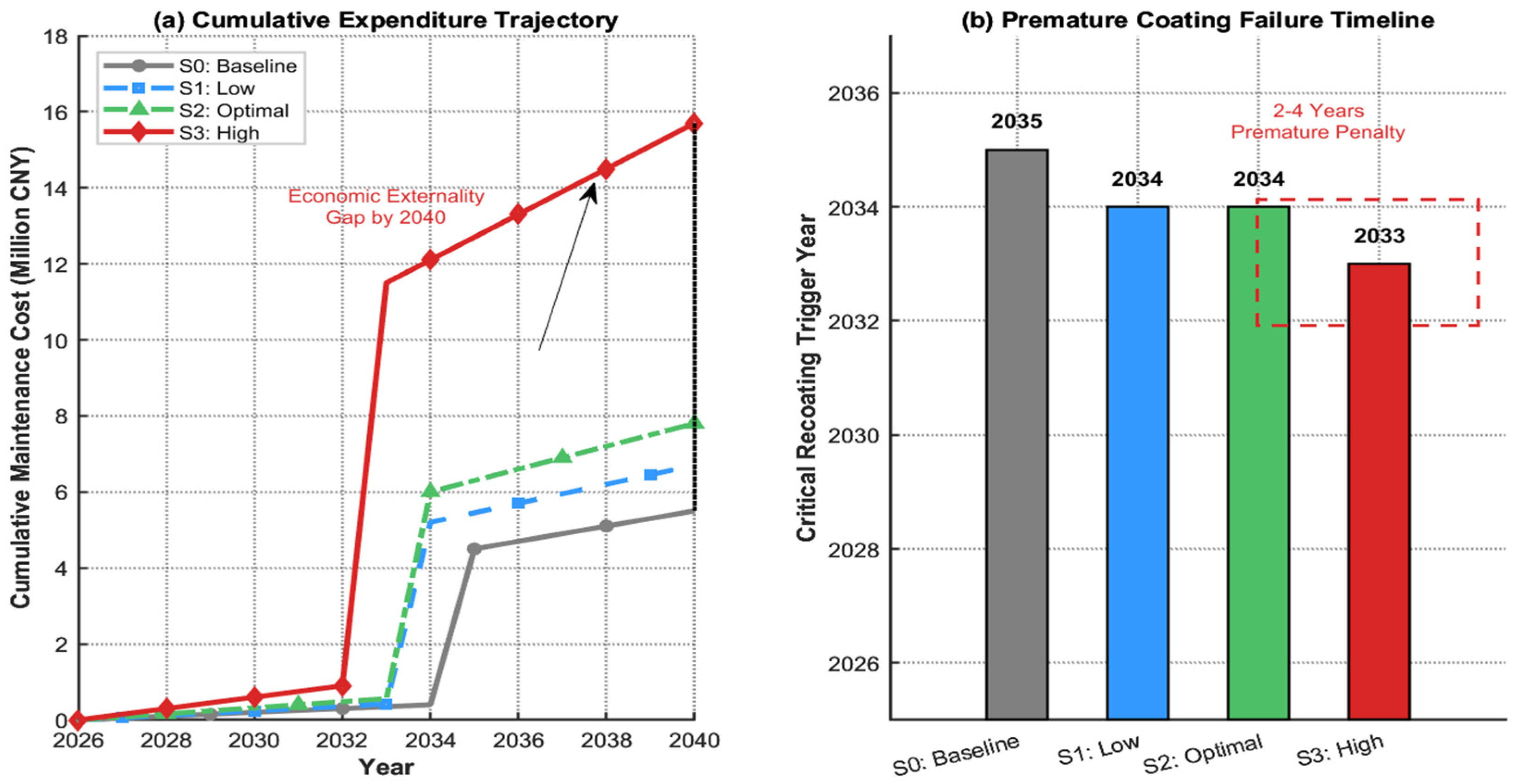
Figure 6 illustrates the long-term economic consequences of policy-induced material degradation through a cumulative maintenance cost trajectory. Under the baseline and moderate scenarios (S0–S2), the infrastructure maintains a stable protective cycle with predictable fiscal requirements. However, the high-stimulus scenario (S3) triggers a significant temporal compression of the maintenance intervals. Due to the accelerated chemical depletion of the coating thickness, the first major recoating event is forced to occur 2–4 years earlier than the engineered design life. This heightened frequency, combined with the increased unit cost of treating severely corroded substrates, creates a substantial “economic externality gap” by 2040. These findings emphasize that the fiscal savings from aggressive carbon reduction may be partially neutralized by the unplanned expenditures necessitated by premature material failure.
An analysis of the simulated financial trajectories reveals a profound divergence in maintenance expenditures across policy scenarios. Under the baseline and moderate intervention scenarios, the infrastructure recoating cycles align closely with historical municipal budget projections. However, under the high-stimulus scenario (S3), the severe localized acidification forces a significant forward shift in the maintenance schedule. The accelerated chemical degradation shortens the necessary interval between consecutive protective interventions, forcing asset managers to execute recoating operations years earlier than originally engineered. This premature failure results in a compounded increase in cumulative maintenance expenditures over the transition period, imposing a substantial and unplanned fiscal burden on public infrastructure budgets.

3.5.3. Hidden Economic Externalities in Policy Evaluation

These quantified maintenance spikes highlight a critical structural flaw in conventional transportation policy assessments. Traditional evaluation frameworks predominantly calculate the net cost of an intervention based strictly on direct financial subsidy payouts versus the monetized benefits of carbon reduction. The empirical results of this study conclusively demonstrate that aggressively promoting vehicle electrification through excessive subsidies generates a massive hidden economic externality in the form of accelerated material corrosion.
When the material degradation penalty—specifically, the required capital for premature infrastructure recoating—is integrated into the macroscopic accounting framework, the true socio-economic cost of the high-subsidy scenario significantly exceeds initial policy estimates. Consequently, the findings prove that ignoring the intricate mechanisms of environmental corrosivity and its direct impact on material durability leads to a severe underestimation of a policy’s overall systemic cost. Such omissions ultimately compromise the long-term financial and physical sustainability of urban infrastructure networks.

3.6. Pareto Optimization: Balancing Decarbonization and Coating Durability

This section integrates the dual objectives of environmental decarbonization and infrastructure material preservation into a multi-objective optimization framework. By synthesizing the conflicting trajectories of carbon reduction and acidic-induced coating failure, a Pareto-optimal subsidy interval is identified to ensure systemic sustainability.

3.6.1. Objective Function Integration and Trade-Off Analysis

The evaluation of vehicle trade-in policies requires a simultaneous consideration of global warming potential (GWP) and infrastructure maintenance externalities. The optimization model seeks to minimize the systemic penalty function, which incorporates the monetized value of total carbon emissions and the premature recoating costs triggered by accelerated atmospheric acidification.
Analytical results demonstrate a clear trade-off relationship between these two objectives. While increasing subsidy intensity generally shifts consumer preference toward electric propulsion, thereby reducing direct CO2 emissions, it simultaneously escalates the localized AP via the “pseudo-upgrading” effect. This divergence creates a classic Pareto conflict where the maximization of climate benefits potentially compromises the durability of the protective coating layer on transportation infrastructure. The mathematical convergence of these competing indices necessitates a search for a balanced solution that prevents the “emission inversion” from overwhelming the gains in decarbonization.
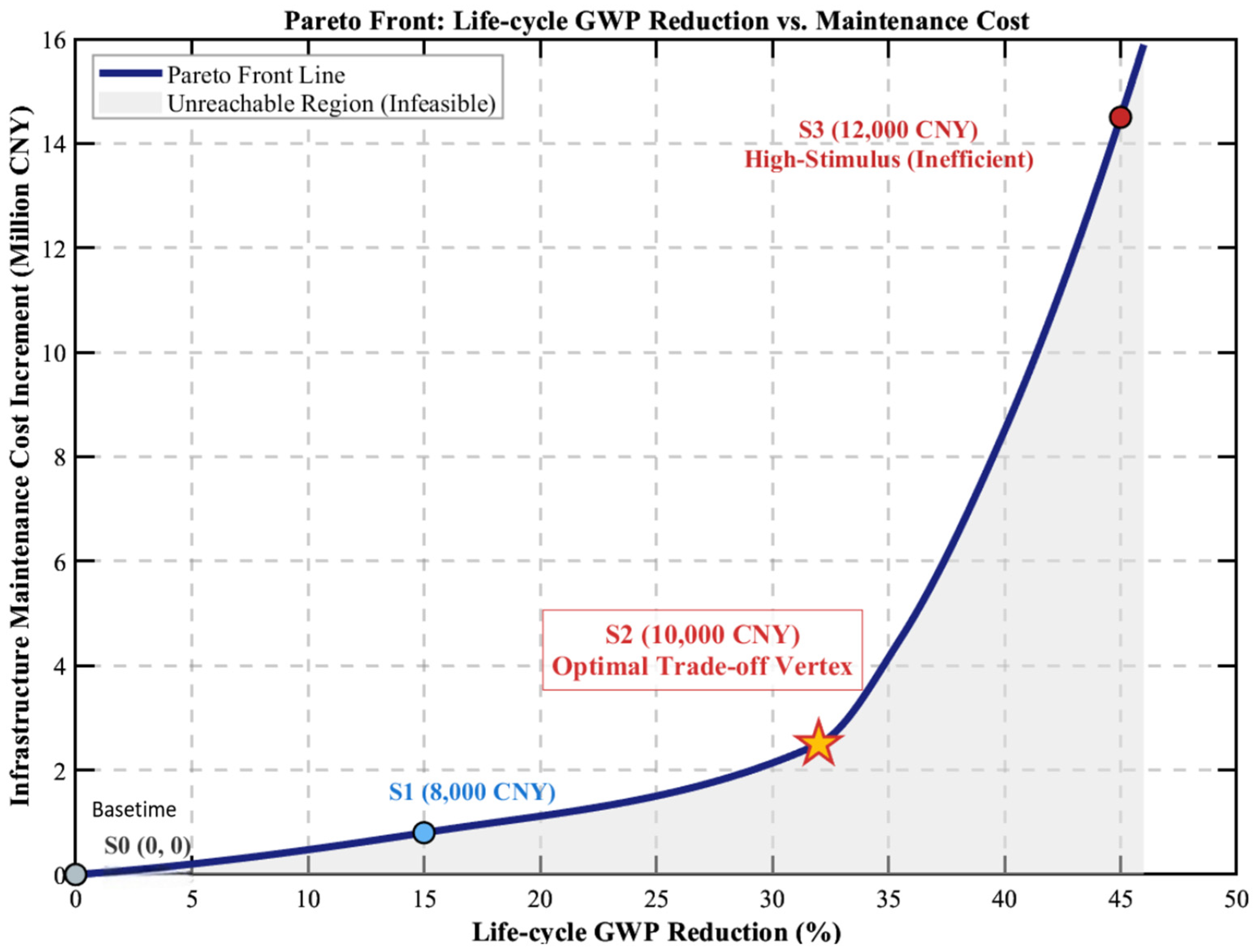
Figure 7 illustrates the Pareto front mapping the fundamental trade-off between the macroscopic environmental benefit (GWP reduction) and the microscopic material penalty [64,65] (infrastructure maintenance cost increment). The profile of the Pareto front reveals a non-linear sensitivity of the transportation-infrastructure system to subsidy intensity.
As observed, the trajectory initially follows a path of “synergistic sustainability,” where substantial decarbonization is achieved with minimal impact on coating durability. However, as the system approaches the high-stimulus regime (e.g., the S3 scenario), the Pareto front exhibits a sharp inflection point. Beyond this threshold, the marginal cost of extracting further carbon reductions spikes exponentially due to the “emission inversion” effect, which accelerates chemical degradation of the coatings and necessitates premature recoating. The 10,000 CNY point sits at the vertex of this Pareto front, representing the mathematical equilibrium where the system extracts the maximum decarbonization efficiency before the physical degradation of the infrastructure network becomes economically prohibitive.

3.6.2. Identification of the Optimal 8000–10,500 CNY Subsidy Window

Through the simulation of the Pareto front across all evaluated environmental stress scenarios, a clearly defined optimal subsidy interval is locked between 8000 and 10,500 CNY.
As quantitatively detailed in Table 5, the identification of the optimal 8000–10,500 CNY subsidy window is mathematically governed by the Systemic Trade-off Ratio. This ratio serves as a Pareto efficiency metric, evaluating the percentage of carbon reduction (ΔGWP) achieved per unit of infrastructure coating lifespan sacrificed (Lifespan Penalty).
Below the 8000 CNY threshold, the policy exhibits an “under-stimulus” effect. The fleet electrification rate remains sluggish (e.g., 21.5% at 5000 CNY), yielding marginal decarbonization benefits that do not justify the policy implementation costs.
Conversely, when the subsidy exceeds 10,500 CNY, the system enters an “over-stimulus” phase characterized by diminishing marginal utility. While the electrification rate and carbon reduction continue to increase, the ΔAP metric rapidly deteriorates, crossing into positive territory (+25.0% at 12,000 CNY) due to the upstream emission inversion. This intense acidic shock inflicts a severe 2.3-year penalty on the coating lifespan, causing the Systemic Trade-off Ratio to plunge to 19.5.
The 10,000 CNY point emerges as the strict Pareto-efficient vertex. At this specific threshold, the policy achieves a highly synergistic environmental outcome: a robust 32.0% reduction in life-cycle carbon emissions with the maximum corresponding drop in atmospheric acidification (−18.0%). Crucially, it yields the highest Systemic Trade-off Ratio (24.6), demonstrating that the maximum climate benefit is extracted before the material degradation penalty accelerates non-linearly. Thus, the 8000–10,500 CNY interval strategically shields the infrastructure network from severe “coating shock” while fulfilling the macro-decarbonization mandate.

3.6.3. Strategic Synergy for Decarbonization and Material Longevity

The identification of the 8000–10,500 CNY interval provides profound implications for the design of sustainable transportation policies. This interval functions as a “safety buffer” that aligns the micro-behavioral shift of the vehicle fleet with the physical tolerance limits of existing infrastructure materials.
By maintaining the subsidy within this range, policy makers can effectively guide the transition toward cleaner vehicles without triggering the upstream emission spikes that lead to premature coating failure. This synergistic balance ensures that the environmental gains achieved in the transportation sector are not offset by the fiscal and material costs of repairing acid-damaged infrastructure. Consequently, the Pareto-optimal strategy advocates for a holistic “surface-to-system” perspective in policy formulation, ensuring that the drive toward a low-carbon future does not inadvertently erode the physical foundations of the urban transportation network [66].

4. Discussion and Recommendations

4.1. Discussion

4.1.1. Resilience Differences and Vulnerability Mechanisms in Transport-Energy Coupled Systems

The low-carbon transition of transportation is an evolutionary process of a complex socio-technical system deeply coupled between transportation and energy, and the effectiveness of policies is influenced by the degree of synergistic adaptation among system elements. In regions dominated by coal-fired power, vehicle replacement policies centered on “replacing oil with electricity” show significant systemic vulnerability. In areas with a high proportion of clean energy, the low-carbon level of the power grid can effectively support emission reductions across the entire lifecycle of new energy vehicles, resulting in strong system resilience; conversely, in regions dependent on coal-fired power, the high-carbon structure of the grid significantly undermines the emission reduction advantages of new energy vehicles during the usage phase. Combined with the concentrated release of embodied carbon from vehicle production, this often leads to an increase in lifecycle emissions. This research indicated that the root cause of system vulnerability lies in the structural mismatch between the demand for low-carbon transportation transformation and the energy supply structure. Implementing unilateral policy interventions in the transportation system without aligning them with the decarbonization process of the energy system makes it difficult to achieve overall low-carbon goals, thereby confirming that multi-system co-evolution is an intrinsic requirement for transforming complex socio-technical systems.

4.1.2. Local Optimization Bias and Unintended Systemic Effects of Universal Subsidies

The current nationwide uniform universal subsidy for vehicle replacement suffers from local optimization and global imbalance in practice. While the subsidy policy can boost consumer willingness to purchase vehicles and increase the penetration rate of new energy vehicles, achieving incentive effects at the micro level, it fails to account for regional heterogeneity in power grid structures, vehicle usage intensity, and usage scenarios. Implementing incentives using a uniform standard is prone to triggering unintended effects such as emission reversals, increased atmospheric corrosion, and accelerated aging of infrastructure coatings. In regions dominated by coal-fired power generation and in low-mileage usage scenarios, the emission-reduction advantages of new energy vehicles are difficult to realize, and universal subsidies can lead to inefficient use of funds and diminished environmental benefits. This suggests that a single policy tool based on linear thinking cannot adequately account for the nonlinear transmission relationships within complex systems, making it challenging to balance the multiple objectives of a low-carbon transition, environmental impact, and engineering safety.

4.1.3. Policy Optimization Logic from a Multi-System Coordination Perspective

Vehicle replacement policies must shift from traditional unidirectional incentives to multi-system collaborative governance. First, respect the differences in regional system resilience and implement differentiated support based on energy structure; second, use full-lifecycle carbon performance as a basis to enhance policy precision and leverage efficiency; third, establish dynamic monitoring and feedback mechanisms to ensure that policies adapt in sync with system conditions, thereby promoting the coordinated evolution of transportation, energy, environment, and infrastructure toward a low-carbon steady state.

4.2. Policy Recommendations

4.2.1. Establishing a Differentiated Subsidy System Based on Full-Life-Cycle Emissions Reduction

Factors such as subsidy intensity, regional grid structure, and vehicle usage intensity all influence the overall effectiveness of vehicle replacement policies; a nationwide, uniform, universal subsidy is unlikely to achieve overall optimization. Therefore, the universal subsidy model should be gradually optimized to explore the establishment of a differentiated subsidy system guided by net carbon emissions reductions over the full life cycle [67,68]. Using key reference parameters, such as regional grid emission factors, annual vehicle mileage, and carbon payback periods, the subsidy should be adjusted accordingly for entities with a higher proportion of clean energy, higher annual mileage, and greater potential for significant emission reductions. For regions dominated by coal-fired power and low-mileage usage scenarios, the subsidy for new energy vehicle replacement can be moderately reduced or temporarily suspended, with the relevant funds redirected toward phasing out old fossil-fuel vehicles, energy-saving retrofits, and optimizing public transportation services. At the same time, based on the model simulation results obtained in this study, the overall subsidy level should be maintained within the range of 8000–10,500 CNY.

4.2.2. Improving Dynamic Fleet Structure Regulation to Mitigate Emissions Rebound Risks

The multi-scenario simulation results obtained in this study indicated that, under certain conditions, excessively high subsidy intensity may induce irrational growth in “large-battery, high-energy-consumption new energy vehicles”, leading to increased emissions in the upstream power generation sector. This results in a temporary rise in AP across the entire life cycle—a phenomenon known as emission inversion—and may exacerbate urban atmospheric corrosion. To address this potential risk, a fleet structure regulation mechanism aligned with dynamic emission trajectories can be established. On the one hand, criteria such as vehicle energy consumption levels and battery capacity rationality can be incorporated into subsidy eligibility requirements to guide the development of the NEV structure toward high efficiency and low carbon. On the other hand, by integrating dynamic LCA calculation results, the phasing-out rates of fossil fuel vehicles, the promotion structure of NEVs, and emission control targets can be reasonably set on a regional and annual basis to strengthen overall control over emissions of acid precursors such as SO2 and NOx.

4.2.3. Strengthening Infrastructure Durability Assurance by Integrating Atmospheric Corrosion Impacts

Based on analyses conducted using the ECRI and dose–response models, changes in transportation emissions will alter atmospheric corrosivity to some extent, thereby affecting the service life of anti-corrosion coatings on transportation infrastructure such as bridges and guardrails. To better balance the low-carbon transition with the long-term operation of infrastructure, factors such as atmospheric corrosivity, coating aging characteristics, and infrastructure maintenance costs should be gradually incorporated into the comprehensive evaluation framework for vehicle replacement policies. Based on simulation results of the coating life decay rate (LDR), dynamic monitoring of coating lifespan and risk early warning should be implemented in areas with relatively high corrosion risks. When formulating vehicle replacement policies, the carbon emission reduction benefits should be weighed against the potential additional maintenance costs resulting from accelerated corrosion.

4.2.4. Establish a Multi-System Coupled Mechanism for Dynamic Policy Monitoring and Optimization

The effects of vehicle replacement policies exhibit significant dynamism and regional heterogeneity; fixed policy designs struggle to adapt to long-term system evolution. To address this, multi-source data—including consumer behavior, fleet composition, grid emissions, atmospheric conditions, and coating performance—can be integrated to build a unified platform for dynamic policy monitoring and evaluation. A closed-loop management mechanism—comprising “policy implementation—effect monitoring—scenario simulation—dynamic optimization”—should be established to periodically evaluate policy performance in terms of subsidy efficiency, emission reduction effectiveness, and corrosion control, thereby promptly identifying potential issues such as emission reversals, increased corrosion, and insufficient policy efficacy.

5. Conclusions

This study developed a coupled framework integrating a Mixed Logit consumer choice model, dynamic LCA, and an ECRI to evaluate the cross-system impacts of vehicle trade-in subsidies on urban atmospheric corrosivity and infrastructure coating durability. By bridging transportation economics, environmental science, and surface engineering, this research uncovered the hidden physical and economic externalities of poorly optimized decarbonization policies. The main conclusions were drawn as follows:
(1) The “Pseudo-Upgrading” Effect and Emission Inversion. While financial subsidies accelerated the phase-out of older vehicles, high-intensity subsidies (e.g., 12,000 CNY) distorted market behavior. This induced a “pseudo-upgrading” phenomenon where consumers disproportionately adopted heavy, large-battery NEVs. Although tailpipe emissions decreased, the substantial charging demands of these heavy NEVs drastically increased the upstream power grid load. This triggered an “emission inversion,” where the macroscopic Global Warming Potential (GWP) declined, but the localized AP—driven by upstream SO2 and NOx emissions—surged significantly.
(2) Accelerated Depletion of Coating Durability. The policy-induced spike in atmospheric acidification directly altered the urban corrosive micro-environment. Utilizing established Dose–Response Functions (DRF), the quantitative simulation revealed that the accelerated chemical degradation under aggressive subsidy scenarios significantly elevated the Lifespan Depletion Rate (LDR) of standard anti-corrosion coating systems. This severe acidic stress violently breached the critical thickness threshold, resulting in a premature lifespan penalty of 1.3 to 2.3 years compared with the baseline.
(3) Economic Externalities and Maintenance Burdens. The premature physical failure of the protective coatings structurally disrupted the scheduled maintenance cycles of urban transportation infrastructure. The temporal compression of recoating intervals translated the material degradation into a massive, unplanned economic externality. Consequently, traditional policy assessments that solely focused on carbon reduction metrics fundamentally underestimated the true systemic costs by ignoring policy-induced material corrosion.
(4) Pareto-Optimal Subsidy Window. Through multi-objective Pareto optimization balancing decarbonization efficiency and coating preservation, this study identified a strict optimal subsidy interval of 8000–10,500 CNY. This window acted as a “safety buffer,” guiding the transition to cleaner fleets while mitigating upstream acidic shock. At the 10,000 CNY Pareto vertex, the policy achieved the maximum climate benefit before the marginal material degradation penalty accelerated non-linearly.
In conclusion, the formulation of sustainable urban transportation policies requires a holistic “surface-to-system” perspective. Policymakers must incorporate material durability and localized environmental corrosivity metrics alongside carbon targets to ensure that the drive toward a low-carbon future does not inadvertently erode the physical and fiscal foundations of urban infrastructure.

Supplementary Materials

The following supporting information can be downloaded at: https://www.mdpi.com/article/10.3390/coatings16060666/s1.

Author Contributions

Conceptualization, Z.C., J.Q. and T.L.; methodology, Z.C. and J.Q.; software, Z.C. and D.L.; validation, T.M., T.S. and J.Z. (Jinjian Zhang); formal analysis, Z.C. and J.Q.; investigation, Z.C., J.Q. and T.M.; resources, T.L.; data curation, D.L., T.S. and J.Z. (Jinming Zhao).; writing—original draft preparation, Z.C. and J.Q.; writing—review and editing, D.L., J.Z. (Jinjian Zhang) and T.L.; visualization, Z.C. and T.M.; supervision, T.L.; project administration, T.L.; funding acquisition, T.L. All authors have read and agreed to the published version of the manuscript. Z.C. and J.Q. contributed equally to this work as co-first authors.

Funding

This research received no external funding.

Institutional Review Board Statement

Institutional Review Board Statement: Ethical review and approval were waived for this study because the survey was anonymous and voluntary, collected no personally identifiable information, involved no experimental intervention, and posed no more than minimal risk to the participants.

Informed Consent Statement

Informed consent was obtained from all subjects involved in the study.

Data Availability Statement

The original contributions presented in this study are included in the article/Supplementary Materials. Further inquiries can be directed to the corresponding author.

Acknowledgments

The authors would like to express their sincere gratitude to all the respondents who participated in the anonymous empirical survey. Their valuable input and time were indispensable for constructing the micro-behavioral dataset used in this study. We also thank them for their assistance and insightful discussions during the data collection and preliminary analysis phases. During the preparation of this manuscript, the authors used [Google Gemini 3.0 Pro] for the purposes of [Figure 1]. The authors have reviewed and edited the output and take full responsibility for the content of this publication.

Conflicts of Interest

The authors declare no conflicts of interest.

Abbreviations

The following abbreviations are used in this manuscript:
APAcidification Potential
BEVBattery Electric Vehicle
CNYChinese Yuan
CO2Carbon Dioxide
DRFDose–Response Function
ECRIEnvironmental Corrosion Risk Index
EIAEnvironmental Impact Assessment
EVElectric Vehicle
GWPGlobal Warming Potential
HEVHybrid Electric Vehicle
ICEVInternal Combustion Engine Vehicle
LCALife Cycle Assessment
LCCLife Cycle Cost
LDRLifespan Depletion Rate
MNLMultinomial Logit
NEVNew Energy Vehicle
NOxNitrogen Oxides
PHEVPlug-in Hybrid Electric Vehicle
RLRemaining Lifespan
SO2Sulfur Dioxide

References

  1. Humphrey, E.; Elisaus, V.; Rahmani, R.; Mohammadpour, M.; Theodossiades, S.; Morris, N.J. Diamond Like-Carbon Coatings for Electric Vehicle Transmission Efficiency. Tribol. Int. 2023, 189, 108916. [Google Scholar] [CrossRef]
  2. Zhang, W.H.; Zhang, W.Y.; Qiao, X.T.; Lyu, W.J. Pure Electric Bus Life Cycle Carbon Emission Calculation and Emission Factors. J. Jilin Univ. (Eng. Technol. Ed.) 2026, in press. [Google Scholar]
  3. Zhang, F.A.; Li, N.; Da, Q.L.; Wang, W. Low-Carbon Remanufacturing Research in Closed-Loop Supply Chain with Multiple Demands Based on Two Subsidy Policies. Chin. J. Manag. Sci. 2023, 31, 116–127. [Google Scholar]
  4. Weng, J.C.; Zhou, H.Y.; Zhang, M.Y.; Yu, J.B. Effectiveness of New Energy Vehicle Incentive Strategies Considering City and Group Heterogeneity. J. Transp. Syst. Eng. Inf. Technol. 2025, 25, 2–14. [Google Scholar]
  5. Yang, Z.; Wang, B.; Jiao, K. Life Cycle Assessment of Fuel Cell, Electric and Internal Combustion Engine Vehicles under Different Fuel Scenarios and Driving Mileages in China. Energy 2020, 198, 117365. [Google Scholar] [CrossRef]
  6. Ahmadzadeh, O.; Rodriguez, R.; Getz, J.; Panneerselvam, S.; Soudbakhsh, D. The Impact of Lightweighting and Battery Technologies on the Sustainability of Electric Vehicles: A Comprehensive Life Cycle Assessment. Environ. Impact Assess. Rev. 2025, 110, 107668. [Google Scholar] [CrossRef]
  7. Liu, H.; Hu, D.; Kelleher, L.; Wang, L. Life Cycle Assessment: Driving Strategies for Promoting Electric Vehicles in China. Int. J. Sustain. Transp. 2024, 18, 843–857. [Google Scholar] [CrossRef]
  8. Chen, Y.S.; Liu, Q.Y.; Xing, Y.X.; Zhang, C.M.; Zhang, C. Life Cycle Assessment and Uncertainty Analysis of Intelligent Electric Vehicles: A Case Study of BYD Han EV. Acta Sci. Circumstantiae 2025, 45, 527–540. [Google Scholar]
  9. Koffler, C.; Rohde-Brandenburger, K. On the Calculation of Fuel Savings through Lightweight Design in Automotive Life Cycle Assessments. Int. J. Life Cycle Assess. 2010, 15, 128–135. [Google Scholar] [CrossRef]
  10. Zhang, S.; Cao, Z.Q.; Zhang, C.M.; Chen, Y.-S. Life Cycle Assessment and Scenario Simulation of Plug-in Hybrid Electric Vehicles. Environ. Sci. 2025, 46, 3604–3618. [Google Scholar]
  11. Zhang, S.; Zhang, C.M.; Cai, X.; Lan, L.B.; Zhang, J.Z.; Zhang, X.Q.; Chen, Y.S. Life Cycle Environmental Impact Prediction of Hydrogen Fuel and Diesel Heavy Commercial Vehicles towards 2035. Res. Environ. Sci. 2023, 36, 1892–1904. [Google Scholar]
  12. Zhu, H.; Yu, Z.P. Hydrogen Pathway Analysis of Fuel Cell Vehicles Based on Life Cycle Assessment. J. Tongji Univ. (Nat. Sci.) 2017, 45, 138–143+151. [Google Scholar]
  13. Qian, S.D.; Li, L. Life Cycle Carbon Emission and Energy Consumption Analysis of Hydrogen Fuel Cell Locomotives Based on GREET Model. Railw. Transp. Econ. 2024, 46, 112–119. [Google Scholar]
  14. Shao, W.L.; Chen, M.F.; Chang, C. Life Cycle Carbon Emission Comparison between Battery Electric Vehicles and Internal Combustion Engine Vehicles in China and Carbon Emission Prediction for 2030. Acta Sci. Circumstantiae 2025, 45, 449–460. [Google Scholar]
  15. Li, D. Artificial Intelligence Applications in Cervical Cancer: Current Progress and Future Prospects. In Proceedings of the ICCMT 2025: 2025 2nd International Conference on Computer and Multimedia Technology, Sanming, China, 6–8 June 2025; pp. 116–121. [Google Scholar]
  16. Yang, L.; Yu, B.Y.; Feng, Y. Life Cycle Carbon Emission Assessment of Electric Vehicles: A Case Study of Passenger Cars in China. China Popul. Resour. Environ. 2023, 33, 113–124. [Google Scholar]
  17. Kang, X.P.; Nie, H.H.; Gao, M.; Wu, F.B. Life Cycle Carbon Emissions of Electric Vehicles. Energy Storage Sci. Technol. 2023, 12, 976–984. [Google Scholar]
  18. Lu, M.Q.; Chen, L.J. Community Residents’ Willingness to Contribute to Wetland Conservation Based on MNL Discrete Choice Model: A Case Study of Daqing Wetland. J. Nat. Resour. 2021, 36, 449–458. [Google Scholar]
  19. Wang, C.S.; Xu, C.C.; Ren, W.L.; Peng, C.; Jiao, L.J. Analysis of Tricycle Rider Injury Severity in Crashes Based on Machine Learning and Discrete Choice Models. J. Jilin Univ. (Eng. Technol. Ed.), 2026; in press.
  20. Pourmatin, M.; Moeini-Aghtaie, M.; Hassannayebi, E.; Hewitt, E. Transition to Low-Carbon Vehicle Market: Characterization, System Dynamics Modeling, and Forecasting. Energies 2024, 17, 3525. [Google Scholar] [CrossRef]
  21. Torren-Peraire, D.; Bassart-i-Loré, M. Driving in the Wrong Direction? A Co-Evolutionary Model of Electric Vehicle Adoption and Innovation. SSRN 2024, preprint. [Google Scholar]
  22. Osawa, J. Consumer Preferences for Second-Life Electric Vehicle Batteries across Multiple Applications. Clean. Responsible Consum. 2025, 19, 100337. [Google Scholar] [CrossRef]
  23. Fernando, C. Consumer Behaviour Integrated Dynamic-Life Cycle Assessment of Car-Based Sharing Economy. Ph.D. Thesis, The Australian National University, Canberra, Australia, 2023. [Google Scholar]
  24. Li, N.; Sun, L. Research on the Behavioral Differences between New Energy Vehicle Enterprises’ Innovation and Consumers’ Purchase: From the Perspective of Government Subsidy Effectiveness. J. Ind. Technol. Econ. 2025, 44, 15–24. [Google Scholar]
  25. Qi, J.Y.; Zhang, J. Experimental Investigation on Heat Transfer Performance and Temperature Uniformity of Two-Phase Cooling in Microchannels with Different Cross-Section Geometries. Case Stud. Therm. Eng. 2026, 81, 107740. [Google Scholar] [CrossRef]
  26. Chen, Z.; Chen, M.T.; Jia, S.W. Simulation and Optimization of New Energy Vehicles Promotion Policy Strategies Considering Energy Saving, Carbon Reduction, and Consumers’ Willingness Based on System Dynamics. Sustainability 2025, 17, 2811. [Google Scholar] [CrossRef]
  27. Zhang, Y.; Dong, C. Exploring the digital transformation of generative AI-assisted foreign language education: A socio-technical systems perspective based on mixed-methods. Systems 2024, 12, 462. [Google Scholar] [CrossRef]
  28. Ammari, F.; Le Penglau, R.; Bouhier, M.; Neff, D. Characterization of Long-Term Atmospheric Corrosion of Iron in Indoor and Outdoor Conditions Using Raman Spectroscopy Coupled to Multivariate Curve Resolution-Alternating Least Squares. Talanta 2026, 305, 129569. [Google Scholar] [CrossRef] [PubMed]
  29. Aljibori, H.S.; Alamiery, A.; Kadhum, A.A.H. Advances in Corrosion Protection Coatings: A Comprehensive Review. Int. J. Corros. Scale Inhib. 2023, 12, 1476–1520. [Google Scholar] [CrossRef]
  30. Antony Jose, S.; Lapierre, Z.; Williams, T.; Hope, C.; Jardin, T.; Rodriguez, R.; Menezes, P.L. Wear-and Corrosion-Resistant Coatings for Extreme Environments: Advances, Challenges, and Future Perspectives. Coatings 2025, 15, 878. [Google Scholar] [CrossRef]
  31. Panchenko, Y.M.; Marshakov, A.I.; Kudryavtseva, L.A.; Igonin, T.N. Prediction of Atmospheric Corrosivity Categories with Respect to Typical Metals. Int. J. Corros. Scale Inhib. 2025, 14, 2201–2231. [Google Scholar] [CrossRef]
  32. Sawyer-Beaulieu, S.; Tam, E.; Hussein, A. Measuring Corrosion on Vehicles, in Real-Time, Using Digital Imaging and Analysis Techniques. Materials 2022, 15, 3053. [Google Scholar] [CrossRef]
  33. Hensher, D.A.; Greene, W.H. The Mixed Logit model: The state of practice. Transportation 2003, 30, 133–176. [Google Scholar] [CrossRef]
  34. Liao, F.; Molin, E.; van Wee, B. Consumer preferences for electric vehicles: A literature review. Transp. Rev. 2017, 37, 252–275. [Google Scholar] [CrossRef]
  35. Li, W.; Long, R.; Chen, H.; Geng, J. A review of factors influencing consumer intentions to adopt battery electric vehicles. Renew. Sustain. Energy Rev. 2017, 78, 318–328. [Google Scholar] [CrossRef]
  36. Hawkins, T.R.; Singh, B.; Majeau-Bettez, G.; Strømman, A.H. Comparative environmental life cycle assessment of conventional and electric vehicles. J. Ind. Ecol. 2013, 17, 53–64. [Google Scholar] [CrossRef]
  37. Wang, R.; Song, Y.; Xu, H.; Li, Y.; Liu, J. Life Cycle Assessment of Energy Consumption and CO2 Emission from HEV, PHEV and BEV for China in the Past, Present and Future. Energies 2022, 15, 6853. [Google Scholar] [CrossRef]
  38. Huo, H.; Zhang, Q.; Wang, M.Q.; Streets, D.G.; He, K. Environmental implication of electric vehicles in China. Environ. Sci. Technol. 2010, 44, 4856–4861. [Google Scholar] [CrossRef]
  39. Zhu, Y.; Zhang, J.; Long, Y. A Comparative Life Cycle Assessment of Carbon Emissions for Battery Electric Vehicle Types. Energies 2026, 19, 377. [Google Scholar] [CrossRef]
  40. Morcillo, M.; Chico, B.; Díaz, I.; Cano, H.; de la Fuente, D. Atmospheric corrosion data of weathering steels: A review. Corros. Sci. 2013, 77, 6–24. [Google Scholar] [CrossRef]
  41. Sørensen, P.A.; Kiil, S.; Dam-Johansen, K.; Weinell, C.E. Anticorrosive coatings: A review. J. Coat. Technol. Res. 2009, 6, 135–176. [Google Scholar] [CrossRef]
  42. Kucera, V. The effect of acidification on corrosion of structures and cultural property. Water Air Soil. Pollut. 1995, 85, 161–171. [Google Scholar]
  43. Marler, R.T.; Arora, J.S. Survey of multi-objective optimization methods for engineering. Struct. Multidiscip. Optim. 2004, 26, 369–395. [Google Scholar] [CrossRef]
  44. Lidicker, J.; Sathaye, N.; Madanat, S.; Horvath, A. Pavement resurfacing policy for minimization of life-cycle costs and greenhouse gas emissions. J. Infrastruct. Syst. 2013, 19, 129–137. [Google Scholar] [CrossRef]
  45. Syed, S. Atmospheric corrosion of materials. Electrochim. Acta 2006, 52, 1039–1051. [Google Scholar]
  46. ISO 12944; Paints and Varnishes—Corrosion Protection of Steel Structures by Protective Paint Systems. International Organization for Standardization: Geneva, Switzerland, 2017.
  47. Tidblad, J.; Kucera, V.; Mikhailov, A.A.; Henriksen, J.; Kreislova, K.; Yates, T. UN ECE ICP materials: Dose-response functions on dry and wet acid deposition effects after 8 years of exposure. Water Air Soil. Pollut. 2001, 130, 1457–1462. [Google Scholar] [CrossRef]
  48. Feliu, S.; Morcillo, M.; Feliu, S. The prediction of atmospheric corrosion from meteorological and pollution parameters—I. Annual corrosion. Corros. Sci. 1993, 34, 403–414. [Google Scholar] [CrossRef]
  49. Helveston, J.P.; Liu, Y.; Feit, E.M.; Fuchs, E.; Klampfl, E.; Michalek, J.J. Will subsidies drive electric vehicle adoption? Measuring consumer preferences in the US and China. Transp. Res. Part A Policy Pract. 2015, 73, 96–112. [Google Scholar] [CrossRef]
  50. Wang, N.; Tang, L.; Pan, H. Effectiveness of policy incentives on electric vehicle acceptance in China: A discrete choice analysis. Transp. Res. Part A Policy Pract. 2017, 105, 210–218. [Google Scholar] [CrossRef]
  51. Maness, M.; Lin, P.S. An Exploratory Analysis to Estimate the Value of Free Charging Bundle in Electric Vehicle Purchases. Transp. Res. Part D Transp. Environ. 2021, 92, 102720. [Google Scholar]
  52. Ou, S.; Zhang, X.; Washington, S. Analytical models for the impact of electric vehicle charging on the power grid. Appl. Energy 2020, 257, 114002. [Google Scholar]
  53. Requia, W.J.; Mohamed, M.; Higgins, C.D.; Arain, A.; Ferguson, M. How clean are electric vehicles? Evidence-based review of the effects of electric mobility on air pollutants, greenhouse gas emissions and human health. Atmos. Environ. 2018, 185, 64–77. [Google Scholar] [CrossRef]
  54. Huijbregts, M.A.J.; Steinmann, Z.J.N.; Elshout, P.M.F.; Stam, G.; Verones, F.; Vieira, M.; Zijp, M.; Hollander, A.; van Zelm, R. ReCiPe2016: A harmonised life cycle impact assessment method at midpoint and endpoint level. Int. J. Life Cycle Assess. 2017, 22, 138–147. [Google Scholar] [CrossRef]
  55. ISO 9223:2012; Corrosion of Metals and Alloys—Corrosivity of Atmospheres—Classification, Determination and Estimation. International Organization for Standardization: Geneva, Switzerland, 2012.
  56. Lyon, S.B.; Bingham, R.; Mills, D.J. Advances in corrosion protection by organic coatings: What we know and what we would like to know. Prog. Org. Coat. 2017, 102, 2–7. [Google Scholar] [CrossRef]
  57. Shokri, M.; Traverso, M.; Mankaa, R.N. A coupled Monte Carlo–Pareto approach for sustainable asphalt mix optimization: Life cycle insights into green hydrogen and reclaimed materials. J. Clean. Prod. 2026, 554, 148042. [Google Scholar] [CrossRef]
  58. Ramezanzadeh, B.; Attar, M.M.; Farzam, M. A study on the anticorrosive performance of the epoxy-polyamide zinc-rich primer on steel substrates. Prog. Org. Coat. 2011, 72, 410–422. [Google Scholar] [CrossRef]
  59. Frangopol, D.M.; Kong, J.S.; Gharaibeh, E.S. Reliability-based life-cycle management of highway bridges. J. Comput. Civ. Eng. 2001, 15, 27–34. [Google Scholar] [CrossRef]
  60. Xiang, J.; Wan, X.; Ni, S. CoastCor-Net: A Wind Turbine Blade Defect Detection Network for Coastal Environments. Coatings 2026, 16, 373. [Google Scholar] [CrossRef]
  61. Safi, M.; Sundquist, H.; Karoumi, R. Cost-efficient maintenance of bridges using life-cycle cost analysis. Struct. Infrastruct. Eng. 2015, 11, 763–775. [Google Scholar]
  62. Kendall, K.; Keoleian, G.A.; Helfand, G.E. Integrated life-cycle assessment and life-cycle cost analysis model for concrete bridge deck applications. J. Infrastruct. Syst. 2008, 14, 214–222. [Google Scholar] [CrossRef]
  63. Zayed, T.M.; Chang, L.M.; Fricker, J.D. Life-cycle cost-based maintenance plan for steel bridge protection systems. J. Perform. Constr. Facil. 2002, 16, 55–62. [Google Scholar] [CrossRef]
  64. Hjorteset, M.A.; Böcker, L. Car sharing in Norwegian urban areas: Examining interest, intention and the decision to enrol. Transp. Res. Part D. Transp. Environ. 2020, 84, 102322. [Google Scholar] [CrossRef]
  65. Miettinen, K. Nonlinear Multiobjective Optimization; Kluwer Academic Publishers: Boston, MA, USA, 1999. [Google Scholar]
  66. Deb, K.; Sindhya, K.; Hakanen, J. Multi-objective optimization. In Decision Sciences; CRC Press: Boca Raton, FL, USA, 2016; pp. 161–200. [Google Scholar]
  67. Wan, X.; Liu, C.; Song, Y.; Lau, T.L. Prediction of post-earthquake node damage using a two-step intelligent method for prefabricated steel structures. Structures 2026, 89, 112125. [Google Scholar] [CrossRef]
  68. Yue, S.; Liu, C.; Wan, X. Intelligent multi-objective optimization of dynamic subsea cable systems for offshore energy platforms. J. Braz. Soc. Mech. Sci. Eng. 2026, 48, 64. [Google Scholar] [CrossRef]
Figure 1. Cross-scale system evolution framework and Model Coupling Logic.
Coatings 16 00666 g001
Figure 2. Dynamic evolution forecast of fleet structure under different environmental stress scenarios (S0–S3).
Coatings 16 00666 g002
Figure 3. Dynamic evolution and comparison curves of life-cycle Global Warming Potential (GWP) and AP under scenarios S0–S3.
Coatings 16 00666 g003
Figure 4. Spatiotemporal evolution of environmental stress and subsequent coating degradation under optimal versus aggressive subsidy policies.
Coatings 16 00666 g004
Figure 5. Dynamic depletion trends of infrastructure coating thickness and failure probability distributions across scenarios S0–S3 (2026–2030).
Coatings 16 00666 g005
Figure 6. Projected trajectory of cumulative infrastructure maintenance costs and recoating frequencies under scenarios S0–S3.
Coatings 16 00666 g006
Figure 7. Pareto front mapping the relationship between life-cycle GWP reduction and infrastructure maintenance cost increments.
Coatings 16 00666 g007
Table 1. Core attributes and level settings in the behavioral preference survey.
Attribute VariableVariable DefinitionAttribute Level Setting
Subsidy intensityThe amount of fiscal subsidy provided by the government for scrapping an old vehicle and purchasing a new oneCNY 0; CNY 3000; CNY 5000; CNY 10,000
Daily operating costUnit mileage energy expenditure and routine maintenance cost during vehicle operationCalibrated according to respondents’ subjective evaluation: low; medium; high
Charging convenienceAccessibility of charging infrastructure at the vehicle owner’s residence or workplaceConvenient, with a fixed charging pile; inconvenient, without fixed charging conditions
Vehicle-type preferenceThe technological route preference of the target replacement vehicle under equivalent policy incentivesICEV; NEV
Table 2. Simulation parameters for the infrastructure coating system.
ParameterSymbolInitial ValueUnit
Initial Coating Thicknessd0200μm
Critical Failure Thicknessdcrit80μm
Standard Degradation RateLDRbase12.5μm/year
Acidic Sensitivity Coefficientα1.25Dimensionless
Maintenance Trigger Thresholdη60% of d0
Table 3. Parameter estimation results and significance tests of the Mixed Logit model.
VariablesCoefficient (β)Std. Errorz-Valuep-Value
Alternative Specific Constant: ICEV1.1420.2155.31<0.001
Alternative Specific Constant: NEV0.8750.2433.6<0.001
Subsidy Intensity1.5830.14211.15<0.001
Operating Cost−0.0460.007−6.57<0.001
Charging Convenience0.8120.1186.88<0.001
Battery Capacity & Weight Index0.4350.0825.3<0.001
Random Parameters
SD of Subsidy Intensity0.9240.1765.25<0.001
SD of Operating Cost0.0180.0053.60.001
Model Fit Statistics
Number of Respondents597
NullLog-likelihood−655.82
FinalLog-likelihood−382.45
Pseudo R2 (McFadden’s)0.416
Table 4. Comparative assessment of Remaining Lifespan (RL) and premature failure timelines for standard bridge anti-corrosion coatings under various policy scenarios.
Policy ScenarioAverage ECRI (2026–2030)Mean Depletion Rate (μm/Year)Predicted Lifespan (Years)Lifespan Penalty vs. S0 (Years)Critical Recoating Trigger Year
S0: Baseline112.59.6-2035
S1: Low-Stimulus1.0813.58.90.72034
S2: Optimal-Stimulus1.1614.58.31.32034
S3: High-Stimulus1.3216.47.32.32033
Table 5. Comparative metrics of systemic efficiency and coating lifespan across different subsidy thresholds.
Subsidy Threshold (CNY)Fleet Electrification Rate (%)ΔGWP (Carbon Reduction vs. S0)ΔAP (Acidification Variation vs. S0)Coating Lifespan Penalty (Years)Systemic Trade-off Ratio (ΔGWP/Penalty)
0 (Baseline, S0)18ReferenceReference0-
5000 (Under-stimulus)21.5−4.20%−3.50%0.221
8000 (Lower Bound, S1)28−15.00%−12.00%0.721.4
10,000 (Pareto Vertex, S2)50−32.00%−18.00%1.324.6 (Max)
10,500 (Upper Bound)58.5−35.50%−8.00%1.622.1
12,000 (Over-stimulus, S3)80−45.00%+25.0% (Inversion)2.319.5
Disclaimer/Publisher’s Note: The statements, opinions and data contained in all publications are solely those of the individual author(s) and contributor(s) and not of MDPI and/or the editor(s). MDPI and/or the editor(s) disclaim responsibility for any injury to people or property resulting from any ideas, methods, instructions or products referred to in the content.