1. Introduction
Thermal spray technologies are widely applied across numerous industrial sectors, with the aerospace, industrial gas turbine, and automotive industries representing the most economically significant markets. In addition to these major sectors, industries such as oil and gas, metal processing, and biomedical engineering increasingly benefit from advancements in thermal spray processes [
1]. Engineering components operating in aggressive environments such as oil and gas, marine, and power generation systems and the aerospace industry are frequently subjected to combined wear, erosion, corrosion, and elevated temperatures. These conditions often result in accelerated surface degradation and reduced service life, highlighting the need for advanced protective coatings capable of enhancing surface durability [
2] while remaining cost-effective [
3,
4].
Thermal spraying is a versatile surface engineering technique that enables the rapid deposition of thick protective layers. When applied as protective layers on lower-cost substrates, thermally sprayed coatings provide a cost-effective alternative to bulk materials without compromising performance or longevity. Among the available thermal spray processes, wire arc spraying (WAS) is distinguished by its high deposition efficiency, low operational cost, and suitability for large-scale and on-site applications. In this process, consumable metal wires are melted by an electric arc and atomized into fine droplets that are propelled toward the substrate, forming coatings with thicknesses up to several millimeters [
3,
4].
Within this context, material selection plays a critical role in achieving the desired performance of thermally sprayed coatings, particularly for demanding service environments. Nickel-based superalloys are widely used in harsh service environments due to their excellent mechanical strength and resistance to oxidation and corrosion at elevated temperatures. Inconel 625, a solid-solution-strengthened Ni–Cr–Mo alloy, exhibits outstanding resistance to pitting, crevice corrosion, and stress corrosion cracking, combined with high toughness and ductility [
5]. These properties make it a preferred coating material for tribological applications under severe operating conditions.
In addition, NiAl intermetallic alloys have also attracted considerable attention owing to their low density, high melting point, and excellent oxidation resistance [
6]. When combined with Inconel 625 in a composite coating system, NiAl can synergistically integrate high-temperature stability and oxidation resistance with superior corrosion resistance and mechanical toughness. This combination has the potential to enhance the overall tribological performance, making such composite coatings well-suited for demanding applications involving wear and elevated temperatures.
Although extensive studies have investigated thermally sprayed Inconel 625 coatings, most have focused on HVOF [
7,
8,
9] and other thermal spray methods [
10,
11,
12,
13], with limited attention given to wire arc sprayed composite systems. Moreover, the characteristic microstructural features of WAS coatings, including lamellar splats, oxides, and porosity, play a critical role in governing wear behavior and remain insufficiently explored.
Thus, the present study investigates the tribological performance at room temperature and the microstructural characteristics of a NiAl–Inconel 625 composite coating produced by wire arc spraying. Room-temperature testing is employed as a preliminary screening approach to assess the abrasive resistance of the coating, since abrasion-induced wear represents a common failure mechanism under service conditions [
14]. Particular emphasis is placed on elucidating the relationships between microstructural features, phase distribution, and the dominant wear mechanisms. The findings aim to provide deeper insight into the performance of the coating and to evaluate its suitability for demanding industrial applications.
2. Materials and Methods
In this study, AISI 1025 carbon steel plate, with chemical composition which is shown in
Table 1, were utilized as the base substrate materials. The specimens were machined into square coupons with dimensions of 30 mm × 30 mm, featuring thicknesses of 2 mm.
Prior to coating deposition, the specimens underwent a surface preparation protocol. Initially, surface activation was achieved through a grit-blasting process conducted using commercial type, alumina (Al2O3) media. Alumina was chosen for its superior hardness relative to both substrates, ensuring a high-anchorage surface profile necessary for the mechanical bonding of the thermal spray coatings.
The coatings were deposited using the Wire Arc Spraying (WAS) technique. A dual-layer coating system was implemented, consisting of a primary bond coat followed by a functional topcoat. Two distinct spray systems were employed. The bond Coating Deposited using an Oerlikon-Metco system and the Main Coating Deposited using a a Metallisation Energizer 450 Series system (Metallisation Limited, Dudley, West Midlands, UK). The WAS systems utilized a twin-wire feed mechanism, where a motorized pull-and-push assembly directed the metallic wires from spools through flexible conduits into the spray gun. This configuration ensures a constant feedstock flow, which is critical for maintaining arc stability and achieving a uniform, fine-grained atomized melt stream.
The feedstock consisted of 1.6 mm diameter solid wires manufactured by Flame Spray Technologies (FST, Duiven, Gelderland, The Netherlands). For the bond coat, W-375 (Ni-5%Al) was utilized, while W-365 (Inconel 625) was used for the main functional coating. The chemical compositions of the feedstock materials are detailed in
Table 2 as mentioned by FST.
The deposition was performed under strictly controlled parameters to ensure reproducibility. The Inconel 625 layer was deposited using a higher energy input (230 A/44 V) compared to the bond coat to ensure proper melting of the alloy. The specific operational settings for both coating layers are summarized in
Table 3.
To investigate the microstructure of the material, a metallographic sample was pre pared from cross-sections of the coated specimens by grinding with SiC papers and polishing with 3 µm and 1 µm diamond suspension, followed by 0.1 µm aluminum oxide polishing.
The coating microstructure was characterized using optical microscopy (OM) together with scanning electron microscopy (SEM, JEOL IT500LV, Tokyo, Japan). Elemental composition analysis was carried out by energy-dispersive spectroscopy (EDS, Oxford Instruments X-Max Extreme, Oxford, UK). Phase identification and crystallographic characterization were performed using X-ray diffraction (XRD, Bruker D8 Advance, Ettlingen, Germany) equipped with a CuKα radiation source (λ = 0.154 nm) and a scanning step of 0.1°.
Microhardness measurements were conducted using a Vickers indenter (Duramin-5, Struers, Copenhagen, Denmark) under a load of 0.2 kg applied for 12 s. The reported hardness values correspond to the average of five individual indentations.
Tribological experiments were performed under ambient laboratory conditions using a reciprocating ball-on-disk tribometer (BASALT-N2, TETRA, Ilmenau, Germany). An Al2O3 ball with a diameter of 6 mm, hardness of 2000 HV0.5, and surface roughness of Rα = 0.2 µm served as the counter material. The tests were conducted using a normal load of 10 N, a stroke length of 2 mm, a sliding speed of 20 mm/s, and a total duration of 10,000 cycles. Two different surface conditions were investigated during the wear tests. Sample “A” corresponded to the as-sprayed coating, whereas Sample “B” was mechanically polished using SiC abrasive papers with grit sizes ranging from 120 to 1200. Duplicate experiments were carried out for each condition.
Surface roughness measurements and wear-track depth evaluations were performed using a confocal microscope (NanoFocus µSurf Explorer, NanoFocus AG, Oberhausen, Germany).
3. Results and Discussion
3.1. Coating and Surface Characterization
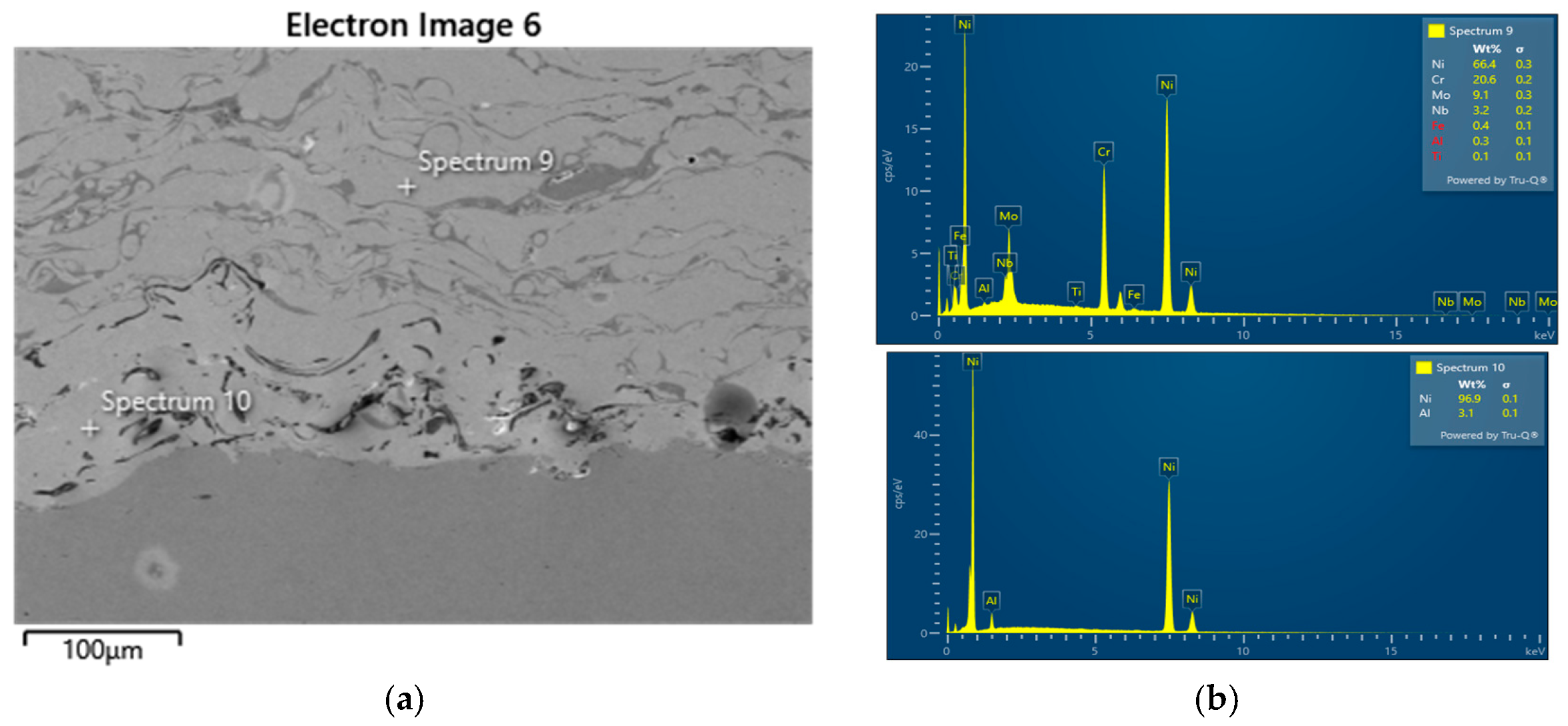
The fabricated specimens exhibit the typical stoichiometric composition (wt.%), as presented in
Table 4 and illustrated in
Figure 1, together with the nominal composition of the nickel-based Inconel 625 superalloy in accordance with the aerospace material specification (AMS 5666) [
15].
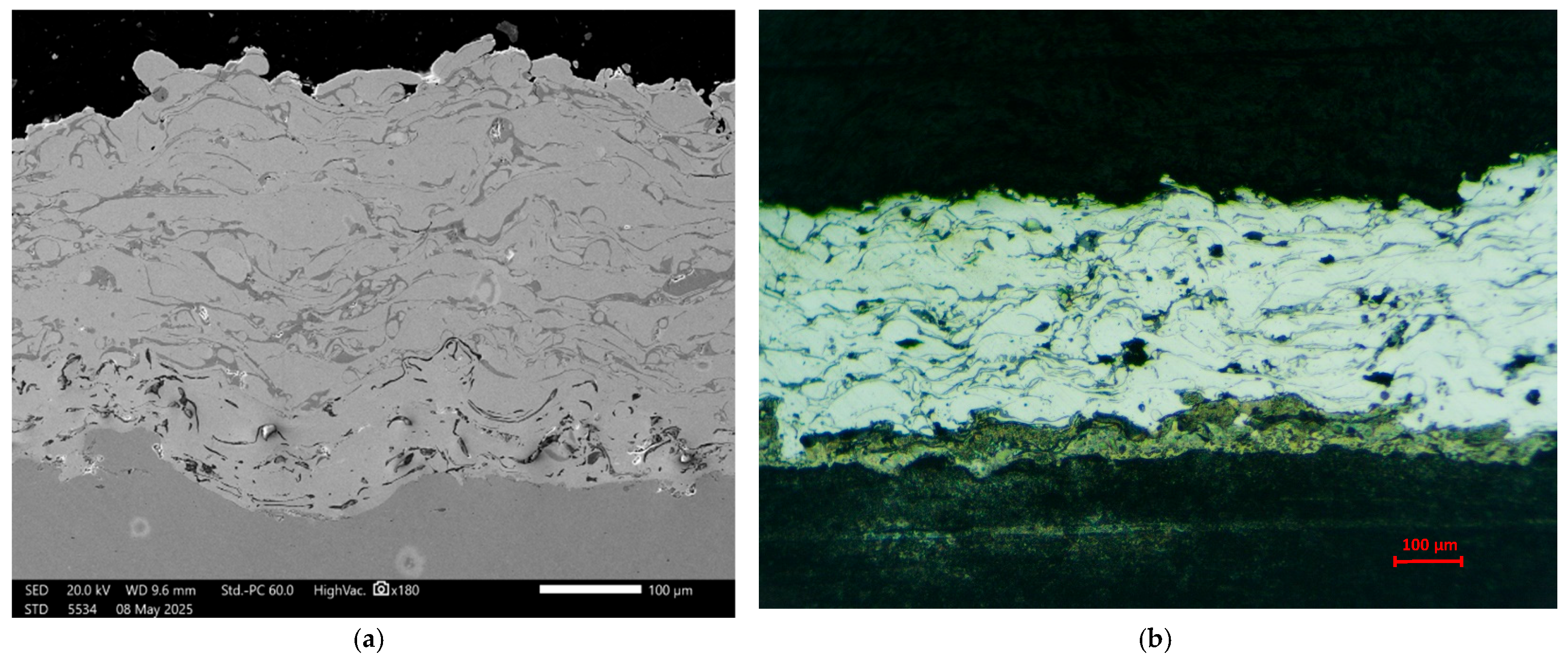
Figure 2 shows a typical cross section of a coated sample where the Inconel-625 deposit is approximately 340 μm and bond coating NiAl 95 μm in thickness deposited onto the substrate. The coating porosity ranged from 2% to 3% with the noticeable presence of oxide formation, ranged from 12% to 15%, around the resolidified splats as shown in
Figure 2.
The coating, as shown in
Figure 3, exhibits the characteristic lamellar morphology of arc-sprayed deposits, formed by the successive impingement, spreading, and rapid solidification of molten splats. Clearly defined splat boundaries are observed, along which pores and voids are preferentially distributed. These defects appear predominantly as irregularly shaped, elongated pores aligned parallel to the spraying direction, while smaller, near-spherical pores are occasionally detected within the splat interiors.
Figure 3.
SEM image depicting the cross-sections of Inconel 625 coating specimen.
Figure 3.
SEM image depicting the cross-sections of Inconel 625 coating specimen.
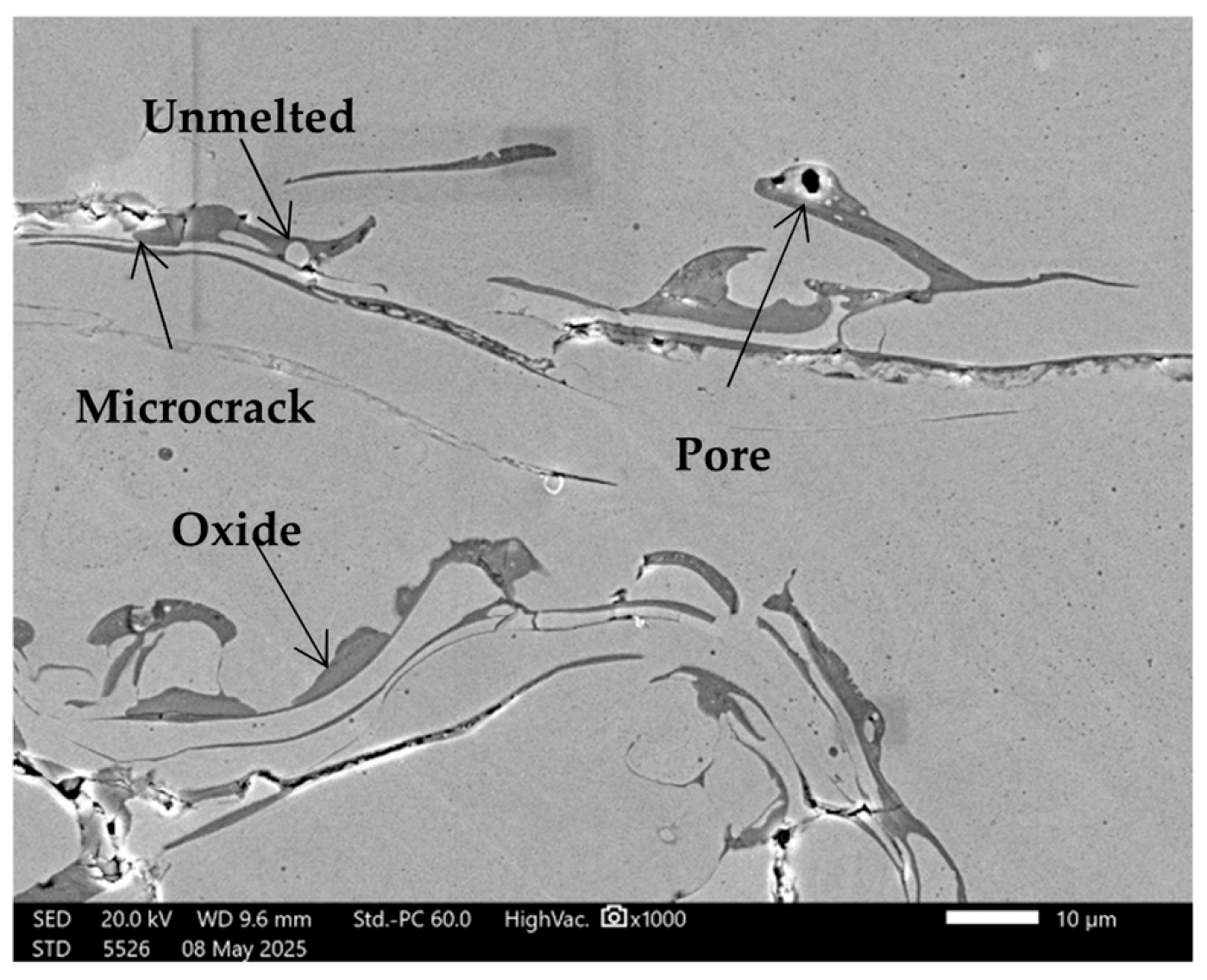
Regions of intermediate gray contrast are evident along several inter-splat interfaces, suggesting compositional variations induced during the spraying process, as shown in
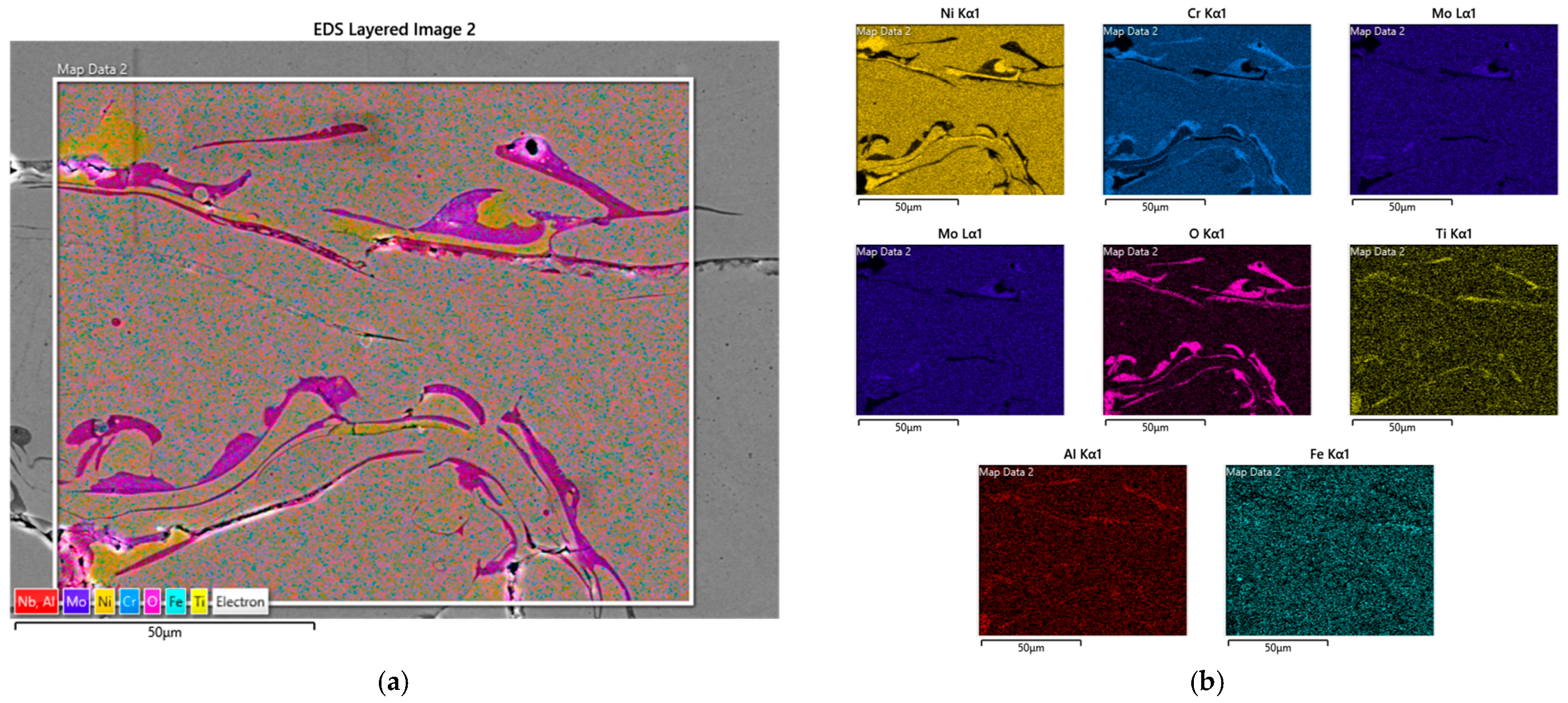
Figure 4. Elemental mapping by EDS reveals that these interfacial regions are enriched mainly in chromium, niobium, and oxygen, indicating the formation of Cr,Nb-rich oxide phases. This oxide formation is attributed to the in-flight oxidation of molten particles and subsequent oxidation during splat solidification, a phenomenon commonly associated with the Wire Arc Spraying (WAS) process. The presence of such oxide-rich inter-splat layers can influence the mechanical integrity and tribological response of the coating.
The Ni-rich regions, identified via EDS mapping, exhibit a distinct partially spherical morphology, suggesting they reached the substrate in a semi-solid or highly viscous state due to in-flight nucleation or incomplete melting at the wire arc tip. These globular nodes serve as primary sites for heterogeneous nucleation, where high thermal gradients promote rapid undercooling. Similar phenomena have also been reported in previous studies by A.H. Dent et al. [
16].
Figure 4.
(a) Cross-sectional SEM micrograph and (b) corresponding EDS elemental maps of the wire arc sprayed Inconel 625 coating, illustrating the elemental distribution of the main alloying elements (Ni, Cr, Mo, Nb) as well as minor elements and substrate-related signals (Ti, O, Al, Fe).
Figure 4.
(a) Cross-sectional SEM micrograph and (b) corresponding EDS elemental maps of the wire arc sprayed Inconel 625 coating, illustrating the elemental distribution of the main alloying elements (Ni, Cr, Mo, Nb) as well as minor elements and substrate-related signals (Ti, O, Al, Fe).
However, the sharp geometric transition between these rigid, spherical inclusions and the surrounding flattened splats creates significant stress concentration sites. Consequently, the thermal expansion mismatch and volumetric shrinkage during quenching lead to the initiation of large micro-cracks at the interfaces of these Ni-rich phases. This localized failure highlights how the discrete distribution of Ni-rich “seeds” governs both the structural integrity and the defect density of the overall Inconel 625 coating matrix [
17,
18].
The microhardness of the deposited coating was measured at 444 ± 15 HV. This value represents a slight increase compared to results reported in previous studies of similar thermal spray deposits [
19] and is significantly higher than the microhardness of bulk annealed Inconel 625, which typically ranges from 146 to 224 HV [
20]. This enhancement in hardness is attributed to the rapid solidification and the presence of fine oxide inclusions characteristic of the wire arc spray (WAS) process (
Figure 5).
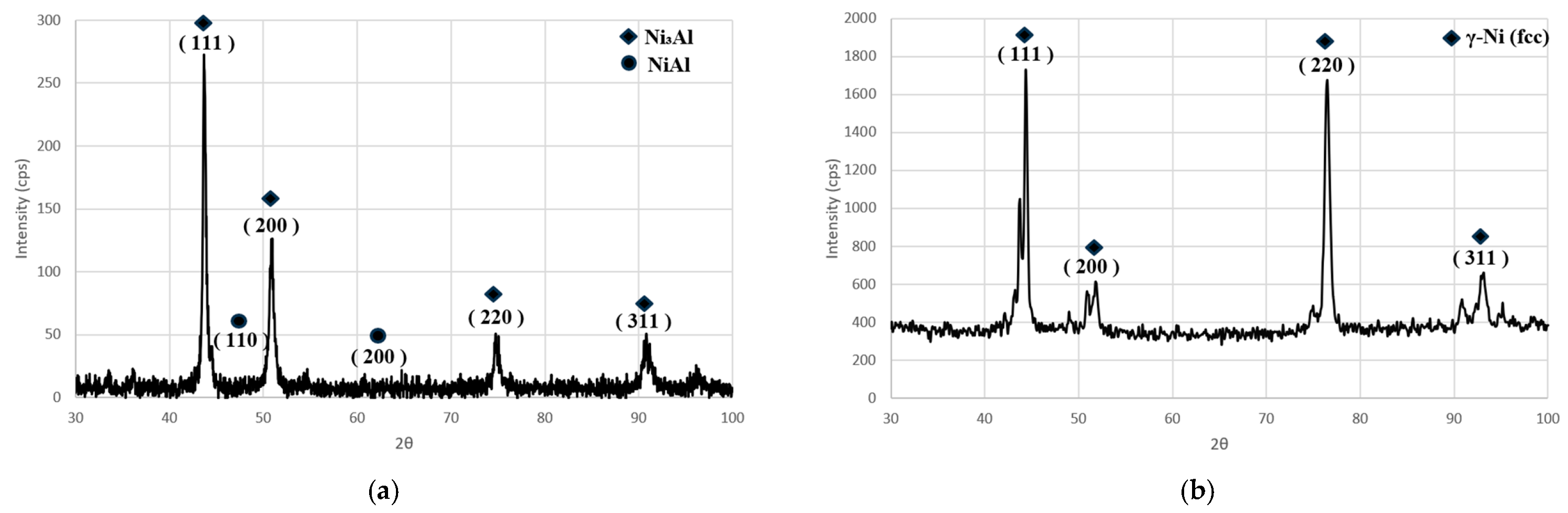
X-ray diffraction (XRD) analysis of the NiAl bond coat, as shown in
Figure 5a, revealed a predominantly intermetallic microstructure, with principal reflections corresponding to Ni
3Al and secondary contributions from NiAl. The dominance of the γ′ (Ni
3Al) phase indicates possible pronounced interdiffusion between the NiAl bond coat and the Inconel 625 top coat. This phase evolution is consistent with previous reports on aluminized Inconel 625 systems, where Al diffusion promotes γ′-Ni
3Al formation within the interdiffusion zone [
21]. The absence of distinct γ (fcc Ni) reflections is attributed to peak overlap and the crystallographic similarity between γ and Ni
3Al.
The XRD pattern of the Inconel 625 top coat, as shown in
Figure 5b, is dominated by a face-centered cubic (FCC) γ solid-solution phase, with characteristic reflections indexed to the (111), (200), (220), and (311) planes of the Ni-based matrix.
Although EDS mapping indicated Nb-, Cr-, and O-enriched regions, no corresponding oxide phases were detected by XRD. This is ascribed to their low volume fraction, localized distribution, and possible amorphous or nanocrystalline nature, placing them below the detection limit of XRD [
22].
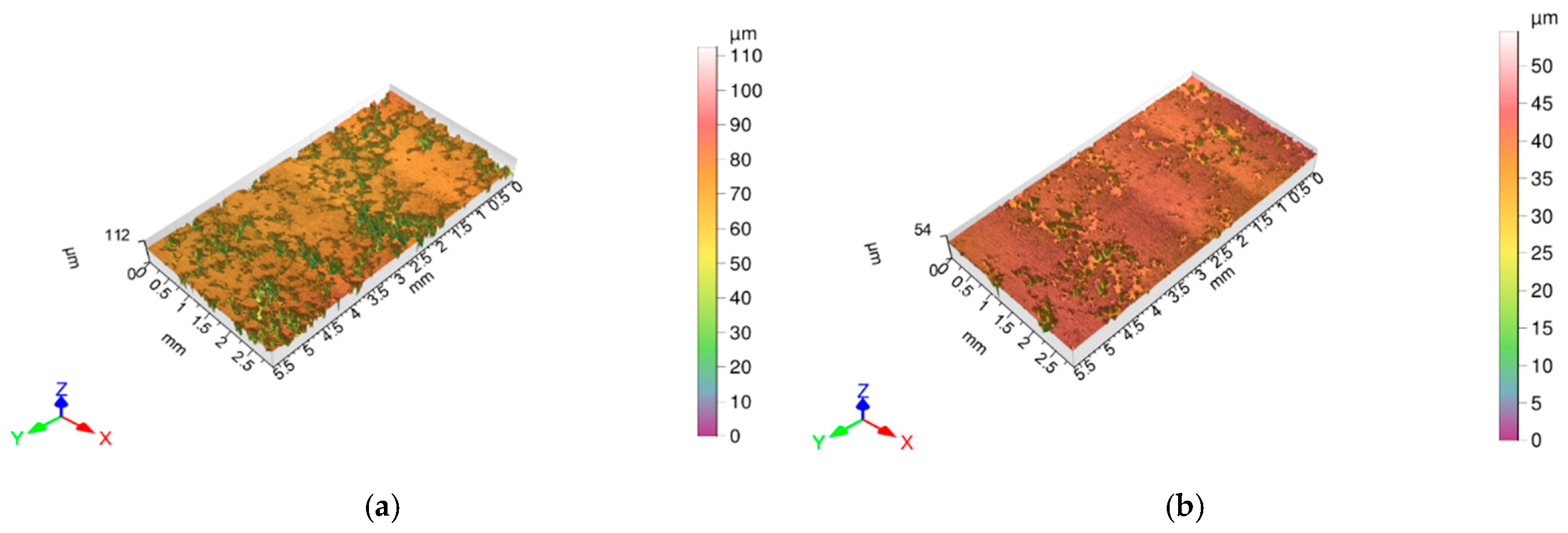
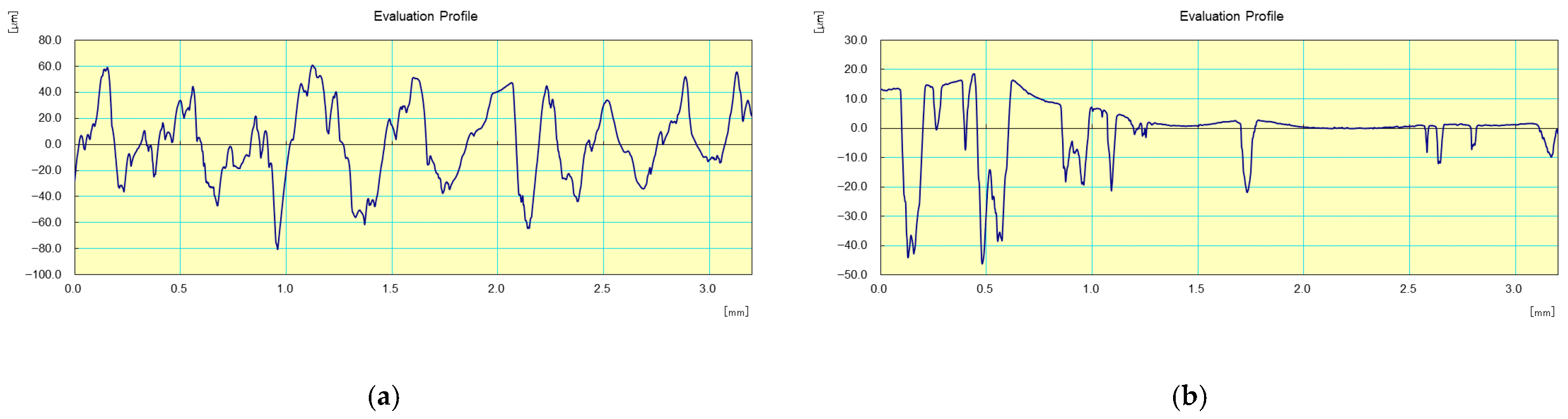
Surface roughness was characterized for both the as-sprayed and polished specimens prior to the tribological experiments. Indicative 3D surface topographies are presented in
Figure 6. It is important to note that for the friction and wear tests, specific areas were selected where detached splats were absent to ensure that the results reflect the inherent wear resistance of the coating matrix rather than localized structural defects.
The as-sprayed specimens presented an average surface roughness of 11.9 µm, while the polished surfaces exhibited a substantially lower roughness value of 2.12 µm. In addition, skewness (Ssk) and kurtosis (Sku) parameters were evaluated to further characterize the surface topography. For the as-sprayed condition, the obtained Ssk and Sku values were −1.34 and 3.76, respectively, indicating a height distribution located slightly above the mean plane with an approximately normal profile. In contrast, the polished specimens exhibited Ssk and Sku values of −3.73 and 20.9, respectively. This pronounced negative skewness together with the elevated kurtosis value suggests that the polishing treatment effectively removed most of the prominent surface asperities while leaving isolated deep grooves across the surface as shown in
Figure 7.
3.2. Tribological Performance
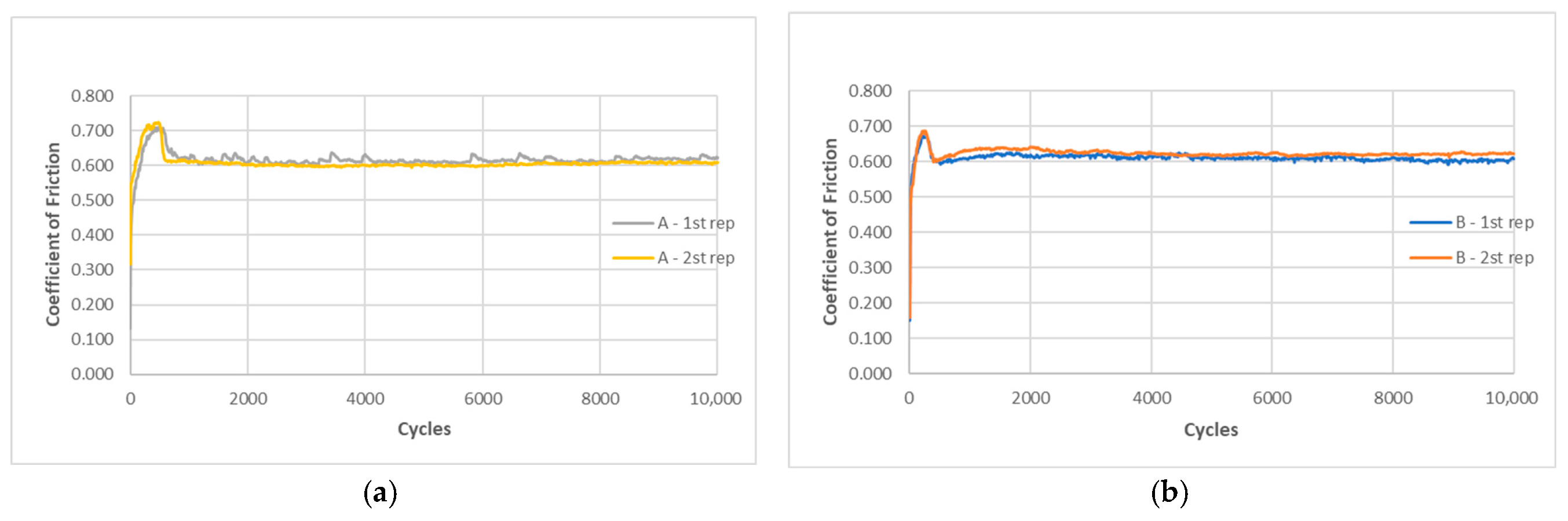
The evolution of the coefficient of friction (COF)
μ per cycle is depicted in
Figure 8a for the as-sprayed “A” specimen and in
Figure 8b for the polished “B” specimen.
For the as-sprayed specimens, the run-in stage appears to extend for a higher number of cycles, until reaching steady-state. In contrast, the polished specimens exhibit a shorter transition to steady-state friction. In the fundamental work of Blau [
23], such curve morphologies are associated mainly with the initial surface roughness that causes a temporary rise in friction. As the surfaces conform and smooth under sliding, friction decreases. The subsequent drop can also result from surface texturing induced by shear or from the formation of a low-shear transfer film.
The as-sprayed specimens exhibited an average steady-state coefficient of friction of µ = 0.611 ± 0.008, whereas the polished condition produced a comparable value of µ = 0.617 ± 0.005. The limited scatter observed in both datasets indicates good experimental repeatability and stable tribological behavior. Despite the significant difference in surface roughness, both specimen conditions ultimately reached nearly identical steady-state friction levels.
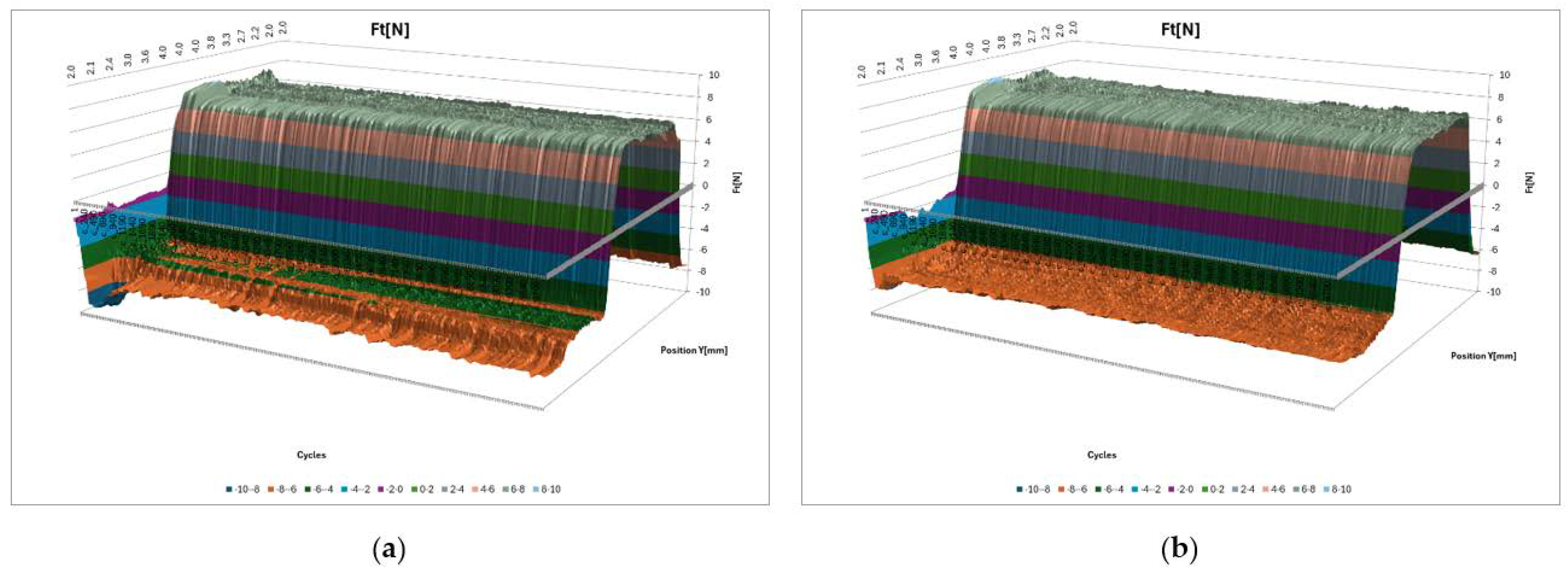
To further examine the sliding response of the coatings, the friction force was analyzed as a function of displacement throughout the reciprocating cycles. Representative three-dimensional triboscopic maps for both surface conditions are shown in
Figure 9.
While both the as-prepared and polished specimens eventually reach an identical steady-state coefficient of friction, their transitional friction force behaviors are markedly different. The 3D triboscopical curve for the as-prepared specimen reveals intense initial fluctuations and significant force peaks at the stroke edges, reaching values between −10 and −8 N. These peaks are believed to relate to pilling-up of debris (due to roughness removal) at the wear track edges, due to the reciprocating motion of the counter material. Thus, it is more pronounced in the as-prepared specimen’s because of their higher roughness values and morphology (see
Figure 6 and
Figure 7).
3.3. Wear Behavior
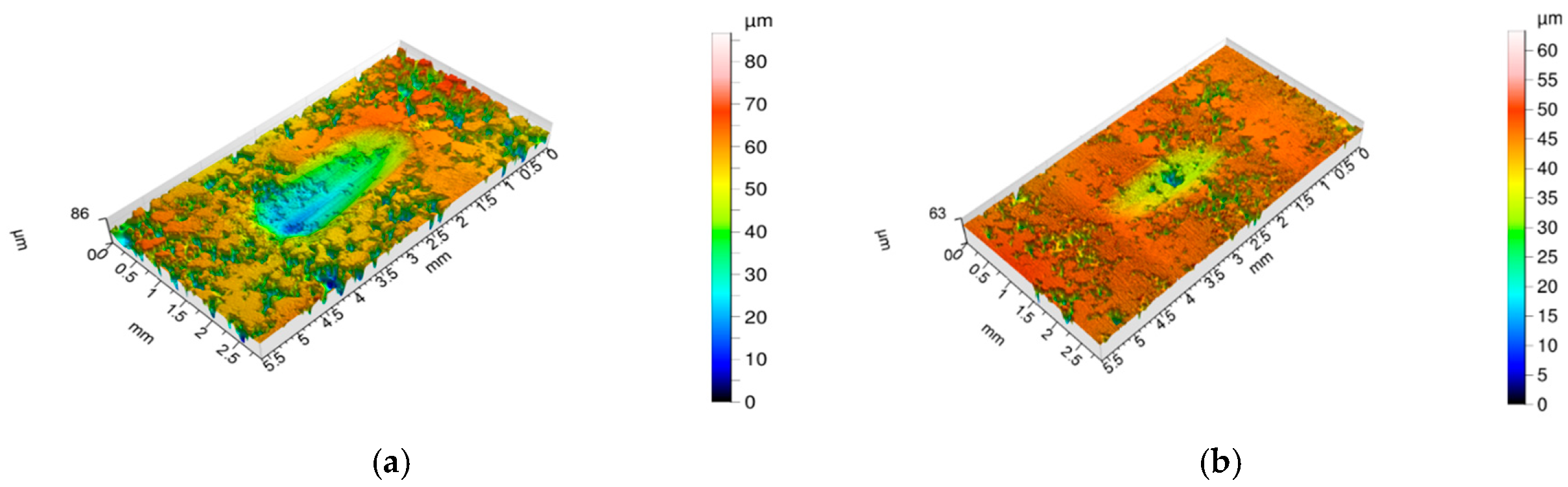
Indicative 3D confocal microscopy images for the as-prepared and polished specimens are presented in
Figure 10.
The wear track of the as-prepared specimen exhibits significant material removal, with a maximum depth of 50.5 µm and a maximum pile-up height of 52.7 µm at the edges of the track. This confirms the previous hypothesis, that the increase in friction at the triboscopical image at the edges of the track is mainly related to debris pile-ups. The measured wear volume was approximately 0.037 mm3, while the debris pile-up volume (peak) was approximately 0.015 mm3. The mean depth and height were recorded at 13.3 µm and 9.10 µm, respectively.
In contrast, the polished specimen shows enhanced wear resistance with a lower volume loss of approximately 0.012 mm3 and a debris pile-up volume of only 0.0075 mm3. The maximum depth and height for the polished surface were reduced to 43.0 µm and 34.3 µm, respectively, with significantly lower mean values of 5.68 µm for depth and 4.07 µm for height. This data confirms that the polished specimens exhibit approximately 2.5 times less volume loss than the as-prepared specimens, demonstrating much better surface homogeneity and reduced susceptibility to severe abrasive wear. To understand the significant differences, analysis of wear mechanisms was performed.
Thus, the specific wear rate was determined to be approximately 9.3 × 10⁻⁵ mm3/Nm for the as-prepared specimen and 3.0 × 10⁻⁵ mm3/Nm for the polished specimen, thereby confirming the superior wear resistance of the polished surface.
As shown in
Table 5 the polished coating produced in this study exhibits one of the lowest specific wear rates among the reported deposition methods, highlighting its enhanced wear performance. Furthermore, Gao et al. [
24] reported a value of approximately 1 × 10
−5 mm
3/Nm untreated bulk Inconel 625 under a ball-on-disk configuration, suggesting that the present coating demonstrates comparable wear performance to bulk material.
The wear observed in the specimens is primarily attributed to material loss resulting from mechanical interaction between the Inconel 625 coating and the alumina (Al
2O
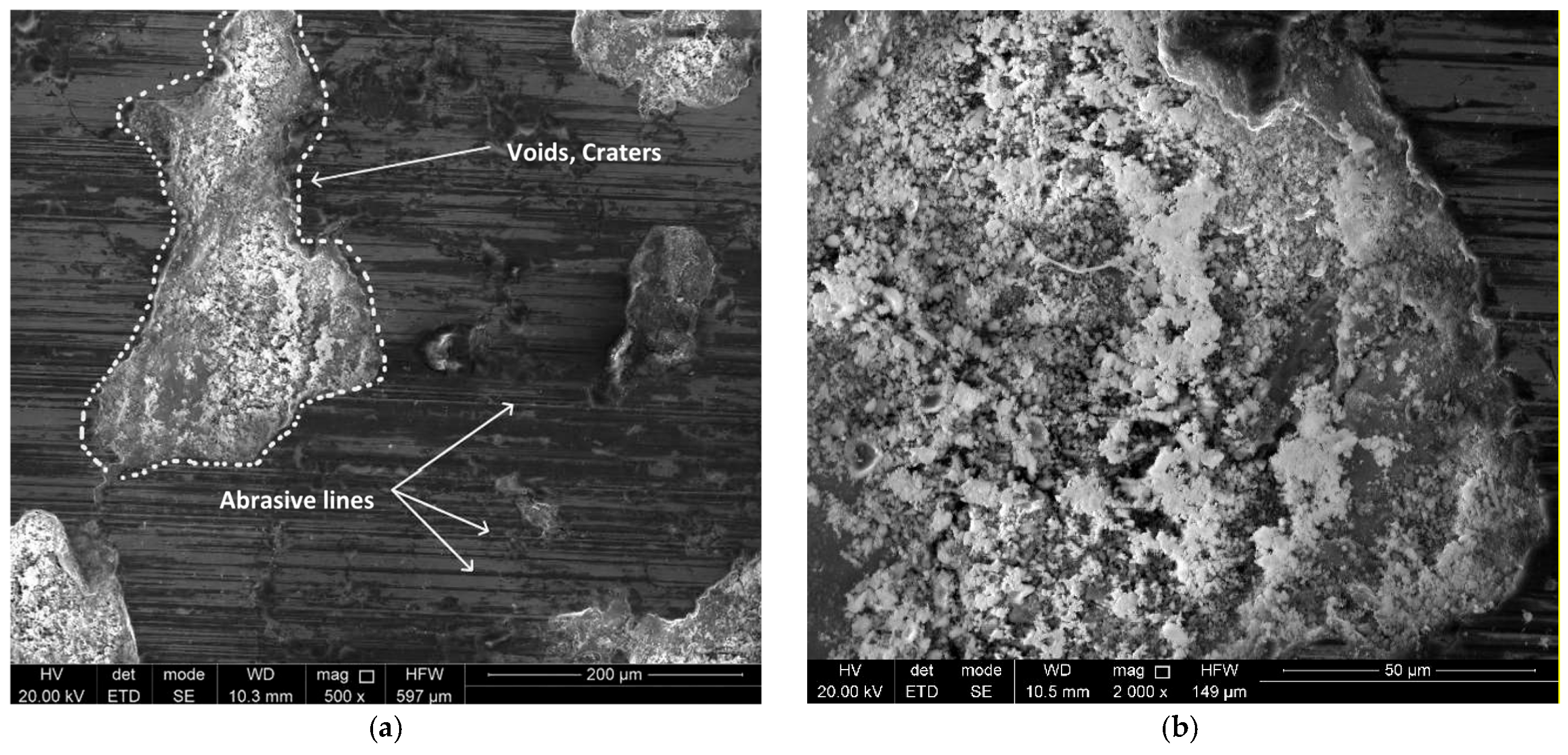
3) counter-body. In the absence of significant chemical interaction and given the presence of grooves parallel to the sliding direction, as shown in
Figure 11a, abrasion is identified as the dominant wear mechanism [
9,
27]. This occurs through both two-body abrasion, caused by the harder asperities of the Al
2O
3 counter-body, and three-body abrasion associated with debris particles within the tribological contact.
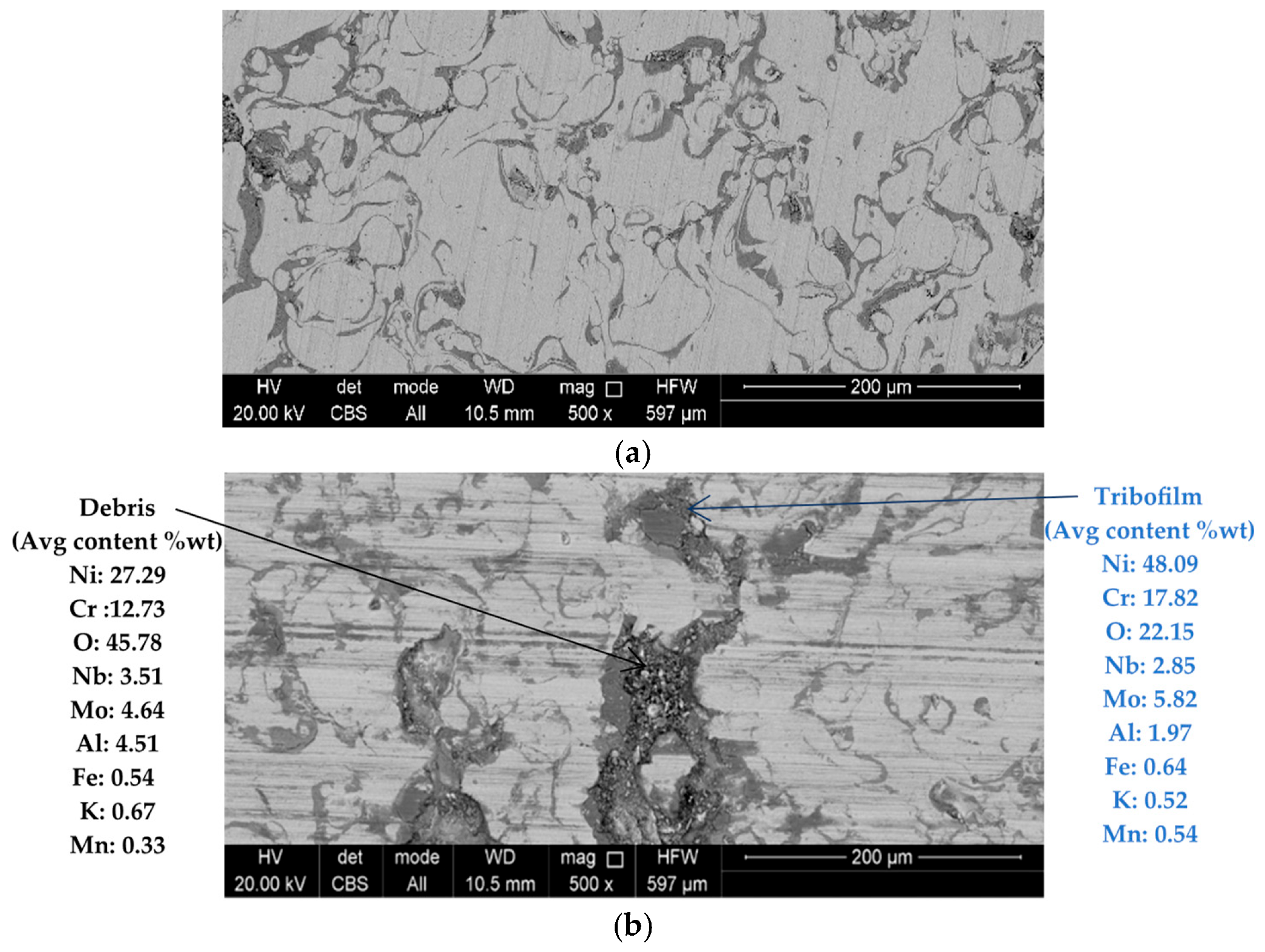
In addition, the presence of craters and extensive voids within the wear track suggests the concurrent action of a decohesion mechanism, where debris becomes entrapped within the contact, as shown in
Figure 11b. This decohesion is likely triggered by high shear stresses acting on the pre-existing surface roughness [
28] and the brittle interlamellar oxides surrounding the splats (as indicated in
Figure 4). Furthermore, EDS analysis (
Figure 12b) confirms the accumulation of debris within these voids and oxides, as well as the formation of tribofilms on the worn surface. The formation of such tribofilms is attributed to the compaction and oxidation of wear debris under repeated sliding, which can locally reduce direct metal-to-counter-body contact.
While both specimen types reached a highly repeatable steady-state coefficient of friction, the as-prepared specimen exhibited significantly higher wear compared to the polished specimen. This difference emphasizes that, although polishing does not substantially alter the fundamental frictional behavior, it effectively mitigates micro-detachment of material and reduces the influence of primary topographical defects on the overall wear rate.
4. Conclusions
Inconel 625 coatings were successfully deposited onto AISI 1025 steel plates via wire arc spraying (WAS). This study investigates the microstructural characteristics and tribological performance of a NiAl–Inconel 625 composite coating system. As industries increasingly demand cost-effective solutions for components operating in aggressive environments—such as marine, power generation, and aerospace—the integration of high-temperature superalloys via thermal spray processes has become a critical engineering focus.
The experimental analysis revealed that the WAS-deposited coatings exhibit a characteristic lamellar morphology, with porosity levels between 2% and 3% and oxide content ranging from 12% to 15%. Microstructural characterization via SEM and EDS identified that the formation of Cr,Nb-rich oxides and the presence of semi-solid, Ni-rich globular inclusions create significant stress concentration sites. These features lead to thermal expansion mismatch and volumetric shrinkage, which trigger inter-lamellar micro-cracking and influence the overall structural integrity of the coating. X-ray diffraction (XRD) analysis confirmed the presence of a dominant face-centered cubic (FCC) γ Ni-based solid solution in the top coat, while the bond coat consisted primarily of intermetallic γ′-Ni3Al with secondary NiAl, indicating significant interdiffusion between layers. No oxide phases were detected by XRD, likely due to their low volume fraction and nanocrystalline or amorphous nature.
Tribological testing using a ball-on-disk reciprocating configuration demonstrated that while both as-prepared and polished surfaces achieved a consistent steady-state coefficient of friction, their wear behaviors differed significantly. The primary wear mechanism was identified as abrasion, compounded by the decohesion of brittle inter-lamellar oxides under shear stress. Post-deposition polishing reduced surface roughness from 11.9 µm to 2.12 µm, resulting in a 2.5-fold improvement in wear resistance and a substantial reduction in debris pile-up.
The corresponding specific wear rates were determined to be approximately 9.3 × 10⁻⁵ mm3/Nm for the as-prepared condition and 3 × 10⁻⁵ mm3/Nm for the polished surface. These values fall within the range reported in the literature for Inconel 625 coatings produced by various deposition methods and approach those of bulk Inconel 625 (≈1 × 10⁻⁵ mm3/Nm) []. Notably, comparable wear performance is achieved using wire arc spraying, a relatively low-cost and industrially accessible technique, in contrast to more advanced deposition methods such as cold spray, highlighting its potential as a cost-effective alternative for tribological applications.
These results underscore that while wire arc spraying is an efficient method for applying protective superalloy layers, post-deposition finishing is a mandatory requirement for mitigating localized failure and maximizing service life in demanding industrial applications.
Author Contributions
Methodology, M.V., E.G. and A.K.; Validation, K.A.; Formal analysis, K.A.; Investigation, K.A. and T.V.d.D.; Writing—original draft, K.A.; Writing—review & editing, A.T., D.D., M.V., E.G., A.K. and P.S.; Supervision, E.G. and A.K. All authors have read and agreed to the published version of the manuscript.
Funding
This research received no external funding.
Institutional Review Board Statement
Not applicable.
Informed Consent Statement
Not applicable.
Data Availability Statement
The original contributions presented in this study are included in the article. Further inquiries can be directed to the corresponding author.
Conflicts of Interest
Author Dirk Drees was employed by the company Falex Tribology NV. Author Michalis Vardavoulias was employed by the company Pyrogenesis S.A. The remaining authors declare that the research was conducted in the absence of any commercial or financial relationships that could be construed as a potential conflict of interest.
References
- Espallargas, N. Future Development of Thermal Spray Coatings; Elsevier: Amsterdam, The Netherlands, 2015; pp. 16–18. [Google Scholar]
- Hawthorne, H.M.; Arsenault, B.; Immarigeon, J.P.; Legoux, J.G.; Parameswaran, V.R. Comparison of slurry and dry erosion behaviour of some HVOF thermal sprayed coatings. Wear 1999, 225–229, 825–834. [Google Scholar] [CrossRef]
- Boulos, M.I.; Fauchais, P.L.; Heberlein, J.V.R. Thermal Spray Fundamentals; Springer Nature: Berlin/Heidelberg, Germany, 2021. [Google Scholar]
- Gedzevicius, I.; Valiulis, A.V. Analysis of wire arc spraying process variables on coatings properties. J. Mater. Process. Technol. 2006, 175, 206–211. [Google Scholar] [CrossRef]
- Reed, R.C. The Superalloys; Cambridge University Press: Cambridge, UK, 2008. [Google Scholar]
- Kornienko, E.; Gulyaev, I.G.O.R.; Smirnov, A.; Nikulina, A.; Ruktuev, A.; Kuzmin, V.; Tuezov, A. Microstructure and properties of Ni-Al coatings obtained by conventional and high-velocity atmospheric plasma spraying. Results Surf. Interfaces 2022, 6, 100038. [Google Scholar] [CrossRef]
- Zhang, D.; Harris, S.J.; McCartney, D.G. Microstructure formation and corrosion behaviour in HVOF-sprayed Inconel 625 coatings. Mater. Sci. Eng. A 2003, 344, 45–56. [Google Scholar] [CrossRef]
- Ahmed, N.; Bakare, M.S.; McCartney, D.G.; Voisey, K.T. The effects of microstructural features on the performance gap in corrosion resistance between bulk and HVOF sprayed Inconel 625. Surf. Coat. Technol. 2010, 204, 2294–2301. [Google Scholar] [CrossRef]
- Phiri, R.R.; Oladijo, O.P.; Maledi, N.; Akinlabi, E.T. Effect of Coating Thickness on Wear Performance of Inconel 625 coating. IOP Conf. Ser. Mater. Sci. Eng. 2018, 423, 012159. [Google Scholar] [CrossRef]
- Vijeesh, V.P.; Ramesh, M.R.; Anoop, A.D. Inconel 625 Coatings on AISI 304 Steel using Laser Cladding: Microstructure and Hardness. Eng. Technol. Appl. Sci. Res. 2023, 13, 11911–11916. [Google Scholar] [CrossRef]
- Wu, K.; Sun, W.; Tan, A.W.-Y.; Marinescu, I.; Liu, E.; Zhou, W. An investigation into microstructure, tribological and mechanical properties of cold sprayed Inconel 625 coatings. Surf. Coat. Technol. 2021, 424, 127660. [Google Scholar] [CrossRef]
- Gui, W.; Zhong, C.; Gu, J.; Ding, Y.; Wang, X.; Wu, T.; Liang, Y.; Qin, J.; Qu, Y.; Lin, J. Laser-clad Inconel 625 coatings on Q245R structure steel: Microstructure, wear and corrosion resistance. npj Mater. Degrad. 2022, 6, 37. [Google Scholar] [CrossRef]
- Scendo, M.; Staszewska-Samson, K.; Danielewski, H. Corrosion Behavior of Inconel 625 Coating Produced by Laser Cladding. Coatings 2021, 11, 759. [Google Scholar] [CrossRef]
- Karagiannidis, I.; Tzanis, A.; Drees, D.; Lopes, L.; Chondrakis, G.; Dardavila, M.M.; Georgiou, E.; Koutsomichalis, A. Friction and Wear Behavior of 3D-Printed Inconel 718 Alloy under Dry Sliding Conditions. Coatings 2024, 14, 1029. [Google Scholar] [CrossRef]
- SAE International|Advancing Mobility Knowledge and Solutions. Sae.org. 2026. Available online: https://www.sae.org/standards/ams5666k-nickel-alloy-corrosion-heat-resistant-bars-forgings-extrusions-rings-stock-forgings-extrusions-rings-62ni-215cr-90mo-365cb-nb-annealed (accessed on 24 February 2026).
- Dent, A.H.; Horlock, A.J.; McCartney, D.G.; Harris, S.J. Microstructure formation in high velocity oxy-fuel thermally sprayed Ni–Cr–Mo–B alloys. Mater. Sci. Eng. A 2000, 283, 242–250. [Google Scholar] [CrossRef]
- Davis and ASM International. Thermal Spray Society Training Committee. In Handbook of Thermal Spray Technology; ASM International: Materials Park, OH, USA, 2005; pp. 45–55. [Google Scholar]
- Bolelli, G.; Cannillo, V.; Lusvarghi, L.; Riccò, S. Mechanical and tribological properties of electrolytic hard chrome and HVOF-sprayed coatings. Surf. Coat. Technol. 2006, 200, 2995–3009. [Google Scholar] [CrossRef]
- Chen, T.-C.; Chou, C.-C.; Lin, H.-E.; Yung, T.-Y.; Yang, C.-T.; Tsai, Y.-W. Influence of coating microstructure on the corrosion behavior of Inconel 625 coatings fabricated by different thermal spraying processes. Surf. Coat. Technol. 2024, 484, 130674. [Google Scholar] [CrossRef]
- INCONEL ® Alloy 625. August 2013. Available online: https://www.specialmetals.com/documents/technical-bulletins/inconel/inconel-alloy-625.pdf (accessed on 24 February 2026).
- Bölükbaşı, Ö.S.; Serindağ, T.; Gürol, U.; Günen, A.; Çam, G. Improving oxidation resistance of wire arc additive manufactured Inconel 625 Ni-based superalloy by pack aluminizing. CIRP J. Manuf. Sci. Technol. 2023, 46, 89–97. [Google Scholar] [CrossRef]
- Khan, H.; Yerramilli, A.S.; D’Oliveira, A.; Alford, T.L.; Boffito, D.C.; Patience, G.S. Experimental methods in chemical engineering: X-ray diffraction spectroscopy—XRD. Can. J. Chem. Eng. 2020, 98, 1255–1266. [Google Scholar] [CrossRef]
- Blau, P.J. On the nature of running-in. Tribol. Int. 2005, 38, 1007–1012. [Google Scholar] [CrossRef]
- Gao, Y.; Li, X.; Ma, Y.; Kitchen, M.; Ding, Y.; Luo, Q. Formation mechanism and wear behavior of gradient nanostructured Inconel 625 alloy. Trans. Nonferrous Met. Soc. China 2022, 32, 1910–1925. [Google Scholar]
- Srichen, A.; Moonngam, S.; Linjee, S.; Banjongprasert, C. Tribological behaviors of arc sprayed NiCrMoAl alloy coating after heat treatments. Surf. Coat. Technol. 2022, 437, 128325. [Google Scholar] [CrossRef]
- Bolelli, G.; Lusvarghi, L.; Mantini, F.P.; Barletta, M.; Casadei, F. Microstructural and tribological characterisation of as sprayed and heat treated HVOF deposited Ni alloys. Surf. Eng. 2007, 23, 355–372. [Google Scholar] [CrossRef]
- Babu, N.N.; Kumar, S.; Govindarajan, S. Microstructural, Mechanical, and Tribological Evaluation of HVAF-Sprayed Inconel 718 Coatings. J. Therm. Spray Technol. 2025, 34, 1065–1081. [Google Scholar] [CrossRef]
- Oladijo, O.P.; Collieus, L.L.; Obadele, B.A.; Akinlabi, E.T. Correlation between residual stresses and the tribological behaviour of Inconel 625 coatings. Surf. Coat. Technol. 2021, 419, 127288. [Google Scholar] [CrossRef]
| Disclaimer/Publisher’s Note: The statements, opinions and data contained in all publications are solely those of the individual author(s) and contributor(s) and not of MDPI and/or the editor(s). MDPI and/or the editor(s) disclaim responsibility for any injury to people or property resulting from any ideas, methods, instructions or products referred to in the content. |



 ,
,