Article

Preparation, Mechanical and Microwave Absorption Properties of Resin-Based Coating with Bionic Helical Structures

1
School of Mechanical and Electrical Engineering, North University of China, Taiyuan 030051, China
2
School of Materials Science and Engineering, North University of China, Taiyuan 030051, China
*
Author to whom correspondence should be addressed.
These authors contributed equally to this work.
Coatings 2026, 16(5), 599; https://doi.org/10.3390/coatings16050599 (registering DOI)
Submission received: 20 March 2026 / Revised: 4 May 2026 / Accepted: 7 May 2026 / Published: 15 May 2026
(This article belongs to the Section Functional Polymer Coatings and Films)

Abstract

To optimize the electromagnetic and mechanical properties, a resin-based coating with a bionic helical structure made by carbonyl iron fibers (CIF) was prepared by alternating spray and brushing with 0°/45°/90°. The morphologies of CIP and CIF were characterized by a scanning electron microscope (SEM). The electromagnetic parameters of CIP were measured in the frequency range of 2–18 GHz by the coaxial ring method, and microwave absorption properties of the coating were evaluated by reflection loss (RL). The mechanical properties of the coating with the bionic helical structure were investigated by the pull-off method. The effects of the CIP ratio, CIF content, and thickness on the microwave absorption were discussed, respectively. The results show that 6.5:3.5 is the optimal CIP-to-paraffin ratio with superior electromagnetic performance and RL. The coating with the triple helical structure, fiber content of 3 wt% and free of CIP (C4) exhibits optimal electromagnetic wave absorption performance with a minimum RL value of −10.66 dB and wide effective absorbing bandwidth (EAB) of 10.58 GHz at a thickness of 0.6 mm. Moreover, the adhesion strength of C4 reaches 13.52 MPa. The excellent absorption performance and mechanical properties of the resin-based coating with the bionic helical structure indicate that it has potential application value in the field of stealth materials.

1. Introduction

With the rapid evolution of electronic warfare technology, the integration of advanced detection systems and high-precision guided weapons has significantly compromised the combat survivability of military assets, including aircraft, missiles, tanks, and naval vessels, across aerial, terrestrial, and maritime domains. Consequently, stealth technology has become a key challenge in military fields. Among various stealth strategies, wave-absorbing coatings have attracted significant interest due to their excellent shape adaptability and ease of application [1].
Extensive research has been conducted on wave-absorbing coatings by scholars domestically and internationally. For example, Wang, W.J. designed a multifunctional coating that achieved radar stealth and reduced high-temperature infrared emission through polarization conversion, thereby enabling compatibility between radar and infrared stealth [2]. Gao, Y.X. et al. utilized modified floating aluminum powder to develop a multifunctional composite coating with low infrared emissivity, dielectric loss, and antistatic properties [3]. Liu, Z.H. et al. fabricated a carbon fiber/polyurethane radar-absorbing coating using carbon fiber as the filler and polyurethane as the matrix, which broadened the effective absorption bandwidth [4]. Wang, J. et al. prepared an absorbing coating using carbon nanotubes (CNTs) and NT-ZnO as absorbers within an epoxy resin binder [5]. Wang, L.Y. et al. produced CNTs/AT13 coatings via micro-plasma spraying and investigated the influence of CNT diameter on wave absorption performance [6]. Bae et al. designed a broadband multilayer radar-absorbing coating (RAC) to reduce the radar cross-section (RCS) of maritime targets in the 7–12 GHz range [7].
However, resin-based coatings on certain products are often subjected to harsh service environments, including overheating, high-speed airflow erosion, thermal shock, and vibration under practical conditions. These environments can lead to carbon deposition, oil accumulation, sediment coverage, peeling, delamination, abrasion, and blistering, significantly compromising protective performance. Therefore, enhancing the mechanical properties of resin-based coatings, as well as extending their service life, can mitigate erosion-related damage and improve product reliability. Yuan et al. prepared FeCoCr/silicone resin coatings, achieving an adhesion strength of 11.78 MPa and a reflection loss of −6.18 dB at a thickness of 1 mm, and the maximum effective bandwidth below −4 dB reaches 5.9 GHz (4.98–10.88 GHz) [8]. Mayer et al. prepared 0.5 mm thick epoxy and polyurethane coatings, and the epoxy coating with 20 wt% graphite achieved the highest pull-off strength of 3.88 MPa [9]. Deng et al. prepared carbonyl iron powder/boron-modified phenolic resin composite coatings, which achieved full effective absorption in the X-band at a thickness of 1.2 mm, and the minimum reflection loss was −19.8 dB at a thickness of 1.4 mm. The 75 wt% carbonyl iron powder coating reached an adhesion strength of 12.01 MPa [10]. Although the above studies have enhanced the microwave absorption or mechanical properties of coatings by several methods, few studies have reported resin-based coatings that simultaneously possess superior mechanical performance, exceptional microwave absorption, and ultra-thin thickness.
Nature provides a wealth of unique structures and properties that inspire biomimetic engineering designs. The incorporation of novel bionic structures can improve the mechanical properties of materials. For instance, Jadav, K.C. et al. used finite element methods to analyze the tensile strength of structures inspired by beetle, biomimetic lotus root, and trabecular bone, demonstrating that biomimetic designs enhance the mechanical properties of 3D-printed ABS structures [11]. Wang, S.J. et al. drew inspiration from the attachment mechanisms between hard and soft scales in certain animals to design six types of bionic armor via 3D printing. They simplified bio-armor structures while preserving essential features, and found that interactions between adjacent scales significantly improved mechanical performance [12]. Xie, W.Q. et al. prepared a biomimetic cellular MCMB@WC composite with good flexural strength and fracture toughness inspired by the unique structure of plant cells [13]. Quan, G.P. developed a biomimetic mineralization-based interface modification method for producing high-strength carbon fiber composites inspired by biominerals [14]. Wu, M.M. et al. fabricated a biomimetic graphite foil with a mortar-like structure, which enhanced both mechanical properties and electrical conductivity [15]. Rivera, J. examined the elytra of a compression-resistant beetle and applied insights into its structural and mechanical properties to the development of biomimetic fiber-reinforced composites [16]. Li, X.W. et al. investigated the hierarchical structural features and mechanical properties of cross-laminated structures and summarized recent advances and biomimetic applications based on unique cross-laminated architectures [17]. Estrada, S. simulated the graded mineral content and hierarchical structure of arapaima gigas scales from nano to macro scales, leading to the development of biomimetic laminated composites with improved impact resistance [18]. Research has revealed that the arapaima gigas can withstand formidable attacks from piranhas due to the unique helical plywood micro-nano structure within its scales. This specific spiral configuration enables the scales to absorb energy from external loads and effectively resist crack propagation, which is essential for protecting the fish from piranha bites [19,20,21,22,23]. The toughening mechanism of biomimetic helical structures closely resembles that of natural armored fish scales. Under load, cracks propagate parallel to the direction of the microfiber long axis and gradually extend between fiber layers with different orientations, ultimately forming a spiral crack pattern. The crack propagation behavior resulting from the biomimetic helical structure contrasts sharply with the planar crack extension typically observed in conventional fiber-reinforced materials. Owing to the larger damaged interface area, biomimetic helical structures exhibit greater energy absorption and superior damage resistance.
In this study, a bionic helical structure was incorporated into the coating to enhance mechanical and wave-absorbing properties. The dielectric and wave-absorbing properties of coatings with varying contents of carbonyl iron powder were investigated. The influence of the bionic helical structure on the coating’s mechanical performance was analyzed, and the effects of the number of helical layers, fiber content, and different slurry formulations on wave-absorbing performance were examined.

2. Experimental

2.1. Preparation

The carbonyl iron powder (CIP), epoxy resin, carbonyl iron fiber (CIF), dispersing agent, curing agent, and paraffin wax were prepared in the experiment process. (1) Preparation of coaxial ring specimens: the coaxial ring specimens were prepared by mixing CIP and paraffin wax at different mass ratios. The mass ratios of CIP to paraffin wax were 6:4, 6.5:3.5, 7:3, and 7.5:2.5, designated as CIP6-P4, CIP6.5-P3.5, CIP7-P3, and CIP7.5-P2.5, respectively. (2) Preparation of carbonyl iron coating: The slurry included CIP, epoxy resin, dispersing agent, and curing agent. And then, a carbonyl iron powder coating was prepared by the cold spray method. (3) Preparation of carbonyl iron fiber coating: The slurry included CIP, CIF, epoxy resin, dispersing agent, and curing agent. And then, a carbonyl iron fiber coating was prepared by a brushing method. The brushing angles are 0°, 45°, and 90°.
A simulated helical-structured, resin-based, wave-absorbing coating on the aluminum alloy was fabricated by combining the brushing and spraying methods. The helical angle was controlled by alternating spraying and brushing at different 45° orientations, repeated as required. The process is shown in Figure 1. Based on the different fabrication processes and compositions, the composite coatings were categorized into four types and designated as C1, C2, C3 and C4, and C5 is the ordinary coating without the bionic helical structure used as a control group for comparison. The detailed classification is shown in Table 1.

2.2. Characterization

The morphology of the CIP was examined using scanning electron microscopy (SEM, JSM-7610F, JEOL Ltd., Tokyo, Japan). The complex permittivity and complex permeability of the CIP were measured by the coaxial transmission-line method, and the calibration and testing methods refer to GJB 5239-2004. The reflection loss of the coating was tested by a vector network analyzer in the 2–18 GHz range, and the testing method refers to GJB 2038A-2011. The mechanical property was characterized by a pull-off test. A pull stub was directly adhered to the coating surface using structural adhesive. After the adhesive was fully cured, the pull stub was coaxially connected to the loading fixture of the testing apparatus. A controlled pull-off test was conducted on the bonded assembly to determine the tensile force required to separate the coating from the substrate. Finally, the average value of six measurements was obtained.

3. Results and Discussion

3.1. Microstructure

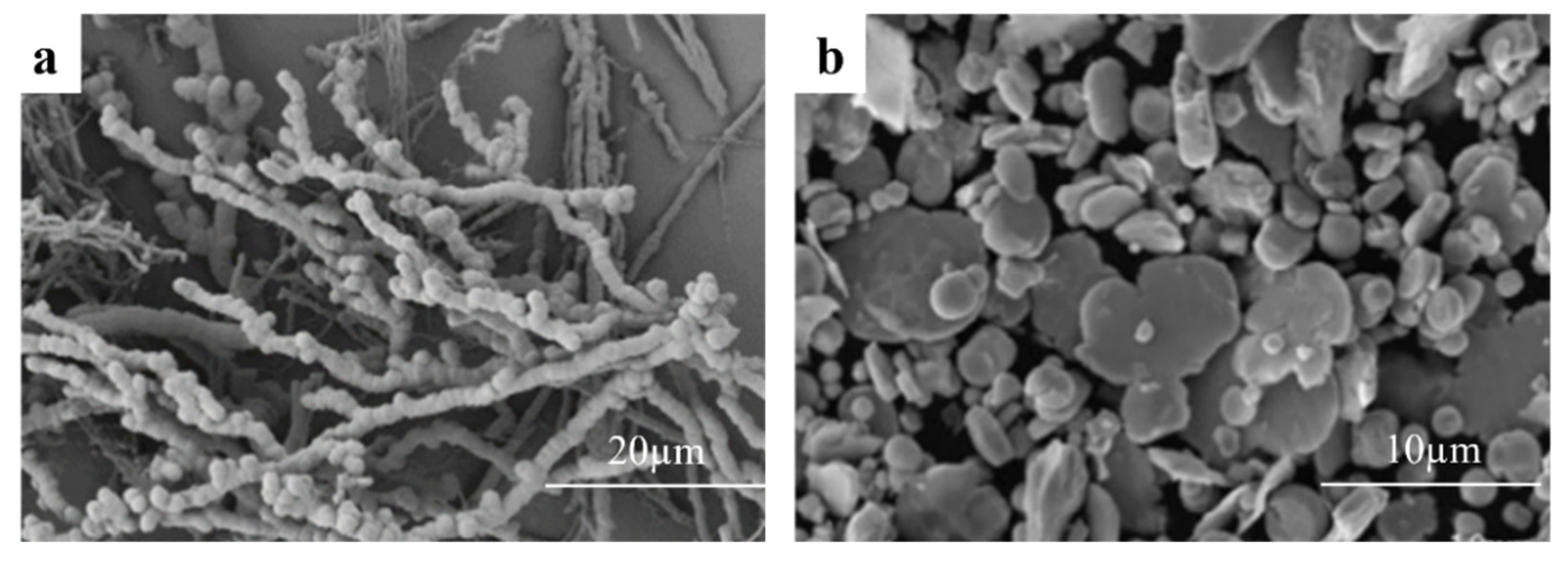
Figure 2 shows SEM images of the CIF and CIP. The CIF is uniform in size and exhibits continuous protrusions on their surfaces. The flaky CIP particles are smooth, and no agglomeration or adhesion is observed. The powder is interspersed with a minor fraction of spherical carbonyl iron particles. The particle size ranges from 1 to 5 μm, which is conducive to uniform dispersion within the epoxy resin matrix.
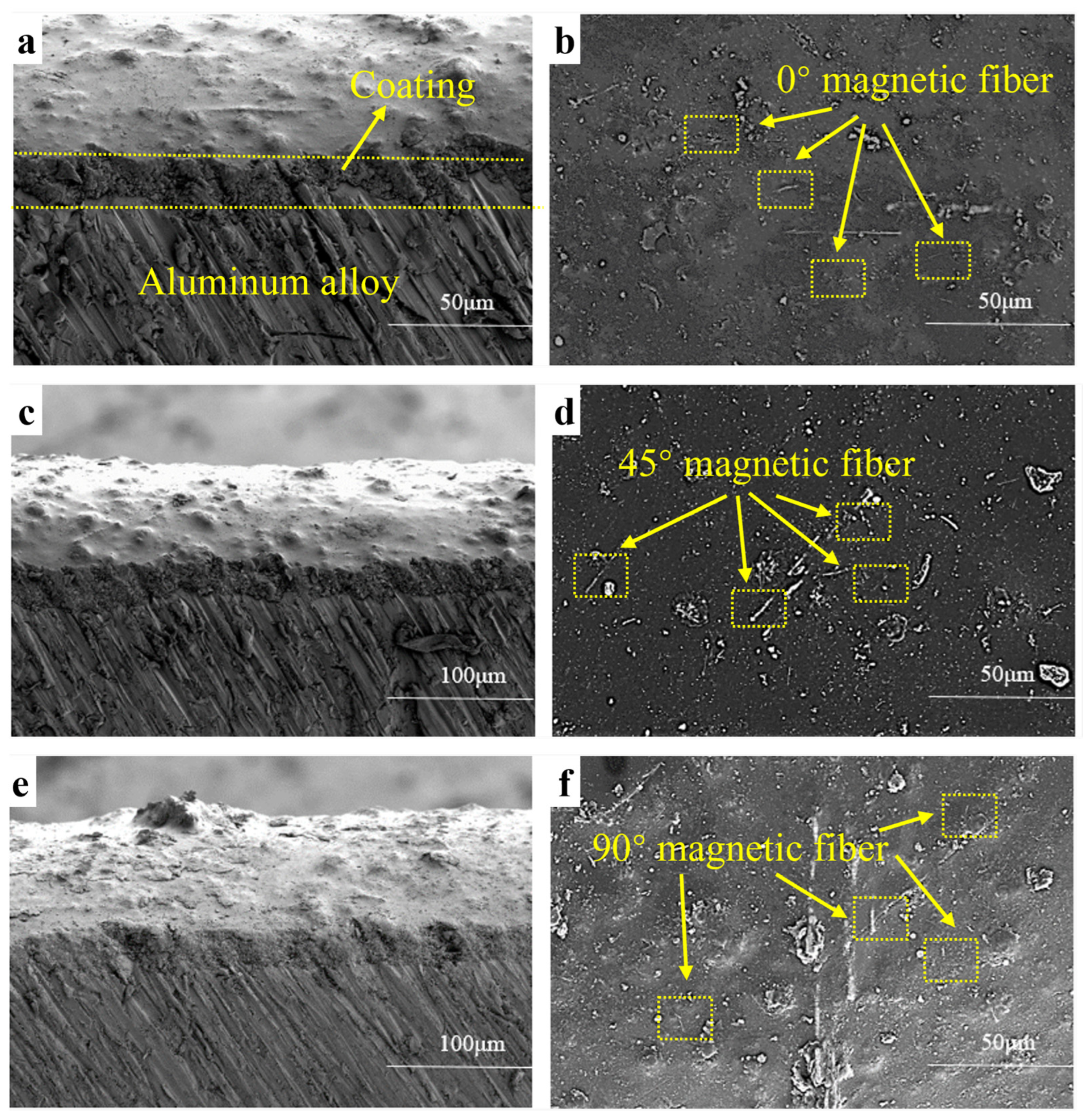
Figure 3 displays SEM images of single-layer fiber coatings brush-coated at different orientations: 0° (a, b), 45° (c, d), and 90° (e, f). Figure 3a,c,e show the lateral view of the magnetic fiber layer. From Figure 3b,d,f, it is evident that a significant proportion of the magnetic fibers are aligned along the brushing direction. This alignment confirms the feasibility of fabricating the bionic helical structure via the brushing process.
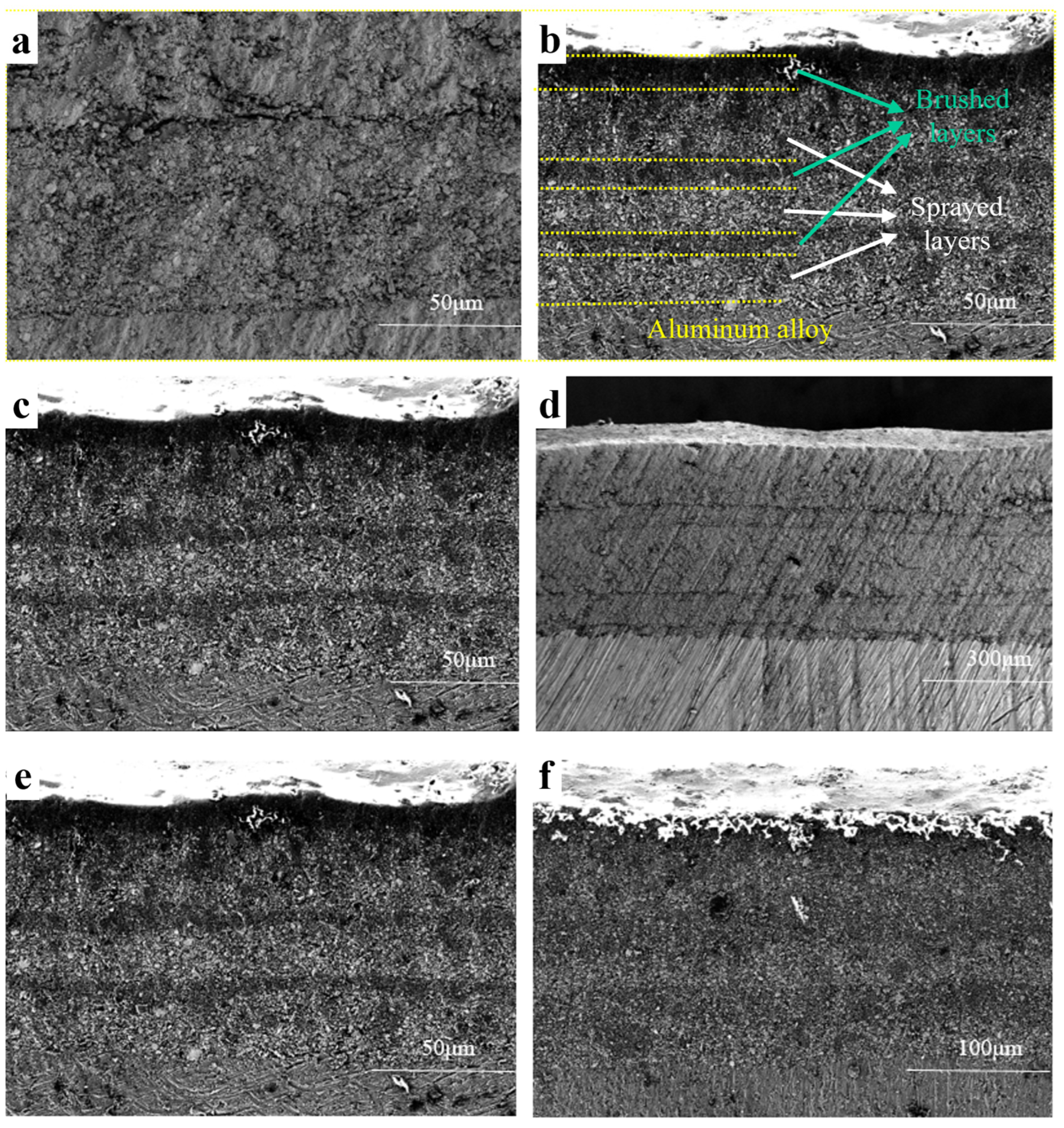
Figure 4 shows the SEM of the bionic helical-structured coatings fabricated via different processes. Figure 4a,b show the microstructures of the two-layer and three-layer helical architectures, respectively. Figure 4c,d display the morphologies with fiber contents of 3 wt% and 5 wt%, respectively. It can be observed that the coatings, assembled in a helical structure, exhibit an alternating arrangement of the sprayed and brushed layers. Meanwhile, Figure 4e,f show the coatings prepared from brushing pastes of CIF/resin and CIF/flake-shaped CIP/resin, respectively. With the addition of CIP to the brushing paste, the compatibility between the brushed and sprayed layers is enhanced, resulting in an unclear interface.

3.2. Dielectric and Microwave Absorption Properties of the Carbonyl Iron Powder

The content of carbonyl iron powder has a significant impact on the microwave absorption performance of the bionic helical structure coating, and electromagnetic parameters are important indicators for evaluating wave absorption performance of the carbonyl iron powder. By preparing the coaxial ring specimens of CIP/paraffin wax, the influence of the content of carbonyl iron powder on the dielectric and microwave absorption properties was studied, laying the foundation for the subsequent preparation of bionic helical structure coatings.
Generally, the characteristic electronic and magnetic interactions between the incident electromagnetic wave and the material medium are described as dielectric loss and magnetic loss, respectively [24]. The ε′ reflects the material’s capability to store electromagnetic energy, and the ε″ reflects its ability to dissipate electromagnetic energy. Similarly, the μ′ indicates magnetic energy storage, and the μ″ corresponds to magnetic loss. The electromagnetic attenuation of absorbing materials is primarily governed by dielectric loss, which originates from conductivity and various polarization mechanisms (electronic, ionic, dipole orientation, and interfacial), and magnetic loss, which arises from relaxation processes during magnetization such as natural resonance, exchange resonance, and eddy current loss [25].
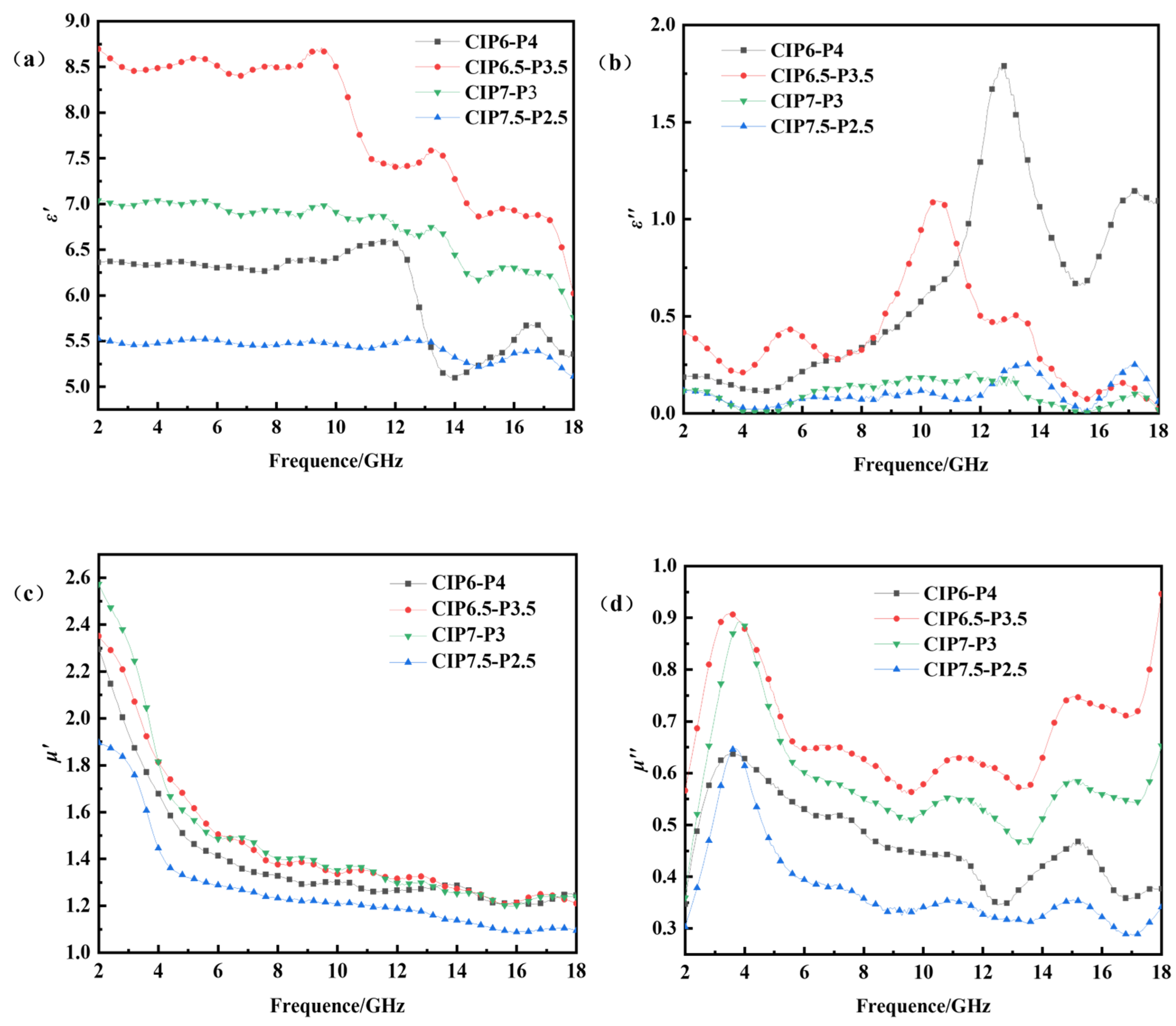
Figure 5 shows the electromagnetic parameters for specimens with varying mass ratios of CIP to paraffin wax measured via the coaxial method in the 2–18 GHz range. Figure 5a,b show the real part (ε′) and the imaginary part (ε″) of the complex permittivity, respectively. The ε′ of CIP decreases with increasing frequency in the 2–18 GHz range. At 9.7 GHz, the ε′ of the four samples is 6.4, 8.5, 5.5, and 6.9, respectively. The CIP6.5-P3.5 exhibits the highest ε′ values, ranging from 6.0 to 8.7. Both the CIP6-P4 and CIP6.5-P3.5 show relatively high ε″ values, within ranges of 0.2–1.8 and 0.1–1.1, respectively. Overall, the complex permittivity of the CIP6.5-P3.5 shows superior performance. When the CIP content increases from 60 wt% to 65 wt%, the ε′ increases. The reason for this phenomenon is that the addition of conductive fillers to an insulating epoxy causes charges to accumulate at the interface between CIP (conductive filler) and the polymer. The interfaces between conductive fillers and the matrix can be analogous to numerous microcapacitors, which are responsible for the increase in permittivity. The permittivity of the composites is enhanced owing to the interfacial polarization, which is also called the Maxwell–Wagner–Sillars effect [26]. However, as the CIP content increases, the particles gradually aggregate and form clusters, which suggest that the reinforcement of interfacial polarization is restrained by clusters, and the number of generated microcapacitors is highly limited, especially when compared with homogeneous distribution [27,28]. Additionally, the excessive CIP particles inhibit the motion of dipoles, so dipoles are incapable of following the change in the external field, which brings about the decrease in permittivity in the high-frequency region [26]. Therefore, as the CIP content increases to 70 wt%, the ε′ and ε″ show a downward trend.
The real part (μ′) and imaginary part (μ″) of the complex permeability are shown in Figure 5c,d. It is observed that the μ′ of CIP gradually decreases with increasing frequency. The CIP6.5-P3.5 and CIP7-P3 exhibit higher μ′ values in the ranges of 1.2–2.4 and 1.2–2.6, respectively. At 2 GHz, the μ″ values of the four samples are 0.35, 0.57, 0.36 and 0.30, respectively, while the values become 0.38, 0.95, 0.34, and 0.65 at 18 GHz. The CIP6.5-P3.5 shows the highest μ″ values, ranging from 0.57 to 0.95. A comprehensive comparison confirms that the CIP6.5-P3.5 possesses higher real and imaginary parts of the complex permeability. With the addition of CIP, the real part and the imaginary part of the complex permeability first increase then decrease, owing to the agglomeration. Because of the inhibition of the insulation layer, eddy currents emerge inside the particles. The lower intra-particle eddy current can be seen in smaller particles for any density. With increasing frequencies, a pronounced skin effect occurs within the particles, and the intensity of the eddy current decreases exponentially from the surface to the center [29]. On one hand, the fine CIP can fill the air gap between larger amorphous powders. On the other hand, an excessive amount of CIP will reduce the overall resistivity of SMCs and cause particle agglomeration [30]. This leads to an increasing particle size and a stronger eddy current effect, thereby exhibiting a more prominent skin effect. The agglomerations cause cluster fragments, which behave electrically like large, isolated particles of non-spherical shape in powder. Although the individual particles are spheres, the effective magnetic moments per unit volume will be decreased by the skin effect, thereby causing the decline in the microwave permeability of composites [31].
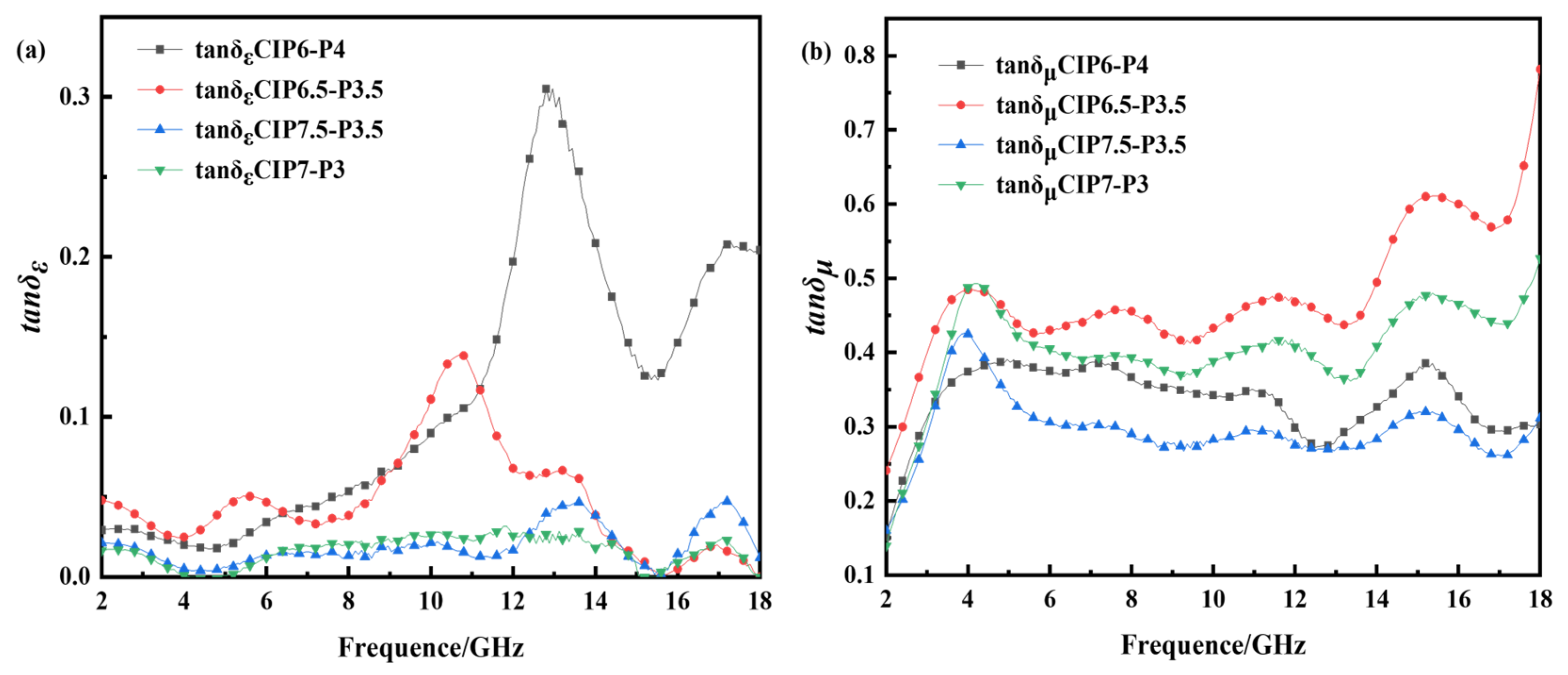
Attenuation capacity includes dielectric loss and magnetic loss abilities, which are denoted by dielectric loss factor (tanδɛ) and magnetic loss factor (tanδμ), respectively [32]. The electric dipolar polarization and interface polarization result in the dielectric loss, while the mechanism of magnetic loss properties is mainly caused by natural resonance and exchange resonance [33]. Figure 6 shows the loss tangent values with varying mass ratios of carbonyl iron powder (CIP) to paraffin wax, which is measured via the coaxial method over the frequency range of 2–18 GHz. As shown in Figure 6, the values of magnetic loss are larger than those of the dielectric loss owing to the shape anisotropy and multiple magnetic resonance [34]; it is clear that the wave absorption mechanism of the materials is primarily dominated by magnetic loss [35,36]. In the frequency range of 2–11 GHz, the CIP6.5-P3.5 and CIP6-P4 exhibit higher tanδε than the other two. Over the 2–18 GHz range, the CIP6.5-P3.5 consistently exhibits the highest tanδμ. Based on a comprehensive comparison of the loss tangents of the four materials, the CIP6.5-P3.5 sample demonstrates the most effective loss performance.
The transmission line theory indicates that the wave impedance of the interface is determined by the electromagnetic properties of the material and the load impedance, as expressed in Equation (1) [37]. The reflection loss (RL) of electromagnetic waves incident normal to the coating surface is given by Equation (2) [38,39,40,41].
Z i = η i . Z i 1 + η i t a n h ( γ i d i ) η i + Z i 1 t a n h ( γ i d i )
R L = 20 l o g R = 20 l o g Z n η 0 Z n + η 0
In the equations, η i is the complex impedance of the layer coating i ; γ i is the propagation constant of the layer coating i ; d i is the thickness of the layer coating i ; R is the reflection coefficient of the coating; and η 0 is the characteristic impedance of free space.
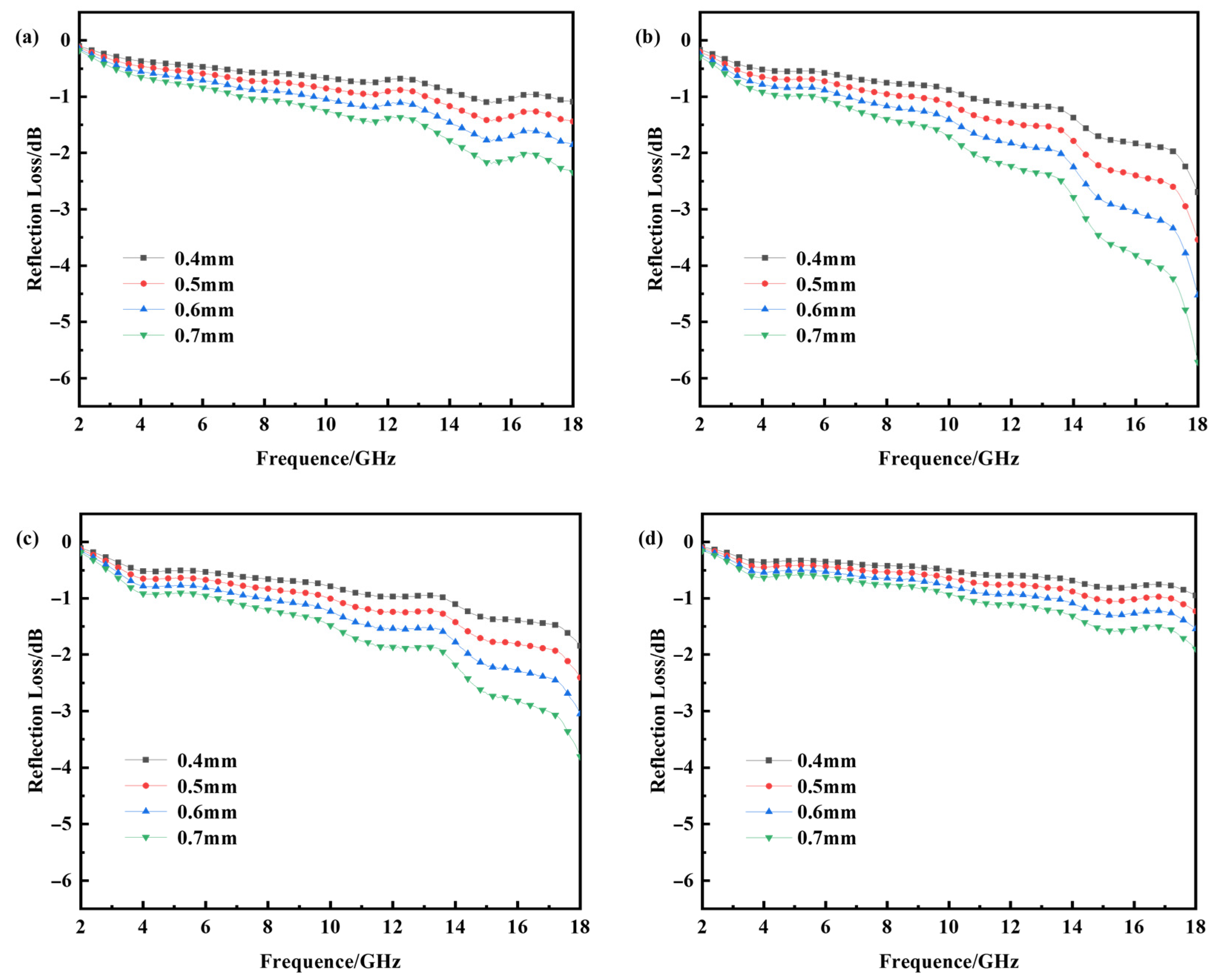
Figure 7 shows the reflection loss of carbonyl iron powder (CIP)/paraffin composites with varying CIP content at different coating thicknesses. As shown in Figure 7a–d, the reflection loss performance is significantly influenced by the coating thickness. As thickness increases, the reflection loss generally decreases, indicating enhanced wave-absorbing capability. Under the identical coating thickness, the reflection loss of CIP6.5-P3.5 is better than others. In addition, the frequency corresponding to the absorption peak remains largely consistent across different thicknesses. The reflection loss of all composites exhibits a decreasing trend with increasing frequency and exhibits better absorption performance at high frequencies.
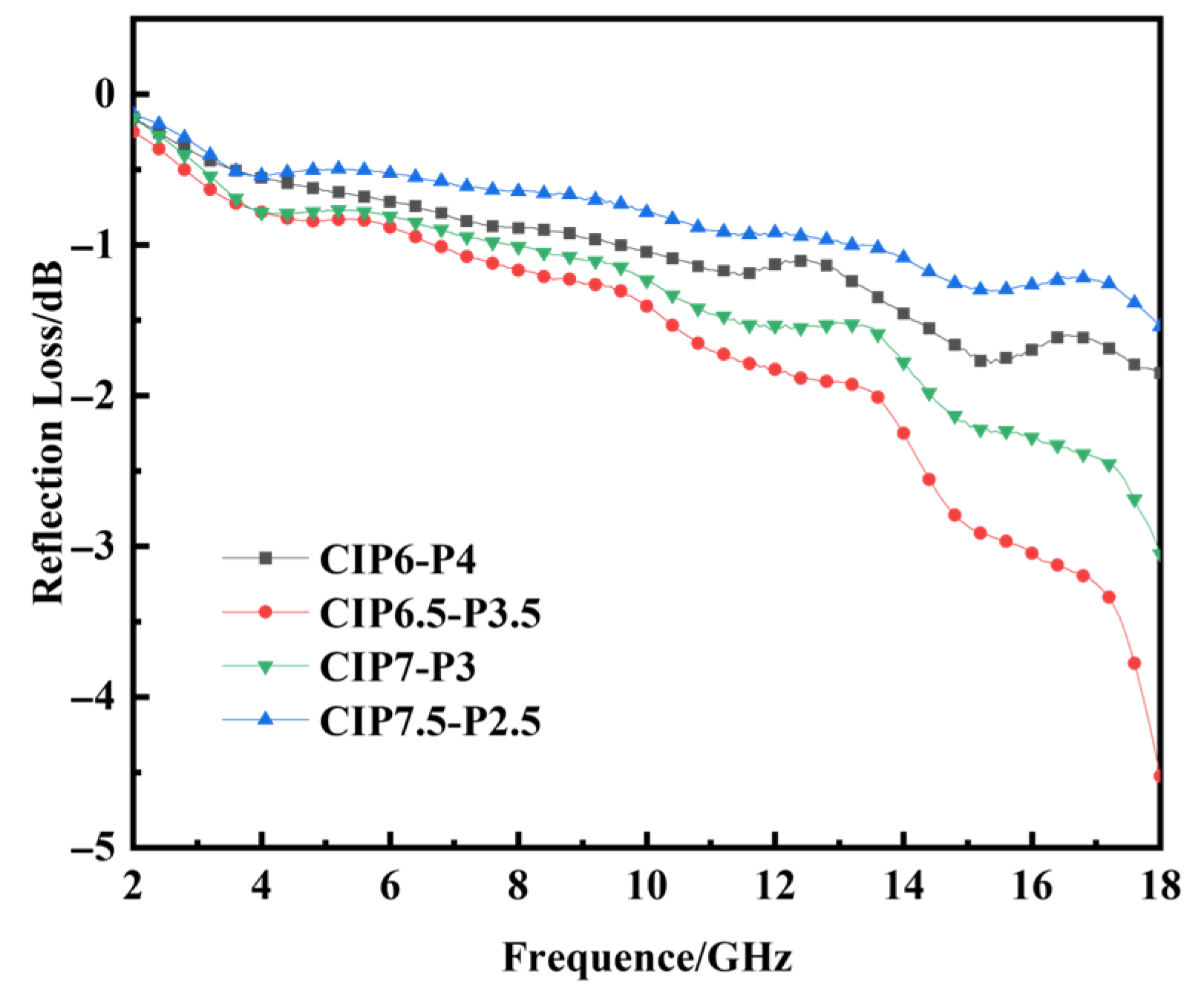
As the thickness of the coating increases, the bonding strength of the coating decreases [42]. Therefore, based on the above consideration and cost, optimum thickness should be chosen. To optimize the whole characteristics of the composite coating, the thickness of the coating is 0.6 mm. Figure 8 shows the reflection loss of carbonyl iron powder/paraffin composites with varying carbonyl iron powder content at a fixed thickness of 0.6 mm. Due to the influence of electromagnetic parameters, the values of reflection loss decrease initially and then increase as the content of carbonyl iron powder increases. At a thickness of 0.6 mm, the minimum reflection loss values of the four composites are −1.9 dB, −4.5 dB, −1.5 dB, and −3.1 dB, respectively, suggesting that the CIP6.5-P3.5 sample possesses the best wave-absorbing performance.

3.3. Wave Absorption Properties of Bionic Helical Structure Coatings

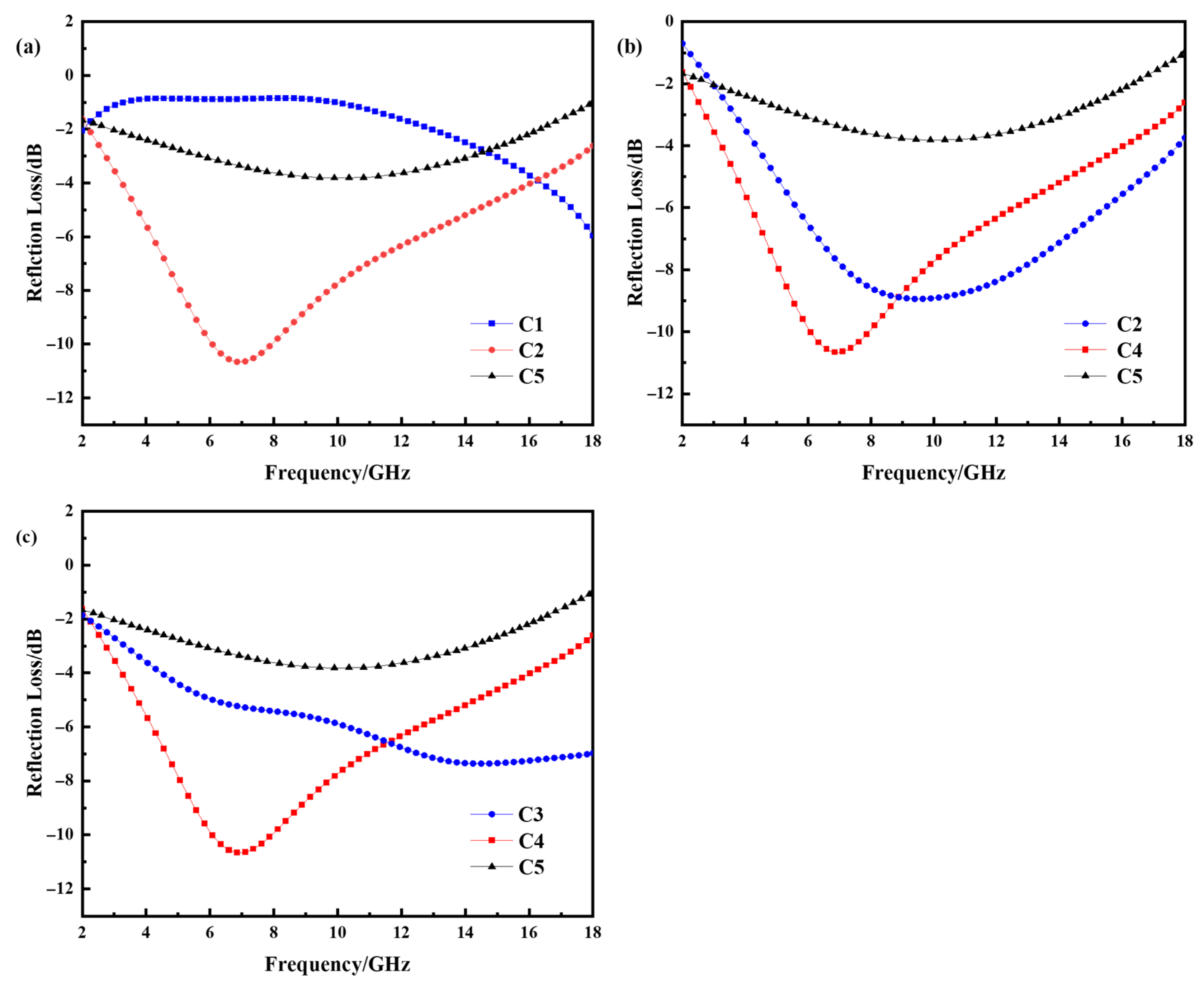
The CIP is a typical magnetic medium wave-absorbing material. Its electromagnetic wave attenuation primarily arises from resonance and hysteresis losses. Figure 9a shows the reflection loss of the coating influenced by different layers with a thickness of 0.6 mm. For the ordinary coating C5 without the bionic helical structure, the RLmin can only reach −3.82 dB, and the reflection loss is above −5 dB in the whole 2–18 GHz range. For the C1, the RLmin reaches −5.97 dB, with an effective absorption bandwidth (EAB, RL < −5 dB) of 0.6 GHz (17.4–18 GHz). For the C4, the RLmin reaches 10.66 dB, with EAB of 10.58 GHz (3.72–14.30 GHz). When RL was less than −5 dB, the material could absorb 68.4% electromagnetic waves. In contrast, the C4 exhibits significantly enhanced wave-absorbing performance across most of the measured frequency bands. The presence of multiple interfaces for reflection and incidence in a multilayer structure leads to more pronounced interference attenuation, thereby effectively achieving superior electromagnetic wave-absorbing performance [43]. The reflection loss of coatings with different fiber content is shown in Figure 9b. Both coatings exhibit similar trends: reflection loss first decreases and then increases with rising frequency. With the increase in the fiber content, the RL peak moves to a higher frequency. For the C2, the RLmin reaches −8.94 dB with EAB of 11.73 GHz (5–16.73 GHz). Although the EAB increases slightly with higher fiber content, the minimum RLmin also increases. In conclusion, the optimal fiber content is 3 wt% to achieve the best absorption performance in the coating. Figure 9c plots the reflection loss of coatings with different slurry processes for brushed layers. Within the 2–11.6 GHz range, the C4 exhibits lower reflection loss, whereas the C3 demonstrates superior performance in the 11.6–18 GHz range. For the C3, the RLmin reaches −7.36 dB, with an EAB of 11.9 GHz (6.1–18 GHz). The absence of CIP in the coating results in better microwave absorption performance. In summary, C4 has the best wave-absorbing performance with a thickness of 0.6 mm.

3.4. Mechanical Properties of Bionic Helical Structure Coatings

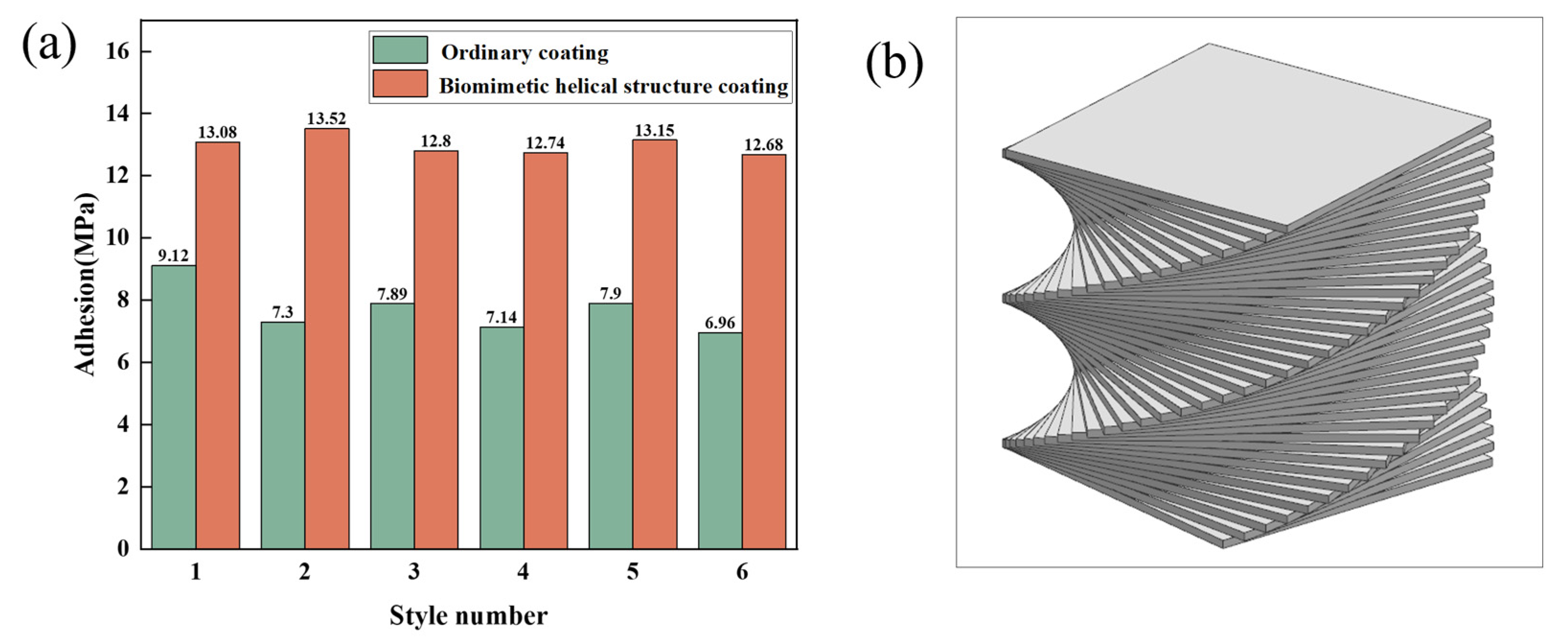
Based on the above conclusions, the adhesion strength was tested by choosing the C4 with a CIP content of 65 wt%, which had the best wave absorption performance. The adhesion strength of the coatings was evaluated by a pull-off test. Figure 10a presents the results for both the ordinary coating and the biomimetic coating. The ordinary coating exhibits a maximum adhesion strength of 9.12 MPa and an average strength of 7.72 MPa. In contrast, the bionic helical structure coating reaches a maximum adhesion strength of 13.52 MPa with an average value of 13.00 MPa, demonstrating a significant enhancement in mechanical performance.
The bionic coating embodies a typical Bouligand structure. When a crack initiates in this structure, it propagates through the coating along a helical path between adjacent fibers, ultimately forming a helical crack surface [44,45]. For the analysis of three-dimensional cracking behavior in Bouligand structures, the three-dimensional crack problem is transformed into a local two-dimensional problem, and the stress changes along the crack propagation path [46]. When crack initiation occurs, the energy release rate ( G t i l t ) at the crack tip equals the material’s fracture energy ( Γ i n t ). Meanwhile, the energy release rate ( G 0 ) applied by the far field at the tip of the initial crack plane equals the apparent fracture energy ( G t i l t c ) of the composite material, thus satisfying G t i l t c Γ i n t = G 0 G t i l t . If G t i l t < G 0 , then G t i l t c > Γ i n t , indicating the occurrence of crack shielding and second-phase toughening effects. Therefore, the bionic helical structure can significantly enhance the mechanical properties of the coating. The bionic helical structure coatings were prepared by alternating spraying and brushing at 0°/45°/90°. The preparation process was simple, low-cost, and did not rely on expensive, ultra-precise equipment, which is convenient for batch production. In the future, the manual brushing process can be replaced by automated brushing equipment to enhance efficiency. In summary, the bionic helical structure holds potential reference value for enhancing mechanical properties in the field of resin-based coatings.

4. Conclusions

The CIF/resin composite wave-absorbing coatings with a bionic helical structure were successfully prepared by alternating spraying and brushing methods. SEM results indicate that the bionic helical structure can be obtained by alternating spraying and brushing processes. The electromagnetic parameter results show that the real part and imaginary part of the complex permittivity ascend first and then fall with an increasing CIP ratio, which is affected by agglomeration restraining interfacial polarization. The dielectric properties show that the optimum matching proposal is CIP6.5-P3.5. The reflection loss of CIP/paraffin shows that CIP6.5-P3.5 exhibits superior microwave absorption properties. To meet the performance requirements of “wide, strong, light, and thin”, the CIP6.5-P3.5 with a thickness of 0.6 mm has been chosen to prepare coatings. The C4 with the bionic helical structure has an RLmin of −10.66 dB and an EAB of 10.58 GHz (3.72–14.30 GHz), which proves the best absorption performance. At the same time, an average adhesion strength of 13.00 MPa for the C4 is obtained. Thus, the bionic helical structure not only enhances the mechanical properties but also improves the microwave absorption performance of the resin-based coating. The bionic helical structure holds potential reference value in the field of resin-based coatings.

Author Contributions

Conceptualization, methodology, investigation, G.C.; writing—original draft preparation, H.C.; writing—review and editing, W.M.; supervision, data curation, H.G. All authors have read and agreed to the published version of the manuscript.

Funding

This research was supported by the Shanxi Natural Science Foundation (Grant No. 202203021221108), the National Natural Science Foundation of China (No. 62404209) and National Defense Basic Research Program (No. JCKY2023408C012).

Institutional Review Board Statement

Not applicable.

Informed Consent Statement

Not applicable.

Data Availability Statement

Data will be made available on request.

Conflicts of Interest

The authors declare no conflicts of interest.

References

  1. Shirke, N.; Ghase, V.; Jamdar, V. Recent advances in stealth coating. Polym. Bull. 2024, 81, 9389–9418. [Google Scholar] [CrossRef]
  2. Wang, W.; Jiang, J.; Liang, J.; Wang, Z.; Xu, C.; Li, Y.; Zheng, L.; Meng, Y.; Wang, J.; Qu, S. A multifunctional coating for radar-infrared stealth-compatible at high temperatures. IEEE Access 2022, 10, 122280–122285. [Google Scholar] [CrossRef]
  3. Gao, Y.; Wang, Y.; Liu, S.; Zhong, S.; Yu, M.; Wang, C. Preparation of paraffin wax-modified floating aluminum powder and composite coating with infrared stealth and wave-transparent function. Mater. Sci. Eng. B 2023, 295, 116611. [Google Scholar] [CrossRef]
  4. Liu, Z.H.; Tao, R.; Luo, P.; Shu, X.; Ban, G.D. Preparation and microwave absorbing property of carbon fiber/polyurethane radar absorbing coating. RSC Adv. 2017, 7, 46060–46068. [Google Scholar] [CrossRef]
  5. Wang, J.; Li, H.F.; Huang, Y.H.; Yu, H.-B.; Zhang, Y. Microwave absorbing properties of composite coating by carbon nanotube and nanoscaled tetrapod-shaped ZnO. Acta Phys. Sin. 2010, 59, 1946–1951. [Google Scholar] [CrossRef]
  6. Wang, L.Y.; Xu, Z.; Hua, S.C.; Liu, A.M.; Guo, Q.; Liu, G. Raman spectroscopy and microwave absorbing properties of CNTs/Al2O3-TiO2 composite absorbing coatings with different diameters. Wuji Cailiao Xuebao/J. Inorg. Mater. 2013, 28, 136–140. [Google Scholar] [CrossRef]
  7. Bae, G.-S.; Kim, C.Y. Broadband multilayer radar absorbing coating for RCS reduction. Microw. Opt. Technol. Lett. 2014, 56, 1907–1910. [Google Scholar] [CrossRef]
  8. Yuan, D.; Chen, Z.; Cai, C.; Yang, B.; Wang, Y.; Chen, Z. Microstructures, absorption and adhesion evolution of FeCoCr/silicone resin coatings at elevated temperature. Front. Mater. 2023, 10, 1168418. [Google Scholar] [CrossRef]
  9. Mayer, P.; Dmitruk, A.; Kaczmar, J.W. Adhesion of functional layers based on epoxy and polyurethane resins for aluminum substrate. Int. J. Adhes. Adhes. 2021, 109, 102898. [Google Scholar] [CrossRef]
  10. Deng, H.; Yang, Q.; Zhang, Z.; Wang, C.; Qing, Y. Temperature dependence of the microwave absorption performance of carbonyl iron powder/boron-modified phenolic resin composite coating. Appl. Phys. A 2022, 128, 251. [Google Scholar] [CrossRef]
  11. Jadav, K.C.; Ismail, S.O.; Oladapo, B.I. Benefiting from Biomimicry Through 3D Printing to Enhance Mechanical Properties of Polymeric Structures: Simulation Approach. In Advances in Manufacturing Technology XXXVI; IOS Press: Amsterdam, The Netherlands, 2023; Volume 44, p. 189. [Google Scholar]
  12. Wang, S.; Li, S.; Xu, T.; Bian, Y.; Miao, C.; Luo, T. A comparative study of the mechanical properties of the bio-inspired overlapped scales fabricated by 3d printing. Extrem. Mech. Lett. 2023, 63, 102052. [Google Scholar] [CrossRef]
  13. Xie, W.; Cao, X.; Zhang, B.; Wei, Z.; Ge, B.; Xiao, Z.; Li, Q.; Shi, Z. Biomimetic cellular-structured MCMB@WC composites with excellent mechanical properties. J. Eur. Ceram. Soc. 2023, 43, 4696–4705. [Google Scholar] [CrossRef]
  14. Quan, G.; Wu, Y.; Wang, P.; Li, W.; Li, D.; Yan, Z.; Ao, Y.; Xiao, L.; Liu, Y. Polydopamine-induced biomimetic mineralization strategy to generate hydroxyapatite for the preparation of carbon fiber composites with excellent mechanical properties. Int. J. Biol. Macromol. 2024, 277, 134529. [Google Scholar] [CrossRef]
  15. Wu, M.; Zhang, M.; Ma, H.; Qu, L.; Li, C. Biomimetic graphite foils with high foldability and conductivity. Small Methods 2019, 3, 1800282. [Google Scholar] [CrossRef]
  16. Rivera, J. Structure-Property Relationships, and Biomimetic Designs from the Compression-Resistant Cuticle of the Ironclad Beetle. Ph.D. Thesis, University of California, Riverside, CA, USA, 2020. [Google Scholar]
  17. Li, X.W.; Ji, H.M.; Yang, W.; Zhang, G.P.; Chen, D.L. Mechanical properties of crossed-lamellar structures in biological shells: A review. J. Mech. Behav. Biomed. Mater. 2017, 74, 54–71. [Google Scholar] [CrossRef]
  18. Estrada, S.; Múnera, J.C.; Hernández, J.; Arroyave, M.; Arola, D.; Ossa, A. Bioinspired hierarchical impact tolerant materials. Bioinspir. Biomim. 2020, 15, 046009. [Google Scholar] [CrossRef]
  19. Lin, Y.S.; Wei, C.T.; Olevsky, E.A.; Meyers, M.A. Mechanical properties and the laminate structure of Arapaima gigas scales. J. Mech. Behav. Biomed. Mater. 2011, 4, 1145–1156. [Google Scholar] [CrossRef] [PubMed]
  20. Yang, W.; Sherman, V.R.; Gludovatz, B.; Mackey, M.; Zimmermann, E.A.; Chang, E.H.; Schaible, E.; Qin, Z.; Buehler, M.J.; Ritchie, R.O.; et al. Protective role of Arapaima gigas fish scales: Structure and mechanical behavior. Acta Biomater. 2014, 10, 3599–3614. [Google Scholar] [CrossRef]
  21. Zimmermann, E.A.; Gludovatz, B.; Schaible, E.; Dave, N.K.N.; Yang, W.; Meyers, M.A.; Ritchie, R.O. Mechanical adaptability of the Bouligand-type structure in natural dermal armour. Nat. Commun. 2013, 4, 2634. [Google Scholar] [CrossRef] [PubMed]
  22. Arola, D.; Murcia, S.; Stossel, M.; Pahuja, R.; Linley, T.; Devaraj, A.; Ramulu, M.; Ossa, E.A.; Wang, J. The limiting layer of fish scales: Structure and properties. Acta Biomater. 2018, 67, 319–330. [Google Scholar] [CrossRef]
  23. Meyers, M.A.; Lin, Y.S.; Olevsky, E.A.; Chen, P.-Y. Battle in the Amazon: Arapaima versus piranha. Adv. Eng. Mater. 2012, 14, B279–B288. [Google Scholar] [CrossRef]
  24. Chen, L.F.; Ong, C.K.; Neo, C.P.; Varadan, V.V.; Varadan, V.K. Microwave Electronics: Measurement and Materials Characterization; John Wiley & Sons: Hoboken, NJ, USA, 2004. [Google Scholar]
  25. Wang, B.; Wu, Q.; Fu, Y.; Liu, T. A review on carbon/magnetic metal composites for microwave absorption. J. Mater. Sci. Technol. 2021, 86, 91–109. [Google Scholar] [CrossRef]
  26. Sun, K.; Xin, J.; Li, Y.; Wang, Z.; Hou, Q.; Li, X.; Wu, X.; Fan, R.; Choy, K.L. Negative permittivity derived from inductive characteristic in the percolating Cu/EP metacomposites. J. Mater. Sci. Technol. 2019, 35, 2463–2469. [Google Scholar] [CrossRef]
  27. Jia, Z.; Liu, X.; Zhou, X.; Zhou, Z.; Wu, G. A seed germination-inspired interface polarization augmentation strategy toward superior electromagnetic absorption performance. Compos. Commun. 2022, 34, 101269. [Google Scholar] [CrossRef]
  28. Amoresi, R.A.C.; Felix, A.A.; Botero, E.R.; Domingues, N.L.C.; Falcão, E.A.; Zaghete, M.A.; Rinaldi, A.W. Crystallinity, morphology and high dielectric permittivity of NiO nanosheets filling Poly (vinylidene fluoride). Ceram. Int. 2015, 41, 14733–14739. [Google Scholar] [CrossRef]
  29. Shi, K.; Zhang, D.; Ren, Z.; Chen, D.; Zhang, Y.; Koh, C.-S. Effect of particles size on eddy-current loss of soft magnetic composites using combined DEM and FEM. IEEE Trans. Magn. 2023, 60, 2000308. [Google Scholar] [CrossRef]
  30. Liu, J.; Dong, Y.; Wang, P.; Zhu, Z.; Pang, J.; Li, X.; Zhang, J. Improved high-frequency magnetic properties of FeSiBCCr amorphous soft magnetic composites by adding carbonyl iron powders. J. Non-Cryst. Solids 2023, 605, 122166. [Google Scholar] [CrossRef]
  31. Zhang, B.; Feng, Y.; Xiong, J.; Yang, Y.; Lu, H. Microwave-absorbing properties of de-aggregated flake-shaped carbonyl-iron particle composites at 2–18 GHz. IEEE Trans. Magn. 2006, 42, 1778–1781. [Google Scholar] [CrossRef]
  32. Li, X.; Shen, F.; Sun, Y.; Liu, X. Synchronous enhancement and broadening of dielectric loss and magnetic loss induced by substituted Gd in GdFeO3-encapsulated Fe (Gd) nanoparticles. J. Alloys Compd. 2024, 1002, 175371. [Google Scholar] [CrossRef]
  33. Xu, H.; Sun, W.; Gui, Y.; Wang, L.; Yu, M.; Zhang, Q. Electromagnetic loss properties of ZnO nanofibers. J. Mater. Sci. Mater. Electron. 2016, 27, 12846–12851. [Google Scholar] [CrossRef]
  34. Liu, X.; Ran, S.; Yu, J.; Sun, Y. Multiscale assembly of Fe2B porous microspheres for large magnetic losses in the gigahertz range. J. Alloys Compd. 2018, 765, 943–950. [Google Scholar] [CrossRef]
  35. Nan, H.; Qing, Y.; Gao, H.; Jia, H.; Luo, F.; Zhou, W. Synchronously oriented Fe microfiber & flake carbonyl iron/epoxy composites with improved microwave absorption and lightweight feature. Compos. Sci. Technol. 2019, 184, 107882. [Google Scholar] [CrossRef]
  36. Sharma, S.; Parne, S.R.; Panda, S.S.S.; Gandi, S. Progress in microwave absorbing materials: A critical review. Adv. Colloid Interface Sci. 2024, 327, 103143. [Google Scholar] [CrossRef]
  37. Yuan, J.; Xiao, G.; Cao, M.-S. A novel method of computation and optimization for multi-layered radar absorbing coatings using open source software. Mater. Des. 2006, 27, 45–52. [Google Scholar] [CrossRef]
  38. Ma, J.; Shu, J.; Cao, W.; Zhang, M.; Wang, X.; Yuan, J.; Cao, M. A green fabrication and variable temperature electromagnetic properties for thermal stable microwave absorption towards flower-like Co3O4@rGO/SiO2 composites. Compos. Part B Eng. 2019, 166, 187–195. [Google Scholar] [CrossRef]
  39. Fan, B.; Li, N.; Dai, B.; Shang, S.; Guan, L.; Zhao, B.; Wang, X.; Bai, Z.; Zhang, R. Investigation of adjacent spacing dependent microwave absorption properties of lamellar structural Ti3C2Tx MXenes. Adv. Powder Technol. 2020, 31, 808–815. [Google Scholar] [CrossRef]
  40. Li, X.; Zhang, M.; You, W.; Pei, K.; Zeng, Q.; Han, Q.; Li, Y.; Cao, H.; Liu, X.; Che, R. Magnetized MXene microspheres with multiscale magnetic coupling and enhanced polarized interfaces for distinct microwave absorption via a spray-drying method. ACS Appl. Mater. Interfaces 2020, 12, 18138–18147. [Google Scholar] [CrossRef]
  41. Zhong, B.; Wang, C.; Wen, G.; Yu, Y.; Xia, L. Facile fabrication of boron and nitrogen co-doped carbon@Fe2O3/Fe3C/Fe nanoparticle decorated carbon nanotubes three-dimensional structure with excellent microwave absorption properties. Compos. Part B Eng. 2018, 132, 141–150. [Google Scholar] [CrossRef]
  42. Zhou, L.; Zhou, W.; Chen, M.; Luo, F.; Zhu, D. Dielectric and microwave absorbing properties of low power plasma sprayed Al2O3/Nb composite coatings. Mater. Sci. Eng. B 2011, 176, 1456–1462. [Google Scholar] [CrossRef]
  43. Wu, Y.; Wang, X.; Liu, X.; Wang, Z. A review of electromagnetic wave absorbing structures. Mater. Rev. 2023, 37, 22020147. [Google Scholar]
  44. Song, Z.; Ni, Y.; Cai, S. Fracture modes and hybrid toughening mechanisms in oscillated/twisted plywood structure. Acta Biomater. 2019, 91, 284–293. [Google Scholar] [CrossRef]
  45. Suksangpanya, N.; Yaraghi, N.A.; Pipes, R.B.; Kisailus, D.; Zavattieri, P. Crack twisting and toughening strategies in Bouligand architectures. Int. J. Solids Struct. 2018, 150, 83–106. [Google Scholar] [CrossRef]
  46. Faber, K.T.; Evans, A.G. Crack deflection processes—I. Theory. Acta Metall. 1983, 31, 565–576. [Google Scholar] [CrossRef]
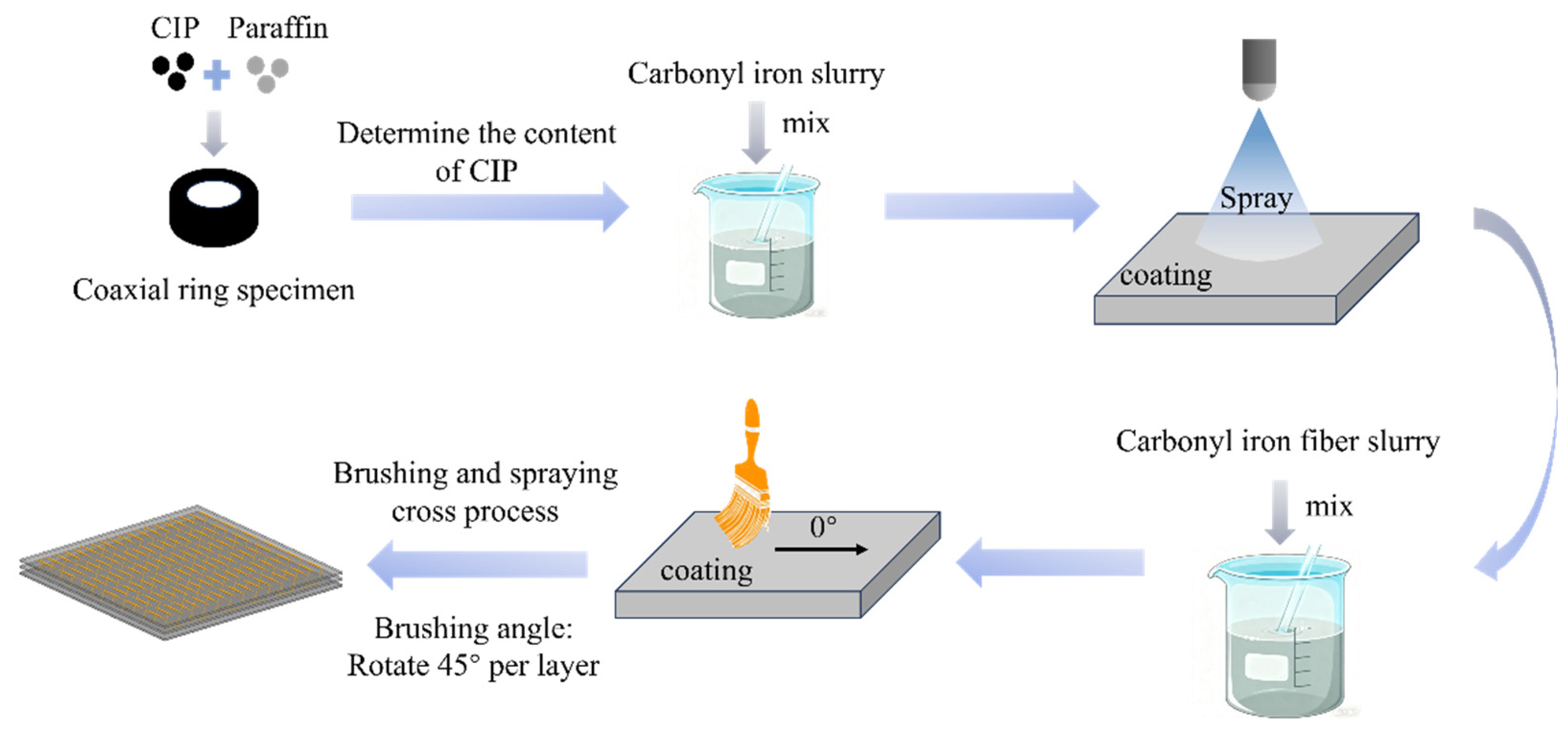
Figure 1. Coating preparation process.
Coatings 16 00599 g001
Figure 2. SEM micrographs of (a) carbonyl iron fiber and (b) carbonyl iron powder.
Coatings 16 00599 g002
Figure 3. Cross-sectional SEM micrograph of (a) 0°, (c) 45°, (e) 90° fiber-brushed coating; surface SEM micrograph of (b) 0°, (d) 45°, (f) 90° fiber-brushed coating.
Coatings 16 00599 g003
Figure 4. SEM micrographs of coatings prepared by different fabrication processes: (a) 2-layer helical structure; (b) 3-layer helical structure; (c) 3 wt% fiber content; (d) 5 wt% fiber content; (e) carbonyl iron fiber/resin slurry; (f) carbonyl iron fiber/flake carbonyl iron powder/resin slurry.
Coatings 16 00599 g004
Figure 5. Electromagnetic parameters and magnetic data for (a,b) real and imaginary part of permittivity; (c,d) real and imaginary part of permeability.
Coatings 16 00599 g005
Figure 6. Dielectric loss tangent (a) and magnetic loss tangent (b) with varying carbonyl iron powder content.
Coatings 16 00599 g006
Figure 7. Reflection loss versus thickness for CIP/paraffin composites ((a) CIP6-P4, (b) CIP6.5-P3.5, (c) CIP7-P3, (d) CIP7.5-P2.5).
Coatings 16 00599 g007
Figure 8. Reflection loss of carbonyl iron powder/paraffin composites with varying carbonyl iron powder content at a fixed thickness of 0.6 mm.
Coatings 16 00599 g008
Figure 9. (ac) Reflection loss of coatings under different processes.
Coatings 16 00599 g009
Figure 10. (a) Adhesion strength test results of the coatings and (b) schematic diagram of Bouligand structure.
Coatings 16 00599 g010
Table 1. Detailed compositions and experiment codes of different samples.
CodeDouble-Helical/Triple-HelicalFiber ContentCoating Slurry Process for Brushed Layers
C1double-helical3 wt%CIF/resin
C2triple-helical5 wt%CIF/resin
C3triple-helical3 wt%CIF/CIP/resin
C4triple-helical3 wt%CIF/resin
C5ordinary coating without the bionic helical structure
Disclaimer/Publisher’s Note: The statements, opinions and data contained in all publications are solely those of the individual author(s) and contributor(s) and not of MDPI and/or the editor(s). MDPI and/or the editor(s) disclaim responsibility for any injury to people or property resulting from any ideas, methods, instructions or products referred to in the content.