Article

Tailoring Mechanical and Surface Properties of Epoxy Coatings with Synthesized Pigment Particles: Microhardness, Adhesion, and Wettability Studies


by
Nikola Nedeljković
1,
Ivana O. Mladenović
2,*,
Marija M. Vuksanović
3,
Jelena Lamovec
4,
Milica Ž. Mušicki Bogdanović
4,
Dana G. Vasiljević-Radović
2 and
Radmila Jančić Heinemann
1,*
1
Faculty of Technology and Metallurgy, University of Belgrade, Karnegijeva 4, 11000 Belgrade, Serbia
2
Institute of Chemistry, Technology and Metallurgy, University of Belgrade, Njegoševa 12, 11000 Belgrade, Serbia
3
VINČA Institute of Nuclear Sciences—National Institute of the Republic of Serbia, University of Belgrade, 11000 Belgrade, Serbia
4
University of Criminal Investigation and Police Studies, Cara Dušana Street 196, 11000 Belgrade, Serbia
*
Authors to whom correspondence should be addressed.
Coatings 2026, 16(5), 584; https://doi.org/10.3390/coatings16050584 (registering DOI)
Submission received: 9 April 2026 / Revised: 7 May 2026 / Accepted: 8 May 2026 / Published: 12 May 2026
(This article belongs to the Section Functional Polymer Coatings and Films)

Highlights

What are the main findings?
  • Cobalt blue (CoAl2O4) and chrome orange (PbCrO4·Pb(OH)2) pigments were synthesized using the coprecipitation method and heat drying.
  • Epoxy-based resin was deposited onto three modified substrates (brass B36, aluminum L3005, and phosphor-bronze 510).
  • The 3.0 wt.% of pigment powder was mixed with epoxy resin and deposited onto substrates in the form of thin coatings using the drop-spinning technique.
What are the implications of the main findings?
  • Chrome orange pigment exhibits a hollow micro-tube, while cobalt blue pigment displays an irregular morphology.
  • All pigmented coatings show higher composite hardness and better adhesion compared to a pure epoxy matrix.
  • All epoxy and epoxy/orange coatings showed a hydrophilic character, and epoxy/blue coatings showed a hydrophobic character.

Abstract
Epoxy resins are widely used in coatings and adhesives due to their strong adhesion and processability. In this study, epoxy-based coatings were prepared with two synthesized pigments: cobalt blue and chrome orange. The coatings were applied to aluminum, phosphor bronze, and brass substrates to evaluate mechanical and adhesive performance. Microhardness was analyzed using the Chen–Gao model to exclude substrate effects, while adhesion was assessed via parameter b. Pigment morphology strongly influenced the properties: Pb-orange exhibited hollow micro-tube structures, while Co-blue showed an irregular morphology. Results revealed that epoxy coatings on brass with Pb-orange pigment reached a hardness of 242.6 MPa, compared to 187.2 MPa for Co-blue, representing a 22.8% increase. Adhesion was superior in epoxy/Pb-orange, with values 1.3 times higher than epoxy/Co-blue and 1.8 times higher than neat epoxy on brass. However, pigments have no influence on the intrinsic hardness of the epoxy coating. The orange pigment in the epoxy impairs wetting resistance, while the blue pigmented epoxy coating becomes hydrophobic. In this way, in addition to colorizing epoxy coatings, multifunctional coatings with adjustable adhesion, free surface energy, and hardness are also obtained. These findings highlight the potential of pigment-modified coatings for tailored industrial applications, offering improved properties depending on pigment selection.

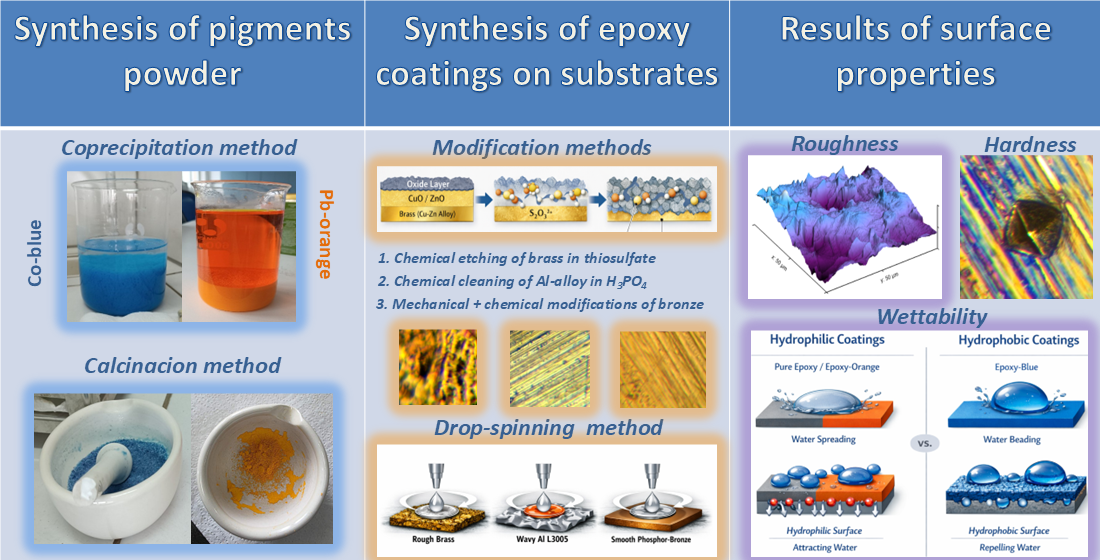
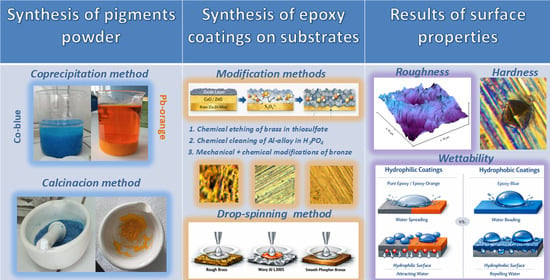
Graphical Abstract

1. Introduction

Epoxy resins have become indispensable in modern technology and play a key role in numerous industrial sectors due to their exceptional versatility and performance. Composite materials based on epoxy resins are commonly used as adhesives (concrete, stone, wood, metal, glass), protective coatings that extend the service life of traditional materials, structural elements for building construction and infrastructure reconstruction and renovation, as well as independent building components and architectural constructions (poured floors, fiberglass products, etc.) [1,2]. Epoxy resins are widely used in industrial applications due to their high mechanical strength, adhesion, solvent and chemical resistance and their ability to cure at various temperatures without volatile byproducts [3,4]. Epoxy is a fundamental matrix material, with micro- and nanoparticle additions, especially inorganic ones, boosting elasticity, hardness, strength, and toughness [5,6,7,8].
Pigments are generally insoluble and chemically inert in water or other media, whereas dyes are colored substances that dissolve or enter into solution at some stage during their application [9,10]. Inorganic pigments, usually non-permeable and non-migratory, have many new applications in various fields such as optoelectronics [11], optical devices [12], color filters [13], photocatalysis [14], and inkjet printing [15], owing to their excellent chemical stability and compatibility with most thermoplastic and thermosetting resins [16].
Organic or inorganic coatings play a crucial role in protecting metallic structures and substrates from corrosion. They are widely used across industries such as automotive, power generation, aerospace, and oil production [17,18]. Over the past decade, considerable attention has been focused on developing novel coating formulations to enhance their barrier and corrosion protection properties [19]. Among the various coating systems currently in use, epoxy-based coatings are the most well-known [20]. Epoxy-based coatings are valued for their high chemical resistance, effective insulation properties, and excellent adhesion [21]. However, their inherent brittleness can result in mechanical failure under abrasion. Although these coatings initially provide strong barrier protection against corrosive environments, prolonged exposure leads to significant hydrolytic degradation, limiting their long-term performance [22]. The adhesion, barrier, and corrosion protection properties of epoxy coating systems can be further improved by adding suitable pigments and additives [23]. Epoxy coatings are widely used for protective and functional applications on metallic substrates due to their excellent toughness [24], chemical resistance [25], and adhesion [26].
Beyond industrial and protective purposes, epoxy resins find decorative applications, such as colored aggregate flooring, highlighting their versatility across different sectors. Specifically in this research, inorganic pigment particles (Co-blue and Pb-orange) were used as specific reinforcements in an epoxy matrix in the form of thin coatings deposited on different metallic substrates. Starting from the fact that a pigment is a chemical compound responsible for absorbing specific wavelengths of light, thereby imparting color to materials, and is widely used to modify or control visual appearance, this research has a major industrial contribution in the paint and varnish sectors.
In this study, epoxy-based adhesive coatings were prepared in two variants: one incorporating cobalt blue (Co-blue) particles, and the other containing chrome orange (Pb-orange) pigment particles synthesized in the laboratory. Both formulations were applied to three metallic substrates—aluminum alloy, phosphor bronze, and brass—allowing the evaluation of coating performance and interfacial interactions across metals with distinct surface characteristics and adhesive behaviors. The epoxy-based coatings were deposited on non-ferrous substrates of industrial relevance. The selection emphasizes substrates with varied texture, availability, cost efficiency, broad applications, distinct colors, and variation in chemical composition. These coatings serve as primers to enhance the adhesion of automotive and marine paints.
Although Co-blue and Pb-orange pigments provide intense blue and orange coloration of epoxy resin, both raise environmental and health concerns. Lead chromates are recognized as highly hazardous and have been largely phased out, while cobalt spinels are under scrutiny for ecotoxicity and sustainability, with lower-cobalt alternatives being developed. The initial postulation was whether the epoxy matrix can bind the hazardous and toxic powders of these pigments without violating the eco-friendly principles of modern materials engineering.
The main goal of the research is to examine the mechanical and surface properties of the synthesized epoxy pigment (EP) coatings, with emphasis on testing their microhardness (composite and intrinsic) and wettability. Using microhardness measurements at different loads, the adhesion parameter b was obtained as a quantitative indicator of adhesion quality. Characterization of laboratory-synthesized pigment microparticles is another contribution of this research. Exploring the influence of synthesized pigment particles within epoxy matrices on diverse metallic alloys paves the way for epoxy coatings to transition from purely scientific inquiry to widespread industrial implementation. The type of pigment, the shape and size of the particles, and their chemical properties greatly influence changes in coating adhesion and variations in the coating’s composite hardness. Additionally, the nature of the selected substrates and topography modification determines the adhesion and microhardness of the composite. To isolate the intrinsic hardness of the coatings from the composite microhardness, a mathematical model named Chen–Gao (C-G) was applied [27,28,29]. The model excludes the contribution of the substrate microhardness to composite hardness, which is generally measured by the Vickers hardness test. In this study, the wetting angles of fluids such as water and glycerin were measured, and the corresponding surface free energy of the epoxy coatings was calculated.

2. Materials and Methods

2.1. Materials

The following lab-made pigment powders were used in this study: Co-blue and Pb-orange, which were incorporated into a two-component commercial epoxy matrix (“EPODEX ULTRA CLEAR PRO + PRO + epoxy resin”, EPODEX GmbH, Krefeld, Germany), a crystal-clear, transparent, and viscous system composed of a resin and a hardener (crosslinking agent) mixed at a fixed weight ratio of 100:50.
The epoxy resin (component A) is based on an epoxy oligomer formulated without free bisphenol A (BPA-free). The hardener (component B) is a cycloaliphatic amine. Some properties of this epoxy resin are an equivalent epoxide number (EEN) of 0.53 eq/100 g, viscosity at 25 °C of 350 mPa·s, density of 1.1 g/cm3, gelling time and pot life of 6 h, and recommended curing conditions of 48–72 h at 20 °C and max. 70% relative humidity during the process. The coating was applied to square substrates with dimensions of 1 cm × 1 cm, fabricated from three different materials, to ensure a broader range of experimental results. The substrates consisted of aluminum, brass, and phosphor bronze alloy foils.

2.2. Synthesis of Pigment-Based Particles

2.2.1. Synthesis of Cobalt Blue (Co-Blue) Powder (Cobalt-(II)-Oxide-Aluminum-Oxide, CoO Al2O3)

An amount of 1 g of cobalt (II)-chloride-hexahydrate (CoCl2·6H2O, Superlab®, Belgrade, Serbia) and 5 g of aluminum-chloride-hexahydrate (AlCl3·6H2O, Centrohem Ltd., Stara Pazova, Serbia) were thoroughly homogenized in a mortar. The powder was rinsed in distilled water and then dried at 100 °C for 6 h to remove chloride. The resulting mixture was subsequently heated in a test tube using a gas burner for 3–4 min [30,31,32] and in an annealing furnace (in an air atmosphere) for 5 h at a temperature of 600 °C with a heating rate of 2–5 °C. The controlled cooling rate was 5 °C/min to avoid thermal shock and phase instability. Cobalt blue, also known as Thénard’s Blue, is an inorganic pigment characterized by its spinel-type crystal structure based on aluminates. The pigment is a cobalt–aluminum mixed-phase oxide with the stoichiometric composition CoAl2O4. This crystalline arrangement provides the pigment with exceptional stability and durability under a wide range of environmental conditions [33].

2.2.2. Synthesis of Chrome Orange (Pb-Orange) Powder (Lead (II)-Chromate, PbCrO4 Pb(OH)2)

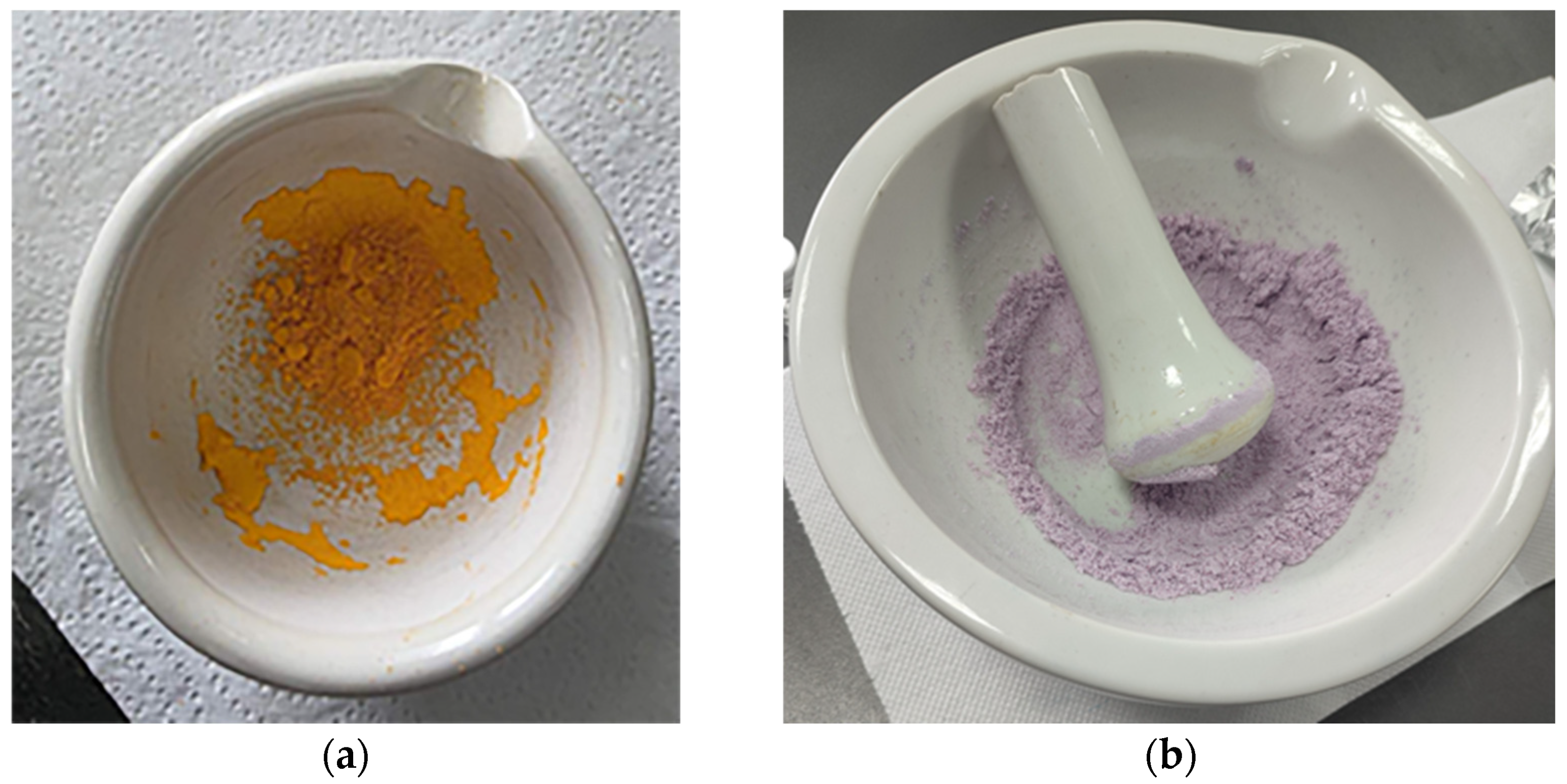
Six grams of lead(II)nitrate (Pb(NO3)2, Merck, Darmstadt, Germany) were dissolved in 100 mL of deionized water, while 5 g of potassium dichromate (K2Cr2O7, Kemika Ltd., Zagreb, Croatia) were dissolved separately in 100 mL of deionized water [34]. After complete dissolution, 1 g of sodium hydroxide (NaOH, NRK® Engineering Ltd., Belgrade, Serbia) was added to the dichromate solution, and both solutions were then heated to the boiling point. The Pb(NO3)2 solution was slowly added to the dichromate solution under continuous stirring. The resulting precipitate was collected by filtration, washed with deionized water, and dried [35]. This pigment, also known as Derby red, Persian red, or Victoria red, has a monoclinic–prismatic crystalline structure [36]. The appearance of the synthesized powders of both pigments is shown in Figure 1. The Pb-orange pigment is in Figure 1a, and the mixture for cobalt blue is in Figure 1b. After annealing, the color of the Co-blue pigment changes from purple to light or dark blue, depending on the annealing temperature.

2.3. Substrate Preparation

The first substrate–brass foil, ½ hard (ASTM B36, K&S Engineering, Chicago, IL, USA), 250 µm thick, was chemically etched in a 0.8 M (mol/L) sodium thiosulfate solution (Na2S2O3, Merck, Darmstadt, Germany) for 25 s [37]. A thiosulfate solution was selected for etching brass, as this concentration provides a reproducible balance between etching efficiency and surface control. It enables uniform removal of the oxide layer and controlled dissolution of copper and zinc phases, while minimizing excessive corrosion or passivation. Thiosulfate dissolves these oxides, exposing fresh metallic sites that bond better with epoxy-based resin. The etching process for a period of 25 s produces micro-roughness on the brass surface, which can enhance the mechanical interlocking of the epoxy resin coating.
The second substrate for deposited epoxy-based resin was aluminum alloy L3005. This foil is used for meat packaging in the Serbian food sector. Before coating, the aluminum alloy L3005 foil (90 µm-thick) supplied by AL PACK, Subotica, Serbia, was degreased and chemically cleaned in a phosphoric acid (H3PO4, CARLO ERBA REAGENTS S.A.S., Val-de-Reuil, France) solution to remove contaminants and activate the surface for improved adhesion [38,39].
Annealed phosphor-bronze foil (ASTM 510/B103, Comet metals, Solon, OH, USA) was used as the third substrate. The preparation steps are as follows: mechanical grinding with SiC abrasive paper of 1200 grit → ultrasonic cleaning to remove particles → immersion in acetone (5 min) → rinse in DI water → etching in a solution of sulfuric acid (10 vol.%, 2 min) → neutralization in a solution of NaHCO3 → drying in a nitrogen stream. Synergistic control of grain size, texture, boundary type, and cold deformation between the annealing and cold-rolling processes is crucial for the bending behavior of phosphorus bronze foil [40], and it also influences the adhesion properties of epoxy-based coatings.

2.4. Preparation of Composite Coatings

Epoxy resin served as the matrix for the preparation of pigment-filled composite coatings. The epoxy components were mixed according to the manufacturer’s instructions (comp A/comp B = 2/1). Cobalt blue and Pb-orange pigments (3.0 wt.%) were incorporated into the epoxy resin by mechanical mixing in a Pyrex glass jar. The resulting composite exhibited a violet-blue hue for the cobalt-based pigment and an orange hue for the lead-based pigment. A nail polisher/electric nail drill (GLX-019, Wenzhou Xudi Technology Ltd., Wenzhou, China) was used to drop-spin the coatings at 100 rpm. When mixed with epoxy components, the color of the resin containing Co-blue powders (3.0 wt.%) varies from purple to dark blue with increasing polymerization time. In contrast, the color of the epoxy mixture with Pb-orange pigment is intensely orange. The composite coatings were cured/post-cured according to the manufacturer’s specification (360 min/48 h at 20 °C and 55% relative humidity during the process for a designed coating thickness ranging from 0 to 3 mm).
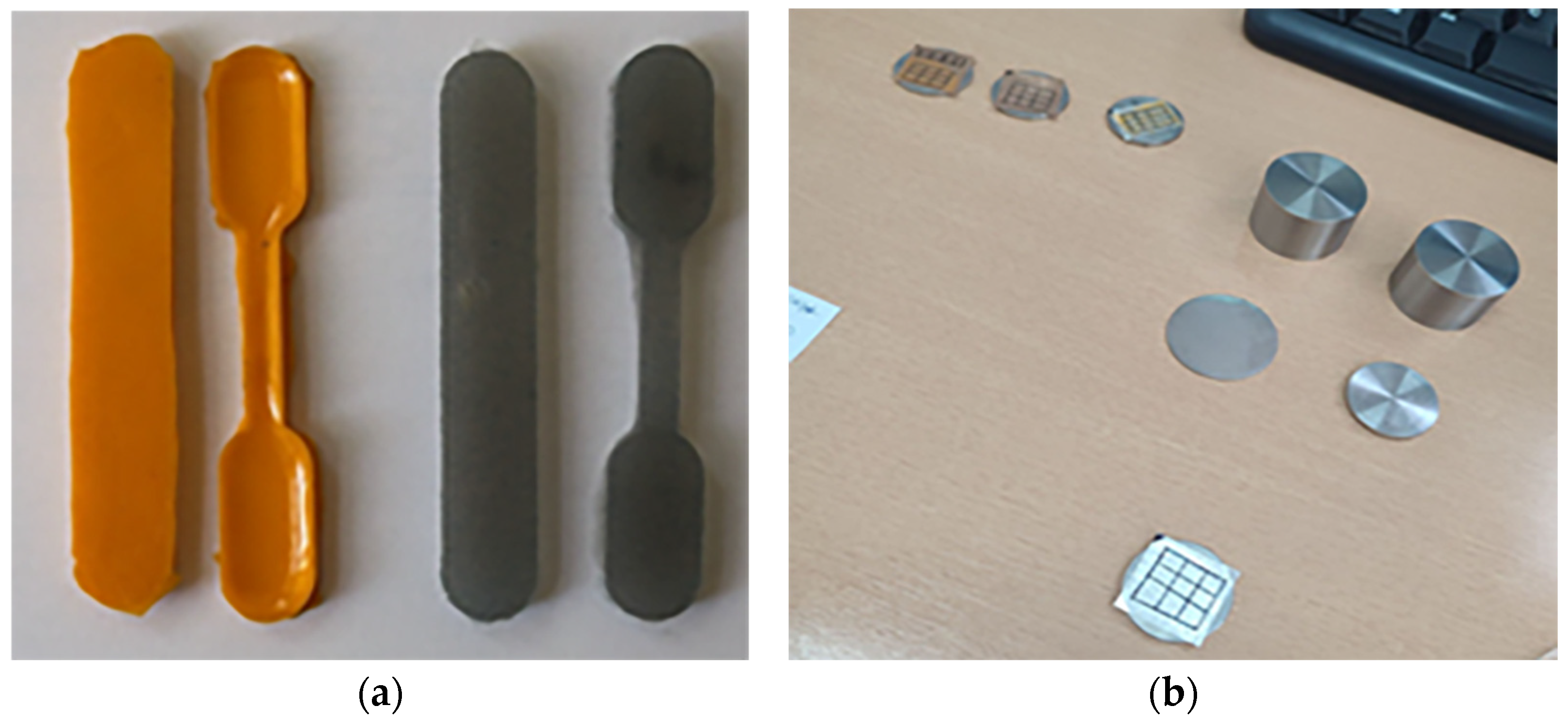
Figure 2a shows the bulk form of the epoxy-based material containing the pigments Co-blue and Pb-orange, while Figure 2b shows the coatings’ epoxy/pigmented form on different substrates prepared for the characterization methods. The intense color of the epoxy material in bulk form with 3.0 wt.% of pigment particles is shown in Figure 2a. The orange sample contains Pb-orange pigment, while the dark blue sample contains Co-blue pigment. Figure 2b shows epoxy/pigment thin coatings on various metallic foils prepared for the microhardness testing. Due to the thinness of the epoxy coatings, the color of these samples depends on the color of the substrate beneath the coating, as the epoxy coating itself is transparent.

2.5. Characterizations of the Materials

The synthesized Co-blue and Pb-orange pigments were characterized by FE-SEM to determine particle morphology, while their phase composition was verified via XRD. The brass substrate and the resulting composite coatings were examined for surface topography. The three-dimensional surface map of epoxy coatings and the evaluation of roughness parameters were characterized using the AFM technique, while the presence of characteristic chemical bonds was confirmed by FTIR. Cross-sectional SEM analysis was performed to evaluate coating thickness and the quality of the pigment–matrix interface. Furthermore, the wetting behavior was assessed via the sessile drop method using distilled water. Detailed specifications of the equipment and extended EDS mapping protocols are maintained in the Supplementary Materials (Supplementary Materials Section S2.5) [41,42,43,44,45,46,47,48,49,50,51,52,53,54,55,56,57,58].

3. Results and Discussion

The sequence of the results shown matches the sequence of the characterization methods listed below, and part of the results is shown in the Supplementary Materials, Section S3.

3.1. Characterization of Pigments

3.1.1. Optical Analysis

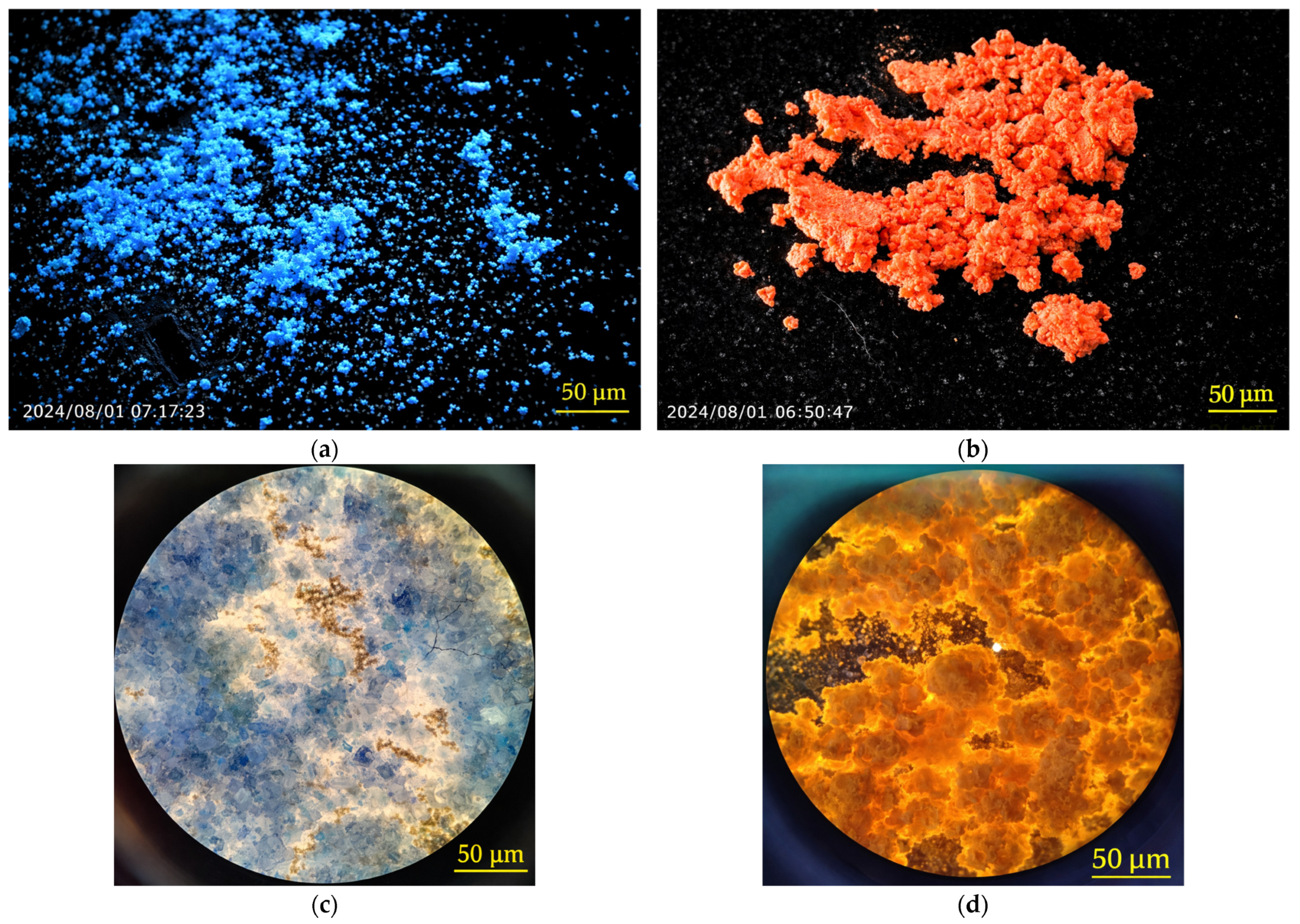
Figure 3 shows a microscopic view of the synthesized particles using optical (Figure 3a for Co-blue and Figure 3b for Pb-orange pigment) and stereo microscopes (Figure 3c for Co-blue and Figure 3d for Pb-orange). Crystals of Co-blue pigments are small, relatively isometric (closer to a round or flat shape) and have a very intense blue color, which is homogeneous, with minor variations in shade (Figure 3c). The higher surface energy of the orange pigment makes it more prone to aggregate formation (Figure 3b) than the Co-blue pigment (Figure 3a). The Pb-orange pigment has typically irregular crystals of intense orange-red color (Figure 3d) with pronounced reflexivity. Unlike the orange pigment, the blue pigment shows less pronounced reflectivity under a stereo microscope (Figure 3c).

3.1.2. FE-SEM and Image Analysis

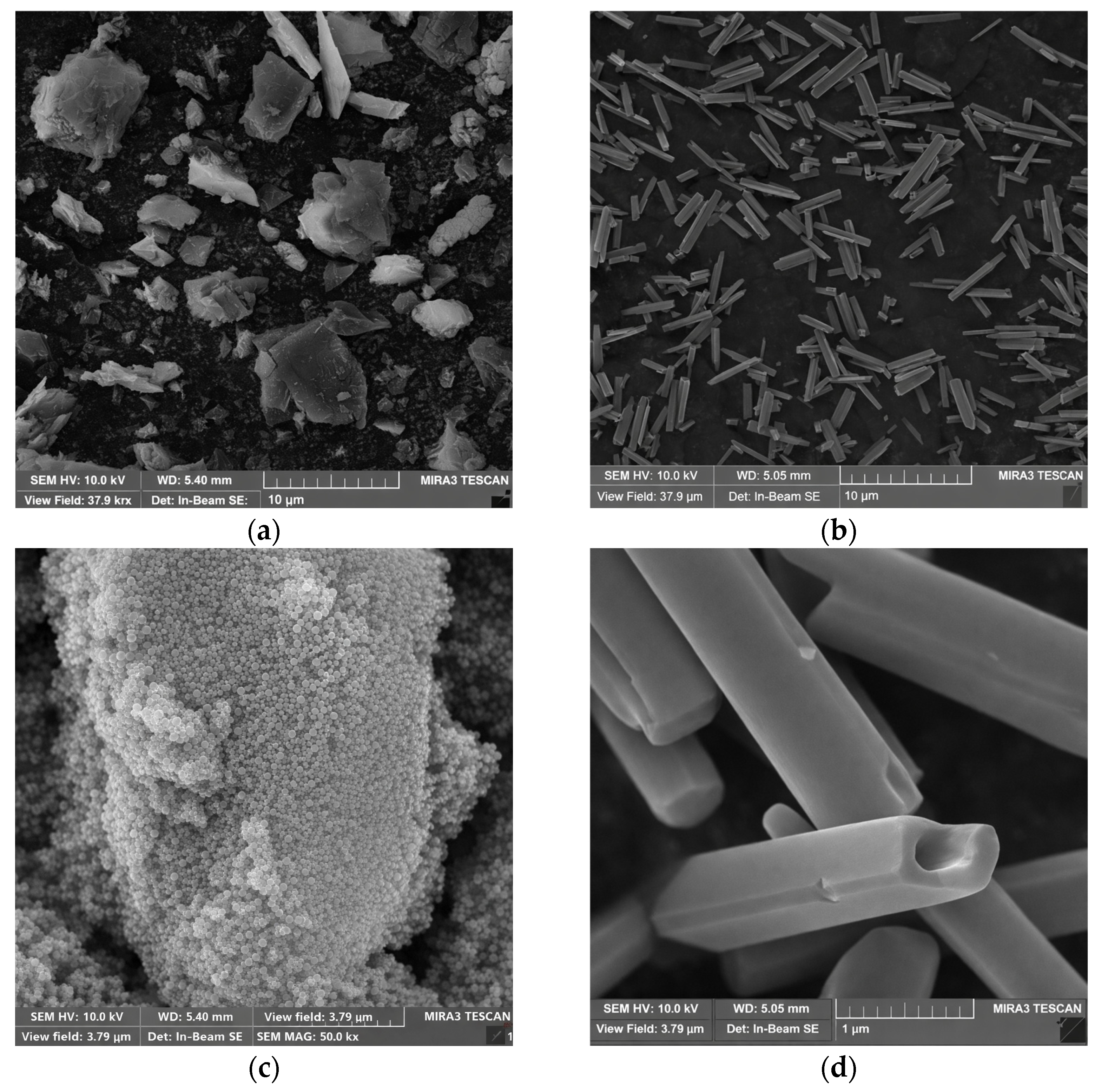
Field-emission scanning electron microscopy (FE-SEM) revealed distinct morphological differences between the two investigated pigments (Figure 4). The micrograph of Co-blue (Figure 4a,c) shows irregularly shaped particles with rough surfaces and heterogeneous size distribution. Such morphology is characteristic of spinel-type cobalt pigments, where mechanical grinding or uncontrolled crystallization often leads to poly-disperse aggregates [59,60,61,62]. The irregular surface topography may enhance light scattering, thereby contributing to the pigment’s high covering power, but it may also complicate dispersion in polymeric or coating matrices.
The sharp particle edges observed in Figure 4c indicate a high degree of crystallinity, which will be verified by X-ray diffraction analysis. The synthesized micro-Co-blue powder consisted of granular particles ranging from 0.1 to 5 µm, with occasional nanoscale crystallites present on their surfaces.
In contrast, the Pb-orange pigment (Figure 4b,d) exhibits a rod-like or needle-shaped morphology with relatively smooth surfaces and more uniform rod dimensions. This ordered structure suggests a crystalline growth mechanism, possibly resulting from controlled precipitation or hydrothermal synthesis [63]. Typical rod dimensions are in the range of 100–500 nm in diameter and 1–5 µm in length (see Figure 4d). The morphology is in the form of sticks, hollow at the end. The typical rod structure of this pigment is formed due to the anisotropic growth of crystals along the axis of the monoclinic lattice, as a typical mechanism for this type of pigment.
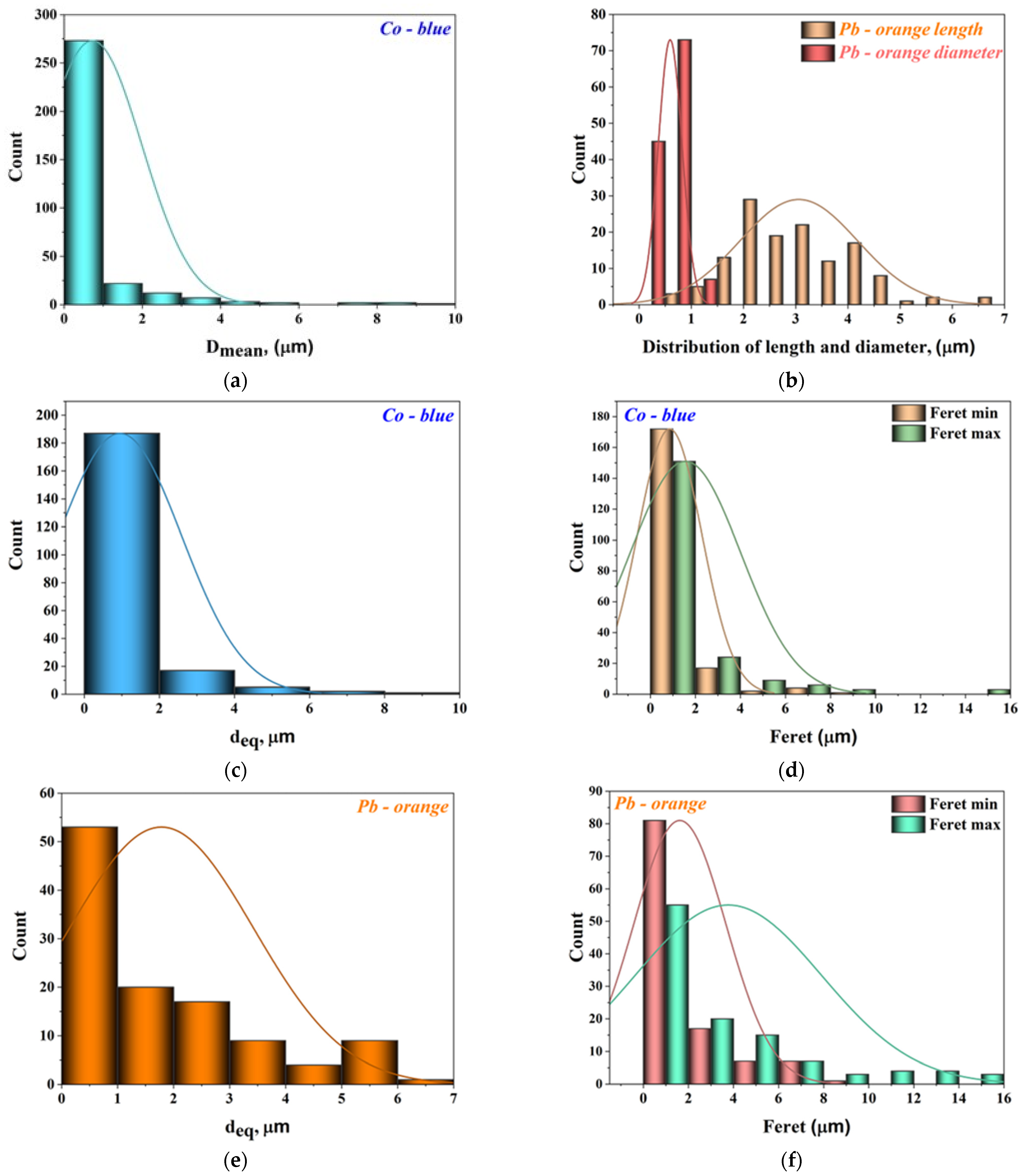
The particle size distributions for both Co-blue and Pb-orange powders are presented in Figure 5. An image analysis was performed on FE-SEM pictures (Figure 4a,b). The Image Pro-Plus program was used for this purpose. Specific criteria were analyzed that, in addition to particle size (diameter and length), also assess the spherical equivalent, deq, and Feret min/max of particles. Feret min/max values describe the shape and elongation of a particle, while the spherical equivalent provides the effective size as if the particles were perfectly round [64,65]. The mean diameter (Dmean) of the largest population of Co-blue pigment particles is below 1 μm (Figure 5a).
The distribution of the length and diameter of Pb-orange particles is shown in Figure 5b. The Co-blue samples exhibit a significantly narrower particle size distribution compared to the Pb-orange samples. In the plot (Figure 5c), the equivalent diameter (deq) is concentrated below 2 µm, suggesting a more controlled synthesis and narrower dispersion of sizes. In contrast, the Pb-orange samples (Figure 5e) show a broader distribution, with particles extending up to 7 µm.
Such variations in distribution width are critical, as the size and dispersion of fillers directly influence the interfacial bonding and stress transfer mechanisms within polymer matrices [66]. The comparison between Feret min and Feret max (Figure 5d,f) serves as a proxy for the aspect ratio and particle non-sphericity. For the Co-blue sample, the substantial overlap between the minimum and maximum Feret diameters implies a more spherical or equiaxed morphology. Conversely, the Pb-orange sample (Figure 5f) shows a distinct lateral shift between the two curves, which is a quantitative indicator of particle elongation or irregular morphology [67]. According to ISO 9276-1 [68], this deviation in statistical diameters is a standard metric for assessing the shape factor of synthesized powders. The “tailing” observed in the Pb-orange distribution (Figure 5f), where the Feret max reaches up to 16 µm, suggests the presence of secondary aggregates or larger grain growth. The better-defined sub-5 µm range of the Co-blue sample indicates superior dispersion stability, which is often a prerequisite for achieving optimal mechanical reinforcement in nanocomposites [69].
The anisotropic particle shape can influence optical properties, imparting transparency or gloss in thin films, while simultaneously increasing the risk of agglomeration if surface stabilization is not applied. Such morphology is typical of iron oxide-based pigments, where crystalline structure strongly correlates with hue intensity and stability [70,71].
Overall, the comparison highlights how particle morphology directly impacts pigment performance. The heterogeneous Co-blue particles are likely to provide strong opacity and stability, whereas the crystalline Pb-orange rods may offer enhanced optical effects but require careful formulation to prevent aggregation. These findings underline the importance of correlating synthesis conditions with pigment microstructure to optimize functional properties in coating applications.

3.1.3. XRD Analysis of Synthesized Pigment Powders

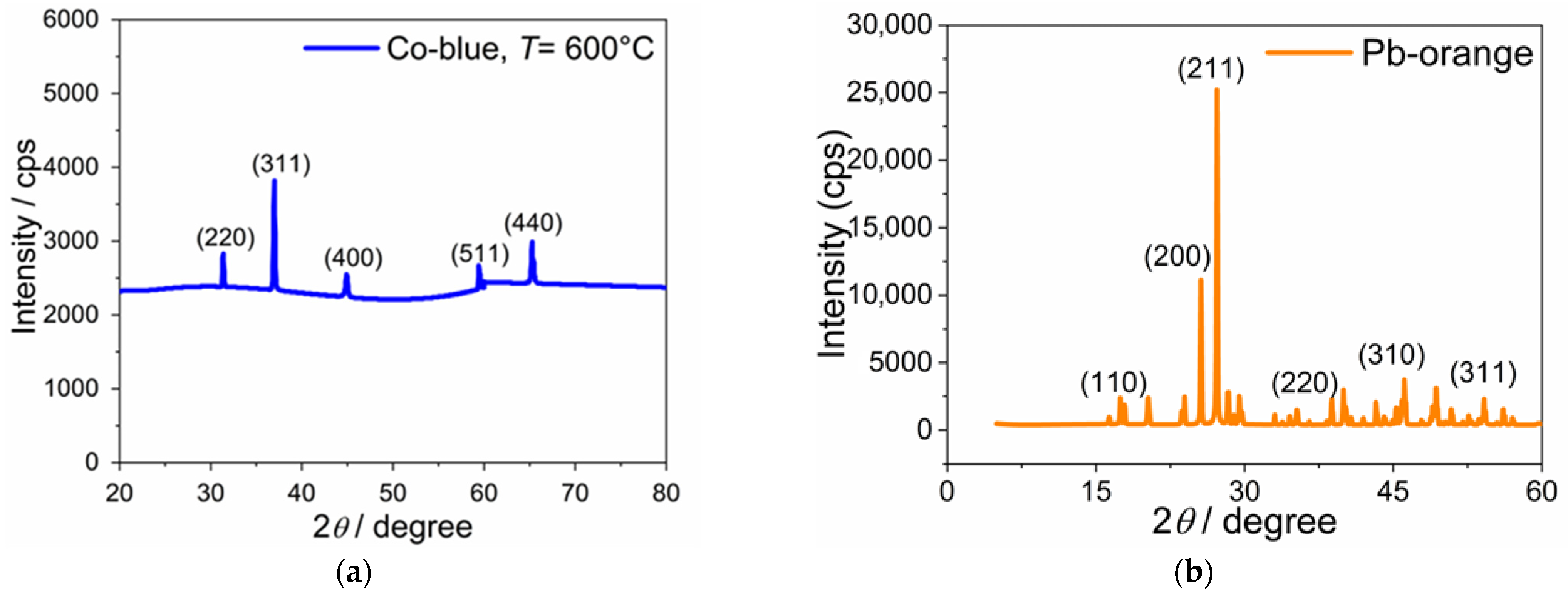
The cobalt blue (CoAl2O4) shows sharp XRD peaks characteristic of a cubic spinel structure, while Pb-orange (PbCrO4 or related lead chromate phases) exhibits strong reflections typical of monoclinic or orthorhombic structures. These diffraction patterns, given as Figure 6, are used to confirm phase purity and crystalline pigment powders.
The characteristic peaks correspond to the following crystallographic planes for cobalt blue pigment particles: (220), (311), (400), (511), and (440), detected for the 2θ angles: ~31.3°, ~36.9°, 44.8°, ~59.3°, and ~65.2° [72], as shown in Figure 6a. The most intense reflection at (311) indicates a preferred orientation along this plane, suggesting high crystallinity and uniform grain alignment [73]. The absence of secondary peaks confirms the phase purity of the sample.
The XRD pattern of Pb-orange (PbCrO4) pigment powder is shown in Figure 6b. Characteristic peaks are observed at the following values of double angles: 18.2°, 29.3°, 30.1°, 36.3°, 43.2°, and 47.6°, which correspond to the following crystallographic planes: (110), (200), (211), (220), (310), and (311) [74]. The dominant peak at (211) implies a preferential growth direction and strong diffraction from that plane [74]. The sharpness and intensity of the peaks further support the high crystallinity and phase purity of PbCrO4 [75].

3.2. Characterization of Substrates

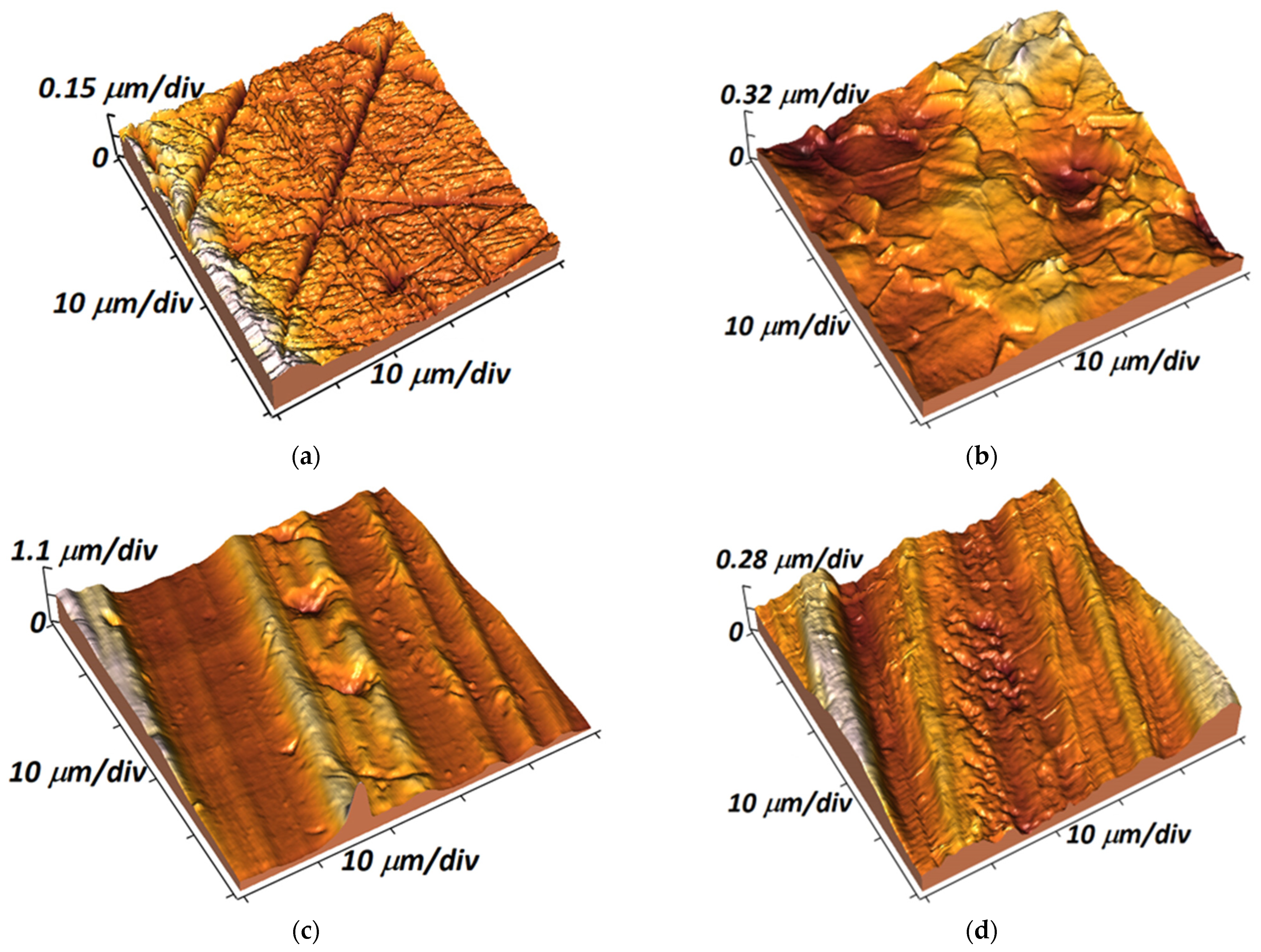
The chemical composition of the substrates was given in Table S1. Figure 7 presents 3D-AFM (Atomic Force Microscopy–Auto Probe CP Research (TM Microscopes, Veeco Instruments, Santa Barbara, CA, USA)) topographic images of the substrates obtained from the AFM analysis and the results of the performed mechano-chemical modifications (that were made). Brass B36 substrates before and after etching in a 0.8 M thiosulfate solution are presented in Figure 7a,b. The brass substrate shows moderate roughness with roughness parameters Sq = 43.7 nm and Sa = 31.3 nm before and Sq = 90.1 nm and Sa = 71.9 nm after etching. Chemical etching of a brass substrate in a thiosulfate solution (0.8 mol/L) for 25 s was carried out optimally under our laboratory conditions at 21 °C. At this stage, the characteristic phases of brass were revealed. The aluminum alloy L3005 cleaned in the H3PO4 solution has the highest roughness due to the wavy topography and rolling marks during the production of aluminum foil (Sq = 225 nm and Sa = 183 nm) (Figure 7b). The phosphor-bronze substrate modified with grinding and chemical etching in the solution of sulfuric acid (10 vol.%, 2 min) has similar roughness parameters to etched brass (Sa = 69.1 nm), with a slight increase in the Sq parameter (100.8 nm), probably due to sanding of the sample, which left deeper channels (Figure 7c), resulting in wavy topography as an aluminum substrate (Figure 7b).
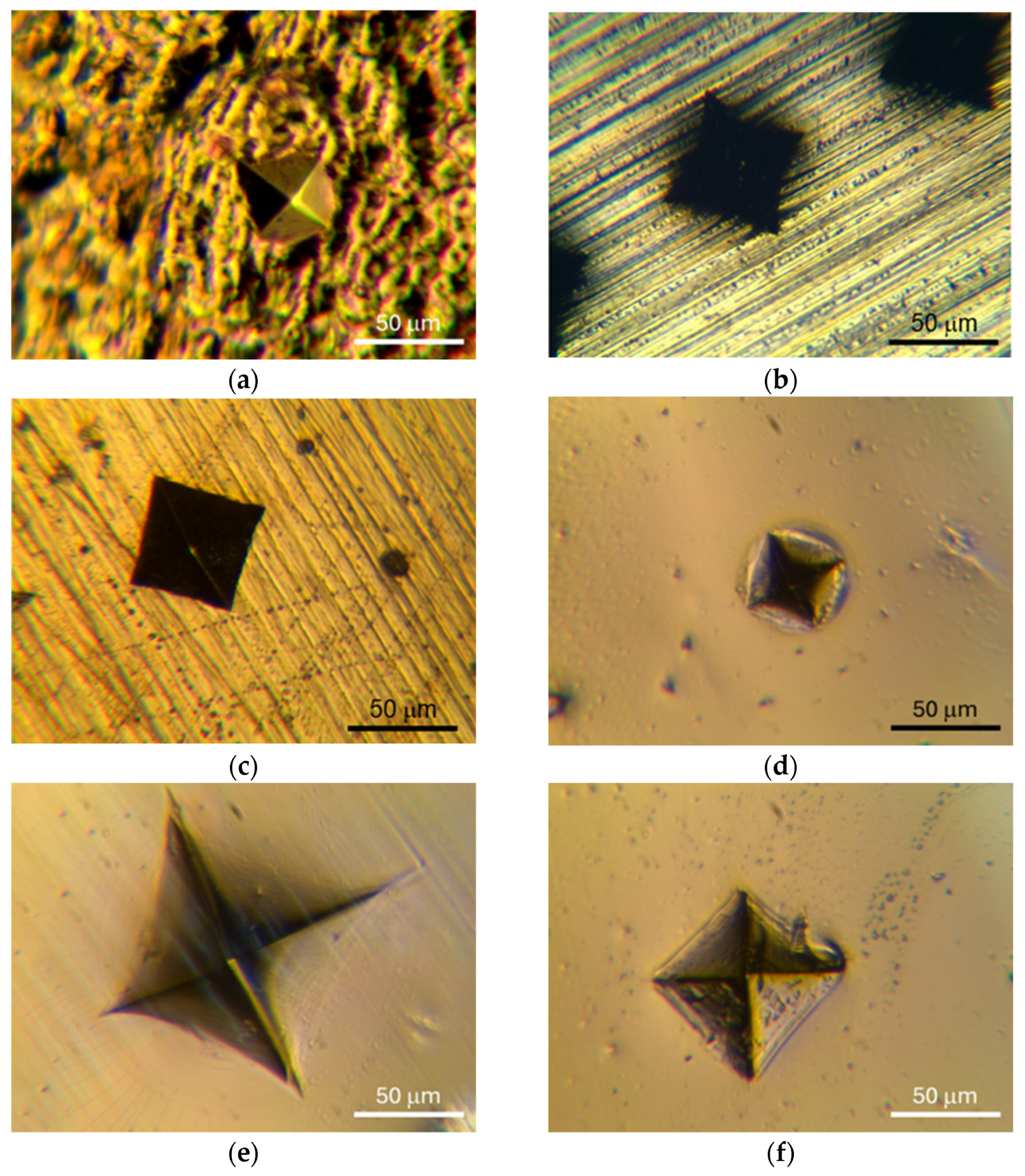
The images in Figure 8 show results from a microhardness indentation test, specifically a Vickers hardness test. They show the appearance of the Vickers indentation after unloading the indenter, as well as the microstructure of the modified substrates around the indent (Figure 8a,c) and covered with epoxy coatings (Figure 8d–f). A coarse and very rough microstructure of the brass substrate is visible after chemical etching in a thiosulphate solution (Figure 8a). The Vickers pyramid indentation appears irregular due to the influence of surface topography. A large imprint for the same applied load of 100 gf (0.98 N) is visible on the aluminum substrate (Figure 8b) and epoxy matrix on aluminum (Figure 8e). This indicates that the aluminum alloy is much softer than the brass alloy. A smooth surface is also observed, with a rolling texture of the Al alloy foil. Figure 8c shows the appearance of a Vickers pyramid indentation on a phosphorus-bronze alloy modified by combined mechanical and chemical treatments, and Figure 8f shows a thin epoxy layer. The surface is smoother than that of the modified brass alloy; however, due to the chemical modification, pitting holes are present.
Details of the analysis of the mechanical properties of the substrates and the Vickers method are described in the Supplementary Materials, see Section S.2.5.2.
The microstructure of the epoxy and epoxy/pigmented composite samples deposited on the bronze substrate with varying pigment compositions and dispersion of the pigment particles is provided in the Supplementary Materials; please see Figure S5.
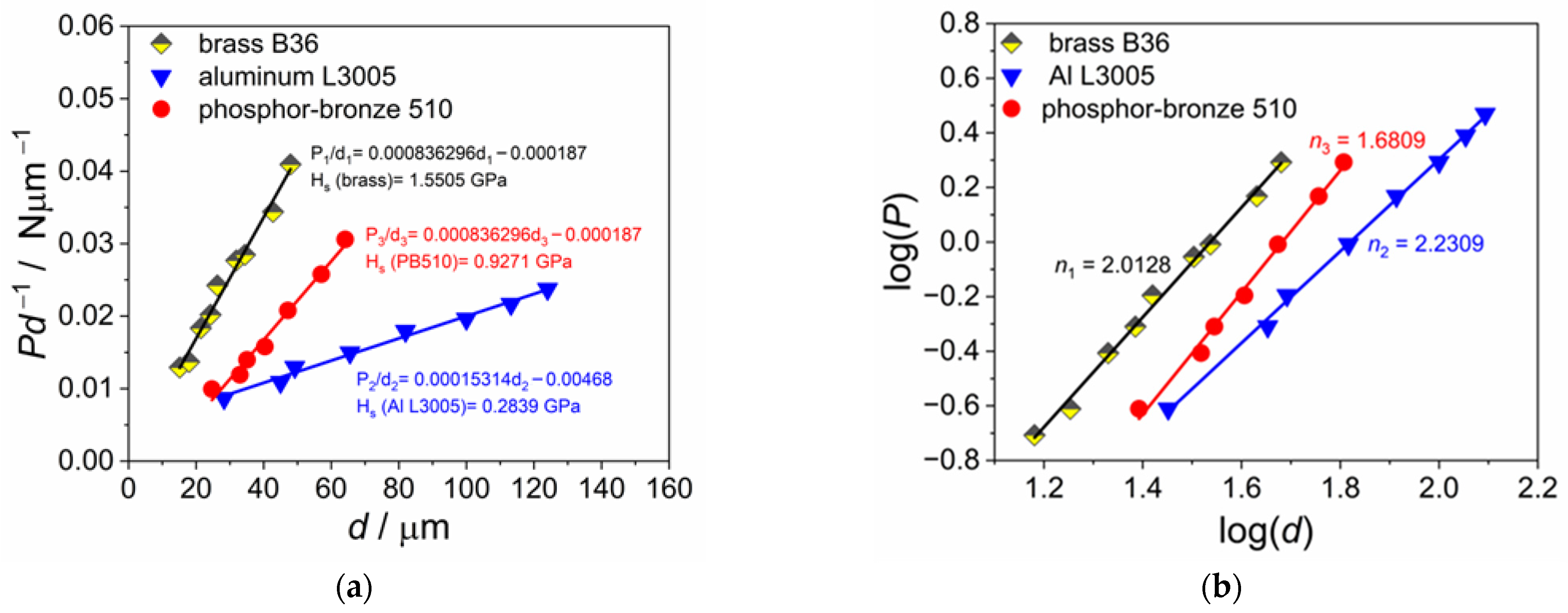
The results of calculating the absolute hardness of all modified substrates and applications of the PSR model [42,51] and Mayer’s law [52,53,54] are presented in Figure 9a,b.
By applying the PSR model using the slope obtained from the linear fitting of the d and p/d dependence, and then multiplying by the Vickers constant, the absolute values of the substrate hardness before the epoxy coating is applied are obtained. For the B36 brass substrate, chemically etched in thiosulphate, the absolute hardness is 1.5505 GPa, while the phosphor-bronze alloy that was annealed and then chemically and mechanically modified showed a hardness of 0.9271 GPa. The softest substrate is aluminum alloy L3005, with an absolute hardness of 0.2839 GPa (283.9 MPa). It is interesting to note that Al L3005 alloy has a strain-hardening exponent (n = 2.2309) comparable to that of brass B36 (n = 2.0128). Figure 9a shows that L3005 hardens considerably under load, like brass, even though aluminum alloys are often softer. In contrast to brass or aluminum alloy, a lower Meyer index (n = 1.6809) indicates less strain hardening for phosphor-bronze 510 (Figure 9b). Under indentation load, phosphor bronze deforms more consistently and resists more gradually as the indentation increases.

3.3. Characterization of the Epoxy-Based Coatings

3.3.1. Cross-Section Analysis and Measurement of Coating Thickness

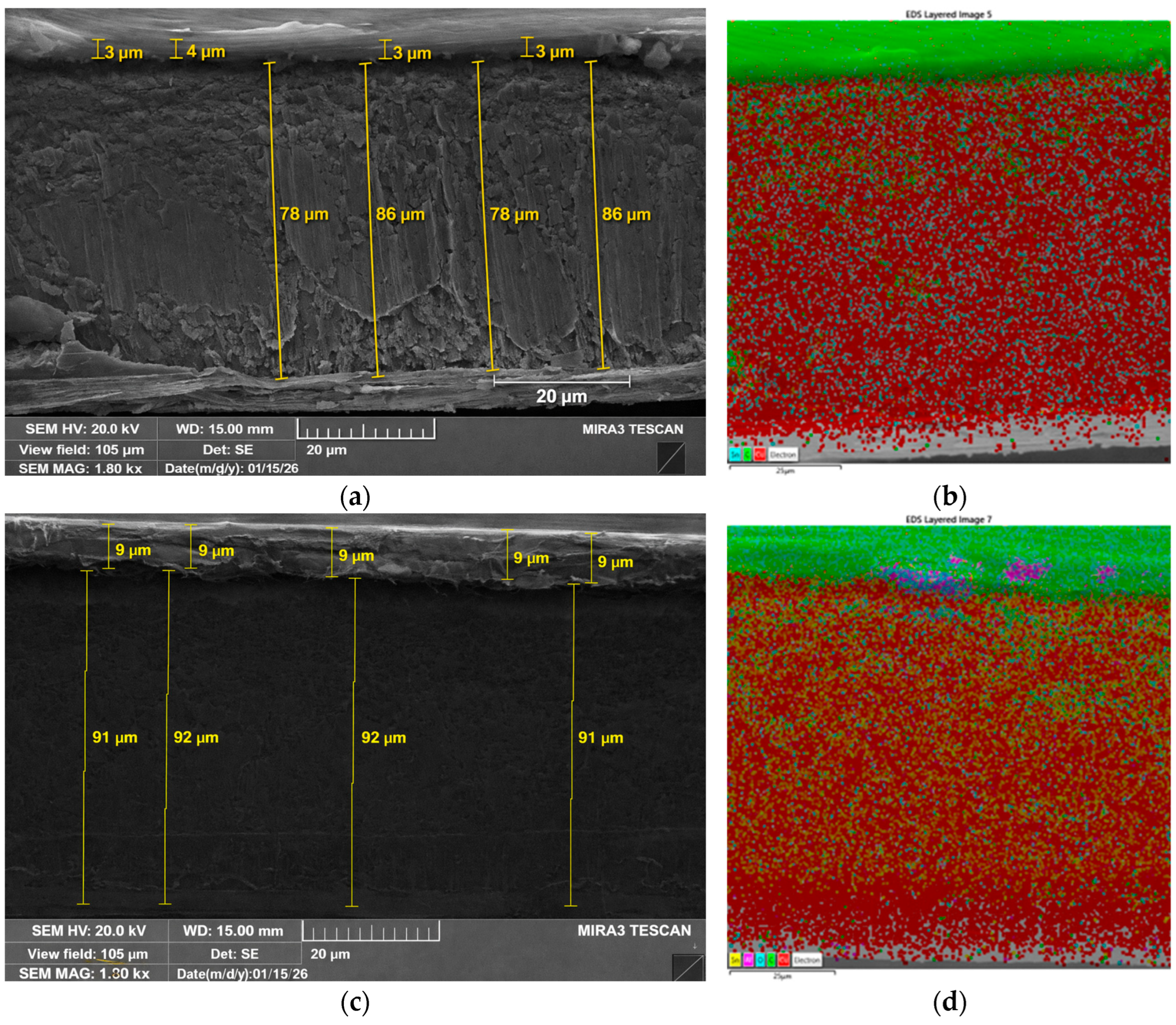
The estimated thickness of a pure epoxy coating on a phosphor-bronze 510 substrate, with variations in the type of pigment in the epoxy matrix, is shown in Figure 10. The estimated thickness of coatings on different substrates is provided in the Supplementary Materials as Figure S1, along with all EDS spectra (Figure S2) for aluminum, and Figures S3 and S4 for the brass substrate.
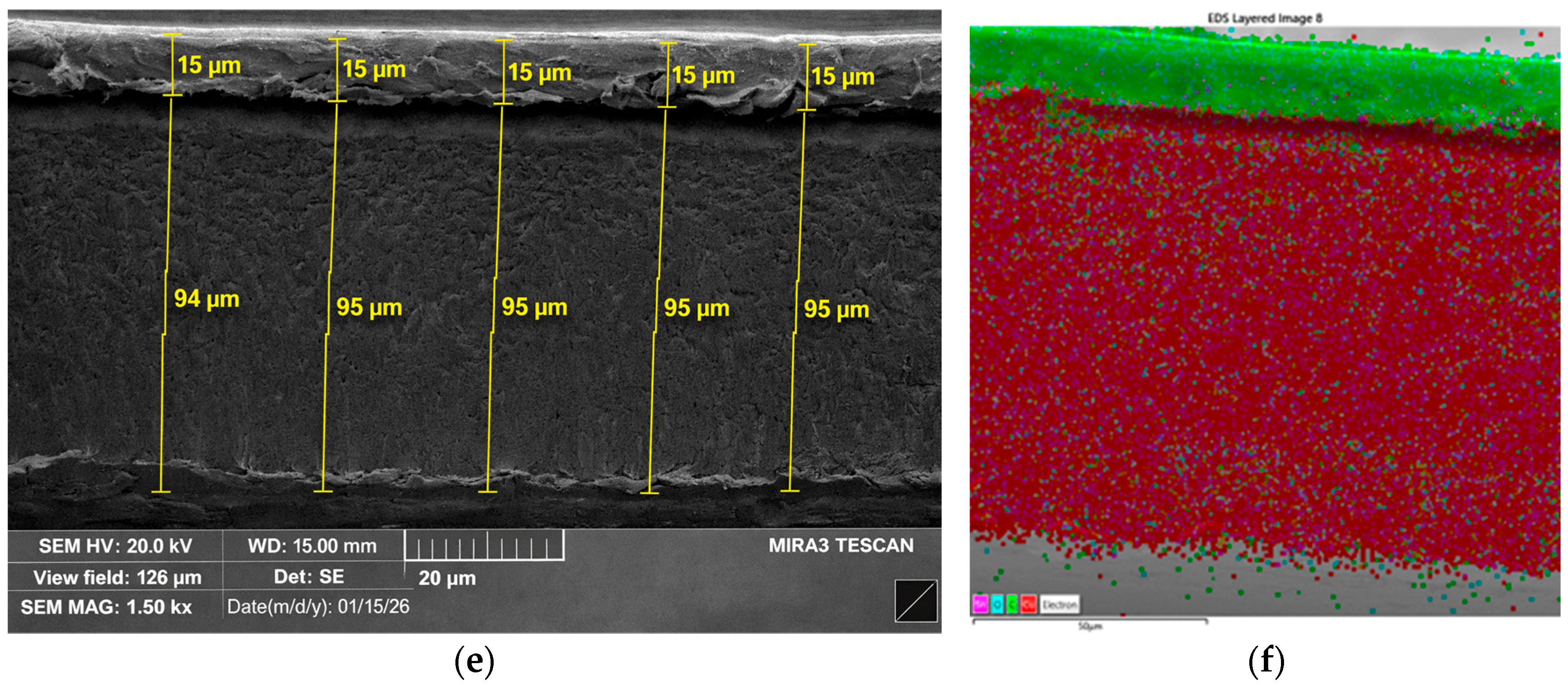
Figure 10a presents the FE-SEM cross-section analysis of pure epoxy coatings with mapping of each element detected on the cross-section (Figure 10b). Figure 10c,d show epoxy coating with 3 wt.% Co-blue pigment, and Figure 10e,f show epoxy coating with 3 wt.% of Pb-orange pigment. The coating–substrate interface is clearly defined and free of detectable interfacial voids, indicating good adhesion between the epoxy matrix and the bronze surface (Figure 10a). Slight contrast variations are locally visible in the upper coating region, consistent with the presence and distribution of pigment particles within the matrix. No large pigment agglomerates are observed in the examined cross-sectional area, suggesting reasonably good pigment dispersion. Based on the measured coating thicknesses on the cross-section, oscillations in the thickness are observed even though the same spinner speed was used. At the same spinner speed, the effective viscosity and flow dynamics differ between pure epoxy resin and pigment-filled resin. Epoxy/pigment suspensions exhibit shear-thinning or shear-thickening [76], so viscosity changes with shear rate (non-Newtonian flow).
It is widely known that the solvent evaporation component in epoxy resin interacts differently with particle-filled resin, causing localized viscosity changes [31]. However, the thickness of the pure epoxy coating is the smallest and is ≈3 μm (Figure 10a), while the maximum coating thickness (15 μm) was measured with the composite coating with Pb-orange pigment (Figure 10e). If the influence of particle shape on rheology and coating thickness is considered, plate-shaped particles in epoxy resin show lower hydrodynamic resistance during spinning and smaller viscosity change compared to rod-shaped particles, as indicated by the smaller coating thickness (in Figure 10b). Pb-orange pigment powder as rod-shaped particles has a higher aspect ratio (length >> width, according to Figure 4b,c >> 5 μm/500 nm). Hence, they are more difficult to orient during the spinning resin flow, with stronger shear-thinning/thickening effects and greater non-Newtonian flow behavior. Figure 10c shows the delamination of the layer, which is likely the result of cutting the sample during cross-section preparation. A slightly heterogeneous texture is observed in the near-surface region, which can be attributed to particle distribution and/or surface morphology developed during resin crosslinking (Figure 10d).
Elemental composition determined by EDS analysis according to Figure 10d shows dominant carbon content (≈39.3 wt.%) and oxygen, consistent with an organic epoxy matrix. A significant copper contribution (≈53.2 wt.%) and minor tin content (≈2.8 wt.%) are also detected, confirming signal contribution from the bronze substrate. Minor amounts of aluminum (0.54 wt.%), chlorine (0.10 wt.%), and phosphorus (0.02 wt.%) are also detected. The presence of aluminum may be associated with the pigment phase (e.g., cobalt aluminate–type blue pigment), although cobalt was not detected above the sensitivity threshold in the summed spectrum. The absence of a detectable cobalt peak in the area spectrum may result from low local pigment concentration or from the analyzed region not intersecting pigment-rich particles. Unambiguous confirmation of the pigment would require EDS analysis of the targeted spots. Targeted point EDS analysis would be required for unambiguous pigment confirmation.
The EDS sum spectrum, according to Figure 10f, is dominated by carbon (≈37.1 wt.%) and oxygen (3.07 wt.%), consistent with the organic epoxy phase. Copper (≈56.4 wt.%) and tin (≈3.2 wt.%) are also strongly represented and originate from the bronze substrate. Their relatively high contribution indicates involvement of the substrate signal due to the electron-interaction volume under the applied FE-SEM conditions. Minor amounts of phosphorus and iron (0.07 and 0.14 wt.%) and Sn (3.19 wt.%) are detected as trace elements from the substrate. Lead is not clearly identified in the summed spectrum, despite the declared addition of Pb-orange pigment. The absence of a measurable Pb signal in the area spectrum may be due to low local pigment concentration or the analyzed region not intersecting pigment-rich particles. It is assumed that the epoxy macromolecule can encapsulate the inorganic particle, thereby attenuating or preventing the detection of its characteristic X-ray signals in EDS analysis.

3.3.2. FTIR Measurement of Epoxy-Based Coatings

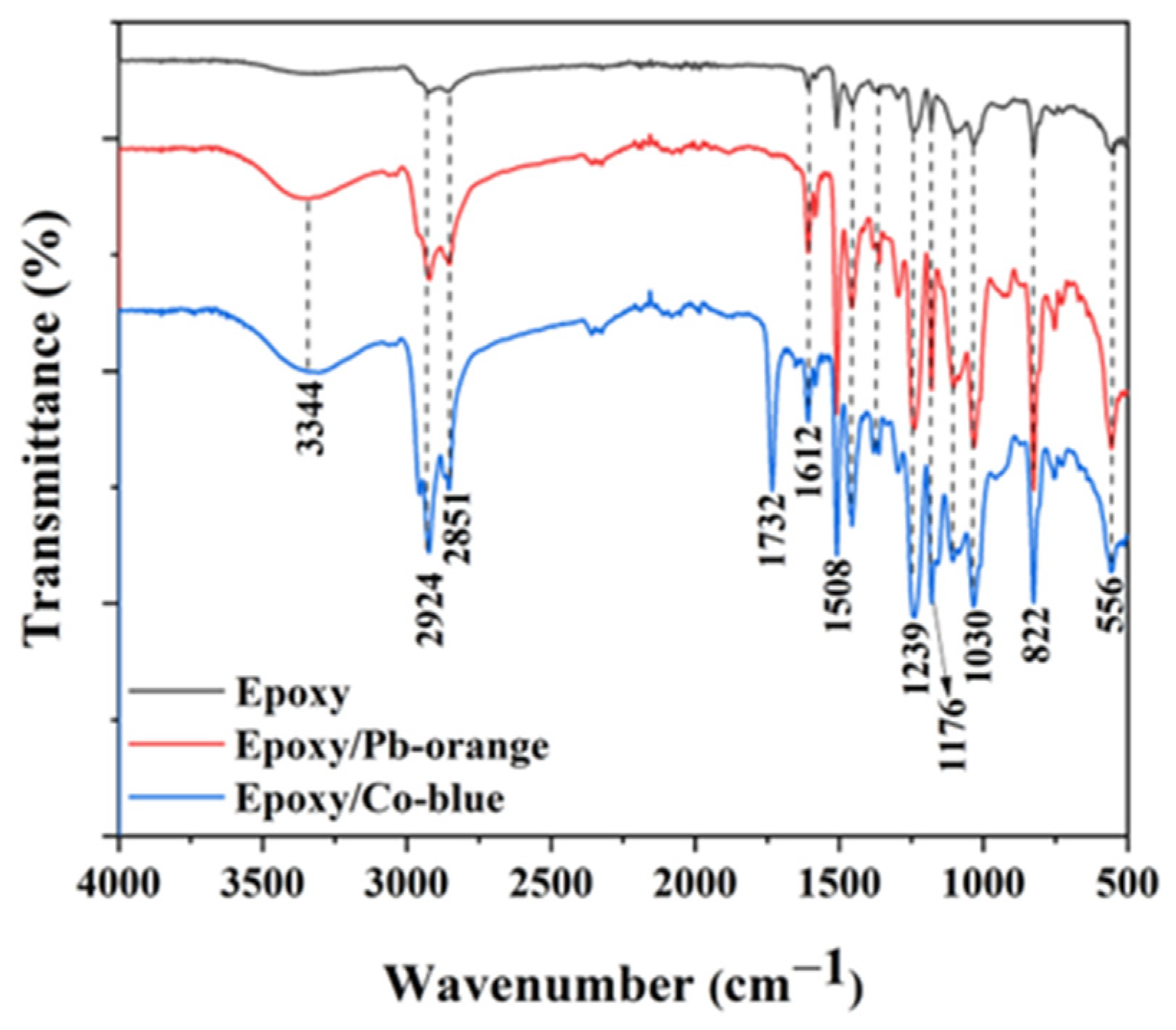
The FTIR spectra of neat epoxy and its composites, epoxy/Pb-orange and epoxy/Co-blue, are shown in Figure 11.
The neat epoxy spectrum exhibits a broad band at 3344 cm−1, corresponding to -OH groups formed during the epoxide ring-opening reaction [77]. Aliphatic C-H stretching is identified at 2924 and 2851 cm−1, while the peak at 1732 cm−1 is attributed to C=O stretching, likely originating from the curing agent or minor oxidation [78]. The aromatic backbone of the resin is confirmed by stable C=C vibrations at 1612 and 1508 cm−1, which serve as internal references. The formation of the polymer network is further evidenced by the ether linkage (C-O-C) vibrations at 1239 and 1030 cm−1. Notably, the absence of a peak at 915 cm−1 indicates a high degree of curing and the consumption of oxirane rings across all samples [77]. The inclusion of Pb-orange and Co-blue pigments leads to an increase in the intensity of the absorption bands, most prominently in the epoxy/Co-blue sample. This suggests that the pigments interact with the matrix, possibly altering the dipole moments of the functional groups. Additionally, the enhanced peak at 556 cm−1 is characteristic of metal–oxygen (M-O) vibrations from the inorganic pigments [79]. The consistency of the main peak positions confirms that the fundamental chemical structure of the epoxy remains stable after the addition of the fillers.

3.3.3. AFM Measurement of Epoxy-Based Coatings

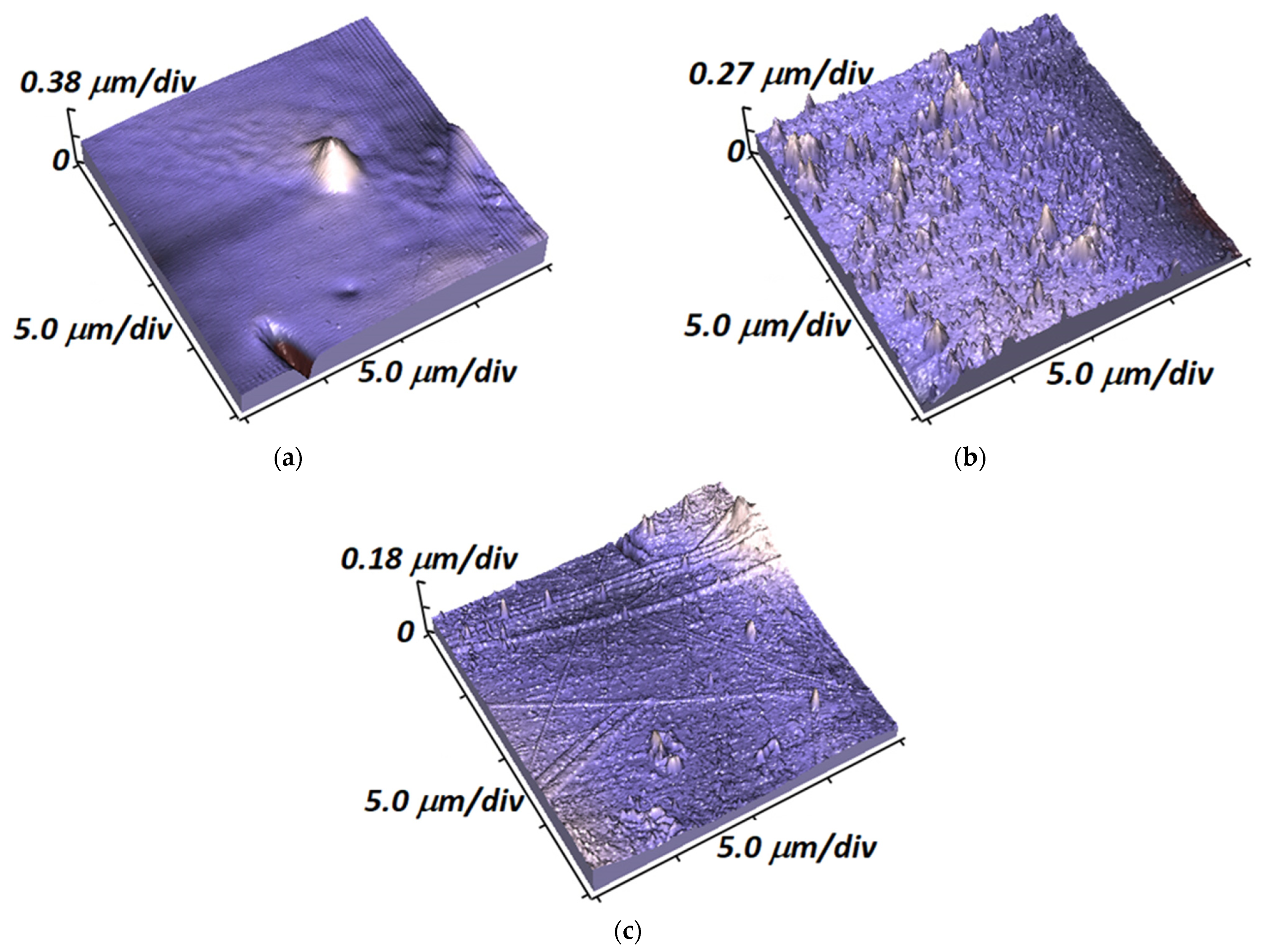
The 3D-AFM topography of neat epoxy and its composites, epoxy/Pb-orange and epoxy/Co-blue coatings, are shown in Figure 12. Figure 12a depicts a neat epoxy coating deposited on the brass foil with smooth topography, Figure 12b shows epoxy/Co-blue coating with a granular and irregular surface, and Figure 12c shows epoxy/Pb-orange coatings with an anisotropic, very rough surface. The neat epoxy coating exhibits uneven micro-roughness with a pronounced central peak, indicating local variations in curing or trapped impurities (Figure 12a). The roughness parameters for the epoxy coating without pigments are Sa = 25.77 nm and Sq = 43.55 nm for the entire surface, and 15.72 and 21.6 when only the area excluding the central inclusion is considered. The AFM topography of the epoxy/Co-blue coating shows a highly irregular microstructure with numerous sharp peaks and valleys distributed across the 20 µm × 20 µm scan area. The surface roughness parameters are Sa = 44.83 nm and Sq = 60.95 nm (Figure 12b). Compared to neat epoxy, this surface is rougher and more heterogeneous, which can trap air pockets and contribute to hydrophobic behavior. Such micro-roughness enhances the mechanical interlocking of the epoxy coating with metallic substrates and may shift wetting toward the Cassie–Baxter regime, which explains the hydrophobicity observed in epoxy/Co-blue coatings. The topography of epoxy/Pb-orange coating (Figure 12c) shows a distinctly rough surface characterized by elongated ridges and protrusions, which is consistent with the morphology of the Pb-orange particles. This topography strongly enhanced adhesion through mechanical interlocking, but the coating’s hydrophilic nature reduced water repellence compared to Co-blue coatings. The roughness parameters of the surface of epoxy/Pb-orange coating are Sa = 32.5 nm and Sq = 57.6 nm (Figure 12c).

3.3.4. Microhardness Measurement of Epoxy-Based Coatings

Composite Hardness Measurement
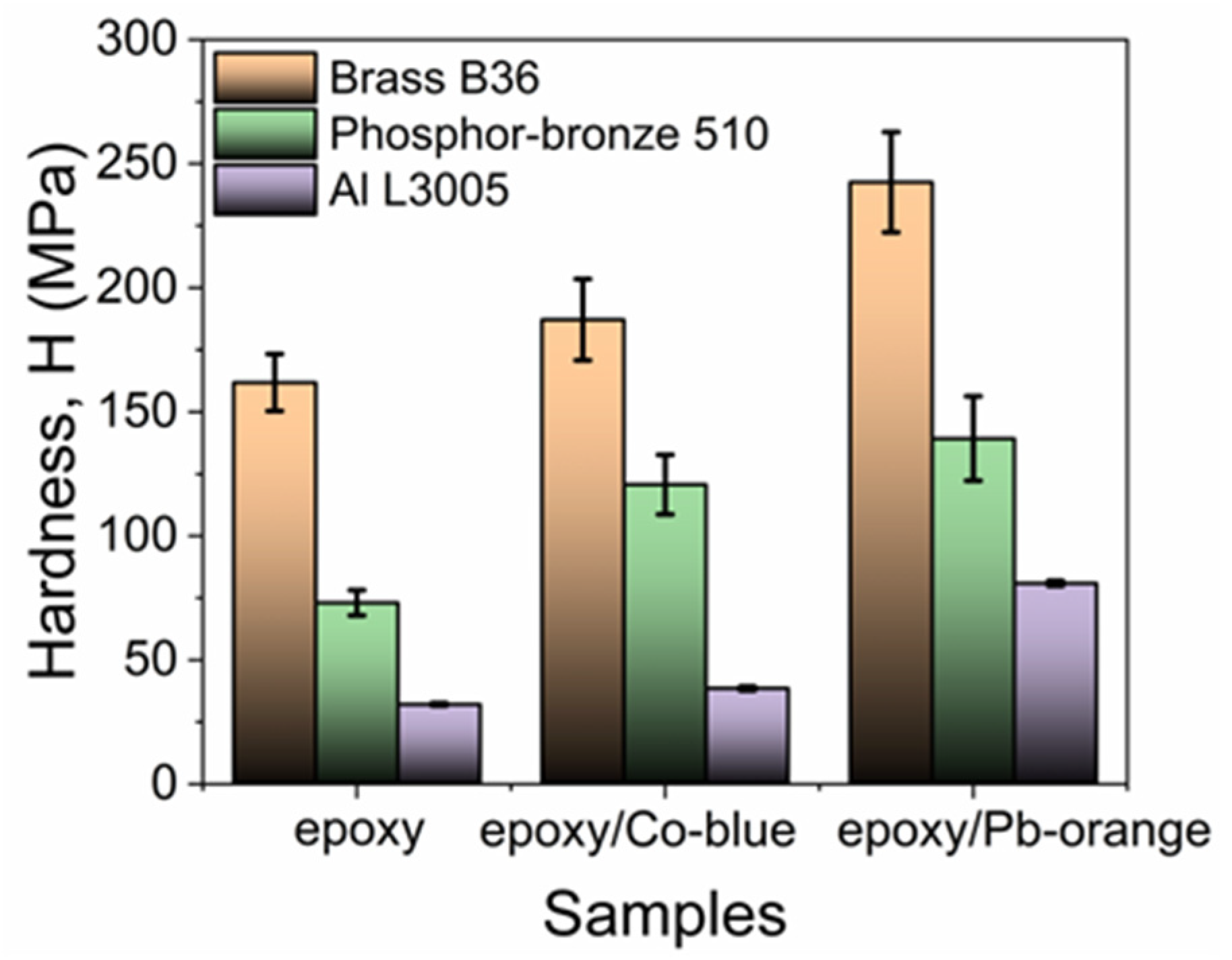
The microhardness values (H) and standard deviation of epoxy-based coatings deposited on brass B36, phosphor-bronze, and Al L3005 alloys after indentations at 0.49 N, and dwell time at 25 s are shown in Figure 13 and Table 1 for all coatings (clear epoxy, epoxy/Co-blue, and epoxy/Pb-orange).
The epoxy/Pb orange-coated sample on brass substrate displayed a higher microhardness value of 242.56 MPa compared to pure epoxy coating (161.83 ± 11.51 MPa) and epoxy/Co-blue pigmented coating (187.17 MPa). On the aluminum substrate, the same microhardness trend was observed. The epoxy/Pb-orange coating was the hardest (80.93 MPa), while the epoxy/Co-blue coating (38.59 MPa) and pure epoxy (32.16 MPa) showed much lower values.
The epoxy coatings deposited on bronze 510 exhibited the same microhardness trend as the epoxy coating deposited on brass. For example, Ngasoh et al. [80] studied a combined experimental and theoretical investigation of the interfacial and mechanical properties of epoxy/clay composite coatings applied to mild steel substrates. Epoxy coatings reinforced with montmorillonite clay particles (1–5 wt.%) have a hardness in the range of 85 to 160 MPa. Although in this study, the substrate effect was avoided by using nanoindentation, the layer thickness was not considered.
Collado et al. investigated the microhardness of epoxy systems in relation to the stoichiometric ratio, the presence of particulate reinforcements, and the curing stage [81]. They found that incorporating nanoparticles increased the Vickers hardness, reaching maximum values of 22.6 HV0.3. They also observed that this increase was due to the formation of a reinforcement network and a lower void volume. Furthermore, they demonstrated that the final degree of curing affects the hardness values. Specifically, greater hardness is achieved with longer curing times due to higher cross-linking densities.
A comparison of the results in Table 1 shows that the microhardness (HV0.05) of the epoxy coatings depends largely on the substrate, with values ranging from 16.5 to 24.74 HV on brass, 7.45 to 14.20 HV on bronze, and 3.27 to 8.25 HV on aluminum. Furthermore, although the particle-containing systems have greater thickness (and therefore would be expected to show a lower degree of curing and lower hardness), they display higher hardness. Thus, in this case, the particles also increase hardness by reducing free volume and forming a reinforcing network.
However, it is also important to note that the microhardness results for the coatings show a clear and consistent trend, regardless of the type of coating (epoxy/brass B36 > epoxy/bronze 510 > epoxy/Al L3005). The absolute hardness values of the substrate obtained using the PSR model (Figure 9) follows the same trend. The higher hardness value of Brass B36 indicates a more severe mechanical restriction on the plastic deformation of the coating during indentation, which directly results in higher composite microhardness values. Conversely, aluminum, being the softest substrate, allows for greater joint deformation of the system, resulting in the lowest apparent hardness for the coating. This effect primarily explains the trend observed in Figure 13 and Table 1 and is consistent with the literature on microhardness in thin coating systems.
Calculation of Intrinsic Hardness
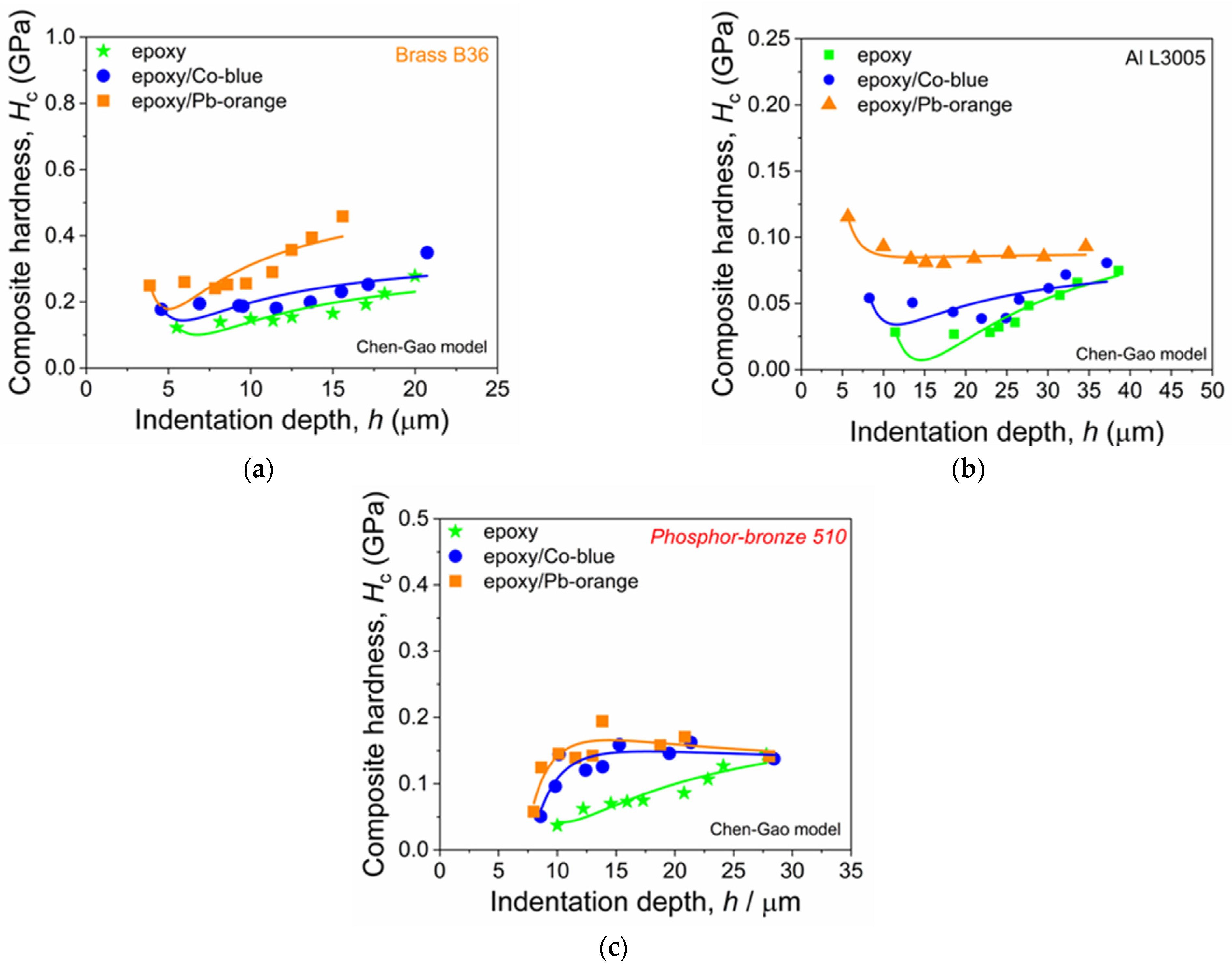
The intrinsic hardness values of the epoxy-based coatings were determined using the Chen–Gao (C–G) composite hardness model, and the results are presented in Table 2. Experimental microhardness data were fitted to the C–G model to describe the dependence of composite hardness on indentation depth, as shown in Figure 14. Specifically, Figure 14a illustrates the fitting curves for epoxy-based coatings deposited on brass. In contrast, Figure 14b shows the corresponding results for epoxy-based coatings deposited on Al L3005, and Figure 14c shows the results for epoxy deposited on phosphor-bronze 510. The fitting procedure was carried out in ORIGIN using the non-linear curve-fitting function in accordance with Equation (S2), and the intrinsic hardness of the coatings was subsequently estimated using Equation (S3).
The values of intrinsic hardness (Hi) of epoxy coatings are very similar when comparing epoxy-based coatings on the same substrate. This indicates that the substrate type is a more dominant factor than the reinforcement phase (pigment type). An intrinsic hardness of the epoxy coating with pigment particles is slightly increased compared to the pure epoxy coating. Compared to pure epoxy coating, the hardness increase in coatings with Co-blue pigment is only 5.2% on brass, 7.8% on aluminum, and 3.1% on bronze. The highest increase in intrinsic hardness was achieved with an epoxy coating containing Pb-orange pigment: 19.7% on brass, 9.4% on aluminum, and 9.7% on bronze. Overall, the effect of pigment particles in the epoxy matrix on increasing intrinsic hardness is negligible, because the epoxy matrix itself is strong. While particulate reinforcement increases epoxy matrix hardness, the substrate exerts the dominant influence on composite hardness. Chen–Gao intrinsic hardness analysis confirms this, showing greater variability across substrates than coatings.
The Adhesion Properties of Epoxy-Based Coatings
Calculated adhesion parameter b using the Vickers hardness test and Chen–Gao model [27,28,43,44,56,57,58] is a very suitable method for all variations of epoxy coatings. Values of b quantify the strength of coating–metallic substrate bonds, with higher b indicating stronger adhesion [27,28,43,44,56,57,58]. Table 3 shows the values of this parameter. The parameter b was calculated using Equation (S4) from the Hi data shown in Table 2 and the substrate hardness values (Hs) obtained via the PSR model. Scaling was adjusted to the actual thickness of each coating, determined by measurements on the cross-section.
Based on the results in Table 3, the choice of substrates is crucial: epoxy/Pb-orange coating on brass shows the best adhesion (b = 115.97), and neat epoxy coating on aluminum the weakest (b = 1.83). Examining the influence of pigment type on adhesion reveals that epoxy coatings containing Pb-orange pigment achieve the greatest improvement. In contrast, those with Co-blue pigment produce a moderate enhancement across all substrates. Significant increases were achieved with Pb-orange pigment in epoxy coating compared to pure epoxy coating: 44.5% on brass, 92.8% for Al L3005, and 73.3% for bronze 510 substrates. The epoxy coatings with Co-blue pigment show the following improvements of adhesion parameter b over the pure epoxy matrix: 25.5% for brass, 14.1% for AL L3005, and 47.1% for bronze.
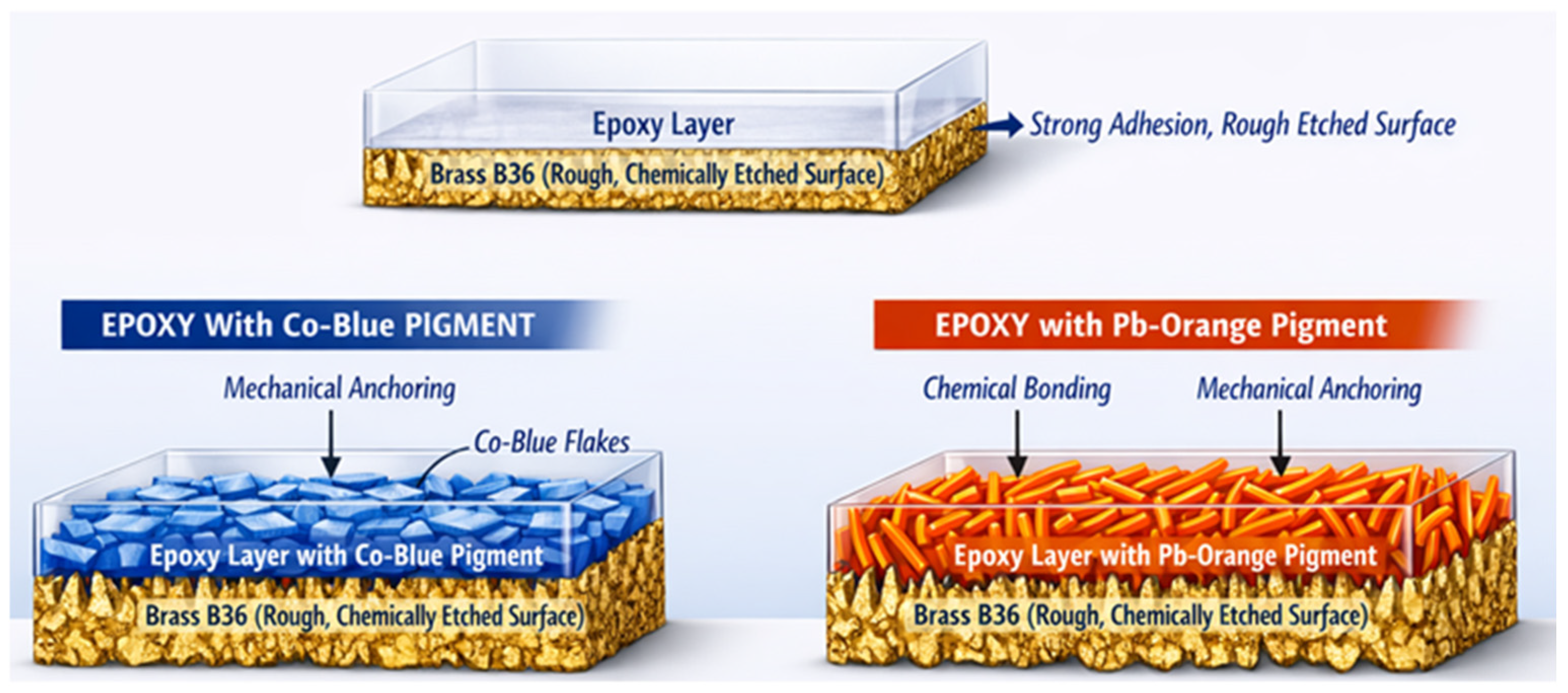
The mechanism of strong adhesion between an epoxy-based coating and a chemically etched brass substrate is shown in Figure 15. The Co-blue pigment particles are flake-shaped (Figure 4a,c) and lie parallel to the brass substrate. This irregular morphology of pigment particles enhances mechanical anchoring by fitting between the brass spikes (Figure 7a), moderately improving adhesion. The flakes also help distribute stress across the coating, reducing delamination. The Pb-orange pigment particles are rod-shaped (Figure 4b,d) and are likely embedded vertically or diagonally in the epoxy matrix. Their geometry enables chemical bonding with the brass surface and mechanical interlocking with the spikes. This dual mechanism results in very high adhesion, consistent with the experimental b values mentioned earlier in Table 3. It should be noted that the surface energy of brass is increased by chemical etching, and therefore, the contact surface for epoxy bonding is increased.
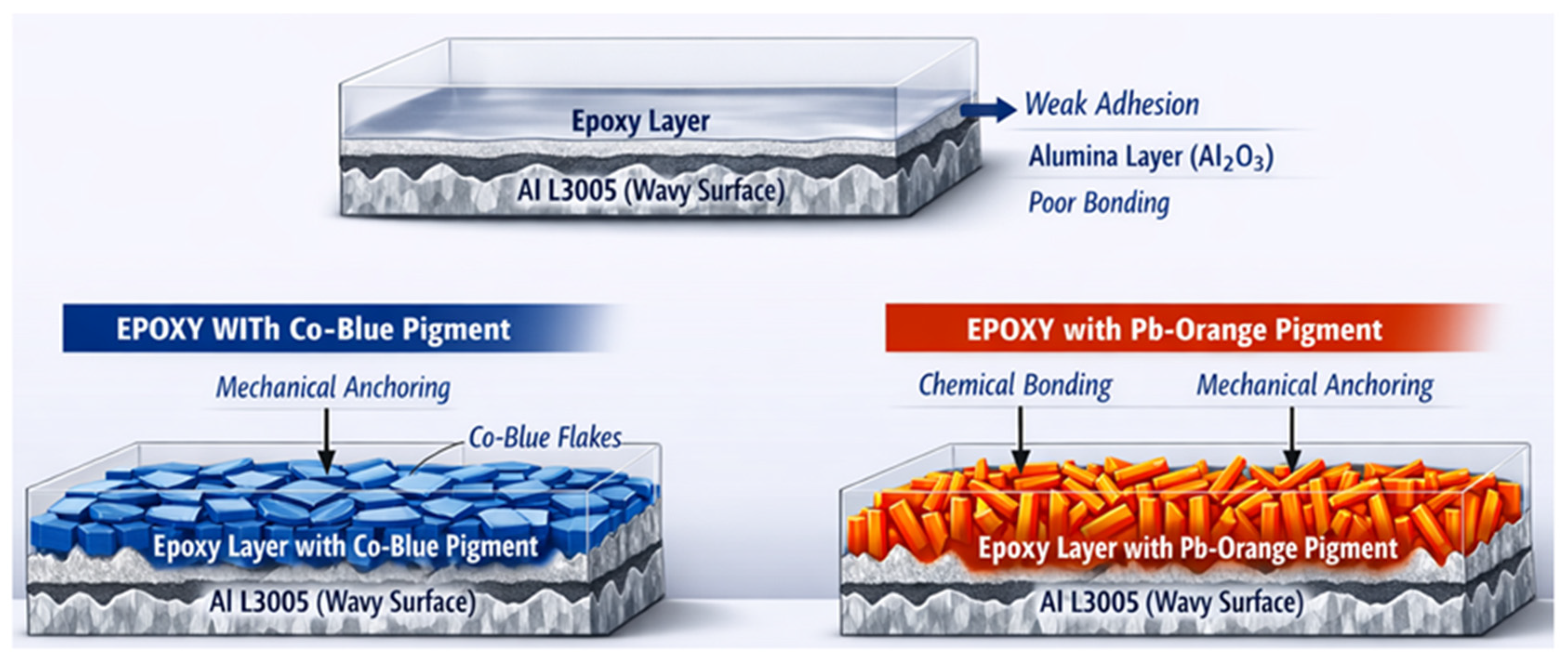
The poor adhesion between the epoxy and the aluminum substrate is due to the aluminum alloy’s lack of oxidation resistance, leading to a thin layer of aluminum oxide forming on the wavy surface (Figure 7b and Figure S1). The adhesion mechanism for the epoxy–aluminum system is shown in Figure 16. The very thin oxide layer on the aluminum substrate acts as a barrier, reducing direct chemical bonding between the epoxy-based coating and the Al-substrate. The Pb-orange pigment rods, particles, or needles penetrate deeper into the epoxy matrix and interact more effectively with the epoxy and thin oxide interlayer layer than Co-blue flakes. However, the geometry of the microparticles is not sufficiently influential on the macro-bulk topography of the Al-substrate to improve adhesion, which explains the low value of the parameter b.
Epoxy-based coatings on phosphor-bronze substrate exhibit moderate adhesion, with adhesion strength similar to that on the Al alloy. Although it is expected that the adhesion of epoxy to brass and bronze would be similar, since both substrates are copper alloys, this study did not confirm this. The reasons are as follows: Based on AFM analysis, bronze is a substrate with minimal roughness (Sa = 69.1 nm), and its wavy topography is more similar to Al-alloy than to etched brass. However, in this case as well, it was confirmed that the adhesion (expressed through the parameter b) of the epoxy coating improved with the addition of pigment particles: 3.7 times with Pb-orange pigment and 1.9 times with Co-blue pigment.

3.4. Wettability Properties of Epoxy-Based Coatings

In the field of powder-reinforced epoxy-based composite coatings, contact angle measurements provide a simple yet effective means of evaluating the interfacial characteristics between pigment particles (Co-blue and Pb-orange) and the epoxy matrix. These interfacial features were analyzed by measuring static contact angles on coating surfaces deposited onto three different substrates.
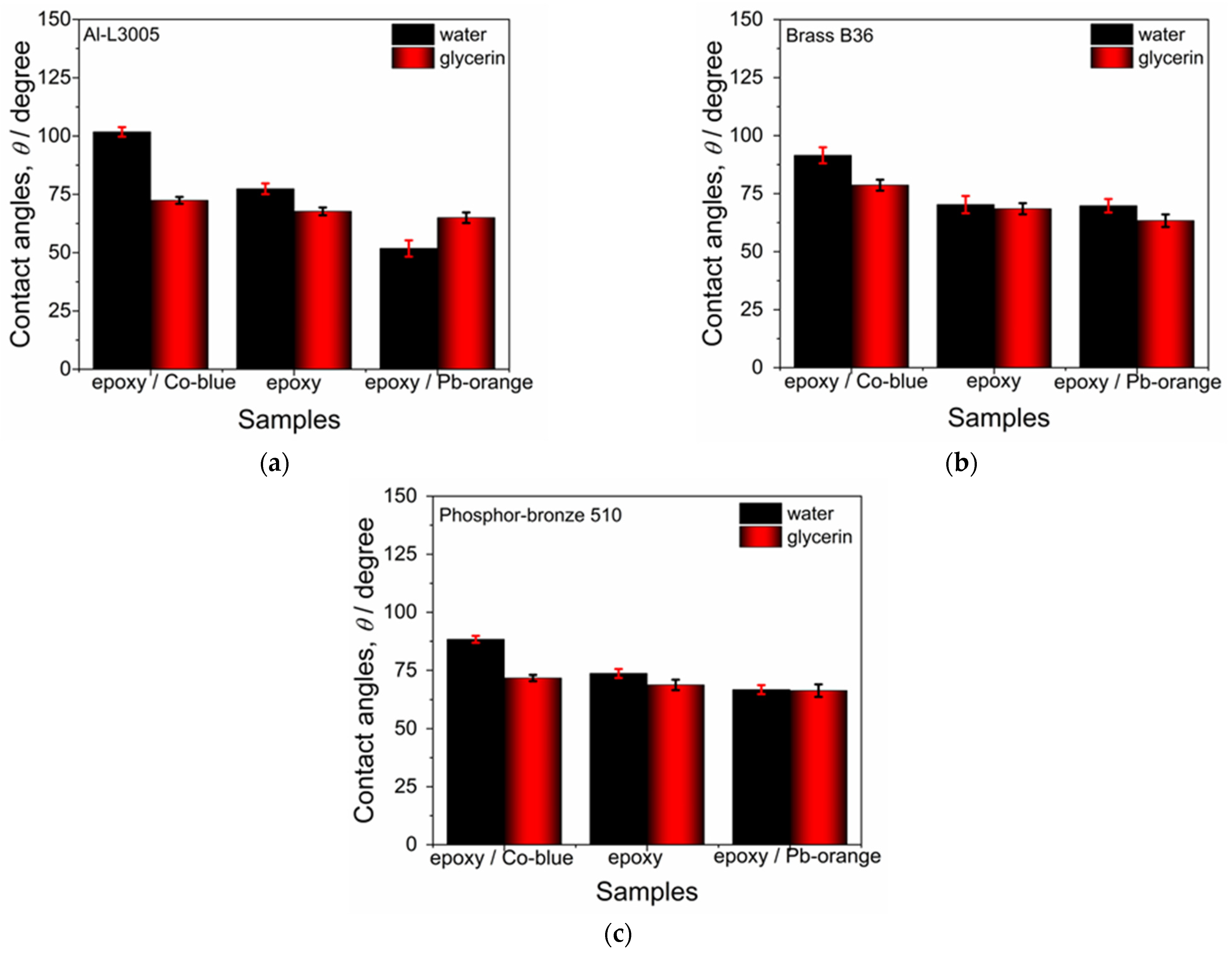
Figure 17 shows the measured water and glycerin contact angles with the standard deviation values. The contact angles were obtained for each substrate/epoxy coating surface: Figure 17a for epoxy-based coatings on Al L3005 substrate, Figure 17b for epoxy-brass B36, and Figure 17c for epoxy-phosphor bronze 510 composite systems.
Comparing the measured contact angles of water and glycerin on epoxy coatings with and without pigments, the contact angles of water are larger than those of glycerin on the epoxy surface. This indicates that water is less compatible with epoxy in terms of wetting, while glycerin exhibits stronger interaction and better wettability. The interaction between the polymer and water molecules alters the effective crosslink density as water seeps into the epoxy matrix. The relaxation time and molecular weight distribution both rise as a result [82].
The next observation concerns the effect of pigment type on the wetting behavior of epoxy-based composite coatings. Histogram trends show that coatings containing Co-blue pigment exhibit the highest resistance to wetting, reflected in elevated contact angle values and pronounced hydrophobicity. In contrast, pure epoxy displays moderate wetting properties, representing a transitional state toward full hydrophilicity, which is achieved upon the incorporation of Pb-orange pigment.
Particle morphology explains the variation in the wetting behavior of epoxy composite coatings with different pigments. The Pb-orange pigment with rod-like structure (see Figure 4b,d and Figure 12a,b) integrates more easily into the epoxy matrix, producing a compact surface rich in oxide groups (see Figure 11). This enhances polar interactions with water and reduces the contact angle, resulting in hydrophilic behavior (water contact angles of epoxy-based coatings are 51.79° on Al, 67.63° on brass and 66.80° on bronze). In contrast, the irregular cobalt-based (blue) pigment (see Figure 4a,c and Figure 12b,c) forms a multilayer barrier that lowers surface energy and reduces the availability of polar sites, making it more difficult for water droplets to wet the surface. Consequently, the epoxy/Pb-orange composite coatings become hydrophilic, while the epoxy/Co-blue composite exhibits hydrophobicity (rougher surface).
The substrate type and preparation method also affect the wetting of epoxy coatings. The contact angle of the epoxy coating is the highest on aluminum alloy, then lower on brass, and the lowest on phosphor bronze substrates, due to chemistry, surface energy, and substrate roughness [83,84]. Aluminum L3005 is covered by a stable native oxide layer (Al2O3), which is relatively inert and has lower surface energy [85]. Brass B36 is a copper–zinc alloy, and its surface contains oxides (CuO, ZnO) that are more polar than aluminum oxide [86]. This increases surface energy and allows better interaction with water. The bronze 510 contains copper and phosphorus, and its oxide layer (mainly Cu2O/CuO) is even more polar [87]. The presence of oxides increased hydrophilicity, water spreads more easily, and the samples showed the lowest contact angle.
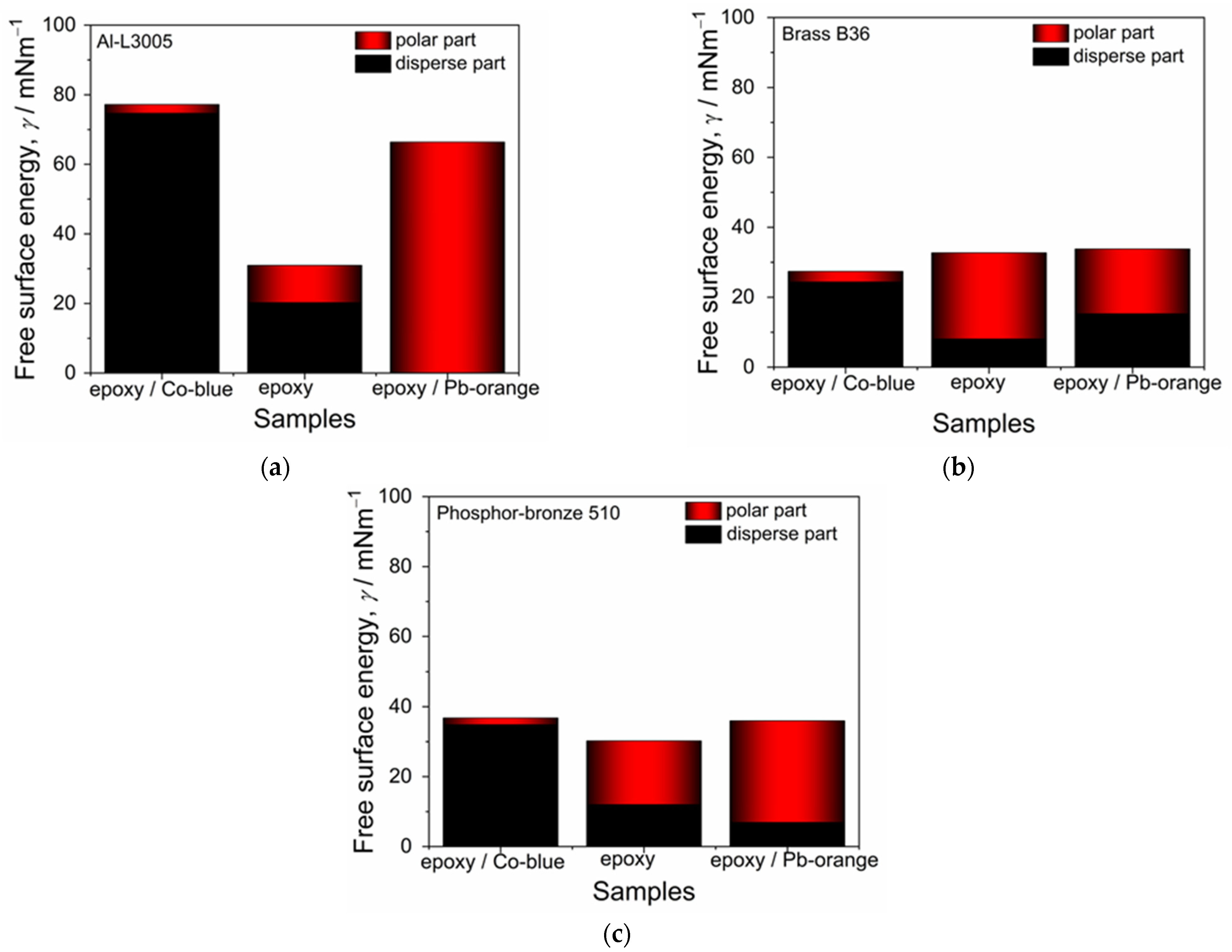
This leads to enhanced hydrophilicity, and water spreads more easily, and samples have the lowest contact angle. Also, the pigment type in the epoxy matrix and compatibility with oxide layers on the substrate surface dictated wetting features. The Co-blue pigment and Al2O3 on aluminum together created an inert, hydrophobic surface, while copper and zinc oxides increased polarity and reduced the contact angle. In conclusion, the wetting differences in epoxy/pigment composite coatings are influenced not only by particle shape but also by the chemical nature of the pigment, with cobalt pigments promoting hydrophobicity and lead pigments enhancing hydrophilicity. This will be further explained through surface energies in correlation with XRD analysis of pigment particles. Figure 18 shows the total surface energy values obtained for all epoxy coatings.
The static contact angles of water and glycerin were evaluated on different epoxy coatings, thereby determining the polar and dispersive components of the free surface energy based on Equation (S5). In general, two or more liquids are commonly used to determine free surface energy values. The fluids are water, ethanol, diiodomethane, and formamide, which have different surface tensions and different polar characteristics [88,89], but in this research, we used two polar liquids with different viscosities to avoid toxic diiodomethane and rapidly volatile ethanol.
From the results in Figure 18a, the epoxy-based coating with Co-blue pigment on the Al-L3005 substrate has the highest total free surface energy, with a very high dispersive component. The dominance of dispersive components (black area) indicates that the epoxy/Co-blue coating resists wetting by polar liquids, such as glycerin and water, thereby providing strong hydrophobicity. At the same time, the high total surface energy reflects good cohesion within the coating, which supports barrier performance and durability.
Epoxy coatings exhibit lower total surface energy on brass substrate (Figure 18b) due to the chemistry of the oxide layer on the substrate and its interaction with the epoxy, which has direct consequences on adhesion. However, comparing the values (Figure 18b,c) shows that the surface energy of epoxy coatings on these two substrates is similar. This is expected since both substrates are copper-based, just of different chemical composition.
Generally, adding Co-blue pigment to an epoxy matrix increases the dispersion component of the free surface energy. In contrast, Pb-orange pigment in an epoxy matrix reduces this component and increases the polar component of the surface energy. The primary factor affecting the surface energy of epoxy is the type of pigment, whereas the substrate type is less significant. However, as with any complex multicomponent system, the interactions cannot be considered in isolation, especially when the chemical composition of the pigment is similar to that of the substrate.
Based on the surface free energy and contact angle measurement on the surface of epoxy coatings and composite coatings with pigments, the work of adhesion, WA, for water and glycerin was calculated to evaluate interfacial interaction between all coatings and applied fluids based on the Young–Dupré equation [90]. The values for work of adhesion were given in Table 4. The surface tension for water (~72.2 mN/m at 25 °C) and for glycerin (~64.0 mN/m at 25 °) are taken from the literature [91].
A lower value of adhesion work to water WAwater was recorded for all epoxy coatings with Co-blue pigment. This indicates a weak interaction with water, meaning we synthesized a coating that is more resistant to wetting. There is no droplet spreading on such a surface. Coating of epoxy/Pb-orange pigment on Al-L3005 has a high value of adhesion work (~118 mN/m2), which shows a strong interaction with water and hydrophilicity. Regarding the adhesion to glycerin, epoxy/Co-blue on Al-L3005 has ~83 mN/m2, which is significantly higher than for water (~58 mN/m2), and indicates that the coating strongly interacts with glycerin rather than with water. In short, the data indicate that epoxy/Co-blue on aluminum (Figure 18a) is water-repellent but glycerin-wettable, meaning dispersive interactions dominate its surface energy profile.
Generally, a pure epoxy coating can be considered a moderate-wetting surface, representing a transition between a hydrophilic epoxy/Pb-orange coating and a hydrophobic epoxy/Co-blue coating.
Future research will focus on the thermo-mechanical, opto-electrical, and chemical-catalytic properties of composites in bulk epoxy form with varying pigments and numbers of layers, expanding understanding of their performance and creating opportunities for new applications as sandwich composite structures [92,93].

4. Conclusions

In this study, cobalt blue (CoAl2O4) and chrome orange (PbCrO4·Pb(OH)2) pigment particles were synthesized via precipitation followed by calcination. These synthesis methods yielded particles with distinct features, including differences in size, morphology, coloration, chemical composition, and compatibility with epoxy resins. Composite coatings containing epoxy resin and 3 wt.% pigment particles were then prepared using a drop-spinning process and applied to brass, aluminum, and bronze substrates. The characterization results revealed the following:
  • Microparticles of Co-blue pigment showed granular size in the range of 0.1–5 µm, with nano-scale crystallites decorating their surfaces. This hierarchical structure enhances color intensity, stability, and dispersibility in the epoxy coating. The Pb-orange pigment forms smooth rod- or needle-like forms, typically 100–500 nm in diameter and 1–5 µm long, often hollow at the ends. Both synthesized pigments are highly crystalline, which was confirmed by XRD analysis.
  • The hardest substrate is brass (1.5505 GPa), and the softest is the AL-alloy (283.9 MPa), while the roughness parameter is smallest for the phosphor bronze substrate (69.1 nm).
  • The maximum composite hardness of the epoxy coating was achieved on chemically etched brass foil (242.56 MPa), while the minimum hardness was shown by the pure epoxy coating on the aluminum alloy (32.165 MPa). All coatings with epoxy/Pb-orange pigment are harder than those with Co-blue pigment, while the pure epoxy matrix shows the lowest hardness on all substrates.
  • The modified brass substrate shows the optimal substrate for the deposition of epoxy-based coatings. The addition of Pb-orange pigment increases the adhesion strength of epoxy on all substrates: 44.5% on brass, 92.8% on Al L3005, and 73.3% on bronze. The epoxy coatings with Co-blue pigment show the following improvements of adhesion parameter b over the pure epoxy matrix: 25.5% on brass, 14.1% on AL L3005, and 47.1% on bronze.
  • The intrinsic hardness of epoxy-based coatings does not change significantly with the addition of pigment particles, indicating that the type of substrate has a dominant effect on the composite hardness of epoxy-based coatings. Both hardness values (Hc and Hi) are sensitive to variations in coating thickness.
  • The pigments significantly influence the wettability of epoxy-based coatings. While pure epoxy and epoxy/Pb-orange coatings exhibited hydrophilic behavior, promoting water affinity, the epoxy/Co-blue coatings showed hydrophobic character, resisting water interaction.
  • The Co-blue pigment increases the dispersion component of epoxy’s surface energy. In contrast, Pb-orange pigment decreases it and enhances the polar component, showing that pigment type is the dominant factor in surface energy modification.
This outcome highlights that beyond aesthetic differences, pigment incorporation can alter the surface chemistry and functional performance of coatings (adhesion), making pigment (color) choice a critical factor in tailoring material properties.

Supplementary Materials

The following supporting information can be downloaded at: https://www.mdpi.com/article/10.3390/coatings16050584/s1, Figure S1: FE-SEM and EDS mapping layered image of epoxy matrix on Al alloy substrate: (a) cross-section, (b) mapping of cross-section with individual elements: (c) Al, (d) C, and (e) O; Figure S2: EDS spectrum of an epoxy coating deposited on a aluminium substrate without pigmentation; Figure S3: FE-SEM and EDS mapping layered image of epoxy matrix on brass substrate: (a) cross-section, (b) mapping of cross-section with individual elements: (c) Zn, (d) O, and (e) C, and (f) Cu; Figure S4: EDS spectrum of an epoxy coating deposited on a brass substrate without pigment; Figure S5: FE-SEM analysis of the epoxy-based coatings on surface, spin-coated on a phosphor-bronze 510 substrate: (a) neat epoxy coatings, (b) epoxy coating with 3 wt.% Co-blue pigment, and (c), epoxy coating with 3 wt.% Pb-orange pigment; Table S1: The chemical composition of the substrate.

Author Contributions

Conceptualization, I.O.M. and R.J.H.; methodology, I.O.M., M.M.V. and D.G.V.-R.; J.L.; software, M.M.V. and D.G.V.-R.; validation, R.J.H., D.G.V.-R. and J.L.; formal analysis, N.N., M.Ž.M.B. and M.M.V.; investigation, N.N. and M.Ž.M.B.; resources, I.O.M., M.M.V. and R.J.H.; data curation, M.M.V., I.O.M. and D.G.V.-R.; writing—original draft preparation, N.N., I.O.M. and R.J.H.; writing—review and editing, all authors; visualization, M.M.V. and I.O.M.; supervision, R.J.H., J.L. and D.G.V.-R.; project administration, R.J.H.; funding acquisition, I.O.M., M.M.V. and R.J.H. All authors have read and agreed to the published version of the manuscript.

Funding

This research was funded by the Ministry of Science, Technological Development and Innovation of the Republic of Serbia (Contracts Nos. 451-03-34/2026-03/200135, 451-03-33/2026-03/200026, and 451-03-33/2026-03/200017).

Institutional Review Board Statement

Not applicable for studies not involving humans or animals.

Informed Consent Statement

Not applicable.

Data Availability Statement

The data presented in this study are available on request from the corresponding author or co-authors. The data are not publicly available.

Acknowledgments

During the preparation of this manuscript, Željko Radovanović from the Faculty of Technology and Metallurgy, University of Belgrade, used FE-SEM/EDS instruments for the characterization of the obtained pigments and epoxy-based coatings. Rastko Vasilić from the Faculty of Physics, University of Belgrade, performed the XRD analysis of pigments. The authors thank colleagues for their assistance.

Conflicts of Interest

The authors declare no conflicts of interest.

Abbreviations

The following abbreviations are used in this manuscript:
C-GChen–Gao
FTIRFourier-Transform Infrared Spectroscopy
FE-SEMField-emission scanning electron microscopy
XRDX-ray diffraction
AFMAtomic Force Microscopy

References

  1. Jin, F.-L.; Li, X.; Park, S.-J. Synthesis and Application of Epoxy Resins: A Review. J. Ind. Eng. Chem. 2015, 29, 1–11. [Google Scholar] [CrossRef]
  2. Capricho, J.C.; Fox, B.; Hameed, N. Multifunctionality in Epoxy Resins. Polym. Rev. 2020, 60, 1–41. [Google Scholar] [CrossRef]
  3. Ogundana, T.O.; Oginni, O.T.; Onuh, F.A.; Morawo, J.; Olagonju, M.O. Characterization of Epoxy Resin Matrix Reinforced with Silica Nanoparticles for Enhanced Mechanical Performance. FUW Trends Sci. Technol. J. 2024, 9, 057–063. [Google Scholar]
  4. Collado, I.; Vázquez-López, A.; Jiménez-Suárez, A.; Prolongo, S.G. Multifunctional Sequential Dual Curing Electroactive Graphene Nanocomposites: Self-Heating, de-Icing and in-Situ Curing. Compos. Part B Eng. 2025, 307, 112911. [Google Scholar] [CrossRef]
  5. Jin, R.; Xu, B.; Guo, D.; Shi, B.; Chen, Y.; Jia, X.; Qu, L. Advanced Chemical Modification Technology of Inorganic Oxide Nanoparticles in Epoxy Resin and Mechanical Properties of Epoxy Resin Nanocomposites: A Review. Nano Mater. Sci. 2025, 7, 643–664. [Google Scholar] [CrossRef]
  6. Parvizi, P.; Jalilian, M.; Dearn, K.D. Epoxy Composites Reinforced with Nanomaterials and Fibres: Manufacturing, Properties, and Applications. Polym. Test. 2025, 146, 108761. [Google Scholar] [CrossRef]
  7. Ilangovan, S.; Kumaran, S.S.; Vasudevan, A.; Naresh, K. Effect of Silica Nanoparticles on Mechanical and Thermal Properties of Neat Epoxy and Filament Wounded E-Glass/Epoxy and Basalt/Epoxy Composite Tubes. Mater. Res. Express 2019, 6, 0850e2. [Google Scholar] [CrossRef]
  8. Białkowska, A.; Bakar, M.; Kucharczyk, W.; Zarzyka, I. Hybrid Epoxy Nanocomposites: Improvement in Mechanical Properties and Toughening Mechanisms—A Review. Polymers 2023, 15, 1398. [Google Scholar] [CrossRef]
  9. Gürses, A.; Açıkyıldız, M.; Güneş, K.; Gürses, M.S. Dyes and Pigments: Their Structure and Properties. In SpringerBriefs in Molecular Science; Springer: Berlin/Heidelberg, Germany, 2016; pp. 13–29. [Google Scholar]
  10. Völz, H.G.; Kischkewitz, J.; Woditsch, P.; Westerhaus, A.; Griebler, W.-D.; De Liedekerke, M.; Buxbaum, G.; Printzen, H.; Mansmann, M.; Räde, D.; et al. Pigments, Inorganic. In Ullmann’s Encyclopedia of Industrial Chemistry; Wiley-VCH Verlag GmbH & Co. KGaA: Weinheim, Germany, 2006. [Google Scholar]
  11. Lee, H.B.; Yoo, Y.M.; Han, Y.-H. Characteristic Optical Properties and Synthesis of Gold–Silica Core–Shell Colloids. Scr. Mater. 2006, 55, 1127–1129. [Google Scholar] [CrossRef][Green Version]
  12. Gholami, T.; Salavati-Niasari, M.; Varshoy, S. Investigation of the Electrochemical Hydrogen Storage and Photocatalytic Properties of CoAl2O4 Pigment: Green Synthesis and Characterization. Int. J. Hydrogen Energy 2016, 41, 9418–9426. [Google Scholar] [CrossRef]
  13. Enríquez, E.; Reinosa, J.J.; Fuertes, V.; Fernández, J.F. Advances and Challenges of Ceramic Pigments for Inkjet Printing. Ceram. Int. 2022, 48, 31080–31101. [Google Scholar] [CrossRef]
  14. Morán-Lázaro, J.P.; Blanco, O.; Rodríguez-Betancourtt, V.M.; Reyes-Gómez, J.; Michel, C.R. Enhanced CO2-Sensing Response of Nanostructured Cobalt Aluminate Synthesized Using a Microwave-Assisted Colloidal Method. Sens. Actuators B Chem. 2016, 226, 518–524. [Google Scholar] [CrossRef]
  15. Farrokhpay, S.; Morris, G.E.; Fornasiero, D.; Self, P. Influence of Polymer Functional Group Architecture on Titania Pigment Dispersion. Colloids Surf. A Physicochem. Eng. Asp. 2005, 253, 183–191. [Google Scholar] [CrossRef]
  16. Zhang, K.; Zhang, Y.; Ye, M.; Han, A.; Chen, X. Preparation and Characterization of Multi-Component Composite Microspheres Used for Ceramic Toner. Ceram. Int. 2019, 45, 24601–24608. [Google Scholar] [CrossRef]
  17. Nwokolo, I.K.; Shi, H.; Liu, F. MOF-Based Protective Coatings for Metal Corrosion Protection: A Critical Review of Design/Synthesis, Performance, and Mechanism. Mater. Sci. Eng. B 2025, 313, 117932. [Google Scholar] [CrossRef]
  18. Amune, U.O.; Solomon, M.M.; Hu, D.; He, J.; Tesema, F.B.; Umoren, S.A.; Gerengi, H. A Comprehensive Review of Stimulus-Based Smart Self-Healing Coatings for Substrate Protection. Prog. Org. Coat. 2026, 210, 109669. [Google Scholar] [CrossRef]
  19. Gharieh, A.; Sharifian, A.; Dadkhah, S. Enhanced Long-Term Corrosion Resistance and Self-Healing of Epoxy Coating with HQ-Zn-PA Nanocomposite. Sci. Rep. 2025, 15, 8154. [Google Scholar] [CrossRef]
  20. Chopra, I.; Ola, S.K.; Priyanka; Dhayal, V.; Shekhawat, D.S. Recent Advances in Epoxy Coatings for Corrosion Protection of Steel: Experimental and Modelling Approach-A Review. Mater. Today Proc. 2022, 62, 1658–1663. [Google Scholar] [CrossRef]
  21. Fekiač, J.J.; Krbata, M.; Kohutiar, M.; Janík, R.; Kakošová, L.; Breznická, A.; Eckert, M.; Mikuš, P. Comprehensive Review: Optimization of Epoxy Composites, Mechanical Properties, & Technological Trends. Polymers 2025, 17, 271. [Google Scholar] [CrossRef]
  22. Antony Jose, S.; Lapierre, Z.; Williams, T.; Hope, C.; Jardin, T.; Rodriguez, R.; Menezes, P.L. Wear- and Corrosion-Resistant Coatings for Extreme Environments: Advances, Challenges, and Future Perspectives. Coatings 2025, 15, 878. [Google Scholar] [CrossRef]
  23. Hare, C.H. Corrosion Control of Steel by Organic Coatings. In Uhlig’s Corrosion Handbook; Wiley: Hoboken, NJ, USA, 2011; pp. 971–983. [Google Scholar]
  24. Mi, X.; Liang, N.; Xu, H.; Wu, J.; Jiang, Y.; Nie, B.; Zhang, D. Toughness and Its Mechanisms in Epoxy Resins. Prog. Mater. Sci. 2022, 130, 100977. [Google Scholar] [CrossRef]
  25. Kalenda, P. Improved Chemical Resistance of Epoxy Resin-Based Coating Compositions. Dye. Pigment. 1995, 27, 305–312. [Google Scholar] [CrossRef]
  26. Ramakrishnan, T.; Raja Karthikeyan, K.; Tamilselvan, V.; Sivakumar, S.; Gangodkar, D.; Radha, H.R.; Narain Singh, A.; Asrat Waji, Y. Study of Various Epoxy-Based Surface Coating Techniques for Anticorrosion Properties. Adv. Mater. Sci. Eng. 2022, 2022, 5285919. [Google Scholar] [CrossRef]
  27. Tomić, N.Z.; Saleh, M.N.; Vuksanović, M.M.; Egelja, A.; Obradović, V.; Marinković, A.; Jančić Heinemann, R. Tailored Adhesion Properties of Acrylate Adhesives on Al Alloys by the Addition of Mn-Al–LDH. Polymers 2021, 13, 1525. [Google Scholar] [CrossRef]
  28. Algellai, A.A.; Tomić, N.; Vuksanović, M.M.; Dojčinović, M.; Volkov-Husović, T.; Radojević, V.; Heinemann, R.J. Adhesion Testing of Composites Based on Bis-GMA/TEGDMA Monomers Reinforced with Alumina Based Fillers on Brass Substrate. Compos. Part B Eng. 2018, 140, 164–173. [Google Scholar] [CrossRef]
  29. Altwair, K.; Vuksanović, M.M.; Mladenović, I.O.; Heinemann, R.J. Development of PMMA–Silica–Alumina Nanocomposites for Enhanced Performance. Polym. Polym. Compos. 2026, 34, 09673911251414228. [Google Scholar] [CrossRef]
  30. Wang, K.; Li, J.; Yi, Y.; Lv, B.; Wu, Y.; Wang, C.; Li, H.; Li, Y.; Liu, Y.; Cai, X.; et al. Polyamine-Activated Carbonyl Stress Strategy for Oxidative Damage Therapy. Nano Today 2022, 42, 101355. [Google Scholar] [CrossRef]
  31. Wang, H.; Yan, Y.; Tian, L.; Li, X.; Yang, Y.; Niu, L.; Li, X.; Zhang, Z. High Content of Spherical Nanosilica Filled Epoxy Resin Master Batch with Low Viscosity and Superior Thermomechanical Performance. Compos. Commun. 2022, 36, 101355. [Google Scholar] [CrossRef]
  32. Available online: https://www.webexhibits.org/pigments/indiv/overview/crorange.html (accessed on 7 May 2026).
  33. Available online: http://www.seilnacht.tuttlingen.com (accessed on 7 May 2026).
  34. Available online: https://www.webexhibits.org/pigments/indiv/recipe/crorange.html (accessed on 7 May 2026).
  35. Habashi, F. Pigments through the Ages. Interceram—Int. Ceram. Rev. 2016, 65, 156–165. [Google Scholar] [CrossRef]
  36. Robert, L. Feller Artists’ Pigments: A Handbook of Their History and Characteristics; Cambridge University Press: London, UK, 1986; ISBN 9780521303743. [Google Scholar]
  37. Available online: https://www.metallography.com (accessed on 7 May 2026).
  38. Luo, J.; Liu, J.; Xia, H.; Ao, X.; Yin, H.; Guo, L. Surface Treatments for Enhancing the Bonding Strength of Aluminum Alloy Joints. Materials 2023, 16, 5674. [Google Scholar] [CrossRef]
  39. Lee, S.; Cho, Y.J. Phosphoric Acid Anodizing Effect on Morphology and Corrosion Resistance of Nanostructured Anodic Oxide Layers on 6061 Aluminum Alloy. Met. Mater. Int. 2025, 31, 2598–2608. [Google Scholar] [CrossRef]
  40. Chen, Z.; Yang, Y.; Lou, H.; Wang, H.; Xiang, C. Effects of the Grain Size, Boundary Type and Texture on the Bending Properties of Phosphorus Bronze Strips. Mater. Charact. 2025, 225, 115090. [Google Scholar] [CrossRef]
  41. Broitman, E. Indentation Hardness Measurements at Macro-, Micro-, and Nanoscale: A Critical Overview. Tribol. Lett. 2017, 65, 23. [Google Scholar] [CrossRef]
  42. Petrík, J.; Blaško, P.; Markulík, Š.; Šolc, M.; Palfy, P. The Indentation Size Effect (ISE) of Metals. Crystals 2022, 12, 795. [Google Scholar] [CrossRef]
  43. Magagnin, L.; Maboudian, R.; Carraro, C. Adhesion Evaluation of Immersion Plating Copper Films on Silicon by Microindentation Measurements. Thin Solid Film. 2003, 434, 100–105. [Google Scholar] [CrossRef]
  44. Magagnin, L.; Cojocaru, P.; Raygani, A.; Brivio, D.; Secundo, F.; Turolla, A.; Ottolina, G. Galvanic Displacement of Nanostructured Gold for Flavoenzyme Adsorption in Biotechnology. ECS Trans. 2011, 33, 59–66. [Google Scholar] [CrossRef]
  45. Ou, J.F.; Amirfazli, A.; Chini, S.F. The Sessile Drop Work of Adhesion Revisited. Int. J. Adhes. Adhes. 2025, 136, 103872. [Google Scholar] [CrossRef]
  46. Zukiene, K.; Monastyreckis, G.; Kilikevicius, S.; Procházka, M.; Micusik, M.; Omastová, M.; Aniskevich, A.; Zeleniakiene, D. Wettability of MXene and Its Interfacial Adhesion with Epoxy Resin. Mater. Chem. Phys. 2021, 257, 123820. [Google Scholar] [CrossRef]
  47. Royaux, A.; El Haitami, A.; Fichet, O.; Cantin, S. Surface Free-Energy Determination of Copper Wire Using a Large Range of Model Liquids. SN Appl. Sci. 2020, 2, 48. [Google Scholar] [CrossRef]
  48. Sagar, R.; Gaur, M.S.; Kushwah, V.; Rathore, A.; Piliptsou, D.G.; Rogachev, A.A. Preparation, Characterization and Microhardness Measurements of Hybrid Nanocomposites Based on PMMA + P(VDF–TrFE) and Graphene Oxide. Polym. Bull. 2021, 78, 7279–7300. [Google Scholar] [CrossRef]
  49. Embirsh, H.S.A.; Mladenović, I.O.; Radojević, V.; Marinković, A.; Vuksanović, M.M. Evaluation of Surface Properties in Biosilica-Reinforced Biobased Polyester Nanocomposites. Appl. Sci. 2025, 15, 9244. [Google Scholar] [CrossRef]
  50. Huhtamäki, T.; Tian, X.; Korhonen, J.T.; Ras, R.H.A. Surface-Wetting Characterization Using Contact-Angle Measurements. Nat. Protoc. 2018, 13, 1521–1538. [Google Scholar] [CrossRef]
  51. Mohamed, S.S.M.; Vuksanović, M.M.; Vasiljević-Radović, D.G.; Janković Mandić, L.; Jančić Heinneman, R.M.; Marinković, A.D.; Mladenović, I.O. Sol–Gel Derived Alumina Particles for the Reinforcement of Copper Films on Brass Substrates. Gels 2024, 10, 648. [Google Scholar] [CrossRef]
  52. Jasper, S.; Subash, R.; Muthuneelakandan, K.; Vijayakumar, D.; Jhansi Ida, S. The Mechanical Properties of Brass Alloys: A Review. Eng. Proc. 2025, 93, 11. [Google Scholar]
  53. Chang, S.C.; Jahn, M.T.; Wan, C.M.; Lee, J.Y.M.; Hsu, T.K. The Determination of Tensile Properties from Hardness Measurements for Al-Zn-Mg Alloys. J. Mater. Sci. 1976, 11, 623–630. [Google Scholar] [CrossRef]
  54. Yang, K.; Fu, Z.H.; Chen, H.; Wang, X.; Liu, B. Micro-Indentation Analysis of Aluminium Alloys: Simultaneous Evaluation of Tensile Properties and Hardness Characterisation via Knoop Indentation. Nondestruct. Test. Eval. 2026, 1–21. [Google Scholar] [CrossRef]
  55. Mladenović, I.O.; Lamovec, J.S.; Vasiljević Radović, D.G.; Vasilić, R.; Radojević, V.J.; Nikolić, N.D. Morphology, Structure and Mechanical Properties of Copper Coatings Electrodeposited by Pulsating Current (PC) Regime on Si(111). Metals 2020, 10, 488. [Google Scholar] [CrossRef]
  56. Chen, M.; Gao, J. The Adhesion of Copper Films Coated on Silicon and Glass Substrates. Mod. Phys. Lett. B 2000, 14, 103–108. [Google Scholar] [CrossRef]
  57. Hou, Q.R.; Gao, J.; Li, S.J. Adhesion and Its Influence on Micro-Hardness of DLC and SiC Films. Eur. Phys. J. B 1999, 8, 493–496. [Google Scholar] [CrossRef]
  58. He, J.L. Hardness Measurement of Thin Films: Separation from Composite Hardness. Appl. Phys. Lett. 1996, 25, 2002. [Google Scholar] [CrossRef]
  59. Rajabi, M.; Kharaziyan, P.; Montazeri-Pour, M. Microwave-Assisted Processing of Cobalt Aluminate Blue Nano-Ceramic Pigment Using Sol–Gel Method. J. Aust. Ceram. Soc. 2019, 55, 219–227. [Google Scholar] [CrossRef]
  60. Horsth, D.F.L.; de O. Primo, J.; Anaissi, F.J.; Umek, P.; Bittencourt, C. Sustainable Near-Infrared Reflective Blue Pigments: Recycled Aluminum from Can Seals for Cobalt Aluminates in Cool Coatings. Colorants 2024, 3, 253–262. [Google Scholar] [CrossRef]
  61. Barbar, S.K. Structural, Optical and Luminescence Characteristics of a Novel Blue Pigment Ba2CaCo2Si6O17. J. Coat. Technol. Res. 2025, 23, 993–1000. [Google Scholar] [CrossRef]
  62. Zhang, W.; Li, Z.; Wu, G.; Wu, W.; Zeng, H.; Jiang, H.; Zhang, W.; Wu, R.; Xue, Q. Effects of Coloration of Spinel CoAl2O4 Cobalt Blue Pigments: Composition, Structure, and Cation Distribution. Inorganics 2023, 11, 368. [Google Scholar] [CrossRef]
  63. Ghazitabar, A.; Ataeefard, M.; Moradi, Z.; Naderi, M. Influence of the Chemistry and Morphology of Recycled Iron Oxide Pigments on the Colorimetric Properties of Flexographic Ink. J. Mater. Cycles Waste Manag. 2025, 27, 4641–4654. [Google Scholar] [CrossRef]
  64. Liu, M.; Jia, Z.; Li, P.; Liu, Y.; Zhao, M.; Yang, Y.; Huang, Q.; Yu, C. High Catalytic Activity of Fe3−xCuxO4/Graphene Oxide (0 ≤ x ≤ 0.1) Nanocomposites as Heterogeneous Fenton Catalysts for p-Nitrophenol Degradation. Water Air Soil Pollut. 2019, 230, 64. [Google Scholar] [CrossRef]
  65. Yap, F.Y.; Berkes, J.L.; Knuttinen, M.G.; Walzer, N.M.; Cotler, S.J.; Owens, C.A.; Bui, J.T.; Gaba, R.C. Quantitative Morphometric Analysis of Hepatocellular Carcinoma: Programmed Algorithm Development and Preliminary Application. Diagn. Interv. Radiol. 2012, 19, 97–105. [Google Scholar] [CrossRef]
  66. Kudekar, V.P.; Rane, B.R.; Jain, A.S.; Kothawade, S.N. Characterization Techniques for Polymer Nanocomposites. In Polymer Nanocomposites; Springer Nature: Cham, Switzerland, 2026; pp. 139–159. [Google Scholar]
  67. Allen, T. Particle Size Measurement: Volume 1–Powder Sampling and Particle Size Measurement; Springer: Dordrecht, The Netherlands, 1997. [Google Scholar] [CrossRef]
  68. ISO 9276-1:1998; Representation of Results of Particle Size Analysis—Part 1: Graphical Representation. International Organization for Standardization: Geneva, Switzerland, 1998.
  69. Merkus, H.G. Particle Size Measurements; Particle Technology Series; Springer: Dordrecht, The Netherlands, 2009; Volume 17, ISBN 978-1-4020-9015-8. [Google Scholar]
  70. Mrkwitschka, P.; Abram, S.-L.; Rühle, B.; Hodoroaba, V.-D. Understanding Correlative Electron Microscopy Imaging with SEM, STEM-in-SEM and TEM for the Accurate Characterization of Size and Shape of Iron Oxide Nanoparticles. Microsc. Microanal. 2024, 30, ozae044.339. [Google Scholar] [CrossRef]
  71. Pfaff, G. Iron Oxide Pigments. Phys. Sci. Rev. 2021, 6, 535–548. [Google Scholar] [CrossRef]
  72. Zhang, W.; Li, J.; Zhong, F.; Wu, G.; Jiang, H.; Zhang, W.; Liu, Q. Preparation and Characterization of Supercritical Fluid—Fried (CoAl2O4) Cobalt Blue Nano-Pigment. J. Asian Ceram. Soc. 2022, 10, 33–39. [Google Scholar] [CrossRef]
  73. Zavalij, P.Y.; Pecharsky, V.K. Fundamentals of Powder Diffraction and Structural Characterization of Materials; Springer Nature: Cham, Switzerland, 2025; ISBN 978-3-031-91503-1. [Google Scholar]
  74. Zhiani, R.; Es-haghi, A.; Sadeghzadeh, S.M.; Shamsa, F. Green Synthesis of PbCrO 4 Nanostructures Using Gum of Ferula Assa-Foetida for Enhancement of Visible-Light Photocatalytic Activity. RSC Adv. 2018, 8, 40934–40940. [Google Scholar] [CrossRef]
  75. Kaiser, M.; Wosylus, A.; Gerke, B.; Pöttgen, R.; Prokeš, K.; Ruck, M.; Doert, T. Crystal Growth and Structure Determination of Pigment Orange 82. Z. Anorg. Allg. Chem. 2019, 645, 564–569. [Google Scholar] [CrossRef]
  76. Mahmoudian, M.; Goharpey, F.; Behzadnasab, M.; Daneshfar, Z. Shear Thickening and Hysteresis in Dense Suspensions: The Effect of Particle Shape. J. Rheol. 2024, 68, 479–490. [Google Scholar] [CrossRef]
  77. Nikolic, G.; Zlatkovic, S.; Cakic, M.; Cakic, S.; Lacnjevac, C.; Rajic, Z. Fast Fourier Transform IR Characterization of Epoxy GY Systems Crosslinked with Aliphatic and Cycloaliphatic EH Polyamine Adducts. Sensors 2010, 10, 684–696. [Google Scholar] [CrossRef]
  78. Zhang, W.; Fina, A.; Ferraro, G.; Yang, R. FTIR and GCMS Analysis of Epoxy Resin Decomposition Products Feeding the Flame during UL 94 Standard Flammability Test. Application to the Understanding of the Blowing-out Effect in Epoxy/Polyhedral Silsesquioxane Formulations. J. Anal. Appl. Pyrolysis 2018, 135, 271–280. [Google Scholar] [CrossRef]
  79. Zhang, A.; Mu, B.; Wang, X.; Wang, A. CoAl2O4/Kaoline Hybrid Pigment Prepared via Solid-Phase Method for Anticorrosion Application. Front. Chem. 2018, 6, 586. [Google Scholar] [CrossRef]
  80. Ngasoh, O.F.; Anye, V.C.; Ojo, E.B.; Stanislas, T.T.; Bello, A.; Agyei-Tuffour, B.; Orisekeh, K.; Oyewole, O.K.; Rahbar, N.; Soboyejo, W.O. Mechanical Properties of Epoxy/Clay Composite Coatings on an X65 Steel Substrate. Cogent Eng. 2021, 8, 1944015. [Google Scholar] [CrossRef]
  81. Collado, I.; Vázquez-López, A.; Jiménez-Suárez, A.; Prolongo, S.G. Dual-Curing MWCNT Nanocomposites for Energy-Efficient Electroactive Shape Memory and In-Situ Processing. Chem. Eng. J. 2025, 515, 163471. [Google Scholar] [CrossRef]
  82. Bratasyuk, N.A.; Latyshev, A.V.; Zuev, V.V. Water in Epoxy Coatings: Basic Principles of Interaction with Polymer Matrix and the Influence on Coating Life Cycle. Coatings 2023, 14, 54. [Google Scholar] [CrossRef]
  83. Gong, J.; Wei, H.; Hao, P.; Li, S.; Zhao, X.; Tang, Y.; Zuo, Y. Study on the Influence of Metal Substrates on Protective Performance of the Coating by EIS. Materials 2024, 17, 378. [Google Scholar] [CrossRef]
  84. van den Brand, J.; Van Gils, S.; Beentjes, P.C.J.; Terryn, H.; Sivel, V.; de Wit, J.H.W. Improving the Adhesion between Epoxy Coatings and Aluminium Substrates. Prog. Org. Coat. 2004, 51, 339–350. [Google Scholar] [CrossRef]
  85. Rodič, P.; Kapun, B.; Milošev, I. Superhydrophobic Aluminium Surface to Enhance Corrosion Resistance and Obtain Self-Cleaning and Anti-Icing Ability. Molecules 2022, 27, 1099. [Google Scholar] [CrossRef]
  86. Wiame, F.; Salgin, B.; Swiatowska-Mrowiecka, J.; Maurice, V.; Marcus, P. Brass Surface Nanochemistry: The Role of Alloying Cu with Zn. J. Phys. Chem. C 2008, 112, 7540–7543. [Google Scholar] [CrossRef]
  87. Giuliani, C.; Pascucci, M.; Riccucci, C.; Messina, E.; Salzano de Luna, M.; Lavorgna, M.; Ingo, G.M.; Di Carlo, G. Chitosan-Based Coatings for Corrosion Protection of Copper-Based Alloys: A Promising More Sustainable Approach for Cultural Heritage Applications. Prog. Org. Coat. 2018, 122, 138–146. [Google Scholar] [CrossRef]
  88. Huang, F.; Wei, Q.; Wang, X.; Xu, W. Dynamic Contact Angles and Morphology of PP Fibres Treated with Plasma. Polym. Test. 2006, 25, 22–27. [Google Scholar] [CrossRef]
  89. Kim, J.-H.; Shin, P.-S.; Kwon, D.-J. Evaluation of Static and Dynamic Contact Angle Methods for Their Correlation with Interfacial Properties in Composites. Adv. Ind. Eng. Chem. 2025, 1, 16. [Google Scholar] [CrossRef]
  90. Hanh, V.T.H.; Truong, M.X.; Ha, C.V.; Thuy, N.T.M.; Do, T.C.; Ha, D.T.; Thuy, T.G.T.; Hien, N.T.T.; Nguyen, T.-B. Evaluating the Morphology Contribution and Modeling of Solidification Time for Icephobic Surface Design. Europhys. Lett. 2026, 153, 16001. [Google Scholar] [CrossRef]
  91. Takamura, K.; Fischer, H.; Morrow, N.R. Physical Properties of Aqueous Glycerol Solutions. J. Pet. Sci. Eng. 2012, 98–99, 50–60. [Google Scholar] [CrossRef]
  92. Golewski, P.; Budka, M. Manufacturing Technology and Mechanical Properties of Novel Pre-Impregnated Coatings as Applied to FRP “Sandwich” Composites. Materials 2025, 18, 4725. [Google Scholar] [CrossRef]
  93. Ulaeto, S.B.; Ravi, R.P.; Udoh, I.I.; Mathew, G.M.; Rajan, T.P.D. Polymer-Based Coating for Steel Protection, Highlighting Metal–Organic Framework as Functional Actives: A Review. Corros. Mater. Degrad. 2023, 4, 284–316. [Google Scholar] [CrossRef]
Figure 1. Pigment powders: (a) Pb-orange, and (b) mixtures of CoCl2·6H2O and AlCl3 for the preparation of cobalt blue pigment before calcination.
Coatings 16 00584 g001
Figure 2. Epoxy/pigments-based composite with 3.0 wt.% of pigment particles synthesized in different forms: (a) bulk and (b) coatings deposited on brass, aluminum and phosphor-bronze substrates.
Coatings 16 00584 g002
Figure 3. Optical images of obtained pigments: (a,c) Co-blue and (b,d) Pb-orange powders.
Coatings 16 00584 g003
Figure 4. SEM images of obtained pigments: (a,c) Co-blue, (b,d) Pb-orange powders. Magnifications: ×5000 (a,b) and ×50,000 (c,d).
Coatings 16 00584 g004
Figure 5. Statistical distribution of morphological parameters for the synthesized pigment particles: (a) Dmean for Co-blue, (b) distribution of length and diameter for Pb-orange, (c) deq for Co-blue, (d) Feret for Co-blue, (e) deq for Pb-orange, and (f) Feret for Pb-orange.
Coatings 16 00584 g005
Figure 6. XRD patterns of synthesized pigment powders: (a) Co-blue and (b) Pb-orange powders.
Coatings 16 00584 g006
Figure 7. 3D-AFM images of prepared substrates that have been modified: (a) brass B36 foil before chemical treatment, (b) brass B36 etched in a 0.8 M thiosulfate solution for 25 s, (c) aluminum alloy L3005 cleaning in solution of H3PO4, and (d) phosphor-bronze 510/B103 modified with grinding and chemical etching in a solution of sulfuric acid (10 vol.%, 2 min). The scan area was 50 × 50 μm2.
Coatings 16 00584 g007
Figure 8. Metallographic microscopy and appearance of Vickers indentations on various substrates that have been modified and covered with epoxy: (a) brass B36 etched in a 0.8 M thiosulfate solution for 25 s, (b) aluminum alloy L3005 cleaning in a solution of H3PO4, and (c) phosphor-bronze 510/B103 modified with grinding and chemical etching in a solution of sulfuric acid (10 vol.%, 2 min), (d) epoxy on brass, (e) epoxy on Al, and (f) epoxy on bronze. The indentation load was 0.98 N.
Coatings 16 00584 g008
Figure 9. Application of the PSR model for calculating the absolute hardness of the substrates (a) and Meyer’s law for calculating the n-index (b).
Coatings 16 00584 g009
Figure 10. Cross-sectional analysis of the epoxy-based coatings spin-coated on a phosphor-bronze 510 substrate, obtained on FE-SEM (left) and EDS/mapping software (Aztec 4.3, Oxford Instruments, Abingdon, UK) (right): (a,b) neat epoxy coatings, (c,d) epoxy coating with 3 wt.% Co-blue pigment, and (e,f) epoxy coating with 3 wt.% of Pb-orange pigment.
Coatings 16 00584 g010aCoatings 16 00584 g010b
Figure 11. FTIR spectra of neat epoxy resin and epoxy composites containing Pb-orange and Co-blue pigments.
Coatings 16 00584 g011
Figure 12. 3D-AFM images of prepared epoxy-based coatings deposited on the brass foil: (a) neat epoxy coating, (b) epoxy/Co-blue coating, and (c) epoxy/Pb-orange coating. The scan area was 20 × 20 μm2.
Coatings 16 00584 g012
Figure 13. Microhardness measurement of epoxy-based composite coatings on brass, bronze, and aluminum alloy substrates.
Coatings 16 00584 g013
Figure 14. Application of the Chen–Gao composite hardness model for epoxy-based coatings deposited on different substrates: (a) brass B36, (b) Al L3005, and (c) phosphor-bronze 510.
Coatings 16 00584 g014
Figure 15. Mechanism of adhesion between epoxy-based coatings and rough, chemically etched brass B36 substrate.
Coatings 16 00584 g015
Figure 16. Mechanism of adhesion between epoxy-based coatings and wavy Al L3005 substrate.
Coatings 16 00584 g016
Figure 17. Histograms with values and STD errors for water and glycerol static contact angles obtained on epoxy/pigment-based coatings on three substrates: (a) Al-L3005, (b) brass B36, and (c) phosphor-bronze 510. The droplets were captured after 5 s of contact between the fluid/solid. Contact angles were measured as average values of three droplets of the same size (10 μL).
Coatings 16 00584 g017
Figure 18. Total free surface energy, and polar/dispersive parts obtained on epoxy/pigment-based coatings on three substrates: (a) Al-l3005, (b) brass B36, and (c) phosphor-bronze 510.
Coatings 16 00584 g018
Table 1. Microhardness data for epoxy-based coatings deposited on brass, bronze, and Al alloy substrates, H1 and HV20.05.
H1
Substrate →Brass B36Bronze 510Al L3005
Coatings
Epoxy161.8 ± 11.573.07 ± 5.132.16 ± 0.5
Epoxy/Co-blue187.2 ± 16.4120.7 ± 12.038.59 ± 0.8
Epoxy/Pb-orange242.6 ± 20.2139.3 ± 17.080.93 ± 1.0
HV20.05
Substrate →Brass B36Bronze 510Al L3005
Coatings
Epoxy16.5 ± 1.27.45 ± 0.53.27 ± 0.1
Epoxy/Co-blue19.09 ± 1.712.31 ± 1.23.94 ± 0.1
Epoxy/Pb-orange24.74 ± 2.114.20 ± 1.78.25 ± 0.1
1 Microhardness data, H in MPa, calculated for applied load at 0.49 N. 2 Vickers hardness number, HV0.05.
Table 2. The results of calculating the intrinsic hardness of the epoxy-based coatings, Hi (in GPa), produced on the brass B36, Al L3005, and phosphor-bronze 510 substrates, together with both fitting parameters (A, B, C) and error values: MS-mean square and p-value (probability).
SubstrateEpoxy CoatingsABCMSp-ValueHi/GPa
Brass B36Epoxy0.338 ± 0.05−2.171 ± 0.642119.9 ± 54.60.00730.0170.423
Brass B36Epoxy/Co-blue0.362 ± 0.05−1.744 ± 0.67765.83 ± 36.10.00710.0520.446
Brass B36Epoxy/Pb-orange0.364 ± 0.07−2.627 ± 0.74263.25 ± 23.760.02940.0010.527
Al L3005Epoxy0.076 ± 0.02−2.552 ± 0.3591220 ± 2180.00120.0010.106
Al L3005Epoxy/Co-blue0.089 ± 0.02−0.880 ± 0.425222.4 ± 1190.00040.0090.115
Al L3005Epoxy/Pb-orange0.098 ± 0.01−0.071 ± 0.09229.04 ± 9.450.00050.0020.117
Bronze 510Epoxy0.107 ± 0.032.552 ± 0.600480.5 ± 2490.00410.0010.157
Bronze 510Epoxy/Co-blue0.157 ± 0.040.577 ± 0.715−471.0 ± 2050.00380.0120.162
Bronze 510Epoxy/Pb-orange0.162 ± 0.040.972 ± 0.651−451.9 ± 1530.00430.0110.174
Table 3. The results of the calculated adhesion parameter of the epoxy-based coatings, b, produced on the brass B36, Al L3005, and phosphor-bronze 510 substrates, together with coating thickness (t), and the slope of the curve (k) obtained by plotting the dependence (Hs − Hi) t/d.
SubstrateEpoxy Coatingskt/μmb
Brass B36Epoxy0.190812 ± 0.864.35
Brass B36Epoxy/Co-blue0.139215 ± 0.986.40
Brass B36Epoxy/Pb-orange0.096120 ± 1.2115.9
Al L3005Epoxy1.059918 ± 1.11.83
Al L3005Epoxy/Co-blue0.863020 ± 1.32.13
Al L3005Epoxy/Pb-orange1.059925 ± 1.925.54
Bronze 510Epoxy1.45513 ± 0.35.76
Bronze 510Epoxy/Co-blue0.74359 ± 0.610.89
Bronze 510Epoxy/Pb-orange0.080115 ± 0.821.57
Table 4. The calculated values of the work of adhesion for water and glycerin.
SubstrateCoating TypeWAwater
(mN/m2)
WAglycerin
(mN/m2)
Al-L3005Epoxy/Co-blue58.0283.38
Al-L3005Epoxy88.7788.32
Al-L3005Epoxy/Pb-orange117.891.11
Brass B36Epoxy/Co-blue70.9576.63
Brass B36Epoxy97.4387.50
Brass B36Epoxy/Pb-orange97.9992.73
Bronze 510Epoxy/Co-blue74.9684.06
Bronze 510Epoxy93.3087.14
Bronze 510Epoxy/Pb-orange101.5289.66
Disclaimer/Publisher’s Note: The statements, opinions and data contained in all publications are solely those of the individual author(s) and contributor(s) and not of MDPI and/or the editor(s). MDPI and/or the editor(s) disclaim responsibility for any injury to people or property resulting from any ideas, methods, instructions or products referred to in the content.