Article

Effect of Aging on Nonlinear Viscoelasticity of Carbon Black/Silica Filled Rubber: Experimental Investigation and Classical Model Selection Strategy

1
School of Civil Engineering and Architecture, Hunan University of Arts and Science, Changde 415000, China
2
School of Civil Engineering, Hunan University of Science and Technology, Xiangtan 411201, China
*
Author to whom correspondence should be addressed.
Coatings 2026, 16(5), 538; https://doi.org/10.3390/coatings16050538
Submission received: 2 April 2026 / Revised: 26 April 2026 / Accepted: 30 April 2026 / Published: 1 May 2026
(This article belongs to the Special Issue Polymer Coatings: Fundamentals and Applications)

Highlights

What are the main findings?
  • Thermal oxidation and ultraviolet aging had a great effect on the Payne effect.
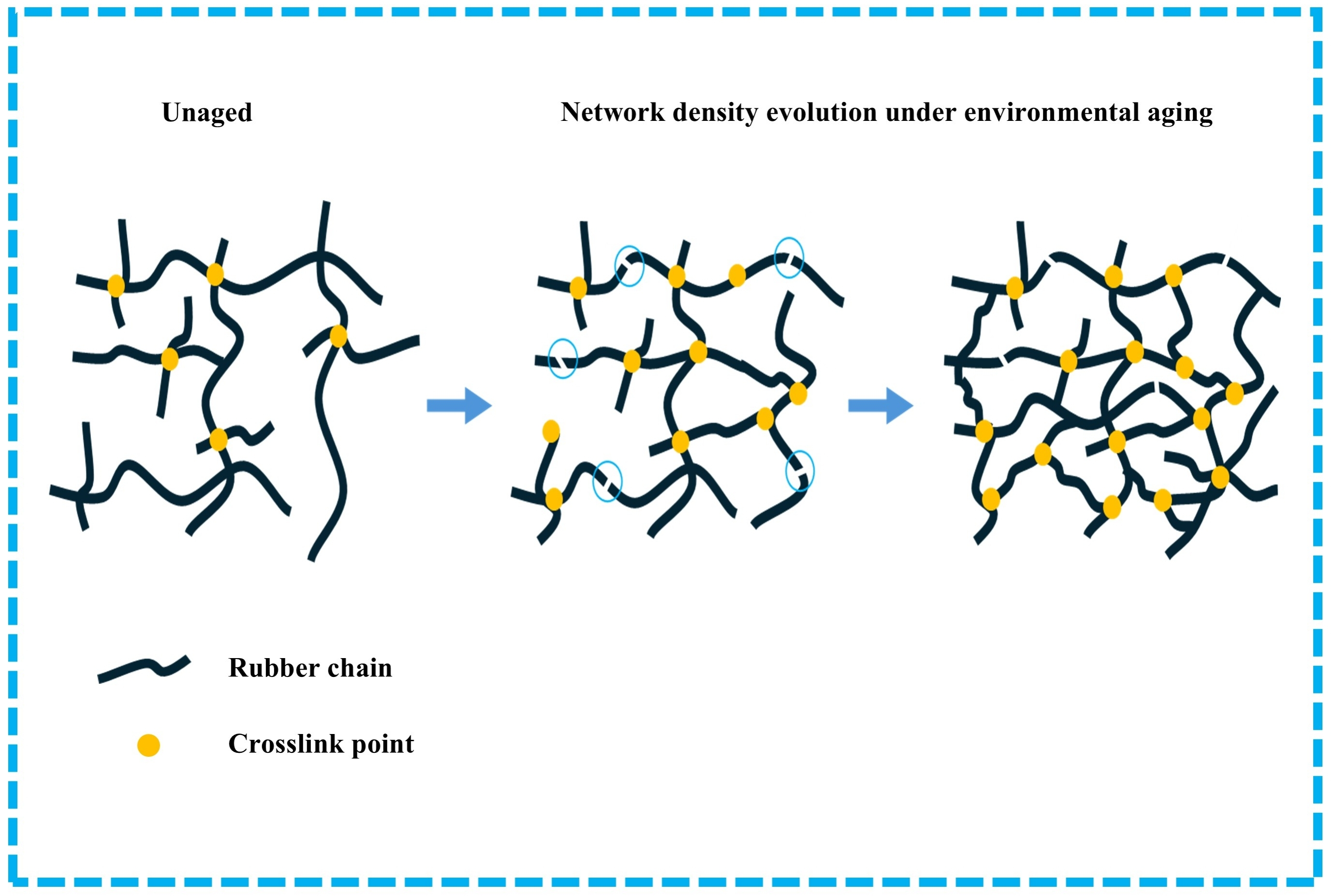
  • Performance degradation mechanisms were discussed based on existing works.
  • The applicability of the Kraus and Maier–Göritz model wasdiscussed.
  • A model selection strategy was proposed with an in-depth analysis.
What are the implications of the main findings?
  • Comprehensive understanding of the Payne effect evolution with thermal oxidation and ultraviolet aging.
  • A deeper understanding of the Payne effect evolution mechanism induced by aging.
  • A model selection strategy of the Payne effect for rubber engineers.

Abstract
During service in engineering fields, the performance of carbon black (CB)/silica-filled rubber suffers degradation because of the influence of aging. In the process of reproducing the mechanical behavior of CB/silica-filled rubber, many constitutive models have been proposed. However, the model selection strategy taking the aging effect into consideration is still unclear, especially the classical model selection strategy. In this work, the effects of thermo-oxidative and ultraviolet aging on the nonlinear viscoelasticity of CB/silica -filled rubber were investigated using dynamic mechanical analysis tests. It was found that aging conditions had a great effect on the nonlinear viscoelasticity of CB/silica -filled rubber. Meanwhile, the degradation mechanisms were discussed on the basis of the existing works. To accurately reproduce the nonlinear viscoelasticity degradation, classical models, such as the Kraus model and Maier–Göritz model, were used to describe the experimental data. In the reproducing process, fitting correlation coefficients and root mean square error were used to verify the reliability of classical models. Comparingsimulation results and experimental ones, it was found that the Maier–Göritz model was more reliable under all aging conditions. This work will contribute to a model selection strategy and a deeper understanding of the degradation mechanism.

Graphical Abstract

1. Introduction

CB-filled rubber has been widely used in civil engineering, automobile engineering, and aerospace engineering because of its excellent mechanical properties [1]. However, in these engineering applications, CB-filled rubber often suffers from environmental aging, which leads to mechanical property degradation and shortens the service life of the rubber component [2,3]. Meanwhile, there is a coupling effect resulting from environmental aging and dynamic load, which can further aggravate the mechanical property degradation [4]. Under dynamic loading conditions, the nonlinear viscoelasticity of CB-filled rubber, such as the Payne effect, is essential to the service life of the rubber component [5]. Therefore, it is necessary to investigate the mechanical property degradation under various aging conditions to master the nonlinear viscoelasticity change in CB/silica-filled rubber and ensure the safe use of rubber components.
In engineering applications, CB-filled rubber often exhibits obvious strain-dependent nonlinear viscoelasticity, especially in the tire industry [6]. When the dynamic strain amplitude increases, the storage modulus decreases, and the loss modulus increases at first and then decreases, which is the so-called Payne effect [7]. The Payne effect has a great effect on the tire’s rolling resistance, which contributes to the carbon dioxide emission [8]. In addition, in the actual service process, CB-filled rubber components are often exposed to the natural environment for a long time, which can result in thermo-oxidative aging and ultraviolet aging [9]. Meanwhile, due to the coupling effect resulting from the natural environment and load, the aging effect of the rubber component becomes more and more important [2]. For example, under extreme loading and thermal conditions, which tend to amplify stress concentrations and compromise structural stability [10]. In order to investigate the change inthe Payne effect induced by aging, many works have been conducted from the aspect of macroscopic and microscopic scales. In practice, the dynamic mechanical analysis (DMA) test is a very useful method to investigate the Payne effect. For example, Yin [5] investigated the effect of thermo-oxidative aging on the Payne effect of CB-filled rubber by use of the DMA test, and the results showedthat aging time had a great effect on the dynamic moduli. In addition, ultraviolet light has agreat effect on the Payne effect of CB-filled rubber. In the sunlight-rich area, such as Yunnan province in China, the ultraviolet aging of the rubber component is inevitable due to the thin atmosphere [11]. For example, Tan [12] carried out ultraviolet radiation aging tests to investigate the effect of ultraviolet aging on the mechanical properties. The results showedthat ultraviolet aging had a great effect on the evolution of crosslink density, which resulted in achange in mechanical properties. Although there are many works that have been achieved by taking oxidative aging into consideration, there is very little research considering the effect of oxidative aging and ultraviolet aging [9]. Therefore, it is necessary to investigate the Payne effect by a comprehensive study on the effect of oxidative aging and ultraviolet aging, which is important to the engineering application of CB-filled rubber, such as a tire’s rolling resistance.
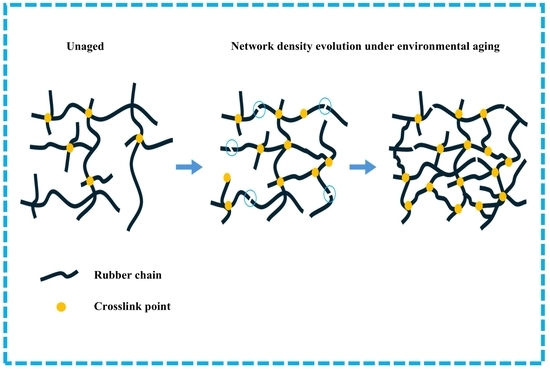
To this end, many studies have been conducted to investigate the aging effect, which are helpful to understand the mechanism of the change inthe Payne effect induced by aging. Most studies suggest that the change inthe Payne effect induced by aging is related to the crosslink density evolution [4,5]. They believe that the crosslink density will change because of aging, which leads to achange inthe mechanical propertiesof the rubber material. Li [13] investigated the evolution of microstructure and mechanical properties of CB-filled rubber under high temperature thermo-oxidative aging, and the results showed that there was a two-stage aging behavior of the crosslink density: a rapid decline and then a continuous rise. Generally, scission and crosslinking simultaneously occur in the aging process, which can result in the two-stage aging behavior of the crosslink density [14]. For example, Hou [15] investigated the effect of thermo-oxidative aging on the Payne effect, and the results showed that the crosslink density evolution had a great effect on the Payne effect. In addition to the crosslink density evolution, some studies believed that the change in mechanical property induced by aging was closely related to the interfacial behavior [16]. After investigating the interface evolution of filled rubber, it has been proventhat the Payne effect is related to the evolution of bound rubber content [17,18]. The main reason is that the bound rubber content depends on temperature, especially in the high-temperature thermo-oxidative aging process [19]. In addition to the bound rubber content, the interfacial thickness is regarded as another important factor to determine the Payne effect of filled rubber. Ning [20] characterized the interfacial thickness of filled rubber based on the gradient change in Young’s modulus by use of AFM PF-QNM mode. The results showed that the higher the Payne effect, the weaker the interfacial interaction between filler and rubber, which indicated lower interfacial thickness. All these methods are meaningful to understand the mechanism of the change inthe Payne effect induced by aging.
In order to accurately describe the Payne effect of CB-filled rubber, a scientific and reasonable constitutive model should be constructed. Traditionally, the Kraus model, Huber–Vilgis model, and Maier–Göritz model are the three most used ones [21]. The Kraus model was proposed to describe the Payne effect based on filler network breakage, which believed that there was a dynamic equilibrium between the weak physical bond’s breakage and recovery [22]. Similarly, the Huber–Vilgis model was developed based on the same assumption to describe the Payne effect [23]. In addition, based on the filler–rubber interaction, Maier and Göritz [24] believed that there were strong bonds and weak bonds in the filled rubber, and they proposed the Maier–Göritz model to describe the Payne effect. Generally, it is believed that the weak bond tends to break under cyclic loading conditions, which leads to the crosslink density evolution and results in the change inthe Payne effect. Recently, in addition to the above three classical models, there have beenother contributions to describe the Payne effect [25,26,27]. For example, Österlöf [28] proposed a three-dimensional viscoplastic constitutive model, and the results showedthat the proposed model had the ability to describe the Payne effect of filled rubber. Although there are many models to investigate the Payne effect, the most commonly used models are the above three classical ones due to their simplicity [1]. In addition, the Kraus model describes the Payne effect based on filler network breakage, while the Maier–Göritz model describes it based on filler–rubber interactions. It can provide further insight into the mechanisms underlying the evolution of the Payne effect after aging.Meanwhile, most researchers use one of the classical models at their will, and the model’s applicability is not taken into consideration. Therefore, it is meaningful to discuss the applicability of the above three classical models, especially under thermo-oxidative and ultraviolet aging conditions.
In this work, the effect of thermo-oxidative aging and ultraviolet aging on the Payne effect of CB/silica-filled rubber was experimentally investigated. The mechanism of the change inthe Payne effect induced by aging was discussed based on the existing works. In order to accurately describe the Payne effect of CB/silica-filled rubber, the Kraus model and Maier–Göritz model were used due to their simplicity. Subsequently, the applicability of the three classical models was discussed based on fitting correlation coefficients ( E R 2 , E R 2 ) and root mean square error (RMSE). This work will contribute to a model selection strategy for future studies, which can avoid the disadvantage of choosing a model at random.

2. Materials and Methods

2.1. Materials

The specimens were processed by Zhuzhou Times New Material Technology Co., Ltd., Zhuzhou, China. The main information was shown in Table 1.

2.2. Aging Conditions

Thermo-oxidative aging tests were carried out in an air-aging oven, which wasbased on the ISO 23529 standard [29]. The aging temperature was 100 °C, and the aging time was 192 h. It has been proventhat when the aging temperature is lower than 100 °C, the influence of short-term thermo-oxidative aging is not obvious [30]. Therefore, the aging temperature of 100 °C was selected.
Ultraviolet aging tests were carried out in an ultraviolet aging oven with a UVA-340 nm lamp, blackboard temperature 65 °C, and humidity 65%. The power density was 550 W/m2, and the aging time was 192 h. The temperature was 50 °C, which was based on the GB/T 16585-1996 standard [31].

2.3. Payne Effect Tests

The specimens used for the Payne effect tests have dimensions of 35 × 5 × 2 mm3. All the tests were carried out at room temperature using the Gabo Eplexor 500N test machine (Netzsch Group, Bavaria, Germany) in a tension mode, with a frequency of 10 Hz. The Payne effect has been reported to be observed under various strain amplitudes ranging from 0.1% to 10% [4]. Therefore, in this paper, the prestrain was 5%. The dynamic strain ranged from 0.1% to 2%. Before the Payne effect tests, all specimens were stretched to a strain of 10% with six loading cycles in order to exclude the Mullins effect.

2.4. General Theory

Under dynamic loading conditions, the Payne effect is regarded as a representative feature of the nonlinear viscoelasticity of CB/silica-filled rubber, which gives an understanding of the inner structure evolution [32]. In order to accurately understand the mechanism of the Payne effect, a scientific and reasonable model should be selected. In this work, the three most commonly used models were chosen due to their simplicity, and their applicability under aging conditions was discussed to provide a model selection strategy for future research.
The Kraus model is the first one to describe the Payne effect based on filler network breakage. In the Kraus model, the dynamic moduli can be written as [5]
E Δ ε = E + E 0 E 1 + Δ ε / Δ ε c 2 m = E 0 Δ E + Δ E 1 + Δ ε / Δ ε c 2 m
E Δ ε = E + 2 E m E Δ ε / Δ ε c m 1 + Δ ε / Δ ε c 2 m
where Δ ε is the dynamic strain amplitude; Δ ε c represents a characteristic value of dynamic strain amplitude, at which the loss modulus comes to a maximum value E m ; and E 0 represents the storage modulus at small dynamic strain amplitude (<0.01%). At large strain amplitude, the storage modulus and loss modulus reach the plateau values E and E , respectively; Δ E = E 0 E represents the Payne effect; m is a non-negative exponent. It should be noticed that m is independent of temperature, frequency, and CB content, and the value is approximately 0.4 [33] or 0.5 [34].
The Maier–Göritz model is proposed based on the filler–rubber interaction. In this model, there are strong bonds and weak bonds in the filled rubber, and the weak bond tends to break under cyclic loading conditions, which leads to the crosslink density evolution and results in the change inthe Payne effect. The dynamic moduli of the Maier–Göritz model can be written as [4]
E Δ ε = E s t + E i 1 1 + c Δ ε
E Δ ε = E s t + E i c Δ ε 1 + c Δ ε 2
where Δ ε is the dynamic strain amplitude, E st is the storage modulus at large deformation, E i is the Payne effect amplitude, E s t is the loss modulus at large or small deformation, E i is the loss modulus amplitude, and parameter c is obtained by experimental data analysis.

3. Results and Discussion

3.1. Effect of Thermo-Oxidative Aging on Payne Effect

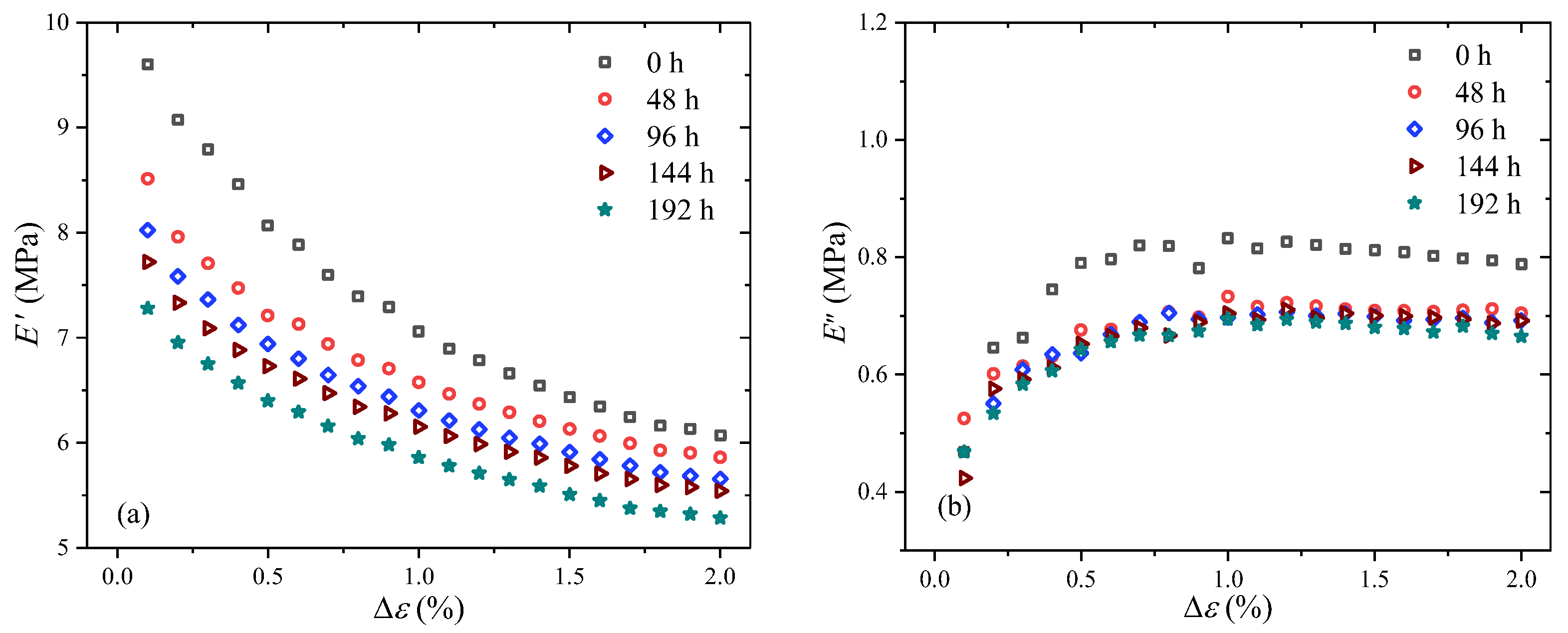
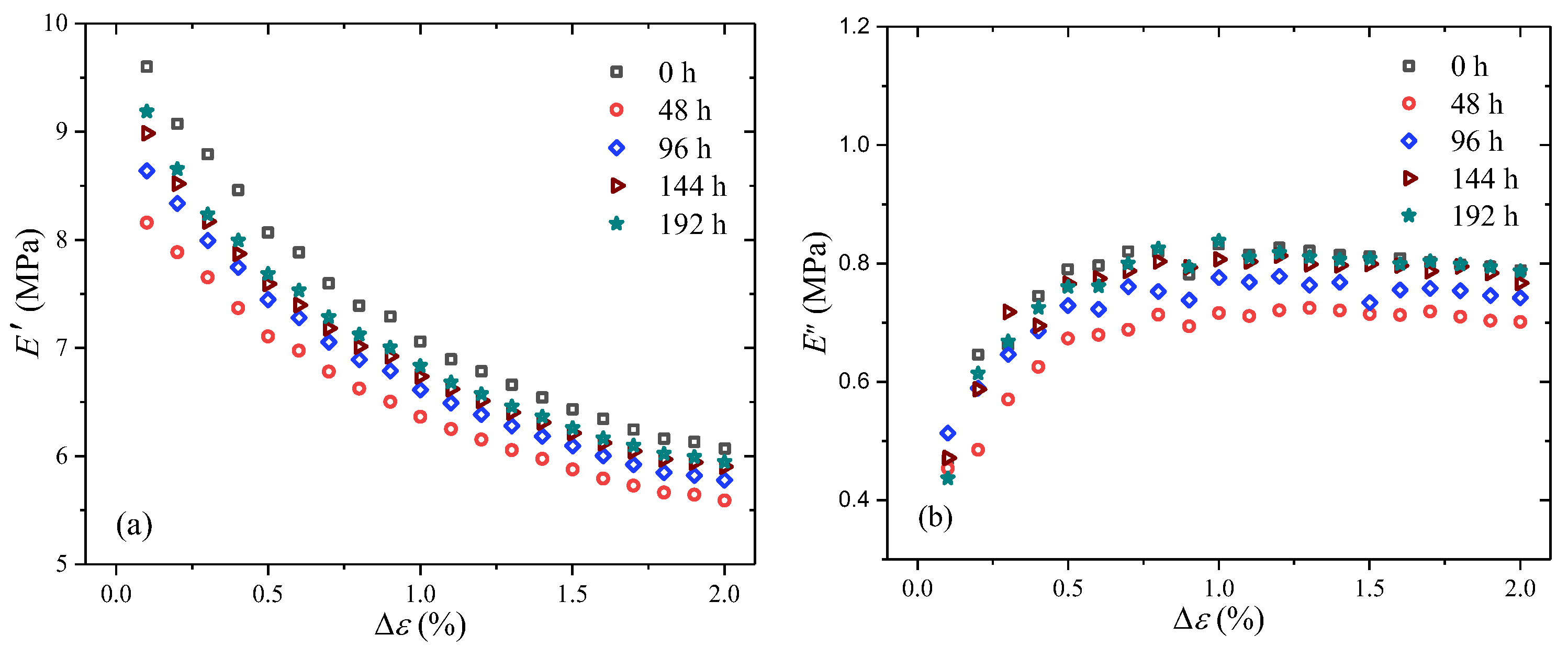
Figure 1 shows the Payne effect evolution of the CB/silica-filled rubber under various thermo-oxidative aging times. It can be seen that both storage modulus and loss modulus decrease with an increase in aging time, which results from the decrease in crosslink density during the thermo-oxidative aging process [15]. In Figure 1a, the storage modulus decreases with an increase in dynamic strain amplitude. It can be seen that the storage modulus begins to decrease markedly within a relatively low dynamic strain range (<0.5%), which may result from the disruption of filler–filler network [35]. In Figure 1b, with an increase in dynamic strain amplitude, the loss modulus increases at first and then decreases, which is related to the intermolecular friction [36]. It is obvious that the peak values of loss modulus occur at almost the same dynamic strain amplitude of 1%. In addition, when the aging time is more than 48 h, the loss modulus evolution with aging time is not obvious.
In order to accurately describe the Payne effect of CB-filled rubber, the applicability of the Kraus model and Maier–Göritz model isdiscussed. In addition, all fitting processes are realized by use of the 1stOpt software (version 7.0) based on the Levenberg–Marquardt optimization algorithm.
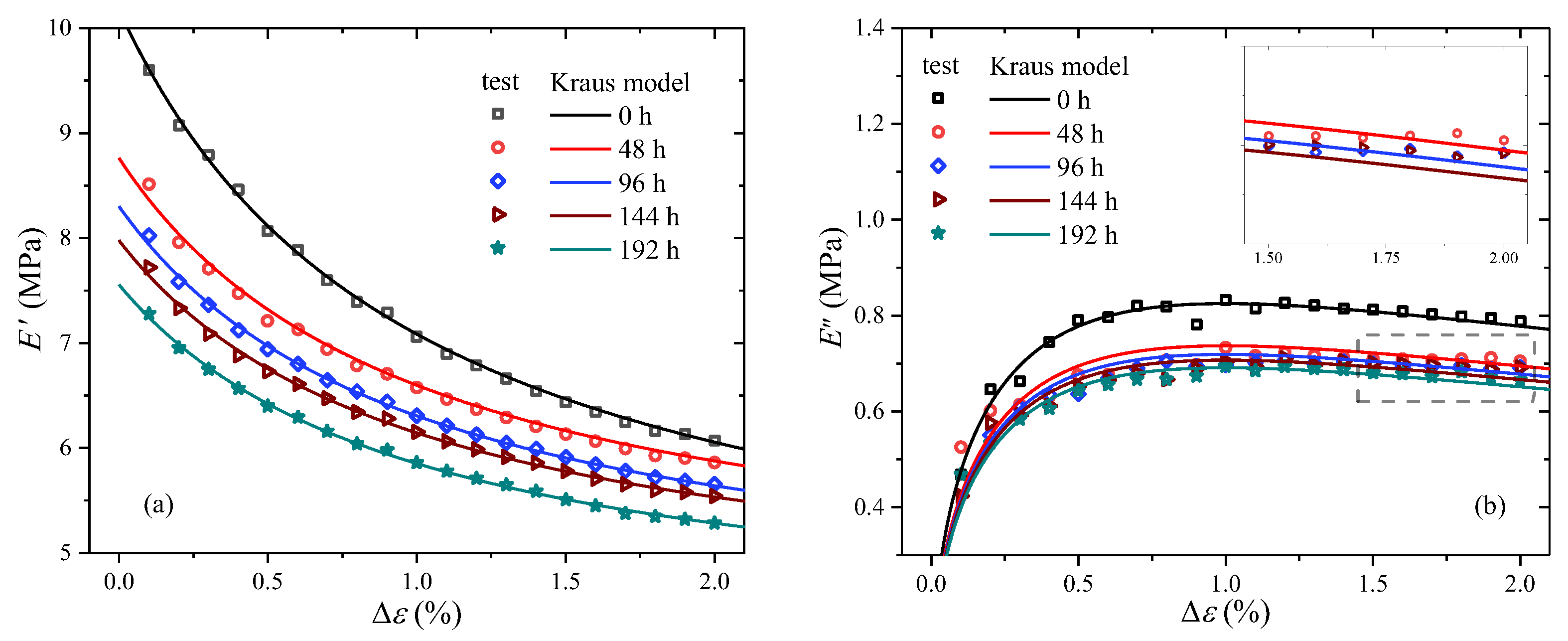
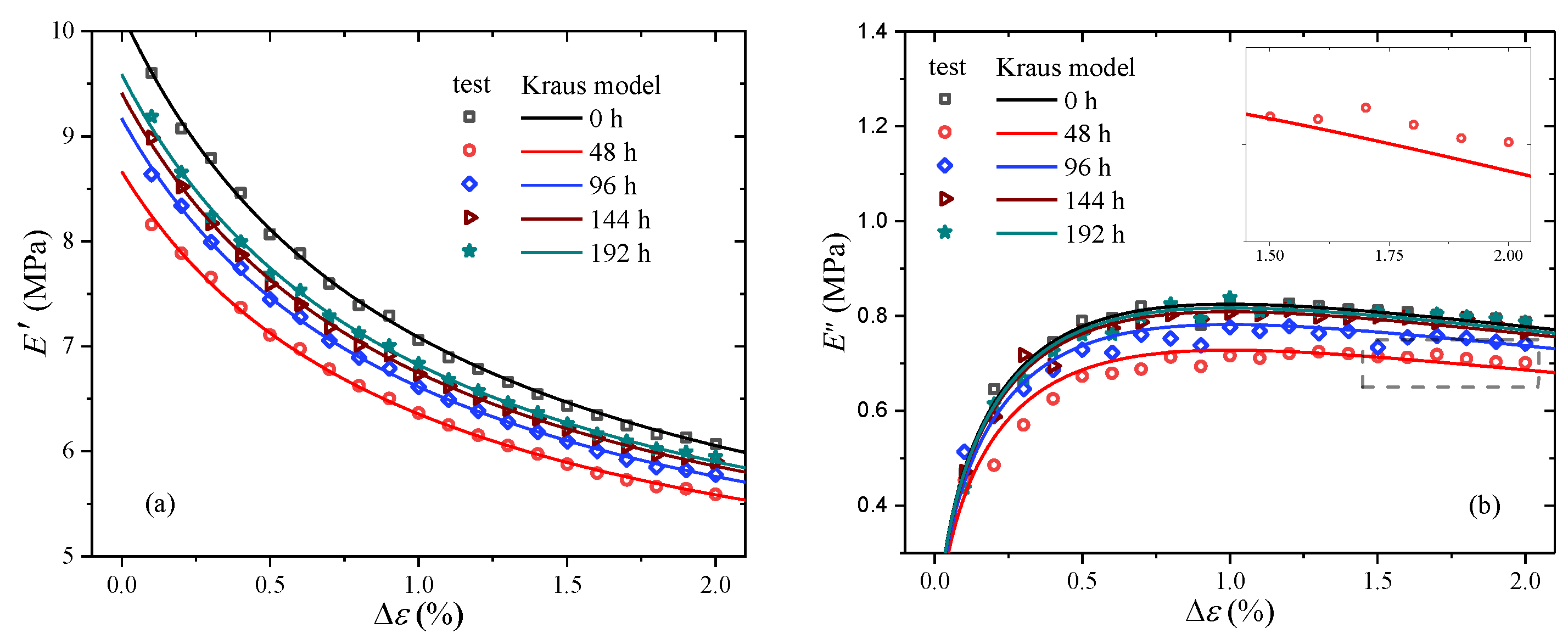
Figure 2 presents the descriptiveresults of the Kraus model. In the Kraus model, it should be noticed that Δ ε c in Equations (1) and (2) represents a characteristic value of dynamic strain amplitude, at which the loss modulus comes to a maximum value E m . In Figure 2, it is very easy to observe that the maximum values of loss modulus under various thermo-oxidative aging times occur at the same dynamic strain amplitude of 1%. Therefore, Δ ε c = 0.01 . In Equation (2), E represents the plateau value of loss modulus at large dynamic strain amplitude, and it tends to be 0 for CB-filled rubber [37]. In addition, the parameter m is independent of temperature, frequency, and CB content. Based on the existing work [34] and fitting results, m is equal to 0.5. After fitting the experimental data by using Equations (1) and (2), the other parameters can be obtained, as shown in Table 2. The fitting correlation coefficients ( E R 2 , E R 2 ) and the root mean square error (RMSE) are used to estimate the reliability of the Kraus model, where E R 2 and E R 2 represent the fitting correlation coefficients of storage modulus and loss modulus, respectively.
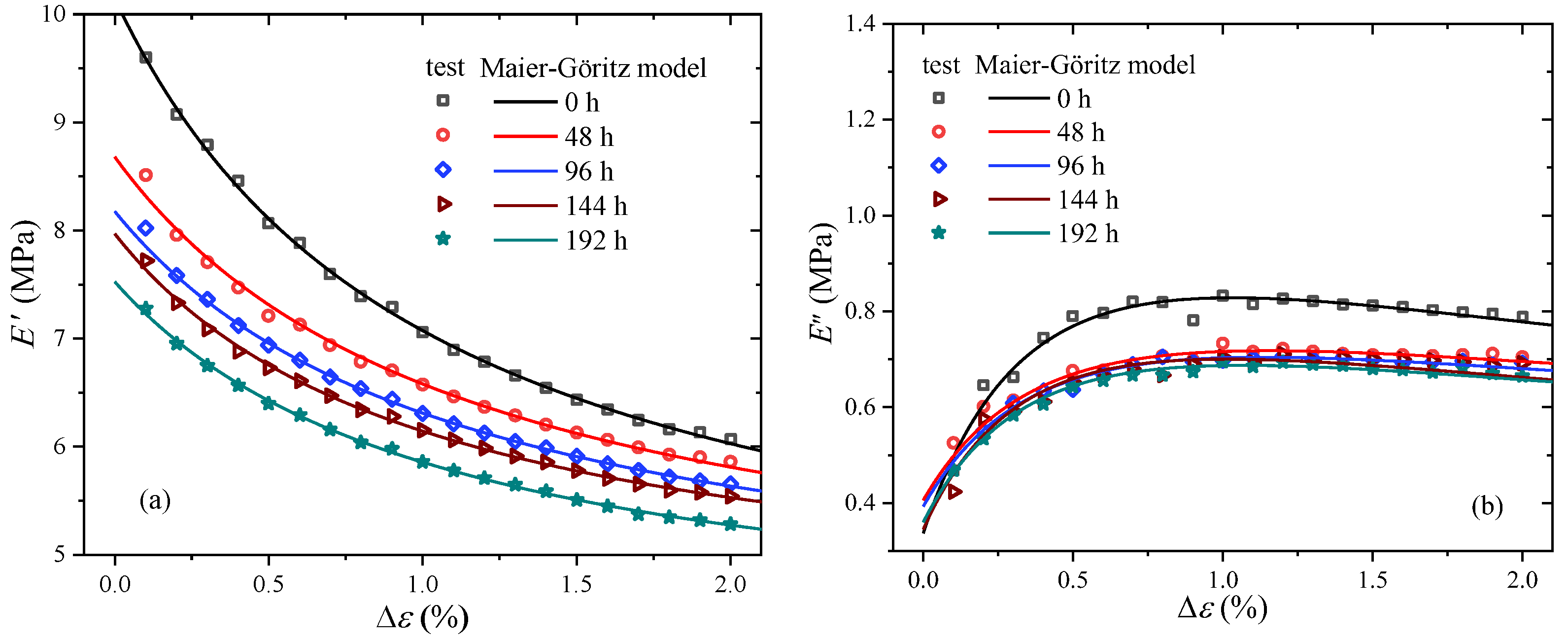
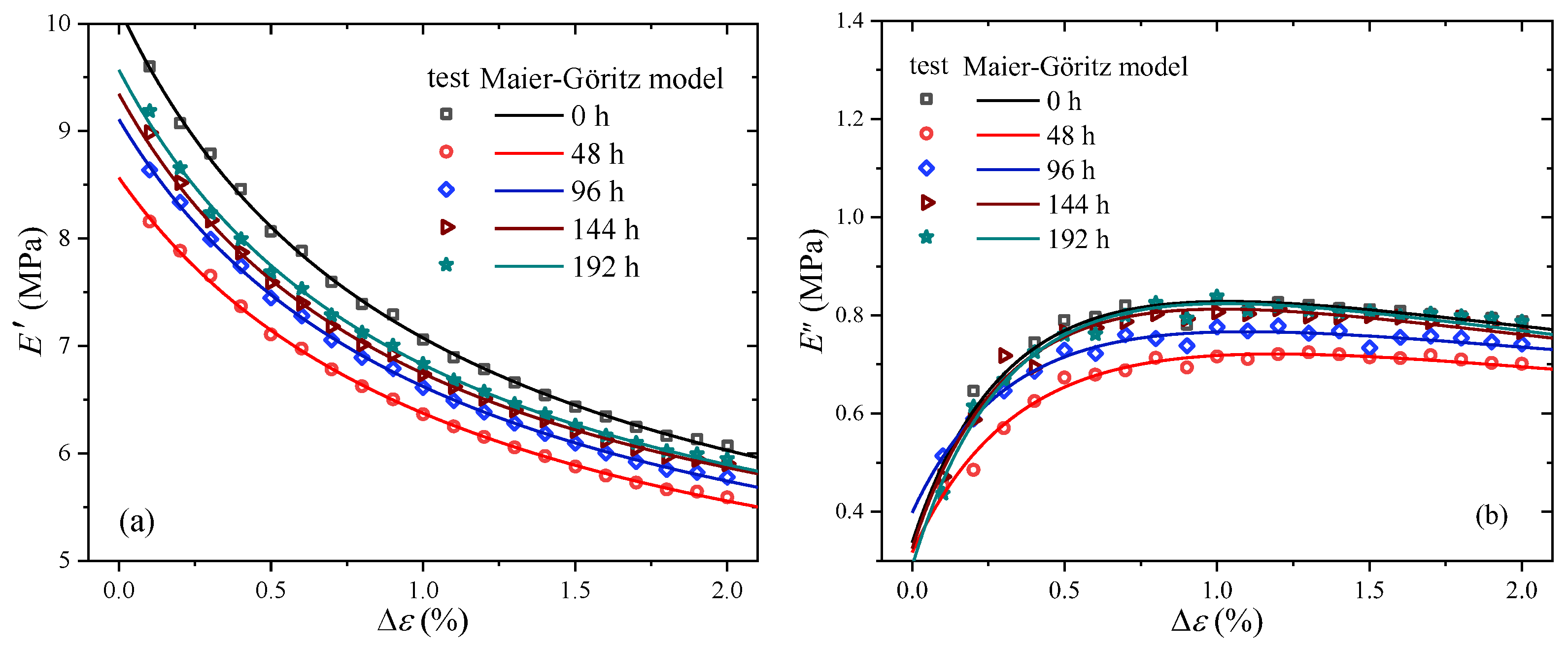
Figure 3 presents the descriptiveresults of the Maier–Göritz model. After fitting the experimental data using Equations (3) and (4), the parameters are as shown in Table 3. Compared Figure 2 with Figure 3, it is easy to observe that both the Kraus model and Maier–Göritz model have the ability to describe the storage modulus data well. However, in Table 2, it can be found that the fitting correlation coefficients of loss modulus ( E R 2 ) of the Kraus model are not perfect, especially for the aging times 48 h, 96 h, and 144 h. When the dynamic strain amplitude is greater than 1.5%, the partially enlarged details of the Kraus model are as presented in Figure 2b. Based on fitting correlation coefficients, it can be concluded that the Maier–Göritz model is more suitable to describe the thermo-oxidative aging-dependent Payne effect. Meanwhile, RMSE has been used to further verify the applicability of the Kraus model and Maier–Göritz model. Generally, the smaller the RMSE value is, the higher the fitting accuracy will be. By comparingthe RMSE values in Table 2 and Table 3, it can also be proven that the Maier–Göritz model is more suitable to describe the thermo-oxidative aging-dependent Payne effect. The main reason is that the Maier–Göritz model is proposed based on filler–rubber interaction [24]. It has been confirmed that filler–rubber interaction has a great effect on the Payne effect [35].

3.2. Effect of Ultraviolet Aging on Payne Effect

Figure 4 shows the Payne effect evolution of the CB/silica-filled rubber under various ultraviolet aging times. With an increase in dynamic strain amplitude, the storage modulus decreases, and the loss modulus increases at first and then decreases. Meanwhile, it is interesting to observe that both storage modulus and loss modulus decrease at first and then increase with an increase in aging time, which has been confirmed in the works [12,38]. In the works [12,38], it has been proved that the crosslink density decreases at first and then increases with an increase in aging time. In the ultraviolet aging process, there are two competitive mechanisms: scission and crosslinking [4]. In Figure 4, both storage modulus and loss modulus decrease within 48 h, which may contribute to chain scission. On the contrary, crosslinking becomes the main mechanism lasting more than 48 h, which results in anincrease in crosslink density. The late-stage crosslinking induced can be attributed to the increased UV exposure time, which promotes the generation of macromolecular radicals and oxygenated species radicals that subsequently recombine to form new crosslinks [12].
Figure 5 shows the fitting results of the Kraus model. In Figure 5b, it is obvious to find that when the dynamic strain amplitude comes to 1%, the loss modulus reaches the maximum value. Therefore, the characteristic value Δ ε c in Equations (1) and (2) is equal to 1%. The determination of other parameters in the Kraus model is consistent with the fitting process of thermo-oxidative aging. After fitting the experimental data using the Kraus model, all parameters can be obtained, as shown in Table 4. Similarly, the applicability of the Kraus model under ultraviolet aging conditions can be discussed by use of fitting correlation coefficients ( E R , E R ) and root mean square error (RMSE).
Figure 6 shows the modeling results of the Maier–Göritz model. After fitting the experimental data by usingthe Maier–Göritz model, the parameters of Equations (3) and (4) are as shown in Table 5. Comparing Figure 5 with Figure 6, it can be found that both the Kraus model and Maier–Göritz model have the ability to describe the storage modulus data well. However, in Table 4, it can be found that the fitting correlation coefficients of loss modulus ( E R 2 ) of the Kraus model are not perfect, especially for the aging time of 48 h. The partially enlarged details of the Kraus model are presented in Figure 5b. Based on fitting correlation coefficients and RMSE in Table 4 and Table 5, it can also be concluded that the Maier–Göritz model is more suitable to describe the ultraviolet aging-dependent Payne effect.
The above results indicate that, under thermo-oxidative and UV aging conditions, the Maier–Göritz model exhibits highly stable fitting correlation coefficients for both the storage modulus and loss modulus. Therefore, the Maier–Göritz model is more suitable for describing the Payne effect in the context of thermo-oxidative and UV aging.

4. Conclusions

CB/silica-filled rubber is a reliable materialthatis extensively used in many engineering fields because of its excellent mechanical properties. However, the environmental aging factors, such as thermal oxidation and ultraviolet radiation, have a great effect on the mechanical property degradation, which shortens the service life of rubber components.
In this work, the effects of thermo-oxidative aging and ultraviolet aging on the Payne effect have been experimentally investigated by use of dynamic mechanical analysis tests. Based on the experimental results, the degradation mechanisms of the Payne effect have been discussed on the basis of the existing works. In order to accurately describe the Payne effect of CB/silica-filled rubber, an appropriate model should be selected. Based on the most commonly used models, such as the Kraus model and Maier–Göritz model, the objective of this paper is to discuss the applicability of the three classical models, especially under thermo-oxidative and ultraviolet aging conditions. To this end, detailed comparisons have been presented on the basis of fitting correlation coefficients and root mean square error. As for thermo-oxidative aging, it can be found that the fitting correlation coefficients of the loss modulus of the Kraus model are not perfect, especially for the aging times 48 h, 96 h, and 144 h, corresponding to 0.898, 0.879, and 0.927, respectively, while the Maier–Göritz model is 0.960, 0.966, and 0.921, respectively. As for ultraviolet aging, the fitting correlation coefficients of the loss modulus of the Kraus model are not perfect, especially for the aging time of 48 h, which is 0.913.The Maier–Göritz model is 0.976.The results show that the Maier–Göritz model is more suitable to describe the Payne effect when it comes to thermo-oxidative aging and ultraviolet aging, which will contribute to a model selection strategy for future studies.

Author Contributions

Conceptualization, M.L. and B.Y.; methodology, B.Y.; software, M.L.; validation, M.L. and B.Y. Yin; formal analysis, M.L.; investigation, M.L.; resources, B.Y.; data curation, M.L.; writing—original draft preparation, M.L.; writing—review and editing, B.Y.; visualization, M.L.; supervision, B.Y.; project administration, B.Y.; funding acquisition, B.Y. All authors have read and agreed to the published version of the manuscript.

Funding

This research was funded by the National Natural Science Foundation of China, grant number 52408528.

Institutional Review Board Statement

Not applicable.

Informed Consent Statement

Not applicable.

Data Availability Statement

The data used tosupport the findings of this study are available upon request to Boyuan Yin (yinboyuanxtu@163.com).

Conflicts of Interest

The authors declare no conflicts of interest.

Abbreviations

The following abbreviations are used in this manuscript:
CBCarbon Black
RMSERoot Mean Square Error
DMADynamic Mechanical Analysis

References

  1. Yin, B.; Wen, H.; Luo, W.; Li, M. Frequency-and temperature-dependent Payne effect and hysteresis loss of carbon black filled rubbers: Experimental study and model prediction. Mater. Today Commun. 2022, 33, 104920. [Google Scholar] [CrossRef]
  2. He, Z.; Song, Y.; Wang, J.; Xu, W.; Guan, H.; Pang, Y. Experimental study on mechanical property degradation of thermal aging laminated rubber bearing. Case Stud. Constr. Mat. 2023, 18, e02060. [Google Scholar] [CrossRef]
  3. Shao, Z.; Cheng, H.; Zhu, M.; Yang, Y.; Huang, L.; Li, S.; Zhao, X.; Zhu, C.; Liu, Y. Constitutive model for investigating the effect of microstructure evolution on the macroscopic properties of silicone rubber during radiation aging. Macromolecules 2025, 58, 4033–4042. [Google Scholar] [CrossRef]
  4. Jiao, X.; Yu, J.; Yin, B.; Sun, H. Effect of thermo-oxidative, ultraviolet, and ozone aging on nonlinear viscoelasticity of carbon black-Filled rubber based on crosslink density evolution. Polym. Compos. 2025, 46, 15433–15446. [Google Scholar] [CrossRef]
  5. Yin, B.; Wen, H.; Luo, W. Effect of thermo-oxidative aging on the Payne effect and hysteresis loss of carbon-black filled rubber vulcanizates. npj Mater. Degrad. 2022, 6, 94. [Google Scholar] [CrossRef]
  6. Ouyang, G.B. Modulus, hysteresis and the Payne effect. Kgk-Kaut. Gummi. Kunst. 2006, 59, 332–343. [Google Scholar]
  7. Payne, A.R. The dynamic properties of carbon black-loaded natural rubber vulcanizates. Part I. J. Appl. Polym. Sci. 1962, 6, 57–63. [Google Scholar] [CrossRef]
  8. Lolage, M.; Parida, P.; Gupta, A.; Rautaray, D. Synergistic effects of silica and nanoclay on curing characteristics, processing behaviour and mechanical properties of solution styrene butadiene rubber (SBR)-based tire tread compounds. Emergent Mater. 2022, 5, 957–966. [Google Scholar] [CrossRef]
  9. Zhou, B.; Liu, W.; Huang, Y.; Luo, J.; Yin, B. Effect of thermo-oxidative, ultraviolet and ozone aging on mechanical property degradation of carbon black-filled rubber materials. Buildings 2025, 15, 2705. [Google Scholar] [CrossRef]
  10. Muayad, H.; Raffaele, C.; Marco, D.; Hamed, F.; Rad, M.M. Thermo-mechanical reliability-based topology optimization for imperfect elasto-plastic materials. Int. J. Mech. Mater. Des. 2025, 21, 1755–1776. [Google Scholar] [CrossRef]
  11. Wang, Z.; Qian, L.; Peng, X.; Huang, Z.; Yang, Y.; He, C.; Fang, P. New aspects of degradation in silicone rubber under UVA and UVB irradiation: A gas chromatography-mass spectrometry study. Polymers 2021, 13, 2215. [Google Scholar] [CrossRef] [PubMed]
  12. Tan, J.H.; Chen, C.L.; Wu, J.Y.; He, R.; Liu, Y.W. The effect of UV radiation ageing on the structure, mechanical and gas permeability performances of ethylene-propylene-diene rubber. J. Polym. Res. 2021, 28, 81. [Google Scholar] [CrossRef]
  13. Li, Z.X.; Kong, Y.R.; Chen, X.F.; Huang, Y.J.; Lv, Y.D.; Li, G.X. High-temperature thermo-oxidative aging of vulcanized natural rubber nanocomposites: Evolution of microstructure and mechanical properties. Chin. J.Polym. Sci. 2023, 41, 1287–1297. [Google Scholar] [CrossRef]
  14. Kadri, R.; Abdelaziz, M.N.; Fayolle, B.; Hassine, M.B.; Witz, J.F. A unified mechanical based approach to fracture properties estimates of rubbers subjected to aging. Int. J. Solids Struct. 2022, 234, 111305. [Google Scholar] [CrossRef]
  15. Hou, F.; Song, Y.; Zheng, Q. Payne effect of thermo-oxidatively aged isoprene rubber vulcanizates. Polymer 2020, 195, 122432. [Google Scholar] [CrossRef]
  16. Tian, C.; Chu, G.; Feng, Y.; Lu, Y.; Miao, C.; Ning, N.; Zhang, L.; Tian, M. Quantitatively identify and understand the interphase of SiO2/rubber nanocomposites by using nanomechanical mapping technique of AFM. Compos. Sci. Technol. 2019, 170, 1–6. [Google Scholar] [CrossRef]
  17. Zhou, H.; Song, L.; Lu, A.; Jiang, T.; Yu, F.; Wang, X. Influence of immobilized rubber on the non-linear viscoelasticity of filled silicone rubber with different interfacial interaction of silica. RSC Adv. 2016, 6, 15155–15166. [Google Scholar] [CrossRef]
  18. Wang, P.; Liu, P.; Ao, W. Study on the nonlinear viscoelastic behavior of rubber composites filled with silica. Alex. Eng. J. 2024, 97, 1–7. [Google Scholar] [CrossRef]
  19. Mihara, S.; Datta, R.N.; Noordermeer, J.W.M. Flocculation in silica reinforced rubber compounds. Rubber Chem. Technol. 2009, 82, 524–540. [Google Scholar] [CrossRef]
  20. Ning, N.; Mi, T.; Chu, G.; Zhang, L.Q.; Liu, L.; Tian, M.; Yu, H.T.; Lu, Y.L. A quantitative approach to study the interface of carbon nanotubes/elastomer nanocomposites. Eur. Polym. J. 2018, 102, 10–18. [Google Scholar] [CrossRef]
  21. Clément, F.; Bokobza, L.; Monnerie, L. Investigation of the Payne effect and its temperature dependence on silica-filled polydimethylsiloxane networks. Part I: Experimental results. Rubber Chem. Technol. 2005, 78, 211–231. [Google Scholar] [CrossRef]
  22. Kraus, G. Swelling of filler-reinforced vulcanizates. J. Appl. Polym. Sci. 1963, 7, 861–871. [Google Scholar] [CrossRef]
  23. Huber, G.; Vilgis, T.A.; Heinrich, G. Universal properties in the dynamical deformation of filled rubbers. J. Phys.-Condens. Matter 1996, 8, L409. [Google Scholar] [CrossRef]
  24. Maier, P.G.; Göritz, D. Molecular interpretation of the Payne effect. Kaut. Gummi. Kunst. 1996, 49, 18–21. [Google Scholar]
  25. Pan, Y.; Zhong, Z. A viscoelastic constitutive modeling of rubber-like materials with the Payne effect. Appl. Math. Model. 2017, 50, 621–632. [Google Scholar] [CrossRef]
  26. Narayan, S.P.A.; Palade, L.I. Modeling Payne effect with a framework of multiple natural configurations. Int. J. Eng. Sci. 2020, 157, 103396. [Google Scholar] [CrossRef]
  27. Narayan, S.P.A.; Palade, L.I. Comparison of a natural configuration approach and a structural parameter approach to model the Payne effect. Acta Mech. 2020, 231, 4781–4802. [Google Scholar] [CrossRef]
  28. Österlöf, R.; Wentzel, H.; Kari, L. A finite strain viscoplastic constitutive model for rubber with reinforcing fillers. Int. J. Plast. 2016, 87, 1–14. [Google Scholar] [CrossRef]
  29. ISO 23529:2016; Rubber—General Procedures for Preparing and Conditioning Test Pieces for Physical Test Methods. International Organization for Standardization: Geneva, Switzerland, 2016.
  30. Zhang, Z.; Sun, J.; Lai, Y.; Wang, Y.; Liu, X.; Shi, S.; Chen, X. Effects of thermal aging on uniaxial ratcheting behavior of vulcanised natural rubber. Polym. Test. 2018, 70, 102–110. [Google Scholar] [CrossRef]
  31. GB/T 16585-1996; Rubber, Vulcanized—Test Method of Resistance to Artificial Weathering (Fluorescent UV Lamp). The State Bureau of Quality and Technical Supervision: Beijing, China, 1996. (In Chinese)
  32. Ansari, A.; Mohanty, T.R.; Sarkar, S.; Ramakrishnan, S.; Amarnath, S.K.P.; Singha, N.K. Epoxy modified styrene butadiene rubber (SBR) in green tire application. Eur. Polym. J. 2024, 213, 113069. [Google Scholar] [CrossRef]
  33. Hu, X.; He, R.; Huang, Y.; Yin, B.; Luo, W. A method to predict the dynamical behaviors of carbon black filled natural rubber at different temperatures. Polym. Test. 2019, 79, 106067. [Google Scholar] [CrossRef]
  34. Cho, J.H.; Youn, S.K. A viscoelastic constitutive model of rubber under small oscillatory load superimposed on large static deformation considering the Payne effect. Arch. Appl. Mech. 2006, 75, 275–288. [Google Scholar] [CrossRef]
  35. Tang, S.; Li, J.; Li, Z.; Chen, Z.; Lin, J.; Zhang, L.; He, S. Enhanced mechanical properties of rubber/clay nanocomposite via compounding butadiene-styrene-vinyl pyridine rubber-contained clay gel with styrene butadiene rubber. Polymer 2024, 312, 127643. [Google Scholar] [CrossRef]
  36. Fan, X.; Xu, H.; Wu, C.; Song, Y.; Zheng, Q. Influences of chemical crosslinking, physical associating, and filler filling on nonlinear rheological responses of polyisoprene. J. Rheol. 2020, 64, 775–784. [Google Scholar] [CrossRef]
  37. Luo, W.; Hu, X.; Wang, C.; Li, Q. Frequency-and strain-amplitude-dependent dynamical mechanical properties and hysteresis loss of CB-filled vulcanized natural rubber. Int. J. Mech. Sci. 2010, 52, 168–174. [Google Scholar] [CrossRef]
  38. Tan, J.; Chen, C.; Wu, J.; He, R.; Jiang, L.; Liu, Y. Influence of ultraviolet aging on the structure, mechanical and gas permeability properties of hydrogenated nitrile butadiene rubber. J. Appl. Polym. Sci. 2021, 138, 50543. [Google Scholar] [CrossRef]
Figure 1. Effect of thermo-oxidative aging on Payne effect: (a) storage modulus; (b) loss modulus.
Coatings 16 00538 g001
Figure 2. Experimental data and Kraus model fitting results under various thermo-oxidative aging times: (a) storage modulus; (b) loss modulus.
Coatings 16 00538 g002
Figure 3. Experimental data and Maier–Göritz model fitting results under various thermo-oxidative aging times: (a) storage modulus; (b) loss modulus.
Coatings 16 00538 g003
Figure 4. Effect of ultraviolet aging on Payne effect: (a) storage modulus; (b) loss modulus.
Coatings 16 00538 g004
Figure 5. Experimental data and Kraus model fitting results under various ultraviolet aging times: (a) storage modulus; (b) loss modulus.
Coatings 16 00538 g005
Figure 6. Experimental data and Maier–Göritz model fitting results under various ultraviolet aging times: (a) storage modulus; (b) loss modulus.
Coatings 16 00538 g006
Table 1. Formulations of specimens (Unit: phr).
Raw MaterialFormulationManufacturer/Address
Natural rubber CV60100Vietnam
Carbon black N77430Shanghai Cabot Chemical Co., Ltd., Shanghai, China
Whitecarbon black VN325Evonik Special Chemicals Co., Ltd., Shanghai, China
Zinc oxide5Pan-Continental Chemical Co., Ltd., Suzhou, China
Silane coupling agent Si-692.5Jianghan New Materials Technology Co., Ltd., Tianmen, China
Antioxidant RD2China Rubber Industry, China
Antioxidant 6PPD2China Rubber Industry, China
Sulfur2China Rubber Industry, China
Vulcanization accelerator DM1.2China Rubber Industry, China
Vulcanization accelerator PDM0.5China Rubber Industry, China
Table 2. Parameter values of Kraus model under various thermo-oxidative aging times.
Aging Time/h E 0 /MPa Δ E /MPa E m /MPam E R 2 E R 2 E RMSE E RMSE
010.1756.1800.8250.5000.9980.9660.0360.015
488.7624.3290.7370.5000.9960.8980.0550.032
968.3023.9930.7190.5000.9980.8790.0270.070
1447.9773.6670.7070.5000.9980.9270.0270.020
1927.5563.4090.6910.5000.9980.9500.0200.019
Table 3. Parameter values of Maier–Göritz model under various thermo-oxidative aging times.
Aging Time/h E st /MPa E i /MPa E st /MPa E i /MPac E R 2 E R 2 E RMSE E RMSE
03.9056.2410.3371.96596.9440.9980.9580.0340.017
484.1554.5260.4061.24786.6130.9940.9600.0550.013
964.1943.9830.3931.24588.1620.9980.9660.0120.007
1444.2923.6780.3451.42198.5660.9980.9210.0270.019
1924.0683.4570.3601.30993.3430.9980.9820.0200.007
Table 4. Parameter values of Kraus model under various ultraviolet aging times.
Aging Time/h E 0 /MPa Δ E /MPa E m /MPam E R 2 E R 2 E RMSE E RMSE
010.1756.1800.8250.5000.9980.9660.0360.015
488.6654.6190.7280.5000.9980.9130.0290.024
969.1705.1140.7820.5000.9980.9500.0240.022
1449.4115.3280.8090.5000.9980.9680.0260.014
1929.5905.5330.8170.5000.9980.9760.0360.015
Table 5. Parameter values of Maier–Göritz model under various ultraviolet aging times.
Aging Time/h E st /MPa E i /MPa E st /MPa E i /MPac E R 2 E R 2 E RMSE E RMSE
03.9056.2410.3371.96596.9440.9980.9580.0340.017
483.7654.8010.3171.61784.0240.9980.9760.0220.011
963.8975.2120.3981.47591.2400.9980.9720.0210.010
1444.1025.2440.3251.95198.5110.9980.9640.0320.015
1924.0075.5620.2892.14097.3130.9980.9700.0380.015
Disclaimer/Publisher’s Note: The statements, opinions and data contained in all publications are solely those of the individual author(s) and contributor(s) and not of MDPI and/or the editor(s). MDPI and/or the editor(s) disclaim responsibility for any injury to people or property resulting from any ideas, methods, instructions or products referred to in the content.