


Highlights
What are the main findings?
- First, the TiNbZrO film fabricated by magnetron sputtering maintains BCC structure after 50 keV He ion irradiation, demonstrating exceptional phase stability under irradiation.
- Second, the film displays remarkable irradiation resistance with merely 0.64% swelling and 31.91% hardening at the highest fluence of 2 × 10¹⁷ ions/cm2.
What are the implications of the main findings?
- The synergistic dynamic interaction involving high-entropy lattice distortion and oxygen-complex pinning effectively suppresses radiation-induced defect evolution under irradiation.
Abstract
The development of accident-tolerant fuels has significantly enhanced the safety of fission reactors. The TiNbZrO alloy system has garnered considerable attention due to its excellent mechanical properties and outstanding irradiation resistance. Its unique compositional design enables effective suppression of irradiation-induced defect formation. In this study, TiNbZrO thin films are fabricated via radio-frequency magnetron sputtering and irradiated with 50 keV He ions to fluences of 5 × 10¹⁶, 1 × 10¹⁷, and 2 × 10¹⁷ ions/cm2. The microstructural evolution before and after irradiation is characterized by Transmission Electron Microscopy (TEM) and Grazing Incidence X-ray Diffraction (GIXRD), and the changes in mechanical properties are evaluated by nanoindentation. With increasing irradiation fluence, the average size of He bubbles increases from 1.10 nm to 2.06 nm, the number density decreases from 5.27 × 1024 m−3 to 1.39 × 1024 m−3, and the swelling rate rises from 0.37% to 0.64%. Although significant irradiation hardening is observed in all samples, the maximum hardening rate reaches only 31.91%, a value substantially lower than that reported for many conventional nuclear materials. This demonstrates the superior irradiation resistance of TiNbZrO thin films. The superior irradiation resistance of TiNbZrO thin films stems from two synergistic effects: high-entropy lattice distortion suppresses atomic diffusion, while oxygen complexes pin defects.
1. Introduction
With the advancement of modern industry, energy demand continues to grow while non-renewable resources remain limited. Nuclear energy has attracted widespread attention as a clean and efficient alternative [1]. Zr-based alloys have been used as fuel cladding in light water reactors (LWRs) for over four decades due to their low neutron absorption, excellent corrosion resistance, and adequate mechanical properties [2,3]. However, following the 2011 Fukushima accident, their inadequate oxidation resistance and hydrogen generation under loss-of-coolant accident (LOCA) or beyond design basis accident (BDBA) conditions have become major concerns [4]. This has prompted the proposal and investigation of “accident-tolerant fuel” (ATF) [5].
Among various enhancement strategies, the application of protective films on structural materials has emerged as a feasible and cost-effective approach [6,7,8,9]. Currently, Cr-based films have gained prominence as the leading candidate for such protective layers [10,11,12]. Extensive experimental investigations have demonstrated their excellent corrosion resistance under normal operating conditions of pressurized water reactors (PWRs) [13,14], as well as outstanding oxidation resistance when exposed to steam and air environments during accident scenarios [15,16,17,18]. As a protective film material, Cr films are also required to exhibit good irradiation resistance [4,19]. Kuprin et al. [11] investigated the void swelling behavior of Cr films irradiated with 1.4 MeV Ar ions at 400 °C to fluences of 5, 15, and 25 dpa. Results showed that the grain size of the Cr films increased uniformly from an initial 250 nm to 295 nm after irradiation, with this change independent of temperature. Even at the highest irradiation fluence of 25 dpa, the swelling rate remained as low as 0.66%.
Since the concept of multi-principal element alloys (MPEAs) [20,21] was proposed by scholar Yeh from Taiwan, alloy systems based on this novel design philosophy have proliferated extensively. MPEAs possess excellent mechanical properties [22,23] as well as outstanding irradiation resistance. Chang et al. [24] investigated the irradiation behavior of the TiNbZrHfTa MPEA with body-centered cubic (BCC) structure. After irradiation with 300 keV Ni ions at 100 °C, the measured hardness values of the irradiated and unirradiated regions were 3.6 ± 0.3 GPa and 3.5 ± 0.4 GPa, respectively, indicating a low irradiation hardening rate. Although this alloy system exhibits excellent irradiation resistance, its practical application is constrained by the high cost of Hf and Ta, the complex processing of refractory alloys, and substantial elemental density disparities that hinder quality consistency in large-scale components. Zhang et al. [25] observed that under He ion irradiation at 400 keV and 350 °C with a fluence of 5 × 10¹⁷ ions/cm2, the single-phase BCC TiNbMo0.5VCr0.25 and TiNbZr0.25Mo0.5V0.5 alloys exhibited low irradiation hardening rates of 19.23% and 19.18%, respectively. These values are significantly lower than those of conventional alloys under similar conditions, demonstrating the exceptional He ion irradiation resistance of these materials.
MPEA thin films also exhibit remarkable irradiation resistance. In particular, the refractory TiNbZr alloy system not only offers excellent neutron economy due to the low neutron absorption cross-sections of its constituent elements but has also been widely reported to exhibit good irradiation resistance, demonstrating considerable potential for use in advanced nuclear energy systems [26,27,28,29]. Li et al. [30] reported that amorphous TiNbZrTa alloy films, when irradiated with 60 keV He ions at room temperature, underwent a structural transition to a single-phase BCC structure. Remarkably, the BCC phase remained stable across a wide range of irradiation fluences, demonstrating exceptional phase stability. Even under high fluence irradiation, the material exhibited significant irradiation hardening without compromising its mechanical integrity. The enhanced irradiation resistance of the TiNbZr-based films is principally ascribed to their inherent high-entropy effect and pronounced lattice distortion [31,32]. These characteristics induce considerable fluctuations in local energy landscapes, which impede defect migration and effectively suppress the nucleation and growth of defect clusters. Furthermore, films fabricated using techniques such as magnetron sputtering typically exhibit ultrafine-grained or nanocrystalline microstructures. The high density of interfacial boundaries in these materials serves as efficient defect sinks, trapping and annihilating radiation-induced defects [33,34]. In addition, Egami [35] proposed a self-healing mechanism in which the significant lattice distortion and associated atomic-level stresses in MPEAs induce localized amorphization under irradiation. Simultaneously, the thermal energy introduced by incident particles triggers local melting followed by recrystallization. Together, these mechanisms effectively eliminate a considerable number of defects, thus reducing the accumulation of radiation-induced damage.
Despite the advantages of TiNbZrTa films, the potential for structural transitions to a single-phase BCC structure under irradiation may alter their intrinsic properties. Moreover, the high cost of Ta presents an additional economic concern. TiNbZrO alloy has attracted significant research interest because of its exceptional mechanical properties [36]. This study investigates the irradiation response of TiNbZrO thin films under 50 keV He ions irradiation at room temperature. The results indicate that the films retain a single-phase BCC structure both before and after irradiation, demonstrating excellent phase stability. As the irradiation fluence increases from 5 × 10¹⁶ to 2 × 10¹⁷ ions/cm2, significant irradiation hardening is observed, with a maximum hardening rate of 31.91%. Meanwhile, the films exhibit a maximum swelling rate of only 0.64%, further confirming their superior irradiation resistance. This study provides experimental evidence and a technical pathway for the development of protective films for Zr-based ATF cladding.
2. Materials and Methods
2.1. Sample Preparation and Irradiation Experiments
The TiNbZrO thin films were deposited on the Si (10 mm × 10 mm × 1 mm, weight 0.12 g) substrates by radio-frequency (RF) magnetron sputtering (JCP500 high-vacuum multi-target magnetron sputtering film system, Beijing Technol Co., Ltd., Beijing, China). TiNbZr MPEA target was prepared by powder metallurgy (99.99% purity). Before depositing, the Si substrates were ultrasonically cleaned with ethanol and deionized water respectively for 10 min each.
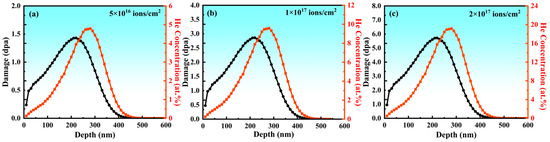
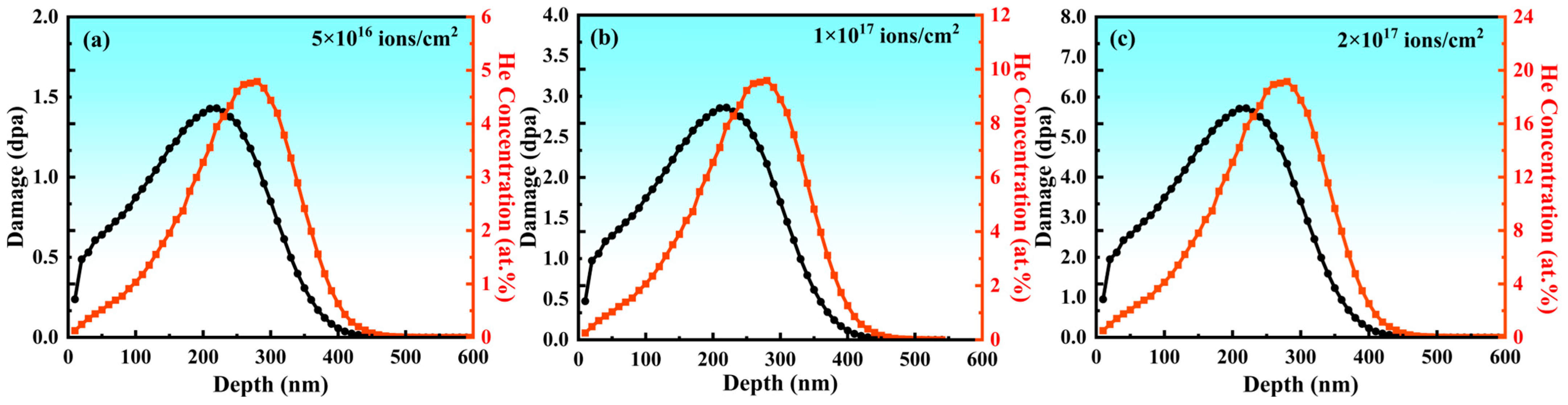
The deposition process was performed in a vacuum chamber, initiated once the base pressure reached 3.0 × 10⁻⁴ Pa. Subsequently, high-purity Ar gas was introduced at a flow rate of 50 sccm, accompanied by an oxygen–argon mixture gas at a flow rate of 0.5 sccm, maintaining the deposition pressure at 0.6 Pa throughout the process. During deposition, the power was fixed at 200 W, and the substrate rotation speed was set to 8 rpm to ensure uniform film growth. The deposition duration was 2.5 h. The TiNbZrO thin films were irradiated with 50 keV He ions at fluences of 5 × 10¹⁶, 1 × 10¹⁷, and 2 × 10¹⁷ ions/cm2, respectively. SRIM-2013 software was used to calculate the displacement per atom (dpa) and He concentration, and the threshold displacement energies of Ti, Nb, Zr, and O elements were set as 30 eV, 60 eV, 40 eV, and 50 eV, respectively [30,37,38]. The damage and He concentration profiles are shown in Figure 1. As can be seen, the calculated peak dpa are 1.43, 2.86, and 5.72, respectively, at 220 nm depth. The maximum He concentration depth is 280 nm.
Figure 1.
Depth profiles of dpa and He concentration of 50 keV He ion irradiation corresponding to the fluences of (a) 5 × 10¹⁶ ions/cm2, (b) 1 × 10¹⁷ ions/cm2, (c) 2 × 10¹⁷ ions/cm2.
2.2. Characterization
Grazing Incidence X-ray Diffraction (GIXRD, D8 Advance, Bruker, Karlsruhe, Germany) with Cu-Kα radiation at a wavelength of 1.5418 Å was used to characterize the phase structure of the TiNbZrO thin films. The scanning range was set from 20° to 80° at a scan rate of 4°/min. To further observe the internal microstructure of TiNbZrO thin films before and after irradiation, samples were prepared using dual-beam focused ion beam (FIB, Helios G4 UX, Thermo Fisher Scientific, Waltham, MA, USA) technology. The samples were then characterized using a field-emission transmission electron microscope (TEM, JEM 2100F, JEOL Ltd., Tokyo, Japan). Additionally, energy-dispersive spectroscopy (EDS, Ultim Max, Oxford Nanopore Technologies, Abingdon, England) was employed to analyze the elemental composition of the samples. Nanoindentation tests were performed at room temperature using a nanoindentation tester (NHT3, Anton Paar, Graz, Austria) to measure the hardness of the samples before and after irradiation. All the samples were tested with a load control mode with the maximum load of 0.7 mN. A Berkovich indenter was used for the tests, with at least eight measurements taken for each sample. The average values of these measurements were used in the analysis.
3. Results and Discussion
3.1. Microstructures of As-Deposited and Irradiated TiNbZrO Thin Films
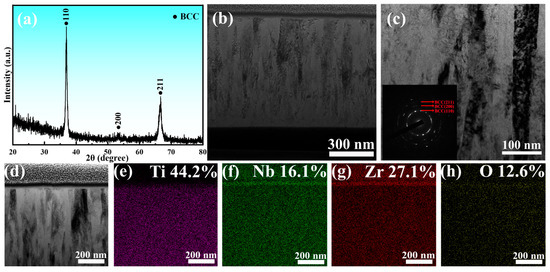
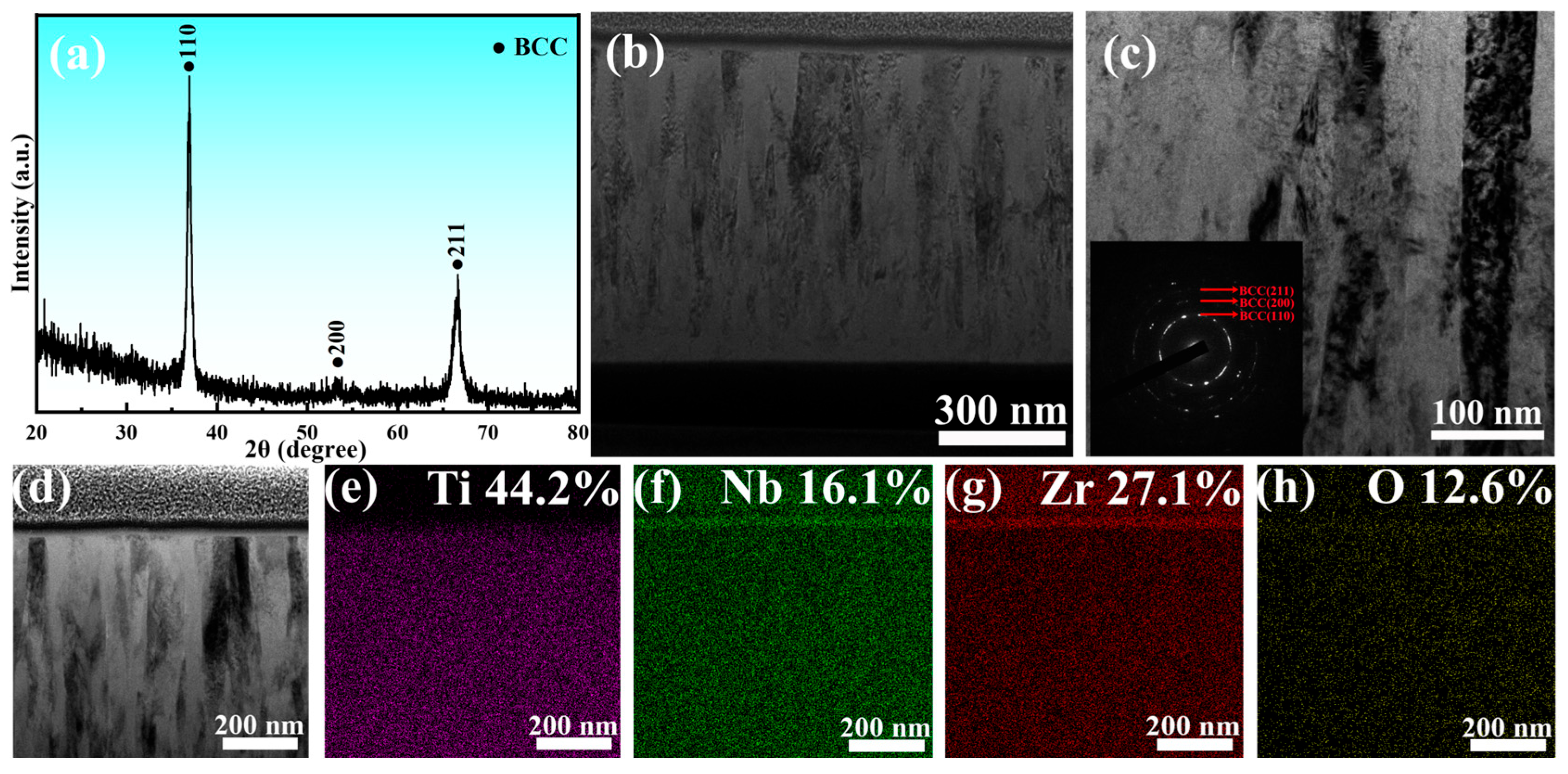
Figure 2a presents the GIXRD pattern of the TiNbZrO thin film. The results indicate that the film possesses a single-phase BCC crystal structure. Within the 2θ range of 20° to 80°, only the (110), (200), and (211) diffraction peaks are observed, located at 36.92°, 53.08°, and 66.66°, respectively. Through further refinement analysis, the lattice parameter of the TiNbZrO thin film is determined to be 0.3428 nm. To further confirm the crystal structure of the thin film and clearly characterize its morphology, TEM analysis was conducted on the sample. Figure 2b displays the cross-sectional bright-field (BF) TEM of the as-deposited TiNbZrO thin film, showing the overall morphology. In general, the thin film exhibits a dense microstructure without pores or cracks, consisting of columnar grains that grow parallel to each other and perpendicular to the surface of the Si substrate. Figure 2c displays the magnified BF-TEM image and selected-area electron diffraction (SAED) pattern. According to the statistics from Figure 2c, the average grain width of the thin film is approximately 48.8 nm. The SAED pattern clearly confirms that the thin film possesses a single-phase BCC structure. These findings are in excellent agreement with the GIXRD pattern displayed in Figure 2a. Figure 2d–h display the cross-sectional dark-field (DF) TEM image and the EDS mappings of each element in the same area of TiNbZrO thin film. At this magnification, the four elements (Ti, Nb, Zr, O) demonstrate homogeneous distribution throughout the cross-section, without elemental segregation.
Figure 2.
Microstructures of the TiNbZrO thin film: (a) The GIXRD pattern of the TiNbZrO thin film; (b) cross-sectional BF-TEM image showing the overall morphology; (c) cross-sectional BF-TEM and SAED pattern; (d–h) cross-sectional DF-TEM and the EDS mappings of each element in the same area of TiNbZrO thin film.
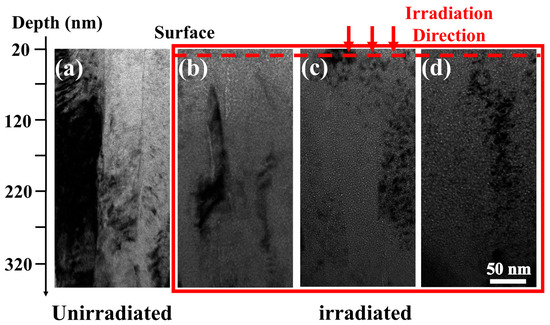
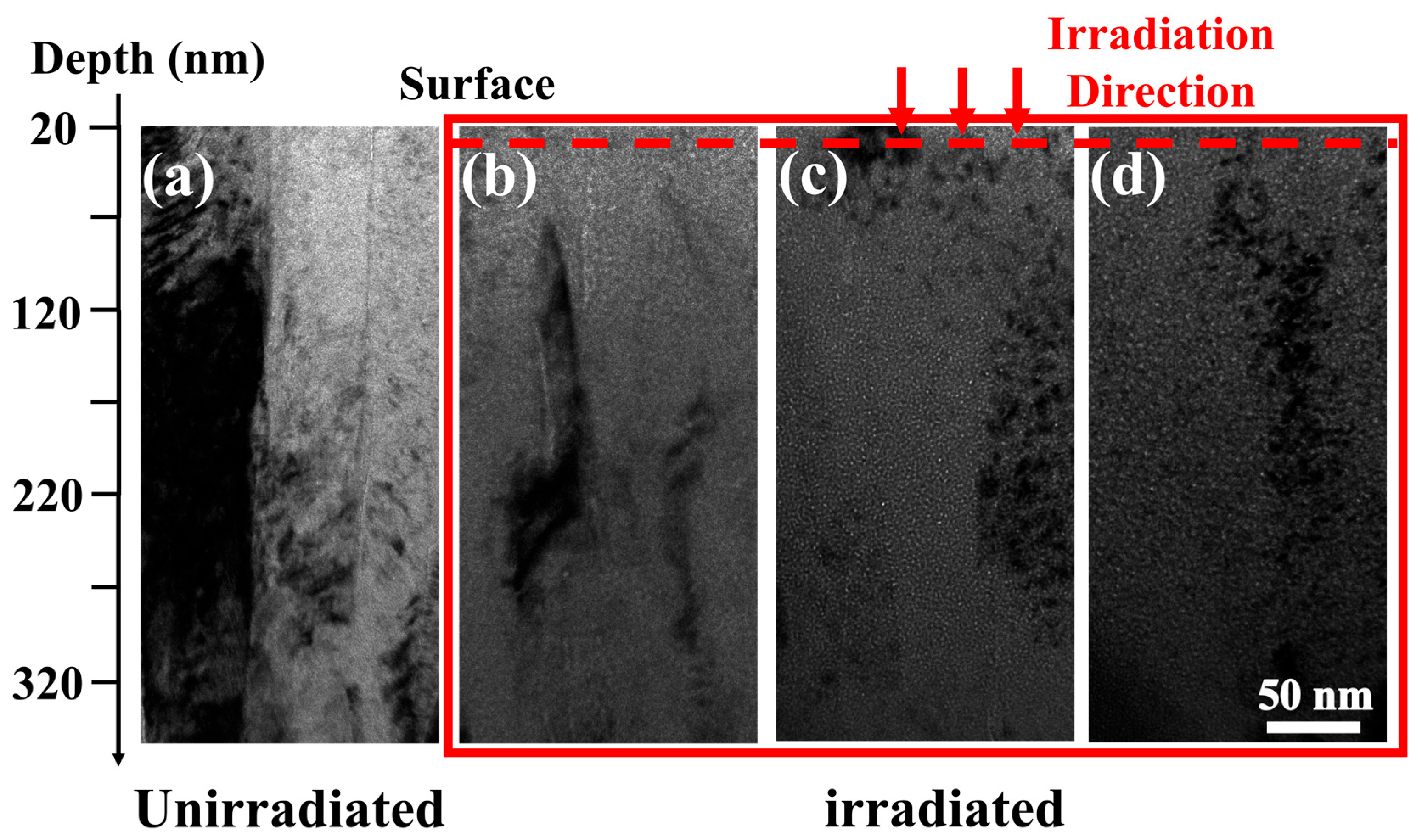
Based on TEM images, Figure 3 systematically examines the evolution of He bubbles in TiNbZrO thin films irradiated with He ion with varying irradiation fluences. The results reveal that nanoscale He bubbles form in the irradiation region of the TiNbZrO thin films under different irradiation conditions. Despite variations in fluence, the spatial distribution of the bubbles remains highly consistent, exhibiting a random dispersion pattern with no significant agglomeration. A pronounced depth-dependent distribution is observed for the He bubble concentration. The profile features a distinct peak located between 220 and 280 nm below the surface.
Figure 3.
Cross-sectional distribution of He bubbles under irradiation with different fluences: (a) Unirradiated, (b) 5 × 10¹⁶ ions/cm2, (c) 1 × 10¹⁷ ions/cm2, (d) 2 × 10¹⁷ ions/cm2.
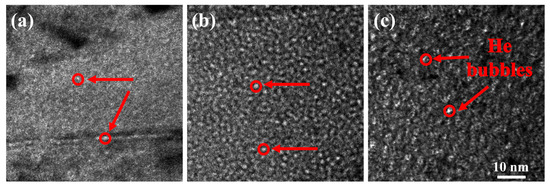
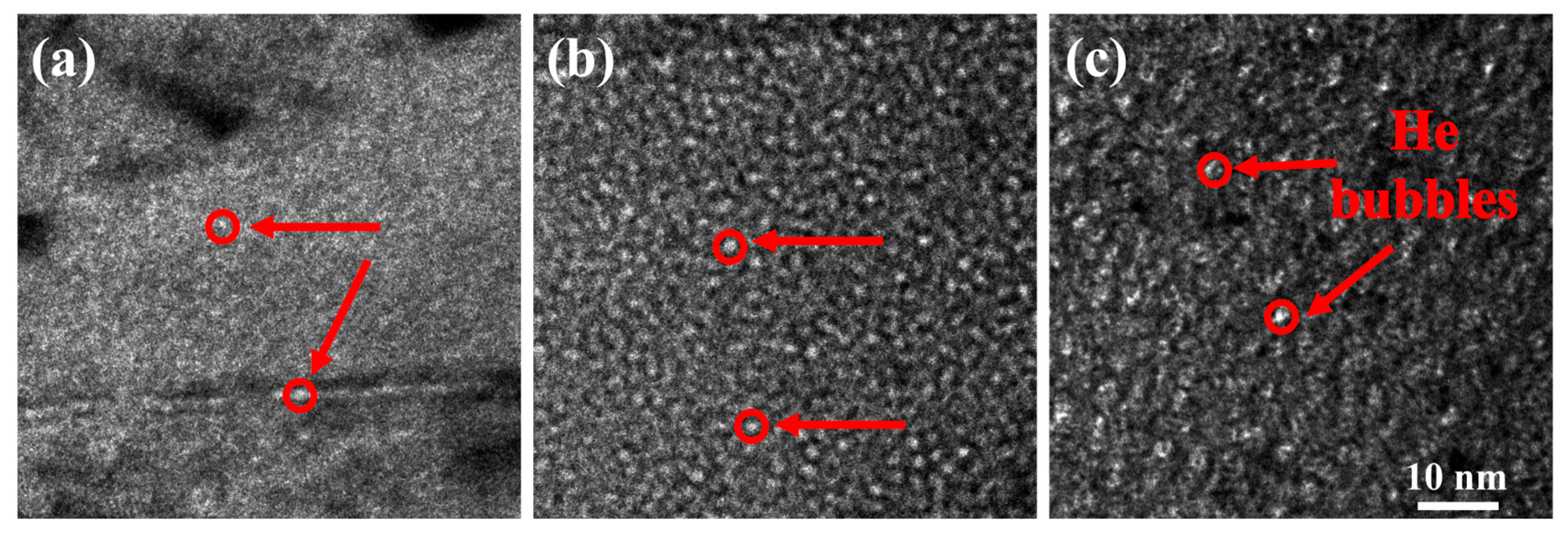
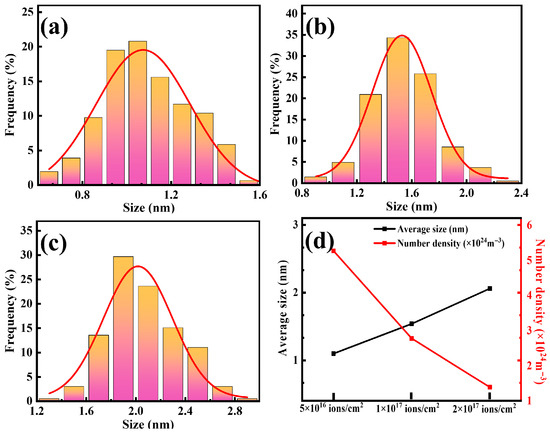
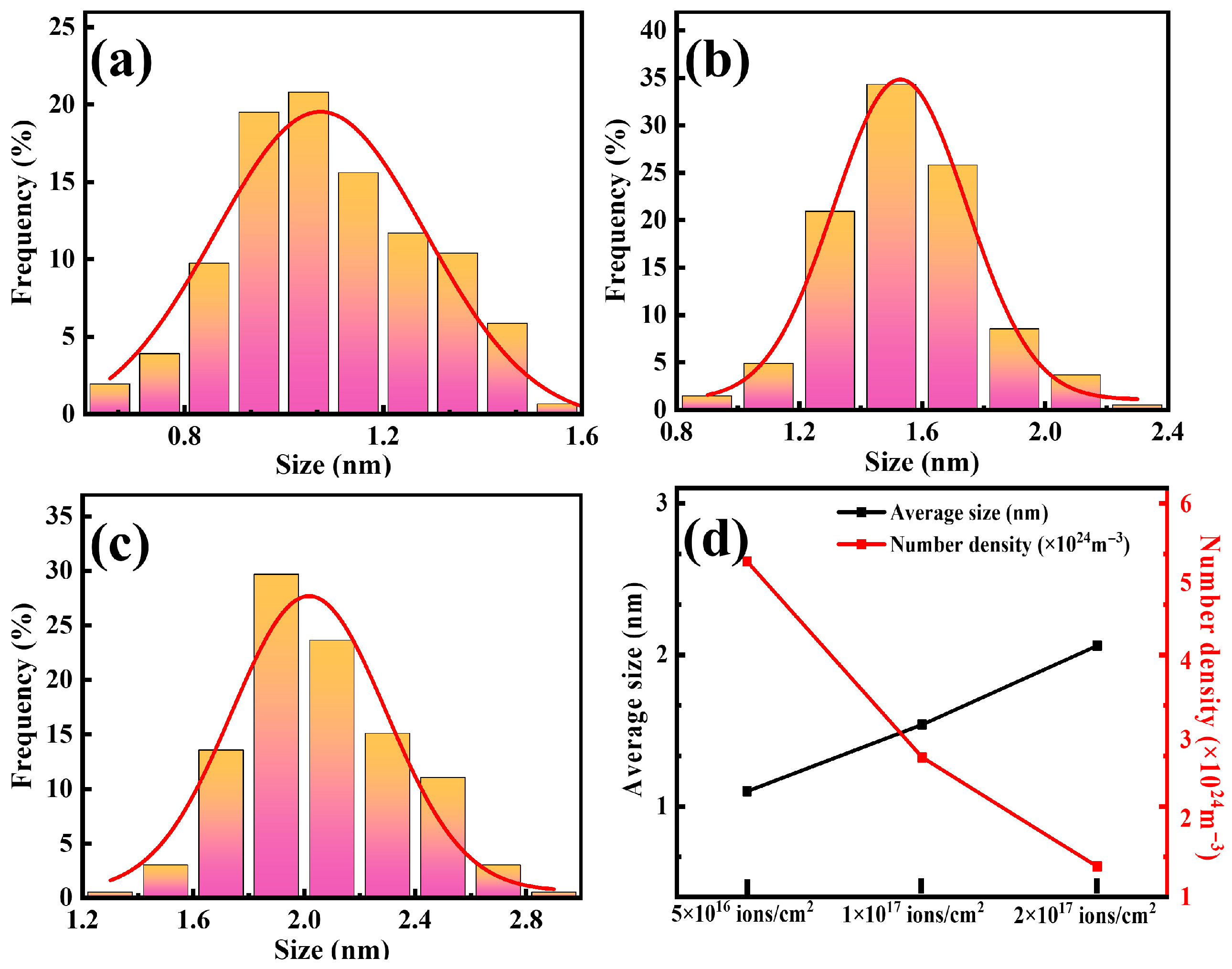
Figure 4 displays the morphological characteristics of He bubbles within the peak damage region (depth 220–280 nm) under different irradiation fluences. The He bubbles in all images exhibit a uniform and random spatial distribution. A statistical analysis of the size and density distributions of He bubbles at various fluences is conducted, with the results summarized in Figure 5. As illustrated in Figure 5a–c, the sizes of He bubbles within the peak damage region at each irradiation fluence conform to an approximately normal distribution. This observation indicates consistent and uniform nucleation behavior of He bubbles across varying irradiation levels [39,40]. From Figure 5d, it can be observed that as the irradiation fluence increases, the average size of the He bubbles increases from 1.10 nm to 1.54 nm and further to 2.06 nm, while the number density decreases from 5.27 × 1024 m−3 to 2.78 × 1024 m−3 and eventually to 1.39 × 1024 m−3. This coarsening behavior is primarily driven by a thermodynamic mechanism that reduces the total interfacial energy of the system, leading to the coalescence and growth of He bubbles. In the TiNbZrO system, however, oxygen atoms act as strong trapping sites for irradiation-induced vacancies and He atoms. This trapping suppresses defect migration and aggregation, significantly retarding the kinetic processes of Ostwald ripening and bubble coalescence. Consequently, the abnormal growth of He bubbles is effectively inhibited [41,42,43].
Figure 4.
Characteristics of He bubbles in the peak damage region under different irradiation fluences: (a) 5 × 10¹⁶ ions/cm2, (b) 1 × 10¹⁷ ions/cm2, (c) 2 × 10¹⁷ ions/cm2.
Figure 5.
(a–c) Size distribution histograms of He bubbles at 5 × 10¹⁶ ions/cm2, 1 × 10¹⁷ ions/cm2 and 2 × 10¹⁷ ions/cm2, respectively. (d) The average size and number density of He bubbles as a function of irradiation fluence.
The volume fraction of He bubbles (F) serves as a critical indicator for assessing volumetric swelling induced by bubble formation under irradiation, directly influencing the dimensional stability and mechanical properties of the material. In this study, F is strictly defined as the ratio of the total volume of He bubbles to the total volume of the sampled region. The analysis was focused on a depth of 220–280 nm, the peak damage zone where both He concentration and dpa are maximized. This region is therefore highly representative for investigating He bubble behavior. The volume fraction is calculated using the following expression:
where denotes the total volume of He bubbles (modeled as spheres), represents the total sample volume (characterized over an area of 60 nm × 60 nm), is the average equivalent radius of He bubbles, and signifies the He bubble density.
As the irradiation fluence increases from 5 × 10¹⁶ ions/cm2 to 2 × 10¹⁷ ions/cm2, the volumetric swelling fraction demonstrates a monotonic rise, with measured values of 0.37%, 0.53%, and 0.64%, respectively. The increase in swelling rate is primarily attributed to the significant growth of bubble size during He bubble coarsening. Given that the swelling volume fraction scales with , the cubic dependence on size dominates over the reduction in bubble number density. Consequently, despite the decreased number density, the swelling rate continues to rise. This microstructural evolution is driven by the thermodynamic tendency to minimize interfacial energy through Ostwald ripening and bubble coalescence. Notably, the presence of oxygen atoms effectively retards the coarsening kinetics by suppressing point defect migration [44], which inhibits the substantial swelling that would otherwise occur, resulting in a low overall swelling rate.
3.2. Phase Compositions Before and After Irradiation
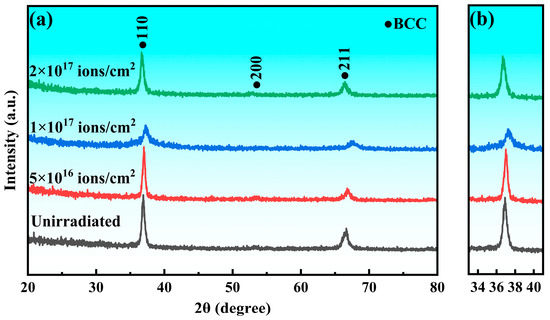
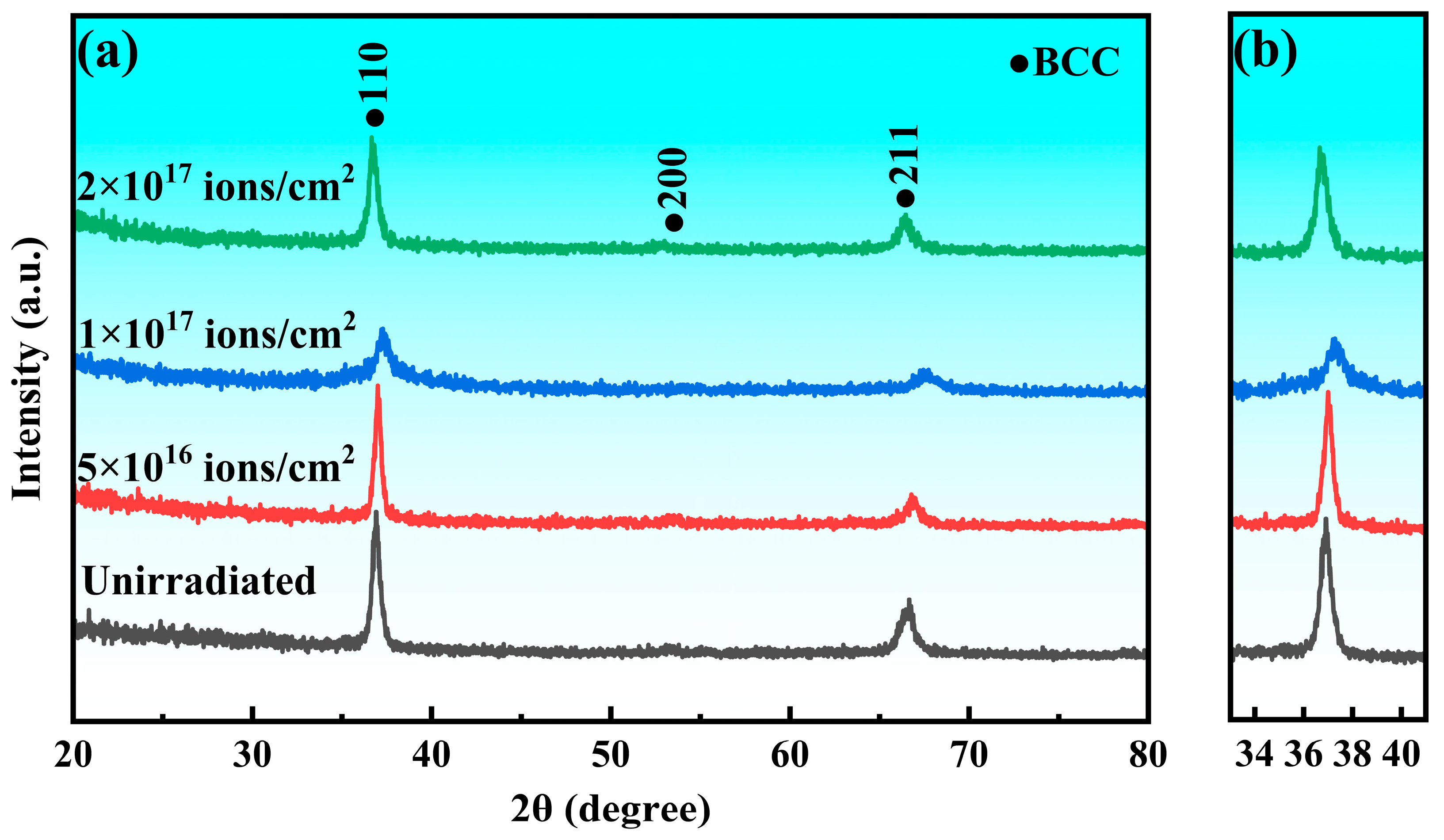
As shown in Figure 6, the GIXRD patterns illustrate the phase structure of the TiNbZrO thin films before and after irradiation. From Figure 6a, it is evident that the films maintain a single-phase BCC structure across all irradiation fluences. The diffraction patterns are dominated by three prominent peaks corresponding to the (110), (200), and (211) crystallographic planes, demonstrating remarkable phase stability under irradiation. This structural stability can be attributed to the inherent lattice distortion and high mixing entropy effects characteristic of the TiNbZr-based BCC alloy system, which significantly suppress atomic diffusion rates [45]. Furthermore, O–Ti/Zr complexes, formed through the addition of oxygen, effectively pin lattice defects and dislocations, thereby inhibiting dislocation glide and grain boundary migration [43]. These mechanisms collectively contribute to the suppression of radiation-induced phase transformation, decomposition, and recrystallization.
Figure 6.
The GIXRD patterns of the TiNbZrO thin films before and after irradiation: (a) At different fluences; (b) local magnification of the (110) plane.
Figure 6b displays a magnified view of the (110) diffraction peak region, revealing discernible changes in both the intensity and angular position of the diffraction peaks following irradiation. The full width at half maximum (FWHM) provides a quantitative measure that correlates with the degree of structural ordering in the material. Macroscopic strain, derived from Bragg’s law, serves as an effective metric for quantifying uniform lattice expansion or contraction in thin films subjected to He ion irradiation. The corresponding computational formula is expressed as follows:
where d denotes the interplanar spacing (Å), d0 refers to the interplanar spacing of the unirradiated sample (Å), and Δd represents the change in interplanar spacing after irradiation (Å). The symbol θ corresponds to the diffraction peak position (°), and λ is the wavelength of the incident X-ray beam, taken as 1.5418 Å. The macroscopic strain, denoted as ε, is derived from these parameters, a positive value of ε indicates tensile strain, whereas a negative value corresponds to compressive strain. All computed results are summarized in Table 1.
Table 1.
Variation of (110) diffraction peak parameters in TiNbZrO thin films under different irradiation fluences.
At the low-fluence irradiation (5 × 10¹⁶ ions/cm2), the FWHM of the diffraction peak decreases to 0.49, which is indicative of irradiation-induced crystallization [46,47]. The energy deposited by incident particles facilitates the migration and recombination of pre-existing defects (such as dislocations), thereby enhancing the crystallographic perfection of the material. This microstructural recovery is accompanied by a slight lattice contraction (ε = −0.21%), suggesting limited elastic restoration.
With increasing fluence to the intermediate level (1 × 10¹⁷ ions/cm2), the FWHM broadens markedly to 2.17, concurrent with a pronounced positive shift in the diffraction angle. These alterations are principally attributed to the accumulation of irradiation-induced damage within the BCC phase [48]. At this stage, damage mechanisms prevail: the clustering of supersaturated interstitial atoms introduces a strong compressive stress field, resulting in macroscopic lattice contraction (ε = −0.94%) and substantial lattice distortion.
At the highest fluence (2 × 10¹⁷ ions/cm2), a fundamental transition occurs in the defect evolution mechanism, which is primarily manifested by the change in lattice strain from compressive to tensile (ε = +0.66%). In the lower fluence regime, the compressive strain is mainly attributed to the crowding of defects into interstitial lattice sites, generating a strong compressive stress field. When the fluence reaches its maximum value (2 × 10¹⁷ ions/cm2), He atoms become saturated at interstitial lattice sites, driving their migration and subsequent precipitation into high-pressure He bubbles. These He bubbles exert an outward tensile stress on the surrounding lattice, leading to the transition of lattice strain from compressive to tensile [30]. Concurrently, the FWHM recovers to 0.67, further confirming that a fundamental transition in the defect evolution mechanism has occurred.
3.3. Mechanical Properties Before and After Irradiation
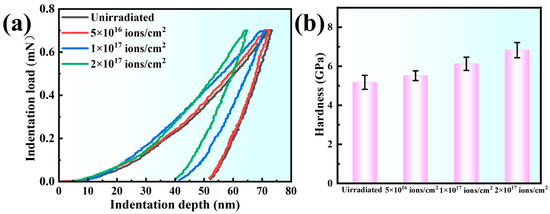
Figure 7 presents the nanoindentation test results of TiNbZrO thin films before and after irradiation. All the samples are subjected to eight tests, and the average values are used to represent their hardness. Figure 7a displays the load–displacement curves of the thin films, indicating variations in hardness under different irradiation fluences. Figure 7b illustrates the average hardness values of the thin films before and after irradiation. To quantitatively evaluate the effect of irradiation fluence on the mechanical properties of the thin film, the hardness of the as-deposited sample is measured to be 5.17 GPa (H0). As presented in Figure 7b, with increasing irradiation fluence, the average hardness progressively increases to 5.51 GPa, 6.12 GPa, and 6.82 GPa, respectively. Compared with the initial hardness, the hardness values at all fluences exhibit a significant increase, indicating a pronounced irradiation hardening effect. Furthermore, this hardening effect intensifies with increasing irradiation fluence and shows no evidence of saturation.
Figure 7.
Nanoindentation test results of TiNbZrO thin films before and after irradiation: (a) Load–displacement curves, (b) Average hardness diagram.
The occurrence of irradiation hardening is mainly attributed to the following two aspects [49,50,51]. Firstly, the irradiation generates a large number of defects within the material, including He bubbles, dislocation loops, and defect clusters. These defects act as obstacles to pin the movement of slip dislocations, exerting a significant negative impact on the mechanical properties of the material. Secondly, the size of He bubbles also has an important influence on the degree of hardening. Larger He bubbles can more effectively interact with dislocations, thereby further enhancing the hardening effect.
The hardness increment (ΔH, defined as the difference in hardness between irradiated and unirradiated samples) and the hardening ratio (ΔH/H0, representing the normalized hardness increase relative to the unirradiated state) offer improved quantification of irradiation-induced hardening in the thin films. The corresponding values are summarized in Table 2. With increasing irradiation fluence, both ΔH and ΔH/H0 show continuous yet decelerating growth. The measured hardening ratios reach 6.58%, 18.38%, and 31.91%, respectively. The maximum hardening ratio remains below 32%, which is significantly lower than the irradiation hardening rates observed in numerous conventional alloys and candidate structural materials for reactors, demonstrating excellent irradiation resistance. For instance, the Ti1.5Nb0.5ZrHf0.5Ta0.5 alloy was subjected to He ion irradiation at room temperature using a 160 keV beam. At a fluence of 4.57 × 10¹⁶ ions/cm2, the hardening rate was measured to be 30.04%. When the fluence was increased to 1.37 × 10¹⁷ ions/cm2, a further increase in hardening rate to 34.33% was observed [52]. Furthermore, under 500 keV He ions irradiation at room temperature and a fluence of 1 × 10¹⁷ ions/cm2, the Al2O3-ZrO2-ZrC composite exhibited a more pronounced hardening effect, reaching 35.51% [53].
Table 2.
Experimental parameters with increasing irradiation fluences.
Compared with conventional nuclear materials, the irradiation hardening rate of TiNbZrO thin films is significantly lower, which is fundamentally attributed to the synergistic effect between high-entropy lattice distortion and ordered oxygen complexes (OOCs) that substantially reduces the number density of hardening defect clusters, such as dislocation loops and He bubbles [43,54]. Interstitial oxygen atoms play a central role in enhancing irradiation resistance. They preferentially segregate to Ti/Zr-enriched chemical short-range order (CSRO) regions, forming OOCs and inducing nanoscale local chemical order (LCO) clusters [43,44]. This OOCs-LCO configuration triggers atomic-scale lattice distortions and heterogeneous stress fields, which increase the vacancy formation energy and hinder point defect migration. Concurrently, these complexes serve as efficient point defect traps, preferentially capturing interstitials and promoting Frenkel pair recombination, thereby significantly reducing the number of surviving point defects available for defect cluster nucleation. Meanwhile, they suppress irradiation-induced precipitation and secondary hardening by pinning solute atoms [43,54]. Furthermore, the combined effect of high-entropy lattice distortion and the trapping by OOCs suppresses defect evolution through a multiscale synergistic mechanism of “global deceleration and local trapping”. At the atomic scale, high-entropy lattice distortion introduces a global energy barrier, which increases the vacancy formation energy and impedes the long-range migration of point defects, thereby achieving “global deceleration”. At the nanoscale, OOCs serve as strong chemical trapping centers that preferentially capture interstitials, enabling “local trapping”. These two mechanisms are spatially complementary, significantly enhancing the Frenkel pair recombination rate and drastically reducing the number of surviving point defects. Consequently, the nucleation of dislocation loops and He bubbles is suppressed. Meanwhile, irradiation-induced phase transformations and the formation of brittle secondary phases are inhibited, avoiding secondary hardening [43,54]. This synergistic mechanism endows the TiNbZrO thin film with irradiation hardening resistance substantially surpassing that of conventional nuclear materials.
Fracture toughness represents a critical mechanical property index, and achieving desirable fracture toughness is essential for the engineering application of alloys. It can be indirectly estimated using the H/E ratio, where H denotes hardness and E represents the elastic modulus. Alloys exhibiting high hardness coupled with a low elastic modulus are likely to possess enhanced fracture toughness [55]. The calculated parameters are summarized in Table 2. As shown, the values increase from 0.039 (unirradiated) to 0.046, 0.054, and 0.061 with rising irradiation fluence from 5 × 10¹⁶ ions/cm2 to 2 × 10¹⁷ ions/cm2, indicating enhanced fracture toughness after irradiation. This suggests that the irradiation-induced damage did not lead to degradation in fracture toughness.
4. Conclusions
In this work, the TiNbZrO thin films with BCC structure were irradiated by 50 keV He ions at fluences of 5 × 10¹⁶ ions/cm2, 1 × 10¹⁷ ions/cm2, and 2 × 10¹⁷ ions/cm2. The evolution of their microstructure and mechanical properties was investigated in detail by XRD, TEM and nano-indentation. The main conclusions are as follows:
- (1)
- TiNbZrO thin films exhibit excellent phase stability under 50 keV He ions irradiation. The samples maintain a single-phase BCC structure before and after irradiation. This irradiation stability originates from a synergistic mechanism where high-entropy lattice distortion suppresses atomic diffusion while oxygen complexes pin defects, collectively effectively inhibiting irradiation-induced phase transformation and recrystallization.
- (2)
- Under 50 keV He ions irradiation, the coarsening of He bubbles in the TiNbZrO film is evident with increasing fluence. At depths of 220–280 nm, the average bubble size increases from 1.10 to 2.06 nm, while the number density decreases from 5.27 × 1024 to 1.39 × 1024 m−3, resulting in a rise in swelling from 0.37% to 0.64%. This coarsening is primarily driven by interfacial energy reduction. Oxygen atoms act as strong trapping sites, suppressing defect migration and delaying Ostwald ripening and coalescence, thereby inhibiting excessive bubble growth.
- (3)
- Significant irradiation hardening is observed in films after irradiation. With increasing fluence, the hardness values rise from the initial value of 5.17 GPa to 5.51 GPa, 6.12 GPa, and 6.82 GPa, corresponding to hardening rates of 6.58%, 18.38%, and 31.91%, respectively. Furthermore, the H/E ratio significantly increases from 0.039 in the unirradiated state to 0.061 at the highest irradiation fluence, indicating a positive effect of irradiation fluence on the energy release capability of the alloy during fracture. The irradiation hardening resistance of TiNbZrO thin films is significantly enhanced, primarily attributed to the synergistic effect of OOCs and LCOs in suppressing point defect migration. The findings offer valuable reference for enhancing the operational safety and reliability of nuclear reactors under extreme conditions.
Author Contributions
W.Y.: Conducted the formal analysis, wrote original draft. R.G. and G.W.: Validation. Y.L. (Yanhui Li): Helped with TEM analysis. T.Z. and Y.L. (Youping Lu): Completed the mechanical test. Z.L. and J.D.: Completed data organization. Z.C.: Review and editing. L.J.: Made significant improvement, proposed the project. All authors have read and agreed to the published version of the manuscript.
Funding
This research was funded by Science and Technology Planning Project of National Natural Science Foundation of China (Grant No. 52571033, No. 52101036, No. 52271024), Liaoning Province (2023JH2/101700280), Aeronautical science foundation (2023Z056063001).
Institutional Review Board Statement
Not applicable.
Informed Consent Statement
Not applicable.
Data Availability Statement
Data will be made available on request.
Acknowledgments
Authors acknowledge the assistance of DUT Instrumental Analysis Center.
Conflicts of Interest
Authors Tianyu Zhao, Youping Lu, Zhenjie Liu and Juan Du were employed by the Southwestern Institute of Physics, China National Nuclear Corporation (CNNC). The remaining authors declare that the research was conducted in the absence of any commercial or financial relationships that could be construed as a potential conflict of interest.
References
- Gao, W.; Ullah, S.; Zafar, S.; Usman, A. How does nuclear energy consumption contribute to or hinder green growth in major nuclear energy-consuming countries? Prog. Nucl. Energy 2024, 170, 105111. [Google Scholar] [CrossRef] [Scilit]
- Ko, J.; Kim, J.W.; Min, H.W.; Kim, Y.; Yoon, Y.S. Review of manufacturing technologies for coated accident tolerant fuel cladding. J. Nucl. Mater. 2022, 561, 153562. [Google Scholar] [CrossRef] [Scilit]
- Kashkarov, E.; Afornu, B.; Sidelev, D.; Krinitcyn, M.; Gouws, V.; Lider, A. Recent advances in protective coatings for accident tolerant Zr-based fuel claddings. Coatings 2021, 11, 557. [Google Scholar] [CrossRef] [Scilit]
- Jiang, L.; Xiu, P.; Yan, Y.; Lu, C.; Huang, M.; Liu, T.; Ye, C.; Sun, H.; Shu, R.; Wang, L. Effects of ion irradiation on chromium coatings of various thicknesses on a zirconium alloy. J. Nucl. Mater. 2019, 526, 151740. [Google Scholar] [CrossRef] [Scilit]
- Karoutas, Z.; Brown, J.; Atwood, A.; Hallstadius, L.; Lahoda, E.; Ray, S.; Bradfute, J. The maturing of nuclear fuel: Past to accident tolerant fuel. Prog. Nucl. Energy 2018, 102, 68–78. [Google Scholar] [CrossRef] [Scilit]
- Yang, J.; Shi, K.; Chen, Q.; Zhang, W.; Zhu, C.; Ning, Z.; Liao, J.; Yang, Y.; Liu, N.; Zhang, W.; et al. Effect of Au-ion irradiation on the surface morphology, microstructure and mechanical properties of amorphous AlCrFeMoTi HEA coating. Surf. Coat. Technol. 2021, 418, 127252. [Google Scholar] [CrossRef] [Scilit]
- Ni, J.; Li, J.; Jian, J.; He, J.; Chen, H.; Leng, X.; Liu, X. Recent studies on the fabrication of multilayer films by magnetron sputtering and their irradiation behaviors. Coatings 2021, 11, 1468. [Google Scholar] [CrossRef] [Scilit]
- Yang, Z.; Zeng, Y.; Ma, Y.; He, H.; Gu, M.; Zeng, G.; Liu, C. High temperature steam oxidation behavior of AlCrNbTiZr high entropy alloy coating modified by irradiation-induced atomic diffusion. Surf. Coat. Technol. 2025, 511, 132303. [Google Scholar] [CrossRef] [Scilit]
- Ali, S.; Ahmed, M.; Liu, B.; Balal, A.H.; Jia, Y.; Tariq, N.H.; Sun, K.; Mu, Y.; Jia, Y.; Wang, G. Microstructural stability and mechanical property of AlCrFeMoTi high-entropy amorphous alloy thin films under He+ ions irradiation. Surf. Coat. Technol. 2024, 487, 130952. [Google Scholar] [CrossRef] [Scilit]
- Cui, L.J.; Du, Y.F.; Yang, H.L.; Jovellana, J.A.K.; Shi, Q.Q.; Kano, S.; Abe, H. Improved irradiation resistance of Cr-Fe alloy for Cr-coated Zircaloy application in accident tolerant fuel. Scr. Mater. 2023, 229, 115344. [Google Scholar] [CrossRef] [Scilit]
- Kuprin, A.S.; Belous, V.A.; Voyevodin, V.N.; Vasilenko, R.L.; Ovcharenko, V.D.; Tolstolutskaya, G.D.; Kopanets, I.E.; Kolodiy, I.V. Irradiation resistance of vacuum arc chromium coatings for zirconium alloy fuel claddings. J. Nucl. Mater. 2018, 510, 163–167. [Google Scholar] [CrossRef] [Scilit]
- Gong, W.; Chen, H.; Zhan, C.; Du, P.; Zhang, R.; Wang, Y.; Wei, T.; Yang, H.; Zou, Y.; Yang, J. Formation of voids in the Cr coatings with (110)-preferred orientation prepared by arc ion plating under an Au+ irradiation of 20 dpa. Surf. Coat. Technol. 2021, 425, 127750. [Google Scholar] [CrossRef] [Scilit]
- Bischoff, J.; Delafoy, C.; Vauglin, C.; Barberis, P.; Roubeyrie, C.; Perche, D.; Duthoo, D.; Schuster, F.; Brachet, J.C.; Schweitzer, E.W.; et al. AREVA NP’s enhanced accident-tolerant fuel developments: Focus on Cr-coated M5 cladding. Nucl. Eng. Technol. 2018, 50, 223–228. [Google Scholar] [CrossRef] [Scilit]
- Wang, J.; Gong, W.; Chen, H.; Zhang, R.; Ma, Z.; Zou, Y.; Feng, Y.; Zhan, C.; Yang, J. Irradiation-accelerated corrosion/oxidation of the Cr coating prepared by arc-ion plating. Nucl. Eng. Des. 2023, 406, 112252. [Google Scholar] [CrossRef] [Scilit]
- Zhong, W.; Mouche, P.A.; Heuser, B.J. Response of Cr and Cr-Al coatings on Zircaloy-2 to high temperature steam. J. Nucl. Mater. 2018, 498, 137–148. [Google Scholar] [CrossRef] [Scilit]
- Li, Y.; Wang, B.; Zhang, X.; Wang, S.; Li, C.; Yang, H.; Su, R.; Liu, T. High-temperature oxidation behavior and degradation mechanism of chromium-coated zirconium alloy cladding: A review. Tungsten 2025, 7, 50–70. [Google Scholar] [CrossRef] [Scilit]
- Hu, X.; Dong, C.; Wang, Q.; Chen, B.; Yang, H.; Wei, T.; Zhang, R.; Gu, W.; Chen, D. High-temperature oxidation of thick Cr coating prepared by arc deposition for accident tolerant fuel claddings. J. Nucl. Mater. 2019, 519, 145–156. [Google Scholar] [CrossRef] [Scilit]
- He, X.; Tian, Z.; Shi, B.; Xu, X.; Meng, C.; Dang, W.; Tan, J.; Ma, J. Effect of gas pressure and bias potential on oxidation resistance of Cr coatings. Ann. Nucl. Energy 2019, 132, 243–248. [Google Scholar] [CrossRef] [Scilit]
- Maier, B.R.; Yeom, H.; Johnson, G.; Dabney, T.; Hu, J.; Baldo, P.; Li, M.; Sridharan, K. In situ TEM investigation of irradiation-induced defect formation in cold spray Cr coatings for accident tolerant fuel applications. J. Nucl. Mater. 2018, 512, 320–323. [Google Scholar] [CrossRef] [Scilit]
- Cantor, B.; Chang, I.T.H.; Knight, P.; Vincent, A.J.B. Microstructural development in equiatomic multicomponent alloys. Mater. Sci. Eng. A 2004, 375–377, 213–218. [Google Scholar] [CrossRef] [Scilit]
- Yeh, J.W.; Chen, S.K.; Lin, S.J.; Gan, J.Y.; Chin, T.S.; Shun, T.T.; Tsau, C.H.; Chang, S.Y. Nanostructured high-entropy alloys with multiple principal elements: Novel alloy design concepts and outcomes. Adv. Eng. Mater. 2004, 6, 99–303. [Google Scholar] [CrossRef] [Scilit]
- Jiang, H.; Ni, Z.; Lu, S.; Li, H.; Li, Y.; Dong, Y. Effect of remelting and heat treatment on the microstructure and mechanical properties AlCoCrFeNi2.1 eutectic high entropy Alloy. J. Alloys Compd. 2025, 1020, 179360. [Google Scholar] [CrossRef] [Scilit]
- Jiang, H.; Li, L.; Xie, W.; Wei, C.; Jia, D.; Li, J.; Li, Y. Influence of NbC particles on microstructure and wear properties of AlCoCrFeNi2.1 eutectic high-entropy alloy coatings prepared by laser cladding. Surf. Coat. Technol. 2025, 502, 131963. [Google Scholar] [CrossRef] [Scilit]
- Chang, S.; Tseng, K.K.; Yang, T.Y.; Chao, D.S.; Yeh, J.W.; Liang, J.H. Irradiation-induced swelling and hardening in HfNbTaTiZr refractory high-entropy alloy. Mater. Lett. 2020, 272, 127832. [Google Scholar] [CrossRef] [Scilit]
- Zhang, Z.; Han, E.H.; Xiang, C. Irradiation behaviors of two novel single-phase bcc-structure high-entropy alloys for accident-tolerant fuel cladding. J. Mater. Sci. Technol. 2021, 84, 230–238. [Google Scholar] [CrossRef] [Scilit]
- Xin, H.; Yang, J.; Zhang, W.; Yang, J.; Mao, J.; Teng, C.; Kong, X.; Si, J.; Xu, X.; Zhang, W.; et al. Effect of Au ion irradiation on the surface morphology, microstructure and mechanical properties of AlNbTiZr medium-entropy alloy coatings with various Al content for ATF. Surf. Coat. Technol. 2022, 434, 128157. [Google Scholar] [CrossRef] [Scilit]
- Peng, S.; Jin, K.; Yi, X.; Dong, Z.; Guo, X.; Liu, Y.; Cheng, Y.; Jia, N.; Duan, H.; Xue, J. Mechanical behavior of the HfNbZrTi high entropy alloy after ion irradiation based on micro-pillar compression tests. J. Alloys Compd. 2021, 892, 162043. [Google Scholar] [CrossRef] [Scilit]
- King, D.; Cheung, S.T.Y.; Humphry-Baker, S.A.; Parkin, C.; Couet, A.; Cortie, M.B.; Lumpkin, G.R.; Middleburgh, S.C.; Knowles, A.J. High temperature, low neutron cross-section high-entropy alloys in the Nb-Ti-V-Zr system. Acta Mater. 2019, 166, 435–446. [Google Scholar] [CrossRef] [Scilit]
- Sadeghilaridjani, M.; Ayyagari, A.; Muskeri, S.; Hasannaeimi, V.; Salloom, R.; Chen, W.; Mukherjee, S. Ion irradiation response and mechanical behavior of reduced activity high entropy alloy. J. Nucl. Mater. 2020, 529, 151955. [Google Scholar] [CrossRef] [Scilit]
- Li, J.; Pu, G.; Sun, H.; Du, X.; Lin, L.; Ren, D.; Zhang, K.; Liu, B. Effect of He-ions irradiation on the microstructure and mechanical properties of TiTaNbZr refractory medium-entropy alloy film. Vacuum 2023, 217, 112545. [Google Scholar] [CrossRef] [Scilit]
- Zong, Y.; Hashimoto, N.; Oka, H. Study on irradiation effects of refractory bcc high-entropy alloy. Nucl. Mater. Energy 2022, 31, 101158. [Google Scholar] [CrossRef] [Scilit]
- Zhao, S. Defect properties in a VTaCrW equiatomic high entropy alloy (HEA) with the body centered cubic (bcc) structure. J. Mater. Sci. Technol. 2020, 44, 133–139. [Google Scholar] [CrossRef] [Scilit]
- Liu, K.; Long, X.; Li, B.; Xiao, X.; Jiang, C. A hardening model considering grain size effect for ion-irradiated polycrystals under nanoindentation. Nucl. Eng. Technol. 2021, 53, 2960–2967. [Google Scholar] [CrossRef] [Scilit]
- Heintze, C.; Hilger, I.; Bergner, F.; Weissgärber, T.; Kieback, B. Nanoindentation of single- (Fe) and dual-beam (Fe and He) ion-irradiated ODS Fe-14Cr-based alloys: Effect of the initial microstructure on irradiation-induced hardening. J. Nucl. Mater. 2019, 518, 1–10. [Google Scholar] [CrossRef] [Scilit]
- Egami, T.; Ojha, M.; Khorgolkhuu, O.; Nicholson, D.M.; Stocks, G.M. Local electronic effects and irradiation resistance in high-entropy alloys. JOM 2015, 67, 2345–2349. [Google Scholar] [CrossRef] [Scilit]
- Zhang, C.; Chen, C.; Jiang, L.; Li, Y.; Zhu, Z.; Chen, F.; Cao, Z.; Zhang, W. Effects of interstitial oxygen content on microstructures and mechanical properties of TiZrNb refractory medium-entropy alloy. Metals 2025, 15, 250. [Google Scholar] [CrossRef] [Scilit]
- Luo, H.; Long, B.; Lu, S.; Guo, L.; Luo, F.; Lin, W.; Cao, J.; Yin, Z.; Zhao, P. Dislocation loops, segregation and hardening induced by high-dose ion irradiation of NbMoTaW and VCrTaW high-entropy alloy coatings on the T91 substrate. Surf. Coat. Technol. 2023, 473, 130019. [Google Scholar] [CrossRef] [Scilit]
- Wei, D.; Liu, J.; Lv, X.; Song, H.; Gao, Z.; Zhang, P. Design and preparation of Ta33W35Cr15V17 /Al2O3 nano multilayer film based on multi-level construction strategy and its radiation resistance behavior. Corros. Sci. 2024, 237, 112303. [Google Scholar] [CrossRef] [Scilit]
- Li, B.; Yang, Z.; Xu, S.; Wei, K.; Wang, Z.; Shen, T.; Zhang, T.; Liao, Q. Comparison of helium bubble formation in F82H, ODS, SIMP and T91 steels irradiated by Fe and He ions simultaneously. Chin. Phys. B 2021, 30, 036102. [Google Scholar] [CrossRef] [Scilit]
- La, L.; Qin, L.; Liang, G.; Wang, L. Irradiation resistance properties of WTaVCr alloy coatings. Fusion Eng. Des. 2026, 223, 115467. [Google Scholar] [CrossRef] [Scilit]
- Li, S.H.; Li, J.T.; Han, W.Z. Radiation-induced helium bubbles in metals. Materials 2019, 12, 1036. [Google Scholar] [CrossRef] [Scilit] [PubMed]
- Li, Q.; Zhang, C.; Lin, X.; Liu, C.; Xing, Y. A combined rate theory-population balance model of the evolution of irradiation-induced helium bubbles in metals during annealing. J. Nucl. Mater. 2023, 573, 154136. [Google Scholar] [CrossRef] [Scilit]
- Su, Z.; Yang, J.; Zhou, X.; Li, J.; Zhang, P.; Zhang, C.; Shi, T.; Jin, K.; Sun, Y.; Wu, L.; et al. Interstitial oxygen solutes promote atomic-scale heterogeneities to achieve superior irradiation tolerance in body-centered cubic multi-principal element alloys. J. Mater. Sci. Technol. 2025, 227, 142–154. [Google Scholar] [CrossRef] [Scilit]
- Jiao, M.; Lei, Z.; Wu, Y.; Du, J.; Zhou, X.Y.; Li, W.; Yuan, X.; Liu, X.; Zhu, X.; Wang, S.; et al. Manipulating the ordered oxygen complexes to achieve high strength and ductility in medium-entropy alloys. Nat. Commun. 2023, 14, 806. [Google Scholar] [CrossRef] [Scilit] [PubMed]
- Shi, T.; Su, Z.; Li, J.; Liu, C.; Yang, J.; He, X.; Yun, D.; Peng, Q.; Lu, C. Distinct point defect behaviours in body-centered cubic medium-entropy alloy NbZrTi induced by severe lattice distortion. Acta Mater. 2022, 229, 117806. [Google Scholar] [CrossRef] [Scilit]
- Jing, H.Y.; Li, M.F.; Wang, P.W.; Malomo, B.; Yang, L. Self-healing mechanisms of ZrCu nanocrystalline/amorphous laminated alloy under irradiation. Materialia 2021, 20, 101227. [Google Scholar] [CrossRef] [Scilit]
- Zhang, K.; Wang, Y.; Zhang, W.; Hu, Z.; Wei, B.; Feng, Y. Crystallization behavior and mechanical response of metallic glass induced by ion irradiation at elevated temperature. J. Nucl. Mater. 2021, 545, 152618. [Google Scholar] [CrossRef] [Scilit]
- Pu, G.; Sun, S.; Wang, S.; Gan, L.; Chen, S.; Ye, Z.; Huang, Z.; Zheng, J.; Wang, Z.; Yang, C.; et al. A comparative study of irradiation response in amorphous TaTiWVCr refractory high entropy alloy with the counterpart of tungsten films. Intermetallics 2023, 156, 107850. [Google Scholar] [CrossRef] [Scilit]
- Zhang, H.; Wang, Q.; Li, C.; Zhu, Z.; Huang, H.; Lu, Y. He-ion irradiation effects on the microstructures and mechanical properties of the Ti-Zr-Hf-V-Ta low-activation high-entropy alloys. Materials 2023, 16, 5530. [Google Scholar] [CrossRef] [Scilit]
- Zhang, H.; Zhu, Z.; Huang, H.; He, T.; Yan, H.; Zhang, Y.; Lu, Y.; Wang, T.; Li, T. Microstructures, mechanical properties, and irradiation tolerance of the Ti-Zr-Nb-V-Mo refractory high-entropy alloys. Intermetallics 2023, 157, 107873. [Google Scholar] [CrossRef] [Scilit]
- Jeong, W.; Yang, J.; Choi, J.; Hwang, J.; Kim, Y.; Park, S.; Choi, J.; Heogh, W.; Lee, H.; Park, J.; et al. Al-based functionally graded super-intermetallic compounds for the turbine blade of a high-performance jet engine. Adv. Compos. Hybrid Mater. 2025, 8, 420. [Google Scholar] [CrossRef] [Scilit]
- Li, Y.; Wang, X.; Lan, A.; Qiao, J. Helium ion irradiation-induced hardening behavior in Ti1.5ZrHf0.5Nb0.5Ta0.5 refractory high-entropy alloys. J. Nucl. Mater. 2025, 616, 156037. [Google Scholar] [CrossRef] [Scilit]
- Li, S.; Jin, P.; Zhu, Y.; Chai, J.; Niu, L.; Shen, T.; Wang, Z. Effects of He irradiation on the microstructures and mechanical properties of Al2O3–ZrO2–ZrC ceramic composites. Ceram. Int. 2024, 50, 15633–15641. [Google Scholar] [CrossRef] [Scilit]
- Lei, Z.; Liu, X.; Wu, Y.; Wang, H.; Jiang, S.; Wang, S.; Hui, X.; Wu, Y.; Gault, B.; Kontis, P.; et al. Enhanced strength and ductility in a high-entropy alloy via ordered oxygen complexes. Nature 2018, 563, 546–550. [Google Scholar] [CrossRef] [Scilit]
- Touaibia, D.; Achache, S.; Bouissil, A.; Ghanbaja, J.; Migot, S.; Yazdi, M.; Schuster, F.; Panicaud, B.; Sanchette, F.; Garah, M. Oxidation resistance and mechanical properties of AlTiZrHfTa(-N) high entropy films deposited by reactive magnetron sputtering. J. Alloys Compd. 2023, 969, 172397. [Google Scholar] [CrossRef] [Scilit]

Disclaimer/Publisher’s Note: The statements, opinions and data contained in all publications are solely those of the individual author(s) and contributor(s) and not of MDPI and/or the editor(s). MDPI and/or the editor(s) disclaim responsibility for any injury to people or property resulting from any ideas, methods, instructions or products referred to in the content. |
© 2026 by the authors. Licensee MDPI, Basel, Switzerland. This article is an open access article distributed under the terms and conditions of the Creative Commons Attribution (CC BY) license.