Review

Research Progress on Microbially Induced Calcium Carbonate Precipitation (MICP) for Reinforcing Fractured Rock Masses

1
Department of Civil Engineering, School of Civil Engineering and Geomatics, Shandong University of Technology, Zibo 255000, China
2
China Design Group Co., Ltd., 9 Ziyun Avenue, Nanjing 210000, China
3
Department of Landscape Architecture, School of Civil Engineering and Architecture, Hebei University of Engineering Science, Shijiazhuang 050011, China
4
Department of Civil Engineering, Faculty of Engineering, Universiti Malaya, Kuala Lumpur 50603, Malaysia
5
Department of Engineering and Management, International College, Krirk University, No. 3 Soi Ramintra 1, Ramintra Road, Anusaowaree, Bangkhen, Bangkok 10220, Thailand
*
Authors to whom correspondence should be addressed.
Coatings 2026, 16(4), 413; https://doi.org/10.3390/coatings16040413
Submission received: 7 March 2026 / Revised: 25 March 2026 / Accepted: 27 March 2026 / Published: 29 March 2026

Abstract

The deterioration of mechanical properties and seepage issues in fractured rock masses represent critical technical bottlenecks in the field of geotechnical engineering. Traditional remediation techniques suffer from drawbacks such as environmental pollution, poor filling effects in microfissures, and susceptibility to secondary cracking, making it difficult to meet the requirements for long-term effectiveness and environmental compatibility in fractured rock mass reinforcement. Microbially induced calcium carbonate precipitation (MICP) technology, which drives the formation of calcium carbonate crystals through microbial metabolic activities, achieves fracture filling and rock mass reinforcement. This technology offers several advantages, including environmental friendliness, high permeability, and excellent compatibility; thus, it represents a cutting-edge direction for green remediation in geotechnical engineering. In this paper, the core mineralization mechanisms of MICP technology, key influencing factors, and engineering applications in fractured rock masses are systematically analysed. Research has indicated that MICP can significantly increase the compressive strength, impermeability, and liquefaction resistance of fractured rock masses, enabling both self-healing of rock fractures and precise filling of existing fissures. Compared with traditional techniques, it demonstrates superior environmental compatibility and remediation efficacy. This review aims to serve as a reference for theoretical research and engineering applications of MICP in fractured rock mass reinforcement.

1. Introduction

Fractured rock masses are widely distributed in geotechnical engineering scenarios such as slope engineering, underground caverns, hydraulic dams, and oil and gas well walls. The randomly developed internal fracture network directly leads to a reduction in compressive strength and deterioration of impermeability, serving as a primary inducement for engineering disasters, including slope instability, cavern seepage, and dam piping [1]. Traditional remediation techniques for fractured rock masses predominantly employ physical or chemical methods to achieve fracture reinforcement through material grouting [2,3]. Cement-based repair represents the most prevalent physical remediation approach, with cementitious materials being most widely applied in engineering practice because of their low cost, easy accessibility, and mature construction techniques [4,5,6]. However, cement production generates substantial greenhouse gas emissions [7,8], accounting for 5%–7% of global greenhouse gas emissions [9]. Cement-based repair materials exhibit substantial particle sizes, elevated slurry viscosity, and inadequate fluidity, which collectively result in limited efficacy for filling fine cracks. Furthermore, the hydration heat of cement [10] induces post-hardening shrinkage, predisposing the material to secondary cracking and consequently compromising the attainment of ideal remediation outcomes. Conversely, although chemical grouts possess advantageous characteristics such as low viscosity and superior fluidity [11] that enable effective microcrack infiltration, they present critical limitations, including prohibitive costs and poor environmental compatibility. These drawbacks pose potential risks to human health and ecological systems, thereby limiting their applicability in green engineering contexts.
A wide variety and large number of microbial communities inhabit rock masses. During long-term geological evolution, these microorganisms have evolved unique biomineralization capabilities, which can regulate the nucleation, growth and deposition processes of calcium carbonate in the environment through their own metabolic activities, a phenomenon known as microbially induced calcium carbonate precipitation (MICP) [12]. Among the numerous microbial groups, bacteria have become the core application carrier of MICP technology because of their high abundance of 109–1010 cells per gram in the soil environment, wide ecological distribution and diverse metabolic pathways [13]. The cell diameter of bacteria is usually only 0.5–3 μm, and the spore diameter of some Bacillus species can even be as small as 0.2 μm [14]. This tiny size endows them with a unique permeability advantage, enabling them to easily penetrate micron-scale and even nanometer-scale small pores and fractures in geotechnical masses and reach areas that are difficult for traditional repair materials to access, providing an ideal reaction site for the subsequent mineralization reaction. The calcium carbonate crystals generated during microbial metabolism do not exist in isolation but cement the geotechnical particles and fill the pore spaces between the particles at the same time, bonding the loose particles into an integral body with a certain strength and integrity [12]. Following MICP treatment, the unconfined compressive strength and impermeability of sand columns or geotechnical specimens are significantly enhanced [15].
In recent years, against the backdrop of increasingly prominent environmental issues caused by global warming and the widespread consensus among nations on the concept of “green and low-carbon” development [16], MICP technology has emerged as a highly promising green remediation technique [17]. This technology harnesses the metabolic processes of naturally occurring microorganisms to achieve mineralization under mild reaction conditions, generating few harmful by-products and significantly reducing environmental disturbance and pollution. Furthermore, MICP exhibits unique self-healing potential: when new micro-cracks form in a geotechnical mass due to external forces, the mineralization process can be re-initiated as long as active microorganisms and sufficient reaction substrates are present in the environment. This enables autonomous crack repair, thereby substantially enhancing the long-term service performance of engineering structures [18].
To ensure the systematic rigor and reproducibility of this review, we adhered to the retrieval principles of systematic literature reviews to conduct a comprehensive search of studies on the reinforcement of fractured rock masses using microbially induced calcium carbonate precipitation (MICP). This review systematically analyzes the mineralization mechanisms of various functional microorganisms, elucidating the core pathways through which different types of microorganisms regulate the physicochemical properties of the microenvironment and induce calcium carbonate precipitation. Additionally, it synthesizes the key influencing factors and their coupling effects, thereby contributing to a deeper understanding of the behavioral principles and application performance of MICP technology in the reinforcement of fractured rock masses. These findings provide a scientific reference for strain selection, parameter optimization, and process design across various engineering scenarios, including slope engineering, hydraulic dams, and underground caverns.

Literature Search Strategy

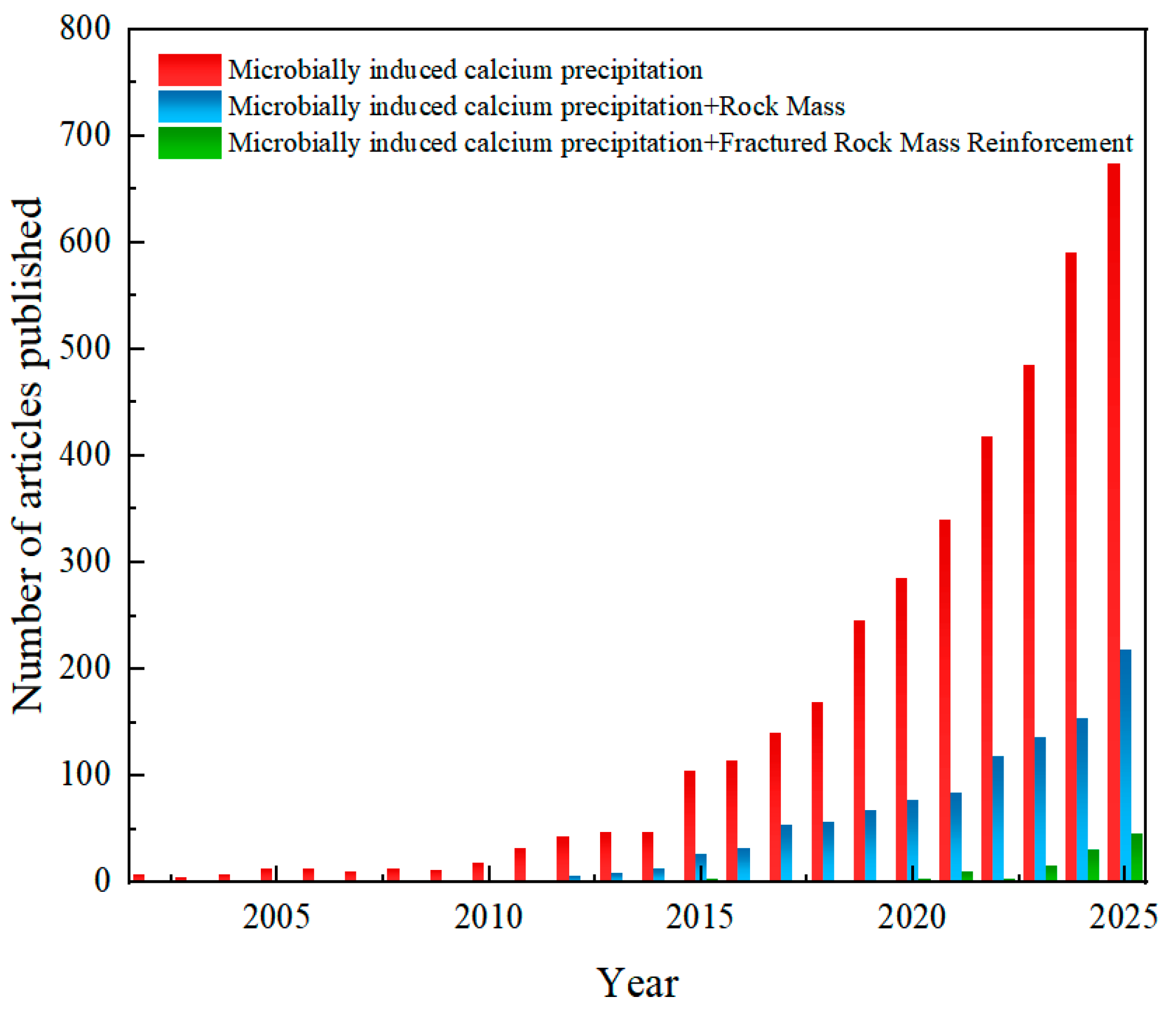
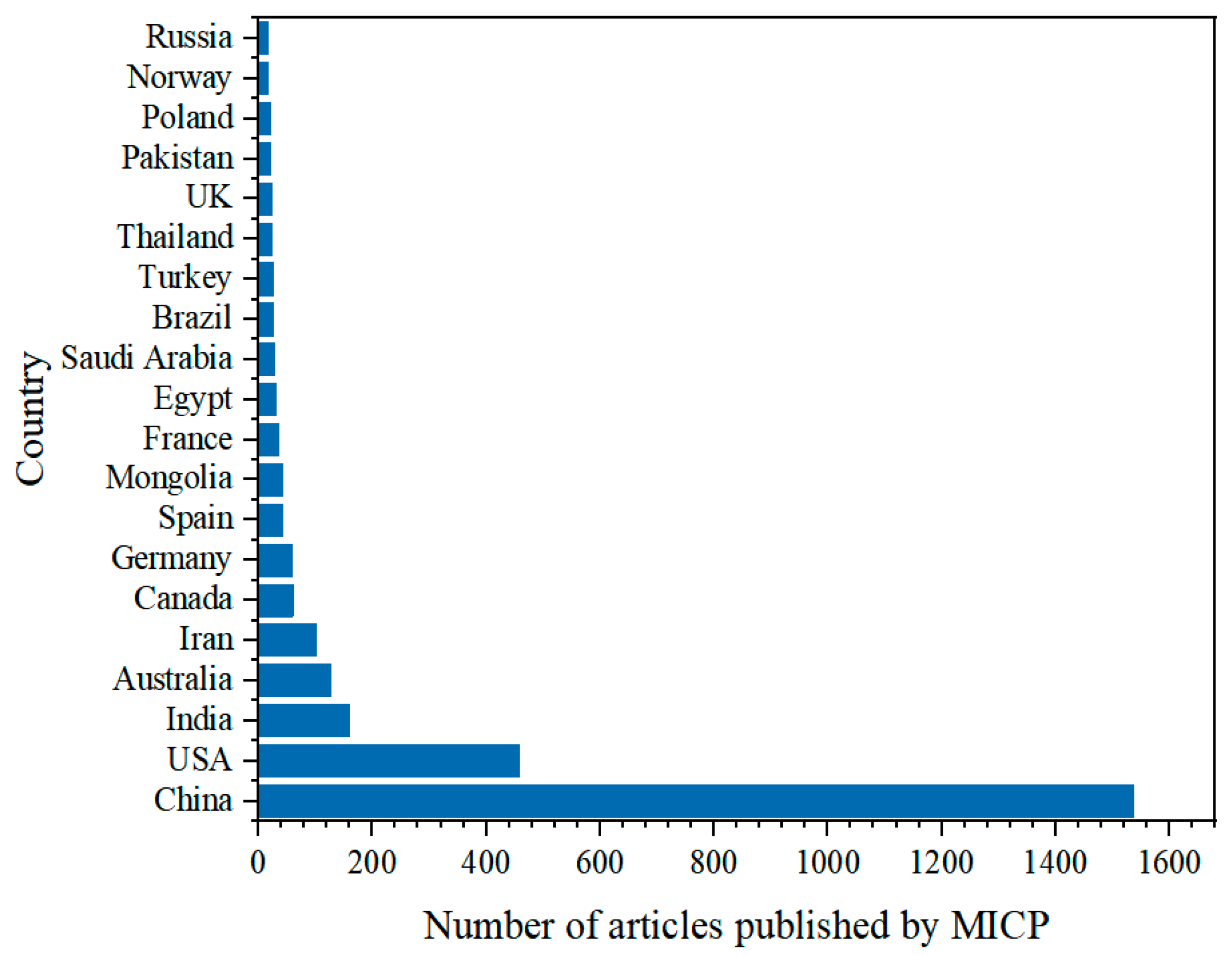
For the sake of systematicity and replicability, a comprehensive literature search was conducted on studies related to MICP for reinforcing fractured rock masses. The search was performed in the following databases: CNKI, Wanfang Data, Web of Science, Scopus, and Google Scholar. The search time frame spanned from 1990 to 2026. The keyword combinations used were: MICP, (“microbially induced carbonate precipitation” OR “MICP”) AND (“fractured rock” OR “rock fracture” OR “crack repair” OR “Reinforcing Fractured Rock Masses”). Figure 1 illustrates the annual publication volume based on keyword searches, and Figure 2 presents the global distribution of publications by country.
The inclusion criteria for the literature were: (I) research content directly related to the principles of MICP technology, mineralization mechanisms, or engineering applications; (II) research objects involving fractured rock masses, rock fractures, or concrete cracks; (III) sources from peer-reviewed journals, authoritative conference proceedings, or high-quality dissertations; and (IV) inclusion of clear data or conclusions to support the findings.
It should be noted that the application of MICP technology in geotechnical engineering can be divided into two typical scenarios. One is porous media, where the primary objective is to cement loose particles and fill intergranular pores. The other is fractured media, where the core focus lies in filling and bridging pre-existing fractures to restore the continuity and overall strength of the rock mass. Although the mineralization mechanisms underlying these two scenarios share certain commonalities, they exhibit fundamental differences in terms of bacterial transport, spatial constraints on precipitation, and mechanical response mechanisms [19]. This paper focuses on fractured rock masses and systematically reviews the latest research progress in this field.

2. Microbial Mineralization Reaction Mechanism

Biologically induced mineralization refers to the process in which microorganisms indirectly induce mineral precipitation by altering the physicochemical properties of their surrounding environment through metabolic activities [20]. The underlying mechanism involves the generation of carbonate ions by microbes while simultaneously regulating the ambient pH to alkaline conditions, thereby facilitating the combination of metal ions, such as calcium, with carbonate ions to ultimately form stable carbonate precipitates [21]. MICP technology involves various types of mineralization reactions, with the functional microorganisms that are typically involved primarily being ureolytic bacteria, sulfate-reducing bacteria, and denitrifying bacteria.

2.1. Urease-Producing Bacteria Reaction Mechanism

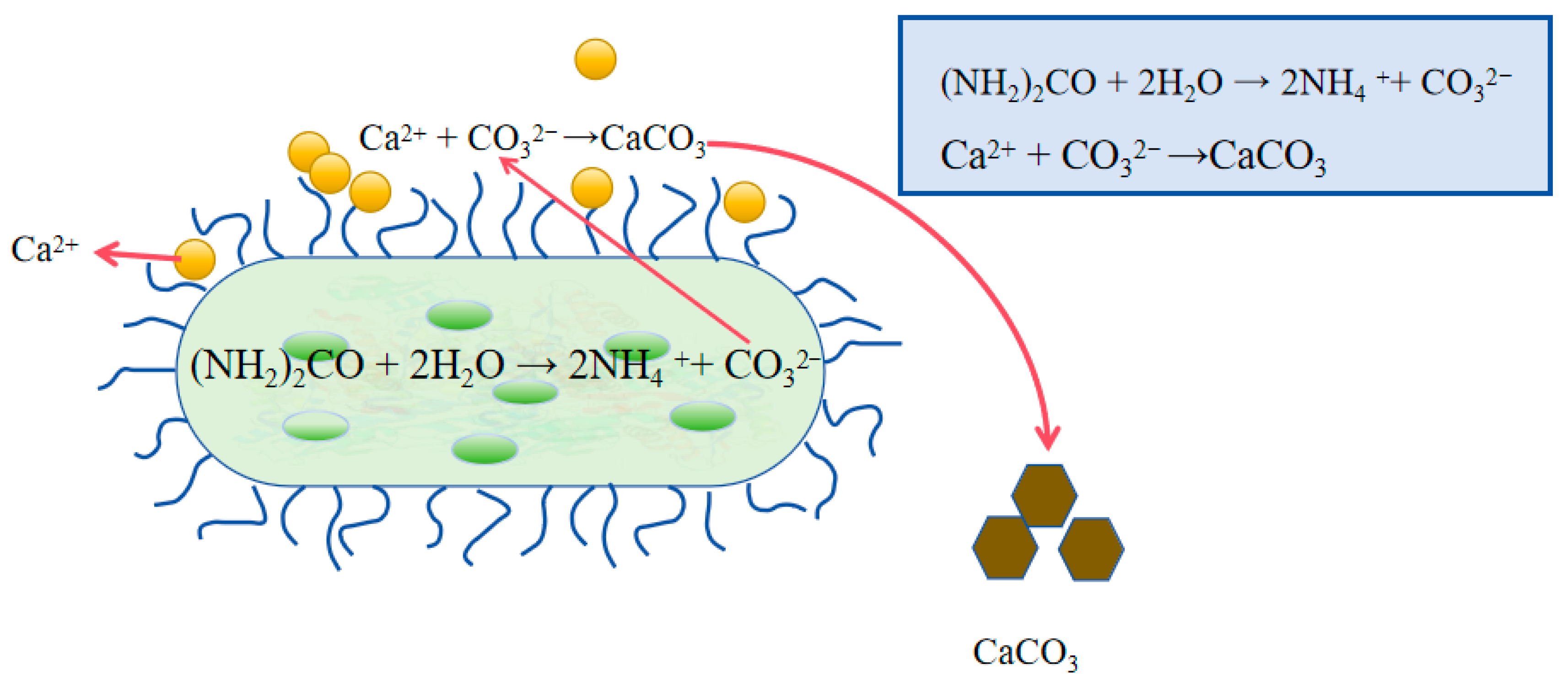
Within the mineralization mechanism of MICP for geotechnical fracture remediation, the urea hydrolysis pathway has emerged as the most extensively applied and rigorously investigated approach owing to its high reaction efficiency, ease of control, and excellent stability of its mineralized products [14]. The process of calcium carbonate precipitation induced by ureolytic bacteria is shown in Figure 3. These microorganisms, capable of synthesizing and secreting urease, drive the hydrolysis of urea within the environment to initiate carbonate precipitation, thereby serving as the key functional flora for achieving geotechnical fracture reinforcement and repair via MICP technology. The urease-producing bacteria currently widely investigated and applied include multiple genera, with representative strains [22] such as Sporosarcina pasteurii (formerly Bacillus pasteurii), Bacillus sphaericus, Bacillus subtilis, Escherichia coli, and Staphylococcus spp.
Studies have confirmed the dual core role of urease-producing bacteria in the mineralization repair of geotechnical fractures [23]. Urea hydrolysis catalyzed by secreted urease yields NH3 and CO2. Elevated NH3 concentrations increase the ambient pH and drive the formation of carbonate ions in solution. Sustained urease secretion promotes efficient urea hydrolysis, providing a sufficient material basis for carbonate precipitation at fracture sites [24]. Surface functional groups, charge characteristics and negatively charged organic layers enable continuous Ca2+ chelation and offer stable heterogeneous nucleation sites for calcium carbonate crystals. Regulated crystal growth and morphology favour the integration of precipitated calcium carbonate with the geotechnical matrix, enhancing fracture repair performance [25]. Microorganisms contribute to microbially induced calcium carbonate precipitation not only through urease production but also by providing essential nucleation sites for effective fracture remediation.

2.2. Sulfate-Reducing Bacteria Reaction Mechanism

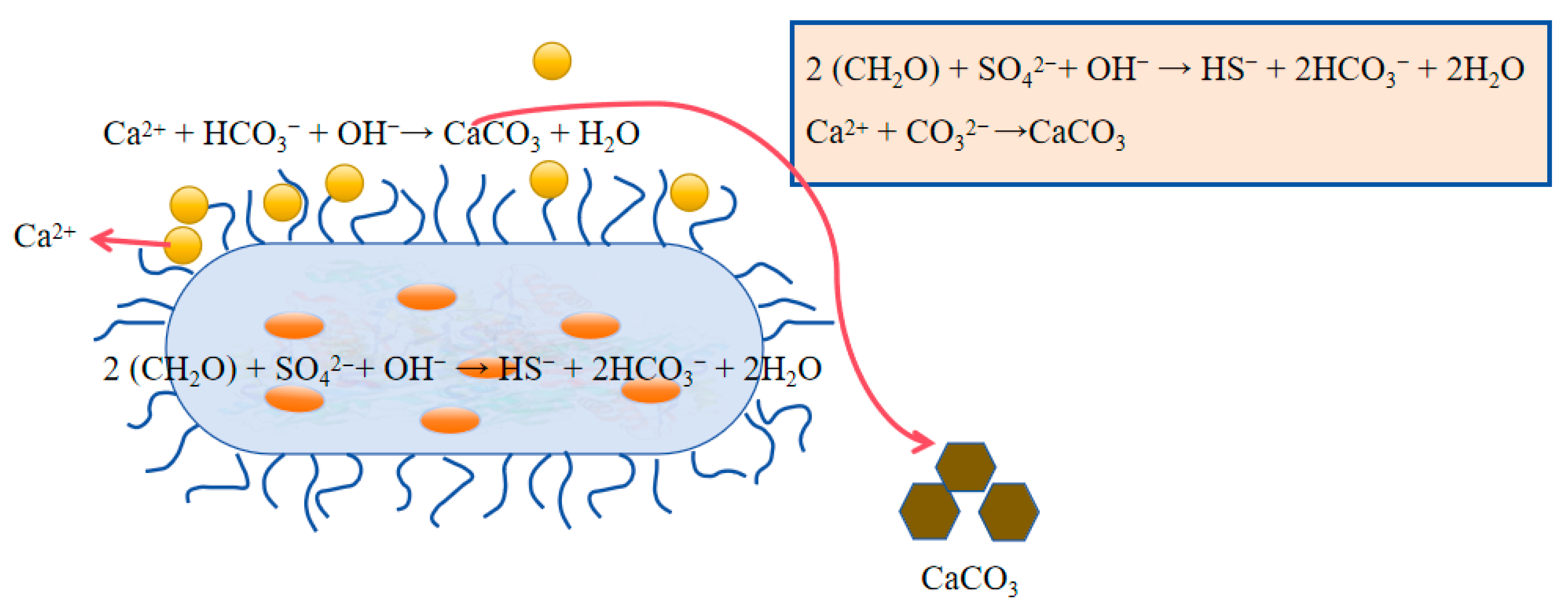
Sulfate-reducing bacteria (SRB) are a class of anaerobic microorganisms characterized by unique metabolic capabilities. In anoxic microenvironments within geotechnical fractures that are rich in organic matter, SRB utilize sulfate as an electron acceptor, reducing sulfate ions to hydrogen sulfide gas, which is subsequently released [26]. This metabolic process simultaneously generates bicarbonate ions. These bicarbonate ions then combine with metal ions present in the geotechnical environment to precipitate carbonate, as shown in Figure 4. Furthermore, the sulfate reduction activity of the SRB increases the pH of the surrounding microenvironment within the fractures, thereby further promoting precipitation formation [27]. Common SRB predominantly belong to the genus Desulfovibrio, as do 11 other genera, including Desulfomonas and Desulfosarcina [28]. Mineralization technology based on SRB metabolism has unique advantages in the engineering application of microbially induced carbonate precipitation (MICP) for repairing geotechnical fractures. It is particularly suitable for fractured zones in organic-rich cohesive or silty soils, roadbeds with sulfate-rich backgrounds, and geotechnical fracture zones in tailings dams [29].

2.3. Iron Salt-Reducing Bacteria Reaction Mechanism

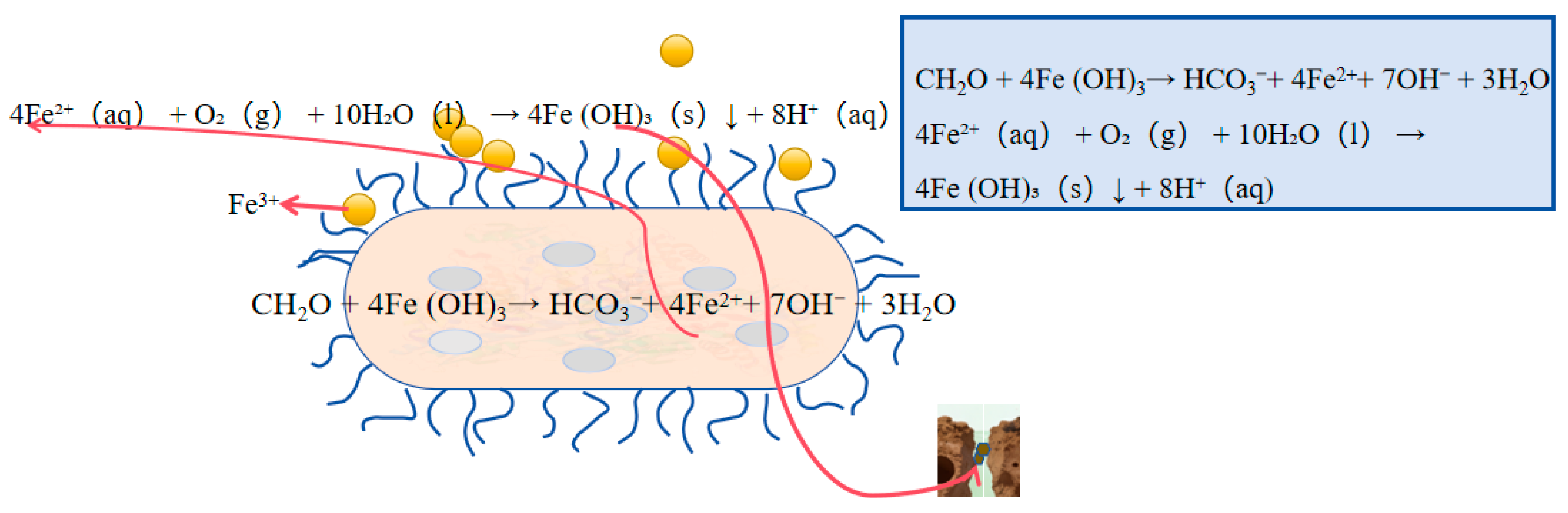
Iron-reducing bacteria (IRBs) are widely distributed in natural environments, particularly in iron-rich soils, groundwater sediments, and anoxic geotechnical fracture media. These microorganisms possess a unique dissimilatory iron reduction metabolic capability, which drives the valence transformation of iron ions and induces the precipitation of stable iron-based minerals. This provides a novel technical pathway for the MICP-based remediation of geotechnical fractures [30]. During metabolism, IRB reduces insoluble Fe3+ to soluble Fe2+, which subsequently reacts with oxidizing agents in the environment to form insoluble iron-based precipitates [31,32], as shown in Figure 5. In addition, their metabolic activity modulates the local redox potential and pH, establishing thermodynamically favourable conditions for iron mineral formation [33]. These biogenic precipitates fill fracture pores and cement loose particles, ultimately achieving effective plugging and mechanical reinforcement of geotechnical fractures.

2.4. Denitrifying the Bacteria Reaction Mechanism

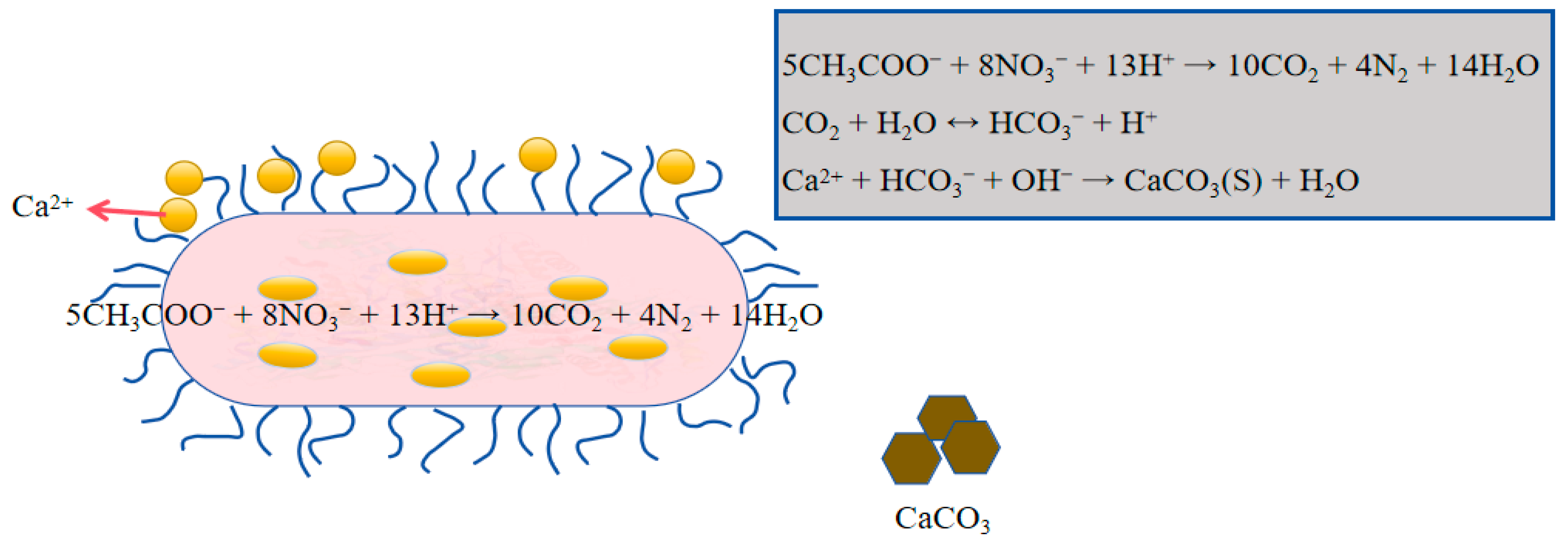
Denitrifying bacteria are typical facultative anaerobes whose metabolic characteristics render them particularly well suited to the anoxic or microaerophilic conditions often encountered in geotechnical fractures. These microorganisms utilize organic carbon as an electron donor and energy source, progressively reducing nitrate to nitrogen gas via enzyme-catalyzed reactions [34]. Throughout this dissimilatory process, hydrogen ions are continuously consumed, leading to a marked increase in the pH of the local microenvironment. This alkalinization establishes favourable conditions for carbonate precipitation [35]. The bicarbonate ions generated through denitrification subsequently combine with free calcium ions present in the geotechnical medium. Under the nucleation effect provided by functional groups on the bacterial cell surface, insoluble calcium carbonate precipitates are rapidly formed, as shown in Figure 6. These precipitates predominantly consist of stable polymorphs such as calcite or aragonite, which exhibit strong integration with the surrounding geotechnical matrix [36]. The accumulated calcium carbonate progressively fills the void spaces within fractures and effectively cements adjacent loose particles—including soil grains, rock fragments, or concrete matrix constituents—thereby forming a continuous and structurally stable solidified layer [37]. A notable advantage of this pathway over other MICP mechanisms, such as urea hydrolysis, is that it eliminates the need for exogenous strain introduction [38]. The resulting biomineralized layer serves a dual function: it achieves efficient fracture sealing, thereby reducing groundwater seepage and mitigating medium erosion while also significantly enhancing the compressive strength and shear performance of the fractured zone. This contributes to the long-term recovery of structural stability in the treated geotechnical mass [39].
Nevertheless, incomplete denitrification reactions may lead to the accumulation of toxic intermediates such as nitrite and nitrous oxide. These byproducts pose potential environmental risks because of their toxicity and pollutant characteristics, which could adversely affect surrounding water bodies and soil ecosystems if not adequately controlled [35].

2.5. Methanotroph Mineralization

In low-oxygen or anaerobic environments such as deep fractures in geotechnical engineering and underground excavation engineering, methanotrophs, as core anaerobic functional microorganisms, can mediate the microbially induced calcium carbonate precipitation (MICP) process through metabolic activities driven by formic acid oxidation, providing a new path for green and nonsecondary pollution for geotechnical fracture repair in such special scenarios [40]. With methane as the sole carbon source and formic acid as the electron donor, methane is converted into carbon dioxide through an anaerobic oxidation reaction [41]. The generated carbon dioxide combines with pore water in geotechnical fractures to form carbonic acid, providing a material basis for the subsequent generation of carbonate ions. Moreover, the synchronous consumption of methane can also achieve the additional benefit of atmospheric methane removal. Proton in the environment is consumed through metabolic processes, and the pH of the local microenvironment gradually increases [42]. Methanotrophs can adapt to the anaerobic conditions in fractures through their own metabolism and construct an alkaline environment in a complex geotechnical microenvironment, providing an efficient material guarantee for fracture filling and cementation [43]. Compared with traditional urea hydrolysis-type MICP, this pathway can also avoid the secondary pollution problems caused by ammonia release and nitric acid formation [44].
The core chemical reaction Equations (1)–(3) for calcium carbonate precipitation induced by methanotrophs are as follows:
Without sulfate participation (typical reaction):
C H 4 + 2 H 2 O C a C O 3 + 4 H 2
C O 2 + H 2 O + C a 2 + C a C O 3 + 2 H +
In the presence of sulfate (sulfur-containing environment):
C H 4 + C a 2 + + S O 4 2 + C a C O 3 + H 2 O + H 2 S

2.6. Mineralization Mechanisms of Other Microorganisms

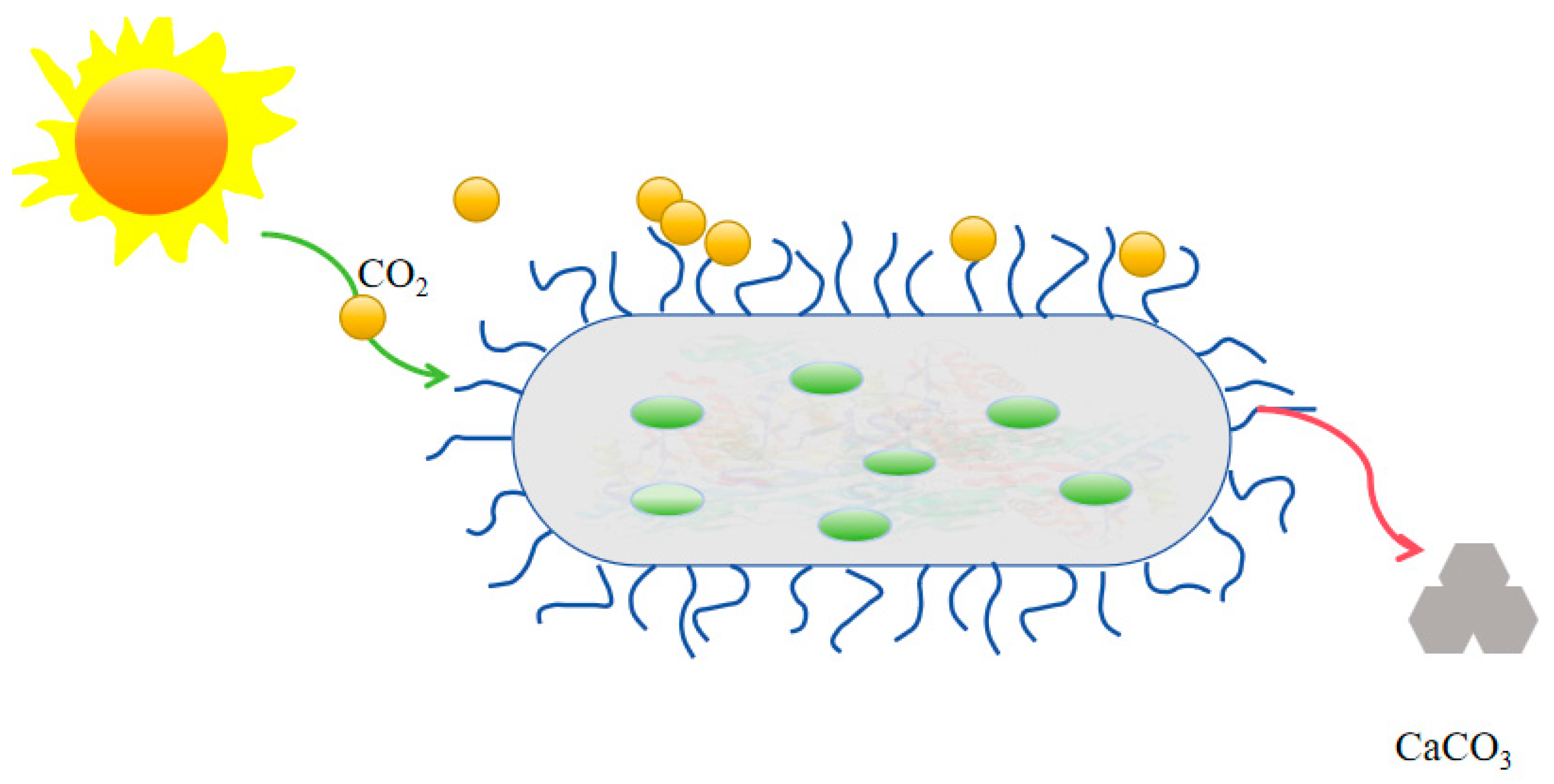
Photosynthetic microorganisms, such as cyanobacteria and microalgae, are autotrophic organisms that utilize CO2 in the environment as their primary carbon source through photosynthetic metabolism and physiological characteristics. The photosynthetic process directly alters the speciation of inorganic carbon within the system, facilitating the conversion of CO2 into available forms such as bicarbonate ions. Concurrently, the metabolic process generates OH, leading to a significant increase in the pH of the surrounding environment [45]. Ultimately, this elevated pH reduces the solubility of carbonates, promoting the combination of metal ions (primarily Ca2+) in the environment with the converted bicarbonate ions to induce carbonate precipitation. These precipitates achieve remediation by filling pores in the rock or soil mass and cementing loose particles, as shown in Figure 7. Furthermore, this entire process proceeds without the involvement of urease, thereby avoiding environmental pollution caused by ammonia and offering the advantage of being ecologically friendly [46].
As indicated by the metabolic mechanisms and application characteristics of different functional microorganisms shown in Table 1, significant differences exist in both the application performance and the required reaction conditions of microbially induced calcium carbonate precipitation (MICP) technology for geotechnical fracture remediation. For each mole of CaCO3 produced via ureolytic MICP, 2 moles of NH4+ are generated [47]. If left untreated, this byproduct can cause environmental pollution. Although current post-treatment technologies can achieve 80%–90% ammonium removal, they increase process complexity [48]. Denitrification-based MICP requires strict control of the nitrate loading rate (≤0.7 mol/m2·day) to avoid nitrite accumulation. SRB-based MICP is constrained by the toxicity of H2S and is only suitable for specific scenarios with a sulfate-rich background. From an economic perspective, the use of low-cost calcium sources (e.g., agricultural fertilizers, industrial byproducts) can increase CaCO3 yield by 2.3–2.5 times; however, challenges such as compositional variability and potential impurity toxicity remain unresolved. Therefore, the large-scale application of MICP necessitates a balance between environmental benefits and process costs. Future research should focus on the development of low-toxicity or non-toxic metabolic pathways (e.g., carbonic anhydrase-engineered bacteria) and the resource utilization of byproducts.

3. Influencing Factors of Microbial Mineralization for Reinforcing Fractured Rock

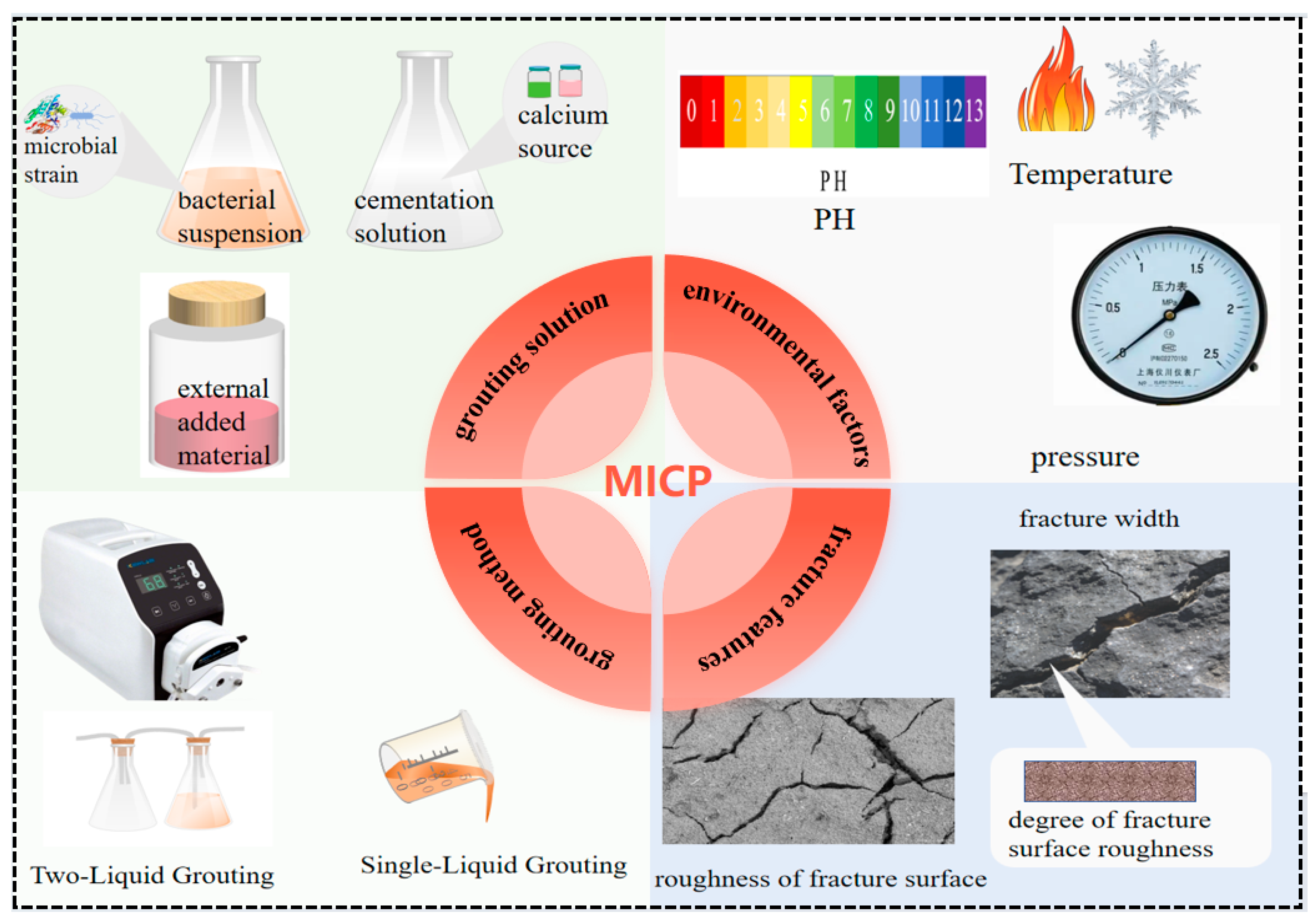
In practical applications, microbially induced calcium carbonate precipitation (MICP) technology is constrained by multiple factors that directly influence its mineralization efficiency [47]. The primary factors influencing the solidification performance of MICP are shown in Figure 8, including the bacterial concentration, bacterial and urease activity, pH, temperature, fracture characteristics, and calcium source type and concentration. These factors collectively impact the engineering properties of reinforced or remediated rock masses through their effects on the amount of precipitation, crystal morphology, distribution uniformity, and cementation characteristics of calcium carbonate.

3.1. Species and Concentrations of Bacterial Strains

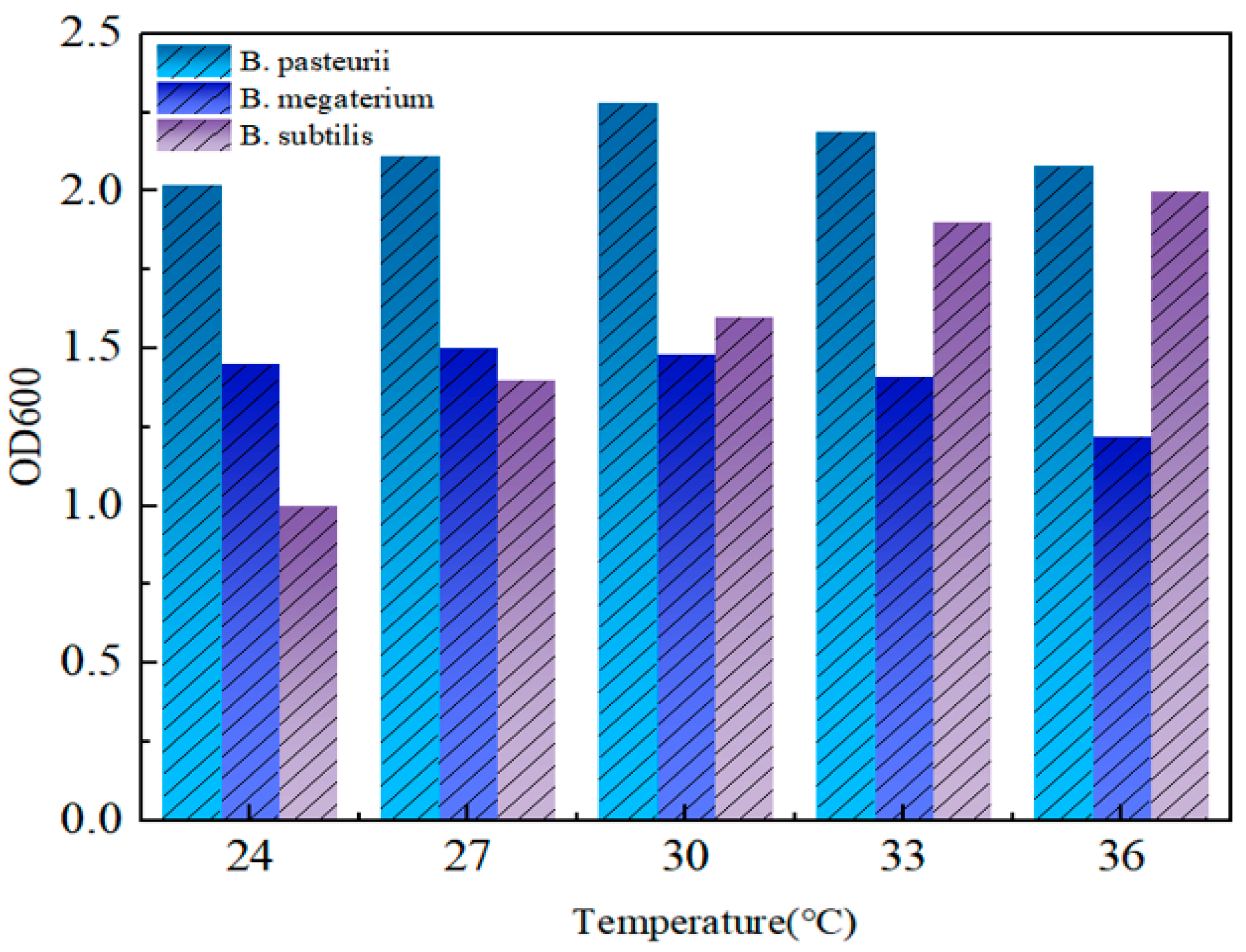
The efficacy of microbial mineralization is directly influenced by the microbial species employed, as significant variations in mineralization capacity exist among different microbial taxa [48], which directly affects the efficiency and effectiveness of geotechnical fracture remediation. Urease-producing microorganisms represent the most commonly utilized functional strains in fracture repair, primarily Bacillus sphaericus, Sporosarcina pasteurii, Bacillus megaterium, and Bacillus subtilis [49,50]. Under identical environmental conditions, inherent differences in urea hydrolysis rates among bacterial species lead to corresponding variations in calcium carbonate precipitation kinetics [51]. A comparative analysis of mineralization rates across different bacterial strains, as shown in Table 2, revealed that the mineralization rate of Sporosarcina pasteurii ranged from 80% to 90%, with calcium carbonate production reaching 21.83 g/L, whereas that of Bacillus megaterium ranged from only 40%–70%. Within the context of MICP-based geotechnical fracture remediation, Sporosarcina pasteurii is recognized as the most promising ureolytic bacterium, possessing advantages such as high enzyme production capacity, superior mineralization efficiency, excellent precipitate characteristics, and robust environmental adaptability, enabling rapid acclimatization to fracture environments [51].
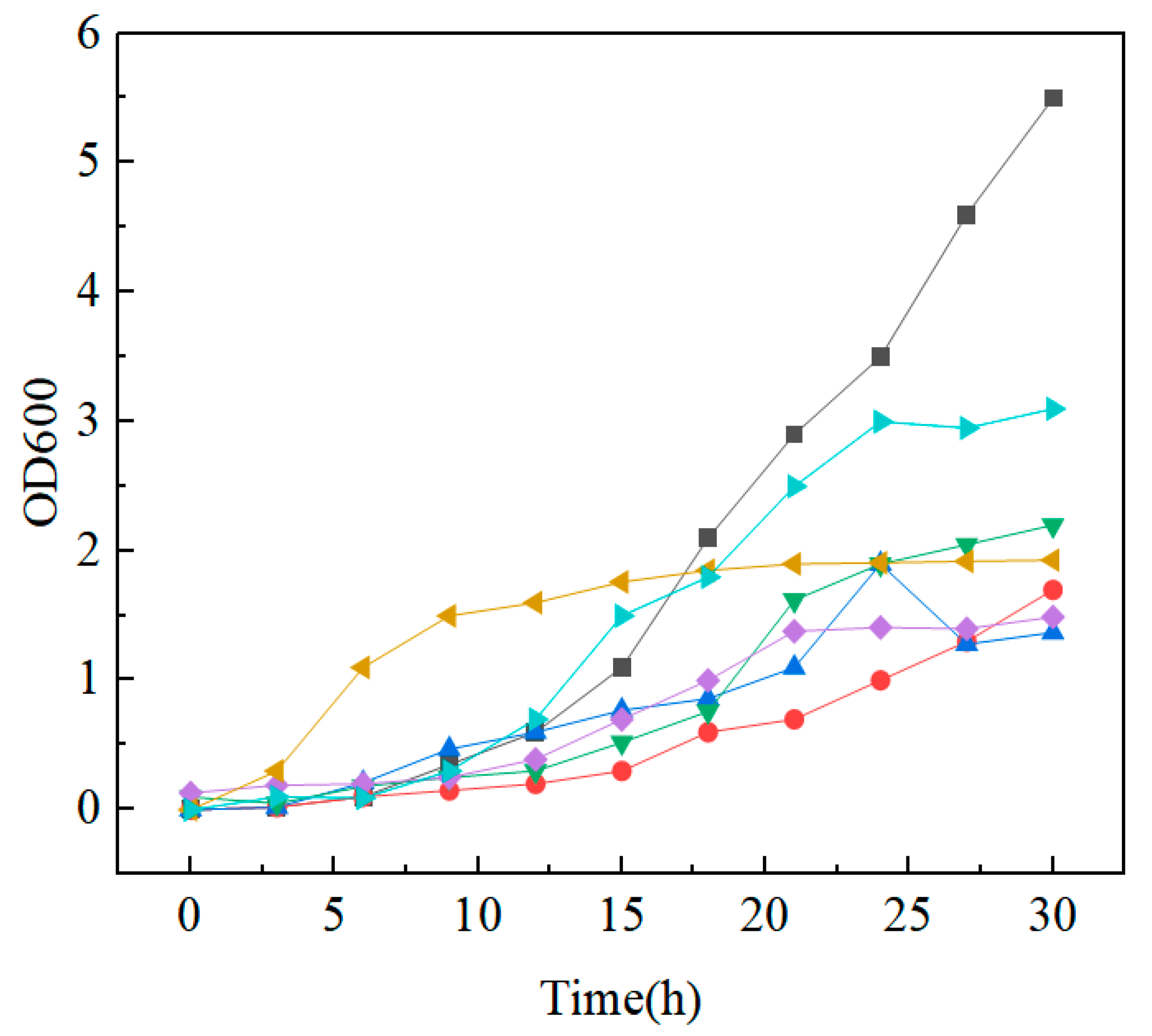
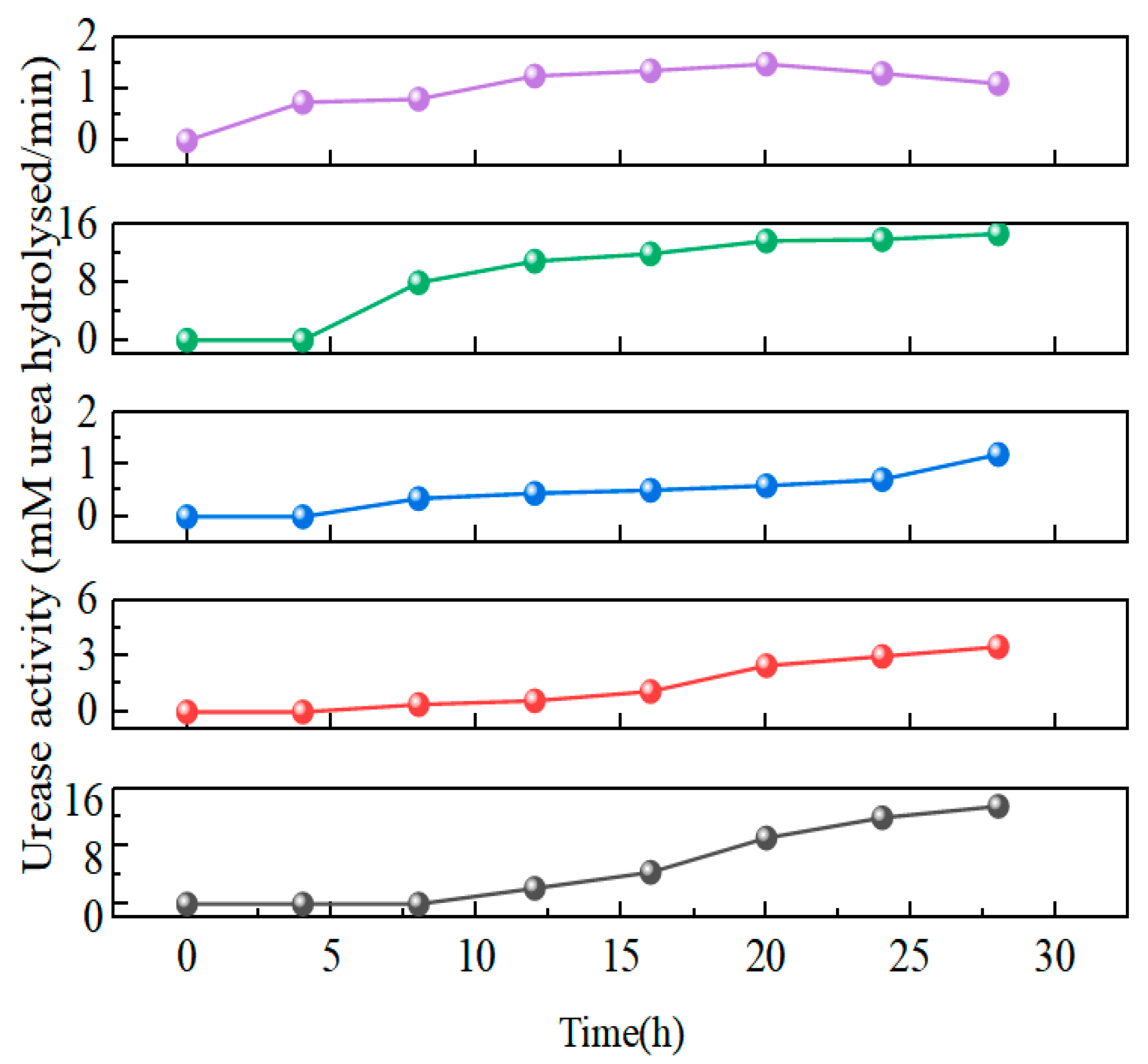
In addition to microbial species, bacterial concentration constitutes a core factor that regulates the MICP mineralization process, directly influencing the precipitation efficiency and cementation quality of calcium carbonate within fractures [52]. The bacterial concentration, which is typically characterized by the OD600 value (optical density at 600 nm), serves as a critical parameter affecting mineralization efficiency. Under conditions where the urea concentration sufficiently supports bacterial metabolic activity, the urea hydrolysis rate accelerates with increasing bacterial concentration, thereby promoting the generation and deposition of calcium carbonate precipitates [39]. The growth curve of Sporosarcina pasteurii is shown in Figure 9, which clearly demonstrates that under appropriate culture conditions, the bacterial concentration progressively increases with extended cultivation time. When the cultivation period exceeds 25 h, nutrient depletion and the accumulation of toxic metabolites gradually reduce the rate of bacterial growth and reproduction. The temporal variation in urease activity, shown in Figure 10, reveals that urease activity increases synchronously with cultivation time; specifically, when the bacterial concentration (OD600) increases from 0.4 to 0.7, urease activity increases 2.5-fold [52]. Similarly, the calcium carbonate precipitation rate increases concomitantly, establishing a positive correlation between the bacterial concentration and calcium carbonate yield [53]. Furthermore, elevated bacterial concentrations accelerate calcite formation. The cementation efficacy of calcium carbonate is also intimately associated with the spatial distribution of bacteria within fractures; when substantial bacterial populations adhere to fracture walls and surrounding geotechnical media surfaces, the formation of sufficient quantities of well-cemented calcium carbonate crystals is facilitated [54]. In summary, an optimal bacterial concentration ensures adequate bacterial colonization within fractures and on fracture surfaces, efficiently induces calcium carbonate mineralization, and forms continuous, dense calcium carbonate cementitious structures within fracture spaces, thereby enhancing the overall cementation strength and impermeability of remediated fractures.
Table 2. Comparison of Urease Activity, Calcium Carbonate Mineralization Characteristics, and the Application Potential of Different Spore-Forming Bacteria.
Bacterial NameEffect of Bacterial Concentration on Urease ActivityEffect of Bacterial Concentration on Calcium Carbonate YieldApplication Potential/AdvantagesSuitable pH ValueCalcium Carbonate Yield Under the Same External ConditionsRef.
Bacillus sphaericusPositive correlationPositive correlationFlexible environmental adaptability, alkali resistance, calcium tolerance, low temperature adaptabilitySuitable working pH 7–11High yield >80%[47,55,56]
Sporosarcina pasteuriiPositive correlationPositive correlationHigh urease activity and mineralization efficiency, strong environmental adaptability, cell characteristics suitable for mineralizationSuitable working pH 6–9Yield up to more than 80%–90%[57,58]
Bacillus megateriumPositive correlationPositive correlationOutstanding environmental repair capacity, suitable for working in low-temperature environmentSuitable working pH range 6–8Yield approximately 40%–70%[59,60,61,62]
Bacillus subtilisPositive correlationPositive correlationWide adaptation rangeSuitable working pH range 6–10Yield approximately 50%–80%[63,64]
Figure 9. Growth curve of Sporosarcina pasteurii: Change in bacterial concentration with time: Black squares [52], red circles [65], blue upward triangles [66], green downward triangles [67], purple diamonds [68], orange left-pointing triangles [69], and cyan right-pointing triangles [70].
Coatings 16 00413 g009
Figure 10. Growth curve of Sporosarcina pasteurii: Change in urease activity with time: Purple diamonds [52], green downward triangles [65], blue upward triangles [66], red circles [68], and black squares [69].
Coatings 16 00413 g010
The urea concentration in the cementation solution directly influences the amount of calcium carbonate produced; higher urea concentrations lead to an increased hydrolysis rate, thereby generating more calcium carbonate precipitates. However, excessively high urea concentrations can inhibit the production of microbially induced calcium carbonate. When the concentration exceeds 1.0 mol/L, an inhibitory effect gradually emerges, becoming significantly pronounced at concentrations of 1.5–2.0 mol/L [23,71]. Similarly, an excessively high bacterial concentration can result in an uneven distribution of calcium carbonate [72,73], often causing clogging near the injection port and consequently limiting the effective penetration range of the grout. To address the limitations associated with high-concentration bacterial suspensions in the remediation of geotechnical fractures, studies on MICP grouting [74] have demonstrated that compared with a single injection of a high-concentration bacterial suspension, multiple injections of low-concentration suspensions significantly increase the unconfined compressive strength of sand columns. This improvement is attributed to the slower attenuation of bacterial activity and reduced flocculation at lower concentrations, which extends the effective grouting window. Furthermore, this approach facilitates the formation of large calcium carbonate crystals that effectively fill the pores between soil particles and geotechnical fractures, thereby establishing a more stable granular cementation network.
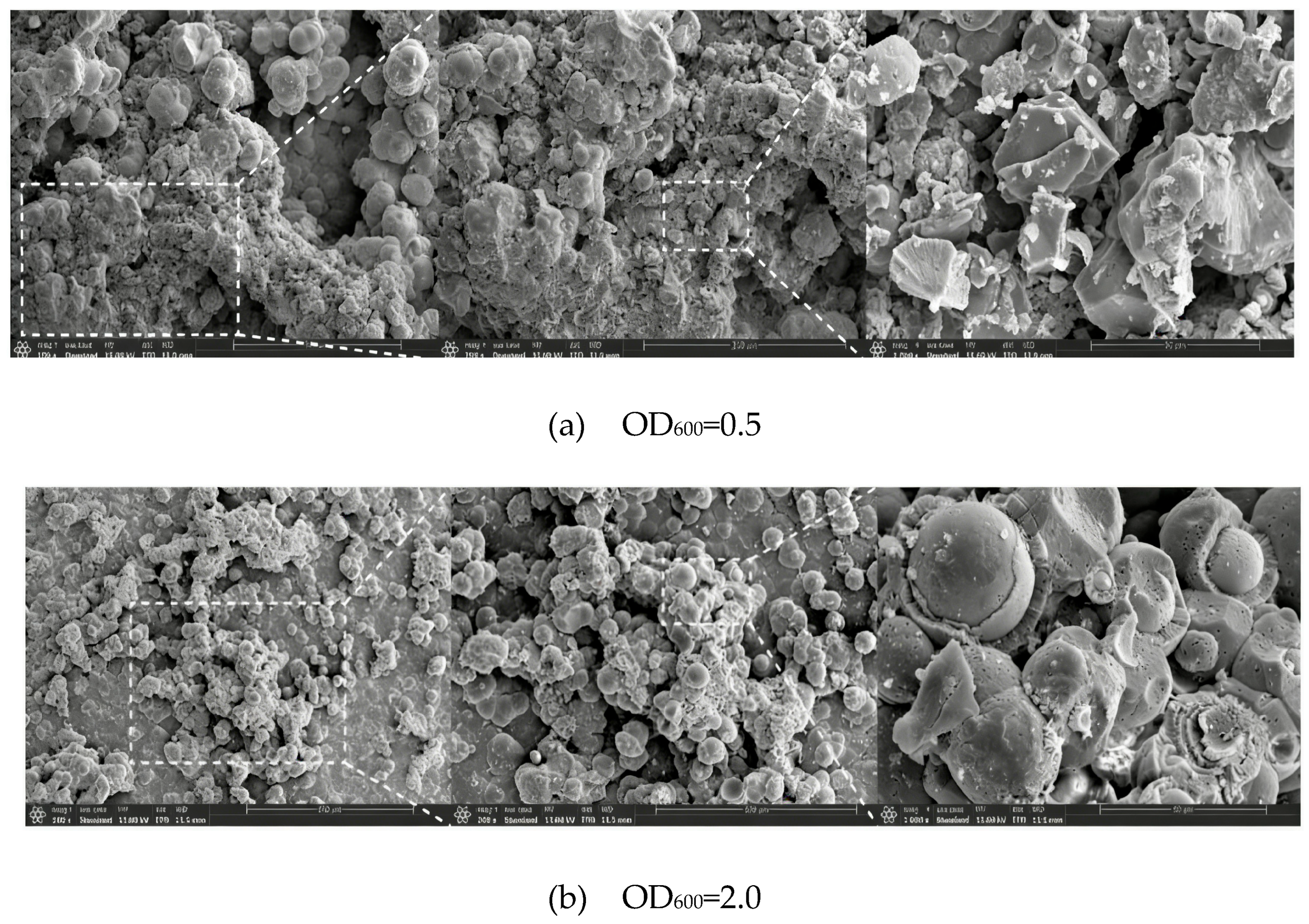
The morphological characteristics of calcium carbonate crystals under different bacterial concentrations are shown in Figure 11. The regulatory effect of bacterial concentration on the mineralization process is also reflected in the morphology of calcium carbonate crystals, and this effect increases with increasing bacterial concentration [71,75]. SEM results [69] revealed that in the bacterial liquid system with different concentrations containing both bacterial cells and secretions, calcium carbonate crystals were mainly spherical and hexagonal. In environments containing only bacterial secretions, the crystals are mostly spindle-shaped and spherical, with stable calcite and metastable vaterite coexisting. In the environment containing only bacterial cells, it is regular hexagonal calcite. These findings indicate that bacterial secretions are the key to controlling crystal morphology and that bacterial cells provide nucleation sites for calcium carbonate deposition, thereby guiding the deposition and growth of calcium carbonate crystals and improving the compactness and stability of the cemented structure [68]. Regulating different concentrations of bacterial liquid to form stable calcite crystals with mainly spherical and hexagonal shapes can adapt to the multiscale pore-filling requirements of geotechnical fractures, form a mineralized cemented layer with high compactness and excellent cementation effects, and significantly improve the fracture plugging stability, impermeability and shear strength [76].
In summary, the concentration and activity of urease are directly related to the bacterial concentration. Within a certain range, the higher the bacterial concentration is, the stronger the catalytic activity of urease, and the higher the urea hydrolysis rate, thereby generating more calcium carbonate crystals and ultimately accelerating the mineralization process of MICP.

3.2. Temperature

Temperature plays a pivotal role in determining the efficiency of microbially induced calcium carbonate precipitation (MICP) for fracture remediation. Suitable temperatures significantly increase the metabolic activity of microorganisms and the catalytic efficiency of urease, thereby promoting the generation and stabilization of calcium carbonate precipitates. This provides a favourable basis for the effective remediation of geotechnical fractures.
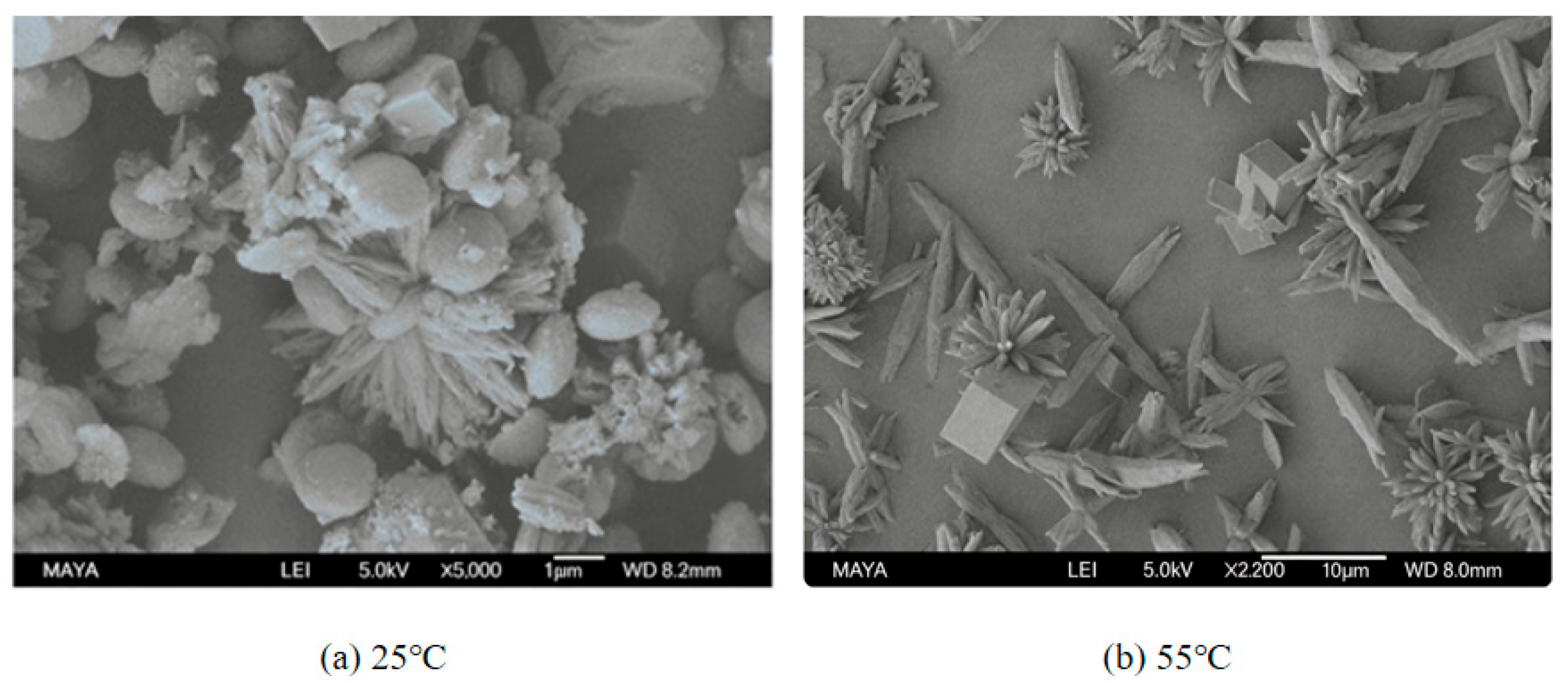
Research on the influence of temperature on fracture remediation and soil reinforcement efficacy indicates that within the environmental range of 10–30 °C, elevated temperatures are positively correlated with the strength of geotechnical masses following fracture repair [77]. Concurrently, the permeability of fractured zones decreases significantly with increasing temperature, providing empirical support for MICP-based fracture remediation projects in temperate climate regions [78]. Within a broader temperature spectrum [79], as illustrated in Figure 12, which depicts the morphological characteristics of calcium carbonate crystals at different temperatures, both the yield and size of calcium carbonate crystals employed for fracture filling initially increase but subsequently decrease with increasing temperature [80]. During the temperature increase phase, microbial activity and crystal growth conditions continuously improve, facilitating the dense filling of multiscale fracture pores. However, when the temperature reaches 50 °C, both the crystal yield and size markedly decrease, highlighting the inhibitory effects of high-temperature environments on the MICP reaction system, which adversely affects the formation of mineralized fracture layers. Therefore, when geotechnical fracture remediation is being conducted in high-temperature regions, targeted temperature control measures must be implemented to mitigate the inhibitory effects of elevated temperatures on mineralization reactions, thereby ensuring the compactness and cementation quality of mineralized fracture fill [81].
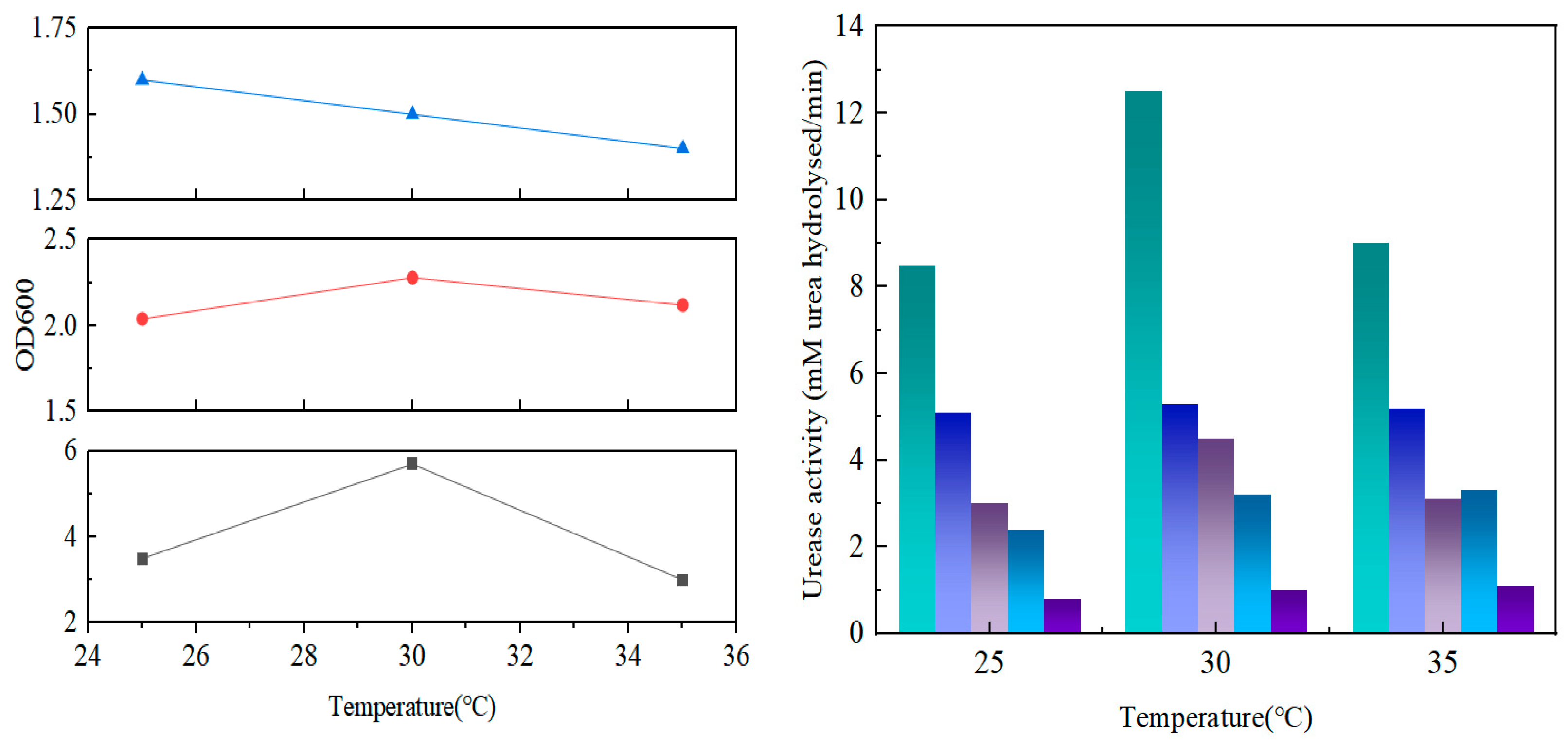
Taking urea hydrolysis-based MICP technology for geotechnical fracture remediation as an example, the temperature response characteristics of urease activity—the core driving factor of the MICP reaction—are particularly critical. As shown in Figure 13, which presents the influence of environmental temperature on the concentration of different bacterial strains, the urease activity of Sporosarcina pasteurii peaks at 30 °C and thereafter gradually declines with increasing temperature [65]. In contrast, Bacillus subtilis exhibits peak urease activity at 36 °C [77]. Corresponding mechanical property studies [79] have demonstrated that fracture-repaired samples treated at 35 °C achieve the highest peak strength and residual strength, followed by those treated at 20 °C. This trend aligns with the response patterns of Sporosarcina pasteurii bacterial concentration and urease activity under varying temperatures shown in Figure 14, further confirming the regulatory role of enzymatic activity in controlling the solidification effectiveness of fracture remediation. Conducting rock fracture remediation within an appropriate temperature range maximizes the mineralization efficiency at fracture sites, thereby significantly enhancing both the structural stability and shear-bearing capacity of the remediated geotechnical mass [77].
Although urease catalytic activity decreases exponentially in low-temperature environments below 15 °C—with urea hydrolysis efficiency falling below 30% of that observed under optimal thermal conditions [79,82], thereby presenting significant challenges for fracture remediation in cold climates—it is noteworthy that MICP technology has considerable application potential for low-temperature fracture repair. Specifically, elevated bacterial concentrations can effectively offset the temperature-induced reduction in urease activity, thereby ensuring the continuity of mineralized fracture filling. Furthermore, freeze-thaw cycling studies [83] have demonstrated that under adverse environmental conditions, such as cyclic freeze-thaw exposure, the Sporosarcina pasteurii employed in MICP-based fracture remediation is capable of forming endospores to preserve metabolic viability. Upon the return of favourable environmental conditions, these dormant spores can germinate and reestablish functionally active bacterial populations. These reactivated microorganisms subsequently utilize the nutrients available within the soil matrix and surrounding fracture zones to sustain microbial mineralization reactions, continuously generating calcium carbonate precipitates that progressively infill fracture networks. This adaptive resilience provides a robust theoretical foundation for the application of MICP-based fracture remediation technologies in cold regions, positioning this approach as a promising strategy for soil stabilization and frost-resistant crack repair in low-temperature environments [84].
Figure 12. Morphology of Calcium Carbonate Crystals at Different Temperatures. (Reprinted from Wang et al., ACS Applied Materials & Interfaces, 2013, 5, 4884–4892, Figures 6 and 8 [79]).
Coatings 16 00413 g012
Figure 13. Effects of Ambient Temperature on Bacterial Concentrations: teal [65], blue [85], purple [86].
Coatings 16 00413 g013
Figure 14. Influence of Temperature on the Cell Concentration and Urease Activity of Sporosarcina pasteurii: Blue upward triangles [52], red circles [65], black squares [85]; Muted teal [52], dusty blue [65], dusty purple [67], blue [85], purple [87].
Coatings 16 00413 g014

3.3. pH Value

To a certain extent, the pH directly affects the total calcium carbonate yield and crystalline quality within the mineralization reaction system in rock fractures, thereby influencing the final compactness and mechanical performance of geotechnical fracture remediation. Urease, the core biological enzyme driving the MICP repair reaction, is essentially a protein. All the enzyme preparations possess a corresponding optimal pH range, within which only urease can maintain high activity [88]. If the pH of the filling system within the geotechnical fracture deviates from this suitable range, an excessively high or low acidic–alkaline environment will directly compromise the molecular structure of urease, resulting in a significant attenuation of enzyme activity or even complete deactivation [23]. Therefore, during the MICP repair process of geotechnical fractures, regulating the internal pH of the fissure environment to the optimal range can significantly increase the catalytic efficiency of urease. This ensures the continuous and efficient progression of the urea hydrolysis reaction, thereby providing stable reaction conditions for the in situ generation of calcium carbonate precipitates and the filling of fracture pores [89].
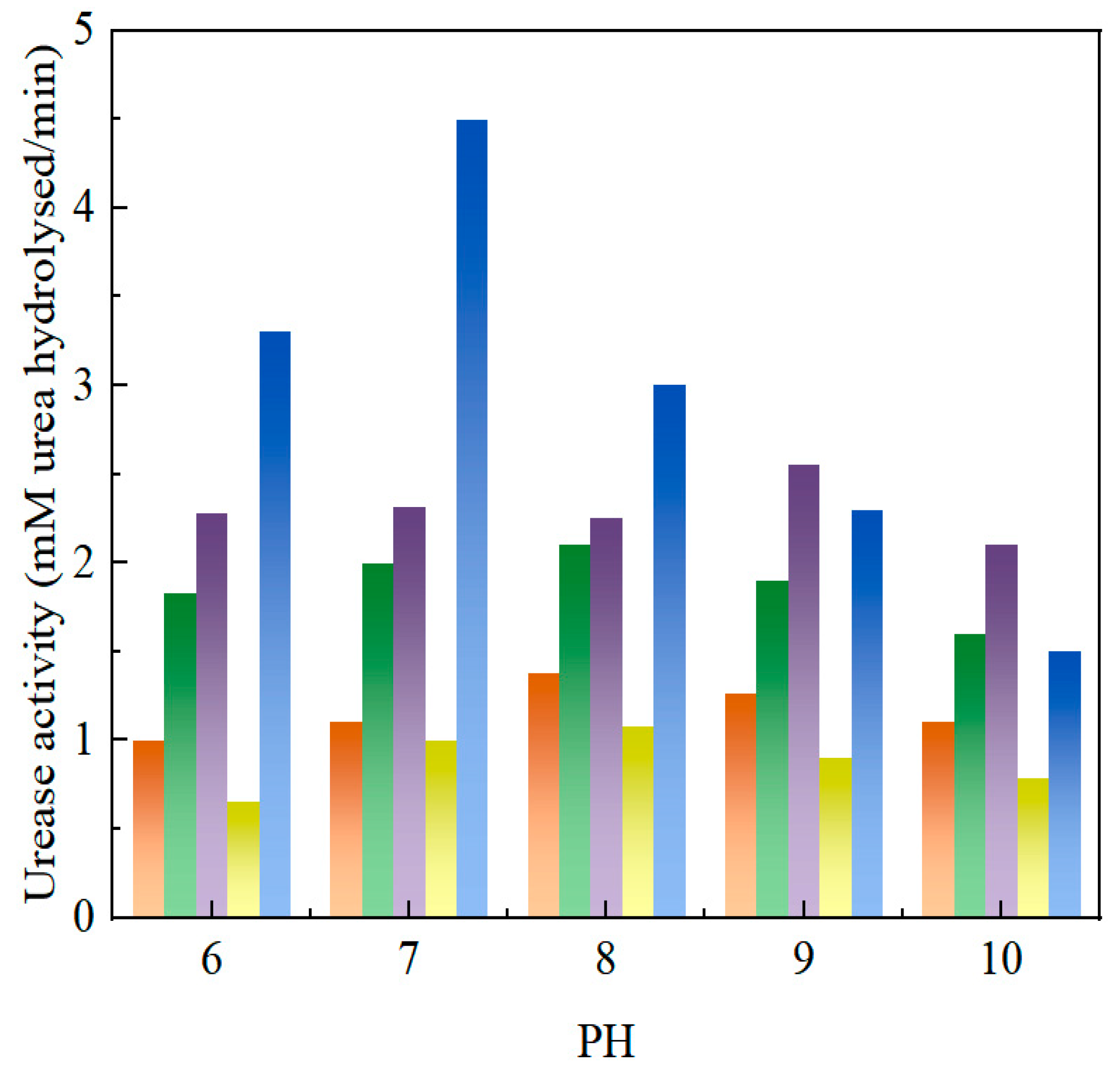
The regulatory effect of pH on urease activity is shown in Figure 15. A weakly acidic, low-pH environment markedly compromises the catalytic function of urease [89], thereby decelerating the urea hydrolysis rate and consequently decreasing the quantity of calcium carbonate crystals formed within the fracture [90]. If the pH becomes excessively low, the hydrolytic mineralization reaction within the fissure may even cease entirely, rendering the effective cementation and filling of the fracture unattainable [91]. Within a complete bacterial reaction system for geotechnical fracture remediation, the buffering effect of bacterial metabolism and extracellular secretions establishes an optimal pH range of 6.0–8.5 for efficient urease activity [23]. This range aligns closely with the complex media environment of actual fissures, offering more pertinent guidance for in situ remediation construction.
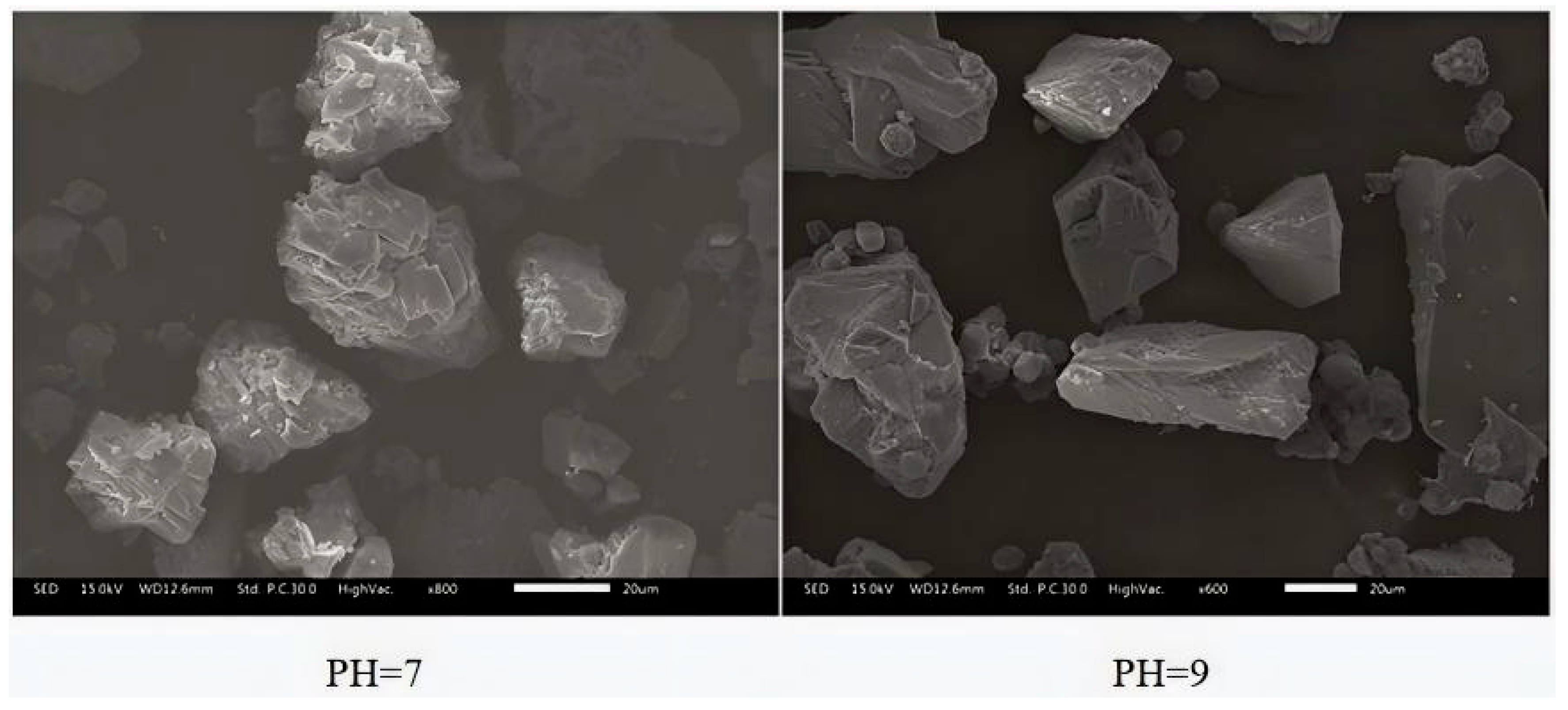
The direct effect of pH on calcium carbonate yield during fracture remediation is equally significant. As shown in Figure 16, which shows the morphological characteristics of calcium carbonate precipitated by Sporosarcina pasteurii under different pH conditions, pH has a negligible influence on calcium carbonate yield and longitudinal distribution when it is controlled within the range of 4–7. Within the pH range of 7–10, calcium carbonate production first increases but then decreases with increasing pH. The precipitation yield remains at a peak level within pH 8–9, which favours the dense filling of multiscale pores in geotechnical fractures and improves the cementation performance of the remediation interface [92]. Further studies have indicated that over a broad pH range of 6–13, urease activity also first increases but then decreases with changes in environmental acidity and alkalinity [93], reaching maximum activity at pH 7–8 [94]. Overall, maintaining the reaction system pH within the optimal range of 7–9 during both in situ geotechnical fracture remediation and laboratory experiments maximizes the efficiency of calcium carbonate production and the quality of crystal development. When combined with suitable temperature control, this strategy further improves the fracture filling density, interfacial cementation strength, and overall durability of the repaired geotechnical mass, thus providing a fundamental basis for optimizing environmental parameters in MICP-based fracture remediation technology [95].
Figure 15. Effect of Different pH Values on Urease Activity of Sporosarcina pasteurii: orange [65], green [94], purple [85], yellow [87], blue [67].
Coatings 16 00413 g015
Figure 16. Morphological Characteristics of Calcium Carbonate Crystals Under Different pH Values. (Reprinted from Wang et al., ACS Applied Materials & Interfaces, 2013, 5, 5204–5213, Figure 4 [82]).
Coatings 16 00413 g016

3.4. Type and Concentration of the Calcium Source

Calcium sources, as the fundamental substrate in microbially induced calcium carbonate precipitation (MICP) technology for geotechnical fracture remediation, provide the Ca2+ ions essential for the formation of calcium carbonate minerals, which are required for fracture cementation. In the absence of Ca2+, the mineral precipitation necessary for fracture filling and cementation cannot proceed [96]. The type and concentration of calcium sources directly dictate the yield, crystal size, and distribution uniformity of calcium carbonate precipitated within fractures, thereby influencing the remediation efficacy and cementation stability of MICP-treated geotechnical fractures. Accordingly, calcium source parameters represent critical factors governing the quality of mineralized fracture filling.
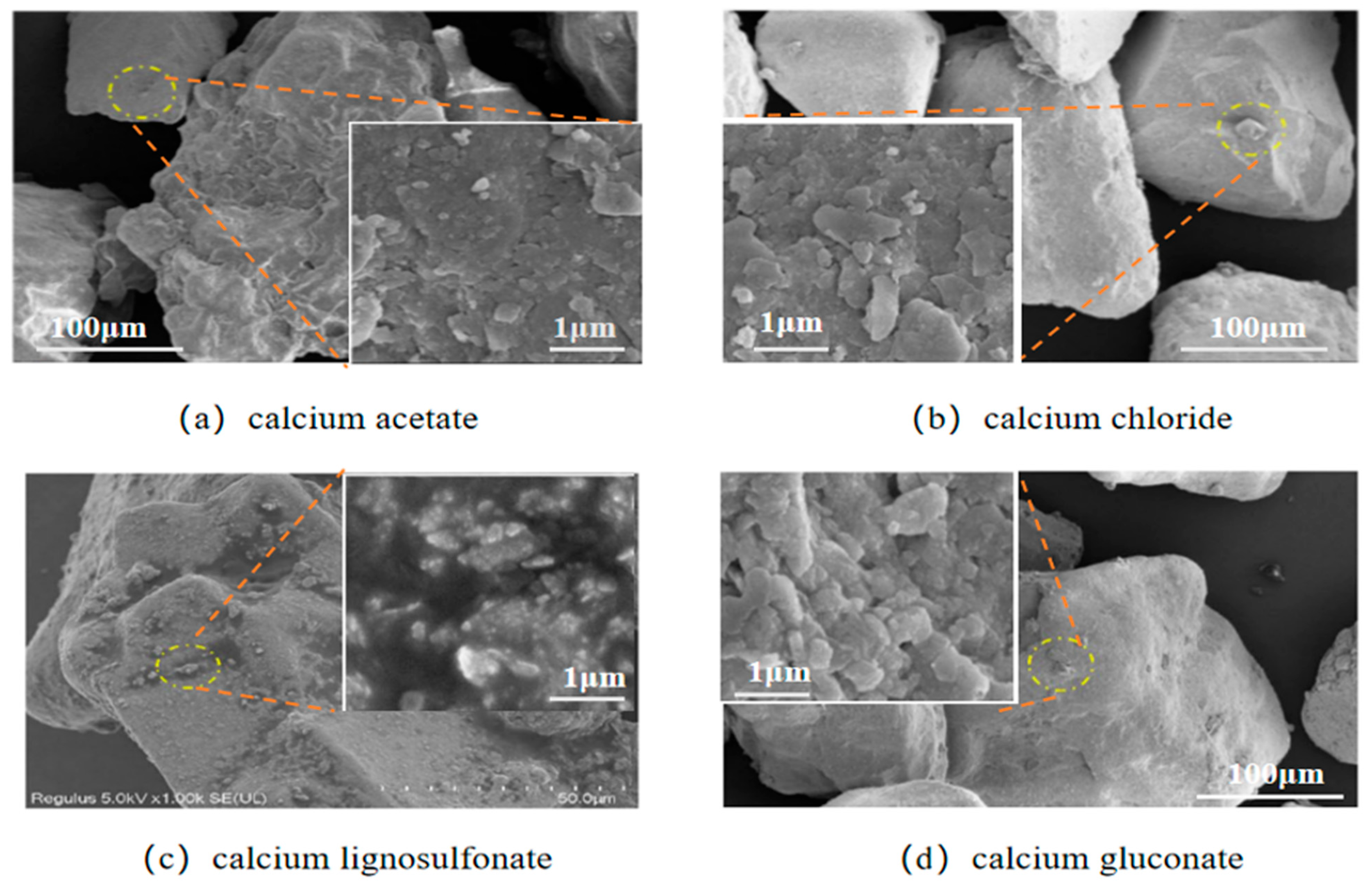
Comparative MICP-based fracture remediation experiments were systematically conducted using calcium sources of varying types and concentrations, as shown in Figure 17 and Figure 18, followed by electron microscopic characterization of the resulting calcium carbonate crystal morphologies [97,98,99,100,101,102,103,104,105]. The experimental findings reveal that calcium sulfate, characterized by its inherently low solubility, fails to provide a sustained and sufficient flux of Ca2+ ions to the fracture zone. When calcium carbonate is applied as the sole calcium source, the resulting calcium carbonate precipitation is quantitatively inadequate to achieve effective fracture cementation, thereby yielding only marginal improvements in the mechanical strength of the remediated geotechnical matrix. In contrast, the calcium chloride treatment group generated hexagonal calcite crystals with atomically smooth surfaces and well-defined crystallographic facets, characterized by high structural regularity and density, rendering them particularly suitable for filling and cementing macroscopic fracture voids. The calcium nitrate treatment group produced hexagonal calcite crystals with notably roughened surface topography; this enhanced surface roughness substantially improved interfacial adhesion between the precipitated crystals and fracture wall surfaces, thereby significantly increasing cementation stability and long-term durability [96]. The calcium acetate treatment group predominantly generated acicular aragonite crystals, whose elongated morphology enables effective penetration into microscale interstitial spaces within the fracture network, thereby compensating for the inherent filling limitations of larger, equant crystal morphologies and ensuring comprehensive void occupation across multiple length scales. These findings establish a robust scientific basis for the tailored selection of calcium sources in MICP-based remediation strategies targeting fractures of varying geometrical characteristics and scale distributions [106,107,108,109].
In microbially induced calcium carbonate precipitation (MICP) for geotechnical fracture remediation, the calcium ion concentration, together with the calcium source type, constitutes a critical determinant of remediation efficacy, directly influencing the sealing density of fractures and the postremediation stability of the treated geotechnical mass [110]. The results demonstrate that elevated calcium ion concentrations promote increased calcium carbonate precipitation, thereby enhancing fracture remediation and reinforcement performance [111]. MICP-based fracture remediation experiments employing analytical-grade calcium chloride as the calcium source revealed that all treated geotechnical samples achieved compressive strengths exceeding 600 kPa, with maximum values approaching 4 MPa. The calcium carbonate mass fraction within the solidified matrix remained stable within the range of 12.2%–16.6% [99], facilitating the formation of a dense cemented layer that effectively impedes water infiltration and mitigates the loss of geotechnical particles. Within the MICP remediation framework, the strength improvement of the treated geotechnical material is positively correlated with the calcium ion concentration in the cementation solution [112]: Within the low-concentration range, increasing the calcium ion concentration promotes calcium carbonate precipitation, thereby improving fracture filling and cementation efficiency. In sand solidification experiments using calcium chloride as the calcium source [96], it was found that when the calcium ion concentration exceeded 1.25 mol/L, the increase in calcium carbonate precipitation gradually plateaued, adversely affecting both remediation efficiency and cost control. Under the specific experimental conditions of that study (sand matrix, Sporosarcina pasteurii, and laboratory scale), a calcium ion concentration in the range of 0.5–1.0 mol/L promoted relatively uniform calcium carbonate precipitation, enhanced the strength of fracture remediation, and improved the compactness of the cemented layer. It should be noted that the above concentration threshold was obtained under specific experimental conditions, and its applicability may vary depending on factors such as rock lithology, bacterial strain characteristics, and grouting processes. In engineering applications, it is advisable to use these literature-derived values as references and to optimize parameters according to site-specific conditions.

3.5. Fracture Characteristics

In microbially mediated geotechnical fracture remediation, fracture characteristics constitute a governing factor that regulates the efficacy of microbially induced calcium carbonate precipitation (MICP) reinforcement. These characteristics directly influence the closure rate of geotechnical fractures and the efficiency of calcium carbonate accumulation by governing bacterial transport within fracture channels, the diffusion uniformity of cementation solutions, and the spatial distribution of calcium carbonate precipitates [113]. A schematic illustration of microbially mediated geotechnical fracture remediation is shown in Figure 19, which reveals that under favourable conditions, microbial mineralization effectively fills and rehabilitates rock fractures. Research has indicated [114] that when the fracture aperture is within the range of 0.5–2.0 mm, calcium carbonate precipitation tends to significantly increase with increasing aperture, and the fracture sealing efficacy progressively improves with increasing width. Specifically, fractures with apertures of 1.5–2.0 mm demonstrate sealing rates approximately 5%–15% higher than those of 1.0 mm fractures [115,116], accompanied by superior bond strength at the cementation interface. Under conditions where commonly used Sporosarcina pasteurii, conventional grouting processes, and calcium chloride as the calcium source are employed, existing studies indicate that an aperture range of 0.5–2.0 mm represents a preferable width interval for MICP-based fractured rock mass remediation.
Larger fracture apertures provide more ample physical space for microbial metabolic activity and calcium carbonate precipitation, facilitating both efficient urease-catalyzed urea hydrolysis [117] and favourable conditions for crystal growth and deposition. This prevents premature pore throat clogging caused by crystal aggregation, accommodates greater volumes of bacterial suspension and cementation solution, prolongs contact time between microorganisms and reactive substrates, and sustains material supply for substantial calcium carbonate generation [118]. Conversely, when the fracture aperture falls below 0.5 mm, the confined space readily induces rapid accumulation of reaction-generated calcium carbonate, forming localized blockages that impede subsequent infiltration and diffusion of the bacterial suspension and cementation solution, thereby significantly compromising the overall sealing efficacy [119]. When the fracture width exceeds 2 mm, despite ample spatial availability, the bacterial suspension and cementation solution tend to rapidly decrease along the fracture network. Furthermore, calcium carbonate precipitates, lacking effective attachment sites, fail to adhere stably to geotechnical particle surfaces and predominantly exist as loosely aggregated crystals, resulting in substantially diminished sealing density and durability [120].
The influence of fracture surface roughness on MICP remediation efficacy has a dualistic nature [120,121]: moderate roughness provides abundant attachment sites for calcium carbonate crystals, promoting crystal deposition and bridging interactions. When the fracture roughness is 0.414 mm, the remediation rate reaches 27.06%. As the roughness increases to 0.873 mm, the remediation rate further improves to 33.55% [117]. However, excessive roughness tends to induce localized overdeposition of calcium carbonate, thereby compromising the overall uniformity of the remediation process and decreasing the effectiveness of the reinforcement. However, it is worth noting that the remediation capability of MICP technology with respect to fracture aperture is not fixed, but is governed by multifactor coupling, including bacterial type, injection method, and calcium source. For instance, the choice of bacterial strain directly influences the achievable repair width. Using agar-immobilized Bacillus megaterium, the maximum repairable aperture was increased to 0.66 mm, significantly outperforming the 0.29 mm achieved by the injection method [122]. This improvement can be attributed to the enhanced retention and localized activity of the immobilized bacterial carriers within wider fractures. Injection strategy also plays a critical role. By optimizing the injection flow rate, higher calcium carbonate retention can be achieved in larger-aperture fractures than in smaller-aperture ones [123], suggesting that flow dynamics can be tailored to overcome the challenges posed by increased fracture width. Furthermore, a three-stage grouting strategy achieved a high bridging rate of 89.5% in meter-long fractures [124], demonstrating that multi-step injection protocols can substantially extend the effective repair scale.
These findings collectively indicate that the capability of MICP technology to remediate wide fractures still holds considerable potential for improvement through process innovation. Future efforts may focus on synergistic optimization of bacterial carriers, grouting procedures, and calcium source chemistry to further expand the applicable fracture aperture range and enhance remediation reliability in field-scale applications.

3.6. Grouting Method

An appropriate injection strategy is critically important for the efficacy of microbially mediated rock fracture reinforcement, as it directly governs the penetration depth of the bacterial suspension and cementation solution within fractures, the uniformity of their distribution, and the degree of contact with geotechnical particles, thereby determining both the efficiency of calcium carbonate precipitation and the ultimate remediation strength [125]. The bacterial suspension and cementation solution are mixed and then injected into the fractured rock mass in a single step. This method is simple to operate and allows for rapid construction, and was widely adopted in early MICP studies. However, injecting a mixture of high-concentration bacterial suspension and cementation solution in a single step leads to rapid calcium carbonate precipitation near the injection port, forming a “filter cake effect” that hinders the further penetration of subsequent slurry into deeper zones. This issue directly results in a highly uneven distribution of calcium carbonate within the solidified body, with precipitation accumulating near the injection port while almost no reinforcement effect is observed at the distal end [21]. Therefore, this method is only suitable for shallow reinforcement or scenarios with large fracture apertures (>2 mm), and its effectiveness in repairing deep micro-fractures is limited. Currently, the most mature grouting process in both laboratory research and field applications is the staged injection method [126]. The “two-phase cementation process” effectively delays the rapid reaction that occurs upon contact between the bacterial suspension and cementation solution, significantly alleviates clogging at the injection port, and improves the penetration of the slurry into sand columns. However, this method still suffers from a relatively long treatment cycle. For wide fractures (>2 mm), the bacterial suspension is prone to loss, necessitating the use of filling materials [127]. Comparative studies have shown that, compared with single-step high-concentration injection, the use of low-concentration multiple injections achieves a more uniform distribution of calcium carbonate within sand columns, resulting in larger crystal sizes and a denser cementation structure [71]. After six repeated treatments with low-concentration cementation solution, the unconfined compressive strength of the treated specimen increased by approximately 2.3 times, while the coefficient of variation of calcium carbonate distribution decreased by over 60% [64]. Although this approach requires multiple grouting rounds in practical engineering, leading to higher time costs, it is suitable for projects requiring high uniformity of reinforcement and for environmentally sensitive areas.
Different injection strategies significantly influence the reinforcement efficacy of MICP in fractured rock masses. The injection approach strongly affects mineralization uniformity, sealing effectiveness, and mechanical performance during remediation, as shown in Table 3. Various injection strategies are suited to different application scenarios: the mixing method improves the distribution uniformity of calcium carbonate, the spraying method facilitates the formation of fine crystals, and the injection method achieves better reinforcement efficacy through flow rate control. Techniques such as direct grouting, grouting after filling, immersion, brushing, mixing, and the two-phase cementation process are applicable to different fracture characteristics and geotechnical conditions. In consideration of the specific properties of rock fractures, appropriate grouting techniques should be selected accordingly: fractures with widths less than 0.5 mm can be effectively sealed using direct grouting, whereas fractures with larger apertures require preliminary filling with fine sand or similar media before grouting treatment [125]. Under equivalent microbial treatment cycles, specimens reinforced by the mixing method and the grouting method show minimal differences in calcium carbonate content; however, specimens treated by the mixing method exhibit better uniformity in the distribution of precipitated calcium carbonate [128].
Research on the number of immersion cycles indicates that compared with those receiving fewer treatment cycles, specimens subjected to multiple immersion treatments exhibit significantly higher compressive strength [129]. Comparative experimental analysis using immersion, spraying, and brushing methods revealed distinct differences in the formation characteristics of calcium carbonate crystals under different application techniques [130]. In the samples treated by the spraying method, the nucleation function of the microorganisms was effective, resulting in uniformly distributed calcium carbonate precipitate particles on the surface of the solidified samples. In terms of crystal morphology and dimensions, the immersion method generated irregular spheroidal calcium carbonate crystals with relatively large sizes; the spraying method produced relatively small crystals (with a mean diameter of approximately 10 μm), whereas the brushing method yielded the smallest crystals, which were predominantly concentrated in the surface layer of the samples. In studies on calcareous sand solidification, the spraying method has been shown to effectively promote calcium carbonate crystal formation between desert soil particles [131]. Furthermore, experiments using the mixing method for calcareous sand solidification and fracture remediation systematically analysed its one-dimensional consolidation characteristics, revealing that microbially mineralized calcareous sand exhibited significantly reduced permeability and effectively enhanced structural stability [132].
Table 3. Effects of Perfusion-related Factors on the Microbial Reinforcement Performance of Rock Fractures.
Influence DimensionSpecific Grouting MethodConditionsImpact on Reinforcement EffectRef.
Classification of grouting methodsStirring methodUniversalExcellent distribution uniformity of calcium carbonate[128]
Spraying methodUniversalBacteria play a nucleation role, small crystal size, can promote the formation of calcareous sand crystals[130,131]
Injection methodUniversalThe smaller the slurry flow rate, the longer the solidification time, but the better the reinforcement effect[133]
Perfusion method—direct grouting methodPlugging of rock fractures with width less than 0.5 mmCan realize fracture plugging, the specific calcium carbonate content, distribution, etc., are not clearly mentioned[127]
Perfusion method—grouting after filling methodReinforcement of rock fractures with larger widthNeed to fill with fine sand and other media first, then grout, can realize fracture plugging[127]
Immersion methodUniversal, focusing on plugging effect and crystal morphologyLarge crystal size (irregular spherical), excellent plugging effect, higher compressive strength with multiple immersions[129,130,134]
Brushing methodUniversalThe generated calcium carbonate crystals are small in size and basically concentrated on the surface of the specimen[130]
Mixing methodCalcareous sand solidification scenarioThe permeability of solidified calcareous sand is significantly reduced[132]
Two-phase cementation process (grout bacterial liquid first, then cementing liquid)Solve the blockage problem in the solidification of sand by Sporosarcina pasteuriiAlleviate grouting port blockage and improve penetration effect[23]
The flow rate of the grouting solution during injection critically influences the reinforcement efficacy of MICP technology, an effect particularly pronounced in the strength anisotropy resulting from heterogeneous calcium carbonate distribution. Experiments on sand solidification using the injection method revealed that lower flow rates extend the duration required for solidification but yield superior reinforcement outcomes [133]. Comparative investigations on rock fracture reinforcement demonstrated that all the samples treated with different injection methods exhibited macroscopically visible calcium carbonate precipitates, indicating that fracture filling occurred. Notably, specimens treated by peristaltic pump injection, characterized by slower flow rates, displayed smoother surfaces with relatively limited calcium carbonate attachment and fracture filling, accompanied by finer precipitate particles. In contrast, specimens subjected to immersion grouting exhibited rougher surfaces because of substantial precipitate attachment, with abundant interfracture precipitates aggregating into cohesive clusters, thereby achieving superior sealing effectiveness [134].
Laboratory investigations into the factors influencing microbial mineralization have further elucidated [96] that when the grout flow rate falls below 0.042 (mol/L)/h, the MICP efficiency in a closed system can reach 100%. Conversely, if the flow rate is excessively high, the urea hydrolysis rate fails to match the grout flow velocity, resulting in diminished solidification efficiency. Furthermore, within the optimal flow rate range, the medium concentration does not significantly influence the total calcium carbonate precipitation but significantly alters its distribution characteristics, with lower concentration conditions favouring a more uniform distribution of calcium carbonate precipitates.

3.7. Admixtures

The introduction of various admixtures into the microbially induced calcium carbonate precipitation (MICP) reaction system constitutes a pivotal strategy for enhancing the efficiency of microbial reinforcement technologies. Different exogenous materials optimize the reinforcement effect by modulating the reaction environment, microbial activity, or product characteristics. However, the dosage and underlying mechanisms of these admixtures require precise control.
(1)
Sodium Silicate
When geotechnical fractures are remediated, the incorporation of sodium silicate into the cementation solution significantly enhances the effectiveness of MICP treatment. Sodium silicate rapidly adjusts the pH of the cementation solution to form a weakly alkaline environment, thereby improving the activity of functional bacteria such as Sporosarcina pasteurii, promoting efficient urea hydrolysis, and consequently increasing calcium carbonate yield while accelerating the precipitation rate [135]. The morphological characteristics of geotechnical fractures after the addition of sodium silicate reveal the formation of amorphous porous layered materials that fill the microvoids within the fractures and establish bridging connections between the rock particles and calcium carbonate crystals [136]. This promotes the formation of a continuous spatial network cementation structure, improving the fracture sealing density and rock mass integrity and thereby enhancing the mechanical strength of the remediated rock mass. Stringent control of the sodium silicate dosage is needed, with its addition not exceeding 0.3%; excessive dosage leads to excessively rapid calcium carbonate formation, inducing hardening and clogging at the injection port, as well as heterogeneous distribution of precipitates, thereby reducing the overall load-bearing capacity of the rock mass [136].
(2)
Ferric Chloride
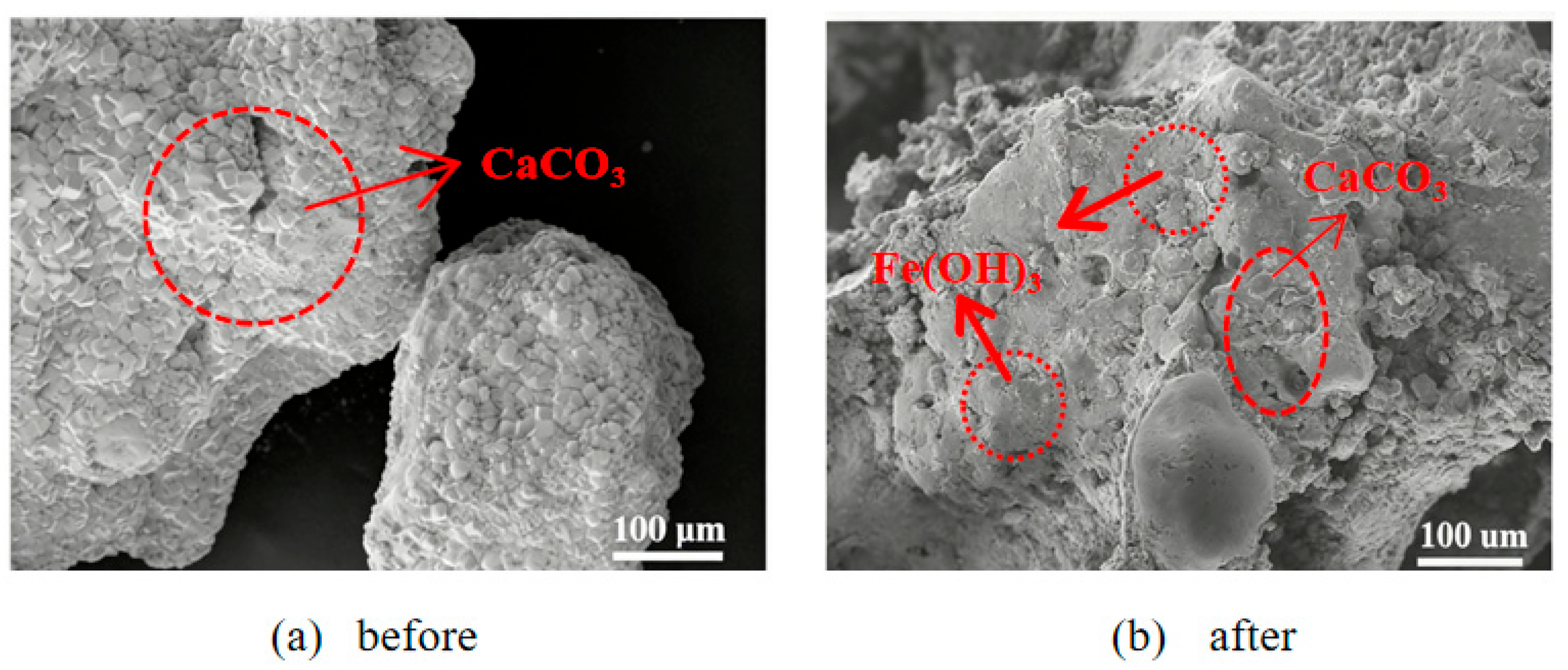
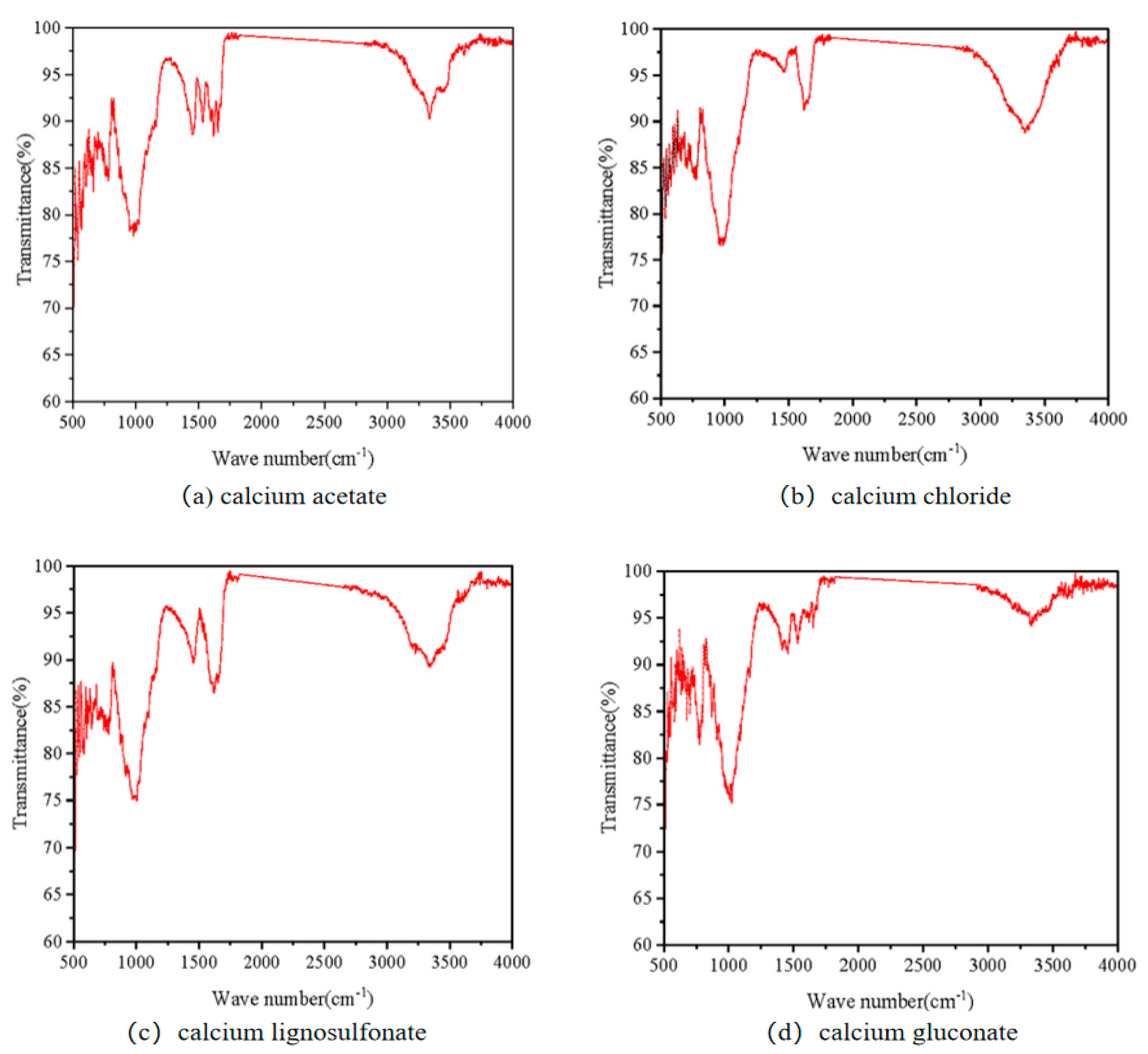
The incorporation of ferric chloride solution into the cementation solution indirectly enhances the reinforcement efficacy by reducing the number of grouting cycles [137]. The addition of ferric chloride lowers the pH of the cementation solution, which, although delaying the rate of calcium carbonate precipitation, enables more uniform diffusion and penetration of the cementation solution through soil fractures and pores, effectively mitigating localized clogging at the injection port. As shown in Figure 20, which presents the morphological characteristics of calcium carbonate crystals before and after the addition of ferric chloride, calcium carbonate and ferric hydroxide coprecipitate simultaneously at the sand particle interface, forming a continuous cementitious bonding layer that substantially enhances the overall mechanical strength of the sand column samples. Furthermore, iron ions exert significant regulatory effects on the crystal morphology of calcium carbonate [138]: with increasing iron ion concentration, the formation of flat calcium carbonate is readily induced. This morphological variant densely fills the interstitial spaces within the soil matrix, significantly improving the impermeability of the treated soil. However, excessive iron ions reduce the pH of the cementation solution below the optimal range for bacterial activity, suppressing the metabolic function of Sporosarcina pasteurii and ultimately diminishing calcium carbonate yield, thereby compromising the effectiveness of the reinforcement.
(3)
Carbonic Anhydrase
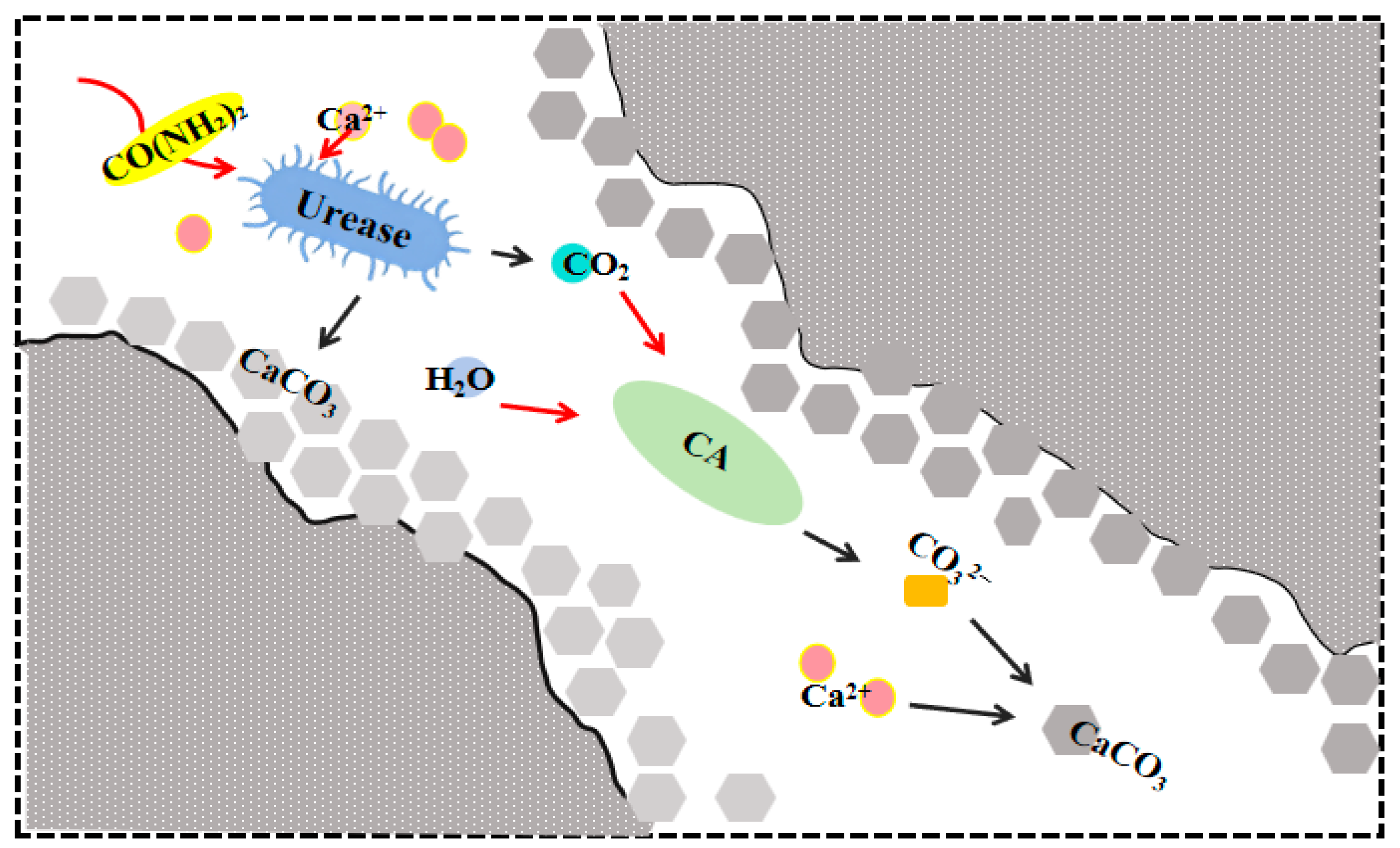
Carbonic anhydrase (CA), a functional biological enzyme secreted by CA-producing bacteria, enhances the MICP reaction in geotechnical fracture remediation. As shown in Figure 21, which presents a schematic diagram of calcium carbonate generation via the synergistic induction of urease and carbonic anhydrase, carbonic anhydrase accelerates CO2 hydration and increases carbonate ion production, thereby promoting calcium ion deposition to form calcium carbonate while simultaneously achieving carbon dioxide fixation and environmentally beneficial carbon sequestration [139]. To address the issue where Ca2+ concentrations in the cementation solution exceeding 1.25 mol/L inhibit urease activity and reduce calcium carbonate yield, the addition of carbonic anhydrase alleviates this inhibition and accelerates ionic binding, thereby improving mineralization efficiency [140]. When it is combined with urease, carbonic anhydrase rapidly increases the strength of remediated samples, and its dosage is positively correlated with both the rate and amount of calcium carbonate generation within a certain range [141]. The application of carbonic anhydrase in microbially mediated geotechnical fracture remediation optimizes the efficiency and uniformity of calcium carbonate deposition within fractures, mitigates the limitations of conventional MICP reactions under high calcium concentrations, and achieves efficient and environmentally sustainable fracture remediation.
(4)
Fly Ash
When MICP technology is employed for geotechnical fracture remediation, the addition of fly ash to the cementation solution enhances the unconfined compressive strength of the treated geotechnical mass while reducing its permeability coefficient [142]. The incorporation of fly ash not only provides nucleation sites for bacteria to participate in the mineralization reaction but also increases the immobilization rate of bacterial cells. This enables a greater number of bacteria to participate in the MICP process, thereby increasing the yield of calcium carbonate [143]. Furthermore, fly ash adsorbs the ammonia generated during the MICP reaction, achieving an ammonia nitrogen removal efficiency of up to 62.6% [144]. Silicon and aluminum components within fly ash are solubilized under alkaline conditions and react with calcium ions in the solution to form cementitious materials such as calcium silicate hydrate (C-S-H) and calcium aluminosilicate hydrate. These gel-like substances, together with the precipitated calcium carbonate crystals, collectively fill the interstitial voids between the sand and gravel particles [145]. At an optimal dosage of 7%, the compressive strength of MICP-solidified sand is increased by a factor of 2.6 [144]. Conversely, excessive fly ash content can clog rock fractures, thereby reducing the overall efficiency of the MICP remediation process.
(5)
Jute Fibre
The incorporation of jute fibres into the cementation solution during preparation significantly enhances both the compressive strength and the tensile strength of the remediated geotechnical mass. The inherently rough surface of jute fibres provides an increased surface area for microbial adhesion and colonization, thereby sustaining bacterial growth and consequently enhancing urease activity [146]. As shown in Figure 22, which presents a schematic diagram of geotechnical particle cementation following the addition of jute fibres, the inclusion of jute fibres improves microbial viability, enabling enhanced mineralization and the formation of dense calcium carbonate crystals, thereby increasing the overall strength of the geotechnical mass [147]. With increasing fibre content, the unconfined compressive strength of the remediated rock mass correspondingly increases, indicating a positive correlation between the jute fibre content and the compressive strength of the treated geotechnical mass within a certain range. Research has indicated [146,148] that the optimal jute fibre content is 3%, with an optimal fibre length of 15–20 mm. When the quantity and length of incorporated jute fibres exceed these optimal levels, fibres tend to entangle during the fracture remediation process, thereby impeding bacterial access to interstitial spaces between sand particles, reducing the available habitat for microorganisms, and consequently diminishing calcium carbonate production [149].
Furthermore, synergistic solidification technology combining nanosilica with MICP has been demonstrated as a green, low-carbon, and highly efficient approach suitable for enhancing silt [150,151,152,153,154]. Compared with the MICP treatment alone, the porous structure of the biochar adsorbs urea and calcium ions, enabling the slow release of these compounds from the substrate and resulting in enhanced heavy metal immobilization rates [155]. Polyacrylamide (PAM) increases calcium carbonate yield and calcium ion utilization efficiency, thickens the hardened surface layer, and improves both penetration resistance and water stability [156]. In summary, the selection of exogenous materials for incorporation into the MICP reaction system necessitates comprehensive consideration of the target soil type, engineering requirements, and environmental conditions. Through precise control of the dosage and optimization of compounding strategies, a balance among reaction efficiency, reinforcement effectiveness, and engineering efficiency can be achieved. Future research directions will likely emphasize the development of multimaterial synergistic formulations and functionalized admixtures as important pathways for enhancing the application potential of MICP technology.

3.8. Coupling Effects of Multiple Factors

In engineering practice, factors such as temperature, pH, calcium source concentration, and injection strategy do not operate independently; rather, they exhibit multiple types of coupling effects that directly influence the regulatory precision of MICP mineralization outcomes.
(1)
Biochemical Coupling Effect
This is primarily manifested as the antagonistic effect between the “cementation solution concentration and pH” and the synergistic effect between the “calcium source type and microbial activity” [157]. For instance, when the concentration of calcium chloride exceeds 1.0 mol/L, the ambient pH rapidly increases to above 9.5, thereby inhibiting urease activity. Under such conditions, even increasing the urea concentration does not improve mineralization efficiency [158]. In contrast, when calcium acetate is employed as the calcium source, the acetate ions generated from its hydrolysis exert a buffering effect on the pH, enabling microorganisms to maintain relatively high activity even at calcium source concentrations up to 1.5 mol/L. This finding demonstrates the synergistic protective mechanism between calcium source type and microbial activity [159]. To address these coupling effects in engineering practice, a combined strategy of “gradient regulation of calcium source concentration coupled with pH buffering” can be adopted: for strongly alkaline calcium sources such as calcium chloride, the concentration should be controlled within 1.0 mol/L, supplemented with 0.05 mol/L phosphate buffer solution to stabilize the reaction environment [23]; for weakly alkaline calcium sources such as calcium acetate, the concentration can be appropriately increased to 1.2–1.5 mol/L without the need for additional buffering agents [159].
(2)
Physical–biological Coupling Effect
This is manifested primarily as synergistic effects between “temperature and injection efficiency” and between “fracture roughness and the microbial retention rate”. For example, under low-temperature conditions (<10 °C), the viscosity of the bacterial suspension increases, leading to reduced grout penetration depth, whereas microbial metabolic rates concurrently slow, resulting in significantly diminished mineralization efficiency [160]. However, when the rock fracture roughness exceeds 50 μm, the microbial retention rate increases by more than 40%, which can partially offset the inhibitory effect of low temperature on metabolic activity. This finding demonstrates the compensatory role of “fracture roughness–microbial retention” coupling in low-temperature environments [161]. To address these coupling effects in engineering practice, a strategy of “environmental adaptation coupled with process optimization” can be employed: under low-temperature conditions, water-reducing agents are added to the bacterial suspension to reduce viscosity, while the injection pressure is increased to 0.3–0.5 MPa [126,162]. For fractured rock masses with smooth surfaces, sandblasting can be applied to increase surface roughness, or surfactants can be incorporated into the bacterial suspension to increase microbial retention rates [163].
(3)
Physical–chemical–biological Coupling Effect
This represents the most complex type of coupling in engineering practice, characterized by three-dimensional interactions among “temperature, pH value, and calcium source concentration”. For instance, under high-temperature conditions (>40 °C), urease is susceptible to thermal denaturation. If calcium chloride is employed as the calcium source under such conditions, the resulting increase in pH further exacerbates urease inactivation [23]. Conversely, when calcium nitrate is used as the calcium source in conjunction with denitrifying bacteria, mineralization can be achieved under neutral pH conditions (7.0–7.5), thereby avoiding the dual inhibitory effects of high-temperature and alkaline environments [164]. To address this coupling effect, the establishment of a “multifactor response model” is necessary, enabling the selection of appropriate bacterial strains, calcium sources, and injection processes on the basis of site-specific temperature conditions and fracture characteristics [165]. For example, in open-pit high-temperature slope engineering, denitrification-mediated mineralization is preferentially selected, employing calcium nitrate as the calcium source and vacuum injection processes [166]. For underground low-temperature cavern engineering, Sporosarcina pasteurii is preferentially selected, employing calcium chloride supplemented with phosphate-buffered solution and pressure injection processes [23].
Microbially induced calcium carbonate precipitation (MICP) technology represents an environmentally friendly and sustainable approach for the reinforcement and remediation of geotechnical fractures. The remediation efficacy of this technology is contingent upon the interplay of multiple factors, including bacterial strain characteristics, environmental conditions, and substrate parameters, rather than being dominated by any single variable. These factors collectively govern the yield, crystal morphology, distribution, and cementation quality of calcium carbonate precipitates, thereby ultimately determining the mechanical properties and durability of the fractured rock mass after remediation.

4. Engineering Applications of MICP in Rock Fracture Repair

The low viscosity and excellent fluidity of the bacterial suspension and cementation solution enable effective infiltration and filling of micropores and fractures within geotechnical masses under gravitational seepage or low-pressure grouting conditions, achieving nondestructive reinforcement of in situ soil. This constitutes a critical advantage of MICP technology for in situ soil improvement [167]. Consequently, this approach enhances the mechanical properties and overall stability of the treated soil, thereby improving the strength, stability, and impermeability of foundations, slopes, dams, and other geotechnical structures.

4.1. Microbial Reinforcement of Fractured Rock

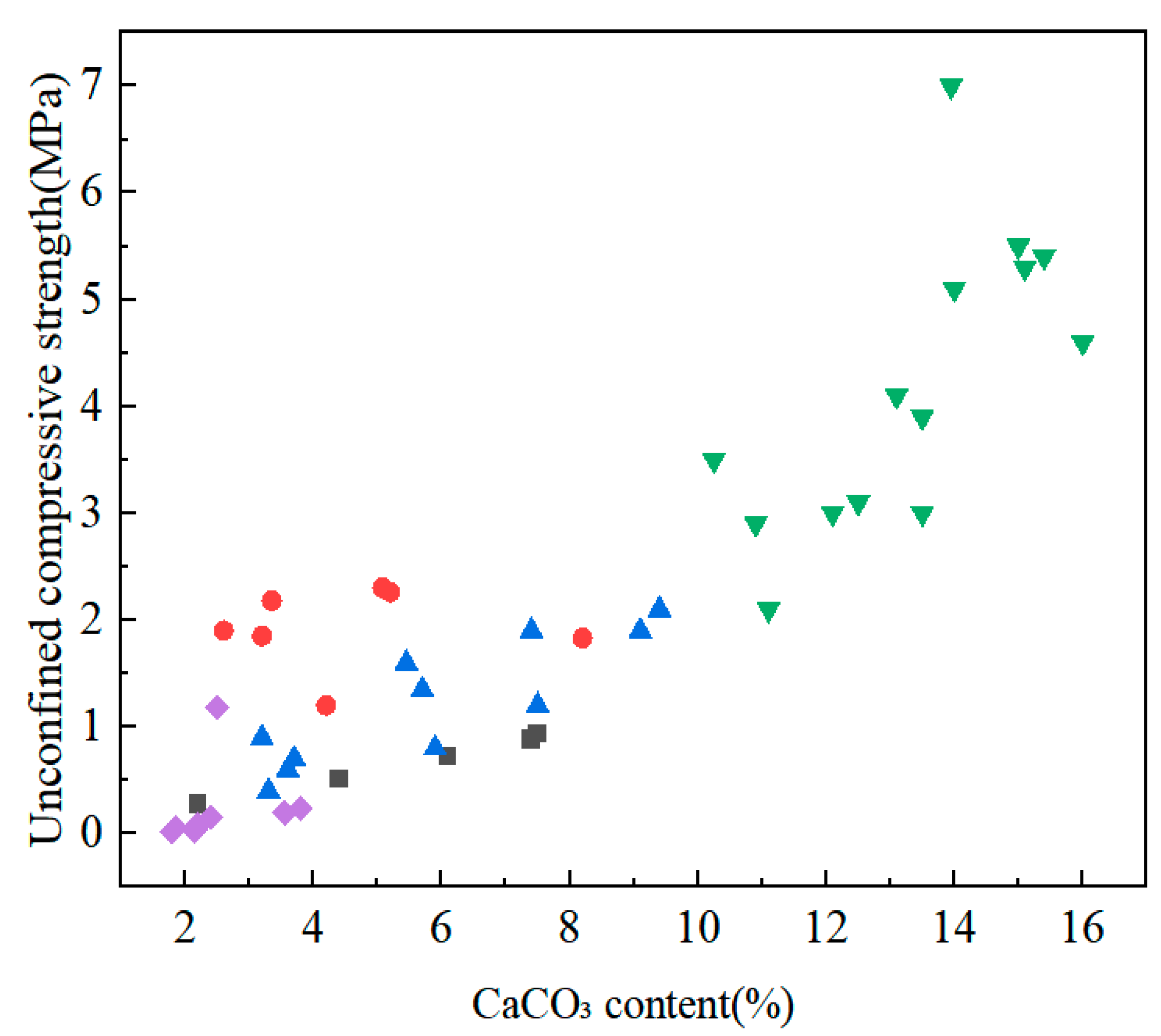
Under the action of microbial mineralization, the fracture-filled regions exhibit pronounced integrity, and the compressive strength of the treated samples is significantly enhanced [65]. A remediation approach that uses loose materials such as sand as microbial carriers for filling geotechnical fractures rationally utilizes the cementation effect of biobinders. The pores and particles within the sand matrix provide sufficient space and nucleation sites for the precipitation of mineralization products. Untreated loose sand (particle size 0.1–0.5 mm) typically exhibits a compressive strength below 0.5 MPa [168,169]. Following MICP treatment, calcium carbonate precipitates fill the interparticle pores within the sand, transforming loose particles into an integrated structure, with the compressive strength increasing to 2–10 MPa depending on the treatment process employed [170,171]. It has been widely reported in the literature [172,173] that the cementitious structure formed by calcium carbonate precipitates between particles constitutes the key mechanism for soil strength enhancement. The correlation between the unconfined compressive strength and the corresponding calcium carbonate content in solidified sand, as reported by different research teams [174,175,176,177,178], is shown in Figure 23. The data presented in the figure reveal a significant positive correlation between the unconfined compressive strength of solidified sand and calcium carbonate content [179]. Notably, the increase in calcium carbonate content strongly strengthened the unconfined compressive strength of the soil, indicating that the calcium carbonate content directly governs the mechanical properties of the remediated geotechnical mass.
In addition to enhancing compressive strength, microbial mineralization technology significantly improves the tensile strength of geotechnical masses [180]. With a cementation solution concentration of 1.0 mol/L [181], the tensile strength of the treated soil markedly increased. Following MICP treatment, the geotechnical mass exhibits residual strength even after experiencing compressive or shear failure. Compared with untreated loose sand, MICP-cemented sand demonstrates a substantially enhanced capacity to retain strength after failure, indicating a significant improvement in residual strength [182]. To address the apparent brittle failure observed in MICP-treated geotechnical materials, research has confirmed that the combination of fibre reinforcement technology with microbial mineralization soil consolidation significantly enhances the tensile strength of treated soil. Fibres bridge particles, span fractures, and provide attachment sites for calcium carbonate crystals, thereby forming a reinforced structure [183]. This combination effectively mitigates the brittle behavior of solidified soil and significantly enhances its toughness [184].

4.2. Impermeability of Microbially Repaired Fractured Rock Masses

In engineering application research on seepage control and crack remediation, the technical application scenarios have progressively expanded from traditional crack repair to the regulation and improvement of sand permeability. Numerous studies have confirmed that the continuous generation and accumulation of microbial metabolic byproducts within soil can effectively fill soil pores and play an auxiliary role in significantly reducing soil permeability. The integration of microbially induced mineralization technology with fractured rock and soil remediation not only achieves self-healing and long-term sealing of cracks but also improves the compactness and impermeability of the geotechnical mass at the microstructural level, providing a green and sustainable approach for seepage control and reinforcement in hydraulic engineering, subgrade construction, and slope engineering [185,186]. Research has demonstrated the dual efficacy of MICP technology in soil seepage control and dam protection: On the one hand, it can form a low-permeability layer in sandy soils; on the other hand, it can be employed for surface reinforcement of dams. Through dam model experiments [187], surface MICP solidification and crack remediation were achieved by spraying a bacterial suspension and nutrient solution. Flume tests revealed the formation of a 20–30 mm calcium carbonate protective layer on the model surface (with the surface 5 mm exhibiting a dense structure). Furthermore, specialized investigations into the effectiveness of seepage control of biological slurries in rock fractures [188] have demonstrated that MICP treatment resulted in reduced permeability of the samples, indicating significant antiseepage efficacy. Erosion tests conducted on fine sand after MICP solidification revealed that MICP technology significantly enhanced the scour resistance of fine sand. Further analysis indicated that the erosion resistance performance is closely correlated with the quantity of calcium carbonate generated within the system and the microstructural characteristics of the solidified matrix [189].
The performance data presented in Table 4 are primarily derived from studies using ureolytic bacteria (particularly Sporosarcina pasteurii), which currently represent the most mature and well-documented MICP pathway for engineering applications. For fractured rock masses, nuclear magnetic resonance testing has shown that after 42 days of treatment, the compressive strength of fractured yellow sandstone increased by 30.52%, impermeability improved by 94.62%, and porosity decreased by 36.41% [41]. Studies have demonstrated that the Darcy permeability coefficient of fractured rock can be reduced by three to four orders of magnitude following MICP grouting [115]. Using an enzyme-induced carbonate precipitation (EICP) combined with calcium acetate process, the peak load of fractured rock increased by 12.03 times after seven reinforcement cycles [75,190]. In granite fractures, excellent results were achieved, including a four-order-of-magnitude reduction in transmissivity, shear strength reaching 512–688 kPa, and a fracture filling rate of 85% [191].
Notable differences exist in the reinforcement effects of different microbial mineralization pathways, with their typical characteristics summarized as follows: Ureolytic bacteria: Most significant strength improvement [65], permeability reduction of three to four orders of magnitude [117]; suitable for most geotechnical fracture repair scenarios, but ammonia release remains a concern. Denitrifying bacteria: Slightly lower strength improvement than ureolytic bacteria, permeability reduction of approximately two orders of magnitude [38]; suitable for water-sensitive areas where ammonia nitrogen introduction is undesirable, but reaction rate is relatively slow. Sulfate-reducing bacteria: Moderate strength improvement; primarily applicable to sulfate-rich environments [29]. Methanotrophs and photosynthetic microorganisms: Relatively lower strength improvement but produce no toxic byproducts; suitable for shallow surface engineering or deep anaerobic environments [42,46].

4.3. Practical Engineering Applications of MICP

A CO2 geological storage project in Montana, USA, targeted the sealing of fractures in a diorite formation at a depth of 340.8 m to prevent CO2 leakage [194]. A “two-step” grouting strategy was adopted, in which bacterial suspension and cementation solution were injected alternately to promote calcium carbonate precipitation within the fractures. Complete fracture sealing was achieved within four days, effectively reducing the permeability of the formation and demonstrating the feasibility of MICP technology under deep geological conditions [195]. For micro-fractures smaller than 0.2 mm, which are difficult to treat with cement grout, a field grouting trial was conducted using a low-viscosity microbial slurry prepared with indigenous bacterial strains. A “multi-stage quantitative injection” process was employed to achieve effective slurry diffusion within the fractures. The slurry diffusion distance reached over 0.4 m, and the permeability of the rock mass after grouting was reduced to approximately 0.1 Lu, demonstrating a significant anti-seepage effect [196]. Against the engineering backdrop of seepage control in a large underground water-sealed oil storage cavern, a study on MICP sealing of micro-fractures in the rock mass was conducted (Figure 24). Using a self-designed visual fracture model test apparatus, the study revealed a “stepwise” decrease in fracture permeability and established the concept of a “critical fracture sealing threshold.” Although this study was conducted as a detailed laboratory experiment, its engineering background was clearly defined, and its findings directly support seepage control requirements for underground energy storage facilities. In summary, based on the above field application examples, MICP technology for fractured rock mass reinforcement is currently in a critical transition stage from laboratory research to field application. Although several successful field trials have demonstrated the feasibility of the technology, large-scale application still faces challenges related to precipitation uniformity, long-term stability, and cost-effectiveness. Future research should further promote the integration of laboratory and field experiments, optimize grouting processes and bacterial strain performance, reduce engineering costs, and provide technical support for practical applications under complex geological conditions.

4.4. Current Status of MICP Technical Specifications and Standardization

As an emerging geotechnical remediation technology, MICP has not yet established dedicated national or international technical specifications specifically for the reinforcement of fractured rock masses. Nevertheless, with the advancement of research and the expansion of engineering applications, relevant standardization efforts have gradually been initiated.
(1)
International Specifications and Guidelines
At the international level, ASTM International issued ASTM D8260-20 [198], Standard Test Method for Microbial Calcite Precipitation in Soil Specimens, in 2020. This standard represents the most directly relevant testing standard for MICP currently available, specifying experimental procedures for microbially induced calcite precipitation in soil specimens, encompassing aspects such as bacterial solution preparation, grouting processes, and strength testing. It provides a unified testing framework for laboratory-scale investigations of MICP technology.
The International Organization for Standardization (ISO) published ISO/TR 23262:2021, Geotechnics—Use of microorganisms in soil improvement—Technical report, in 2021 [199]. This technical report systematically summarizes the current state of application, underlying mechanisms, and engineering considerations pertaining to the use of microorganisms in soil improvement, serving as a foundational document for the standardization of MICP technology and providing technical support for the subsequent development of formal standards. Additionally, the Federal Highway Administration (FHWA) of the United States released Bio-mediated Soil Improvement: A Review of Recent Advances and Applications in 2016 [200], which offers technical guidance for the application of MICP technology in highway engineering, covering aspects such as material selection, construction processes, and quality control.
(2)
Analysis and Outlook of Standardization Status
Standardization efforts for MICP technology remain in their nascent stages and face the following principal challenges:
    • Diversity of bacterial strains and processes: The substantial influence exerted by different bacterial strains (e.g., Sporosarcina pasteurii, Bacillus sphaericus), grouting processes (e.g., one-phase method, two-phase method, staged injection), and material formulations on reinforcement performance renders the unification of technical parameters challenging.
    • Lack of long-term performance evaluation systems: Unified evaluation methodologies and acceptance criteria for long-term durability, freeze–thaw resistance, aging resistance, and chemical erosion resistance of MICP-reinforced materials remain absent.
    • Environmental impact assessment standards: Byproducts such as ammonia released from ureolytic MICP and nitrite potentially generated from denitrification-based MICP necessitate the establishment of clear environmental control standards and emission limits.
    • Field quality control methods: Rapid and effective detection methods for real-time monitoring of bacterial activity, calcium carbonate production, and reinforcement effectiveness during field construction are currently lacking.

4.5. Current Commercialization Status of MICP Technology

According to the Global Bio Cement Market Report published by HTF Market Intelligence, MICP-related technologies are experiencing rapid market growth in the fields of geotechnical engineering and infrastructure repair. The market size for related applications was approximately USD 198 million in 2024 and is projected to reach USD 1.34 billion by 2033, growing at a compound annual growth rate (CAGR) of 23.7% [201]. BioCement Technologies (Netherlands): Provides MICP-based soil stabilization solutions primarily for foundation reinforcement, slope stabilization, and erosion control. The underlying technical principles are also applicable to the filling and cementation of rock fractures. StoneBio (UK): Develops MICP-based bio-remediation materials focused on the restoration and conservation of historical buildings and stone cultural heritage, filling stone cracks and surface damage through induced calcium carbonate precipitation. Halliburton (USA): A globally leading oilfield service company that applies MICP technology for fracture sealing in oil and gas wellbores and for lost circulation control, representing a typical industrial application of MICP technology in deep rock fracture repair. BASF SE (Germany): A global chemical giant currently expanding into bio-based construction materials, with MICP-related products being one of its research and development directions, with potential applications including concrete crack repair and geotechnical reinforcement.
MICP technology has transitioned from laboratory research to engineering applications, with the global related market experiencing rapid growth. The aforementioned companies have launched mature products in their respective niche areas and have successfully applied them in practical engineering projects. Particularly in fields such as crack repair in hydraulic tunnels and dams, rock fracture reinforcement on slopes, restoration of historical stone structures, and fracture sealing in oil and gas wellbores, MICP technology has demonstrated strong engineering applicability and environmental benefits. With ongoing cost optimization and the advancement of standardization efforts, MICP technology is expected to achieve large-scale application across a broader range of engineering scenarios, including rock fracture repair.

4.6. Cost Analysis of MICP Technology

The cost of MICP technology represents one of the main bottlenecks limiting its large-scale commercial application [202]. The cost of MICP technology mainly comprises three components: bacterial strain and culture medium expenses, grouting equipment and labor costs, and testing and acceptance fees [98]. From a material perspective, the cost of preparing a 1 mol/L cementation solution (equimolar concentrations of urea and calcium chloride) in the laboratory is approximately RMB 7.0–8.0 per liter, of which bacterial culture medium accounts for 50%–80% [203,204]. Notably, the cultured bacterial strains can be reused, which helps to further reduce the process cost [205]. In practical engineering, material dosage and ratios must be adjusted according to variations in geological conditions and remediation objectives, leading to significant cost fluctuations [206].
Studies have shown that, excluding the time costs associated with microbial cultivation and grouting construction, the cost of microbial grouting engineering is only 55% of that of cement grouting [207]. However, when related costs such as bacterial solution preparation and specimen curing are taken into account, the overall cost of MICP technology is typically higher than that of conventional chemical grouting processes. To address this, researchers have conducted numerous optimization studies aimed at cost reduction and efficiency improvement. One important direction involves the use of industrial solid waste as a substitute for conventional reagents to serve as low-cost nutrient substrates and calcium sources [208,209]. In addition to optimizing material costs, enhancing mineralization efficiency is key to reducing overall costs. By introducing specific additives (e.g., organic polymers, inorganic ions, or bioactive substances) into the MICP reaction system, urease activity can be effectively enhanced, additional nucleation sites can be provided, and calcium carbonate crystal growth can be regulated, thereby significantly improving mineralization rates and product stability [210,211]. Concurrently, researchers have employed genetic engineering and synthetic biology approaches to directionally modify functional strains. For example, heterologous expression of a highly efficient urease gene cluster in Bacillus subtilis has successfully yielded engineered strains with substantially improved mineralization efficiency [212]. Furthermore, the application of non-destructive monitoring techniques such as ultrasound, X-ray computed tomography, and electrical resistivity tomography enables real-time dynamic monitoring of the grouting and sealing process, allowing timely adjustments to grouting strategies, ensuring uniformity of calcium carbonate deposition, and effectively reducing waste of materials and construction resources.

5. Current Challenges and Future Research Directions

5.1. Current Challenges

Although MICP technology exhibits broad application prospects in the field of fractured rock mass reinforcement, existing processes still face challenges related to byproduct generation, reinforcement uniformity, and long-term durability. Considering the characteristics of different microbial mineralization pathways, future research should focus on the following directions:
(1)
Spatial distribution heterogeneity and long-term stability of mineralized products
When MICP technology is applied to fractured rock mass reinforcement, the complex and irregular geometry of fractures significantly restricts the seepage and diffusion of reaction solutions, leading to uneven distribution of calcium carbonate precipitation within the fracture space. This heterogeneous deposition can easily cause localized sealing failure, ultimately compromising the overall structural strength and stability of the rock mass [213]. Moreover, fractured rock masses reinforced by MICP are subjected to complex environmental conditions during service, including wetting–drying cycles, freeze–thaw cycles, acid rain erosion, and long-term loading [214]. Currently, research on the long-term durability of MICP-reinforced rock masses remains severely insufficient, representing a critical bottleneck limiting the application of this technology. Existing studies have demonstrated that optimized grouting processes—such as staged injection and low-concentration repeated treatment—can effectively improve the distribution of reaction solutions within fractures and enhance the uniformity of calcium carbonate precipitation [64,109]. However, research on the long-term performance of calcium carbonate precipitates remains limited, particularly regarding resistance to dissolution and erosion under conditions of water scouring, freeze–thaw cycles, and acidic environments.
(2)
Adaptability of functional strains to extreme geological environments
Fractured rock masses are often situated in extreme geological environments, including deep subsurface, anaerobic conditions, high or low temperatures, and acidic or alkaline settings. However, the functional strains currently used in mainstream applications have stringent environmental requirements and suffer from issues such as poor environmental adaptability, rapid decline in metabolic activity, and significantly reduced mineralization efficiency, making them unsuitable for complex engineering scenarios [215]. Progress in screening indigenous stress-tolerant strains and engineering strain modification for extreme environments in fractured rock masses remains slow. A strain system that combines both high enzyme activity and strong environmental adaptability has yet to be established. Furthermore, in-depth research on the colonization, proliferation, and metabolic behavior of strains within the fracture microenvironment is lacking, limiting the application of MICP technology in complex fracture scenarios such as acidic, low-temperature, and deep subsurface environments.
(3)
Control of harmful byproducts
The issue of byproducts represents a core controversy regarding the environmental friendliness of MICP technology and constitutes a critical bottleneck restricting its application in environmentally sensitive areas. Significant differences exist in the types and emission intensities of byproducts among different mineralization pathways: ammonia emissions from ureolytic MICP, N2O and nitrite accumulation from denitrification-based MICP, and H2S release from sulfate-reducing MICP all require targeted management. Future research should focus on [216,217]: low-cost, high-efficiency in situ byproduct immobilization technologies (e.g., the MISP method); the optimization and application of novel bacterial strains with no ammonia or greenhouse gas emissions; and the establishment of monitoring and evaluation systems for the long-term environmental behavior of byproducts.

5.2. Future Research Directions

Although MICP technology demonstrates broad application prospects in the field of fractured rock mass reinforcement, existing processes still face challenges such as byproduct generation, reinforcement uniformity, and long-term durability. Considering the characteristics of different microbial mineralization pathways, future research should focus on the following directions:
(1)
Ureolytic MICP: This pathway offers high mineralization efficiency and is the most mature in terms of application; however, the issue of ammonia release urgently needs to be addressed. Future research could explore low-cost ammonia recovery technologies, develop modified strains with low ammonia emissions, or adopt plant-derived urease (EICP) as an alternative. In addition, optimization of grouting processes (e.g., low-concentration multiple injections) and the development of novel admixtures (e.g., sodium silicate, ferric chloride) can help improve the uniformity of calcium carbonate distribution.
(2)
Denitrification-based MICP: This pathway does not require exogenous urea and is suitable for sensitive water areas where ammonia nitrogen introduction is undesirable. However, it suffers from a relatively slow reaction rate and may produce intermediates such as nitrite. Future research should focus on precise regulation of reaction conditions to avoid intermediate accumulation, while exploring synergistic applications with ureolytic bacteria to achieve complementary advantages.
(3)
Sulfate-reducing MICP: This pathway is suitable for sulfate-rich environments (e.g., marine environments, tailings dams). However, the generation of hydrogen sulfide poses a threat to construction safety. Future research should develop safe and reliable hydrogen sulfide capture and treatment systems, and explore its application potential in extreme environments such as deep sea and deep subsurface.
(4)
Methanotrophs and photosynthetic microorganisms: Both pathways produce no toxic byproducts and offer the best environmental friendliness, but their reaction rates are relatively slow. Methanotrophs are suitable for deep anaerobic environments (e.g., underground caverns, oil/gas wellbores) and can provide the added benefit of methane emission reduction. Photosynthetic microorganisms are suitable for shallow surface engineering (e.g., desert solidification, dust control). Future research should aim to improve their mineralization efficiency through strain acclimatization and optimization of light conditions.
(5)
Synthetic biology-engineered bacteria: Our research team has constructed a carbonic anhydrase heterologously expressed engineered bacterium (CA-HEEB) based on synthetic biology approaches [218]. Figure 25 illustrates the preparation of CA-HEEB and its application process in bio-cementation of fractured rock masses. By heterologously expressing carbonic anhydrase, this strain achieves mineralization efficiency comparable to that of ureolytic bacteria without generating ammonia, while also possessing carbon dioxide fixation capability. Preliminary assessments in recycled aggregate concrete indicate a potential carbon emission reduction of 3.74%. This technology offers a new direction for the green development of MICP, although its engineering application data and long-term stability require further validation.
In summary, future development of MICP technology should adopt a pathway-specific approach, selecting the most suitable microbial pathway according to the specific engineering scenario, and advancing technological maturity through interdisciplinary integration (microbiology, materials science, geotechnical engineering). Meanwhile, closer integration of laboratory and field studies should be promoted to accelerate the transition of the technology from laboratory research to engineering applications.

6. Conclusions

This paper provides a systematic analysis of the microbial mineralization mechanism, the influence of various factors on mineralization reactions, and the engineering applications of MICP technology. The following conclusions are drawn:
(1)
Compared with traditional rock fracture remediation methods, MICP technology offers the advantage of self-healing, eliminating the need for repeated manual intervention. By leveraging microbial metabolism, it continuously facilitates fracture remediation, achieving long-term repair. Furthermore, when new cracks develop in the same area, the microorganisms can be reactivated by external environmental stimuli and perform secondary crack repair through their inherent mineralization activity.
(2)
Among the various microbial mineralization pathways, the ureolytic pathway exhibits high environmental adaptability and mineralization efficiency, making it the most widely applied approach; however, it requires exogenous nutrients and generates ammonia as a byproduct. Pathways such as denitrification and sulfate reduction offer application value under specific environmental conditions but are limited by slow reaction rates or the production of toxic byproducts, respectively. In recent years, a carbonic anhydrase-engineered bacterium (CA-HEEB) constructed based on synthetic biology has achieved mineralization under ammonia-free conditions while also possessing carbon fixation capability, offering a new direction for MICP technology; however, its engineering application data still require further validation. Overall, each pathway has its own characteristics, and the selection in practical applications should be based on a comprehensive consideration of engineering scenarios and environmental requirements.
(3)
The mineralization efficacy of MICP is governed by a synergistic regulatory mechanism involving “single-factor and multifactor coupling”. Individual factors—including bacterial strain characteristics, temperature, pH, calcium source type and concentration, fracture characteristics, and injection methods—directly influence the quantity and crystalline quality of calcium carbonate precipitates. However, multifactor coupling effects, such as “biochemical” and “physical–biological” interactions, are more decisive for engineering applications and require precise control through parameter optimization.
(4)
The engineering application of MICP technology necessitates the selection of suitable functional bacterial strains on a project scale and under site-specific environmental conditions. Simultaneously, the reliability and stability of the remediation effect must be ensured through the optimization of admixture combinations and injection processes, thereby providing a foundation for large-scale implementation in scenarios such as slope reinforcement and dam seepage control.

Author Contributions

M.Y.: Writing—original draft, Investigation, Data curation. Z.Z.: Conceptualization, Methodology, Writing—original draft, Resources, Writing—review and editing, Supervision. C.X.: Writing—review and editing, Writing—original draft, Supervision, Investigation, Funding acquisition. T.S.: Conceptualization, Methodology, Writing—original draft, Resources, Writing—review and editing, Supervision. Z.T.: Investigation, Data curation. All authors have read and agreed to the published version of the manuscript.

Funding

This work was supported by the Shandong University of Technology Young and Middle-aged Key Teachers Overseas Visit Program Funds (Tian Su); the Natural Science Foundation of Shandong Province (ZR2025MS802) (Tian Su).

Data Availability Statement

The data presented in this study are available on request from the corresponding authors.

Conflicts of Interest

Author Zehui Zhang employed by the company China Design Group (China). The remaining authors declare that the research was conducted in the absence of any commercial or financial relationships that could be construed as a potential conflict of interest.

References

  1. Chen, W.Z.; Wang, L.Y.; Tan, X.J.; Yang, D.S.; Yuan, J.Q.; Yang, J.P. Development trends in stability research of fractured rock mass underground engineering. Chin. J. Rock Mech. Eng. 2021, 40, 1945–1961. (In Chinese) [Google Scholar]
  2. Luo, C.J. Application of curtain grouting technology in soluble rock dam foundations of existing earth dams. Chin. J. Rock Mech. Eng. 2004, 22, 3910–3916. (In Chinese) [Google Scholar]
  3. Liu, Z.J.; Qi, X.B.; Ke, J.; Shui, Z.H. Enhancing the toughness of ultra-high performance concrete through improved fiber-matrix interface bonding. Constr. Build. Mater. 2025, 491, 142616. [Google Scholar] [CrossRef]
  4. Achal, V.; Mukherjee, A.; Reddy, M.S. Microbial concrete: Way to enhance the durability of building structures. J. Mater. Civ. Eng. 2011, 23, 730–734. [Google Scholar] [CrossRef]
  5. Choi, S.G.; Wu, S.; Chu, J. Biocementation for sand using an eggshell as calcium source. J. Geotech. Geoenvironmental Eng. 2016, 142, 06016010. [Google Scholar] [CrossRef]
  6. Luo, B.; Su, Y.H.; Hu, X.; Chen, Z.F.; Chen, Y.H.; Ding, X.H. Strength behavior and microscopic mechanisms of geopolymer-stabilized waste clays considering clay mineralogy. J. Clean. Prod. 2025, 530, 146877. [Google Scholar] [CrossRef]
  7. Bremner, T.W.; Eng, P. Environmental aspects of concrete: Problems and solutions. In Proceedings of the 1st All-Russian Conference on Concrete and Reinforced Concrete, Moscow, Russia, 14 September 2001. [Google Scholar]
  8. Worrell, E.; Price, L.; Martin, N.; Hendriks, C.; Meida, L.O. Carbon dioxide emissions from the global cement industry. Annu. Rev. Energy Env. 2001, 26, 303–329. [Google Scholar] [CrossRef]
  9. Benhelal, E.; Zahedi, G.; Shamsaei, E.; Bahadori, A. Global strategies and potentials to curb CO2 emissions in cement industry. Clean. Prod. 2013, 51, 142–161. [Google Scholar] [CrossRef]
  10. Liu, H.Q.; Yi, H.H.; Cao, F.B.; Liu, C.J.; Li, B.X.; Gao, Y.J.; Su, T. Multi-component synergistic regulation of hydration behavior and microstructure in solid waste-based high belite calcium sulphoaluminate cement: Hydration-microstructure-performance correlation. Constr. Build. Mater. 2025, 505, 144750. [Google Scholar] [CrossRef]
  11. Naeimi, M.; Haddad, A. Environmental impacts of chemical and microbial grouting. Environ. Sci. Pollut. Res. 2020, 27, 2264–2272. [Google Scholar] [CrossRef]
  12. Wang, S.J.; Li, Z.Q.; Tian, Y.F.; Li, Y.M.; Zhou, Y.X.; Li, D.D. The past, present and future of microbial geotechnical engineering technology. J. Eng. Geol. 2024, 32, 236–264. (In Chinese) [Google Scholar]
  13. Tecon, R.; Or, D. Biophysical processes supporting the diversity of microbial life in soil. FEMS Microbiol. Rev. 2017, 41, 599–623. [Google Scholar] [CrossRef]
  14. Geng, Y.Y.; Wang, S.M.; Tang, L.Y.; Shen, Z.T. Influence of typical soil minerals on ureolytic bacteria-induced carbonate precipitation. Soil Use Manag. 2024, 40, e13149. [Google Scholar] [CrossRef]
  15. Vekariya, M.S.; Pitroda, J. Bacterial concrete: New era for construction industry. Int. J. Eng. Trends Technol. 2013, 4, 4128–4137. [Google Scholar]
  16. Wang, P.F.; Tan, W.H.; Ma, X.W.; Li, Z.J.; Liu, J.J.; Wu, Y.F. Experimental study of seepage characteristics of consecutive and filling fracture with different roughness levels and gap-widths. Rock Soil Mech. 2019, 40, 3062–3070. (In Chinese) [Google Scholar]
  17. Qian, C.X.; Wang, J.Y.; Wang, R.X.; Guo, H.D.; Li, L. Yield of microbial sedimentary calcite. J. Inorg. Chem. 2006, 4, 618–621. (In Chinese) [Google Scholar]
  18. Wong, P.Y.; Mal, J.; Sandak, A.; Luo, L.; Jian, J.; Pradhan, N. Advances in microbial self-healing concrete: A critical review of mechanisms, developments, and future directions. Sci. Total Environ. 2024, 947, 174553. [Google Scholar] [CrossRef] [PubMed]
  19. Fouladi, A.S.; Arulrajah, A.; Chu, J.; Horpibulsuk, S. Application of Microbially Induced Calcite Precipitation (MICP) technology in construction materials: A comprehensive review of waste stream contributions. Constr. Build. Mater. 2023, 388, 131546. [Google Scholar] [CrossRef]
  20. Han, X.; Schultz, L.; Zhang, W.; Zhu, J.; Meng, F.; Geesey, G.G. Mineral formation during bacterial sulfate reduction in the presence of different electron donors and carbon sources. Chem. Geol. 2016, 435, 49–59. [Google Scholar] [CrossRef]
  21. Gollapudi, U.K.; Knutson, C.; Bang, S.S.; Islam, M.R. A new method for controlling leaching through permeable channels. Chemosphere 1995, 30, 695–705. [Google Scholar] [CrossRef]
  22. Jiang, N.; Soga, K.; Kuo, M. Microbially Induced Carbonate Precipitation for Seepage-Induced Internal Erosion Control in Sand-Clay Mixtures. J. Geotech. Geoenviron. 2017, 143, 4016100. [Google Scholar] [CrossRef]
  23. Whiffin, V.S.; van Paassen, L.A.; Harkes, M.P. Microbial carbonate precipitation as a soil improvement technique. Geomicrobiol. J. 2007, 24, 417–423. [Google Scholar] [CrossRef]
  24. Wang, M.L.; Wu, S.J.; Yang, Y.Q.; Chen, F.R. Advances in microbial-induced carbonate precipitation and its application in heavy metal fixation. Chin. J. Environ. Sci. 2018, 31, 206–214. (In Chinese) [Google Scholar] [CrossRef]
  25. Dhami, N.K.; Reddy, M.S.; Mukherjee, A. Biomineralization of calcium carbonates and their engineered applications: A review. Front. Microbiol. 2013, 4, 314. [Google Scholar] [CrossRef]
  26. Li, J.Y.; Huang, W.B.; Wang, X.L.; Zou, Z.R. Isolation and physiological characteristics of sulfate-reducing bacteria. J. Anhui Agric. Sci. 2010, 38, 16092–16123. [Google Scholar] [CrossRef]
  27. Baumgartner, L.K.; Reid, R.P.; Dupraz, C.; Decho, A.W.; Buckley, D.H.; Spear, J.R.; Przekop, K.M.; Visscher, P.T. Sulfate reducing bacteria in microbial mats: Changing paradigms, new discoveries. Sediment. Geol. 2006, 185, 131–145. [Google Scholar] [CrossRef]
  28. Dai, Y.D. Biomineralogy; Petroleum Industry Press: Beijing, China, 1994. (In Chinese) [Google Scholar]
  29. Chen, Q.Y.; Min, Q.; Wu, H.; Zhang, L.; Si, Y.B. Biomineralization of Cd2+ and Pb2+ by sulfate-reducing bacteria Desulfovibrio desulfuricans and Desulfobulbus propionicus. Front. Environ. Sci. 2025, 13, 1591564. [Google Scholar] [CrossRef]
  30. Ivanov, V.; Stabnikov, V.; Zhuang, W.Q.; Tay, J.H.; Tay, S.T.L. Phosphate removal from the returned liquor of municipal wastewater treatment plant using iron-reducing bacteria. J. Appl. Microbiol. 2005, 98, 1152–1161. [Google Scholar] [CrossRef]
  31. Maitte, B.; Jorand, F.P.A.; Grgic, D.; Abdelmoula, M.; Carteret, C. Remineralization of ferrous carbonate from bioreduction of natural goethite in the Lorraine iron ore (Minette) by Shewanella putrefaciens. Chem. Geol. 2015, 412, 48–58. [Google Scholar] [CrossRef]
  32. Ju, J.F.; Li, Q.S.; Xu, J.L.; Li, J.J.; Cao, Z.G. Experimental study on seepage reduction characteristics of chemical precipitation remediation for fractured/porous rock mass disturbed by mining. Coal Sci. Technol. 2020, 48, 89–96. (In Chinese) [Google Scholar]
  33. Roden, E.E.; Leonardo, M.R.; Ferris, F.G. Immobilization of strontium during iron biomineralization coupled to dissimilatory hydrous ferric oxide reduction. Geochim. Cosmochim. Acta 2002, 66, 2823–2839. [Google Scholar] [CrossRef]
  34. Zhu, T.; Dittrich, M. Carbonate precipitation through microbial activities in natural environment, and their potential in biotechnology: A review. Front. Bioeng. Biotechnol. 2016, 4, 4. [Google Scholar] [CrossRef]
  35. Seifan, M.; Khajeh Samani, A.; Berenjian, A. Bioconcrete: Next generation of self-healing concrete. Appl. Microbiol. Biotechnol. 2016, 100, 2591–2602. [Google Scholar] [CrossRef] [PubMed]
  36. Martin, D.; Dodds, K.; Butler, I.; Ngwenya, B.T. Carbonate precipitation under pressure for bioengineering in the anaerobic subsurface via denitrification. Environ. Sci. Technol. 2013, 47, 8238–8245. [Google Scholar] [CrossRef]
  37. Karatas, I. Microbiological Improvement of the Physical Properties of Soils. Ph.D. Thesis, Arizona State University, Tempe, AZ, USA, 2008. [Google Scholar]
  38. Erşan, Y.Ç.; de Belie, N.; Boon, N. Microbially induced CaCO3 precipitation through denitrification: An optimization study in minimal nutrient environment. Biochem. Eng. J. 2015, 101, 108–118. [Google Scholar] [CrossRef]
  39. Liu, H.L.; Xiao, P.; Xiao, Y.; Chu, J. State-of-the-art review of biogeotechnology and its engineering applications. J. Civ. Environ. Eng. 2019, 41, 101030. (In Chinese) [Google Scholar]
  40. Ganendra, G.; De Muynck, W.; Ho, A.; Arvaniti, E.C.; Hosseinkhani, B.; Ramos, J.A.; Rahier, H.; Boon, N. Formate oxidation-driven calcium carbonate precipitation by Methylocystis parvus OBBP. Appl. Environ. Microbiol. 2014, 80, 4659–4667. [Google Scholar] [CrossRef]
  41. Riding, R. Cyanobacterial calcification, carbon dioxide concentrating mechanisms, and Proterozoic-Cambrian changes in atmospheric composition. Geobiology 2006, 4, 299–316. [Google Scholar] [CrossRef]
  42. Gao, X.B.; Pan, Z.D.; Gong, P.L.; Jiang, Y.; Li, C.C.; Li, H.Y. Process and mechanism of microbial induced carbonate precipitation. Carsologica Sin. 2022, 41, 441–452. (In Chinese) [Google Scholar]
  43. Deng, H.J.; Luo, Y.L.; Wu, L.J.; Zhang, Y.N.; Peng, S.H. Experimental study of improving impermeability and strength of fractured rock by microbial induced carbonate precipitation. Rock Soil Mech. 2019, 40, 3542–3548. (In Chinese) [Google Scholar]
  44. Latif, D.O.; Diana, W.; Daga, W.; Apriyono, A. A PRISMA-guided systematic review of MICP and EICP in clayey soils: Mineralogy-aware mechanisms, injection control, and multi-scale performance synthesis. Results Eng. 2026, 29, 109337. [Google Scholar] [CrossRef]
  45. Reeburgh, W.S. Oceanic methane biogeochemistry. Chem. Rev. 2007, 107, 486–513. [Google Scholar] [CrossRef]
  46. Zúñiga-Barra, H.; Ostojic, C.; Torres-Aravena, Á.; Rivas, M.; Vílchez, C.; Jeison, D. Use of photosynthetic MICP to induce calcium carbonate precipitation: Prospecting the role of the microorganism in the formation of CaCO3 crystals. Algal Res. 2024, 80, 103499. [Google Scholar] [CrossRef]
  47. Dong, Y.; Gao, Z.; Wang, D.; Di, J.; Guo, X.; Yang, Z.; Li, Y.; Wang, Y.; Wang, Y. Optimization of growth conditions and biological cementation effect of Sporosarcina pasteurii. Constr. Build. Mater. 2023, 395, 132288. [Google Scholar] [CrossRef]
  48. Chuo, S.C.; Mohamed, S.F.; Mohd Setapar, S.H.; Ahmad, A.; Jawaid, M.; Wani, W.A.; Yaqoob, A.A.; Mohamad Ibrahim, M.N. Insights into the current trends in the utilization of bacteria for microbially induced calcium carbonate precipitation. Materials 2020, 13, 4993. [Google Scholar] [CrossRef]
  49. Le Métayer, É.; Castanier, S.; Le Borgne, T.; Perito, B.; Ménez, B.; Delaunay, A.; Orial, G.; Servant-Vildary, S.; Tiano, P. Influence of temperature on the effectiveness of a biogenic carbonate surface treatment for limestone conservation. Appl. Microbiol. Biotechnol. 2013, 97, 1335–1347. [Google Scholar]
  50. Dhami, N.K.; Reddy, M.S.; Mukherjee, A. Biomineralization of calcium carbonate polymorphs by the bacterial strains isolated from calcareous sites. J. Microbiol. Biotechnol. 2013, 23, 707–714. [Google Scholar] [CrossRef]
  51. Okwadha, G.D.O.; Li, J. Optimum conditions for microbial carbonate precipitation. Chemosphere 2010, 81, 1143–1148. [Google Scholar] [CrossRef]
  52. Zhao, Q. Experimental Study on Soil Improvement Using Microbial Induced Calcite Precipitation (MICP). Ph.D. Thesis, China University of Geosciences (Beijing), Beijing, China, 2014. (In Chinese) [Google Scholar]
  53. Liu, S.Y.; Yu, J.; Zeng, W.L.; Peng, X.Q.; Cai, Y.Y.; Tu, B.X. Repair effect of tabia cracks with microbially induced carbonate precipitation. Chin. J. Rock Mech. Eng. 2020, 39, 191–204. [Google Scholar]
  54. Prajapati, N.K.; Agnihotri, A.K.; Basak, N. Microbial induced calcite precipitation (MICP) a sustainable technique for stabilization of soil: A review. Mater. Today Proc. 2023, 93, 357–361. [Google Scholar] [CrossRef]
  55. Liu, Y.; Ali, A.; Su, J.F.; Li, K.; Hu, R.Z.; Wang, Z. Microbial-induced calcium carbonate precipitation: Influencing factors, nucleation pathways, and application in waste water remediation. Sci. Total Environ. 2023, 860, 160439. [Google Scholar] [CrossRef]
  56. Li, H.D.; Jiao, X.Y.; Li, J.; Su, M.X.; Wu, S.Y.; Liu, Y. Using microbe-induced calcite precipitation and enzyme-induced carbonate precipitation to cement slopes of earth ditches. Guan’gai Paishui Xuebao 2021, 40, 59–65. [Google Scholar]
  57. Carter, M.S.; Tuttle, M.J.; Mancini, J.A.; Martineau, R.; Hung, C.S.; Gupta, M.K. Microbially induced calcium carbonate precipitation by Sporosarcina pasteurii: A case study in optimizing biological CaCO3 precipitation. Appl. Environ. Microbiol. 2023, 89, e01794-22. [Google Scholar] [CrossRef] [PubMed]
  58. Seifan, M.; Khajeh Samani, A.; Berenjian, A. Beneficial factors for biomineralization by ureolytic bacterium Sporosarcina pasteurii. Microb. Cell Factories 2020, 19, 12. [Google Scholar] [CrossRef] [PubMed]
  59. Shi, W.; Wang, M.; Wu, L.; Xie, X.H.; Wang, M.; Lu, T.J. Study of concrete crack repair using Bacillus megaterium. Adv. Mater. Sci. Eng. 2022, 2022, 6188680. [Google Scholar] [CrossRef]
  60. Shen, T.Y.; Li, X.; Wang, S.J.; Xu, C.; Xue, L. Triaxial shear strength and immersion compressive strength of sandy clayey purple soil treated by microbial induced calcite precipitation. Trans. Chin. Soc. Agric. Eng. (Trans. CSAE) 2019, 35, 135–143. (In Chinese) [Google Scholar]
  61. Qin, Y.F.; Lu, W.; Yuan, M.X.; Shen, T.Y.; Li, X.; Wang, S.J. An experimental study of Handan strong expansive soil enhanced by Bacillus megaterium. J. Southwest China Norm. Univ. (Nat. Sci. Ed.) 2020, 45, 87–95. (In Chinese) [Google Scholar]
  62. Zhao, S.M. Enhancement Effect of Bacillus Megaterium LY02 on Phytoremediation of Heavy Metal-Contaminated Soil by Ryegrass. Master’s thesis, Zhejiang A&F University, Lin’an, China, 2018. (In Chinese) [Google Scholar]
  63. Peng, J.; He, X.; Liu, Z.M.; Feng, Q.P.; He, J. Experimental study on microbial induced calcium carbonate precipitation for soil stabilization under low temperature conditions. Chin. J. Geotech. Eng. 2016, 38, 1801–1807. (In Chinese) [Google Scholar]
  64. Tran, T.K.; Nguyen, T.P.; Le, Q.L.; Tran, T.M.N.; Vu, T.T.N.; Duong, T.H.D.; Tran, Q.V.; Nguyen, H.D. Effect of culture conditions on bacteria-induced calcite precipitation of Bacillus subtilis QN7 strain. Huit. J. Sci. 2024, 24, 3–11. [Google Scholar]
  65. Deng, J.R. Mechanical Behavior and Microscopic Characterization of Rock Materials After Microbial Remediation. Ph.D. Thesis, Central South University, Changsha, China, 2023. (In Chinese) [Google Scholar]
  66. Sun, X.H. Study on Mechanism of Microbial Mineralization and Application of it to Repair Concrete Cracks. Ph.D. Thesis, Southeast University, Nanjing, China, 2019. (In Chinese) [Google Scholar]
  67. Li, D. Investigation of Solidifying Desert Aeolian Sand Using Microbially Induced Calcite Precipitation. Master’s thesis, Northwest A&F University, Yangling, China, 2018. (In Chinese) [Google Scholar]
  68. Liu, D.; Shao, A.L.; Zhao, X.; Jin, C.Y. Experimental study on rock mass structural plane repair based on microbially induced calcium carbonate precipitation. J. Northeast. Univ. (Nat. Sci.) 2018, 39, 961–965. (In Chinese) [Google Scholar]
  69. Zhang, H.N. Experimental Study on Microbial Induced Calcium Carbonate Precipitation Technology for Sand Solidification. Ph.D. Thesis, China University of Geosciences (Beijing), Beijing, China, 2019. (In Chinese) [Google Scholar]
  70. Pei, D. Studies on Sporosarcina pasteurii Induced Mineralization and Its Mechanism. Ph.D. Thesis, National University of Defense Technology, Changsha, China, 2021. (In Chinese) [Google Scholar]
  71. van Paassen, L.A. Biogrout: Ground Improvement by Microbial Induced Carbonate Precipitation. Ph.D. Thesis, Delft University of Technology, Delft, The Netherlands, 2009. [Google Scholar]
  72. Wang, J.Y.; Jonkers, H.M.; Boon, N.; De Belie, N. Bacillus sphaericus LMG 22257 is physiologically suitable for self-healing concrete. Appl. Microbiol. Biotechnol. 2017, 101, 5101–5114. [Google Scholar] [CrossRef]
  73. Cheng, L.; Cord-Ruwisch, R. In situ soil cementation with ureolytic bacteria by surface percolation. Ecol. Eng. 2012, 42, 64–72. [Google Scholar] [CrossRef]
  74. Yi, H.H.; Zheng, T.W.; Jia, Z.R.; Su, T.; Wang, C.G. Study on the influencing factors and mechanism of calcium carbonate precipitation induced by urease bacteria. J. Cryst. Growth 2021, 564, 126113. [Google Scholar] [CrossRef]
  75. Cui, Z.H.; He, X.; Dai, F.; Liu, Y.; Yang, S.H. Influence of bacterial concentration and fissure aperture on improving dynamic mechanical properties of MICP repaired fissured sandstone. J. Rock Mech. Geotech. Eng. 2026, 18, 1213–1232. [Google Scholar] [CrossRef]
  76. Wu, D.D.; Zhang, J.G.; Wang, P.Z.; Gao, P.; Liu, Y.Z.; Zhou, A.J. Optimizing the self-healing of concrete cracks under actual service oxygen conditions via mineralization of facultatively aerobic microbial consortia. Cem. Concr. Compos. 2026, 165, 106319. [Google Scholar] [CrossRef]
  77. Li, K.L.; Yan, C.; Chen, X.; Chen, A.J.; Du, X.M.; Li, W.H. Comparative analysis of the repair effect of three methods of microbial induced calcium carbonate precipitation on recycled aggregate concrete cracks. Mater. Rep. 2025, 39, 59–66. (In Chinese) [Google Scholar]
  78. Peng, J.; Feng, Q.P.; Sun, Y.C. Influences of temperatures on MICP-treated soils. Chin. J. Geotech. Eng. 2018, 40, 1048–1054. (In Chinese) [Google Scholar]
  79. Wang, H.; Alfredsson, V.; Tropsch, J.; Ettl, R.; Nylander, T. Formation of CaCO3 Deposits on Hard Surfaces—Effect of Bulk Solution Conditions and Surface Properties. ACS Appl. Mater. Interfaces 2013, 5, 5204–5213. [Google Scholar] [CrossRef]
  80. Wang, Y.Z.; Wang, Y.; Soga, K.; DeJong, J.T.; Kabla, A.J. Microscale investigations of temperature-dependent microbially induced carbonate precipitation (MICP) in the temperature range 4–50 °C. Acta Geotech. 2023, 18, 2239–2261. [Google Scholar] [CrossRef]
  81. Cheng, M.; Jiang, L.; Hu, S.; Zhao, X.; Wang, W.; Zhang, Y.; Paine, K.; Liu, Y. Mechanism and application of a coating-free microbial self-healing agent in cement-based composites. Cem. Concr. Compos. 2025, 163, 106213. [Google Scholar] [CrossRef]
  82. Chen, J.; Liu, B.L.; Zhong, M.; Jing, C.; Guo, B.Y. Research status and development of microbial induced calcium carbonate mineralization technology. PLoS ONE 2022, 17, e0271761. [Google Scholar] [CrossRef]
  83. Kang, B.; Zha, F.S.; Li, J. Study of self-healing capability of MICP technology under freeze-thaw cycle conditions. J. Eng. Geol. 2025, 33, 1271–1279. (In Chinese) [Google Scholar]
  84. Liu, H.Q.; Chen, J.L.; Zhang, P.; Li, W.; Su, W.; Su, T.; Gong, S.W.; Li, B.X. Freeze-Thaw Behavior and Damage Prediction of Mixed Recycled Coarse Aggregate Concrete. Buildings 2026, 16, 368. [Google Scholar] [CrossRef]
  85. Wang, S. Study on the Effect and Mechanism of Microbial Reinforcement of Fractured Rock Mass. Master’s thesis, Xi’an University of Technology, Xi’an, China, 2023. (In Chinese) [Google Scholar]
  86. Li, D.; Niu, C.H.; Jiang, Y.Y.; Wang, J.H. Optimization of high density fermentation conditions of Bacillus subtilis NKY1145. China Brew. 2015, 34, 75–78. (In Chinese) [Google Scholar]
  87. Gao, G.Y. Experimental study on microbial dust suppressant for solidified dust based on MICP. Coal Mine Saf. 2024, 55, 91–98. (In Chinese) [Google Scholar]
  88. Kappaun, K.; Piovesan, A.R.; Carlini, C.R.; Ligabue-Braun, R. Ureases: Historical aspects, catalytic, and non-catalytic properties-A review. J. Adv. Res. 2018, 13, 3–17. [Google Scholar] [CrossRef] [PubMed]
  89. Zhang, Q.C.; Zheng, Y.F.; Huang, M.Z.; Shen, X.K.; Wu, L.L.; Zhang, Z.J. Experimental and Computational Investigation of pH-Dependent Urease Conformational Dynamics and Its Impact on MICP Efficiency. Chin. J. Biochem. Mol. Biol. 2025, 41, 879–894. (In Chinese) [Google Scholar]
  90. Lai, H.J.; Cui, M.J.; Chu, J. Effect of pH on soil improvement using one-phase-low-pH MICP or EICP biocementation method. Acta Geotech. 2023, 18, 3259–3272. [Google Scholar] [CrossRef]
  91. Risdanareni, P.; Fatkhurrahman, M.; Hastuti, A.A.M.; Zai, K.; Karolina, R.; Mustafa, I.; Kristiawan, S.A.; Kusbiantoro, A. pH responsive natural-based hydrogel: Application in bacteria-based self-healing mortar. Results Eng. 2025, 28, 107932. [Google Scholar] [CrossRef]
  92. Stocks-Fischer, S.; Galinat, J.K.; Bang, S.S. Microbiological precipitation of CaCO3. Soil Biol. Biochem. 1999, 31, 1563–1571. [Google Scholar] [CrossRef]
  93. Cui, R. Experimental Study on Mechanical Properties of Remolded Mudstone Cemented and Reinforced by MICP Method. Master’s thesis, Hubei University of Technology, Wuhan, China, 2020. (In Chinese) [Google Scholar]
  94. Zhang, Y. Experimental Study on Microorganisms Applied to Sand Cementation and Concrete Crack Repair. Master’s thesis, Tsinghua University, Beijing, China, 2014. (In Chinese) [Google Scholar]
  95. Zheng, Y.F.; Wu, L.L.; Zhang, Q.C.; Hu, L.; Tian, Y.K.; Wang, M.; Zheng, H.M.; Zhang, Z.J. A constant pH molecular dynamics and experimental study on the effect of different pH on the structure of urease from Sporosarcina pasteurii. J. Mol. Model. 2025, 31, 164. [Google Scholar] [CrossRef]
  96. Lv, C.; Tang, C.S.; Zhang, J.Z.; Pan, X.H.; Liu, H. Effects of calcium sources and magnesium ions on the mechanical behavior of MICP-treated calcareous sand: Experimental evidence and precipitated crystal insights. Acta Geotech. 2023, 18, 2703–2717. [Google Scholar] [CrossRef]
  97. Zhao, T.; Du, H.; Shang, R. The Effect of Bacteria-to-Calcium Ratio on Microbial-Induced Carbonate Precipitation (MICP) under Different Sequences of Calcium-Source Introduction. Materials 2024, 17, 1881. [Google Scholar] [CrossRef]
  98. Lajmiri, A.; Sharafi, H.; Khayat, N. Evaluation of low-cost calcium sources for microbially induced calcite precipitation (MICP): Implications for sustainable bio-cementation. Results Eng. 2025, 28, 107638. [Google Scholar] [CrossRef]
  99. Zhao, Z.F.; Duan, R. Effect of different calcium sources on MICP biocementation of silt. J. Wuhan Univ. (Eng. Sci.) 2025, 58, 1–9. (In Chinese) [Google Scholar]
  100. Zheng, T.W.; Qian, C.X.; Su, Y.L. Influences of different calcium sources on the early age cracks of self-healing cementitious mortar. Biochem. Eng. J. 2021, 166, 107849. [Google Scholar] [CrossRef]
  101. Zhang, Y.H.; Guo, H.X.; Cheng, X.H. Influences of calcium sources on microbially induced carbonate precipitation in porous media. Mater. Res. Innov. 2014, 18, S2-79–S2-84. [Google Scholar] [CrossRef]
  102. Wang, W.L.; Qin, S.Y.; Xiao, Y.; Xiao, Z.Y.; Zheng, C.L. Effect of different calcium sources on MICP solidification of cyanide tailings. Nonferrous Met. (Smelt. Part) 2022, 85–111. (In Chinese) [Google Scholar]
  103. Ming, D.G.; Qiu, M.X.; Yin, L.J.; Zhang, J.M.; Zhu, J.K.; Zhou, Y. Experimental study on the effect of calcium sources on microbial solidification of aeolian sand. Yellow River 2020, 42, 85–88. (In Chinese) [Google Scholar]
  104. Achal, V.; Pan, X.L. Influence of calcium sources on microbially induced calcium carbonate precipitation by Bacillus sp. CR2. Appl. Biochem. Biotechnol. 2014, 173, 307–317. [Google Scholar] [CrossRef]
  105. Su, Y.L.; Qu, F.L.; Meng, Y.; Xu, W.J.; Zhu, X.H.; Zhang, C.; Tsang, D.C.W. Microbial-induced carbonate precipitation (MICP) modified biochar for low-carbon cementitious materials. Constr. Build. Mater. 2024, 451, 138644. [Google Scholar] [CrossRef]
  106. Gorospe, C.M.; Han, S.H.; Kim, S.G. Effects of different calcium salts on calcium carbonate crystal formation by Sporosarcina pasteurii KCTC3558. Biotechnol. Bioprocess Eng. 2013, 18, 903–908. [Google Scholar] [CrossRef]
  107. Liang, S.H.; Niu, J.G.; Fang, C.T.; Dai, J.; Yin, Y.M.; Liu, Y.J. Experimental study on the effect of nutrient solution calcium source on microbial solidification of sand. J. Disaster Prev. Mitig. Eng. 2018, 38, 781–786. (In Chinese) [Google Scholar]
  108. Tao, H.; Jiang, P.P.; Qu, J.L.; Huang, Y.D. The impact of various calcium ion sources on the curing efficacy of MICP. Sci. Rep. 2025, 15, 9149. [Google Scholar] [CrossRef] [PubMed]
  109. Gu, T.Q.; Xu, X.; Wang, Z.; Zheng, C.L. Study on the effect of different calcium sources on the solidification of cyanide tailings by microbial induced carbonate precipitation. Nonferrous Met. (Smelt. Part) 2025, 2327–2336. (In Chinese) [Google Scholar] [CrossRef]
  110. Zhu, W.K.; Luo, X.G. Optimization of Calcium Carbonate Precipitation Conditions Induced by Carbonate Mineralization Bacteria. Non-Met. Mines 2012, 35, 1–4. (In Chinese) [Google Scholar]
  111. Al Qabany, A.; Soga, K. Effect of chemical treatment used in MICP on engineering properties of cemented soils. Geotechnique 2014, 63, 331–339. [Google Scholar] [CrossRef]
  112. Huang, C.C.; Du, Q.; Qu, L.Q.; Liu, X.M.; Xue, J.L. Effect of calcium sources and solidification methods on the uniformity and strength of MICP-treated sandy loess. J. Civ. Environ. Eng. 2024, 46, 1–3. (In Chinese) [Google Scholar]
  113. Peng, S.Q.; Kang, J.Y.; Zhang, K.J.; Fan, L.; Chen, S.F.; Wang, F. Seepage law of fractured rock mass sealed with microbiologically induced CaCO3 precipitation. Min. Metall. Eng. 2020, 40, 15–19. (In Chinese) [Google Scholar]
  114. Wu, Y.R.; Zhang, Y.; Xiao, Y.; Liu, H.L. Study on the influence of crack opening on the shear performance of rock fractures repaired by microbial mineralization. J. Xi’an Univ. Archit. Technol. (Nat. Sci. Ed.) 2025, 57, 636–638. (In Chinese) [Google Scholar]
  115. Jia, Q.; Zhao, Q.C.; Sun, Z.C. Study on impermeability of concrete cracks repaired by microbial calcium carbonate precipitation. Chin. J. Appl. Basic Sci. Eng. 2017, 25, 141–148. (In Chinese) [Google Scholar]
  116. Shen, J.W.; Du, Z.H.; Li, H.; Li, L.; Wang, F.B.; Ni, J.J.; Teng, G.G. Fracture gas invasion mechanism and plugging method of shale gas layer. J. Chengdu Univ. Technol. 2022, 49, 579–585. (In Chinese) [Google Scholar]
  117. Peng, S.Q.; Di, H.; Fan, L.; Fan, W.; Qin, L. Factors Affecting Permeability Reduction of MICP for Fractured Rock. Front. Earth Sci. 2020, 8, 217. [Google Scholar] [CrossRef]
  118. Wang, J.; Li, Y.; Zhang, S.; Zhang, H.; Li, Z. Mechanical behavior and microscale mechanisms of grout-consolidated fractured coal rock: Integrated 3D In-Situ CT reconstruction modeling and multiscale experimental analysis. Results Eng. 2026, 29, 108901. [Google Scholar]
  119. Zhang, S.X.; Shen, D.Y.; Zhang, R.Z.; Wu, C.Z. The high-strength method of reinforcing sand particles using MICP combined with coconut fiber under unsaturated conditions in marine and coastal regions. Case Stud. Constr. Mater. 2025, 22, e04550. [Google Scholar] [CrossRef]
  120. Zhong, L.; Islam, M. A New Microbial Plugging Process and Its Impact on Fracture Remediation. In Proceedings of the SPE Annual Technical Conference and Exhibition, Dallas, TX, USA, 22–25 October 1995. [Google Scholar]
  121. Cardoso, R.; Arbabbzadeh, E.; Lima, J.T.; Flores-Colen, I.; Pereira, M.F.C.; Silva, M.C.; Duarte, S.O.D.; Monteiro, G.A. The influence of stone joints width and roughness on the efficiency of biocementation sealing. Constr. Build. Mater. 2021, 283, 122743. [Google Scholar] [CrossRef]
  122. Song, C.P.; Elsworth, D.; Zhi, S.; Zhang, X. Impact of flow-direction and gravitational settling on microbially-induced calcium carbonate precipitation (MICP) in rock fractures. Bull. Eng. Geol. Environ. 2024, 83, 261. (In Chinese) [Google Scholar] [CrossRef]
  123. Dai, Q.C.; Pan, X.H.; Zhang, Y.C.; Tang, C.S. A high-bridging-rate MICP repair method for non-penetrating steeply inclined rock fractures based on three-step grouting strategy. Geol. J. China Univ. 2025, 31, 562–571. (In Chinese) [Google Scholar] [CrossRef]
  124. Tobler, D.J.; Minto, J.M.; Mountassir, G.E.; Lunn, R.J.; Phoenix, V.R. Microscale Analysis of Fractured Rock Sealed With Microbially Induced CaCO3 Precipitation: Influence on Hydraulic and Mechanical Performance. Water Resour. Res. 2018, 54, 8295–8308. [Google Scholar] [CrossRef]
  125. Jia, Q.; Jiang, H.; Zhang, X. Experimental study on microbial deposition of calcium carbonate for sealing concrete cracks. J. Build. Mater. 2018, 21, 663–666. (In Chinese) [Google Scholar]
  126. Gao, R.X.; Wang, J.Y. Influence of Repairing Technical Parameters on the Healing Efficiency of Biological Calcium Carbonate–Based Mortar Crack Healing Efficiency. J. Mater. Civ. Eng. 2026, 38, 04025548. [Google Scholar] [CrossRef]
  127. Cheng, L.; Shahin, M.; Cord-Ruwisch, R. Bio-cementation of sandy soil using microbially induced carbonate precipitation for marine environments. Geotechnique 2014, 64, 1010. [Google Scholar] [CrossRef]
  128. Pang, Y.S. Study on Grouting Method of Microbial Induced Calcium Carbonate Precipitation. Master’s thesis, Yangzhou University, Yangzhou, China, 2017. (In Chinese) [Google Scholar]
  129. Li, Y.; Wen, K.J.; Li, L.; Huang, W.; Bu, C.M.; Amini, F. Experimental investigation on compression resistance of bio-bricks. Constr. Build. Mater. 2020, 265, 120751. [Google Scholar] [CrossRef]
  130. Qian, C.X.; Wang, R.X.; Cheng, L.; Wang, J.Y. Theory of microbial carbonate precipitation and its application in restoration of cement-based materials defects. Chin. J. Chem. 2010, 28, 847–857. [Google Scholar] [CrossRef]
  131. Zheng, Y.L.; Li, R.L.; Wang, J.Q.; Pan, H.Z.; Zhang, G.Y.; Cheng, L. Innovative and environmentally friendly MICP surface curing: Enhancing mechanical and durability properties of concrete. J. Clean. Prod. 2024, 478, 143962. [Google Scholar] [CrossRef]
  132. Guo, X.X.; Li, D.R.; Ma, R.N.; Cheng, X.H. One-dimensional consolidation test of MICP mixed and solidified calcareous sand. J. Tsinghua Univ. (Sci. Technol.) 2019, 59, 593–600. (In Chinese) [Google Scholar]
  133. Peng, J.; Huang, M.F.; Xie, G.Q.; Tian, Y.M. Grouting method for microbial induced calcium carbonate precipitation to solidify soil. J. Hohai Univ. (Nat. Sci.) 2019, 47, 259–264. (In Chinese) [Google Scholar]
  134. Shan, Z.G.; Zhou, N.; Hou, W.X.; Chen, Q.; Kou, H.J. Influence of different treatment processes on the reinforcement effect of microorganisms on rock cracks. J. Water Resour. Water Eng. 2022, 33, 70–75. [Google Scholar]
  135. Xu, J.; Wang, X.; Yao, W.; Kulinskaya, A.; Shah, S.P. Microbial-inspired self-healing of concrete cracks by sodium silicate-coated recycled concrete aggregates served as bacterial carrier. Front. Struct. Civ. Eng. 2024, 18, 14–29. [Google Scholar] [CrossRef]
  136. Shang, Z.Y.; Peng, J.; Wei, R.J.; Li, L.L.; Jiang, R.; Dai, D. Experimental study on sodium silicate enhanced microbial grouting reinforcement effect. J. Civ. Environ. Eng. 2025, 47, 3–8. (In Chinese) [Google Scholar]
  137. Zhu, J.; Wei, R.J.; Dai, D.; Li, L.L.; Shang, Z.Y.; Jiang, Z.; Peng, J. Enhancing microbial-induced calcium carbonate precipitation efficiency in calcareous sands through ferric ion additives: A comprehensive experimental investigation. PLoS ONE 2025, 20, e0327568. [Google Scholar] [CrossRef]
  138. Wei, R.J.; Tang, P.Y.; Peng, J.; Li, L.L.; Shang, Z.Y.; Jiang, R. Experimental study on the strengthening effect of ferric chloride on microbial mineralization of sand. Chin. J. Geotech. Eng. 2025, 47, 949–955. (In Chinese) [Google Scholar]
  139. Al Jaber, M.; Muhammad, N.; Ahmad, H.F. Sustainable Stabilization Using Gypsum and Concrete Waste Enhanced Microbially Induced Calcium Precipitation (MICP) Activities in Peat Soil. Biogeotechnics 2026, 100233. [Google Scholar] [CrossRef]
  140. Liu, P.; Cao, Y.X.; Cheng, Y.; Bai, Y.B. Experimental study on the effect of carbonic anhydrase enhanced microbial mineralization for soil stabilization. Rock Soil Mech. 2024, 45, 2555–2561. (In Chinese) [Google Scholar] [CrossRef]
  141. Chen, Y. Experimental Study on Sand Solidification by Carbonic Anhydrase Bacteria and Urease Bacteria Combined with Active Magnesium Oxide. Master’s thesis, Nanjing Forestry University, Nanjing, China, 2025. (In Chinese) [Google Scholar]
  142. Li, M.; Liu, S.; Hu, G.H.; Zhang, J.X.; Guo, S.J.; Huo, B.B.; Zhao, Y. Study on properties and cementation mechanism of microbial modified coal-based solid waste backfill materials. J. Min. Saf. Eng. 2025, 42, 937–948. (In Chinese) [Google Scholar]
  143. Wang, Z.W.; Wei, R.; Wu, S.F.; Tian, J.X.; Liang, S.J. Strength effect and mechanism analysis of MICP-solidified coal ash. Chin. J. Geotech. Eng. 2023, 45, 88–91. (In Chinese) [Google Scholar]
  144. Zhang, P.; Li, Z.H.; Yu, J.L.; Gong, Y.H.; Tang, Y.Z. Experimental study on the performance of alkali modified fly ash enhanced MICP solidified sand. Chin. J. Geotech. Eng. 2025, 47, 1295–1303. (In Chinese) [Google Scholar]
  145. Li, M.M.; Fang, C.L.; Kawasaki, S.; Achal, V. Fly ash incorporated with biocement to improve strength of expansive soil. Sci. Rep. 2018, 8, 2565. [Google Scholar] [CrossRef]
  146. He, G.C.; Tang, M.Y.; Li, Y.M.; Li, C.G.; Zhang, Z.J.; Wu, L.L. Experiment on the impermeability of uranium tailings treated by microbial induced calcium carbonate precipitation combined with modified jute fiber. Rock Soil Mech. 2023, 44, 3459–3470. (In Chinese) [Google Scholar]
  147. Spencer, C.A.; van Paassen, L.; Sass, H. Effect of jute fibres on the process of MICP and properties of biocemented sand. Materials 2020, 13, 5429. [Google Scholar] [CrossRef] [PubMed]
  148. Al Imran, M.D.; Gowthaman, S.; Nakashima, K.; Kawasaki, S. The influence of the addition of plant-based natural fibers (jute) on biocemented sand using MICP method. Materials 2020, 13, 4198. [Google Scholar] [CrossRef]
  149. Al Imran, M.D.; Nakashima, K.; Evelpidou, N.; Kawasaki, S. Durability improvement of biocemented sand by fiber-reinforced MICP for coastal erosion protection. Materials 2022, 15, 2389. [Google Scholar] [CrossRef]
  150. Su, T.; Yu, X.H.; Jin, H.S.; Chen, L.K.; Tan, Z.Y.; Ngo, T. Macro-mechanical properties and freeze thaw evaluation of innovative nano-silica modified concrete reinforced by recycled carpet fibers. Constr. Build. Mater. 2025, 492, 142894. [Google Scholar]
  151. Chen, H. Evaluation of efficiency and driving mechanism of nano-SiO2-MICP synergistic solidification of sludge. J. Yangtze River Sci. Res. Inst. 2024, 41, 117–125. (In Chinese) [Google Scholar]
  152. Hu, Z.; Yang, Y.; Zhang, H. Durability and damage evolution of steel fiber and Nano-SiO2 reinforced concrete under freeze-thaw and salt erosion environments based on acoustic emission and Computed Tomography analysis. J. Build. Eng. 2025, 115, 114595. [Google Scholar] [CrossRef]
  153. Hu, Z.; Zhou, X.; Yu, L. An intelligent prediction method for rock core integrity based on deep semantic segmentation. Rock Mech. Rock Eng. 2026. [Google Scholar] [CrossRef]
  154. Li, W.; Chen, Y.; Zhan, X.; Lv, G.; Huang, X. An experimental study on the densification mechanism of coarse-grained landslide deposits from Southeastern Tibet under dynamic compaction. Soil Dyn. Earthq. Eng. 2026, 202, 110023. [Google Scholar]
  155. Cui, X.L.; Li, J.X.; Xie, J.M. Experimental study on improvement of soft soil mechanical properties by biochar combined with microbial mineralization technology. Water Resour. Hydropower Eng. 2024, 55, 134–146. (In Chinese) [Google Scholar]
  156. Wang, J. Experimental Study on Sand Fixation and Dust Suppression by Polyacrylamide Combined with MICP. Master’s thesis, Nanjing Forestry University, Nanjing, China, 2023; pp. 80–82. (In Chinese) [Google Scholar]
  157. Huang, Y.; Liu, F.; Zhang, X. A One-Phase Injection Method with Dual Inhibition for Improving the Strength and Uniformity of MICP. Materials 2025, 18, 2514. [Google Scholar] [CrossRef]
  158. Jia, Q.; Wang, Y.C. Study on Calcium Carbonate Deposition of Microorganism Bottom Grouting to Repair Concrete Cracks. Sustainability 2023, 15, 3723. [Google Scholar] [CrossRef]
  159. Xiang, J.; Qiu, J.; Wang, Y.; Gu, X. Calcium acetate as calcium source used to biocement for improving performance and reducing ammonia emission. J. Clean. Prod. 2022, 348, 131286. [Google Scholar] [CrossRef]
  160. Kim, G.; Kim, J.; Youn, H. Effect of Temperature, pH, and Reaction Duration on Microbially Induced Calcite Precipitation. Appl. Sci. 2018, 8, 1277. [Google Scholar] [CrossRef]
  161. Xiao, Y.; Wang, Y.; Wang, S.; Evans, T.M.; Stuedlein, A.W.; Chu, J.; Zhao, C.; Wu, H.; Liu, H. Homogeneity and mechanical behaviors of sands improved by a temperature-controlled one-phase MICP method. Acta Geotech. 2021, 16, 1417–1427. [Google Scholar] [CrossRef]
  162. Wu, C.; Song, Z.; Jang, B.A.; Song, H.G.; Ni, P. Strength improvement of rock fractures and aggregates cemented with bio-slurry. Mater. Lett. 2021, 305, 130866. [Google Scholar] [CrossRef]
  163. Li, S.; Li, X.; Zhong, J.M.; Zhu, Z.Y.; Xiao, W.M. Experimental study on the effect of contact area on the impermeability of rough rock joints treated by MICP. J. Eng. Geol. 2025, 33, 2126–2137. (In Chinese) [Google Scholar]
  164. Pham, V.P.; Nakano, A.; van der Star, W.R.L.; Heimovaara, T.J.; van Paassen, L.A. Applying MICP by denitrification in soils: A process analysis. Environ. Geotech. 2017, 5, 79–93. [Google Scholar] [CrossRef]
  165. Erdmann, N.; de Payrebrune, K.M.; Ullher, R.; Strieth, D. Optimizing compressive strength of sand treated with MICP using response surface methodology. SN Appl. Sci. 2022, 4, 282. [Google Scholar] [CrossRef]
  166. Kakelar, M.M.; Ebrahimi, S. Up-scaling application of microbial carbonate precipitation: Optimization of urease production using response surface methodology and injection modification. Int. J. Environ. Sci. Technol. 2016, 13, 2619–2628. [Google Scholar] [CrossRef]
  167. Liu, H.L. Biological construction system and prospects. J. Civ. Environ. Eng. 2024, 46, 1–22. (In Chinese) [Google Scholar]
  168. Feng, Q.; Liu, J.; Lu, Y.; Wang, Y.; Zhang, D.; Qi, X.H.; Liu, R.T. Experimental study on strength of sand reinforced with composite reinforcement agent. J. Eng. Geol. 2017, 25, 903–911. (In Chinese) [Google Scholar]
  169. Xu, G.; Pei, X.J.; Yuan, J.K.; Chen, J.; Ren, H. A study of the engineering characteristics of reinforced loose sand by modified nano-Si materials. Hydrogeol. Eng. Geol. 2019, 46, 142–149. (In Chinese) [Google Scholar]
  170. Wu, L.Y.; Miao, L.C.; Sun, X.H.; Chen, R.F.; Wang, C.C. Experimental study on sand solidification using plant-derived urease-induced calcium carbonate precipitation. Chin. J. Geotech. Eng. 2020, 42, 714–720. (In Chinese) [Google Scholar]
  171. Zhao, X.B.; Ma, J.J.; Du, J.; Jiang, L. Microbially induced calcite precipitation for soil solidification and erosion mitigation: A review. Bull. Eng. Geol. Environ. 2026, 85, 90. [Google Scholar] [CrossRef]
  172. Li, Z.; Zhang, Y.; Yao, W.J. Review of research on monitoring and prediction technologies for gully erosion. Sci. Soil Water Conserv. 2012, 10, 110. (In Chinese) [Google Scholar]
  173. Arias, D.; Gallardo, K.; Saldana, M.; Galleguillos-Madrid, F. Urease-Driven Microbially Induced Carbonate Precipitation (MICP) for the Circular Valorization of Reverse Osmosis Brine Waste: A Perspective Review. Minerals 2025, 15, 543. [Google Scholar] [CrossRef]
  174. Dong, Y.R.; Gao, Z.Q.; Di, J.Z.; Wang, D.; Yang, Z.H.; Wang, Y.F.; Guo, X.Y.; Li, K.F. Experimental study on solidification and remediation of lead–zinc tailings based on microbially induced calcium carbonate precipitation (MICP). Constr. Build. Mater. 2023, 369, 130611. [Google Scholar] [CrossRef]
  175. Zhang, J.K.; Su, P.D.; Li, L. Microbial induced carbonate precipitation modified steel slag: Mechanical improvement and erosion resistance to sulfate attack. J. Clean. Prod. 2023, 405, 136982. [Google Scholar] [CrossRef]
  176. Yang, Y.; Chu, J.; Cao, B.; Liu, H.; Cheng, L. Biocementation of soil using non-sterile enriched urease-producing bacteria from activated sludge. J. Clean. Prod. 2020, 262, 121315. [Google Scholar] [CrossRef]
  177. Lin, W.B.; Gao, Y.P.; Lin, W.; Zhuo, Z.L.; Wu, W.T.; Cheng, X.H. Seawater-based bio-cementation of natural sea sand via microbially induced carbonate precipitation. Environ. Technol. Innov. 2023, 29, 103010. [Google Scholar] [CrossRef]
  178. Dagliya, M.; Satyam, N.; Sharma, M.; Garg, A. Experimental study on mitigating wind erosion of calcareous desert sand using spray method for microbially induced calcium carbonate precipitation. J. Rock Mech. Geotech. Eng. 2022, 14, 1556–1567. [Google Scholar] [CrossRef]
  179. Meng, H.; Gao, Y.F.; He, J.; Qi, Y.S.; Hang, L. Microbially induced carbonate precipitation for wind erosion control of desert soil: Field-scale tests. Geoderma 2021, 383, 114723. [Google Scholar] [CrossRef]
  180. Ahenkorah, I.; Rahman, M.M.; Karim, M.R.; Beecham, S. Unconfined compressive strength of MICP and EICP treated sands subjected to cycles of wetting-drying, freezing-thawing and elevated temperature: Experimental and EPR modelling. J. Rock Mech. Geotech. Eng. 2023, 15, 1226–1247. [Google Scholar] [CrossRef]
  181. Liu, L.; Liu, H.; Stuedlein, A.W.; Evans, T.M.; Xiao, Y. Strength, stiffness, and microstructure characteristics of biocemented calcareous sand. Can. Geotech. J. 2019, 56, 1502–1513. [Google Scholar] [CrossRef]
  182. DeJong, J.T.; Mortensen, B.M.; Martinez, B.C.; Nelson, D.C. Bio-mediated soil improvement. Ecol. Eng. 2010, 36, 197–210. [Google Scholar] [CrossRef]
  183. Wang, D.L.; Tang, C.S.; Pan, X.H.; Liu, B.; Li, H.; Lv, C.; Cheng, Y.J. Tensile strength of fiber-reinforced MICP-treated calcareous sand. Geol. J. China Univ. 2021, 27, 670–678. (In Chinese) [Google Scholar]
  184. Han, Q.; Jiang, L.; Zhang, Y.; Wang, W.; Li, P.; Lu, W.; Xia, H.; Li, Z. Study on crack-healing effect of cement mortar with fiber under dynamic water environment. J. Build. Eng. 2023, 72, 106567. [Google Scholar] [CrossRef]
  185. Chen, X.; Zhang, D.; Larson, S.L.; Ballard, J.H.; Knotek-Smith, H.M.; Nie, J.; Hu, N.; Ding, D.; Han, F.X. Microbially induced carbonate precipitation techniques for the remediation of heavy metal and trace element–polluted soils and water. Water Air Soil Pollut. 2021, 232, 268. [Google Scholar] [CrossRef]
  186. Song, H.W.; Sha, J.Q.; Wei, S.H.; An, J. Low nitrogen MICP remediation of Pb contaminated water by multifunctional microbiome UN-1. Environ. Technol. Innov. 2025, 38, 104097. [Google Scholar] [CrossRef]
  187. Duan, Y.T.; Yuan, Q.; Yu, C.Q.; Zheng, C.L. A large-scale study on solidification of gold tailings based on microbially induced carbonate precipitation (MICP). Biogeotechnics 2025, 3, 100164. [Google Scholar] [CrossRef]
  188. Abharian, S.; Sadrekarimi, A. Development of a low-cost MICP protocol for strengthening mine tailings. Constr. Build. Mater. 2026, 518, 145828. [Google Scholar] [CrossRef]
  189. Wang, J.; Li, Y.; Zhang, S.; Zhang, H.; Li, Z. Decoupling of permeability and strength recovery in microbial-induced calcium carbonate precipitation (MICP) for concrete crack repair. Results Eng. 2026, 29, 109910. [Google Scholar] [CrossRef]
  190. Zhang, A.; Xu, S.H.; Zhou, C.J.; Shi, G.M.; Yang, D.J.; Guan, W.M.; Zhang, J.H.; Jin, C.; Wang, D.Y.; Pan, X.H. Enhancing mechanical strength of Yili loess soil using microbial-induced calcite precipitation (MICP). Mater. Today Commun. 2026, 52, 114931. [Google Scholar] [CrossRef]
  191. Dong, Z.H.; Pan, X.H.; Tang, C.S.; Lv, C.; Shi, B. An adjustable bio-sealing method for rock fracture leakage mitigation. J. Rock Mech. Geotech. Eng. 2025, 17, 220–232. [Google Scholar] [CrossRef]
  192. Fan, L.; Wang, C.B.; Hu, D. Experimental Study on Acoustic Emission Characteristics of Uniaxial Compression of MICP-Filled Sandstone. Materials 2023, 16, 3428. [Google Scholar] [CrossRef]
  193. Sang, G.J.; Lunn, R.J.; Minto, J.M.; El Mountassir, G. Microbially induced calcite precipitation for sealing anhydrite fractures with gouges. In Proceedings of the 56th US Rock Mechanics/Geomechanics Symposium, 26–29 June 2022, New Mexico/Online; ARMA USA: Carson City, NV, USA, 2022. [Google Scholar]
  194. Li, Z.Y.; Wu, C.Z.; He, J.; Cheng, L.; Zhang, F.S. Advance in microbial mineralization for fractured rock mass reinforcement and its application. J. Zhejiang Univ. (Eng. Sci.) 2025, 59, 2336–2351. [Google Scholar] [CrossRef]
  195. Dai, Q.C.; Pan, X.H.; Tang, C.S.; Shi, B. A bio-healing method for underground long rock fractures with high bridging rate. J. Rock Mech. Geotech. Eng. 2026, 18, 1359–1367. [Google Scholar] [CrossRef]
  196. Qi, Y.M.; Wang, W.Z.; Fu, P. Field experimental study on MICP technology applied to rock fracture grouting. J. Water Resour. Archit. Eng. 2024, 22, 127–133. [Google Scholar] [CrossRef]
  197. Liu, Q.L. Seepage Reduction Mechanism of Microbial Mediated Rock Fine Fracture Mineralization Sealing and Its Application in Underground Water-Sealed Oil Storage. Ph.D. Thesis, China University of Geosciences (Beijing), Beijing, China, 2024. (In Chinese) [Google Scholar]
  198. ASTM D8260-20; Standard Test Method for Microbial Calcite Precipitation in Soil Specimens. ASTM International: West Conshohocken, PA, USA, 2020.
  199. ISO/TR 23262:2021; Geotechnics-Use of Microorganisms in Soil Improvement-Technical Report. International Organization for Standardization: Geneva, Switzerland, 2021.
  200. FHWA. Bio-Mediated Soil Improvement: A Review of Recent Advances and Applications; Federal Highway Administration: Washington, DC, USA, 2016.
  201. HTF Market Intelligence. Global Bio Cement Market Professional Survey Report 2025–2033; HTF Market Intelligence: Pune, India, 2025. [Google Scholar]
  202. Zhu, J.; Wei, R.J.; Peng, J.; Dai, D. Improvement Schemes for Bacteria in MICP: A Review. Materials 2024, 17, 5420. [Google Scholar] [CrossRef] [PubMed]
  203. Yan, Z.; Nakashima, K.; Takano, C.; Kawasaki, S. Strategies for cost-optimized biocement production: A comprehensive review. World J. Microbiol. Biotechnol. 2025, 41, 67. [Google Scholar] [CrossRef]
  204. Song, Z.C.; Shen, D.Y.; Liu, Z.Y.; Wu, C.Z. A rapid and costeffective biogrouting method for forming bio-piles considering in-situ situation. Acta Geotech. 2024, 19, 5597–5609. [Google Scholar] [CrossRef]
  205. Li, J.H.; Wang, T.; Du, C.Y.; Wang, C.X.; Cao, F.B.; Su, T. Multi-faceted assessment of microbial-reinforced recycled brick aggregate concrete. Chem. Eng. J. 2024, 497, 154481. [Google Scholar] [CrossRef]
  206. Zúñiga-Barra, H.; Toledo-Alarcón, J.; Torres-Aravena, Á.; Jorquera, L.; Rivas, M.; Gutiérrez, L.; Jeison, D. Improving the sustainable management of mining tailings through microbially induced calcite precipitation: A review. Miner. Eng. 2022, 189, 107855. [Google Scholar] [CrossRef]
  207. Suer, P.; Hallberg, N.; Carlsson, C.; Bendz, D.; Holm, G. Biogrouting compared to jet grouting: Environmental (LCA) and economical assessment. J. Environ. Sci. Health Part A Toxic/Hazard. Subst. Environ. Eng. 2009, 44, 346–353. [Google Scholar] [CrossRef]
  208. Wang, J.Q.; Hu, X.M.; Zhao, Y.Y.; Li, X.; Zhao, P.D.; Guo, Y.X. Effects of molasses-based microbial dust suppressant on soil dust and microbial community. Powder Technol. 2024, 441, 119831. [Google Scholar] [CrossRef]
  209. Liang, S.H.; Chen, J.T.; Niu, J.G.; Gong, X.; Feng, D.L. Using recycled calcium sources to solidify sandy soil through microbial induced carbonate precipitation. Mar. Georesources Geotechnol. 2020, 38, 393–399. [Google Scholar] [CrossRef]
  210. Wang, Z.X.; Qin, H.C.; Dong, X.; Zhang, W.C. Classification of additives and their influence mechanisms in improving the performance of biologically induced carbonate precipitation. Environ. Res. 2025, 275, 121376. [Google Scholar] [CrossRef] [PubMed]
  211. Zhang, X.S.; Wang, H.Y.; Wang, Y.; Wang, J.H.; Cao, J.; Zhang, G. Improved methods, properties, applications and prospects of microbial induced carbonate precipitation (MICP) treated soil: A review. Biogeotechnics 2025, 3, 100123. [Google Scholar] [CrossRef]
  212. Hoffmann, T.D.; Paine, K.; Gebhard, S. Genetic optimisation of bacteria-induced calcite precipitation in Bacillus subtilis. Microb. Cell Factories 2021, 20, 214. [Google Scholar] [CrossRef]
  213. Wu, C.Z.; Chu, J.; Wu, S.F.; Hong, Y. 3D characterization of microbially induced carbonate precipitation in rock fracture and the resulted permeability reduction. Eng. Geol. 2019, 249, 23–30. [Google Scholar] [CrossRef]
  214. Xiao, Y.; Zhao, H.H.; Wu, H.R.; Zaman, M.; Liu, H.L. Degradation characteristics of sandstone with inclined biotreated fractures under dry–wet cycles. Acta Geotech. 2026, 21, 31–39. [Google Scholar] [CrossRef]
  215. Chen, Y.Q.; Liu, Z.Y.; Xia, Z.; Li, L.; Huang, D.W.; Kang, X. Leveraging the Fine-Control MICP framework for cross-scale geoenvironmental applications: A roadmap of innovations and challenges. Geoenviron. Disasters 2026, 13, 21. [Google Scholar] [CrossRef]
  216. Naveed, M.; Duan, J.G.; Uddin, S.; Suleman, M.; Hui, Y.; Li, H.Y. Application of microbially induced calcium carbonate precipitation with urea hydrolysis to improve the mechanical properties of soil. Ecol. Eng. 2020, 153, 105885. [Google Scholar] [CrossRef]
  217. Yu, X.N.; Chu, J.; Yang, Y.; Qian, C.X. Reduction of ammonia production in the biocementation process for sand using a new biocement. J. Clean. Prod. 2021, 286, 124928. [Google Scholar] [CrossRef]
  218. Li, J.H.; Cao, F.B.; Yang, Q.F.; Yi, H.H.; Yang, X.C.; Wang, C.X.; Su, T. Carbon-capture heterologous expression engineering bacteria based on synthetic biology and comprehensive evaluation of its modifying effect on recycled aggregate concrete. Constr. Build. Mater. 2025, 490, 142425. [Google Scholar] [CrossRef]
Figure 1. Annual number of peer-reviewed publications on microbial-induced carbonate precipitation with different keyword combinations, 2002–2025. (Note: Data were retrieved from the ScienceDirect database on March 20, 2026, using the keywords “Microbial-induced carbonate precipitation” (MICP), “MICP + Rock Mass”, and “MICP + Fractured Rock Mass Reinforcement”).
Coatings 16 00413 g001
Figure 2. Top 20 countries in terms of MICP research publications.
Coatings 16 00413 g002
Figure 3. Schematic diagram of calcium carbonate precipitation induced by urease-producing bacteria.
Coatings 16 00413 g003
Figure 4. Schematic Diagram of Calcium Carbonate Precipitation Induced by Sulfate-Reducing Bacteria.
Coatings 16 00413 g004
Figure 5. Schematic Diagram of the Calcium Carbonate Precipitation Induced by Iron Salt-Reducing Bacteria.
Coatings 16 00413 g005
Figure 6. Schematic diagram of calcium carbonate precipitation induced by denitrifying bacteria.
Coatings 16 00413 g006
Figure 7. Schematic diagram of calcium carbonate precipitation induced by photosynthetic microorganisms.
Coatings 16 00413 g007
Figure 8. Schematic Diagram of the Influencing Factors for Microbially Induced Calcium Carbonate Precipitation.
Coatings 16 00413 g008
Figure 11. Morphological characteristics of calcium carbonate crystals with different bacterial solution concentrations. (Reprinted from Cui et al., Journal of Rock Mechanics and Geotechnical Engineering, 2026, 18, 1213–1232, Figure 18 [75]).
Coatings 16 00413 g011
Figure 17. Morphological Characteristics of Calcium Carbonate Crystals with Different Calcium Sources. (Reprinted from Tao et al., Scientific Reports, 2025, 15, 9149, Figure 14 [108]).
Coatings 16 00413 g017
Figure 18. FTIR Spectra of Mineralized Products Under Different Calcium Sources. (Reprinted from Tao et al., Scientific Reports, 2025, 15, 9149, Figure 17 [108]).
Coatings 16 00413 g018
Figure 19. Schematic Diagram of Microbial-Induced Calcium Carbonate Precipitation (MICP) for Geotechnical Crack Remediation.
Coatings 16 00413 g019
Figure 20. Morphological characteristics of calcium carbonate crystals before and after ferric chloride addition. (Reprinted from Zhu et al., PLoS One, 2025, 20(7), e0327568, Figure 9 [137]).
Coatings 16 00413 g020
Figure 21. Schematic Diagram of Calcium Carbonate Production Induced by the Synergistic Effects of Urease and Carbonic Anhydrase.
Coatings 16 00413 g021
Figure 22. Schematic diagram of cementing geotechnical particles after the addition of jute fibres.
Coatings 16 00413 g022
Figure 23. Relationship between the unconfined compressive strength and calcium carbonate content of the MICP-treated sand: black [174], red [175], blue [176], green [177], purple [178].
Coatings 16 00413 g023
Figure 24. Field observation of grouting sealing effect. (Reprinted from Liu QL, China University of Geosciences (Beijing), 2024, Figures 6–9, 6–10 and 6–21 [197]).
Coatings 16 00413 g024
Figure 25. Schematic diagram of the preparation of CA-HEEB and its application in bio-cementation of fractured rock masses. (Adapted from Li JH, Cao FB, Yang QF, et al. 2025, Construction and Building Materials, 490: 142425; Figure 4 [218]).
Coatings 16 00413 g025
Table 1. Metabolic Mechanisms and Application Characteristics of Microorganisms with Different Functions.
Microbial TypeCore Metabolic ReactionProduct TypepH Adaptation RangeAdvantagesBy-ProductEngineering ApplicabilityMineralization EfficiencyRef.
Urease-producing bacteriaUrea hydrolysis to produce ammonia and carbonateCalcium carbonate7.0–10.0Fast metabolic rate, high precipitation yieldAmmoniaGood injectability; suitable for shallow or well-ventilated fractures; low cost; controllable.Extremely high[14,21,22,23,24,25]
Sulfate-reducing bacteriaSulfate reduction to produce sulfideCalcium sulfide, ferrous sulfide6.0–8.5Suitable for sulfate environmenttoxic hydrogen sulfideSuitable for anaerobic conditions; applicable to underground or deep oxygen-deficient fractures.Moderate[26,27,28,29]
Iron salt-reducing bacteriaFerrous ion oxidation to produce iron hydroxideIron hydroxide2.0–6.0Suitable for iron-bearing rocksolid secondary iron mineralsSuitable for anaerobic or iron-rich environments; applicable to iron-bearing rock masses and mining fractures; suitable for specialized pollution remediation scenarios.Moderate[30,31,32,33]
Denitrifying bacteriaNitrate reduction to produce nitrogen and carbonateCalcium carbonate6.5–9.0No urea needed, low costN2, N2OApplicable to both underground and shallow settings; moderate efficiency; suitable for nitrate-rich or oxygen-deficient environments.Moderate[34,35,36,37,38,39]
MethanotrophsAnaerobic oxidation reactionCalcium carbonate7.5–9.0Low cost, carbon sequestrationproduces no toxic byproductsSuitable for deep anaerobic environments; applicable to deep fractures, underground caverns, and oil/gas wellbores.Moderate[40,41,42,43,44]
PhotosyntheticAutophototrophyCalcium carbonate6.5–9.0No urea needed, low costproduces no toxic byproductsSuitable for surface or shallow engineering applications; surface solidification; dust control; desertification management.Moderately low[45,46]
Table 4. Summary of application effects and influencing factors of MICP technology for fractured rock mass reinforcement.
Application ScenarioReinforcement EffectTypical DataKey Influencing FactorsRef.
Fractured rock mass reinforcementCompressive strength improvement+30.52% (after 42 days of treatment)Treatment duration, bacterial activity[41,192]
Impermeability improvement+94.62%Degree of pore filling[41]
Porosity reduction–36.41%Uniformity of calcium carbonate distribution[193]
Permeability coefficient reduction3–4 orders of magnitudeFracture aperture, confining pressure[21,115]
Disclaimer/Publisher’s Note: The statements, opinions and data contained in all publications are solely those of the individual author(s) and contributor(s) and not of MDPI and/or the editor(s). MDPI and/or the editor(s) disclaim responsibility for any injury to people or property resulting from any ideas, methods, instructions or products referred to in the content.