Next Article in Journal
Thickness Effects on Acoustic Parameters of TiO2 Layers on SiO2, Ti, Al2O3, and Si Substrates
Previous Article in Journal
Corrosion Resistance of Innovative Composite Coatings Based on Nanoparticles
 
 
Due to scheduled maintenance work on our servers, there may be short service disruptions on this website between 11:00 and 12:00 CEST on March 28th.
Article

Application of an Electrodeposited Sacrificial Nano-Reinforced Zn Coating Incorporating CeO2-Gr for Marine Corrosion Protection


1
Laboratory of Physics of Matter and Radiation (LPMR), Department of Process Engineering, Faculty of Science and Technology, University Mohamed Cherif Messaadia, BP 1553, Souk-Ahras 41000, Algeria
2
Laboratoire de Génie des Procédés pour le Développement Durable et les Produits de Santé (LGPDDPS), Ecole Nationale Polytechnique de Constantine, Nouvelle Ville, Constantine 25000, Algeria
3
Laboratoire des Sciences de l’Ingénieur pour l’Environnement (LaSIE), UMR 7356-CNRS, La Rochelle Université, Avenue Michel Crépeau, CEDEX 1, 17042 La Rochelle, France
4
Research Laboratory for Advanced Technologies in Mechanical Production (LRTAPM), University of Badji Mokhtar, BP 12, Annaba 23000, Algeria
5
Department of Environmental Engineering, Faculty of Engineering Process, University Salah Boubnider-Constantine 3, New City Ali Mendjeli, Constantine 25000, Algeria
6
Laboratoire d’Etude et Recherche sur le Matériau Bois (LERMAB), Ecole Nationale Supérieure des Technologies et Industries du Bois (ENSTIB), University of Lorraine, 27 rue Philippe Seguin, 88000 Epinal, France
7
Department of Civil, Architectural and Environmental Engineering, University of Naples “Federico II”, Via Claudio 21, 80125 Naples, Italy
8
Department of Engineering, University of Campania L. Vanvitelli, 81031 Aversa, Italy
9
Département de Chimie Physique, Ecole Normale Supérieure de Constantine, Nouvelle Ville, Constantine 25000, Algeria
10
Laboratory of Reaction Engineering, Faculty of Mechanical Engineering and Process Engineering, University of Science and Technology Houari Boumediene (USTHB), BP 32, Algiers 16111, Algeria
*
Author to whom correspondence should be addressed.
Coatings 2026, 16(4), 409; https://doi.org/10.3390/coatings16040409 (registering DOI)
Submission received: 7 January 2026 / Revised: 28 January 2026 / Accepted: 30 January 2026 / Published: 28 March 2026
(This article belongs to the Section Corrosion, Wear and Erosion)

Abstract

Zinc-based coatings are insufficient as surface coatings; they corrode rapidly and can cause long-term damage to subsea pipelines and other instruments. Therefore, this research was undertaken by manufacturing a sacrificial nano-reinforced Zn coating combined with additives via electrodeposition onto a mild steel S235 substrate, which provides excellent corrosion resistance under severe marine conditions. The electrodeposited coatings were characterized using SEM/EDS and XRD, revealing the effective incorporation of cerium oxide nanoparticles and high-quality graphene (Gr) in the zinc matrix. Vickers microhardness measurements, mechanical resilience, and surface roughness of the Zn-CeO2-Gr coating showed an inverse correlation between improved microhardness (+65.85%) and mechanical resilience (+31.49%), while surface roughness decreased (−81.48%) compared to pure zinc electrodeposited coatings. These characteristics indicate grain refinement and greater reliability under mechanical stress. Electrochemical impedance spectroscopy (EIS) and DC polarization measurements indicate a significant improvement in corrosion resistance compared to pure zinc, due to the synergistic effect between graphene and cerium oxide nanoparticles, which reduces the cathodic activity of the surface. These findings offer promising applications for cutting-edge materials in saline environments.

1. Introduction

Electrodeposited zinc and zinc alloy coatings are widely used as sacrificial protection for steel owing to their efficiency [1] and cost-effectiveness [2]. However, their use presents two significant issues: Firstly, the degradation of zinc coatings may result in the progressive dissolution of heavy metals into the environment, thus enabling the dissemination of toxic substances into groundwater and compromising the quality of water resources [3]. This phenomenon constitutes a main threat to human health due to accumulated toxicity while also permanently disturbing the ecological balance [4]. Different approaches have been investigated to mitigate this issue, including adjusting the chemical composition of the zinc deposits to decrease their reactivity. Alloying zinc with transition metals was investigated in order to reduce the zinc corrosion rate. The addition of elements like Ni or Co was investigated in order to affect the surface reactivity and corrosion product formation [5,6]. Recently, the development of new zinc alloys with high iron content was investigated in order to limit the use of nickel [7,8], improving the corrosion performance quite similar to that of electrodeposited ZnNi alloys.
Recent studies have shown that the reactivity of zinc-based coatings can be significantly reduced through the electrodeposition of nanocomposite coatings, by incorporating advanced functional particles such as Zn-Ni-CeO2 [9], Zn-Mo-TiO2 [10], Zn-Mn-CeO2 [11], and Zn-Mg-Gr [12]. Nanocomposite coatings revealed their higher corrosion and mechanical resistance. Their smart self-reactivity and self-healing capabilities allow for the refinement and reduction of grain boundaries [13], along with the formation of protective corrosion product films that aid in the self-sealing of the material against corrosive ions like chlorides, as reported by Liu et al. [13]. Joshua et al. [14] investigated the effect of CeO2 incorporation inside a zinc matrix, aiming to enhance the mechanical performance associated with microstructure and the uniformity of particle distribution. Moreover, their research denoted increased microhardness regarding crack sensitivity as well as better corrosion resistance of the coated samples in comparison with the untreated specimens in a 3.5 wt% NaCl solution. Sun et al. [15] denoted the beneficial effect of CeO2 and its important chemical and atomic affinity, which is crucial in the purification process, affecting the microstructural and mechanical characteristics of the (Ti, Nb)C/Ni coating produced via laser deposition. Li et al. [16] evaluated the effects of microstructural refinement on Fe-NbC coatings, exhibiting an increase in average hardness from 815 HV0.2 to 853 HV0.2, which contributed to improved wear resistance. Despite the useful incorporation of CeO2 nanoparticles in zinc coatings relative to samples without this addition, these deposits display low electrical conductivity [17], poor cycle stability, and limited specific surface area [18].
The implementation of exfoliated graphene reinforcement inside Zn-CeO2 coating presents a novel challenge and an effective technique that would enhance their mechanical reliability and increase their corrosion protection. Graphene, a two-dimensional allotrope of carbon [19], possesses unique properties, including exceptional electrical and thermal conductivity, and a remarkable mechanical strength of 130 GPa [20]. Furthermore, it produces an inherent electrical mobility considerably superior to that of silicon, linked to a quasi-ballistic charge transport, which imparts high flexibility, thereby radically minimizing the irregularities that may compromise the coating’s quality [21]. Its ability to restrict the penetration of O2 and H2O molecules [22] renders it an especially attractive candidate for the development of anti-corrosion coatings. Ding et al. [23] indicated that graphene serves as both a protective barrier and a proficient conductor, ensuring the shielding and electrical connectivity of the Zn/Fe system. Despite its remarkable properties, graphene tends to cluster within metallic matrices due to strong Van der Waals interactions [19]. To address this constraint, various solutions are suggested, including the regulated incorporation of nanoparticles and the enhancement of electrochemical deposition processes to improve the dispersion of graphene nanoplatelets [24]. Jiang et al. [25] indicated that coatings derived from Mg-Zn-Al ternary alloys offer better mechanical security due to the production of stable intermetallic phases at high temperature, exceeding that of binary systems. The synergistic mixture of CeO2 and exfoliated graphene nanoparticles serves two functions: it acts as a self-sealing solution for insoluble corrosion products on the surface while simultaneously serving as a nano-reinforcing agent to enhance the durability and mechanical reliability of the deposit in the alkaline environment [19,26].
Although resilience is more commonly applied to polymeric systems, it is used here as a relevant descriptor of impact tolerance, energy absorption, and crack resistance in zinc-based protective coatings under realistic service conditions [27]. In aggressive environments involving mechanical shocks and cyclic stresses, resilience provides critical insight into dynamic toughness and energy dissipation behavior, which cannot be captured by microhardness alone. This parameter is particularly significant for composite coatings reinforced with CeO2 nanoparticles and graphene nanosheets, as these reinforcements enhance crack deflection, interfacial energy dissipation, and suppression of crack propagation. Consequently, nanoparticle-modified coatings, especially those containing graphene, offer improved mechanical performance and corrosion protection, thereby extending the service life of metallic [28,29]. Electrodeposited zinc coatings typically exhibit high density, which enhances their protective performance by limiting crack formation and electrolyte penetration. Since mechanical deformation and cracking directly facilitate corrosion, coating resilience plays a critical role in anticorrosive effectiveness, particularly under vibrational and shock-loading conditions. Although not yet standardized for metallic coatings, resilience testing provides a practical indicator of mechanical durability and long-term performance, enabling more reliable prediction of coating behavior in marine and industrial environments [30].
This work aims to develop and evaluate a novel Zn-CeO2-graphene composite coating, electrodeposited on S235 mild steel, that exploits the synergistic effects of CeO2 nanoparticles and exfoliated graphene to overcome the mechanical and electrochemical limitations of conventional zinc coatings. By integrating microstructural engineering with key macroscopic performance metrics—such as hardness, impact resilience, surface roughness, and corrosion resistance—the study seeks to establish a multifunctional protective architecture suitable for demanding industrial and marine applications while reducing material degradation and corrosion-related waste.

2. Experimental Procedure

2.1. Coatings Preparation

According to the method of Wei-Wen Liu et al. [29], graphene was manufactured with modification [30]. To assess the mechanical reinforcing properties of graphene in composite coatings, electrochemical exfoliation of graphite was carried out, using a volume of the solution (H2SO4: HNO3). A platinum grid was selected as the cathode, while a high-purity graphite rod (≥99.98%) was used as the anode. The distance between the two parallel electrodes was 2 cm, and a direct current voltage of 3 V was applied for 2 h at T = 25 °C. After exfoliation, the black precipitate of the graphene sheets was separated via vacuum filtration and purified by washing with distilled water six times to remove impurities. In addition, the filtrate was subjected to centrifugation, then the resulting graphene was dried and hermetically packaged for further analysis [31].
Zinc-based composite coatings were electrodeposited in a three-electrode cell connected to a ModuLab (Solartron Analytical, AMETEK, Oak Ridge, TN, USA), using S235 mild steel substrates, a saturated calomel reference electrode that was inserted in a Luggin capillary, and a commercial zinc plate (with 99.99% purity) as the anode. Before deposition, the substrate surfaces were mechanically ground and ultrasonically cleaned. Table 1 summarizes the zinc plating bath composition and its operating parameters. CeO2 and Graphene particles were added to the zinc electrodeposition bath. To improve dispersion, wettability, and coating uniformity, the cationic surfactant DTAB (Sigma-Aldrich, Merck Life Science, Burlington, MA, USA; purity ≥ 98%) was added. The concentration of CeO2 nanoparticles (Sigma-Aldrich, Merck Life Science, Burlington, MA, USA; purity 99.5%) was optimized in the article [2] and fixed at 15 g/L. The mixture was homogenized through magnetic stirring and ultrasonication, stabilized for 24 h, and continuously stirred during deposition at 600 rpm to promote the migration of nanoparticles towards the growing coating.

2.2. Coatings Characterization

To establish the performance of coatings, the microstructure, surface morphology, and elemental composition were analyzed using the following techniques: X-ray diffraction (XRD) with a Bruker AXS D8 Advance diffractometer using a Cu Kα radiation source (λ = 0.15418 nm), and a micro-Raman spectroscopy was performed using an optical microscope (Olympus BX 41, Olympus Corporation, Tokyo, Japan) in combination with a Peltier-cooled CCD detector and a high-resolution micro-Raman system (Horiba Jobin Yvon LabRaman HR, HORIBA Jobin Yvon Inc., Edison, NJ, USA). A 532 nm excitation laser (Nd: YAG) was employed in this setup. Two scanning electron microscopes were used: an environmental field emission SEM (FEI/Thermo Scientific Quanta 200 ESEM-FEG, Thermo Fisher Scientific, Hillsboro, OR, USA) equipped with an Energy Dispersive EDAX system, operated at 20 kV as accelerating voltage and 130 Pa (1.30 mbar) of water vapor pressure (images shown in this work were obtained with secondary electrons using a Large Field Detector); and a Quattro SEM (Thermo Scientific Quattro, Thermo Fisher Scientific, Hillsboro, OR, USA) operated in the 5–15 kV range in high-vacuum mode. Coatings microhardness was assessed at different points via a Vickers microhardness tester (INNOVATEST microhardness tester, INNOVATEST Europe BV, Maastricht, The Netherlands) with a load of 100 GF for 15 s. In order to investigate the mechanical properties like ductility and durability against shocks, mechanical resilience measurements were carried out using instruments from Gibitre Instruments (Gibitre Instruments S.r.l., Bergamo, Italy). To assess the topographic post-deposition surface quality, the surface roughness and durability of the coating were evaluated using a portable roughness meter (PCE-RT 1200, PCE Instruments, Meschede, Germany).

2.3. Corrosion Experiments

The corrosion resistance tests for the substrate and the Zn-based coatings were conducted in triplicate at 25 °C under ambient conditions in a 35 g/L NaCl solution, which is commonly used to replicate marine conditions accurately, corresponding to the average oceanic salinity and commonly utilized in the literature for standardized corrosion tests [32]. Electrochemical measurements were performed using a potentiostat/galvanostat (BioLogic 150, Bio-Logic Science Instruments SAS, Seyssinet-Pariset, Auvergne-Rhône-Alpes, France). The experiments were conducted in a conventional three-electrode, thermally regulated electrochemical cell using zinc-based coatings deposited onto steel as the working electrode, a platinum grid acted as the counter electrode, and a saturated calomel electrode as the reference electrode. Before each electrochemical experiment, the sample surfaces were delimited using Lacomit® varnish to keep a consistent area of 1 cm2, which avoided edge effects of the coatings. Potentiodynamic polarization curves were generated in a range of ±250 mV (vs. OCP), applying a scanning rate of 0.2 mV/s. To reach stability before each polarization test, the samples were immersed in saline solution for 90 min. The EIS results were carried out in a frequency range of 0.1 Hz to 100 kHz, with an amplitude of 10 mV, using ZSimpWin 3.60 software.

3. Results and Discussion

3.1. Characterization of Nanopowders and Zinc-Based Coatings Samples

3.1.1. Microstructural Study

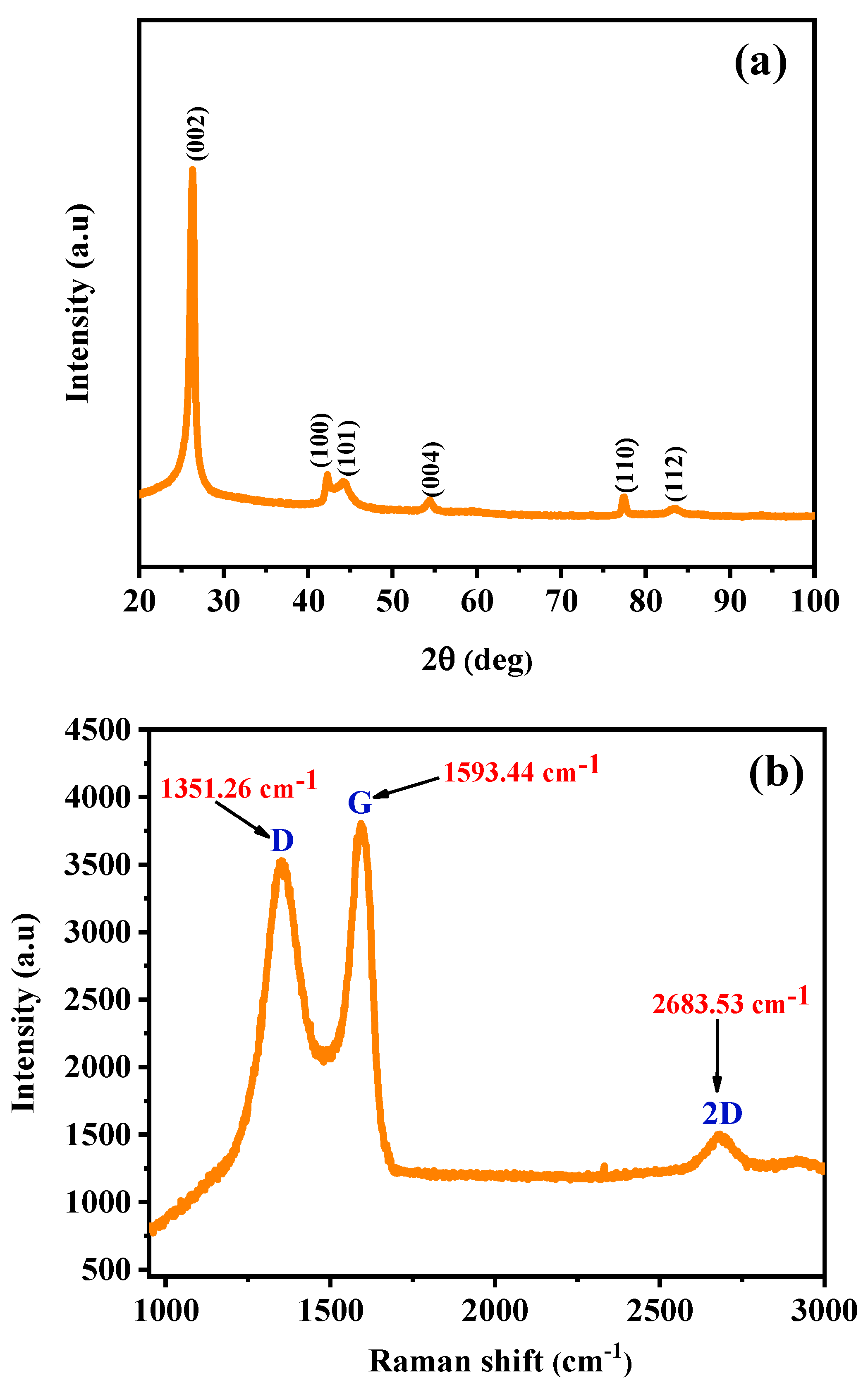
The diffraction peak observed at 2θ = 26.3° in Figure 1a corresponds to the (002) plane, reporting a single layer of carbon atoms arranged in a close-packed hexagonal lattice, according to JCPDS card No. 41-1487. This peak is pronounced and well-defined, suggesting that the graphene layers are well-stacked with minimal graphitic layers, resulting in high crystallinity. Furthermore, it is established that few-layer graphene displays electrical conductivity about 100 times higher than that of graphene oxide [33], with an inter-lattice distance of approximately d = 0.34 nm. The crystallite size of the exfoliated graphene was evaluated using the Scherrer equation for the (002) diffraction peak [34], after the correction of the instrumental enlargement, which was estimated at βi = 0.1° using the same experimental procedure with a LaB6 crystal. The experimental enlargement was corrected considering a Gaussian shape of the (002) diffraction peak using the relation: β T 2 = β 0 2 β i 2 where β0 is the enlargement of the (002) diffraction peak, βi the instrumental enlargement, and βT the corrected experimental enlargement. According to Figure 1a, the crystallite size of the exfoliated graphene was calculated at 11.9 nm.
Raman spectroscopy was conducted to ascertain the ordered and/or disordered crystalline structure of exfoliated graphene. Figure 1b shows three significant vibration bands at 1351.25 cm−1, 1592.62 cm−1, and 2683.16 cm−1, corresponding to the D, G, and 2D bands, respectively. In graphitic materials, the D band reflects a disordered structural vibration, which delineates the flaws within the structures [19]. The G band is the principal characteristic peak of graphene, indicating the vibration mode of the E2g phonon in the Brillouin zone center of hybridized sp2 carbon atoms, produced by the alignment of C-C bonds [35]. The development of the 2D band represents the conversion of graphite into electrochemically exfoliated graphene, whose shape varies with the thickness of the graphene sheet layers [36].
The number of graphene layers is frequently inversely proportional to the 2D/G ratio, a crucial metric to determine the number of layers and structural properties of graphene. A 2D/G ratio > 2 suggests a single-layer graphene [37], but a lower ratio denotes multi-layered graphene (>5 layers) [38]. 2D/G ratio, estimated from the Raman spectrum in Figure 1b is around 1.7, which is quite close to the single-layer graphene structure. The Tuinstra-Koenig relation [39] provides an estimation of the crystallite size in graphitic materials as the following Equation (1):
L a n m = 2.4 × 10 10   λ 4 I 2 D I G 1
where La is the average crystallite size of graphene, λ denotes the laser wavelength in nanometers and I2D, IG the intensity ratio of respectively 2D and G vibration bands. According to Equation (1), the crystallite size can be estimated approximately 20.7 nm. This crystallite size value is in good agreement with the single layer stricture of graphene. Furthermore, the two-dimensional structure of graphene, characterized by hexagonal carbon networks (sp2) and few crystallographic imperfections, permits the building of a highly resistant barrier, ensuring excellent substrate protection [40].
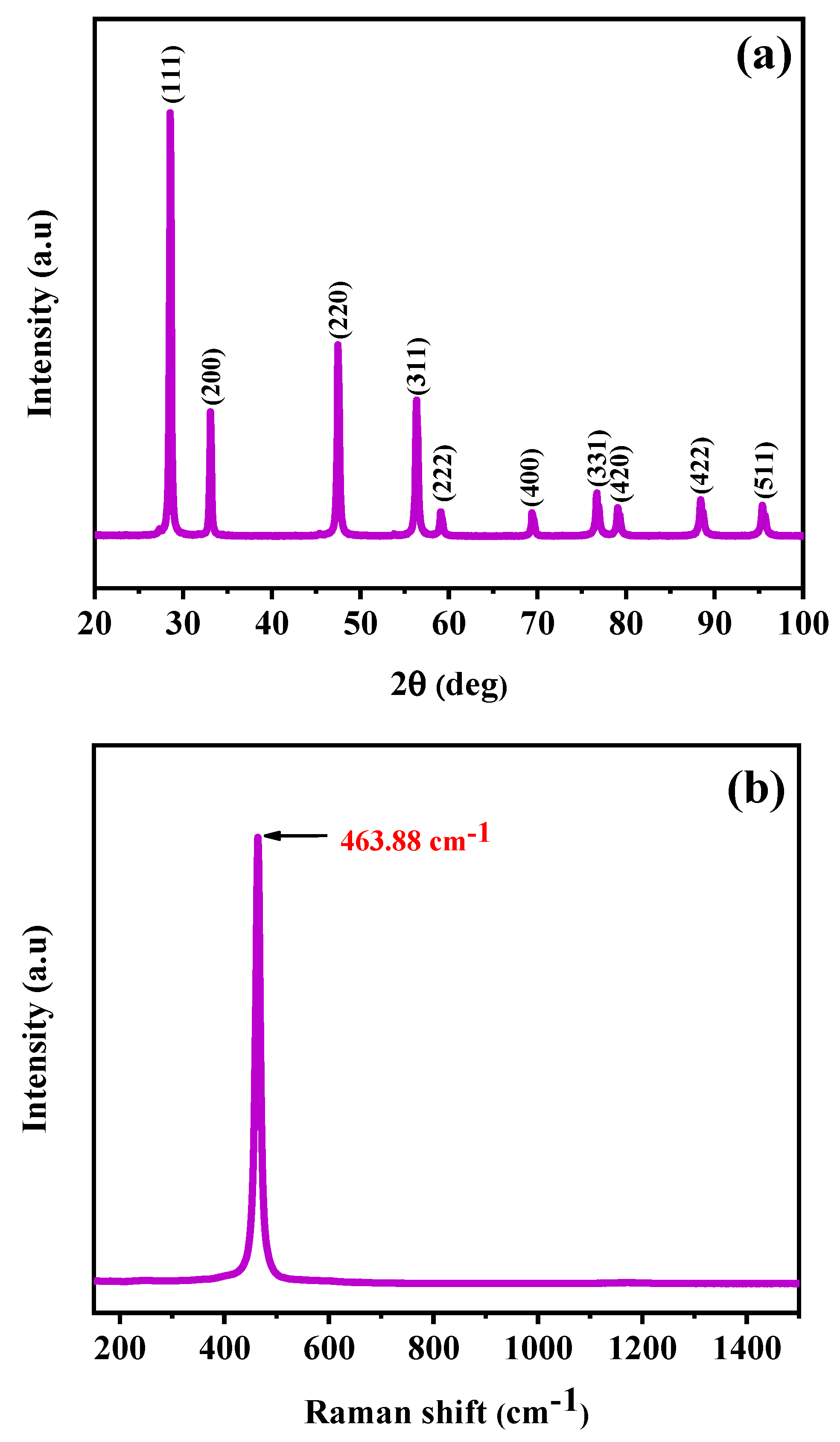
Figure 2a presents the XRD diagram of cerium oxide nanoparticles with a strong diffraction peak at 28.59° corresponding to the (111) diffraction peak (from JCPDS card No. 34-0394), associated with an inter-lattice distance of approximately d = 0.169 nm. The crystallite size of CeO2, calculated using the Scherrer equation for the (111) diffraction peak [34], was found to be 37.6 nm.
Raman analyses were conducted to identify CeO2 ceria by looking for a high-intensity absorption peak at around 463.88 cm−1, generating a unique and strong Raman signal, as presented in Figure 2b. This analysis confirms that the cubic fluorite structure exhibits the triply degenerate F2g Raman mode, resulting from symmetric stretching vibrations of oxygen atoms around Ce4+ ions in the CeO2 lattice, corresponding to highly symmetric Oh local site symmetry [41]. Saitzek et al. [42] proposed a semi-empirical relationship to estimate the crystallite size using the enlargement of the main Raman peak:
  c m 1 = 5.48 + 98.4 D g ( n m )
Using this equation, the crystallite size of ceria particles was estimated at 18.2 nm, which is lower than the crystallite size deduced from XRD diagrams.
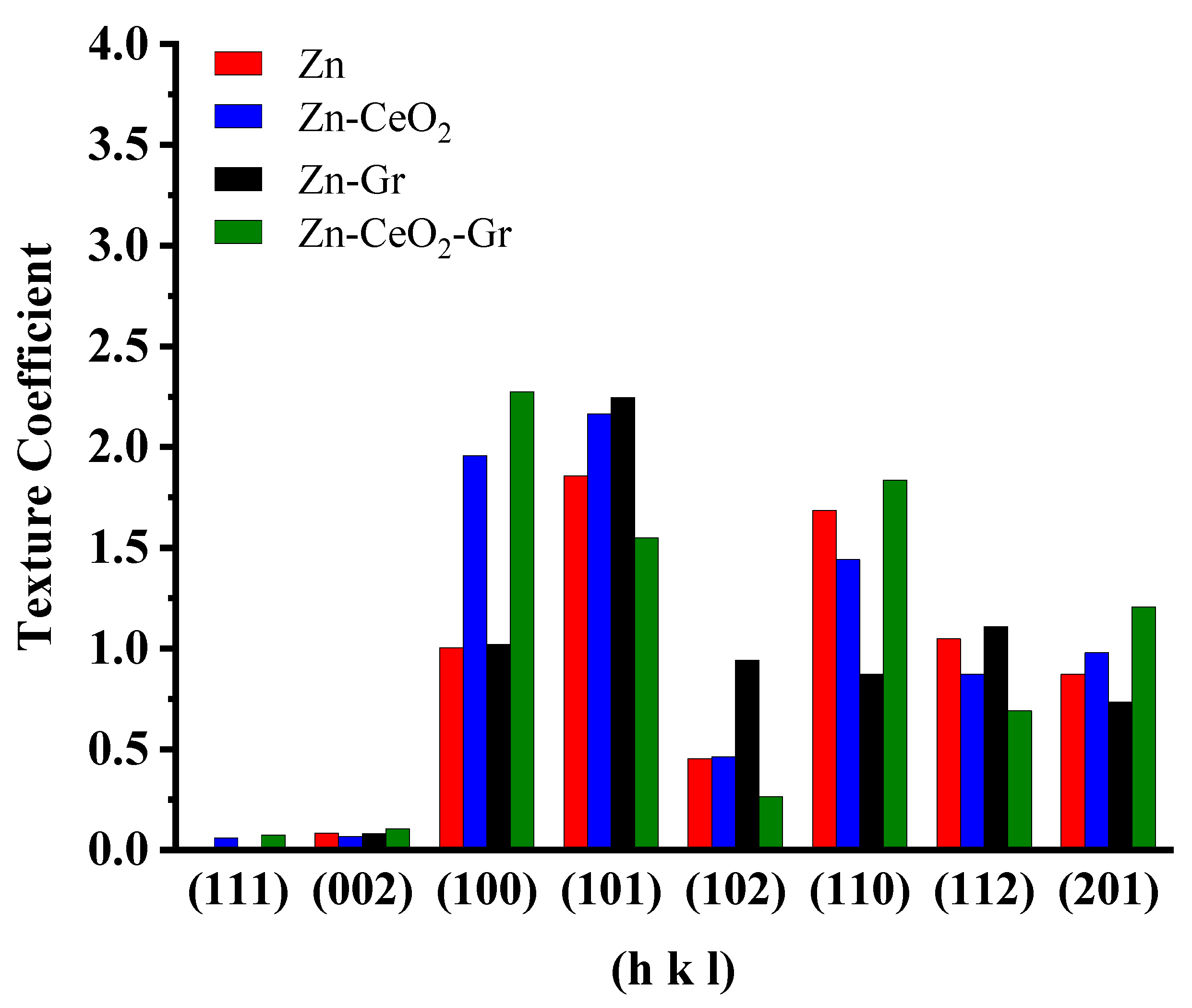
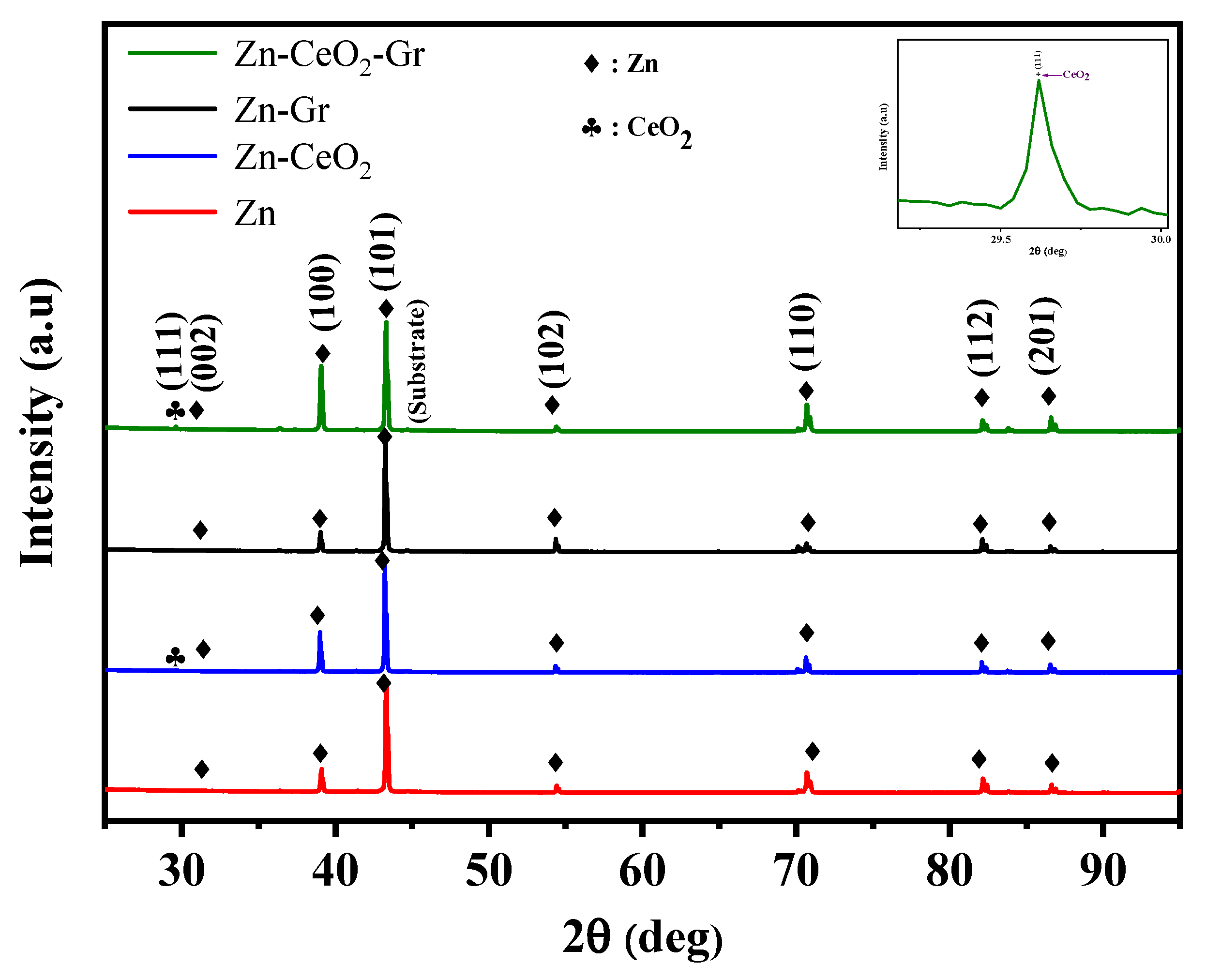
The phase structures of Zn, Zn-CeO2, Zn-Gr, and Zn-CeO2-Gr coatings were characterized by XRD, as shown in Figure 3. For pure zinc coatings, the predominant peaks in the XRD pattern at 30.76°, 39.10°, 43.33°, 54.44°, 70.76°, 82.23°, and 86.62° correspond to the crystal planes (002), (100), (101), (102), (110), (112), and (201), respectively, according to JCPDS chart No. 04-0831 for pure zinc [43]. According to Figure 4, the decrease in the intensity of the basal peak (002) and the increase in the prismatic peaks (100), (101), and (110) on the X-ray diffractogram confirm the marked influence of the additives on the crystallographic texture of the deposits. To evaluate this effect and quantify the variation in preferred crystallographic orientation, the texture coefficient (TC) was calculated using the following equation [44]:
T C = I ( h k l ) I 0 ( h k l ) N 1   n I ( h k l ) I 0 ( h k l )
where I and I0 are the measured relative intensity and standard intensity from the JCPDS file, respectively, for a plane (hkl), N is the reflection number in the diffractogram. For the Zn deposit without additive, the TC values for the different orientations are not significantly high. However, the presence of the surfactant in the bath seems to reduce the intensity of the low-energy planes like (002), (102), (112), and (201) while enhancing the growth of the high-energy (100), (101), and (110) planes, attributed to a preferential adsorption of these additives during deposition.
The addition of CeO2 nanoparticles into the bath leads to a deposit with a small crystalline preferential orientation along the (100) and (101) planes. Conversely, when graphene is introduced, it impedes the growth of the basal (002) plane. This inhibition promotes the development of new orientations, specifically prismatic (100) and (112) planes, along with pyramidal (101) planes [45]. The simultaneous incorporation of CeO2 and graphene further alters the crystalline structure of the deposit. The resultant material shows a predominance of (100) and (110) planes, indicating a distinctly defined prismatic orientation, primarily due to the increased amount of graphene/carbon in the coating, which appears to obstruct other growth directions of zinc, corroborating the results of Xiangkang et al. [46].
Crystallite sizes of zinc-based coatings were calculated using the Scherrer equation for the (101) plane peak, and the results are reported in Table 2. Zn-Gr composite coatings, which incorporate a second phase, present a lower grain size. This reduction is attributed to graphene’s larger surface area (heterogeneous nucleation) and its promotion of crystal growth along crystallographic planes [26] Thus, the reduction results in a compact structure, altering the energy of the cathode’s active surface due to graphene’s adsorption during zinc deposition. This phenomenon leads to a decrease in the grain size, thereby enhancing wear resistance through stronger chemical and interfacial bonds, ultimately creating a protective barrier against aggressive industrial, biological, or environmental agents. These structural changes are reflected in the coating characteristics (refer to Table 2), as previously demonstrated in the work of Ayush et al. [47]. The absence of the graphene peak in the XRD profile of Zn-Gr and Zn-CeO2-Gr composites may result from a small amount of graphene in the coating [37] or from effective exfoliation of the graphene layers in the composite, according to findings from another work on (Zn/Gr) coatings by Punith Kumar [26].
The effective incorporation of CeO2 nanoparticles into the Zinc matrix for coatings (Zn-CeO2) and (Zn-CeO2-Gr) is confirmed by the detection of a small diffraction peak at approximately 2θ = 29.67° in the deposit, corresponding to the crystallographic plane (111) [31] of CeO2 (JCPDS card No. 34-0394 for CeO2). It seems that the presence of DTAB surfactant altered the surface morphology of our deposit. The increase in the Zn (100) peak intensity with surface energy can be ascribed to a modification or disruption in the hexagonal crystal lattice due to the incorporation of DTAB. Conversely, the reduction in the Zn (101) peak intensity, relative to the intensities of these peaks in the pure Zn coating, suggests the alteration of the metal’s surface energy resulting from the adsorption of organic molecules, favoring the presence of CeO2, which refines the zinc grain sizes. This change is explained by the inert CeO2 phase in the coatings, which facilitates nucleation by obstructing the insertion of adatoms into the lattice or inhibiting their surface diffusion to the growth centers, which impairs and prevents crystal growth [48]. The XRD pattern of the (Zn-CeO2-Gr) coating, distinct from that of the binary alloy coatings, indicates that the incorporation of graphene sheets and CeO2 nanoparticles into the zinc deposit can markedly modify the preferential orientation patterns, crystal orientations, and growth behavior [49]. The X-ray pattern is closely similar to that of Zn-CeO2 alone, thereby affirming the successful incorporation of CeO2 in the coatings and possibly graphene, both of which prevent the development of Zn crystals. Therefore, the addition of graphene nanosheets with CeO2 decreases the surface energy of the coating [40].
The average crystallite size of zinc grains, calculated using the Scherrer equation [50] as shown in Table 2, reveals that Zn-CeO2-Gr coatings possess a relatively finer grain structure than pure zinc, corroborating the previous observations of Munir et al. [51]. The hardening of microcrystalline materials occurs via the Hall-Petch mechanism, where smaller crystallites generate more grain boundaries that impede dislocation migration and thus enhance microhardness. Consequently, as the crystallite size reduces, the material life improves due to the correlative increase in hardness. The graphene nanofibers absorbed on the cathode surface are electrically conductive, adversely affecting crystal growth and preserving nucleation sites, which reduces Zn ions while inducing network disorder during electrodeposition, thereby promoting the formation of new nucleation sites and refining the grain size.

3.1.2. Surface Morphological Examination

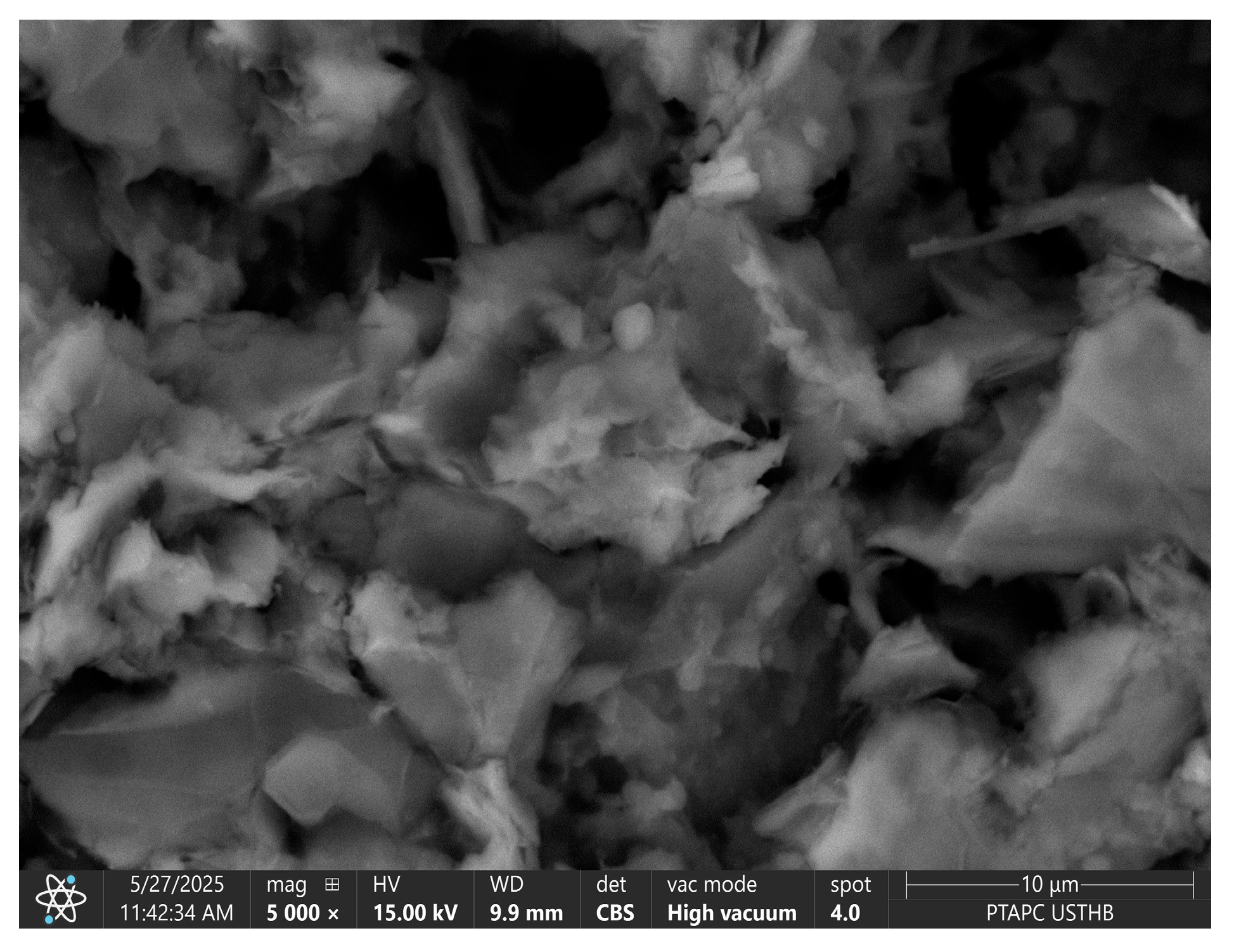
SEM/EDS analysis was conducted to analyze the surface morphology and to determine the relative elemental composition of the species involved in the manufacture of graphene nanosheets (Table 3). Figure 5 illustrates the stacking and stratification of graphite integuments [52], revealing a uniformity of aggregates, many of which appear as folded or crumpled flakes. These structures exhibit deformation due to crumpling or compression, arising from an imbalance in the oriented alignment caused by the oxidation process. Conversely, numerous agglomerates display flat and thin flake configurations. In certain cases, minor surface undulations were observed, while others possess strong edges that enable the distinction of the numerous graphene layers. This morphological feature is typical of graphene obtained during exfoliation [37], where aggregates and multilayer configurations are often encountered.
The electrochemical exfoliation approach depends on the instability of 2D layers, owing to ionic interactions between O2 and SO2 species and the graphite substrate [29]. The variation in energy density within the suspension can lead to complete exfoliation of graphite, resulting in the production of sheets. However, the difficulty in overcoming all interlayer pressures may lead to deformation, which can cause the exfoliated layers to occasionally re-agglomerate due to Van der Waals interactions [53]. An in-depth analysis of the sheets, using a high-voltage electron beam, exposes primarily flat, low-contrast surfaces. This suggests that the sheets are composed of many layers of graphene [54]. As shown in Figure 5, square-shaped graphene nanosheets are observed on the surface of nanoplatelets. The chaotic, multi-layered structure of graphene acts as a protective lamellar architecture, defending against corrosive attacks from moisture or salts. In addition, its wrinkled [31] irregular shape generates active sites for zinc, promoting its adsorption and deposition onto our steel. This enhances the quality of the protective coating and reinforces its mechanical and electrochemical properties.
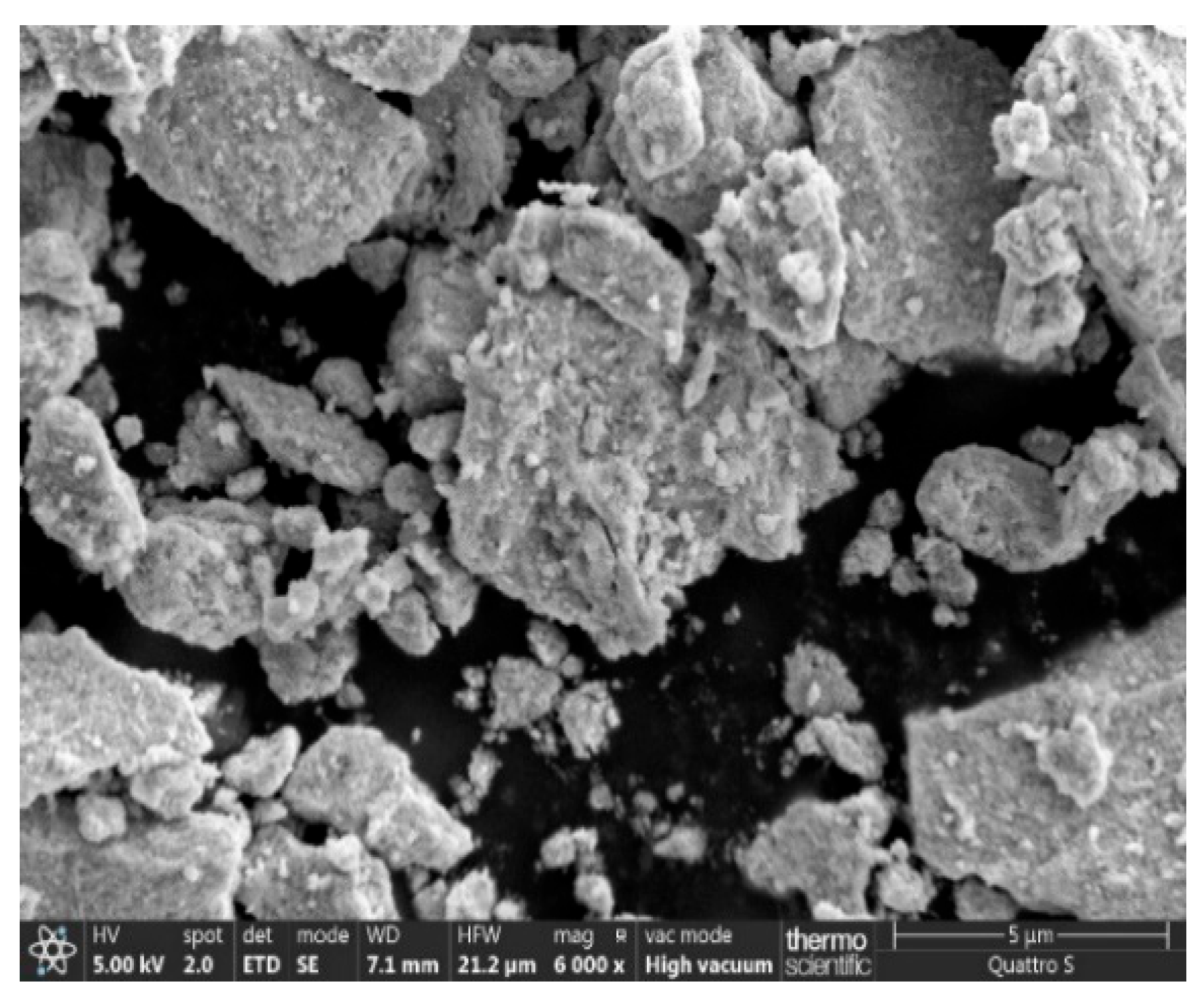
The morphology and microstructure of cerium oxide nanoparticles were assessed, revealing through scanning electron microscope (SEM) images (Figure 6) that the particle samples were predominantly aggregates and had irregular shapes resembling cotton fluff [55]. EDS analysis confirms the presence of cerium and oxygen associated with the CeO2 nanoparticles with no further impurities.
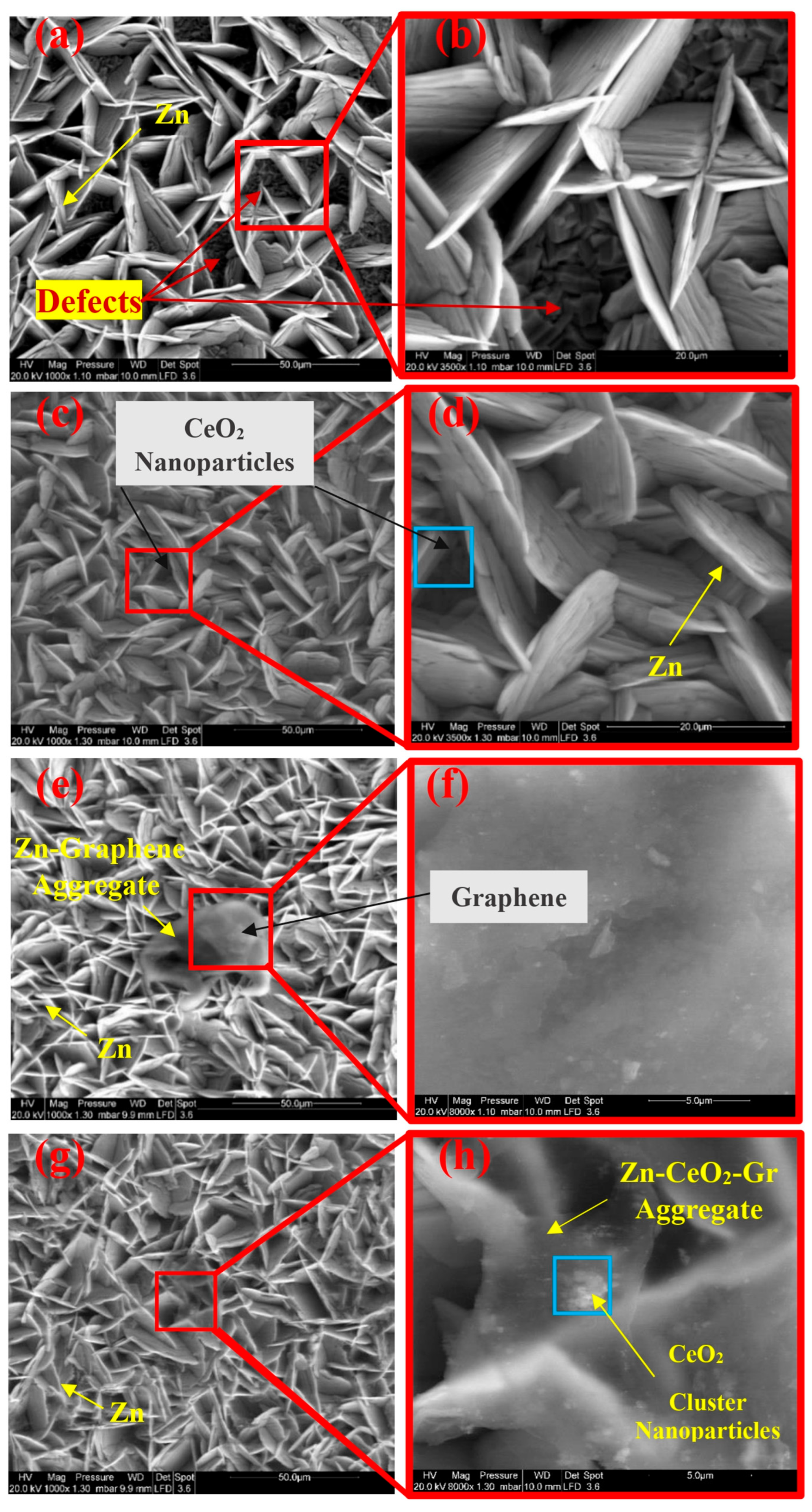
According to Figure 7a,b, zinc coatings present a lamellar crystal growth, with localized microscopic defects [56]. Electrodeposited zinc coatings are composed of the superposition of hexagonal platelets, which seem to grow quite normally to the substrate surface, as can be observed on higher SEM magnification. Additionally, a combination of coarse and fine particles was identified. Incorporation of ceria or graphene nanoparticles does not change the morphological aspect of the zinc coating. Figure 7c,d, present the SEM observations of the Zn- CeO2 composite coating in the presence of the DTAB surfactant. They emphasize the existence of agglomerated CeO2 nanoparticles that are weakly incorporated into the zinc matrix, with an estimated content of 0.68% by mass [57]. This method allowed a substantial refinement of the grain size in the composite coatings. The deposit’s morphology was considerably enhanced, mostly due to the application of a current density of 5 A/dm−2. The refinement is additionally favored by cerium oxide (CeO2) nanoparticles, which actively contribute to the reduction in the grain size compared to the pure zinc deposit [58]. The ceria nanoparticles are distinctly observed adsorbed on the surface of zinc. The addition of the surfactant DTAB seems to effectively reduce the agglomeration of these nanoparticles, although some agglomerates still remain, with sizes ranging from a few tens to several hundreds of nanometers. As illustrated in Figure 7c,d, the detected CeO2 nanoparticles (marked by blue squares) are preferentially adsorbed on the edges of the hexagonal zinc platelets. This observation corroborates the findings presented by Kondo in Zn–SiO2 and Exbrayat et al. in Zn-CeO2 composite system [59,60,61].
Figure 7e–h, indicate that the incorporation of graphene into the composite Zn-Gr and Zn-CeO2-Gr coatings led to a more compact, smooth, and defect-free structure [48,62]. Graphene’s existence was confirmed using EDS (Energy Dispersive Spectroscopy) analysis, which revealed a distinctive carbon content in both composite coatings. However, despite the use of a graphene-enriched electrolytic bath for the synthesis of the Zn-CeO2-Gr deposit, the resultant carbon content in this coating was determined to be low. This decline can be attributed to other sources. The sedimentation of graphene sheets in the electrolytic bath probably restricted their diffusion into the zinc matrix. The zeta potential of graphene, measured at +13 mV, implies a positive surface charge. This value approximates that reported by Kumar et al. (+11.8 mV) [26], suggesting that graphene particles may migrate towards the negatively charged cathode, partially promoting their incorporation into the metal deposit. The hypotheses are corroborated by (SEM/EDS) measurements, which confirm the presence of graphene sheets partially embedded into the composite coating structure (Figure 7g,h).
Furthermore, the morphology of pure Zn and Zn- CeO2 deposits was heterogeneous, whereas the incorporation of graphene led to a more uniform, compact, and significant grain size reduction. According to the crystallite size values from the XRD analysis (Table 2), which confirm a progressive decrease in grain size [51], while substantially enhancing the compactness of the deposits compared to pure zinc and Zn-CeO2 coatings. In addition, the use of additives, such as graphene and CeO2 nanoparticles, significantly reduced the remaining porosity and the density of disordered crystals. As noted by Vlasa et al. [48], these nanomaterials alter the structure of the metal deposit, refining it by increasing the nucleation sites and inhibiting crystal development. Consequently, these coatings possess major potential for advanced corrosion protection applications.

3.2. Mechanical Characterization of Zinc-Based Coatings Samples

3.2.1. Vickers Microhardness

This section presents the Vickers HV0.1 microhardness, roughness measurements, and mechanical resilience of the implemented composite coatings (Table 4). The Vickers HV0.1 microhardness values were estimated as the average of multiple measurements per sample. The results showed that the improvement in coating microhardness is significantly associated with the incorporation of the two nanoparticles into the bath.
The Vickers microhardness (HV0.1) of the coatings increased with the addition of nanoparticles. The pure Zn coating exhibited a baseline hardness of 41 ± 1 HV, as reported in the literature by Praveen Kumar et al. [63].
The Zn-CeO2 coating showed a modest increase of 7.3%, probably due to the agglomeration phenomenon observed previously that limits the homogenous distribution of the nanoparticles inside the metal matrix. The Zn-Gr coating resulted in a more significant hardness increase of 21.9%, which is correlated to the nanoparticle size and zeta potential that favor their incorporation inside the zinc metal matrix. And finally, Zn-CeO2-Gr coating achieved the highest microhardness of 68 ± 1 HV, a substantial 65.8% increase compared to pure Zn.
This significant improvement in microhardness is attributed to several synergistic microstructural mechanisms. The primary mechanism is dispersion strengthening, where the embedded CeO2 and graphene nanoparticles act as obstacles [31] that hinder the movement of dislocations within the zinc matrix, thereby increasing the material’s resistance to plastic deformation [64]. Furthermore, the incorporation of nanoparticles promotes grain refinement during the electrodeposition process, which is consistent with the Hall-Petch effect [65], and dispersion hardening, as per the Orowan process. They act as new nucleation sites on the substrate surface, leading to a denser structure with a higher grain boundary area. The high intrinsic shear strength of graphene also enhances the matrix’s ability to restrict dislocations and prevent plastic flow. Indeed, Chunyu Wang et al. claimed a combined effect of grain refinement by CeO2 nanoparticles that increases both the porosity and the strong interfacial bonding between graphene and the Zn matrix [19], hence increasing the microhardness of the Zn-CeO2-Gr composite coating.

3.2.2. Surface Roughness

According to Table 4, a strong inverse relationship was observed between microhardness and surface roughness. All additives significantly reduced the surface roughness (Ra) compared to the pure Zn coating (2.16 µm), because they block micro-asperities present on the surface, leading to a measurable decrease in average roughness (Ra). The Zn-CeO2 coating presents a reduction in roughness by 27.77% to 1.56 µm. This limits the appearance of cracks and pores while filling internal gaps, which facilitates the uniform growth of zinc grains, resulting in a smoother and less rough surface [66]. The Zn-Gr coating has a roughness reduced by 32.87%, reaching a value of 1.45 µm. Graphene (Gr) is characterized by its exceptionally smooth surface [67]. Consequently, incorporation of Gr promotes the development of a denser and homogeneous morphology. The roughness reduction, even more significant than the one obtained for Zn-CeO2 deposits, is attributed to graphene’s exceptional ability to generate a uniform and nearly flat coating. Moreover, the hybrid Zn-CeO2-Gr coating exhibited the smoothest surface, displaying a roughness value of 0.40 µm, a remarkable 81.48% decrease. The reduction in roughness is due to the nanoparticles filling micro-cracks and pores on the surface. This improved packing and lower porosity lead to a smoother surface, which positively impacts the coating’s mechanical properties by reducing stress concentration points.

3.2.3. Mechanical Resilience

The mechanical resilience (impact toughness) of the coating, representing the specific elastic energy absorbed before rupture, also improved with the addition of nanoparticles. The pure Zn coating had a resilience of 11.3 ± 1.20 J/cm2, as shown in Table 4, a strong inverse relationship was observed between microhardness and surface roughness. All additives are probably attributed to the fine-grained microstructure and the ductile nature of zinc [68]. Furthermore, the Zn-CeO2 coating showed a modest increase of 2.8%, owing to several mechanisms that contribute to the enhancement of coating resistance, which impedes the plastic deformation [69]. In addition, the Zn-Gr coating displayed a slight rise of 3.6%, which confirms the structural and mechanical reinforcement resulting from the impediment of dislocation mobility, the anchoring and crack-bridging mechanisms provided by graphene [70]. This is accomplished by improved interfacial interactions, which restrict porosity while augmenting the density and compactness of the layer. These processes increase tolerance to mechanical shocks, augmenting the resilience, strength, and durability of the coating while reducing brittleness [71]. Moreover, the hybrid Zn-CeO2-Gr coating demonstrated a substantial 31.49% increase in resilience to 14.81± 2.1 J/cm2. This enhancement is attributed to the fine-grained microstructure [68] and the stiffening effects of graphene, with its high mechanical strength and modulus, which acts as an effective nano-reinforcement, obstructing dislocation mobility and bridging potential micro-cracks [72], which impedes the plastic deformation. Graphene is characterized by an exceptionally high modulus of elasticity (≈1 TPa) and excellent thermal conductivity. Its electrical conductivity (approximately 5300 W/m·K for thermal and 6000 S/cm for electrical) [73,74] also makes it a powerful and highly promising candidate in this field, serving as a rigid nano-reinforcement that significantly enhances mechanical resilience without compromising ductility. This resilience previously observed for the Zn/graphene coating aligns with recent works, those of Chen Shen et al., who emphasized joint improvements in electrical, thermal, and mechanical properties (hardness and toughness) and wear resistance, and Owhal et al., who also showed that the homogeneous dispersion of the graphene nano-reinforcement within the zinc metal matrix could be achieved. Furthermore, the graphene-reinforced Zn-MMC sample showed significantly superior mechanical and tribological performances compared to pure zinc [47]. This combination is confirmed by the simultaneous achievement of the highest hardness (increase of 65.8%), lowest roughness (decrease of 81.5%), and highest mechanical resilience (increase of 31.5%) of the coating. SEM/EDS results corroborate this conclusion, indicating that the hybrid coating is characterized by finer grains and a more homogeneous surface than the single-additive coatings.

3.3. Electrochemical Characterization of Zinc-Based Coatings Samples

3.3.1. Electrodeposition of Zn-Based Coatings onto S235

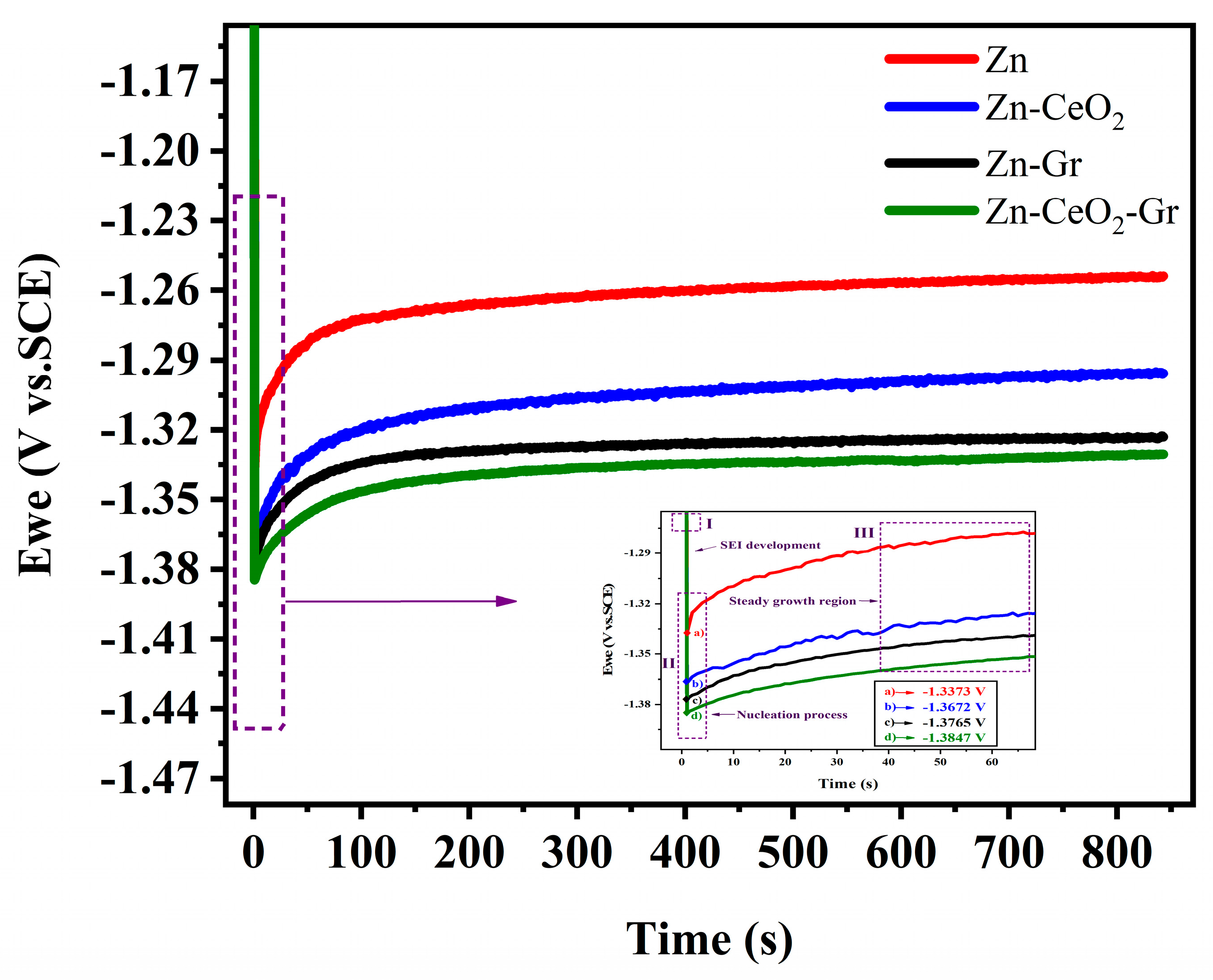
The chronopotentiometric curves of the electrodeposited coatings, presented in Figure 8, reveal three different stages. The shape of the potential transient is quite similar for all the deposition configurations, but a shift towards more negative potentials is observed when particles are added into the electrolytic bath [57,75,76].
Initially, within the range (I–II), a charge accumulation phenomenon is observed at the electric double layer EDL, causing a notable shift with a fast decline in potential towards cathodic (more negative) values [77], along with a rise in the electrode overpotential.
This phase is followed by a progressive increase in potential (zone II–III), which then reaches a stability, revealing the uniformity of the coating, marking the attainment of a quasi-steady state [78], followed by an extended crystallization phase during the rest of the process. Electrodeposition begins when the overpotential reaches a sufficient level for the discharge of Zn2+ ions, leading to the immediate formation of the first zinc nuclei on the steel substrate. The nucleation and subsequent growth of these nuclei occur due to an increase in the electrode’s electroactive surface area [79,80], reflecting the decrease in impedance and overpotential, eventually facilitating an expansion of the electrodeposition zone. The chronopotentiometric curve then shows an ascending progression of the potential with a constant current, as seen by the interval (II–III). As the nuclei grow, the diffusion regions around each become insufficient for discharge, which slows down the velocity of the electrodeposition process [81].
In summary, a quasi-steady state is established when the potential stabilizes, implying zinc deposition at a constant rate. Reduced potential values with an overpotential below the nucleation potential suggest that Zn2+ ions are preferentially depositing on existing nuclei rather than forming new nuclei. Likewise, the Zn-CeO2-Gr coating gives the highest nucleation overpotential. This deduction is explained by important mass transfer peaks [31], which in turn promote competition among nucleation sites, which offsets the surface (Gibbs) free energy [82].

3.3.2. Potentiodynamic Polarization Analysis in Saline Solution

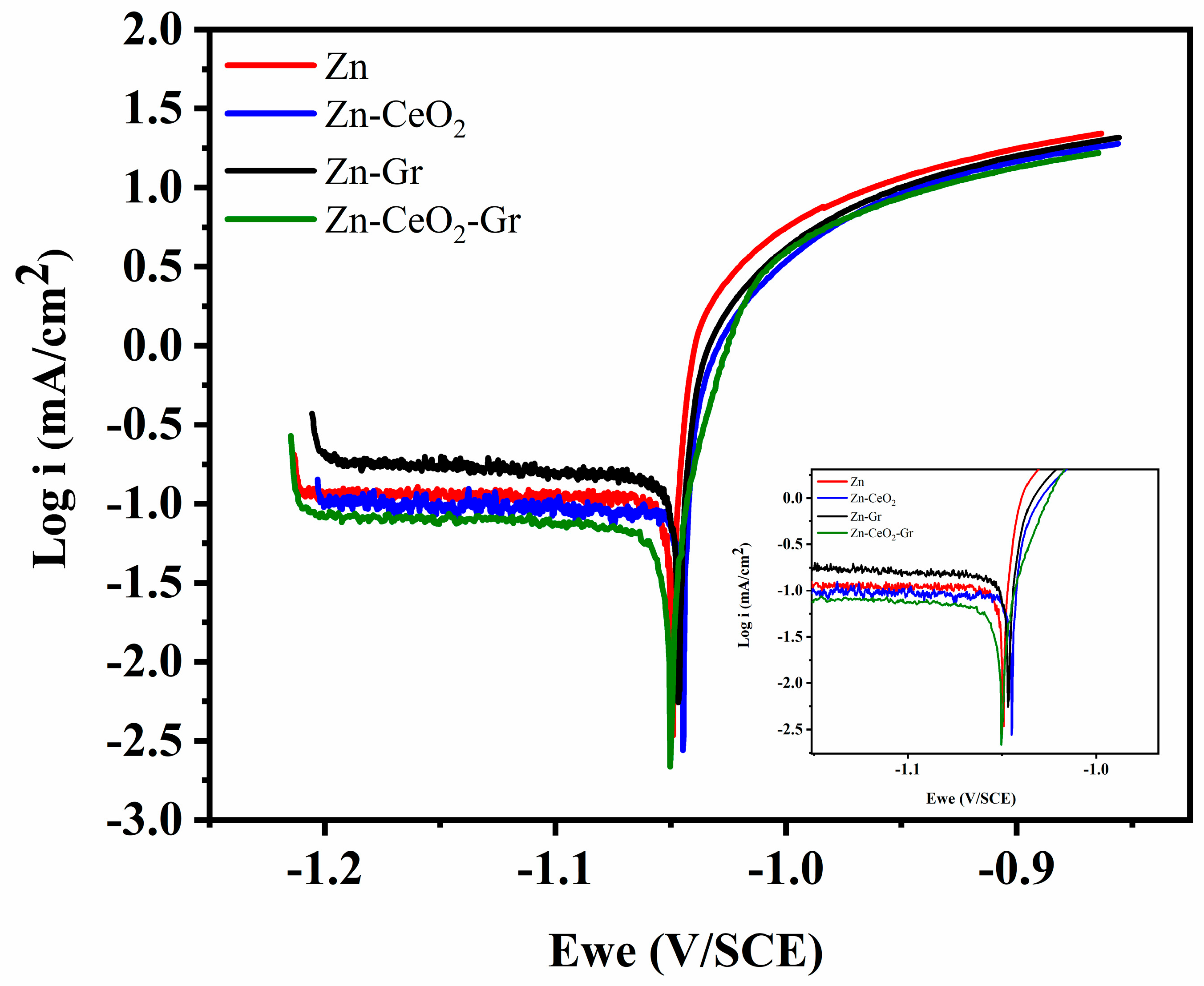
Potentiodynamic curves after 1 h 30 min of immersion in a stirred NaCl solution (3.5 wt%) at ambient temperature were recorded in a potential range from 150 mV below OCP (cathodic side) to 250 mV above OCP (anodic side), with a scanning rate of 0.2 mV/s, for the developed composite zinc coatings, as shown in Figure 9. It can be easily observed that the corrosion process in saline and aerated media is evidently governed by cathodic control (oxygen diffusion) [83], and the cathodic segments of the polarization curves display notable similarity for all deposits. The corrosion parameters deduced from the Tafel segment extrapolation method are shown in Table 5. The polarization resistance RP in NaCl solution is determined using the following Stern-Geary Equation (4) (βc >> βa) [2]:
R P = β a   β c 2.3   ( β a +   β c ) · 1 i c o r r =   β a 2.3   i c o r r
The Tafel slopes of the pure zinc electrodeposition coating closely align with the values reported in previous works [2,8]. It is important to note that pure zinc deposition exhibits the highest corrosion current density (114 µA/cm2) compared to all deposited samples. This variation is probably attributed to a microgalvanic corrosion phenomenon due to the micropores present and other structural defects existing on the surface [56,61], which contribute to an increase in the corrosion current density and a decrease in corrosion resistance. This observation aligns with the SEM micrograph of the particle-free Zn coating in Figure 7a, highlighting the surface defects of pure Zn deposition.
Additionally, the oxidizing character of ceria and its self-healing property can promote the formation of a stable protective layer on the zinc surface, effectively addressing the coating’s defects and restricting the access of corrosive agents. In addition, CeO2 nanoparticles can support the adsorption of zinc-charged species generated during anodic polarization, stabilizing the film of zinc-protective corrosion products. The ceria concentration of 15 g/L, selected based on the research of Exbrayat [2] for our zinc coatings electrodeposited on steel, led to maintaining a steady and homogeneous surface dispersion, hence accounting for the reduction in the observed cathodic current densities. Moreover, high CeO2 concentrations are detrimental, as these nanoparticles enhance oxygen adsorption [17] and thus promote the cathodic reaction. S. Ranganatha et al. found that the beneficial effect of CeO2 incorporation on corrosion evolution is more pronounced when the composites are deposited with the surfactant [58]. Microstructural refinement enhances the density of grain boundaries, mostly due to the addition of light elements (C, O, H) that impede their granular expansion. A slight elevation in the Tafel anodic slope is noticed, indicating that CeO2 nanoparticles participate in the dissolving mechanism of zinc in NaCl solution. The cationic surfactant DTAB produces an acicular structure [2,84] characterized by zinc plates oriented perpendicularly to the substrate, which refines the morphology of Zn-Gr and Zn-CeO2-Gr alloys through effective integration of graphene nanosheets. This combination favors a uniformity of current distribution, mitigates the penetration of corrosive agents, thereby enhancing the material’s durability and anticorrosion performance, and causes a shift in the corrosion potential towards more negative values [9] When zinc or its composite coating is immersed for 1 h 30 in a saline solution of NaCl 3.5 wt%, the chloride ions present in solution have an affinity for the defective areas of the composite coatings, therefore enabling the initiation of corrosive processes [85]. However, coatings incorporating Zn-Gr and Zn-CeO2-Gr graphene nanosheets exhibit sealed fissures, interstices, and imperfections, hence restricting electrolyte infiltration. In addition, its homogeneous dispersion, along with its function as a stable and inert physical barrier, consolidates the protection against corrosion. Concerning the anodic Tafel slopes, the values evolve between 10 and 19 mV/dec, revealing strong alignment with the published data.
This ternary composite coating Zn-CeO2-Gr exhibits the lowest icorr value of 45 μA/cm2 and the highest RP value of 184 Ω·cm2, indicating an approximate ~4.8× increase in RP relative to pure Zn, alongside a corrosion current density decrease of about 61% compared to pure Zn (114 µA/cm2). This behavior arises from the synergistic effects of CeO2 nanoparticles, which, on one hand, create a self-healing passive barrier to mass and charge transfer [86], and, on the other hand, enhance the lamellar structure of graphene. The combination will confer impermeability, defect-free compactness [26], and reinforcement of the zinc coating, ultimately improving durability and increasing electrochemical resistance.

3.3.3. Electrochemical Impedance (EIS) Test

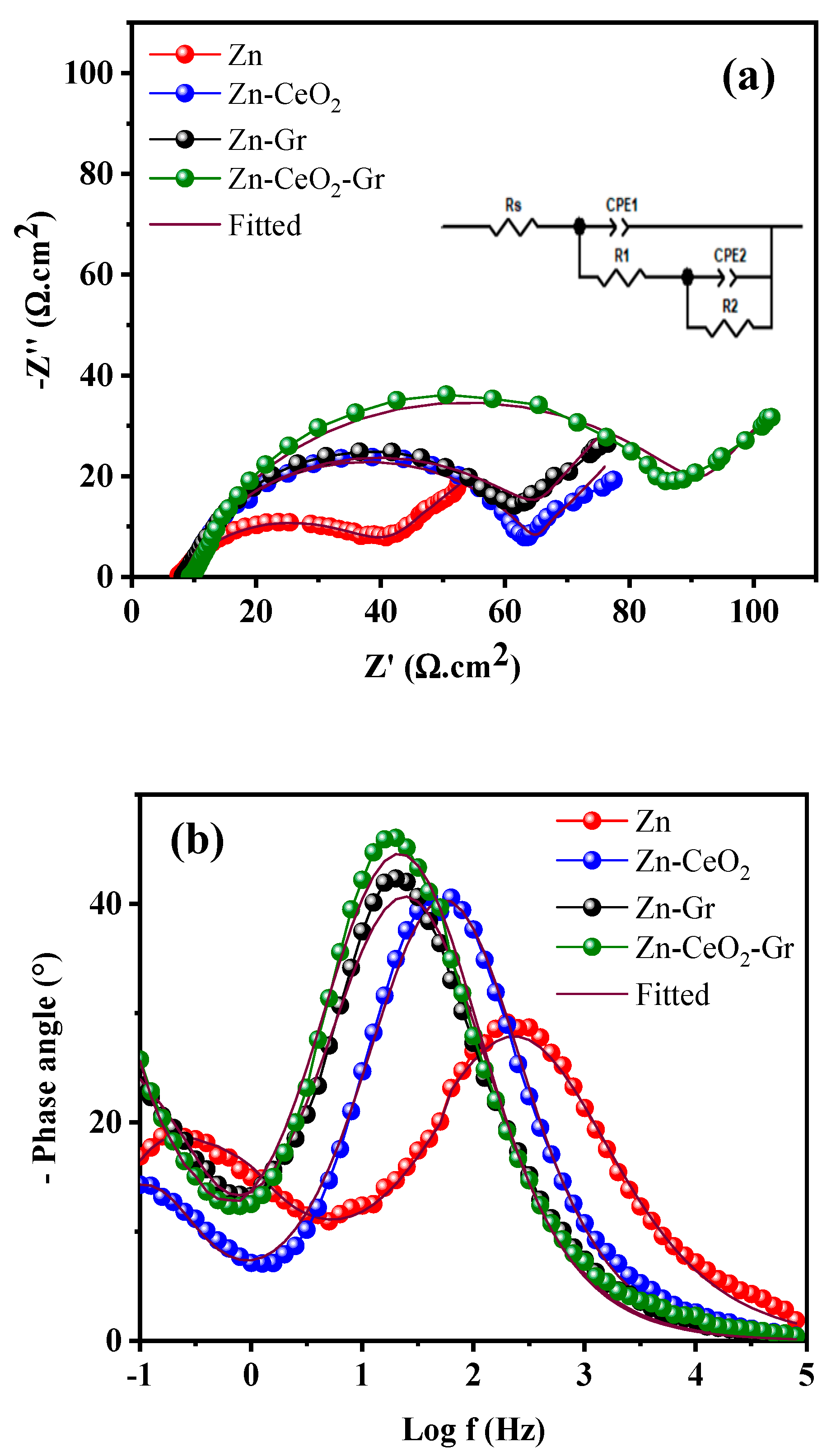
To evaluate the anticorrosion performance and determine the dielectric properties of the composite coatings, the EIS data were analyzed and interpreted using ZSimpWin 3.60 software, employing the equivalent electrical circuit “EEC” designed for porous electrodes showing a strong correlation between the experimental data and the impedance model, as illustrated in Figure 10a. This model uses the electrolyte resistance Rs and 2 parallel circuits (R1CPE1) and (R2CPE2), which represent the resistances of the coating’s passive layer and the charge transfer, respectively. The CPEs were evaluated based on the surface charge distribution, with CPE1 and CPE2 representing the capacitance of the deposited passive layer and the non-ideal double layer, respectively. Also, the capacitive loop width, an indicator of corrosion or polarization resistance, appears significantly larger for the developed coatings. This means that the latter exhibits better anticorrosion behavior than the pure Zn coating. The CPE reflects a non-ideal response due to surface heterogeneity, roughness, and porosity, which disrupt the charge distribution. The CPE reflects a non-ideal response due to surface heterogeneity, roughness, and porosity, which disrupt the charge distribution [87].
Additionally, for our nanocomposite coatings developed with DTAB, RP increases while CPE values decrease, attributable to the lower porosity of the insoluble corrosion products formed and a reduced active surface in contact with the electrolyte, a consequence of the increased compactness of the structure. Furthermore, the integration of graphene revealed an expansion of the capacitive loop, indicating enhanced mechanical [88] and electrochemical reinforcement of the coating. The elevation of the phase angle in the Bode diagram (Figure 10b) also highlights its significance in the alteration of the metal/electrolyte interface and in the effective safeguarding of the substrate [61]. The obtained results show that the ternary Zn-CeO2-Gr composite coating presents the widest loop in the Nyquist plot, reflecting a marked variation attributable to the influence of the incorporated nanomaterials. The electrochemical parameters derived from the EIS adjustment are summarized in Table 6, which shows that the synergy of these graphene and CeO2 nanocompounds induces granular refinement, coupled with a significant enhancement of mechanical resilience and microhardness, highlighted by the characterization, which leads to an increase in polarization resistance (Rp) [56] and impedance, alongside a notable reduction in CPE values. Table 7 provides a quantitative comparison of the electrochemical and mechanical performance of the Zn-CeO2-Gr, Zn-Gr and Zn-CeO2 coatings developed in this study, as well as several zinc-based coatings reported in the literature. The protection efficiencies (P.E.%) of the protective coating were evaluated and calculated using the icorr and RP values, following the approach reported by Yang et al. [89].
The results show that the ternary coating attains a corrosion protection efficiency of 87% and a microhardness enhancement of approximately 40% compared to pure zinc, thus outperforming the most comparable systems, including those reported by Exbrayat et al. [2]. The Zn-Gr coating exhibits intermediate values, indicating that the addition of graphene alone does not achieve the performance levels shown in the ternary deposit. The superior electrochemical impedance and improved mechanical properties of the Zn-CeO2-Gr coating result from the synergistic effect between CeO2 nanoparticles and graphene, which promotes a more compact microstructure, reduced porosity [87], and better matrix cohesion, as confirmed by previous characterization analyses, thus marking the strong potential of this system for advanced corrosion protection applications [61].

4. Conclusions

A high-performance anti-corrosion nano-reinforced Zn coating structure was manufactured by electrodeposition via the synergistic interaction between the graphene and CeO2, using an electroplating bath on S235 steel. This sacrificial hybrid reinforcement highlights a real challenge for marine corrosion protection, requiring the implementation of various global characterization analyses by SEM/EDS and XRD, which revealed that the incorporation of graphene and CeO2 into zinc coatings resulted in a significant modification of the morphology of the coating. In addition, Raman spectroscopy provided significant information on the monolayer 2D crystalline structure of exfoliated graphene, clearly proving the conversion of graphite to graphene, characterized by minimal crystalline defects. This structure promotes the formation of a highly resistant barrier, ensuring excellent protection of the substrate. These results affirm the successful synthesis of graphene and demonstrate its preserved structure, along with its manufacture in a state of high purity and quality. The Zn-based ternary coatings obtained by electrodeposition display successful and efficient incorporation of CeO2 and graphene within the metal matrix.
Vickers microhardness and impact resistance tests revealed a significantly higher hardness and a notable enhancement for the Zn-CeO2-Gr coating, highlighting their strength and durability under mechanical stress. Similarly, the surface topographic quality results displayed an important reduction in the roughness of the deposit. This trend confirms the pronounced inverse correlation between surface roughness and microhardness, which is enhanced structural integrity caused by the integration of nano-reinforcing agents. Their superior corrosion resistance was validated using DC polarization and EIS measurements conducted on the coating in a 3.5 wt% NaCl solution. The corrosion resistance was significantly further enhanced due to the synergistic effect of nano-reinforcing agents CeO2 and graphene in composite coatings, with a minimum corrosion current (icorr) of 45 μA·cm−2 and a maximum polarization resistance (RP) of 215 Ω·cm−2. This effect promotes granular refinement, improved self-healing phenomena, and anti-corrosion behavior in both mass and charge transfer, thus extending the material’s durability.
The technological progress raises new prospects for applications, especially in mechanical and corrosion resistance durability against cracking and stress applied in subsea pipelines across different sectors, including safeguarding zinc-coated hulls against seawater corrosion, desalination systems and water treatment, the paint and automotive industries, as well as the hydrocarbons sectors, and other fields.

Author Contributions

Conceptualization, A.F.G., Y.H., K.D., J.C., T.A.Z. and E.C.; methodology, A.F.G., Y.H., J.C., K.D., T.A.Z., E.C., A.P. (Antonio Pizzi) and N.N.; investigation, A.F.G., Y.H., K.D. and J.C.; data curation, A.F.G., K.D., Y.H., T.A.Z. and J.C.; writing—original draft preparation, A.F.G., Y.H., K.D., J.C., T.A.Z., Z.L., G.T., E.C. and A.B.; writing—review and editing, Y.H., K.D., J.C., A.P. (Antonio Pizzi), G.T. and A.P. (Antonio Panico); supervision, Y.H., K.D., A.F.G. and J.C.; project administration, Y.H. and K.D. All authors have read and agreed to the published version of the manuscript.

Funding

This research received no external funding.

Institutional Review Board Statement

Not applicable.

Informed Consent Statement

Not applicable.

Data Availability Statement

Data will be made available on request.

Acknowledgments

The authors acknowledge with deep appreciation the support and collaboration provided by the Laboratoire des Sciences de l’Ingénieur pour l’Environnement (LaSIE) at La Rochelle University (France), and the Laboratory of Physics of Matter and Radiation (LPMR) at University of Souk Ahras, for their active participation, technical assistance, and encouragement in carrying out this collaborative research.

Conflicts of Interest

The authors declare no conflicts of interest.

References

  1. Wang, D.; Gao, Z.; Wu, Y.; Du, B.; Fan, Z. Selection of Zinc Coatings Based on Corrosion Behavior and Environmental Impact Assessment. Coatings 2025, 15, 199. [Google Scholar] [CrossRef]
  2. Exbrayat, L.; Rébéré, C.; Milet, R.; Calvié, E.; Steyer, P.; Creus, J. Corrosion Behavior in Saline Solution of Electrodeposited Nanocomposite Zn-CeO2 Coatings Deposited onto Low Alloyed Steel. Coatings 2023, 13, 1688. [Google Scholar] [CrossRef]
  3. Su, S.; Fontmorin, J.; The, H.; Milner, E.; Mohamed, P.; Scott, K.; Head, I.; Hao, E. Zinc Removal and Recovery from Industrial Wastewater with a Microbial Fuel Cell: Experimental Investigation and Theoretical Prediction. Sci. Total Environ. 2021, 776, 145934. [Google Scholar] [CrossRef]
  4. Laggoun, Z.; Khalfaoui, A.; Benalia, A.; Ghomrani, A.F.; Bouchareb, R.; Mahfouf, A.; Pizzi, A.; Panico, A.; Derbal, K. Applied Sciences Application of Response Surface Design for Optimization of Direct Red Dye Biosorption onto Cockleshells. Appl. Sci. 2023, 13, 12333. [Google Scholar] [CrossRef]
  5. Mosavat, S.H.; Shariat, M.H.; Bahrololoom, M.E. Study of Corrosion Performance of Electrodeposited Nanocrystalline Zn-Ni Alloy Coatings. Corros. Sci. 2012, 59, 81–87. [Google Scholar] [CrossRef]
  6. Sylla, D.; Rebere, C.; Gadouleau, M.; Savall, C.; Creus, J.; Refait, P.H. Electrodeposition of Zn-Mn Alloys in Acidic and Alkaline Baths. Influence of Additives on the Morphological and Structural Properties. J. Appl. Electrochem. 2005, 35, 1133–1139. [Google Scholar] [CrossRef]
  7. Amirat, S.; Rehamnia, R.; Bordes, M.; Creus, J. Zn-Fe Alloy Electrodeposition from Chloride Bath: Influence of Deposition Parameters on Coatings Morphology and Structure. Mater. Corros. 2013, 64, 328–334. [Google Scholar] [CrossRef]
  8. Arrighi, C.; Savall, C.; Cohendoz, S.; Grosseau-Poussard, J.L.; Baissac, L.; Olivier, M.G.; Creus, J. Optimization of the Morphology, Structure and Properties of High Iron Content Zn–Fe Coatings by Pulse Electrodeposition. Mater. Chem. Phys. 2021, 263, 124366. [Google Scholar] [CrossRef]
  9. Exbrayat, L.; Rébéré, C.; Eyame, R.N.; Steyer, P.; Creus, J. Corrosion Behaviour in Saline Solution of Pulsed-Electrodeposited Zinc-Nickel-Ceria Nanocomposite Coatings. Mater. Corros. 2017, 68, 1129–1142. [Google Scholar] [CrossRef]
  10. Deepa, M.J.; Arunima, S.R.; Riswana, G.; Riyas, A.H.; Sha, M.A.; Suneesh, C.V.; Shibli, S.M.A. Applied Surface Science Exploration of Mo Incorporated TiO2 Composite for Sustained Biocorrosion Control on Zinc Coating. Appl. Surf. Sci. 2019, 494, 361–376. [Google Scholar] [CrossRef]
  11. Zhang, S.; Liu, L.; Lei, Q.; Zhang, T.; Bing, J.; Dong, J. A Nano-CeO2/Zn-Mn Composite Conversion Coatings on AZ91D Magnesium Alloy Surface of Corrosion Resistance Research. Coatings 2023, 13, 929. [Google Scholar] [CrossRef]
  12. Kabir, H.; Lin, J.; Munir, K.; Wen, C.; Wright, P.F.A.; Li, Y. Mechanical Properties, Degradation Behavior, and Cytocompatibility of Zn—Mg—Graphene Nanoplatelets Composite for Orthopedic-Implant Applications. Adv. Eng. Mater. 2023, 25, 2301293. [Google Scholar] [CrossRef]
  13. Liu, Y.; Huang, C.; Yang, H.; Sun, X.; Zhang, H.; Sun, Y.; Zhang, W.; Lan, H.; Yu, S. Enhanced Corrosion Resistance of CuAl/BN Coatings through the Addition of Rare Earth Elements and High-Temperature Oxidation Treatment. Crystals 2024, 14, 808. [Google Scholar] [CrossRef]
  14. Joshua, O.T.; Fayomi, O.S.I.; Omeje, E.T. Development of an In-Situ Composite Doped Coating for Corrosion Protection and Mechanical Properties Enhancements in Process Engineering. J. Miner. Mater. Charact. Eng. 2019, 7, 171–179. [Google Scholar] [CrossRef]
  15. Sun, S.; Fu, H.; Ping, X.; Guo, X.; Lin, J.; Lei, Y.; Wu, W.; Zhou, J. Effect of CeO2 Addition on Microstructure and Mechanical Properties of In-Situ (Ti, Nb)C/Ni Coating. Surf. Coat. Technol. 2019, 359, 300–313. [Google Scholar] [CrossRef]
  16. Li, Q.; Lei, Y.; Fu, H. Laser Cladding In-Situ NbC Particle Reinforced Fe-Based Composite Coatings with Rare Earth Oxide Addition. Surf. Coat. Technol. 2014, 239, 102–107. [Google Scholar] [CrossRef]
  17. Peera, S.G.; Kim, S.W. Rare Earth Ce/CeO2 Electrocatalysts: Role of High Electronic Spin State of Ce and Ce3+ /Ce4+ Redox Couple on Oxygen Reduction Reaction. Nanomaterials 2025, 15, 600. [Google Scholar] [CrossRef]
  18. Bai, R.; Zhao, Y.; Lu, C.; Meng, Y.; Gao, W.; Wang, Y.; Dang, R.; Mu, M.; Wang, J.; Jiao, Y. Sonochemical Synthesis and Electrochemical Performance of Reduced Graphene Oxide/Cerium Dioxide Nanocomposites. J. Chem. Res. 2023, 47, 1–8. [Google Scholar] [CrossRef]
  19. Wang, C.; Qin, Z.; Feng, K.; Zhong, B. CeO2 Modified Graphene Nanoplatelets Composite Powders Enhanced the Cathodic Protection of Waterborne Zinc-Rich Epoxy Coatings. J. Polym. Res. 2020, 27, 367. [Google Scholar] [CrossRef]
  20. Kim, H.; Abdala, A.A.; Macosko, C.W. Graphene / Polymer Nanocomposites. Macromolecules 2010, 43, 6515–6530. [Google Scholar] [CrossRef]
  21. Govindaraj, P.; Fox, B.; Aitchison, P.; Hameed, N. A Review on Graphene Polymer Nanocomposites in Harsh Operating Conditions. Ind. Eng. Chem. Res. 2019, 58, 17106–17129. [Google Scholar] [CrossRef]
  22. He, G.; Liang, T.; Wang, Q.; Xu, M.; Liu, Y. Increased Permeability of Oxygen Atoms through Graphene with Ripples. Soft Matter 2017, 13, 3994–4000. [Google Scholar] [CrossRef] [PubMed]
  23. Ding, R.; Zheng, Y.; Yu, H.; Li, W.; Wang, X.; Gui, T. Study of Water Permeation Dynamics and Anti-Corrosion Mechanism of Graphene/Zinc Coatings. J. Alloys Compd. 2018, 748, 481–495. [Google Scholar] [CrossRef]
  24. Chen, C.; He, Y.; Xiao, G.; Xia, Y.; Li, H.; He, Z. Two-Dimensional Hybrid Materials: MoS2-RGO Nanocomposites Enhanced the Barrier Properties of Epoxy Coating. Appl. Surf. Sci. 2018, 444, 511–521. [Google Scholar] [CrossRef]
  25. Jiang, P.; Blawert, C.; Zheludkevich, M.L. The Corrosion Performance and Mechanical Properties of Mg-Zn Based Alloys—A Review. Corros. Mater. Degrad. 2020, 1, 92–158. [Google Scholar] [CrossRef]
  26. Kumar, M.K.P.; Singh, M.P.; Srivastava, C. Electrochemical Behavior of Zn—Graphene Composite Coatings. RSC Adv. 2015, 5, 25603–25608. [Google Scholar] [CrossRef]
  27. Liu, X. Review of Protective Coatings for Corrosion Mitigation in Chemical Machinery: Performance and Mechanical Aspects. J. Adhes. Sci. Technol. 2025, 1–50. [Google Scholar] [CrossRef]
  28. Sharma, S.K.; Miladinovic, S.; Sharma, L.K.; Gajevic, S.; Sharma, Y.; Sharma, M.; Cukic, S.; Stojanovic, B. Graphene / CNT Nanocomposites: Processing, Properties, and Applications. Nanomaterials 2026, 16, 100. [Google Scholar] [CrossRef]
  29. Liu, W.W.; Aziz, A. Review on the Effects of Electrochemical Exfoliation Parameters on the Yield of Graphene Oxide. ACS Omega 2022, 7, 33719–33731. [Google Scholar] [CrossRef]
  30. Messabhia, A.; Boudellioua, H.; Hamlaoui, Y.; Pedraza, F. Electrochemical Deposition of Graphene-Doped Polyaniline Films for Enhanced Zinc Corrosion Resistance. Appl. Surf. Sci. 2025, 701, 163311. [Google Scholar] [CrossRef]
  31. Gharbi, A.; Hamlaoui, Y.; Djaghout, I.; Pedraza, F. Electrochemical Exfoliation of Graphene Nanosheets and Development of a Novel Efficient Ni-CeO2-Gr Ternary Nanocomposite Coatings for Dual Functional Anti-Corrosion and Wear-Resistance. Surf. Coat. Technol. 2024, 494, 131492. [Google Scholar] [CrossRef]
  32. Gudic, S.; Coric, M.; Vrsalovic, L.; Nagode, A.; Krolo, J.; Jakic, J. Effect of Natural Seawater Salinity on Stainless Steel Corrosion: Enhanced Resistance in Seawater Bittern. Appl. Sci. 2026, 16, 109. [Google Scholar] [CrossRef]
  33. Xu, H.Y.; Lu, D.; Han, X. Graphene-Induced Enhanced Anticorrosion Performance of Waterborne Epoxy Resin Coating. Front. Mater. Sci. 2020, 14, 211–220. [Google Scholar] [CrossRef]
  34. Azar, M.M.K.; Gugtapeh, H.S.; Rezaei, M. Evaluation of Corrosion Protection Performance of Electroplated Zinc and Zinc-Graphene Oxide Nanocomposite Coatings in Air Saturated 3.5 wt. % NaCl Solution. Colloids Surf. A Physicochem. Eng. Asp. 2020, 601, 125051. [Google Scholar] [CrossRef]
  35. Abd El-Monem, M.; Khairy, M.; Mahmoud, K.; Abdel-Ghany, A.; Ebnalwaled, A.; Ibrahim, E.M.M. Synthesis, Characterization, and Electrochemical Analysis of Graphene Oxide Prepared by Modified Hummer’s Method. Sohag J. Sci. 2024, 9, 140–144. [Google Scholar] [CrossRef]
  36. Muhsan, A.A.; Lafdi, K. Numerical Study of the Electrochemical Exfoliation of Graphite. SN Appl. Sci. 2019, 1, 276. [Google Scholar] [CrossRef]
  37. Li, X.; Shen, Q.; Zhang, Y.; Wang, L.; Nie, C. Wear Behavior of Electrodeposited Nickel/Graphene Composite Coating. Diam. Relat. Mater. 2021, 119, 108589. [Google Scholar] [CrossRef]
  38. Yousef, A.; El-Newehy, M.H.; Al-Deyab, S.S.; Barakat, N.A.M. Facile Synthesis of Ni-Decorated Multi-Layers Graphene Sheets as Effective Anode for Direct Urea Fuel Cells. Arab. J. Chem. 2017, 10, 811–822. [Google Scholar] [CrossRef]
  39. Nuayi, A.W.; Noor, F.A.; Sustini, E.; Irzaman; Winata, T. Enhancing Growth of Multi-Layer Graphene Synthesis on Glass Substrate Though Ni Catalyst Annealing Using Hot Wire in Plasma Very High-Frequency PECVD Method. J. Phys. Conf. Ser. 2024, 2734, 012039. [Google Scholar] [CrossRef]
  40. Parra, C.; Aristizabal, J.; Arce, B.; Montero-Silva, F.; Lascano, S.; Henriquez, R.; Lazcano, P.; Giraldo-Gallo, P.; Ramírez, C.; Henrique Rodrigues da Cunha, T.; et al. Graphene Coating as an Effective Barrier to Prevent Bacteria-Mediated Dissolution of Gold. Metals 2021, 11, 147. [Google Scholar] [CrossRef]
  41. Jayakumar, G.; Irudayaraj, A.A.; Raj, A.D. A Comprehensive Investigation on the Properties of Nanostructured Cerium Oxide. Opt. Quantum Electron. 2019, 51, 312. [Google Scholar] [CrossRef]
  42. Saitzek, S.; Blach, F.; Villain, S.; Gavarri, R. Nanostructured Ceria: A Comparative Study from X-Ray Diffraction, Raman Spectroscopy and BET Specific Surface Measurements. Phys. Status Solidi 2008, 205, 1534–1539. [Google Scholar] [CrossRef]
  43. Ding, F.; Zhang, Y.; Zhu, X.; Guo, P.; Yang, L.; Zhang, Q.; Xu, C.; Sun, W.; Song, Z. Strengthening Mechanism of Rotary-Forged Deformable Biodegradable Zn-0.45Li Alloys. Materials 2023, 16, 3003. [Google Scholar] [CrossRef] [PubMed]
  44. Rosas-Laverde, N.M.; Pruna, A.; Busquets-Mataix, D.; Pullini, D. Graphene Oxide-Assisted Morphology and Structure of Electrodeposited ZnO Nanostructures. Materials 2020, 13, 365. [Google Scholar] [CrossRef]
  45. Shen, X.; Sheng, J.; Zhang, Q.; Xu, Q.; Cheng, D. The Corrosion Behavior of Zn / Graphene Oxide Composite Coatings Fabricated by Direct Current Electrodeposition. J. Mater. Eng. Perform. 2018, 27, 3750–3761. [Google Scholar] [CrossRef]
  46. Cao, X.; Huang, F.; Huang, C.; Liu, J.; Cheng, Y.F. Preparation of Graphene Nanoplate Added Zinc-Rich Epoxy Coatings for Enhanced Sacrificial Anode-Based Corrosion Protection. Corros. Sci. 2019, 159, 108120. [Google Scholar] [CrossRef]
  47. Owhal, A.; Pingale, A.D.; Belgamwar, S.U.; Rathore, J.S. Preparation of Novel Zn/Gr MMC Using a Modified Electro-Co-Deposition Method: Microstructural and Tribo-Mechanical Properties. Mater. Today Proc. 2021, 44, 222–228. [Google Scholar] [CrossRef]
  48. Vlasa, A.; Varvara, S.; Pop, A.; Bulea, C.; Muresan, L.M. Electrodeposited Zn-TiO2 Nanocomposite Coatings and Their Corrosion Behavior. J. Appl. Electrochem. 2010, 40, 1519–1527. [Google Scholar] [CrossRef]
  49. Jabbar, A.; Yasin, G.; Khan, W.Q.; Anwar, M.Y.; Korai, R.M.; Nizam, M.N.; Muhyodin, G. Electrochemical Deposition of Nickel Graphene Composite Coatings: Effect of Deposition Temperature on Its Surface Morphology and Corrosion Resistance. RSC Adv. 2017, 7, 31100–31109. [Google Scholar] [CrossRef]
  50. Monshi, A.; Foroughi, M.R.; Monshi, M.R. Modified Scherrer Equation to Estimate More Accurately Nano-Crystallite Size Using XRD. World J. Nano Sci. Eng. 2012, 2, 154–160. [Google Scholar] [CrossRef]
  51. Munir, K.; Wen, C.; Li, Y. Graphene Nanoplatelets-Reinforced Magnesium Metal Matrix Nanocomposites with Superior Mechanical and Corrosion Performance for Biomedical Applications. J. Magnes. Alloys 2020, 8, 269–290. [Google Scholar] [CrossRef]
  52. Kuo, W.; Tai, N.; Chang, T. Composites: Part A Deformation and Fracture in Graphene Nanosheets. Compos. Part A Appl. Sci. Manuf. 2013, 51, 59–61. [Google Scholar] [CrossRef]
  53. Gul, W.; Riaz, S.; Shah, A.; Khan, A.; Ahmad, N.; Ahmed, S.; Ain, N.; Mehmood, A.; Salah, B.; Ullah, S.S.; et al. Synthesis of Graphene Oxide (GO) and Reduced Graphene Oxide (RGO) and Their Application as Nano-Fi Llers to Improve the Physical and Mechanical Properties of Medium Density Fiberboard. Front. Mater. 2023, 10, 1206918. [Google Scholar] [CrossRef]
  54. Park, M.H.; Kim, T.H.; Yang, C.W. Thickness Contrast of Few-Layered Graphene in SEM. Surf. Interface Anal. 2012, 44, 1538–1541. [Google Scholar] [CrossRef]
  55. Farahmandjou, M.; Zarinkama, M. Synthesis of Nano-Sized Ceria (CeO2) Particles via a Cerium Hydroxy Carbonate Precursor and the Effect of Reaction Temperature on Particle Morphology. J. Ultrafine Grained Nanostruct. Mater. 2015, 48, 5–10. [Google Scholar] [CrossRef]
  56. Tian, X.; Sun, Y.; Li, H.; Duan, X.; Zhao, Q.; Ma, T. Crystallographic Texturing of Electrodeposits for Sustainable Zn Anodes. Adv. Energy Mater. 2025, 15, 2403995. [Google Scholar] [CrossRef]
  57. Riđošić, M.; Nikolić, N.D.; Salicio-Paz, A.; García-Lecina, E.; Živković, L.S.; Bajat, J.B. Zn-Co-CeO2 vs. Zn-Co Coatings: Effect of CeO2 Sol in the Enhancement of the Corrosion Performance of Electrodeposited Composite Coatings. Metals 2021, 11, 704. [Google Scholar] [CrossRef]
  58. Ranganatha, S.; Venkatesha, T.V.; Vathsala, K.; Kumar, M.K.P. Electrochemical Studies on Zn/Nano-CeO2 Electrodeposited Composite Coatings. Surf. Coat. Technol. 2012, 208, 64–72. [Google Scholar] [CrossRef]
  59. Exbrayat, L.; Steyer, P.; Rébéré, C.; Berziou, C.; Savall, C.; Ayrault, P.; Tertre, E.; Joly-Pottuz, G.L.; Creus, J. Electrodeposition of Zinc-Ceria Nanocomposite Coatings in Alkaline Bath. J. Solid State Electrochem. 2014, 18, 223–233. [Google Scholar] [CrossRef]
  60. Tomić, M.V.; Mitrović, M.G. Electrodeposition of Zn-Mn/CeO2 Composite Coatings: Evaluation of Corrosion Properties. J. Solid State Electrochem. 2023, 27, 1901–1910. [Google Scholar] [CrossRef]
  61. Punith Kumar, M.K.; Ray, S.; Srivastava, C. Effect of Graphene Addition on Composition, Morphology and Corrosion Behavior of ZnNiFe-Graphene Composite Coatings. Diam. Relat. Mater. 2020, 107, 107904. [Google Scholar] [CrossRef]
  62. Kondo, K.; Ohgishi, A.; Tanaka, Z. Electrodeposition of Zinc-SiO2 Composite. J. Electrochem. Soc. 2000, 147, 2611. [Google Scholar] [CrossRef]
  63. Kumar, C.M.P.; Chandrashekarappa, M.P.G.; Kulkarni, R.M.; Pimenov, D.Y.; Giasin, K. The Effect of Zn and Zn–WO3 Composites Nano-Coatings Deposition on Hardness and Corrosion Resistance in Steel Substrate. Materials 2021, 14, 2253. [Google Scholar] [CrossRef] [PubMed]
  64. Wang, G.; Zhang, Y.; Liu, J.; Chen, W.; Wang, K.; Cui, B.; Zou, B.; Ouyang, Q.; Zhang, Y.; Hu, Z.; et al. Dispersion Hardening Using Amorphous Nanoparticles Deployed via Additive Manufacturing. Nat. Commun. 2025, 16, 3589. [Google Scholar] [CrossRef]
  65. Xu, W.; Yu, J.; Jia, L.; Gao, C.; Miao, Z.; Wu, G.; Li, G.; Zhang, Z. Grain Refinement Impact on the Mechanical Properties and Wear Behavior of Mg-9Gd-3Y-2Zn-0.5Zr Alloy after Decreasing Temperature Reciprocating Upsetting-Extrusion. J. Magnes. Alloys 2022, 10, 3506–3519. [Google Scholar] [CrossRef]
  66. Sreelekshmy, B.R.; Vijayan, A.; Basheer, R.; Arunima, S.R.; Ameen Sha, M.; Riyas, A.H.; Bhagya, T.C.; Manu, M.N.; Shibli, S.M.A. Zn Wetted CeO2 Based Composite Galvanization: An Effective Route to Combat Biofouling. ACS Appl. Bio Mater. 2019, 2, 3774–3789. [Google Scholar] [CrossRef]
  67. Rana, A.R.K.; Islam, M.A.; Farhat, Z. Effect of Graphene Nanoplatelets (GNPs) Addition on Erosion—Corrosion Resistance of Electroless Ni—P Coatings. J. Bio-Tribo-Corros. 2020, 6, 11. [Google Scholar] [CrossRef]
  68. Lozrt, J.; Votava, J.; Kumbár, V.; Polcar, A. Analysis of Corrosion-Mechanical Properties of Electroplated and Hot-Dip Zinc Coatings on Mechanically Pre-Treated Steel Substrate. Appl. Sci. 2025, 15, 2626. [Google Scholar] [CrossRef]
  69. Roa, J.J.; Gilioli, E.; Bissoli, F.; Pattini, F.; Rampino, S.; Capdevila, X.G.; Segarra, M. Study of the Mechanical Properties of CeO2 Layers with the Nanoindentation Technique. Thin Solid Films 2009, 518, 227–232. [Google Scholar] [CrossRef]
  70. Zhu, J.; Liu, X.; Zhou, X.; Yang, Q. Strengthening Effect of Graphene-Edge Dislocation Interaction in Graphene Reinforced Copper Matrix Composites. Comput. Mater. Sci. 2020, 188, 110179. [Google Scholar] [CrossRef]
  71. Wu, S.; Qureshi, T.; Wang, G. Application of Graphene in Fiber-Reinforced Cementitious Composites: A Review. Energies 2021, 14, 4614. [Google Scholar] [CrossRef]
  72. Abd-elaziem, W.; Liu, J.; Ghoniem, N.; Li, X. Effect of Nanoparticles on Creep Behaviour of Metals: A Review. J. Mater. Res. Technol. 2023, 26, 3025–3053. [Google Scholar] [CrossRef]
  73. Saboori, A.; Dadkhah, M.; Fino, P.; Pavese, M. An Overview of Metal Matrix Nanocomposites Reinforced with Graphene Nanoplatelets; Mechanical, Electrical and Thermophysical Properties. Metals 2018, 8, 423. [Google Scholar] [CrossRef]
  74. Jeon, D.; Sagong, M.; Soo, M.; Jong, K.; Nam, S.; Park, H. Electrospun Carbon Nanofibers for Clean Energy Applications: A Comprehensive Review. EcoMat 2025, 7, e12517. [Google Scholar] [CrossRef]
  75. Costovici, S.; Pantazi, A.; Balan, D.; Cojocaru, A.; Visan, T.; Enachescu, M.; Anicai, L. Electrodeposition of Tin-Reduced Graphene Oxide Composite from Deep Eutectic Solvents Based on Choline Chloride and Ethylene Glycol. Metals 2023, 13, 203. [Google Scholar] [CrossRef]
  76. Li, S.; Song, G.; Zhang, Y.; Fu, Q.; Pan, C. Graphene-Reinforced Zn-Ni Alloy Composite Coating on Iron Substrates by Pulsed Reverse Electrodeposition and Its High Corrosion Resistance. ACS Omega 2021, 6, 13728–13741. [Google Scholar] [CrossRef]
  77. Wu, Q.; McDowell, M.T.; Qi, Y. Effect of the Electric Double Layer (EDL) in Multicomponent Electrolyte Reduction and Solid Electrolyte Interphase (SEI) Formation in Lithium Batteries. J. Am. Chem. Soc. 2023, 145, 2473–2484. [Google Scholar] [CrossRef]
  78. Larchet, C.; Nouri, S.; Auclair, B.; Dammak, L.; Nikonenko, V. Application of Chronopotentiometry to Determine the Thickness of Diffusion Layer Adjacent to an Ion-Exchange Membrane under Natural Convection. Adv. Colloid Interface Sci. 2008, 139, 45–61. [Google Scholar] [CrossRef]
  79. Xia, Z.; Yang, S.; Tang, M.T. Nucleation and Growth Orientation of Zinc Electrocrystallization in the Presence of Gelatin in Zn(II)-NH3-NH4Cl-H2O Electrolytes. RSC Adv. 2015, 5, 2663–2668. [Google Scholar] [CrossRef]
  80. Xu, Z.; Wu, M. Toward Dendrite-Free Deposition in Zinc-Based Flow Batteries: Status and Prospects. Batteries 2022, 8, 117. [Google Scholar] [CrossRef]
  81. Yuan, Y.; Luo, G.; Li, N. New: In Situ Description of Electrodepositing Multiple Nucleation Processes under Galvanostatic Stimuli. RSC Adv. 2021, 11, 31526–31532. [Google Scholar] [CrossRef] [PubMed]
  82. Pei, A.; Zheng, G.; Shi, F.; Li, Y.; Cui, Y. Nanoscale Nucleation and Growth of Electrodeposited Lithium Metal. Nano Lett. 2017, 17, 1132–1139. [Google Scholar] [CrossRef] [PubMed]
  83. Nemeş, P.I.; Zaharescu, M.; Muresan, L.M. Initial Corrosion Behavior of Composite Coatings Obtained by Co- Electrodeposition of Zinc with Nanoparticles of Ti and Ce Oxides. J. Solid State Electrochem. 2013, 17, 511–518. [Google Scholar] [CrossRef]
  84. Li, Z.; Khimyak, Y.Z.; Taubert, A. Lessons from a “Failed” Experiment: Zinc Silicates with Complex Morphology by Reaction of Zinc Acetate, the Ionic Liquid Precursor (ILP) Tetrabutylammonium Hydroxide (TBAH), and Glass. Materials 2008, 1, 3–24. [Google Scholar] [CrossRef]
  85. Chakik, M.; Bebe, S.; Prakash, R. Applied Sciences Hydrogenated Graphene Based Organic Thin Film Transistor Sensor for Detection of Chloride Ions as Corrosion Precursors. Appl. Sci. 2022, 12, 863. [Google Scholar] [CrossRef]
  86. Rouabhia, F.; Hamlaoui, Y.; Meroufel, A.; Pedraza, F. Corrosion Properties of Ceria-Based Coating Electrodeposited from Alkaline Bath on Electrogalvanized Steel. J. Appl. Electrochem. 2021, 51, 567–580. [Google Scholar] [CrossRef]
  87. Benito-santiago, S.E.; Onofre-bustamante, E.; Lozano-puerto, R.M. Synthesis and Characterisation of CeO2 Coatings on the AZ31 Alloy for Corrosion Protection and In Vitro Biocompatibility of MC3T3-E1 Pre-Osteoblasts. Metals 2023, 13, 653. [Google Scholar] [CrossRef]
  88. Varadaraj, S.; Shreeprakash, B.; Praveen, B.M.; Davendra, B.K. The Effect of Graphene Content on the Corrosion and Mechanical Properties of an Electrodeposited Ni-Graphene Coating. Appl. Surf. Sci. Adv. 2022, 11, 100310. [Google Scholar] [CrossRef]
  89. Yang, H.; Dong, Y.; Li, X.; Gao, Y.; He, W.; Liu, Y.; Mu, X.; Zhao, Y.; Fu, W.; Wang, X.; et al. Development of a Mechanically Robust Superhydrophobic Anti-Corrosion Coating Using Micro-HBN/Nano-Al2O3 with Multifunctional Properties. Ceram. Int. 2025, 51, 491–505. [Google Scholar] [CrossRef]
  90. Nemes, P.I.; Lekka, M.; Fedrizzi, L.; Muresan, L.M. Influence of the Electrodeposition Current Regime on the Corrosion Resistance of Zn-CeO2 Nanocomposite Coatings. Surf. Coat. Technol. 2014, 252, 102–107. [Google Scholar] [CrossRef]
  91. Dai, Q.; Peng, S.; Zhang, Z.; Liu, Y.; Fan, M.; Zhao, F. Microstructure and Mechanical Properties of Zinc Matrix Biodegradable Composites Reinforced by Graphene. Front. Bioeng. Biotechnol. 2021, 9, 635338. [Google Scholar] [CrossRef]
Figure 1. XRD pattern (a) and Raman spectrum (b) of Gr.
Coatings 16 00409 g001
Figure 2. XRD pattern (a) and Raman spectrum (b) of CeO2 nanomaterials.
Coatings 16 00409 g002
Figure 3. XRD patterns of the electroplated coatings.
Coatings 16 00409 g003
Figure 4. Texture coefficient for various planes of the electroplated coatings.
Coatings 16 00409 g004
Figure 5. SEM image of Gr.
Coatings 16 00409 g005
Figure 6. SEM image of CeO2 nanoparticles.
Coatings 16 00409 g006
Figure 7. SEM images of the electrodeposited coatings (a,b) Pure Zn, (c,d) Zn-CeO2, (e,f) Zn-Gr, (g,h) Zn-CeO2-Gr.
Coatings 16 00409 g007
Figure 8. Potential versus time curves performed via chronopotentiometry of pure Zn, Zn-CeO2, Zn-Gr, Zn-CeO2-Gr at 50 mA/cm2 for 14 min at 40 °C.
Coatings 16 00409 g008
Figure 9. Potentiodynamic curves after 1 h 30 in 3.5 wt% NaCl for various zinc-based coatings.
Coatings 16 00409 g009
Figure 10. Electrochemical impedance spectroscopy diagrams (a) Nyquist (b) Bode-phase plots after immersion time of 1 h 30 of the implemented zinc coatings in 3.5 wt% NaCl solution.
Coatings 16 00409 g010
Table 1. Zinc Plating Bath composition and experimental conditions for the electroplated composite coatings.
Bath CompositionConcentrationExperimental Conditions
KCl240 g/LCathode: S235 Mild Steel
ZnCl2, 6H2O63 g/LAnode: Zn Plate (99.99% pure)
H3BO325 g/LCurrent density: 50 mA/cm2
DTAB (cationic surfactant)1 g/LPlating time: 14 min
CeO2 nanoparticles15 g/LStirring speed: 400 rpm
Graphene0.25 g/LpH: 4.9 and Temperature: 40 ± 2 °C
Table 2. The crystallite size of Zn grains was determined from Scherrer’s formula (nm).
Samples IDCrystallite Size (nm)
Pure Zn60.2
Zn-Gr48.2
Zn-CeO224.7
Zn-CeO2-Gr14.6
CeO2 nanoparticles37.8
Graphene11.8
Table 3. EDS composition analysis of Gr.
ElementLineat%wt%
CK84.079.7
OK16.020.3
SK0.10.4
Table 4. Vickers microhardness HV0.1, Roughness, and Mechanical Resilience with standard deviation (SD) tests of the implemented coatings.
Coatings
ID
HV0.1 (Mean + SD)Roughness (µm)
(Ra)
Mechanical Resilience (J/cm2) (Mean + SD)
Pure Zn41 ± 1 HV2.1611.3 ± 1.20
Zn-CeO244 ± 1 HV1.5611.6 ± 1.6
Zn-Gr50 ± 1 HV1.4511.8 ± 1.2
Zn-CeO2-Gr68 ± 1 HV0.4014.8 ± 2.1
Table 5. Electrochemical parameters derived from the polarization curves after 1 h 30 of immersion time in 3.5 wt% NaCl.
Coatings IDEcorr
(V/SCE)
icorr
(µA/cm2)
βA
(mV/dec)
RP
(Ω·cm2)
Pure Zn−1.0501141038
Zn-CeO2−1.045921466
Zn-Gr−1.046981149
Zn-CeO2-Gr−1.0514519184
Table 6. Electrochemical parameters obtained through EIS data fitting after 1 h 30 immersion of zinc coatings in saline medium.
CPE1CPE2
Coatings
ID
Rs (Ω·cm2)R1
(Ω·cm2)
R2
(Ω·cm2)
Y1 in 10−4
(S·secn)
n1Y2
(S·secn)
n2* RP
(Ω·cm2)
Pure Zn7.428.418.75.0700.710.0640.6347.1
Zn-CeO28.740.732.64.1070.870.0290.9873.3
Zn-Gr9.245.338.12.0100.820.03100.8783.4
Zn-CeO2-Gr12.565.6149.21.3740.880.005810.85215
* RP = (R1 + R2).
Table 7. Quantitative comparison of corrosion resistance and microhardness values with literature data.
Coatings IDMicro
Hardness
(HV)
Hardness
Improvement (%)
icorr
(µA/cm2)
Protective
Efficiency P.E. %
RP
(Ω·cm2)
Rct
(Ω·cm2)
P.E. %References
Zn
Zn-CeO2
38
45

16
4.81
6.56

26
[90]
Zn
Zn-0.7wt%GNS
54
65

17
277.6
195.8

29.47
[91]
Zn
Zn-Gr MMC
45
62

27
[47]
Zn
Zn-CeO2
100
90

10
65
122
128
133
4[2]
Zn
Zn-CeO2
Zn-Gr
Zn-CeO2-Gr
41
44
50
68

7
18
40
114
92
98
45

19
14
61
47.1
73.3
83.4
215
18.7
32.6
38.1
149.2

43
51
87
This work
Disclaimer/Publisher’s Note: The statements, opinions and data contained in all publications are solely those of the individual author(s) and contributor(s) and not of MDPI and/or the editor(s). MDPI and/or the editor(s) disclaim responsibility for any injury to people or property resulting from any ideas, methods, instructions or products referred to in the content.