


Abstract
Laser powder bed fusion (LPBF) of AA7075 is severely constrained by a narrow process window and susceptibility to defect formation (hot cracking and porosity), which often dominates performance. In this study, 5 wt.% AlCoCrFeNi2.1 high-entropy alloy (HEA) particles, volumetric energy density (VED = 74–222 J·mm−3), and subsequent T6 heat treatment were systematically investigated to reveal their combined effects on defect structure, crystallographic texture/substructure, and tensile behaviour. Quantitative EBSD shows a measurable grain refinement in the as-built state (average grain size 13.44 → 11.80 µm, ~12%) accompanied by a pronounced weakening of the <001> fibre texture (maximum MRD 4.94 → 2.38), indicating disrupted epitaxial growth and a more dispersed orientation distribution. After T6, the reinforced alloy retains a higher low-angle boundary fraction (31.62% vs. 24.17% in unreinforced AA7075) and a higher kernel average misorientation (0.80° vs. 0.60°), consistent with particle-stabilised substructure retention and retarded recovery. Across all VEDs, AA7075-HEA exhibits higher microhardness (compared with AA7075, the addition of HEA increases the hardness by roughly 20–50 HV) and tensile strength, with the intermediate VED (140.74 J·mm−3, T6 states) yielding the best performance. While macroscopic cracking is not fully eliminated, the results clarify that HEA-enabled texture/substructure modifications can contribute to enhanced defect tolerance and are more effectively translated into tensile performance when the as-built defect severity is controlled. These findings provide quantitative insights into defect–microstructure–property coupling in LPBF AA7075-HEA composites from as-built to T6 states.
1. Introduction
High-strength 7xxx-series aluminium alloys are widely used in aerospace and transportation because of their exceptional specific strength and mature precipitation-strengthening design space [1,2]. Manufacturing complex, weight-critical AA7075 components by conventional routes (forging/extrusion followed by extensive machining) is often limited by geometric constraints, material buy-to-fly ratio, and lead time, which has motivated the adoption of additive manufacturing (AM) for near-net-shape fabrication and enhanced design freedom [3,4,5]. Among AM processes, laser powder bed fusion (LPBF) offers high geometric resolution, but its application to AA7075 has been persistently hindered by metallurgical instability during rapid solidification and repeated thermal cycling [2,3,4,6].
A central barrier is the tendency of LPBF AA7075 to form solidification (hot) cracks together with process-induced porosity, both of which can dominate mechanical behaviour even when the measured relative density is high [7,8,9,10]. The high Zn-Mg-Cu solute content, wide solidification range, and persistence of intergranular liquid films promote strain localisation and intergranular crack initiation under steep thermal gradients [7,8,10]. Meanwhile, porosity can transition from lack-of-fusion defects at insufficient energy input to keyhole-type pores at excessive energy input [8,9,11,12,13]. Volumetric energy density (VED) is often used as a first-order metric to rationalise defect trends; however, it is not a universal descriptor of melt-pool shape/stability, evaporation dynamics, or thermal gradients, and identical VED values achieved via different power–speed combinations may yield different defect populations [14]. Therefore, VED-based interpretations should be confined to a specified parameter set (scan strategy v, h, and t) and used primarily as a comparative indicator of energy input within that domain. Recent studies combining experiments and modelling further suggest that the crack-sensitive processing window for LPBF AA7075 can be narrow and difficult to stabilise, underscoring the need for microstructure-informed strategies beyond parameter tuning alone [10].
Accordingly, alloy modification and inoculation-based approaches have been explored to mitigate cracking and improve buildability. Microalloying with Zr and rare-earth additions can alter the solidification path and promote grain refinement, thereby reducing crack susceptibility when an appropriate processing window is achieved [15,16,17]. Other routes, including hierarchical strategies, inoculation engineering, and in situ formation of hybrid reinforcements (e.g., TiB2/Al3Ti), have also been employed to fabricate crack-free or crack-reduced AA7075 components with enhanced strength [18,19,20,21]. However, many reports primarily emphasise crack suppression in the as-built state, while the post-LPBF heat-treatment response and the associated microstructural/substructural evolution are less consistently quantified for AA7075-based composites. In addition, residual defects, reinforcement clustering, and interfacial brittleness can still limit strength–ductility performance, particularly when defects remain at a level sufficient to control fracture [19,20,21]. Furthermore, LPBF can cause selective vaporisation and compositional drift (notably Zn/Mg loss), potentially altering precipitation kinetics and diminishing the classical T6 response expected for wrought AA7075 [9]. Therefore, it is critical to understand not only whether cracking is alleviated, but also how reinforcement and thermal post-processing reshape defect–microstructure–property correlations.
In this context, high-entropy alloy (HEA) particles have emerged as a promising reinforcement class for aluminium matrix composites. Compared with conventional ceramic particulates, HEA reinforcements can offer different combinations of load transfer, dispersion strengthening, and interfacial compatibility, while their interfacial reactions and load-bearing efficiency remain strongly processing-dependent [22,23,24,25,26,27]. Under LPBF, extreme cooling rates and repeated reheating can partially dissolve particles, trigger interfacial reactions, and generate heterogeneous residual stresses, such that the microstructural role of HEA particles is inherently coupled to the processing window [4,11,23,24,25,26].
Among candidate HEAs, the AlCoCrFeNi2.1 eutectic HEA is attractive because its dual-phase (FCC/B2) eutectic microstructure provides an intrinsic strength–ductility synergy [28,29,30]. LPBF studies on AlCoCrFeNi2.1 have demonstrated the fabrication of dense components and revealed that compositional inhomogeneity can reduce cracking susceptibility in additively manufactured eutectic HEAs [28,29,30]. Building on this foundation, introducing AlCoCrFeNi2.1 particles into AA7075 offers a conceptually different pathway: rather than relying solely on ceramic inoculants, HEA particles may contribute to strengthening via a combination of solid-solution contributions from multi-component dissolution products, fine dispersions, and particle–matrix constraints, while potentially modifying local strain accommodation and crack initiation/arrest behaviour [17,18,19,20,21,22,23,24,25,26,31]. Nevertheless, an integrated understanding of how the process window (e.g., VED), defect populations (cracks versus porosity modes), and subsequent T6 heat treatment jointly determine the attainable strength–ductility response of LPBF AA7075-HEA composites remains limited [2,8,14,31].
T6 heat treatment is the conventional strengthening route for wrought AA7075, but its effectiveness in LPBF materials is not guaranteed. The as-built state often contains non-equilibrium solute distributions, high dislocation density, and heterogeneous thermal histories across melt tracks, which can modify the solutionising/ageing response and interact with defect-controlled fractures [3,4,9,32]. In particle-reinforced systems, heat treatment can additionally change interfacial chemistry, residual stress, and local precipitation near particle–matrix regions, making the net strengthening response strongly conditional on the initial microstructure and defect state [22,23,24,25,26]. Therefore, a systematic comparison between unreinforced AA7075 and AA7075 reinforced with eutectic HEA particles across representative VED levels, in both as-built and T6 conditions, is essential to delineate the boundary conditions under which reinforcement and heat treatment are beneficial versus when macroscopic defects remain the governing limitation.
In this work, we investigate LPBF-fabricated unreinforced AA7075 and AA7075 composites reinforced with 5 wt.% AlCoCrFeNi2.1 eutectic HEA particles as a function of VED, before and after T6 heat treatment. Defect populations and phase constitution are assessed by optical/SEM-EDS and XRD, and EBSD is used to quantify grain size, boundary character, local misorientation (kernel average misorientation, KAM), and texture intensity. These measurements are correlated with microhardness, tensile response, and fractography to clarify (i) VED-dependent transitions in dominant defects, (ii) the extent to which HEA particles modify grain structure, texture, and local strain fields, and (iii) how the T6 response depends on the as-built defect state.
Despite previous efforts to improve AA7075 buildability through microalloying or particulate reinforcement, the combined effects of processing parameters, defect populations, HEA-induced microstructure modifications, and subsequent T6 treatment remain poorly understood. Guided by this gap, we hypothesise that the incorporation of AlCoCrFeNi2.1 HEA particles into AA7075 can simultaneously mitigate defect sensitivity and stabilise substructure evolution during LPBF, such that, when combined with optimised VED and T6 heat treatment, the achievable strength–ductility synergy exceeds that of unreinforced AA7075. Testing this hypothesis, the present study quantifies how VED-dependent defects, microstructure evolution, and thermal post-processing collectively govern the mechanical performance of AA7075-HEA composites, thereby providing a comprehensive understanding of process–microstructure–property relationships for particle-reinforced LPBF aluminium alloys.
2. Materials and Methods
2.1. Powder Materials and Composite Powder Preparation
Commercial gas-atomised powders were employed as both the matrix material and the reinforcement. The matrix was an AA7075 aluminium alloy powder with a near-spherical morphology and a relatively narrow particle size distribution, which is well suited to the powder-spreading and melting requirements of LPBF. The chemical composition of AA7075 was dominated by Al, with Zn (≈5.15 wt.%), Mg (≈2.31 wt.%) and Cu (≈1.45 wt.%) as the principal alloying elements and minor additions of Cr and Mn; no Ni or Co was detected. The reinforcing phase was an AlCoCrFeNi2.1 high-entropy alloy (HEA) powder whose particle size distribution was characterised by D10 ≈ 18.2 μm, D50 ≈ 33.9 μm and D90 ≈ 57.8 μm, ensuring a good match to the AA7075 powder in terms of flowability and packing density. Both powders were supplied by Guangzhou Shinengine AM Technology Co., Ltd., Guangzhou, China. AlCoCrFeNi2.1 is a Ni-rich, non-equiatomic multi-principal alloy containing approximately 18.34 wt.% Co, 17.55 wt.% Fe, 16.53 wt.% Cr and 8.22 wt.% Al, with the balance predominantly Ni. Because the HEA contains no Zn, Mg or Cu and the elements Ni, Co, Fe and Cr are absent from the AA7075 matrix, these latter elements can be used as tracer elements to distinguish HEA particles from the aluminium matrix in subsequent SEM–EDS analyses.
Composite powders were prepared by mechanical mixing in a planetary ball mill operated without grinding media, so that it acted purely as a mixing device. AA7075 and AlCoCrFeNi2.1 powders were weighed at a mass ratio of 95:5. To ensure a homogeneous distribution of the HEA reinforcement particles while preserving the spherical morphology of the precursor powders for the subsequent laser powder bed fusion (LPBF) process, the blending was performed using a desktop dual-motion mixer (JHT10, Zhengzhou Jinhe Powder Technology Co., Ltd., Zhengzhou, China). The powder mixture was sealed in a stainless-steel container under a high-purity argon (Ar) atmosphere to prevent oxidation. The mechanical mixing was conducted at a constant rotation speed of 200 rpm for 4 h, successfully yielding a homogeneously distributed composite powder with a nominal HEA content of 5 wt.%. The rotation speed and mixing duration were selected to provide sufficient shear and friction to disperse the HEA particles over the surfaces of the Al alloy powder while avoiding severe cold welding and excessive degradation of particle morphology.
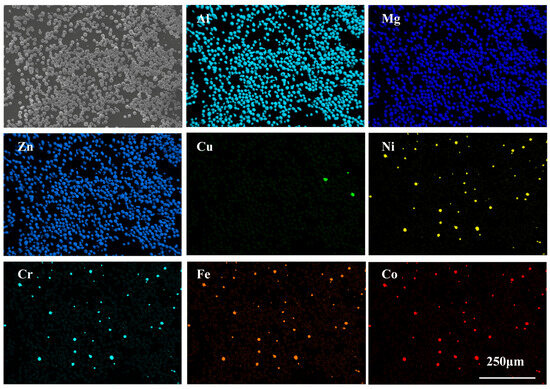
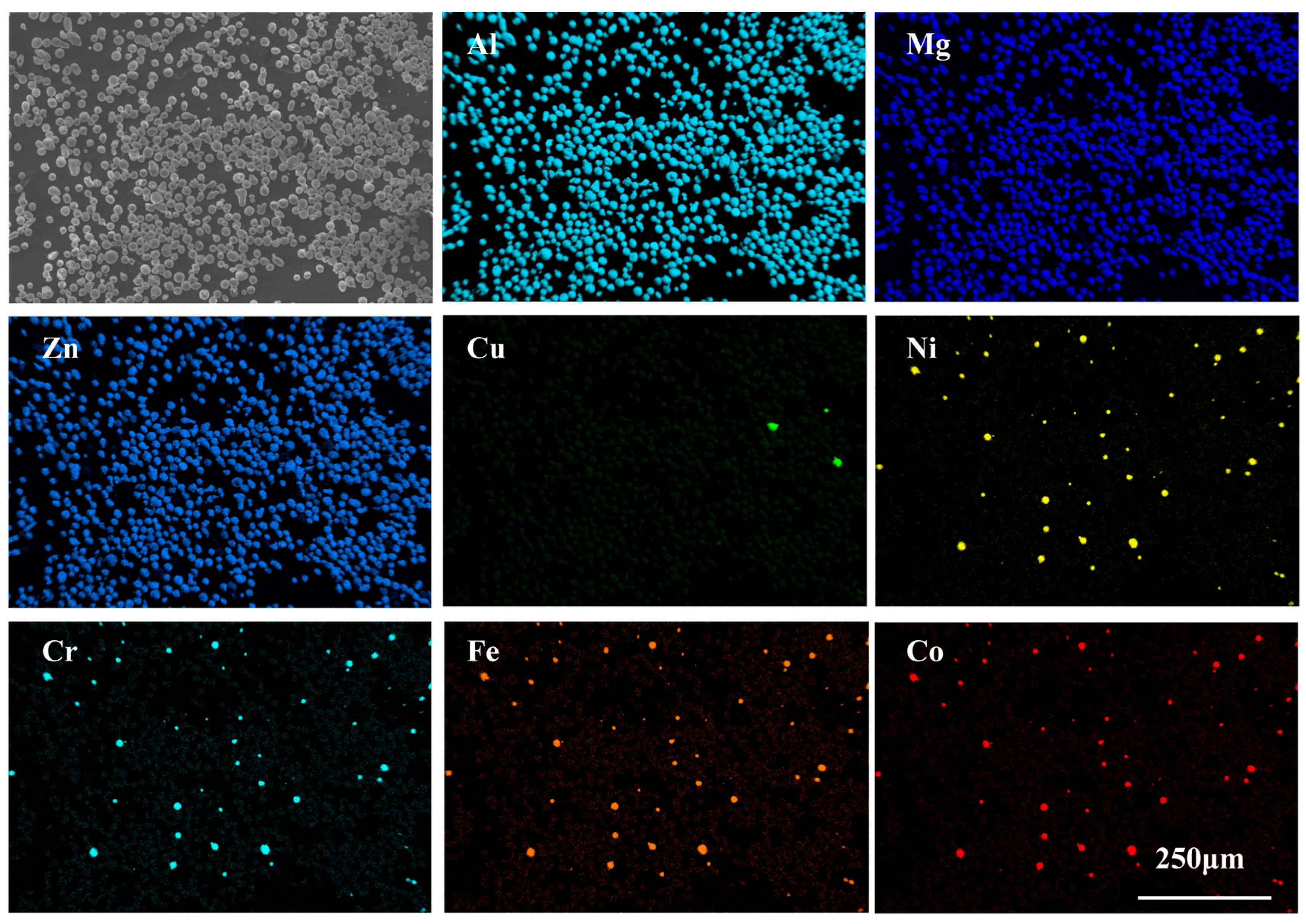
Representative powder morphologies and elemental distributions for the 7075–5 wt.% AlCoCrFeNi2.1 composite powder were examined using a field-emission scanning electron microscope (FE-SEM; Quanta 450 FEG, FEI Company, Hillsboro, OR, USA) equipped with an energy-dispersive X-ray spectroscopy (EDS) system. As illustrated schematically in Figure 1, Al, Mg, Zn and minor Cu are homogeneously distributed in most of the near-spherical particles and therefore correspond to the AA7075 matrix powder, whereas Ni, Co, Cr and Fe signals are concentrated in a subset of particles that appear as bright features in backscattered electron mode, confirming that these are AlCoCrFeNi2.1 HEA particles. Overall, the HEA particles are finely dispersed between the aluminium alloy powders without obvious agglomeration or large-scale compositional segregation, indicating that the mixing procedure produces a compositionally uniform composite powder suitable for LPBF processing.
Figure 1.
SEM image and corresponding EDS elemental maps of the mixed AA7075–5 wt.% AlCoCrFeNi2.1 composite feedstock powder. The Al, Mg, Zn and Cu maps identify the AA7075 matrix particles, while Ni, Co, Cr and Fe highlight the HEA particles, which are homogeneously dispersed between the aluminium alloy powders (scale bar 250 μm).A similar powder morphology of the same material system was reported previously in Ref. [31].
2.2. LPBF Processing
All specimens were fabricated using a commercial laser powder bed fusion (LPBF) system (EP-M150 Pro, Eplus3D, Hangzhou, China) equipped with a continuous-wave fibre laser of wavelength 1070 nm and a nominal focus diameter of approximately 80 μm. Prior to building, the processing chamber was repeatedly purged with high-purity Ar until the oxygen level was reduced below 0.1%, and the base plate was preheated to approximately 150 °C to reduce the initial thermal gradient and mitigate hot-cracking susceptibility.
In the present study, the layer thickness t, hatch spacing h and scan speed v were fixed at 30 μm, 90 μm and 500 mm·s−1, respectively. Three laser power levels (P = 100, 190, and 300 W) were employed while keeping v, h, and t constant, thereby establishing three nominal energy-input conditions that correspond to VED values of approximately 74.07, 140.74, and 222.22 J·mm−3 under the present parameter set. The VED was calculated according to
where P is the laser power (W), v is the scan speed (mm·s−1), h is the hatch spacing (mm) and t is the layer thickness (mm).
VED = P/(v · h · t),
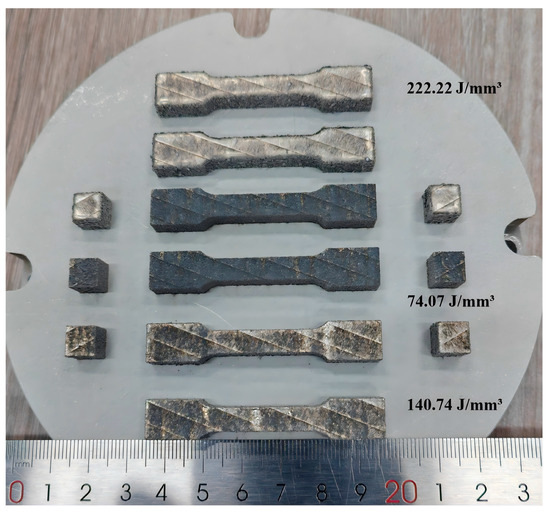
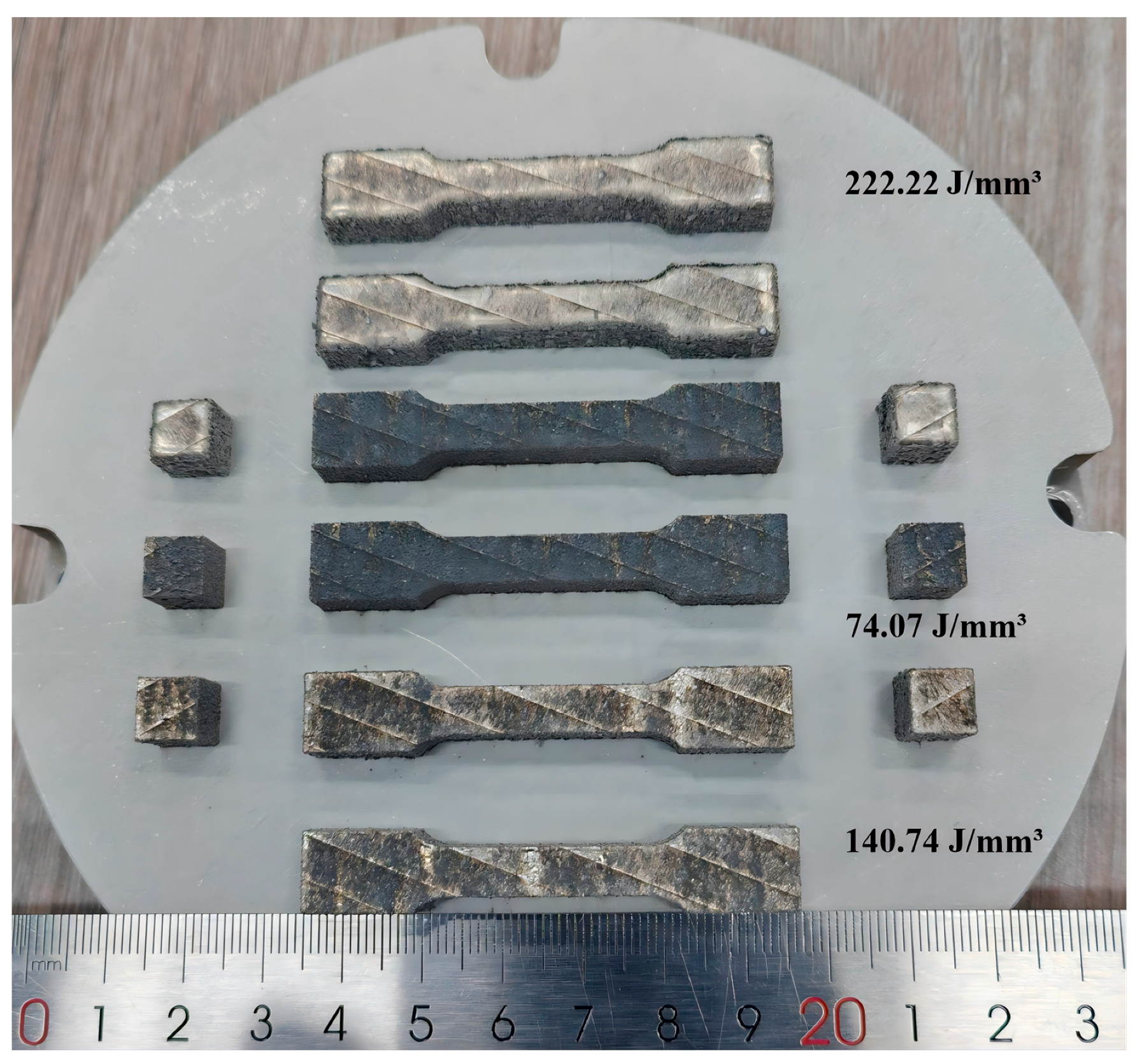
Each parameter set was applied to both unreinforced AA7075 powder and the 5 wt.% HEA-reinforced composite powder (AA7075-HEA). For every material/processing condition, 8 mm × 8 mm × 8 mm cubes and 60 mm × 10 mm × 7 mm tensile blanks were fabricated. The cubes were used for density measurements, microstructural characterisation and microhardness testing, while the tensile blanks were subsequently machined into sub-sized tensile specimens by wire electrical discharge machining (EDM). Typical processing parameters and specimen types are summarised in Table 1. Representative as-built LPBF specimens are shown in Figure 2, where the central sub-sized tensile specimen is flanked by the cube samples, illustrating that all builds exhibited sound external geometry and dimensional stability under the selected process window.
Table 1.
LPBF parameter combinations used in this study.
Figure 2.
As-built LPBF specimens fabricated at three volumetric energy densities (VED = 74.07, 140.74 and 222.22 J·mm−3). The central row shows sub-sized tensile blanks, while the left and right rows show 8 × 8 × 8 mm cubic samples for density and microstructure characterisation.
It is noted that VED is used here as a convenient, first-order indicator of energy input under a single-parameter design in which scan speed (v), hatch spacing (h), layer thickness (t), and scan strategy are held constant and only laser power (P) is varied. Under this constraint, variations in VED are effectively equivalent to a power-gradient study. Accordingly, VED-based comparisons and the identified ‘low/intermediate/high’ regimes should be interpreted within the present processing domain, and the absolute VED values should not be directly generalised to other power–speed combinations or scan strategies.
2.3. Heat Treatment
To evaluate the influence of post-build heat treatment on microstructure and mechanical properties, selected AA7075 and AA7075-HEA specimens were subjected to a conventional T6 schedule. The specimens were solutionised at 470 °C for 90 min in a resistance furnace under a protective high-purity Ar atmosphere, followed by immediate water quenching to room temperature. Subsequent artificial ageing was performed at 120 °C for 24 h. A heating rate of approximately 5 °C·min−1 was employed throughout the solution and ageing cycles to ensure consistent thermal conditions and to minimise thermal shock. Unless otherwise specified, as-built and heat-treated samples are denoted as AA7075/AA7075-HEA and AA7075-T6/AA7075-HEA-T6, respectively.
2.4. Microstructural Characterisation
Polished (unetched) cross-sections of as-built and T6-treated specimens were prepared by standard mechanical grinding and polishing. Optical microstructures were examined using an inverted optical microscope (IE500M, Ningbo Sunny Instruments Co., Ltd. (SOPTOP), Yuyao, China) at low and intermediate magnifications to assess melt-pool morphology, pore characteristics, crack distribution and microstructural uniformity.
Detailed microstructural analysis was carried out using a field-emission scanning electron microscope (FE-SEM; Quanta 450 FEG, FEI Company, Hillsboro, OR, USA) operated in both secondary electron (SE) and backscattered electron (BSE) imaging modes. SE imaging was employed to reveal surface morphology, while BSE imaging was used to enhance compositional contrast between the α-Al matrix, HEA-related phases and secondary precipitates. An attached energy-dispersive X-ray spectroscopy (EDS) system was used for elemental mapping as well as point and line analyses, in order to clarify the spatial distribution of HEA-derived elements, interface chemistry and possible solute segregation behaviour.
To quantitatively characterise the grain morphology and crystallographic texture, Electron Backscatter Diffraction (EBSD) measurements were performed on the cross-sectioned specimens. Prior to analysis, the samples were mechanically polished and subsequently subjected to argon ion polishing to completely remove the surface deformation layer and ensure high-quality Kikuchi patterns.
The EBSD data were acquired using an Oxford Instruments detector. The collected data were post-processed to generate inverse pole figure (IPF) maps, grain size distributions, and kernel average misorientation (KAM) maps. Furthermore, pole figures (PFs) were calculated to evaluate the evolution of crystallographic texture and its correlation with the hot-cracking behaviour.
For fracture analysis, fracture surfaces of representative tensile specimens were examined directly in the FE-SEM without further cleaning or polishing. Macroscopic and microscopic fractographic features were documented, with particular attention to crack initiation sites, pore morphology and the role of HEA particles during crack propagation and final failure.
2.5. Density and Microhardness Measurements
Relative densities of the cube specimens were measured at room temperature by the Archimedes method in deionised water. For each specimen, the masses in air and in water were recorded at least five times, and the average value was used to calculate the relative density. The standard deviation was taken as an estimate of data scatter and measurement repeatability.
Vickers microhardness measurements were performed on polished cross-sections using a digital microhardness tester (model 310HVS-5, Laizhou Huayin Testing Instrument Co., Ltd., Laizhou, China) in accordance with ASTM E384. A load of 500 gf (4.9 N) was applied with a dwell time of 10 s. The specimens had a macroscopic dimension of 8 × 8 × 8 mm3, providing sufficient area for reliable indentation placement. To avoid stress-field interactions and edge effects, adjacent indentations were spaced at distances at least three times the diagonal length of the indent, and the minimum distance from any sample edge was maintained at no less than three diagonal lengths. The instrument was calibrated using a certified reference hardness block prior to testing. For each condition, at least five indentations were placed in different regions of the specimen while avoiding visible pores, cracks, and particle agglomerations to obtain representative matrix-dominated hardness values. The average Vickers hardness (HV0.5) and the corresponding standard deviation are reported.
2.6. Tensile Testing
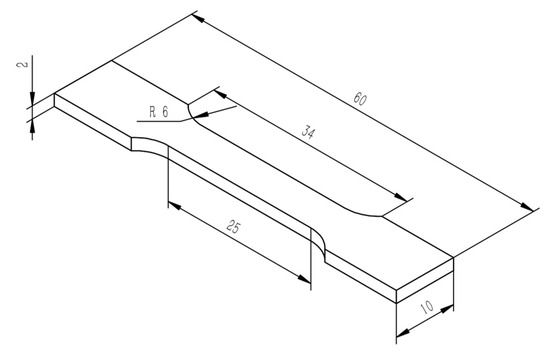
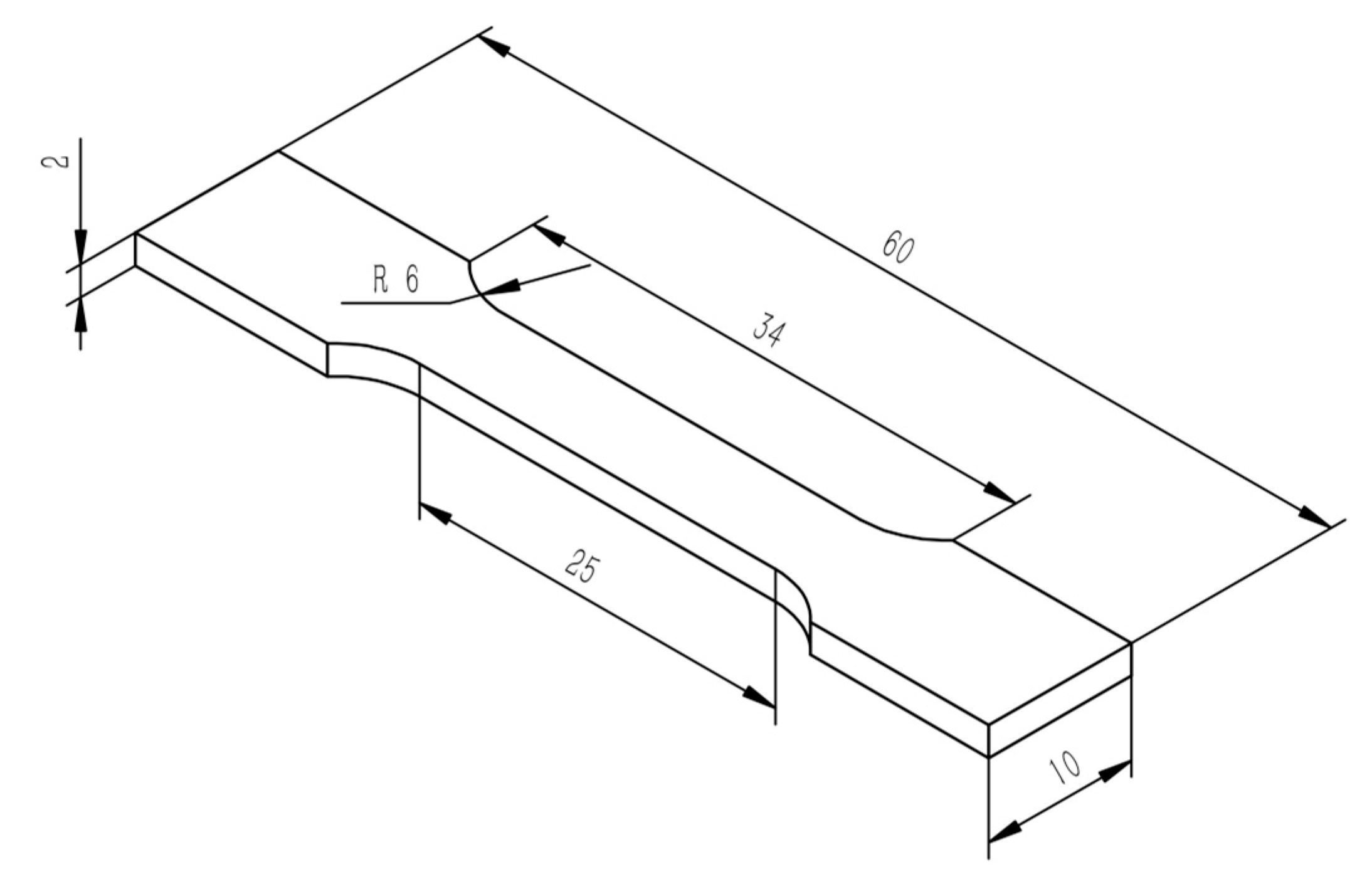
Sub-sized flat tensile specimens were machined from the as-built LPBF tensile blanks (60 mm × 10 mm × 7 mm) using wire electrical discharge machining (DK350, Tengzhou Hoton Machinery Co., Ltd., Tengzhou, China). The specimen geometry, with a gauge length of approximately 25 mm, followed the requirements of the ASTM E8/E8M standard for sub-sized flat specimens (Figure 3). After machining, the gauge sections and end regions were progressively ground and mechanically polished to remove machining marks and surface defects and to ensure dimensional accuracy.
Figure 3.
Schematic of the sub-sized flat tensile specimen used in this study, with dimensions in millimetres.
Uniaxial tensile tests were carried out at room temperature on a Shimadzu Autograph AG-X plus universal testing machine (Shimadzu Corporation, Kyoto, Japan) under displacement control, using a constant crosshead speed of 0.5 mm·min−1. For each material and processing condition, at least three specimens were tested to obtain representative stress–strain curves. The 0.2% proof yield strength was determined using the standard offset method. The ultimate tensile strength (UTS) and total elongation to fracture were calculated from the engineering stress–strain data and are reported as mean values together with the corresponding standard deviations. Fractured specimens were immediately labelled and stored for subsequent fractographic examination.
3. Results and Discussion
3.1. Densification Behaviour
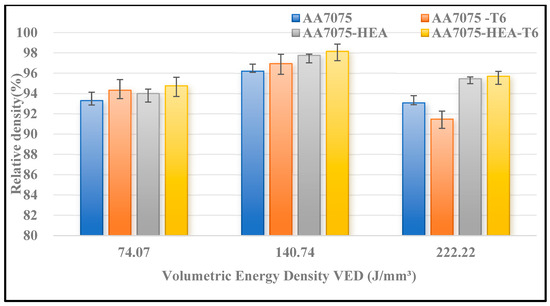
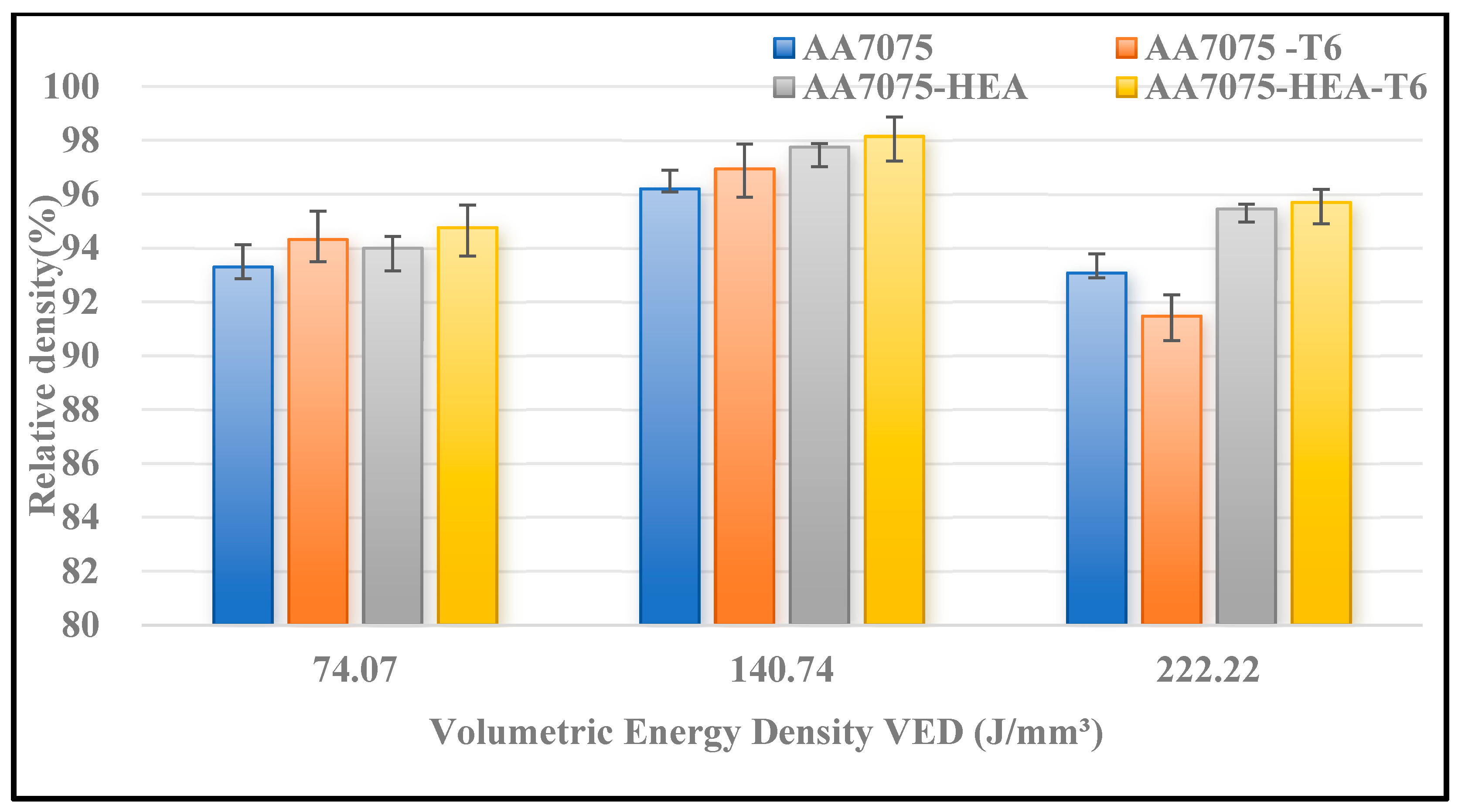
Figure 4 shows the relative densities of AA7075, AA7075-HEA and their T6 heat-treated counterparts as a function of VED. Overall, the relative density exhibits a characteristic trend of first increasing and then decreasing with increasing VED. At the lowest VED of 74.07 J·mm−3, all samples reach only intermediate densities of approximately 93–95%. In this regime, the laser energy input is insufficient to fully melt the powder, the melt-pool fluidity is limited and inter-track as well as inter-layer bonding is poor, leading to pronounced lack-of-fusion defects and irregular pores. When the VED is increased to 140.74 J·mm−3, the relative density rises markedly to about 95%–98%, which represents the highest densification level in the present study. The moderate energy input at this condition ensures nearly complete melting and promotes sufficient melt-pool wetting and flow, so that the liquid metal can effectively fill interstitial regions and reduce both the number and size of pores and cracks. With a further increase in VED to 222.22 J·mm−3, the density decreases again to around 93%–95%. Here, the laser power is high enough to produce deep, unstable melt pools and intensified evaporation, which favour keyhole formation and collapse. As a result, nearly spherical keyhole-type pores and gas pores become the dominant defects and deteriorate the overall densification.
Figure 4.
Relative density of LPBF-processed AA7075 and 7075-HEA specimens (as-built and T6) as a function of volumetric energy density. Error bars, where present, represent the standard deviation of repeated measurements for each condition.
At a given VED, a comparison between AA7075 (including its T6 state) and the 5 wt.% HEA-reinforced 7075-HEA reveals that the composite generally exhibits comparable or slightly higher relative densities. In particular, at VED = 140.74 J·mm−3, the density of 7075-HEA marginally exceeds that of the corresponding AA7075 samples, suggesting that the introduction of HEA particles does not impair LPBF densification. On the contrary, it may promote the densification process by modifying the local thermal and wetting behaviour of the melt pool, thus improving melt spreading and pore filling. By contrast, the relative densities of as-built and T6-treated specimens are essentially identical (1-T6, 2-T6 and 3-T6 versus 1, 2 and 3; 1-HEA-T6, 2-HEA-T6 and 3-HEA-T6 versus 1-HEA, 2-HEA and 3-HEA). This confirms that T6 heat treatment does not modify the spatial distribution of pores and cracks formed during LPBF. In other words, the density is primarily governed by the combined effects of VED and the material system during building, whereas the subsequent heat treatment mainly affects the precipitate state, solid-solution condition and dislocation structures rather than the macroscopic defect population.
Taken together, these results indicate that the intermediate energy-input condition (VED ≈ 140.74 J·mm−3 under the fixed v–h–t and scan strategy used here) provides the highest densification and the lowest defect severity for the present AA7075/7075-HEA system, providing the highest relative density and a comparatively weak defect constraint for subsequent mechanical performance. The addition of HEA particles exerts a slightly positive effect on densification, whereas the T6 treatment has a negligible influence on relative density.
3.2. Microstructural Analysis
3.2.1. Optical Microstructures
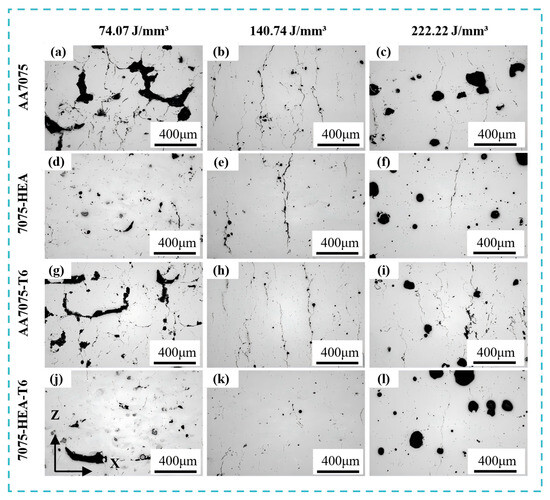
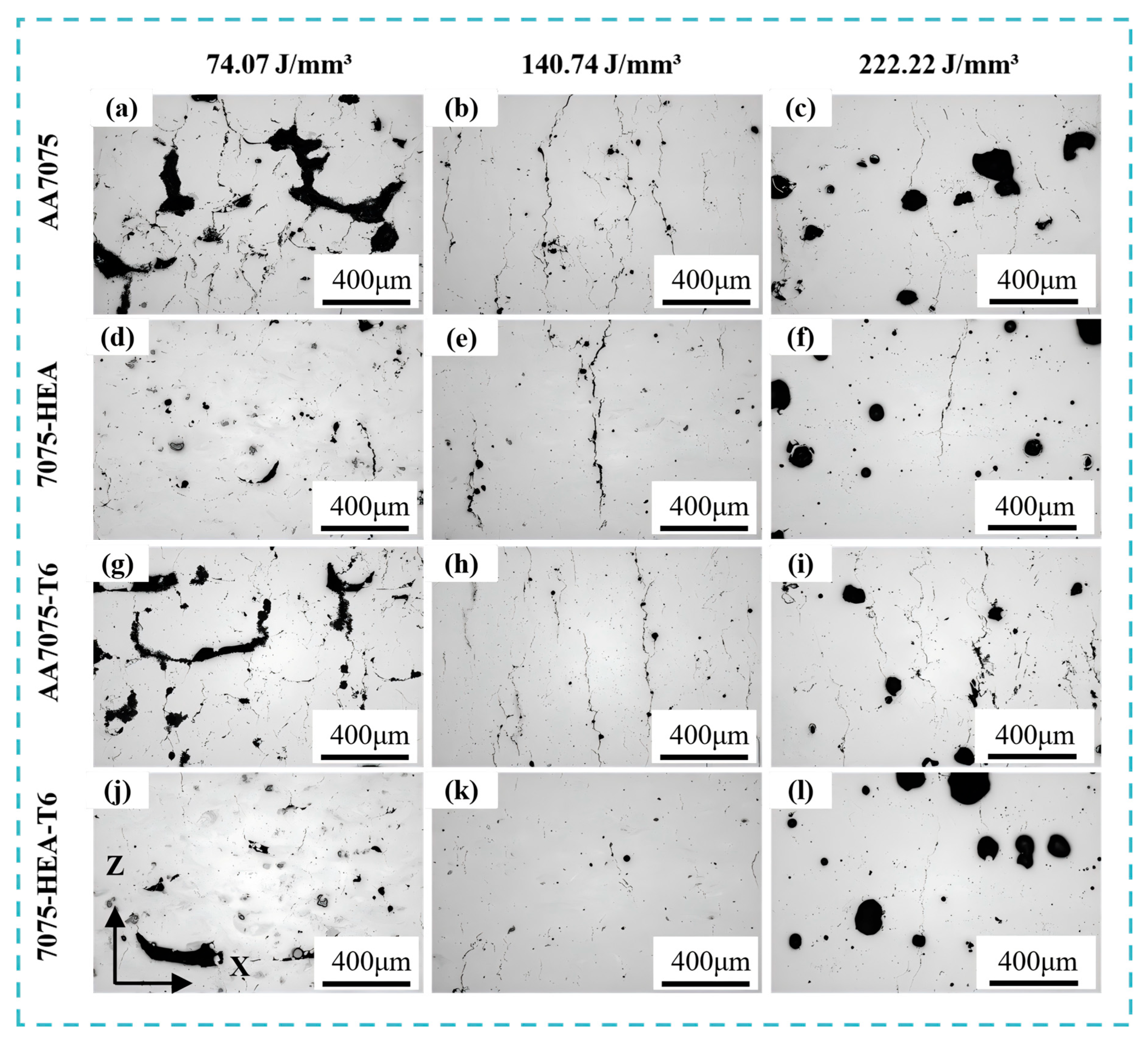
Representative unetched optical micrographs of AA7075, 7075-HEA and their T6-treated counterparts at different VED levels are presented in Figure 5. The observed pore morphologies and crack distributions are fully consistent with the densification trends discussed above and further elucidate the underlying defect-formation mechanisms.
Figure 5.
Representative unetched optical micrographs (XZ cross-sections) of LPBF-processed samples built at different volumetric energy densities: (a–c) AA7075 at VED = 74.07, 140.74 and 222.22 J·mm−3; (d–f) 7075-HEA at the same VED levels; (g–i) AA7075-T6; and (j–l) 7075-HEA-T6. Variations in pore morphology (lack-of-fusion and keyhole-type porosity) and crack characteristics with VED, alloy system and heat-treatment condition are evident (all images taken at 100×; scale bar 400 μm).
At the low VED of 74.07 J·mm−3 (AA7075: Figure 5a; AA7075-T6: Figure 5g; 7075-HEA: Figure 5d; 7075-HEA-T6: Figure 5j), all samples exhibit insufficient densification. In AA7075 and AA7075-T6 (Figure 5a,g), large and irregular lack-of-fusion pores are frequently observed, often accompanied by long cracks extending across multiple melt tracks. In contrast, the AA7075-HEA and AA7075-HEA-T6 samples (Figure 5d,j) show fewer large pores, with the remaining defects appearing smaller and more rounded; however, microcracks are still present. These observations indicate that inadequate laser energy leads to incomplete melting and poor inter-track bonding, while the high hot-cracking susceptibility of 7xxx alloys under steep thermal gradients promotes crack formation, particularly along melt-pool boundaries.
When the VED is increased to 140.74 J·mm−3 (AA7075: Figure 5b; AA7075-HEA: Figure 5e; AA7075-T6: Figure 5h; AA7075-HEA-T6: Figure 5k), a pronounced reduction in pore size and pore population is consistently observed across all material states. Melt-pool boundaries become more continuous and clearly defined, reflecting improved melting continuity and interlayer bonding. Microcracks, however, remain visible in AA7075, AA7075-HEA and AA7075-T6 (Figure 5b,e,h), and their apparent density does not show a marked decrease compared with the low-VED condition. Notably, a clearer reduction in crack density and crack continuity is observed only in the AA7075-HEA-T6 sample (Figure 5k). These results suggest that, at intermediate VED, defect minimisation is dominated by the suppression of lack-of-fusion porosity, whereas effective crack mitigation is material- and condition-dependent rather than universal.
At the highest VED of 222.22 J·mm−3 (AA7075: Figure 5c, AA7075-HEA: Figure 5f, AA7075-T6: Figure 5i, AA7075-HEA-T6: Figure 5l), many nearly circular pores are observed, exhibiting typical keyhole and gas-pore morphologies. These defects are predominantly located in or near the centres of melt pools, indicating that excessive energy input leads to deep, unstable melt pools, enhanced evaporation and inadequate backfilling, which together result in keyhole collapse and gas entrapment.
Comparisons between AA7075 and AA7075-HEA reveal that, at low VED, the incorporation of HEA particles (Figure 5d,j) reduces the occurrence of large pores; the remaining pores tend to be smaller and more rounded, and the crack density is slightly decreased. At the intermediate VED, both materials exhibit relatively few pores, but AA7075-HEA presents smoother and more continuous melt-pool boundaries, which is favourable for load transfer. At the high VED, both materials are dominated by keyhole-type porosity, and the differences are mainly reflected in local melt-pool morphology and particle distribution, with HEA additions having a limited effect on suppressing keyhole-related defects. A comparison between as-built and T6-treated samples (e.g., Figure 5a,g and Figure 5d,j, respectively) indicates that T6 heat treatment essentially does not alter the morphology or number of pores and cracks, supporting the earlier conclusion that T6 mainly adjusts precipitate and dislocation structures but cannot ‘heal’ defects formed during LPBF.
In summary, the OM observations demonstrate that VED is the dominant parameter controlling pore formation, with intermediate-VED conditions most effective in reducing lack-of-fusion porosity. Crack behaviour shows a more complex dependence on alloy system and heat treatment and cannot be described solely by VED. These microstructural observations provide a qualitative basis for interpreting the subsequent mechanical-property results.
3.2.2. BSE/SEM Observations and EDS Elemental Distributions
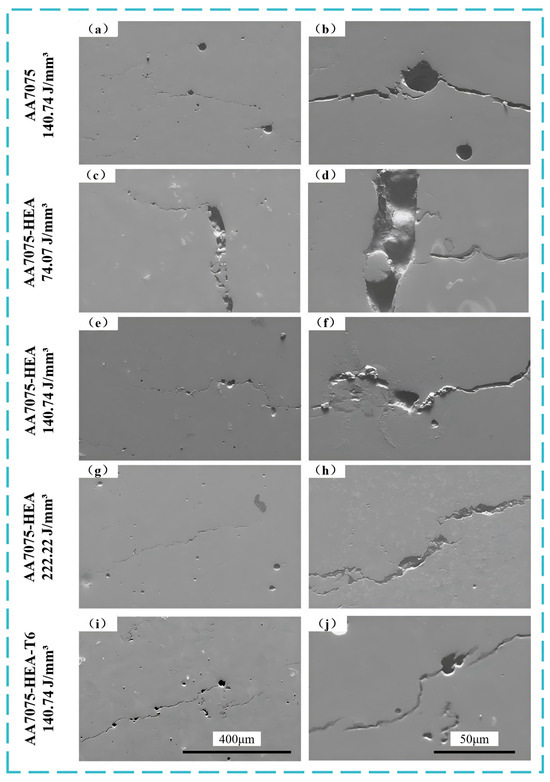
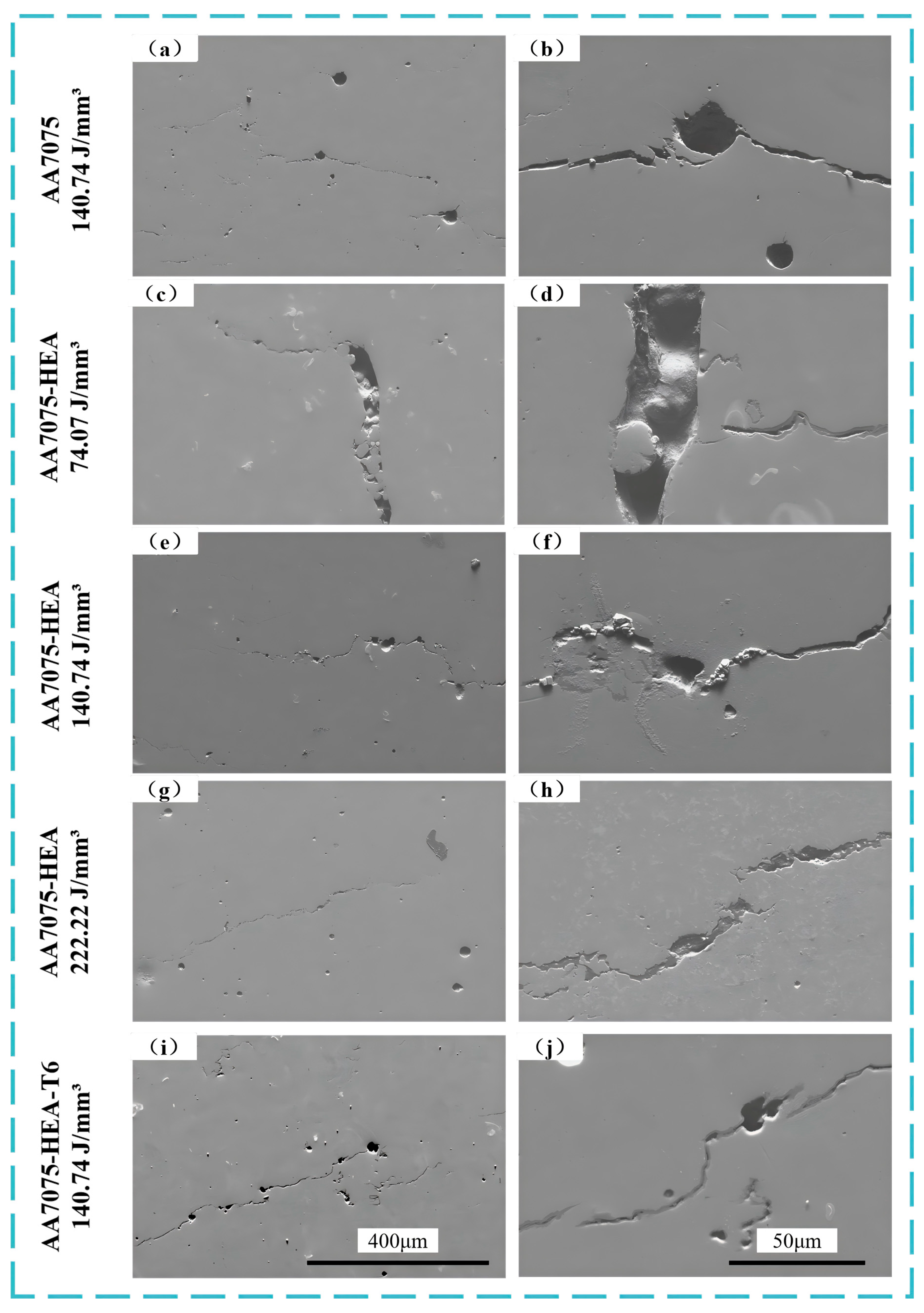
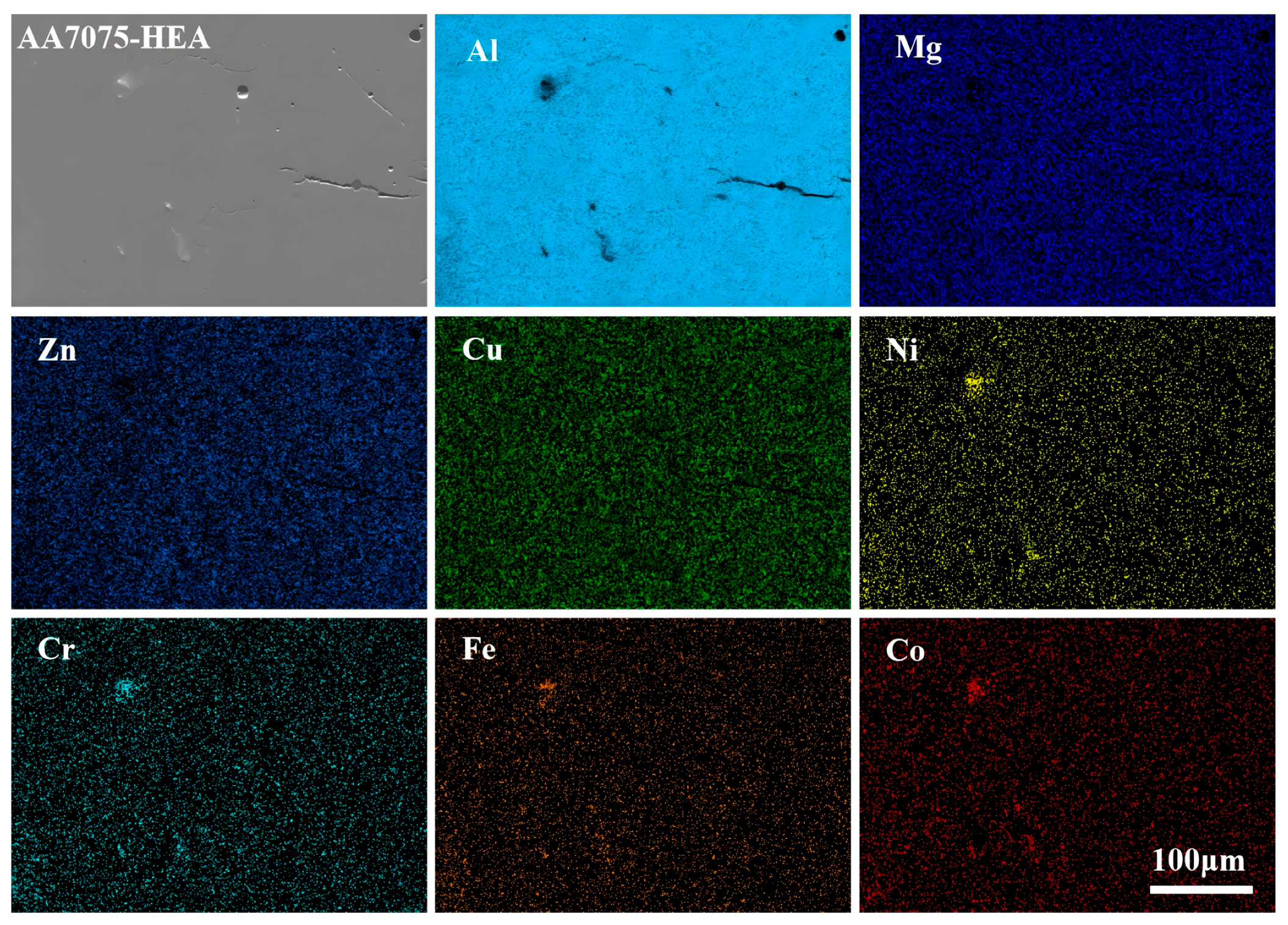
Backscattered electron (BSE) imaging combined with EDS analysis provides a more direct assessment of the distribution, interfacial characteristics and defect association of HEA particles in the aluminium matrix, as illustrated in Figure 6, Figure 7, Figure 8 and Figure 9. At the intermediate VED of 140.74 J·mm−3, both AA7075 and AA7075-HEA exhibit relatively uniform microstructures in BSE mode, with the HEA-related bright phase appearing as finely dispersed, light-grey features within the α-Al matrix. No large-scale particle agglomeration is observed and the particle sizes are slightly smaller than those of the original HEA powder, reflecting partial dissolution and fragmentation during LPBF. The particle/matrix interfaces appear continuous in BSE images, indicating that the composite powder preparation and LPBF process can achieve good metallurgical bonding at the HEA/Al interface.
Figure 6.
Backscattered electron (BSE) micrographs showing defect structures and HEA-related bright phases in LPBF-fabricated AA7075 and AA7075-HEA samples under different volumetric energy density (VED) conditions and heat-treatment states. (a) AA7075 fabricated at an intermediate VED of 140.74 J·mm−3, 500×; (b) AA7075 fabricated at an intermediate VED of 140.74 J·mm−3, 3000×; (c) AA7075-HEA fabricated at a low VED of 74.07 J·mm−3, 500×; (d) AA7075-HEA fabricated at a low VED of 74.07 J·mm−3, 3000×; (e) AA7075-HEA fabricated at an intermediate VED of 140.74 J·mm−3, 500×; (f) AA7075-HEA fabricated at an intermediate VED of 140.74 J·mm−3, 3000×; (g) AA7075-HEA fabricated at a high VED of 222.22 J·mm−3, 500×; (h) AA7075-HEA fabricated at a high VED of 222.22 J·mm−3, 3000×; (i) T6-treated AA7075-HEA fabricated at a low VED of 74.07 J·mm−3, 500×; (j) T6-treated AA7075-HEA fabricated at a low VED of 74.07 J·mm−3, 3000×. These images illustrate representative local morphologies of defects and bright phases under different processing conditions. The scale bars are 400 μm in (a,c,e,g,i), and 50 μm in (b,d,f,h,j).
Figure 7.
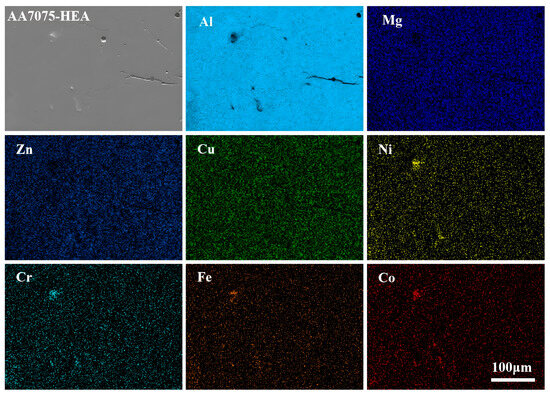
EDS elemental maps of sample 2-HEA (AA7075 + 5 wt.% AlCoCrFeNi2.1; as-built; VED = 140.74 J·mm−3). The base elements Al, Mg, Zn and Cu are uniformly distributed, while Ni, Co, Cr and Fe originating from the HEA appear as finely dispersed regions of slightly enhanced intensity, indicating a homogeneous dispersion of HEA-derived phases at the microscale (scale bar 100 μm).
Figure 8.
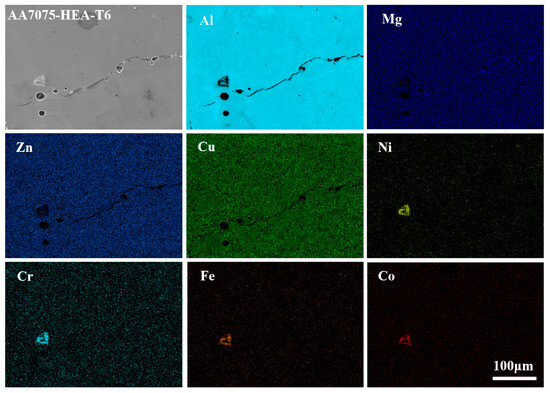
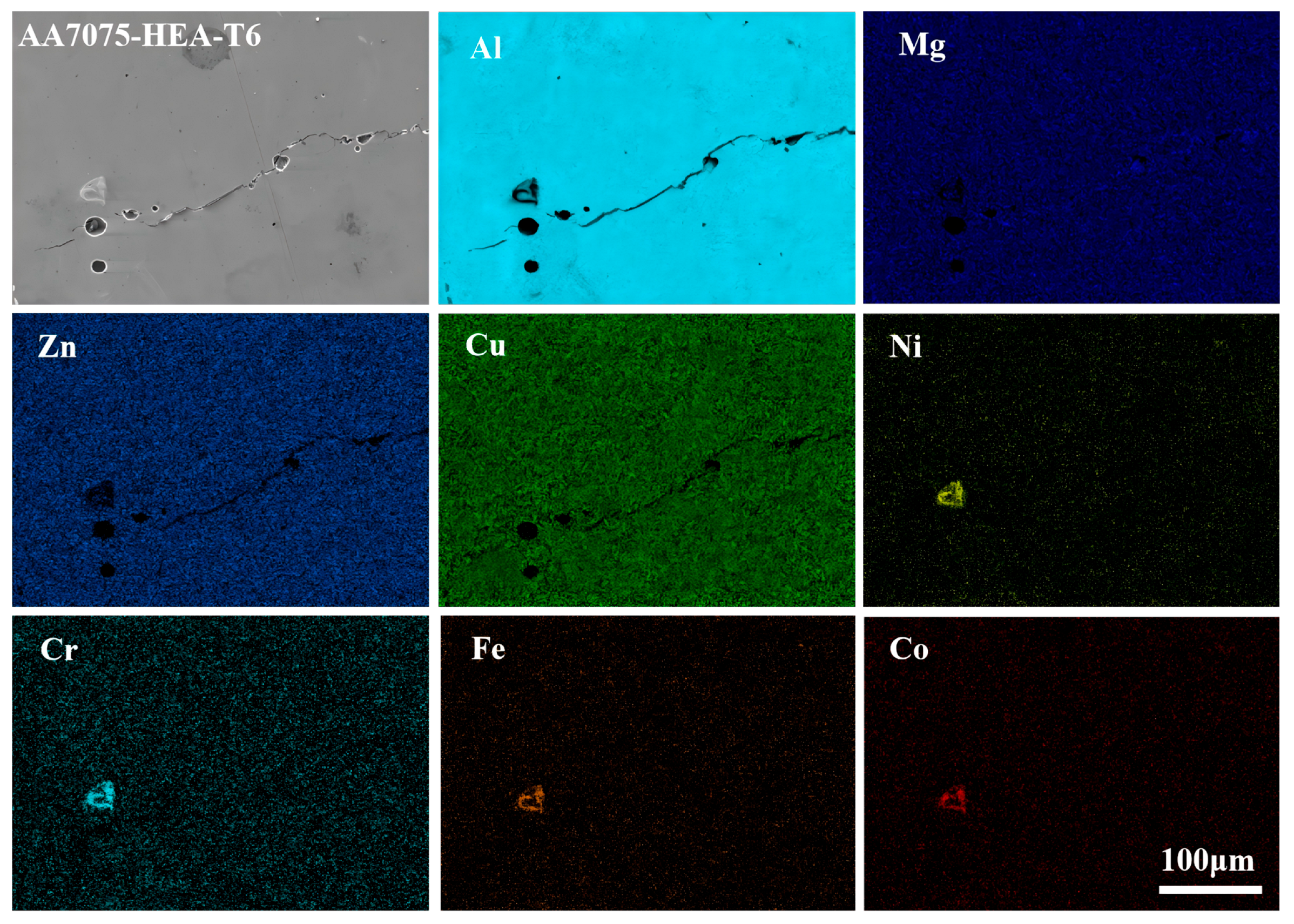
EDS elemental maps of sample 2-HEA-T6 (AA7075 + 5 wt.% AlCoCrFeNi2.1 after T6 treatment; VED = 140.74 J·mm−3). The overall elemental distributions remain highly uniform and no coarse segregated phases are observed, confirming that the LPBF + T6 route produces a supersaturated α-Al matrix with finely dispersed HEA-derived constituents (scale bar 100 μm).
Figure 9.
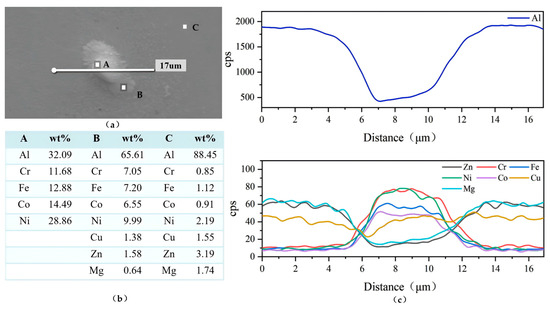
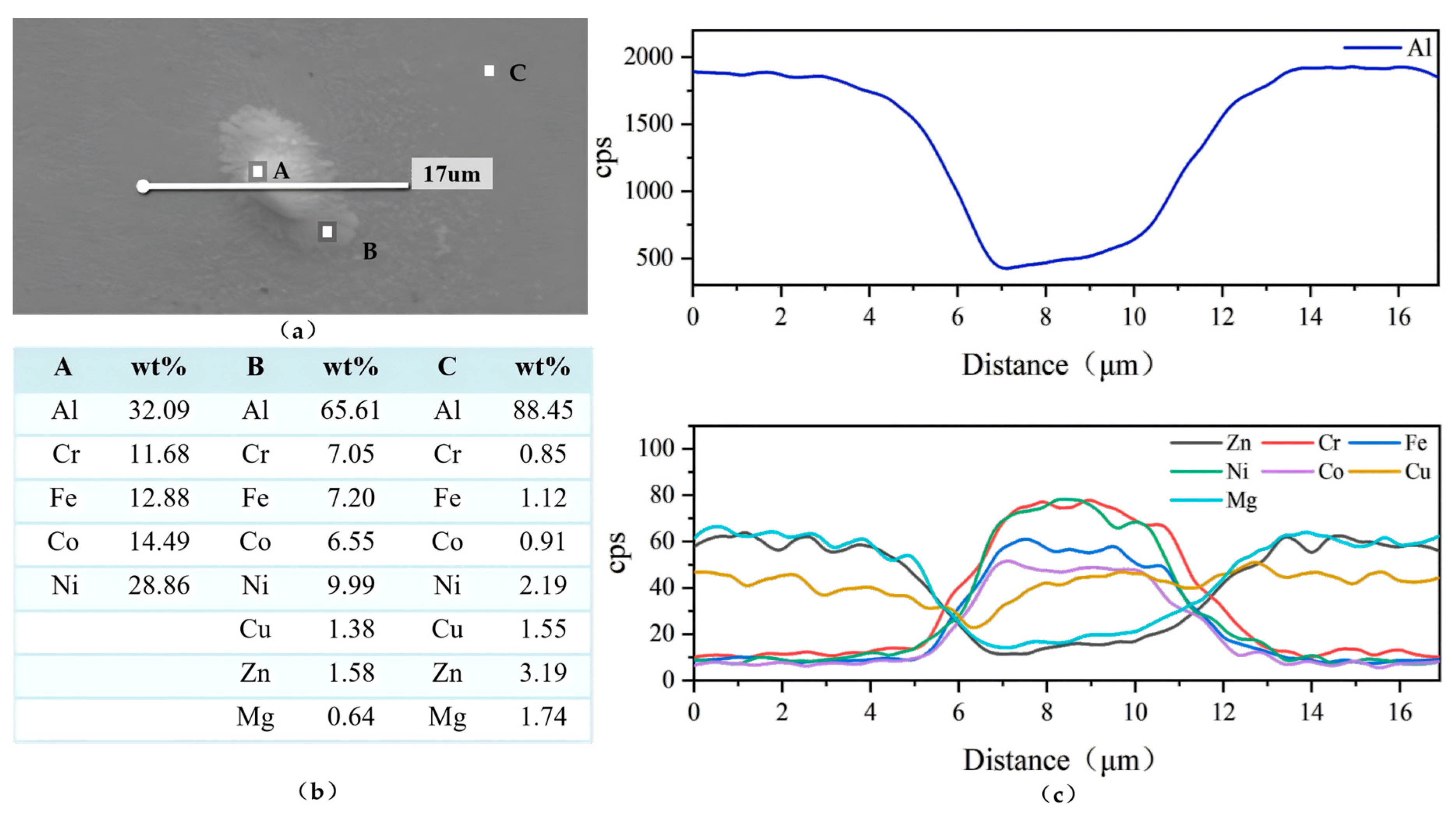
EDS point and line analyses across HEA-enriched regions in sample 2-HEA. (a) BSE micrograph showing the locations of analysis points A–C and the line-scan trajectory; (b) corresponding line profiles for Al, Mg, Zn, Cu, Ni, Co, Cr and Fe; (c) point compositions at A (HEA-rich region), B (transition zone) and C (matrix). The results demonstrate a compositionally graded interface and partial dissolution of HEA elements into the α-Al matrix.
In contrast, at the low VED of 74.07 J·mm−3, BSE images reveal numerous lack-of-fusion defects and cracks extending along melt-pool boundaries. Partially or semi-molten HEA particles are frequently found within cracks and surrounding pores (Figure 6c,d), indicating that under insufficient energy input, a weakly bonded region may exist around some particles. At the high VED of 222.22 J·mm−3 (Figure 6g,h), low-magnification BSE images show a relatively fine crack crossing the field of view, accompanied by smaller, more fragmented bright features distributed along the crack path. Under higher magnification, the crack edges are decorated by small bright blocks and locally continuous bright regions of limited length and irregular shape, while the surrounding matrix is populated by uniformly dispersed fine bright dots. These observations suggest that increasing VED promotes HEA fragmentation and dissolution, leading to a finer and more homogeneous dispersion of HEA-derived phases.
A combined assessment of Figure 5 and Figure 6 reveals that defect morphology and HEA-related bright phases evolve with increasing VED from 74.07 to 222.22 J·mm−3, with variations depending on the material condition. At low VED, AA7075 and AA7075-T6 exhibit large, irregular lack-of-fusion pores and long cracks, whereas AA7075-HEA and AA7075-HEA-T6 show fewer and smaller pores with some microcracks; BSE images indicate HEA as irregular, tens-of-micrometre-sized blocks near defects and a few fine dots in the matrix. At intermediate VED, pores decrease in size and number, cracks shorten, and coarse HEA regions fragment into smaller blocky or particulate features, with more fine bright dots. At high VED, nearly circular keyhole- and gas-type pores dominate, cracks remain slender, and BSE images show that coarse HEA blocks mostly disappear, leaving fine dots and small blocks homogeneously distributed. Overall, increasing VED promotes the refinement, homogenization, and more uniform spatial distribution of the HEA-related phase.
EDS elemental maps for 2-HEA (as-built; VED = 140.74 J·mm−3) and 2-HEA-T6 are shown in Figure 7 and Figure 8, respectively. The base elements Al, Mg, Zn and Cu are uniformly distributed over the entire field of view, without evidence of macroscopic segregation or large dendritic intermetallics, indicating that the high cooling rates of LPBF effectively suppress long-range solute diffusion and macroscopic segregation, resulting in a highly supersaturated α-Al solid solution. Ni, Cr, Fe and Co originating from the HEA also exhibit a dispersed distribution within the matrix, with only minor regions of locally increased intensity that likely correspond to nanoscale or sub-micrometre HEA-enriched particles or partially dissolved remnants. No pronounced enrichment or depletion of specific elements is detected at crack tips, suggesting that the cracks are primarily thermally driven solidification or stress cracks rather than being triggered by continuous low-melting-point films of brittle phases.
After T6 heat treatment (Figure 8), the overall elemental distributions remain highly uniform and no micron-scale precipitates or significant solute segregations are observed at the SEM–EDS scale; correspondingly, the XRD patterns do not show any additional distinct peaks attributable to coarse secondary phases. However, because the η/η′ precipitates in 7xxx alloys are typically nanoscale and of low volume fraction, their presence and evolution cannot be reliably assessed by laboratory XRD and SEM–EDS alone and would require higher-resolution characterisation (e.g., TEM/DSC/electrical conductivity). These observations suggest that the LPBF + T6 processing route does not produce XRD-detectable coarse precipitation networks and that the measured strength/hardness response is likely influenced by a combination of solute state, grain structure, and fine particle/dispersion effects. Nevertheless, the contribution of nanoscale precipitation (η/η′) cannot be excluded based on the present XRD and SEM–EDS results and should be clarified by complementary methods (e.g., TEM/DSC/electrical conductivity or ageing response curves).
Point and line EDS analyses in Figure 9 further support this picture. In HEA-enriched regions (point A), the atomic fractions of Co, Cr, Fe and Ni are substantially higher than in the surrounding matrix and approach the composition of the original AlCoCrFeNi2.1 powder. In the transition region between HEA and matrix (point B), the concentrations of HEA elements decrease while those of Al, Mg, Zn and Cu increase, indicating significant interdiffusion and the formation of a compositionally graded interface that favours strong interfacial bonding. In the matrix region (point C), measurable amounts of Ni, Cr, Fe and Co are still detected, demonstrating that part of the HEA has dissolved into the α-Al matrix and contributes to solid-solution strengthening and lattice distortion. Taken together, these results show that, at suitable VED (especially 140.74 J·mm−3), LPBF can produce a uniformly dispersed, well-bonded HEA phase in the 7075 matrix with highly homogeneous elemental distributions at the microscale, providing a robust microstructural basis for mechanical-property optimisation.
3.2.3. Phase Identification (XRD Analysis)
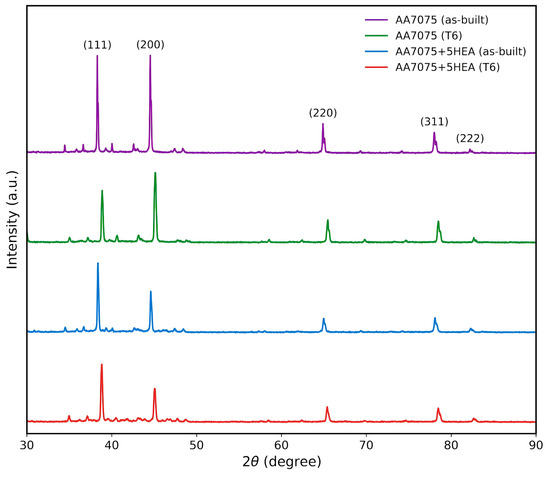
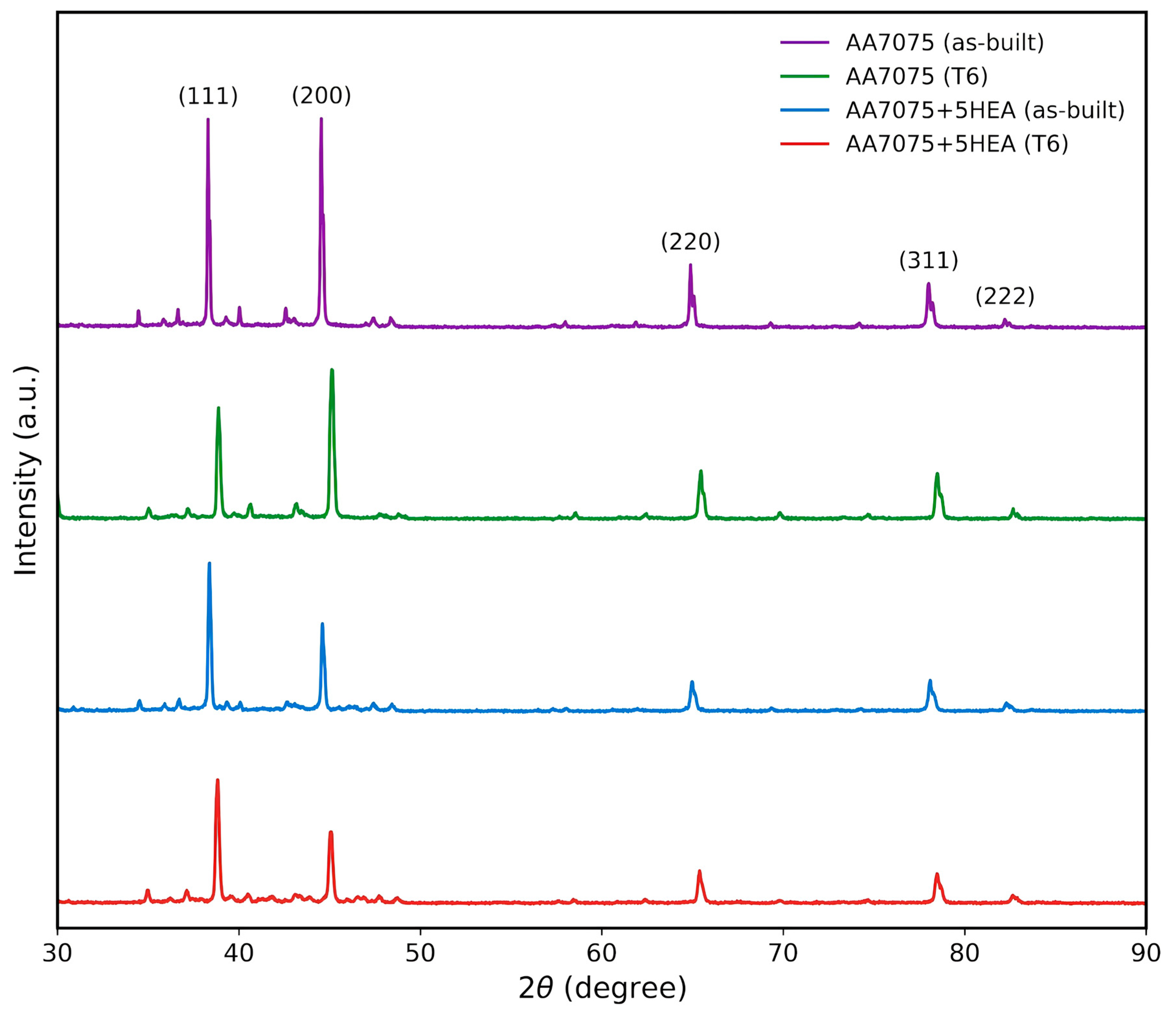
Figure 10 compares the XRD patterns of LPBF-fabricated AA7075 and AA7075 + 5 wt.% AlCoCrFeNi2.1 (AA7075–HEA) in both the as-built and T6 conditions. For all four states, the diffraction profiles are dominated by the face-centred cubic (fcc) α-Al reflections (PDF#04-0787), with the main peaks located at approximately 2θ ≈ 38.5°, 44.7°, 65.1°, 78.2° and 82.4°, corresponding to the (111), (200), (220), (311) and (222) planes, respectively. The persistence of these α-Al peaks indicates that the matrix phase remains α-Al after both HEA addition and subsequent T6 heat treatment, and no phase transformation of the Al matrix detectable by laboratory XRD is introduced across the investigated conditions.
Figure 10.
XRD patterns of LPBF-fabricated AA7075 and AA7075 + 5 wt.% AlCoCrFeNi2.1 (AA7075-HEA) in the as-built and T6 conditions. The major α-Al peaks are indexed according to PDF#04-0787. Patterns are normalised and vertically offset for clarity.
Importantly, the AA7075-HEA patterns do not exhibit additional strong diffraction peaks that can be unambiguously assigned to crystalline HEA phases or coarse intermetallic reaction products within the detection limit of the present measurements. This is reasonable given the relatively low reinforcement fraction (5 wt.%) and the likelihood of peak overlap between potential HEA-related reflections and the dominant α-Al peaks, together with the possibility that any interfacial reaction products and age-hardening precipitates are either nanoscale and/or present at low volume fractions.
A qualitative comparison between the as-built and T6 states shows no emergence of new prominent peaks after heat treatment, indicating that the applied T6 schedule does not generate a substantial fraction of coarse, XRD-resolvable secondary phases. It should be noted, however, that nanoscale η/η′ precipitates and low-volume-fraction interfacial products may remain below the detection limit of laboratory XRD.
Beyond phase identification, relative peak intensities can provide semi-quantitative indications of preferred orientation when measured under identical conditions. The as-built AA7075 shows an enhanced (200) reflection with I(200)/I(111) about 1.0, higher than the random alpha-Al reference (about 0.5), consistent with a pronounced <001> fibre texture tendency in LPBF. With HEA addition, I(200)/I(111) decreases to about 0.60, indicating weakened preferred orientation and a more dispersed orientation distribution; rigorous texture quantification is provided by EBSD in Section 3.2.4.
3.2.4. Electron Backscatter Diffraction (EBSD) Analysis
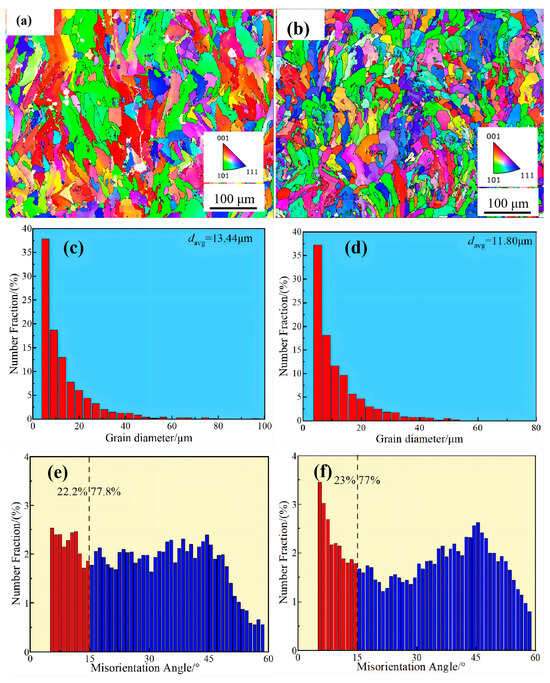
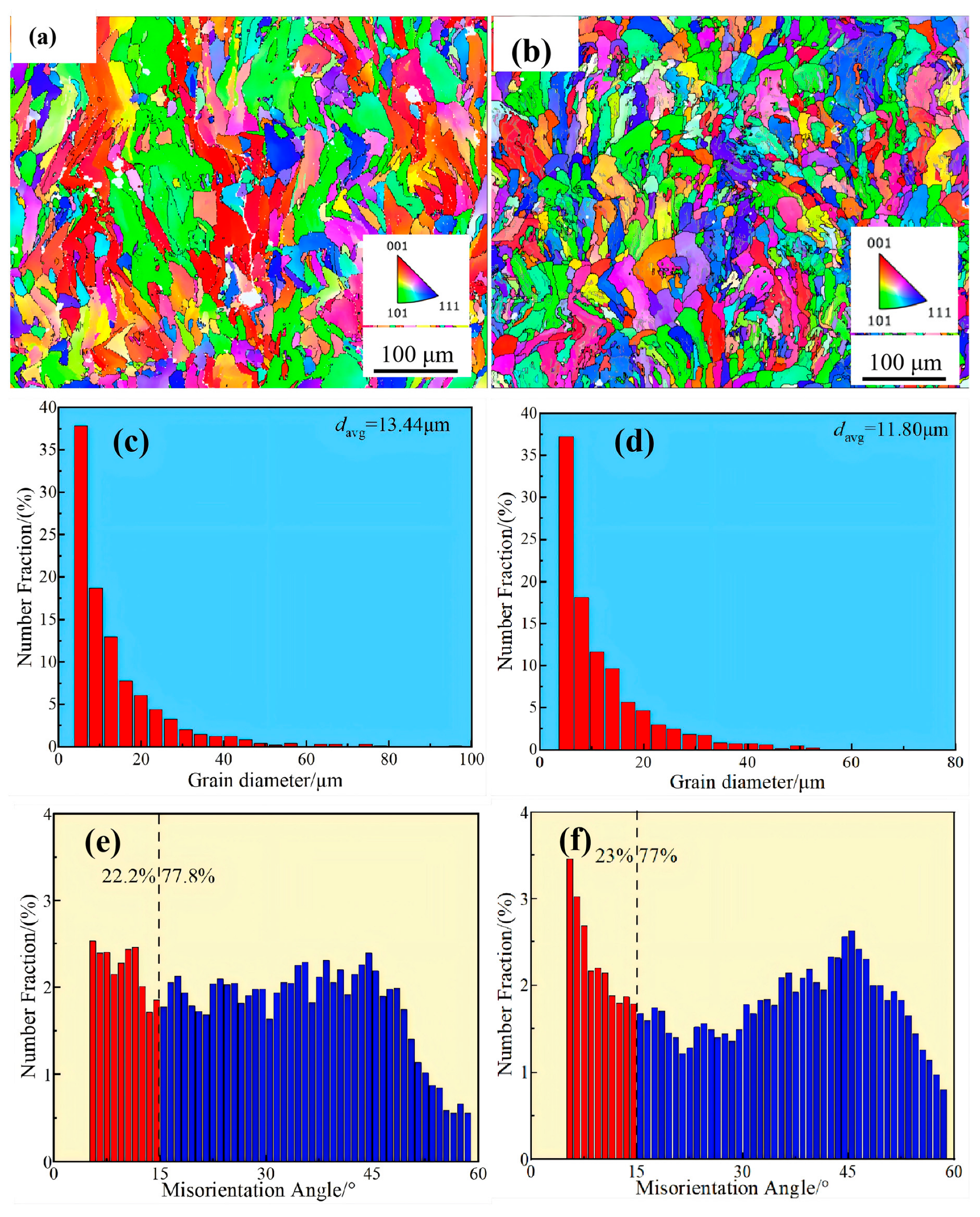
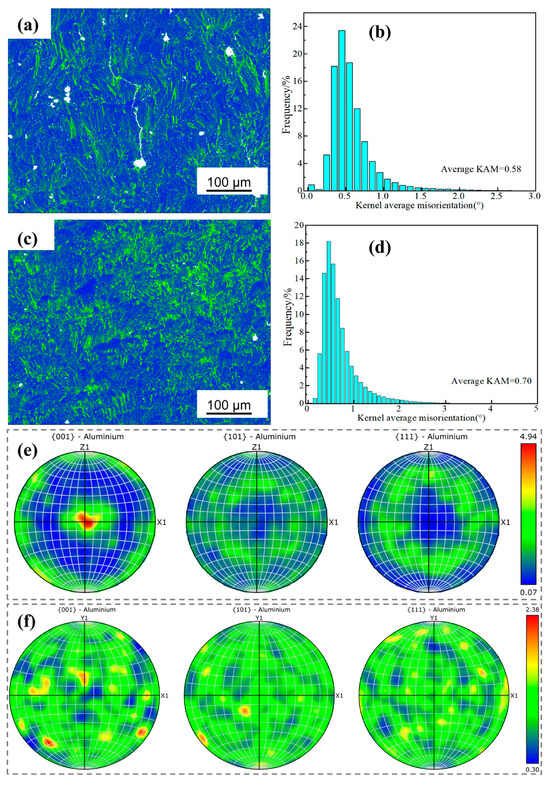
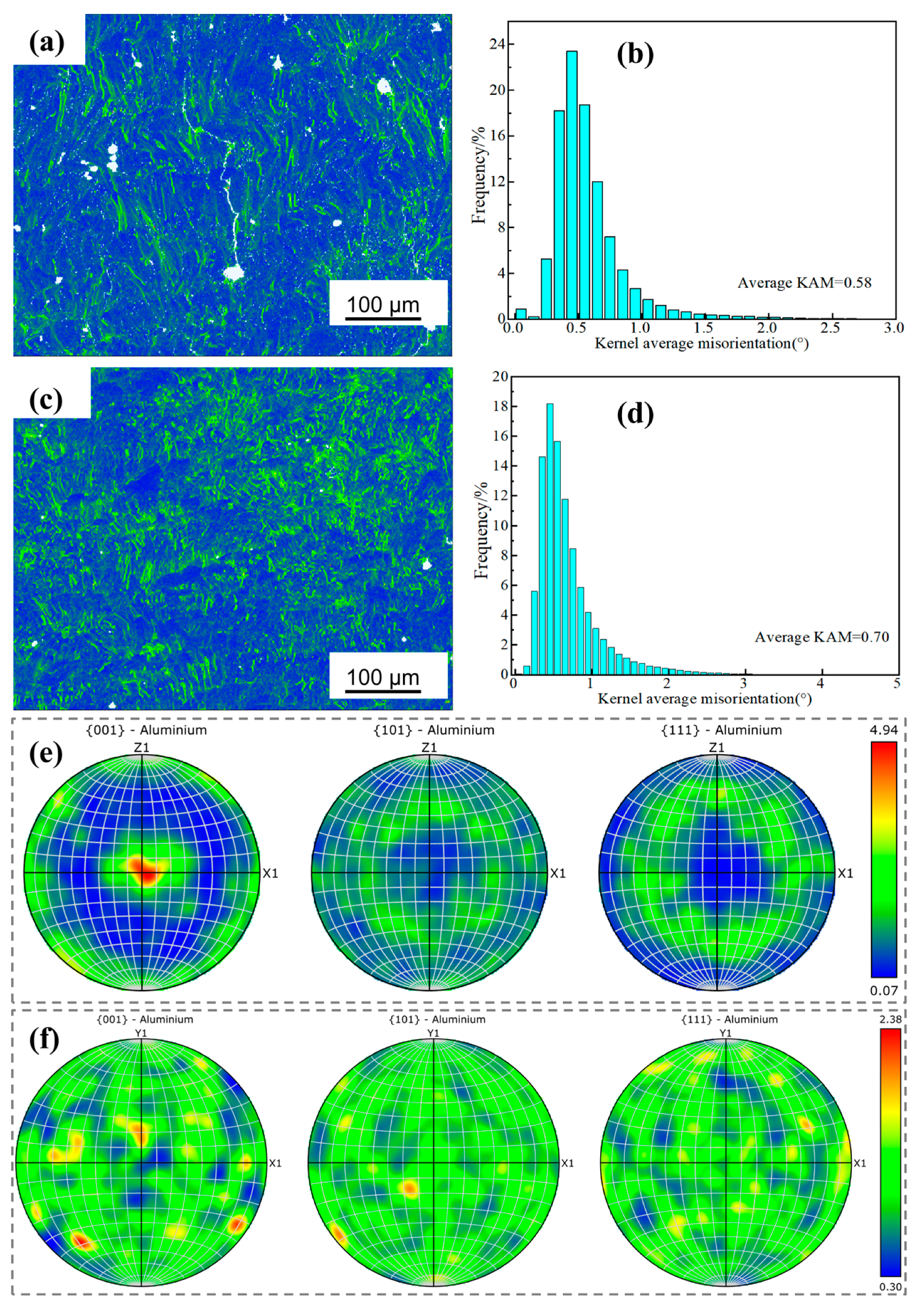
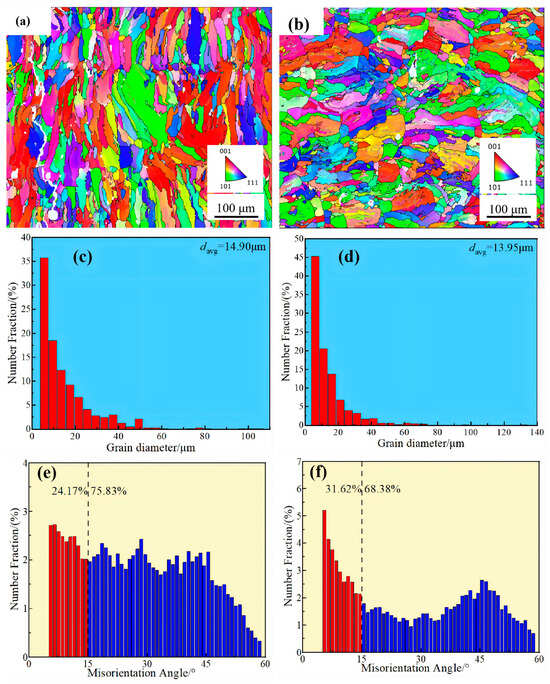
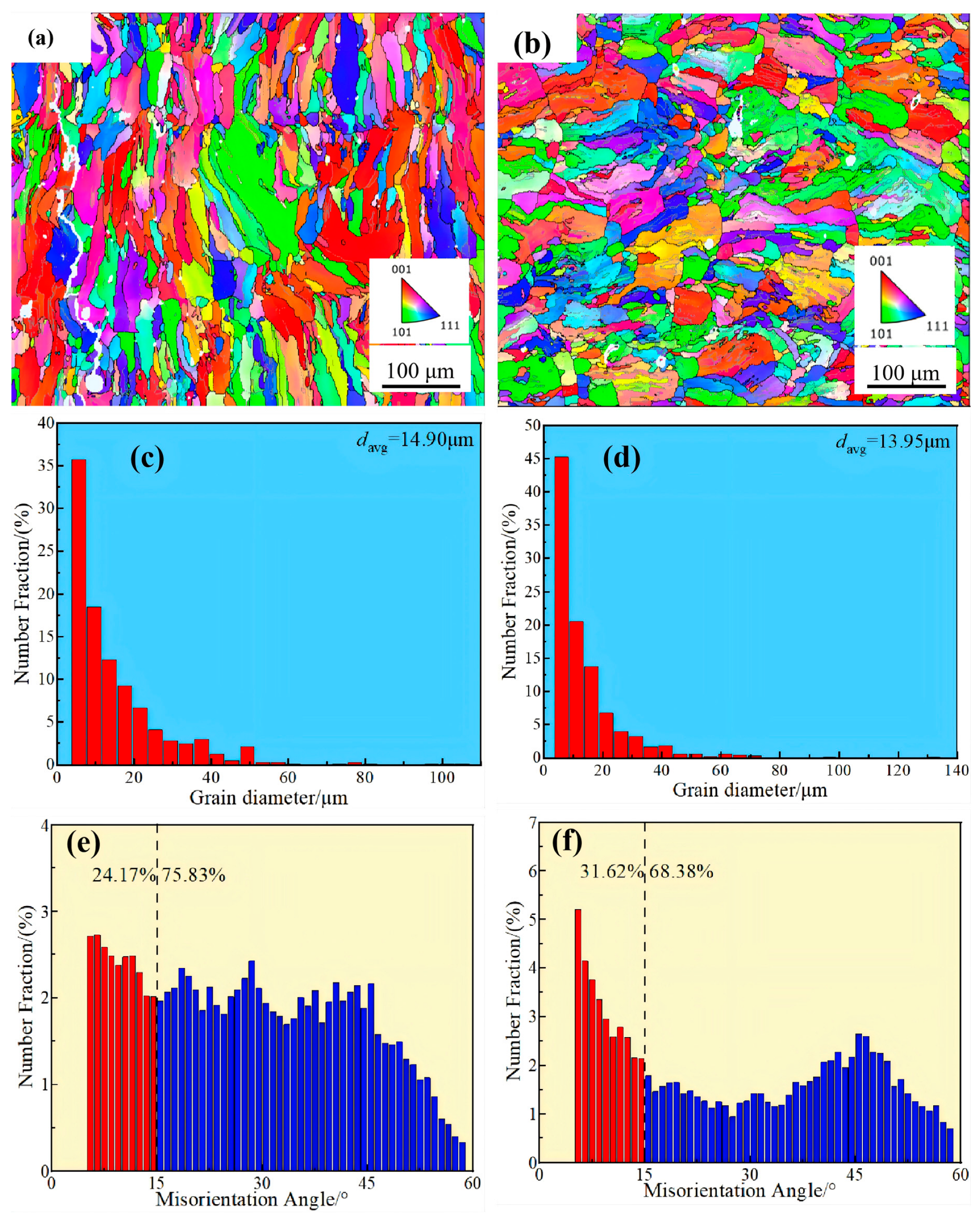
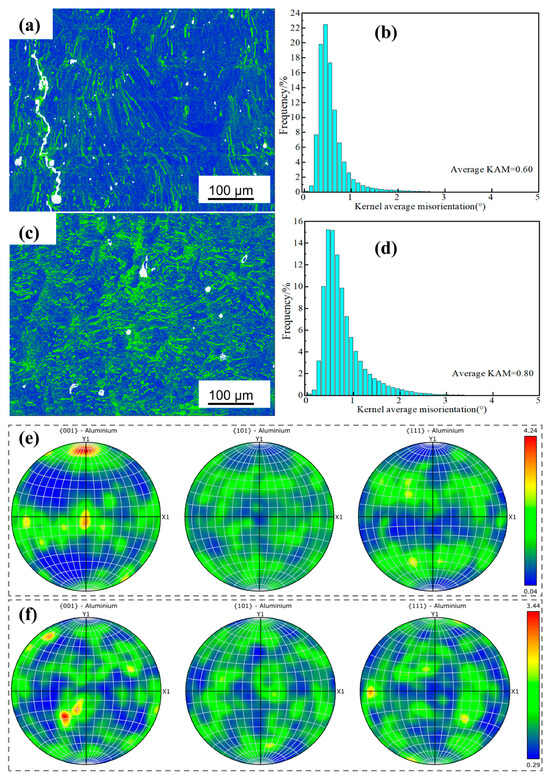
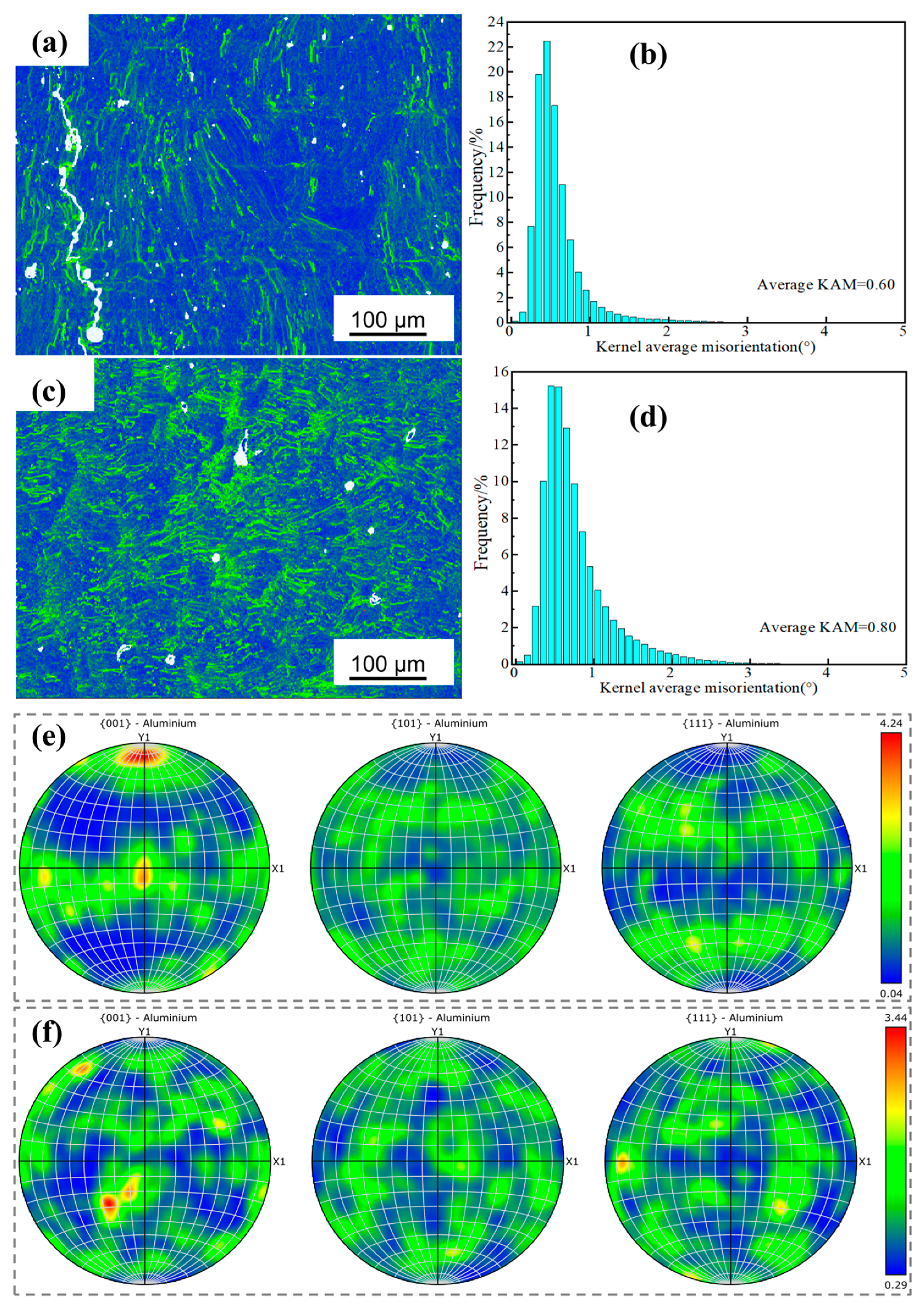
Figure 11, Figure 12, Figure 13 and Figure 14 summarise the EBSD-derived grain structure, boundary character, local misorientation, and texture of LPBF-fabricated AA7075 and the 5 wt.% AlCoCrFeNi2.1-reinforced composite (AA7075-HEA) in the as-built and T6 conditions. Inverse pole figure (IPF) maps (with respect to the build direction) and the corresponding grain-size histograms are presented in Figure 11 and Figure 13 for the as-built and T6 states, respectively. Figure 12 and Figure 14 further compare the kernel average misorientation (KAM) fields/histograms and the {001}, {101}, and {111} pole figures, where the maximum multiple of random distribution (MRD) value is used to indicate the relative texture intensity.
Figure 11.
EBSD grain-structure statistics of the as-built specimens. (a,b) IPF maps (with respect to the build direction) for AA7075 and AA7075-HEA, respectively. (c,d) Grain diameter distributions with the corresponding average grain size (d_avg). (e,f) Grain-boundary misorientation angle distributions; the dashed line at 15° separates low-angle grain boundaries (LAGBs, 2–15°) and high-angle grain boundaries (HAGBs, >15°).
Figure 12.
EBSD local misorientation and texture of the as-built specimens. (a,c) KAM maps for AA7075 and AA7075-HEA. (b,d) KAM histograms with the average KAM value. (e,f) {001}, {101}, and {111} pole figures for AA7075 and AA7075-HEA; the maximum MRD value indicates the relative texture intensity.
Figure 13.
EBSD grain-structure statistics of the T6-treated specimens. (a,b) IPF maps (with respect to the build direction) for AA7075-T6 and AA7075-HEA-T6, respectively. (c,d) Grain diameter distributions with the corresponding average grain size (d_avg). (e,f) Grain-boundary misorientation angle distributions; the dashed line at 15° separates LAGBs (2–15°) and HAGBs (>15°).
Figure 14.
EBSD local misorientation and texture of the T6-treated specimens. (a,c) KAM maps for AA7075-T6 and AA7075-HEA-T6. (b,d) KAM histograms with the average KAM value. (e,f) {001}, {101}, and {111} pole figures for AA7075-T6 and AA7075-HEA-T6; the maximum MRD value indicates the relative texture intensity.
In the as-built condition (Figure 11), AA7075 exhibits a heterogeneous grain morphology with elongated grains and regions of coarser grain packets, consistent with directional solidification and partial epitaxial growth under LPBF. With HEA addition, the grain morphology becomes more fragmented and the grain-size distribution shifts to smaller diameters. The average grain size decreases from 13.44 μm (AA7075) to 11.80 μm (AA7075-HEA), corresponding to an approximate 12% refinement. Although the refinement is moderate in magnitude, the morphological change suggests a reduced tendency for uninterrupted columnar growth and a more dispersed grain structure.
Grain-boundary misorientation statistics in the as-built state (Figure 11e,f) show comparable low-angle grain-boundary (LAGB, 2–15°) fractions for AA7075 (22.2%) and AA7075-HEA (23.0%), indicating that the overall boundary character is not dramatically altered solely by HEA addition at this stage. However, the intragranular orientation gradients are more pronounced in the composite. As shown in Figure 12, the average KAM increases from 0.58° in AA7075 to 0.70° in AA7075-HEA, implying higher local misorientation and a higher density of geometrically necessary dislocations (GNDs). This behaviour is consistent with locally heterogeneous strain fields introduced by a particle–matrix constraint and thermal mismatch during rapid solidification and cyclic reheating.
Texture analysis reveals that HEA addition has a stronger effect on crystallographic orientation distribution than on grain size alone. The as-built AA7075 exhibits a discernible <001> fibre texture tendency, with a maximum MRD of 4.94 (Figure 12e). In contrast, AA7075-HEA shows a substantially weaker texture with maximum MRD reduced to 2.38 (Figure 12f), indicating a more dispersed orientation distribution and disrupted epitaxial growth. This EBSD-based texture weakening is consistent with the XRD peak-intensity trend discussed in Section 3.2.3 and suggests that HEA particles promote orientation diversification during solidification rather than simply refining grains.
After T6 heat treatment (Figure 13 and Figure 14), both materials show a modest increase in average grain size relative to their as-built counterparts, increasing to 14.90 μm for AA7075-T6 and 13.95 μm for AA7075-HEA-T6. The composite retains a slightly smaller average grain size, which is consistent with particle-assisted suppression of grain coarsening, although the magnitude of the difference remains limited at the present reinforcement level.
More importantly, the boundary/substructure metrics indicate a distinct thermal stability of the composite during T6. The LAGB fraction rises to 24.17% in AA7075-T6 but increases more markedly to 31.62% in 7075-HEA-T6 (Figure 13e,f). Similarly, the average KAM is higher in the composite after T6 (0.80°) compared with AA7075-T6 (0.60°) (Figure 14b,d). The concurrent elevation in LAGB fraction and KAM suggests that a larger fraction of subgrain boundaries and intragranular orientation gradients are retained in the reinforced alloy, consistent with particle-stabilised substructure retention and retarded recovery during solution treatment.
The texture weakening induced by HEA addition is also partially preserved after T6. The maximum MRD decreases from 4.24 in AA7075-T6 to 3.44 in AA7075-HEA-T6 (Figure 14e,f), indicating that the composite maintains a more dispersed orientation distribution even after heat treatment. Taken together, EBSD demonstrates that HEA particles not only weaken the as-built texture but also promote the retention of deformation substructure (higher KAM and LAGB fraction) through T6, providing a microstructural basis for enhanced defect tolerance and for more effective translation of microstructural benefits into tensile performance when the as-built defect severity is controlled.
3.3. Microhardness and Its Relationship with Processing Parameters
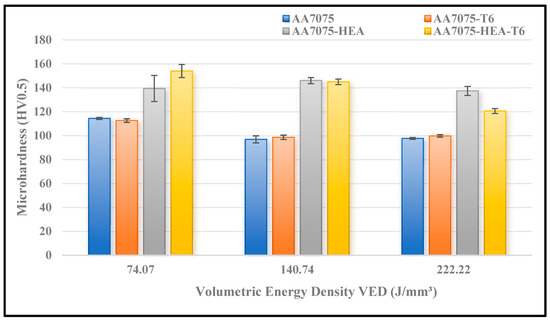
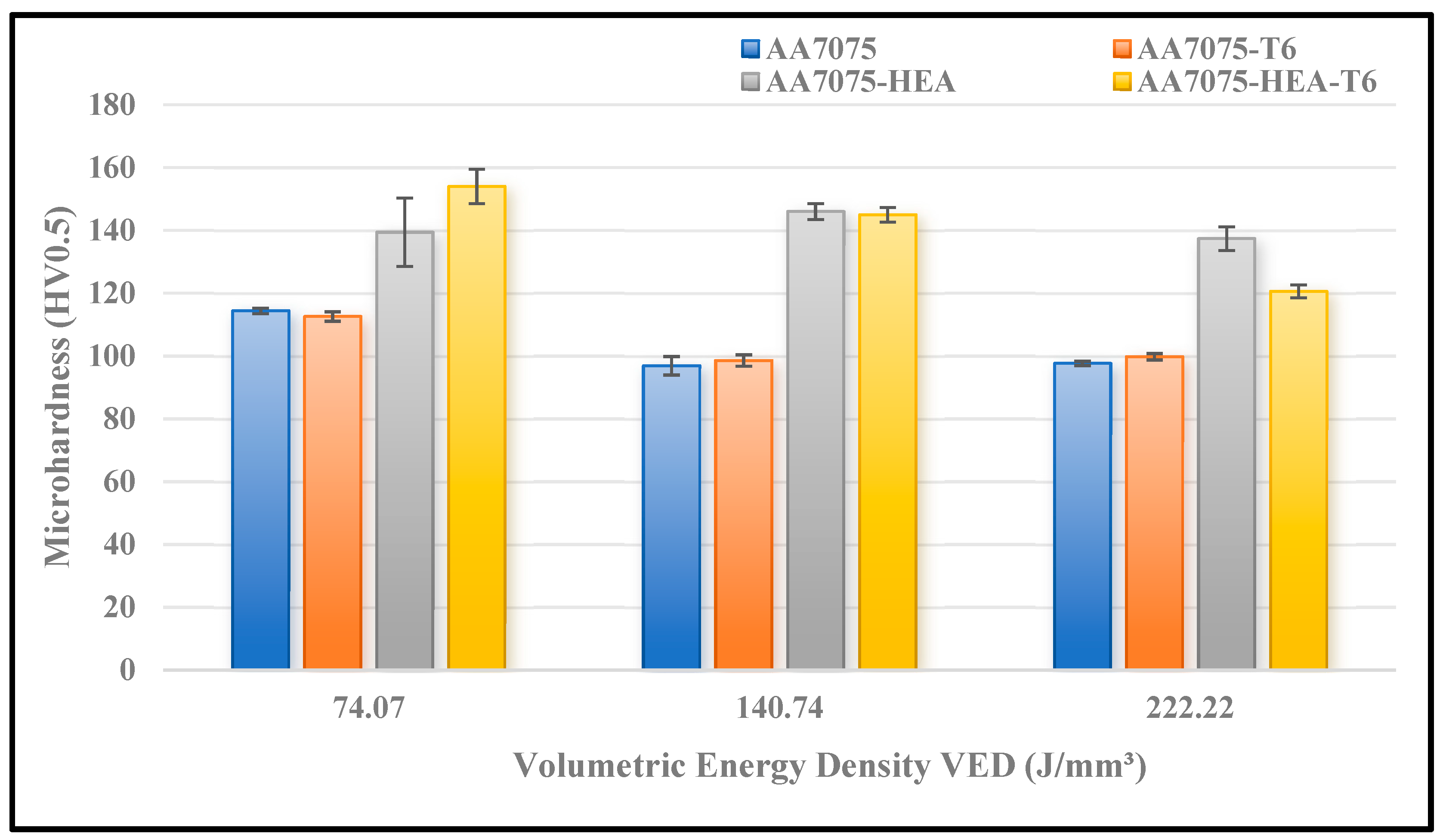
Figure 15 summarises the Vickers microhardness (HV0.5) of AA7075 and AA7075-HEA, together with their T6 heat-treated counterparts, at different volume energy densities. These data highlight the coupled effects of material composition (with or without HEA addition), processing parameters and heat-treatment state. For AA7075 without HEA, the microhardness at the three VED levels is approximately: ~114 HV at 74.07 J·mm−3, ~97 HV at 140.74 J·mm−3 and ~98 HV at 222.22 J·mm−3. Overall, the hardness of AA7075 varies only slightly with energy density, with the low-VED condition exhibiting a marginally higher hardness. This low-VED condition is expected to be associated with a higher cooling rate and a higher solute supersaturation in the matrix, favouring the formation of a high-hardness supersaturated solid solution. In addition, microhardness measurements are intrinsically less sensitive to pores and cracks than tensile properties; local defects exert only a limited influence on the indentation response. Therefore, despite the higher macroscopic defect content in low-VED samples, their hardness can still remain at a relatively high level.
Figure 15.
Vickers microhardness HV0.5 of AA7075 and AA7075-HEA specimens (as-built and T6 heat-treated) as a function of volumetric energy density. The combined effects of HEA reinforcement, LPBF processing parameters and T6 treatment on matrix strengthening are highlighted.
After adding 5 wt.% HEA, the microhardness of AA7075-HEA at all three VED levels is significantly higher than that of AA7075, with typical values of ~139 HV at 74.07 J·mm−3, ~146 HV at 140.74 J·mm−3 and ~137 HV at 222.22 J·mm−3. Compared with AA7075, the addition of HEA increases the hardness by roughly 20–50 HV, with the largest increment observed at VED = 140.74 J·mm−3. This suggests that, under the condition of highest densification and lowest defect content, where HEA-related particles are also most uniformly distributed according to the microstructural observations, multi-component solid-solution strengthening, grain refinement and dispersion strengthening from HEA-derived particles can be most effectively exploited.
The effect of T6 heat treatment on hardness is VED-dependent. At VED = 74.07 J·mm−3, the hardness of AA7075-HEA increases from ~139 HV in the as-built state to ~154 HV after T6, corresponding to an increment of about 10%. At VED = 140.74 J·mm−3, the hardness changes only marginally, whereas at VED = 222.22 J·mm−3, it even shows a slight decrease. These tendencies are likely associated with a combination of partial precipitation and solute redistribution in the matrix together with the relaxation of residual strain and rearrangement of the dislocation structure during heat treatment; however, a detailed quantification of these contributions would require dedicated TEM/DSC characterisation. In contrast, the hardness of AA7075 changes only slightly before and after T6 at all VED levels, indicating that as-built LPBF AA7075 already exhibits a quasi-aged microstructure and that the conventional T6 schedule has only a limited effect on further hardness enhancement.
It should be noted that, in the present system, the trend of microhardness does not strictly follow that of relative density. For AA7075, the low-VED condition exhibits the lowest density but the highest hardness, whereas for AA7075-HEA, the intermediate VED yields both the highest density and the highest hardness. This indicates that, for the additively manufactured 7xxx alloy system studied here, microhardness primarily reflects microstructural strengthening mechanisms (solid solution, grain refinement and secondary phases), while tensile strength is more strongly influenced by macroscopic defects such as pores and cracks. Hardness alone therefore cannot fully predict tensile performance; a comprehensive assessment must also incorporate defect characteristics and fracture behaviour, which is the focus of the next subsection.
3.4. Tensile Properties and Fracture Behaviour
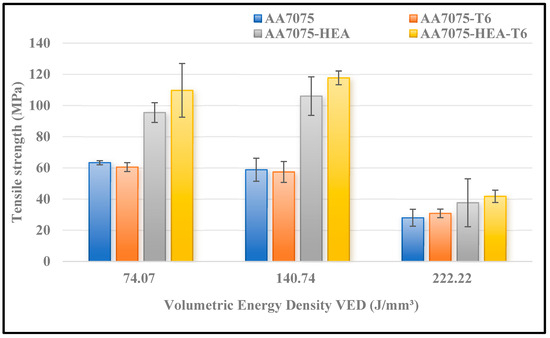
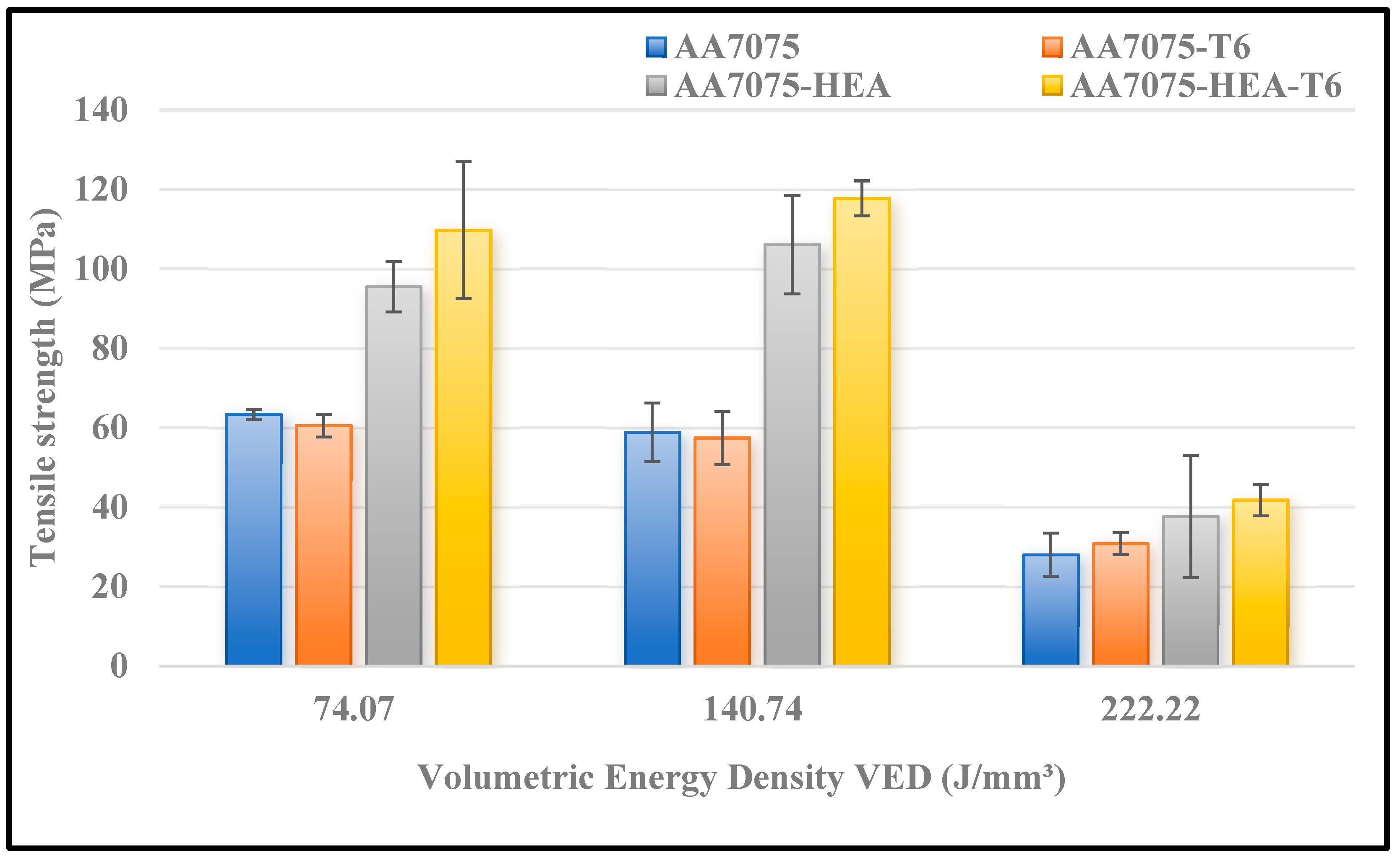
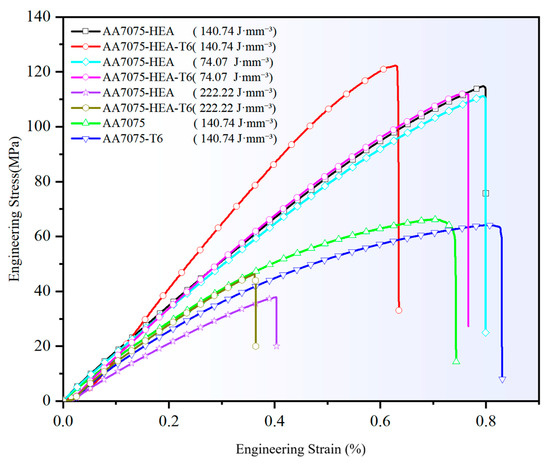
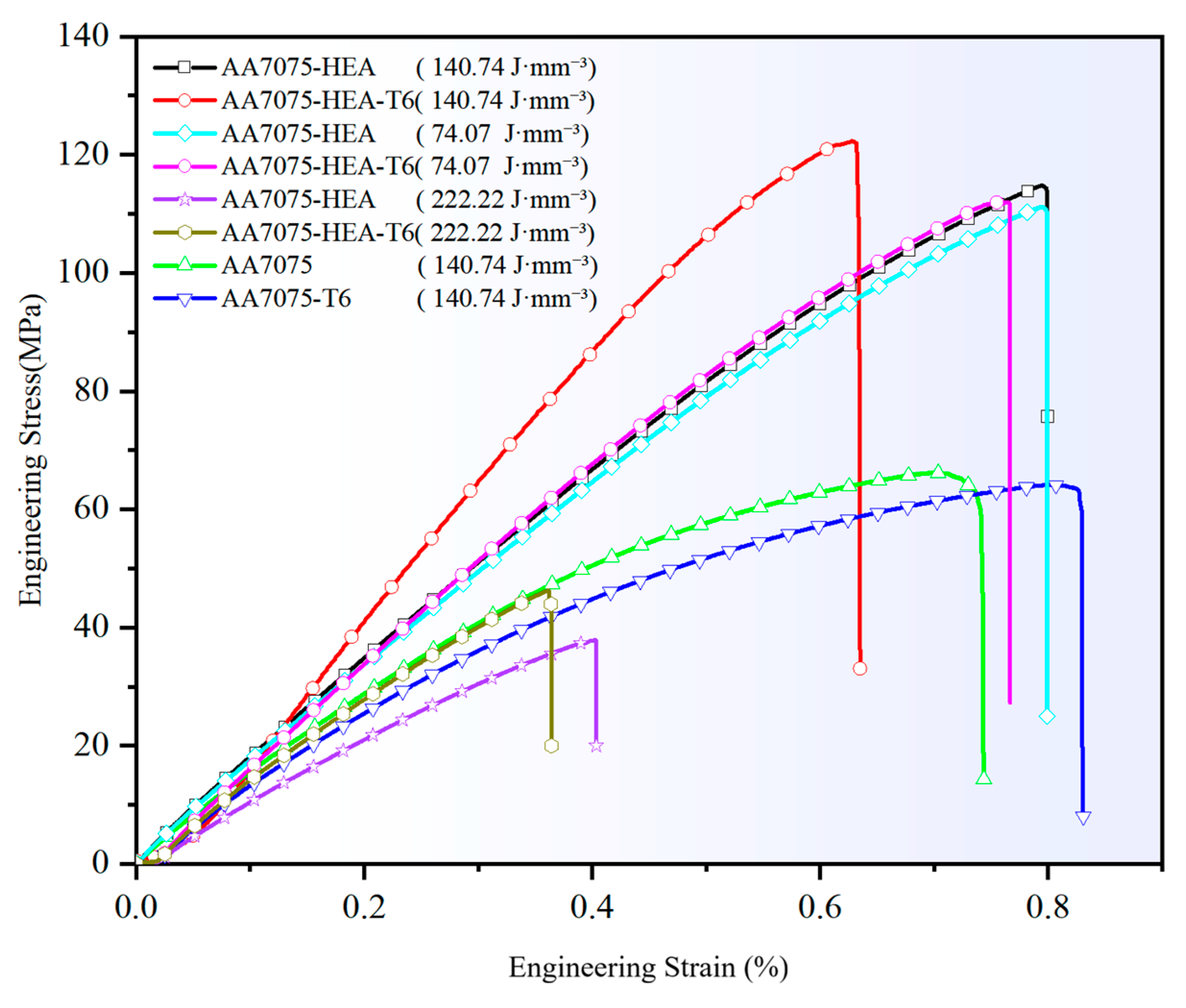
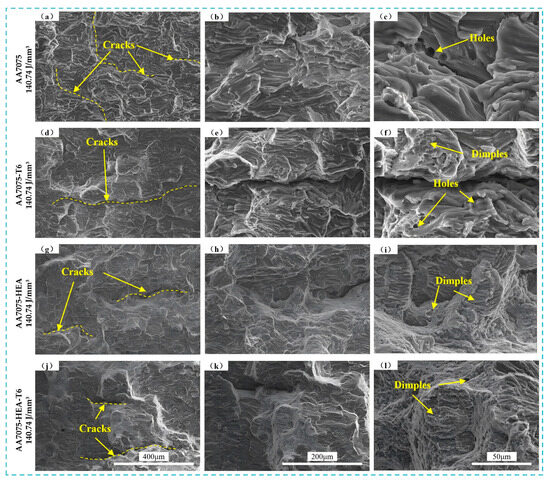
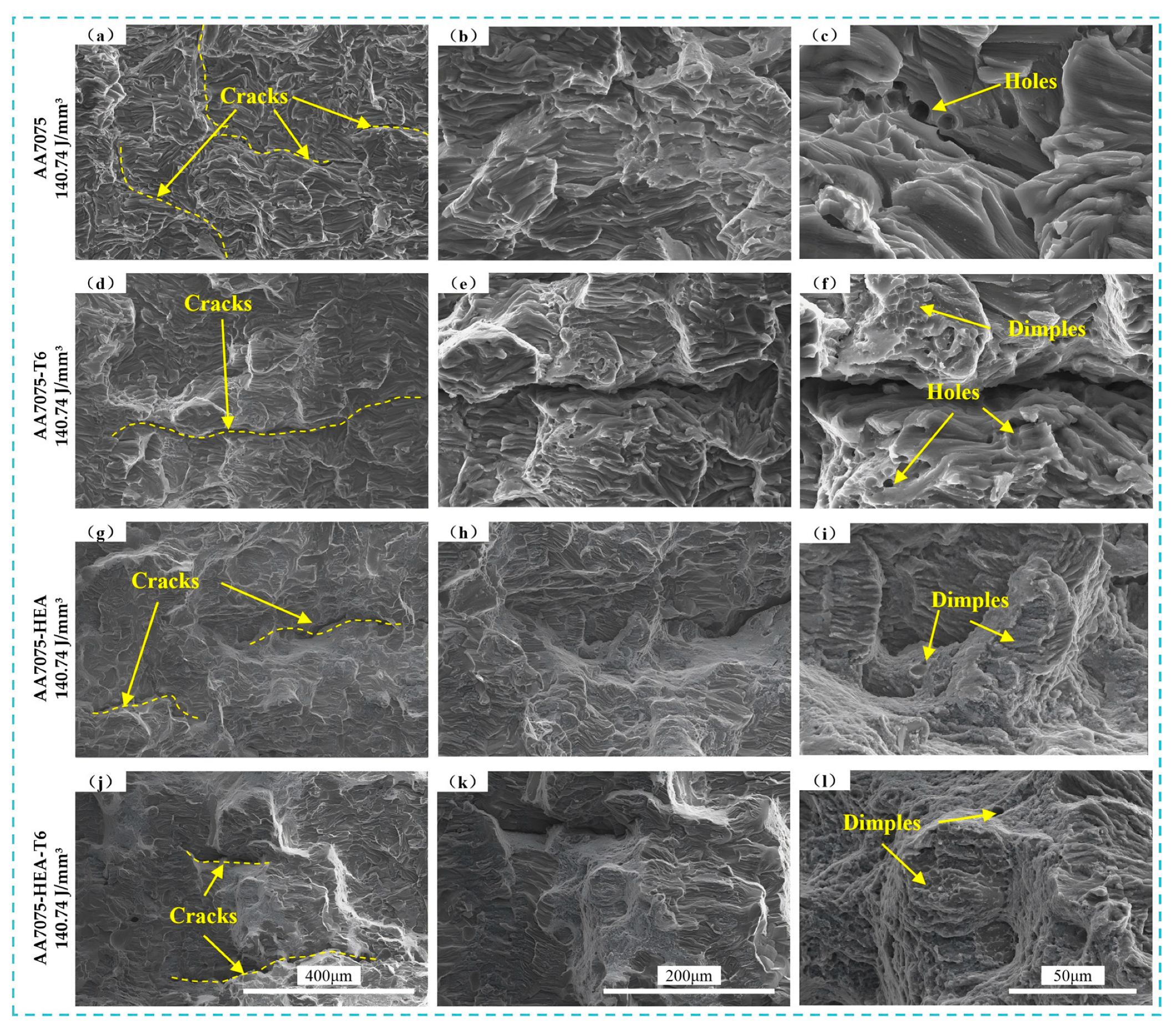
Figure 16 summarises the ultimate tensile strengths of AA7075 and AA7075-HEA, together with their T6-treated counterparts, at different VED levels, while Figure 17 presents representative engineering stress–strain curves and Figure 18 shows typical fracture surfaces. When considered together with the microstructural, densification and hardness results, these data allow the tensile behaviour to be interpreted in terms of both microscopic strengthening mechanisms and macroscopic defect populations.
Figure 16.
Ultimate tensile strength of LPBF-processed AA7075 and AA7075-HEA specimens, with and without T6 treatment, as a function of volumetric energy density. Data points represent averages of repeated tensile tests for each condition; error bars denote standard deviations.
Figure 17.
Representative engineering stress–strain curves of selected AA7075 and AA7075-HEA specimens in the as-built and T6-treated states at different volumetric energy densities. The curves illustrate the combined influence of HEA addition, LPBF parameters and T6 treatment on the strength–ductility balance.
Figure 18.
Representative SEM fracture morphologies of the tensile fracture surfaces for (a–c) as-built AA7075, (d–f) T6-treated AA7075, (g–i) as-built AA7075-HEA, and (j–l) T6-treated AA7075-HEA specimens fabricated at a moderate volumetric energy density (VED = 140.74 J·mm−3). (a,d,g,j) Low-magnification fracture morphologies showing crack features; (b,e,h,k) intermediate-magnification fracture morphologies; (c) high-magnification image of as-built AA7075 showing holes; (f) high-magnification image of T6-treated AA7075 showing dimples and holes; (i,l) high-magnification images of AA7075-HEA specimens showing dimple-dominated ductile fracture features. Overall, the fracture characteristics indicate a transition from crack-dominated brittle behaviour in AA7075 to more ductile dimple-dominated failure after HEA addition and T6 treatment. Scale bars are 400 μm for the left column, 200 μm for the middle column, and 50 μm for the right column.
From the perspective of energy input, the tensile response exhibits a composition-dependent process-window behaviour.
For AA7075 and AA7075-T6, the highest tensile strengths are obtained at the lowest VED of 74.07 J·mm−3. A further increase in energy density to 140.74 J·mm−3 does not improve strength and instead leads to a slight reduction. This behaviour indicates that, in the absence of HEA reinforcement, increasing energy input does not translate into effective strengthening, and the tensile performance remains limited to approximately 60 MPa regardless of moderate densification improvements.
The beneficial effect of HEA addition on tensile properties is clearly VED-dependent. At VED = 74.07 J·mm−3, optical and BSE micrographs show that both AA7075 and AA7075-HEA contain numerous cracks and lack-of-fusion defects. Nevertheless, the ultimate tensile strength of AA7075-HEA is significantly higher than that of AA7075, with an increment of roughly 30 MPa. Microstructural observations reveal that, at the same VED, the average crack length and defect size in AA7075-HEA are slightly reduced compared with AA7075, suggesting that HEA additions partially alleviate crack sensitivity. Furthermore, the uniformly dispersed HEA particles and their derivative phases enhance the yield strength of the matrix and, in the fracture surface, promote crack deflection and finer ductile dimples in their vicinity. These combined effects allow the composite to sustain higher applied stresses even in the presence of substantial defects, leading to the somewhat counterintuitive situation where microstructural cracks remain abundant (Figure 5 and Figure 6) but the macroscopic strength is markedly improved relative to the unreinforced alloy (Figure 17).
At the high VED of 222.22 J·mm−3, both materials contain large, nearly spherical pores whose size and volume fraction greatly exceed those of the HEA particles. These keyhole-type pores dominate stress localisation and early failure during tensile loading, causing pronounced reductions in strength and ductility for all materials (Figure 17). Although AA7075-HEA and AA7075-HEA-T6 still exhibit slightly higher strengths than their AA7075 counterparts under these conditions, the absolute tensile strengths remain relatively low, indicating that the beneficial microstructural effects of HEA cannot fully offset the detrimental influence of macroscopic keyhole porosity.
At the intermediate VED of 140.74 J·mm−3, the combination of HEA addition and optimised processing conditions is most favourable. Here, relative densities are highest and macroscopic defects are least severe (Figure 4 and Figure 5) and HEA-derived phases are fine and homogeneously distributed (Figure 7, Figure 8, Figure 9 and Figure 10), while the microhardness remains high and stable (Figure 16). Under these conditions, the ultimate tensile strengths of AA7075-HEA and AA7075-HEA-T6 are markedly higher than those of AA7075 and AA7075-T6, and the stress–strain curves reveal significantly increased yield and ultimate strengths while maintaining a reasonable level of elongation. This reflects a beneficial strength–ductility balance in which solid-solution, grain-refinement and dispersion strengthening mechanisms associated with HEA can be effectively expressed in the context of a comparatively low defect content(Figure 17).
The influence of T6 heat treatment on tensile properties and fracture behaviour also differs between AA7075 and AA7075-HEA. For AA7075, T6 treatment produces only modest changes in microhardness and, because pores and cracks are not eliminated during heat treatment, leads to limited improvements in tensile strength and negligible changes in elongation. In contrast, the AA7075-HEA system is more responsive to T6 treatment at low and intermediate VED. When high density and uniform HEA dispersion are already achieved during LPBF, T6 further adjusts the precipitate population and releases part of the residual strain, resulting in additional increases in yield and ultimate strengths. At the high VED, however, where failure is dominated by keyhole pores, the strengthening effect of T6 is much less pronounced.
Fractographic observations (Figure 18, shown here for VED = 140.74 J·mm−3 as a representative case) corroborate these trends. In as-built AA7075 (Figure 18a–c), fracture surfaces are characterised by extensive flat regions, coalesced pores and cracks that propagate along pre-existing defects, indicative of defect-controlled brittle or quasi-brittle fracture. After T6 treatment (Figure 18d–f), a greater fraction of the fracture surface exhibits fine dimples, but large pores and initial cracks still act as dominant crack-initiation sites. By contrast, the fracture surfaces of AA7075-HEA (Figure 18g–i) and AA7075-HEA-T6 (Figure 18j–l) contain a higher density of fine dimples and tearing ridges, and local regions show fractured or debonded HEA particles, suggesting that HEA particles and their derivatives play an active role in load transfer and crack-arresting during fracture.
Overall, the AA7075-HEA composite processed at the intermediate VED of 140.74 J·mm−3 exhibits the most attractive combination of properties: high relative density, minimal macroscopic defects, uniformly dispersed and well-bonded HEA phases, and significantly enhanced hardness and tensile strength compared with AA7075, while retaining acceptable ductility. At low VED, HEA additions can partially compensate for crack-related strength losses, whereas at high VED, the prevalence of keyhole-type pores limits the attainable strength and masks much of the microscopic strengthening imparted by HEA. T6 heat treatment provides a synergistic strengthening effect in the AA7075-HEA system, but only when porosity and cracking are adequately controlled during LPBF.
4. Conclusions
In this work, the densification behaviour, microstructural evolution, and mechanical and fracture properties of AlCoCrFeNi2.1 high-entropy alloy (HEA) particle-reinforced 7075 aluminium matrix composites (AA7075-HEA) processed by laser powder bed fusion (LPBF) were systematically investigated as a function of volume energy density (VED) and compared with unreinforced AA7075. The main conclusions are as follows:
- (1)
- VED-dependent densification and defect types: Within the investigated nominal energy-input range (VED = 74.07–222.22 J·mm−3 for the fixed v, h, t and scan strategy employed in this study), relative density exhibits a typical ‘increase–decrease’ trend with increasing VED. Within the evaluation metrics used in this study, the intermediate VED (140.74 J·mm−3) corresponds to the lowest defect severity; low- and high-VED conditions are mainly limited by lack-of-fusion defects and keyhole-type porosity, respectively.
- (2)
- Effect of HEA addition on build quality: Introducing HEA does not degrade the printability of AA7075 and slightly improves densification under low-to-intermediate-VED conditions. Microscopic observations indicate that HEA particles are reasonably well dispersed in the matrix and that particle–matrix interfaces are largely continuous; however, hot cracks/crack-like discontinuities remain observable, with their severity varying with VED.
- (3)
- Microstructure and texture/substructure response: XRD indicates that all conditions are dominated by the α-Al phase. Quantitative EBSD shows that, in the as-built state, HEA reduces the average grain size from 13.44 μm to 11.80 μm and markedly weakens the <001> fibre texture (maximum MRD decreases from 4.94 to 2.38), indicating a disrupted epitaxial-growth tendency and a more dispersed orientation distribution. After T6 treatment, 7075–HEA retains a higher fraction of low-angle grain boundaries (LAGBs, 31.62%) and a higher average KAM (0.80°) than AA7075-T6 (24.17% and 0.60°), reflecting stronger substructure retention that is consistent with a particle-stabilised substructure and retarded recovery.
- (4)
- Mechanical properties governed by the competition between defects and strengthening: 7075–HEA exhibits higher hardness than the unreinforced alloy across the entire VED range, and the tensile response is optimised at the intermediate VED. At low and high VED, tensile performance is limited by premature failure associated with lack-of-fusion defects and by strength loss dominated by keyhole porosity, respectively. Overall, once the as-built defect severity is controlled, the HEA-enabled texture weakening and substructure stability can be more readily translated into improved strength–ductility synergy.
- (5)
- Integrated assessment of optimal processing condition:Considering densification, defect characteristics, microstructural evolution and mechanical performance collectively, the intermediate energy input (VED = 140.74 J·mm−3; P = 190 W under fixed v, h and t) provides the most balanced overall performance for the 7075–HEA system. With this condition, relative density is maximised and defect severity is minimised, allowing HEA-induced grain refinement, texture weakening and substructure stability to be effectively translated into enhanced hardness and tensile strength without significant ductility loss. Moreover, T6 heat treatment provides a synergistic strengthening effect in the AA7075-HEA system, but only when porosity and cracking are adequately suppressed during LPBF fabrication. In contrast, the low VED is limited by lack-of-fusion defects, whereas the high VED is dominated by keyhole porosity; in both cases, defect-controlled failure overrides intrinsic microstructural strengthening and reduces the effectiveness of post-heat treatment.
Author Contributions
Conceptualization, B.S.B.S. and S.G.; Methodology, Q.X., Y.Z., S.Z. and S.G.; Formal analysis, Q.X., Y.Z., S.Z. and S.G.; Investigation, Q.X., S.Z. and S.G.; Resources, B.S.B.S. and M.S.A.; Data curation, Q.X. and S.G.; Writing—original draft preparation, Q.X., S.Z. and S.G.; Writing—review and editing, B.S.B.S., Y.Z., M.S.A. and S.G.; Supervision, B.S.B.S. and M.S.A.; Project administration, B.S.B.S. and M.S.A.; Funding acquisition, Y.Z. and S.G. All authors have read and agreed to the published version of the manuscript.
Funding
This research was supported by the Natural Science Foundation Project of Fujian Province, China (Grant No. 2023J011808 and No. 2023J011798).
Institutional Review Board Statement
Not applicable.
Informed Consent Statement
Not applicable.
Data Availability Statement
The original contributions presented in this study are included in the article. Further inquiries can be directed to the corresponding author.
Conflicts of Interest
The authors declare no conflicts of interest.
References
- Khalid, M.Y.; Umer, R.; Khan, K.A. Review of recent trends and developments in aluminium 7075 alloy and its metal matrix composites (MMCs) for aircraft applications. Results Eng. 2023, 20, 101372. [Google Scholar] [CrossRef] [Scilit]
- Rometsch, P.A.; Zhu, Y.; Wu, X.; Huang, A. Review of high-strength aluminium alloys for additive manufacturing by laser powder bed fusion. Mater. Des. 2022, 219, 110779. [Google Scholar] [CrossRef] [Scilit]
- Yadegari, M.J.; Martucci, A.; Biamino, S.; Ugues, D.; Montanaro, L.; Fino, P.; Lombardi, M. Aluminum Laser Additive Manufacturing: A Review on Challenges and Opportunities Through the Lens of Sustainability. Appl. Sci. 2025, 15, 2221. [Google Scholar] [CrossRef] [Scilit]
- DebRoy, T.; Wei, H.L.; Zuback, J.S.; Mukherjee, T.; Elmer, J.W.; Milewski, J.O.; Beese, A.M.; Wilson-Heid, A.; De, A.; Zhang, W. Additive manufacturing of metallic components—Process, structure and properties. Prog. Mater. Sci. 2018, 92, 112–224. [Google Scholar] [CrossRef] [Scilit]
- Wang, X.; Zhang, D.; Li, A.; Yi, D.; Li, T. A Review on Traditional Processes and Laser Powder Bed Fusion of Aluminum Alloy Microstructures, Mechanical Properties, Costs, and Applications. Materials 2024, 17, 2553. [Google Scholar] [CrossRef] [Scilit] [PubMed]
- Kaufmann, N.; Imran, M.; Wischeropp, T.M.; Emmelmann, C.; Siddique, S.; Walther, F. Influence of Process Parameters on the Quality of Aluminium Alloy EN AW 7075 Using Selective Laser Melting (SLM). Phys. Procedia 2016, 83, 918–926. [Google Scholar] [CrossRef] [Scilit]
- Zhang, X.; Zheng, H.; Yu, W. A review on solidification cracks in high-strength aluminum alloys via laser powder bed fusion. Mater. Today Proc. 2022, 70, 465–469. [Google Scholar] [CrossRef] [Scilit]
- Stopyra, W.; Gruber, K.; Smolina, I.; Kurzynowski, T.; Kuźnicka, B. Laser powder bed fusion of AA7075 alloy: Influence of process parameters on porosity and hot cracking. Addit. Manuf. 2020, 35, 101270. [Google Scholar] [CrossRef] [Scilit]
- Li, G.; Li, X.; Guo, C.; Zhou, Y.; Tan, Q.; Qu, W.; Li, X.; Hu, X.; Zhang, M.-X.; Zhu, Q. Investigation into the effect of energy density on densification, surface roughness and loss of alloying elements of 7075 aluminium alloy processed by laser powder bed fusion. Opt. Laser Technol. 2022, 147, 107621. [Google Scholar] [CrossRef] [Scilit]
- Wimmer, A.; Panzer, H.; Zoeller, C.; Adami, S.; Adams, N.A.; Zaeh, M.F. Experimental and numerical investigations of the hot cracking susceptibility during the powder bed fusion of AA 7075 using a laser beam. Prog. Addit. Manuf. 2024, 9, 1589–1603. [Google Scholar] [CrossRef] [Scilit]
- Martin, A.A.; Calta, N.P.; Khairallah, S.A.; Wang, J.; Depond, P.J.; Fong, A.Y.; Thampy, V.; Guss, G.M.; Kiss, A.M.; Stone, K.H.; et al. Dynamics of pore formation during laser powder bed fusion additive manufacturing. Nat. Commun. 2019, 10, 1987. [Google Scholar] [CrossRef] [Scilit]
- Weingarten, C.; Buchbinder, D.; Pirch, N.; Meiners, W.; Wissenbach, K.; Poprawe, R. Formation and reduction of hydrogen porosity during selective laser melting of AlSi10Mg. J. Mater. Process. Technol. 2015, 221, 112–120. [Google Scholar] [CrossRef] [Scilit]
- Yang, H.; Sha, J.; Zhao, D.; He, F.; Ma, Z.; He, C.; Shi, C.; Zhao, N. Defects control of aluminum alloys and their composites fabricated via laser powder bed fusion: A review. J. Mater. Process. Technol. 2023, 319, 118064. [Google Scholar] [CrossRef] [Scilit]
- Scipioni Bertoli, U.; Wolfer, A.J.; Matthews, M.J.; Delplanque, J.-P.R.; Schoenung, J.M. On the limitations of Volumetric Energy Density as a design parameter for Selective Laser Melting. Mater. Des. 2017, 113, 331–340. [Google Scholar] [CrossRef] [Scilit]
- Yu, W.; Xiao, Z.; Zhang, X.; Sun, Y.; Xue, P.; Tan, S.; Wu, Y.; Zheng, H. Processing and characterization of crack-free 7075 aluminum alloys with elemental Zr modification by laser powder bed fusion. MSAM 2022, 1, 4. [Google Scholar] [CrossRef] [Scilit]
- Yu, W.; Zheng, H.; Xiao, Z. Microstructure of aluminum alloys manufactured via laser powder bed fusion: A review. Mater. Today Proc. 2022, 70, 382–387. [Google Scholar] [CrossRef] [Scilit]
- Martin, J.H.; Yahata, B.D.; Hundley, J.M.; Mayer, J.A.; Schaedler, T.A.; Pollock, T.M. 3D printing of high-strength aluminium alloys. Nature 2017, 549, 365–369. [Google Scholar] [CrossRef] [Scilit] [PubMed]
- Yi, J.; Chang, C.; Yan, X.; Xie, Y.; Liu, Y.; Liu, M.; Zhou, K. A novel hierarchical manufacturing method of the selective laser melted Al 7075 alloy. Mater. Charact. 2022, 191, 112124. [Google Scholar] [CrossRef] [Scilit]
- Yang, T.; Chen, X.; Liu, T.; Wei, H.; Zhu, Z.; Du, Y.; Cao, Y.; Zhang, C.; Liao, W. Crack-free high-strength AA-7075 fabricated by laser powder bed fusion with inoculations of metallic glass powders. Mater. Sci. Eng. A 2024, 891, 145916. [Google Scholar] [CrossRef] [Scilit]
- Liang, Y.; Han, Q.; Sui, Z.; Zhang, Z.; Zhang, H.; Gu, H.; Wu, D.; Wang, L.; Liu, H.; Setchi, R. Laser powder bed fusion of high-strength crack-free Al7075 alloy with the in-situ formation of TiB2/Al3Ti-reinforced phases and nucleation agents. Compos. Part B Eng. 2025, 289, 111940. [Google Scholar] [CrossRef] [Scilit]
- Wang, T.; Zeng, W.; Wang, R.; Xia, T.; Wang, R.; Zhang, D. A novel inoculation strategy combined with mechanical alloying for preparing crack-free 7075 alloy in laser powder bed fusion. J. Alloys Compd. 2025, 1040, 183364. [Google Scholar] [CrossRef] [Scilit]
- Kareem, S.A.; Anaele, J.U.; Aikulola, E.O.; Anamu, U.S.; Koko, A.; Bodunrin, M.O.; Alaneme, K.K. Aluminium matrix composites reinforced with high entropy alloys: A comprehensive review on interfacial reactions, mechanical, corrosion, and tribological characteristics. J. Mater. Res. Technol. 2024, 30, 8161–8186. [Google Scholar] [CrossRef] [Scilit]
- Foroutan, R.; Peighambardoust, S.J.; Boffito, D.C.; Ramavandi, B. Sono-Photocatalytic Activity of Cloisite 30B/ZnO/Ag2O Nanocomposite for the Simultaneous Degradation of Crystal Violet and Methylene Blue Dyes in Aqueous Media. Nanomaterials 2022, 12, 3103. [Google Scholar] [CrossRef] [Scilit] [PubMed]
- Ogunbiyi, O.; Tian, Y.; Akinwande, A.A.; Rominiyi, A.L. AA7075/HEA composites fabricated by microwave sintering: Assessment of the microstructural features and response surface optimization. Intermetallics 2023, 155, 107830. [Google Scholar] [CrossRef] [Scilit]
- Luo, K.; Wu, Y.; Xiong, H.; Zhang, Y.; Kong, C.; Yu, H. Enhanced mechanical properties of aluminum matrix composites reinforced with high-entropy alloy particles via asymmetric cryorolling. Trans. Nonferrous Met. Soc. China 2023, 33, 1988–2000. [Google Scholar] [CrossRef] [Scilit]
- Ananiadis, E.A.; Karantzalis, A.E.; Sfikas, A.K.; Georgatis, E.; Matikas, T.E. Aluminium Matrix Composites Reinforced with AlCrFeMnNi HEA Particulates: Microstructure, Mechanical and Corrosion Properties. Materials 2023, 16, 5491. [Google Scholar] [CrossRef] [Scilit]
- Yang, X.; Zhang, Y. Prediction of high-entropy stabilized solid-solution in multi-component alloys. Mater. Chem. Phys. 2012, 132, 233–238. [Google Scholar] [CrossRef] [Scilit]
- He, L.; Wu, S.; Dong, A.; Tang, H.; Du, D.; Zhu, G.; Sun, B.; Yan, W. Selective laser melting of dense and crack-free AlCoCrFeNi2.1 eutectic high entropy alloy: Synergizing strength and ductility. J. Mater. Sci. Technol. 2022, 117, 133–145. [Google Scholar] [CrossRef] [Scilit]
- Lan, L.; Wang, W.; Cui, Z.; Hao, X.; Qiu, D. Anisotropy study of the microstructure and properties of AlCoCrFeNi2.1 eutectic high entropy alloy additively manufactured by selective laser melting. J. Mater. Sci. Technol. 2022, 129, 228–239. [Google Scholar] [CrossRef] [Scilit]
- Geng, Z.; Chen, C.; Li, R.; Luo, J.; Zhou, K. Composition inhomogeneity reduces cracking susceptibility in additively manufactured AlCoCrFeNi2.1 eutectic high-entropy alloy produced by laser powder bed fusion. Addit. Manuf. 2022, 56, 102941. [Google Scholar] [CrossRef] [Scilit]
- Gan, S.; Xu, Q.; Zhang, Y.; Singh, B.S.B. Effect of AlCoCrFeNi2.1 High-Entropy Alloy Reinforcement on the Densification, Microstructure, and Hot-Cracking Behavior of LPBF-Processed AA7075. Metals 2025, 15, 1193. [Google Scholar] [CrossRef] [Scilit]
- Wang, P.; Li, H.C.; Prashanth, K.G.; Eckert, J.; Scudino, S. Selective laser melting of Al-Zn-Mg-Cu: Heat treatment, microstructure and mechanical properties. J. Alloys Compd. 2017, 707, 287–290. [Google Scholar] [CrossRef] [Scilit]

Disclaimer/Publisher’s Note: The statements, opinions and data contained in all publications are solely those of the individual author(s) and contributor(s) and not of MDPI and/or the editor(s). MDPI and/or the editor(s) disclaim responsibility for any injury to people or property resulting from any ideas, methods, instructions or products referred to in the content. |
© 2026 by the authors. Licensee MDPI, Basel, Switzerland. This article is an open access article distributed under the terms and conditions of the Creative Commons Attribution (CC BY) license.