1. Introduction
In the past few years, dental implants have garnered a lot of popularity as a preferred method for tooth replacement since the primary stability of the implant is essential for the success of implant therapy, as it promotes osseointegration [
1]. It has become necessary to identify innovative materials that expedite bone formation at the implant–bone interface as well as osseointegration to optimise rapid and early loading following the insertion of a dental implant. In 1977, Brånemark et al. described osseointegration as a direct functional and structural relationship that is present between the implant surface and living bone [
2]. Dental implants using titanium (Ti) still require a few physical and chemical surface modifications. When tantalum (Ta), a novel metallic biomaterial, is applied as a coating layer over implants, it significantly enhances the surface characteristics of Ti. Furthermore, when plasma is used to modify the surface of dental implants, several advantages are noted, which include an increase in the surface roughness, changes in surface topography, and increased wettability. Osseointegration is essential for the loading capacity of the implant and its long-term clinical efficacy. Optimal osseointegration depends on attaining primary stability, which is affected by factors like surgical procedures and bone quality and quantity [
3].
In the past few years, modern implant dentistry has been increasingly focusing on peri-implant bone preservation while minimising the treatment time [
4]. One of the most notable discoveries was that changing the surface texture of a machined surface might improve and enhance the success rate and longevity of dental implants, especially in more difficult scenarios or areas [
5]. Although surface modification has led to therapeutic developments, there is a need to improve implant osseointegration and decrease the healing period before loading, particularly in difficult clinical scenarios such as instantaneous implant placement [
6]. It is common practice to alter the surface characteristics of materials using physically and chemically reactive plasma, as it has been performed recently to improve the titanium surface properties [
7].
Osseointegration is influenced by a variety of parameters, such as the implant material, its surface and design; host characteristics; surgical methods; and biomechanical preparation [
8]. Titanium (Ti) exhibits several inherent qualities that make it a good choice for manufacturing dental implants, including a low specific weight, high strength-to-weight ratio, low modulus of elasticity, strong corrosion resistance, easy surface coating, and good biocompatibility [
9]. Surface coating is one of the techniques that is used to accelerate the osseointegration process; it is accomplished by increasing the surface roughness and altering the surface characteristics using chemical and physical techniques [
10]. Plasma discharges with chemical and physical reactivity are frequently employed to alter the surface characteristics of materials [
11]. The primary stability of dental implants is determined by surgical protocols, bone density, and the implant’s macro- and micro-design, in addition to other factors. These parameters improve the main mechanical stability of bone-to-implant contact and thus the implant’s secondary stability [
12].
Tantalum (Ta), which is found on the surface layer of base materials, is a promising material that is used in dentistry and medical fields [
13].
Tantalum oxynitride (TaON) is a well-known material for various fields of application, e.g., optical coatings [
14], photocatalysis [
15], memory devices [
16], hard coatings [
17] and biocompatible coatings [
18] due to its wide band gap, high dielectric constant, excellent hardness and biocompatibility [
19,
20,
21]. Tantalum oxynitrides demonstrate application potential, in general, in a much larger domain, in relation to the corresponding metallic nitrides and oxides [
17,
20,
22]. The excellent corrosion resistance, fracture toughness, and biocompatibility of tantalum-based materials endorse their use as biomaterials in several applications: vascular clips, flexible vascular stents, and dental implants, as well as orthopaedic components, such as acetabular cups, or other trabecular metal components [
23,
24].
In this study, the researchers used plasma sputtering techniques to coat the surface of a CpTi disc with TaON. The surface properties of CpTi were improved and enhanced by coating the disc surface with tantalum nitride (TaN) and tantalum oxide (TaO) using plasma sputtering processes [
25]. Plasma coating is a dry process that is used to create dental implants that are easy to use, inexpensive and environmentally friendly, and that only affects the biomaterial’s external surface, not its intrinsic properties [
26].
In vivo study results showed that the removal torque value of the TaON-coated CpTi screws recorded the highest RTV two weeks post-implantation in diabetic and non-diabetic rabbits, with 34.4 N-cm for the non-diabetic rabbits and 31.2 N-cm for the diabetic rabbits. Meanwhile, non-coated CpTi screws recorded the lowest RTV, with 27.8 N-cm for the non-diabetic rabbits and 23.7 N-cm for the diabetic rabbits, which means an improvement in titanium surface properties after surface coating by tantalum oxynitride, improving the osseointegration process [
8].
This method allows for the physical and chemical modification of surfaces using a wide variety of gases. The objective of this study was to compare the chemical composition, roughness and wettability of non-coated commercially pure titanium (CpTi) disc surfaces with CpTi discs that have been coated with tantalum oxynitride (TaON).
2. Materials and Methods
2.1. Sample Preparation
The Ti discs were designed (5mm thickness × 10 mm diameter) by cutting a CpTi rod using a Taurus® 7000-W6 computer numerical control (CNC) bench nibbling machine. To obtain a scratch-free and smooth surface, all of the samples were abraded consecutively using different grits of silicon carbide (SiC) grinding paper, starting from 80 grit and moving to 120, 230, 400, 600, 800, and 1000 grit. A mirror-polished surface was achieved by polishing and smoothing every disc. The samples were then cleaned using an ultrasonic cleaning apparatus containing 99.8% ethanol.
2.2. Surface Coating with TaON
The direct current (DC) glow discharge reactive plasma sputtering process was modified to implement the sputtering process. Thirteen discs were used as samples, where 12 were coated while one was not coated. The above-coated discs were categorised into four groups that were subjected to different coating times (2, 4, 6, and 8 h). The sputtering technique was initiated by positioning the clean and polished sample in the centre of the anode base. The chamber was evacuated using a high vacuum (≈1 × 10⁻⁵ mbar), which uses rotary and turbo-molecular vacuum pumps to remove all heavy gases, including hydrocarbons. The reactive and bombardment gases were fed to increase the pressure from 2 × 10⁻² to 7 × 10⁻² mbar. Thereafter, a 3.5 kV negatively charged power supply was applied. A Variac® alternating current (AC) power supply was used to gradually apply the voltage during the sputtering process until the necessary energy (applied current and voltage) was attained. The regulator carefully controlled the voltage and mbar until the ideal sputtering glow (purple colour, which is standardised for every gas) was obtained. One of the primary changes that were made to transform a regular plasma system into a sputtering plasma system was to change the position of the electrodes, wherein the cathode was placed in the upper section of the chamber, and the anode electrode was moved to the lower section. The anode and cathode (target) were made using stainless steel discs. With 7 cm between the anode and cathode, the gas was released by the electric field. The bottom of the stainless steel disc that served as the cathode electrode was covered by a Ta sheet that was considered a target. Electrical electrodes and a 5 kV DC power supply were included in the apparatus. The clean and polished samples were positioned in the centre of the anode’s base, which is known as the substrate. All the samples were well cleaned using argon gas (Ar2) by plasma sputtering for 15 min before the TaON coating procedure through applying a bios DC voltage of 100 V onto the anode. The reactive plasma sputtering process used nitrogen (N2) and oxygen (O2) as reactive gases, while Ar2 served as bombardment gas. The chamber was filled with Ar2 until it reached the sputtering pressure of 5 × 10⁻² mbar. Thereafter, reactive gases such as O2 and N2 were forced inside the evacuated chamber, where the researchers monitored the flow rate of gases until the pressure was stabilised at the necessary pressure of 1 × 10⁻² mbar. After the completion of the sputtering process, all samples were stored until the vacuum chamber showed an ambient temperature. The researchers applied different sputtering times during this process (i.e., 2, 4, 6, and 8 h). The researchers excluded a sputtering treatment of 2 h since it showed no change. The Variac® used in this work area (Zenith Electric Co., Wavendon, Milton Keynes, UK) is a variable transformer that acts as an adjustable AC power supply, allowing for step control of AC output voltage from 0 V up to 240. A DC glow discharged colour of Ar/75 and 25% O2 typically was shifted towards violet/lavender. Alternating current (AC) power in glow discharge plasma is primarily used to generate stable, uniform, and non-equilibrium cold plasma, especially for surface treatments.
2.3. X-Ray Diffraction (XRD)-Based Phase Analysis
Surface analysis was used to determine the phase distribution for both non-coated and TaON-coated CpTi discs. This procedure was carried out using copper K-alpha (Cu Kα) radiation and a Shimadzu® 6000 X-ray diffractometer (XRD). The XRD studies were carried out at room temperature in the 2θ range between 30 and 80° with a 0.05° step and a counting time of 5 s per step. The powder diffraction files (PDFs), acquired from the Information Centre for Diffraction Data (ICDD), were used to identify the diffraction peaks and the data indexing.
2.4. Wettability Testing
The non-coated and TaON-coated CpTi discs showed a similar diameter and thickness of 5 × 10 mm. A graduated pipette was used to add an equal volume of normal saline (0.25 mL) to every disc. Then, 25 s after the addition of the first drop, the researchers captured a digital camera image to measure the angle between the CpTi disc’s surface and the saline drop on every non-coated and TaON-coated CpTi disc.
2.5. Scanning Electron Microscopy (SEM)
All the discs were examined using a JEOL® JSM-5600 scanning electron microscope (SEM). Before placing a disc in the SEM chamber, it was prepared in the cross-section and set in the electrically conductive double-faced metal tape, which made the sample holder more electrically conductive. The following parameters were used for SEM analysis: TESCAN® VEGA3® SEM HV: 20 KV, SEM MAG: 7.50 kx, VIEW FIELD: 27.7.
2.6. Energy Dispersive Spectroscopy (EDS)
Energy dispersive spectroscopy is a scientific technique used to analyse the composition materials elementally. The chemical structures and relative concentrations of un-coated CpTi and coated CpTi were assessed; this is a very important technology that supports the final result. The researchers evaluated the chemical structures and relative concentrations on the non-coated and TaON-coated CpTi discs with the help of an energy dispersive spectroscope (EDS). An EDS uses the X-ray spectrum to radiate a concentrated electron beam into a solid sample to yield a localised chemical analysis for every disc. It is theoretically possible to detect all elements ranging from atomic number 4 (Be) to 92 (U). The concentrations of all elements were determined using quantitative analysis. The qualitative analysis and the simple X-ray spectra helped in identifying all elements in the spectrum.
2.7. Atomic Force Microscopy (AFM)
Atomic force microscopes (AFMs) are capable of detecting both conductive and non-conductive surfaces at the atomic scale. The AFM used the scanning technique to generate a high-resolution three-dimensional (3D) image from the sample’s surface. A sharp tip at the cantilever’s end establishes contact with the development’s surface, and piezoelectric scanners are used to move the sample. The tip is subjected to a force that results in deflection, which may be measured by tunnelling capacitive or other optical detector techniques like interferometer lasers. In this process, the standard pressure supplied to the joint is 0 to avoid any surface deformation.
2.8. Rutherford Backscattering (RBS)
Rutherford Backscattering Spectrometry (RBS technique) is used to determine the thickness and stoichiometry of the deposited tantalum oxynitride layers on titanium substrate. The 5SDH pelletron tandem accelerator of 1.7 MV located at the LAEC was used to perform RBS analysis on the samples placed under a normal incident alpha particle beam of 2 MeV energy. A partially depleted PIPS detector from Canberra, with 14 keV of energy resolution and 25 mm2 of active area, detected the backscattered particles of the incident α-particles beam. This detector is located 6 cm away from the target and at a scattered angle of 165° in reference to the beam direction. The ion beam energy was calibrated using the 16O (α, α) resonance at 3.034 MeV.
3. Results
Regarding the Ta-N-O ratio, the atomic percentages were received from the EDS analysis. The surface coating was also analysed by the Rutherford Backscattering technique (RBS) and the TaNO deposited film stoichiometry was measured using SIMNRA v. 7.03 software (0.349613, 0.262685, and 0.387702 respectively); the results show that the ratio is not equal 1:1:1.
Generally, in stoichiometric compound tantalum oxynitride (TaNO), the atomic percentages of the elements are: tantalum (Ta): 33.33 at.%; nitrogen (N): 33.33 at.%; and oxygen (O): 33.33 at.%. However, in the current study, the ratio of atoms are: tantalum (Ta): 4.30 at.%; nitrogen (N): 41.72 at.%; and oxygen (O): 53.95 at.%.
Experimental studies such as those using EDS or XPS often show variations in the nitrogen and oxygen content due to the formation of different phases (e.g., TaON,
\(Ta_{3}N_{5}
\)) or non-stoichiometry [
27].
3.1. Surface Characterisation
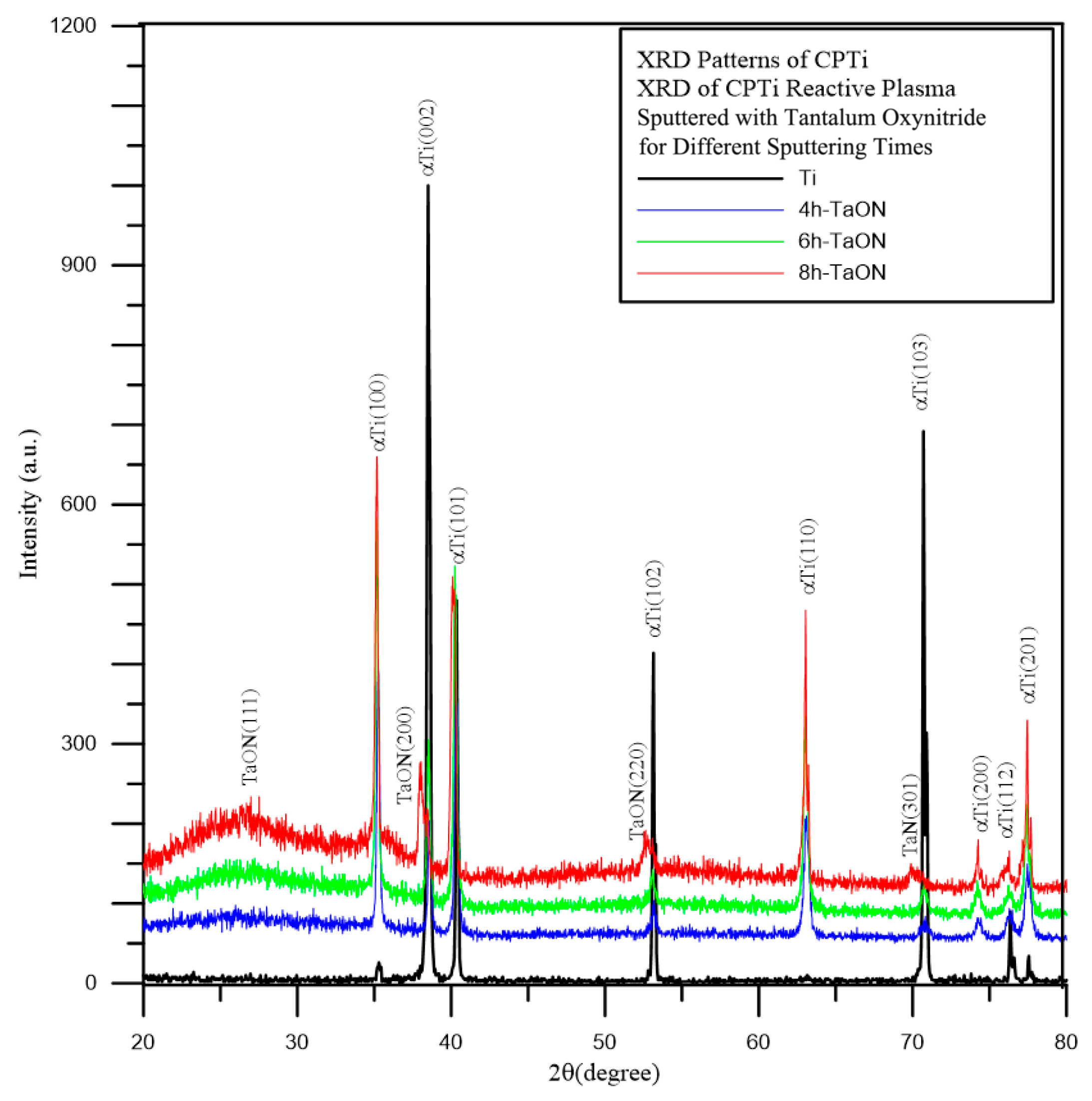
Figure 1 presents the XRD patterns of the non-coated and the TaON-coated (acquired by using the reactive plasma sputtering technique) CpTi discs after sputtering for different durations (4, 6, and 8 h). The powder diffraction files (PDFs) for the hexagonal αTi (JCPDS-ICDD file # 44-1294), TaON (JCPDS-ICDD files # 70-1193 and 20-1235), and TaN (JCPDS-ICDD files # 39-1485) were used to index the patterns. The non-coated CpTi disc’s diffraction peaks aligned with (100), (002), (101), (102), (110), (200), (112), and (201) α-Ti at 2θ values of 35.00°, 38.30°, 40.05°, 52.9°, 62.8°, 70.6°, 76.25°, and 77.35°, respectively. The 4 and 6 h TaON-coated CpTi discs displayed a broad “halo” in the 2θ (20–30°) range, which appears to be caused by the presence of an amorphous structure. This indicates a lack of long-range order, common in sputtered, high-oxygen-content, or lower-temperature amorphous dielectric films. In contrast, the 8 h TaON-coated CpTi discs show a distinct and noticeable shift in CpTi reflections towards the lower two theta (2θ), which indicated the formation of the (021) and (220) TaON peaks at 2θ 38.00° and 52.20° that corresponded to the reflections. This change in the 2θ position of CpTi reflections to the low 2θ highlighted a change in the Ti lattice structure because of an alteration in the surface composition.
3.2. Surface Characterisation via Wettability Testing
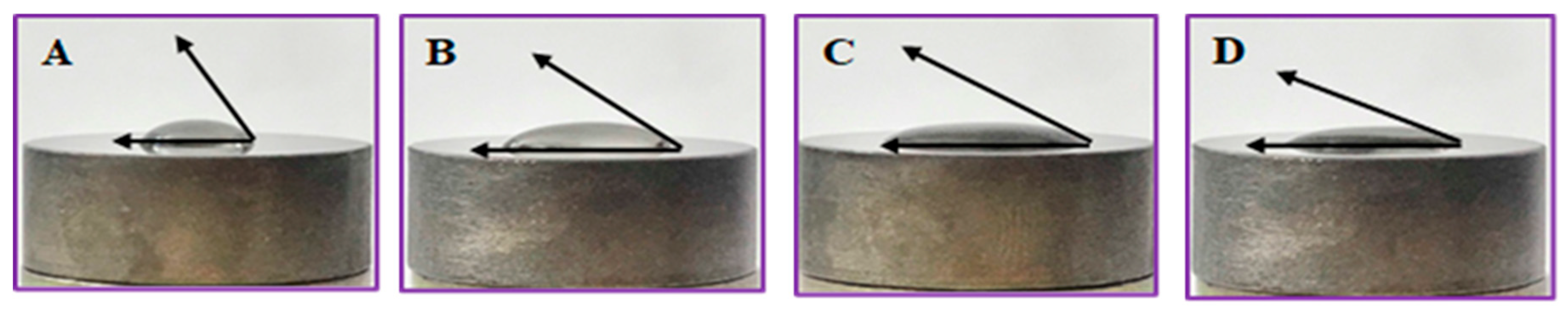
The results of the wettability test showed that the non-coated CpTi discs offered a more hydrophobic surface, with a higher contact angle, than the 8 h TaON-coated CpTi discs (
Figure 2).
3.3. Surface Characterisation via Scanning Electron Microscopy (SEM)
3.3.1. Topography
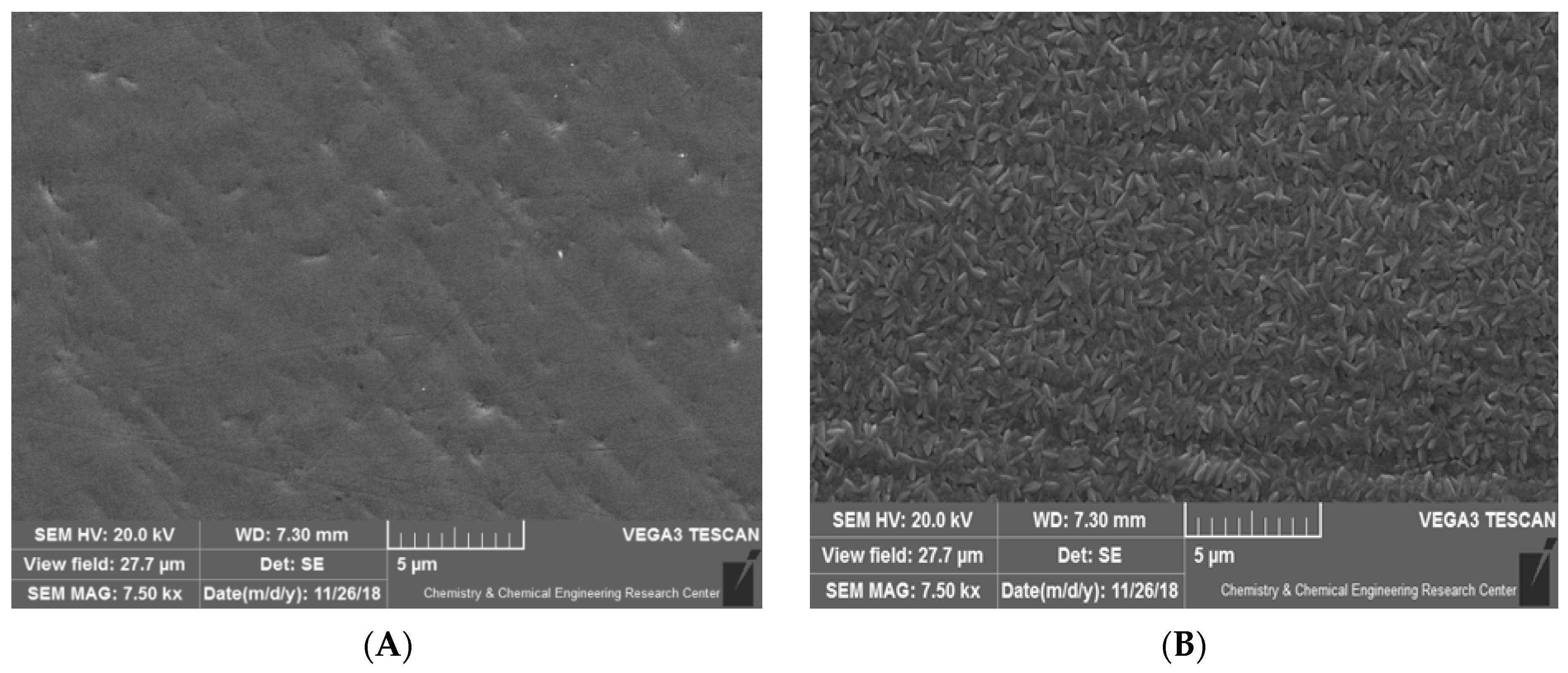
When the non-coated CpTi discs were assessed by the SEM technique (
Figure 3A), the results indicated a relatively flat and smooth surface. On the other hand, when the 8 h TaON-coated CpTi discs were analysed using SEM analysis, their surface morphology revealed the presence of uniformly dispersed and properly arranged nanochips (
Figure 3B).
3.3.2. Energy Dispersive Spectroscopy (EDS)-Based Chemical Composition
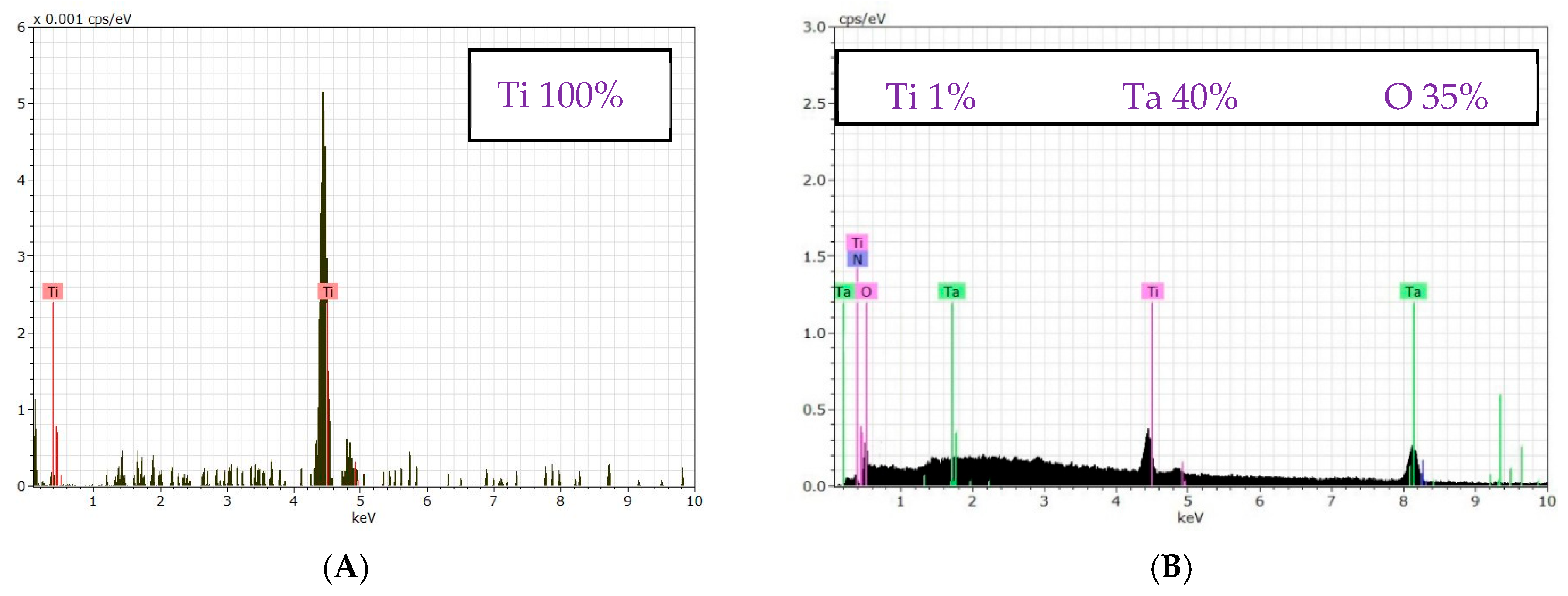
All the discs were evaluated for elemental composition and chemical structure characterisation. The chemical structure analysis of CpTi (
Figure 4A) showed the presence of two Ti peaks with values (kα 4.512 and lα 0.452) like the Ti alpha phase.
As seen in
Figure 4B, the TaON-coated CpTi discs showed the presence of two Ta peaks (lα 8.146 and mα 1.712), two Ti peaks in the alpha phase (kα 4.512 and lα 0.452), one N peak (kα 0.392), and one O peak (kα 0.525). The elemental composition of the non-coated CpTi disc included 100% Ti (
Figure 4A), while the TaON-coated CpTi discs showed the following elemental composition: Ta—40%, Ti—1%, N—23%, and O—35% (
Figure 4B).
4. Discussion
The tantalum, and its derivatives, have better biocompatibility, corrosion resistance and mechanical properties than titanium metal [
28,
29,
30]. Also, it has excellent antibacterial capabilities and osseointegration. At present, tantalum and its derivatives have been successfully used in dental materials [
31]; their antibacterial and osseointegration properties can be further improved through surface treatment, making them ideal implant materials for orthopaedics and dentistry.
After the coating process there was an increase in the hydrophilicity of the titanium disc and an improvement in surface roughness which emerged in the wettability and SEM test, and a formation of new Ta, O, and N on the surface of the titanium which was improved in the EDS test. These important factors are very effective for the titanium surface, especially when applied to dental implant applications even in in vivo research.
Many researchers have used tantalum as a coating material for titanium in dental applications to enhance and accelerate the osseointegration process, either used as porous tantalum or as tantalum oxide. Our research is the first time that TaON has been used as a coating material in the reactive plasma sputtering technique to improve the osseointegration process, which was later confirmed by an in vivo study when the removal torque value increased with coated dental screws.
The results of the in vivo study showed the removal torque value of the TaON-coated CpTi screws post-implantation in non-diabetic and diabetic rabbits, which was done two weeks post-implantation. The highest RTV was recorded for the group with the TaON-coated CpTi screws—with 34.4 N-cm for the non-diabetic rabbits and 31.2 N-cm for the diabetic rabbits—while the group with the non-coated CpTi screws recorded the lowest RTV, with 27.8 N-cm for the non-diabetic rabbits and 23.7 N-cm for the diabetic rabbits, which shows the improvement in titanium surface properties after surface coating by tantalum oxynitride in improving the osseointegration process.
Owing to its unique characteristics, Ta is generally used as a coating material with N2 and O2 to develop a TaON surface on a CpTi disc. In this study, the researchers used a modified plasma sputtering approach, since plasma, with its high efficiency and simple process, can generate controllable and excellent-bond-strength Ta coatings varying from the microscale to the nanoscale [
32]. The reactive plasma sputtering technique is a simple and dry process that does not affect the biomaterial’s inherent properties or the environment [
33]. The surface characteristics of CpTi discs were improved by coating its surface with TaN and TaO using the plasma sputtering technique [
26].
5. Conclusions
The findings indicated that the optimum coating duration was 8 h. A new peak formation was detected in the XRD analysis for the TaON-coated CpTi disc which was not found in the non-coated CpTi disc. In addition, the SEM analysis indicated that the TaON-coated CpTi disc exhibited a more uniform distribution of surface roughness than the uncoated one. The uncoated CpTi discs had reduced wettability compared to the TaON-coated CpTi discs.
An SEM analysis was carried out to examine the surface characteristics and roughness of the 8 h TaON-coated CpTi discs. The results revealed uniformly shaped nanochips that were arranged in the coated layers, and this could be attributed to the variation in the chemical composition of the TaON-coated discs and the non-coated discs. The shape of the nanochips could be attributed to the TaON deposition on the CpTi discs’ surfaces. The results of the XRD analysis of the TaON-coated CpTi discs showed the presence of a new peak in the 2θ direction, owing to the deposition of TaON on the CpTi discs’ surfaces. However, these peaks became more prominent after the TaON-coated CpTi discs were subjected to heat treatment, which indicated the crystalline nature of TaON. Furthermore, the results of the surface wettability test showed that the contact angle between the liquid droplet and the 8 h TaON-coated CpTi discs’ surfaces was smaller than that of the non-coated disc. These findings indicated that the TaON-coated CpTi discs were more hydrophilic than the non-coated CpTi discs. This result could be attributed to a higher affinity of Ta, N2, and O2 atoms to water+.
This study improved the change in chemical composition, roughness and wettability of CpTi discs that have been coated with tantalum oxynitride film (TaON) via a modified plasma sputtering coating technique. One of the important changes was to increase the hydrophilicity of the titanium surface coated by TaON film, which also improved later in the in vivo study done on rabbits, through increasing and accelerating the osseointegration process and torque removal value for coated dental implants with TaON film.
This study used a new technique for the deposition of tantalum oxynitride film on commercial pure titanium discs in the modified reactive plasma sputtering technique, which gives the titanium surface texture better properties. The mean target of the work is to enhance bone formation around the CPTi dental implants with different surface coatings, including Ta oxynitride, for improving the osseointegration process.