Enhancement of Flame Resistance of Cotton Fabrics Using Multilayer Biomaterial Coatings of Chitosan and Sodium Alginate



Highlights
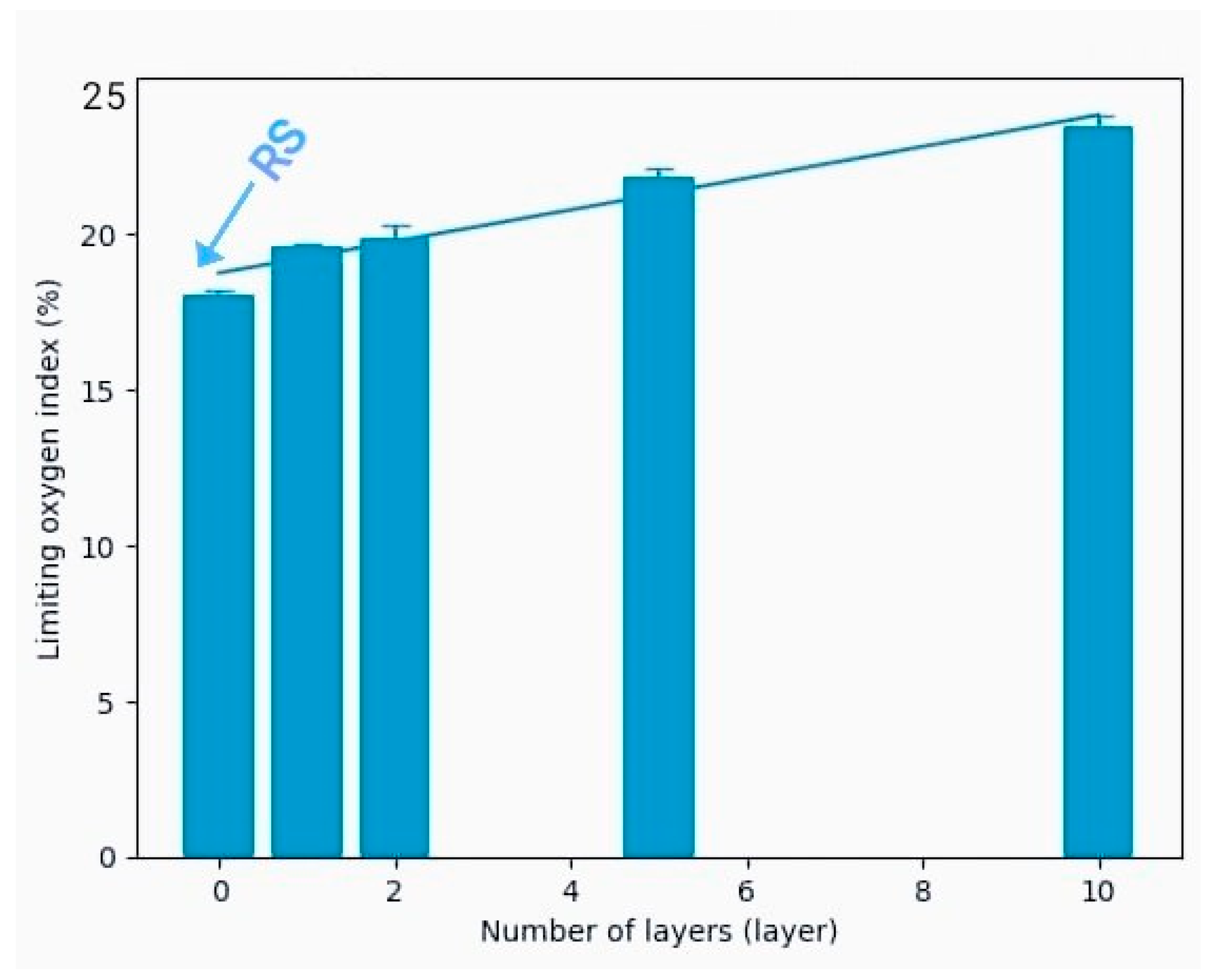
- Chitosan/sodium alginate multilayer biocoatings increase cotton flame resistance, with the LOI for combustion reaching 23.47%.
- Ten-bilayer samples pass the vertical flame test with a 9.72 cm char length and zero burning droplets, representing a 68% char length reduction and complete drip elimination.
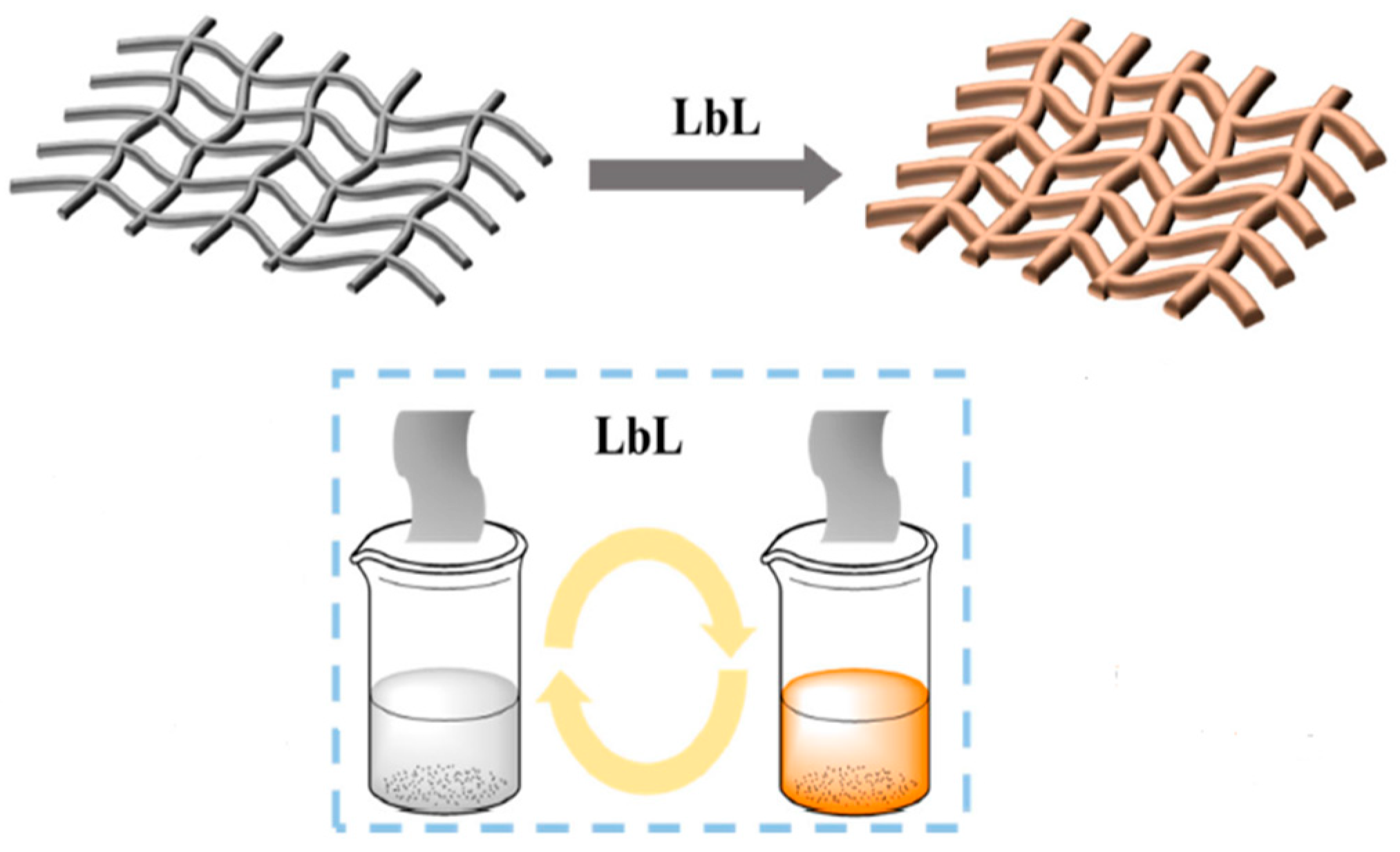
- Layer by layer, the assembly creates cohesive and protective carbon barriers that may reduce the likelihood of flammable gas formation due to heat feedback from the combustion zone.
- Biobased coatings provide sustainable environmental alternatives to synthetic chemical flame retardants commonly used in protective textiles and industrial applications.
- Scalable coating technology demonstrates strong potential for the commercial production of high-performance flame-resistant fabrics for safety garments and protective textiles.
Abstract
1. Introduction
2. Materials and Methods
2.1. Materials
2.2. Equipment
2.3. Methods
- is the weight of the cotton sample after coating it with a specified number of double layers;
- is the weight of the cotton sample (reference/control sample) before the coating process.
3. Results
3.1. Vertical Flame Test
3.1.1. After-Flame Time in the Vertical Flame Test
3.1.2. After-Glow Time in the Vertical Flame Test
3.1.3. Char Length in the Vertical Flame Test
3.1.4. Dripping in the Vertical Flame Test
3.1.5. Cotton Ignition in the Vertical Flame Test
3.2. Limiting Oxygen Index (LOI) Test
Relationship Between Number of Layers and Limiting Oxygen Index
3.3. Amount of Coating Added to Sample
4. Limitations of the Study
5. Discussion
6. Conclusions
Author Contributions
Funding
Institutional Review Board Statement
Informed Consent Statement
Data Availability Statement
Conflicts of Interest
References
- Candlin, J.P. Polymeric Materials: Composition, Uses and Applications. Compr. Anal. Chem. 2008, 53, 65–119. [Google Scholar]
- Ghosh, A.K.; Dwivedi, M. Advantages and Applications of Polymeric Composites. In Processability of Polymeric Composites; Springer: New Delhi, India, 2020; pp. 29–57. [Google Scholar]
- Rahman, M.R.; Taib, N.A.A.B.; Bakri, M.K.B.; Taib, S.N.L. Importance of Sustainable Polymers for Modern Society and Development. In Advances in Sustainable Polymer Composites; Woodhead Publishing: Cambridge, UK, 2021; pp. 1–35. [Google Scholar]
- Chen, Q.; Yang, C.Q.; Zhao, T. Heat Release Properties and Flammability of the Nylon/Cotton Blend Fabric Treated with a Crosslinkable Organophosphorus Flame Retardant System. J. Anal. Appl. Pyrolysis 2014, 110, 205–212. [Google Scholar] [CrossRef] [Scilit]
- Shen, R.; Fan, T.; Quan, Y.; Ma, R.; Zhang, Z.; Li, Y.; Wang, Q. Thermal Stability and Flammability of Cotton Fabric with TiO2 Coatings Based on Biomineralization. Mater. Chem. Phys. 2022, 282, 125986. [Google Scholar] [CrossRef] [Scilit]
- Pan, H.; Song, L.; Ma, L.; Pan, Y.; Liew, K.M.; Hu, Y. Layer-by-Layer Assembled Thin Films Based on Fully Bio-Based Polysaccharides: Chitosan and Phosphorylated Cellulose for Flame-Retardant Cotton Fabric. Cellulose 2014, 21, 2995–3006. [Google Scholar] [CrossRef] [Scilit]
- Li, P.; Liu, C.; Xu, Y.J.; Zhu, P. Novel and Eco-Friendly Flame-Retardant Cotton Fabrics with Lignosulfonate and Chitosan Through LbL: Flame Retardancy, Smoke Suppression and Flame-Retardant Mechanism. Polym. Degrad. Stab. 2020, 181, 109302. [Google Scholar] [CrossRef] [Scilit]
- Chen, H.Q.; Yan, C. The Thermal Degradation Property and Flame-Retardant Mechanism of Coated Knitted Cotton Fabric with Chitosan and APP by LBL Assembly. J. Therm. Anal. Calorim. 2019, 140, 591–602. [Google Scholar] [CrossRef] [Scilit]
- Li, P.; Wang, B.; Liu, Y.Y.; Xu, Y.J.; Jiang, Z.M.; Dong, C.H.; Liu, Y.; Zhu, P. Fully Bio-Based Coating from Chitosan and Phytate for Fire-Safety and Antibacterial Cotton Fabrics. Carbohydr. Polym. 2020, 237, 116173. [Google Scholar] [CrossRef] [Scilit] [PubMed]
- Zhang, Z.; Ma, Z.; Leng, Q.; Wang, Y. Eco-Friendly Flame Retardant Coating Deposited on Cotton Fabrics from Bio-Based Chitosan, Phytic Acid and Divalent Metal Ions. Int. J. Biol. Macromol. 2019, 140, 303–310. [Google Scholar] [CrossRef] [Scilit] [PubMed]
- Fang, Y.; Sun, W.; Li, J.; Liu, H.; Liu, X. Eco-Friendly Flame Retardant and Dripping-Resistant of Polyester/Cotton Blend Fabrics Through Layer-by-Layer Assembly Fully Bio-Based Chitosan/Phytic Acid Coating. Int. J. Biol. Macromol. 2021, 175, 140–146. [Google Scholar] [CrossRef] [Scilit] [PubMed]
- Cao, X.; Huang, Y.Y.; Tian, X.Y.; Ni, Y.P.; Wang, Y.Z. Facile and Atom-Economical Synthesis of Highly Efficient Chitosan-Based Flame Retardants Towards Fire-Retarding and Antibacterial Multifunctional Coatings on Cotton Fabrics. Int. J. Biol. Macromol. 2025, 300, 140205. [Google Scholar] [CrossRef] [Scilit] [PubMed]
- Yu, C. Natural Textile Fibres: Vegetable Fibres. In Textiles and Fashion; Woodhead Publishing: Cambridge, UK, 2015; pp. 29–56. [Google Scholar]
- Zhou, Q.; Lan, W.; Xie, J. Phenolic Acid-Chitosan Derivative: An Effective Strategy to Cope with Food Preservation Problems. Int. J. Biol. Macromol. 2024, 254, 127917. [Google Scholar] [CrossRef] [Scilit] [PubMed]
- Shaikh, M.A.J.; Gupta, G.; Goyal, A.; Dua, K. Sodium Alginate-Based Drug Delivery for Diabetes Management: A Review. Int. J. Biol. Macromol. 2023, 236, 123986. [Google Scholar] [CrossRef] [Scilit] [PubMed]
- Pravasi, S.D. Acetic Acid. In Encyclopedia of Toxicology, 3rd ed.; Academic Press (Elsevier): London, UK, 2014; pp. 33–35. [Google Scholar]
- MacLean-Blevins, M.T. Material Selection Which Plastic to Use. In Designing Successful Products with Plastics; William Andrew (Elsevier): Norwich, NY, USA, 2018; pp. 19–50. [Google Scholar]
- Schinazi, G.; Price, E.J.; Schiraldi, D.A. Fire Testing Methods of Bio-Based Flame-Retardant Polymeric Materials. In Bio-Based Flame-Retardant Technology for Polymeric Materials; Elsevier: Amsterdam, The Netherlands, 2022; pp. 61–95. [Google Scholar]
- Krevelen, D.W.V.; Rybachenko, R.; Nijenhuis, K.T. Product Properties (II): Environmental Behavior and Failure. In Properties of Polymers, 4th ed.; Elsevier: Amsterdam, The Netherlands, 2009; pp. 847–873. [Google Scholar]
- Benzarti, K.; Colin, X. Understanding the Durability of Advanced Fibre-Reinforced Polymer (FRP) Composites for Structural Applications. In Advanced Fibre-Reinforced Polymer (FRP) Composites for Structural Applications; Philadelphia, PA, USA, 2013; pp. 361–439. [Google Scholar]
- Qiu, X.; Li, Z.; Li, X.; Zhang, Z. Flame Retardant Coatings Prepared Using Layer-by-Layer Assembly: A Review. Chem. Eng. J. 2018, 334, 108–122. [Google Scholar] [CrossRef] [Scilit]
- dos Santos, V.L.; Araújo, R.C.; Lisboa, E.S.; Severino, P. Layer-by-Layer Assembly: A Versatile Approach for Tailored Biomedical Films and Drug Delivery. J. Drug Deliv. Sci. Technol. 2023, 91, 105243. [Google Scholar] [CrossRef] [Scilit]
- Hu, Y.; Nabipour, H.; Wang, X. Bio-Based Flame-Retardant Technology for Polymeric Materials; Elsevier: Amsterdam, The Netherlands, 2022. [Google Scholar]
- Zhao, B.; Grulan, C. Environmental Benign, Water-Based Covalent Polymer Network for Flame Retardant Cotton. Cellulose 2021, 28, 5855–5866. [Google Scholar] [CrossRef] [Scilit]



| Material | Purity | Trade Name/Supplier | Specifications |
|---|---|---|---|
| Cotton fabric | 100% woven | Lattakia Textile Company | Turbine-woven |
| Acetic acid | 100% | Acetic acid (glacial) | Concentrated, reagent-grade |
| Deionized water | 100% | Rahmoun/Solar Power | DI water, mineral-free |
| Chitosan | ~90% | Commercial powder | Deacetylation rate ~90% |
| Sodium alginate | Commercial | Powder form | MW: 32–400 g/mol |
| Sample | After-Flame Time (s) | After-Glow Time (s) | Char Length (cm) | Dripping |
|---|---|---|---|---|
| Uncoated | 9 ± 0.16 | 6.06 ± 0.09 | 30 ± 0 | Light |
| Sample coated with one bilayer | 15 ± 0.16 | 15.12 ± 0.13 | 30 ± 0 | None |
| Sample coated with two bilayers | 11.4 ± 0.16 | 0 ± 0 | 30 ± 0 | None |
| Sample coated with five bilayers | 9.12 ± 0.18 | 0 ± 0 | 30 ± 0 | None |
| Sample coated with ten bilayers | 6.9 ± 0.15 | 0 ± 0 | 9.72 ± 0.08 | None |
| Sample | Cotton Ignition |
|---|---|
| Uncoated | Yes |
| Sample coated with one bilayer | No |
| Sample coated with two bilayers | No |
| Sample coated with five bilayers | No |
| Sample coated with ten bilayers | No |
| Sample | Limiting Oxygen Index % |
|---|---|
| Uncoated | 18.04 ± 0.114 |
| Sample coated with one bilayer | 19.594 ± 0.053 |
| Sample coated with two bilayers | 19.87 ± 0.37 |
| Sample coated with five bilayers | 21.83 ± 0.24 |
| Sample coated with ten bilayers | 23.47 ± 0.30 |
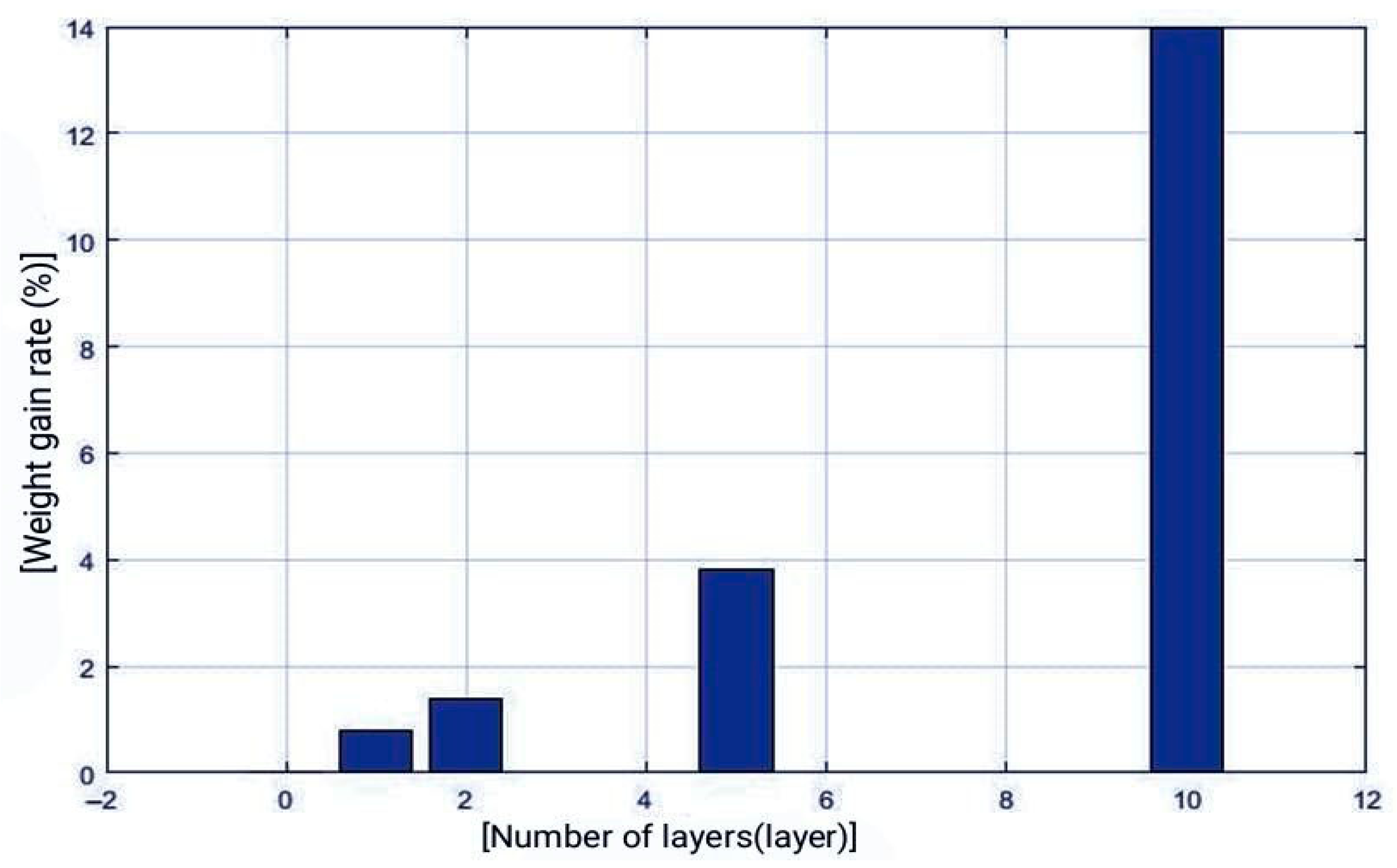
| Sample | Addition Amount % |
|---|---|
| Uncoated | - |
| Sample coated with one bilayer | 0.846 ± 0.040% |
| Sample coated with two bilayers | 1.3 ± 0.16% |
| Sample coated with five bilayers | 3.88 ± 0.16% |
| Sample coated with ten bilayers | 13.98 ± 0.16% |
Disclaimer/Publisher’s Note: The statements, opinions and data contained in all publications are solely those of the individual author(s) and contributor(s) and not of MDPI and/or the editor(s). MDPI and/or the editor(s) disclaim responsibility for any injury to people or property resulting from any ideas, methods, instructions or products referred to in the content. |
© 2026 by the authors. Licensee MDPI, Basel, Switzerland. This article is an open access article distributed under the terms and conditions of the Creative Commons Attribution (CC BY) license.
Share and Cite
Nazha, H.M.; Osman, T.; Shash, M.; Mohammed, L. Enhancement of Flame Resistance of Cotton Fabrics Using Multilayer Biomaterial Coatings of Chitosan and Sodium Alginate. Coatings 2026, 16, 311. https://doi.org/10.3390/coatings16030311
Nazha HM, Osman T, Shash M, Mohammed L. Enhancement of Flame Resistance of Cotton Fabrics Using Multilayer Biomaterial Coatings of Chitosan and Sodium Alginate. Coatings. 2026; 16(3):311. https://doi.org/10.3390/coatings16030311
Chicago/Turabian StyleNazha, Hasan Mhd, Thaer Osman, Mayssa Shash, and Layal Mohammed. 2026. "Enhancement of Flame Resistance of Cotton Fabrics Using Multilayer Biomaterial Coatings of Chitosan and Sodium Alginate" Coatings 16, no. 3: 311. https://doi.org/10.3390/coatings16030311
APA StyleNazha, H. M., Osman, T., Shash, M., & Mohammed, L. (2026). Enhancement of Flame Resistance of Cotton Fabrics Using Multilayer Biomaterial Coatings of Chitosan and Sodium Alginate. Coatings, 16(3), 311. https://doi.org/10.3390/coatings16030311