Article

A Novel Interface Between Ti6Al4V and Organic Tissue Through a TiOxCy Organometallic Multilayer Coating


1
Namur Institute of Structured Matter (NISM), University of Namur, Rue de Bruxelles 61, 5000 Namur, Belgium
2
Laboratory for Biomaterials and Bioengineering, Department of Min-Met-Materials Engineering, University Hospital Research Center, Laval University, Quebec City, QC G1V 0A6, Canada
*
Authors to whom correspondence should be addressed.
Coatings 2026, 16(3), 312; https://doi.org/10.3390/coatings16030312

Submission received: 20 January 2026 / Revised: 19 February 2026 / Accepted: 26 February 2026 / Published: 3 March 2026
(This article belongs to the Section High-Energy Beam Surface Engineering and Coatings)

Highlights

What are the main findings?
  • A novel carbon gradient TiOxCy organometallic multilayer coating was successfully developed.
  • The multilayer evolves from mineral-like near the substrate to organic-like in the outermost layer.
What are the implications of the main findings?
  • The multilayer closely matches the sum of the individual films, indicating good reproducibility.
  • Oxygen interacts with the precursor (TIPP), modifying the chemical composition of the layers.
  • XPS analyses show a decrease in C with increased O2 flow, while the Ti:O ratio remains constant.

Abstract

Titanium alloys are widely used in biomedical applications, especially in dental implants. In this work, individual TiOxCy thin films and a novel multilayer coating approach were investigated to prevent early implant failure through surface properties optimization. The research focuses on designing an innovative TiOxCy organometallic multilayer coating, varying from mineral (low C) to organic (high C), on Ti6Al4V substrates. These coatings were prepared using the PECVD technique, varying parameters as the reactive gas flow to modify the chemical composition, hydrophilicity, and layer thickness. Comprehensive characterization of the surface was conducted using XPS, and by contact angle to evaluate wettability. To further understand the chemical composition within each layer, XPS depth profiling analyses were performed. The results revealed that the newly designed multilayer coating with a decreasing reactive gas flow clearly exhibited a gradient in its composition. Near the upper substrate surface, the layers display a mineral-like, low-carbon structure, transitioning to an organic-like, high-carbon composition at the outermost surface.

1. Introduction

Titanium, along with its alloys, is a highly functional material and is therefore widely used today due to its wide range of applications, ranging from aerospace engineering, such as the production of satellites and manned spacecraft [1,2] to energy [3,4] solutions such as environmental purification [5] and photovoltaic [6,7]. Moreover, thanks to its physical, chemical, mechanical, and biological properties [8], it is a material that shows high biological performances, and for that reason, its applications in the field of medicine [8,9,10,11,12] are very promising.
Since the second half of the XXth century, titanium structures, either pure or alloys, have been developed for biomedical applications. In this context, this material has been employed either in the manufacture of medical devices to supplement physiological functions, such as vascular stents [13], or in the fabrication of bone replacement structures [10], such as internal orthopedic implants, including knee, shoulder prostheses and dental implants [11,14].
In recent years, there has been a sharp increase in the demand for orthopedic implants, primarily due to the aging population [15]. Specifically, in the field of dental medicine, the emergence of titanium dental implants has revolutionized restorative dentistry, and this is currently a growing market [16]. Among the many titanium alloys used in dental implants, Ti6Al4V (titanium grade 5) is a bioactive material that promotes bone adhesion to the metal surface, and this alloy has superior strength and a lower Young’s modulus than commercial pure titanium.
Nevertheless, the oral cavity contains a high concentration of microorganisms and salivary enzymes that, together with fluctuations in pH and temperature, create a more aggressive environment than other regions of the body [17]. These factors directly affect cell adhesion and implant longevity, making high adhesion, corrosion resistance, low degradation, and long-term durability essential requirements [18,19]. A current challenge in oral implantology is to achieve rapid or even ultra-rapid osseointegration [20]. The tissue–implant interface is critical, as the fast formation of a liquid layer on the metal surface promotes protein adsorption, a key step for cell adhesion, bone formation, and accelerated osseointegration [21]. Therefore, the metallic screw of the implant must integrate effectively with the bone, making hydrophilic surfaces crucial for optimal bonding.
Although Ti6Al4V demonstrates favorable osseointegration, the establishment of stable jawbone fixation often requires considerable time. In addition the bioinert TiO2 layer on Ti6Al4V surface may hinder tissue integration and promote infections, increasing the risk of poor osseointegration and finally leading to implant loosening. Therefore, there is significant interest in investigating treatments such as surface modifications or coatings to improve biocompatibility, as well as cell adhesion and subsequent proliferation [22,23,24].
New bioactive coatings are being developed to enhance osseointegration. Although coatings such as hydroxyapatite significantly improve bone bonding, their high brittleness and weak adhesion limit long-term performance. For this reason, TiOxCy coatings obtained from organometallic precursors are proposed. These coatings exhibit high hardness, excellent corrosion resistance, and enhanced bioactivity, making them promising candidates for dental implant applications.
Nowadays, it is possible to deposit TiOxCy organometallic coatings using a multitude of techniques, such as spin coating [25], Pulsed Laser Deposition (PLD) [4], Atomic Layer Deposition (ALD) [26], Chemical Vapor Deposition (CVD) and Plasma Enhanced Chemical Vapor Deposition (PECVD) [27,28]. Among these techniques, CVD and PECVD allow coatings on pieces with complex shapes, and therefore, they are ideal for the preparation of thin films on dental implant screws [29,30]. Furthermore, the added advantage of the PECVD technique is that the plasma promotes the deposition, allowing films with good adhesion at low temperatures, thus avoiding heating the substrate [31,32]. Furthermore, if one of the gases is reactive, it can interact with the precursor, changing its chemical composition and consequently the properties of the thin coating [27].
Among the organometallic precursors, titanium (IV) isopropoxide (Ti [OCH(CH3)2]4, TTIP) is employed as a precursor in the synthesis of titanium-based materials [27,31]. The addition of oxygen promotes the formation of pure TiO2—because oxygen fully oxidizes the organometallic precursor—by breaking down and removing organic components, resulting in a lowered carbon content [33].
Veronesi et al. [34] investigated titanium implants coated with TiC and demonstrated enhanced biocompatibility and osteoblastic cell proliferation. Tic coated implants exhibited a bone implant contact (BIC) formation rate close to 2 times higher at 2 weeks and 1.6 time higher at 8 weeks compared to uncoated titanium implants. Additionally, higher mineral apposition rate (MAR) and bone formation rate (BFR) values were observed. These findings indicate that TiC coatings promote rapid and extensive early-stage bone formation at the implant interface, resulting in significantly improved osseointegration. Moreover, TiC coatings provide protection against oxidation while enhancing osteoblast adhesion and activity, thereby accelerating implant integration into the bone.
Although numerous studies have been reported on TiC, TiO2, and TiOxCy films [28,31,33,34], these systems are typically homogeneous in composition or depend on post-deposition treatments to modify surface chemistry. To the best of the authors’ knowledge, no previous studies have reported the fabrication of TiOxCy multilayer coatings exhibiting a controlled and continuous carbon gradient achieved exclusively through oxygen flow rate modulation during PECVD.
Altogether, in this work, a TiOxCy organometallic multilayer with varying compositions was developed and studied to optimize the chemical properties of the dental implant interface. By modulating the oxygen flow during deposition, a controlled carbon gradient was obtained, ranging from a mineral-like composition with low carbon content to an organic-like composition with high carbon content.
Homogeneous coatings cause a drastic transition in the elastic modulus and induce residual stresses; these mechanical mismatches lead to crack propagation. Conversely, chemical gradient structures provide a gradual transition in the elastic modulus, reducing stress at the interface and preventing crack propagation. In this sense, our carbon gradient multilayer, which transitions from a TiOxCy layer with low carbon content, ranging from mineral-like near the substrate to organic-like near the bone, could reduce the stress concentration in the structure and thus promote crack deflection.
The mineral-like bottom layer provides strong chemical and mechanical anchoring to the Ti6Al4V substrate, functioning similarly to an oxide interphase that enhances coating stability. Above this region, the subsequent layers exhibit progressively higher carbon contents, leading to a more organic-like character that could be favorable for interface interactions with biological tissue [34]. Our results indicate that adjusting the coating composition in a layer-by-layer manner offers a promising route for developing advanced bioactive coatings for titanium implants.
This work provides a deep chemical characterization of the surface and the carbon gradient multilayer architecture. No biological test has been carried out at this stage; therefore, the results are limited to chemical and wettability analyses. The biological effects have been discussed based on the literature correlations between surface chemistry and wettability with the biological response.

2. Materials and Methods

2.1. Synthesis

2.1.1. Precursor Material and Substrates

Titanium (IV) isopropoxide (Ti [OCH(CH3)2]4, TTIP), 98% purity, supplied by Thermo Scientific, has been employed as precursor.
Ti6Al4V (titanium grade 5) alloy foils with a thickness of 1 mm, supplied by Goodfellow, were used as substrates. The foils were cut (10 mm × 15 mm) and cleaned in an ultrasonic bath using the following cleaning protocol: 10 min in acetone, 10 min in deionized water, 10 min in ethanol, and finally dried with N2.

2.1.2. PECVD Method for Thin Films and Multilayer Deposition

The deposition of the TiOxCy individual thin films and the multilayer was carried out in a homemade RF-PECVD (Radio Frequency Plasma Enhanced Chemical Vapor Deposition) equipment. with a CESAR™ 1310 power generator (13.56 MHz) coupled with a matching box.
The vacuum chamber was pumped to a base pressure of 10−6 Torr. A controlled flow of argon gas at 5 sccm was introduced into the TTIP flask as a carrier gas for the precursor, which was maintained at 65 °C during all the deposition. The argon induced bubbling within the titanium isopropoxide precursor. The precursor vapor mixed with argon is then mixed with oxygen gas (with different flow from 0 to 15 sccm) before entering the deposition chamber. The mixture is then transported through a dispersal ring-shaped tube where the gases (argon and oxygen) with the vaporized TTIP exit through some small holes, ensuring a uniform dispersion of reactive species within the plasma zone and promoting homogeneous film growth. The deposition process was carried out at a constant RF power of 100 W for 10 min for all the films. The pressure of the chamber was 3 × 10⁻³ Torr and the substrate bias voltage was 0 V during the deposition.
A sequential deposition approach was employed for the preparation of the multilayer on the Ti6Al4V substrates. Initially, the layer with the highest oxygen flow rate (15 sccm) was deposited; subsequently, the process continued with successive layers formed under decreasing oxygen flow conditions of 10 sccm and 5 sccm, respectively. Finally, the outermost layer was deposited without introducing oxygen (0 sccm). All other deposition parameters, including RF power (100 W) and precursor temperature (65 °C), remained constant while the deposition time for each layer was 10 min. It is important to note that between successive layers, the precursor temperature was reduced, and the chamber was re-evacuated to base pressure.

2.2. Characterization

2.2.1. X-Ray Photoelectron Spectroscopy Analyses (XPS): Surface and Profiles

The chemical composition and electronic states analyses were carried out by X-Ray Photoelectron Spectroscopy using a K-alpha XPS spectrometer by Thermo Fisher Scientific (Waltham, MA, USA), with a monochromatic Al Kα radiation source of 1486.6 eV for photoelectron excitation.
High resolution XPS scans were performed for surface analyses of Ti2p, Al2p, V2p, C1s and O1s spectra using a pass energy of 20 eV. The primary excitation energy was set at 12 kV, the energy step and the spot size were 0.1 eV and 300 µm2 respectively. Depth profile XPS analysis was performed using sputtering with Ar+ monoatomic ions at an energy of 2 keV; the sputtering step was 5 s long. The XPS scans were done using a snapshot acquisition with a pass energy of 150 eV. Data analyses were performed using Thermo Avantage software version 6.7.

2.2.2. Contact Angle Measurements

The wetting behavior of TiOxCy films and the multilayer were studied by conducting contact angle measurements using an optical contact angle meter OCA 20 equipment and SCA20 software. The measurements were performed at room temperature using DI H2O; the dosage and the dosing rate were 3 µL and 1 µL/s, respectively. The water droplet was captured on the surface of the sample, and the contact angle was analyzed.

2.2.3. Thickness Measurements

A mask was placed on the substrate before the deposition to create a step between the substrate and the film or the multilayer. The thickness of all samples was estimated by measuring the step height between the substrate and the surface of the coating using a Bruker-Dektak-XT stylus profilometer.

3. Results and Discussion

The organometallic TiOxCy multilayer coating was proposed for two key purposes: (i) to modify the physicochemical properties of the interface between the Ti6Al4V and the organic tissue [35,36] and (ii) to prevent direct contact between the biological environment and metallic elements such as aluminum and vanadium [8,37,38].
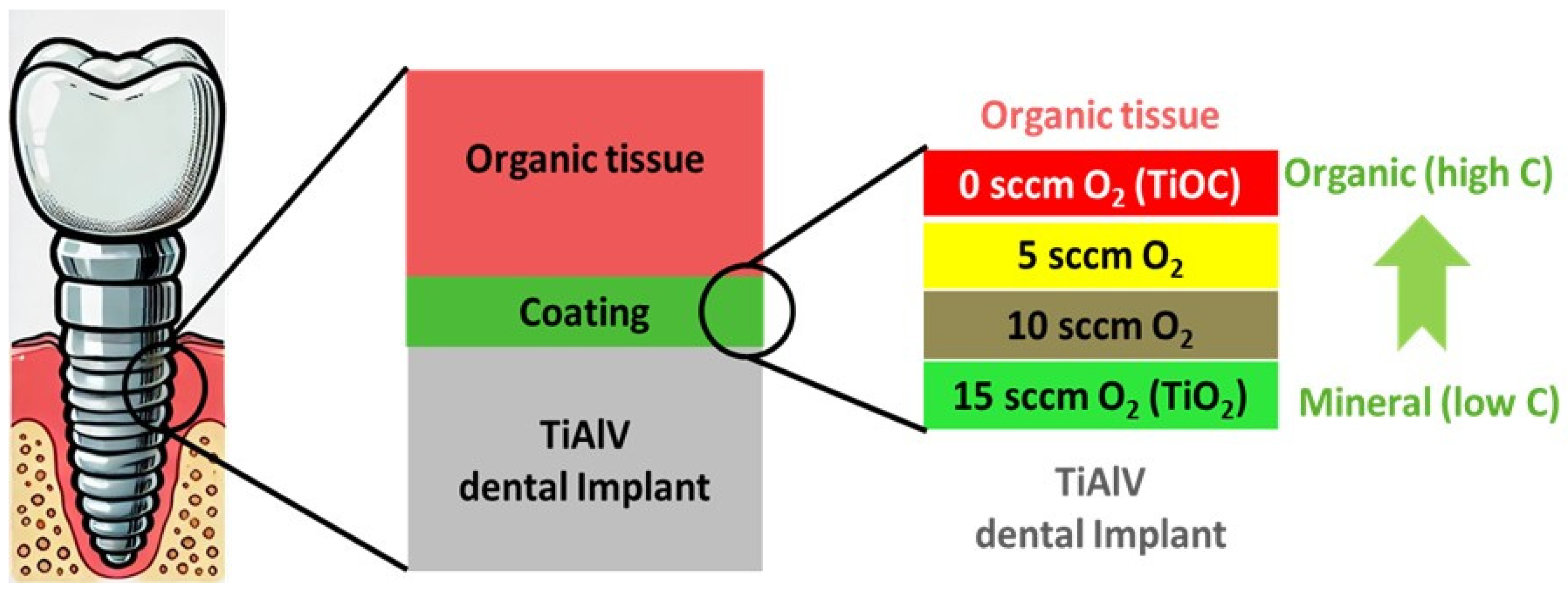
Figure 1 illustrates the proposed multilayer coating architecture developed for Ti6Al4V dental implants. This schematic focuses on the functional gradient design of the coating, with its gradual chemical change between the implant screw and the surrounding organic tissue. The multilayer architecture, described in the Section 2, consists of four sequential sublayers under different oxygen flow conditions (15 sccm, 10 sccm, 5 sccm and without oxygen flux) prepared by sequential deposition under identical conditions to produce a progressive increase in carbon, from mineral-like (TiO2-like) near the substrate to organic-like (carbon-enriched surface) on the surface.
This architecture of our multilayer coating fundamentally differs from previously reported TiO2, TiC and TiOxCy monolayer coatings. In particular, the combination of multilayer architecture, a carbon gradient across the coating thickness, has not been previously described for titanium organometallic coatings intended for biomedical interfaces.
In the first stage of this work, this study focuses on the synthesis and characterization of individual TiOxCy thin films deposited at different oxygen flow rates (0, 5, 10, and 15 sccm) on Ti6Al4V substrates. Each individual organometallic coating was studied to evaluate the influence of deposition conditions on film properties.
In the second stage, this investigation focuses on the development and analyses of a TiOxCy multilayer with a gradient in carbon content, varying from mineral (low C—15 sccm O2) to organic (high C—0 sccm O2). Finally, their properties were compared with the results of individual films.

3.1. Individual TiOxCy Organometallic Thin Films

High Resolution X-ray Photoelectron Spectroscopy (HR-XPS) was employed to investigate the surface chemical composition and oxidation states of the elements present in the individual TiOxCy films deposited under changing oxygen flow. Note that all binding energies were calibrated against the C 1s reference peak at 284.6 eV to ensure consistency across measurements.
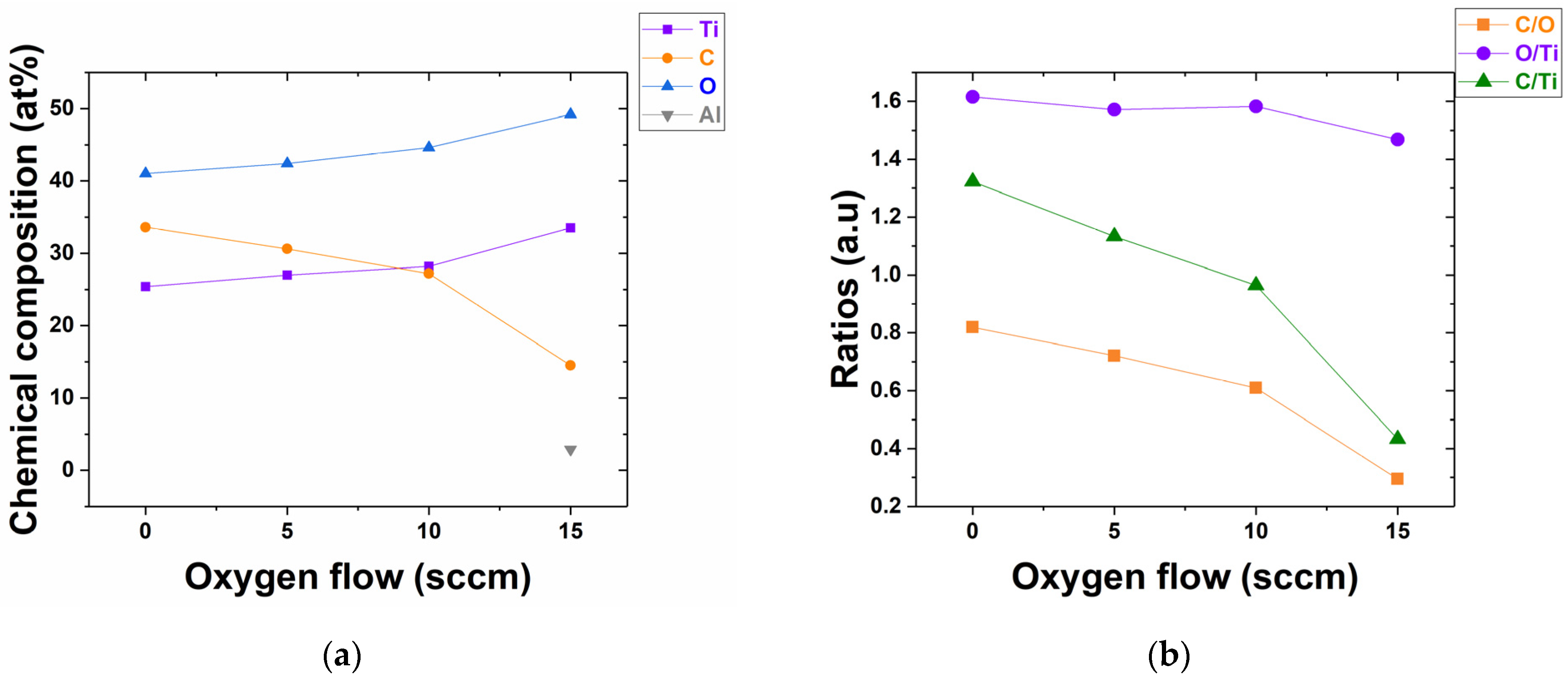
Figure 2 shows the elemental surface studies by XPS of the individual samples deposited with different oxygen flow rates. The composition analyses reveal the presence of titanium (Ti), oxygen (O), and carbon (C) in all samples, as expected for the Ti-based films. Furthermore, a signal from aluminum (Al), originating from the substrate, is observed only in the sample synthesized under the highest oxygen flow conditions. The detection of this element suggests that under this condition, the film thickness is reduced to less than the typical XPS probing depth (~10 nm), thereby allowing signal contribution from the substrate. As one can see in Figure 2a, an increase in oxygen flow during the deposition process leads to a systematic decrease in surface carbon content, suggesting that a higher oxygen flux effectively limits the incorporation of carbon inside the films. The decrease in carbon content is attributed to purer titanium oxide compound facilitated by reactive oxygen species.
The compositional evolution of titanium, oxygen and carbon is quantitatively analyzed in Figure 2b, which illustrates the changes in the O/Ti, C/O and C/Ti ratios of the film surface as a function of oxygen flow. The O/Ti ratio remains nearly constant for all deposition conditions, indicating that the introduced oxygen predominantly reacts with the precursor. Increasing oxygen flow leads to systematic changes in the coating chemistry, most notably a reduction in carbon content. These results suggest that oxygen mainly interacts with carbon-containing species, thereby maintaining a stable O/Ti ratio throughout the investigated oxygen flow range.
The C:O and C:Ti ratios decrease significantly with the oxygen flow, primarily due to the progressive reduction in carbon content. Specifically, the carbon concentration decreases by approximately 12%, 26%, and 64% for the coatings prepared with oxygen flows of 5 sccm, 10 sccm, and 15 sccm, respectively, relative to the carbon content in the 0 sccm (oxygen-free) sample. This result suggests that the plasma, and especially the use of reactive gases such as oxygen, helps to fragment and oxidize the TTIP (Ti[OCH(CH3)2]4) [39], breaking the carbon bonds of the precursor compound. Particularly, the use of reactive plasma like oxygen promotes the decrease of carbon content [33].
The progress of the organometallic coating deposition with oxygen flow rates suggests the formation of a titanium oxycarbide phase (TiOxCy), where the stoichiometry of oxygen is constant, and carbon is modulated by the oxygen flow rate during deposition.
The empirical formula of the TiOxCy films surface can be derived from the observed trends in the O:Ti ratio that remain relatively constant at approximately 1.6, and then it can be expressed as TiO1.6Cy with y variable. In addition, the values of y have been estimated by C:Ti ratios of 1.3, 1.1, 1.0, and 0.4 for the films deposited at 0, 5, 10, and 15 sccm oxygen flow, respectively.
These findings confirm that the addition of oxygen plays a crucial role in modifying the chemical composition of organometallic titanium-based coatings, promoting the oxidation of carbon species and leading to the formation of TiO1.6Cy organometallic compounds. Therefore, by controlling the oxygen flow during deposition, it is possible to systematically tune the carbon content and modify the stoichiometry and then the properties of the TiOxCy organometallic coatings.
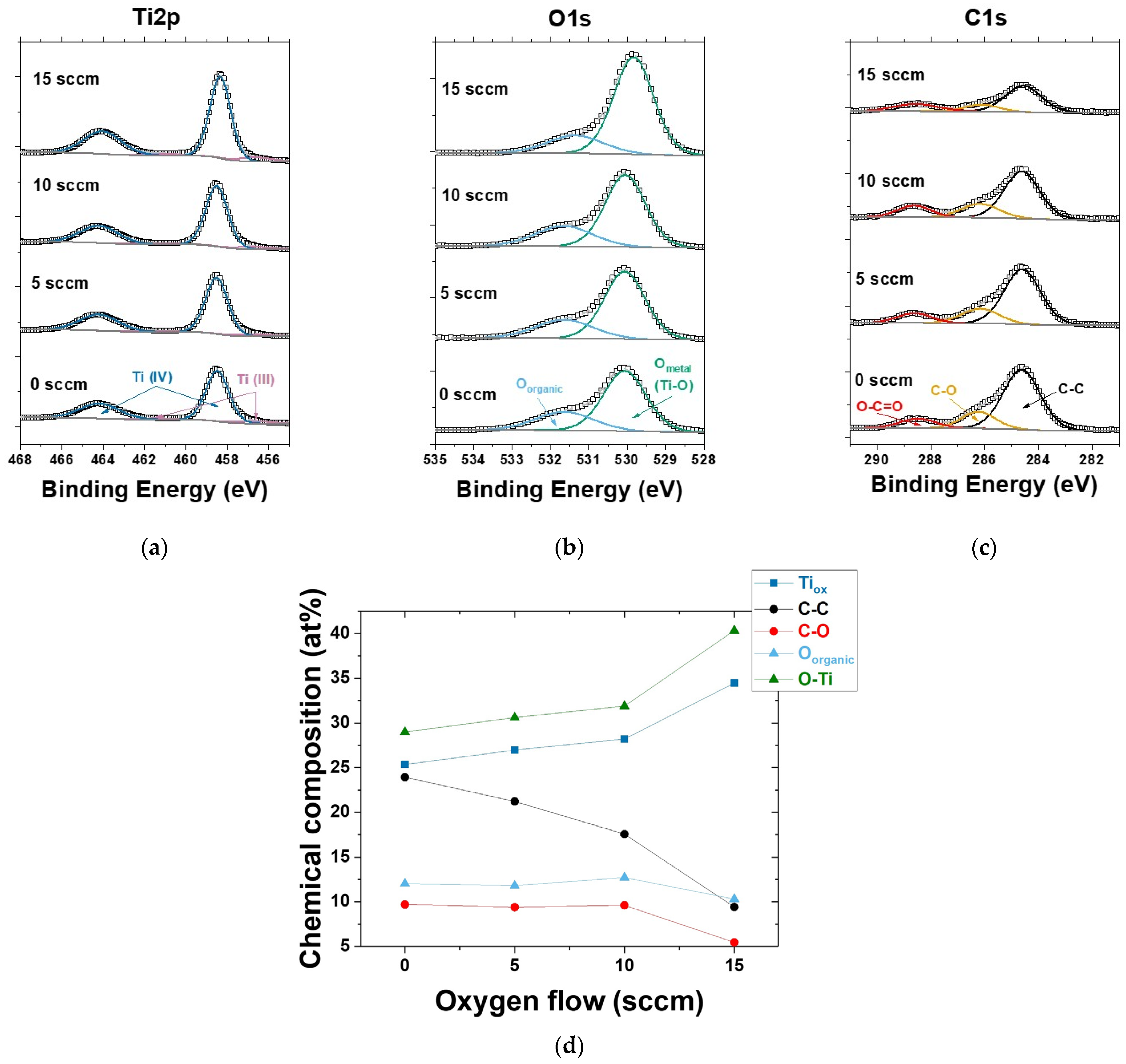
Figure 3 shows the chemical environment of TiOxCy from the surface individual films prepared at 0, 5, 10, and 15 sccm oxygen flow by high-resolution XPS analysis of the Ti2p, O1s and C1s regions.
Figure 3a shows the Ti 2p spectrum oxidation states: Ti (IV), corresponding to titanium dioxide (TiO2), and Ti(III), associated with titanium sesquioxide (Ti2O3). Specifically, the Ti(III) 2p1/2 and Ti(IV) 2p1/2 binding energies are located at 461.3 eV and 464.2 eV, respectively, with a spin–orbit splitting of approximately 5.7 eV between the Ti 2p doublet components. The Ti 2p region is dominated by Ti2p (IV) species, corresponding to TiO2, which represent over 90% of the total titanium content across all samples. Beyond the titanium oxide originating from the decomposition of the organometallic compound, additional TiO2 may result from the spontaneous passivation of titanium upon atmospheric exposure.
The O 1s spectrum is represented in Figure 3b and exhibits two principal contributions: a main peak at 530.1 eV attributed to oxygen in titanium oxides (Ometal = Ti–O), which may originate from either TiO2 or Ti2O3, and a secondary component at 531.6 eV associated with oxygen organic functional groups (Oorganic), such as C–O and/or O–C=O chemical species. The quantitative analysis of the O 1s spectra reveals that over 70% of the oxygen atoms are coordinated to titanium atoms (Ometal = Ti–O bonds), indicative of metal oxide formation. Furthermore, an incremental increase in the Ti–O component is detected with an increasing oxygen flow, accompanied by a reduction in oxygen-containing organic species. The behavior reflects a progressive refinement of the titanium oxide composition, with a corresponding decrease in carbon species.
The C 1s spectrum, presented in Figure 3c, reveals three chemical states, with binding energies located at 284.6 eV (C–C), 286.2 eV (C–O), and 288.5 eV (O–C=O). The C–C component is the most intense among these, indicating the predominance of aliphatic or aromatic hydrocarbon groups on the surface due to the atmospheric contamination. The C 1s spectrum provides insights into the evolution of surface carbon chemistry as a function of oxygen flow. A moderate decline in the relative intensity of the C–C component is observed with increasing oxygen exposure, suggesting a reduction of unoxidized carbon residues from the TTIP. At the same time, the abundance of oxidized carbon species shows a pronounced increase; this fact indicates that residual carbon undergoes partial oxidation to C–O functionalities and, in some cases, complete oxidation to carboxylate-like groups (O–C=O) under conditions of higher oxygen availability. Concerning the possible formation of Ti–C bonds, no such contribution is detected in the C 1s spectra. No peak is observed in the 281–282 eV binding energy range characteristic of titanium carbide, indicating that no titanium carbide bonds were created.
Figure 3d shows the atomic percentage of the different contributions. The graph shows that the titanium oxide and O–Ti contributions increase with increasing oxygen flow, while the C–C contribution decreases. This behavior indicates that Ti:O is practically stable, while the carbon content can be systematically adjusted by modulating the oxygen flow.
In summary, these results demonstrate that the oxygen flow rate during synthesis plays a crucial role in modulating the oxidation states and chemical composition of TiOxCy organometallic coatings. Increased oxygen incorporation promotes the formation of TiO1.6Cy and extracts the carbon from TTIP, which could result in the formation of volatile by-products [33], thereby enhancing the overall oxidation of the oxide films.
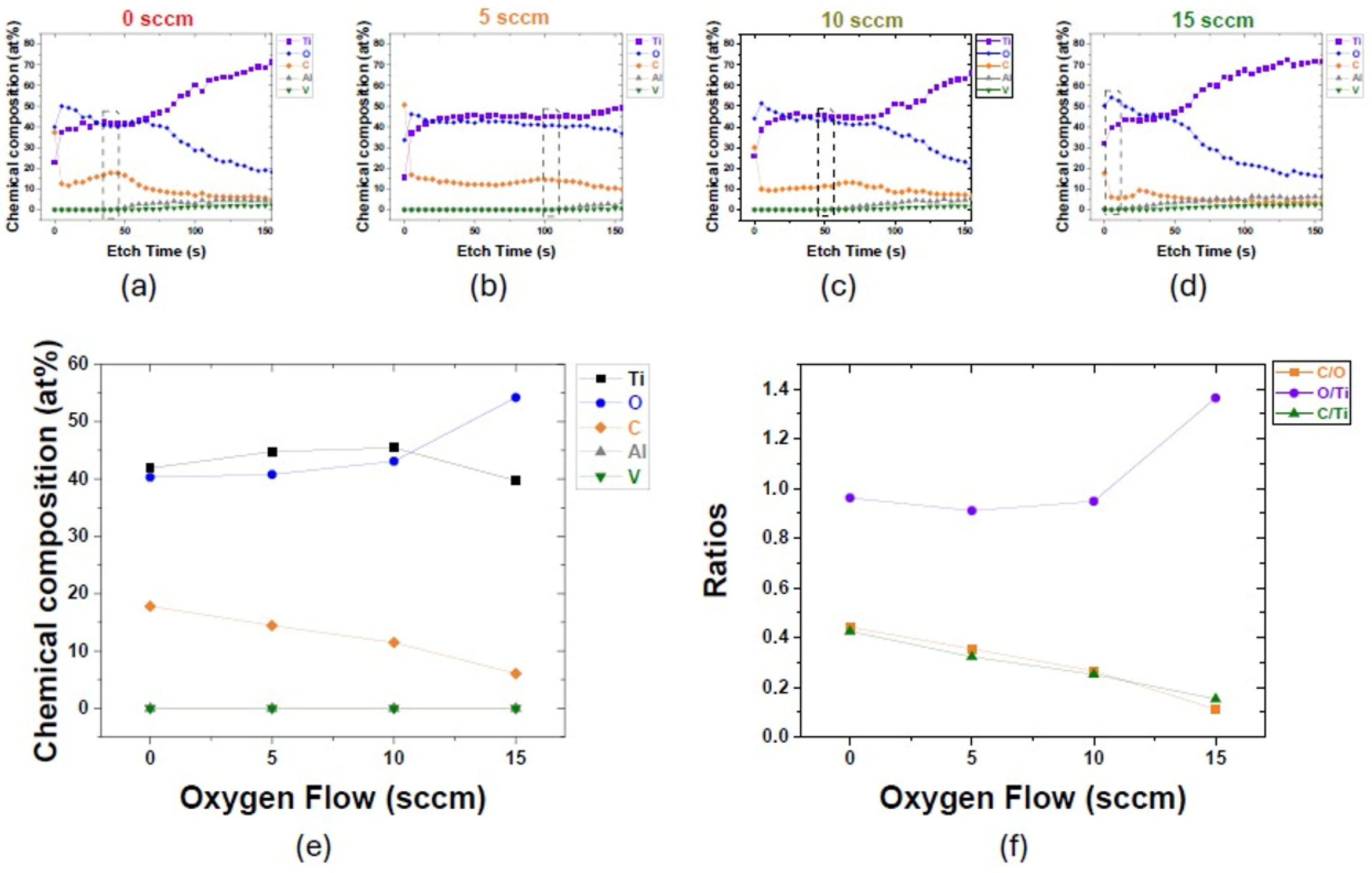
In addition to performing surface measurements, X-ray Photoelectron Spectroscopy (XPS) depth profiling was carried out to investigate the chemical composition throughout the entire coating layer and the substrate. Figure 4 describes the elemental XPS depth profiles of TiOxCy individual thin films deposited under different oxygen flow rates (0, 5, 10, and 15 sccm). In Figure 4a–d, the atomic concentration of titanium, oxygen, carbon, aluminum, and vanadium is plotted as a function of etching time, providing insight into the chemical composition across the entire TiOxCy coating of each film and the Ti6Al4V substrate. These profiles reveal the evolution of elemental distribution as a function of oxygen incorporation during deposition, highlighting significant compositional changes throughout the coating depth.
Figure 4e compares the atomic composition of the coating in areas close to the substrate interface. Under low-oxygen conditions, the films show elevated carbon contents (~18 at.%), consistent with incomplete TTIP fragmentation and the retention of hydrocarbon species. For the highest oxygen flow, carbon incorporation decreases markedly, reaching ~6 at.% at 15 sccm, as the more oxidative plasma environment promotes more efficient cleavage of TTIP carbon bonds. Using the 0 sccm film as a reference, the relative carbon reductions are 18.8 at.%, 35.6 at.%, and 71.5 at.% for depositions carried out at 5, 10, and 15 sccm of oxygen, respectively.
These results indicate that inside the layers, the carbon content strongly depends on the oxygen flow.
The O/Ti, C/O, and C/Ti ratios as a function of oxygen flow are represented in Figure 4f. The chemical analysis shows that the O/Ti atomic ratio remains close to 0.9 across the depth profile of all films, indicating that titanium and oxygen stoichiometry remains relatively constant. Nevertheless, the decrease in the O/Ti ratio, which varies from 1.6 in the surface layers to 0.9 in the coating volume, is probably due to the surface oxidation by atmospheric oxygen, which significantly influences the analysis of the outermost layer. This relationship close to 0.9 is consistent with the observation of multiple titanium oxidation states, Ti2p(IV), Ti2p(III), and Ti2p(II), inside the deposited layers. As the oxygen flow increases, there is intensification in the Ti2p(IV) component and a consequent reduction in Ti2p(II), suggesting a more mineral-like (TiO2-like) character. Both C/Ti and C/O ratios decrease progressively with increasing oxygen flow. Based on the O/Ti and C/Ti ratios, an empirical formula can be proposed for TiOxCy, where x is fixed at 0.9 and y corresponds to the C/Ti value, being 0.43, 0.32, 0.25, and 0.15 for oxygen flows of 0, 5, 10, and 15 sccm, respectively.
Table 1 presents the thickness and water contact angle values of the individual thin films deposited under different oxygen flow conditions of 0, 5, 10, and 15 sccm. The samples prepared from 0 to 10 sccm O2 exhibited similar thicknesses (~50 nm), indicating comparable film growth under these conditions. However, a significant decrease in thickness was observed for the sample prepared at 15 sccm O2. This fact could be due to the T-shaped junction with one branch connected to the precursor argon inlet line and the opposite branch connected to the oxygen gas line. The central branch of the T leads directly into the chamber, where both fluids mix before entering the deposition zone. High oxygen flow (≥15 sccm), compared to the argon flow (5 sccm), may hinder precursor transport into the chamber, strongly decreasing the deposition rate.
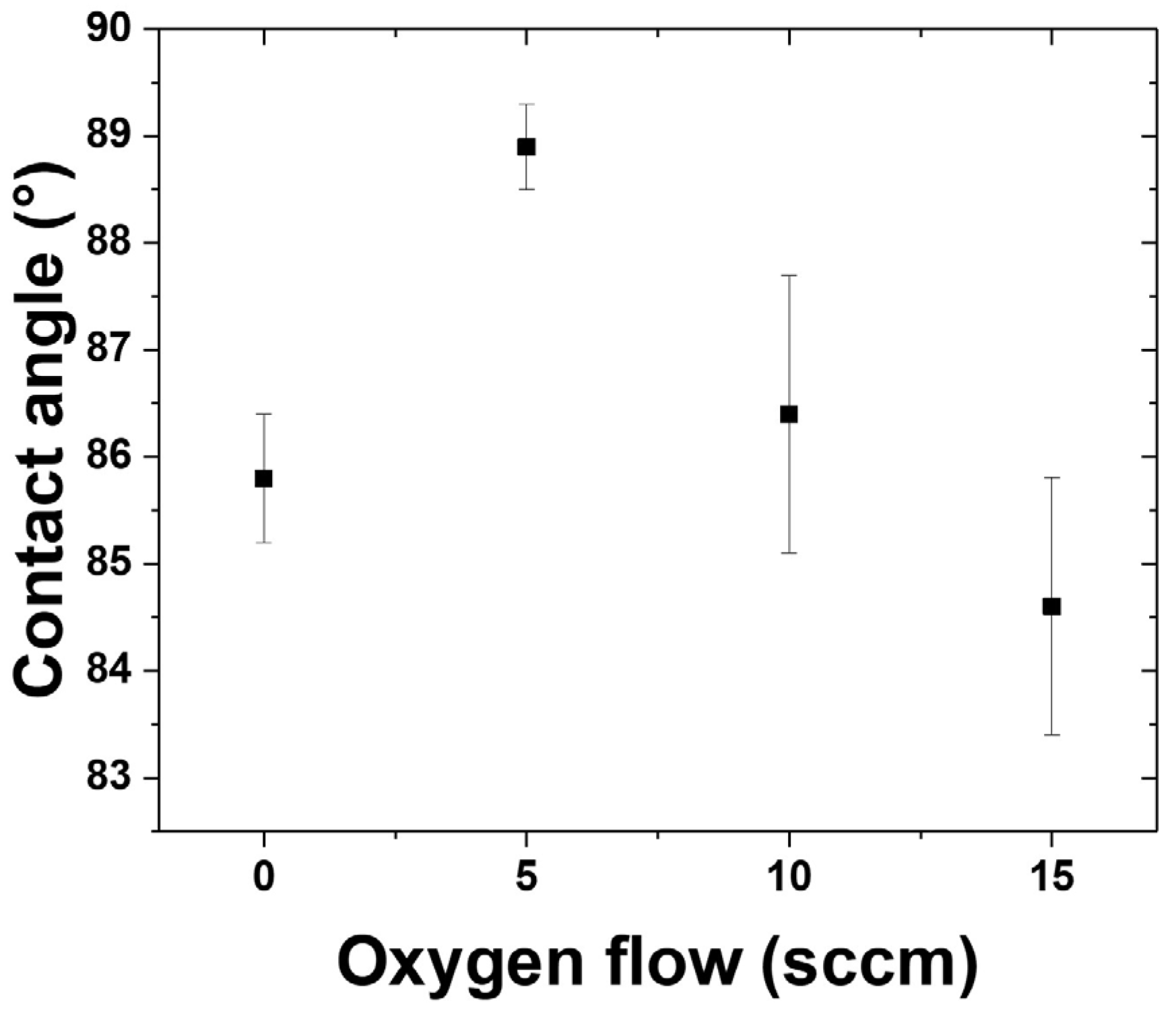
Figure 5 shows the contact angle for the different individual films along with the standard deviation. The individual films have a contact angle between 84° and 89° and a standard deviation between 0.5 and 1.3.
Contact angle measurements of TiOxCy thin films were conducted and compared to the average contact angle of the Ti6Al4V substrate (86°). All samples exhibit contact angles which are comparable to the substrate value. These results suggest a hydrophilicity-neutral character, which may be favorable for protein adsorption [40,41] and could enhance the osteointegration process. Therefore, these films could be suitable for medical prothesis applications, especially in dental implantology.
Hydrophobic surfaces are often associated with increased protein adsorption driven by hydrophobic interactions and water displacement, frequently accompanied by partial protein denaturation [42,43]. In contrast, hydrophilic or oxidized titanium surfaces promote adsorption through polar and electrostatic interactions, which may favor the preservation of protein conformation [42,44]. Barberi et al. further emphasized that protein adsorption results from the combined contribution of several driving forces, including hydrophobic, electrostatic, and van der Waals interactions, and therefore cannot be predicted solely based on wettability [45].
In this context, the near-neutral wettability observed for the TiOxCy coatings (≈85–90°), comparable to that of the Ti6Al4V substrate, suggests an intermediate surface regime in which both polar and non-polar interactions may coexist. Such a balance is considered advantageous for biomedical applications, as it may support protein adsorption while limiting excessive denaturation, thereby facilitating subsequent cell adhesion and osteointegration, particularly in dental implantology [42,44].

3.2. TiOxCy Organometallic Multilayer

The surface chemical composition of the multilayer coating was first characterized via High-Resolution X-ray Photoelectron Spectroscopy (HR-XPS). The resulting surface composition presents the values of 27 at.%, 31 at.%, and 42 at.% for titanium, carbon, and oxygen, respectively, nearly identical to that of the surface of sample prepared in the absence of oxygen (0 sccm).
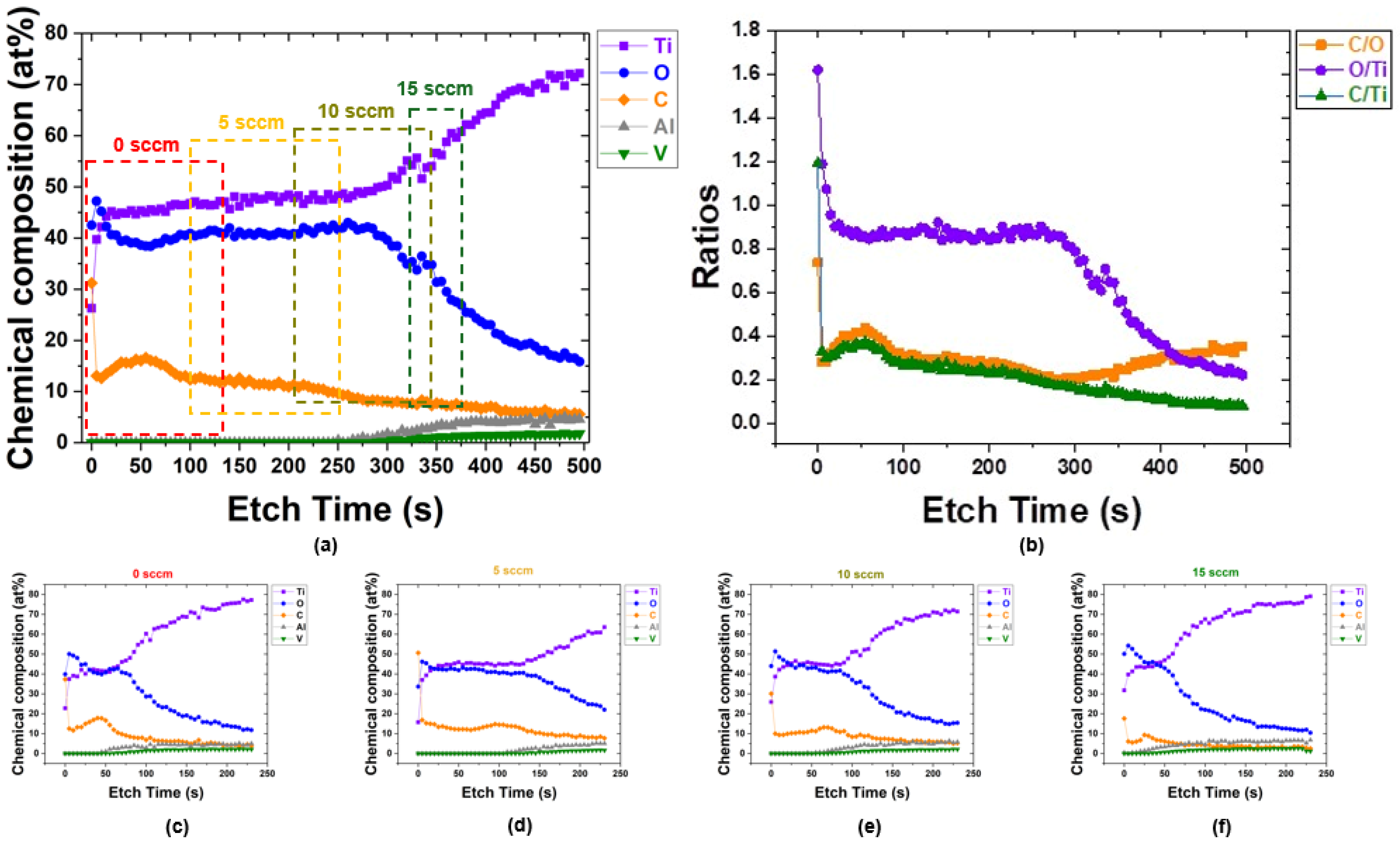
The XPS depth profile analysis of the TiOxCy individual and multilayer coatings deposited on a Ti6Al4V alloy substrate is presented in Figure 6. The chemical composition of the TiOxCy multilayer as a function of etching time is shown in Figure 6a. The colored squares are associated with the areas corresponding to the layers prepared at 0 sccm, 5 sccm, 10 sccm, and 15 sccm. Three different regions can be clearly distinguished: (i) the surface region, characterized by high carbon levels, originating from atmospheric contamination; (ii) the multilayer region, from 5 to 250 s of etching, exhibiting the compositional carbon gradient of TiOxCy coating by modulating the oxygen flow; and (iii) the substrate region, emerging beyond 250 s of etching, where rising signals from Al and V confirm the exposure of the Ti6Al4V substrate.
Within the multilayer region, the Ti and O atomic concentrations suggest a homogeneous Ti:O ratio throughout the coating. In contrast, the carbon content exhibits a gradual decrease supporting the carbon gradient design proposal. It would also support the hypothesis proposed during the analysis of the individual films that the introduction of oxygen promotes oxidation of the precursor and variable chemical composition of the growing coating by the development of a gradient carbon TiOxCy multilayer, with a lower amount of carbon as the oxygen flow increases.
Figure 6b provides C/O, C/Ti, and O/Ti profile ratios as a function of etching time. The C/O and C/Ti ratios show a monotonic decrease with depth from 0.4 for the layer deposited without oxygen to 0.2 for the region close to the multilayer–substrate interface. This change is attributed primarily to the decrease in carbon content because the O/Ti ratio remains nearly constant (~0.9) across the multilayer, corroborating the uniform distribution of Ti and O. Also, in addition to Ti (IV), other titanium oxides (TiOx, x < 2) like Ti2p(III) and Ti2p(II) are present along the multilayer with a slight increase in the contribution of Ti2p(IV) in accordance with the results from the individual films.
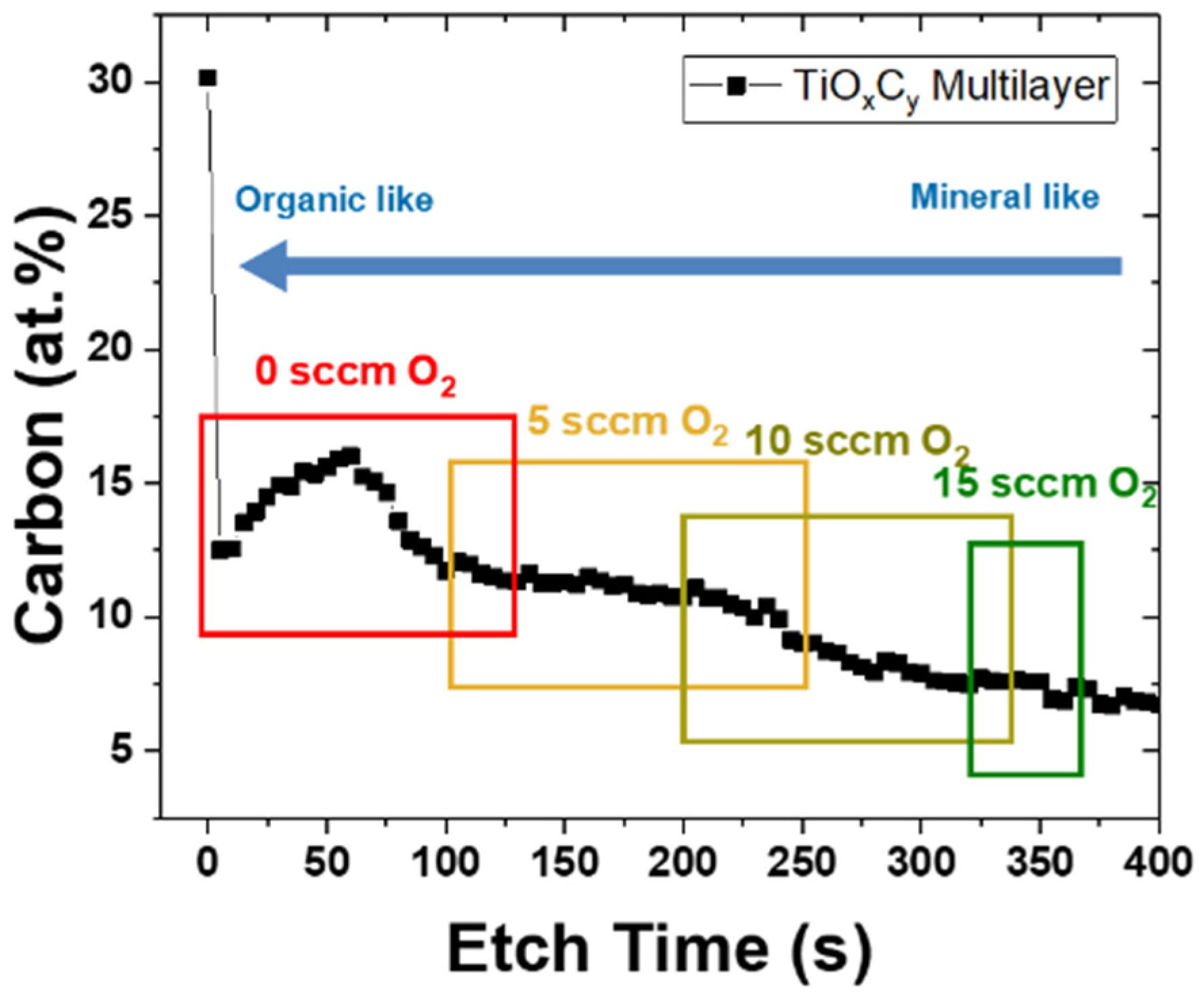
Figure 7 illustrates the carbon atomic percentage (at.%) as a function of argon etching time (s) for the TiOxCy multilayer. The coating is composed of four sequential TiOxCy layers deposited under different oxygen flow rates, with the colored squares superimposed to indicate the ranges that correspond to the individual layers to provide a clearer comparison with the multilayer sample.
One can see that the atomic percentage of carbon systematically decreases with an increasing oxygen flow rate, from 0 to 15 sccm, confirming that the introduction and consequent increase of oxygen during deposition promotes to more mineral like (TiO2-like).
O/Ti ratio both for individual thin films and the multilayer present similar values (around 0.9), indicating the same behavior across the gradient multilayer architecture.
Notably, the sequential reduction in the empirical coefficient y equal to the C/Ti ratio varies from 0.35 to 0.10 across the organometallic TiO0.9Cy multilayer directly correlates with the modulation of oxygen flow during deposition (0 to 15 sccm) and confirms that carbon incorporation can be finely tuned by adjusting the flow of the reactive oxygen plasma environment. This fact is consistent with the behavior observed in the individual films.
A comparative analysis of the thickness between the carbon gradient multilayer and the cumulative thickness of the corresponding individual thin films arranged in the same architecture that the multilayer was conducted. The multilayer exhibits a total thickness of 150 nm which closely matches the sum of the individual layers’ thickness (149 nm). Contact angle measurements carried out on the multilayer (86°) and 0 sccm individual thin film (83°) surface reveal similar surface wettability, indicating a hydrophilicity-neutral character.
The continuity of the compositional gradient throughout the multilayer was evaluated by X-ray Photoelectron Spectroscopy depth profiling. As shown in Figure 6 and Figure 7, the C/Ti and C/O ratios decrease progressively with etching time, without abrupt changes at the interfaces between successive layers. This monotonic evolution confirms the presence of a continuous chemical gradient rather than sharply defined discrete layers.
It is important to emphasize that this TiOxCy multilayer differs fundamentally from conventional TiC or TiOC coatings reported in the literature, which typically exhibit a uniform chemical composition throughout the entire coating thickness. In contrast, the present coating is intentionally engineered as a functional gradient, evolving from a mineral-like, oxygen-rich region close to the Ti6Al4V substrate favoring strong interfacial bonding to an organic-like, carbon-enriched surface layer designed to interact with biological tissue.
Although this study provides a comprehensive physicochemical characterization, the authors acknowledge that direct biological tests like cell attachment unfortunately were not conducted at this stage. This present work was designed to establish foundational materials science and to optimize the multilayer coating architecture, as surface chemistry and wettability are critical precursors to biological performance. Consequently, our forthcoming research is specifically directed toward evaluating these biological interactions. These future studies will utilize in vitro models to directly correlate the optimized surface parameters reported here with cellular response and long-term osseointegration potential.

4. Conclusions

In this work, a carbon gradient TiOxCy multilayer coating was successfully developed on Ti6Al4V substrates by combining four sequential layers with different oxygen flow rates. Both individual organometallic TiOxCy thin films and a multilayer were deposited using the PECVD technique, modulating the oxygen flow rate during deposition. XPS measurements revealed a constant Ti:O ratio across all samples, regardless of the introduced oxygen flow rate, as well as a reduction in carbon content with an increasing oxygen flow rate. These results indicate that plasma induces fragmentation of the TTIP precursor, and the introduction of oxygen enhances its decomposition, which is essential to control the carbon content and develop a TiO0.9Cy multilayer coating with a gradual transition from low carbon (mineral-like) to high carbon (organic-like). The comparative study of multilayer and individual TiO0.9Cy films demonstrated the reproducibility of multilayer architecture design due to a close match in chemical composition, thickness, and wettability (neutral hydrophilic character). These findings indicate that the physicochemical properties of the multilayer could promote cell attachment, particularly in the context of dental applications.

Author Contributions

Conceptualization, L.H., S.R., P.C. and D.M.; Methodology, L.H., S.R. and P.C.; investigation, S.R.; writing—original draft preparation, S.R.; writing—review and editing, L.H., S.R., P.C. and D.M.; supervision, L.H.; project administration, L.H. and D.M.; funding acquisition, L.H. and D.M. All authors have read and agreed to the published version of the manuscript.

Funding

This work was supported by ‘MULTICOATINGS4DENTALIMPLANTS: Design and development of advanced multifunctional nano-coatings to enhance the clinical performances of dental implants’ project, funded by FNRS (Fonds National de la Recherche Scientifique) and FRQ (Fonds de la recherche du Québec) through a bilateral research program between Québec (Canada) and Fédération Wallonie-Bruxelles (Belgium).

Institutional Review Board Statement

Not applicable.

Informed Consent Statement

Not applicable.

Data Availability Statement

Data are contained within the article.

Acknowledgments

Authors thank the technological platform Synthesis, Irradiation, and Analysis of Materials platform (SIAM) at the University of Namur.

Conflicts of Interest

The authors declare no conflicts of interest.

References

  1. Zhao, Q.; Sun, Q.; Xin, S.; Chen, Y.; Wu, C.; Wang, H.; Xu, J.; Wan, M.; Zeng, W.; Zhao, Y. High-strength titanium alloys for aerospace engineering applications: A review on melting-forging process. Mater. Sci. Eng. A 2022, 845, 143260. [Google Scholar] [CrossRef]
  2. Kumar, V.A.; Gupta, R.K.; Prasad, M.J.N.V.; Murty, S.V.S.N. Recent advances in processing of titanium alloys and titanium aluminides for space applications: A review. J. Mater. Res. 2021, 36, 689–716. [Google Scholar] [CrossRef]
  3. Chirkunova, N.; Islavath, N.; Dorogov, M. Titanium Dioxide for Hydrogen Economy: A Brief Review. Rev. Adv. Mater. Technol. 2023, 5, 56–76. [Google Scholar] [CrossRef]
  4. Curcio, M.; De Bonis, A.; Brutti, S.; Santagata, A.; Teghil, R. Pulsed laser deposition of thin films of TiO2 for Li-ion batteries. Appl. Surf. Sci. Adv. 2021, 4, 100090. [Google Scholar] [CrossRef]
  5. Aboualigaledari, N.; Rahmani, M. A review on the synthesis of the TiO2-based photocatalyst for the environmental purification. J. Compos. Compd. 2021, 2, 25–42. [Google Scholar] [CrossRef]
  6. Agrawal, A.; Siddiqui, S.A.; Soni, A.; Khandelwal, K.; Sharma, G.D. Performance analysis of TiO2 based dye sensitized solar cell prepared by screen printing and doctor blade deposition techniques. Sol. Energy 2021, 226, 9–19. [Google Scholar] [CrossRef]
  7. Lukong, V.T.; Mouchou, R.T.; Enebe, G.C.; Ukoba, K.; Jen, T.C. Deposition and characterization of self-cleaning TiO2 thin films for photovoltaic application. Mater. Today Proc. 2022, 62, S63–S72. [Google Scholar] [CrossRef]
  8. Neto, J.V.C.; Celles, C.A.S.; De Andrade, C.S.A.F.; Afonso, C.R.M.; Nagay, B.E.; Barão, V.A.R. Recent Advances and Prospects in β-type Titanium Alloys for Dental Implants Applications. ACS Biomater. Sci. Eng. 2024, 10, 6029–6060. [Google Scholar] [CrossRef]
  9. Festas, A.; Ramos, A.; Davim, J.P. Machining of titanium alloys for medical application—A review. Proc. Inst. Mech. Eng. Part B J. Eng. Manuf. 2022, 236, 309–318. [Google Scholar] [CrossRef]
  10. Han, X.; Ma, J.; Tian, A.; Wang, Y.; Li, Y.; Dong, B.; Tong, X.; Ma, X. Surface modification techniques of titanium and titanium alloys for biomedical orthopaedics applications: A review. Colloids Surf. B Biointerfaces 2023, 227, 113339. [Google Scholar] [CrossRef] [PubMed]
  11. Marin, E.; Lanzutti, A. Biomedical Applications of Titanium Alloys: A Comprehensive Review. Materials 2023, 17, 114. [Google Scholar] [CrossRef]
  12. Sarraf, M.; Ghomi, E.R.; Alipour, S.; Ramakrishna, S.; Sukiman, N.L. A state-of-the-art review of the fabrication and characteristics of titanium and its alloys for biomedical applications. Bio-Des. Manuf. 2022, 5, 371–395. [Google Scholar] [CrossRef]
  13. Malisz, K.; Świeczko-Żurek, B. Vascular stents—Materials and manufacturing technologies. Eng. Biomater. 2022, 166, 22–28. [Google Scholar] [CrossRef]
  14. Silva, R.C.S.; Agrelli, A.; Andrade, A.N.; Mendes-Marques, C.L.; Arruda, I.R.S.; Santos, L.R.L.; Vasconcelos, N.F.; Machado, G. Titanium Dental Implants: An Overview of Applied Nanobiotechnology to Improve Biocompatibility and Prevent Infections. Materials 2022, 15, 3150. [Google Scholar] [CrossRef]
  15. Guo, C.; Ding, T.; Cheng, Y.; Zheng, J.; Fang, X.; Feng, Z. The rational design, biofunctionalization and biological properties of orthopedic porous titanium implants: A review. Front. Bioeng. Biotechnol. 2025, 13, 1548675. [Google Scholar] [CrossRef] [PubMed]
  16. Garay-Sarmiento, M.; Yayci, A.; Rutsch, Y.; El Kadaoui, H.; Apelt, S.; Englert, J.; Boes, A.; Kohse, M.; Jakob, F.; Bergs, T.; et al. Structure Protects Function: A Multilevel Engineered Surface Modification Renders the Surface of Titanium Dental Implants Resistant to Bacterial Colonization. ACS Appl. Mater. Interfaces 2025, 17, 7498–7509. [Google Scholar] [CrossRef] [PubMed]
  17. Alhamad, M.; Barão, V.A.R.; Sukotjo, C.; Cooper, L.F.; Mathew, M.T. Ti-Ions and/or Particles in Saliva Potentially Aggravate Dental Implant Corrosion. Materials 2021, 14, 5733. [Google Scholar] [CrossRef]
  18. Ossowska, A.; Zieliński, A. The Mechanisms of Degradation of Titanium Dental Implants. Coatings 2020, 10, 836. [Google Scholar] [CrossRef]
  19. Bunoiu, I.; Andrei, M.; Scheau, C.; Manole, C.C.; Stoian, A.B.; Cioranu, V.S.I.; Didilescu, A.C. Electrochemical Behavior of Rejected Dental Implants in Peri-Implantitis. Coatings 2020, 10, 209. [Google Scholar] [CrossRef]
  20. Hossain, N.; Islam, M.A.; Ahmed, M.S.; Chowdhury, M.A.; Mobarak, H.; Rahman, M.; Hossain, H. Advances and significances of titaniumin dental implant applications. Results Chem. 2024, 7, 101394. [Google Scholar] [CrossRef]
  21. Lang, N.P.; Salvi, G.E.; Huynh-Ba, G.; Ivanovski, S.; Donos, N.; Bosshardt, D.D. Early osseointegration to hydrophilic and hydrophobic implant surfaces in humans: Early osseointegration on implant surfaces. Clin. Oral Implant. Res. 2011, 22, 349–356. [Google Scholar] [CrossRef]
  22. Yu, H.-N.; Hsu, H.-C.; Wu, S.-C.; Hsu, C.-W.; Hsu, S.-K.; Ho, W.-F. Characterization of Nano-Scale Hydroxyapatite Coating Synthesized from Eggshells Through Hydrothermal Reaction on Commercially Pure Titanium. Coatings 2020, 10, 112. [Google Scholar] [CrossRef]
  23. Ribeiro, I.M.; Cardoso, L.M.; Pansani, T.N.; Chagas, A.C.; De Souza Costa, C.A.; Basso, F.G. Development of a Bioactive Titanium Surface via Alkalinization and Naringenin Coating for Peri-Implant Repair: In Vitro Study. Coatings 2024, 14, 1303. [Google Scholar] [CrossRef]
  24. Jemat, A.; Razali, M.; Otsuka, Y.; Ghazali, M.J. Enhancement of Human Gingival Fibroblasts Bioactivity and Proliferation on Plasma Sprayed Yttria-Stabilised Zirconia/TiO2 Surface Coating of Titanium Alloys: An In-Vitro Study. Coatings 2023, 13, 1746. [Google Scholar] [CrossRef]
  25. Lukong, V.T.; Ukoba, K.; Jen, T.-C. Review of self-cleaning TiO2 thin films deposited with spin coating. Int. J. Adv. Manuf. Technol. 2022, 122, 3525–3546. [Google Scholar] [CrossRef]
  26. Kania, A.; Szindler, M.M.; Szindler, M. Structure and Corrosion Behavior of TiO2 Thin Films Deposited by ALD on a Biomedical Magnesium Alloy. Coatings 2021, 11, 70. [Google Scholar] [CrossRef]
  27. Weber, A.; Poeckelmann, R.; Klages, C.-P. Plasma CVD of high quality titanium nitride using titanium (IV) isopropoxide as precursor. Microelectron. Eng. 1997, 33, 277–282. [Google Scholar] [CrossRef]
  28. da Cruz, N.C.; Rangel, E.C.; Wang, J.; Trasferetti, B.C.; Davanzo, C.U.; Castro, S.G.; de Moraes, M.A. Properties of titanium oxide films obtained by PECVD. Surf. Coat. Technol. 2000, 126, 123–130. [Google Scholar] [CrossRef]
  29. Xia, X.; Chiang, C.-C.; Gopalakrishnan, S.K.; Kulkarni, A.V.; Ren, F.; Ziegler, K.J.; Esquivel-Upshaw, J.F. Properties of SiCN Films Relevant to Dental Implant Applications. Materials 2023, 16, 5318. [Google Scholar] [CrossRef]
  30. Bute, A.; Jena, S.; Kedia, S.; Udupa, D.; Singh, K.; Bhattacharya, D.; Modi, M.; Chand, N.; Sinha, S. Boron carbide thin films deposited by RF-PECVD and PLD technique: A comparative study based on structure, optical properties, and residual stress. Mater. Chem. Phys. 2021, 258, 123860. [Google Scholar] [CrossRef]
  31. Li, D.; Bulou, S.; Gautier, N.; Elisabeth, S.; Goullet, A.; Richard-Plouet, M.; Choquet, P.; Granier, A. Nanostructure and photocatalytic properties of TiO2 films deposited at low temperature by pulsed PECVD. Appl. Surf. Sci. 2019, 466, 63–69. [Google Scholar] [CrossRef]
  32. Uricchio, A.; Fanelli, F. Low-Temperature Atmospheric Pressure Plasma Processes for the Deposition of Nanocomposite Coatings. Processes 2021, 9, 2069. [Google Scholar] [CrossRef]
  33. Li, D.; Dai, S.; Goullet, A.; Granier, A. The Effect of Plasma Gas Composition on the Nanostructures and Optical Properties of TiO2 Films Prepared by Helicon-PECVD. Nano 2018, 13, 1850124. [Google Scholar] [CrossRef]
  34. Veronesi, F.; Giavaresi, G.; Fini, M.; Longo, G.; Ioannidu, C.A.; Scotto D’Abusco, A.; Superti, F.; Panzini, G.; Misiano, C.; Palattella, A.; et al. Osseointegration is improved by coating titanium implants with a nanostructured thin film with titanium carbide and titanium oxides clustered around graphitic carbon. Mater. Sci. Eng. C 2017, 70, 264–271. [Google Scholar] [CrossRef]
  35. Shahmohammadi, M.; Sun, Y.; Yuan, J.C.-C.; Mathew, M.T.; Sukotjo, C.; Takoudis, C.G. In vitro corrosion behavior of coated Ti6Al4V with TiO2, ZrO2, and TiO2/ZrO2 mixed nanofilms using atomic layer deposition for dental implants. Surf. Coat. Technol. 2022, 444, 128686. [Google Scholar] [CrossRef]
  36. Grigoriev, S.; Sotova, C.; Vereschaka, A.; Uglov, V.; Cherenda, N. Modifying Coatings for Medical Implants Made of Titanium Alloys. Metals 2023, 13, 718. [Google Scholar] [CrossRef]
  37. Barrak, F.N.; Li, S.; Muntane, A.M.; Jones, J.R. Particle release from implantoplasty of dental implants and impact on cells. Int. J. Implant. Dent. 2020, 6, 50. [Google Scholar] [CrossRef]
  38. Costa, B.C.; Tokuhara, C.K.; Rocha, L.A.; Oliveira, R.C.; Lisboa-Filho, P.N.; Pessoa, J.C. Vanadium ionic species from degradation of Ti-6Al-4V metallic implants: In vitro cytotoxicity and speciation evaluation. Mater. Sci. Eng. C 2019, 96, 730–739. [Google Scholar] [CrossRef] [PubMed]
  39. Kang, S.; Mauchauffé, R.; You, Y.S.; Moon, S.Y. Insights into the Role of Plasma in Atmospheric Pressure Chemical Vapor Deposition of Titanium Dioxide Thin Films. Sci. Rep. 2018, 8, 16684. [Google Scholar] [CrossRef]
  40. Kanduč, M.; Schneck, E.; Netz, R.R. Understanding the ‘Berg limit’: The 65° contact angle as the universal adhesion threshold of biomatter. Phys. Chem. Chem. Phys. 2024, 26, 713–723. [Google Scholar] [CrossRef] [PubMed]
  41. Sarkar, S.; Kundu, S. Protein (BSA) adsorption on hydrophilic and hydrophobic surfaces. Mater. Today Proc. 2023. [Google Scholar] [CrossRef]
  42. Silva-Bermudez, P.; Rodil, S.E. An overview of protein adsorption on metal oxide coatings for biomedical implants. Surf. Coat. Technol. 2013, 233, 147–158. [Google Scholar] [CrossRef]
  43. Yang, Y.; Cavin, R.; Ong, J.L. Protein adsorption on titanium surfaces and their effect on osteoblast attachment. J. Biomed. Mater. Res. Part A 2003, 67, 344–349. [Google Scholar] [CrossRef] [PubMed]
  44. Fabre, H.; Mercier, D.; Galtayries, A.; Portet, D.; Delorme, N.; Bardeau, J.F. Impact of hydrophilic and hydrophobic functionalization of flat TiO2/Ti surfaces on proteins adsorption. Appl. Surf. Sci. 2018, 432, 15–21. [Google Scholar] [CrossRef]
  45. Barberi, J.; Spriano, S. Titanium and Protein Adsorption: An Overview of Mechanism and Effects of Surface Features. Materials 2021, 14, 1590. [Google Scholar] [CrossRef] [PubMed]
Figure 1. Multilayer coating with chemical gradient on Ti6Al4V implant.
Coatings 16 00312 g001
Figure 2. Chemical composition of individual TiOxCy thin films. (a) Surface atomic percentages from XPS analysis; (b) C/O, O/Ti, and C/Ti ratios as a function of oxygen flow during deposition.
Coatings 16 00312 g002
Figure 3. Evolution of TiOxCy film chemistry with oxygen flow. Core-level XPS spectra for (a) Ti 2p, (b) O 1s, and (c) C 1s. (d) Quantification of chemical states.
Coatings 16 00312 g003
Figure 4. Atomic percentages from XPS profile analysis (ad) and the atomic percentages at the interface (e,f) of the TiOxCy individual films prepared at 0 sccm, 5 sccm, 10 sccm, and 15 sccm.
Coatings 16 00312 g004
Figure 5. Contact angle of individual thin films.
Coatings 16 00312 g005
Figure 6. XPS profile analysis: (a) atomic percentages from XPS profile analysis of the multilayer; (b) C/O, O/Ti, and C/Ti profile ratios of the multilayer; (cf) atomic percentages from of the individual thin films.
Coatings 16 00312 g006
Figure 7. XPS carbon profile of TiOxCy multilayer.
Coatings 16 00312 g007
Table 1. Thickness and contact angle of the individual TiOxCy thin films as function of the oxygen flow.
Oxygen Flow (sccm)Thickness (nm)Contact Angle (°)
04286
55489
104586
15885
Disclaimer/Publisher’s Note: The statements, opinions and data contained in all publications are solely those of the individual author(s) and contributor(s) and not of MDPI and/or the editor(s). MDPI and/or the editor(s) disclaim responsibility for any injury to people or property resulting from any ideas, methods, instructions or products referred to in the content.