Article

Multilayer Barrier Coatings with Starch/Bentonite for Paperboard—The Effects of the Number of Layers and the Drying Strategy on the Barrier Properties


1
Department of Engineering and Chemical Sciences, Karlstad University, 651 88 Karlstad, Sweden
2
Billerud Skog & Industri AB, 801 81 Gävle, Sweden
3
UMV Coating Systems AB, 661 32 Säffle, Sweden
*
Author to whom correspondence should be addressed.
Current address: Lars Järnström Consulting, 756 44 Uppsala, Sweden.
Current address: VTT, 02150 Espoo, Finland.
§
Current address; Billerud AB, 664 33 Grums, Sweden.
Coatings 2026, 16(3), 299; https://doi.org/10.3390/coatings16030299
Submission received: 30 January 2026 / Revised: 20 February 2026 / Accepted: 25 February 2026 / Published: 28 February 2026
(This article belongs to the Special Issue Advanced Materials and Films for Food Packaging)

Abstract

This study investigates the impact of multilayer structures and drying strategies on the barrier properties of high-speed starch/bentonite-coated paperboard. The study examines the impact of drying at a high machine speed of 400 m min−1, addressing a key knowledge gap. The hypotheses were that thin multilayer coatings reduce oxygen permeability more effectively than thick single or double coatings and that gentle infrared (IR) drying would be required to achieve this effect. The experiments comprised up to six consecutive coating applications, each providing a dry coat weight between 0.5 and 1.5 g m−2. The IR dryer power ranged from 207 kW to 829 kW, and different IR frame positions were tested. The results indicated that thin multilayer coatings resulted in fewer pinholes, lower oxygen transmission rates, and improved grease resistance compared with one or two thick layers. However, the effectiveness of the multilayer-coated paperboard was influenced by the employed drying strategy. Specifically, gentle IR drying reduced pinholes, lowered oxygen transmission rates and enhanced grease resistance.

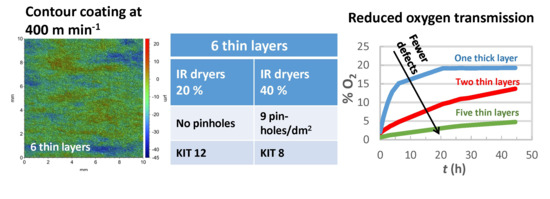
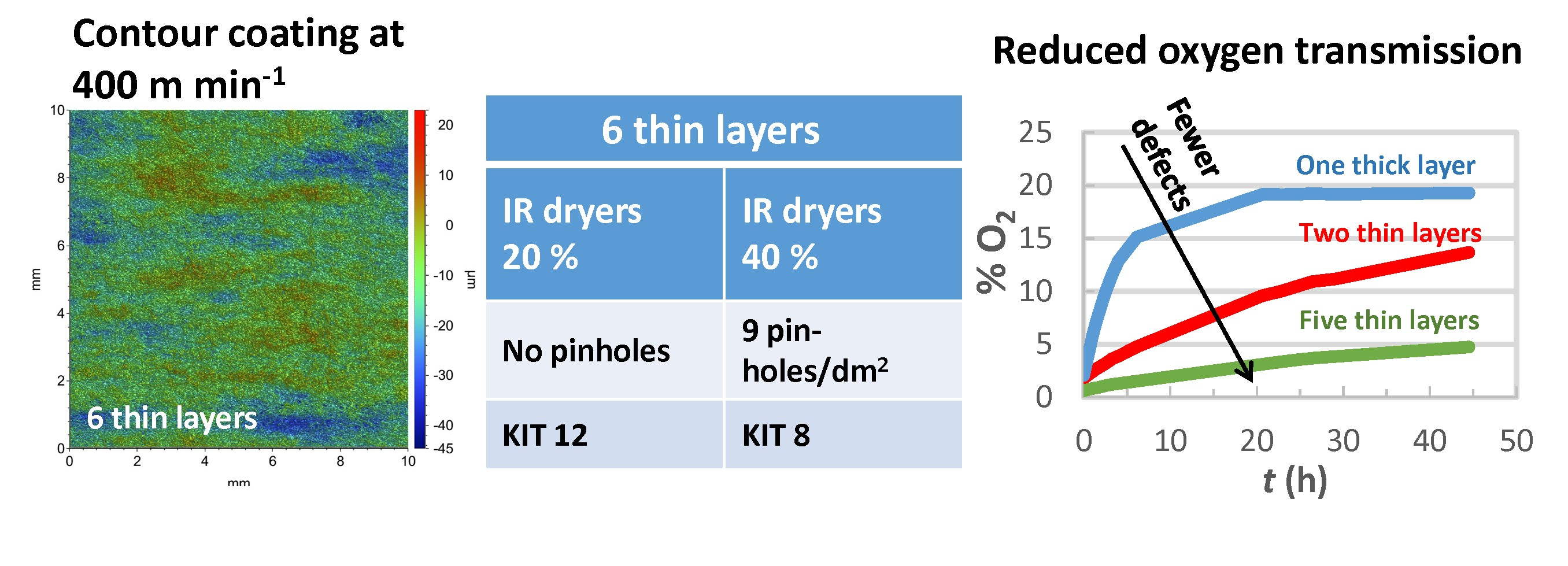
Graphical Abstract

1. Introduction

Substantial efforts have been made to increase the use of paper-based packaging materials as replacement for fossil-based alternatives, as a part of a transition toward sustainable raw materials. Packaging materials that provide oxygen, moisture vapour, water, oil and grease barriers are critical in packaging applications such as food packaging [1,2]. Modified atmosphere packaging (MAP) is used to extend the shelf life of food products such as meat, fruit and vegetables. For meat, adequate carbon dioxide partial pressure in the headspace is needed to inhibit the growth of microbial organisms. In such cases, the packaging must prevent the loss of carbon dioxide [3]. For fresh fruits and vegetables, which undergo respiration and transpiration, careful control of the passage of water vapour, oxygen and carbon dioxide through the packaging material is needed to optimise the shelf life [4,5]. The present study focuses on oxygen and grease barrier performances.
The hydrophilic nature of the cellulose fibre and the porous structure of paper and paperboard necessitate additional processing steps to enhance barrier properties. One such step is the application of coatings to render the surface layer nearly impermeable to the target penetrant [2]. To achieve effective barriers against gas and liquid penetration, the coating must be as free from defects as possible. The interactions between the applied water-based barrier coatings (WBBCs) and the paper or paperboard substrate are of high importance. Water absorptiveness, density, roughness, and surface structure of the uncoated substrate significantly affect the final properties of the coated product [6,7,8,9,10,11]. The importance of a smooth and dense substrate for a high-speed barrier coating was demonstrated by Vähä-Nissi et al. [11]. An oxygen transmission rate (OTR) as low as 0.02 cm3 m−2 day−1 bar−1 was found in pilot trials where styrene–butadiene aqueous dispersions, modified with platy fillers and wax, were applied onto smooth high-density papers surface-sized with carboxymethyl cellulose (CMC). However, high-density papers (greaseproof papers) with air permeance below 0.3 nm Pa−1 s−1 still exhibit oxygen transmission rates that are too high for them to function as oxygen barrier materials without additional coating [12].
To reduce water absorption and enhance water resistance, hydrophobic sizing agents are added to the fibre furnish during papermaking, a process known as internal sizing [13,14,15,16,17,18]. Furthermore, polymer dispersions or solutions are often applied to the surface of paper and paperboard to control surface porosity, improve printability and print quality, enhance surface finish, and increase the surface or internal strength. This process is referred to as surface sizing. Paperboard grades are often surface-sized prior to coating to enhance coating hold-out and surface coverage, thereby preventing the penetration of the coating into the baseboard [19,20]. Surface sizes may also include hydrophobic agents and mineral pigments, and the distinction between surface sizing and coating is not always clear-cut.
The predominant techniques for producing barrier-coated paper and paperboard are water-based coating and extrusion coating. In water-based coating processes, both polymer dispersions and water-soluble polymers are employed. Notably, WBBC formulations frequently utilise synthetic latex dispersions, which may include mineral fillers and are typically applied at relatively high solids content [11,21,22,23]. Poly(vinyl alcohol) (PVOH) and modified starches are water-soluble polymers commonly used in water-based solutions for surface sizing and as co-binders in coating applications [1,24]. Films and coatings based on starch and PVOH have also demonstrated suitable barrier properties for certain applications [25,26,27,28,29]. However, the gas permeability of starch films increases dramatically with increasing ambient humidity [30]. Water-based biopolymer coatings are increasingly replacing petroleum-based coatings in some packaging applications because of their ability to maintain the recyclability and compostability of paper and paperboard substrates [2].
Historically, the development of water-based paper coating technology has been driven by demands to improve print quality and aesthetical properties such as gloss and brightness [31]. Aesthetical properties and print quality are closely linked to coating homogeneity and surface smoothness [32]. In the industrial production of dispersion-coated paperboard, the substrate is typically subjected to double or triple coating to improve surface properties and achieve higher coat weights. Industrial water-based coating equipment has largely been designed for high solids coating colours (coating dispersions) based on mineral pigments and synthetic latex binders such as acrylic and styrene–butadiene emulsions. The solids content of such coating colours typically ranges from 50 to 70% (by wt.), depending on the paper grade and the mineral pigment and additives used [31]. The most common top-coating process is blade metering, in which excess coating colour is removed with a blade to achieve the desired coat weight [2,31]. In particular, bent-blade metering, where the bending of the blade results in a tip angle close to 0°, has been widely used in board coating [33]. In addition to blade coating, numerous other coating techniques have been developed, and are described elsewhere [6,34,35,36,37,38,39,40,41,42,43,44]. Each of these coating techniques has been further modified to a variety of designs. Spreading and casting coating methods are widely used at the laboratory-scale development of renewable packaging materials [45].
The present study investigates how drying parameters influence the barrier properties of high-speed coated paperboard. The chosen coating techniques illustrate the application of rod and polymer tip metering methods. A multilayer coating approach analogous to those previously described by Emilsson et al. [46] and Christophliemk et al. [47] was employed. Drying has been identified as a critical unit operation in the application of barrier coating from aqueous solutions and dispersions [6,48]. Although drying has a significant influence on the barrier properties of high-speed coated paperboard, relatively few studies have examined this subject in detail. Heilmann [48] proposed that an optimal drying strategy for functional coatings, including barrier coatings, requires appropriate evaporation rates together with effective heating of the substrate beneath the coating and the initial sedimentation layer. Proper evaporation rates relative to infrared (IR) energy transfer are essential to prevent premature film formation at the surface, which can lead to micro-blistering. Guezennec [49] reported blister defects in dry coatings during pilot trials at 70 m min−1 using electric IR combined with hot-air drying using a 17% PVOH solution. However, when microfibrillated cellulose (MFC) was added to the PVOH solution, the resulting PVOH-MFC suspension exhibited no observable blistering. This phenomenon was attributed to differences in water evaporation behaviour during drying.
The coating formulation used in the present study served as a model dispersion for analysing the coating and drying processes. The coating consisted of bentonite dispersed in an aqueous starch solution plasticised with poly(ethylene glycol) (PEG), reflecting the longstanding utilisation of starch/bentonite dispersions within the paper industry. Optimisation of the starch/bentonite formulation with respect to barrier performance lies beyond the scope of the present study. It is important to recognise the historical use of bentonite–starch suspensions as a precoating layer in the industrial coating of paper and paperboard. This initial precoating step was implemented to establish a primary barrier layer on the substrate surface before subsequent coating operations, which included a conventional precoat formulation (often containing calcium carbonate) followed by a top-coat [50]. In the trials described by Weigl et al. [50], the bentonite–starch barrier layer was applied using a metered size press equipped with a grooved rod and operated at a web speed of 400 m min−1. Hlavatsch et al. [51] investigated the further development of barrier layers consisting of starch and bentonite. A recent review of nano materials in smart and active food packaging has been presented by Patra et al. [52].
Pure starch films are brittle; however, the incorporation of plasticisers such as glycerol markedly reduces tensile stress and increases strain at rupture [53]. Poly(ethylene glycol) (PEG) is utilised as an alternative plasticiser for starch, and its effects have been described elsewhere [54,55,56,57]. To reduce gas and water vapour permeability as well as water uptake, attempts have been made over the last 20 years to coat paper and paperboard for packaging applications with aqueous starch–bentonite (montmorillonite) dispersions [58,59,60,61,62]. The microstructures of starch–bentonite–plasticiser films have been examined in several studies [63,64,65,66,67,68]. For a range of different bentonite clays, starches and plasticisers, Breen et al. [63] investigated structural changes in the composite layers induced by various plasticisers and the corresponding effects on barrier properties. The incorporation of PEG significantly enhanced the barrier properties of starch/bentonite coatings by reducing the water vapour transmission rate (WVTR). Interactions between bentonite and starch in the presence of plasticisers have also been documented by Reyes-Mayer et al. [64], Romo-Uribe et al. [65], Borges et al. [66], and Kumari et al. [67]. Starch chains interact with bentonite through hydrogen bonding, leading to intercalation of starch and glycerol within the nanoclay gallery [67]. Exfoliation occurs below 2% bentonite, whereas intercalation occurs above this level [65]. The addition of bentonite increased the water contact angle of starch films, indicating enhanced surface hydrophobicity [66]. Furthermore, the permeability of water vapour decreased with increasing bentonite content [67]. Compared with starch films without bentonite, the addition of bentonite generally resulted in an increase in Young’s modulus and decrease in strain to break. [64,65]. However, it has been reported that the mechanical properties of paper coated with bentonite–starch–plasticiser formulations at low speed (laboratory-scale conditions) are predominantly affected by water absorption and drying during the coating process [62]. The oxygen permeability of laboratory-scale cast starch/montmorillonite films containing various plasticisers has been documented elsewhere [68,69]. Zeppa et al. [68] examined both a pure starch matrix and starch matrices plasticised with either glycerol or with a mixture of urea and ethanolamine. In all cases, the oxygen permeability exhibited a significant reduction following the incorporation of montmorillonite. Zdanowicz and Johansson [69] examined starch matrices plasticised with deep eutectic solvents. They found that the addition of small quantities of montmorillonite into the plasticised matrix increased the OTR, which then decreased as additional filler was incorporated. At five parts of montmorillonite per hundred parts of dry starch, the OTR of the composite matched that of the plasticised matrix without fillers.
Poor barrier performance observed in pilot-scale coated paperboards can, at least in part, be attributed to the presence of coating defects, observed in both dispersion- and solution-coated paperboards [11,47,49,70,71]. A key challenge in high-speed solution coating is the relatively high viscosity of water-based polymer solutions, which typically limit the attainable dry solids content to around 25–30 wt%, as demonstrated for PVOH solutions [49]. To date, only a few studies have demonstrated high-machine-speed wet coating of starch–bentonite (or starch–nanoclay) dispersions onto paperboard for barrier applications. Tanninen et al. [72] reported a pilot-scale trial using a blade coating unit operated at 350 m·min−1, in which hyper-platy kaolin was utilised as the mineral filler. Menzel and Koch [73] presented the results from pilot trials using a starch–bentonite formulation and a hard blade configuration at 400 m min−1. Olsson et al. [74] described another pilot trial using a starch–bentonite formulation and a bent blade configuration at 500 m min−1.
The overall objective of the present study is to identify and clarify critical process parameters governing multilayer coating technology with the dual aim of highlighting potential opportunities and describing a feasible process window. Emphasis was placed on drying strategies. It is anticipated that these results will form a basis for more detailed modelling in future research. This study is based on two hypotheses:
Firstly, the multilayer concept is expected to produce a contour coating profile—i.e., uniform fibre coverage with low variation in coating thickness—and to reduce defects within the coating layer;
Secondly, premature skin formation, pinholing and blistering are expected to decrease as a result of (a) a reduced amount of water that must be evaporated when applying multiple thin layers and (b) the lower IR drying power required for such thin individual layers.
The results of the present study clearly indicate that both coater design and the associated coating and drying strategies must be carefully optimised when producing barrier-coated paperboard from starch-based aqueous dispersions. Most publications on barrier-coated board production at industrially relevant speeds overlook drying as a critical process variable. The present study addresses this gap by systematically investigating the role of drying strategies within high-speed multilayer coating processes.

2. Materials and Methods

2.1. Materials

Hydroxypropylated and oxidised potato starch (Solcoat P 55) was supplied by Solam GmbH, Emlichheim, Germany. Its Brookfield viscosity (100 rpm) at 25% aqueous solution and 50 °C was about 82 mPas, according to the manufacturer. Hydroxypropylated starches are widely used as food additives [75]. Poly(ethylene glycol), PEG (Carbowax Sentry PEG 600) was purchased from Univar Sweden AB, Malmö, Sweden. According to the supplier, the average molecular weight range and density at 20 °C were 570 to 630 and 1.126 g cm−3, respectively. The PEG used has approval as a component of articles intended for contact with food (FDA 21 CFR 178.3750). Bentonite, Cloisite Na+, was purchased as a powder from Southern Clay Products, Gonzales, TX, USA. The aspect ratio of the bentonite layers was 75–100 nm [63]. The used bentonite powder contained 7.5% water (by wt.), as analysed gravimetrically. Bentonite is authorised as an additive for plastic materials in contact with foods with no specific restrictions (Commission Regulation (EU) No 10/2011). Sodium hydroxide was used for pH adjustments. All chemicals were used without further purification.
The used substrate was an uncoated triple-ply paperboard with a bleached top layer from Billerud AB, Frövi, Sweden. The board had a grammage of 270 g m−2 and a thickness of 390 μm. The water absorptiveness on the brown unbleached side measured 23.3 ± 0.8 g m−2, according to Cobb60 tests (ISO 535:1991).

2.2. Methods

2.2.1. Preparation of Barrier Dispersion

The barrier dispersion (coating colour) was based on the starch/bentonite/PEG formulations described by Olsson et al. [74], with two principal deviations: citric acid was omitted and a higher-molecular-weight plasticizer, PEG 600, was used instead of the PEG 400 that was applied in the earlier work [74].
The as-received starch was gelatinised under vigorous stirring at 95 °C for 45 min. The resulting solid content of the aqueous starch solution was 26%. The as-received PEG was heated to above 50 °C to ensure a liquid state and added to the hot starch solution about 10 min after the preparation of the starch solution was completed. A Cowles-type impeller was used for the dispersion of bentonite. The dispersion took place by adding bentonite to water under high stirring. Stirring continued for about 30 min after the last amount of bentonite powder had been added. The resulting solid content of the bentonite dispersion was 8.5%. This corresponded approximately to the maximum dry solid content that can be achieved for a manageable bentonite suspension of the type used. The bentonite suspension was then pumped into the tank that contained the starch/PEG solution. Studies indicate that bentonite clay is intercalated but not delaminated in this type of dispersion [61]. To slightly increase the bentonite content of the final barrier dispersion, a small amount of dry bentonite powder was added to the bentonite/starch/PEG suspension. Following this addition of bentonite powder, the barrier dispersion was stirred for 30 min and adjusted to pH = 8.5. The composition of the final barrier dispersion formulation is presented in Table 1. The final coating colour was then pumped into the machine tank. The dry solid content and the viscosity of the final barrier dispersion used in all coating trials were 19.5% and 0.90 Pas (Brookfield 100 rpm at 32 °C), respectively. The temperature of the coating colour during the pilot trials was 32 °C.

2.2.2. Pilot Coating

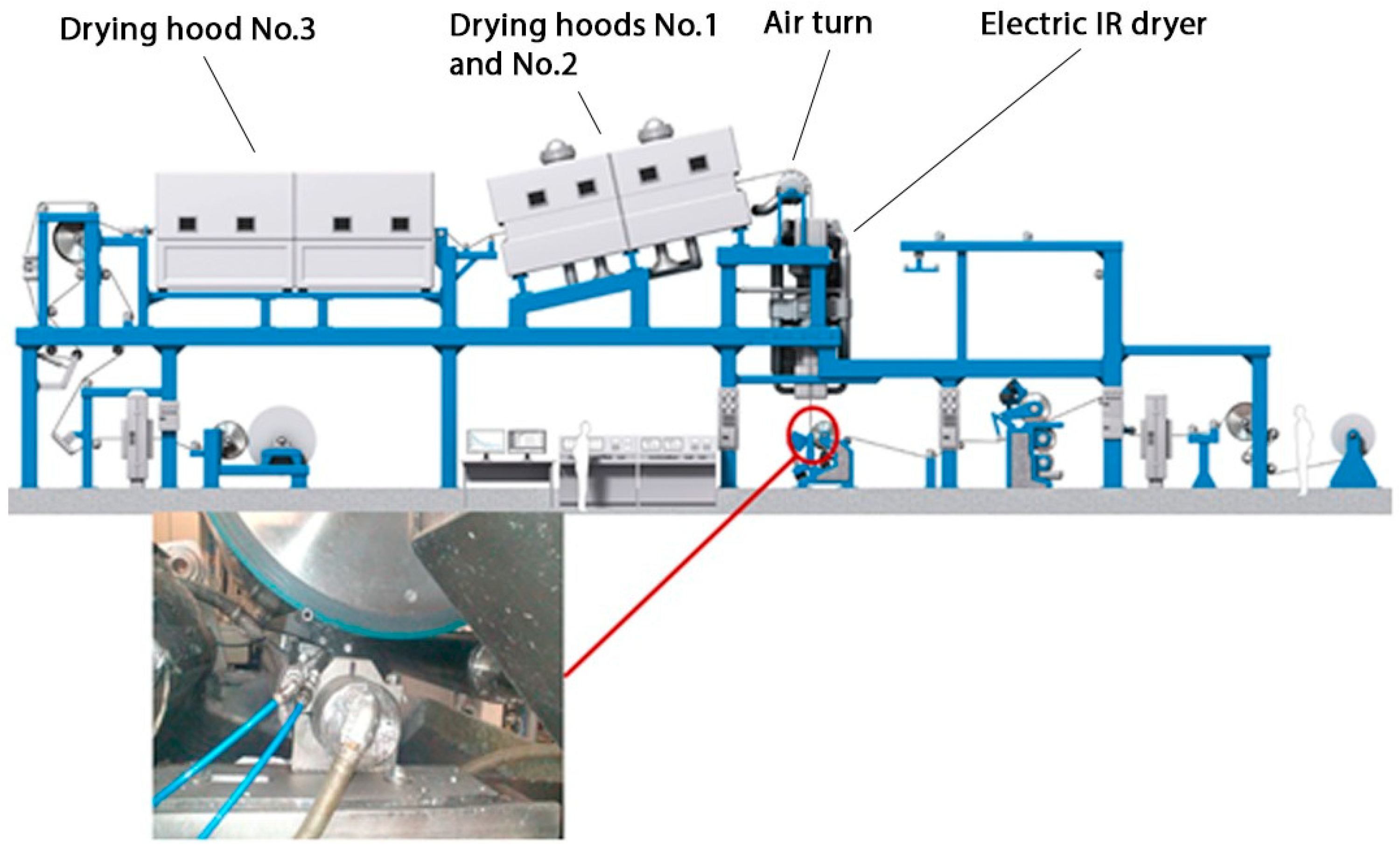
The pilot-scale coating trials were conducted using the UMV Coating Systems AB pilot coater in Säffle, Sweden, operating at a machine speed of 400 m min−1 on paperboard with a web width of ca. 0.55 m. The pilot coater is shown in Figure 1. The coatings were applied onto the brown unbeached backside side of the substrates using a short-dwell-time applicator (SDTA), also referred to as a zero-dwell coater (Invo Coater®, UMV Coating System AB, Säffle, Sweden). The dwell time between application and metering was 0.005 s at a machine speed of 400 m min−1. The coater can be equipped with several different types of metering elements, integrated in the SDTA coating unit. In the thin multilayer coating trials, the metering element was a soft and resilient polymer tip (Invo Tip, UMV Coating System AB, Säffle, Sweden). The coat weight was controlled by the metering tip angle. The metering tip angle was kept constant at 20° during all thin multiple coating trials. For comparison, thick single-layer and double-layer coatings were performed using volumetric rod metering elements (diameter 14 mm) to achieve the required coat weights. The SDTA coating unit and the metering elements were further described by Christophliemk et al. [47].
The online drying system comprised the following components:
  • One electric IR dryer (manufactured by Ircon Drying Systems AB, Vänersborg, Sweden) equipped with 12 individual IR frames, distributed as 6 frames on each side of the web, where the total installed power was 1036 kW, i.e., 86.3 kW per individual IR frame. The total length of the electric IR dryer was 3.6 m. At the maximum power level, the peak wavelength was 1.21 μm. The peak wavelength increased slightly with decreasing IR power—for instance, the peak wavelength was 1.35 μm and 1.73 μm at 66% and 27% of maximum power, respectively.
  • One air turn of radius 0.4 m, not formally classified as a dryer, located between the IR dryer and airfloat dryers, where the air turn has some minor effect on the drying process.
  • Three airfloat drying hoods, each capable of operating at temperatures up to 300 °C.
A cooling cylinder was positioned directly after the final drying hood. The experimental design of the pilot trials is summarised in Table 2. Essentially, two different drying strategies were compared for multilayer coatings comprising up to six individual layers.
Series A: Low IR power combined with high air hood temperature.
Series B: Medium IR power combined with low air hood temperature.
To facilitate a more comprehensive understanding of the influence exerted by IR drying parameters, targeted modifications to both Series A and Series B were included in the experimental protocols. In parallel trials when executing Series A, the second and third layers were dried at high IR power (referred to as Modified Series A). In a parallel trial when executing Series B, drying of the sixth layer took place at reduced total IR power by turning off all six IR frames positioned on the uncoated side of the web, while keeping the power level unchanged for each remaining active IR frame (referred to as Modified Series B).
In the multilayer approach, each coating layer was dried before the subsequent layer was applied. After each pass, the coated reel was transferred from the winder to the unwinding position in the front of the pilot machine for application of the next layer. The total coat weight after 6 thin layers was about 5 g m−2. The coat weight of each individual layer ranged from 0.45 to 1.5 g m−2, with the highest coat weights obtained during the first coating passes. Drying between successive layers was applied to the double-coated reference samples as well. The paperboards entering the coater for MA2, MB6, RDA2 and RDB2 were A1, B5, RDA1 and RDB1, respectively. The coat weights were calculated from the measured consumption of barrier dispersion. The coat weights and drying conditions are summarised in Table 2.
The drying units utilised for the reference samples, i.e., the thick single- and double-coatings with coat weights of each individual layer >3 g m−2, operated at higher power relative to those employed for the thin multilayer samples (see Table 2).

2.2.3. Analyses of Coated Paperboard

Pinholes
Pinholes were quantified in accordance with SS-EN 13676. A colouring solution prepared by dissolving 0.5 g of dyestuff, Crocein Scarlet MOO (CAS 5413-75-2), in 100 mL of ethanol, was used. The coated side of each specimen was exposed to the solution for 5 min, after which the surplus was removed, and any coloured spots were counted. The results were expressed as the number of pinholes/dm2, with an upper detection limit of 30 pinholes/dm2. All experiments were performed within one week after the coating trials. For the pinhole measurements and all other analyses mentioned below, the samples were stored at 23 °C and 50% relative humidity (RH) prior to measurement. The results from the pinhole measurements were performed in five replicates.
Surface Structure—Air Flow Method
A Bendtsen apparatus (Bendtsen Tester, Model 58-27, Messmer Buchel, The Netherlands) was used to test surface roughness according to ISO 8791-2. This method is based on air flow, and the test pressure was 1.47 kPa. All measurements were repeated 21 times, except for those for the uncoated paperboard, which were repeated 42 times. The measurements on the uncoated cardboard were performed on the unbleached brown side.
Profilometry—Images, Roughness and Void Volume
An optical surface profiler (ContourGT-K, Bruker Nano Inc., Tucson, AZ, USA) operated in VSI mode along with the Vision 64 software (Bruker Nano Inc., Tucson, AZ, USA) was used to acquire contour images and determine roughness parameters listed in Table 3. All measurements were performed in triplicate, except for those for the uncoated paperboard, which were repeated 10 times. The measurements employed a Michelson 5× objective with an optical resolution of 2.2 µm and a 0.55× field-of-view lens. The pixel size of all images was 3.5 µm. Stitched images (rectangular stitch; 10 mm × 10 mm) were used for all roughness calculations. The stitched raw images were optimised by applying a 3-pixel median statistic filter, followed by data restoration (data interpolation from valid pixels around eventual missing pixels) and finally by gentle tilt removal (plane fit). The natural and positive volumes were carefully controlled such that the natural volume equalled the negative volume and that the positive volume equalled 0 nm3 after the removal of any tilt impact. The optimised images were then used in the analysis of the roughness parameters.
Two of the parameters in Table 3 are derived from bearing analyses. Bearing analyses are commonly utilised in tribology and can also be applied to other fields. The details of bearing analysis curves are explained elsewhere [76]. The total surface volume ( V s ) was defined according to the following:
V s = Sc + Sv
To distinguish between surface roughness and waviness, zero-order Gaussian regression filtering (Vision 64 software program, Bruker Nano Inc., Tucson, AZ, USA) was used for the elimination of large-scale lateral components. A wavelength cutoff of 1 mm was used, as surface roughness typically scales between 0.001 mm and 1 mm [77]. Values of Sa before and after Gaussian regression filtering are shown, while Sc and Sv were calculated without filtering.
All measurements of surface structure, including the Bendtsen test, were completed within 22 months after the coating trials.
Grease Resistance
Grease resistance was evaluated using the Kit test according to TAPPI 559 in five replicates. In this test, 12 different mixtures of castor oil, toluene and heptane are prepared—referred to as Kit solutions—which vary in surface tension and viscosity and are numbered from 1 to 12. A higher Kit number indicates a greater tendency for the solution to penetrate the specimen. A drop of each Kit solution was applied to the coated surface, and the Kit rating was defined as the highest-numbered Kit solution that did not penetrate within 15 s. This means that a high Kit rating number indicates high grease resistance. The maximum Kit rating number is 12. All grease resistance measurements were conducted two months after the coating trials.
Oxygen Transmission
The oxygen transmission rate (OTR) was determined in accordance with ASTM D 3985-05 using a Mocon Ox-Tran oxygen transmission rate tester, Model 2/21 MH from Mocon, Inc., Minneapolis, MN, USA. The test area was 5 cm2, and the OTR measurements were carried out using air as the permeant (oxygen concentration 20.9% (by vol.) and 50% RH) in two and four replicates for Series A and the reference thick double coating, respectively. All OTR measurements were completed within three months of the coating trials.
The ambient oxygen ingress rate (AOIR) was determined using air as the permeant to characterise the dynamics of oxygen permeation. The sample cells were connected to a gas permeation analyser (PermMate, Systech, IL, USA). The cell volume ( V c e l l ) was 330 mL and the oxygen volume ( V o x y g e n ) was recorded as a function of time ( t ). Before each experiment, the sample cell was flushed with nitrogen to reduce the oxygen concentration to approximately 1% (by vol.). The temperature and RH were maintained at 23 °C and 50%, respectively. Further experimental details are provided elsewhere [78]. The AOIR, defined as ( d V o x y g e n d t   ), was calculated from the initial linear part of the curve V o x y g e n vs. t , under conditions where the oxygen pressure inside of the cell is small in comparison with the oxygen pressure outside of the cell.
d V o x y g e n d t l i n = V c e l l p f p i p a t m t f t i
where p a t m is the atmospheric pressure, p i is the oxygen pressure in the cell measured at the initial time t i , and p f is the oxygen pressure in the cell measured at the final time t f , according to Larsen et al. [79]. Experimental points up to an oxygen concentration of 4 ± 1% (by vol.) oxygen were used for the linear curve fit of the initial part of the curve V o x y g e n vs. t . However, experimental points at higher oxygen concentration were also included for samples BASE, A1, RSB1 and RDB1 due to the rapid increases in oxygen concentration. All AOIR measurements were completed within three months after the coating trials and conducted in duplicates.

3. Results

3.1. Pinholes and Surface Structure

The quantification of pinholes in the coated sheets was conducted as an initial assessment of their barrier properties. Surface roughness was evaluated using both the Bendtsen air leakage method and surface profilometry, supplemented by V s measurements. This approach offers valuable insights into the interfacial interactions between the coating dispersion and the substrate. The present study further examined the substrate’s responses to applied forces during application and metering, as well as its interaction with the aqueous phase throughout the interval between application and immobilisation.
Table 4 displays the number of pinholes and the Bendtsen surface roughness values for the samples analysed in this study. The multilayer approach in combination with the selected coater and metering device was used to achieve coated paperboard free of pinholes even at low coat weights. The multilayered samples A5, A6 and MB6 contained no pinholes, indicating that a uniform and continuous coating had been achieved. In contrast, the single- and double-coated reference samples exhibited significantly higher numbers of pinholes. This occurred notwithstanding the fact that certain reference samples exhibited a higher coat weight compared with any of the multilayer-coated paperboards. Notably, for the multilayer coatings, the incidence of pinholes could not be predicted based on Bendtsen roughness measurements. Instead, drying conditions—particularly the IR drying settings—appear to be the decisive factor governing pinhole formation.
Raising the IR power from 20% to 40% resulted in more pinholes (cf. Series A and Series B in Table 4), indicating that the 40% IR setting caused premature film formation. This effect is further supported by a comparison between A2 and MA2, which exhibited 19.0 pinholes/dm2 and a pinhole density beyond the measurable range, respectively. The only difference between these two samples was the higher IR power for MA2. Excessively intense IR drying of the multilayered samples, as in the Modified Series A samples, resulted in severe blistering, which became evident in the third layer.
MB6 exhibited a much lower pinhole density than M6. During the MB6 run, all IR frames located on the uncoated side of the web were switched off, reducing the total IR power from 40% to 20%. However, the IR frames positioned on the coated side remained active at 40% of their maximum power.
All thick reference samples possessed a higher number of pinholes than the detection limit of 30 pinholes/dm2. Although their coat weights were higher than those of the multilayer samples, none of the reference coatings showed fewer pinholes than samples A2 to A6 in Series A or the samples B6 and MB6. Notably, sample A2 contained fewer pinholes than RDB2, despite RDB2 having almost three times the coat weight. This probably relates to the dynamics of drying thick layers at high machine speeds. Higher IR power is needed to transfer sufficient energy to the substrate/sedimentation layer at increasing coat weight.
As expected, all coated samples exhibited lower Bendtsen roughness than the uncoated substrate. A clear trend was observed in which the Bendsen roughness of the multilayered samples decreased with increasing number of layers, although the reduction from one layer to the next was not always significant. An increase in IR power when drying the thin multilayered samples did not result in any significant changes in Bendsen roughness (see Series A and Series B).
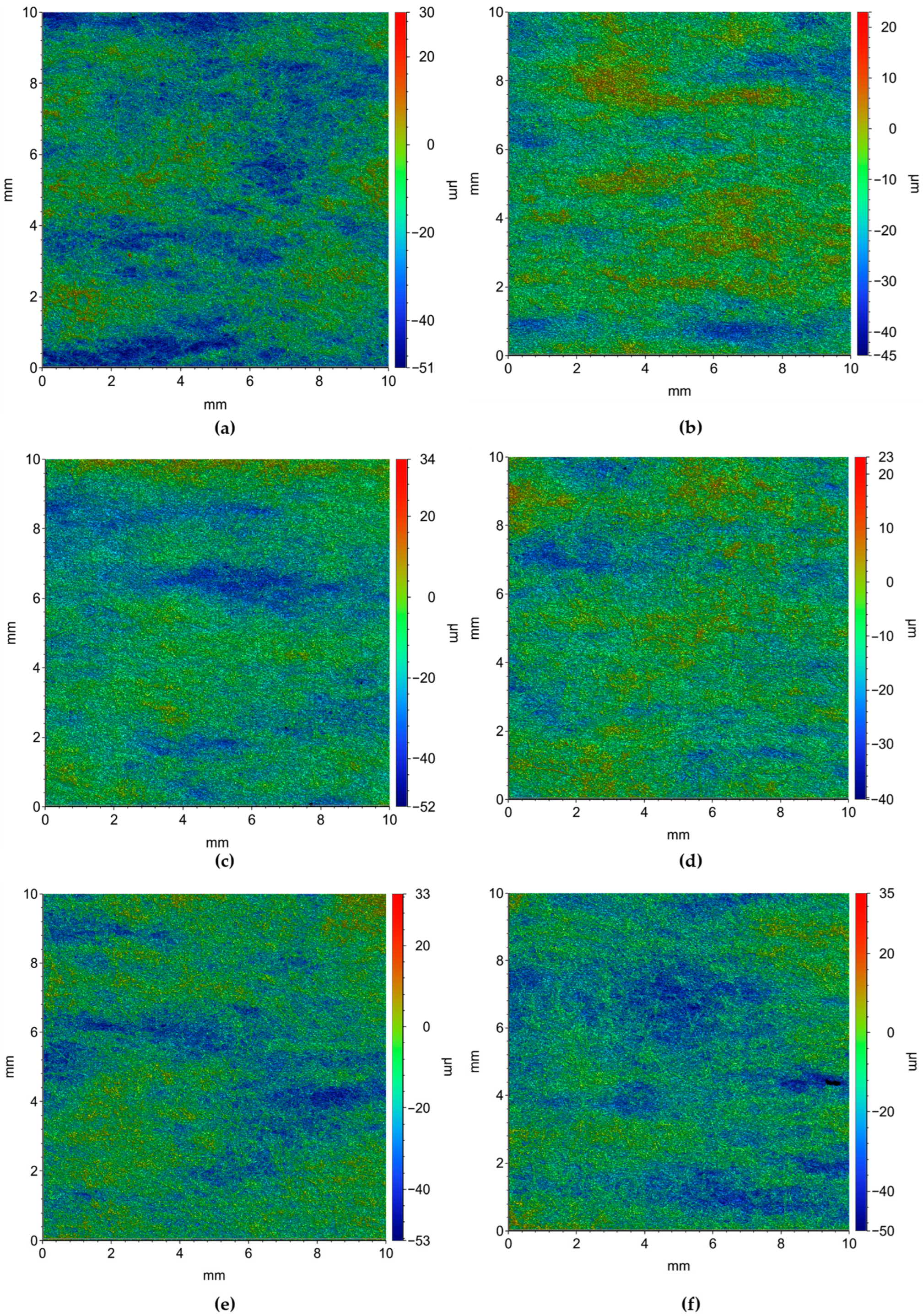
Optical surface profilometry provides a much more comprehensive and detailed characterisation of the structure of the coated samples than is possible with Bendtsen surface roughness measurements. Given that Bendtsen surface roughness and optical profilometry use different measurement techniques, the results obtained from these two methods may not always correspond exactly. Optical surface profilometry images (contour images) for BASE, A6, B6, MB6, RSB1 and RDB2 are shown in Figure 2. The long-range waviness is distinctly observable. However, differences in surface roughness could not be observed directly from Figure 2. To draw conclusions about surface roughness, the surface profiler datasets were processed using computer-aided calculations to obtain the filtered average roughness (Sa). Table 5 shows the unfiltered Sa; the short wavelength pass-filtered Sa; and Sc, Sv, and V s .
Table 5 shows no significant differences in unfiltered Sa between BASE and the coated paperboards, indicating that all samples—whether metered with the soft-tip element or with the rod—exhibited a contour-type coating. A uniform coating layer is essential for achieving low gas transmission. The experimental scatter in unfiltered Sa was anticipated to be high due to the large-scale waviness in Figure 2 relative to the limited the image size.
The filtered Sa values are shown in Table 5. The filtered Sa values show roughness values without the influence of waviness. As expected, the experimental scatter of the filtered Sa values was considerably lower than that of the unfiltered Sa values. The filtered Sa showed that the roughness of the multilayered samples exhibited substantially lower roughness than the uncoated paperboard. The samples with six thin layers without any pinholes (A6 and MB6) displayed the lowest surface roughness. The diameter of cellulose fibres (approximately 30 μm for softwood) falls within the length scale of roughness (0–1000 μm). This implies that the reduced filtered Sa observed for thin multilayer coatings likely reflects a high degree of fibre coverage and filling of surface voids between cellulose fibres.
The filtered Sa values of the reference samples matched or exceeded those of the uncoated paperboard. The thick single-coated reference samples RSA1 and RSB1 exhibited the highest roughness (measured as filtered Sa) of all samples. A comparison of the thick single-coated reference samples (RSA1 and RSB1) and the multilayered samples with comparable coat weights (A6, B6 and MB6) clearly shows that the multilayer strategy produced significantly lower filtered Sa values (i.e., lower roughness). This observation is consistent with the Bendtsen roughness for the corresponding samples in Table 4, where the multilayer approach also yielded lower roughness values (although the differences were not always statistically significant).
The total surface volume ( V s ) of the coated paperboards (Table 5) did not differ substantially between samples, once again indicating a high degree of contour coating. Additional evidence for contour coating is provided by the rather constant Sc/Sv ratio, which remained between 9 and 12 for BASE and all coated samples. The wet volume ( V w e t ) applied after metering at each coating step can be calculated from the increase in coat weight, provided that the density and dry solid content of the wet coating dispersion are known. The approximate density of the coating dispersion was calculated based on the assumption of ideal mixing [80]. The densities of pure starch, PEG, water, and bentonite were set to 1.4985 g cm−3 [80], 1.126 g cm−3, 0.995 g cm−3, and 2.35 g cm−3 [81], respectively. The estimated resulting density of the coating dispersion and the aqueous phase of the dispersion were 1.07 g cm−3 and 1.04 g cm−3, respectively. Although the assumption of ideal mixing deviates from real conditions, it provides a sufficiently accurate approximation for estimating the wet volume applied at each coating step. The real density values are supposed to be higher than the calculated ones.
A fundamental requirement for fibre coverage is that the wet volume of the coating dispersion fills the surface volume between large-scale height variations caused by fibre flocs. Table 6 shows V s and V w e t for selected coated samples. For the thin multilayered samples (A1, A6, B1, B6 and MB6), V w e t was substantially smaller than V s , indicating that compression of the substrate beneath the metering element was required to obtain good fibre coverage and a uniform coating layer. Increased compression beneath the metering element has previously been shown to promote more uniform coating [82].
For the thick single-coated reference samples (RSA1 and RSB1), V w e t was substantially greater than V s , indicating that, in principle, fibre coverage could have been achieved without compressing the substrate. For the reference samples, RDA1, RDA2 and RDB1, V w e t was just slightly higher than V s . However, the optical surface profilometry results also clearly indicated a contour-type coating for the reference samples. This suggests that the substrates were compressed beneath the metering element during the reference trials as well.

3.2. Grease Resistance and Oxygen Barrier Properties

Analyses of grease resistance and oxygen transmission were carried out for a selected subset of samples. The AOIR, OTR and Kit ranking numbers are shown in Table 7. The variation in AOIR values for Series A aligns well with the corresponding decrease in pinhole surface density (cf. Table 4). A marked reduction in the AOIR—to values around 10 mL day−1—was observed from three layers onwards. Due to experimental scatter, distinguishing between the AOIR values for the four samples in Series A with three to six layers was not possible. The higher IR power in Series B compared with that in Series A resulted in higher AOIR values, consistent with the increased pinhole densities for Series B. Turning off the IR radiation on one side of the web for the sixth layer in Series B gave a significantly lower AOIR (cf. M6 and MB6), demonstrating that defects can be reduced by lowering the total IR power. All reference samples (RSB1, RDB1 and RDB2) possessed an AOIR rather similar to that observed for A1 (one thin layer). Table 7 clearly shows that thin multilayer coatings provide lower oxygen transmission than one or two thick coating layers. Table 7 also includes the OTR for A6 and RDB1, measured according to the ASTM D 3985-05 standard. All other samples without pinholes (see Table 4) are likely to exhibit OTRs in the same range as A6. Even if a substantial decrease in the AOIR with an increasing number or layers in Series A was observed, the OTR was still too high to be regarded as a sufficient oxygen barrier for sensitive food packaging applications [83]. The OTR values presented in Table 7 should be compared with the oxygen barrier properties of films produced by laboratory-scale casting. Zeppa et al. [68] reported that the oxygen permeability of starch–montmorillonite cast films ranges from 66 to 239 cm3·μm·m−2·day−1 (pure oxygen was used as the permeant), depending on the type of plasticiser and montmorillonite employed. Based on the densities of the individual dry components, the density of the dry coating layers used in the present work can be approximated as 1.58 g cm3. This corresponds to an average coating thickness of 3.2 μm for A6. The OTR value measured for A6 shown in Table 7 is higher than would be expected from the permeability values for cast free-standing films given by Zeppa et al. [68].
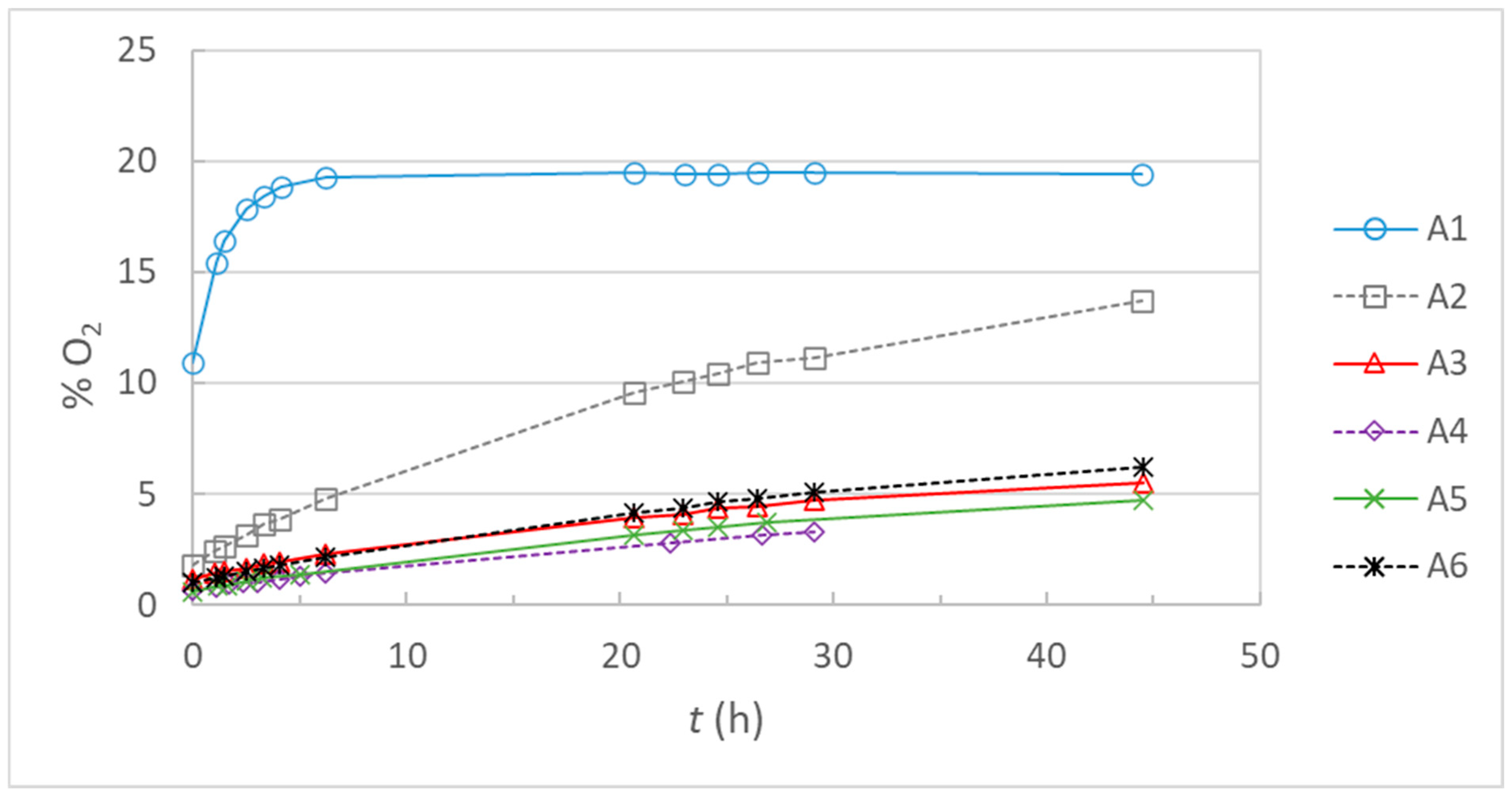
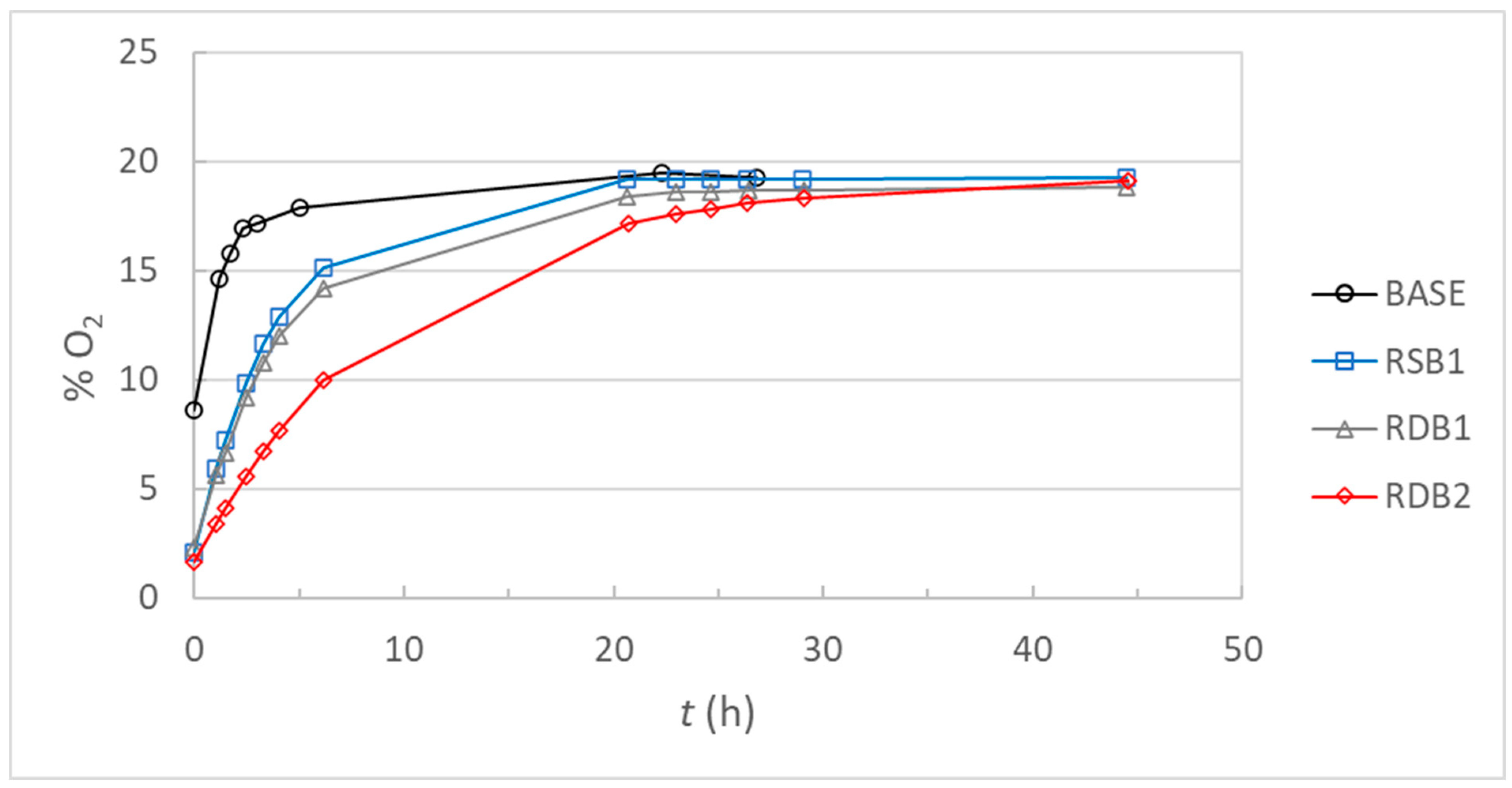
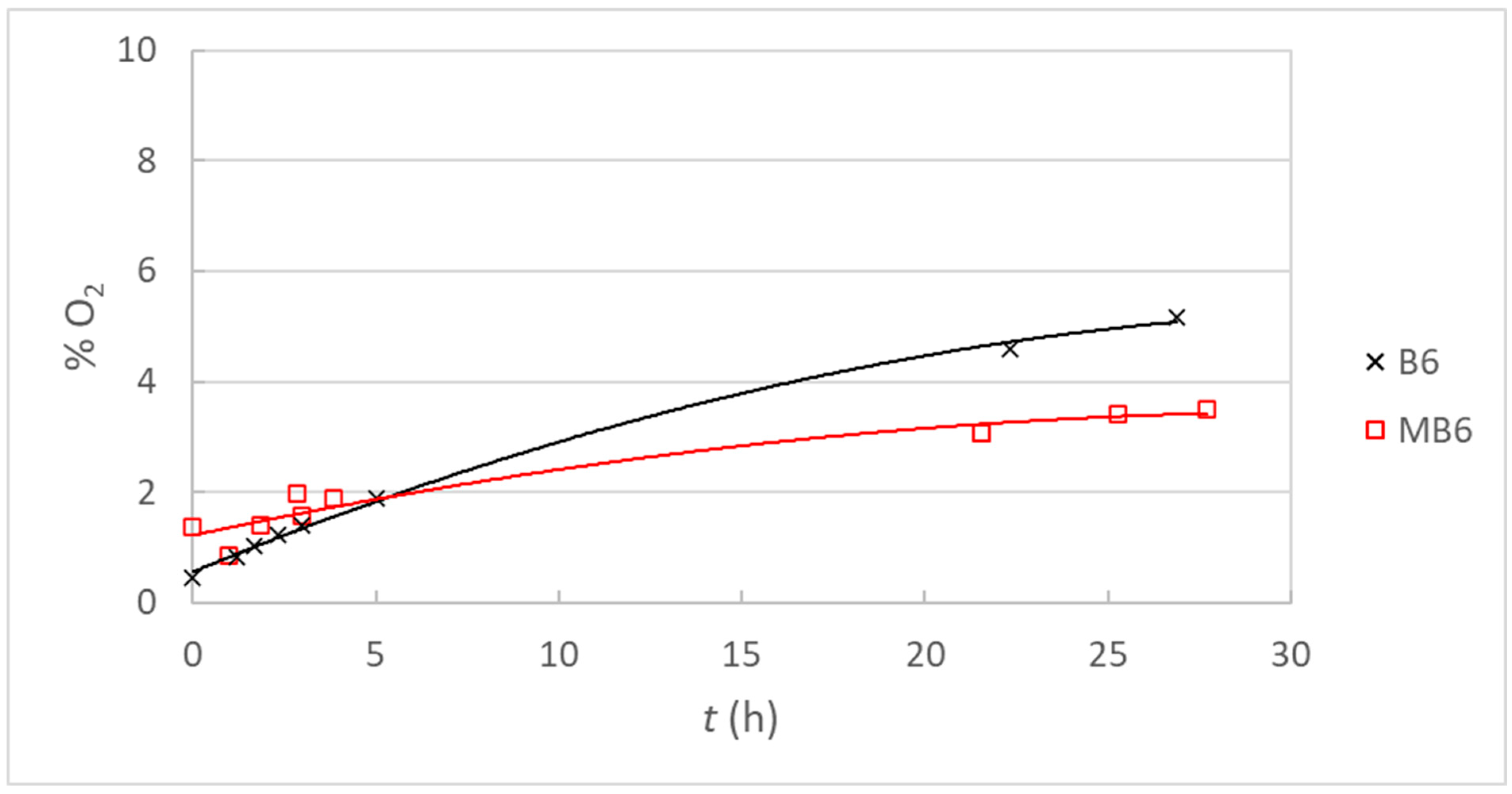
Figure 3, Figure 4 and Figure 5 illustrate the dynamics of oxygen permeation. Only small differences were observed among the four samples in Series A containing three to six layers (Figure 3), in contrast to the clear reduction in pinhole density. This demonstrates that oxygen ingress cannot be explained solely based on pinhole numbers. The experimental error in Figure 3, Figure 4 and Figure 5 can be estimated from the error limits for the AOIR values in Table 7. Figure 4 reveals that the rate of oxygen increase observed in the reference samples was substantially higher compared to any of the multilayered samples in Series A with more than one coating layer. Figure 5 further demonstrates that deactivating all IR frames on the uncoated side significantly reduced the rate of oxygen concentration increase, indicating enhanced barrier performance under these modified drying conditions.
The Kit rating values exhibited a strong correlation with the pinhole analysis (Table 4). Samples A5, A6 and MB6 achieved a Kit ranking of 12, consistent with the absence of detectable pinholes. This concordance between the Kit test and pinhole assessment was anticipated, as both methodologies evaluate barrier integrity through the penetration of non-aqueous test solutions. The results clearly demonstrate that the presence of pinholes is detrimental to high grease resistance.

4. Discussion

4.1. Interaction with Water

The reduction in pinholes observed for the thin multilayered samples dried under gentle IR power (Table 4) is governed by several dynamic processes. Primarily, the absorption of the aqueous phase into the base paper or paperboard is influenced not only by the intrinsic properties of the substrate and the coating dispersion, but also by critical process parameters, including web speed, the pressure pulse exerted during application and metering, and the dwell time between application and subsequent metering and drying stages. Transport of water into the substrate may result in fibre swelling and loss of fibre network strength and consequently lead to increased surface roughness [84]. For multilayer coatings, swelling phenomena are most likely to occur during the initial coating pass, when the wet coating is in direct contact with the substrate, as proposed by Guezennec [49]. Rapid dewatering may also reduce the amount of wet coating present at the metering stage, potentially causing defects such as non-uniform coat weight distribution and blade scratches. Penetration of the coating dispersion, or just its aqueous phase, into the substrate can also compromise barrier performance and reduce tensile stiffness [62]. On the other hand, Table 4 indicates that the barrier properties are predominantly controlled by the drying strategy. Rapid drying utilising electric IR dryers that possess a maximum wavelength in the near-infrared (NIR) range helps minimise water uptake by the substrate [6,48]. However, the results presented in Table 4 clearly revealed that too intense drying is decisive for the barrier properties.
The Bendtsen roughness (Table 4) and filtered Sa values (Table 5) at comparable coat weights were lower for samples produced via the multilayer coating strategy compared to those prepared with a single thick layer. This is likely attributable to the substantial volume of aqueous dispersion applied during the pass through the coater for the reference samples RSA1 and RSB1. The increased wet coating volume may lead to more blistering, pinholes and increased water penetration into the base paperboard. A detailed examination of the double-coated reference samples (Table 4) revealed surprisingly high Bendtsen roughness values for RDA1 and RDA2 compared to RDB1 and RDB2. This observation may be attributed to insufficient IR power during the drying of RDA1 and RDA2, which likely resulted in inadequate heating of the substrate beneath the coating layer. Such conditions are expected to promote water penetration and subsequent swelling. The variations in Bendtsen roughness among repeated measurements of the same sample, reflected by the error limits in Table 4, are indicative of inherent heterogeneity in the surface structure of the uncoated paperboard.

4.2. Adhesion and Crystallinity

Modified starches are used by the paper industry in high-speed surface sizing applications to increase the surface strength of the paper and to improve properties such as internal bond, tensile strength, and folding ability. Unmodified and modified starches are also used as an adhesive in high-speed paper coating applications to bind clay particles together and to the paper [24]. Based on pencil hardness tests and SEM cross-sectional images, Santos et al. [62] concluded that starch–bentonite coatings possessed strong bonding to the base paper. Thus, the coatings in the present study likely possessed strong adhesion to the base paperboard.
The present study showed a distinct negative correlation between pinhole formation and barrier properties. Although the number of pinholes seemed decisive, it cannot be excluded that starch crystallinity had a minor effect on the barrier properties observed in coated samples without pinholes. Both pure starch and thermoplastic starch are semi-crystalline polymers. Amorphous polymers exhibit, in general, higher oxygen permeability than their semicrystalline counterparts, at least at conditions that are not too humid [85,86]. The crystallinity of starch—and therefore the barrier performance of starch-based coatings—can be affected by several factors, including the ratio of amylopectin to amylose, the type and concentration of plasticiser, and process conditions like drying rate, temperature, and relative humidity during film formation [87,88]. However, the relationship between crystallinity and oxygen barrier properties, as well as crystallinity and mechanical properties, is likely more intricate than simply depending on the degree of crystallinity. Guinault et al. [89] showed that both the degree of crystallinity and the crystalline morphology must be taken into consideration when describing the effects of crystallisation. In addition, it has been proposed that bentonite promotes crystallinity in starch films [64]. Analyses of microstructure and crystallinity were beyond the scope of the present study and are recommended for future research.

4.3. Effects of Coating and Drying Conditions on Oxygen Barrier Properties

The origin of pinholes and analogous defects that adversely affect barrier properties can be attributed to several mechanisms. First, the applied coating must achieve thorough coverage of the pores located between the cellulose fibres at the substrate surface. In most cases, this necessitates the formation of a uniform coating layer. Inadequate coating uniformity will result in residual open pores. Additionally, the emergence of pinholes may be induced by entrapment of air bubbles within the coating dispersion [71] or from blistering phenomena [49]. Multilayers are anticipated to reduce pinhole pathways by covering holes present in previous layers, which results in decreased gas transport through the pinholes [71]. Notably, Table 4 demonstrates that sample A2 (comprising two thin layers dried using gentle IR power) exhibited fewer pinholes than any of the thick double-coated samples. This clearly highlights the benefits of thin multilayered coatings in combination with optimised drying conditions.
In the IR drying of barrier-coated paper and paperboard, Heilmann [48] emphasised the importance of heating the initial sedimentation layer, noting that coatings should be dried from bottom to top to prevent premature film formation at the surface and penetration of the coating into the substrate. Premature film formation at the surface may in turn cause the formation of micro-blisters and pinholes. The reduced pinhole density observed in multilayered samples at 20% IR power (Table 4) indicates that thin individual layers enable sufficient heating of the substrate beneath the coating, thereby minimising defect formation. In contrast, drying at 40% IR power resulted in a markedly higher incidence of pinholes, indicating that too high IR power led to premature film formation of the uppermost part of the coating layer. A comparison between Series A and Modified Series A (Table 4) further demonstrated that overly intense IR drying of multilayered samples can induce pronounced blistering. This is most likely attributed to premature film formation resulting from elevated IR energy input relative to the enthalpy of vaporisation. At optimal conditions, the cooling effect of evaporation is expected to contribute to a temperature profile that promotes drying of the wet layer from bottom to top, as proposed by Heilmann [48]. The IR setup in MB6 resulted in coated sheets free from detectable pinholes (Table 4) and a relatively low AOIR (Table 7). The power setting of each active individual IR frame was 40% and 20% for the MB6 and Series A samples, respectively, with the total IR power kept constant. The higher power of each active IR frame for MB6—and thus the slightly shorter peak wavelength and greater penetration depth—may have promoted bottom-to-top drying, while the total IR power was low enough to prevent premature film formation. It is plausible that implementing a comparable drying strategy from the initial coating layer, deactivating all IR frames on the uncoated side, would have been successful in reducing both oxygen transmission and the pinhole density.
A comparison between Table 4 and Table 7 reveals that the oxygen and grease barrier failure in the thin coatings was primarily due to local defects rather than average thickness. The observed differences in pinhole density can explain the measured barrier performance. Achieving effective barrier coatings at elevated machine speeds on rough paperboard substrates, in the absence of a precoating layer, presents considerable challenges. In the present study, the rates of oxygen transmission summarised in Table 7 and Figure 3, Figure 4 and Figure 5 are slower than reported elsewhere. Olsson et al. [74] reported OTR values that exceeded 1000 cm3 m−2 day−1 at a total coat weight of 9.1 g m−2 for starch/bentonite/PEG coatings applied at 500 m min−1 on liquid packaging board. Changing the substrate to a smooth and dense greaseproof paper resulted in a minimum measured OTR of 74 cm3 m−2 day−1 [74], indicating the benefits of smooth substrates when applying aqueous barrier coatings at high machine speeds. It is anticipated that conducting analogous multiple coating trials on a smooth and mineral precoated paperboard would yield substantially lower oxygen transmission rates.
The oxygen transmission measured for sample A6 was higher than anticipated based on the oxygen permeability of laboratory-cast montmorillonite/starch films [68]. This discrepancy may stem from local variations in coating thickness, even though Figure 2 and Table 5 indicate a pronounced contour coating. The comparatively low coat weight recorded for sample A6 (5.1 g m−2) increases the likelihood that certain regions received insufficient coating, thereby creating local weaknesses in the barrier layer. Furthermore, it is conceivable that minor defects in the coating layers may become increasingly influential after the principal voids between cellulose fibres were sealed after the first two layers.
Table 6 revealed that compression of the substrate is needed to fill the surface irregularities between fibre flocs, leading to a uniform coating. The characteristics of the resilient metering tip used in the present study are also expected to contribute to coating uniformity [90]. In addition to the material properties, the shape and angle of the resilient tip influence the degree of compression, in line with the force balance outlined by Renvall and Kuni [33]. The use of an integrated applicator/metering of the short-dwell type and the use of a base paperboard with a low Cobb value further helped to ensure a sufficient wet volume beneath the metering blade. Overall, the findings indicate that coating uniformity is influenced not only by the dryers and machine speed, but also by the design of the coater. Previous studies have demonstrated that the coating uniformity becomes highly dependent on the coating technique within the wavelength range 1–8 mm [91]. In a study addressing multilayer PVOH barrier coatings, Christophliemk et al. [47] proposed that excessive compression during metering may induce small-scale defects, typically a few micrometres in size—resulting from surface compression followed by relaxation. In the present study, a resilient polymer metering tip was selected to mitigate such defects. Furthermore, the optical resolution of the Michelson objective employed in the present study was inadequate for detecting minute surface defects caused by compression and relaxation. Optimisation of coating parameters such as machine speed, blade tip angle and coater pressure was beyond the scope of the present study, as these variables remained constant during all multilayer trials. However, further optimisation of the coating parameters could have resulted in additional reductions in oxygen permeability.
Although the AOIR and OTR values presented in Table 7 do not fulfil the requirements for effective oxygen gas barrier performance, all multilayer-coated samples without pinholes exhibited outstanding grease resistance. These findings suggest that the thin multilayer coating approach can be successfully applied in paperboard manufacturing to achieve superior grease resistance, thereby obviating the necessity for mineral precoating.

4.4. Food Contact

Starch is a hydrophilic material and starch films may slowly dissolve in contact with water. This must be considered when starch films and coatings are used in packaging applications [92]. According to Commission Regulation (EU) No 10/2011, plastic materials and articles must not release more than 10 mg of constituents per dm2 of contact surface into food simulants. Crosslinking of starch has been proposed as an effective strategy to comply with regulatory requirements concerning overall migration limits, while simultaneously reducing the solubility of starch-based films in aqueous environments [73,74].

5. Conclusions

The present study focused on traditional coating techniques, i.e., applying excess coating colour and then metering to achieve the desired coat weight. The coater was equipped with a resilient metering tip, and the design was aimed to minimise the dwell time between application and metering, thereby reducing sorption of the coating colour or its aqueous phase into the substrate. Thus, the conclusions strictly apply to such techniques. Since the present study addresses drying effects, most findings related to drying settings are likely applicable to other wet coating techniques for paper or paperboard, as well as other water-borne coating formulations. The most important findings were as follows:
To fully realise the benefits of multilayer technology, it is essential to implement an optimised drying strategy.
An excessive power setting in the IR dryer led to a higher incidence of pinholes and increased oxygen penetration in the multilayer-coated samples. Further elevation of the IR power resulted in blistering, most likely as a consequence of premature film formation.
Modifying the placement of the IR frames to be solely on the coated side of the paperboard appeared to mitigate pinholes and reduce oxygen penetration.
Thin multilayer coatings exhibit fewer pinholes, lower oxygen transmission rates and enhanced grease resistance compared to one or two thick layers, suggesting that multilayer technology might potentially contribute to material savings and promote resource-efficient production.
A significant reduction in pinholes and oxygen transmission was noted for the multilayer-coated samples after the application of two thin layers.
A contour coating was achieved for both the multilayer-coated paperboard and the thick single- and double-coated reference samples.
Significant compression of the substrate beneath the blade was required to obtain the observed contour coating for the multilayer-coated paperboard. Although not directly examined in the present study, it is conceivable that the compliance of the metering tip also contributed to the resulting coating uniformity.
In comparison to thick single or double coatings, the multilayer technique produced a smoother surface when measured over several fibre diameters.
The bentonite–starch–PEG formulation demonstrated limited suitability for packaging oxygen-sensitive foods but showed potential for other packaging applications or as a precoating layer.
Further work should explore improved substrates, top-coats and durability tests to advance towards commercial application.

Author Contributions

Conceptualisation, L.J. and P.E.; methodology, L.J., H.C., E.B., J.L. and P.E.; formal analysis, L.J. and H.C.; investigation, L.J., H.C., E.B., J.L. and P.E.; resources, L.J., J.L. and P.E.; writing—original draft preparation, L.J. and H.C.; writing—review and editing, L.J., H.C., E.B., J.L. and P.E.; supervision, L.J.; project administration, L.J. and P.E.; funding acquisition, L.J. and P.E. All authors have read and agreed to the published version of the manuscript.

Funding

This research was funded by the SWEDISH GOVERMENTAL AGENCY FOR INNOVATION SYSTEMS (VINNOVA), file reference number 2014-00319; STIFTELSEN NILS OCH DORTHI TROËDSSONS FORSKNINGSFOND, Sweden, grant application number 866/15; and the KNOWLEDGE FOUNDATION, Sweden, file reference number 20180036.

Institutional Review Board Statement

Not applicable.

Informed Consent Statement

Data are contained within the article.

Data Availability Statement

The original contributions presented in this study are included in the article. Further inquiries can be directed to the corresponding author.

Conflicts of Interest

Lars Järnström (L.J.) runs the sole proprietorship Lars Järnström Consulting, and Hanna Christophliemk (H.C.) is employed by the research organisation VTT. L.J. and H.C. declare no conflicts of interest. Erik Bohlin (E.B.), Johan Larsson (J.L.), and Per Emilsson (P.E.) hereby disclose their conflict of interest as outlined by the MDPI guide. E.B. and J.L. work for Billerud Skog & Industri AB and Billerud AB, respectively. Billerud, a pulp and paper company, manufactures coated paperboards among other products. P.E. is an employee of UMV Coating Systems AB, a company that manufactures coating equipment. The present study discusses fundamental issues relevant to most pulp and paper companies. The results are presented impartially, and the research was conducted in the absence of any commercial or financial compensation.

References

  1. Andersson, C. New ways to enhance the functionality of paperboard by surface treatment—A review. Packag. Technol. Sci. 2008, 21, 339–373. [Google Scholar] [CrossRef]
  2. Tyagi, P.; Salem, K.S.; Hubbe, M.A.; Lokendra, P. Advances in barrier coatings and film technologies for achieving sustainable packaging of food products–A review. Trends Food Sci. Technol. 2021, 115, 461–485. [Google Scholar] [CrossRef]
  3. Jakobsen, M.; Bertelsen, G. Predicting the amount of carbon dioxide absorbed in meat. Meat Sci. 2004, 68, 603–610. [Google Scholar] [CrossRef]
  4. Matar, C.; Gaucel, S.; Gontard, N.; Guilbert, S.; Guillard, V. Predicting shelf life gain of fresh strawberries ‘Charlotte cv’ in modified atmosphere packaging. Postharvest Biol. Technol. 2018, 142, 28–38. [Google Scholar] [CrossRef]
  5. Jalali, A.; Linke, M.; Geyer, M.; Mahajan, P.V. Shelf life prediction model for strawberry based on respiration and transpiration processes. Food Packag. Shelf Life 2020, 25, 100525. [Google Scholar] [CrossRef]
  6. Ruberto, Y.; Vivod, V.; Grkman, J.J.; Lavrič, G.; Graiff, C.; Kokol, V. Slot-die coating of cellulose nanocrystals and chitosan for improved barrier properties of paper. Cellulose 2024, 31, 3589–3606. [Google Scholar] [CrossRef]
  7. Kumar, V.; Koppolu, V.R.; Bousfield, D.; Toivakka, M. Substrate role in coating of microfibrillated cellulose Suspensions. Cellulose 2017, 24, 1247–1260. [Google Scholar] [CrossRef]
  8. Shen, Z.; Rajabi-Abhari, A.; Oh, K.; Yang, G.; Youn, H.J.; Lee, H.L. Improving the Barrier Properties of Packaging Paper by Polyvinyl Alcohol Based Polymer Coating—Effect of the Base Paper and Nanoclay. Polymers 2021, 13, 1334. [Google Scholar] [CrossRef]
  9. Pokharel, K.; Bousfield, D.W.; Wang, J. The influence of precoating layers on the performance of water-based barrier coatings. TAPPI J. 2025, 24, 36–47. [Google Scholar] [CrossRef]
  10. Burton, D.; Welsch, G.; Piwowar, A. Influence of base sheet properties on barrier coating performance. TAPPI J. 2025, 24, 518–532. [Google Scholar] [CrossRef]
  11. Vähä-Nissi, M.; Savolainen, A.; Talja, M.; Mörö, R. Dispersion barrier coating of high-density base papers. TAPPI J. 1998, 81, 165–173. [Google Scholar]
  12. Furuheim, K.M.; Axelson, D.E.; Helle, T. Oxygen barrier mechanisms of polyethylene extrusion coated high density papers. Nord. Pulp Pap. Res. J. 2003, 18, 168–175. [Google Scholar] [CrossRef]
  13. Korpela, A.; Jaiswal, A.K.; Asikainen, J. Effects of hydrophobic sizing on paper dry and wet-strength properties: A comparative study between AKD sizing of NBSK handsheets and rosin sizing of CTMP handsheets. BioResources 2021, 16, 5350–5360. [Google Scholar] [CrossRef]
  14. Zhang, W.; Liu, W.; Li, H.; Hubbe, M.A.; Yu, D.; Li, G.; Wang, H. Improving Stability and Sizing Performance of Alkenylsuccinic Anhydride (ASA) Emulsion by Using Melamine-Modified Laponite Particles as Emulsion Stabilizer. Ind. Eng. Chem. Res. 2014, 53, 12330–12338. [Google Scholar] [CrossRef]
  15. Lindström, T.; Larsson, P.T. Alkyl Ketene Dimer (AKD) sizing–a review. Nord. Pulp Pap. Res. J. 2008, 23, 202–209. [Google Scholar] [CrossRef]
  16. Hubbe, M.A. Paper’s resistance to wetting—A review of internal sizing chemicals and their effects. BioResources 2007, 2, 106–145. [Google Scholar]
  17. Li, H.; Liu, W.; Yu, D.; Song, Z. Anchorage of ASA on cellulose fibers in sizing development. Nord. Pulp Pap. Res. J. 2015, 30, 626–633. [Google Scholar] [CrossRef]
  18. Seppänen, R. On the Internal Sizing Mechanisms of Paper with AKD and ASA Related to Surface Chemistry, Wettability and Friction. PhD Thesis, KTH Royal Institute of Technology, Stockholm, Sweden, 2007. [Google Scholar]
  19. Lindström, T. Sizing. In Volume 3 Paper Chemistry and Technology; Ek, M., Gellerstedt, G., Henriksson, G., Eds.; De Gruyter: Berlin, Germany, 2009; p. 301. [Google Scholar] [CrossRef]
  20. Engström, G. Pigment Coating. In Volume 3 Paper Chemistry and Technology; Ek, M., Gellerstedt, G., Henriksson, G., Eds.; De Gruyter: Berlin, Germany, 2009; pp. 374–375. [Google Scholar] [CrossRef]
  21. Kimpimäki, T.; Savolainen, A.V. Barrier dispersion coating of paper and board. In Surface Applications of Paper Chemicals; Brander, J., Thorn, I., Eds.; Springer: Dordrecht, The Netherlands, 1997; pp. 208–228. [Google Scholar] [CrossRef]
  22. Andersson, C.; Järnström, L.; Hellgren, A.-C. Effects of carboxylation of latex on polymer interdiffusion and water vapor permeability of latex films. Nord. Pulp Pap. Res. J. 2002, 17, 20–28. [Google Scholar] [CrossRef]
  23. Andersson, C.; Ernstsson, M.; Järnström, L. Barrier properties and heat sealability/failure mechanisms of dispersion-coated paperboard. Packag. Technol. Sci. 2002, 15, 209–224. [Google Scholar] [CrossRef]
  24. Maher, S.L.; Cremer, C.W. Use of Modified Starches: Paper Industry. In Modified Starches: Properties and Uses; Wurzburg, O.B., Ed.; CRC Press, Inc.: Boca Raton, FL, USA, 1986; pp. 213–227. [Google Scholar]
  25. Pawlak, P.; Kippenhahn, R.; Luck, T.; Schönweitz, C. Mehrschichtige Verpackung für Fettende Güter. European Patent EP 1 296 790 B1, 25 February 2004. [Google Scholar]
  26. Ovaska, S.-S.; Geydt, P.; Österberg, M.; Johansson, L.-S.; Backfolk, K. Heat-Induced changes in oil and grease resistant hydroxypropylated-starch-based barrier coatings. Nord. Pulp Pap. Res. J. 2015, 30, 488–496. [Google Scholar] [CrossRef]
  27. Fu, Y.; Wang, J.; Huang, S.; Duan, F. High oxygen barrier property of polyethylene composite films with bilayer polyvinyl alcohol coating for emergency foods in high-humidity environments. J. Appl. Polym. Sci. 2024, 141, e55251. [Google Scholar] [CrossRef]
  28. Kalita, P.; Bora, N.S.; Gogoi, B.; Goswami, A.; Pachuau, L.; Das, P.J.; Baishya, D.; Roy, S. Improving the hydrophobic nature of biopolymer based edible packaging film: A review. Food Chem. 2025, 479, 143793. [Google Scholar] [CrossRef]
  29. Wang, S.; Liang, J.; Wang, J.; Duan, F. Effect of food simulator on barrier properties of polyvinyl alcohol packaging film. J. Food Eng. 2025, 396, 112546. [Google Scholar] [CrossRef]
  30. Stading, M.; Rindlav-Westling, Å.; Gatenholm, P. Humidity-induced structural transitions in amylose and amylopectin films. Carbohydr. Polym. 2001, 45, 209–217. [Google Scholar] [CrossRef]
  31. Kogler, W.; Tietz, M.; Auhorn, W.J. Paper and Board, 7. Coating of Paper and Board. In Ullmann’s Encyclopedia of Industrial Chemistry, 7th ed.; Wiley Online Library: Hoboken, NJ, USA, 2012. [Google Scholar] [CrossRef]
  32. Engström, G.; Rigdahl, M. Literature review: Binder migration—Effect on printability and print quality. Nord. Pulp Pap. Res. J. 1992, 7, 55–74. [Google Scholar] [CrossRef]
  33. Renvall, S.; Kuni, S. Coat weight control in bent blade mode. TAPPI J. 2013, 12, 31–38. [Google Scholar] [CrossRef]
  34. Rückert, H. VARI-BAR: Ein System zur Regelung des Strichgewichts als Ergebnis der Weiterentwicklung der bekannten Rollschabereinrichtungen. Wochenbl. Papierfabr. 1982, 110, 461–464. [Google Scholar]
  35. Hanumanthu, R.; Scriven, L.E. Coating with patterned rolls and rods. TAPPI J. 1996, 79, 126–138. [Google Scholar]
  36. Kapur, N.; Hewson, R.; Sleigh, P.A.; Summers, J.L.; Thompson, H.M.; Abbott, S.J. A Review of Gravure Coating Systems. Convertech e-Print 2011, 1, 56–60. [Google Scholar]
  37. Klass, C.P.; Åkesson, R. Development of the metering size press: A historical perspective. In Proceedings of the TAPPI Metered Size Press Forum, Nashville, TN, USA, 16–18 May 1996; pp. 1–12. [Google Scholar]
  38. Schweizer, P.M. Stability of Liquid Curtains. In Proceedings of the PITA Coating Conference, Edinburgh, UK, 4–5 March 2003; pp. 103–111. [Google Scholar]
  39. Larsson, J.; Karlsson, A. Coating Composition, a Method for Coating a Substrate, a Coated Substrate, a Packaging Material and a Liquid Package. US Patent US 2014/0251856 A1, 11 September 2014. [Google Scholar]
  40. Döll, H. Curtain coating for paper industry–Single and multilayer. In Proceedings of the TAPPI PaperCon Paper Conference and Trade Show, Minneapolis, MN, USA, 23–26 April 2017. [Google Scholar]
  41. Husband, J.C.; Hiorns, A.G. The trend towards low impact coating of paper and board. In Proceedings of the 6th European Coating Symposium, Bradford, UK, 7–9 September 2005; pp. 1–10. [Google Scholar]
  42. Mayrhofer, A.; Mandlez, D.; Bauer, W. Comparison of the application of polysaccharide-based barrier coatings on paper using film press and spray coating. TAPPI J. 2025, 24, 26–35. [Google Scholar] [CrossRef]
  43. Kumar, V.; Elfving, A.; Koivula, H.; Bousfield, D.; Toivakka, M. Roll-to-roll processed nanocellulose coatings for barriers applications. Ind. Eng. Chem. Res. 2016, 55, 3603–3613. [Google Scholar] [CrossRef]
  44. Kinnunen-Raudaskoski, K.; Hjelt, T.; Koskela, H.; Forsström, U.; Sadocco, P.; Causio, J.; Baldi, G. Thin barrier and other functional coatings for paper by foam coating. In Proceedings of the TAPPI PaperCon Paper Conference and Trade Show, Atlanta, GA, USA, 19–22 April 2015. [Google Scholar]
  45. Gómez-Estaca, J.; Gavara, R.; Catalá, R.; Hernández-Muñoz, P. The Potential of Proteins for Producing Food Packaging Materials: A Review. Packag. Technol. Sci. 2016, 29, 203–224. [Google Scholar] [CrossRef]
  46. Emilsson, P.; Larsson, T.; Järnström, L. Multiple barrier application for improved overall efficiency. In Proceedings of the PTS Coating Symposium, Papiertechnische Stiftung PTS, Munich, Germany, 16–17 September 2015; pp. 343–359. [Google Scholar]
  47. Christophliemk, H.; Bohlin, E.; Emilsson, P.; Järnström, L. Surface Analyses of Thin Multiple Layer Barrier Coatings of Poly(vinyl alcohol) for Paperboard. Coatings 2023, 13, 1489. [Google Scholar] [CrossRef]
  48. Heilmann, W. Drying of Functional Coatings. In Proceedings of the PTS Coating Symposium, Papiertechnische Stiftung PTS, Bamberg, Germany, 13–14 September 2023; pp. 1–8. [Google Scholar]
  49. Guezennec, C. Development of New Packaging Materials Based on Micro- and Nano-Fibrillated Cellulose. Ph.D. Thesis, Université de Grenoble, Grenoble, France, 2012; pp. 196–246. [Google Scholar]
  50. Weigl, J.; Laber, A.; Bergh, N.-O.; Ruf, F. Oberflächenbehandlung durch Pigmentierung. Wochenbl. Papierfabr. 1995, 123, 634–645. [Google Scholar]
  51. Hlavatsch, J.; Wechselberger, D.; Ruf, F. Streichbentonite–Neuentwicklung mit Perspektive? Wochenbl. Papierfabr. 1997, 125, 588–594. [Google Scholar]
  52. Patra, N.; Kumar, P.; Ţălu, S. Chapter 4—Nanomaterials as functional enablers in smart and active packaging. In Polymer-Based Nanostructured Barrier Materials; Prajitha, V., Thomas, S., Jibin, K.P., Eds.; Elsevier: Amsterdam, The Netherlands, 2025; pp. 73–96. [Google Scholar] [CrossRef]
  53. Thunwall, M.; Boldizar, A.; Rigdahl, M. Compression Molding and Tensile Properties of Thermoplastic Potato Starch Materials. Biomacromolecules 2006, 7, 981–986. [Google Scholar] [CrossRef]
  54. Kim, C.H.; Kim, D.W.; Cho, K.Y. The influence of PEG molecular weight on the structural changes of corn starch in a starch/PEG blend. Polym. Bull. 2009, 63, 91–99. [Google Scholar] [CrossRef]
  55. Laohakunjit, N.; Noomhorm, A. Effect of Plasticisers on Mechanical and Barrier Properties of Rice Starch Film. Starch/Stärke 2004, 56, 348–356. [Google Scholar] [CrossRef]
  56. Ismail, H.; Zaaba, N.F. Tensile properties, degradation behavior, and water absorption of sago starch plastic films. J. Vinyl Add. Techn. 2012, 18, 235–240. [Google Scholar] [CrossRef]
  57. Khairuddin; Arrafi, S.R.; Widiyandari, H. Properties investigation of sago starch plasticised with Polyethylene Glycol (PEG) and glycerol as food packaging material. J. Phys. Conf. Ser. 2025, 2945, 012053. [Google Scholar] [CrossRef]
  58. Pandey, J.K.; Singh, R.P. Green Nanocomposites from Renewable Resources: Effect of Plasticiser on the Structure and Material Properties of Clay-filled Starch. Starch/Stärke 2005, 57, 8–15. [Google Scholar] [CrossRef]
  59. Mondragón, M.; Mancilla, J.E.; Rodríguez-González, F.J. Nanocomposites from plasticised high-amylopectin, normal and high-amylose maize starches. Polym. Eng. Sci. 2008, 48, 1261–1267. [Google Scholar] [CrossRef]
  60. Johansson, C.; Järnström, L.; Breen, C. Biopolymer Based Barrier Material and Method for Making the Same. PCT Patent WO 2010/077203 A1, 8 July 2010. [Google Scholar]
  61. Bangar, S.P.; Ilyas, R.A.; Chowdhury, A.; Navaf, M.; Sunooj, K.V.; Siroha, A.K. Bentonite clay as a nanofiller for food packaging applications. Trends Food Sci. Technol. 2023, 142, 104242. [Google Scholar] [CrossRef]
  62. Santos, A.A.; Matos, L.C.; Mendonça, M.C.; Muguet, M.C.S.; Ponzecchi, A.; Sanadi, A.R.; Tonoli, G.H.D. Addition of bentonite to cationic starch matrix for coating on kraftliner paper to improve grease resistance. Nord. Pulp Pap. Res. J. 2023, 38, 285–300. [Google Scholar] [CrossRef]
  63. Breen, C.; Clegg, F.; Thompson, S.; Jarnstrom, L.; Johansson, C. Exploring the interactions between starches, bentonites and plasticisers in sustainable barrier coatings for paper and board. Appl. Clay Sci. 2019, 183, 105272. [Google Scholar] [CrossRef]
  64. Reyes-Mayer, A.; Rueda-Bravo, L.M.; Calixto-Rodriguez, M.; Romo-Uribe, A. Elastomeric biodegradable starch/bentonite nanocomposites plasticised with glycerol. MRS Adv. 2023, 8, 464–468. [Google Scholar] [CrossRef]
  65. Romo-Uribe, A.; Reyes-Mayer, A.; Calixto-Rodriguez, M.; Sarmiento-Bustos, E. Elastomeric biodegradable starch/bentonite nanocomposites. Structure-thermo-mechanical correlation and degradation behavior. Carbohydr. Polym. 2023, 304, 120514. [Google Scholar] [CrossRef]
  66. Borges, R.; Velloso, C.C.V.; de Godoy, C.R.; Sanchez, C.F.; Ribeiro, C. Modulation of starch-based film properties for potential application as coating systems. Polym. Bull. 2024, 81, 13765–13782. [Google Scholar] [CrossRef]
  67. Kumari, P.; Kumari, N.; Mohan, C.; Al-Ansari, M.M.; Dixit, S. Augmenting barrier efficiency in clay-based starch composite films for enhanced packaging sustainability. Polym. Adv Technol. 2024, 35, e6458. [Google Scholar] [CrossRef]
  68. Zeppa, C.; Gouanvé, F.; Espuche, E. Effect of a plasticiser on the structure of biodegradable starch/clay nanocomposites: Thermal, water-sorption, and oxygen-barrier properties. J. Appl. Polym. Sci. 2009, 112, 2044–2056. [Google Scholar] [CrossRef]
  69. Zdanowicz, M.; Johansson, C. Impact of additives on mechanical and barrier properties of starch-based films plasticised with deep eutectic solvents. Starch/Stärke 2017, 69, 1700030. [Google Scholar] [CrossRef]
  70. Javed, A.; Rättö, P.; Järnström, L.; Ullsten, H. Lignin-Containing Coatings for Packaging Materials—Pilot Trials. Polymers 2021, 13, 1595. [Google Scholar] [CrossRef]
  71. Pignères, E.; Gaucel, S.; Coffigniez, F.; Gontard, N.; Baghe, E.; Lyannaz, L.; Martinez, P.; Guillard, V.; Angellier-Coussy, H. Deciphering the respective roles of coating weight and number of layers on the mass transfer properties of polyvinyl alcohol coated cardboards. Prog. Org. Coat. 2024, 195, 108627. [Google Scholar] [CrossRef]
  72. Tanninen, P.; Lindell, H.; Saukkonen, E.; Backfolk, K. Thermal and mechanical durability of starch-based dual polymer coatings in the press forming of paperboard. Packag. Technol. Sci. 2014, 27, 353–363. [Google Scholar] [CrossRef]
  73. Menzel, C.; Koch, K. Impact of the coating process on the molecular structure of starch-based barrier coatings. J. Appl. Polym. Sci. 2014, 131, 41190. [Google Scholar] [CrossRef]
  74. Olsson, E.; Johansson, C.; Larsson, J.; Järnström, L. Montmorillonite for starch-based barrier dispersion coating—Part 2: Pilot trials and PE-lamination. Appl. Clay Sci. 2014, 97–98, 167–173. [Google Scholar] [CrossRef]
  75. Fu, Z.; Zhang, L.; Ren, M.-H.; BeMiller, J.N. Developments in Hydroxypropylation of Starch: A Review. Starch/Stärke 2019, 71, 1800167. [Google Scholar] [CrossRef]
  76. Varenberg, M. Modeling Contact of Rough Surfaces with Bearing Ratio Curves. Tribology Letters 2024, 72, 104. [Google Scholar] [CrossRef]
  77. Alam, A.; Thim, J.; Manuilskiy, A.; O’Nils, M.; Westerlind, C.; Lindgren, J.; Lidén, J. MECHANICAL PULPING: Investigation of the surface topographical differences between the Cross Direction and the Machine Direction for newspaper and paperboard. Nord. Pulp Pap. Res. J. 2011, 26, 468–475. [Google Scholar] [CrossRef][Green Version]
  78. Nyflött, Å.; Axrup, L.; Carlsson, G.; Järnström, L.; Lestelius, M.; Moons, E.; Wahlström, T. Influence of kaolin addition on the dynamics of oxygen mass transport in polyvinyl alcohol dispersion coatings. Nord. Pulp Pap. Res. J. 2015, 30, 385–392. [Google Scholar] [CrossRef]
  79. Larsen, H.; Kohler, A.; Magnus, E.M. Ambient oxygen ingress rate method—An alternative method to Ox-Tran for measuring oxygen transmission rate of whole packages. Packag. Technol. Sci. 2000, 13, 233–241. [Google Scholar] [CrossRef]
  80. Lourdin, D.; Colonna, P.; Ring, S.G. Volumetric behaviour of maltose-water, maltose-glycerol and starch-sorbitol-water systems mixtures in relation to structural relaxation. Carbohydr. Res. 2003, 338, 2883–2887. [Google Scholar] [CrossRef]
  81. Uddin, F. Clays, Nanoclays, and Montmorillonite Minerals. Met. Mater. Trans. A 2008, 39, 2804–2814. [Google Scholar] [CrossRef]
  82. Jäder, J.; Engström, G. Frequency analysis evaluation of base sheet structure in a pilot coating trial using different thickener systems. Nord. Pulp Pap. Res. J. 2004, 19, 360–365. [Google Scholar] [CrossRef]
  83. Trinh, B.M.; Chang, B.P.; Mekonnen, T.H. The barrier properties of sustainable multiphase and multicomponent packaging materials: A review. Prog. Mater. Sci. 2023, 133, 101071. [Google Scholar] [CrossRef]
  84. Rhim, J.-W. Effect of Moisture Content on Tensile Properties of Paper-based Food Packaging Materials. Food Sci. Biotechnol. 2010, 19, 243–247. [Google Scholar] [CrossRef]
  85. Burgess, S.K.; Karvan, O.; Johnson, J.R.; Kriegel, R.M.; Koros, W.J. Oxygen sorption and transport in amorphous poly(ethylene furanoate). Polymer 2014, 55, 4748–4756. [Google Scholar] [CrossRef]
  86. Mehravar, E.; Leiza, J.R.; Asua, J.M. Performance of latexes containing nano-sized crystalline domains formed by comb-like polymers. Polymer 2016, 96, 121–129. [Google Scholar] [CrossRef]
  87. Rindlav-Westling, Å.; Stading, M.; Hermansson, A.-M.; Gatenholm, P. Structure, mechanical and barrier properties of amylose and amylopectin films. Carbohydr. Polym. 1998, 36, 217–224. [Google Scholar] [CrossRef]
  88. Yang, J.; Tang, K.; Qin, G.; Chen, Y.; Peng, L.; Wan, X.; Xiao, H.; Xia, Q. Hydrogen bonding energy determined by molecular dynamics simulation and correlation to properties of thermoplastic starch films. Carbohydr. Polym. 2017, 166, 256–263. [Google Scholar] [CrossRef] [PubMed]
  89. Guinault, A.; Sollogoub, C.; Domenek, S.; Grandmontagne, A.; Ducruet, V. Influence of crystallinity on gas barrier and mechanical properties of PLA food packaging films. Int. J. Mater. Form. 2010, 3, 603–606. [Google Scholar] [CrossRef]
  90. Larsson, T.; Emilsson, P. Optimization of coating with water-based barriers. TAPPI J. 2019, 18, 111–118. [Google Scholar] [CrossRef]
  91. Hedman, A.; Gron, J.; Rigdahl, M. Coating layer uniformity as affected by base paper characteristics and coating method. Nord. Pulp Pap. Res. J. 2003, 18, 333–343. [Google Scholar] [CrossRef]
  92. Ortega, F.; Sobral, P.; Jios, J.L.; Arce, V.B.; García, M.A. Starch Nanocomposite Films: Migration Studies of Nanoparticles to Food Simulants and Bio-Disintegration in Soil. Polymers 2022, 14, 1636. [Google Scholar] [CrossRef] [PubMed]
Figure 1. The pilot coater used in the trials. The figure shows the state of the pilot plant during the present study and does not include modifications made later. The insertion shows an enlargement of the application/metering unit. Figure 1 is based on an image published by Christophliemk et al. [47].
Coatings 16 00299 g001
Figure 2. Contour images of (a) BASE, (b) A6, (c) B6, (d) MB6, (e) RSB1 and (f) RDB2. Image size is 10 mm × 10 mm. The bar to the right indicates the z-axis in μm.
Coatings 16 00299 g002
Figure 3. Oxygen concentration vs. time for BASE and Series A. Mean values of two repeated measurements. Lines are included in order to increase the visibility.
Coatings 16 00299 g003
Figure 4. Oxygen concentration vs. time for BASE and reference samples RSB1, RSB1 and RSB2. Mean values of two repeated measurements. Lines are included in order to increase the visibility.
Coatings 16 00299 g004
Figure 5. Oxygen concentration vs. time for B6 and MB6. Mean values of two repeated measurements. Lines are included in order to increase the visibility.
Coatings 16 00299 g005
Table 1. Composition of the barrier dispersion. Dry solid content of the constituent parts, dry mass of the components used during the preparation and coating formulation. The formulation is given as parts (by wt.) per hundred parts of dry bentonite (pph).
ComponentDry Solid Content
(%)
Dry Mass
(kg)
Coating Formulation
(pph)
Bentonite, aqueous suspension8.526.6100
Bentonite, powder92.53.8
Starch, aqueous solution2676.7252
PEG 600 (liquid)10015.350
Table 2. Summary of the coat weight drying strategy used in the pilot trials, indicating IR power, number of IR frames and temperature (T) in the three drying hoods. The IR power is given as a percentage of the maximum power of each active IR frame.
Sample NameNumber of LayersTotal (Accumulated) Coat Weight (g m−2)IR Power
(%)
Number of Active IR FramesT Drying Hood #1
(°C)
T Drying Hood #2
(°C)
T Drying Hood #3
(°C)
Base paperboard
BASE00N/A 1N/AN/AN/AN/A
Series A—IR 20%
A111.5201220020060
A222.5201220020060
A333.5201220020060
A444.1201220020060
A554.6201220020060
A665.1201220020060
Modified Series A—IR 80%
MA222.5801220020060
MA333.5801220020060
Series B—IR 40%
B111.44012606060
B222.44012606060
B333.054012606060
B443.704012606060
B554.304012606060
B664.754012606060
Modified Series B—IR 40%—half of the IR frames are active
MB664.75406606060
Reference thick single coating
RSA115.4801225025060
RSB115.4991225025060
Reference thick double coating
RDA113.7551220020060
RDA226.8201220020060
RDB113.9801220020060
RDB227.0801220020060
1—N/A stands for ”not applicable”.
Table 3. List of selected roughness parameters that were obtained from analysis of surface profiler images.
SymbolNameDescription
SaAverage roughness over a measurement areaArithmetic mean of the absolute values of the surface departures from the mean plane.
ScCore void volumeThis parameter is derived from bearing analyses and expresses the volume (e.g., of a fluid filling the core surface) that the surface would support from 10% to 80% of the bearing area ratio. 
SvSurface void volumeThis parameter is derived from bearing analyses and expresses the volume (e.g., of a fluid filling the valleys) that the surface would support from 80% to 100% of the bearing area ratio.
Table 4. Bendtsen roughness and number of pinholes for multiple coated paperboards and thick single- and double-coated paperboards. Error limits indicate standard deviation. A minor portion of the pinhole results are derived from the work by Emilsson et al. [46].
Sample NameRoughness
(mL min−1)
Pinholes (Number/dm2)
Base paperboard
BASE1119 ± 139>30
Series A—IR 20%
A1883 ± 165>30
A2765 ± 14119.0 ± 3.6
A3691 ± 1514.6 ± 2.0
A4676 ± 1521.6 ± 1.2
A5495 ± 640.0 ± 0.0
A6490 ± 1340.0 ± 0.0
Modified Series A—IR 80%
MA2881 ± 134>30
MA3 1Not measuredNot measured
Series B—IR 40%
B1861 ± 135>30
B2770 ± 148>30
B3687 ± 112>30
B4584 ± 156>30
B5585 ± 100>30
B6496 ± 1269.4 ± 3.4
Modified Series B—IR 40%—half of the IR frames are active
MB6482 ± 820.0 ± 0.0
Reference thick single coating
RSA1527 ± 89>30
RSB1689 ± 135>30
Reference thick double coating
RDA1526 ± 51>30
RDA2662 ± 129>30
RDB1474 ± 93>30
RDB2431 ± 90>30
1—Sample MA3 was excluded from the test protocol due to severe blistering.
Table 5. Roughness parameters obtained from analyses of surface profiler images. Sa filtered indicates the average roughness after the elimination of waviness (wavelength cutoff 1 mm). The error limits indicate standard deviation.
Sample NameSa
Unfiltered
(μm)
Sa
Filtered
(μm)
Sc
(cm3 m−2)
Sv
(cm3 m−2)
Sc/Sv V s
(cm3 m−2)
Base paperboard
BASE6.7 ± 0.44.4 ± 0.210.1 ± 0.60.9 ± 0.111.1 ± 0.911.0 ± 0.6
Series A—IR 20%
A55.9 ± 1.23.3 ± 0.08.4 ± 1.20.8 ± 0.110.3 ± 0.79.3 ± 1.3
A66.1 ± 1.53.0 ± 0.28.4 ± 1.61.0 ± 0.38.5 ± 1.09.5 ± 1.9
Series B—IR 40%
B56.0 ± 0.73.5 ± 0.18.8 ± 1.00.9 ± 0.09.9 ± 0.79.7 ± 1.0
B66.4 ± 1.03.2 ± 0.39.6 ± 1.50.9 ± 0.111.0 ± 0.810.5 ± 1.6
Modified Series B—IR 40%—half of the IR frames are active
MB65.0 ± 0.53.0 ± 0.17.3 ± 0.60.8 ± 0.19.6 ± 0.88.1 ± 0.8
Reference thick single coating
RSA17.6 ± 2.04.8 ± 0.311.8 ± 4.41.0 ± 0.112.0 ± 3.812.8 ± 4.4
RSB17.3 ± 0.95.1 ± 0.311.0 ± 1.61.0 ± 0.011.0 ± 1.312.0 ± 1.7
Reference thick double coating
RDA16.4 ± 0.34.6 ± 0.29.3 ± 0.31.0 ± 0.19.5 ± 0.610.2 ± 0.3
RDA25.7 ± 0.64.1 ± 0.48.4 ± 0.90.9 ± 0.19.7 ± 0.79.2 ± 1.0
RDB26.6 ± 1.14.1 ± 0.29.9 ± 2.10.9 ± 0.111.2 ± 1.910.8 ± 2.1
Table 6. Total surface volume ( V s ) of the paperboard entering the coater, incremental coat weight and the wet volume of coating dispersion applied after metering ( V w e t ) in the production of coated samples.
Sample NamePaperboard Entering the Coater V s
(cm3 m−2)
Incremental Coat Weight
(g m−2)
V w e t
(cm3 m−2)
A1BASE11.0 ± 0.61.57.2
A6A59.3 ± 1.30.52.4
B1BASE11.0 ± 0.61.46.7
B6B59.7 ± 1.00.452.1
MB6B59.7 ± 1.00.452.1
RSA1BASE11.0 ± 0.65.425.8
RSB1BASE11.0 ± 0.65.425.8
RDA1BASE11.0 ± 0.63.717.7
RDA2RDA110.22 ± 0.353.114.8
RDB1BASE11.02 ± 0.653.918.6
Table 7. AOIR, OTR and Kit rating number for some of the samples presented in Table 2. The upper detection limit for OTR measurements was 1000 cm3 m−2 day−1 atm−1. The error limits indicate range.
Sample NameAOIR
(mL day−1)
OTR
(cm3 m−2 day−1 atm−1)
Kit Rating Number
Base paperboard
BASE663 ± 15  
Series A—IR 20%
A1337 ± 44  
A243 ± 2  
A313 ± 9  
A46 ± 2 5
A59 ± 4 12
A611 ± 2511 ± 26712
Series B—IR 40%
B623 ± 6 8
Modified Series B—IR 40%—half of the IR frames are active
MB67 ± 1 12
Reference thick single coating
RSB1254 ± 38>1000 
Reference thick double coating
RDB1253 ± 30  
RDB2135 ± 9  
Disclaimer/Publisher’s Note: The statements, opinions and data contained in all publications are solely those of the individual author(s) and contributor(s) and not of MDPI and/or the editor(s). MDPI and/or the editor(s) disclaim responsibility for any injury to people or property resulting from any ideas, methods, instructions or products referred to in the content.