Article

A Mechanism–Data Hybrid Approach for Predicting Energy Consumption in CNC Machine Tools

1
Key Laboratory of Advanced Manufacturing and Intelligent Technology, Ministry of Education, Harbin University of Science and Technology, Harbin 150080, China
2
Department of Intelligent Control Teaching, Guangzhou Light Industry Vocational School, Guangzhou 510650, China
3
Tianjin University of Technology and Education, Tianjin 300222, China
4
Harbin Dongan Industrial Development Co., Ltd., Harbin 150066, China
*
Author to whom correspondence should be addressed.
Coatings 2026, 16(2), 265; https://doi.org/10.3390/coatings16020265
Submission received: 6 January 2026 / Revised: 10 February 2026 / Accepted: 16 February 2026 / Published: 23 February 2026
(This article belongs to the Section Surface Characterization, Deposition and Modification)

Abstract

Accurate predictions of CNC machine tool energy consumption are crucial for sustainable manufacturing but remain challenging due to complex nonlinear dynamics. This paper proposes a mechanism–data hybrid framework combining physical modeling with an Attention–LSTM network. Unlike existing parallel hybrid models, this approach embeds the mechanism model’s output as a strong prior into the neural network, explicitly guiding the learning of nonlinear residuals. First, a hierarchical decoupled mechanism model is constructed to establish the physical baseline of energy consumption. Second, an Attention–LSTM network is designed to compensate for dynamic errors caused by tool wear and thermal variations. Finally, experimental validation on a three-axis CNC milling machine demonstrates that the proposed method significantly outperforms meaningful baselines, achieving a Root Mean Square Error (RMSE) of 0.0610 and an R2 of 0.9936. The framework provides a robust, physically interpretable solution for energy monitoring in intelligent manufacturing systems.

1. Introduction

In recent years, the global energy crisis and climate change have become increasingly severe. As a major energy-consuming sector, manufacturing faces immense pressure to reduce energy consumption and emissions [1,2]. Machine tools, serving as the “mother machines” of modern industry, often exhibit low energy efficiency during operation. According to the International Energy Agency (IEA), motor-driven systems consume approximately 70% of global industrial electricity [3]. Research indicates that energy consumption within machining systems accounts for a significant proportion of total workshop energy use, exceeding 80% in certain scenarios [4,5]. Rising energy costs not only compress corporate profit margins but also pose severe environmental challenges. Therefore, with the advancement of “Industry 4.0” and “dual carbon” goals (Carbon Peaking and Carbon Neutrality), how to accurately predict machine tool energy consumption, optimize process parameters, and manage workshop energy scheduling has become a focal point for the manufacturing industry [6,7].
In the field of energy consumption modeling for machine tool cutting processes, early research primarily focused on identifying physical mapping relationships between cutting parameters and power consumption. Gutowski et al. [8] and Kara et al. [9] proposed classical linear models. Based on thermodynamic analysis and extensive cutting experiments, they established a linear empirical relationship (SEC model (Specific Energy Consumption)) between cutting power and material removal rate (MRR), laying the theoretical foundation for subsequent energy consumption assessments. To capture more complex machining dynamics, Balogun et al. [10] and Yoon et al. [11] refined the model boundaries by decomposing total machine tool power into standby, no-load, cutting, and auxiliary system power. They also conducted detailed analyses of the nonlinear effects of spindle speed and feed rate on no-load power. As our understanding of machining mechanisms deepened, the limitations of the MRR metric alone became apparent under complex conditions. Wang et al. [12] and Liu et al. [13] introduced cutting force as a key variable. By establishing a coupled cutting force-energy consumption model, they significantly improved prediction accuracy for processes like drilling and milling. For specific tool and workpiece characteristics, Meng et al. [14] modeled the cutting energy consumption of AlTiCrN-coated end mills, while Meng et al. [15] established a multi-objective energy consumption model considering both tool wear and workpiece material properties. These studies indicate that the MRR metric alone has limitations when applied to complex operating conditions. Additionally, the Therblig analysis method has advanced rapidly. Lv et al. [16] and Jia et al. [17] innovatively discretized machine tool operation into a series of microscopic action units, establishing an action-flow-based energy consumption superposition model that provides a clear physical picture for understanding the energy consumption composition of machine tool auxiliary systems. Feng et al. [18] even introduced the thermodynamic concept of exergy to construct a comprehensive evaluation model.
On the other hand, with the proliferation of the Industrial Internet of Things (IIoT) and sensing technologies, data-driven machine learning and statistical modeling methods have gradually emerged. Compared to physical models requiring complex parameter calibration, data-driven approaches offer greater flexibility in handling nonlinear relationships. Shin et al. [19] utilized standard STEP-NC (Standard for the Exchange of Product model data—Numerical Control) and MTConnect protocols to establish a standardized data-driven predictive framework. Machine learning algorithms are widely applied. Zhang et al. [20] utilized Random Forest to evaluate the energy efficiency of process planning, while Brillinger et al. [21] and Bustillo et al. [22] compared the performance of various algorithms—including decision trees and Support Vector Machines (SVMs)—in predicting cutting energy consumption and machining quality.
Compared to mechanistic models and machine learning, data-driven models are more capable of fitting functional relationships in complex machining processes when sufficient data is available, thereby yielding more accurate results. Xie et al. [23] established a nonlinear mapping model linking machine tool energy consumption to cutting parameters using a BP neural network (Back Propagation Neural Network) and successfully optimized the combination of cutting parameters with the lowest energy consumption by integrating a genetic algorithm (GA). Kant et al. [24] validated the effectiveness of artificial neural network (ANN) models in predicting machine tool energy consumption under varying machining parameters, demonstrating their reliability as tools for sustainable process planning. Meng et al. [25] proposed a hybrid mechanism–data-driven modeling strategy to address the predictive limitations of single models. These approaches exhibit higher accuracy and generalization capabilities than traditional analytical models in predicting cutting energy.
Despite significant progress in the aforementioned research, existing modeling approaches still exhibit limitations in practical production. On the one hand, purely physical mechanism-based models, while offering good interpretability, rely on overly idealized experimental assumptions. They struggle to accurately capture complex nonlinear time-varying characteristics caused by tool wear, machine thermal deformation, and system vibrations. When machining conditions change, the prediction deviation of physical models increases significantly. On the other hand, purely data-driven models, while possessing strong fitting capabilities, inherently lack physical consistency constraints. Their high-precision predictions rely heavily on high-quality labeled data, and acquiring data covering all operating conditions in actual production environments is extremely costly.
To overcome the limitations of single models, hybrid mechanism–data-driven modeling has emerged as a new research trend. Hybrid modeling has proven effective in various complex processes, such as battery health monitoring and chemical process control, and is now gaining traction in machining. For example, Chen et al. [26] introduced a multi-dimensional data integration framework for multi-level energy consumption modeling, which aligns with the data-rich requirements of digital twin systems. Pushing the boundary further, Zhang et al. [27] proposed a Physics-Informed Multimodal Transformer (PIMT), utilizing attention mechanisms to fuse physical laws with heterogeneous monitoring data for enhanced prediction accuracy. However, existing hybrid models mostly treat physical parameters as simple feature inputs, failing to fully leverage the mechanism model’s guidance on energy consumption trends.
However, a critical gap remains in current hybrid approaches for machining. Most existing models adopt a ‘parallel’ or ‘concatenation’ strategy, where physical parameters are treated merely as additional input features. This fails to fully leverage the mechanism model’s ability to constrain the solution space, leading to poor generalizations when training data is scarce. Furthermore, standard neural networks often struggle to distinguish between normal operational fluctuations and critical transient events (e.g., tool entry impact), resulting in reduced sensitivity to dynamic errors.
Building upon this research, this paper proposes a hybrid mechanism–data-driven energy consumption prediction method for CNC machine tools. Unlike traditional hybrid models where physical and data-driven components operate in parallel or simply concatenate physical parameters as input features, the proposed approach embeds the output of the mechanism model as a strong prior into the input layer of the neural network. This architecture forces the network to focus specifically on learning the nonlinear residuals rather than the entire energy function, thereby improving training efficiency and sensitivity to abrupt changes. The main contributions of this paper are summarized as follows:
  • This study develops a hierarchical decoupled energy consumption mechanism model for machine tools. Based on metal cutting principles and machine tool characteristics, total energy consumption is decomposed into standby, no-load transmission and material removal cutting energy components. This establishes the physical properties of energy consumption variation with process parameters, providing reliable trend information for the hybrid model.
  • An Attention–LSTM (Attention Mechanism–Long Short-Term Memory) dynamic residual compensation network is proposed. To address nonlinear dynamic errors (residuals) beyond the mechanism model’s scope, a deep residual prediction network was designed. This network utilizes LSTM to capture long-range dependencies in energy consumption time-series data. By incorporating an attention mechanism, it automatically identifies critical inflection points in machine tool energy consumption. Furthermore, the output of the physical model is embedded as prior knowledge into the network input, effectively constraining the neural network with physical information.
  • A comprehensive hybrid-driven prediction framework was established and experimentally validated. An orthogonal experiment incorporating multiple cutting parameter combinations was designed. Experimental results demonstrate that this hybrid model significantly outperforms both standalone mechanistic models and pure data-driven models in prediction accuracy.
The remainder of this paper is organized as follows. Section 2 details the mechanism-based modeling approach for machine tool energy consumption, introduces the Attention–LSTM network architecture, and presents the hybrid mechanism–data-driven prediction model; Section 3 presents the experimental validation; and Section 4 summarizes the findings and outlines future research directions.

2. Modeling Methods

2.1. Mechanistic Energy Consumption Modeling Method

2.1.1. Decomposition of Machine Tool Power

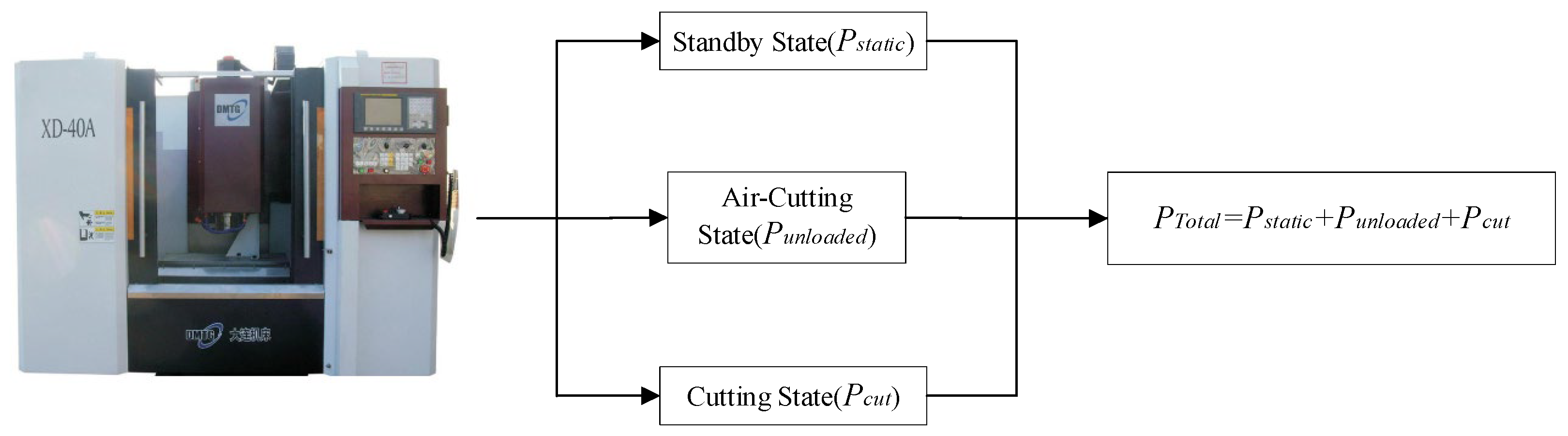
The standby and auxiliary system energy consumption of machine tools typically lacks a direct linear correlation with cutting load, manifesting primarily as fixed energy consumption or step-type energy consumption based on specific commands. The energy consumption decomposition of CNC machine tools is illustrated in Figure 1.
Standby power, Pstandby, refers to power consumption when the machine tool is powered on and enters a ready state but has not executed any operational commands. It primarily includes standby losses from the CNC system, servo drives, indicator lights on the operator panel, and basic cooling fans [10]. During machine operation, this portion of power can be considered a constant, C0.
Auxiliary System Power, Paux, primarily consists of the cutting fluid pump, chip conveyor, lubrication pump, and lighting system. Its status is typically controlled by M codes in the CNC program, manifesting as a linear sum of on/off quantities. The total standby and auxiliary system power consumption model can be expressed by Equation (1).
P static = P standby + i = 1 k δ i P aux , i
where δ i is the switching state variable (0 or 1) for the i-th auxiliary component, and Paux,i is the rated power of the corresponding component.
Unloaded transmission power, Punloaded, refers to the power consumed to overcome mechanical friction, viscous resistance, and inertia during spindle rotation and feed axis movement. This energy consumption can be divided into spindle no-load power and feed axis no-load power.
  • Spindle no-load power: The no-load power of the spindle motor is primarily used to overcome bearing friction and air resistance. Experiments show that spindle power, Pspindle, exhibits a nonlinear relationship with rotational speed, n, typically fitted using a quadratic polynomial by Equation (2).
    P spindle ( n ) = α 0 + α 1 n + α 2 n 2
    where n is the spindle speed (r/min), and α 0 , α 1 , and α 2 are fitting coefficients related to the characteristics of the machine tool spindle.
  • Feed axis no-load power: Power consumption in the feed axis primarily stems from overcoming guideway friction. During steady-state feed operation—where transient inertial forces from acceleration/deceleration are neglected—feed power, Pfeed, exhibits an approximate linear relationship by Equation (3).
    P feed ( v f ) = β 0 + β 1 v f
    where vf is the feed rate (mm/min), and β 0 and β 1 are the feed axis power coefficients. In summary, the total power consumption model for no-load transmission can be expressed by Equation (4).
    P unloaded = P spindle ( n ) + P feed ( v f )

2.1.2. Energy-Based Cutting Power Modeling

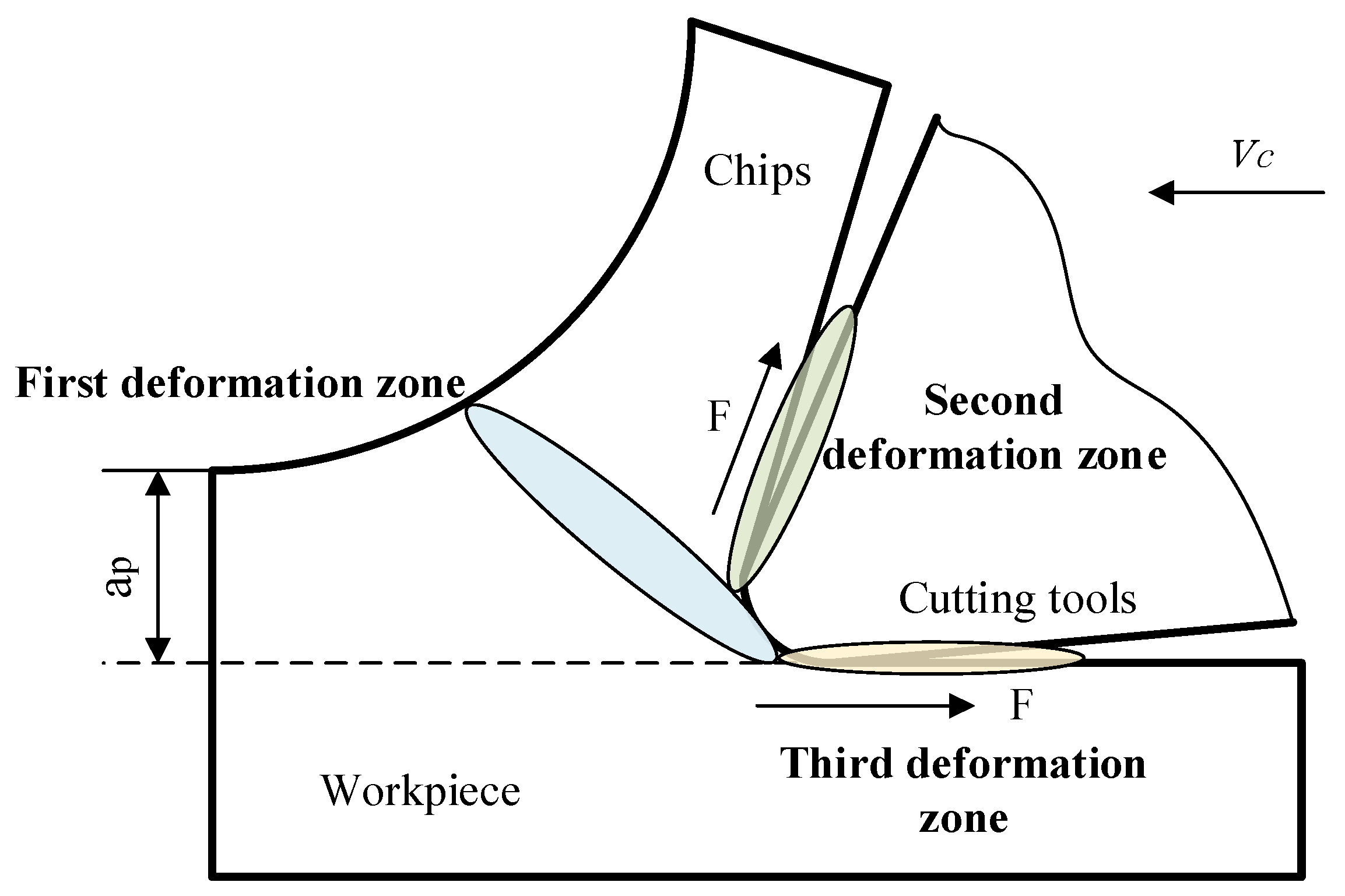
Material removal power, Pcut, represents the most fluctuating and unpredictable component of machine tool energy consumption, directly reflecting the work done by the tool in removing workpiece material. Based on Gutowski’s classical specific energy theory, energy consumption in the cutting zone primarily consists of three components [6], corresponding to the three deformation zones of cutting shown in Figure 2.
  • First deformation zone (Shear Zone): strain energy, Eshear, consumed during plastic deformation of the material;
  • Second deformation zone (Rake Face): energy, Efriction, expended by the chip overcoming friction as it flows along the tool’s rake face;
  • Third deformation zone (Flank Face): energy, Eploughing, consumed by the tool’s flank face through friction and compression against the machined surface.
Cutting power is proportional to material removal rate (MRR) by Equations (5) and (6).
P cut = k sec M R R ( t )
M R R ( t ) = a p a e v f ( t )
where ksec is the specific cutting energy coefficient (J/mm3), influenced by workpiece material hardness, tool geometry angles, and cutting conditions; ap is the axial depth of cut (mm); and ae is the radial width of cut (mm).
The above model simplifies complex cutting energy consumption into concise formulas. However, it assumes ksec is constant, thereby neglecting energy fluctuations caused by tool wear, interrupted cutting impacts, and other factors. Consequently, it cannot accurately calculate material removal power during machine tool operation.

2.1.3. Discussion of Error Sources

Although the above mechanism-based modeling approach captures the overall trend of energy consumption variation at low computational costs, it introduces significant systematic errors in actual high-precision machining scenarios. These errors primarily stem from three sources:
  • Time-varying effects of tool wear: The classical model assumes ksec is constant, ignoring the dynamic impact of tool wear on cutting forces. As the width of the rake face wear band (VB) increases, friction and plowing effects in the third deformation zone significantly intensify, causing actual energy consumption to progressively deviate from theoretical values.
  • Nonlinear transient impacts: During the instantaneous entry and exit phases of milling, the cutting thickness undergoes abrupt changes, causing nonlinear pulsating fluctuations in cutting force and energy consumption. Static MRR models cannot describe this phenomenon, resulting in errors.
  • Neglecting machine tool thermal characteristics: Prolonged machining of workpieces causes thermal expansion of the spindle and changes in guideway lubricant viscosity, requiring fine-tuning of the no-load power baseline. Existing fixed-parameter physical models cannot adaptively account for this thermal drift phenomenon.

2.2. Residual Prediction Network Based on Attention Mechanism–LSTM

Considering the sequential nature of the monitoring data and the limited sample size available in typical machining experiments, the LSTM architecture was selected over complex Transformer-based models due to its superior sample efficiency and robustness against overfitting on small-to-medium-scale time-series datasets.
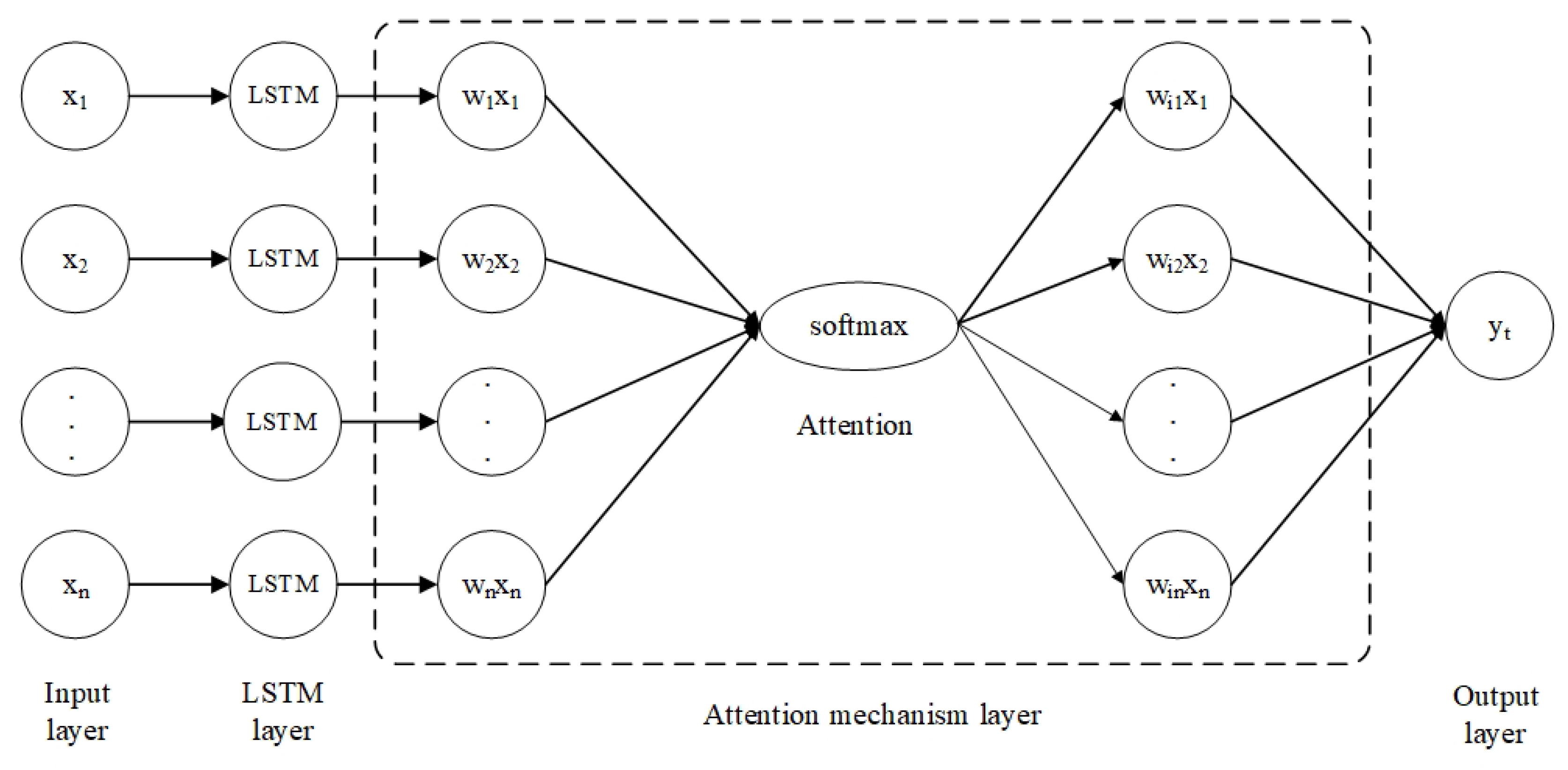
The power residual sequence, Pres(t) = Preal(t) − Pshy(t), is fundamentally a time-series influenced by multiple coupled factors. To extract hidden dynamic features from the residuals, this paper introduces a Long Short-Term Memory (LSTM) network based on an attention mechanism. The Attention–LSTM network architecture is shown in Figure 3.
The rationale for selecting the Attention–LSTM architecture is twofold. First, machining energy data is a time-series with significant temporal lag effects, which LSTM units are adept at modeling. Second, and more importantly, energy consumption spikes during transient phases are critical but sparse. The Attention mechanism allows the network to assign higher weights to these informative time steps, preventing them from being diluted by steady-state data.
  • Input layer construction with physical information embedding: To achieve physical information embedding, the network’s input vector, Xt, not only incorporates current cutting process parameters (spindle speed, n; feed rate, vf; cutting depth, ap; and cutting width, ae) but also introduces the output, Pshy, from the mechanism model as prior knowledge features by Equation (7).
    X i = n , v f , a p , a e , P s h y T
  • LSTM feature extraction layer: This utilizes the unique gating mechanism of LSTM units to handle time-dependent relationships in machine tool processing, addressing the vanishing gradient problem in traditional RNNs and effectively capturing the dynamic evolution of energy consumption over time [28].
  • Attention mechanism layer: During milling, energy fluctuations at tool entry and exit points significantly impact overall precision, though these moments constitute a small fraction of the long sequence. Introducing an attention mechanism automatically assigns different weights to the hidden layer state, ht, output by the LSTM, α t , enabling the model to focus on critical time steps that substantially contribute to residuals by Equation (8).
    c t = j = 1 T α t j h j
This approach enables the network to more sensitively capture transient power residuals caused by abrupt changes in cutting force. The application scope and assumptions of the model are clarified in Table 1.
To ensure the reproducibility of the proposed Attention–LSTM network, these hyperparameters were determined through heuristic tuning based on empirical experiments to achieve an optimal balance between convergence speed and prediction accuracy the key hyperparameters used in the training process are detailed as follows: the time window length was set to 10 time steps; the network consisted of 1 LSTM layers with 64 hidden units each; and the learning rate was initialized at 0.001 with a batch size of 32. The model was trained for 80 epochs using the Adam optimizer.

2.3. Hybrid-Driven Model Method

2.3.1. Overall Framework

Addressing the limitations of mechanism-based modeling, the proposed hybrid driving model effectively preserves physical structure while capturing features at energy consumption inflection points. This model adeptly captures the trend and nonlinearity of energy consumption during machining. Regarding computational feasibility, the trained model has a low inference latency, making it suitable for real-time monitoring in digital twin applications.
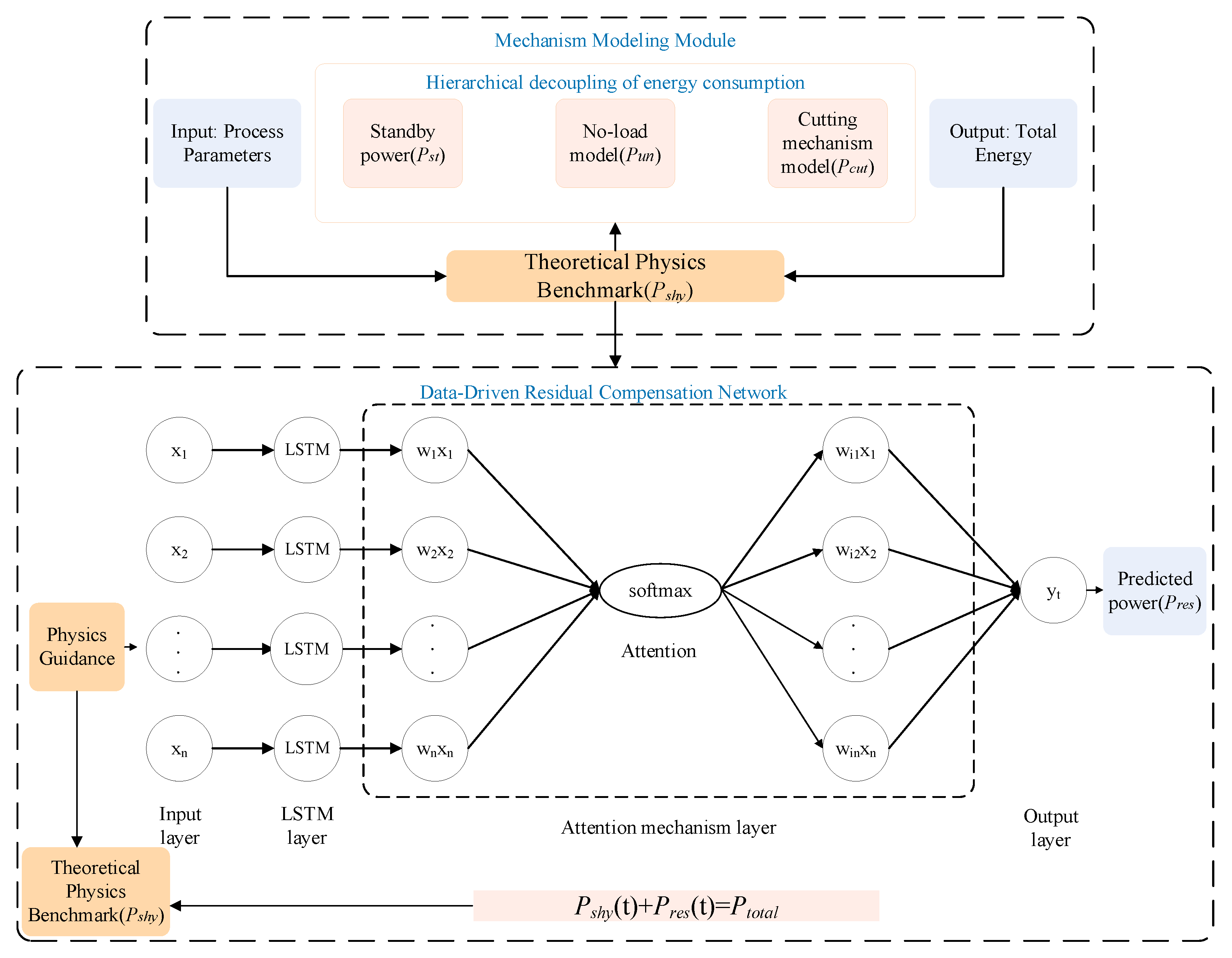
The core concept of the hybrid-driven model decomposes the total energy consumption prediction problem for machine tools into two subtasks: theoretical baseline prediction and dynamic residual prediction. The final energy consumption prediction value, Ptotal, is defined by Equation (9).
P total ( t ) = P phy ( t ) + P res ( t )
where Pshy is the theoretical value computed by the mechanism model constructed in Section 2, describing the physical trend of energy consumption changes, and Pres(t) is the power residual predicted by the data-driven network, used to correct deviations caused by nonlinear factors (vibration, thermal deformation, and wear). This serial coupling structure preserves the interpretability of the physical model while leveraging the strong fitting capability of deep learning. The overall framework is illustrated in Figure 4.

2.3.2. Implementation Method of the Hybrid-Driven Model

The specific implementation and training process of the model are divided into the following four steps:
  • Data preprocessing and baseline calculation: Collect real-time machine operation data, and compute the theoretical power, Pshy, at each time step using the mechanism-based formula in Section 2.
  • Dataset construction: Combine standardized process parameters with Pshy to form feature vectors. Use Preal as labels. Construct experimental training and test sets based on time windows. This study collected 256 experimental sets, selecting 80% of the data as the training set and 20% as the test set to evaluate the accuracy of the hybrid model.
  • Offline residual network training: Train the Attention–LSTM network using the training set with the Adam optimizer, setting the difference between the predicted residual, Pres, and the true residual, Preal, as the objective function.
  • Online fusion prediction: In practical applications, real-time physical baseline values are computed and combined with the predicted residuals from the trained network to yield the final high-precision energy consumption forecast.

3. Experimental Validation

3.1. Experimental Equipment and Environment Description

To validate the proposed hybrid model’s performance in predicting energy consumption during actual machine tool operations, a 4 × 4 full-factor experiment was designed to collect data and assess model capabilities. Parameters are detailed in Table 2. The selected range of cutting parameters represents typical finishing to semi-finishing conditions for aluminum alloys, chosen based on the recommended usage range of the tool manufacturer to ensure stable cutting.
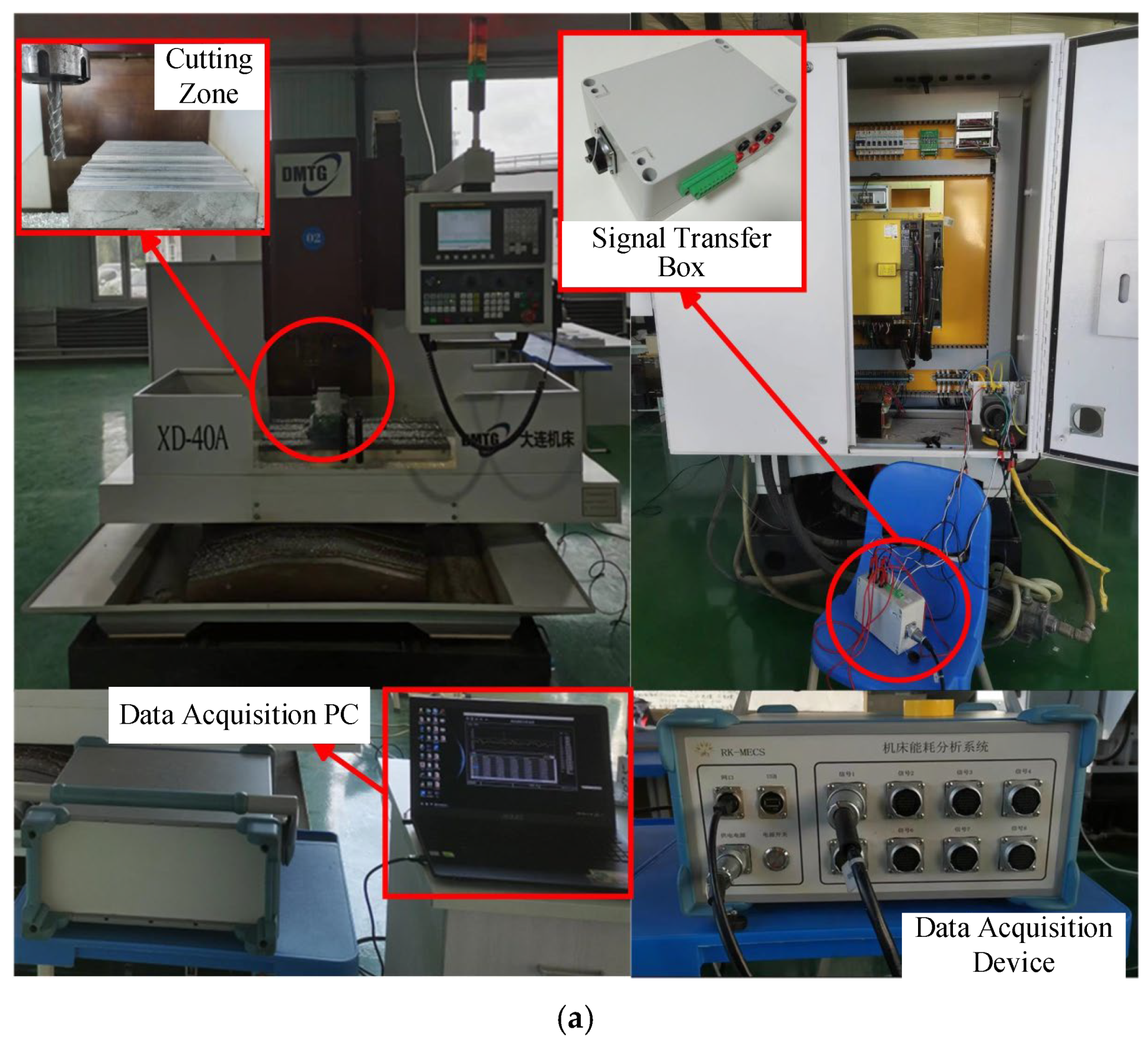
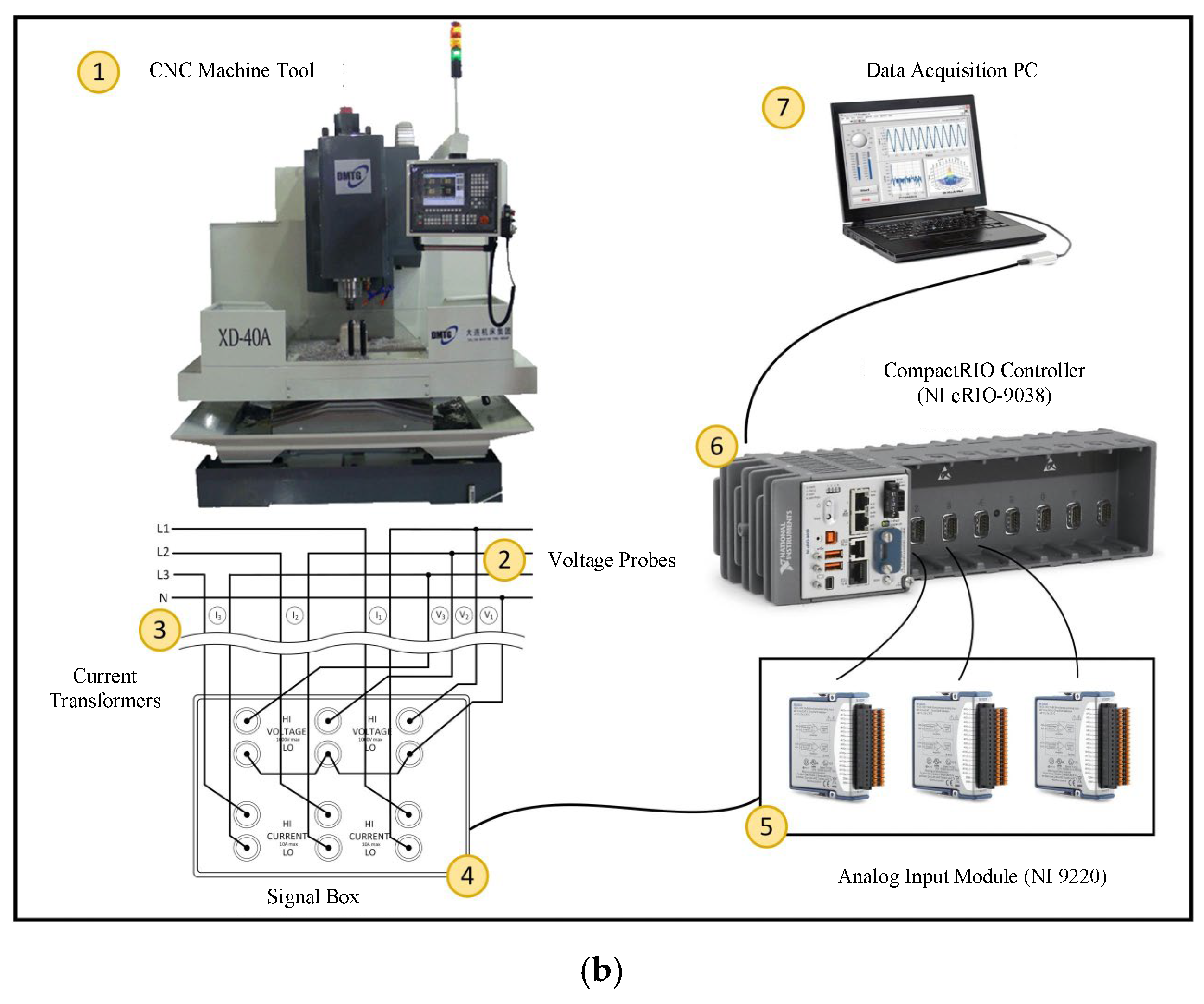
The computational software used in this experimental study was based on an Intel i9 12900H server running Windows 11, equipped with 16 GB of RAM, an NVIDIA 3060 GPU, and a 5.00 GHz CPU. The installed software modules were as follows: PyCharm 2021.2.4 (Professional Edition), Python 3.9.17, and Anaconda 3 2021.11. Cutting experiments were conducted using an XD-40A CNC machine tool. The experimental setup and data acquisition system are illustrated in Figure 5, with instrument parameters detailed in Table 3.
A total of 256 experimental sets were designed to collect data and experimentally validate the hybrid models proposed in Section 3. The CNC machine tool employs a three-phase power supply (voltage, 380 V; frequency, 50 Hz), thus requiring real-time power measurement for each phase. The total power consumed by the machine tool is the sum of the powers across the three phase lines. This study employed three voltage and current sensor modules to simultaneously measure and acquire the machine tool’s voltage, current, and power signals via a six-channel synchronous data acquisition card (sampling frequency: 5000 Hz). The data acquisition system is illustrated in Figure 5 with its performance parameters listed in Table 4. Specific parameters are detailed in Table 5.

3.2. Theoretical Model Parameters

The mechanism model adopted in this study is a layered decoupled benchmark model for machine tool energy consumption. Its core approach involves decomposing the total energy consumption of a CNC machine tool into four independent submodules based on physical characteristics. Each module’s energy consumption is described through formulas, and the total energy consumption is ultimately obtained by summing these values. Using the no-load phase data collected from experiments, the coefficients of the mechanism model in Section 2 were identified and calibrated via the least squares method.
  • Standby power: The average standby power, P s t a n d b y = 450 W, was obtained through multiple measurements.
  • No-load transmission coefficients: Step-speed experiments yielded spindle power coefficients: α 0 = 120, α 1 = 0.15, and α 2 = 2.3 × 10⁻⁵. Feed-axis no-load experiments yielded feed power coefficients: β 0 = 50 and β 1 = 0.2.
  • Specific cutting energy coefficient: Based on the linear regression relationship between average power during the cutting phase and MRR, the average specific energy coefficient, k s e c = 2.85 J/mm3, was calibrated for this operating condition.
Thus, the fundamental energy consumption prediction model expression for this experimental machine tool was established.

3.3. Model Prediction Accuracy

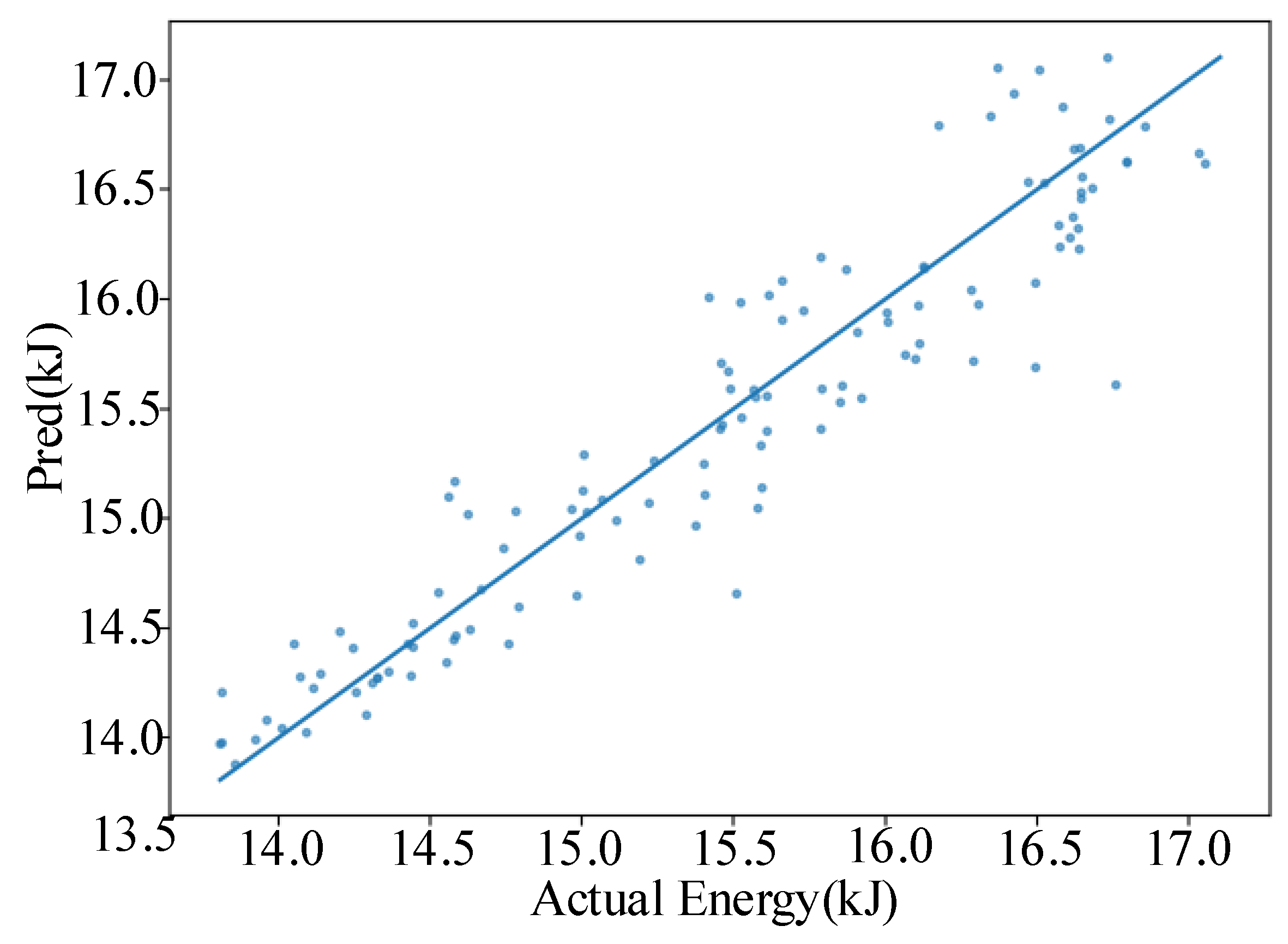
Through further research, it was found that a single physical model may fail during the transient processes of tool engagement and disengagement, leading to significant prediction errors. The results of the physical model employed in this study, tested under the experimental configuration described above, are shown in Figure 6. Since the transient changes occurring during the cutting process are difficult for physical models to capture, this results in a distribution bias in the prediction fit, reducing the prediction accuracy of a single physical model.
In contrast, the model developed in this study leverages the weight allocation capability of the attention mechanism to rapidly capture sudden power changes, thereby enhancing prediction accuracy. The results also demonstrate that integrating physical principles with data-driven approaches effectively resolves the inherent challenge of reconciling accuracy and generalizability in machine tool energy consumption prediction.
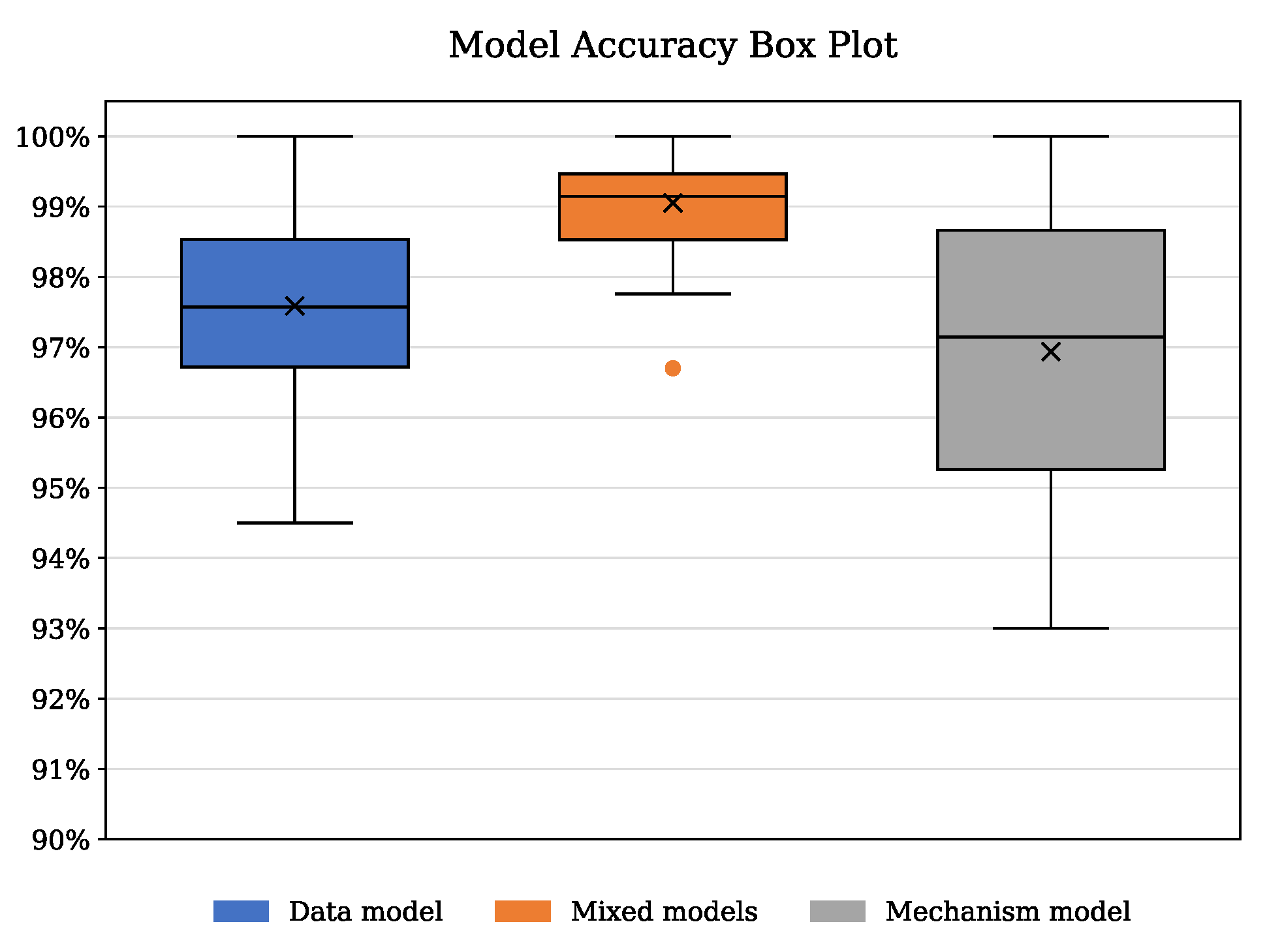
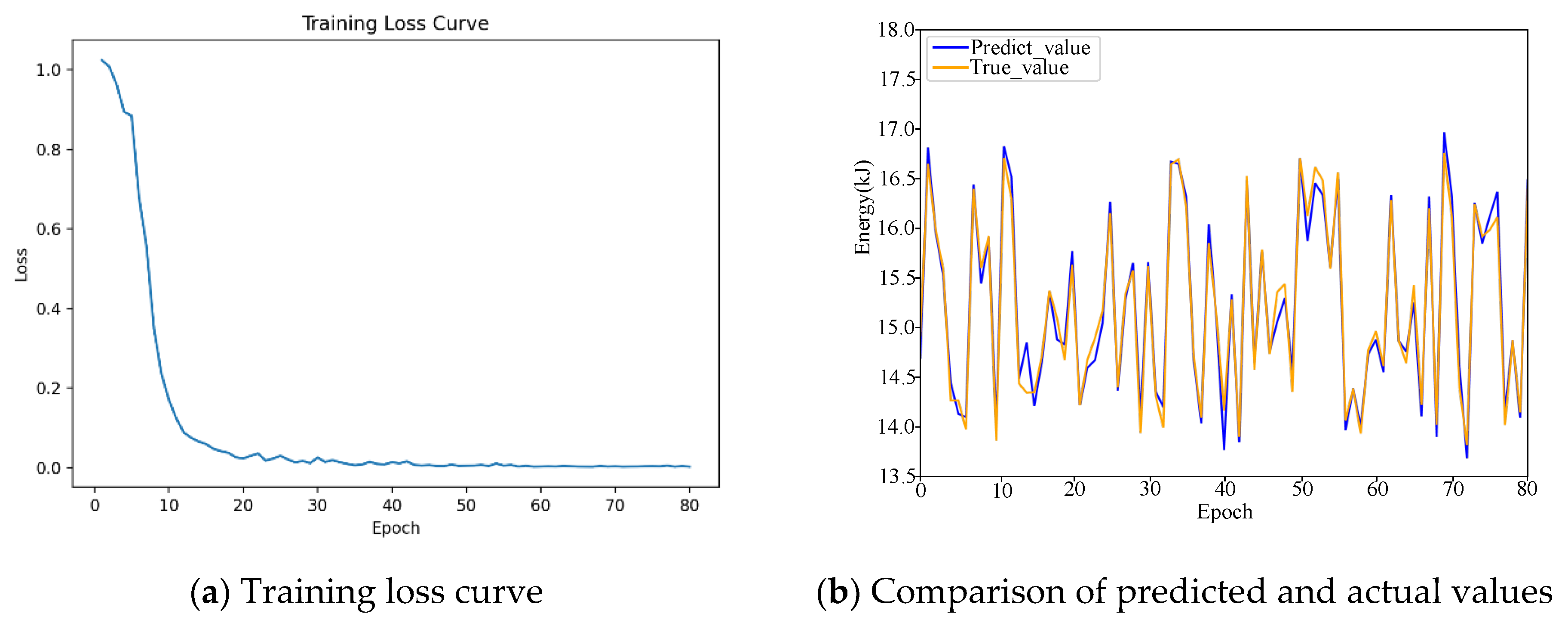
The model training loss curve and prediction results are shown in Figure 7. Within the loss function, the loss decreases sharply during the first 20 epochs, indicating that the hybrid model is effectively learning features. After 20 epochs, the loss curve begins to stabilize and enters the convergence phase, ultimately reaching approximately 0.01. The predictions derived from the hybrid model exhibit an excellent fit with actual values, with most data points clustering closely around the fitted line, indicating high prediction accuracy. The incorporation of physical benchmarks endows the model with strong robustness to parameter variations, while the Attention–LSTM mechanism effectively compensates for dynamic errors. Ultimately, the model achieves an RMSE (Root Mean Square Error) of 0.0610, an MAE (Mean Absolute Error) of only 0.0413, and an R2 (Coefficient of Determination) of 0.9936. Box plots illustrating the predictive performance of the three models are shown in Figure 8, with corresponding performance metrics summarized in Table 6. This demonstrates that the proposed mechanism–data hybrid-driven cutting energy consumption prediction method significantly enhances prediction accuracy while ensuring physical consistency.
To rigorously evaluate the generalization capability of the proposed hybrid model and rule out potential overfitting due to the limited sample size (256 sets), a 5-fold cross-validation strategy was implemented. The entire dataset was randomly partitioned into five equal subsets. In each iteration, four subsets were utilized for training the Attention–LSTM network, while the remaining one served as the validation set. This process was repeated five times to ensure that every sample was tested exactly once. A statistical analysis of the cross-validation results yields a mean RMSE of 0.0610 with a standard deviation of only 0.002. The low standard deviation confirms that the proposed hybrid architecture possesses strong statistical robustness and is not biased towards a specific subset of the experimental data.
It is important to note that while tool wear and thermal drift were not explicitly measured in real-time during these experiments, their cumulative effects on energy consumption manifest as deviations from the physical baseline. The high accuracy of the hybrid model confirms that the residual network successfully learned and compensated for these implicit time-varying factors.

4. Conclusions

Addressing the complex energy consumption mechanisms in CNC machine tool processing and the weak generalization capabilities of pure data models, this paper proposes a hybrid mechanism–data-driven energy consumption prediction method for CNC machine tool cutting processes. By deeply integrating cutting physics with deep learning algorithms, this method achieves high-precision prediction of energy consumption throughout the entire cutting process. The main research findings and conclusions are as follows:
  • A hierarchical decoupled benchmark model for machine tool energy consumption mechanisms was constructed, establishing the physical characteristics for energy prediction. By analyzing the energy flow of the machine tool, the total power was decoupled into three components: standby power, no-load transmission power, and material removal power. Experiments demonstrate that this mechanism model accurately reflects the influence trends of spindle speed, feed rate, and material removal rate on energy consumption. It provides reliable, physically consistent constraints for the hybrid model, effectively preventing overfitting in small sample sizes that pure data models often encounter.
  • A residual compensation network based on physical information embedding and Attention–LSTM is proposed, achieving precise correction of dynamic nonlinear errors. To address residual power errors caused by tool wear, nonlinear friction, and cutting transient impacts—which the mechanism model cannot capture—this paper introduces an Attention–LSTM network. By embedding the physical model’s output as prior features into the network input, the model not only enhances its ability to capture complex temporal features during machine operation but also significantly improves dynamic response capabilities during cutting force fluctuations, such as tool engagement and disengagement.
  • Experimental results demonstrate that the hybrid-driven model combines the robustness of mechanism models with the accuracy of data models. Tests on a three-axis CNC milling machine show that the proposed hybrid-driven model achieves an RMSE of 0.0610, an MAE of 0.0413, and an R2 of 0.9936, exhibiting strong predictive accuracy.
Although the proposed method achieves satisfactory results in energy consumption prediction, there remains room for further improvement. It should be noted that the proposed method was validated on a specific CNC milling machine (XD-40A) processing 6061-T6 aluminum alloy. While the experimental results demonstrate high accuracy under these conditions, the specific coefficients of the mechanism model are machine-dependent and material-dependent. However, the proposed hybrid framework itself is generalizable. For varying machining scenarios, the mechanism model can be rapidly recalibrated using standard no-load tests, allowing the Attention–LSTM network to adapt to new residual characteristics without structural changes.
Beyond incremental accuracy gains, the proposed framework offers a deployable solution for Digital Twin construction. By decoupling the physical baseline from data-driven residuals, the model allows for independent updating—engineers can quickly recalibrate the physical parameters for a new machine without retraining the entire neural network. This transferability is essential for large-scale deployment in intelligent manufacturing systems where diverse equipment is interconnected.

Author Contributions

G.L.: conceptualization, methodology, formal analysis, investigation, and writing—original draft; Q.S.: project administration, conceptualization, supervision, writing—review and editing; G.C.: methodology and formal analysis; Y.Z.: investigation and validation; H.C.: supervision and writing—review and editing; Y.M.: project administration, writing—review and editing, and visualization. All authors have read and agreed to the published version of the manuscript.

Funding

This research was funded by the National Natural Science Foundation of China (Project No. U22A20128) and the Opening Project of Tianjin Key Laboratory of High-Performance Manufacturing Technology and Equipment (Project No. TKL-TUTE2502).

Institutional Review Board Statement

Not applicable.

Informed Consent Statement

Not applicable.

Data Availability Statement

The data presented in this study is available on request from the corresponding author. The data is not publicly available due to privacy restrictions.

Conflicts of Interest

Author Yingnan Zhu and Haiqin Cui was employed by the company Harbin Dongan Industrial Development Co., Ltd. The remaining authors declare that the research was conducted in the absence of any commercial or financial relationships that could be construed as a potential conflict of interest.

References

  1. Gutowski, T.G.; Allwood, J.M.; Herrmann, C.; Sahni, S. A global assessment of manufacturing: Economic development, energy use, carbon emissions, and the potential for energy efficiency and materials recycling. Annu. Rev. Environ. Resour. 2013, 38, 81–106. [Google Scholar] [CrossRef]
  2. Alaux, N.; Saade, M.R.M.; Hoxha, E.; Truger, B.; Passer, A. Future trends in materials manufacturing for low carbon building stocks: A prospective macro-scale analysis at the provincial level. J. Clean. Prod. 2023, 382, 135278. [Google Scholar] [CrossRef]
  3. Bera, M.; Das, S.; Garai, S.; Dutta, S.; Choudhury, M.R.; Tripathi, S.; Chatterjee, G. Advancing energy efficiency: Innovative technologies and strategic measures for achieving net zero emissions. Carbon Footpr. 2025, 4, 3. [Google Scholar] [CrossRef]
  4. Lestingi, L.; Frigerio, N.; Bersani, M.M.; Matta, A.; Rossi, M. Data-driven energy modeling of machining centers through automata learning. IEEE Trans. Autom. Sci. Eng. 2024, 22, 5769–5780. [Google Scholar] [CrossRef]
  5. Wu, H.; Wang, X.; Deng, X.; Shen, H.; Yao, X. Review on design research in CNC machine tools based on energy consumption. Sustainability 2024, 16, 847. [Google Scholar] [CrossRef]
  6. Li, C.; Ge, W.; Huang, Z.; Zhang, Q.; Li, H.; Cao, H. Digital twin-driven modeling and application of carbon emission for machine tool. Int. J. Adv. Manuf. Technol. 2024, 133, 5595–5609. [Google Scholar] [CrossRef]
  7. Li, J.; He, P.; Li, H.; Li, S.; Xu, L.; He, K. Multi-objective cutting parameter optimization method for the energy consumption and machining quality of computerized numerical control lathes. Appl. Sci. 2024, 14, 905. [Google Scholar] [CrossRef]
  8. Gutowski, T.; Dahmus, J.; Thiriez, A. Electrical energy requirements for manufacturing processes. In Proceedings of the 13th CIRP International Conference on Life Cycle Engineering, Leuven, Belgium, 31 May–2 June 2006; Volume 31, pp. 623–638. [Google Scholar]
  9. Kara, S.; Li, W. Unit process energy consumption models for material removal processes. CIRP Ann. 2011, 60, 37–40. [Google Scholar] [CrossRef]
  10. Balogun, V.A.; Mativenga, P.T. Modelling of direct energy requirements in mechanical machining processes. J. Clean. Prod. 2013, 41, 179–186. [Google Scholar] [CrossRef]
  11. Yoon, H.S.; Lee, J.Y.; Kim, M.S.; Ahn, S.H. Empirical power-consumption model for material removal in three-axis milling. J. Clean. Prod. 2014, 78, 54–62. [Google Scholar] [CrossRef]
  12. Wang, Q.; Zhang, D.; Chen, B.; Zhang, Y.; Wu, B. Energy consumption model for drilling processes based on cutting force. Appl. Sci. 2019, 9, 4801. [Google Scholar] [CrossRef]
  13. Liu, Z.Y.; Guo, Y.B.; Sealy, M.P.; Liu, Z.Q. Energy consumption and process sustainability of hard milling with tool wear progression. J. Mater. Process. Technol. 2016, 229, 305–312. [Google Scholar] [CrossRef]
  14. Meng, Y.; Sun, X.; Dong, S.; Wang, Y.; Liu, X. Cutting energy consumption modelling of end milling cutter coated with AlTiCrN. Coatings 2023, 13, 679. [Google Scholar] [CrossRef]
  15. Meng, Y.; Dong, S.; Sun, X.; Wei, S.; Liu, X. Cutting energy consumption modeling by considering tool wear and workpiece material properties for multi-objective optimization of machine tools. Coatings 2024, 14, 691. [Google Scholar] [CrossRef]
  16. Lv, J.; Tang, R.; Jia, S. Therblig-based energy supply modeling of computer numerical control machine tools. J. Clean. Prod. 2014, 65, 168–177. [Google Scholar] [CrossRef]
  17. Jia, S.; Tang, R.; Lv, J. Therblig-based energy demand modeling methodology of machining process to support intelligent manufacturing. J. Intell. Manuf. 2014, 25, 913–931. [Google Scholar] [CrossRef]
  18. Feng, Z.; Zhang, H.; Li, W.; Yu, Y.; Guan, Y.; Ding, X. Exergy Loss Assessment Method for CNC Milling System Considering the Energy Consumption of the Operator. Processes 2023, 11, 2702. [Google Scholar] [CrossRef]
  19. Shin, S.J.; Woo, J.; Rachuri, S.; Meilanitasari, P. Standard data-based predictive modeling for power consumption in turning machining. Sustainability 2018, 10, 598. [Google Scholar] [CrossRef]
  20. Zhang, C.; Jiang, P. Sustainability evaluation of process planning for single CNC machine tool under the consideration of energy-efficient control strategies using random forests. Sustainability 2019, 11, 3060. [Google Scholar] [CrossRef]
  21. Brillinger, M.; Wuwer, M.; Hadi, M.A.; Haas, F. Energy prediction for CNC machining with machine learning. CIRP J. Manuf. Sci. Technol. 2021, 35, 715–723. [Google Scholar] [CrossRef]
  22. Bustillo, A.; Pimenov, D.Y.; Mia, M.; Kapłonek, W. Machine-learning for automatic prediction of flatness deviation considering the wear of the face mill teeth. J. Intell. Manuf. 2021, 32, 895–912. [Google Scholar] [CrossRef]
  23. Xie, D.; Chen, G.R.; Wang, F.; Zhu, J.Q. Modeling of CNC machine tool energy consumption and optimization study based on neural network and genetic algorithm. Appl. Mech. Mater. 2012, 195, 770–776. [Google Scholar] [CrossRef]
  24. Kant, G.; Sangwan, K.S. Predictive modelling for energy consumption in machining using artificial neural network. Procedia CIRP 2015, 37, 205–210. [Google Scholar] [CrossRef]
  25. Meng, Y.; Dong, S.M.; Sun, X.S.; Wei, S.L.; Liu, X.L. A mechanism-data hybrid-driven modeling method for predicting machine tool-cutting energy consumption. Adv. Manuf. 2025, 13, 167–195. [Google Scholar] [CrossRef]
  26. Chen, Y.; Zhang, H.; Yan, W.; Zhang, X.; Jiang, Z.; Liu, Y. A multi-dimensional data integration approach for machining system multi-level energy consumption modeling and prediction. Int. J. Comput. Integr. Manuf. 2025, 39, 245–266. [Google Scholar] [CrossRef]
  27. Zhang, H.; Yan, W.; Chen, C.; Liu, Y.; Liu, Q.; Liang, X.; Jiang, Z. A physics-informed multimodal transformer model for machining energy consumption prediction. J. Comput. Inf. Sci. Eng. 2026, 1–26. [Google Scholar] [CrossRef]
  28. Johnston, L.; Patel, V.; Cui, Y.; Balaprakash, P. Revisiting the problem of learning long-term dependencies in recurrent neural networks. Neural Netw. 2025, 183, 106887. [Google Scholar] [CrossRef]
Figure 1. Energy consumption breakdown of CNC machine tools.
Coatings 16 00265 g001
Figure 2. Metal cutting deformation zone.
Coatings 16 00265 g002
Figure 3. Attention–LSTM network structure.
Coatings 16 00265 g003
Figure 4. Overall framework diagram.
Coatings 16 00265 g004
Figure 5. Experimental setup and data acquisition system details. (a) Physical configuration of the XD-40A CNC milling machine site, showing the placement of the 6061-T6 aluminum workpiece, cutting tool, and the signal transfer box installed in the electrical cabinet. (b) Schematic diagram of the signal acquisition process, utilizing a National Instruments CompactRIO-9038 controller and NI 9220 analog input modules to capture real-time voltage and current signals via high-precision sensors.
Coatings 16 00265 g005aCoatings 16 00265 g005b
Figure 6. Physical model prediction results. The scattered points represent the predicted results from the model, and the solid line indicates the actual baseline.
Coatings 16 00265 g006
Figure 7. Experimental results.
Coatings 16 00265 g007
Figure 8. Performance parameter comparison of different models.
Coatings 16 00265 g008
Table 1. Assumptions and implications of the model.
AssumptionsDescriptionImplications for Hybrid Model
Steady-state No-loadAssumes no-load power is constant for a given speed.Learns the slow-varying temporal drift of the baseline power caused by thermal accumulation.
Constant Cutting CoefficientsAssumes specific cutting energy is static.Predicts the dynamic increment in energy consumption resulting from tool wear progression.
Rigid System DynamicsAssumes the machine structure is perfectly rigid.Treats high-frequency vibrations as stochastic residuals to fine-tune the instantaneous power prediction.
Table 2. All-factor processing parameters.
Cutting ParametersValue
Spindle Speed, n (r/min)1200/1400/1600/1800
Feed Rate, vf (mm/min)100/120/140/160
Cutting Depth, ap (mm)2/3/4/5
Cutting Width, ae (mm)1/1.5/2/2.5
Table 3. Detailed experimental environment.
ItemInformation
CNC Machine ToolXD-40A
TypeCNC Milling Machine
Workpiece Material6061-T6 Aluminum Alloy
Workpiece Dimensions100 × 100 × 100 mm3
Tool MaterialCarbide
ModelAL-3EL-D10.0
Table 4. Energy consumption measurement system performance parameters.
Instrument PerformanceParameter
Data Acquisition System Range±10 V
Synchronous Sampling Rate>50 kS/s
Acquisition Accuracy<1.5 mV
Temperature Range−40 °C to +70 °C
Number of System Synchronized Acquisition Channels48 channels
Personal ComputerCore Duo, i7 CPU
Current Transformer Accuracy0.2%
Voltage Transformer Accuracy0.2%
Table 5. Specific parameters of the cutting tools.
InformationParameters
Tool ModelAL-3EL-D10
MaterialCarbide
Number of Teeth3
Diameter10 mm
Cutting Edge Length45 mm
Helix Angle45°
Table 6. Performance comparison.
ParametersData ModelHybrid ModelMechanistic Model
MAE (kJ)0.1753 ± 0.0120.0413 ± 0.0030.1972
RMSE (kJ)0.2009 ± 0.0150.0610 ± 0.0020.2352
R20.9141 ± 0.0200.9936 ± 0.0010.8616
Disclaimer/Publisher’s Note: The statements, opinions and data contained in all publications are solely those of the individual author(s) and contributor(s) and not of MDPI and/or the editor(s). MDPI and/or the editor(s) disclaim responsibility for any injury to people or property resulting from any ideas, methods, instructions or products referred to in the content.