Article

Regulating Microstructure Evolution and Strengthening Mechanisms in Al-Zn-Mg-Cu Alloy via Pre-Aging Treatment


1
Department of Computer and Electrical Engineering, Hunan University of Arts and Science, Changde 415000, China
2
Hunan Provincial Key Laboratory of Distributed Electric Propulsion Vehicle Control Technology, Changde 415000, China
3
Light Alloy Research Institutes, Central South University, Changsha 410083, China
*
Author to whom correspondence should be addressed.
Coatings 2026, 16(2), 247; https://doi.org/10.3390/coatings16020247
Submission received: 15 January 2026 / Revised: 10 February 2026 / Accepted: 11 February 2026 / Published: 14 February 2026

Highlights

What are the main findings?
  • η′-dominated pre-aging gives the best strength–ductility at 140 °C.
  • Optimized pre-aging lowers vacancies and stabilizes dense η′ precipitates.
  • Pre-aging leads to elongated, discontinuous grain boundary precipitates on aging.
What are the implications of the main findings?
  • Practical pre-aging control achieves 612.6 MPa with a 10.3% elongation.
  • Suppressing η′ → η yields stable, uniform intragranular strengthening.
  • Tuning grain boundary morphology via pre-aging improves the strength in Al-Zn-Mg-Cu alloys.

Abstract
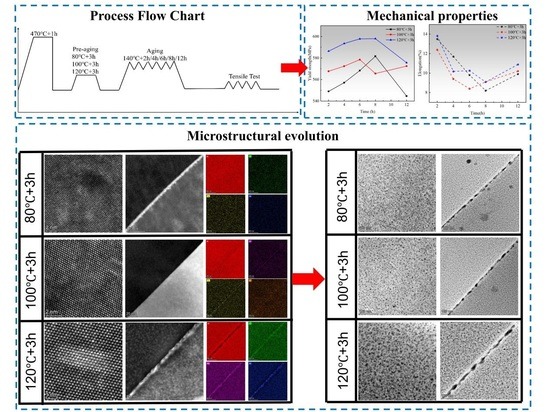
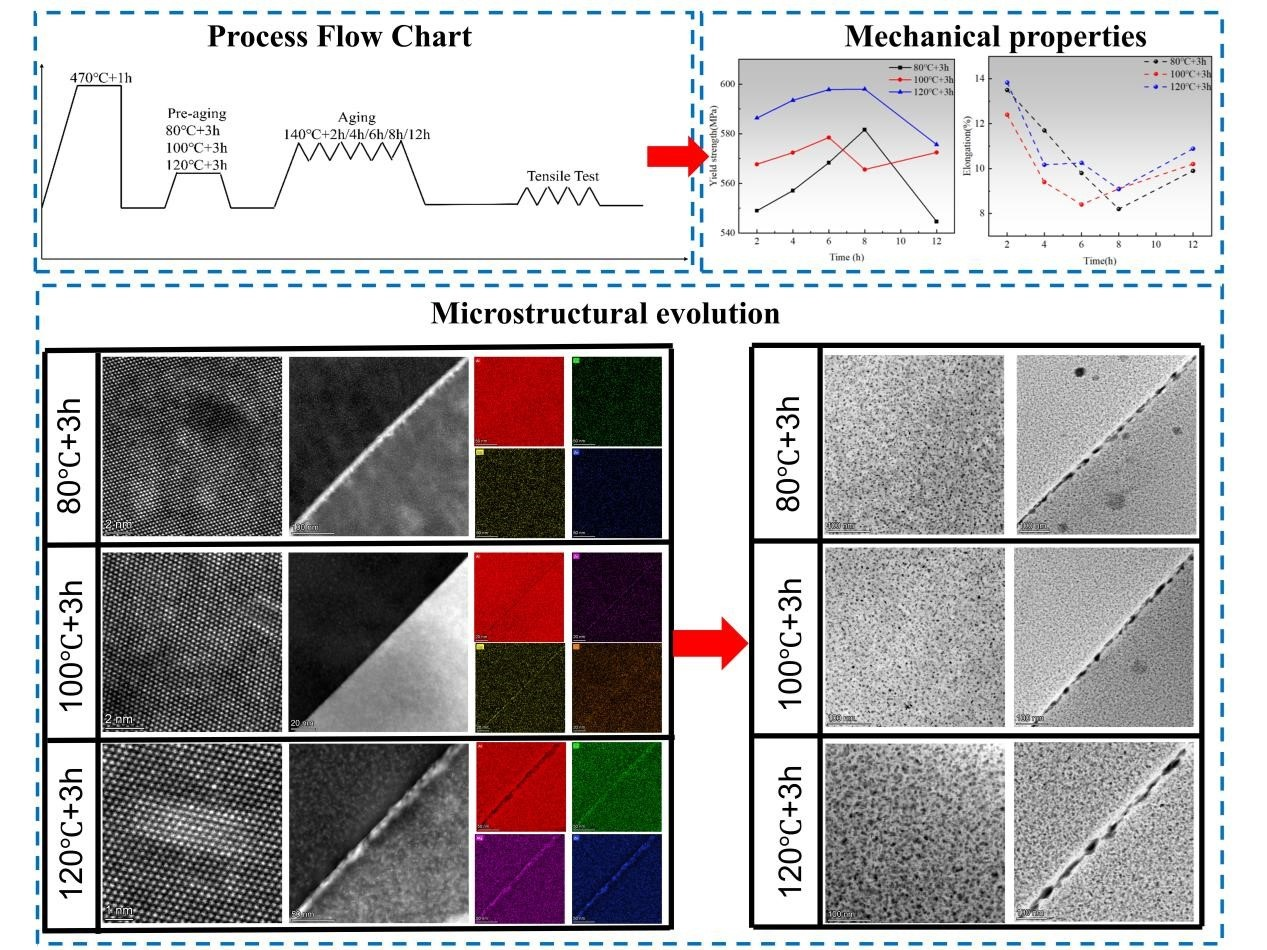
This study significantly enhances the mechanical properties of an Al-Zn-Mg-Cu alloy through the implementation of a pre-aging process. By optimizing the microstructure of the Al-Zn-Mg-Cu alloy with different pre-aging treatments, the evolution of the microstructure and mechanical properties of the alloy initially containing GP I, GP II, and η′ phases is systematically investigated during aging at 140 °C. The experimental results show that, under the three pre-aging processes, the peak tensile strengths are 590.8 MPa, 594.0 MPa, and 612 MPa, respectively, while the corresponding elongation rates are 8.2%, 8.4%, and 10.3%. When pre-aging produces an initial microstructure containing GP I and GP II, these GP zones rapidly coarsen within the grains during subsequent aging. This makes it difficult for solute atoms to diffuse to the grain boundaries, resulting in finer grain boundary precipitates and ultimately leading to a lower alloy strength. When the pre-aging temperature is 120 °C, the pre-aging process can reduce the vacancy concentration, thereby suppressing the phase transformation from η′ to η precipitates. For samples pre-aged to the η′ phase, solute atoms diffuse to the grain boundaries, resulting in grain boundary precipitates with a greater length during subsequent aging compared to the other two samples. These grain boundary precipitates exhibit a discontinuous distribution along the grain boundaries, which contributes to the improved elongation of the alloy. The present work provides a novel heat treatment strategy for producing high-strength Al alloys while effectively achieving a favorable balance between strength and ductility.

Graphical Abstract

1. Introduction

Al-Zn-Mg-Cu aluminum alloy, as a typical high-strength alloy in the lightweight aluminum alloy series, has become a critical structural material in the aerospace field due to its high specific strength, excellent corrosion resistance, and outstanding processability [1,2,3,4,5]. As performance requirements for large thin-walled components in the aerospace sector continue to rise, the development of advanced sheet materials with higher strength and enhanced reliability has become an urgent technological bottleneck to be addressed [3,5,6]. Therefore, optimizing the mechanical properties of thin-walled components, particularly those of alloy sheets under harsh service environments, has become a central focus of current research [7,8,9].
Heat treatment processes play a critical role in regulating the microstructure and mechanical properties of aluminum alloy sheets [10,11]. It is of great significance to conduct in-depth investigations into the effects of aging processes on the regulation of mechanical properties in plastically deformed aluminum alloy sheets. Pre-aging, as a method to control the initial microstructure of aluminum alloys, has been introduced to improve the post-aging mechanical properties of the material. This technology has been widely adopted in the automotive manufacturing industry, where it enhances the aging hardening response of Al alloy materials, enabling them to achieve strength levels comparable to the T6 state. Relevant studies have found that, in Al-Zn-Mg-Cu alloys, the GP I and GP II formed during the pre-aging process do not completely dissolve after aging; instead, they can act as nucleation sites for the precipitation of η′-phases [12,13,14]. Zeng et al. [15] found that pre-aging 7150 alloy at 120 °C notably improved its mechanical properties, achieving a tensile strength of 605.2 MPa, yield strength of 583.4 MPa, and elongation of 13.8%. The pre-aging created a “peak-aging zone” during two-step aging, which extended the aging time, enhanced strain performance, and preserved the high strength. In addition, pre-aging can prepare the matrix material in an under-aged state, thereby extending the time required for subsequent aging to reach the over-aged condition [16]. Meanwhile, the finely dispersed η′ precipitates formed during pre-aging can significantly improve the precipitate-free zone (PFZ), suppress the coarsening of other precipitates, and enhance the material strength [17]. Particularly when the η′-phase serves as the dominant precipitate, this process further strengthens the comprehensive mechanical properties and formability in the subsequent aging–hardening stage [18]. Currently, pre-aging as a pretreatment for the T6 aging of plastically deformed alloys remains scarcely explored. Chen et al. [19] investigated the effects of pre-aging temperatures of 65 °C, 90 °C, and 115 °C on Al-Li alloys and found that this treatment significantly improved the ductility of the alloy. However, a poor formability, insufficient mechanical properties, and high manufacturing costs remain major constraints limiting the application of plastic forming technologies in the aerospace sector [20,21]. To enhance subsequent mechanical properties, it is crucial to precisely design pre-aging processes to control precipitation behavior. Therefore, systematic studies are urgently needed to elucidate the intrinsic relationship between pre-aging and microstructural evolution during secondary aging, ultimately achieving optimized improvements in the the mechanical performance of materials [22].
This study systematically investigates the structural differences in GP I, GP II, and η′ phases in Al-Zn-Mg-Cu alloy sheets via three pre-aging conditions, as well as their strengthening mechanisms on the alloy sheets, through a combination of mechanical property testing and transmission electron microscopy analysis [23].
In this work, we use GP I to denote the earliest solute-rich clusters that form in Al-Zn-Mg-Cu alloys: fully coherent, spherical/ellipsoidal aggregates of Zn and Mg with appreciable Al, typically ≤1–3 nm in size, lacking a preferred habit plane or resolvable internal periodicity in TEM. By contrast, GP II refers to fully coherent, extremely thin disk/plate precipitates that adopt the {111}Al habit plane, are larger, and produce diffuse streaking in SAED/FFT along Al matrix directions (without discrete superlattice reflections). GP I dominates very early aging, while GP II develops at slightly higher/intermediate aging temperatures and precedes the emergence of η′. GP II was distinguished from η′ precipitates through a combined assessment of morphology, crystallography, and chemistry. Features assigned to GP II appear as fully coherent, very thin plates on {111}Al that show diffuse, featureless contrast in BF/HRTEM and HAADF-STEM, with no resolvable internal lattice fringes. Their FFT/SAED signatures are limited to diffuse streaking along the <220>Al without discrete superlattice reflections attributable to η′. They are sub-10–15 nm in length and typically <1–2 nm in thickness, and exhibit only moderate HAADF Z-contrast and modest Zn + Mg enrichment with appreciable Al in STEM-EDS maps/line scans. In contrast, precipitates classified as η′ are larger platelets on {111}Al that display a clear hexagonal ordering: discrete superlattice reflections appear at the expected positions in FFT/SAED, and periodic lattice fringes are resolved in HRTEM.
The research aims to regulate the type, morphology, and distribution of precipitates in Al-Zn-Mg-Cu aluminum alloys by designing pre-aging processes, thereby revealing their influence mechanisms on the properties of rolled sheets. Based on this, a novel pre-aging preparation process for high-strength Al-Zn-Mg-Cu alloy sheets is developed.

2. Materials and Experiments

2.1. Experimental Procedure and Mechanical Testing

The material used in this study was a commercial as-cast Al-Zn-Mg-Cu alloy with a thickness of 35 mm. The chemical composition of the Al-Zn-Mg-Cu alloy is detailed in Table 1. The alloy was first hot-rolled by 60% and then cold-rolled by 50%. The rolled sheets were solution-treated in a furnace at 470 °C for 1 h.
After solution treatment, specimens were liquid-quenched in agitated deionized water at 20 ± 2 °C for ~20 s. A K-type thermocouple attached to a dummy coupon indicated an approximate cooling rate of ~300–400 K/s from 450 °C to 100 °C, and the transfer time from the quench tank to the pre-aging furnace was < 60 s. Pre-aging was conducted in a preheated, circulated-air furnace (Changsha, China). For short pre-aging, samples were removed and air-cooled on a room-temperature aluminum plate (Xinjiang, China) with fan assistance. For long pre-aging, samples were furnace-cooled (door closed) to ~60 °C and then air-cooled to ambient. No oil quench, gas-jet cooling, or cryogenic media were used between pre-aging and subsequent steps; apart from the initial water quench, all intermediate cool-downs were by air cooling as specified.
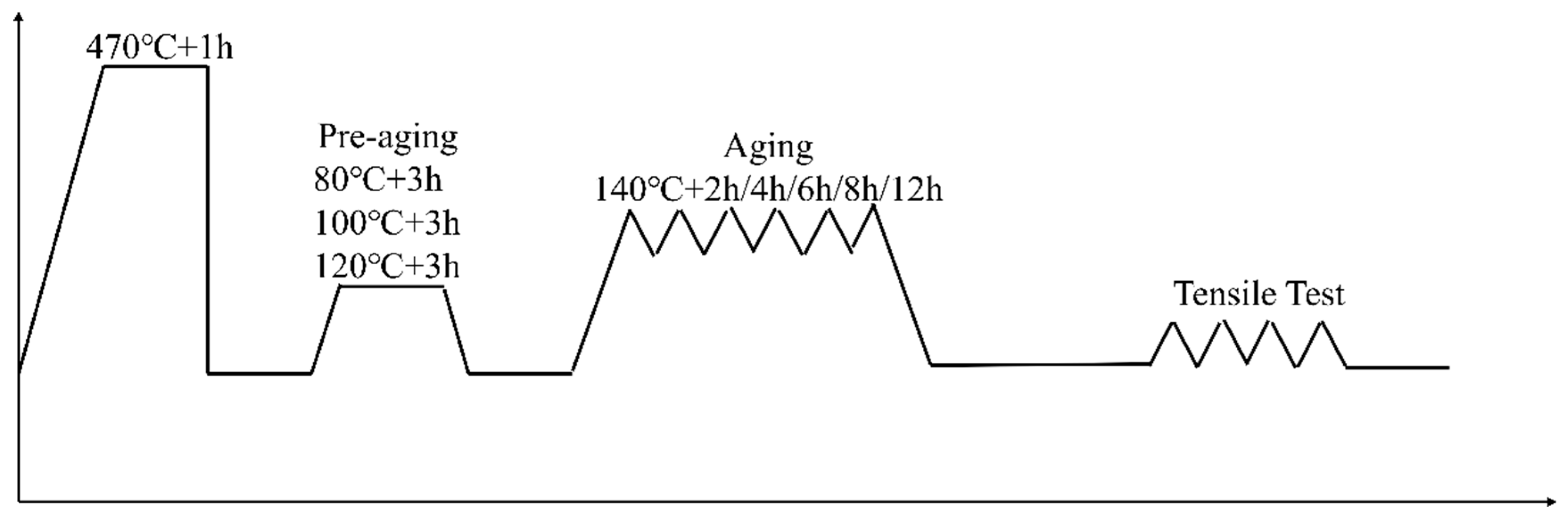
Subsequently, the sheets were subjected to pre-aging treatments at 80 °C, 100 °C, and 120 °C for 3 h, followed by aging at 140 °C for 2 h, 4 h, 6 h, 8 h, and 12 h. The specific process flow is illustrated in Figure 1.
Tensile specimens were tested using a 100-kN MTS Landmark testing machine(MTS Systems Corporation, Eden Prairie, MN, USA), with the tensile direction aligned parallel to the rolling direction. For each condition, tensile tests were performed on 3 independent specimens (n = 3). The tensile strain rate was set at 10−3 s−1. For clarity in describing the experimental results, pre-aged samples are denoted by the following abbreviations: PA80–3h, PA100–3h, and PA120–3h, respectively.

2.2. Microstructural Characterization

The microstructure of the samples was characterized using a Thermo-Fisher Talos F200× TEM (Thermo Fisher Scientific Inc. Waltham, MA, USA) operated at an accelerating voltage of 200 kV. Prior to TEM examination, the samples were mechanically ground to a thickness of 50–80 μm and then punched into 3 mm diameter disks. The disks were thinned to electron transparency using a Struers TenuPol-5 twin-jet electropolisher (Struers ApS, Ballerup, Denmark), with an electrolyte consisting of 30% HNO3 acid and 70% CH3OH at a temperature of approximately –25 °C and a voltage of 16.5 V.

3. Experimental Results

3.1. Microstructural Characterization Results

The TEM/HAADF-STEM(Waltham, MA, USA) dataset in this study was acquired primarily for phase identification and microstructural interpretation. Due to limited and non-uniform sampling across regions, as well as foil-thickness and orientation constraints, we do not report statistically robust size distributions or number density estimates. Instead, we focus on representative features and qualitative trends, and we avoid statements that imply statistical significance.
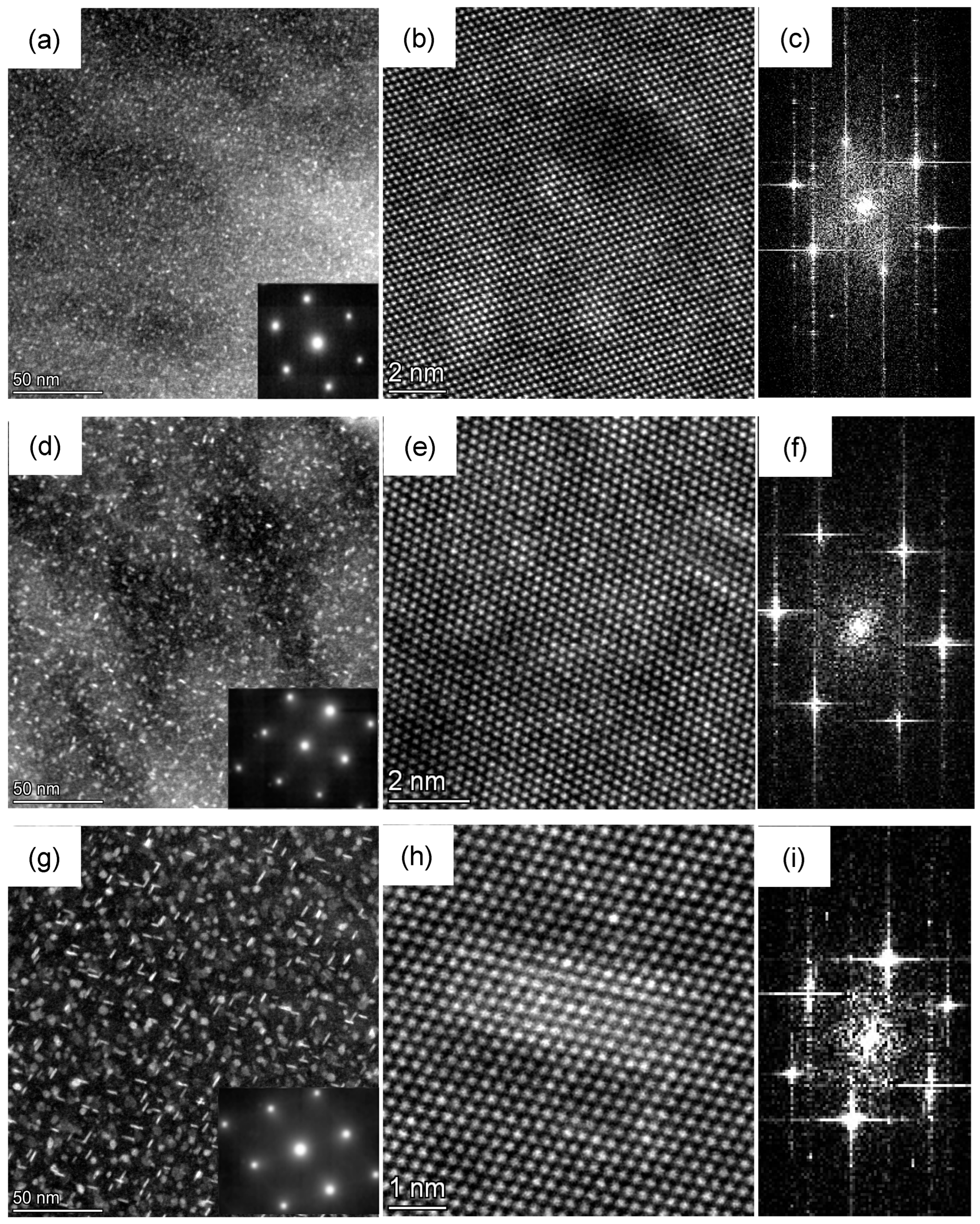
Figure 2 displays TEM and HAADF-STEM images of precipitate features in an Al-Zn-Mg-Cu alloy under various pre-aging conditions. Figure 2a shows that numerous bright features are observed within the imaged area. The bright contrast in Figure 2b originates from elements with higher atomic numbers. The FFT calculated from this limited HRTEM field of view shows only Al matrix reflections; therefore, weak precipitate-related reflections cannot be ruled out. Based on the apparent lattice continuity across the matrix/feature interface in real space (Figure 2b), these early-stage features are consistent with coherent GP I-type clusters, although rigorous confirmation would require SAED from a larger sampled volume. For the PA80–3h condition, only a weak precipitate-related contrast is observed, and no distinct additional reflections are evident in the corresponding FFT (Figure 2c), suggesting a limited extent of early clustering under this condition [24].
Figure 2d shows grain boundary precipitates in the PA100–3h sample imaged along the [110]Al zone axis, revealing spherical, rod-shaped, and needle-shaped morphologies. The corresponding SAED inset (Figure 2d) and FFT features (Figure 2f) suggest that more than one precipitate type may be present. Weak extra features near the 1/3 and 2/3{220}Al positions are observed in the FFT and are consistent with GP zone-type periodicities; however, localized FFTs have a limited sensitivity and are not used as definitive diffraction evidence. Representative rod-shaped GP II zones measure ~2.4 nm in length and ~0.8 nm in width. The needle-shaped features in Figure 2e are assigned to GP II zones based on their morphology and the associated FFT characteristics (Figure 2f).
Figure 2g,h display high-resolution HAADF-STEM images and the corresponding FFTs (optical transforms) for the PA120–3h sample acquired along the [110]Al zone axis. These images show rod-like and spheroidal precipitate morphologies. Representative rod-like precipitates measure ~12.2 nm in length and ~2.8 nm in width, and spheroidal precipitates with diameters of ~5–10 nm are also observed. Based on the expected geometry of {111}Al habit planes viewed along [110]Al, precipitates on {111}Al can appear rod-like in projection. Compared with PA100–3h, the PA120–3h condition shows a higher fraction of larger, η′-type morphologies and fewer GP-zone-type features in the imaged areas; however, given the limited sampling of the present dataset, we describe these differences qualitatively rather than as statistically significant changes in the number density.
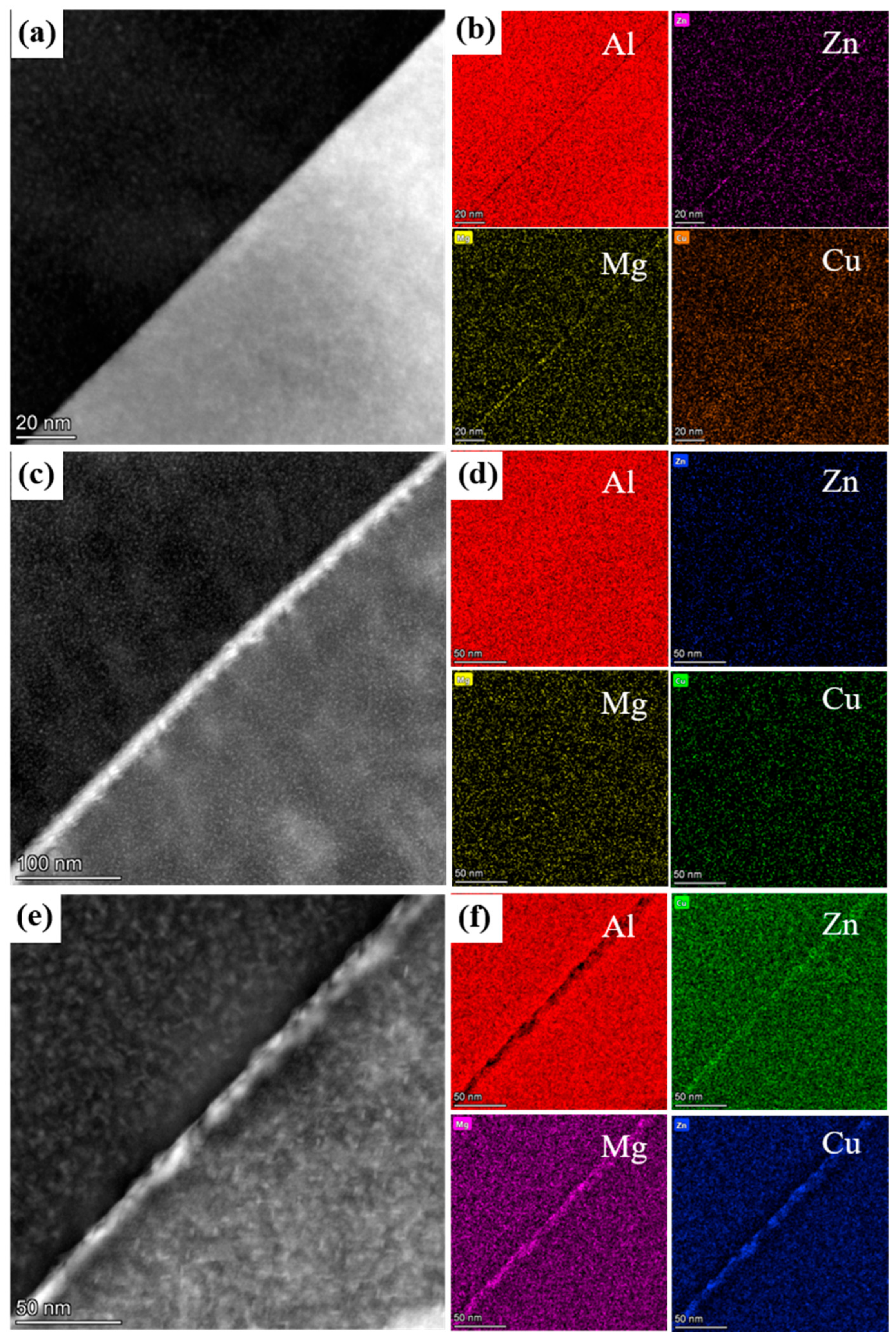
Figure 3 presents bright-field STEM images and corresponding STEM-EDS elemental maps of grain boundary (GB) regions in samples subjected to different pre-aging temperatures. For the PA80–3h sample (Figure 3a,b), no distinct GB precipitates are observed in the imaged area, and the elemental maps do not show an obvious enrichment band along the boundary within the detection limits. For the PA100–3h sample (Figure 3c,d), GB segregation appears heterogeneous: a clear enrichment band is visible in some GB regions, whereas other mapped areas do not show a measurable segregation signal along the plotted boundary. For the PA120–3h sample (Figure 3e,f), more prominent enrichment bands are observed along the GB in the mapped region, with Zn and Mg enrichment and a co-localized Cu signal in Figure 3f. Overall, these results indicate that GB segregation depends on both the pre-aging condition and local boundary-to-boundary variability, and should be interpreted qualitatively given the limited sampling.

3.2. Microstructural Characterization of Peak-Aged Alloy

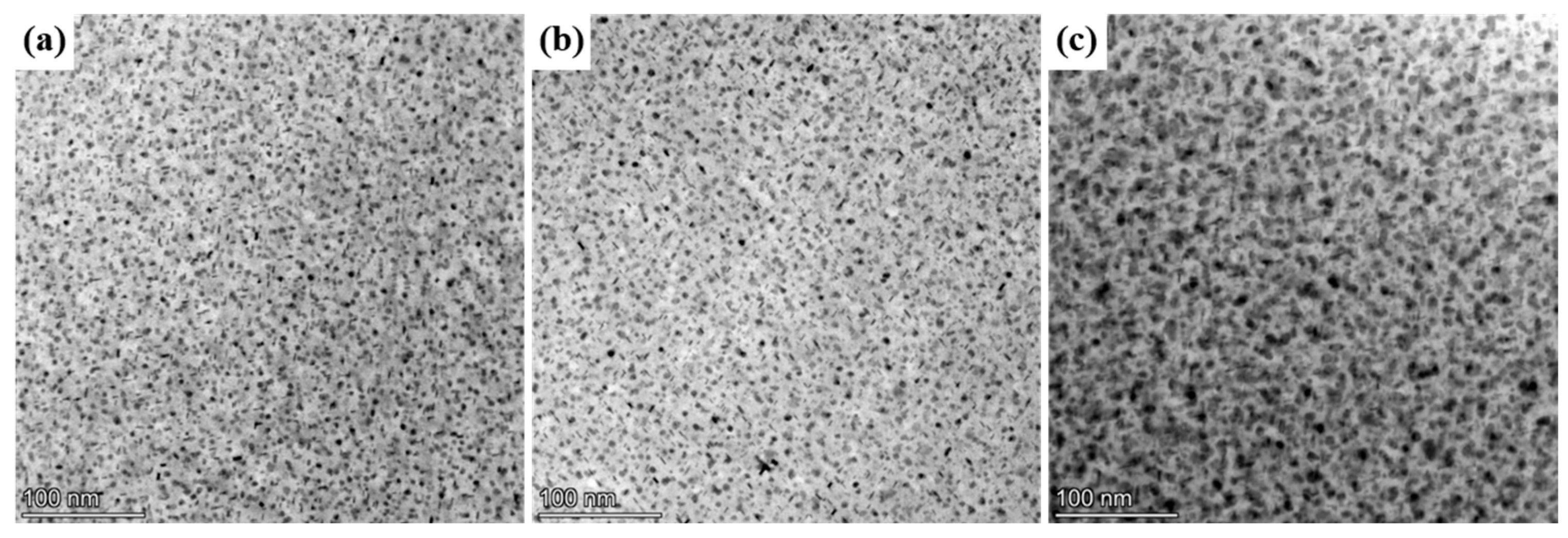
Figure 4 compares the intragranular precipitate microstructure of Al-Zn-Mg-Cu alloy sheets after peak aging (140 °C/8 h) under three pre-aging conditions, clarifying the influence of different pre-aging treatments on the final microstructure. As shown in Figure 4a (80 °C/3 h), the precipitates are relatively sparse, unevenly distributed, and include locally coarse particles. The average area fraction of precipitates is about 10.1%, indicating that the lower pre-aging temperature is consistent with fewer early-stage precursors, resulting in an insufficient density of strengthening phases after peak aging. Consequently, the mechanical properties, especially strength, are expected to be relatively low. In Figure 4b (100 °C/3 h), the peak-aged microstructure exhibits fine, uniformly distributed precipitates that appear higher, and an average area fraction of approximately 15.4%. This suggests that the process effectively promotes the efficient nucleation and homogeneous growth of η′ strengthening phases, suggesting that the alloy can achieve an optimal balance between strength and ductility. In Figure 4c, the intragranular precipitate density further increases, and its morphology differs noticeably from that in Figure 4a,b. The proportion of precipitates is larger, with an average area fraction of about 21.2%, indicating that the pre-aging treatment has generated abundant precursors and GP I/GP II zones. Overall, these results show that the pre-aging temperature directly influences the precipitation behavior of strengthening phases during peak aging by regulating the formation of GP I/GP II zones. Under the experimental aging condition of 140 °C, this approach achieves optimal microstructural control and is consistent with the improved strengthening response under the present conditions.
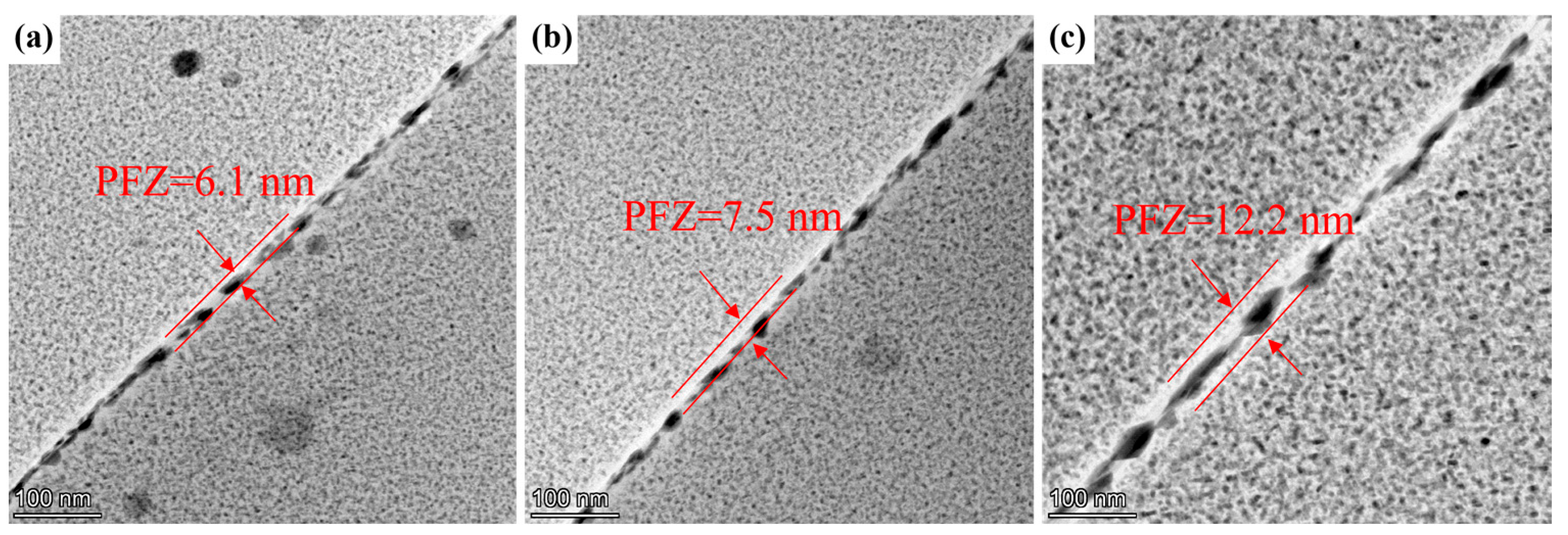
Figure 5 compares the grain boundary microstructural evolution in Al-Zn-Mg-Cu alloy sheets under peak aging at 140 °C for 8 h after three distinct pre-aging treatments. The analysis indicates that Specimen P80–3h, shown in Figure 5a, displays fine grain boundary precipitates accompanied by a narrow precipitate-free zone measuring 6.1 nm in width, with discontinuous precipitate distribution. In contrast, Figure 5b,c reveal microstructural refinement, where the precipitate-free zone widens to 7.5 nm and 12.2 nm, respectively, while the grain boundary precipitates undergo obvious coarsening and transition into continuous, densely packed structures. This differentiation stems from the moderate increase in pre-aging temperature, which accelerates the formation of stable solute segregation GP I near grain boundaries. During subsequent peak aging, this GP I serves as an effective nucleation site for the η phase, promoting long-range solute diffusion that drives precipitate coarsening and enhances continuity along grain boundaries. The optimized grain boundary architecture critically strengthens intergranular cohesion, delays the onset of intergranular fracture, and elevates the alloy’s comprehensive mechanical properties, including its resistance to stress corrosion cracking.

3.3. Mechanical Properties

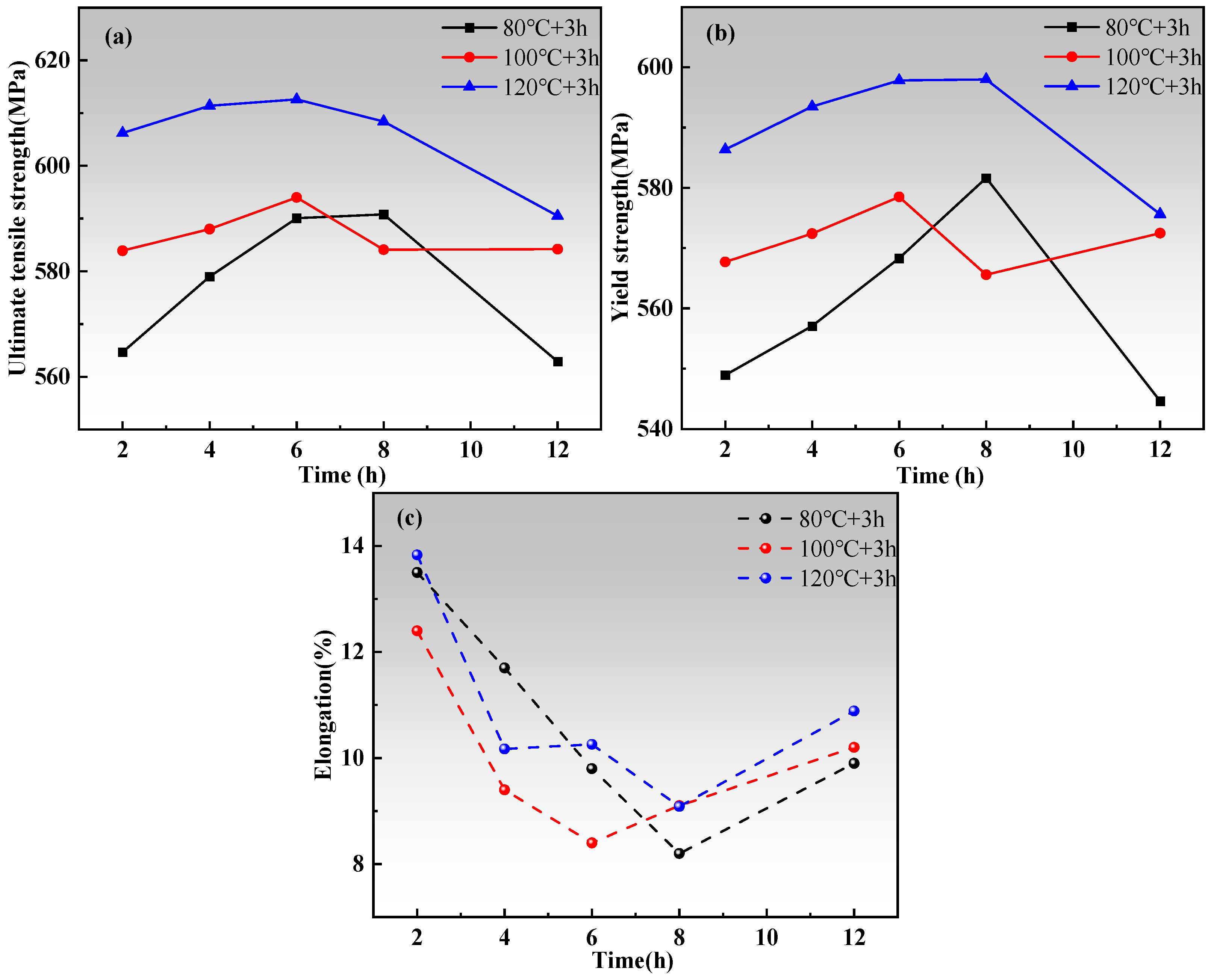
Figure 6 depicts the evolution of mechanical properties, specifically yield strength (YS), ultimate tensile strength (UTS), and elongation (EL), in Al-Zn-Mg-Cu rolled plates during artificial aging under three different pre-aging treatments. Overall, the PA80–3h and PA100–3h samples exhibited similar peak strength levels, with YS values of 581.6 MPa and approximately 578 MPa, UTS values of 591 MPa and 594 MPa, and EL values of 8.2% and 8.4%, respectively. In contrast, the PA120–3h pre-aged sample achieved significantly enhanced strength–ductility synergy, with approximately 598 MPa YS, 612 MPa UTS, and 10.3% EL.
Clear variations in peak-aging duration were observed: the PA80–3h sample required 8 h of aging to reach its peak UTS of 591 MPa, whereas both the PA100–3h and PA120–3h samples attained their respective maximum strengths of 594 MPa and 612 MPa within only 6 h of aging. This accelerated response is mainly attributed to the enhanced formation of GP I and GP II zones during higher-temperature pre-aging, which subsequently facilitates rapid nucleation and precipitation during peak aging. Notably, the UTS of the PA120–3h sample surpassed that of the PA80–3h and PA100–3h samples by 3.5% and 3.0%, respectively, fulfilling the production targets for high-strength Al alloy sheets.
An analysis of the mechanical property evolution reveals three distinct aging stages: the under-aging phase (2–4 h), during which strength gradually increased due to ongoing precipitation; the peak-aging period (4–8 h), characterized by stable high-strength retention; and the over-aging stage (8–12 h), marked by progressive strength degradation. The PA120–3h sample exhibited an exceptional mechanical performance, achieving a simultaneous optimization of ultimate tensile strength and elongation at its peak-aged state while maintaining ultra-high strength. This distinctive synergy between tensile strength and ductility offers a promising pathway for enhancing the strength–ductility balance in high-strength aluminum alloy plates.

3.4. Evolution of Dislocation Density

Dislocations constitute a fundamental feature of crystalline materials and are ubiquitously present across various alloy systems. The density of these defects quantifies their presence within the material structure and is primarily governed by the interplay between dislocation multiplication and annihilation mechanisms. According to Ungar’s research [25,26], X-ray diffraction peak data can provide information on dislocation structures, grain distribution, and size. XRD measures(Bruker, Karlsruhe, Germany) dislocation density through diffraction line broadening, where the extent of peak broadening is related to the dislocation density within the crystal.
In this study, XRD tests were conducted on both the as-received and aged samples. The effects of aging conditions on peak broadening were evaluated through high-resolution scans of the {111}, {200}, {220}, and {311} diffraction peaks. A high-resolution optical system was employed to generate a highly collimated and monochromatic X-ray beam, rendering instrumental broadening negligible. The full width at half maximum and corresponding diffraction angles of the peaks were determined by fitting with a Pseudo-Voigt function using Jade 6.0 software [27]. The dislocation density was calculated based on the modified Williamson–Hall method using the following formula [28]:
β c o s θ λ = 1 d + 2 e 2 s i n θ λ
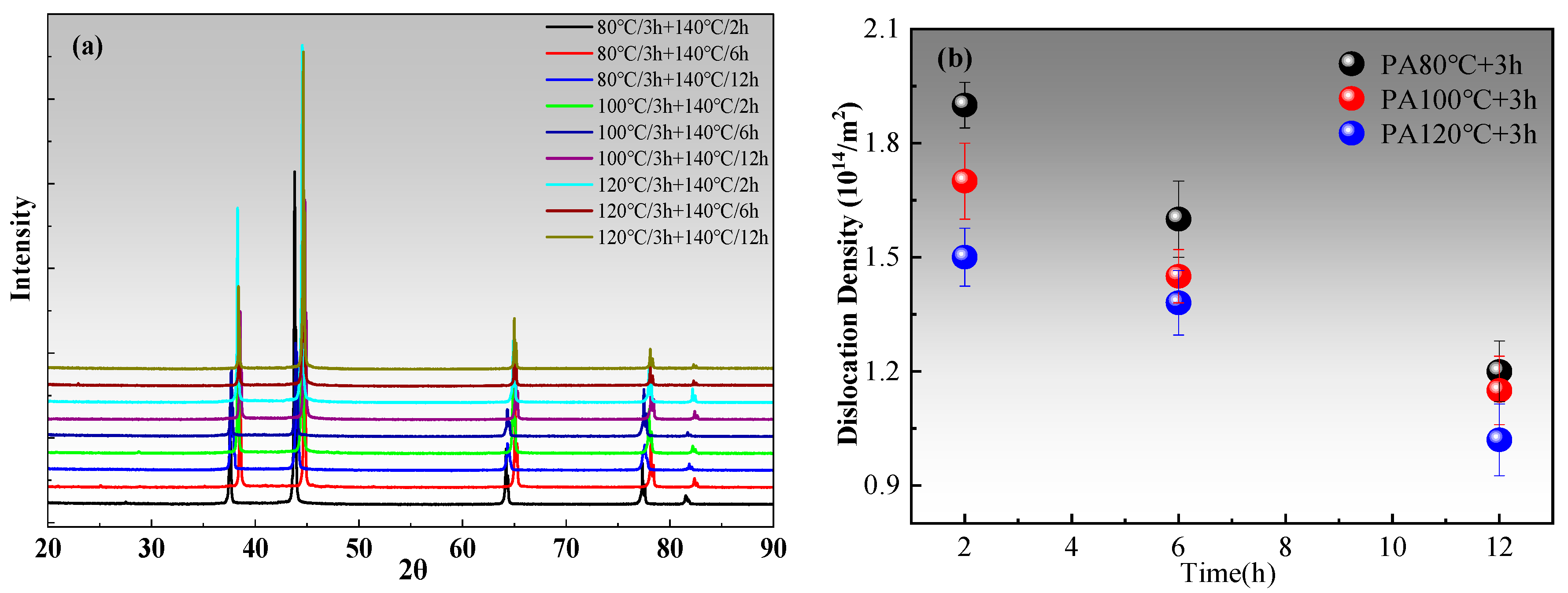
where θ denotes the diffraction angle corresponding to the Bragg reflection, λ (0.154 nm) represents the wavelength of the incident Cu Kα radiation, and β is the half-width of the diffraction peak. Utilizing the diffraction peak data of the (111), (200), (220), and (311) crystallographic planes shown in Figure 7a, the relationship between βcosθ/λ and 2sinθ/λ was fitted. Consequently, the correlation between the dislocation density and lattice distortion can be described using the following equation [29]:
ρ = 2 3 e d b
In this formulation, ρ denotes the dislocation density, while b represents the Burgers vector (0.286 nm for aluminum). The calculated dislocation densities ρ are shown in Figure 7b. After 2 h of aging, the dislocation densities are 1.9 × 10¹⁴ m−2, 1.6 × 10¹⁴ m−2, and 1.2 × 10¹⁴ m−2, respectively. After 6 h of aging, the densities decrease to 1.7 × 10¹⁴ m−2, 1.45 × 10¹⁴ m−2, and 1.15 × 10¹⁴ m−2. Following 12 h of aging, the values further decline to 1.5 × 10¹⁴ m−2, 1.38 × 10¹⁴ m−2, and 1.02 × 10¹⁴ m−2. The results indicate that dislocation densities follow the order PA80–3h > PA100–3h > PA120–3h across different aging conditions, demonstrating that higher pre-aging temperatures promote dislocation recovery. The examination of intragranular and intergranular precipitates in Figure 2 and Figure 3 reveals that dislocations act as dominant nucleation sites while simultaneously facilitating atomic-scale recovery processes.

4. Discussion

4.1. Microstructural Evolution During Peak Aging

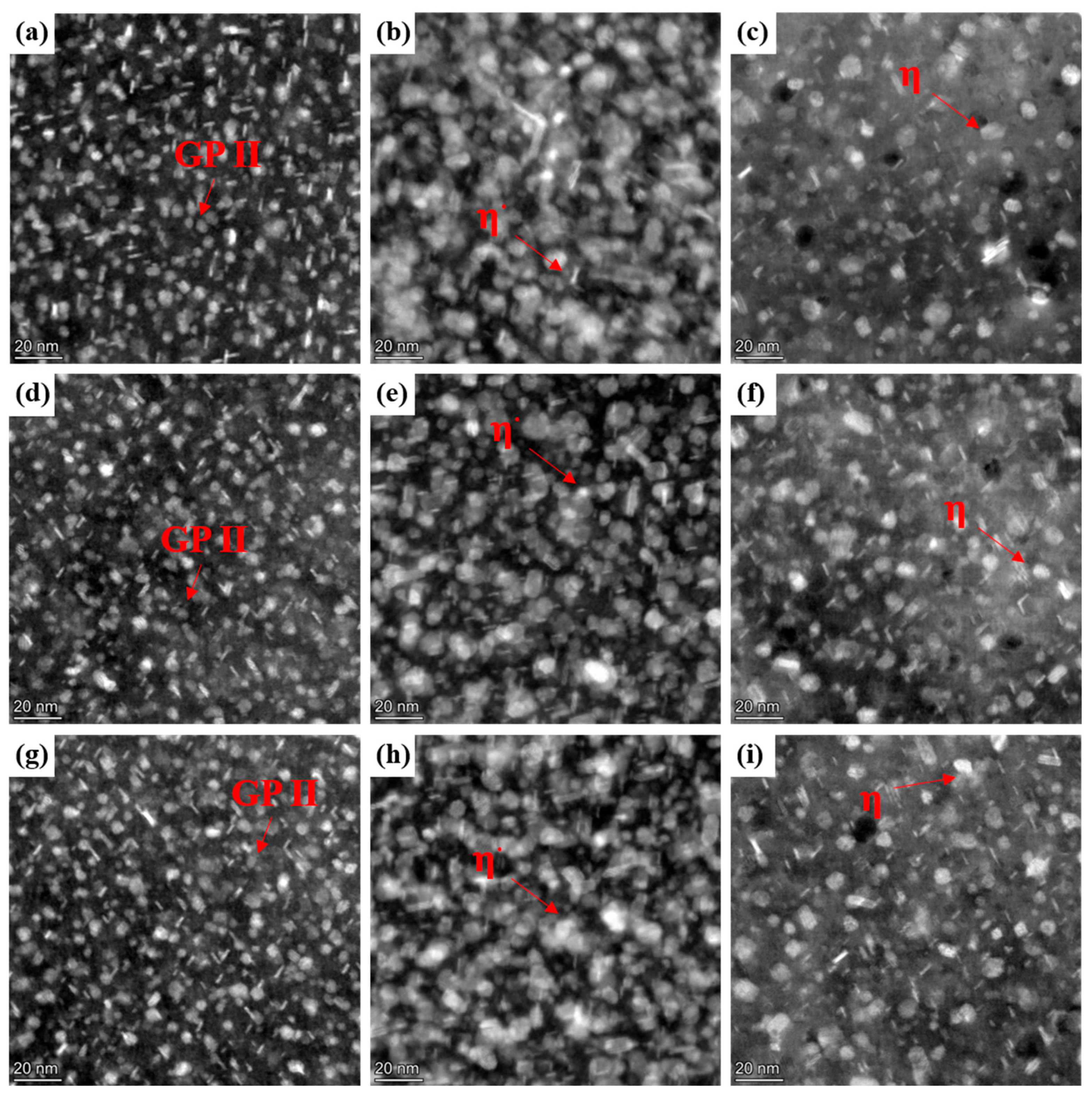
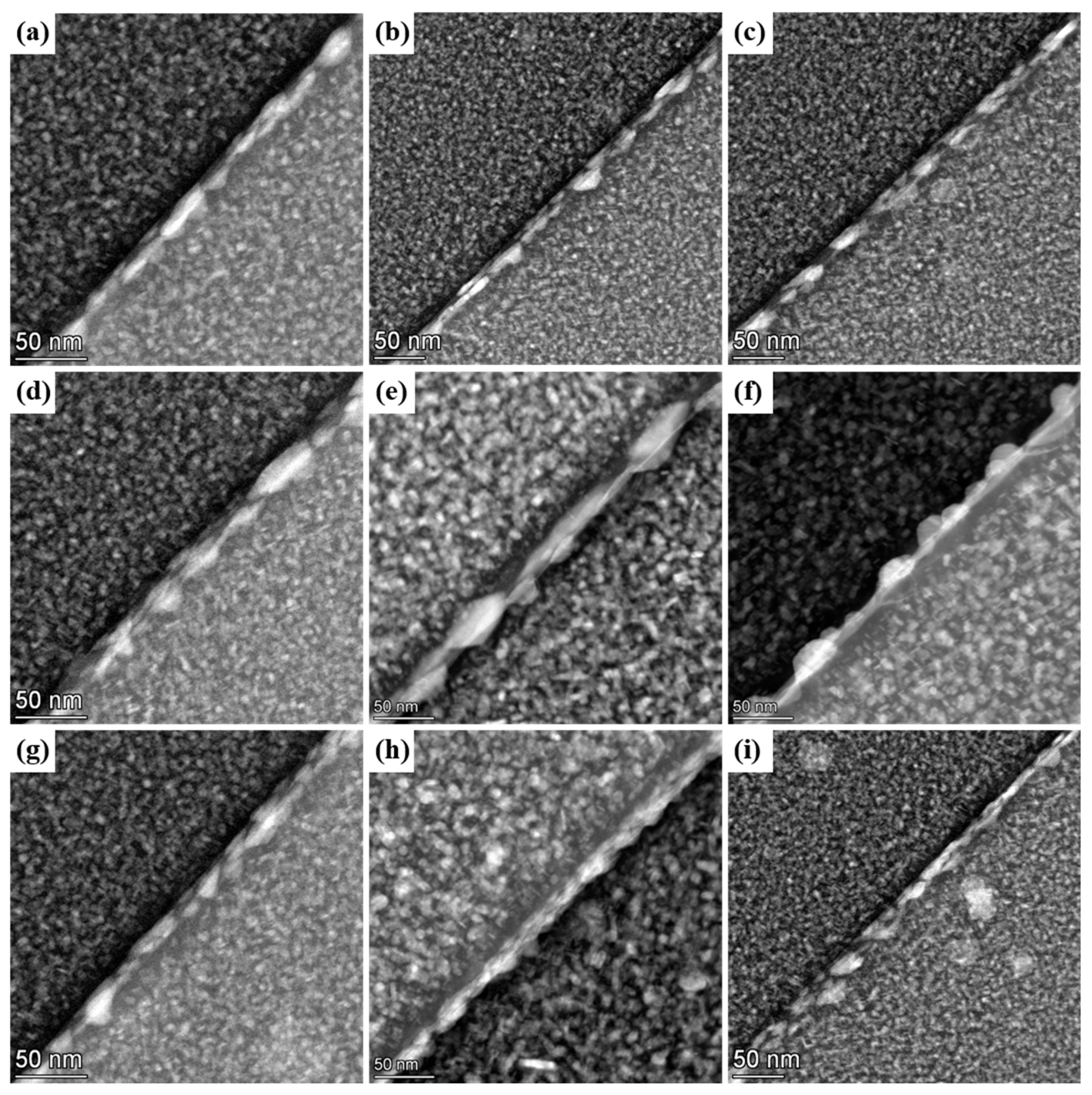
Figure 8 visually presents multiple precipitate phases formed during subsequent aging in pre-aged samples, including GP I, GP II zones, η′-phases, and η-phases. To investigate the evolution of GP I in the PA80–3h sample under creep-aging conditions, TEM analysis was performed. As shown in Figure 8a–c, the predominant precipitates in this sample are GP I uniformly distributed within the aluminum matrix. At the initial aging stage, illustrated in Figure 8a, the precipitate density within the GP I increases rapidly. After 6 h of aging, Figure 8b shows a significant decrease in the density of GP II zones and η′-phases, accompanied by an increase in the η-phase content. Following 12 h of aging, η precipitation becomes dominant, as evidenced in Figure 8c.
In contrast, the PA100–3h sample initially contains mainly GP II zones along with a small amount of η′-phases. According to Figure 8d, precipitate coarsening begins after 2 h of aging, where the increase in η-phase density leads to a reduction in the density of GP II zones and η′-phases. After 6 and 12 h of aging, Figure 8e and Figure 8f respectively show a continued decrease in the density of GP II zones and η′-phases, alongside a marked rise in η-phase density.
For the PA120–3h sample, the initial microstructure consists mainly of finely dispersed and uniformly distributed η′-phases. After 2 h of aging, a small amount of η-phase appears, while η′-phases remain dominant, as seen in Figure 8g. Following 6 h of aging, the precipitate morphology shows no significant change, with η′-phases still predominant and η phases accounting for only a minor fraction, shown in Figure 8h. After 12 h of aging, although the amount of the η-phase increases, a large number of fine η′-phases persist, as displayed in Figure 8i.
Figure 9 illustrates the evolution of grain boundary precipitates during aging. After 2 h of aging, the grain boundary precipitates in the PA80–3h specimen showed significant coarsening, reaching approximately 32.3 nm in size, and were continuously distributed along the grain boundaries. When aging was extended to 6 h, the precipitate size decreased to about 12.03 nm while transitioning toward a discontinuous distribution along the boundaries, as shown in Figure 9b,c. After 12 h of aging, the precipitate-free zone expanded from 26.1 nm to 61.5 nm.
In contrast, the grain boundary precipitates in the PA100–3h specimen were considerably coarser, with sizes around 16.26 nm, and exhibited a continuous distribution along the boundaries, as evident in Figure 9e,f. The precipitate-free zone in this specimen underwent a similar expansion from 24.2 nm to 62.4 nm, comparable to that observed in the PA80–3h specimen. Throughout the aging sequence, the PA120–3h specimen initially displayed coarser grain boundary precipitates, ranging from 18.6 nm to 42.21 nm, as captured in Figure 9g. Subsequent aging induced a significant widening of the newly formed precipitate-free zones, which expanded from 23.1 nm to 63.4 nm. Post-aging analysis confirmed that this specimen possessed the widest precipitate-free zone among all three materials, as documented in Figure 9h,i.

4.2. Evolution of Grain Boundary Microstructure During Pre-Aging

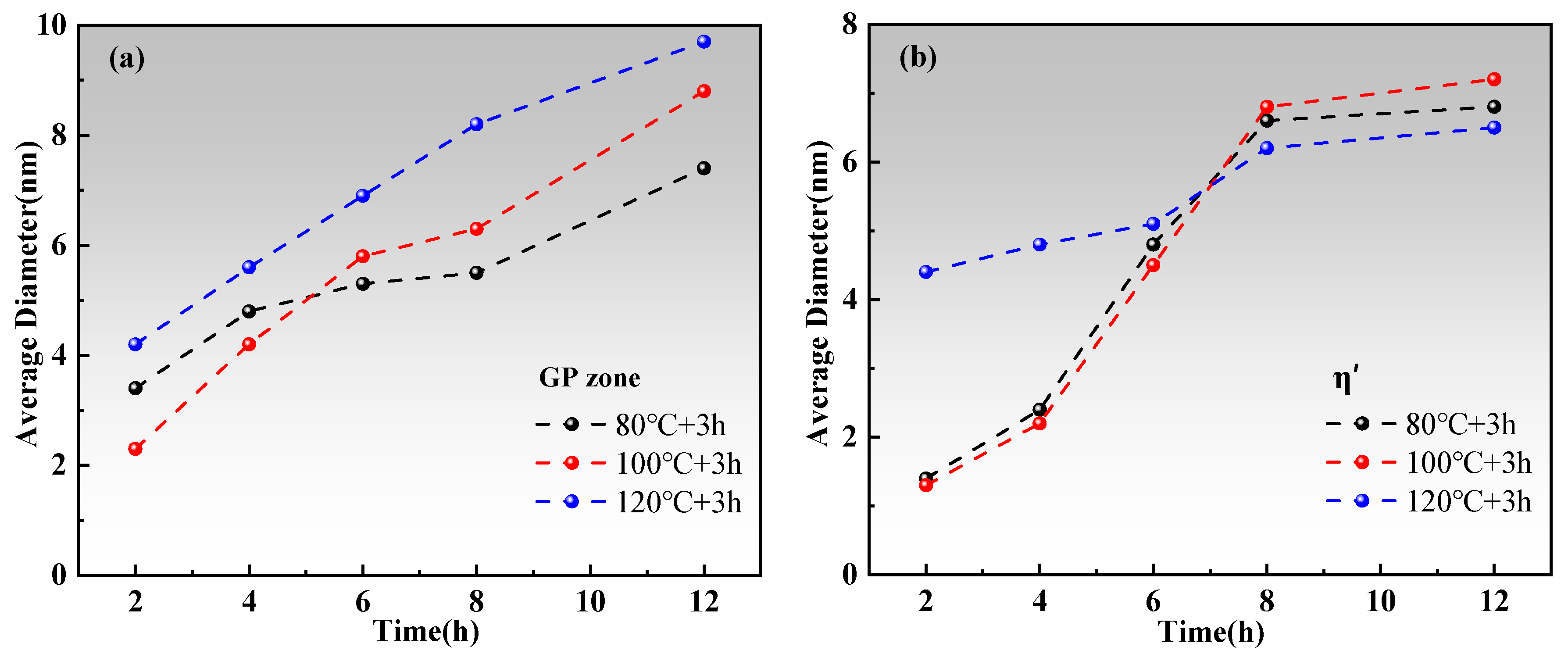
Figure 10 compiles the measured precipitate length evolution during aging for the pre-aged specimens, enabling a comparison of coarsening kinetics across GP II zones and η′ precipitates. The trends are discussed here in terms of plausible controlling mechanisms and the prior literature.
The strategic implementation of pre-aging offers dual advantages for microstructural optimization. First, pre-aging generates a substantial population of nanoscale precipitates that undergo sustained growth during subsequent aging, thereby mitigating the strength degradation typically induced by high-temperature exposure. Second, these additional fine precipitates effectively inhibit the nucleation and coarsening of dislocation-induced precipitation during aging. In this study, pre-aging treatment was deliberately conducted prior to high-temperature aging to prevent the excessive coarsening of precipitates.
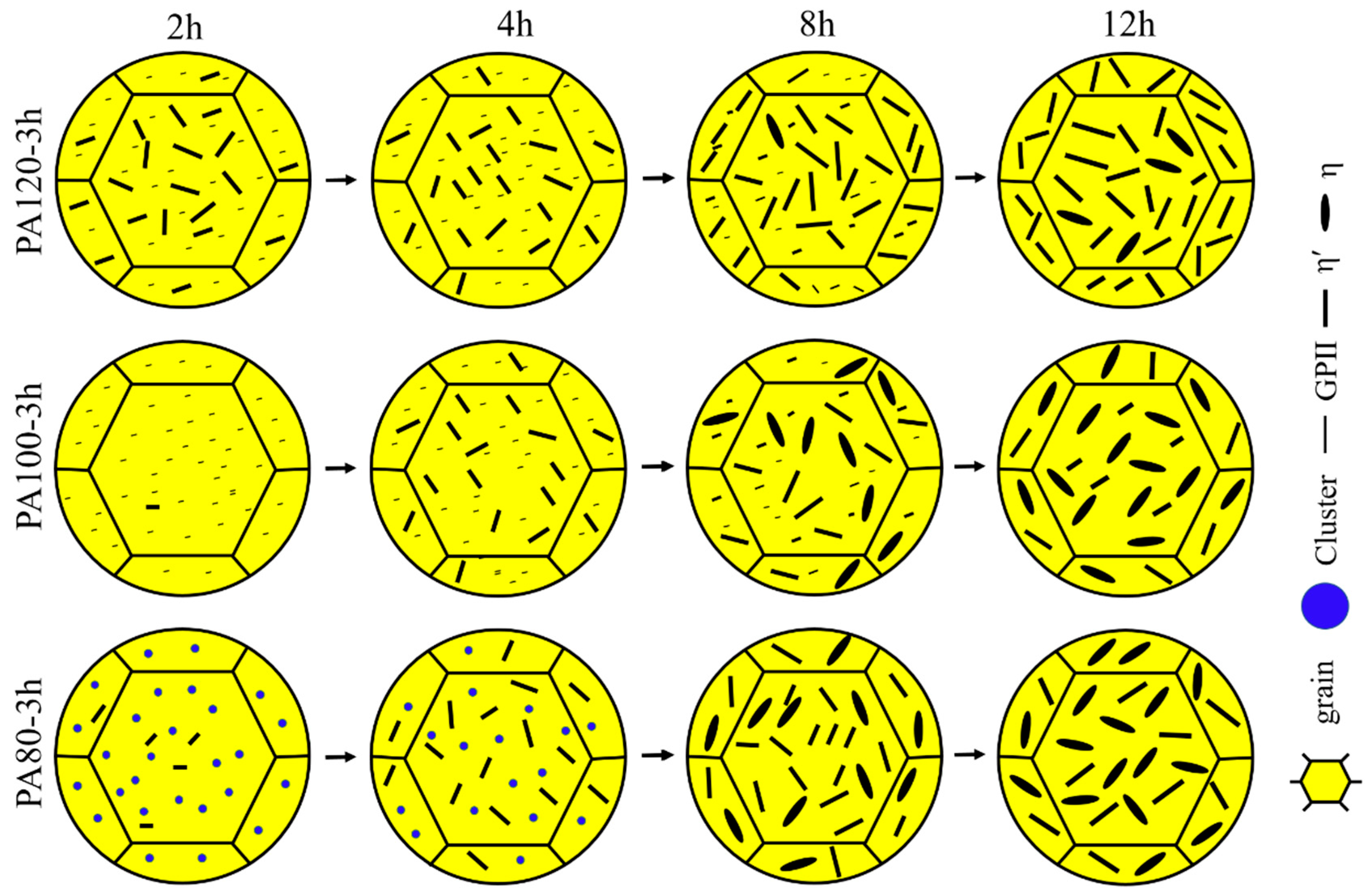
Figure 11 schematically illustrates the distinct aging behavior microstructural evolution across pre-aged specimens designated as PA80–3h, PA100–3h, and PA120–3h. Pre-aging at 80 °C or 100 °C elevates precipitate nucleation density yet is consistently insufficient to prevent η′-phase transformation into the η-phase. In contrast, pre-aging at 120 °C simultaneously enhances nucleation sites and remarkably inhibits this phase transition, achieving finely dispersed, high-density η′-phase precipitates.
Immediately after quenching, the matrix is a supersaturated solid solution containing a high concentration of vacancies. Low-temperature pre-aging may promote solute–vacancy association, forming solute–vacancy complexes and/or nascent GP I that act as nucleation precursors for subsequent precipitation [30]. Notably, vacancy depletion and diffusion constraints are proposed interpretations and are not directly measured in the present study.
Within PA80–3h specimens, as evidenced in Figure 11, GP I initiates precipitation but undergoes rapid coarsening during aging before transforming into a thermodynamically stable η phase. This transformation sequesters substantial solute resources, hindering GP II zone and η′-phase nucleation, which consequently diminishes strengthening-phase density. Specimens pre-aged at 100 °C designated as PA100–3h exhibit analogous coarsening behavior, where suboptimal cluster ordering limits nucleation efficacy. An excessive temperature or duration risks premature solute/vacancy exhaustion, generating either oversized η′-phase variants or grain boundary precipitates that reduce microstructural flexibility and may trigger premature over-aging. Dislocation activity, as quantified in Figure 11, accelerates coarsening, driving the direct transformation of GP II zones into the η phase without intermediate stable η′ formation.
Unique microstructural evolution distinguishes PA120–3h, illustrated comprehensively in Figure 11. Pre-dispersed nanoscale precursors establish homogeneous intragranular nucleation sites for the η′ phase. During subsequent aging, this configuration favors a uniform transformation toward GP II/η′ phases rather than preferential heterogeneous nucleation at interfaces or dislocations, thereby enhancing precipitate spatial homogeneity and thermal stability. Intense precipitation activity during pre-aging dramatically depletes vacancies while generating interfacial passivation effects. Consequently, η′-to-η transformation is significantly suppressed, promoting a metastable regime characterized by rapid nucleation but sluggish coarsening dynamics. This distinctive Disko effect extends the kinetic stability window of the strengthening η′-phase, prolongs peak strength duration, and forestalls irreversible degradation toward the coarse η-phase.

4.3. Strengthening Effects

To clarify the dominant influence of pre-aging on the Al-Zn-Mg-Cu alloy, this study focuses on the contribution of precipitate evolution to the yield strength. According to references [31,32], pre-aging primarily regulates precipitation strengthening while minimally affecting other mechanisms such as solid solution strengthening. The dominant strengthening mechanism is determined by comparing the strength increments of dislocation shearing and Orowan bypassing, with the lower increment governing the process [33,34]. Specifically, Orowan bypassing applies to non-shearable precipitates, where dislocations circumvent the particles forming surrounding dislocation loops. The governing equation for this mechanism is expressed as follows [35]:
σ O r o w a n = M 0.4 G b π 1 υ l n ( 2 2 3 r / b ) λ p
The equation describing the Orowan bypassing mechanism incorporates several key parameters including the Poisson’s ratio ν, typically approximately 0.33 for Al-Zn-Mg-Cu alloys, along with the edge-to-edge inter-precipitate spacing λ p , expressed as λ p = 2 λ p = 2 2 / 3 r π / 4 f 1 , where r and f denote the average precipitate radius and volume fraction, respectively, as quantified in Figure 11.
Material strength and hardness depend principally on morphological evolution within fine intragranular precipitates and dispersoids. Dispersoids exhibited negligible variations across different pre-aged specimens, whereas distinct characteristics of GP II zones alongside η′ precipitates dominated the strengthening response. Notably, intragranular precipitates maintained refined dimensions constituted mainly by ultrafine GP II zones, and η′-phase dislocations readily sheared through these nanoscale precipitates. This strengthening mechanism is consequently characterized as follows according to reference [36]:
τ c u t = α f 1 / 2 r 1 / 2
Within the presented equation, α denotes a scaling constant, f represents the precipitate volume fraction, and r signifies the precipitate radius. Consequently, for refined precipitates in Al-Zn-Mg alloys, the strength exhibits positive correlations with both the precipitate radius and volume fraction. In contrast, when precipitates coarsen, the strengthening response inversely correlates with the precipitate radius while retaining a positive dependence on the volume fraction.
Figure 8 shows that, in the PA80–3h specimens, GP I dominates during the initial aging stages. Pre-aging accelerates the formation of nucleation sites, enabling the rapid coarsening of GP I after 2 h of high-temperature aging. Subsequent aging promotes the transformation from the η′-phase to the η phase along with precipitate coarsening, which reduces the number density, increases the inter-precipitate spacing, diminishes the overall strengthening contribution, and leads to an accelerated decline in YS. In contrast, the PA100–3h specimens primarily consist of fine GP II zones. A vigorous transformation from GP II zones to the η′-phase occurs during the early stages of high-temperature aging, although the η′-phase simultaneously undergoes an accelerated conversion to the η phase under thermal exposure [37]. Upon extended aging, the volume fraction of the η′-phase significantly decreased, while the η-phase fraction and dimensions increased synchronously, exhibiting an evolution trajectory similar to PA80–6h. The replacement of shearable η′ by coarse η particles reduced dislocation shearing opportunities while weakening Orowan bypassing stress due to the increased effective spacing, collectively explaining the inferior strength in PA80–3h and PA100–3h specimens [38].
Compared with the aforementioned samples, the PA120–3h specimens contained a significantly higher proportion of the η′-phase. The solute-depleted matrix inhibited the transformation from the η′ phase to the η phase, while dislocations generated during aging provided supplementary nucleation sites that promoted the formation of GP II zones and the η′-phase, while impeding the conversion to the η phase. Consequently, the microstructure of peak-aged PA120–3h exhibited a higher density of η′ precipitates and retained GP II zones. Pre-aging supplied additional precipitation sites, which were further amplified by dislocation networks. The increased nucleation sites enhanced the formation of the η′ phase, substantially depleting solute atoms and vacancies. The reduced solute and vacancy concentration ultimately hindered the coarsening of the η′-phase during creep-aging. Notably, Figure 11 shows minimal change in the length of η′ precipitates in PA120–3h between 2 and 8 h of aging, which corresponds to the characteristic plateau region observed in Figure 6. The progressive increase in the volume fraction of the η′ phase during pre-aging simultaneously enhanced dislocation shearing and the Orowan bypass effect. According to reference [25], interactions between precipitates and dislocations further hindered dislocation motion and stimulated dislocation multiplication during deformation. As a result, optimal mechanical properties were achieved: an ultimate tensile strength of 612.6 MPa, a yield strength of 596.7 MPa, and an elongation of 10.3%.
Using Equations (3) and (4), together with the representative precipitate size/spacing metrics extracted from the TEM/HAADF observations (Figure 4, Figure 8 and Figure 11), we estimate that the intragranular strengthening in PA80–3h and PA100–3h is primarily shearing-dominated because the dominant obstacles remain very fine and coherent (GP I/GP II), giving an approximate shearing contribution on the order of ~60–110 MPa, while Orowan bypass provides a smaller secondary increment. In contrast, PA120–3h promotes thicker η′ platelets with a reduced coherency, increasing the relative importance of bypassing; the estimated Orowan contribution is on the order of ~160–200 MPa. These estimates are intended as order-of-magnitude comparisons rather than exact values, but they are consistent with the experimentally observed increase in yield strength for PA120 at peak aging. Although bypass-dominated strengthening can, in principle, reduce uniform elongation by enhancing dislocation filtering, the net ductility in the present study is governed mainly by GB/PFZ characteristics; the widened PFZ and discontinuous GB precipitation in PA120 offset this tendency and led to an overall strength–ductility synergy.
The ductility evolution during aging varied across pre-aged specimens due to precipitate characteristics. Coherent GP II zones and η′-phases accommodated dislocation accumulation, enhancing ductility [39]. Conversely, incoherent η phases merely occupied lattice sites and poorly accommodated slip dislocations. The reduced capacity for multiple dislocation accumulation during tensile testing thus degraded elongation. Hence, PA120–3h’s improved ductility originated from its lower η-phase fraction compared with other specimens. Furthermore, equilibrium η phases at grain boundaries potentially initiated fracture during deformation. Plasticity typically diminishes with increasing η-phase size, as reported in reference [40,41].
Specimens exhibiting discontinuous GB precipitates and a broader PFZ show a higher uniform elongation, consistent with easier boundary compatibility and delayed strain localization. Fractography and EBSD/TEM evidence indicate a reduced early intergranular cracking and more homogeneous plasticity near GBs when GB precipitates are discontinuous and PFZs are wider. The dominant contributors to the observed elongation are GB discontinuity and PFZ width, while changes in the intragranular precipitate distribution play a secondary role in ductility under the present conditions.
It is worth noting that grain boundary (GB) precipitation and solute-depletion features can exert competing effects on strength and ductility. The increased boundary resistance to dislocation transmission likely elevates the yield strength; however, the same GB features can lower ductility by reducing intergranular compatibility, accelerating damage initiation, and limiting strain hardening. We also note that the net mechanical response reflects the interplay between GB phenomena and intragranular precipitation. PFZs adjacent to grain boundaries are solute-depleted, relatively soft regions whose composition approaches that of pure aluminum; by reducing local hardness mismatch with the surrounding matrix, PFZs mitigate stress concentrations, promote strain compatibility between grains, and thereby support more coordinated deformation and improved plasticity. In PA80–3h and PA100–3h, prolonged aging simultaneously raises intragranular and grain boundary strength while narrowing PFZs, which intensifies stress localization at boundaries and leads to a rapid loss of ductility. In contrast, PA120–6h also increases intragranular and boundary strength, but the markedly widened PFZs (chemically closer to pure Al) facilitate load transfer and slip accommodation across boundaries, enhancing deformation coordination and improving plasticity [23]. This mechanism explains the gradual ductility increase during aging illustrated in Figure 6. Narrow PFZs together with continuous grain boundary precipitation promote early intergranular damage and reduce elongation. Wider PFZs and a discontinuous boundary precipitate distribution delay void nucleation and boundary decohesion, sustain a more uniform strain-hardening response, and increase elongation.
This trend is also consistent with the lower dislocation densities measured for PA120–3h (Figure 7). A reduced dislocation storage may be facilitated by wider PFZs that act as compliant channels, by increased cross-slip and annihilation at boundaries with discontinuous GB precipitates, and by altered obstacle spacing due to precipitate coarsening; however, these are plausible mechanisms rather than demonstrated causes under our conditions. A fine and homogeneous intragranular dispersion with larger interparticle spacing also reduces strain localization within grains and supports higher total elongation before fracture.

4.4. Proposed Mechanisms and Supporting Literature

The mechanistic interpretations below are presented explicitly as proposed explanations that are consistent with the observed trends and with the prior literature on Al-Zn-Mg-Cu precipitation, but they are not directly measured in the present study. We summarize the evidence base and indicate the key measurements needed for future validation.
Vacancy depletion/trapping: Pre-aging and early precipitation may trap a fraction of vacancies in solute–vacancy complexes and early GP structures, reducing the population of mobile vacancies available for long-range diffusion during subsequent aging. Lower vacancy mobility could slow solute transport, thereby retarding coarsening and Ostwald ripening and delaying transformation kinetics [3,18,23].
Interfacial passivation at η′/Al interfaces: Prior work on η′ nano-phase structure and interfaces suggests that interface chemistry and misfit accommodation can influence interfacial mobility and transformation pathways [24]. We propose that pre-aging may promote a more stable η′/Al interface state (e.g., via solute segregation or modified misfit structures), which could reduce the tendency for η′ to transform into the equilibrium η phase and contribute to the observed stability window [3,24].
Suppression of η′→η transformation: The combined effects of reduced mobile vacancies, altered solute availability, and stabilized interfaces may shift the balance toward a metastable η′-dominated regime, consistent with the literature reports of diffusion-controlled transformation barriers in 7xxx-series alloys [3,22]. In this framework, the plateau-like behavior observed for PA120–3h reflects delayed coarsening/transformation rather than a complete cessation of kinetic processes.
Future validation: To test these hypotheses and establish causality, future studies should (i) quantify vacancy concentration and mobility (e.g., positron annihilation spectroscopy), (ii) resolve η′/Al interfacial chemistry and misfit structures (e.g., APT and high-resolution STEM-EDS/EELS), and (iii) track precipitation/transformation kinetics in situ (e.g., DSC, SAXS/WAXS, or in situ TEM), together with systematic multi-region imaging for stereological statistics.

5. Conclusions

This study suggests that the precise control of pre-aging temperature effectively modulates the initial microstructure of Al-Zn-Mg-Cu alloy, thereby optimizing its secondary aging behavior and mechanical properties. The principal findings are summarized as follows:
(1)
Pre-aging temperature critically governs the initial microstructure prior to secondary aging. Lower pre-aging temperatures (80 °C and 100 °C) primarily produce metastable structures dominated by GP I and GP II zones, which inadequately inhibit the subsequent transformation from the η′ phase to the η phase. In contrast, pre-aging at 120 °C directly generates a high density of η′ precipitates while reducing the vacancy concentration, thereby effectively suppressing the conversion from the η′ phase to the η phase.
(2)
Appropriately designed pre-aging treatments induce a distinctive peak aging plateau during high-temperature aging. This facilitates both high-density uniform precipitate distribution and strength retention throughout the prolonged aging duration, effectively circumventing the mechanical property deterioration typical of conventional over-aging.
(3)
The optimized pre-aging protocol at 120 °C for 6 h delivers an exceptional mechanical property synergy: ultimate tensile strength 612.6 MPa, yield strength 596.7 MPa, and elongation 10.3%. These results unequivocally validate that regulating phase transformation pathways through pre-aging significantly enhances the comprehensive performance of Al-Zn-Mg-Cu alloys.

Author Contributions

Conceptualization, J.T.; Methodology, J.T. and R.L.; Software, J.T.; Validation, R.L.; Formal analysis, K.Z.; Resources, R.L.; Data curation, J.T.; Writing—original draft, J.T.; Writing—review & editing, K.Z.; Project administration, K.Z.; Funding acquisition, K.Z. All authors have read and agreed to the published version of the manuscript.

Funding

This work was supported by the National Natural Science Foundation of China (grant number 12405245), the Natural Science Foundation of Hunan Province (grant number 2024JJ6329), and the Excellent Youth Project of the Education Department of Hunan Province (grant number 23B0665).

Institutional Review Board Statement

Not applicable.

Informed Consent Statement

Not applicable.

Data Availability Statement

Some or all data that support the findings of this study are available from the corresponding author upon reasonable request.

Conflicts of Interest

The authors declare no conflict of interest.

References

  1. Zhou, L.; Luo, Y.; Zhang, Z.; He, M.; Xu, Y.; Zhao, Y.; Liu, S.; Dong, L.; Zhang, Z. Microstructures and Macrosegregation of Al–Zn–Mg–Cu Alloy Billet Prepared by Uniform Direct Chill Casting. Materials 2021, 14, 708. [Google Scholar] [CrossRef]
  2. Xiao, W.; Zhu, X.; Liu, Y.; Zou, S.; Chen, P.; Pan, C. Influence of heat treatment on microstructure, tensile, and corrosion properties of B4C/6061Al neutron absorbing composite manufactured by laser directed energy deposition. Ceram. Int. 2026. [Google Scholar] [CrossRef]
  3. Azarniya, A.; Taheri, A.K.; Taheri, K.K. Recent advances in ageing of 7xxx series aluminum alloys: A physical metallurgy perspective. J. Alloys Compd. 2018, 781, 945–983. [Google Scholar] [CrossRef]
  4. Jiang, R.P.; Li, A.Q.; Hai, X.Q.; Li, R.; Zhou, H.; Xie, Z. Effect of ultrasonic power on degassing and microstructure of large-scale 7085 aluminum alloy ingots. Mater. Today Commun. 2023, 37, 107279. [Google Scholar] [CrossRef]
  5. Li, A.Q.; Jiang, R.P.; Hai, X.Q.; Li, R.; Fu, A.; Li, X. Numerical Simulation of Physical Field During Different Ultrasonic-Power-Assisted Casting of 7085 Aluminum Alloy. Adv. Eng. Mater. 2024, 26, 2400458. [Google Scholar] [CrossRef]
  6. Nie, B.; Liu, P.; Zhou, T. Effect of compositions on the quenching sensitivity of 7050 and 7085 alloys. Mater. Sci. Eng. A 2016, 667, 106–114. [Google Scholar] [CrossRef]
  7. Wang, H.; Wang, C.; Mo, Y.; Wang, H.; Xu, J. Hot deformation and processing maps of Al–Zn–Mg–Cu alloy under coupling-stirring casting. J. Mater. Res. Technol. 2019, 8, 1224–1234. [Google Scholar] [CrossRef]
  8. Zhang, J.; Li, Z.; Wen, K.; Huang, S.; Li, X.; Yan, H.; Yan, L.; Liu, H.; Zhang, Y.; Xiong, B. Simulation of dynamic recrystallization for an Al-Zn-Mg-Cu alloy using cellular automaton. Prog. Nat. Sci. Mater. Int. 2019, 29, 477–484. [Google Scholar] [CrossRef]
  9. Duan, L.; Zhan, L.; Xu, Y.; Huang, M. Effect of pre-deformation on creep aging behavior and microstructural evolution of Al-Li alloy. J. Plast. Eng. 2020, 27, 106–115. [Google Scholar]
  10. Peng, X.; Guo, Q.; Liang, X.; Deng, Y.; Gu, Y.; Xu, G.; Yin, Z. Mechanical properties, corrosion behavior and microstructures of a non-isothermal ageing treated Al-Zn-Mg-Cu alloy. Mater. Sci. Eng. A 2017, 688, 146–154. [Google Scholar] [CrossRef]
  11. Zeng, Q.; Zhan, L.; Jiang, Y.; Li, Y.; Chen, F. Synchronous improvement of creep strain and mechanical properties in Al-Zn-Mg-Cu alloy via microalloying with Yb. Mater. Sci. Eng. A 2025, 948, 149374. [Google Scholar] [CrossRef]
  12. Bignon, M.; Shanthraj, P.; Robson, J.D. Modelling dynamic precipitation in pre-aged aluminium alloys under warm forming conditions. Acta Mater. 2022, 234, 118036. [Google Scholar] [CrossRef]
  13. Chae, W.; Jeong, M.; Lee, D.; Lee, J.; Chun, D.W.; Lee, S.Y.; Hong, S.-K.; Kim, S.H.; Han, J.H. Effects of pre/post-aging treatment on the mechanical properties and texture of asymmetrically rolled 6061 aluminum alloy: Formability and planar anisotropy. J. Mater. Res. Technol. 2023, 24, 9476–9490. [Google Scholar] [CrossRef]
  14. Luo, J.; Luo, H.; Li, S.; Wang, R.; Ma, Y. Effect of pre-ageing treatment on second nucleating of GPII zones and precipitation kinetics in an ultrafine grained 7075 aluminum alloy. Mater. Des. 2020, 187, 108402. [Google Scholar] [CrossRef]
  15. Zeng, Q.; Feng, S.; Chen, F.; Wang, D.; Zhan, L.; Yang, Y.; Tang, L.; Liu, C.; Yan, D. Improving creep-aging behavior and mechanical properties of AA7150 alloy via pre-aging. Mater. Sci. Eng. A 2024, 894, 146130. [Google Scholar] [CrossRef]
  16. Li, Z.; Zang, R.; Zhao, P.; Jia, Z. Effects of pre-aging and natural aging on the clusters, strength and hemming performance of AA6014 alloys. Mater. Sci. Eng. A 2020, 782, 139206. [Google Scholar] [CrossRef]
  17. Jiang, H.; Xing, H.; Xu, Z.; Yang, B.; Feng, W.; Sui, T.; Han, Y.; Zhang, J.; Baode, S. Effect of pre-aging and precipitation behavior on mechanical properties of 7055 aluminum alloy processed by hot-forming quenching. Mater. Charact. 2023, 198, 112729. [Google Scholar] [CrossRef]
  18. Lee, S.-H.; Jung, J.-G.; Baik, S.-I.; Seidman, D.N.; Kim, M.-S.; Lee, Y.-K.; Euh, K. Precipitation strengthening in naturally aged Al–Zn–Mg–Cu alloy. Mater. Sci. Eng. A 2021, 803, 140719. [Google Scholar] [CrossRef]
  19. Chen, F.; Zhong, J.; Zhan, L.; Wang, P.; Ruan, X.; Wu, H.; Xu, Y.; Ma, B.; Liu, C.; Zeng, Q.; et al. Effect of pre-aging on creep aging properties and microstructure evolution of 2195 Al–Li alloy. J. Mater. Res. Technol. 2022, 21, 1029–1041. [Google Scholar] [CrossRef]
  20. Wang, X.; Shi, Z.S.; Lin, J.G. Deformation, strength and corrosion resistance evolutions of AA7475 under creep-ageing with various pre-treatments. Mater. Sci. Eng. A 2025, 948, 149278. [Google Scholar] [CrossRef]
  21. Gao, C.; Gao, Y.; Wang, F.-Q.; Guo, X.-B.; Deng, Y.-L. Microstructure and mechanical properties evolution mechanism of 7050 aluminum alloy plate by coupled bending and creep aging forming. Mater. Today Commun. 2025, 48, 113412. [Google Scholar] [CrossRef]
  22. Zhou, P.; Song, Y.; Lu, J.; Hua, L.; Huang, L. A novel precipitation kinetics model for fast-aging process of Al-Zn-Mg-Cu alloy. J. Mater. Res. 2024, 39, 928–943. [Google Scholar] [CrossRef]
  23. Deschamps, A.; Fribourg, G.; Bréchet, Y.; Chemin, J.; Hutchinson, C. In situ evaluation of dynamic precipitation during plastic straining of an Al-Zn-Mg-Cu alloy. Acta Mater. 2012, 60, 1905–1916. [Google Scholar] [CrossRef]
  24. Cao, F.; Zheng, J.; Jiang, Y.; Chen, B.; Wang, Y.; Hu, T. Experimental and DFT characterization of η′ nano-phase and its interfaces in Al Zn Mg Cu alloys. Acta Mater. 2019, 164, 207–219. [Google Scholar] [CrossRef]
  25. Williamson, G.K.; Hall, W.H. X-ray line broadening from filed aluminium and wolfram. Acta Metall. 1953, 1, 22–31. [Google Scholar] [CrossRef]
  26. Tang, J.; Omar, M.Z.; Jiang, R.; Mohamed, I.F. Effect of TiB2 on the Microstructure and Mechanical Properties of TiB2/Al-5Cu Matrix Composites. JOM 2025, 77, 1064–1078. [Google Scholar] [CrossRef]
  27. Li, H.; Chen, P.; Wang, Z.; Zhu, F.; Song, R.; Zheng, Z. Tensile properties, microstructures and fracture behaviors of an Al-Zn-Mg-Cu alloy during ageing after solution treating and cold-rolling. Mater. Sci. Eng. A 2019, 742, 798–812. [Google Scholar] [CrossRef]
  28. Mei, L.; Chen, X.; Huang, G.; Liu, Q. Improvement of mechanical properties of a cryorolled Al-Mg-Si alloy through warm rolling and aging. J. Alloys Compd. 2019, 777, 259–263. [Google Scholar] [CrossRef]
  29. Liu, T.; Vaudin, M.D.; Bunn, J.R.; Ungár, T.; Brewer, L.N. Quantifying dislocation density in Al-Cu coatings produced by cold spray deposition. Acta Mater. 2020, 193, 115–124. [Google Scholar] [CrossRef]
  30. Westmacott, K.H.; Barnes, R.S.; Hull, D.; Smallman, R.E. Vacancy trapping in quenched aluminium alloys. Philos. Mag. J. Theor. Exp. Appl. Phys. 1961, 6, 929–935. [Google Scholar] [CrossRef]
  31. Afifi, M.A.; Wang, Y.C.; Langdon, T.G. Effect of dynamic plastic deformation on the microstructure and mechanical properties of an Al–Zn–Mg alloy. Mater. Sci. Eng. A 2020, 784, 139287. [Google Scholar] [CrossRef]
  32. Bignon, M.; Ma, Z.; Robson, J.D.; Shanthraj, P. Interactions between plastic deformation and precipitation in Aluminium alloys: A crystal plasticity model. Acta Mater. 2023, 247, 118735. [Google Scholar] [CrossRef]
  33. Wen, H.; Topping, T.D.; Isheim, D.; Seidman, D.N.; Lavernia, E.J. Strengthening mechanisms in a high-strength bulk nanostructured Cu–Zn–Al alloy processed via cryomilling and spark plasma sintering. Acta Mater. 2013, 61, 2769–2782. [Google Scholar] [CrossRef]
  34. Li, F.; Dong, T.; Zhang, C.; Chen, G.; Chen, S.; Chen, K.; Zhu, C. Controllable precipitation behavior near grain boundaries enabled by artificial strain concentration in age-hardening aluminum alloys. Mater. Sci. Eng. A 2024, 892, 146026. [Google Scholar] [CrossRef]
  35. Heo, J.G.; Lee, Y.S.; Kim, M.S.; Kim, H.W.; Kim, Y.D. Effect of Pre-Aging Treatment on Bake-Hardenability of Al-8.0Zn-2.5Mg-2.0Cu Alloy Sheet Fabricated by Twin-Roll Casting Process. Korean J. Met. Mater. 2019, 57, 396–404. [Google Scholar] [CrossRef]
  36. Lee, S.-H.; Jung, J.-G.; Baik, S.-I.; Park, S.H.; Kim, M.-S.; Lee, Y.-K.; Euh, K. Effects of Ti addition on the microstructure and mechanical properties of Al–Zn–Mg–Cu–Zr alloy. Mater. Sci. Eng. A 2021, 801, 140437. [Google Scholar] [CrossRef]
  37. Berg, L.; Gjønnes, J.; Hansen, V.; Li, X.; Knutson-Wedel, M.; Waterloo, G.; Schryvers, D.; Wallenberg, L. GP-zones in Al–Zn–Mg alloys and their role in artificial aging. Acta Mater. 2001, 49, 3443–3451. [Google Scholar] [CrossRef]
  38. Zhao, J.; Liu, Z.; Bai, S.; Zeng, D.; Luo, L.; Wang, J. Effects of natural aging on the formation and strengthening effect of G.P. zones in a retrogression and re-aged Al–Zn–Mg–Cu alloy. J. Alloys Compd. 2020, 829, 154469. [Google Scholar] [CrossRef]
  39. Robson, J.D. Deformation Enhanced Diffusion in Aluminium Alloys. Metall. Mater. Trans. A 2020, 51, 5401–5413. [Google Scholar] [CrossRef]
  40. Waterloo, G.; Hansen, V.; Gjønnes, J.; Skjervold, S. Effect of predeformation and preaging at room temperature in Al–Zn–Mg–(Cu,Zr) alloys. Mater. Sci. Eng. A 2001, 303, 226–233. [Google Scholar] [CrossRef]
  41. Yang, T.; Zeng, H.; Liu, Z.; Chen, P.; Yang, C.; Qiu, C.; Chu, P.K. Synergistic improvement of strength and elongation in laser-melting-deposited 18Ni300/316 heterostructured dual-phase steel by heat treatment. Smart Mater. Manuf. 2026, 4, 100124. [Google Scholar] [CrossRef]
Figure 1. Schematic diagram of the pre-aging experimental process for Al-Zn-Mg-Cu alloy.
Coatings 16 00247 g001
Figure 2. Intragranular microstructures of pre-aged samples along the [110]Al direction: (ac) for PA80–3h, (df) for PA100–3h, (gi) for PA120–3h.
Coatings 16 00247 g002
Figure 3. Bright-field STEM images of GBs in samples subjected to different pre-aging treatments: (a,b) 80 °C + 3 h, (c,d) 100 °C + 3 h, (e,f) 120 °C + 3 h.
Coatings 16 00247 g003
Figure 4. Intragranular precipitation in Al-Zn-Mg-Cu alloy under dual aging: (a) 80 °C/3 h + 140 °C/8 h, (b) 100 °C/3 h + 140 °C/6 h, (c) 120 °C/3 h + 140 °C/6 h.
Coatings 16 00247 g004
Figure 5. Grain boundary precipitation in Al-Zn-Mg-Cu alloy under dual aging: (a) 80 °C/3 h + 140 °C/8 h, (b) 100 °C/3 h + 140 °C/6 h, (c) 120 °C/3 h + 140 °C/6 h.
Coatings 16 00247 g005
Figure 6. Evolution of mechanical properties in pre-aged specimens during aging: (a) ultimate tensile strength curves, (b) yield strength curves, and (c) elongation curves (n = 3).
Coatings 16 00247 g006
Figure 7. Dislocation structure evolution in the three pre-aged specimens: (a) XRD diffraction pattern, (b) quantitative distribution of dislocation density.
Coatings 16 00247 g007
Figure 8. Bright-field scanning transmission electron microscopy (STEM) imaging of intragranular precipitates in different pre-aged specimens: (ac) 80 °C for 3 h (PA80–3h), (df) 100 °C for 3 h (PA100–3h), and (gi) 120 °C for 3 h (PA120–3h). Panels (a,d,g), (b,e,h), and (c,f,i) correspond to 2 h, 6 h, and 12 h, respectively.
Coatings 16 00247 g008
Figure 9. Bright-field scanning transmission electron microscopy (STEM) imaging of grain boundary precipitates in different pre-aged specimens: (ac) PA80–3h (pre-aged at 80 °C for 3 h) aged for 2 h, 6 h, and 12 h, respectively; (df) PA100–3h (pre-aged at 100 °C for 3 h) aged for 2 h, 6 h, and 12 h, respectively; (gi) PA120–3h (pre-aged at 120 °C for 3 h) aged for 2 h, 6 h, and 12 h, respectively.
Coatings 16 00247 g009
Figure 10. Evolution of precipitate length during aging in PA80–3h, PA100–3h, and PA120–3h specimens: (a) GP II zones, (b) η′ phase.
Coatings 16 00247 g010
Figure 11. Microstructural evolution schematics during secondary aging of PA80–3h, PA100–3h, and PA120–3h samples [15].
Coatings 16 00247 g011
Table 1. Composition ranges of Al-Zn-Mg-Cu aluminum alloy (wt.%).
ZnCuMgZrTiSiFeAl
6.22.32.20.110.05≤0.12≤0.15Balance
Disclaimer/Publisher’s Note: The statements, opinions and data contained in all publications are solely those of the individual author(s) and contributor(s) and not of MDPI and/or the editor(s). MDPI and/or the editor(s) disclaim responsibility for any injury to people or property resulting from any ideas, methods, instructions or products referred to in the content.