Article

Packaging-Grade Paper Humidity Sensors Made by Flexography Only: From Sustainable Manufacturing to Transient Applications

by
Tatiana Nowicka
1,2,*,
Sandra Lepak-Kuc
1,3,
Jerzy Szałapak
1,3,
Daniel Janczak
1,3,
Jarosław Szusta
4 and
Małgorzata Jakubowska
1,3
1
Faculty of Mechanical and Industrial Engineering, Warsaw University of Technology, Narbutta 85, 02-524 Warsaw, Poland
2
Masterpress S.A., Jacka Kuronia 4, 15-569 Białystok, Poland
3
Centre for Advanced Materials and Technologies (CEZAMAT), Warsaw University of Technology, Poleczki 19, 02-822 Warsaw, Poland
4
Faculty of Mechanical Engineering, Bialystok University of Technology, Wiejska 45C, 15-351 Bialystok, Poland
*
Author to whom correspondence should be addressed.
Coatings 2026, 16(2), 241; https://doi.org/10.3390/coatings16020241
Submission received: 9 January 2026 / Revised: 4 February 2026 / Accepted: 7 February 2026 / Published: 13 February 2026
(This article belongs to the Special Issue Advances in Surface and Coatings Technologies)

Abstract

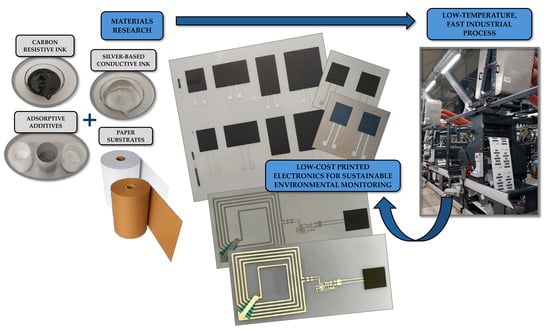
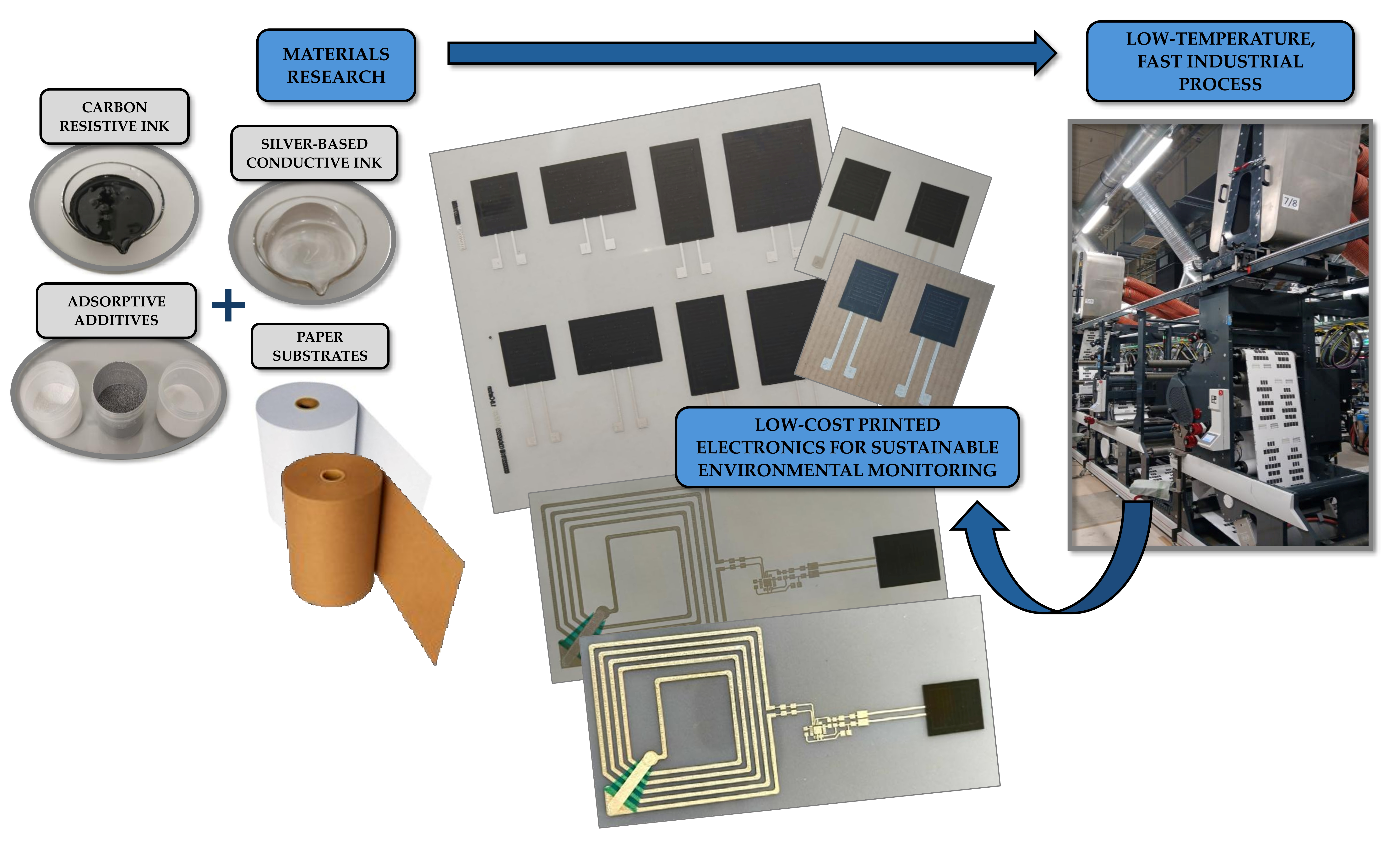
Printed electronics offer a scalable and sustainable route for integrating sensing systems into everyday environments; however, the use of flexography remains highly limited, and fully printed sensors fabricated exclusively with industrial flexographic technology have not been previously reported. This study evaluates the feasibility and practical limits of fabricating resistive humidity sensors for relative humidity (RH) measurements using flexography only, relying on commercial infrastructure, packaging-grade substrates, and low-temperature processing. Silver interdigitated electrodes and a carbon-based sensing layer were printed using solvent-based electronic inks, industrial aniloxes (12 and 20 cm3/m2), and standard flexographic conditions (10 m/min, ≤120 °C drying), without any post-processing. The sensing layer was optionally modified with adsorptive additives (≤5 wt% MgO; additionally, Al2O3 and Al) to enhance moisture interaction while maintaining rheological compatibility. Sensors were fabricated on recyclable paper substrates and PET for comparison. Under controlled conditions (10%–90% RH at 23 °C), devices exhibited a maximum relative resistance change of ~75% at 90% RH (referenced to 40% RH), low hysteresis (≤~5%), rapid visible response (<1 min), and stabilization within ~30 min. MgO increased relative response by 20%–233%, depending on humidity. Paper-based sensors showed higher responses but single-use behavior under flooding, while PET enabled repeatable cycling. Rather than targeting state-of-the-art performance, this work defines the functionality reliably achievable using flexography only, clarifying trade-offs among substrate choice, layer thickness, and additives for sustainable, humidity and disposable flood monitoring.

Graphical Abstract

1. Introduction

Digital technologies now play a central role in modern society. A growing number of everyday objects are being equipped with digital functions through integrated electronic components. These developments strongly support the expansion of the Internet of Things (IoT), in which almost any device can be connected to a network. Printed electronics (PE) have become a key technology enabling this progress. They allow low-cost, flexible, and scalable production of electronic devices using industrial printing methods. Unlike conventional silicon-based fabrication, which depends on high-temperature and energy-intensive steps, printing provides an additive, energy-efficient, and material-saving approach. As a result, PE is naturally aligned with sustainability principles [1]. In the coming years, printed electronics are expected to grow rapidly. As the unit cost of printed electronic components continues to fall, their adoption across multiple industries and mass-market applications will expand substantially [2,3,4,5]. Among the available printing methods, flexography stands out as a mature roll-to-roll industrial process capable of large-scale, high-throughput manufacturing. It is widely used in the packaging and labeling sectors but remains relatively underexplored for functional electronics. Flexography can deposit thin and uniform layers at high speed, making it a strong candidate for the mass production of printed sensors, especially when paired with eco-friendly substrates and coatings. Integrating this established industrial technique with the requirements of electronic materials is an important step toward the sustainable digitalization of everyday products. Entire devices can be fabricated through printing alone, without additional etching or masking steps, which significantly reduces the overall carbon footprint [6].
Paper, as a renewable, biodegradable, and recyclable substrate, plays an important role in this transition. Due to its low cost, mechanical flexibility, and compatibility with roll-to-roll processing, it is increasingly recognized as a strategic material for sustainable electronic devices [7,8]. Paper is made from cellulose, one of the most abundant and renewable biopolymers in nature, readily extractable from plant sources. It is easy to manufacture on an industrial scale, and its properties can be tailored through well-established modification processes. Beyond being part of the natural carbon cycle, paper is also highly recyclable. This makes it a valuable material for designing printed electronic devices that align with circular-economy principles. Using paper as a functional component of electronic structures can significantly improve the recyclability of such devices in the future. Printed electronics manufactured on paper offer an environmentally responsible alternative to conventional printed circuit boards (PCBs). In this approach, both the polymeric substrates and valuable materials, such as silver from printed conductive traces, can be efficiently recovered and reprocessed [9,10]. Paper-based electronics support environmentally friendly manufacturing and end-of-life management, aligning with global efforts to reduce electronic waste. Current research in this field focuses on biodegradable inks, low-temperature processing, and recyclable substrates. Sustainable electronic inks typically incorporate various forms of carbon, biopolymer binders such as cellulose or chitosan, and water as the primary solvent [11,12,13,14]. The use of such materials supports the creation of a circular economy, as they can be easily renewed, reused, or recycled.
Beyond its environmental benefits, paper exhibits natural porosity and hydrophilicity—properties that are undesirable in traditional microelectronics but highly advantageous for water-detection applications. The intrinsic hygroscopic and capillary behavior of cellulose fibers enables rapid absorption and desorption of moisture, making paper an effective platform for sensing humidity and liquid contact. This combination of eco-friendliness and functional responsiveness positions paper-based electronics as a compelling alternative to polymer-based sensing devices [15,16,17]. Paper-based electronics span a wide range of technologies and support diverse application areas, including biosensing, wearable and health-monitoring systems, smart packaging, environmental monitoring, and IoT devices [18,19,20,21,22,23,24,25]. Within this landscape, humidity sensors are among the most extensively studied primarily due to the natural hygroscopicity of paper substrates. Recent reviews, e.g., Korotcenkov et al., provide an extensive, up-to-date analysis of paper-based humidity sensors across capacitive, resistive, impedance, microwave, RFID, and non-conventional designs, including materials (e.g., CNTs, graphene, polymers) and performance trade-offs [26,27]. Duan et al. demonstrate facile, flexible, low-cost paper-based humidity sensors with good stability/repeatability—directly evidencing the breadth of reported paper-based devices [28]. Duan, Jiang, and Huiling Tai review recent advances in humidity sensors for human-body-related detection (respiration, skin moisture, non-contact switches), synthesizing mechanisms and device architectures relevant to paper and flexible platforms [29]. Table 1 provides a comparison between previously reported solutions and the results of the present research.
Humidity sensors are among the most widely used physical sensors across industrial sectors and consumer devices [37,38,39]. Air humidity is a critical parameter influencing the functioning and longevity of living organisms, as well as the processing, storage, and performance of raw materials and manufactured products. Numerous designs of humidity sensors have been reported on both paper and synthetic substrates, most commonly polyimide (PI) [40,41,42] and polyethylene terephthalate (PET) [43,44,45,46,47]. Their electrodes are typically fabricated from silver-based conductive materials. The literature describes electrode patterning using several printing and microfabrication techniques, including inkjet [45,48,49,50,51], screen printing [43,44,52], rotogravure [41,53], and conventional photolithography widely employed in the electronics industry. For instance, researchers from Fraunhofer EMFT (Research Institution for Microsystems and Solid State Technologies) described humidity sensors with electrodes fabricated via standard photolithography on 620 µm thick glass substrates, and a polyimide-based sensing layer applied using spin coating [54]. The sensing layer materials in the described examples are also applied using inkjet printing [48], screen printing [43,55,56,57], rotogravure [40,44], as well as coating techniques—most commonly spin coating [45,46,53]. Only a few examples of humidity sensors fabricated using flexographic printing have been reported to date, and in most cases only selected components of the device are produced using this method [43]. To our knowledge, no fully printed humidity sensors based solely on flexographic technology have been described. Manufacturability therefore remains a major bottleneck for paper-based humidity sensors, as many high-performance designs rely on laboratory-scale deposition methods that are incompatible with high-speed packaging workflows and the stringent rheological requirements of industrial printing inks. In contrast, process integration on packaging-grade paper using flexographically printed conductive layers without post-processing remains sparsely documented, despite its clear relevance for roll-to-roll manufacturing. Existing reviews predominantly focus on sensing performance, whereas aspects essential for efficient and sustainable large-scale production—while still ensuring the functional performance required for end-use applications—receive considerably less attention in the literature.
This study addresses this gap by presenting fully flexographically printed humidity sensors fabricated directly on widely available packaging-grade paper. The devices are produced using commercial carbon-based ink and newly developed silver-based conductive ink, without any additional post-processing steps. All inks were formulated for low-temperature processing (<120 °C), ensuring compatibility with paper substrates and compliance with solvent-safety constraints. To enhance the humidity response while maintaining strict flexographic-processability requirements, we incorporate and optimize adsorptive additives (MgO, Al2O3, Al) within printable ink formulations, ensuring suitable viscosity, transfer efficiency, and layer integrity at industrial web speeds. A systematic investigation was carried out to evaluate the influence of (i) sensing-layer thickness and topology, (ii) the composition of adsorptive additives (MgO, Al2O3, Al), and (iii) substrate type (different grades of paper and polymeric film) on overall device performance.
The results indicate a clear correlation between sensor construction and humidity response, demonstrating a synergistic interplay between substrate morphology, ink formulation and design. The fabricated sensors exhibit a rapid resistive response and appropriate recovery upon drying, confirming their suitability for low-cost, disposable flood-detection applications within sustainable product ecosystems. These devices are intended for transient or short-term deployments—ranging from hours to several weeks—aligned with logistical or event-driven use cases, rather than long-term field monitoring.
Beyond device-level sensing behavior, we also quantify key process windows relevant to roll-to-roll manufacturing, positioning this technology for scalable integration into smart-packaging applications. Such manufacturing-oriented analysis remains largely absent from the predominantly performance-focused laboratory studies, underscoring the need to connect sensing functionality with true production readiness. By combining environmentally benign materials with an industrial-scale printing process, this work establishes a new class of circular, scalable flood sensors and highlights flexography as a key enabler of eco-intelligent packaging and infrastructure-monitoring systems in the next generation of sustainable electronics.

2. Materials and Methods

2.1. Materials

The following paper substrates were used for sensor printing:
AZ600: LCJ SUPREME FSC S2012HTC-HF55 from Avery Dennison, Brwinów, Poland (hereafter referred to as substrate (1)), AF957: NATURAL BOIS-S2047N-BG45WH IMP from Avery Dennison, Brwinów, Poland (2), BQ903: CANE FIBER PAPER WHITE S2047N-PET23 from Avery Dennison, Brwinów, Poland (3), AM234: MC PRIMECOAT FSC S9500-BG40WH FSC from Avery Dennison, Brwinów, Poland (4), AH997: MC PRIMECOAT FSC S2045N-PET23 from Avery Dennison, Brwinów, Poland (5), BJ995: MC FSC S2045N-BG40BR from Avery Dennison, Brwinów, Poland (6), Sappi Galerie Art 170 g/m2 from Sappi Europe (Polska) Sp. z o. o., Warsaw, Poland (7). One plastic material was used—Mylar foil 125 μm from DuPont Poland Sp. z o.o., Warsaw, Poland (8).
For electrode printing, a custom-developed silver-based conductive ink, LAX0015, was used. The ink formulation included Laroflex MP35 resin from BASF Polska Sp.z o.o., Warsaw, Poland; solvents [2-(2-Butoxyethoxy)ethyl] acetate p.a. and 2-Butoxyethanol p.a. from Merck Sp. z o. o., Warsaw, Poland; and a functional phase consisting of commercial silver flakes AX 20LC with an average diameter of approximately 2 μm from Amepox Microelectronics, Łódź, Poland [58]. The ink preparation method is described and protected under Polish patent PL243416B1 [59]. A single layer of the conductive ink LAX0015 was applied using an anilox roller with a volume of 12 cm3/m2 and dried in an oven for 10 minutes (min) at 120 °C.
The sensing layer was fabricated using a commercially available carbon-based ink, Saral HumiditySensor 400 from Elantas Europe GmbH, Hamburg, Germany (hereafter referred to as HS 400). In a series of experiments, the carbon ink was modified with adsorptive additives such as magnesium oxide (MgO), aluminum oxide (Al2O3), and powdered aluminum (Al), all sourced from Merck Sp. z o. o., Warsaw, Poland. Single and double layers of the carbon inks were applied using two selected anilox rollers (12 cm3/m2 and 20 cm3/m2). The carbon layers were also dried in an oven at 120 °C for 10 min. The summary of printed sensors’ compositions is shown below in Table 2.

2.2. Printing Procedure

The sensors were fabricated using a flexographic printing technique on a Testacolor 171 device manufactured by nsm Norbert Schläfli AG, Zofingen, Switzerland. Printing was carried out on substrate sheets measuring 170 mm × 200 mm, with a constant printing speed of 10 m/min. The flexographic unit was equipped with steel anilox rollers, which enabled controlled ink deposition.
After preliminary tests with a standard set of anilox rollers (capacities ranging from 6.5 cm3/m2 to 40 cm3/m2), two types were selected, differing in volume capacity and line count, which resulted in distinct ink transfer characteristics:
Anilox roller with a volume of 12 cm3/m2 and a line count of 140 lines/cm, providing an estimated ink transfer of 4 g/m2.
Anilox roller with a volume of 20 cm3/m2 and a line count of 50 lines/cm, providing an estimated ink transfer of 6.7 g/m2.
The Binder FD 115 chamber, BINDER GmbH, Tuttlingen, Germany was used to dry the prints offline.

2.3. Functional Testing

Following the printing process, two types of functional tests were conducted: water exposure tests and tests in a climate chamber under varying RH conditions.
The water exposure test involved applying 1 mL of tap water on the surface of the printed sensor. Resistance was measured using a two-point method before water application and at time intervals of 1 min, 3 min, 10 min, and 30 min after exposure. After 30 min, the water was removed from the sensor surface, and further resistance measurements were taken at the following intervals: 1 min, 3 min, 10 min, 20 min, 30 min, 40 min, 50 min, 60 min, and 24 h post-removal.
Humidity variation tests were performed in a Binder MKF 115 climate chamber, BINDER GmbH, Tuttlingen, Germany. Initial resistance measurements were taken under ambient conditions (temperature: 23 °C, RH 40%). The sensors were then placed in the chamber with the temperature maintained at 23 °C and the RH varied from 10% to 90%. Resistance was recorded over a period of 3 h at 30-min intervals.

2.4. Sensor Response Evaluation

Sensors printed with different graphic designs and structural configurations exhibited varying baseline resistance levels as well as different responses under elevated humidity conditions. To enable comparison of sensor performance, the change in resistance was calculated as a percentage, reflecting the extent to which resistance varied in response to humidity relative to the initial value.
Based on the resistance measurements obtained under different surface moisture levels and ambient RH conditions, sensor relative resistance response (RR, %) was determined as the relative resistance change using the following formula:
R R = R   h u m i d R   d r y R   d r y × 100
where RR is the sensor relative resistance response, R humid is the resistance of the sensor structure under specified/increased humidity conditions, and R dry is the resistance of the sensor structure under ambient (dry) conditions. The equation was used to express the percentage change in electrical resistance when a sensor is exposed to humidity compared to a dry reference state. In the case of the water exposure tests, R humid refers to the resistance measured 1 min after water application. For the climate chamber tests, R humid corresponds to the resistance measured 30 min after placing the sensor under specified humidity conditions. The time points for resistance measurements were determined experimentally during the initial test series.

3. Results and Discussion

3.1. Investigation of the Influence of Sensors’ Construction and Topology on Sensor Properties

The first series of experiments aimed to determine the optimal sensor design in terms of the number and thickness of sensory layers. Based on literature data and results from previous in-house studies, preliminary sensor structures (Table 2) and a graphical design (A) of a resistive humidity sensor were developed (Figure 1). The sensor consists of seven pairs of interdigitated electrodes (IDEs), each with a width of 1 mm and a spacing of 0.6 mm. The sensor coating measures 27 mm × 24 mm. Two types of substrates were used for sensor printing: paper-based—Sappi Galerie Art (7); and foil-based—Mylar 125 µm (8).
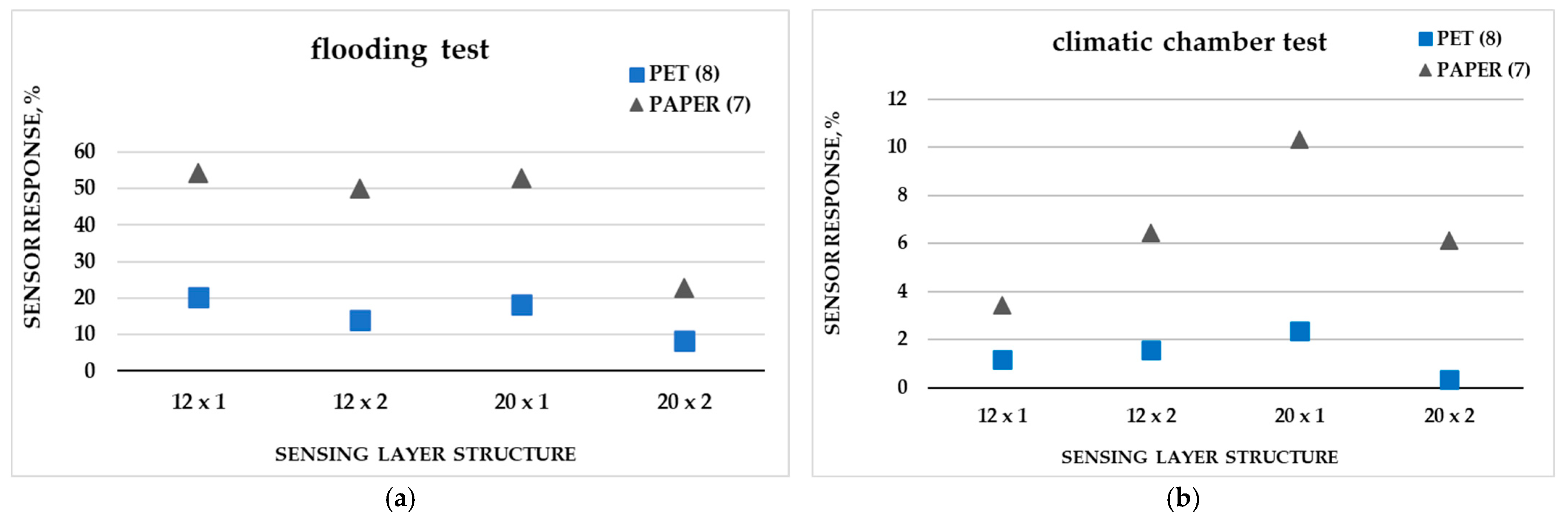
After printing, flooding tests and climatic-chamber experiments were performed to evaluate sensor performance under extreme and controlled humidity conditions. For all tested samples, the sensor resistance increased with rising RH. In carbon-based resistive humidity sensors, this response results from structural and electrical changes within the conductive network caused by water adsorption. Carbon inks rely on particle-to-particle contacts and electron tunneling for charge transport. As humidity increases, water molecules adsorb onto the surface and diffuse into the porous structure. This process causes swelling of both the substrate and the ink matrix. The resulting expansion increases interparticle distances, decreases tunneling probability, and leads to a marked rise in resistance [60,61]. Flooding the sensor surface caused an immediate spike in resistance, detectable within the first minute. On PET substrates, no further significant resistance changes were observed after 10 min. In contrast, for paper substrates, flooding beyond 10 min increased the probability of device failure by ~30% and produced unstable readings. Therefore, resistance values recorded 1 min after flooding were used for subsequent response calculations. In climatic-chamber tests, resistance changes also appeared within the first minute. Measurements were taken during the initial 90 min. Experimental observations showed that chamber conditions stabilized after ~15 min, while sensor resistance stabilized within ~30 min. Subsequent readings exhibited negligible drift; thus, resistance values at 30 min were used for further analysis. These results confirm that the sensors respond almost instantaneously to sudden humidity changes, demonstrating their suitability for real-world rapid-onset events such as flooding.
The initial evaluation of the sensors was performed by monitoring the condition of the substrate and printed coatings during testing. For sensors on PET substrates, flooding caused no visible changes in either the substrate or the printed layers. In contrast, the paper substrate showed high sensitivity to moisture. In several samples, water penetrated through the sensing layer, leading to absorption and deformation of the paper. Deformation began after approximately 3 min of flooding and intensified with time. The most vulnerable samples were those containing a single carbon layer, regardless of the transfer method. This behavior was observed for layers printed using both the 12 cm3/m2 anilox roller and the 20 cm3/m2 anilox roller. When double layers were applied, water penetration occurred much less frequently, and the substrate did not absorb moisture. During climatic-chamber tests, no visible changes were observed in either the substrates or the printed layers under elevated humidity, regardless of substrate type. In flooding tests, however, sensors on paper substrates exhibited markedly larger resistance variations. All paper-based samples showed a consistent response pattern: a gradual resistance increase between 1 and 10 min after flooding, followed by a pronounced spike at 30 min. After water removal, substrate absorption caused resistance to continue rising for at least 1 min after drying. A downward trend appeared between 10- and 20-min post-drying. Unlike PET substrates, where resistance returned to near-initial values within 20 min and remained stable, paper substrates showed a substantial decrease only after ≈40 min. Measurements at 50 and 60 min were similar and only slightly lower than those at 40 min. After 24 h, resistance remained comparable to the 60-min values and did not return to the baseline. These pronounced differences relative to PET sensors likely result from substrate deformation and mechanical damage to the contact pads, indicating that paper-based flooding sensors are effectively single-use. For PET substrates, resistance increased during the first 10 min after flooding, with no significant changes between 10 and 30 min. Immediately after water removal, resistance began to decrease and returned to near-initial values within 20 min. No further changes were observed over the following 40 min or after 24 h, confirming the potential for multiple reuses of PET-based sensors.
During climatic-chamber tests, as in the flooding experiments, sensors on paper substrates exhibited larger resistance variations than those on PET. For both substrate types, a noticeable increase in resistance occurred within the first 30 min of exposure to the programmed humidity conditions. After this period, resistance changes remained relatively stable over the following hours. Sensors on PET substrates showed repeatable and stable behavior, whereas paper-based sensors exhibited fluctuations throughout the test due to the hygroscopic nature of paper. Nevertheless, the most pronounced change for both constructions occurred within the initial 30 min. After 24 h, the resistance of both PET- and paper-based sensors returned to the values recorded before testing. Figure 2 presents the relative sensor response for each design during flooding and climatic-chamber experiments on paper and PET substrates.
In the flooding test, the largest resistance change was obtained for sensors with the thinnest single sensing layer printed using the 12 cm3/m2 anilox roller (indicated as 12 × 1). The lowest response was observed for sensors with the thickest double sensing layer printed using the 20 cm3/m2 roller (indicated as 20 × 2). In the climatic-chamber test, the highest resistive response was observed for sensors with a single sensing layer printed using the 20 cm3/m2 anilox roller (indicated as 20 × 1). In this case, water interacts with the sensing layer as vapor rather than through direct wetting. This difference reflects the distinct mechanisms governing vapor adsorption and liquid-water penetration. Under flooding, thinner coatings are penetrated more rapidly, allowing water to reach the electrodes and producing larger resistance changes. Because the interaction occurs mainly at the surface, thinner layers—with their higher surface-to-volume ratio—have a greater fraction of “active” material involved in the response. In thicker layers, water does not penetrate uniformly, leaving part of the material inactive and reducing the overall resistance change. Thinner coatings are also more vulnerable to mechanical disruption during flooding. Their shorter conductive pathways are more easily altered by water, whether through changes in particle-to-particle contacts or through microscopic structural effects such as swelling or microcracking. These processes amplify resistance variations relative to thicker, more mechanically robust layers. In the climatic chamber, the sensing layer is exposed only to water vapor, without direct wetting. Under these conditions, moisture interacts with the coating through vapor adsorption and, in thicker layers, through partial absorption into the porous structure. The higher response of thick sensing layers arises from the dominance of volumetric effects. A thicker carbon coating contains a larger porous volume and more microstructural features that facilitate deeper vapor penetration and produce a greater overall resistance change, whereas in thin coatings the response is confined mainly to the surface, where adsorption dominates and additional changes become limited once surface saturation is reached. Under the uniform vapor conditions of the climatic chamber, thicker coatings reach full moisture uptake more effectively, leading to a stronger signal. These findings indicate that humidity interaction results from combined surface adsorption and volumetric diffusion processes, with their relative contributions governed by layer thickness and porosity.
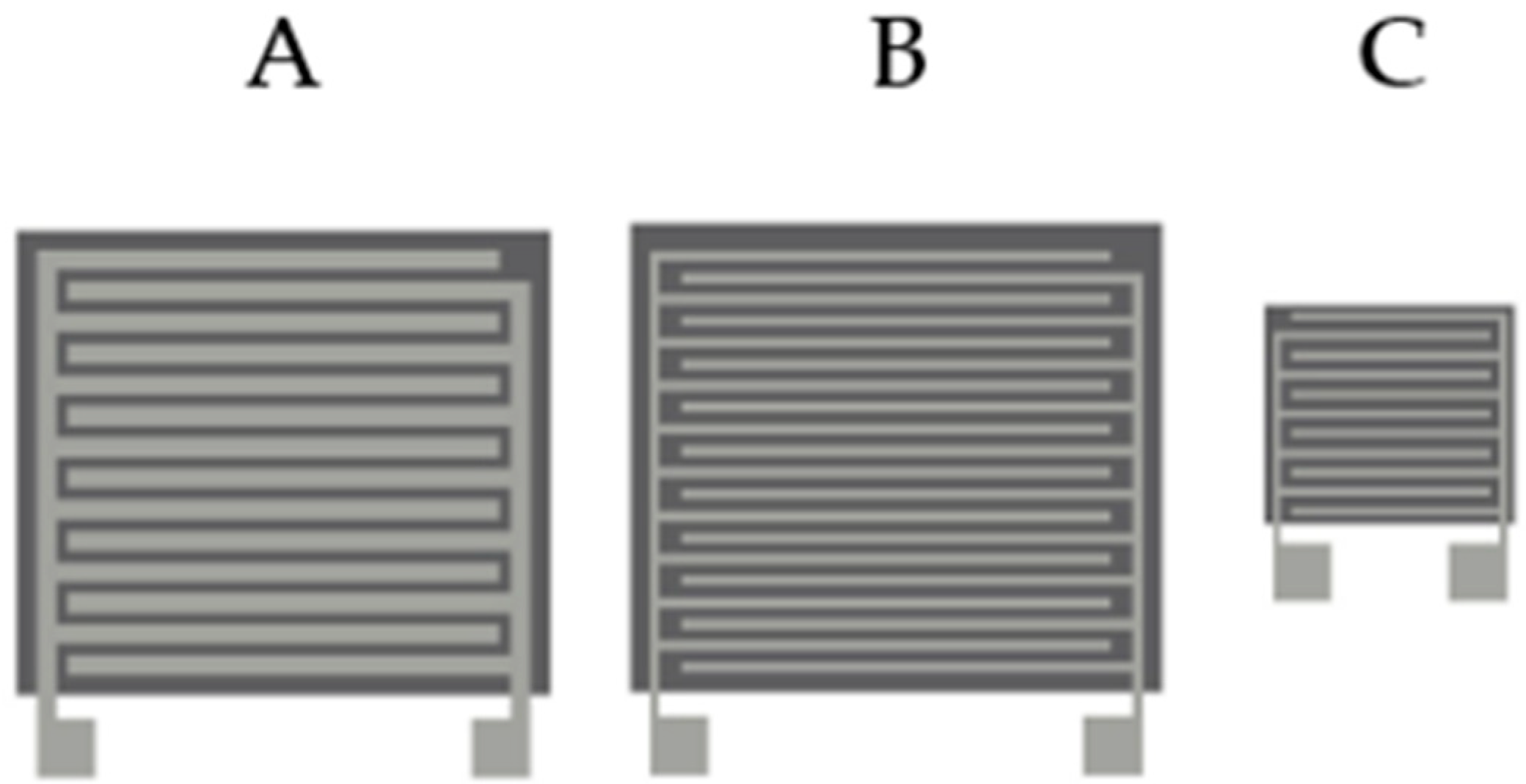
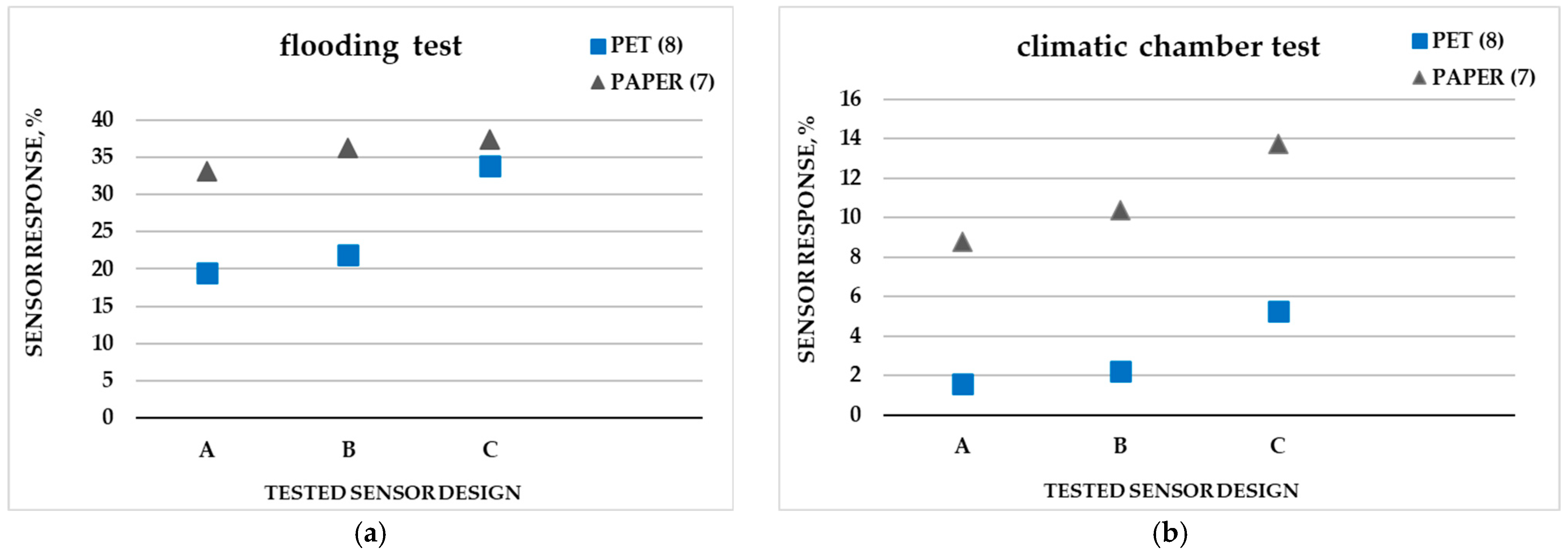
Due to the damage observed during flooding tests in sensors with a single sensing layer, designs with double carbon-ink layers were selected for further evaluation. In the next stage, three IDE configurations were developed to examine the effect of electrode geometry on electrical and sensing performance. All sensors use planar IDE structures, commonly applied in resistive sensing. Each design consists of one electrode layer printed with LAX0015 ink (anilox 12 cm3/m2) and a double sensing layer printed with HS 400 ink (anilox 12 cm3/m2 × 2), fabricated on substrates 7 and 8. Figure 3 shows schematic drawings of the sensor layouts. Design A replicates the configuration from the first test series. It includes seven electrode pairs with a width of 1 mm and a spacing of 0.6 mm, forming an active area of 27 mm × 24 mm. Design B includes ten electrode pairs, reducing electrode width to 0.5 mm while keeping the 0.6 mm spacing. Design C is a miniaturized version with five electrode pairs, a width of 0.4 mm, and a 0.6 mm spacing, giving an active area of 13.5 mm × 12 mm. This layout enables assessment of compact sensors for localized or portable applications.
Resistance measurements showed that increasing electrode thickness slightly reduced overall resistance, reflecting the larger conductive area. The lowest resistance in all test scenarios was recorded for design A, which has the widest electrodes (1 mm). In contrast, the highest resistance was observed for design C, whose dimensions are approximately half those of designs A and B. In terms of resistive response, design A showed the weakest response, design B a moderate response, and design C the strongest response. These results indicate that miniaturization and higher electrode density significantly enhance sensing performance. Figure 4 presents the calculated response of each design on paper and PET substrates.
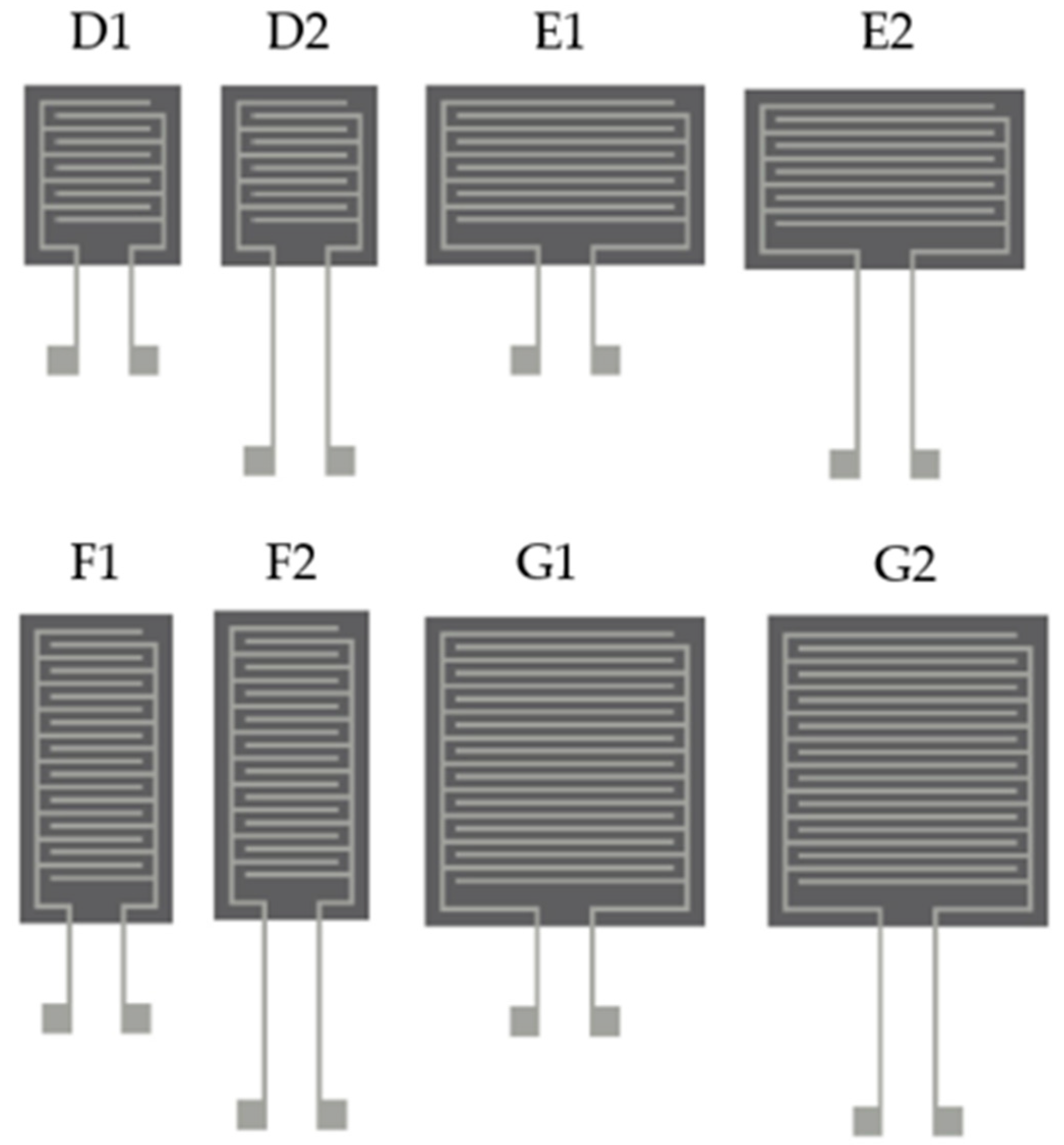
Variations in electrode width, pair count, and overall sensor dimensions directly influence both electrical resistance and sensing response. These geometric modifications enable a systematic assessment of scaling effects and support optimization for specific sensing applications. After completing the first two test series, a shortened climatic-chamber test was performed to isolate the influence of individual design features on sensor performance, particularly the resistive response. For this next design stage (Figure 5), the electrode layout from design B was selected, as it provided a higher response than design A and greater stability than design C. The dimensions of the sensing layer and the length of the contact pads were varied.
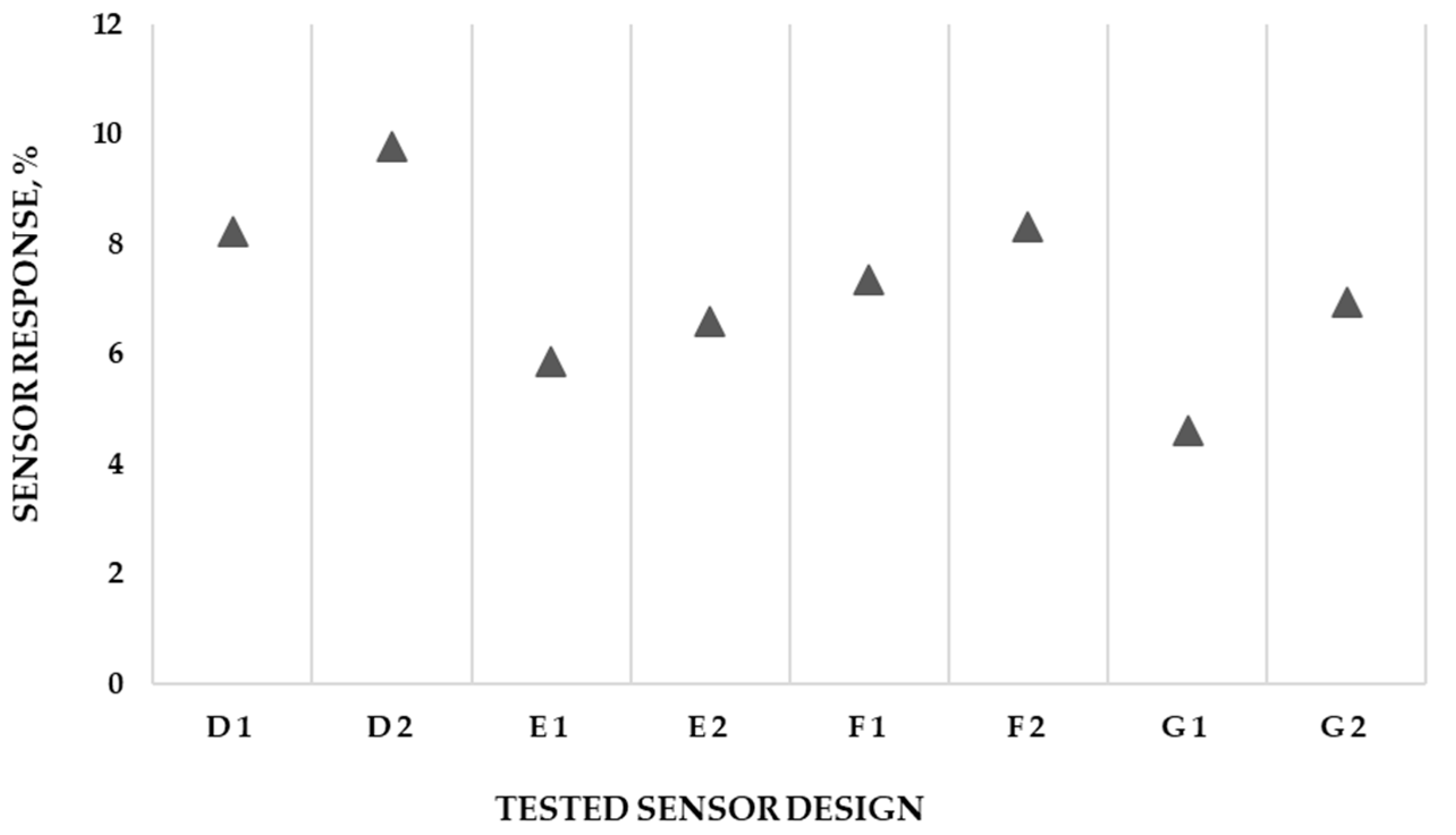
In the D1 and D2 designs, the sensing layers are half the size of those in the E1 and E2 designs. Similarly, in the F1 and F2 designs, the sensing layers are half the size of those in the G1 and G2 designs. Sensors D1, E1, F1, and G1 use contact electrodes 10 mm in length, whereas D2, E2, F2, and G2 employ 20 mm contact electrodes. All sensors were printed on Sappi paper substrates using one layer of silver ink LAX0015 (anilox 12 cm3/m2) and two layers of carbon ink HS 400 (anilox 12 cm3/m2 × 2). After printing, the devices were tested in a climatic chamber at 60% RH. Based on resistance measurements, the response of each printed design was calculated (Figure 6).
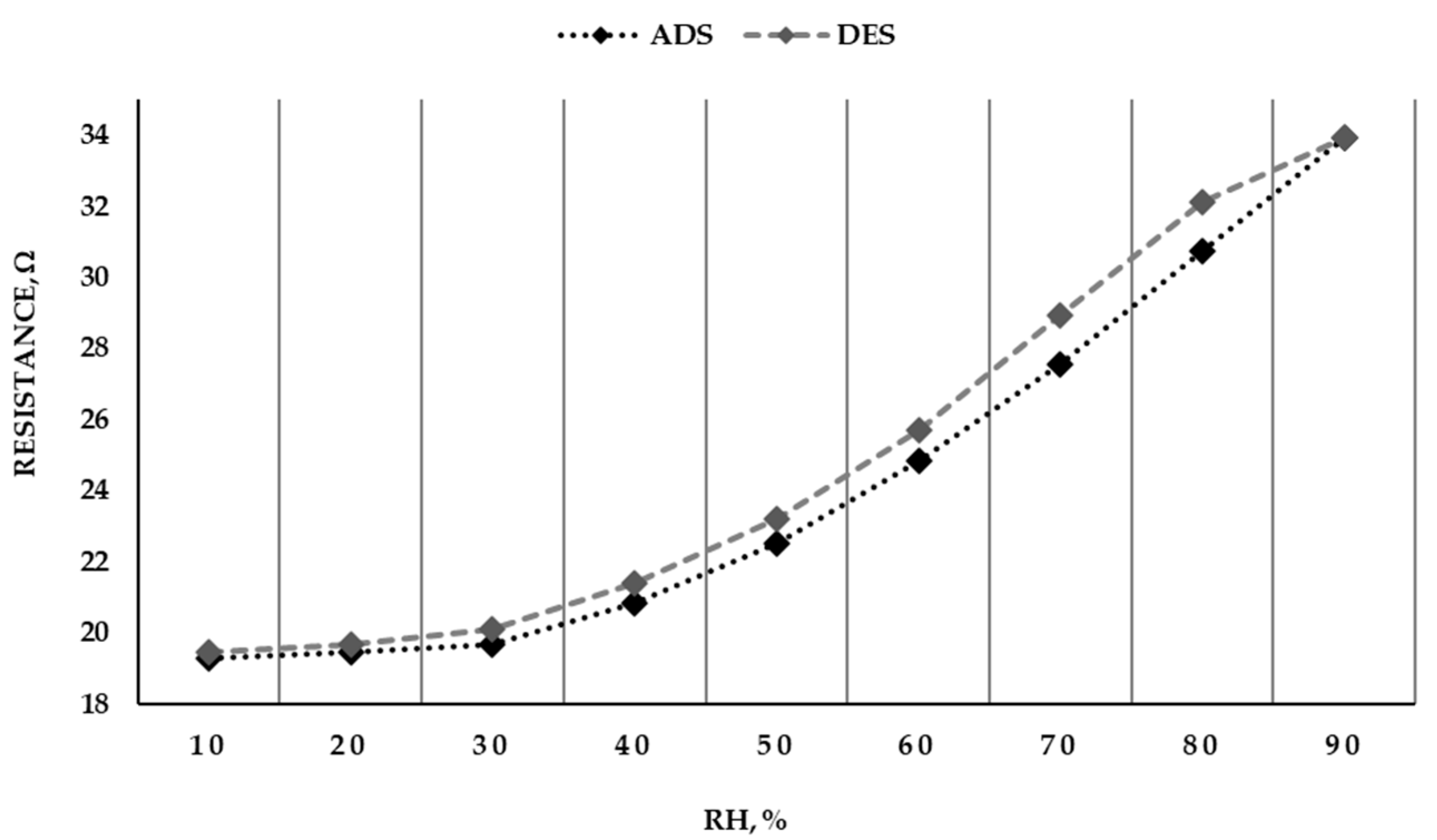
The experimental results show that increasing the length of the output electrodes enhances the humidity-sensor response. Longer electrodes introduce higher electrical resistance within the system, which increases the relative change from the baseline during humidity exposure and leads to a stronger sensor response. The findings also indicate that not only the sensing coating but also the surface of the conductive tracks reacts to ambient humidity. To eliminate the influence of these tracks, their surfaces should be insulated with a moisture-resistant dielectric layer. Such protection can be applied via flexographic printing using graphic inks or protective varnishes, or by laminating a self-adhesive dielectric film during printing or in a separate lamination step. Among the tested configurations, design D was selected for further development due to its high response, reduced material consumption, and suitability for miniaturization. Sensors fabricated according to design D, using Saral HS400 ink on paper substrates, were then tested under varying ambient humidity conditions in both adsorption and desorption cycles (Figure 7).
In resistive-type humidity sensors, hysteresis in the resistive response typically occurs, meaning that the resistance values measured at the same RH differ between the adsorption and desorption cycles, as widely reported for both resistive and polymer-based humidity sensors [62,63]. Humidity hysteresis in this study was calculated as the difference between the sensor response during adsorption and desorption at the same RH level, following commonly adopted definitions used for humidity sensors and sorption systems [64,65,66]. The calculated hysteresis did not exceed 5%, indicating a high level of repeatability and stability of the sensor response. These findings confirm that the selected materials and the applied structural configuration are suitable for reliable humidity detection under dynamic environmental conditions.

3.2. Study of the Influence of Adsorptive Additives on Sensor Response

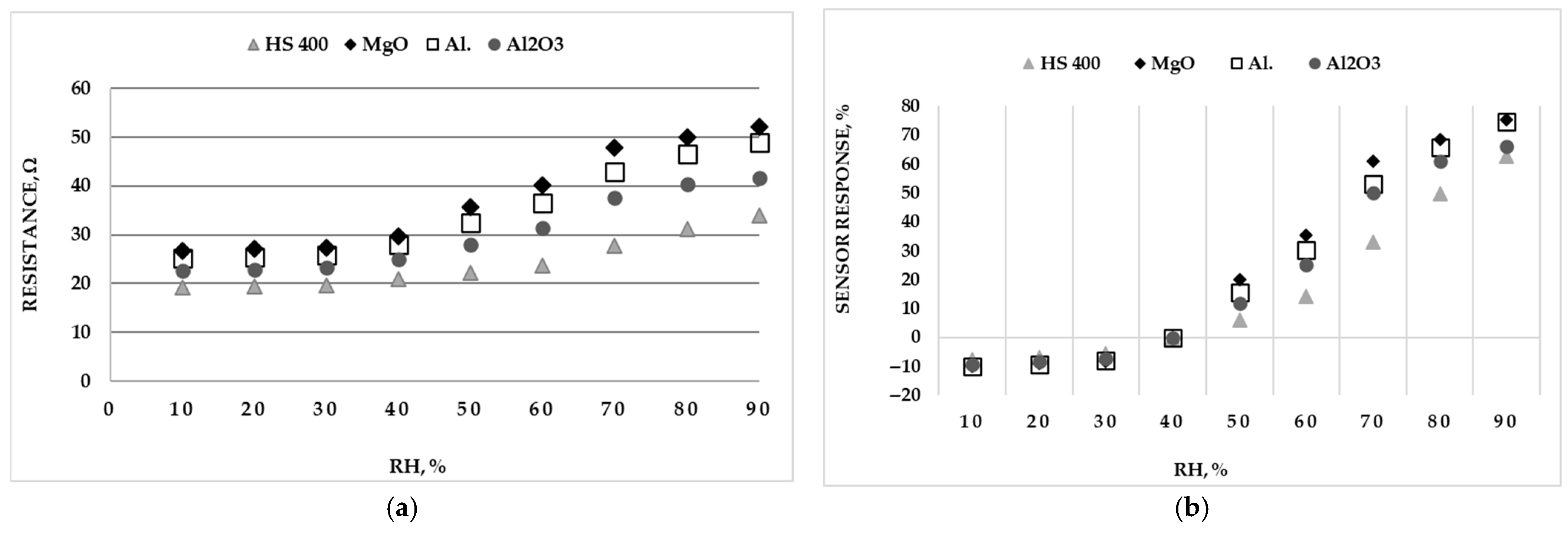
Subsequent modifications to the sensing layer were introduced by incorporating adsorptive additives. Resistive sensors for flood detection and humidity measurement operate on changes in electrical resistance caused by water or water-vapor uptake by the hygroscopic sensing coating. The response can be enhanced by adding materials with high water-adsorption capacity. Three additives were selected—aluminum oxide (Al2O3), magnesium oxide (MgO), and powdered aluminum (Al)—based on their ability to influence the electrical and mechanical properties of the resistive layer. Al2O3 and MgO were chosen for their high thermal stability and potential to improve coating uniformity, while powdered Al was included to promote conductivity through partial formation of additional conductive pathways. Each additive was incorporated at 5 wt%, a concentration determined experimentally. Preliminary trials examined additive levels from 1% to 10%. Because flexographic printing requires inks with controlled viscosity to ensure proper transfer from the anilox roller, concentrations above 5% caused excessive thickening, poor spreading, and incomplete coverage. At 10%, the ink became too viscous for flexographic application. Therefore, ≤5 wt% was identified as the optimal concentration that preserved printability while enabling effective modification. Sensors printed with the modified inks were evaluated in a climatic chamber at 23 °C across humidity levels from 10% to 90% RH. Resistance changes were recorded for the double-layer sensor structures, and the responses of sensors with the different additive compositions were calculated and compared (Figure 8).
The incorporation of powdered aluminum (Al), aluminum oxide (Al2O3), and magnesium oxide (MgO) into the carbon-based ink increases the resistance of the humidity sensors by altering the conductive network. Metallic Al may initially introduce additional conductive pathways, but it quickly oxidizes, forming an Al2O3 layer that is hygroscopic and electrically insulating. This oxide absorbs water molecules and creates dielectric barriers that disrupt electron tunneling between carbon particles, leading to higher resistance at elevated humidity. Similarly, Al2O3 and MgO possess porous structures and high surface energy, enabling strong water-vapor adsorption. Their moisture uptake promotes swelling and increases separation between conductive carbon domains. These combined effects enhance sensitivity to relative humidity but often introduce non-linearity in the sensor response. All additives improved the response of the printed sensors. As an electrically insulating material, MgO increases baseline resistance, while its high surface area and porosity promote extensive water-vapor adsorption. This moisture uptake enhances swelling within the sensing layer and amplifies resistance changes during humidity exposure. MgO is a well-established material in resistive-type humidity sensors, which further supports its suitability for this application [67,68,69]. The sensing mechanism of aluminum oxide relies on variations in its dielectric constant and is predominantly employed in capacitive sensors [70,71,72]. Aluminum is the least sensitive additive to humidity changes. Metallic aluminum is inherently insensitive to moisture; in humid environments, it tends to oxidize, forming a passivating layer of Al2O3. In carbon-based systems, aluminum is more commonly used as a conductivity enhancer [73,74]. In our study, the greatest enhancement in sensor response was achieved with magnesium oxide, and the results clearly show that MgO is the most effective adsorptive additive for designed carbon-based resistive humidity sensors. Repeated humidity cycling (up to five adsorption–desorption cycles) did not induce significant baseline drift, confirming structural stability of the MgO-modified carbon films. This additive improved the sensors’ response by minimum 20% at RH 90% and maximum ≈ 233% at RH 50% compared to the unmodified HS400 ink.

3.3. Study of the Substrate’s Impact on Sensor Functionality

In the following step, the influence of paper-substrate type on the functional parameters of the printed sensors was examined. These tests were conducted exclusively in the climatic chamber, as previous flooding experiments confirmed the poor durability and single-use nature of paper-based flood sensors. At this stage, considering the intended application of the humidity sensor directly on paper packaging, printing trials and functionality tests were performed on several paper grades. The selected substrates differed in surface properties, adhesive composition, and coating structure. The list of substrates, chosen based on preliminary material characterization, is presented in the table below (Table 3).
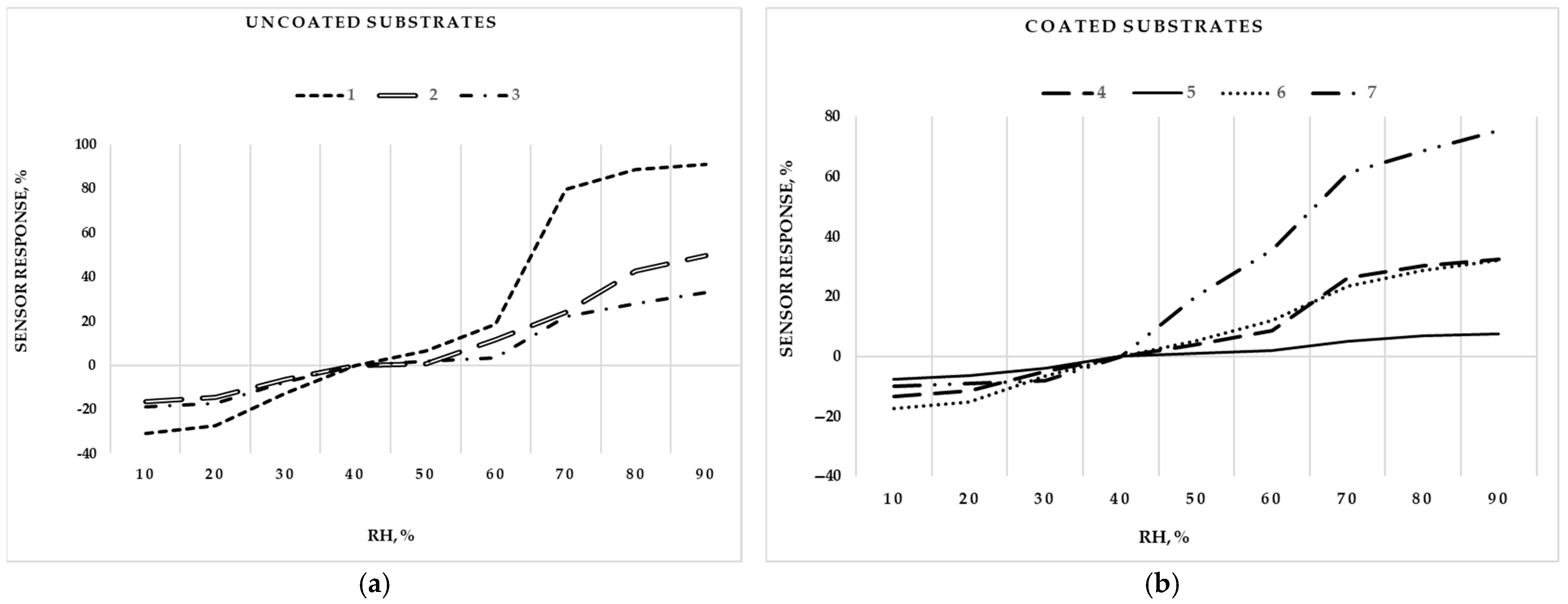
The printed sensor samples consisted of the selected paper substrates, electrodes formed by a single layer of silver ink LAX0015 applied with a 12 cm3/m2 anilox roller, and a sensing layer composed of two layers of carbon ink HS 400 modified with 5 wt% MgO, also printed using a 12 cm3/m2 anilox roller. These sensors were tested in a climatic chamber by sequential exposure to humidity levels ranging from 10% to 90% RH at a constant temperature of 23 °C. Resistance changes were recorded, and the results showed that the substrate type directly affected sensor behavior, as it was the only variable in the experiment. The resistive response for each substrate was calculated relative to the initial measurements taken at room-condition humidity of 40% RH. Figure 9 presents the obtained results.
The results of humidity sensor tests printed on various paper substrates confirmed that the type of printing substrate can significantly influence the functionality of the printed sensor structures. This influence is reflected in the variation in sensor resistance, which directly determines the overall response. The largest resistance changes were observed on uncoated substrates (1, 2, 3), attributable to their higher roughness and absorbency. These characteristics demonstrate that substrate roughness, absorbency, and coating type strongly shape the effective sensor response, indicating that the substrate can act as an active component in paper-based sensing systems rather than merely passive support. Among the self-adhesive papers, sensors printed on paper-based liners (substrates 4 and 6) exhibited greater resistance changes and higher relative response. The use of a PET liner reduced the response possibility of the sensor structure (substrate 5 compared to substrates 4 and 6). The used paper substrate without adhesive and liner (substrate 7) displayed the lowest resistance values, which can be attributed to its greater thickness (130 µm). In contrast, the remaining substrates had top-layer thicknesses ranging from 66 µm to 130 µm. Thinner paper substrates promote faster moisture absorption from the environment and deeper water vapor migration into the substrate, meaning the substrate partially acts as a sensing element, resulting in higher sensor resistance values. However, printed resistive humidity sensors on paper exhibit nonlinear resistive response. This nonlinearity is an inherent feature of paper-based resistive sensors and arises from the combined effects of multilayer water adsorption, substrate swelling, and disruption of percolation pathways within the conductive network [27,39,75,76]. At low RH, water molecules form a monolayer on the sensing surface, causing only minor resistance changes. At higher RH, multilayer adsorption and capillary condensation occur within pores, producing a rapid resistance increase. Because paper is hygroscopic, moisture uptake causes substrate swelling, which alters the geometry of the printed layer. This swelling increases the interparticle distances in the carbon network and suppresses electron tunneling, resulting in an exponential rather than linear increase in resistance. Conductivity in carbon-based inks relies on a percolating particle network, where charge transport occurs through direct contacts, tunneling, and field-emission effects. At low RH, this network remains largely intact, but humidity-induced swelling pushes the system toward the percolation threshold, sharply increasing resistance [77,78]. Adsorptive additives (Al2O3, MgO) introduce additional nonlinearities because their water uptake accelerates at higher RH, amplifying resistance changes. Al behaves similarly to Al2O3 at high RH since nonlinearity increases after oxidation. Based on Figure 8 and Figure 9, the humidity sensors developed in this study exhibit a distinctly non-linear response across the entire 10%–90% RH range, irrespective of the additive used or the substrate configuration. Importantly, this non-linearity is systematic and reproducible. The sensor response can be clearly segmented into three RH regions characterized by different regimes: (i) a low-RH region (10%–30% RH), showing minimal resistance variation and poor linearity; (ii) an intermediate-RH region (approximately 40%–70% RH), where resistance increases nearly linearly with RH, providing a quasi-linear sensor regime suitable for practical sensing applications; (iii) a high-RH region (≥70% RH), in which resistance and response increase sharply, exhibiting pronounced deviation from linearity attributed to multilayer water adsorption and substrate swelling effects. However, by carefully selecting and balancing additives and considering substrate characteristics, the sensor’s response curve can be tuned for improved linearity—making calibration easier and performance more predictable across intended humidity ranges.
The conducted study enables future selection of the most suitable printing substrate depending on the requirements of the final application.

3.4. Other Potential Applications of the Developed Flexographic Functional Inks in Printing-Related Uses

Composite conductive inks based on silver and carbon pigments, engineered and optimized for flexographic printing, offer broad application potential beyond conventional moisture-detection systems. Their rheological stability, mechanical flexibility, and tunable electrical properties enable integration into various printed functional structures operating through different sensing or activation mechanisms. From a materials-science perspective, the formulations—combining a polymeric binder with conductive fillers such as carbon, graphite, and silver flakes—provide controlled resistivity, compatibility with roll-to-roll printing, and strong adhesion to polymeric and cellulosic substrates. These attributes support the development of multifunctional printed electronic components for quality control, smart packaging, and environmental monitoring.
The ink’s moderate temperature coefficient of resistance (TCR) enables its use in resistive temperature detectors (RTDs) or distributed thermal field sensors. Controlled heating or cooling modifies polymer matrix expansion and interparticle tunneling distances, leading to predictable resistance changes. Integrating such temperature sensors with shrink tunnels or lamination lines allows spatial temperature mapping, contributing to better thermal process optimization. Furthermore, the same resistive principle can be applied to low-power printed heating elements for localized thermal activation or drying processes.
Printed strain sensors can monitor real-time deformation in flexible packaging, polymer components, and even soft robotics. In such devices, the piezoresistive response arises from reversible disconnections and reconnections within the conductive network during stretching or bending. The relationship between normalized resistance change (ΔR/R0) and applied strain (ε) defines a calibration factor that can be tuned via ink composition or layer thickness. The developed ink exhibits a stable calibration factor in the range of 2–10, suitable for low-strain industrial applications.
Due to excellent printability and surface adhesion, the developed conductive inks can form electrodes for touch sensors, printed switches, or antenna elements for RFID tags. Its conductivity supports spiral or rectangular antenna geometries operating in UHF or HF (NFC) bands. In smart packaging contexts, printed RFID structures can be combined with resistive or capacitive sensing elements to provide real-time information on product integrity, moisture exposure, or tampering attempts. The combination of mechanical flexibility, print resolution, and chemical compatibility makes this ink an attractive option for low-cost, disposable electronic devices in logistics chains.
The high sensitivity of the conductive coating to mechanical discontinuities enables its use in damage detection networks for structural health monitoring. Printed conductive meshes on flexible or composite substrates can act as crack sensors—any microcrack or delamination causes abrupt resistance changes. Such sensor films can be integrated with polymer composites or coatings used in packaging machinery or transport containers, providing continuous information on mechanical stress or damage accumulation.
A novel application of the developed conductive inks is their use in smart shrink-sleeve labels for inline quality control of label shrinkage on bottles, cans, and other packaging. This approach combines strain-sensing principles with inline control technologies used in packaging lines, representing a step toward the digital transformation of industrial packaging processes. From a scientific perspective, the detection mechanism is linked to percolation dynamics within the conductive network during mechanical compression. Reduced interparticle distances between conductive fillers increase electron tunneling probability, thereby lowering resistance. The correlation between ΔR and mechanical strain provides a quantitative measure of shrinkage efficiency. Improper or uneven shrinkage results in incomplete percolation recovery and increased resistance, serving as a safety indicator. Integrating printed electronics with production-line metrology creates a scalable, cost-effective pathway to cyber–physical monitoring systems. The method for evaluating the quality of label application using functional conductive inks during automated quality control is described in a patent application currently filed with the Polish Patent Office (UPRP).

4. Conclusions

This study reports a fully flexographically printed coating system for humidity and liquid contact sensing, integrating silver interdigitated electrodes with a carbon-based functional layer deposited on packaging-grade paper and PET substrates. Commercially available carbon ink modified with adsorptive additives, including MgO, Al2O3 and Al, and newly formulated silver ink were engineered to meet flexographic process requirements, including viscosity control, layer integrity, and drying compatibility. Systematic evaluation of coating–substrate interactions revealed that substrate porosity, surface topology, printed layer thickness, and additive composition strongly influenced the electrical response. Paper substrates deliver the highest response at the lowest cost, making them effective for disposable and sustainability-oriented sensing, whereas PET substrates ensure superior stability, repeatability, and multi-cycle operation. Flooding experiments further highlighted substrate dependent recovery behavior, with PET based sensors returning to baseline within 20 min, while paper-based sensors showed prolonged drift. Accordingly, substrate selection should be guided by whether the target application prioritizes low-cost single-shot sensing (paper) or stable multi-cycle performance (PET). Across 10%–90% RH, the coatings exhibited resistive behavior with a maximum relative response of 75% and low hysteresis (1%–5%). MgO-modified coatings yielded the highest enhancement in response amplitude—ranging from 20% to 233% across the tested RH range. Double-layer carbon structures reduced water penetration and mitigated substrate deformation. Beyond the material-level insights, this work validates the potential of low-temperature flexographic printing for scalable production of environmentally friendly electronic sensors. The results establish a framework for designing fully printed, biodegradable, and recyclable devices capable of environmental monitoring and early flood detection. The approach advances sustainable manufacturing (materials and process) for short-lived monitoring tasks, rather than durability-focused sensing. Future research may extend this approach toward multi-parameter paper-based systems combining humidity, temperature, and liquid-contact sensing for sustainable smart-packaging applications.

5. Patents

Patent PL243416B1 [59], Patent PL442413A1 [79], Patent application P.453693, Patent application P.454160.

Author Contributions

The present research article is the work of authors stated below according to their contributions; Conceptualization, T.N. and S.L.-K.; methodology, T.N., S.L.-K., J.S. (Jerzy Szałapak), D.J. and J.S. (Jarosław Szusta); validation, T.N.; formal analysis, S.L.-K.; investigation, T.N., J.S. (Jerzy Szałapak) and D.J.; writing—original draft preparation, T.N.; writing—review and editing, S.L.-K., J.S. (Jarosław Szusta) and T.N.; supervision, M.J.; project administration, T.N.; funding acquisition, T.N. All authors have read and agreed to the published version of the manuscript.

Funding

The present paper is financially supported by the Marshal’s Office in Białystok, grant number WND-RPPD.01.02.01-20-0190/20, and the Masterpress S.A.

Institutional Review Board Statement

Not applicable.

Informed Consent Statement

Not applicable.

Data Availability Statement

The data presented in this study are available within the content of this article.

Conflicts of Interest

Author Tatiana Nowicka was employed by the company Masterpress S.A. The remaining authors declare that the research was conducted in the absence of any commercial or financial relationships that could be construed as a potential conflict of interest.

Abbreviations

The following abbreviations are used in this manuscript:
CEZAMATCentre for Advanced Materials and Technologies
IDEInterdigitated Electrodes
IoTInternet of Things
PEPrinted Electronics
PCBsPrinted Circuit Boards
MOFsMetal–organic frameworks
EHSEnvironment, Health, and Safety
PFETP-channel Field-Effect Transistor
RFIDRadio Frequency Identification
PIPolyimide
PETPolyethylene terephthalate
RHRelative Humidity
TCRTemperature Coefficient of Resistance
RTDsResistive Temperature Detectors
UHFUltra High Frequency
HFHigh Frequency
NFCNear Field Communication

References

  1. Suganuma, K. Introduction to Printed Electronics; Springer Science & Business Media: Berlin/Heidelberg, Germany, 2014; pp. 1–22. ISBN 978-1-4614-9625-0. [Google Scholar]
  2. Luo, Y.; Abidian, M.R.; Ahn, J.-H.; Akinwande, D.; Andrews, A.M.; Antonietti, M.; Bao, Z.; Berggren, M.; Berkey, C.A.; Bettinger, C.J.; et al. Technology Roadmap for Flexible Sensors. ACS Nano 2023, 17, 5211–5295. [Google Scholar] [CrossRef]
  3. Iñiguez, B. Flexible and Printed Electronics. In More-than-Moore Devices and Integration for Semiconductors; Iacopi, F., Balestra, F., Eds.; Springer International Publishing: Cham, Switzerland, 2023; pp. 105–125. ISBN 978-3-031-21610-7. [Google Scholar]
  4. Sudheshwar, A.; Malinverno, N.; Hischier, R.; Nowack, B.; Som, C. The Need for Design-for-Recycling of Paper-Based Printed Electronics—A Prospective Comparison with Printed Circuit Boards. Resour. Conserv. Recycl. 2023, 189, 106757. [Google Scholar] [CrossRef]
  5. 9th OE-A Roadmap—Mapping the Future of Flexible and Printed Electronics—OE-A. 2023. Available online: https://oe-a.org/topics/oe-a-working-groups/roadmap (accessed on 4 February 2026).
  6. Sudheshwar, A.; Beni, V.; Malinverno, N.; Hischier, R.; Nevo, Y.; Dhuiège, B.; Borras, M.; Chbani, A.; Aucher, C.; Martinez-Crespiera, S.; et al. Assessing Sustainability Hotspots in the Production of Paper-Based Printed Electronics. Flex. Print. Electron. 2023, 8, 015002. [Google Scholar] [CrossRef]
  7. Scandurra, G.; Arena, A.; Ciofi, C. A Brief Review on Flexible Electronics for IoT: Solutions for Sustainability and New Perspectives for Designers. Sensors 2023, 23, 5264. [Google Scholar] [CrossRef]
  8. Martins, P.; Pereira, N.; Lima, A.C.; Garcia, A.; Mendes-Filipe, C.; Policia, R.; Correia, V.; Lanceros-Mendez, S. Advances in Printing and Electronics: From Engagement to Commitment. Adv. Funct. Mater. 2023, 33, 2213744. [Google Scholar] [CrossRef]
  9. Batet, D.; Vilaseca, F.; Ramon, E.; Esquivel, J.P.; Gabriel, G. Experimental Overview for Green Printed Electronics: Inks, Substrates, and Printing Techniques. Flex. Print. Electron. 2023, 8, 024001. [Google Scholar] [CrossRef]
  10. Brooke, R.; Edberg, J.; Petsagkourakis, I.; Freitag, K.; Mulla, M.Y.; Nilsson, M.; Isacsson, P.; Ersman, P.A. Paper Electronics Utilizing Screen Printing and Vapor Phase Polymerization. Adv. Sustain. Syst. 2024, 7, 2300058. [Google Scholar] [CrossRef]
  11. Lepak-Kuc, S.; Wójkowska, K.; Biernacka, D.; Kądziela, A.; Murawski, T.T.; Janczak, D.; Jakubowska, M. Biodegradable Conductive Layers Based on a Biopolymer Polyhydroxybutyrate/Polyhydroxyvalerate and Graphene Nanoplatelets Deposited by Spray-Coating Technique. Coatings 2023, 13, 1791. [Google Scholar] [CrossRef]
  12. Szałapak, J.; Zdanikowski, B.; Kądziela, A.; Lepak-Kuc, S.; Dybowska-Sarapuk, Ł.; Janczak, D.; Raczyński, T.; Jakubowska, M. Carbon-Based Composites with Biodegradable Matrix for Flexible Paper Electronics. Polymers 2024, 16, 686. [Google Scholar] [CrossRef] [PubMed]
  13. Lepak-Kuc, S.; Kądziela, A.; Staniszewska, M.; Janczak, D.; Jakubowska, M.; Bednarczyk, E.; Murawski, T.; Piłczyńska, K.; Żołek-Tryznowska, Z. Sustainable, Cytocompatible and Flexible Electronics on Potato Starch-Based Films. Sci. Rep. 2024, 14, 18838. [Google Scholar] [CrossRef]
  14. Sanandiya, N.D.; Pai, A.R.; Seyedin, S.; Tang, F.; Thomas, S.; Xie, F. Chitosan-Based Electroconductive Inks without Chemical Reaction for Cost-Effective and Versatile 3D Printing for Electromagnetic Interference (EMI) Shielding and Strain-Sensing Applications. Carbohydr. Polym. 2024, 337, 122161. [Google Scholar] [CrossRef] [PubMed]
  15. Zea, M.; Moya, A.; Villa, R.; Gabriel, G. Reliable Paper Surface Treatments for the Development of Inkjet-Printed Electrochemical Sensors. Adv. Mater. Interfaces 2022, 9, 2200371. [Google Scholar] [CrossRef]
  16. Ji, Y.; Tang, G.; Zhao, C.; Zhao, X.; Mei, D.; Pan, Y.; Wang, Y. High-Performance Paper-Based Humidity Sensors with Nafion/AgNWs Hybrid Electrodes. RSC Adv. 2023, 13, 28613–28622. [Google Scholar] [CrossRef]
  17. Kumar, A.; Maiti, P. Paper-Based Sustainable Biosensors. Mater. Adv. 2024, 5, 3563–3586. [Google Scholar] [CrossRef]
  18. Barmpakos, D.; Apostolakis, A.; Jaber, F.; Aidinis, K.; Kaltsas, G. Recent Advances in Paper-Based Electronics: Emphasis on Field-Effect Transistors and Sensors. Biosensors 2025, 15, 324. [Google Scholar] [CrossRef]
  19. Rauter, L.; Neumaier, L.; Bedük, T.; Lenzhofer, M.; Horn, A.; Malik, M.H.; Zikulnig, J.; Oltean, R.; Seiler, A.; Kosel, J. Printed Single-Chip RFID Tags on Uncoated Paper for Environmental Monitoring Applications. IEEE Sens. Lett. 2025, 9, 6005604. [Google Scholar] [CrossRef]
  20. Say, M.G.; Brett, C.J.; Edberg, J.; Roth, S.V.; Söderberg, L.D.; Engquist, I.; Berggren, M. Scalable Paper Supercapacitors for Printed Wearable Electronics. ACS Appl. Mater. Interfaces 2022, 14, 55850–55863. [Google Scholar] [CrossRef]
  21. Benjamin, S.R.; de Lima, F.; Nascimento, V.A.d.; de Andrade, G.M.; Oriá, R.B. Advancement in Paper-Based Electrochemical Biosensing and Emerging Diagnostic Methods. Biosensors 2023, 13, 689. [Google Scholar] [CrossRef]
  22. Lai, Q.-T.; Liang, H.-Q.; Tang, X.-G.; Zhang, D.; Roy, V.A.L.; Sun, Q.-J. Printing Paper-Derived Ultralight and Highly Sensitive E-Skin for Health Monitoring and Information Encryption. J. Alloys Compd. 2024, 976, 173411. [Google Scholar] [CrossRef]
  23. Borghetti, M.; Cantù, E.; Ponzoni, A.; Sardini, E.; Serpelloni, M. Aerosol Jet Printed and Photonic Cured Paper-Based Ammonia Sensor for Food Smart Packaging. IEEE Trans. Instrum. Meas. 2022, 71, 9504810. [Google Scholar] [CrossRef]
  24. Strand, E.J.; Gopalakrishnan, A.; Crichton, C.A.; Palizzi, M.J.; Lee, O.; Borsa, T.; Bihar, E.; Goodrich, P.; Arias, A.C.; Shaheen, S.E.; et al. Ultrathin Screen-Printed Plant Wearable Capacitive Sensors for Environmental Monitoring. Adv. Sens. Res. 2025, 4, 2400177. [Google Scholar] [CrossRef]
  25. Al-Amri, A.M. Printed Sensors for Environmental Monitoring: Advancements, Challenges, and Future Directions. Chemosensors 2025, 13, 285. [Google Scholar] [CrossRef]
  26. Korotcenkov, G. Paper-Based Humidity Sensors as Promising Flexible Devices: State of the Art: Part 1. General Consideration. Nanomaterials 2023, 13, 1110. [Google Scholar] [CrossRef]
  27. Korotcenkov, G.; Simonenko, N.; Simonenko, E.; Sysoev, V.; Brinzari, V. Paper-Based Humidity Sensors as Promising Flexible Devices, State of the Art, Part 2: Humidity-Sensor Performances. Nanomaterials 2023, 13, 1381. [Google Scholar] [CrossRef] [PubMed]
  28. Tai, H.; Duan, Z.; Wang, Y.; Wang, S.; Jiang, Y. Paper-Based Sensors for Gas, Humidity, and Strain Detections: A Review. ACS Appl. Mater. Interfaces 2020, 12, 31037–31053. [Google Scholar] [CrossRef]
  29. Duan, Z.; Jiang, Y.; Tai, H. Recent Advances in Humidity Sensors for Human Body Related Humidity Detection. J. Mater. Chem. C 2021, 9, 14963–14980. [Google Scholar] [CrossRef]
  30. Su, Y.; Liu, Y.; Li, W.; Xiao, X.; Chen, C.; Lu, H.; Yuan, Z.; Tai, H.; Jiang, Y.; Zou, J.; et al. Sensing–Transducing Coupled Piezoelectric Textiles for Self-Powered Humidity Detection and Wearable Biomonitoring. Mater. Horiz. 2023, 10, 842–851. [Google Scholar] [CrossRef]
  31. Tai, H.; Wang, S.; Duan, Z.; Jiang, Y. Evolution of Breath Analysis Based on Humidity and Gas Sensors: Potential and Challenges. Sens. Actuators B Chem. 2020, 318, 128104. [Google Scholar] [CrossRef]
  32. Su, Y.; Chen, G.; Chen, C.; Gong, Q.; Xie, G.; Yao, M.; Tai, H.; Jiang, Y.; Chen, J. Self-Powered Respiration Monitoring Enabled By a Triboelectric Nanogenerator. Adv. Mater. 2021, 33, 2101262. [Google Scholar] [CrossRef]
  33. Falco, A.; Marín-Sánchez, A.; Loghin, F.C.; Castillo, E.; Salinas-Castillo, A.; Salmerón, J.F.; Rivadeneyra, A. Paper and Salt: Biodegradable NaCl-Based Humidity Sensors for Sustainable Electronics. Front. Electron. 2022, 3, 838472. [Google Scholar] [CrossRef]
  34. Liang, A.; Chen, X. A Non-Contact Porous Composite Fiber Paper-Based Humidity Sensor for Wearable Breathing and Skin Humidity Monitoring. J. Mater. Chem. A 2024, 12, 29081–29091. [Google Scholar] [CrossRef]
  35. Chen, Z.; Lu, C. Humidity Sensors: A Review of Materials and Mechanisms. Sens. Lett. 2005, 3, 274–295. [Google Scholar] [CrossRef]
  36. Lin, Y.; Gritsenko, D.; Liu, Q.; Lu, X.; Xu, J. Recent Advancements in Functionalized Paper-Based Electronics. ACS Appl. Mater. Interfaces 2016, 8, 20501–20515. [Google Scholar] [CrossRef] [PubMed]
  37. Arman Kuzubasoglu, B. Recent Studies on the Humidity Sensor: A Mini Review. ACS Appl. Electron. Mater. 2022, 4, 4797–4807. [Google Scholar] [CrossRef]
  38. Printed and Flexible Sensors 2022–2032: Technologies, Players, Markets. 2021. Available online: https://www.idtechex.com/en/research-report/printed-and-flexible-sensors-2022-2032-technologies-players-markets/838 (accessed on 4 February 2026).
  39. Delipinar, T.; Shafique, A.; Gohar, M.S.; Yapici, M.K. Fabrication and Materials Integration of Flexible Humidity Sensors for Emerging Applications. ACS Omega 2021, 6, 8744–8753. [Google Scholar] [CrossRef]
  40. Zhang, X.; Maddipatla, D.; Bose, A.K.; Hajian, S.; Narakathu, B.B.; Williams, J.D.; Mitchell, M.F.; Atashbar, M.Z. Printed Carbon Nanotubes-Based Flexible Resistive Humidity Sensor. IEEE Sens. J. 2020, 20, 12592–12601. [Google Scholar] [CrossRef]
  41. Jeong, H.; Noh, Y.; Lee, D. Highly Stable and Sensitive Resistive Flexible Humidity Sensors by Means of Roll-to-Roll Printed Electrodes and Flower-like TiO2 Nanostructures. Ceram. Int. 2019, 45, 985–992. [Google Scholar] [CrossRef]
  42. Romero, F.J.; Rivadeneyra, A.; Salinas-Castillo, A.; Ohata, A.; Morales, D.P.; Becherer, M.; Rodriguez, N. Design, Fabrication and Characterization of Capacitive Humidity Sensors Based on Emerging Flexible Technologies. Sens. Actuators B Chem. 2019, 287, 459–467. [Google Scholar] [CrossRef]
  43. Zhang, Z.; Chen, M.; Alem, S.; Tao, Y.; Chu, T.-Y.; Xiao, G.; Ramful, C.; Griffin, R. Printed Flexible Capacitive Humidity Sensors for Field Application. Sens. Actuators B Chem. 2022, 359, 131620. [Google Scholar] [CrossRef]
  44. Turkani, V.S.; Narakathu, B.B.; Maddipatla, D.; Bazuin, B.J.; Atashbar, M.Z. P1FW.5—A Fully Printed CNT Based Humidity Sensor on Flexible PET Substrate. In Proceedings of the IMCS 2018; AMA Service GmbH: Wunstorf, Germany; Vienna, Austria, 2018; pp. 519–520. [Google Scholar] [CrossRef]
  45. Khan, M.U.; Hassan, G.; Awais, M.; Bae, J. All Printed Full Range Humidity Sensor Based on Fe2O3. Sens. Actuators Phys. 2020, 311, 112072. [Google Scholar] [CrossRef]
  46. Hassan, G.; Bae, J.; Lee, C.H.; Hassan, A. Wide Range and Stable Ink-Jet Printed Humidity Sensor Based on Graphene and Zinc Oxide Nanocomposite. J. Mater. Sci. Mater. Electron. 2018, 29, 5806–5813. [Google Scholar] [CrossRef]
  47. Ali, S.; Hassan, A.; Hassan, G.; Bae, J.; Lee, C.H. All-Printed Humidity Sensor Based on Graphene/Methyl-Red Composite with High Sensitivity. Carbon 2016, 105, 23–32. [Google Scholar] [CrossRef]
  48. Fernandez, F.D.M.; Bissannagari, M.; Kim, J. Fully Inkjet-Printed BaTiO3 Capacitive Humidity Sensor: Microstructural Engineering of the Humidity Sensing Layer Using Bimodal Ink. Ceram. Int. 2021, 47, 24693–24698. [Google Scholar] [CrossRef]
  49. Barmpakos, D.; Tsamis, C.; Kaltsas, G. Multi-Parameter Paper Sensor Fabricated by Inkjet-Printed Silver Nanoparticle Ink and PEDOT:PSS. Microelectron. Eng. 2020, 225, 111266. [Google Scholar] [CrossRef]
  50. Gaspar, C.; Olkkonen, J.; Passoja, S.; Smolander, M. Paper as Active Layer in Inkjet-Printed Capacitive Humidity Sensors. Sensors 2017, 17, 1464. [Google Scholar] [CrossRef]
  51. Quddious, A.; Yang, S.; Khan, M.M.; Tahir, F.A.; Shamim, A.; Salama, K.N.; Cheema, H.M. Disposable, Paper-Based, Inkjet-Printed Humidity and H2S Gas Sensor for Passive Sensing Applications. Sensors 2016, 16, 2073. [Google Scholar] [CrossRef]
  52. Guan, X.; Hou, Z.; Wu, K.; Zhao, H.; Liu, S.; Fei, T.; Zhang, T. Flexible Humidity Sensor Based on Modified Cellulose Paper. Sens. Actuators B Chem. 2021, 339, 129879. [Google Scholar] [CrossRef]
  53. Reddy, A.S.G.; Narakathu, B.B.; Atashbar, M.Z.; Rebros, M.; Rebrosova, E.; Bazuin, B.J.; Joyce, M.K.; Fleming, P.D.; Pekarovicova, A. Printed Capacitive Based Humidity Sensors on Flexible Substrates. Sens. Lett. 2011, 9, 869–871. [Google Scholar] [CrossRef]
  54. Polyimide-Based Capacitive Humidity Sensor—PMC. Available online: https://www.ncbi.nlm.nih.gov/pmc/articles/PMC5982669/ (accessed on 20 April 2024).
  55. McGhee, J.R.; Sagu, J.S.; Southee, D.J.; Evans, P.S.A.; Wijayantha, K.G.U. Printed, Fully Metal Oxide, Capacitive Humidity Sensors Using Conductive Indium Tin Oxide Inks. ACS Appl. Electron. Mater. 2020, 2, 3593–3600. [Google Scholar] [CrossRef]
  56. Kim, D.-U.; Gong, M.-S. Thick Films of Copper-Titanate Resistive Humidity Sensor. Sens. Actuators B Chem. 2005, 110, 321–326. [Google Scholar] [CrossRef]
  57. Yawale, S.P.; Yawale, S.S.; Lamdhade, G.T. Tin Oxide and Zinc Oxide Based Doped Humidity Sensors. Sens. Actuators Phys. 2007, 135, 388–393. [Google Scholar] [CrossRef]
  58. Lepak-Kuc, S.; Nowicka, T.; Wasilewska, K.; Janczak, D.; Walter, P.; Jakubowska, M. Low-Temperature Silver-Based Ink for Highly Conductive Paths through Industrial Printing Processes Suitable for Thermally Sensitive Substrates and Beyond. J. Mater. Res. 2024, 39, 297–310. [Google Scholar] [CrossRef]
  59. Lepak-Kuc, S.; Janczak, D.; Szałapak, J.; Jakubowska, M.; Nowicka, T.; Wasilewska, K. Heterophasic Conductive Polymer Composition for Printing on Heat-Shrinkable Substrates and Method of Its Preparation. 2023. Available online: https://patents.google.com/patent/PL243416B1/en?oq=PL243416B1 (accessed on 4 February 2026).
  60. Tulliani, J.-M.; Inserra, B.; Ziegler, D. Carbon-Based Materials for Humidity Sensing: A Short Review. Micromachines 2019, 10, 232. [Google Scholar] [CrossRef]
  61. Duan, Z.; Jiang, Y.; Zhao, Q.; Huang, Q.; Wang, S.; Zhang, Y.; Wu, Y.; Liu, B.; Zhen, Y.; Tai, H. Daily Writing Carbon Ink: Novel Application on Humidity Sensor with Wide Detection Range, Low Detection Limit and High Detection Resolution. Sens. Actuators B Chem. 2021, 339, 129884. [Google Scholar] [CrossRef]
  62. Kok, S.P.; Go, Y.I.; Wong, M.L.D. Effect of Hygroscopic and Electronic Materials, Challenges, and Sensing Requirements in Humidity-Controlled Industry. J. Electron. Mater. 2025, 54, 6960–6981. [Google Scholar] [CrossRef]
  63. Zou, Y.; Maillet, B.; Coussot, P.; Brochard, L. Sorption Hysteresis in Nanoporous Swelling Adsorbents. Phys. Rev. Res. 2025, 7, 013205. [Google Scholar] [CrossRef]
  64. Aeby, X.; Bourely, J.; Poulin, A.; Siqueira, G.; Nyström, G.; Briand, D. Printed Humidity Sensors from Renewable and Biodegradable Materials. Adv. Mater. Technol. 2023, 8, 2201302. [Google Scholar] [CrossRef]
  65. Wang, L.; Yao, X.; Yuan, S.; Gao, Y.; Zhang, R.; Yu, X.; Tu, S.-T.; Chen, S. Ultra-High Performance Humidity Sensor Enabled by a Self-Assembled CuO/Ti3C2TXMXene. RSC Adv. 2023, 13, 6264–6273. [Google Scholar] [CrossRef] [PubMed]
  66. Liu, M.-Q.; Wang, C.; Kim, N.-Y. High-Sensitivity and Low-Hysteresis Porous MIMType Capacitive Humidity Sensor Using Functional Polymer Mixed with TiO2 Microparticles. Sensors 2017, 17, 284. [Google Scholar] [CrossRef] [PubMed]
  67. Duan, Z.; Li, X.; Deng, B. Recent Development in the Environmental Application of Nano-Sized MgO. Bull. Mater. Sci. 2022, 45, 204. [Google Scholar] [CrossRef]
  68. Shanawad, S.S.; Chethan, B.; Prasad, V.; Sunilkumar, A.; Veena, V.S. Humidity Sensing Performance of the Magnesium Oxide Nanoparticles. J. Mater. Sci. Mater. Electron. 2023, 34, 244. [Google Scholar] [CrossRef]
  69. Sajid, M.; Khattak, Z.J.; Rahman, K.; Hassan, G.; Choi, K.H. Progress and Future of Relative Humidity Sensors: A Review from Materials Perspective. Bull. Mater. Sci. 2022, 45, 238. [Google Scholar] [CrossRef]
  70. Nalcaci, B.; Polat Gonullu, M. Insight of Mechanical and Morphological Properties of ALD-Al2O3 Films in Point of Structural Properties. Appl. Phys. A 2021, 127, 460. [Google Scholar] [CrossRef]
  71. Congreve, R.C.; Quezada, C.P.; Kokkarachedu, V. Aluminum Oxide Nanoparticles: Properties and Applications Overview. In Nanoparticles in Modern Antimicrobial and Antiviral Applications; Kokkarachedu, V., Sadiku, R., Eds.; Springer International Publishing: Cham, Switzerland, 2024; pp. 265–288. ISBN 978-3-031-50093-0. [Google Scholar]
  72. Xie, T.; Abdul Rahman, A.F.; Abu Bakar, A.; Arsad, A. Design and Optimization of Metal Oxide-Based Humidity Sensors: A Review on Mechanisms and Material Engineering. J. Clust. Sci. 2025, 36, 148. [Google Scholar] [CrossRef]
  73. Korotcenkov, G. Humidity-Sensitive Materials. In Handbook of Gas Sensor Materials; Springer: New York, NY, USA, 2013; Available online: https://link.springer.com/chapter/10.1007/978-1-4614-7165-3_18 (accessed on 14 October 2025).
  74. Ding, Y.; Chen, Y.; Wang, M. Effects of Al Incorporation on Structural and Humidity-Sensing Properties of SnO2 Sensor. J. Mater. Sci. Mater. Electron. 2024, 35, 172. [Google Scholar] [CrossRef]
  75. Sharma, A.; Sharma, A.; Kar, D.; Puhan, S.S.; Shirage, P.M. A Non-Trivial Approach for Estimation of Error in Resistive Humidity Sensors and Its Correlation with Sensitivity. J. Mater. Sci. Mater. Electron. 2025, 36, 110. [Google Scholar] [CrossRef]
  76. Shakir, M.; Rubina; Islam, T. A Capacitive Inkjet Printed Humidity Sensor on a Paper Substrate. In Proceedings of the Emerging Electronics and Automation; Stroe, D.-I., Nasimuddin, Laskar, S.H., Pandey, S.K., Eds.; Springer Nature: Singapore, 2025; pp. 97–106. [Google Scholar]
  77. Chang, E.; Ameli, A.; Alian, A.R.; Mark, L.H.; Yu, K.; Wang, S.; Park, C.B. Percolation Mechanism and Effective Conductivity of Mechanically Deformed 3-Dimensional Composite Networks: Computational Modeling and Experimental Verification. Compos. Part B Eng. 2021, 207, 108552. [Google Scholar] [CrossRef]
  78. Balberg, I. A Comprehensive Picture of the Electrical Phenomena in Carbon Black–Polymer Composites. Carbon 2002, 40, 139–143. [Google Scholar] [CrossRef]
  79. Wasilewska, K.; Nowicka, T. Method of Obtaining a Label Having a Printed Humidity Sensor. 2024. Available online: https://patents.google.com/patent/PL442413A1/en?oq=PL442413A1 (accessed on 4 February 2026).
Figure 1. Schematic drawing of humidity sensor—project A.
Coatings 16 00241 g001
Figure 2. Response of printed sensors A with different sensory layer configurations on PET and paper substrates: (a) flooding test; (b) climatic chamber test.
Coatings 16 00241 g002
Figure 3. Schematic drawings of humidity sensors—projects A, B, C.
Coatings 16 00241 g003
Figure 4. Response of printed sensors A, B, and C on PET and paper substrates: (a) flooding test; (b) climate chamber test.
Coatings 16 00241 g004
Figure 5. Schematic drawings of humidity sensors—projects D, E, F and G.
Coatings 16 00241 g005
Figure 6. Response of printed sensors D, E, F, G during the climate chamber test.
Coatings 16 00241 g006
Figure 7. Resistance hysteresis occurring in adsorption and desorption processes.
Coatings 16 00241 g007
Figure 8. Influence of adsorptive additives on the resistance change (a) and sensors’ response (b).
Coatings 16 00241 g008
Figure 9. Sensors’ response on different paper substrates: (a) on uncoated substrates; (b) on coated substrates.
Coatings 16 00241 g009
Table 1. Comparison of reported humidity sensors with results of present work.
AspectsRepresentative LiteratureFully Flexographically Printed Sensors (This Work)
Primary goalPerformance-first: maximize sensitivity and dynamics; demonstrate novel materials/mechanisms [29,30,31,32]Manufacturing-first: realize R2R-compatible, low-cost sensors on packaging-grade paper using commercial electronic inks with no post-processing, demonstrate novel materials developed for R2R process
Typical substratesPaper, often specialty papers (filter paper, chromatography paper) or surface-modified papers [26,27]; PET/PI flexible films; often laboratory-prepared/treated surfaces [28,29,32]Packaging-grade paper designed for high-speed press handling; no special surface treatment
Deposition methodDrop-casting, spin-coating, spray-coating, filtration transfer-small-area prototyping [28,29,30,32]; manual coating, screen- or inkjet printing [26,27], often not R2R-validatedFlexographic printing (roll-to-roll capable), inline drying; multi-layer registration at industrial web speeds
Sensing
mechanism(s)
Resistive, capacitive and electrochemical; ultrahigh sensitivity and fast response achieved by using advanced hybrid materials [26,27,28,29,30,31,32]Resistive using printed carbon/silver tracks; response modulated by adsorptive additives (MgO, Al2O3, Al)
Sensing materialsSpecialized nanomaterials (e.g., graphene derivatives, MOFs), hybrid ionic polymers, nanostructured metal oxides or polymer composites, novel functional composites not commercially formulated [26,27,28,29,30,31,32]Commercial electronic carbon- and silver-based inks; oxide/metal adsorptive additives (MgO, Al2O3, Al) formulated within the flexo rheology window
ResponseHigh or extremely high sensitivity; fast response (often <10 s) in controlled lab conditions, often nonlinear, especially above 70%–80% RH on paper [28,29,30,31,32]; wide variability of response on paper (seconds to minutes) due to fiber swelling and moisture trapping [26,27]Moderate response but application-relevant; response in tens of seconds-minutes, typical for printed thick films on paper; optimized for stability & repeatability under process constraints
RH operating rangeFull RH range [26,27,28,29,30,31,32]Broad packaging-relevant window (~20%–90% RH), with tunability via ink laydown and additive loading
Linearity/hysteresisOften non-linearity common due to multilayer adsorption and paper substrates, hysteresis depends on nanostructure morphology, managed via complex material design [26,27,28,29,30,31,32]Non-linear response, quasi-linear regions achievable; oxide/metal additives chosen to limit drift and hysteresis vs. salt-rich films
Stability/durabilityHigh sensitivity devices can face moisture-induced drift; salt-rich papers boost output but risk leaching/hysteresis [27,28,29,33,34]Prioritizes mechanical/chemical stability of printed layers under humidity cycling; avoids salt leaching by using MgO/Al2O3/Al additives
Scalability/yieldLab-scale, small-batch prototypes; limited discussion of web-speed, registration, and yield [26,28,29,35,36,37]R2R print-ready inks, process windows, and device-to-device variability evaluated under flexographic constraints
Primary applications demonstratedWearables (respiration, skin moisture, non-contact switches), environmental monitoring; some paper-based disposable prototypesSmart packaging and logistics indicators; disposable environmental tags and flood sensors
SustainabilityFlexible substrates and low-power/self-powered concepts; advanced nanomaterials can complicate recycling workflowsPaper substrates, minimal material usage, low-temperature, cost-effective manufacturing; inks/additives selected for process and EHS compliance
Table 2. Printed sensors’ compositions.
Test SeriesSubstratePrinting ProcessPrinting Speed (m/min)Electrodes (Ink)Electrodes
(Anilox, cm3/m2/l/cm)
Electrode Layers (nr)Sensor Layers (ink)Adsorptive Additive (%)Sensor Layers
(Anilox, cm3/m2/l/cm)
Sensor Layers (nr)Project
18flexo10LAX001512/1401HS 400no12/1401A
8flexo10LAX001512/1401HS 400no12/1402A
8flexo10LAX001512/1401HS 400no20/501A
8flexo10LAX001512/1401HS 400no20/502A
7flexo10LAX001512/1401HS 400no12/1401A
7flexo10LAX001512/1401HS 400no12/1402A
7flexo10LAX001512/1401HS 400no20/501A
7flexo10LAX001512/1401HS 400no20/502A
28flexo10LAX001512/1401HS 400no12/1402A
8flexo10LAX001512/1401HS 400no12/1402B
8flexo10LAX001512/1401HS 400no12/1402C
7flexo10LAX001512/1401HS 400no12/1402A
7flexo10LAX001512/1401HS 400no12/1402B
7flexo10LAX001512/1401HS 400no12/1402C
37flexo10LAX001512/1401HS 400no12/1402D1
7flexo10LAX001512/1401HS 400no12/1402D2
7flexo10LAX001512/1401HS 400no12/1402E1
7flexo10LAX001512/1401HS 400no12/1402E2
7flexo10LAX001512/1401HS 400no12/1402F1
7flexo10LAX001512/1401HS 400no12/1402F2
7flexo10LAX001512/1401HS 400no12/1402G1
7flexo10LAX001512/1401HS 400no12/1402G2
47flexo10LAX001512/1401HS 400 MgO (5%)12/1402D2
7flexo10LAX001512/1401HS 400Al2O3 (5%)12/1402D2
7flexo10LAX001512/1401HS 400Al (5%)12/1402D2
51flexo10LAX001512/1401HS 400MgO (5%)12/1402D2
2flexo10LAX001512/1401HS 400MgO (5%)12/1402D2
3flexo10LAX001512/1401HS 400MgO (5%)12/1402D2
4flexo10LAX001512/1401HS 400MgO (5%)12/1402D2
5flexo10LAX001512/1401HS 400MgO (5%)12/1402D2
6flexo10LAX001512/1401HS 400MgO (5%)12/1402D2
7flexo10LAX001512/1401HS 400MgO (5%)12/1402D2
8flexo10LAX001512/1401HS 400MgO (5%)12/1402D2
Table 3. Selected paper substrates.
NrNameCoated MaterialThickness
(µm)
Face MaterialAdhesiveLiner
1AZ600: LCJ SUPREME FSC S2012HTC-HF55no140white, uncoated, matte paper with good
absorption properties
general-purpose, permanent, acrylic adhesivecoated bleached kraft paper
2AF957: NATURAL BOIS-S2047N-BG45WH IMPno185unbleached uncoated
paper
general-purpose, permanent, rubber-based adhesivecalendered glassine paper
3BQ903: CANE FIBER PAPER WHITE S2047N-PET23no145white, uncoated, matte, wood-free paper made from sugarcanegeneral-purpose, permanent, rubber-based adhesiveclear polyester
4AM234: MC PRIMECOAT FSC S9500-BG40WH FSCyes125white, one-side machine-coated, woodfree printing paper with semi-gloss appearanceacrylic-based, permanent, OK compost INDUSTRIAL-certified adhesivecalendered
siliconized glassine paper
5AH997: MC PRIMECOAT FSC S2045N-PET23yes97white, one-side machine-coated, woodfree printing paper with semi-gloss appearancegeneral-purpose, permanent, rubber-based adhesiveclear polyester
6BJ995: MC FSC S2045N-BG40BRyes116white, one-side machine-coated, woodfree printing paper with semi-gloss appearancegeneral-purpose, permanent, rubber-based adhesivecalendered glassine paper
7Sappi Galerie Artyes130white, coated paper with a satin finishno adhesiveno liner
Disclaimer/Publisher’s Note: The statements, opinions and data contained in all publications are solely those of the individual author(s) and contributor(s) and not of MDPI and/or the editor(s). MDPI and/or the editor(s) disclaim responsibility for any injury to people or property resulting from any ideas, methods, instructions or products referred to in the content.