Article

PEI-Functionalized Surface Coating on Carbonized ZIF-8 for Enhanced Adsorption of Methyl Orange

1
School of Chemical Engineering, Sichuan University, Chengdu 610065, China
2
College of Polymer Science and Engineering, Sichuan University, Chengdu 610065, China
3
Guangdong Provincial Key Laboratory of Environmentally Friendly Coatings, Carpoly Chemical Group Co., Ltd., Jiangmen 529085, China
*
Author to whom correspondence should be addressed.
Coatings 2026, 16(2), 242; https://doi.org/10.3390/coatings16020242
Submission received: 19 January 2026 / Revised: 6 February 2026 / Accepted: 10 February 2026 / Published: 13 February 2026
(This article belongs to the Section Environmental Aspects in Colloid and Interface Science)

Abstract

The contamination of water resources by high concentrations of organic dyes poses severe threats to human health, making the removal of these pollutants critical. Metal–organic frameworks (MOFs) have shown promising potential in dye adsorption due to their high surface area and chemical stability. Zeolitic imidazolate framework-8 (ZIF-8), a typical MOF, is known for its thermal stability and is frequently used in removing organic dyes. To enhance its adsorption performance, ZIF-8 is often carbonized to form porous carbon-based materials. However, carbonized ZIF-8 (CZ) often demonstrates restricted adsorption capacity and sluggish kinetics. To address these limitations, we chemically modified low-temperature carbonized ZIF-8 (CZ-550) with polyethyleneimine (PEI) using cyanuric chloride (CC) as a crosslinking agent, producing a novel composite (CZ@PEI/CC-7) featuring abundant amine-rich active sites for adsorption. This study evaluated the adsorption performance of CZ@PEI/CC-7 in removing methyl orange (MO) dye. Our findings reveal that CZ@PEI/CC-7 exhibits accelerated adsorption kinetics aligning with the pseudo-second-order kinetic model, while its isotherms fit the Freundlich and Temkin models, highlighting a favorable multilayer adsorption. Significantly, CZ@PEI/CC-7 achieved an adsorption capacity of 3150 mg/g for MO, compared to 1100 mg/g for unmodified CZ-550. Furthermore, the composite demonstrated excellent acid-base stability across a broad pH range (2–12), retaining structural integrity and adsorption efficiency. These findings suggest that CZ@PEI/CC-7 is a promising candidate for efficient MO removal from water.

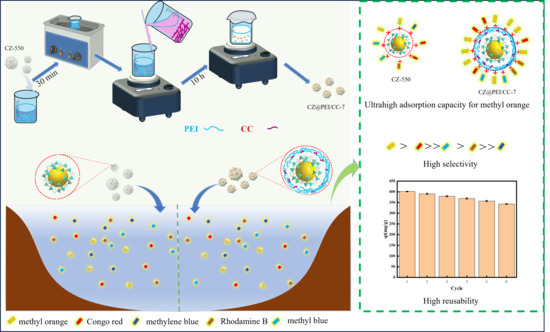
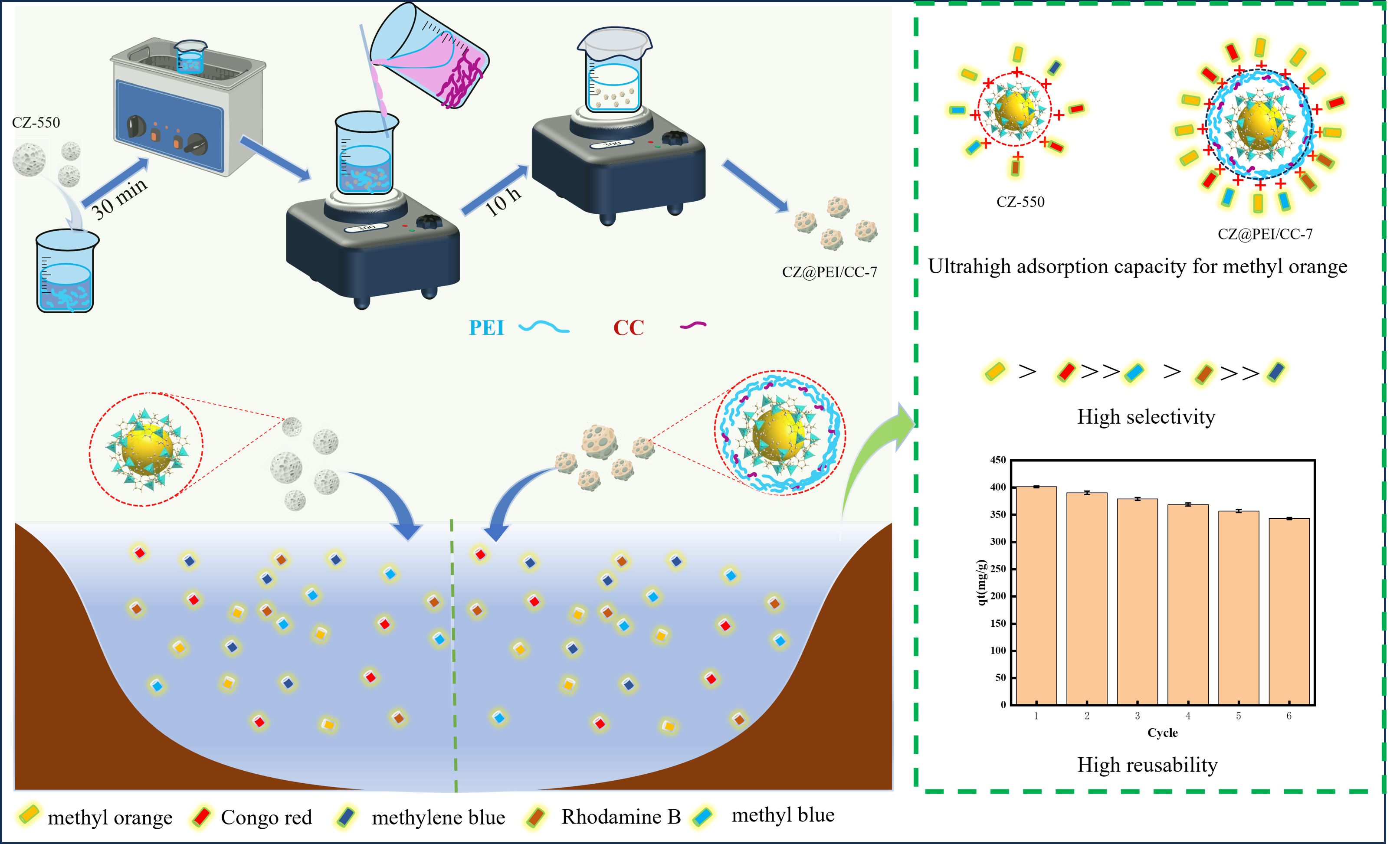
Graphical Abstract

1. Introduction

The large-scale discharge of organic dyes causes severe environmental pollution, degrading water resources and posing serious threats to human health [1,2,3]. Methyl orange (MO), a toxic organic dye, can induce tachycardia, acute shock, tissue necrosis, and even paralysis when ingested in significant quantities [4,5]. Due to its harmful effects and its role as a representative organic pollutant, MO is often studied to assess the effectiveness of adsorbent materials. Consequently, effective removal of MO and similar organic dyes from water has garnered significant research attention. Adsorption is currently the most widely used and effective method for dye removal from water [6,7,8,9]. However, traditional adsorbents are often limited by low saturation capacity, slow adsorption rates, and lack of selectivity, restricting their application potential [10]. Addressing water pollution requires developing advanced adsorbent materials with tunable pore sizes, high chemical and mechanical stability, and selective adsorption capability.
Metal–organic frameworks (MOFs) are a class of novel crystalline nanoporous materials [11,12], formed by the self-assembly of inorganic metal ions or clusters with polydentate organic ligands to create a highly ordered and stable periodic network [13,14]. Zeolitic imidazolate framework-8 (ZIF-8), a prominent MOF variant, not only inherits the porous structure and surface properties typical of MOFs but also exhibits the thermal and chemical stability associated with zeolites [15]. These characteristics make ZIF-8 widely applicable in organic dye adsorption for wastewater treatment [16,17,18]. For example, Li et al. [19] extended the growth of ZIF-67 on ZIF-8 to form a core–shell structure with an increased surface area and pore volume, providing additional active sites and facilitating electron transfer to accelerate adsorption rates. Similarly, Mirzaei et al. [20] created hybrid nanomaterials by combining oxidized nanodiamond (OND) with ZIF-8, where the electronegative functional groups on OND enhanced surface charge and increased adsorption capacity for methylene blue. Despite ZIF-8’s strong adsorption capacity for various molecules, issues remain, such as particle aggregation, reduced surface contact area, increased mass transfer resistance, and challenges in separation and recyclability in aqueous solutions [21]. Consequently, the development of ZIF-8 and its derivatives with enhanced selectivity and adsorption performance has become essential [22,23,24]. Current enhancement strategies include combining ZIF-8 with functional materials [19], surface modification, and carbonization [25]. Among these, carbonization is a straightforward method to transform ZIF-8 into carbon-based materials with desirable adsorption properties. However, challenges such as moderate adsorption capacity and sluggish kinetics persist, necessitating further modifications. Polyethyleneimine (PEI), a water-soluble polyelectrolyte rich in amino groups, is commonly used to introduce additional adsorption sites and improve adsorption capacity [26]. Cyanuric chloride (CC), frequently used as a crosslinker, enables efficient grafting of PEI, thereby improving the grafting density and stability of PEI on carbonized ZIF-8 [27].
Building upon our previous work on CZ-550 [28], this study utilizes the carbonized framework as a substrate for advanced functionalization. A one-step hydrothermal method and ambient-temperature chemical crosslinking were applied to graft the aminated compound polyethyleneimine (PEI) onto CZ-550 using cyanuric chloride (CC) as a crosslinker, resulting in a novel composite material, CZ@PEI/CC-7. The composite material was characterized using various analytical techniques to evaluate its structural and functional properties. Using MO as a model organic pollutant, this study investigated the effects of pH, initial MO concentration, ionic strength, adsorption time, and other factors on MO adsorption efficiency, as well as adsorption kinetics. Compared with CZ-550 and other carbon-based materials (Table S1) [29,30,31], CZ@PEI/CC-7 exhibited a markedly enhanced maximum adsorption capacity for MO of 3150 mg/g.

2. Experimental Procedure

2.1. Materials

MO, methyl blue, methylene blue, Congo red, and Rhodamine B were obtained from Chengdu Cologne Chemicals Co., Ltd., Chengdu, China; anhydrous methanol from Chengdu Changlian Chemical Reagents Co., Ltd., Chengdu, China; hydrochloric acid from Sichuan Xilong Scientific Co., Ltd., Meishan, China; polyethyleneimine, cyanuric chloride, and sodium hydroxide from Shanghai Aladdin Biochemical Technology Co., Ltd., Shanghai, China; and anhydrous ethanol from Chengdu Dingsheng Times Technology Co., Ltd. Chengdu, China. All reagents were of analytical grade and used without further purification.

2.2. Instruments

Fourier transform infrared (FT-IR) spectra were collected using a NEXUS 670 FT-IR spectrometer (Thermo Fisher Scientific, Waltham, MA, USA) over the wavenumber range of 4000–400 cm−1. X-ray photoelectron spectroscopy (XPS) measurements were performed on a Thermo Scientific K-Alpha spectrometer (Thermo Fisher Scientific, Waltham, MA, USA) using monochromated Al Kα radiation as the excitation source. The morphology of the powder samples was examined by field-emission scanning electron microscopy (FE-SEM, JSM 7610F, JEOL Ltd., Akishima, Japan) at an accelerating voltage of 3–5 kV. Transmission electron microscopy (TEM) and high-resolution TEM (HRTEM) observations were carried out on an FEI Talos F200S microscope (Thermo Fisher Scientific, Waltham, MA, USA) operated at 200 kV. TEM specimens were prepared by dispersing the powders in ethanol, ultrasonication for 10–30 min, drop-casting onto carbon-coated copper grids, and drying at room temperature. UV–visible absorption spectra were recorded on a UV600 UV–Vis spectrophotometer (Meipuda Instrument Co., Ltd., Shanghai, China) using a 1 cm quartz cuvette over 200–800 nm, with the corresponding solvent as the blank. Powder X-ray diffraction (XRD) patterns were acquired on an Ultima IV diffractometer (Rigaku Corporation, Tokyo, Japan) with Cu Kα radiation (λ = 1.5406 Å) operated at 40 kV and 40 mA. Data were collected in the 2θ range of 5–80° with a step size of 0.02° and a scanning rate of 2–5° min−1. Nitrogen adsorption–desorption isotherms were measured at 77 K using a Micromeritics ASAP 2460 surface area and porosity analyzer (Micromeritics, Norcross, GA, USA). Prior to analysis, samples were degassed under vacuum at 150 °C for 8–12 h. The specific surface area was calculated using the multi-point BET method within the linear relative pressure (P/P0) range of 0.05–0.35. The total pore volume was derived from the nitrogen uptake at (P/P0) ≈ 0.99, and the average pore diameter was estimated as 4V/A assuming a cylindrical pore model, where V is the total pore volume and A is the BET surface area. The zeta potential of the samples dispersed in aqueous media was determined using a ZEN 3690 nanoparticle size and zeta potential analyzer (Malvern Instruments Ltd., Malvern, United Kingdom) at 25 °C. Each sample was measured in triplicate, and the mean value was reported. Thermogravimetric analysis (TGA) was performed on an STA449F3 thermogravimetric analyzer (Netzsch, Selb, Germany) from 25 to 800 °C at a heating rate of 10 °C min−1 under a nitrogen flow of approximately 50 mL min−1. Carbonization of ZIF-8 was carried out in a KTL1600 tube furnace (Nanda Instrument Co., Ltd., Nanjing, China) under nitrogen protection at a flow rate of 161 mL min−1 with a heating ramp of 5 °C min−1. Adsorption-related experiments were conducted in an HZQ-X100 constant-temperature shaking incubator (Peiying Experimental Equipment Co., Ltd., Suzhou, China) at 37 °C. Ultrasonic cleaning bath (KQ5200, Kunshan Ultrasonic Instruments Co., Ltd., Kunshan, China) operated at 100 W and 40 kHz.

2.3. Synthesis

CZ-550 was synthesized according to previously reported work [28]. Zinc nitrate hexahydrate was first dissolved in methanol to prepare Solution A, while 2-methylimidazole was dissolved in methanol to prepare Solution B. Solution A was then rapidly poured into Solution B under vigorous stirring to ensure thorough mixing, and the mixture was continuously stirred at room temperature for 24 h, forming a milky suspension. After the reaction, the product was collected by centrifugation and washed three times with methanol, followed by drying in an oven at 60 °C for 24 h to obtain ZIF-8, with a Zn2+ to 2-methylimidazole molar ratio of 1:4. The as-prepared ZIF-8 was subsequently ground into a uniform powder and placed in a crucible, then carbonized in a tube furnace under a nitrogen atmosphere by heating at 5 °C/min to 550 °C and holding for 3 h. After naturally cooling to room temperature, the carbonized sample CZ-550 was obtained. CZ-550 was used as a literature benchmark, and the relevant data were taken from our previous work (Table S2).
The as-prepared CZ-550 was activated by vacuum-drying at 150 °C for 10 h and then cooled to room temperature before use. A measured amount of polyethyleneimine was added to a beaker containing 5 mL of acetonitrile and stirred until fully dissolved. Then, 0.03 g of activated CZ-550 was added to the solution and sonicated for 30 min to ensure thorough dispersion. Stirring was continued for an additional 30 min to obtain Solution C. Separately, a measured amount of cyanuric chloride was dissolved in 5 mL of acetonitrile to prepare Solution D. Solution D was added dropwise to Solution C under vigorous stirring, and stirring was continued for 10 h after addition was complete. The reaction mixture was then centrifuged at 10,000 rpm for 5 min, washed three times with deionized water and once with anhydrous ethanol. The resulting brown precipitate was dried at 60 °C for 24 h to obtain the final product. The mass ratios of polyethyleneimine to cyanuric chloride used in the experiments were 0.02 g/0.01 g, 0.02 g/0.03 g, 0.04 g/0.01 g, 0.04 g/0.03 g, 0.06 g/0.06 g, 0.08 g/0.06 g, 0.10 g/0.06 g, and 0.12 g/0.06 g, and the resulting series of products were labeled as CZ@PEI/CC-x (x = 1–8).

2.4. Analytical Methods

The concentrations of MO were quantified using a UV600 UV-Visible spectrophotometer (Mapada Instruments Co. Ltd., Shanghai, China) at the maximum absorption wavelength of 464 nm. The method exhibited a Limit of Detection (LOD) of 0.13 mg/L and a Limit of Quantification (LOQ) of 0.40 mg/L (Figure S1), ensuring precise measurement of residual dye concentrations. Adsorption capacities and removal efficiencies were calculated based on the standard mass-balance equations. More details of the stability and adsorption experiments for the CZ@PEI/CC materials are provided in the Supporting Information.

3. Results and Discussion

3.1. Optimization of Preparation Conditions

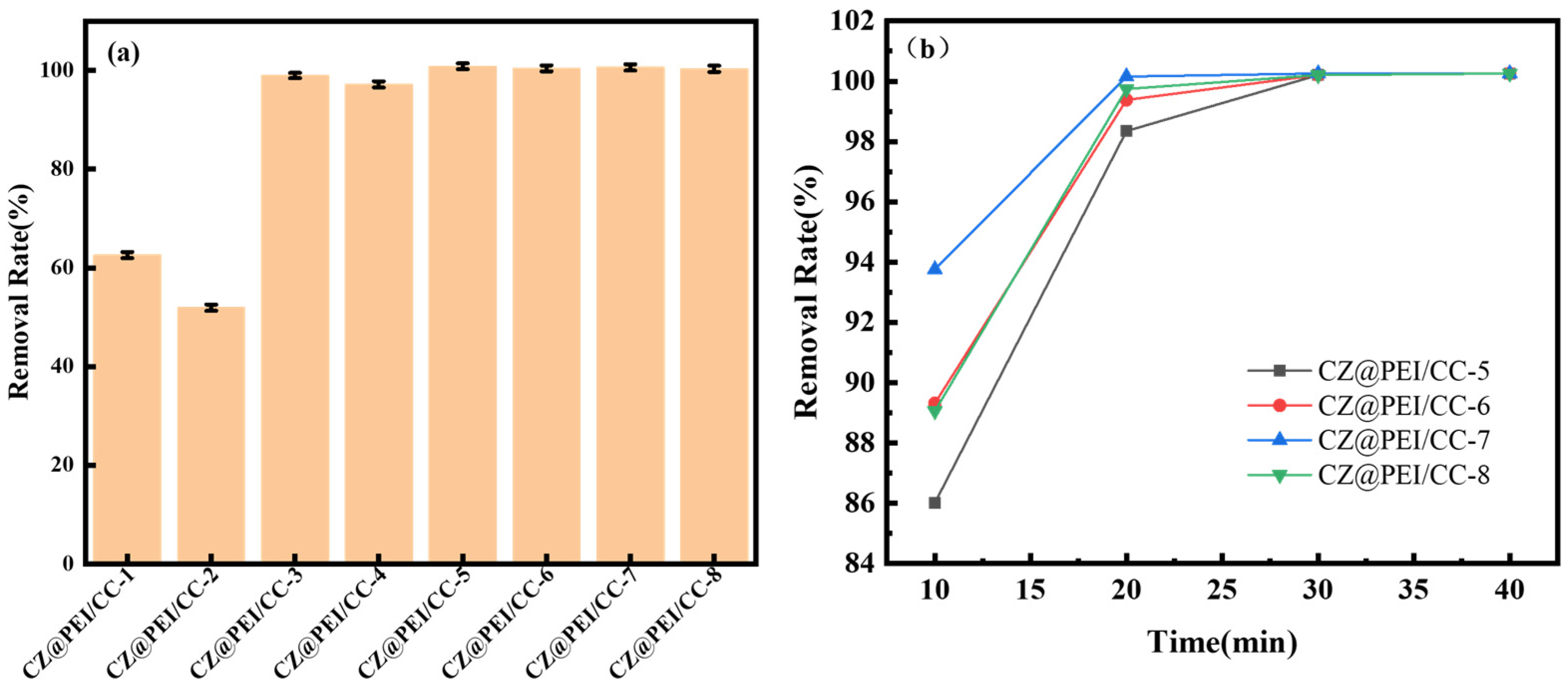
Different mass ratios of PEI and CC lead to composites with varying degrees of crosslinking, thereby affecting their adsorption capacity toward MO [32]. Therefore, the optimal PEI-to-CC ratio was investigated to obtain a composite with the maximum adsorption capacity. As shown in Figure 1a, the PEI/CC mass ratio has a pronounced effect on MO adsorption (initial MO concentration, 60 mg/L). CZ@PEI/CC-1 and CZ@PEI/CC-2 exhibited relatively low removal efficiencies. When the ratio was adjusted to CZ@PEI/CC-3 and above, the removal efficiency increased sharply and reached a plateau (97%–100%), indicating that sufficient crosslinking and amine-rich active sites had been established. Furthermore, the adsorption kinetics of CZ@PEI/CC-5–8 (Figure 1b) show that all samples rapidly reached adsorption equilibrium within 30 min. Notably, CZ@PEI/CC-7 achieved the highest removal efficiency during the initial stage (10–20 min), demonstrating a faster adsorption rate. Therefore, considering both equilibrium performance and kinetic advantages, CZ@PEI/CC-7 was selected as the optimal formulation for subsequent studies.

3.2. Characterization

3.2.1. Morphological Characterization of CZ@PEI/CC-x Composites

SEM was employed to characterize the morphology of the CZ@PEI/CC-x composites. As shown in Figure S2, the particle surfaces are uniformly coated with a PEI molecular layer. Owing to PEI self-crosslinking within the CZ@PEI/CC-x system, the particles tend to aggregate and become interconnected through the PEI coating, resulting in blurred particle boundaries and reduced dispersibility. Such aggregation may also contribute to the formation of larger pore structures. These larger pores not only facilitate mass transfer and adsorption of MO but also enable PEI molecules to form a more stable network structure, thereby reducing their detachment from the CZ-550 surface. The PEI coating therefore improves PEI reusability and acts as a protective layer that enhances the structural integrity and chemical stability of the CZ-550 framework. Notably, the images also show that multiple particles are encapsulated within the cross-linked PEI to form irregular secondary clusters. This phenomenon may arise from insufficient dispersion of CZ-550 crystals during the reaction, leading to rapid crosslinking that traps undispersed particles within the PEI layer.
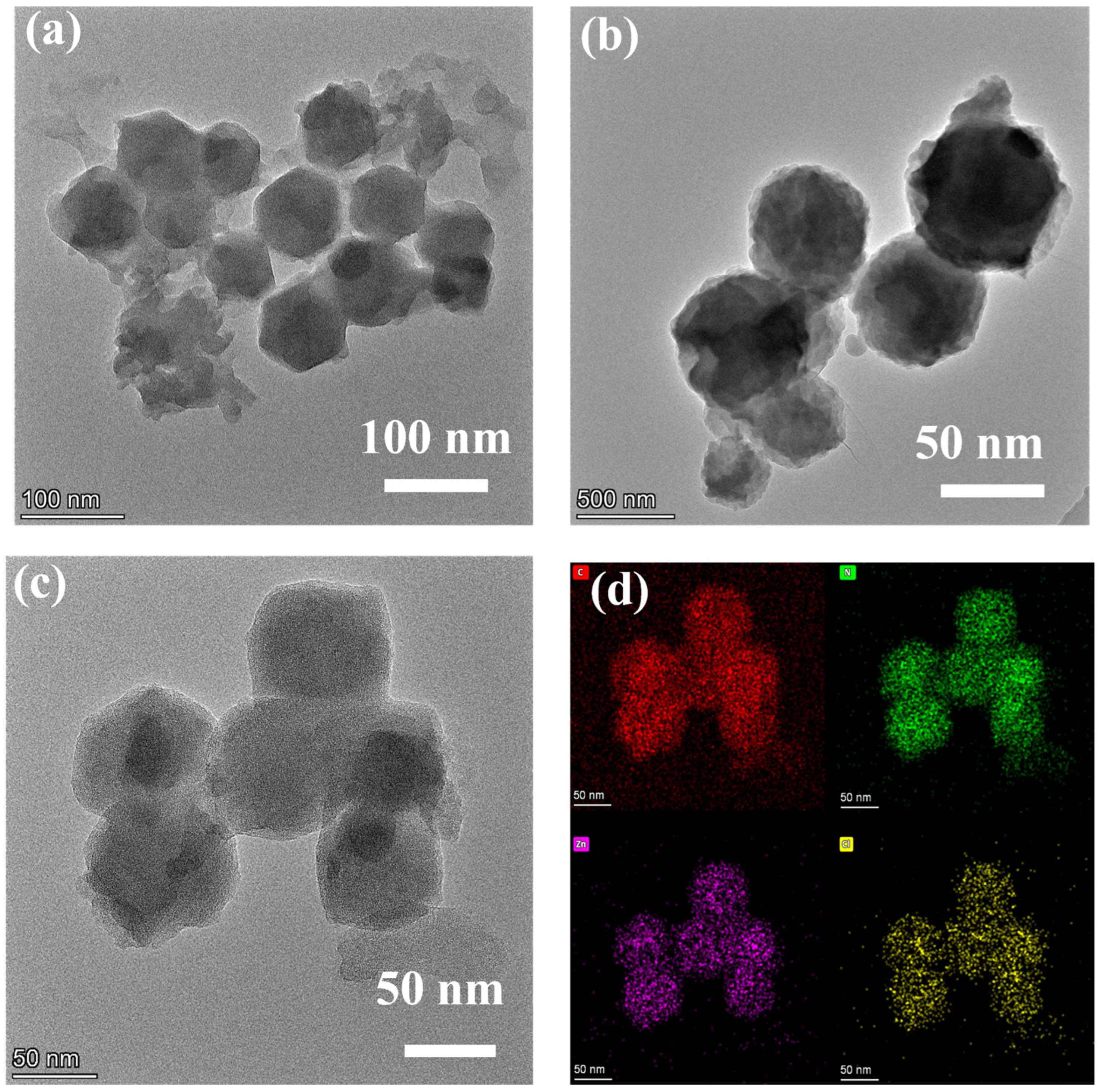
Transmission electron microscopy (TEM) was further used to visualize the PEI-coated core–shell structure of CZ-550. As shown in Figure 2a, particles with diameters of approximately 80–90 nm are clearly coated with a PEI layer, which exhibits self-crosslinking behavior and forms an extended coating structure. Figure 2b,c shows that, due to limited dispersibility and fast reaction kinetics, PEI can encapsulate multiple particles to form irregular spherical aggregates with diameters of around 500 nm, while smaller particles remain visible on the surface. The elemental mapping in Figure 2d shows a uniform distribution of Cl throughout the CZ@PEI/CC-7 particles, further confirming the successful grafting of PEI and CC.

3.2.2. XPS Analysis of Elemental Composition and Zn–N Coordination Changes in CZ@PEI/CC-7

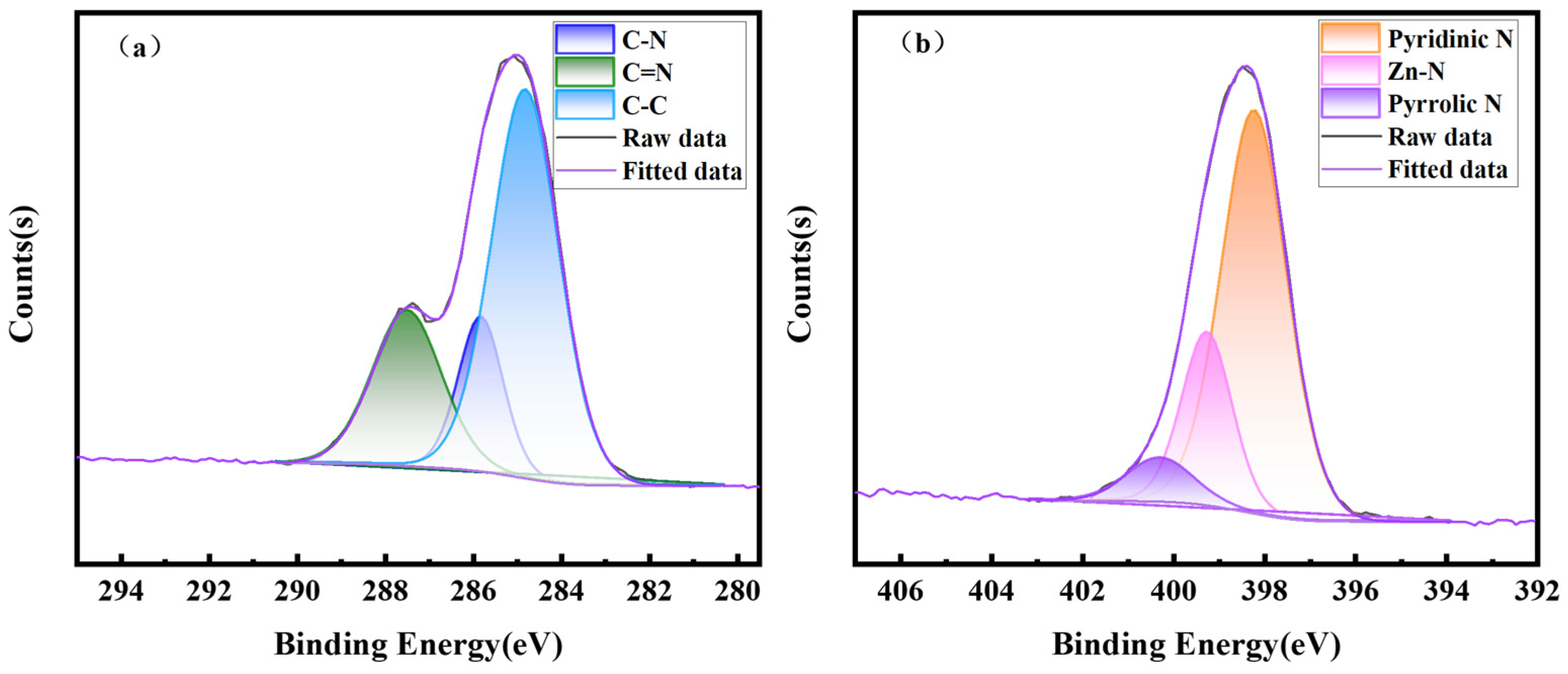
XPS was employed to analyze the elemental composition and chemical states of CZ@PEI/CC-7. As shown in Figure 3a, compared with CZ-550 [28], the C 1s spectrum of CZ@PEI/CC-7 shows an increased relative peak area for the C=N component at ~287 eV. This feature can be attributed to the 1,3,5-triazine ring introduced by cyanuric chloride (CC), indicating that CC was successfully involved in the crosslinking reaction. As further evidenced by the N 1s spectrum (Figure 3b), PEI/CC modification decreases the intensity of the peak associated with saturated Zn–N bonds, likely reflecting partial perturbation of the Zn–N coordination environment. Such a change may generate more unsaturated Zn2+ sites and additional N-coordination sites, thereby providing more potential active sites for subsequent adsorption.

3.2.3. Functional Group Analysis and Structural Alterations in CZ@PEI/CC Composites

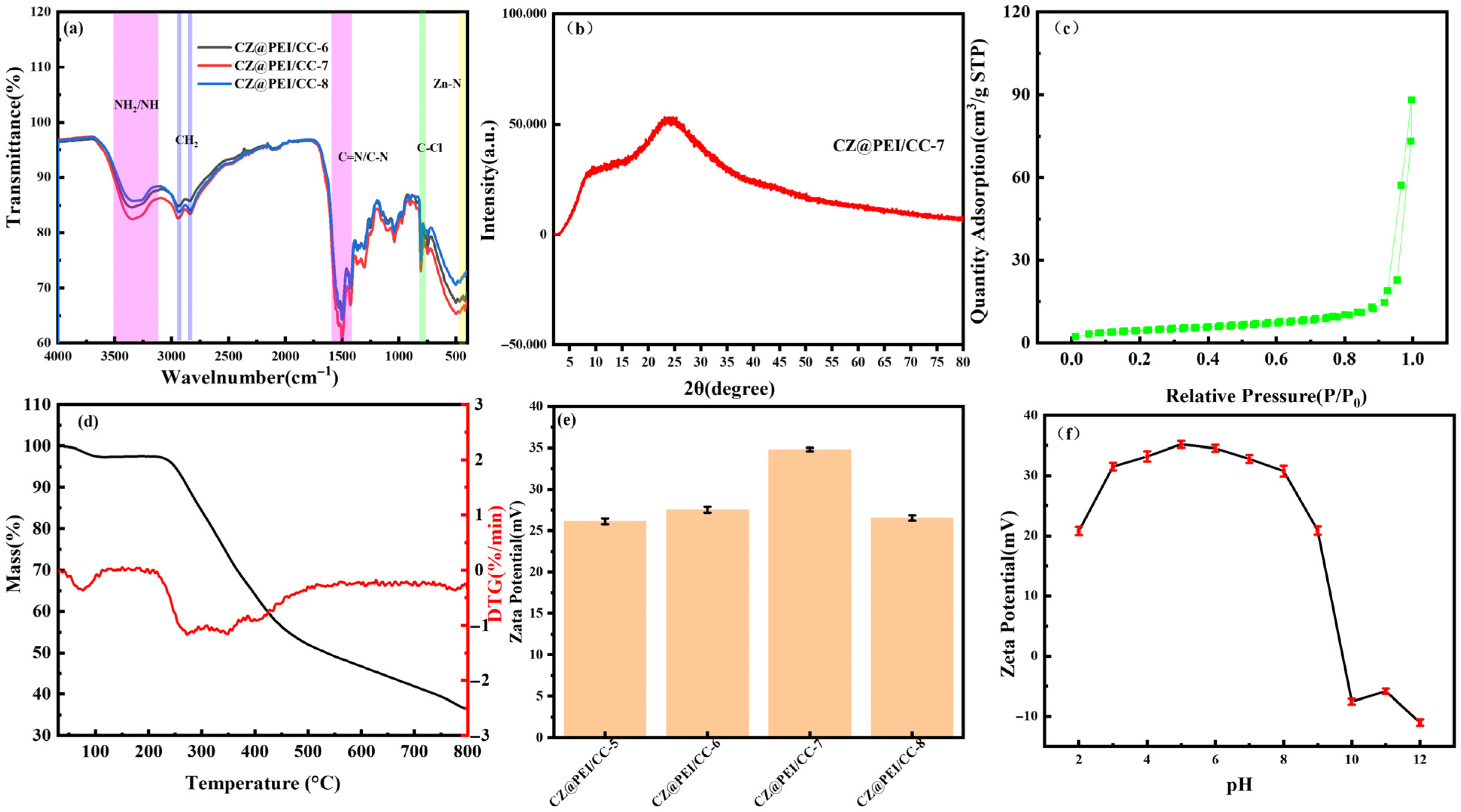
FT-IR spectroscopy was conducted for CZ@PEI/CC-x (x = 6, 7, 8) to identify the surface functional groups, and the results are shown in Figure 4a. After modification, several characteristic absorption bands associated with PEI/CC appeared in the composites, whereas some bands of CZ-550 became less distinguishable, which can be attributed to polymer coating and band overlap. Specifically, the band at 800 cm−1 is assigned to the C–Cl stretching vibration of the cyanuric chloride crosslinker [33], indicating the successful incorporation of CC. The broad band in the range of 3100–3500 cm−1 corresponds to the N–H stretching vibration of amine groups in PEI [34]. In addition, the emergence and enhancement of bands at 1500–1600 cm−1 can be attributed to the C=N/C–N skeletal vibrations of the triazine ring. The peaks at 2840 and 2930 cm−1 are ascribed to the symmetric and asymmetric stretching vibrations of –CH2– groups in the PEI structure, respectively [35], further confirming the presence of PEI on the composite surface. Compared with the FT-IR spectrum of CZ-550 [28], the Zn–N (422 cm−1) vibration feature associated with the ZIF framework is markedly weakened or nearly indistinguishable in the composites, suggesting that the framework characteristics may be altered during the modification process, which is consistent with the XRD results.

3.2.4. Structural Transformation and Crystallinity Analysis of CZ-550 and CZ@PEI/CC Composites

As shown in Figure 4b, after introducing PEI and CC, the diffraction features of CZ-550 change markedly [28], and the characteristic ZIF-8 diffraction peaks reported in the literature are significantly weakened or even disappear. This phenomenon may be attributed to the relatively limited structural stability of CZ-550 under aqueous conditions. During the reaction and in the water phase, the original framework may undergo further amorphization accompanied by partial rearrangement of the carbon phase, resulting in attenuation of the diffraction peaks. Nevertheless, CZ@PEI/CC-7 still retains a weak diffraction peak that can be assigned to the ZIF-8 (011) plane reported in the literature [36], indicating that a small fraction of residual framework features remains. Overall, the XRD pattern of CZ@PEI/CC-7 is dominated by a broad diffuse halo, suggesting that the structure is primarily composed of an amorphous carbon phase. These results further imply that PEI/CC coating and crosslinking not only enhance surface functionalization but also accompany and likely promote the weakening of the CZ-550 framework characteristics and structural rearrangement, ultimately yielding a more stable amorphous carbon-based composite structure.

3.2.5. Effect of PEI Crosslinking on Structure and Adsorption Performance

Nitrogen adsorption–desorption isotherms were utilized to analyze the surface area and pore size distribution changes before and after chemical modification. The results are presented in Figure 4c. The nitrogen adsorption–desorption isotherm of CZ@PEI/CC-7 exhibits a typical H3 hysteresis loop and aligns with IUPAC classifications between type I and type IV, with a tendency towards type I. Type I isotherms indicate the presence of micropores, while the H3 hysteresis loop suggests the coexistence of mesopores and macropores. These findings indicate that CZ@PEI/CC-7 primarily consists of micropores, along with a minor presence of mesopores and macropores.
As shown in Table 1, the addition of PEI reduces the specific surface area of CZ-550, likely because PEI crosslinking forms a dense protective film on the CZ-550 surface, blocking many pores [37]. Consequently, the specific surface area and pore volume of CZ@PEI/CC-7 are significantly reduced, consistent with the XRD results. Although the reduction in surface area and pore volume may limit the accessibility of CZ-550’s active sites for MO adsorption, the high positive charge introduced by chemical grafting of PEI compensates for this limitation, resulting in enhanced adsorption performance.

3.2.6. Thermal Stability and Decomposition Behavior of CZ@PEI/CC-7

The thermal stability of CZ@PEI/CC-7 was evaluated via thermogravimetric analysis (TGA), with results shown in Figure 4d. The TG curve reveals four distinct stages of weight loss. Below 100 °C, approximately 3% of the weight loss is attributed to residual physically adsorbed water and trace unreacted reactants within the pores. From 100 °C to 320 °C, a 16% weight loss is attributed to the decomposition and volatilization of the cyanuric chloride crosslinker. At 400 °C, the decomposition of PEI contributes to an additional 20% weight loss [38]. Above 400 °C, the CZ-550 framework is destroyed and collapses. Compared to CZ-550 [28], the composite material collapses at a lower temperature, likely due to structural defects or changes induced by the coating and interactions of PEI and CC. Nevertheless, this has minimal impact on adsorption applications, as the material retains good thermal stability [39].

3.2.7. Zeta Potential Analysis of CZ@PEI/CC-7 and Its pH-Dependent Behavior

The Zeta potentials of composite materials synthesized with various ratios are presented in Figure 4e. CZ@PEI/CC-7 exhibits the highest Zeta potential, indicating a more positively charged surface. This confirms that amine modification enhances the positive charge of the material, thereby improving its adsorption capacity for MO [40].
The Zeta potential of CZ@PEI/CC-7 across various pH conditions is illustrated in Figure 4f. Compared to CZ-550 [28], the Zeta potential of CZ@PEI/CC-7 shows less variation with pH, albeit following a similar trend. CZ@PEI/CC-7 shows a significant increase in Zeta potential, particularly in the neutral pH range, where it exhibits a much higher positive charge. Under strongly alkaline conditions, it carries a lower negative surface charge. This suggests that the material maintains a high positive surface charge across a broad pH range, enhancing its MO adsorption capacity. This is attributed to the protonation of amine groups in PEI molecules under acidic conditions, resulting in a strong positive charge. This further confirms the successful incorporation of PEI, which broadens the range of positive charge enhancement and improves MO adsorption. As the pH rises above 9, the surface charge transitions from positive to negative, with an isoelectric point of 9.8 for CZ@PEI/CC-7.

3.3. Adsorption Characteristics of MO on CZ@PEI/CC-7

3.3.1. Optimization of Adsorbent Dosage for MO Adsorption

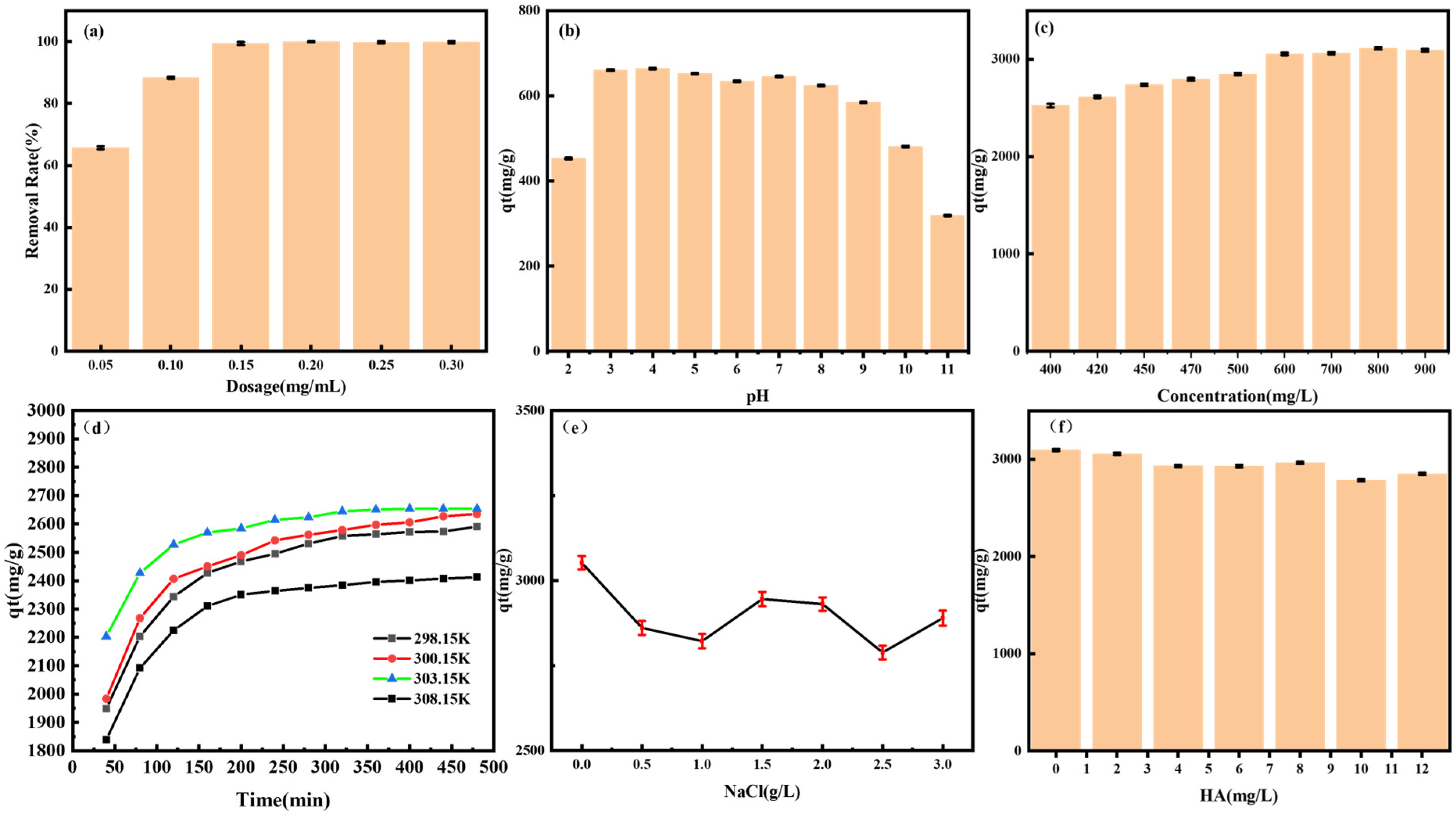
As shown in Figure 5a, the effect of adsorbent dosage on MO removal was evaluated using 20 mL of MO solution (100 mg/L) with a contact time of 10 min. The removal efficiency increased monotonically as the CZ@PEI/CC-7 dosage increased from 1 to 6 mg (0.05–0.30 mg/mL). Notably, a dosage of 3 mg (0.15 mg/mL) already achieved >99% MO removal, while further increasing the dosage led to complete removal. Therefore, 3 mg (0.15 mg/mL) was selected as the optimal dosage for subsequent adsorption experiments.

3.3.2. pH-Dependent MO Adsorption on CZ@PEI/CC-7

Adsorption efficiency is significantly influenced by solution pH, as it affects dye ionization, adsorbent surface charge, material structure, and functional group interactions [41,42,43]. Figure 5b illustrates the effect of pH on MO adsorption by CZ@PEI/CC-7. The experiments used a MO concentration of 100 mg/L and a contact time of 10 min. Unlike CZ-550 [28], MO adsorption by CZ@PEI/CC-7 exhibits strong pH dependence. CZ@PEI/CC-7 achieves its highest adsorption capacity of 667 mg/g under acidic conditions at pH 4. Notably, the adsorption capacity decreases significantly to 456 mg/g under strongly acidic conditions (pH 2). This behavior aligns with CZ-550, which loses stability under strongly acidic conditions, resulting in partial structural degradation and decreased adsorption efficiency. However, unlike CZ-550, which exhibits negligible adsorption capacity under strongly acidic conditions (pH 2), CZ@PEI/CC-7 retains an adsorption capacity of 450 mg/g, demonstrating superior performance. This result aligns with the acid and alkali stability tests, as the PEI molecular layer effectively shields the core CZ-550 from acid corrosion. At higher pH levels, the adsorption capacity of CZ@PEI/CC-7 decreases. This can be attributed to the abundance of PEI molecules on the surface of CZ@PEI/CC-7, which are rich in amine functional groups. Under acidic conditions, amine groups become highly protonated, rendering the material highly cationic [44]. The sulfonic groups in MO remain ionized across a wide pH range, enabling strong electrostatic attraction with the highly cationic adsorbent under acidic conditions, leading to enhanced adsorption. In alkaline conditions, amine groups are deprotonated, reducing surface positive charge and weakening electrostatic attraction to MO.

3.3.3. Effect of Initial MO Concentration on CZ@PEI/CC-7 Adsorption Performance

The effect of initial MO concentration on its adsorption by CZ@PEI/CC-7 was investigated. As the initial MO concentration increased, more dye molecules were available per unit volume, resulting in a larger concentration gradient between the bulk solution and the adsorbent surface. This enhanced the mass-transfer driving force and accelerated the approach to adsorption equilibrium. As shown in Figure 5c, the adsorption capacity of CZ@PEI/CC-7 increased sharply as the MO concentration rose from 400 to 500 mg/L. When the concentration exceeded 500 mg/L, the increase in adsorption capacity slowed and gradually reached a plateau, with a saturated adsorption capacity of approximately 3150 mg/g. This behavior can be attributed to the progressive occupation of available adsorption sites on CZ@PEI/CC-7 by MO molecules. As the number of vacant sites decreased and the surface approached saturation, further increases in the initial MO concentration no longer produced an appreciable increase in adsorption capacity.

3.3.4. Effect of Time and Temperature on MO Adsorption by CZ@PEI/CC-7

The effects of adsorption time and temperature on MO adsorption by CZ@PEI/CC-7 were investigated. As shown in Figure 5d, CZ@PEI/CC-7 exhibited rapid adsorption at the initial stage, indicating a high initial uptake rate for MO. With increasing contact time, the adsorption rate gradually decreased, while the adsorption capacity increased slowly and eventually reached equilibrium. When the temperature increased from 298.15 K to 300.15 K (and further to 303.15 K), both the adsorption rate and the equilibrium adsorption capacity increased, suggesting that moderate heating favors MO adsorption on CZ@PEI/CC-7. In addition, increasing temperature reduces solution viscosity and enhances the diffusion of MO molecules, thereby decreasing boundary-layer mass-transfer resistance, promoting the initial adsorption process, and accelerating the attainment of equilibrium. However, when the temperature was further increased to 308.15 K, the adsorption capacity decreased markedly, and the equilibrium uptake became lower than that at the other three temperatures. This indicates that excessively high temperature makes the adsorption less favorable, which may be attributed to enhanced desorption and/or weakened adsorbate–adsorbent interactions.

3.3.5. Effect of Ionic Strength on MO Adsorption Performance of CZ@PEI/CC-7

In practice, natural water and industrial wastewater systems often contain a variety of soluble inorganic salts [45]. This can affect the adsorption removal of dyes. Therefore, NaCl was added to study the influence of coexisting anions on the adsorption capacity of the adsorbent. The results are presented in Figure 5e. As the NaCl concentration increased from 0 to 0.5 g/L, the adsorption capacity of CZ@PEI/CC-7 for MO slightly decreased from 3062 mg/g to approximately 2870 mg/g. This reduction is attributed to Cl ions in the electrolyte, which compete with MO for adsorption sites on CZ@PEI/CC-7, thereby reducing the number of available sites. Additionally, increased Na+ ion concentrations may neutralize some negative charges on MO, weakening electrostatic interactions with CZ@PEI/CC-7. However, further increases in NaCl concentration had minimal impact on adsorption capacity, which stabilized around 2850 mg/g. This indicates that CZ@PEI/CC-7 maintains excellent adsorption capacity for MO in the presence of electrolytes, demonstrating its suitability for real water environments. Similarly to CZ-550, the adsorption of MO on CZ@PEI/CC-7 is primarily driven by electrostatic interactions [46].

3.3.6. Effect of Natural Organic Matter on MO Adsorption Performance of CZ@PEI/CC-7

The influence of natural organic matter on MO adsorption by CZ@PEI/CC-7 was investigated using humic acid as a model compound. The results are presented in Figure 5f. As the humic acid concentration increased to 4 mg/L, the adsorption capacity of CZ@PEI/CC-7 for MO started to decline. With further increases in humic acid concentration, the adsorption capacity remained nearly constant, stabilizing at approximately 2937 mg/g. At a humic acid concentration of 12 mg/L, the adsorption capacity of CZ@PEI/CC-7 slightly decreased. This slight reduction in adsorption capacity is attributed to competition between MO and humic acid for adsorption sites on CZ@PEI/CC-7. However, the overall impact of humic acid is minimal, indicating that CZ@PEI/CC-7 retains high adsorption efficiency for MO in the presence of natural organic matter, making it suitable for real water applications.

3.4. Stability Analysis

3.4.1. Evaluation of Water Stability of CZ@PEI/CC-7

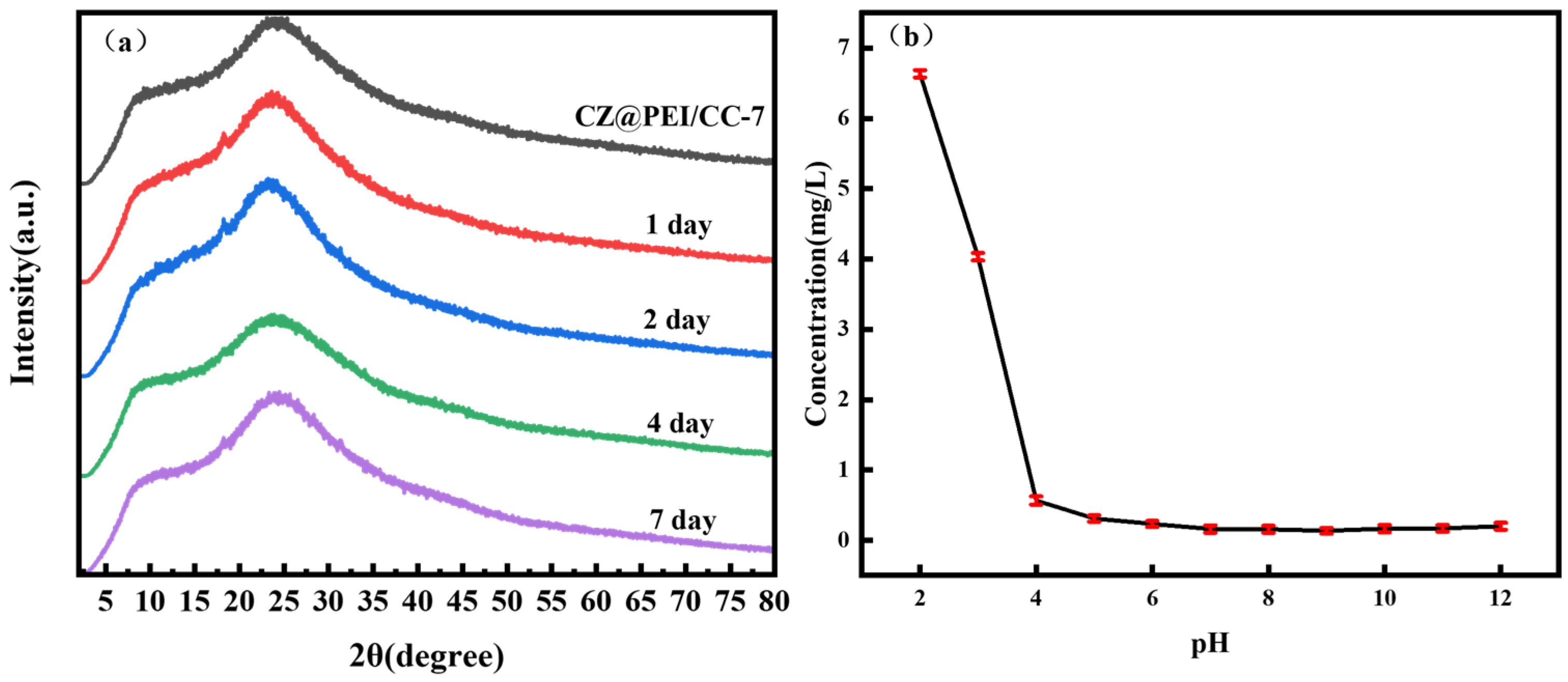
Equal amounts of adsorbent were placed into 20 mL conical flasks and shaken for different durations to assess their structural stability. The results are shown in Figure 6a. As illustrated, the XRD pattern of CZ@PEI/CC-7 remains unchanged even after one week, highlighting the superior stability of the amorphous carbon material. In comparison to CZ-550, CZ@PEI/CC-7 demonstrates significantly enhanced water stability.

3.4.2. Enhanced Acid and Alkali Stability of CZ@PEI/CC-7

The release of Zn2+ ions from CZ@PEI/CC-7 in aqueous solutions at different pH levels is shown in Figure 6b. CZ@PEI/CC-7 demonstrates significantly greater resistance to acidic and alkaline conditions compared to CZ-550. Under strongly acidic conditions (pH = 2), CZ@PEI/CC-7 released less than 7 mg/L of Zn2+ ions, whereas CZ-550 released approximately 30 mg/L. These results highlight the superior acid and alkali resistance of CZ@PEI/CC-7. This enhanced resistance is attributed to the conformal encapsulation of CZ-550 by the cross-linked PEI layer creates a physical barrier, which shields it from external acidic or alkaline environments, thereby preserving its structural stability.

3.5. Kinetic and Isothermal Adsorption Models

3.5.1. Kinetic Modeling of MO Adsorption

Kinetic analysis was performed using pseudo-first-order and pseudo-second-order models [47]. The formulas are as follows:
Pseudo-first-order kinetic model:
l n q e q t = l n q e k 1 t
Pseudo-second-order kinetic model:
t q t = 1 k 2 q e 2 + t q e
where k1 is the adsorption rate constant of the pseudo-first-order model (in/min), k2 is the adsorption rate constant of the pseudo-second-order model (in g/(mg·min)), qe is the equilibrium adsorption capacity of CZ@PEI/CC-7 for MO dye at equilibrium (in mg/g), qt is the adsorption capacity of CZ@PEI/CC-7 for MO at time t (in mg/g), and t is the time (in min).
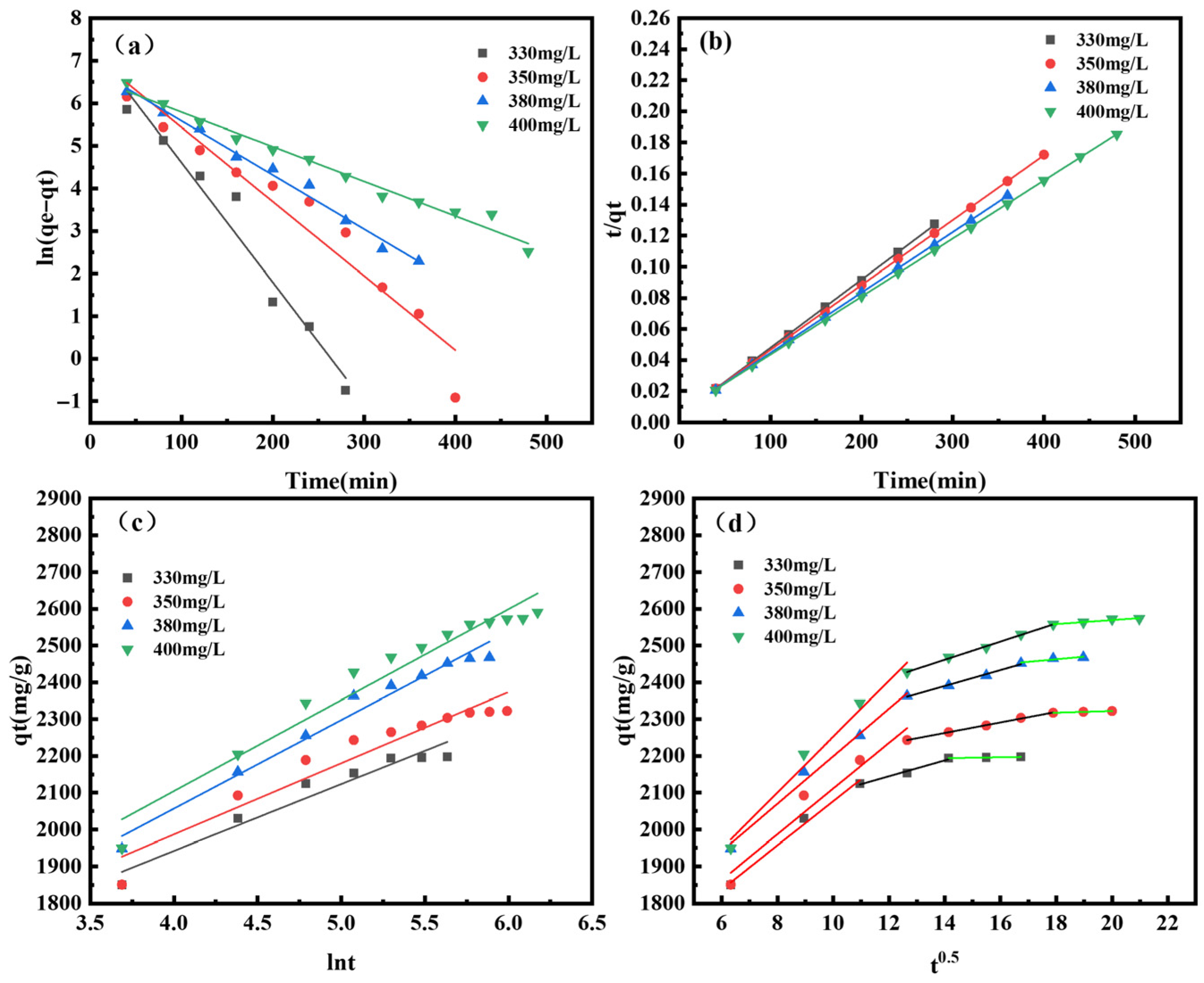
Figure 7a,b shows the fittings of the pseudo-first-order and pseudo-second-order kinetic models, and Table S3 summarizes the calculated parameters. The adsorption of MO on CZ@PEI/CC-7 is better described by the pseudo-second-order model, evidenced by higher linear correlation coefficients and R 2 values approaching unity, and by the close agreement between the calculated and experimental q e . This kinetic behavior suggests that the adsorption rate is strongly governed by surface-site-related processes, i.e., the availability and occupation of active sites on the adsorbent. In many dye–adsorbent systems, a pseudo-second-order kinetic preference is often associated with chemisorption-involved rate control, where specific interactions at the solid–liquid interface (e.g., electrostatic attraction between anionic MO and protonated amine groups, along with other short-range interactions on functionalized sites) contribute to the overall rate. Importantly, the pseudo-second-order model reflects the rate-controlling characteristics rather than uniquely proving a purely chemisorption mechanism, and therefore physical adsorption contributions may coexist.
Additional fitting was conducted using the intraparticle diffusion and Elovich kinetic models, with results illustrated in Figure 7c,d and parameters listed in Table S4. The formulas are as follows:
The intraparticle diffusion kinetic model:
q t =   k d t 0.5 + C
The Elovich kinetic model:
q t = 1 β l n α β + 1 β l n t
where k d is the adsorption rate constant in the intraparticle diffusion model (mg·g−1·min−1/2), C is the boundary layer thickness (mg·g−1), α is the initial adsorption rate (mg·g−1·min−1), and β is the rate constant (g·mg−1), qt is the adsorption capacity of CZ@PEI/CC-7 for MO at time t (in mg/g), and t is the time (in min).
The adsorption process can be divided into three stages: (i) fast initial uptake dominated by boundary-layer/surface diffusion to the external surface, (ii) slower uptake dominated by intraparticle diffusion within pores, and (iii) a final equilibrium stage controlled by micropore diffusion and site saturation. The Elovich model, which is suitable for adsorption on heterogeneous surfaces with varying activation energies, provides complementary insight into surface-controlled adsorption kinetics. As shown in Table S4, the variation in α and β with MO concentration suggests changes in the apparent surface-controlled adsorption rate and activation characteristics, consistent with a physicochemical adsorption process where surface interactions play an important kinetic role.

3.5.2. Adsorption Isotherm Modeling of MO on CZ@PEI/CC-7

Adsorption at the solid–liquid interface is a complex process involving both physical and chemical interactions. Adsorption isotherm models simplify this complexity by categorizing adsorption into distinct modes under various conditions, offering insights into the interaction mechanisms between the adsorbent and adsorbate. The Langmuir, Freundlich, and Temkin isotherm models were employed for the analysis [48,49,50]. The Langmuir, Freundlich, and Temkin isothermal adsorption models were used for analysis, with the following equations:
Langmuir isotherm model:
q e = q m K L C e 1 + K L
Freundlich isotherm model:
q e = K F C e 1 / n
Temkin isotherm model:
q e = R T b T l n ( A T C e )
where KL and KF are the adsorption rate constants for the Langmuir and Freundlich isotherm models, respectively; qe is the equilibrium adsorption capacity of CZ@PEI/CC-7 for MO (in mg/g); qm is the maximum adsorption capacity of CZ@PEI/CC-7 for MO (in mg/g); AT is the equilibrium binding constant in the Temkin isotherm model; 1/n represents the adsorption intensity in the isotherm model; RT/bT is the adsorption constant in the Temkin isotherm model (in J/mol); and Ce is the equilibrium concentration of MO for adsorption by CZ@PEI/CC-7 (in mg/L).
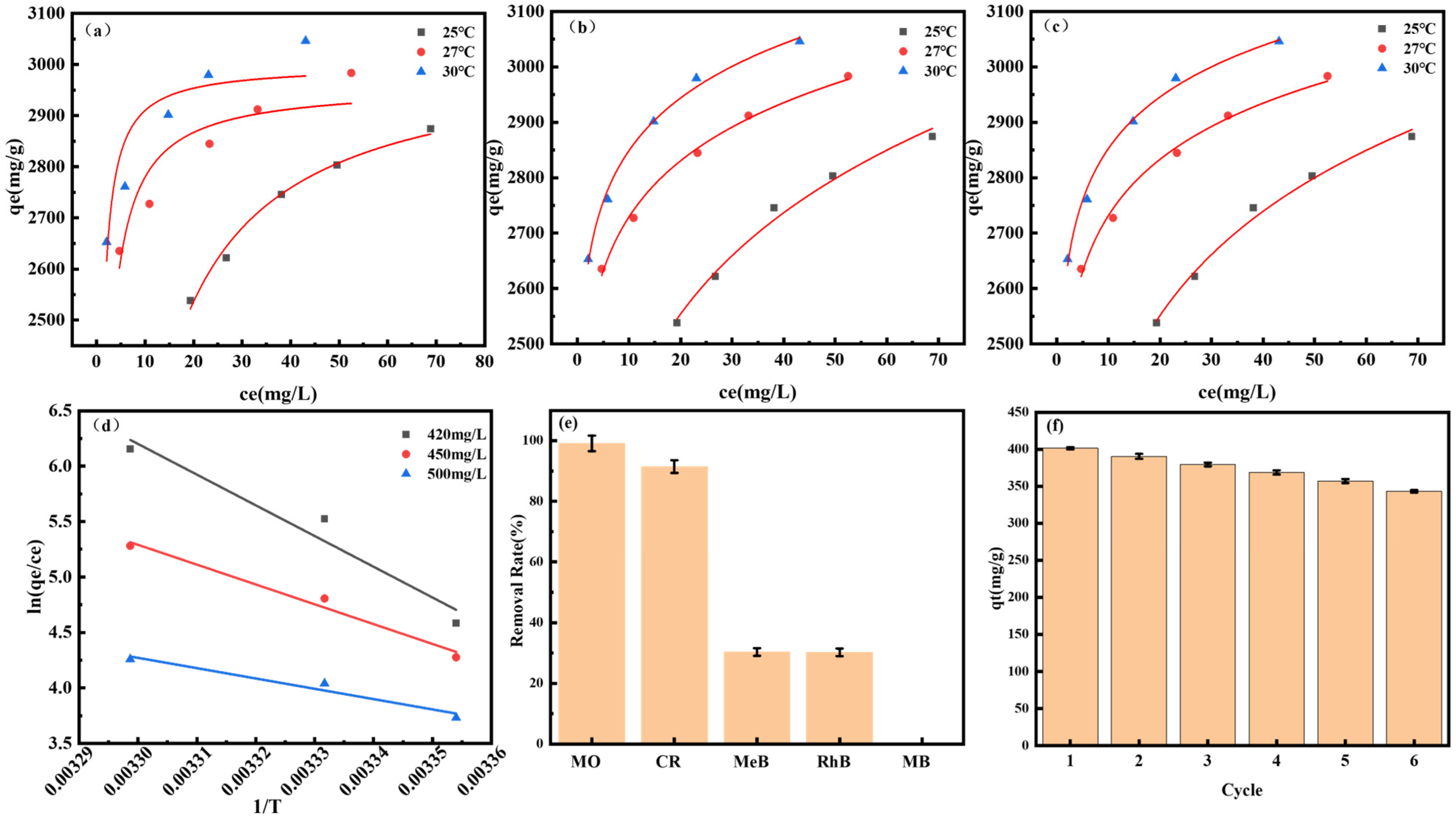
Figure 8a–c and Table S5 show the fitted curves and calculated parameters. The experimental data fit the Freundlich model better than the Langmuir model, indicated by higher correlation coefficients, suggesting multilayer adsorption on a heterogeneous surface. The 1/n values (0–1) imply favorable adsorption of MO on CZ@PEI/CC-7. The increase in adsorption constants with temperature supports the endothermic nature of the process.
The Temkin model also correlates well with the adsorption behavior. The Temkin parameter B T provides information about the overall energetic scale of adsorption. The B T values in Table S5 are below 8 kJ/mol, indicating that the adsorption is thermodynamically dominated by weak interactions typical of physisorption. Meanwhile, the heterogeneous surface and the amine-rich functional layer can introduce site-specific interactions (e.g., electrostatic attraction, hydrogen bonding, and π–π interactions with the carbonized framework), suggesting a physicochemical combined adsorption mechanism rather than a purely physical process.

3.5.3. Thermodynamic Analysis of MO Adsorption on CZ@PEI/CC-7

In this experiment, the thermodynamic behavior of CZ@PEI/CC-7 for MO adsorption was analyzed by calculating thermodynamic parameters at three adsorption temperatures: 298.15 K, 300.15 K, and 303.15 K. A plot was generated with the logarithm of the equilibrium adsorption constant on the y-axis and the reciprocal of temperature on the x-axis. The intercept and slope of the linear curve were used to calculate the standard entropy change (ΔS) and standard enthalpy change (ΔH) at the corresponding temperatures. The Gibbs free energy (ΔG) was then calculated using the formula below.
The adsorption thermodynamics formulas are as follows:
K = q e / C e
ln K = ( Δ S T Δ H ) R T
Δ G = R T l n K
where ΔK is the equilibrium adsorption constant; qe is the equilibrium adsorption capacity of CZ@PEI/CC-7 for MO (in mg/g); Ce is the equilibrium concentration of MO for adsorption by CZ-550 (in mg/L); ΔS is the standard entropy change (in J/mol); ΔH is the standard enthalpy change (in J/(mol·K)); ΔG is the Gibbs free energy (in J/mol); R is the ideal gas constant (8.314 J/(mol·K)); and T is the temperature (in K).
Figure 8d and Table 2 summarize the thermodynamic parameters. The negative ΔG values indicate that adsorption is spontaneous, and the more negative ΔG at higher temperature suggests enhanced spontaneity with increasing temperature. The magnitude of ΔG (−20 to 0 kJ/mol) indicates that the adsorption is thermodynamically dominated by physisorption, while the endothermic ΔH supports that elevated temperature favors adsorption, potentially by facilitating diffusion and/or activating additional accessible sites. The positive ΔS suggests increased randomness at the solid–liquid interface during adsorption.
Overall, combining kinetic and thermodynamic results, MO adsorption on CZ@PEI/CC-7 is best described as a physicochemical combined process: the adsorption rate is controlled by surface-site interactions with chemisorption-involved kinetic characteristics, whereas the overall adsorption energetics are dominated by weak interactions typical of physisorption.

3.6. Selective and Binary System Competitive Adsorption

3.6.1. Selective Adsorption Behavior

Figure 8e compares the removal efficiencies of MO, Congo red (CR), Rhodamine B (RhB), methylene blue (MB, cationic), and methyl blue (MeB, anionic) by CZ@PEI/CC-7. Within 20 min, the removal efficiency followed the order: MO > CR > RhB > MB > MeB. CZ@PEI/CC-7 achieved 99.1% removal of MO, indicating nearly complete adsorption, whereas the removal of MB was only 0.6%, suggesting negligible uptake. This extremely low MB removal is consistent with electrostatic charge exclusion. Based on the zeta-potential results (IEP = 9.8), CZ@PEI/CC-7 remains positively charged at neutral pH (pH < IEP), thereby generating strong electrostatic repulsion toward cationic MB and suppressing its adsorption. In this case, the dominant limitation is electrostatic repulsion rather than pore accessibility. In contrast, MeB is an anionic dye but still exhibits much lower adsorption than MO and CR, which is mainly attributed to size/steric exclusion. Although anionic dyes are generally favored on a positively charged surface, MeB has a relatively larger molecular size, and the PEI/CC functionalization can partially narrow pore channels and introduce steric hindrance within the modified pore structure, reducing the accessibility of internal adsorption sites. Therefore, MeB adsorption is limited by molecular-size constraints and steric hindrance, while MB adsorption is limited by electrostatic repulsion. Overall, these results highlight that the dye selectivity of CZ@PEI/CC-7 is jointly governed by surface charge (Zeta potential/IEP) and pore accessibility, enabling efficient uptake of suitably sized anionic dyes (e.g., MO and CR) while effectively rejecting cationic dyes such as MB.

3.6.2. Reusability and Cyclic Adsorption Performance of CZ@PEI/CC-7

After each cycle, the adsorbent was regenerated by washing (desorption) with anhydrous ethanol to remove the retained dye molecules and recover its adsorption capacity. Figure 8f presents the results of six adsorption cycles, where 3 mg of CZ@PEI/CC-7 was used to adsorb 60 mg/L of MO. After six cycles, the adsorption capacity remained above 300 mg/g, while the removal rate decreased from 100% to 85.35%. This decline is likely attributed to partial mass loss of the adsorbent during the adsorption–desorption process.

4. Conclusions

In this study, CZ@PEI/CC-7 was synthesized and applied for the efficient removal of the anionic dye MO. Compared with the baseline material CZ-550, the maximum adsorption capacity of CZ@PEI/CC-7 increased from 1100 mg/g to 3150 mg/g. This enhancement is mainly attributed to the amine sites introduced by PEI/CC, which are readily protonated under acidic to neutral conditions, imparting a higher positive surface charge and generating a dominant electrostatic attraction toward the –SO3 groups of MO. The Zeta-potential results provide direct support for this mechanism, showing that CZ@PEI/CC-7 exhibits a higher positive charge in the neutral pH range, with an isoelectric point ( p H I E P ) of 9.8. In addition to electrostatic interactions, the synergistic contributions of hydrogen bonding and dipole interactions, intraparticle diffusion and pore filling, as well as carbon-framework-related interactions further promote fast kinetics and high adsorption capacity. CZ@PEI/CC-7 also shows good acid–base stability over a wide pH range (2–12), maintaining high removal performance under substantial pH fluctuations. Kinetic fitting favors the pseudo-second-order model, and the isotherm data are better described by the Freundlich and Temkin models, indicating multilayer adsorption on a heterogeneous surface, dominated by physical adsorption with concurrent chemisorption-type interactions. Notably, CZ@PEI/CC-7 exhibits a more pronounced selectivity toward anionic dyes. For cationic dyes, electrostatic repulsion may occur in the pH range where the surface is positively charged; therefore, their adsorption is more likely governed by non-electrostatic contributions (e.g., hydrophobic/π–π interactions and hydrogen bonding or dipole interactions), resulting in adsorption behavior distinct from that of anionic dyes. This interpretation is consistent with the pH-dependent zeta-potential trend. Reusability tests further demonstrate that CZ@PEI/CC-7 is readily regenerable, maintaining an MO removal efficiency above 80% after six cycles. Overall, CZ@PEI/CC-7 shows strong potential for water treatment applications, particularly for the removal of MO and other anionic organic dyes.

Supplementary Materials

The following supporting information can be downloaded at: https://www.mdpi.com/article/10.3390/coatings16020242/s1, Figure S1: Standard curve of methyl orange; Figure S2: The SEM images of (a) CZ@PEI/CC-1, (b) CZ@PEI/CC-2, (c) CZ@PEI/CC-3, (d) CZ@PEI/CC-4, (e) CZ@PEI/CC-5, (f) CZ@PEI/CC-6, (g) CZ@PEI/CC-7 and (h) CZ@PEI/CC-8; Table S1. Comparison with other carbon-based materials; Table S2. Key advantages of CZ-550 reported in the literature [28]; Table S3. Parameters of pseudo-first-order and pseudo-second-order kinetic models for methyl orange adsorption on CZ@PEI/CC-7; Table S4. Parameters of the Intraparticle Diffusion and Elovich Kinetic Models for methyl orange adsorption on CZ@PEI/CC-7; Table S5. Parameters of three isotherm models for methyl orange adsorption on CZ@PEI/CC-7.

Author Contributions

Z.M.: Investigation, Writing—Original draft, Formal analysis. Y.X.: Data curation, Methodology, Formal analysis. Y.D.: Methodology, Supervision. P.L.: Conceptualization. X.Y.: Validation. Z.Y.: Supervision. Q.Z.: Writing—review and editing, Funding acquisition, Resources, Project administration. All authors have read and agreed to the published version of the manuscript.

Funding

This work was supported by the Open Fund of the Key Laboratory of Environment-Friendly Coatings Enterprises in Guangdong Province (No. 24H1454) and the Beixin Carpoly–Sichuan University Technology Development Project (No. 25H0747).

Institutional Review Board Statement

Not applicable.

Informed Consent Statement

Not applicable.

Data Availability Statement

Data will be made available on request.

Acknowledgments

The authors express their gratitude to the Analytical and Testing Center, Sichuan University for their support in this study.

Conflicts of Interest

Author Zhi Ye was employed by the company Guangdong Provincial Key Laboratory of Environmentally Friendly Coatings, Carpoly Chemical Group Co., Ltd. The remaining authors declare that the research was conducted in the absence of any commercial or financial relationships that could be construed as a potential conflict of interest.

References

  1. Ewuzie, U.; Saliu, O.D.; Dulta, K.; Ogunniyi, S.; Bajeh, A.O.; Iwuozor, K.O.; Ighalo, J.O. A review on treatment technologies for printing and dyeing wastewater (PDW). J. Water Process Eng. 2022, 50, 103273. [Google Scholar] [CrossRef]
  2. Lu, H.; Zhang, L.; Wang, B.; Long, Y.; Zhang, M.; Ma, J.; Khan, A.; Chowdhury, S.P.; Zhou, X.; Ni, Y. Cellulose-supported magnetic Fe3O4–MOF composites for enhanced dye removal application. Cellulose 2019, 26, 4909–4920. [Google Scholar] [CrossRef]
  3. Zhang, W.; Huang, T.; Ren, Y.; Wang, Y.; Yu, R.; Wang, J.; Tu, Q. Preparation of chitosan crosslinked with metal-organic framework (MOF-199) @aminated graphene oxide aerogel for the adsorption of formaldehyde gas and methyl orange. Int. J. Biol. Macromol. 2021, 193, 2243–2251. [Google Scholar] [CrossRef] [PubMed]
  4. Darwish, A.; Rashad, M.; Al-Aoh, H.A. Methyl orange adsorption comparison on nanoparticles: Isotherm, kinetics, and thermodynamic studies. Dye. Pigment. 2019, 160, 563–571. [Google Scholar] [CrossRef]
  5. Haque, E.; Jun, J.W.; Jhung, S.H. Adsorptive removal of methyl orange and methylene blue from aqueous solution with a metal-organic framework material, iron terephthalate (MOF-235). J. Hazard. Mater. 2011, 185, 507–511. [Google Scholar] [CrossRef]
  6. Yang, W.; Kong, Y.; Yin, H.; Cao, M. Study on the adsorption performance of ZIF-8 on heavy metal ions in water and the recycling of waste ZIF-8 in cement. J. Solid State Chem. 2023, 326, 124217. [Google Scholar] [CrossRef]
  7. Zhang, J.; Yan, X.; Hu, X.; Feng, R.; Zhou, M. Direct carbonization of Zn/Co zeolitic imidazolate frameworks for efficient adsorption of Rhodamine B. Chem. Eng. J. 2018, 347, 640–647. [Google Scholar] [CrossRef]
  8. Xu, Y.-Y.; Zhou, M.; Geng, H.-J.; Hao, J.-J.; Ou, Q.-Q.; Qi, S.-D.; Chen, H.-L.; Chen, X.-G. A simplified method for synthesis of Fe3O4@PAA nanoparticles and its application for the removal of basic dyes. Appl. Surf. Sci. 2012, 258, 3897–3902. [Google Scholar] [CrossRef]
  9. Lin, K.-Y.A.; Chang, H.-A. Ultra-high adsorption capacity of zeolitic imidazole framework-67 (ZIF-67) for removal of malachite green from water. Chemosphere 2015, 139, 624–631. [Google Scholar] [CrossRef]
  10. Ahmad, A.; Khan, S.; Tariq, S.; Luque, R.; Verpoort, F. Self-sacrifice MOFs for heterogeneous catalysis: Synthesis mechanisms and future perspectives. Mater. Today 2022, 55, 137–169. [Google Scholar] [CrossRef]
  11. Zhu, C.; Gerald, R.E.; Huang, J. Metal-Organic Framework Materials Coupled to Optical Fibers for Chemical Sensing: A Review. IEEE Sens. J. 2021, 21, 19647–19661. [Google Scholar] [CrossRef] [PubMed]
  12. Shah, S.S.A.; Peng, L.; Najam, T.; Cheng, C.; Wu, G.; Nie, Y.; Ding, W.; Qi, X.; Chen, S.; Wei, Z. Monodispersed Co in Mesoporous Polyhedrons: Fine-tuning of ZIF-8 Structure with Enhanced Oxygen Reduction Activity. Electrochim. Acta 2017, 251, 498–504. [Google Scholar] [CrossRef]
  13. Wei, T.; Wang, Z.; Zhang, Q.; Zhou, Y.; Sun, C.; Wang, M.; Liu, Y.; Wang, S.; Yu, Z.; Qiu, X.; et al. Metal–organic framework-based solid-state electrolytes for all solid-state lithium metal batteries: A review. CrystEngComm 2022, 24, 5014–5030. [Google Scholar] [CrossRef]
  14. Safaei, M.; Foroughi, M.M.; Ebrahimpoor, N.; Jahani, S.; Omidi, A.; Khatami, M. A review on metal-organic frameworks: Synthesis and applications. TrAC Trends Anal. Chem. 2019, 118, 401–425. [Google Scholar] [CrossRef]
  15. Ding, Y.; Xu, Y.; Ding, B.; Li, Z.; Xie, F.; Zhang, F.; Wang, H.; Liu, J.; Wang, X. Structure induced selective adsorption performance of ZIF-8 nanocrystals in water. Colloids Surf. Physicochem. Eng. Asp. 2017, 520, 661–667. [Google Scholar] [CrossRef]
  16. Mohamud, M.A.; Yurtcan, A.B. Zeolotic imidazolate frameworks (ZIFs) derived porous carbon: A review from crystal growth & green synthesis to oxygen reduction reaction activity. Int. J. Hydrogen Energy 2021, 46, 33782–33800. [Google Scholar] [CrossRef]
  17. Ahmad, K.; Shah, H.-U.; Ashfaq, M.; Shah, S.S.A.; Hussain, E.; Naseem, H.A.; Parveen, S.; Ayub, A. Effect of metal atom in zeolitic imidazolate frameworks (ZIF-8 & 67) for removal of Pb2+ & Hg2+ from water. Food Chem. Toxicol. 2021, 149, 112008. [Google Scholar]
  18. Lee, Y.-R.; Jang, M.-S.; Cho, H.-Y.; Kwon, H.-J.; Kim, S.; Ahn, W.-S. ZIF-8: A comparison of synthesis methods. Chem. Eng. J. 2015, 271, 276–280. [Google Scholar] [CrossRef]
  19. Li, Y.; Xiang, P.; Chen, H.; Zhou, Y. Adsorption performance of one- and two-component anionic dyes using core-shell ZIF-8@ZIF-67. J. Solid State Chem. 2022, 315, 123538. [Google Scholar] [CrossRef]
  20. Mirzaei, K.; Mohammadi, A.; Jafarpour, E.; Shojaei, A.; Moghaddam, A.L. Improved adsorption performance of ZIF-8 towards methylene blue dye by hybridization with nanodiamond. J. Water Process Eng. 2022, 50, 103254. [Google Scholar] [CrossRef]
  21. Dai, H.; Yuan, X.; Jiang, L.; Wang, H.; Zhang, J.; Zhang, J.; Xiong, T. Recent advances on ZIF-8 composites for adsorption and photocatalytic wastewater pollutant removal: Fabrication, applications and perspective. Coord. Chem. Rev. 2021, 441, 213985. [Google Scholar] [CrossRef]
  22. Qiu, H.; Yang, L.; Liu, F.; Zhao, Y.; Liu, L.; Zhu, J.; Song, M. Highly selective capture of phosphate ions from water by a water stable metal-organic framework modified with polyethyleneimine. Environ. Sci. Pollut. Res. 2017, 24, 23694–23703. [Google Scholar] [CrossRef] [PubMed]
  23. Yang, L.; Wang, Z.; Zhang, J. Zeolite imidazolate framework hybrid nanofiltration (NF) membranes with enhanced permselectivity for dye removal. J. Membr. Sci. 2017, 532, 76–86. [Google Scholar] [CrossRef]
  24. Qiang, T.; Luo, M.; Bu, Q.; Wang, X. Adsorption of an acid dye on hyperbranched aminated collagen fibers. Chem. Eng. J. 2012, 197, 343–349. [Google Scholar] [CrossRef]
  25. Wang, J.; Wang, Y.; Liang, Y.; Zhou, J.; Liu, L.; Huang, S.; Cai, J. Nitrogen-doped carbons from in-situ glucose-coated ZIF-8 as efficient adsorbents for Rhodamine B removal from wastewater. Microporous Mesoporous Mater. 2021, 310, 110662. [Google Scholar] [CrossRef]
  26. Yan, Y.; An, Q.; Xiao, Z.; Zheng, W.; Zhai, S. Flexible core-shell/bead-like alginate@PEI with exceptional adsorption capacity, recycling performance toward batch and column sorption of Cr(VI). Chem. Eng. J. 2017, 313, 475–486. [Google Scholar] [CrossRef]
  27. Sun, W.; Zhai, X.; Zhao, L. Synthesis of ZIF-8 and ZIF-67 nanocrystals with well-controllable size distribution through reverse microemulsions. Chem. Eng. J. 2016, 289, 59–64. [Google Scholar] [CrossRef]
  28. Xiong, Y.; He, J.; Zhao, Q. Study of low-temperature carbonization modification of ZIF-8 and its adsorption performance. Chem. Res. Appl. 2023, 35, 2449–2458. [Google Scholar] [CrossRef]
  29. Madduri, S.B.; Kommalapati, R.R. Harnessing Novel Reduced Graphene Oxide-Based Aerogel for Efficient Organic Contaminant and Heavy Metal Removal in Aqueous Environments. Nanomaterials 2024, 14, 1708. [Google Scholar] [CrossRef]
  30. Al-Hazeef, M.S.F.; Aidi, A.; Hecini, L.; Ahmed, I.O.; Gamil, G.H.; Mohammed, A.; Sabrina, Z.; Tarik, O.; David, W.R. Valorizing date palm spikelets into activated carbon-derived composite for methyl orange adsorption: Advancing circular bioeconomy in wastewater treatment—A comprehensive study on its equilibrium, kinetics, thermodynamics, and mechanisms. Environ. Sci. Pollut. Res. 2024, 31, 50493–50512. [Google Scholar] [CrossRef]
  31. Serban, G.V.; Iancu, V.I.; Dinu, C.; Tenea, A.; Vasilache, N.; Cristea, I.; Niculescu, M.; Ionescu, I.; Chiriac, F.L. Removal Efficiency and Adsorption Kinetics of Methyl Orange from Wastewater by Commercial Activated Carbon. Sustainability 2023, 15, 12939. [Google Scholar] [CrossRef]
  32. Zhang, S.; Wang, Z.; Chen, H.; Kai, C.; Jiang, M.; Wang, Q.; Zhou, Z. Polyethylenimine functionalized Fe3O4/steam-exploded rice straw composite as an efficient adsorbent for Cr(VI) removal. Appl. Surf. Sci. 2018, 440, 1277–1285. [Google Scholar] [CrossRef]
  33. Zargarkazemi, A.; Sadeghi-Kiakhani, M.; Arami, M.; Bahrami, H. Modification of wool fabric using prepared chitosan-cyanuric chloride hybrid. J. Text. Inst. 2015, 106, 80–89. [Google Scholar] [CrossRef]
  34. Xie, X.; Wang, Y.; Xiong, Z.; Li, H.; Yao, C. Highly efficient removal of uranium(VI) from aqueous solution using Poly(cyclotriphosphazene-co-polyethyleneimine) microspheres. J. Radioanal. Nucl. Chem. 2020, 326, 1867–1877. [Google Scholar] [CrossRef]
  35. Javadian, H.; Ghorbani, F.; Tayebi, H.-A.; Asl, S.H. Study of the adsorption of Cd (II) from aqueous solution using zeolite-based geopolymer, synthesized from coal fly ash; kinetic, isotherm and thermodynamic studies. Arab. J. Chem. 2015, 8, 837–849. [Google Scholar] [CrossRef]
  36. Nordin, N.A.H.M.; Ismail, A.F.; Mustafa, A.; Goh, P.S.; Rana, D.; Matsuura, T. Aqueous room temperature synthesis of zeolitic imidazole framework 8 (ZIF-8) with various concentrations of triethylamine. RSC Adv. 2014, 4, 33292–33300. [Google Scholar] [CrossRef]
  37. Yin, C.Y.; Aroua, M.K.; Daud, W.M.A.W. Impregnation of palm shell activated carbon with polyethyleneimine and its effects on Cd2+ adsorption. Colloids Surf. Physicochem. Eng. Asp. 2007, 307, 128–136. [Google Scholar] [CrossRef]
  38. Fu, J.; Zhu, J.; Wang, Z.; Wang, Y.; Wang, S.; Yan, R.; Xu, Q. Highly-efficient and selective adsorption of anionic dyes onto hollow polymer microcapsules having a high surface-density of amino groups: Isotherms, kinetics, thermodynamics and mechanism. J. Colloid Interface Sci. 2019, 542, 123–135. [Google Scholar] [CrossRef]
  39. Lei, Y.; Liu, X.; Zhang, J.; Dai, Z.; Zhao, X.; Liu, G. A novel composite (ZIF-8@PEI-CC) with enhanced adsorption capacity and kinetics of methyl orange. J. Solid State Chem. 2023, 318, 123758. [Google Scholar] [CrossRef]
  40. Hernández-Morales, V.; Nava, R.; Acosta-Silva, Y.; Macías-Sánchez, S.; Pérez-Bueno, J.; Pawelec, B. Adsorption of lead (II) on SBA-15 mesoporous molecular sieve functionalized with –NH2 groups. Microporous Mesoporous Mater. 2012, 160, 133–142. [Google Scholar] [CrossRef]
  41. Liu, L.; Gao, Z.Y.; Su, X.P.; Chen, X.; Jiang, L.; Yao, J.M. Adsorption Removal of Dyes from Single and Binary Solutions Using a Cellulose-based Bioadsorbent. ACS Sustain. Chem. Eng. 2015, 3, 432–442. [Google Scholar] [CrossRef]
  42. Saleh, H.A.; Mantasha, I.; Qasem, K.M.; Shahid, M.; Akhtar, M.N.; AlDamen, M.A.; Ahmad, M. A two dimensional Co(II) metal–organic framework with bey topology for excellent dye adsorption and separation: Exploring kinetics and mechanism of adsorption. Inorganica Chim. Acta 2020, 512, 119900. [Google Scholar] [CrossRef]
  43. Choudhury, A.R. Synthesis of a novel gellan-pullulan nanogel and its application in adsorption of cationic dye from aqueous medium. Carbohydr. Polym. 2020, 227, 115291. [Google Scholar] [CrossRef]
  44. Xie, X.; Gao, H.; Luo, X.; Su, T.; Zhang, Y.; Qin, Z. Polyethyleneimine modified activated carbon for adsorption of Cd(II) in aqueous solution. J. Environ. Chem. Eng. 2019, 7, 103183. [Google Scholar] [CrossRef]
  45. Zong, P.; Wang, S.; Liang, G.; Shao, M.; Yan, N.; Xu, X.; Xu, M.; Li, W.; Yang, Y.; Chen, J.; et al. Eco-friendly approach for effective removal for Congo red dye from wastewater using reusable Zn-Al layered double hydroxide anchored on multiwalled carbon nanotubes supported sodium dodecyl sulfonate composites. J. Mol. Liq. 2022, 349, 118468. [Google Scholar] [CrossRef]
  46. Nazir, M.A.; Bashir, M.A.; Najam, T.; Javed, M.S.; Suleman, S.; Hussain, S.; Kumar, O.P.; Shah, S.S.A.; Rehman, A.U. Combining structurally ordered intermetallic nodes: Kinetic and isothermal studies for removal of malachite green and methyl orange with mechanistic aspects. Microchem. J. 2021, 164, 105973. [Google Scholar] [CrossRef]
  47. Ren, Z.; Kong, D.; Wang, K.; Zhang, W. Preparation and adsorption characteristics of an imprinted polymer for selective removal of Cr(VI) ions from aqueous solutions. J. Mater. Chem. A 2014, 2, 17952–17961. [Google Scholar] [CrossRef]
  48. Kara, A.; Demirbel, E.; Tekin, N.; Osman, B.; Beşirli, N. Magnetic vinylphenyl boronic acid microparticles for Cr(VI) adsorption: Kinetic, isotherm and thermodynamic studies. J. Hazard. Mater. 2015, 286, 612–623. [Google Scholar] [CrossRef] [PubMed]
  49. Kara, A.; Demirbel, E. Kinetic, Isotherm and Thermodynamic Analysis on Adsorption of Cr(VI) Ions from Aqueous Solutions by Synthesis and Characterization of Magnetic-Poly(divinylbenzene-vinylimidazole) Microbeads. Water Air Soil Pollut. 2012, 223, 2387–2403. [Google Scholar] [CrossRef]
  50. Gimbert, F.; Morin-Crini, N.; Renault, F.; Badot, P.-M.; Crini, G. Adsorption isotherm models for dye removal by cationized starch-based material in a single component system: Error analysis. J. Hazard. Mater. 2008, 157, 34–46. [Google Scholar] [CrossRef] [PubMed]
Figure 1. (a) Effect of the PEI/CC mass ratio on the methyl orange (MO) removal efficiency; (b) Comparison of MO removal efficiency for CZ@PEI/CC-x (x = 5–8).
Coatings 16 00242 g001
Figure 2. Microscopic morphology of CZ@PEI/CC-7: (ac) TEM images showing the core–shell structure and aggregates; (d) EDS elemental mapping of C, N, Zn, and Cl.
Coatings 16 00242 g002
Figure 3. (a) High-resolution XPS spectrum of C 1s; and (b) High-resolution XPS spectrum of N 1s for CZ@PEI/CC-7 demonstrating altered Zn–N coordination.
Coatings 16 00242 g003
Figure 4. (a) The FT-IR of CZ@PEI/CC-x (x = 6, 7, 8) and (b) The XRD images of CZ@PEI/CC-7 and (c) Nitrogen adsorption–desorption curves of CZ@PEI/CC-7 and (d) Thermogravimetric analysis of CZ@PEI/CC-7 and (e) the Zeta potential of CZ@PEI/CC-x (x = 5, 6, 7, 8) and (f) the Zeta potential of CZ@PEI/CC-7 in different pH.
Coatings 16 00242 g004
Figure 5. Effects of (a) dosage (b) pH (c) initial concentrations of MO (d) temperatures and times (e) ionic strength and (f) humic acid organics on the adsorption capacity of CZ@PEI/CC-7.
Coatings 16 00242 g005
Figure 6. (a) XRD patterns of CZ@PEI/CC-7 in aqueous solution at different times. (b) Concentration of leached Zn2+ from CZ@PEI/CC-7 as a function of pH.
Coatings 16 00242 g006
Figure 7. (a) Pseudo first-order kinetic model and (b) Pseudo second-order dynamic model and (c) Elovich kinetic model and (d) internal diffusion model of the adsorption behavior CZ@PEI/CC-7 on MO.
Coatings 16 00242 g007
Figure 8. Adsorption modeling and reusability of CZ@PEI/CC-7: (ac) Langmuir, Freundlich, and Temkin isotherm models for MO adsorption; (d) Van’t Hoff plot for thermodynamic analysis; (e) Removal efficiencies for various organic dyes; and (f) Reusability of the adsorbent over six adsorption–desorption cycles.
Coatings 16 00242 g008
Table 1. Specific Surface Area and Pore Parameters of Samples.
AdsorbentSpecific Surface Area
(m2/g)
Pore Volume
(cm3/g)
Average Pore
Diameter
(nm)
ZIF-81635.290.941.91
CZ-5501231.651.032.03
CZ@PEI/CC-7144.650.128.46
Table 2. Thermodynamic parameters of adsorption behavior of CZ@PEI/CC-7 on MO.
Initial Concentration of MO (mg/L)ΔH (kJ/mol)ΔS (J/(mol·K))ΔG (kJ/mol)
(298.15 K)
ΔG (kJ/mol)
(300.15 K)
ΔG (kJ/mol)
(303.15 K)
420230.5812.1−11.7−13.3−15.7
450148.6534.3−10.7−11.8−13.4
50077.3290.7−9.34−9.9−10.8
Disclaimer/Publisher’s Note: The statements, opinions and data contained in all publications are solely those of the individual author(s) and contributor(s) and not of MDPI and/or the editor(s). MDPI and/or the editor(s) disclaim responsibility for any injury to people or property resulting from any ideas, methods, instructions or products referred to in the content.