Article

A Study on the Mechanical Properties of Perovskite Films Based on Molecular Dynamics Simulation

1
School of Mechanical Engineering, Wuhan Polytechnic University, Wuhan 430023, China
2
School of Power and Mechanical Engineering, Wuhan University, Wuhan 430072, China
3
School of Automotive Engineering, Wuhan University of Technology, Wuhan 430070, China
*
Author to whom correspondence should be addressed.
Coatings 2026, 16(2), 212; https://doi.org/10.3390/coatings16020212
Submission received: 19 December 2025 / Revised: 4 February 2026 / Accepted: 4 February 2026 / Published: 6 February 2026
(This article belongs to the Special Issue Innovative Thin Films and Coatings for Solar Cells)

Abstract

The bottleneck of service stability of perovskite solar cells is rooted in the mechanical failure of its active layer materials at the micro scale. In order to deeply understand this process, the nano-indentation mechanical response of all-inorganic perovskite CsPbBr3 under pre-stress was studied by molecular dynamics simulation at the atomic scale. The core of this research work is to systematically reveal the quantitative influence of prestress, an inevitable initial stress state in the preparation and service of practical devices, on the near-surface mechanical behavior of materials. Firstly, the stress–strain response of the CsPbBr3 model at 300 K, 350 K, and 400 K was verified. The temperature dependence of its mechanical properties and the consistency with the experimental values confirmed the reliability of the force field and simulation method. In addition, by applying a series of uniaxial pre-strains, we analyzed the influence of prestress on the evolution of the force-depth curve and indentation strain during nano-indentation. The results show that the introduction of pre-strain will induce the material to have a significant “softening effect” and systematically reduce its ability to resist the intrusion of the indenter. More importantly, this study quantitatively reveals the asymmetric influence of prestress direction: tensile prestress leads to more serious softening than compressive prestress with the same amplitude, indicating that materials are more prone to plastic deformation under tensile preload. This work clarifies the key regulation function of prestress on the mechanical properties of perovskite thin films and provides a crucial theoretical basis for constructing accurate cross-scale mechanical models and designing perovskite photoelectric devices with high reliability and fatigue resistance.

1. Introduction

Promoting the transformation of clean energy is the core strategy to meet the global energy challenge, in which solar energy utilization plays a key role [1,2]. In recent years, Perovskite Solar Cells (PSCs) have been regarded as one of the most promising next-generation photovoltaic technologies because of their excellent photoelectric conversion efficiency, low manufacturing cost, and simple solution processing technology [3,4,5], which is expected to complement or even replace the traditional silicon-based photovoltaic technology. However, the commercialization process of PSCs has long been limited by the key bottleneck of its insufficient service stability [6,7]. The research shows that external stimuli, such as thermal stress and mechanical load during the preparation and operation of the perovskite active layer, will cause damage and degradation of its microstructure, which will lead to the accelerated attenuation of device performance [8,9,10]. Therefore, it is very important to deeply understand the mechanical properties and failure mechanism of perovskite materials at the micro-scale for designing PSCs with high efficiency and high reliability.
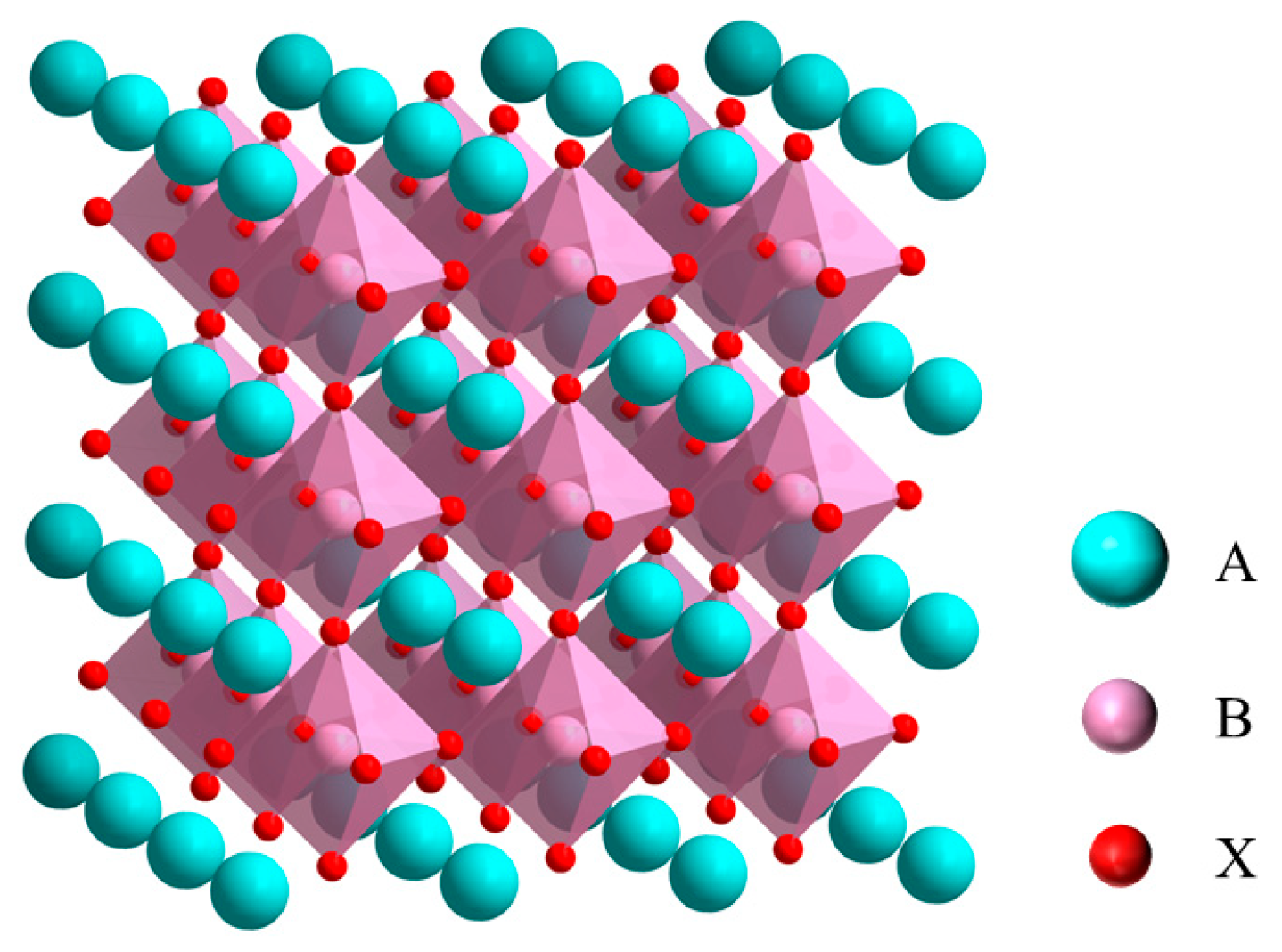
Perovskite, as an important inorganic material, is a kind of crystal structure with a perovskite structure, which is often composed of a chemical formula with the ABX3 structure [11]. In this structure, A stands for a larger cation, B stands for a smaller cation, and X is an anion. The lattice structure of the perovskite crystal is the densest packing structure. As shown in Figure 1, cations A and B are distributed in the hexagonal close-packed gap in the form of an octahedron, and anion X is filled in the center of the octahedron composed of cations. Its general classification is shown in Table 1.
This structure endows the material with excellent photoelectric properties [12,13] and also brings significant stability challenges. The research process can be roughly divided into two stages. The first stage focuses on the improvement of photoelectric efficiency: in 2009, Miki Fujita and others synthesized CH3NH3PbX3 (X is Br or I) for the first time in Japan, and the efficiency increased to 3.81% [14]. However, compared with dye-sensitized solar cells [15,16] (11%), perovskite materials are unstable in a liquid electrolyte. In 2011, the Korean team [17] optimized the material structure, and the photoelectric conversion efficiency increased to 6.5%. In 2012, Michael Grätzel’s research group cooperated with Nam-Gyu Park [18] to use 9′-Spiro-OMeTAD as the solid hole transport layer, with an efficiency of 9.7%. Subsequently, the team of Oxford University [19] successfully improved the photoelectric conversion efficiency to 10.9% by combining the mesoporous structure. In the subsequent research, the photoelectric conversion efficiency has been continuously broken through, and the current laboratory certification efficiency has exceeded 25% [20]. In the second stage, it gradually turned to stability research: with the improvement of efficiency, the research on stability and heavy metal substitution was gradually paid attention to. Using all-inorganic components (such as CS) instead of organic cations has become an effective strategy to enhance stability [21,22]. Among them, lead cesium bromide (CsPbBr3) has become an important model system because of its stable cubic phase structure, suitable direct band gap (~2.3 eV), and excellent thermal and chemical stability [23]. Compared with organic–inorganic hybrid perovskite, such as MAPbI3, CsPbBr3 not only has a high open circuit voltage, but also shows stronger stability in a high temperature and high humidity environment, and has good light absorption characteristics, long carrier diffusion length, and effective carrier management ability [24], which shows broad prospects in photovoltaic and optoelectronic devices. The same excellent phase stability and thermal stability are one of the core advantages of CsPbBr3 [25]. In contrast, the tolerance factor of CsPbBr3 is closer to the ideal value, which enables it to stably exist in the orthogonal phase (Pnma space group) with a direct band gap at room temperature or even higher temperatures, showing excellent thermodynamic stability [26]. The experimental results show that CsPbBr3 single crystal exhibits good phase stability at high temperature and hydrothermal environment, which guarantees its practical application under harsh conditions. In order to give full play to its application potential, it is necessary to deeply understand the mechanical behavior and performance evolution of this material under external stress, which is very important for developing efficient, stable, and mechanically tolerant perovskite devices.
At present, the characterization of mechanical properties of perovskite mainly depends on macro-experimental techniques such as nano-indentation, which can measure parameters such as elastic modulus and hardness [27,28,29], and the existing simulation research focuses on the behavior of materials under a single load, while there is still a lack of systematic exploration on the mechanical behavior in the prestressed state, which is more common in actual working conditions; in particular, how prestress affects the deformation resistance and final structural stability of perovskite films during nano-indentation is still an unsolved key scientific problem. In this paper, the nano-indentation mechanical behavior of CsPbBr3 perovskite under prestress is studied at the atomic scale through systematic molecular dynamics simulation, and the influence of prestress magnitude and direction on its mechanical response law is revealed, which provides a theoretical and simulation basis for developing a multi-scale mechanical model and designing anti-fatigue perovskite thin-film devices.

2. Modeling and Simulation Details

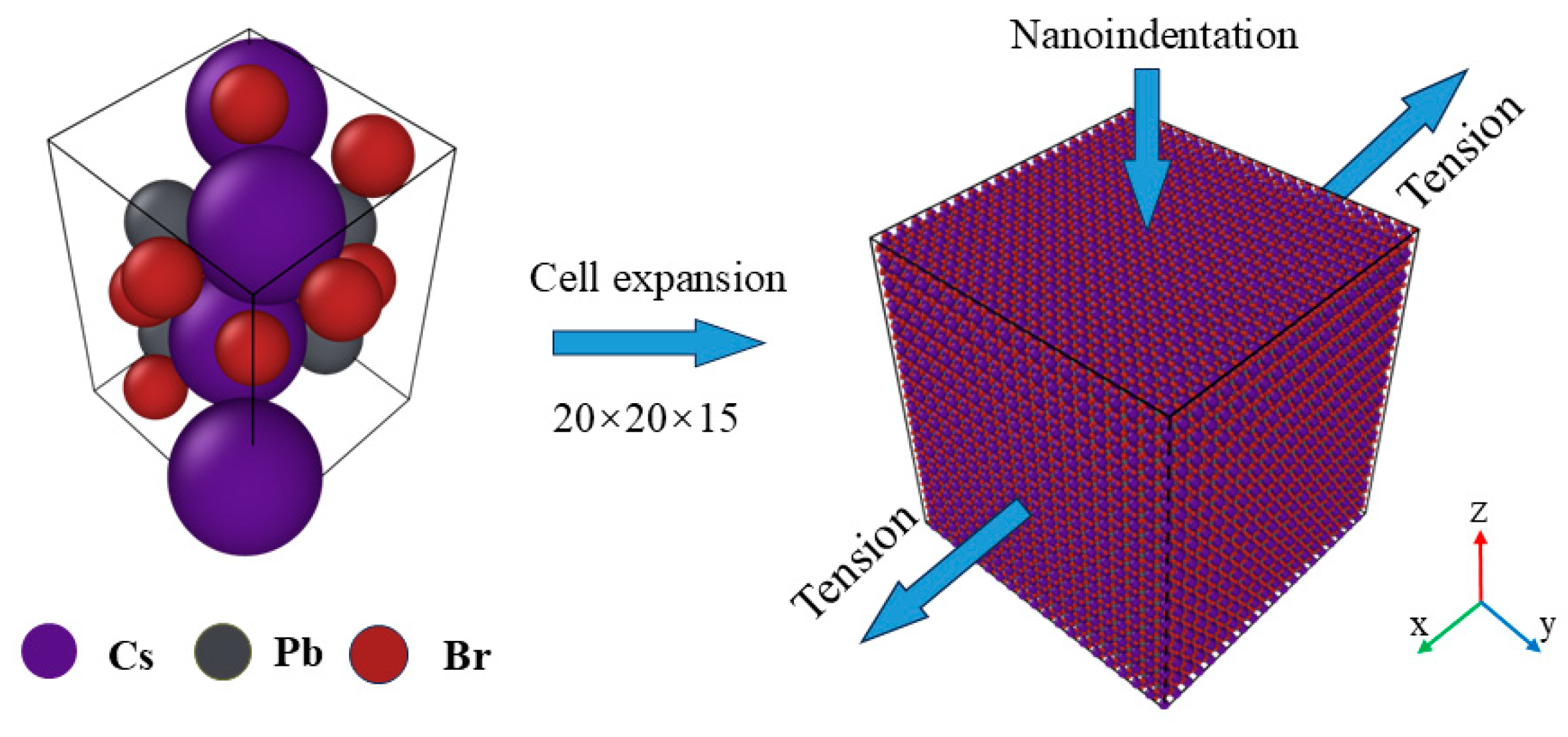
In this work, we choose to build a perovskite CsPbBr3 model as the simulation research object, use the large-scale molecular dynamics simulation software LAMMPS 2024 [30] to exert prestress, and carry out nano-indentation simulation analysis to study the characteristics of the model. The model of the CsPbBr3 simulation process is shown in Figure 2.
The unit cell is a Pnma orthogonal structure with lattice parameters of a = 8.101 Å, b = 8.453 Å, and c = 11.878 Å, and contains 20 atoms (4 Cs, 4 Pb, and 12 Br). In order to construct a molecular dynamics model with a reasonable size, a cubic CsPbBr3 simulation system with about 120,000 atoms was established in this study. Periodic boundary conditions were used in the simulation to eliminate the finite-size effect and reflect the mechanical behavior of materials in the macro state more truly. In order to accurately simulate the prestress state, uniaxial tensile loading along a specific direction was adopted, and the system was relaxed by 60 ps before loading, so as to eliminate the initial unreasonable configuration, minimize the energy of the system, and reach the set stable temperature. In the process of tensile simulation, the system is controlled by canonical ensemble (NPT), and the loading rate is set to 0.005 Å/ps. After completing different pre-strain loading, the boundary conditions of the model are adjusted accordingly, and the model is relaxed again under the NPT ensemble. Subsequently, the nano-indentation simulation is realized by a spherical rigid indenter with a radius of 65 Å, which squeezes the sample at a constant speed in the direction perpendicular to the surface of the film (Direction Z), so as to study its indentation response behavior in the prestressed state. This method is commonly used in MD simulation, and it is an option to balance the calculation cost and loading approximation [31].
In a molecular dynamics simulation, the potential function is a function that describes the interaction or influence between atoms or molecules that directly affect various properties of materials. The choice of the potential function of interatomic interaction determines the accuracy and reliability of the simulation, which is the core element of molecular dynamics calculations. For halide perovskite materials, the Lennard-Jones (LJ) potential and the Buckingham potential are the most commonly used types of atomic pair potentials. Among them, the LJ potential function is widely used in molecular dynamics simulation and many other fields because of its concise form, high calculation efficiency, and reasonable description of short-range repulsion and long-range attraction between atoms.
For ionic compounds, such as CsPbBr3, electrostatic interaction is very important, so this study describes the interaction between atoms in CsPbBr3 perovskite in the form of a superposition of the LJ potential function and Coulomb force [32], and its mathematical expression is as follows:
E t o t a l = i < j 4 ε i j σ i j r i j 12 σ i j r i j 6 + 1 4 π ε 0 i < j q i q j r i j
The formula mainly includes two parts:
(1) LJ potential (in square brackets): where ε i j represents the depth of the potential well of atoms i and j, reflecting the intensity of interaction; σ i j is the distance parameter between atoms corresponding to the zero potential energy point, which is related to atomic size; and r i j is the instantaneous distance between atoms i and j. The LJ potential itself contains two terms: σ i j r i j 12 terms represent short-range strong repulsion and σ i j r i j 6 terms represent long-range weak attraction.
(2) Coulomb potential: used to describe the long-range electrostatic interaction between charged particles. Where q i and q j are the charges of atoms i and j, respectively, ε 0 is the vacuum dielectric constant, and r i j is the distance between two atoms.
The charge parameters (CS is +0.5068e, Pb2+ is +1.0136e, and Br is −0.5068e) [32,33] and LJ parameters used in this study are determined based on the fitted force field data calculated by first principles to ensure the accuracy of the simulation. The parametric work of Pascazio et al. [32] has verified that the force field can reliably reproduce the phonon dispersion of CsPbBr3, thus effectively describing the deformation mechanism involving octahedral tilt. Although the accurate bond breaking energy needs a higher-level method, the force field still achieves a good balance between accuracy and calculation cost when simulating large-scale mechanical response. The stress used in the simulation is calculated based on the Virial theorem [34], and the stress tensor contains the contribution of interatomic interaction and heat transport. This calculation method is a standard method of stress calculation in molecular dynamics simulations, which is reasonable and widely accepted in most cases.

3. Results and Discussion

3.1. Model Stress–Strain Analysis

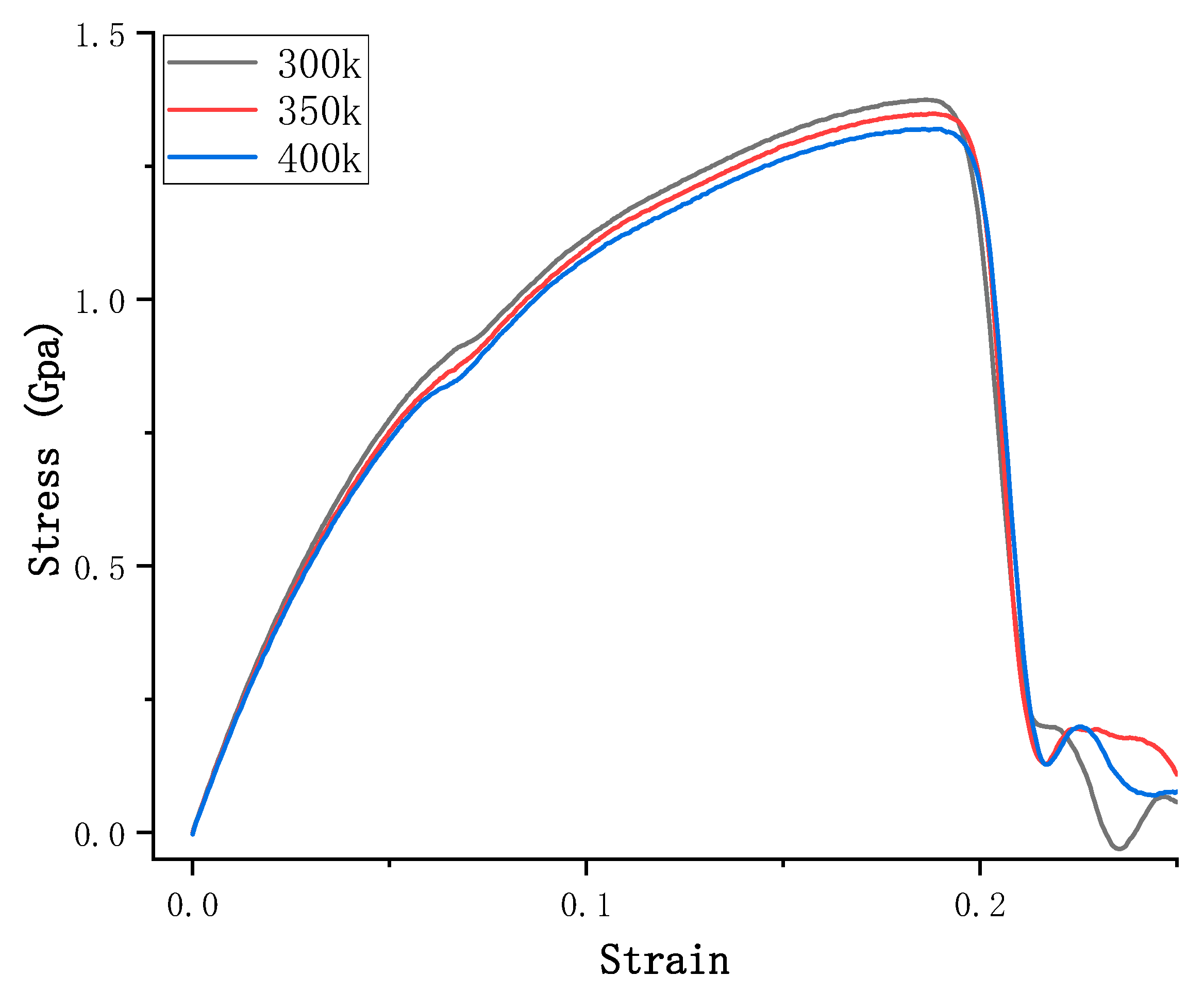
The orthogonal phase (Pnma) of CsPbBr3 is stable in the range of 300–400 K [35,36], and there is no cubic-tetragonal phase transformation, thus ensuring that the mechanical properties change mainly comes from thermal effect rather than phase transformation in this temperature range. We apply prestress in the X direction to the CsPbBr3 model and draw the stress–strain curves of the model under different temperatures, as shown in Figure 3.
The stress–strain curve analysis shows that the mechanical behavior of CsPbBr3 follows the deformation law of typical materials and goes through elastic deformation, yield, strengthening, and failure stages in turn. The simulated elastic modulus of CsPbBr3 is 16.05 GPa, 15.52 GPa, and 15.21 GPa at 300 K, 350 K, and 400 K, respectively. Among them, the simulation value (16.05 GPa) at 300 K is in good agreement with the experimental result (about 15.8 GPa [29]), which verifies the reliability of this simulation. The curve clearly shows that the tensile strength of the material decreases with the increase in temperature, indicating that its high temperature tolerance is limited and its mechanical properties are significantly dependent on temperature. At the same time, the fracture strain increases slightly with the increase in temperature. This shows that CsPbBr3 is brittle at room temperature, but it shows the characteristic of transition to toughness at higher temperatures [37]. In addition, the stress–strain curve shows an obvious yield plateau, and the strain corresponding to the yield point is about 0.07, which further proves that the material has plastic deformation ability under tensile load.

3.2. Model Nanoindentation Analysis

According to the tensile simulation results of CsPbBr3 at 300 K, its compression yield point corresponds to 7% strain. In order to study the influence of prestress on nano-indentation behavior of CsPbBr3, we selected the balanced size of the non-prestressed model (about 162.022 Å × 169.077 Å × 178.022 Å), and set seven pre-strain states of −6%, −4%, −2%, 0%, +2%, +4%, and +6% for a comparative study. The specific simulation flow is as follows: First, the model is subjected to tensile or compressive load at the rate of 0.005 Å/ps along the X direction until the target pre-strain is reached. It should be noted that the high loading rate used in the simulation may overestimate the material strength to some extent, which is the inherent scale limitation of the molecular dynamics method. Subsequently, the system is relaxed under an NPT ensemble, the temperature is maintained at 300 K, the stress in X and Y directions is controlled to be zero, and the dimension in Z direction is allowed to change freely to ensure the mechanical balance of the system. After the relaxation is completed, the indentation simulation stage is entered. At this stage, a thin layer of atoms at the bottom of the Z direction is fixed to simulate the constraint of a rigid substrate. At the same time, a spherical rigid indenter with a radius of 65 Å was used to press the sample surface in the negative direction of the Z axis at a constant speed until the indentation depth reached 65 Å. In the process of indentation, the temperature of the main part of the sample, except the fixed substrate, is controlled at 300 K by the NVT ensemble. During the whole simulation process, the force acting on the indenter and the trajectory of all atoms are continuously recorded to extract key mechanical response data such as the force-depth curve.
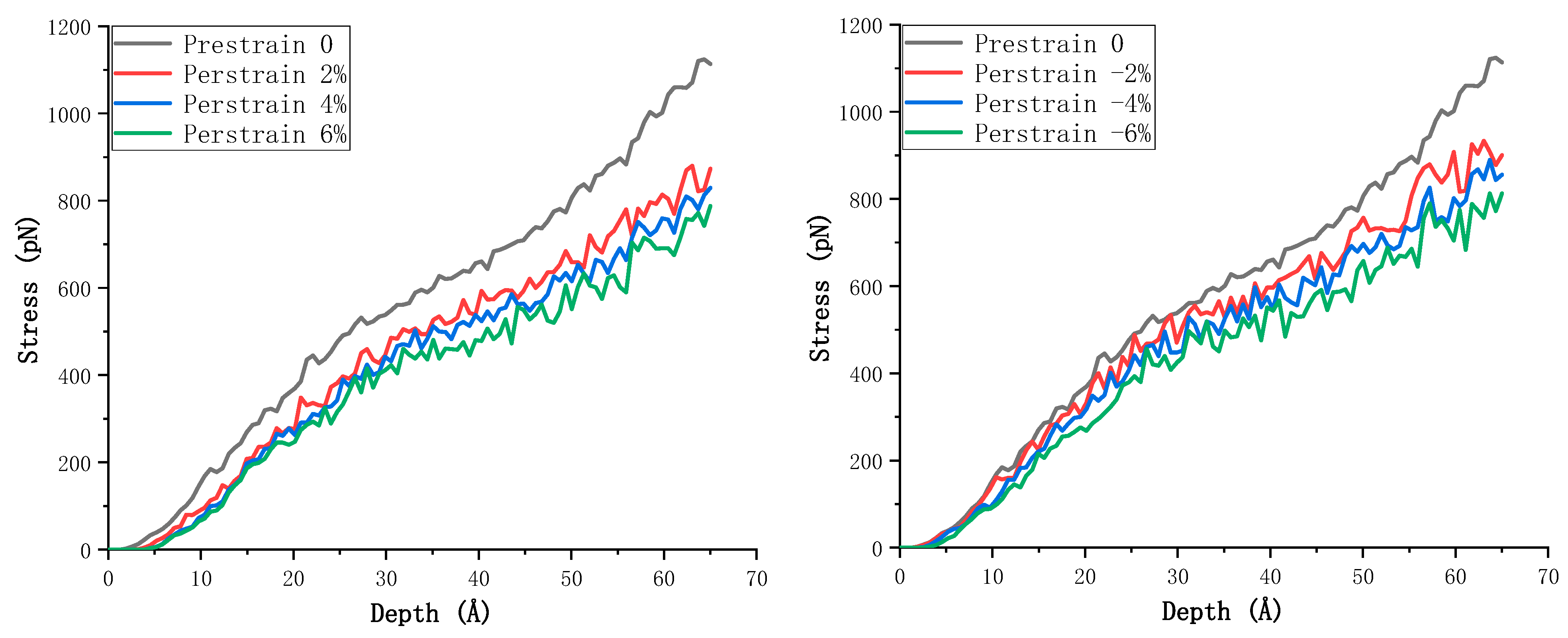
In this process, we output the force-depth curve of indentation, and the result is shown in Figure 4. The analysis shows that the introduction of pre-strain significantly affects the near-surface mechanical properties of materials. It is worth noting that under the same indentation depth, the indentation load corresponding to the non-prestressed condition is always the highest. In contrast, the curves under pre-tensile and pre-compression conditions are systematically below the non-prestressed curve. This shows that the smaller the prestress, the greater the force required to reach the same indentation depth, and the stronger the ability of the material to resist surface deformation, reflecting higher surface stability [38]. The above phenomenon reveals that pre-strain may induce some softening effect on the surface layer of the material, thus weakening its ability to resist the intrusion of the indenter and making the material more prone to plastic deformation [39]. In addition, the softening effect appears from the initial stage of indentation and persists throughout the indentation process, indicating that the influence of pre-strain on the near-surface mechanical behavior of materials is global and not limited to the superficial area.
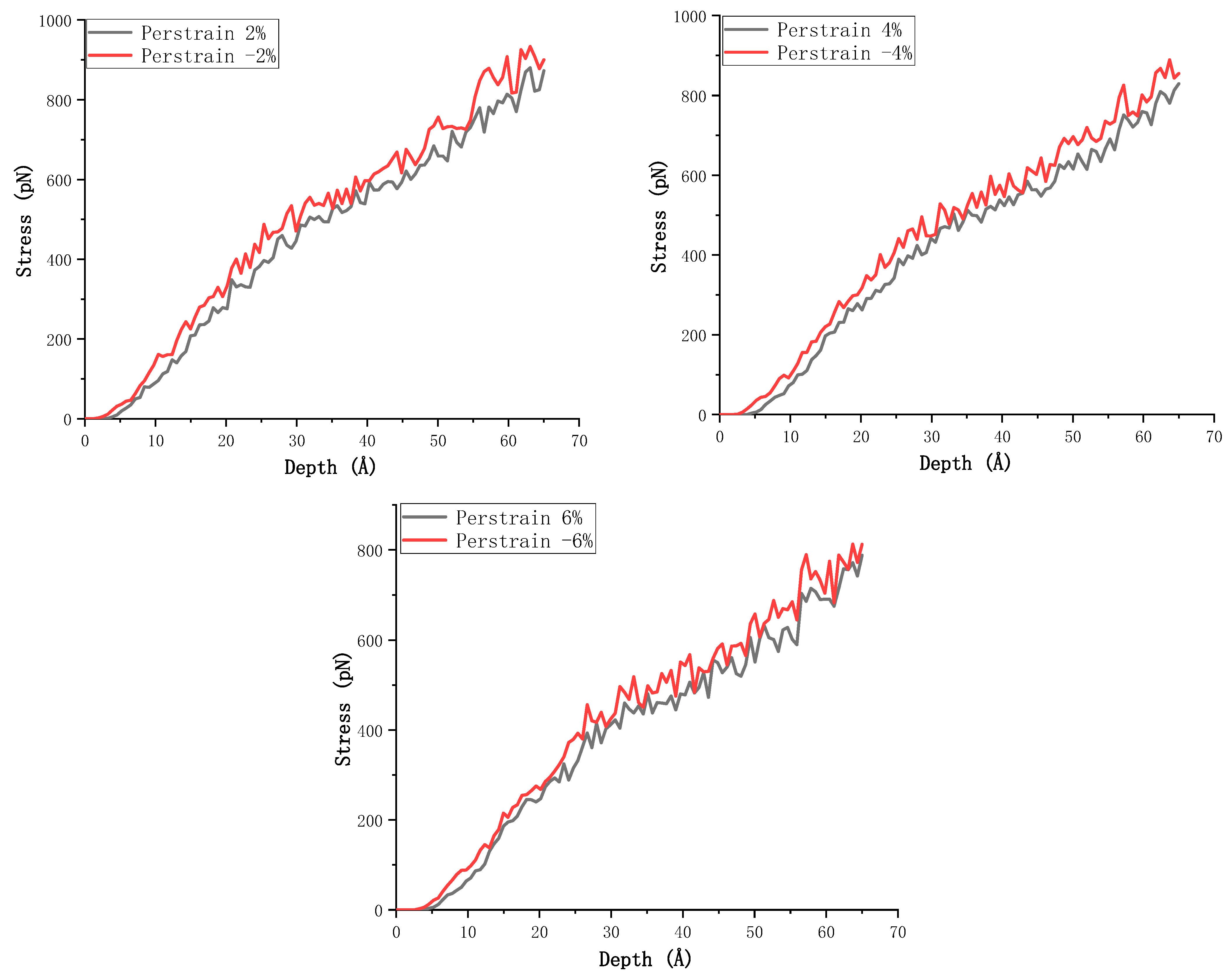
Figure 5 shows the stress-depth indentation curves of materials under three different pre-strain amplitudes. The analysis shows that at the initial stage of indentation, the curves corresponding to the same amplitude and opposite directions of pre-strain basically coincide, indicating that the response of the material surface to small depth indentation is mainly controlled by indentation itself, and the influence of pre-strain type has not yet appeared. However, with the increase in indentation depth, the curves began to separate systematically. Under the same indentation depth, the indentation stress corresponding to the compressive pre-strain model is always significantly higher than that of the tensile pre-strain model with the same amplitude. The results show that, in the plastic deformation dominant stage of indentation, although all prestress conditions show overall softening compared with the non-prestressed state, there are differences in the degree of softening between prestresses in different directions. Specifically, tensile prestress induces a more significant softening effect, which makes the material more easily deformed during indentation. Although compressive prestress also leads to softening, its degree is relatively weak, so that the material still maintains a relatively high ability to resist the intrusion of the indenter. This is because tensile pre-strain creates more favorable conditions for dislocation movement and plastic deformation in the subsequent indentation process by inducing lattice expansion [40,41,42], reducing the binding energy between atoms, and introducing defects in advance. In contrast, although the compressive pre-strain has enhanced the local resistance due to lattice densification [43] and shortened atomic spacing, its overall softening is still due to pre-damage, but the softening degree is weaker than that of the tensile case. Therefore, under the same indentation depth, compared with the tensile pre-strain model with the same amplitude, the compressive pre-strain model always shows higher bearing capacity, which indicates that the material has better structural stability under this condition.

4. Conclusions

In this study, the nano-indentation mechanical behavior of CsPbBr3 perovskite in a pre-stressed state was deeply explored by molecular dynamics simulation, and the main conclusions were as follows:
  • The simulation of the mechanical properties of CsPbBr3 foundation shows that its stress–strain curve presents typical stages of elasticity, yield, strengthening, and failure, and the temperature dependence of mechanical properties (such as elastic modulus and tensile strength) is consistent with the existing experimental data, which confirms the reliability of this simulation method.
  • Whether the pre-strain is in the direction of tensile or compression, its existence will systematically reduce the mechanical response of CsPbBr3 during nano-indentation. Compared with the non-prestressed state, the load required to reach the same indentation depth under all pre-stressed conditions is significantly reduced, indicating that the pre-strain weakens the ability of the material to resist plastic deformation and induces the softening effect in the near-surface region.
  • Although both tensile pre-strain and compressive pre-strain will lead to material softening, their functions are different. In the dominant stage of indentation plastic deformation, the tensile pre-strain with the same amplitude causes a more obvious softening effect than the compressive pre-strain, which makes the material easier to deform and shows lower stability.
This study confirms that prestress is the core parameter to regulate the micromechanical behavior of perovskite. Therefore, in device design, actively adjusting residual stress should be as important as improving photoelectric efficiency, which is the key to ensuring the mechanical reliability and long-term stability of devices. Although the classical force field used in this paper has obvious advantages in computational efficiency and can effectively simulate the nano-indentation process of large-scale systems containing tens of thousands of atoms, it may have limitations in quantitatively describing key physical processes, such as the bond-breaking energy barrier. In addition, the conclusions of this study are mainly based on the CsPbBr3 system and specific force field parameters, so we should be cautious when extrapolating to other perovskite materials or actual device conditions. In the future, other force fields or methods combined with first-principles calculations can be considered to describe these processes more accurately and further verify the universality of the conclusions.

Author Contributions

Conceptualization, X.Y. and F.Z.; methodology, X.Y. and R.L.; software, K.Z. and R.L.; validation, R.L. and X.Y.; formal analysis, J.Y.; investigation, S.S.; resources, X.Y.; data curation, K.Z.; writing—original draft preparation, X.Y. and K.Z.; writing—review and editing, K.Z. and R.L.; visualization, K.Z.; supervision, S.S. and J.Y.; project administration, F.Z.. All authors have read and agreed to the published version of the manuscript.

Funding

This research received no external funding.

Institutional Review Board Statement

Not applicable.

Informed Consent Statement

Not applicable.

Data Availability Statement

The original contributions presented in this study are included in the article. Further inquiries can be directed to the corresponding author.

Conflicts of Interest

The authors declare no conflict of interest.

References

  1. Jia, L.; Ma, J.; Cheng, P.; Liu, Y. Perspective of solar energy-powered road and rail transportation in China. CSEE J. Power Energy Syst. 2020, 6, 760–771. [Google Scholar] [CrossRef]
  2. Envall, F.; Andersson, D.; Wangel, J. Gridlocked: Sociomaterial configurations of sustainable energy transitions in Swedish solar energy communities. Energy Res. Soc. Sci. 2023, 102, 103200. [Google Scholar] [CrossRef]
  3. Yoo, J.J.; Seo, G.; Chua, M.R.; Park, T.G.; Lu, Y.; Rotermund, F.; Kim, Y.-K.; Moon, C.S.; Jeon, N.J.; Correa-Baena, J.-P.; et al. Efficient perovskite solar cells via improved carrier management. Nature 2021, 590, 593. [Google Scholar] [CrossRef]
  4. Wang, T.; Deng, W.; Cao, J.; Yan, F. Recent Progress on Heterojunction Engineering in Perovskite Solar Cells. Adv. Energy Mater. 2022, 13, 2201436. [Google Scholar] [CrossRef]
  5. Cheng, J.; Liu, F.; Tang, Z.; Li, Y. Scalable Blade Coating: A Technique Accelerating the Commercialization of Perovskite-Based Photovoltaics. Energy Technol. 2021, 9, 2100204. [Google Scholar] [CrossRef]
  6. Christians, J.A.; Schulz, P.; Tinkham, J.S.; Schloemer, T.H.; Harvey, S.P.; de Villers, B.J.T.; Sellinger, A.; Berry, J.J.; Luther, J.M. Tailored interfaces of unencapsulated perovskite solar cells for >1000 hour operational stability. Nat. Energy 2018, 3, 68–74. [Google Scholar] [CrossRef]
  7. Wang, R.; Mujahid, M.; Duan, Y.; Wang, Z.-K.; Xue, J.; Yang, Y. A Review of Perovskites Solar Cell Stability. Adv. Funct. Mater. 2019, 29, 1808843. [Google Scholar] [CrossRef]
  8. Afre, R.A.; Pugliese, D. Perovskite Solar Cells: A Review of the Latest Advances in Materials, Fabrication Techniques, and Stability Enhancement Strategies. Micromachines 2024, 15, 192. [Google Scholar] [CrossRef]
  9. Mazumdar, S.; Zhao, Y.; Zhang, X. Stability of Perovskite Solar Cells: Degradation Mechanisms and Remedies. Front. Electron. 2021, 2, 712785. [Google Scholar] [CrossRef]
  10. Maraveas, C.; Kyrtopoulos, I.-V.; Arvanitis, K.G.; Bartzanas, T. The Aging of Polymers under Electromagnetic Radiation. Polymers 2024, 16, 689. [Google Scholar] [CrossRef] [PubMed]
  11. Anaya, M.; Lozano, G.; Calvo, M.E.; Míguez, H. ABX3 Perovskites for Tandem Solar Cells. Joule 2017, 1, 793. [Google Scholar] [CrossRef]
  12. Kim, E.-B.; Akhtar, M.S.; Shin, S.; Ameen, S.; Nazeeruddin, M.K. A review on two-dimensional (2D) and 2D-3D multidimensional perovskite solar cells: Perovskites structures, stability, and photovoltaic performances. J. Photochem. Photobiol. C Photochem. Rev. 2021, 48, 100405. [Google Scholar] [CrossRef]
  13. Liu, X.; Xu, W.; Bai, S.; Jin, Y.; Wang, J.; Friend, R.H.; Gao, F. Metal halide perovskites for light-emitting diodes. Nat. Mater. 2020, 20, 21. [Google Scholar] [CrossRef] [PubMed]
  14. Kojima, A.; Teshima, K.; Shirai, Y.; Miyasaka, T. Organometal halide perovskites as visible-light sensitizers for photovoltaic cells. J. Am. Chem. Soc. 2009, 131, 6050–6051. [Google Scholar] [CrossRef] [PubMed]
  15. O’Regan, B.; Grätzel, M. A low-cost, high-efficiency solar cell based on dye-sensitized colloidal TiO2 films. Nature 1991, 353, 737–740. [Google Scholar] [CrossRef]
  16. Hagfeldt, A.; Boschloo, G.; Sun, L.; Kloo, L.; Pettersson, H. Dye-sensitized solar cells. Chem. Rev. 2010, 110, 6595–6663. [Google Scholar] [CrossRef]
  17. Im, J.H.; Lee, C.R.; Lee, J.W.; Park, S.W.; Park, N.G. 6.5% efficient perovskite quantum-dot-sensitized solar cell. Nanoscale 2011, 3, 4088–4093. [Google Scholar] [CrossRef]
  18. Kim, H.S.; Lee, C.R.; Im, J.H.; Lee, K.B.; Moehl, T.; Marchioro, A.; Moon, S.-J.; Humphry-Baker, R.; Yum, J.-H.; Moser, J.E.; et al. Lead iodide perovskite sensitized all-solid-state submicron thin film mesoscopic solar cell with efficiency exceeding 9%. Sci. Rep. 2012, 2, 591. [Google Scholar] [CrossRef]
  19. Perovskites, O.H. Efficient hybrid solar cells based on meso-superstructured. Phys. Rev. Lett. 2004, 92, 210403. [Google Scholar]
  20. Kim, J.Y.; Lee, J.-W.; Jung, H.S.; Shin, H.; Park, N.-G. High-Efficiency Perovskite Solar Cells. Chem. Rev. 2020, 120, 7918. [Google Scholar] [CrossRef]
  21. Fu, Y.; Zhu, H.; Stoumpos, C.C.; Ding, Q.; Wang, J.; Kanatzidis, M.G.; Zhu, X.; Jin, S. Broad Wavelength Tunable Robust Lasing from Single-Crystal Nanowires of Cesium Lead Halide Perovskites (CsPbX3, X = Cl, Br, I). ACS Nano 2016, 10, 7972. [Google Scholar] [CrossRef] [PubMed]
  22. Yuan, Y.; Yan, G.; Hong, R.; Liang, Z.; Kirchartz, T. Quantifying Efficiency Limitations in All-Inorganic Halide Perovskite Solar Cells. Adv. Mater. 2022, 34, e2108132. [Google Scholar] [CrossRef]
  23. Kulbak, M.; Gupta, S.; Kedem, N.; Levine, I.; Bendikov, T.; Hodes, G.; Cahen, D. Cesium Enhances Long-Term Stability of Lead Bromide Perovskite-Based Solar Cells. J. Phys. Chem. Lett. 2015, 7, 172. [Google Scholar] [CrossRef]
  24. Mumtaz, S.; Rizwan, M.; Ullah, M.A.; Ali, S.; Usman, Z.; Mahmood, T. Unveiling pressure-driven tunability of structural, electronic, mechanical and optical characteristics in CsPbBr3 based on a DFT study. Next Mater. 2025, 8, 100761. [Google Scholar] [CrossRef]
  25. Han, D.; Yang, K.; Bai, C.; Chen, F.; Sun, Z.; Wang, Y.; Ji, H.; Yang, Z.; Tang, X. Thermal and Chemical Durability of Metal Halide Perovskite CsPbBr3 Single Crystals. Chem. Eng. J. 2023, 475, 146209. [Google Scholar] [CrossRef]
  26. Ullah, S.; Wang, J.; Yang, P.; Liu, L.; Yang, S.-E.; Xia, T.; Guo, H.; Chen, Y. All-inorganic CsPbBr3 perovskite: A promising choice for photovoltaics. Mater. Adv. 2021, 2, 646–683. [Google Scholar] [CrossRef]
  27. Dai, Z.; Doyle, M.C.; Liu, X.; Hu, M.; Wang, Q.; Athanasiou, C.E.; Liu, Y.; Sheldon, B.W.; Gao, H.; Liu, S.; et al. The mechanical behavior of metal-halide perovskites: Elasticity, plasticity, fracture, and creep. Scr. Mater. 2022, 223, 115064. [Google Scholar] [CrossRef]
  28. Hussain, S.; Rehman, J.U. Investigation of structural; electronic; optical, and mechanical properties of perovskite CsPbBr3 material through induced pressure for photovoltaic applications: A DFT Insights. Comput. Theor. Chem. 2024, 1241, 114889. [Google Scholar] [CrossRef]
  29. Rakita, Y.; Cohen, S.; Kedem, N.; Hodes, G.; Cahen, D. Mechanical properties of APbX3 (A = Cs or CH3NH3; X = I or Br) perovskite single crystals. MRS Commun. 2015, 5, 623–629. [Google Scholar] [CrossRef]
  30. Plimpton, S. Fast Parallel Algorithms for Short-Range Molecular Dynamics. J. Comput. Phys. 1995, 117, 1–19. [Google Scholar] [CrossRef]
  31. Peng, C.; Zeng, F.; Yuan, B.; Wang, Y. An MD simulation study to the indentation size effect of polystyrene and polyethylene with various indenter shapes and loading rates. Appl. Surf. Sci. 2019, 492, 579–590. [Google Scholar] [CrossRef]
  32. Pascazio, R.; Zaccaria, F.; van Beek, B.; Infante, I. Classical force-field parameters for CsPbBr3 perovskite nanocrystals. J. Phys. Chem. C 2022, 126, 9898–9908. [Google Scholar] [CrossRef]
  33. Zhou, X.; Doty, F.; Yang, P. Atomistic simulation study of atomic size effects on B1 (NaCl), B2 (CsCl), and B3 (zinc-blende) crystal stability of binary ionic compounds. Comput. Mater. Sci. 2011, 50, 2470–2481. [Google Scholar] [CrossRef]
  34. Zhou, M. A new look at the atomic level virial stress: On continuum-molecular system equivalence. Proc. R. Soc. A Math. Phys. Eng. Sci. 2003, 459, 2347–2392. [Google Scholar] [CrossRef]
  35. Hoffman, A.E.J.; Saha, R.A.; Borgmans, S.; Puech, P.; Braeckevelt, T.; Roeffaers, M.B.J.; Steele, J.A.; Hofkens, J.; Van Speybroeck, V. Understanding the phase transition mechanism in the lead halide perovskite CsPbBr3 via theoretical and experimental GIWAXS and Raman spectroscopy. APL Mater. 2023, 11, 041124. [Google Scholar] [CrossRef]
  36. Rodová, M.; Brožek, J.; Knížek, K.; Nitsch, K. Phase transitions in ternary caesium lead bromide. J. Therm. Anal. Calorim. 2003, 71, 667–673. [Google Scholar] [CrossRef]
  37. Mahmood, Q.; Yaseen, M.; Hassan, M.U.; Rashid, M.S.; Tlili, I.; Laref, A. The first-principle study of mechanical, optoelectronic and thermoelectric properties of CsGeBr3 and CsSnBr3 perovskites. Mater. Res. Express 2018, 6, 045901. [Google Scholar] [CrossRef]
  38. Zhao, J.; Deng, Y.; Wei, H.; Zheng, X.; Yu, Z.; Shao, Y.; Shield, J.E.; Huang, J. Strained hybrid perovskite thin films and their impact on the intrinsic stability of perovskite solar cells. Sci. Adv. 2017, 3, Eaao5616. [Google Scholar] [CrossRef] [PubMed]
  39. Li, S.; Zhao, Y.; Cui, J.; Yu, Z.; Kou, L. Ultrasonic energy attenuation characteristics in plastic deformation of 2219-O aluminum alloy. Int. J. Adv. Manuf. Technol. 2022; under review. [Google Scholar]
  40. Deng, Y.; Zhao, Y.; Xu, Y.; Dai, X.; Wang, S.; He, K.; Xu, Y.; He, L. Strain-tunable lattice and energy gap in bulk black phosphorus. AIP Adv. 2024, 14, 105212. [Google Scholar] [CrossRef]
  41. Du, T.; Macdonald, T.J.; Yang, R.X.; Li, M.; Jiang, Z.; Mohan, L.; Xu, W.; Su, Z.; Gao, X.; Whiteley, R.; et al. Additive-Free, Low-Temperature Crystallization of Stable α-FAPbI3 Perovskite. Adv. Mater. 2021, 34, 2107850. [Google Scholar] [CrossRef]
  42. Ghosh, D.; Acharya, D.; Zhou, L.; Nie, W.; Prezhdo, O.V.; Tretiak, S.; Neukirch, A.J. Lattice Expansion in Hybrid Perovskites: Effect on Optoelectronic Properties and Charge Carrier Dynamics. J. Phys. Chem. Lett. 2019, 10, 5000–5007. [Google Scholar] [CrossRef] [PubMed]
  43. Xiong, K.; Huang, L.; Wang, X.; Yu, L.; Feng, W. Cooling-Rate Effect on Microstructure and Mechanical Properties of Al0.5CoCrFeNi High-Entropy Alloy. Metals 2022, 12, 1254. [Google Scholar] [CrossRef]
Figure 1. Structure diagram of perovskite.
Coatings 16 00212 g001
Figure 2. Three-dimensional model of tensile and indentation.
Coatings 16 00212 g002
Figure 3. Tensile stress–strain curves at different temperatures.
Coatings 16 00212 g003
Figure 4. Pressure-depth curves of CsPbBr3 under different pre-strain.
Coatings 16 00212 g004
Figure 5. Comparison of pressure-depth curves of CsPbBr3 under different pre-strain directions.
Coatings 16 00212 g005
Table 1. Classification of perovskites.
A+B2+X
Cs+Pb2+Cl
MA+Sn2+Br
FA+ I
Disclaimer/Publisher’s Note: The statements, opinions and data contained in all publications are solely those of the individual author(s) and contributor(s) and not of MDPI and/or the editor(s). MDPI and/or the editor(s) disclaim responsibility for any injury to people or property resulting from any ideas, methods, instructions or products referred to in the content.