Article

Comparative Analysis of Microstructure, Phase Composition, and Wear Characterization of Fe-Cr-C, Fe-Mn-Mo-B, and Ni-WC Hardfacing Alloys


1
Department of Manufacturing Systems, Faculty of Mechanical Engineering and Robotics, AGH University of Krakow, A. Mickiewicza 30, 30-059 Krakow, Poland
2
Department of Computerized Mechanical Engineering, Institute of Engineering Mechanics and Robotics, Ivano-Frankivsk National Technical University of Oil and Gas, Karpatska 15, 076019 Ivano-Frankivsk, Ukraine
3
Department of Technical Mechanics, Engineering and Computer Graphics, Institute of Engineering Mechanics and Robotics, Ivano-Frankivsk National Technical University of Oil and Gas, Karpatska 15, 076019 Ivano-Frankivsk, Ukraine
*
Authors to whom correspondence should be addressed.
Coatings 2026, 16(2), 178; https://doi.org/10.3390/coatings16020178
Submission received: 25 December 2025 / Revised: 22 January 2026 / Accepted: 26 January 2026 / Published: 30 January 2026

Highlights

  • There exists a correlation between the proportional amount of carbides in the al-loy and the Hs hardness.
  • The volumetric loss is inversely proportional to the proportional amount of car-bides present in the alloy.
  • Ni-W-B-C wire (alloy C) exhibits the most favorable combination of characteris-tics for enhanced wear resistance, yet it may not be the best cost-effective choice in less demanding cases. Its resistance relies on a high amount of macrocrystalline tungsten-based carbides.
  • The experimental, tungsten-free hardfacing alloy D of Fe-Mo-Mn-B composition demonstrated only slightly less wear resistance (at about 85% of that of alloy C) due to the presence of ternary boride—Mo2(Fe,Mn)B2. The experimental Fe–Mo–Mn–B hardfacing alloy (Alloy D) can potentially be less expensive than its MTC-based counterpart (Ni–WC, Alloy C).
  • The two other chromium-based alloys (A—9.5% Cr & B—30% Cr) exhibit lower wear resistance (about 30% and 45% of alloy C, respectively), despite a high con-tent of hard chromium carbides. This phenomenon can be attributed to the lower micro-hardness of the alloy carbide constituents, especially when comparing their hardness to WC crystals.

Abstract

Wear resistance of hardfaced or cladded protective layers is commonly assessed through hardness measurements. Traditionally, this involves single-point diamond indenter tests. However, in complex cladding alloys, such methods often yield inconsistent results due to significant differences between the hardness of the metallic matrix and harder constituents, such as carbides or nitrides. To address this, the authors performed a series of scratch tests on four wear-resistant hardfacing materials. The method involves producing a scratch under constant load on a polished bead surface and measuring the resulting groove width as an indirect measure of hardness and wear behavior. The study focuses on four FCAW hardfacing wires: a Cr-Si-C-Mn solid cored wire (Alloy A), a Cr-Mo-C-Si-Mn cored wire (Alloy B), a nickel-sheathed macrocrystalline tungsten carbide cored wire (Alloy C), and an original Fe(Mn)-Mo-B-C hardfacing alloy (Alloy D) developed by one of the authors. All materials were deposited on C45 steel substrates. Comparative analysis included scratch tests, abrasion wear tests, and thermodynamic modeling. The scratch test approach proved effective in evaluating and optimizing deposition parameters to achieve improved wear resistance of the investigated Fe–Cr–C, Ni–WC, and Fe–Mo–Mn–B hardfacing systems.

1. Introduction

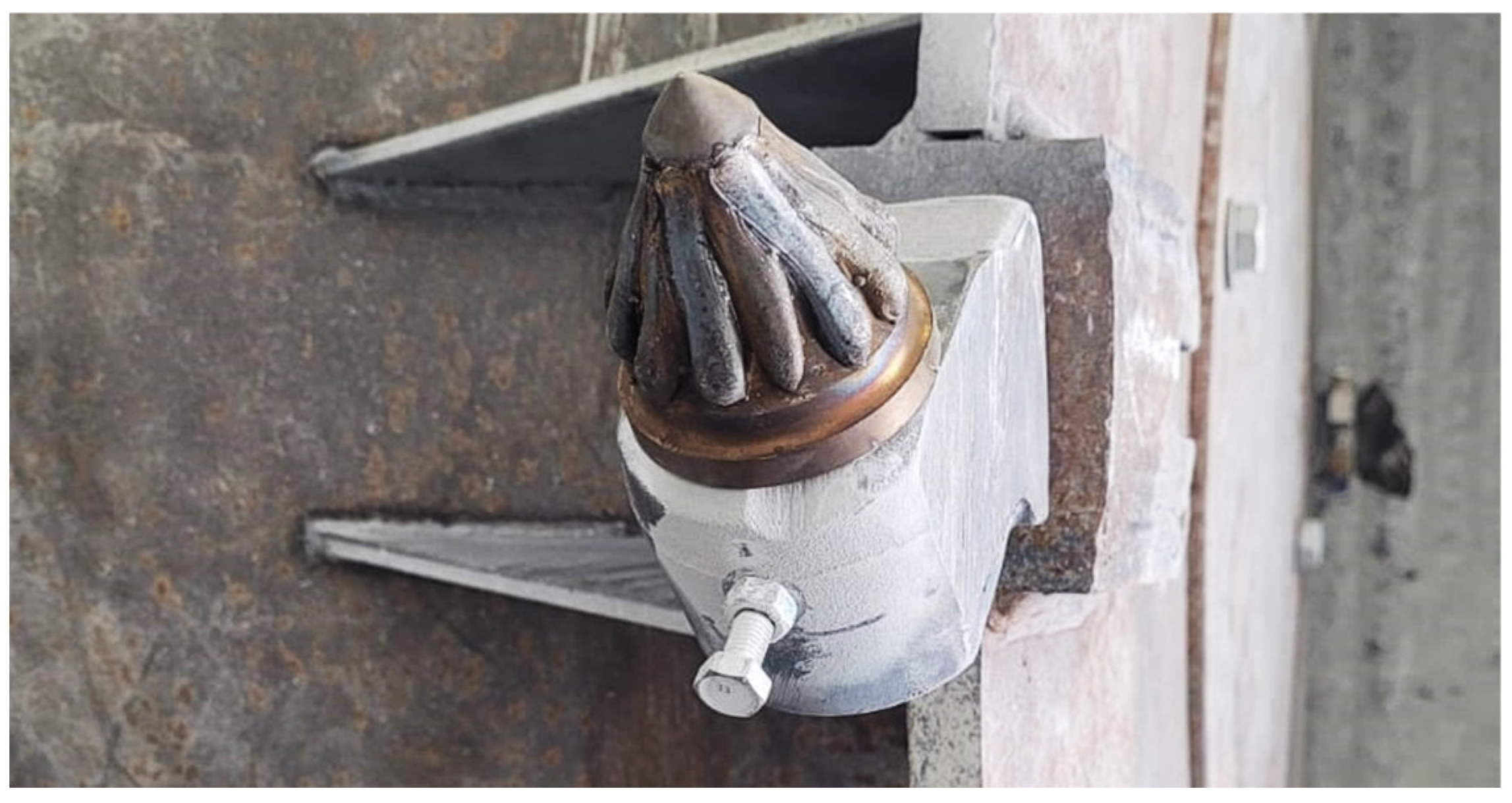
The wear of machine parts is an inevitable process, accompanying the operation of any given mechanism [1,2]. Although it is impossible to prevent it, it can be postponed by increasing the wear resistance of the superficial layer [3,4]. There are many technologies allowing for the increase in the lifespan of the part’s operability, for instance, heat treatment [5,6], mechanical treatment [7,8,9], chemical treatment [10,11,12,13,14] or a combination of the above [15]. Those processes result in a relatively thin protective layer, and whilst it proves itself suitable in many cases, some applications require thicker overlays. Examples of such applications can be found in agricultural [16] and mineral extraction (Figure 1) and processing industries [17], and metal forming tools [18], where hardfacing and thermal spraying [19,20] processes may appear indispensable [21,22,23,24].
Nowadays, the manufacturers of hardfacing consumables offer a wide variety of materials. Some of those materials are easy to apply within a wide range of process parameters while preserving plausible protective properties. However, more advanced materials [25,26,27,28,29,30] require more attention, but if the input parameters are set properly, they provide high wear resistance [31,32]. In order to estimate the desired set of parameters, a series of destructive tests needs to be carried out. Commonly, the inspected properties are the following: weld bead shape and dimensions, microstructure of the overlay and the heat-affected zone and the hardness [33,34]. All of the aforementioned properties require specific inspection techniques to provide reliable results, yet the hardness test results of specific compositions of the hard-faced layer can be misleading [35]. The hardfaced protective layer fabricated with specific cored wires can seemingly be all-metallic, where the main constituent of its hardness properties are the carbides [36,37,38,39]. In some cases etching the polished cut-out can give information about carbide location and segregation type [40,41,42,43]. There also exist some methods to analytically predict the hardness distribution [44], but those methods are only suitable for non-complex alloys, which excludes advanced wear-resistant overlays.
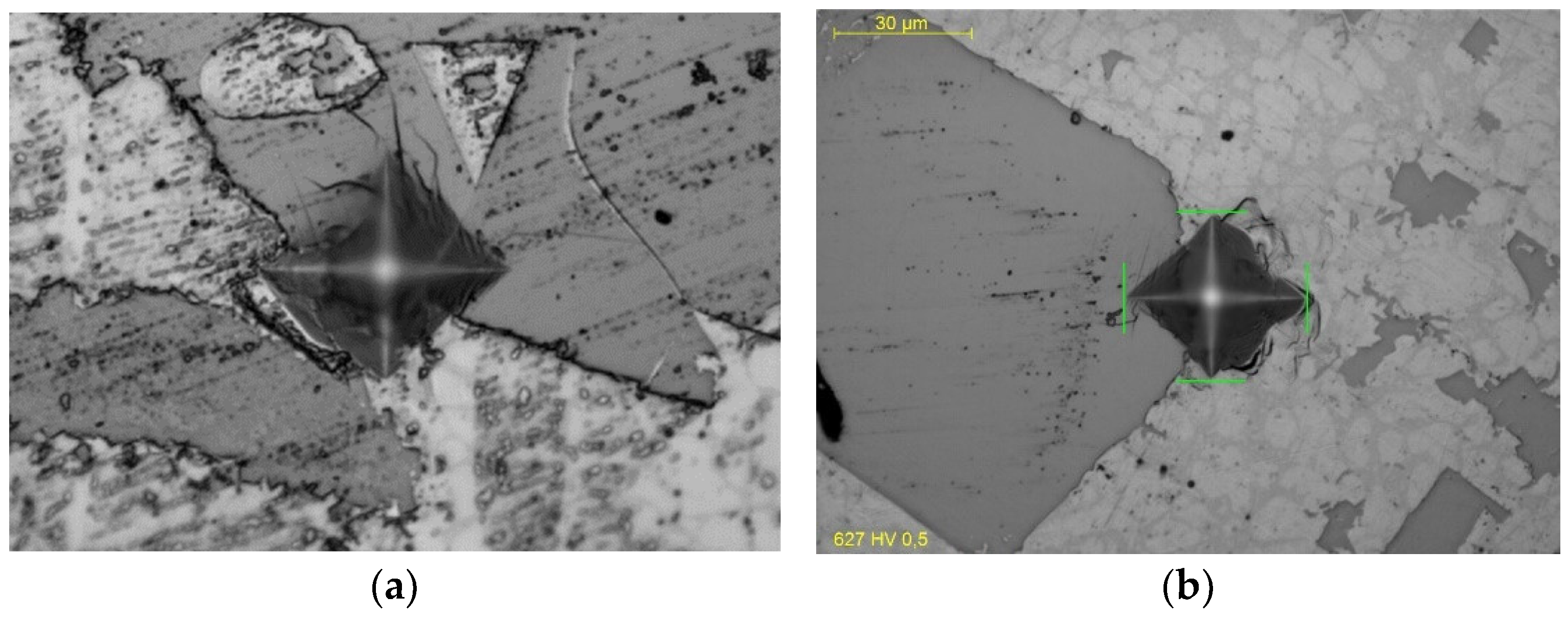
Additionally, when measuring the hardness of complex cladding alloy with heterogeneous precipitations, it is possible to read the values incorrectly due to plastic deformation of the hardfaced layer by pressing the harder carbide or nitride into the softer matrix (Figure 2).
Even though there are many hardness measuring methods, most of them rely on measuring the indent left by a standardized indenter pressed onto the sample surface with known force [45,46]. Dynamic methods are able to provide the hardness value by measuring the bounce of a free-falling or projected metal ball (for instance the Leeb method); however, this method does not allow us to obtain reliable results of carbide micro-hardness [47,48].
All of the mentioned methods are vulnerable to the possibility of omitting the less visible carbides, even when one measures multi-point micro-hardness with dense mesh [49]. To overcome this inconvenience, another method is required. In this case, the authors decided to utilize the less popular but well-established “scratch test hardness test” approach. This approach relies on fabricating a scratch of linear trajectory with the use of a diamond tip on the polished surface in selected areas of the metal composite. Such an approach offers to obtain hardness values in the form of a quasi-continuous signal, thus allowing one to read hardness values of the hardfacing matrix and carbides separately without careful planning of the location of the indent. The authors believe that it can observably reduce the measurement errors while decreasing the duration of the test.
In this paper, scratches were made in three distinctive locations of the weld bead cross section—the area containing the hardfaced layer, the interlayer, and the area in HAZ. This method was examined on four different cladding materials, namely high alloy Cr-Si-C-Mn solid cored wire, Cr-Mo-C-Si-Mn cored wire, nickel-sheathed macrocrystalline tungsten carbide cored wire, and original Fe(Mn)-Mo-B-C wire, developed by one of the Authors. The materials listed above were applied on C45 (DIN 1.0503/ISO 683-1 1987) steel with incrementally changing voltage and deposition intervals. The wear test and hardness results were referred to the untreated C45 steel sample.
Additionally, thermodynamic modelling of all the studied alloys was conducted to correlate the input parameters with hardness results and the carbide-forming temperature range. The results of the hardness scratch test were compared with traditional Vickers hardness measurements from previous studies [50,51]. In order to confirm the results, a series of abrasive tests was carried out. The tests show that the more carbides are present in the alloys, the greater is their maximal wear resistance. Additionally, the authors have found a “sweet-spot” for one of the tested materials, which results in very high hardness of the interlayer.

2. Materials and Methods

2.1. Materials

The following hardfacing alloys were selected for the comparative study of the wear resistance of FCAW (Flux-Cored Arc Welding) materials from different alloy systems: EnDOtec DO*351 (Fe-Cr-C—later described as Alloy A), EnDOtec DO*332 (Fe-Cr-Mo-C, later referred to as Alloy B), EnDOtec DO*611x (MTC-Ni, referred to as Alloy C), and an experimental alloy of an Fe(Mn)-Mo-B-C system described in [32,52], further referred to as Alloy D. The typical chemical composition of the hardfaced layers for each alloy is shown in Table 1. The hardfacing process for all alloys was conducted using an original numerically controlled machine (NaPawlik v2.0, AGH University of Science and Technology), designed and built by one of the authors [50]. This machine allows for precise and repeatable control of voltage, gas flow, wire feed, and welding speed during the GMAW/FCAW process. In the current study the variable parameters included the time of deposition (500–1750 ms with a 250 ms step) and voltage level (19–24 V with a 2.5 V step). The amperage of the droplet fabrication was a result of the aforementioned parameters and material type and remained within 120–300 A.
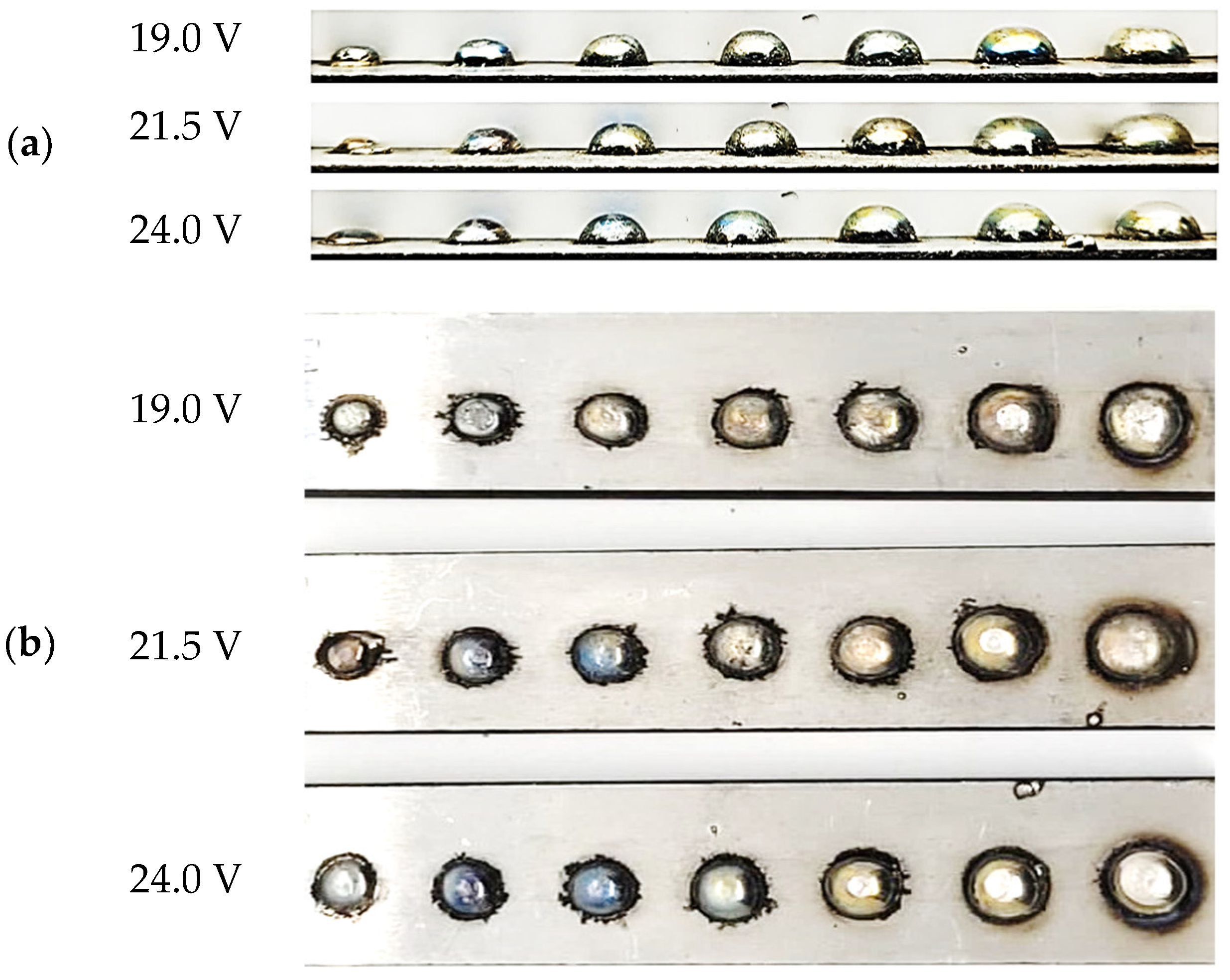
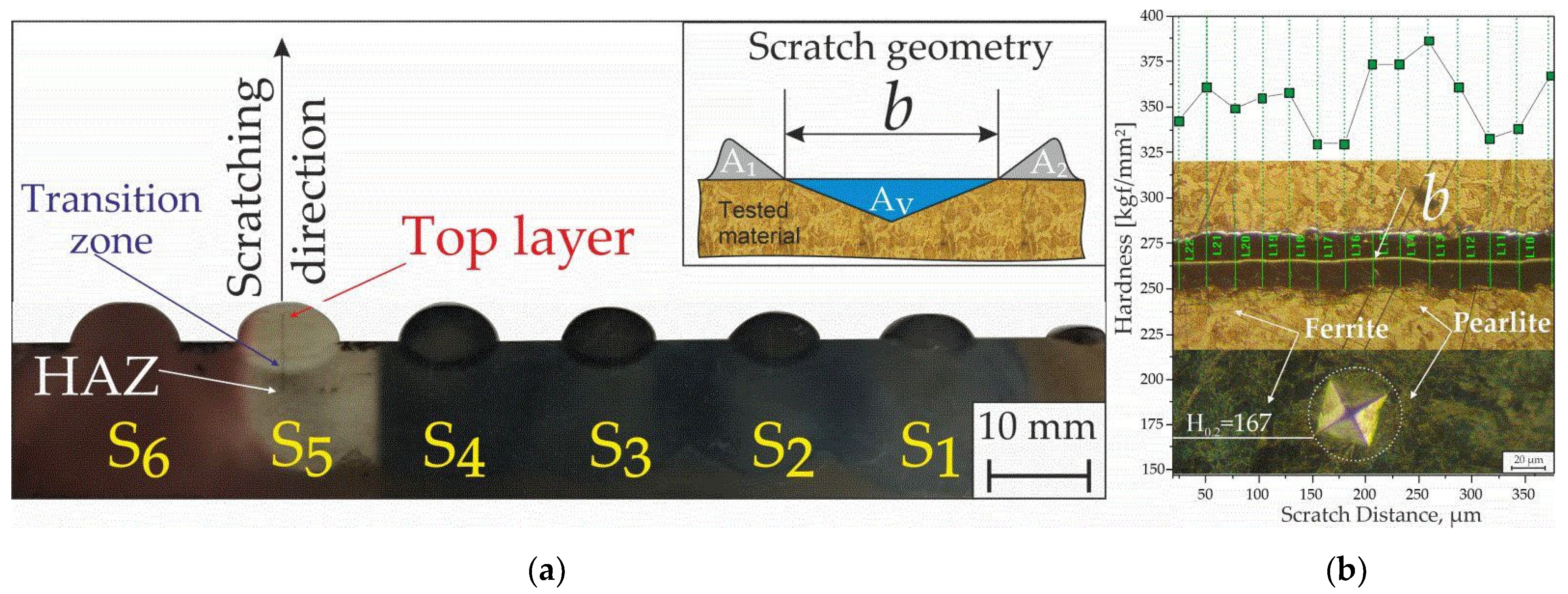
The first hemisphere deposited on each steel bar visible in Figure 3 was not measured nor taken into further investigation since it acted as a running start for every set of samples.
The comparative abrasion tests were carried out using the test machine described in [53] according to the ASTM G65 dry sand/rubber wheel standard (Procedure A). A chlorobutyl rubber wheel (hardness ≈ A60) was used as the counter-body. To ensure severe abrasive conditions, strictly classified crushed silica sand (SiO2) with a grain size of 0.2–0.4 mm was utilized as the abrasive agent. The tests were conducted under a normal load of 130 N with a total sliding distance of 6600 m. For each hardfacing material, three samples of the same composition were tested to obtain an average mass loss value, and C45 medium carbon steel without heat treatment was used as the reference material. For each hardfacing material, three samples of the same composition were tested to obtain an average mass loss value, and C45 medium carbon steel without heat treatment was used as the reference material. The morphology of the worn surfaces was studied using electron microscopy (Phenom XL, Nanoscience Instruments, USA).

2.2. Thermodynamic Analysis

To predict the phase composition and properties of the hardfaced layer and the transition zone, the CALculation of PHase Diagrams (CALPHAD) approach was employed, utilizing the Thermocalc-Calc 2022a software [54] with the TCFE12:steels/Fe-alloys database to model phase equilibrium in alloys within the Fe-Ni-Cr-W-B-C system, along with thermodynamic data from references [52,55,56], for the Fe-Mn-Mo-B-C alloying system. To investigate the phase composition across the interface between the hardfaced layer and the base material, pseudobinary isopleths were constructed in the temperature range of 600 to 1600 °C. The phase composition of the top (hardfaced) layers was evaluated using temperature step diagrams. To make the calculations closer to the real conditions, graphite and diamond were treated as suspended phases.
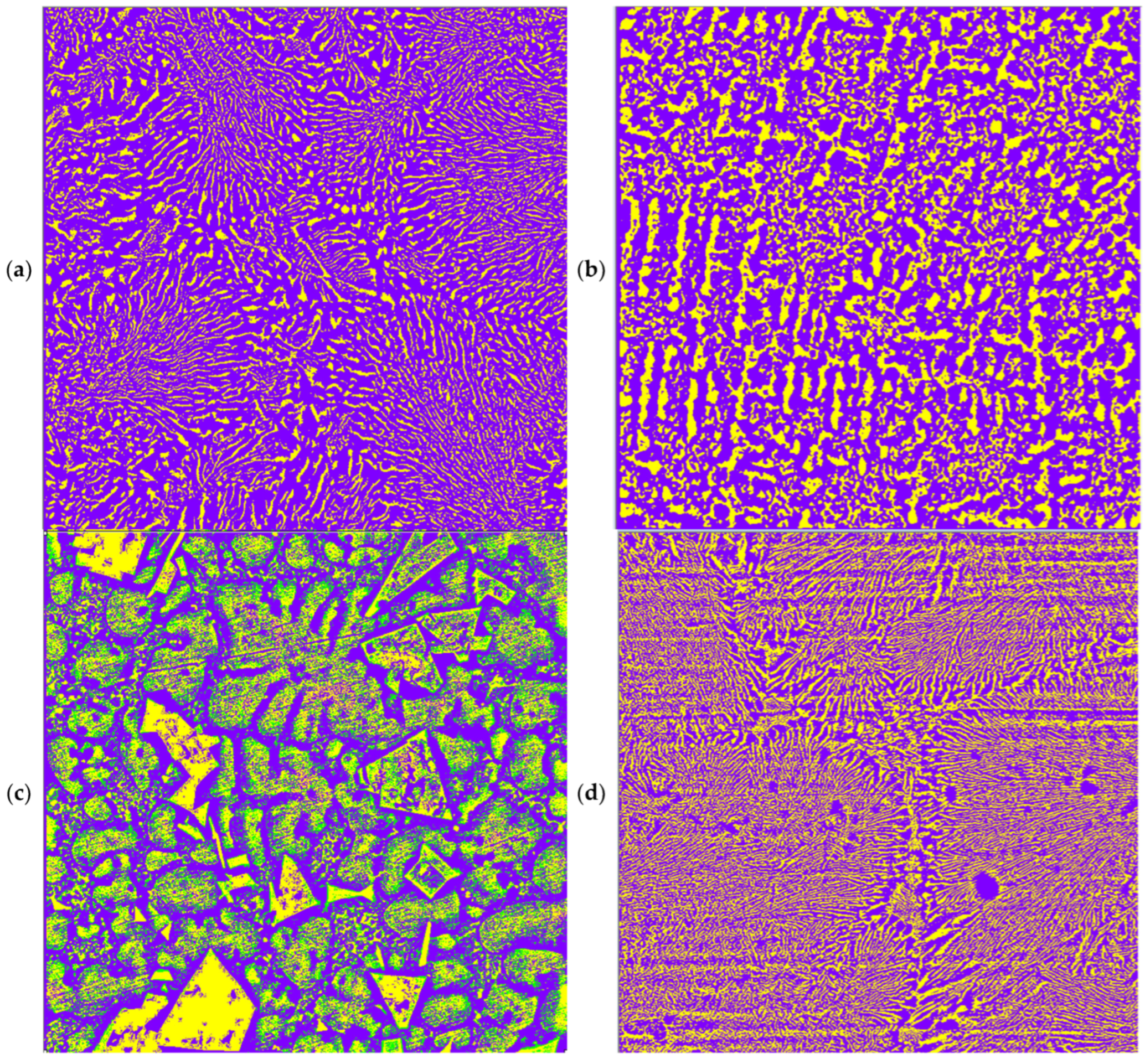
To quantitatively verify the volume fraction of the hard phases predicted by CALPHAD, an image analysis was performed on the SEM micrographs. The detailed microstructures were captured at a magnification of ×3000 to ensure the resolution of fine eutectic precipitates. The images were processed using the open-source software Fiji 2.17.0. (ImageJ distribution). The analysis involved converting the representative micrographs into 8-bit grayscale images, followed by binarization using a thresholding algorithm to isolate the hard phases (carbides and borides) from the matrix for subsequent area fraction calculation.

2.3. Scratch Test Analysis

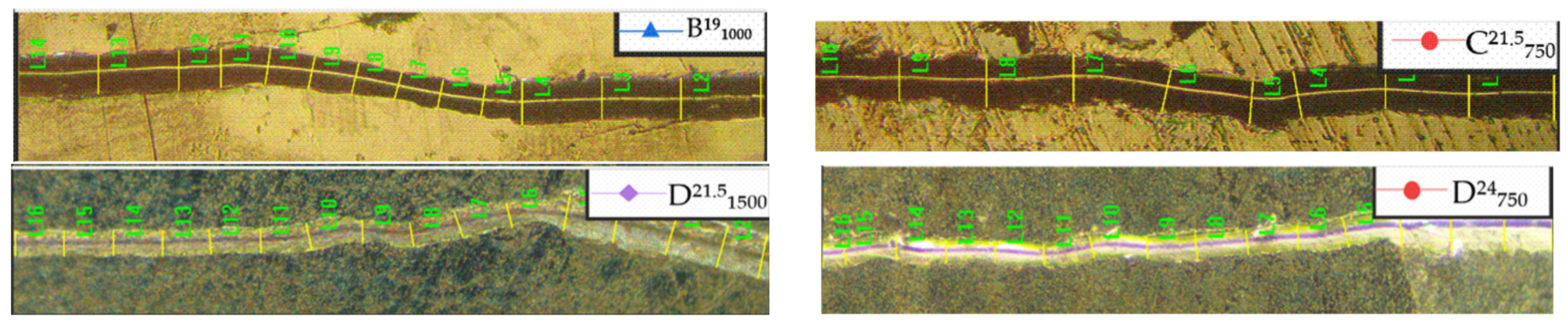
To establish a correlation between micromechanical properties and wear resistance, a series of scratch tests were performed for each of the inspected alloys, with the aim of closely replicating the microcutting and microploughing actions of abrasive grains during interactions with various phases of the hardfaced layer [57]. Scratch tests were conducted using a modified hardness tester (PMT-3M, LLC NPF «Standard-M», Ukraine), which allows scratch tests to be performed using the Vickers pyramid method according to the GOST 21318–75 standard, «Measurement of Microhardness by Diamond Scratch Testing». To apply scratches, the pyramid arrangement scheme with the «edge forward» was utilized under a load ( F ) of 1.96 N (0.2 kgf). The specific normal load of 1.96 N was selected based on a series of preliminary optimization tests. It was observed that at lower loads (below 1 N), the indenter tended to slide over the hard constituents without sufficient penetration depth, leading to discontinuous tracks and a failure to provide an integral assessment of the multiphase structure. Conversely, applying higher loads resulted in severe brittle fracture and chipping of the coarse hard phases (primary carbides and borides). This phenomenon caused irregular groove edges and significant distortion of the scratch geometry, thereby compromising the accuracy of the optical width measurements used for scratch hardness calculation. Analysis of scratch geometries was carried out using optical microscopy. The primary criterion for assessing scratch hardness ( H s ) was the width of the track, denoted as b (Figure 3b), and the calculation was performed using the formula:
H s = 3.782 × F b 2 .
To ensure statistical reliability, a minimum of three parallel scratches were performed for each specimen. The scratch hardness profiles presented in the subsequent results section correspond to a representative track selected from these repetitions to demonstrate the typical hardness distribution without visual clutter.
While conventional indentation-based hardness tests provide localized measurements strongly dependent on phase selection, in the present study the scratch test is treated as a simulation of an elementary abrasive wear event rather than a conventional hardness measurement. The resulting scratch hardness reflects the combined response of the metallic matrix and hard reinforcing phases to microcutting, microploughing, and local fracture mechanisms activated during indenter motion. Therefore, Hs is interpreted as a functional tribo-mechanical parameter, suitable for comparative evaluation of heterogeneous hardfacing layers under identical test conditions.
To study the dependence of scratch hardness as a function of hardfacing parameters, the varying factors were hardfacing duration, denoted as «S», and the welding voltage, denoted as «U». The S varied from 500 to 1750 ms with incremental steps of 250 ms, and the «U» was set at three distinctive levels: 19 V, 21.5 V, and 24 V. Therefore, the investigated samples were marked as A(B, C, or D)sU, where the letter denotes the alloy type (Table 1), the subscript indicates the hardfacing duration, and the superscript indicates the voltage. The scratch tests were conducted on polished samples (Figure 4a) prepared using 220–800 grit discs and 6–1 μm diamond paste suspension (Struers Labo-Pol 4, Denmark) and etched with a 5% solution of nitric acid in alcohol (known as “Nital 5%”) to reveal microstructural features and indicate the presence of distinct regions across the hardfacing-base metal interface. The results were compared to an untreated C45 steel reference sample with a hypoeutectoid (pearlite and ferrite) structure (Figure 4b), which has a Vickers hardness (HV) of 167 kgf/mm2 and an average scratch hardness of 360 kgf/mm2, measured along the distance of 350 µm.

3. Results and Discussion

3.1. Thermodynamic Analysis

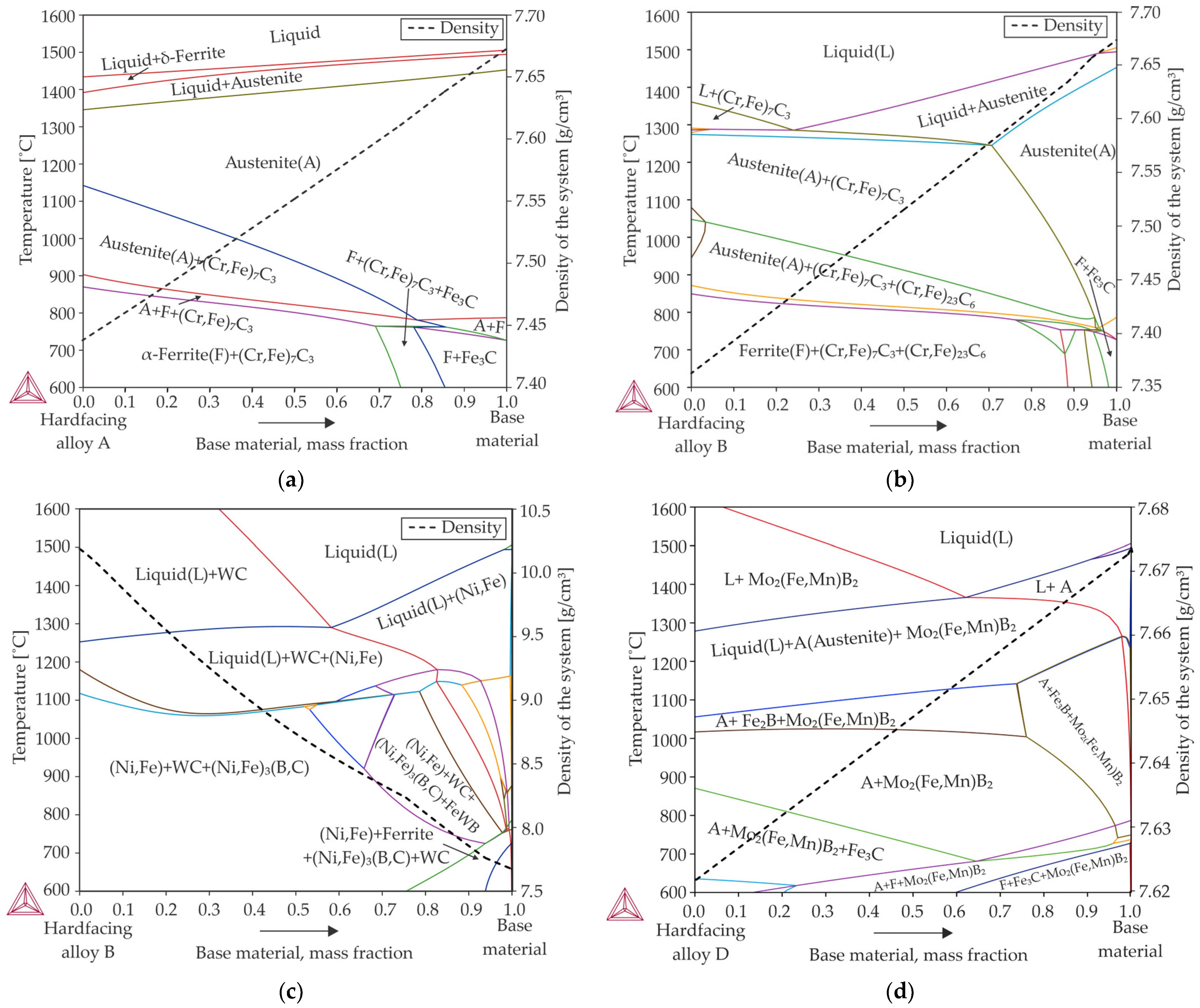
The results of the calculations of the phase composition changes in the direction from the top hardfaced layer to the base material (medium carbon steel C45) indicate the presence of significant phase composition gradients for all alloys studied. For hardfacing alloy A (Figure 5a), increasing the fraction of hardfacing material leads to the appearance and increasing amount of the (Cr,Fe)7C3 complex carbide, which forms from the austenite phase in the solid state below 1150 °C and prevents cementite formation. The pseudo-binary section for the layers deposited with Alloy B (Figure 5b) is of the eutectic type, and as a result, the solidification of the upper layers begins with the primary (Cr,Fe)7C3 carbide crystallization and further eutectic (austenite + (Cr,Fe)7C3) formation. Increasing the amount of base steel causes the primary phase to change to Cr-enriched austenite. Regions with a base steel content of less than 75 wt. % are characterized by the presence of a carbide/austenite eutectic. Thus, the overall phase composition of a typical alloy within a hardfaced layer at room temperature is represented by ferrite and two chromium-based carbides of different stoichiometric ratios (M7C3 and M23C6). The system with Alloy C is also of the eutectic type (Figure 5c), so that the structure formation in hypoeutectic and hypereutectic alloys begins with the crystallization of WC or Ni-based solid solution. In the narrow temperature range below 1200 °C, the nickel carbo-boride crystallizes from the melt so that the resulting phase composition of the typical hardfacing layer consists of three phases: an Ni-based matrix and two reinforcements (WC and (Ni,Fe)3(B,C)). The high-temperature region on the pseudo-binary isopleth of an Alloy D system (Figure 5d) is similar to that of Alloy C, except for the main ceramic strengthening phase. In this case it is represented by the Mo2(Fe,Mn)B2 complex boride and the matrix phase represented by austenite. After completion of all transformations, including the liquid decomposition reaction into the eutectic Mo2(Fe,Mn)B2/austenite mixture, the eutectoid decomposition of the austenite, and the precipitation of cementite (Fe3C), the resulting structure consists of a ferrite-austenite matrix and the hard phases: Mo2(Fe,Mn)B2 and cementite. The calculated density in all systems (except for Alloy C) decreases as the amount of hardfacing alloy increases.
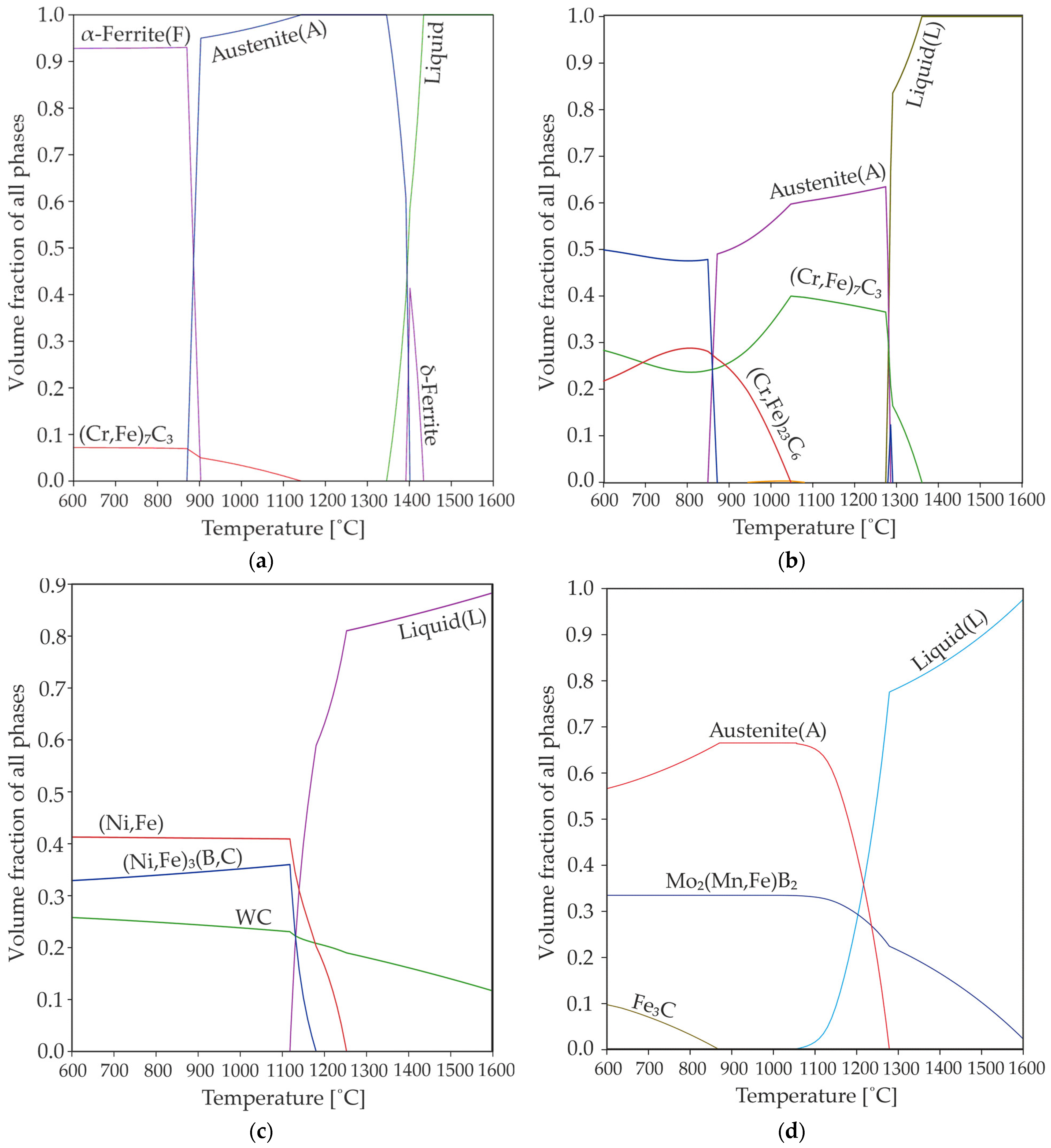
Analysis of the temperature step diagrams of the phase composition for the hardfacing alloys studied shows that there is an observable difference in their melting points and the total amount of hard phases. In the case of Alloy A (Figure 6a), the solidification begins at about 1450 °C from the formation of δ-Ferrite, which transforms into austenite at about 1400 °C. In the solid state at 1150 °C, due to the decrease in the solubility of Cr and C in austenite, precipitation and the increase in the amount of the (Cr,Fe)7C3 carbide phase begin. After the eutectoid-like decomposition of austenite at around 900 °C, the resulting structure consists of 7 vol. % of (Cr,Fe)7C3 and the ferrite (the rest). In contrast to Alloy A, the solidification of Alloy B (Figure 6b) starts with the crystallization of the hard (Cr,Fe)7C3 carbide phase from the liquid, followed by a eutectic transformation and the next partial decomposition of (Cr,Fe)7C3 causing (Cr,Fe)23C6 formation. At low temperatures (below 600 °C) the total amount of hard carbide phases is close to 50 vol. %, while the rest is composed of ferrite. Alloy C crystallization starts at high temperature (above 1600 °C) from crystallization of WC from Ni melt (Figure 6c). In the next stage, a eutectic reaction occurs involving WC, Ni, and large amounts of nickel boride Ni3(B,C) with orthorhombic structure. After all phase transformations, the microstructure of this alloy contains about 60 vol. % of hard phases and Ni-based metal matrix. The solidification pathway for Alloy D (Figure 6d) includes the following sequential stages: primary Mo2(Fe,Mn)B2 crystallization, formation of austenite/ Mo2(Fe,Mn)B2 eutectic, and precipitation of alloyed cementite from austenite. Therefore, the resulting amount of wear-resistant phases (Mo2(Fe,Mn)B2 and alloyed cementite) is about 46 vol. %, while the rest is austenite.
It is important to acknowledge that while FCAW is inherently a non-equilibrium process, the applicability of CALPHAD depends on the specific alloying system. In low-alloy steels, mechanical properties are often dictated by metastable solid-state transformations (e.g., martensite formation) sensitive to cooling rates. In contrast, for the high-alloy systems investigated here (particularly Alloys C and D), the wear resistance is primarily derived from coarse primary hard phases (carbides and borides). Due to the high concentration of alloying elements, the thermodynamic driving force for the nucleation of these phases is substantial. Consequently, they form as stable equilibrium phases directly from the melt, rendering the equilibrium phase diagrams highly accurate for predicting the phase constitution, as supported by the distinct morphology and high hardness of the observed precipitates, despite the rapid solidification conditions.
Experimental validation of the phase content via image analysis yielded the following volume fractions of hard phases: Alloy A—23%, Alloy B—32%, Alloy C—47%, and Alloy D—38%. Interestingly, while CALPHAD predicted a higher equilibrium phase fraction for Alloy B (~50%) compared to Alloy D (~46%), the experimental image analysis revealed the opposite trend (32% vs. 38%). This discrepancy is attributed to the non-equilibrium nature of FCAW, where the formation of complex chromium carbides in Alloy B is kinetically suppressed compared to the more stable borides in Alloy D. Consequently, the experimental analysis establishes the actual ranking of hard phase content as A < B < D < C, differing from the equilibrium prediction (Figure 7).

3.2. Worn Surface Morphology

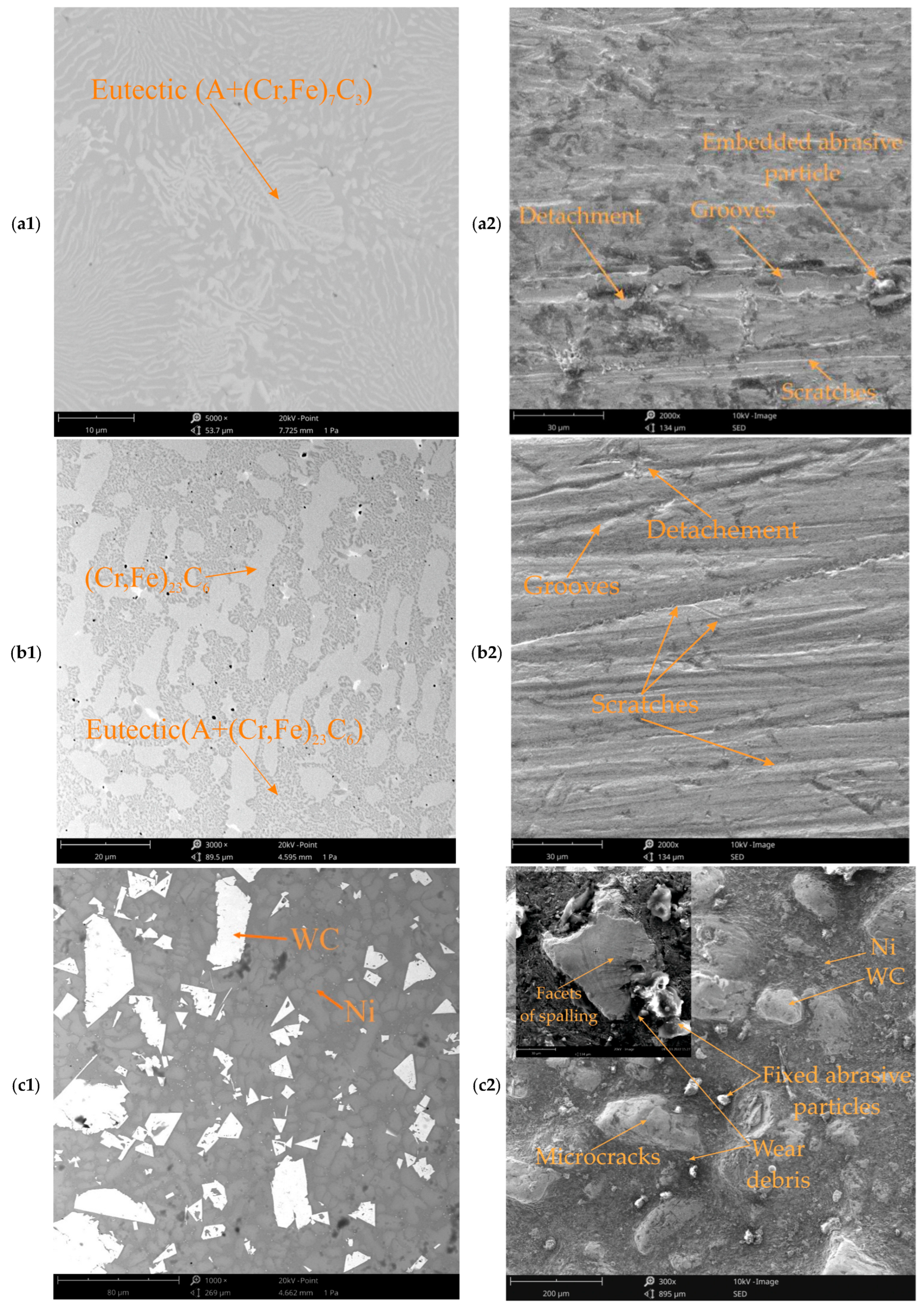
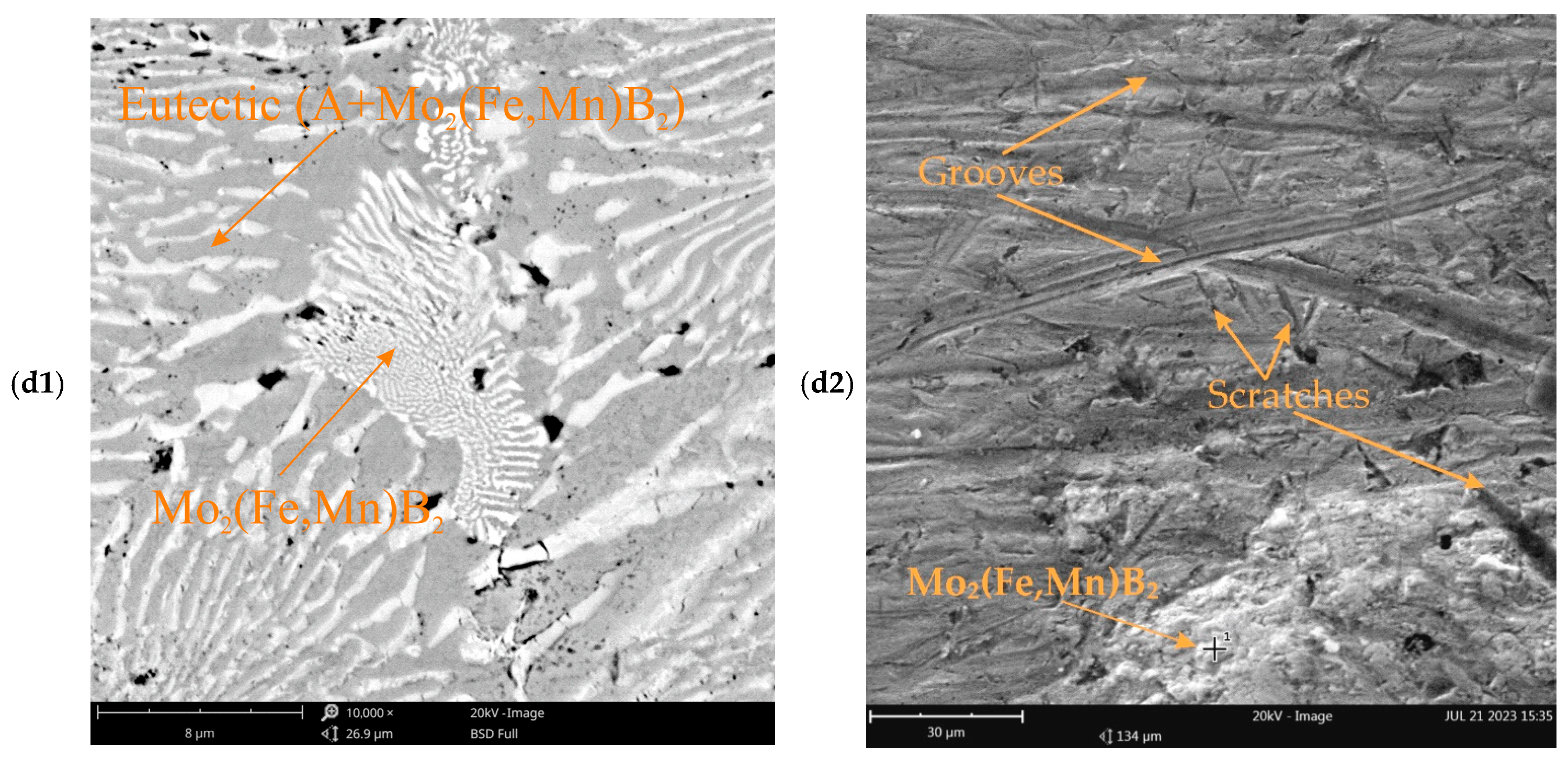
The results of microscopic examinations of the worn surfaces of the hardfaced layers after wear tests show that both their morphology and wear mechanisms depend strongly on the chemical composition of the alloy used. The subfigures in Figure 8 depict the surface microstructures and the worn surface morphologies of the investigated alloys before and after the dry sand/rubber wheel test, respectively. As can be seen in Figure 8(a1), the structure of Alloy A does not contain primary chromium carbides and has a hypoeutectic structure. In contrast, the other high-chromium alloy (Alloy B) is characterized by the presence of primary chromium carbides, providing a hypereutectic structure (Figure 8(b1)) with rod-like eutectic. The microstructure of Alloy C (Figure 8(c1)) belongs to a composite-like structure containing large WC faceted grains uniformly distributed within a Ni-based matrix. The microstructure of Alloy D (Figure 8(d1)) is similar to Alloy C in terms of heterophase structure and consists of large Mo2FeB2 grains and the lamellar Austenite + Mo2FeB2 eutectic.
The worn surface of the Alloy A hardfacing (Figure 8(a2)) is covered with directional deep scratches that cause substantial material detachment due to microcutting processes, wide grooves, and the presence of embedded abrasive particles. Such morphology features indicate high surface plasticity and relatively low abrasion resistance. In contrast to Alloy A, the worn surface hardfaced with Alloy B (Figure 8(b2)) with a relatively higher amount of hard phases (about 5-fold) is characterized by the presence of shallower scratches oriented in the wear direction. Some scratches are oriented at different angles with respect to the main direction, which can be caused by the reflection of small abrasive particles as a result of their clashes with hard phase inclusions. As can be seen from the worn surface hardfaced with Alloy C (Figure 8(c2)), the wear mechanisms in this case are much more complex than in Alloys A and B. The main feature of the surface morphology is the presence of protruding large WC grains, indicating that the wear intensity of the Ni-based matrix is significantly higher than that of the WC inclusions. This leads to the formation of tracks with significant tortuosity in the intergranular space, where movement of abrasive particles and wear debris is blocked by WC grains embedded in the nickel matrix. Because such particles remain fixed, they play a positive role in resisting further penetration and microcutting processes by partially shielding the deeper layers of the matrix. The wear mechanism is different for WC grain and Ni-based matrix because the hardness of the abrasive used (quartz sand) is about twice as low as WC. The wear of the matrix is thus mainly caused by micro-cutting, while carbide grains show traces of brittle fracture in the form of regular faceted spalling, indicating the presence of fatigue damage caused by cycle indentation by abrasive particles. The morphology of the worn surface hardfaced with Alloy D (Figure 8(d2)) is characterized by the presence of short, randomly oriented scratches, indicating areas of wear by microcutting, as well as long grooves. However, the depth of the scratches is smaller than that for high-chromium alloys (Alloys A and B), and the number of grooves oriented in different directions is greater. Additionally, the large inclusions of the reinforcement phase (Mo2(Fe,Mn)B2 grains) remain undetached from the worn surface, indicating a strong bond between the ceramic and metal austenite phases in the hardfaced layer.
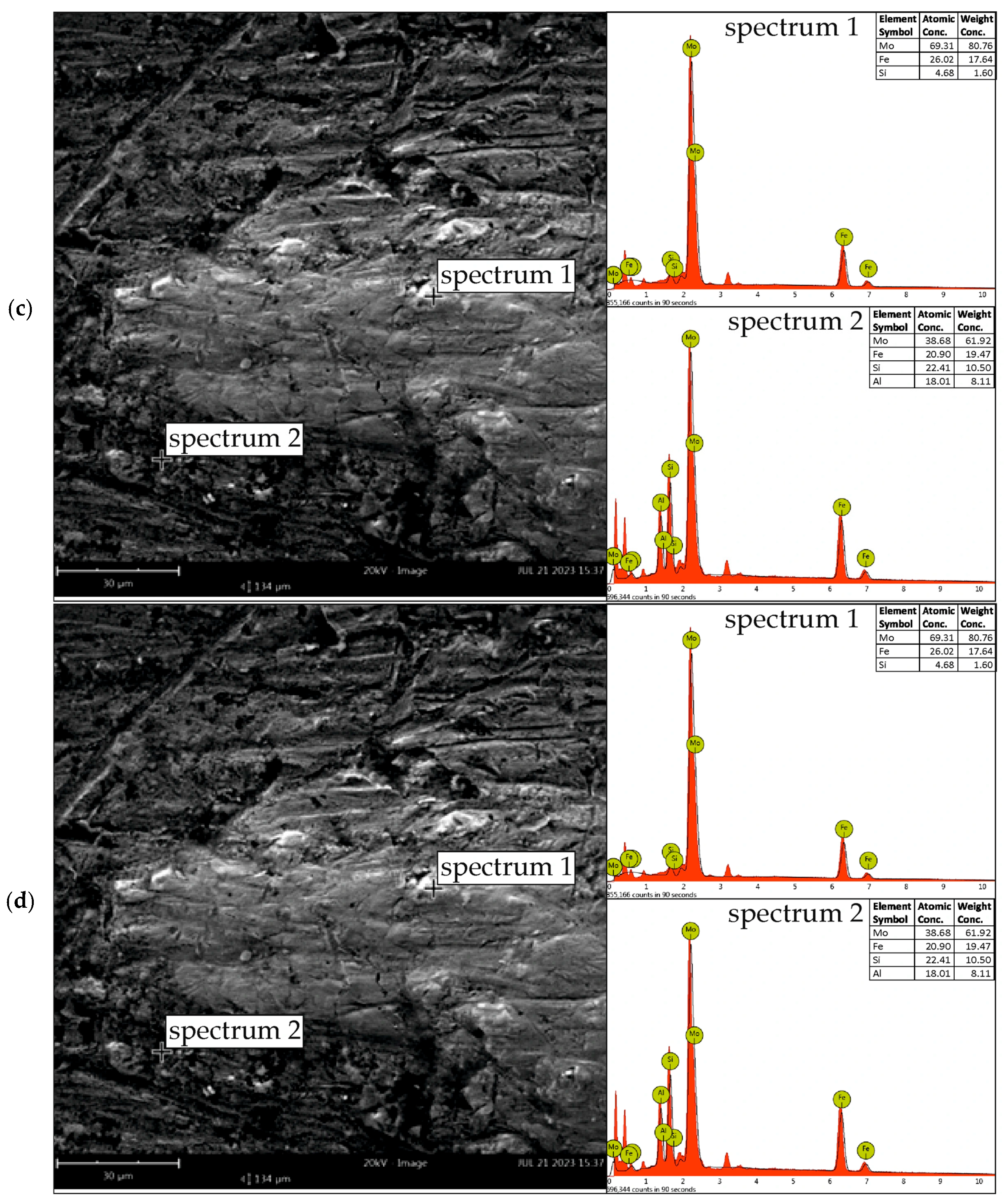
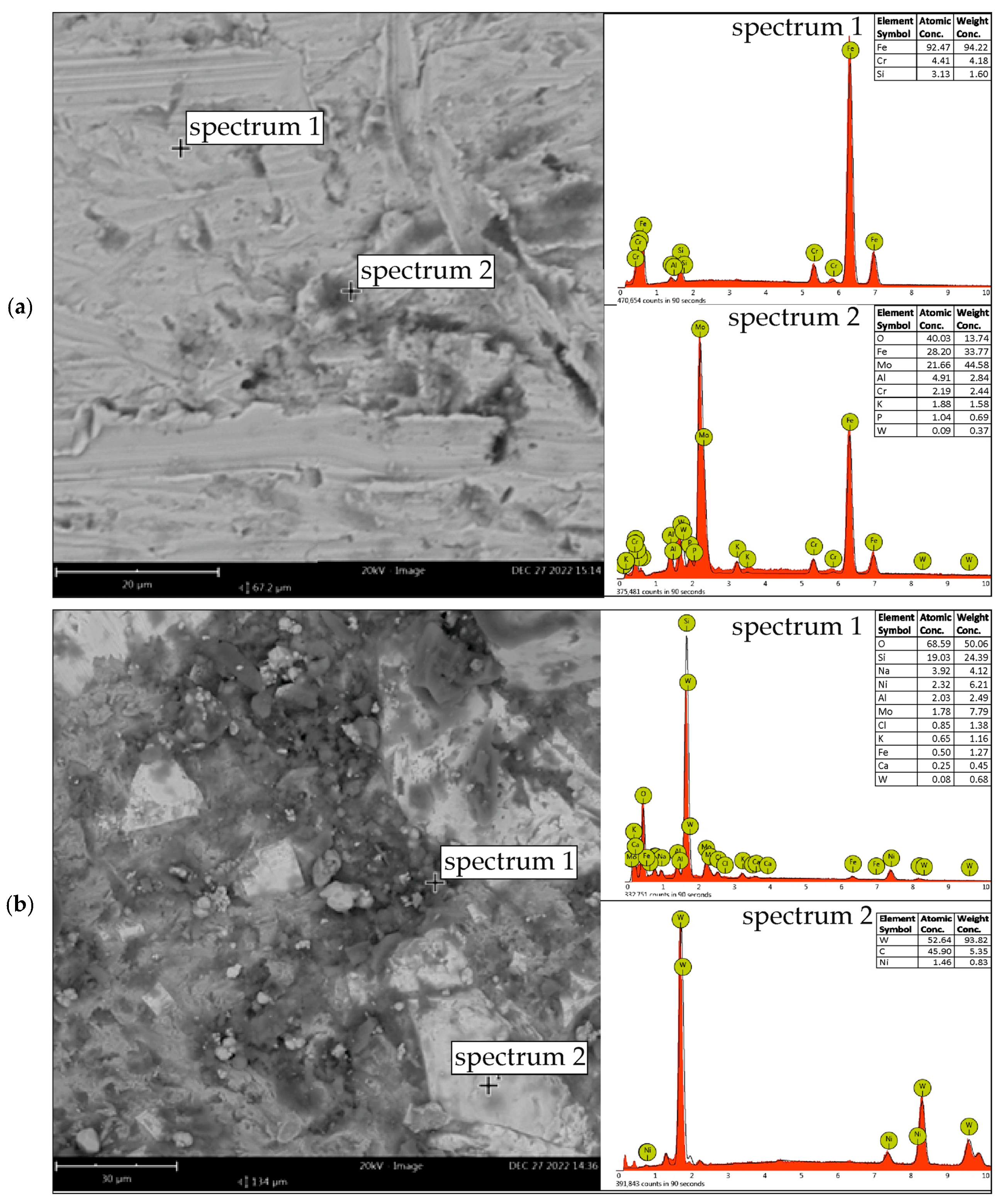
The detailed examination of the worn surfaces performed by EDS shows that the chemical composition of the white areas (spectrum 1, Figure 9a) in Alloy A is close to the Fe-rich Fe + (Cr,Fe)7C3 eutectic, while the dark areas (spectrum 2, Figure 9a) in the wear grooves are simultaneously enriched with oxygen and metal components, indicating the presence of corresponding oxides in these areas.
In Alloy B, the composition of the white areas (spectrum 1, Figure 9b) corresponds to the hypereutectic alloy with (Cr,Fe)23C6 + eutectic structure, and the dark areas (spectrum 2, Figure 9b) contain traces of oxides and elements used as technological additives (Ca, Al, Mg, etc.). On the worn surface of Alloy C in the heterophase regions (spectrum 1, Figure 9c), there are simultaneously high concentrations of Si and O in a ratio close to that of SiO2. The remaining spectral components in this region belong to the composition of the wear debris. The composition of the central regions of the large grains (Spectrum 2, Figure 9c) was determined to be 93.8 wt% W and 5.4 wt% C. This corresponds almost perfectly to the stoichiometric tungsten carbide (WC), with negligible amounts of Ni attributed to the matrix interaction. This result is in good agreement with the calculated phase equilibrium results (Section 3.1, Figure 5d). On the worn surface, after hardfacing with Alloy D (spectrum 1, Figure 9d), the wide gray areas are Fe-enriched and show minor traces of other metal components and correspond to the alloyed ferrite. The small white inclusions (spectrum 2, Figure 9d) have high amounts of Mo and Fe with an atomic ratio close to 2:1, which corresponds to the composition of the Mo2(Fe,Mn)B2 phase predicted by thermodynamic modelling.
SEM observations of the worn surfaces enable a clear classification of the dominant wear mechanisms in the investigated hardfacing alloys. In Alloy A, wear is governed mainly by microcutting and plastic deformation of the ferritic matrix, producing deep grooves. Alloy B shows a mixed mechanism, where matrix microcutting is accompanied by brittle fragmentation and pull-out of chromium carbides, reducing their load-bearing efficiency despite a high hard-phase fraction. In contrast, Alloy C is characterized by selective microcutting of the Ni-based matrix combined with fatigue-controlled spalling of large WC particles, which remain partially embedded and effectively shield the underlying material. Alloy D exhibits limited microcutting and microploughing, with Mo2(Fe,Mn)B2 borides remaining well anchored in the matrix, indicating efficient load transfer and high structural stability of the reinforcing phase.
These results demonstrate that abrasion resistance depends not only on the volume fraction of hard phases but also on their intrinsic hardness, morphology, size, and continuity within the matrix. The lower wear resistance of Alloy B compared to Alloy C is therefore attributed to the lower hardness and eutectic morphology of chromium carbides, whereas the superior performance of Alloy C and Alloy D is associated with the presence of mechanically stable, load-bearing hard phases.

3.3. Scratch Tests

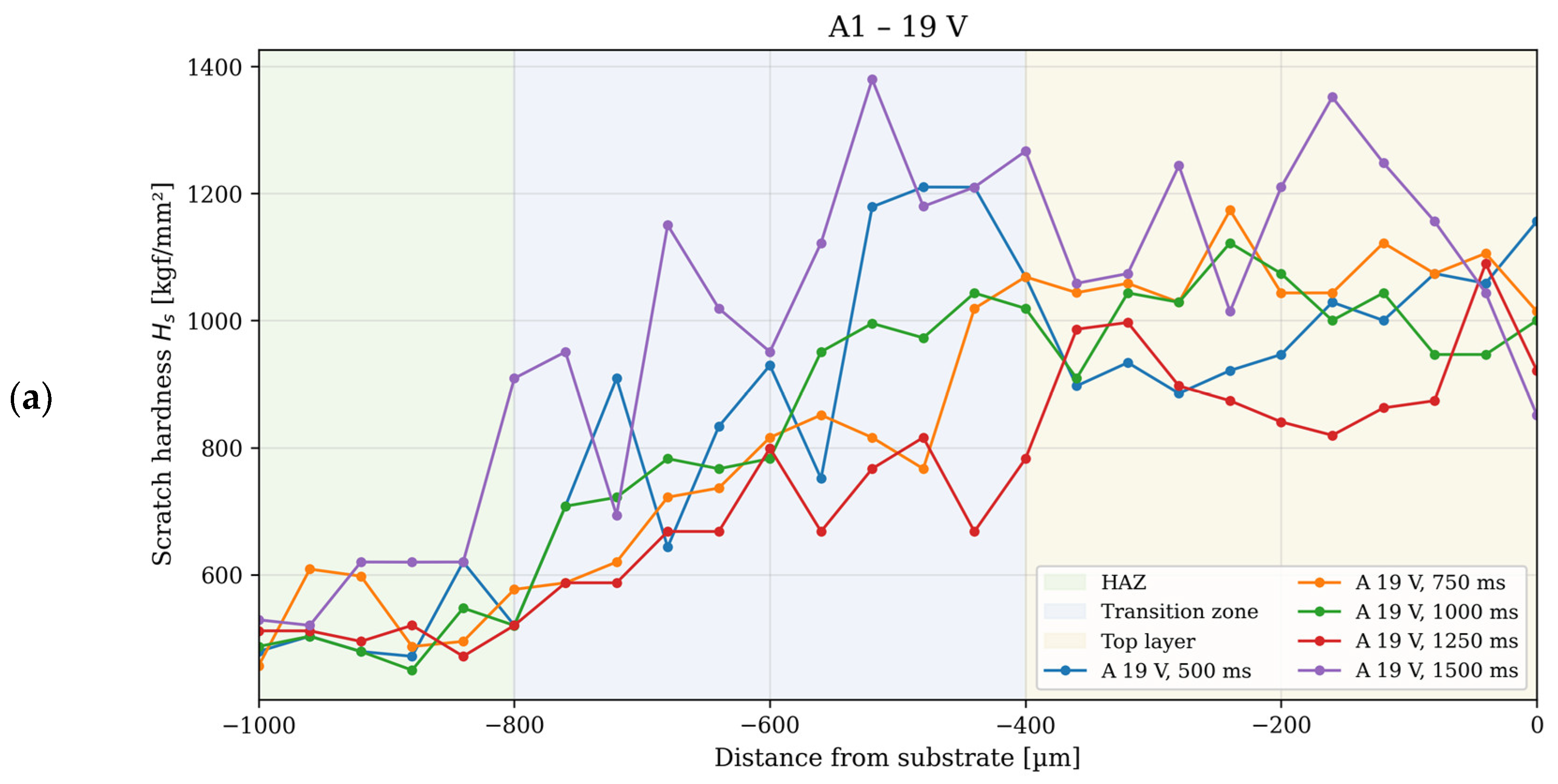
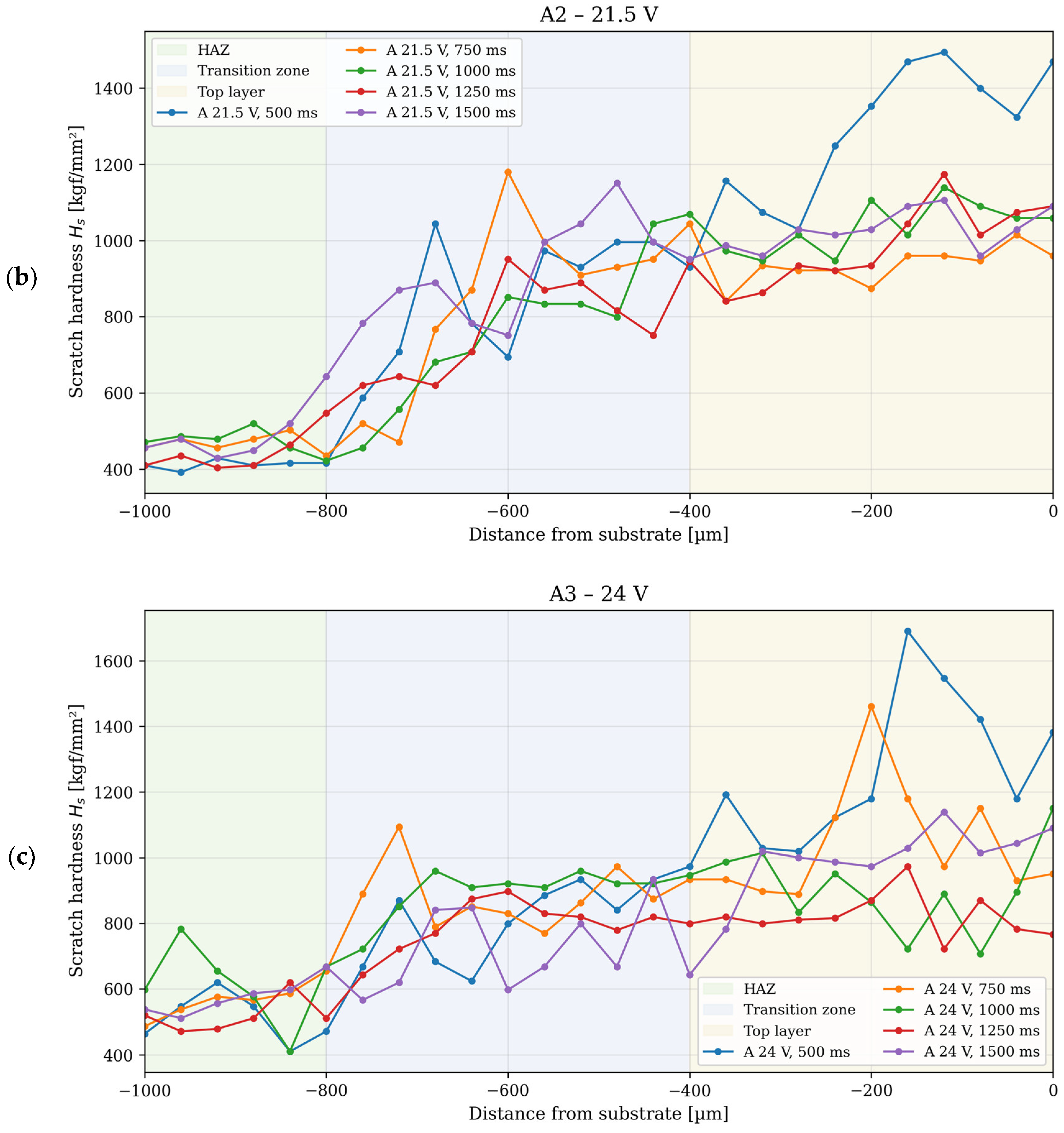
The investigations of the scratch tracks for the surface hardfaced with Alloy A showed rather smooth transitions of the Hs values from the base metal to the hardfacing layer (green parts of Figure 10a–c), ranging from 400 to 800–1600 kgf/mm2. This indicates the absence of large carbide particles that exceed the average step of Hs measurements, which is approximately 40 µm. In the top layers, the Hs values range from 800 to 1400 kgf/mm2 (yellow parts of Figure 10a–c). These results are in good match with the findings of the thermodynamic calculations (Section 3.1, Figure 5a and Figure 6a), which show a small amount of the carbide phase (Cr,Fe)7C3. The enhanced Hs values in the HAZ and transition zone layers can be attributed to the formation of non-equilibrium quenching structures occurring during an increase in heat input and a decrease in the duration of the hardfacing process, which overall leads to an increase in the Hs.
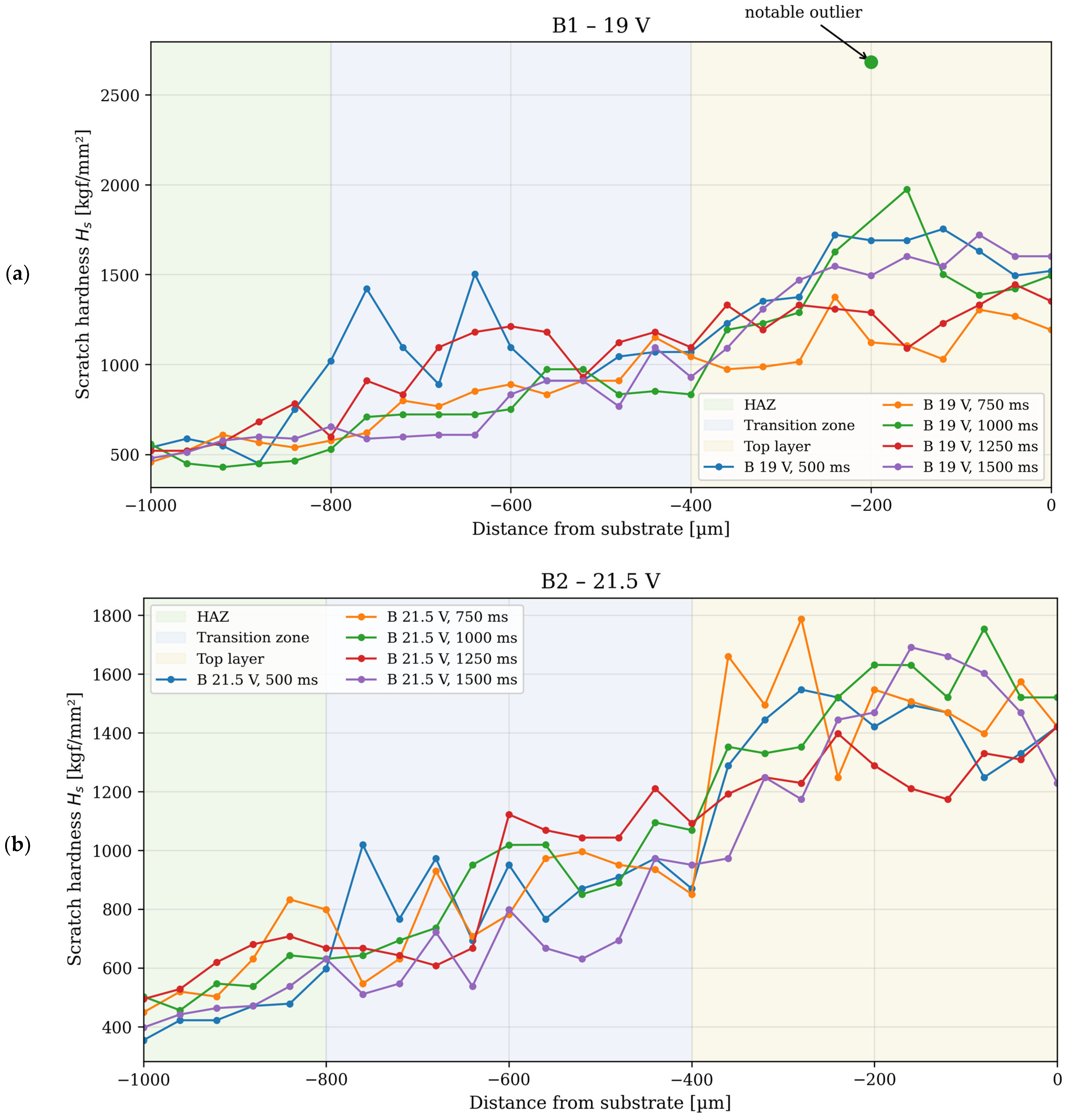
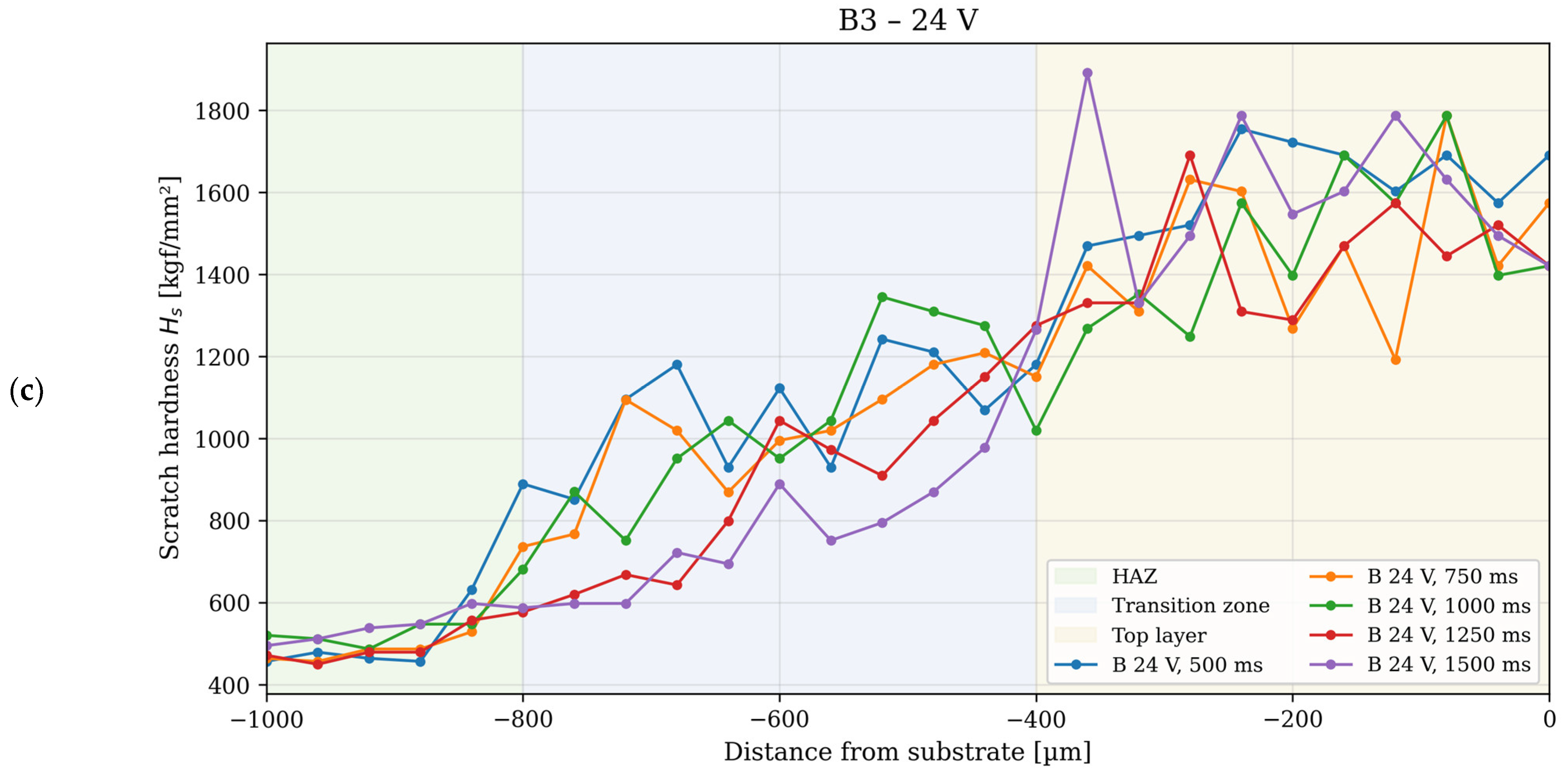
For the layer hardfaced with Alloy B, the overall HAZ also exhibits a smooth transition in HS from the substrate in the direction to the hardfaced layer (Figure 11a–c). However, in this case, some local regions show enhanced values of Hs. Additionally, a transition layer (Figure 10b,c—blue area) corresponding to the calculated hypereutectic region (Section 2.2, Figure 4a) is observed between the HAZ and the top layer. The transition across this layer demonstrates a smooth tendency towards increased Hs values, ranging from 800 to 1200–1600 kgf/mm2. At the top layer (Figure 11a), the presence of high (up to 2800 kgf/mm2) and wide peaks of Hs suggests the existence of large grains of the hard phases. These hard phases, as indicated by thermodynamic calculations (Figure 5b), can be represented by inclusions such as (Cr,Fe)7C3 and (Cr,Fe)23C6. Overall, the characterization of the hardfaced layer with Alloy B shows a smooth transition from base material to the top overlay with localized areas of elevated Hs values, marking increased local hardness.
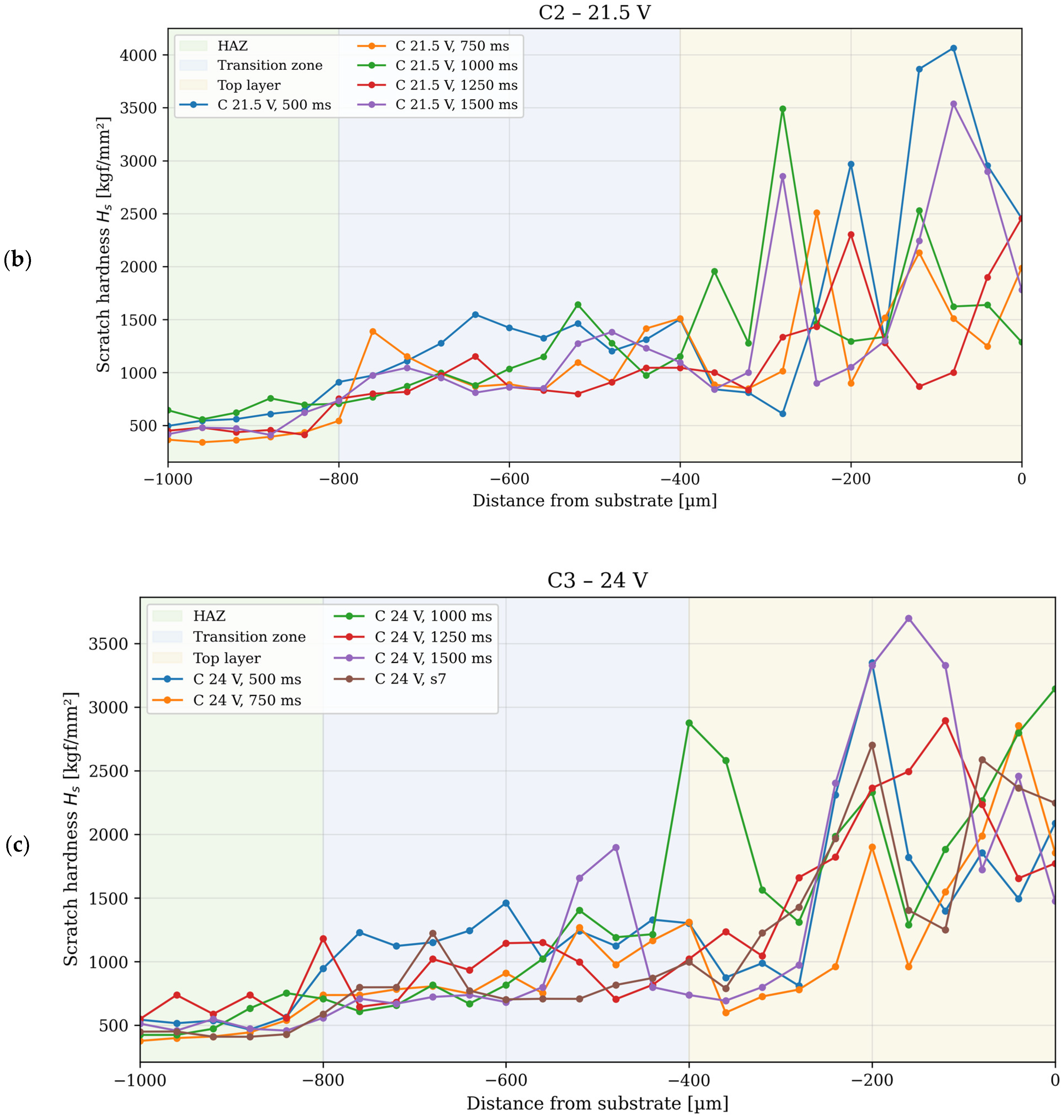
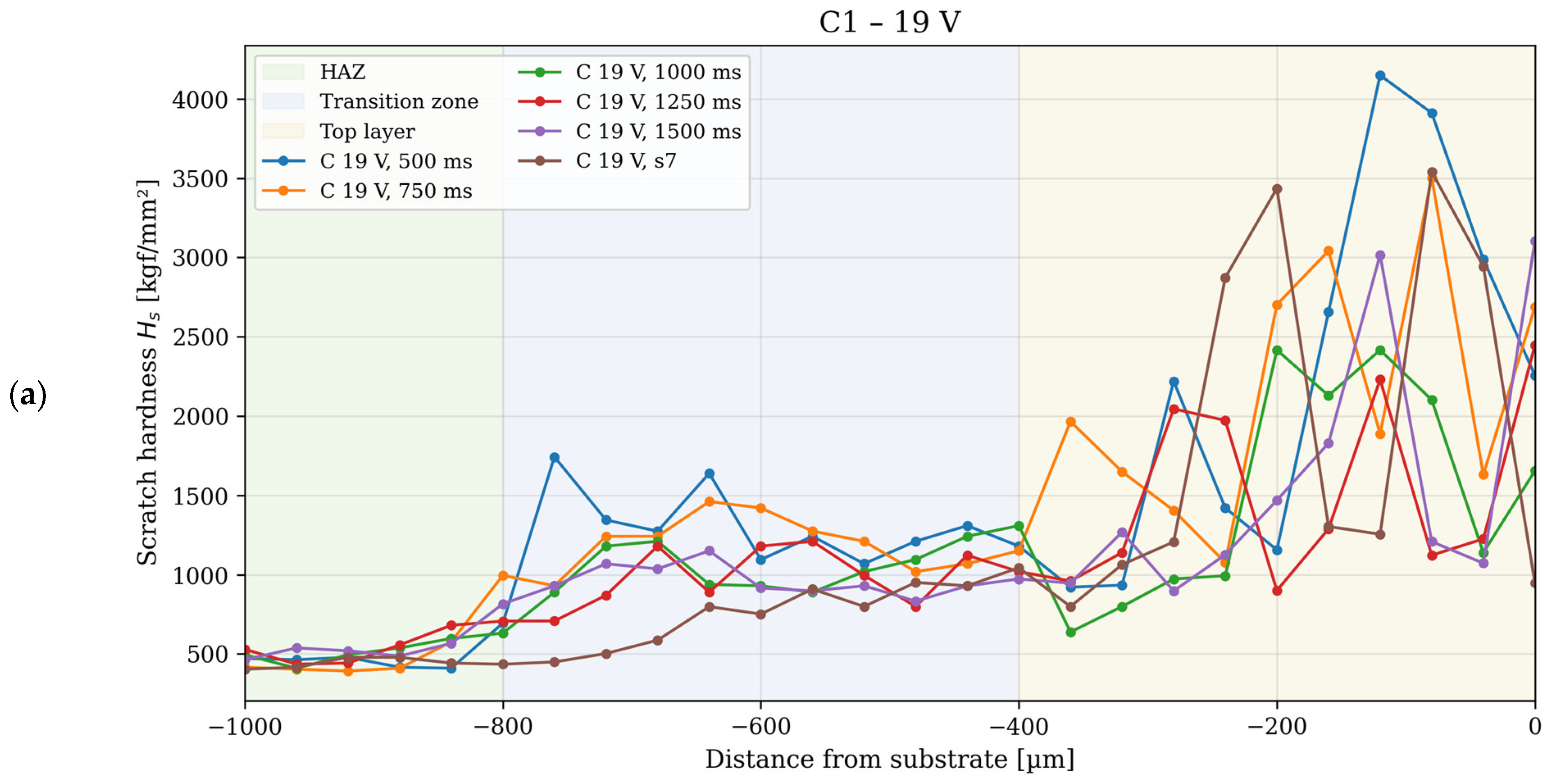
The samples that were hardfaced with Alloy C are characterized by the presence of three regions. These regions include the HAZ (Figure 12a–c—green areas), the transition layer with Hs ranges from 800 to 1600 kgf/mm2 (Figure 12a–c—blue areas), and the top layer (Figure 12a–c—yellow areas). The transition layer is mainly composed of Ni-based solid solution, the Ni + WC eutectic (Section 2.2, Figure 5c), and regions with enhanced Hs values of 3000 kgf/mm2, indicating the presence of nickel boride ((Ni,Fe)3(B,C)) phases (Section 3.1, Figure 5c). In the top layer, some regions exhibit high Hs values, reaching up to 4000 kgf/mm2. These high values indicate the presence of tungsten carbides. Due to their hardness, these carbides can cause changes in the direction of the scratch track during tests (please refer to Figure 14), similar to how abrasive particles change direction during wear tests as a result of interaction with hard inclusions (Section 3.1, Figure 6c). The most impactful effect of tungsten carbide particles is observed during long hardfacing durations, as these conditions promote grain growth.
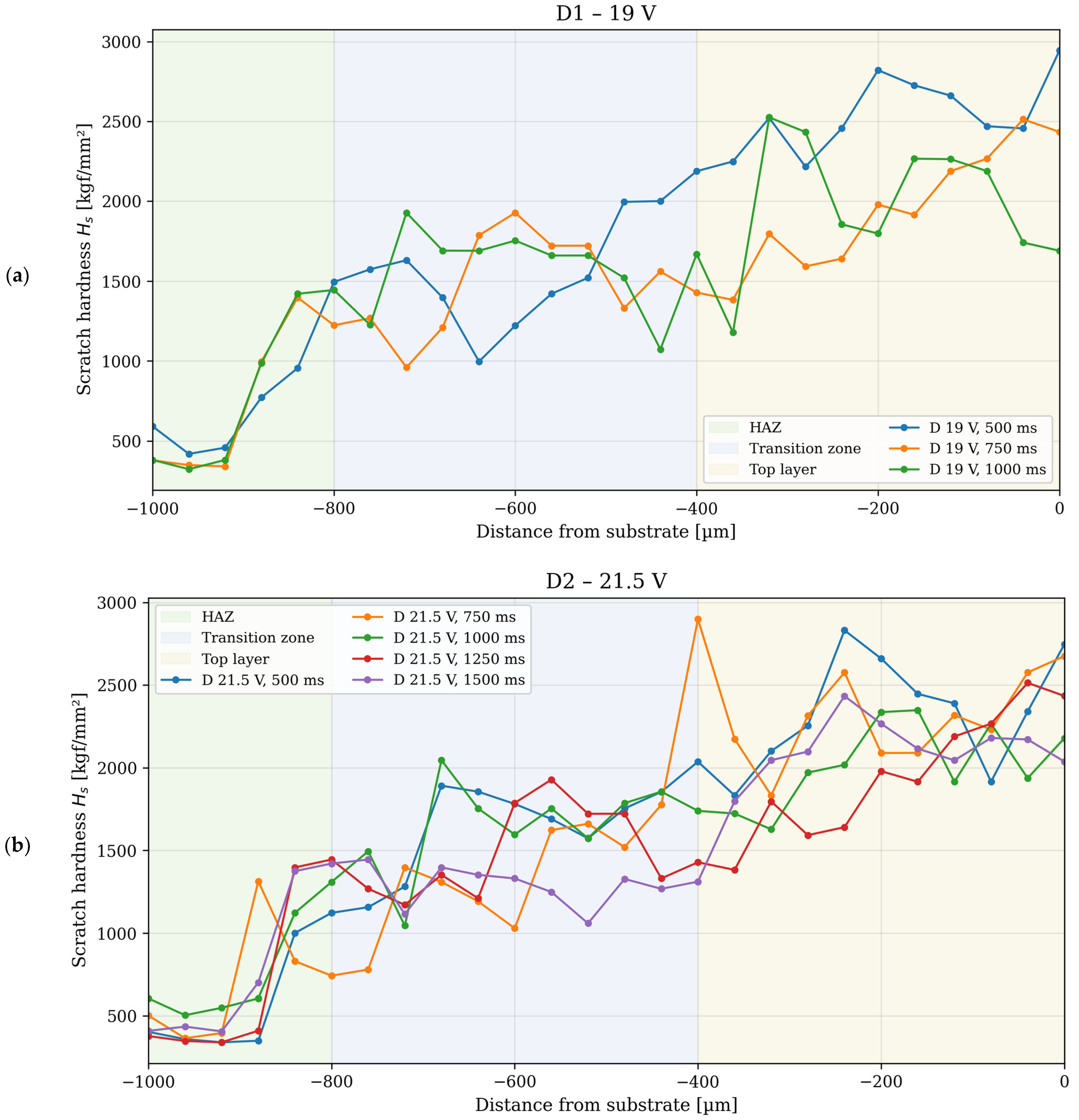
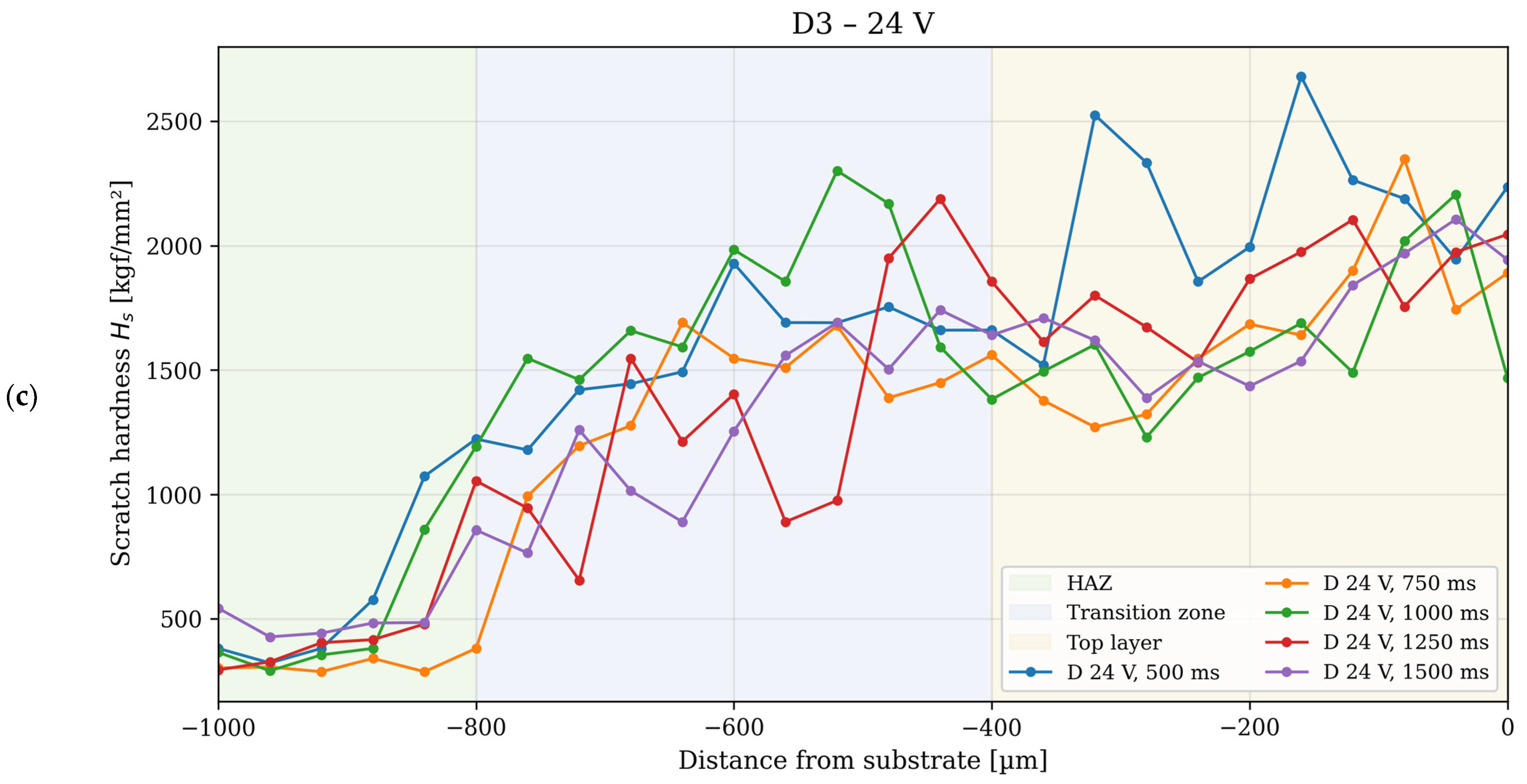
Scratch tests of the hard-faced layer with Alloy D show a clear interface between the base material and the top layer, with the absence of a wide transition zone. The Hs values near the HAZ (Figure 13a–c) change from 400 to 2000 kgf/mm2, with peaks reaching ~3000 kgf/mm2, indicating the presence of hard inclusions of Mo2(Fe,Mn)B2. These inclusions appear as a primary phase and as constituents of the eutectic with austenite (Section 3.1, Figure 5d and Figure 6d). The Hs values of the top layer range from 1000 to 3000 kgf/mm2 (Figure 13a–c), and decreasing the duration of the hardfacing process leads to an increase in Hs values due to the refinement of the structure.
Figure 13. The Hs hardness scratch test results for Alloy D hardfacing: (a) at 19 v; (b) at 21.5 V, (c) at 24 V.
Coatings 16 00178 g013aCoatings 16 00178 g013b
However, the interpretation of results must consider the method’s sensitivity to crystallographic orientation, residual surface roughness, and the phase size effect (particularly where inclusions exceed the scratch width) Figure 14.
Figure 14. Examples of locations of sudden spikes in Hs hardness values where the diamond tip occurred upon a hard phase constituent.
Coatings 16 00178 g014
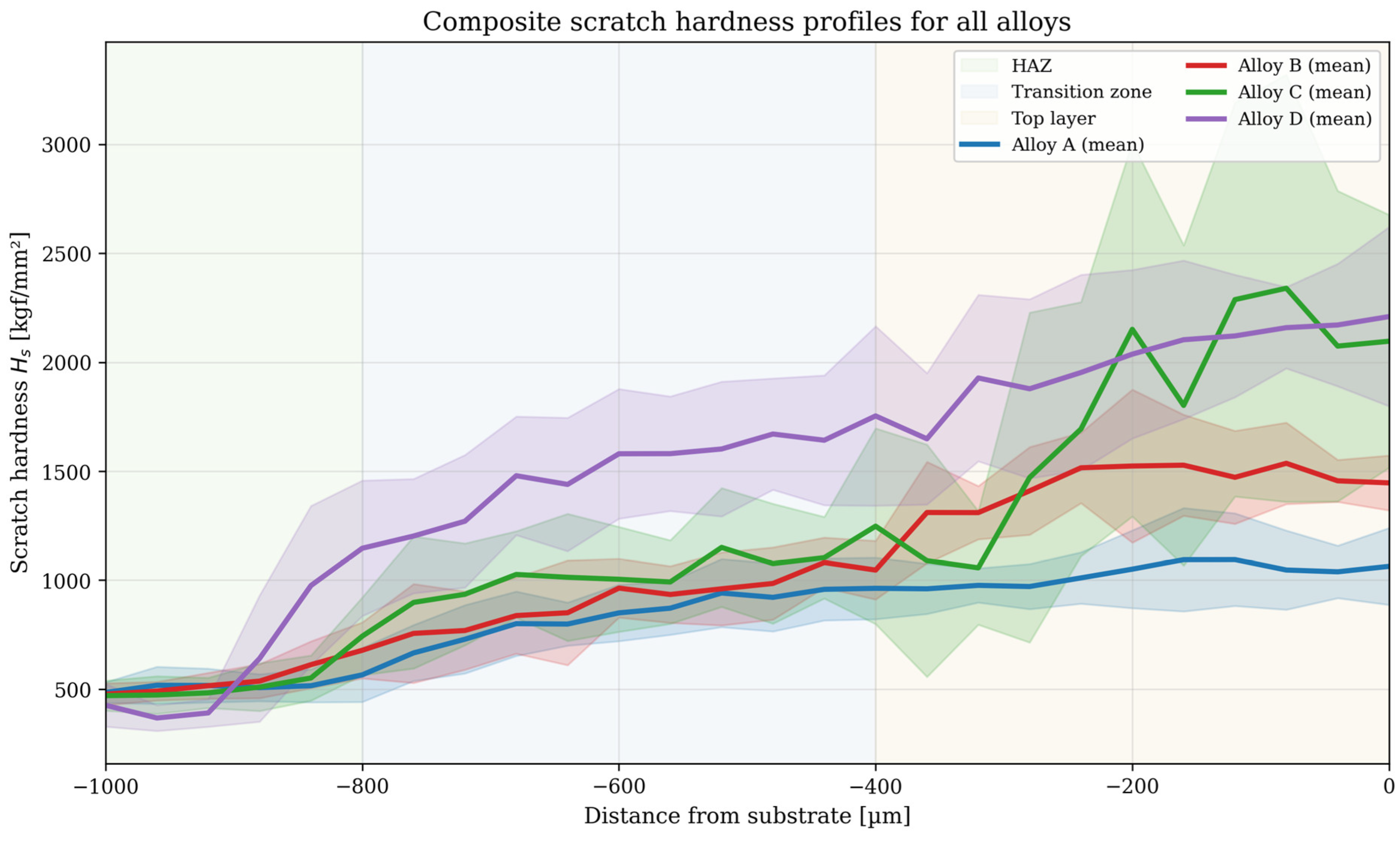
Consequently, the observed fluctuations in Hs profiles reflect the inherent microstructural heterogeneity, providing a representative assessment of the composite hardness rather than a singular macroscopic value, as presented in Figure 15, which contains all measured Hs values averaged for all materials with visible scatter.

3.4. Wear Tests

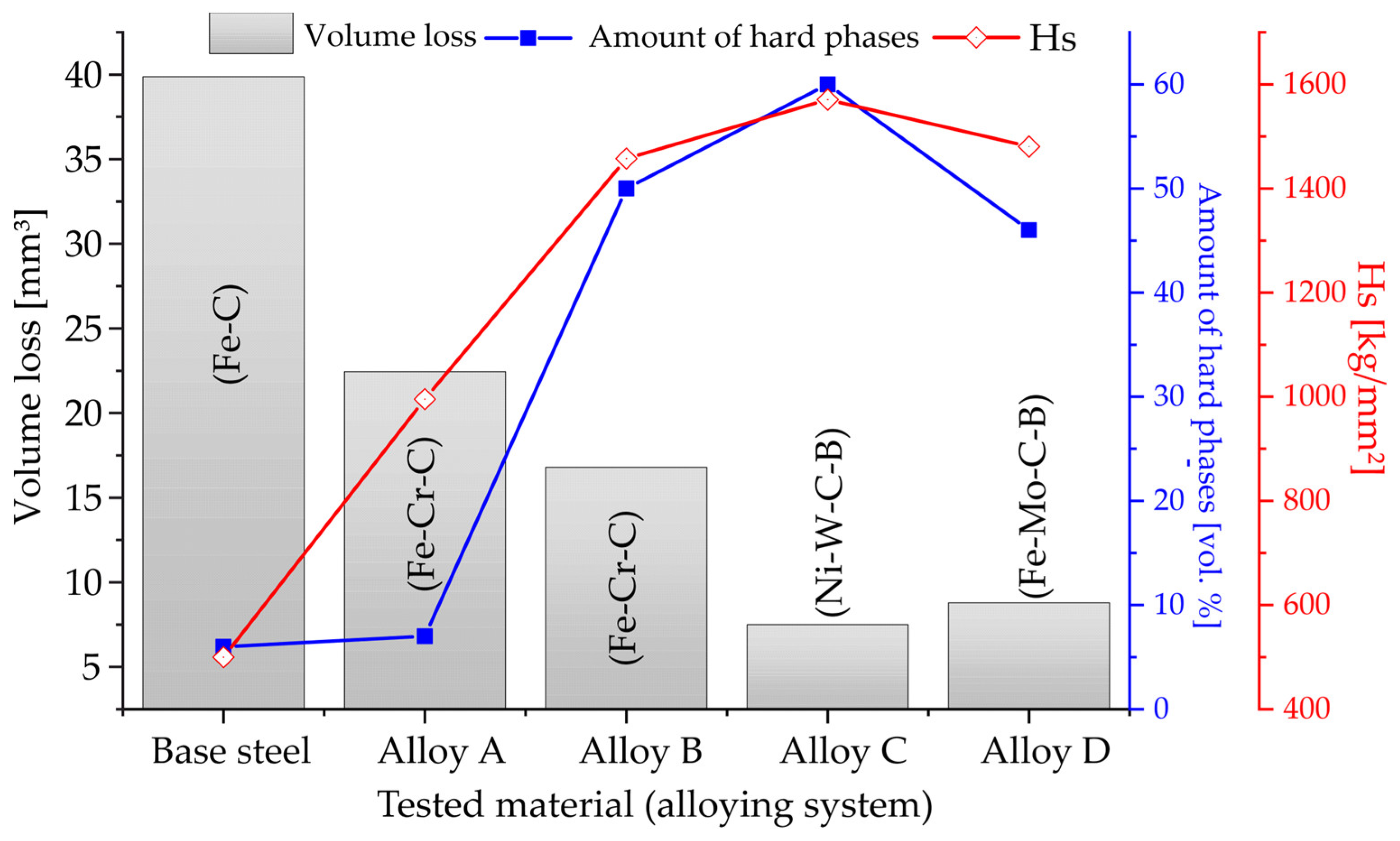
The wear test results are shown in Figure 16. As illustrated in the figure, the highest wear rate is observed for the base material (steel C45), where the main hard phase is cementite, constituting approximately 7 vol.%. Complete replacement of cementite with the same amount of a complex chromium carbide (Cr,Fe)7C3 in Alloy A results in a strong (approximately 2-fold) increase in wear resistance. An additional rise in the quantity of complex chromium carbides, reaching up to 50 vol. % as seen in Alloy B, leads to a 1.33-fold improvement in wear resistance. In Alloy D, the total amount of hard phases is equal to that of Alloy B, but the main hard phase in this alloy is Mo2(Fe,Mn)B2, which is characterized by higher microhardness than that of chromium carbides; hence, the resulting volume loss of Alloy D is about 1.91 times lower than that of Alloy B. The wear resistance of Alloy C is the highest among all inspected hardfacing materials, which is typical for tungsten carbide-based materials and coatings with a heterophase structure. The comparison of the wear tests, the calculated amount of the hard phases (Section 3.1, Figure 5), and the average values of the scratch hardness in the top layer (Figure 10b, Figure 11c, Figure 12c, and Figure 13b) are compared and shown in Figure 16. From the figure, it is clear that there is a close correlation between the Hs and wear resistance. To interpret these correlations semi-quantitatively, a linear Rule of Mixtures (ROM) can be applied to the hardness estimation: H m i x = V f H p + 1 V f H m , where V f is the volume fraction of the hard phase (determined via CALPHAD), and H p and H m are the hardness values of the reinforcing phase and matrix, respectively. Also, the wear resistance increases as the amount of hard phases increases, except for the reference base steel (C45). Among the tested hardfacing alloys, the highest wear resistance, as well as Hs and the amount of hard phases, was observed for Alloy C of the Ni-W-C-B alloying system. The experimental Alloy D exhibits similar characteristics to Alloy C, while alloys of the Fe-Cr-C system (Alloys A and B) show relatively low wear resistance, despite having a high amount of hard phase (Alloy B). This is attributed to the significantly higher microhardness of the key phases in Alloys C and D, represented by tungsten carbide and Mo2(Fe,Mn)B2, respectively.
Moreover, the wear behavior is influenced not only by the quantity and size of the hard phases but also by their specific response to abrasive loading. For instance, the tungsten carbides in Alloy C can exhibit limited micro-plasticity and fatigue resistance, which promotes a mechanism of gradual faceted spalling rather than immediate fracture. In comparison, the chromium carbides in Alloys A and B are generally more susceptible to brittle fragmentation. Similarly, the complex borides in Alloy D offer enhanced resistance to micro-cutting due to their higher hardness relative to chromium carbides. Consequently, the integral Hs measurements provide a functional assessment that reflects these intrinsic micromechanical differences more effectively than dimensional metrics alone.
From an economic and industrial perspective, Alloy D presents a highly cost-effective alternative to Alloy C for applications where the extreme wear resistance of W carbides is not strictly required. The substitution of strategic and expensive elements like Ni and W with an Fe-Mn-Mo system significantly reduces the raw material cost–estimated to be roughly 3–4 times lower based on current market prices. Regarding processability, the iron-based matrix of Alloy D ensures excellent metallurgical compatibility with steel substrates (C45). Since the overlay and the substrate share the same iron base, the effects of dilution are chemically less critical compared to the mixing of dissimilar systems, ensuring consistent phase formation and robust bond integrity employing conventional FCAW procedures.
Regarding mechanical integrity, it is important to distinguish the complex ternary boride Mo2(Fe,Mn)B2 from typical brittle ceramic phases (e.g., chromium carbides). As demonstrated in our previous DFT investigations [52], this phase exhibits a dual nature of interatomic bonding: strong covalent B-B and B-metal bonds provide high hardness, while significant metallic bonding between Mo and Fe/Mn atoms imparts intrinsic toughness and plasticity. This unique electronic structure minimizes the risk of crack initiation within the hard phase itself. Furthermore, the iron-based chemistry of Alloy D ensures excellent metallurgical compatibility with the steel substrate, minimizing residual stresses and preventing delamination.
The results of the current study are in good agreement with the recent research on complexly alloyed hardfacing systems. The effectiveness of the CALPHAD-based approach for predicting phase composition and mechanical properties was also demonstrated by Lozynskyi et al. [58] for the Fe–Cr–C–B–Ti–Cu system. Similar to their findings, our model successfully identified the primary reinforcing phases, although experimental verification remains crucial due to the non-equilibrium conditions of the welding process. Furthermore, the observed wear behavior, where the microstructural architecture and the ratio between hard phases and a tough matrix play a more significant role than bulk hardness alone, aligns with the conclusions of Escherová et al. [59]. In their study of powder tool steels, it was emphasized that the specific distribution and type of carbides/borides, rather than just macro-hardness, determine the final tribological performance. This supports our interpretation of why Alloy D, despite its moderate hardness, showed superior resistance due to the formation of a stable boride-reinforced structure.
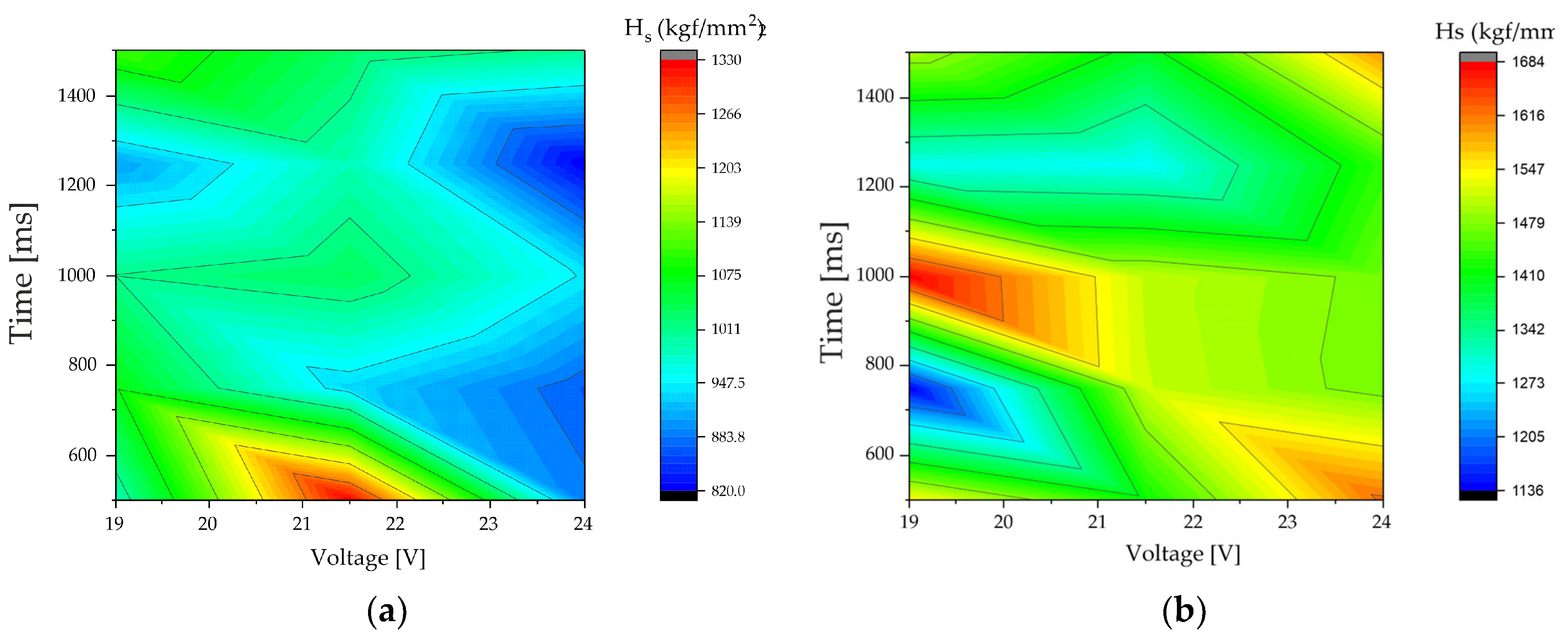
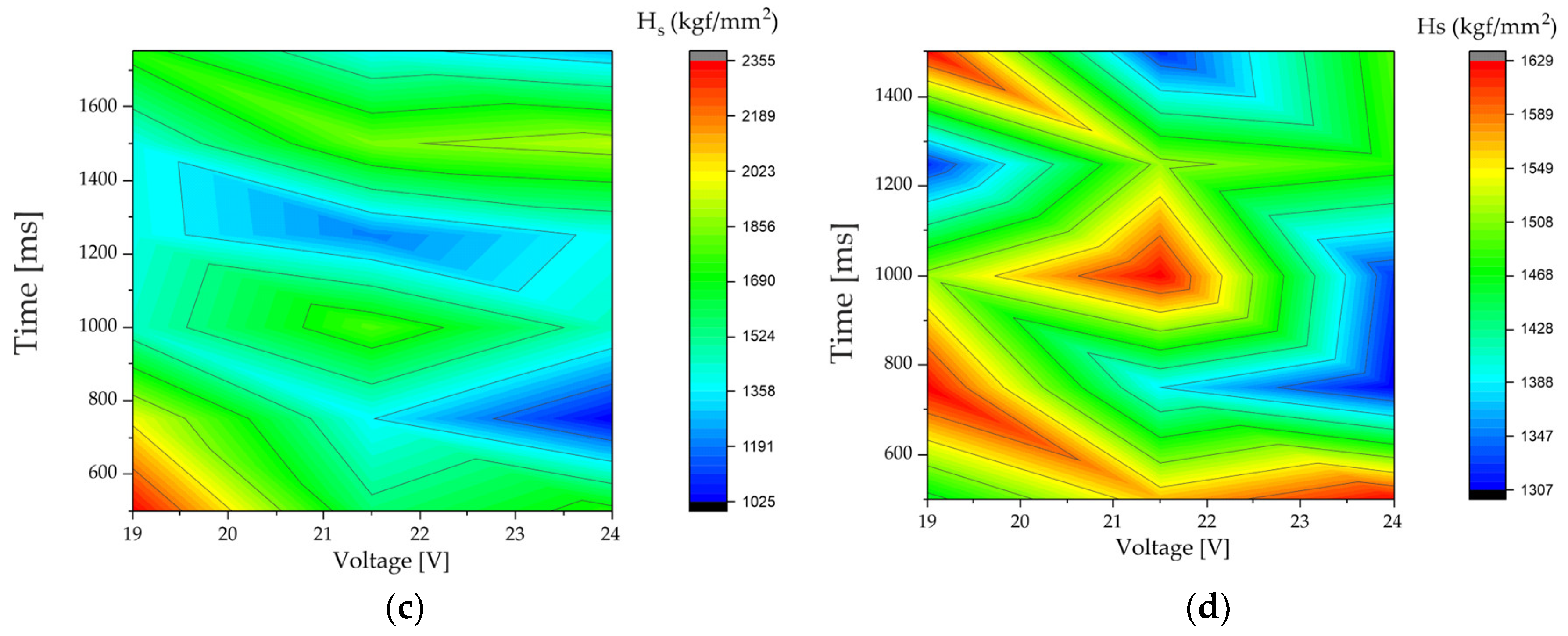
Assuming the close association between the Hs values and the wear resistance, this characteristic was chosen as the objective function for the qualitative selection of the hardfacing parameters. The factors considered for this selection were the voltage and hardfacing duration, as shown in the Hs mapping (Figure 17). The analysis of the Hs maps reveals optimal values of the hardfacing parameters for Alloy A, indicating that the formation of quenching structures is the main mechanism for strengthening the surface layer. These optimal values correspond to an intermediate voltage range (21.5–24 V) and a low hardfacing time (Figure 17a). In contrast, for Alloy B, the optimal Hs values are observed at an intermediate time (~1000 ms) and low heat input, which creates conditions for the growth of chromium carbides, which are the main phases providing wear resistance (Figure 17b). For the tungsten carbide-based material (Alloy C), two distinct regions of optimal hardfacing modes can be distinguished (Figure 17c). One region corresponds to low voltage and duration, while the other corresponds to high heat input at a low duration. These conditions are necessary to prevent initial tungsten carbide dissolution and promote tungsten carbide recrystallization in the presence of a liquid phase, respectively. Besides the possible dissolution, the dense WC crystals may sink under the nominal surface of the base material in the molten deposit. Alloy D (Figure 17d) exhibits wide ranges of optimal modes corresponding to the primary crystallization of the main strengthening phase, represented by Mo2(Fe,Mn)B2, and its based eutectics. Therefore, by changing the hardfacing parameters, it is possible to reinforce the surface layer through different mechanisms, including the primary crystallization of the hard phase as reinforcement and structure refinement, followed by dispersive strengthening of the austenite phase.

4. Conclusions

This study presents a comparative analysis of three commercially available and one original hardfacing alloy from differing alloying systems, aiming to identify potential candidates for enhancing the wear resistance of (but not limited to) mining machinery equipment operating in aggressive and highly abrasive environments. Although the scratch test method is neither conventional nor widely known, it should be relatively undemanding to apply on commercially available Vickers hardness measurement devices with a movable platform after little changes in the device’s software. The hardfaced layers were comprehensively characterized through wear tests, phase composition analysis using the CALPHAD approach, and scratch tests performed at the interfaces between the hardfaced layer and the base material.
The main highlights of this research are the following:
There exists a correlation between the proportional amount of carbides in the alloy and the Hs hardness.
The volumetric loss is inversely proportional to the proportional amount of carbides present in the alloy.
Ni-W-B-C wire (alloy C) exhibits the most favorable combination of characteristics for enhanced wear resistance, yet it may not be the best cost-effective choice in less demanding cases. Its resistance relies on a high amount of macrocrystalline tungsten-based carbides.
The experimental, tungsten-free hardfacing alloy D of Fe-Mo-Mn-B composition demonstrated only slightly less wear resistance (at about 85% of that of alloy C) due to the presence of ternary boride—Mo2(Fe,Mn)B2. This material can potentially be less expensive than its MTC-based counterpart.
The two other chromium-based alloys (A—9.5% Cr & B—30% Cr) exhibit lower wear resistance (about 30% and 45% of alloy C, respectively), despite a high content of hard chromium carbides. This phenomenon can be attributed to the lower micro-hardness of the alloy carbide constituents, especially when comparing their hardness to WC crystals.
The presented comparative ranking is specific to low-stress abrasion using silica sand. Under conditions involving high-impact loading or combined wear modes, the performance of the brittle phases may differ, which warrants further investigation.
This study revealed an observable correlation between wear resistance, phase composition, and hardness, as determined by the presented scratch test hardness measurement method for the tested materials A, B, C, and D. This correlation enables the use of hardness (Hs) as an objective function for optimizing the parameters of the hardfacing technology during the numerically controlled FCAW process for providing the desired level of wear resistance for any given alloy. Additionally, this method can be used by users with limited experience in metallurgy, providing a reliable basis for estimating the possible resistance to abrasive wear.

Author Contributions

Conceptualization, P.P. and J.P.; methodology, P.P.; software, P.P., I.M. and V.V.; validation, P.P., I.M. and J.P.; formal analysis, M.B.; investigation, P.P. and J.P.; resources, I.M., V.V., P.P. and J.P.; data curation, I.M. and V.V.; writing—original draft preparation, P.P. and J.P.; writing—review and editing, M.B., I.M., V.V., P.P. and J.P.; visualization, P.P. and J.P.; supervision, M.B.; project administration, M.B.; funding acquisition, M.B. All authors have read and agreed to the published version of the manuscript.

Funding

The research was funded by the Ministry of Education and Science of Ukraine, grant number 0123U101858 “Development of materials for applying wear-resistant coatings of the “high-manganese steel—refractory compounds” system by electric arc deposition” and grant number 0124U000473 “Technological assurance of the quality of components in strategic and long-operating equipment reinforced by surfacing of wear-resistant tungsten-free coatings”.

Institutional Review Board Statement

Not applicable.

Informed Consent Statement

Not applicable.

Data Availability Statement

The supplementary and raw data supporting this Figure 5, Figure 6, Figure 7, Figure 8, Figure 9, Figure 10, Figure 11, Figure 12, Figure 13 and Figure 14 will be made available upon a reasonable request.

Conflicts of Interest

All authors declare that they have no affiliations with or involvement in any organization or entity with any financial or non-financial interest in the subject matter or materials discussed in this manuscript.

References

  1. Holmberg, K.; Erdemir, A. Influence of Tribology on Global Energy Consumption, Costs and Emissions. Friction 2017, 5, 263–284. [Google Scholar] [CrossRef]
  2. Lachowicz, M.M.; Zwierzchowski, M.; Smolik, J.; Hawryluk, M. Influence of Oxidation on the Tribological Wear of Hot Work Tool Steels in Sliding Contact: Implications for the Forming Process. Arch. Civ. Mech. Eng. 2024, 25, 59. [Google Scholar] [CrossRef]
  3. Bembenek, M.; Krawczyk, J.; Pańcikiewicz, K. The Wear on Roller Press Rollers Made of 20Cr4/1.7027 Steel under Conditions of Copper Concentrate Briquetting. Materials 2020, 13, 5782. [Google Scholar] [CrossRef] [PubMed]
  4. Górnik, M.; Lachowicz, M.; Łatka, L. Corrosion Resistance of PPTA Ni-Based Hardfacing Layers. Mater. Sci.-Pol. 2024, 42, 66–78. [Google Scholar] [CrossRef]
  5. Gonzalez-Pociño, A.; Alvarez-Antolin, F.; Asensio-Lozano, J. Erosive Wear Resistance Regarding Different Destabilization Heat Treatments of Austenite in High Chromium White Cast Iron, Alloyed with Mo. Metals 2019, 9, 522. [Google Scholar] [CrossRef]
  6. Frocisz, Ł.; Krawczyk, J.; Bała, P.; Madej, M. The Relationshio between tribological properties and microstructure of 90CRV6 steel. In Proceedings of the Metal 2015: 24th Conference on Metallurgy and Materials, Brno, Czech Republic, 3–5 June 2015. ISBN 978-80-87294-62-8. [Google Scholar]
  7. Allende-Seco, R.; Artigas, A.; Bruna, H.; Carvajal, L.; Monsalve, A.; Sklate-Boja, M.F. Hardening by Transformation and Cold Working in a Hadfield Steel Cone Crusher Liner. Metals 2021, 11, 961. [Google Scholar] [CrossRef]
  8. Gharbi, F.; Sghaier, S.; Al-Fadhalah, K.J.; Benameur, T. Effect of Ball Burnishing Process on the Surface Quality and Microstructure Properties of AISI 1010 Steel Plates. J. Mater. Eng. Perform. 2011, 20, 903–910. [Google Scholar] [CrossRef]
  9. Bembenek, M.; Kopei, V.; Ropyak, L.; Levchuk, K. Stressed State of Chrome Parts During Diamond Burnishing. Metallofiz. Noveishie Tekhnol. 2023, 45, 239–250. [Google Scholar] [CrossRef]
  10. Mohrbacher, H. Metallurgical Concepts for Optimized Processing and Properties of Carburizing Steel. Adv. Manuf. 2016, 4, 105–114. [Google Scholar] [CrossRef]
  11. Walvekar, A.A.; Sadeghi, F. Rolling Contact Fatigue of Case Carburized Steels. Int. J. Fatigue 2017, 95, 264–281. [Google Scholar] [CrossRef]
  12. Bhaskar, S.V.; Kudal, H.N. Tribology of Nitrided-Coated Steel-a Review. Arch. Mech. Technol. Mater. 2017, 37, 50–57. [Google Scholar] [CrossRef]
  13. Wu, Q.; Qin, T.; Shen, M.; Rong, K.; Xiong, G.; Peng, J. Effect of Gas Nitriding on Interface Adhesion and Surface Damage of CL60 Railway Wheels under Rolling Contact Conditions. Metals 2020, 10, 911. [Google Scholar] [CrossRef]
  14. Lachowicz, M.M. Insight into the Microstructural Stability and Thermal Fatigue Behavior of Nitrided Layers on Martensitic Hot Forging Tools. Mater. Sci.-Pol. 2025, 43, 1–17. [Google Scholar] [CrossRef]
  15. Liu, H.; Tan, C.K.I.; Wei, Y.; Lim, S.H.; Lee, C.J.J. Laser-Cladding and Interface Evolutions of Inconel 625 Alloy on Low Alloy Steel Substrate upon Heat and Chemical Treatments. Surf. Coat. Technol. 2020, 404, 126607. [Google Scholar] [CrossRef]
  16. Kostencki, P.; Stawicki, T.; Królicka, A.; Sędłak, P. Wear of Cultivator Coulters Reinforced with Cemented-Carbide Plates and Hardfacing. Wear 2019, 438–439, 203063. [Google Scholar] [CrossRef]
  17. Krawczyk, J.; Pawłowski, B. The analysis of the tribological properties of the armoured face conveyor chain race / badania własności tribologicznych płyty ślizgowej przenośnika zgrzebłowego. Arch. Min. Sci. 2013, 58, 1251–1262. [Google Scholar] [CrossRef]
  18. Widomski, P.; Kaszuba, M.; Sokołowski, P.; Lange, A.; Walczak, M.; Długozima, M.; Gierek, M.; Chocyk, D.; Gładyszewski, G.; Boryczko, B. Nitriding of Hardfaced Layers as a Method of Improving Wear Resistance of Hot Forging Tools. Arch. Civ. Mech. Eng. 2023, 23, 241. [Google Scholar] [CrossRef]
  19. Szala, M.; Walczak, M.; Świetlicki, A. Effect of Microstructure and Hardness on Cavitation Erosion and Dry Sliding Wear of HVOF Deposited CoNiCrAlY, NiCoCrAlY and NiCrMoNbTa Coatings. Materials 2021, 15, 93. [Google Scholar] [CrossRef]
  20. Łatka, L.; Szala, M.; Macek, W.; Branco, R. Mechanical Properties and Sliding Wear Resistance of Suspension Plasma Sprayed YSZ Coatings. Adv. Sci. Technol. Res. J. 2020, 14, 307–314. [Google Scholar] [CrossRef]
  21. Choi, S.-W.; Lee, C.; Ha, T.; Kang, T.-H.; Chang, S. Endurance Performance of Conical Picks with Hardfacing for Improving Wear Resistance. In Proceedings of the First International Conference on Underground Mining Technology; Australian Centre for Geomechanics: Perth, Australia, 2017; pp. 637–643. [Google Scholar]
  22. Okechukwu, C.; Dahunsi, O.A.; Oke, P.K.; Oladele, I.O.; Dauda, M. Review on Hardfacing as Method of Improving the Service Life of Critical Components Subjected to Wear in Service. Niger. J. Technol. 2018, 36, 1095. [Google Scholar] [CrossRef]
  23. Krauze, K.; Boloz, L.; Wydro, T.; Mucha, K. Evaluation of the Durability of Hard-Faced Layers Welded on the Conical Picks on the Basis of Laboratory Tests. In Progressive Technologies in Mechanical Engineering: VIII International Scientific and Technical Conference, 4–8 February 2019, Yaremche, Ukraine; Ivano-Frankivsk National Technical University of Oil and Gas, Institute of Engineering Mechanics, Lviv Polytechnic National University, Institute of Engineering Mechanics and Transport: Yaremche, Ukraine, 2019; pp. 50–53. ISBN 978-617-7496-46-4. [Google Scholar]
  24. Lazić, V.; Sedmak, A.; Nikolić, R.R.; Mutavdzić, M.; Aleksandrović, S.; Krstić, B.; Milosavljević, D.I. Selection of the Most Appropriate Welding Technology for Hardfacing of Bucket Teeth. Mater. Technol. 2015, 49, 165–172. [Google Scholar]
  25. Tang, W.B.; Guo, Y.G.; Wang, H.G. The Effect of Microstructure on Properties of Fe-Cr-C-Nb/Ti Hardfacing Alloy. Adv. Mater. Res. 2011, 279, 126–131. [Google Scholar] [CrossRef]
  26. Dobra, R.M.; Farbas, N.; Pascu, D.R. Evaluation of Abrasive Wear Resistance of Fe-Cr-C Hardfacing Alloys Deposited on Active Components of the Agricultural Components. Adv. Mater. Res. 2014, 1029, 188–193. [Google Scholar] [CrossRef]
  27. Zhang, D.; Luo, Z.; Yuan, T.; Wang, R. Effects of Rare Earth Elements Erbium and Cerium on the Properties of Hardfacing Alloy. Adv. Mater. Res. 2011, 189–193, 3488–3491. [Google Scholar] [CrossRef]
  28. Öztürk, Z.T. Wear Behavior and Microstructure of Fe-C-Si-Cr-B-Ni Hardfacing Alloys. Mater. Test. 2021, 63, 231–234. [Google Scholar] [CrossRef]
  29. Prysyazhnyuk, P.; Ivanov, O.; Matvienkiv, O.; Marynenko, S.; Korol, O.; Koval, I. Impact and Abrasion Wear Resistance of the Hardfacings Based on High-Manganese Steel Reinforced with Multicomponent Carbides of Ti-Nb-Mo-V-C System. Procedia Struct. Integr. 2022, 36, 130–136. [Google Scholar] [CrossRef]
  30. Balaguru, S.; Gupta, M. Hardfacing Studies of Ni Alloys: A Critical Review. J. Mater. Res. Technol. 2021, 10, 1210–1242. [Google Scholar] [CrossRef]
  31. Guo, C.; Chen, J.; Zhou, J.; Zhao, J.; Wang, L.; Yu, Y.; Zhou, H. Effects of WC–Ni Content on Microstructure and Wear Resistance of Laser Cladding Ni-Based Alloys Coating. Surf. Coat. Technol. 2012, 206, 2064–2071. [Google Scholar] [CrossRef]
  32. Trembach, B.; Dmitriiev, O.; Kulahin, K.; Balenko, O.; Maliuha, V.; Neduzha, L. Hybrid Optimization of Hardfacing Conditions and the Content of Exothermic Additions in the Core Filler During the Flux-Cored Arc Welding Process. Eng 2026, 7, 23. [Google Scholar] [CrossRef]
  33. Kumari, P.; Singh, R.P. Development of Mathematical Models for Prediction of Weld Bead Geometry of Hardfaced Steel. Int. J. Appl. Eng. Res. 2015, 10, 38509–38525. [Google Scholar]
  34. Senthilkumar, B.; Kannan, T. Effect of Flux Cored Arc Welding Process Parameters on Bead Geometry in Super Duplex Stainless Steel Claddings. Measurement 2015, 62, 127–136. [Google Scholar] [CrossRef]
  35. Çömez, N.; Çivi, C.; Durmuş, H. Reliability Evaluation of Hardness Test Methods of Hardfacing Coatings with Hypoeutectic and Hypereutectic Microstructures. Int. J. Min. Met. Mater. 2019, 26, 1585–1593. [Google Scholar] [CrossRef]
  36. Aksoy, M.; Kuzucu, V.; Korkut, M.H. The Influence of Strong Carbide-Forming Elements and Homogenization on the Wear Resistance of Ferritic Stainless Steel. Wear 1997, 211, 265–270. [Google Scholar] [CrossRef]
  37. Pawar, S.; Jha, A.K.; Mukhopadhyay, G. Effect of Different Carbides on the Wear Resistance of Fe-Based Hardfacing Alloys. Int. J. Refract. Met. Hard Mater. 2019, 78, 288–295. [Google Scholar] [CrossRef]
  38. Lazi, V.; Milosavljevi, D.; Aleksandrovi, S.; Marinkovi, P.; Bogdanovi, G.; Nedeljkovi, B. Carbide Type Influence on Tribological Properties of Hard Faced Steel Layer—Part I—Theoretical Considerations. Tribol. Ind. 2010, 32, 10. [Google Scholar]
  39. Ivanov, O.; Prysyazhnyuk, P.; Lutsak, D.; Matviienkiv, O.; Aulin, V. Improvement of Abrasion Resistance of Production Equipment Wear Parts by Hardfacing with Flux-Cored Wires Containing Boron Carbide/Metal Powder Reaction Mixtures. Manag. Syst. Prod. Eng. 2020, 28, 178–183. [Google Scholar] [CrossRef]
  40. Liu, D.S.; Liu, R.P.; Wei, Y.H. Influence of Tungsten on Microstructure and Wear Resistance of Iron Base Hardfacing Alloy. Mater. Sci. Technol. 2014, 30, 316–322. [Google Scholar] [CrossRef]
  41. Günther, K.; Bergmann, J.P.; Zhang, C.; Rosenberger, M.; Notni, G.J.W.J.; American Welding Society. Hot Wire-Assisted Gas Metal Arc Welding of Ni-Based Hardfacing. Weld. J. 2018, 97, 99–107. [Google Scholar] [CrossRef]
  42. Dilawary, S.A.A.; Motallebzadeh, A.; Akhter, R.; Atar, E.; Cimenoglu, H. Enhanced Wear Resistance of Stellite 12 by Mo Addition and LSM. Surf. Eng. 2018, 34, 569–576. [Google Scholar] [CrossRef]
  43. Chaidemenopoulos, N.G.; Psyllaki, P.P.; Pavlidou, E.; Vourlias, G. Aspects on Carbides Transformations of Fe-Based Hardfacing Deposits. Surf. Coat. Technol. 2019, 357, 651–661. [Google Scholar] [CrossRef]
  44. Piekarska, W.; Sága, M.; Goszczyńska-Króliszewska, D.; Domański, T.; Kopas, P. Application of Analytical Methods for Determination of Hardness Distribution in Welded Joint Made of S1100QL Steel. MATEC Web Conf. 2018, 157, 02041. [Google Scholar] [CrossRef][Green Version]
  45. Broitman, E. Indentation Hardness Measurements at Macro-, Micro-, and Nanoscale: A Critical Overview. Tribol. Lett. 2017, 65, 23. [Google Scholar] [CrossRef]
  46. Pańcikiewicz, K. Preliminary Process and Microstructure Examination of Flux-Cored Wire Arc Additive Manufactured 18Ni-12Co-4Mo-Ti Maraging Steel. Materials 2021, 14, 6725. [Google Scholar] [CrossRef]
  47. Gogolinskii, K.V.; Syasko, V.A.; Umanskii, A.S.; Nikazov, A.A.; Bobkova, T.I. Mechanical Properties Measurements with Portable Hardness Testers: Advantages, Limitations, Prospects. J. Phys. Conf. Ser. 2019, 1384, 012012. [Google Scholar] [CrossRef]
  48. Kohlhöfe, W.; Penny, R.K. Dynamic Hardness Testing of Metals. Int. J. Press. Vessel. Pip. 1995, 61, 65–75. [Google Scholar] [CrossRef]
  49. Morsy, M.; El-Kashif, E. The Effect of Microstructure on High-Stress Abrasion Resistance of Fe-Cr-C Hardfacing Deposits. Weld. World 2014, 58, 491–497. [Google Scholar] [CrossRef]
  50. Pawlik, J.; Cieślik, J.; Bembenek, M.; Góral, T.; Kapayeva, S.; Kapkenova, M. On the Influence of Linear Energy/Heat Input Coefficient on Hardness and Weld Bead Geometry in Chromium-Rich Stringer GMAW Coatings. Materials 2022, 15, 6019. [Google Scholar] [CrossRef]
  51. Pawlik, J.; Bembenek, M.; Góral, T.; Cieślik, J.; Krawczyk, J.; Łukaszek-Sołek, A.; Śleboda, T.; Frocisz, Ł. On the Influence of Heat Input on Ni-WC GMAW Hardfaced Coating Properties. Materials 2023, 16, 3960. [Google Scholar] [CrossRef]
  52. Prysyazhnyuk, P.; Di Tommaso, D. The Thermodynamic and Mechanical Properties of Earth-Abundant Metal Ternary Borides Mo2 (Fe, Mn) B2 Solid Solutions for Impact-and Wear-Resistant Alloys. Mater. Adv. 2023, 4, 3822–3838. [Google Scholar] [CrossRef]
  53. Bembenek, M.; Prysyazhnyuk, P.; Shihab, T.; Machnik, R.; Ivanov, O.; Ropyak, L. Microstructure and Wear Characterization of the Fe-Mo-B-C—Based Hardfacing Alloys Deposited by Flux-Cored Arc Welding. Materials 2022, 15, 5074. [Google Scholar] [CrossRef]
  54. Andersson, J.-O.; Helander, T.; Höglund, L.; Shi, P.; Sundman, B. Thermo-Calc & DICTRA, Computational Tools for Materials Science. Calphad 2002, 26, 273–312. [Google Scholar] [CrossRef]
  55. Hallstedt, B.; Khvan, A.V.; Lindahl, B.B.; Selleby, M.; Liu, S. PrecHiMn-4—A Thermodynamic Database for High-Mn Steels. Calphad 2017, 56, 49–57. [Google Scholar] [CrossRef]
  56. van de Walle, A.; Nataraj, C.; Liu, Z.-K. The Thermodynamic Database Database. Calphad 2018, 61, 173–178. [Google Scholar] [CrossRef]
  57. Slota, J.; Kubit, A.; Gajdoš, I.; Trzepieciński, T.; Kaščák, Ľ. A Comparative Study of Hardfacing Deposits Using a Modified Tribological Testing Strategy. Lubricants 2022, 10, 187. [Google Scholar] [CrossRef]
  58. Lozynskyi, V.; Trembach, B.; Hossain, M.M.; Kabir, M.H.; Silchenko, Y.; Krbata, M.; Sadovyi, K.; Kolomiitsev, O.; Ropyak, L. Prediction of Phase Composition and Mechanical Properties Fe–Cr–C–B–Ti–Cu Hardfacing Alloys: Modeling and Experimental Validations. Heliyon 2024, 10, e25199. [Google Scholar] [CrossRef]
  59. Escherová, J.; Krbata, M.; Kohutiar, M.; Barényi, I.; Chochlíková, H.; Eckert, M.; Jus, M.; Majerský, J.; Janík, R.; Dubcová, P. The Influence of Q & T Heat Treatment on the Change of Tribological Properties of Powder Tool Steels ASP2017, ASP2055 and Their Comparison with Steel X153CrMoV12. Materials 2024, 17, 974. [Google Scholar] [CrossRef]
Figure 1. Exemplary picture of a mining cutting tool with hard-faced wear-resistant overlay fabricated with one of the studied materials.
Coatings 16 00178 g001
Figure 2. Exemplary microscopic image of ambiguous hardness measurement values of TC-rich hardfaced layer. (a) depicts plastic deformation of the nickel matrix, (b) depicts mixed hardness of two distinctive materials.
Coatings 16 00178 g002
Figure 3. Picture of exemplary specimen of Alloy B, fabricated with three distinctive voltage levels and six incremental deposition durations, (a) side view, (b) top view.
Coatings 16 00178 g003
Figure 4. The methodology of the scratch tests: (a) schematic representation of the tested sample, (b) results of the measurements of the scratch and Vickers hardness of the C45.
Coatings 16 00178 g004
Figure 5. The pseudobinary isopleths of the Hardfacing alloy—base material» systems: (a) Alloy A; (b) Alloy B; (c) Alloy C; (d) Alloy D.
Coatings 16 00178 g005
Figure 6. The temperature step diagrams of the phase compositions for alloys corresponding to the top hardfacing layers: (a) Alloy A; (b) Alloy B; (c) Alloy C; (d) Alloy D.
Coatings 16 00178 g006
Figure 7. Image analysis of the hardfaced layer microstructures. The letters correspond to the codenames of the materials studied ((a) for Alloy A, (b) for Alloy B, (c) for Alloy C and (d) for Alloy D). The metallic matrix is rendered in purple, whereas the hard phases are highlighted in yellow and green.
Coatings 16 00178 g007
Figure 8. Microstructures of hardfaced layer surfaces (a1,b1,c1,d1) and morphologies of the worn surfaces after abrasion tests (a2,b2,c2,d2). The letters correspond to the codenames of the studied materials.
Coatings 16 00178 g008aCoatings 16 00178 g008b
Figure 9. The results of EDS analysis for worn surfaces of hardfaced layers after abrasion tests: (a) Alloy A; (b) Alloy B; (c) Alloy C; (d) Alloy D.
Coatings 16 00178 g009aCoatings 16 00178 g009b
Figure 10. The Hs hardness scratch test results for the Alloy A hardfacing: (a) at 19 V; (b) at 21.5 V, (c) at 24 V.
Coatings 16 00178 g010aCoatings 16 00178 g010b
Figure 11. The Hs hardness scratch test results for the Alloy B hardfacing: (a) at 19 V; (b) at 21.5 V, (c) at 24 V.
Coatings 16 00178 g011aCoatings 16 00178 g011b
Figure 12. The Hs hardness scratch test results for Alloy C hardfacing: (a) at 19 V; (b) at 21.5 V, (c) for 24 V.
Coatings 16 00178 g012aCoatings 16 00178 g012b
Figure 15. Averaged Hs values for all tested alloys with visible scatter of hardness, resulting mainly from hard carbides.
Coatings 16 00178 g015
Figure 16. Comparative chart of abrasion wear resistance, scratch hardness, and total amount of hard phase calculated within the CALPHAD approach.
Coatings 16 00178 g016
Figure 17. The Hs maps corresponding to the selected ranges of the hardfacing modes: (a) Alloy A; (b) Alloy B; (c) Alloy C; (d) Alloy D.
Coatings 16 00178 g017aCoatings 16 00178 g017b
Table 1. The chemical composition of the investigated hardfacing alloys.
Hardfacing AlloyChemical Composition (wt.%)
FeCrMoBCWSiNiMn
ABal.9.420.01 0.59 2.86 
BBal.30.0 3.8 3.5 1.200.6
C1.0 3.0 37.7 0.5Bal.0.56
DBal.24.12.70.7513.7
Disclaimer/Publisher’s Note: The statements, opinions and data contained in all publications are solely those of the individual author(s) and contributor(s) and not of MDPI and/or the editor(s). MDPI and/or the editor(s) disclaim responsibility for any injury to people or property resulting from any ideas, methods, instructions or products referred to in the content.