Review

Recent Progress in Organic Inhibitors for Anticorrosion in Complex Acid Environments

1
Research Institute of Natural Gas Technology, Southwest Oil and Gas Field Company of PetroChina, Chengdu 610213, China
2
Engineering Technology Department, Southwest Oil and Gas Field Company of PetroChina, Chengdu 610213, China
3
College of Biomedical Engineering, Sichuan University, Chengdu 610065, China
*
Author to whom correspondence should be addressed.
Coatings 2026, 16(2), 150; https://doi.org/10.3390/coatings16020150
Submission received: 10 December 2025 / Revised: 16 January 2026 / Accepted: 21 January 2026 / Published: 23 January 2026
(This article belongs to the Special Issue Advanced Coating Protection Technology in the Oil and Gas Industry)

Abstract

Corrosion in complex acid environments, such as high temperatures and acidic downhole conditions, remains a critical threat to well integrity during oil and gas acidizing. This review firstly examines the influence of downhole variables, including temperature, acidity, and steel, on the performance of organic inhibitors. It analyzes molecular design strategies that enhance the stability and adsorption of traditional inhibitor classes, including Mannich Bases, quaternary ammonium salts, and benzimidazoles, through structural modifications such as rigid heterocycles, extended alkyl chains, and multi-dentate architectures. The discussion extends to synergistic formulations, sustainable alternatives derived from biopolymers or green chemistry, and intelligent responsive systems. Furthermore, the growing role of computational methods, from molecular dynamics simulations to AI-driven molecular design, in accelerating the discovery of high-performance inhibitors is highlighted. Together, these advances offer a comprehensive and forward-looking perspective on developing adaptive, efficient, and environmentally compatible corrosion protection strategies for next-generation hydrocarbon extraction.

1. Introduction

Acidizing, a critical well stimulation technique used to enhance hydrocarbon recovery, involves injecting concentrated acids, such as hydrochloric or hydrofluoric acid, into a formation under high temperature and pressure [1,2,3]. These aggressive fluids, while effective in dissolving mineral deposits and improving permeability, pose severe corrosion risks to downhole tubulars, wellhead equipment, and surface piping [4,5,6]. The combined action of acidic media, elevated temperatures (often exceeding 150 °C in deep wells), dissolved corrosive gases (CO2, H2S), and ionic species accelerates metal degradation, leading to uniform corrosion, pitting, and hydrogen-induced cracking, which can compromise well integrity and result in costly operational failures [7,8]. To mitigate these risks, advanced corrosion inhibitors are essential for maintaining equipment reliability during and after stimulation [9,10]. Effective inhibitor systems must not only provide high retardation of acid-induced corrosion but also demonstrate thermal stability, compatibility with other stimulation additives, and minimal impact on formation permeability [11,12,13].
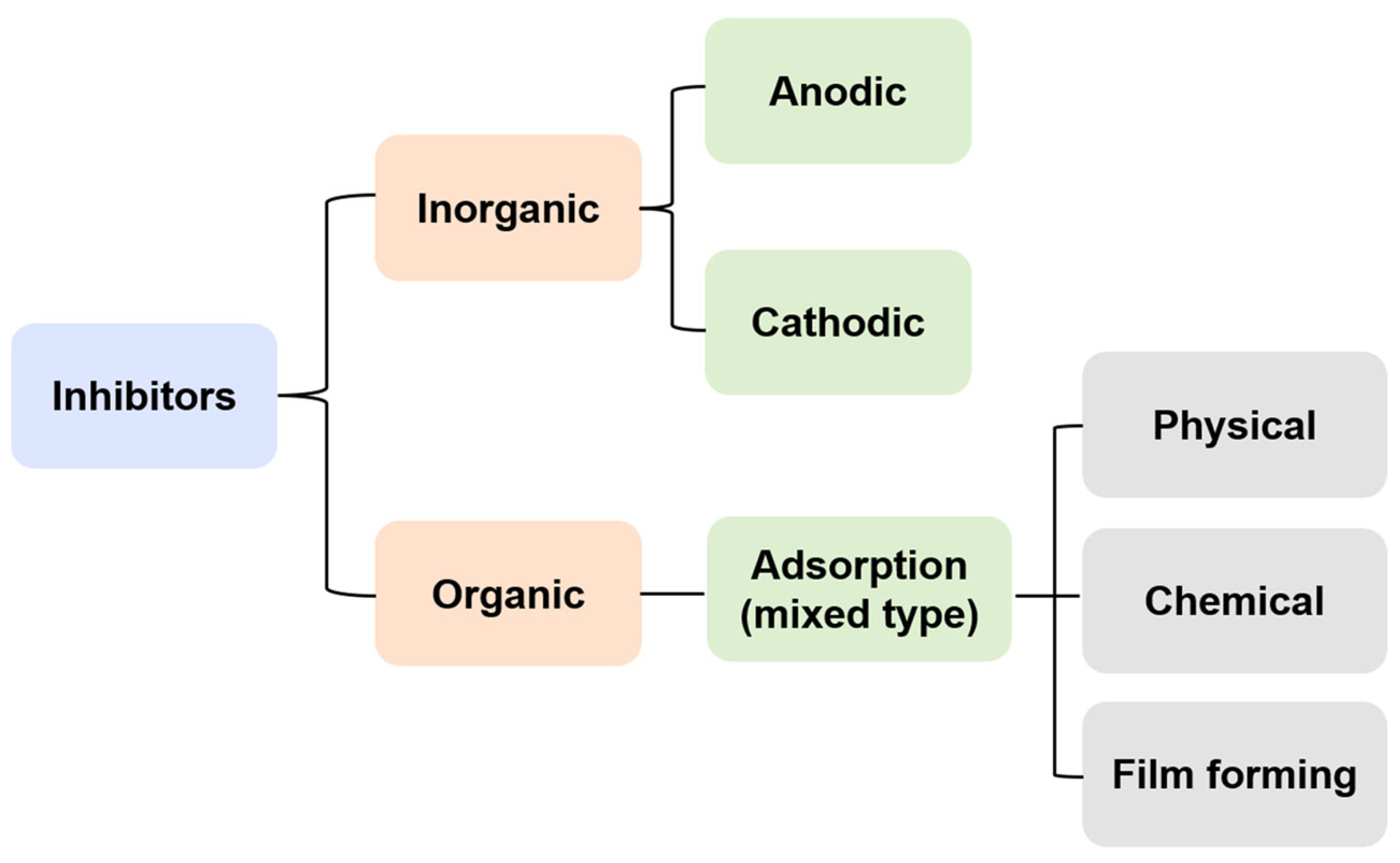
Corrosion inhibitors are primarily categorized into inorganic and organic types, each defined by distinct chemical compositions and protection mechanisms (Scheme 1) [14]. Inorganic inhibitors, including metal-containing compounds and oxyanions such as chromates, molybdates, phosphates, nitrites, and silicates, function mainly through surface-reactive processes like passivation or precipitation via either cathodic or anodic actions. However, these mechanisms are fundamentally incompatible with acidizing environments [15,16,17]. The high H+ concentration in acidic media disrupts passive films, dissolves precipitated layers, and compromises thermal stability, rendering inorganic inhibitors ineffective under such conditions. In contrast, organic inhibitors are the predominant and technically superior choice for acidizing applications. Their protection derives from adsorption onto metal surfaces, facilitated by molecular structures containing heteroatoms and aromatic systems [18,19,20,21,22]. The protective action of organic corrosion inhibitors is primarily governed by their adsorption behavior onto metal surfaces, which can occur through physical or chemical mechanisms. Physical adsorption, driven by electrostatic attraction, allows for rapid but often reversible attachment. By comparison, chemisorption involves charge sharing or transfer between inhibitor molecules and the metal, resulting in stronger, more stable bonds, though the process is typically slower and less reversible. The effectiveness of organic inhibitors in aggressive environments, such as high-concentration HCl (15–28%) used in downhole operations, stems from their ability to form dense, hydrophobic films via surface reactions. Organic inhibitors generally have amphiphilic compounds featuring polar headgroups (e.g., N, S, O, and P) that anchor via coordination or electrostatic interactions, while extended hydrophobic alkyl tails (C12–C18) create a tightly packed, hydrophobic barrier [23,24,25,26,27,28]. This structure effectively blocks both anodic and cathodic sites, impeding charge and mass transfer and typically reducing corrosion rates by 80–95%. In practical pipeline applications, such inhibitors are often synergistically incorporated into organic coating systems, thereby establishing a multi-level defense strategy. Coatings serve as a physical barrier, while inhibitors provide active, chemically responsive protection, collectively enhancing long-term infrastructure integrity [29,30,31,32,33].
Despite these merits, conventional organic inhibitors still experience severe performance degradation due to harsh downhole conditions. The thermal stability of molecular structures becomes compromised, with imidazolines undergoing ring-opening reactions, quaternary ammonium compounds decomposing via Hofmann elimination, and amine-based inhibitors volatilizing or polymerizing [34,35,36,37]. Simultaneously, the thermodynamic equilibrium of adsorption processes shifts unfavorably; specifically, physical adsorption becomes unstable due to weakened electrostatic interactions, while chemisorption bonds may rupture under intense thermal vibration. Furthermore, the environment fundamentally alters corrosion kinetics and inhibitor functionality. The Arrhenius relationship dictates that corrosion rates typically double with every 10 °C temperature increase, meaning deep well conditions can accelerate corrosion by 16–32 times compared to surface operations. More critically, pH changes or elevated temperatures disrupt the self-assembly and maintenance of protective films. This combination of factors leads to the rapid deterioration of conventional inhibition systems, manifesting as severe localized corrosion, under-deposit attack, and stress cracking [34,35,36,37,38,39,40].
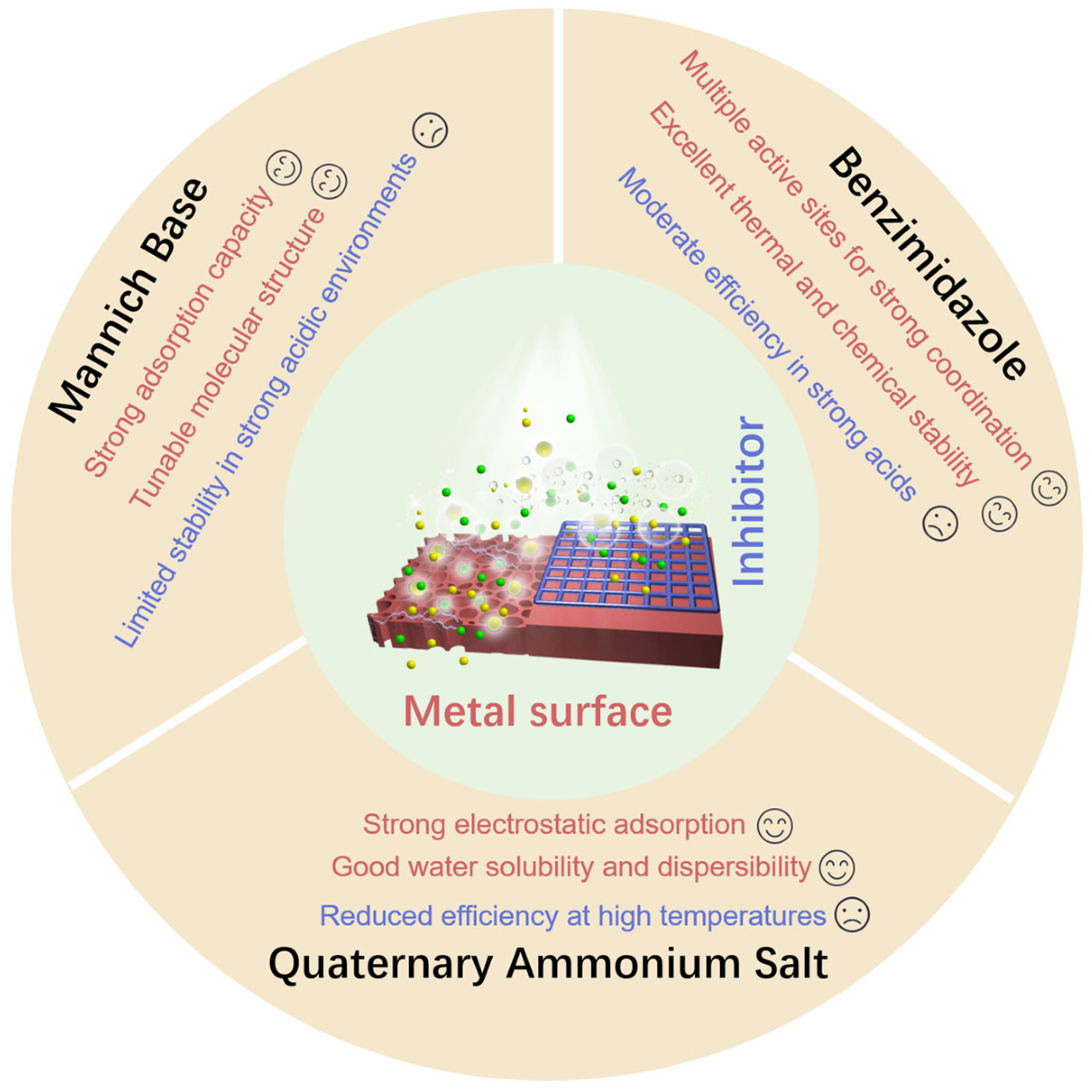
Hence, this review firstly outlines the impact of downhole conditions on the efficiency of inhibitors. Then, we discuss the molecular design related to the structural rigidity and multi-dentate binding capability of recent organic inhibitors involving Mannich Base, quaternary ammonium salt, and benzimidazole types (Scheme 2), which are the most commonly utilized. Finally, we briefly detail emerging trends in metal corrosion protection, including bio-based organic inhibitors designed for economical, recyclable, and environmentally sustainable demand; intelligent stimuli-responsive inhibitor systems; and artificial intelligence (AI)-driven development of novel organic inhibitors, which is promising for the design of cost-effective, adaptive, and self-regulating inhibitors in future oil and gas field applications. Notably, we conducted a systematic and reproducible literature search across multiple electronic databases and publisher platforms, with studies focusing on recent designs of corrosion inhibitors by selecting representative molecular structures and modification strategies, as well as referencing analytical and computational simulation means for comparison and discussion.

2. The Impact of Various Downhole Conditions on the Efficiency of Inhibitors

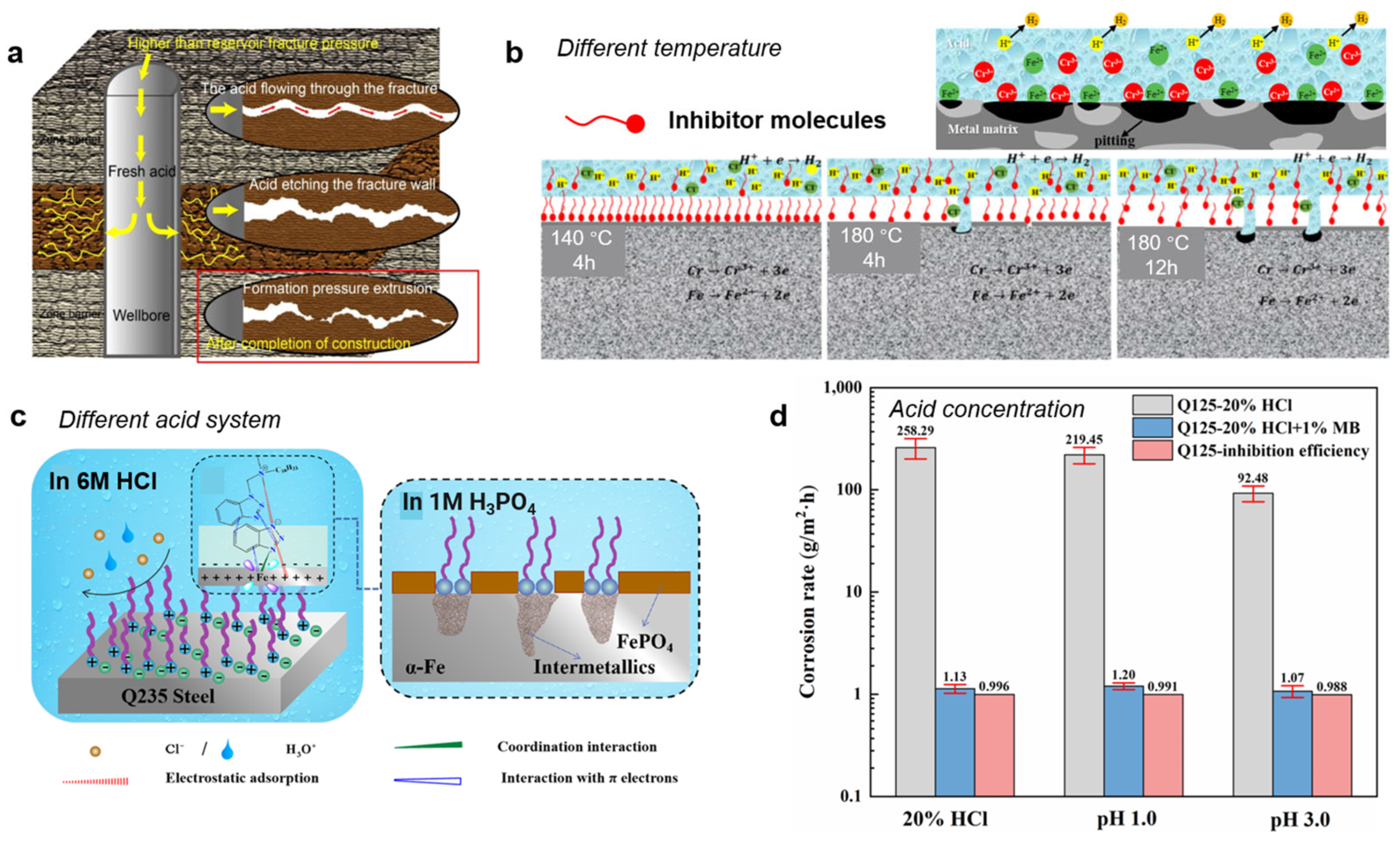
Acidizing stimulation involves pumping concentrated acid (e.g., HCl) into a wellbore to dissolve reservoir minerals and enhance permeability (Figure 1a) [41]. During this process, the highly corrosive acid contacts and attacks downhole tubulars, risking severe metal loss, hydrogen embrittlement, and equipment failure. Corrosion inhibitors are, therefore, essential additives that adsorb onto metal surfaces, forming a protective film to significantly reduce corrosion rates, ensure well integrity, and allow the treatment to proceed safely and effectively. The performance of acidizing corrosion inhibitors is not an intrinsic property but a dynamic response governed by the complex interplay of downhole conditions. These operational parameters critically modulate inhibitor adsorption, film stability, and ultimate protective efficacy [42,43,44].

2.1. High Temperatures

Elevated temperatures (>100 °C in downhole conditions) exponentially accelerate corrosion kinetics with the following reverse effect on inhibitor efficiency. Firstly, inhibitors function by blocking active reaction sites. At higher temperatures, the turnover rate of these sites is accelerated, leading to promoted desorption. Thermodynamic analysis suggested that the standard Gibbs free energy of adsorption (ΔG°ads) becomes less negative at higher temperatures, indicating a weaker and less spontaneous adsorption process. Consequently, inhibitors acting primarily through geometric blocking effects may fail as enhanced diffusion allows corrosive agents to penetrate film defects [48,49].
Secondly, temperature triggers an exponential increase in the intrinsic corrosion rate of steel in acidic media, qgoverned by the Arrhenius equation. Meanwhile, the diffusion rates of corrosive species (e.g., H+, Cl) accelerate. This heightened flux creates a more competitive environment at the metal–solution interface, where aggressive ions can more readily displace adsorbed inhibitor molecules through competitive adsorption, especially if the inhibitor–metal bond is not sufficiently strong [14,21]. For example, the corrosion of duplex stainless steel in acidic environments involves preferential dissolution of ferrite and chromium, driven by their more negative electrochemical potentials compared to austenite and iron. The localized loss of chromium creates defective sites that are highly susceptible to chloride adsorption [2,5]. These sites, often at phase boundaries or inclusion interfaces, become stable anodic pits where aggressive acid–chloride solutions can be trapped and maintained. This leads to the initiation and propagation of localized pitting corrosion, which is the most severe threat to duplex stainless-steel integrity in such environments. At 180 °C, the inorganic underlayer of the film becomes prone to cracking and damage, while the binding energy and adsorption strength of the organic overlayer are simultaneously reduced. This dual degradation impairs the self-healing ability of the film, failing to provide adequate barrier protection and ultimately leading to the significant expansion of corrosion pits in both depth and area (Figure 1b) [45].
Thirdly, high temperatures may induce chemical degradation of the organic backbone of inhibitors. Particularly, those reliant on long aliphatic chains or esters face risks of thermal cracking, hydrolysis, or oxidative decomposition. For example, certain amine-based inhibitors could undergo Hofmann degradation or cyclization reactions, altering their molecular structure and deactivating key adsorption functional groups. The thermal stability of an inhibitor is fundamentally governed by its molecular architecture [9,14]. Structures incorporating aromatic rings, heterocycles (e.g., imidazoline, pyridine, and quinoline), and conjugated systems exhibit superior stability due to stronger bond energies (e.g., C-C and C-N in aromatic systems) and resonance stabilization [18,28]. Molecular design strategies, such as introducing thermally robust substituents or synthesizing oligomeric/polymeric inhibitors, aim to elevate the decomposition temperature, thereby extending the functional lifespan of the inhibitor under harsh thermal conditions.
Finally, high temperature significantly alters the physical properties of the acidizing fluid, including reduced viscosity and surface tension. While this generally improves fluid injectivity, it can also hinder the transport and interfacial distribution of inhibitor molecules, particularly if they are hydrophobic or have low solubility.

2.2. Acid Type and Concentration

The inhibition efficiency is closely related to the acid type and concentration. Strong mineral acids present a high H+ activity challenge, while organic acids or chelants introduce unique mechanisms like chelant-induced corrosion [7]. Higher acid concentrations intensify both the corrosion driving force and ionic strength, which can screen electrostatic interactions and alter inhibitor solubility/micellization.
The inorganic acid system in acid fracturing is commonly hydrochloric acid (HCl)–hydrofluoric acid (HF). HCl provides a high concentration of H+ ions, leading to vigorous hydrogen evolution corrosion. The corrosion rate is inherently high and temperature-sensitive. Inhibitors for HCl environments must primarily and robustly block cathodic sites to impede H+ reduction [23,49]. Xiang et al. compared the anticorrosion effects on Q235 steel caused by halogen-free quaternary ammonium-based ionic liquid functionalized with benzotriazole, namely, BTA-16-BTA, in 6 M HCl and 1 M H3PO4. They found that there was a different corrosion inhibition mechanism. HCl formed an electrostatically assembled hydrophobic bilayer that displaced corrosive species, providing barrier protection. By comparison, in H3PO4, phosphate anions contributed to surface passivation, and the inhibitor adsorbed synergistically at film defects at low doses but competed with passivation at high concentrations, especially under elevated temperatures, leading to reduced efficiency (Figure 1c) [46]. Furthermore, the presence of HF in mud acid introduces additional complexity. Fluoride ions are highly aggressive toward silicate scales but also pose a severe risk of pitting and stress corrosion cracking, particularly on chromium-containing alloys [5]. Furthermore, HF can complex with certain inhibitor components, potentially deactivating them. Another type is organic acids. These weaker, partially dissociated acids offer a lower overall concentration of free H+ ions, resulting in intrinsically lower corrosion rates compared to HCl at equivalent mass concentrations [14,50]. However, this presents a different challenge. The lower corrosivity can reduce the thermodynamic driving force for strong, spontaneous inhibitor adsorption. Additionally, organic acids can chelate dissolved metal ions (Fe2+ and Fe3+), which influences corrosion product layers. For instance, the presence of chelants can prevent the precipitation of protective iron acetate films in acetic acid systems, potentially increasing bare metal exposure and demanding more persistent inhibitor films. In organic acids, the higher pH alters the surface charge of the steel, necessitating tailored functional groups that adsorb effectively under near-neutral conditions. Additionally, the corrosion mechanism may shift from predominant hydrogen evolution to mixed-control or oxygen-dependent pathways, requiring inhibitors with broader-spectrum activity.
In addition, acid concentration operates as a dual-edged sword, non-linearly governing both corrosion severity and inhibitor efficacy through competing physicochemical mechanisms. At high concentrations (e.g., 15–28% HCl), the elevated H+ activity provides a strong electrochemical driving force for the initial adsorption of cationic inhibitors onto the negatively charged steel surface [7,21]. However, this same high ionic flux creates intense competitive pressure, where the sheer abundance of H+ ions can displace weakly adsorbed inhibitor molecules, demanding films of exceptional integrity and adsorption strength. For example, the corrosion rate in 6.0 M HCl decreases by over 50% as pH increases from 1 to 3 and is further significantly suppressed upon inhibitor addition. Interestingly, inhibition efficiency is lower at pH = 3.0 (98.8%) than at pH = 1.0 (99.1%). This is because the reduced H+ concentration at higher pH diminishes the cathodic driving force, which is crucial for strong inhibitor chemisorption, resulting in a less protective film (Figure 1d) [5].
Moreover, the exothermic reaction with carbonate formations can induce significant downhole temperature spikes (“temperature kicks”), synergistically coupling high acidity with elevated temperature to produce peak-corrosivity conditions that challenge the functional limits of conventional inhibitors [9,41]. Consequently, formulations for high-strength acids often require increased dosage and enhanced thermal stabilizers. Conversely, lower to moderate acid concentrations (e.g., 7.5–10% HCl or weak organic acids) present a distinct adsorption dilemma: the reduced H+ activity and ionic strength may insufficiently drive the electrostatic adsorption of certain inhibitor chemistries, leading to incomplete surface coverage [14,20]. Thus, inhibitor selection must be precisely calibrated to the acid concentration, balancing adsorption driving force against competitive displacement and additive compatibility.

2.3. Steel Type and Environmental Adaptiveness

The effectiveness of corrosion inhibitors in downhole environments is fundamentally governed by the metallurgical composition and surface properties of the steel substrate. The interaction between inhibitor molecules and the steel surface is not generic but highly specific, dictated by the alloy’s electrochemical behavior, passive film characteristics, and microstructure. This substrate specificity presents both mechanistic insights and significant practical challenges in designing universally effective corrosion protection strategies.
Carbon and low-alloy steels, the most prevalent materials in well casings and tubing, present an actively corroding surface dominated by iron. Inhibitors for these materials primarily function through chemisorption onto active Fe sites, forming a protective organic monolayer that blocks both anodic dissolution and cathodic hydrogen evolution [8,51]. The key challenge lies in achieving and maintaining high surface coverage amid intense competition from aggressive anions like chloride. Inhibitor molecules often require multiple heteroatom adsorption centers and planar geometry to maximize interaction with the iron lattice. In contrast, corrosion inhibition on chromium-containing steels (e.g., 13Cr and super 13Cr) and duplex stainless steels involves fundamentally different mechanisms. These alloys rely on thin but robust passive oxide layers (primarily Cr2O3) for corrosion resistance [12,52]. Effective inhibitors must, therefore, operate without disrupting this passive film. Some organic inhibitors can adsorb onto the oxide surface through hydrogen bonding or van der Waals interactions, providing an additional barrier layer. However, incompatible inhibitor formulations may locally destabilize the passive film, potentially inducing pitting or chloride stress corrosion cracking (SCC) risks that are particularly acute in high-temperature, high-chloride environments.
The metallurgical microstructure further modulates inhibitor performance. Grain boundaries, inclusions, and precipitated phases create electrochemical heterogeneities that can serve as initiation sites for localized corrosion [7,53]. Inhibitors must demonstrate the ability to adsorb preferentially at these vulnerable sites, a requirement that depends on both molecular structure and the specific metallurgical features of the steel. For instance, the effectiveness of an inhibitor may vary significantly between normalized and quenched-and-tempered versions of the same steel grade due to differences in carbide distribution and grain boundary chemistry.
Practical challenges stem from this complexity. Laboratory qualification tests typically employ standard carbon steel coupons, generating performance data that may not translate reliably to higher-grade alloys used in actual downhole applications. The oilfield industry lacks standardized testing protocols that adequately account for metallurgical variations, potentially leading to underperformance or unexpected failure in field applications.

2.4. Other Conditions

Beyond the primary factors of temperature, acid type, and steel composition, the efficiency of downhole corrosion inhibitors is critically modulated by hydrodynamic conditions, ionic strength, and operational variables, which collectively define the actual service environment [14,34,49]. Hydrodynamics impose a fundamental mechanical constraint on inhibitor performance. High flow rates, turbulent conditions, and significant shear stresses inherent in pumping operations and tubular flow can physically impede the formation of adsorbed inhibitor films or strip established protective layers. This mechanical challenge necessitates the design of inhibitors capable of forming tenacious, viscoelastic films with strong chemisorption bonds that resist shear-induced desorption. The dynamic nature of flow also influences mass transport, potentially enhancing the delivery of the inhibitor to the metal surface while simultaneously increasing the flux of corrosive species, thereby testing the film barrier properties under non-equilibrium conditions.
The ionic composition of the acidizing fluid and its evolution during treatment introduce further complexity. High ionic strength, resulting from concentrated acids or dissolved minerals, can compress the electrical double layer, potentially altering the electrostatic component of inhibitor adsorption and affecting the orientation of charged inhibitor molecules at the interface [23,26,54]. More critically, the spent acid environment accumulates metal ions (Fe2+, Fe3+) from tubular and formation corrosion. These ions can complex with inhibitor molecules in the bulk solution, reducing their effective concentration, or form precipitates (e.g., iron hydroxides and sulfides) that foul the metal surface, creating uneven coverage and undermining the inhibitor’s protective barrier. The presence of dissolved gases, particularly CO2 and H2S, introduces additional cathodic reduction reactions beyond hydrogen evolution. Effective inhibitors must, therefore, not only block surface sites but also favorably modify the kinetics of hydrogen recombination to mitigate the risk of hydrogen embrittlement, a failure mechanism distinct from general weight-loss corrosion.
Operational parameters, especially contact time, present a critical yet often overlooked variable. For retarded acid systems or emulsified acids designed for deep penetration, the inhibitor must maintain film integrity and protective efficacy over extended periods, while the live acid remains in the wellbore. This demands exceptional film persistence, often achieved through multi-layer adsorption, polymerization at the surface, or synergistic formulations with film-strengthening additives. Consequently, a successful downhole corrosion inhibitor cannot be a single-molecule solution but must be engineered as a system-responsive material. Its formulation must integrate components that address mechanical stability under shear, compatibility with a high ionic strength and evolving chemical environment, mitigation of secondary damage mechanisms like hydrogen uptake, and durability over the required treatment lifespan. This multidimensional adaptability is the key to transitioning from laboratory efficacy to reliable field performance in the geometrically and chemically complex downhole environment.

3. Classification of Organic Inhibitors

Traditional organic inhibitors applied in complex acid environments mainly consist of Mannich Bases, benzimidazoles, and their quaternary ammonium salt derivatives. To overcome the limitations of single components, such as film instability under extreme temperatures, synergistic additives like intensifiers are often compounded to form inhibitor systems that build more stable and denser composite protective films. By virtue of the high thermal stability of their molecular structures, these inhibitor systems have become indispensable protective agents for high-temperature acidizing operations in deep and ultra-deep wells. We first summarize them in Table 1 and present the details below.

3.1. Mannich Base Corrosion Inhibitors

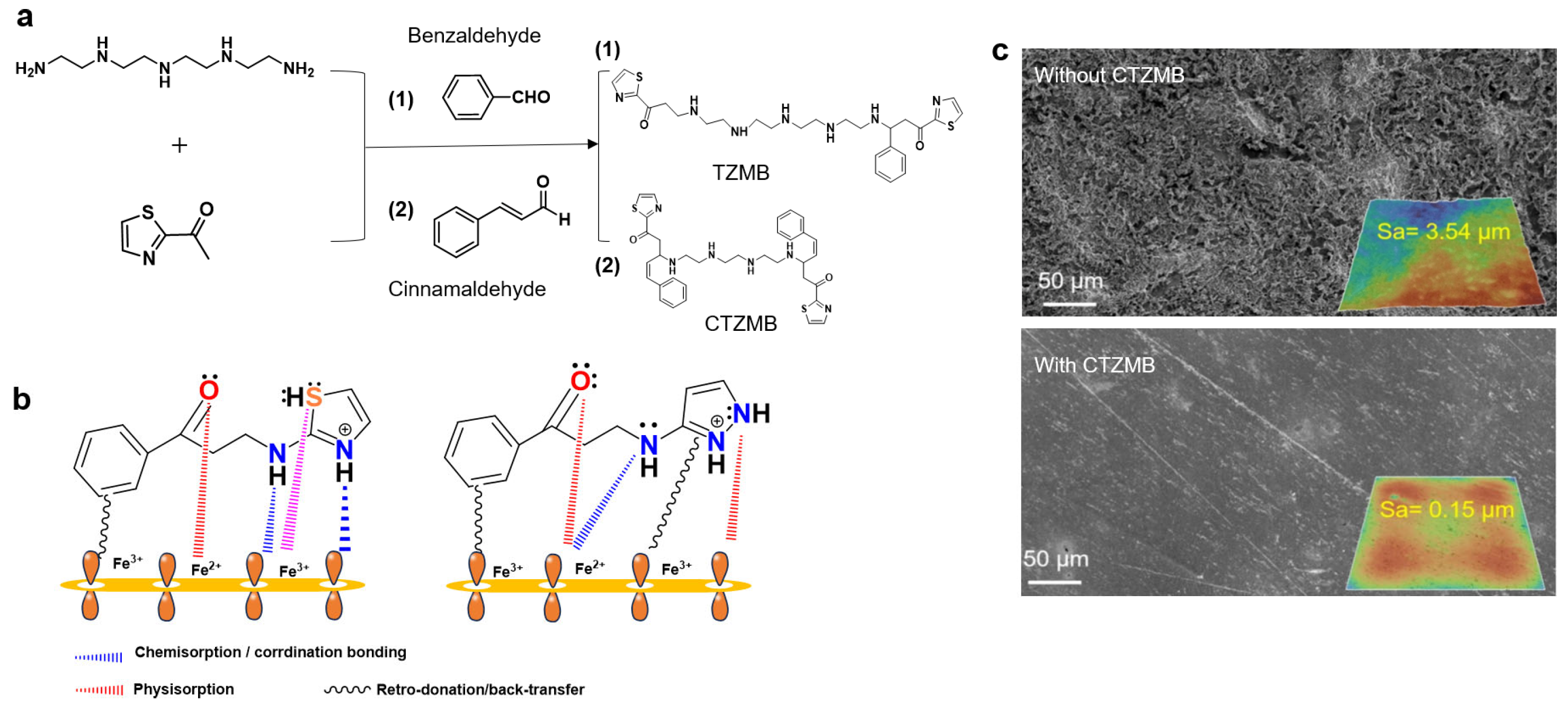
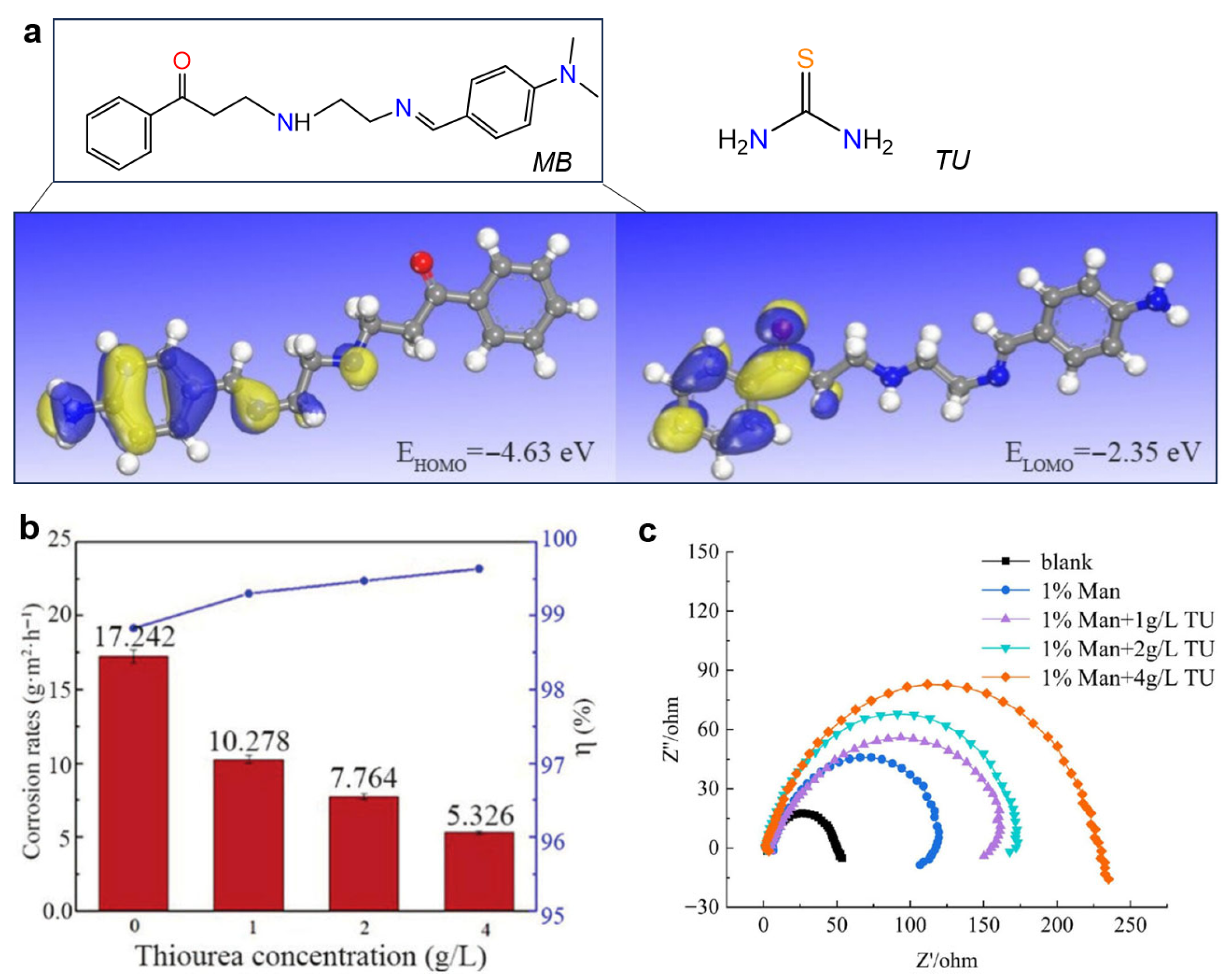
Mannich Bases (MBs) represent an important class of corrosion inhibitors synthesized through the condensation reaction of amines, formaldehyde, and carbonyl compounds [55,56,57,58,59,74,75,76,77,78,79]. Their molecular architecture, featuring multiple functional groups, including amines, hydroxyl groups, and carbonyl moieties, enables comprehensive corrosion protection through several interconnected mechanisms. The inhibition performance primarily stems from their ability to adsorb onto metal surfaces through lone electron pairs in functional groups, form continuous protective films that physically block corrosive species, chelate metal ions to reduce corrosion reactants, generate passivating metal complexes, and modify electrochemical processes through electron transfer mechanisms. The structural versatility of MBs constitutes their significant advantage, enabling molecular tailoring for specific operational conditions. They demonstrate effectiveness across broad pH ranges and temperature variations, making them suitable for diverse industrial applications from acidic pickling solutions to neutral cooling waters. Furthermore, their compatibility with various formulation systems enables integration into protective coatings and paints, while their generally favorable environmental profile with low toxicity and biodegradability aligns with modern sustainable development requirements. However, despite these advantages, MBs face substantial challenges in the extremely harsh acidic environments encountered in the oil refining, shipbuilding, and industrial cleaning processes. The intense corrosive conditions of strong inorganic and organic acids during pickling, descaling, and electrochemical processing can overwhelm the protective capabilities of conventional MBs. The stability of the protective films formed by MBs under such aggressive conditions remains questionable, with potential issues of rapid desorption, chemical degradation, and film breakdown. This performance gap highlights the urgent need for developing next-generation MB derivatives with enhanced molecular stability, stronger adsorption characteristics, and improved film persistence to meet the demanding requirements of extreme industrial applications. Current research focuses on structural modifications, including the incorporation of heterocyclic systems, the extension of hydrophobic chains, and the development of synergistic formulations to address these limitations while maintaining the environmental benefits that make MBs attractive corrosion inhibition solutions. The functional groups in MB molecules can be well tuned by changing the heteroatoms in the benzene ring or imidazole, thus not only offering more polarity for electron transfer or charge transfer processes at the metal surface but also gifting special functions such as corrosion protection in harsh environments. For example, Li et al. adopted tetraethylenepentamine to react with benzaldehyde and 2-Acetylthiazole (TZ) to synthesize a TZMB inhibitor (Figure 2a) [55]. Compared with its analogue, pyrazol-like BM (PZMB), TZMB shows a better inhibition effect (Figure 2b) [56]. This is because the TZMB possessed greater electrophilic properties that endowed it with better physical adsorption. Furthermore, the S atom in the thiazole ring was coordinated with the Fe atom on the metal surface to form Fe-S bonds, which are stronger than the Fe-N bonds of PZMB, therefore strengthening the chemisorption. Meanwhile, more delocalized electrons in TZMB on the heterocyclic and benzene rings further interacted with ionized iron, which accelerated the retro-donation process. More significantly, the S atoms in TZMB showcased a comproportionation with H2S, which was largely advantageous to the corrosion inhibitor for steel exposed to corrosive liquid containing Cl, H2S, and CO2. As for the high-temperature resistance, the chelated structure between TZMB and Fe can build a steady six-membered ring, with each molecule forming two adsorption points, facilitating firmer adsorption on the surface of steel, which contributes to high-temperature resistance. Consequently, by applying TZMB, even at 180 °C, the corrosion rate of the steel was made lower than 0.876 g/(m2·h). To further improve the electron delocalization for better chemical adsorption, Shen et al. replaced benzaldehyde with cinnamaldehyde in their system to derive a novel CTZMB (Figure 2a) [78]. Notably, the olefinic bond not only assisted the enhanced conjugation effect but also decreased the chain rigidity, endowing the interactions between the benzene ring of cinnamaldehyde and the imine bonding of tetraethylenepentamine, hence offering greater stability. The as-obtained CTZMB exhibited an impressive inhibition efficiency of 98% at a small dosage of 9 ppm. Additionally, despite 24 h of immersion in H2S and 1 M of HCl co-existing solution, the CTZMB-inhibited case did not cause any loose or porous structures to appear on the carbon steel surface in scanning electron microscope (SEM) images (Figure 2c), suggesting no critical corrosion. Furthermore, in some oil environments, the nonpolar light alkane molecules attached to the steel surface displayed weak interaction with polar MB molecules, leading to poor MB dispersion and flow on the metal surface instead of firm adsorption. To address this issue, Liu et al. developed hexane-chain-involved MB (NM-2) by introducing n-hexylamine. The simulated molecular dynamics (MD) reflected that NM-2 was oleophilic and could not adsorb on the surface of Fe (001) in either a pure aqueous or HCl solution environment. This feature, in turn, allowed NM-2 to repel water molecules and Cl ions away from the metal surface, thus guaranteeing corrosion inhibition effectiveness. Consequently, the corrosion inhibition efficiency of 99.82% was achieved in 20% HCl solution at 333 K. Although MB could effectively suppress the uniform corrosion of stainless steel under high-temperature acidizing conditions, it presented limited protection against pitting corrosion. To solve this problem, some compounded MB strategies were proposed. For example, Li et al. introduced thiourea (TU) in MB to improve the adsorption configuration of MB on the surface of 13Cr stainless steel [58]. As shown in Figure 3a, the molecular frontier orbital density distribution of MB indicated that the inhibition activity originated from the planar adsorption of its aromatic rings and functional groups onto the metal surface. Active sites, primarily located on the benzene rings and the carbonyl (C=O) group, along with electron-donating regions around the C-N bonds, facilitated strong interfacial interaction through π-electron donation and coordination. However, the adsorbed film may exhibit incomplete coverage or structural defects due to molecular rigidity and limited functional diversity. Hence, TU was added as a synergistic agent to address these shortcomings. Its small, highly polar structure, featuring strong electron-donating S and -NH2 groups, can adsorb into the gaps and defects of the MB layer. This co-adsorption fills vacancies, enhances film density, and improves charge transfer blocking, thereby creating a more continuous and robust protective barrier. Consequently, the corrosion rate of the 13Cr stainless steel sample was gradually decreased from 17.242 g/(m2·h) to 5.326 g/(m2·h) (Figure 3b), and the arc radius of the capacitive reactance arc was only increased along with TU addition (Figure 3c) in a 6.0 M HCl environment. This highlights the synergistic effect by compounding the strategy. Likewise, Zhang et al. reported the use of allicin/N,N′-bis(3-oxo-3-phenylpropyl)ethane-1,2-diamine dihydrochloride (EDMB) for enhanced inhibition performance [59]. To investigate the interaction of allicin with both the corrosive medium and the EDMB molecule, they performed a modeling study based on van der Waals force (vdW) interaction calculation. The VdW potential iso-surfaces and cross-sectional plots revealed that the S probe atom exhibited a stronger binding affinity for EDMB than the O atom, evidenced by its larger iso-surface area and a more negative vdW potential (−2.67 vs. −1.15 kcal/mol). The extreme value near the N-H bond further confirmed this enhanced interaction. Consequently, in 1.7 M lactic acid, EDMB was preferentially bound to allicin molecules via these favorable interactions, facilitating the formation of a compact inhibitory film on the metal surface that effectively displaced water molecules to mitigate corrosion. Apart from the organic component, some inorganic counterparts have been leveraged for MB compounds as well. For instance, Ma et al. reported an organic nano-silicon MB (NPs-SM) synthesized from acetophenone, formaldehyde, and aminated silicon nanoparticles [80]. Unlike conventional MB, whose inhibition performance typically declines at elevated temperatures, NPs-SM exhibited enhanced efficiency in strong acid environments with increasing temperature, reaching 94.94%. This behavior stemmed from a dual adsorption mechanism. In an acidic solution, the protonated NPs-SM was first physically adsorbed via electrostatic attraction to Cl pre-adsorbed on an N80 steel surface. Subsequently, chemical adsorption occurred through coordination bonds between the empty d-orbitals of Fe atoms and electron donors in NPs-SM. Specifically, there were lone pairs on N and O atoms, as well as π-electrons on the benzene ring. Back-donation from filled d-orbitals of Fe to antibonding π+-orbitals of the aromatic system further stabilized the adsorbed layer. At higher temperatures, this chemical adsorption dominated, leading to an observed improvement in inhibition efficiency. Hu et al. elucidated the synergy inhibition mechanism between a mixed MB (C15H15NO) and Na2WO4 system on an Fe surface via molecular dynamics simulation [81]. They indicated that WO42− anions firstly filled the voids between adsorbed C15H15NO molecules, forming a denser protective film. Subsequently, WO42− reacted with Fe2+ to form an insoluble FeWO4 precipitate, providing secondary protection. Then, WO42− formed hydrates with H3O+ via hydrogen bonding, creating a barrier that impeded the diffusion of corrosive species (H3O+ and Cl) to the metal surface. Collectively, these actions depleted the free charge on the Fe surface, thereby enhancing its structural stability and corrosion resistance. Moreover, the mixed inhibitor drastically reduced the free charges and ions on the Fe surface, which endowed it with a more stable metal structure.

3.2. Quaternary Ammonium Salt Corrosion Inhibitors

Quaternary ammonium (QA) salts, encompassing alkane, quinoline, pyridine, and imidazoline derivatives, constitute a critical class of cationic inhibitors extensively employed in high-temperature oil and gas acidizing operations. Their effectiveness stems from a permanently charged nitrogen center, which ensures strong electrostatic adsorption onto negatively charged metal surfaces, facilitating the rapid formation of a primary protective film. Beyond electrostatic interaction, the molecular architecture of QA salts can be strategically engineered to enhance high-temperature performance. Through quaternization of N-heterocyclic precursors, hydrophobic alkyl chains (typically C12–C18), aromatic rings, and additional heteroatoms (e.g., S, O) are incorporated. These structural features not only improve thermal stability by increasing molecular rigidity and van der Waals cohesion but also promote dense surface packing and hydrophobicity, thereby sustaining film integrity under aggressive thermal and acidic conditions (e.g., >150 °C in 4.8–9.1 M HCl). This tunable design enables optimization of adsorption strength, coverage, and environmental compatibility, making QA salts a versatile platform for developing high-temperature corrosion inhibitors [82,83,84,85,86].
Since different alkyl chain lengths and hydrophobic motifs are easily incorporated into QA compounds, they could regulate amphipathic properties and adsorptive performance. Lipiar et al. reported a novel alkane QA chloride salt involving a diallyl amine moiety with an ideal balance between hydrophobicity and hydrophilicity, featuring a quaternary ammonium group for strong electrostatic adsorption; an aromatic ring and lone-pair-bearing nitrogen for chemisorption via coordination and retro-donation; and a long alkyl chain to form a hydrophobic barrier [87]. This synergistic structure enabled it to outperform other complex inhibitors that required higher doses. In addition to the chemisorption facilitated by electron donation from the inhibitor’s chloride counterions to the vacant d-orbitals of the metal, the QA moiety enhances physisorption via electrostatic interaction with pre-adsorbed chloride ions on the metal surface. Likewise, Ibrahim et al. synthesized a quaternary surfactant, N-(4-Chloromethylbenzyl)-N, N-dimethyldodecan-1-aminium chloride (CMBDAC), as an excellent corrosion inhibitor of C1018 carbon steel [60]. The CMBDAC demonstrated outstanding performance as a high-temperature corrosion inhibitor in 4.8 M HCl, maintaining exceptional efficiency above 96% with less than 1% fluctuation between 30 and 60 °C. It functioned as a mixed-type interface inhibitor, forming a protective barrier that suppressed both anodic and cathodic reactions. Computational studies revealed that its high efficacy originated from the synergistic action of the quaternary ammonium nitrogen and the benzyl chloride moieties, which facilitated strong adsorption via charge sharing.
Furthermore, to make it more economical and environmentally friendly, grafting QA onto chitosan (CS) offers an eco-efficient corrosion inhibition strategy. The biodegradable CS backbone contributes film-forming capabilities and supplementary adsorption sites through its amino/hydroxyl groups, while the grafted QA provides permanent cationic charges that enhance electrostatic attraction to metal surfaces [88]. This synergy creates a denser, more stable protective layer with superior adsorption strength and coverage. The molecular structure can also be tailored to improve hydrophobicity and thermal stability, rendering it a high-performance, environmentally benign inhibitor suitable for aggressive acidic environments.
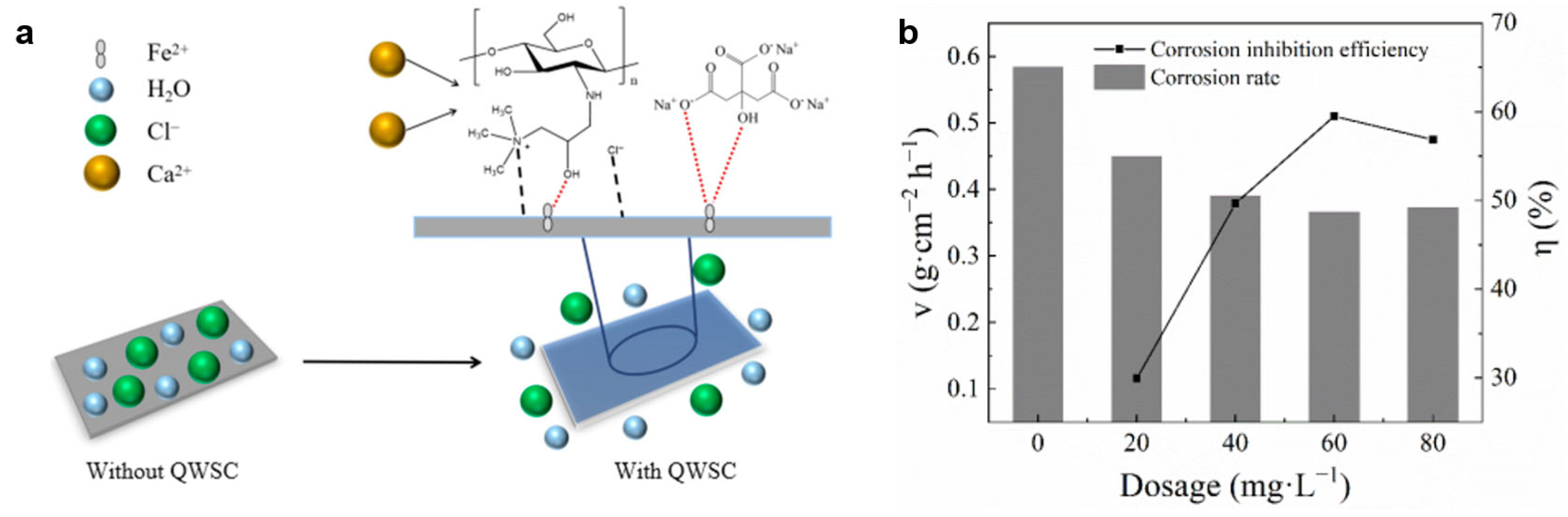
For example. Xiang et al. carried out a QA reaction between 2,3-epoxypropyltrimethylammonium chloride and CS to prepare QA saltwater-soluble chitosan (QWSC) (Figure 4a) [89]. At a flow concentration of 60 mL/L, QWSC achieved an inhibition efficiency of 59.51% for carbon steel at 80 mg L−1 (Figure 4b). Its QA and amino cations adsorbed onto the positively charged steel surface, neutralizing excess negative charge from pre-adsorbed Cl and forming a protective film that mitigated corrosion. Apart from alkane N, quinolinium-based QA salts were highly effective corrosion inhibitors for steel in this study, primarily due to their robust adsorption mechanism. The permanently charged quaternary ammonium group ensured strong electrostatic attraction to the negatively charged metal surface. Furthermore, the large, planar quinoline ring system enhanced surface coverage and provided multiple active centers for chemisorption through π-electron interaction with the metal. This synergistic combination of physical and chemical adsorption resulted in the formation of a durable, hydrophobic protective film that efficiently blocked both anodic and cathodic reaction sites, significantly mitigating corrosion in aggressive environments [61,62,90]. In particular, fused heterocyclic benzyl QA salt (BQD) that possessed more N atoms and π electrons offered better corrosion inhibition performance than other types of quinolinium QA. Unfortunately, the BQD yield is normally low (~1%). Meanwhile, the corrosion inhibition capabilities of BQD in highly concentrated acid solutions have been seldom studied. Thus, Wang et al. proposed a two-step method to synthesize BQD from quinoline and benzyl chloride via quaternization and 1,3-dipolar dimerization, which did not require tedious purification or enhancing the yield [63]. The as-achieved BQD delivered outstanding corrosion inhibition for N80 steel in 6.0 M HCl at 90 °C, reaching 99.17% efficiency at a concentration of only 500 ppm. It synergized strongly with urotropine to form a hydrophobic film that retarded both anodic and cathodic reactions, and the flat orientation of its conjugated heterocyclic structure was the key to its high performance. Nevertheless, the inhibition efficacy of BQD was often inadequate in lactic acid environments. While composite additives were typically employed to enhance the performance of single inhibitors in chelating acid systems, conventional options such as propargyl alcohol and potassium iodide generally fell short of industrial requirements for cost-effectiveness and environmental sustainability. To address this issue, Zhang et al. synthesized a novel QA salt dimer (TQD) derived from thiazole chloride quinoline and compared it with its analogue, BQD [64]. They found that TQD exhibited superior corrosion inhibition over BQD in 1.7 M lactic acid on N80 steel. The protonated TQD enabled stronger physisorption via electrostatic interaction with pre-adsorbed lactate ions. Moreover, TQD featured enhanced chemisorption through the coordination of N and S atoms with Fe, Fe–S bond formation, and stronger retro-donation from Fe d-orbitals to aromatic rings, collectively forming a denser and more stable protective layer. To further boost the ultrahigh-temperature tolerance of quinolinium QA, Li et al. recently synthesized (1,4-phenylethyl (methylene)) bis (1,10-phenanthroline-1-xuan-1-yl) chloride) (PDQ) from 1,10-phenanthroline and 1,4-p-dichlorobenzyl [65]. The adsorption of PDQ on N80 steel was driven by the dual capabilities of its phenanthroline rings to donate electrons to and simultaneously accept electrons from Fe atoms. These rings not only donate electrons to the vacant d-orbitals of surface Fe atoms, forming coordination bonds, but also accept electrons from Fe d-orbitals via retro-donation, enhancing adsorption stability. Meanwhile, PDQ’s low electronegativity (2.8698 eV) and positive electron transfer rate value confirm its simultaneous ability to donate electrons to the metal surface.
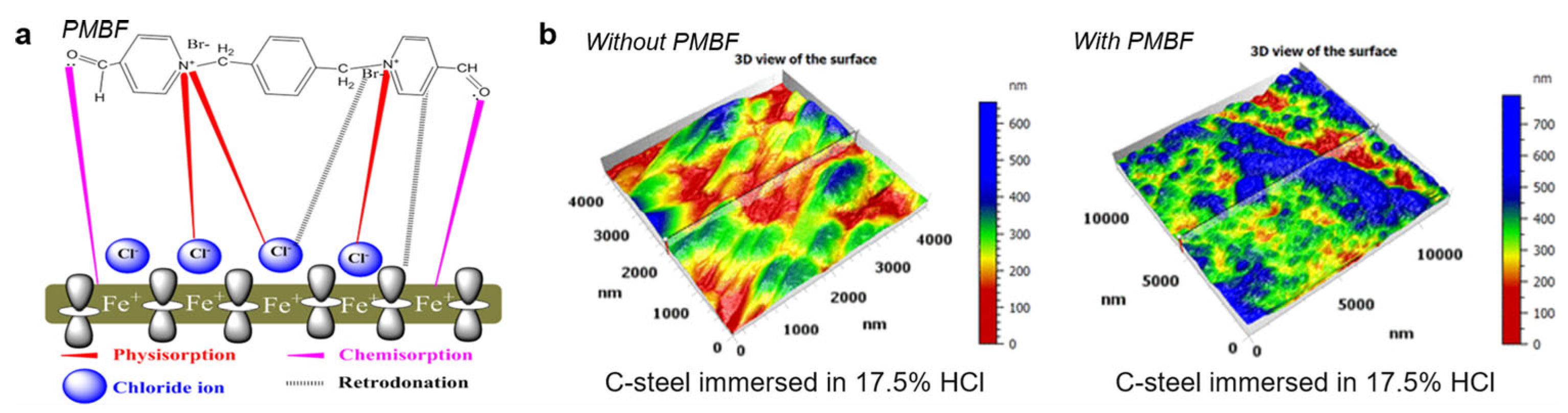
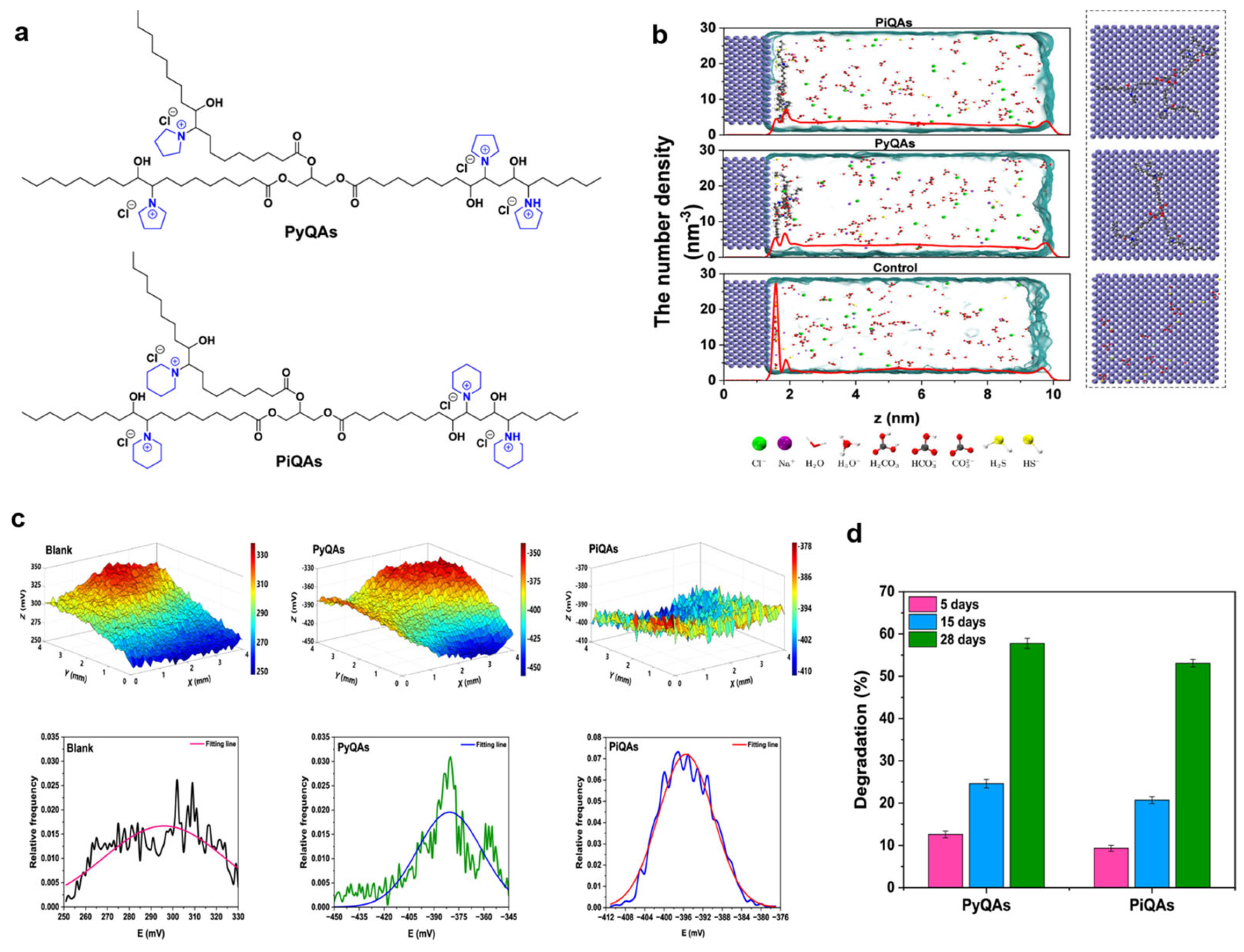
Other widely applied hexatomic nitrogenous heterocyclic QA salts are pyridine or pyrimidine derivatives since they generally exhibit stronger electron-withdrawing characteristics and higher charge density compared to their quinoline counterparts. This enhanced electron deficiency facilitates more robust electrostatic attraction to the negatively charged metal surface. Furthermore, the multiple nitrogen atoms in pyrimidine provide additional active sites for coordination bonding with metal atoms. Zaidoun et al. reported a pyridine-based QA salt, 1,1′-(1,4-phenylenebis-(methylene)) bis(4-formylpyridin-1-ium) (PMBF) [91]. The as-obtained PMBF showed high effectiveness as a corrosion inhibitor for C1018 steel in 5.6 M HCl, achieving up to 98.79% inhibition efficiency at 323 K and a concentration of 4.2 × 10⁻⁶ M. The inhibition mechanism was novel, where Cl and Br were preferentially adsorbed onto the C1018 steel, imparting a negative surface charge. This facilitated the electrostatic attraction and adsorption of the cationic inhibitor, forming a composite film where the halide ions act as interfacial mediators (Figure 5a). Meanwhile, compared to alkane N-based QA, the benzene rings in PMBF enhanced the thermal stability at high temperature. Atomic Force Microscopy (AFM) profiles further demonstrated that PMBF dramatically avoided pit corrosion, which is beneficial for inhibition (Figure 5b). Furthermore, Shao et al. developed a new cationic mercaptopyrimidine derivative QA salt (DTEBTAC), which displayed the merits of facile synthesis, a stable structure, long-lasting corrosion resistance, and good water solubility [92]. At 1% loading of DTEBTAC, the corrosion rate of N80 steel plate at 90 °C HCl decreased to 3.3325 g/(m2·h). The significant performance contributed to a dual adsorption mechanism. The protonated QA group enabled rapid initial physisorption onto the steel surface via electrostatic interactions. This was complemented by strong chemisorption through coordination bonds formed between the metal and lone electron pairs on the pyrimidine ring and its N and S atoms. The benzyl substituent enhanced surface coverage and hydrophobicity, while intermolecular hydrogen bonding between adjacent inhibitor molecules created a rigid, dense protective film that effectively blocked corrosive species from reaching the metal surface. In addition, the conventional aromatic QA salts are inevitably rendered chemically toxic, with non-biodegradability and environmental harm. To solve this issue, Chen et al. designed a novel piperidine (PiQAs) by leveraging sunflower oil as a precursor [93]. More importantly, they also compared the performance between PiQAs and its pentatomic nitrogenous heterocyclic pyrrolidine counterpart (PyQAs) (Figure 6a). MD simulations revealed the distinct adsorption behaviors of PyQAs and PiQAs on Fe surfaces (Figure 6b). Both inhibitors exhibited planar adsorption, significantly reducing the first adsorption peak of corrosive agents from 27.35 nm−3 to 5.40 nm−3 (PyQAs) and 4.46 nm−3 (PiQAs) while minimally affecting the second peak. This adsorption configuration effectively blocked active sites and increased steric hindrance, thereby restricting corrosive agent mobility. Notably, PiQAs demonstrated superior performance with a 76.16% reduction in absolute binding energy, highlighting its enhanced inhibitory efficacy through stronger interfacial interaction and more effective surface coverage. The Scanning Kelvin Probe (SKP) technique was subsequently employed to assess the corrosion inhibition performance of PyQAs and PiQAs on mild steel. As shown in Figure 6c, the Volta potential of uninhibited mild steel was found to be +325 mV, indicating high corrosion susceptibility. In contrast, specimens treated with PyQAs and PiQAs exhibited significantly lower average potentials of −361 mV and −405 mV, respectively. This notable negative shift demonstrated the ability of both inhibitors to suppress anodic and cathodic reactions, with PiQAs showing superior performance, conforming to MD-simulated outcomes. Hence, the inhibition efficiency of PiQAs (95.2%) was higher than that of PyQAs (92.1). Furthermore, both inhibitors presented outstanding biodegradability, with levels of 57.8 and 53.1% in 28 days (Figure 6d), which makes them valuable candidates for industrial applications that address the growing emphasis on environmentally conscious practices.
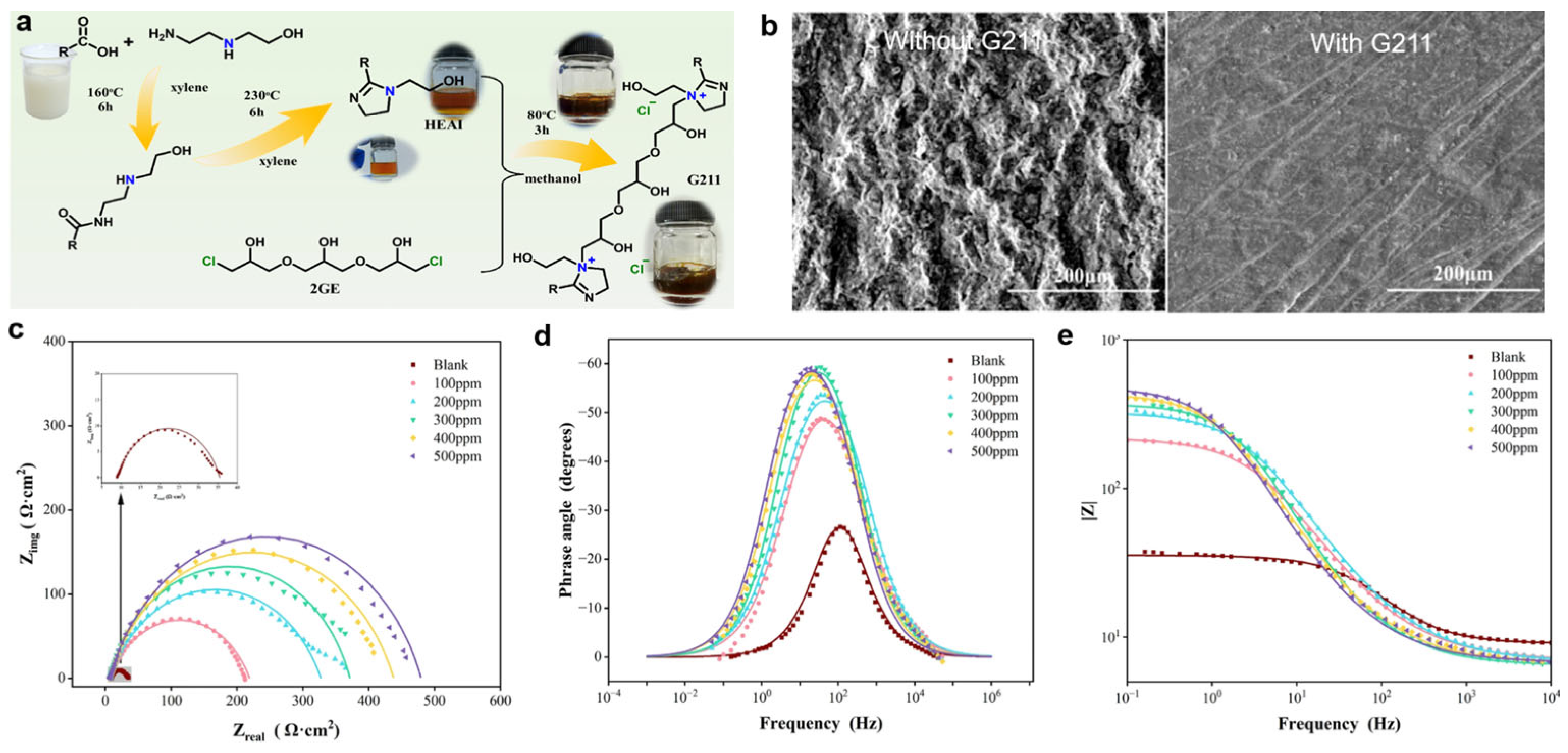
In addition to hexatomic nitrogenous heterocyclic QA salts, extensive research attention has focused on pentatomic variants, particularly those derived from imidazoline-derived cases. Wang et al. synthesized three MB imidazoline quaternary ammonium salt corrosion inhibitors with varying alkane side chain lengths as the sole structural difference [94]. Nyquist plots demonstrated that PPLC, with the longest alkane side chain, exhibited the largest capacitive arc diameter, followed by PPLB and then PPLA. This trend corresponded to increased charge transfer resistance and enhanced corrosion protection performance. The superior inhibition efficiency of PPLC was attributed to its elongated alkane chain, which strengthened hydrophobicity and improved adsorption stability through enhanced vdW interactions. This resulted in denser molecular packing, greater surface coverage, and a more effective barrier against corrosive species. Likewise, Ma et al. reported an environmentally friendly Gemini-shaped imidazoline QA salt corrosion inhibitor (G211) synthesized from hydroxyethyl ethylenediamine-derived imidazoline (HEAI) (Figure 7a) [95]. It inhibited corrosion through chemisorption via N and O electron donation and physisorption of its cations on Cl-covered surfaces, forming a protective film that blocks corrosive agents. SEM analysis revealed significant morphological differences on Q235 steel surfaces after 7 days of acid immersion. Untreated specimens exhibited severe corrosion with rough, loose morphology and obscured polishing marks. In contrast, samples with 500 ppm G211 retained smoother surfaces and distinct scratches, demonstrating the ability of G211 to form a dense protective film through effective adsorption, thereby significantly mitigating acid corrosion (Figure 7b). Electrochemical impedance spectroscopy (EIS) results for Q235 steel in 1 M HCl (Figure 7c,d) demonstrated that increasing concentrations of inhibitor G211 lead to larger semicircle radii in Nyquist plots, with maximum impedance achieved at 500 ppm. The observed capacitive loop distortion indicated surface heterogeneity and dispersion effects. Bode plots confirmed a single time constant, suggesting charge-transfer-controlled corrosion. In addition, Cao et al. used density functional theory (DFT) and MD simulations to systematically compare the corrosion inhibition behavior of a QA salt and an imidazolium-based ionic liquid (IBIL), both featuring a 10-carbon alkyl chain on Fe (100) in a CO2-saturated NaCl environment [96]. The results demonstrated the superior inhibition efficiency of IBIL over QA salt, ascribed to distinct adsorption mechanisms. While QA salt adsorbed via a direct electron donation model, IBIL exhibited an imidazole cyclic electron exchange process involving multiple functional groups, leading to stronger interfacial interaction and more stable surface coverage. This mechanistic insight provided a molecular-level basis for the rational design of high-performance corrosion inhibitors with tailored electron transfer properties. Relatedly, Qin et al. further studied the relationship between the adsorption–desorption and inhibition efficiency of imidazoline QA salt under different flow rates [97]. They indicated that at velocities below 0.5 m s−1, adsorption dominated over desorption, enabling the formation of a stable protective film through combined physical adsorption and chemisorption. This continuous molecular replenishment thus maintained film integrity and effectively suppressed corrosion. Conversely, at velocities exceeding 0.5 m s−1, increased desorption and shear forces disrupted the adsorption–desorption equilibrium, leading to film deterioration, exposure of the metal substrate, and severe pitting corrosion. These findings underscore the necessity of controlling flow conditions to ensure effective corrosion inhibition in dynamic environments.

3.3. Benzimidazole Corrosion Inhibitors

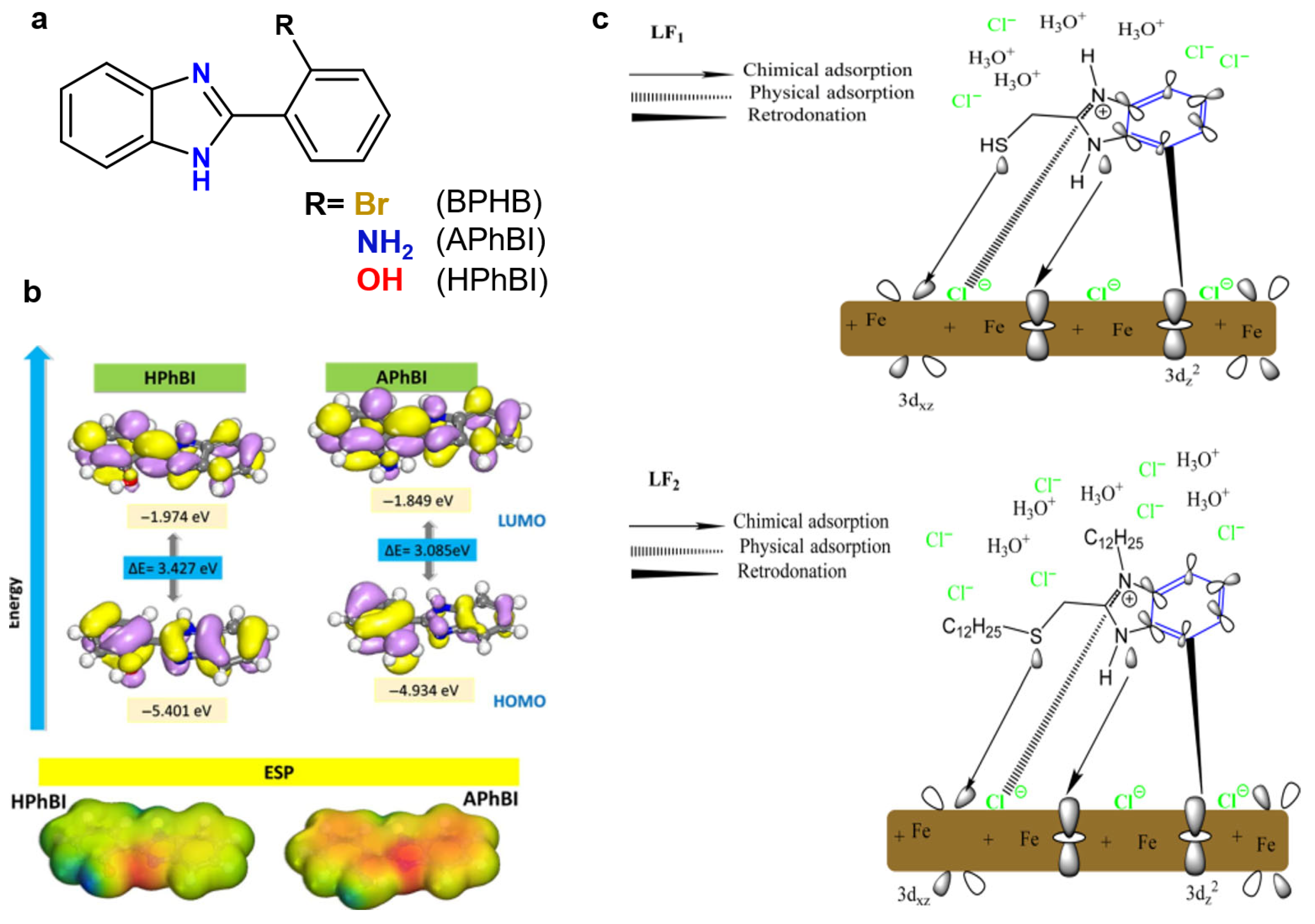
Benzimidazole (BM) derivatives represent a promising class of corrosion inhibitors due to their versatile molecular structure and outstanding inhibition performance in acidic environments [98,99,100]. The inherent presence of heteroatoms such as nitrogen, aromatic systems, and π-conjugated double bonds in the benzimidazole framework enables strong adsorption on metal surfaces, primarily through electron donation and formation of protective films. Furthermore, the structure of these inhibitors is highly tunable. Particularly, heteroatoms or aromatic moieties on the carbene or imidazole N can further enhance their corrosion inhibition performance and durability at high temperatures. For example, Ikenna et al. synthesized a BM with 2-bromophenyl on carbene, namely 2-(2-bromophenyl)-1H-benzimidazole (BPHB), to investigate the corrosion inhibition performance of BPHB on steel in a CO2-saturated, chloride-containing environment with acetic acid (HAc) and HCl (Figure 8a) [66]. MD simulations revealed that BPHB spontaneously adsorbed on an Fe (110) surface, forming a dense hydrophobic film through a flat-lying orientation facilitated by imidazole nitrogen and aromatic C=C bonds, which maximized surface coverage. Electrochemically, BPHB functioned as a mixed-type inhibitor with predominant cathodic action, preferentially adsorbing at cathodic sites to impede H+ reduction and significantly suppress cathodic current density. However, in HCl-containing environments, abundant H+ competitively disrupted this cathodic adsorption, compromising its effectiveness and shifting its action toward anodic sites. Consequently, while BPHB mitigated microstructural damage, such as pitting, in both systems, its protective efficiency was superior without HCl. This performance was corroborated by stronger adsorption on dominant Fe (110)/(200) phases and more negative adsorption energy, confirming the crucial role of adsorption stability in corrosion inhibition performance. To improve the adaptability in HCl, Klodian et al. recently modified 2-bromophenyl to either 2-amino or 2-hydroxy, namely, 2-(2-aminophenyl)-1H-benzimidazole (APhBI) or 2-(2-hydroxophenyl)-1H-benzimidazole (HPhBI) (Figure 8a) [67]. They found that both APhBI and HPhBI effectively inhibited S235 steel corrosion in 1 M HCl, exhibiting comparable performance to BPHB, with efficiencies of 87.1% and 85.1%, respectively. Although their intrinsic inhibition capacities were nearly identical, APhBI demonstrated marginally superior compatibility with synergistic additives and thus practical applicability. Frontier molecular orbital (FMO) analysis revealed that the highest occupied and lowest unoccupied orbitals were mainly distributed over the BM π-system and heteroatoms (N and O). Lower HOMO energy and a wider HOMO-LUMO gap indicated reduced electron-donating capability, lower polarizability, and higher molecular stability. The electrostatic potential (ESP) map further showed pronounced negative charge (red regions) localized around the heteroatoms, identifying them as key nucleophilic sites for adsorption, while blue areas denoted electron-deficient regions prone to electrophilic interaction. These electronic features collectively supported the inhibitor’s adsorption-driven corrosion protection mechanism, where APhBI showed stronger electron donation capability. This advantage was evidenced by its enhanced responsiveness to a broader range of intensifier additives, particularly formic acid and paraformaldehyde, whereas HPhBI only showed significant synergy with potassium iodide and propargyl alcohol.
In addition to the carbene position of BM, the modification of the side imidazole N group for the improvement of inhibition performances has often been discussed. For instance, Azgaou et al. and Boutaqqa et al. explored the effect of grafting different groups, namely propargyl (the as-obtained BM: IMD1), allyl (the as-obtained BM: IMD2), benzyl (the as-obtained BM: OTH-Be), and ethyl propionate (the as-obtained BM: OTH-Et), on (cyclopent-1-en-1-yl)-1H-benzimidazol (CpBM) [68,69]. Among them, IMD1 demonstrated superior inhibition performance compared to IMD2, originating from its optimized molecular geometry and enhanced electron density distribution, as alkyne groups generally exhibit stronger binding to Fe surfaces than alkene groups due to their higher electron density and dual π-bond systems. The structural configuration of IMD1 promoted more efficient surface coverage and stronger chemisorption through improved orbital overlap with iron d-orbitals, resulting in a denser and more durable protective film that offered prolonged corrosion resistance under acidic conditions. Besides the conjugation degree, the polar/non-polar side group was also investigated between OTH-Be and OTH-Et. The outcomes indicated that OTH-Et exhibited superior corrosion inhibition potential compared to OTH-Be, primarily owing to its enhanced electronic reactivity. With higher HOMO energy (−6.0029 eV) and lower LUMO energy (−0.6830 eV), OTH-Et possessed a narrower energy gap (ΔE = 5.3199 eV), facilitating stronger electron exchange with metallic surfaces. Its higher electron affinity and optimized chemical hardness promoted efficient adsorption via both electron donation and acceptance. The inhibition mechanism involved synergistic physical adsorption through electrostatic interactions with Cl and chemisorption via coordination bonds between heteroatoms (N and O) and Fe2+ sites. This dual adsorption, combined with π-electron delocalization from benzimidazole rings, enabled OTH-Et to form a dense protective layer that effectively isolated mild steel from corrosive species in acidic environments. Similarly, the authors continued to extend this comparison strategy, using benzyl and ethyl propionate to functionalize (cyclohex-1-en-1-yl)-1H-benzimidazol (ChBM) and 2-thioxo-2,3-dihydro-1H- benzimidazole (ThBM), finding that the ethyl propionate-functionalized case showed better inhibition performance for both [70,71], conforming with the above-mentioned studies. Furthermore, Guendouz et al. synthesized two kinds of high-performance inhibitors, Benz1 and Benz2, via 1,3-dipolar cycloaddition reactions between mesitonitrile oxide and propargyl- or allyl-grafted chlorobenzyl methacrylate (ChBM), respectively [72]. Both Benz1 and Benz2 exhibited outstanding corrosion inhibition on mild steel in 1 M HCl, achieving efficiencies of 96.32% and 98.30% at 20–30 ppm, respectively. Surface characterization confirmed that Benz2 formed a better protective adsorbed layer. The results reversed the case of IMD1 and IMD2. This was because, after cycloaddition, Benz2 possessed a flatter molecular structure, enabling more effective surface coverage and interaction. To maximize the utilization of the side imidazole N-grafted group in BM, symmetric aromatic bis-substituents have been used to enhance its functionality. For instance, Ettahiri et al. investigated the inhibition efficiency of two novel symmetric bis-substituted BMs, namely, 2,2′-(1H-benzo[d]Benzimidazole-1,3(2H)-diyl)bis(1-phenylethan-1-one) (BO) and 2,2′-(1H-benzo[d]Benzimidazole-1,3(2H)-diyl)bis(1-phenylethane-1-thione) (BS) [102]. The structural distinction between BO and BS lies in their functional groups: BO features a ketone group (C=O), whereas BS contains a thione group (C=S). Key adsorption centers include N atoms in the benzimidazole ring, the C=O/C=S group, and delocalized π-electrons in aromatic rings. The results suggested that BS possessed a greater inhibition efficiency of 98.8%, compared with 97.6% for BO. Further analysis showed that the presence of C=S enhanced electron donation and formed more stable Fe-S bonds compared to the carbonyl group (C=O) in BO. Moreover, the dual-functionalization of BM at both the carbene and imidazole sites synergistically enhances its adsorption, and corrosion inhibition is feasible as well. For example, Timoudan et al. grafted dodecyl to both the thio and imidazole sites of (1H-Benzimidazol-2-yl) methanethiol (LF1) to obtain1-Dodecyl-2-((dodecylthio) methyl)-1H-benzimidazole (LF2) [101]. This indicated that these extended alkyl chains of LF2 provided greater surface coverage and stronger hydrophobic interactions, forming a denser protective film that effectively blocked chloride ion penetration [101]. The improved adsorption of LF2 was further facilitated by electron transfer from inhibitor molecules to Fe d-orbitals, complemented by back-donation from metal centers to aromatic systems (Figure 8c). This synergistic mechanism, combining robust physisorption through hydrophobic layers with strengthened chemisorption via orbital interactions, benefited LF2 in achieving higher charge-transfer resistance and maintaining better film integrity across concentrations than the LF1 case, leading to consistently superior inhibition efficiency in a 1.0 M HCl environment. Considering the increment of inhibition efficiency alongside the length of its carbon chain, Zgueni et al. adopted similar means to achieve methyl dodecyl (1-dodecyl-1H-benzo[d]imidazol-2-yl) carbamate (CBC12) through the N-alkylation of carbendazim with dodecyl bromide [73]. Its molecular structure combined aromatic rings and long aliphatic chains, forming a stable protective film through physicochemical adsorption. The more parallel orientation from the long chain configuration on Fe (110) endowed optimal surface coverage, benefiting mixed-type inhibition with a corrosion inhibition rate of 93% at 5 × 10⁻³ M. Notably, a counterintuitive case of molecular modification was reported by Benabid et al. [103], where the nitration derivative 1-(4-Nitrobenzyl)-2-(4-nitrophenyl)-1H-benzimidazole (NNBI) demonstrated inferior performance compared to its precursor, 1-Benzyl-2-phenyl-1H-benzimidazole (BI). This unexpected result highlighted the critical importance of electronic effects in corrosion inhibitor design, as the introduced nitro groups compromised adsorption capabilities despite structural enhancement.

4. Emerging Frontiers for Organic Inhibitors Development

Significant research efforts are directed toward developing next-generation organic corrosion inhibitors, emphasizing green and sustainable chemistries, intelligent (e.g., stimuli-responsive) functionalities, and data-driven molecular design. However, their practical implementation in oil and gas acidizing faces considerable challenges. The primary barrier lies in the extreme complexity and heterogeneity of downhole environments, which include high temperature and pressure, dynamic shear stresses, fluctuating pH, and variable ionic compositions. These conditions collectively impose stringent requirements on inhibitor stability, adsorption kinetics, and long-term film persistence that are difficult to replicate in laboratory settings. Consequently, translating innovative molecular designs into reliable field applications remains a slow and iterative process. In this context, the following sections provide selected case studies that exemplify promising approaches, such as biomass molecules, nanocomposite carriers, and computationally guided synergistic formulations, which serve as practical paradigms for bridging the gap between novel inhibitor concepts and their functional realization in realistic downhole scenarios. These examples aim to illustrate how targeted molecular engineering and system-level design can progressively address the multifaceted demands of actual wellbore conditions.

4.1. Green and Sustainable Inhibitors

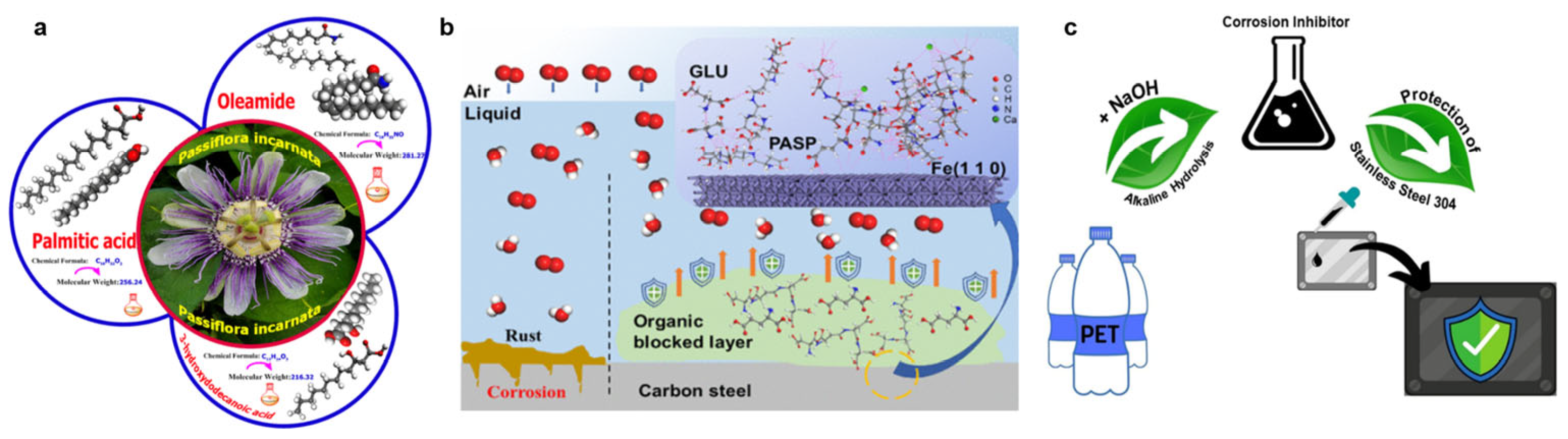
The imperative for sustainable development in oil and gas field operations extends beyond economic efficiency to encompass stringent environmental stewardship. A dominant and growing trend in corrosion inhibitor research is, therefore, the shift toward green and sustainable chemistries. This involves the strategic development of high-performance inhibitors derived from renewable, biodegradable biomass (e.g., plant extracts, CS, and cellulose derivatives) or valorized industrial/agricultural waste streams [20,88,89]. Such materials not only reduce dependency on toxic, non-renewable petrochemical feedstocks but also enhance the environmental compatibility of production chemicals, aligning with circular economy principles and increasingly strict regulatory frameworks. This paradigm prioritizes inhibitors that offer effective protection while minimizing their ecological footprint throughout their lifecycle, from synthesis to downhole application and final disposal. For example, Abeer investigated the extracts from Passiflora incarnata, including 9-Octadecenamide, oleamide, n-hexadecanoic acid, palmitic acid, and 3-hydroxydodecanoic acid (Figure 9a) [104]. They found that, in acidic solutions, these molecules existed as neutral species or protonated cations. Neutral molecules adsorb via chemisorption, forming coordinate bonds through electron exchange between heteroatoms (N and O) and the metal surface, displacing adsorbed water and reducing corrosion. Likewise, Berdimurodov et al. introduced a novel gossypol–indole modification (GIM) as a green corrosion inhibitor for mild steel in corrosive alkaline saline environment [105]. The experimental results proved that GIM is an excellent inhibitor, with a maximum inhibition efficiency of 96%, and it remains effective at high temperatures. Farhadian et al. prepared a castor-oil-based corrosion inhibitor (COCI) using castor oil in an acidic medium. Using 140 μM of COCI at 80 °C achieved maximum inhibition efficiencies of 85% and 91%, demonstrating good high-temperature resistance [106]. Huang et al. isolated hyperoside (HYP) from Uncaria rhynchophylla and used it for corrosion inhibition of Q235 steel in an acidic medium [107]. Experiments showed that 300 mg L−1 HYP had an inhibition efficiency of 92.34% for Q235 steel in 1 M HCl, and it still reached 80.49% at 85 °C. Sanni et al. adopted eggshell powders to deal with the corrosion of Type 316 austenitic stainless steel in both NaCl and sulfuric acid solutions, with remarkable inhibition efficiencies of 99.99% and 94.74%, respectively [108]. Moreover, amino acids are reported as eco-friendly corrosion inhibitors due to their bifunctional groups, biodegradability, and solubility. Gong et al. investigated glutamic acid (GLU) as a synergistic enhancer for polyaspartic acid (PASP) for green corrosion inhibitor. Electrochemical and weight loss tests demonstrated that adding GLU significantly improved the inhibition efficiency of PASP, reducing both uniform corrosion and pitting on carbon steel (Figure 9b) [109]. MD simulations revealed the underlying mechanism where GLU interacted with PASP via donor–acceptor bonds at carboxyl and amino groups, facilitating PASP diffusion to the metal surface. Furthermore, GLU strengthened the binding between PASP and the steel substrate, promoting the formation of a denser and more stable protective film. Likewise, Guo et al. combined L-cysteine (L-cys) and quaternary ammonium salts of varying alkyl chain lengths to enhance their inhibition efficiency in an acid environment [110]. Quantum chemical calculations revealed that L-Cys exhibited higher HOMO (−6.58 eV) and LUMO (−0.79 eV) energies compared to CTAB/TTAB, indicating its stronger electron-donating capabilities. Among them, the L-Cys/TTAB system showed the highest adsorption energy, consistent with its superior corrosion protection performance. This was because L-Cys chemisorbed via its N, O, and S heteroatoms, while TTAB was oriented with hydrophilic headgroups adsorbed on the metal and hydrophobic tails extending toward the solution. Critically, hydrogen bonding (H⋯N, H⋯O) between the components enhanced film density and cohesion. This configuration formed a compact, hydrophobic barrier that impeded corrosive species transport, which outperformed other quaternary ammonium combinations. In addition to biochemicals, Santos innovatively converted post-consumer poly (ethylene terephthalate) (PET) bottles into an effective corrosion inhibitor for stainless steel 304 through alkaline hydrolysis catalyzed by a cationic surfactant (Figure 9c) [111]. Electrochemical evaluation confirmed that polymer resin obtained from recycled PET bottles served as an effective anodic corrosion inhibitor for AISI304 stainless steel in saline medium (0.51 M NaCl). At a 2.5% concentration, the resin achieved 78–81% inhibition efficiency via polarization and impedance techniques, outperforming conventional BMs. The protective mechanism involved the formation of a multi-component polymeric layer on the steel surface, providing sustainable corrosion mitigation while valorizing plastic waste. This work established a green pathway for repurposing PET into high-value industrial inhibitors, supporting circular economy objectives.

4.2. Intelligent Stimuli-Responsive Inhibitors

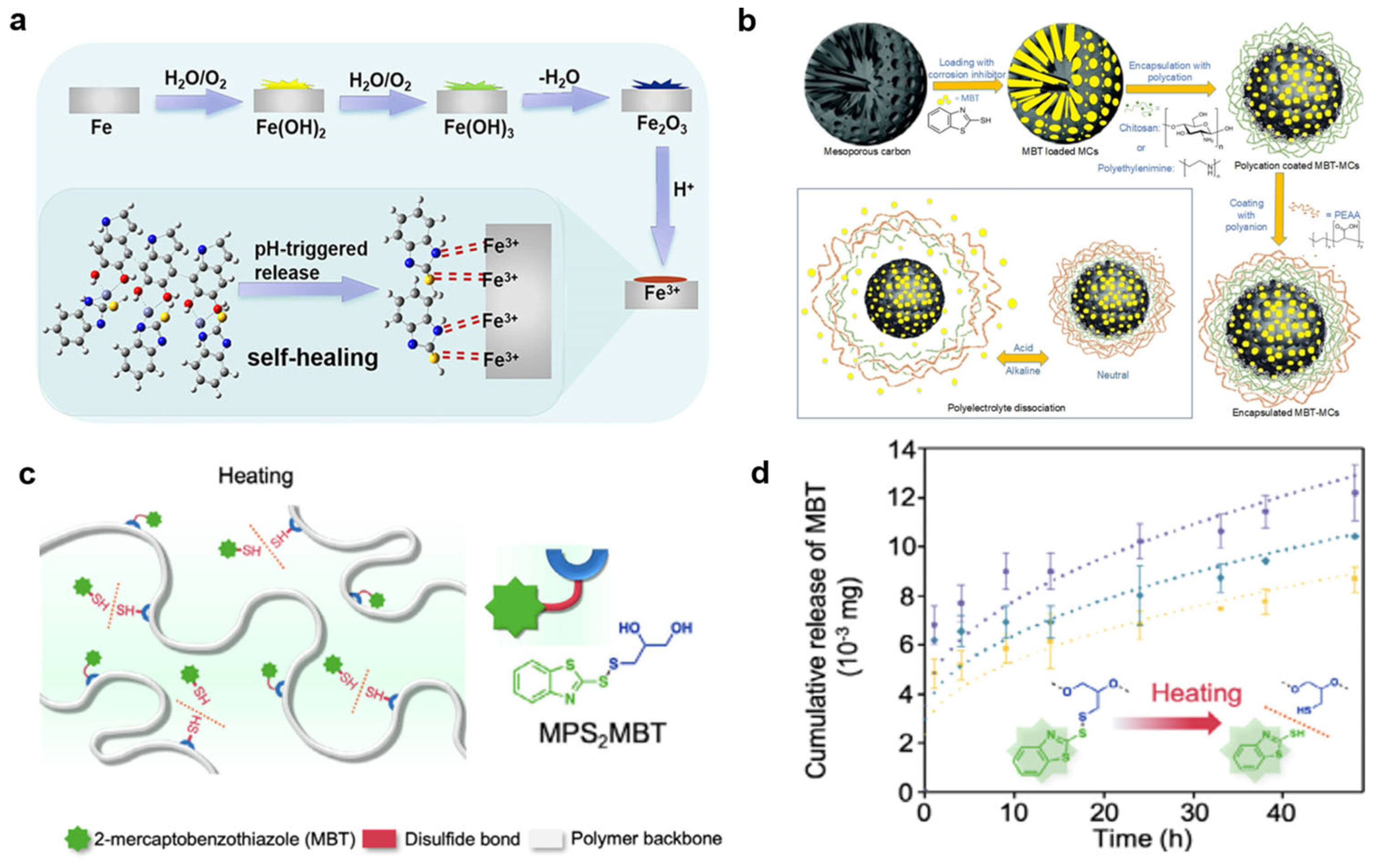
As wellbore environments grow more complex, with fluctuating temperatures, pressures, acidity, and CO2/H2S concentrations, the demand for “smart” corrosion inhibitors that adapt to changing conditions becomes increasingly urgent. Future research should focus on multi-stimuli-responsive systems capable of targeted, on-demand inhibitor release to achieve precise and efficient protection. Temperature/pH dual-responsive microcapsules represent a highly promising direction. For instance, imidazole-based inhibitors can coordinate with metal ions to form metal–organic frameworks (MOFs) [112]. Upon HCl etching, MOFs are unstable, where the inhibitor is released from MOFs while metal ions can react with Cl- to substitute Fe2+, thus effectively attenuating corrosion and enabling smart acid-responsiveness. Zhang et al. adopted this strategy to construct a smart self-healing coating system (ZIF-11-PAACe-EP), consisting of epoxy coating containing ZIF-11 encapsulated by cerium polyacrylate (PAACe) polymer (ZIF-11-PAACe) [113]. It showed outstanding coating performance with |Z|0.01 Hz reaching 4 × 10¹⁰ Ω⋅cm2 even after 60 days of immersion. The corrosion-triggered release mechanism of ZIF-11-PAACe operated through a pH-responsive dual-action process. In acidic environments, protonation weakened electrostatic interactions within the composite, inducing PAACe shell expansion while simultaneously decomposing the ZIF-11 framework. This coordinated structural response enabled the controlled release of active species, including BM inhibitor molecules from the ZIF-11 core, alongside Zn2+ and Ce3+ cations from the shell matrix. The BM coordinated with Fe2+ in the anodic area to form the protective layer, while liberated Ce3+ ions further experienced hydroxide precipitation at cathodic sites, establishing a self-healing protective barrier that synergistically enhanced the corrosion inhibition. Similarly, Liu et al. designed a pH-responsive smart carrier, a corrosion inhibitor carrier 2-mercaptobenzimidazole (MBI)-Zn2+-polydopamine@ graphite (MZPG) [114]. When incorporated into an epoxy coating (MZPG/EP), it significantly enhanced mechanical properties and corrosion resistance, three orders of magnitude higher than a pure epoxy coating. In aqueous environments, a protective Fe2O3 layer formed on steel under acidic conditions; this layer was rapidly dissolved, generating Fe3+ ions that further accelerated corrosion via a redox cycle with metallic Fe. The MZPG carrier then rapidly released the MBI in acid. The MBI coordinated with Fe3+, effectively retarding the dissolution of the Fe2O3 layer and breaking this detrimental autocatalytic corrosion cycle, thereby significantly inhibiting corrosion (Figure 10a). In addition to acid-responsive release, Mohammad et al. synthesized nanoporous carbon spheres to load 2-mercaptobenzothiazole (MBT), followed by encapsulation of polyethyleneimine (PEI)/PeAA or CS/PeAA polyelectrolyte pairs that presented acid/alkaline-responsiveness [115]. As shown in Figure 10b, when pH changed from neutral (pH = 7) to acidic (pH = 2) or alkaline (pH = 12), the MBT was released under both conditions because of the collapse of outer polyelectrolytes. Moreover, to boost thermo-responsiveness and self-inhibition, Sun et al. synthesized a novel BM corrosion inhibitor (OBIP) through amide reaction using 2-aminobenzimidazole and 4-octadecyloxybenzoic acid as precursors [116]. The experimental results showed that the corrosion inhibition rate of OBIP at 320 ppm (8 × 10⁻⁴ M) was 85% at 90 °C on the Q235 steel immersed in the acidic oilfield solution. Then, they loaded OBIP into an alginate/polyacrylamide (SA@PAM) hydrogel network to construct heavy polymer capsules (SA@PAM@OBIP) for oil downhole applications. Below 50 °C, a stable phenamine network between SA and PAM securely encapsulated the OBIP inhibitor. After descending the well, at elevated temperatures (>50 °C), SA decomposed and expanded, while PAM maintained structural integrity, enlarging the network pores and triggering controlled OBIP release. This intelligent response realized targeted corrosion inhibition precisely when high-temperature conditions occurred. However, the release mechanism in conventional porous carriers is predominantly governed by physical entrapment and diffusion, which offers limited dynamic controllability and often lacks precise responsiveness to environmental stimuli. To achieve more programmable thermally triggered release at the chemical level, Jenpob et al. designed 2-mercaptobenzothiazole (MPS2-MBT) as a functional monomer [117]. This molecule was incorporated into a polyurethane (PU) network via polyaddition, with the inhibitor linked as a side chain through a thermally labile disulfide bond, enabling on-demand release in response to temperature changes (Figure 10c). At higher temperatures above 70 °C after 48 h, the amount of released MBT was enhanced from 8.7 to 12.2 μg with ratios of MPS2MBT in polymers increasing from 22 to 38 mol% (Figure 10d). Consequently, the corrosion rate of steel substrates coated with polymer-corrosion-inhibitor conjugate was 32 times lower than that of steel substrates coated with an analogue self-healing polymer without a conjugated corrosion inhibitor. The healing efficiency of the anticorrosion and mechanical properties exceeded 93% and 96%, respectively. This design thus endowed these coatings with self-healing properties triggered by disulfide exchange reactions and anticorrosion properties due to the corrosion-responsive release of the inhibitor.

4.3. AI-Driven Design of Inhibitors

The development of corrosion inhibitors is undergoing a transformative shift with the integration of AI and machine learning (ML), moving from traditional trial-and-error approaches to a predictive, data-driven paradigm. AI techniques, particularly quantitative structure–activity relationship (QSAR) modeling, deep neural networks, and generative models, are being employed to decipher the complex relationships between molecular descriptors (e.g., electronic properties, topological indices, and functional groups) and inhibitory performance [11,12]. These models can screen vast virtual chemical libraries with unprecedented speed, predicting inhibition efficiency, adsorption energy, and even environmental toxicity. However, the application of AI-driven molecular design for developing high-temperature corrosion inhibitors in oil and gas field development is in its early stages. In this context, we present several AI-designed molecular candidates as corrosion inhibitors, aiming to provide methodological references and practical paradigms to inform and inspire subsequent research in this promising interdisciplinary field. For example, Dharmendr et al. utilized DFT to significantly accelerate the rational design and screening of inhibitors for mild steel in acidic environments. They first screened a set of sulfur-containing compounds using quantum chemical descriptors (Figure 11a) [12]. They found that naphthalene-1-thiocarboxamide (NTC) exhibited the lowest LUMO energy and smallest HOMO-LUMO gap, indicating superior inhibition potential. Subsequent explicit adsorption simulations revealed strong chemisorption of NTC on the Fe (001) surface via multiple Fe-C/N/S covalent bonds, while surface coverage studies predicted the formation of a dense protective monolayer. Experimental validation through gravimetric analysis, potentiodynamic polarization, and electrochemical impedance spectroscopy confirmed NTC as an outstanding inhibitor for mild steel in 1 N HCl, exhibiting high efficiency even at a low concentration (1 mM) and an elevated temperature (60 °C). Similarly, Can et al. adopted ML to estimate the fundamental distinction between the metrics of inhibition efficiency and inhibitor power in assessing corrosion protection (Figure 11b) [118]. While inhibition efficiency with a conventional, normalized parameter appeared to show stronger correlations only among top-performing inhibitors, this is largely a mathematical artifact arising from the compression of high-performance data within a bounded scale (0%–100%). In contrast, the inhibitor power metric, derived from the polarization resistance, distributed the data more evenly and revealed consistent correlation across the entire performance range, with most compounds clustering along the ideal correlation diagonal. By systematically characterizing AA2024-T3 alloys exposed to numerous organic compounds, this generated a rich dataset encompassing key mechanistic parameters (e.g., charge transfer resistance, corrosion rate, and breakdown potential), enabling the development of predictive quantitative structure–property relationships that link molecular structures to inhibition performance. Furthermore, to investigate the underlying mechanism of 2-alkyl BM series-based inhibitors, Iyer et al. harnessed ML and virtual sample generation (VSG) to analyze 10 different previously published BM scaffolds for mild steel corrosion in 1 M HCl [119]. An Artificial Neural Network (ANN) was employed to predict corrosion inhibition efficiency from quantum chemical descriptors using a regularized hidden layer. Correlation matrix analysis confirmed that all quantum descriptors were significantly related to inhibition efficiency. It was noteworthy that, because of the small dataset, dimensionality reduction was avoided, and VSG was applied to enhance data stability without degrading feature–label relationships. Ultimately, the study envisioned two new 2-alkyl BMs, i.e., 5-((2-ethyl-1H-benzo[d]imidazol-1-yl) methyl)-1,3,4-oxadiazole-2-thiol (EBIMOT) and 5-((2-propyl-1H-benzo[d]imidazol-1-yl) methyl)-1,3,4-oxadiazole-2-thiol (PBIMOT), with an inhibition efficiency of ~94%. Their experimental results closely matched the ANN’s predictions, validating the accuracy of the model in forecasting corrosion inhibitor performance, as well as providing a guide to BM design. Similarly, Ekeocha et al. explored 50 benzimidazole derivatives on carbon and low-alloy steels under HCl exposure through machine learning [120]. By screening structures with diverse functional groups and active sites, they hypothetically designed three new BMs, namely, 6-methoxy-2-(((4-methoxy-3,5-dimethylpyridine-2-yl)methyl)sulfinyl)1-(bromomethyl)-1 H-benz [d] imidazole (MSBMB), 6-methoxy-2-(((4-methoxy-3,5-dimethylpyridin-2-yl)methyl)sulfinyl)-1 H-benzimidazol-1-yl) acethydrazide (MSBAH), and 6-methoxy-2-(((4-methoxy-3,5-dimethyl pyridine-2-yl)methyl)sulfinyl)-1-(-1,3,4-oxadiazole-2-thiol)-1-H-benzimidazole (MSBOT). MSBOT, MSBAH, and MSBMB demonstrated exceptional corrosion inhibition performance due to optimized molecular architectures featuring multiple heteroatoms (N, O, S, and Br) and extended π-systems. These structural elements enabled simultaneous adsorption through complementary mechanisms, including coordination bonding via lone electron pairs to Fe d-orbitals, π-electron back-donation from aromatic systems, and electrostatic interactions between protonated nitrogen atoms and chloride-covered metal surfaces. The parallel molecular orientation on Fe (110) surfaces ensured maximum coverage. Adsorption energies ranging from −215.76 to −233.17 kcal mol−1 correlated with high inhibition efficiencies exceeding 90%. Among them, MSBOT displayed the best properties due to its additional heteroatoms and functional groups, which facilitated stronger surface interactions and denser protective film formation. These AI driving methods provide benefits and convenience for rationally designing and optimizing inhibitors.

5. Outlook and Prospects

The field of corrosion inhibition for anticorrosion in complex acid environments, such as oil and gas exploitation, stands at an inflection point. Future progress will be determined not by incremental improvements to existing chemistries but by a fundamental re-imagining of the design, delivery, and discovery of protective agents. This paradigm shift will be catalyzed by the convergence of supramolecular engineering, stimuli-responsive materials, and data-driven science, with the overarching goals of achieving precision, autonomy, and sustainability.
Firstly, the next generation of inhibitors can be multifunctional and adaptive. The conventional model of a single molecule blocking a single reaction pathway is inadequate for the complex, fluctuating environments of deep wells. Instead, molecular design beyond MB, QA, and BM should embrace hybrid architectures that integrate, for instance, the planar, π-electron-rich scaffolds of benzimidazoles for dense surface packing with the permanent cationic charge of quaternary ammonium salts for robust electrostatic anchoring. This approach creates synergies that enhance surface coverage, improve adhesion under shear, and provide multi-mechanistic protection against general and localized corrosion. Beyond molecular design, the concept of intelligent, stimuli-responsive systems will move from laboratory curiosity to field-ready technology. These systems utilize corrosion itself as a trigger. For example, nano- or micro-carriers fabricated from pH-labile polymers or redox-sensitive linkers (e.g., disulfide bonds) can remain inert during transport but rupture at anodic sites where pH drops, releasing a high local concentration of inhibitors precisely where and when they are needed. This targeted, on-demand action maximizes efficiency, reduces total chemical volume, and enables self-healing of the protective layer.
Parallel to this pursuit of performance is the non-negotiable driver of environmental sustainability. Regulatory and societal pressures are mandating a transition to benign alternatives. This is fueling intensive research into high-performance inhibitors derived from renewable, biodegradable, and non-bioaccumulative feedstocks. Meanwhile, the sustainable natural materials are more economical, in contrast to complicated organic synthesis. CS, cellulose derivatives, and functionalized amino acids are prime candidates. The frontier here extends beyond simple substitution to designing for circularity: inhibitors that can be recovered from flowback water or degraded into harmless by-products, thereby closing the material lifecycle and minimizing environmental legacy.
Moreover, AI-driven design is a rising trend. By constructing robust, high-dimensional datasets from high-throughput electrochemical screening, capturing kinetic parameters, interfacial properties, and time-dependent performance, we can train models that establish quantitative structure–property relationships. These models can then rapidly screen vast virtual chemical spaces or, more powerfully, employ generative algorithms to propose entirely novel molecular entities optimized for specific targets, for instance, unprecedented thermal stability, selective affinity for 13Cr steel, or optimal hydrophobicity. This in silico funnel dramatically accelerates the discovery pipeline, identifying a shortlist of high-probability candidates for experimental validation and reducing development timelines from years to months.
In conclusion, the future of corrosion protection lies in smart, sustainable, and computationally engineered systems. The integration of adaptive materials from traditional organic inhibitors to multifunctional ones that respond to their environment, green chemistry principles, and AI-driven discovery promises a new era of corrosion management. This will yield cost-effective, autonomous solutions that ensure the integrity of critical infrastructure, enabling the safe and sustainable extraction of energy resources from ever more challenging environments.

Funding

This research was supported by the National Science and Technology Major Project of China (Grant No. 2025ZD1402500) and the Major Science & Technology Projects of PetroChina (No. 2024ZS49).

Institutional Review Board Statement

Not applicable.

Informed Consent Statement

Not applicable.

Data Availability Statement

The data presented in this study are available on request from the corresponding author.

Conflicts of Interest

Authors Yunfeng Liu, Wei Li, Zhenhua Xiao, Shiwen Ji, Qiang Liu, Yongfan Tang and Yan Zhang were employed by Southwest Oil and Gas Field Company of PetroChina. The remaining author declares that the research was conducted in the absence of any commercial or financial relationships that could be construed as a potential conflict of interest.

References

  1. Xiang, W.; Li, L.; Dong, Y.B.; Wang, Z.Z.; Song, Z.F.; Zhao, M.W.; Dai, C.L. Ultra-high temperature and salinity resistant microspheres featuring “Rigid hydrophobic core- soft hydrophilic Shell” structure for deep reservoir profile control. Chem. Eng. J. 2025, 509, 161432. [Google Scholar] [CrossRef]
  2. Zhou, J.; Zhu, J.Y.; Yang, Z.Z.; Sun, Y.Q.; Wang, S.; He, J.Y.; Li, X.G.; Yi, L.P. Preparation and application performance of high-temperature and high-pressure resistant microencapsulated acid for acid fracturing in ultra-deep reservoir. Chem. Eng. J. 2025, 525, 170204. [Google Scholar] [CrossRef]
  3. Wang, Q.; Zhou, F.J.; Su, H.; Zhang, S.Y.; Dong, R.C.; Yang, D.D.; Wang, Y.J.; Chen, Z.X.; Li, J.J. Experimental evaluations of nano high-viscosity friction reducers to improve acid fracturing efficiency in low-permeability carbonate reservoirs. Chem. Eng. J. 2024, 483, 149358. [Google Scholar] [CrossRef]
  4. Wu, G.; Cai, J.; Shi, S.Y.; Yang, C.H.; Liu, Q.L.; Zhao, N.; Wang, X.W.; Zeng, D.Z. Research on High Temperature Resistant and Low Corrosion Solid-Free Killing Fluid for Ultra-Deep Wells. Chem. Eng. Oil Gas 2025, 54, 65–73. [Google Scholar]
  5. Gamal, H.A.M.; Zewail, T.M.; El-Ashtoukhy, E.Z. Effect of crude oil on the rate of diffusion-controlled corrosion in pipelines under turbulent flow conditions. Corros. Rev. 2018, 36, 483–493. [Google Scholar] [CrossRef]
  6. Zhang, M.; Yu, B.; Shi, B.C.; Zhu, Q.X.; Liu, K. Optimization and Evaluation of Corrosion Inhibitors for P110S Steel in Coexisting H2S/CO2 System. Chem. Eng. Oil Gas 2025, 54, 106–114. [Google Scholar]
  7. Guo, G.; Zhang, Z.; Liu, P.; Guo, Y.; Ye, Y.; Liu, Y. Experimental Study on Solid Acid Systems for Acid Fracturing in Ultrahigh-Temperature Carbonate Reservoirs. ACS Omega 2025, 10, 45309–45322. [Google Scholar] [CrossRef]
  8. Luo, S.; Fu, A.; Liu, M.; Xue, Y.; Lv, N.; Han, Y. Stress corrosion cracking behavior and mechanism of super 13Cr stainless steel in simulated O2/CO2 containing 3.5 wt% NaCl solution. Eng. Fail. Anal. 2021, 130, 105748. [Google Scholar] [CrossRef]
  9. Winkler, D.A.; Hughes, A.E.; Özkan, C.; Mol, A.; Würger, T.; Feiler, C.; Zhang, D.; Lamaka, S.V. Impact of inhibition mechanisms, automation, and computational models on the discovery of organic corrosion inhibitors. Prog. Mater. Sci. 2025, 149, 101392. [Google Scholar] [CrossRef]
  10. Bahraq, A.A.; Obot, I.B.; Al-Osta, M.A.; Ibrahim, M. Molecular simulations of anticorrosion behavior of inhibitors for steel in concrete: A review on recent advances and progress. Constr. Build. Mater. 2024, 412, 134808. [Google Scholar] [CrossRef]
  11. Gong, H.Y.; Ma, L.W.; Liu, D.D.; Zhang, D.W. AI-driven discovery of high-performance corrosion inhibitors using a BERT-GPT framework for molecular generation. Corros. Sci. 2025, 257, 113327. [Google Scholar] [CrossRef]
  12. Kumar, D.; Muralidhar, K.V.; Jain, V.; Rai, B. Accelerating corrosion inhibitor discovery through computational routes: A case of naphthalene 1-thiocarboxamide. npj Mater. Degrad. 2024, 8, 5. [Google Scholar] [CrossRef]
  13. Verma, C.; Promila; Dubey, S.; Qiang, Y.J.; Bhaskaran; Ebenso, E.E.; Barsoum, I.; Rhee, K.Y.; Alfantazi, A. Heteroatomic multiple bonded corrosion inhibitors: Coordination chemistry, bonding and synergistic behavior of σ-donors and π-acceptors. Coord. Chem. Rev. 2025, 537, 216683. [Google Scholar] [CrossRef]
  14. Taghavikish, M.; Dutta, N.K.; Choudhury, N.R. Emerging Corrosion Inhibitors for Interfacial Coating. Coatings 2017, 7, 217. [Google Scholar] [CrossRef]
  15. Farid, R.; Sarkar, D.K.; Das, S. Studies of Corrosion Inhibition Performance of Inorganic Inhibitors for Aluminum Alloy. Materials 2025, 18, 595. [Google Scholar] [CrossRef]
  16. Xiong, L.L.; Wu, M.X.; Liao, J.X.; Gu, Z.W.; Fu, Z.H.; Fan, X.Q.; Zhu, M.H. In-situ encapsulation of organic and inorganic inhibitors into 2D zeolitic imidazolate framework assisted by sodium gluconate for enhanced anticorrosion protection of AA2024. Corros. Sci. 2025, 256, 216683. [Google Scholar] [CrossRef]
  17. Wang, Z.; Varela, B.; Somers, A.; Tan, M.Y. Enhancing the efficiency of hydrogen permeation inhibition by means of the synergistic effects of inorganic and organic inhibitors. Int. J. Hydrogen Energy 2025, 120, 529–541. [Google Scholar] [CrossRef]
  18. Guo, X.; Ma, L.W.; Wang, X.Q.; Shi, B.X.; Fu, Z.H.; Liu, D.; Zhao, J.Z.; Lu, L.; Zhang, D.W. Revealing the atomic-scale mechanism of organic corrosion inhibitors in suppressing anodic dissolution of metals via ab initio molecular dynamics and meta dynamics simulations: A case study of sorbitol on aluminum. Corros. Sci. 2025, 257, 113326. [Google Scholar] [CrossRef]
  19. Zou, B.; Liang, W.; Gai, P.Y.; Chen, X.C.; Cheng, S.J.; Fu, C.Y. Corrosion Inhibition Behavior of Imidazoline Rich in Double Bonds in Saturated CO2 Brine. Chem. Eng. Oil Gas 2024, 53, 78–86. [Google Scholar]
  20. Zhou, H.; Shao, Z.; Ermolin, D.V.; Novikov, A.S.; Skorb, E.V.; Cheng, R.; Shchukin, D.G.; Wang, H. Environmentally responsive semi-interpenetrating network microcapsules with enhanced stability for corrosion protection. Mater. Horiz. 2025, 12, 9211–9220. [Google Scholar] [CrossRef]
  21. Jero, D.; Caussé, N.; Pébère, N. Film-forming amines as corrosion inhibitors: A state-of-the-art review. npj Mater. Degrad. 2024, 8, 111. [Google Scholar] [CrossRef]
  22. Salcedo, A.; Caputo, S.; Loehlé, S.; Steinmann, S.N.; Michel, C. Molecular modeling of the diffusion of ammonia through corrosion inhibitor films on copper. Corros. Sci. 2024, 240, 112491. [Google Scholar] [CrossRef]
  23. Li, M.; Fu, S.; Peng, Y.; Sang, T.; Cui, C.; Ma, H.; Dai, J.; Liang, Z.; Li, J. An extensive analysis of isoindigotin derivatives as effective corrosion inhibitors for mild steel in acidic corrosive environments: An electrochemical and theoretical investigation. Prog. Org. Coat. 2025, 200, 108960. [Google Scholar] [CrossRef]
  24. Benaissa, A.; Belghit, M.Y.; Hasan, G.G.; Benaissa, Y.; Hussin, F.; Aroua, M.K. Coalescing theoretical and experimental approaches for Schiff base and its copper complex as high-performing corrosion inhibitors for XC52 alloy. Prog. Org. Coat. 2025, 200, 109011. [Google Scholar] [CrossRef]
  25. Fang, B.; Zhang, X.; Liu, H.; Zhao, F.; Li, Y.; Zeng, X.; Feng, Z.; Li, W.; Liu, J. Improved anti-corrosion performance of epoxy coatings based on pH-sensitive gels loaded with inhibitors. J. Mater. Res. Technol. 2025, 34, 1682–1690. [Google Scholar] [CrossRef]
  26. Kundu, S.; Akanksha; Sheetal; Thakur, S.; Kumar, V.; Pani, B.; Singh, M.; Singh, A.K. A critical review on nano ferrites pioneering a paradigm shift in corrosion inhibition towards different metal/alloys in diverse corrosive environments. J. Environ. Chem. Eng. 2025, 13, 115277. [Google Scholar] [CrossRef]
  27. Soroush, E.; Alibakhshi, E.; Malekli, M.; Ramezanpour, J.; Ramezanzadeh, B.; Mohammadloo, H.E. Advances in hybrid organic-inorganic coordination complexes (HOICCs) as a new generation of smart anti-corrosive materials. Adv. Compos. Hybrid Mater. 2025, 8, 444. [Google Scholar] [CrossRef]
  28. Cao, C.; Li, X.Y.; Chen, Y.H.; Liu, J.T. Understanding N-site substituents effect on corrosion inhibition performance of benzotriazoles derivatives in copper chemical mechanical planarization: Theoretical and experimental analysis. Mater. Today Chem. 2025, 47, 102850. [Google Scholar] [CrossRef]
  29. Yang, B.; Zhang, H.; Wu, B.; Lv, K.; Zhou, Y.; Li, X.; Yang, Z.; Yuan, R. Joule-Thomson Effect on Bottom Hole Temperature in Ultra-High-Temperature and High-Pressure Gas Wells. ACS Omega 2025, 10, 10302–10307. [Google Scholar] [CrossRef]
  30. Shen, Z.L.; Ji, G.F. A model for evaluating fracture leakage based on variations in bottom-hole temperature and pressure during the fracturing process. Geoenergy Sci. Eng. 2024, 238, 212902. [Google Scholar] [CrossRef]
  31. Xiao, C.Y.; Ni, H.J.; Shi, X.; Wang, R.H. A fracture initiation model for carbon dioxide fracturing considering the bottom hole pressure and temperature condition. J. Pet. Sci. Eng. 2020, 184, 106541. [Google Scholar] [CrossRef]
  32. Zhang, R.Y.; Li, J.; Liu, G.H.; Yang, H.W.; Jiang, H.L. Analysis of Coupled Wellbore Temperature and Pressure Calculation Model and Influence Factors under Multi-Pressure System in Deep-Water Drilling. Energies 2019, 12, 3533. [Google Scholar] [CrossRef]
  33. Mishra, S.; Keister, L.; Mawalkar, S. Interpretation of bottom-hole temperature data from CO2 injection projects. Int. J. Greenh. Gas Control 2020, 101, 103132. [Google Scholar] [CrossRef]
  34. Obot, I.B.; Onyeachu, I.B.; Umoren, S.A.; Quraishi, M.A.; Sorour, A.A.; Chen, T.; Aljeaban, N.; Wang, Q.W. High temperature sweet corrosion and inhibition in the oil and gas industry: Progress, challenges and future perspectives. J. Pet. Sci. Eng. 2020, 185, 106469. [Google Scholar] [CrossRef]
  35. Zhen, S.; Zheng, L.; Yinjuan, B. The reduction ring-opening reaction of imidazoline. Sci. China Ser. B Chem. 2000, 43, 69–75. [Google Scholar] [CrossRef]
  36. Ramlan, D.G.; Juli, N.B.; Pojtanabuntoeng, T.; Yaakob, N. Benzylamine as volatile corrosion inhibitor for top-of-the-line corrosion in water-hydrocarbon co-condensation environment. J. Pipeline Sci. Eng. 2025, 5, 100253. [Google Scholar] [CrossRef]
  37. Winkler, D.A. Predicting the Performance of Organic Corrosion Inhibitors. Metals 2017, 7, 553. [Google Scholar] [CrossRef]
  38. Pathirana, M.; Laleh, M.; Somers, A.; Hinton, B.; Deacon, G.B.; Junk, P.C.; Tan, M.Y. Enhancing the inhibition of localised corrosion on a pre-rusted steel surface by the synergistic effect of rare-earth and inorganic inhibitors. Electrochim. Acta 2025, 541, 147346. [Google Scholar]
  39. Yao, J.; Peng, Z.; Wang, S.; Zhao, Q.; Xie, E.; Chen, G.; Liu, Z.; Wang, Y.; Ouyang, J. A review on thermo-optical properties of complex rare-earth thermal barrier oxides in extreme environments: Measurement methodology, materials and applications. J. Rare Earths 2025, in press. [Google Scholar] [CrossRef]
  40. Zhao, W.W.; Li, F.X.; Lv, X.H.; Chang, J.X.; Shen, S.C.; Dai, P.; Xia, Y.; Cao, Z.Y. Research Progress of Organic Corrosion Inhibitors in Metal Corrosion Protection. Crystals 2023, 13, 1329. [Google Scholar] [CrossRef]
  41. Du, J.; Zou, Q.; Chen, P.F.; Shi, Y.Q.; Liu, P.L.; Liu, J.M.; Yuan, Y.S.; Chen, X.; Shu, H. Corrosion Behavior of 110SS Steel in Self-Generated Acid at High Temperature. Mater. Corros. Werkst. Korros. 2025, 76, 557–571. [Google Scholar] [CrossRef]
  42. Wang, Y.; Fan, Y.; Zhou, C.; Luo, Z.; Chen, W.; He, T.; Fang, H.; Fu, Y. Research and Application of Segmented Acid Fracturing by Temporary Plugging in Ultradeep Carbonate Reservoirs. ACS Omega 2021, 6, 28620–28629. [Google Scholar] [CrossRef]
  43. Yousufi, M.M.; Mohyaldinn Elhaj, M.E.; Dzulkarnain, I.B. A Review on Use of Emulsified Acids for Matrix Acidizing in Carbonate Reservoirs. ACS Omega 2024, 9, 11027–11049. [Google Scholar] [CrossRef] [PubMed]
  44. Li, Z.Q.; Sun, L.H.; Huang, B.L.; Luo, S.S. A Study on the Productivity of Ultra-Deep Carbonate Reservoir (UDCR) Oil Wells Considering Creep and Stress Sensitivity Effects. Processes 2025, 13, 2165. [Google Scholar] [CrossRef]
  45. Li, D.; Song, W.; Zhang, J.; Yin, C.; Zhao, M.; Chao, H.; Zhang, J.; Lei, Z.; Fan, L.; Liu, W.; et al. Corrosion Inhibition Mechanism of Ultra-High-Temperature Acidizing Corrosion Inhibitor for 2205 Duplex Stainless Steel. Materials 2023, 16, 2358. [Google Scholar] [CrossRef]
  46. Xiang, W.; Zhao, C.; Zhang, C.; Wang, X.; Li, X.; Liu, S.; Sun, C.; Yu, Q.; Yu, B.; Cai, M.; et al. Halogen-Free Functional Quaternary Ammonium-Based Ionic Liquid as an Ecofriendly Corrosion Inhibitor for Q235 Steel in Acids. Langmuir 2024, 40, 389–402. [Google Scholar] [CrossRef]
  47. Yan, W.; Ma, Z.L.; Wang, Z.; Zhang, J.R.; Li, K.P.; Wen, L.; Li, C.; Jiang, X.H.; Xu, Z.X. Localized Corrosion Mechanism of Q125 Casing Steel in Residual Acid Solution during Oil Reservoir Acidizing. Coatings 2023, 13, 710. [Google Scholar] [CrossRef]
  48. Li, G.; Ji, W.; Wang, W.; Xu, W.; Xiao, W.; Zhou, H.; Lu, C.; Wang, K. Asymmetric Gemini surfactants as corrosion inhibitors for N80 steel in 15 % HCl solution: Experimental and theoretical approaches. Colloids Surf. A Physicochem. Eng. Asp. 2026, 730, 138977. [Google Scholar] [CrossRef]
  49. Xu, Y.Z.; Zhang, Q.L.; Chen, H.; Huang, Y. Understanding the interaction between erosion and corrosion of pipeline steel in acid solution of different pH. J. Mater. Res. Technol.-JmrT 2023, 25, 6550–6566. [Google Scholar] [CrossRef]
  50. Quraishi, M.A.; Chauhan, D.S.; Ansari, F.A. Development of environmentally benign corrosion inhibitors for organic acid environments for oil-gas industry. J. Mol. Liq. 2021, 329, 115514. [Google Scholar] [CrossRef]
  51. Souza, L.; Pereira, E.; Matlakhova, L.; Nicolin, V.A.F.; Monteiro, S.N.; de Azevedo, A.R.G. Ionic liquids as corrosion inhibitors for carbon steel protection in hydrochloric acid solution: A first review. J. Mater. Res. Technol. 2023, 22, 2186–2205. [Google Scholar] [CrossRef]
  52. Solodyankin, A.A.; Eremin, V.A.; Ananyev, M.; Antonova, E.P.; Bulatov, V.A.; Zamyatin, D.A.; Tropin, E.S.; Porotnikova, N.M.; Khodimchuk, A. Revealing the degradation mechanism of the lanthanum nickelates based double-layer electrodes during long-term tests in contact with chromium-containing steel interconnects. Int. J. Energy Res. 2022, 46, 12579–12596. [Google Scholar] [CrossRef]
  53. Xie, Y.; Meng, X.; Mao, D.; Qin, Z.; Wan, L.; Huang, Y. Homogeneously Dispersed Graphene Nanoplatelets as Long-Term Corrosion Inhibitors for Aluminum Matrix Composites. ACS Appl. Mater. Interfaces 2021, 13, 32161–32174. [Google Scholar] [CrossRef]
  54. Singh, A.; Ansari, K.R.; Bedi, P.; Pramanik, T.; Ali, I.H.; Lin, Y.; Banerjee, P.; Zamindar, S. Understanding xanthone derivatives as novel and efficient corrosion inhibitors for P110 steel in acidizing fluid: Experimental and theoretical studies. J. Phys. Chem. Solids 2023, 172, 111064. [Google Scholar] [CrossRef]
  55. Zhuoke, L.; Jun, C.; Ting, M.; Dan, N. Synthesis of bimannich base with thiazole and its corrosion inhibition effect on H2S and CO2 at high temperature. BMC Chem. 2021, 15, 59. [Google Scholar] [CrossRef]
  56. Zhang, X.; Zhang, Y.; Su, Y.; Wang, X.; Lv, R. Synthesis and Corrosion Inhibition Performance of Mannich Bases on Mild Steel in Lactic Acid Media. ACS Omega 2022, 7, 32208–32224. [Google Scholar] [CrossRef] [PubMed]
  57. Liu, J.; Song, S.; Sun, Y. Synthesis, characterization and anticorrosion mechanism of n-hexylamine Mannich base corrosion inhibitor. Chem. Eng. Sci. 2026, 320, 122342. [Google Scholar] [CrossRef]
  58. Li, X.H.; Wang, X.H.; Xv, S.; Li, Z.K.; Luo, X.; Yang, H.K. Synergistic Effect of Thiourea and Mannich Base as Corrosion Inhibitors for 13Cr Stainless Steel in High Temperature and High Concentration Hydrochloric Acid. Surf. Interface Anal. 2025, 57, 855–870. [Google Scholar] [CrossRef]
  59. Zhang, X.Y.; Zhang, Y.H.; Su, Y.X.; Guan, S. Enhancing the corrosion inhibition performance of Mannich base on mild steel in lactic acid solution through synergistic effect of allicin: Experimental and theoretical study. J. Mol. Struct. 2024, 1304, 137658. [Google Scholar] [CrossRef]
  60. Yaagoob, I.Y.; Goni, L.K.M.O.; Verma, C.; Mazumder, M.A.J.; Ali, S.A. N-(4-Chloromethylbenzyl)-N, N-dimethyldodecan-1-aminium Chloride: A Quaternary Ammonium Surfactant as Corrosion Inhibitor. ChemistrySelect 2023, 8, e202301913. [Google Scholar] [CrossRef]
  61. Lin, H.; Chen, X.; Luo, Z.; Xu, J.; Lu, P.; Xie, T.; Tang, J.; Wang, H. Corrosion Inhibition Properties of Corrosion Inhibitors to under-Deposit Corrosion of X65 Steel in CO(2) Corrosion Conditions. Molecules 2024, 29, 2611. [Google Scholar] [CrossRef]
  62. Yang, Z.; Wang, Y.; Yang, J.; Wang, J.; Finšgar, M. Corrosion Inhibition of Benzyl Quinoline Chloride Derivative-Based Formulation for Acidizing Process. SPE J. 2023, 29, 1483–1491. [Google Scholar] [CrossRef]
  63. Wang, J.; Wang, Y.F.; Yang, Z.; Guo, L.; Yang, J.; Yang, Q.W.; Wu, J.J. Synthesis of a novel fused heterocyclic quaternary ammonium salt and its performance in ultra-low dosage as acidizing corrosion inhibitor. J. Mol. Struct. 2024, 1303, 137571. [Google Scholar] [CrossRef]
  64. Zhang, X.Y.; Su, Y.X.; Zhang, Y.H.; Guan, S.; Wang, X.Y.; He, Y.P. A quinoline-based quaternary ammonium salt dimer as corrosion inhibitor for N80 steel in lactic acid solution. J. Mol. Struct. 2023, 1290, 135914. [Google Scholar] [CrossRef]
  65. Li, X.; Zhang, F.; Liu, P.; Li, H.; Yu, W.; Zhong, H.; Liu, S.; Wang, J.; Bao, D.; Chen, S.; et al. Construction and performance study of quaternary ammonium salt inhibitor for carbon steel corrosion in high temperature (180 °C) during oilfield acidification. J. Mol. Struct. 2026, 1349, 143655. [Google Scholar] [CrossRef]
  66. Onyeachu, I.B.; Al-Amri, A.H.; Ahanotu, C.C.; Adama, K.K.; Nnadozie, F.C.; Njoku, D.I. Electrochemical, microstructural and theoretical validation of 2-(2-Bromophenyl)-1H-benzimidazole as inhibitor for C1018 steel during very aggressive CO2 corrosion. Mater. Today Commun. 2024, 40, 109965. [Google Scholar] [CrossRef]
  67. Xhanari, K.; Farruku, M.; Berisha, A.; Xhaxhiu, K.; Canaj, J.; Seiti, B.; Kokalari, E.; Lame, A. Experimental and theoretical evaluation of the corrosion inhibition performance of two benzimidazole derivatives for low carbon steel in acidic solution. RSC Adv. 2025, 15, 24815–24830. [Google Scholar] [CrossRef] [PubMed]
  68. Azgaou, K.; Ettahiri, W.; Ech-chihbi, E.; Adardour, M.; Azam, M.; Benmessaoud, M.; Baouid, A.; Min, K.M.; El Hajjaji, S. Experimental and computational study of newly synthesized benzimidazole derivatives as corrosion inhibitors for mild steel in 1.0 M HCl: Electrochemical, surface studies, DFT modeling, and MC simulation. J. Electroanal. Chem. 2024, 974, 118699. [Google Scholar] [CrossRef]
  69. Boutaqqa, O.; Ettahiri, W.; Adardour, M.; Safir, E.; Alanazi, A.S.; Naamane, S.; Rais, Z.; Baouid, A.; Wiedmer, S.K.; Taleb, M. Synthesis and assessment of benzimidazole derivatives as effective corrosion inhibitors for mild steel in acidic environments: An experimental and theoretical approach. J. Mol. Struct. 2025, 1347, 143281. [Google Scholar] [CrossRef]
  70. Azgaou, K.; Ettahiri, W.; Ech-chihbi, E.; Alanazi, A.S.; Adardour, M.; Benmessaoud, M.; Alanazi, M.M.; Baouid, A.; Taleb, M.; El Hajjaji, S. Evaluation of corrosion inhibition performance of ethyl- and benzyl-substituted benzimidazole derivatives for mild steel in 1 M HCl: Experimental and computational studies. Surf. Interfaces 2025, 73, 107389. [Google Scholar] [CrossRef]
  71. Boutaqqa, O.; Ettahiri, W.; Adardour, M.; Safir, E.; Lazrak, J.; Alanazi, A.S.; Taleb, A.; Rais, Z.; Wiedmer, S.K.; Taleb, M. Benzimidazole derivatives: Design; synthesis, and electrochemical assessment as efficient mild steel corrosion inhibitors in acidic environments. J. Mol. Struct. 2025, 1344, 142890. [Google Scholar] [CrossRef]
  72. Guendouz, A.; Ettahiri, W.; Adardour, M.; Lazrak, J.; Assiri, E.H.E.; Taleb, A.; Hammouti, B.; Rais, Z.; Baouid, A.; Taleb, M. New Benzimidazole derivatives as efficient organic inhibitors of mild steel corrosion in hydrochloric acid medium: Electrochemical, SEM/EDX, MC, and DFT studies. J. Mol. Struct. 2025, 1321, 139901. [Google Scholar] [CrossRef]
  73. Zgueni, H.; Mesky, M.E.; Idlahoussaine, N.; Haddou, B.A.; Znini, M.; Oubair, A.; Mabrouk, E.; Ibrahimi, B.E.; Chebabe, D. Synthesis of a new benzimidazole surfactant as a new effective corrosion inhibitor for carbon steel in 1 M HCl acid medium: Experimental, surface morphological (SEM-EDX) and computational analysis. J. Mol. Struct. 2025, 1345, 143175. [Google Scholar] [CrossRef]
  74. Ayeni, A.O.; Akinyele, O.F.; Hosten, E.C.; Fakola, E.G.; Olalere, J.T.; Egharevba, G.O.; Watkins, G.M. Synthesis, crystal structure, experimental and theoretical studies of corrosion inhibition of 2-((4-(2-hydroxy-4-methylbenzyl)piperazin-1-yl)methyl)-5-methylphenol—A Mannich base. J. Mol. Struct. 2020, 1219, 128539. [Google Scholar] [CrossRef]
  75. Al-Amiery, A.A.; Al-Azzawi, W.K. Mannich bases as corrosion inhibitors: An extensive review. J. Mol. Struct. 2023, 1294, 136421. [Google Scholar] [CrossRef]
  76. Ganjoo, R.; Verma, C.; Thakur, A.; AlFantazi, A.; Assad, H.; Sharma, S.; Dubey, S.; Kumar, A. Mannich bases: Chemical structure; chemistry, coordination bonding and application in aqueous phase corrosion protection. J. Ind. Eng. Chem. 2024, 131, 136–166. [Google Scholar] [CrossRef]
  77. Zhou, X.; Lai, Z.; Li, J.; Fan, C.; Cui, S. Novel Mannich-Type Multicomponent Reactions: Discovery, Mechanism, and Application. Acc. Chem. Res. 2025, 58, 2317–2331. [Google Scholar] [CrossRef]
  78. Shen, C.; Yan, J.; Ai, Z.; Huang, H.; Mo, L.; Liang, B.; Zhang, C. Insights into the newly synthesized bi- Mannich base for carbon steel corrosion inhibition in H2S and HCl solution. Sci. Rep. 2024, 14, 19869. [Google Scholar] [CrossRef]
  79. Wang, G.; Li, W.; Wang, X.; Yuan, X.; Yang, H. A Mannich-base imidazoline quaternary ammonium salt for corrosion inhibition of mild steel in HCl solution. Mater. Chem. Phys. 2023, 293, 126956. [Google Scholar] [CrossRef]
  80. Ma, C.C.; Xie, Z.F.; Miao, J.M.; Shi, W.; Xue, S.S. Preparation of novel silica mannich base nanoparticles and corrosion inhibition properties on N80 steel under high acidic conditions. Appl. Surf. Sci. 2025, 692, 162715. [Google Scholar] [CrossRef]
  81. Hu, J.; Wang, Z.; Wang, T.T.; Xu, P.Y.; Li, N. Investigation on the synergy mechanism of mixed inhibitors—Mannich base and Na2WO2 on Fe surface by molecules dynamic simulation. Mol. Simul. 2019, 45, 927–934. [Google Scholar] [CrossRef]
  82. Liu, Y.F.; Chen, L.L.; Tang, Y.F.; Zhang, X.D.; Qiu, Z.S. Synthesis and characterization of nano-SiO2@octadecylbisimidazoline quaternary ammonium salt used as acidizing corrosion inhibitor. Rev. Adv. Mater. Sci. 2022, 61, 186–194. [Google Scholar] [CrossRef]
  83. Tang, M.; Deng, S.; Xu, D.; Qu, Q.; Li, X. Novel quaternary ammonium Gemini surfactant as a highly efficient inhibitor for the corrosion of steel in HCl and H2SO4 solutions. J. Mater. Sci. Technol. 2025, 223, 287–307. [Google Scholar] [CrossRef]
  84. Avdeev, Y.G.; Nenasheva, T.A.; Luchkin, A.Y.; Marshakov, A.I.; Kuznetsov, Y.I. Effect of Quaternary Ammonium Salts and 1,2,4-Triazole Derivatives on Hydrogen Absorption by Mild Steel in Hydrochloric Acid Solution. Materials 2022, 15, 6989. [Google Scholar] [CrossRef] [PubMed]
  85. Sun, Z.W.; Wu, H.; Wei, G.F.; Zhang, R.L.; Deng, S.D.; Lei, R.; Xu, D.K.; Li, X.H. Adsorption and inhibition of rosin thiourea imidazole quaternary ammonium salt on steel surface in HCl solution. Colloid Interface Sci. Commun. 2024, 60, 100788. [Google Scholar] [CrossRef]
  86. Gao, G.; Wang, J.; Liang, P.; Ruan, Y.; Wang, D.; Feng, L.; Ma, X.; Hu, Z.; Zhu, H. Two novel triazine-based quaternary ammonium salt Gemini surfactants as potential corrosion inhibitors for carbon steel in a sulfate-reducing bacteria solution: Experimental and theoretical studies. Heliyon 2024, 10, e40385. [Google Scholar] [CrossRef]
  87. Goni, L.; Ali, S.A.; Al-Muallem, H.A.; Mazumder, M.A.J. Synthesis of a new quaternary ammonium salt for efficient inhibition of mild steel corrosion in 15% HCl: Experimental and theoretical studies. Heliyon 2024, 10, e38425. [Google Scholar] [CrossRef] [PubMed]
  88. Zhang, Q.H.; Xu, N.; Jiang, Z.N.; Liu, H.F.; Zhang, G.A. Chitosan derivatives as promising green corrosion inhibitors for carbon steel in acidic environment: Inhibition performance and interfacial adsorption mechanism. J. Colloid Interface Sci. 2023, 640, 1052–1067. [Google Scholar] [CrossRef]
  89. Xiang, J.; Mo, C.; Peng, C.; Yang, L.; Wan, T.; Song, Y.; Lei, X.; Liu, P.; Gao, B.; Ren, D.; et al. An Evaluation of the Corrosion Inhibition Performance of Chitosan Modified by Quaternary Ammonium Salt for Carbon Steel in Stone Processing Wastewater. Molecules 2024, 29, 3401. [Google Scholar] [CrossRef]
  90. Tang, J.Y.; Shi, Y.; He, S.; Luo, J.Q.; Liu, Y.X.; Zhai, K.Y.; Duan, M.; Wang, H.; Xie, J. Study on the corrosion inhibition properties of some quinoline derivatives as acidizing corrosion inhibitors for steel. Int. J. Electrochem. Sci. 2024, 19, 100547. [Google Scholar] [CrossRef]
  91. Kuraimid, Z.K.; Abid, D.S.; Fouda, A.E.S. Synthesis and Characterization of a Novel Quaternary Ammonium Salt as a Corrosion Inhibitor for Oil-Well Acidizing Processes. ACS Omega 2023, 8, 27079–27091. [Google Scholar] [CrossRef]
  92. Shao, M.L.; Fang, Z.Q.; Cheng, M.J.; Fu, L.P.; Liao, K.L.; Chang, A.L. Research on the corrosion inhibition performance and mechanism of pyrimidine quaternary ammonium salt. Anti Corros. Methods Mater. 2024, 71, 663–675. [Google Scholar] [CrossRef]
  93. Chen, Z.R.; Farhadian, A.; Iravani, D.; Rahimi, A.; Akbarinezhad, E.; Chen, C. Highly Biodegradable Corrosion Inhibitors Derived from Sunflower Oil for Mild Steel Corrosion in CO2- and H2S-Saturated Oilfield-Produced Water. Energy Fuels 2024, 38, 9529–9545. [Google Scholar] [CrossRef]
  94. Wang, G.; Li, W.T.; Wang, X.; Fan, S.M.; Yang, H.Y. Experimental and theoretical investigations of three Mannich-base imidazoline quaternary ammonium salts as efficient inhibitors for Q235 steel in sulfuric acid. Appl. Surf. Sci. 2023, 638, 157946. [Google Scholar] [CrossRef]
  95. Ma, Y.; Qi, W.; Yu, M.; Huang, N.; Li, R.; Tan, J.; Zhu, X. Synthesis of Gemini-type imidazoline quaternary ammonium salt using by-product fatty acid as corrosion inhibitor for Q235 steel. Sci. Rep. 2024, 14, 13854. [Google Scholar] [CrossRef]
  96. Cao, S.Y.; Cao, Y.B.; Zhao, Y.; Wang, H. Theoretical insights into the structural characteristics and inhibition mechanisms of quaternary ammonium salt and imidazolium-based ionic liquid: DFT and MD simulations. Int. J. Electrochem. Sci. 2025, 20, 267. [Google Scholar] [CrossRef]
  97. Qin, M.; Zhu, Z.; Liu, Y.; Ye, N.; Chen, Y.; Zhang, S.; Lyu, X.; Leng, J.; Liao, K. The relationship between adsorption-desorption and inhibition efficiency of imidazoline quaternary ammonium salt under flow. J. Ind. Eng. Chem. 2025, 153, 653–664. [Google Scholar] [CrossRef]
  98. Marinescu, M. Recent advances in the use of benzimidazoles as corrosion inhibitors. BMC Chem. 2019, 13, 136. [Google Scholar] [CrossRef]
  99. Obot, I.B.; Edouk, U.M. Benzimidazole: Small planar molecule with diverse anti-corrosion potentials. J. Mol. Liq. 2017, 246, 66–90. [Google Scholar] [CrossRef]
  100. Goni, L.; Mazumder, M.A.J.; Quraishi, M.A.; Rahman, M.M. Bioinspired Heterocyclic Compounds as Corrosion Inhibitors: A Comprehensive Review. Chem. Asian J. 2021, 16, 1324–1364. [Google Scholar] [CrossRef]
  101. Timoudan, N.; Al-Gorair, A.S.; El Foujji, L.; Warad, I.; Safi, Z.; Dikici, B.; Benhiba, F.; Qaiss, A.E.K.; Bouhfid, R.; Bentiss, F.; et al. Corrosion inhibition performance of benzimidazole derivatives for protection of carbon steel in hydrochloric acid solution. RSC Adv. 2024, 14, 30295–30316. [Google Scholar] [CrossRef]
  102. Ettahiri, W.; Lazrak, J.; Safir, E.; Almehizia, A.A.; Rais, Z.; Chaouiki, A.; Wiedmer, S.K.; Taleb, M. Improved surface properties of mild steel using benzimidazole-based inhibitors: Synthesis, electrochemical performance, and adsorption behavior. Inorg. Chem. Commun. 2025, 180, 114950. [Google Scholar] [CrossRef]
  103. Benabid, S.; Toukal, L. Inhibition Effect of Benzimidazole Derivatives on the Corrosion of Mild Steel in Acidic Medium: Experimental and Theoretical Studies. Acta Chim. Slov. 2024, 71, 668–684. [Google Scholar] [CrossRef]
  104. Alamry, A.Y.H.; Al-Subaie, N.S.; Alshahrani, W.S.; Shanab, M.; Motawea, M.M. Exploring the Experimental and Theoretical Studies and Inhibition Mechanism of Passiflora Incarnata Extract as a Novel Green Inhibitor for API 5CT N80 in an Aggressive Environment. ACS Omega 2024, 9, 44697–44713. [Google Scholar] [CrossRef]
  105. Berdimurodov, E.; Kholikov, A.; Akbarov, K.; Guo, L.; Kaya, S.; Katin, K.P.; Verma, D.K.; Rbaa, M.; Dagdag, O.; Haldhar, R. Novel gossypol-indole modification as a green corrosion inhibitor for low-carbon steel in aggressive alkaline-saline solution. Colloids Surf. A Physicochem. Eng. Asp. 2022, 637, 128207. [Google Scholar] [CrossRef]
  106. Farhadian, A.; Rahimi, A.; Safaei, N.; Shaabani, A.; Abdouss, M.; Alavi, A. A theoretical and experimental study of castor oil-based inhibitor for corrosion inhibition of mild steel in acidic medium at elevated temperatures. Corros. Sci. 2020, 175, 108871. [Google Scholar] [CrossRef]
  107. Huang, L.; Zhao, Q.; Li, H.J.; Wang, J.Y.; Wang, X.Y.; Wu, Y.C. Investigation of adsorption and corrosion inhibition property of Hyperoside as a novel corrosion inhibitor for Q235 steel in HaCl medium. J. Mol. Liq. 2022, 364, 120009. [Google Scholar] [CrossRef]
  108. Sanni, O.; Popoola, A.P.I.; Fayomi, O.S.I.; Loto, C.A. A Comparative Study of Inhibitive Effect of Waste Product on Stainless Steel Corrosion in Sodium Chloride/Sulfuric Acid Environments. Metallogr. Microstruct. Anal. 2018, 8, 72–82. [Google Scholar] [CrossRef]
  109. Gong, S.; Li, Y.; Li, H.; He, L.; Yan, Z.; Wang, S.; Sun, X.; Song, C. Glutamic Acid Enhances the Corrosion Inhibition of Polyaspartic Acid on Q235 Carbon Steel. ACS Omega 2023, 8, 39709–39719. [Google Scholar] [CrossRef]
  110. Guo, X.; Ding, X.L.; Wang, Y.X.; Wang, J.K.; Tan, W.M.; Li, Y.R.; Chen, Z.B.; Li, Z.B.; Chen, W.T.; Ma, L.W.; et al. High-throughput screening of green amino acid and surfactant mixtures with high corrosion inhibition efficiency: Experimental and modelling perspectives. Corros. Sci. 2024, 240, 112460. [Google Scholar] [CrossRef]
  111. Santos, G.F.S.D.; Rodrigues, J.G.A.; Junior, S.B.G.; da Silva, T.M.N.; Schaffel, I.F.; Conceição, N.S.; Gonçalves, G.R.; Filho, E.A.S.; Ferreira, R.Q. From Waste to Protection: A Green Industrial Recycling Approach to Generate an Eco-Friendly Corrosion Inhibitor for 304 Stainless Steel in Saline Solutions. J. Mater. Eng. Perform. 2024, 34, 2703–2714. [Google Scholar] [CrossRef]
  112. Liu, C.B.; Cheng, L.; Cui, L.Y.; Qian, B.; Zeng, R.C. Corrosion self-diagnosing and self-repairing polymeric coatings based on zeolitic imidazolate framework decorated hydroxyapatite nanocontainer on steel. Chem. Eng. J. 2022, 431, 133476. [Google Scholar] [CrossRef]
  113. Zhang, M.; Wan, J.R.; Wang, J.; Wang, S.; Cao, Y.Y.; He, Y.Z.; Wang, Y.L.; Song, D.L.; Zhang, T.; Wang, J. Smart self-healing coating with multiple synergistic effects based on ZIF-11 for corrosion protection of carbon steel. Colloids Surf. A Physicochem. Eng. Asp. 2024, 684, 133186. [Google Scholar] [CrossRef]
  114. Liu, Q.; Li, H.; Kong, L.; Du, Y.; Da, Y.; Sun, Z.; Dong, Y.; Zhang, W.; Liu, Y.; Tian, X.; et al. High-Loading Smart Carrier Containing 2-Mercaptobenzimidazole-Zn2+-Polydopamine with pH-Responsive Function to Fabricate High-Performance Waterborne Epoxy Anticorrosion Coatings. ACS Appl. Mater. Interfaces 2024, 16, 19651–19662. [Google Scholar] [CrossRef]
  115. Roshan, M.R.; Kazemi Asl, A.A.; Rahsepar, M. Polyelectrolyte-coated nanoporous carbon nanoparticles as pH-sensitive nanocontainers for controlled release of corrosion inhibitors. Sci. Rep. 2025, 15, 31425. [Google Scholar] [CrossRef]
  116. Sun, X.; He, Z.Q.; Zou, F.X.; Tian, H.W. Temperature-controlled sinking delivery of thermostable alkyl substituted benzimidazole by sodium alginate polymer gel network for efficient inhibition of carbon steel corrosion in acid oilfield solution. Chem. Eng. J. 2025, 513, 162912. [Google Scholar] [CrossRef]
  117. Sokjorhor, J.; Phantan, C.; Ratanathawornkit, K.; Crespy, D. Simultaneous Self-Healing and Corrosion Protection Using Disulfide Bonds. Adv. Funct. Mater. 2025, 35, 2508274. [Google Scholar] [CrossRef]
  118. Özkan, C.; Sahlmann, L.; Feiler, C.; Zheludkevich, M.; Lamaka, S.; Sewlikar, P.; Kooijman, A.; Taheri, P.; Mol, A. Laying the experimental foundation for corrosion inhibitor discovery through machine learning. npj Mater. Degrad. 2024, 8, 21. [Google Scholar] [CrossRef]
  119. Iyer, R.S.; Iyer, N.S.; Ammal, R.; Joseph, A. Harnessing machine learning and virtual sample generation for corrosion studies of 2-alkyl benzimidazole scaffold small dataset with an experimental validation. J. Mol. Struct. 2024, 1306, 137767. [Google Scholar] [CrossRef]
  120. Ekeocha, C.I.; Uzochukwu, I.N.; Etim, I.-I.N.; Onyeachu, B.I.; Oguzie, E.E. Machine learning models and computational simulation techniques for prediction of anti-corrosion properties of novel benzimidazole derivatives. Mater. Today Commun. 2024, 41, 110156. [Google Scholar] [CrossRef]
Scheme 1. Classification of corrosion inhibitors.
Coatings 16 00150 sch001
Scheme 2. Schematic illustration outlining conventional organic inhibitors with their advantages and disadvantages.
Coatings 16 00150 sch002
Figure 1. Discussion of different conditions. (a) Acid fracturing schematic diagram [41]. (b) Corrosion inhibition mechanism of acidizing corrosion inhibitor for duplex stainless steel in different high-temperature and high-concentration acid solution systems [45]. (c) Schematic representation of different inhibition mechanisms of BTA-16-BTA on Q235 steel in 6 M HCl solutions and 1M H3PO4 [46]. (d) The corrosion rate of casing steel immersed in different concentrations of HCl with or without inhibitor [47].
Coatings 16 00150 g001
Figure 2. Functionality comparison of MB for enhanced inhibition. (a) Synthetic route of TZMB and CTZMB. (b) Adsorption mechanisms of TZMB and PZMB on steel surface. (c) SEM images of steel surfaces after 24 h of immersion in H2S and 1 M HCl co-existing solution at 20 °C without and with CTZMB [78].
Coatings 16 00150 g002
Figure 3. Compounding strategy using MB for enhanced inhibition. (a) Molecular structure of MB with density distribution map of the front-line orbital and TU [58]. (b) Corrosion rates and corrosion inhibition efficiency [58]. (c) AC impedance spectra of 13Cr stainless steel by MB inhibitor with TU compounds in 20% HCl [58].
Coatings 16 00150 g003
Figure 4. Grafting strategy using alkane QA for enhanced inhibition. (a) Schematic illustration of the inhibition mechanisms of the QWSC inhibitor [89]. (b) Effect of grafted QA concentrations on inhibition [89].
Coatings 16 00150 g004
Figure 5. Novel heterocyclic QA for enhanced inhibition. (a) Schematic illustration of the mechanism of PMBF for inhibition. (b) AFM images of the surface of C1018 immersed in 17.5% HCl with and without PMBF inhibitor [91].
Coatings 16 00150 g005
Figure 6. Comparison of the efficiency of heterocyclic QA with pentabasic and hexatomic rings. (a) Chemical structures of PyQAs and PiQAs. (b) MD of adsorption states of PyQAs and PiQAs on an iron surface with the number density and adsorption configuration of corrosive substances. (c) SKP potential distribution and the relative frequency histogram of SKP diagrams with fitting curves for blank, PyQAs, and PiQAs in CO2- and H2S-saturated oilfield water. (d) Biodegradation of PyQAs and PiQAs based on the BOD/COD ratio over various time intervals [93].
Coatings 16 00150 g006
Figure 7. Gemini-shaped imidazoline QA for enhanced inhibition. (a) Synthesis route of G211 [95]. (b) SEM images of Q235 steel after immersion of 7 days in 1 M HCl solution without and with G211 [95]. (ce) EIS test of Q235 steel in 1 M HCl solution with various concentrations of G211 [95].
Coatings 16 00150 g007
Figure 8. Novel carbene type of BM with different side groups for inhibition comparison. (a) Chemical structure of the PhBI series. (b) HOMO, LUMO, and ESP comparison of HPhBI and APhBI [67]. (c) Comparison of the inhibition mechanism of LF1 and LF2 [101].
Coatings 16 00150 g008
Figure 9. Green and sustainable inhibitors. (a) The inhibitor components of Passiflora incarnata [104]. (b) GLU/PASP-based inhibitors for corrosion inhibition [109]. (c) Pictures of an open reactor after PET depolymerization and the recyclable inhibitor concept [111].
Coatings 16 00150 g009
Figure 10. The intelligent stimuli-responsive inhibitors. (a) Schematic illustration of the acid-responsive anticorrosion mechanism in MZPG/EP [114]. (b) Schematic illustration of the inhibitor-loading, polyelectrolyte coating, and inhibitor release processes [115]. (c,d) Schematic illustration showing the chemical dynamic release of the corrosion inhibitor MBT from the PU via dynamic disulfide bond exchange reaction upon heating and the release profile of MBT [117].
Coatings 16 00150 g010
Figure 11. AI-driven design of inhibitors. (a) Flow chart for rational screening/design of new organic inhibitor—NTC [12]. (b) Correlation calculations and Pearson correlation coefficients of inhibitors for alloys using ML [118].
Coatings 16 00150 g011
Table 1. Comparison of major organic corrosion inhibitors.
CategoryCorrosion InhibitorOptimal Temperature Range [°C]Acidic MediaTypical Inhibition Efficiency [%]Refs.
Mannich Bases (MBs)TZBM1804.4 M HCl90.28[55]
DTZA1001.7 M Lactic Acid97.56[56]
NM-21206.0 M HCl99.61[57]
Thiourea + Mannich Base1402.9 M HCl99.96[58]
EDAM + Allicin1201.7 M Lactic Acid99.60[59]
Quaternary Ammonium (QA) SaltsCMBDAC1204.4 M HCl99.25[60]
Mixed Inhibitor120CO2-Saturated water88.7[61]
SIDM1004.4 M HCl99.8[62]
BQD904.4 M HCl99.1[63]
TQD901.7 M Lactic Acid99.38[64]
PQD1806.0 M HCl90.5[65]
Benzimidazole (BM) Derivatives2-BrPhBI1200.6 M HCl + CO291.5[66]
APhBI and HPhBI1401.0 M HCl93.0 and 95.2[67]
T-BI1201.0 M HCl94.8[68]
BOU-1/BOU-21201.0 M HCl97.1[69]
Et-BI/Bn-BI1201.0 M HCl96.5[70]
BOU-Et/BOU-Be1201.0 M HCl98.2[71]
Alkyne-BI1201.0 M HCl95.4[72]
C12-BIM-C121201.0 M HCl96.8[73]
Disclaimer/Publisher’s Note: The statements, opinions and data contained in all publications are solely those of the individual author(s) and contributor(s) and not of MDPI and/or the editor(s). MDPI and/or the editor(s) disclaim responsibility for any injury to people or property resulting from any ideas, methods, instructions or products referred to in the content.