Article

Co-Embedded N-Doped Carbon Composites Derived from CoZn-ZIFs for Peroxymonosulfate Activation Toward Efficient Tetracycline Degradation

1
School of Chemical Engineering, Shandong Key Laboratory of Green Electricity & Hydrogen Science and Technology, Shandong Institute of Petroleum and Chemical Technology, Dongying 257061, China
2
National Engineering Technology Research Center of Flame Retardant Materials, School of Materials, Beijing Institute of Technology, Beijing 100081, China
3
WeiHai Research Institute of Industrial Technology of Shandong University, Shandong University, Weihai 264209, China
*
Authors to whom correspondence should be addressed.
Coatings 2026, 16(1), 89; https://doi.org/10.3390/coatings16010089
Submission received: 2 December 2025 / Revised: 3 January 2026 / Accepted: 5 January 2026 / Published: 11 January 2026
(This article belongs to the Section Environmental Aspects in Colloid and Interface Science)

Highlights

What are the main findings?
  • A simple and environmentally friendly preparation method for CoZn-ZIFs was proposed.
  • The novel PMS activator Co-CNTs@NC was successfully obtained via pyrolysis of CoZn-ZIFs.
What are the implications of the main findings?
  • The Co-CNTs@NC/PMS system achieved efficient degradation of TCH over a wide pH range.
  • The degradation mechanism dominated by 1O2 for TCH degradation was confirmed.

Abstract

Zeolite imidazolate frameworks (ZIFs)-derived carbon materials have garnered widespread attention as peroxymonosulfate (PMS) activators in removing antibiotics because of their excellent catalytic performance. However, most carbon materials derived from ZIFs exhibit limited efficacy in treating high-concentration (>10 ppm) antibiotic wastewater, and their synthesis methods are environmentally unfriendly. Herein, we develop a simple and environmentally friendly preparation method to synthesize a new type of nitrogen-doped carbon-supported carbon nanotubes coated with cobalt nanoparticle (Co-CNTs@NC) composites via high-temperature calcination of cobalt–zinc bimetallic ZIFs. The material characterization results confirm the successful preparation of Co-CNTs@NC composites featuring a high specific surface area (512.13 m2/g) and a Co content of 5.38 wt%. Across an initial pH range of 3.24–9.00, the Co-CNTs@NC/PMS catalytic system achieved over 84.17% degradation of 20 mg/L tetracycline hydrochloride within 90 min, demonstrating its favorable pH tolerance. The singlet oxygen-dominated degradation mechanism was confirmed by quenching experiments and electron paramagnetic resonance characterization. This work can provide technical guidance and reference significance for the preparation of metal–carbon materials derived from ZIFs with excellent efficiency of removal of high-concentration antibiotics.

1. Introduction

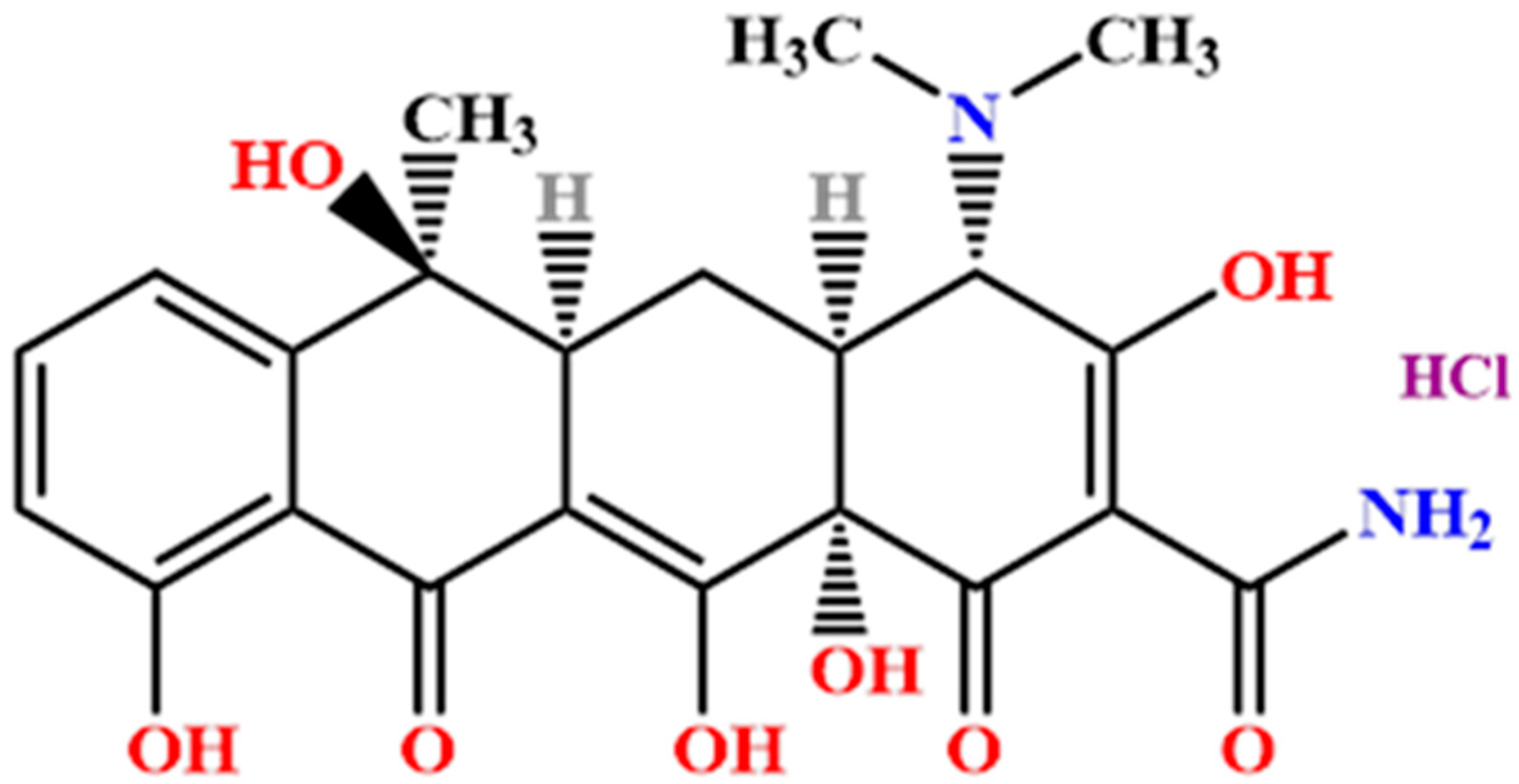
As a typical tetracycline antibiotic, tetracycline hydrochloride (TCH; the molecular structure of TCH is illustrated in Figure 1) is extensively employed in human medicine, animal husbandry, and aquaculture owing to its broad-spectrum antibacterial activity, cost-effectiveness, and excellent bioavailability [1]. However, tetracycline is poorly metabolized and absorbed by organisms, with over 70%–80% persisting in the environment as the parent compound or its primary metabolites [2]. Long-term exposure to water contaminated with TCH can promote the development of antibiotic resistance genes in microorganisms, which poses a serious threat to public health [3,4]. Due to its stable chemical properties and high-water solubility, traditional wastewater treatment technologies are inefficient in removing TCH [5]. Therefore, the development of efficient and cost-effective technologies for TCH removal is imperative.
Peroxymonosulfate-based advanced oxidation processes (PMS-AOPs) have emerged as promising technologies for the degradation of refractory organic pollutants, owing to their high oxidation potential, broad pH adaptability, and the long half-life of the generated radicals [6,7,8,9]. However, PMS alone exhibits limited efficacy in pollutant degradation, necessitating external activation to generate reactive oxygen species with strong oxidizing capacity [10]. Compared with other activators, metal–carbon composites supported by conventional carbon nanotubes (CNTS) or graphene oxide (rGO) (e.g., Co9S8@S-N-rGO [11], Co@N-O-CNTs [12], and FeCoS@N-rGO [13]) have been extensively investigated because of their large specific surface area, excellent catalytic performance, superior stability, and good biocompatibility. However, these conventional carbon supports are typically synthesized from raw materials derived from fossil fuels, including coal and crude oil [14]. In light of the ongoing energy crisis, there is a pressing need to develop novel N-doped carbon materials as sustainable alternatives to these conventional carbon materials. Additionally, the activation mechanisms of PMS primarily involve radical pathways triggered by transition metal activation and nonradical pathways dominated by nitrogen (N)-doped carbonaceous materials [15,16]. Owing to its electrophilic properties, singlet oxygen (1O2) exhibits remarkable efficiency and selectivity in the abatement of antibiotic contaminants [17,18]. To date, 1O2 oxidation as the predominant non-radical mechanisms have been widely confirmed in N-doped carbon material/PMS systems [19,20]. Accordingly, the rational design and fabrication of novel N-doped carbon materials targeting PMS activation for the efficient degradation of high-concentration TCH wastewater are of profound research value.
As a representative category of metal–organic frameworks, zeolite imidazolate frameworks (ZIFs) possess permanent porosity, tunable pore size and structure, relatively low synthesis cost, and straightforward preparation procedures [21,22]. These distinctive advantages render ZIFs-derived materials promising catalysts for PMS activation [23,24]. For instance, Wang and co-workers successfully synthesized a cobalt-based catalyst featuring dual active sites (Co0.75Zn0.25-NC) through the calcination of cobalt–zinc bimetallic ZIFs (CoZn-ZIFs). The Co–Co site and Co–N site separately activated PMS to generate sulfate radicals and 1O2, thus enabling the efficient degradation of TCH [25]. Hua et al. reported that N-doped porous carbon-encapsulated Co nanoparticles (denoted as CZA-1000) were successfully fabricated via the pyrolysis of a Co-ZIF-8@anionic polyacrylamide network composite precursor. Benefiting from its abundant defect structures and encapsulated Co nanoparticles, CZA-1000 efficiently activated PMS to generate free radicals and 1O2, achieving a tetracycline removal efficiency of 99.8% within 30 min [26]. Yao and co-workers described the fabrication of Zn4Co1-C materials with Co-N4 coordination configurations via the pyrolysis of ZnxCo1−x-ZIFs precursors. Co-N4 sites can efficiently activate PMS to generate 1O2. Accordingly, Zn4Co1−C delivers a remarkable selectivity of 98% for phenol removal in aqueous systems containing a mixture of phenol and benzoic acid [27]. Despite the remarkable PMS-activation efficacy of ZIFs-derived metal–carbon composites, their preparation and practical deployment suffer from two major drawbacks. Firstly, the synthesis of ZIFs typically relies on toxic and volatile methanol as the solvent, along with lengthy solvothermal reactions under harsh high-temperature and high-pressure conditions, making the protocol environmentally unfriendly, unsafe, and time-consuming. Additionally, these materials are primarily applied for the removal of traditional organic pollutants including dyes, phenols, and bisphenol A. Nevertheless, their catalytic efficiency toward high-concentration antibiotic pollutants still warrants in-depth investigation [28].
To address these two major drawbacks, we report a facile, eco-friendly, and rapid self-assembly approach to synthesize a novel CoZn-ZIFs nanosheet precursor. Subsequently, N-doped carbon-supported CNTs coated with Co nanoparticles (Co-CNTs@NC) composites were obtained via the high-temperature calcination of CoZn-ZIFs. The physicochemical properties of Co-CNTs@NC were systematically investigated by means of X-ray diffraction (XRD), transmission electron microscopy (TEM), high-resolution transmission electron microscopy (HRTEM), X-ray photoelectron spectroscopy (XPS), and Raman spectroscopy. A series of control experiments were carried out to investigate the catalytic efficacy of Co-CNTs@NC toward PMS activation, as well as to identify the primary active sites. Systematic optimization was conducted on critical operational parameters (e.g., initial TCH concentration, PMS dosage, Co-CNTs@NC dosage, reaction temperature, and initial pH) to evaluate their impacts on TCH degradation efficiency. Concurrently, the reactive oxygen species accountable for TCH degradation were identified via a combination of quenching experiments and electron paramagnetic resonance spectroscopy, based on which a potential degradation mechanism was proposed. This study seeks to develop an eco-friendly, scalable synthetic protocol for high-performance PMS activators, while advancing the application of MOF-derived composites in the remediation of antibiotic-contaminated wastewater.

2. Materials and Methods

2.1. Materials

2-Methylimidazole, cobalt nitrate hexahydrate (Co(NO3)2·6H2O), cetyltrimethylammonium bromide (CTAB), p-Benzoquinone (PBQ), tert-butanol (TBA), potassium monopersulfate triple salt (PMS, KHSO5∙0.5KHSO4∙0.5 K2SO4), L-histidine (L-His), and tetracycline hydrochloride (TCH) were obtained from Aladdin Biochemical Technology Co., Ltd. (Shanghai, China). Zinc nitrate hexahydrate (Zn(NO3)2·6H2O), methanol (MeOH), and sodium hydroxide (NaOH) were supplied from Sinopharm Chemical Reagent Co., Ltd. (Shanghai, China). All reagents were of analytical grade and employed without additional purification. Deionized water (18.2 MΩ·cm resistivity) was utilized throughout the entire experimental process.

2.2. Preparation

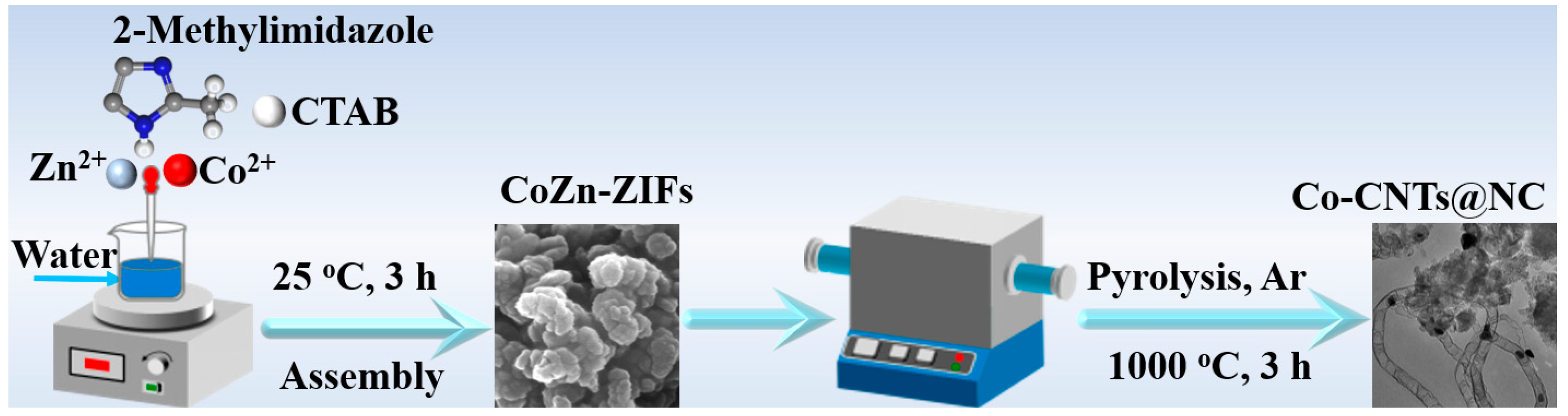
The synthesis processes of CoZn-ZIFs and Co-CNTs@NC are illustrated in Figure 2. CoZn-ZIFs were fabricated through a room-temperature self-assembly route in an aqueous medium, where the molar ratio of 2-methylimidazole to metal salts was maintained at 20:1. This procedure was adapted from our previously reported protocol with minor modifications [29]. For comparison, CoZn-ZIFs-30 and CoZn-ZIFs-40 were synthesized by adjusting the molar ratio of 2-methylimidazole to metal salts (Co2+ + Zn2+) to 30:1 and 40:1, respectively. Zn-ZIFs (without Co2+) were prepared using the same procedure of CoZn-ZIFs with a Zn2+:Co2+ molar ratio of 1:0. N-doped carbon-loaded CNTs coating Co nanoparticle composites were synthesized by calcining above precursors. Specifically, 1.0 g of CoZn-ZIFs was weighed, ground into fine powder, and loaded into a porcelain boat. The boat was then placed in a tube furnace. Under an argon atmosphere, the temperature was first increased up to 500 °C at a heating rate of 10 °C min−1, followed by a subsequent increase to 1000 °C at 5 °C min−1. After holding this final temperature for 3 h, the system was cooled down to 20 °C. The resulting black samples were collected, ground, and labeled as Co-CNTs@NC. Following the synthetic protocol for Co-CNTs@NC, Co-CNTs@NC-30, Co-CNTs@NC-40, and NC were successfully fabricated via the calcination of CoZn-ZIFs-30, CoZn-ZIFs-40, and Zn-ZIFs precursors, respectively. The synthetic details of all samples are summarized in Text S1 of the Supplementary Materials (SM).

2.3. Characterization

The crystal phase and morphologies of CoZn-ZIFs and Co-CNTs@NC were analyzed using XRD (D8 ADVANCE, Bruker, Karlsruhe, Germany), TEM (JEM 2100 plus, Electron Optics Laboratory, Tokyo, Japan), and scanning electron microscopy (SEM, Zeiss Sigma 360, Oberkochen, Germany), respectively. The XPS data of Co-CNTs@NC was obtained with a Thermo Scientific K-Alpha spectrometer (Thermo, Waltham, MA, USA). The XPS Peak 4.1 software was used to analyze the elemental composition and valence states of Co-CNTs@NC. The graphitization degrees of Co-CNTs@NC and NC were evaluated using Raman spectroscopy (LabRAM Odyssey, HORIBA, Tokyo, Japan) with an excitation wavelength of 532 nm.

2.4. TCH Degradation Experiments

The experimental procedures for TCH degradation, the investigation of reaction condition effects on TCH degradation, and the exploration of free radical types and roles are detailed in Texts S2–S4 of the Supporting Materials (SM), respectively. According to the UV spectral scanning data of TCH (Figure S1), the absorbance of the reaction mixture was determined at 358 nm with an ultraviolet-visible spectrophotometer (UV-Vis, T600A, Beijing Purkinje General Instrument Co., Ltd., Beijing, China).

3. Results and Discussion

3.1. Material Characterization

3.1.1. Morphological Characterization

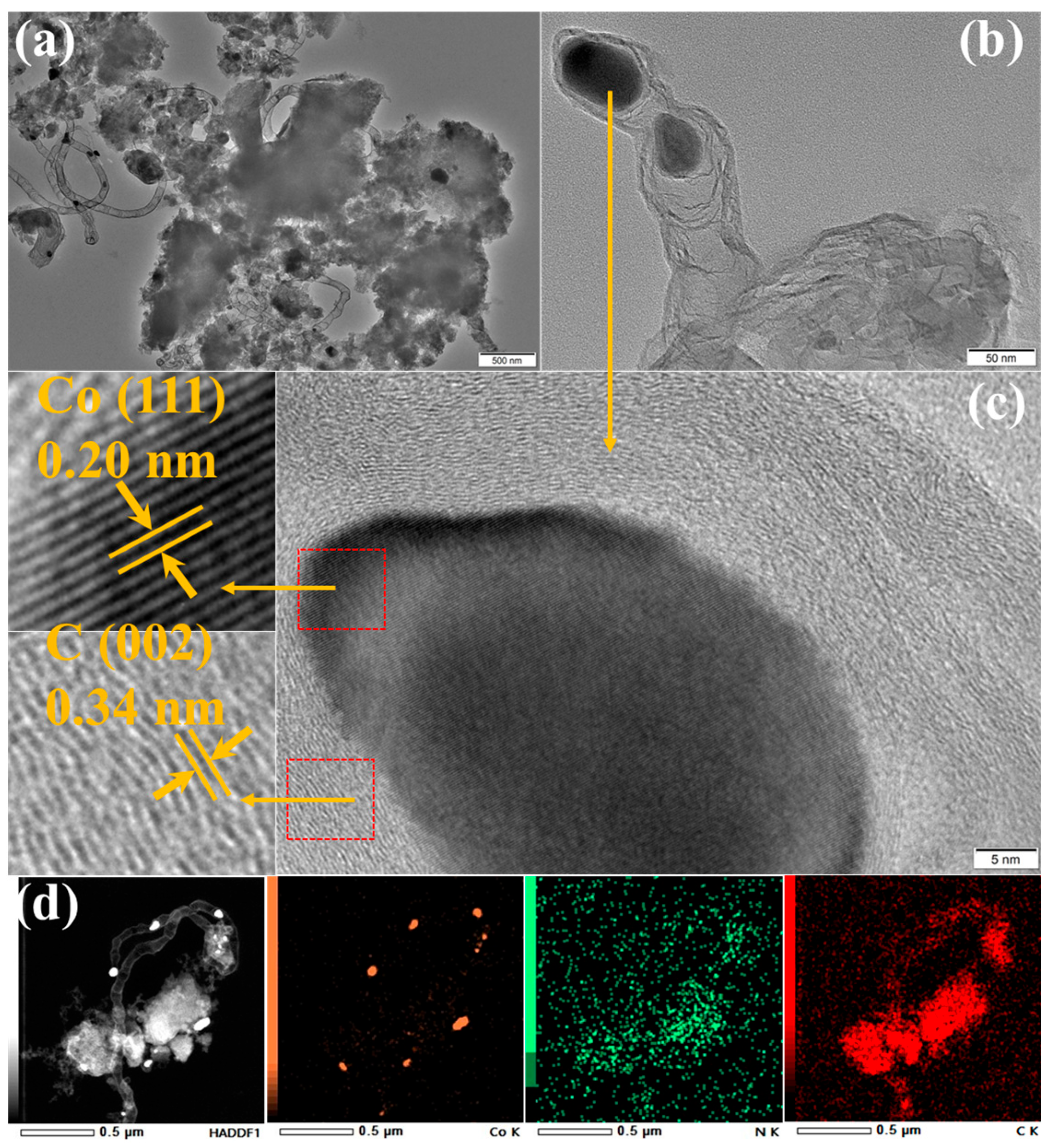
The morphological features of CoZn-ZIFs and Co-CNTs@NC were investigated via SEM. Figure S2 clearly shows that CoZn-ZIFs possess an irregular lamellar microstructure. As shown in the SEM micrograph of Co-CNTs@NC at 1 μm magnification (Figure S3a), the carbonized material largely preserves its lamellar structure, concomitantly displaying the formation of partial CNT domains. At a higher magnification of 200 nm (Figure S3b), the SEM image distinctly visualizes the CNT morphology, where Co nanoparticles are encapsulated at the tips of the nanotubes. To further verify the successful fabrication of Co nanoparticles encapsulated within CNTs, TEM and HRTEM characterizations were performed. Figure 3a,b reveal that Co nanoparticles encapsulated within CNTs are successfully anchored on the surface of Co-CNTs@NC. This structural feature can be ascribed to the continuous migration of Co atoms during high-temperature calcination, which catalyzes the growth of CNTs [30]. The HRTEM micrographs of Co-CNTs@NC in Figure 3c show distinct lattice fringes with interplanar spacings of 0.20 and 0.34 nm, corresponding to the (111) facet of metallic cobalt and the (002) facet of graphitic carbon, respectively [31]. The characterization results of high-angle annular dark field scanning TEM (HAADF-STEM) and the corresponding element mapping images (Figure 3d) verify the uniform distribution of Co, N, and C in the Co-CNTs@NC with good dispersibility. The morphological analysis results confirm the successful preparation of Co-CNTs@NC.

3.1.2. XRD and Raman Analysis

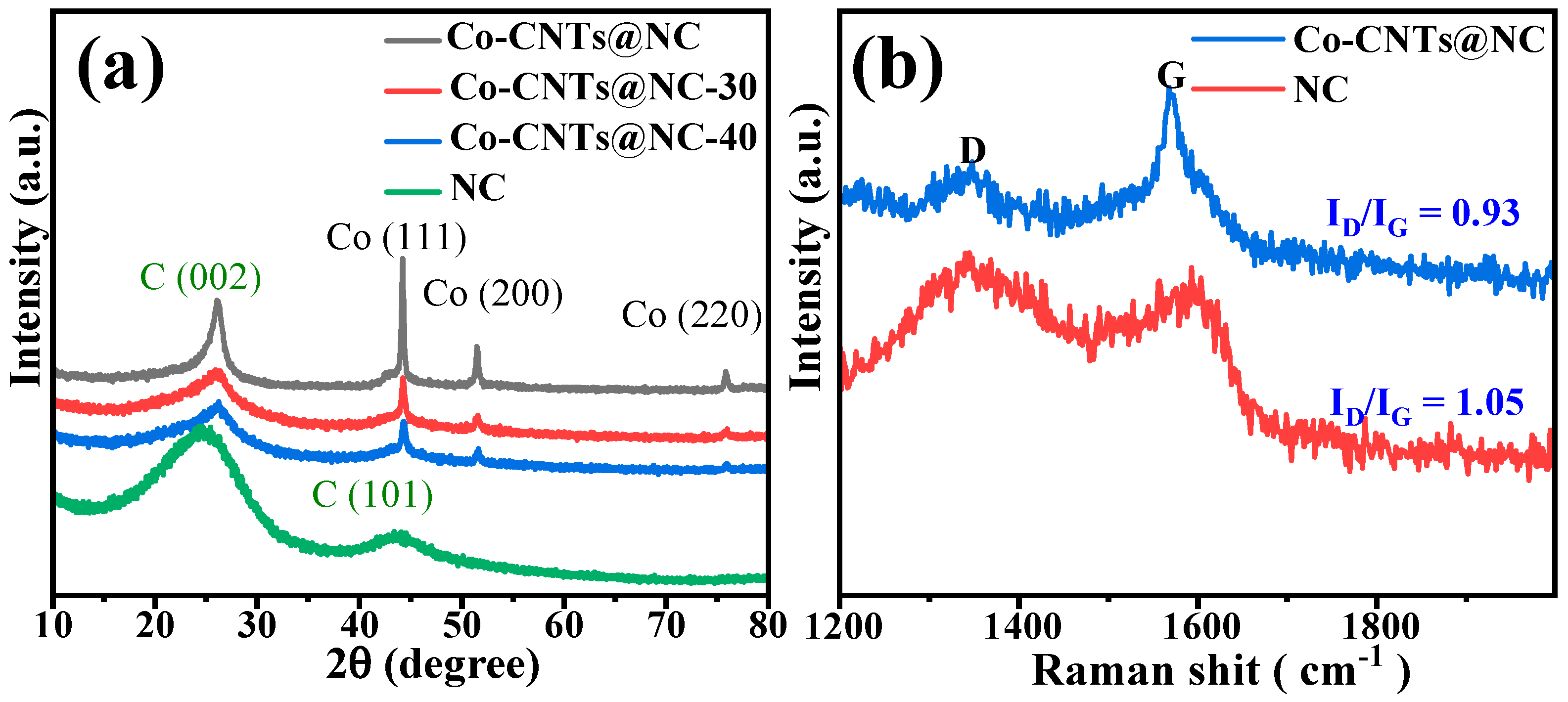
To gain insights into the crystal structural characteristics of Zn-ZIFs and CoZn-ZIFs, XRD analysis was conducted on the two samples. As illustrated in Figure S4, both Zn-ZIFs and CoZn-ZIFs possessed well-resolved crystalline architectures with high crystallinity. The incorporation of Co species did not alter the crystal framework of Zn-ZIFs, confirming the remarkable structural stability of the as-prepared CoZn-ZIFs. Figure 4a shows that a broad diffraction peak at ~26° appears in all samples, and is corresponding the (002) crystal plane of graphitic carbon (JCPDS No. 75-1621) [32]. The intensity of this peak is significantly higher in Co-CNTs@NC, Co-CNTs@NC-30, and Co-CNTs@NC-40 than in NC, which demonstrates that the introduction of Co promoted the graphitization of carbon matrices during high-temperature calcination. Additionally, the XRD patterns of Co-CNTs@NC, Co-CNTs@NC-30, and Co-CNTs@NC-40 exhibit three distinct diffraction peaks located at 44.04°, 51.48°, and 75.71°, assignable to the (111), (200), and (220) crystal planes of metallic Co (JCPDS No. 15-0806) [33]. The diffraction peaks corresponding to cobalt oxides are not detected, which can be attributed to the enhanced stability of Co nanoparticles resulting from the CNT coating. The XRD results confirm that the three composite materials are successfully synthesized by tailoring the molar ratio of metal precursors to organic ligands in this work.
Raman spectroscopy was further utilized to quantify the graphitization degree of Co-CNTs@NC and NC composites. As presented in Figure 4b, the Raman spectra of the Co-CNTs@NC and NC reveal two prominent peaks at ~1350 (D-band) and ~1580 cm−1 (G band), yielding the ID/IG intensity ratios of 0.93 and 1.05, respectively. Significantly, the ID/IG ratio of Co-CNTs@NC is considerably lower than that of NC, which attests to the higher graphitization degree of the former. In general, a high graphitization degree is conducive to enhancing the electrical conductivity of carbon-based materials, and thus contributes to the improvement of their catalytic performance [34]. This finding is consistent with the XRD characterization results.

3.1.3. XPS Analysis

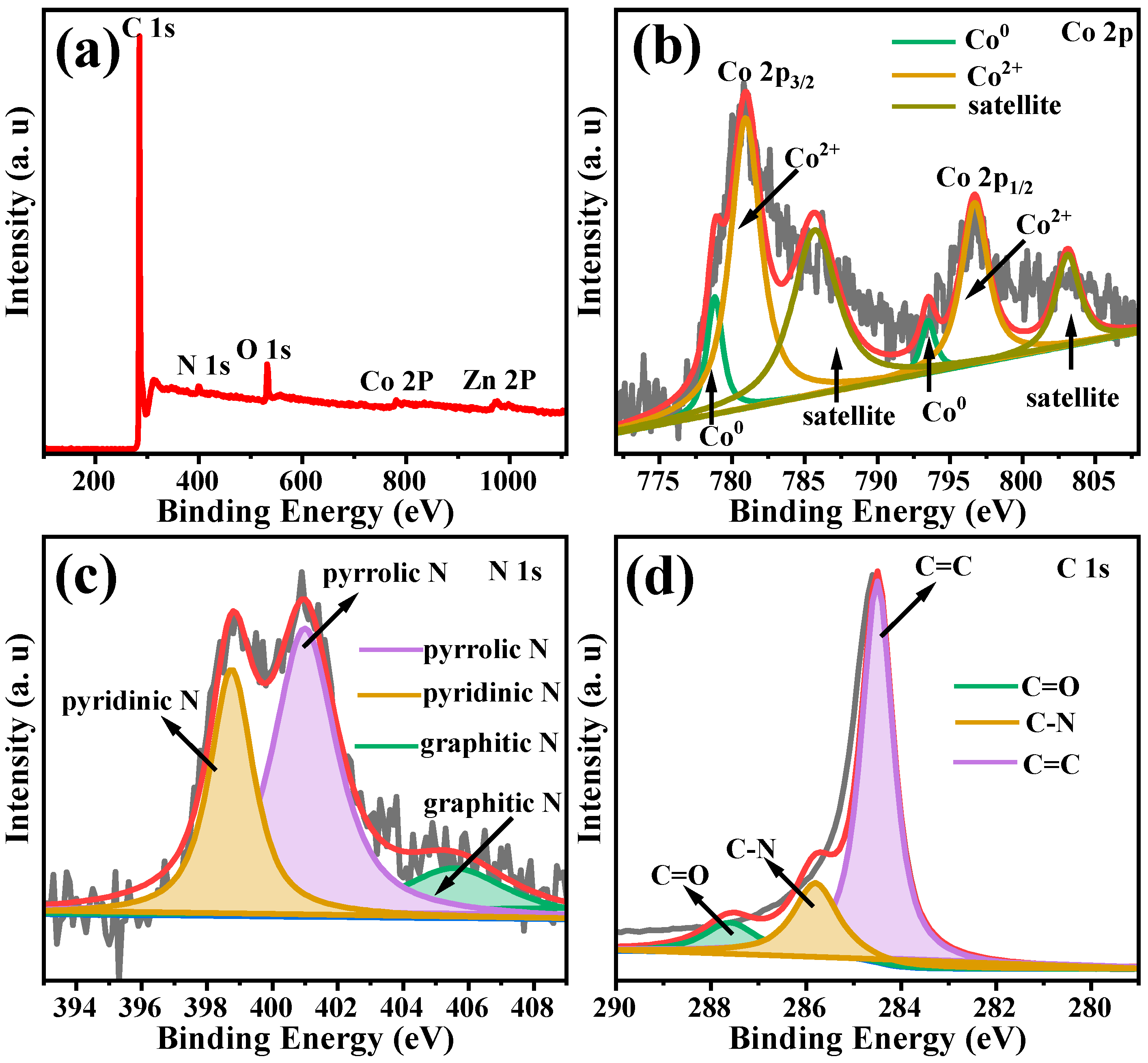
The element composition and chemical states of Co and N in the Co-CNTs@NC were systematically characterized using XPS. As shown in Figure 5a, the characteristic peaks of C 1s, N 1s, Co 2p, O 1s, and Zn 2p are resolved. Figure S5a displays a faint XPS signal corresponding to Zn 2p, which can be attributed to the evaporation of Zn (boiling point: 907 °C) during calcination at 1000 °C [35]. To further confirm the nearly complete evaporation of Zn, the contents of Co and Zn elements in Co-CNTs@NC were quantified via inductively coupled plasma mass spectrometry (ICP-MS), with the corresponding data summarized in Table S1. Co-CNTs@NC exhibited a high Co content (5.38 wt%), which is favorable for TCH degradation. Meanwhile, the Zn content was merely 0.03 wt%, indicating that Zn was almost completely volatilized during calcination at 1000 °C. The peak fitting of the O 1s XPS spectrum in Figure S5b resolves two well-defined peaks at binding energies of 531.62 eV and 532.91 eV, corresponding to carbonyl moieties (C=O) and hydroxyl groups (C–O–H) in the composite matrix, respectively [36]. The Co 2p XPS spectrum of Co-CNTs@NC (Figure 5b) are deconvoluted into two spin–orbit doublets (Co 2p3/2 and Co 2p1/2), each comprising peak pairs corresponding to metallic Co (778.78 eV/793.47 eV) and Co2+ (780.93 eV/796.72 eV), along with two satellite peaks located at 785.69 eV and 803.08 eV [37]. Similarly, no XPS peaks corresponding to cobalt oxides were observed, thereby verifying that the CNT coating improves the antioxidative stability of Co nanoparticles. The high-resolution N 1s XPS spectrum in Figure 5c displays three well-defined characteristic peaks, corresponding to pyridinic N (398.75 eV), pyrrolic N (400.93 eV), and graphitic N (405.57 eV), respectively [38]. As illustrated in Figure 5d, the high-resolution C 1s spectrum verifies the existence of C=C (284.51 eV), C–N (285.76 eV), and C=O (287.58 eV) moieties [39]. Collectively, the combined results from TEM, HRTEM, XRD, Raman, and XPS characterizations corroborate the successful fabrication of the Co-CNTs@NC composite.

3.1.4. Bet Analysis

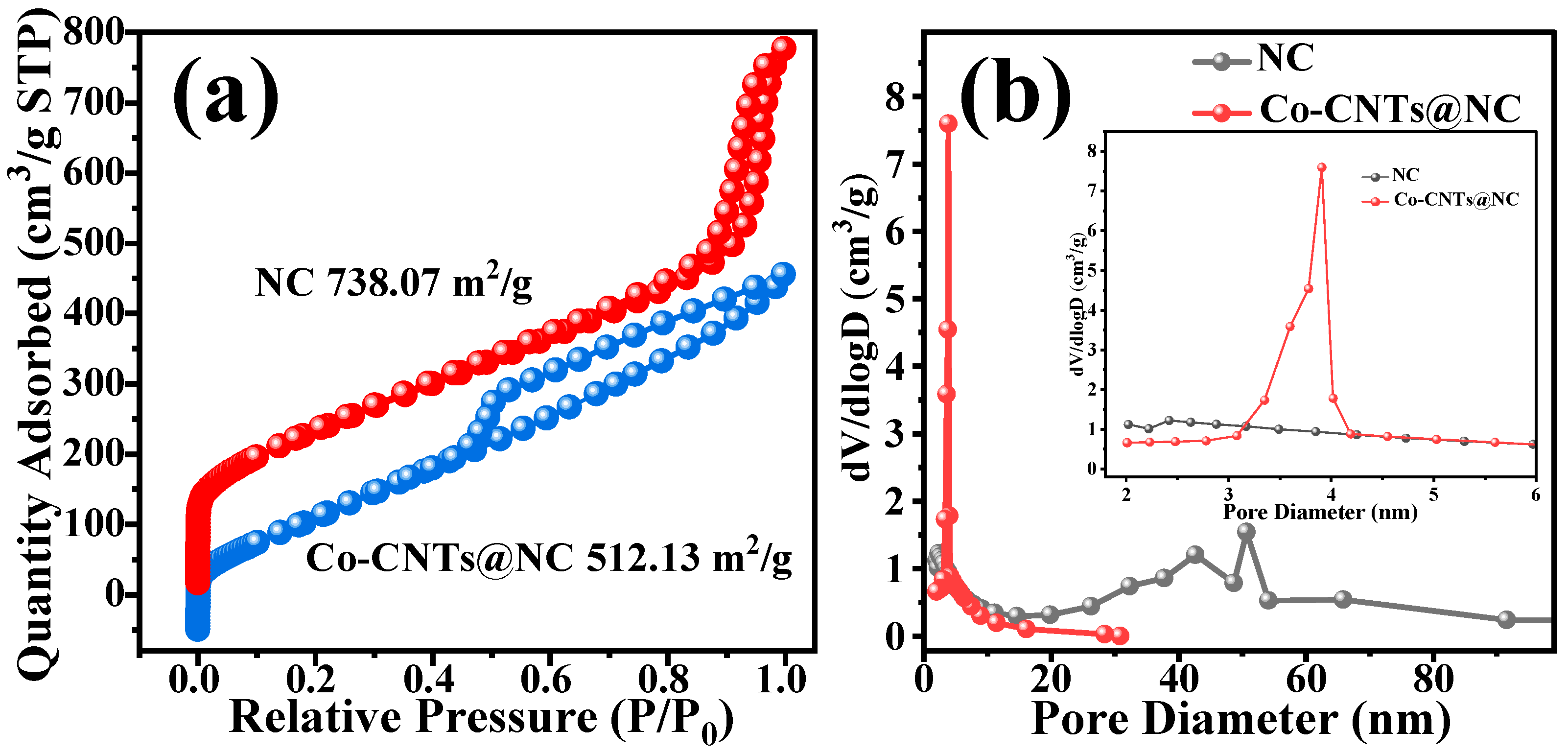
The specific surface area and pore structure of NC and Co-CNTs@NC were characterized by N2 adsorption–desorption isotherms. As depicted in Figure 6a, Co-CNTs@NC exhibits a reversible type IV isotherm at relative pressures (P/P0) > 0.4, coupled with long and narrow hysteresis loops, which is characteristic of a mesoporous structure [40]. In the high-pressure region (p/p0 > 0.9), NC shows a drastic upturn, confirming the presence of macro-porous structures [41]. Figure 6b provides complementary evidence confirming the macro-porous nature of NC and the mesoporous characteristics of Co-CNTs@NC. The Brunauer–Emmett–Teller (BET) surface area and pore volume of Co-CNTs@NC (512.13 m2/g, 0.78 cm3/g) are slightly lower than those of the N-C sample (738.07 m2/g, 1.17 cm3/g). Co-CNTs@NC still exhibits a substantial surface area and abundant pore structure, which are conducive to increasing the exposure of active sites.

3.2. Catalytic Degradation of TCH

3.2.1. Efficiency Comparison of Different Reaction Systems

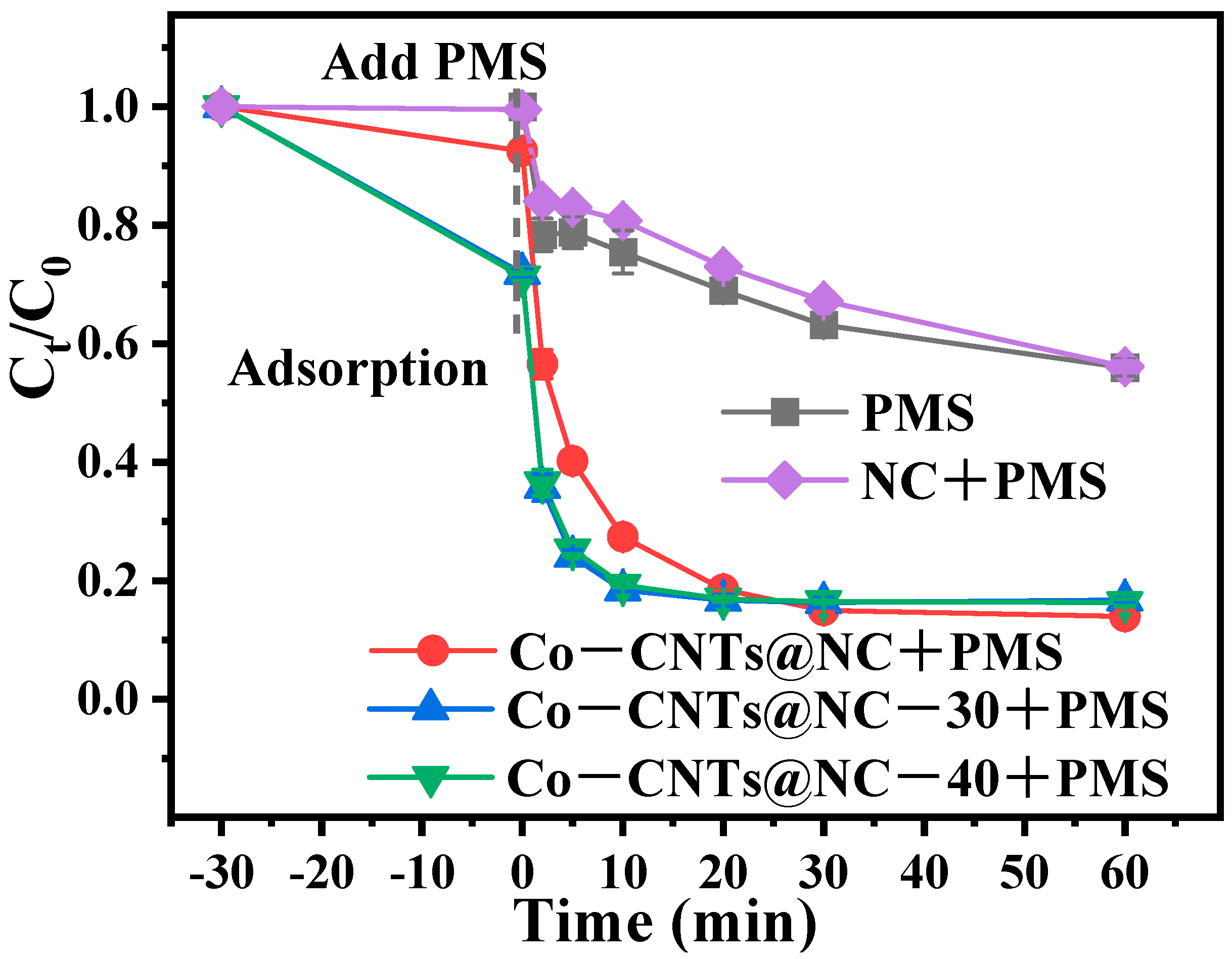
To investigate material performance in PMS-activated TCH degradation and key active sites, a systematic evaluation of TCH removal efficiencies was performed across multiple catalytic systems. The adsorption efficiencies of Co-CNTs@NC for TCH were determined to be 6.01% and 8.21% at reaction time of 30 and 60 minutes (min), respectively (Figure S6). The results demonstrate that the adsorption of TCH onto Co-CNTs@NC can attain adsorption equilibrium within 30 min. As shown in Figure 7, the adsorption efficiencies of Co-CNTs@NC and NC for TCH reached 7.52% and 0.50% within 30 min, respectively. The adsorption efficiencies of the two reaction systems within 30 min were both below 10%, indicating that the adsorption role is almost negligible in TCH removal. The Co-CNTs@NC/PMS reaction system can remove 43.46% and 86.02% of TCH in 2 and 60 min, respectively. The removal efficiency at 60 min exhibited a remarkable superiority over that of PMS alone (44.04%) and the NC/PMS reaction system (43.92%), which can be attributed to the high Co content in Co-CNTs@NC. The high Co content in Co-CNTs@NC is responsible for the formation of abundant active sites, thereby enhancing PMS-activated TCH degradation efficiency. Concurrently, Figure S7 shows that the Co-CNTs@NC/PMS system possesses the highest pseudo-first-order rate constant (kobs = 0.0859 min−1) within 10 min, 13.22-fold and 14.32-fold higher than those of NC/PMS (0.0065 min−1) and PMS alone (0.0060 min−1), respectively. Consequently, the above results confirm that Co-CNTs@NC exhibits superior efficiency in PMS-activated TCH degradation, where Co nanoparticles are the dominant active sites. After comprehensive evaluation of key parameters including catalyst dosage, PMS dosage, and initial tetracycline concentration, Co-CNTs@NC/PMS delivers superior degradation kinetics and catalytic performance, comparable to the performance metrics of previously reported metal–carbon/PMS activation systems for tetracycline degradation (Table S2).
In addition, to investigate the effect of 2-methylimidazole to metal salt molar ratio on TCH removal efficiency, CNTs@NC-30/PMS and Co-CNTs@NC-40/PMS system were constructed separately, and the results are listed in Figure 7. The adsorption efficiencies of Co-CNTs@NC-30 and Co-CNTs@NC-40 for TCH were 28.14% and 28.67% within 30 min, respectively. The removal efficiencies of two reaction systems were determined to be 83.27% and 83.70% within 60 min, respectively, both lower than that of the Co-CNTs@NC/PMS system. As a result, increasing the dimethylimidazole to metal salt molar ratio only enhanced adsorption efficiency, whereas high adsorption efficiency impairs TCH deep removal. Therefore, considering both the degradation efficiency and economic cost, Co-CNTs@NC (2-methylimidazole: metal salts = 20:1) was selected as the optimal catalyst for subsequent experiments.

3.2.2. Effect of Different Experimental Conditions

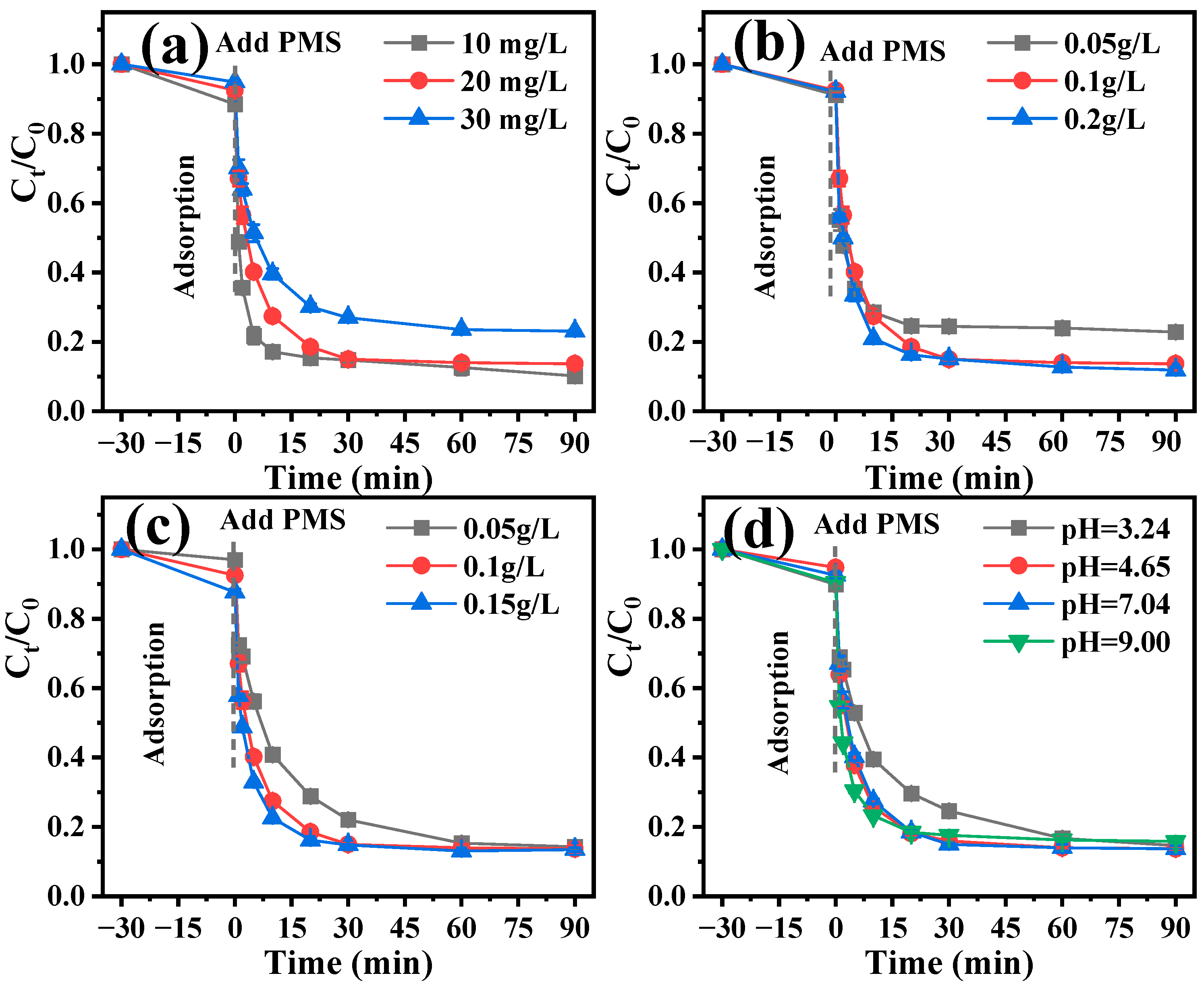
Contaminant concentration is widely recognized as a key factor governing the performance of advanced oxidation systems. Accordingly, the influence of the initial TCH concentration on TCH removal was investigated first. As can be seen from Figure 8a, with the TCH concentration increasing from 10 mg/L to 30 mg/L, the TCH degradation efficiency decreased from 89.83% to 76.91%. Meanwhile, the kobs of TCH decreased from 0.1143 to 0.0625 min−1 (Figure S8a). The reason may be attributed to the limited availability of active sites on Co-CNTs@NC. Thus, 20 mg/L of TCH was set as the initial concentration for subsequent experiments to ensure good degradation efficiency.
The effect of PMS dosage on TCH degradation was investigated. After 90 min of reaction, the degradation efficiency of TCH increased from 77.14% to 86.33% and 88.15% with PMS dosage increasing from 0.05 g/L to 0.1 and 0.2 g/L (Figure 8b). Correspondingly, Figure S8b reveals that the kobs increased from 0.0565 to 0.0962 and 0.1090 min−1 with increasing PMS dosage. As shown by the results, increasing the PMS dosage can promote TCH removal, which is attributed to two factors. It strengthens the direct oxidation capacity of PMS for TCH removal and promotes Co-CNTs@NC to activate PMS for more active species generation [42]. In contrast, no notable changes were observed in the TCH degradation efficiency and kobs value when the PMS dosage was increased from 0.1 to 0.2. Therefore, to balance degradation efficiency and cost-effectiveness, 0.1 g/L was determined as the optimal PMS concentration.
The Co-CNTs@NC dosage as an important variable was also investigated (Figure 8c). After 30 min of adsorption, the TCH adsorption efficiencies for Co-CNTs@NC at dosages of 0.05, 0.1, and 0.15 g/L were 3.01%, 7.52%, and 12.39%, respectively. In the degradation process, increasing Co-CNTs@NC dosage promoted the TCH degradation efficiency to rise from 27.62% to 42.21% within 1 min. Within 90 min, the TCH degradation efficiencies reached 85.74%, 86.33%, and 86.53%, respectively, with corresponding kobs values of 0.0453, 0.0962, and 0.1059 min−1 under the three dosage conditions (Figure S8c). No significant differences in degradation efficiency or kobs were observed between the 0.1 and 0.15 g/L dosages. Therefore, considering both degradation performance and cost-effectiveness, 0.1 g/L was selected as the Co-CNTs@NC dosage for subsequent reactions.
The effect of initial pH on TCH degradation is illustrated in Figure 8d. The TCH adsorption efficiencies of Co-CNTs@NC under various pH conditions were fairly low, ranging from 5.23% to 10.16%, suggesting that pH had an insignificant impact on adsorption behavior. Within 90 min of reaction, the TCH degradation efficiencies reached 85.35% (pH 3.24), 86.27% (pH 4.65), 86.33% (pH 7.04), and 84.17% (pH 9.00), respectively. Figure S8d reveals that the k1obs values for initial pH values of 3.24, 4.65, 7.04, and 9.00 were 0.0628, 0.0996, 0.0962, and 0.0816 min−1, respectively, whereas the k2obs values under these pH conditions were 0.0241, 0.0262, 0.0292, and 0.0161 min−1. These results demonstrate that the Co-CNTs@NC/PMS system possesses excellent adaptability across a wide pH range. Comparison of TCH degradation efficiencies and kobs across different pH values confirms that Co-CNTs@NC/PMS achieves the optimal degradation performance under neutral conditions. Considering that the pH of most real-world wastewater samples is close to neutral, an initial pH of 7.04 was determined to be the optimal operational parameter.
Finally, the influence of temperature on the TCH degradation was examined. Following a 30 min adsorption at 15, 25, and 35 °C, the TCH adsorption efficiencies of Co-CNTs@NC were measured to be 9.67%, 7.52%, and 12.87%, respectively, indicating that reaction temperature exerted a negligible impact on TCH adsorption behavior (Figure S9). The corresponding TCH degradation efficiencies reached 84.12%, 86.33%, and 88.68%, respectively, within 90 min. No statistically significant differences were observed in the degradation efficiencies across these three temperature conditions. In consideration of operational practicality and energy costs, 25 °C was designated as the standard reaction temperature for all subsequent experiments.

3.3. Reusability and Stability of Co-CNTs@NC

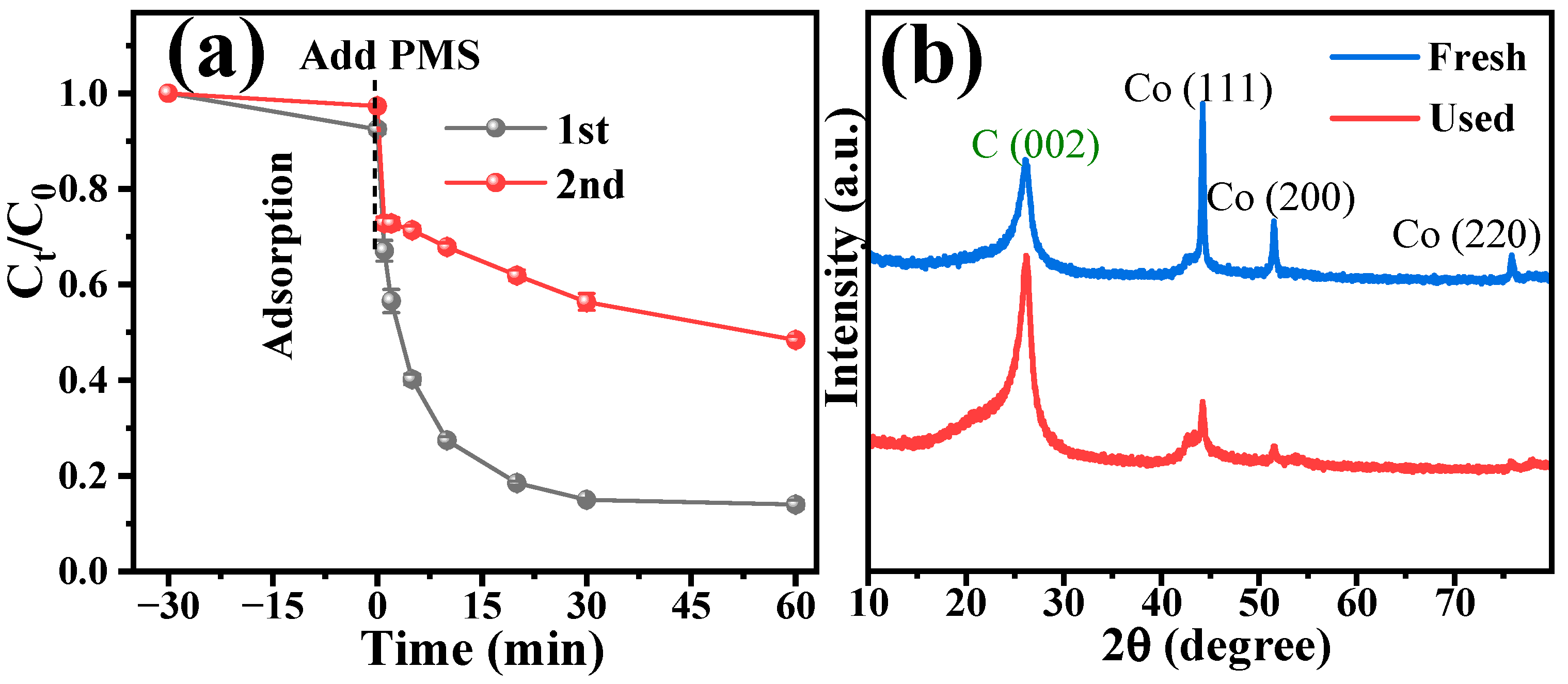
Cycling tests were conducted under optimal reaction conditions using the recovered Co-CNTs@NC catalyst to evaluate the cycling stability of Co-CNTs@NC. As shown in Figure 9a, the TCH degradation efficiency decreased from 86.02% to 51.59% after 60 min in the second cycle, indicating that Co-CNTs@NC exhibits unsatisfactory reusability.
To unravel the intrinsic cause of Co-CNTs@NC’s inferior reusability, the Co leaching concentration during the reaction process was first measured by ICP-MS. As documented in Table S3, Co-CNTs@NC exhibited substantial Co leaching (>4.54 mg/L), which induced irreversible depletion of Co active sites and thus a dramatic decline in TCH degradation efficiency. Figure 9b reveals that the characteristic diffraction signal of metallic Co diminished drastically after the reaction cycle, which further confirms the reduction in Co active sites. As a result, high Co leaching is a crucial factor responsible for the poor reusability of Co-CNTs@NC. Beyond metal leaching, the coverage of reaction intermediates can also impair the cyclic performance of catalysts. Thus, the variation in total organic carbon (TOC) during the reaction was monitored to clarify the mineralization degree of TCH and the evolution of intermediates. After 90 min of reaction with PMS addition, the TOC removal efficiency reached 21.85% (Figure S10), confirming partial mineralization of TCH. However, the relatively low mineralization efficiency demonstrates that most reaction intermediates were refractory to further degradation. The accumulation of a large number of intermediates in the reaction system would result in the masking of active sites [43]. A third factor responsible for performance deterioration is material loss incurred during the catalyst recovery process. Specifically, residual carbon particles present in the centrifugal supernatant inevitably result in material loss during the recycling of Co-CNTs@NC. A similar phenomenon has been previously reported in advanced oxidation processes employing cobalt-carbon composite materials [44,45]. Based on the aforementioned experimental results and corresponding analyses, the poor reusability of Co-CNTs@NC can be primarily ascribed to three key issues: excessive Co leaching, masking of active sites by reaction intermediates, and material loss during the recovery process. It has been demonstrated that the incorporation of a second metal (e.g., Fe and Cu) for fabricating bimetallic systems can effectively suppress metal leaching and enhance cyclic stability [37,46]. Accordingly, our future work will adopt established methodologies to tailor the Co-CNTs@NC derived from CoZn-ZIFs, aiming to optimize its long-term cyclic stability and mitigate metal leaching.
Additionally, no characteristic signals associated with cobalt oxides were identified in the Co 2p XPS spectrum, O 1s spectrum, and FT-IR spectrum (Figure S11) of Co-CNTs@NC, as well as XRD patterns of Co-CNTs@NC after the reaction. This observation can be ascribed to the protective CNT coating, which effectively enhances the oxidation resistance of Co-CNTs@NC and thus inhibits the formation of cobalt oxide species.

3.4. Degradation Mechanism

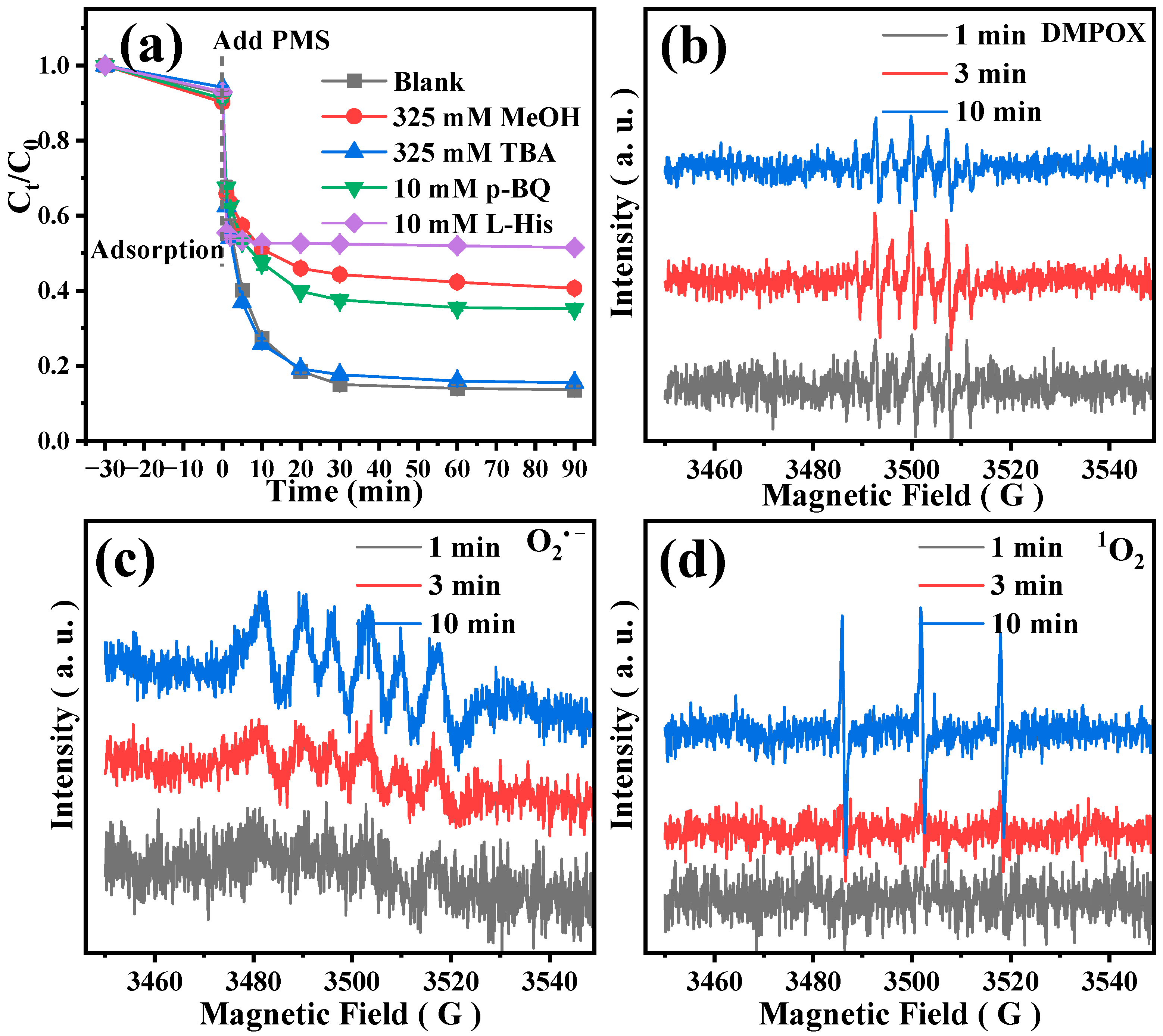
A series of radical quenching experiments were carried out to elucidate the reactive oxygen species (ROS) responsible for TCH degradation. Specifically, the sulfate radical (SO4•−), hydroxyl radical (•OH), superoxide radical (O2•−), and singlet oxygen (1O2) were quenched using methanol (MeOH), tert-butanol (TBA), p-Benzoquinone (PBQ), and L-histidine (L-His) as quenching agents, respectively. Comprehensive details regarding the experimental protocols and quenching mechanisms are documented in Text S4 of the Supplementary Materials.
Figure 10a illustrates that following 90 min of reaction, the TCH degradation efficiency declined from 86.33% to 84.49%, 59.32%, 64.80%, and 48.50% upon the addition of TBA, MeOH, PBQ, and L-His, respectively. These results demonstrate that 1O2 serves as the primary reactive species mediating TCH degradation, whereas SO4•−, O2•−, and •OH also participate in the degradation process within the Co-CNTs@NC/PMS system.
To further elucidate the species and relative contributions of ROS generated during the reaction, electron paramagnetic resonance (EPR) experiments were performed. 5,5-Dimethyl-1-pyrroline N-oxide (DMPO) and 2,2,6,6-tetramethyl-4-piperidone (TEMP) were utilized as spin-trapping agents to identify the corresponding ROS. A distinct characteristic signal of the DMPO oxidation product (DMPOX) can be observed in Figure 10b. In contrast, no detectable signals of SO4•− and •OH were observed. This observation can presumably be ascribed to the rapid oxidation of DMPO mediated by 1O2, which generates the short-lived DMPOX intermediate in the 1O2-dominant system, thereby impeding the efficient trapping and detection of the target free radicals [47]. As depicted in Figure 10c, faint DMPO–O2•− signals were detected in the Co-CNTs@NC/PMS reaction system, a phenomenon presumably arising from the rapid conversion of O2•− to 1O2 [48]. In addition, strong TEMP-1O2 signals were obviously observed with different reaction times in the Co-CNTs@NC/PMS system (Figure 10d). The results verify that Co-CNTs@NC is highly efficient at activating PMS to produce 1O2. Compared with the EPR signals of DMPOX and DMPO−O2•−, the signal intensity of 1O2 increased significantly as the reaction proceeded, which further demonstrates that 1O2 serves as the predominant ROS driving TCH degradation.
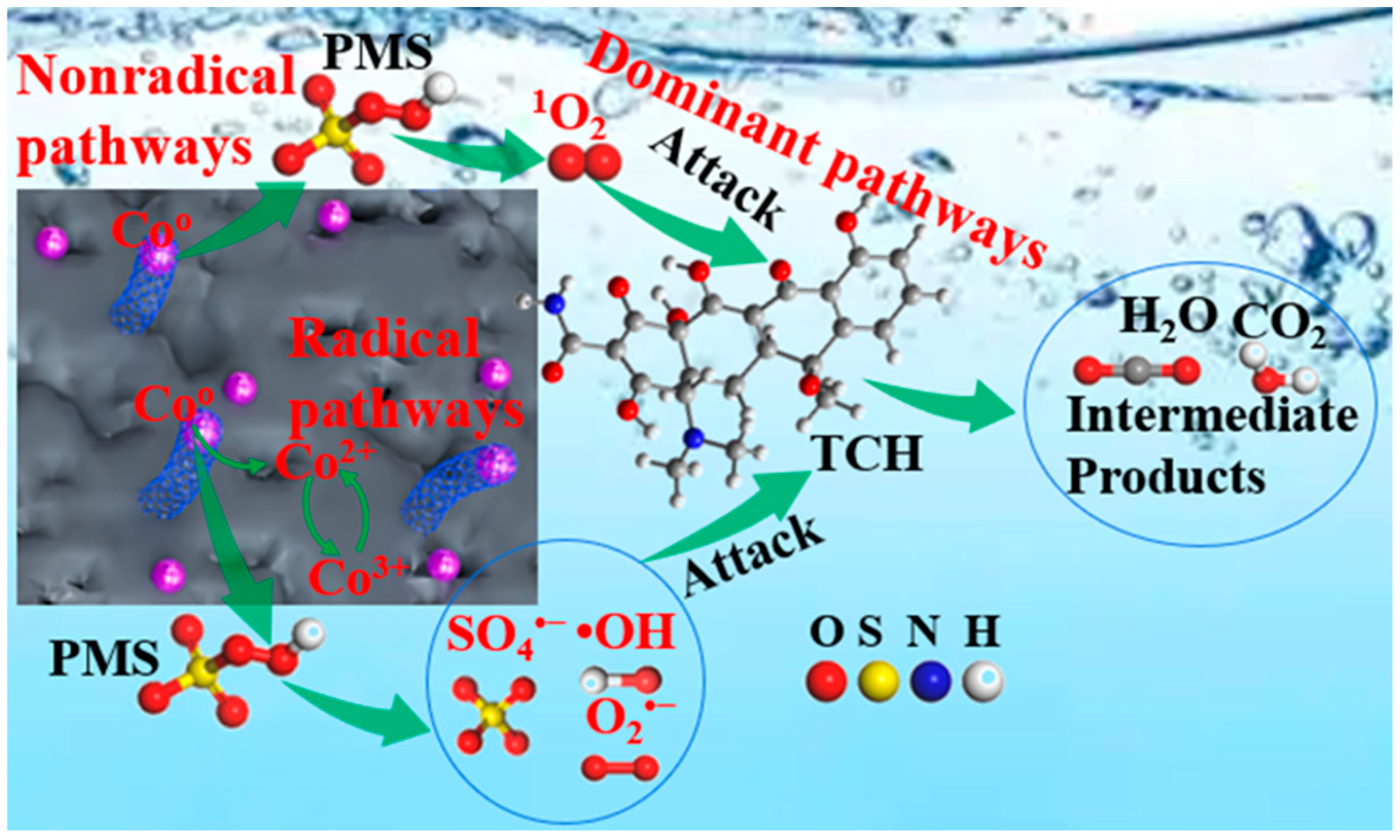
On the basis of the above results, a nonradical-dominated degradation mechanism is proposed in Figure 11. Co nanoparticles anchored within Co-CNTs@NC donated electrons to PMS, triggering cleavage of the O–O bond and concomitant formation of SO4•−, •OH, and O2•− according to Equations (1)–(7) [26,49]. 1O2 was generated via the further transformation of SO4•−, •OH, and O2•− according to Equations (8) and (9) [50]. Previous studies have demonstrated that electrons can migrate from nucleophilic PMS (electron donors) to electrophilic carbonyl (C=O) functional groups (electron acceptors). When PMS donates one electron, it generates the corresponding PMS anion radical SO5•− (Equation (10)). As depicted in Equation (11), SO5•− undergoes facile transformation into S2O82− or SO42− with the accompanying production of 1O2 [51]. Ultimately, TCH was degraded by the in situ generated ROS (Equation (12)).
C o 0 + 2 H S O 5   2 O H + C o 2 + + 2 S O 4
C o 2 + + H S O 5   O H + C o 3 + + S O 4
C o 3 + + H S O 5     S O 5 + C o 2 + + H +
C o 0 + 2 C o 3 +     3 C o 2 +
H S O 5 + H 2 O     H 2 O 2 + H S O 4
C o 3 + + H 2 O 2     C o 2 + + H O 2 + H +
S O 4 + H 2 O     O H + H + + S O 4 2
O 2 + O H     O 2 1 + O H
H S O 5   S O 5 + H + + e
2 S O 5 S 2 O 8 2 + O 2 1   or   2 S O 5 + H 2 O 2 S O 4 2 + 1.5 O 2 1 + 2 H +
O 2   / O H / S O 4 / O 2 1 + T C H     I n t e r m e d i a t e s + C O 2 + H 2 O

4. Conclusions

In summary, CoZn-ZIFs were successfully synthesized via a simple room-temperature self-assembly method using water as the solvent. The TEM, HRTEM, and HAADF-STEM elemental mapping, XRD, and XPS characterization results demonstrate that Co-CNTs@NC with well-dispersed Co nanoparticles was successfully fabricated via the high-temperature calcination of CoZn-ZIFs. The in situ generated CNTs effectively enhanced the oxidation resistance of Co active sites. Benefiting from its high Co content (5.38 wt%), Co-CNTs@NC possessed 13.22-fold faster TCH degradation kinetics than NC. Within a reaction period of 90 min, the TCH degradation and mineralization efficiencies in the Co-CNTs@NC/PMS system reached 86.33% and 21.85%, respectively. Radical quenching experiments and EPR characterization demonstrate a 1O2-dominated nonradical mechanism for TCH degradation in Co-CNTs@NC/PMS, with SO4•−, •OH, and O2•− synergistically involved. With outstanding catalytic efficacy and cost-competitiveness, the Co-CNTs@NC composites demonstrate substantial practical potential for remediating antibiotic-contaminated aquatic environments.

Supplementary Materials

The following supporting information can be downloaded at: https://www.mdpi.com/article/10.3390/coatings16010089/s1, Text S1: Synthesis of all precursors; Text S2: TCH Degradation Experiments; Text S3: Evaluation of the influence factors; Text S4: Free Radical Determination Experiments; Figure S1: The ultraviolet spectroscopy scanning results of TCH; Figure S2: SEM images of CoZn-ZIFs. (a) Image of material part; (b) enlarged view of material part; Figure S3: SEM images of Co-CNTs@NC at various magnifications. Scale bars: (a) 1 μm, (b) 200 nm; Figure S4: XRD spectra of (a) CoZn-ZIFs and (b) Zn-ZIFs; Figure S5: XPS spectra of Co-CNTs@NC. (a) The Zn 2p XPS spectrum of Co-CNTs@NC; (b) the O 1s XPS spectrum of Co-CNTs@NC; Figure S6: The TCH adsorption performance of Co-CNTs@NC; Figure S7: The degradation kinetics of different reaction systems. Reaction conditions: [TCH] = 20 mg/L; [catalyst] = 0.1 g/L; [PMS] = 0.1 g/L; [Temp] = 25 °C; initial pH = 7.02 ± 0.02; Figure S8: The degradation kinetics of different experimental conditions on TCH degradation. (a) TCH concentration; (b) PMS concentration; (c) Co-CNTs@NC dosage; (d) initial pH; Figure S9: Effect of different experimental temperature on TCH degradation efficiency. Reaction conditions: [TCH] = 20 mg/L; [catalyst] = 0.1 g/L; initial pH = 7.02 ± 0.02; Figure S10: TOC test results at the reaction initiation stage and after 20 and 90 min of PMS addition. Reaction conditions: [TCH] = 20 mg/L; [catalyst] = 0.1 g/L; initial pH = 7.05; Figure S11: FT-IR spectrum of Co-CNTs@NC; Table S1: The Co and Zn contents detection of Co-CNTs@NC using ICP-MS; Table S2: The leaching concentration of Co after reaction as determined from ICP-MS; Table S3: Comparison of kobs values for TCH Removal by Co-CNTs@NC and reported materials. Refs. [26,52,53,54,55,56,57,58,59,60,61,62] are cited in the supplementary materials.

Author Contributions

Conceptualization, H.L. and. Z.H.; methodology, H.L.; software, Y.L.; validation, H.S., Q.M., and Y.L.; formal analysis and investigation, H.S., Q.M., and L.Y.; resources, H.L., W.W., and H.Y.; data curation, H.S., Q.M., and L.Y.; writing—original draft preparation, H.L.; writing—review and editing, W.W. and Z.H.; visualization, H.L.; supervision, H.L. and. Z.H.; project administration, H.L.; and funding acquisition, H.L. and H.Y. All authors have read and agreed to the published version of the manuscript.

Funding

This research was funded by the Shandong Provincial Natural Science Foundation (No. 2024ZKJ0022 and ZR2023QE218) and the Scientific Research Startup Fund of Shandong Institute of Petroleum and Chemical Technology (No. 2024kyqd018).

Institutional Review Board Statement

Not applicable.

Informed Consent Statement

Not applicable.

Data Availability Statement

The datasets used and analyzed during the current study are available from the corresponding author on reasonable request.

Conflicts of Interest

The authors declare no conflicts of interest.

References

  1. Zhao, Y.; Lin, J.; Wu, Q.; Ying, Y.; Puigmartí-luis, J.; Pané, S.; Wang, S. Revolutionizing Tetracycline Hydrochloride Remediation: 3D Motile Light-Driven MOFs Based Micromotors in Harsh Saline Environments. Adv. Sci. 2024, 11, 2406381. [Google Scholar] [CrossRef]
  2. Leichtweis, J.; Vieira, Y.; Welter, N.; Silvestri, S.; Dotto, G.L.; Carissimi, E. A Review of the Occurrence, Disposal, Determination, Toxicity and Remediation Technologies of the Tetracycline Antibiotic. Process Saf. Environ. Prot. 2022, 160, 25–40. [Google Scholar] [CrossRef]
  3. Cao, Y.; Wang, Y.; Wei, S.; Li, M.; Wang, H.; Zhou, F.; Li, J.; Huang, J. Substituted Triazine-Based Covalent Organic Frameworks Aerogels for the Efficient Adsorption and Catalytic Degradation of Tetracycline Hydrochloride. J. Colloid Interface Sci. 2025, 686, 978–989. [Google Scholar] [CrossRef]
  4. Hua, M.; Hu, J.; Zhang, S.; Li, F.; Liang, S.; Xu, J.; Cheng, H.; Huang, Y.; Liu, J.; Zhu, W. Mo-Doped CuAl-Layered Double Hydroxide for High-Efficiency Adsorption of Tetracycline Hydrochloride in Wastewater. Environ. Res. 2025, 286, 122918. [Google Scholar] [CrossRef]
  5. Li, Q.; Zhou, Q.; Deng, H.; Li, Z.; Xue, B.; Liu, A.; Shen, B.; Hao, D.; Zhu, H.; Wang, Q. Schottky Heterojunction-Based Photocatalysis-in-Situ-Self-Fenton System: Removal of Tetracycline Hydrochloride and Biotoxicity Evaluation of Intermediates. Appl. Catal. B Environ. Energy 2025, 360, 124533. [Google Scholar] [CrossRef]
  6. Zhang, Z.-Q.; Duan, P.-J.; Zheng, J.-X.; Xie, Y.-Q.; Bai, C.-W.; Sun, Y.-J.; Chen, X.-J.; Chen, F.; Yu, H.-Q. Nano-Island-Encapsulated Cobalt Single-Atom Catalysts for Breaking Activity-Stability Trade-off in Fenton-like Reactions. Nat. Commun. 2025, 16, 115. [Google Scholar] [CrossRef] [PubMed]
  7. Zhang, Y.J.; Huang, G.X.; Winter, L.R.; Chen, J.J.; Tian, L.; Mei, S.C.; Zhang, Z.; Chen, F.; Guo, Z.Y.; Ji, R.; et al. Simultaneous Nanocatalytic Surface Activation of Pollutants and Oxidants for Highly Efficient Water Decontamination. Nat. Commun. 2022, 13, 3005. [Google Scholar] [CrossRef] [PubMed]
  8. Xu, P.; Wei, R.; Wang, P.; Shen, T.; Zheng, T.; Zhang, G. A Nanoconfined FeCo2O4-Embedded Ceramic Membrane Regulates Electron Transfer in Peroxymonosulfate Activation to Selectively Generate Singlet Oxygen for Water Decontamination. Environ. Sci. Technol. 2024, 58, 17464–17474. [Google Scholar] [CrossRef]
  9. Gu, C.-H.; Wang, S.; Zhang, A.-Y.; Liu, C.; Jiang, J.; Yu, H.-Q. Tuning Electronic Structure of Metal-Free Dual-Site Catalyst Enables Exclusive Singlet Oxygen Production and in-Situ Utilization. Nat. Commun. 2024, 15, 5771. [Google Scholar] [CrossRef]
  10. Yang, L.-X.; Yang, J.-C.E.; Yuan, B.-L.; Fu, M.-L. MOFs-Derived Magnetic Hierarchically Porous CoFe2O4-Co3O4 Nanocomposite for Interfacial Radicals-Induced Catalysis to Degrade Chloramphenicol: Structure, Performance and Degradation Pathway. Colloids Surfaces A Physicochem. Eng. Asp. 2022, 633, 127859. [Google Scholar] [CrossRef]
  11. Wang, S.; Hu, J.; Wang, J. Degradation of Sulfamethoxazole Using PMS Activated by Cobalt Sulfides Encapsulated in Nitrogen and Sulfur Co-Doped Graphene. Sci. Total Environ. 2022, 827, 154379. [Google Scholar] [CrossRef]
  12. Wang, S.; Wang, J. Degradation of Sulfamethoxazole Using Peroxymonosulfate Activated by Cobalt Embedded into N, O Co-Doped Carbon Nanotubes. Sep. Purif. Technol. 2021, 277, 119457. [Google Scholar] [CrossRef]
  13. Ye, J.; Dai, J.; Yang, D.; Li, C.; Yan, Y.; Wang, Y. 2D/2D Confinement Graphene-Supported Bimetallic Sulfides/g-C3N4 Composites with Abundant Sulfur Vacancies as Highly Active Catalytic Self-Cleaning Membranes for Organic Contaminants Degradation. Chem. Eng. J. 2021, 418, 129383. [Google Scholar] [CrossRef]
  14. Xin, S.; Ma, B.; Zhang, C.; Ma, X.; Xu, P.; Zhang, G.; Gao, M.; Xin, Y. Catalytic Activation of Peroxydisulfate by Alfalfa-Derived Nitrogen Self-Doped Porous Carbon Supported CuFeO2 for Nimesulide Degradation: Performance, Mechanism and DFT Calculation. Appl. Catal. B Environ. 2021, 294, 120247. [Google Scholar] [CrossRef]
  15. Xie, J.; Zhang, L.; Luo, X.; Huang, L.; Gong, X.; Tian, J. Sulfur Anchored on N-Doped Porous Carbon as Metal-Free Peroxymonosulfate Activator for Tetracycline Hydrochloride Degradation: Nonradical Pathway Mechanism, Performance and Biotoxicity. Chem. Eng. J. 2023, 457, 141149. [Google Scholar] [CrossRef]
  16. Zhen, Y.; Sun, Z.; Qie, H.; Zhang, Y.; Liu, C.; Lu, D.; Wang, W.; Tian, Y.; Ma, J. Selectively Efficient Removal of Micropollutants by N-Doped Carbon Modified Catalytic Ceramic Membrane: Synergy of Membrane Confinement and Surface Reaction. Appl. Catal. B Environ. 2023, 324, 122188. [Google Scholar] [CrossRef]
  17. Sun, X.; Yang, N.; Dong, H.; Yu, H.; Yu, H.; Feng, L. In-Situ Electrochemical Synthesis of Heteroatoms-Doped Reduced Graphene Oxide toward Nonradical Degradation of Tetracycline. Chem. Eng. J. 2023, 471, 144834. [Google Scholar] [CrossRef]
  18. Yan, Y.; Wei, Z.; Duan, X.; Long, M.; Spinney, R.; Dionysiou, D.D.; Xiao, R.; Alvarez, P.J.J. Merits and Limitations of Radical vs. Nonradical Pathways in Persulfate-Based Advanced Oxidation Processes. Environ. Sci. Technol. 2023, 57, 12153–12179. [Google Scholar] [CrossRef] [PubMed]
  19. Zhen, Y.; Zhu, S.; Sun, Z.; Tian, Y.; Li, Z.; Yang, C.; Ma, J. Identifying the Persistent Free Radicals (PFRs) Formed as Crucial Metastable Intermediates during Peroxymonosulfate (PMS) Activation by N-Doped Carbonaceous Materials. Environ. Sci. Technol. 2021, 55, 9293–9304. [Google Scholar] [CrossRef]
  20. Cui, M.; Cui, K.; Liu, X.; Chen, X.; Guo, Z.; Chen, Y.; Li, C. Insights into the Photocatalytic Peroxymonosulfate Activation over Defective Boron-Doped Carbon Nitride for Efficient Pollutants Degradation. J. Hazard. Mater. 2021, 418, 126338. [Google Scholar] [CrossRef] [PubMed]
  21. Park, K.S.; Ni, Z.; Côté, A.P.; Choi, J.Y.; Huang, R.; Uribe-Romo, F.J.; Chae, H.K.; O’Keeffe, M.; Yaghi, O.M. Exceptional Chemical and Thermal Stability of Zeolitic Imidazolate Frameworks. Proc. Natl. Acad. Sci. USA 2006, 103, 10186–10191. [Google Scholar] [CrossRef]
  22. Wang, C.; Kim, J.; Tang, J.; Kim, M.; Lim, H.; Malgras, V.; You, J.; Xu, Q.; Li, J.; Yamauchi, Y. New Strategies for Novel MOF-Derived Carbon Materials Based on Nanoarchitectures. Chem 2020, 6, 19–40. [Google Scholar] [CrossRef]
  23. Ma, Y.; Chen, Y.; Sun, M.; Zhang, X.; Liu, B.; Zhou, S.; Jiang, W.; Liu, C. Engineering Active Co-Co/Co-N Sites in Carbon Nanotube Catalyst for Efficient Fenton-like Removal of Sulfamethoxazole. Sep. Purif. Technol. 2026, 380, 135474. [Google Scholar] [CrossRef]
  24. Lei, Y.; Guo, X.; Jiang, M.; Sun, W.; He, H.; Chen, Y.; Thummavichai, K.; Ola, O.; Zhu, Y.; Wang, N. Co-ZIF Reinforced Cow Manure Biochar (CMB) as an Effective Peroxymonosulfate Activator for Degradation of Carbamazepine. Appl. Catal. B Environ. 2022, 319, 121932. [Google Scholar] [CrossRef]
  25. Wang, Z.; Zhang, M.; Wang, J.; Kakavandi, B.; Niu, J.; Li, W.-W.; Bao, Y. ZIF-Derived Catalyst with Co–Co/Co–N Dual Active Sites for Boosting Mixed Pathway Decontamination in Fenton-like Catalysis. Environ. Sci. Technol. 2025, 59, 7389–7398. [Google Scholar] [CrossRef]
  26. Hua, B.; Zheng, L.; Adeboye, A.; Li, F. Defect- and Nitrogen-Rich Porous Carbon Embedded with Co NPs Derived from Self-Assembled Co-ZIF-8 @ Anionic Polyacrylamide Network as PMS Activator for Highly Efficient Removal of Tetracycline Hydrochloride from Water. Chem. Eng. J. 2022, 443, 136439. [Google Scholar] [CrossRef]
  27. Yao, Y.; Wang, C.; Yan, X.; Zhang, H.; Xiao, C.; Qi, J.; Zhu, Z.; Zhou, Y.; Sun, X.; Duan, X.; et al. Rational Regulation of Co-N-C Coordination for High-Efficiency Generation of 1O2 toward Nearly 100% Selective Degradation of Organic Pollutants. Environ. Sci. Technol. 2022, 56, 8833–8843. [Google Scholar] [CrossRef]
  28. Guo, C.; Cheng, M.; Zhang, G.; Xiong, W.; Zhou, C.; Song, B.; Du, L.; Li, L.; Tang, C.; Wang, G.; et al. Degradation of Organic Contaminants by Peroxymonosulfate Activated with Zeolitic Imidazolate Framework-Based Catalysts: Performances, Mechanisms and Stability. Environ. Sci. Nano 2023, 10, 1528–1552. [Google Scholar] [CrossRef]
  29. Liu, H.; He, Z.; Wang, S.; Zhao, S. CoZn-ZIF and Melamine Co-Derived Double Carbon Layer Matrix Supported Highly Dispersed and Exposed Co Nanoparticles for Efficient Degradation of Sulfamethoxazole. Chem. Eng. J. 2023, 469, 144054. [Google Scholar] [CrossRef]
  30. Mou, J.; Li, Y.; Liu, T.; Zhang, W.; Li, M.; Xu, Y.; Zhong, L.; Pan, W.; Yang, C.; Huang, J.; et al. Metal–Organic Frameworks-Derived Nitrogen-Doped Porous Carbon Nanocubes with Embedded Co Nanoparticles as Efficient Sulfur Immobilizers for Room Temperature Sodium–Sulfur Batteries. Small Methods 2021, 5, 2100455. [Google Scholar] [CrossRef]
  31. Tang, J.; Salunkhe, R.R.; Liu, J.; Torad, N.L.; Imura, M.; Furukawa, S.; Yamauchi, Y. Thermal Conversion of Core–Shell Metal–Organic Frameworks: A New Method for Selectively Functionalized Nanoporous Hybrid Carbon. J. Am. Chem. Soc. 2015, 137, 1572–1580. [Google Scholar] [CrossRef]
  32. Zhang, M.; Xiao, C.; Zhang, C.; Qi, J.; Wang, C.; Sun, X.; Wang, L.; Xu, Q.; Li, J. Large-Scale Synthesis of Biomass@MOF-Derived Porous Carbon/Cobalt Nanofiber for Environmental Remediation by Advanced Oxidation Processes. ACS EST Eng. 2021, 1, 249–260. [Google Scholar] [CrossRef]
  33. Liu, H.; He, Z.; Li, J.; Zhao, S. Well-Dispersed Cobalt Nanoparticles Encapsulated on ZIF-8-Derived N-Doped Porous Carbon as an Excellent Peroxymonosulfate Activator for Sulfamethoxazole Degradation. Chem. Eng. J. 2023, 451, 138597. [Google Scholar] [CrossRef]
  34. Lai, Q.; Zhao, Y.; Liang, Y.; He, J.; Chen, J. In Situ Confinement Pyrolysis Transformation of ZIF-8 to Nitrogen-Enriched Meso-Microporous Carbon Frameworks for Oxygen Reduction. Adv. Funct. Mater. 2016, 26, 8334–8344. [Google Scholar] [CrossRef]
  35. Pan, Y.; Sun, K.; Liu, S.; Cao, X.; Wu, K.; Cheong, W.-C.; Chen, Z.; Wang, Y.; Li, Y.; Liu, Y.; et al. Core–Shell ZIF-8@ZIF-67-Derived CoP Nanoparticle-Embedded N-Doped Carbon Nanotube Hollow Polyhedron for Efficient Overall Water Splitting. J. Am. Chem. Soc. 2018, 140, 2610–2618. [Google Scholar] [CrossRef]
  36. Zhang, M.; Dai, Q.; Zheng, H.; Chen, M.; Dai, L. Novel MOF-Derived Co@N-C Bifunctional Catalysts for Highly Efficient Zn-Air Batteries and Water Splitting. Adv. Mater. 2018, 30, 1705431. [Google Scholar] [CrossRef] [PubMed]
  37. Chen, M.M.; Niu, H.Y.; Niu, C.G.; Guo, H.; Liang, S.; Yang, Y.Y. Metal-Organic Framework-Derived CuCo/Carbon as an Efficient Magnetic Heterogeneous Catalyst for Persulfate Activation and Ciprofloxacin Degradation. J. Hazard. Mater. 2022, 424, 127196. [Google Scholar] [CrossRef] [PubMed]
  38. Li, X.; Huang, X.; Xi, S.; Miao, S.; Ding, J.; Cai, W.; Liu, S.; Yang, X.; Yang, H.; Gao, J.; et al. Single Cobalt Atoms Anchored on Porous N-Doped Graphene with Dual Reaction Sites for Efficient Fenton-like Catalysis. J. Am. Chem. Soc. 2018, 140, 12469–12475. [Google Scholar] [CrossRef]
  39. Chen, X.; Wang, X.; Fang, D. A Review on C1s XPS-Spectra for Some Kinds of Carbon Materials. Fuller. Nanotub. Carbon Nanostruct. 2020, 28, 1048–1058. [Google Scholar] [CrossRef]
  40. Ruan, J.; Dou, T.; Zhang, M.; Shao, W.; Chen, Z.; Guo, H.; Wang, J.; Wei, W.; Qiao, W. Tailored Design of 2D MOF Derived Carbon Boosting the Low Temperature Plasma Catalysis for Water Treatment: The Role of Graphitization and Hierarchical Porous Structure. Chem. Eng. J. 2023, 470, 144316. [Google Scholar] [CrossRef]
  41. Kone, I.; Xie, A.; Tang, Y.; Chen, Y.; Liu, J.; Chen, Y.; Sun, Y.; Yang, X.; Wan, P. Hierarchical Porous Carbon Doped with Iron/Nitrogen/Sulfur for Efficient Oxygen Reduction Reaction. ACS Appl. Mater. Interfaces 2017, 9, 20963–20973. [Google Scholar] [CrossRef]
  42. Li, J.; Xu, M.; Yao, G.; Lai, B. Enhancement of the Degradation of Atrazine through CoFe2O4 Activated Peroxymonosulfate (PMS) Process: Kinetic, Degradation Intermediates, and Toxicity Evaluation. Chem. Eng. J. 2018, 348, 1012–1024. [Google Scholar] [CrossRef]
  43. Peng, Y.; Tong, W.; Xie, Y.; Hu, W.; Li, Y.; Zhang, Y.; Wang, Y. Yeast Biomass-Induced Co2P/Biochar Composite for Sulfonamide Antibiotics Degradation through Peroxymonosulfate Activation. Environ. Pollut. 2021, 268, 115930. [Google Scholar] [CrossRef] [PubMed]
  44. Chen, Y.; Bai, X.; Ji, Y.; Shen, T. Reduced Graphene Oxide-Supported Hollow Co3O4@N-Doped Porous Carbon as Peroxymonosulfate Activator for Sulfamethoxazole Degradation. Chem. Eng. J. 2022, 430, 132951. [Google Scholar] [CrossRef]
  45. Cui, P.; Yang, Q.; Liu, C.; Wang, Y.; Fang, G.; Dionysiou, D.D.; Wu, T.; Zhou, Y.; Ren, J.; Hou, H.; et al. An N,S-Anchored Single-Atom Catalyst Derived from Domestic Waste for Environmental Remediation. ACS EST Eng. 2021, 1, 1460–1469. [Google Scholar] [CrossRef]
  46. Wang, A.; Ni, J.; Wang, W.; Liu, D.; Zhu, Q.; Xue, B.; Chang, C.C.; Ma, J.; Zhao, Y. MOF Derived Co−Fe Nitrogen Doped Graphite Carbon@crosslinked Magnetic Chitosan Micro−nanoreactor for Environmental Applications: Synergy Enhancement Effect of Adsorption−PMS Activation. Appl. Catal. B Environ. 2022, 319, 121926. [Google Scholar] [CrossRef]
  47. Bilski, P.; Reszka, K.; Bilska, M.; Chignell, C.F. Oxidation of the Spin Trap 5,5-Dimethyl-1-Pyrroline N-Oxide by Singlet Oxygen in Aqueous Solution. J. Am. Chem. Soc. 1996, 118, 1330–1338. [Google Scholar] [CrossRef]
  48. Huang, W.; Xiao, S.; Zhong, H.; Yan, M.; Yang, X. Activation of Persulfates by Carbonaceous Materials: A Review. Chem. Eng. J. 2021, 418, 129297. [Google Scholar] [CrossRef]
  49. Yu, Y.; Li, N.; Lu, X.; Yan, B.; Chen, G.; Wang, Y.; Duan, X.; Cheng, Z.; Wang, S. Co/N Co-Doped Carbonized Wood Sponge with 3D Porous Framework for Efficient Peroxymonosulfate Activation: Performance and Internal Mechanism. J. Hazard. Mater. 2022, 421, 126735. [Google Scholar] [CrossRef]
  50. Cai, P.; Zhao, J.; Zhang, X.; Zhang, T.; Yin, G.; Chen, S.; Dong, C.L.; Huang, Y.C.; Sun, Y.; Yang, D.; et al. Synergy between Cobalt and Nickel on NiCo2O4 Nanosheets Promotes Peroxymonosulfate Activation for Efficient Norfloxacin Degradation. Appl. Catal. B Environ. 2022, 306, 121091. [Google Scholar] [CrossRef]
  51. Shao, P.; Tian, J.; Yang, F.; Duan, X.; Gao, S.; Shi, W.; Luo, X.; Cui, F.; Luo, S.; Wang, S. Identification and Regulation of Active Sites on Nanodiamonds: Establishing a Highly Efficient Catalytic System for Oxidation of Organic Contaminants. Adv. Funct. Mater. 2018, 28, 1705295. [Google Scholar] [CrossRef]
  52. Li, Q.; Liu, J.; Ren, Z.; Wang, Z.; Mao, F.; Wu, H.; Zhou, R.; Bu, Y. Catalytic Degradation of Antibiotic by Co Nanoparticles Encapsulated in Nitrogen-Doped Nanocarbon Derived from Co-MOF for Promoted Peroxymonosulfate Activation. Chem. Eng. J. 2022, 429, 132269. [Google Scholar] [CrossRef]
  53. Li, F.; Lu, Z.; Li, T.; Zhang, P.; Hu, C. Origin of the Excellent Activity and Selectivity of a Single-Atom Copper Catalyst with Unsaturated Cu-N2 Sites via Peroxydisulfate Activation: Cu(III) as a Dominant Oxidizing Species. Environ. Sci. Technol. 2022, 56, 8765–8775. [Google Scholar] [CrossRef]
  54. Zhang, Y.; Yang, W.; Zhang, K.; Kumaravel, A.; Zhang, Y. Sulfite Activation by Glucose-Derived Carbon Catalysts for As(III) Oxidation: The Role of Ketonic Functional Groups and Conductivity. Environ. Sci. Technol. 2021, 55, 11961–11969. [Google Scholar] [CrossRef] [PubMed]
  55. Zhu, M.; Lu, J.; Hu, Y.; Liu, Y.; Hu, S.; Zhu, C. Photochemical Reactions between 1,4-Benzoquinone and O2•−. Environ. Sci. Pollut. Res. 2020, 27, 31289–31299. [Google Scholar] [CrossRef] [PubMed]
  56. Wang, Y.; Ren, N.; Xi, J.; Liu, Y.; Kong, T.; Chen, C.; Xie, Y.; Duan, X.; Wang, S. Mechanistic Investigations of the Pyridinic N–Co Structures in Co Embedded N-Doped Carbon Nanotubes for Catalytic Ozonation. ACS EST Eng. 2021, 1, 32–45. [Google Scholar] [CrossRef]
  57. Méndez-Hurtado, J.; López, R.; Suárez, D.; Menéndez, M.I. Theoretical Study of the Oxidation of Histidine by Singlet Oxygen. Chem.—A Eur. J. 2012, 18, 8437–8447. [Google Scholar] [CrossRef]
  58. Nakane, K.; Sato, S.; Niwa, T.; Tsushima, M.; Tomoshige, S.; Taguchi, H.; Ishikawa, M.; Nakamura, H. Proximity Histidine Labeling by Umpolung Strategy Using Singlet Oxygen. J. Am. Chem. Soc. 2021, 143, 7726–7731. [Google Scholar] [CrossRef]
  59. Cao, J.; Yang, Z.; Xiong, W.; Zhou, Y.; Wu, Y.; Jia, M.; Sun, S.; Zhou, C.; Zhang, Y.; Zhong, R. Peroxymonosulfate Activation of Magnetic Co Nanoparticles Relative to an N-Doped Porous Carbon under Confinement: Boosting Stability and Performance. Sep. Purif. Technol. 2020, 250, 117237. [Google Scholar] [CrossRef]
  60. Li, Q.; Ren, Z.; Liu, Y.; Zhang, C.; Liu, J.; Zhou, R.; Bu, Y.; Mao, F.; Wu, H. Petal-like Hierarchical Co3O4/N-Doped Porous Carbon Derived from Co-MOF for Enhanced Peroxymonosulfate Activation to Remove Tetracycline Hydrochloride. Chem. Eng. J. 2023, 452, 139545. [Google Scholar] [CrossRef]
  61. Song, J.; Yuan, X.; Sun, M.; Wang, Z.; Cao, G.; Gao, K.; Yang, C.; Zhang, F.; Dang, F.; Wang, W. Oxidation of Tetracycline Hydrochloride with a Photoenhanced MIL-101(Fe)/g-C3N4/PMS System: Synergetic Effects and Radical/Nonradical Pathways. Ecotoxicol. Environ. Saf. 2023, 251, 114524. [Google Scholar] [CrossRef]
  62. Du, Z.; Chen, H.; Liu, Z.; Yang, X.; Tian, X.; Shi, C. Synergistic Effect of Iron and Nitrogen on Porous Carbon to Improve Electron Transfer Efficiency Resulting in the Enhancement of Tetracycline Hydrochloride Removal. Diam. Relat. Mater. 2023, 137, 110114. [Google Scholar] [CrossRef]
Figure 1. The molecular structure of TCH.
Coatings 16 00089 g001
Figure 2. Preparation route of CoZn-ZIFs and Co-CNTs@NC.
Coatings 16 00089 g002
Figure 3. TEM and HRTEM images of Co-CNTs@NC. (a) TEM, (b) and (c) HRTEM, and (d) HAADF-STEM elemental mappings of Co-CNTs@NC. Scale bars: (a) 500 nm, (b) 50 nm, (c) 5 nm, and (d) 500 nm.
Coatings 16 00089 g003
Figure 4. XRD and Raman analysis of samples. (a) XRD patterns of Co-CNTs@NC, Co-CNTs@NC-30, Co-CNTs@NC-40, and NC; (b) Raman spectra of Co-CNTs@NC and NC.
Coatings 16 00089 g004
Figure 5. XPS spectra of Co-CNTs@NC. (a) Survey spectra, (b) Co 2p, (c) N 1s, and (d) C 1s XPS spectrum of Co-CNTs@NC.
Coatings 16 00089 g005
Figure 6. BET analysis results. (a) Nitrogen adsorption–desorption isotherms and (b) pore structure of Co-CNTs@NC and NC, with inset of 2–6 nm pore schematic.
Coatings 16 00089 g006
Figure 7. TCH degradation efficiency of different reaction systems. Reaction conditions: [TCH] = 20 mg/L; [catalyst] = 0.1 g/L; [PMS] = 0.1 g/L; [Temp] = 25 °C; and initial pH = 7.02 ± 0.02.
Coatings 16 00089 g007
Figure 8. Effect of different reaction parameters on TCH degradation efficiency. (a) TCH concentration; (b) PMS dosage; (c) Co-CNTs@NC dosage; and (d) initial pH.
Coatings 16 00089 g008
Figure 9. (a) The cycling test results of the Co-CNTs@NC; (b) the XRD patterns of Co-CNTs@NC before and after the reaction.
Coatings 16 00089 g009
Figure 10. Reactive oxygen species identification experiments and EPR characterization results. (a) Effects of different quenchers on the TCH degradation efficiency; EPR signal detection results of (b) DMPOX, (c) DMPO-O2•−, and (d) TEMP-1O2.
Coatings 16 00089 g010
Figure 11. Schematic illustration of the possible degradation mechanism of TCH.
Coatings 16 00089 g011
Disclaimer/Publisher’s Note: The statements, opinions and data contained in all publications are solely those of the individual author(s) and contributor(s) and not of MDPI and/or the editor(s). MDPI and/or the editor(s) disclaim responsibility for any injury to people or property resulting from any ideas, methods, instructions or products referred to in the content.