Article

Compared Corrosion Resistance of 430 Ferritic Stainless Steels Produced via Unidirectional and Reversible Rolling

1
Institute of Science and Technology, China Three Gorges Corporation, Beijing 101199, China
2
Guizhou Branch, China Three Gorges Corporation, Guiyang 550081, China
3
Guizhou University Mining College, Mining College of Guizhou University, Guiyang 550025, China
*
Author to whom correspondence should be addressed.
Coatings 2026, 16(1), 57; https://doi.org/10.3390/coatings16010057 (registering DOI)
Submission received: 19 November 2025 / Revised: 24 December 2025 / Accepted: 31 December 2025 / Published: 4 January 2026

Abstract

This study investigates the comparative effects of unidirectional (R1) and reversible (R2) rolling processes on the corrosion resistance of 430 stainless steel, specifically evaluating the roles of residual stress versus microstructural stability. The experimental approach involved microstructural characterization of processed samples followed by corrosion performance evaluations, including salt spray testing and post-corrosion morphological analysis. The results indicate that R1 processing produces a dense, aligned microstructure with high residual stress, whereas R2 rolling leads to cyclic stress dissipation but results in extensive carbide delamination and surface porosity. Despite its higher residual stress, the R1 sample demonstrated significantly higher corrosion resilience. In contrast, the R2 sample exhibited pronounced localized degradation, characterized by deep intergranular cavities and intragranular attack. The findings reveal that microstructural voids and interfacial stability, rather than residual stress levels, are the primary factors governing passive film rupture and pit nucleation in these rolling conditions. The study demonstrates that unidirectional rolling preserves microstructural coherence, thereby enhancing the overall corrosion resistance of 430 stainless steels.

1. Introduction

Ferritic stainless steels (FSSs), represented by the widely used 430 grade (Fe-(16-18) Cr), have gained significant industrial attention in heat exchanger components for geothermal lithium extraction due to their good thermal conductivity and excellent mechanical and corrosion properties [1,2,3]. Unlike nickel (Ni)-containing austenitic stainless steels (e.g., 304, 316L), FSSs eliminate expensive Ni elements, this cost-effectiveness makes it a preferred choice for automotive exhaust systems, kitchenware, and hydrogen energy fuel cells [4,5,6]. Furthermore, FSSs exhibit superior resistance to stress corrosion cracking (SCC) in chloride-containing environments compared to austenitic grades, attributed to their body-centered cubic (BCC) structure and higher stacking fault energy [7]. However, the absence of Ni also compromises their corrosion performance, particularly in aggressive media. For instance, the instability of Cr2O3 passive films in 430 steel increases susceptibility to pitting and intergranular corrosion (IGC), especially when exposed to chlorides or acidic solutions [8,9,10]. These limitations restrict its applications in marine and chemical processing industries, where austenitic steels dominate despite higher costs.
The corrosion degradation of FSSs primarily originates from microstructural inhomogeneity. Chromium carbides (e.g., Cr23C6) precipitated at grain boundaries during thermal processing deplete adjacent regions of Cr (<12 wt.%), creating localized anodic zones vulnerable to attack [11,12,13]. Additionally, surface defects (e.g., microcracks, inclusions) introduced during manufacturing acts as initiation sites for pitting. To address these challenges, strategies such as alloying with Mo/Ti [14,15,16], surface coatings [17,18,19], and heat treatment optimization [20,21] have been explored. Nevertheless, these methods often involve complex processes or increased costs, limiting their scalability. In contrast, tailoring rolling processes—a cost-effective and industrially feasible approach—has shown promise in enhancing corrosion resistance by modifying microstructure and surface integrity [11,22,23,24].
Rolling, a critical step in FSS production, significantly influences grain refinement, texture evolution, and precipitation behavior. Hot rolling eliminates casting defects and homogenizes composition, while cold rolling followed by annealing governs recrystallization and carbide distribution [23]. Recent studies suggest that stress is also considered as an important factor to trigger pitting corrosion in steels. It is commonly accepted that applied tensile stress can accelerate dissolution rate of the inclusions to trigger pitting corrosion in stainless steels [25,26,27]. For example, Tokuda et al. [25,26] demonstrated that anodic dissolution of bulk (Mn, Cr, Fe) S was accelerated under applied stress in type 304 stainless steels. Under the applied stress, the pitting potential of the stainless steel with (Mn, Cr, Fe) S inclusions are decreased. Moreover, for the cold rolled and warm-rolled stainless steels, the corrosion pits initiate at the deformation band regions and cold rolling can increase the transition from metastable to stable pitting [28,29,30]. Despite these advances, the mechanisms linking rolling process to corrosion behavior remain poorly understood, particularly regarding the interaction between precipitate detachment and the origin of corrosion pits.
This study establishes a critical relationship between rolling processes and the corrosion behavior of 430 stainless steels, providing essential insights for its application in the aggressive environment, such as geothermal lithium extraction. By combining electrochemical tests, microstructural characterization, and surface analysis, we seek to establish the relationship between rolling-induced microstructural features (including original voids generated during rolling) and corrosion behavior. Through a hypothesis on the origin of corrosion pits combined with validation via simulated experiments, we clarify the impact of original voids on the corrosion resistance of rolled ferritic stainless steel. The findings provide actionable insights for industrial production, enabling 430 ferritic stainless steels to be deployed in harsher environments while maintaining cost competitiveness.

2. Materials and Methods

2.1. Material Preparation

The materials used in this study are 430 stainless steel plates produced via two distinct rolling processes (named as R1 and R2), and both the total rolling rate are about 60%. The R1 rolling employs unidirectional deformation throughout the entire process, whereas the R2 reverses the rolling direction between consecutive passes while maintaining an identical total reduction. Schematic illustrations of both rolling processes are provided in Figure 1. The rolling process was performed using an MSK-5070-AC rolling mill (MTI Corporation, Richmond, CA, USA). The chemical composition of the materials was analyzed using ARL iSpark 8860 Spectrometer (Thermo Fisher Scientific, Waltham, MA, USA), with the results presented in Table 1. When compared against the composition requirements of the Standard 430 stainless steels, both materials exhibit essentially similar elemental compositions, differing primarily in their processing techniques. Square-shaped samples (10 mm × 10 mm) were obtained through wire cutting from the rolled plates for subsequent characterization.

2.2. Microstructural Characterization

Samples for microstructural analysis were sectioned parallel to the Normal Direction (ND) plane of as-rolled plates. Following sequential grinding with SiC paper (P400 to P2000 grit) and diamond polishing (down to 1 μm finish), colloidal silica (0.04 μm) was used for final surface preparation. Optical microscopy (OM) was performed using a Leica DMI 3000M system (Leica Microsystems, Wetzlar, Germany) equipped with differential interference contrast (DIC) optics. Both bright-field (BF) and dark-field (DF) imaging modes were systematically employed at different magnifications to characterize second-phase distribution and rolling band features. In addition, microstructural and crystallographic analyses were further conducted via scanning electron microscopy (SEM) using an Prisma E SEM instrument (Thermo Fisher Scientific, Waltham, MA, USA) operated at 10 kV with a working distance of 10 mm. Everhart-thornley detector (ETD) and Circular Backscatter (CBS) mode were utilized for topographical and compositional contrast imaging. Electron backscatter diffraction (EBSD) mapping was performed at 20 kV with a 70° tilt angle using a Symmetry detector (Oxford Instruments, Abingdon, UK). Data acquisition employed a step size of 0.8 μm (adjusted per grain size), with post-processing (orientation distribution functions, grain boundary misorientation) executed in AZtecCrystal v3.3 software. Kernel Average Misorientation (KAM) maps were derived using a 3rd-neighbor kernel and 5° maximum misorientation threshold.
Residual stress measurements were conducted using a high-power X-ray residual stress analyzer (Proto Manufacturing Inc., Taylor, MI, USA), model Proto LXRD. The specific parameters adopted during the test are as follows: a Cr-Kα target X-ray tube was selected as the radiation source; the test aperture size was set to 2 mm, and the operating voltage and current of the equipment were adjusted to 30.00 kV and 25.00 mA, respectively.

2.3. Electrochemical Testing and Corrosion Evaluation

Potentiodynamic polarization tests were performed on ND surfaces (1 cm2 exposed area) using a Reference 620 potentiostat (Gamry Instruments, Warminster, PA, USA). Tests employed a standard three-electrode cell with a saturated calomel reference electrode (SCE), platinum counter electrode, and 3.5% NaCl electrolyte (ASTM D1141 substitute ocean water) maintained at 25.0 ± 0.5 °C. After 30 min of open-circuit potential (OCP) stabilization, scans initiated at −0.25 V vs. OCP and proceeded anodically at 0.167 mV/s until trans passive dissolution (per ASTM G5/G59). Electrochemical impedance spectroscopy (EIS) measurements were conducted at OCP after 24 and 168 h immersion in quiescent 3.5% NaCl, applying a 10 mV sinusoidal perturbation over 105–10−2 Hz frequency range (10 points/decade).
Neutral salt spray (NSS, ZhongZhi CZ-90C, Dongguan, China) exposure followed ASTM B117-19 specifications (5% NaCl, pH 6.5–7.2, 35 °C chamber temperature) were carried out, and samples were mounted at 20° from vertical and exposed for 24 h. After electrochemical potentiodynamic polarization and NSS testing, the corroded surfaces underwent ultrasonic cleaning in deionized water/ethanol and critical point drying. Then, SEM micrographs acquired at different magnification quantified pit density, depth, and distribution relative to microstructural features.

3. Results and Discussion

3.1. Microstructure

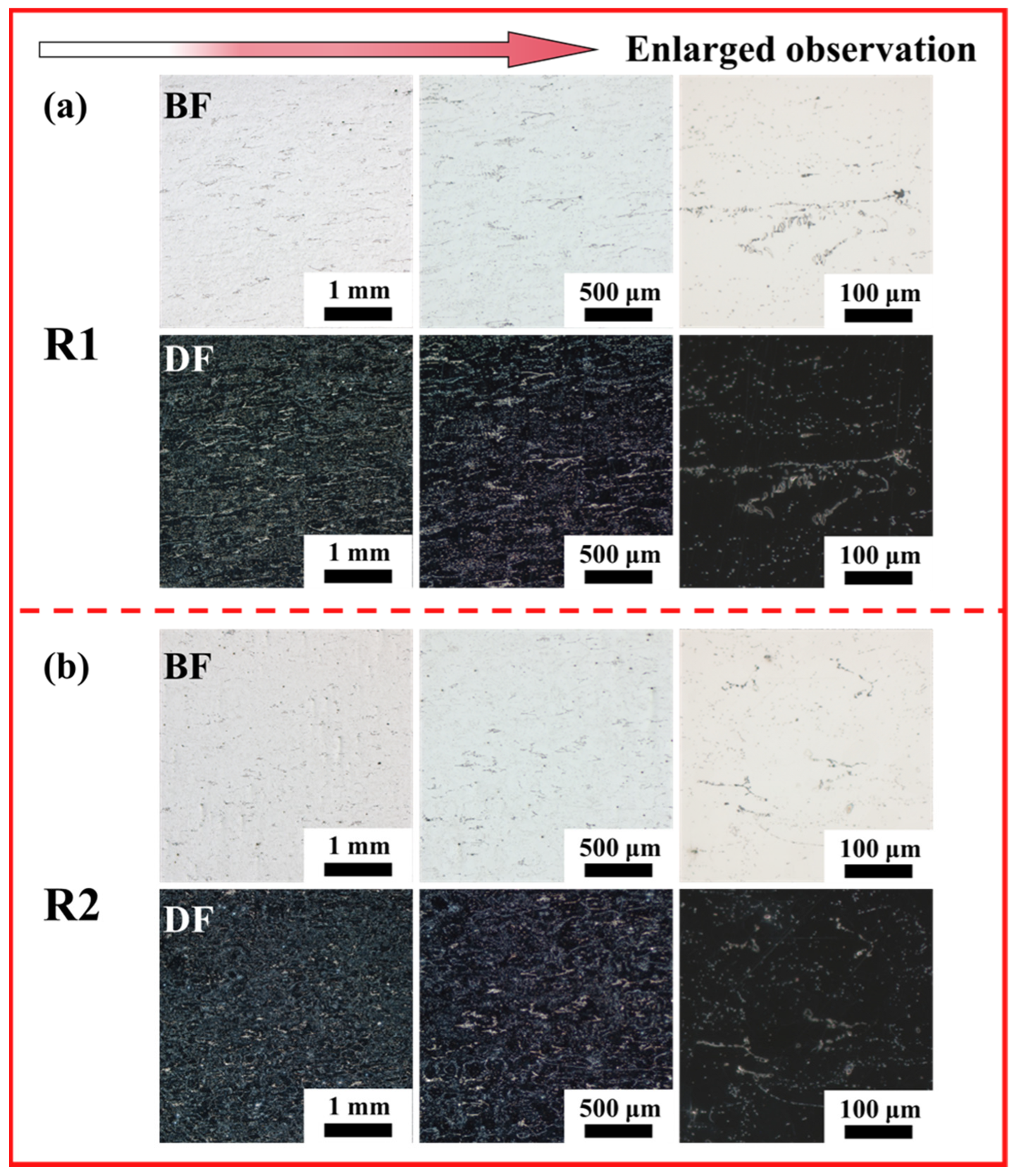
The optical microstructures of the ND plane for samples R1 and R2 are displayed in Figure 2, captured from low to high magnifications under both bright-field (BF) and dark-field (DF) illumination modes. In the BF mode of sample R1, no distinct rolling band structure was discernible at low magnification. However, increasing the magnification clearly revealed a banded distribution characteristic along the rolling direction (RD) for the second-phase particles dispersed within the matrix. Under DF illumination, the morphology of these second-phase particles became more distinct, exhibiting a fragmented and dispersed nature overall, while still retaining observable traces of rolling deformation. These secondary phases primarily consist of granular MC-type carbides (where M denotes Cr and Fe) distributed within the ferrite matrix, a common feature in this class of stainless steels [31]. For sample R2, the presence of granular MC carbides was similarly observable in both BF and DF modes, but their distribution appeared more homogeneous, with significantly less pronounced banding features compared to R1. Consequently, unidirectional rolling throughout the entire process (R1) promotes the banded distribution of MC carbide particles along the RD, whereas reversible rolling facilitates a more dispersed arrangement. This difference arises from the distinct stress–strain conditions imposed on the stainless-steel plate under varying rolling process, which induce corresponding alterations in the distribution of secondary phases.
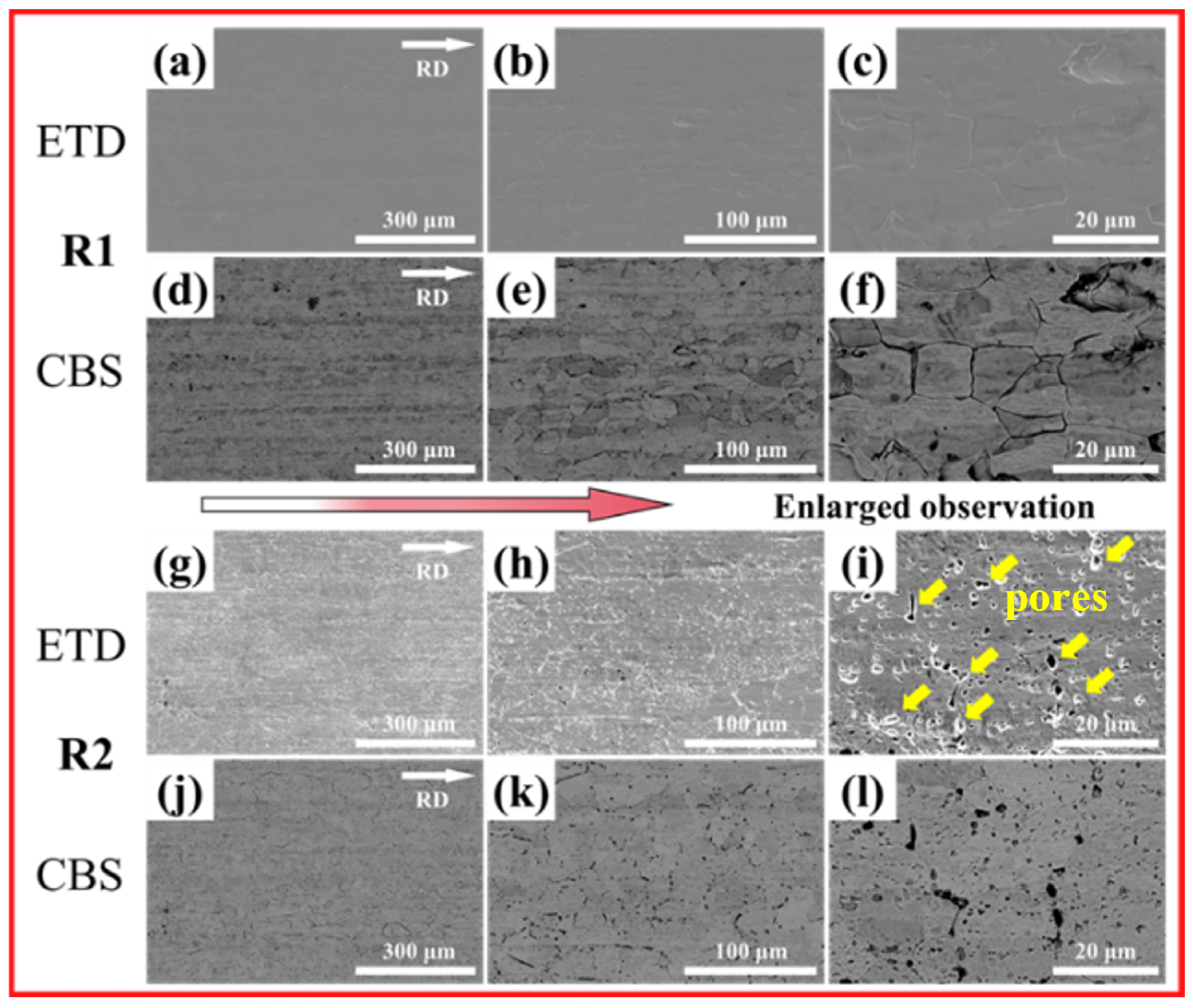
To further characterize and comparatively analyze the microstructures of both samples, scanning electron microscopy (SEM) was employed, with corresponding micrographs from low to high magnification presented in Figure 3. At low magnification, sample R1 exhibited distinct rolling streamline features, primarily manifested as shallow linear pits. This characteristic was particularly pronounced under ETD (Everhart-Thornley Detector) mode, consistent with the OM observations. Upon increasing the magnification, grains with irregular outlines were observed, alongside a limited number of voids or pit-like features predominantly clustered at or near grain boundaries. This distribution indicates the occurrence of partial detachment of MC carbides. For sample R2, the low-magnification SEM morphology showed minimal difference from R1, also revealing rolling band characteristics. However, significantly distinct morphological features emerged at high magnification. Sample R2 displayed numerous, deeply etched voids exhibiting a dispersed distribution. Notably, some voids had extended laterally, evolving into elongated deep pits. This morphology is closely linked to the distribution characteristics and detachment behavior of its carbides. Under the cyclic loading of reversible rolling, MC carbides tend to debone from the matrix, which simultaneously relieves residual stress and creates voids at the carbide/matrix interfaces. Thus, carbide detachment, residual stress relaxation, and void formation are intrinsically interconnected processes. Furthermore, distinct grain boundary features were not discernible in sample R2. These results suggest that the divergent microstructural features evolved during the two distinct rolling processes are closely linked to the corrosion performance of the nominally identical stainless steel.
Based on analysis of the microstructures of both samples reveals that during the entire unidirectional rolling process (sample R1), both the matrix and the second-phase particles are subjected to stress consistently aligned along the rolling direction. This promotes a higher interfacial bonding strength between the second-phase particles and the matrix, making particle detachment less likely. Consequently, the microstructure of sample R1 appears relatively smooth, exhibiting fewer voids or pits. However, in the case of the plate produced by reversible rolling (sample R2), incompatible deformation occurs between the second-phase particles and the matrix. This results in localized stress concentration at the phase interfaces. Moreover, the direction of the interfacial stress alternates during the reciprocating rolling passes, collectively leading to a reduction in the interfacial bonding strength compared to unidirectional rolling. Thus, a significantly higher degree of second-phase particle detachment is observed on the surface of sample R2, manifesting as distinct voids or pit-like features in the microstructure.
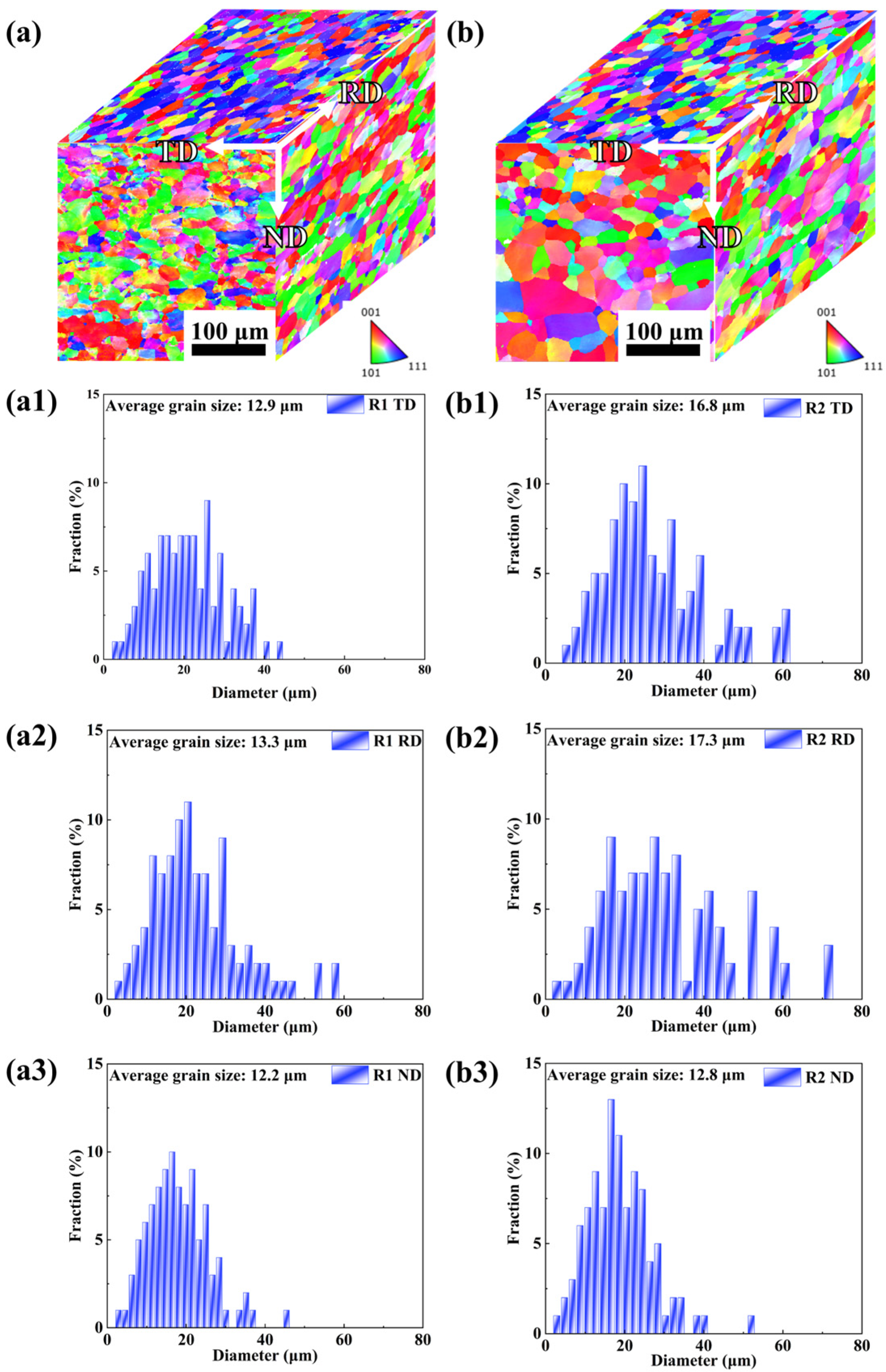
In general, for the metallic material, different forming techniques (such as rolling) can alter grain orientation, leading to texture formation, and concurrently refines grain size [32,33,34]. To analyze the crystal orientation distribution and grain size characteristics of 430 stainless steels processed by these two rolling processes, EBSD is further employed to examine samples R1 and R2 across their three principal planes (ND, TD, ED), as presented in Figure 4. Analysis of the ND plane reveals a significantly larger area fraction of blue-colored regions in sample R1, indicating a pronounced {111} texture. In contrast, while the area fraction of blue regions on the ND plane of sample R2 is reduced compared to R1, it remains predominant. This observation demonstrates that rolling deformation induces a {111} texture in 430 stainless steels, and reversible rolling can attenuate this texture intensity. Regarding the crystal orientation distributions on the TD and ED planes of both R1 and R2 samples, the exposed surfaces primarily consist of {001} (red) and {101} (green) planes, exhibiting weaker texture intensities with no significant differences between the two processing routes. As for grain size, the statistically measured grain sizes across all three planes of sample R1 are comparable, ranging between 12.2 μm and 13.3 μm. Conversely, the grain sizes for sample R2 across its three planes range from 12.8 μm to 17.3 μm. Overall, the grain size of sample R2 is slightly larger than that of R1. Notably, the grain size on the TD plane of R2 (16.8 μm) is approximately 3.9 μm larger than that on the ND plane of R1 (12.9 μm). Therefore, consistent with the SEM microstructure analysis, the reversible rolling process subjects the grains within the 430 stainless steels matrix to a cyclic stress–strain history. This impedes grain rotation during deformation, consequently weakening texture development, while simultaneously facilitating internal stress relaxation during alternating loading, which is less conducive to grain refinement.
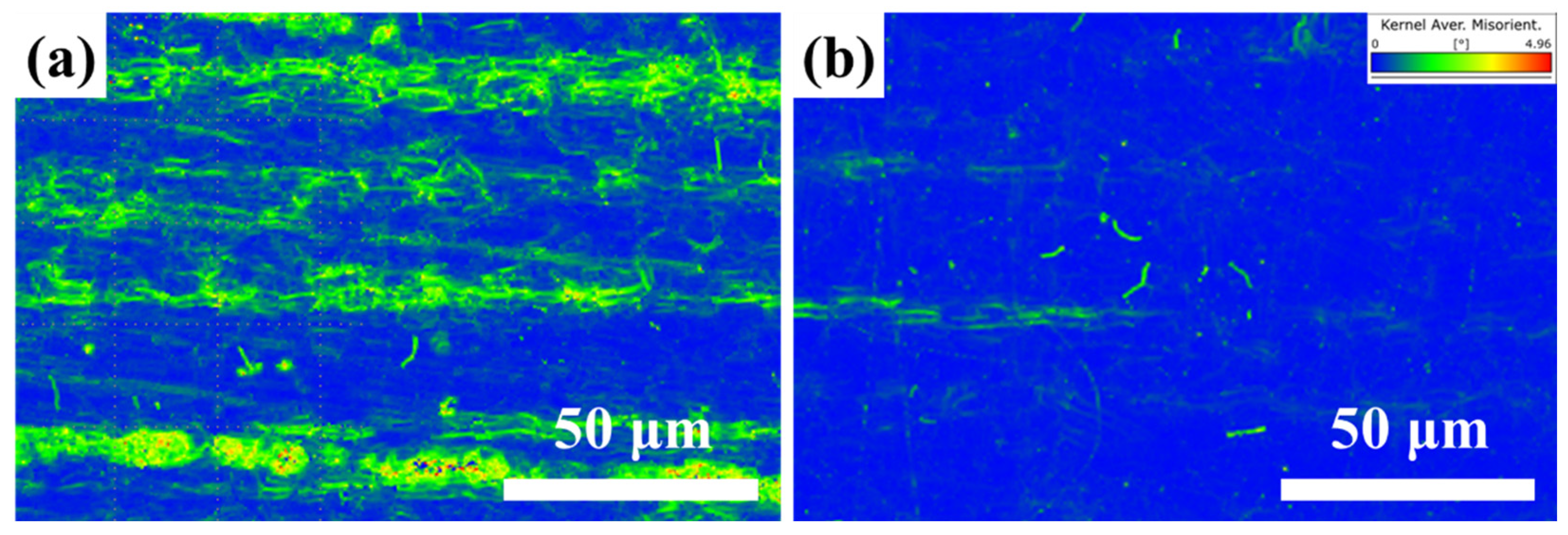
Following rolling deformation, 430 stainless steels inevitably develop internal residual stress. To analyze the residual stress distribution within the alloys processed by the two distinct rolling process, the Kernel Average Misorientation (KAM) mapping results are presented in Figure 5. The KAM value represents the local average misorientation between neighboring grains, quantifying the micro-orientation variation near grain boundaries. This parameter reflects the grain boundary misorientation density, strain distribution, and microstructural stability of the material, serving as a key indicator for evaluating mechanical properties and processing effectiveness. The predominant green coloration in sample R1 indicates a larger average misorientation between adjacent grains, signifying a higher dislocation density and consequently greater residual stress. Furthermore, the regions of concentrated residual stress (i.e., dislocation accumulation) in sample R1 primarily exhibit a banded distribution aligned with the rolling direction, consistent with the general stress distribution patterns observed in rolled metallic materials. Notably, sample R2, processed via reversible rolling, displays a significantly reduced area of high KAM concentration. This corresponds to a smaller average misorientation between neighboring grains, although the distribution still follows the rolling direction, indicating substantially lower residual stress levels compared to R1. Therefore, the reversible rolling process facilitates stress relaxation within the 430 stainless steels, validating the preceding microstructural observations. Specifically, the cyclic stresses induced by reversible rolling promote debonding at the interface between second-phase particles and the matrix in sample R2, leading to particle detachment, void formation, and consequently, substantial stress relaxation in localized regions. Meanwhile, we performed XRD residual stress analysis on the TD and ND surfaces of samples R1 and R2, and the specific results are shown in Table 2, which are highly consistent with the KAM results.

3.2. Electrochemical Characterization

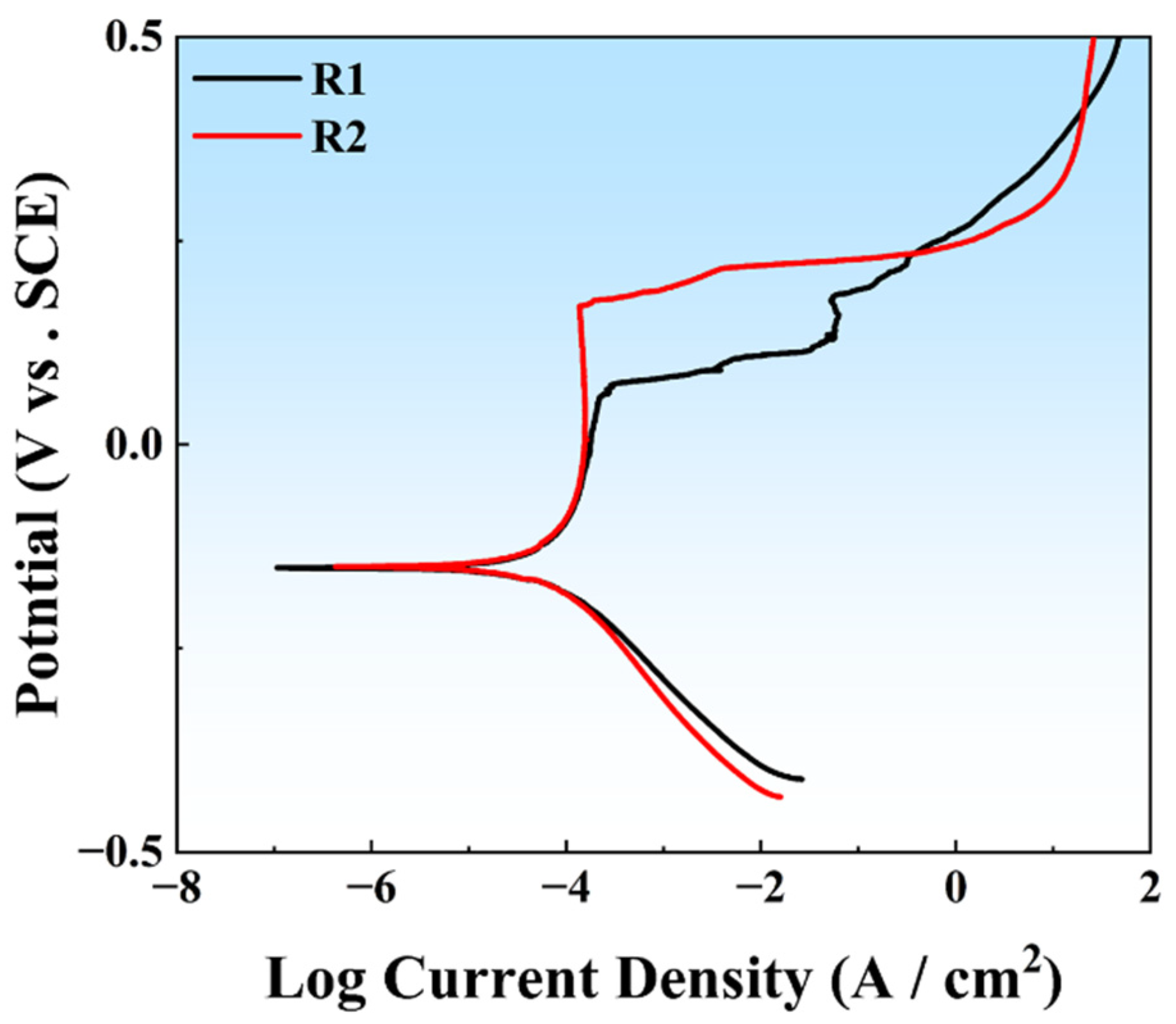
To compare the corrosion resistance of samples processed under the two different rolling processes, electrochemical testing was employed to analyze the ND surface of both samples. The potentiodynamic polarization curves are presented in Figure 6. The analysis shows that the corrosion current density (icorr) of sample R1 is lower and the corrosion potential (Ecorr) is almost the same. In general, a higher icorr combined with a lower Ecorr indicates a poor corrosion performance. Therefore, only from the transient results of polarization test, the corrosion performance of sample R 1 is better. In addition, both R1 and R2 samples show passivation on their polarization curves, which verifies the existence of a passive film on the surface of 430 stainless steels. However, the passivation region of R2 is inclined to the left, indicating that the growth rate of the passivation film is slightly faster than the dissolution rate. At the same time, the passivation region of R2 is relatively larger, indicating that the stability of the passivation film is stronger than that of R1. It should be noted that higher internal stresses are usually associated with a decrease in corrosion resistance. Considering the higher residual stress of the previously established sample R1, this is consistent with the phenomenon that “The corrosion performance of R1 is relatively weaker than that of R2 (from the perspective of passivation film stability)”. However, it should also be clarified that the corrosion current density (icorr) is more direct and significant for the characterization of corrosion resistance, and the polarization curve reflects the initial reaction in a short time in the corrosion solution, which cannot fully reflect the long-term corrosion behavior of the material. The fitted data for the potentiodynamic polarization curves are shown in Table 3.
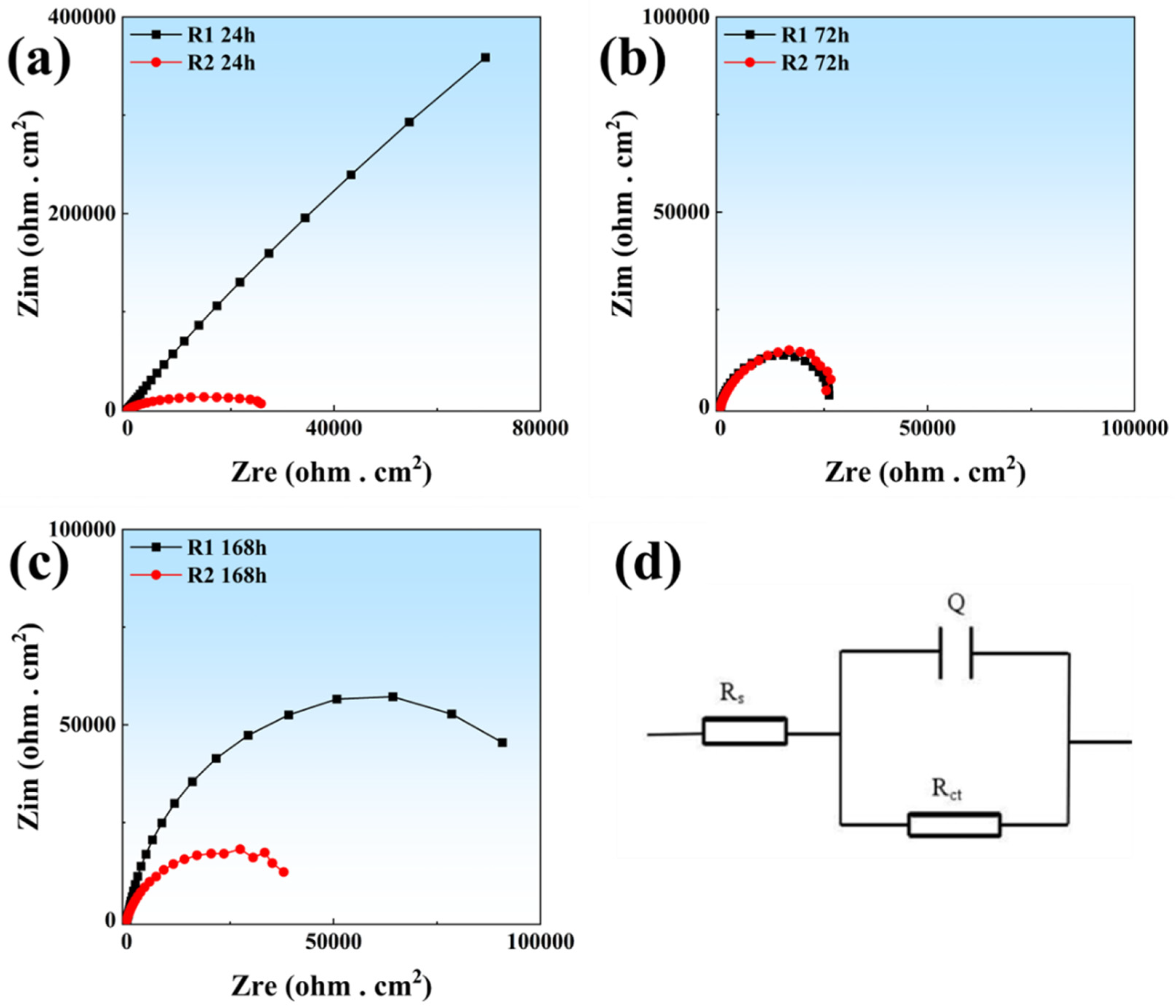
To better evaluate the protective nature of the passive films formed on both samples, electrochemical impedance spectroscopy (EIS) was performed after immersion in 3.5% NaCl solution for different durations (to form passive films of varying thicknesses), with the results shown in Figure 7. Electrochemical impedance spectroscopy (EIS), as a critical tool for investigating electrode kinetics and surface phenomena, generally associates the radius of capacitive arcs in Nyquist plots with material impedance magnitude—a larger arc radius correlates with enhanced corrosion resistance. The analysis of Nyquist spectra showed that the capacitance arc radius of the two samples presented a decreasing phenomenon during the immersion period from 24 h to 168 h, but they remained at a high level. This suggests that during immersion in NaCl solution, the corrosion product films formed on sample surfaces exhibit sufficient compactness to impede further corrosion propagation, thereby improving the corrosion resistance.
In addition, the diameter of the capacitive arcs for sample R1 is consistently and significantly larger than that for sample R2, indicating a higher impedance value and consequently superior protective performance for the surface film formed on R1 sample. Therefore, under long-term corrosion conditions, sample R1 exhibits the best performance, signifying that its corrosion resistance surpasses that of sample R2. Furthermore, the equivalent circuit is applied for the EIS fitting (Figure 7c), and the Nyquist plot fitting results for the two samples after immersion in 5% NaCl solution for varying durations are presented in Table 4. Here, Rct represents the charge transfer resistance, and Q denotes the constant phase element (CPE) used to characterize the interfacial double-layer capacitance. The solution resistance (Rs) presents minimal influence on the corrosion behavior of R1 and R2 samples, whereas the charge transfer resistance (Rct) plays a more significant role in determining corrosion resistance. It can be observed that under identical conditions and immersion times, the Rt values of the R1 sample are consistently higher than those of R2 sample. This further confirms that the R1 sample exhibits superior corrosion resistance compared to R2 sample. The R2 sample exhibited the lowest χ2 value (7.761 × 10⁻⁴) after 168 h, indicating that its interface remained relatively uniform after prolonged immersion, the corrosion process was relatively stable, and the fitted model showed high consistency. In contrast, the R1 sample showed slightly higher χ2 values at 24 h and 168 h, possibly suggesting more complex structural changes on its surface over time, leading to a slight deviation of the interfacial response from the ideal circuit model.
It should be noted that the EIS results are consistent with the findings from the polarization tests. As previously noted, the polarization curve reflects only the transient corrosion response, indicative of the inherent corrosion resistance of the bulk material (consistent with the normal trend where higher residual stress correlates with lower corrosion resistance). However, upon prolonged immersion in the aggressive solution, the highly stressed surface of sample R1, due to its initially lower inherent corrosion resistance, facilitates rapid electrochemical corrosion reactions. This rapid reaction promotes the formation of a surface film while simultaneously consuming the near-surface residual stress. This consumed stress, in turn, provides a more effective barrier, thereby enhancing the long-term corrosion resistance of R1. This phenomenon is applicable to materials capable of forming protective surface films, such as the stainless steel in this study, but not to materials like magnesium alloys where the surface film lacks protective qualities. For sample R2, the initial surface residual stress is lower. Consequently, during the early stages of immersion, the corrosion reaction rate at the surface is slower compared to the highly stressed R1 sample. The concomitant formation of a thinner surface film offers weaker corrosion resistance, corresponding to the smaller capacitive arcs observed in the EIS. Furthermore, microstructural analysis (Figure 2 and Figure 3) highlights a critical difference: the surface of sample R1 is relatively smooth, whereas sample R2 exhibits numerous voids resulting from second-phase particle detachment. These voids accelerate the breakdown of the corrosion surface film, further degrading its corrosion resistance. In summary, while the reversible rolling process (R2) applied to the 430 stainless steels in this study results in lower residual stress, it induces severe detachment of second-phase particles. This creates a porous surface microstructure that promotes surface film breakdown and significantly compromises corrosion resistance [35]. Crucially, this work also challenges the conventional wisdom that higher residual stress inevitably leads to poorer corrosion resistance, demonstrating that corrosion resistance is not solely dependent on residual stress but is also intimately linked to the morphology of the near-surface microstructure.

3.3. Corrosion Morphology

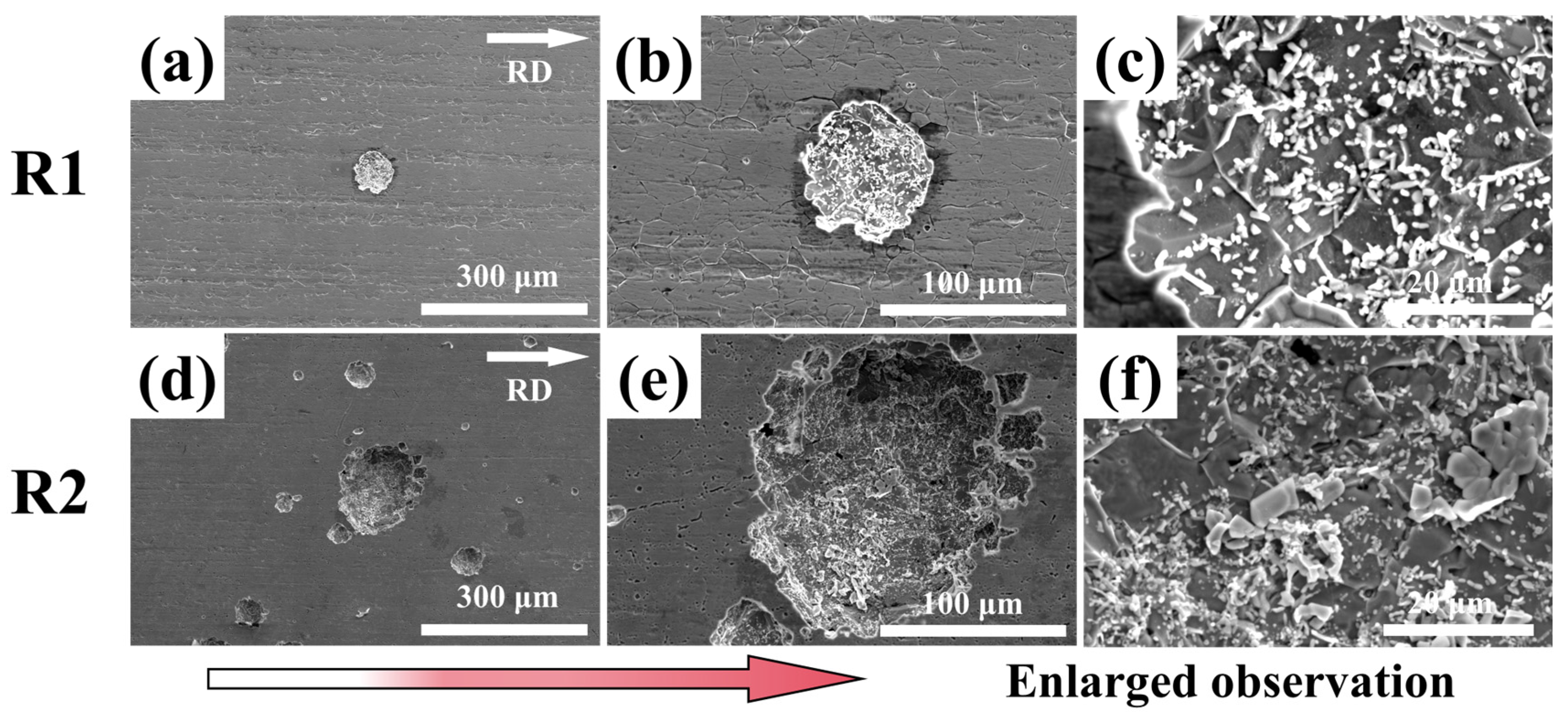
Owing to the inherently high corrosion resistance of 430 stainless steels, prolonged immersion in NaCl solution is required to discern significant differences. To efficiently compare the corrosion morphologies of both samples, the surfaces were examined following potentiodynamic polarization testing, with the results presented in Figure 8. Low- and high-magnification micrographs reveal that the surface of sample R1 retains relatively good integrity after polarization. Although isolated shallow pits are locally present, they show no evidence of propagation. In stark contrast, low-magnification images of sample R2 exhibit extensive deep corrosion pits with large dimensions. and a dense population of small corrosion pits is distributed across the surface. This morphology clearly indicates the easy breakdown of the surface film formed on R2, resulting in significantly poorer corrosion resistance. Correlating these observations with the preceding microstructural analysis, the inferior corrosion resistance and severe corrosion damage morphology of sample R2 are primarily attributed to its microstructure with voids, a direct consequence of the reversible rolling process employed. Therefore, the R2 rolling process significantly compromises the corrosion resistance of the 430 stainless steels.
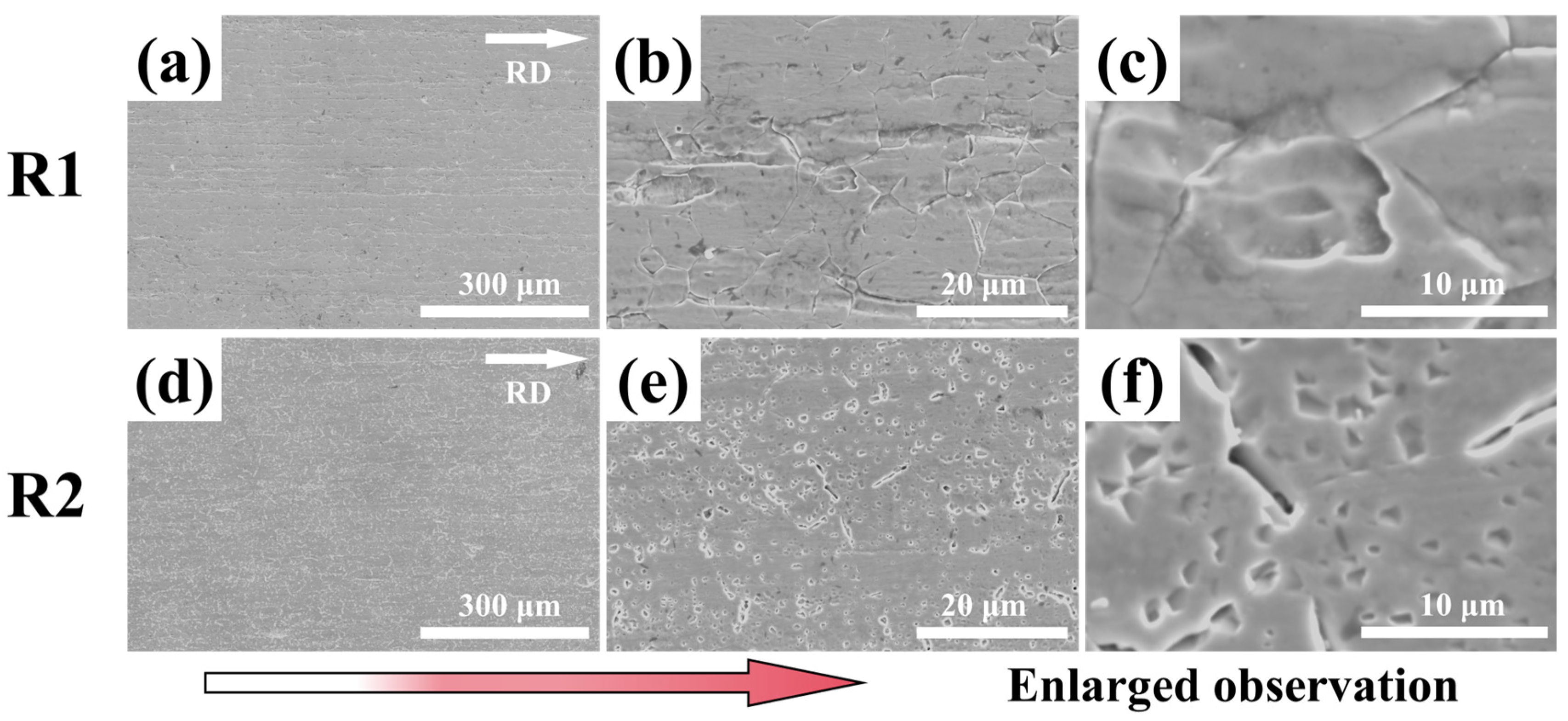
To further substantiate the corrosion resistance analysis of the samples processed under the two different rolling process, neutral salt spray (NSS) testing according to ASTM B117 was conducted, serving to validate the preceding corrosion resistance findings. The surface morphologies after 24 h of salt spray exposure are presented in Figure 9. Consistent with prior observations, the corrosion morphology of sample R1 remains relatively smooth, exhibiting no discernible corrosion pits, with grain boundaries clearly visible. In stark contrast, sample R2 displays severe corrosion damage. Notably, elongated corrosion pits have developed preferentially along grain boundaries, corresponding to the characteristic grain boundary distribution of second-phase particles. Additionally, numerous fine corrosion pits are evident within the grain interiors. As established by the preceding analysis, the distribution characteristics of these corrosion pits align precisely with the microstructure with voids features of sample R2. This concordance thus provides further compelling evidence that the microstructure with voids induced by the reversible rolling process is the primary factor responsible for initiating and accelerating corrosion in sample R2.
The comprehensive analysis aforementioned reveals that during unidirectional rolling (R1), residual stress effectively accumulates within the 430 stainless steels. This probably promotes strong interfacial bonding between the second-phase carbide particles and the matrix, resulting in an integrated and compact microstructure that enhances corrosion resistance. Conversely, the reversible rolling process (R2) facilitates the release of internal residual stress under cyclic loading. Meanwhile, this weakens the interfacial bonding strength between the second-phase particles and the matrix, leading to particle detachment and the formation of a microstructure with voids, which severely degrades corrosion resistance. While residual stress is generally known to accelerate corrosion damage in metallic materials [36,37], this study demonstrates a significant counterexample: sample R1, possessing higher residual stress, exhibits markedly superior corrosion resistance compared to sample R2 with lower residual stress. This compelling observation provides robust evidence that the microstructure with voids in sample R2 is the primary factor responsible for its inferior corrosion performance. Therefore, this work offers crucial theoretical guidance for optimizing rolling processes and applications aimed at achieving high-corrosion-resistance 430 stainless steels.
By comparing the R1 and R2 processes, this study reveals that the interface characteristics between the second-phase particles and the matrix are crucial in determining the corrosion resistance of 430 ferritic stainless steel. Although reversible rolling (R2) facilitates the release of residual stress, its cyclic loading easily leads to carbide delamination and the formation of surface voids, which become preferential sites for pitting and intergranular corrosion initiation. Therefore, optimizing the rolling path (such as using R1) can suppress void formation, providing a stable substrate for a dense passivation film, thereby significantly improving the material’s service life in chloride environments without the need for expensive alloy additions. Future research should combine multi-scale modeling to determine the critical interfacial stress for carbide detachment and explore the long-term stability of the passivation film in complex environments to expand its applications under harsh conditions.

4. Conclusions

This work systematically investigates the effects of unidirectional rolling (R1) and reversible rolling (R2) on the microstructure and corrosion resistance of 430 stainless steels. Through multi-scale characterization (OM, SEM, EBSD) and electrochemical/salt spray testing, we demonstrate that divergent rolling process induces fundamentally distinct microstructural evolution pathways, ultimately dictating corrosion performance by altering interfacial integrity of second phase and matrix. The following conclusions can be drawn:
(1).
Unidirectional rolling (R1) promotes strong interfacial bonding between MC carbides and the ferrite matrix, forming a compact microstructure with aligned carbide bands. Conversely, reversible rolling (R2) induces cyclic stress release, weakening particle-matrix interfaces and triggering widespread particle detachment, thereby generating a porous surface morphology characterized by deep voids and pits.
(2).
Although the R1 sample exhibits higher residual stress (validated by KAM mapping), it demonstrates superior long-term corrosion resistance in immersion/EIS tests due to its dense microstructure. This contrasts with the lower stress state of the R2 sample but severe localized corrosion, proving that surface porosity—not residual stress—is the dominant factor accelerating corrosion damage by facilitating passive film breakdown.
(3).
The void-rich structure in the R2 sample (from particle detachment) acts as preferential corrosion initiation sites. Salt spray testing confirms elongated pits along grain boundaries and dense intra-granular pitting, directly correlating with carbide distribution and pore locations. This morphology accelerates anodic dissolution and undermines surface film stability, reducing corrosion resistance compared to R1 sample.
(4).
Unidirectional rolling enhances corrosion resistance by preserving microstructural coherence, while reversible rolling sacrifices integrity for stress relaxation. This work establishes that optimizing interfacial bonding strength—not merely minimizing residual stress—is critical for high-corrosion-resistance applications. The findings provide a mechanistic basis for tailoring rolling process in stainless steel manufacturing.

Author Contributions

L.Y.: Writing—original draft, methodology, investigation, data curation. B.Z.: Formal analysis, Resources, Writing—review and editing, Supervision. Z.W.: Investigation, formal analysis, data curation. H.Y.: Validation, methodology, funding acquisition. X.Z.: Writing—review and editing, supervision. S.G.: Funding acquisition, conceptualization. All authors have read and agreed to the published version of the manuscript.

Funding

This research was funded by the research project of China Three Gorges Corporation (Grant No. NBZZ20220125), the Science and Technology Program of Guizhou Province (Grant No. [2023]414) and the research project of China Three Gorges Corporation (Grant No. NBZZ202400321).

Institutional Review Board Statement

Not applicable.

Informed Consent Statement

Not applicable.

Data Availability Statement

The raw data supporting the conclusions of this article will be made available by the authors on request.

Conflicts of Interest

The authors declare no conflicts of interest.

References

  1. Thanedburapasup, S.; Wetchirarat, N.; Muengjai, A.; Tengprasert, W.; Wiman, P.; Thublaor, T.; Uawongsuwan, P.; Siripongsakul, T.; Chandra-ambhorn, S. Fabrication of Mn–Co Alloys Electrodeposited on AISI 430 Ferritic Stainless Steel for SOFC Interconnect Applications. Metals 2023, 13, 612. [Google Scholar] [CrossRef]
  2. Yan, Y.; Kesler, O. Evaluation of Pore-Former Size and Volume Fraction on Tape Cast Porous 430 Stainless Steel Substrates for Plasma Spraying. Materials 2024, 17, 5408. [Google Scholar] [CrossRef] [PubMed]
  3. Alnegren, P.; Sattari, M.; Svensson, J.E.; Froitzheim, J. Temperature dependence of corrosion of ferritic stainless steel in dual atmosphere at 600−800 °C. J. Power Sources 2018, 392, 129–138. [Google Scholar] [CrossRef]
  4. Cashell, K.A.; Baddoo, N.R. Ferritic stainless steels in structural applications. Thin-Walled Struct. 2014, 83, 169–181. [Google Scholar] [CrossRef]
  5. Amaya Dolores, B.; Ruiz Flores, A.; Núñez Galindo, A.; Calvino Gámez, J.J.; Almagro, J.F.; Lajaunie, L. Textural, Microstructural and Chemical Characterization of Ferritic Stainless Steel Affected by the Gold Dust Defect. Materials 2023, 16, 1825. [Google Scholar] [CrossRef]
  6. Hao, Y.Q.; Xu, R.H.; Bi, H.Y.; Zhang, Z.X.; Chen, Z.Q.; Li, M.C.; Chen, B. The corrosion properties of ferritic stainless steel with varying Cr and Mo contents in the early stages of a simulated proton exchange membrane fuel cell environment investigated using experimental and joint calculation method HKD. Corros. Sci. 2024, 239, 112389. [Google Scholar] [CrossRef]
  7. Moore, S.R.; Martin, T.L.; Flewitt, P.E.J. Stress Corroison Cracking in Stainless Steels. Compr. Struct. Integr. 2023, 6, 163–200. Available online: https://research-information.bris.ac.uk/en/publications/stress-corrosion-cracking-in-stainless-steels/ (accessed on 19 November 2025).
  8. Kim, J.K.; Kim, Y.H.; Kim, K.Y. Influence of Cr, C and Ni on intergranular segregation and precipitation in Ti-stabilized stainless steels. Scr. Mater. 2010, 63, 449–451. [Google Scholar] [CrossRef]
  9. Fu, J.; Wang, J.; Li, F.; Cui, K.; Du, X.; Wu, Y. Effect of Nb addition on the microstructure and corrosion resistance of ferritic stainless steel. Appl. Phys. A 2020, 126, 194. [Google Scholar] [CrossRef]
  10. Hu, S.; Han, E.-H.; Liu, X. Atomic-scale evidence for the intergranular corrosion mechanism induced by co-segregation of low-chromium ferritic stainless steel. Corros. Sci. 2021, 189, 109588. [Google Scholar] [CrossRef]
  11. Fu, J.W.; Cheng, Y.H.; Wang, Z.H.; Feng, Y.; Zhao, M.M.; Zhang, R.Y.; Hou, B.R. Origin of the pitting corrosion in the as-rolled and annealed ferritic stainless steel in 3.5wt.% NaCl solution. Electrochim. Acta 2025, 520, 145899. [Google Scholar] [CrossRef]
  12. Ha, H.-Y.; Kim, K.-W.; Park, S.-J.; Lee, T.-H.; Park, H.; Moon, J.; Hong, H.-U.; Lee, C.-H. Effects of Cr on pitting corrosion resistance and passive film properties of austenitic Fe-19Mn-12Al-1.5 C lightweight steel. Corros. Sci. 2022, 206, 110529. [Google Scholar] [CrossRef]
  13. Wang, R. Precipitation of sigma phase in duplex stainless steel and recent development on its detection by electrochemical potentiokinetic reactivation: A review. Corros. Commun. 2021, 2, 41–54. [Google Scholar] [CrossRef]
  14. Hashimoto, K.; Asami, K.; Kawashima, A.; Habazaki, H.; Akiyama, E. The role of corrosion-resistant alloying elements in passivity. Corros. Sci. 2007, 49, 42–52. [Google Scholar] [CrossRef]
  15. Park, J.H.; Seo, H.S.; Kim, K.Y. Alloy design to prevent intergranular corrosion of low-Cr ferritic stainless steel with weak carbide formers. J. Electrochem. Soc. 2015, 162, C412–C418. [Google Scholar] [CrossRef]
  16. Wang, B.; Li, Y.G.; Li, H.Y.; Zhao, G.H.; Song, Y.H.; Xu, H. Influence of homogenized annealing on the intergranular corrosion behavior of super ferritic stainless steel S44660. Corros. Sci. 2025, 247, 112783. [Google Scholar] [CrossRef]
  17. Pandiyan, S.; Bianco, M.; El-Kharouf, A.; Tomov, R.I.; Steinberger-Wilckens, R. Evaluation of inkjet-printed spinel coatings on standard and surface nitrided ferritic stainless steels for interconnect application in solid oxide fuel cell devices. Ceram. Int. 2022, 48, 20456–20466. [Google Scholar] [CrossRef]
  18. Yu, H.W.; Xu, X.L.; Zhang, Y.L.; Zhang, Q.; Li, G.Y.; Yan, H. Preparation of high corrosion resistant solar absorbing coating on the surface of ferritic stainless steel by utilizing chemical coloring. Mater. Lett. 2020, 270, 127628. [Google Scholar] [CrossRef]
  19. Shaigan, N.; Qu, W.; Ivey, D.G.; Chen, W.X. A review of recent progress in coatings, surface modifications and alloy developments for solid oxide fuel cell ferritic stainless steel interconnects. J. Power Sources 2010, 195, 1529–1542. [Google Scholar] [CrossRef]
  20. Cheng, P.; Zhong, N.; Dai, N.; Wu, X.; Li, J.; Jiang, Y. Intergranular corrosion behavior and mechanism of the stabilized ultra-pure 430LX ferritic stainless steel. J. Mater. Sci. Technol. 2019, 35, 1787–1796. [Google Scholar] [CrossRef]
  21. Sun, J.; Sun, L.; Dai, N.; Li, J.; Jiang, Y. Investigation on ultra-pure ferritic stainless steel 436L susceptibility to intergranular corrosion using optimised double loop electrochemical potentiokinetic reactivation method. Corros. Eng. Sci. Technol. 2018, 53, 574–581. [Google Scholar] [CrossRef]
  22. Aghamohammadi, H.; Jamaati, R. Effect of cold single-roll drive rolling on the microstructural evolution and mechanical properties of ferritic stainless steel. J. Mater. Res. Technol. 2024, 29, 2679–2688. [Google Scholar] [CrossRef]
  23. Du, L.Y.; Lu, H.H.; Xing, Z.Z.; Han, J.S.; Zhang, S.H.; Li, J.C. Effects of Al additions on precipitation, recrystallization and mechanical properties of hot-rolled ultra-super ferritic stainless steels. J. Mater. Res. Technol. 2023, 27, 4278–4289. [Google Scholar] [CrossRef]
  24. Shang, B.G.; Lei, L.L.; Wang, X.Y.; He, P.; Yuan, X.Z.; Dai, W.; Li, J.; Jiang, Y.M.; Sun, Y.T. Effects of grain boundary characteristics changing with cold rolling deformation on intergranular corrosion resistance of 443 ultra-pure ferritic stainless steel. Corros. Commun. 2022, 8, 27–39. [Google Scholar] [CrossRef]
  25. Tokuda, S.; Muto, I.; Sugawara, Y.; Hara, N. Pit initiation on sensitized Type 304 stainless steel under applied stress: Correlation of stress, Cr-depletion, and inclusion dissolution. Corros. Sci. 2020, 167, 108506. [Google Scholar] [CrossRef]
  26. Tokuda, S.; Muto, I.; Sugawara, Y.; Hara, N. The role of applied stress in the anodic dissolution of sulfide inclusions and pit initiation of stainless steels. Corros. Sci. 2021, 183, 109312. [Google Scholar] [CrossRef]
  27. Xiao, Y.; Lin, B.; Tang, J.L.; Zheng, H.P.; Wang, Y.Y.; Zhang, H.L.; Kuang, Y.; Sun, X.M. Effect of elastic tensile stress on the pitting corrosion mechanism and passive film of 2205 duplex stainless steel. Electrochim. Acta 2024, 47, 143765. [Google Scholar] [CrossRef]
  28. Liu, L.L.; Fei, R.S.; Sun, F.; Bi, H.Y.; Chang, E.; Li, M.S. Effect of cold rolling deformation on the pitting corrosion behavior of high-strength metastable austenitic stainless steel 14Cr10Mn in simulated coastal atmospheric environments. J. Mater. Res. Technol. 2024, 29, 1476–1486. [Google Scholar] [CrossRef]
  29. Nakhaie, D.; Moayed, M.H. Pitting corrosion of cold rolled solution treated 17-4 PH stainless steel. Corros. Sci. 2014, 80, 290–298. [Google Scholar] [CrossRef]
  30. Tao, H.M.; Zhou, C.S.; Zheng, Y.Y.; Hong, Y.J.; Zheng, J.Y.; Zhang, L. Anomalous evolution of corrosion behaviour of warm-rolled type 304 austenitic stainless steel. Corros. Sci. 2019, 154, 268–276. [Google Scholar] [CrossRef]
  31. Gao, Y.; Zhang, M.; Li, J.; Wang, R.; Yuan, Z.; Tan, Z.; Yu, W. Precipitation mechanisms and crystallographic study of co-precipitation carbides in super austenitic stainless steel. J. Alloys Compd. 2025, 1036, 181942. [Google Scholar] [CrossRef]
  32. Chen, J.; Zhu, Y.; Chen, X.; Ma, X.; Chen, B. Interfacial Microstructure and Cladding Corrosion Resistance of Stainless Steel/Carbon Steel Clad Plates at Different Rolling Reduction Ratios. Metals 2025, 15, 16. [Google Scholar] [CrossRef]
  33. Deng, Y.S.; Dai, Q.; Wang, D.S.; Yang, Y.; Zhang, P.; Li, C.Q. Insight into the enhancing mechanical strength of CoCrNi-TiC composites fabricated by laser powder bed fusion. Mater. Sci. Eng. A 2025, 924, 147786. [Google Scholar] [CrossRef]
  34. Bordbar-Khiabani, A.; Gasik, M. Electrochemical and biological characterization of Ti–Nb–Zr–Si alloy for orthopedic applications. Sci. Rep. 2023, 13, 2312. [Google Scholar] [CrossRef] [PubMed]
  35. Jagarinec, D.; Gubeljak, N. Effect of Residual Stresses on the Fatigue Stress Range of a Pre-Deformed Stainless Steel AISI 316L Exposed to Combined Loading. Metals 2024, 14, 1084. [Google Scholar] [CrossRef]
  36. Shojai, S.; Schönamsgruber, F.; Köhler, M.; Ghafoori, E. Impact of accelerated corrosion on weld geometry, hardness and residual stresses of offshore steel joints over time. Mater. Des. 2025, 251, 113578. [Google Scholar] [CrossRef]
  37. Cho, H.; Yoo, Y.-R.; Kim, Y.-S. Effect of Ultrasonic Nanocrystalline Surface Modification (UNSM) on Stress Corrosion Cracking of 304L Stainless Steel. Metals 2024, 14, 1315. [Google Scholar] [CrossRef]
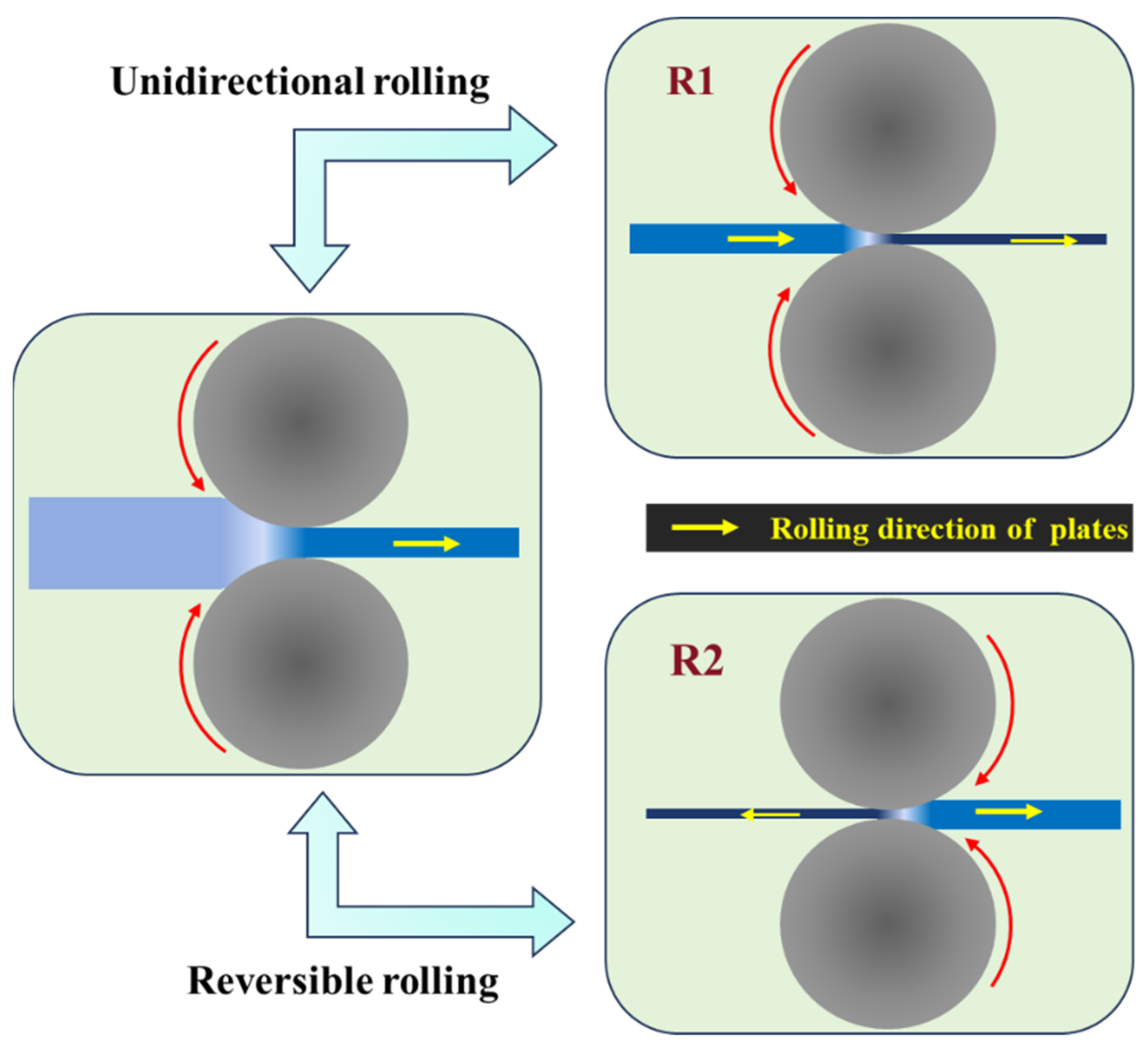
Figure 1. Illustration to the preparation of R1 and R2 plates.
Coatings 16 00057 g001
Figure 2. OM images of (a) R1 and (b) R2 plates under bright-field (BF) and dark-field (DF) conditions at varying magnifications.
Coatings 16 00057 g002
Figure 3. SEM images of (af) R1 and (gl) R2 plates under Everhart Thornley detector (ETD) and Circular Backscatter (CBS) mode at varying magnifications.
Coatings 16 00057 g003
Figure 4. EBSD analysis for crystal misorientation distribution maps of (a) R1 and (b) R2 samples, and grain size distribution histograms across (a1,b1) TD plane, (a2,b2) RD plane, (a3,b3) ND plane.
Coatings 16 00057 g004
Figure 5. EBSD analysis for Kernel Average Misorientation (KAM) maps of (a) R1 and (b) R2 samples.
Coatings 16 00057 g005
Figure 6. Potentiodynamic polarization curves R1 and R2 samples.
Coatings 16 00057 g006
Figure 7. Nyquist plots of (a) R1 and (b) R2 samples after immersion in 3.5% NaCl solution for 24 h and 168 h, (c) equivalent circuit model and (d) the corresponding equivalent circuit diagram.
Coatings 16 00057 g007
Figure 8. SEM observation to corrosion morphologies of (ac) R1 and (df) R2 samples after electrochemical polarization at different magnifications.
Coatings 16 00057 g008
Figure 9. SEM observation to corrosion morphologies of (ac) R1 and (df) R2 samples after 24 h salt spray corrosion at different magnifications.
Coatings 16 00057 g009
Table 1. Chemical composition of the two samples compared with the Standard 430 stainless steels (wt.%).
SampleFeCrAlCoCuMnNiOSi
430Bal.16-18///10.75/1
R1Bal.16.220.0030.0310.0800.3130.1830.0080.385
R2Bal.15.960.0030.0300.0750.2750.1160.0120.362
Table 2. Residual stress table for R1 and R2.
SampleR1R2
Test DirectionTDRDTDRD
Maximum value of compressive stress σmax(MPa)−52.81−72.11−21.37−52.05
Table 3. Fitting analysis results of polarization tests for samples R1 and R2 after 24 h and 168 h immersion in 3.5% NaCl solution.
Ecorr (mV/SCE)icorr (μA/cm2)Eb (mV/SCE)
R1−151.3190.075169.691
R2−149.6770.07858.412
Table 4. Fitting analysis results of electrochemical impedance spectroscopy (EIS) for samples R1 and R2 after 24 h and 168 h immersion in 3.5% NaCl solution.
SampleRs
(Ω cm2)
Ydl
−1 cm−2 sn)
ndlRt
(Ω cm2)
χ2
R1-24 h16.423.304 × 10−50.89361.171 × 1082.192 × 10−3
R1-168 h15.486.692 × 10−50.89031.386 × 1041.396 × 10−3
R2-24 h7.429.293 × 10−50.83873.261 × 1041.447 × 10−3
R2-168 h7.448.028 × 10−50.80004.484 × 1037.761 × 10−4
Disclaimer/Publisher’s Note: The statements, opinions and data contained in all publications are solely those of the individual author(s) and contributor(s) and not of MDPI and/or the editor(s). MDPI and/or the editor(s) disclaim responsibility for any injury to people or property resulting from any ideas, methods, instructions or products referred to in the content.