1. Introduction
In engineering fields such as thermal management systems [
1], biomedical manufacturing [
2], and precision agriculture [
3], the dynamic impact of fluids on porous media is a widespread phenomenon with significant research value. For example, in electronic chip spray cooling systems, coolant droplets often need to impact the surface of porous heat sinks [
4]. In 3D printing processes, functional inks are typically deposited onto porous or mesh-structured substrates [
5]. In agricultural plant protection, droplets may also impact mesh screens or perforated surfaces [
6].
The process of droplet impact on mesh surfaces is a complex multistage flow phenomenon, involving a series of rich dynamic behaviors, including droplet spreading, retraction, and rebound on the mesh structure, as well as wetting beneath the structure, ligament necking, and breakup [
7,
8,
9,
10,
11,
12,
13,
14]. This phenomenon was first reported by Seunggeol et al. [
9], who indicated that on superhydrophobic porous surfaces, when the impact velocity of the droplet is sufficiently high, the fluid can penetrate the surface and form a spray. As the impact velocity increases, penetration occurs successively during the retraction stage, spreading/retraction stage, and spreading stage of the droplet. It is generally believed that penetration during the spreading stage occurs when the dynamic impact pressure (
) exceeds the capillary pressure (
), where
is the liquid density,
is the impact velocity,
is the surface tension coefficient, and
is the pore diameter [
9,
12,
15]. As for the mechanism of spray formation due to penetration during the retraction stage, our previous study attributed it to the high-speed downward jet generated by cavitation collapse, which exerts a significant impact on the pore surface [
15]. Fluid penetration through the surface is accompanied by mass loss. Soto et al. used a high-precision electronic balance to measure the relationship between the impact position and the penetrated mass on a single-pore surface and extended the findings to two-dimensional porous surfaces. Wang et al. found that under identical impact conditions, an increase in droplet surface tension leads to a reduction in penetrated mass, while the effect of fluid viscosity is relatively minor [
7]. Xu et al. further pointed out that in the case of multiple impacts, the penetration effect is significantly influenced by prior impact history [
16,
17]. The liquid column penetrating the pore surface is unstable and prone to disturbances, eventually breaking up into smaller droplets [
18,
19,
20]. In studies on droplet impact on two-dimensional porous surfaces, Kooij et al. were the first to statistically analyze the size distribution of spray droplets, finding that the droplet sizes formed during the spreading stage follow a Gamma distribution [
8]. Subsequently, our previous study revealed a linear relationship between the average droplet size and the pore diameter [
15]. Considering the influence of fluid rheological properties, Abbasali et al. investigated the impact of droplets containing the polymer poly (ethylene oxide) (PEO) on mesh surfaces and found that the addition of a small amount of polymer significantly suppressed ligament instability and fluid penetration [
21,
22].
On solid surfaces, droplet impact behavior exhibits diverse dynamic responses depending on the impact velocity, including spreading–retraction, bouncing, and breakup. Key dynamic parameters such as contact time and maximum spreading diameter have been extensively studied as important indicators characterizing the impact process [
23,
24,
25]. However, in the context mentioned above, the mechanism by which the structural parameters (pore size) of mesh surfaces strongly influence the solid–liquid transport interface [
26] has not been systematically revealed, and research in this area remains relatively scarce. Therefore, this study aims to systematically compare and analyze the impact behavior of droplets on superhydrophobic mesh surfaces with different pore sizes and on superhydrophobic smooth surfaces through experimental investigations. The focus is on examining the influence of pore size on dynamic processes such as droplet spreading, penetration, bouncing, and breakup, and analyzing how pore size affects the spreading time and contact time of droplets. Based on the experimental results, correlation criteria between pore size and droplet behavior characteristics are established.
3. Results and Discussion
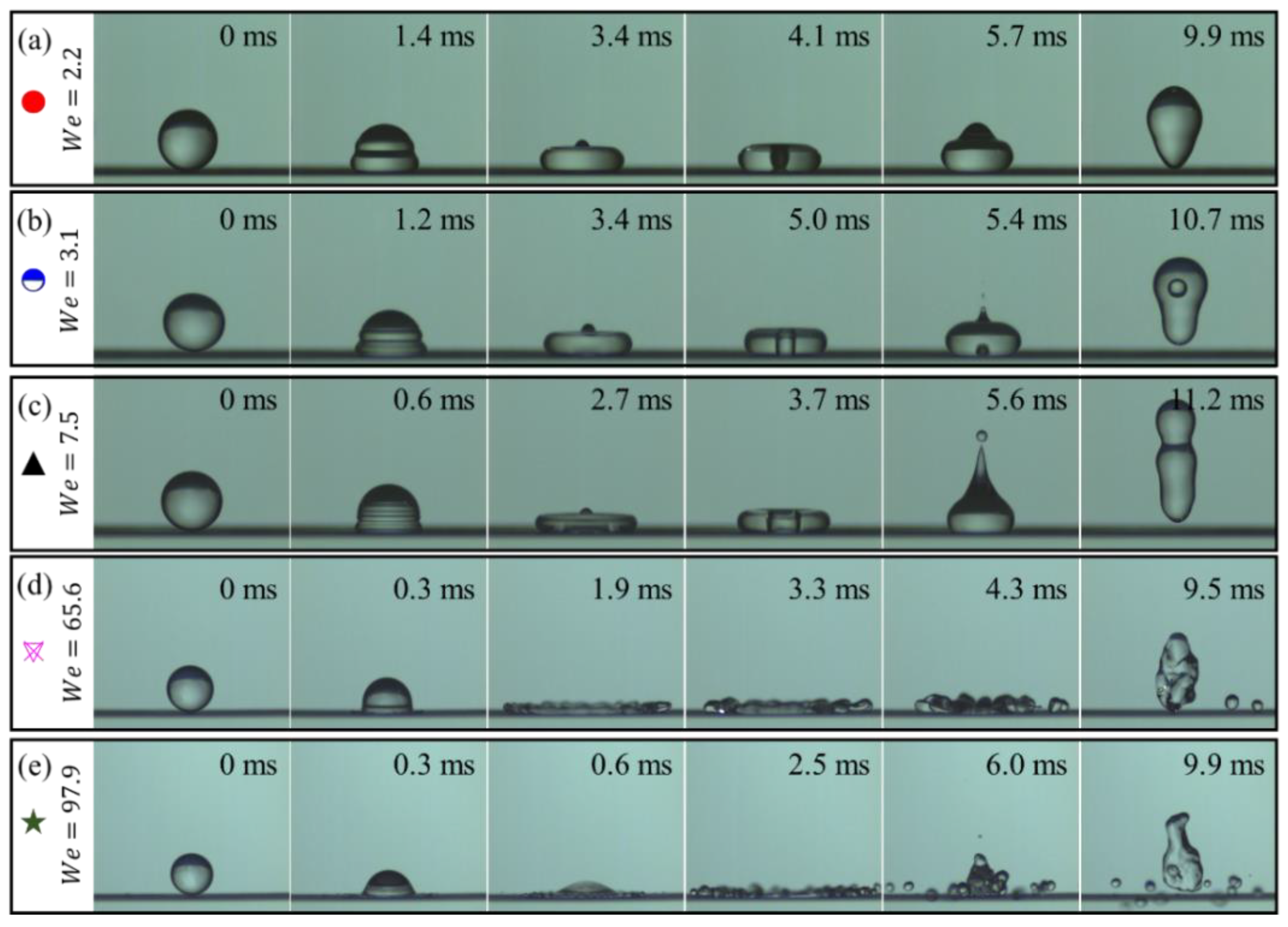
Figure 2 presents the experimental outcomes of droplets impacting a superhydrophobic copper surface (i.e.,
) at varying Weber numbers (
). As illustrated, with an increase in impact velocity (i.e.,
), the droplets sequentially exhibit typical behaviors such as complete rebound (
Figure 2a), bubble entrapment accompanied by jetting (
Figure 2b), jetting (
Figure 2c), receding breakup (
Figure 2d), and prompt breakup (
Figure 2e).
During the complete rebound stage, the impacting droplet spreads outward under inertial forces, with kinetic energy gradually converting into surface energy. Upon reaching the maximum spreading diameter, the droplet begins to retract inward, driven by surface tension and eventually rebounds along the central axis, detaching from the surface without any liquid residue. This behavior resembles a miniature water ball bouncing on a trampoline. As the
increases, a bubble is observed to be trapped within the rebounding droplet, and an axially upward jet is generated during the receding stage [
27,
28]. Both jet formation and bubble entrapment originate from the air cavity phenomenon and its subsequent closure process, where inertial forces play a dominant role [
27,
29]. Specifically, bubble entrapment results from the development of a relatively deep air cavity near the wall region during the droplet spreading stage, with the top or middle section of the cavity closing before the bottom during rapid retraction. In contrast, jetting is triggered by flow instability during droplet retraction after maximum spreading, leading to energy convergence along the central axis. The velocity of the resulting jet droplets is significantly higher than the initial impact velocity of the droplet. From the results in
Figure 2, it is evident that compared to the “bubble entrapment accompanied by jetting” (
) phenomenon, the “jetting” (
) phenomenon occurs over a wider range of Weber numbers. Additionally, as the Weber number further increases, the size of the secondary droplets generated by jetting becomes larger than those observed at lower Weber numbers, as shown at 5.4 ms and 5.6 ms in
Figure 2b,c. With a continued increase in the Weber number, the droplet sequentially undergoes receding breakup and prompt breakup. Receding breakup occurs during the droplet receding stage and is caused by liquid film instability, whereas prompt breakup takes place during the spreading stage, manifesting as the direct ejection of tiny droplets from the advancing rim. Overall, the droplet impact behaviors demonstrated in
Figure 2 are largely consistent with those reported in the existing literature [
30,
31].
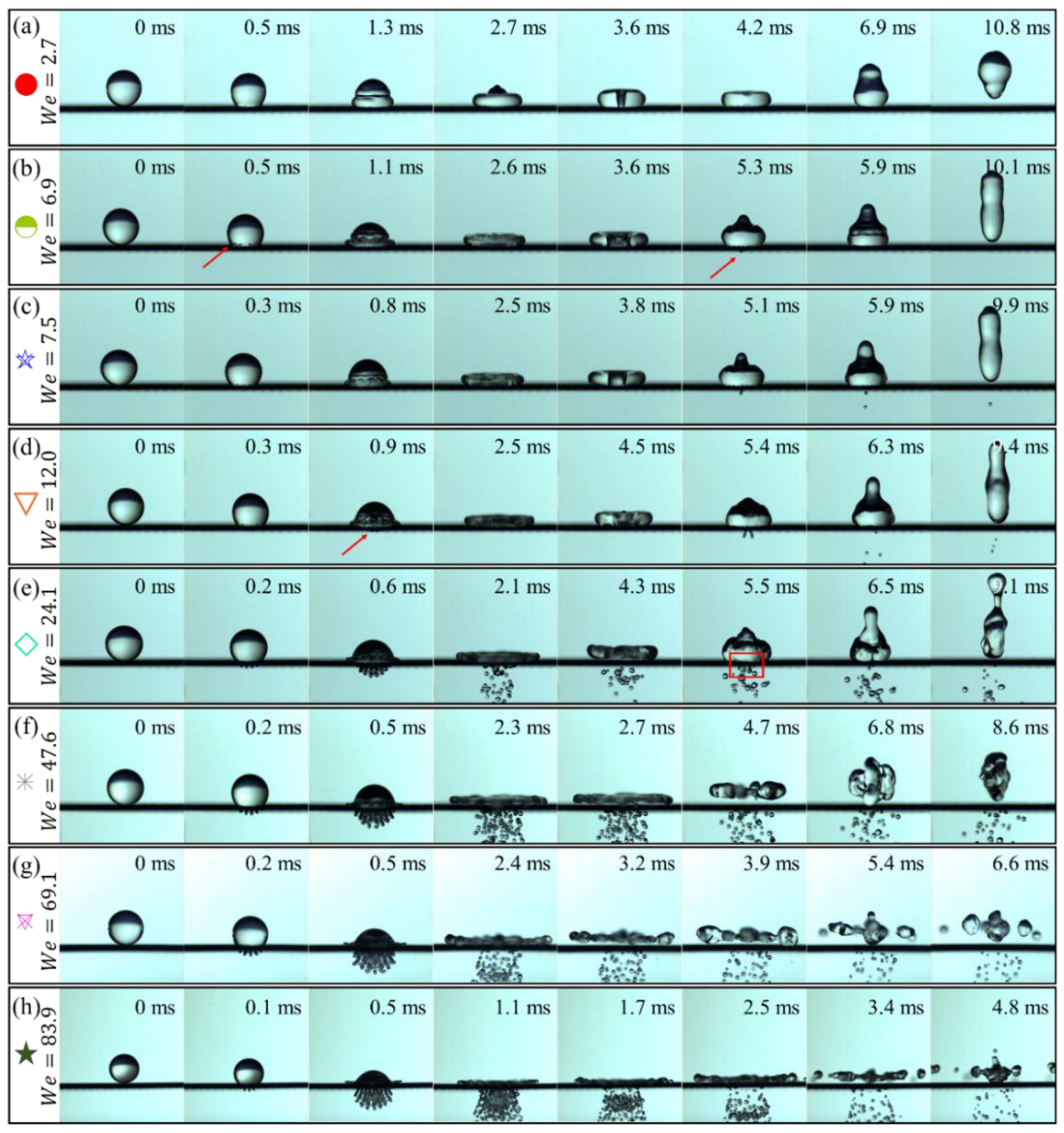
The dynamic behavior of droplet impact on superhydrophobic meshes differs significantly from that on smooth surfaces, as shown in
Figure 3 for a mesh with
. At low Weber numbers, the droplet retracts and rebounds from the surface after reaching maximum spreading, a process largely similar to that on smooth surfaces (as shown in
Figure 3a). As
increases, fluid penetration through the pores during the receding stage (
Figure 3b, indicated by the red arrow at 5.3 ms); however, the penetrating fluid does not break up into microdroplets but is instead drawn back into the main droplet during retraction. With further increase in
, the liquid columns penetrating during the receding stage break up, forming the spray below the mesh (
Figure 3c, 5.1–9.9 ms). Regarding the formation of spray beneath the mesh during retraction, in our previous study, we drew upon the theory of cavity collapse accompanying droplet retraction on superhydrophobic surfaces, and pointed out that it results from a high-speed downward jet induced by air cavity collapse, which strongly impacts the pore [
15].
As the impact velocity continues to rise, fluid penetration occurs during the spreading stage. Similar to the retraction stage, the penetrating fluid does not break up but retracts back into the droplet (as indicated by the red arrow in
Figure 3d at 0.9 ms), although spray formation during retraction still persists. When
increases further into a higher range, the fluid penetrating during the spreading stage also breaks up into microdroplets, generating spray below the mesh. Moreover, complete penetration persists into the retraction phase, as highlighted by the red box in
Figure 3e at 5.5 ms. A commonly accepted criterion for penetration during the spreading stage is that the impact dynamic pressure (
) exceeds the capillary pressure (
), where
is the liquid density,
is the impact velocity,
is the surface tension coefficient, and
is the pore diameter [
9,
10].
The sequential appearance of penetration behavior during the retraction, spreading/retraction, and spreading stage, with increasing
is consistent with reports in the literature. The reason why penetrating fluid in some stages does not break up into spray can be understood through the Rayleigh–Plateau instability theory: the most unstable wavelength for the pinch-off of a cylindrical liquid jet of diameter
is
[
9]. Therefore, if the scale of the penetrating jet is insufficient, it will not meet the breakup criterion and will instead retract into the main droplet.
Upon further increasing the impact velocity, the droplet exhibits “pancake bouncing” at maximum spreading on the superhydrophobic mesh, during which the retraction dynamics change, and no spray is formed. Similar to smooth surfaces, at sufficiently high velocities, the droplet above the surface can also experience receding breakup and rapid breakup modes. The key difference is that penetration and spray behavior persist throughout on the mesh surface. Additionally, it can be observed from the overall phenomenology that, unlike on smooth surfaces, the interfacial waves propagating upward from the bottom during impact are significantly suppressed on the mesh surface due to fluid penetration. This suppression becomes more pronounced with increased penetration, as shown in the second column of
Figure 3.
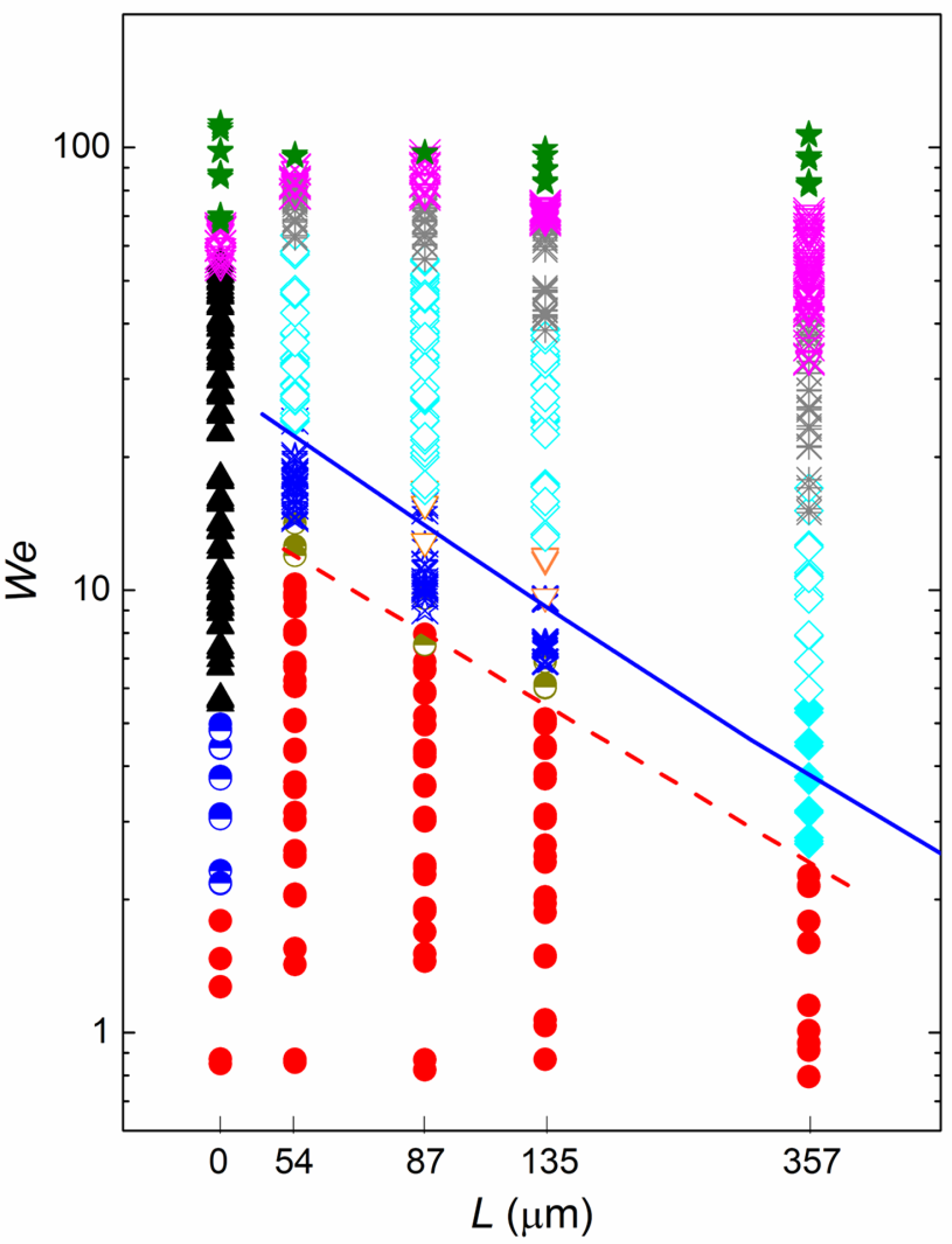
Based on the droplet impact behavior on the copper sheet and copper meshes with different pore sizes shown in
Figure 2 and
Figure 3, a phase diagram as a function of the Weber number (
) is summarized and presented in
Figure 4. The meaning of each symbol in the figure has been explained in
Figure 2 and
Figure 3. For the mesh with
, symbol
indicates incomplete penetration during the spreading and receding stages of the droplet. The red dashed line represents the critical condition for droplet penetration and spray generation during the retraction stage, while the solid blue line indicates the critical velocity for penetration during the spreading stage, given by
. As can be seen from
Figure 4, the phenomena of spray generation during the retraction stage, as well as spray occurring during either the spreading or retraction stage, are only observed on meshes with pore sizes of
,
, and
. With increasing pore size, the critical Weber number required for fluid penetration during the retraction stage gradually decreases, dropping from
on the
surface to
on the
surface. Regarding the cause of spray generation during the retraction stage, our previous study indicated that this is due to the downward hydrodynamic pressure generated by cavity collapse during droplet retraction exceeding the capillary pressure of the pores. During the impact process, the dynamic pressure induced by droplet inertia is approximately
. Once this dynamic pressure surpasses the capillary pressure
, fluid penetration occurs. Therefore, the critical velocity for droplet penetration during the spreading stage can be expressed as
. In
Figure 4, the critical Weber number corresponding to penetration during the spreading stage decreases with increasing pore size, falling from
on the
surface to
on the
surface. When the impact velocity exceeds the critical velocity
, penetration occurs during the spreading stage, and the solid blue line shows good agreement with the experimental results.
However, on the superhydrophobic mesh with , the larger surface structure significantly interferes with the propagation of capillary waves, the formation of air cavities, and their subsequent collapse process. Additionally, the increased pore size leads to thicker penetrating fluid ligaments, requiring a larger characteristic lateral length for their breakup. Therefore, no spray formation was observed during the receding stage on this surface, and the penetrating liquid columns during the spreading stage are highly prone to retracting back into the main droplet without breaking up to form spray. This indicates that within the Weber number range of , the droplet exhibits incomplete penetration. In contrast, on the small pore-sized surface (), the penetrating liquid columns break up more easily. Consequently, compared to the superhydrophobic mesh surfaces with and , the phenomenon of incomplete penetration during the spreading stage, represented by the symbol , was scarcely observed.
Additionally, it should be noted that the pore size of the mesh surface also has a significant impact on the critical value for droplet breakup. As shown in
Figure 4, compared to the smooth copper mesh, the mesh with a small pore size (e.g.,
) suppresses droplet breakup to some extent, as evidenced by a higher critical Weber number. Conversely, as the pore size increases (to
and
), the critical Weber number required for droplet breakup progressively decreases, indicating that breakup occurs more easily.
On grid surfaces, studying parameters such as droplet spreading time (
), contact time (
), and maximum spreading radius (
) is of significant importance.
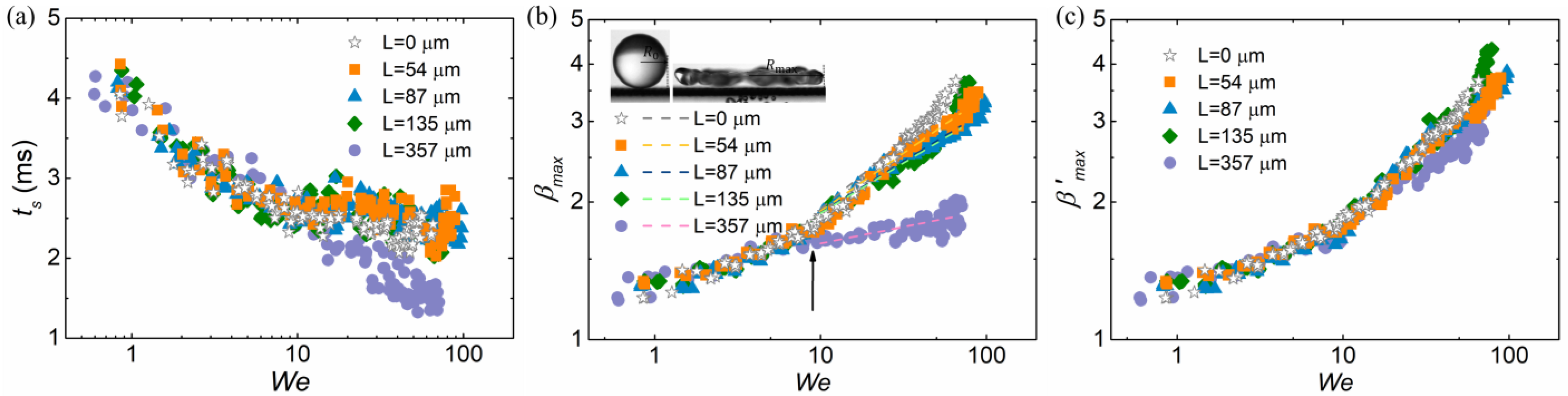
Figure 5 shows the time required for droplets to reach maximum spreading on different surfaces, as well as the variation trend of the maximum spreading factor (
) with the Weber number. Here, the maximum spreading factor is defined as
, where the meanings of
and
are illustrated in
Figure 5b.
At low Weber numbers (
), the droplet kinetic energy is low, and inertial forces are insufficient to drive significant fluid penetration through the grid. Additionally, no noticeable spray phenomenon occurs during the retraction stage. In this case, the spreading process is primarily dominated by the droplet’s own inertia, and its behavior resembles that on smooth superhydrophobic surfaces. Therefore, as shown in
Figure 5a, the spreading times on surfaces with different pore sizes are essentially the same as on flat surfaces, indicating that the grid structure has not yet substantially influenced the spreading dynamics at this stage.
However, when the Weber number increases to
(as shown by the black arrow in
Figure 5b), the situation changes significantly. As seen in
Figure 5a, the spreading time on the mesh with
is noticeably shorter than on other surfaces, while its maximum spreading factor (
) is also significantly reduced (
Figure 5b). This is mainly because, at higher Weber numbers, the fluid begins to penetrate the mesh surface, and larger pore sizes lead to more liquid loss due to atomization (
Figure 6).
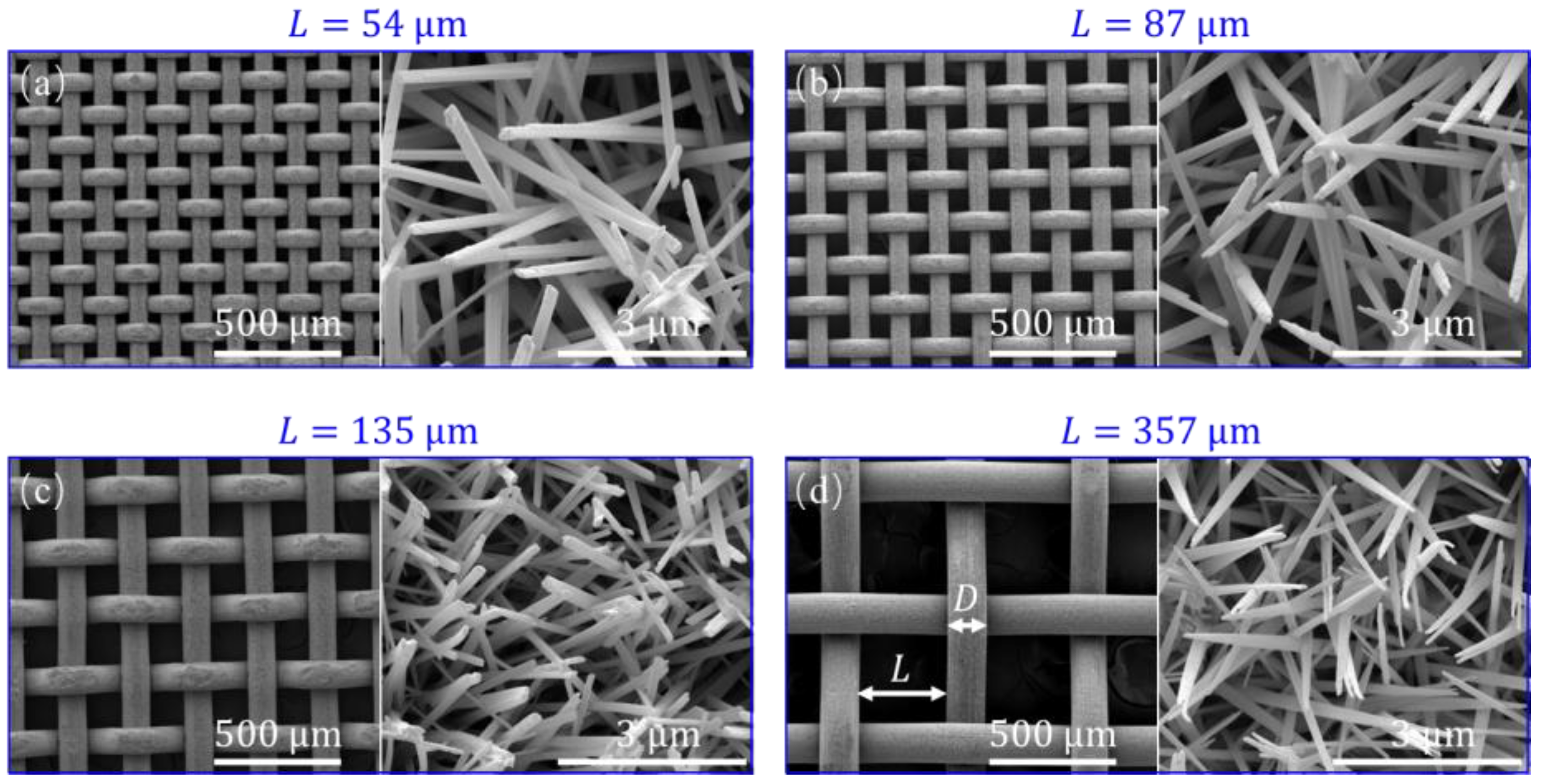
Figure 6 presents a comparison of the droplet morphology at the maximum spreading stage for four meshes with the
and an initial droplet radius of
. The phenomenon of fluid penetration reduces the volume of liquid available for spreading, thereby accelerating the process toward equilibrium. Simultaneously, the decrease in the maximum spreading factor (
) directly reflects the constraint imposed by mass loss on the spreading limit, meaning that part of the liquid detaches from the main droplet, resulting in a reduced final spreading radius. Consequently, in
Figure 5b, for the five surfaces when
, the slope of the guide line for the maximum spreading factor gradually decreases as the pore size increases, with the change in slope being most pronounced on the
mesh surface.
Both our previous study and the work by Soto et al. indicate that the transmitted mass of fluid increases with the droplet impact velocity [
10,
15]. On surfaces with large pore sizes, the transmitted mass can reach approximately
of the total droplet mass. Furthermore, Soto et al. derived the relationship between the transmitted mass on a multi-hole surface and the total droplet mass based on the transmitted mass through a single hole. Building on the findings of Soto et al. [
10], we normalize the maximum spreading coefficient using the effective radius of the residual droplet, defining the scaled maximum spreading coefficient as follows:
where the effective radius
is defined as follows:
This expression is related to the surface open area ratio
and the critical penetration velocity
, with
adopted in the experiments. The normalized maximum spreading coefficient
is shown in
Figure 5c. It can be observed that the data from different surfaces collapse on one master curve, which aligns closely with the results from the flat surface. This indicates that the maximum spreading behavior of the droplet is not influenced by the surface pore structure but depends solely on the droplet volume.
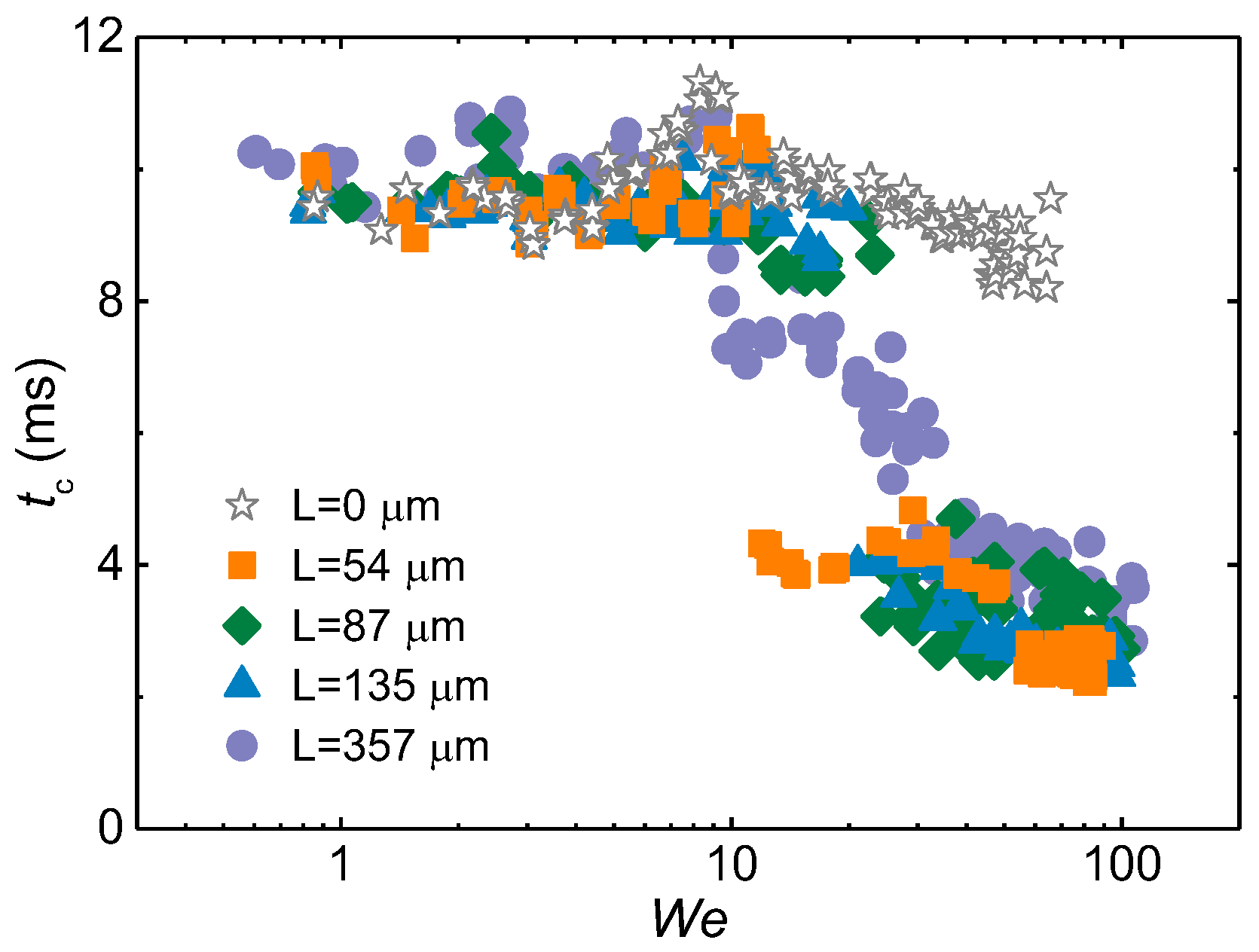
Furthermore, the contact time (
) of droplets on a surface serves as a crucial dynamic parameter characterizing their interaction.
Figure 7 presents the measured contact times of droplets on various superhydrophobic surfaces. It can be observed that under conditions of a low Weber number, the droplet contact time on all surfaces is approximately ~10 mm. However, as the impact velocity increases, the contact time on the mesh surface decreases significantly to about
, which is attributed to the occurrence of “pancake bouncing” on this surface. In contrast, the contact time on the superhydrophobic copper sheet remains around
.
The phenomenon of pancake bouncing was first reported by Wang et al., whose study revealed that superhydrophobic surfaces with needle-like microstructures can induce this behavior [
32]. The results of this study further demonstrate that a mesh-like surface structure can also enable pancake bouncing of droplets, thereby significantly reducing the contact time [
33].
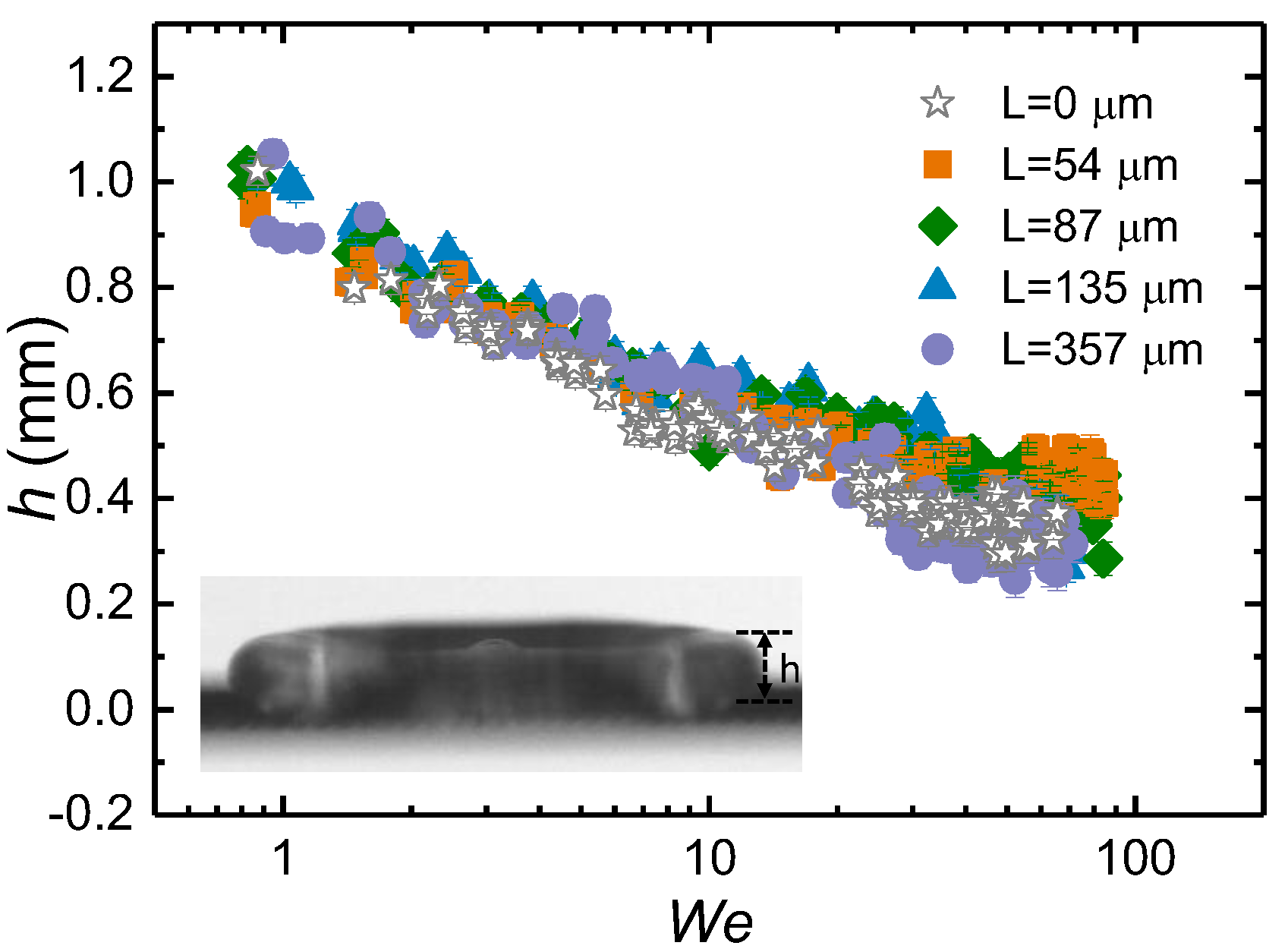
Additionally, we compared the variations in droplet height (
) at maximum spreading, with the results shown in
Figure 8. It can be observed that as the Weber number increases, the droplet height at maximum spreading gradually decreases on several superhydrophobic surfaces, and the surface microstructure does not significantly affect this height.