Article

Synthesis and Characterization of ITO Films via Forced Hydrolysis for Surface Functionalization of PET Sheets


by
Silvia del Carmen Madrigal-Diaz
1,
Laura Cristel Rodríguez-López
1,
Isaura Victoria Fernández-Orozco
1,
Saúl García-López
1,
Cecilia del Carmen Díaz-Reyes
2,
Claudio Martínez-Pacheco
3,
José Luis Cervantes-López
1,
Ibis Ricárdez-Vargas
1 and
Laura Lorena Díaz-Flores
1,*
1
División Académica de Ingeniería y Arquitectura, Universidad Juárez Autónoma de Tabasco, Km 1 Carretera Cunduacán-Jalpa de Méndez, Col. La Esmeralda, Cunduacán CP 86690, Tabasco, Mexico
2
Departamento de Ingeniería Química, Bioquímica y Ambiental, Instituto Tecnológico de Villahermosa, Carretera Villahermosa—Frontera Km. 3.5 Ciudad Industrial, Villahermosa CP 86010, Tabasco, Mexico
3
División de Procesos Industriales, Universidad Tecnológica de Tabasco, Carretera Villahermosa-Teapa Km 14.6, Parrilla II, Centro CP 86288, Tabasco, Mexico
*
Author to whom correspondence should be addressed.
Coatings 2026, 16(1), 120; https://doi.org/10.3390/coatings16010120
Submission received: 8 December 2025 / Revised: 2 January 2026 / Accepted: 8 January 2026 / Published: 16 January 2026
(This article belongs to the Special Issue Recent Advances in Surface Functionalisation, 2nd Edition)

Abstract

Transparent conductive oxides (TCOs), such as indium tin oxide (ITO), are essential for flexible electronics; however, conventional vacuum-based deposition is costly and thermally aggressive for polymers. This study investigated the surface functionalization of PET substrates with ITO thin film-based forced hydrolysis as a low-cost, reproducible alternative. S n O 2 nanoparticles were synthesized by forced hydrolysis at 180 °C for 3 h and 6 h, yielding crystalline nanoparticles with a cassiterite phase and an average crystallite size of 20.34 nm. The process showed high reproducibility, enabling consistent structural properties without complex equipment or high-temperature treatments. The S n O 2 sample obtained at 3 h was incorporated into commercial I n 2 O 3 to form a mixed In–Sn–O oxide, which was subsequently deposited onto PET substrates by spin coating onto UV-activated PET. The resulting 1.1 µm ITO films demonstrated good adhesion (4B according to ASTM D3359), a low resistivity of 1.27 × 10⁻⁶ Ω·m, and an average optical transmittance of 80% in the visible range. Although their resistivity is higher than vacuum-processed films, this route provides a superior balance of mechanical robustness, featuring a hardness of (H) of 3.8 GPa and an elastic modulus (E) of 110 GPa. These results highlight forced hydrolysis as a reproducible route for producing ITO/PET thin films. The thickness was strategically optimized to act as a structural buffer, preventing crack propagation during bending. Forced hydrolysis-driven PET sheet functionalization is an effective route for producing durable ITO/PET electrodes that are suitable for flexible sensors and solar cells.

1. Introduction

Currently, the electronics industry is being driven to improve semiconductor materials due to the digital characteristics of emerging technologies and the increasing use of electrical sensors in communication and transportation devices [1]. This trend has significantly increased the demand for semiconductor oxides, revealing critical limitations in their large-scale production and supply chains, as evidenced during the COVID-19 pandemic [2]. Leading manufacturers in the electronics industry, such as Samsung and Taiwan Co., were notably affected by production pauses during 2020 [3].
The rising demand for flexible electronic devices has encouraged research on transparent conductive materials that are compatible with polymeric substrates such as polyethylene terephthalate (PET). Among these, indium tin oxide (ITO) stands out for its high transparency in the visible range and excellent electrical conductivity properties that make it suitable for use in touch screens, sensors, and solar cells [4]. However, conventional deposition techniques such as sputtering and other vacuum-based processes are costly and energy-intensive and often require high processing temperatures that are incompatible with polymer substrates, limiting their scalability and use in flexible electronics. Unlike conventional physical deposition techniques, such as sputtering, which require specialized equipment for high-vacuum environments and dedicated facilities, as well as significant energy consumption, the forced hydrolysis method presented herein offers a cost-effective and scalable alternative [5]. This chemical approach enables the surface functionalization of the PET substrate by promoting a high affinity between the oxide precursors and the polymer surface, so that it can be used for sustainable manufacturing processes in flexible optoelectronics.
Recent advances in surface engineering suggest that the performance of flexible electrodes depends not only on bulk conductivity but also on the chemical nature of the interface. Recent studies have focused on milder synthesis routes and hybrid or solution-based deposition methods combined with moderate thermal or mechanical treatments [6]. Furthermore, nanoindentation has proven to be an effective technique for characterizing the mechanical degradation of PET-based films, providing reliable measurements of hardness and elastic modulus in functionalized coatings that are subjected to mechanical stress [7]. Despite these advances, some reported methods remain complex, expensive, or exhibit limited reproducibility, restricting their practical implementation.
In this context, the essential problem addressed in this work is the development of a simple, low-cost, and reproducible method to functionalize PET surfaces with mechanically robust ITO thin films exhibiting balanced optical, electrical, and mechanical properties. This approach results in a significant reduction in manufacturing costs by eliminating expensive specialized infrastructure. A forced hydrolysis synthesis is proposed to incorporate Sn into an In-precursor matrix ( I n 2 O 3 ) and form a stable solution that chemically anchors to the UV-activated PET surface.
The resulting films demonstrate average optical transmittance of 80% in the visible range, a low resistivity of 1.27 × 10⁻⁶ Ω·m, and enhanced surface hardness. These contributions provide a reproducible alternative for PET surface functionalization, where the 1.1 µm ITO thickness is strategically employed to act as a structural buffer, ensuring improved durability and extended operational lifetime in flexible sensors, displays, and solar cell applications.

2. Materials and Methods

This process was carried out in two main steps: the synthesis of SnO2 nanoparticles via forced hydrolysis and their subsequent incorporation into an In2O3 matrix to create a functionalization of PET substrates, and the processing conditions that were used to obtain flexible conductive coatings.

2.1. Synthesis of SnO2 Nanoparticles by Forced Hydrolysis

To obtain the metal oxide precursors for ITO, tin dioxide S n O 2 was synthesized using the forced hydrolysis method from the precursor salt S n C l 2 2 H 3 O (tin(II) chloride dihydrate), at 99% purity (Sigma-Aldrich, St. Louis, MI, USA). The precursor solution was magnetically stirred at 400 rpm for 15 min prior to hydrothermal shythesis. No pH adjustment was performed.
The synthesis was carried out using 50 mL of bidistilled water (Wöhler, Ciudad de México, México) as the reaction medium in a 100 mL stainless-steel hydrothermal reactor, operated at 180 °C and 1.4 atm. The synthesis procedure was designed following a 22-factorial model with variations in precursor concentration (0.3 M and 0.5 M) and reaction time (3 h and 6 h) to evaluate their effect on the crystal size of the resulting tin oxide. After completion, the reactor was allowed to cool naturally to room temperature.
During hydrolysis, S n 2 + metal ions are solvated in water, favoring nucleophilic substitution reactions that lead to the formation of intermediate hydroxylated species, as shown in Equations (1)–(3):
S n C l 2 2 H 3 O S n ( O H ) 2 + 2 H C L ( hydrolysis )
S n ( O H ) 2 S n O + H 2 O ( condensation )
2 S n O + O 2 2 S n O 2 ( oxidation )
The aging of the solution for 72 h promoted the gradual condensation of S n ( O H ) 2 into S n O 2 , achieving a reaction efficiency of approximately 40% [8]. The resulting precipitates were washed and filtered with bidistilled water to remove unreacted residues, dried at 120 °C for 2 h, and sintered at 250 °C for 1 h using a heating rate of 5 °C·min−1 to obtain the stable crystalline structure of S n O 2 .

2.2. Preparation of the Mixed Oxide ( I n 2 O 3 : S n O 2 )

The mixed oxide was prepared with a molar ratio of 9:1 I n 2 O 3 : S n O 2 . Commercial In2O3 (99%, Sigma-Aldrich, St. Louis, MI, USA) was mixed with the previously synthesized SnO2 and calcined at 250 °C for 2 h to promote interaction between the oxides and the formation of the I n 2 S n O 3 phase (Equation (4)).
S n O 2 + I n 2 O 3 I n 2 S n O 3 + O 2 ( g )
Subsequently, 0.15 mmol of the mixture was dispersed in 10 mL of isopropyl alcohol (99.5%, Baker, Phillipsburg, NJ, USA) under magnetic stirring at 350 rpm for 30 min at 45 °C and subsequently sonicated for 10 min to improve dispersion stability, resulting in a stable suspension specifically designed for the surface functionalization process.

2.3. Cleaning and Surface Activation of the PET Substrate

Polyethylene terephthalate (PET, (thickness 0.1 mm, size 300 × 300 mm, Sigma-Aldrich, St. Louis, MO, USA) sheets of 75 cm2 area and 0.125 mm thickness were used. Cleaning was carried out by sequential immersion in acetone, isopropyl alcohol, and deionized water for 10 min in each solvent, using an ultrasonic bath. Subsequently, the substrates were dried at 100 °C for 20 min. Each sheet was then cut into three equal sections (2.5 × 2.5 cm) for individual processing and subjected to a surface functionalization process via UV irradiation (λ = 254 nm, 13 W) for 10 min to increase surface energy and improve film adhesion [9,10]. This photo-activation step is crucial, as it induces the cleavage of C-C and C-H bonds on the polymer surface, promoting the formation of polar hydroxyl (-OH) and carboxyl (-COOH) functional groups. These groups act as chemical anchoring sites that react with the ITO precursors during the subsequent forced hydrolysis-based deposition, ensuring a robust chemical bridge between the organic substrate and the inorganic film [11].

2.4. Preparation of ITO Thin Films

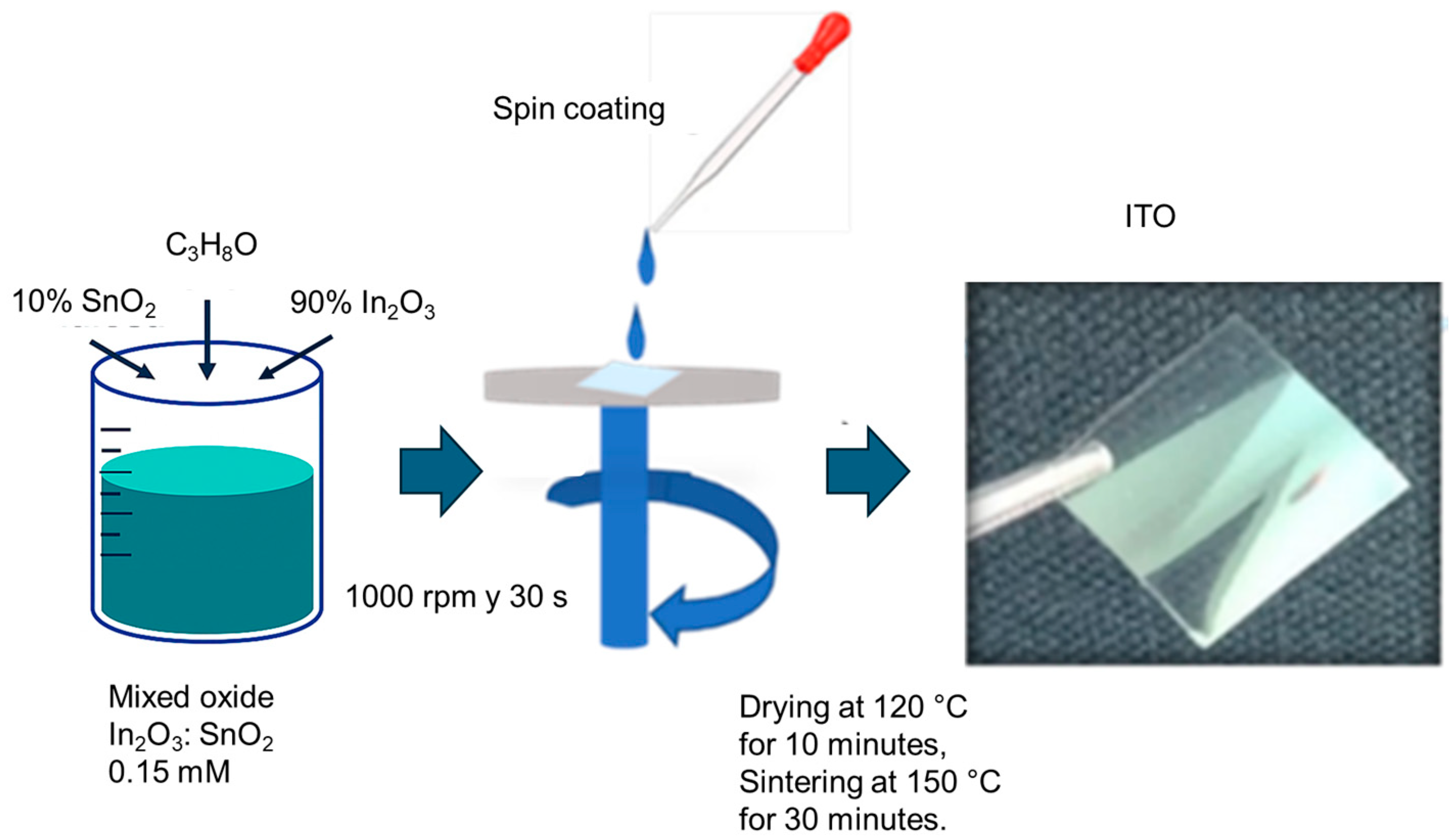
ITO thin films were deposited onto the previously functionalized PET substrates using the spin coating technique. Approximately 100 µL of the precursor suspension was dispensed onto each substrate. The spin coater acceleration was set to 500 rpm·s−1. The prepared suspension was deposited at 1000 rpm for 30 s, performing five deposition cycles on each substrate, with intermediate drying at 120 °C for 10 min between each layer. Finally, the samples were sintered at 150 °C for 30 min to promote film consolidation without affecting the thermal integrity of the polymeric substrate [12].
This procedure yielded homogeneous and well-adhered ITO films, where the 1.1 µm thickness was strategically controlled to provide a mechanical buffer for flexible applications (see Figure 1).

2.5. Methods Employed for Analysis

The structural characterization of the powders and ITO thin films was performed by X-ray diffraction (XRD) using a Malvern Panalytical Empyrean diffractometer, Malvern, UK with Cu-Kα radiation (λ = 1.54060 Å) at a grazing incidence angle of 0.1° (2θ range: 20–70°). Functional groups were identified via Fourier-transform infrared spectroscopy (FTIR) using a Thermo Scientific Nicolet iS50 spectrometer (Thermo Fisher Scientific, Waltham, MA, USA) in Attenuated Total Reflectance (ATR) mode with 64 scans. Morphology and elemental composition were analyzed by scanning electron microscopy (SEM-EDS) using a Tescan Mira 3 microscope (Brno, Czech Republic) equipped with a Bruker Xflash 6160 energy-dispersive detector (EDS detector, Madison, WI, USA) at 13 kV. Furthermore, Raman spectra were recorded with a Witec Alpha 300 confocal system (WITec, Ulm, Alemania) (488 nm laser), while optical transmittance was evaluated through 1280 Ultravioleta-Visible (UV-Vis) spectrophotomer (Ter shimadzu, Colombia, MD, USA) using an integrating sphere. Surface topography and root mean square (RMS) roughness were determined by atomic force microscopy (AFM) using a Park Systems XE7 model, Suwon, Republic of Korea.

3. Results

3.1. Structural and Compositional Analysis of S n O 2 Powders

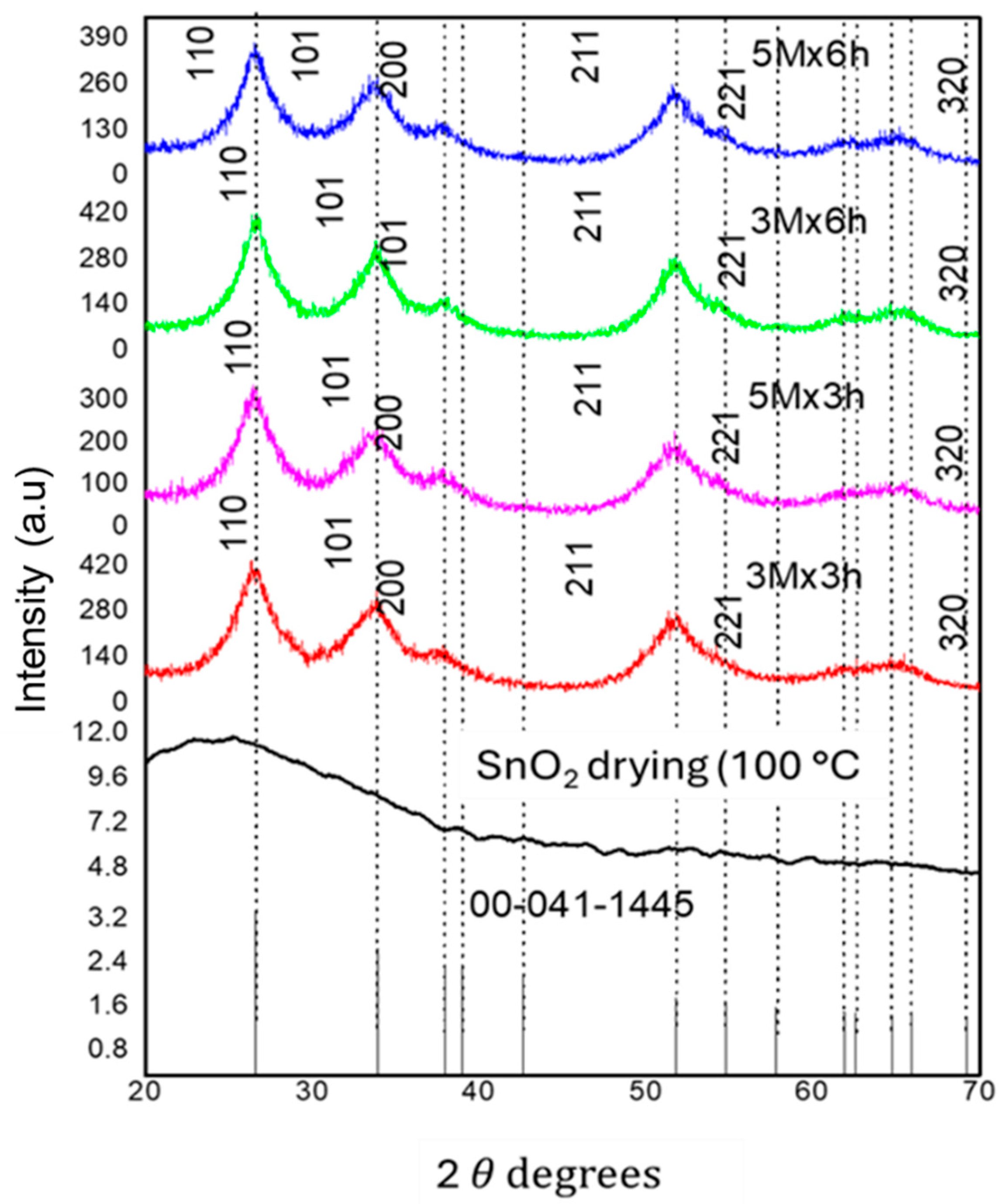
The diffraction patterns shown in Figure 2 correspond to SnO2 powders that have been synthesized by the forced hydrolysis method described in Section 2.1, following a 22-factorial experimental design. The diffractograms include samples prepared using precursor concentrations of 0.3 M and 0.5 M and reaction times of 3 h and 6 h, all recorded over the same 2θ range, allowing for a direct comparison of position, intensity, and peak broadening.
According to the indexed patterns, all samples exhibit a polycrystalline structure, which is characteristic of the tetragonal cassiterite phase of SnO2. By comparison with the standard reference card ICDD 00-041-1445 [13], the most distinctive and intense diffraction peaks were identified at 2θ ≈ 26.6°, 33.6°, 37.6°, 51.6°, 54.4°, and 74.0°, corresponding to the (110), (101), (200), (211), (220), and (310) crystallographic planes, respectively. These reflections confirm the successful formation of the cassiterite SnO2 phase without the presence of secondary phases.
A comparative analysis of peak intensities and full width at half maximum (FWHM) reveals notable differences among the samples. In particular, the 0.3 M × 3 h and 0.3 M × 6 h samples exhibit higher peak intensities and broader diffraction peaks, especially for the dominant (110) reflection, indicating smaller crystallite sizes and increased lattice distortion. In contrast, samples synthesized at a higher precursor concentration (0.5 M) show narrower peaks with reduced broadening, suggesting improved crystallinity [14]. This enhanced crystallinity implies a more ordered atomic arrangement with fewer structural defects, which is crucial for maximizing carrier mobility by reducing electron scattering at grain boundaries.
The observed peak broadening is mainly attributed to nanoscale crystallite size effects and lattice microstrains, induced by the forced hydrolysis conditions, rather than to instrumental factors.
Several studies emphasize that the synthesis of this material is typically carried out at temperatures above 400 °C. However, in the present work, S n O 2 was successfully obtained at a lower temperature of 250 °C and at the autogenous pressure generated within the reactor (1.4 atm). The diffractogram shows the diffraction pattern of the pure S n O 2 powder as obtained after drying at 100 °C, where no additional diffraction peaks corresponding to impurity phases were observed.
The average crystallite size of the tin oxide was estimated using the Scherrer equation (Equation (5)) based on the XRD data:
D = K λ β c o s   θ
where D is the crystallite size (nm), K is the shape-dependent constant (typically 0.9), λ is the wavelength of the incident X-rays, β is the full width at half maximum (FWHM) of the diffraction peak, and θ is the Bragg angle corresponding to the peak of maximum intensity.
The orientation quality of the S n O 2 samples was evaluated using the texture coefficient (TC) (Equation (6)), which depends on the crystal growth and the degree of preferred orientation [15]. In this equation, TChkl represents the texture coefficient of the analyzed plane (hkl), Ihkl is the measured relative intensity of a given (hkl) plane, and I h k l 0 is the standard intensity obtained from the crystallographic reference card (00-014-1454). The calculated values are listed in Table 1 for each plane, showing that the preferred growth direction in all experiments corresponds to the (221) plane. Additionally, the crystallite size varies among experiments; for the lowest precursor concentration and shortest reaction time (3 M × 3 h), smaller crystallite sizes were obtained, which is consistent with the results reported by Van [16].
T C h k l = ( I h k l / I h k l 0 ) ( I h k l / I h k l 0 )
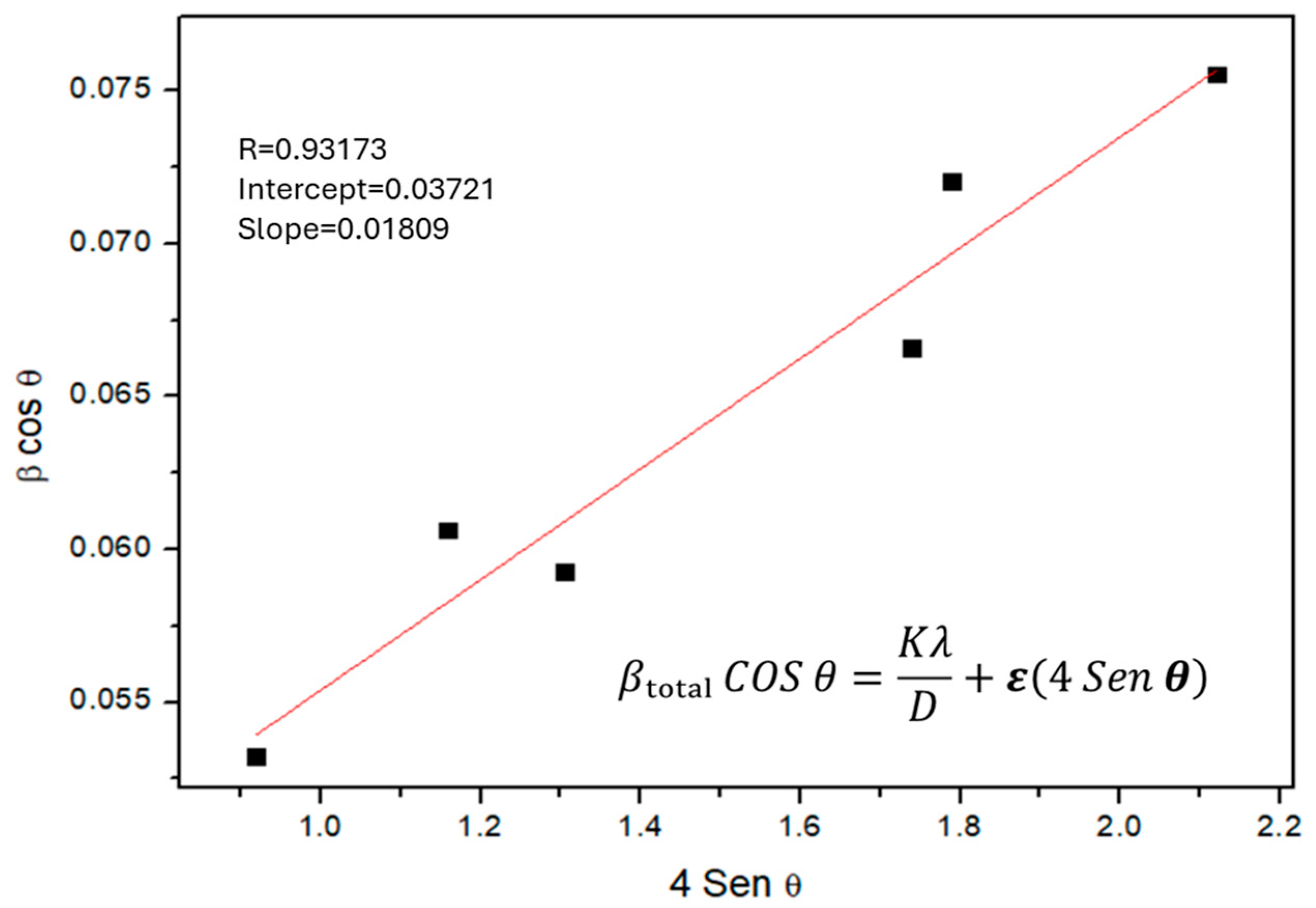
The average crystallite size estimated using the Scherrer equation was 20.34 nm, whereas a larger value of approximately 37 nm was obtained from the Williamson–Hall analysis. This difference can be attributed to the inherent assumptions of each method, since the Scherrer approach considers only the peak broadening associated with crystallite size and neglects lattice strain effects. In contrast, the Williamson–Hall method enables the separation of size- and strain-induced contributions to peak broadening. The microstrain lattice was estimated from the linear fitting of βcos θ as a function of 4sin θ (Figure 3), where the slope is related to the microstrain (ε) and the intercept to the crystallite size contribution. The linear regression yielded a correlation coefficient of R = 0.93, indicating an acceptable linear correlation of the experimental data. The obtained microstrain value (ε = 0.018) suggests the presence of lattice distortions, which may be associated with the nanoscale crystallite size and with internal stresses introduced during the synthesis process. Such behavior is commonly reported for nanocrystalline SnO2 materials synthesized via wet-chemical or hydrothermal routes [17].
The preferential (221) orientation of SnO2 enhances its ability to be doped with In2O3, as this plane exhibits a moderate surface energy and an atomic arrangement that favors the diffusion and incorporation of cations. These structural conditions facilitate the substitution of Sn4+ by In3+ and reduce defect formation during the synthesis of ITO [18,19]. In addition, a larger crystallite size decreases the density of grain boundaries, improving dopant mobility and promoting a more homogeneous incorporation of indium [20]. Overall, controlling the crystallographic orientation and crystallite size of SnO2 leads to ITO-based films with higher carrier concentrations, improved conductivity, and superior optical performance [9,21].
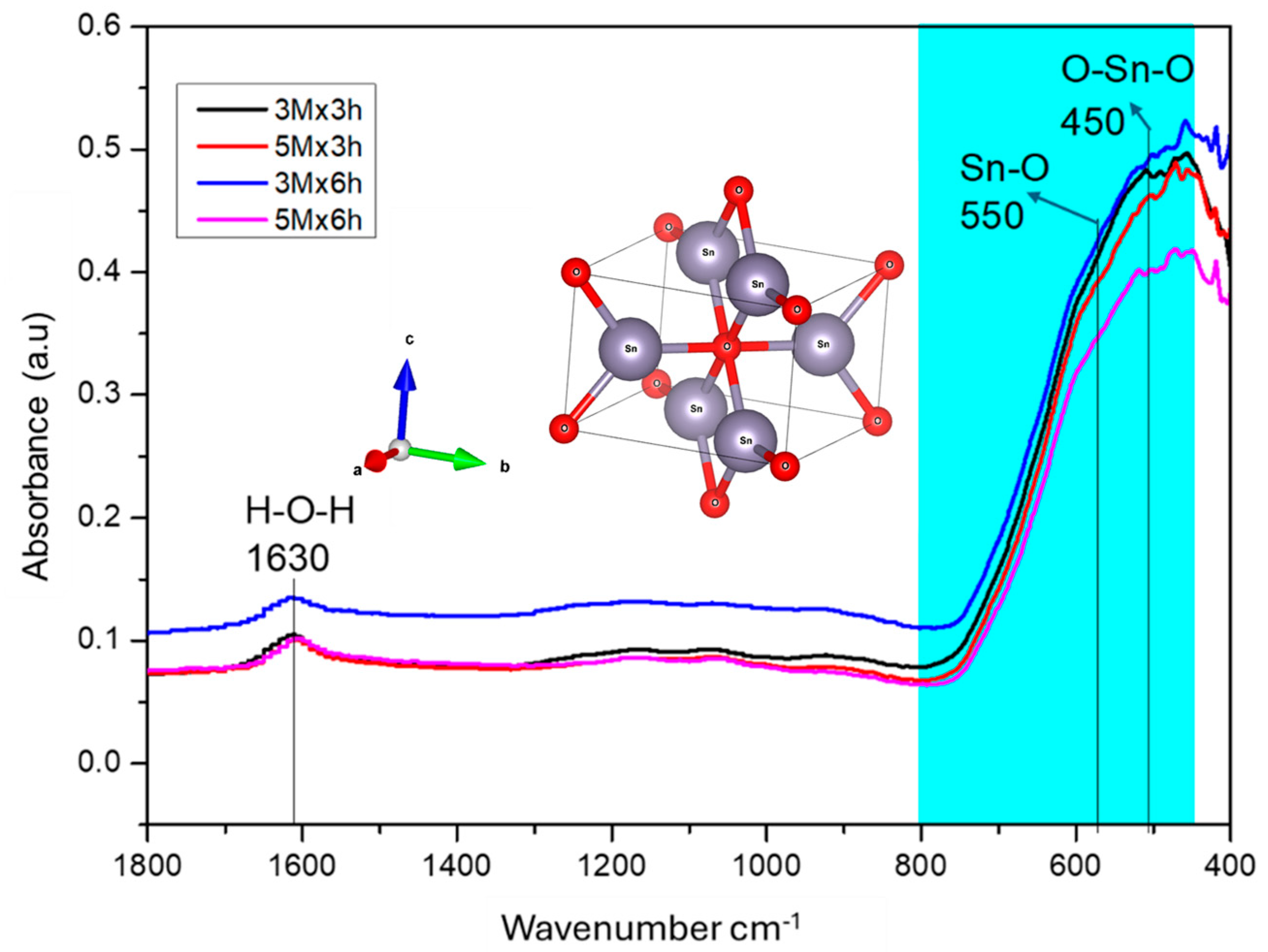
To verify that the hydrolysis reaction of S n O 2 was complete and to determine the presence of water being bonded to the Sn–O network, the SnO2 powders were analyzed using FTIR spectroscopy, since in hydrolysis-based synthesis processes, it is common for S n O 2 to absorb or retain water. Figure 4 shows the FTIR spectra evidencing the presence of the H–O–H bending vibration band at 1600 cm−1, corresponding to water molecules being bonded to the structure. The pattern of atoms in the structure was identified through the characteristic lattice vibrations in the fingerprint region. The absorption bands observed between 800 and 450 cm−1 are associated with the stretching and bending vibrations of Sn–O and O–Sn–O bonds, which are consistent with the tetragonal rutile-type structure (space group P42/mnm). In this arrangement, each Tin (Sn) atom is coordinated to six oxygen (O) atoms in an octahedral geometry, as illustrated in the unit cell inset of Figure 4 [22]. The oxidation of this material to form S n O 2 is promoted by the sintering temperature (250 °C).

3.2. Morphological Evaluation and Composition of S n O 2 Powders

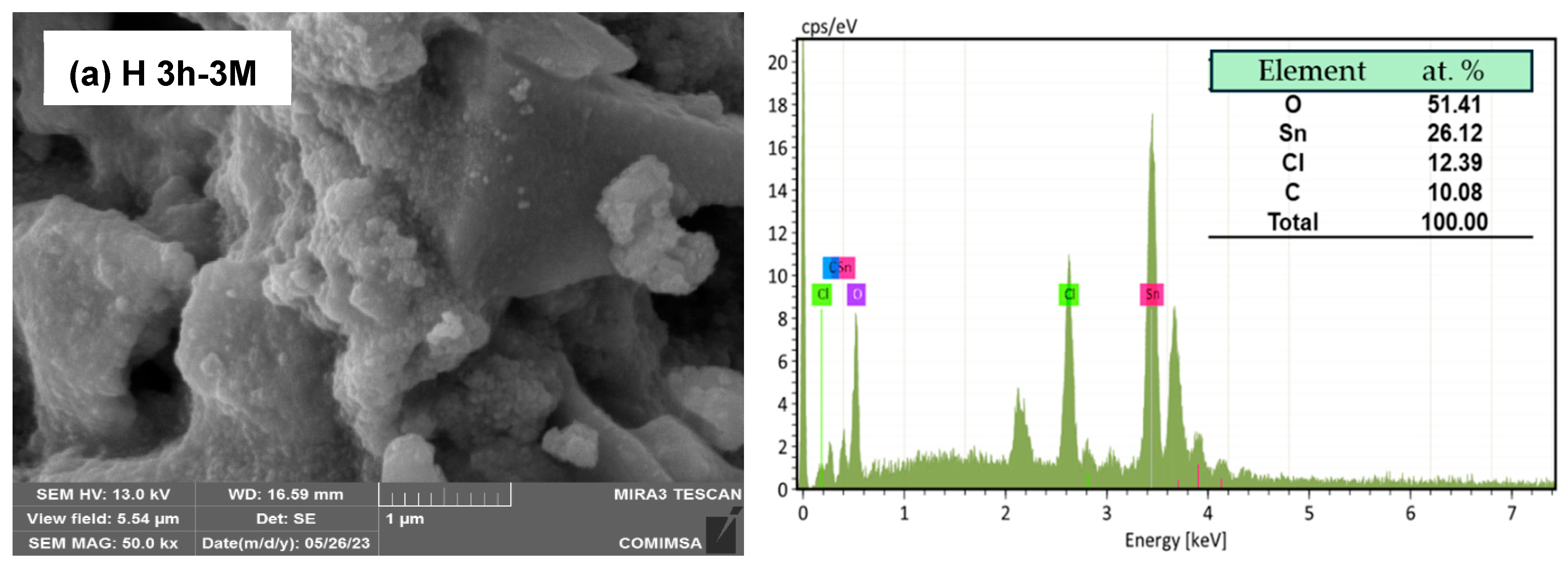
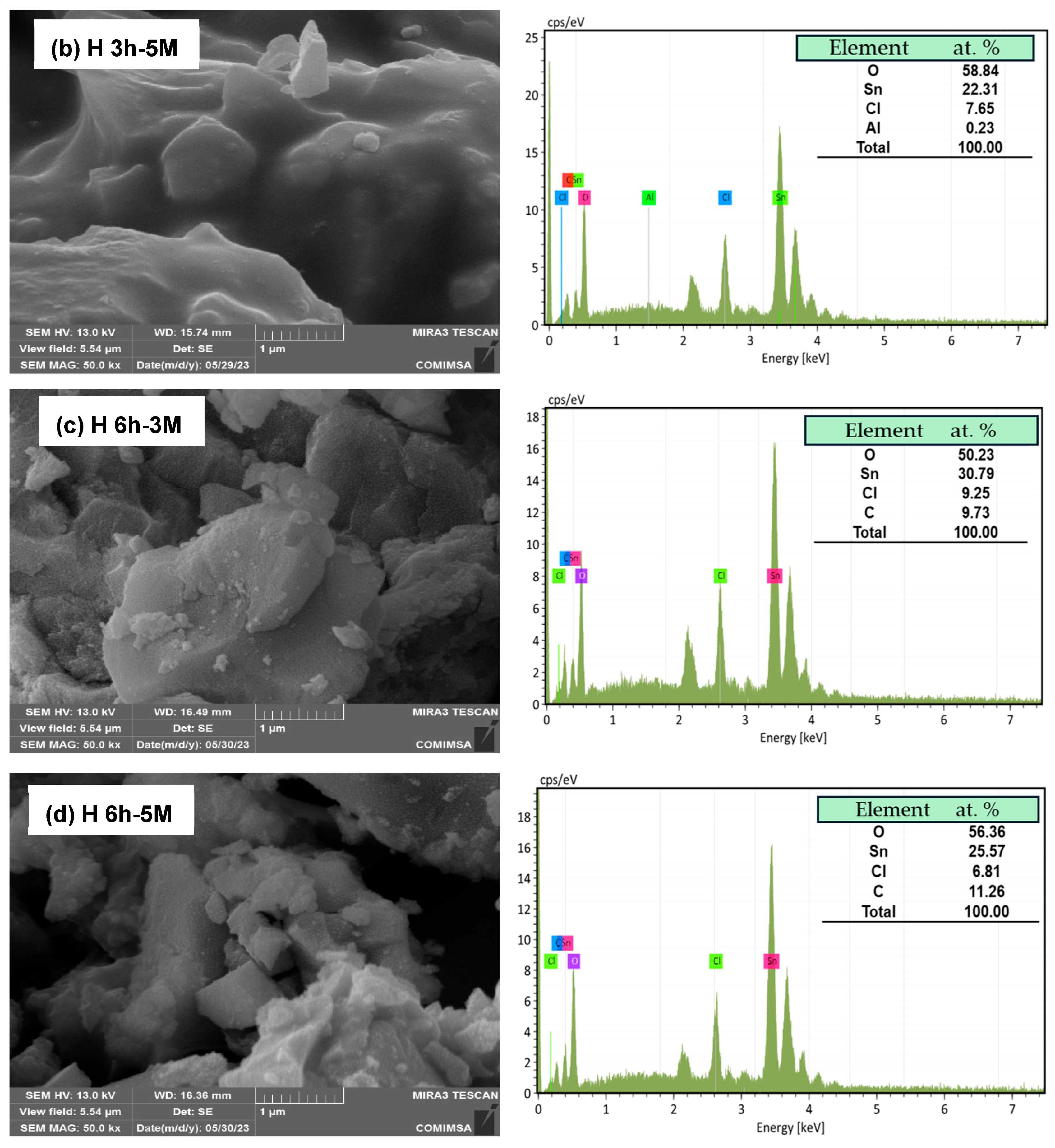
Figure 5 shows the FESEM micrographs at a 1 µm scale and the corresponding EDS spectra of the synthesized S n O 2 powders. The images reveal distinct morphological differences as a function of reaction time and concentration; while all samples exhibit granular growth forming agglomerates of approximately 400 nm, samples (c) and (d) (6 h) show a more densely packed and defined grain structure compared to the 3 h samples. The elemental chemical composition of the powders reveals a higher molar ratio of oxygen compared to tin, confirming the successful formation of the oxide phase. However, traces of ionic elements such as carbon (C) and chlorine (Cl) were detected in all experiments at low molar ratios that do not affect the process. These residual elements likely originate from the precursors used ( S n C l 2 2 H 2 O ), the washing steps (filter paper), and/or unreacted reagents. The EDS spectra (integrated in Figure 5) corroborate the high purity of the SnO2, despite these minor traces.

3.3. Characterization of the Composition and Structure of the I n 2 O 3 : S n O 2 Oxide Mixture

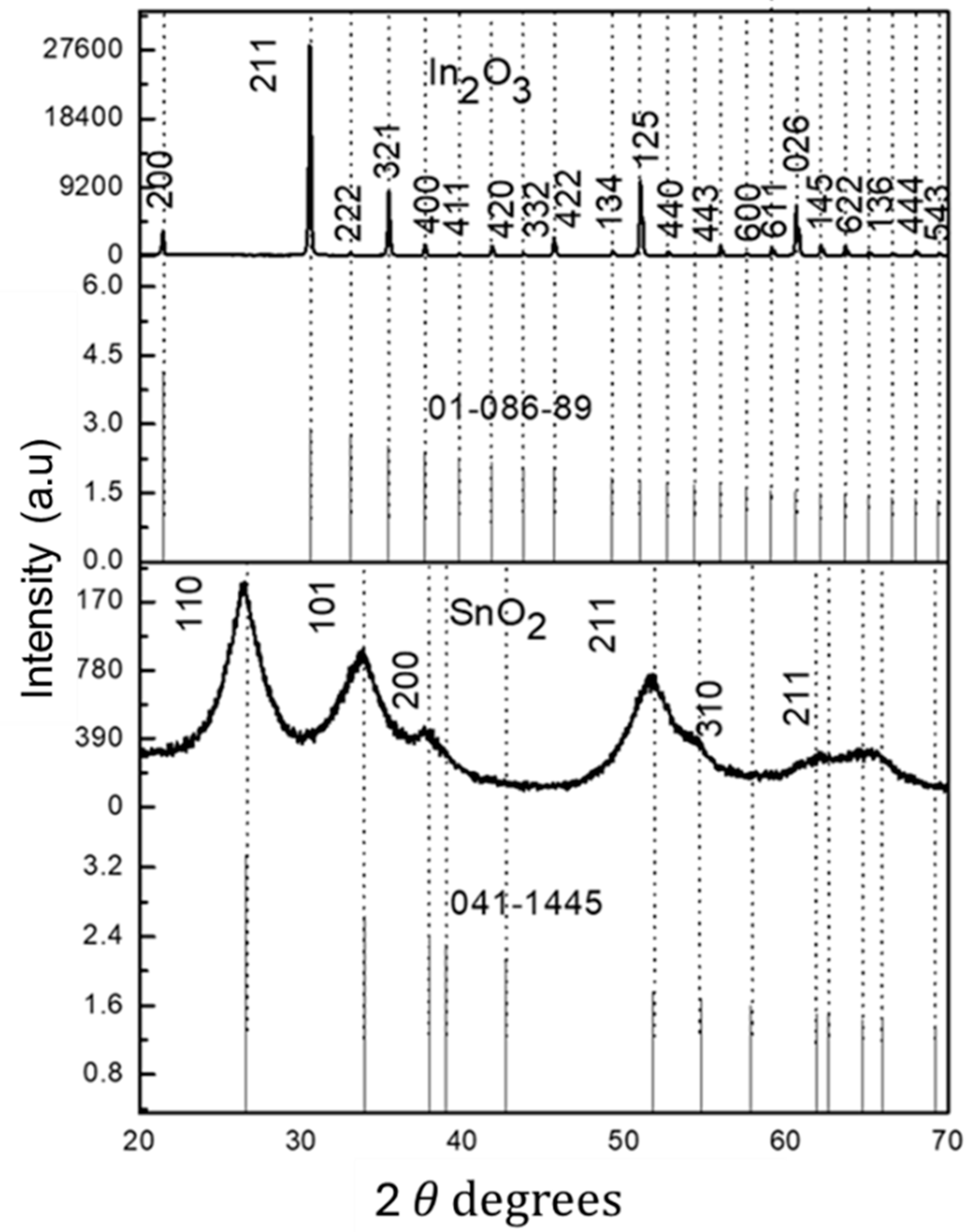
The diffractogram shown in Figure 6 presents the XRD patterns of I n 2 O 3 and S n O 2 powders, analyzed separately to evaluate the diffraction signals corresponding to each oxide. The diffractogram of In2O3 shows 21 peaks with high-intensity characteristics and narrow widths (<1° 2θ), indicating larger crystal sizes. In contrast, the diffractogram of S n O 2 exhibits six main diffraction peaks with moderate intensities and broader widths, which are defined by the sintering temperature. Nevertheless, the results confirm the formation of the most stable cassiterite phase.

3.4. Structural Characterization of ITO Powders

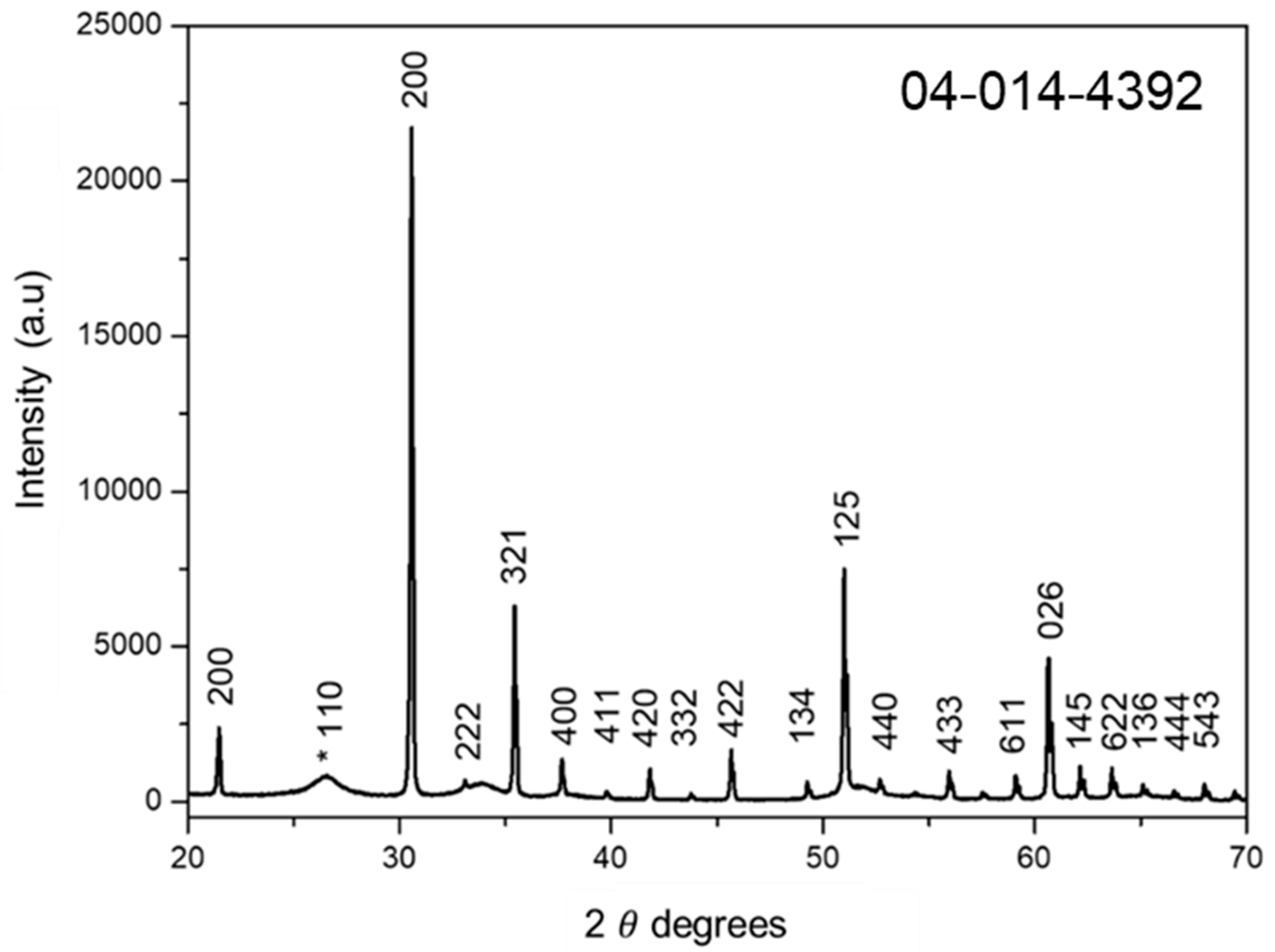
On the other hand, Figure 7 shows the diffractogram of the ITO powder obtained at 250 °C. The diffraction peaks correspond to the presence of a single-phase indium tin oxide (ITO) structure, as reported by Nicolescu et al., 2021 [23]. According to the indexed patterns, the results confirm the formation of a structure corresponding to the bixbyite phase of the cubic crystal system with a space group Ia-3 (206). This structure was compared with the crystallographic card No. 04-014-4392, yielding a 98% match (Ramos Rivero, 2021 [24]) with 22 diffraction peaks and intensities associated with the (200), (110), (211), (222), (321), (400), (411), (420), (332), (422), (134), (125), (440), (433), (600), (611), (026), (145), (622), (136), (444), and (543) planes. No impurities or secondary phases were observed within the measurement range. Furthermore, broad peaks were identified, corresponding to smaller crystallite sizes, while sharp peaks indicate good crystallinity of the samples [25].

3.5. Structural Analysis of the ITO Film Deposited on PET Substrate

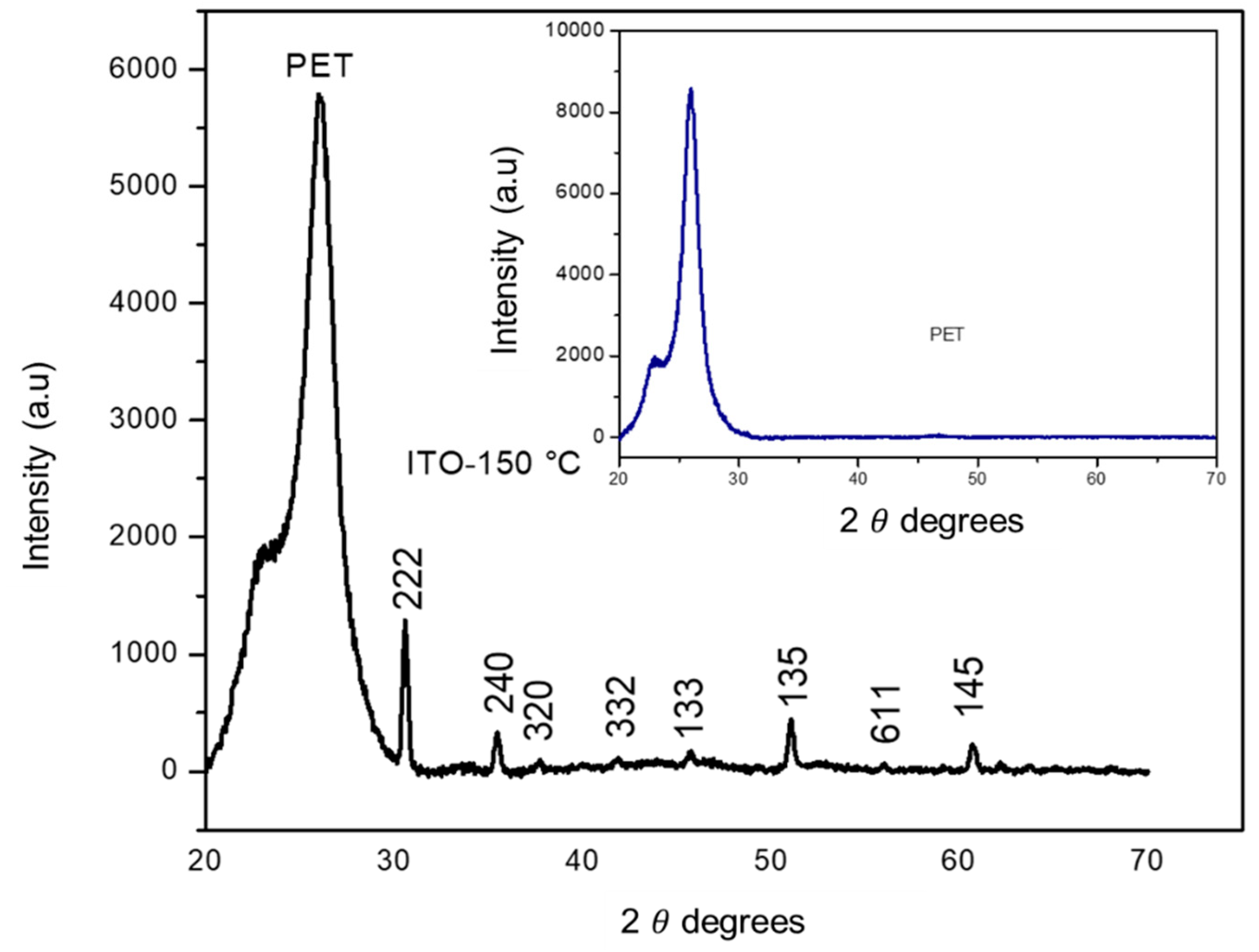
To confirm that the powder deposited on the PET substrate corresponded to ITO, Figure 8 presents the diffractogram of the film deposited on PET. Corresponding to the ITO structure, eight diffraction peaks were observed at the (222), (240), (320), (332), (133), (135), (611), and (145) planes. According to the crystallographic card No. 041-014-4392, these peaks correspond to the formation of I n 1.9 S n 0.4 O 3.02 (ITO) with a bixbyite-type structure belonging to the cubic crystal system. The preferential growth is found along the (222) plane [26].
A different signal can be identified at 26.6° (2θ), which corresponds to the characteristic diffraction of PET, which is consistent with the results reported by Boehme and Charton (2005) [27]. This behavior is attributed to the anisotropic concentration effect of the PET substrate, which increases from lower to higher coating concentrations due to the sintering temperature. For reference, the diffractogram of bare PET is shown in the inset of Figure 8.
The estimated crystallite size of our ITO/PET film (~22 nm, obtained from the XRD peak broadening) falls within the commonly reported range for ITO deposited on polymeric substrates using low- to medium-temperature techniques. This crystallite size range reduces the density of grain boundaries compared with highly nanocrystalline films (<10 nm), thereby promoting adequate electron mobility and sufficient conductivity for optoelectronic applications. Previous studies on ITO deposited on flexible substrates have shown that even under mechanical deformation, films with a well-developed crystalline structure maintain their conductivity and transparency [28]. Consequently, the crystallite size obtained in this work supports the suitability of our films as flexible transparent electrodes.
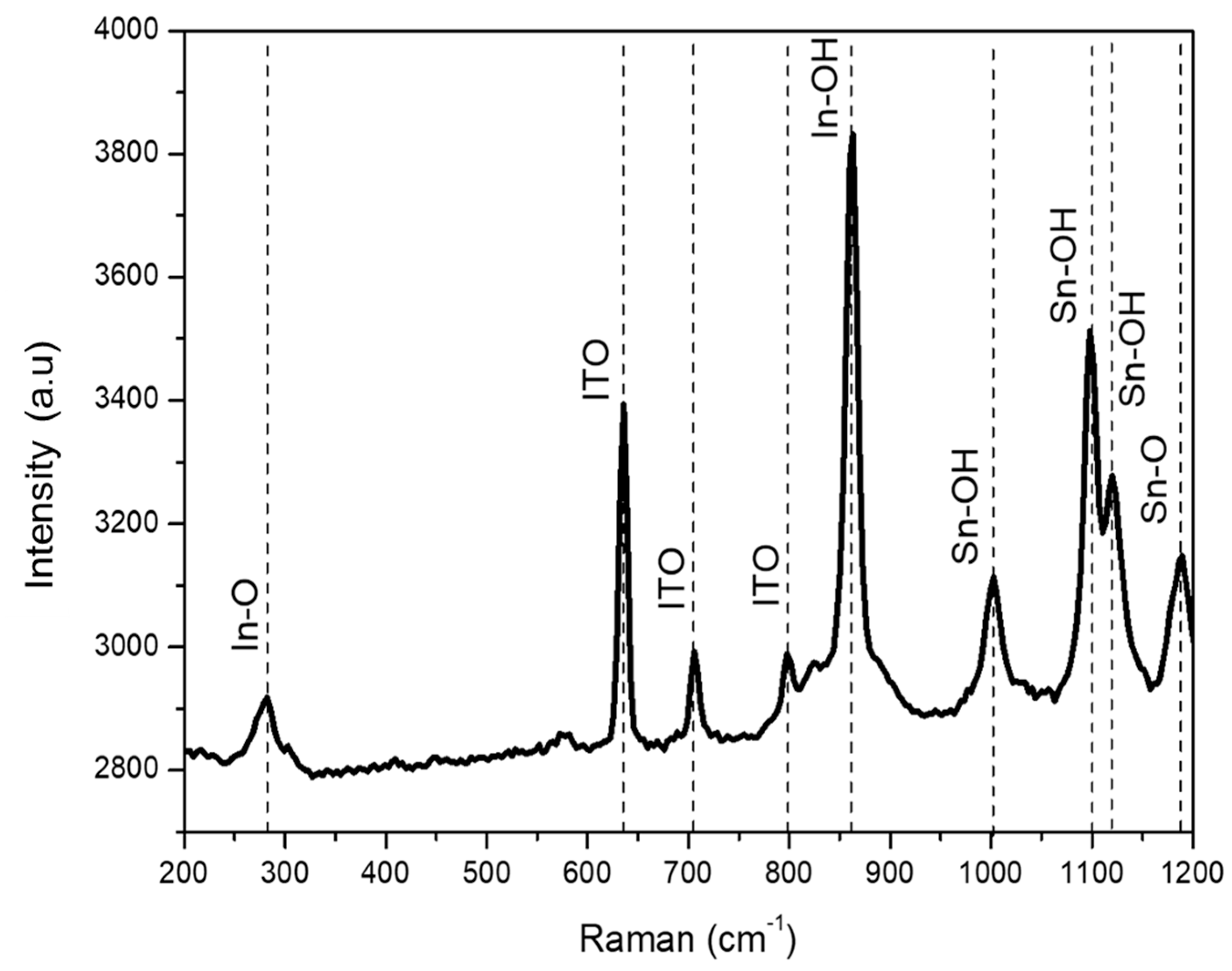
Through Raman spectroscopy, it was possible to determine the vibrational bands of the ITO films, which confirms the presence of the mixed oxide. Figure 9 shows the Raman signals indexed at the inflection points of the spectra in the range of 200–1200 cm−1. This range corresponds to the vibrational bands associated with the In–O, ITO, In–OH, Sn–OH, and Sn–O bonds, with nine vibrational interactions being observed between 150 and 1200 cm−1. The low intensity of the peaks is related to the Raman scattering cross-section, which is influenced by the small particle size of the films. Likewise, the expected composition corresponding to ITO formation is observed, represented by the nine vibrations without the presence of impurities [23].
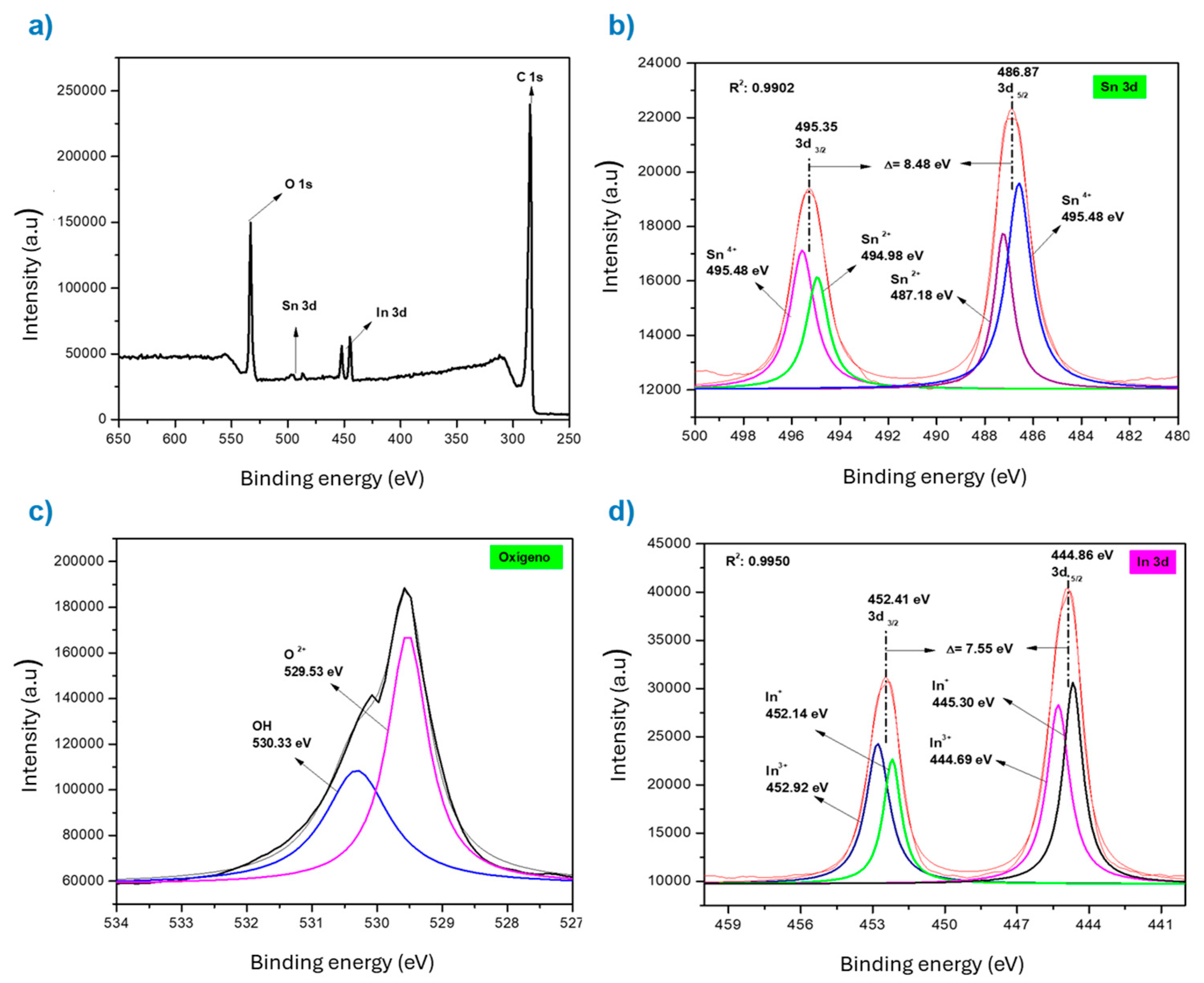
Based on the obtained results, the reaction efficiency in forming ITO was determined, and to confirm it, X-ray photoelectron spectroscopy (XPS) analysis was carried out. Figure 10 shows the XPS analyses of the ITO/PET films deposited using the spin coating technique. A generalized survey spectrum of the samples is presented, where the binding energy was calibrated using the C 1s peak at 284.5 eV. Small peaks corresponding to In 3d and Sn 3d are observed, with a higher intensity at the O 1s peak, suggesting a higher oxygen concentration (Figure 10a). The high-resolution spectrum of the Sn 3d doublet is shown, with a binding energy of 486.87 eV, indicating the presence of Sn4+ and suggesting a S n O 2 bonding state (Figure 10b). The O 1s binding energy is shown at 529.4 eV, corresponding to metal–oxygen bonds (In–O and Sn–O), while a second peak at 530.3 eV is associated with hydroxide bonds, likely due to environmental contamination during measurement (Figure 10c). Finally, Figure 10d presents the indium 3d spectrum with a binding energy of 444.86 eV, suggesting the formation of I n 2 O 3 [29].

3.6. Surface Analysis of the ITO/PET Film Quality

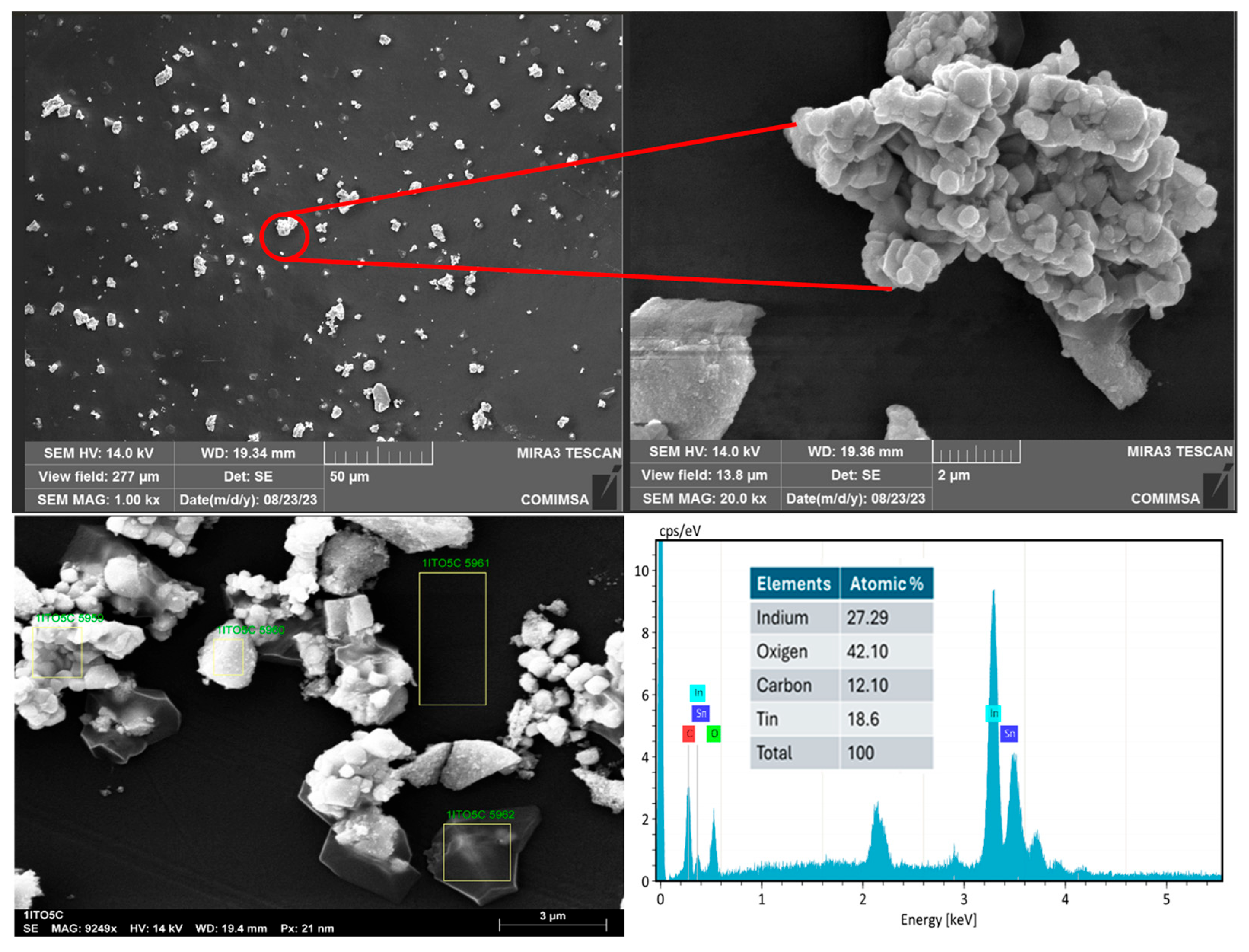
The morphological and compositional evaluation of the coatings was carried out using scanning electron microscopy with energy-dispersive X-ray spectroscopy (SEM–EDS) and atomic force microscopy (AFM). Figure 11 shows the morphology of the films deposited by the spin coating technique, consisting of five ITO layers on PET substrates sintered at 150 °C. In Figure 11a, at a scale of 50 µm, a granular surface with irregular formations, approximately 87 nm in size, can be observed. At higher magnification (Figure 11b,c), small agglomerates with well-defined cubic geometrical shapes are visible. The elemental composition obtained by EDS (Figure 11c) confirms the presence of carbon, oxygen, tin, and indium, as expected according to the nominal composition of ITO.

3.7. Optical Transmittance of the ITO/PET Films

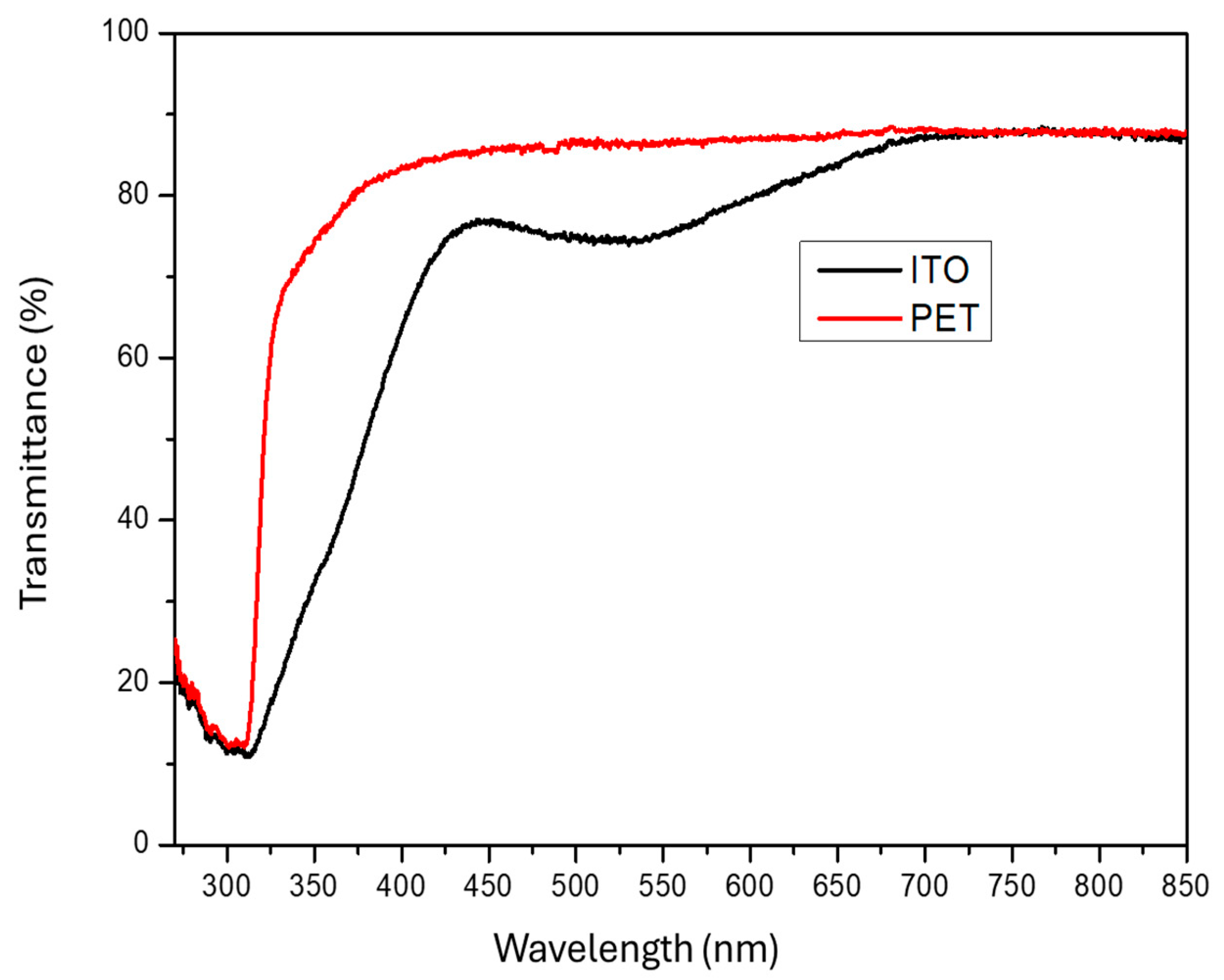
I n 2 S n O 3 is known as an n-type TCO and characterized by a high free carrier density, which allows for a higher degree of optical transparency. Figure 12 shows the normalized transmittance spectra of the ITO film with five deposited layers, compared with the uncoated PET substrate. The results confirm that the material exhibits good optical transparency, as the ITO film shows significant light transmission within the ultraviolet–visible region, starting at a wavelength of approximately 320 nm.
At 430 nm, the transmittance reaches about 70%, increasing up to 80% at 700 nm—similar to the bare PET substrate. This spectral variation is primarily governed by thin-film interference phenomena and the optical dispersion of the material. The lower transmittance at shorter wavelengths (430 nm) can be attributed to increased photon scattering at grain boundaries and a higher refractive index mismatch between the ITO film (n ≈ 1.9) and the PET substrate (n ≈ 1.65). As the wavelength increases towards 700 nm, the constructive interference effects and a reduction in the extinction coefficient allow the transmittance to approach the values of the bare substrate [30]. This behavior may also be attributed to several factors, including the sintering temperature and the total film thickness, which in this case depends on the number of deposited layers. A higher number of layers can promote an increase in grain size, which reduces the density of grain boundaries, thereby minimizing light scattering and, consequently, enhancing the optical transmittance of the coating [31].

3.8. Surface Analysis of ITO/PET Film Quality

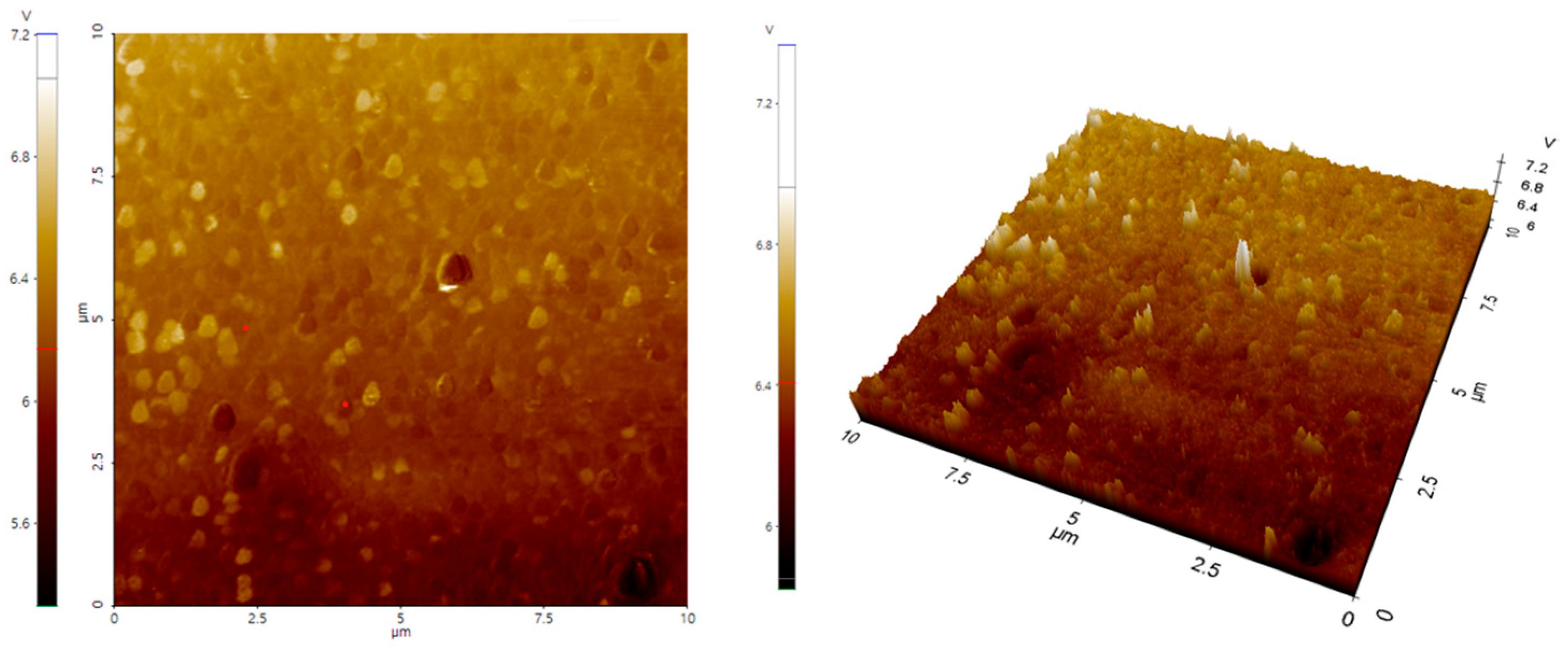
To verify the presence of irregularities on the film surface, Figure 13 shows the surface morphology of the ITO/PET films over a scanned area of 10 × 10 μm. As can be observed, the sample exhibits a surface morphology with a root mean square (RMS) roughness of 53 nm, which is higher than the value reported by Bao (2020) [32]. This value is attributed both to the number of deposited layers, which fill the voids between each layer, and to the deposition technique, which produces granular surface appearances with valley formations. It is also related to the synthesis method used, which allows sufficient time for the formation of the crystalline structure, as well as to the sintering temperature, which ensures the stability of the formed structure, as confirmed by XRD measurements. A high roughness value enables the use of ITO/PET substrates as a base for the fabrication of electrodes requiring additional film deposition, thus allowing for the development of other thin films with a reported thickness of 6.5 µm, generating a contact area that promotes strong bonds and greater fatigue resistance [33].
Surface roughness is a key parameter in ITO/PET films, as it simultaneously modulates optical scattering and electrical transport in the electrode. The film exhibited an average roughness of 53 nm, a value that, although higher than that typically reported for vacuum-deposited coatings, remains within the functional range for flexible optoelectronic devices. This topography promotes adequate interfacial interaction and enhances mechanical stability during bending or cyclic loading. Moreover, roughness contributes to maintaining high transmittance by minimizing undesired diffuse scattering. In electrical terms, this roughness level does not significantly increase resistivity, as charge transport is predominantly governed by the bulk of the film. Therefore, the values obtained are compatible with transparent electrode assemblies and demanding optoelectronic applications [28,34].

3.9. Mechanical Properties of ITO/PET Films

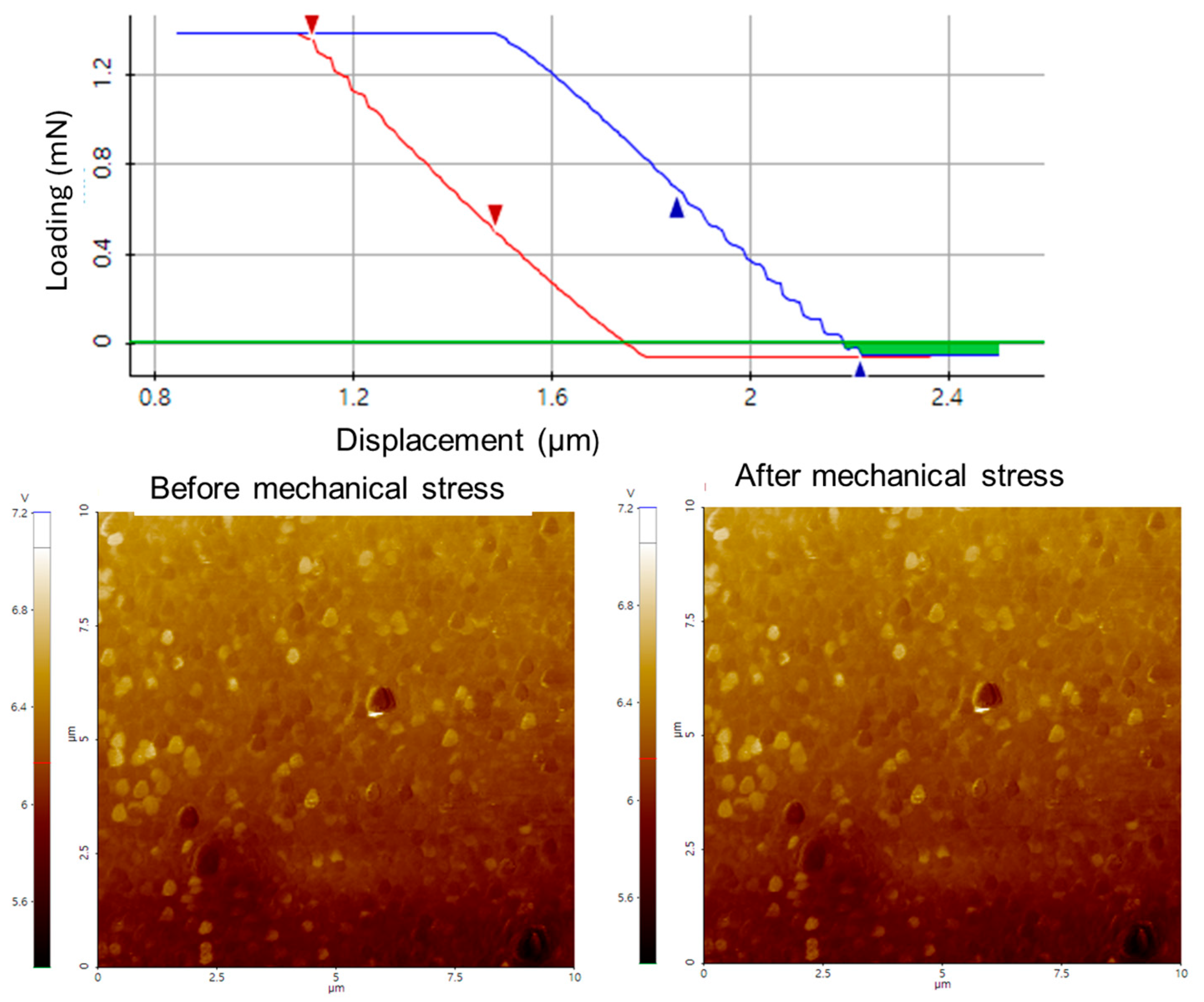
The mechanical properties of the ITO/PET films were evaluated by nanoindentation tests using an atomic force microscope (AFM, Park Systems XE7, Park Systems, Santa Clara, CA, USA) equipped with a TD27004 tip. The samples obtained by spin coating were analyzed under a maximum load of 10 µN, reaching a penetration depth of approximately 400 nm, with a holding time of 10 s at the maximum load. Measurements were performed at seven different points per sample to ensure reproducibility of the results.
The load–displacement curves (Figure 14) show a typical elasto-plastic behavior. The loading curve (red) corresponds to the indenter penetration, while the unloading curve (blue) reflects the elastic recovery of the material. The analysis revealed an average hardness (H) of 3.8 GPa and an elastic modulus (E) of 110 GPa. The consistent mechanical response across all measured points confirms that the ITO films exhibit isotropic mechanical properties, a result of the uniform centrifugal force applied during the spin coating process, which promotes a non-directional grain distribution. Regarding the optoelectronic performance, the relatively high hardness (H) is indicative of a high packing density and strong cohesive forces within the ITO lattice. A denser film structure reduces the concentration of internal defects and porosity, which are known to act as scattering centers for both photons and charge carriers [35]. Consequently, this mechanical robustness ensures that the electronic mobility and optical transparency are preserved during the bending cycles that are required for flexible optoelectronic applications. These results are consistent with those reported by Gorji et al. [36] and Roa and Sirena [37], confirming that the ITO films obtained by spin coating exhibit isotropic mechanical properties that make them suitable for applications in flexible optoelectronic devices.
The mechanical integrity of the films, characterized by a hardness of 3.8 GPa and an elastic modulus of 110 GPa, confirms that the chosen thickness provides a robust protective barrier for the flexible PET. While thinner PVD films often suffer from micro-cracking under repetitive bending, the homogeneous microstructure produced via forced hydrolysis maintains its structural functionality, justifying its implementation in wearable sensors and flexible storage devices [38].

3.10. Electrical Evaluation of ITO Films

Considering the transmittance and surface quality of the samples, the electrical properties of the ITO films that were sintered at 150 °C were evaluated by measuring their resistivity (Table 2). Current–voltage (I–V) measurements were performed using a Sourcemeter 2420 (Keithley-Tektronix, Beaverton, OR, USA), and the resistivity values were calculated according to Equation (7).
The obtained resistivity of the ITO film was 1.76 × 10⁶ Ω·m, which falls within the range reported by Kim et al. (2019) [20]. These authors indicated that the reduction in resistivity may be attributed to the increase in carrier concentration induced by the presence of oxygen vacancies. Reported resistivity values for ITO films typically range between 10−4 Ω·m and 10−6 Ω·m, confirming that the obtained values are representative of materials with low electrical resistance. Therefore, the proposed synthesis method enables the production of transparent conductive ITO/PET thin films with suitable resistivity values for optoelectronic applications [39].
ρ = π I n 2 V I
Although the electrical resistivity is higher than that achieved by optimized physical vapor deposition (PVD) methods, it remains highly competitive among solution-processed transparent electrodes. The values obtained in this work represent a strategic trade-off; by utilizing a wet-chemical route and a thickness of 1.1 µm, and as shown by the comparative analysis presented in Table 3, ITO/PET films obtained by this method are a superior platform for photoelectrochemical applications. Compared to the recent literature, these ITO/PET films achieve a higher optical transmittance (80%) and the lowest lattice microstrain (ε = 0.018). This reduced microstrain is a critical advantage, as it indicates a nearly defect-free crystal structure that minimizes charge recombination, a common limitation in SnO3/graphene and SnO2/WO3 systems. The reported electrodes show capacitance increments between 25% and 45%, meaning that the superior structural integrity and photon management of ITO/PET electrodes obtained in this paper suggest that they are not only a viable candidate, but also potentially a high-performance benchmark for next-generation flexible energy storage devices.

3.11. Adherence Test of ITO/PET Films According to ASTM D3359

The adhesion quality of the ITO films deposited on PET substrates was evaluated following the ASTM D3359 standard [44]. This method was selected because it provides a simple and effective way to assess coating detachment, with classifications that vary depending on the application and required performance of the coating. In particular, this test is suitable for materials that are not subjected to continuous mechanical stress but must maintain a uniform coating over the surface for their intended application [30].
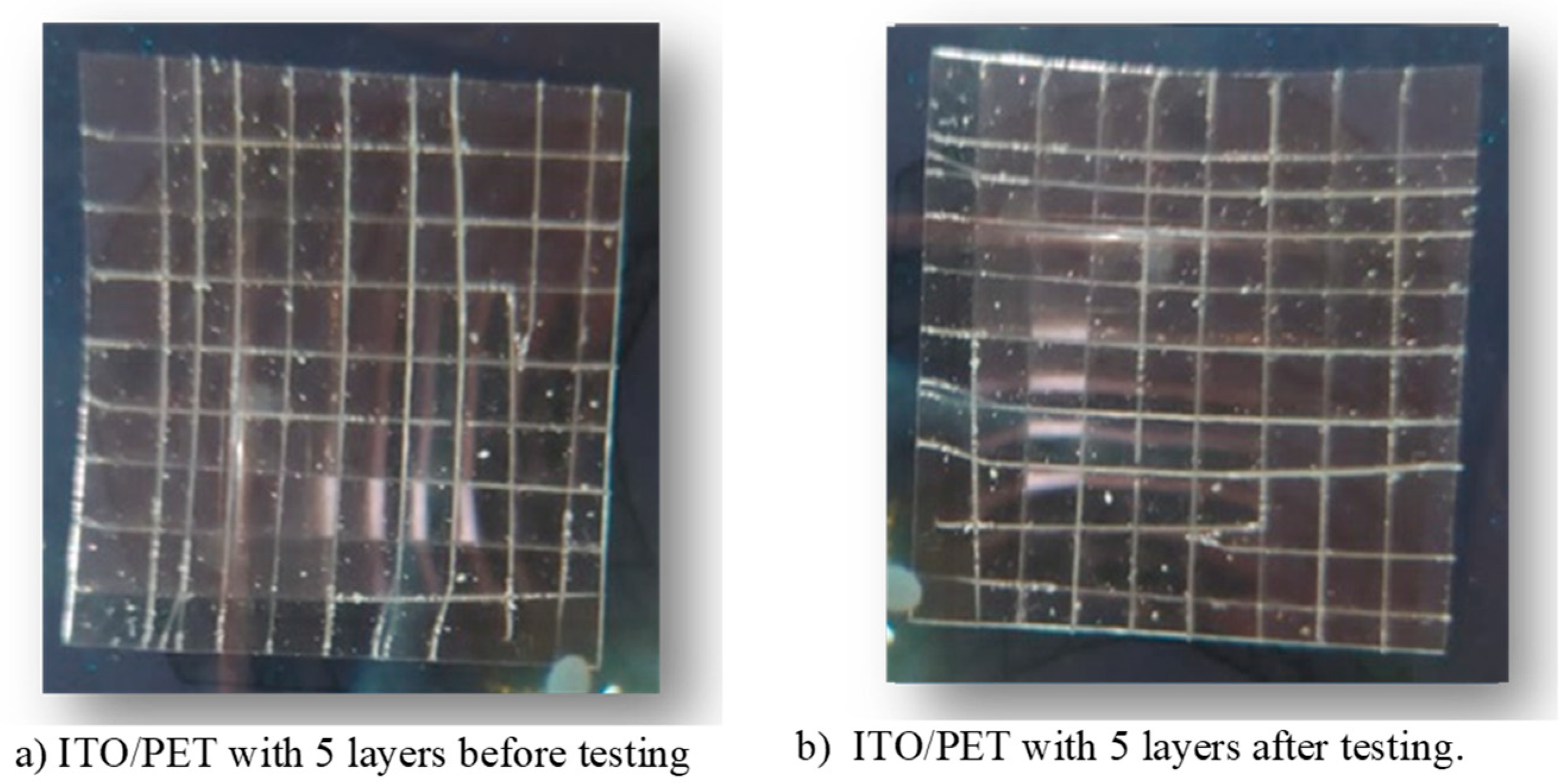
The adhesion test for the ITO/PET samples, deposited in five layers using the spin coating method, was carried out using an adhesion tape test (Standard Test Methods for Measuring Adhesion by Tape Test). The test consisted of making cross-hatch cuts on the coated surface, applying the adhesive tape, and then removing it to evaluate the amount of coating that detached. The detached area was examined under an illuminated magnifier to obtain a clearer observation of the affected zone. During the test, the samples were compared with the rating scale defined in ASTM D3359, where a value of 5 corresponds to no detachment, a value of 4 indicates slight traces of coating removal, and a value of 0 represents more than 65% detachment.
The adhesion test of the five-layer ITO/PET samples resulted in a 4B classification, with less than 5% coating removal, indicating good adhesion performance (see Figure 15).

4. Discussion

The ITO thin films fabricated by the forced hydrolysis method and deposited onto flexible PET substrates exhibited good structural and electrical properties. The S n O 2 nanoparticles synthesized at 250 °C showed a cassiterite-type crystalline phase with an average crystallite size of approximately 20 nm. The strong preferential orientation towards the (222) plane in the functionalized ITO thin films suggests a highly ordered crystalline growth, which is promoted by the chemical affinity between the In–Sn–O precursor solution and the UV-activated PET surface. This interaction facilitated a homogeneous microstructure in the films, with an average thickness of 1.1 µm and excellent surface uniformity (<4% variation).
Optical and electrical measurements confirmed the dual functionality of the films as transparent and conductive materials. The transmittance in the visible range reached 70–80%, while the electrical resistivity was 1.27 × 10⁻⁶ Ω·m. While this resistivity is higher than that of films produced by vacuum-based techniques, it remains highly competitive for solution-processed functionalized electrodes. The low resistivity is attributed to the presence of oxygen vacancies and the effective chemical anchoring achieved during the hydrolysis-driven deposition, which ensures continuous charge carrier pathways across the organic–inorganic interface.
Mechanical characterization by nanoindentation revealed a hardness of 3.8 GPa and an elastic modulus of 110 GPa. These values, coupled with the 4B adhesion rating (ASTM D3359), confirm that the forced hydrolysis method does not merely deposit a layer but achieves robust surface functionalization. The 1.1 µm ITO thickness was strategically maintained to act as a structural buffer; unlike thinner, brittle sputtering coatings, this thicker functionalized matrix effectively dissipates mechanical stress and inhibits micro-crack propagation during bending.
While state-of-the-art ITO/PET electrodes prepared by sputtering achieve lower resistivities (10−8 Ω·m), they require high energy input and offer limited interfacial chemical bonding. In contrast, our results demonstrate that forced hydrolysis-driven functionalization provides a superior balance between cost, optical clarity, and mechanical durability. By prioritizing the chemical integration of the ITO onto the PET surface, the nanoparticle level developed is proposed for applications in wearable sensors and flexible electronics, where the mechanical life-cycle and interfacial integrity are as critical as optoelectronic performance [45,46,47].

5. Conclusions

A reproducible route for the surface functionalization of PET substrates with ITO thin films nanoscale level was successfully demonstrated via forced hydrolysis. The nanoindentation results (H = 3.8 GPa) and the high adhesion rating (4B) validate that the forced hydrolysis-driven process achieves a functionalized organic–inorganic interface rather than an ITO physical coating. This enhanced mechanical integrity, combined with an optical transmittance of 80%, positions the proposed method as a sustainable candidate for the large-scale manufacturing of flexible sensors and wearable devices where durability and cost-reduction are prioritized over extreme optoelectronic benchmarks.
The results confirm that the chemical synergy between the UV-activated polymer surface and the solution-processed precursors enables the fabrication of mechanically robust electrodes without the need for high-vacuum or high-temperature treatments.
While the electrical resistivity (1.27 × 10⁻⁶ Ω·m) is higher than that of industrial sputtering-deposited films, it aligns well with other wet-chemical routes and meets the requirements for flexible optoelectronic applications. The strategic optimization of a 1.1 µm ITO thickness could act as a structural buffer. This architecture maintains electrical percolation and prevents micro-crack propagation during mechanical deformation, a common failure mode in ultra-thin, brittle films produced by conventional PVD.
Regarding sustainability, this solution-processed route addresses current environmental concerns by eliminating the high energy demands and material waste associated with traditional vacuum systems. By balancing the use of indium, this research provides a viable pathway to extending the life-cycle of flexible electronics, offering a robust and scalable alternative for the next generation of functional surface engineering.

Author Contributions

Conceptualization: S.d.C.M.-D. and L.L.D.-F.; methodology: S.d.C.M.-D. and L.L.D.-F.; experimental process: S.d.C.M.-D.; formal analysis: S.d.C.M.-D., L.C.R.-L., I.V.F.-O., S.G.-L., C.d.C.D.-R., C.M.-P., J.L.C.-L., I.R.-V. and L.L.D.-F.; writing—original draft preparation: S.d.C.M.-D.; writing—review and editing: S.d.C.M.-D., L.C.R.-L., I.V.F.-O., S.G.-L., C.d.C.D.-R., C.M.-P., J.L.C.-L., I.R.-V. and L.L.D.-F.; supervision: L.L.D.-F. and I.R.-V. All authors have read and agreed to the published version of the manuscript.

Funding

Madrigal Diaz Silvia del Carmen thanks the support of the scholarship CONAHCYT with number 861340.

Institutional Review Board Statement

Not applicable.

Informed Consent Statement

Not applicable.

Data Availability Statement

All the data are presented in the current document.

Acknowledgments

The authors appreciate the support provided by Juan José Alvarado Gil during Silvia del Carmen Madrigal Díaz stay in the laboratory, in addition, at the technical help provided by the technical staff of Cinvestav-Unidad Mérida, in particular, José Bante (Raman and AFM) and Juan Carlos Díaz Guillen in INNOVA BIENESTAR by SEM measurements.

Conflicts of Interest

The authors declare no conflicts of interest.

References

  1. Lah, N.A.C.; Zubir, M.N.M.; Samykano, M.A. Engineered Nanomaterial in Electronics and Electrical Industries. In Handbook of Nanomaterials for Industrial Applications; Elsevier: Amsterdam, The Netherlands, 2018; pp. 324–364. [Google Scholar] [CrossRef]
  2. Pennisi, S. The Integrated Circuit Industry at a Crossroads: Threats and Opportunities. Chips 2022, 1, 150–171. [Google Scholar] [CrossRef]
  3. Dimngaihvungi; Singh, L.R. Silver and copper nanowire-based nanocomposite for transparent electrodes: Deposition methods and applications in solar cells. Compos. Interfaces 2023, 30, 1449–1478. [Google Scholar] [CrossRef]
  4. Toikka, A.; Ilin, M.; Kamanina, N. Perspective Coatings Based on Structured Conducting ITO Thin Films for General Optoelectronic Applications. Coatings 2024, 14, 178. [Google Scholar] [CrossRef]
  5. Chavan, G.T.; Kim, Y.; Khokhar, M.Q.; Hussain, S.Q.; Cho, E.C.; Yi, J.; Ahmad, Z.; Rosaiah, P.; Jeon, C.W. A Brief Review of Transparent Conducting Oxides (TCO): The Influence of Different Deposition Techniques on the Efficiency of Solar Cells. Nanomaterials 2023, 13, 1226. [Google Scholar] [CrossRef]
  6. Mohammed, D.W.; Ameen, R.B.; Bowen, J.; Sierros, K.A.; Kukureka, S.N. Durability of ITO/Ag-Alloy/ITO Films on Pet Substrate Under Extended Bending Stress at Various Temperature and Humidity Conditions. Adv. Mater. Sci. 2025, 25, 36–51. [Google Scholar] [CrossRef]
  7. Christöfl, P.; Ottersböck, B.; Czibula, C.; Macher, A.; Teichert, C.; Pinter, G.; Oreski, G. Nanoindentation for Fast Investigation of PET Film Degradation. JOM 2022, 74, 2287–2294. [Google Scholar] [CrossRef]
  8. Li, J.; Chen, C.; Li, J.; Li, S.; Dong, C. Synthesis of Tin-Glycerate and It Conversion into SnO2 Spheres for Highly Sensitive Low-Ppm-Level Acetone Detection. J. Mater. Sci. Mater. Electron. 2020, 31, 16539–16547. [Google Scholar] [CrossRef]
  9. del Carmen Gómez Torres, F.; Cervantes López, J.L.; López Rodríguez, A.S.; Gallardo, P.S.; Morales, E.R.; Hernández, G.P.; Díaz Guillen, J.C.; Díaz Flores, L.L. Sol-Gel/Hydrothermal Synthesis of Well-Aligned ZnO Nanorods. Bol. Soc. Esp. Ceram. Vidr. 2022, 62, 348–356. [Google Scholar] [CrossRef]
  10. Wang, T.; Lu, K.; Xu, Z.; Lin, Z.; Ning, H.; Qiu, T.; Yang, Z.; Zheng, H.; Yao, R.; Peng, J. Recent Developments in Flexible Transparent Electrode. Crystals 2021, 11, 511. [Google Scholar] [CrossRef]
  11. Subbarao, P.S.; Aparna, Y.; Suresh, P.; Ramanaiah, M. Low-temperature/room-temperature gas sensing application for NO2 gas by SnO2 and Ni doped SnO2 nanostructures synthesized by sol-gel method. Results Surf. Interfaces 2024, 17, 100330. [Google Scholar] [CrossRef]
  12. Yang, J.C.; Mun, J.; Kwon, S.Y.; Park, S.; Bao, Z.; Park, S. Electronic Skin: Recent Progress and Future Prospects for Skin-Attachable Devices for Health Monitoring, Robotics, and Prosthetics. Adv. Mater. 2019, 31, 1904765. [Google Scholar] [CrossRef]
  13. Wan, W.; Li, Y.; Ren, X.; Zhao, Y.; Gao, F.; Zhao, H. 2D SnO2 Nanosheets: Synthesis, Characterization, Structures, and Excellent Sensing Performance to Ethylene Glycol. Nanomaterials 2018, 8, 112. [Google Scholar] [CrossRef]
  14. Bargougui, R.; Omri, K.; Mhemdi, A.; Ammar, S. Synthesis and Characterization of SnO2 Nanoparticles: Effect of Hydrolysis Rate on the Optical Properties. Adv. Mater. Lett. 2015, 6, 816–819. [Google Scholar] [CrossRef]
  15. Mezyen, M.; El Fidha, G.; Bitri, N.; Harrathi, F.; Ly, I.; Llobet, E. Visible Light Activated SnO2:Dy Thin Films for the Photocatalytic Degradation of Methylene Blue. RSC Adv. 2023, 13, 31151–31166. [Google Scholar] [CrossRef]
  16. Van, K.N.; Huu, H.T.; Nguyen Thi, V.N.; Le Thi, T.L.; Truong, D.H.; Truong, T.T.; Dao, N.N.; Vo, V.; Tran, D.L.; Vasseghian, Y. Facile Construction of S-Scheme SnO2/g-C3N4 Photocatalyst for Improved Photoactivity. Chemosphere 2022, 289, 133120. [Google Scholar] [CrossRef]
  17. Williamson, G.K.; Hall, W.H. X-Ray Line Broadening from Filed Aluminium and Wolfram. Acta Metall. 1953, 1, 22–31. [Google Scholar] [CrossRef]
  18. Dontsova, T.A.; Nagirnyak, S.V.; Zhorov, V.V.; Yasiievych, Y.V. SnO2 Nanostructures: Effect of Processing Parameters on Their Structural and Functional Properties. Nanoscale Res. Lett. 2017, 12, 332. [Google Scholar] [CrossRef] [PubMed]
  19. Yang, C.; Li, Z.; Li, H.; Liang, H.; Liu, J.; Zhang, Y.; Wang, X.; Jiang, X.; Chen, W.; Yuan, J.; et al. Molecular Adsorption Behavior and Photoelectric Properties of SnO2 (221) Crystal Plane. Sens. Actuators B Chem. 2023, 374, 132753. [Google Scholar] [CrossRef]
  20. Kim, H.J.; Maeng, M.J.; Park, J.H.; Kang, M.G.; Kang, C.Y.; Park, Y.; Chang, Y.J. Chemical and Structural Analysis of Low-Temperature Excimer-Laser Annealing in Indium-Tin Oxide Sol-Gel Films. Curr. Appl. Phys. 2019, 19, 168–173. [Google Scholar] [CrossRef]
  21. Haghighi, M.; Ghazyani, N.; Mahmoodpour, S.; Keshtmand, R.; Ghaffari, A.; Luo, H.; Mohammadpour, R.; Taghavinia, N.; Abdi-Jalebi, M. Low-Temperature Processing Methods for Tin Oxide as Electron Transporting Layer in Scalable Perovskite Solar Cells. Solar RRL 2023, 7, 2201080. [Google Scholar] [CrossRef]
  22. Peiris, T.A.N.; Benitez, J.; Sutherland, L.; Sharma, M.; Michalska, M.; Scully, A.D.; Vak, D.; Gao, M.; Weerasinghe, H.C.; Jasieniak, J. A Stable Aqueous SnO2 Nanoparticle Dispersion for Roll-to-Roll Fabrication of Flexible Perovskite Solar Cells. Coatings 2022, 12, 1948. [Google Scholar] [CrossRef]
  23. Nicolescu, M.; Anastasescu, M.; Calderon-Moreno, J.M.; Maraloiu, A.V.; Teodorescu, V.S.; Preda, S.; Predoana, L.; Zaharescu, M.; Gartner, M. Optical, Microstructural and Vibrational Properties of Sol–Gel ITO Films. Opt. Mater. 2021, 114, 110999. [Google Scholar] [CrossRef]
  24. Ramos Rivero, J.D. Efecto Sobre Las Propiedades Estructurales, Ópticas y Magnéticas Del Dopaje Con Cobalto En Nanopartículas de Óxido de Indio (In2O3). Undergraduate Thesis, Universidad de Córdoba, 2021. Available online: http://repositorio.unicordoba.edu.co/handle/ucordoba/4282 (accessed on 1 January 2026).
  25. Villaseñor-Cerón, L.S.; Reyes-Valderrama, M.I.; López-Ortiz, S.; Salinas- Rodríguez, E.; Rodriguez-Lugo, V. El PH Como Parámetro En La Síntesis de Hidroxiapatita y Cloroapatita a Partir Del Método Hidrotermal Asistido Por Microondas. Pädi Boletín Científico Cienc. Básicas Ing. ICBI 2021, 9, 34–40. [Google Scholar] [CrossRef]
  26. Lacroix, B.; Paumier, F.; Santos, A.J.; Maudet, F.; Girardeau, T.; Dupeyrat, C.; García, R.; Morales, F.M. Texture in ITO Films Deposited at Oblique Incidence by Ion Beam Sputtering. Appl. Surf. Sci. 2022, 605, 154677. [Google Scholar] [CrossRef]
  27. Boehme, M.; Charton, C. Properties of ITO on PET Film in Dependence on the Coating Conditions and Thermal Processing. Surf. Coat. Technol. 2005, 200, 932–935. [Google Scholar] [CrossRef]
  28. Tran, D.P.; Lu, H.I.; Lin, C.K. Conductive Characteristics of Indium Tin Oxide Thin Film on Polymeric Substrate under Long-Term Static Deformation. Coatings 2018, 8, 212. [Google Scholar] [CrossRef]
  29. Petrovska, S.; Ilkiv, B.; Khyzhun, O.; Ohtsuka, M.; Sergiienko, R.; Voisin, L.; Nakamura, T. XPS investigation of indium-saving indium-tin oxide (ITO) thin films. Nanosistemi Nanomateriali Nanotehnologii. 2022, 20, 305–320. [Google Scholar] [CrossRef]
  30. Vargas-Aburto, C.; Uribe, R.M. Electron Irradiation Facility for the Study of Radiation Damage in Large Solar Cell Arrays in the Energy Range 0.5 < E ≤ 5 MeV. Sol. Energy Mater. Sol. Cells 2005, 87, 629–636. [Google Scholar] [CrossRef]
  31. Liu, X.; Wang, L.; Tong, Y. Optoelectronic Properties of Ultrathin Indium Tin Oxide Films: A First-Principle Study. Crystals 2021, 11, 30. [Google Scholar] [CrossRef]
  32. Bao, S.Y.; Deng, X.; Mao, F.; Zhong, N.; Yue, F.Y.; Sun, L.; Xiang, P.H.; Duan, C.G. Ultra-Flat ITO Films on Mica for High Temperature Transparent Flexible Electrodes. Ceram. Int. 2020, 46, 2268–2272. [Google Scholar] [CrossRef]
  33. Yousefi, M.; Rozati, S.M.; Najafi, N. Investigation of the Effect of Temperature on the Structural, Optical, Electrical, and Self-Cleaning Properties of ITO Thin Films. Appl. Phys. A Mater. Sci. Process. 2020, 126, 523. [Google Scholar] [CrossRef]
  34. Weng, X.L.; Tang, W.; Wu, Y.T.; Deng, L.J. Microstructure and Resistivity of Low Temperature Deposition ITO Films on PET Substrate by Magnetron Sputtering. Key Eng. Mater. 2007, 353–358, 1867–1870. [Google Scholar] [CrossRef]
  35. Kallel, M.; Masseoud, M.; Antar, Z.; Fridrici, V.; Barletta, M.; Elleuch, K. Tribological Properties of Ni–B–TiO2 Sol Composite Coating Elaborated by Sol-Enhanced Process: Abrasive Wear and Impact Wear. J. Mater. Res. Technol. 2021, 13, 857–871. [Google Scholar] [CrossRef]
  36. Gorji, N.E.; O’Connor, R.; Brabazon, D. X-Ray Tomography, AFM and Nanoindentation Measurements for Recyclability Analysis of 316L Powders in 3D Printing Process. Procedia Manuf. 2020, 47, 1113–1116. [Google Scholar] [CrossRef]
  37. Roa, S.; Sirena, M. AFM Imaging Analysis of Nanoindentation-Induced Plastic Strain in Indium Surface for Calibrating Nanoindenters Area Profiles. Phys. B Condens Matter 2022, 633, 413773. [Google Scholar] [CrossRef]
  38. Jung, Y.-G.; Lawn, B.R.; Martyniuk, M.; Huang, H.; Hu, X.Z. Evaluation of elastic modulus and hardness of thin films by nanoindentation. J. Mater. Res. 2004, 19, 3076–3087. [Google Scholar] [CrossRef]
  39. Ahmed, M.; Bakry, A.; Shaaban, E.R.; Dalir, H. Structure, Electrical and Optical Properties of ITO Thin Films and Their Influence on Performance of CdS/CdTe Thin-Film Solar Cells. J. Mater. Sci. Mater. Electron. 2021, 32, 11107–11118. [Google Scholar] [CrossRef]
  40. Lu, S.; Sun, Y.; Ren, K.; Liu, K.; Wang, Z.; Qu, S. Recent Development in ITO-free Flexible Polymer Solar Cells. Polymers 2018, 10, 5. [Google Scholar] [CrossRef]
  41. Cao, Y.; Ruan, P.; Xue, Y.F.; Cao, Y.; He, H.; Qiu, W. Performance Enhancement of Hf-Ta-O Nanofiber Based Energy Storage Materials Using Oxygen-Vacancy and Its Application for Supercapacitor. J. Alloys Compd. 2023, 958, 170542. [Google Scholar] [CrossRef]
  42. Nikiforov, A.; Timofeev, V.; Mashanov, V.; Azarov, I.; Loshkarev, I.; Volodin, V.; Gulyaev, D.; Chetyrin, I.; Korolkov, I. Formation of SnO and SnO2 Phases during the Annealing of SnO(x) Films Obtained by Molecular Beam Epitaxy. Appl. Surf. Sci. 2020, 512, 145735. [Google Scholar] [CrossRef]
  43. Yan, K.; Ren, Y.; Zhang, J.; Song, M.; Du, X.; Lu, M.; Wu, D.; Li, Y.; Yun, J. Structural–Material Coupling Enabling Broadband Absorption for a Graphene Aerogel All-Medium Metamaterial Absorber. Nanomaterials 2025, 16, 18. [Google Scholar] [CrossRef] [PubMed]
  44. ASTM D3359-22; Standard Test Methods for Rating Adhesion by Tape Test. ASTM: West Conshohocken, PA, USA, 2023.
  45. Cho, S.; Kim, J.; Jo, Y.; Ahmed, A.T.A.; Chavan, H.S.; Woo, H.; Inamdar, A.I.; Gunjakar, J.L.; Pawar, S.M.; Park, Y.; et al. Bendable RuO2/Graphene Thin Film for Fully Flexible Supercapacitor Electrodes with Superior Stability. J. Alloys Compd. 2017, 725, 108–114. [Google Scholar] [CrossRef]
  46. Shen, Q.; Sato, T.; Hashimoto, M.; Chen, C.; Toyoda, T. Photoacoustic and Photoelectrochemical Characterization of CdSe-Sensitized TiO2 Electrodes Composed of Nanotubes and Nanowires. Thin Solid Films 2006, 499, 299–305. [Google Scholar] [CrossRef]
  47. Minami, T. Present Status of Transparent Conducting Oxide Thin-Film Development for Indium-Tin-Oxide (ITO) Substitutes. Thin Solid Films 2008, 516, 5822–5828. [Google Scholar] [CrossRef]
Figure 1. Deposition of ITO onto PET substrates by the spin coating method.
Coatings 16 00120 g001
Figure 2. X-ray diffractograms of solid samples of S n O 2 powders obtained by hydrolysis synthesis, with reaction times of 3 and 6 h at 180 °C and concentrations of 0.3 and 0.5 M.
Coatings 16 00120 g002
Figure 3. Fitting of the experimental data for the calculation of the slope and lattice strain using the Williamson–Hall method.
Coatings 16 00120 g003
Figure 4. ATR spectra of S n O 2 powders obtained by hydrolysis synthesis at different concentrations and reaction times, sintered at 250 °C.
Coatings 16 00120 g004
Figure 5. FESEM images of the S n O 2 powder samples: (a) 3 h of reaction with 3 M concentration (3 M × 3 h), (b) 3 h of reaction with 5 M concentration (5 M × 3 h), (c) 6 h of reaction and 3 M concentration (3 M × 6 h), and (d) 6 h of reaction and 5 M concentration (5 M × 6 h).
Coatings 16 00120 g005aCoatings 16 00120 g005b
Figure 6. X-ray diffractograms corresponding to the solid samples of commercial I n 2 O 3 and S n O 2 powders by hydrolysis synthesis.
Coatings 16 00120 g006
Figure 7. X-ray diffractogram corresponding to the solid ITO powder sample at 250 °C.
Coatings 16 00120 g007
Figure 8. X-ray diffractogram corresponding to the ITO suspension films at 250 °C, deposited on the PET substrate.
Coatings 16 00120 g008
Figure 9. Raman spectra of ITO films deposited by spin coating.
Coatings 16 00120 g009
Figure 10. Superimposed signal fitting for ITO by the Laurentian method using XPS for ITO/PET films and element-specific windows. (a) Measurement of the general ITO/PET film, (b) tin, (c) oxygen, and (d) indium.
Coatings 16 00120 g010
Figure 11. SEM micrographs of ITO/PET films deposited by spin coating: (a) surface morphology at 50 µm; (b) high-magnification image showing cubic grain formations; (c) EDS elemental mapping confirming the presence of C, O, Sn, and In.
Coatings 16 00120 g011
Figure 12. Normalized optical transmittance spectra of ITO/PET films with five spin-coated layers compared to the uncoated PET substrate.
Coatings 16 00120 g012
Figure 13. FM images on ITO/PET films by hydrolysis synthesis, deposited by the spin coating technique.
Coatings 16 00120 g013
Figure 14. Nanoindentation measurements using an AFM for ITO/PET spin-coated films, showing the surface topography before and after applying mechanical stress.
Coatings 16 00120 g014
Figure 15. Adhesion classification according to ASTM D3359-22 standard for the 5-layer ITO/PET film.
Coatings 16 00120 g015
Table 1. Texture coefficient and crystallite size of S n O 2 by hydrolysis with 0.3 M for 3 h, 0.5 M for 3 h, 0.3 M for 6 h, and 0.5 M for 6 h.
SampleTexture Coefficient (TC)Scherrer
D (nm)
110101200211221320
Hydrolysis3 M × 3 h0.0200.0210.0560.0240.5430.35316.911
5 M × 3 h0.0170.0150.0330.0400.5430.36516.785
3 M × 6 h0.0190.0190.0390.0230.5300.36525.793
5 M × 6 h0.0190.0190.0390.0230.5300.36521.898
Parameter (samples 3 M × 3 h)Crystalline phaseAverage crystallite size, D (nm)Microstrain, εLattice parameter, a = b, c (Å)Method
ValueCassiterite SnO2371.81 × 10−24.743.18Williamson–Hall
Table 2. I and V measurements to calculate the resistivity of 5-layer ITO films.
I (A)V (V)Resistivity
5-layer ITO/PET sample9.43 × 10−83.110 × 10−21.50 × 106
8.69 × 10−83.095 × 10−21.61 × 10⁶
7.95 × 10−83.80 × 10−22.67 × 10⁶
Table 3. Benchmarking of structural and optical parameters of the synthesized ITO/PET films compared to performances reported in the literature.
Electrode
Configuration
Transmittance (%)Microstrain (ε)Reported
Capacitance Enhancement
Refs.
ITO/PET 800.018Potential
Candidate
[40]
SnO3/graphene720.02545%[41]
ITO/TiO2 flexible780.02132%[42,43]
SnO2/WO3750.02825%[43]
Disclaimer/Publisher’s Note: The statements, opinions and data contained in all publications are solely those of the individual author(s) and contributor(s) and not of MDPI and/or the editor(s). MDPI and/or the editor(s) disclaim responsibility for any injury to people or property resulting from any ideas, methods, instructions or products referred to in the content.