


Abstract
Effective in situ pH sensing holds exciting prospects in environmental and biomedical applications, but still faces a great challenge. Until now, pH sensors with small size, high sensitivity, good stability and repeatability, great biosafety, wide detection range, and flexible structure have rarely been reported. Herein, we propose a novel dual-emission ratiometric fluorescent pH sensor by decorating ethyl cellulose (EC)-encapsulated CdSe/ZnS quantum dots (QDs) and oxazine 170 perchlorate (O170 dye) on the surface of the spider silk. When a 473 nm excitation light is coupled into the pH sensor, the evanescent wave transmitting along the surface of the spider silk will excite the CdSe/ZnS QDs and then the O170 dye based on the fluorescence resonance energy transfer (FRET) effect from the QDs; thus, the pH sensing of the surrounding liquid environment can be achieved in real time by collecting the photoluminescence (PL) spectra of the pH sensor and measuring the emission intensity ratio of the two fluorescent materials. The sensor has also demonstrated a high sensing sensitivity (0.775/pH unit) within a wide pH range of 1.92–12.11, as well as excellent reusability and reversibility, structure and time stability, biocompatibility, and biosafety. The proposed pH sensor has a potential application in an in situ monitor of water microenvironments, cellular metabolism, tumor microenvironments, etc.
1. Introduction
pH is a key target parameter for responding to the properties of the water environment and determining its pollutants [1], while it is also significant to monitor the pH changes in the cellular and internal environment for investigating common physiological processes [2,3,4,5,6]. Hence, it is highly desirable to develop pH sensors with high sensitivity, small size, great biocompatibility, wide detection range, and flexible structure. The commonly used pH detection methods mainly include electrochemical sensing, pH test paper, optical sensing, and so on [7,8]. Among them, optical pH sensors have the advantages of high sensitivity, small size, flexible operation, and anti-electromagnetic interference, which has received extensive attention from researchers [9,10,11,12]. Particularly, the fluorescent pH sensor integrating fluorescent material with high quantum efficiency, such as quantum dots and organic dyes, has been widely designed and prepared due to the extra advantages of fast response and simple production [13,14,15,16]. However, most of the fluorescent pH sensors were based on the intensity change in a single fluorescence emission peak, which is easily influenced by factors such as environmental change and photobleaching of fluorophores [17]. Moreover, the fluorescent materials used in the sensors have a certain degree of biotoxicity, which may pollute the detection environment and affect the detection safety [18,19]. To improve the stability of the fluorescent pH sensor, a feasible solution is to select two kinds of fluorescent material sensitive to pH for the preparation of a dual-emission ratiometric pH sensor [20], which can effectively reduce the influence caused by factors unrelated to pH [21]. To avoid their residue and reduce their impact on the detection environment, the fluorescent materials are often coated onto or doped into the flexible and compact micrometer–nanometer optical waveguide [22,23]. But, the waveguide is mainly based on silica optical fiber, which has high brittleness, poor tensile properties, and difficult surface modification, limiting the further application of the fluorescence sensors [24,25,26,27]. In recent research, spider silk is proposed to be used as an optical waveguide instead of silica optical fiber in the preparation of a sensor [28,29,30]. Our previous work has also demonstrated that a metal-nanostructure-decorated spider silk could be designed and fabricated as a highly sensitive refractive index sensor [31]. In this work, the spider silk exhibits good light-guiding and easy surface modification performance, and excellent biocompatibility and flexibility, which can overcome the drawbacks caused by the brittleness of silica optical fibers. Additionally, it also has a higher refractive index ranging from 1.54 to 1.58 [32], which can ensure a detection environment with a wider range of refractive indices [33,34]. The significant advantages make the spider silk an ideal optical material for the preparation of optical fiber fluorescence biosensors.
Inspired by the above works, we designed and fabricated a novel dual-emission ratiometric fluorescent pH sensor by decorating CdSe/ZnS quantum dots (QDs) and oxazine 170 perchlorate (O170 dye) encapsulated in ethyl cellulose (EC) onto the surface of the spider silk in this work. Once a laser beam with a 473 nm wavelength is coupled into the spider silk (diameter: 2.0 μm) by a tapered optical fiber probe, an evanescent wave can be transmitted along the outside surface of the spider silk and then to excite the CdSe/ZnS QDs; based on fluorescence resonance energy transfer (FRET) effect from the QDs, the O170 dye is also efficiently excited; thus, the pH value of the surrounding liquid environment can be detected in real time by measuring the emission intensity ratio of the two fluorescent materials. Moreover, the proposed pH sensor has been proven to have high sensing sensitivity, good stability and reversibility, and high biosafety. The excellent performance of the pH sensor shows its great potential and also provides a novel, feasible solution for water environment detection and biological monitoring.
2. Results and Discussions
2.1. Design and Preparation of the pH Sensor
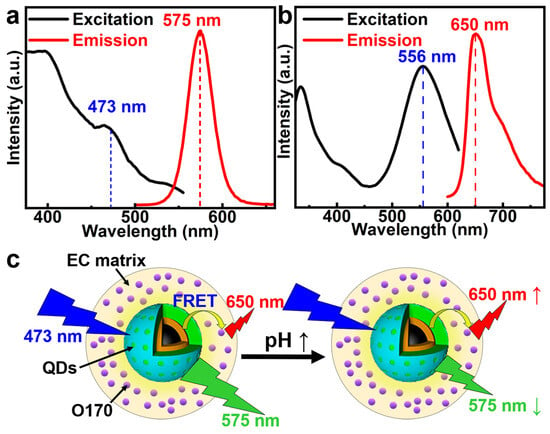
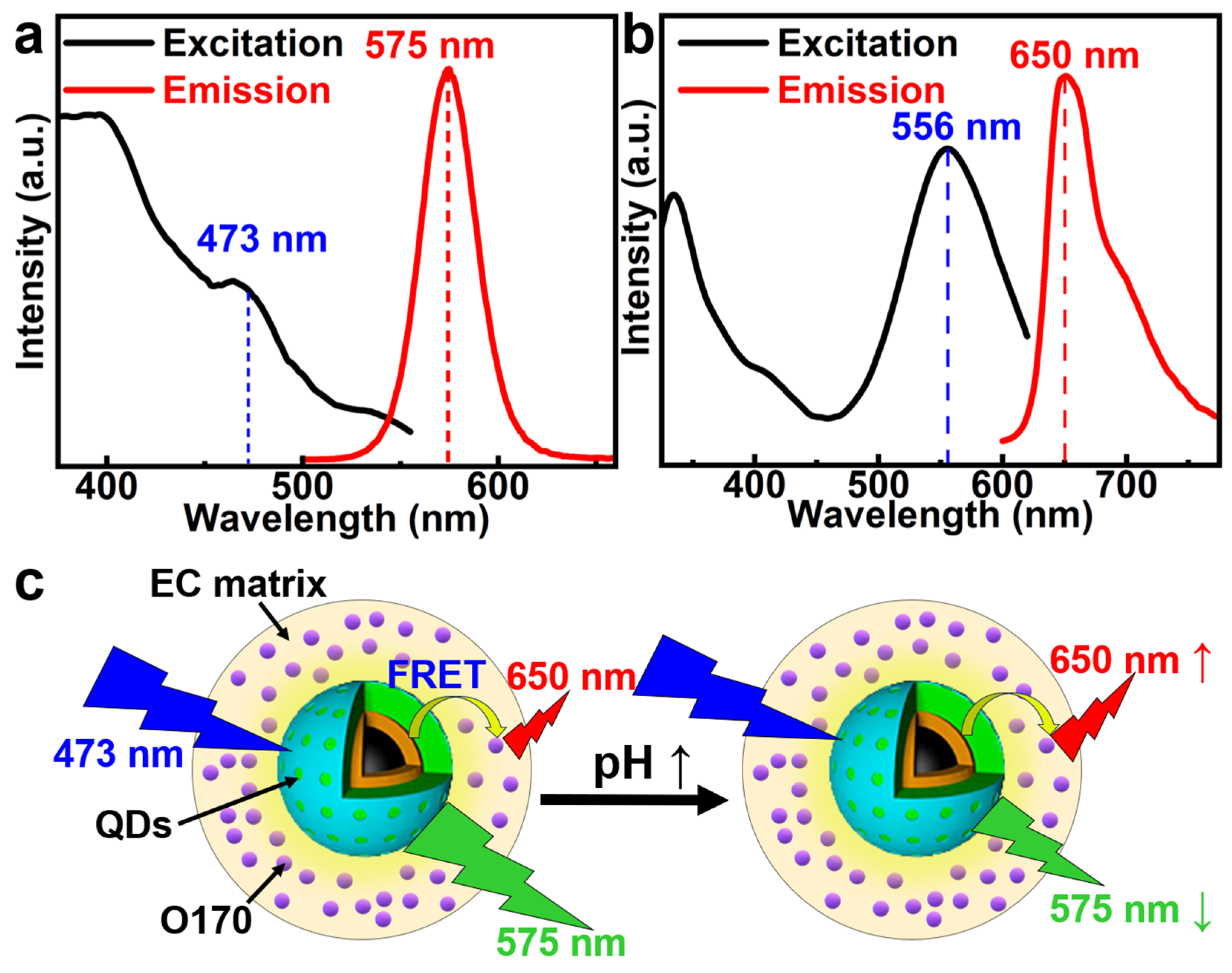
As a core component of the pH sensor, the sensitive element decorating the surface of the spider silk waveguide is designed as a composite material consisting of two fluorescent materials (CdSe/ZnS QDs and O170 dye) and an organic matrix material (EC), as shown in Figure 1. The reasons for such a design are as follows. Firstly, both of the fluorescent materials have excellent optical properties and are sensitive to pH. Secondly, the excitation spectrum of the O170 dye (Shanghai Acmec Biochemical Technology Co., Ltd., Shanghai, China) and the emission spectrum of CdSe/ZnS QDs (Wuhan Jiayuan Quantum Dots Co., Ltd., Wuhan, China) have a good overlap, as shown in Figure 1a,b. It provides a prerequisite for the occurrence of the FRET from the QDs to the O170 dye, and then constructs a dual-emission ratiometric pH sensor. Considering a lower propagation loss of the spider silk and a stronger evanescent field on its surface under an excitation of a longer-wavelength light [33], 473 nm is selected as the excitation wavelength of CdSe/ZnS QDs (black line in Figure 1a); thus, the CdSe/ZnS QDs will emit a light with a peak wavelength of 575 nm (red line in Figure 1a). The O170 dye presents an obvious absorbance in the green band (peak wavelength: 556 nm, black line in Figure 1b), which matches well with the emission of the QDs and facilitates the generation of FRET between them; its emission peak is concentrated at 650 nm (red line in Figure 1b), which can be easily distinguished from the emission band of the CdSe/ZnS QDs and facilitates the acquisition and analysis of the fluorescent signals in the following pH-sensing application. Finally, the introduction of EC is mainly to encapsulate the above two fluorescent materials, which can further ensure the stability and safety of the sensor structure and avoid the negative impact on sensor performance and the environment caused by the detachment of the fluorescent material or its direct contact with the surrounding environment. Figure 1c shows a schematic of the designed composite material and its pH-sensing mechanism. The CdSe/ZnS QDs (as the donor) and the O170 dye (as the acceptor) are encapsulated by the EC matrix; when a 473 nm light irradiates the composite material, the CdSe/ZnS QDs are firstly excited; a portion of the energy of the QDs is transferred to the O170 dye by the FRET effect and then the O170 dye emits a 650 nm-wavelength fluorescent light; the remaining energy of the QDs is converted into the energy of 575 nm-wavelength emission light; the emission light intensity I575 and I650 of the two fluorescent materials can be decreased and increased, respectively, with an increasing pH value of the surrounding liquid environment. Thus, the pH value can be detected in real time by collecting photoluminescence (PL) spectra of the sensor and measuring the emission intensity ratio I575/I650. Here, it is necessary to clarify the reasons for the decreasing I575 and the increasing I650 with increasing pH value. The oil-soluble CdSe/ZnS QDs used in this work are functionalized with amine-based ligands coordinating to Zn2+ sites on the ZnS shell, thereby introducing non-radiative carrier recombination centers. The stronger coordination between the amine ligands and Zn2+ will cause more photo-generated carriers in the QDs to recombine through these centers, leading to more significant fluorescence quenching. As the environmental pH value increases, the protonation state of amine ligands decreases while their deprotonation degree increases; it can strengthen their coordination to Zn2+ via electrostatic interactions, gradually changing from repulsion to attraction, thereby resulting in enhanced fluorescence quenching. This explanation is consistent with the previously reported work [35,36]. The enhancement in the luminescence intensity I650 of the O170 dye with increasing pH is primarily attributed to the increase in its molar absorptivity at higher pH [37]. This change improves the spectral overlap between the QDs’ emission and the O170 absorption and promotes energy transfer from the QDs to the O170 dye via the FRET process, ultimately leading to an increase in the luminescence intensity of O170.
Figure 1.
Design of the sensitive element of the pH sensor. (a) Excitation and emission spectra of the QDs. (b) Excitation and emission spectra of O170 dye. (c) Schematic of the designed composite material and its pH-sensing mechanism.
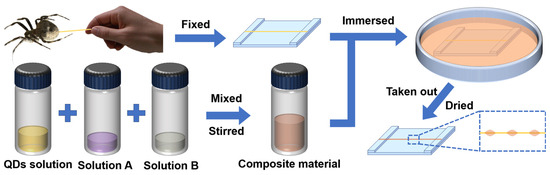
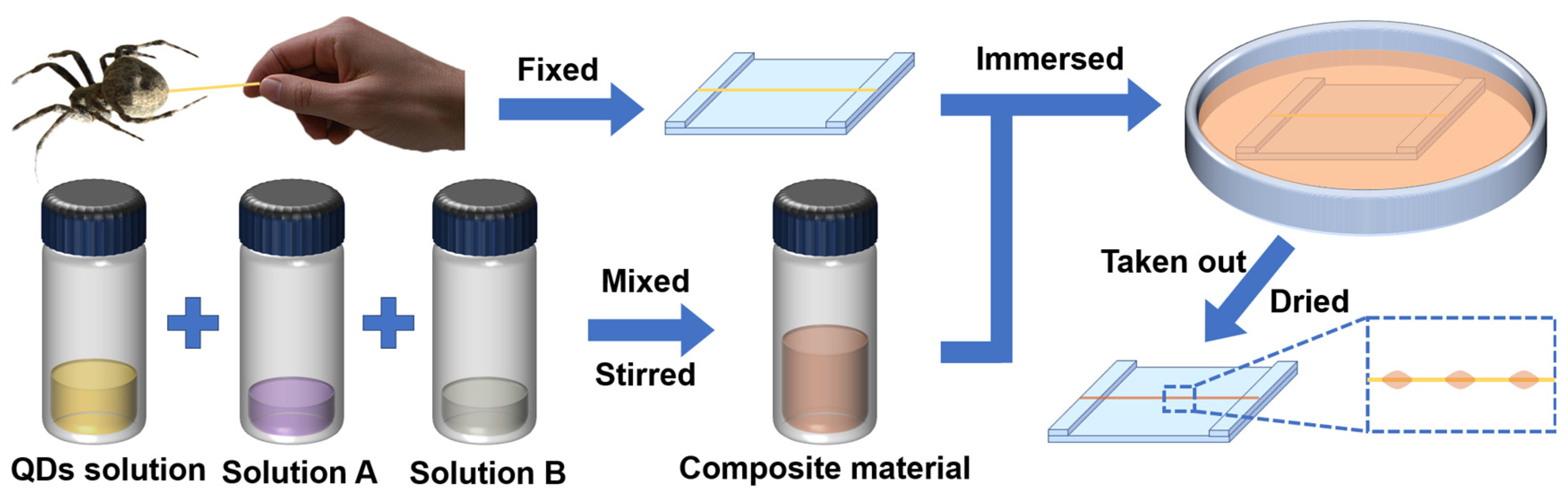
The preparation process of the pH sensor is schematically shown in Figure 2. The spider silk is first dragged from the Araneus ventricosus by a one-step drawing method, and its diameter can be adjusted by controlling the drawing speed. In general, the diameter of the spider silk decreases with increasing drawing speed, and it can be controlled from 6.0 to 0.5 μm by adjusting the drawing speed from 0.05 to 0.5 m/s. An appropriate diameter should meet both a strong evanescent field on the surface of the spider silk and a good mechanical property in a pH-sensing application. Secondly, the dragged spider silk is fixed on a glass slide with steps on both sides for further surface modification. Here, it should remain in a tense and suspended state to achieve a good light transmission. The next step is the preparation of a pH-sensitive composite material. Solution A is obtained by dissolving 1 g of EC in 4 mL of ethanol and 10 mL of n-hexane. Solution B is obtained by dissolving 2 mg of O170 dye in 10 mL of tetrahydrofuran. The pH-sensitive composite material is prepared by mixing 1 mL of CdSe/ZnS QDs solution (concentration: 3 mg/mL) with 0.5 mL of solution A and 0.5 mL of solution B and then stirring them at a speed of 25 r/min for 20 min at room temperature; thus, the composite material solution is successfully prepared, and the QDs and the O170 dye in it can be fully mixed and encapsulated by the EC matrix, which is conducive to producing the FRET effect and then achieving sensitive and safe pH sensing. The last and most important step is decorating the composite material onto the surface of the spider silk by a self-assembly synthesis. After being immersed in the composite material solution for 2 min, the spider silk is taken out and then put in a dark and dry environment for 24 h; under the influence of surface tension, a series of uniformly spaced spindle-shaped structures are formed on the surface of spider silk after the solvent evaporates. Thus, the CdSe/ZnS QDs and O170 dye-decorated spider silk pH sensor are successfully prepared.
Figure 2.
Preparation of the pH sensor.
2.2. Characterization of the pH Sensor
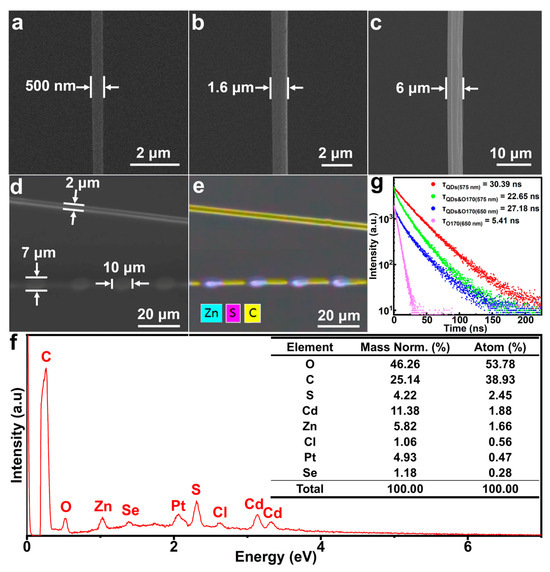
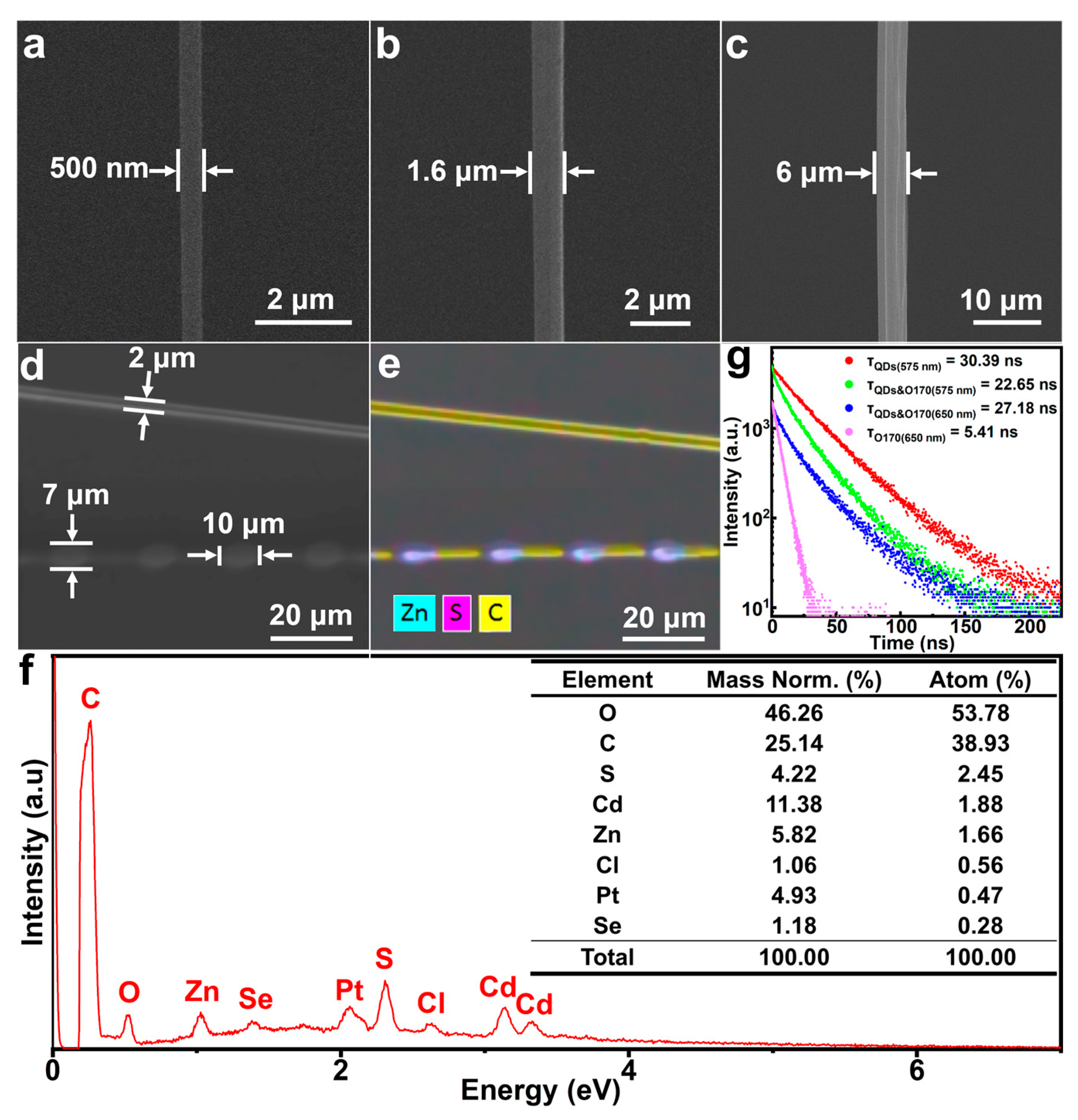
By controlling the drawing speed, size-controlled spider silks can be obtained. As examples, Figure 3a–c show three representative SEM images of the prepared spider silks with the diameters of 500 nm, 1.6 μm, and 6 μm, respectively, which present good diameter uniformity and surface smoothness. The spider silk with an overly large diameter has an extremely weak evanescent wave on its surface, which will be unfavorable to the excitation of fluorescent materials and thereby affect the sensitivity of the pH sensor; the spider silk with an overly small diameter lacks sufficient mechanical strength and is prone to breaking during the subsequent surface modification and pH-sensing process. Taking into account the above, we believe that the spider silk with a diameter within 1.0–2.5 μm is suitable for the preparation and application of the pH sensor. As an example, a 2.0 μm-diameter spider silk (the drawing speed: 0.15 m/s) was used in the following experiments. The corresponding SEM images of the spider silk before and after the surface modification are shown on the top and bottom of Figure 3d, respectively. Compared with the smooth and flat surface of the naked spider silk before the modification, a series of spindle-shaped structures indeed appear on the surface of the spider silk after the modification. They have a similar size (length: ~10 μm, waist diameter: ~7 μm) and are evenly distributed at regular intervals.
Figure 3.
Characterization of the pH sensor. (a–c) Representative SEM images of the prepared spider silk with the diameter of 500 nm (a), 1.6 μm (b), and 6 μm (c). (d) SEM images of the spider silk before (top) and after (bottom) the surface modification used in this work. (e) Back Scattered Electron (BSE) image corresponding to (d). (f) EDS spectrum and elemental analysis of the spider silk decorated by the spindle-shaped structures. (g) PL decay curves of the QDs, O170 dye, and the pH sensor (QDs&O170).
To confirm the composition of the spindle-shaped structures and further verify that the CdSe/ZnS QDs and O170 dye encapsulated by the EC matrix were decorated on the surface of the spider silk, the related investigations have been performed using backscattered electron (BSE) imaging and energy-dispersive X-ray spectroscopy (EDS) techniques. Figure 3e shows the BSE images corresponding to Figure 3d. The presence of Zn and S within these spindle-shaped structures indicates the encapsulation of CdSe/ZnS QDs; due to the significantly lower mass fraction of the O170 dye compared to the QDs, it is not labeled in the image. As a result, the EDS spectrum and the elemental analysis are further collected, as shown in Figure 3f. It reveals the presence of C, O, Zn, Se, Pt, S, Cl, and Cd. Specifically, C and O originate from the spider silk, O170 dye, and EC matrix; Cd, Se, Zn, and S are derived from the CdSe/ZnS QDs; Cl originates from the O170 dye; and Pt comes from a conductive film coated on the surface of the sample to enhance conductivity for SEM imaging. The results indicate that the composition of the spindle-shaped structures is indeed the prepared composite material above. That is, the CdSe/ZnS QDs and O170 dye encapsulated by the EC matrix have been decorated on the surface of the spider silk, and the pH sensor was successfully fabricated.
To validate the occurrence of FRET between the CdSe/ZnS QDs and O170 dye in the prepared pH sensor and to ensure the realization of ratiometric pH sensing, the PL decay curves of both the QDs and QDs&O170 (the spindle-shaped structures on the pH sensor) were measured, and the corresponding fluorescence lifetimes τ were calculated, as shown in Figure 3g. The PL decay curves were fitted with a double exponential function y(t) = Aexp(−t/τ1) + Bexp(−t/τ2), and then the average τ could be calculated by the expression τ = (Aτ12 + Bτ22)/(Aτ1 + Bτ2) [38]. Based on the above, the calculated lifetime of the CdSe/ZnS QDs sample is τQDs(575 nm) = 30.39 ns (red), while that of the QDs in the spindle-shaped structures decreases to τQDs&O170(575 nm) = 22.65 ns (green), which confirms that the FRET occurs from the QDs to the O170 dye. In addition, the PL decay curves of the pH sensor at 650 nm are also recorded and shown in Figure 3g. The lifetime of O170 dye in the spindle-shaped structures (τQDs&O170(650 nm) = 27.18 ns, blue) is significantly higher than that of the light-excited O170 dye (τO170(650 nm) = 5.41 ns, purple), which also proves the existence of the FRET between the QDs and O170 dye. The efficiency of FRET (ηFRET) can also be calculated according to the value of the donor lifetimes with (τDA) and without (τD) the acceptor, expressed as ηFRET = (1 − τDA/τD) × 100% [38]. In this work, τDA and τD represent the lifetime of 575 nm emission of the QDs and the QDs&O170, respectively. The ηFRET is calculated to be 25.48%. It is further proved that the FRET occurs between the CdSe/ZnS QDs and O170 dye in the prepared pH sensor, which can also ensure the realization of ratiometric pH sensing. In addition, the above also implies the donor–acceptor distance in this work is less than 10 nm (the key distance between the acceptor and the donor in the case of a FRET mechanism). To prove this point more intuitively, additional experiments have been performed (see TEM image (Figure S1) and elemental mapping analysis of the composite material (Figure S2) in the Supporting Information). This indicates that the QDs and the O170 dye are evenly mixed and the distance between them is less than 10 nm, which further ensures the occurrence of FRET.
2.3. Sensing Applications of the pH Sensor
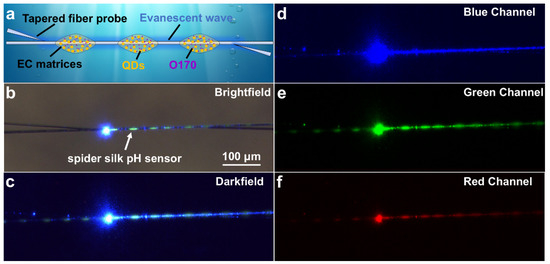
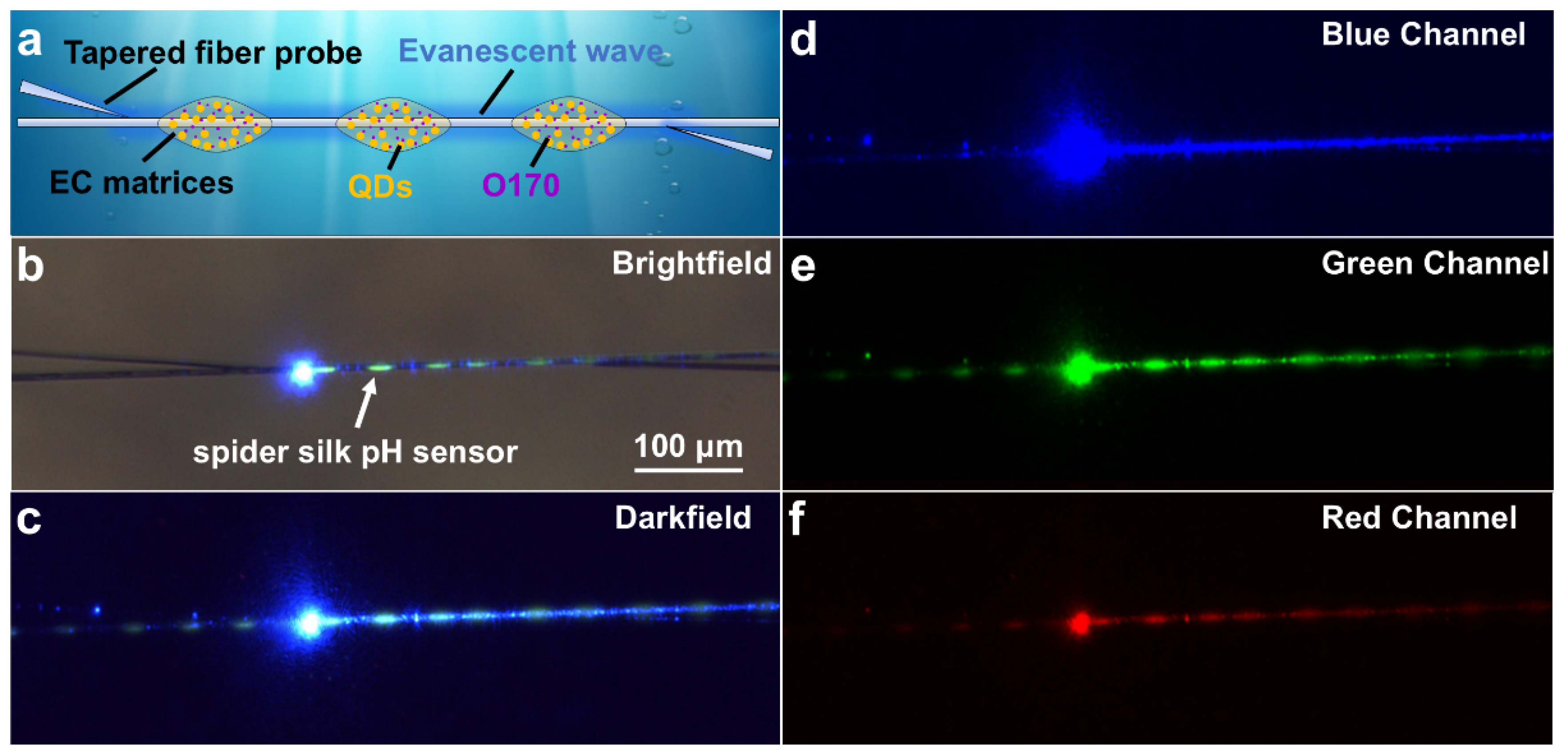
Based on the above analysis and prediction, the proposed CdSe/ZnS QDs and O170 dye-decorated spider silk can be applied in pH sensing. Figure 4a shows the corresponding schematic diagram. A 473 nm laser beam is coupled into one end of the spider silk by a tapered optical fiber probe and will transmit along the surface of the spider silk in a form of evanescent wave; it can excite the CdSe/ZnS QDs and then O170 dye based on the FRET; the green and red emission lights will also transmit along its surface, which can be coupled out from the other end of the spider silk by another tapered optical fiber probe and then collected by an optical spectrometer. Thus, the pH value of the surrounding environment can be detected by analyzing the spectra and measuring the emission intensity ratio I575/I650. Figure 4b,c show two optical micrographs of bright and dark fields, respectively, corresponding to Figure 4a. Obviously, the 473 nm laser beam can be successfully coupled into the spider silk pH sensor and effectively transmitted along its surface. Moreover, green emission lights from the CdSe/ZnS QDs can be clearly observed at the position of the spindle-shaped structures, but the red emission light from the O170 dye cannot be identified due to its weak intensity. In order to distinguish them more clearly, the dark-field optical micrograph in Figure 4c is separated into the blue (Figure 4d), the green (Figure 4e), and the red channel (Figure 4f), respectively. In addition to the blue excitation light and the green emission light, the red emission light is also clearly observed, which is very beneficial for effectively collecting their spectra and then ensuring sensitive pH sensing.
Figure 4.
Schematic diagram and optical micrographs for pH sensing. (a) Schematic of the pH sensing. (b–f) Optical micrographs of pH sensing. They are from bright field (b), dark field (c), blue channel (d), green channel (e), and red channel (f), respectively.
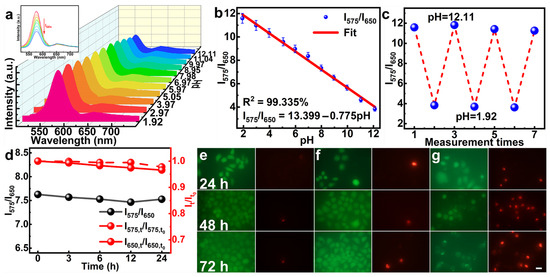
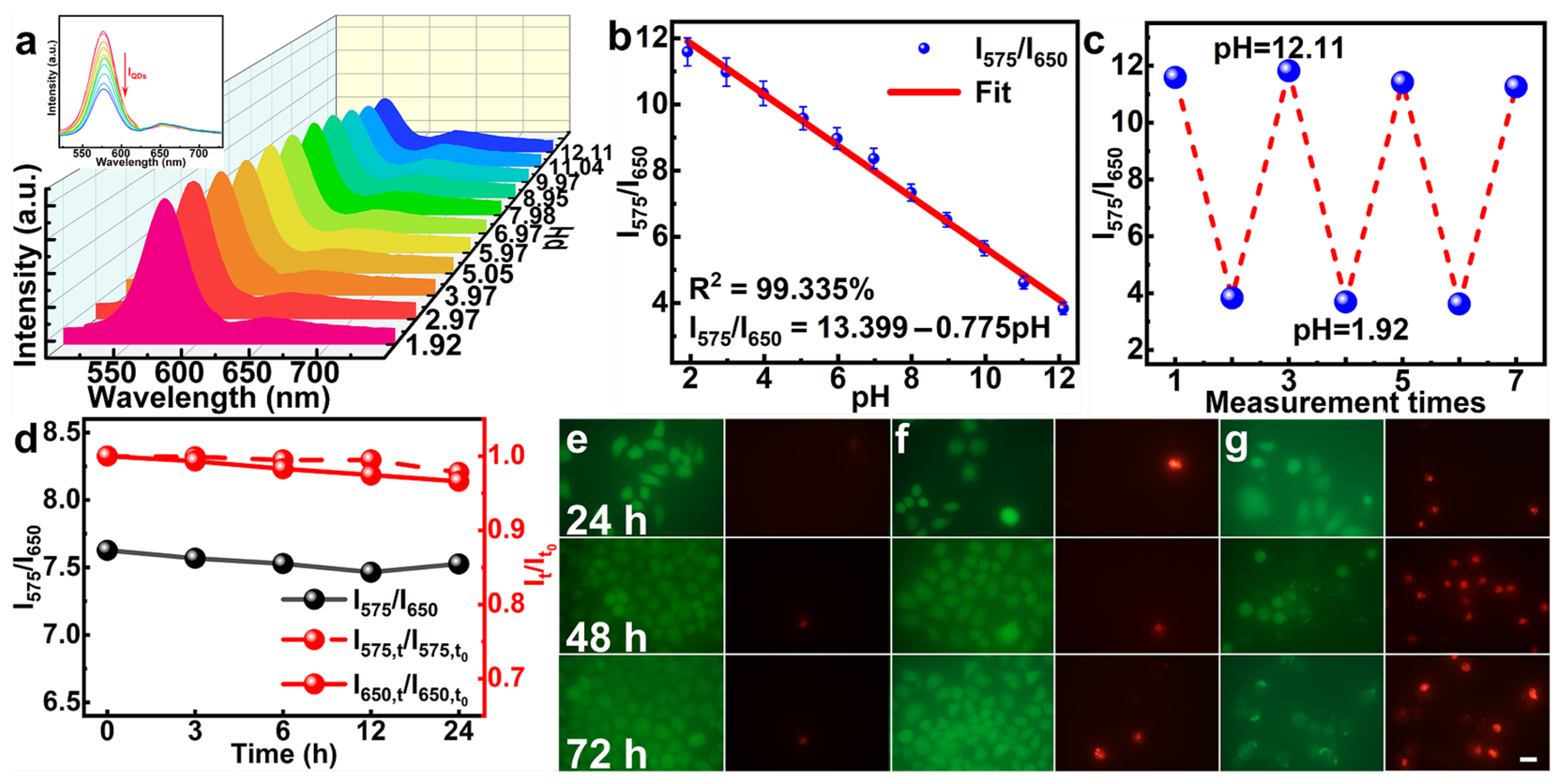
To quantify the pH-sensing ability of the proposed CdSe/ZnS QDs and O170 dye-decorated spider silk, 11 gradient solutions with pH values ranging from 1.92 to 12.11 were prepared by mixing 1 mol/L NaOH solution, 1 mol/L HCl solution, and deionized water in different proportions and successively dripped into the sample cell. Before changing the solution with a different pH value, the pH sensor needs to be rinsed three times with deionized water and then once with ethanol. Moreover, during this operation process, it is necessary to keep the positions and angles of the two tapered optical fibers unchanged as much as possible, which is mainly to maintain a stable evanescent wave coupling and ensure the stability and accuracy of the pH sensing. Figure 5a shows the collected PL spectra in the different pH solutions. To visually display the change in the emission intensity of the QDs relative to that of the O170 dye in different pH solutions (i.e., the variation in the emission intensity ratio I575/I650), each spectrum is adjusted to unify the emission intensity of the O170 dye, as shown in the inset of Figure 5a. It does not compromise the accuracy of the sensing results. Obviously, the emission peak intensity (I575) of the QDs decreases with increasing pH. The intensity ratio I575/I650 in different pH solutions is calculated, as shown in Figure 5b. It exhibits a linear dependence on the pH value, which can be fitted with a linear regression equation I575/I650 = 13.399–0.775 pH and a correlation coefficient (R2) of 99.335%. The results indicate that the sensitivity of the proposed pH sensor is up to 0.775/pH unit and also prove that the pH sensor has great detection accuracy in a wide pH range from 1.92 to 12.11.
Figure 5.
Applications of the pH sensor. (a) Collected PL spectra of the pH sensor in the 11 different pH solutions ranging from 1.92 to 12.11. The inset shows the adjusted spectra with uniform emission intensity of the O170 dye. (b) Calculated intensity ratio I575/I650 in different pH solutions. (c,d) Reversibility (c) and stability (d) evaluations of the proposed pH sensor. (e–g) Biosafety evaluation of HeLa cells in the standard culture medium (e), the leaching culture medium of the proposed sensor (f), and the culture medium with 2 μM Cd2+ (the positive control group) (g) for 72 h. The cell viability is assessed every 24 h. The scale bar is 20.0 μm.
In addition, the reversibility, stability, and biosafety of the proposed pH sensor were also investigated to further evaluate its sensing performance, as shown in Figure 5c–f. By alternately immersing the prepared pH sensor in solutions with pH values of 1.92 and 12.11, the reusability and reversibility were first tested. Figure 5c presents the measured intensity ratio I575/I650 over 3 consecutive cycles. The sensor exhibits a highly responsive reaction to pH changes, and no significant fluctuations in intensity ratio after each detection cycle were observed. The maximum deviation of the intensity ratio did not exceed 2% in the cycle test. Hence, it can be concluded that the proposed pH sensor exhibits excellent reusability and reversibility. To evaluate the time stability of the proposed pH sensor, multiple repeated experiments were performed in the same pH solution. Taking the solution with pH = 5.97 as an example, Figure 5d shows the six repeated measurements at times (t) of 0, 3, 6, 12, and 24 h, as shown in Figure 5d. I575,t/I575,t0 (red dotted polyline) represents the variation in the emission intensity of the QDs (t0 refers to t = 0 h), which decreases by less than 2.5% within 24 h; I650,t/I650,t0 (red solid polyline) represents the variation in the emission intensity of the O170 dye, which decreases by less than 3.5% within 24 h; I575,t/I650,t (black solid polyline) represents the variation in the emission intensity ratio of the pH sensor, and its fluctuation is calculated to be less than 1.5%. Hence, the spider silk pH sensor has excellent stability, and it could effectively reduce the effect of photobleaching on sensing stability.
To verify the biosafety of the proposed pH sensor, taking HeLa cells as an example, further experiments on cell culture have been performed. HeLa cells were cultured for 72 h in the standard culture medium (Figure 5e) and the leaching culture medium of the proposed sensor (Figure 5f), respectively, and the corresponding cell viability was assessed every 24 h. Based on the 72 h half-maximal inhibitory concentration (IC50) of Cd2+ for HeLa cells [39], a culture medium containing 2 μM of Cd2+ was set as the positive control group (Figure 5g). Before each viability assay, the cells were treated with a live/dead stain using Calcein-AM/PI. Following staining, live cells emit green fluorescence at 517 nm when excited by blue light at 494 nm, while dead cells emit red fluorescence at 617 nm when excited by green light at 535 nm. The corresponding dark-field (fluorescence) optical microscopic images are shown in Figure 5e–g. Within the 72 h period, both the leaching culture medium and the standard culture medium support a high cell viability, with no significant difference observed between them. In contrast, the cell viability in the positive control group is significantly lower than that in the other two groups, indicating that Cd2+ has a marked inhibitory effect on the biological activity of HeLa cells. The result demonstrates that the proposed pH sensor would not release toxic substances (such as cadmium) into the solution during the detection process, providing strong evidence for its great biocompatibility and biosafety.
Compared with other reported ratiometric methods for pH sensing [13,20,24,40,41,42], the prepared pH sensor in this work provides a comparable or higher sensing sensitivity within a wider pH range, as shown in Table 1. Moreover, it was also demonstrated to have excellent reusability and reversibility, structure and time stability, biocompatibility, and biosafety. It suggests a promising application in in vivo real-time monitoring and environmental detection of pH.
Table 1.
Comparison of the proposed pH sensor with other reported ratiometric pH sensors.
3. Conclusions
In this work, a novel, flexible, compact, and dual-emission ratiometric pH sensor was successfully developed by decorating EC-encapsulated CdSe/ZnS QDs and O170 dye on the surface of the spider silk. Firstly, it combined pH-sensitive CdSe/ZnS QDs and pH-dependent FRET from CdSe/ZnS QDs to the O170 dye, avoiding the influence caused by factors unrelated to pH and enabling the sensitive, stable, and dual-emission ratiometric pH sensing; secondly, it introduced the organic EC matrix, avoiding the detaching of the fluorescent materials or their direct contacts with the surrounding detecting environment, and ensuring the stability and biosafety of the sensor structure; finally, it integrated the sensitive element and the flexible, biocompatible and compact natural spider silk, adding more exceptional performance in in situ detection, reusability, pollution-free and residue-free operation, flexibility, and biosafety. The sensor was experimentally demonstrated to have a high sensing sensitivity (0.775/pH unit) within a wide pH range of 1.92–12.11, which is comparable to or better than those of other reported ratiometric pH fluorescent sensing. The excellent performance and outstanding advantages of the proposed pH sensor not only show its great potential in highly sensitive pH sensors, but also provide a reference idea for the development of microenvironmental detection and biosensing.
Supplementary Materials
The following supporting information can be downloaded at: https://www.mdpi.com/article/10.3390/coatings16010110/s1, Figure S1. TEM image of the composite material. Figure S2. Back Scattered Electron (BSE) image and the corresponding element mapping analysis of the composite material.
Author Contributions
Conceptualization, Y.T., H.Z.; Methodology, Y.T., H.Z., J.Z. and C.L.; Formal analysis, Y.T., H.Z., R.X., G.Y.; Investigation, Y.T., H.Z., R.X., Q.W., J.Z., P.Y.; Data curation, Y.T., R.X.; Writing—original draft, Y.T., H.Z., R.X.; Writing—review & editing, H.L.; Visualization, Y.T. and H.Z.; Supervision, H.L.; Project administration, H.L.; Funding acquisition, H.L., P.Y. All authors have read and agreed to the published version of the manuscript.
Funding
This work was supported by the National Key Research and Development Program of China (2021YFA1200903), the National Natural Science Foundation of China (NSFC) (12374299 and 11974435), and the Natural Science Foundation of Guangdong Province (2024A1515011756 and 2018A030313498).
Institutional Review Board Statement
Not applicable.
Informed Consent Statement
Not applicable.
Data Availability Statement
The original contributions presented in this study are included in the article/Supplementary Materials. Further inquiries can be directed to the corresponding author.
Conflicts of Interest
The authors declare no conflicts of interest.
References
- Song, J.; Liu, S.; Zhao, N.; Zhao, L. A new fluorescent probe based on metallic deep eutectic solvent for visual detection of nitrite and pH in food and water environment. Food Chem. 2023, 398, 133935. [Google Scholar] [CrossRef] [Scilit]
- Korostynska, O.; Arshak, K.; Gill, E.; Arshak, A. Review Paper: Materials and Techniques for In Vivo pH Monitoring. IEEE Sens. J. 2008, 8, 20–28. [Google Scholar] [CrossRef]
- Bratash, O.; Buhot, A.; Leroy, L.; Engel, E. Optical fiber biosensors toward in vivo detection. Biosens. Bioelectron. 2024, 251, 116088. [Google Scholar] [CrossRef] [Scilit]
- Min, R.; Hu, X.; Pereira, L.; Simone Soares, M.; Silva, L.C.B.; Wang, G.; Martins, L.; Qu, H.; Antunes, P.; Marques, C.; et al. Polymer optical fiber for monitoring human physiological and body function: A comprehensive review on mechanisms, materials, and applications. Opt. Laser Technol. 2022, 147, 107626. [Google Scholar] [CrossRef] [Scilit]
- Li, L.; Zhang, Y.-n.; Zhang, H.; Li, X.; Zhao, Y. Advances in Optical Fiber Aptasensor for Biochemical Sensing Applications. Adv. Mater. Technol. 2023, 8, 2300137. [Google Scholar] [CrossRef] [Scilit]
- Li, Y.; Luo, S.; Gui, Y.; Wang, X.; Tian, Z.; Yu, H. Difunctional Hydrogel Optical Fiber Fluorescence Sensor for Continuous and Simultaneous Monitoring of Glucose and pH. Biosensors 2023, 13, 287. [Google Scholar] [CrossRef] [Scilit] [PubMed]
- Hassan Akhtar, M.; Azhar Hayat Nawaz, M.; Abbas, M.; Liu, N.; Han, W.; Lv, Y.; Yu, C. Advances in pH Sensing: From Traditional Approaches to Next-Generation Sensors in Biological Contexts. Chem. Rec. 2024, 24, e202300369. [Google Scholar] [CrossRef] [Scilit] [PubMed]
- Avolio, R.; Grozdanov, A.; Avella, M.; Barton, J.; Cocca, M.; De Falco, F.; Dimitrov, A.T.; Errico, M.E.; Fanjul-Bolado, P.; Gentile, G.; et al. Review of pH sensing materials from macro- to nano-scale: Recent developments and examples of seawater applications. Crit. Rev. Environ. Sci. Technol. 2022, 52, 979–1021. [Google Scholar] [CrossRef] [Scilit]
- Vivaldi, F.; Salvo, P.; Poma, N.; Bonini, A.; Biagini, D.; Del Noce, L.; Melai, B.; Lisi, F.; Francesco, F.D. Recent Advances in Optical, Electrochemical and Field Effect pH Sensors. Chemosensors 2021, 9, 33. [Google Scholar] [CrossRef] [Scilit]
- Gong, P.; Li, X.; Zhou, X.; Zhang, Y.; Chen, N.; Wang, S.; Zhang, S.; Zhao, Y. Optical fiber sensors for glucose concentration measurement: A review. Opt. Laser Technol. 2021, 139, 106981. [Google Scholar] [CrossRef] [Scilit]
- Wencel, D.; Kaworek, A.; Abel, T.; Efremov, V.; Bradford, A.; Carthy, D.; Coady, G.; McMorrow, R.C.N.; McDonagh, C. Optical Sensor for Real-Time pH Monitoring in Human Tissue. Small 2018, 14, 1803627. [Google Scholar] [CrossRef] [Scilit]
- Steinegger, A.; Wolfbeis, O.S.; Borisov, S.M. Optical Sensing and Imaging of pH Values: Spectroscopies, Materials, and Applications. Chem. Rev. 2020, 120, 12357–12489. [Google Scholar] [CrossRef] [Scilit]
- Zhang, Z.; Zhang, H.; Hou, L.; Jia, D.; Yao, K.; Meng, Q.; Qu, J.; Yan, B.; Luan, Q.; Liu, T. Highly sensitive fiber-optic chemical pH sensor based on surface modification of optical fiber with ZnCdSe/ZnS quantum dots. Anal. Chim. Acta 2024, 1294, 342281. [Google Scholar] [CrossRef] [Scilit]
- Ackermann, J.; Metternich, J.T.; Herbertz, S.; Kruss, S. Biosensing with Fluorescent Carbon Nanotubes. Angew. Chem. Int. Ed. 2022, 61, e202112372. [Google Scholar] [CrossRef] [Scilit] [PubMed]
- Xu, S.-L.; Guo, F.-F.; Xu, Z.-H.; Wang, Y.; James, T.D. A hemicyanine-based fluorescent probe for ratiometric detection of ClO- and turn-on detection of viscosity and its imaging application in mitochondria of living cells and zebrafish. Sens. Actuators B Chem. 2023, 383, 133510. [Google Scholar]
- He, H.; Sun, D.-W.; Wu, Z.; Pu, H.; Wei, Q. On-off-on fluorescent nanosensing: Materials, detection strategies and recent food applications. Trends Food Sci. Technol. 2022, 119, 243–256. [Google Scholar] [CrossRef] [Scilit]
- Gui, R.; Jin, H. Organic fluorophores-based molecular probes with dual-fluorescence ratiometric responses to in-vitro/in-vivo pH for biosensing, bioimaging and biotherapeutics applications. Talanta 2024, 275, 126171. [Google Scholar] [CrossRef] [Scilit]
- Liang, J.; Yang, L.; Ye, Z.; Tang, Y.; Ouyang, H.; Yang, G.; Lei, H. CdSe/ZnS quantum dots-doped polymer optical fiber microprobe for pH sensing. Opt. Express 2025, 33, 2475–2486. [Google Scholar] [CrossRef] [Scilit]
- Xue, S.; Jiang, X.-F.; Zhang, G.; Wang, H.; Li, Z.; Hu, X.; Chen, M.; Wang, T.; Luo, A.; Ho, H.-P.; et al. Surface-plasmon-enhanced optical formaldehyde sensor based on CdSe@ZnS quantum dots. ACS Sens. 2020, 5, 1002–1009. [Google Scholar] [PubMed]
- Li, Z.; Wang, X.; Fu, X.; Liu, J.; Liu, Y.; Zhang, H. Ratiometric fluorescent capillary sensor for real-time dual-monitoring of pH and O2 fluctuation. Spectrochim. Acta Part A Mol. Biomol. Spectrosc. 2025, 327, 125388. [Google Scholar] [CrossRef] [Scilit] [PubMed]
- Shamsipur, M.; Babaee, E.; Gholivand, M.-B.; Molaabasi, F.; Hajipour-Verdom, B.; Sedghi, M. Intrinsic dual emissive insulin capped Au/Ag nanoclusters as single ratiometric nanoprobe for reversible detection of pH and temperature and cell imaging. Biosens. Bioelectron. 2024, 250, 116064. [Google Scholar] [CrossRef] [Scilit]
- López Aveiga, M.G.; Ramos, M.D.F.; Núnez, V.M.; Vallvey, L.F.C.; Casado, A.G.; Medina Castillo, A.L. Portable fiber-optic sensor for simple, fast, cost-effective, and environmentally friendly quantification of total acidity in real-world applications. Sens. Actuators B Chem. 2024, 417, 136214. [Google Scholar] [CrossRef] [Scilit]
- Li, Z.; Lan, N.; Cheng, Z.; Jin, F.; Song, E.; Xu, Z.; Zhang, Y.; Feng, Y.-Z.; Cai, X.; Ran, Y.; et al. In vivo fiber-optic fluorescent sensor for real-time pH monitoring of tumor microenvironment. Chem. Eng. J. 2024, 493, 152495. [Google Scholar] [CrossRef] [Scilit]
- Chen, Q.; Li, S.; Tu, X.; Zhang, X. Skin-attachable Tb-MOF ratio fluorescent sensor for real-time detection of human sweat pH. Biosens. Bioelectron. 2024, 263, 116606. [Google Scholar] [CrossRef] [Scilit]
- Mu, H.; Shao, S.; Wu, B.; Miki, K.; Kobayashi, M.; Harada, H.; Ohe, K. Fast tumor imaging using pH-responsive aggregation of cyanine dyes with rapid clearance. Sens. Actuators B Chem. 2024, 413, 135876. [Google Scholar] [CrossRef] [Scilit]
- Quan, Z.; Chen, Z.; Li, H.; Sun, S.; Xu, Y. A hydrogel sensor based on cellulose nanofiber/polyvinyl alcohol with colorimetric-fluorescent bimodality for non-invasive detection of urea in sweat. Int. J. Biol. Macromol. 2024, 276, 133760. [Google Scholar] [CrossRef] [Scilit]
- Cheng, C.; Terreno, E. Development of a versatile optical pH sensor array for discrimination of anti-aging face creams. Talanta 2024, 278, 126447. [Google Scholar] [CrossRef] [Scilit]
- Muhammad, N.A.M.; Awang, N.A.; Talip, B.A.; Zalkepali, N.U.H.H.; Supaat, M.I. Highly sensitive adulteration detection in kelulut honey utilizing fiber Bragg grating technology with Q-switched pulse erbium-doped fiber laser and innovative spider silk substrate. Sens. Actuators A Phys. 2024, 376, 115656. [Google Scholar] [CrossRef] [Scilit]
- Hendra, Y.H.; Heah, W.Y.; Malay, A.D.; Numata, K.; Yamamoto, Y. Micrometer-Scale Optical Web Made of Spider Dragline Fibers with Optical Gate Operations. Adv. Opt. Mater. 2023, 11, 2202563. [Google Scholar] [CrossRef] [Scilit]
- Zhang, M.; Liu, Z.; Zhang, Y.; Zhang, Y.; Zhang, J.; Yang, X.; Yuan, L. Spider Silk as a Flexible Light Waveguide for Temperature Sensing. J. Light. Technol. 2023, 41, 1884–1889. [Google Scholar] [CrossRef] [Scilit]
- Wang, J.; Zhang, H.; Tang, Y.; Wen, M.; Yao, B.; Yuan, S.; Zhang, W.; Lei, H. Metal-Nanostructure-Decorated Spider Silk for Highly Sensitive Refractive Index Sensing. ACS Biomater. Sci. Eng. 2022, 8, 1060–1066. [Google Scholar] [CrossRef] [Scilit]
- Little, D.J.; Kane, D.M. Investigating the transverse optical structure of spider silk micro-fibers using quantitative optical microscopy. Nanophotonics 2017, 6, 341–348. [Google Scholar] [CrossRef] [Scilit]
- Zhang, W.; Liu, P.; Yang, G.; Lei, H. Single Polylactic Acid Nanowire for Highly Sensitive and Multifunctional Optical Biosensing. ACS Appl. Mater. Interfaces 2021, 13, 27983–27990. [Google Scholar] [CrossRef] [Scilit] [PubMed]
- Gong, Z.; Wu, T.; Chen, X.; Guo, J.; Zhang, Y.; Li, Y. Upconversion Nanoparticle Decorated Spider Silks as Single-Cell Thermometers. Nano Lett. 2021, 21, 1469–1476. [Google Scholar] [CrossRef] [Scilit]
- Li, D.; Xu, H.; Li, D.; Wang, Y. p-Aminothiophenol-coated CdSe/ZnS quantum dots as a turn-on fluorescent probe for pH detection in aqueous media. Talanta 2017, 166, 54–62. [Google Scholar] [CrossRef] [Scilit]
- Ando, M.; Kamimura, T.; Uegaki, K.; Biju, V.; Ty, J.D.T.; Shigeri, Y. Reversible photoluminescence sensing of gaseous alkylamines using CdSe-based quantum dots. Sens. Actuators B Chem. 2017, 246, 1074–1079. [Google Scholar] [CrossRef] [Scilit]
- Zhang, H.; Jin, Q.; Song, X.; Li, H.; Jia, D.; Liu, T. Oxazine-functionalized CdSe/ZnS quantum dots for photochemical pH sensing. ACS Appl. Nano Mater. 2020, 3, 10996–11006. [Google Scholar] [CrossRef] [Scilit]
- Zhang, W.; Li, J.; Lei, H.; Li, B. Temperature-dependent Förster resonance energy transfer from upconversion nanoparticles to quantum dots. Opt. Express 2020, 28, 12450–12459. [Google Scholar] [CrossRef] [Scilit]
- Kareem, A.; Zafar, H.; Sherwani, A.; Mohammad, O.; Khan, T.A. Synthesis, characterization and in vitro anticancer activity of 18-membered octaazamacrocyclic complexes of Co(II), Ni(II), Cd(II) and Sn(II). J. Mol. Struct. 2014, 1075, 17–25. [Google Scholar] [CrossRef] [Scilit]
- Xue, X.-L.; Wang, Y.; Chen, S.; Wang, K.-P.; Niu, S.-Y.; Zong, Q.-S.; Jiang, Y.; Hu, Z.-Q. Monitoring intracellular pH using a hemicyanine-based ratiometric fluorescent probe. Spectrochim. Acta Part A Mol. Biomol. Spectrosc. 2023, 284, 121778. [Google Scholar] [CrossRef] [Scilit]
- Qi, X.; Wang, Y.; Wu, F.; Long, X.; Lv, X.; Du, X.; Li, Y.; Huang, X.; Bai, T.; Xing, S. Bicomponent-quantum-dots based ratiometric fluorescence pH sensing platform constructed through placing in close proximity strategy for multiple bio-applications. Microchem. J. 2025, 217, 115092. [Google Scholar] [CrossRef] [Scilit]
- Zhou, J.; Ren, Y.; Nie, Y.; Jin, C.; Park, J.; Zhang, J.X.J. Dual fluorescent hollow silica nanofibers for in situ pH monitoring using an optical fiber. Nanoscale Adv. 2023, 5, 2180–2189. [Google Scholar] [CrossRef] [Scilit] [PubMed]

Disclaimer/Publisher’s Note: The statements, opinions and data contained in all publications are solely those of the individual author(s) and contributor(s) and not of MDPI and/or the editor(s). MDPI and/or the editor(s) disclaim responsibility for any injury to people or property resulting from any ideas, methods, instructions or products referred to in the content. |
© 2026 by the authors. Licensee MDPI, Basel, Switzerland. This article is an open access article distributed under the terms and conditions of the Creative Commons Attribution (CC BY) license.