1. Introduction
In recent years, the rapid expansion of the market has led the global LIB recycling market to reach over 18 billion dollars by 2030, demonstrating the considerable scale of industrial development [
1]. While stringent global regulations (e.g., EU Battery Regulation, China’s power battery recycling policies) mandating high material recovery rates and low-carbon processes further amplify the urgency of advancing efficient recycling technologies. Considering the reduction in the hazards of harmful substances in used batteries and the economic benefits of recycling valuable metals from them, the recycling and treatment of used batteries are extremely urgent [
2,
3]. Currently, commercial pyrometallurgical and hydrometallurgical recycling mainly extract valuable metals and lithium salts. However, these two traditional recycling methods either consume high energy or involve complex processes and generate large amounts of acidic and alkaline waste liquids, all of which limit recycling efficiency [
4,
5]. In contrast, the direct regeneration method for repairing the cathode materials of used batteries does not require the extraction of metal elements but instead restores their performance. Due to its low energy consumption, high efficiency, and environmental friendliness, direct recycling is considered an important development direction for LIB recycling [
6]. Generally, lithium loss from the cathode materials of ternary lithium-ion batteries during cycling is the primary cause of their failure [
7]. The loss of lithium leads to lithium-ion vacancies in the cathode materials, and Ni
2+ fills these vacancies, making the deintercalation and intercalation of lithium ions difficult and further exacerbating the loss of lithium ions [
8]. At the same time, the loss of lithium generates stress, causing microcracks on the surface of the particles, and simultaneously produces by-products such as spinel and rock salt phases, which continuously reduce the capacity of the cathode materials. Furthermore, under high voltage, the release of oxygen also causes the migration of transition metals, leading to structural degradation, as well as fast charging, causing the electrolyte to accelerate side reactions, resulting in an increase in impedance [
5]. Therefore, the direct regeneration strategy focusing on lithium replenishment and structural restoration provides a key approach for effective positive electrode recovery.
Regarding the performance degradation issue of spent ternary lithium-ion batteries, researchers have conducted various explorations. Fan et al. repaired the spent NCM materials through solid-phase sintering. They mixed an excess amount of Li
2CO
3 with the spent NCM and heated it at 850 °C for 12 h. The results showed that the direct solid-phase sintering method was effective [
9]. Shi et al. used a hydrothermal lithiumization method to repair degraded NCM materials, thereby obtaining positive electrode materials with excellent electrochemical performance [
10]. Chen et al. compared the solid–liquid regeneration environment after molten salt melting with the traditional solid–solid repair method and achieved good performance [
11]. Based on this, two or more lithium salts were combined to form a eutectic system, reducing the melting point to enable the molten salt to encapsulate the cathode materials and promote the diffusion of lithium ions, thereby better compensating for lithium loss and structural deterioration. This molten salt method is not only efficient for repairing the structure of the spent cathode but also has lower costs and energy consumption.
Based on the above research, this paper directly recycles spent ternary lithium-ion battery cathode materials using a two-stage sintering method with a eutectic lithium salt of Li2CO3 and LiOH (molar ratio LiOH:Li2CO3 = 7:3). Both LiOH and Li2CO3 prevent the generation of toxic halogenated or sulfurous gases that are commonly produced by other lithium sources. The composition of the molten salt can balance cost and regeneration performance. Once a specific temperature is reached, the lithium salt melts, forming a liquid that encapsulates the spent NCM and replenishes the lithium ions lost. Subsequently, it is annealed at a higher temperature to restore its layered structure, reducing defects such as spinel, rock salt phase, and lithium-nickel mixed arrangement, and yielding a regenerated cathode material with better performance. In summary, this paper provides reference values for revealing the degradation mechanism of spent NCM cathode materials and improving the direct regeneration method using molten salt.
2. Experimental Section
2.1. Materials and Method
Processing of cathode materials in spent batteries: After cleaning the surface of the retired pouch battery (NCM523), it was placed in a 5% concentration saltwater solution for discharge for 24 h. Then, the battery was manually disassembled in a fume hood, and the cathode sheet, anode sheet, and separator were extracted separately. The cathode sheet was immersed in DMC organic solvent to remove residual electrolyte. The cathode sheet was dried and cut into small pieces of approximately 3 × 3 cm. These small pieces were sintered in a muffle furnace at 400 °C, 500 °C, and 600 °C, with sintering times of 1, 2, and 3 h. In this thermal treatment process, the cathode powder was peeled from the aluminum foil (Al foil) and recorded as S-NCM523.
Direct regeneration of cathode materials: The S-NCM523 powder was mixed with the molten salt (LiOH and Li2CO3 in a molar ratio of 7:3) at molar ratios of 1:0.2, 1:0.3, and 1:0.4, and ground evenly. The mixed sample was pre-sintered at 500 °C in an oxygen atmosphere for 5 h, cooled to room temperature, and then fully ground. Then, it was subjected to a second sintering in an oxygen atmosphere at 800 °C for 6 h (heating rate of 5 °C/min). The regenerated samples were recorded as R-20, R-30, and R-40.
2.2. Materials Characterization
The elemental composition of the samples was determined by ICP-OES (iCAP7400, Thermo Scientific, Waltham, MA, USA). The thermogravimetric analysis was conducted in air at a heating rate of 5 °C/min within the temperature range of 25 °C to 800 °C (Netzsch, Selb, Germany) to assess the optimum sintering temperature. The crystal structure of the samples was characterized using an X-ray diffractometer (Bruker D8-A25, Bruker, Ettlingen, Germany), with the test range set at 10–80 ° (2θ angle), and a continuous scanning mode was performed at a step speed of 1°/min. The original XRD data were refined using Rietveld refinement. The chemical state of the material’s surface was investigated by X-ray photoelectron spectroscopy (Thermo Scientific, Waltham, MA, USA). For microscopic morphology characterization, observations were performed using a field-emission scanning electron microscope (HITACHI S-4800, Tokyo, Japan).
2.3. Electrochemical Measurements
Mix the cathode powder, polyvinylidene fluoride (binding agent) and acetylene black (conductive agent) in a mass ratio of 8:1:1 in the NMP solvent and stir thoroughly. Apply the prepared slurry evenly onto the aluminum foil, then dry it in a vacuum oven at 80 °C for 12 h. Use a cutting machine to shape the cathode sheet into a 12 mm diameter circle, with an active material loading of approximately 3–4 mg. Assemble a 2025-type button cell (H2O ≤ 0.1 ppm, O2 ≤ 0.1 ppm) in a glove box filled with argon gas. The materials used include a 2025-type cathode shell, a cathode sheet, a Celgard 2325 separator, 502A electrolyte, a lithium metal sheet (16 mm × 1.5 mm), a 0.8 mm spacer, and a 2025-type anode shell. Then conduct charge–discharge, rate and cycle performance tests on the NEWARE battery testing system. The working voltage of the button cell is set at 2.8–4.3 V (relative to Li+/Li), for long-term cycle testing (current density of 0.5 C) and rate testing (current densities of 0.2 C, 0.5 C, 1 C, 2 C, 3 C, 5 C, 10 C, 0.2 C), where 1 C = 160 mAh/g. Test its cyclic voltammetry (CV) performance and electrochemical impedance spectroscopy (EIS) on the electrochemical workstation (CHI660E). Perform CV tests at a scan rate of 1 mV/S, with a voltage range of 2.5–4.6 V (relative to Li+/Li). The EIS test frequency is within the range of 100 kHz–0.01 Hz.
3. Results and Discussion
To explore the optimal extraction efficiency of the cathode powder, the cathode sheets were cut into small pieces for subsequent sintering research.
Figure S1 shows the comparison of electrode sheets and Al foil after sintering at different temperatures and times. The left side of each group of pictures is the unsintered electrode sheet, and the right side is the Al foil after sintering and the separation of the cathode powder. The experimental results indicate that when the sintering temperature reaches 500 °C or the sintering time exceeds 2 h, the separation effect of the cathode powder from the Al foil is better.
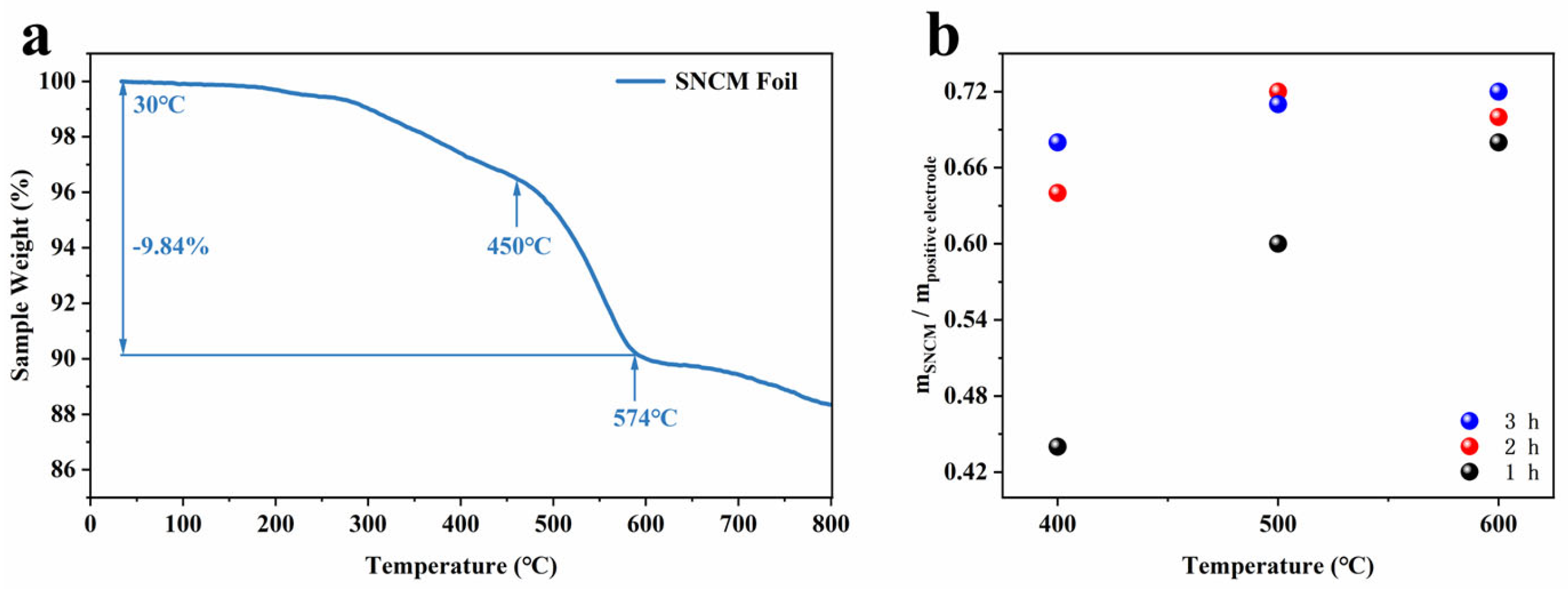
Figure 1a presents the thermogravimetric analysis results of the electrode sheet. The reduction in electrode sheet mass is mainly due to the thermal decomposition of organic components (residual electrolyte, binder, and conductive agent). The results show that when the temperature reaches 450 °C, the electrode sheet mass slightly decreases. As the temperature rises to 574 °C, the electrode sheet mass decreases significantly, indicating that the organic components (binder and conductive agent) undergo extensive decomposition, which is conducive to the separation of the cathode sheet from the Al foil. When the temperature exceeds 574 °C, although the electrode sheet mass continues to decrease, the excessively high temperature significantly increases the cost.
Figure 1b shows the extraction rate of the S-NCM523 cathode, that is, the ratio of cathode active materials mass to cathode sheet mass. The experimental results show that under sintering conditions of 500 °C for 2 h and 600 °C for 3 h, the cathode extraction rate reaches 72%. Combining thermogravimetric analysis and extraction rate data, it is determined that 500 °C for 2 h is the optimal process condition, which also considers the economic and efficiency of the process.
The elements in the S-NCM523 and regenerated samples were tested using ICP-OES.
Table S1 indicates that the contents of Ni, Co, and Mn elements in the four samples all conform to the molecular formula ratio of NCM523. S-NCM523 has approximately 4% loss of lithium ions. After sintering with the melted lithium salt, the lithium ions in the samples are replenished. Among them, the lithium content in the R-30 sample is the highest, while the lithium content in the R-40 sample, which has the largest amount of added lithium salt, actually decreases. This indicates that too many lithium ions cannot be added to the crystal lattice of S-NCM523. Samples regenerated with an appropriate amount of lithium salt can restore performance while also considering cost.
The phase structure of the samples was characterized by X-ray diffraction (XRD).
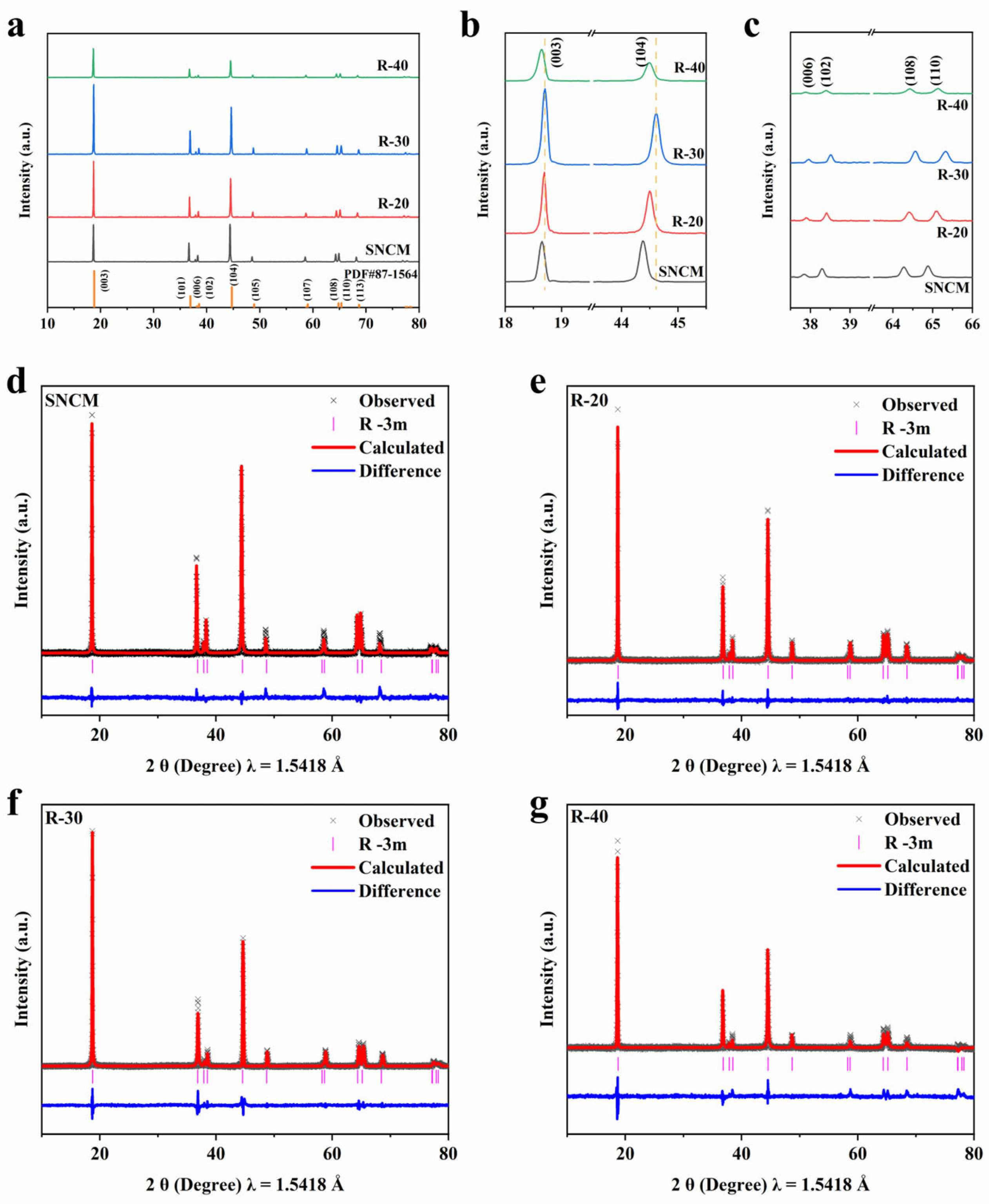
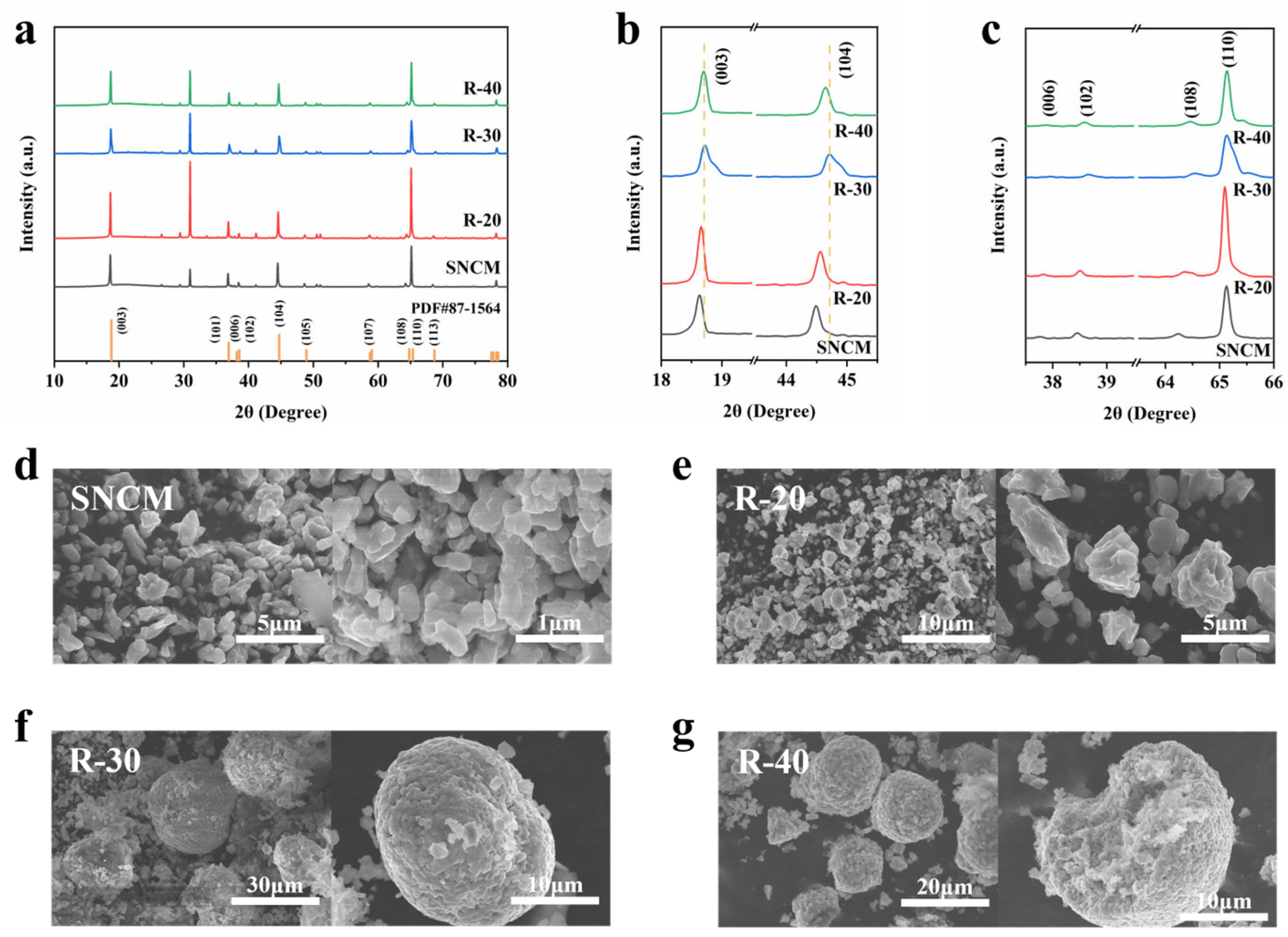
Figure 2a shows that both S-NCM523 and the regenerated samples exhibit the hexagonal crystal structure of α-NaFeO
2, space group R-3m, which is consistent with the standard PDF card (PDF#87-1564). However, there are still specific differences in the structure between the S-NCM523 sample and the regenerated sample. When the ratio of the (003) peak to the (104) peak in the XRD spectrum is greater than 1.2, it is considered that the Li
+/Ni
2+ intermixing is relatively small [
12,
13].
Figure 2b and
Table S2 indicate that the intensity of the (003) peak of the S-NCM523 sample is relatively low, and the intensity ratio of the (003) peak to the (104) peak is 1.17, indicating that Li
+/Ni
2+ is intermixing in the sample, and its crystal structure has been disrupted. In contrast, the intensity ratio of the (003) peak and the (104) peak of the regenerated sample is greater than 1.2, indicating that the Li
+/Ni
2+ intermixing degree of the regenerated sample is reduced and its crystal structure has been effectively improved. At the same time, the splitting degree of the two pairs of peaks, (006) peak and (102) peak, as well as (108) peak and (110) peak, can be used to determine the structural changes in the ternary material [
14,
15]. As shown in
Figure 2c, the two sets of peaks of the regenerated sample are split to a certain extent, and the (108) peak and (110) peak of this sample have a slightly larger angle compared to other samples, which is basically consistent with the standard PDF card. From
Figure 2b, the (003) peak and the (104) peak of R-30 are higher in angle compared to other samples. During the battery charging process, the formation of lithium vacancies induces local stress in the lattice. This stress further triggers lattice distortion along the c-axis direction, causing the (003) peak in the XRD spectrum to shift to a lower angle direction [
10,
16]. After the regeneration treatment, it can be observed that the (003) peak of the R-30 sample returns to a higher angle position, indicating that its crystal structure repair is the best.
The lattice parameters and ion disordering changes were analyzed using Rietveld refinements, as shown in
Figure 2d–g and
Table S3. From the table, due to the loss of lithium ions, S-NCM523 exhibited severe Li
+/Ni
2+ disordering and c-parameter expansion (14.2440 Å). The Li
+/Ni
2+ disordering in the four samples was 15%, 9%, 4%, and 6%, respectively, indicating that the degree of Li
+/Ni
2+ disordering in the regenerated samples was improved. Among them, the R-30 sample had the best disordering degree and lattice distortion repair effect (14.1987 Å).
The surface morphology and microstructure of the samples were characterized by scanning electron microscopy (SEM).
Figure S2 shows that the basic morphology of the secondary particles of S-NCM523 is still spherical. Still, there are more fragmented small particles, indicating that some S-NCM523 particles split into smaller particles after cyclic degradation. However, the small particles in the regenerated samples are significantly reduced.
The valence states of transition metals in S-NCM523 and R-30 were determined using X-ray photoelectron spectroscopy (XPS).
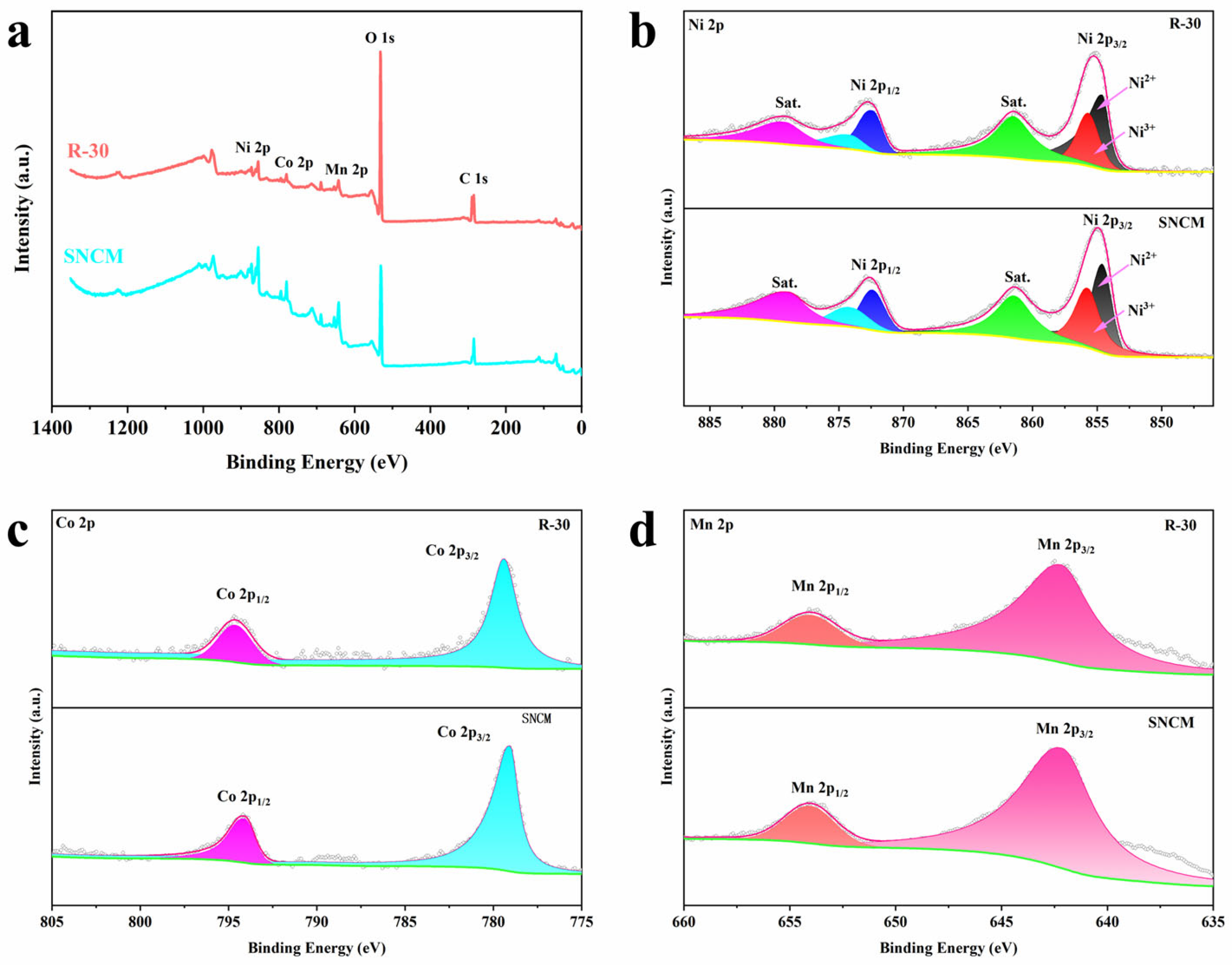
Figure 3a shows the full spectra of S-NCM523 and R-30.
Figure 3b is the detailed spectrum of Ni 2p, where the binding energies at 854.8 eV and 872.4 eV correspond to the characteristic peaks of Ni 2p
3/2 and Ni 2p
1/2 [
17,
18]. The binding energy of Ni
3+ is 854.6 eV, and that of Ni
2+ is 855.7 eV [
19]. The proportion of Ni
2+ ions in S-NCM523 and R-30 obtained by fitting is 58.26% and 48.77%, respectively. After regeneration treatment, the proportion of Ni
2+ in the R-30 sample decreased by 9.49%, confirming that the degree of lithium-nickel ion disorder in the crystal structure has significantly decreased, which is consistent with the XRD refinement results. For the detailed spectrum of Co 2p (
Figure 3c), the binding energies at 779.0 eV and 794.1 eV correspond to the characteristic peaks of Co 2p
3/2 and Co 2p
1/2, indicating that the Co element in the sample is still in the +3 valence state [
20]. Meanwhile, in
Figure 3d, the binding energies at 642.1 eV and 653.9 eV correspond to the characteristic peaks of Mn 2p
3/2 and Mn 2p
1/2, indicating that the Mn element in the sample is in the +4 valence state [
21]. In summary, the regenerated sample R-30 significantly reduces the proportion of Ni
2+ ions in S-NCM523 while maintaining Co and Mn in the +3 and +4 valence states, respectively.
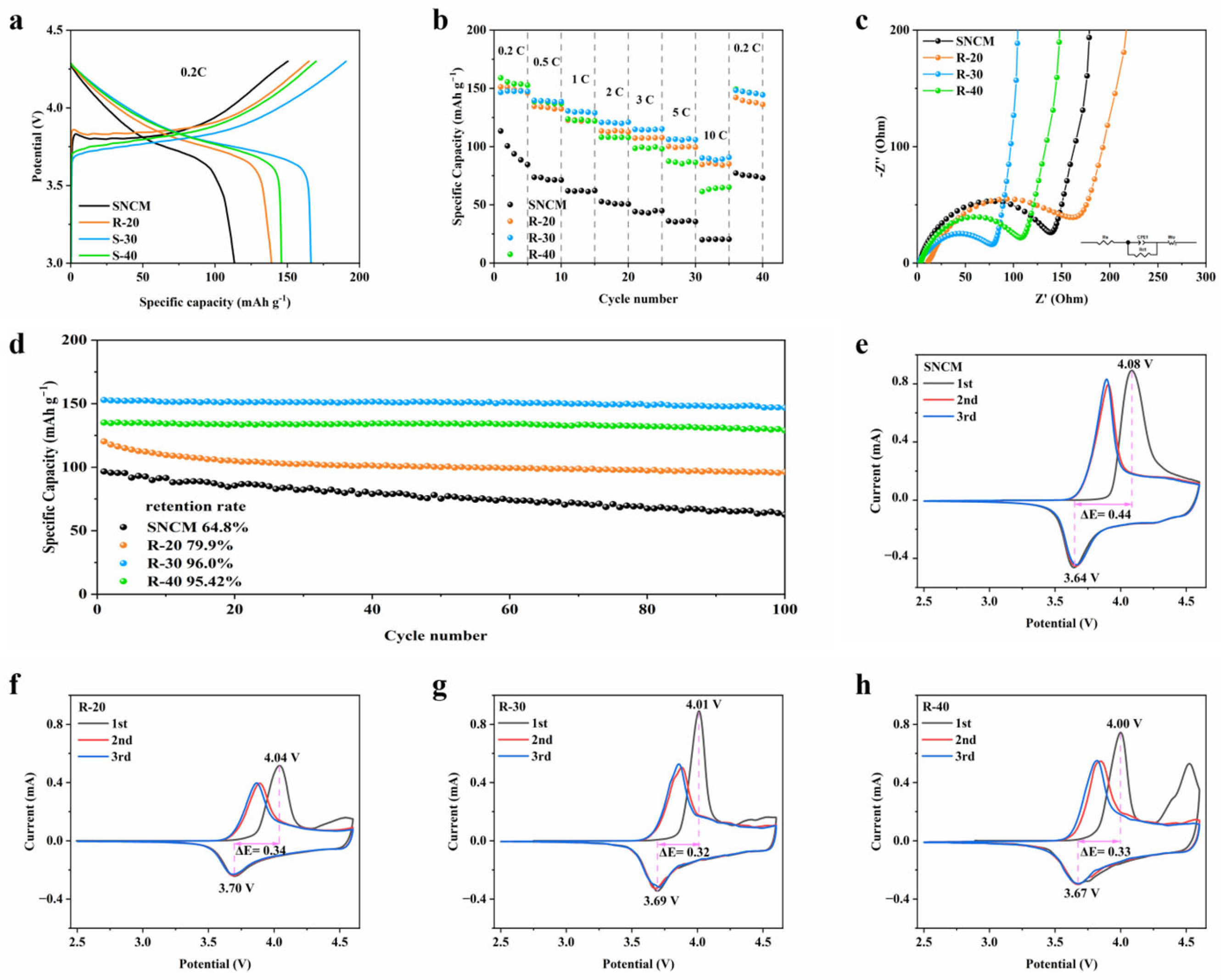
Figure 4a shows that the four samples have relatively gentle charging and discharging platforms ranging from 3.7 V to 4 V, consistent with the redox process of Ni ions [
22]. This indicates that the materials in the four samples exhibit typical electrochemical behavior of a ternary lithium-ion battery. At 0.2 C, the first-round specific discharge capacity of the four samples is 113.4, 139.0, 166.2, and 145.9 mAh/g, and the Coulomb efficiency is 70.9%, 84.2%, 87.2%, and 85.8%, respectively. After regeneration, the specific discharge capacity of the samples significantly increases, and the Coulomb efficiency also rises above 80%.
Figure 4b is the rate performance diagram of different samples. After cycling at the maximum rate of 10 C and returning to 0.2 C, the average specific discharge capacity of S-NCM523 at 0.2 C changes from the original 96.2 mAh/g to 75.1 mAh/g, while the R-30 sample changes from 154.9 mAh/g to 146.7 mAh/g, which is 94.7% of the original. In contrast, the repaired R-30 sample shows excellent capacity and rate performance. To compare the electrochemical kinetic properties of the materials after regeneration, electrochemical impedance spectroscopy (EIS) was performed, and the results are shown in
Figure 4c. There is a semicircle in the high-frequency region. The intersection point with the X-axis represents the ohmic impedance (R
s), and the diameter of the semicircle is related to the interface charge transfer impedance (R
ct), which is in the low-frequency region as a straight line with a slope related to the diffusion of Li
+ in the active material (the Warburg impedance) [
23]. The fitting results of the samples are shown in
Table S4. The R
ct values for the four samples are 142.40 Ω, 128.60 Ω, 76.96 Ω, and 110.20 Ω, respectively. R-30 shows the lowest Rct, which is almost half of S-NCM523. The lower charge transfer resistance indicates a faster ionic conductivity between the electrolyte and the electrode, which is due to the repair of the layered structure of R-30, reducing the defects that hinder the migration of Li
+/Ni
2+. The long-cycle performance of the four samples at 0.5 C is shown in
Figure 4d. The initial discharge specific capacities of S-NCM523, R-20, R-30, and R-40 are 96.5 mAh/g, 120.3 mAh/g, 152.9 mAh/g, and 135.1 mAh/g, respectively. After 100 cycles, the capacity retention rates of S-NCM523, R-20, R-30, and R-40 are 64.8%, 79.9%, 96.0%, and 95.4%, respectively. The R-30 shows excellent specific discharge capacity and a high capacity retention rate, indicating that lithium ions have been replenished in the regenerated samples, the structure has been restored, and its electrochemical performance has been improved.
Figure 4e–h show the CV curves of S-NCM523, R-20, R-30, and R-40, respectively. The phase transformation of the samples from the hexagonal (H1) phase to the monoclinic (M) phase occurs, and a similar phase transformation (H1→M→H1) occurs during the delithiation/lithiation process of the samples, indicating that the regenerated samples have good phase transformation reversibility [
24]. The oxidation peak potential (E
oxidation), reduction peak potential (E
reduction), and potential difference (ΔE = E
oxidation − E
reduction) of the samples are shown in
Table S5. R-30 has a lower potential difference compared to S-NCM523, indicating smaller electrode polarization and better cycle reversibility.
To explore the structural evolution of the materials after cycling, S-NCM523 and regenerated samples were assembled into a button cell and cycled for 100 times before being disassembled.
Figure 5a shows the XRD spectra of the samples after cycling, indicating that both S-NCM523 and regenerated samples maintained a relatively good crystal structure of α-NaFeO2 in the hexagonal crystal system.
Figure 5b shows that the ratios of the (003) peak and (104) peak of the samples have decreased, which may be related to the slight Li
+/Ni
2+ intercalation in the samples after cycling. In
Figure 5c, the four peaks of (006), (102), (108), and (110) of the samples are well separated, but the intensities of the first three peaks have decreased, while the intensity of the (110) peak has increased, which is consistent with the structural degradation mechanisms such as Li
+/Ni
2+ intercalation and the formation of rock salt phase.
Figure 5d–g show the SEM images of the samples after cycling. The secondary particles of the regenerated samples all exhibited different degrees of structural degradation, and the spherical structure decomposed into smaller, irregular fragments. In contrast, the secondary particles of the R-30 maintained a relatively intact morphology and structure after cycling.
Figure S3 shows the lithium sheet images of the battery after 100 cycles. The lithium sheet of the R-30 sample has the cleanest surface and the smallest black-region area, indicating that it generated the fewest by-products during cycling, which ensures its structural stability and excellent electrochemical performance during charging and discharging.



 ,
,