


Abstract
Herein, we propose a simple and cost-effective method for fabricating moderate-sensitivity surface-enhanced Raman scattering (SERS) substrates using Cu-plasma polymer fluorocarbon (Cu-PPFC) nanocomposite films fabricated through RF sputtering. The use of a composite target composed of carbon nanotube (CNT), Cu, and polytetrafluoroethylene (PTFE) powders (5:60–80:35–15 wt%) offers the advantage of the simple fabrication of moderate-sensitivity SERS substrates with a single cathode compared to co-sputtering. X-ray photoelectron spectroscopy (XPS) revealed that the film surface was partially composed of metallic Cu with Cu-F bonds and Cu–O bonds, confirming the coexistence of the conducting and plasmon-active domains. UV-VIS spectroscopy revealed a distinct absorption peak at approximately 680 nm, indicating the excitation of localized surface plasmon resonances in the Cu nanoclusters embedded in the plasma polymer fluorocarbon (PPFC) matrix. Atomic force microscopy and grazing incidence small-angle X-ray scattering analyses confirmed that the Cu nanoparticles were uniformly distributed with interparticle distances of 20–35 nm. The Cu-PPFC nanocomposite film with the highest Cu content (80 wt%) exhibited a Raman enhancement factor of 2.18 × 10⁴ for rhodamine 6G, demonstrating its potential as a moderate-sensitivity SERS substrate. Finite-difference time-domain (FDTD) simulations confirmed the strong electromagnetic field localization at the Cu-Cu nanogaps separated by the PPFC matrix, corroborating the experimentally observed SERS enhancement. These results suggest that a Cu-PPFC nanocomposite film, easily fabricated using a composite target, provides an efficient and scalable route for fabricating reproducible, inexpensive, and moderate-sensitivity SERS substrates suitable for practical sensing applications.
1. Introduction
SERS is an innovative spectroscopic technique that amplifies Raman scattering signals by plasmonic nanostructures, enabling ultra-sensitive single-molecule analysis through a signal enhancement of 103–1014 times compared to conventional Raman spectroscopy [1,2,3,4]. SERS has been extensively studied for various environmental and biomedical applications, including the detection of environmental pollutants [1,5], food contaminants [6,7], therapeutic drugs [1], and cancer cells [8]. SERS is realized through the synergistic contributions of electromagnetic (EM) and chemical (CM) mechanisms. EM is caused by the electric field concentration induced by localized surface plasmon resonance, and CM is caused by charge transfer between the molecules and the metal surface [4]. The SERS enhancement factor can generally be classified into three sensitivity levels: moderate (103–105), high (106–108), and ultra-high (109–1014), each with its own application areas and technological characteristics [9,10,11]. Among these, the moderate-sensitivity region is the most suitable range for practical commercialization, providing an enhancement factor of the order of 103–105. This range is characterized by excellent reproducibility and mass-production potential and is economical owing to its low manufacturing costs. The main applications are food safety monitoring (detection of pesticides and antibiotic residues) [6,7], environmental pollution monitoring (heavy metals and organic pollutants) [5], and security screening [12]. Moderate-sensitivity SERS substrates are mainly fabricated through the fusion of photonic crystal design and semiconductor manufacturing technology, which enables precise control of the nanostructure while maintaining low cost.
A relatively simple process to uniformly control the nanoparticles is a key feature of the moderate-sensitivity substrates. This allowed for evenly distributed hotspots, resulting in consistent signal enhancement across the entire substrate. Silver nanoarrays on anodic aluminum oxide (AAO) or flexible PDMS substrates have been reported to achieve stable enhancement across the sensitivity range [7]. Moderate-sensitivity SERS substrates are actively applied in food safety and medical diagnostics, such as the detection of levofloxacin in milk and blood glucose sensing. Their applications are expanding to security screening and environmental monitoring [7,12,13,14,15]. In particular, moderate-sensitivity SERS substrates can be manufactured at a relatively low cost using mass-production processes, which makes them advantageous for commercialization.
Copper (Cu) plasmonics operate across a broad spectral range from visible to near-infrared [16] and can also be used to implement surface plasmons in the ultraviolet region [8]. Compared to gold and silver, they are attracting attention as the only low-cost plasmonic materials for UV applications [2,8,17,18,19]. Cu-based SERS substrates can achieve moderate to high sensitivity enhancement factors, with the highest-performing Cu SERS substrates reported to have enhancement factors of up to 108 [8].
Cu SERS substrates can be fabricated using various methods, including electrochemical deposition [8,20], laser ablation [16,21,22], chemical reduction [1,23,24], chemical vapor deposition [25], surface plasmon-mediated chemical solution deposition [26], electrochemical deposition, atomic layer deposition [27], and sputtering [17,19,23,28,29]. Among these, sputtering is widely used in research and industry and is suitable for producing low-cost, moderate-sensitivity SERS substrates because it allows for the production of Cu SERS substrates using a relatively simple process. Our research group developed a novel method for manufacturing metal-polymer composite targets and established a technology for producing Cu-PPFC and silver (Ag)-Cu PPFC nanocomposite thin films using a sputtering process [2,28,29]. This manufacturing method enables large-area fabrication in a simple, uniform, and reproducible manner with a simple equipment configuration, ultimately offering significant advantages in terms of mass production and cost efficiency. It has been demonstrated that the composition, size, spacing, and distribution of nanoparticles can be precisely controlled by the sputtering process variables. In particular, Cu-PPFC thin films fabricated using a composite sputtering target prepared by mixing Cu and polytetrafluoroethylene (PTFE) powders are expected to be promising for the production of moderate-sensitivity SERS substrates. The Cu-PPFC thin film was suitable for generating surface plasmon resonance by uniformly distributing Cu nanoparticles in a plasma-polymerized fluorocarbon matrix, thereby enabling the implementation of SERS characteristics.
In this study, we pioneer single-target RF sputtering of Cu-rich (60–80 wt%) Cu-PPFC nanocomposite, the first Cu-only platform unlike prior Ag-Cu hybrids where Ag dominated enhancement, unlocking substantially lower-cost, stable moderate-sensitivity SERS substrates via validated nanogaps (21.7–34.9 nm). We analyzed the properties of the thin film and reported its applicability to moderate-sensitivity SERS substrates. Carbon nanotubes (CNTs, 5 wt%) were added to the target to impart conductivity, which increased the sputtering rate and facilitated the formation of Cu-PPFC nanocomposite thin films. X-ray photoelectron spectroscopy (XPS) was employed to elucidate the chemical composition of the Cu-PPFC nanocomposite thin film. The transmittance and absorption of the fabricated thin films were measured by ultraviolet-visible-infrared (UV-VIS-NIR) spectroscopy. Atomic force microscopy (AFM) analysis indirectly confirmed that the Cu nanoparticles were evenly distributed without agglomeration. Grazing-incidence small-angle X-ray scattering (GISAXS) analysis was used to measure the distance between the Cu particles to confirm that the nanoparticles were well-formed. When the Cu-PPFC thin film had the highest Cu content of 80 wt%, the SERS effect was measured for Rhodamine 6G (R6G) fluorescent dye, and the enhancement factor was as high as 2.18 × 10⁴, demonstrating its potential as a moderate-sensitivity SERS substrate. In addition, the SERS effect of Cu nanoparticles was verified using a finite-difference time-domain (FDTD) simulations.
2. Experimental Section
2.1. Preparation of CNT-Cu-PTFE Composite Targets
CNT (K-nanos 2000P, powder size 5–15 m, KKPC), Cu (ECU-25, powder size 5–20 m, Chang Sung), and PTFE (TF-1750, powder size 25 m, Dyneon) powders were mixed well with a weight ratio of 5:60:35, 5:70:25, and 5:80:15, respectively. The mixed powders were placed in a mold and pressed under a pressure of 200 kgf/cm2 at 370 °C to prepare a CNT-Cu-PTFE bulk composite. The CNT-Cu-PTFE bulk composite was milled to produce a composite target in the form of a disk with a diameter of 101.6 mm, and a thickness of 6 mm.
2.2. Fabrication of Cu-PPFC Nanocomposite Thin Films
Plasma surface treatment was performed on Si wafers (WSI0PR0029, iTASCO, 10 × 20 mm2), glass (Eagle XG, TASCO, 25 × 25 mm2), and polyethylene terephthalate (PET) films (V7610, SKC, 20 × 20 mm2, 30 × 30 mm2) using a plasma processing system (Femto Science, CIONE6-RF). Plasma surface treatment was performed at a frequency of 13.56 MHz for 60 s using the reactive-ion etching (RIE) method. The power was 150 W, and O2 gas was used for surface treatment to remove organic contamination. Radio frequency (RF) magnetron sputtering was used to deposit Cu-PPFC nanocomposite thin films. The distance between the target and substrate was 13.7 cm. The sputtering chamber was evacuated to 2.5 × 10⁻⁵ Torr using a rotary pump and a turbomolecular pump. The Ar flow rate was 20 sccm (corresponding to 3.3 × 10⁻⁷ m3/s at STP), and the working pressure was controlled at 1.0 × 10⁻³ Torr using a throttle valve. The sputtering power densities applied to the CNT-Cu-PTFE composite targets were 1.23 W/cm2, 2.47 W/cm2, and 3.70 W/cm2. To ensure the uniformity of the deposited thin film, the rotation speed of the substrate during deposition was set to 13.2 rpm. For simplicity, the thin-film samples were labeled Cu60-PPFC, Cu70-PPFC, and Cu80-PPFC according to the target composition ratio.
2.3. Properties of Cu-PPFC Nanocomposite Thin Films
The film thickness was measured using an Alpha Step (D-600, KLA). The deposition rate was calculated as the film thickness with respect to deposition time. The thickness of the thin film obtained using the Alpha Step was 100 nm for both the Si wafer and glass. The chemical structures of the Cu-PPFC nanocomposite thin films were analyzed using XPS (PHI Quantera II, Ulvac). Glass was used as the substrate for the Cu-PPFC nanocomposite thin film for XPS analysis. For XPS analysis, a monochromatic X-ray was used, with an X-ray beam diameter of 100 µm and X-ray generation conditions of 25 W–15 kV. Before XPS analysis, the thin film was surface-etched with Ar+ ion beams to remove impurities on the thin film surface. The Ar+ ion beams used at this time were 1 keV–0.6 µA conditions. The binding-energy intensity was calibrated based on the position of the C-C bond (284.8 eV). Transmittance and absorbance were measured using a UV-Vis-NIR Spectrophotometer (Cary 5000, Agilent) at wavelengths of 300–1200 nm. Atomic force microscopy (AFM; NX-10, Park Systems Corp., Republic of Korea) was used to analyze the surface morphology of the Cu-PPFC thin films. AFM measurements employed tapping mode over 3 × 3 μm2 scan areas, yielding root mean square roughness Rq = 1.05 nm and average roughness Ra = 0.82 nm. GISAXS data were collected using Cu Kα radiation (λ = 1.54189 Å) at 1.1 m sample-detector distance with 300 s exposure time; interparticle spacing determined by Gaussian peak fitting of 2D scattering patterns (q-position uncertainty ± 0.001 Å−1). The incident angle of the Cu60-PPFC sample was set to 0.03°, and that of the Cu80-PPFC sample was set to 0.16°, respectively. The detector used in the GISAXS was an EIGER2 S 500 K from Dectris. Raman SERS measurements were conducted using a Raman spectrometer (NS200, Nanoscope Systems). R6G fluorescent dye was used to enhance the Raman scattering signal intensity. The R6G has a molar mass of 479.02 g/mol, a chemical formula of C28H31N2O3Cl, and a density of 1.26 g/cm3. A large amount of dilution was performed in a 50 mL tube, and a R6G fluorescent dye with a concentration of 10 µM was used in the experiment. Raman measurements were performed using a 532 nm laser in the range of 100–3600 cm−1. The stage height was adjusted so that the focal length of the Raman microscope laser was focused on the thin film surface, and a circular spot of 10 µm in size was examined for 5000 ms. The degree of enhancement is quantified by the Enhancement Factor (EF), which is obtained through the equation, Enhancement factor (EF) = (ISERS/Ibulk) × (Nbulk/NSERS). Numerical simulations were performed using the ANSYS/Lumerical FDTD (2024 versiion 8.31.3633) solver. The simulated structure consisted of spherical Cu particles dispersed in pure form, with the remaining voids filled with the PPFC material. The average diameter of the spherical Cu particles was assumed to be 15 nm, and their distribution was approximated using a Gaussian distribution. The size of the simulation box was limited to (100 × 100 × 100 nm3), and the center positions of the spherical Cu particles were designated and placed using random number generation until the volume ratio of Cu exceeded 41%. In this process, the area of the overlapping spherical Cu particles was considered negligible to simplify the calculations. Information on the physical properties of Cu, such as the complex permittivity, was obtained from the CRC Chemistry and Physics Handbook Library within the FDTD software. The complex permittivity of PPFC was measured directly using ellipsometry. The grid was simulated for 8,000,000 grid points, with Nx × Ny × Nz = 200 × 200 × 200. The temperature of the simulation system was set to 300 K, and the simulation time was set to 1000 fs. The wavelength of the pulsed laser pumped in the Z-direction was set to 532 nm, and the pulse length was set to 16.27 fs.
3. Results and Discussion
3.1. Preparation of Cu-PPFC Nanocomposite Thin Films
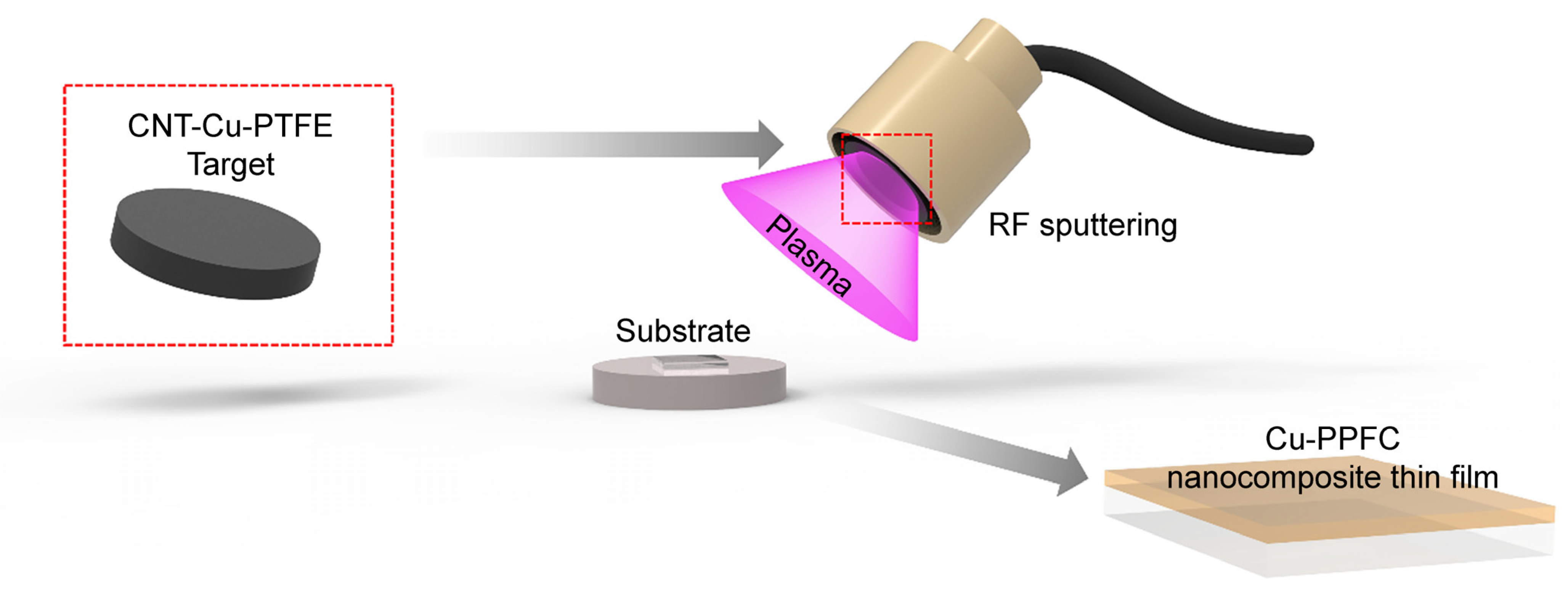
Figure 1 shows a schematic of the moderate-sensitivity Cu-PPFC nanocomposite SERS substrate fabrication. Conventionally, co-sputtering, in which the metal is sputtered with a DC power source and the polymer is sputtered with an RF power source, is mainly used to fabricate composites of metals and polymers. Although this method is widely known to be reliable and useful for producing various nanocomposite thin films, it requires the simultaneous operation of two cathodes, necessitating the need to control the sputtering yield differences between each target, minimize the effects of plasma interference, and complicate the fabrication of uniform thin films over large areas. In this study, Cu and PTFE powders were combined to create a single target that enabled sputtering from a single cathode. Furthermore, highly conductive CNTs were added to enhance the sputtering yield and thermal stability of the target. CNT (5 wt%) provides essential target conductivity for stable RF plasma sheath formation, enabling uniform Cu-PPFC nanocomposite deposition. Post-sputtering, CNT fully decomposes (XPS C 1s: amorphous C-F/C-C only, no graphitic carbon), increasing PPFC matrix carbon content. This single-cathode approach eliminates complex co-sputtering requirements while achieving controlled Cu nanoparticle dispersion. Using this CNT-Cu-PTFE target, we expect to fabricate a moderate-sensitivity SERS substrate that can be easily mass-produced at low cost.
Figure 1.
Schematic diagram of the fabrication of Cu-plasma polymerized fluorocarbon (PPFC) nanocomposite thin films. (Red dashed lines indicate the mounting position of the CNT-Cu-PTFE target).
3.2. Chemical Structures and Properties of Cu-PPFC Nanocomposite Thin Film
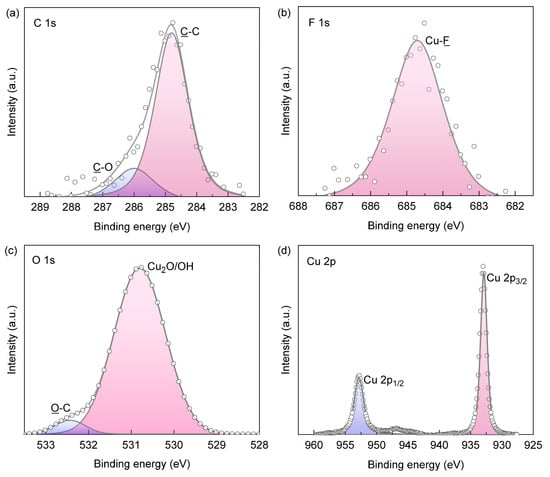
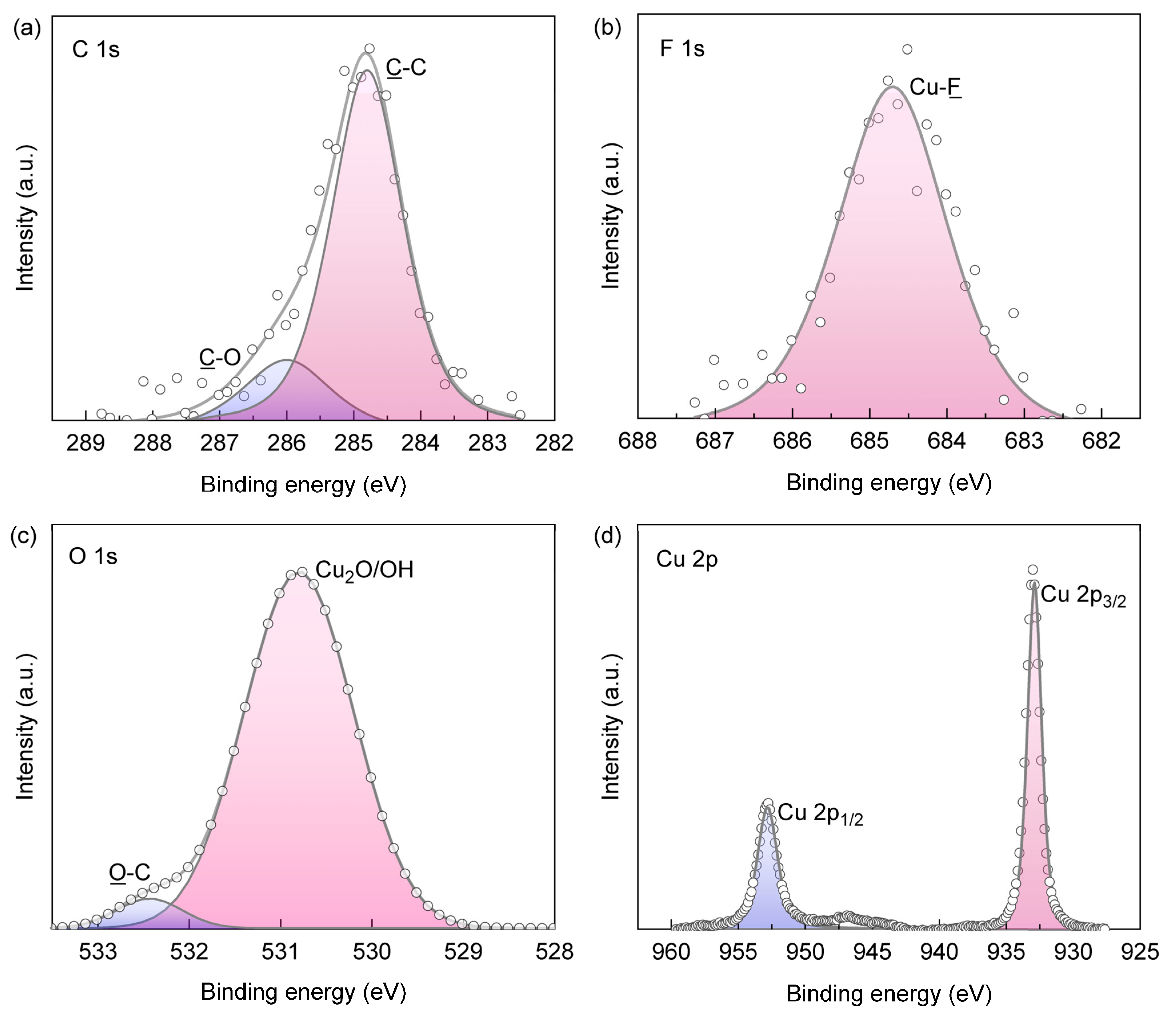
The chemical bonding of the Cu-PPFC nanocomposite thin films was analyzed using XPS. The binding-energy intensity was calibrated based on the position of the C-C bond (284.8 eV). Figure 2 shows the binding energy intensities of the Cu-PPFC nanocomposite thin films deposited at a power density of 2.47 W/cm2. Figure 2a shows the C 1s XPS profile. In a previous study, the C 1s XPS profiles of PPFC films fabricated by MF sputtering using a CNT-PTFE (5:95, w/w) composite target (without Cu) showed five peaks at 294.0 eV (CF3), 292.0 eV (CF2), 289.8 eV (CF), 287.5 eV (C-CFn), and 285.2 eV (-CH2-) [30]. In the C 1s XPS spectrum of the thin film deposited using a CNT-Cu-PTFE (5:80:15, w/w) composite target by RF sputtering, only the C-O bond (286.0 eV and the C-C bond (284.8 eV) were present. This indicates the presence of a small number of C-O organic impurities and adsorbed layers on the sample surface. Peaks for CF3, CF2, and CF, which are types of C–F bonds, were not observed. Figure 2b shows the F 1s profile of the Cu80-PPFC nanocomposite thin films. The single peak at 684.7 eV dominates. This binding energy range indicates metal-fluoride bonding and demonstrates the presence of Cu-F bonding on the thin-film surface [28,31,32]. The atomic concentration of F on the thin-film surface was 3.72 at%, which is not a large atomic concentration, suggesting that Cu-F was thinly deposited on the surface. For the Cu50-PPFC nanocomposite thin film obtained in a previous study using MF sputtering, C-F and Cu-F bonds appeared on the surface. The C-F bond did not appear at 1.85 W/cm2 and 2.47 W/cm2, but it began to appear when the MF power density increased to 3.08 W/cm2. In contrast, the Cu80-PPFC nanocomposite films did not exhibit F bonds. This may be because, as the amount of Cu in the Cu80-PPFC nanocomposite film increases, the Cu-F bond becomes dominant on the surface, and the C-F bond becomes relatively small. Figure 2c shows the O 1s XPS profile. Peaks appear at 532.5 eV and 530.8 eV, which are O-C and Cu2O/OH bonds, respectively. A Cu2O-based oxide layer was present on the surface of the Cu-PPFC nanocomposite film, accompanied by adsorbed organic/hydroxyl oxygen species. Figure 2d presents the Cu 2p XPS profile of the Cu-PPFC nanocomposite film. A Cu 2p3/2 binding energy peak appears at 932.7 eV, and the characteristic satellite peak (940–945 eV) of Cu2+ was not observed. The binding energy of 932.7 eV corresponds to the region where both Cu0 and Cu+ (Cu2O) can be included [33,34]. Therefore, the thin film surface is confirmed to contain a mixture of metallic Cu and Cu2O. As metallic Cu provides abundant free electrons, it can significantly enhance the electric field. This confirms the utility of the Cu-PPFC nanocomposite thin film as a moderate-sensitivity SERS substrate. Furthermore, as the oxide contribution was confirmed at 530.8 eV for O 1s, the surface of the thin film can be viewed as a mixed structure of Cu0 and Cu2O.
Figure 2.
(a) C 1s, (b) F 1s, (c) O 1s, (d) Cu 2p XPS profile of Cu80-PPFC nanocomposite thin film deposited with 2.47 W/cm2 power density.
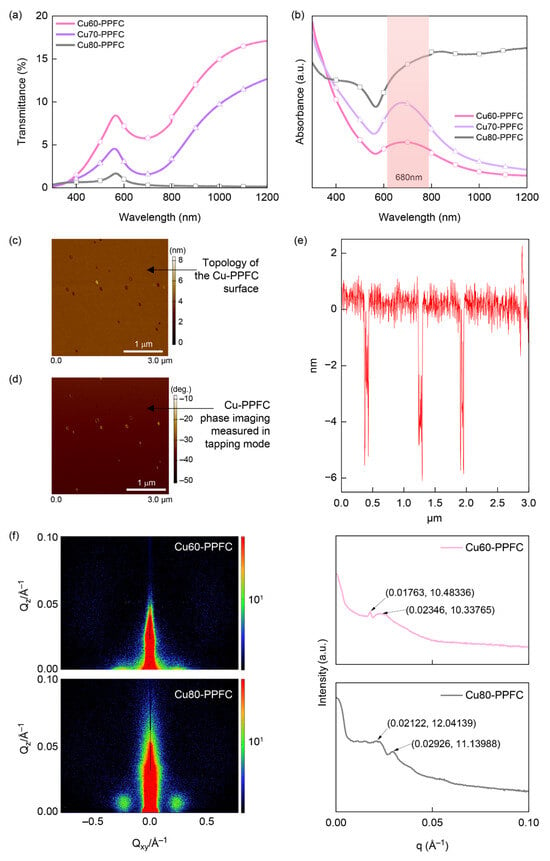
Figure 3a shows the transmittance spectra of the Cu-PPFC nanocomposite thin films deposited according to the Cu content of the composite target. As the Cu content of the target increased from 60 to 80 wt%, the transmittance decreased. This is because the presence of numerous Cu nanoparticles in the thin film causes a significant amount of light to be absorbed or reflected. This is confirmed by the absorbance spectra shown in Figure 3b. In a previous study, a nanocomposite thin film obtained by the DC sputtering of a PTFE target containing 80 wt% Cu at 1.23 W/cm2 showed an absorbance peak at 678 nm [29]. Similarly, the thin films deposited with the Cu60-PPFC and Cu70-PPFC nanocomposites thin films also showed absorbance peaks at approximately 680 nm. The absorbance peak appearing in the Cu-PPFC nanocomposite thin film suggests the occurrence of surface plasmon resonance. This can significantly amplify the Raman scattering around the metal nanoclusters present on the thin-film surface. In particular, Cu nanoclusters readily induce surface plasmon resonance, effectively providing the electromagnetic field amplification effect essential for the SERS phenomenon. Thus, the Cu-PPFC nanocomposite thin film is highly suitable as a moderate-sensitivity SERS substrate owing to its excellent plasmonic properties.
Figure 3.
(a,b) Transmittance/absorbance spectra (300–1200 nm) with 532 nm SERS laser (red vertical line) vs. LSPR peak (680 nm). (c–e) AFM topography (z-height ±5 nm, blue-low/red-high)/phase(0–30° lag, grayscale: Cu = low phase, PPFC = high phase) images, 3 × 3 μm2 scan area (tapping mode, Ra = 0.82 nm, Rq = 1.05 nm). (f) GISAXS patterns acquired using Cu Kα radiation (λ = 1.54189 Å), 1.1 m sample-detector distance, 300 s exposure time, Gaussian peak fitting (q-position error ±0.001 Å−1).
Figure 3c shows the surface topology of the Cu-PPFC thin film, and Figure 3e shows the line scan profile of the surface. The Cu-PPFC nanocomposite thin film exhibited a smooth shape with an average roughness of less than 1 nm. The ellipsoids visually observed on the surface were estimated to be pinholes with a diameter of ~50 nm and were assumed to have been formed by surface contamination or particles. The phase imaging of the Cu-PPFC measured in tapping mode in Figure 3d also shows a uniform distribution with an average error of less than 1%, suggesting that Cu is distributed with a uniform composition over the entire measured surface area. That is, the Cu and PPFC domains were not separated on the surface, and the Cu nanoparticles and PPFC matrix were evenly distributed. In addition, there was a depth-wise gradient in the distributions of Cu and PPFC [29].
Figure 3f shows the GISAXS results for the Cu60-PPFC and Cu80-PPFC deposited on the PET film. The left side of Figure 3f shows the 2D SAXS patterns of Cu60-PPFC and Cu80-PPFC obtained at RF sputtering power density of 3.70 W/cm2. Both Cu60-PPFC and Cu80-PPFC showed scattering patterns obscured by the beam stopper and symmetrical scattering patterns centered around the obscured scattering patterns. To obtain detailed structural information on the Cu-PPFC nanocomposite thin film, a 1D SAXS profile was acquired from the 2D SAXS patterns. Information on the interparticle distance can be obtained from the scattering vector q. The interparticle distance, d-spacing, follows the formula d-spacing = 2π/q. The Cu60-PPFC nanocomposite thin film exhibits peaks at q = 0.018 Å−1 and q = 0.023 Å−1. The d-spacing is 34.9 nm (q = 0.018 Å−1) and 27.3 nm (q = 0.023 Å−1). The Cu80-PPFC nanocomposite thin film exhibits peaks at q = 0.021 Å−1 and q = 0.029 Å−1, and has d-spacing of 29.9 nm (q = 0.021 Å−1) and 21.7 nm (q = 0.029 Å−1). These peaks reflect the overlap between the interparticle distances of the Cu nanoparticles in the PPFC matrix and the average domain distances of the polymer substrate [28]. Cu60-PPFC and Cu80-PPFC have two peaks, which confirms that the Cu nanoparticles are uniformly distributed in the thin film in a disordered state within the PPFC matrix. GISAXS analysis reveals uniform interparticle spacing of 21.7–34.9 nm between Cu nanoparticles within the PPFC matrix (Figure 3f), while AFM confirms exceptionally smooth surface morphology with Ra = 0.82 nm over 3 × 3 μm2 scan areas (Figure 3c–e). These complementary structural characterizations validate the FDTD model geometry, which employs ~15 nm diameter spherical Cu particles—a morphology directly confirmed by prior cross-sectional TEM of compositionally identical Cu-PPFC nanocomposites [28]. The excellent consistency between measured LSPR peak position (680 nm), experimental SERS enhancement factor (EF = 2.18 × 10⁴ for Cu80-PPFC), and simulated field enhancement (|E/E0|2 = 213 in nanogaps) across the Cu60–80 wt% series demonstrates robust nanostructure-performance correlation.
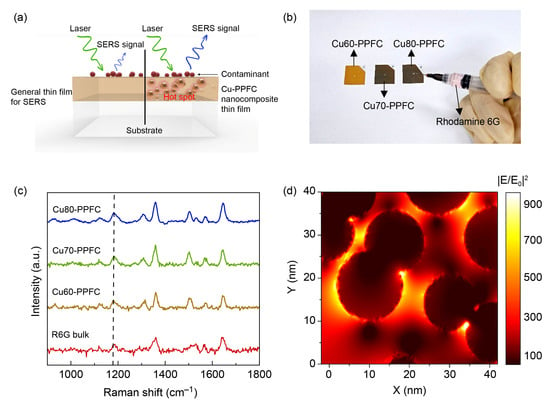
Figure 4a is a schematic diagram demonstrating the excellent SERS signal amplification of the Cu-PPFC nanocomposite film. The Cu-PPFC nanocomposite film exhibits hotspots due to nanogaps between Cu nanoparticles. These hotspots result in moderate-sensitivity SERS signal detection compared to conventional substrates. Figure 4b shows R6G fluorescent dye diluted to 10 µM and used as a probe molecule. SERS measurements were performed to estimate the local field-enhancement effect with increasing Cu content in the Cu-PPFC nanocomposite films. Figure 4c shows the Raman spectra of R6G adsorbed on the Cu60-PPFC, Cu70-PPFC, and Cu80-PPFC nanocomposite films; the Raman intensity at 1180 cm−1 is higher than that of R6G Bulk adsorbed on glass. Even at a concentration of 10 µM, a significant Raman signal enhancement corresponding to moderate-sensitivity is observed. The moderate-sensitivity SERS activity was influenced by the hot spots formed by the Cu nanogaps in the Cu-PPFC films. In this study, the calculated enhancement factor (EF) under a 532 nm laser reached up to 2.18 × 10⁴, demonstrating the potential of the SERS substrate with intermediate sensitivity. 532 nm excitation optimally matches R6G electronic absorption (~530 nm) despite LSPR peak at 680 nm. Broad Cu plasmon band (500–800 nm, polydisperse nanoparticles), interband d→s/p transitions, and quadrupolar modes ensure effective EM enhancement at 532 nm. Composition tuning enables visible-NIR versatility [2], while 532 nm represents standard condition for R6G benchmarking across moderate-sensitivity SERS platforms. R6G validation establishes Cu-PPFC platform for extension to practical analytes. Moderate sensitivity suits food safety monitoring where cost/reproducibility outweigh ultra-low LOD requirements [6,7]. Future work will optimize for specific matrices. SERS reproducibility is excellent (RSD = 25.27%, analogous sputtered Ag-Cu-PPFC [2]), benefiting from uniform nanoparticle dispersion (GISAXS) and smooth morphology (AFM Ra < 1 nm). Unlike topography-dependent electrochemical substrates, 3D Cu-PPFC embedding ensures consistent hot-spot density across cm2 scales, validated by batch-consistent EF values (Table 1). The PPFC matrix provides excellent protection for embedded Cu nanoparticles, as demonstrated in our prior study on identical Cu-PPFC nanocomposites [28]. These films retained optical transmittance, surface hydrophobicity, and Cu nanoparticle integrity after 10,000 bending cycles (5 mm radius) and 30-day ambient storage, with no evidence of Cu oxidation or agglomeration. The mechanical robustness and long-term stability confirm that Cu80-PPFC SERS substrates are suitable for practical applications requiring durability under repeated use and storage.
Figure 4.
(a) Schematic of SERS signal amplification by the Cu-PPFC nanocomposite thin film. (b) picture of R6G on Cu-PPFC thin films. (c) SERS signal intensity measured using Cu-PPFC SERS substrate. (d) FDTD simulation results of the Cu nanoparticles within the PPFC matrix.
Table 1.
SERS performance of the Cu-PPFC nanocomposite films.
The SERS effect of the Cu nanoparticles in the Cu-PPFC nanocomposite film was verified using a FDTD simulation, and the formation of an electric field distribution around the nanoparticles was confirmed. The composition ratio of the Cu-PPFC nanocomposite film was assumed based on the results of EDS component analysis of the cross-section of a TEM specimen conducted in a previous study [28]. The mass ratio of Cu in the approximately 100 nm thick Cu-PPFC nanocomposite film was 74.06%, and the composition ratio of other organic substances was 25.94%. The raw material density was assumed to approximate the film volume ratio. When the density of the PPFC region is approximated as 2.20 g/cm3, similar to PTFE, and the density of the Cu region is approximated as 8.96 g/cm3, the volume fraction of 74.06 g of Cu and 25.94 g of PPFC can be approximated as Cu:PPFC = 41:59. Figure 4d shows FDTD simulation of |E/E0|2 distribution in Cu-PPFC nanocomposite. FDTD simulations employed 15 nm spherical Cu particles with random Gaussian distribution, validated by GISAXS interparticle spacing (21.7–34.9 nm, Figure 3f) and smooth AFM morphology (Ra = 0.82 nm). Nanogap field enhancement |E/E0|2 = 213 corresponds to theoretical EF ≈ 4.53 × 10⁴ (|E/E0|4 scaling), matching experimental 2.18 × 10⁴ within factor of 2. Discrepancy reflects realistic effects: probe offset from optimal hot-spots by surface passivation layer, oxide scattering losses, and statistical sampling of polydisperse gap distribution. Figure 4d shows a heatmap of the signal intensity of the electromagnetic field |E/E0|2 calculated by the FDTD simulation and observed in the XY cross-section. The spherical Cu metal nanoparticles were randomly arranged using random number generation, and many overlapping regions occurred due to the high volume ratio (i.e., volume ratio of 41%). The maximum |E/E0|2 in the XY cross-section was calculated to be 873 (coordinates 33.0, 9.5), which corresponds to a Raman signal enhancement factor of 7.62 × 10⁵ and is therefore somewhat exaggerated compared to the actual experimental results. This is because the simulation structure was constructed by neglecting the degree of curvature flattening in such regions owing to necking, according to the TEM results of a previous study. In contrast, in the gap between the spherical Cu layers at the same position (coordinates 3.0, 24.0), |E/E0|2 was calculated to be 213, which corresponds to a Raman enhancement factor of 4.53 × 10⁴. That is, the Cu-PPFC thin film can exhibit a localized hot spot owing to the Cu-Cu nanogap with the PPFC layer as a separator, which is detected as a representative signal in the Raman measurement. In conclusion, the FDTD simulation suggests that the electric field is concentrated in the Cu nanogap formed by PPFC as a separator in the Cu-PPFC nanocomposite thin film, which induces SERS. Based on this hot-spot-driven mechanism, the Cu-PPFC nanocomposite thin film can be utilized as a moderate-sensitivity SERS substrate.
4. Conclusions
Cu–plasma polymer fluorocarbon (Cu-PPFC) nanocomposite thin films were fabricated by RF sputtering using CNT–Cu–PTFE composite targets. The addition of CNTs improved conductivity and enabled the uniform dispersion of Cu nanoparticles within the PPFC matrix. XPS analysis confirmed the coexistence of metallic Cu and Cu2O with partial Cu–F bonding, while optical and GISAXS measurements indicated well-distributed nanoparticles exhibiting localized surface plasmon resonance at a wavelength of approximately 680 nm. The Cu-PPFC thin film with 80 wt% Cu achieved a Raman enhancement factor of 2.18 × 10⁴ for R6G, corresponding to a moderate-sensitivity SERS substrate. The FDTD simulation supported the finding that strong electromagnetic fields were localized in the Cu-Cu nanogaps separated by the PPFC matrix. These findings demonstrate that the Cu-PPFC nanocomposite thin films provide a simple, reproducible, and cost-effective approach for the scalable fabrication of moderate-sensitivity SERS substrates suitable for practical sensing applications.
Author Contributions
S.C.: Conceptualization, methodology, visualization, analysis, writing original draft, writing—review & editing. S.H.K.: Methodology, formal analysis, analysis, writing—review & editing. J.L.: Analysis, writing—review & editing. S.-J.L.: Supervision, conceptualization, writing-reviewing and editing, funding acquisition. All authors have read and agreed to the published version of the manuscript.
Funding
This work was supported by the National Research Foundation of Korea (NRF) grant funded by the Korean government (MSIT) (RS-2025-00516639). And This research was also supported by the Regional Innovation System & Education (RISE) program through the (Chungbuk Regional Innovation System & Education Center), funded by the Ministry of Education (MOE) and the (Chungcheongbuk-do), Republic of Korea (2025-RISE-11-014-03).
Institutional Review Board Statement
Not applicable.
Informed Consent Statement
Not applicable.
Data Availability Statement
The original contributions presented in this study are included in the article. Further inquiries can be directed to the corresponding author.
Conflicts of Interest
The authors declare no conflicts of interest.
References
- Markina, N.E.; Volkova, E.K.; Zakharevich, A.M.; Goryacheva, I.Y.; Markin, A.V. SERS detection of ceftriaxone and sulfadimethoxine using copper nanoparticles temporally protected by porous calcium carbonate. Microchim. Acta 2018, 185, 481. [Google Scholar] [CrossRef] [Scilit] [PubMed]
- Lee, J.; Kim, S.H.; Son, S.-K.; Lee, S.-J. Plasma-polymerized fluorocarbon Ag–Cu nanocomposites: Nanostructure optimization for superior SERS sensitivity. Appl. Surf. Sci. Adv. 2025, 25, 100690. [Google Scholar] [CrossRef] [Scilit]
- Katherine, A. Willets, Super-Resolution Surface-Enhanced Raman Scattering: Perspectives on the Past, Present, and Future. ACS Nano 2024, 18, 27824–27832. [Google Scholar]
- Boto, R.A.; Esteban, R.; Candelas, B.; Aizpurua, J. Theoretical Procedure for Precise Evaluation of Chemical Enhancement in Molecular Surface-Enhanced Raman Scattering. J. Phys. Chem. C 2024, 128, 18293–18304. [Google Scholar] [CrossRef] [Scilit]
- Terry, L.R.; Sanders, S.; Potoff, R.H.; Kruel, J.W.; Jain, M.; Guo, H. Applications of surface-enhanced Raman spectroscopy in environmental detection. Anal. Sci. Adv. 2022, 3, 113–145. [Google Scholar] [CrossRef] [Scilit]
- Li, L.; Chin, W.S. Rapid Fabrication of a Flexible and Transparent Ag Nanocubes@PDMS Film as a SERS Substrate with High Performance. ACS Appl. Mater. Interfaces 2020, 12, 37538–37548. [Google Scholar] [CrossRef] [Scilit]
- Li, N.; Han, S.; Lin, S.; Sha, X.-Y.; Hasi, W. Fabrication of an AAO-based surface-enhanced Raman scattering substrate for the identification of levofloxacin in milk. New J. Chem. 2021, 45, 7571. [Google Scholar] [CrossRef] [Scilit]
- Sultangaziyev, A.; Ilyas, A.; Dyussupova, A.; Bukasov, R. Trends in Application of SERS Substrates beyond Ag and Au, and Their Role in Bioanalysis. Biosensors 2022, 12, 967. [Google Scholar] [CrossRef] [Scilit]
- Le Ru, E.C.; Blackie, E.; Meyer, M.; Etchegoin, P.G. Etchegoin, Surface Enhanced Raman Scattering Enhancement Factors: A Comprehensive Study. J. Phys. Chem. C 2007, 111, 13794–13803. [Google Scholar] [CrossRef] [Scilit]
- Pilot, R.; Signorini, R.; Durante, C.; Orian, L.; Bhamidipati, M.; Fabris, L. A Review on Surface-Enhanced Raman Scattering. Biosensors 2019, 9, 57. [Google Scholar] [CrossRef] [Scilit]
- Bell, S.E.J.; Charron, G.; Cortés, E.; Kneipp, J.; De La Chapelle, M.L.; Langer, J.; Procházka, M.; Tran, V.; Schlücker, S. Towards Reliable and Quantitative Surface-Enhanced Raman Scattering (SERS): From Key Parameters to Good Analytical Practice. Angew. Chem. Int. Ed. 2020, 59, 5454–5462. [Google Scholar] [CrossRef] [Scilit]
- Ju, J.; Liu, W.; Perlaki, C.M.; Chen, K.; Feng, C.; Liu, Q. Sustained and Cost Effective Silver Substrate for Surface EnhancedRaman Spectroscopy Based Biosensing. Sci. Rep. 2017, 7, 6917. [Google Scholar] [CrossRef] [Scilit] [PubMed]
- Peng, W.; Xu, Z.; Jia, X.; Liao, Q. A copper foam-based surface-enhanced Raman scattering substrate for glucose detection. Discov. Nano 2023, 18, 7. [Google Scholar] [CrossRef] [Scilit] [PubMed]
- Li, C.; Huang, Y.; Li, X.; Zhang, Y.; Chen, Q.; Ye, Z.; Alqarni, Z.; Bell, S.E.J.; Xu, Y. Towards practical and sustainable SERS: A review of recent developments in the construction of multifunctional enhancing substrates. J. Mater. Chem. C 2021, 9, 11517. [Google Scholar] [CrossRef] [Scilit]
- Sultana, P.; Qiang, B.; Son, C.; Kim, S.; Mensing, G.; Ferreira, P. High-Volume Production of Repeatable High Enhancement SERS Substrates Using Solid-State Superionic Stamping. J. Manuf. Sci. Eng. 2024, 146, 110908. [Google Scholar] [CrossRef] [Scilit]
- Liu, P.; Wang, H.; Li, X.; Rui, M.; Zeng, H. Localized surface plasmon resonance of Cu nanoparticles by laser ablation in liquid media. RSC Adv. 2015, 5, 79738. [Google Scholar] [CrossRef] [Scilit]
- Ding, Q.; Hang, L.; Ma, L. Controlled synthesis of Cu nanoparticle arrays with surface enhanced Raman scattering effect performance. RSC Adv. 2018, 8, 1753. [Google Scholar] [CrossRef] [Scilit]
- Saegusa, S.; Naya, M.; Fukuoka, T.; Tabata, M.; Sumitomo, K.; Yamaguchi, A. Microchemical system for simultaneous measurement of surface-enhanced Raman scattering and electrochemical reactions. Sci. Rep. 2025, 15, 18574. [Google Scholar] [CrossRef] [Scilit]
- Chen, C.-C.; Hong, F.C.-N. Structure and properties of diamond-like carbon nanocomposite films containing copper nanoparticles. Appl. Surf. Sci. 2005, 242, 261–269. [Google Scholar] [CrossRef] [Scilit]
- Yang, H.; Liu, C.; Tang, J.; Jin, W.; Hao, X.; Ji, X.; Hu, J. Twinned copper nanoparticles modulated with electrochemical deposition for in situ SERS monitoring. CrystEngComm 2018, 20, 5609. [Google Scholar] [CrossRef] [Scilit]
- Muniz-Miranda, M.; Gellini, C.; Giorgetti, E. Surface-Enhanced Raman Scattering from Copper Nanoparticles Obtained by Laser Ablation. J. Phys. Chem. C 2011, 115, 5021–5027. [Google Scholar] [CrossRef] [Scilit]
- Dizajghorbani-Aghdam, H.; Miller, T.S.; Malekfar, R.; McMillan, P.F. SERS-Active Cu Nanoparticles on Carbon Nitride Support Fabricated Using Pulsed Laser Ablation. Nanomaterials 2019, 9, 1223. [Google Scholar] [CrossRef] [Scilit] [PubMed]
- Dai, P.; Li, H.; Huang, X.; Wang, N.; Zhu, L. Highly Sensitive and Stable Copper-Based SERS Chips Prepared by a Chemical Reduction Method. Nanomaterials 2021, 11, 2770. [Google Scholar] [CrossRef] [Scilit] [PubMed]
- Rao, V.K.; Ghildiyal, P.; Radhakrishnan, T.P. In Situ Fabricated Cu−Ag Nanoparticle-Embedded Polymer Thin Film as an Efficient Broad Spectrum SERS Substrate. J. Phys. Chem. C 2017, 121, 1339–1348. [Google Scholar] [CrossRef] [Scilit]
- Xu, S.; Man, B.; Jiang, S.; Wang, J.; Wei, J.; Xu, S.; Liu, H.; Gao, S.; Liu, H.; Li, Z.; et al. Graphene/Cu Nanoparticle Hybrids Fabricated by Chemical Vapor Deposition As Surface-Enhanced Raman Scattering Substrate for Label-Free Detection of Adenosine. ACS Appl. Mater. Interfaces 2015, 7, 10977–10987. [Google Scholar] [CrossRef] [Scilit]
- Qiu, J.; Richey, N.E.; DuChene, J.S.; Zhai, Y.; Zhang, Y.; McElwee-White, L.; Wei, W.D. Surface Plasmon-Mediated Chemical Solution Deposition of Cu Nanoparticle Films. J. Phys. Chem. C 2016, 120, 20775–20780. [Google Scholar] [CrossRef] [Scilit]
- Preston, A.S.; Hughes, R.A.; Demille, T.B.; Neretina, S. Plasmonics under Attack: Protecting Copper Nanostructures from Harsh Environments. Chem. Mater. 2020, 32, 6788–6799. [Google Scholar] [CrossRef] [Scilit]
- Kim, M.; Kim, S.H.; Rho, Y.; Cho, E.; Lee, J.H.; Lee, S.J. Transparent, Water-Repellent, Antiviral, Antistatic, and Flexible Cu−Plasma-Polymerized Fluorocarbon Nanocomposite Thin Films. ACS Appl. Mater. Interfaces 2021, 13, 10301–10312. [Google Scholar] [CrossRef] [Scilit]
- Kim, S.H.; Kim, M.; Park, J.S.; Lee, S.-J. Optical, Electrical, and Surface Properties of Cu/Plasma Polymer Fluorocarbon Nanocomposite Thin Film Fabricated Using Metal/Polymer Composite Target. Appl. Sci. 2019, 9, 1296. [Google Scholar] [CrossRef] [Scilit]
- Kim, S.H.; Kim, M.; Um, M.S.; Choi, W.J.; Lee, J.H.; Yang, Y.S.; Lee, S.-J. Effects of carbon concentration on high-hardness plasma-polymer-fluorocarbon film deposited by mid-range frequency sputtering. Sci. Rep. 2019, 9, 10664. [Google Scholar] [CrossRef] [Scilit]
- Xia, J.; Wang, Z.; Rodrig, N.D.; Nan, B.; Zhang, J.; Zhang, W.; Lucht, B.L.; Yang, C.; Wang, C. Super-reversible CuF2 cathodes enabled by Cu2+-coordinated alginate. Adv. Mater. 2022, 34, e2205229. [Google Scholar] [CrossRef] [Scilit]
- John, P.J.; Liang, J. Initial metal fluoride formation at metal/fluorocarbon interfaces. J. Vac. Sci. Technol. A Vac. Surf. Film. 1994, 12, 199–203. [Google Scholar] [CrossRef] [Scilit]
- Wong, A.S.W.; Krishnan, R.G.; Sarkar, G. X-ray photoelectron spectroscopy and Auger electron spectroscopy investigation on the oxidation resistance of plasma-treated copper leadframes. J. Vac. Sci. Technol. A Vac. Surf. Film. 2000, 18, 1619–1631. [Google Scholar] [CrossRef] [Scilit]
- Younan, H.; Yue, S.; Kai, L.; Yuan, W.J.; Shen, C.Y.; Yixin, C.; Chao, F.; Xiaomin, L. Studies on XPS valence state analysis of copper materials. In Proceedings of the 2016 IEEE 37th International Electronics Manufacturing Technology (IEMT) & 18th Electronics Materials and Packaging (EMAP) Conference, Georgetown, Malaysia, 20–22 September 2016; IEEE: New York, NY, USA, 2016. [Google Scholar]

Disclaimer/Publisher’s Note: The statements, opinions and data contained in all publications are solely those of the individual author(s) and contributor(s) and not of MDPI and/or the editor(s). MDPI and/or the editor(s) disclaim responsibility for any injury to people or property resulting from any ideas, methods, instructions or products referred to in the content. |
© 2026 by the authors. Licensee MDPI, Basel, Switzerland. This article is an open access article distributed under the terms and conditions of the Creative Commons Attribution (CC BY) license.