Abstract
Bone is a structurally complex and dynamic tissue that plays a crucial role in mobility and skeletal stability. However, conditions such as osteoporosis, osteoarthritis, trauma-induced fractures, infections, and malignancies often necessitate the use of orthopedic and dental implants. Despite significant progress in implant biomaterials, challenges such as bacterial infection, inflammation, and loosening continue to compromise implant longevity, frequently leading to revision surgeries and extended recovery times. Smart coatings have emerged as a next-generation solution to these problems by providing on-demand, localized therapeutic responses to microenvironmental changes around implants and promoting bone regeneration. Such coatings can minimize antibiotic resistance by enabling controlled, stimulus-triggered drug release. Although the idea of using pH-sensitivity as a tool to make smart coatings is not a new thought, there are no options currently good enough to enter clinical studies. This review provides a comprehensive overview of recent advances in pH-sensitive polymers, hybrid composites, porous architectures, and bioactive linkers designed to dynamically respond to pathological pH variations at implant sites. By investigating the mechanisms of action, antibacterial and anti-inflammatory effects, and roles in bone regeneration, it is shown that the ability to provide time-dependent drug release for both short-term and long-term infections, as well as keeping the environment welcoming to the bone cell growth and replacement, is not an easy goal to reach, even with a fully biocompatable, non-toxic, and semi-biodegradable (one that releases the drug, but does not fade away) coating material compound. Reviewing all available options, including their functions and failures, finally, emerging trends, translational barriers, and future opportunities for clinical implementation are highlighted, underscoring the transformative potential of bioresponsive coatings in orthopedic and dental implant technologies.
1. Introduction
Bone function can be compromised by various health conditions, including fractures, osteoarthritis, osteoporosis, infections, and cancer. Implants and replacements are highly effective treatments for restoring bone functionality, where roughly one-quarter of people in Western countries will undergo a knee or hip replacement in their lifetime [1]. However, approximately 10% of implants require revision surgery [2] due to failure, often resulting from infection or aseptic loosening (Figure 1). Infection generally starts with the adhesion of bacteria to the surface of the implant [3,4], which can lead to the formation of biofilms that interfere with tissue attachment and growth, thereby damaging the surrounding tissue and loosening the implant [5,6]. In aseptic loosening, implantation stimulates inflammatory and immune responses [7,8], which lead to the release of inflammatory cytokines, including interleukin 1beta, interleukin 6, and tumor necrosis factor-alpha, that increase bone resorption and osteolysis, which causes the final detachment of the implant from the bone [7,9] (Figure 1). Moreover, the body’s immune system may recognize the implant as a foreign object and mount an immune response against it (Figure 1), resulting in a thick fibrotic layer that isolates the implant from the surrounding tissue; however, the effect on implant detachment and loosening is not fully understood yet [10].
Figure 1.
Mechanisms of infection, inflammation, and loosening on implants (sketched in biorender.com). First row: During surgery, bacteria may attach to the surface of the implant. Within the body, they start to proliferate into layers, causing the layer far from the tissue to be deprived of nutrients. These bacteria die and form a solid biofilm, which thickens and expands over the implant over time with more bacterial proliferation and dispersion. Second row: This shows the initial response of the body to the identification of bacteria in the implantation site. The activity and movement of macrophages to the infection site result in the birth of unnecessary osteoclasts, which absorb the bone and induce loosening in the contact area. Third row: The immune system may identify the implant as a harmful foreign body object that needs to be removed. Inflammation is the result of macrophage attack on the implant or inhibiting the near osteocytes’ receptors to defend. This interrupts the natural growth and maturation of osteocytes, causing loosening.
Modifying the surface of implants with passive or active coatings is crucial for enhancing biocompatibility and preventing infection. Passive coatings create distinct surface morphologies and chemistries to evade the immune system and deter bacterial adhesion to the implant surface, while active coatings are designed to respond to and kill microorganisms [5]. Passive coatings rely on rationally designed properties like composition, chemistry, and topography to effectively manage inflammation [11,12]. Alternatively, active coatings are prepared with antibacterial polymers, peptides, metal ions (such as silver, copper, and zinc), essential oils, and small molecules that have been used to prevent bacterial growth and biofilm formation on bone implants [13,14,15]. However, antibacterial substances can impede bone formation, meaning that the effectiveness largely depends on the release profile of the antibacterial agent from the coating [16]. Therefore, smart implant coatings, for example, those sensitive to pH, can promote osseointegration through the controlled and responsive release of antibacterial or anti-inflammatory agents [17,18,19].
Smart coatings represent a cutting-edge approach to drug delivery where various triggers lead to the controlled release of therapeutic agents precisely when and where needed. Internal or external stimuli, such as temperature [20], light [21], magnetic field [22], sound [23], and pH, can trigger drug release. A particularly relevant trigger for smart orthopedic implant coatings is pH, as different functional groups and linkers included in the coatings can respond to the change in hydrogen atom concentration via protonation, deprotonation, or conformational changes that induce drug release. In this review, a variety of natural and synthetic pH-sensitive materials, as well as their chemical structure and mechanism of pH response, are introduced. The pH-sensitive materials, release profiles, antibacterial activity, and osteogeneration are summarised with the aim of guiding research for mitigating infection, loosening, and inflammation related to bone implants and joint transplants. Finally, we discuss challenges impacting smart orthopedic implant coatings, such as release timing and efficacy, and future prospects to improve therapeutic efficacy, such as the combination of different coatings or surface treatments into a single system.
2. pH-Sensitive Materials
In this section, the most well-known pH-sensitive materials and structures commonly used for designing smart implant coatings are discussed and categorized as bio-polymers, synthetic polymers, porous coatings, and pH-sensitive linkers. In each section, the mechanism of pH-sensing is briefly discussed, along with the advantages and disadvantages of the materials for bone implant coatings. Notably, the deposition method can influence the coating properties, along with the materials used to assemble the coatings [24].
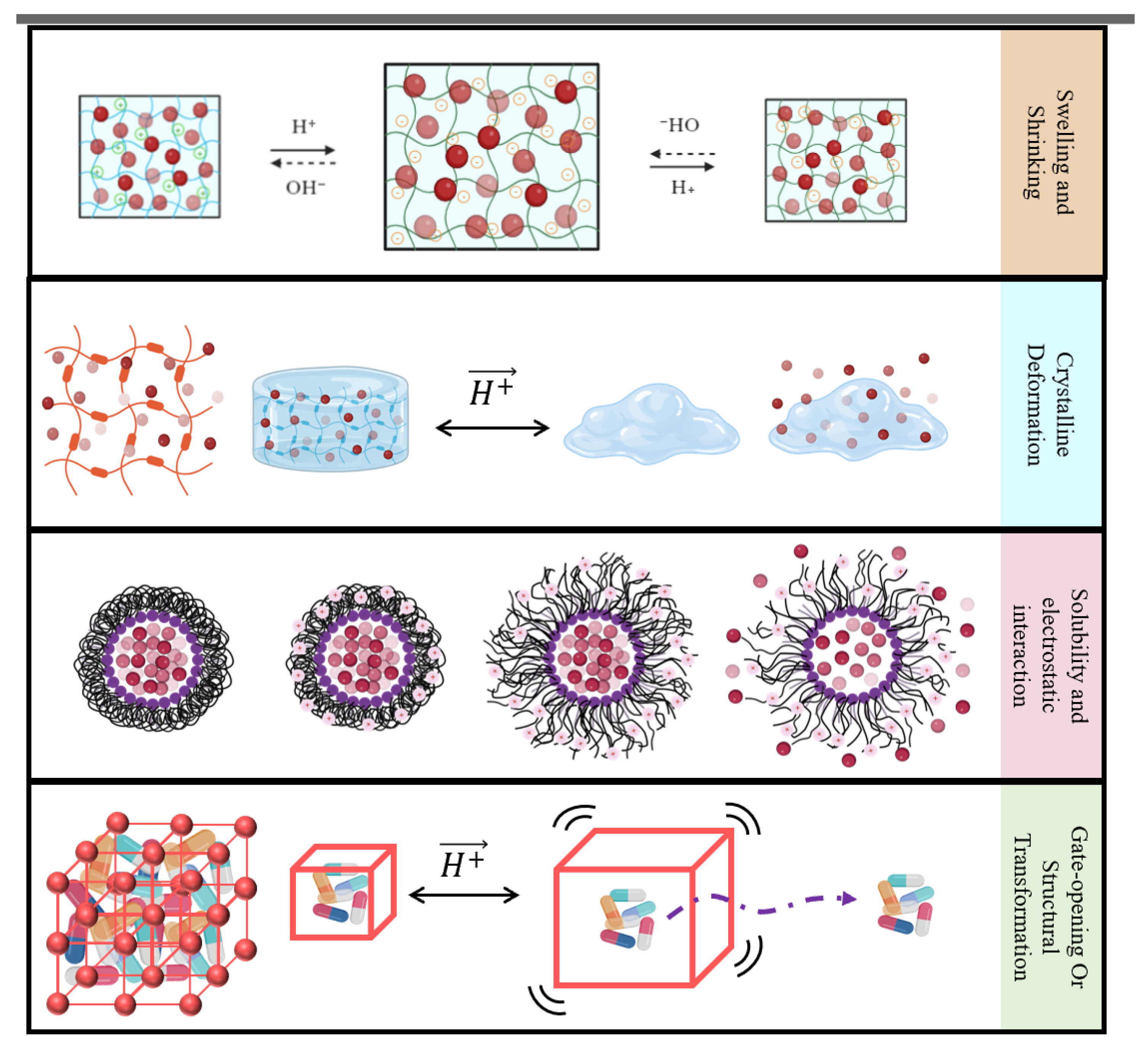
As shown in Figure 2, the mechanisms of pH sensitivity for coatings included in this paper may be categorized into the following four groups. Swelling and shrinking, similar to what most hydrogels do, is simply a change in the size of the carrier due to a change in pH and its effect on the charges of the polymer chain, causing the drug to release [25]. Another mechanism more common to pH-sensitive hydrogels (here for silk fibrin) is crystalline deformation or transition, where chain conformation changes due to pH change [26]. As the name states, sometimes electrostatic reactions between charges of the functional groups and a low pH environment can increase the solubility and drug release. Finally, gate-opening refers to metal-organic frameworks’ ability to undergo a structural transition in low pH environments and release of carried material [27].
Figure 2.
pH-sensitivity mechanisms. First row: swelling or shrinking of a coating compound due to absorption of H+ ions, which have formed the acidic environment. This would allow the drug to be released from the bonds. Second row: some materials form a sort of solid-like structure, like hydrogels, in their neutral form. However, in the presence of H+ ions, their bonds detach, and the material may lose the structure holding the drug. This helps drug release. Third row: H+ ions in an acidic environment can encourage a micelle holding the drug to dissolve and release the anti-bacterial agent. Fourth row: the antibacterial agents trapped in units of an organized structure or pores of a porous compound can be released if the structure changes form, e.g., the bond length increases, or if the gates protecting the pores open up, e.g., the coating around the solid porous particles dissolves.
2.1. Bio-Polymers
Amino acids are naturally pH-sensitive and are regularly used in their polymeric form of short peptides or fully intact proteins and glycoproteins to make smart coatings. These molecules can respond to pH via conformation or structure changes occurring due to protonation or deprotonation of their constituent amino acids (e.g., histamine, glutamic acid, etc.) [28,29], which also affects properties such as solubility and shape. Materials composed of peptides, proteins, or glycoproteins are generally biocompatible because they are composed of natural molecules [30,31], although they can sometimes be allergenic [32,33,34]. The peptide bonds are often cleavable by enzymes in the body, making such materials biodegradable; however, stability can be an issue, especially as the peptide bonds are also hydrolyzable. Moreover, these coatings have low mechanical strength and are sensitive to other environmental conditions besides pH, such as temperature and humidity. Finally, protein purification can be expensive, and there are limited resources for sourcing specific proteins.
2.1.1. Chitosan
Chitosan is the main biopolymer discussed here due to its extensive application in pH-sensitive implant coatings. Due to its bioderived nature, chitosan is highly biocompatible and biodegradable and contains protonatable glucosamine and N-acetylglucosamine, which collectively make it one of the most commonly used pH-sensitive polysaccharides for engineering biomaterials [35]. The pH-sensitive mechanism of this polymer works by protonating chitosan in response to a high concentration of H+ in an acidic environment (electrostatic interaction—Figure 1). The chitosan NH2 bond is charged to NH3+ and releases the loaded drug. The reverse occurs if pH increases to an alkaline level, and, therefore, chitosan responds differently to different pH scenarios. With a physiologically relevant pKa of ~6.5, chitosan can be protonated at low pH, which leads to steric repulsion, water adsorption, increased solubility, and drug release [36]. Additionally, he cell toxicity tests frequently reported that the chitosan and its functional group reactions, such as carboxyl, are non-toxic. Also, it has been proven that the bioactive chitosans do not have any effects on cell morphology and cell proliferation [35,36].
Chitosan is also inherently antimicrobial due to its high density of positively charged moieties and can promote wound healing, which makes it promising as an osteoconductive coating [35,37]. However, chitosan can elicit an immune response due to its cationic nature and because it is derived from the chitin of shellfish [38], and it can have issues adhering to some surfaces. Due to the physiologically relevant pKa and the relative abundance and low cost of chitosan, this section focuses almost exclusively on chitosan, although smart coatings made from alginate, a low-cost natural polysaccharide, are also discussed briefly. Chitosan plays a role in enhancing the immune response, which is quite well-known and is not discussed here. Briefly, it helps the activity of cytokines and dendritic cells, which helps to regulate the immune response and signalling pathways such as cGAS–STING, STAT-1, and NLRP3 [39].
When used as an antibacterial implant coating, chitosan can outperform other common biocompatible polymers, such as poly-lactic-co-glycolic acid (PLGA). For example, titanium implants modified with gentamicin-loaded titanium nanotubes were coated with either PLGA or chitosan by dip-coating. The chitosan-coated samples had better antibacterial properties and better cell attachment (~100% in 1.5 h) than the PLGA-coated samples, probably due to the long-term stability and cationic nature of chitosan. Micelles and thicker coatings could both be used to further extend drug release to 3–4 weeks of continuous release after implantation. Specifically, drug release could be increased from a ~6 h burst release profile to a ~21 d extended release profile for both the chitosan and PLGA coatings [40]. Meanwhile, as toxicology tests show, poly-lactic-co-glycolic can be biocompatible and non-toxic depending on the manufacturing method and the complete removal of toxic solvents [41].
There are many examples of using chitosan along with synthetic polymers (discussed in the Section 2.2. to enhance pH-sensitivity. The first example would be chitosan and Poly-l-lactic acid (PLLA). Dexamethasone was added to MSNs that were coated with chitosan and electrospun with PLLA. The resulting fibers responded to pH drops by releasing dexamethasone to enhance osteodifferentiation. ALP and calcium deposition levels improved significantly between 7 and 14 days post-implantation [42].
Sometimes, chitosan has been used to improve antibacterial activity and osteogenesis and is not specifically pH-sensitive. For example, Zheng et al. [43] introduced a bifunctional coating on titanium coatings to inhibit bacterial adhesion and promote osteogenesis. They functionalized the titanium implant surface with polydopamine (PDA), then coated it with carboxymethyl chitosan (CMCS), and, finally, added a layer of covalently immobilized ALP over them all by immersion in various solutions. This reduced bacterial adhesion by as much as 89% in 4 h, while, depending on ALP density, cell proliferation and calcium deposition were improved by up to 44%. The osteogenic activity was also considerable due to ALP’s influence on the upregulation of related gene expressions. Although the coating stabilized after autoclaving, its bioactivity was reduced by 50% after being immersed in phosphate-buffered saline (PBS) for 14 days.
Alternatively, a multilayer coating of polycaprolactone (PCL) and chitosan impregnated with drugs (vancomycin or daptomycin) either as powder or pre-loaded into microspheres could be deposited onto stainless steel using immersive assembly. The microspheres allowed for the release kinetics to be controlled over a roughly 5–24 h window, with pH 5.5 accelerating release from the coatings containing drug-loaded microspheres and pH 7.4 accelerating release from the coatings containing drug powders [44]. This drug release allowed the smart coatings to kill drug-resistant bacteria, a common cause of hospital-contracted infections.
Another multilayer coating composed of black phosphorus nanosheets and chitosan was deposited layer-by-layer (LbL) on a sulfonated polyether-ether-ketone (PEEK) bone scaffold that fully resembles natural bone [45]. The chitosan component limited the degeneration of the black phosphorus nanosheets while also allowing for the pH-triggered controlled release of and encapsulated drugs (doxorubicin hydrochloride (DOX)), which promoted bone repair and inhibited bacteria growth, respectively, in acidic environments. Additionally, the incorporated black phosphorus had photothermal properties and enabled tumor ablation through the generation of reactive oxygen species (ROS), which could also help combat infection. More DOX was released at lower pH; however, the release trend was similar for pH = 7.4 and pH = 5.5 over ~30 h. Regarding bone regeneration, the DOX-loaded multilayer films had the highest regeneration score compared to pure-chitosan-coated groups. Furthermore, the that was released from the black phosphorus nanosheets increased bone and mineral formation. In the pure chitosan coatings, osteogenesis still occurs due to its cationic nature.
Similarly, chitosan can be grafted onto mesoporous silica nanoparticles (MSNs) to deliver dexamethasone (an antibiotic and anti-inflammatory agent) and Bone Morphogenetic Protein 2 (BMP-2), which is a bone growth factor, to improve osteogenesis [46]. This composite showed far higher drug release at pH 6.0 (90%) than at pH 7.4 (5%) after 80 min. Moreover, higher ALP, Runx2, and Osteopontin (OPN) expression confirmed the osteogenic potential of this coating, and bone volume increased by as much as 100% after four weeks [46].
Chitosan can also enable the sustained release of antibiotics from dental implant coatings made of core–shell nanoparticles [47]. Specifically, the nanoparticles had a core of poly(L-lactic acid) loaded with BMP-2 and a shell of chitosan decorated with osteoprotegerin. The nanoparticles had sustained release, but almost no pH-sensitivity, as incubation at pH 7.4 and 6.8 both led to a release of ~80% over 39 days. Still, this design improved osteogenesis by inhibiting osteoclasts and promoting bone stem cells, where the ALP optical density was higher than in the blank samples at ~0.8 at all pHs tested. Degeneration of this compound, studied in various pHs, showed the surface becoming rougher over time, and the main body of the nanoparticles was degraded in 30 days.
Similarly, BMP2-loaded titania nanotubes (TNTs) can be coated with multiple layers of alginate dialdehyde-gentamicin and chitosan via LbL assembly and spin-coating [48]. This system could release gentamicin while providing an appropriate environment for osteoblasts. Within 24 h, 17 µg of gentamicin was released at pH 7.4, while 38 µg was released at pH 5.8. Over ten days, 44 µg and 130.3 µg of gentamicin were released at pH 7.4 and 5.8, respectively. Roughly 95% of BMP2 was released over ten days and hours for both pHs; however, pH 5.8 had a faster release, more like an undesirable burst release, over the first 96 h. Degradation of the Schiff base was recognized as the reason. Furthermore, bacteria viability assays demonstrated that roughly half as many bacteria adhered to this coating after 72 h when compared to pristine Ti or even TNTs. Osteoblast viability, ECM mineralization, and Runx2 expression were highest in the samples containing BMP-2 compared to native Ti and TNT samples, likely due to alginate and chitosan increasing cell adhesion and proliferation.
TNTs can also be coated using cathodic electrodeposition with chitosan and small interfering RNA (siRNA). The siRNA remained intact and functional, and the release after 14 days was higher in acidic pH when compared to neutral pH (90% and 70% release, respectively) [49].
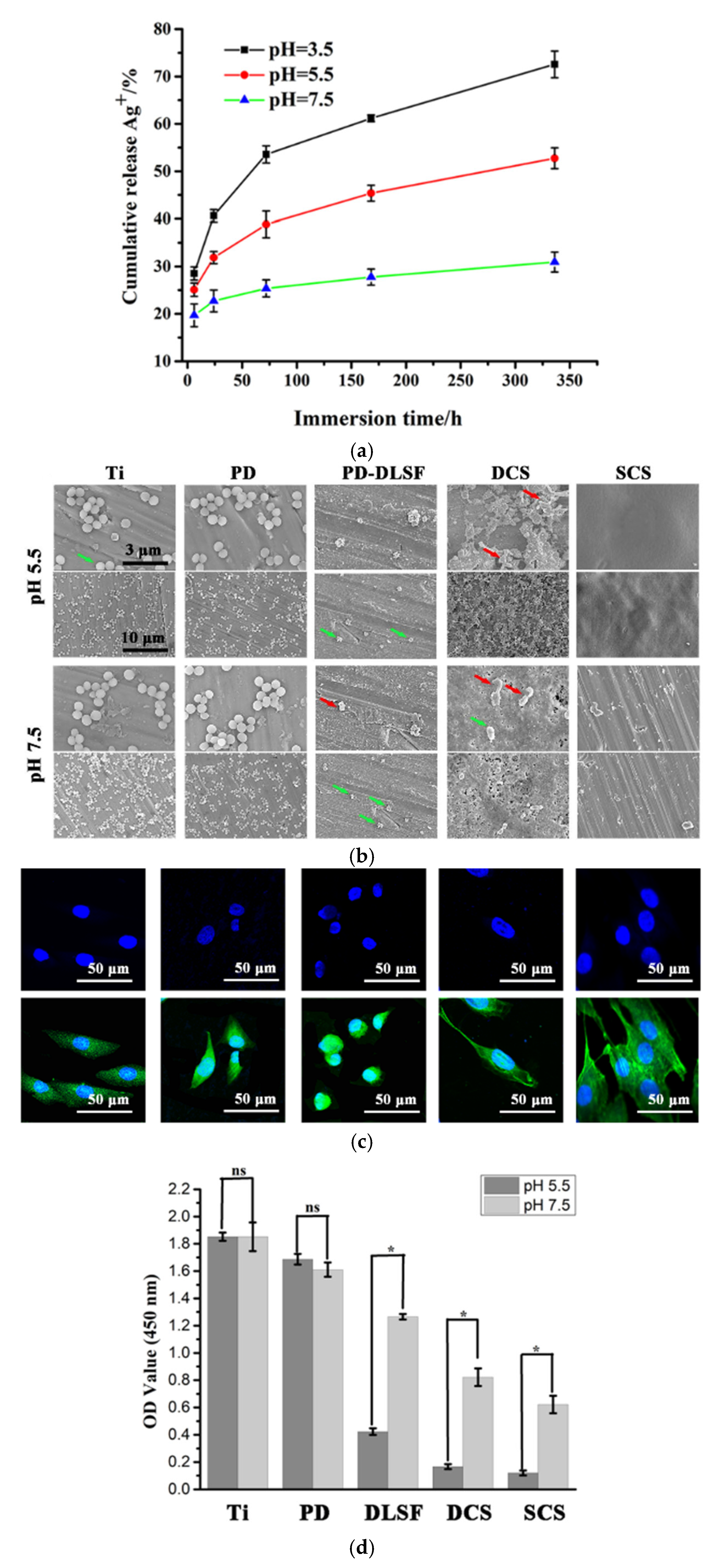
In addition to small molecule antibiotics, metal ions like silver can also be used as antimicrobial agents incorporated into smart coatings. For example, a multicomponent coating composed of silk fibroin (SF) loaded with both silver nanoparticles (AgNPs) and gentamicin (Gen) is attached to a PDA-functionalized titanium substrate and capped with a layer of chitosan. Both dip-coating and spin-coating were used to investigate the effects of the coating methods on the drug release profiles [50]. Both coating approaches led to systems that could release Ag+ as the antibacterial agent in a pH-dependent pattern; however, the spin-coated system was more hydrophilic and had slightly better pH-responsiveness. On average, after 14 days, less than 30% of Ag+ was released at pH 7.5, ~55% was released at pH 5.5, and ~75% was released at pH 3.5. This controlled release improved the adhesion and proliferation of preosteoblast cells, and the accumulated biomass on uncoated, dip-coated, and spin-coated samples showed a reduction in dead bacteria by 66.1%, 95.4%, and 98.6%, respectively (Figure 3a–d).
Figure 3.
(a) Release behavior of silver in spin-coated surface, (b) SEM images representing S. aureus attachment to the coating after 24 h incubation (green arrows = intact bacteria, red arrows = lesions and distortions on the cells’ membrane), (c) cell staining of the coating, green = cytoskeletal actin fibers, blue = nuclei, (d) killing efficiencies over different substrates; pristine titanium (Ti), PD-modified Ti (PD), SF-coated Ti (DLSF), Dip-Coated Substrate (DCS), Spin-Coated Substrate (SCS) (* shows that the difference between two data columns is statistically significant with p ≤ 0.05, and “ns” shows that there is no statistically significant difference) [50].
A multilayer coating was prepared by depositing alternating layers of positively charged ibuprofen-loaded chitosan (IBU@CS) with negatively charged heparin via immersive assembly. Roughly 50% more ibuprofen was released at pH 6.8 when compared to pH 7.4 for incubation times of 100 min, 600 min, or 8 days at pH 6.8 [51]. The multilayer coatings also improved the corrosion resistance, and negligible cytotoxicity was seen against mammalian cells, but the coating had antibacterial properties for a narrow pH range. Specifically, the chitosan inhibited the growth of E. coli by 76% and the growth of S. aureus by 71.8%.
In another approach to loading nanoparticles into functional films, MSNs were loaded with glycyl-L-histidyl-L-lysine-Cu2+ (GHK-Cu) and then co-deposited onto titanium substrates with chitosan using electrophoretic assembly. The antimicrobial copper ions could be released over 20 days at different pHs, with roughly 30% more released at pH 5.8 compared to pH 7.4. This coating showed promising cytocompatibility and reduced bacterial adhesion. Specifically, the pristine Ti substrate had roughly 5-fold more adhered E. coli and 2.5-fold more S. aureus than the coated substrates. Osteogenic gene expression was detected after 3 days, which was proposed to arise because of the Cu2+ ion concentration [52].
Eudragit E 100 is a cationic, pH-sensitive copolymer that dissolves in acidic environments [53,54,55] and can be combined with chitosan to make smart coatings on titanium substrates using electrophoretic deposition. Eudragit E 100 increased the sensitivity of the coatings to pH changes and reduced the degradation rate, but increased the coatings’ corrosion. Over 8 days, almost no weight was lost at pH 7.0, while 100% was lost at pH 5.0, suggesting complete coating disassembly in acidic environments. Generally, the coating was degrading faster than chitosan itself.
Chitosan has also been used as an antibacterial agent by itself. For example, using immersive assembly, titanium implants were first coated with a PDA precursor layer, followed by a carboxymethyl chitosan layer, and post-modified ALP [43]. This coating reduced bacterial adhesion by as much as 89% within 4 h, and the cell proliferation and calcium deposition could be improved by up to 44% depending on the ALP density, and there was a noticeable upregulation of osteogenic gene expression. The coating was stable after autoclaving; however, its bioactivity was reduced by 50% after exposure to phosphate-buffered saline for 14 days.
2.1.2. Silk Fibrin
Silk fibroin (SF) is a popular pH-sensitive, biocompatible, and biodegradable protein that, under neutral pH conditions, is predominantly beta-sheets (crystalline deformation—Figure 2) stabilized by strong hydrogen bonds that can stabilize the coating mixture and retain drugs. In acidic environments, the hydrogen bonds break the SF aggregates as insoluble random coils or helices, which can release any loaded drugs [40].
SF is regularly used as a pH-sensitive and thermo-sensitive implant coating that can be loaded with a variety of functional therapeutics. For example, SF can be co-assembled on PEEK disks with either copper microspheres or AgNP-decorated copper microspheres via a combination of spin and dip coating [56]. Both coatings showed the pH-sensitive release of Cu2+, as significant release was seen at pH 5.0 over 30 days, but no release was seen at pH 7.4. The coatings containing AgNPs released ~40% more silver at pH 5.0 when compared to pH 7.4. Even the low release seen at pH 7.4 improved various factors involving bone formation, including high expression of alkaline phosphatase (ALP), significant cell growth (early-stage proliferation), high expression of Collagen 1 (Col I) (second-stage), and high expression of osteocalcin (OCN) (late-stage). Cell proliferation was almost the same with and without silver, indicating the negligible negative influence of this ion. Moreover, ALP and collagen secretion in the AgNP-decorated copper microspheres samples were as much as 20- and 3-fold, respectively, in vitro. In vivo, new bone formation was observed over implanted coated and uncoated PEEK in the rabbit tibia. The uncoated PEEK was separated from normal tissue in week 6, while a thinner and discontinuous layer was established for the AgNP-decorated copper microspheres sample, which entirely vanished and was substituted by bone after 12 weeks. The antibacterial rate for PEEK was negligible, but was 30% at pH 7.4 and 80% at pH 5.0 for the copper microspheres sample, and 75.62% at pH 7.4 and 99.99% at pH 5.0 for the AgNP-decorated copper microspheres sample.
A pH-sensitive and self-healing coating composed of SF and tribasic potassium phosphate (K3PO4) can be made on magnesium alloy via spin-coating [57]. When corrosion occurred, Mg2+ was released from the surface, and the pH increased, which triggered the release of capable of forming a stable salt with Mg2+. This salt formed a passive corrosion-resistant film and helped the surface heal, as confirmed by scratch tests at different pH values. In addition, this coating was biocompatible and induced desirable osteogenesis, as ALP activity was higher in the SF and K3PO4 groups after 14 days, while mineralization improved in both the SF and the SF and K3PO4 groups. Moreover, cell attachment using the F-actin focal adhesion kit staining showed more cells, actin filaments, and elongated filopodia (tightly adhered cells) in both SF samples.
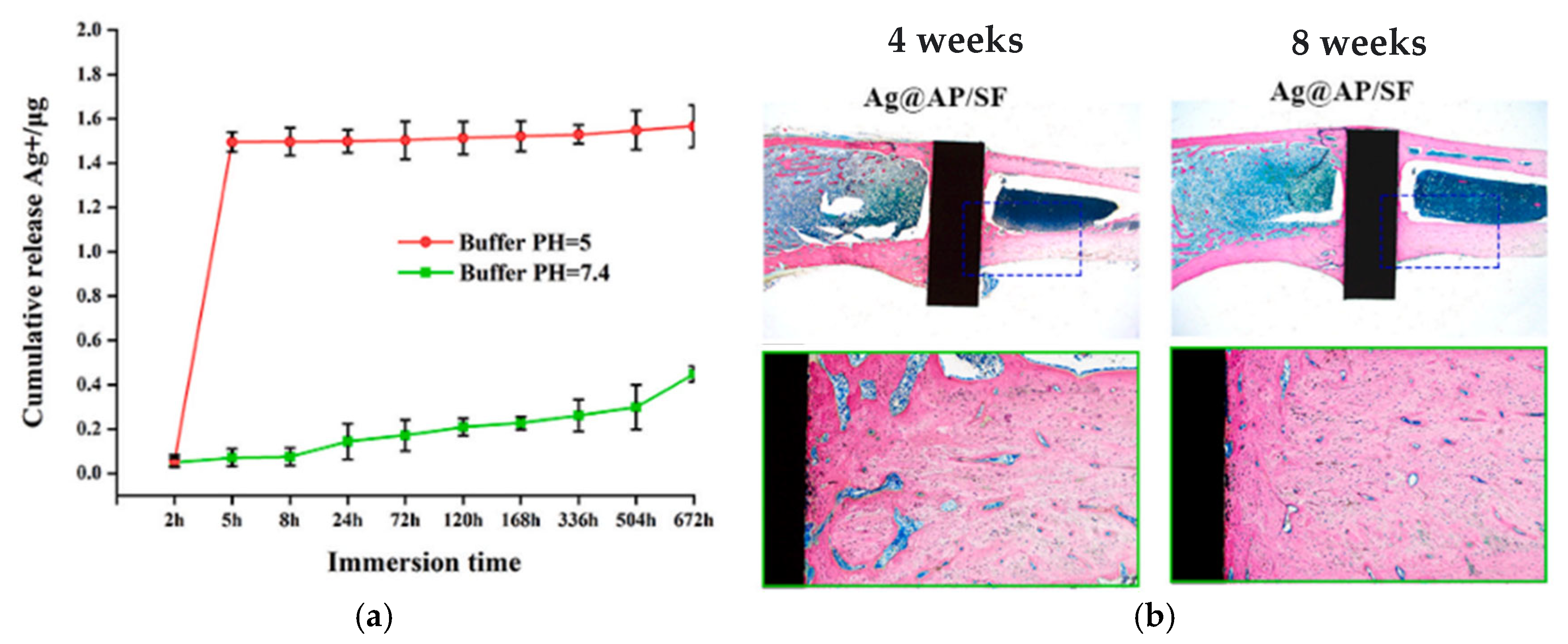
Interestingly, adenosine monophosphates (AMPs) can be grafted onto AgNPs [58] and deposited onto titanium implants with SF via spin-coating. The antibacterial rate was around 99% at pH 5.0, and roughly 4-fold more Ag+ ions were released over 28 days at pH 5.0 when compared to pH 7.4. The release peaked at 5 h in pH 5.0 media and then remained constant thereafter. Overall, AgNPs@AMP/SF with 1 mg/mL AgNPs and 0.2 mg/mL AMPs showed a much higher antibacterial effect than each component separately and achieved complete bacterial eradication within 4 h. AgNPs@AMPs/SF led to the highest ALP, Col I, and osteoblast-related gene expression and higher OCN and Runx2 (Runt-related transcription factor 2—a vital transcription factor for osteogenesis) upregulation after 7 and 14 days when compared to the other samples. In vivo, results also demonstrated higher bone regeneration and osseointegration levels when compared against pristine Ti, where even rod samples were covered with bone cells after 8 weeks. Good stability and low degradation were other observations in this test. The low Ag release and negligible negative effects on bone healing and histology confirmed minimal adverse impacts of AgNPs or AMP on the main organs (Figure 4a,b).
Figure 4.
(a) pH-dependent release behavior of Ag+ from Ag@AP/SF coating, (b) stained tissue of pristine and Ag@AP/SF-coated Ti rods tested in vivo at 4 and 8 weeks [58].
2.1.3. ECM-Based Composites
The extracellular matrix (ECM) is pH-sensitive (solubility and electrostatic reaction—Figure 2) and can be deposited onto titanium implants and loaded with hydroxyapatite nanorods and antimicrobial peptides (AMPs) [59], and release profiles lasting 30 days were achievable with 50 wt.% of AMPs. Specifically, 90% was released at pH 6.0, and 50% was released at pH 7.4 over 30 days, and the antibacterial efficiency was close to 100% on days 1 and 4 and 90% on day 8. At lower AMP concentrations, the antibacterial efficiency was around 80% on days 1 and 4 and 10% on day 8. Furthermore, after 7 days of incubation, the mitochondrial activity and cell proliferation increased to a higher level in the 50 wt.% sample than in other coating samples.
Demineralized ECM (DECM) can be loaded with vancomycin (Van) and then used to form pH-sensitive coatings. Vancomycin release for this composition and pH = 6.0 was almost three times higher than pH = 7.4 under around 45 days of the experiment, compared to the ECM-only groups at pH = 6.0. The resulting coating showed anti-planktonic and anti-adherent properties against bacterial infection (rate of antibacterial ability against planktonic bacteria (Rap) = over 98%) and immunoregulatory and osteoclast-limiting properties. Culturing bacteria on defective implants showed a bacterial count of 15 and 7.5 log10 (CFU/mL) after 1 and 6 weeks in uncoated specimens, while this was around 0 for the proposed coating. It also inhibited osteoclast activity and improved osteogenesis [60].
2.1.4. Other Bio-Polymers
Alginate is another pH-sensitive bio-polymer (swelling and shrinking—Figure 2) not covered in the above categories. In a relevant study, the Ti6Al4 plate was coated with pH-sensitive alginate and gelatin particles loaded with gentamicin via immersive assembly. Roughly 10% of the gentamicin was released in the first 0.5 h, followed by pH-dependent release over the next 10 days. There were only slight differences between the drug release at pH 7.4 and 5.0 after the first 12 h (5–20 wt.%), and after 18h incubation with bacteria, the native implant showed ~5 times more bacterial growth, while this growth was reduced in the coated alloy by 99.97% in bacteria. A bone coverage study demonstrated that there was full coverage of the implant surface with needle-shaped and spherical particles of calcium and phosphate after 21 days, confirming that the system could coat orthopedic implants properly [61].
2.2. Synthetic Polymers
2.2.1. pH-Sensitive Cationic Polymers
Polyelectrolytes are macromolecules with repeating charged units and include many cationic and anionic synthetic and natural polymers. Cationic polymers, often containing amine groups, have positive charges that allow them to bond with negatively charged molecules, such as drugs or DNA, and act as a drug reservoir for controlled release (electrostatic interaction—if hydrogel: swelling/shrinking—Figure 2). Some cationic polymers can even mimic other antibacterial peptides and help disrupt bacterial cell membranes, which makes them prime candidates for antibacterial coatings (Figure 2) [62,63]. Still, pH-sensitive cationic polymers can have low solubility at higher pH [64] and can, therefore, have limited compatibility with some substrates. Some popular pH-sensitive cationic polymers are polyethyleneimine (PEI), Poly(beta-amino esters) (PbAEs), Poly(N, N-dimethylaminoethyl methacrylate) (PDMAEMA), and Poly(N-isopropylacrylamide-co-methacrylic acid) (P(NIPAM-co-MAA)).
PEI has high transfection efficiency and pH sensitivity. In low pH, it tends to protonate, which causes the negatively charged drug to be released [65]. Poly(beta-amino esters) (PbAEs) can control the release of nucleic acid by degradation under low pH [66]. Finally, poly (N,N-dimethylaminoethyl methacrylate) (PDMAEMA) changes conformation and solubility in different pH levels and causes controlled drug release. PDMAEMA has tertiary amino groups in its structure, which are protonated in a low pH environment. It can also be designed as a multi-functional carrier with thermo-sensitive polymers or other stimuli-responsive materials [67]. In addition, the cell toxicity of synthetic polymers depends on various factors, including physical and mechanical characteristics, synthesis methods, and controlling steps for removing toxic residues, and the additives [68]. This can make Polypropylene non-toxic on the human body, while the results show different behavior for PDMAEMA on different kinds of human cells, which may be more harmful [64].
One attractive property of poly(N-isopropylacrylamide-co-methacrylic acid) (P(NIPAM-co-MAA)), as another pH-sensitive cationic polymer, is that, under low pH, its carboxylic groups remain protonated and, as a result, have a hydrophilic property. On the contrary, carboxylic groups become deprotonated when pH increases, and this causes them to develop a hydrophobic property. This would affect solubility and swelling, meaning it can easily dissolve in an acidic environment. Also, polyacrylic acid has the same properties as this polymer [69]. Finally, citrate is made of citric acid and an anion that can protonate under high pH to reduce pH and donate protons to an acidic solution to increase pH. This property makes it useful in many processes, like pH regulation. For example, pH-sensitive coatings can be made from hydroxyapatite nanoparticles and either citrate or poly(acrylic acid) (PAA) [70] using electrodeposition on Ti substrates. In vivo testing demonstrated that this coating led to osteogeneration that was similar to physiological bone growth.
In an alternative approach, Gupta et al. [71] used pH-sensitivity as a method for detecting bacterial infection at the prosthesis interface. Their pH-sensitive coating comprised multi-walled carbon nanotubes (MWCNTs) and polyaniline (PANI-pH-sensitive bond). It was coated over various substrates (e.g., glass, plastics, metals, and fiber-reinforced polymer composites) by spray coating. The coat would sense and show infection by changing permittivity, which an electrical capacitance tomography (ECT) could grasp. They showed that the average relative permittivity of their proposed compound changed from 0.025 to 0.055 by pH variation from 1.0 to 13.0.
Poly-L-lysine (PLL) and Polyacrylic acid (PAA) can be deposited as smart coatings with controllable roughness to reduce the degradability of Ti on titanium implants via LbL assembly [72]. For example, the roughness was 115 nm for uncoated titanium and 141 nm for ten double layers, where the roughness increased further when submerged in water. Still, the roughness did not exceed 200 nm, a threshold for preventing excessive bacterial adhesion [73,74]. The coatings were stable and could be loaded with tetracycline that had a burst release at both pH 7.4 and pH 4.5, but the total amount released at pH 4.5 was nearly double. Drug release remained constant from day 3 to day 15, which allowed for no detectable P. gingivalis W83 in the coated sample versus uncoated Ti.
Most recently, a more pH-sensitive complicated polymer, star-poly [2-(dimethylamino) ethyl methacrylate] (star-PDMAEMA), was used to develop an LbL coating over poly(lactic acid)/hydroxyapatite substrate by soaking. This coating was sensitive to the natural degradation of PLA inside the biological environment of the body, which can help stabilize the function of a biodegradable material like PLA as a coating. Consequently, local inflammation was well-controlled for around 8 weeks, and substrate degradation was more homogenous. Indomethacin release was higher at a lower pH of 6.0 than in physiological conditions (pH = 7.4). It was also faster at first and then slowed down. This coating evoked the least inflammatory cytokines [75].
PDMAEMA was further studied by Hemmatpour et al. [76]. They grafted PDMAEMA using the surface-initiated atom transfer radical polymerization (SI-ATRP) method on halloysite nanotubes (HNT). For pH-sensitivity purposes, the resulting compound had different diameters at different pH values. This study could only suggest that the pH sensitivity of this compound differs depending on the loaded compound. However, it was not much pH-sensitive at the tested ratio.
Finally, polyquaternary ammonium (QA) salts-co-methacrylic acid copolymer coating showed significant pH-sensitive antibacterial activity. The best performance was seen at pH = 5, where bacterial activity was less than 5% for all coatings with different assembly layers, while at pH = 7.4, no antibacterial effect was observed. Release of QAs after pH drop and deionization of the carboxyl group was concluded to break the cells and be the reason for this pH-sensitivity. Polyethyleneimine (PEI) is also a pH-sensitive component used in the coating procedure, which helps osteogenesis under neutral pH by a negatively charged (carboxyl groups) coating. Under bacterial activity and pH drop, the coating became positively charged (quaternary ammonium salts) and showed antibacterial effects. Also, the osteogenesis and inflammatory test results in poly-quaternary ammonium-coated substrates indicated better bone binding and growth, and less inflammatory response—amine groups induced by dopamine modification and resulting hydrophilicity reduced cell adhesion [77].
2.2.2. pH-Sensitive Anionic Polymers
In contrast to cationic polymers, anionic ones have negatively charged functional groups such as carboxylate (-COO) or sulfate (-SO3). The carboxylate group does not stimulate foreign body reactions and, therefore, is another great polyelectrolyte to use in coating implants (swelling/shrinking—Figure 2) [78]. Apart from controlled drug release, these polymers are excellent options for smart coatings and improve their adhesion, stability, and durability. Like cationic polymers, anionic ones also change in solubility and swelling by ionization and deionization under certain pH levels (Figure 2). The acid dissociation constant (pKa) defines the critical pH at which a polymer undergoes drastic changes in its properties [79].
Alternatively, BMP-2 can be grafted to anodized titanium substrates, followed by a pH-sensitive coating composed of alternating layers of Poly L-Histidine (PLH) and poly(methacrylic acid) (PMAA) [80]. PLH is a bio-derived polymer here used with a synthetic polymer (PMAA). BMP-2 release was observed over several months and had a sustained release phase following a burst release. After 25 days, the highest release was observed at pH 4.0 (roughly 3-fold that of pH 7.0). Similarly, a porous oxide structure (40–200 nm) anodized on titanium plates and coated with PLH/PMAA multilayers was investigated. Fluorescently labeled PLL was loaded into the films as a model polypeptide, and release was studied at different pH levels over 25 days [81]. After the initial burst release, a sustained release was observed that was dependent on the molecular weight of the PMAA, where a lower molecular weight gave a lower burst and a higher sustained release. Diffusion was identified as the main mechanism of release rather than the degradation of the coat. Moreover, the multilayer order affected the release rate along with the pH, with the highest release seen at pH 5.0, which was 2.5-fold the release at pH 7.4 and 5-fold at pH 4.0.
Finally, a coating with both passive and active antibacterial properties was suggested, implementing both cationic and anionic polymer responses. Multi-layer films of pH-sensitive zwitterionic block copolymer micelles (BCMs) made of zwitterionic poly [3-dimethyl (methacryloyloxyethyl) ammonium (βPDMA) shell and pH-responsive 2-(diisopropylamino)ethyl methacrylate] (PDPA) core were dip-coated. Having Triclosan loaded as an antibacterial agent in a 3-layer coating, the normalized (by 100) number of bacterial colonies was around 15 fewer in pH = 5.5 compared to pH = 7.5. Testing antibacterial efficiency showed the tiniest bacterial count [82]. Moreover, in a recent study, the long-term effectiveness of another zwitterionic polymer has been tested. A two-layer coating of dopamine (DA) and a poly(sulfobetaine methacrylate-co-dopamine methacrylamide) (PSBDA) and gentamicin sulfate, covalently linked, was deposited on a titanium-based implant. The initial anti-bacterial reduction for this coating was recorded as 90%. Due to a pH drop resulting from a later bacterial infection, gentamicine was released by the hydrolysis of Schiff-based bonds and effectively cancelled bacterial infection [83].
2.2.3. pH-Sensitive Polyphenols
As the names show, polyphenols have phenolic functional groups, which makes them a perfect crosslinking agent (e.g., tannic, ferulic, and caffeic acid) as they can form covalent bonds, electrostatic bonds, hydrophobic bonds, and chelation bonds to form networks of molecules (electrostatic interaction—if hydrogel: swelling/shrinking—Figure 2) [84,85]. pH-sensitive phenolic linkers have shown the ability to encapsulate drugs and keep them from degradation until bacterial infection occurs. Polyphenols can be relatively cheap and abundant depending on their origin, tend to have negligible toxicity to mammalian cells, and often demonstrate antimicrobial properties, making them generally promising materials for implant coatings [86,87,88].
Dopamine is a versatile phenolic molecule that can polymerize into PDA to make smart coatings on nearly any substrate [15]. Moreover, at low pH, the amine and phenolic groups become protonated, which can lead to drug release and a positively charged surface that increases adhesion properties [89]. For example, PDA can be deposited on 3D-printed hierarchical porous PEEK scaffolds, followed by one layer of AgNPs, a final capping PDA layer, with subsequent apatite grafting. This sandwich-like coating led to an increase in released silver ions when the pH dropped from 7.4 to 5.0 (~1.8-fold increase). The coatings showed 99% antibacterial efficiency compared to the uncoated surface or an apatite coating without AgNPs. In a 28-day study, no notable degradation was observed at neutral or near-acidic pH. By further decreasing the pH, the residual content of Ag+ ions decreased ALP activity, and calcium-based ECM production improved in all samples, and Ag ions did not negatively affect the osteoconductivity. Collagen (Col I) expression was higher for late-stage osteogenic differentiation; however, excluding the AgNP layer resulted in higher expression of ALP and Runx2 (early osteogenesis). Finally, in vivo experiments showed higher bone growth (27% more) in the AgNP and Ap-covered scaffolds compared to coatings without apatite [90].
2.3. Porous Coatings
2.3.1. Mesoporous Silica Nanoparticles
Mesoporous microspheres are spherical particles made of meso-sized pores (diameter of 2–50 nm). Porous structure means high surface area, pore volume, and efficient diffusion ability. Microsphere properties can be designed and controlled by the type of material, synthesis method, and application. The pH sensitivity of mesoporous microspheres is mainly dependent on their coating. Pores can accommodate the drug, and coating keeps them safe. The interaction of the coating with the acidic environment can disintegrate the coat and cause the drug to escape from the pores (Gate Opening or Structural Transformation—Figure 2) [91,92,93].
Common Mesoporous Silica Nanoparticles (MSNs) were one of the porous materials tested as a drug carrier. Silica has excellent biocompatibility, low cell toxicity, and proper chemical stability, but its long-term effects on the human body, especially when used as nanoparticles, need to be considered [68]. Sutthavas et al. used MSNs to deliver strontium (Sr) as a medium to improve bone regeneration. They coated them with calcium phosphate (CaP) or calcium phosphate zinc (CaZnP) as a pH-sensitive agent to enable controlled release. Since none of these elements are antibacterial agents or antibiotics, this is not an antibacterial effect study. However, due to the osteogenic properties of silica, calcium, and phosphate, this can be an excellent coating to improve osteoblast differentiation and proliferation. In general, MSNs could encapsulate ions at neutral pH with the help of CaP coating. The structure of MSNs itself was stable at a lower pH of 5.0. The results showed 100% release after a maximum of 150 h of experiment under pH = 5.0. ALP activity increased by around 3.5-fold in all MSN coatings after two days of culture in humans. Gene expression confirmed early osteogenic activity and late osteogenesis capability [94].
In the most recent study (2022) in this case, Zhao et al. synthesized Zinc-doped Amorphous Calcium Phosphate (Zn/ACP) mesoporous microspheres as pH-sensitive carriers using a microwave-assisted hydrothermal method. This compound was established by calcium-based components for osteogenesis and Zn2+ as an antibacterial agent. It showed appropriate stability in water and pH-sensitivity. The results also showed almost 100% release of zinc after 120 h in pH = 4.0, while it was around 20% for pH = 7.0. In a culture of 2 × 10⁶ bacteria, the uncoated specimen showed a tenfold increase in bacteria count. In contrast, the antibacterial efficiency of Zn/ACP increased with its concentration. It showed up to 91.93% efficiency against E. coli and 99.71% efficiency against S. aureus when Zn/ACP concentration was 8000 ppm Zn/ACP [95].
2.3.2. Metal-Organic-Frameworks
MOFs are a group of porous materials made of metal nodes and organic ligands. They are popular carriers in drug delivery applications due to their porous structure, which is appropriate for loading therapeutics [96,97]. Metal nodes can also reduce antibiotic resistance. However, due to H2O bonds, they degrade quickly in water and even faster in acidic environments such as the one created by bacterial activity (solubility and electrostatic reaction—Figure 2) [98]. This makes them a perfect option for designing pH-sensitive carriers. Although they are extensively used in drug delivery system designs, only a handful of them have specifically been implemented in pH-sensitive anti-bacterial implant coatings.
There are different mechanisms of pH sensitivity for MOFs. One is to benefit from a pH-sensitive metal ion ligand and bonding with H+ in an acidic environment, which deforms or breaks the structure and releases the drug (Gate opening—Figure 2). It is also possible that the whole MOF is sensitive to low pH and releases the drug due to protonation (solubility and electrostatic reaction—Figure 2). It means they may need to become stabilized using further treatment or extra linkers to show controlled release only in bacterial attack events. It is ideal for coating bone implants to control and limit drug release to low pH or infection time rather than neutral pH. This helps osteogeneration and extended release of drugs to support both antibacterial and bone formation for the long term [99,100,101]. The toxicity of MOFs depends on multiple parameters such as shape, size, and topologies. For example, by decreasing the size of MOFs, their cell permeability and toxicity increase. Among the most used metal-MOFs, Ca and Bi have the least toxicity, and the most toxic MOFs are Mn, Cu, and Zn [102].
One example of a pH-sensitive MOF-based coating is a magnesium/zinc-metal organic framework (Mg/Zn-MOF74) coated on a substrate of alkaline-heat-treated titanium (AT) by soaking. Zn2+ and Mg2+ increase osteogenesis and downregulate inflammation [103,104]. They can kill pathogenic agents like bacteria. Although Mg2+ is highly soluble in water, and a high dosage of Zn2+ is toxic to cell growth, the resulting combination had proper stability and was not cytotoxic. In response to a pH drop, this compound increases the pH to around 8.0. Satisfactory anti-inflammatory properties were also observed for this MOF. The final concentration of the used ligand (2,5-dihydroxyterephthalic acid (DHTA)), Mg2+, and Zn2+ after 168 h of the release test was almost the same for pH = 7.4 and 6.5, but the initial slope was steeper for pH = 6.5. This paper investigated the antibacterial activity of different Zn contents. The highest activity was 80% efficiency over a 6 h test. Upregulation of osteogenic genes was also observed after Zn2+ treatment of Mg-MOF74 coatings [105].
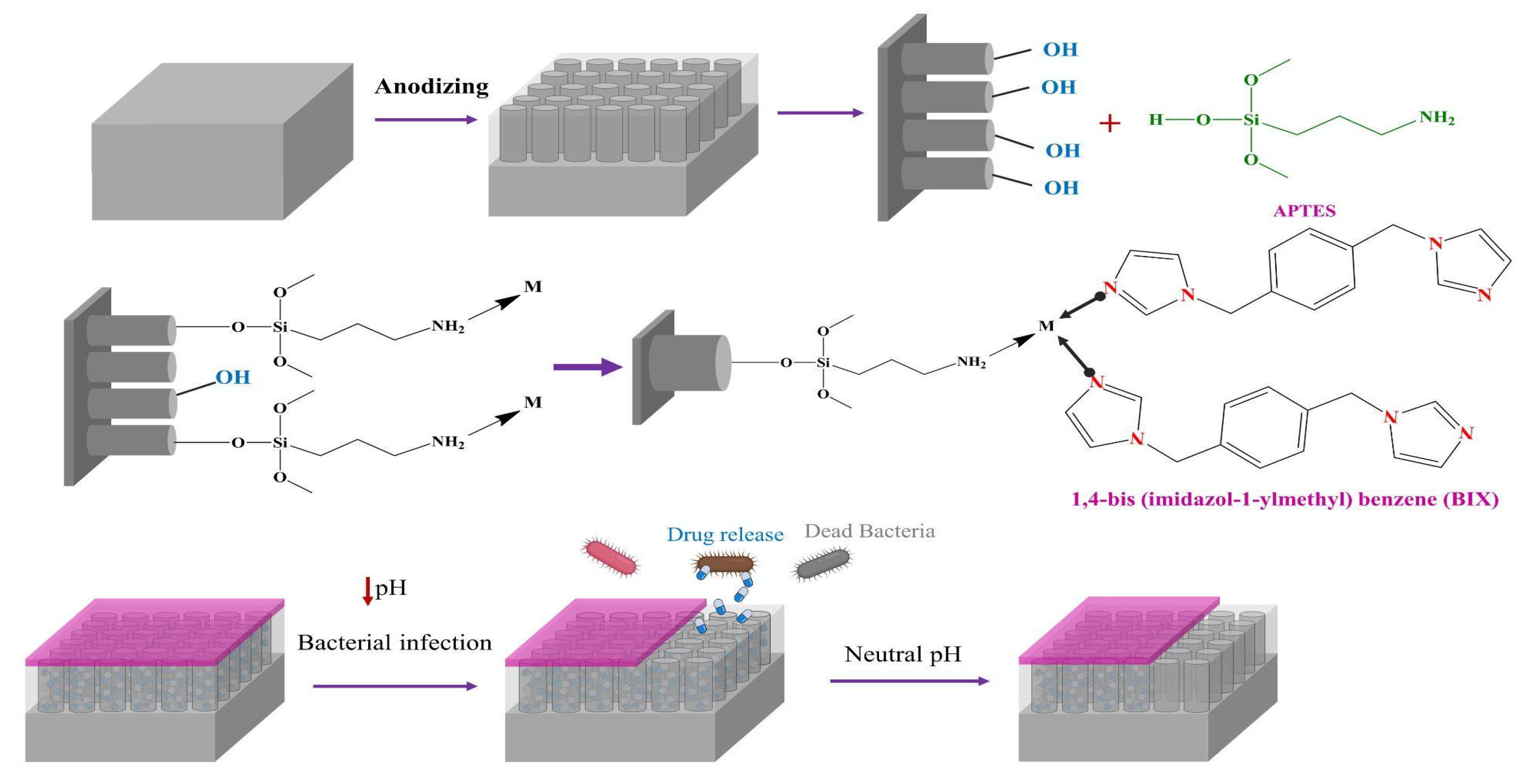
Imidazolate is also one of the most common linkers in pH-sensitive zeolitic imidazolate frameworks (ZIFs). Wang et al. fabricated a hybrid pH-sensitive system. They loaded some functional agents, such as Ibuprofen, Vancomycin (Van), and silver nanoparticles (AgNp), into TNTs and then sealed them with coordination polymers (CPs) (1,4-bis(imidazol-1-ylmethyl)benzene (BIX)) through the attachment of metallic ions such as Zn2+ or Ag+ (Figure 5). Once the environment becomes acidic because of illness, the coordination bond of the capped CPs is triggered to open and release antibacterial agents. Meanwhile, Zn2+ in the compound promoted osteogenesis, and Ag+ helped antibacterial performance. Quantitatively, after 22 days, Ag+ release grew from 1250 µg/mL at pH = 7.4 to around 2000 µg/mL at pH = 5.4. Similarly, Zn2+ release changed from 200 µg/mL at pH = 7.4 to around 900 µg/mL at pH = 5.4 on day 22 of the experiment. Zn and Mg-containing coatings showed an efficiency of over 99% against both E. coli and S. aureus, while simple TNT-NH2-Van had only 90% antibacterial efficiency against S. aureus and no effect on E. coli. Cell viability increased to a proper level after 18 days. ALP expression was higher in Zn-containing coat due to Zn2+ stimulation of cell metabolism, but ALP was less after 14 days [106].
Figure 5.
A schematic illustration of the preparation method of titania nanotubes (TNTs) using anodizing, and their modification with APTES to create drug-loaded TNTs. Further coating them with BIX to produce the @M(drig)-BIX hybrid system. The last line indicates the opening and drug-releasing mechanism of this coating in case of bacterial infection and acidic environment. This pH-triggered release acts as an antibacterial reaction. When the infection dies and pH returns to normal, the release stops (sketched in biorender.com from ref. [106]).
ZIF-67 pH-sensitivity has recently been studied in 2021 by Tao et al. This pH-sensitive MOF was loaded with osteogenic growth peptide (OGP) and coated over titanium dioxide nanotubes. The coating was conducted by electrophoresis deposition (EPD) technique, and over a titanium substrate anodized to obtain titanium dioxide nanotubes (TNTs). This coating showed a fast response to acidic environments and could effectively kill various bacteria by increasing the pH to an alkaline level. It suppressed possible inflammatory response, enhanced antibacterial activity by over 90% by inducing an alkaline environment (due to Co2+ release), and improved osseointegration by helping mesenchymal stromal cells’ differentiation. Meanwhile, TNT-ZIF-67@OGP showed around 95% antibacterial efficiency. Comparing titanium and TNT-based samples, TNT-ZIF-67@OGP samples showed an improved osteodifferentiation, the highest ALP level, and the lowest inflammatory cytokines. ZIF-67@OGP nanoparticles were dissolved entirely after 3 days, and bone formation was the highest after 4 weeks post-implantation. These results were consistent with in vivo tests [18].
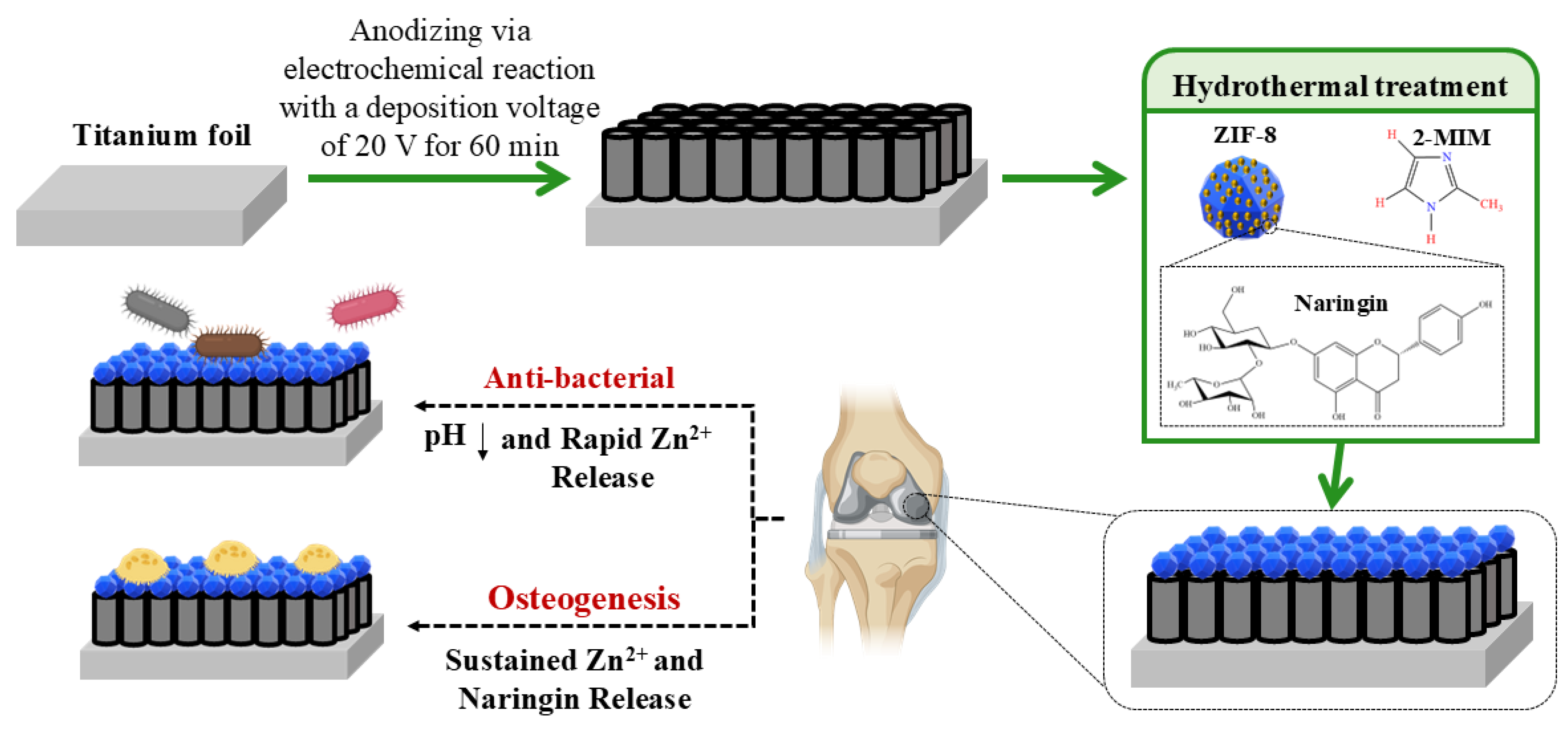
Furthermore, in 2022, Wang et al. studied zeolitic imidazolate framework-8 (ZIF-8) pH-sensitivity (Figure 6). They used TNT coated with naringin-loaded ZIF-8 (TNT-ZIF8@Nar) on a titanium substrate by hydrothermal treatment. Release of Zn2+ and naringin due to pH drop enhanced antibacterial activity by 93.6% and 88.3% for samples without naringin and with naringin, respectively. Adding ZIF-8 as a pH-sensitive carrier increased the slope of the release time at pH = 5.5 compared to pH = 7.4. At pH = 5.5, Zn2+ release reached its maximum in 4 days and was preserved until day 21 in both TNT-ZIF8 and TNT-ZIF8@Nar. The same maximum was reached on day 21 for the same compound at pH = 7.4. The antibacterial rate against E. coli was 93.6%, while many bacterial colonies were observed over non-modified TNT-based samples during the test. The synergistic effect of naringin and Zn2+ was identified as the reason for this antibacterial activity. Meanwhile, ZIF hydrolysis hurt cell adhesion, but adding naringin compensated for that and improved osteoblast proliferation and differentiation. Therefore, comparing other samples, TNT-ZIF8@Nar indicated higher ALP activity, collagen secretion, ECM mineralization, and Runx2, Col I, and OPN expression. Testing in vivo for 4 weeks, they reported the ratio of new bone formation to total bone volume, trabecular thickness, and trabecular number to increase by as much as 39.4%, 0.23, and 6.58, respectively, compared to the native coating [107]. In a recent study, ZIF-8 was incorporated as a unit to encapsulate a biofilm-eliminating enzyme in Poly (methacrylic acid-co-2-(dimethylamino)ethyl methacrylate) hydrogel. This polymer hydrogel opened the way for the release of the loaded enzyme at pH 8.5 and the rupture of the biofilm. In the following week, the enzyme release maxed out at 90% and 96% in a three-week follow-up. Anti-bacterial ability test showed time-dependent decrease in E. coli and S. aureus, and no inflammation or toxicity was observed in the in vivo test [108].
Figure 6.
A schematic illustration of titania nanotubes (TNTs) preparation using anodizing, and deposition of naringin-loaded ZIF-8 nanoparticles (ZIF-8@Nar) onto TNT substrates (TNT-ZIF-8@Nar) by means of the hydrothermal method. These TNT-ZIF-8@Nar coatings have two main advantages as an implant coating. (1) Its excellent pH-responsiveness of Zn2+ and the timely release of naringin showing high antibacterial abilities against both E. coli and S. aureus in vitro. and (2) remarkable osteogenesis behavior increasing adhesion, proliferation, differentiation, and expression of osteogenesis-related genes of the osteoblasts (sketched in biorender.com from ref. [107]).
2.4. pH-Sensitive Linkers
pH-sensitive linkers are a group of linkers that can undergo acid-catalyzed cleavage at specific pH levels and release their content. In a pH-sensitive setting based on these linkers, hydrolysis or degradation of the linker under low pH conditions opens the doors for loaded drugs. Also, there are a variety of pH-sensitive linkers that can be manipulated to give desired properties. Some of these groups are hydrozones, orthoesters, and phosphoramidates. Coatings made of pH linkers have limited control over release kinetics and may cause incomplete release. Also, they are more unstable and unpredictable in terms of degradation. However, in recent years, this disadvantage has been significantly modified by manipulating the linkers’ chemistry [109].
In a study by Dong et al. [110], an acetal linker (3,9-Bis(3-aminopropyl)-2,4,8,10-tetraoxaspiro [5.5]undecane) was used as a pH-sensitive agent to graft antimicrobial silver nanoparticles to the titania nanotube-modified implant by soaking. The linker is cleaved and releases nanoparticles at low pH values to improve antibacterial activity. A release study in 30 days showed a maximum of 2.5 ppm and 1 ppm nanoparticle release at pH = 5.5 and 7.4, respectively. Furthermore, the antibacterial efficiency of the AgNP-containing coating was higher than that of native TNT, and even under pH = 5.5, the coating showed 12.7- and 5.1-times higher efficiency against S. aureus and E. coli, respectively. However, AgNP was more stable at pH = 7.4 than at pH = 5.5 over a 30-day experiment. Comparison of the coated TNT with native TNT showed that osteoblast proliferation was almost doubled after 1 day. Moreover, an increased ALP of 1.7-fold indicated the biocompatibility of this coating [110].
Yang et al. [111] developed a relatively complex LbL antibacterial coating of three layers: (1) 5, 6-dihydroxyindole (DHI) directly on the substrate, (2) formyl phenylboronic acid (FPBA), and (3) aminoglycosides (AGs) antibiotic. The resulting maximum drug release was over 80% in pH = 5.0 and around 10% in pH = 7.4 after 120 h of long experiments. In this structure, catechol borate and imine bonds were known as pH-sensitive agents and increased hydrophobicity due to many hydroxyls and amine groups. This hydrophobicity was another indication of the antibacterial properties of this coating. Antibacterial activity was also around 0 compared to 2–14 × 104 CFU/mL (E. coli and Pseudomonas aeruginosa) bacteria count for uncoated surfaces.
3. Current Challenges and Future Outlook
Problems like septic loosening, infections, and inflammatory reactions around bone and dental implants are still big challenges. Because of these issues, there is growing interest in practical strategies that industries can actually use—especially those that improve current implant systems without costing too much. Surface coating has proven to be one of the most practical and impactful routes, offering a way to modify implant–tissue interactions and reduce many of the complications observed in long-term use.
Antibiotic resistance is one of the most critical challenges associated with bone–implant infections, and as it becomes more common, it is clear we need smarter, adaptable surface solutions. Smart coatings, particularly those sensitive to pH changes, look promising because they can deliver targeted antimicrobial action exactly when and where it is needed (refer to Table 1 for the summary of discussed pH-sensitive coatings). Although these coatings have been studied a lot in labs, the big challenge now is moving past early research and figuring out how to bring them into real-world medical use.
Table 1.
Summary of pH-sensitive materials and their antibacterial and osteointegration potential. (green: over 90% antibacterial activity, blue: acceptable performance in both short and long terms and pH (5.8–7.4), yellow: acceptable performance in either short and long terms and pH (5.8–7.4)).
Despite the many advantages of pH-sensitive coatings for orthopedic implants, including localized and smart drug release and controllable osteodifferentiation, there are still various challenges [112]. Most pH-responsive coatings have been evaluated in the laboratory under different acidic conditions, but it remains unclear how well they withstand and maintain their function over time when exposed to the fluctuating pH levels that occur around implants in the body. Although many of these systems appear to activate reliably once the pH drops to levels typical of infected sites—or even lower—ensuring that they continue to work during subsequent acidic episodes, sustain drug release, prevent biofilm formation, and support bone regeneration requires further investigation. Even at normal physiological pH, the long-term effectiveness of pH-responsive coatings may be affected by chemical breakdown and hydrolysis, protein attachment and biofouling, mechanical wear and stress, biological and oxidative stress, as well as drug depletion or reservoir exhaustion, which should be carefully investigated [113,114,115,116]. For sustained functionality, a strong bond between the coating and the substrate is essential for the prolonged durability of implant coatings. Phenolic compounds such as TA and PDA have a strong universal adherence and offer promise for solving this challenge. Another strategy to enhance the durability of smart coatings is surface treatment using different functional groups, which can create a strong bond between the coating and the implant surface [117].
Burst release is also a critical challenge that could be overcome through various pre-treatment routes, such as washing or implementing clinical interventions. The encapsulation of active materials and the utilization of biocompatible linkers in the coating composition significantly impact the drug release kinetics. Biocompatible linkers can also regulate drug release rates and, in certain instances, react to pH while increasing the durability of fragile therapeutics, such as proteins [110]. Encapsulation in porous materials also offers promise for controlling the release profile. However, the porous materials would need to be biocompatible and promote adhesion to and regeneration of bone tissue [118]. Additionally, multi-stage release could be effective in controlling the release rate. For example, dual antimicrobial systems ensure the drug is sufficient to fight the infection in a specific area and that resistance is prevented. Regarding the release of active agents from pH-sensitive coatings, it is important to keep in mind that a mild pH drop naturally occurs during the early inflammatory phase after implant placement due to immune cell activity and tissue remodelling. This is a normal and transient physiological process. What matters is ensuring that pH-responsive coatings designed for antibacterial release are engineered so that no drug release occurs at pH values above ~6.6, while effective release is triggered only when the pH falls below this threshold [115,119].
Moreover, dual-functional coatings could provide opportunities for both antibiofilm formation ability and osteogenic properties [120]. Using a multi-layer approach could also offer opportunities to design multifunctional coatings. Similarly, liposomes and other delivery systems, such as mesoporous zirconia [121] and ZnO quantum dots [122], could be integrated into coatings. Another exciting idea has been using pH-increasing agents to bring the acidic environment induced by bacteria back to normal pH and stop infection early on [123]. The coating method, the reproducible preparation techniques, and the use of cost-effective materials capable of scale-up affect the performance and are essential for clinical uptake. These highlight some of the challenges and the many ways they could be overcome by researchers.
4. Conclusions
One of the challenges associated with implants is the potential risk of infection after surgery. The use of anti-infection coatings that simultaneously promote bone attachment and growth is a promising approach to tackle this problem. In particular, pH-sensitive coatings have shown effectiveness in controlling infections by regulating the release rate of drugs and helping to overcome antibiotic resistance. These materials can sense changes in pH levels at inflamed or infected sites around the implants and respond rapidly, such as releasing antibacterial agents. This review article reviewed the concept and advances around bio-based pH-sensitive coatings for orthopedic implants. Various pH-sensitive materials, including cationic polymers, polysaccharides, protein-based polymers, anionic polymers, polyphenolic polymers, zwitterionic polymers, porous materials, and pH-sensitive linkers, have been reviewed as smart coatings for bone implants. In general, these types of materials are responsive to changes in the pH of the environment and can provide a smart release system. However, further studies are required to design various coating structures, such as porous and multi-layered coatings, that can perform at a clinically relevant level.
Author Contributions
Literature review and writing; R.G., N.V.M., Z.Y., and F.G.; consistency review and editing; R.G., N.V.M., and J.J.R.; final review and improvements; R.G., N.V.M., J.J.R., B.A., V.A., and V.K.T. All authors have read and agreed to the published version of the manuscript.
Funding
This research received no external funding.
Institutional Review Board Statement
Not applicable.
Informed Consent Statement
Not applicable.
Data Availability Statement
No new data were created or analyzed in this study.
Acknowledgments
GenAI (ChatGPT-4) has been used in initial drafting to improve wording in introductions. No technical literature has been trusted on AI tools. The authors have reviewed and edited the output and take full responsibility for the content of this publication.
Conflicts of Interest
The authors declare no conflicts of interest.
Nomenclature
| PLGA | poly-lactic-co-glycolic acid |
| MSN | mesoporous silica nanoparticle |
| ALP | alkaline phosphatase |
| PDA | polydopamine |
| LbL | layer-by-layer |
| PEEK | sulfonated polyether-ether-ketone |
| DOX | doxorubicin hydrochloride |
| ROS | reactive oxygen species |
| BMP-2 | Bone Morphogenetic Protein 2 |
| OPN | Osteopontin |
| TNT | titania nanotube |
| siRNA | small interfering RNA |
| AgNP | silver nanoparticle |
| SF | silk fibroin |
| Col I | Collagen 1 |
| OCN | osteocalcin |
| ECM | Extracellular matrix |
| PEI | polyethyleneimine |
| PDMAEMA | Poly(N, N-dimethylaminoethyl methacrylate) |
| P(NIPAM-co-MAA) | Poly(N-isopropylacrylamide-co-methacrylic acid) |
| MWCNT | multi-walled carbon nanotubes |
| PLL | Poly-L-lysine |
| QA | quaternary ammonium |
| PLH | Poly L-Histidine |
| PMAA | poly(methacrylic acid) |
| OGP | osteogenic growth peptide |
References
- Ackerman, I.N.; Bohensky, M.A.; de Steiger, R.; Brand, C.A.; Eskelinen, A.; Fenstad, A.M.; Furnes, O.; Garellick, G.; Graves, S.E.; Haapakoski, J.; et al. Substantial rise in the lifetime risk of primary total knee replacement surgery for osteoarthritis from 2003 to 2013: An international, population-level analysis. Osteoarthr. Cartil. 2017, 25, 455–461. [Google Scholar] [CrossRef] [PubMed]
- LROI. Online LROI Annual Report 2022; Dutch Arthroplasty Register (LROI): s-Hertogenbosch, The Netherlands, 2022. [Google Scholar]
- Arciola, C.R.; Campoccia, D.; Montanaro, L. Implant infections: Adhesion, biofilm formation and immune evasion. Nat. Rev. Microbiol. 2018, 16, 397–409. [Google Scholar] [CrossRef] [PubMed]
- Ciofu, O.; Moser, C.; Jensen, P.Ø.; Høiby, N. Tolerance and resistance of microbial biofilms. Nat. Rev. Microbiol. 2022, 20, 621–635. [Google Scholar] [CrossRef] [PubMed]
- Narayana, S.V.V.S.; Srihari, P.S.V.V. Biofilm Resistant Surfaces and Coatings on Implants: A Review. Mater. Today Proc. 2019, 18, 4847–4853. [Google Scholar] [CrossRef]
- Zhao, L.; Chu, P.K.; Zhang, Y.; Wu, Z. Antibacterial coatings on titanium implants. J. Biomed. Mater. Res. Part B Appl. Biomater. 2009, 91B, 470–480. [Google Scholar] [CrossRef]
- Jones, M.D.; Buckle, C.L. How does aseptic loosening occur and how can we prevent it? Orthop. Trauma 2020, 34, 146–152. [Google Scholar] [CrossRef]
- Hodges, N.A.; Sussman, E.M.; Stegemann, J.P. Aseptic and septic prosthetic joint loosening: Impact of biomaterial wear on immune cell function, inflammation, and infection. Biomaterials 2021, 278, 121127. [Google Scholar] [CrossRef]
- Nunes, C.D.R.; Barreto Arantes, M.; Menezes de Faria Pereira, S.; Leandro da Cruz, L.; de Souza Passos, M.; Pereira de Moraes, L.; Vieira, I.J.C.; Barros de Oliveira, D. Plants as Sources of Anti-Inflammatory Agents. Molecules 2020, 25, 3726. [Google Scholar] [CrossRef]
- Carnicer-Lombarte, A.; Chen, S.-T.; Malliaras, G.G.; Barone, D.G. Foreign Body Reaction to Implanted Biomaterials and Its Impact in Nerve Neuroprosthetics. Front. Bioeng. Biotechnol. 2021, 9, 622524. [Google Scholar] [CrossRef]
- Ziats, N.P.; Miller, K.M.; Anderson, J.M. In vitro and in vivo interactions of cells with biomaterials. Biomaterials 1988, 9, 5–13. [Google Scholar] [CrossRef]
- Lebaudy, E.; Fournel, S.; Lavalle, P.; Vrana, N.E.; Gribova, V. Recent Advances in Antiinflammatory Material Design. Adv. Healthc. Mater. 2021, 10, 2001373. [Google Scholar] [CrossRef] [PubMed]
- Yang, Y.; Ao, H.Y.; Yang, S.B.; Wang, Y.G.; Lin, W.T.; Yu, Z.F.; Tang, T.T. In vivo evaluation of the anti-infection potential of gentamicin-loaded nanotubes on titania implants. Int. J. Nanomed. 2016, 11, 2223–2234. [Google Scholar] [CrossRef]
- He, S.; Zhou, P.; Wang, L.; Xiong, X.; Zhang, Y.; Deng, Y.; Wei, S. Antibiotic-decorated titanium with enhanced antibacterial activity through adhesive polydopamine for dental/bone implant. J. R. Soc. Interface 2014, 11, 20140169. [Google Scholar] [CrossRef] [PubMed]
- Chen, X.; Zhou, J.; Qian, Y.; Zhao, L. Antibacterial coatings on orthopedic implants. Mater. Today Bio 2023, 19, 100586. [Google Scholar] [CrossRef]
- Croes, M.; Boot, W.; Kruyt, M.C.; Weinans, H.; Pouran, B.; van der Helm, Y.J.M.; Gawlitta, D.; Vogely, H.C.; Alblas, J.; Dhert, W.J.A.; et al. Inflammation-Induced Osteogenesis in a Rabbit Tibia Model. Tissue Eng. Part C Methods 2017, 23, 673–685. [Google Scholar] [CrossRef]
- Roupie, C.; Labat, B.; Morin-Grognet, S.; Echalard, A.; Ladam, G.; Thébault, P. Dual-functional antibacterial and osteogenic nisin-based layer-by-layer coatings. Mater. Sci. Eng. C 2021, 131, 112479. [Google Scholar] [CrossRef]
- Tao, B.; Lin, C.; He, Y.; Yuan, Z.; Chen, M.; Xu, K.; Li, K.; Guo, A.; Cai, K.; Chen, L. Osteoimmunomodulation mediating improved osteointegration by OGP-loaded cobalt-metal organic framework on titanium implants with antibacterial property. Chem. Eng. J. 2021, 423, 130176. [Google Scholar] [CrossRef]
- Djošić, M.; Janković, A.; Mišković-Stanković, V. Electrophoretic Deposition of Biocompatible and Bioactive Hydroxyapatite-Based Coatings on Titanium. Materials 2021, 14, 5391. [Google Scholar] [CrossRef]
- Amin, M.; Lammers, T.; ten Hagen, T.L.M. Temperature-sensitive polymers to promote heat-triggered drug release from liposomes: Towards bypassing EPR. Adv. Drug Deliv. Rev. 2022, 189, 114503. [Google Scholar] [CrossRef]
- Xing, Y.; Zeng, B.; Yang, W. Light responsive hydrogels for controlled drug delivery. Front. Bioeng. Biotechnol. 2022, 10, 1075670. [Google Scholar] [CrossRef]
- Liu, J.F.; Jang, B.; Issadore, D.; Tsourkas, A. Use of magnetic fields and nanoparticles to trigger drug release and improve tumor targeting. Wiley Interdiscip. Rev. Nanomed. Nanobiotechnol. 2019, 11, e1571. [Google Scholar] [CrossRef] [PubMed]
- Shin Low, S.; Nong Lim, C.; Yew, M.; Siong Chai, W.; Low, L.E.; Manickam, S.; Ti Tey, B.; Show, P.L. Recent ultrasound advancements for the manipulation of nanobiomaterials and nanoformulations for drug delivery. Ultrason. Sonochem. 2021, 80, 105805. [Google Scholar] [CrossRef]
- Richardson, J.J.; Björnmalm, M.; Caruso, F. Technology-driven layer-by-layer assembly of nanofilms. Science 2015, 348, aaa2491. [Google Scholar] [CrossRef] [PubMed]
- Rizwan, M.; Yahya, R.; Hassan, A.; Yar, M.; Azzahari, A.D.; Selvanathan, V.; Sonsudin, F.; Abouloula, C.N. pH Sensitive Hydrogels in Drug Delivery: Brief History, Properties, Swelling, and Release Mechanism, Material Selection and Applications. Polymers 2017, 9, 137. [Google Scholar] [CrossRef] [PubMed]
- Schmaljohann, D. Thermo- and pH-responsive polymers in drug delivery. Adv. Drug Deliv. Rev. 2006, 58, 1655–1670. [Google Scholar] [CrossRef]
- Hiraide, S.; Nishimoto, K.; Watanabe, S. Controlling the steepness of gate-opening behavior on elastic layer-structured metal–organic framework-11 via solvent-mediated phase transformation. J. Mater. Chem. A 2024, 12, 18193–18203. [Google Scholar] [CrossRef]
- Bialas, F.; Reichinger, D.; Becker, C.F.W. Biomimetic and biopolymer-based enzyme encapsulation. Enzym. Microb. Technol. 2021, 150, 109864. [Google Scholar] [CrossRef]
- Zhu, J.; Han, H.; Ye, T.T.; Li, F.X.; Wang, X.L.; Yu, J.Y.; Wu, D.Q. Biodegradable and pH Sensitive Peptide Based Hydrogel as Controlled Release System for Antibacterial Wound Dressing Application. Molecules 2018, 23, 3383. [Google Scholar] [CrossRef]
- Kyriakides, T.R.; Cheung, C.Y.; Murthy, N.; Bornstein, P.; Stayton, P.S.; Hoffman, A.S. pH-sensitive polymers that enhance intracellular drug delivery in vivo. J Control Release 2002, 78, 295–303. [Google Scholar] [CrossRef]
- Singh, J.; Nayak, P. pH-responsive polymers for drug delivery: Trends and opportunities. J. Polym. Sci. 2023, 61, 2828–2850. [Google Scholar] [CrossRef]
- Chen, H.; Wang, J.; Cheng, Y.; Wang, C.; Liu, H.; Bian, H.; Pan, Y.; Sun, J.; Han, W. Application of Protein-Based Films and Coatings for Food Packaging: A Review. Polymers 2019, 11, 2039. [Google Scholar] [CrossRef] [PubMed]
- Hassan, B.; Chatha, S.A.S.; Hussain, A.I.; Zia, K.M.; Akhtar, N. Recent advances on polysaccharides, lipids and protein based edible films and coatings: A review. Int. J. Biol. Macromol. 2018, 109, 1095–1107. [Google Scholar] [CrossRef] [PubMed]
- Kaewprachu, P.; Osako, K.; Benjakul, S.; Tongdeesoontorn, W.; Rawdkuen, S. Biodegradable Protein-based Films and Their Properties: A Comparative Study. Packag. Technol. Sci. 2016, 29, 77–90. [Google Scholar] [CrossRef]
- Desai, N.; Rana, D.; Salave, S.; Gupta, R.; Patel, P.; Karunakaran, B.; Sharma, A.; Giri, J.; Benival, D.; Kommineni, N. Chitosan: A Potential Biopolymer in Drug Delivery and Biomedical Applications. Pharmaceutics 2023, 15, 1313. [Google Scholar] [CrossRef]
- Kalliola, S.; Repo, E.; Srivastava, V.; Zhao, F.; Heiskanen, J.P.; Sirviö, J.A.; Liimatainen, H.; Sillanpää, M. Carboxymethyl Chitosan and Its Hydrophobically Modified Derivative as pH-Switchable Emulsifiers. Langmuir 2018, 34, 2800–2806. [Google Scholar] [CrossRef]
- Lee, J.H.; Tachibana, T.; Wadamori, H.; Yamana, K.; Kawasaki, R.; Kawamura, S.; Isozaki, H.; Sakuragi, M.; Akiba, I.; Yabuki, A. Drug-Loaded Biocompatible Chitosan Polymeric Films with Both Stretchability and Controlled Release for Drug Delivery. ACS Omega 2023, 8, 1282–1290. [Google Scholar] [CrossRef]
- Jiménez-Gómez, C.P.; Cecilia, J.A. Chitosan: A Natural Biopolymer with a Wide and Varied Range of Applications. Molecules 2020, 25, 3981. [Google Scholar] [CrossRef]
- Ghattas, M.; Dwivedi, G.; Chevrier, A.; Horn-Bourque, D.; Alameh, M.G.; Lavertu, M. Chitosan immunomodulation: Insights into mechanisms of action on immune cells and signaling pathways. RSC Adv. 2025, 15, 896–909. [Google Scholar] [CrossRef]
- Tao, X.; Jiang, F.; Cheng, K.; Qi, Z.; Yadavalli, V.K.; Lu, S. Synthesis of pH and Glucose Responsive Silk Fibroin Hydrogels. Int J. Mol. Sci. 2021, 22, 7107. [Google Scholar] [CrossRef]
- Makadia, H.K.; Siegel, S.J. Poly Lactic-co-Glycolic Acid (PLGA) as Biodegradable Controlled Drug Delivery Carrier. Polymers 2011, 3, 1377–1397. [Google Scholar] [CrossRef]
- Porgham Daryasari, M.; Dusti Telgerd, M.; Hossein Karami, M.; Zandi-Karimi, A.; Akbarijavar, H.; Khoobi, M.; Seyedjafari, E.; Birhanu, G.; Khosravian, P.; SadatMahdavi, F. Poly-l-lactic acid scaffold incorporated chitosan-coated mesoporous silica nanoparticles as pH-sensitive composite for enhanced osteogenic differentiation of human adipose tissue stem cells by dexamethasone delivery. Artif. Cells Nanomed. Biotechnol. 2019, 47, 4020–4029. [Google Scholar] [CrossRef]
- Zheng, D.; Neoh, K.G.; Kang, E.-T. Bifunctional coating based on carboxymethyl chitosan with stable conjugated alkaline phosphatase for inhibiting bacterial adhesion and promoting osteogenic differentiation on titanium. Appl. Surf. Sci. 2016, 360, 86–97. [Google Scholar] [CrossRef]
- Soares, Í.; Faria, J.; Marques, A.; Ribeiro, I.A.C.; Baleizão, C.; Bettencourt, A.; Ferreira, I.M.M.; Baptista, A.C. Drug Delivery from PCL/Chitosan Multilayer Coatings for Metallic Implants. ACS Omega 2022, 7, 23096–23106. [Google Scholar] [CrossRef] [PubMed]
- He, M.; Zhu, C.; Sun, D.; Liu, Z.; Du, M.; Huang, Y.; Huang, L.; Wang, J.; Liu, L.; Li, Y.; et al. Layer-by-layer assembled black phosphorus/chitosan composite coating for multi-functional PEEK bone scaffold. Compos. Part B Eng. 2022, 246, 110266. [Google Scholar] [CrossRef]
- Gan, Q.; Zhu, J.; Yuan, Y.; Liu, H.; Qian, J.; Li, Y.; Liu, C. A dual-delivery system of pH-responsive chitosan-functionalized mesoporous silica nanoparticles bearing BMP-2 and dexamethasone for enhanced bone regeneration. J. Mater. Chem. B 2015, 3, 2056–2066. [Google Scholar] [CrossRef] [PubMed]
- Cheng, Y.; Qiao, Y.; Shen, P.; Gao, B.; Liu, X.; Kong, X.; Zhang, S.; Wu, J. Fabrication and in vitro biological activity of functional pH-sensitive double-layered nanoparticles for dental implant application. J. Biomater. Appl. 2020, 34, 1409–1421. [Google Scholar] [CrossRef]
- Tao, B.; Deng, Y.; Song, L.; Ma, W.; Qian, Y.; Lin, C.; Yuan, Z.; Lu, L.; Chen, M.; Yang, X.; et al. BMP2-loaded titania nanotubes coating with pH-responsive multilayers for bacterial infections inhibition and osteogenic activity improvement. Colloids Surf. B Biointerfaces 2019, 177, 242–252. [Google Scholar] [CrossRef]
- Song, W.; Zhao, L.; Fang, K.; Chang, B.; Zhang, Y. Biofunctionalization of titanium implant with chitosan/siRNA complex through loading-controllable and time-saving cathodic electrodeposition. J. Mater. Chem. B 2015, 3, 8567–8576. [Google Scholar] [CrossRef]
- Zhou, W.; Li, Y.; Yan, J.; Xiong, P.; Li, Q.; Cheng, Y.; Zheng, Y. Construction of Self-defensive Antibacterial and Osteogenic AgNPs/Gentamicin Coatings with Chitosan as Nanovalves for Controlled release. Sci. Rep. 2018, 8, 13432. [Google Scholar] [CrossRef]
- Lei, L.; Yan, R.; Chen, S.; Hao, X.; Dou, W.; Liu, H.; Guo, Z.; Kilula, D.; Seok, I. Narrow pH response multilayer films with controlled release of ibuprofen on magnesium alloy. Mater. Sci. Eng. C Mater. Biol. Appl. 2021, 118, 111414. [Google Scholar] [CrossRef]
- Ning, C.; Jiajia, J.; Meng, L.; Hongfei, Q.; Xianglong, W.; Tingli, L. Electrophoretic deposition of GHK-Cu loaded MSN-chitosan coatings with pH-responsive release of copper and its bioactivity. Mater. Sci. Eng. C 2019, 104, 109746. [Google Scholar] [CrossRef] [PubMed]
- Pawłowski, Ł.; Bartmański, M.; Strugała, G.; Mielewczyk-Gryń, A.; Jażdżewska, M.; Zieliński, A. Electrophoretic Deposition and Characterization of Chitosan/Eudragit E 100 Coatings on Titanium Substrate. Coatings 2020, 10, 607. [Google Scholar] [CrossRef]
- Doerdelmann, G.; Kozlova, D.; Epple, M. A pH-sensitive poly(methyl methacrylate) copolymer for efficient drug and gene delivery across the cell membrane. J. Mater. Chem. B 2014, 2, 7123–7131. [Google Scholar] [CrossRef] [PubMed]
- Leopold, C.S.; Eikeler, D. Eudragit E as coating material for the pH-controlled drug release in the topical treatment of inflammatory bowel disease (IBD). J. Drug Target. 1998, 6, 85–94. [Google Scholar] [CrossRef]
- Yan, J.; Xia, D.; Zhou, W.; Li, Y.; Xiong, P.; Li, Q.; Wang, P.; Li, M.; Zheng, Y.; Cheng, Y. pH-responsive silk fibroin-based CuO/Ag micro/nano coating endows polyetheretherketone with synergistic antibacterial ability, osteogenesis, and angiogenesis. Acta Biomater. 2020, 115, 220–234. [Google Scholar] [CrossRef]
- Xiong, P.; Yan, J.; Wang, P.; Jia, Z.; Zhou, W.; Yuan, W.; Li, Y.; Liu, Y.; Cheng, Y.; Chen, D.; et al. A pH-sensitive self-healing coating for biodegradable magnesium implants. Acta Biomater. 2019, 98, 160–173. [Google Scholar] [CrossRef]
- Zhou, W.; Bai, T.; Wang, L.; Cheng, Y.; Xia, D.; Yu, S.; Zheng, Y. Biomimetic AgNPs@antimicrobial peptide/silk fibroin coating for infection-trigger antibacterial capability and enhanced osseointegration. Bioact. Mater. 2023, 20, 64–80. [Google Scholar] [CrossRef]
- Li, K.; Zhang, L.; Li, J.; Xue, Y.; Zhou, J.; Han, Y. pH-Responsive ECM Coating on Ti Implants for Antibiosis in Reinfected Models. ACS Appl. Bio Mater. 2022, 5, 344–354. [Google Scholar] [CrossRef]
- Fang, B.; Qiu, P.; Xia, C.; Cai, D.; Zhao, C.; Chen, Y.; Wang, H.; Liu, S.; Cheng, H.; Tang, Z.; et al. Extracellular matrix scaffold crosslinked with vancomycin for multifunctional antibacterial bone infection therapy. Biomaterials 2021, 268, 120603. [Google Scholar] [CrossRef]
- Xiao, J.; Zhu, Y.; Liu, Y.; Zeng, Y.; Xu, F. A composite coating of calcium alginate and gelatin particles on Ti6Al4V implant for the delivery of water soluble drug. J. Biomed. Mater. Res. B Appl. Biomater. 2009, 89, 543–550. [Google Scholar] [CrossRef]
- Farshbaf, M.; Davaran, S.; Zarebkohan, A.; Annabi, N.; Akbarzadeh, A.; Salehi, R. Significant role of cationic polymers in drug delivery systems. Artif. Cells Nanomed. Biotechnol. 2018, 46, 1872–1891. [Google Scholar] [CrossRef]
- Carmona-Ribeiro, A.M.; de Melo Carrasco, L.D. Cationic antimicrobial polymers and their assemblies. Int. J. Mol. Sci. 2013, 14, 9906–9946. [Google Scholar] [CrossRef] [PubMed]
- Deen, G.R.; Loh, X.J. Stimuli-Responsive Cationic Hydrogels in Drug Delivery Applications. Gels 2018, 4, 13. [Google Scholar] [CrossRef] [PubMed]
- Sawant, R.R.; Sriraman, S.K.; Navarro, G.; Biswas, S.; Dalvi, R.A.; Torchilin, V.P. Polyethyleneimine-lipid conjugate-based pH-sensitive micellar carrier for gene delivery. Biomaterials 2012, 33, 3942–3951. [Google Scholar] [CrossRef] [PubMed]
- Karlsson, J.; Rhodes, K.R.; Green, J.J.; Tzeng, S.Y. Poly(beta-amino ester)s as gene delivery vehicles: Challenges and opportunities. Expert Opin. Drug Deliv. 2020, 17, 1395–1410. [Google Scholar] [CrossRef]
- Stawski, D. Poly(N,N-dimethylaminoethyl methacrylate) as a bioactive polyelectrolyte-production and properties. R Soc. Open Sci. 2023, 10, 230188. [Google Scholar] [CrossRef]
- Teo, A.J.T.; Mishra, A.; Park, I.; Kim, Y.-J.; Park, W.-T.; Yoon, Y.-J. Polymeric Biomaterials for Medical Implants and Devices. ACS Biomater. Sci. Eng. 2016, 2, 454–472. [Google Scholar] [CrossRef]
- Martinez-Moro, M.; Jenczyk, J.; Giussi, J.M.; Jurga, S.; Moya, S.E. Kinetics of the thermal response of poly(N-isopropylacrylamide co methacrylic acid) hydrogel microparticles under different environmental stimuli: A time-lapse NMR study. J. Colloid Interface Sci. 2020, 580, 439–448. [Google Scholar] [CrossRef]
- Geuli, O.; Metoki-Shlubsky, N.; Eliaz, N.; Mandler, D. Electrochemically Driven Hydroxyapatite Nanoparticles Coating of Medical Implants. Adv. Funct. Mater. 2016, 26, 8003–8010. [Google Scholar] [CrossRef]
- Gupta, S.; Loh, K.J. Noncontact Electrical Permittivity Mapping and pH-Sensitive Films for Osseointegrated Prosthesis and Infection Monitoring. IEEE Trans. Med. Imaging 2017, 36, 2193–2203. [Google Scholar] [CrossRef]
- de Avila, E.D.; Castro, A.G.B.; Tagit, O.; Krom, B.P.; Löwik, D.; van Well, A.A.; Bannenberg, L.J.; Vergani, C.E.; van den Beucken, J.J.J.P. Anti-bacterial efficacy via drug-delivery system from layer-by-layer coating for percutaneous dental implant components. Appl. Surf. Sci. 2019, 488, 194–204. [Google Scholar] [CrossRef]
- Bollen, C.M.; Lambrechts, P.; Quirynen, M. Comparison of surface roughness of oral hard materials to the threshold surface roughness for bacterial plaque retention: A review of the literature. Dent. Mater. 1997, 13, 258–269. [Google Scholar] [CrossRef] [PubMed]
- Bollen, C.M.; Papaioanno, W.; Van Eldere, J.; Schepers, E.; Quirynen, M.; van Steenberghe, D. The influence of abutment surface roughness on plaque accumulation and peri-implant mucositis. Clin. Oral Implant. Res. 1996, 7, 201–211. [Google Scholar] [CrossRef] [PubMed]
- Wu, D.; Chen, X.; Chen, T.; Ding, C.; Wu, W.; Li, J. Substrate-anchored and degradation-sensitive anti-inflammatory coatings for implant materials. Sci. Rep. 2015, 5, 11105. [Google Scholar] [CrossRef]
- Hemmatpour, H.; Haddadi-Asl, V.; Roghani-Mamaqani, H. Synthesis of pH-sensitive poly (N,N-dimethylaminoethyl methacrylate)-grafted halloysite nanotubes for adsorption and controlled release of DPH and DS drugs. Polymer 2015, 65, 143–153. [Google Scholar] [CrossRef]
- Zhang, F.; Hu, Q.; Wei, Y.; Meng, W.; Wang, R.; Liu, J.; Nie, Y.; Luo, R.; Wang, Y.; Shen, B. Surface modification of titanium implants by pH-Responsive coating designed for Self-Adaptive antibacterial and promoted osseointegration. Chem. Eng. J. 2022, 435, 134802. [Google Scholar] [CrossRef]
- Smetana, K., Jr.; Vacík, J. Anionic polymers for implantation. Ann. N. Y. Acad. Sci. 1997, 831, 95–100. [Google Scholar] [CrossRef]
- Zou, Y.; Ito, S.; Fujiwara, M.; Komatsu, N. Probing the Role of Charged Functional Groups on Nanoparticles Grafted with Polyglycerol in Protein Adsorption and Cellular Uptake. Adv. Funct. Mater. 2022, 32, 2111077. [Google Scholar] [CrossRef]
- Salvi, C.; Lyu, X.; Peterson, A.M. Effect of Assembly pH on Polyelectrolyte Multilayer Surface Properties and BMP-2 Release. Biomacromolecules 2016, 17, 1949–1958. [Google Scholar] [CrossRef]
- Peterson, A.M.; Möhwald, H.; Shchukin, D.G. pH-controlled release of proteins from polyelectrolyte-modified anodized titanium surfaces for implant applications. Biomacromolecules 2012, 13, 3120–3126. [Google Scholar] [CrossRef]
- Onat, B.; Bütün, V.; Banerjee, S.; Erel-Goktepe, I. Bacterial anti-adhesive and pH-induced antibacterial agent releasing ultra-thin films of zwitterionic copolymer micelles. Acta Biomater. 2016, 40, 293–309. [Google Scholar] [CrossRef] [PubMed]
- Hu, Q.; Du, Y.; Bai, Y.; Xing, D.; Wu, C.; Li, K.; Lang, S.; Liu, X.; Liu, G. Smart zwitterionic coatings with precise pH-responsive antibacterial functions for bone implants to combat bacterial infections. Biomater. Sci. 2024, 12, 4471–4482. [Google Scholar] [CrossRef] [PubMed]
- Ejima, H.; Richardson, J.J.; Liang, K.; Best, J.P.; van Koeverden, M.P.; Such, G.K.; Cui, J.; Caruso, F. One-step assembly of coordination complexes for versatile film and particle engineering. Science 2013, 341, 154–157. [Google Scholar] [CrossRef] [PubMed]
- Zhou, J.; Lin, Z.; Ju, Y.; Rahim, M.A.; Richardson, J.J.; Caruso, F. Polyphenol-Mediated Assembly for Particle Engineering. Acc. Chem. Res. 2020, 53, 1269–1278. [Google Scholar] [CrossRef]
- Banerjee, I.; Pangule, R.C.; Kane, R.S. Antifouling coatings: Recent developments in the design of surfaces that prevent fouling by proteins, bacteria, and marine organisms. Adv. Mater. 2011, 23, 690–718. [Google Scholar] [CrossRef]
- Liu, Y.; Ai, K.; Lu, L. Polydopamine and its derivative materials: Synthesis and promising applications in energy, environmental, and biomedical fields. Chem. Rev. 2014, 114, 5057–5115. [Google Scholar] [CrossRef]
- Gullotti, E.; Park, J.; Yeo, Y. Polydopamine-based surface modification for the development of peritumorally activatable nanoparticles. Pharm. Res. 2013, 30, 1956–1967. [Google Scholar] [CrossRef]
- Lin, Y.S.; Hlady, V. The desorption of ribonuclease A from charge density gradient surfaces studied by spatially-resolved total internal reflection fluorescence. Colloids Surf B Biointerfaces 1995, 4, 65–75. [Google Scholar] [CrossRef]
- Deng, Y.; Shi, X.; Chen, Y.; Yang, W.; Ma, Y.; Shi, X.-L.; Song, P.; Dargusch, M.S.; Chen, Z.-G. Bacteria-Triggered pH-Responsive Osteopotentiating Coating on 3D-Printed Polyetheretherketone Scaffolds for Infective Bone Defect Repair. Ind. Eng. Chem. Res. 2020, 59, 12123–12135. [Google Scholar] [CrossRef]
- Zhang, B.; Chai, Y.; Huang, K.; Wei, X.; Mei, Z.; Wu, X.; Dai, H. Vancomycin Hydrochloride Loaded Hydroxyapatite Mesoporous Microspheres with Micro/Nano Surface Structure to Increase Osteogenic Differentiation and Antibacterial Ability. J. Biomed. Nanotechnol. 2021, 17, 1668–1678. [Google Scholar] [CrossRef]
- Son, H.Y.; Kim, K.R.; Lee, J.B.; Le Kim, T.H.; Jang, J.; Kim, S.J.; Yoon, M.S.; Kim, J.W.; Nam, Y.S. Bioinspired Synthesis of Mesoporous Gold-silica Hybrid Microspheres as Recyclable Colloidal SERS Substrates. Sci. Rep. 2017, 7, 14728. [Google Scholar] [CrossRef] [PubMed]
- Yang, K.N.; Zhang, C.Q.; Wang, W.; Wang, P.C.; Zhou, J.P.; Liang, X.J. pH-responsive mesoporous silica nanoparticles employed in controlled drug delivery systems for cancer treatment. Cancer Biol. Med. 2014, 11, 34–43. [Google Scholar] [CrossRef] [PubMed]
- Sutthavas, P.; Tahmasebi Birgani, Z.; Habibovic, P.; van Rijt, S. Calcium Phosphate-Coated and Strontium-Incorporated Mesoporous Silica Nanoparticles Can Effectively Induce Osteogenic Stem Cell Differentiation. Adv. Healthc. Mater. 2022, 11, 2101588. [Google Scholar] [CrossRef] [PubMed]
- Zhao, J.; Zhu, Y.-J.; Zheng, J.-Q.; Chen, F.; Wu, J. Microwave-assisted hydrothermal preparation using adenosine 5′-triphosphate disodium salt as a phosphate source and characterization of zinc-doped amorphous calcium phosphate mesoporous microspheres. Microporous Mesoporous Mater. 2013, 180, 79–85. [Google Scholar] [CrossRef]
- Neufeld, B.; Neufeld, M.; Lutzke, A.; Schweickart, S.; Reynolds, M. Metal–Organic Framework Material Inhibits Biofilm Formation of Pseudomonas aeruginosa. Adv. Funct. Mater. 2017, 27, 1702255. [Google Scholar] [CrossRef]
- Mao, D.; Hu, F.; Kenry; Ji, S.; Wu, W.; Ding, D.; Kong, D.; Liu, B. Metal-Organic-Framework-Assisted In Vivo Bacterial Metabolic Labeling and Precise Antibacterial Therapy. Adv. Mater. 2018, 30, e1706831. [Google Scholar] [CrossRef]
- Wyszogrodzka, G.; Marszałek, B.; Gil, B.; Dorożyński, P. Metal-organic frameworks: Mechanisms of antibacterial action and potential applications. Drug Discov. Today 2016, 21, 1009–1018. [Google Scholar] [CrossRef]
- Chang, H.H.R.; Chen, K.; Lugtu-Pe, J.A.; AL-Mousawi, N.; Zhang, X.; Bar-Shalom, D.; Kane, A.; Wu, X.Y. Design and Optimization of a Nanoparticulate Pore Former as a Multifunctional Coating Excipient for pH Transition-Independent Controlled Release of Weakly Basic Drugs for Oral Drug Delivery. Pharmaceutics 2023, 15, 547. [Google Scholar] [CrossRef]
- Christodoulou, I.; Bourguignon, T.; Li, X.; Patriarche, G.; Serre, C.; Marlière, C.; Gref, R. Degradation Mechanism of Porous Metal-Organic Frameworks by In Situ Atomic Force Microscopy. Nanomaterials 2021, 11, 722. [Google Scholar] [CrossRef]
- Ding, H.; Tan, P.; Fu, S.; Tian, X.; Zhang, H.; Ma, X.; Gu, Z.; Luo, K. Preparation and application of pH-responsive drug delivery systems. J. Control. Release 2022, 348, 206–238. [Google Scholar] [CrossRef]
- Ettlinger, R.; Lächelt, U.; Gref, R.; Horcajada, P.; Lammers, T.; Serre, C.; Couvreur, P.; Morris, R.E.; Wuttke, S. Toxicity of metal–organic framework nanoparticles: From essential analyses to potential applications. Chem. Soc. Rev. 2022, 51, 464–484. [Google Scholar] [CrossRef] [PubMed]
- Shen, X.; Hu, Y.; Xu, G.; Chen, W.; Xu, K.; Ran, Q.; Ma, P.; Zhang, Y.; Li, J.; Cai, K. Regulation of the biological functions of osteoblasts and bone formation by Zn-incorporated coating on microrough titanium. ACS Appl. Mater. Interfaces 2014, 6, 16426–16440. [Google Scholar] [CrossRef] [PubMed]
- Hu, T.; Xu, H.; Wang, C.; Qin, H.; An, Z. Magnesium enhances the chondrogenic differentiation of mesenchymal stem cells by inhibiting activated macrophage-induced inflammation. Sci. Rep. 2018, 8, 3406. [Google Scholar] [CrossRef] [PubMed]
- Shen, X.; Zhang, Y.; Ma, P.; Sutrisno, L.; Luo, Z.; Hu, Y.; Yu, Y.; Tao, B.; Li, C.; Cai, K. Fabrication of magnesium/zinc-metal organic framework on titanium implants to inhibit bacterial infection and promote bone regeneration. Biomaterials 2019, 212, 1–16. [Google Scholar] [CrossRef]
- Wang, T.; Liu, X.; Zhu, Y.; Cui, Z.D.; Yang, X.J.; Pan, H.; Yeung, K.W.K.; Wu, S. Metal Ion Coordination Polymer-Capped pH-Triggered Drug Release System on Titania Nanotubes for Enhancing Self-antibacterial Capability of Ti Implants. ACS Biomater. Sci. Eng. 2017, 3, 816–825. [Google Scholar] [CrossRef]
- Wang, L.; Dai, F.; Yang, Y.; Zhang, Z. Zeolitic Imidazolate Framework-8 with Encapsulated Naringin Synergistically Improves Antibacterial and Osteogenic Properties of Ti Implants for Osseointegration. ACS Biomater. Sci. Eng. 2022, 8, 3797–3809. [Google Scholar] [CrossRef]
- Khatua, C.; Mukherjee, E.; Gurjeet Singh, T.; Chauhan, S.; Roy, P.; Lahiri, D. A pH-modulated polymeric drug-release system simultaneously combats biofilms and planktonic bacteria to eliminate bacterial biofilm. Chem. Eng. J. 2024, 499, 156223. [Google Scholar] [CrossRef]
- Yang, X.; Pan, Z.; Choudhury, M.R.; Yuan, Z.; Anifowose, A.; Yu, B.; Wang, W.; Wang, B. Making smart drugs smarter: The importance of linker chemistry in targeted drug delivery. Med. Res. Rev. 2020, 40, 2682–2713. [Google Scholar] [CrossRef]
- Dong, Y.; Ye, H.; Liu, Y.; Xu, L.; Wu, Z.; Hu, X.; Ma, J.; Pathak, J.L.; Liu, J.; Wu, G. pH dependent silver nanoparticles releasing titanium implant: A novel therapeutic approach to control peri-implant infection. Colloids Surf. B Biointerfaces 2017, 158, 127–136. [Google Scholar] [CrossRef]
- Yang, L.; Li, L.; Li, H.; Wang, T.; Ren, X.; Cheng, Y.; Li, Y.; Huang, Q. Layer-by-Layer Assembled Smart Antibacterial Coatings via Mussel-Inspired Polymerization and Dynamic Covalent Chemistry. Adv. Healthc. Mater. 2022, 11, 2200112. [Google Scholar] [CrossRef]
- Rothe, R.; Hauser, S.; Neuber, C.; Laube, M.; Schulze, S.; Rammelt, S.; Pietzsch, J. Adjuvant Drug-Assisted Bone Healing: Advances and Challenges in Drug Delivery Approaches. Pharmaceutics 2020, 12, 428. [Google Scholar] [CrossRef] [PubMed]
- Eliaz, N. Corrosion of Metallic Biomaterials: A Review. Materials 2019, 12, 407. [Google Scholar] [CrossRef] [PubMed]
- Zhang, B.; Wang, J.; Wu, B.; Guo, X.W.; Wang, Y.J.; Chen, D.; Zhang, Y.C.; Du, K.; Oguzie, E.E.; Ma, X.L. Unmasking chloride attack on the passive film of metals. Nat. Commun. 2018, 9, 2559. [Google Scholar] [CrossRef] [PubMed]
- Liang, L.; Li, X.; Liang, H.; Zhang, J.; Lu, Q.; Zhou, G.; Tang, J.; Li, X. Navigating oxidative stress in oral bone regeneration: Mechanisms and reactive oxygen species-regulating biomaterial strategies. Regen. Biomater. 2025, 12, rbaf091. [Google Scholar] [CrossRef]
- Berbel, L.O.; Banczek, E.d.P.; Karousis, I.K.; Kotsakis, G.A.; Costa, I. Determinants of corrosion resistance of Ti-6Al-4V alloy dental implants in an In Vitro model of peri-implant inflammation. PLoS ONE 2019, 14, e0210530. [Google Scholar] [CrossRef]
- Mandracci, P.; Mussano, F.; Rivolo, P.; Carossa, S. Surface Treatments and Functional Coatings for Biocompatibility Improvement and Bacterial Adhesion Reduction in Dental Implantology. Coatings 2016, 6, 7. [Google Scholar] [CrossRef]
- Bharti, C.; Nagaich, U.; Pal, A.K.; Gulati, N. Mesoporous silica nanoparticles in target drug delivery system: A review. Int. J. Pharm. Investig. 2015, 5, 124–133. [Google Scholar] [CrossRef]
- Khodaei, T.; Schmitzer, E.; Suresh, A.P.; Acharya, A.P. Immune response differences in degradable and non-degradable alloy implants. Bioact. Mater. 2023, 24, 153–170. [Google Scholar] [CrossRef]
- Horprasertkij, K.; Dwivedi, A.; Riansuwan, K.; Kiratisin, P.; Nasongkla, N. Spray coating of dual antibiotic-loaded nanospheres on orthopedic implant for prolonged release and enhanced antibacterial activity. J. Drug Deliv. Sci. Technol. 2019, 53, 101102. [Google Scholar] [CrossRef]
- Huang, X.Q.; Yang, H.Y.; Luo, T.; Huang, C.; Tay, F.R.; Niu, L.N. Hollow mesoporous zirconia delivery system for biomineralization precursors. Acta Biomater. 2018, 67, 366–377. [Google Scholar] [CrossRef]
- Xiang, Y.; Liu, X.; Mao, C.; Liu, X.; Cui, Z.; Yang, X.; Yeung, K.W.K.; Zheng, Y.; Wu, S. Infection-prevention on Ti implants by controlled drug release from folic acid/ZnO quantum dots sealed titania nanotubes. Mater Sci. Eng. C Mater. Biol. Appl. 2018, 85, 214–224. [Google Scholar] [CrossRef]
- Echezarreta-López, M.M.; De Miguel, T.; Quintero, F.; Pou, J.; Landin, M. Antibacterial properties of laser spinning glass nanofibers. Int. J. Pharm. 2014, 477, 113–121. [Google Scholar] [CrossRef]
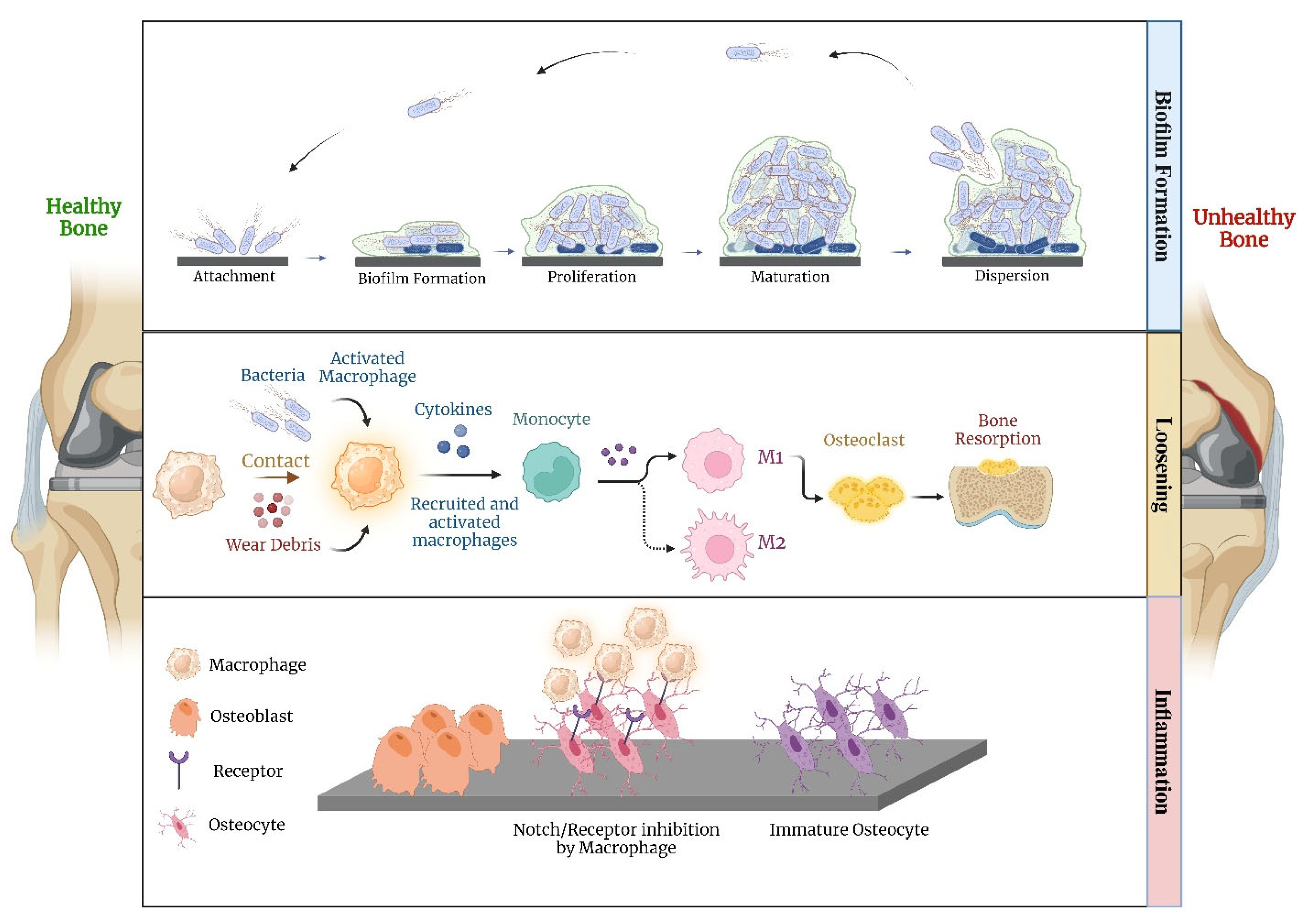
Disclaimer/Publisher’s Note: The statements, opinions and data contained in all publications are solely those of the individual author(s) and contributor(s) and not of MDPI and/or the editor(s). MDPI and/or the editor(s) disclaim responsibility for any injury to people or property resulting from any ideas, methods, instructions or products referred to in the content. |
© 2025 by the authors. Licensee MDPI, Basel, Switzerland. This article is an open access article distributed under the terms and conditions of the Creative Commons Attribution (CC BY) license (https://creativecommons.org/licenses/by/4.0/).