You are currently viewing a new version of our website. To view the old version click .
Coatings
  • Article
  • Open Access

10 December 2025

Synergistic Corrosion Inhibition of Q235B Steel in Sulfuric Acid by a Novel Hybrid Film Derived from L-Aspartic Acid β-Methyl Ester and Glutaraldehyde

,
,
,
,
,
,
,
,
and
1
School of Ecological Environment and Urban Construction, Fujian University of Technology, Fuzhou 350118, China
2
Fuzhou Green Chemical and Cleaner Production Industry Technology Innovation Center, Fujian University of Technology, Fuzhou 350118, China
3
Intelligent Manufacturing College, Luoding Polytechnic, Yunfu 527200, China
*
Authors to whom correspondence should be addressed.
Coatings2025, 15(12), 1460;https://doi.org/10.3390/coatings15121460 
(registering DOI)
This article belongs to the Section Corrosion, Wear and Erosion

Abstract

Aspartic acid (ASP) and its derivatives are eco-friendly and cost-effective scale inhibitors but exhibit limited corrosion inhibition in acidic media. To enhance their performance against acid corrosion, a facile, purification-free one-pot aqueous reaction was developed to synthesize an L-ASPME/GA hybrid inhibitor from L-aspartic acid β-methyl ester (L-ASPME) and glutaraldehyde (GA). The resulting inhibitor solution was directly introduced into a 0.5 M H2SO4 pickling solution to achieve synergistic corrosion inhibition for Q235B steel. The corrosion inhibition performance was systematically evaluated using weight loss tests, electrochemical impedance spectroscopy (EIS), potentiodynamic polarization (PDP), scanning electron microscopy (SEM), X-ray photoelectron spectroscopy (XPS), and contact angle measurements, with temperature effects also assessed. The results demonstrate that the L-ASPME/GA hybrid, particularly at molar ratios of 2:3–4:1, achieves 90.7%–96.1% inhibition efficiency, significantly outperforming L-ASPME or GA alone. Notably, the 2:3 L-ASPME/GA hybrid shows superior high-temperature acid corrosion resistance versus single components. This synergistic effect is attributed to a co-adsorption mechanism, forming a compactly oriented, thermally robust film driven by hydrogen-bonding networks, Fe2+ coordination, and electrostatic attraction. These findings offer a practical strategy to improve the acid corrosion resistance of ASP–like inhibitors.

1. Introduction

Carbon steel, a cost-effective material with excellent mechanical properties, is widely used in various industries such as oil, gas, petrochemical, and related fields [1]. However, its inherent thermodynamic instability renders it highly susceptible to corrosion, particularly in acidic and biotic environments [2]. Such corrosion not only deteriorates the overall performance of the associated equipment but also poses risks of casualties, economic losses, and environmental pollution [2,3]. The application of inhibitors is a primary method for mitigating steel corrosion in acidic and biotic environments across various industries [2,4].
Organic inhibitors such as amines, carbazoles, imidazoles, imines, phthalocyanines, and their derivatives are commonly employed to protect carbon steel against acid corrosion [3,4,5]. These inhibitors typically contain heteroatoms (e.g., sulfur, nitrogen, and oxygen), multiple bonds, benzene rings and/or alkyl chains in their molecular structures, enabling them to form protective films via adsorption on metal surfaces [3,4,5]. Unfortunately, with increasing environmental awareness and stricter regulations, most of these organic inhibitors are facing growing restrictions due to their potential biological toxicity and mutagenicity [3].
Aspartic acid (ASP) and its derivatives emerge as promising eco-friendly corrosion inhibitors, offering the advantages of nontoxicity, biodegradability, and cost-effective production with high purity [6]. They are also effective against CaSO4 and CaCO3 scales and are seen in widespread use in the oil and gas industry [7]. However, their application as a high-efficiency, multifunctional inhibitor against corrosion, scale, and bacterial fouling remains limited. This is hindered by three main factors: (1) their electron-donating ability is generally weak [8]; (2) they typically form hydrophilic adsorption films on metal surfaces, affording only modest corrosion inhibition unless used at high concentrations [9,10]; and (3) particularly in aggressive acidic media, ionization occurs, preventing them from establishing sufficiently stable chemical adsorption on metal substrates [11,12].
Considerable efforts have been devoted to improving the inhibition performance of ASP-like inhibitors, aiming to reduce their required dosage and/or broaden their application scope through chemical derivatization or synergistic inhibition. Chemical derivatization is often performed by introducing specific structures or groups into the molecule of an ASP-like inhibitor to increase the variety and number of its action sites [13,14], adjust its hydrophilic-lipophilic balance value [11,13], and make full use of the steric and electronic effects [11]. Through these derivatizations, the strong interaction between the inhibitor molecule and the metal surface can be strengthened, thus enhancing the corrosion inhibition performance of the inhibitor. However, all such chemical derivatizations, typically tedious and cumbersome, inevitably require toxic organic solvents [13,14]. A simple, green, and efficient procedure in aqueous solution for deriving ASP-like inhibitors is expected. Synergic strategies present another effective approach that has been employed to enhance the inhibition effect of ASP-like inhibitors. It is usually carried out by mixing two or more functional components with ASP-like inhibitors, mainly through organic-organic mixing [15] and organic-inorganic compounding [6,10]. Although better inhibition performance and more functionalization could be achieved through multi-component blends, antagonism is more frequently observed [11]. So far, there are still relatively few functional components that can be used for synergism with ASP-like inhibitors. Qian et al. [16] found that the inhibition efficiency of polyaspartic acid in inhibiting mild steel corrosion in 0.5 M H2SO4 solution can be synergistically increased by adding a small amount of I. Shanthy et al. [10] demonstrated that a synergistic combination of 50 ppm of ASP and 50 ppm of Zn2+ offers 60.0% inhibition efficiency for controlling corrosion of carbon steel in 120 ppm Cl. Similarly, Prathipa et al. [6] revealed that a synergistic combination of 50 mg·L−1 of ASP and 5 mg·L−1 of Zn2+ achieves 90.0% inhibition efficiency in controlling corrosion of carbon steel in well water. More efficient synergists for ASP-like formulations for corrosion control of carbon steel need to be developed and further researched, especially in aggressive media with acidic and biological corrosion.
Glutaraldehyde (GA) is a kind of broad-spectrum fungicide with low toxicity but rapid and strong sterilizing effects. It is recommended as an efficient disinfectant by the World Health Organization and has been widely used as a biocide to control microbiologically influenced corrosion in oil fields and industrial water treatment [17,18,19]. Under anaerobic conditions, GA can slightly enhance the corrosion resistance of C1018 carbon steel in eutrophic artificial seawater [18]. It can also mitigate the corrosion of X80 pipeline steel by reducing the adhesion of sulfate-reducing bacteria cells on the sample surface and the formation of FeS [19]. However, under aerobic conditions typical of most corrosive environments, GA tends to accelerate the corrosion of X80 pipeline steel [17]. This creates a key challenge: preserving its potent bactericidal effect while suppressing its corrosive action. Moreover, despite its “eco-friendly” image, concentrated GA poses respiratory toxicity risks. These limitations emphasize the necessity of developing synergistic agents capable of modulating GA concentrations to remain within a safe and effective antimicrobial window.
Imine condensation between amino-containing compounds and aldehydes produces Schiff bases, a class of effective corrosion inhibitors [20,21,22,23,24,25]. As their efficiency typically surpasses that of their precursors, we hypothesize that a Schiff base formed from ASP-like compounds and GA would act as a superior inhibitor. This approach offers a dual benefit: enhanced inhibition through additional adsorption sites and multi-mechanism action, coupled with the on-demand modulation of GA concentration. The reversibility of the condensation further means the Schiff base could serve as both a short-term GA scavenger, reducing its effective dose, and a long-term slow-release source. To our knowledge, this promising concept awaits experimental verification.
L-aspartic acid β-methyl ester (L-ASPME) combines the activity and advantages of ASP with amphiphilicity, making it an ideal precursor for multifunctional corrosion inhibitors [11,15]. However, it suffers from low inhibition efficiency and lacks antimicrobial potency. Conversely, GA is a potent antimicrobial agent, but its corrosiveness and toxicity at high concentrations limit its application [17,18,19]. In this work, GA was strategically employed as a dual-function agent through imine condensation, serving simultaneously as both a derivatization reagent and a synergistic enhancer for L-ASPME. A simple one-pot aqueous-phase reaction strategy at room temperature was developed to prepare hybrid inhibitors by mixing L-ASPME and GA under natural aeration conditions. An inhibitor resulting from imine condensation was intentionally prepared by mixing L-ASPME and GA at a 2:3 molar ratio. It was characterized using Fourier transform infrared (FTIR) spectrometry, which verified the effectiveness of the derivatization via the proposed reaction strategy. Hybrid inhibitors derived from mixing L-ASPME and GA at molar ratios ranging from 1:4 to 4:1 were systematically investigated using the weight loss method for their corrosion inhibition performance on Q235B steel in a 0.5 M H2SO4 solution. The corrosion inhibition efficiency and synergistic effects of the L-ASPME/GA hybrid inhibitor (2:3 molar ratio) were further evaluated using electrochemical impedance spectroscopy (EIS), potentiodynamic polarization (PDP), scanning electron microscopy (SEM), X-ray photoelectron spectroscopy (XPS), and contact angle measurements. It was found that the L-ASPME/GA hybrid inhibitor achieved superior inhibition efficiency exceeding 90.0% at total concentration ranging from 2.0 to 4.0 g·L−1, significantly outperforming either component alone. Although the hybrid inhibitor formed a highly hydrophilic film on steel, it still provided outstanding corrosion protection. The findings demonstrate that by adjusting the molar ratio of L-ASPME to GA, it is possible to effectively enhance the corrosion inhibition performance of L-ASPME while simultaneously controlling the residual concentration of GA. Furthermore, probable synergistic inhibition mechanisms were proposed to explain the experimental results.

2. Materials and Methods

L-ASPME (≥98%), GA (50% in H2O), and H2SO4 (≥96%) were purchased from Shanghai Macklin Biochemical Co., Ltd. (Shanghai, China). All chemicals were of analytical grade and used as received without further purification. Double-distilled water was used as the solvent. Mild steel sheets (Q235B), measuring 5 cm × 1 cm × 0.3 cm, were supplied in a mechanically polished condition by Maanshan Iron & Steel Co., Ltd. (Maanshan, China). The steel composition was 0.16% C, 0.2% Si, 0.41% Mn, 0.009% S, 0.0125% P, and the balance Fe. The surfaces of Q235B sheets were all progressively polished using 500, 1000, and 1500 grit abrasive papers. They were then sequentially rinsed with deionized water, acetone, and ethanol, and finally dried under a stream of cold air. The total surface area (S) of the Q235B sheets used for weight loss experiments was calculated using Equation (1) [15]:
S = 2 ( w l + d w + d l )
where w is the width (cm), l is the length (cm), and d is the thickness (cm). All coupons were ultrasonically cleaned in ethanol, dried under vacuum at room temperature, and weighed with a precision of 0.0001 g.
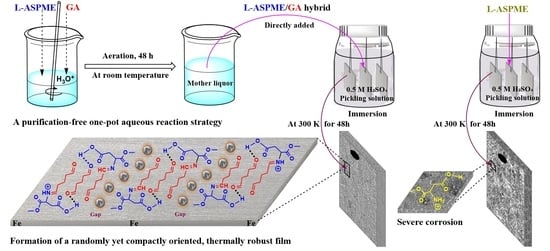
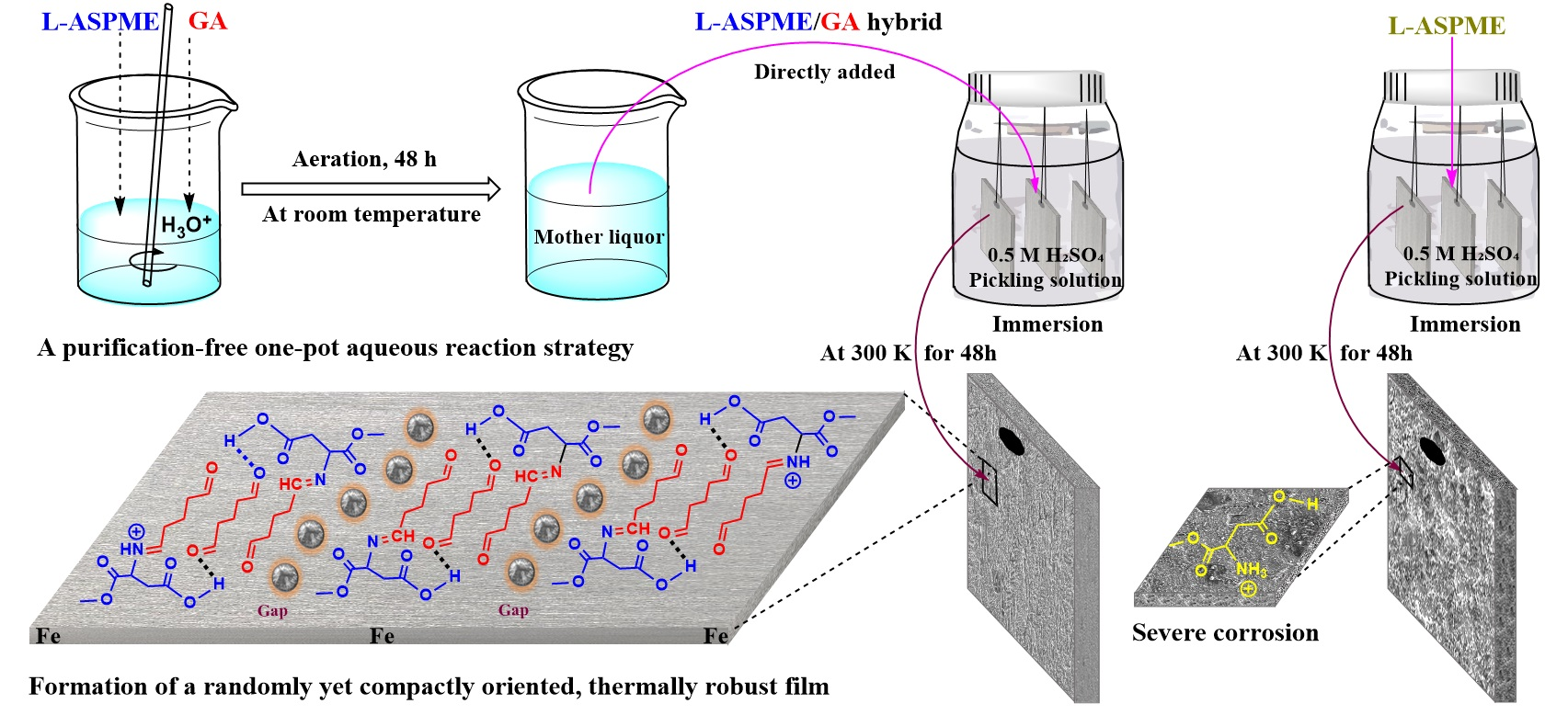
A simple one-pot aqueous-phase reaction strategy at room temperature was developed to prepare L-ASPME/GA hybrid inhibitors under natural aeration conditions. Typically, 4.00 g (0.0272 mol) of L-ASPME was dispersed ultrasonically in 300 mL of water under an air atmosphere at 300 K. Subsequently, 1.0 mol·L−1 H2SO4 was added dropwise to the mixture until L-ASPME dissolved completely. The L-ASPME solution was then mechanically mixed with 50 wt% GA for 10 min at L-ASPME/GA molar ratios of 1:4–4:1. The resulting mixture was left to react at room temperature for 12 h. The mother liquor of the hybrid inhibitors was collected as a clear solution. This solution was directly added to acid media to provide effective corrosion inhibition for carbon steel.
Weight loss experiments were carried out in 150 mL polypropylene vessels filled with 100 mL of test solutions under natural aeration. The vessels were kept at a constant temperature between 300 K and 320 K in a water bath. Q235B steel sheets were immersed in 100 mL of 0.5 M H2SO4 with/without inhibitors at 300 K for 48h. After corrosion, the specimens were cleaned (scrubbed with nylon brushes, rinsed with double-distilled water, washed with ethanol, and air-dried) and weighed (0.0001 g precision). Triplicates were used to calculate the average weight loss.
The corrosion rate (ν) and inhibition efficiency (η) were calculated using Equations (2) and (3), respectively:
v =   Δ W S × t
η % = 1 ν ν 0 × 100 = θ × 100
where ΔW represents the average weight loss of the triplicate specimens (g), S denotes the total surface area of the specimens (cm2), t is the immersion time (h), ν and ν0 are the corrosion rates in the presence and absence of inhibitors, respectively (g·cm−2·h−1), and θ represents the surface coverage degree (%).
All electrochemical measurements were performed on an Autolab PGSTAT 302N electrochemical workstation (Metrohm Autolab B.V., Utrecht, The Netherlands) with a conventional three-electrode cell under ambient conditions. A Q235B steel sample (exposed area: 1 cm2), a platinum sheet, and a saturated calomel electrode (SCE) served as the working, counter, and reference electrodes, respectively. Prior to the tests, the open circuit potential (OCP) of the Q235B steel sample was monitored. After 0.5 h, the OCP stabilized with AC signals of amplitude 10 mV peak to peak, and electrochemical impedance spectroscopy (EIS) measurements were subsequently conducted over the frequency range of 100 kHz to 0.1 Hz. Similarly, with the OCP stabilized, potentiodynamic polarization (PDP) curves were recorded at a scan rate of 1 mV/s within the potential range of −250 mV to +250 mV (vs. OCP). Each electrochemical test was repeated three times to ensure reproducibility.
Inhibition efficiencies for EIS (ηE) and PDP (ηP) measurements were calculated according to the following Equations (4) and (5), respectively:
η E % = 1 R c t 0 R c t × 100
η p % = 1   i c o r r i c o r r 0 × 100
where Rct and R0ct are the charge transfer resistances in the presence and absence of inhibitors, respectively, and icorr and i0corr are the corrosion current densities in the presence and absence of inhibitors, respectively.
A mother liquor of L-ASPME/GA hybrid inhibitor was prepared at a 2:3 molar ratio via the proposed one-pot aqueous-phase reaction. The liquor was then diluted, pH-adjusted, and used to prepare a 0.5 M H2SO4 pickling solution. A small aliquot of the solution was applied repeatedly onto a Q235B steel substrate and allowed to evaporate naturally. The resulting precipitates were collected and characterized by a Nicolet iS50 FTIR spectroscopy (Thermo Fisher Scientific, Madison, WI, USA) using the KBr method.
A comparative surface analysis of Q235B steel was further conducted before and after immersion in a 0.5 M H2SO4 solution at 300 K for 48 h, with and without 2.0 g·L−1 corrosion inhibitors. The hydrophobic/hydrophilic properties of the surfaces were determined by the sessile water drop method on a Chengde Dingsheng (Chengde, China) JY-82C contact angle goniometer. Morphological characterization was performed using field-emission scanning electron microscopy (JSM-7800F, JEOL Ltd., Tokyo, Japan) at an accelerating voltage of 15 kV and a beam current of 1.6 nA. Chemical states were analyzed by a ESCALAB 250Xi X-ray photoelectron spectroscopy (Thermo Fisher Scientific, East Grinstead, UK) using monochromatic Al Kα radiation (1486.6 eV). The XPS protocol included: (i) wide-range survey scans (0–1200 eV) for elemental profiling, and (ii) high-resolution narrow scans (20–30 eV pass energy) for specific elements. The binding energy was calibrated with reference to the C 1s peak at 284.8 eV.

3. Results and Discussion

3.1. Preparation of Hybrid Inhibitors

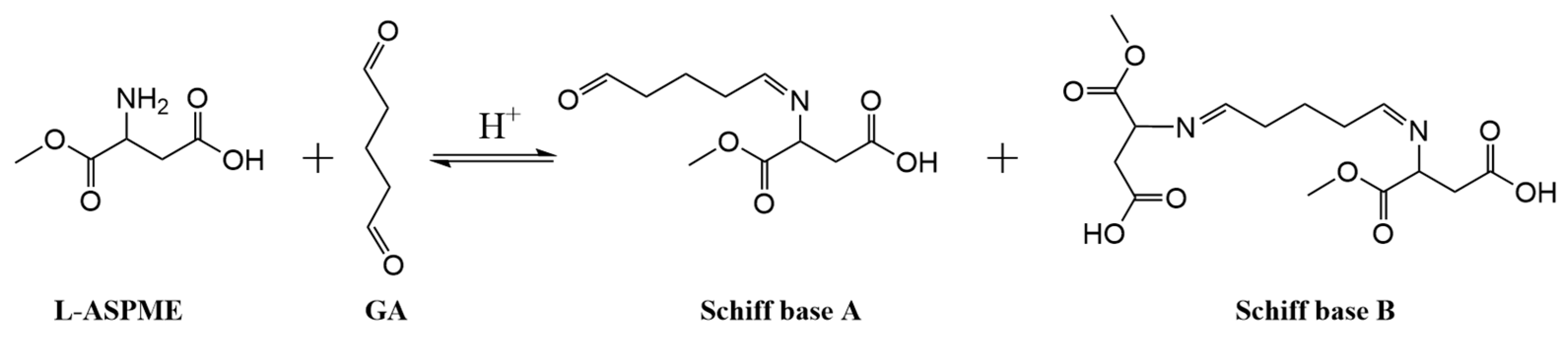
Capitalizing on the inherent reactivity between amino groups and aldehydes in forming imine bonds under ambient conditions [20,21,22], a one-pot aqueous-phase reaction strategy was developed in this work by mixing L-ASPME with GA under naturally aerated environments. In systems with L-ASPME/GA molar ratios ranging from 1:4 to 2.5:2.5, L-ASPME undergoes complete mono-imidization, yielding Schiff base A (Figure 1) along with residual GA [22]. The excess GA is expected to act as both a synergistic co-inhibitor via cooperative adsorption and an antimicrobial agent against microbiologically influenced corrosion [18,19]. Given the potential functions, this study will primarily concentrate on systems containing residual GA. In contrast, when L-ASPME is present in higher proportions (molar ratios of 2.5:2.5 to 4:1), it undergoes selective mono- or di-imidization reactions, generating a product mixture of Schiff base A, Schiff base B, and residual L-ASPME (Figure 1). In the present work, the freshly formed hybrids derived from mixing L-ASPME and GA were directly used as hybrid inhibitors without purification. This direct application provides significant practical advantages over traditional methods, which usually require the separate synthesis and purification of individual Schiff base compounds before their use as corrosion inhibitors [23,24].
Figure 1. L-ASPME and GA undergo an imine condensation reaction to form Schiff bases.
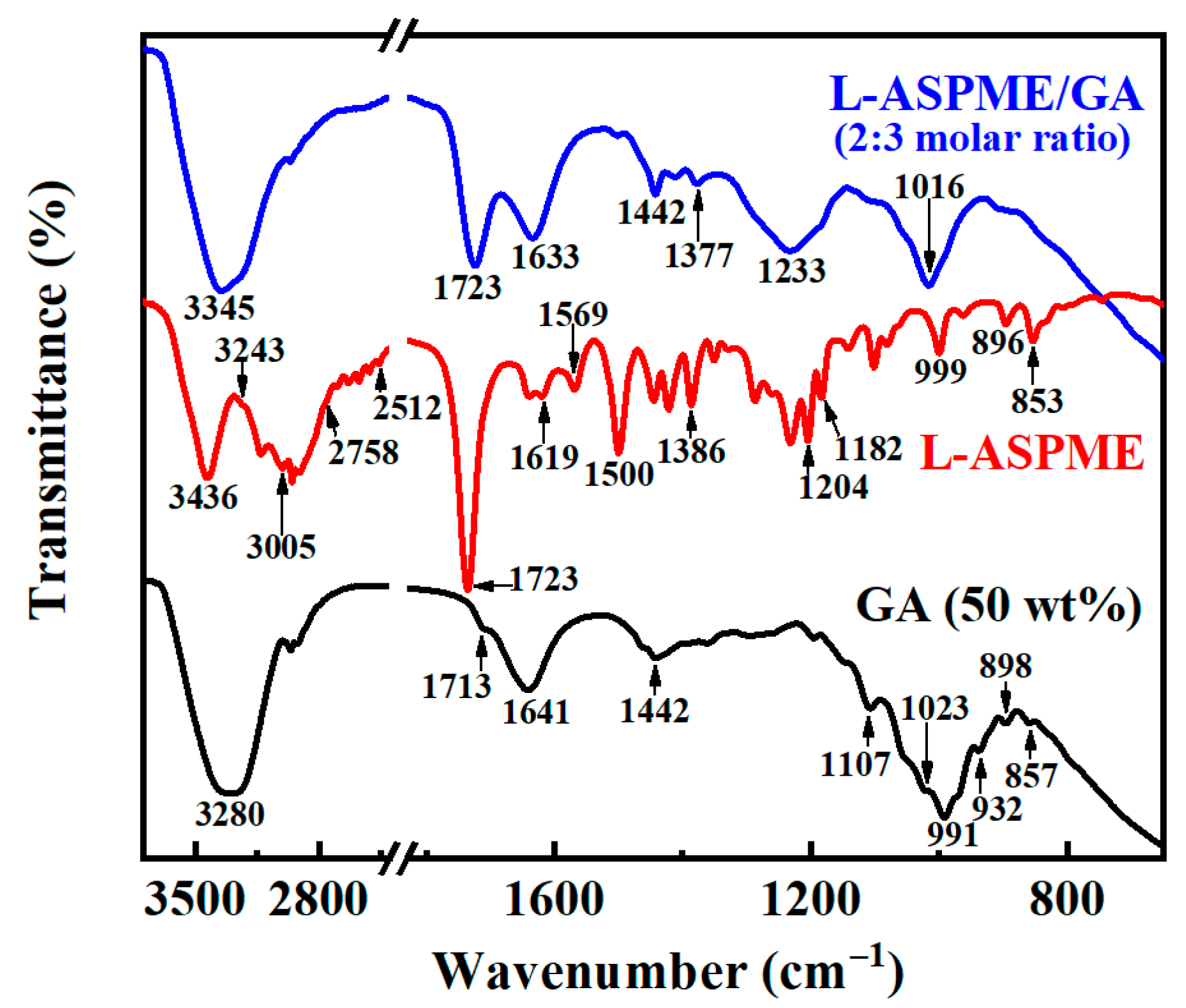
Figure 2 presents the FTIR spectrum (red curve) of L-ASPME, displaying characteristic absorption peaks at 3436 cm−1 (O–H stretching), 3243–3005 cm−1 (N–H stretching), 2951–2851 cm−1 (C–H stretching), 2758–2512 cm−1 (broad O–H stretching of strongly H-bonded carboxylic acid dimers), 1723 cm−1 (C=O stretching), 1639–1619 cm−1 (N–H in-plane asymmetric bending), 1569 cm−1 (N–H in-plane symmetric bending), 1500 cm−1 (C–N stretching affected by hydrogen bonding), 1442 cm−1 (methylene C–H bending), 1423–1386 cm−1 (methoxy C–H bending), 1288–1229 cm−1 (ester C–O–C asymmetric stretching), 1204–1182 cm−1 (C–N stretching), 1140–1081 cm−1 and 999 cm−1 (ester C–O–C symmetric stretching), and 896–853 cm−1 (N–H out-of-plane bending) [6,13]. After the one-pot reaction of L-ASPME and 50 wt% GA at a molar ratio of 2:3 (L-ASPME:GA), the characteristic IR bands of the L-ASPME amino moiety were significantly attenuated in the hybrid spectrum (blue curve). These bands include N–H stretching (3243–3005 cm−1), in-plane bending (1619 and 1569 cm−1), out-of-plane bending (896–853 cm−1), and C–N stretching (1500 cm−1). This attenuation indicates the depletion of free amino groups. Simultaneously, the IR absorption bands in the hybrid spectrum corresponding to hydrated aldehyde groups (O–H stretching at 3280 cm−1, out-of-plane bending at 857–898 cm−1) and self-condensed aldehyde groups (C–O stretching at 1023–1107 cm−1, out-of-plane bending at 991 cm−1) of GA showed significant shifts or weakening, confirming the participation of aldehyde groups in the reaction. Moreover, the IR spectrum of the hybrid confirmed imine (C=N) bond formation with a new band at 1633 cm−1 [21,22], and also showed characteristic bands at 3345 cm−1 (carboxylic O–H stretch), 2956–2854 cm−1 (C–H stretch), 1723 cm−1 (C=O stretch), 1442 cm−1 (methylene C–H bend), 1412–1377 cm−1 (methoxy C–H bend), 1233 cm−1 (ester C–O–C asymmetric stretch), and 1016 cm−1 (ester C–O–C symmetric stretch). These FTIR observations collectively demonstrate that the reaction between L-ASPME and GA under the given conditions primarily involves an imine condensation reaction between the amino (–NH2) and aldehyde (–CHO) groups, yielding a Schiff base [20,21,22].
Figure 2. FTIR spectra of neat L-ASPME, the 50 wt% GA solution, and the L-ASPME/GA hybrid precipitate (2:3 molar ratio) formed on Q235B steel.

3.2. Corrosion Inhibition Performance

3.2.1. Weight Loss Measurements

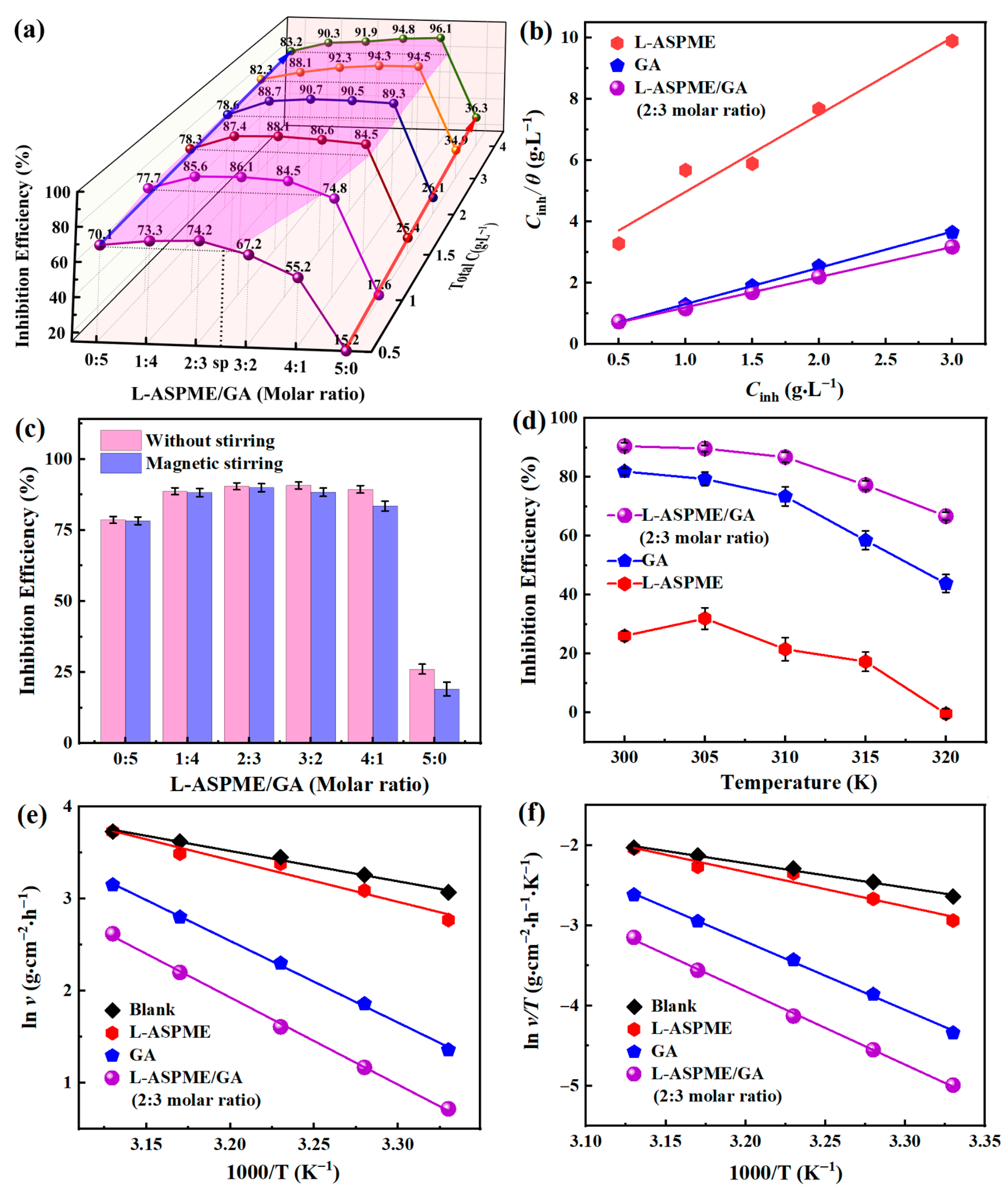
The inhibition efficiencies of L-ASPME, GA, and their hybrid formulations for Q235B steel in 0.5 M H2SO4 solution, tested over a total concentration range of 0.5–4.0 g·L−1 after 48 h of immersion at 300 K, are presented in Figure 3a. As indicated by the red arrow in Figure 3a, the inhibition efficiency of L-ASPME increased from 15.2% to 36.3% as its concentration was raised from 0.5 g·L−1 to 4.0 g·L−1. Similarly, the inhibition efficiency of GA increased from 70.1% to 83.2% over the same concentration range, as marked by the blue arrow in Figure 3a. However, the inhibition efficiencies of both L-ASPME and GA did not exceed 83.2%, even at 4.0 g·L−1. The finding suggests that using either compound alone as a corrosion inhibitor may have limited practical applicability. Notably, the L-ASPME/GA hybrid inhibitors demonstrated 90.7–96.1% corrosion inhibition efficiency at verified molar ratios (2:3–4:1) and concentrations (2.0–4.0 g·L−1), significantly outperforming individual components as evidenced by the magenta surface in Figure 3a. This synergistic effect enables dosage reduction and broadens applicability to harsh environments. The results also demonstrate that adjusting the molar ratio of L-ASPME to GA allows for an effective enhancement of L-ASPME’s corrosion inhibition performance while simultaneously controlling the residual GA concentration.
Figure 3. Synergistic corrosion inhibition of L-ASPME/GA hybrid inhibitors for Q235B steel in 0.5 M H2SO4: (a) Weight loss-measured inhibition efficiency (%) dependence on molar composition (L-ASPME: GA) and total inhibitor concentration at 300 K. (b) Langmuir’s isotherm plots for adsorption of inhibitors on Q235B steel surface at 300 K. (c) Comparison of inhibition efficiency of 2.0 g·L−1 L-ASPME, GA, and their hybrids for Q235B steel in 0.5 M H2SO4 with/without magnetic stirring (48 h, 300 K). (d) Effect of temperature on the inhibition efficiency of 2.0 g·L−1 L-ASPME, GA, and L-ASPME/GA hybrid (2:3 molar ratio) for Q235B steel. (e) Arrhenius plots of ln v vs. 1000/T. (f) Plots of ln (v/T) vs. 1000/T.
The effectiveness of organic corrosion inhibitors primarily depends on their adsorption capacity on metal surfaces [23,25]. The inhibition efficiencies of L-ASPME, GA, and their hybrid formulations for Q235B steel in 0.5 M H2SO4 solution all increased with concentration, as shown in Figure 3a. This phenomenon can be attributed to the fact that their protective mechanisms all involve the formation of an adsorption film, which becomes denser and more inhibitory at higher concentrations [12,23]. The L-ASPME/GA hybrid inhibitor at a 2:3 molar ratio (with excess GA) exhibited the highest inhibition efficiency, which increased from 74.2% to 90.7% with increasing concentration from 0.5 g·L−1 to 2.0 g·L−1. However, when the concentration increased from 3.0 g·L−1 to 4.0 g·L−1, the formulation with a 4:1 molar ratio (excess L-ASPME) achieved the highest efficacy, ranging from 94.5% to 96.1%. This disparity stems from two factors: (1) varying L-ASPME:GA feed ratios generate distinct Schiff bases with differing active-site densities (Figure 1); (2) the resulting Schiff bases, together with residual L-ASPME and GA, possess dissimilar co-adsorption capacities on steel [9,25,26].
Adsorption isotherms of L-ASPME, GA, and their hybrids were conducted at 300 K to investigate the interactions between the adsorbed molecules and the steel surface, as shown in Figure 3b and Table 1. The experimental data were analyzed using multiple theoretical models (Langmuir, Temkin, Frumkin, Flory-Huggins, Freundlich, and El-Awady) to characterize the adsorption behavior of the inhibitors. Among these, the Langmuir adsorption isotherm (Equation (6)) exhibited the best fit, as evidenced by its consistently higher linear regression coefficients (R2) compared to other models (Table S1). These results suggest that L-ASPME, GA, and their hybrids preferentially underwent monolayer adsorption on the metal surface, forming either chemical or physical protective films [3,23].
C i n h θ = 1 K a d s + C i n h
where Cinh is the inhibitor concentration (g·L−1), θ denotes the degree of surface coverage, Kads is the adsorption equilibrium constant (L·g−1).
Table 1. Thermodynamic parameters from the Langmuir adsorption isotherms of L-ASPME, GA, and their L-ASPME/GA hybrids at 300 K.
As shown in Table 1, the R2 value for L-ASPME adsorption isotherm fitting was 0.9652, whereas those for GA and all L-ASPME/GA hybrids exceeded 0.9990. The obvious difference indicates that both the L-ASPME/GA hybrids and GA exhibited superior monolayer adsorption behavior compared to L-ASPME. The greater deviation of L-ASPME from ideal Langmuir adsorption behavior (Figure 3b) can be attributed to its rigid molecular structure that lacks flexible carbon chains, resulting in incomplete surface coverage on the Q235B steel surface [9]. In contrast, the L-ASPME/GA hybrids exhibited enhanced Langmuir adsorption behavior (Table 1) due to the incorporation of GA. The abundant flexible CH2 chains and reactive aldehyde groups in GA, introduced through either Schiff base formation or physical interactions, not only alleviated structural constraints but also provided additional chemical adsorption sites for L-ASPME/GA hybrids, thereby improving monolayer adsorption efficiency.
The adsorption equilibrium constant (Kads) and the standard free energy of adsorption (ΔGads) were further calculated from the intercept of the Langmuir model equation (Table 1) and Equation (7), respectively.
Δ G a d s = R T ln ( 1000 K a d s )
where Kads is the adsorption equilibrium constant (L·g−1), R represents the universal gas constant (8.314 J·mol−1·K−1), T is the absolute temperature in Kelvin (K), and 1000 is the concentration of water in the solution (g·L−1).
A higher Kads value indicates a stronger adsorption affinity of inhibitor molecules on the metal surface [27]. As shown in Table 1, the Kads values for L-ASPME, GA, and the L-ASPME/GA hybrids were 0.4067 L·g−1, 7.6161 L·g−1, and 2.3020–10.3734 L·g−1, respectively. These results indicate that L-ASPME had the lowest monolayer adsorption capacity on carbon steel, which is primarily attributed to its structural rigidity and limited conformational flexibility [9,28]. In contrast, after mixing L-ASPME with GA, the resulting L-ASPME/GA hybrids exhibited improved monolayer adsorption capacity compared to L-ASPME alone. This enhancement can be attributed to the incorporation of the GA structure into L-ASPME, which not only increased conformational flexibility but also introduced additional active sites, including the C=N double bond and free aldehyde functional groups. Furthermore, as the molar ratio of L-ASPME to GA decreased from 4:1 to 1:4, the Kads values of the L-ASPME/GA hybrids increased from 2.3020 L·g−1 to 10.3734 L·g−1, indicating a significant enhancement in monolayer adsorption capacity with increasing GA content.
ΔGads serves as a fundamental thermodynamic parameter for evaluating both the thermodynamic spontaneity of adsorption processes and their mechanism classification (physisorption/chemisorption). Negative ΔGads values demonstrate spontaneous adsorption, with ΔGads ≥ −20 kJ·mol−1 typically indicating physisorption and ΔGads ≤ −40 kJ·mol−1 signifying chemisorption [27,29]. In this study, all the calculated values of ΔGads listed in Table 1 were negative, confirming the spontaneous adsorption of the inhibitor molecules on the metal surface. L-ASPME exhibited a ΔGads of −14.9854 kJ·mol−1 (>−20 kJ·mol−1), consistent with physisorption, while GA showed a ΔGads of −22.2932 kJ·mol−1 (−20–−40 kJ·mol−1), suggesting physico-chemical adsorption. Table 1 shows that as the molar ratio of L-ASPME to GA decreased from 4:1 to 1:4, the ΔGads values of the resulting hybrid inhibitors decreased from −19.3090 kJ·mol−1 to −23.0639 kJ·mol−1. These findings suggest that decreasing the proportion of L-ASPME shifted the adsorption behavior of the resulting hybrid inhibitor from a purely physical adsorption to a physico-chemical adsorption, thereby strengthening its chemical adsorption capability. This is consistent with the fact that L-ASPME tends to form ammonium salts in acidic media, leading to physical adsorption through electrostatic interactions [16].
Figure 3c compares the inhibition efficiencies of 2.0 g·L−1 L-ASPME, GA, and their hybrids for Q235B steel in 0.5 M H2SO4 under static and vortex-free magnetic stirring conditions (48 h, 300 K). The data reveal that mechanical stirring caused a 7.0% reduction in inhibition efficiency for L-ASPME, while GA and L-ASPME/GA hybrids showed significantly smaller decreases of only 0.3% and 0.4%–5.9%, respectively. This behavior suggests that: (1) inhibitor adsorption occurred primarily within the fluid boundary layer on the steel surface, as mild hydrodynamic conditions were insufficient to disrupt the protective film; and (2) GA-containing formulations exhibited substantially stronger interfacial adhesion compared to pure L-ASPME, likely due to enhanced chemical interactions with the metal substrate.
Figure 3d shows the inhibition efficiencies of 2.0 g·L−1 L-ASPME, GA, and their hybrid (2:3 molar ratio) for Q235B steel in 0.5 M H2SO4 over the temperature range of 300–320 K. Over this interval, the inhibition efficiency of L-ASPME decreased sharply from 26.0% to nearly zero with increasing temperature, while that of GA declined from 81.9% to 44.8%. In contrast, the hybrid exhibited only a moderate reduction from 90.7% to 66.8%, which is consistent with its superior high-temperature protection inferred from the lower thermal loss. As shown in Figure S1, the corrosion rates (v) of Q235B steel in 0.5 M H2SO4 were evaluated in the absence and presence of 2.0 g·L−1 L-ASPME, GA, or the hybrid over the same temperature range. In acidic media, metal corrosive dissolution typically occurs with hydrogen evolution. Increasing temperature can create new active sites on the metal surface and activate corrosive species (particularly H+), collectively intensifying the aggressive medium’s attack and accelerating metal dissolution rates [27,30]. As anticipated, the corrosion rate of the blank sample increased significantly from 21.52 to 41.84 g·cm−2·h−1 as the temperature rose from 300 to 320 K. For samples with inhibitors under the same conditions, the corrosion rates increased from 15.91 to 41.54 g·cm−2·h−1 for L-ASPME, 3.90 to 23.24 g·cm−2·h−1 for GA, and 2.05 to 13.78 g·cm−2·h−1 for the hybrid. These findings clearly indicate that the hybrid inhibitor provided the most thermally stable protective film, due to its lower tendency to desorb at elevated temperatures compared to the individual components [27,30].
Based on the corrosion rate data (Figure S1), the Arrhenius Equation (8), and the Transition State Equation (9) were used to calculate the kinetic parameters:
ln v = ln A E a R T
ln ( v T ) = ln ( R N A h ) + Δ S a * R Δ H a * R T  
where v, A, Ea, R, T, h, NA, ΔSa*, and ΔHa* denote corrosion rate (g·cm−2·h−1), the pre-exponential factor, activation energy (kJ·mol−1), the molar gas constant (8.314 J·mol−1·K−1), the absolute temperature (K), Plank’s constant (6.626 × 10⁻³⁴ m2·kg·s−1), Avogadro’s number (6.022 × 10²³ mol−1), activation entropy (J·mol−1·K−1), and activation enthalpy (kJ·mol−1), respectively.
Figure 3e presents the Arrhenius plots of ln v as a function of 1000/T. Ea were calculated from the slopes of these plots, as listed in Table 2. The Ea values exceeded 20 kJ mol−1 both in the presence and absence of inhibitors, indicating that the corrosion process is governed by the surface-controlled reaction [31]. L-ASPME, GA, and their hybrid (2:3 molar ratio) adsorbed on Q235B steel surfaces, providing varying energy barriers for the surface corrosion reaction in the following order: L-ASPME/GA hybrid (78.70 kJ·mol−1) > GA (73.66 kJ·mol−1) > L-ASPME (37.61 kJ·mol−1) > blank (27.40 kJ·mol−1). This suggests that the L-ASPME/GA hybrid formed the most robust corrosion-inhibiting film, effectively preventing charge or mass transfer from the carbon steel surface [30].
Table 2. Activation parameters for the corrosion of Q235B steel in 0.5 M H2SO4 solution without and with 2.0 g·L−1 inhibitor.
The values of ΔHa* and ΔSa*, calculated from the ln (v/T) vs. 1000/T plots (Figure 3f), are also listed in Table 2. The positive values of ΔHa* reflect the endothermic nature of the activation process during the corrosive dissolution of Q235B steel [23]. Compared to the blank (27.40 kJ·mol−1), the ΔHa* values increased with inhibitors in the following order: L-ASPME (35.65 kJ·mol−1) < GA (70.90 kJ·mol−1) < L-ASPME/GA hybrid (76.08 kJ·mol−1), reflecting an increasing energy requirement for the corrosive dissolution reaction. This observation is consistent with the fact that the L-ASPME/GA hybrid adsorbed most strongly onto the metal surface, requiring more energy for desorption, thus hindering the access of H+ and other corrosive species to the carbon steel substrate. As shown in Table 2, in the absence of the inhibitor, the corrosion reaction of Q235B steel exhibited a pronounced negative ΔSa* value of −135.14 J·mol−1·K−1, indicating a decrease in randomness from the reactant state to the activated complex [32,33]. Both molecular reorganization and hydration offset the entropy gain from metal dissolution, thereby lowering the activation entropy [34,35]. In the presence of L-ASPME, the ΔSa* value increased slightly to −102.86 J·mol−1·K−1, confirming that the rate-determining step remained the “ordered binding” of metal ions. As GA-containing formulations were introduced, the ΔSa* values exhibited a more substantial rise, reaching 2.72 J·mol−1·K−1 for GA and 14.16 J·mol−1·K−1 for the L-ASPME/GA hybrid (2:3 molar ratio). This pronounced increase in ΔSa* reflects a marked rise in molecular disorder during the rate-determining step, signifying the transition from ordered binding of metal ions to the dominant dissociation of inhibitor–metal complexes [31]. The mechanistic shift may stem from the protonated aldehyde group’s (in GA or the hybrid) stronger coordination affinity for Fe2+ under acidic conditions compared to the protonated amino group of L-ASPME [26,36].

3.2.2. Electrochemical Performance

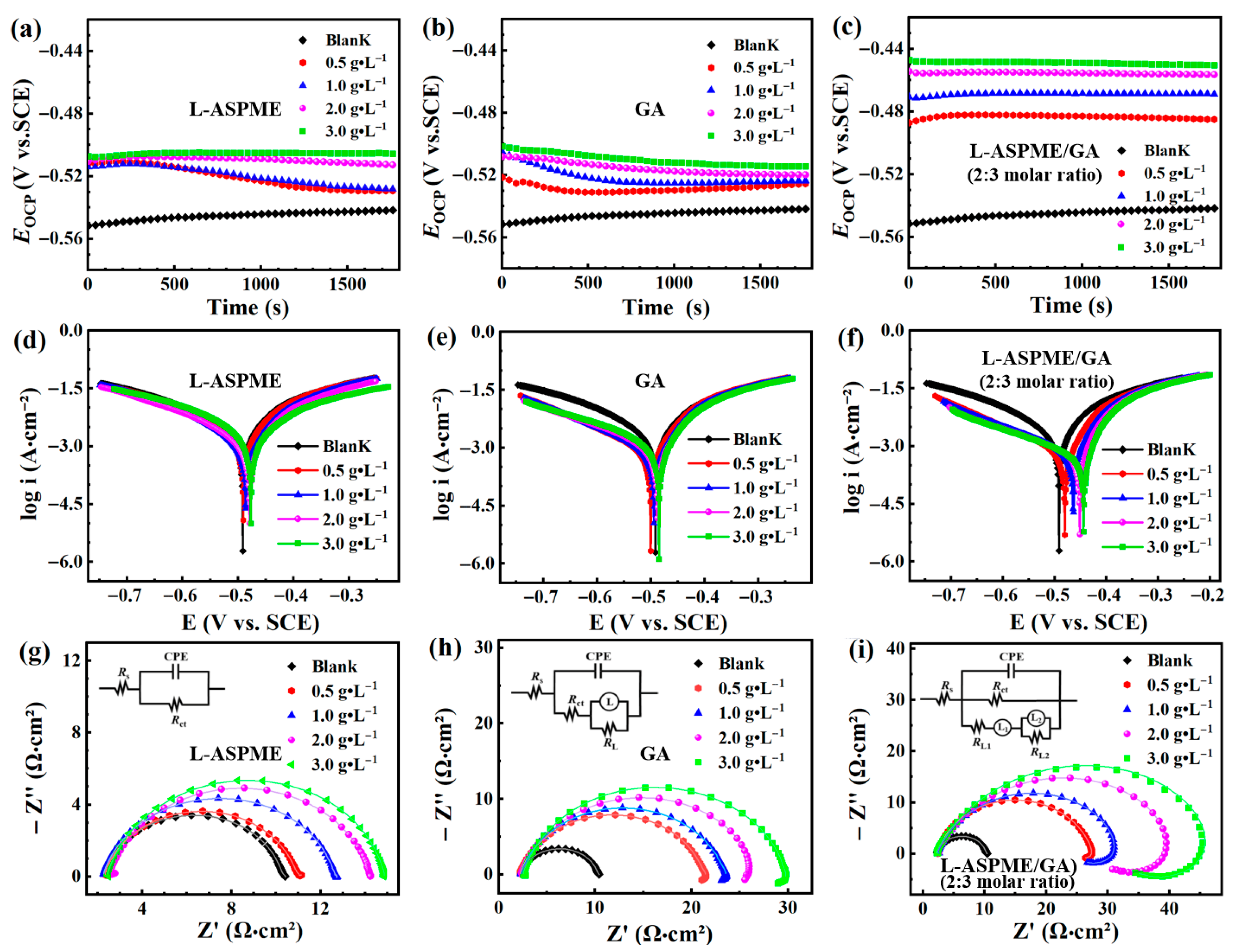
The open-circuit potential (EOCP), defined as the zero-current potential difference between working and reference electrodes, serves as a key indicator of a working electrode’s surface state, reflecting either corrosion or passivation [37]. Higher EOCP values generally indicate enhanced oxidation resistance and reduced corrosion susceptibility of the metal surface [37,38]. Figure 4a–c presents the evolution of EOCP for Q235B steel as a function of immersion time in 0.5 M H2SO4 containing different concentrations of L-ASPME (Figure 4a), GA (Figure 4b), or their 2:3 molar ratio hybrid (Figure 4c). Notably, at total inhibitor concentrations of 0.5–3.0 g·L−1, the hybrid inhibitor system exhibited markedly higher EOCP values and greater potential stability than either component alone, indicating better film formation and inhibition on the metal surface.
Figure 4. Electrochemical performance of Q235B steel in 0.5 M H2SO4 at 300 K in the presence and absence of inhibitors at various concentrations. Electrochemical open-circuit potential (EOCP) plots as functions of time: (a) L-ASPME; (b) GA; (c) L-ASPME/GA hybrid (2:3 molar ratio). Potentiodynamic polarization curves: (d) L-ASPME; (e) GA; (f) L-ASPME/GA hybrid (2:3 molar ratio). Nyquist plots (inset: equivalent circuit models): (g) L-ASPME; (h) GA; (i) L-ASPME/GA hybrid (2:3 molar ratio). Solid lines represent fitting curves.
Figure 4d–f shows the potentiodynamic polarization (PDP) curves of Q235B steel in 0.5 M H2SO4 under uninhibited and inhibited conditions at varying concentrations of L-ASPME (Figure 4d), GA (Figure 4e), and their 2:3 molar ratio hybrid (Figure 4f). The electrochemical parameters, such as corrosion current density (Icorr), corrosion potential (Ecorr), anodic Tafel slopes (ba), and cathodic Tafel slopes (bc), were obtained using the Tafel extrapolation method (Table 3). The PDP results show that the addition of the L-ASPME/GA hybrid progressively reduced both anodic and cathodic currents. In contrast, L-ASPME alone had a negligible effect on either reaction branch, while GA primarily suppressed the cathodic branch. These findings indicate that the hybrid effectively inhibited both anodic iron dissolution and cathodic hydrogen evolution, a synergistic effect unattainable by the individual components. Consistent with this behavior, the Icorr value decreased from 6138 μA·cm−2 (blank) to 3962, 1180, and 439 μA·cm−2 in the presence of L-ASPME, GA, and the hybrid, respectively, as the total inhibitor concentration increased from 0.0 to 3.0 g·L−1. The most pronounced decline in Icorr confirms the superior protective performance of the hybrid, which can be attributed to the formation of a highly robust film on the mild steel surface [39]. Furthermore, the maximum positive shift in Ecorr relative to the blank reached 48.21 mV for L-ASPME, 51.37 mV for GA, and 81.10 mV for the hybrid, further confirming that the hybrid offered the highest oxidation and corrosion resistance. Since the Ecorr shifts were within the range of −85 mV to +85 mV, all inhibitors can be classified as mixed-type [29].
Table 3. PDP parameters for the Q235B steel electrodes in 0.5 M H2O4 solution without and with 2.0 g·L−1 inhibitor.
Figure 4g–i shows electrochemical impedance spectroscopy (EIS) Nyquist plots for Q235B steel in 0.5 M H2SO4 without inhibitors and with increasing concentrations of L-ASPME (Figure 4g), GA (Figure 4h), or their 2:3 molar ratio hybrid (Figure 4i). All capacitive semicircles in the Nyquist plots were depressed, primarily owing to the surface heterogeneity of the steel [3]. These semicircles mainly arise from the parallel combination of charge transfer resistance and double-layer capacitance [40]. The diameter of capacitive loops progressively increased with inhibitor concentration, indicating charge-transfer-controlled corrosion alongside enhanced surface coverage and robust protective film formation [29]. Notably, the L-ASPME/GA hybrid produced larger capacitive loops than individual components (Figure 4i vs. Figure 4g,h), demonstrating more effective adsorption films and superior corrosion blocking [41]. Small inductive loops observed at low frequencies for the GA and hybrid inhibited samples can be attributed to the adsorption–desorption of species (H+, SO42−, inhibitors) [40,42] and relaxation of adsorbed inhibitor molecules [41].
To better interpret the distinct impedance responses, three equivalent circuit models (insets in Figure 4g–i) were applied to fit the EIS data for systems inhibited by L-ASPME, GA, and the L-ASPME/GA hybrid (2:3 molar ratio), respectively. In these circuits, Rs, Rct, RL, L, and CPE in turn denote solution resistance, charge transfer resistance, inductive resistance, inductance, and constant phase element. The CPE was employed instead of double-layer capacitance (Cdl) to better account for non-ideal impedance behavior. Key EIS parameters for the investigated corrosion systems are summarized in Table 4. Low χ2 values (4.0 × 10⁻⁵ to 5.4 × 10⁻⁴) confirm an excellent fit of the models [3]. The values of phase shift (n) remained nearly constant regardless of inhibitor addition, indicating that the corrosion-inhibition mechanism is still fundamentally controlled by charge transfer [40]. Increasing inhibitor concentration raised Rct values, reflecting enhanced steel surface coverage by inhibitor molecules [41]. At equal concentrations, the L-ASPME/GA hybrid consistently yielded the highest Rct and optimal ηEIS, outperforming either component alone. This superior performance originates from the hybrid’s Schiff-base-rich molecular structure, which features larger dimensions and more adsorption sites, thereby enhancing surface coverage and corrosion suppression [29].
Table 4. EIS parameters for the Q235B steel electrodes in 0.5 M H2SO4 at 300 K in the presence and absence of inhibitors at various concentrations.

3.3. Steel Surface Analysis

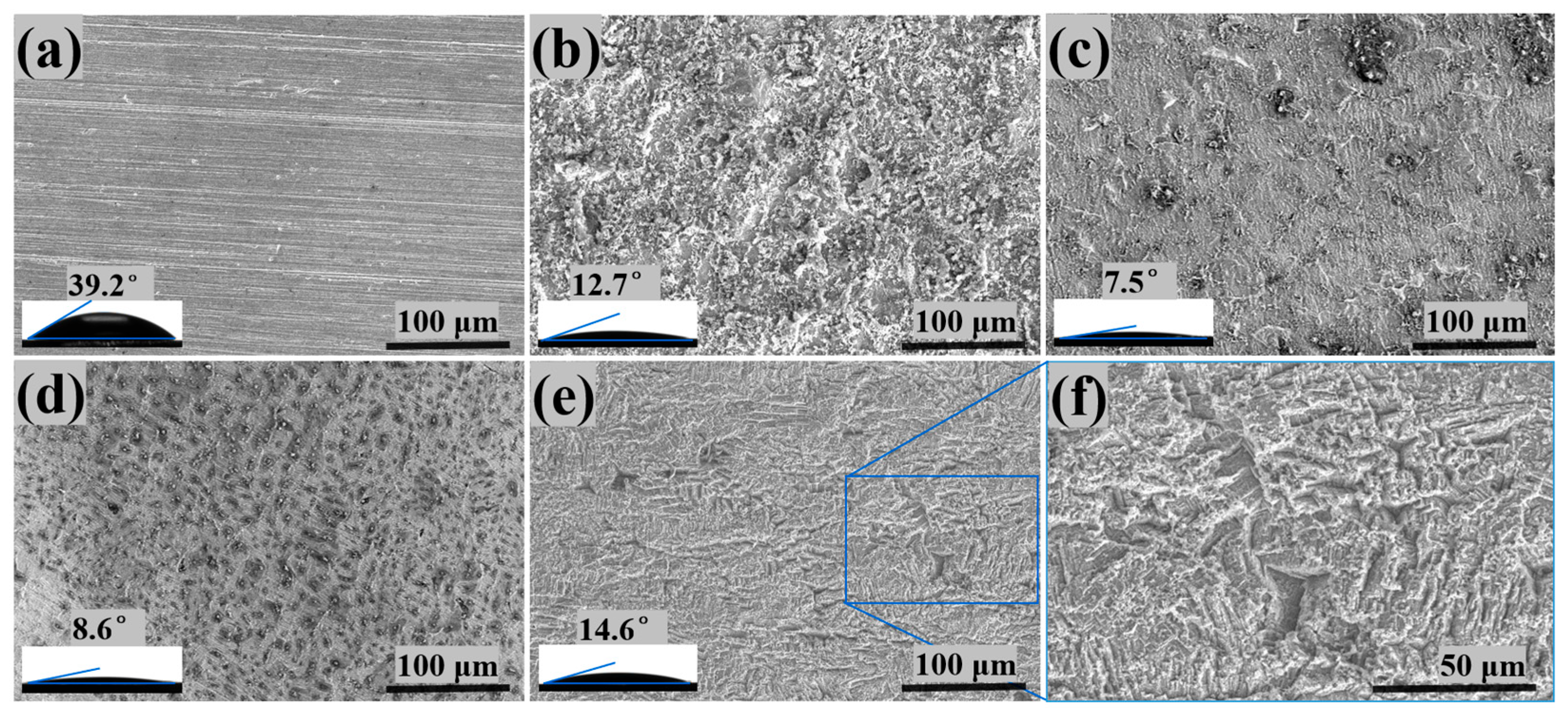
Figure 5a shows the surface morphology of polished Q235B steel before pickling, exhibiting characteristic fresh polishing marks with visible scratches. After 48 h of immersion in 0.5 M H2SO4 at 300 K without any inhibitor, the steel surface developed numerous heterogeneous gray clusters and pitting (Figure 5b), indicating severe corrosion and the formation of iron oxide [27]. The addition of 2.0 g·L−1 L-ASPME suppressed pitting but failed to prevent severe general corrosion, leaving extensive, patchy layers of gray, fuzzy products (Figure 5c). Conversely, 2.0 g·L−1 GA suppressed general corrosion yet allowed extensive black-spot attack (Figure 5d). Notably, under the same pickling conditions, 2.0 g·L−1 of the L-ASPME/GA hybrid (2:3 molar ratio) essentially achieved dual suppression of both general and pitting corrosion through the formation of a more compactly oriented film (Figure 5e). The hybrid inhibitor consists of Schiff base A (Figure 1) and excess GA, as previously demonstrated. The oriented protective film formed primarily through synergistic assembly mediated by hydrogen-bonding networks between Schiff base A and GA, as well as Fe2+ coordination chemistry. This mechanism is similar to the previously reported directional chemisorption of glycine molecules on a Zn steel substrate, which brought directional corrosion protection [43]. Directional pitting corrosion was observed only in the gaps of the oriented film of the L-ASPME/GA hybrid on the Q235B steel surface (Figure 5f). This demonstrates that the molecular alignment in the hybrid adsorption film created micron-confined transport pathways, which effectively blocked corrosive species from reaching the steel substrate.
Figure 5. SEM images of Q235B steel surfaces: (a) before pickling and (bf) after immersion in 0.5 M H2SO4 solution for 48 h at 300 K with different inhibitors: (b) blank; (c) pickled with 2.0 g·L−1 L-ASPME, (d) pickled with 2.0 g·L−1 GA, (e) pickled with 2.0 g·L−1 L-ASPME/GA hybrid (2:3 molar ratio), and (f) magnified view of the region marked in (e). The insets show the corresponding contact angle measurements for each sample.
The insets in Figure 5a–e show the contact angles of the treated Q235B steel surfaces. A smaller contact angle indicates stronger hydrophilicity. Without inhibition, the contact angle decreased from 39.2° before pickling (Figure 5a) to 12.7° after pickling (Figure 5b). This reduction is owing to the porous, rough structure of the steel surface corrosion products, coupled with the presence of polar groups (notably –OH) in the iron oxides, which together significantly enhance interfacial hydrophilicity [44]. In the presence of L-ASPME or GA, the contact angles decreased further to 7.5° (Figure 5c) and 8.6° (Figure 5d), respectively, indicating strong hydrophilicity (contact angle < 30°). This phenomenon can be attributed to two factors: (1) the adsorption of the inhibitors introduces a wealth of polar groups (amino, carboxyl, or aldehyde) that enhance wettability; (2) the presence of either L-ASPME or GA facilitates the formation of a more hydrophilic iron oxide layer resulting from steel corrosion [45,46]. The hydrophobicity-based corrosion inhibition theory posits that a hydrophobic surface is crucial for forming a gaseous barrier against corrosive media [47]. However, individual L-ASPME or GA inhibitors achieved considerable efficiency despite producing strongly hydrophilic surfaces. This apparent contradiction can be explained by their specific inhibition mechanisms, which override the hydrophobic barrier requirement. While L-ASPME tends to physisorb on carbon steel through electrostatic attraction between its ionized ammonium groups and adsorbed sulfate ions [16,36], its methyl ester group (–COOCH3) extends outward, potentially forming a barrier [43,48]. However, due to the amphipathicity of –COOCH3, it cannot efficiently block corrosive attack from H+. Therefore, L-ASPME likely inhibits corrosion primarily through its –COOH groups coordinating with Fe2+ ions (from corrosion products) to form a weak complex precipitation film [9,33]. Similarly, GA extends its alkyl chain (–(CH2)3–) outward to create a hydrophobic barrier [48]. Nevertheless, the coordination of its aldehyde groups with Fe2− ions at both ends of the molecule restricts the optimal spreading of –(CH2)3–, thereby limiting the efficacy of a purely hydrophobicity-based inhibition mechanism [26]. Consequently, GA is likely to primarily function by forming a chemisorbed monolayer that alters the redox potential of H+ [36].
In contrast, the L-ASPME/GA hybrid (2:3 molar ratio) also yielded a hydrophilic interface but with a higher contact angle of 14.6° (Figure 5e) compared to the blank (12.7°, Figure 5b). This suggests a different molecular arrangement of the hybrid on the steel surface, forming a more compactly oriented adsorption layer. Such orientation limits the exposure of polar groups (aldehyde and carboxyl) and leads to the lowest hydrophilicity among the inhibited interfaces. Unlike individual L-ASPME or GA, the hybrid—comprising Schiff-base A and residual GA—self-assembles into cohesive domains through intermolecular H-bonding [28]. This pre-organization projects a multitopic interface in which the C=N bond, aldehyde/carbonyl oxygens and protonated imine can concurrently anchor to Fe2+ via coordination [9,24,26] and/or electrostatic attraction [24,33,39]. The outward-directed methyl ester tails and –(CH2)3– chains thus pack into a denser hydrophobic mantle than either component alone, generating micron-scale diffusion barriers that forcibly reroute corrosive species and confer directional protection to the underlying steel [43]. Furthermore, this performance can be enhanced by the complementary mechanisms of –COOH/Fe2+ complex precipitation [9,33] and GA-mediated alteration of the H+ redox potential [9,33]. The contact angle results confirm that the L-ASPME/GA hybrid effectively inhibited steel corrosion during pickling while maintaining a strongly hydrophilic interface via compactly oriented adsorption, making it promising for applications such as self-cleaning surfaces and biofouling/scale prevention barriers [49].
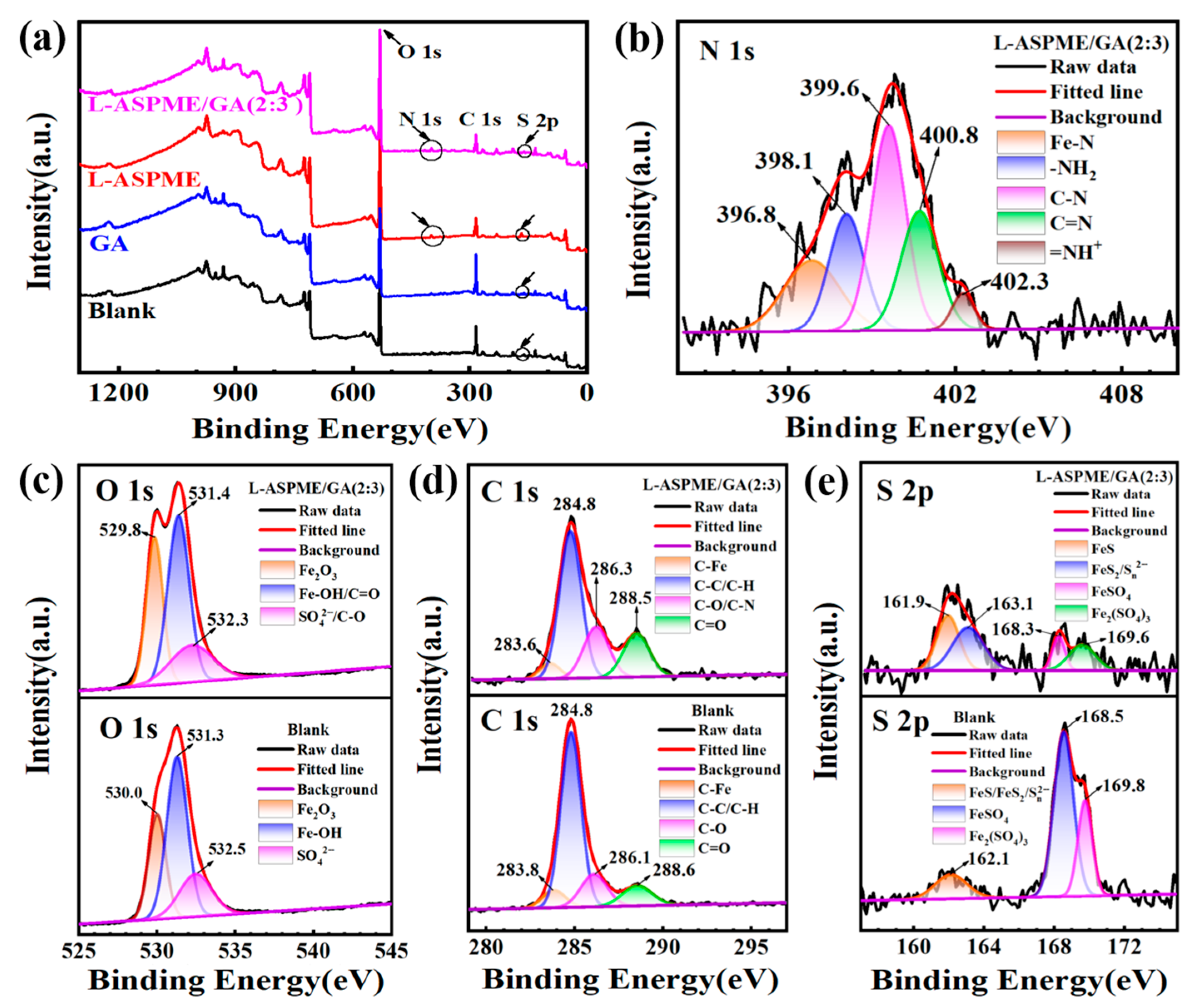
XPS analysis further confirmed the adsorption of the L-ASPME/GA hybrid (2:3 molar ratio) onto the treated Q235B steel surface. As shown in Figure 6a, the full-scale XPS spectra obtained in the absence and presence of the inhibitors exhibit distinct differences. The corresponding elemental compositions are summarized in Table 5. Notably, no nitrogen (N) was detected on the surface of the uninhibited blank sample, whereas the hybrid-inhibited surface showed a distinct nitrogen signal, accounting for 3.78% of the elemental composition. Additionally, the oxygen (O) content increased from 49.84% to 59.93%. These results provide clear evidence that the hybrid inhibitor adsorbed successfully onto the treated Q235B steel surface.
Figure 6. XPS analysis of Q235B steel surfaces immersed in 0.5 M H2SO4 at 300 K for 48 h, comparing uninhibited and 2.0 g·L−1 L-ASPME/GA hybrid (2:3 mol ratio)- inhibited conditions: (a) Full survey spectra, (be) High-resolution spectra of (b) N 1s, (c) O 1s, (d) C 1s, and (e) S 2p.
Table 5. The XPS results of surface element compositions of Q235B steel after 48 h of immersion in 0.5 M H2SO4 at 300 K.
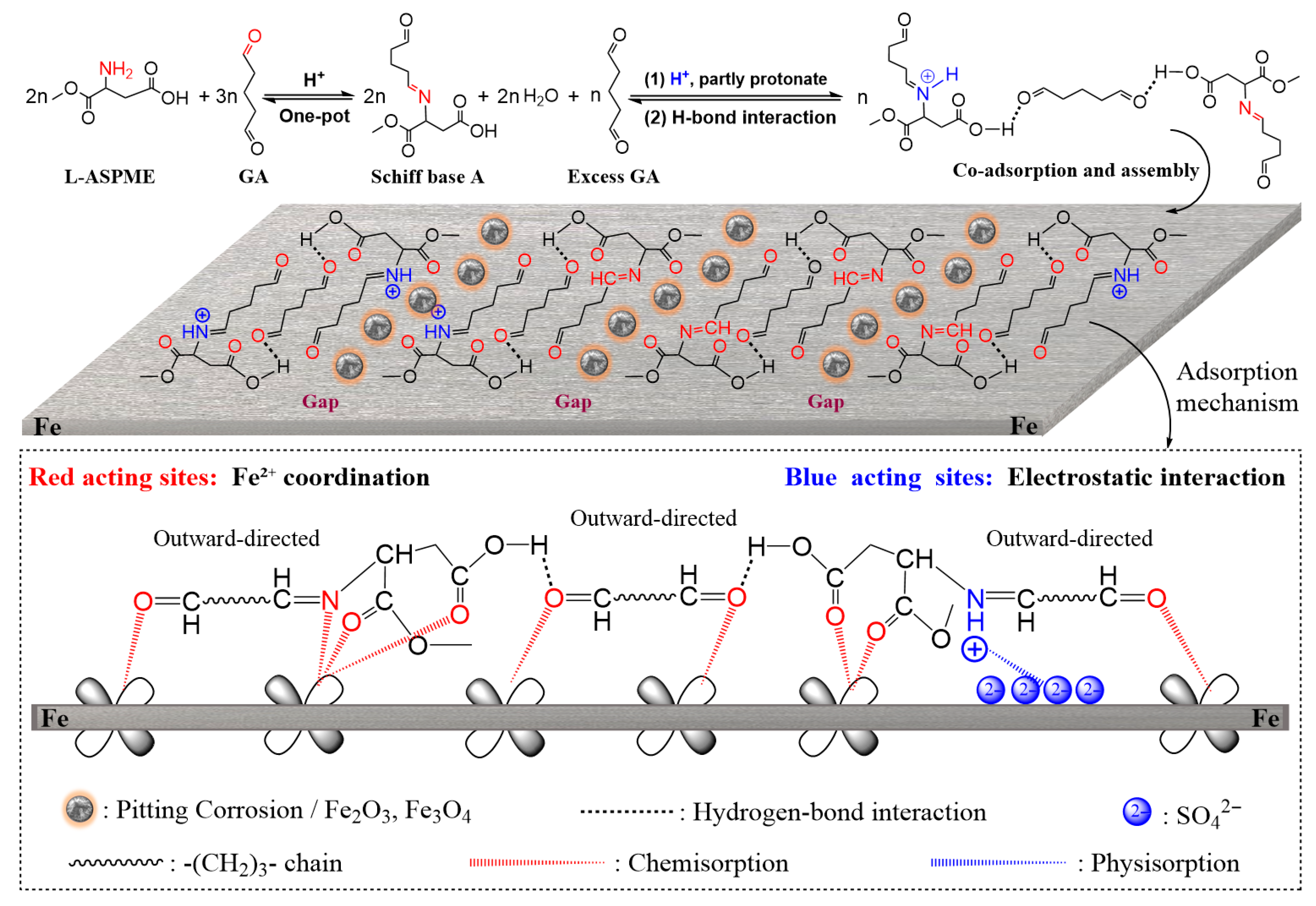
Figure 6b–e presents the high-resolution N 1s, O 1s, C 1s, and S 2p XPS spectra of the Q235B steel surface after immersion in 0.5 M H2SO4 with 2.0 g·L−1 of the hybrid inhibitor for 48 h at 300 K. The N 1s spectrum (Figure 6b and Table S2) shows five fitted peaks absent in the blank sample, located at 396.8 eV (Fe–N), 398.1 eV (–NH2), 399.6 eV (N–C), 400.8 eV (>C=N–), and 402.3 eV (>C=NH+–) [29,38,42]. These peaks correspond to the active sites associated with coordination, hydration, physisorption, chemisorption, and protonation of the hybrid, respectively. For O 1s (Figure 6c and Table S3), the spectrum of the blank sample can be deconvoluted into peaks at 530.0 eV (Fe2O3), 531.3 eV (FeOOH), and 532.5 eV (SO42−) [40,41], corresponding to oxides, hydrated iron oxides, and iron sulfates [38]. Addition of the hybrid induced a chemical shift, giving peaks at 529.8 eV (Fe2O3), 531.4 eV (FeOOH/C=O), and 532.3 eV (SO42−/C–O) [29,41]. The C 1s spectrum (Figure 6d and Table S4) displayed a comparable shift, with peaks emerging at 283.6 eV (C–Fe), 284.8 eV (C–C/C–H in L-ASPME/GA and adventitious carbon), 286.3 eV (C–N/C–O), and 288.5 eV (–C=O/–COOH) [38,40,41,42]. The S 2p spectra (Figure 6e and Table S5) further reveal distinct differences in sulfur speciation between the hybrid-inhibited and uninhibited steel surfaces. The uninhibited surface shows three peaks at 162.1 eV (Fe–S/FeS2/Sn2−), 168.5 eV (FeSO4), and 169.8 eV (Fe2(SO4)3) [41]. In contrast, four peaks were observed on the hybrid-inhibited surface at 161.9 eV (Fe–S), 163.1 eV (FeS2/Sn2−), 168.5 eV (FeSO4), and 169.7 eV (Fe2(SO4)3). Collectively, these analyses provide direct evidence for the physical and chemical adsorption of L-ASPME/GA onto the steel surface, as illustrated in Figure 7.
Figure 7. Synergistic corrosion inhibition mechanism of L-ASPME/GA hybrid (2:3 molar ratio) for Q235B steel in 0.5 M H2SO4.

3.4. Synergistic Corrosion Inhibition Mechanism

In acidic environments, H+ and SO42− ions rapidly diffuse to the Q235B steel surface and adsorb at cathodic and anodic sites, respectively. These adsorptions accelerate both hydrogen reduction and anodic dissolution, with the conjugated reactions reinforcing each other to cause severe corrosion [50]. When introducing L-ASPME, GA, or their hybrids into the acidic medium, they adsorb onto the metal surface via different mechanisms, forming protective films that provide varying degrees of protection against attack by H+ and SO42− ions. The efficiency of these organic molecules as corrosion inhibitors primarily depends on their adsorption ability on the metal surface [12,23].
Molecules of L-ASPME bearing heteroatoms (N, O) are inherently alkaline and readily undergo protonation in H2SO4 media [12]. These protonated species self-assemble through physisorption (ΔGads =−14.9854 kJ·mol−1; Kads = 0.4067 L·g−1) via electrostatic interaction with adsorbed SO42− ions, thereby forming a loose protective film on the steel surface [16,36]. The resulting film exhibited thermal instability owing to its low desorption energy and presented a low energy barrier (Ea=37.61 kJ·mol−1) for surface corrosion. Consequently, the inhibition efficiency of L-ASPME was limited to 26.0% at 300 K and essentially diminished to zero at 320 K (Figure 3d).
GA exhibited physico-chemical adsorption on the Q235B steel surface, as evidenced by its relatively low adsorption free energy (ΔGads = −22.2932 kJ·mol−1) and high adsorption equilibrium constant (Kads = 7.6161 L·g−1). Physisorption involves van der Waals interactions between the flexible CH2 chains and the steel substrate, while chemisorption relies on coordination of Fe2+ (unoccupied d-orbitals) with the lone-pair electrons on aldehyde oxygens [26]. The mixed adsorption film exhibited good thermal stability and a high energy barrier against corrosion (Ea = 73.66 kJ·mol−1), allowing GA to deliver an inhibition efficiency of 81.9% at 300 K and retain 43.8% at 320 K (Figure 3d). However, GA failed to suppress extensive localized black-spot corrosion (Figure 5d), as its adsorption sites operated independently without intermolecular hydrogen bonds or other strong interactions necessary for spatial synergy.
The L-ASPME/GA hybrids outperformed the individual components, exhibiting superior Langmuir adsorption (higher R2, Table 1), concurrent suppression of general and pitting corrosion (Figure 5e), and >90.0% inhibition efficiencies across the verified ratios (2:3–4:1) and concentrations (2.0–4.0 g·L−1, Figure 3a). The synergistic inhibition observed in the L-ASPME/GA hybrid stems from the mixed co-adsorption of its components, leading to the formation of more compactly oriented protective films. This assembly process is primarily driven by spatially synergistic interactions, including hydrogen-bonding networks [28], Fe2+ coordination [9,24,26], and electrostatic interactions [24,33,39]. The resulting oriented films establish micron-confined pathways that effectively block corrosive species from reaching the steel substrate, thereby providing oriented corrosion protection [43]. The hydrogen-bonding networks form mainly between excess components and the Schiff bases within the hybrids [28], while Fe2+ coordination is dominated by the C=N groups of the Schiff base ligands [24] and the O atoms with lone pairs from active aldehyde and carbonyl groups [9,26]. Electrostatic interactions occur primarily between adsorbed negatively charged SO42− ions and protonated C=N groups [24,33,39]. Varying the feed ratios results in differences in the composition of the resulting L-ASPME/GA hybrids and the compactness of their assembled films. Consequently, the corrosion inhibition efficacy of these hybrids against sulfuric acid on carbon steel varied with the feed ratio. Among them, the L-ASPME/GA hybrid with a 2:3 molar ratio exhibited mixed adsorption on the Q235B steel surface (ΔGads = −21.8569 kJ·mol−1; Kads = 6.3939 L·g−1), forming a compactly oriented and thermally robust film with a high energy barrier (Ea = 78.70 kJ·mol−1) against corrosion (Figure 5e). This film provided 90.7% corrosion inhibition efficiency at 300 K and maintained 66.8% at 320 K (Figure 3d), significantly outperforming those formed by individual L-ASPME or GA. The synergistic corrosion inhibition mechanism of this hybrid for Q235B steel in sulfuric acid solution is illustrated in Figure 7.

4. Conclusions

A facile one-pot aqueous reaction strategy was successfully implemented under ambient conditions to prepare hybrid inhibitors comprising Schiff bases together with either residual glutaraldehyde (GA) or L-aspartic acid β-methyl ester (L-ASPME), depending on the feed ratio of L-ASPME to GA. This mild and eco-friendly strategy, employing natural raw materials, renders the resulting hybrid inhibitor a promising candidate for industrial acid cleaning and pickling applications.
A comprehensive study demonstrates that the hybrid inhibitor system exhibits remarkable synergistic corrosion inhibition for Q235B steel in 0.5 M H2SO4, even though it forms a highly hydrophilic surface film. Within the L-ASPME/GA molar ratio range of 2:3 to 4:1, the hybrid inhibitor achieved high inhibition efficiencies between 90.7% and 96.1% at verified concentrations, significantly outperforming the individual components (L-ASPME or GA alone). The results confirm the feasibility of boosting inhibition efficiency and controlling residual GA concentration by adjusting the L-ASPME/GA ratio. Specifically, the 2:3 L-ASPME/GA hybrid functioned as a mixed-type inhibitor that simultaneously suppressed anodic dissolution and cathodic hydrogen evolution, a capability not observed in either pure component. Under identical conditions, it consistently delivered the strongest resistance to high-temperature corrosion, the most pronounced reduction in corrosion current density (Icorr), the largest positive shift in corrosion potential (Ecorr), and the highest charge transfer resistance (Rct), resulting in optimal inhibition efficiency (as evaluated by η, ηPDP, and ηEIS). This enhanced performance is attributed to a synergistic corrosion inhibition mechanism. The synergy likely stems from mixed co-adsorption involving Schiff bases and residual L-ASPME or GA, promoting the formation of compactly oriented films. This process is presumably driven by spatially synergistic interactions, including hydrogen-bonding networks between excess components and Schiff bases, Fe2+ coordination via C=N groups and oxygen atoms with lone pairs, as well as electrostatic interactions between adsorbed SO42− and protonated C=N groups. Collectively, these mechanisms facilitate the assembly of compact, micron-scale confined films that effectively block corrosive agents, thereby providing oriented and enhanced corrosion protection.
This work establishes a green and efficient strategy for modifying aspartic acid-like inhibitors, with significant implications for industrial steel corrosion protection in acidic environments. Further research should prioritize: (1) evaluating long-term stability under simulated industrial conditions, (2) elucidating the controlled-release mechanism of GA, and (3) quantitatively assessing the biocorrosion resistance of the L-ASPME/GA hybrid inhibitor system.

Supplementary Materials

The following supporting information can be downloaded at: https://www.mdpi.com/article/10.3390/coatings15121460/s1, Table S1: Comparison of linear regression coefficients (R2) across different adsorption isotherm models; Tables S2–S5: Fitting parameters derived from the N 1s, O 1s, C 1s, and S 2p XPS spectra in Figure 6b–e; Figure S1: Effect of temperature on the corrosion rate of Q235B steel in the absence and presence of 2.0 g·L−1 of L-ASPME, GA, or L-ASPME/GA hybrid (2:3 molar ratio); Figure S2: Water contact angle measurement on polished Q235B steel surface before pickling (a); after immersion in 0.5 M H2SO4 solution for 48 h at 300 K with no inhibitor (blank) (b), with 2.0 g·L−1 L-ASPME (c), with 2.0 g·L−1 GA (d), and with 2.0 g·L−1 L-ASPME/GA hybrid (2:3 molar ratio) (e). Refs. [51,52] are cited in Supplementary Materials.

Author Contributions

R.C.: writing—review and editing, visualization, investigation, methodology, supervision, conceptualization, funding acquisition. W.C.: writing—original draft, visualization, investigation, validation. X.J.: writing—review and editing, methodology, resources, project administration. L.L.: methodology, formal analysis. Z.Z.: methodology, supervision. Y.C.: formal analysis, visualization. C.D.: writing—review and editing, formal analysis, validation, funding acquisition. R.W.: writing—review and editing. Y.W.: data curation. M.X. and J.Y.: Validation. All authors have read and agreed to the published version of the manuscript.

Funding

This research was funded by the Fujian Provincial Science and Technology Major Project (Grant No. 2023YZ038001), Quanzhou Major Science and Technology Project (Grant No. 2024QZNZ4), Fuzhou Major Science and Technology Project (Grant No. 2023-ZD-008), and the Scientific Research Start-up Fund of Fujian University of Technology (GY-Z21023).

Institutional Review Board Statement

Not applicable.

Data Availability Statement

The data that support the findings of this study are available from the corresponding author upon reasonable request.

Conflicts of Interest

The authors declare no conflicts of interest.

References

  1. Alipanah, N.; Yari, H.; Mahdavian, M.; Ramezanzadeh, B.; Bahlakeh, G. MIL-88A (Fe) filler with duplicate corrosion inhibitive barrier effect for epoxy coatings: Electrochemical, molecular simulation, and cathodic delamination studies. J. Ind. Eng. Chem. 2021, 97, 200–215. [Google Scholar] [CrossRef]
  2. Ituen, E.; Ekemini, E.; Lin, Y.; Li, R.; Singh, A. Mitigation of microbial biodeterioration and acid corrosion of pipework. Int. Biodeterior. Biodegrad. 2020, 149, 104935. [Google Scholar] [CrossRef]
  3. Guo, L.; Zhu, L.; Kaya, S.; Sun, R.; Ritacca, A.G.; Wang, K.; Chang, J. Electrochemical and surface investigations of N, S codoped carbon dots as effective corrosion inhibitor for mild steel in acidic solution. Colloids Surf. A Physicochem. Eng. Asp. 2024, 702, 135062. [Google Scholar] [CrossRef]
  4. Nwankwo, H.U.; Akpan, E.D.; Olasunkanmi, L.O.; Verma, C.; Al-Mohaimeed, A.M.; Al Farraj, D.A.; Ebenso, E.E. N-substituted carbazoles as corrosion inhibitors in microbiologically influenced and acidic corrosion of mild steel: Gravimetric, electrochemical, surface and computational studies. J. Mol. Struct. 2021, 1223, 129328. [Google Scholar] [CrossRef]
  5. Al Kiey, S.A.; El-Sayed, A.A.; Khalil, A.M. Controlling corrosion protection of mild steel in acidic environment via environmentally benign organic inhibitor. Colloids Surf. A Physicochem. Eng. Asp. 2024, 683, 133089. [Google Scholar] [CrossRef]
  6. Prathipa, V.; Raja, A.S.; Prabha, S.S. An efficient water soluble inhibitor for corrosion of carbon steel in aqueous media. Int. J. Chem. Mater. Environ. Res. 2016, 3, 35–41. [Google Scholar]
  7. Mpelwa, M.; Tang, S.F. State of the art of synthetic threshold scale inhibitors for mineral scaling in the petroleum industry: A review. Pet. Sci. 2019, 16, 830–849. [Google Scholar] [CrossRef]
  8. Ryu, S.; Moinpour, M.; Rawat, A.; Kim, P.J.; Podlaha, E.J.; Seo, J. Molecular interactions of amino acids for corrosion control in molybdenum CMP through bridging experimental insights and DFT simulations. Appl. Surf. Sci. 2025, 698, 163046. [Google Scholar] [CrossRef]
  9. Oubaaqa, M.; Ouakki, M.; Rbaa, M.; Abousalem, A.S.; Maatallah, M.; Benhiba, F.; Jarid, A.; Touhami, M.E.; Zarrouk, A. Insight into the corrosion inhibition of new amino-acids as efficient inhibitors for mild steel in HCl solution: Experimental studies and theoretical calculations. J. Mol. Liq. 2021, 334, 116520. [Google Scholar] [CrossRef]
  10. Shanthy, P.; Rajendran, S.; Joany, R.M.; Maheswari, T.U.; Pandiarajan, M. Influence of a biocide on the corrosion inhibition efficiency of aspartic acid Zn2+ system. Int. J. Nano Corros. Sci. Eng. 2015, 2, 2395. [Google Scholar]
  11. Morsi, M.S.; Barakat, Y.F.; El-Sheikh, R.; Hassan, A.M.; Baraka, D.A. Corrosion inhibition of mild steel by amphoteric surfactants derived from aspartic acid. Mater. Corros. 1993, 44, 304–308. [Google Scholar] [CrossRef]
  12. Yurt, A.; Bereket, G.; Ogretir, C. Quantum chemical studies on inhibition effect of amino acids and hydroxy carboxylic acids on pitting corrosion of aluminium alloy 7075 in NaCl solution. J. Mol. Struct. Theochem. 2005, 725, 215–221. [Google Scholar] [CrossRef]
  13. Masroor, S.; Mobin, M.; Singh, A.K.; Rao, R.A.K.; Shoeb, M.; Alam, M.J. Aspartic di-dodecyl ester hydrochloride acid and its ZnO-NPs derivative, as ingenious green corrosion defiance for carbon steel through theoretical and experimental access. SN Appl. Sci. 2020, 2, 144. [Google Scholar] [CrossRef]
  14. Banerjee, R.R.; Nandi, M.M. Inhibition effect of amino acid derivatives on the corrosion of brass in 0.6 M aqueous sodium chloride solution. Indian J. Chem. Technol. 2010, 17, 176–180. [Google Scholar]
  15. Moses, M.S. Effective inhibition of T95 steel corrosion in 15 wt% HCl solution by aspartame, potassium iodide, and sodium dodecyl sulphate mixture. Sci. Rep. 2023, 13, 13085. [Google Scholar] [CrossRef]
  16. Qian, B.; Wang, J.; Zheng, M.; Hou, B. Synergistic effect of polyaspartic acid and iodide ion on corrosion inhibition of mild steel in H2SO4. Corros. Sci. 2013, 75, 184–192. [Google Scholar] [CrossRef]
  17. Tian, F.; Pan, L. Effect of glutaraldehyde on corrosion of X80 pipeline steel. Coatings 2021, 11, 1176. [Google Scholar] [CrossRef]
  18. Kijkla, P.; Wang, D.; Mohamed, M.E.; Saleh, M.A.; Kumseranee, S.; Punpruk, S.; Gu, T. Efficacy of glutaraldehyde enhancement by d-limonene in the mitigation of biocorrosion of carbon steel by an oilfield biofilm consortium. World J. Microbiol. Biotechnol. 2021, 37, 174. [Google Scholar] [CrossRef]
  19. Liu, L.; Fu, Q.; Peng, C.; Wei, B.; Qin, Q.; Gao, L.; Bai, Y.; Xu, J.; Sun, C. Effect of glutaraldehyde as a biocide against the microbiologically influenced corrosion of X80 steel pipeline. J. Pipeline Syst. Eng. Pract. 2022, 13, 04022014. [Google Scholar] [CrossRef]
  20. Sharma, N. Schiff bases bearing amino acids for selective detection of Pb2+ ions in aqueous medium. Chem. Phys. Lett. 2022, 788, 139280. [Google Scholar] [CrossRef]
  21. Bsharat, I.; Abdalla, L.; Sawafta, A.; Abu-Reidah, I.M.; Al-Nuri, M.A. Synthesis, characterization, antibacterial and anticancer activities of some heterocyclic imine compounds. J. Mol. Struct. 2023, 1289, 135789. [Google Scholar] [CrossRef]
  22. Mustafa, F.H.A.; ElRab, E.K.M.G.; Kamel, R.M.; Elshaarawy, R.F.M. Cost-effective removal of toxic methylene blue dye from textile effluents by new integrated crosslinked chitosan aspartic acid hydrogels. Int. J. Biol. Macromol. 2023, 248, 125986. [Google Scholar] [CrossRef]
  23. Jafari, H.; Danaee, I.; Eskandari, H.; Rashvandavei, M. Combined computational and experimental study on the adsorption and inhibition effects of N2O2 Schiff Base on the corrosion of API 5L grade B steel. J. Mater. Sci. Technol. 2014, 30, 239–252. [Google Scholar] [CrossRef]
  24. Upadhyay, A.; Purohit, A.K.; Mahakur, G.; Dash, S.; Kar, P.K. Verification of corrosion inhibition of mild steel by some 4-Aminoantipyrine-based Schiff bases-impact of adsorbate substituent and cross-conjugation. J. Mol. Liq. 2021, 333, 115960. [Google Scholar] [CrossRef]
  25. Hegazya, M.A.; Hasan, A.M.; Emara, M.M.; Bakr, M.F.; Youssef, A.H. Evaluating four synthesized Schiff bases as corrosion inhibitors on the carbon. Corros. Sci. 2012, 65, 67–76. [Google Scholar] [CrossRef]
  26. Wang, Y.; Wang, T.; Wang, B.; Chang, W.; Cao, J.; Hu, L.; Lu, M.; Zhang, L. Performance evaluation of a novel and effective water-soluble aldehydes as corrosion inhibitor for carbon steel in aggressive hydrochloric medium. J. Renew. Mater. 2022, 10, 301–327. [Google Scholar] [CrossRef]
  27. Benabbouha, T.; Siniti, M.; Byadi, S.; Chefira, K.; Attari, H.E.; Barhoumi, A.; Chafi, M.; Chibi, F.; Rchid, H.; Rachid, N. Insight into corrosion inhibition mechanism of carbon steel in 2 M HCl electrolyte by eco-friendly based pharmaceutical drugs. Mater. Corros. 2023, 74, 1535–1549. [Google Scholar] [CrossRef]
  28. Ramotowska, S.; Zarzeczańska, D.; Dąbkowska, I.; Wcisło, A.; Niedziałkowski, P.; Czaczyk, E.; Grobelna, B.; Ossowski, T. Hydrogen bonding and protonation effects in amino acids’ anthraquinone derivatives: Spectroscopic and electrochemical studies. Spectrochim. Acta A 2019, 222, 117226. [Google Scholar] [CrossRef]
  29. Zheng, H.; Zhang, B.; Wang, X.; Lu, Y.; Li, F.; Li, C. Improved corrosion resistance of carbon steel in soft water with dendritic-polymer corrosion inhibitors. Chem. Eng. J. 2023, 452, 139043. [Google Scholar] [CrossRef]
  30. Ansari, K.R.; Quraishi, M.A.; Singh, A. Schiff’s base of pyridyl substituted triazoles as new and effective corrosion inhibitors for mild steel in hydrochloric acid solution. Corros. Sci. 2014, 79, 5–15. [Google Scholar] [CrossRef]
  31. Musa, A.Y.; Mohamad, A.B.; Kadhum, A.A.H.; Takriff, M.S.; Tien, L.T. Synergistic effect of potassium iodide with phthalazone on the corrosion. Corros. Sci. 2011, 53, 3672–3677. [Google Scholar] [CrossRef]
  32. Zhang, Q.H.; Hou, B.S.; Li, Y.Y.; Zhu, G.Y.; Liu, H.F.; Zhang, G.A. Two novel chitosan derivatives as high efficient eco-friendly inhibitors for the corrosion of mild steel in acidic solution. Corros. Sci. 2020, 164, 108346. [Google Scholar] [CrossRef]
  33. Keles, H.; Keles, M.; Sayın, K. Experimental and theoretical investigation of inhibition behavior of 2-((4-(dimethylamino)benzylidene)amino)benzenethiol for carbon steel in HCl solution. Corros. Sci. 2021, 184, 109376. [Google Scholar] [CrossRef]
  34. Marcus, R.A. On the theory of electron-transfer reactions. VI. Unified treatment for homogeneous and electrode reactions. J. Chem. Phys. 1965, 43, 679–701. [Google Scholar] [CrossRef]
  35. Bologna, A.; Graziano, G. Remarks on the hydration entropy of polar and nonpolar species. J. Mol. Liq. 2023, 391, 123437. [Google Scholar] [CrossRef]
  36. Kokalj, A.; Behzadi, H.; Farahati, R. DFT study of aqueous-phase adsorption of cysteine and penicillamine on Fe (110): Role of bond-breaking upon adsorption. Appl. Surf. Sci. 2020, 514, 145896. [Google Scholar] [CrossRef]
  37. Hu, L.; Sun, W.; Liu, L.; Zhang, Y.; Pan, G.; Xu, Y.; Ren, Z. The corrosion inhibition performance and mechanism of α-benzoin oxime on copper: A comprehensive study of experiments and DFT calculations. Colloids Surf. A Physicochem. Eng. Asp. 2024, 700, 134832. [Google Scholar] [CrossRef]
  38. Giselle, G.S.; Octavio, O.X.; Natalya, V.L.; Paulina, A.L.; Irina, V.L.; Víctor, D.J.; Diego, G.L.; Janette, A.M. Inhibition mechanism of some vinylalkylimidazolium-based polymeric ionic liquids against acid corrosion of API 5L X60 steel: Electrochemical and surface studies. ACS Omega 2022, 7, 37807−37824. [Google Scholar] [CrossRef]
  39. Sehrawat, R.; Yadav, S.; Pundeer, R.; Sharma, D.K.; Mangla, B. Synthesis of novel thiazole derivatives and their assessment as efficient corrosion inhibitors on mild steel in acidic medium. Prog. Org. Coat. 2025, 203, 109156. [Google Scholar] [CrossRef]
  40. Chai, C.; Xu, Y.; Li, D.; Zhao, X.; Xu, Y.; Zhang, L.; Wu, Y. Cysteamine modified polyaspartic acid as a new class of green corrosion inhibitor for mild steel in sulfuric acid medium. Prog. Org. Coat. 2019, 129, 159–170. [Google Scholar] [CrossRef]
  41. Chai, C.; Xu, Y.H.; Xu, Y.; Liu, S.; Zhang, L. Dopamine-modified polyaspartic acid as a green corrosion inhibitor for mild steel in acid solution. Eur. Polym. J. 2020, 137, 109946. [Google Scholar] [CrossRef]
  42. Sun, Y.; Wang, Y.; Liu, D.; Pan, S.; Ma, A.; Kuvarega, A.T.; Mamba, B.B.; Gui, J. Polymeric carboxylic acid functionalized ionic liquid as a green corrosion inhibitor: Insights into the synergistic effect with KI. Colloids Surf. A Physicochem. Eng. Asp. 2024, 702, 135157. [Google Scholar] [CrossRef]
  43. Lin, C.; He, L.; Xiong, P.; Lin, H.; Lai, W.; Yang, X.; Xiao, F.; Sun, X.; Qian, Q.; Liu, S.; et al. Adaptive ionization-induced tunable electric double layer for practical Zn metal batteries over wide pH and temperature ranges. ACS Nano 2023, 17, 23181−23193. [Google Scholar] [CrossRef]
  44. Teng, X.; Deng, S.; Li, X. Synergistic corrosion inhibition of rubber seed extract with KI on cold rolled steel in sulfuric acid solution. J. Taiwan Inst. Chem. 2024, 161, 105564. [Google Scholar] [CrossRef]
  45. Cornell, R.M.; Schwertmann, U. Influence of organic anions on the crystallization of ferrihydrite. Clays Clay Miner. 1979, 27, 402−410. [Google Scholar] [CrossRef]
  46. Sabzehvar, F.; Sarraf, S.; Soltanieh, M.; Seyedein, S.H. Improving bioactivity of anodic titanium oxide (ATO) layers with chlorine ion addition in electrolytes. Ceram. Int. 2025, 51, 3493–3509. [Google Scholar] [CrossRef]
  47. Yayoglu, Y.E.; Toomey, R.G.; Crane, N.B.; Gallant, N.D. Laser machined micropatterns, as corrosion protection of both hydrophobic and hydrophilic magnesium. J. Mech. Behav. Biomed. Mater. 2022, 125, 104920. [Google Scholar] [CrossRef] [PubMed]
  48. Guan, Y.; Li, X.; Yang, S.; Wei, G.; Qiu, L.; Deng, S. Amphoteric surfactant of dodecyl dimethyl betaine as an efficient inhibitor for the corrosion of steel in H2SO4 solution Experimental studies and theoretical calculations. Colloids Surf. A Physicochem. Eng. Asp. 2025, 718, 136894. [Google Scholar] [CrossRef]
  49. Lv, J.; Chen, Z.L.; Tang, J.; Chen, L.; Xie, W.J.; Sun, M.X.; Huang, X.J. Study on the superhydrophilic modification and enhanced corrosion resistance method of aluminum alloy distillation desalination tubes. Surf. Coat. Technol. 2022, 446, 128770. [Google Scholar] [CrossRef]
  50. Li, M.; Fu, S.; Peng, Y.; Sang, T.; Cui, C.; Ma, H.; Dai, J.; Liang, Z.; Li, J. An extensive analysis of isoindigotin derivatives as effective corrosion inhibitors for mild steel in acidic corrosive environments: An electrochemical and theoretical investigation. Prog. Org. Coat. 2025, 200, 108960. [Google Scholar] [CrossRef]
  51. Arrousse, N.; Salim, R.; Kaddouri, Y.; Zarrouk, A.; Zahri, D.; Hajjaji, F.; Touzani, R.; Tale, M.; Jodeh, S. The inhibition behavior of two pyrimidine-pyrazole derivatives against corrosion in hydrochloric solution: Experimental, surface analysis and in silico approach studies. Arab. J. Chem. 2020, 13, 5949–5965. [Google Scholar] [CrossRef]
  52. Tang, M.; Deng, S.; Xu, J.; Xu, D.; Shao, D.; Qu, Q.; Li, X. Invasive weed of mikania micrantha extract as a novel efficient inhibitor for the corrosion of aluminum in HNO3 solution. Colloids Surf. A Physicochem. Eng. Asp. 2024, 680, 132687. [Google Scholar] [CrossRef]
Disclaimer/Publisher’s Note: The statements, opinions and data contained in all publications are solely those of the individual author(s) and contributor(s) and not of MDPI and/or the editor(s). MDPI and/or the editor(s) disclaim responsibility for any injury to people or property resulting from any ideas, methods, instructions or products referred to in the content.

Article Metrics

Citations

Article Access Statistics

Article metric data becomes available approximately 24 hours after publication online.