Article

Fatigue Performance Improvement of Titanium Alloy with Microstructure Gradient and Residual Stress Gradient Produced by Laser Shock Peening

1
Laser Application Research, School of Electrical Engineering, Hunan University, Changsha 410082, China
2
Key Laboratory of Electromagnetic Radiation and Sensing Technology, Chinese Academy of Sciences, Beijing 100190, China
*
Author to whom correspondence should be addressed.
Coatings 2025, 15(12), 1443; https://doi.org/10.3390/coatings15121443
Submission received: 3 November 2025 / Revised: 28 November 2025 / Accepted: 5 December 2025 / Published: 8 December 2025
(This article belongs to the Section Corrosion, Wear and Erosion)

Abstract

In the present paper, the fatigue performance of a TC6 titanium alloy with a microstructure gradient and residual stress gradient produced by laser shock peening (LSP) is investigated. After LSP, a 1 mm thickness gradient compressive residual stress layer with a maximum surface compressive residual stress of −708 MPa is introduced into the materials. Electron back-scattering diffraction (EBSD) and transmission electron microscopy (TEM) techniques are used to characterize the microstructural evolution of the TC6 titanium alloy subjected to LSP. The results show that a nanostructured layer forms on the surface of the TC6 titanium alloy. At a depth of 20 μm, high dense dislocation and nanocrystalline are observed on the top surface. Based on the results of the microstructural characterization, it is found that dislocation movement is the main reason for the formation of nanocrystalline on the top surface. A high-cycle fatigue test showed that the fatigue limit of the TC6 titanium alloy treated by LSP improves from 431 ± 10 MPa to 486 ± 14 MPa, increasing by 12.8%.

1. Introduction

Titanium alloy is the key alloy used in aeroengine compressor and fan components, such as blades, blisks, and disks operating at intermediate temperatures. Furthermore, its excellent biocompatibility and mechanical properties also make it a suitable material for biomedical prosthetic implants subjected to cyclic loading, such as hip and knee joints. However, in an actual service profile, these rotating parts are subjected to combined centrifugal, aerodynamic, and vibratory loads, resulting in high-cycle fatigue failure of the components. Since fatigue cracking is commonly initiated at metallic surfaces, various surface-enhancement techniques have been introduced to titanium alloy components to further increase their resistance to high-cycle fatigue [1,2,3].
Among various techniques, laser shock peening (LSP) represents an advanced surface-modification approach and offers clear benefits over conventional strengthening treatments, including shot peening, rolling, and grinding [4,5,6,7,8]. It utilizes high-power laser pulses focused onto the surface of the material, which generate rapid heating and result in a plasma formation. The sudden expansion of this plasma generates a shock wave that propagates through the material’s surface. The shock wave, with pressures reaching several GPa, induces severe plastic deformation in the surface layer, which improves the microstructure and residual stress distribution. As the shock wave propagates deeper into the material, its pressure attenuates, creating a gradient in the microstructure and residual stress. Under such a strong shock wave, the surface layer suffers from severe plastic deformation, which improves the microstructure and residual stress. Since the shock wave gradually attenuates when it propagates into the interior matrix, the microstructure and residual stress show a gradient distribution [9,10]. On the top surface, the strain rate could reach its maximum (>106/s) and then decrease with increasing depth [11]. Thus, the matrix in different depth shows different responses. In short, LSP could cause gradient deformation, thereby resulting in gradient microstructure and residual stress [12,13,14]. In summary, the enhancement in fatigue performance achieved by LSP primarily stems from the introduced residual compressive stresses and the formation of a refined gradient microstructure [15,16,17].
The mechanical properties of pure nickel with a gradient microstructure, produced by LSP, were investigated by Zhou et al. [18]. Their results reveal that an increase in the gradient microstructure layer volume fraction leads to higher yield strength, but reduced elongation at fracture. Wang et al. [19] explored the impact of LSP-induced surface gradient stress distribution on the corrosion fatigue life of AISI 420 stainless steel. They observed that corrosion fatigue life in pH 7 NaCl solution increased by as much as 30.87% for LSP-treated samples. This enhancement was linked to the compressive residual stress and surface gradient microstructure generated by LSP, which slowed or prevented the growth of small cracks in the surface layer. Yang et al. [20] examined the microstructure of the 2195 aluminum–lithium alloy subjected to LSP. TEM images showed that large grains, originally measuring about 16 μm in length and 5 μm in width, were reduced to equiaxed grains of approximately 91 nm at the surface. The enhancement in surface microhardness was attributed to the refined grains and the deformation of substructures. Karthik et al. [9] explored the plastic strain gradient and nanotwinning in 321 steel treated with multi-pass LSP. Their findings show a significant change in grain orientation and an increase in low-angle boundaries in the heavily deformed regions. Additionally, after five laser peening passes, multiple twinning occurred within the twin matrix. Mao et al. [21] studied the deformation twinning mechanism and twinning-induced strain hardening effect of Mg alloy during LSP. After LSP, a gradient 10–12 twinning microstructure was generated. In addition, a gradient hardness distribution well corresponded to the gradient twinning microstructure. For TC6 titanium alloy, Umapathi and Swaroop [22] found high dense dislocation such as dislocation tangles and dislocation walls in the near surface region after LSP, but no dislocation cell or nanocrystals structures. And synchrotron radiation showed the volume fraction of β phase was increased with the increasing of power density in the far-surface region. From the studies mentioned above, it could be seen that LSP introduces gradient residual stress and gradient microstructure into the surface layer of processed material, which has a remarkable effect on improving its mechanical performance [23].
However, while previous studies have well documented the gradient features induced by LSP across various materials, the underlying mechanisms through which such gradient characteristics—specifically in titanium alloys—enhance high-cycle fatigue resistance remain inadequately explored. And, so far, the most research have been carried on gradient microstructure characterization and its effects on tensile properties, yet few examples have been reported on how this unique microstructure influences its fatigue performance, especially for titanium alloys. Thus, in the present paper, which aims to investigate the features of microstructure gradient and residual stress gradient produced by LSP, the TC6 titanium alloy is used as the research object. At the same time, a high-cycle fatigue test was performed to evaluate the effects of gradient microstructure and gradient residual stress on the fatigue performance of the titanium alloy. Finally, the formation mechanism of the gradient microstructure is analyzed and revealed.

2. Materials and Experiments

2.1. Materials and Specimens

The TC6 titanium alloy, commonly used in aeroengines, consists of Al (5.5%), Mo (2.0%), Cr (0.8%–2.3%), Fe (0.2%–0.7%), and Si (0.15%–0.4%), with titanium as the balance. The TC6 titanium alloy consists of two crystalline phases: the α phase (HCP) and the strengthening β phase (BCC). Its mechanical properties include a yield strength ( σ 0.2 ) of 840 MPa, ultimate tensile strength ( σ b ) of 980 MPa, and an elongation rate (ζ) of 25% [24].

2.2. LSP Process

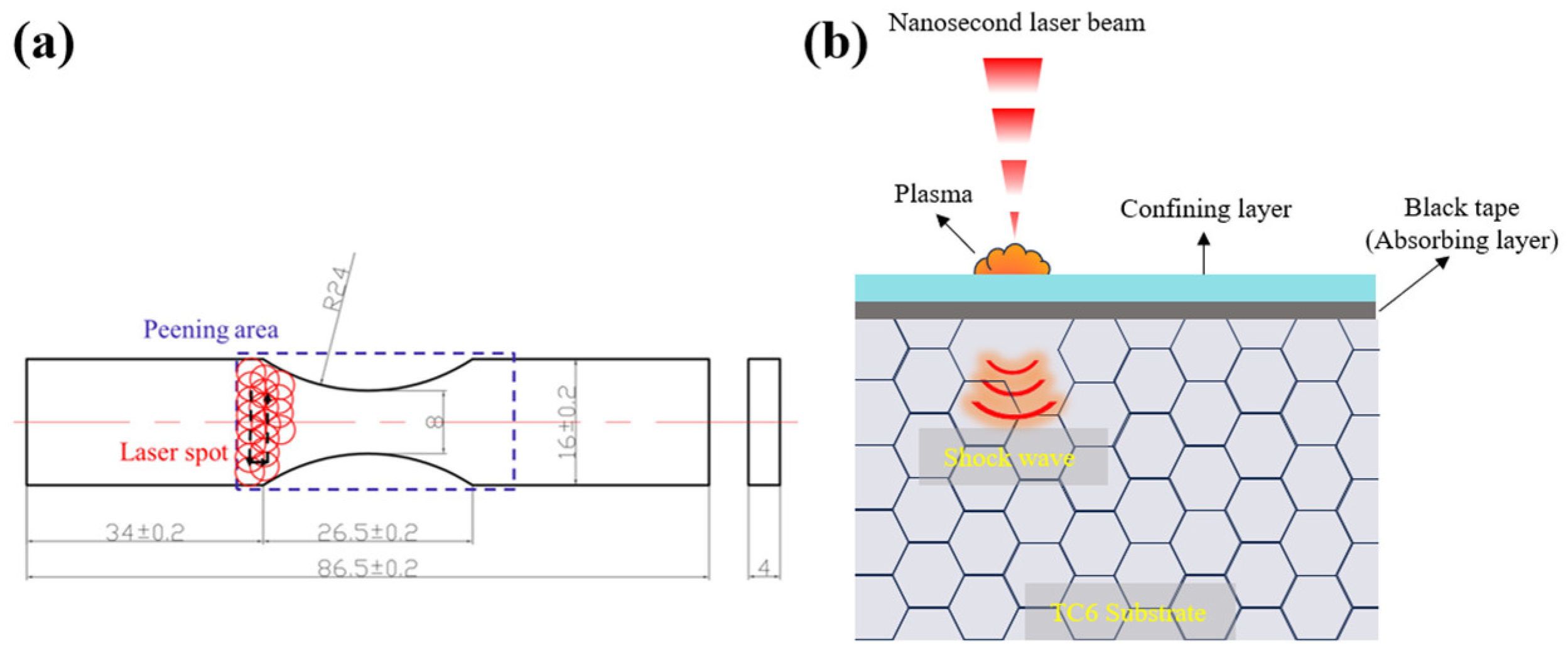
LSP was performed with a YAG laser (Tyrida, China) to produce high power density with a pulse width of 20 ns and a wavelength of 1064 nm. A 2 mm water layer is used to increase the plasma plume pressure, while a 100 μm black tape on the material surface enhances laser absorption by blocking radiation. The laser spot diameter is 4 mm with a 50% overlap (2 mm spacing). LSP parameters, including laser power and impact cycles, are optimized before the fatigue test. In the present work, the laser power density was set to 3.9, 5.2, and 6.5 GW/cm2, respectively, and the impact time was selected as 0, 1, 3, and 5 times according to our previous experiments. Then a better parameter was determined according to the results of compressive residual stress and was finally applied on the process of fatigue specimens. The size of fatigue specimens used in present work and a diagram of the LSP process is shown in Figure 1, which is manufactured from a titanium plate by wire-cutting. During the LSP experiment, the TC6 samples were treated using the two-sided LSP.

2.3. Residual Stress Measurement

Residual stress measurement was performed using Proto-LXRD X-ray diffractometer (Proto, Windsor, ON, Canada) with the sin2ψ-method. The diffracted tube is Cu-kα, and the X-ray beam’s diameter was 2 mm. The diffracted plane was (213) and 2θ was 142°. For the residual stress in depth, electrolytic polishing was firstly conducted to remove the surface materials layer-by-layer before the measurement of residual stress at a certain depth. The polishing solution was 90% methanol and 10% perchloric acid. Each point was measured three times, and the average value was adopted.

2.4. EBSD and TEM Characterization

EBSD was also performed to characterize the microstructure evolution of the TC6 titanium ally along the depth direction. The experiment was carried out using a Tescan Mira 3 XH SEM (Tescan, Brno, Czech) with an Oxford Nordly Max3 EBSD detector (Oxford, Abingdon, UK). The scanning step was 0.2 μm, and the observed area measured 100 μm in width and 200 μm in depth. EBSD samples were prepared by mechanical polishing.
To examine the dislocation morphology and grain size of the near-surface layer, TEM analysis was performed using a JEM-2800F field emission TEM (JEOL, Tokyo, Japan) at 200 kV. TEM samples were prepared by double-jet electrolytic polishing.

2.5. High-Cycle Fatigue Test

In this study, the step-loading method based on linear cumulative damage theory was employed to evaluate the high-cycle fatigue strength of specimens before and after femtosecond laser strengthening with optimized parameters [25]. This approach was used to assess the effectiveness of laser shock wave strengthening in enhancing fatigue performance. Compared to the traditional S-N curve method, this technique significantly reduces both the number of specimens required and the overall time cost. The experimental procedure is outlined as follows: For the unstrengthened baseline sample, the initial stress level was set to 25% of the tensile strength. The material studied here is the TC6 titanium alloy, with a tensile strength of 980 MPa, resulting in a fatigue limit of approximately 320 MPa. Given the anticipated improvement in fatigue performance after strengthening, the initial stress level for the strengthened sample was increased to 350 MPa. During the experiment, if no failure occurred after the first 106 cycles, a subsequent 106 cycles were applied with a stress increment of 10% (R = 0.1), and this process continued until the specimen experienced fatigue fracture. Finally, the number of cycles and the loading stage at fracture are recorded, and the fatigue limit is calculated using the following formula:
σ H C F = σ p r + N f ( σ f σ p r ) / 10 6
where σ p r is the first-order stress value before fracture failure of fatigue specimen and σ f and N f are the maximum stress level and the cycle number of specimen at fracture stress level, respectively. The accuracy of this method has been validated in Ni-based superalloy Udimet 720 [26,27] and Ti6Al4V titanium alloy [28], showing results comparable to the conventional constant amplitude stress-life method. It provides a rapid way to assess the high-cycle fatigue limit of materials. In this study, we apply the step-loading method to evaluate the fatigue limits of specimens with and without LSP treatment. To ensure the reliability of the results, ten specimens for each condition were tested, and the average value was used.

3. Results and Discussion

3.1. Gradient Residual Stress Distribution

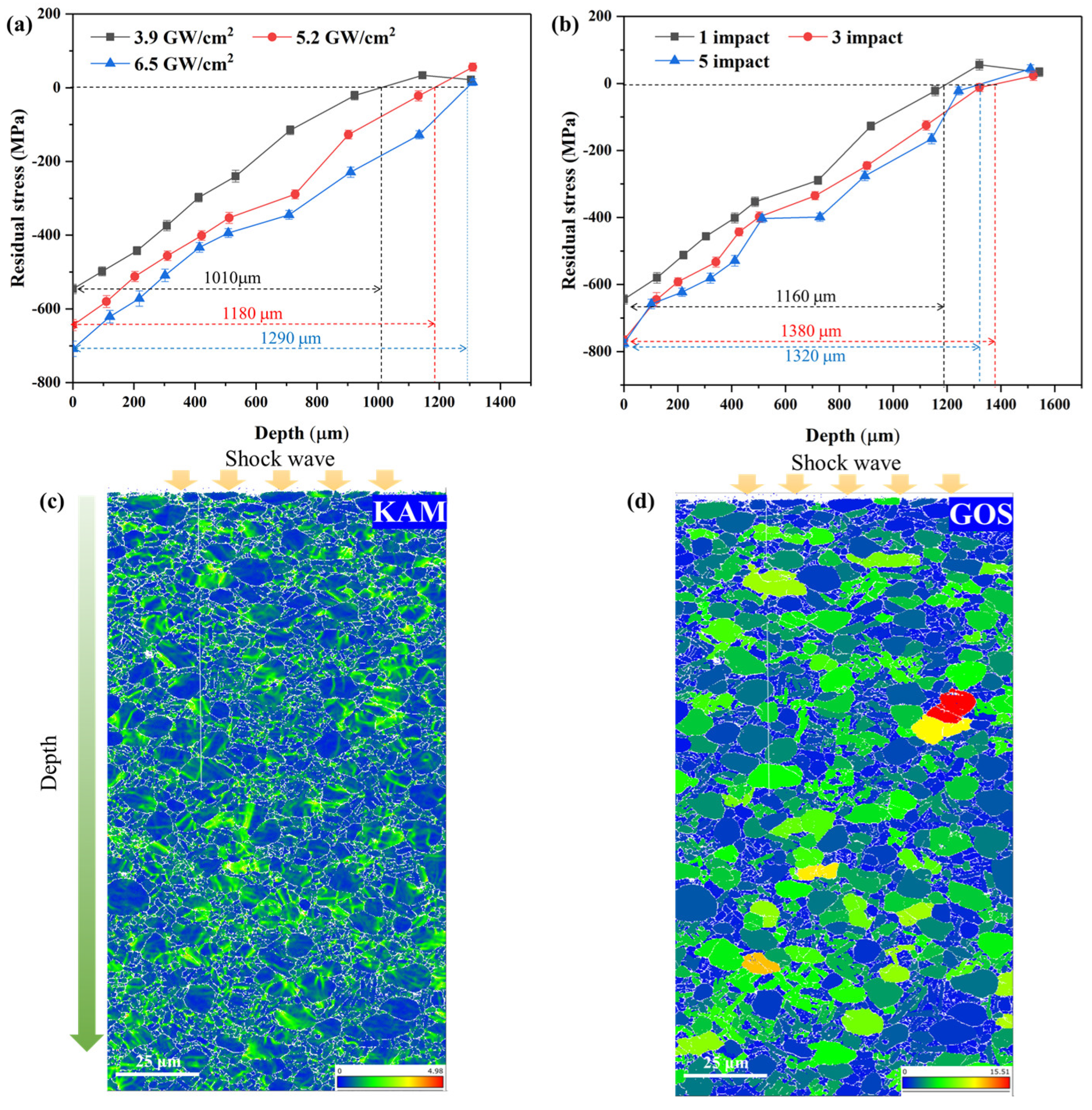
Figure 2 shows the effects of different processing parameters on the residual stress distribution of the TC6 titanium alloy. As shown in Figure 2a, when the impact time is identical (1 impact) and the laser power density is 3.9, 5.2, and 6.5 GW/cm2, gradient-compressive residual stress along the depth is introduced into the surface layers of materials. The maximum value appears on the surface and then decreases with the increasing distance from the surface. This is attributed to the gradual decrease in shock wave pressure by damping the effects of the matrix when it propagates into the interior material. Among the material response for the three different laser power densities, the specimens treated with 6.5 GW/cm2 show a maximum compressive residual stress on the surface, reaching −708 MPa. And the samples subjected to LSP with laser power densities of 3.9 and 5.2 GW/cm2 exhibited a relatively smaller surface-compressive residual stress, −546 MPa and −644 MPa. This indicates the clear impact of laser power density on the amplitude of compressive residual stress. The thickness of the affected layer also increases with higher laser power density. For instance, when the titanium alloy is treated with LSP at a laser power density of 6.5 GW/cm2, the thickness of the compressive residual stress layer reaches approximately 1290 μm, which is 27.7% and 9.3% greater than that for treatments at 3.9 GW/cm2 (1010 μm) and 5.2 GW/cm2 (1180 μm), respectively. This suggests that a higher laser power density enhances the depth of the compressive residual-stress-affected layer.
Impact time is another crucial parameter in LSP experiments. As shown in Figure 2b, the impact time affects residual stress distribution. With a constant laser power density of 5.2 GW/cm2, increasing the impact time from one to three cycles raises the surface compressive residual stress from −644 MPa to −765 MPa, an 18.8% increase. But further increasing impact times do not induce larger surface-compressive residual stress. For instance, after five impacts, the surface-compressive residual stress increases slightly, reaching −776 MPa. A similar trend is observed in the thickness of the affected layer. As shown in Figure 2b, the sample treated with three impacts has a compressive residual stress layer of 1380 μm, a 19.0% increase compared to the sample treated with one impact. However, when the impact time is further increased to five, the layer thickness only shows a slight rise, indicating that plastic deformation reaches its saturation point, and additional impacts have a minimal effect on improving the compressive residual stress.
To understand microstructural behavior, the deformation mechanism of the TC6 titanium alloy under severe plastic deformation must be examined. Kernel average misorientation (KAM) mapping in EBSD analysis can effectively quantify the degree of deformation and strain energy. As shown in Figure 2c, after LSP treatment, the scanned areas predominantly display green and blue, indicating a significant deformation of the surface layer (0–200 μm depth) of the TC6 titanium alloy. This could also be confirmed from grain orientation spread (GOS) mapping (Figure 2d), which quantify the extent of misorientation within grains. AS shown in Figure 2d, it was found that the local misorientation within most grains exhibited a larger value (the average GOS was around 2.6°). Considering the results of the compressive residual stress measurement, we could see that, after LSP treatment, gradient-compressive residual stress was introduced into the materials and there existed larger micro-strain/stress within the grains on the surface layer where the strain rate was at the maximum.

3.2. Gradient Microstructure Features

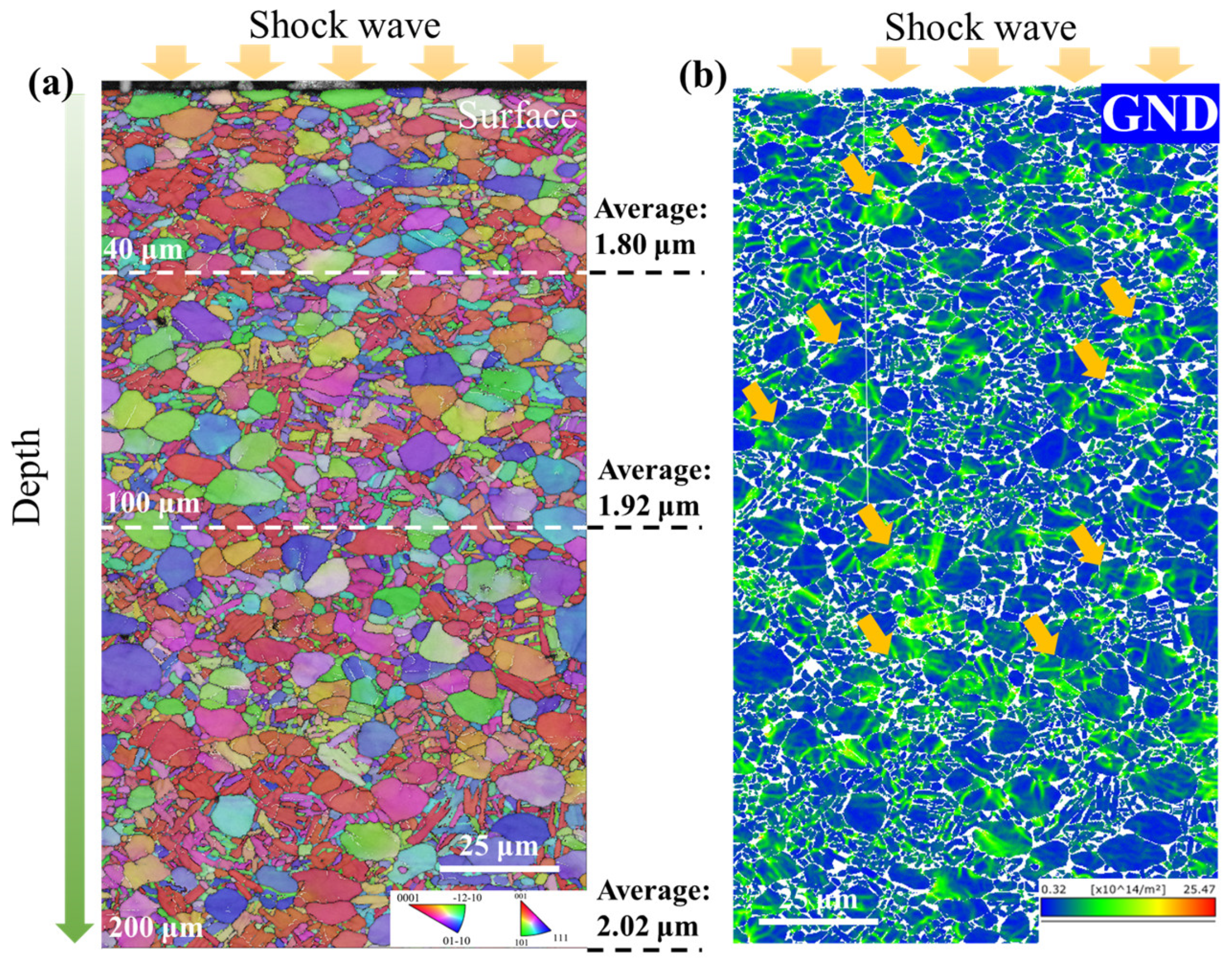
EBSD was conducted to analyze the microstructural response here, and the inverse pole figure (IPF) and geometry-necessary dislocation (GND) mapping was plotted (Figure 3) [9,10,21,29]. As shown in Figure 3a, grain refinement occurred at varying levels from the surface to the interior of the samples. For instance, at a depth of 0–40 μm, the average grain size was 1.80 μm, with grains exhibiting an elongated, stretched shape. At a depth of 40–100 μm, the average grain size increased slightly to 1.92 μm. Further into the material, at depths of 100–200 μm, the grain size measured 2.02 μm. These EBSD observations indicate a gradient distribution of grain size along the depth direction. Figure 3b shows the geometry-necessary dislocation distribution of the sectioned surface processed samples. It can be seen that the green color dominates the whole scanning area, suggesting the massive multiplication of geometry-necessary dislocation after LSP. The average dislocation density was calculated as 4.0 × 10¹⁴/m2, and most dislocation accumulated around the grain boundary, as indicated by arrows. It is well established that ultra-high laser-induced shock waves significantly increase dislocation density [30].
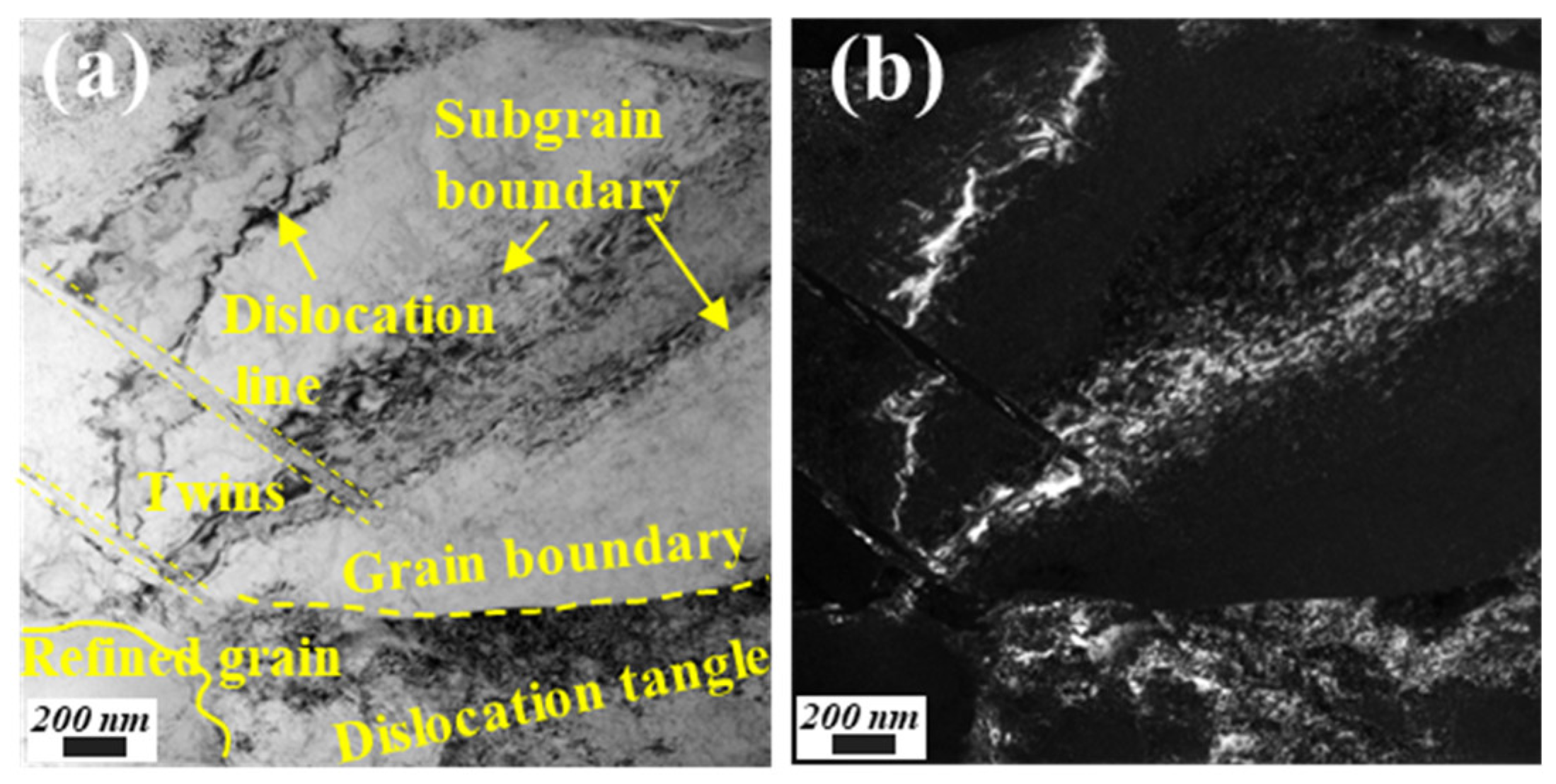
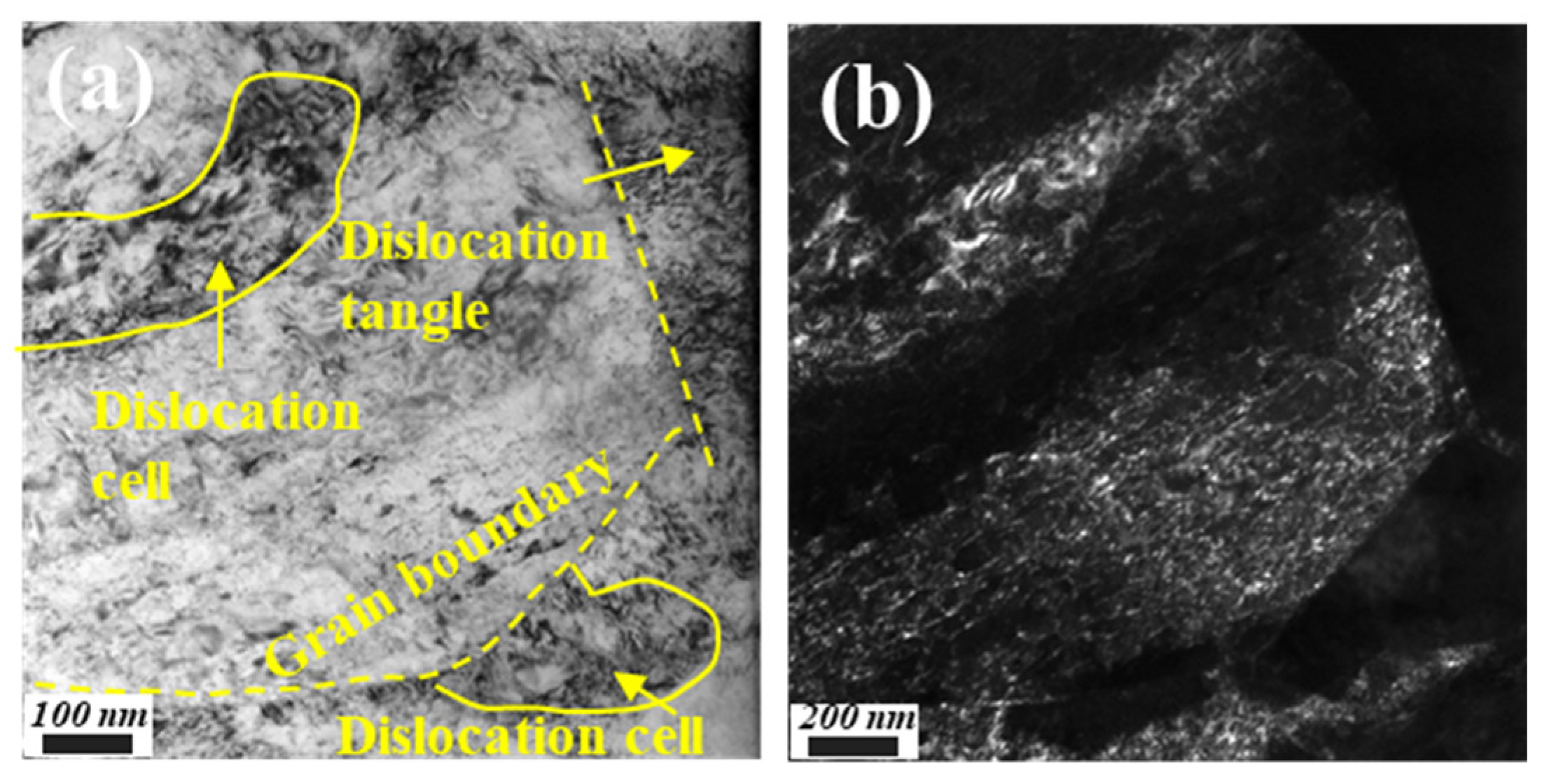
Figure 4 shows TEM images from a depth of 20 μm from the top surface of the TC6 titanium alloy subjected to LSP. As shown in Figure 4a, massive dislocation piles up on the grain boundary, forming dislocation tangle structures. Within the grains, high dense dislocation structures could also be observed, such as dislocation line and dislocation tangle, which can be seen clearly in the dark-field TEM image (Figure 4b). These high dense dislocation structures could be transformed into subgrain boundaries under further deformation because these locations are in a high-energy unstable state and must minimize the total energy through dislocation accumulation and rearrangement [31]. In this way, the original coarse grains are refined into finer grains. In addition, some deformed twins are also observed in the grains. These twin boundaries could act as a barrier to the dislocation movement, thereby resulting in the accumulation of numerous dislocations. Moreover, such twin/matrix lamellae also play an important role in the process of grain refinement [32].
Figure 5 presents a TEM image of the TC6 titanium alloy subjected to LSP at a depth of 5 μm from the surface. Dislocation movement is observed to form small dislocation cells (Figure 5a). The dark-field TEM image (Figure 5b) shows a higher dislocation density at this depth compared to 20 μm. This indicates that, as the strain and strain rate increase, dislocation movement becomes significantly enhanced, leading to the accumulation of dislocation lines and tangles. Consequently, more complex dislocation structures, such as dislocation cells, are formed in the severely deformed layer.
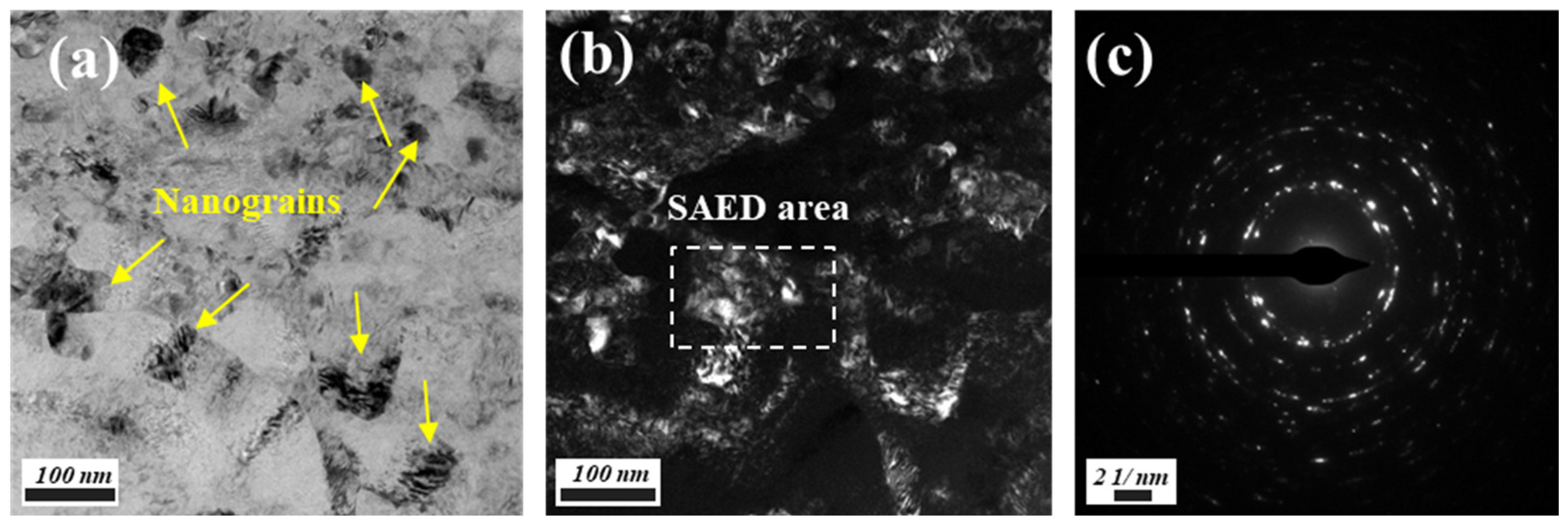
The surface layer experiences the highest strain and strain rate, making it the focus of the TEM analysis. The results are shown in Figure 6. TEM images (Figure 6a,b) reveal that the surface nanocrystalline grains range from 100 to 200 nm in size and are evenly distributed. The corresponding selected area electron diffraction (SAED) pattern (Figure 6c), taken from the rectangle in Figure 6b, shows discontinuous, elongated diffraction spots in a ring shape. This suggests that nanocrystals with random crystallographic orientations are present on the surface.
If the formation and movement of dislocation and twin deformation are viewed as a competitive mechanism, the evolution of microstructures under shock waves is completed by dislocation movement for titanium alloys, as seen from the results of the microstructural characterization [33]. Dislocation substructures produced by shock loading are relevant for the parameters of shock wave and materials. Among the parameters of shock waves, pressure is the most important parameter, and an increase in pressure will increase the dislocation density. Meyers et al. [34,35] put forward the homogeneous nucleation theory about dislocation deformation. According to this theory, dislocations are generated when the deviatoric elastic stresses at the front reach a critical level. The high density of dislocations then relieves these stresses, which elastically distort the original lattice. It is suggested that the shock pressure must satisfy a specific condition to induce homogeneous dislocation generation:
τ h / G = 0.054
where τ h and G are the shear stress needed to generate homogeneous dislocation and shear modulus, respectively. And the shear stress τ induced by LSP could be calculated by the following equation:
τ = 6 G P ( 1 2 v ) / E
where P, v, and E are the pressure of shock wave, Poisson’s ratio, and laser energy, respectively. When the maximum shear stress τ caused by the shock wave is greater than the critical shear stress τ h , the homogeneous dislocation will be formed. Theoretically, it is believed that the dislocation density is extremely high and the observed microstructure also indicates this assumption, as shown in Figure 5 and Figure 6. As shock wave pressure increases, dislocations form rapidly in high densities, and dislocation movement is triggered. During ultra-high-strain-rate plastic deformation, the dislocation movement is limited due to the short travel distance and the rise time of the shock wave being under 1 nanosecond. This results in dislocation multiplication, disappearance, and rearrangement. Consequently, the dislocation cell size is small, around 500 nm, as shown in Figure 6. This follows the principle that higher shock wave pressure leads to smaller dislocation cell dimensions [36]. After the action of the shock wave, different microstructures form in different depths of the cross-sectional sample. The process for Laue diffraction peak variation is as follows: With the increase in shock wave pressure, Laue diffraction peak is widened and gradually stretched. The final lengthened diffraction peak evolves into many small and sharp diffraction peaks near the top surface.
During the surface nanocrystalline process of the TC6 titanium alloy subjected to LSP, the transformation from high dense dislocation to subgrain plays a key role in grain refinement. Under the high-pressure shock wave, dislocations accumulate near the grain boundaries. To minimize energy, these dislocations organize into subgrains with low-angle grain boundaries. As strain increases, the misorientation of the subgrains rises, eventually transforming into high-angle grain boundaries through dynamic recrystallization. This process leads to the formation of nanocrystals on the material’s surface after LSP treatment.

3.3. High-Cycle Fatigue Performance

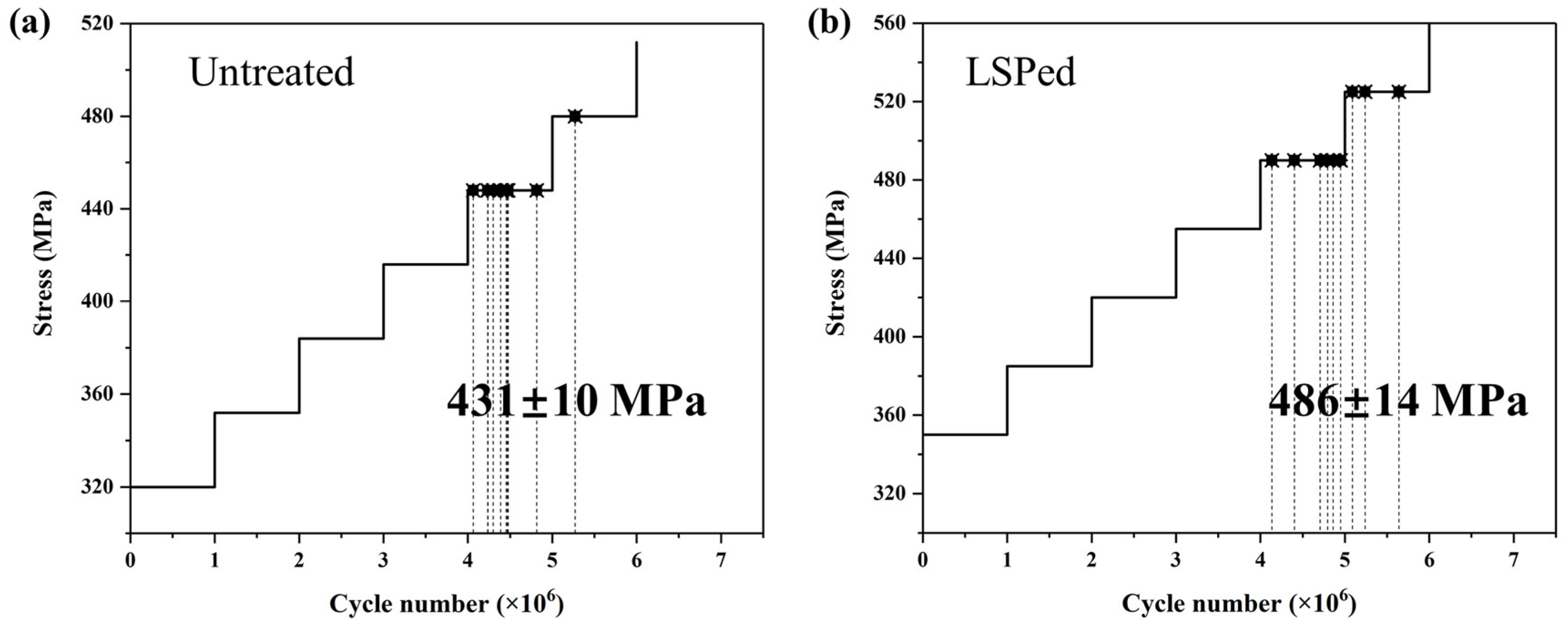
For the TC6 titanium alloy subjected to LSP with different parameters, the optimal settings for fatigue specimens were determined as follows: laser power density of 5.2 GW/cm2 and three impacts. Following LSP treatment, high-cycle fatigue testing was performed. Based on previous findings for the high-cycle fatigue limit of untreated the TC6 titanium alloy, the initial stress level for untreated specimens was set to 320 MPa, with a 32 MPa stress increment. It is generally observed that LSP improves the fatigue limit of metals by 10%–20% compared to untreated specimens [37,38,39]. For LSP-treated specimens, the initial stress level was set to 350 MPa, with a corresponding stress increment of 35 MPa. The fatigue test results for the TC6 titanium alloy before and after LSP, obtained using the step-loading method, are presented in Table 1 and Figure 7. The high-cycle fatigue limit of untreated specimens is 431 ± 10 MPa, while for LSP-treated specimens, it is 486 ± 14 MPa. This indicates a 12.8% improvement in the fatigue limit, demonstrating the effectiveness of LSP in enhancing the fatigue performance of the TC6 titanium alloy.
According to the mechanical measurement and microstructural observation mentioned above, the strengthening mechanism for the fatigue performance improvement of the TC6 titanium alloy with LSP treatment could be explained as follows: As we knew, the fatigue cracks usually initiated from the surface of the materials under fatigue cyclic loading; thus, the surface nanograins were regarded as a better way to improve the fatigue resistance of materials. Lu et al. [17,40] have investigated the fatigue properties of 316L stainless steel and Cu with gradient nanostructures, and their work shows that fatigue performance improvement was attributed to the fatigue-induced microstructural homogenization. During fatigue cyclic loading, the nanograins and refined grains continuously coarsen and grow by grain boundaries migration, while the original coarse grains were gradually refined, owing to the formation of intragranular dislocations cells. When most grains became homogeneous, they experience a steady-state cyclic response until eventual failure. During the fatigue process, the combination of nanograined and coarse grain layers enhances fatigue resistance. Nanograins hinder crack initiation, while coarse grains absorb large plastic strains, both contributing to improved fatigue performance. Additionally, severe plastic deformation generates a compressive residual stress layer at the surface, which helps reduce plastic strain in the refined grain layer and impedes or slows crack growth, further improving fatigue performance. However, as compressive residual stress dissipates during cyclic loading, the gradient microstructure becomes the dominant factor influencing fatigue life in the later stages of testing.

4. Conclusions

This work investigates the high-cycle fatigue performance of the TC6 titanium alloy with microstructure gradient and residual stress gradient produced by LSP; the main conclusions could be drawn as follows:
(1)
LSP induces a gradient-compressive residual stress in the surface layer of TC6 titanium alloy, with a maximum value of −708 MPa and an affected layer thickness greater than 1 mm.
(2)
From the surface to the material interior, the microstructure of the TC6 titanium alloy subjected to LSP treatments exhibited a gradient distribution with increasing depth: nanocrystalline, high dense dislocation, and matrix coarse grains. It was found that dislocation movement is the main reason for the formation of nanocrystalline in the LSP-treated TC6 titanium alloy.
(3)
After LSP, the high-cycle fatigue limit of the TC6 titanium alloy improved from 431 ± 10 MPa to 486 ± 14 MPa, increasing by 12.8%.

Author Contributions

Conceptualization, L.R. and J.L.; methodology, L.R.; writing—original draft preparation, L.R.; writing—review and editing, L.R.; supervision, J.L. All authors have read and agreed to the published version of the manuscript.

Funding

This research received no funding.

Data Availability Statement

Data will be made available on request.

Conflicts of Interest

The authors declare no conflicts of interest.

References

  1. Lee, S.; Ahmadi, Z.; Pegues, J.W.; Mahjouri-Samani, M.; Shamsaei, N. Laser polishing for improving fatigue performance of additive manufactured Ti-6Al-4V parts. Opt. Laser Technol. 2021, 134, 106639. [Google Scholar] [CrossRef]
  2. Bergant, Z.; Trdan, U.; Grum, J. Effects of laser shock processing on high cycle fatigue crack growth rate and fracture toughness of aluminium alloy 6082-T651. Int. J. Fatigue 2016, 87, 444–455. [Google Scholar] [CrossRef]
  3. Wang, H.; Jürgensen, J.; Decker, P.; Hu, Z.; Yan, K.; Gurevich, E.L.; Ostendorf, A. Corrosion behavior of NiTi alloy subjected to femtosecond laser shock peening without protective coating in air environment. Appl. Surf. Sci. 2020, 501, 144338. [Google Scholar] [CrossRef]
  4. Li, J.; Zhou, J.; Feng, A.; Huang, S.; Meng, X.; Sun, Y.; Huang, Y.; Tian, X. Influence of multiple laser peening on vibration fatigue properties of TC6 titanium alloy. Opt. Laser Technol. 2019, 118, 183–191. [Google Scholar] [CrossRef]
  5. Rajan, S.S.; Manivasagam, G.; Ranganathan, M.; Swaroop, S. Influence of laser peening without coating on microstructure and fatigue limit of Ti-15V-3Al-3Cr-3Sn. Opt. Laser Technol. 2019, 111, 481–488. [Google Scholar] [CrossRef]
  6. Xu, G.; Luo, K.Y.; Dai, F.Z.; Lu, J.Z. Effects of scanning path and overlapping rate on residual stress of 316L stainless steel blade subjected to massive laser shock peening treatment with square spots. Appl. Surf. Sci. 2019, 481, 1053–1063. [Google Scholar] [CrossRef]
  7. Mao, B.; Li, B.; Lin, D.; Liao, Y. Enhanced room temperature stretch formability of AZ31B magnesium alloy sheet by laser shock peening. Mater. Sci. Eng. A 2019, 756, 219–225. [Google Scholar] [CrossRef]
  8. Chattopadhyay, A.; Muvvala, G.; Sarkar, S.; Racherla, V.; Nath, A.K. Effect of laser shock peening on microstructural, mechanical and corrosion properties of laser beam welded commercially pure titanium. Opt. Laser Technol. 2021, 133, 106527. [Google Scholar] [CrossRef]
  9. Karthik, D.; Yazar, K.; Bisht, A.; Swaroop, S.; Srivastava, C.; Suwas, S. Gradient plastic strain accommodation and nanotwinning in multi-pass laser shock peened 321 steel. Appl. Surf. Sci. 2019, 487, 426–432. [Google Scholar] [CrossRef]
  10. Meng, X.-K.; Wang, H.; Tan, W.-S.; Cai, J.; Zhou, J.-Z.; Liu, L. Gradient microstructure and vibration fatigue properties of 2024-T351 aluminium alloy treated by laser shock peening. Surf. Coat. Technol. 2020, 391, 125698. [Google Scholar] [CrossRef]
  11. Geng, Y.; Dong, X.; Wang, K.; Mei, X.; Tang, Z.; Duan, W. Evolutions of microstructure, phase, microhardness, and residual stress of multiple laser shock peened Ni-based single crystal superalloy after short-term thermal exposure. Opt. Laser Technol. 2020, 123, 105917. [Google Scholar] [CrossRef]
  12. Yang, Y.; Wang, H.; Zhou, K.; Li, G. Effect of laser shock peening and annealing temperatures on stability of AA2195 alloy near-surface microstructure. Opt. Laser Technol. 2019, 119, 105569. [Google Scholar] [CrossRef]
  13. Prabhakaran, S.; Kalainathan, S.; Shukla, P.; Vasudevan, V.K. Residual stress, phase, microstructure and mechanical property studies of ultrafine bainitic steel through laser shock peening. Opt. Laser Technol. 2019, 115, 447–458. [Google Scholar] [CrossRef]
  14. Pan, X.; Guo, S.; Tian, Z.; Liu, P.; Dou, L.; Wang, X.; An, Z.; Zhou, L. Fatigue performance improvement of laser shock peened hole on powder metallurgy Ni-based superalloy labyrinth disc. Surf. Coat. Technol. 2021, 409, 126829. [Google Scholar] [CrossRef]
  15. Pan, Q.; Long, J.; Jing, L.; Tao, N.; Lu, L. Cyclic strain amplitude-dependent fatigue mechanism of gradient nanograined Cu. Acta Mater. 2020, 196, 252–260. [Google Scholar] [CrossRef]
  16. Long, J.; Pan, Q.; Tao, N.; Dao, M.; Suresh, S.; Lu, L. Improved fatigue resistance of gradient nanograined Cu. Acta Mater. 2019, 166, 56–66. [Google Scholar] [CrossRef]
  17. Lei, Y.; Wang, Z.; Xu, J.; Lu, K. Simultaneous enhancement of stress- and strain-controlled fatigue properties in 316L stainless steel with gradient nanostructure. Acta Mater. 2019, 168, 133–142. [Google Scholar] [CrossRef]
  18. Zhou, W.F.; Ren, X.D.; Yang, Y.; Tong, Z.P.; Chen, L. Tensile behavior of nickel with gradient microstructure produced by laser shock peening. Mater. Sci. Eng. A 2020, 771, 138603. [Google Scholar] [CrossRef]
  19. Wang, C.; Luo, K.; Bu, X.; Su, Y.; Cai, J.; Zhang, Q.; Lu, J. Laser shock peening-induced surface gradient stress distribution and extension mechanism in corrosion fatigue life of AISI 420 stainless steel. Corros. Sci. 2020, 177, 109027. [Google Scholar] [CrossRef]
  20. Yang, Y.; Zhou, K.; Li, G. Surface gradient microstructural characteristics and evolution mechanism of 2195 aluminum lithium alloy induced by laser shock peening. Opt. Laser Technol. 2019, 109, 1–7. [Google Scholar] [CrossRef]
  21. Mao, B.; Liao, Y.; Li, B. Gradient twinning microstructure generated by laser shock peening in an AZ31B magnesium alloy. Appl. Surf. Sci. 2018, 457, 342–351. [Google Scholar] [CrossRef]
  22. Umapathi, A.; Swaroop, S. Phase gradient in a laser peened TC6 titanium alloy analyzed using synchrotron radiation. Mater. Charact. 2017, 131, 431–439. [Google Scholar] [CrossRef]
  23. Shen, X.; Shukla, P.; Subramaniyan, A.K.; Zammit, A.; Swanson, P.; Lawrence, J.; Fitzpatrick, M.E. Residual stresses induced by laser shock peening in orthopaedic Ti-6Al-7Nb alloy. Opt. Laser Technol. 2020, 131, 106446. [Google Scholar] [CrossRef]
  24. Nie, X.; He, W.; Zang, S.; Wang, X.; Zhao, J. Effect study and application to improve high cycle fatigue resistance of TC11 titanium alloy by laser shock peening with multiple impacts. Surf. Coat. Technol. 2014, 253, 68–75. [Google Scholar] [CrossRef]
  25. Maxwell, D.C. A Rapid Method for Generation of a Haigh Diagram for High Cycle Fatigue, Fatigue and Fracture Mechanics; ASTM Special Technical Publication: West Conshohocken, PA, USA, 1999; pp. 626–641. [Google Scholar]
  26. Ren, W.; Nicholas, T. Effects and mechanisms of low cycle fatigue and plastic deformation on subsequent high cycle fatigue limit in nickel-base superalloy Udimet 720. Mater. Sci. Eng. A 2002, 332, 236–248. [Google Scholar] [CrossRef]
  27. Ren, W.; Nicholas, T. Notch size effects on high cycle fatigue limit stress of Udimet 720. Mater. Sci. Eng. A-Struct. Mater. Prop. Microstruct. Process 2003, 357, 141–152. [Google Scholar] [CrossRef]
  28. Srinivasan, S.; Garcia, D.B.; Gean, M.C.; Murthy, H.; Farris, T.N. Fretting fatigue of laser shock peened Ti–6Al–4V. Tribol. Int. 2009, 42, 1324–1329. [Google Scholar] [CrossRef]
  29. Pour-Ali, S.; Kiani-Rashid, A.-R.; Babakhani, A. Surface nanocrystallization and gradient microstructural evolutions in the surface layers of 321 stainless steel alloy treated via severe shot peening. Vacuum 2017, 144, 152–159. [Google Scholar] [CrossRef]
  30. Zhou, L.; Li, Y.; He, W.; He, G.; Nie, X.; Chen, D.; Lai, Z.; An, Z. Deforming TC6 titanium alloys at ultrahigh strain rates during multiple laser shock peening. Mater. Sci. Eng. A-Struct. Mater. Prop. Microstruct. Process 2013, 578, 181–186. [Google Scholar] [CrossRef]
  31. Lu, J.; Duan, H.; Luo, K.; Wu, L.; Deng, W.; Cai, J. Tensile properties and surface nanocrystallization analyses of H62 brass subjected to room-temperature and warm laser shock peening. J. Alloys Compd. 2017, 698, 633–642. [Google Scholar] [CrossRef]
  32. Pan, X.; Wang, X.; Tian, Z.; He, W.; Shi, X.; Chen, P.; Zhou, L. Effect of Dynamic Recrystallization on Texture Orientation and Grain Refinement of Ti6Al4V Titanium Alloy Subjected to Laser Shock Peening. J. Alloys Compd. 2021, 850, 156672. [Google Scholar] [CrossRef]
  33. Lu, J.; Wu, L.; Sun, G.; Luo, K.; Zhang, Y.; Cai, J.; Cui, C.; Luo, X. Microstructural response and grain refinement mechanism of commercially pure titanium subjected to multiple laser shock peening impacts. Acta Mater. 2017, 127, 252–266. [Google Scholar] [CrossRef]
  34. Hignette, O.; Cloetens, P.; Rostaing, G.; Bernard, P.; Morawe, C. Efficient sub 100 nm focusing of hard x rays. Rev. Sci. Instrum. 2005, 76, 063709. [Google Scholar]
  35. Meyers, M.; Gregori, F.; Kad, B.; Schneider, M.; Kalantar, D.; Remington, B.; Ravichandran, G.; Boehly, T.; Wark, J. Laser-induced shock compression of monocrystalline copper: Characterization and analysis. Acta Mater. 2003, 51, 1211–1228. [Google Scholar] [CrossRef]
  36. Wei, C.; Nesterenko, V.; Weihs, T.; Remington, B.; Park, H.-S.; Meyers, M. Response of Ni/Al laminates to laser-driven compression. Acta Mater. 2012, 60, 3929–3942. [Google Scholar] [CrossRef]
  37. Lu, J.; Luo, K.; Zhang, Y.; Sun, G.; Gu, Y.; Zhou, J.; Ren, X.; Zhang, X.; Zhang, L.; Chen, K.; et al. Grain refinement mechanism of multiple laser shock processing impacts on ANSI 304 stainless steel. Acta Mater. 2010, 58, 5354–5362. [Google Scholar] [CrossRef]
  38. Nie, X.; He, W.; Zhou, L.; Li, Q.; Wang, X. Experiment investigation of laser shock peening on TC6 titanium alloy to improve high cycle fatigue performance. Mater. Sci. Eng. A 2014, 594, 161–167. [Google Scholar] [CrossRef]
  39. Pan, X.; Li, X.; Zhou, L.; Feng, X.; Luo, S.; He, W. Effect of Residual Stress on S–N Curves and Fracture Morphology of Ti6Al4V Titanium Alloy after Laser Shock Peening without Protective Coating. Materials 2019, 12, 3799. [Google Scholar]
  40. Jing, L.; Pan, Q.; Long, J.; Tao, N.; Lu, L. Effect of volume fraction of gradient nanograined layer on high-cycle fatigue behavior of Cu. Scr. Mater. 2019, 161, 74–77. [Google Scholar] [CrossRef]
Figure 1. Schematic of fatigue specimens and diagram of LSP process. (a) The size of fatigue specimens; (b) The diagram of LSP process.
Coatings 15 01443 g001
Figure 2. Residual stress distribution induced by LSP with different processing parameters, Kernel average misorientation (KAM) mapping and Grain orientation spread (GOS) mapping, plotted against the depth from the surface. (a) Amounts of 3.9, 5.2, and 6.5 GW/cm2 residual stress. (b) Amounts of 1, 3, and 5 impacts times residual stress. (c) KAM mapping. (d) GOS mapping.
Coatings 15 01443 g002
Figure 3. Microstructural evolution of the sectioned surface processed sample characterized by EBSD techniques. (a) Inverse pole figure (IPF) plotted against the depth from the surface. (b) Geometry necessary dislocation (GND) mapping plotted against the depth from the surface.
Coatings 15 01443 g003
Figure 4. TEM images at a depth of 20 μm from the top surface of the LSP specimen. (a) Bright-field TEM image. (b) Dark-field TEM image.
Coatings 15 01443 g004
Figure 5. TEM images at a depth of 5 μm from the top surface of the LSP specimen. (a) Bright-field TEM image. (b) Dark-field TEM image.
Coatings 15 01443 g005
Figure 6. TEM images on the top surface of the LSP specimen. (a) Bright-field TEM image. (b) Dark-field TEM image. (c) Selected area electron diffraction (SAED) pattern of the rectangle in (b).
Coatings 15 01443 g006
Figure 7. High fatigue limit of TC6 titanium alloy. (a) Untreated specimens; (b) LSPed specimens.
Coatings 15 01443 g007
Table 1. Fatigue test results of TC6 titanium alloy before and after LSP by step-loading method.
LabelStateInitial Stress (MPa)Number of StepsStress Increment (MPa)Failure Stress (MPa)Total Cycle Number (×106)Fatigue Strength (MPa)Average (MPa)
1Untreated3205324484.300425.6431 ± 10
2Untreated3205324484.453430.5
3Untreated3205324484.819442.2
4Untreated3205324484.234423.5
5Untreated3206324805.272456.7
6Untreated3205324484.478431.3
7Untreated3205324484.391428.5
8Untreated3205324484.066418.1
9Untreated3205324484.238423.6
10Untreated3205324484.469431.0
11LSP3505354904.863485.2486 ± 14
12LSP3506355255.240498.4
13LSP3505354904.951488.3
14LSP3506355255.640512.4
15LSP3505354904.403469.1
16LSP3505354904.797482.9
17LSP3506355255.091493.2
18LSP3505354904.951488.3
19LSP3505354904.137459.8
20LSP3505354904.709479.8
Disclaimer/Publisher’s Note: The statements, opinions and data contained in all publications are solely those of the individual author(s) and contributor(s) and not of MDPI and/or the editor(s). MDPI and/or the editor(s) disclaim responsibility for any injury to people or property resulting from any ideas, methods, instructions or products referred to in the content.