Article

Electron-Transfer-Induce Optical Modulation and Growth Mechanism of Au–ZnO Heterogeneous Nanopyramids

1
School of Physics and Electronic Engineering, Huaibei Normal University, Huaibei 235000, China
2
Anhui Province Key Laboratory of Intelligent Computing and Applications, Huaibei Normal University, Huaibei 235000, China
3
Suzhou Qingting Acoustics Technology Co., Ltd., Suzhou 215100, China
*
Authors to whom correspondence should be addressed.
Coatings 2025, 15(12), 1439; https://doi.org/10.3390/coatings15121439
Submission received: 13 November 2025 / Revised: 29 November 2025 / Accepted: 4 December 2025 / Published: 7 December 2025

Abstract

Au–ZnO heterogeneous nanoparticles (NPs) were successfully synthesized, and the intrinsic correlation between their spectral evolution and interfacial growth mechanism was systematically elucidated. With increasing Au content, the SPR absorption peak of Au exhibits a pronounced red shift, while the defect-related emission of ZnO is suppressed and the band-edge emission becomes broadened. These spectral variations are closely coupled with the interfacial growth process. Interfacial electron transfer and the formation of a Schottky barrier induce charge redistribution within ZnO and reduce oxygen vacancies, enabling ZnO to preferentially nucleate on the Au surface and subsequently evolve into a pyramidal structure. The resulting morphological transformation further enhances electron depletion and plasmonic coupling, lowering the effective plasmonic energy of Au and deepening the SPR red shift. Quantitative analysis based on Mie theory shows that approximately 12% of the free electrons in Au participate in interfacial transfer, confirming the cooperative role of strong electronic coupling in governing both growth dynamics and optical responses. This study provides deeper insight into the photophysical mechanisms of Au–ZnO heteronanocrystals and offers guidance for designing noble metal–semiconductor composites with tunable optoelectronic properties.

1. Introduction

Noble metal–semiconductor hybrid nanomaterials have received considerable attention in recent years due to their unique structural characteristics and superior optical and electronic properties [1,2,3,4,5]. Through interfacial electron coupling and energy transfer between metal and semiconductor domains, these hybrid systems can effectively promote charge carrier separation and enhance photoluminescence (PL) efficiency, exhibiting synergistic effects that are difficult to achieve in single-component materials [6,7,8,9]. As a result, metal–semiconductor heterostructures have been extensively explored in the fields of photocatalysis [10,11,12], solar energy conversion [13,14,15], surface-enhanced spectroscopy, and nanophotonics [16,17,18]. In particular, the formation of a metal–semiconductor interface facilitates efficient electron transfer [19,20,21], thereby improving the luminescence and photoelectric response of semiconductor nanomaterials. Moreover, the absorption peak of Au typically undergoes a noticeable red shift owing to surface plasmon coupling within metal–semiconductor composites [22,23,24,25,26].
Zinc oxide (ZnO) is a representative II–VI group direct bandgap semiconductor with a wide band gap of 3.37 eV and a high exciton binding energy of approximately 60 meV [27]. It exhibits excellent electrical conductivity, photoluminescence, and piezoelectric properties [28,29]. Various ZnO nanostructures, such as rods, tubes, cones, wires, and disks, have been successfully synthesized [30,31,32,33,34,35,36,37,38]. Materials with well-defined anisotropic morphologies are ideal candidates for site-specific composite synthesis. Nanostructured ZnO has attracted extensive attention not only because of its tunable morphologies and optical responses but also owing to its potential in one-dimensional nano-optoelectronic devices and fundamental optical studies. Noble metal nanocrystals, particularly Au NCs, play a crucial role in modulating semiconductor optical behavior due to their strong localized surface plasmon resonance. When integrated with ZnO, the resulting Au–ZnO heterostructures exhibit interfacial charge redistribution, plasmon–exciton interactions, and defect-state modulation, making them a valuable platform for studying metal–semiconductor coupling [39,40,41,42,43,44,45,46]. Therefore, understanding the individual contributions of ZnO and Au NCs, as well as their synergistic effects in the Au–ZnO hybrid system, is of great significance. Such composites are typically synthesized by chemical or seed-mediated routes [47,48].
At the nanoscale, ZnO materials have been widely applied in optoelectronic, catalytic, and sensing devices, while gold (Au) nanocrystals (NCs), owing to their strong SPR effect and high catalytic activity, are considered ideal noble metal components for tuning the optical behavior of semiconductors [49,50,51]. Among various Au NCs, ultrasmall Au NCs are particularly appealing due to their quantum confinement effect, large surface-to-volume ratio, and unique physical and chemical properties. In Au–ZnO heterostructures, the metal–semiconductor interface can facilitate efficient photogenerated electron transfer, improve carrier recombination dynamics and enhance emission or catalytic performance. Meanwhile, the position of the Au SPR absorption peak is highly sensitive to the particle size, morphology, and interfacial interactions, reflecting the tunability of optical responses in Au–ZnO hybrid systems.
In recent years, the controlled synthesis and interfacial charge-transfer mechanisms of Au–ZnO heterostructures have become research hotspots. Previous studies have demonstrated that the size, concentration, and distribution of Au NCs significantly influence the band structure, defect emission, and plasmonic behavior of ZnO [52,53]. However, most existing reports focus on simple core–shell or surface-modified configurations, while complex heterostructures with specific orientations and tunable optical properties—such as pyramid-, rod–plate-, or rod–sphere-like morphologies—remain less explored. In particular, the role of Au NCs during the nucleation and growth of ZnO, as well as their effect on the resultant morphology and emission properties, has not yet been fully elucidated.
In this work, Au–ZnO heterogeneous nanopyramids were successfully synthesized via a facile two-step route. By systematically tuning the concentration of Au NCs, the effects of Au content on the morphological evolution and optical properties of the heterostructures were examined through comprehensive structural and spectroscopic analyses. The results show a clear red-shift of the Au SPR absorption peak and a strong suppression of the ZnO defect-related emission as the Au content increases. Importantly, this study establishes a direct correlation between the introduced Au amount, the resulting interfacial charge redistribution, and the corresponding optical responses—an aspect rarely quantified in previous Au–ZnO reports. Furthermore, a mechanistic model based on a Schottky-barrier-driven electron-transfer process is proposed to account for both the unusually large plasmonic red-shift of Au and the effective passivation of oxygen-vacancy defects in ZnO. These findings highlight the key role of Au NCs in directing heterostructure formation and provide new insight into electron-transfer–mediated optical modulation in metal–semiconductor hybrids, offering valuable guidance for the design of high-performance optoelectronic nanocomposites.

2. Experimental Section

2.1. Materials

All chemicals used in this study were of analytical grade and were used as received without further purification. Tetralin (≥99%), oleylamine (80%–90%), HAuCl4·4H2O (≥99.9%), tert-butylamine–borane (≥95%), dodecanol (≥99%), and zinc acetate dihydrate (≥99%) were purchased from Aladdin Reagent Co., Ltd. (Shanghai, China). Acetone, hexane, and ethanol were obtained from Sinopharm Chemical Reagent Co., Ltd. (Shanghai, China).

2.2. Sample Preparation

Our experimental strategy was adapted from the procedure reported by Li [52], with deliberate modifications to the amount of Au nanocrystals introduced into the reaction system. By systematically varying the volume of the Au nanocrystal dispersion, we obtained a series of Au–ZnO heterogeneous nanocrystals with different levels of Au incorporation and distinct structural features. Specifically, monodisperse ZnO nanocrystals were first synthesized following Li’s method. Subsequently, different volumes of Au nanocrystals were added into the same precursor mixture, allowing the Au species to participate in the nucleation and growth of ZnO during the heating process. This approach enabled the formation of Au–ZnO hybrid nanostructures with tunable morphology and optical properties. The resulting products exhibited pronounced variations in particle shape, size distribution, and optical responses as a function of the amount of Au introduced, demonstrating the critical role of Au loading in directing the formation of the heterogeneous nanostructure.
Au Nanocrystals (NCs): Tetralin (5 mL), oleylamine (OAm, 5 mL), and HAuCl4·4H2O (0.1 g) were mixed at room temperature (~25 °C) under air and stirred under Ar2 for 10 min. A reducing solution of 0.5 mmol tert-butylamine–borane (TBAB), tetralin (1 mL), and OAm (1 mL) was sonicated and added to the precursor. The reaction proceeded at room temperature for 1 h. Au NCs were precipitated with acetone, collected by centrifugation (10,000 rpm, 5 min), washed 2–3 times, and redispersed in hexane.
ZnO Nanocrystals (NCs): Zinc acetate dihydrate (Zn(Ac)2·2H2O, 0.3 mmol) was added to OAm (2 mL) and dodecanol (DDL, 4 mL) under stirring. The mixture was gradually heated to 180 °C and held for several minutes until a milky-white suspension formed. The ZnO NCs were collected, washed with ethanol, and redispersed in ethanol.
Au–ZnO Heterogeneous Nanopyramids (NPs): Au NCs (0.25, 0.50, or 1.00 mL) were added to a mixture of Zn(Ac)2·2H2O (0.3 mmol), OAm (2 mL), and DDL (4 mL) under stirring. The solution was heated to 120 °C to remove water and hexane, then to 180 °C for several minutes until pink-colored Au–ZnO NPs formed. Products were washed with ethanol and redispersed in hexane.
All synthesis procedures were repeated at least three times, and the resulting samples showed highly consistent morphology, structure, and optical properties, confirming the good reproducibility of the synthetic process.

2.3. Characterization

Transmission electron microscopy (TEM), selected-area electron diffraction (SAED), and energy-dispersive X-ray spectroscopy (EDS) were performed using a Tecnai G2 T20 microscope (FEI, Hillsboro, OR, USA) operated at 200 kV. Photoluminescence (PL) spectra were recorded on a Fluorolog3–TCSPC spectrofluorometer (HORIBA Jobin Yvon, Edison, USA) using a xenon lamp (450 W) as the excitation source, with a spectral resolution of 1 nm. UV–visible absorption spectra were measured on a Hitachi U–3900 spectrophotometer (Hitachi High-Tech, Tokyo, Japan) with a resolution of 0.5 nm.

3. Results and Discussion

3.1. Morphology and Composition

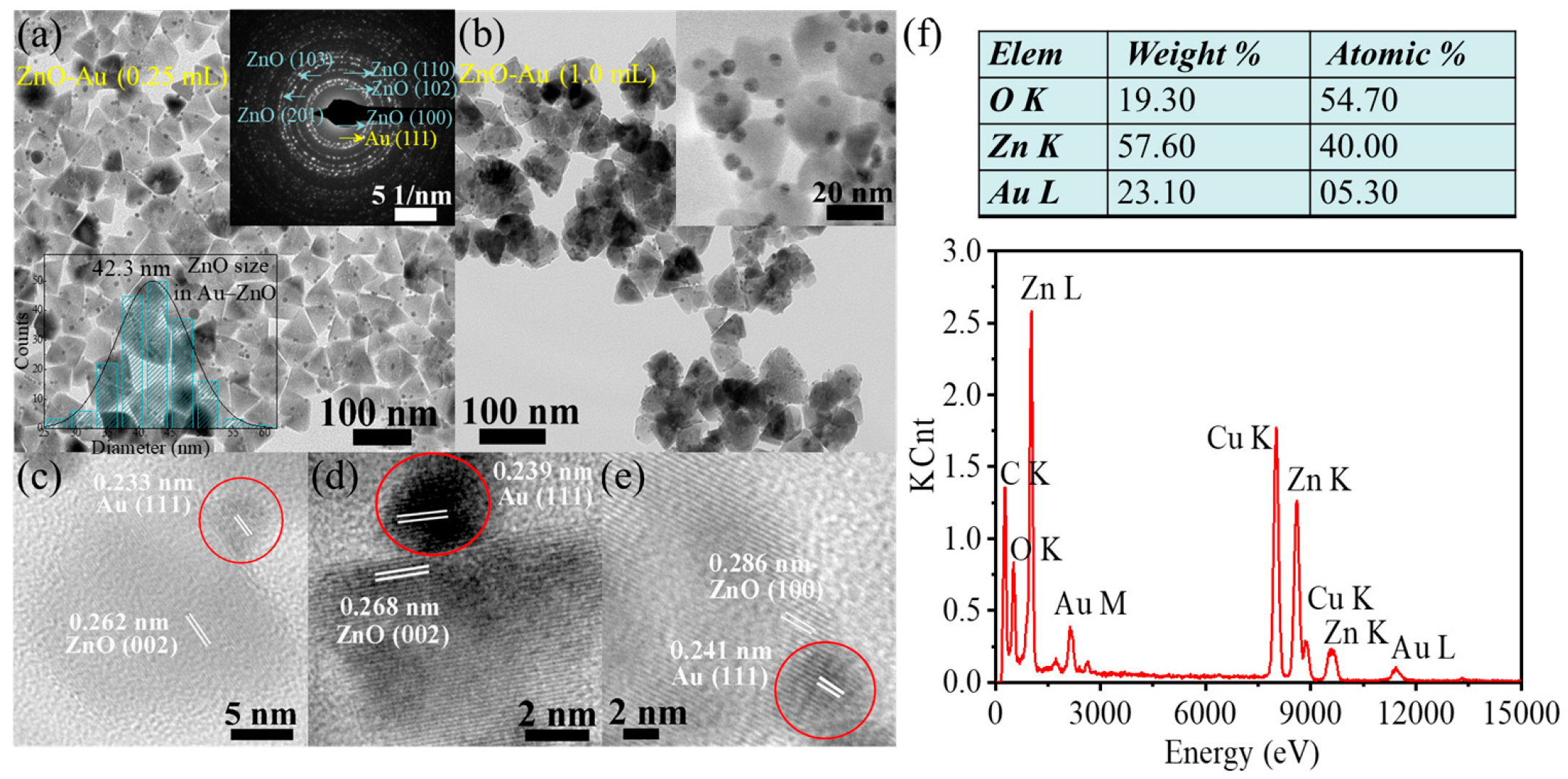
In this study, Au–ZnO heterogeneous nanocrystals with a well-defined hexagonal pyramid-like structure were successfully synthesized by modifying the experimental procedure [52]. By introducing different volumes of Au nanocrystals (Au NCs) into the mixed solution, a series of samples were obtained, and their transmission electron microscopy (TEM) images are shown in Figure 1a,b. All Au–ZnO nano-heterostructure were synthesized at 25 °C and exhibited a regular hexagonal pyramid-like morphology.
As shown in Figure 1a, the spherical Au NCs possessed uniform size and morphology, while the ZnO portion presented a smooth surface and homogeneous pyramid shape. Although adjacent Au–ZnO NPs were in close proximity, they did not aggregate, and each particle existed independently. Statistical analysis revealed that, on average, each hexagonal ZnO pyramid contained only one small spherical Au NC embedded within it. Size measurements showed that the side length of the ZnO nanopyramid was approximately 30 nm, whereas the average diameter of the Au NCs was 3–4 nm, indicating that ZnO crystals were significantly larger than Au. The selected-area electron diffraction (SAED) pattern (upper-right inset of Figure 1a) exhibits a series of well-defined concentric diffraction rings, indicating the good crystallinity of the Au–ZnO heterostructures. The measured ring spacings correspond well to the characteristic planes of hexagonal wurtzite ZnO and face-centered cubic (fcc) Au, as expected from the coexistence of both phases in the nanostructures. Because the Au nanocrystals are ultrasmall, their corresponding diffraction features appear weaker compared to those of ZnO. Quantitative SAED analysis demonstrated that the sample contained both hexagonal wurtzite ZnO and face-centered cubic (fcc) Au structures, corresponding to the different rings observed. Figure 1f displays the EDS spectrum of the Au–ZnO heteronanostructures. Distinct characteristic peaks of O K, Zn L, Zn K, as well as Au M and Au L, can be clearly identified, confirming the coexistence of ZnO and Au in the sample. The Cu K signal originates from the copper TEM grid used for sample support. The corresponding elemental composition is summarized in the inset table, showing weight percentages of 57.6% Zn, 19.3% O, and 23.1% Au, with atomic ratios of 40.0%, 54.7%, and 5.3%, respectively. The Zn-to-O ratio is close to 1:1, further verifying that Au is successfully anchored onto the ZnO nanostructures. These results are consistent with the TEM imaging analysis presented earlier.
High-resolution transmission electron microscopy (HRTEM) images (Figure 1c–e) further revealed the crystallographic characteristics of the Au–ZnO heterogeneous nanoparticles. Clear lattice fringes of both Au and ZnO could be observed. Due to the higher atomic number and stronger electron-scattering ability of Au, the corresponding regions (marked by red circles) appeared darker in the images. The measured lattice spacings of the Au NCs were 0.233, 0.239, and 0.241 nm, corresponding to the Au (111) planes, while those of the ZnO nanopyramids were 0.262 nm and 0.268 nm for the ZnO (002) planes, and 0.286 nm for the ZnO (100) plane. These results indicate a clear crystallographic orientation relationship between the two phases. As shown in Figure 1c,d the Au (111) plane was nearly parallel to the ZnO (002) plane with only a very small tilt, implying strong lattice orientation correlation at the interface.
Although the normal interplanar spacings of Au and ZnO differ slightly, the key factor for heterogeneous epitaxial growth is not the out-of-plane lattice matching but the in-plane lattice matching [53]. The term “in-plane matching” describes the degree of lattice alignment along the interface, where similar in-plane lattice constants allow strain accommodation and promote epitaxial growth. For the fcc Au (111) surface, which exhibits a hexagonal close-packed atomic arrangement, the primary in-plane directions are [1 1 - 0] and [ 2 - 11], with corresponding atomic row spacing of 0.288 nm and 0.166 nm. Similarly, the hexagonal wurtzite ZnO (002) plane also possesses a hexagonal close-packed configuration, with periodic distance along the [100] and [110] directions are 0.283 nm and 0.163 nm, respectively. According to the lattice mismatch equation δ = 2|d1d2|/(d1 + d2) [54], the in-plane lattice matching between Au(111) and ZnO(002) surfaces occurs along the directions Au [1 1 - 0]//ZnO [100] and Au [ 2 - 11]//ZnO [110], with calculated lattice mismatches of 1.8% and 1.7%, respectively. Such a small lattice mismatch indicates that the two lattices can form a high-quality semi-coherent epitaxial interface, facilitating the epitaxial and oriented growth of Au nanocrystals on the ZnO surface. Another orientation relationship is observed in Figure 1e as Au(111)//ZnO(100). For this interface, the in-plane registry is established along Au [11̅0]//ZnO [010], yielding a minimum lattice mismatch of ~1.7%–1.8%. further reveals another orientation relationship, Au(111)//ZnO(100), the in-plane registry is established along Au [1 1 - 0]//ZnO [010], yielding a minimum lattice mismatch of 1.7%, confirming the existence of a stable epitaxial coupling between Au and ZnO. Therefore, the HRTEM lattice fringe and orientation analyses together demonstrate that the Au (111) and ZnO(002)/(100) planes exhibit excellent alignment in both out-of-plane and in-plane directions. This low lattice mismatch, combined with strain accommodation, facilitates the epitaxial growth of Au nanocrystals on ZnO nanopyramids, resulting in a stable, continuous, and low-energy Au–ZnO heterointerface at the atomic scale.
To investigate the effect of Au NC concentration on the formation of heterogeneous nanostructures, a second sample (sample 2) was prepared by increasing the Au NC volume to 1.00 mL (Figure 1b). Compared with sample 1 (0.25 mL Au NCs, Figure 1a), sample 2 showed poorer dispersion and clear agglomeration of Au–ZnO nanoparticles. The TEM images indicate that many particles overlapped or contacted each other, resulting in irregular morphologies. Although the average sizes of Au and ZnO were similar to those in sample 1, the ZnO apex became flattened, forming a prism-like structure, while the Au NCs remained spherical. As shown in the inset of Figure 1b, each ZnO particle in sample 2 contained multiple embedded Au NCs instead of a single Au NC at the pyramid base. This multi-core structure changed the heterointerface and introduced additional nucleation sites, causing lattice distortion, orientation disorder, and aggregation. The closer contact between adjacent ZnO particles suggests that excessive Au disturbed the interfacial energy balance during growth. Several isolated Au NCs were also observed around the aggregates, likely originating from unincorporated Au NCs in the solution. From a physical perspective, the amount of Au added plays a crucial role in regulating the formation of the heterogeneous structure. When a low amount of Au (0.25 mL of Au nanocrystal solution) is introduced into the precursor system, the Au NCs act as preferential nucleation centers, inducing oriented epitaxial growth of ZnO on their surfaces and leading to the formation of single-core Au–ZnO hexagonal pyramids. However, when the Au content exceeds a critical level (1 mL of Au solution), multiple Au NCs competitively adsorb Zn2+ and OH ions, resulting in nonuniform ZnO nucleation and disordered growth orientations, which ultimately cause aggregation. In this scenario, the redistribution of interfacial potential and the rebalancing of surface energy collectively drive the morphological evolution of ZnO from pyramidal to prismatic structures. Therefore, using an appropriate amount of Au (0.5 mL of Au solution) enables balanced single-core epitaxial growth and strain equilibrium, yielding well-defined and highly dispersed Au–ZnO heterogeneous nanocrystals, whereas excessive Au disrupts this balance, leading to aggregation and structural distortion.

3.2. Photoluminescence Properties

After determining the structural and morphological characteristics of the samples, we further investigated the optical absorption and emission properties of the Au–ZnO heterogeneous NPs and pure ZnO NCs to explore how the introduction of metallic components influences their optical behavior. Figure 2b presents the ultraviolet–visible (UV–vis) absorption spectra of four samples: the mixed solution (Au + ZnO), the Au–ZnO heterogeneous NPs, pure ZnO NCs (see Figure 3c for morphology), and pure Au NCs (see Figure 3a for morphology).
As illustrated in Figure 2b, the pure Au NCs and pure ZnO NCs exhibit absorption peaks at 512 nm and 369 nm, respectively, while the mixed solution (Au + ZnO) shows two distinct absorption peaks near 369 nm and 512 nm. Comparison with the spectra of pure Au and ZnO NCs indicates that the absorption behavior of the mixed system is simply the superposition of the individual optical responses of the two components, without any new absorption band or spectral shift (Figure 2b). This observation suggests that no significant electronic coupling or band interaction has yet formed between Au and ZnO in the solution system, and the observed optical absorption arises primarily from the intrinsic electronic transitions of each phase [55].
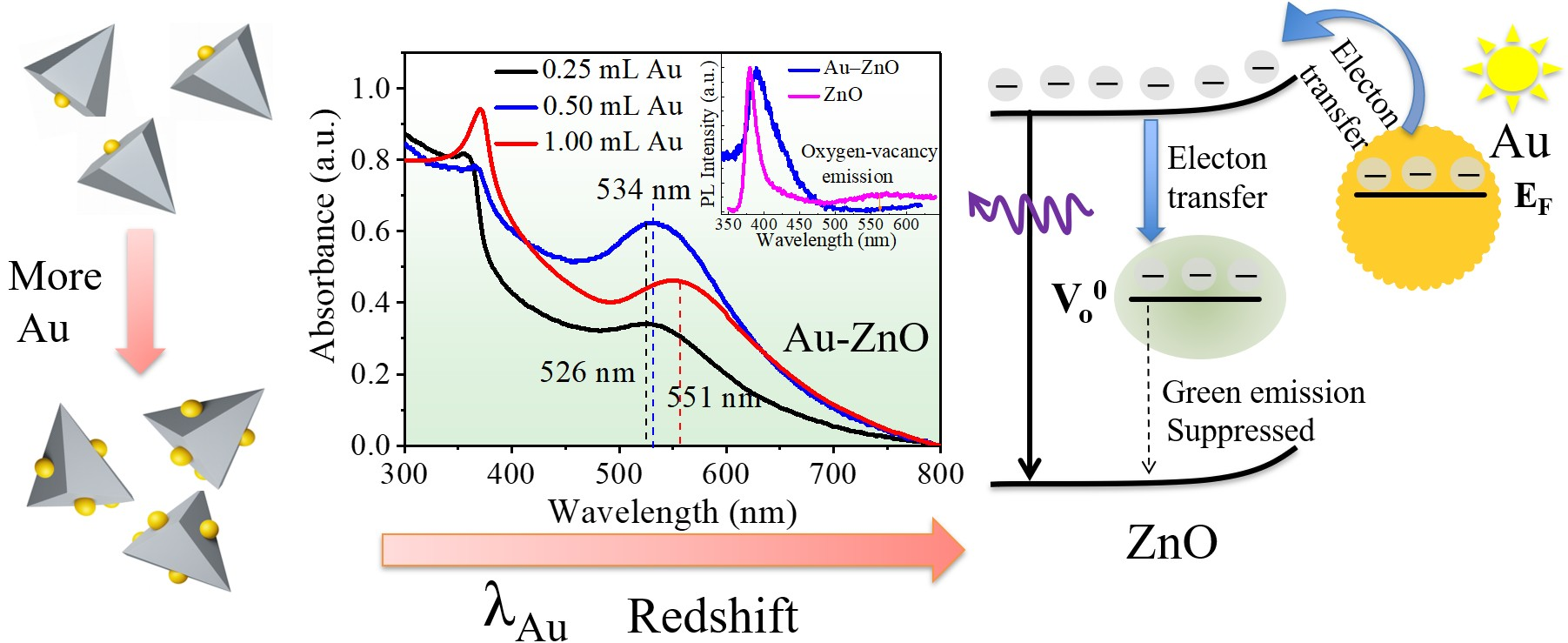
For the Au–ZnO heterogeneous nanoparticles (Sample 2), a clear redshift of the Au absorption peak is observed compared with pure Au NCs—from 512 nm to 551 nm, giving a shift of 39 nm (≈170 meV). Such a large redshift is uncommon in metallic nanoparticle systems, indicating that the Au–ZnO structure is formed through strong interfacial interactions rather than simple physical mixing. To further examine the origin of this shift, the amount of Au NCs added to the solution was varied (0.25–1.00 mL), and the corresponding UV–vis absorption spectra were recorded (Figure 2d). A summary of the plasmonic parameters extracted from the absorption spectra is provided in Table 1. The results show that as the Au content increases, the SPR peak of Au redshifts from 526 nm to 551 nm, whereas the intrinsic ZnO absorption peak near 370 nm shifts by less than 5 nm. Together with the TEM images (Figure 1a,b), which show that the ZnO morphology changes from hexagonal pyramids to hexagonal prisms, this slight shift can be attributed to morphology-induced modifications in the local band structure and a reduced quantum confinement effect [56]. In contrast, the pronounced redshift of the Au peak likely arises from interfacial interactions between Au and ZnO, where dielectric modulation by the ZnO matrix lowers the localized surface plasmon resonance (LSPR) frequency of Au, resulting in the observed spectral shift [57]. Since no particle agglomeration is observed in the TEM images, the observed LSPR red-shift is therefore attributed primarily to changes in the interfacial electronic structure rather than to nanoparticle aggregation. Nevertheless, this redshift may also be partly affected by changes in Au particle size or plasmonic coupling at the Au–ZnO interface [58], although the dominant factor is still uncertain. To address this, the following section examines the influence of particle size on the spectral shift.
Figure 3h–j present the particle size distribution curves of Au nanocrystals (NCs) in four different samples, corresponding to pure Au NCs synthesized at 25 °C (Figure 3h) and Au–ZnO heterogeneous nanoparticles (Sample 1 in Figure 3i and Sample 2 in Figure 3j). The Gaussian fitting was applied solely to obtain the most probable particle size, and the fitting parameters are not directly relevant to the discussion. As shown, all samples exhibit a normal size distribution. The most probable diameters of Au NCs in the pure Au sample and in the Au–ZnO heterogeneous nanoparticles (Sample 1 and Sample 2) are 3.40, 4.08, and 4.02 nm, respectively (Figure 3h–j). Evidently, the particle size of Au NCs in the Au–ZnO system increases slightly compared with that of pure Au (from 3.40 nm to approximately 4.08 nm).
According to Mie theory [59], the absorption peak position of metallic nanoparticles is highly size-dependent: as the particle diameter decreases, the LSPR peak exhibits a blueshift, whereas increasing the diameter leads to a redshift. This behavior is consistent with our experimental observations, suggesting that part of the redshift in the Au absorption peak of Au–ZnO nanoparticles may arise from the size growth of Au NCs caused by Ostwald ripening during synthesis. However, this effect alone cannot account for the significant redshift observed. To exclude the influence of particle size and further identify the intrinsic origin of the spectral shift, Au NCs were resynthesized at a lower temperature (15 °C) (Figure 3a,d). The corresponding particle size distribution and fitted curve (Figure 3g) reveal a most probable diameter of 4.80 nm, which is notably larger than that of Au NCs in Sample 1 and Sample 2 (4.02 nm and 4.08 nm, respectively). Nevertheless, its absorption peak (Figure 2a) is located at 520 nm, only slightly higher than that of pure Au NCs (512 nm) and far below that of the Au–ZnO heterostructure (551 nm). This result indicates that the redshift of the Au absorption peak in Au–ZnO heterogeneous nanoparticles is not primarily induced by particle size enlargement, and its contribution is negligible. Instead, the dominant factor is the electronic coupling effect arising from the strong interfacial interaction between Au NCs and ZnO nanocrystals.
This Au–ZnO heterostructure not only affects the optical absorption of Au nanocrystals but also significantly modifies the photoluminescence (PL) behavior of ZnO. Figure 2c shows the normalized PL spectra of pure ZnO nanocrystals and Au–ZnO heterogeneous nanoparticles (Sample 2). The near-band-edge (NBE) emission of pure ZnO is centered at 380 nm, whereas that of the Au–ZnO sample redshifts to 388 nm, yielding a shift of approximately 0.06 eV. This redshift indicates a modification of the electronic band structure and carrier recombination dynamics upon Au–ZnO coupling.
Physically, the slight redshift can be attributed to interfacial charge coupling between Au and ZnO. Due to the high work function of Au, a Schottky barrier forms at the Au/ZnO interface, inducing band bending and local potential redistribution in ZnO [60]. This reduces the effective recombination energy of excitons, leading to the observed NBE redshift. Moreover, the LSPR of Au nanoparticles enhances the local electromagnetic field and facilitates carrier–plasmon interactions, which further perturb the radiative recombination energy levels and contribute to the spectral shift [61]. In addition, the full width at half maximum (FWHM) of the PL peak in the Au–ZnO sample is broader than that of pure ZnO, implying more complex carrier recombination pathways. This broadening likely arises from the interfacial strain and electric field at the Au–ZnO boundary, which introduce shallow defect states and band-tail broadening. Meanwhile, the intensity of the broad visible defect emission band (around 560 nm) is markedly reduced after hybridization, suggesting that Au incorporation effectively passivates surface defect states and improves the optical quality of ZnO.

3.3. Luminescence and Growth Mechanisms

Based on the experimental results, a simplified growth model for the Au–ZnO heterogeneous nanoparticles is proposed, as illustrated in Figure 4c. When Au NCs are mixed with zinc acetate at 120 °C, ZnO has not yet formed. At this stage, Au NCs approach each other, and zinc acetate begins to adsorb on their surfaces without forming chemical bonds. With increasing temperature and time, Au NCs gradually aggregate through surface adsorption until reaching thermodynamic stabilization. When the temperature rises to 180 °C, zinc acetate decomposes to produce amorphous ZnO, which preferentially nucleates around the Au NCs. Au thus acts as a heterogeneous nucleation center, and ZnO partially grows around the Au NCs, forming surface-contact Au–ZnO composites rather than complete core–shell structures. The final morphology is strongly influenced by the amount of Au added. With a low Au content (upper part of Figure 4c), the large spacing between Au NCs allows ZnO to grow independently around each particle, yielding isolated Au–ZnO heterostructures after crystallization. In contrast, at high Au content (lower part of Figure 4c), the reduced interparticle spacing causes the surrounding ZnO domains to merge during growth, embedding multiple Au NCs in interconnected ZnO frameworks.
Thermodynamically, the entire evolution process is driven by minimizing surface, interfacial, and strain energies. Au NCs lower the nucleation barrier for ZnO formation, while interfacial diffusion and atomic rearrangement enable ZnO to redistribute around the Au cores, reducing surface energy. The formation of coherent or semi-coherent interfaces further minimizes lattice strain. With continued heating, Ostwald ripening promotes crystallization, ultimately yielding stable Au–ZnO heterostructures with well-defined interfaces and strong metal–semiconductor coupling.
In this experiment, the pronounced red-shift of the Au absorption peak and the strong attenuation of the ZnO defect-related emission can be interpreted from the perspective of metal–semiconductor interfacial physics. As shown in Figure 4a, for pure ZnO nanocrystals, photoexcitation promotes electrons from the valence band to the conduction band, where radiative recombination generates near-band-edge emission around 380 nm (solid black line) [62]. Electrons trapped by oxygen-vacancy defect states (Vo+) produce the green defect emission near 560 nm, while additional carriers relax nonradiatively (dashed black line). These processes constitute the intrinsic optical behavior of ZnO.
When Au nanocrystals come into contact with ZnO (Figure 4b), their different work functions lead to the formation of a Schottky barrier at the interface [60]. Because the work function of Au (≈5.1 eV) is higher than the electron affinity of ZnO (≈4.3 eV), electrons transfer from the ZnO conduction band to Au, creating electron depletion and upward band bending in ZnO [63]. Upon illumination, the LSPR of Au enhances the local electromagnetic field, enabling a fraction of hot electrons to overcome the Schottky barrier and inject into the ZnO conduction band. These electrons fill the surface Vo+ states, effectively passivating oxygen vacancies. Once the defect levels are occupied, electrons preferentially undergo band-to-band recombination, strongly suppressing the green emission and enhancing the relative intensity of the near-band-edge emission.
Thus, the Schottky barrier in the Au–ZnO heterostructure plays a dual role: (i) regulating charge redistribution to passivate Vo+ defects and suppress defect-related recombination in ZnO, and (ii) modifying the plasmonic response of Au. Through interfacial coupling and hot-electron dynamics, the barrier lowers the effective plasmonic energy of Au, resulting in the observed red-shift of the Au absorption band. This interfacial mechanism provides a coherent explanation for both the enhanced near-band-edge emission of ZnO and the significant red-shift of the Au SPR peak.
To quantitatively estimate the number of electrons transferred from Au nanocrystals (NCs) to ZnO nanoparticles, the relation between the LSPR wavelength and the number of free electrons N was used, following Ref. [64]:
λ L S P R   1 N
Thus, the relative change in the effective number of free electrons can be expressed as:
  N f i n a l N i n i t i a l = λ i n i t i a l λ f i n a l 2
Using the experimentally determined values λinitial = 516 nm, and λfinal = 551 nm, the effective free-electron number in single Au NC decreases by approximately 12.3% after forming the Au–ZnO heterostructure. For a spherical Au NC with a diameter of 4.02 nm (containing roughly 2.0 × 10³ atoms, assuming one free electron per Au atom), the effective electron number decreases from Ninitial ≈ 2.0 × 10³ to Nfinal ≈ 1.76 × 10³, corresponding to an equivalent reduction of approximately 250 electrons per particle. This reduction in the effective free-electron number indicates that charge redistribution occurs across the Au–ZnO interface. When Au and ZnO form a Schottky junction, electrons from the ZnO conduction band flow into Au until their Fermi levels equilibrate. The resulting built-in electric field and depletion region in ZnO bend the conduction and valence bands upward, which effectively alters the carrier concentration near the interface. Consequently, the Au NCs experience a decrease in electron density (n), leading to a lower bulk plasma frequency ( ω p   = n e 2 / ε 0   m e     ) and therefore a red-shift of the LSPR energy [65].
Additionally, the local dielectric constant (εd) surrounding Au increases due to the higher permittivity of ZnO compared with that of organic ligands or air. According to Mie theory [66]:
ω L S P R = ω p 1 ε m + 2 ε d
a larger εd further reduces the LSPR frequency, reinforcing the red-shift. Therefore, the observed spectral shift is the combined result of both electron density depletion caused by interfacial electron transfer and dielectric loading from ZnO encapsulation.
From the interfacial-coupling perspective, the reduction in free-electron density also reflects the formation of an interfacial dipole layer, which modifies the local electromagnetic boundary conditions. The accumulation of negative charge on the ZnO side and positive charge on the Au side enhances the local electric field asymmetry and alters the restoring force for surface plasmon oscillation. This plasmon damping effect not only causes the red-shift of the absorption peak but also broadens the linewidth, consistent with experimental observations. It should be noted that the present calculation provides an effective estimation of electron transfer, since both the electronic and dielectric effects contribute to the observed LSPR variation. Nevertheless, the observed ∼12% reduction in the plasmonic electron population strongly supports the conclusion that electron transfer from ZnO to Au and subsequent charge redistribution at the interface are key mechanisms driving the observed optical modulation in the Au–ZnO heterostructure.

4. Conclusions

In summary, Au–ZnO heterogeneous nanoparticles were successfully synthesized, exhibiting optical and electronic behaviors distinct from those of pure Au and ZnO. The Au absorption peak shows a content-dependent red-shift, while the defect-related green emission of ZnO is suppressed and its near-band-edge emission becomes broader and slightly red-shifted. These effects arise from interfacial electron transfer and Schottky barrier formation, which drive charge redistribution, oxygen-vacancy passivation, and a reduction in the effective plasmonic energy of Au. Quantitatively, about 12% of the effective free electrons in Au participate in the interfacial transfer, confirming strong electronic coupling. This work provides added value by establishing a clear and quantifiable correlation between Au loading, interfacial charge behavior, and optical response—an aspect rarely clarified in previous studies. Although achieving uniform interfaces requires precise control over synthesis conditions, the insights obtained here offer a foundation for designing noble metal–semiconductor heterostructures with tunable optoelectronic properties and open opportunities for future applications in photocatalysis, sensing, and related fields.

Author Contributions

Y.Z.: Conceptualization, Validation. C.G.: Writing—original draft preparation. Y.Z. and H.L.: Writing—review and editing. Y.Z.: Project administration. Y.Z. and D.L.: Funding acquisition. All authors have read and agreed to the published version of the manuscript.

Funding

This work was supported by the Anhui Natural Science Foundation (2108085QA30), the Anhui Provincial Major Project (2024AH040220), the Middle-aged and young teachers’ training action discipline (major) leader cultivation project (DTR2023022), the Excellent Scientific Research and Innovation Team of Education Department of Anhui Province (2024AH010027), and the University Natural Science Research Project of Anhui Province (2023AH050311).

Institutional Review Board Statement

Not applicable.

Informed Consent Statement

Not applicable.

Data Availability Statement

Data is contained within the article.

Conflicts of Interest

Author Chao Gu was employed by Suzhou Qingting Acoustics Technology Co., Ltd. The remaining authors declare that the research was conducted in the absence of any commercial or financial relationships that could be construed as a potential conflict of interest.

References

  1. Volokh, M.; Mokari, T. Metal/semiconductor interfaces in nanoscale objects: Synthesis, emerging properties and applications of hybrid nanostructures. Nanoscale Adv. 2020, 2, 930–961. [Google Scholar] [CrossRef] [PubMed]
  2. Li, S.; Sun, S.; Li, X.; Zhang, J. Interfacial regulation of aqueous synthesized metal-semiconductor hetero-nanocrystals. Front. Mater. 2022, 9, 1054877. [Google Scholar] [CrossRef]
  3. Ben-Shahar, Y.; Stone, D.; Banin, U. Rich landscape of colloidal semiconductor-metal hybrid nanostructures: Synthesis, synergetic characteristics, and emerging applications. Chem. Rev. 2023, 123, 3790–3851. [Google Scholar] [CrossRef]
  4. Nguyen, T.L.T.; Gascón Nicolás, A.; Edvinsson, T.; Meng, J.; Zheng, K.; Abdellah, M.; Sa, J. Molecular linking selectivity on self-assembled metal-semiconductor nano-hybrid systems. Nanomaterials 2020, 10, 1378. [Google Scholar] [CrossRef]
  5. Sedky, A.; Afify, N.; Almohammedi, A.; Ibrahim, E.M.M.; Ali, A.M. Structural, optical, photoluminescence and magnetic investigation of doped and co-doped ZnO nanoparticles. Opt. Quantum Electron. 2023, 55, 456. [Google Scholar] [CrossRef]
  6. Ullah, A.; Ali, N.; Bahajjaj, A.A.A.; Shahid, A.; Ahmad, Q.S.; Jabeen, M.; Khesro, A. Optoelectronic properties of Mg and Cu co-doped ZnO nanostructure. Dig. J. Nanomater. Biostruct. 2024, 19. [Google Scholar] [CrossRef]
  7. Mohan Kumar, T.; Bandi, S.; Neeraja Rani, G.; Bhupatiraju, S.R.; Bhoomandla, S.; Anoop Reddy, B.S. Structural, optical and electrical properties of La and Cd co-doped ZnO nanostructures with efficient photocatalytic performance. J. Inorg. Organomet. Polym. Mater. 2025, 1–20. [Google Scholar] [CrossRef]
  8. Aldosari, E.; Abdelrazek, E.M.; Farea, M.O.; Nur, O.; Farea, M.A.; Rajeh, A. Novel PEVA/PMMA-based nanocomposites containing ZnO–Co nanoparticles: Investigation of optical, dielectric and electrical properties for energy storage and organic optoelectronic devices. Opt. Quantum Electron. 2025, 57, 1–21. [Google Scholar] [CrossRef]
  9. Alqarni, L.S.; Alghamdi, A.M.; Elamin, N.Y.; Rajeh, A. Enhancing the optical, electrical, dielectric properties and antimicrobial activity of chitosan/gelatin incorporated with Co-doped ZnO nanoparticles: Nanocomposites for use in energy storage and food packaging. J. Mol. Struct. 2024, 1297, 137011. [Google Scholar] [CrossRef]
  10. Fang, M.; Tan, X.; Liu, Z.; Hu, B.; Wang, X. Recent progress on metal-enhanced photocatalysis: A review on the mechanism. Research 2021, 2021, 9791324. [Google Scholar] [CrossRef]
  11. Chen, J.; Hao, D.; Chen, W.; Liu, Y.; Yin, Z.; Hsu, H.Y.; Jia, G. Engineering colloidal metal-semiconductor nanorods hybrid nanostructures for photocatalysis. Chin. J. Chem. 2023, 41, 3050–3062. [Google Scholar] [CrossRef]
  12. Khanam, S.; Rout, S.K. A photocatalytic hydrolysis and degradation of toxic dyes by using plasmonic metal-semiconductor heterostructures: A review. Chemistry 2022, 4, 454–479. [Google Scholar] [CrossRef]
  13. Mascaretti, L.; Chen, Y.; Henrotte, O.; Yesilyurt, O.; Shalaev, V.M.; Naldoni, A.; Boltasseva, A. Designing metasurfaces for efficient solar energy conversion. ACS Photonics 2023, 10, 4079–4103. [Google Scholar] [CrossRef]
  14. Yang, B.; Cang, J.; Li, Z.; Chen, J. Nanocrystals as performance-boosting materials for solar cells. Nanoscale Adv. 2024, 6, 1331–1360. [Google Scholar] [CrossRef]
  15. Yuan, Z.; Zhu, X.; Jiang, Z. Recent advances of constructing metal/semiconductor catalysts designing for photocatalytic CO2 hydrogenation. Molecules 2023, 28, 5693. [Google Scholar] [CrossRef]
  16. Chou Chau, Y.F. Nanophotonic materials and devices: Recent advances and emerging applications. Micromachines 2025, 16, 933. [Google Scholar] [CrossRef]
  17. Abd-Elsamie, A.M.; Abd-Elnabi, S. Optical susceptibility of hybrid semiconductor quantum dot-metallic nano ellipsoid system under the effect of the exciton-plasmon coupling field interaction. Plasmonics 2024, 19, 3309–3321. [Google Scholar] [CrossRef]
  18. Kong, T.; Liao, A.; Xu, Y.; Qiao, X.; Zhang, H.; Zhang, L.; Zhang, C. Recent advances and mechanism of plasmonic metal-semiconductor photocatalysis. RSC Adv. 2024, 14, 17041–17050. [Google Scholar] [CrossRef] [PubMed]
  19. Khurgin, J.; Bykov, A.Y.; Zayats, A.V. Hot-electron dynamics in plasmonic nanostructures: Fundamentals, applications and overlooked aspects. Elight 2024, 4, 15. [Google Scholar] [CrossRef]
  20. Wang, S.J.; Su, D.; Zhang, X.Y.; Zhou, H.L.; Zhang, T. Steered electrical pathways of plasmonic metal-semiconductor heterostructures via crystal-phase-dependent selective deposition. Compos. Commun. 2023, 39, 101558. [Google Scholar] [CrossRef]
  21. Lee, S.W. Hot electron-driven chemical reactions: A review. Appl. Surf. Sci. Adv. 2023, 16, 100428. [Google Scholar] [CrossRef]
  22. Ibrahem, M.A.; Verrelli, E.; Adawi, A.M.; Bouillard, J.S.G.; O’Neill, M. Plasmons enhancing sub-bandgap photoconductivity in TiO2 nanoparticles film. ACS Omega 2024, 9, 10169–10176. [Google Scholar] [CrossRef]
  23. Kanoun, M.B.; Ahmed, F.; Awada, C.; Jonin, C.; Brevet, P.F. Band gap engineering of Au doping and Au–N codoping into anatase TiO2 for enhancing the visible light photocatalytic performance. Int. J. Hydrogen Energy 2024, 51, 907–913. [Google Scholar] [CrossRef]
  24. Loukopoulos, S.; Sakellis, E.; Tsipas, P.; Gardelis, S.; Psycharis, V.; Kostakis, M.G.; Likodimos, V. Visible-light-responsive Ag (Au)/MoS2–TiO2 inverse opals: Synergistic plasmonic, photonic, and charge transfer effects for photoelectrocatalytic water remediation. Nanomaterials 2025, 15, 1076. [Google Scholar] [CrossRef] [PubMed]
  25. Lv, S.; Du, Y.; Xie, B.; Xu, Q.; Li, C. Multifield coupling of local surface plasmon resonance-assisted Au–TiO2 photocatalysis considering bimodal resonance and superposition effect. Phys. Status Solidi B 2023, 260, 2200312. [Google Scholar] [CrossRef]
  26. Ganesh, K.M.; Bhaskar, S.; Cheerala, V.S.K.; Battampara, P.; Reddy, R.; Neelakantan, S.C.; Ramamurthy, S.S. Review of gold nanoparticles in surface plasmon-coupled emission technology: Effect of shape, hollow nanostructures, nano-assembly, metal-dielectric and heterometallic nanohybrids. Nanomaterials 2024, 14, 111. [Google Scholar] [CrossRef] [PubMed]
  27. Abdulredha, S.T.; Abdulrahman, N.A. Cu–ZnO nanostructures synthesis and characterization. Iraqi J. Sci. 2021, 62, 708–717. [Google Scholar] [CrossRef]
  28. Khan, M.; Nowsherwan, G.A.; Ali, R.; Ahmed, M.; Anwar, N.; Riaz, S.; Choi, J.R. Investigation of photoluminescence and optoelectronic properties of transition metal-doped ZnO thin films. Molecules 2023, 28, 7963. [Google Scholar] [CrossRef]
  29. Bhadwal, N.; Ben Mrad, R.; Behdinan, K. Review of zinc oxide piezoelectric nanogenerators: Piezoelectric properties, composite structures and power output. Sensors 2023, 23, 3859. [Google Scholar] [CrossRef] [PubMed]
  30. Radhakrishnan, J.K.; Kumara, M. Growth of ZnO nanostructures: Cones, rods and hollow-rods by microwave-assisted wet chemical growth and their characterization. Ceram. Int. 2021, 47, 5300–5310. [Google Scholar] [CrossRef]
  31. Bakry, M.; Ismail, W.; Abdelfatah, M.; El-Shaer, A. Low-cost fabrication methods of ZnO nanorods and their physical and photoelectrochemical properties for optoelectronic applications. Sci. Rep. 2024, 14, 23788. [Google Scholar] [CrossRef]
  32. Abubakar, S.; Tan, S.T.; Liew, J.Y.C.; Talib, Z.A.; Sivasubramanian, R.; Vaithilingam, C.A.; Paiman, S. Controlled growth of semiconducting ZnO nanorods for piezoelectric energy harvesting-based nanogenerators. Nanomaterials 2023, 13, 1025. [Google Scholar] [CrossRef] [PubMed]
  33. Krishna, M.S.; Singh, S.; Batool, M.; Fahmy, H.M.; Seku, K.; Shalan, A.E.; Zafar, M.N. A review on 2D-ZnO nanostructure-based biosensors: From materials to devices. Mater. Adv. 2023, 4, 320–354. [Google Scholar] [CrossRef]
  34. Gulab, H.; Fatima, N.; Tariq, U.; Gohar, O.; Irshad, M.; Khan, M.Z.; Hanif, M.B. Advancements in zinc oxide nanomaterials: Synthesis, properties, and diverse applications. Nano-Struct. Nano-Objects 2024, 39, 101271. [Google Scholar] [CrossRef]
  35. Chang, J.S.; Saint, C.P.; Chow, C.W.; Bahnemann, D.W.; Chong, M.N. Recent innovations in engineering zinc oxide (ZnO) nanostructures for water and wastewater treatment: Pushing the boundaries of multifunctional photocatalytic and advanced biotechnological applications. Int. Mater. Rev. 2024, 69, 337–379. [Google Scholar] [CrossRef]
  36. Maafa, I.M. Potential of zinc oxide nanostructures in biosensor application. Biosensors 2025, 15, 61. [Google Scholar] [CrossRef] [PubMed]
  37. Zhao, X.; Li, Q.; Xu, L.; Zhang, Z.; Kang, Z.; Liao, Q.; Zhang, Y. Interface engineering in 1D ZnO-based heterostructures for photoelectrical devices. Adv. Funct. Mater. 2022, 32, 2106887. [Google Scholar] [CrossRef]
  38. Garratt, E.; Prete, P.; Lovergine, N.; Nikoobakht, B. Observation and impact of a “surface skin effect” on lateral growth of nanocrystals. J. Phys. Chem. C 2017, 121, 14845–14853. [Google Scholar] [CrossRef]
  39. Mishra, S.M.; Satpati, B. Morphology of ZnO nanorods and Au–ZnO heterostructures on different seed layers and their influence on the optical behavior. J. Lumin. 2022, 246, 118813. [Google Scholar] [CrossRef]
  40. Stefan, M.; Popa, A.; Toloman, D.; Leostean, C.; Barbu-Tudoran, L.; Falamas, A. Enhanced plasmonic photocatalysis of Au-decorated ZnO nanocomposites. Inorganics 2023, 11, 157. [Google Scholar] [CrossRef]
  41. Naz, G.; Khursheed, H.; Hussain, A.; Sharif, H.M.A.; Arshad, M.; Butt, F.K.; Awad, M.A. Silver nanogranules-decorated ZnO hybrid nanostructures with enhanced UV photoresponses. Mater. Today Commun. 2024, 40, 110106. [Google Scholar] [CrossRef]
  42. Yang, S.; Wang, L.; Yan, Y.; Yang, L.; Li, X.; Lu, Z.; Huo, P. Two hybrid Au–ZnO heterostructures with different hierarchical structures: Towards highly efficient photocatalysts. Sci. Rep. 2019, 9, 16863. [Google Scholar] [CrossRef]
  43. Xu, H.; Wei, Z.; Verpoort, F.; Hu, J.; Zhuiykov, S. Nanoscale Au–ZnO heterostructure developed by atomic layer deposition towards amperometric H2O2 detection. Nanoscale Res. Lett. 2020, 15, 41. [Google Scholar] [CrossRef]
  44. Raha, S.; Ahmaruzzaman, M. ZnO nanostructured materials and their potential applications: Progress, challenges and perspectives. Nanoscale Adv. 2022, 4, 1868–1925. [Google Scholar] [CrossRef]
  45. Shirazi, A.A.; Najmoddin, N.; Attaran, N. Optimizing ZnO nanorods synthesis and decoration with Au nanoparticles for enhanced photo-related applications. Mater. Chem. 2024, 3, 1058. [Google Scholar]
  46. Demille, T.B.; Hughes, R.A.; Preston, A.S.; Adelung, R.; Mishra, Y.K.; Neretina, S. Light-mediated growth of noble metal nanostructures (Au, Ag, Cu, Pt, Pd, Ru, Ir, Rh) from micro- and nanoscale ZnO tetrapodal backbones. Front. Chem. 2018, 6, 411. [Google Scholar] [CrossRef]
  47. Nobile, C.; Cozzoli, P.D. Synthetic approaches to colloidal nanocrystal heterostructures based on metal and metal-oxide materials. Nanomaterials 2022, 12, 1729. [Google Scholar] [CrossRef]
  48. He, M.Q.; Ai, Y.; Hu, W.; Guan, L.; Ding, M.; Liang, Q. Recent advances of seed-mediated growth of metal nanoparticles: From growth to applications. Adv. Mater. 2023, 35, 2211915. [Google Scholar] [CrossRef] [PubMed]
  49. Aziz, J.; Nasir, N.; Elahi, E.; Ali, A.; Mehmood, S.; Kim, H.; Bhatti, A.S. Au-decorated ZnO nanostructures for enhanced visible emission and memory applications. J. Alloys Compd. 2023, 965, 171368. [Google Scholar] [CrossRef]
  50. Zhu, L.Y.; Ou, L.X.; Mao, L.W.; Wu, X.Y.; Liu, Y.P.; Lu, H.L. Advances in noble metal-decorated metal oxide nanomaterials for chemiresistive gas sensors: Overview. Nano-Micro Lett. 2023, 15, 89. [Google Scholar] [CrossRef] [PubMed]
  51. Chidambaram, S.; Ganesan, M.K.; Sivakumar, M.; Pandiaraj, S.; Muthuramamoorthy, M.; Basavarajappa, S.; Grace, A.N. Au integrated 2D ZnO heterostructures as robust visible light photocatalysts. Chemosphere 2021, 280, 130594. [Google Scholar] [CrossRef]
  52. Li, P.; Wei, Z.; Wu, T.; Peng, Q.; Li, Y. Au–ZnO hybrid nanopyramids and their photocatalytic properties. J. Am. Chem. Soc. 2011, 133, 5660–5663. [Google Scholar] [CrossRef]
  53. Yoo, Y.; Kim, M.; Kim, B. Epitaxially integrated hierarchical ZnO/Au/SrTiO3 and ZnO/Ag/Al2O3 heterostructures: Three-dimensional plasmo-photonic nanoarchitecturing. Nanomaterials 2021, 11, 3262. [Google Scholar] [CrossRef]
  54. Tang, S.J.; Lee, C.Y.; Huang, C.C.; Chang, T.R.; Cheng, C.M.; Tsuei, K.D.; Chiang, T.C. Electronic versus lattice match for metal-semiconductor epitaxial growth: Pb on Ge(111). Phys. Rev. Lett. 2011, 107, 066802. [Google Scholar] [CrossRef]
  55. Fiedler, S.; Lee Cheong Lem, L.O.; Ton-That, C.; Hoffmann, A.; Phillips, M.R. Enhancement of the UV emission from gold/ZnO nanorods exhibiting no green luminescence. Opt. Mater. Express 2020, 10, 1476–1487. [Google Scholar] [CrossRef]
  56. Abou Zeid, S.; Perez, A.; Bastide, S.; Rossano, S.; Leprince-Wang, Y. Time-dependent growth of ZnO nanowires: Unveiling antibacterial and photocatalytic properties. Langmuir 2025, 41, 2237–2247. [Google Scholar] [CrossRef] [PubMed]
  57. Mancarella, C.; Sygletou, M.; Bricchi, B.R.; Bisio, F.; Li Bassi, A. Tunable optical and plasmonic response of Au nanoparticles embedded in Ta-doped TiO2 transparent conducting films. Phys. Rev. Mater. 2022, 6, 025201. [Google Scholar] [CrossRef]
  58. Sørensen, L.K.; Khrennikov, D.E.; Gerasimov, V.S.; Ershov, A.E.; Polyutov, S.P.; Karpov, S.V.; Ågren, H. Nature of the anomalous size dependence of resonance red shifts in ultrafine plasmonic nanoparticles. J. Phys. Chem. C 2022, 126, 16804–16814. [Google Scholar] [CrossRef]
  59. Evlyukhin, A.B.; Tuz, V.R. Electromagnetic scattering by arbitrary-shaped magnetic particles and multipole decomposition: Analytical and numerical approaches. Phys. Rev. B 2023, 107, 155425. [Google Scholar] [CrossRef]
  60. Zheng, K.O.; Rosli, N.; Rashid, M.M.M.; Halim, M.M. Influence of copper contact thickness on Cu/ZnO nanorods-enhanced Schottky diode. Phys. B Condens. Matter 2023, 648, 414425. [Google Scholar] [CrossRef]
  61. Li, H.; Ding, J.; Cai, S.; Zhang, W.; Zhang, X.; Wu, T.; Yang, R. Plasmon-enhanced photocatalytic properties of Au/ZnO nanowires. Appl. Surf. Sci. 2022, 583, 152539. [Google Scholar] [CrossRef]
  62. Wang, V.; Ma, D.; Jia, W.; Ji, W. Structural and Electronic Properties of Hexagonal ZnO: A Hybrid Functional Study. Solid State Commun. 2012, 152, 2045–2048. [Google Scholar] [CrossRef]
  63. Güler, A.C.; Antoš, J.; Masař, M.; Urbánek, M.; Machovský, M.; Kuřitka, I. Boosting the photoelectrochemical performance of Au/ZnO nanorods by co-occurring gradient doping and surface plasmon modification. Int. J. Mol. Sci. 2022, 24, 443. [Google Scholar] [CrossRef]
  64. Daniel, M.C.; Astruc, D. Gold nanoparticles: Assembly, supramolecular chemistry, quantum-size-related properties, and applications toward biology, catalysis, and nanotechnology. Chem. Rev. 2004, 104, 293–346. [Google Scholar] [CrossRef] [PubMed]
  65. Naik, G.V.; Shalaev, V.M.; Boltasseva, A. Alternative plasmonic materials: Beyond gold and silver. Adv. Mater. 2013, 25, 3264–3294. [Google Scholar] [CrossRef] [PubMed]
  66. Bohren, C.F.; Huffman, D.R. Absorption and Scattering of Light by Small Particles; John Wiley & Sons: New York, NY, USA, 2008; pp. 86–88. [Google Scholar]
Figure 1. (a,b) TEM images of the typical Au–ZnO heterogeneous NPs with 0.25 mL Au NCs and 1.00 mL Au NCs respectively. The upper-right inset of panel (a) shows the SAED pattern of the Au–ZnO heterostructures, while the lower-left inset presents the particle size distribution of ZnO in the Au–ZnO sample. (ce) HRTEM images of Au–ZnO. (f) EDS spectrum and the corresponding elemental composition table of the Au–ZnO heterogeneous NPs (0.25 mL Au NCs).The red circles mark the Au heterostructures.
Coatings 15 01439 g001
Figure 2. UV–vis absorption spectra of (a) Au NCs prepared at 15 °C and 25 °C; (b) the mixed Au + ZnO solution, Au–ZnO heterogeneous NPs, pure ZnO NCs, and pure Au NCs; (c) PL spectra of ZnO NCs and Au–ZnO heterogeneous NPs with 1.00 mL Au NCs; and (d) Au–ZnO heterogeneous NPs synthesized with 0.25 mL, 0.50 mL, and 1.00 mL of Au NCs.
Coatings 15 01439 g002
Figure 3. TEM images and SAED patterns of (a,d) pure Au NCs prepared at 15 °C, (b,e) pure Au NCs prepared at 25 °C, and (c,f) pure ZnO NCs. (gj) Particle-size distribution histograms with Gaussian curve fits used to determine the most probable diameters. Insets show the corresponding physical photographs and HRTEM images of each sample.
Coatings 15 01439 g003
Figure 4. Schematic diagrams showing (a) fluorescence emission of ZnO NCs, (b) electron transfer in Au–ZnO heterogeneous NPs, and (c) growth process of different morphologies of Au–ZnO heterogeneous NPs.
Coatings 15 01439 g004
Table 1. Plasmonic parameters of Au–ZnO samples with different Au contents.
Au Amount (mL)λSPR (nm)Δλ (nm)FWHM (nm)Peak Intensity
0.255261090.34
0.50534+8910.62
1.00551+25880.46
Disclaimer/Publisher’s Note: The statements, opinions and data contained in all publications are solely those of the individual author(s) and contributor(s) and not of MDPI and/or the editor(s). MDPI and/or the editor(s) disclaim responsibility for any injury to people or property resulting from any ideas, methods, instructions or products referred to in the content.