
Article

Effect of Welding Current on Microstructure and Mechanical and Corrosion Properties of 7075/7075 Pulsed MIG Welded Joints

1
School of Materials Engineering, Henan Polytechnic, Zhengzhou 450046, China
2
School of Mechanical Engineering, North China University of Water Resources and Electric Power, Zhengzhou 450045, China
3
School of Materials Science and Engineering, Dalian University of Technology, Dalian 116024, China
*
Author to whom correspondence should be addressed.
Coatings 2025, 15(12), 1437; https://doi.org/10.3390/coatings15121437
Submission received: 27 October 2025 / Revised: 20 November 2025 / Accepted: 27 November 2025 / Published: 6 December 2025

Abstract

This study investigates the effects of welding current on the microstructure, mechanical properties, and corrosion behavior of 7075/7075 pulsed metal inert gas (P-MIG) welded joints. Welding experiments were conducted at currents of 190 A, 200 A, and 210 A using ER5356 filler wire, with the joints analyzed through optical microscopy (OM), scanning electron microscopy (SEM/EDS), and tensile and hardness testing, as well as intergranular and electrochemical corrosion evaluations. The results reveal that increasing welding current alters the solidification dynamics and precipitation behavior in the WZ. At 190 A, refined and uniformly distributed dendrites were obtained, whereas at 210 A, grains coarsened and elemental segregation was more pronounced. The weld hardness exhibited a trend of first increasing and then slightly decreasing with increasing welding current, with a maximum value of 99.5 HV0.1 obtained at 200 A. Similarly, the tensile strength improved with increasing welding current, reaching 257.7 MPa with 8% elongation at 210 A. Corrosion resistance exhibited a non-monotonic trend, with the best performance observed at 200 A, as indicated by the shallowest intergranular corrosion depth, the most positive open-circuit potential, and the highest charge transfer resistance in electrochemical impedance spectroscopy. The findings demonstrate that welding current is a critical parameter controlling the balance between microstructural refinement, mechanical strengthening, and corrosion resistance, and that 200 A represents the optimal condition under the investigated parameters. These insights provide theoretical guidance and experimental evidence for process optimization in the welding of high-strength aluminum alloys.

1. Introduction

Owing to an exceptional combination of specific strength, toughness, and fatigue resistance, 7 series high-strength aluminum alloys find widespread application in demanding industries such as aerospace, the automotive industry, and defense. The 7075 alloy, a classic Al-Zn-Mg-Cu variant, is notably characterized by its remarkable mechanical properties, which have been the focus of extensive study [1].
Although 7075 aluminum alloy exhibits excellent mechanical properties, its poor weldability significantly limits its application [2]. As a typical heat-treatable aluminum alloy, its excellent mechanical properties are highly dependent on the T6 condition, which involves solution treatment and artificial aging processes [3]. During fusion welding processes, such as metal inert gas (MIG) welding, the thermal cycling inevitably alters the original heat-treated condition of the alloy. This leads to the dissolution, coarsening, or redistribution of strengthening phases (such as MgZn2) in both the weld zone (WZ) and the heat-affected zone (HAZ), thereby causing significant joint softening and degradation of mechanical properties [4]. Additionally, 7075 aluminum alloy exhibits a relatively wide solidification temperature range. During the solidification of the weld pool, low-melting-point eutectic phases form liquid films along interdendritic regions. Under welding-induced tensile stress, these regions are highly susceptible to intergranular cracking, leading to hot cracking, which can significantly compromise the mechanical properties of the joint.
Pulsed metal inert gas (P-MIG) welding has become an important process for aluminum alloys because of its lower average heat input, high productivity, and relatively simple operation compared with conventional constant-current MIG or more complex laser and hybrid processes [5]. In P-MIG welding, the cyclic variation in current enables better control of metal transfer and arc stability, and provides additional flexibility to tailor the thermal cycle of the WZ and HAZ. The resulting solidification structures, which transition from equiaxed dendrites to coarse columnar grains, as well as the phase precipitation and dissolution behavior, strongly influence the mechanical performance and corrosion resistance of the joints, especially for heat-treatable alloys such as the 6 and 7 series.
A number of recent studies have addressed the welding of 7075 and related high-strength alloys using modified MIG-based processes. Ye et al. [2] joined 7075-T6 plates by double-pulse MIG (DP-MIG) welding and showed that adjusting welding speed and associated heat input significantly changed the morphology and distribution of precipitated phases in the fusion zone and HAZ, with a corresponding impact on joint tensile strength; the best condition yielded an average strength of about 378.5 MPa, but joint softening in the HAZ remained evident. Machedon-Pisu et al. [6] proposed the MIG welding of 7075 with longitudinal mechanical vibrations and 4043 filler; forced vibrations refined the grain structure, reduced hot-cracking susceptibility and porosity, and improved hardness and tensile strength by 8%–15% compared with stationary welding. In parallel, Sokoluk et al. [7] demonstrated that nanoparticle-enabled filler (7075 + TiC) can fundamentally alter solidification in the gas tungsten arc welding of AA7075, promoting fine globular grains, suppressing solidification and liquation cracking, and achieving ultimate tensile strengths up to ~551 MPa after post-weld heat treatment. These works collectively highlight that careful control of thermal cycles and solidification behavior—via pulsed current modes, external fields, or tailored filler—can markedly improve the weldability and mechanical performance of 7075 joints.
The influence of P-MIG process parameters on dissimilar and 6 series joints has also been extensively investigated. Li et al. [8] studied 6061-T6/7075-T6 dissimilar joints produced by P-MIG using ER5356 filler and showed that welding speed, at a fixed current and voltage, significantly affects weld metal dendrite morphology, HAZ width, tensile strength, and corrosion behavior. The tensile strength first increased and then decreased with welding speed, reaching a maximum at 500 mm/min, while corrosion on the 7075 side intensified at higher speeds due to galvanic interactions between Al–Fe–Mn–Si intermetallics and the surrounding matrix. Xu et al. [5] investigated the P-MIG welding of 6082-T6 aluminum alloy and established a predictive model for columnar-to-equiaxed transition (CET) in the weld metal; their results showed that changes in heat input, driven mainly by welding current, lead to non-monotonic variations in WM grain size and Mg2Si/Al6(Mn,Fe) phase content, with direct consequences for microhardness. These studies confirm that the thermal conditions governed by power-source parameters are key to controlling microstructural evolution and properties in P-MIG welded aluminum alloys.
Despite these studies, systematic research specifically addressing the role of welding current, a fundamental P-MIG parameter, is lacking. Welding current directly controls arc energy, molten pool dynamics, and cooling rate, which profoundly affect microstructural evolution, precipitation behavior, and defect formation. Although related work exists, such as the study of current waveform on the AC-CMT welding of 7075 alloy showing that adjusting boost current can suppress Zn-induced spatter and improve metal transfer stability [9], comprehensive studies on welding current effects in 7075/7075 P-MIG joints remain absent. Therefore, it is imperative to systematically investigate how welding current influences not only microstructure and mechanical performance but also the corrosion behavior of similar P-MIG welded 7075-T6 joints.
This study aims to systematically investigate the effects of different welding current parameters on similar P-MIG welded joints of 7075-T6 aluminum alloy. By analyzing the microstructure, mechanical properties, and corrosion behavior of the joints under various welding current levels, the underlying influencing mechanisms will be elucidated. The findings are expected to provide theoretical guidance and experimental support for achieving high-performance welded joints of 7075 aluminum alloy.

2. Experimental Procedures

2.1. Welding Process

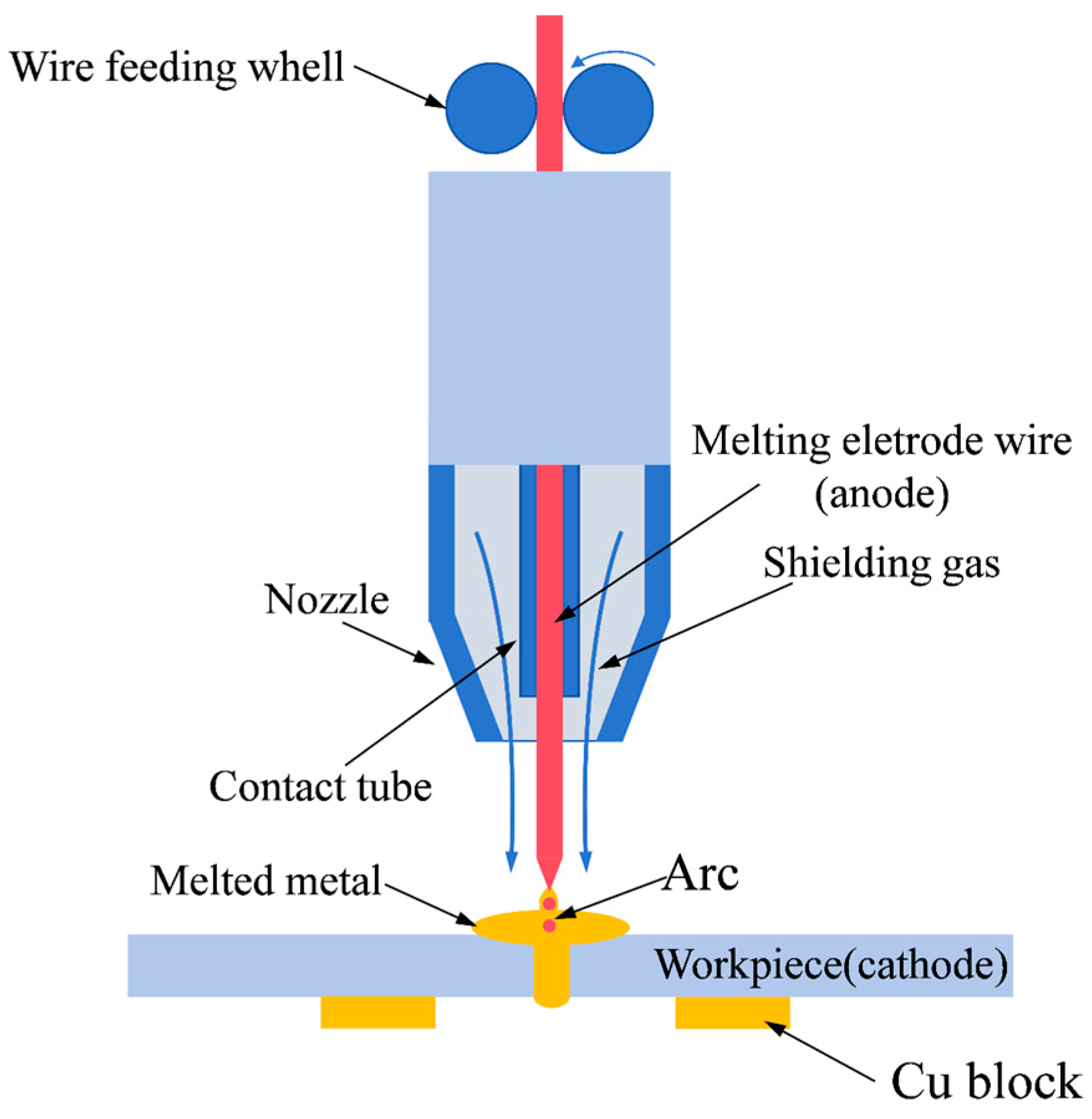
The welding experiments were conducted using a Kemppi A7 MIG Welder 450 to fabricate similar 7075-T6 aluminum alloy joints via the pulsed metal inert gas welding (P-MIG) method. The base material dimensions were 200 mm × 100 mm × 6 mm. An ER5356 filler wire with a diameter of 1.6 mm was employed, with 99.99% argon as the shielding gas. The chemical compositions of the base material and the filler wire are presented in Table 1. During the experiments, the welding voltage was maintained at 24.3 V and the welding speed at 550 mm/min, while the welding current was varied at 190 A, 200 A, and 210 A. To prevent welding defects such as pores and inclusions during the welding process, the 7075 aluminum alloy plates were first ground and then finely sanded to remove the dense oxide layer on the surface. The plates were subsequently cleaned with alcohol and dried prior to welding. During welding, a 2 mm thick copper plate was symmetrically placed beneath the aluminum alloy plate to achieve single-sided welding with double-sided formation, while also ensuring sufficient heat dissipation throughout the process. The welding schematic diagram is shown in Figure 1. The welded joint was divided into different regions: the weld zone (WZ), the heat-affected zone (HAZ), and the base material zone (BM).

2.2. Microstructure Testing of the Welded Joints

In this study, an OLYMPUS GX53 optical microscope (OM) was employed to conduct metallographic analysis of the welded joint microstructure. After mechanical grinding and polishing, the polished specimens were etched with Keller’s reagent (95 mL H2O + 2.5 mL HNO3 + 1.5 mL HCl + 1 mL HF) for 40–50 s, followed by rinsing with alcohol. The microstructures of different regions of the welded joint were observed and analyzed using a Zeiss Gemini Sigma 300 field emission scanning electron microscope (SEM). The fracture morphology of tensile specimens was examined in secondary electron mode to determine the fracture mode, and electrochemical corrosion morphology was also observed. Energy dispersive spectroscopy (EDS) attached to the SEM was used to perform point scanning at selected locations to determine the content and distribution of alloying elements.

2.3. Mechanical Properties

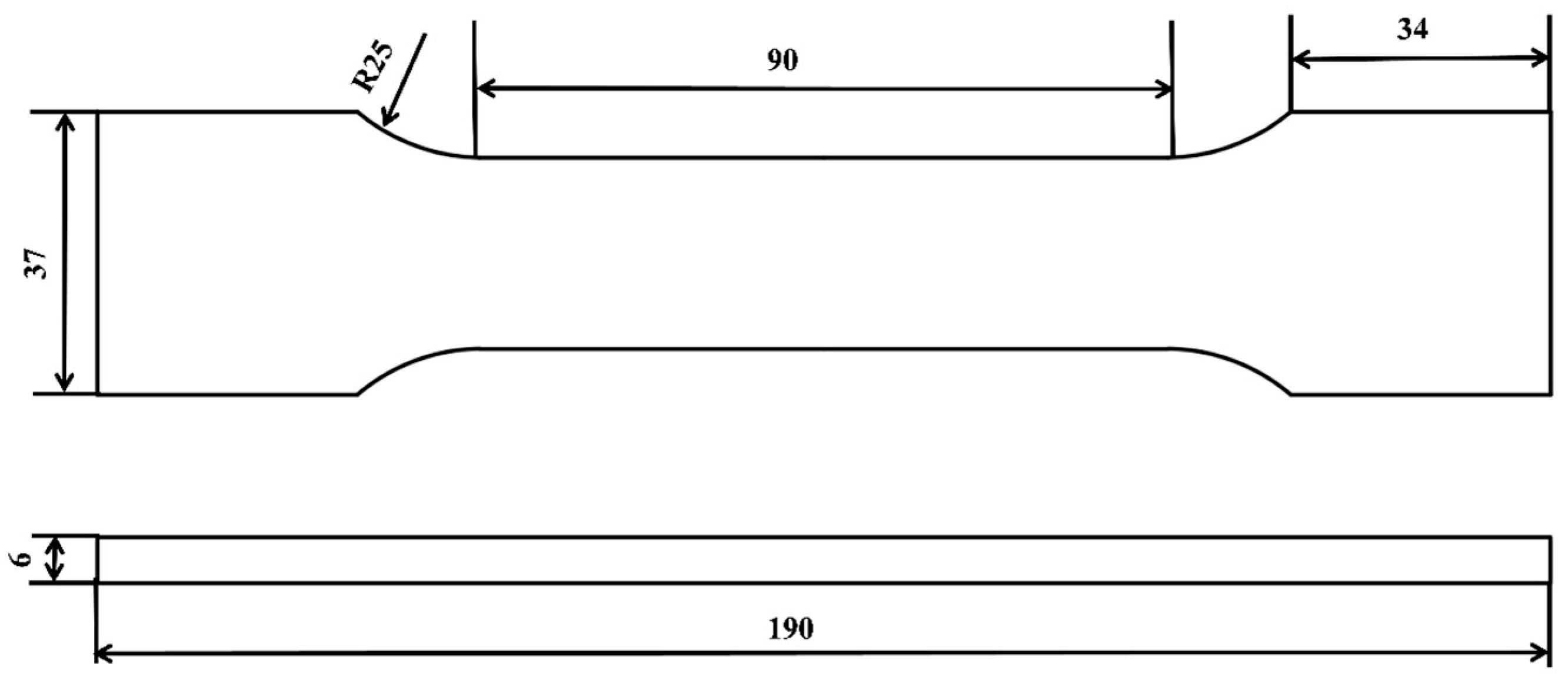
Tensile tests of the welded joints were conducted at room temperature (23 °C ± 5 °C), with specimens prepared in strict accordance with the Chinese National Standard GB/T 228.1-2010: Metallic materials—Tensile testing—Part 1: Method of test at room temperature (China Standard Press: Beijing, China, 2010). For plates with a thickness greater than 3 mm, the specific dimensions of the tensile specimens for the welded joints are shown in Figure 2. The tests were performed using a WDW-200 A tensile testing machine produced by Jinan Xinguang Company (Jinan, China). During testing, the tensile rate was set at 5 mm/min. To ensure accuracy, three specimens were tested for each welding parameter set, and the average value of the three tests was taken as the final measurement under that parameter condition.
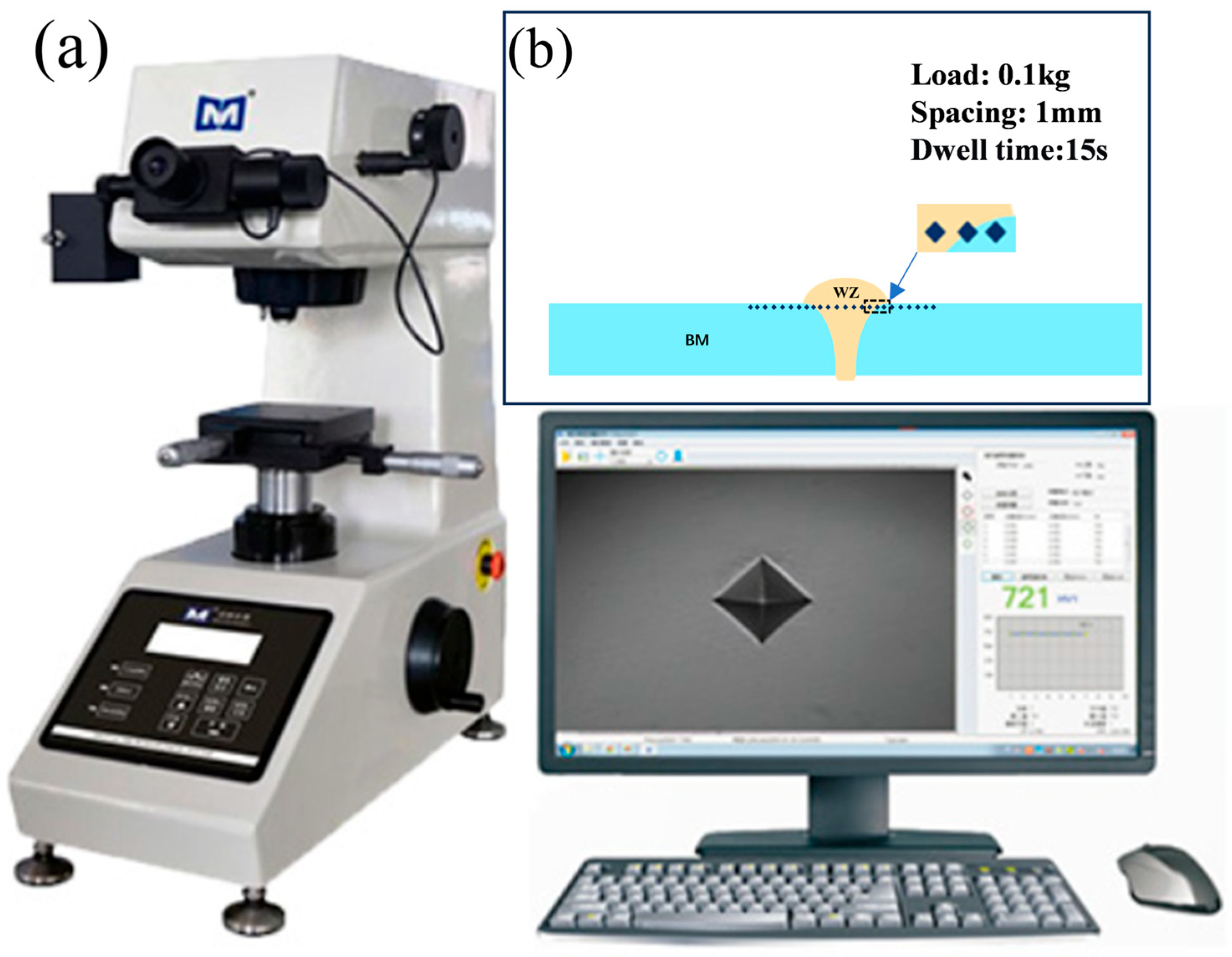
Vickers hardness tests of the welded joints were carried out using a DigiVicker 1000A Vickers hardness tester (Maige Instrument Co., Ltd., Suzhou, China). For the microhardness test, specimens with dimensions of 80 mm × 10 mm × 6 mm were used. The tests were conducted under a load of 0.1 kg with an indentation spacing of 1 mm and a dwell time of 15 s, as illustrated in Figure 3.

2.4. Corrosion Experiment

The intergranular corrosion test was conducted in accordance with the Chinese National Standard GB/T 7998-2005: Aluminium and aluminium alloys—Test method for intergranular corrosion (China Standard Press: Beijing, China, 2005). The intergranular corrosion solution was prepared with 57 g of analytical grade NaCl and 10 mL of H2O2, diluted to 1 L with deionized water. The specimens were immersed in the solution for 12 h in a constant-temperature water bath maintained at 35 ± 2 °C. After the test, a 5 mm section was mechanically cut from one end perpendicular to the primary deformation direction, mounted, ground, and polished. The corrosion depth was then observed and measured under an OM.
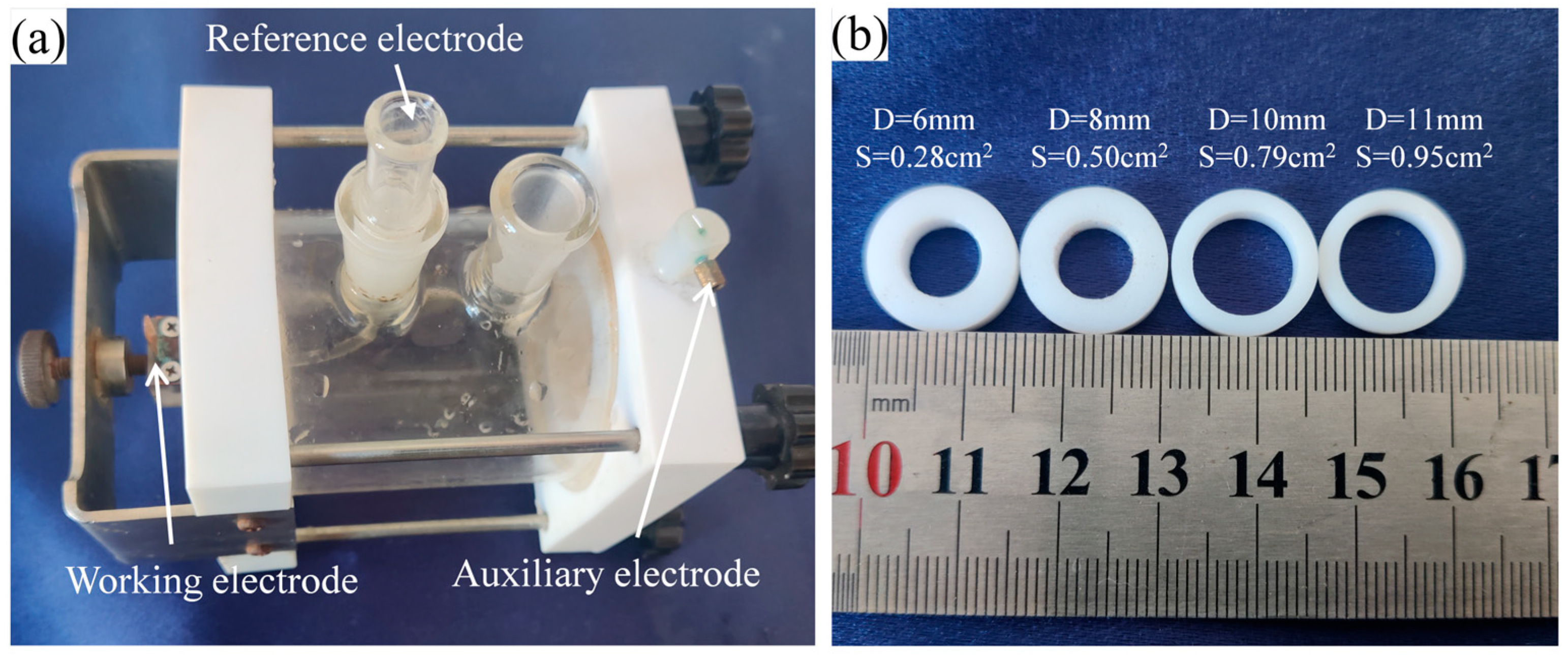
Electrochemical performance tests of the aluminum alloy joints were carried out at room temperature (23 ± 5 °C) using a CS310M electrochemical workstation manufactured by Wuhan Corrtest Instruments Co., Ltd. (Wuhan, China). The tests were conducted using a flat corrosion cell configured with a standard three-electrode system. In this setup, a platinum electrode served as the counter electrode (CE), the test specimen as the working electrode (WE), and a saturated calomel electrode (SCE) as the reference electrode (RE). The assembled three-electrode system is illustrated in Figure 4a. Taking into account the dimensions of different joint regions and processing feasibility, a rubber O-ring with an inner diameter of 6 mm, as shown in Figure 4b, was used to define the area exposed to the electrolyte, resulting in a tested surface area of 0.28 cm2. Prior to testing, the electrochemical specimens were ground stepwise with abrasive paper up to 2000-grit, followed by cleaning with alcohol and drying. A 3.5 wt.% NaCl solution was poured into the corrosion cell, and the specimen was immersed for 30 min before testing. The electrochemical tests were performed sequentially, including open-circuit potential (OCP), electrochemical impedance spectroscopy (EIS), and potentiodynamic polarization curve (PC) measurements. Three parallel specimens were tested for each welded joint condition to ensure the authenticity and reproducibility of the results.
The OCP test duration was set to 1800 s with a filter capacitance of 10 nF. Subsequently, EIS measurements were conducted over a frequency range from 105 Hz to 10−1 Hz using an excitation amplitude of 10 mV. Finally, potentiodynamic polarization tests were performed within a range of ±200 mV relative to the OCP at a scan rate of 1 mV/s. The fitted results were analyzed upon completion of the tests.

3. Results and Discussion

3.1. Microstructure of Welded Joints

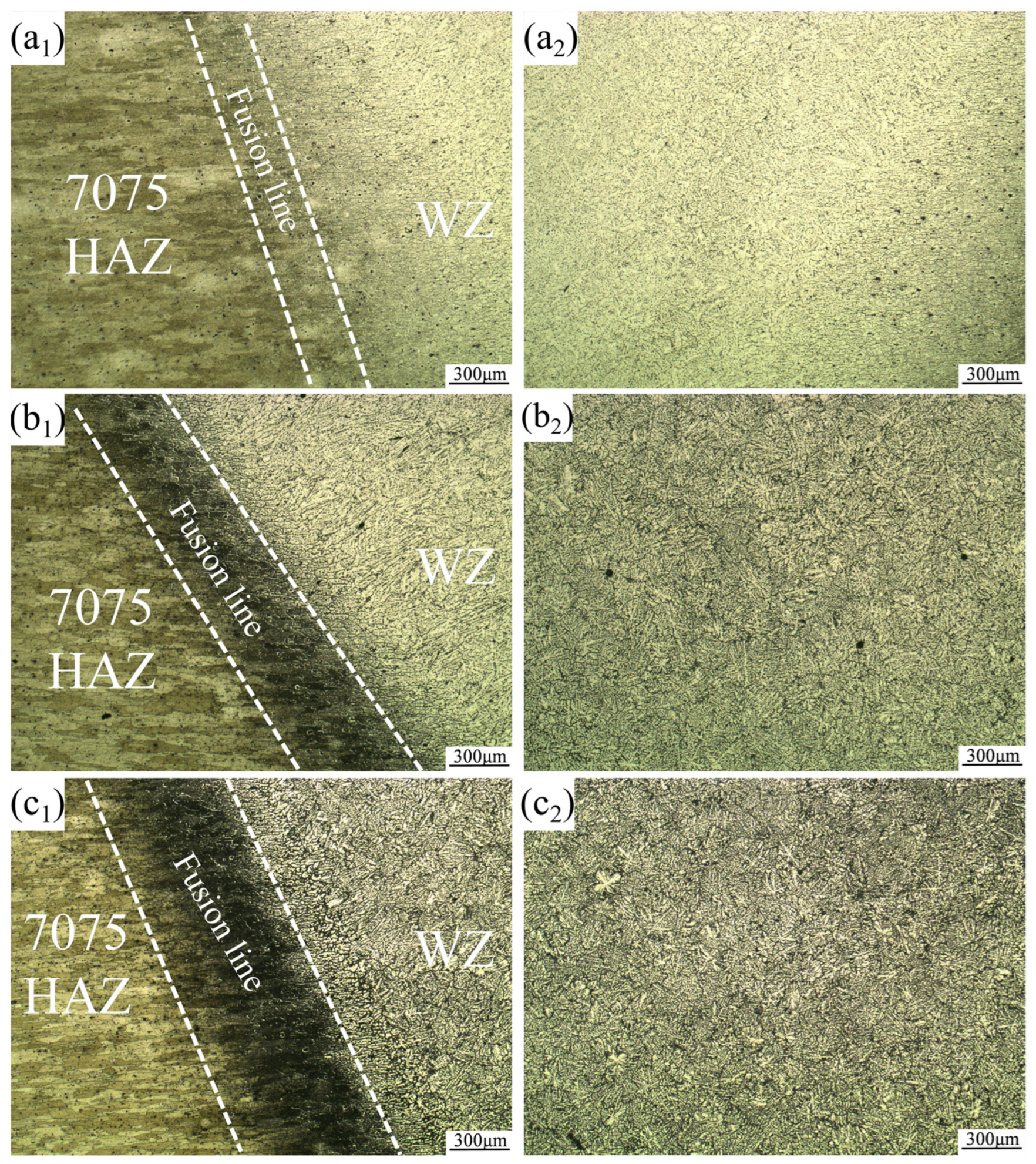
Figure 5 illustrates the metallographic microstructural characteristics of 7075-T6 aluminum alloy P-MIG welded joints under different welding current conditions. The WZ primarily consists of equiaxed dendrites, while the HAZ predominantly exhibits columnar grain structures. Variations in welding current significantly influence the metallographic features of the weld and the microstructural morphology of the fusion zone. At a welding current of 190 A, the lower heat input results in insufficient thermal energy within the molten pool, leading to restricted nucleus growth. In the weld center, dendrites are notably smaller, with refined and uniformly distributed grains. The fusion zone is indistinct, showing only uniformly sized columnar grains near the weld center. This phenomenon indicates that, under low welding current conditions, nuclei form but fail to fully develop, resulting in a narrow transition region between the fusion zone and the base metal. With increased welding current, elevated heat input reduces the temperature gradient during solidification and accelerates nucleation growth rates. In the weld center, dendrites gradually coarsen, with increased interdendritic spacing and a looser structural distribution. Simultaneously, the fusion zone width expands significantly, and columnar grains in the HAZ undergo coarsening. This is attributed to the intensified heat input, which promotes the rapid directional solidification of crystals toward the fusion line and HAZ [10]. Furthermore, higher heat input enhances the precipitation of strengthening phases [11], which may further affect the mechanical properties of the welded joint.
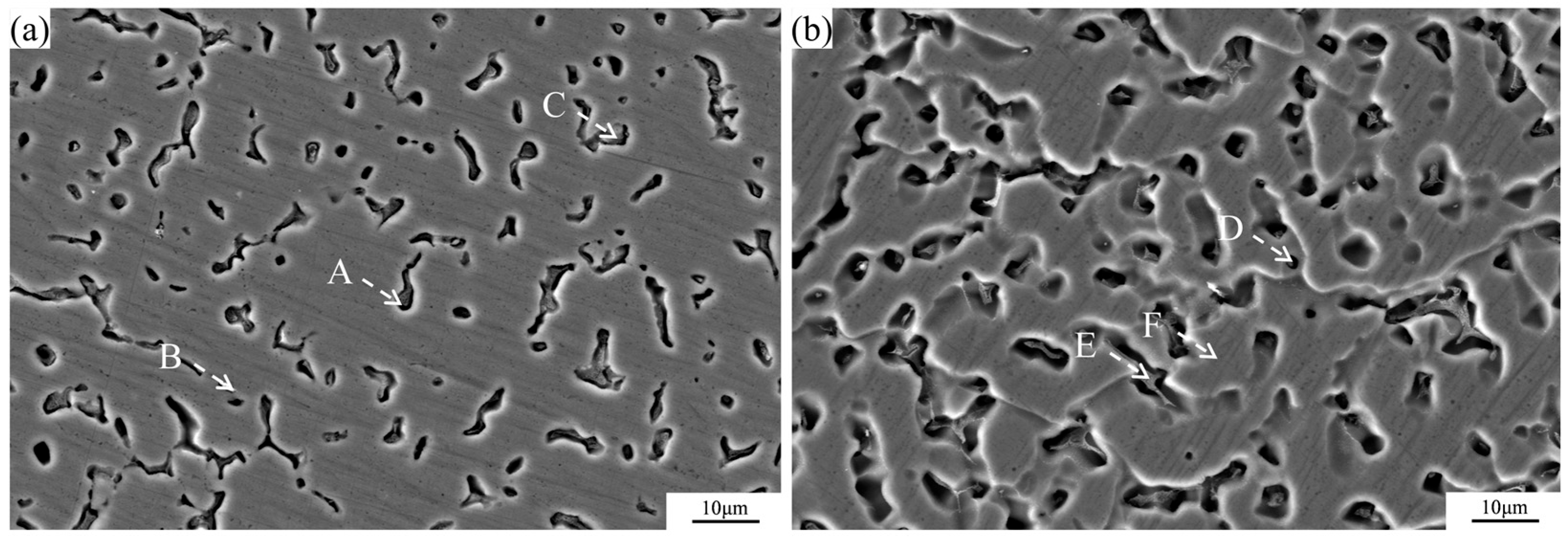
Figure 6a,b show the SEM microstructure characteristics of the weld center of the joints at welding currents of 190 A and 210 A, respectively, and the corresponding EDS test results are listed in Table 2. It can be observed from the figure that the welding heat input increases significantly with the increase in the welding current while the welding speed is kept constant. When the welding current reaches 210 A, the microstructure in the center of the weld becomes significantly larger, the number of precipitated phases increases significantly, and the distribution of the tissue is denser. This indicates that the higher welding heat input accelerates the thermal cycling effect in the weld region, which has an important effect on the microstructural morphology and precipitation behavior [12].
Comparison of the elemental contents at points A, C, D, and E in the figure shows that the content of Mg element in the center of the weld is slightly increased, while the content of Zn element is decreased. This change may result from the multiple effects under high welding heat input: on the one hand, the increase in welding heat input may lead to the enhanced kinetics of element dissolution and reprecipitation in the weld center [13]; on the other hand, due to the low melting point of Zn element, the volatilization or devolatilization phenomenon may occur at high temperature, which may change the local distribution of Zn. In addition, the difference in diffusion coefficient and solubility of Mg and Zn elements may also play a moderating role in this elemental distribution change [14]. Therefore, the change in welding current will have a significant effect on the mechanical properties and corrosion performance of the joint weld.

3.2. Mechanical Properties of Welded Joints

3.2.1. Microhardness

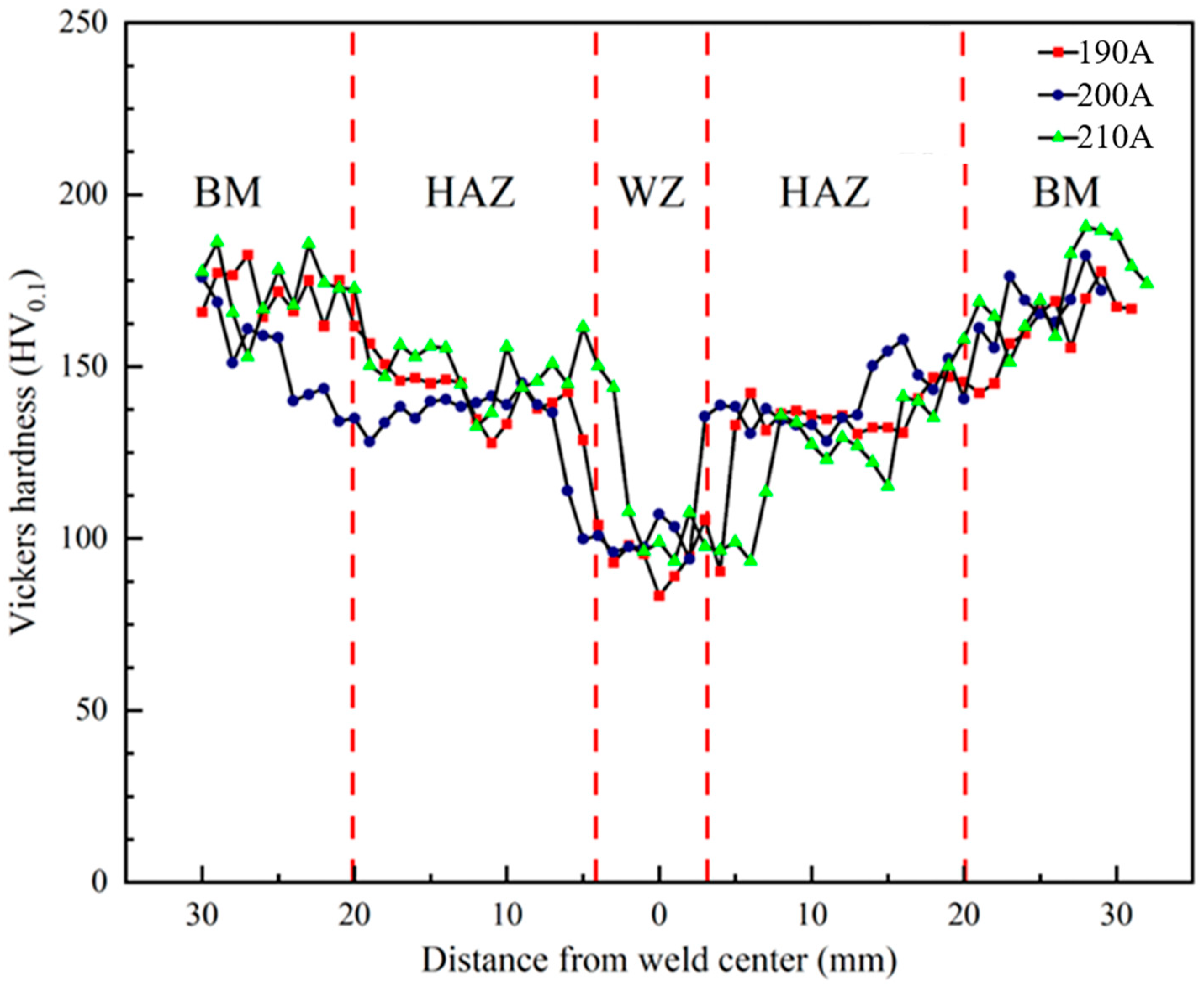
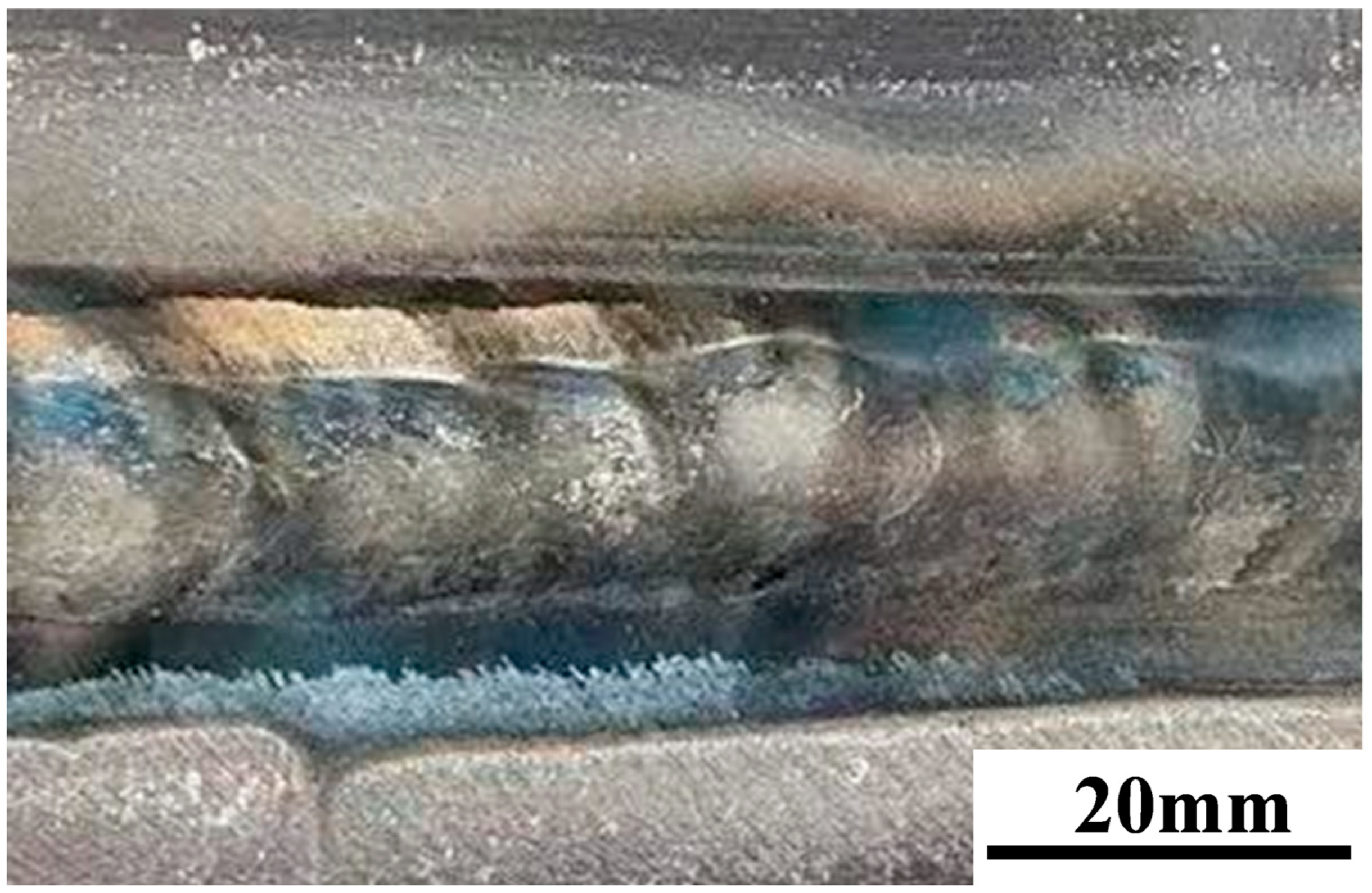
Figure 7 shows the distribution of the microhardness of the joints at different welding currents. From the hardness distribution, the microhardness exhibits a symmetric distribution characteristic to the center of the weld. Among them, the WZ has the lowest hardness, which is mainly due to the fact that the WZ region is subjected to the highest heat input during the welding process, resulting in the partial dissolution of the reinforcing precipitation phase, and to the fact that the wire ER5356 is a non-age-strengthened aluminum alloy, and the main reinforcement mechanism is solid-solution reinforcement [15]; thus, the WZ hardness is the lowest. With the increase in distance from the center of the weld, the hardness of the HAZ gradually increases and approaches the hardness of the base metal. The average hardness of the WZ increased from 94.8 HV0.1 at 190 A to 99.5 HV0.1 at 200 A, followed by a slight decrease to 98.4 HV0.1 at 210 A. It is evident that the hardness of the WZ increases with welding current, but decreases when the welding current becomes excessively high. However, the magnitude of change is small. This may be due to the fact that the precipitated phase of the weld metal undergoes a dynamic equilibrium of dissolution and re-precipitation during the increase in welding current from 190 A to 210 A, which slightly increases the hardness. However, the grain in the center of the weld undergoes coarsening at higher heat input, and the reduction in Zn elements at a welding current of 210 A is shown in Table 2, resulting in a slight decrease in hardness at this parameter. It is important to note that, when the welding current exceeds 210 A, the heat input of the weld exceeds the critical threshold, leading to the overheating of the molten pool, which may result in defects such as weld collapse and weld tumor [16]. The weld macroscopy is shown in Figure 8. Therefore, in this study, further exploration of the joint performance with a welding current greater than 210 A was discarded.

3.2.2. Tensile Experiment

Through the study of microhardness distribution, the influence law of different welding currents on the hardness of the joint area and its intrinsic mechanism were clarified, which provides an important reference for the in-depth discussion of the influence of the welding process on the performance of the joint. However, the microhardness only reflects the mechanical properties of the material in the microscopic localized area, and it is not possible to comprehensively evaluate the mechanical performance of the joint as a whole. In order to further verify the influence of the welding current on the macroscopic mechanical properties of the joints, the tensile strength and plastic deformation behaviors of the joints under different welding current conditions will be systematically analyzed through tensile experiments next.
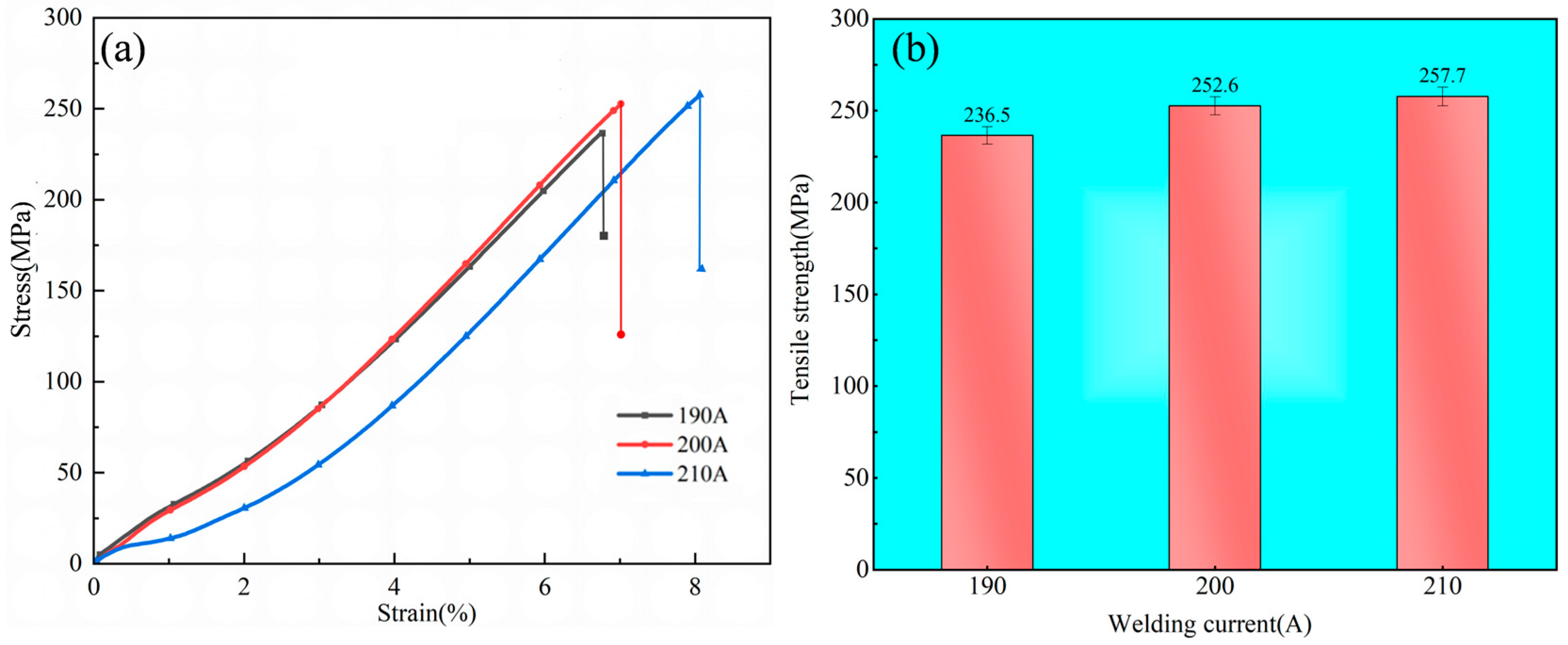
Figure 9 shows the stress–strain curves and corresponding tensile strength of the welded joints. The tensile strength increased with welding current, from 236.5 MPa with 6.5% elongation at 190 A to 252.6 MPa with 7% elongation at 200 A, and reached a maximum of 257.7 MPa with 8% elongation at 210 A. With the increase in welding current, the tensile strength and strain of the joint are also gradually increased. However, in the process of increasing the welding current from 200 A to 210 A, the increase in tensile strength is marginal, which may be due to the fact that the effect of heat input enhancement on the joint strength during the process of increasing the welding current has reached saturation, so the increase in joint strength is not obvious. Wang et al. [17] reported a tensile strength of 280.4 MPa and a weld hardness of 82.1 HV in their as-welded MIG joints, with post-weld T6 heat treatment significantly increasing these values to 336.7 MPa and 97.2 HV, respectively. In comparison, the as-welded P-MIG joints in this work exhibited a lower tensile strength but a higher weld hardness, indicating that the optimized P-MIG process is more effective in suppressing joint softening.

3.2.3. Fracture Form

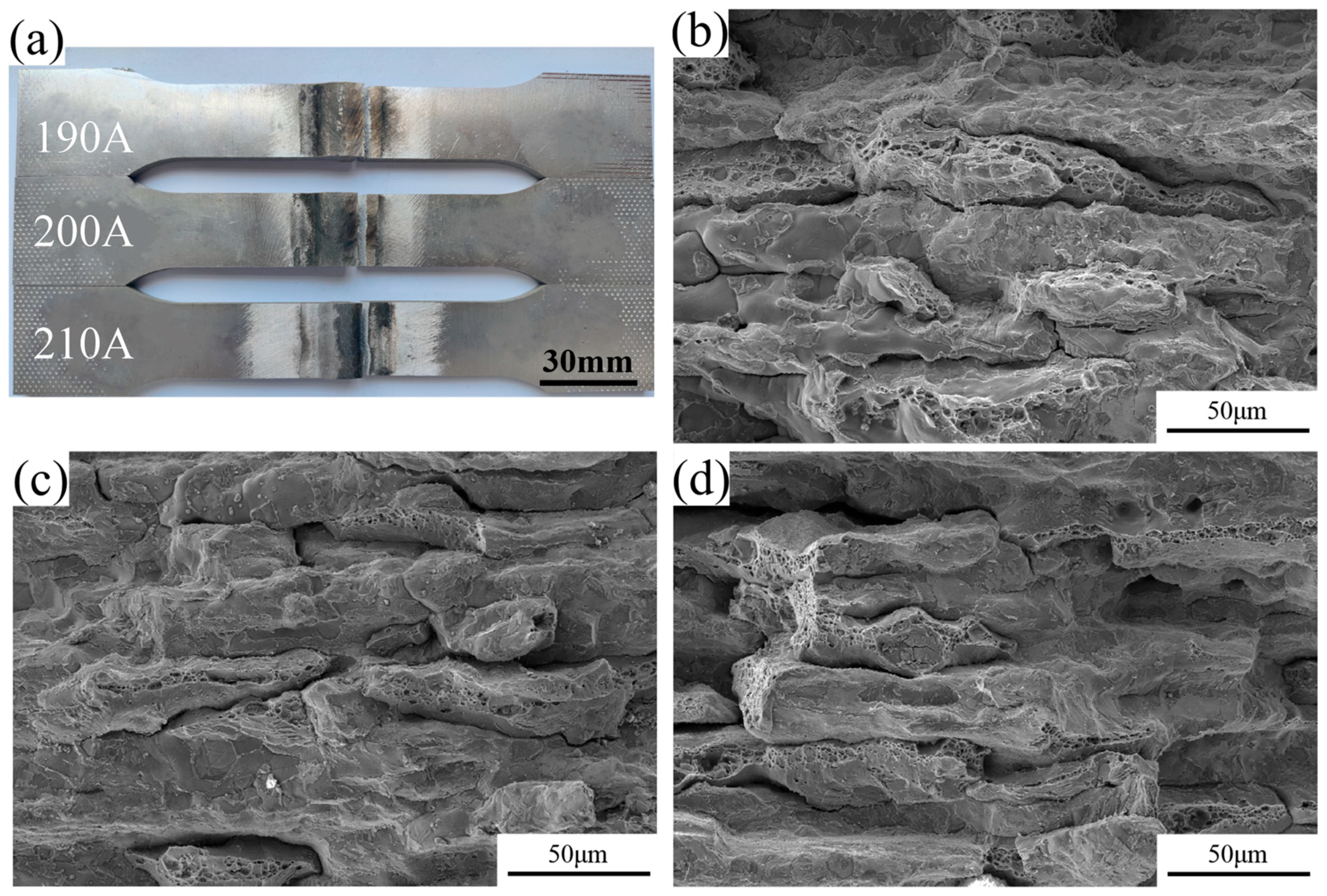
SEM observations of the joint fracture locations were carried out to investigate the form and morphology of the joint fracture. As shown in Figure 10, which shows the fracture locations of three groups of joints with different welding currents, the joints were fractured in the HAZ, a phenomenon that indicates that the welding heat has a significant effect on the mechanical properties of the material. The HAZ undergoes grain coarsening and redistribution of solid solution elements due to the high temperatures, which leads to a decrease in strength and toughness in this region.
From the figure, it can be found that the fracture morphology of the joints under these three welding current parameters is very similar, which is a mixture of brittle fracture and ductile fracture. When the welding current is 190 A, the fracture morphology has more laminar features on the surface, the local area is relatively smooth, and there is a local toughness of the morphology of the nest, which is quasi-dissolutional fracture, but there is also an intermediate area of fracture along the crystal showing the outline of the grains, which presents a rough appearance. When the welding current is 200 A, the left side of the figure shows an obvious river-like pattern quasi-cleavage fracture, compared with 190 A, and a less concave–convex step-like morphology. The quantity of grain boundaries in the region of the toughness of the fossa is higher, and they therefore have a better toughness. When the welding current is 210 A, the fracture along the grain has more obvious, local quasi-dissolution characteristics, but the grain boundary region has more tough nests, so the strength and toughness show better performance.

3.3. Optimization of Corrosion Resistance in Welded Joints

3.3.1. Intergranular Corrosion

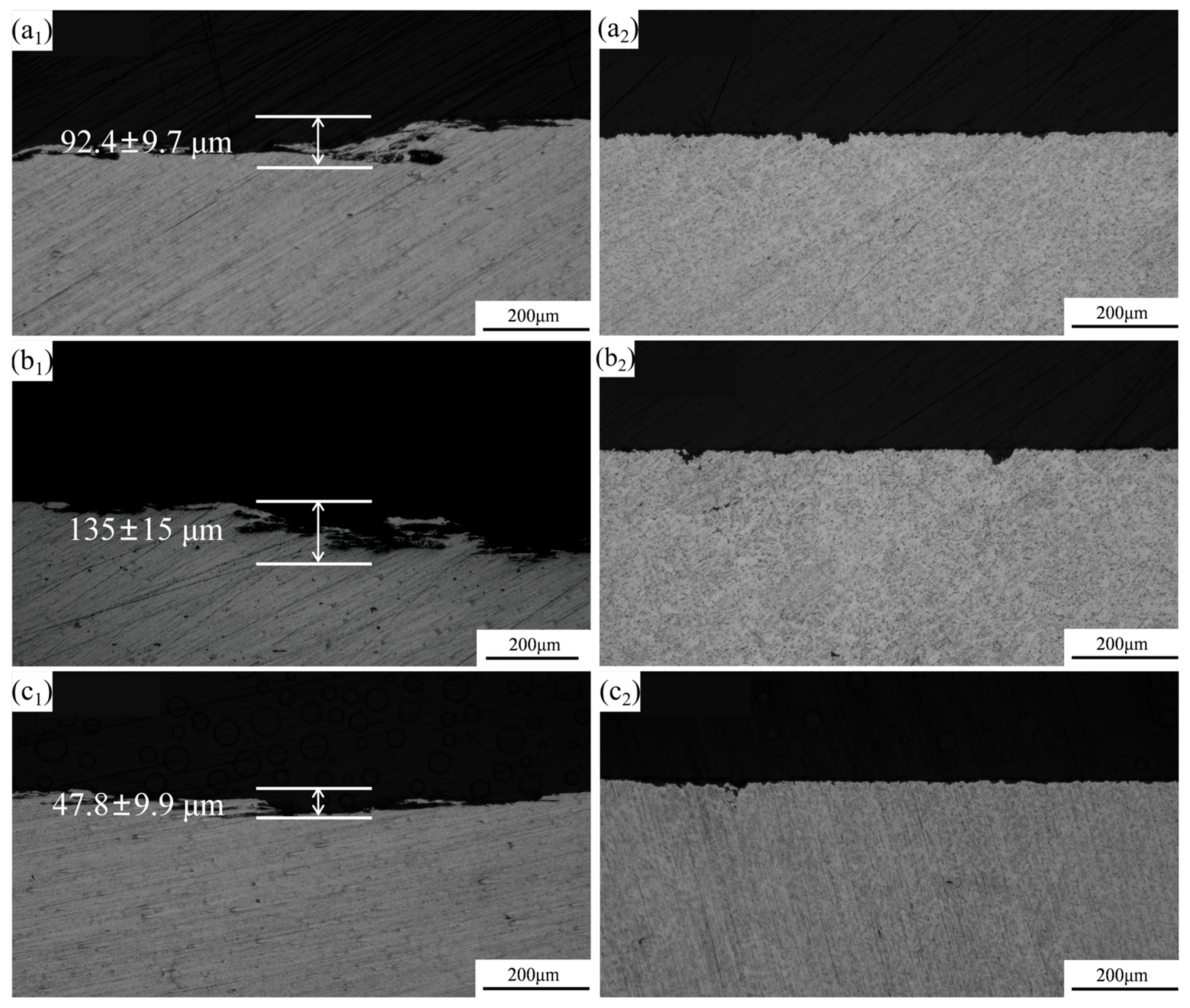
In the P-MIG welding experiments of 7075 aluminum alloy, with a constant welding speed of 550 mm/min and varying welding currents (190 A, 200 A, and 210 A), the WZ remained predominantly susceptible to pitting corrosion. However, the intergranular corrosion (IGC) depths in the 7075 HAZ were measured as 92.4 μm, 135 μm, and 47.8 μm. As shown in Figure 11, the results show that, with the increase in welding current, the corrosion depth shows a trend of “first increase and then decrease”. The reason for this trend may be that, at a high welding current, the heat input is higher, resulting in Zn element evaporation [18], and at the same time, at a high welding heat input and high cooling rate, there is a dissolution of coarse grain boundary precipitation phases. Fine precipitates cannot nucleate in time, which reduces the corrosion susceptibility and leads to a low intergranular corrosion depth of 47.8 μm.

3.3.2. Electrochemical Corrosion

Welding current has an important effect on the microstructure and mechanical properties of welded joints, and also significantly alters the electrochemical corrosion behavior of the WZ and HAZ. It has been shown that changes in welding current not only affect the formation of the molten pool and cooling rate, but also lead to changes in the organization morphology of the welded joints [19], defect distribution and stability of the oxide film, which directly determines the corrosion resistance of the welded joints. In this study, a systematic electrochemical corrosion behavior test was carried out for the WZ and HAZ at three welding currents: 190 A, 200 A, and 210 A. The test was performed by the OCP, EIS, and PC. The experimental methods of OCP, EIS, and PC were used to analyze the influence of welding current on the stability of the oxide film on the weld surface, the corrosion current density, and the corrosion potential.
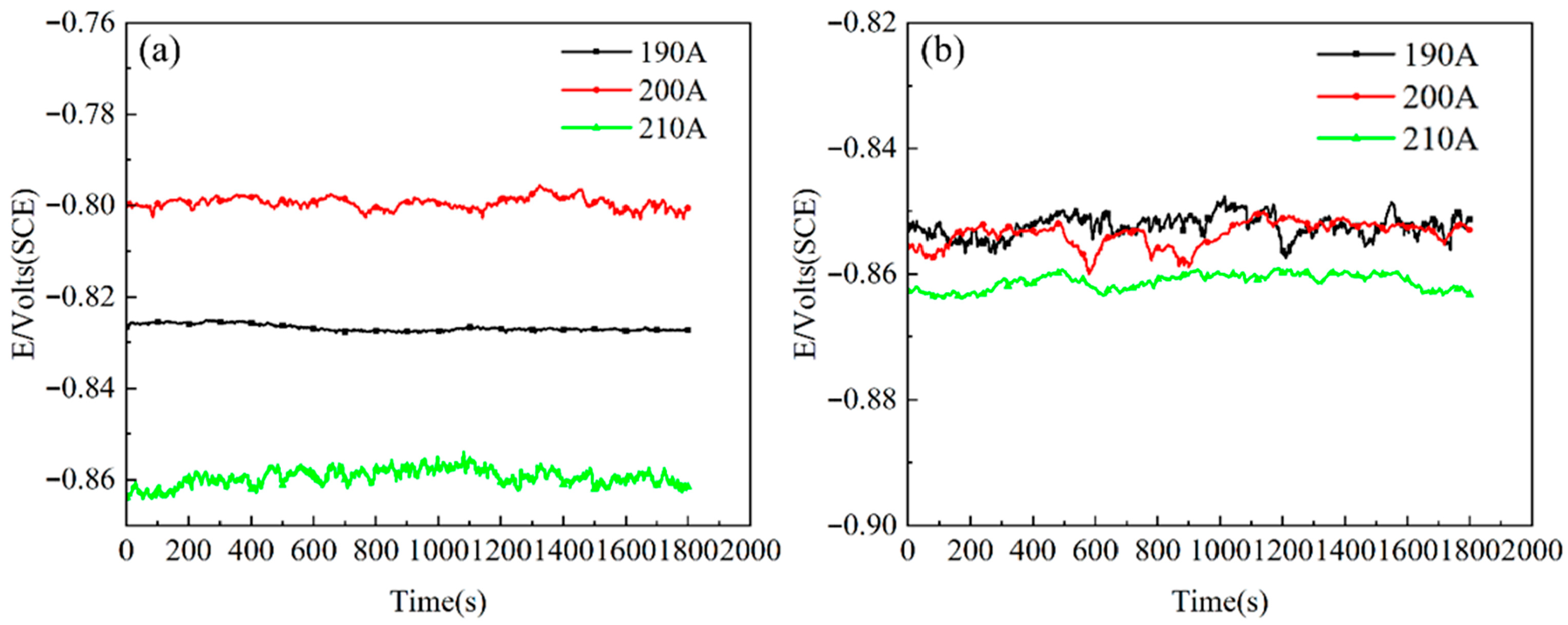
As shown in Figure 12, the variation in the open-circuit potential of welded joints under different welding current conditions showed obvious regularity. Among them, Figure 12a,b demonstrate the experimental results for HAZ and WZ, respectively. At a welding current of 190 A, the open-circuit potentials of the HAZ and the WZ were −0.827 V and −0.848 V, respectively; when the welding current was increased to 200 A, the open-circuit potentials of the two zones increased to −0.800 V and −0.851 V, respectively, which reached the maximum value; and when the welding current was further increased to 210 A, the open-circuit potentials decreased to −0.861 V and −0.868 V. It can be seen that the open-circuit potentials of the HAZ and the WZ showed an obvious pattern. It can be seen that the OCP of the welded joints shows a trend of “first increase and then decrease” with the change in welding current, and reaches the maximum value when the welding current reaches 200 A. This phenomenon indicates that, in the natural equilibrium state, the welded joints with a welding current of 200 A have a more stable surface oxide film and better corrosion resistance, showing a minimal corrosion tendency.
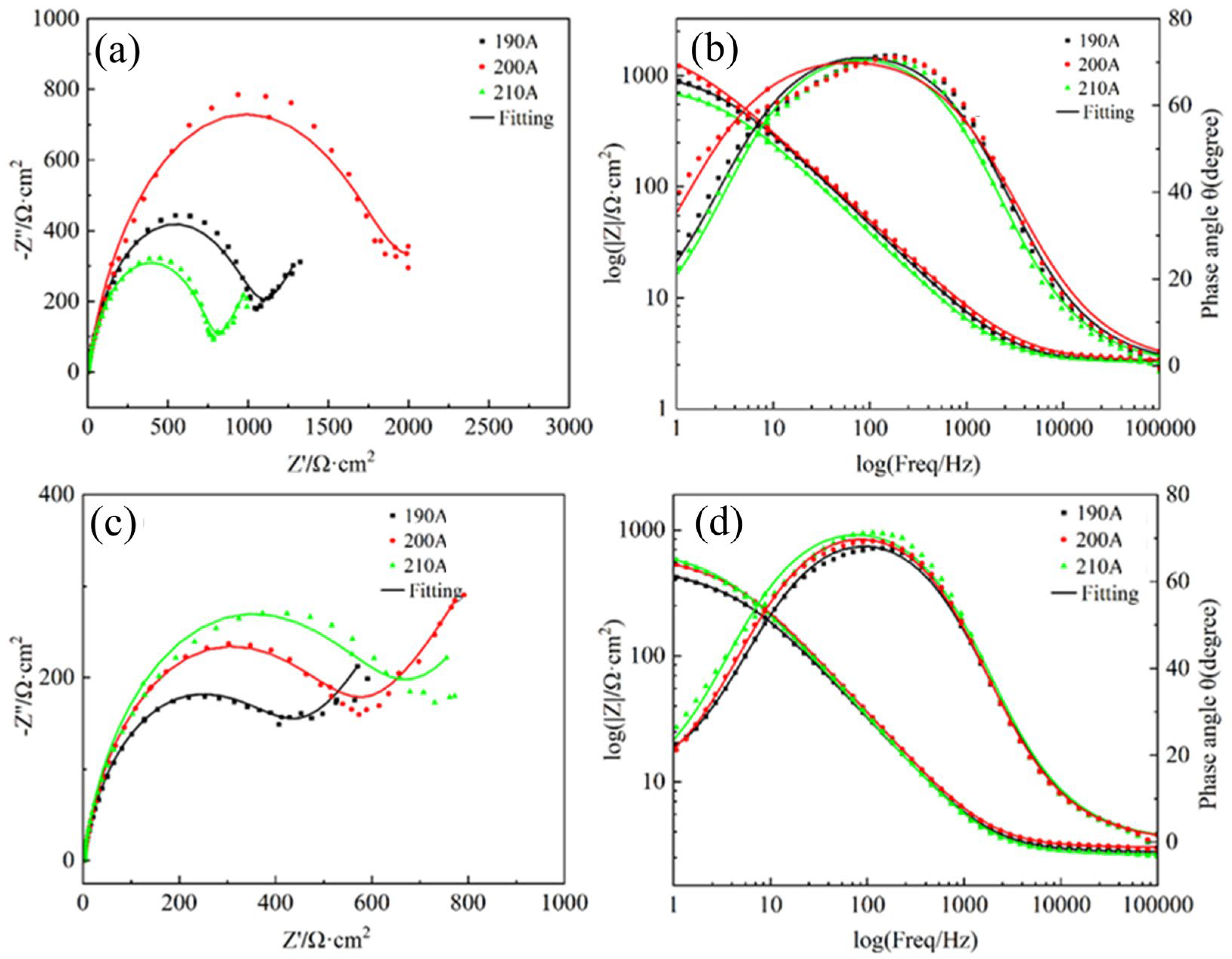
EIS describes the electrochemical reaction rate between the metal and the electrolyte, and the charge transfer impedance Rct can directly reflect the activity of the interfacial reaction. This data is used to evaluate the corrosion resistance of the material. The results of the EIS experiments are shown in Figure 13. Figure 13a,b are the Nyquist and Bode plots of the HAZ, respectively, and Figure 13c,d are the Nyquist and Bode plots of the WZ, respectively. Nyquist plots show semicircular curves in the low frequency region, indicating charge transfer or impedance characteristics, with a larger semicircle representing a lower rate of electrochemical reaction, and vice versa, representing a faster rate of electrochemical reaction [20]. As shown in Figure 13a,c, a 45° straight line appears as the frequency becomes larger, which represents the diffusion process, which usually means that the impedance of the system is mainly controlled by the diffusion process. This behavior is usually associated with Warburg impedance, indicating that the electrochemical reaction is limited by diffusion rather than charge transfer. As shown in Figure 13b,d, there is a phase angle that tends to 90° in the low frequency region as well as a higher amplitude, which represents the passivation behavior of the material and the formation of an oxide film, which has a greater hindering influence on the corrosion behavior.
In order to further analyze the corrosion resistance of the joints with different welding currents under the AC impedance spectrum, the EIS results were fitted to the experimental values shown in Table 3, which presents the magnitude of the Rct values to assess the corrosion resistance. From the magnitude of Rct values in the table, it can be seen that, with the increase in welding current, the impedance magnitude of both the weld and the HAZ show a tendency to increase and then decrease, and the Rct values of the HAZ and the weld are maximal at a welding current at 200 A of 1.8884 and 1.3160, respectively, and joints at this welding current show the best corrosion performance in the AC impedance spectrum. As the welding current continues to increase, the magnitude of the Rct values for both the HAZ and the WZ begins to decrease to 0.8545 and 0.8420, respectively.
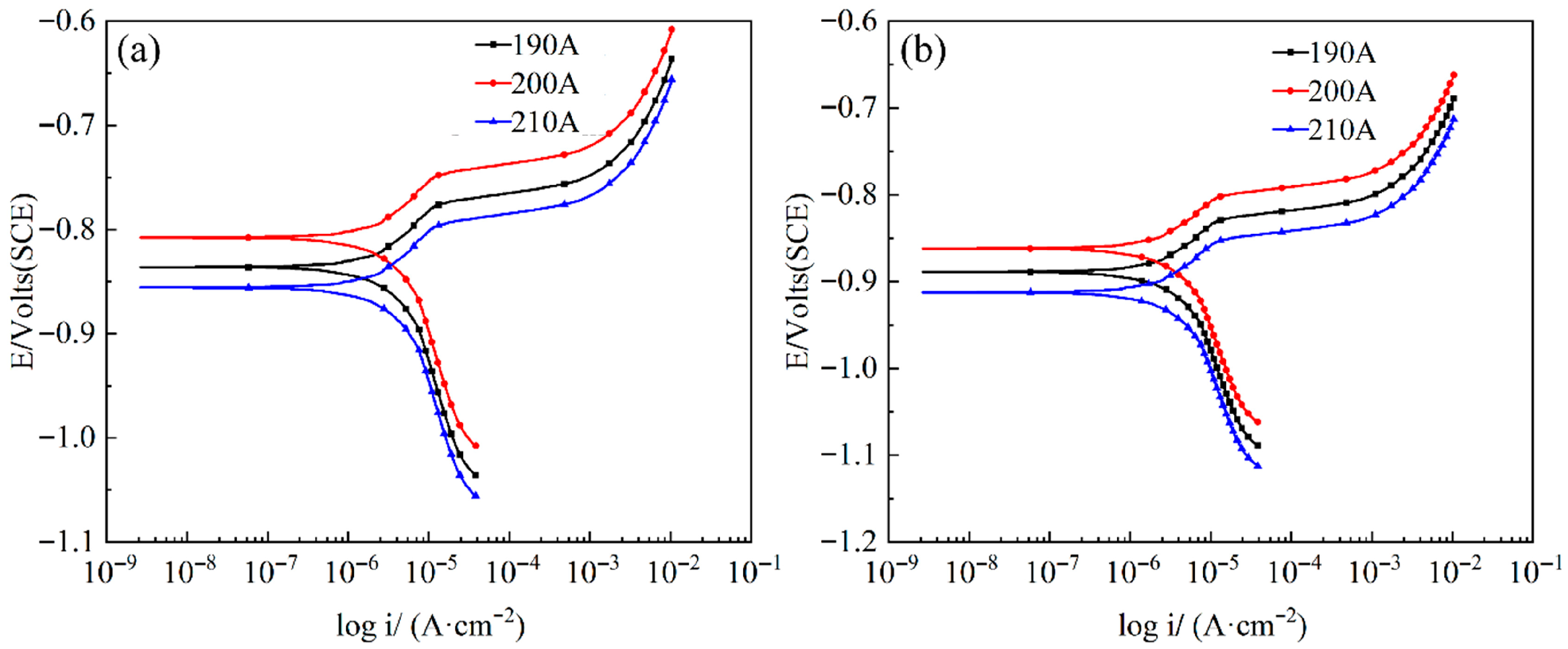
Welding current has a significant effect on the electrochemical properties of the HAZ and WZ of welded joints, especially in the analysis of polarization curves, which reveals the changing law of corrosion behavior under different welding speed conditions. By fitting the polarization curve parameters, such as corrosion potential, corrosion current density, and passivation current density, the regulation mechanism of welding current on the corrosion resistance of joints can be analyzed in depth. Figure 14a,b are the results of the polarization curves of the HAZ and WZ, respectively, from which it can be observed that there is obvious passivation behavior in the anodic zone, and, in the formation of an oxide film to impede the corrosion behavior, the welding voltage increases and the current density tends to be stable, and, when the oxide film ruptures, the pitting behavior occurs, and the current density rises sharply.
In order to specifically explore the corrosion behavior of the polarization curve, the results were Tafel fitted, resulting in specific values, as shown in Table 4. Polarization curves are usually judged by corrosion voltage (Ecorr) and corrosion current density (Icorr). Corrosion voltage for the material in a particular environment corrosion tendency is smaller, representing the higher corrosion tendency. Corrosion current density reflects the material corrosion activity in the environment. With the increase in welding current, the corrosion voltage of the joint HAZ first increases and then decreases, in the welding current of 200 A, with a minimum corrosion voltage of −0.8072 mV; with a corrosion current density in 190 A and 200 A, when the gap is not obvious, and when the welding current continues to increase for 210 A, the corrosion current density increases dramatically, to the maximum value of 4.7822 × 10⁻⁶ A·cm−2. When the corrosion voltage of the weld in the welding current is small, and when there is no obvious difference, it continues to increase to 210 A, and the corrosion voltage of the weld is a minimum of −0.9129 mV; the corrosion current density of the weld with the increase in welding current shows a clear trend of the first decrease after the increase in current density in the current is 200 A, and the current density is a minimum of 3.9884 × 10⁻⁶ A·cm−2. In a comprehensive comparison, it can be concluded that the corrosion resistance of the HAZ is better than that of the WZ, and when the welding current is 200 A, both the weld and the HAZ show excellent corrosion resistance, which is consistent with the results of the previous tests of the open-circuit potential and AC impedance spectra.

4. Conclusions

This study systematically investigated the effects of welding current on the microstructure, mechanical properties, and corrosion behavior of 7075-T6 aluminum alloy joints fabricated by pulsed metal inert gas (P-MIG) welding. The key findings of this study are summarized as follows:
(1)
Increasing welding current altered the weld metal morphology from fine equiaxed dendrites to coarser grains with more pronounced precipitation. Zn evaporation and elemental redistribution were observed at a higher heat input.
(2)
The tensile strength increased with welding current, reaching 257.7 MPa with 8% elongation at 210 A. Weld hardness increased slightly with welding current, peaking at 99.5 HV0.1 at 200 A, but decreased slightly at 210 A due to grain coarsening and Zn loss.
(3)
Corrosion resistance was highly sensitive to welding current. The joint welded at 200 A exhibited the best corrosion performance, with the shallowest intergranular corrosion depth (47.8 μm), the most positive OCP, and the highest charge transfer resistance. In contrast, the joint welded at 210 A showed reduced corrosion resistance due to coarse precipitates and inhomogeneous elemental distribution.
(4)
Welding current must be carefully optimized to balance strength and corrosion resistance. A welding current of 200 A provided the best overall corrosion resistance without significant sacrifice in mechanical performance, whereas 210 A favored strength at the expense of corrosion resistance.
(5)
The primary limitation of this study lies in its focus on a specific range of welding currents without incorporating thermal cycle monitoring or post-weld heat treatment, which restricts a more comprehensive understanding of the underlying mechanisms.

Author Contributions

T.W.: Formal Analysis, Data Curation, Software, Writing—Review and Editing; Y.W.: Methodology, Software, Visualization, Writing—Original Draft; L.L.: Validation, Methodology, Writing—Review and Editing, Software; S.L.: Conceptualization, Investigation, Funding Acquisition, Project Administration, Supervision, Writing—Original Draft, Resources; H.L.: Writing—Review and Editing, Formal Analysis, Data Curation, Methodology. All authors have read and agreed to the published version of the manuscript.

Funding

This work was financially supported by the National Natural Science Foundation of China (Grant Nos. 52475347 and 52575379), the Henan Provincial Key Research and Development Program (No. 251111222600), the Henan International Science and Technology Cooperation Project (No. 252102521057), and the Henan Provincial Foreign Experts Program (No. HNGD2025027).

Data Availability Statement

The original contributions presented in this study are included in the article. Further inquiries can be directed to the corresponding author.

Conflicts of Interest

The authors declare that they have no known competing financial interests or personal relationships that could have appeared to influence the work reported in this paper.

References

  1. Wang, Y.; Wu, D.; Chen, J.; Komen, H.; Chen, M.; Su, H.; Wu, C.; Tanaka, M.J.V. Pore suppression and performance improvement mechanisms in wire-arc directed energy deposition of 7075 alloy. Virtual Phys. Prototyp. 2025, 20, e2464953. [Google Scholar] [CrossRef]
  2. Ye, Z.; Zhu, H.; Wang, S.; Wang, W.; Yang, J. Fabricate high-strength, J.H. 7075 aluminum alloy joint through double pulse MIG welding process. J. Manuf. Process. 2024, 125, 512–522. [Google Scholar] [CrossRef]
  3. Xiao, A.; Huang, C.; Cui, X.; Yan, Z.; Yu, Z. Impact of the pulse induced current on the microstructure and mechanical properties of the 7075-T6 aluminum alloy. J. Alloys Compd. 2022, 911, 165021. [Google Scholar] [CrossRef]
  4. Zhao, X.; Chen, X.; Wang, X. Effect of aging processes on corrosion behavior and stress corrosion sensitivity of pre-stretched 7075 aluminum alloy. Mater. Corros. 2017, 69, 850–857. [Google Scholar] [CrossRef]
  5. Xu, S.; Wang, Y.; Yang, X.; Li, M.V.; Zuo, H.; Yang, S. Microstructure Evolution and Prediction Model of 6082-T6 Aluminum Alloy Pulsed Metal Inert Gas Welded Joint. J. Mater. Eng. Perform. 2025, 34, 13116–13135. [Google Scholar] [CrossRef]
  6. Machedon-Pisu, T.; Machedon-Pisu, M. Enhanced Microstructural and Mechanical Properties of Mig Welded Al 7075 Alloy Under Longitudinal Vibrations. Materials 2025, 18, 4281. [Google Scholar] [CrossRef] [PubMed]
  7. Sokoluk, M.; Cao, C.; Pan, S.; Li, X. Nanoparticle-enabled phase control for arc welding of unweldable aluminum alloy 7075. Nat. Commun 2019, 10, 98. [Google Scholar] [CrossRef] [PubMed]
  8. Li, S.; Liu, L.; Liu, H.; Yang, J.; Liao, C.; Wang, X.; Dong, H. Effect of welding speed on the microstructure, mechanical and corrosion properties of 6061/7075 pulsed MIG welded joints. J. Mater. Res. Technol. 2025, 38, 5909–5928. [Google Scholar] [CrossRef]
  9. Kekuan, W.; Jian, L.; Ruibin, D.; Wanting, C.; Huli, N.; Liangyu, L.; Jianfeng, Y. Current waveform effects on AC-CMT arc welding of 7075 Al alloy with addition of ER7075 wire. Weld. World 2024, 69, 2885–2905. [Google Scholar] [CrossRef]
  10. Zhuanni, G.A.O.; Leilei, W.; Xiang, L.I.; Zhiqiang, L.I.U.; Lü, F.; Yifan, L.I.; Xiaohong, Z. Effect of Thermal Cycle and Temperature Gradient on Solidification Microstructure of Deposition Layer during 7075 Aluminum Alloy Laser Wire Additive Manufacturing. J. Mech. Eng. 2024, 60, 96–118. [Google Scholar]
  11. Du, Z.; Deng, Z.; Cui, X.; Xiao, A. Deformation Behavior and Properties of 7075 Aluminum Alloy under Electromagnetic Hot Forming. Materials 2021, 14, 4954. [Google Scholar] [CrossRef] [PubMed]
  12. Guangfei, G.; Minghao, R.; Heng, J.; Kai, W.; Zhifu, W.; Xiaohu, Z. Effect of Heat Input on Microstructure and Properties of Welded Joint of Low Temperature High Manganese Steel. Mater. Mech. Eng. 2025, 49, 94–99. [Google Scholar]
  13. Li, M.-H.; Yang, Y.-Q.; Chen, Z.-L.; Song, Y.-F.; Tang, C.-P. Heterogeneous precipitation mechanism of η phase at E/Al interface in 7475 aluminum alloy. Rare Met. Mater. Eng. 2022, 51, 2483–2489. [Google Scholar]
  14. Zou, X.-L.; Yan, H.; Chen, X.-H. Evolution of second phases and mechanical properties of 7075 Al alloy processed by solution heat treatment. Trans. Nonferrous Met. Soc. China 2017, 27, 2146–2155. [Google Scholar] [CrossRef]
  15. Li, S.; Dong, H.; Wang, X.; Liu, Z.; Tan, Z.; Shangguan, L.; Lu, Q.; Zhong, S. Effect of repair welding on microstructure and mechanical properties of 7N01 aluminum alloy MIG welded joint. J. Manuf. Process. 2020, 54, 80–88. [Google Scholar] [CrossRef]
  16. Wu, C. Progress in Numerical Simulation of Thermal Processes and Weld Pool Behaviors in Fusion Welding. J. Mech. Eng. 2018, 54, 1. [Google Scholar] [CrossRef]
  17. Wang, C.; Liu, X.; Li, X.; Zhu, B. Heat treatment performance of ER5356 welding wire for MIG welding joint of 7075 aluminum alloy. J. Mater. Eng. 2024, 52, 149–157. [Google Scholar]
  18. El-Batahgy, A.-M.; Klimova-Korsmik, O.; Akhmetov, A.; Turichin, G. High-Power Fiber Laser Welding of High-Strength AA7075-T6 Aluminum Alloy Welds for Mechanical Properties Research. Materials 2021, 14, 7498. [Google Scholar] [CrossRef] [PubMed]
  19. Wang, H.; Liu, X.; Liu, L. Research on Laser-TIG Hybrid Welding of 6061-T6 Aluminum Alloys Joint and Post Heat Treatment. Metals 2020, 10, 130. [Google Scholar] [CrossRef]
  20. Lazanas, A.C.; Prodromidis, M.I. Electrochemical Impedance Spectroscopy—A Tutorial. ACS Meas. Sci. Au 2023, 3, 162–193. [Google Scholar] [CrossRef] [PubMed]
Figure 1. Welding schematic diagram [8].
Coatings 15 01437 g001
Figure 2. Tensile test specimen dimensions (mm) [8].
Coatings 15 01437 g002
Figure 3. Microhardness measurement: (a) testing equipment; (b) hardness test schematic.
Coatings 15 01437 g003
Figure 4. Electrochemical three-electrode system: (a) flat plate corrosion cell; (b) gasket dimensions.
Coatings 15 01437 g004
Figure 5. Metallographic microstructure of different regions of the joint at different welding currents: (a1,a2) 190 A; (b1,b2) 200 A; (c1,c2) 210 A.
Coatings 15 01437 g005
Figure 6. SEM microstructure of welds at different welding currents: (a) 190 A; (b) 210 A.
Coatings 15 01437 g006
Figure 7. Microhardness distribution of joints at different welding currents.
Coatings 15 01437 g007
Figure 8. Weld formation at welding currents greater than 210 A.
Coatings 15 01437 g008
Figure 9. Tensile test results of the joint at different welding currents: (a) stress–strain curve; (b) bar chart.
Coatings 15 01437 g009
Figure 10. Fracture morphology of joints at different welding currents: (a) fracture location; (b) 190 A; (c) 200 A; (d) 210 A.
Coatings 15 01437 g010
Figure 11. Intergranular corrosion depth of joints at different welding currents: (a1) 190 A, 7075 HAZ region; (a2) 190 A, WZ region; (b1) 200 A, 7075 HAZ region; (b2) 200 A, WZ region; (c1) 210 A, 7075 HAZ region; (c2) 210 A, WZ region.
Coatings 15 01437 g011
Figure 12. Open-circuit potential of joints at different welding currents: (a) HAZ; (b) WZ.
Coatings 15 01437 g012
Figure 13. EIS spectra of joints at different welding currents: (a) HAZ Nyquist plot; (b) HAZ Bode plot; (c) WZ Nyquist plot; (d) WZ Bode plot.
Coatings 15 01437 g013
Figure 14. Polarization curves at different welding currents: (a) HAZ; (b) WZ.
Coatings 15 01437 g014
Table 1. Chemical compositions (wt. %) of the welding wire and two aluminum alloy base materials [8].
MaterialSiFeCuMnMgCrZnTiAl
ER53560.03000.09000.00030.10004.50000.09000.01000.0800Bal.
70750.40000.38441.94530.22382.51870.25005.41000.0556Bal.
Table 2. EDS results of joints at different welding currents.
Point\Element(At%)MgAlSiCrMnFeCuZn
A3.0884.650.09-0.150.0810.251.69
B3.1193.700.27-0.180.200.691.83
C3.4592.960.01-0.220.071.252.04
D3.2486.500.070.100.150.048.411.49
E3.1373.740.470.050.190.0120.741.68
F1.6796.76-0.150.200.050.171.00
Table 3. Fitting results of EIS spectra at different welding currents.
SamplesRs
(Ωcm2)
CPERct
(kΩcm2)
Yw
(10−3Ω−1cm−2s−0.5)
Y0
(10−4Ω−1cm−2s−n)
n
(0 < n <1)
190-HAZ2.6420.9120.85101.02406.399
190-WZ2.7631.2600.85520.41274.176
200-HAZ2.7071.0250.82201.88846.553
200-WZ2.7010.9600.84351.31603.255
210-HAZ2.6201.0680.85450.764213.47
210-WZ2.5531.3890.84200.74343.570
Table 4. Fitting results of polarization curves at different welding currents.
SampleEcorr
(mV(SCE))
Icorr (10−6A·cm−2)βa (mV·dec−1)βc (mV·dec−1)
190-HAZ−0.83821.069948.373117.60
190-WZ−0.85365.5360106.170225.14
200-HAZ−0.80721.181446.570141.09
200-WZ−0.86103.9884110.010199.96
210-HAZ−0.86274.7822109.280167.66
210-WZ−0.91296.5945153.880224.63
Disclaimer/Publisher’s Note: The statements, opinions and data contained in all publications are solely those of the individual author(s) and contributor(s) and not of MDPI and/or the editor(s). MDPI and/or the editor(s) disclaim responsibility for any injury to people or property resulting from any ideas, methods, instructions or products referred to in the content.