Article

Electrical, Thermal, Flexural, and EMI-Shielding Properties of Epoxy-Based Polymer Composites Reinforced with RGO/AgRGO Spray-Coated Carbon Fibers


by
Hülya Kaftelen Odabaşı
Department of Airframe and Powerplant, School of Civil Aviation, Fırat University, Elazığ 23119, Turkey
Coatings 2025, 15(12), 1404; https://doi.org/10.3390/coatings15121404
Submission received: 24 October 2025 / Revised: 24 November 2025 / Accepted: 27 November 2025 / Published: 1 December 2025

Abstract

In this study, 8-ply 3K carbon fiber fabrics were spray-coated with Ag/RGO nanoparticles at varying weight ratios (0, 2.5, and 5 w/w). Composite specimens were fabricated, consisting of an unmodified control sample (neat) and three different variants containing 0.075 w/w% RGO, 0.26 w/w% AgRGO, and 0.45 w/w% AgRGO, respectively. The effects of RGO and AgRGO contents on the electrical conductivity, flexural properties, dynamic mechanical properties, and electromagnetic interference shielding (EMI) performance of these composites were investigated. Additionally, the distribution of RGO and AgRGO on the surfaces and interfaces of carbon fibers was examined using field emission scanning electron microscopy to determine the microstructure–property relationship. The increase in the Ag ratio in the AgRGO filler material in the composite from 2.5 to 5 resulted in an increase in both the through-the-thickness and surface conductivity values by 3.5 times, reaching maximum conductivity values (273 × 10−3 S/m and 256 × 10−3 S/m, respectively). Composites containing filler material with an Ag/RGO weight ratio of 2.5 achieved a total electromagnetic shielding efficiency of 18 dB at the X-band frequency region, without loss in flexural strength, while the maximum total electromagnetic shielding efficiency value of 22.68 dB was obtained when the Ag/RGO weight ratio was 5. With a maximum SET value these composites might be suitable for use in areas that do not require primary load-bearing applications, such as satellite, antenna, and avionics system housings.

1. Introduction

Carbon fiber-reinforced epoxy polymer composites have a wide range of applications in various industrial fields, including aerospace, automotive, marine, and energy sectors, due to their exceptional specific strength, low density, and excellent fatigue and corrosion resistance [1,2,3,4]. Although fiber-reinforced polymer composites offer numerous advantages over traditional materials, they also have certain limitations due to the polymer matrix system. These limitations, particularly in applications requiring advanced electrical conductivity, thermal management, or interface compatibility with polymer matrices, stem from the matrix system weakening the composite’s thermal, electrical, and electromechanical properties [5]. For instance, the inadequate lightning resistance of carbon fiber composites utilized in aircraft fuselages is due to their electrical characteristics. The conductivity of carbon fiber composites has been improved by adding conductive filler materials, such as graphene and carbon nanotubes, in very low concentrations to the epoxy matrix. In our previous work, the electrical conductivity of carbon epoxy composites increased 8-fold and 120-fold with the addition of 0.05 wt% and 1.25 wt% graphene, respectively [6]. However, in the case of high filler loading, the cluster or graphene restacking problem may prevent the desired improvements in mechanical properties, and strength values may even deteriorate, falling below the strength value of the neat composite [6]. It has been shown by a series of literature studies that the mechanical properties of the obtained composites are influenced by various factors such as graphene content, functional groups, covalent and non-covalent modifications, stability in graphene dispersion, the graphene-polymer matrix mixing process, and fiber surface modifications [6,7,8,9]. Chen et al. found that amine-functionalized graphene nanoparticles improved the electrical, thermal, and tribological properties of polyamide-based nanocomposites [10]. A study examining the mechanical properties of laminated carbon fiber composites containing reduced graphene oxide particles modified with 0.8% nitrogen by weight found that the flexural strength value increased by 26.5%, while the Mode I fracture toughness value increased by 119.3% [11]. In carbon fiber reinforced polymer (CFRP) composites, besides modifying the matrix by adding nano- fillers such as carbon black, carbon nanotubes, carbon nanofibers, graphene oxides, graphene nanoplatelets (GNPs), etc., the deposition/coating of nanofillers on fiber surfaces also leads to efficient stress transfer between the matrix and fibers, improving mechanical properties [12,13]. Furthermore, the presence of a physical conductive path alongside conductive filler materials promotes load transfer throughout the thickness, increasing electrical conductivity. Due to the low electrical conductivity (~10−5 S/m) of carbon fiber-containing composites along their thickness, their use without coating or additives renders these materials inadequate in applications requiring high electrical conductivity, such as lightning strikes, electromagnetic interference protection, and deicing [14]. Therefore, it is important to improve the electrical conductivity properties of carbon fiber composites both on the surface and throughout their thickness by using fillers such as graphene, metal nanoparticles, and carbon nanotubes, which have high electrical conductivity. The incorporation of metal nanoparticles with superior electrical properties, such as silver nanoparticles, into reduced graphene oxide (RGO) layers prevents their re-stacking and also offers an innovative approach to developing multifunctional composite materials [15]. The deposition of carbon fiber with AgRGO nanoparticles not only enhances the conductivity of the composites but also improves the interfacial compatibility with polymer matrices. In previous studies, GNP, carbon nanotubes/graphene nanoplatelets (CNT/GNP), and nickel-single wall carbon nanotube (Ni-SWCNT) hybrid fillers were deposited directly onto carbon fiber laminates using a solvent-based spray coating technique due to the controllable and scalable nature of this method [12,13,16]. Srivastava and his co-workers investigated the flexural strength of GNP-coated carbon fiber (CF) composite laminates [12]. Li et al. investigated the surface electrical and thermal conductivity of CFRP laminates using a hybrid of carbon nanotubes (CNTs) and GNPs [13]. Chakravarthi studied the effect of coating the SWNTs with nickel on the dispersion, surface coverage, and electrical resistivity of CF composites, as well as their lightning strike properties [16]. Contrary to existing literature, and to the author’s knowledge, no studies have been reported on investigating the flexural, dynamic mechanical, electrical conductivity properties, and electromagnetic shielding effiiciency of RGO- and AgRGO-coated CF composites. This paper aimed to establish the relationships between the structure and properties of carbon fibre composites containing RGO and AgRGO (with different Ag/RGO weight ratios) as the coated material. Thus, the effects of the distribution and amounts of RGO and AgRGO on surface and through-the-thickness electrical conductivity, thermo-mechanical properties, flexural properties, dielectric properties, and EMI shielding properties were investigated.

2. Materials and Methods

2.1. Materials

Natural graphite flake (99.8%, −325 mesh) was purchased from Alfa Aesar (Massachusetts, USA). NaNO3 (98%) and KMnO4 (ACS grade), L-ascorbic acid (99+%), AgNO3 (≥99.5%), H2SO4 (95–98%), and H2O2 (30 wt.%), ethylene glycol (99.8%) were obtained from Sigma-Aldrich (Missouri, USA). Carbon fiber woven 3k plain (a carbon fiber fabric made from 3000-filament tows woven in a plain weave pattern) 200 m2/g used as reinforcement material was obtained from Dost Kimya Company, Istanbul, Turkey. The thermosetting polymer resin Hexion MGS@L160 Epoxy and Hexion MGS@LH160 hardener were provided by Tila Composite Company, Istanbul, Turkey.

2.2. Synthesis of AgRGO Powders

In this study, graphene oxide was prepared prior to the production of Ag-doped reduced graphene oxide. As in our previous studies, graphene oxide was obtained from natural graphite using the modified Hummer method [17]. The preparation of graphene oxide (GO) is described in detail in our previous studies [7]. AgRGO powders were produced using GO and AgNO3. The powders were formed through the simultaneous reduction in Ag particles with GO and their subsequent precipitation onto RGO. The AgRGO powders were prepared by mixing a 3 g AgNO3 ethylene glycol solution with 50 mL of the GO suspension (0.4 mg/mL) in a sonication bath for 30 min. Subsequently, L-ascorbic acid (10 mM) was added slowly to the reaction mixture, and the mixture was stirred in ice water bath for another 30 min to form a uniform suspension. The solution was transferred into a 95 °C oil bath using a water-cooled condenser and stirred overnight to obtain AgRGO suspension. The products were then washed three times with deionised water and dried at 60 °C for 12 h to obtain the as-prepared AgRGO composite powder. As a result of this protocol, an Ag/RGO weight ratio of 5 was obtained. The amount of AgNO3 was adjusted to achieve a weight ratio of 2.5. In addition, RGO powder was prepared by reduction with L-ascorbic acid without the use of AgNO3.

2.3. Fabrication of Coated CF Composites

A dispersion of AgRGO and RGO at a concentration of 3 mg mL−1 was prepared with 1% PVA as a binder in a water/ethanol (1:1 v/v%) solvent. The mixture was tip-sonicated (5 kHz, 250 watts) for 10 min in an ice bath. In the coating of carbon fiber layers with Ag/RGO, the filler ratio was taken as 2.5 and 5 w/w. The dispersion was sprayed onto the carbon fibers for 10 min using an airbrush system at a pressure of 20 psi and a distance of 18 cm with a 0.3 mm nozzle. The coated carbon fibers were then dried under vacuum conditions for six hours. In this study, composite plates were prepared using the vacuum infusion method with eight layers of coated CF (200 g/m2). Eight plies of carbon fabric (22 cm × 25 cm) were covered with peel ply and sealed in a vacuum bag using a vacuum pump (ValueTM VE135 N), and a silicon seal was applied around the infusion set to avoid any leakage. The mixing ratio of degassed epoxy resin to hardener was 10:3 (w/w%). The carbon fibre volume fraction was determined to be 60%, in accordance with the primary composite components used in aircraft [18]. The epoxy resin mixture was infused through the mould using a vacuum pump, impregnating the layers with unidirectional flow. The vacuum-compressed composite plates (around 1.8 mm thick) were then cured in an oven at room temperature for 24 h, followed by a post-curing step at 80 °C for 15 h. In this study, carbon fibre composite plates were fabricated as neat (unfilled), RGO (0.075 w/w%), and AgRGO (0.26 and 0.45 w/w%) coated composites. The detailed composition of the CF composites is given in Table 1. Hereafter, carbon fiber composites will be referred to as neat, 0.075RGO, 0.26AgRGO, and 0.45AgRGO.
Details of the vacuum infusion protocol were discussed in our previous works [7], and Figure 1 provides a schematic illustration of the fabrication process for the RGO/AgRGO/carbon fibre/epoxy composite. The thickness of the CFRP samples was measured to be 1.8 mm.

2.4. Testing and Characterization

The morphology of the RGO and AgRGO powder fillers was investigated using a Zeiss SupraTM scanning electron microscope. For SEM observation, RGO and AgRGO powders transferred to a carbon tape in a sample holder were directly examined without any further preparation. The morphology of the CF composite sample was assessed using a FEI-NovaTM Nano SEM operated at 15 kV. Before examination, the fracture surfaces were coated with Au-Pd using sputter coating. The powder X-ray diffractograms (XRD) were acquired using a Rigaku Smartlab with Cu-Kα radiation (λ = 0.1541 nm). Data were recorded in the 2ϴ range from 5 to 50°, with steps at 1° per minute.
Three-point bending tests were conducted on a Schimadzu AGS-J testing machine equipped with a 1 kN load cell, according to the ASTM D790-03 standard [21]. Five specimens were used in flexural experiments involving CF laminates containing RGO and AgRGO powders. The specimens had average dimensions of 80 mm × 12.2 mm × 2.5 mm, with a fixed thickness-to-span ratio of 1:16, and a crosshead speed of 1 mm/min was used. The deflections were larger than 10% of the support span. The initial slope of the load-deflection curve was used to calculate the flexural modulus. The flexural stress (σf), strain (εf) and modulus (Ef) were evaluated, respectively, as given in Equations (1)–(3).
σ f = 3 P L 2 b d 2
ε f = 6 δ d L 2
E f = L 3 4 b d 3 × m
where P is the maximum load; b and d are the width and thickness of the specimen (mm), and δ is the deflection in the center of the specimen beam, m is the initial slope of the load-deflection curve (N/mm).
The electrical resistivity (the inverse of conductivity) of the composite samples was measured at the surface and through their thickness (T-T-T) according to the ASTM D257 standard, using a Keithley 2400 Source Meter and a Keithley 8009 resistivity test fixture. Conductivity measurements were performed under the same test conditions as in our previous work [6]. At least five measurements were recorded for each composition, and the average value was taken as the representative electrical conductivity for the corresponding specimen type. Measurements were performed at a laboratory temperature of 23 ± 2 °C and relative humidity of 45 ± 5%. T-T-T resistivity (volumetric) was calculated by the following equation:
ρ = A × R t
where ρ is the resistivity (Ω m), R is the resistance (Ω), A is the area of the electrode (m2), and t is the thickness of the samples (m). Note that here the diameter of the electrode was taken as 0.054 m.
The thermal properties of the composite samples were analysed using a dynamic mechanical analyzer (Perkin Elmer DMA 8000) in a three-point bending configuration, following the ASTM D4065-12 standard [22]. The temperature was increased from 20 °C to 160 °C at a ramp rate of 5 °C/min under a nitrogen flow atmosphere. The samples were 52 mm long, 13 mm wide, and 1.8 mm thick. During a typical DMA experiment, a sample is subjected to an oscillating force at a given temperature and/or frequency, and its response to this force is measured. For viscoelastic materials such as polymers, the magnitude of the response (i.e., the deformation amplitude) is shifted by a phase angle. The relationship between the applied stress and the strain produced in the sample is then calculated, and the elastic storage modulus (E′) and the loss modulus (E″) are determined as a function of temperature. E′ shows the sample’s ability to store or return energy, whereas E″ represents its ability to lose or dissipate energy [23]. The ratio of the loss modulus to the storage modulus is defined as the damping factor or loss factor and denoted as tan δ (tan δ = E″/E′). Tan δ indicates the relative degree of energy dissipation or damping of the material. The glass transition temperature (Tg) of the materials was determined from the tan δ peak. In this study, Tg was obtained from the peak of tan δ because this reflects maximum molecular damping.
The EMI shielding efficiency (SE) and dielectric properties of composite samples were measured using a vector network analyzer (VNA) in the frequency range from 8.2 to 12.4 GHz (X-band). The EMI shielding efficiency of composites was measured using a 10 mm × 22 mm × 3 mm sheet in accordance with ASTM D4935-00 standards for planar materials. Electromagnetic interference shielding efficiency (SE) represents the ability of a material to attenuate the incident EM radiation and is expressed in decibels (dB). EMI shielding efficiency (SE) is represented by reflection (SER), absorption (SEA), and total EMI SE (SET), and they were calculated from the reflected power (R), transmitted power (T), absorbed power (A) using the following formula [24,25]:
R = S 11 2
T = S 21 2
A = 1 R T
S E R = 10 log 1 R
S E A = 10 log T 1 R
S E T = S E R + S E A
The scattering parameters S11, S12, S21, and S22 represent the forward reflection coefficient, the forward transmission coefficient, the backward transmission coefficient, and the reverse reflection coefficient, respectively.
The ability of composite materials to shield against electromagnetic waves depends on their dielectric properties, such as dielectric permittivity (ε) and magnetic permeability (μ) expressed in a complex mathematical form [26]. In this study, dielectric permittivity and magnetic permeability values of composites were calculated using the following equations.
ε = ε i ε
μ = μ i μ
In these equations, the real components ( ε and μ ) correspond to the material’s ability to store electric or magnetic energy, while imaginary components ( ε and μ ) describe the loss mechanisms associated with energy dissipation. The real and imaginary parts of the permittivity and permeability values of the different composites were determined using Agilent 85071E software.

3. Results and Discussions

3.1. Morphology and Phase Analysis of Fillers

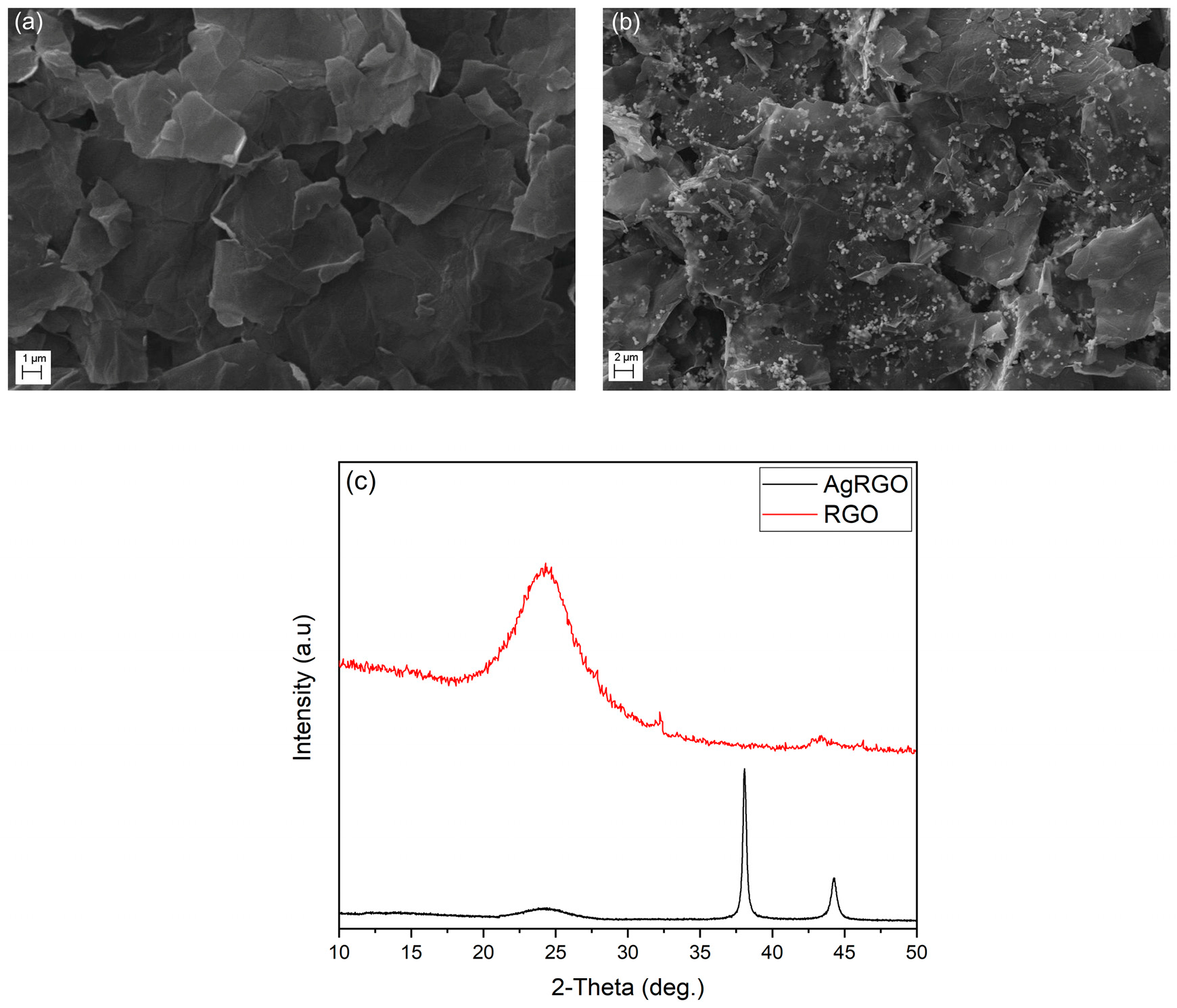
Figure 2a,b gives the SEM morphologies of RGO and AgRGO powders, respectively. A typical feature of RGO is its layered structure with curled edges and slight wrinkling of the surface, as shown in Figure 2a. Figure 2b shows the SEM microstructure resulting from the simultaneous reduction in graphene oxide and the precipitated Ag nanoparticles onto the RGO layers. The sizes of the Ag particles precipitated on the RGO range from 40 nm to 110 nm. AgRGO and RGO particles were used as filler materials in the coating of carbon fiber layers. Figure 2c shows the XRD patterns of RGO and AgRGO (with a ratio of 5 w/w) powders. In all XRD patterns, RGO (002) crystalline plane of the hexagonal structure is characterized by a broad signal located at 2θ = 25.5°. The diffraction peaks located at 38.09°, 44.3° can be indexed to the (111), and (200) crystal planes of Ag, respectively. The results from these Miller indices are consistent with the standard card of the face-centered cubic (FCC) structure of AgNPs (JCPDS no. 04-0783) [27], indicating the formation of metallic Ag on RGO support.

3.2. Microstructural Examination of Composites

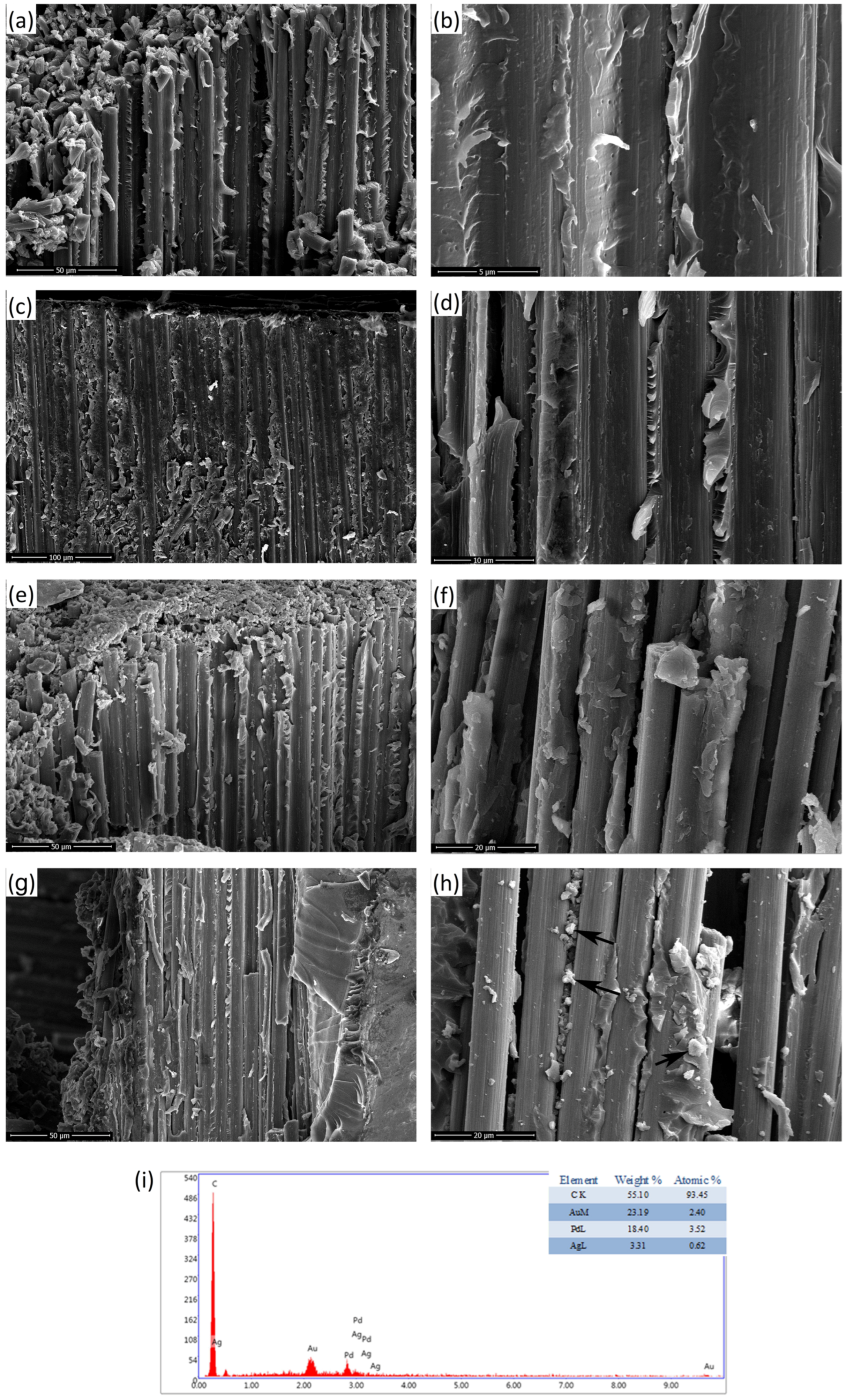
To undertake a microstructural examination of the presence of RGO and AgRGO fillers, as well as the interfaces between the fibers and the matrix in the composite laminates, the CF composites were deliberately peeled off and observed using SEM micrographs presented in Figure 3. The SEM micrographs of the neat samples at low and high magnification are shown in Figure 3a,b, respectively. Figure 3a shows that the fiber-matrix interfaces are generally covered with epoxy matrix, except for some voids caused by fiber breakage. However, it should be noted that the resulting gap at the interface was caused by fiber breakage when the top layer was removed with tweezers for examination of the composite interfaces. In the detailed microstructure analysis shown in Figure 3b, numerous porosities originating from air bubbles trapped in the epoxy during vacuum infusion are observed within the epoxy matrix. Figure 3c,d show the low and high-magnification SEM micrographs of RGO-coated CF composites, respectively. The low-magnification micrograph of RGO/CF composites clearly shows well-bonded carbon fibers. Furthermore, the presence of RGO appears to roughen the exfoliated surface of the RGO/CF composite. The SEM micrograph at high magnification of carbon fiber composites coated with 0.075 wt.% RGO shows the presence and distribution of RGO particles on the fiber surfaces. The high-magnification SEM micrograph (Figure 3d) also shows the presence of mechanical interlocks resulting from the interaction of RGO layers on the CF surfaces with epoxy [28]. The continuous formation of networks by the RGO particles on the surfaces of the fibers within each layer of the carbon fiber composite contributes to its electrical and mechanical properties, resulting from the bonding between the fibers. This micrograph, taken from peeled CF surfaces, reveals some areas where the fiber-matrix interfaces have separated. Unlike the structural image of the 0.075 RGO carbon fiber composite, Figure 3e shows that the composite containing 0.26 wt.% AgRGO exhibits bright grey AgRGOs distributed on the fiber surfaces and at the fiber-matrix interfaces. At these interfaces, the interaction between AgRGOs (with an Ag/RGO weight ratio of 2.5) and the epoxy resin results in the formation of mechanically interlocking regions towards the fiber surfaces. Figure 3f, shown at high magnification, clearly illustrates the AgRGO particles dispersed on the carbon fiber surfaces. For the 0.45AgRGO carbon fiber composite, where the Ag/RGO ratio is 5 w/w, the AgRGO particles are also dispersed on the surfaces and interfaces; however, matrix fracture at the fiber interfaces is noticeable (Figure 3g). Figure 3h shows a high magnification SEM micrograph of the 0.45 AgRGO-coated carbon fiber composite, revealing the presence of AgRGO dispersed at the fiber-matrix interfaces (indicated by the arrows). This suggests that AgRGO particles are less beneficial than RGO particles for interface bonding. The corresponding EDX spectrum taken from the overall micrographs of 0.45AgRGO/CF composites is shown in Figure 3i, confirming the presence of silver particles (light gray regions with 3.31 wt.%) in carbon fiber composites. Furthermore, Figure 3h shows that AgRGOs accumulate in some areas near the interfaces. The accumulation of AgRGO was subjected to a three-point bending test, and SEM micrographs taken from the fracture surfaces of 0.45 AgRGO carbon fiber (CF) composites were examined in detail in the later sections of the article. While the presence and interaction of Ag particles in regions where they cluster is likely to increase electrical conductivity, their brittle properties may affect the thermo-mechanical properties of the composite.
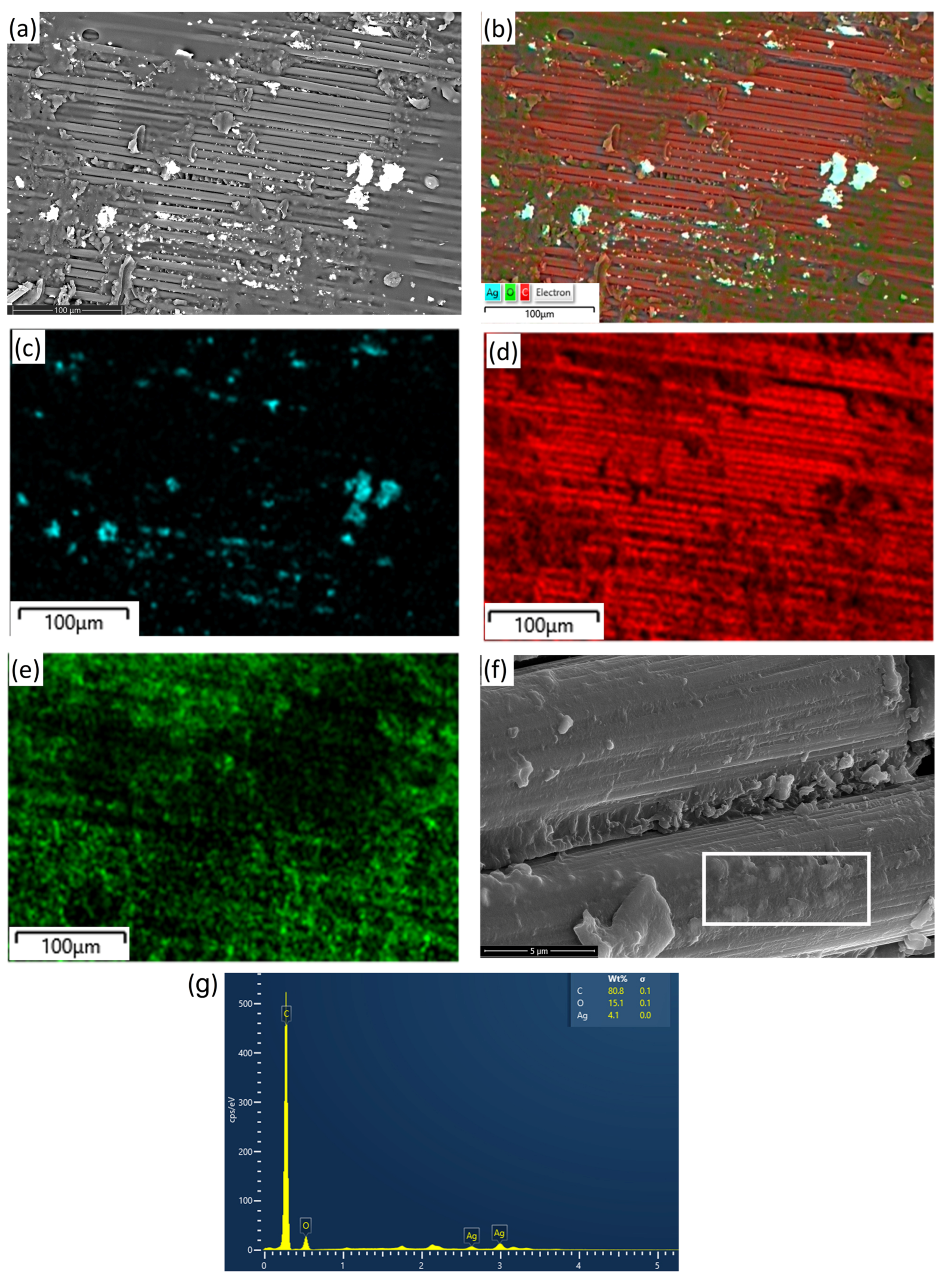
Energy dispersive X-ray (EDX) Elemental mapping was performed on a 0.45AgRGO composite sample to examine the distribution of AgRGO fillers on carbon fibers. The full area of the SEM image depicted in Figure 4a was investigated for distributions of Ag, C and O see Figure 4c–e; a superimposed phase distribution map is shown in Figure 4b. EDX mapping data for elemental analysis indicates that silver (Ag) is distributed across the CF surfaces and interfaces. Some agglomerated AgRGO particles are also present on the CF surfaces. Elemental mapping from the 0.45AgRGO/CF composite confirms the presence of Ag/RGO clusters in certain regions, as shown in Figure 3h.
The high magnification SEM micrograph (Figure 4f) taken from the 0.45 AgRGO/CF composite shows the AgRGO particles deposited on the fibers. Furthermore, the recorded EDX spectrum from this region (enclosed by the white rectangle), as shown in Figure 4g, reveals two major peaks corresponding to Ag and C main peaks along with an oxygen peak. It should be noted that the minor peaks seen before the Ag peaks are peaks from the Au coating.

3.3. Electrical Conductivity Properties

In this study; the surface and through-the-thickness (T-T-T) electrical conductivity values of CFRPs coated with RGO; AgRGO with different Ag/RGO ratios (w/w); and neat carbon fiber composites were measured and are given in Table 1. As can be seen clearly in Table 1; the T-T-T and surface electrical conductivity of the samples increase as the Ag nanoparticle content in the AgRGO/CFRP composite samples increases. The highest T-T-T and surface conductivity values were found to be obtained for the 0.45 AgRGO composite. The T-T-T and surface conductivities of CFRP improved 138 and 143 times, respectively; compared with those of the neat sample; with Ag/RGO at a weight ratio of 5 in the CFRPs. Furthermore; the T-T-T and surface conductivities of CFRP composites containing only RGO increased by almost the same extent with the addition of Ag nanoparticles as in the neat composite. Table 1 also shows that the surface and T-T-T electrical conductivities of CFRP composites with similar additives in the literature are comparable to the present results [6,19,20]. However; it should be noted that the electrical conductivity of composites can vary depending on numerous parameters; such as the quality of the filler material; the filler ratio; the method of application to the carbon fiber; the compatibility of the epoxy matrix and carbon fibers; the production conditions of the composites (curing, etc.), and the type and orientation of the carbon fibers used.

3.4. Flexural Properties

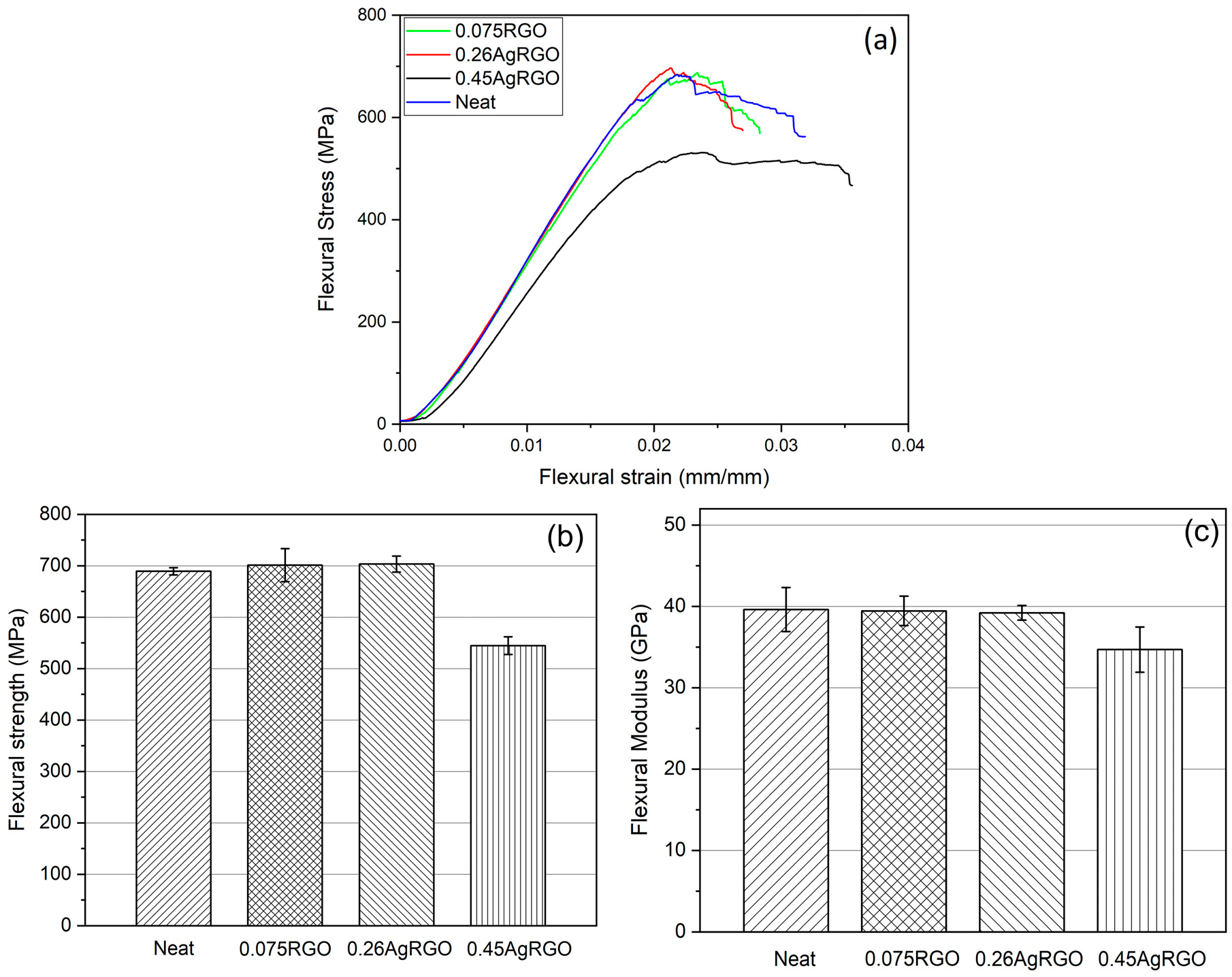
Figure 5 shows the flexural stress–strain, flexural strength, and modulus of neat carbon fiber, RGO, and AgRGO-containing carbon fiber composites. The flexural stress–strain curves of the neat and 0.075RGO, 0.26AgRGO and 0.45AgRGO composites are presented in Figure 5a. According to the stress–strain response curve of the composites (Figure 5a), the flexural stress linearly increased with strain at the beginning of the tests for all samples. The curve of the 0.26 AgRGO composite exhibited a slightly higher slope prior to catastrophic failure in comparison with the curve of the neat composite. Moreover, the 0.45 AgRGO composite exhibits the lowest stress level. Figure 5b shows the flexural strength curves of the neat and composite samples. The flexural strength of the composites increased slightly from 689 MPa for neat composite to 701 MPa and 703 MPa with the addition of 0.075 RGO and 0.26 AgRGO composites, respectively.
In contrast, increasing the Ag/RGO ratio in the carbon fiber coating from 2.5 to 5 w/w results in an approximately 22% decrease in flexural strength compared to the neat composite, reaching a value of 545 MPa in 0.45AgRGO-containing carbon fiber composites. Similarly, the research carried out by Kandera et al. revealed that the bending strength values of the CF composite comprising 1% GNP dropped from 679 MPa to 586 MPa following the incorporation of 0.5 wt.% Ag [1]. The dramatic decrease in the flexural strength and stress of composites containing 0.45 AgRGO is most likely due to the brittleness of the silver nanoparticles. As can be seen, the bending modulus remains almost the same level for the neat, 0.075 RGO-, and 0.26 AgRGO-carbon fibre composites (39.61–39.21 GPa), while the 0.45 AgRGO-composite experiences a 12.5% decrease to 34.7 GPa. The flexural modulus and strength results are tabulated in Table 2. Considering the average values of the neat and 0.075 RGO composites (Table 2) reveals that the flexural modulus of the 0.075 RGO composite does not differ significantly from that of the neat composite. The flexural modulus value of the 0.25AgRGO composite decreased with only 1% change, from 39.6 to 39.2, whereas the flexural modulus value of the 0.45 AgRGO composite showed a 12% decrease compared to the neat composite. This finding indicates that the 0.45 AgRGO composite has the highest strain to failure (2.53% in Table 2) with a decreasing stiffness value. Although the 0.45 AgRGO sample shows the highest fracture strain, its bending strength is significantly reduced. This can be explained by considering pseudo-toughness behavior of the composite samples. The pseudo-toughness values of composite materials are determined by dividing the total energy in the load–displacement curve by the area of the composite after it has broken. The cross-sectional area was calculated by multiplying the thickness and width of the sample used in the bending test. Note that the thickness of all samples was 1.8 mm, and their width was 12.5 mm. The pseudo-toughness values of the neat, 0.075 RGO, 0.26 AgRGO, and 0.45 AgRGO composite samples were found to be 22,424, 20,936, 19,888, and 23,095 J/m2, respectively. The pseudo-toughness value of the 0.45 AgRGO composite sample is the highest compared to the other composites. This behavior indicates that damage initiates at much lower stress levels, consistent with weakened fiber-matrix interfaces. Once debonding occurs, extensive interfacial sliding allows for significant deflections, which explains the increased fracture strain. However, since the load-bearing efficiency is compromised, the maximum flexural stress and strength are substantially reduced.
As shown in Table 1, while a significant decrease in flexural strength is observed in the 0.46 AgRGO composite, a substantial increase (more than 100 times) in electrical conductivity values is noted. Similar results were observed in our previous study between the electrical conductivity and flexural strength of CFRP composites containing 1.25GNP [6]. The bending strength is affected by the insufficient dispersion of filler materials, such as AgRGO and RGO added to the carbon fiber composites. However, this does not appear to have a significant effect on electrical conductivity. This can be explained as follows: even if there are areas of the filler materials that are not saturated with epoxy, the conductive filler particles promote charge transfer by contacting each other along the surface or along the thickness of the carbon fibers, resulting in high electrical conductivity [6]. Furthermore, the clustered areas create much lower-resistance, near-continuous metallic pathways that dominate the composite’s conductivity. These locally metal-rich pathways short-circuit the higher-resistance matrix and fiber regions, enabling a small portion of the clustered AgRGO to significantly increase in T-T-T and surface conductivity. Moreover, SEM micrographs given in Figure 3g,h and EDX mapping results (Figure 4) show that AgRGO clusters in the 0.45 AgRGO composite are also dispersed in resin-rich regions. This study shows that the clusters formed by the filler material with an Ag/RGO ratio of 5 w/w in the composite can create areas rich in resin or prone to void formation, or they can act as stress concentrators, or forming local hard inclusions that cause cracks under bending. Furthermore, Kandera et al. have argued that incorporating silver nanoparticles into CFRPs causes galvanic corrosion due to differences in electrical potentials, which negatively affects the structural properties of CFRPs [1].
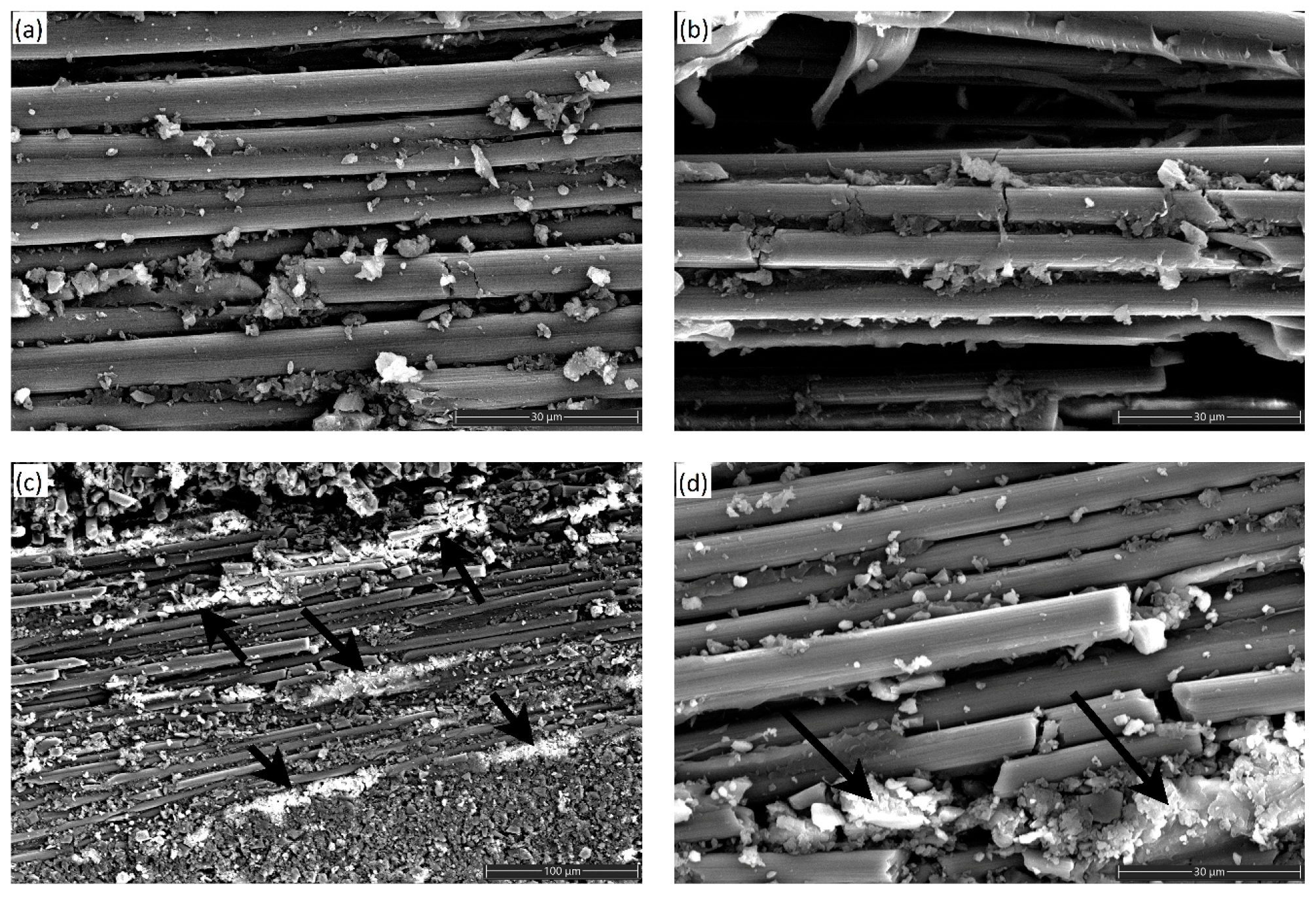
Microstructural analyses of the samples were performed using FESEM (FEI company, Eindhoven, Holland) examination following flexural testing, in order to evaluate both the adhesion of carbon fibers (CFs) in the epoxy matrix, and the distribution of RGO and AgRGO nanoparticles. Figure 6 shows micrographs of the 0.075 RGO, 0.26 AgRGO, and 0.45 AgRGO composite specimens after the bending test. Figure 6a shows a fracture surface taken from the 0.075 RGO composite, revealing fiber cracks and matrix-fiber interface separation in some areas. Regions where RGO nanoparticles have bonded to the fiber surface are also visible. In the microstructure of composite samples containing 0.26AgRGO, fiber breakage is observed to be more intense compared to the 0.075 RGO composite. The presence of AgRGO in the fiber surfaces and interfaces is evident from the light gray areas. Additionally, there are regions where the residual epoxy matrix has settled on the fiber surfaces, and regions where the fibers have delaminated. The low-magnification SEM micrograph of the 0.45 AgRGO composite (Figure 6c) shows AgRGO-rich clustered regions distributed on the carbon fiber surface and interfaces. It is also observed that the presence of AgRGO-rich clusters at interlaminar areas can contribute to interface weakening. This conforms by the pseudo-toughness value of the 0.45 AgRGO composite sample. These regions are indicated by black arrows on the fracture surface. In the detailed SEM micrograph in Figure 6d, the presence of light gray AgRGO particles is clearly visible, the dominant fracture mechanism occurs in the form of fiber breakage as well as interface weakening.
Figure 6. SEM micrographs of fractured samples after being subjected to 3-point bending tests (a) 0.075 RGO, (b) 0.26 AgRGO, and (c,d) 0.45 AgRGO composite samples (black arrows show the AgRGO-rich areas).
Coatings 15 01404 g006

3.5. Dynamic Mechanical Analysis

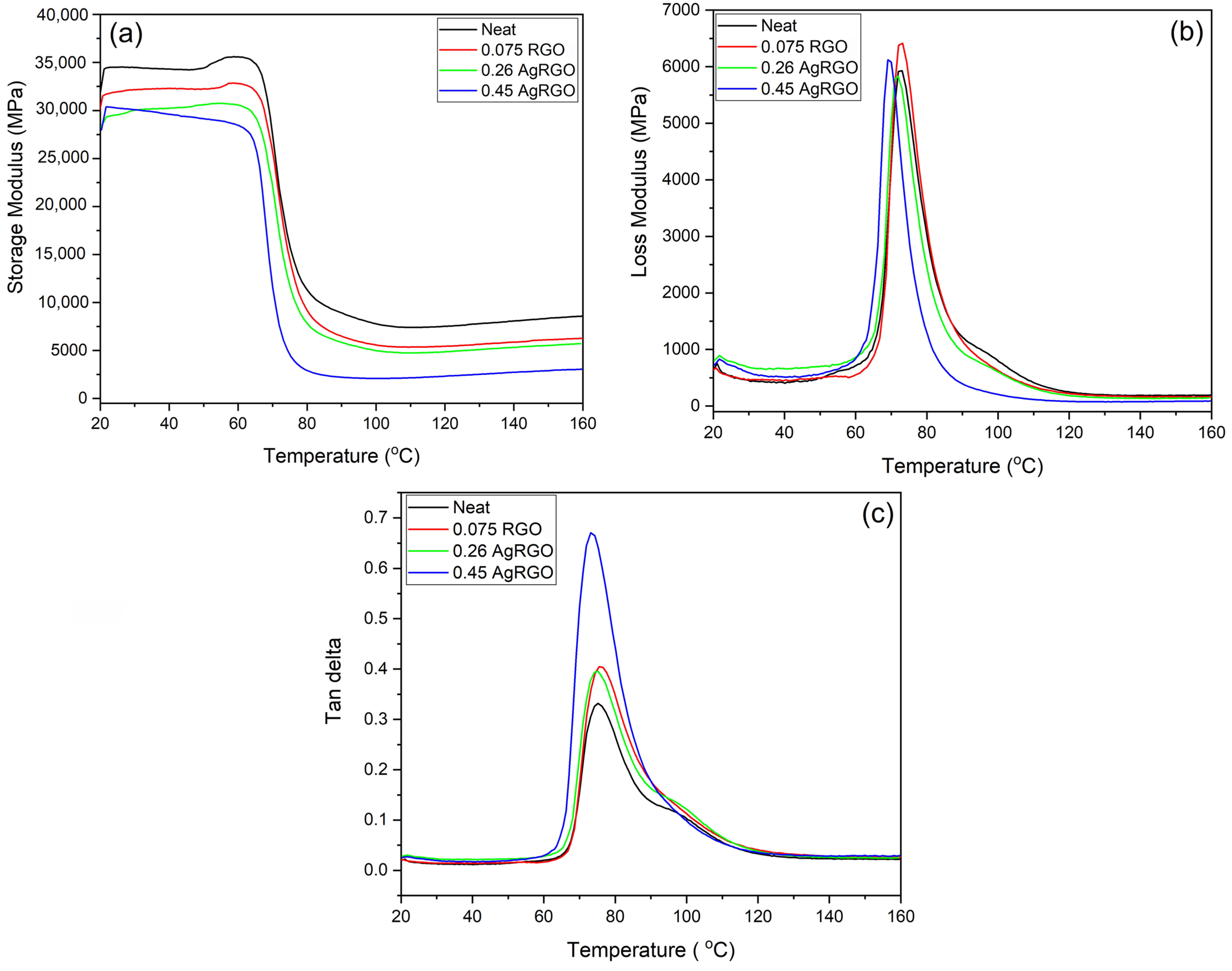
The effect of RGO and AgRGO content on the stiffness and damping properties of CFRP composites was evaluated by dynamic mechanical analysis under a three-point bending configuration. The storage modulus (E′) and loss modulus (E″), as well as the tangent delta (δ), obtained from dynamic mechanical analysis, are given in Figure 7. Figure 7a illustrates the change in storage modulus, which indicates the elastic response of the material proportional to the energy stored per cycle, as a function of temperature. The addition of RGO and AgRGO fillers results in a significant decrease in the stiffness of the composites in the glassy, viscoelastic, and rubbery regions of the storage modulus graph compared to neat composites. The storage modulus of the 0.075 RGO and 0.26 AgRGO composite samples approaches that of neat composite in the viscoelastic region (60–80 °C), while the addition of 0.45 AgRGO results in a sharp decrease in stiffness from the glassy region to the viscoelastic region. This behaviour may be due to insufficient interaction between the RGO and AgRGO fillers coated on the carbon fibers in the epoxy matrix, resulting in decreased stress transfer efficiency. This affects the bending strength of the 0.45 AgRGO composite sample (Table 2). In this study, RGO and AgRGO powders were coated onto carbon fiber mats using a spraying method, unlike hybrid carbon fiber composites in the literature, which are made by directly mixing them into epoxy and performing vacuum infusion [9,10,11]. Therefore, the additives could not contribute to restricting the movement of epoxy resin molecules, resulting in a decrease in the storage modulus of the RGO and AgRGO-coated samples. The effect of RGO and AgRGO filler coated on CF/epoxy composites in the storage module is explained by the filler efficiency coefficient “C” calculated using the following formula [29], taking into account the transition from the glassy region to the rubbery region in the storage module graph (Figure 7):
C = E g E r f i l l e d E g E r n e a t
where E g and E r represent the storage modulus in the glassy and the rubbery region, respectively. The filler efficiency coefficient was calculated using the storage modulus values of E g and E r at 62 °C and 77 °C. The smaller the effectiveness coefficient of the filler material in composites, the better the performance of the filler material in composites. In this study, the coefficient C was found to be 1.19, 1.42, and 3.02 for 0.075 RGO, 0.26 AgRGO, and 0.45 AgRGO composite samples, respectively. While the 0.075 RGO/CF composite has the lowest coefficient C value, the 0.26 AgRGO/CF composite from the AgRGO-containing composites has a low coefficient C value, indicating that RGO is a more effective filler material than AgRGO and that the effectiveness decreases as the amount of AgRGO addition increases during the transition from glassy region to rubbery region.
Loss modulus is a measure of the energy that is lost as heat during a cycle of sinusoidal waves due to deformation. This represents the viscous response of the matrix polymer. The loss factor is overly sensitive to molecular motions, which are affected by the inclusion of fillers in composites. Figure 7b shows the effect of filler-coating on the loss modulus of carbon fiber composites at temperatures ranging from 20 °C to 160 °C. The loss modulus value at the peak point of 0.075RGO carbon fiber composites, shown in Figure 7b, increased from 5947 MPa to 6391 MPa compared to the neat composite. As observed in our previous study of carbon fiber composites containing 0.05 GNP-added epoxy resin [20], the addition of a small amount of reduced graphene oxide (RGO) increased the loss modulus around the glass transition temperature. This increase in the loss modulus is due to the increase in internal friction. In our RGO-coated CF/epoxy composite materials, the increase in loss modulus observed around the glass transition is likely due to enhanced interfacial and nanoscale energy dissipation mechanisms. The RGO layer on the fiber surface enables interlayer sliding within the graphene layers, as well as micro-scale sliding or adhesion-sliding behavior at the fiber-RGO-matrix interface. Both of these convert mechanical deformation into frictional heat, i.e., internal friction. This, in turn, leads to increased energy loss [29]. Additionally, the Tg value of 0.075 RGO composite, corresponding to the loss modulus, remains almost the same at 72.64 °C for the neat composite. However, the loss modulus of the 0.45 AgRGO composite increases to 6118 MPa, but the glass transition temperature (Tg) is reduced to 71.56 °C compared to the neat composite. The 0.26 AgRGO composite sample exhibited the lowest loss modulus, with a value of 5826 MPa, at the Tg temperature of 71.56 °C.
The glass transition temperature (Tg) of carbon fiber composites is determined by the highest point of tan δ. Tan δ is obtained by dividing the loss modulus by the storage modulus and represents the energy dissipation potential of the composites during 3-point bending deformation. The Tg value of the neat composite is 75.33 °C, but adding 0.26 AgRGO and 0.45 AgRGO causes a decrease in the glass transition temperature to 74.9 °C and 73.77 °C, respectively. However, the Tg curve of the 0.075 RGO composite shifted slightly to the right and increased by 1.3% to 76.32 °C compared to the neat composite. As shown in Figure 7c, the tan δ—temperature curve indicates that coating carbon fibers with RGO and AgRGO increases tan δ. The measured tan δ peak value for the neat composite increased by 21% for the 0.075RGO composite, while the Tg of the 0.26 AgRGO sample fluctuates around the Tg value of the neat composite. The 0.45 AgRGO composite exhibits the highest tan δ value (0.66) with a 100% increase compared to that of the neat one (0.33). The variation in tan δ values of the composites with respect to temperature is related to the characteristics of the interfaces between the fibers and the matrix in a composite material [6], as well as nanoparticle agglomeration with an increase in the filler content, which leads to higher molecular mobility [20,29]. The decrease in Tg or increase in tan δ should be primarily due to the respective reduction in polymer molecular mobility.
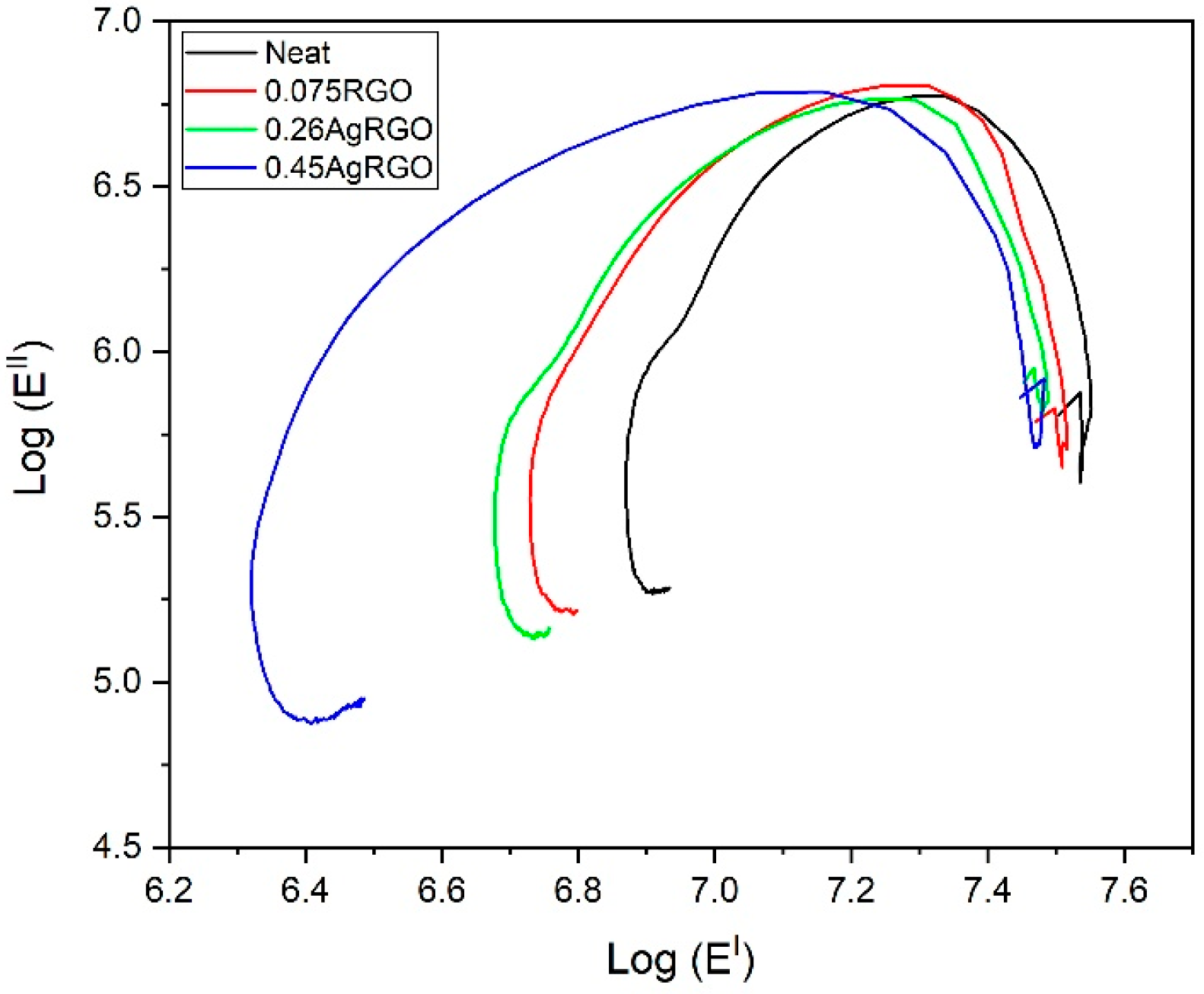
The Cole-Cole graph (Figure 8) was used to analyze the distribution of the RGO and AgRGO coating materials within the carbon fiber composite, as well as the homogeneity of the composite system, by plotting the loss modulus (E″) and storage modulus (E′) on a logarithmic scale. The shapes of the curves in the Cole-Cole graph can be used to determine whether the system is homogeneous or heterogeneous. In other words, a homogeneous system with good epoxy-CF adhesion exhibits semicircular, smooth curves, while a defective or irregular shape represents a two-phase heterogeneous system [30]. As can be seen from the Cole-Cole curves, the RGO and AgRGO-coated CF composites are generally semi-circular in shape. The deviation from symmetry and broadening of this curve might be attributed to either the aggregation or the inadequate dispersion of the 0.45 AgRGO coating filler on the carbon fiber. The micrograph of the 0.45 AgRGO/CF sample shown in Figure 3h and Figure 4 also confirms this situation, as AgRGO filler material has gathered in some areas of the carbon fibers. Similar situations were reported in our previous work with Cole-Cole curves when the amount of GNP increased from 0.25 wt.% to 1.25 wt.% [20], and unmodified RGO [6] was introduced to the epoxy resin.

3.6. Dielectric Properties and EMI Shielding Efficiency

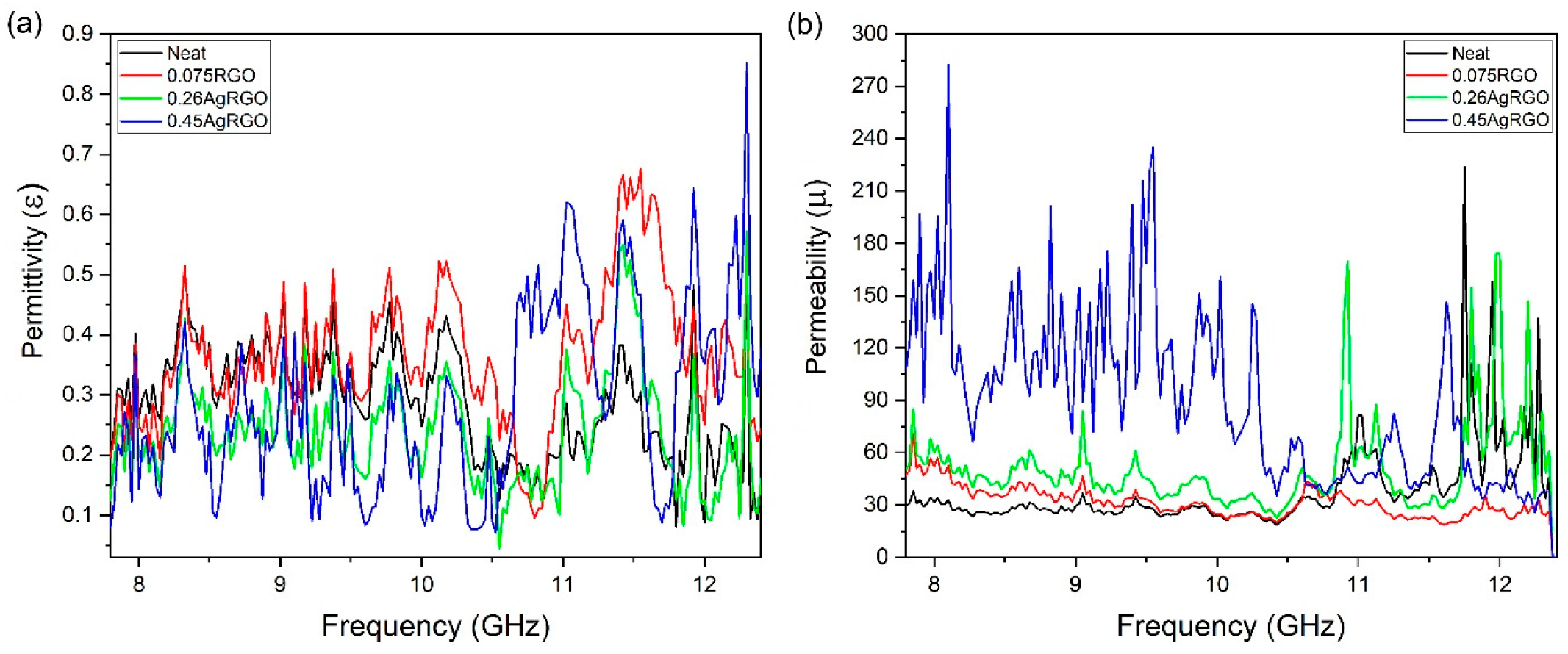
As illustrated in Figure 9, the complex permittivity and permeability properties of carbon fiber composites reinforced with RGO/AgRGO at different Ag/RGO weight ratios show considerable variation in the dielectric permittivity (ε) and magnetic permeability (μ) components over the 8–12 GHz frequency range.
As seen from Figure 9, the dielectric permittivity and magnetic permeability values of all composites exhibited a nearly frequency-dependent behavior. It is noted that the 0.075 RGO composite exhibits relatively good permittivity values compared to other composites within the 8–10.5 GHz frequency range. However, the 0.45 AgRGO composite sample is observed to have superior permittivity values within the 10.5–12 GHz range. The 0.45 AgRGO sample’s good permittivity values at high frequencies indicate its good electrical polarization capacity. The 0.45 AgRGO composite sample reached a maximum εr value of 0.86 at a frequency of 12.3 GHz. This result is confirmed by the T-T-T and surface electrical conductivity values in Table 1. From the permeability graph, it can be seen that the 0.45 AgRGO composite exhibits significantly higher magnetic permeability than other composites in the 7.8–10.6 GHz frequency range and reaches its maximum value at a frequency of 8.1 GHz. Up to the specified frequency, the neat, 0.26 AgRGO, and 0.075 RGO composites exhibit stable magnetic permeability values ranging from μr = 20 to μr = 86. The magnetic permeability values are ranked as follows: 0.26 AgRGO > 0.075 RGO > neat. Beyond the 7.8–10.6 GHz frequency range, the 0.26 AgRGO composite exhibits variable magnetic permeability depending on the frequency; the maximum permeability value is μr = 179 at 12GHz.
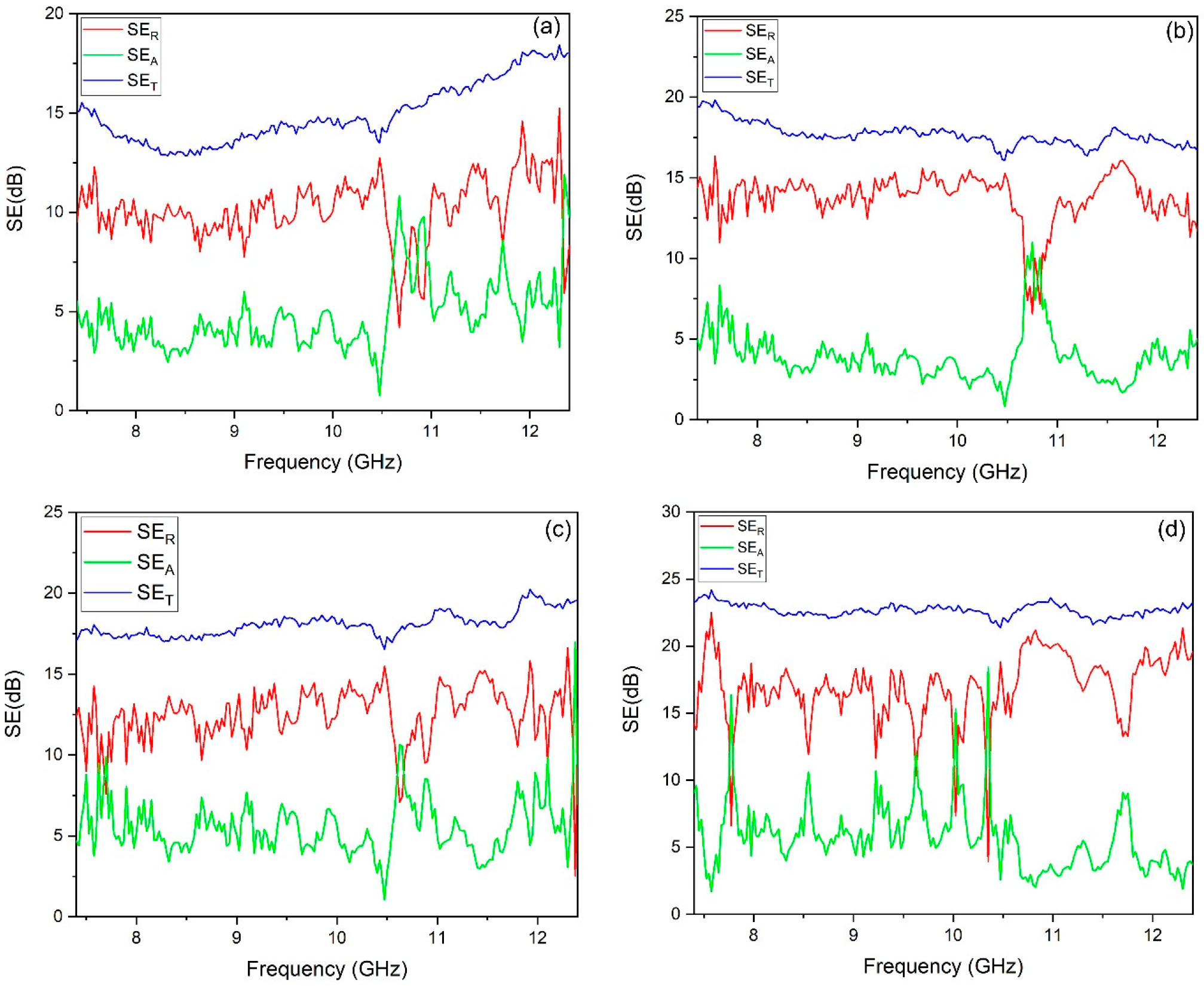
The absorption (SEA), reflection (SER), and total shielding efficiency (SET) of neat, RGO, and AgRGO containing carbon fiber composites are presented in Figure 10 in the frequency range of 8.2–12.4 GHz (X-band). As Figure 10 illustrates, all composites display reflection-dominant characteristics, as evidenced by the variation in SEA, SER values according to frequency. In the 0.075 RGO composite, the average SER value increased to 13.76 dB, contributing to the total shielding efficiency with a value of 17.67 dB. The average SER value of 0.26 AgRGO composite increased by 67%, rising from 10.16 dB to 16.96 dB compared to the neat composite. In addition, the 0.45AgRGO composite increased the average SET value of the neat composite by 52%, reaching the highest average SET value of 22.68 dB. The higher Ag content of the 0.45AgRGO composite, compared with that of the 0.26 AgRGO composite, increases reflection shielding efficiency and contributes to overall EMI shielding efficiency.
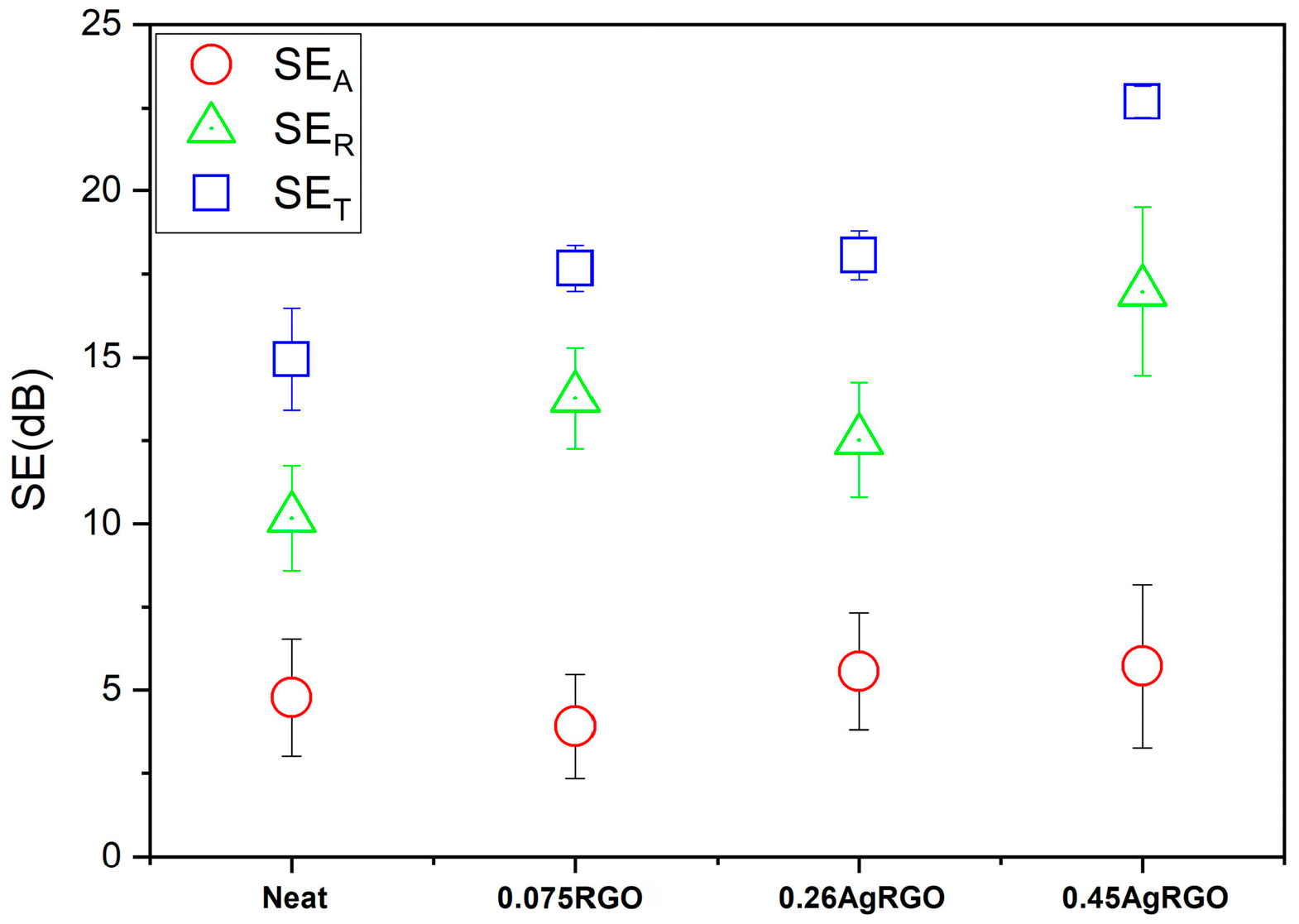
Figure 11 illustrates the mean absorption (SEA), reflection (SER), and total shielding efficiency (SET) values calculated from Equations (8)–(10), for neat, RGO/AgRGO-containing carbon fiber composites. The neat composite, in the absence of fillers, contributes to reflection efficiency with an average SER value of 10.16 dB, attributable to the presence of carbon fibers. The average SEA value in this composite is 4.7 dB, with an average SET value of 14.93 dB. The 0.26 AgRGO composite with a 2.5 w/w Ag/RGO ratio achieved an average total shielding efficiency of 18.06 dB, contributing more to absorption efficiency than the composite containing 0.075 RGO. Among the composites, the maximum SET value of 22.68 dB was achieved in the composite containing AgRGO filler with an Ag/RGO weight ratio of 5.

4. Conclusions

In this contribution, epoxy matrix composites reinforced with spray-coated carbon fibre laminates containing RGO (0.075 w/w%) and AgRGO nanoparticles (0.26 w/w% and 0.45 w/w%) were fabricated using a vacuum infusion method. The impacts of RGO and AgRGO nanoparticles (with the Ag/RGO weight ratios of 2.5 and 5) on the flexural strength, thermomechanical properties, electrical conductivity, dielectric, and electromagnetic interference (EMI)-shielding properties of the neat carbon fiber composites were investigated. A slight increase in flexural strength was observed with the addition of up to 0.26 w/w% of AgRGO, while the addition of 0.45 w/w% of AgRGO resulted in a 21% decrease in flexural strength compared to the neat composite. The addition of RGO/AgRGO individually to carbon fiber composites was found to decrease the storage modulus during thermomechanical testing in three-point bending mode. It was concluded that AgRGO is more effective than RGO at reducing stiffness values during the transition from the glassy phase to the rubbery phase. This result was also confirmed by the findings obtained from the filler efficiency constant. The decrease in the thermomechanical and flexural stiffness values of 0.45 AgRGO composites can be explained by the nature of the AgRGO additive and its accumulation on the fiber surfaces and interfacial regions, as observed in electron microscope examinations of the composites. The EMI shielding measurements demonstrate the synergistic effect of conductive CFs and AgRGO nanoparticles in enhancing the shielding efficiency of epoxy-based composites across the X-band frequency range (8–12 GHz). The highest EMI SE of about 22.68 dB in X-band frequency range has been obtained in AgRGO (with an Ag/RGO ratio of 5:1) coated carbon fiber composites, as well as the highest surface and through-the-thickness conductivity values are measured. The conductivity is increased by the formation of a network between the fibers and the RGO-added epoxy matrix, due to the presence of highly conductive silver nanoparticles. This work contributes to ongoing efforts to improve the electrical conductivity of CFRP composites, which play an important role in electromagnetic interference (EMI) shielding, de-icing applications, and aircraft lightning protection performance, using nano-additives such as AgRGO and RGO. Thanks to their reflective properties and achieved shielding efficiency of 22.68 dB, carbon fiber composites containing AgRGO may be suitable for use in areas such as satellite connections, radar antennas, medical devices, smartphones, and electronic applications in electric vehicles.

Funding

This work was supported financially by the Scientific Research Project Council Unit (FUBAP) of Firat University (funding number SHY 25.11).

Institutional Review Board Statement

Not applicable.

Informed Consent Statement

Not applicable.

Data Availability Statement

The data presented in this study are available on request from the corresponding author. The data are not publicly available due to privacy.

Acknowledgments

The author acknowledges S. Helhel, A. Odabaşı and M. Özdemir for helping experiments.

Conflicts of Interest

The author declares no conflicts of interest.

References

  1. Everson, K.; Akbar, A.K.; Sanghyun, Y.; Ruoyu, W.; Jun, M.; Philippe, O.; Nathalie, G.; Chun, H.W. Improving the through-thickness thermal and electrical conductivity of carbon fibre/epoxy laminates by exploiting synergy between graphene and silver nano-inclusions. Compos. A Appl. Sci. Manuf. 2015, 69, 72–82. [Google Scholar]
  2. Botelho, E.C.; Silva, R.A.; Pardini, L.C.; Rezende, M.C. A review on the development and properties of continuous fiber/epoxy/aluminum hybrid composites for aircraft structures. Mater. Res. 2006, 9, 247–256. [Google Scholar] [CrossRef]
  3. Argon, A.; Cohen, R. Toughenability of polymers. Polymer 2003, 44, 6013–6032. [Google Scholar] [CrossRef]
  4. Soutis, C. Fibre reinforced composites in aircraft construction. Prog. Aerosp. Sci. 2005, 41, 143–151. [Google Scholar] [CrossRef]
  5. Kostagiannakopoulou, C.; Loutas, T.H.; Sotiriadis, G.; Markou, A.; Kostopoulos, V. On the interlaminar fracture toughness of carbon fiber composites enhanced with graphene nano-species. Compos. Sci. Technol. 2015, 118, 217–225. [Google Scholar] [CrossRef]
  6. Kaftelen—Odabaşı, H.; Odabaşı, A.; Özdemir, M.; Baydoğan, M. A study on graphene reinforced carbon fiber epoxy composites: Investigation of electrical, flexural, and dynamic mechanical properties. Polym. Compos. 2023, 44, 121–135. [Google Scholar] [CrossRef]
  7. Kaftelen-Odabaşı, H.; Ruiz-Perez, F.; Odabaşı, A.; Helhel, S.; López-Estrada, S.M.; Caballero-Briones, F. EMI-shielding response of GO/Fe3O4/polypyrrole(PPy)/thermoplastic polyurethane (TPU) composites. Eng. Sci. Technol. Int. J. 2024, 55, 101753. [Google Scholar] [CrossRef]
  8. Kulkarni, H.B.; Tambe, P.; Joshi, G.M. Influence of covalent and non-covalent modification of graphene on the mechanical, thermal, and electrical properties of epoxy/graphene nanocomposites: A review. Compos. Interfaces 2018, 25, 381–414. [Google Scholar] [CrossRef]
  9. Tschoppe, K.; Beckert, F.; Beckert, M.; Mülhaupt, R. Thermally reduced graphite oxide and mechanochemically functionalized graphene as functional fillers for epoxy nanocomposites. Macromol. Mater. Eng. 2015, 300, 140–152. [Google Scholar] [CrossRef]
  10. Chen, Y.; Li, D.; Yang, W.; Xiao, C.; Wei, M. Effects of different amine-functionalized graphene on the mechanical, thermal, and tribological properties of polyimide nanocomposites synthesized by in situ polymerization. Polymer 2018, 140, 56–72. [Google Scholar] [CrossRef]
  11. Soyugüzel, T.; Mecitoğlu, Z.; Kaftelen-Odabaşı, H. Experimental and numerical investigation on the mode I and mode II interlaminar fracture toughness of nitrogen-doped reduced graphene oxide reinforced composites. Theor. Appl. Fract. Mech. 2023, 128, 104103. [Google Scholar] [CrossRef]
  12. Srivastava, A.K.; Gupta, V.; Yerramalli, C.S.; Singh, A. Flexural strength enhancement in carbon-fiber epoxy composites through graphene nano-platelets coating on fibers. Compos. Part B Eng. 2019, 179, 107539. [Google Scholar] [CrossRef]
  13. Li, Y.; Zhang, H.; Liu, Y.; Wang, H.; Huang, Z.; Peijs, T.; Bilotti, E. Synergistic effects of spray-coated hybrid carbon nanoparticles for enhanced electrical and thermal surface conductivity of CFRP laminates. Compos. Part A Appl. Sci. Manuf. 2018, 105, 9–18. [Google Scholar] [CrossRef]
  14. Hung, P.Y.; Lau, K.T.; Fox, B.; Hameed, N.; Lee, J.H.; Hui, D. Surface modification of carbon fibre using graphene–related materials for multifunctional composites. Compos. Part B Eng. 2018, 133, 240–257. [Google Scholar] [CrossRef]
  15. Kanar, D.E.; Kaftelen—Odabaşı, H.; İtik, M. Production and Performance Evaluation of a Novel Ionic Electroactive Polymer Actuator With Ag/RGO Electrodes. Polym. Compos. 2025, 46, 13935–13945. [Google Scholar] [CrossRef]
  16. Chakravarthi, D.K.; Khabashesku, V.N.; Vaidyanathan, R.; Blaine, J.; Yarlagadda, S.; Roseman, D.; Barrera, E.V. Carbon fiber–bismaleimide composites filled with nickel-coated single-walled carbon nanotubes for lightning-strike protection. Adv. Funct. Mater. 2011, 21, 2527–2533. [Google Scholar] [CrossRef]
  17. Hummers, W.S., Jr.; Offeman, R.E. Preparation of Graphitic Oxide. J. Am. Chem. Soc. 1958, 80, 1339. [Google Scholar] [CrossRef]
  18. Takeda, F.N.S.; Hayashi, K.; Komori, Y.; Suga, Y.; Asahara, N. Research in the application of the VaRTM technique to the fabrication of primary aircraft composite structures, Mitsubishi. Heavy Ind. Ltd. Tech. Rev. 2005, 42, 1–6. [Google Scholar]
  19. Imran, K.A.; Shivakumar, K.N. Graphene-modified carbon/epoxy nanocomposites: Electrical, thermal and mechanical properties. J. Compos. Mater. 2019, 53, 93–106. [Google Scholar] [CrossRef]
  20. Kaftelen-Odabaşı, H.; Odabaşı, A.; Caballero-Briones, F.; Arvizu-Rodriguez, L.E.; Özdemir, M.; Baydoğan, M. Effects of polyvinylpyrrolidone as a dispersant agent of reduced graphene oxide on the properties of carbon fiber-reinforced polymer composites. J. Reinf. Plast. Compos. 2023, 42, 1039–1053. [Google Scholar] [CrossRef]
  21. ASTM D790; Standard Test Methods for Flexural Properties of Unreinforced and Reinforced Plastics and Electrical Insulating Materials. ASTM: West Conshohocken, PA, USA, 1997.
  22. ASTM D4065; Standard Practice for Plastics: Dynamic Mechanical Properties: Determination and Report of Procedures. ASTM: West Conshohocken, PA, USA, 2012.
  23. Bashir, M.A. Use of dynamic mechanical analysis (DMA) for characterizing interfacial interactions in filled polymers. Solids 2021, 2, 108–120. [Google Scholar] [CrossRef]
  24. Nicolson, A.M.; Ross, G.F. Measurement of the intrinsic properties of materials by time-domain techniques. IEEE Trans. Instrum. Meas. 1970, 19, 377–382. [Google Scholar] [CrossRef]
  25. Feng, D.; Wang, Q.; Xu, D.; Liu, P. Microwave assisted sinter molding of polyetherimide/carbon nanotubes composites with segregated structure for high-performance EMI shielding applications. Compos. Sci. Technol. 2019, 182, 107753. [Google Scholar] [CrossRef]
  26. Folgueras, L.D.C.; Alves, M.A.; Rezende, M.C. Dielectric properties of microwave absorbing sheets produced with silicone and polyaniline. Mater. Res. 2010, 13, 197–201. [Google Scholar] [CrossRef]
  27. Kim, K.S.; Kim, I.J.; Park, S.J. Influence of Ag-doped graphene on electrochemical behaviors and specific capacitance of polypyrrole-based nanocomposites. Synth. Met. 2010, 160, 2355–2360. [Google Scholar] [CrossRef]
  28. Nie, H.J.; Xu, Z.; Tang, B.L.; Dang, C.Y.; Yang, Y.R.; Zeng, X.L.; Lin, B.C.; Shen, X.J. The effect of graphene oxide modified short carbon fiber on the interlaminar shear strength of carbon fiber fabric/epoxy composites. J. Mater. Sci. 2021, 56, 488–496. [Google Scholar] [CrossRef]
  29. Bagotia, N.; Sharma, D.K. Systematic study of dynamic mechanical and thermal properties of multiwalled carbon nanotube reinforced polycarbonate/ethylene methylacrylate nanocomposites. Polym. Test. 2019, 73, 425–432. [Google Scholar] [CrossRef]
  30. Madarvoni, S.; Rama, S.P.S. Dynamic mechanical behaviour of graphene, hexagonal boron nitride reinforced carbon-Kevlar, hybrid fabric-based epoxy nanocomposites. Polym. Compos. 2022, 30, 1–14. [Google Scholar] [CrossRef]
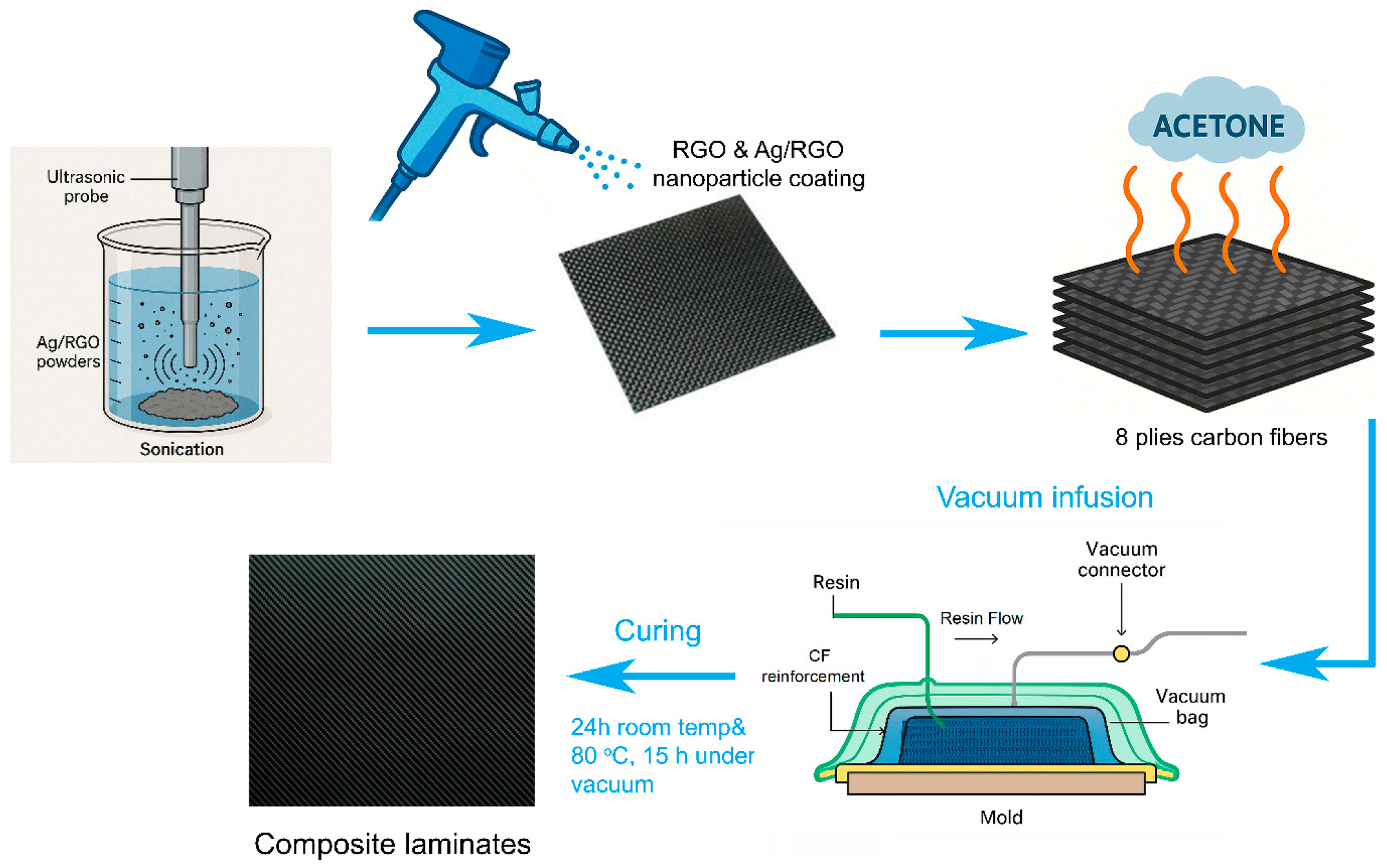
Figure 1. Schematic illustration of RGO and Ag/RGO carbon fiber/epoxy composites fabrication.
Coatings 15 01404 g001
Figure 2. SEM micrographs of (a) RGO, (b) Ag/RGO powders, and (c) XRD analyses taken from RGO and Ag/RGO powders. The Ag/RGO ratio is 5 w/w.
Coatings 15 01404 g002
Figure 3. SEM micrographs of (a,b) neat and carbon fiber composites containing (c,d) 0.075 RGO, (e,f) 0.26 AgRGO, and (g,h) 0.45 AgRGO, and (i) corresponding EDX analysis. Accumulated AgRGO particles at the CF interfaces, as indicated by black arrows in (h).
Coatings 15 01404 g003
Figure 4. (a) SEM image of 0.45 AgRGO/CF composite sample. (b) Element-distribution map showing the pixels indexed as Ag (turquoise blue), C (red), O (green) separated elemental distribution maps for Ag (c), C (d) and O (e). (f) High magnification SEM micrograph and (g) EDX analysis taken from the region indicated by the white square.
Coatings 15 01404 g004
Figure 5. (a) Flexural stress-strain curve, (b) flexural strength, (c) flexural modulus of the neat and RGO & AgRGO containing carbon fiber composites.
Coatings 15 01404 g005
Figure 7. Variation of (a) storage modulus, (b) loss modulus, and (c) tan delta for neat and RGO & AgRGO CF composites as a function of temperature.
Coatings 15 01404 g007
Figure 8. Cole-cole plot of neat, RGO and AgRGO-coated CF composites.
Coatings 15 01404 g008
Figure 9. (a) Frequency-dependent complex permittivity (ε), and (b) permeability (μ) values for carbon fiber composites.
Coatings 15 01404 g009
Figure 10. Absorption efficiency (SEA), Reflection efficiency (SER), and total shielding efficiency (SET) of (a) neat, (b) 0.075 RGO, (c) 0.26AgRGO, (d) 0.45AgRGO carbon fiber composites.
Coatings 15 01404 g010
Figure 11. Comparisons of mean SEA, SER, and SET values of the composites.
Coatings 15 01404 g011
Table 1. A detailed composition of the CF composites and DC Electrical conductivity results alongside comparisons with literature.
Sample NameRGO Content (w/w%)AgRGO Content (w/w%)Ag/RGO Ratio (in wt.)T-T-T Conductivity
(S/m) (×10−3)
Surface Conductivity
(S/m) (×10−3)
References
Neat00-1.98 ± 0.09 1.78 ± 0.17Present
0.075 RGO0.0750.07502.41 ± 0.06 2.53 ± 0.07Present
0.26 AgRGO0.0750.262.578.05 ± 0.06 72.50 ± 0.05Present
0.45 AgRGO0.0750.455273.31 ± 0.2256.07 ± 0.3Present
0.25 GNP0.25 -145134[6]
1.25 GNP1.25 -239234[6]
GNPs/CFRP1 -1.31-[19]
RGO0.15 -469218.6[20]
Table 2. The flexural strength, strain, and modulus values of the neat, RGO, and AgRGO containing CF composites.
Sample NameFlexural Strength (MPa)Flexural Strain at Maximum Load (%)Flexural Modulus (GPa)
Neat689 ± 7.12.35 ± 0.1139.6 ± 2.6
0.075 RGO701 ± 322.31 ± 0.1239.4 ± 1.8
0.26 AgRGO703 ± 152.13 ± 0.0939.2 ± 0.8
0.45 AgRGO545 ± 172.53 ± 0.0434.7 ± 2.7
Disclaimer/Publisher’s Note: The statements, opinions and data contained in all publications are solely those of the individual author(s) and contributor(s) and not of MDPI and/or the editor(s). MDPI and/or the editor(s) disclaim responsibility for any injury to people or property resulting from any ideas, methods, instructions or products referred to in the content.