1. Introduction
Every year, more than 10 million metal oxide sensors and gas-analytical devices based on them are produced all over the world. The areas of their application are quite extensive [
1]. The advantages of such adsorption semiconductor sensors are their ease of operation and low cost. The disadvantages of such sensors include low selectivity and the need to use high temperatures. The traditional way to increase the selectivity of the material is the search for the optimal microstructure of the material, dopants, and analysis temperature for each gas [
2]. Numerous studies on improving the sensory parameters of materials are aimed at optimizing the electronic properties or adsorption capacity of the material [
3]. The main oxides for gas sensors are SnO
2 and In
2O
3 [
4,
5,
6], V
2O
5 [
7] and Ga
2O
3, and perovskite structures with various impurities [
8] are also often used. Surface modification is carried out in different ways: the preparation of thin films of the In
2O
3 nanocolumn structure [
9], a porous microstructure in multilayer sensor structures SnO
2-CuO [
10] and its doping, etc.
In [
11,
12], it was shown that Ga
2O
3 oxide also can be used in high-temperature sensors. Such Ga
2O
3 thin films are sensitive to CO, NO
2 and methanol vapors [
13].
One of the easiest methods for the production of thin films on the surfaces of semiconductors is through their oxidation. However, the production of functional oxide films on the surface of gallium arsenide and an increase in their gas sensitivity for the detection of trace concentrations is accompanied by certain difficulties. These complications are caused by side processes adversely affecting both the properties of the functional layer itself and the semiconductor/oxide interface. One way to solve this problem is chemically stimulated oxidation [
14], allowing the kinetic blockage of adverse stages due to the targeted change in the routes of heterogeneous processes when certain chemostimulant compounds are introduced into the system. In [
15,
16], it was shown that layers grown under the influence of oxide chemostimulants are characterized by the reproducible temperature dependence of the resistance, thermally stable and are of practical interest for use as the sensitive elements of semiconductor gas sensors.
The method presented in this work for the synthesis of thin films on a GaAs surface simultaneously solves two urgent problems of modern materials science: the synthesis of thin films on the surface of III–V semiconductors by an economical and rapid method and the synthesis of new materials capable of acting as solid-state elements of semiconductor gas sensors.
Therefore, the goal of this study was the synthesis of thin films on the GaAs surface by chemically stimulated thermal oxidation under the action of the chemostimulator Sb2O3 + the inert component Y2O3 and the identification of selective gas-sensitive properties of such films.
2. Materials and Methods
The objects of study were GaAs wafers of AGTSCh-1 grade, (111) orientation; the concentration of carriers was 1.5 × 10¹⁸–2.5 × 1018 cm−3; resistivity was 0.010–0.018 Ohm·cm. Thin films were synthesized in a horizontal quartz reactor placed in an MTP-2M-50-500 resistive heating furnace. The operating temperature of 515 °C allowed the synthesis of layers of sufficient thickness and therefore the thermal destruction of GaAs did not occur. Temperature adjustment (±1 °C) was carried out using the TPM-10 m/controller.
The composition for chemical stimulation consisted of yttrium and antimony oxides (Y2O3 + Sb2O3), inert with respect to each other. In this combination, antimony oxide is a proper chemostimulator, providing accelerated film growth on the GaAs surface and targeted modification of film properties. Yttrium oxide does not contribute to film growth on the surface of GaAs, i.e., it is an inert component. The use of yttrium oxide allows not only the additive dependence of the film thickness on the composition to be obtained, but also the controlled content of the chemostimulator in the film, allowing control of its properties. The composition was changed from one pure oxide to another with increments of 20 mol.%.
Oxidation of the GaAs plate was performed in a horizontal quartz reactor as a cover at a distance of 10 mm from the composition (0.3000 g), placed within a furnace. The synthesis was carried at an oxygen flow rate of 30 L/h. Thermal oxidation of the samples was carried out for 40 min by postoxidation with a period of 10 min. The thickness of the resultant oxide films was determined using an LEF-754 laser ellipsometer with an absolute uncertainty of ±2 nm. The elemental and chemical composition of the films was determined by X-ray microanalysis (JEOL JSM-6510LV equipped with a Bruker energy-dispersive X-ray microanalysis system) and infrared (IR) spectroscopy (Vertex 70 spectrophotometer), respectively. The morphology of the films was investigated by atomic force microscopy (AFM) using a Solver p47-pro in contact mode. The resistivity of the oxide films was measured by the four-probe van der Pauw method using a TsIUS-4 system. Copper contacts were used in the work. The distance between the probes in the four-probe head was (1 ± 0.02) mm. The power of the heating element ranged from 0.6 to 70 W. The heating current of the stove was from 0.2 to 2.2 A, which was necessary to warm it up from 20 to 450 °C. Heating was carried out at a rate of 1 °C/мин. During the experiment, temperature control was carried out continuously. For this, a chromel-copel thermocouple was used. The voltage drop value was recorded using a digital DC voltmeter V7-21 with measurement limits from 10 mV to 10 V. When determining the specific surface resistance of thin films, the required amount of the test gas was supplied to the measuring zone of the equipment to provide the required concentration. Further measurements were carried out in stationary mode. The error in measuring the resistance was ±2%. The measurements were carried out in three modes: in air, in the presence of CO in the atmosphere (concentration of 80 ppm), and in NH3 (concentration of 80 ppm). The temperature range in all cases was 20–400 °C. We used anhydrous NH3, which was additionally dried by passing through a tube with CaCl2.
3. Results
The thickness of the films grown on the GaAs surface ranged from 170 nm to 480 nm and increased with increasing chemostimulator content (Sb
2O
3) in the original composition. The inertness of Y
2O
3 has been proven in previous works [
17]. The comparison of the thickness of the obtained films with intrinsic oxidation [
18], under the same oxidation conditions, revealed an acceleration in film growth by 3–6 times.
3.1. Film Composition and Surface Morphology
For the determination of the elemental composition of oxide films on the GaAs surface, the samples were studied by electron probe X-ray microanalysis (EPXMA). The analysis data are presented in
Table 1.
It was found that gallium, arsenic, and antimony were present in the films. Since thermal oxidation was carried out in an oxygen stream, oxygen was the deficient component of the film. The content of oxygen cannot be directly determined by this method and therefore it was calculated by assuming that oxygen made the remainder up to 100%. Moreover, based on its large content, it can be assumed that all other elements were in an oxidized state.
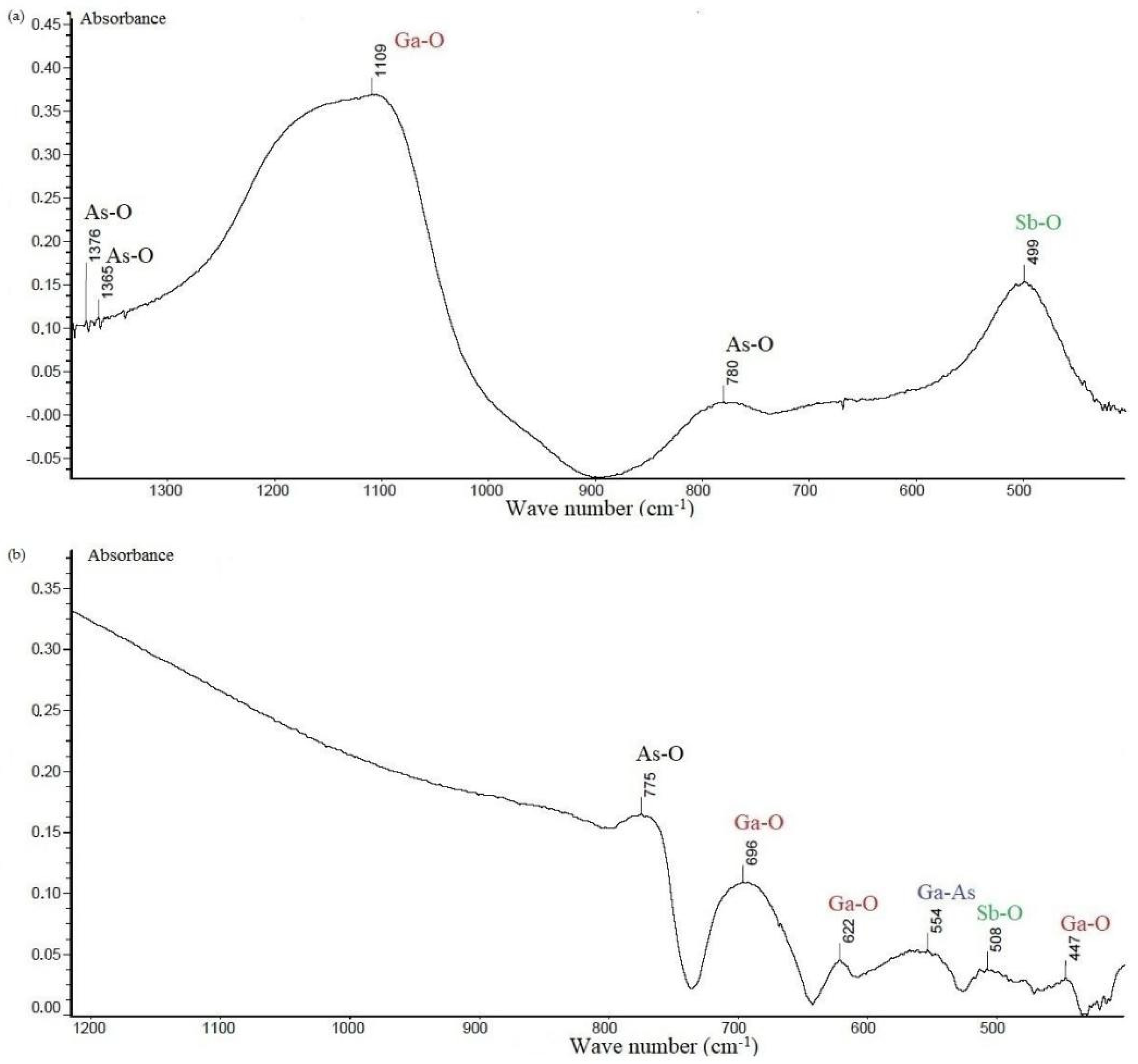
The chemical composition of the films was studied by IR spectroscopy. Two samples with the minimum (20%) and maximum (80%) content of the chemostimulator Sb
2O
3 in the composition were examined; the angle of incidence of radiation was 13°. IR absorption spectra were obtained (
Figure 1).
The data decoding based on a previous study [
19] revealed chemical bonds with the oxygen of both the components of the substrate and the used chemostimulator in the thin films on the GaAs surface. The obtained data confirmed the inertness of yttrium oxide with respect to the GaAs thermal oxidation process. The results of IR spectroscopy correlated well with the results of elemental analysis (EPXMA).
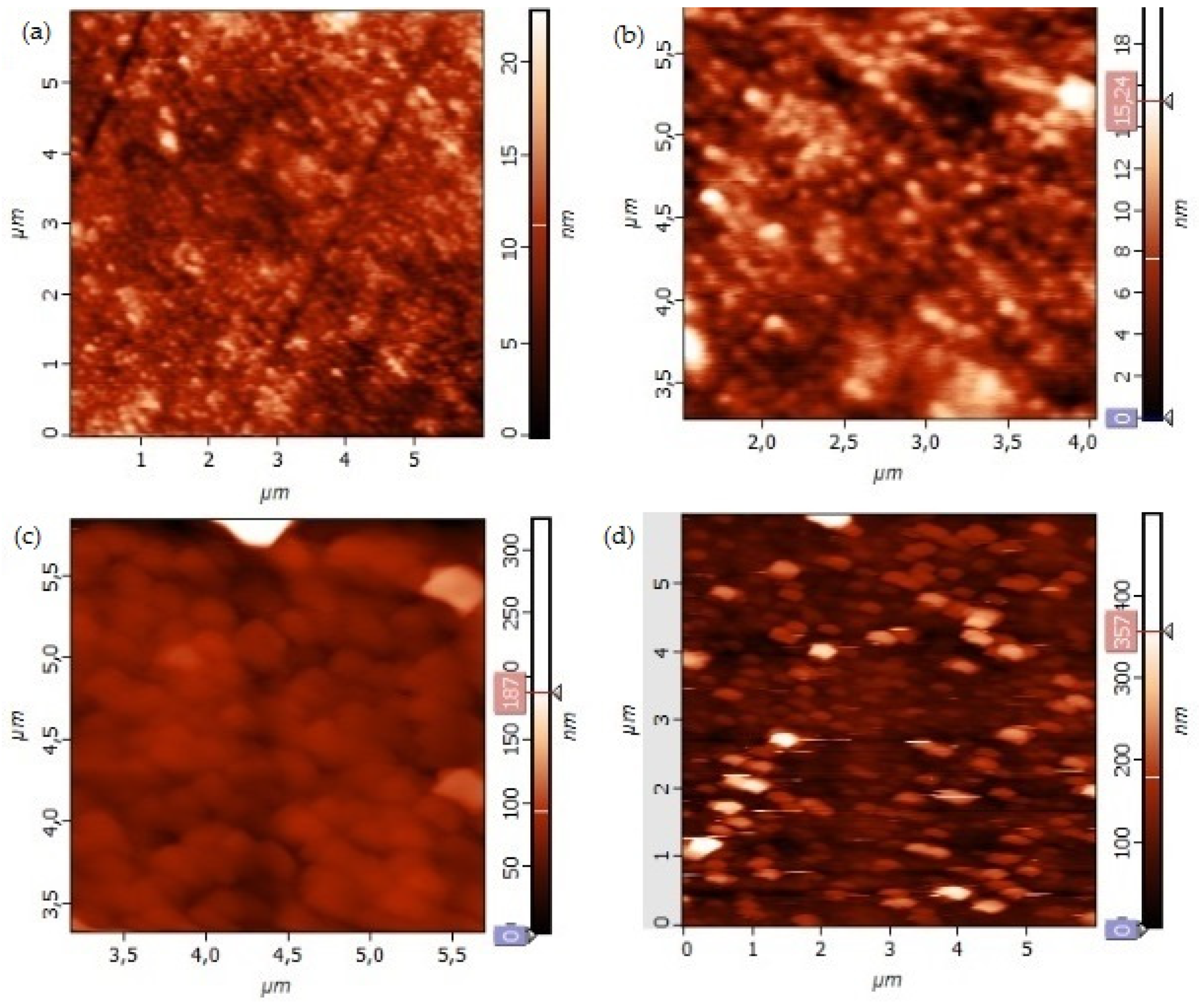
Adsorption processes play a crucial role in the manifestation of gas-sensitive properties by films. The maximum height h
max, average surface roughness S
a, and average grain diameter D
av were determined for samples synthesized at a temperature of °C by the AFM method. The results are shown in
Table 2 and
Figure 2.
According to the data obtained by the AFM method, thin films on the GaAs surface synthesized at a higher content of the Sb2O3 chemostimulator (60% and 80%) were characterized by a rougher surface with a wide variation in height. The maximum height did not exceed 25 nm for thin films synthesized with a lower content of the Sb2O3 chemostimulator (20% and 40%).
3.2. Gas-Sensitive Properties
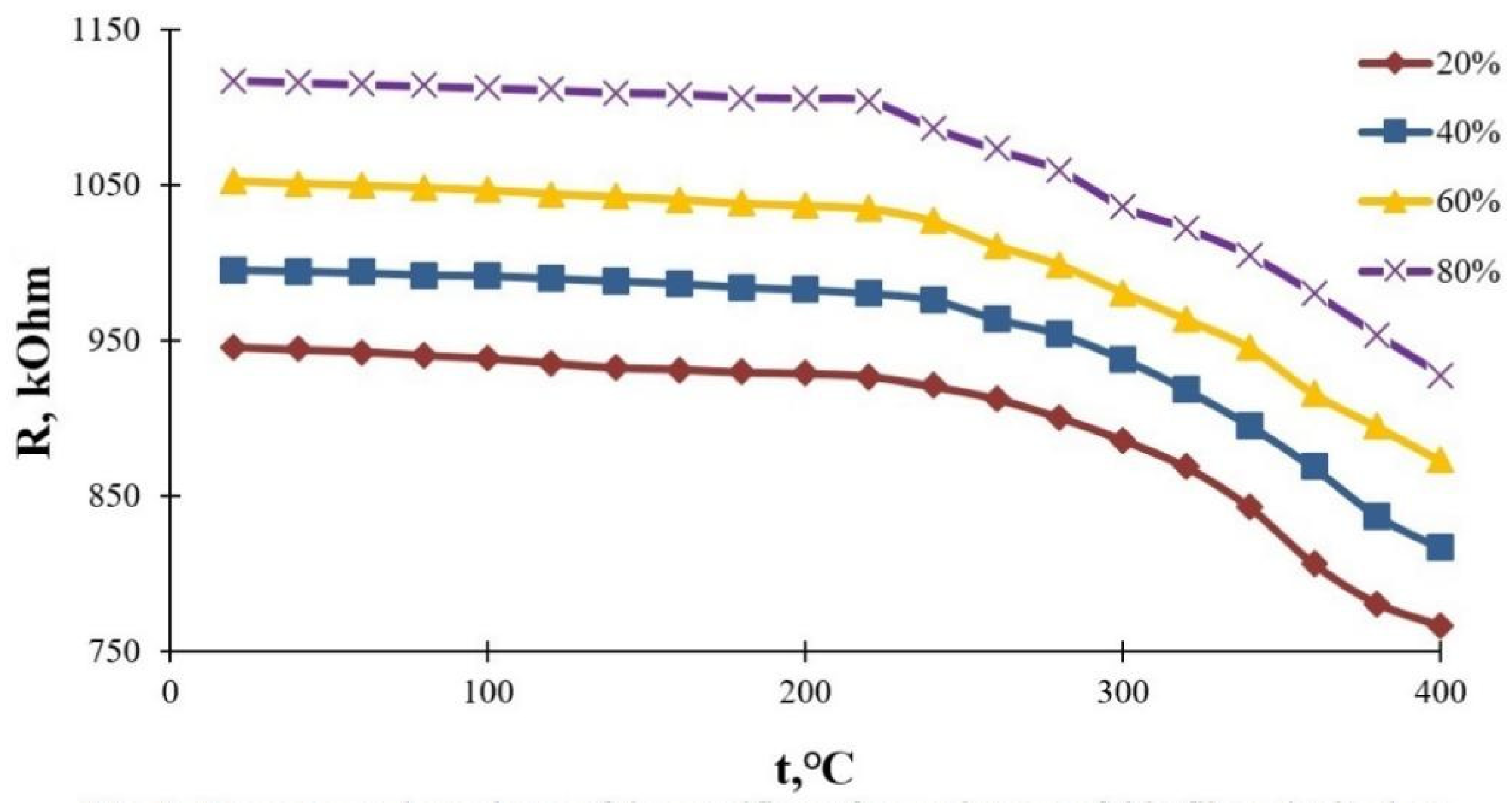
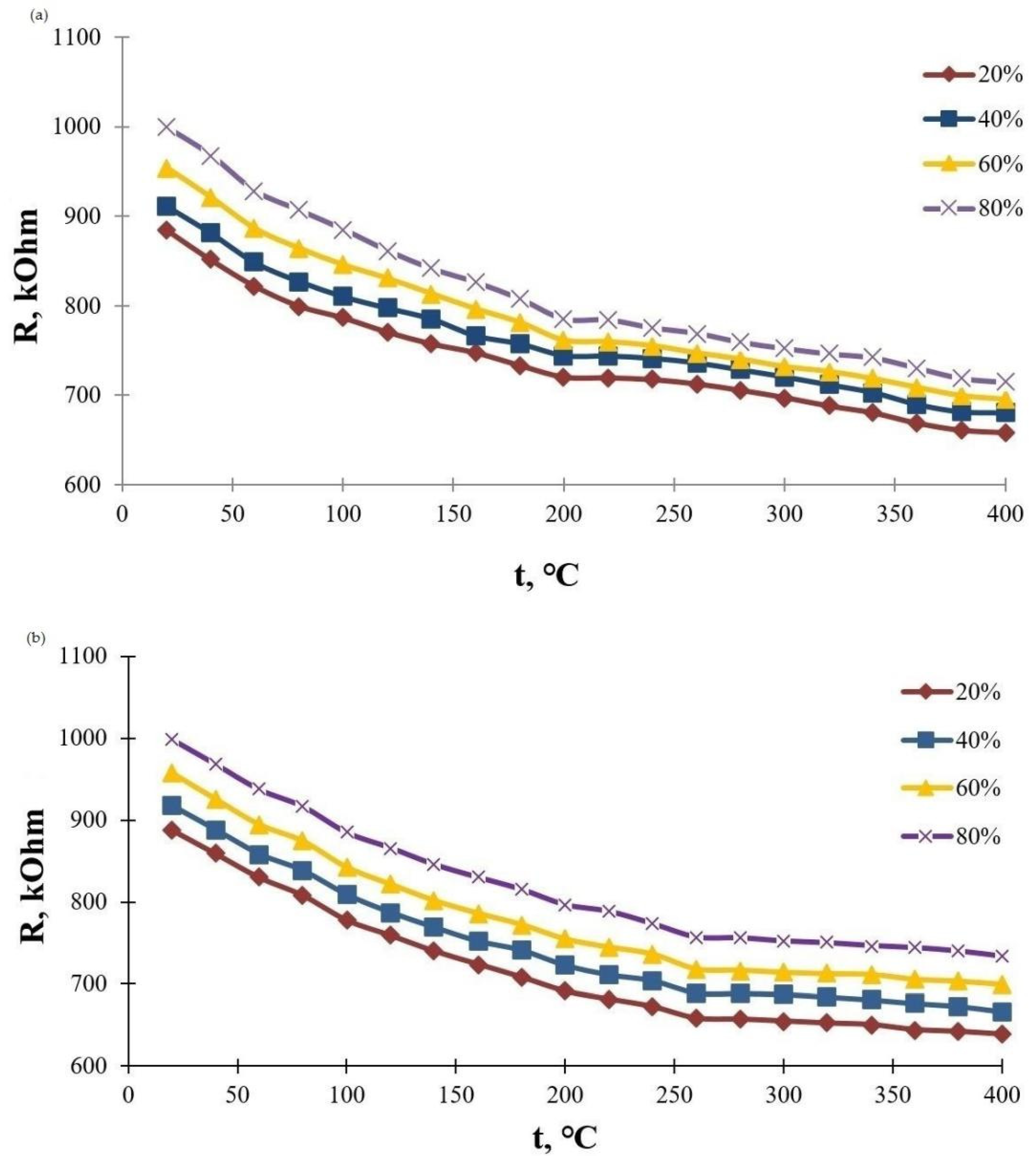
In
Figure 3 and
Figure 4, we show the results of measuring the specific surface resistance of the synthesized films.
Films obtained by oxidation of the GaAs surface had unsatisfactory semiconductor properties up to ohmic conductivity [
20]. To eliminate this problem and create thin films with reproducible semiconductor properties, we used the method of chemically stimulated thermal oxidation of the semiconductor.
4. Discussion
As can be seen from the presented data, with an increase in the Sb2O3 content in the composition, the surface resistance of the thin films on the GaAs surface increased.
The semiconductor properties of the films are indicated by a decrease in their resistance upon heating (
Figure 3), and the n-type conductivity is indicated by an additional decrease in resistance in an atmosphere of gases that are electron donors (CO and NH
3).
Based on these data, a gas-sensitive response was calculated according to the formula
where
—gas sensitivity
—specific surface resistance of the films in air,
—specific surface resistance of films in the presence of a reducing gas.
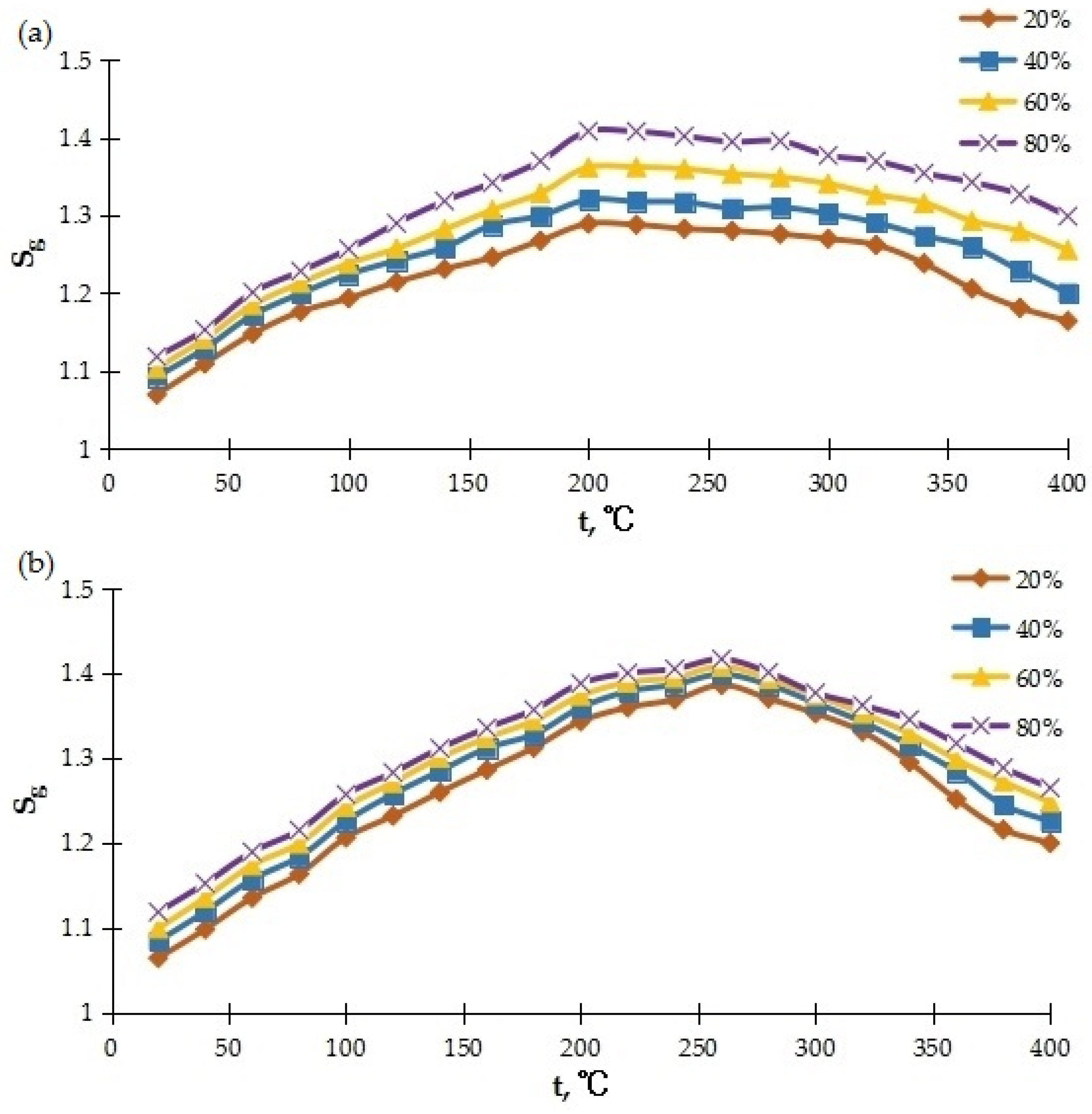
Based on the obtained results, graphs of the dependence of the gas-sensitive response on temperature were plotted. These graphs had a pronounced extreme character (
Figure 5). The value of the sensor signal increased from 1.1 to 1.4 conventional units, and then decreased with increasing temperature. With an increase in the antimony oxide content in the composition, under the action of which the film was formed, the value of the sensor signal naturally increased.
The reason for the extreme temperature dependence of the sensor signal was the increased desorption of gases from the surface of the film with increasing temperature and the occurrence of oxidation processes of detected gases according to the scheme
In the literature [
21,
22,
23,
24], there are data on the oxidation of carbon monoxide and ammonia in the presence of solid catalysts, which most often are metals and their oxides. The formation of CO
2 under normal conditions does not occur below 800 °C, and the formation of NO starts at around 900 °C. Due to the interaction of gas molecules with the substrate, the oxidation temperature should decrease, and then it can be assumed that the decrease in the sensor signal at increased temperatures is a consequence of the partial occurrence of the reactions described above.
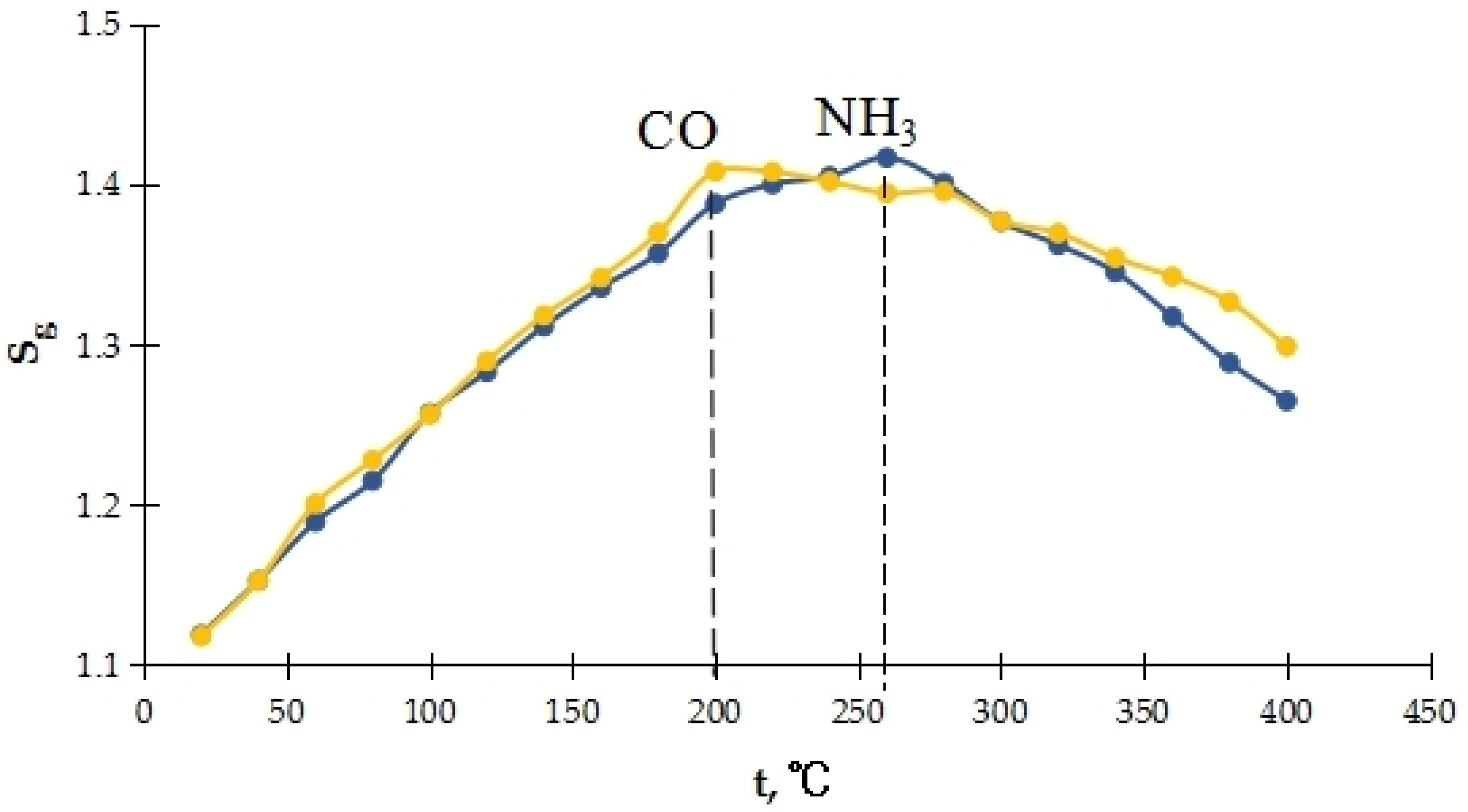
Based on the obtained data, the selectivity of thin films obtained on the GaAs surface can also be estimated. The corresponding dependence is shown in
Figure 6. The maximum in the dependence curve for ammonia and carbon monoxide occurred at different temperatures (200 and 260 °C, respectively), indicating the presence of selective properties of the obtained films to the determined gases.
5. Conclusions
The studies presented in this work were carried out on the basis of one of the basic concepts of modern solid-state chemistry—the establishment of patterns in the series “method of synthesis–composition–structure–property”. Chemically stimulated thermal oxidation was chosen as a method for the synthesis of thin films on the GaAs surface, which ensures the formation of thin films with semiconductor properties. In the work, the chemical composition of the grown films was established by the methods of EPXMA and IR spectroscopy. The study of the surface morphology of the obtained samples (AFM method) was carried out, since this characteristic has a significant effect on their gas sensitivity. The gas sensitivity, which reflects the dependence of the specific surface resistance of thin films on the composition of the surrounding atmosphere, acts as a “property” in the work.
Author Contributions
Organization and management, conceptualization, methodology, and formal analysis—V.F.K.; synthesis of samples, analysis of EPXMA, IR spectroscopy, and AFM—A.S.P.; research and analysis of electrical properties of samples—B.V.S.; writing and original draft preparation—A.S.P. and B.V.S.; writing review and editing—V.F.K. and I.Y.M. All authors have read and agreed to the published version of the manuscript.
Funding
The authors declare that no funds, grants, or other support were received during the preparation of this manuscript.
Institutional Review Board Statement
The study did not require ethical approval.
Informed Consent Statement
Not applicable.
Data Availability Statement
The data that support the findings of this study are available from the corresponding author upon reasonable request.
Acknowledgments
The research results were partially obtained using the equipment of the Shared Scientific Equipment Centre of Voronezh State University. URL:
http://ckp.vsu.ru, accessed on 13 May 2022.
Conflicts of Interest
The authors maintain that they have no conflict of interest to be described in this communication.
References
- Kohl, D. Function and applications of gas sensors. J. Phys. D Appl. Phys. 2001, 34, R125–R149. [Google Scholar] [CrossRef]
- Moshnikova, V.A.; Alexandrova, O.A. Nanostructured Oxide Materials in Modern Micro-, Nano- and Optoelectronics; Publishing House SPbGETU “LETI”: St. Petersburg, Russia, 2017. [Google Scholar]
- Karpova, S.S.; Moshnikov, V.A.; Maksimov, A.I.; Mjakin, S.V.; Kazantseva, N.E. Study of the effect of the acid-base surface properties of ZnO, Fe2O3 and ZnFe2O4 oxides on their gas sensitivity to ethanol vapor. Semiconductors 2013, 47, 1026–1030. [Google Scholar] [CrossRef]
- Rumyantseva, M.; Makeeva, E.; Badalyan, S.; Zhukova, A.; Gaskov, A. Nanocrystalline SnO2 and In2O3 as materials for gas sensors: The relationship between microstructure and oxygen chemisorption. Thin Solid Films 2009, 518, 1283–1288. [Google Scholar] [CrossRef]
- Rumyantseva, M.; Ivanov, V.K.; Shaporev, A.S.; Rudyi, Y.M.; Yushchenko, V.V.; Arbiol, J.; Gas’Kov, A.M. Microstructure and sensing properties of nanocrystalline indium oxide prepared using hydrothermal treatment. Russ. J. Inorg. Chem. 2009, 54, 163–171. [Google Scholar] [CrossRef]
- Ohgaki, T.; Matsuoka, R.; Watanabe, K.; Matsumoto, K.; Adachi, Y.; Sakaguchi, I.; Hishita, S.; Ohashi, N.; Haneda, H. Synthesizing SnO2 thin films and characterizing sensing performances. Sens. Actuators B Chem. 2010, 150, 99–104. [Google Scholar] [CrossRef]
- Huotari, J.; Lappalainen, J.; Puustinen, J.; Spetz, A.L. Gas sensing properties of pulsed laser deposited vanadium oxide thin films with various crystal structures. Sens. Actuators B Chem. 2013, 187, 386–394. [Google Scholar] [CrossRef]
- Fergus, J.W. Perovskite oxides for semiconductor-based gas sensors. Sens. Actuators B Chem. 2007, 123, 1169–1179. [Google Scholar] [CrossRef]
- Han, S.D.; Noh, M.-S.; Kim, S.; Shim, Y.-S.; Song, Y.G.; Lee, K.; Lee, H.R.; Nahm, S.; Yoon, S.-J.; Kim, J.-S.; et al. Versatile approaches to tune a nanocolumnar structure for optimized electrical properties of In2O3 based gas sensor. Sens. Actuators B Chem. 2017, 248, 894–901. [Google Scholar] [CrossRef]
- Verma, M.K.; Gupta, V. A highly sensitive SnO2–CuO multilayered sensor structure for detection of H2S gas. Sens. Actuators B Chem. 2012, 166, 378–385. [Google Scholar] [CrossRef]
- Frank, J.; Fleischer, M.; Meixner, H. Gas-sensitive electrical properties of pure and doped semiconducting Ga2O3 thick films. Sens. Actuators B Chem. 1998, 48, 318–321. [Google Scholar] [CrossRef]
- Hoefer, U.; Frank, J.; Fleischer, M. High temperature Ga2O3-gas sensors and SnO2-gas sensors: A comparison. Sens. Actuators B Chem. 2001, 78, 6–11. [Google Scholar] [CrossRef]
- Fleischer, M.; Meixner, H. A selective CH4 sensor using semiconducting Ga2O3 thin films based on temperature switching of multigas reactions. Sens. Actuators B Chem. 1995, 25, 544–547. [Google Scholar] [CrossRef]
- Mittova, I.Y. Influence of the physicochemical nature of chemical stimulators and the way they are introduced into a system on the mechanism of the thermal oxidation of GaAs and InP. Inorg. Mater. 2014, 50, 874–881. [Google Scholar] [CrossRef]
- Kostryukov, V.F.; Mittova, I.Y.; Dimitrenko, A.A. Chemically stimulated synthesis of gas-sensing films on the surface of GaAs. Inorg. Mater. 2017, 53, 451–456. [Google Scholar] [CrossRef]
- Kostryukov, V.F.; Mittova, I.Y. Ammonia response of thin films grown on GaAs using PbO + Bi2O3 mixtures. Inorg. Mater. 2015, 51, 425–429. [Google Scholar] [CrossRef]
- Penskoi, P.K.; Kostryukov, V.F.; Kutsev, S.V.; Kuznetsova, I.V.; Pshestanchik, V.R.; Mittova, I.Y. Effect of inert components (Y2O3, Al2O3, and Ga2O3) on the chemistimulating effect of the Sb2O3 activator of GaAs thermal oxidation. Russ. J. Inorg. Chem. 2009, 54, 1564–1570. [Google Scholar] [CrossRef]
- Ya, I. Mittova, Thermal oxidation of gallium arsenide in “pure” and extrinsic atmospheres. Inorg. Mater. 1992, 28, 917–927. [Google Scholar]
- Nakamoto, K. Infrared and Raman Spectra of Inorganic and Coordination Compounds; John Wiley & Sons. Inc.: Hoboken, NJ, USA, 2009. [Google Scholar] [CrossRef]
- Kirovskaya, I.A. Surface Properties of Binary Diamond-Like Semiconductors; Izd-vo OmGTU: Omsk, Russia, 2012; 414p. [Google Scholar]
- Yuan, R.-M.; Fu, G.; Xu, X.; Wan, H.-L. Mechanisms for Selective Catalytic Oxidation of Ammonia over Vanadium Oxides. J. Phys. Chem. C 2011, 115, 21218–21229. [Google Scholar] [CrossRef]
- Lietti, L.; Ramis, G.; Busca, G.; Bregani, F.; Forzatti, P. Characterization and reactivity of MoO3/SiO2 catalysts in the selective catalytic oxidation of ammonia to N2. Catal. Today 2000, 61, 187–195. [Google Scholar] [CrossRef]
- Hu, Z.-P.; Zhu, Y.-P.; Gao, Z.-M.; Wang, G.; Liu, Y.; Liu, X.; Yuan, Z.-Y. CuO catalysts supported on activated red mud for efficient catalytic carbon monoxide oxidation. Chem. Eng. J. 2016, 302, 23–32. [Google Scholar] [CrossRef]
- Savchenko, V.I.; Boreskov, G.K.; Kalinkin, A.V.; Salanov, A.N. State of oxygen on metal-surfaces and catalytic activity for the oxidation of carbon-monoxide. Kinet. Catal. 1983, 24, 983–990. [Google Scholar]
| Publisher’s Note: MDPI stays neutral with regard to jurisdictional claims in published maps and institutional affiliations. |
© 2022 by the authors. Licensee MDPI, Basel, Switzerland. This article is an open access article distributed under the terms and conditions of the Creative Commons Attribution (CC BY) license (https://creativecommons.org/licenses/by/4.0/).