De-Escalation of Broad-Spectrum and Last-Resort Antibiotics in Critically Ill Adults with Gram-Negative Infections: A Scoping Review and Evidence-Informed Framework for Tertiary-Care ICUs

 , , ,
, , ,  and
and
Abstract
1. Introduction
2. Results
2.1. Characteristics of the Included Evidence
2.2. Definitions and Timing of Antibiotic De-Escalation
2.3. Frequency of De-Escalation
2.4. Findings According to Antibiotic Class (Table 5)
2.4.1. Carbapenems

| Antibiotic Class | Main De-Escalation Strategies | Main Findings | Evidence Limitations |
|---|---|---|---|
| Carbapenems | Discontinuation; replacement with a susceptible narrower β-lactam; restriction through audit and feedback | Reduced meropenem/imipenem exposure; lower carbapenem consumption; no consistent increase in mortality or treatment failure | Mainly observational studies; variable eligibility and spectrum rankings |
| Cephalosporins | Transition from antipseudomonal or fourth-generation agents to third-generation or narrower cephalosporins; use as carbapenem-sparing therapy | Increased use of narrower cephalosporins in some stewardship programs; reduced fourth-generation cephalosporin exposure | Outcomes rarely stratified by cephalosporin generation |
| Colistin | Discontinuation or avoidance when microbiology supported a less toxic active agent | Colistin consumption decreased in one stewardship program but increased in another because of MDR Gram-negative infections | Very limited class-specific de-escalation and safety data |
| Tigecycline | Discontinuation or replacement when a narrower active option was available | Tigecycline or glycylcycline consumption decreased in several programs | No direct comparative study of tigecycline de-escalation |
2.4.2. Cephalosporins
2.4.3. Colistin and Tigecycline
2.5. Mortality and Safety Outcomes
2.6. Clinical, Microbiological, and Resistance Outcomes
2.7. Antibiotic Exposure and Length of Stay
2.8. Factors Favoring De-Escalation
2.9. Policy- and System-Level Findings
2.10. The Proposed Evidence-to-Practice Framework for a Romanian Tertiary ICU
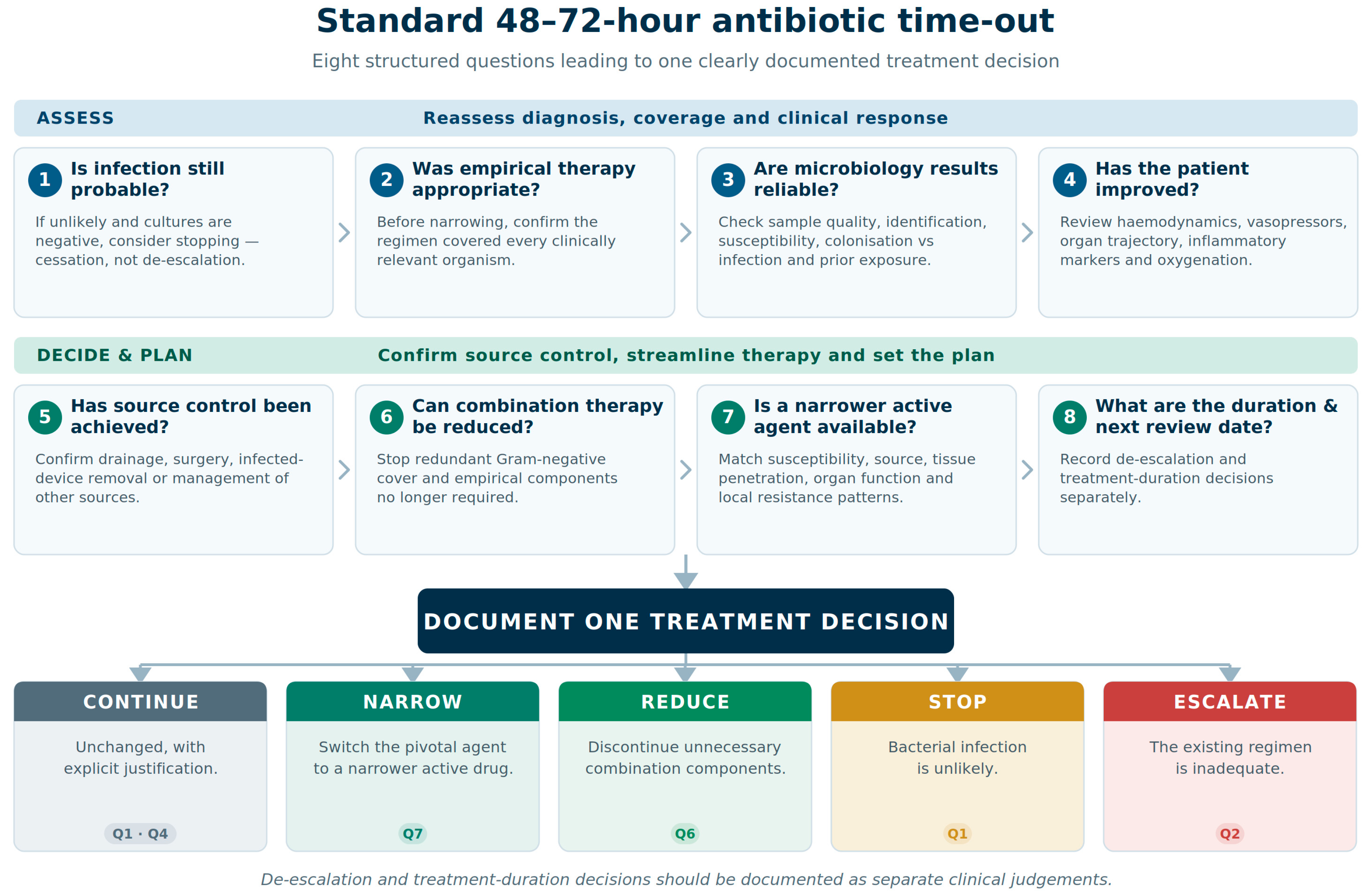
2.11. Standard 48–72 H Antibiotic Time-Out
- Is bacterial infection still probable? If infection is unlikely and adequate samples are negative, consider antibiotic cessation rather than classifying the decision as conventional de-escalation.
- Was the initial empirical regimen appropriate? Confirm that the regimen covers all clinically relevant organisms before narrowing treatment.
- Are microbiological results reliable? Review sample quality, organism identification, susceptibility results, possible colonization or contamination, and previous antimicrobial exposure.
- Has the patient improved? Assess hemodynamic stability, vasopressor requirements, organ dysfunction trajectory, inflammatory markers, and oxygenation.
- Has adequate source control been achieved? Confirm drainage, surgery, removal of infected devices, or management of other relevant sources.
- Can combination treatment be reduced? Discontinue redundant Gram-negative coverage and other empirical components that are no longer required.
- Is a narrower active agent available? Select definitive therapy according to susceptibility, infection source, tissue penetration, organ function, and local resistance patterns.
- What is the planned duration and next review date? Record de-escalation and treatment-duration decisions separately.
2.12. Suggested Documentation Outcome
- Continue unchanged, with justification;
- Narrow the pivotal antibiotic;
- Discontinue unnecessary combination components;
- Stop antibiotics because bacterial infection is unlikely;
2.13. Minimum Dataset for Local Monitoring
3. Discussion
3.1. Limitations
3.2. Future Directions
4. Materials and Methods
4.1. Review Design and Reporting Framework
4.2. Review Question and PCC Framework
4.3. Operational Definition of Antibiotic De-Escalation
- The replacement of a broad-spectrum antibiotic with an agent having a narrower antibacterial spectrum;
- The discontinuation of one or more unnecessary components of combination therapy;
- Conversion from combination therapy to microbiologically active monotherapy;
- The replacement of a carbapenem with a susceptible carbapenem-sparing agent;
- The replacement of colistin or tigecycline with a safer or more targeted active agent;
- Pathogen- and susceptibility-directed reduction in the ecological impact of treatment.
4.4. Information Source and Search Strategy
4.5. Eligibility Criteria
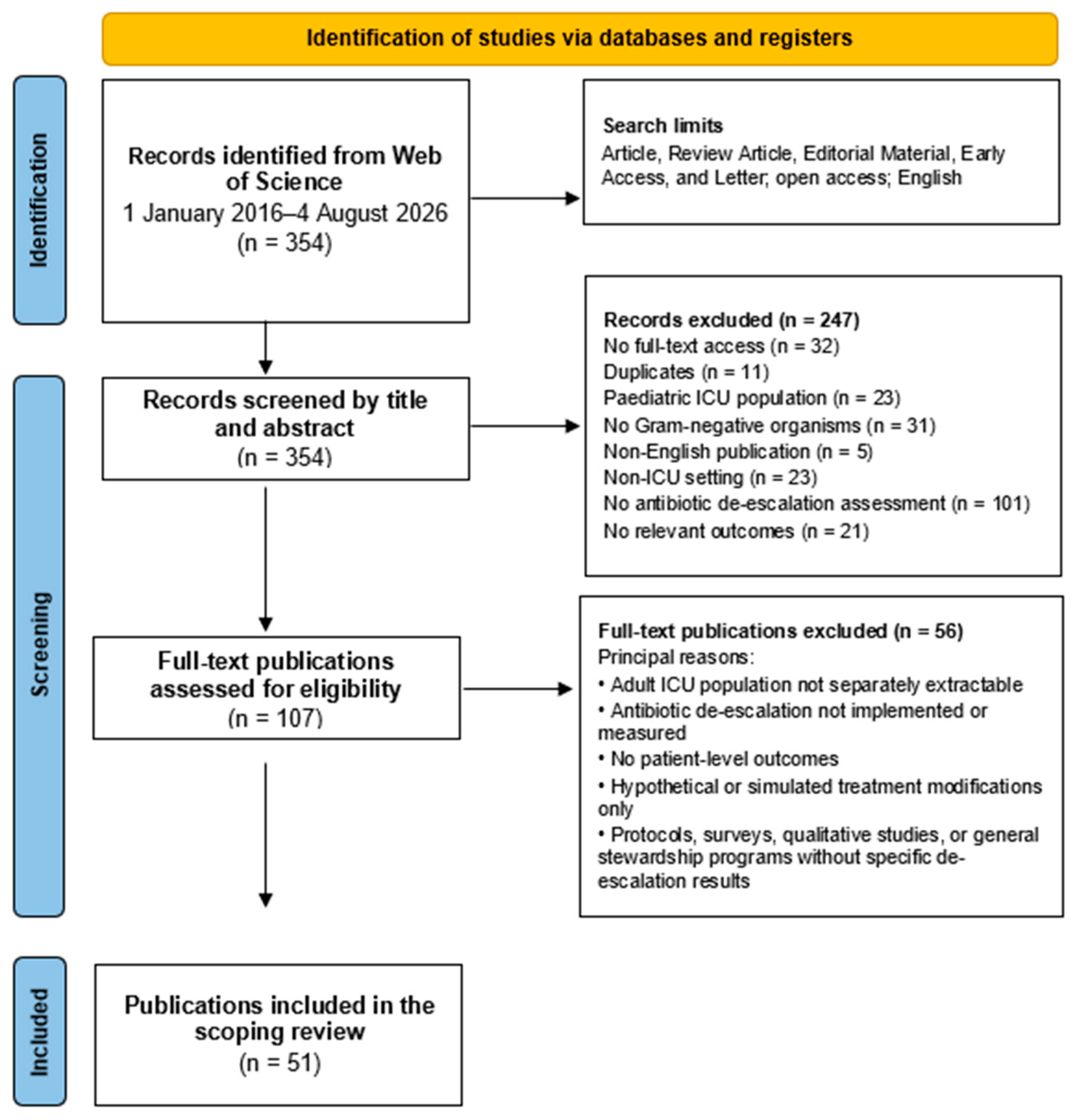
4.6. Study Selection
4.7. Data Charting
4.8. Evidence Synthesis
4.9. Critical Appraisal of Individual Sources of Evidence
4.10. The Development of the Romanian Tertiary-ICU Framework
4.11. Ethics
5. Conclusions
Supplementary Materials
Author Contributions
Funding
Institutional Review Board Statement
Informed Consent Statement
Data Availability Statement
Conflicts of Interest
References
- Tabah, A.; Cotta, M.O.; Garnacho-Montero, J.; Schouten, J.; Roberts, J.A.; Lipman, J.; Tacey, M.; Timsit, J.F.; Leone, M.; Zahar, J.R.; et al. A Systematic Review of the Definitions, Determinants, and Clinical Outcomes of Antimicrobial De-Escalation in the Intensive Care Unit. Clin. Infect. Dis. 2016, 62, 1009–1017. [Google Scholar] [CrossRef] [Scilit] [PubMed]
- Evans, L.; Rhodes, A.; Alhazzani, W.; Antonelli, M.; Coopersmith, C.M.; French, C.; Machado, F.R.; Mcintyre, L.; Ostermann, M.; Prescott, H.C.; et al. Surviving Sepsis Campaign: International Guidelines for Management of Sepsis and Septic Shock 2021. Intensive Care Med. 2021, 47, 1181–1247. [Google Scholar] [CrossRef] [Scilit] [PubMed]
- Prescott, H.C.; Antonelli, M.; Alhazzani, W.; Møller, M.H.; Alshamsi, F.; Azevedo, L.C.P.; Belley-Cote, E.; De Waele, J.; Derde, L.; Dionne, J.C.; et al. Surviving Sepsis Campaign: International Guidelines for Management of Sepsis and Septic Shock 2026. Crit. Care Med. 2026, 54, 725–812. [Google Scholar] [CrossRef] [Scilit] [PubMed]
- Lakbar, I.; De Waele, J.J.; Tabah, A.; Einav, S.; Martin-Loeches, I.; Leone, M. Antimicrobial De-Escalation in the ICU: From Recommendations to Level of Evidence. Adv. Ther. 2020, 37, 3083–3096. [Google Scholar] [CrossRef] [Scilit] [PubMed]
- Vintila, B.I.; Arseniu, A.M.; Butuca, A.; Sava, M.; Bîrluțiu, V.; Rus, L.L.; Axente, D.D.; Morgovan, C.; Gligor, F.G. Adverse Drug Reactions Relevant to Drug Resistance and Ineffectiveness Associated with Meropenem, Linezolid, and Colistin: An Analysis Based on Spontaneous Reports from the European Pharmacovigilance Database. Antibiotics 2023, 12, 918. [Google Scholar] [CrossRef] [Scilit] [PubMed]
- Murray, C.J.; Ikuta, K.S.; Sharara, F.; Swetschinski, L.; Robles Aguilar, G.; Gray, A.; Han, C.; Bisignano, C.; Rao, P.; Wool, E.; et al. Global Burden of Bacterial Antimicrobial Resistance in 2019: A Systematic Analysis. Lancet 2022, 399, 629–655. [Google Scholar] [CrossRef] [Scilit] [PubMed]
- Naghavi, M.; Vollset, S.E.; Ikuta, K.S.; Swetschinski, L.R.; Gray, A.P.; Wool, E.E.; Robles Aguilar, G.; Mestrovic, T.; Smith, G.; Han, C.; et al. Global Burden of Bacterial Antimicrobial Resistance 1990–2021: A Systematic Analysis with Forecasts to 2050. Lancet 2024, 404, 1199–1226. [Google Scholar] [CrossRef] [Scilit] [PubMed]
- Antimicrobial Resistance in the EU/EEA (EARS-Net)—Annual Epidemiological Report for 2024. Available online: https://www.ecdc.europa.eu/en/publications-data/antimicrobial-resistance-eueea-ears-net-annual-epidemiological-report-2024 (accessed on 16 August 2026).
- Ecdc Carbapenem-Resistant. Enterobacterales–Third Update, 3 February 2025; ECDC: Stockholm, Sweden, 2025. [Google Scholar] [CrossRef]
- Vincent, J.L.; Sakr, Y.; Singer, M.; Martin-Loeches, I.; MacHado, F.R.; Marshall, J.C.; Finfer, S.; Pelosi, P.; Brazzi, L.; Aditianingsih, D.; et al. Prevalence and Outcomes of Infection Among Patients in Intensive Care Units in 2017. JAMA 2020, 323, 1478–1487. [Google Scholar] [CrossRef] [Scilit] [PubMed]
- Sava, M.; Vintila, B.I.; Bereanu, A.S.; Fratila, A.M.; Codru, I.R. Lessons from Four Years (2021–2024) of Klebsiella Pneumoniae Resistance Surveillance Epidemiological Trends in a Romanian Intensive Care Unit. Antibiotics 2025, 14, 825. [Google Scholar] [CrossRef] [Scilit] [PubMed]
- Codru, I.R.; Vintilă, B.I.; Bereanu, A.S.; Sava, M.; Popa, L.M.; Birlutiu, V. Antimicrobial Resistance Patterns and Biofilm Analysis via Sonication in Intensive Care Unit Patients at a County Emergency Hospital in Romania. Pharmaceuticals 2025, 18, 161. [Google Scholar] [CrossRef] [Scilit] [PubMed]
- WHO. Policy Guidance on Integrated Antimicrobial Stewardship Activities. Available online: https://www.who.int/publications/i/item/9789240025530 (accessed on 18 August 2026).
- Pandolfo, A.M.; Horne, R.; Jani, Y.; Reader, T.W.; Bidad, N.; Brealey, D.; Enne, V.I.; Livermore, D.M.; Gant, V.; Brett, S.J.; et al. Intensivists’ Beliefs about Rapid Multiplex Molecular Diagnostic Testing and Its Potential Role in Improving Prescribing Decisions and Antimicrobial Stewardship: A Qualitative Study. Antimicrob. Resist. Infect. Control 2021, 10, 95. [Google Scholar] [CrossRef] [Scilit] [PubMed]
- Marin, K.C.; Ritiu, S.A.; Băloi, A.; Barsac, C.R.; Sandesc, D.; Papurica, M.; Rogobete, A.F.; Toma, D.; Porosnicu, M.T.; Gindac, C.; et al. Rapid Molecular Diagnostics for MDR Nosocomial Infections in ICUs: Integration with Prevention, Stewardship, and Novel Therapies. Diagnostics 2025, 15, 3060. [Google Scholar] [CrossRef] [Scilit] [PubMed]
- Lafon, T.; Weingart, M.; Vaidie, J.; Calfee, C.S.; Jacob, S.T.; Freund, Y.; Shapiro, N.I.; Barraud, O.; Monneret, G.; van der Poll, T.; et al. Challenges in Early Detection and Prognostication of Sepsis: New Approaches from the Emergency Department and Intensive Care Unit. EClinicalMedicine 2026, 94, 103864. [Google Scholar] [CrossRef] [Scilit] [PubMed]
- Tanzarella, E.S.; Cutuli, S.L.; Lombardi, G.; Cammarota, F.; Caroli, A.; Franchini, E.; Sancho Ferrando, E.; Grieco, D.L.; Antonelli, M.; De Pascale, G. Antimicrobial De-Escalation in Critically Ill Patients. Antibiotics 2024, 13, 375. [Google Scholar] [CrossRef] [Scilit] [PubMed]
- De Bus, L.; Depuydt, P.; Steen, J.; Dhaese, S.; De Smet, K.; Tabah, A.; Akova, M.; Cotta, M.O.; De Pascale, G.; Dimopoulos, G.; et al. Antimicrobial De-Escalation in the Critically Ill Patient and Assessment of Clinical Cure: The DIANA Study. Intensive Care Med. 2020, 46, 1404–1417. [Google Scholar] [CrossRef] [Scilit] [PubMed]
- Kim, D.; Kim, S.; Lee, K.H.; Han, S.H. Use of Antimicrobial Agents in Actively Dying Inpatients after Suspension of Life-Sustaining Treatments: Suggestion for Antimicrobial Stewardship. J. Microbiol. Immunol. Infect. 2022, 55, 651–661. [Google Scholar] [CrossRef] [Scilit] [PubMed]
- Sekandarzad, A.; Flügler, A.; Rheinboldt, A.; Rother, D.; Först, G.; Rieg, S.; Supady, A.; Lother, A.; Staudacher, D.L.; Wengenmayer, T.; et al. Reduced Antimicrobial Consumption through Enhanced Pneumonia Management in Critically Ill Patients: Outcomes of an Antibiotic Stewardship Program in the Intensive Care Unit. Front. Med. 2025, 12, 1549355. [Google Scholar] [CrossRef] [Scilit] [PubMed]
- Lakbar, I.; Delamarre, L.; Curtel, F.; Duclos, G.; Bezulier, K.; Gragueb-Chatti, I.; Martin-Loeches, I.; Forel, J.M.; Leone, M. Antimicrobial Stewardship during COVID-19 Outbreak: A Retrospective Analysis of Antibiotic Prescriptions in the ICU across COVID-19 Waves. Antibiotics 2022, 11, 1517. [Google Scholar] [CrossRef] [Scilit] [PubMed]
- Yu, J.; Liu, Y.; Qu, R.; Wang, Z.; Zhao, Y.; Zhao, Y.; Zhou, C. Evaluation of a Clinical Pharmacist-Led Antimicrobial Stewardship Program in a Neurosurgical Intensive Care Unit: A Pre-and Post-Intervention Cohort Study. Front. Pharmacol. 2023, 14, 1263618. [Google Scholar] [CrossRef] [Scilit] [PubMed]
- Mishima, Y.; Nawa, N.; Asada, M.; Nagashima, M.; Aiso, Y.; Nukui, Y.; Fujiwara, T.; Shigemitsu, H. Impact of Antibiotic Time-Outs in Multidisciplinary ICU Rounds for Antimicrobial Stewardship Program on Patient Survival: A Controlled Before-and-After Study. Crit. Care Explor. 2023, 5, E0837. [Google Scholar] [CrossRef] [Scilit] [PubMed]
- Jover-Sáenz, A.; Ramírez-Hidalgo, M.F.; Vidal, M.V.; González, M.G.; Cano Marrón, S.M.; Arias, A.E.; Sacrest, M.F.; Castellana-Perelló, D.; Barcenilla-Gaite, F. Antimicrobial Stewardship Program at a Tertiary Care Academic Medical Hospital: Clinical, Microbiological and Economic Impact. A 5-Year Temporary Descriptive Study. Infect. Prev. Pract. 2020, 2, 100048. [Google Scholar] [CrossRef] [Scilit] [PubMed]
- Miller, M.M.; Van Schooneveld, T.C.; Stohs, E.J.; Marcelin, J.R.; Alexander, B.T.; Watkins, A.B.; Creager, H.M.; Bergman, S.J. Implementation of a Rapid Multiplex Polymerase Chain Reaction Pneumonia Panel and Subsequent Antibiotic De-Escalation. Open Forum Infect. Dis. 2023, 10, ofad382. [Google Scholar] [CrossRef] [Scilit] [PubMed]
- Ali, F.; Zehra, T.; Solangi, N.A.; Makki, K.U.; Siddiqui, H.A.; Abidi, S. Evaluation of Carbapenem Antimicrobial Stewardship Program at a Tertiary Care Hospital: A Prospective Interventional Study. Pak. J. Pharm. Sci. 2022, 35, 1595–1601. [Google Scholar] [CrossRef] [Scilit]
- Panditrao, A.; Shafiq, N.; Kumar-M, P.; Sekhon, A.K.; Biswal, M.; Singh, G.; Kaur, K.; Ray, P.; Malhotra, S.; Gautam, V.; et al. Impact of an Antimicrobial Stewardship and Monitoring of Infection Control Bundle in a Surgical Intensive Care Unit of a Tertiary-Care Hospital in India. J. Glob. Antimicrob. Resist. 2021, 24, 260–265. [Google Scholar] [CrossRef] [Scilit] [PubMed]
- Schumann, J.; Johanns, U.; Ahmad-Nejad, P.; Ghebremedhin, B.; Woebker, G. The Impact of the Filmarray-Based Detection of Microbial Pathogens from Positive Blood Culture Vials on the Time to Optimal Antimicrobial Regimen in Intensive Care Units of the Helios University Clinic Wuppertal, Germany. J. Clin. Med. 2021, 10, 5880. [Google Scholar] [CrossRef] [Scilit] [PubMed]
- Gu, H.; Sun, L.; Sheng, B.; Gu, X.; Wang, S.; Liu, L.; Dai, B.; Chen, W. Benefits of Pharmacist Intervention in the Critical Care Patients with Infectious Diseases: A Propensity Score Matching Retrospective Cohort Study. Aust. Crit. Care 2023, 36, 933–939. [Google Scholar] [CrossRef] [Scilit] [PubMed]
- Zhu, M.; Pickens, C.I.; Markov, N.S.; Pawlowski, A.; Kang, M.; Rasmussen, L.V.; Walter, J.M.; Nadig, N.R.; Singer, B.D.; Wunderink, R.G.; et al. Antibiotic De-Escalation Patterns and Outcomes in Critically Ill Patients with Suspected Pneumonia as Informed by Bronchoalveolar Lavage Results. Eur. J. Clin. Microbiol. Infect. Dis. 2025, 44, 1861–1871. [Google Scholar] [CrossRef] [Scilit] [PubMed]
- Souza-Oliveira, A.C.; Cunha, T.M.; Passos, L.B.d.S.; Lopes, G.C.; Gomes, F.A.; Röder, D.V.D.d.B. Ventilator-Associated Pneumonia: The Influence of Bacterial Resistance, Prescription Errors, and de-Escalation of Antimicrobial Therapy on Mortality Rates. Braz. J. Infect. Dis. 2016, 20, 437–443. [Google Scholar] [CrossRef] [Scilit] [PubMed]
- Aissaoui, Y.; Derkaoui, A.; Hachimi, A.; Bouchama, A.; Dendane, T.; Doumiri, M.; Elaidaoui, K.; Ziadi, A.; Essafti, M.; Oualili, L.; et al. Diagnostic Performance and Impact on Antimicrobial Treatment of a Multiplex Polymerase Chain Reaction in Critically Ill Patients with Pneumonia: A Multicenter Observational Study (The MORICUP-PCR Study: Morocco ICU Pneumonia-PCR Study). Crit. Care Explor. 2025, 7, e1220. [Google Scholar] [CrossRef] [Scilit] [PubMed]
- Roper, S.; Wingler, M.J.B.; Cretella, D.A. Antibiotic De-Escalation in Critically Ill Patients with Negative Clinical Cultures. Pharmacy 2023, 11, 104. [Google Scholar] [CrossRef] [Scilit] [PubMed]
- Rodríguez-Gómez, M.; Martínez-Sagasti, F.; Calle-Romero, M.; Prieto-Cabrera, A.; De La Montaña-Díaz, P.; Díaz-De la Torre, I.; Delgado-Iribarren García-Campero, A.; Domingo-Marín, S.; Sánchez-García, M.; Martín-Loeches, I. RAPID-CARE: Rapid Antibiotic Optimization in the ICU After Implementation of a Pneumonia Multiplex PCR Test—A Real-World Evaluation. Antibiotics 2025, 14, 1084. [Google Scholar] [CrossRef] [Scilit] [PubMed]
- Aldardeer, N.; Qushmaq, I.; AlShehail, B.; Ismail, N.; AlHameed, A.; Damfu, N.; Al Musawa, M.; Nadhreen, R.; Kalkatawi, B.; Saber, B.; et al. Effect of Broad-Spectrum Antibiotic De-Escalation on Critically Ill Patient Outcomes: A Retrospective Cohort Study. J. Epidemiol. Glob. Health 2023, 13, 444–452. [Google Scholar] [CrossRef] [Scilit] [PubMed]
- Le, B.H.T.; Mai, A.T.; Phan, M.D. Predictors of Treatment Failure Following Early Antibiotic Discontinuation in Culture-Negative, Ventilator-Associated Pneumonia: An Observational Study. J. Infect. Dev. Ctries. 2024, 18, 1058–1065. [Google Scholar] [CrossRef] [Scilit] [PubMed]
- Arulappen, A.L.; Khan, A.H.; Danial, M.; Hasan, S.S.; Chow, T.S.; Ahmed, N.J.; Long, C.M. Baseline Predictors of Antibiotics De-Escalation from Empirical Therapies in an Intensive Care Unit: A Five-Year Retrospective Study. BMC Infect. Dis. 2025, 25, 369. [Google Scholar] [CrossRef] [Scilit] [PubMed]
- Trupka, T.; Fisher, K.; Micek, S.T.; Juang, P.; Kollef, M.H. Enhanced Antimicrobial De-Escalation for Pneumonia in Mechanically Ventilated Patients: A Cross-over Study. Crit. Care 2017, 21, 180. [Google Scholar] [CrossRef] [Scilit] [PubMed]
- Ghosh, S.; Singh, A.; Lyall, A. Modification of Initial Empirical Antibiotic Prescription and Its Impact on Patient Outcome: Experience of an Indian Intensive Care Unit. Indian J. Crit. Care Med. 2023, 27, 581–587. [Google Scholar] [CrossRef] [Scilit] [PubMed]
- Choudhuri, A.H.; Ahuja, B.; Duggal, S.; Dev Soni, K.; Uppal, R. Etiology and Risk Factors for Late Antibiotic De-Escalation and Their Effect on Intensive Care Unit Outcome. Indian J. Respir. Care 2021, 10, 299–304. [Google Scholar] [CrossRef] [Scilit] [PubMed]
- Contier, J.; Platon, L.; Benchabane, N.; Tchakerian, S.; Herman, F.; Mollevi, C.; Ceballos, P.; Godreuil, S.; Klouche, K. Diagnostic Performance of Pneumonia Multiplex PCR in Critically Ill Immunocompromised Patients. Crit. Care 2025, 29, 310. [Google Scholar] [CrossRef] [Scilit] [PubMed]
- Latorre Ibars, R.; Carvalho-Brugger, S.; Rodríguez Ibáñez, P.; Vallverdú Vidal, M.; Iglesias Moles, S.; Miralbés Torner, M.; Bellés Bellés, A.; Castellano, A.; Campi, D.; Caballero, J.; et al. Evaluating the Impact of Filmarray Pneumonia Plus Panel in Therapeutic Decision-Making in Critical Patients with Suspected Respiratory Infection. Antibiotics 2026, 15, 521. [Google Scholar] [CrossRef] [Scilit] [PubMed]
- Kuwana, T.; Yamaguchi, J.; Kinoshita, K.; Hori, S.; Ihara, S.; Taniguchi, T. Successful De-Escalation Antibiotic Therapy Using Cephamycins for Sepsis Caused by Extended-Spectrum Beta-Lactamase-Producing Enterobacteriaceae Bacteremia: A Sequential 25-Case Series. Open Med. 2020, 15, 782–786. [Google Scholar] [CrossRef] [Scilit] [PubMed]
- Byoung Soo, K.; Sang Ho, C.; Younsuck, K.; Jin-Won, H.; Sang-Bum, H.; Chae-Man, L. Safety of Antimicrobial De-Escalation for Culture-Negative Severe Pneumonia. J. Crit. Care 2019, 54, 14–19. [Google Scholar] [CrossRef] [Scilit] [PubMed]
- Yoon, E.C.; Choi, S.H.; Sung, H.; Chong, Y.P.; Chang, E.; Do, K.H.; Lee, S.Y.; Hyun, D.g.; Ahn, J.H.; Huh, J.W.; et al. Real-World Experience Using Multiplex Polymerase Chain Reaction in Intensive Care Unit Patients with Hospital-Acquired and Ventilator-Associated Pneumonia in South Korea. Acute Crit. Care 2026, 41, 87–96. [Google Scholar] [CrossRef] [Scilit] [PubMed]
- Ferrer, R.; Martínez, M.L.; Gomà, G.; Suárez, D.; Álvarez-Rocha, L.; de la Torre, M.V.; González, G.; Zaragoza, R.; Borges, M.; Blanco, J.; et al. Improved Empirical Antibiotic Treatment of Sepsis after an Educational Intervention: The ABISS-Edusepsis Study. Crit. Care 2018, 22, 167. [Google Scholar] [CrossRef] [Scilit] [PubMed]
- Salahuddin, N.; Amer, L.; Joseph, M.; El Hazmi, A.; Hawa, H.; Maghrabi, K. Determinants of Deescalation Failure in Critically Ill Patients with Sepsis: A Prospective Cohort Study. Crit. Care Res. Pract. 2016, 2016, 6794861. [Google Scholar] [CrossRef] [Scilit] [PubMed]
- Li, H.; Yang, C.H.; Huang, L.O.; Cui, Y.H.; Xu, D.; Wu, C.R.; Tang, J.G. Antibiotics De-Escalation in the Treatment of Ventilator-Associated Pneumonia in Trauma Patients: A Retrospective Study on Propensity Score Matching Method. Chin. Med. J. 2018, 131, 1151–1157. [Google Scholar] [CrossRef] [Scilit] [PubMed]
- Niimura, T.; Zamami, Y.; Imai, T.; Nagao, K.; Kayano, M.; Sagara, H.; Goda, M.; Okada, N.; Chuma, M.; Takechi, K.; et al. Evaluation of the Benefits of De-Escalation for Patients with Sepsis in the Emergency Intensive Care Unit. J. Pharm. Pharm. Sci. 2018, 21, 54–59. [Google Scholar] [CrossRef] [Scilit] [PubMed]
- Rodrigues, C.; Siciliano, R.F.; Filho, H.C.; Charbel, C.E.; De Carvalho Sarahyba Da Silva, L.; Baiardo Redaelli, M.; De Paula Rosa Passetti, A.P.; Franco, M.R.G.; Rossi, F.; Zeigler, R.; et al. The Effect of a Rapid Molecular Blood Test on the Use of Antibiotics for Nosocomial Sepsis: A Randomized Clinical Trial. J. Intensive Care 2019, 7, 37. [Google Scholar] [CrossRef] [Scilit] [PubMed]
- Sellers, L.A.; Fitton, K.M.; Segovia, M.F.; Forehand, C.C.; Dobbin, K.K.; Newsome, A.S. Time to Blood, Respiratory and Urine Culture Positivity in the Intensive Care Unit: Implications for de-Escalation. SAGE Open Med. 2021, 9, 20503121211040702. [Google Scholar] [CrossRef] [Scilit] [PubMed]
- Nikolai, L.A.; Hornuss, D.; Gladstone, B.P.; Walker, S.V.; Vehreschild, J.J.; Schmauder, K.; Eisenbeis, S.; Mischnik, A.; Kramme, E.; Geffers, C.; et al. Missed Opportunities for Antibiotic De-Escalation among Clinically Stable Adult Patients with Bloodstream Infection: Secondary Analysis of a Prospective, Multicentre Study. Int. J. Antimicrob. Agents 2026, 67, 107908. [Google Scholar] [CrossRef] [Scilit] [PubMed]
- Ohji, G.; Doi, A.; Yamamoto, S.; Iwata, K. Is De-Escalation of Antimicrobials Effective? A Systematic Review and Meta-Analysis. Int. J. Infect. Dis. 2016, 49, 71–79. [Google Scholar] [CrossRef] [Scilit] [PubMed]
- Gardner, A.; Nieberg, P.; Sakoulas, G.; Wong-Beringer, A. Carbapenem De-Escalation as an Antimicrobial Stewardship Strategy: A Narrative Review. JAC. Antimicrob. Resist. 2025, 7, dlaf022. [Google Scholar] [CrossRef] [Scilit] [PubMed]
- Ture, Z.; Güner, R.; Alp, E. Antimicrobial Stewardship in the Intensive Care Unit. J. Intensive Med. 2023, 3, 244–253. [Google Scholar] [CrossRef] [Scilit] [PubMed]
- Giamarellou, H.; Galani, L.; Karavasilis, T.; Ioannidis, K.; Karaiskos, I. Antimicrobial Stewardship in the Hospital Setting: A Narrative Review. Antibiotics 2023, 12, 1557. [Google Scholar] [CrossRef] [Scilit] [PubMed]
- Di Bella, S.; Beović, B.; Fabbiani, M.; Valentini, M.; Luzzati, R. Antimicrobial Stewardship: From Bedside to Theory. Thirteen Examples of Old and More Recent Strategies from Everyday Clinical Practice. Antibiotics 2020, 9, 398. [Google Scholar] [CrossRef] [Scilit] [PubMed]
- De Waele, J.J.; Schouten, J.; Beovic, B.; Tabah, A.; Leone, M. Antimicrobial De-Escalation as Part of Antimicrobial Stewardship in Intensive Care: No Simple Answers to Simple Questions—A Viewpoint of Experts. Intensive Care Med. 2020, 46, 236–244. [Google Scholar] [CrossRef] [Scilit] [PubMed]
- Shirazi, O.; Ab Rahman, N.; Zin, C. A Narrative Review of Antimicrobial Stewardship Interventions within In-Patient Settings and Resultant Patient Outcomes. J. Pharm. Bioallied Sci. 2020, 12, 369. [Google Scholar] [CrossRef] [Scilit] [PubMed]
- Seok, H.; Jeon, J.H.; Park, D.W. Antimicrobial Therapy and Antimicrobial Stewardship in Sepsis. Infect. Chemother. 2020, 52, 19–30. [Google Scholar] [CrossRef] [Scilit] [PubMed]
- Moniz, P.; Coelho, L.; Póvoa, P. Antimicrobial Stewardship in the Intensive Care Unit: The Role of Biomarkers, Pharmacokinetics, and Pharmacodynamics. Adv. Ther. 2021, 38, 164–179. [Google Scholar] [CrossRef] [Scilit] [PubMed]
- Mokrani, D.; Chommeloux, J.; Pineton de Chambrun, M.; Hékimian, G.; Luyt, C.E. Antibiotic Stewardship in the ICU: Time to Shift into Overdrive. Ann. Intensive Care 2023, 13, 39. [Google Scholar] [CrossRef] [Scilit] [PubMed]
- Matuszak, S.S.; Kolodziej, L.; Micek, S.; Kollef, M. Antibiotic De-Escalation in the Intensive Care Unit: Rationale and Potential Strategies. Antibiotics 2025, 14, 467. [Google Scholar] [CrossRef] [Scilit] [PubMed]
- Micek, S.T.; Vazquez Guillamet, M.C.; Reynolds, D.; Matuszak, S.; Kolodziej, L.; Kollef, M.H. Optimal Antibiotic Use in the Intensive Care Unit. Crit. Care 2025, 29, 434. [Google Scholar] [CrossRef] [Scilit] [PubMed]
- Benoit, D.D.; Doig, G.; Timsit, J.F. Focus on Adequate Antimicrobial Treatment and De-Escalation in the ICU. Intensive Care Med. 2016, 42, 1856–1858. [Google Scholar] [CrossRef] [Scilit] [PubMed]
- Cortegiani, A.; Antonelli, M.; Falcone, M.; Giarratano, A.; Girardis, M.; Leone, M.; Pea, F.; Stefani, S.; Viaggi, B.; Viale, P. Rationale and Clinical Application of Antimicrobial Stewardship Principles in the Intensive Care Unit: A Multidisciplinary Statement. J. Anesth. Analg. Crit. Care 2023, 3, 11. [Google Scholar] [CrossRef] [Scilit] [PubMed]
- Leone, M.; Bechis, C.; Baumstarck, K.; Lefrant, J.Y.; Albanèse, J.; Jaber, S.; Lepape, A.; Constantin, J.M.; Papazian, L.; Bruder, N.; et al. De-Escalation versus Continuation of Empirical Antimicrobial Treatment in Severe Sepsis: A Multicenter Non-Blinded Randomized Noninferiority Trial. Intensive Care Med. 2014, 40, 1399–1408. [Google Scholar] [CrossRef] [Scilit] [PubMed]
- de Lorenzi-Tognon, M.; Schrenzel, J. Simplified Spectrum Score (S3) App for Pathogen-Agnostic Antimicrobial Drug Spectrum Ranking to Assess for Antimicrobial de-Escalation Events. Sci. Rep. 2024, 14, 9776. [Google Scholar] [CrossRef] [Scilit] [PubMed]
- Stoian, M.; Azamfirei, L.; Andone, A.; Văsieșiu, A.M.; Stîngaciu, A.; Huțanu, A.; Bândilă, S.R.; Dobru, D.; Manea, A.; Stoian, A. Incidence and Risk Factors of Secondary Infections in Critically Ill SARS-CoV-2 Patients: A Retrospective Study in an Intensive Care Unit. Biomedicines 2025, 13, 1333. [Google Scholar] [CrossRef] [Scilit] [PubMed]
- Silva, B.N.G.; Andriolo, R.B.; Atallah, Á.N.; Salomão, R. De-Escalation of Antimicrobial Treatment for Adults with Sepsis, Severe Sepsis or Septic Shock. Cochrane Database Syst. Rev. 2013, 2013, CD007934. [Google Scholar] [CrossRef] [Scilit] [PubMed]
- Weiss, E.; Zahar, J.R.; Lesprit, P.; Ruppe, E.; Leone, M.; Chastre, J.; Lucet, J.C.; Paugam-Burtz, C.; Brun-Buisson, C.; Timsit, J.F.; et al. Elaboration of a Consensual Definition of De-Escalation Allowing a Ranking of β-Lactams. Clin. Microbiol. Infect. 2015, 21, 649.e1–649.e10. [Google Scholar] [CrossRef] [Scilit] [PubMed]
- Tabah, A.; Bassetti, M.; Kollef, M.H.; Zahar, J.R.; Paiva, J.A.; Timsit, J.F.; Roberts, J.A.; Schouten, J.; Giamarellou, H.; Rello, J.; et al. Antimicrobial De-Escalation in Critically Ill Patients: A Position Statement from a Task Force of the European Society of Intensive Care Medicine (ESICM) and European Society of Clinical Microbiology and Infectious Diseases (ESCMID) Critically Ill Patients Study Group (ESGCIP). Intensive Care Med. 2020, 46, 245–265. [Google Scholar] [CrossRef] [Scilit] [PubMed]
- Bereanu, A.S.; Vintilă, B.I.; Oprinca-Muja, L.A.; Bereanu, R.; Codru, I.R.; Bădilă, R.M.; Neamțu, S.I.; Mohor, C.I.; Prodan, L.C.; Sava, M. Prevalence and Multidrug Resistance of WHO-Priority Bacterial Pathogens in a Romanian Intensive Care Unit. J. Clin. Med. 2026, 15, 2799. [Google Scholar] [CrossRef] [Scilit] [PubMed]
- AWaRe Classification of Antibiotics for Evaluation and Monitoring of Use. 2023. Available online: https://www.who.int/publications/i/item/WHO-MHP-HPS-EML-2023.04 (accessed on 19 August 2026).
- Gerber, J.S.; Hersh, A.L.; Kronman, M.P.; Newland, J.G.; Ross, R.K.; Metjian, T.A. Development and Application of an Antibiotic Spectrum Index for Benchmarking Antibiotic Selection Patterns Across Hospitals. Infect. Control Hosp. Epidemiol. 2017, 38, 993–997. [Google Scholar] [CrossRef] [Scilit] [PubMed]
- Moehring, R.W.; Dodds Ashley, E.S.; Davis, A.E.; Dyer, A.P.; Parish, A.; Ren, X.; Lokhnygina, Y.; Hicks, L.A.; Srinivasan, A.; Anderson, D.J. Development of an Electronic Definition for De-Escalation of Antibiotics in Hospitalized Patients. Clin. Infect. Dis. 2021, 73, E4507–E4514. [Google Scholar] [CrossRef] [Scilit] [PubMed]
- Madaras-Kelly, K.; Jones, M.; Remington, R.; Caplinger, C.; Huttner, B.; Samore, M. Description and Validation of a Spectrum Score Method to Measure Antimicrobial De-Escalation in Healthcare Associated Pneumonia from Electronic Medical Records Data. BMC Infect. Dis. 2015, 15, 197. [Google Scholar] [CrossRef] [Scilit] [PubMed]
- Vintila, B.I.; Arseniu, A.M.; Morgovan, C.; Butuca, A.; Sava, M.; Bîrluțiu, V.; Rus, L.L.; Ghibu, S.; Bereanu, A.S.; Roxana Codru, I.; et al. A Pharmacovigilance Study Regarding the Risk of Antibiotic-Associated Clostridioides Difficile Infection Based on Reports from the EudraVigilance Database: Analysis of Some of the Most Used Antibiotics in Intensive Care Units. Pharmaceuticals 2023, 16, 1585. [Google Scholar] [CrossRef] [Scilit] [PubMed]
- World Health Organization; Food and Agriculture Organization of the United Nations; World Organization for Animal Health. Strategic Framework for Collaboration on Antimicrobial Resistance—Together for One Health; World Health Organization: Geneva, Switzerland, 2022. [Google Scholar]
- Sava, M.; Codru, I.R.; Bereanu, A.S.; Stoia, O.; Vintila, B.I. Resistance Dynamics in a Romanian Critical Care Unit: Four Years of ESKAPE Pathogen Surveillance. Medicina 2025, 61, 2114. [Google Scholar] [CrossRef] [Scilit] [PubMed]
- Stoian, M.; Azamfirei, L.; Stângaciu, A.C.; Manea, S.; Onisor, D.; Manea, A.; Cora, A.; Danilesco, A.; Man, A.; Stoian, A. Six Years of Acinetobacter Species in Critical Care: Carbapenem Resistance and Non-Susceptibility, Clinical Outcomes, and Lessons for Stewardship. Antibiotics 2026, 15, 267. [Google Scholar] [CrossRef] [Scilit] [PubMed]
- Ambrosie, L.; Dan, M.; Ilie, O.D.; Condrea, T.D.; Purice, M.; Blaj, M.; Ionescu, L.; Timofte, D.V. Risk Factors and Antibiotic Utilization Patterns in Multidrug-Resistant Surgical Infections: A Retrospective Study from a Romanian Tertiary-Care Center. Int. J. Microbiol. 2026, 2026, 6286424. [Google Scholar] [CrossRef] [Scilit] [PubMed]
- Abdul-Aziz, M.H.; Alffenaar, J.W.C.; Bassetti, M.; Bracht, H.; Dimopoulos, G.; Marriott, D.; Neely, M.N.; Paiva, J.A.; Pea, F.; Sjovall, F.; et al. Antimicrobial Therapeutic Drug Monitoring in Critically Ill Adult Patients: A Position Paper. Intensive Care Med. 2020, 46, 1127–1153. [Google Scholar] [CrossRef] [Scilit] [PubMed]
- Page, M.J.; McKenzie, J.E.; Bossuyt, P.M.; Boutron, I.; Hoffmann, T.C.; Mulrow, C.D.; Shamseer, L.; Tetzlaff, J.M.; Akl, E.A.; Brennan, S.E.; et al. The PRISMA 2020 statement: An updated guideline for reporting systematic reviews. BMJ 2021, 372, n71. [Google Scholar] [CrossRef] [Scilit] [PubMed]


| A. Original comparative studies (RCTs, quasi-experimental & observational cohorts)—n = 35 | ||||||
| No. | Author, Year, Region, and Type of Study | Setting, Population, Infection, Microbiology, and Resistance | De-escalation Definition, Strategy, Timing, and Criteria | De-escalation Frequency and Mortality | Clinical, Microbiological, Resistance, and Implementation Outcomes | Authors’ Reported Conclusions |
| 1 | Kim 2022—Republic of Korea [19] Retrospective multicenter cohort (end-of-life) | 1296 inpatients dying ≤7 d after suspending life-sustaining treatment (2020); 32.9% in ICU. Of 1251 exposed, 213 de-escalated. Pneumonia 23.9%; organisms/resistance not reported. | Narrower agent or stop ≥1 combination component. After formal suspension, before death (median 2 d). No standardized criteria. | DE in 213/1251 (17.0%); complete withdrawal 8.3%. Conversely, 43.6% received broader/more antibiotics. Mortality: 100% by design (not an outcome). | ICU location favored DE (29.6% vs. 10.8%; aRR 2.77, 1.97–3.90). Cure/comfort/eradication/resistance not assessed. | Antimicrobial use stayed excessive in dying patients; antibiotic discontinuation should be an explicit stewardship intervention at end of life. |
| 2 | Sekandarzad 2025—Germany [20] Prospective intervention vs. matched retrospective controls (PSM) | 400 critically ill with pneumonia (200/200); 60% ventilated, 16% shock, 16% immunosuppressed. CAP 63%, HAP 38%. <72 h stays excluded. | No patient-level definition; at program level ↓ meropenem/pip-tazo, ↑ ampicillin–sulbactam, more targeted therapy. Reconsider empirical Rx within 3 d. | ICU 28-d mortality 28.0% vs. 26.5% (NS); PSM 26.8% vs. 26.5% (p = 0.951). | Total DOT 12.95 → 9.91 (−23.6%, p = 0.036); meropenem/pip-tazo DOT down, ampicillin-sulbactam up. Respiratory sampling 58% → 79%; pathogen detection 31% → 46%. LOS/ventilation NS. Resistance not evaluated. | A multifaceted ICU stewardship program cut broad-spectrum use in pneumonia without harming mortality, LOS or ventilation; better sampling enabled targeting. |
| 3 | Lakbar 2022—France [21] Retrospective observational, historical pre-COVID control | COVID ICU: 170 on antibiotics for suspected superinfection (141 empirical); 87.6% ventilated. Historical: 58 empirical. Predominantly pulmonary; documented in 39%. | Narrower/lower-impact agent or stop a combination component; complete stop not counted as DE. First change between empirical start and micro results; daily rounds. | DE 47/141 (33.3%), escalation 3.5%, continuation 63.1%. ICU/hospital/28-d/90-d mortality NS across strategies. | DE = narrowing 61.7% + stopping components 38.2%. Recurrence 27.7% (DE) vs. 60% (escalation) vs. 9% (continuation), p = 0.001. DE lower during COVID than historically (27.6% vs. 52.2%, p < 0.001). MDR acquisition NS. | Empirical therapy was mostly appropriate; DE did not worsen mortality/LOS but fell markedly during COVID—workload/organizational stress impaired stewardship. |
| 4 | Yu 2023—China [22] Single-center pre–post (AMS), neurosurgical ICU | 1013 adults (487 pre/526 during AMS); ~83% post-neurosurgery. MDRO subgroup: 90/58. Respiratory predominant; MDROs: K. pneumoniae, A. baumannii. | “Appropriate DE” (no exact spectrum definition): empirical → pathogen-/susceptibility-directed. Pharmacist daily; MDD every 3 d; MDRO reviewed 1–2×/d. PCT days 3/7. | Overall mortality 10.46% vs. 12.32% (p = 0.373); MDRO subgroup 22.41% vs. 26.67% (NS). | Empirical antipseudomonal β-lactam 60.99% → 43.92% (p < 0.001). Appropriate DE overall 22.3% → 28.0% (p = 0.072); in MDRO-positive 20% → 39.66% (p = 0.001). MDRO infections 18.48% → 11.03%; polymyxin 31% → 15.5%. Gram-negative susceptibility improved. | Pharmacist-led program cut empirical broad-spectrum/polymyxin use, raised appropriate DE in MDRO-positive pts and improved susceptibility without excess mortality. |
| 5 | Mishima 2023—Japan [23] Non-randomized before–after with ITS, mixed ICU | 2730 admissions (1199 pre/1386 during antibiotic time-out, ATO); survival analysis 777/796. Infection as the primary reason: ~10%. Sources/organisms not reported. | DE not explicitly measured; ATO = structured provider-led reassessment of indication, effect, duration at days 3/7/14 (5 weekdays). | ATO associated with higher survival to hospital discharge (aSHR 1.13, 1.02–1.25, p = 0.02); no difference in ICU-discharge survival. Attenuated after DOT adjustment (SHR 0.98). | Total IV DOT fell (intercept −178.26, p = 0.02); antipseudomonal ↓ (level + slope); carbapenem ↓ over time; anti-MRSA ↓. Cure/recurrence/resistance not assessed. | Intensivist-driven antibiotic time-outs in ICU rounds cut IV/antipseudomonal/carbapenem/anti-MRSA exposure and improved discharge survival, without special resources. |
| 6 | Jover-Sáenz 2020—Spain [24] Prospective before–after with historical control | 67,362 antibiotic-treated pts (34,560 pre/32,802 post); ICU sample not separated. Surveillance: MRSA, MDR Acinetobacter, ESBL/carbapenemase K. pneumoniae, MDR Pseudomonas. | Empirical broad-spectrum → targeted/narrower per micro + clinical course. Daily review; acceptance at 24–48 h. | Hospital mortality 3.34% vs. 3.14% (p = 0.210); ICU-specific not reported. | ICU total antibiotic use 155 → 113 DDD/100 bed-days (p = 0.005); carbapenems 21.3 → 9.10, colistin 17.88 → 2.67; 3rd-gen cephalosporins rose. Hospital MDRO incidence and ICU MDR A. baumannii fell. | Long-term stewardship lowered ICU antibiotic consumption, MDRO incidence, and costs without increased mortality. |
| 7 | Miller 2023—USA [25] Retrospective quasi-experimental before–after | 124 ICU pneumonia pts (66 before/58 after pneumonia-panel). CAP/HAP/VAP; ~50% no pathogen. Deaths/comfort-care excluded. | Narrow/remove empirical components (distinct from full stop) after pneumonia panel (~75 min) + culture reassessment. | DE 71.2% vs. 69.0% (p = 0.85). Mortality not evaluated. | Anti-MRSA stop 49.1 vs. 41.8 h (p = 0.28); duration 7.9 vs. 7.6 d (NS). In <72 h anti-MRSA subgroup, stop 41.3 vs. 21.3 h (p = 0.02). Resistance not evaluated. | The pneumonia panel showed numerical but non-significant DE gains; rapid diagnostics must be paired with education and active stewardship. |
| 8 | Ali 2022—Pakistan [26] Prospective interventional, MICU/HDU | 134 critically ill on carbapenems with non-adherent prescriptions; 117 accepted vs. 17 rejected ASP advice. Respiratory 41%, sepsis 13%. 48% no culture growth. | ASP-recommended carbapenem modification (not operationally defined). Daily review; day of DE not reported. | Carbapenem DE in 34/134 (25.4%). 30-d mortality 11.1% (accepted) vs. 11.8% (rejected), p > 0.999. | 7-d clinical improvement 84.6% vs. 70.6% (p = 0.171); 30-d readmission lower when accepted (13.7% vs. 35.3%, p = 0.036). Physician acceptance 87.3%. Resistance not evaluated. | Carbapenem stewardship was feasible and widely accepted in a resource-limited ICU, with fewer readmissions and no excess mortality. |
| 9 | Panditrao 2021—India [27] Prospective before-and-after interventional, surgical semi-ICU | 337 adults (94 baseline/243 intervention); complex postoperative + sepsis. Secondary peritonitis 27.6%. Isolates: A. baumannii, K. pneumoniae, E. coli; MDR frequent. | Not standardized; reassess, then narrow/withdraw per clinical + micro. Formal 48 h time-out with repeats. | DE-related recommendations 15.7% → 21.4% (p = 0.26). Mortality not reported. | DOT 1112→1049 and LOT 956 → 936/1000 pt-days. Carbapenem use 26.3% → 20.9%; colistin rose (MDR). Double Gram-negative coverage 9.6% → 2.9% (p = 0.02). VAP 46.4 → 35.4/1000 vent-days. No longitudinal resistance outcome. | Combining stewardship with time-outs, dose optimization, education and infection control modestly cut exposure and unnecessary double coverage in a resource-limited surgical ICU. |
| 10 | Schumann 2021—Germany [28] Before–after observational (rapid diagnostics), ICU/IMC | 329 adults, 364 BSI episodes (intervention 179/200; control 150/~166). Sepsis/shock; CoNS, S. aureus, Gram-neg, fungi; few ESBL/MRSA. | Not formally defined; broad empirical → narrowest effective/guideline-concordant, or stop if CoNS = contamination. After FilmArray (~70 min). | Mortality NS between groups (p = 0.135). | Optimal therapy ~17 h earlier (20 vs. 37 h, p = 0.071); any change 24 h earlier (36 vs. 60 h, p = 0.029). FilmArray changed 22.2% of episodes. Overall duration was similar; in CoNS, it was unexpectedly longer with FilmArray (166 vs. 117 h, p = 0.041). Subsequent resistance not reported. | Rapid BCID enabled earlier adjustment but did not reduce mortality, LOS, or overall antibiotic exposure—rapid results must be linked to active stewardship. |
| 11 | Gu 2023—China [29] Retrospective before–after cohort, 1:1 PSM, ICU | 561 pre-match (270/291); 102/102 matched (>65 y). Pneumonia 29.9%, sepsis 23.8%, shock 11.2%; organisms/resistance not reported. | Not operationally defined; pharmacist recommendation to “de-escalate in time.” Daily pharmacist review; time to DE not reported. | Mortality 19.6% (control) vs. 22.6% (pharmacist), p = 0.607. | 833/862 recommendations accepted (96.6%); 75 DE recommendations all accepted. Antibiotic-use density 241.9 → 176.6 DDD/100 bed-days (p = 0.018); carbapenem 23.1% → 14.4%. Antibiotic cost $836 → $362/stay (p < 0.001). Cure/resistance not reported. | Pharmacist-led stewardship cut consumption and cost without a significant mortality increase; a trained ICU pharmacist improves rational use. |
| 12 | Zhu 2025—USA [30] Prospective observational cohort, MICU | 686 ventilated pts (927 suspected-pneumonia episodes) undergoing BAL; 30% immunocompromised. CAP/HAP/VAP 150/257/406; 104/486 bacterial episodes resistant. SARS-CoV-2: 76% of viral. | Reduction in breadth/number of antibiotics (declining NAT score); complete stop = NAT −2. PCR ~4 h, susceptibility ≥ 72 h; DE assessed daily to day 7. | DE occurred in all categories except resistant-bacterial by days 1–2. Composite unfavorable outcome (death/hospice/transplant) 43.6%, comparable across aetiologies. | By day 4, ~56–57% of susceptible/microbiology-negative episodes were de-escalated; viral episodes were fully stopped by day 5 (44%). C. difficile: 2%. PCR vs. culture concordant 61.4%. | BAL cultures + rapid multiplex PCR supported prompt de-escalation without increased unfavorable outcomes; protocolized prospective studies needed. |
| 13 | Souza-Oliveira 2016—Brazil [31] Retrospective cohort, clinical–surgical ICU | 120 VAP pts, 132 episodes; mean age 49. P. aeruginosa 30.8%, S. aureus 23.8%, A. baumannii 19%. MDR 45.6%; carbapenem-R P. aeruginosa 47.6%, A. baumannii 69.2%. | Stop treatment or replace with a narrower agent after quantitative culture/susceptibility. Daily reassessment advocated. | Maintained 57%, escalated 33%, DE ~10%. Overall mortality 35%; DE 16.7% vs. escalation/maintenance higher, but DE not significantly linked to mortality (p = 0.160). | Resistant vs. susceptible mortality NS (27% vs. 46%, p = 0.104). Incorrect renal-dose adjustment independently raised mortality (OR 8.76, 1.80–42.53). DE resistance outcomes not reported. | DE was not associated with higher mortality; prescription quality (loading dose and renal adjustment) may matter more than DE or resistance. |
| 14 | Aissaoui 2025—Morocco [32] Prospective multicenter observational, 12 ICUs | 210 ventilated pneumonia pts; median APACHE II 15; shock 35%. CAP 30%, VAP 58%, HAP 12%. mPCR: 88 resistance genes (CTX-M 32, NDM 26, OXA-48 10). | Narrowing/lower-impact or stopping combination components; cessation analyzed with DE. mPCR turnaround 2 h. | Treatment modified in 58%: DE/cessation 11%, escalation 26.5%, initiation 13%. ICU mortality ~51%; appropriate post-mPCR therapy independently lowered mortality (aOR 0.37, 0.15–0.93). | mPCR sensitivity 96.9%, NPV 99.9%. Appropriate treatment rose 38.7%→67% (p < 0.0001). Experts flagged an extra 26% who could have been de-escalated. Resistance not evaluated. | mPCR improved empirical-therapy appropriateness and supported de-escalation, but missed opportunities remained; rapid diagnostics need stewardship expertise. |
| 15 | Roper 2023—USA [33] Retrospective cohort (culture-negative), multiple ICUs | 173 adults on broad-spectrum ≥ 5 d despite negative cultures; 53% ventilated. Presumed pneumonia 51%, sepsis of unknown source 26%. Resistance unavailable. | Spectrum narrowing ≤72 h: pivotal (e.g., meropenem → cefepime) + companion (drop MRSA/double antipseudomonal). | Pivotal DE 38/173 (22.0%); companion drop 47.4% (98% anti-MRSA). ICU mortality 7.9% vs. 15.6% (p = 0.227); inpatient 15.8% vs. 19.3% (NS). | DE → shorter pivotal (3 vs. 6 d) and total therapy (6 vs. 8 d, p = 0.003); hospital LOS 9 vs. 17 d and ICU LOS 5 vs. 9 d (p < 0.001); lower AKI (10.5% vs. 27.4%, p = 0.031). No difference in escalation/HAI/CDI/resistance. | Early pivotal + companion DE was feasible in culture-negative critically ill pts without increased mortality/failure, and shortened therapy/LOS with less AKI. |
| 16 | Rodríguez-Gómez 2025—Spain [34] Prospective observational cohort, mixed ICU | 236 adults, 344 suspected nosocomial LRTI episodes; APACHE II 20.9; MDR risk in 86%. HAP 49%, VAP 20%, VAT 31%. Genes: VIM 11, KPC 4, CTX-M 3. | Stop an agent or narrow spectrum after pneumonia-panel result (~1 h). | PCR influenced prescribing in 57.6% of episodes; of 255 already on antibiotics, 60.8% modified (69.6% PCR-concordant). ICU mortality 28.8%, not compared by DE. | PCR sensitivity 93.4%, NPV 97.9%. Exact DE/discontinuation numbers not separated. Duration, cure, recurrence, resistance not evaluated. | Multiplex pneumonia PCR strongly influenced real-world prescribing, most useful for rapidly excluding bacterial infection; interpret with culture and context. |
| 17 | Aldardeer 2023—Saudi Arabia [35] Two-center retrospective comparative cohort, ICU | 250 adults on empirical antipseudomonal ≥ 48 h; 125 DE/125 continuation; 58% ventilated. Cultures positive 39.6%; ESBL 24, CRE 14. | Replace broad-spectrum with narrower agent; dropping one antipseudomonal or MRSA cover alone not counted. Reassess within 72 h/24 h of cultures. | Only 25.6% de-escalated within 48–72 h. ICU mortality 33.6% vs. 40.0% (p = 0.294); in-hospital 39.2% vs. 45.6% (NS). | Superinfection 6.4% vs. 10.4% (p = 0.254). Broad-spectrum duration was shorter with DE (7.2 vs. 10.3 d, p < 0.001), but total duration was similar. Hospital/ICU LOS was longer with DE. Re-escalation in 57/125. Acquired resistance NS. | DE was not associated with different superinfection/mortality vs. continuation; narrowing was generally safe. Earlier DE with rapid diagnostics should be tested in high-resistance ICUs. |
| 18 | Le 2024—Vietnam [36] Retrospective observational (culture-negative VAP) | 43 ventilated adults, suspected VAP, negative quantitative ETA cultures, early stop; median age 76; APACHE II 18. | Complete withdrawal of all antibiotics within 24 h of final negative culture (cessation, not narrowing). ~3 d empirical therapy. | Overall mortality 18.6%; 16.1% after successful stop vs. 25.0% with failure (p = 0.665). | Treatment failure/recurrent VAP 12/43 (27.9%) within 48 h. Higher mCPIS predicted failure (OR 1.66); mCPIS + PCT OR 1.77 (AUC 0.765); PCT alone was poor. Resistance not evaluated. | Early stop in culture-negative VAP carried a substantial failure rate; PCT alone should not guide cessation—combine mCPIS with PCT. |
| 19 | Arulappen 2025—Malaysia [37] Single-center 5-year retrospective cohort, MICU | 1134 adults on empirical broad-spectrum then de-escalated; 55% severe sepsis, 45% shock; 47% vasopressors. Pulmonary: 80%; cultures negative at 72 h in 82.9%. | Replace empirical broad-spectrum with narrower agent (culture-directed changes excluded). ~3 d before modification (WHO LMIC protocol). | 105/1134 died (9.3%). Independent mortality: HAI (aOR 12.56), SOFA ≥ 6 (aOR 21.44), ≥1 vasopressor (aOR 38.46); higher SBP protective. | Adequate source control 86.2%; infection-free 87.7%; 30-d readmission 3.4%. Resistance/CDI not evaluated. | Empirical DE should be encouraged but individualized by HAI, hemodynamics, SOFA, and vasopressor needs; identified factors could seed a DE decision tool. |
| 20 | Trupka 2017—USA [38] Prospective cross-over interventional, 2 MICUs | 283 ventilated adults, suspected pneumonia; APACHE II ~22. Enhanced DE team (EAD, 144) vs. routine (RAM, 139). Pathogen-negative 35%, viral 17%. | Reduce number of antibiotics/drop a pathogen category/narrow regimen; Gram-negative ranked carbapenem → ceftriaxone. Daily weekday review; early failures excluded. | Among eligible, DE 67.3% (EAD) vs. 66.0% (RAM), p = 0.845. Hospital mortality 35.4% vs. 25.2% (p = 0.061). By decision: DE 16.4% vs. no change 43.3% vs. escalation 50% (confounded). | Total duration: 7 d in both. Post-DE deterioration 11.4% vs. 8.6% (NS); resistant secondary pneumonia 6.3% vs. 4.3% (NS). DE more frequent without shock (61.6% vs. 44.6%, p = 0.001). | Adding an enhanced DE team to an ICU already practicing strong stewardship did not increase DE or shorten therapy (ceiling effect); daily review remains routine. |
| 21 | Ghosh 2023—India [39] Retrospective secondary analysis of prospective database (ANT-CRITIC) | 276 empirical-prescription episodes, ICU ≥ 72 h/until cultures. Culture-positive DE in 41. Pulmonary 50.7%, urinary 22.8%. Organisms not reported. | In culture-positive: drop a non-pivotal agent and/or narrow the pivotal agent (spectrum-scoring system). Reassess at/after 72 h. | Overall mortality 34.1%. Culture-positive DE 24.4% vs. culture-positive/no-DE 48.7%. Positive culture without DE independently predicted mortality (aOR 2.77, 1.18–6.53). | Day-7 cure in DE group: 78.1%; SOFA change: +0.76. Therapy longer after DE (8.27 ± 4.11 d). Resistance/superinfection not evaluated. | Failure to de-escalate culture-positive pts on appropriate therapy independently predicted mortality (reflecting resistance/instability); DE linked to better outcomes but longer courses. |
| 22 | Choudhuri 2021—India [40] Retrospective observational cohort, mixed ICU | 76 critically ill de-escalated: before day 8 (41) vs. day 8+ (35). Mixed infections. New resistant organisms: ESBL, CR-Pseudomonas/Acinetobacter, MRSA, VRE. | Stop broad-spectrum or narrow after clinical improvement/PCT/cultures. “Normal” DE before day 8; late = day 8+. Exposure 6 ± 1.5 vs. 11 ± 3.4 d (p = 0.04). | ICU mortality 7.3% (early) vs. 11.4% (late), p = 0.14. Prior 30-day antibiotic exposure predicted mortality in the late group (OR 2.34). | New infections 19.5% vs. 34.2% (p = 0.04); new resistant organisms 9.7% vs. 25.8% (p = 0.02); ICU LOS 11 vs. 14 d (p = 0.06). | Late DE (driven by persistent infection) brought more new infections/resistant organisms, though not higher mortality; recent antibiotic exposure raised mortality risk. |
| 23 | Contier 2025—France [41] Retrospective cohort (immunocompromised), ICU | 114 immunocompromised adults, hypoxaemic ARF, ventilated, suspected pneumonia; SAPS II 53, SOFA 8.5. Early sampling (VAP excluded). Enterobacterales predominant; 1 ESBL, no MRSA/carbapenemase. | Stop one antibiotic or narrow ongoing therapy (dropping anti-staph counted as DE). PCR ~2.5–4 h vs. 48–72 h culture. | PCR changed therapy in 20/114 (17.5%): DE 11, cessation 3, escalation 2, initiation 2. ICU mortality 39.5%; not reported by DE status. | Modifications appropriate retrospectively in 89.5%. Conventional cultures changed therapy in 25 (15 DE). Pneumonia resolved in 62.3%. PCR NPV 98%; carbapenems most spared. | Multiplex PCR (excellent NPV) enabled early modification, mainly DE, in ~1/5 of immunocompromised ICU pts, but must complement culture. |
| 24 | De Bus 2020 (DIANA)—28 countries, incl. Romania [18] Prospective international multicenter observational, 152 ICUs | 1495 adults on empirical therapy for suspected/confirmed infection. ADE ≤ 3 d in 240 (16.1%), no change 62.5%. Respiratory 48%, abdominal 18%; 55.8% micro-confirmed; baseline MDR colonization 11.5%. | Within 3 d: drop unnecessary combination components or replace an agent intending to narrow spectrum. ADE spread across days 0–3. | ADE 16.1%. 28-d mortality 15.8% (ADE) vs. 19.4% (no change), RR 0.83 (0.60–1.14), p = 0.27; ICU mortality 11.7% vs. 15.5% (NS). | Day-7 cure 57.9% vs. 42.7%, RR 1.34 (1.18–1.52); IPW RR 1.37. MDR emergence 7.5% vs. 11.9%, RR 0.63 (p = 0.06). Antimicrobial-free days/duration similar. Only 25.4% of ICUs had local ADE guidelines. | ADE applied in only 16% within 3 d; adjusted estimates showed no reduction in cure (possible benefit), but causality uncertain (residual confounding). [Flagship cohort]. |
| 25 | Latorre Ibars 2026—Spain [42] Two-center retrospective cohort (rapid PCR), ICU | 363 respiratory samples from 261 critically ill patients; 88% during ventilation; 50% suspected nosocomial. FAPP: H. influenzae 18.5%, S. aureus 12.1%. Panel included CTX-M/KPC/NDM/OXA-48. | FAPP-prompted “negative” change = narrow spectrum or stop ≥1 antibiotic. | Therapy changed 108/363 (29.8%): DE/discontinuation 75 (20.7% of samples), initiation/escalation 33. Mortality not reported. | FAPP positivity 65.3% vs. culture 23.1%; sensitivity 98.8%, NPV 99.2%; agreement κ = 0.27. Among FAPP-neg/culture-neg, 26.6% narrowed/stopped. LOS/duration/resistance not assessed. | FAPP rapidly influenced decisions in ~1/3 of ICU cases, mainly DE/discontinuation; clinical judgment and cultures remain essential. |
| 26 | Kuwana 2020—Japan [43] Retrospective sequential case series (ESBL bacteremia) | 25 ICU sepsis pts, ESBL-Enterobacterales bacteraemia; 15/25 shock; 11 de-escalated to cefmetazole, 14 continued. Source UTI 56%; E. coli 85%. | Replace empirical broad-spectrum with narrower active agent (cefmetazole). Median day 4 (range 3–6). | All 11 cefmetazole-DE pts survived vs. 8/14 without DE; all 6 deaths in the non-DE group. UTI mortality 0% in both. | No recurrent shock/failure after DE; all DE isolates were cefmetazole-susceptible. Best outcomes in urinary-source E. coli. No adjusted comparison. | Cefmetazole may be a carbapenem-sparing definitive option for ESBL–Enterobacterales bacteremia (esp. urinary-source E. coli) once stable and susceptibility confirmed. |
| 27 | Kwon 2019—South Korea [44] Retrospective cohort (culture-negative), MICU | 107 adults, culture-negative severe pneumonia + sepsis/shock; 40 DE/67 no-DE; 91% ventilated; APACHE II 20, SOFA 9.6. HAP 97/107. | Drop a pivotal/companion antibiotic, or replace the carbapenem/antipseudomonal agent, by ICU day 5. Median 3 d; all by day 5. No formal protocol. | ICU mortality 27.5% vs. 41.8% (p = 0.137); aHR 0.739 (0.317–1.723). In-hospital 37.5% vs. 55.2% (p = 0.076). | LOS 11.5 vs. 10 d (NS); duration 21 vs. 24 d (NS); antibiotic burden lower with DE (11.0 vs. 12.6, p = 0.050). MDR occurrence 15% vs. 16.9% (NS); CDI 7.5% in both. | DE in culture-negative pneumonia with sepsis/shock was not linked to higher mortality or MDR and reduced antibiotic burden—consider it when cultures stay negative through day 5. |
| 28 | Yoon 2026—South Korea [45] Retrospective observational (rapid PCR), MICU | 75 adults, HAP/VAP with mPCR + culture; 97% ventilated; APACHE II 25, SOFA 10. mPCR detected bacteria in 34; genes: CTX-M/KPC/NDM. Prior CRE/CPE colonization: 18.7%. | Stop carbapenem or anti-MRSA per mPCR; switching to ceftazidime–avibactam/ceftolozane–tazobactam not counted. mPCR modification 5.8 h vs. 122.3 h (p < 0.01). | In-hospital mortality 62.7%; mPCR-guided modification not independently linked to mortality; DE outcomes not separately reported. | Among 24 carbapenem-treated with negative Gram-negative mPCR, stopped in only 1 (4.2%); among 39 on vanco/teico with negative S. aureus mPCR, stopped in 3 (7.7%). mPCR was not linked to resistant-organism acquisition. | mPCR shortened ID/modification time but carbapenem/anti-MRSA DE stayed rare—molecular testing alone is insufficient; structured stewardship is required. |
| 29 | Ferrer 2018—Spain [46] Prospective multicenter before–after QI, 72 ICUs | 2628 adults, severe sepsis/septic shock; APACHE II 22, SOFA ~8.6. Pneumonia 857, abdominal 883, urinary 438. Community → ICU-acquired. | Switch/stop an antibiotic class to a less broad-spectrum agent after cultures. Formal reassessment at ~72 h. | DE rose 16.3% → 20.1% (p = 0.004). Hospital mortality 30.5% → 29.4% (p = 0.544); intervention not associated with mortality (aOR 1.08). | Inappropriate empirical therapy fell from 8.9% to 6.5%; time to antibiotics fell from 2.5 to 2.0 h. LOS unchanged. DE gains sustained at follow-up. Resistance/cure not evaluated. | A multifaceted educational intervention improved timeliness/appropriateness and increased DE (sustained), but did not reduce mortality. |
| 30 | Salahuddin 2016—Saudi Arabia [47] Prospective single-center observational | 395 critically ill with sepsis/septic shock; APACHE II 24. 195 culture-positive (BSI 42%, respiratory 37%); MDR in 41/195; 200 culture-negative. DNR/imminent death excluded. | Stop an agent or change to a narrower spectrum; strategy classified on ICU day 7. | DE in 189/395 (48%); no change 39%, escalation 11%. ICU mortality 18.7%; 4-group 14.8% (DE) vs. 24.4% (no change), p = 0.11 (unadjusted). | Empirical therapy appropriate in 57%. ICU LOS differed across groups (p = 0.003). Resistance/recurrence/duration not evaluated. | DE performed in <half; clinicians reluctant with greater severity, hematological malignancy, fungal sepsis, or MDR. Formal ASP could raise DE confidence. |
| 31 | Li 2018—China [48] Retrospective cohort, 1:1 PSM (trauma VAP) | 156 ventilated trauma-VAP pts; 62 DE/94 no-DE; 42/42 matched. Organisms P. aeruginosa, A. baumannii, K. pneumoniae; ESBL, MRSA, MDR. | Broad-spectrum → narrower per culture (combination → monotherapy, narrowing or stop). After micro results; exact day not reported. | After matching, 28-d mortality 28.6% (DE) vs. 23.8% (no-DE), p = 0.620; DE not independently linked to mortality (OR 0.51, 0.25–1.03). | Duration shorter with DE (11 vs. 14 d, p = 0.045); antibiotic cost 6430 vs. 7618 RMB (p = 0.043); hospital cost lower. LOS/ventilation NS. Post-treatment MDR 31% vs. 40.5% (NS). | In trauma-VAP, DE cut duration and costs without increasing mortality, LOS, ventilation, or MDR; RCTs needed to confirm. |
| 32 | Niimura 2018—Japan [49] Retrospective observational cohort, EICU | 85 ambulance-transported sepsis pts; DE appropriate in 60, performed in 21 (35%). 41 blood-culture-positive; 30 septic shock. | Narrower agent or fewer antibiotics after pathogen ID/susceptibility. Median organism ID day 4 (DE) vs. 3 (no-DE). | DE 21/60 eligible. Mortality 9.5% vs. 23.1% (p = 0.227); septic shock 10% vs. 40% (p = 0.204); culture-positive 12.5% vs. 24% (p = 0.448). | Shorter stay with DE (12 vs. 26 d, p = 0.028), pronounced in culture-positive (11 vs. 26 d, p = 0.030); duration 12 vs. 16 d (p = 0.071). Resistance not evaluated. | DE was associated with shorter hospitalization/exposure (esp. culture-positive) without excess mortality; culture-guided narrowing may improve efficiency. |
| 33 | Rodrigues 2019—Brazil [50] RCT (superiority), cardiac tertiary ICU | 200 adults, hospital-acquired sepsis ≥ 48 h; ~89% severe sepsis/shock. SeptiFast-guided (100) vs. blood-culture-guided (100). BSI, pneumonia/VAP, other. Prior MDR colonization: 30%. | Switch to a narrower agent or reduce to monotherapy. SeptiFast result 6–12 h; median adjustment 8 h vs. 54 h with culture. | DE 89.5% vs. 84.0% (p = 0.700), but earlier with SeptiFast. Mortality NS: 28-d 40% vs. 47% (p = 0.318); hospital 55% vs. 61%. | Overall DOT NS (1621 vs. 2000, p = 0.067); in culture-positive, lower with SeptiFast (1429 vs. 1889, p = 0.017) and shorter therapy (12 vs. 15 d, p = 0.039). Re-escalation 10.5% vs. 28.0%. Resistance not evaluated. | SeptiFast did not cut overall consumption, but positive rapid results enabled earlier de-escalation and shorter therapy without worse outcomes. |
| 34 | Sellers 2021—USA [51] Retrospective diagnostic cohort, MICU | 1300 MICU pts; 1567 blood + 514 respiratory + 1059 urine cultures; 85.5% immunocompetent. True infection in 58.3% of blood, 88.9% of respiratory, 84.2% of urine. | No treatment definition; DE-eligible at 72 h if cultures negative + clinical-stability criteria (normothermia, WBC 4–12, decreasing vasopressor). | Only 17% met all clinical DE criteria. Descriptive hospital mortality 17.6–23.7%; not compared by DE. | NPV of negative 72-h culture: 0.99 blood, 0.82 respiratory, 0.97 urine. Clinical criteria predicted finalized-negative cultures with sensitivity 0.88, specificity 1.00. Actual changes/cure/resistance not evaluated. | Negative blood/urine cultures at 72 h + clinical stability support protocolized reassessment; read negative respiratory cultures cautiously in suspected pneumonia. |
| 35 | Nikolai 2026—Germany [52] Secondary analysis of two prospective multicenter cohorts (ICU subgroup) | ICU subgroup: 145 clinically stable adults, monomicrobial BSI, narrower option available at day 5; 103 DE/42 no-DE. MDR: 7.1%. Various sources. | Empirical combination → monotherapy or narrower agent by day 5 (WHO AWaRe hierarchy). Assessed on day 5. | ICU DE rate 71.0% (103/145). ICU-specific mortality not reported; whole cohort in-hospital 11.3% vs. 9.3% (p = 0.369). | ICU treatment favored DE (aOR for non-DE 0.60, 0.38–0.95). Whole cohort: unnecessary carbapenem continuation and low DE for urogenital/E. were concerns. ICU cure/duration/resistance not separately reported. | DE opportunities frequently missed despite stability/available susceptibility; ICU pts de-escalated more often—target unnecessary carbapenem continuation and Gram-neg BSI. |
| B. Systematic reviews & meta-analyses—n = 2 | ||||||
| No. | Author, Year, Region, and Type of Study | Setting, Population, Infection, Microbiology, and Resistance | De-escalation Definition, Strategy, Timing, and Criteria | De-escalation Frequency and Mortality | Clinical, Microbiological, Resistance, and Implementation Outcomes | Authors’ Reported Conclusions |
| 36 | Lakbar 2020—multinational [4] Systematic review (PROSPERO CRD42020169433) | 1 RCT (~120) + 20 observational ICU studies (~84–2658 pts); medical/surgical/mixed ICUs. Sepsis, VAP, BSI, intra-abdominal; susceptible + MDR. | Replace broad-spectrum with narrower/lower-ecological-impact agent or stop combination components; complete stop when infection is excluded and not counted. Daily reassessment ~day 3. | RCT 28-day mortality 31% (DE) vs. 23% (continuation), p = 0.55. 14 observational NS, 6 favored DE, none showed harm. Unadjusted synthesis RR 0.71 (0.63–0.80). | RCT: longer therapy + more superinfection (27% vs. 11%, p = 0.03); LOS MDR emergence NS across cohorts. Evidence low quality. | DE appears clinically safe, but evidence is low quality; do it early when >5–7 d therapy expected; effects on resistance/microbiota remain unclear. |
| 37 | Ohji 2016—multinational [53] Systematic review + random-effects meta-analysis (PRISMA/MOOSE, GRADE) | 23 comparative studies; ICU evidence: HAP RCT (109), VAP cohorts (up to 879 pooled), sepsis/shock RCT (116) + PSM cohort (465), 101 neutropenic. Populations overlap. | Appropriate broad-spectrum → narrower by replacement and/or dropping unnecessary components per culture. Timing varied; no uniform reassessment imposed. | ICU-associated pneumonia OR 0.34 (0.17–0.68, low quality). VAP in-hospital OR 0.88 (0.54–1.42). Sepsis/shock RCT HR 1.31 (0.64–2.67). Neutropenic HR 0.51 (0.20–1.33). | DE generally did not worsen mortality; no consistent effect on LOS. One HAP RCT reported more post-treatment MDR and higher MRSA-pneumonia mortality with DE; others did not. Cure/duration/resistance not pooled. | DE appeared safe and potentially effective for several ICU infections, but mortality-benefit evidence was inconsistent—higher-quality studies needed. |
| C. Narrative reviews, expert viewpoints, editorials & consensus statements—n = 14 | ||||||
| No. | Author, Year, Region, and Type of Study | Setting, Population, Infection, Microbiology, and Resistance | De-escalation Definition, Strategy, Timing, and Criteria | De-escalation Frequency and Mortality | Clinical, Microbiological, Resistance, and Implementation Outcomes | Authors’ Reported Conclusions |
| 38 | Gardner 2025—multiple countries [54] Narrative review (15 primary studies; 80% observational) | 15 studies/5283 pts on carbapenems; 10 studies/542 critically ill (~10%). UTI, pneumonia, intra-abdominal, BSI; Gram-negative (Enterobacterales, Pseudomonas, Acinetobacter); ESBL/AmpC/CRE/CRAB. | Narrow or stop a carbapenem used empirically/definitively (excl. group 2 → ertapenem). Timing varied (days to weeks); stewardship review often 48–72 h. | All 15 reported mortality—mostly similar between DE and continuation (0–35%); 3 showed ~15–22% reductions (likely selection bias). No consistent mortality safety signal in critically ill. | Carbapenem exposure cut ~2–5 d; clinical success mostly unchanged (77–89%); LOS similar/shorter. CDI NS in 4 studies; resistance mostly no difference (1 fewer CRAB after DE). | Carbapenem DE reduces exposure without consistently increasing failure/mortality; individualize by stability, source, immune status, prior exposure, and micro. Evidence in critically ill is limited. |
| 39 | Ture 2023—Turkey [55] Narrative review | No pooled sample; adult ICU examples (DURAPOP 410; PCT ICU trial 1575). Lung/intra-abdominal/urinary/BSI/sepsis; MDR Gram-neg (ESBL/CRE, MDR Pseudomonas/Acinetobacter). | Narrow/stop empirical broad-spectrum per daily assessment + micro; shortening and biomarker-guided stopping included. Reassessment 48–72 h. | Surgical-ICU evidence and short-course intra-abdominal treatment showed no mortality increase. PCT-guided care: no significant hospital-mortality difference. | Reduced exposure/duration (PCT cut duration 7 → 5 d in one trial). Cure and LOS generally unchanged. Some resistance improvements not attributable to DE specifically. | Review empirical broad-spectrum daily and narrow/stop when clinical + micro permit; shorter courses and biomarker-supported stopping reduce exposure without worsening major outcomes. |
| 40 | Giamarellou 2023—Greece [56] Narrative review (aggregated prospective ICU studies) | n = 1757: Routsi (262 sepsis/shock, documented infection) + DIANA (1495). High resistance: resistant pathogens in 62.9% (49% XDR). | Stop ≥1 empirical agent, reduce number, or narrow within 3–5 d of empirical therapy. Routsi ≤ 5 d; DIANA ≤ 3 d. | Routsi (PSM): 28-d mortality 13.3% (DE) vs. 36.7% (no DE), p = 0.006. DIANA: no harmful mortality effect (no numbers given). | Routsi: DE feasible in 165/262 but done in only 22.9%. DIANA: 16% de-escalated; cure not harmed. Comparative eradication/recurrence/resistance not reported. | DE is essential ICU stewardship (narrow within 3–5 d) and appears safe, but remains underused—even in high-MDR ICUs. |
| 41 | Di Bella 2020—Italy/Slovenia [57] Narrative, practice-oriented review (13 AMS scenarios) | Illustrative ICU case (septic shock, S. pyogenes) + PCT RCT (1546 critically ill; 761 PCT-guided/785 standard). | Replace broad-spectrum with a narrower active agent after ID; PCT-guided stopping as an additional strategy (PCT ↓ ≥ 80% from peak or ≤0.5 μg/L). | PCT RCT (per-protocol): mortality 20% (PCT) vs. 27% (standard), p = 0.0154. | Median duration 5 d (PCT) vs. 7 d (standard), p < 0.0001. Eradication/recurrence/resistance not reported. | Spectrum narrowing is a central AMS intervention driven by ID + local resistance; PCT can support earlier stopping and cut exposure without evidence of harm. |
| 42 | Tanzarella 2024—Italy/Spain [17] Narrative review of ICU DE evidence | Multiple ICU studies incl. SR of 14/2461, DIANA (1495), RCT (116), IAI cohort (311), β-lactam study (478). Sepsis/shock, VAP/HAP, BSI, intra-abdominal, fungal, neutropenic. | Replace broad-spectrum with narrower/lower-impact agent or stop unnecessary components; complete stop when infection is excluded and not “classical” DE. Daily; usually within first 3 d. | Meta-analysis mortality RR 0.68 (0.52–0.88). DIANA 28-d 15.8% vs. 19.4% (p = 0.27). IAI HR 0.57 (0.25–1.28). | DIANA DE 16%; cure not harmed. RCT: longer therapy + more superinfections, no LOS difference. Resistance after β-lactam DE 30.6% vs. 23.5% (NS); DIANA MDR emergence 7.5% vs. 11.9% (p = 0.052). | DE appears safe when supported by appropriate initial therapy, reliable sampling, and reassessment; daily evaluation recommended. |
| 43 | De Waele 2020—Belgium/NL/SI/FR [58] Expert viewpoint + narrative review | No cohort; ICU observational studies, trials, expert consensus. Severe sepsis, heterogeneous ICU infections; MDR Gram-neg (ESBL, CR-Acinetobacter). | Stop ≥1 empirical combination component and/or replace broad-spectrum with narrower agent. Generally 48–72 h with susceptibilities; daily reassessment. | Randomized evidence reviewed: similar mortality with DE vs. continuation (exact rates not given). | DE cuts broad-spectrum exposure but sometimes requires longer total treatment. No convincing MDR-emergence reduction (one study: small CR-Acinetobacter colonization reduction). | DE is a core ICU stewardship strategy; its safety is reasonable, but effects on resistance are unproven—it should not justify overly broad empirical therapy. |
| 44 | Shirazi 2020—Malaysia [59] Narrative review of inpatient stewardship | 48 inpatient stewardship studies; ICU sample not separated. VAP + MDR Acinetobacter/Gram-neg in ventilated ICU pts. | Stop unnecessary broad-spectrum agents or replace with narrower culture-directed therapy. During audit/after micro; some ~48 h. | In the reviewed ICU VAP DE study, mortality differences were NS (no numbers). | ICU VAP DE did not change LOS. ICU prospective audit reduced antibiotic use; carbapenem restriction cut consumption and improved MDR A. baumannii control (no numbers). | Inpatient stewardship improves use, cost, and resistance; hospitals should adapt coordinated multidisciplinary interventions to their needs. |
| 45 | Seok 2020—South Korea [60] Narrative review (sepsis therapy/stewardship) | No cohort; ICU RCTs, observational studies, SRs, guidelines. Sepsis/shock, pneumonia/VAP, urinary, BSI, intra-abdominal; culture-positive/negative; MDR. | Replace broad-spectrum with narrower/lower-impact agent, convert double coverage to monotherapy, or stop empirical coverage for unisolated pathogens. Daily; usually 48–72 h. | RCT evidence: no significant mortality difference DE vs. continuation; meta-analyses suggested lower mortality (attributed partly to selection bias). | Broad-spectrum use fell with DE. One RCT: longer ICU stay (15.2 vs. 11.8 d) and therapy (14.1 vs. 9.9 d). No significant MDR-acquisition reduction. | Start prompt, appropriate broad-spectrum therapy in shock, then reassess and de-escalate/stop when micro + clinical findings allow; multidisciplinary ICU stewardship is essential. |
| 46 | Moniz 2021—Portugal/Denmark [61] Narrative review (stewardship, biomarkers, PK/PD) | Critically ill adults; DIANA (1495), Leone RCT (116), PCT trials (PRORATA 621, SAPS 1575), CRP RCT (130). Sepsis, VAP/VAT, CAP/HAP. | Stop unnecessary combination components or narrow per improvement + micro. Daily, ideally within 24 h of susceptibilities; biomarker stopping days 3–7. | DIANA: no effect on 28-day mortality. PCT trials NS (PRORATA 21% vs. 20%; SAPS 20% vs. 25%, p = 0.0122). Overall benefit uncertain. | DIANA higher day-7 cure with ADE, no LOS benefit. Leone: longer therapy + more superinfections after ADE. PCT cut duration; CRP raised, stopping by day 5. ADE effect on resistance undetermined. | ADE is probably safe but should be evaluated separately from duration; CRP/PCT support stopping with clinical/micro context; PK/PD + TDM reduce inappropriate use. |
| 47 | Mokrani 2023—France [62] Structured narrative review (systematic Medline searches) | ICU studies incl. cohort of 1109 (397 carbapenem-DE-eligible), RCT (118), cohort (615), VAP cohort (182). Sepsis/shock, VAP/HAP, BSI; ESBL/AmpC/CRE. | Stop when infection is excluded; switch from combination to monotherapy, narrow spectrum, or replace carbapenems/newer β-lactams with targeted agents. Daily; monotherapy/narrowing usually days 2–3. | Observational studies: no mortality increase with DE. 118 pt RCT: similar outcomes. MERINO (mostly non-ICU): 12.3% pip-tazo vs. 3.7% meropenem (methodological concerns). | Carbapenem narrowing in only 14.9% of eligible patients. RCT: longer duration (9 vs. 7.5 d) but less antipseudomonal/combination. Resistance similar; monotherapy ~ combination. | Narrowing to the most targeted active agent is generally safe/feasible once micro available; combination → monotherapy by days 2–3; carbapenem-sparing for ESBL individualized. |
| 48 | Matuszak 2025—USA [63] Narrative review (ICU DE + implementation) | Critically ill; DIANA (1495), opt-out discontinuation trial (10 US hospitals), PRORATA, ventilated cohorts, rapid-diagnostic studies. Broad infection spectrum incl. culture-negative. | Replace broad-spectrum with narrower/lower-impact agent or stop unnecessary combination/empirical coverage. Daily; DE within 24 h of definitive susceptibilities; rapid diagnostics earlier. | DIANA: no 28-day mortality difference. Rapid-diagnostic/MRSA-screening studies: no mortality increase. | DIANA day-7 cure higher (57.9% vs. 42.7%). Opt-out: 32% lower odds of continuing antibiotics. Pneumonia PCR cut inappropriate duration by 45%. β-lactam DE: lowest new Gram-negative resistance (1.42, 1.16–1.68). Stewardship incl. DE cut CDI 32%. | DE appears safe in critically ill and should be assessed continually—within 24 h of susceptibilities (earlier with reliable rapid diagnostics) plus shortest effective duration. |
| 49 | Micek 2025—USA [64] Narrative review (MEDLINE, ICU optimization) | ICU studies; DIANA (1495), small RCTs, cohorts, SRs, rapid-diagnostic studies. Sepsis/shock, CAP, HAP/VAP, BSI, culture-negative; MDR incl. MRSA/VRE/CRE. | Replace broad-spectrum agents with narrower options, drop unnecessary combination components, or stop antibiotics if infection is unlikely. Daily; DE within 24 h of susceptibilities; rapid mPCR ~5 h. | DIANA: no significant day-7/28 mortality difference. A SR reported lower mortality with DE (RR 0.68, 0.52–0.88). No original pooled analysis. | DIANA: 16% DE by day 3, higher cure, no mortality disadvantage. Rapid diagnostics NPV ~92–>99%. Culture-negative studies support withdrawing broad-spectrum/anti-MRSA. Resistance outcomes heterogeneous. | Combine timely appropriate empirical therapy, PK/PD, micro testing, prompt DE, short courses and multidisciplinary stewardship; assess and implement DE when appropriate. |
| 50 | Benoit 2016—Belgium/Australia/France [65] Focus editorial (ICU adequacy + DE) | 3 principal studies: Garnacho–Montero (628 severe sepsis/shock; DE 34.9%), Leone RCT (116), Mokart (101 neutropenic; DE 44%). | Narrow the empirical regimen to the identified pathogen + susceptibility after micro results and clinical-response assessment. Exact reassessment times inconsistent. | Garnacho–Montero: DE linked to lower in-hospital/90-d mortality. Leone: DE did not worsen mortality. Mokart: no excess mortality after adjustment (exact rates not given). | Leone: no worse outcomes but more superinfections after DE. Mokart: 44% DE in neutropenic sepsis without adverse effects. No pooled estimates of cure/LOS/resistance. | DE based on susceptibility should be strongly encouraged after adequate empirical therapy; appears safe (incl. neutropenic), but large multicenter RCTs are required. |
| 51 | Cortegiani 2023—Italy [66] Multidisciplinary expert consensus (modified nominal group; SIAARTI) | No cohort; 10 experts (ICU, ID, pharmacology, microbiology). Sepsis/shock, VAP/HAP, severe CAP, BSI, complicated intra-abdominal; MDR incl. KPC/NDM K. pneumoniae. | No formal definition; broad empirical → “quasi-targeted”/pathogen-directed after rapid ID + resistance characterization, avoiding unnecessary spectrum/duration. Continuous reassessment; rapid ID ~4 h, susceptibility ~8 h. | No original/pooled mortality analysis; cites the literature supporting prompt appropriate therapy. | No original outcomes. Panel considered rapid diagnostics able to shorten empirical duration and individualized short courses feasible for selected BSI/respiratory/intra-abdominal infections; shorter therapy may reduce MDR selection. | ICU stewardship should combine rapid pathogen-directed therapy, individualized duration, surveillance, PK/PD dosing and multidisciplinary decisions—not mere dose/cost reduction. |
| Component of De-Escalation | Application in the Included Literature |
|---|---|
| Spectrum narrowing | Replacement of empirical broad-spectrum therapy with a narrower active agent |
| Combination reduction | Discontinuation of one or more components of combination therapy |
| Complete discontinuation | Included in some studies when infection was excluded; analyzed separately or excluded from the conventional definition in others |
| Spectrum-ranking approach | Movement from a higher-spectrum or higher-ecological-impact agent to a lower-ranked agent |
| Carbapenem-specific de-escalation | Discontinuation of a carbapenem or replacement with a susceptible carbapenem-sparing agent |
| Intravenous-to-oral switch | Inconsistently classified as de-escalation |
| Dose reduction | Generally is not considered de-escalation unless accompanied by spectrum modification |
| Study | Ranking Approach | Application |
|---|---|---|
| Trupka et al., 2017 [38] | Gram-negative agents were ranked by spectrum, from carbapenems as the broadest to ceftriaxone as the narrowest | A switch to a lower-ranked regimen, reduction in antibiotic number, or discontinuation of a pathogen-specific component was classified as de-escalation |
| De Bus et al., 2020—DIANA study [18] | A previously validated antibiotic-spectrum ranking was used to assess β-lactam transitions | Ninety-one percent of β-lactam changes classified as de-escalation were concordant with the ranking; common transitions included piperacillin–tazobactam to a third-generation cephalosporin or narrower penicillin/β-lactamase inhibitor |
| Roper et al., 2023 [33] | Pivotal Gram-negative antibiotics were allocated to predefined spectrum groups | Movement to a lower group was classified as pivotal de-escalation; an example was meropenem to cefepime |
| Aldardeer et al., 2023 [35] | Antipseudomonal agents were ranked according to spectrum | De-escalation required replacement of the principal antipseudomonal antibiotic with a lower-ranked agent; discontinuing MRSA coverage or one component of double antipseudomonal therapy alone was not counted |
| Aissaoui et al., 2025 [32] | β-lactams were classified into six groups according to spectrum and presumed ecological impact | Treatment changes following pneumonia multiplex PCR were classified as de-escalation, escalation, or other modification; results were not reported by individual β-lactam |
| Nikolai et al., 2026 [52] | An antibiotic hierarchy based on WHO AWaRe categories and published spectrum rankings was used | De-escalation included transition to a lower-ranked active agent or reduction from combination therapy to monotherapy by day 5 |
| Lakbar et al., 2020 [4] | Systematic review describing institutional spectrum and ecological rankings | Highlighted heterogeneity between definitions and the absence of a universally accepted ranking system |
| Study | Population or Intervention | De-Escalation Finding |
|---|---|---|
| Souza-Oliveira et al. [31] | Ventilator-associated pneumonia | Approximately 10% |
| Aissaoui et al. [32] | Mechanically ventilated pneumonia; multiplex PCR | 11% de-escalation or cessation |
| De Bus et al. [18] | DIANA multinational ICU cohort | 16.1% by day 3 |
| Kim et al. [19] | Antibiotic use after withdrawal of life-sustaining treatment | 17.0% |
| Roper et al. [33] | Culture-negative ICU infection | 22.0% pivotal-agent de-escalation |
| Ali et al. [26] | Non-adherent carbapenem prescriptions | 25.4% |
| Lakbar et al. [21] | ICU patients during COVID-19 | 33.3% among empirical treatments; de-escalation was less frequent during the COVID-19 period than in the historical control cohort (27.6% vs. 52.2%, p < 0.001) * |
| Salahuddin et al. [47] | Critically ill patients receiving empirical treatment | Approximately 48% |
| Trupka et al. [38] | Clinically eligible mechanically ventilated patients | 67.3% with early antimicrobial de-escalation versus 66.0% with routine antimicrobial management; p = 0.845 * |
| Nikolai et al. [52] | Extractable ICU subgroup | 71.0% in ICU patients versus 52.8% in non-ICU patients; ICU treatment independently favored de-escalation (adjusted OR for non-de-escalation 0.60, 95% CI 0.38–0.95; p = 0.029 *) |
| Study | Mortality Outcome |
|---|---|
| De Bus et al. [18] | 28-day mortality: 15.8% with de-escalation vs. 19.4% without de-escalation; not significant |
| Aldardeer et al. [35] | ICU mortality: 33.6% vs. 40.0%; hospital mortality: 39.2% vs. 45.6%; neither significant |
| Roper et al. [33] | ICU mortality: 7.9% vs. 15.6%; hospital mortality: 15.8% vs. 19.3%; neither significant |
| Choudhuri et al. [40] | ICU mortality: 7.3% after earlier vs. 11.4% after late de-escalation; not significant |
| Le et al. [36] | Mortality: 16.1% after successful discontinuation vs. 25.0% with treatment failure; not significant |
| Ali et al. [26] | 30-day mortality: 11.1% when stewardship recommendations were accepted vs. 11.8% when rejected |
| Gu et al. [29] | Mortality: 19.6% before vs. 22.6% after pharmacist intervention; not significant |
| Lakbar et al. [4], systematic review | RCT: 31% vs. 23%, p = 0.55; observational synthesis favored de-escalation but was susceptible to bias |
| Tanzarella et al. [17], review | Pooled mortality RR 0.68, 95% CI 0.52–0.88 |
| Outcome Domain | Evidence Synthesis |
|---|---|
| Clinical cure/clinical response [18,26,37,39,43] | Generally similar or higher after de-escalation; DIANA reported day-7 cure of 57.9% vs. 42.7%. |
| Treatment failure [36,38,43] | No consistent increase following de-escalation. |
| Recurrence/re-escalation [18,21,35,37,50] | Inconsistently reported; no consistent significant difference. |
| Superinfection [18,35,38,40] | Usually similar, although one randomized study reported an increase. |
| Microbiological eradication | Rarely reported as a separate outcome. No included empirical study provided a robust comparative analysis specifically according to de-escalation status. |
| MDR emergence [18,21,33,38,40,44,45,48] | No consistent significant difference. |
| Acute kidney injury [33] | Lower following de-escalation in one culture-negative ICU cohort. |
| C. difficile infection [30,33,44,54] | No significant increase in the studies reporting this outcome. |
| Factors Favoring De-Escalation | Barriers to De-Escalation |
|---|---|
| Appropriate initial empirical treatment | Septic shock or hemodynamic instability |
| Clinical and hemodynamic improvement | Worsening organ dysfunction |
| Reliable culture and susceptibility results | Negative, unreliable, or unavailable cultures |
| Identification of a susceptible organism | MDR or extensively drug-resistant organisms |
| Negative high-quality cultures | Polymicrobial infection |
| High-negative-predictive-value molecular tests | Uncontrolled or uncertain infection source |
| Absence of resistance determinants | Absence of a narrower active alternative |
| Adequate source control | Previous antibiotic exposure |
| Monomicrobial infection | Concurrent infectious foci |
| Availability of a narrower active agent | Concern about molecular-test false-positive results |
| Daily multidisciplinary reassessment | Clinician concern about treatment failure |
| Pharmacist and microbiologist participation | Insufficient stewardship personnel |
| Formal 48–72 h antibiotic time-out | Lack of institutional protocols |
| Local antibiograms and decision support | Delayed communication of microbiological results |
| Evidence-Derived Finding | Proposed Local Recommendation | Practical Implementation | Resource Requirement | Supporting Evidences |
|---|---|---|---|---|
| Appropriate initial treatment is a prerequisite for safe de-escalation | Preserve adequate empirical coverage at treatment initiation, particularly in septic shock or patients at high risk of MDR infection | Develop empirical protocols according to infection source, previous colonization, recent antibiotics, and the ICU antibiogram | Low–moderate | De Bus et al. [18]; Trupka et al. [38]; Ghosh et al. [39]; Arulappen et al. [37] |
| Reliable microbiological information facilitates de-escalation | Obtain appropriate cultures before antibiotic administration whenever this does not delay urgent treatment | At least two blood-culture sets for sepsis; respiratory samples for HAP/VAP; urine, drainage or operative samples according to source | Low | De Bus et al. [18]; Roper et al. [33]; Zhu et al. [30]; Sellers et al. [51] |
| Reassessment was most commonly undertaken at 48–72 h | Introduce a mandatory antibiotic time-out at 48–72 h | Include a structured antibiotic-review field in the ICU daily chart or electronic record | Low | Panditrao et al. [27]; Mishima et al. [23]; Roper et al. [33]; De Bus et al. [18]; Aldardeer et al. [35] |
| Daily multidisciplinary review improves stewardship implementation | Review broad-spectrum antibiotics during daily ICU rounds | Minimum participants: intensivist and microbiology/infectious-disease representative; pharmacist involvement when available | Low–moderate | Trupka et al. [38]; Ali et al. [26]; Gu et al. [29]; Mishima et al. [23] |
| Results should be acted upon promptly | Make a definitive treatment decision within 24 h of obtaining reliable susceptibility results | Laboratory notification of critical cultures and MDR organisms; designated clinician responsible for documenting the decision | Low | Aldardeer et al. [35]; Moniz et al. [61]; Matuszak et al. [63]; Micek et al. [64] |
| Negative cultures may support de-escalation when the patient is improving | Permit narrowing or cessation despite negative cultures when adequate samples were obtained, the patient is stable, and no uncontrolled source exists | Use a culture-negative infection checklist incorporating hemodynamics, SOFA trajectory, biomarkers, imaging and source control | Low | Roper et al. [33]; Le et al. [36]; Sellers et al. [51] |
| Source control and clinical stability are important prerequisites | Do not evaluate antibiotics in isolation from source control | Incorporate drainage, device removal, surgical review and exclusion of another infectious focus into the time-out | Low | De Bus et al. [18]; Ghosh et al. [39]; Arulappen et al. [37] |
| Rapid diagnostics shorten pathogen-identification time but do not automatically produce de-escalation | Use multiplex PCR selectively in high-risk pneumonia or sepsis and link every result to a stewardship recommendation | Prioritize mechanically ventilated patients with suspected HAP/VAP, severe immunosuppression or previous antibiotic exposure | High | Miller et al. [25]; Aissaoui et al. [32]; Rodríguez-Gómez et al. [34]; Contier et al. [41]; Zhu et al. [30] |
| Carbapenem exposure was reduced by stewardship interventions without a consistent mortality penalty | Establish carbapenem pre-authorization or prospective review within 24–48 h | Require documentation of indication, MDR risk, cultures, planned reassessment date, and available carbapenem-sparing options | Low–moderate | Sekandarzad et al. [20]; Ali et al. [26]; Gu et al. [29]; Gardner et al. [54] |
| Colistin and tigecycline evidence is limited, but toxicity and restricted indications justify closer oversight | Subject colistin and tigecycline prescriptions to mandatory specialist review | Review indication, organism, susceptibility, infection site, organ function, and availability of a safer active agent | Low | Jover-Sáenz et al. [24]; Panditrao et al. [27]; Yu et al. [22] |
| De-escalation did not consistently increase mortality, relapse or resistance | Monitor safety outcomes locally rather than assuming that reduced antibiotic consumption represents success | Measure mortality, recurrence, re-escalation, new infection, AKI, C. difficile infection and MDR acquisition | Low–moderate | De Bus et al. [18]; Roper et al. [33]; Aldardeer et al. [35]; Choudhuri et al. [40] |
| Dedicated stewardship staffing may be unavailable | Begin with a small functional ICU stewardship team | ICU physician, infectious-disease physician, or microbiologist, clinical pharmacist lead, and where available, infection-control practitioner and data support | Low–moderate | Panditrao et al. [27]; Gu et al. [29]; Mishima et al. [23] |
| Antibiotic Class | When De-Escalation Should Be Considered | Preferred Action | Situations Requiring Caution |
|---|---|---|---|
| Carbapenems | Susceptible pathogen identified; clinical improvement; source controlled; active carbapenem-sparing option available | Replace meropenem or imipenem with the narrowest clinically appropriate active β-lactam; discontinue unnecessary companion therapy | Septic shock with ongoing instability, uncertain source control, polymicrobial infection, ESBL/AmpC, or carbapenemase phenotype without a reliable alternative |
| Cephalosporins | Broad antipseudomonal or fourth-generation cephalosporin no longer required | Transition to a narrower cephalosporin or another targeted β-lactam according to susceptibility and infection site | Risk of inducible resistance, high-inoculum infection, CNS infection, inadequate tissue penetration, or uncertain susceptibility |
| Colistin | A less toxic active agent becomes available, or initial suspicion of highly resistant infection is not confirmed | Discontinue colistin promptly or replace it with a microbiologically active, safer agent | Confirmed MDR infection without a reliable alternative, unstable patient, uncertain susceptibility, and inadequate source control |
| Tigecycline | A more targeted active treatment becomes available, or the infection no longer requires its broad tissue activity | Replace with a narrower active agent and discontinue unnecessary combination components | Infection site, bloodstream involvement, organism susceptibility, severity, and availability of alternative agents must be considered |
| Domain | Proposed Indicator |
|---|---|
| Process | Proportion of broad-spectrum prescriptions reviewed within 72 h |
| Process | Proportion with appropriate cultures obtained before antibiotics |
| Process | Proportion with a documented indication, review date, and planned duration |
| De-escalation | Number de-escalated divided by the number clinically eligible for de-escalation |
| Timing | Median time from susceptibility result to treatment modification |
| Consumption | DOT/1000 ICU patient-days for carbapenems, cephalosporins, colistin, and tigecycline |
| Consumption | Broad-spectrum DOT and total antibiotic DOT reported separately |
| Safety | ICU, hospital and 28-day mortality |
| Safety | Re-escalation within 48–72 h |
| Safety | Relapse, recurrent infection, and new hospital-acquired infection |
| Toxicity | Acute kidney injury during colistin or combination therapy |
| Ecological outcomes | New MDR colonization or infection and C. difficile infection |
| Resource outcomes | ICU length of stay and antibiotic expenditure |
| Diagnostic performance | Proportion of rapid-test results followed by an appropriate treatment modification |
Disclaimer/Publisher’s Note: The statements, opinions and data contained in all publications are solely those of the individual author(s) and contributor(s) and not of MDPI and/or the editor(s). MDPI and/or the editor(s) disclaim responsibility for any injury to people or property resulting from any ideas, methods, instructions or products referred to in the content. |
© 2026 by the authors. Licensee MDPI, Basel, Switzerland. This article is an open access article distributed under the terms and conditions of the Creative Commons Attribution (CC BY) license.
Share and Cite
Sava, M.; Codru, I.R.; Bereanu, A.S.; Frățilă, A.M.; Vintilă, B.I. De-Escalation of Broad-Spectrum and Last-Resort Antibiotics in Critically Ill Adults with Gram-Negative Infections: A Scoping Review and Evidence-Informed Framework for Tertiary-Care ICUs. Antibiotics 2026, 15, 912. https://doi.org/10.3390/antibiotics15090912
Sava M, Codru IR, Bereanu AS, Frățilă AM, Vintilă BI. De-Escalation of Broad-Spectrum and Last-Resort Antibiotics in Critically Ill Adults with Gram-Negative Infections: A Scoping Review and Evidence-Informed Framework for Tertiary-Care ICUs. Antibiotics. 2026; 15(9):912. https://doi.org/10.3390/antibiotics15090912
Chicago/Turabian StyleSava, Mihai, Ioana Roxana Codru, Alina Simona Bereanu, Anca Maria Frățilă, and Bogdan Ioan Vintilă. 2026. "De-Escalation of Broad-Spectrum and Last-Resort Antibiotics in Critically Ill Adults with Gram-Negative Infections: A Scoping Review and Evidence-Informed Framework for Tertiary-Care ICUs" Antibiotics 15, no. 9: 912. https://doi.org/10.3390/antibiotics15090912
APA StyleSava, M., Codru, I. R., Bereanu, A. S., Frățilă, A. M., & Vintilă, B. I. (2026). De-Escalation of Broad-Spectrum and Last-Resort Antibiotics in Critically Ill Adults with Gram-Negative Infections: A Scoping Review and Evidence-Informed Framework for Tertiary-Care ICUs. Antibiotics, 15(9), 912. https://doi.org/10.3390/antibiotics15090912