

Arms-Based Meta-Analysis of Microbiological Endpoints of 88 VAP Prevention Studies Using Antimicrobial Versus Non-Antimicrobial Strategies—Towards ‘VAP-Zero’?

Abstract
1. Introduction
2. Materials and Methods
2.1. Study Selection and Decant of Groups
2.2. Outcomes of Interest
2.3. Summary Effect Size; Contrast-Based Analysis
2.4. Arms-Based Analysis and SROC Plots
2.5. Arms-Based Meta-Regression
2.6. Availability of Data and Materials
3. Results
3.1. Characteristics of the Studies
3.2. Prevention Effect Sizes


3.3. Arms-Based Analysis and Meta-Regression
4. Discussion
Limitations
5. Conclusions
Funding
Institutional Review Board Statement
Informed Consent Statement
Data Availability Statement
Conflicts of Interest
Abbreviations
| ICU | Intensive Care Unit |
| IQR | Inter-Quartile Range |
| LOS | Length Of Stay |
| MV | Mechanical Ventilation |
| RCCT | Randomized Concurrent Controlled Trial |
| SROC | Summary Receiver Operator Characteristic |
| TAP | Topical Antibiotic Prophylaxis |
| VAP | Ventilator-Associated Pneumonia |
References
- Acosta-Escribano, J.; Fernández-Vivas, M.; Carmona, T.G.; Caturla-Such, J.; Garcia-Martinez, M.; Menendez-Mainer, A.; Sanchez-Payá, J. Gastric versus transpyloric feeding in severe traumatic brain injury: A prospective, randomized trial. Intensive Care Med. 2010, 36, 1532–1539. [Google Scholar] [CrossRef]
- Bonten, M.J.; Gaillard, C.A.; Van der Geest, S.; Van Tiel, F.H.; Beysens, A.J.; Smeets, H.G.; Stobberingh, E.E. The role of intragastric acidity and stress ulcer prophylaxis on colonization and infection in mechanically ventilated ICU patients. A stratified, randomized, double-blind study of sucralfate versus antacids. Am. J. Respir. Crit. Care Med. 1995, 152, 1825–1834. [Google Scholar] [CrossRef]
- Cook, D.; Guyatt, G.; Marshall, J.; Leasa, D.; Fuller, H.; Hall, R.; Peters, S.; Rutledge, F.; Griffith, L.; McLellan, A.; et al. A comparison of sucralfate and ranitidine for the prevention of upper gastrointestinal bleeding in patients requiring mechanical ventilation. Canadian Critical Care Trials Group. N. Engl. J. Med. 1998, 338, 791–797. [Google Scholar] [CrossRef]
- Damas, P.; Legrain, C.; Lambermont, B.; Dardenne, N.; Guntz, J.; Kisoka, G.; Demaret, P.; Rousseau, A.F.; Jadot, L.; Piret, S.; et al. Prevention of ventilator-associated pneumonia by noble metal coating of endotracheal tubes: A multi-center, randomized, double-blind study. Ann. Intensive Care 2022, 12, 1. [Google Scholar] [CrossRef] [PubMed]
- Dat, V.Q.; Minh Yen, L.; Thi Loan, H.; Dinh Phu, V.; Thien Binh, N.; Geskus, R.B.; Khanh Trinh, D.H.; Hoang Mai, N.T.; Hoan Phu, N.; Huong Lan, N.P.; et al. Effectiveness of continuous endotracheal cuff pressure control for the prevention of ventilator-associated respiratory infections: An open-label randomized, controlled trial. Clin. Infect. Dis. 2022, 74, 1795–1803. [Google Scholar] [CrossRef] [PubMed]
- Daumal, F.; Colpart, E.; Manoury, B.; Mariani, M.; Daumal, M. Changing heat and moisture exchangers every 48 hours does not increase the incidence of nosocomial pneumonia. Infect. Control Hosp. Epidemiol. 1999, 20, 347–349. [Google Scholar] [CrossRef] [PubMed]
- David, D.; Samuel, P.; David, T.; Keshava, S.N.; Irodi, A.; Peter, J.V. An open-labelled randomized controlled trial comparing costs and clinical outcomes of open endotracheal suctioning with closed endotracheal suctioning in mechanically ventilated medical intensive care patients. J. Crit. Care 2011, 26, 482–488. [Google Scholar] [CrossRef]
- Djedaini, K.; Billiard, M.; Mier, L.; Le Bourdelles, G.; Brun, P.; Markowicz, P.; Estagnasie, P.; Coste, F.; Boussougant, Y.; Dreyfuss, D. Changing heat and moisture exchangers every 48 hours rather than 24 hours does not affect their efficacy and the incidence of nosocomial pneumonia. Am. J. Respir. Crit. Care Med. 1995, 152, 1562–1569. [Google Scholar] [CrossRef]
- Drakulovic, M.B.; Torres, A.; Bauer, T.T.; Nicolas, J.M.; Nogué, S.; Ferrer, M. Supine body position as a risk factor for nosocomial pneumonia in mechanically ventilated patients: A randomised trial. Lancet 1999, 354, 1851–1858. [Google Scholar] [CrossRef]
- Dreyfuss, D.; Djedaini, K.; Weber, P.; Brun, P.; Lanore, J.J.; Rahmani, J.; Coste, F. Prospective study of nosocomial pneumonia and of patient and circuit colonization during mechanical ventilation with circuit changes every 48 hours versus no change. Am. Rev. Respir. Dis. 1991, 143, 738–743. [Google Scholar] [CrossRef]
- Dreyfuss, D.; Djedaïni, K.; Gros, I.; Mier, L.; Le Bourdellés, G.; Cohen, Y.; Estagnasié, P.; Coste, F.; Boussougant, Y. Mechanical ventilation with heated humidifiers or heat and moisture exchangers: Effects on patient colonization and incidence of nosocomial pneumonia. Am. J. Respir. Crit. Care Med. 1995, 151, 986–992. [Google Scholar]
- Driks, M.R.; Craven, D.E.; Celli, B.R.; Manning, M.; Burke, R.A.; Garvin, G.M.; Kunches, L.M.; Farber, H.W.; Wedel, S.A.; McCabe, W.R. Nosocomial pneumonia in intubated patients given sucralfate as compared with antacids or histamine type 2 blockers. The role of gastric colonization. N. Engl. J. Med. 1987, 317, 1376–1382. [Google Scholar] [CrossRef]
- Forestier, C.; Guelon, D.; Cluytens, V.; Guillart, T.; Sirot, J.; De Champs, C. Oral probiotic and prevention of Pseudomonas aeruginosa infections: A randomized, double-blind, placebo controlled pilot study in intensive care unit patients. Crit. Care 2008, 12, R69. [Google Scholar] [CrossRef] [PubMed]
- Giamarellos-Bourboulis, E.J.; Bengmark, S.; Kanellakopoulou, K.; Kotzampassi, K. Pro-and synbiotics to control inflammation and infection in patients with multiple injuries. J. Trauma Acute Care Surg. 2009, 67, 815–821. [Google Scholar] [CrossRef]
- Heyland, D.K.; Cook, D.J.; Schoenfeld, P.S.; Frietag, A.; Varon, J.; Wood, G. The effect of acidified enteral feeds on gastric colonization in critically ill patients: Results of a multicenter randomized trial. Canadian Critical Care Trials Group. Crit. Care Med. 1999, 27, 2399–2406.201. [Google Scholar] [CrossRef]
- Holzapfel, L.; Chastang, C.; Demingeon, G.; Bohe, J.; Piralla, B.; Coupry, A. A randomized study assessing the systematic search for maxillary sinusitis in nasotracheally mechanically ventilated patients. Influence of nosocomial maxillary sinusitis on the occurrence of ventilator-associated pneumonia. Am. J. Respir. Crit. Care Med. 1999, 159, 695–701. [Google Scholar] [CrossRef]
- Kappstein, I.; Schulgen, G.; Friedrich, T.; Hellinger, P.; Benzing, A.; Geiger, K.; Daschner, F.D. Incidence of pneumonia in mechanically ventilated patients treated with sucralfate or cimetidine as prophylaxis for stress bleeding: Bacterial colonization of the stomach. Am. J. Med. 1991, 91, S125–S131. [Google Scholar] [CrossRef]
- Kirton, O.C.; DeHaven, B.; Morgan, J.; Civetta, J.A. A prospective, randomized comparison of an in-line heat moisture exchange filter and heated wire humidifiers: Rates of ventilator-associated early-onset (community-acquired) or late-onset (hospital-acquired) pneumonia and incidence of endotracheal tube occlusion. Chest 1997, 112, 1055–1059. [Google Scholar]
- Knight, D.J.; Gardiner, D.; Banks, A.; Snape, S.E.; Weston, V.C.; Bengmark, S.; Girling, K.J. Effect of synbiotic therapy on the incidence of ventilator associated pneumonia in critically ill patients: A randomised, double-blind, placebo-controlled trial. Intensive Care Med. 2009, 35, 854–861. [Google Scholar] [CrossRef]
- Kollef, M.H.; Vlasnik, J.O.; Sharpless, L.; Pasque, C.; Murphy, D.; Fraser, V. Scheduled change of antibiotic classes: A strategy to decrease the incidence of ventilator-associated pneumonia. Am. J. Respir. Crit. Care Med. 1997, 156, 1040–1048. [Google Scholar] [CrossRef]
- Kollef, M.H.; Afessa, B.; Anzueto, A.; Veremakis, C.; Kerr, K.M.; Margolis, B.D.; Schinner, R. Silver-coated endotracheal tubes and incidence of ventilator-associated pneumonia: The NASCENT randomized trial. JAMA 2008, 300, 805–813. [Google Scholar] [CrossRef]
- Kortbeek, J.B.; Haigh, P.I.; Doig, C. Duodenal versus gastric feeding in ventilated blunt trauma patients: A randomized controlled trial. J. Trauma Acute Care Surg. 1999, 46, 992–998. [Google Scholar] [CrossRef]
- Lacherade, J.C.; Auburtin, M.; Cerf, C.; Van de Louw, A.; Soufir, L.; Rebufat, Y.; Rezaiguia, S.; Ricard, J.D.; Lellouche, F.; Brun-Buisson, C.; et al. Impact of humidification systems on ventilator-associated pneumonia: A randomized multicenter trial. Am. J. Respir. Crit. Care Med. 2005, 172, 1276–1282. [Google Scholar] [CrossRef] [PubMed]
- Lacherade, J.C.; De Jonghe, B.; Guezennec, P.; Debbat, K.; Hayon, J.; Monsel, A.; Bastuji-Garin, S. Intermittent subglottic secretion drainage and ventilator-associated pneumonia A multicenter trial. Am. J. Respir. Crit. Care Med. 2010, 182, 910–917. [Google Scholar] [CrossRef] [PubMed]
- Launey, Y.; Nesseler, N.; Le Cousin, A.; Feuillet, F.; Garlantezec, R.; Mallédant, Y.; Seguin, P. Effect of a fever control protocol-based strategy on ventilator-associated pneumonia in severely brain-injured patients. Crit. Care 2014, 18, 689. [Google Scholar] [CrossRef]
- Lorente, L.; Lecuona, M.; Málaga, J.; Revert, C.; Mora, M.L.; Sierra, A. Bacterial filters in respiratory circuits: An unnecessary cost? Crit. Care Med. 2003, 31, 2126–2130. [Google Scholar] [CrossRef]
- Lorente, L.; Lecuona, M.; Galván, R.; Ramos, M.J.; Mora, M.L.; Sierra, A. Periodically changing ventilator circuits is not necessary to prevent ventilator-associated pneumonia when a heat and moisture exchanger is used. Infect. Control Hosp. Epidemiol. 2004, 25, 1077–1082. [Google Scholar] [CrossRef]
- Lorente, L.; Lecuona, M.; Martín, M.M.; García, C.; Mora, M.L.; Sierra, A. Ventilator-associated pneumonia using a closed versus an open tracheal suction system. Crit. Care Med. 2005, 33, 115–119. [Google Scholar] [CrossRef]
- Lorente, L.; Lecuona, M.; Jiménez, A.; Mora, M.L.; Sierra, A. Tracheal suction by closed system without daily change versus open system. Intensive Care Med. 2006, 32, 538–544. [Google Scholar] [CrossRef]
- Lorente, L.; Lecuona, M.; Jimenez, A.; Mora, M.L.; Sierra, A. Ventilator-associated pneumonia using a heated humidifier or a heat and moisture exchanger: A randomized controlled trial. Crit. Care 2006, 10, R116. [Google Scholar] [CrossRef]
- Lorente, L.; Lecuona, M.; Jimenez, A.; Mora, M.L.; Sierra, A. Influence of an endotracheal tube with polyurethane cuff and subglottic secretion drainage on pneumonia. Am. J. Respir. Crit. Care Med. 2007, 176, 1079–1083. [Google Scholar] [CrossRef]
- Lorente, L.; Lecuona, M.; Jiménez, A.; Lorenzo, L.; Roca, I.; Cabrera, J.; Llanos, C.; Mora, M.L. Continuous endotracheal tube cuff pressure control system protects against ventilator-associated pneumonia. Crit. Care 2014, 18, R77. [Google Scholar] [CrossRef] [PubMed]
- Mahmoodpoor, A.; Hamishehkar, H.; Hamidi, M.; Shadvar, K.; Sanaie, S.; Golzari, S.E.; Khan, Z.H.; Nader, N.D. A prospective randomized trial of tapered-cuff endotracheal tubes with intermittent subglottic suctioning in preventing ventilator-associated pneumonia in critically ill patients. J. Crit. Care 2017, 38, 152–156. [Google Scholar] [CrossRef]
- Manzano, F.; Fernandez-Mondejar, E.; Colmenero, M.; Poyatos, M.E.; Rivera, R.; Machado, J.; Catalan, I.; Artigas, A. Positive-end expiratory pressure reduces incidence of ventilator-associated pneumonia in nonhypoxemic patients. Crit. Care Med. 2008, 36, 2225–2231. [Google Scholar] [CrossRef]
- Marjanovic, N.; Boisson, M.; Asehnoune, K.; Foucrier, A.; Lasocki, S.; Ichai, C.; Leone, M.; Pottecher, J.; Lefrant, J.Y.; Falcon, D.; et al. Continuous pneumatic regulation of tracheal cuff pressure to decrease ventilator-associated pneumonia in trauma patients who were mechanically ventilated: The AGATE multicenter randomized controlled study. Chest 2021, 160, 499–508. [Google Scholar] [CrossRef] [PubMed]
- Martin, C.; Perrin, G.; Gevaudan, M.J.; Saux, P.; Gouin, F. Heat and moisture exchangers and vaporizing humidifiers in the intensive care unit. Chest 1990, 97, 144–149. [Google Scholar] [CrossRef] [PubMed]
- Miano, T.A.; Reichert, M.G.; Houle, T.T.; MacGregor, D.A.; Kincaid, E.H.; Bowton, D.L. Nosocomial pneumonia risk and stress ulcer prophylaxis: A comparison of pantoprazole vs ranitidine in cardiothoracic surgery patients. Chest 2009, 136, 440–447. [Google Scholar] [CrossRef]
- Morrow, L.E.; Kollef, M.H.; Casale, T.B. Probiotic prophylaxis of ventilator-associated pneumonia: A blinded, randomized, controlled trial. Am. J. Respir. Crit. Care Med. 2010, 182, 1058–1064. [Google Scholar] [CrossRef]
- Nseir, S.; Zerimech, F.; Fournier, C.; Lubret, R.; Ramon, P.; Durocher, A.; Balduyck, M. Continuous control of tracheal cuff pressure and microaspiration of gastric contents in critically ill patients. Am. J. Respir. Crit. Care Med. 2011, 184, 1041–1047. [Google Scholar] [CrossRef]
- Pickworth, K.K.; Falcone, R.E.; Hoogeboom, J.E.; Santanello, S.A. Occurrence of nosocomial pneumonia in mechanically ventilated trauma patients: A comparison of sucralfate and ranitidine. Crit. Care Med. 1993, 21, 1856–1862. [Google Scholar] [CrossRef]
- Pneumatikos, I.; Konstantonis, D.; Tsagaris, I.; Theodorou, V.; Vretzakis, G.; Danielides, V.; Bouros, D. Prevention of nosocomial maxillary sinusitis in the ICU: The effects of topically applied alpha-adrenergic agonists and corticosteroids. Intensive Care Med. 2006, 32, 532–537. [Google Scholar] [CrossRef]
- Prod’hom, G.; Leuenberger, P.; Koerfer, J.; Blum, A.; Chiolero, R.; Schaller, M.D.; Perret, C.; Spinnler, O.; Blondel, J.; Siegrist, H.; et al. Nosocomial pneumonia in mechanically ventilated patients receiving antacid, ranitidine, or sucralfate as prophylaxis for stress ulcer. A randomized controlled trial. Ann. Intern. Med. 1994, 120, 653–662. [Google Scholar] [CrossRef] [PubMed]
- Reignier, J.; Mercier, E.; Le Gouge, A.; Boulain, T.; Desachy, A.; Bellec, F.; Lascarrou, J.B. Effect of Not Monitoring Residual Gastric Volume on Risk of Ventilator-Associated Pneumonia in Adults Receiving Mechanical Ventilation and Early Enteral Feeding. A Randomized Controlled Trial. JAMA 2013, 309, 249–256. [Google Scholar] [CrossRef]
- Rongrungruang, Y.; Krajangwittaya, D.; Pholtawornkulchai, K.; Tiengrim, S.; Thamlikitkul, V. Randomized controlled study of probiotics containing Lactobacillus casei (Shirota strain) for prevention of ventilator-associated pneumonia. J. Med. Assoc. Thai. 2015, 98, 253–259. [Google Scholar]
- Rumbak, M.J.; Truncale, T.; Newton, M.N.; Adams, B.; Hazard, P. A Prospective, Randomized Study Comparing Early Versus Delayed Percutaneous Tracheostomy in Critically Ill Medical Patients Requiring Prolonged Mechanical Ventilation. Chest 2000, 118, 97S–98S. [Google Scholar]
- Ryan, P.; Dawson, J.; Teres, D.; Celoria, G.; Navab, F. Nosocomial pneumonia during stress ulcer prophylaxis with cimetidine and sucralfate. Arch. Surg. 1993, 128, 1353–1357. [Google Scholar] [CrossRef]
- Smulders, K.; van der Hoeven, H.; Weers-Pothoff, I.; Vandenbroucke-Grauls, C. A randomized clinical trial of intermittent subglottic secretion drainage in patients receiving mechanical ventilation. Chest 2002, 121, 858–862. [Google Scholar] [CrossRef]
- Somberg, L.; Morris, J., Jr.; Fantus, R.; Graepel, J.; Field, B.G.; Lynn, R.; Karlstadt, R. Intermittent intravenous pantoprazole and continuous cimetidine infusion: Effect on gastric pH control in critically ill patients at risk of developing stress-related mucosal disease. J. Trauma. Care Surg. 2008, 64, 1202–1210. [Google Scholar] [CrossRef]
- Staudinger, T.; Bojic, A.; Holzinger, U.; Meyer, B.; Rohwer, M.; Mallner, F.; Locker, G.J. Continuous lateral rotation therapy to prevent ventilator-associated pneumonia. Crit. Care Med. 2010, 38, 486–490. [Google Scholar] [CrossRef]
- Thomachot, L.; Viviand, X.; Arnaud, S.; Boisson, C.; Martin, C.D. Comparing two heat and moisture exchangers, one hydrophobic and one hygroscopic, on humidifying efficacy and the rate of nosocomial pneumonia. Chest 1998, 114, 1383–1389. [Google Scholar] [CrossRef]
- Thomachot, L.; Leone, M.; Razzouk, K.; Antonini, F.; Vialet, R.; Martin, C. Do the components of heat and moisture exchanger filters affect humidifying efficacy and the incidence of nosocomial pneumonia? Crit. Care Med. 1999, 27, 923–928. [Google Scholar] [CrossRef]
- Thomachot, L.; Leone, M.; Razzouk, K.; Antonini, F.; Vialet, R.; Martin, C. Randomized Clinical Trial of Extended Use of a Hydrophobic Condenser Humidifier: 1 vs. 7 Days. Crit. Care Med. 2002, 30, 232–237. [Google Scholar] [CrossRef]
- Valencia, M.; Ferrer, M.; Farre, R.; Navajas, D.; Badia, J.R.; Nicolas, J.M.; Torres, A. Automatic control of tracheal tube cuff pressure in ventilated patients in semirecumbent position: A randomized trial. Crit. Care Med. 2007, 35, 1543–1549. [Google Scholar] [CrossRef]
- Walaszek, M.; Gniadek, A.; Kolpa, M.; Wolak, Z.; Kosiarska, A. The effect of subglottic secretion drainage on the incidence of ventilator associated pneumonia. Biomed. Pap. Med. Fac. Univ. Palacky Olomouc. Czech Repub. 2017, 161, 374–380. [Google Scholar] [CrossRef]
- Zeng, J.; Wang, C.T.; Zhang, F.S.; Qi, F.; Wang, S.F.; Ma, S.; Wu, T.J.; Tian, H.; Tian, Z.T.; Zhang, S.L.; et al. Effect of probiotics on the incidence of ventilator-associated pneumonia in critically ill patients: A randomized controlled multicenter trial. Intensive Care Med. 2016, 42, 1018–1028. [Google Scholar] [CrossRef]
- Caruso, P.; Denari, S.; Ruiz, S.A.; Demarzo, S.E.; Deheinzelin, D. Saline instillation before tracheal suctioning decreases the incidence of ventilator-associated pneumonia. Crit. Care Med. 2009, 37, 32–38. [Google Scholar] [CrossRef]
- Fourrier, F.E.; Cau-Pottier, H.; Boutigny, M.; Roussel-Delvallez, M.; Jourdain Chopin, C. Effects of dental plaque antiseptic decontamination on bacterial colonization and nosocomial infections in critically ill patients. Intensive Care Med. 2000, 26, 1239–1247. [Google Scholar] [CrossRef]
- Fourrier, F.; Dubois, D.; Pronnier, P.; Herbecq, P.; Leroy, O.; Desmettre, T.; Roussel-Delvallez, M. Effect of gingival and dental plaque antiseptic decontamination on nosocomial infections acquired in the intensive care unit a double-blind placebo-controlled multicenter study. Crit. Care Med. 2005, 33, 1728–1735. [Google Scholar] [CrossRef]
- Koeman, M.; van der Ven, A.J.; Hak, E.; Joore, H.C.; Kaasjager, K.; de Smet, A.G.; Ramsay, G.; Dormans, T.P.; Aarts, L.P.; de Bel, E.E.; et al. Oral decontamination with chlorhexidine reduces the incidence of ventilator-associated pneumonia. Am. J. Respir. Crit. Care Med. 2006, 173, 1348–1355. [Google Scholar] [CrossRef]
- Kollef, M.; Pittet, D.; Sanchez Garcia, M.; Chastre, J.; Fagon, J.Y.; Bonten, M.; Hyzy, R.; Fleming, T.R.; Fuchs, H.; Bellm, L.; et al. A randomized double-blind trial of iseganan in prevention of ventilator-associated pneumonia. Am. J. Respir. Crit. Care Med. 2006, 173, 91–97. [Google Scholar] [CrossRef]
- Sebastian, M.R.; Lodha, R.; Kapil, A.; Kabra, S.K. Oral mucosal decontamination with chlorhexidine for the prevention of ventilator-associated pneumonia in children—A randomized, controlled trial. Pediatr. Crit. Care Med. 2012, 13, e305–e310. [Google Scholar] [CrossRef]
- Seguin, P.; Tanguy, M.; Laviolle, B.; Tirel, O.; Mallédant, Y. Effect of oropharyngeal decontamination by povidone-iodine on ventilator-associated pneumonia in patients with head trauma. Crit. Care Med. 2006, 34, 1514–1519. [Google Scholar] [CrossRef] [PubMed]
- Seguin, P.; Laviolle, B.; Dahyot-Fizelier, C.; Dumont, R.; Veber, B.; Gergaud, S.; Asehnoune, K.; Mimoz, O.; Donnio, P.Y.; Bellissant, E.; et al. Effect of oropharyngeal povidone-iodine preventive oral care on ventilator-associated pneumonia in severely brain-injured or cerebral hemorrhage patients: A multicenter, randomized controlled trial. Crit. Care Med. 2014, 42, 1–8. [Google Scholar] [CrossRef]
- Ferrer, M.; Torres, A.; Gonzalez, J.; Puig de la Bellacasa, J.; el-Ebiary, M.; Roca, M.; Gatell, J.M.; Rodriguez-Roisin, R. Utility of selective digestive decontamination in mechanically ventilated patients. Ann. Intern. Med. 1994, 120, 389–395. [Google Scholar] [CrossRef]
- Laggner, A.N.; Tryba, M.; Georgopoulos, A.; Lenz, K.; Grimm, G.; Graninger, W.; Schneeweiss, B.; Druml, W. Oropharyngeal decontamination with gentamicin for long-term ventilated patients on stress ulcer prophylaxis with sucralfate? Wien. Klin. Wochenschr. 1994, 106, 15–19. [Google Scholar]
- Abele-Horn, M.; Dauber, A.; Bauernfeind, A.; Russwurm, W.; Seyfarth-Metzger, I.; Gleich, P.; Ruckdeschel, G. Decrease in nosocomial pneumonia in ventilated patients by selective oropharyngeal decontamination (SOD). Intensive Care Med. 1997, 23, 187–195. [Google Scholar] [CrossRef]
- Bergmans, D.C.; Bonten, M.J.; Gaillard, C.A.; Paling, J.C.; van der Geeest, S.I.; van Tiel, F.H.; Beysens, A.J.; de Leeuw, P.W.; Stobberingh, E.E. Prevention of ventilator-associated pneumonia by oral decontamination: A prospective, randomized, double-blind, placebo-controlled study. Am. J. Respir. Crit. Care Med. 2001, 164, 382–388. [Google Scholar] [CrossRef]
- Blair, P.; Rowlands, B.J.; Lowry, K.; Webb, H.; Armstrong, P.; Smilie, J. Selective decontamination of the digestive tract: A stratified, randomized, prospective study in a mixed intensive care unit. Surgery 1991, 110, 303–309. [Google Scholar]
- Bouza, E.; Granda, M.J.; Hortal, J.; Barrio, J.M.; Cercenado, E.; Muñoz, P. Pre-emptive broad-spectrum treatment for ventilator-associated pneumonia in high-risk patients. Intensive Care Med. 2013, 39, 1547–1555. [Google Scholar] [CrossRef] [PubMed]
- Claridge, J.A.; Edwards, N.M.; Swanson, J.; Fabian, T.C.; Weinberg, J.A.; Wood, C.; Croce, M.A. Aerosolized ceftazidime prophylaxis against ventilator-associated pneumonia in high-risk trauma patients: Results of a double-blind randomized study. Surg. Infect. 2007, 8, 83–90. [Google Scholar] [CrossRef]
- Dahyot-Fizelier, C.; Lasocki, S.; Kerforne, T.; Perrigault, P.F.; Geeraerts, T.; Asehnoune, K.; Cinotti, R.; Launey, Y.; Cottenceau, V.; Laffon, M.; et al. Ceftriaxone to prevent early ventilator-associated pneumonia in patients with acute brain injury: A multicentre, randomised, double-blind, placebo-controlled, assessor-masked superiority trial. Lancet Resp. Med. 2024, 12, 375–385. [Google Scholar] [CrossRef] [PubMed]
- Georges, B.; Mazerolles, M.; Decun, J.-F.; Rouge, P.; Pomies, S.; Cougot, P.; Andrieu, P. Décontamination digestive sélective résultats d’une étude chez le polytraumatisé. Réanimation Soins Intensifs Médecin D’Urgence 1994, 3, 621–627. [Google Scholar] [CrossRef]
- Jacobs, S.; Foweraker, J.E.; Roberts, S.E. Effectiveness of selective decontamination of the digestive tract (SDD) in an ICU with a policy encouraging a low gastric pH. Clin. Intensive Med. 1992, 3, 52–58. [Google Scholar]
- Karvouniaris, M.; Makris, D.; Zygoulis, P.; Triantaris, A.; Xitsas, S.; Mantzarlis, K.; Petinaki, E.; Zakynthinos, E. Nebulised colistin for ventilator-associated pneumonia prevention. Eur. Resp. J. 2015, 46, 1544–1547. [Google Scholar] [CrossRef]
- Klastersky, J.; Huysmans, E.; Weerts, D.; Hensgens, C.; Daneau, D. Endotracheally administered gentamicin for the prevention of infections of the respiratory tract in patients with tracheostomy: A double-blind study. Chest 1974, 65, 650–654. [Google Scholar] [CrossRef]
- Korinek, A.M.; Laisne, M.J.; Nicolas, M.H.; Raskine, L.; Deroin, V.; Sanson-lepors, M.J. Selective decontamination of the digestive tract in neurosurgical intensive care unit patients: A double-blind, randomized, placebo-controlled study. Crit. Care Med. 1993, 21, 1466–1473. [Google Scholar] [CrossRef]
- Nouira, S.; Marghli, S.; Belghith, M.; Besbes, L.; Elatrous, S.; Abroug, F. Once daily oral ofloxacin in chronic obstructive pulmonary disease exacerbation requiring mechanical ventilation: A randomised placebo-controlled trial. Lancet 2001, 358, 2020–2025. [Google Scholar] [CrossRef]
- Palomar, M.; Alvarez-Lerma, F.; Jorda, R.; Bermejo, B. Catalan Study Group of Nosocomial Pneumonia Prevention. Prevention of nosocomial infection in mechanically ventilated patients: Selective digestive decontamination versus sucralfate. Clin. Intensive Care 1997, 8, 228–235. [Google Scholar] [CrossRef]
- Pneumatikos, I.; Koulouras, V.; Nathanail, C.; Goe, D.; Nakos, G. Selective decontamination of subglottic area in mechanically ventilated patients with multiple trauma. Intensive Care Med. 2002, 28, 432–437. [Google Scholar] [CrossRef]
- Quinio, B.; Albanese, J.; Bues-Charbit, M.; Viviand, X.; Martin, C. Selective decontamination of the digestive tract in multiple trauma patients. A prospective double-blind, randomized, placebo-controlled study. Chest 1996, 109, 765–772. [Google Scholar] [CrossRef]
- Reizine, F.; Asehnoune, K.; Roquilly, A.; Laviolle, B.; Rousseau, C.; Arnouat, M.; Dahyot-Fizelier, C.; Seguin, P. Effects of antibiotic prophylaxis on ventilator-associated pneumonia in severe traumatic brain injury. A post hoc analysis of two trials. J. Crit. Care 2019, 50, 221–226. [Google Scholar] [CrossRef] [PubMed]
- Rocha, L.A.; Martin, M.J.; Pita, S.; Paz, J.; Seco, C.; Margusino, L.; Villanueva, R.; Duran, M.T. Prevention of nosocomial infection in critically ill patients by selective decontamination of the digestive tract. A randomized, double blind, placebo-controlled study. Intensive Care Med. 1992, 18, 398–404. [Google Scholar] [CrossRef]
- Sanchez-Garcia, M.; Cambronero, J.A.; Lopez-Diaz, J.; Gomez Aguinaga, M.A.; Onoro Canaveral, J.J.; Sacristan del Castillo, J. Effectiveness and cost of selective decontamination of the digestive tract in critically ill intubated patients. A randomized, double-blind, placebo-controlled multicenter trial. Am. Rev. Respir. Dis. 1998, 158, 908–916. [Google Scholar] [CrossRef] [PubMed]
- Sirvent, J.M.; Torres, A.; El-Ebiary, M.; Castro, P.; De Batlle, J.; Bonet, A. Protective effect of intravenously administered cefuroxime against nosocomial pneumonia in patients with structural coma. Am. J. Respir. Crit. Care Med. 1997, 155, 1729–1734. [Google Scholar] [CrossRef] [PubMed]
- Stoutenbeek, C.P.; van Saene, H.K.F.; Little, R.A.; Whitehead, A. The effect of selective decontamination of the digestive tract on mortality in multiple trauma patients: A multicenter randomized controlled trial. Intensive Care Med. 2007, 33, 261–270. [Google Scholar] [CrossRef]
- Verwaest, C.; Verhaegen, J.; Ferdinande, P.; Schetz, M.; Van den Berghe, G.; Verbist, L.; Lauwers, P. Randomized, controlled trial of selective digestive decontamination in 600 mechanically ventilated patients in a multidisciplinary intensive care unit. Crit. Care Med. 1997, 25, 63–71. [Google Scholar] [CrossRef]
- Wiener, J.; Itokazu, G.; Nathan, C.; Kabins, S.A.; Weinstein, R.A. A randomized, double-blind, placebo-controlled trial of selective digestive decontamination in a medical-surgical intensive care unit. Clin. Infect. Dis. 1995, 20, 861–867. [Google Scholar] [CrossRef]
- Winter, R.; Humphreys, H.; Pick, A.; MacGowan, A.P.; Willatts, S.M.; Speller, D.C. A controlled trial of selective decontamination of the digestive tract in intensive care and its effect on nosocomial infection. J. Antimicrob. Chemother. 1992, 30, 73–87. [Google Scholar] [CrossRef]
- Verhaegen, J. Randomized Study of Selective Digestive Decontamination on Colonization and Prevention of Infection in Mechanically Ventilated Patients in the ICU. Ph.D. Thesis, Katholic University, Leuven, Belgium, 1992. [Google Scholar]
- Toews, I.; George, A.T.; Peter, J.V.; Kirubakaran, R.; Fontes, L.E.S.; Ezekiel, J.P.B.; Meerpohl, J.J. Interventions for preventing upper gastrointestinal bleeding in people admitted to intensive care units. Cochrane Database Syst. Rev. 2018, 6, CD008687. [Google Scholar] [CrossRef]
- Bo, L.; Li, J.; Tao, T.; Bai, Y.; Ye, X.; Hotchkiss, R.S.; Kollef, M.H.; Crooks, N.H.; Deng, X. Probiotics for preventing ventilator-associated pneumonia. Cochrane Database Syst. Rev. 2014, 10, CD009066. [Google Scholar] [CrossRef]
- Wang, L.; Li, X.; Yang, Z.; Tang, X.; Yuan, Q.; Deng, L.; Sun, X. Semi-recumbent position versus supine position for the prevention of ventilator-associated pneumonia in adults requiring mechanical ventilation. Cochrane Database Syst. Rev. 2016, 2016, CD009946. [Google Scholar] [CrossRef]
- Tokmaji, G.; Vermeulen, H.; Müller, M.C.A.; Kwakman, P.H.S.; Schultz, M.J.; Zaat, S.A.J. Silver-coated endotracheal tubes for prevention of ventilator-associated pneumonia in critically ill patients. Cochrane Database Syst. Rev. 2015, 2015, CD009201. [Google Scholar] [CrossRef]
- Gillies, D.; Todd, D.A.; Foster, J.P.; Batuwitage, B.T. Heat and moisture exchangers versus heated humidifiers for mechanically ventilated adults and children. Cochrane Database Syst. Rev. 2017, 9, CD004711. [Google Scholar] [CrossRef]
- Solà, I.; Benito, S. Closed tracheal suction systems versus open tracheal suction systems for mechanically ventilated adult patients. Cochrane Database Syst. Rev. 2007, 2007, CD004581. [Google Scholar] [CrossRef]
- Lewis, S.R.; Schofield-Robinson, O.J.; Alderson, P.; Smith, A.F. Enteral versus parenteral nutrition and enteral versus a combination of enteral and parenteral nutrition for adults in the intensive care unit. Cochrane Database Syst. Rev. 2018, 6, CD012276. [Google Scholar] [CrossRef]
- Padilla, P.F.; Martínez, G.; Vernooij, R.W.; Urrútia, G.; i Figuls, M.R.; Cosp, X.B. Early enteral nutrition (within 48 hours) versus delayed enteral nutrition (after 48 hours) with or without supplemental parenteral nutrition in critically ill adults. Cochrane Database Syst. Rev. 2019, 2019, CD012340. [Google Scholar]
- Hua, F.; Xie, H.; Worthington, H.V.; Furness, S.; Zhang, Q.; Li, C. Oral hygiene care for critically ill patients to prevent ventilator-associated pneumonia. Cochrane Database Syst. Rev. 2016, 10, CD008367. [Google Scholar] [CrossRef]
- Zhao, T.; Wu, X.; Zhang, Q.; Li, C.; Worthington, H.V.; Hua, F. Oral hygiene care for critically ill patients to prevent ventilator-associated pneumonia. Cochrane Database Syst. Rev. 2020, 12, CD008367. [Google Scholar]
- Liberati, A.; D’Amico, R.; Pifferi, S.; Torri, V.; Brazzi, L. Antibiotic prophylaxis to reduce respiratory tract infections and mortality in adults receiving intensive care (Review). Cochrane Database Syst. Rev. 2009, 2009, CD000022. [Google Scholar]
- Minozzi, S.; Pifferi, S.; Brazzi, L.; Pecoraro, V.; Montrucchio, G.; D’Amico, R. Topical antibiotic prophylaxis to reduce respiratory tract infections and mortality in adults receiving mechanical ventilation. Cochrane Database Syst. Rev. 2021, 1, CD000022. [Google Scholar]
- Álvarez-Lerma, F.; Palomar-Martínez, M.; Sánchez-García, M.; Martínez-Alonso, M.; Álvarez-Rodríguez, J.; Lorente, L.; Arias-Rivera, S.; García, R.; Gordo, F.; Añón, J.M.; et al. Prevention of ventilator-associated pneumonia: The multimodal approach of the Spanish ICU “Pneumonia Zero” Program. Crit. Care Med. 2018, 46, 181–188. [Google Scholar] [CrossRef]
- Bonten, M.J. Ventilator-associated pneumonia: Preventing the inevitable. Clin. Infect. Dis. 2011, 52, 115–121. [Google Scholar] [CrossRef] [PubMed]
- Hurley, J.C. Selective digestive decontamination-Con. Intensive Care Med. 2023, 49, 982–983. [Google Scholar] [CrossRef]
- Hurley, J.C. Length of ICU stay and the apparent efficacy of antimicrobial based versus non-antimicrobial based ventilator pneumonia prevention interventions within the Cochrane review database. J. Hosp. Infect. 2023, 140, 46–53. [Google Scholar] [CrossRef]
- Harbord, R.M.; Whiting, P. Metandi: Meta-analysis of diagnostic accuracy using hierarchical logistic regression. Stata J. 2009, 9, 211–229. [Google Scholar] [CrossRef]
- Hurley, J.C. Visualizing and diagnosing spillover within randomized concurrent controlled trials through the application of diagnostic test assessment methods. BMC Med. Res. Methodol. 2024, 24, 182. [Google Scholar] [CrossRef]
- Hurley, J. Meta-analysis of clinical studies of diagnostic tests: Developments in how the receiver operating characteristic “works”. Arch. Pathol. Lab. Med. 2011, 135, 1585–1590. [Google Scholar] [CrossRef]
- Chastre, J.; Fagon, J.Y. Ventilator-associated pneumonia. Am. J. Respir. Crit. Care Med. 2002, 165, 867–903. [Google Scholar] [CrossRef]
- Apostolopoulou, E.; Bakakos, P.; Katostaras, T.; Gregorakos, L. Incidence and risk factors for ventilator-associated pneumonia in 4 multidisciplinary intensive care units in Athens. Respir. Care 2003, 48, 681–688. [Google Scholar]
- Edwards, J.R.; Peterson, K.D.; Mu, Y.; Banerjee, S.; Allen-Bridson, K.; Morrell, G.; Dudeck, M.A.; Pollock, D.A.; Horan, T.C. National Healthcare Safety Network (NHSN) report: Data summary for 2006 through 2008, issued December 2009. Am. J. Infect. Control 2009, 37, 783–805. [Google Scholar] [CrossRef]
- Ding, C.; Zhang, Y.; Yang, Z.; Wang, J.; Jin, A.; Wang, W.; Chen, R.; Zhan, S. Incidence, temporal trend and factors associated with ventilator-associated pneumonia in mainland China: A systematic review and meta-analysis. BMC Infect. Dis. 2017, 17, 468. [Google Scholar] [CrossRef]
- Li, Y.; Liu, C.; Xiao, W.; Song, T.; Wang, S. Incidence, risk factors, and outcomes of ventilator-associated pneumonia in traumatic brain injury: A meta-analysis. Neurocritical Care 2020, 32, 272–285. [Google Scholar] [CrossRef]
- Fagon, J.Y.; Chastre, J.; Vuagnat, A.; Trouillet, J.L.; Novara, A.; Gibert, C. Nosocomial pneumonia and mortality among patients in Intensive care unit. JAMA 1996, 275, 866–869. [Google Scholar] [CrossRef]
- Chevret, S.; Hemmer, M.; Carlet, J.; Langer, M. Incidence and risk factors of pneumonia acquired in intensive care units. Results from a multicenter prospective study on 996 patients. European Cooperative Group on Nosocomial Pneumonia. Intensive Care Med. 1993, 19, 256–264. [Google Scholar] [CrossRef]
- Hurley, J.C. Candida and the Gram-positive trio: Testing the vibe in the ICU patient microbiome using structural equation modelling of literature derived data. Emerg. Themes Epidemiol. 2022, 19, 7. [Google Scholar] [CrossRef]
- Hurley, J.C. Estimating the herd effects of antimicrobial prevention interventions on ventilator-associated pneumonia within ICU populations: A cluster randomized trial emulation using data from Cochrane reviews. J. Antimicrob. Chemother. 2025, 80, 1047–1058. [Google Scholar] [CrossRef]
- Hammond, N.E.; Myburgh, J.; Seppelt, I.; Garside, T.; Vlok, R.; Mahendran, S.; Adigbli, D.; Finfer, S.; Gao, Y.; Goodman, F.; et al. Association between selective decontamination of the digestive tract and in-hospital mortality in intensive care unit patients receiving mechanical ventilation: A systematic review and meta-analysis. JAMA 2022, 328, 1922–1934. [Google Scholar] [CrossRef]
- Pileggi, C.; Bianco, A.; Flotta, D.; Nobile, C.G.; Pavia, M. Prevention of ventilator-associated pneumonia, mortality and all intensive care unit acquired infections by topically applied antimicrobial or antiseptic agents: A meta-analysis of randomized controlled trials in intensive care units. Crit. Care 2011, 15, R155. [Google Scholar] [CrossRef]
- Labeau, S.O.; Van de Vyver, K.; Brusselaers, N.; Vogelaers, D.; Blot, S.I. Prevention of ventilator-associated pneumonia with oral antiseptics: A systematic review and meta-analysis. Lancet Infect. Dis. 2011, 11, 845–854. [Google Scholar] [CrossRef]
- Alhazzani, W.; Smith, O.; Muscedere, J.; Medd, J.; Cook, D. Toothbrushing for Critically Ill Mechanically Ventilated Patients: A Systematic Review and Meta-Analysis of Randomized Trials Evaluating Ventilator-Associated Pneumonia. Crit. Care Med. 2013, 41, 646–655. [Google Scholar] [CrossRef]
- Silvestri, L.; Weir, I.; Gregori, D.; Taylor, D.; Van Saene, J.; Van Saene, H. Effectiveness of oral chlorhexidine on nosocomial pneumonia, causative microorganisms and mortality in critically ill patients: A systematic review and meta-analysis. Minerva Anestesiol. 2014, 80, 805–820. [Google Scholar]
- Silvestri, L.; Van Saene, H.K.; Casarin, A.; Berlot, G.; Gullo, A. Impact of selective decontamination of the digestive tract on carriage and infection due to Gram-negative and Gram-positive bacteria: A systematic review of randomised controlled trials. Anaesth. Intensive Care 2008, 36, 324–338. [Google Scholar] [CrossRef] [PubMed]
- A Stata Press Publication. Stata Corporation Meta-Analysis Reference Manual, in Stata 16 Documentation; Stata Press Publication: College Station, TX, USA, 2023. [Google Scholar]
- Hurley, J.C. Diagnosis of endotoxemia with gram-negative bacteremia is bacterial species dependent: A meta-analysis of clinical studies. J. Clin. Microbiol. 2009, 47, 3826–3831. [Google Scholar] [CrossRef] [PubMed]
- Klompas, M.; Speck, K.; Howell, M.D.; Greene, L.R.; Berenholtz, S.M. Reappraisal of routine oral care with chlorhexidine gluconate for patients receiving mechanical ventilation: Systematic review and meta-analysis. JAMA Intern. Med. 2014, 174, 751–761. [Google Scholar] [CrossRef]
- Kollef, M.H.; Chastre, J.; Fagon, J.Y.; François, B.; Niederman, M.S.; Rello, J.; Torres, A.; Vincent, J.L.; Wunderink, R.G.; Go, K.W.; et al. Global prospective epidemiologic and surveillance study of ventilator-associated pneumonia due to Pseudomonas aeruginosa. Crit. Care Med. 2014, 42, 2178–2187. [Google Scholar] [CrossRef] [PubMed]
- Simor, A.E. Staphylococcal decolonisation: An effective strategy for prevention of infection? Lancet Infect. Dis. 2011, 11, 952–962. [Google Scholar] [CrossRef]
- Rubin, D.B. Statistics and causal inference: Comment: Which ifs have causal answers. J. Am. Stat. Assoc. 1986, 81, 961–962. [Google Scholar] [CrossRef]
- Dias, S.; Ades, A.E. Absolute or relative effects? Arm-based synthesis of trial data. Res. Synth. Methods 2016, 7, 23. [Google Scholar] [CrossRef]
- Hong, H.; Chu, H.; Zhang, J.; Carlin, B.P. Rejoinder to the discussion of “a Bayesian missing data framework for generalized multiple outcome mixed treatment comparisons,” by S. Dias and AE Ades. Res. Synth. Methods 2016, 7, 29. [Google Scholar] [CrossRef]
- Stoutenbeek, C.P.; van Saene, H.K.; Miranda, D.R.; Zandstra, D.F. The effect of selective decontamination of the digestive tract on colonisation and infection rate in multiple trauma patients. Intensive Care Med. 1984, 10, 185–192. [Google Scholar] [CrossRef]
- Hurley, J. Spillover effects on mortality within randomized concurrent controlled trials of antimicrobial-based infection prevention interventions among the mechanically ventilated patient population. A reappraisal of Cochrane review data. J. Hosp. Infect. 2025, 163, 1–9. [Google Scholar] [CrossRef] [PubMed]
- Baggs, J.; Jernigan, J.A.; Halpin, A.L.; Epstein, L.; Hatfield, K.M.; McDonald, L.C. Risk of subsequent sepsis within 90 days after a hospital stay by type of antibiotic exposure. Clin. Infect. Dis. 2018, 66, 1004–1012. [Google Scholar] [CrossRef]
- de Smet, A.M.; Hopmans, T.E.; Minderhoud, A.L.; Blok, H.E.; Gossink-Franssen, A.; Bernards, A.T.; Bonten, M.J. Decontamination of the digestive tract and oropharynx: Hospital acquired infections after discharge from the intensive care unit. Intensive Care Med. 2009, 35, 1609. [Google Scholar] [CrossRef]
- Oostdijk, E.A.; de Smet, A.M.; Blok, H.E.; Thieme Groen, E.S.; van Asselt, G.J.; Benus, R.F.; Bernards, S.A.; Frénay, I.H.; Jansz, A.R.; de Jongh, B.M.; et al. Ecological effects of selective decontamination on resistant Gram-negative bacterial colonization. Am. J. Resp. Crit. Care Med. 2010, 181, 452–457. [Google Scholar] [CrossRef]
- Masse, J.; Elkalioubie, A.; Blazejewski, C.; Ledoux, G.; Wallet, F.; Poissy, J.; Preau, S.; Nseir, S. Colonization pressure as a risk factor of ICU-acquired multidrug resistant bacteria: A prospective observational study. Eur. J. Clin. Microbiol. Infect. Dis. 2017, 36, 797–805. [Google Scholar] [CrossRef]
- Hurley, J. Estimating the herd effects of anti-microbial-based decontamination (ABD) interventions on intensive care unit (ICU) acquired bloodstream infections: A deductive meta-analysis. BMJ Open 2024, 14, e092030. [Google Scholar] [CrossRef]
- Hurley, J.C. Studies of selective digestive decontamination as a natural experiment to evaluate topical antibiotic prophylaxis and cephalosporin use as population-level risk factors for enterococcal bacteraemia among ICU patients. J. Antimicrob. Chemother. 2019, 74, 3087–3094. [Google Scholar] [CrossRef]
- Hurley, J.C. Testing the Stable Unit Treatment Variance Assumption (SUTVA) Within Cochrane Reviews of Antimicrobial-Based Pneumonia Prevention Interventions Among Mechanically Ventilated Patients Using Caterpillar Plots. J. Clin. Med. 2025, 14, 6841. [Google Scholar] [CrossRef]
- Hurley, J.C. Paradoxical ventilator associated pneumonia incidences among selective digestive decontamination studies versus other studies of mechanically ventilated patients: Benchmarking the evidence base. Crit. Care 2011, 15, R7. [Google Scholar] [CrossRef]


| Patients | VAP | VAP | VAP Isolate Counts | ||||||||
|---|---|---|---|---|---|---|---|---|---|---|---|
| Author & Intervention | C/I | Year | Ref. | QS | LOS | (n) | (n) | % | Pseudomonas | Acinetobacter | Staph aureus |
| Non-Antimicrobial | |||||||||||
| Acosta-Escribano | C | 2010 | 1 | 1 | 18 | 54 | 31 | 57 | 4 | 0 | 4 |
| Acosta-Escribano Feed | I | 2010 | 1 | 1 | 16 | 50 | 16 | 32 | 3 | 0 | 8 |
| Bonten | C | 1995 | 2 | 2 | 16.8 | 67 | 15 | 22 | 11 | 0 | 4 |
| Bonten Gastric | I | 1995 | 2 | 2 | 19 | 74 | 16 | 22 | 7 | 1 | 7 |
| Cook | C | 1998 | 3 | 2 | 13.7 | 604 | 98 | 16 | 21 | . | 36 |
| Cook Gastric | I | 1998 | 3 | 2 | 12.8 | 596 | 114 | 19 | 20 | . | 44 |
| Damas | C | 2022 | 4 | 1 | 11 | 155 | 32 | 21 | 4 | 1 | 3 |
| Damas ETT | I | 2022 | 4 | 1 | 11 | 168 | 22 | 13 | 2 | . | 1 |
| Dat | C | 2022 | 5 | 1 | 19 | 301 | 52 | 17 | 17 | 15 | 6 |
| Dat ETT | I | 2022 | 5 | 1 | 20 | 296 | 51 | 17 | 23 | 16 | 7 |
| Daumal | C | 1999 | 6 | 1 | 6.1 | 174 | 25 | 14 | 11 | . | 7 |
| Daumal HME | I | 1999 | 6 | 1 | 7.3 | 187 | 30 | 16 | 12 | . | 9 |
| David | C | 2011 | 7 | 1 | 6 | 100 | 29 | 29 | 20 | . | 5 |
| David ETT | I | 2011 | 7 | 1 | 6 | 100 | 18 | 18 | 10 | . | 4 |
| Djedaini | C | 1995 | 8 | 1 | 9.7 | 61 | 6 | 10 | 0 | 3 | 0 |
| Djedaini HME | I | 1995 | 8 | 1 | 9.3 | 68 | 8 | 12 | 3 | 0 | 2 |
| Drakulovic | C | 1999 | 9 | 1 | 9.7 | 47 | 11 | 23 | 3 | 1 | 4 |
| Drakulovic Position | I | 1999 | 9 | 1 | 9.3 | 39 | 2 | 5 | 1 | 0 | 0 |
| Dreyfuss | C | 1991 | 10 | 1 | 10 | 35 | 11 | 31 | 3 | 3 | 2 |
| Dreyfuss CC | I | 1991 | 10 | 1 | 12.8 | 28 | 8 | 29 | 1 | 2 | 1 |
| Dreyfuss | C | 1995 | 11 | 1 | 10 | 70 | 8 | 11 | 1 | 2 | 2 |
| Dreyfuss HME | I | 1995 | 11 | 1 | 12.5 | 61 | 6 | 10 | 0 | 3 | 0 |
| Driks | C | 1987 | 12 | 2 | 14.2 | 61 | 7 | 11 | 5 | . | 4 |
| Driks Gastric | I | 1987 | 12 | 2 | 10.6 | 69 | 16 | 23 | 1 | . | 0 |
| Forestier | C | 2008 | 13 | 1 | 13 | 106 | 24 | 23 | 8 | . | 11 |
| Forestier Feed | I | 2008 | 13 | 1 | 13 | 102 | 24 | 24 | 3 | . | 12 |
| Giamarellos-Bourboulis | C | 2009 | 14 | 1 | 15 | 36 | 16 | 44 | 2 | 12 | . |
| Giamarellos-Bourboulis F | I | 2009 | 14 | 1 | 15 | 36 | 15 | 42 | 3 | 5 | . |
| Heyland | C | 1999 | 15 | 2 | 12 | 46 | 7 | 15 | 0 | . | 0 |
| Heyland Feed | I | 1999 | 15 | 2 | 13 | 49 | 3 | 6 | 0 | . | 1 |
| Holzapfel | C | 1999 | 16 | 1 | 14.6 | 200 | 51 | 26 | 6 | 3 | 21 |
| Holzapfel ETT | I | 1999 | 16 | 1 | 16.5 | 199 | 37 | 19 | 10 | 4 | 7 |
| Kappstein | C | 1991 | 17 | 2 | 5 | 49 | 12 | 24 | . | . | 11 |
| Kappstein Gastric | I | 1991 | 17 | 2 | 5 | 55 | 25 | 45 | . | . | 9 |
| Kirton | C | 1997 | 18 | 1 | 17 | 140 | 22 | 16 | 6 | . | 6 |
| Kirton HME | I | 1997 | 18 | 1 | 20 | 140 | 10 | 7 | 6 | . | 6 |
| Knight | C | 2009 | 19 | 2 | 7 | 129 | 17 | 13 | 1 | 1 | 1 |
| Knight Feed | I | 2009 | 19 | 2 | 6 | 130 | 12 | 9 | 0 | 3 | 0 |
| Kollef | C | 1999 | 20 | 2 | 4 | 183 | 15 | 8 | 1 | . | 7 |
| Kollef ETT | I | 1999 | 20 | 2 | 4 | 160 | 8 | 5 | 2 | . | 1 |
| Kollef | C | 2008 | 21 | 2 | 4 | 743 | 56 | 8 | 11 | 5 | 16 |
| Kollef ETT | I | 2008 | 21 | 2 | 4 | 766 | 37 | 5 | 8 | 1 | 9 |
| Kortbeek | C | 1999 | 22 | 1 | 7 | 43 | 18 | 42 | 0 | 1 | . |
| Kortbeek Feed | I | 1999 | 22 | 1 | 10 | 37 | 10 | 27 | 0 | 1 | . |
| Lacherade | C | 2005 | 23 | 1 | 25 | 184 | 53 | 29 | 14 | 0 | 16 |
| Lacherade HME | I | 2005 | 23 | 1 | 21 | 185 | 47 | 25 | 9 | 2 | 18 |
| Lacherade | C | 2010 | 24 | 1 | 11 | 164 | 42 | 26 | 16 | 2 | 8 |
| Lacherade SSD | I | 2010 | 24 | 1 | 11 | 169 | 25 | 15 | 9 | 2 | 2 |
| Laueny | C | 2014 | 25 | 1 | 17 | 91 | 11 | 12 | 0 | 0 | 6 |
| Laueny other | I | 2014 | 25 | 1 | 11 | 98 | 37 | 38 | 0 | 1 | 17 |
| Lorente | C | 2003 | 26 | 1 | 18 | 116 | 26 | 22 | 10 | 1 | 8 |
| Lorente HME | I | 2003 | 26 | 1 | 16 | 114 | 29 | 25 | 9 | 0 | 7 |
| Lorente | C | 2004 | 27 | 1 | 16.4 | 143 | 33 | 23 | 8 | 1 | 6 |
| Lorente CC | I | 2004 | 27 | 1 | 19.8 | 161 | 37 | 23 | 9 | 3 | 14 |
| Lorente | C | 2005 | 28 | 2 | 12.7 | 233 | 42 | 18 | 12 | 2 | 11 |
| Lorente TS | I | 2005 | 28 | 2 | 12.5 | 210 | 43 | 20 | 12 | 1 | 10 |
| Lorente | C | 2006 | 29 | 1 | 9.5 | 221 | 31 | 14 | 7 | 1 | 8 |
| Lorente TS | I | 2006 | 29 | 1 | 9.9 | 236 | 33 | 14 | 9 | 1 | 8 |
| Lorente | C | 2006 | 30 | 1 | 21 | 51 | 8 | 16 | 5 | . | 5 |
| Lorente HME | I | 2006 | 30 | 1 | 20 | 53 | 21 | 40 | 2 | . | 2 |
| Lorente | C | 2007 | 31 | 1 | 15.5 | 140 | 31 | 22 | 4 | 1 | 8 |
| Lorente SSD | I | 2007 | 31 | 1 | 14.1 | 140 | 11 | 8 | 4 | 3 | 2 |
| Lorente | C | 2014 | 32 | 1 | 16 | 150 | 33 | 22 | 6 | 1 | 5 |
| Lorente SSD | I | 2014 | 32 | 1 | 15 | 134 | 15 | 11 | 3 | 0 | 1 |
| Mahmoodpoor | C | 2017 | 33 | 1 | 18 | 138 | 46 | 33 | 3 | 3 | 4 |
| Mahmoodpoor ETT | I | 2017 | 33 | 1 | 15 | 138 | 30 | 22 | 2 | 0 | 1 |
| Manzano | C | 2008 | 34 | 1 | 12 | 63 | 16 | 25 | 0 | 4 | 9 |
| Manzano other | I | 2008 | 34 | 1 | 8.5 | 64 | 6 | 9 | 0 | 2 | 4 |
| Marjanović_AGATE | C | 2021 | 35 | 2 | 14 | 218 | 64 | 29 | 6 | 1 | 27 |
| Marjanović_AGATE ETT | I | 2021 | 35 | 2 | 14 | 216 | 73 | 34 | 5 | 3 | 21 |
| Martin | C | 1993 | 36 | 1 | 9.7 | 61 | 4 | 7 | 2 | 0 | 1 |
| Martin HME | I | 1993 | 36 | 1 | 9.7 | 56 | 0 | 0 | 0 | 1 | 0 |
| Miano | C | 2009 | 37 | 1 | 4 | 377 | 31 | 8 | 6 | 3 | 3 |
| Miano Gastric | I | 2009 | 37 | 1 | 4 | 457 | 5 | 1 | 0 | 0 | 0 |
| Morrow | C | 2010 | 38 | 2 | 14.6 | 73 | 33 | 45 | 6 | 2 | 14 |
| Morrow probiotic | I | 2010 | 38 | 2 | 14.8 | 73 | 17 | 23 | 0 | 3 | 8 |
| Nseir | C | 2011 | 39 | 1 | 10 | 61 | 16 | 26 | 2 | 2 | 3 |
| Nseir ETT | I | 2011 | 39 | 1 | 12 | 61 | 6 | 10 | 0 | 1 | 1 |
| Pickworth | C | 1993 | 40 | 2 | 7.4 | 39 | 6 | 15 | . | . | 0 |
| Pickworth Gastric | I | 1993 | 40 | 2 | 7.2 | 44 | 5 | 11 | 1 | . | 1 |
| Pneumatikos | C | 2006 | 41 | 1 | 16 | 40 | 11 | 28 | 1 | 1 | 4 |
| Pneumatikos other | I | 2006 | 41 | 1 | 15 | 39 | 6 | 15 | 0 | 1 | 2 |
| Prod’hom | C | 1994 | 42 | 2 | 5.6 | 81 | 18 | 22 | 4 | 0 | 5 |
| Prod’hom Gastric | I | 1994 | 42 | 2 | 5.2 | 81 | 18 | 22 | 4 | 0 | 5 |
| Prod’hom | C | 1994 | 42 | 2 | 5.1 | 80 | 22 | 28 | 1 | 1 | 4 |
| Prod’hom Gastric | I | 1994 | 42 | 2 | 5.2 | 83 | 11 | 13 | 1 | 0 | 2 |
| Reigneir | C | 2013 | 43 | 2 | 10 | 222 | 35 | 16 | 9 | . | 17 |
| Reigneir other | I | 2013 | 43 | 2 | 10 | 227 | 38 | 17 | 12 | . | 10 |
| Rongrungruang | C | 2015 | 44 | 1 | 8 | 75 | 22 | 29 | 3 | 6 | . |
| Rongrungruang probiotic | I | 2015 | 44 | 1 | 8 | 75 | 18 | 24 | 2 | 8 | . |
| Rumbak | C | 2004 | 45 | 1 | 5 | 60 | 15 | 25 | 5 | . | 5 |
| Rumbak other | I | 2004 | 45 | 1 | 16 | 60 | 3 | 5 | 1 | . | 1 |
| Ryan | C | 1993 | 46 | 2 | 5.6 | 58 | 8 | 14 | 1 | 0 | 2 |
| Ryan Gastric | I | 1993 | 46 | 2 | 5.1 | 56 | 7 | 13 | 2 | 1 | 1 |
| Smulders | C | 2002 | 47 | 1 | 14.2 | 75 | 12 | 16 | 3 | . | 3 |
| Smulders SSD | I | 2002 | 47 | 1 | 11.9 | 75 | 3 | 4 | 1 | . | 1 |
| Somberg | C | 2008 | 48 | 2 | 16 | 167 | 16 | 10 | 3 | 1 | 2 |
| Somberg Gastric | I | 2008 | 48 | 2 | 15 | 35 | 3 | 9 | 0 | 0 | 0 |
| Staudinger | C | 2010 | 49 | 1 | 14 | 75 | 17 | 23 | 5 | . | 2 |
| Staudinger Position | I | 2010 | 49 | 1 | 8 | 75 | 8 | 11 | 3 | . | 2 |
| Thomachot | C | 1998 | 50 | 1 | 12 | 66 | 21 | 32 | 3 | 1 | 7 |
| Thomachot HME | I | 1998 | 50 | 1 | 12 | 70 | 26 | 37 | 2 | 1 | 8 |
| Thomachot | C | 1999 | 51 | 1 | 11 | 77 | 24 | 31 | 1 | 0 | 8 |
| Thomachot HME | I | 1999 | 51 | 1 | 12 | 63 | 21 | 33 | 2 | 0 | 7 |
| Thomachot | C | 2002 | 52 | 1 | 9 | 84 | 22 | 26 | 2 | 0 | 7 |
| Thomachot HME | I | 2002 | 52 | 1 | 9 | 71 | 10 | 14 | 0 | 1 | 5 |
| Valencia | C | 2007 | 53 | 1 | 13 | 69 | 10 | 14 | 1 | 0 | 2 |
| Valencia Position | I | 2007 | 53 | 1 | 13 | 73 | 11 | 15 | 3 | 1 | 2 |
| Walaszek | C | 2017 | 54 | 1 | 5 | 804 | 86 | 11 | 5 | 39 | 4 |
| Walaszek SSD | I | 2017 | 54 | 1 | 5 | 1003 | 43 | 4 | 10 | 22 | 2 |
| Zeng | C | 2016 | 55 | 1 | 22 | 117 | 59 | 50 | 19 | 14 | 16 |
| Zeng probiotic | I | 2016 | 55 | 1 | 18 | 118 | 43 | 36 | 13 | 10 | 12 |
| Antiseptic | |||||||||||
| Caruso | C | 2009 | 56 | 2 | 17 | 132 | 31 | 23 | 9 | 5 | 5 |
| Caruso Saline | I | 2009 | 56 | 2 | 17 | 130 | 14 | 11 | 7 | 1 | 1 |
| Fourrier | C | 2000 | 57 | 2 | 24 | 28 | 14 | 50 | 4 | 2 | 3 |
| Fourrier Chlx | I | 2000 | 57 | 2 | 18 | 30 | 5 | 17 | 1 | 2 | 0 |
| Fourrier | C | 2005 | 58 | 2 | 13 | 114 | 12 | 11 | 5 | 0 | 2 |
| Fourrier Chlx | I | 2005 | 58 | 2 | 14 | 114 | 13 | 11 | 6 | 1 | 1 |
| Koeman | C | 2006 | 59 | 2 | 13 | 130 | 23 | 18 | 4 | . | 5 |
| Koeman-Chlx | I | 2006 | 59 | 2 | 14 | 127 | 13 | 10 | 0 | . | 2 |
| Koeman-Chlx + C | I | 2006 | 59 | 2 | 13 | 128 | 16 | 13 | 2 | . | 5 |
| Kollef | C | 2006 | 60 | 2 | 14 | 347 | 63 | 18 | 9 | 2 | 25 |
| Kollef Iseganin | I | 2006 | 60 | 2 | 14 | 362 | 80 | 22 | 8 | 2 | 17 |
| Sebastian | C | 2012 | 61 | 2 | 8 | 45 | 14 | 31 | 3 | 8 | 0 |
| Sebastian | I | 2012 | 61 | 2 | 8 | 41 | 12 | 29 | 3 | 6 | 1 |
| Seguin—SC | C | 2006 | 62 | 2 | 14 | 31 | 12 | 39 | 1 | . | 7 |
| Seguin—CC | I | 2006 | 62 | 2 | 19 | 31 | 13 | 42 | 0 | . | 7 |
| Seguin-PVI | I | 2006 | 62 | 2 | 15 | 36 | 3 | 8 | 0 | . | 3 |
| Seguin | C | 2014 | 63 | 2 | 16 | 72 | 20 | 28 | 1 | . | 11 |
| Seguin-PVI | I | 2014 | 63 | 2 | 15 | 78 | 24 | 31 | 3 | . | 14 |
| Antibiotic | |||||||||||
| Ferrer | C | 1994 | 64 | 2 | 7.5 | 50 | 11 | 22 | 4 | 0 | 2 |
| Ferrer TAP + PPAP | I | 1994 | 64 | 2 | 7.5 | 51 | 7 | 14 | 1 | 0 | 3 |
| Laggner | C | 1994 | 65 | 1 | 30 | 34 | 4 | 12 | 1 | . | 0 |
| Laggner TAP | I | 1994 | 65 | 1 | 24.9 | 33 | 1 | 3 | 0 | . | 0 |
| Abele-Horn | C | 1997 | 66 | 1 | 22 | 30 | 23 | 77 | 3 | 0 | 5 |
| Abele-Horn TAP + PPAP | I | 1997 | 66 | 1 | 18 | 58 | 13 | 22 | 2 | 0 | 9 |
| Bergmans CC | C | 2001 | 67 | 2 | 15 | 78 | 24 | 31 | 8 | . | 6 |
| Bergmans TAP | I | 2001 | 67 | 2 | 13 | 87 | 9 | 10 | 3 | . | 3 |
| Blair | C | 1991 | 68 | 2 | 5 | 130 | 38 | 29 | 9 | . | 7 |
| Blair TAP + PPAP | I | 1991 | 68 | 2 | 5 | 126 | 12 | 10 | 1 | . | 1 |
| Bouza | C | 2013 | 69 | 2 | 12 | 38 | 8 | 21 | 3 | . | 4 |
| Bouza PPAP | I | 2013 | 69 | 2 | 10 | 40 | 7 | 18 | 3 | . | 2 |
| Claridge | C | 2007 | 70 | 1 | 24 | 52 | 24 | 46 | 9 | . | 10 |
| Claridge PPAP | I | 2007 | 70 | 1 | 21 | 53 | 21 | 40 | 7 | . | 10 |
| Dahyot_Fizelie | C | 2024 | 71 | 2 | 30 | 157 | 58 | 37 | 1 | . | 27 |
| Dahyot_Fizelie PPAP | I | 2024 | 71 | 2 | 26 | 162 | 35 | 22 | 1 | . | 12 |
| Georges | C | 1994 | 72 | 1 | 30 | 33 | 15 | 45 | . | 0 | 1 |
| Georges TAP | I | 1994 | 72 | 1 | 30 | 31 | 4 | 13 | . | 1 | 0 |
| Jacobs | C | 1992 | 73 | 1 | 10 | 43 | 4 | 9 | 0 | 0 | 0 |
| Jacobs TAP + PPAP | I | 1992 | 73 | 1 | 9 | 36 | 0 | 0 | 0 | 0 | 0 |
| Karvouniaris | C | 2015 | 74 | 1 | 13 | 84 | 25 | 30 | . | 11 | 4 |
| Karvouniaris TAP | I | 2015 | 74 | 1 | 16 | 84 | 14 | 17 | . | 2 | 5 |
| Klastersky | C | 1974 | 75 | 1 | 19.9 | 42 | 17 | 40 | 4 | . | 2 |
| Klastersky TAP | I | 1974 | 75 | 1 | 14.7 | 43 | 5 | 12 | 0 | . | 0 |
| Korinek | C | 1993 | 76 | 2 | 26.6 | 95 | 37 | 39 | 3 | 1 | 16 |
| Korinek TAP | I | 1993 | 76 | 2 | 25.4 | 96 | 20 | 21 | 0 | 1 | 9 |
| Nouira | C | 2001 | 77 | 2 | 14.5 | 46 | 10 | 22 | 5 | 5 | 0 |
| Nouira PPAP | I | 2001 | 77 | 2 | 9.4 | 47 | 3 | 6 | 0 | . | 0 |
| Palomar | C | 1997 | 78 | 2 | 8.1 | 46 | 14 | 30 | 1 | 2 | 3 |
| Palomar | C | 1997 | 78 | 2 | 6.4 | 42 | 21 | 50 | 6 | 0 | 8 |
| Palomar TAP + PPAP | I | 1997 | 78 | 2 | 10.8 | 41 | 7 | 17 | 1 | 0 | 5 |
| Pneumatikos | C | 2002 | 79 | 1 | 23 | 30 | 16 | 53 | 1 | 1 | . |
| Pneumatikos TAP | I | 2002 | 79 | 1 | 16 | 31 | 5 | 16 | 0 | 1 | . |
| Quinio | C | 1996 | 80 | 2 | 15.7 | 72 | 38 | 53 | 12 | . | 16 |
| Quinio TAP | I | 1996 | 80 | 2 | 16 | 76 | 19 | 25 | 5 | . | 9 |
| Reizine | C | 2019 | 81 | 2 | 14 | 149 | 88 | 59 | 4 | 3 | 54 |
| Reizine TAP | I | 2019 | 81 | 2 | 13 | 146 | 57 | 39 | 3 | 1 | 36 |
| Rocha | C | 1992 | 82 | 2 | 8 | 54 | 25 | 46 | 8 | 4 | 15 |
| Rocha TAP + PPAP | I | 1992 | 82 | 2 | 8 | 47 | 7 | 15 | 1 | 1 | 5 |
| Sanchez-Garcia | C | 1998 | 83 | 2 | 13 | 140 | 60 | 43 | . | . | 7 |
| Sanchez-Garcia PPAP | I | 1998 | 83 | 2 | 13 | 131 | 32 | 24 | . | . | 5 |
| Sirvent | C | 1997 | 84 | 1 | 16 | 50 | 25 | 50 | 1 | 2 | 11 |
| Sirvent PPAP | I | 1997 | 84 | 1 | 13 | 50 | 12 | 24 | 3 | 1 | 3 |
| Stoutenbeek | C | 2007 | 85 | 2 | 12 | 200 | 100 | 50 | 28 | 23 | 40 |
| Stoutenbeek TAP + PPAP | I | 2007 | 85 | 2 | 13 | 201 | 62 | 31 | 11 | 15 | 18 |
| Verwaest | C | 1997 | 86 | 2 | 18.9 | 185 | 40 | 22 | 7 | 4 | 9 |
| Verwaest TAP | C | 1997 | 86 | 2 | 18.9 | 200 | 31 | 16 | 7 | 4 | 9 |
| Verwaest TAP | I | 1997 | 86 | 2 | 17.3 | 193 | 22 | 11 | 2 | 4 | 6 |
| Wiener | C | 1995 | 87 | 2 | 11.2 | 31 | 8 | 26 | 0 | 0 | 4 |
| Wiener TAP + PPAP | I | 1995 | 87 | 2 | 11.4 | 30 | 8 | 27 | 2 | 1 | 1 |
| Winter CC | C | 1992 | 88 | 2 | 8 | 92 | 17 | 18 | 8 | 2 | 1 |
| Winter TAP + PPAP | I | 1992 | 88 | 2 | 6.4 | 91 | 3 | 3 | 3 | 0 | 0 |
| Non-Antimicrobial | Antiseptic | Antibiotic | |
|---|---|---|---|
| Study characteristics | |||
| Ref. | [1,2,3,4,5,6,7,8,9,10,11,12,13,14,15,16,17,18,19,20,21,22,23,24,25,26,27,28,29,30,31,32,33,34,35,36,37,38,39,40,41,42,43,44,45,46,47,48,49,50,51,52,53,54,55] | [56,57,58,59,60,61,62,63] | [64,65,66,67,68,69,70,71,72,73,74,75,76,77,78,79,80,81,82,83,84,85,86,87,88] |
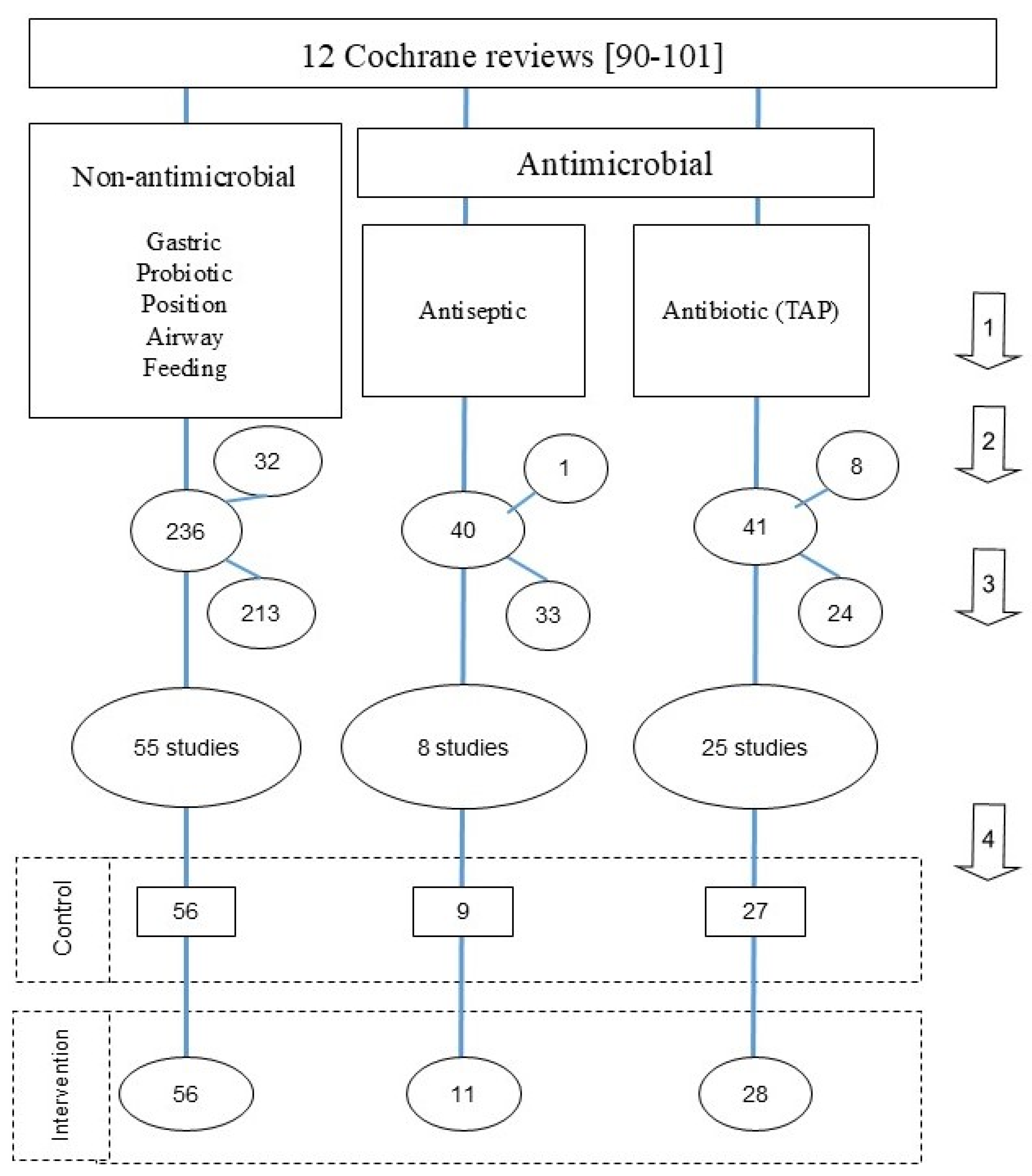
| Number of studies | 55 | 8 | 25 |
| Origin from systematic review b | 18 | 8 | 17 |
| North American ICUs c | 13 | 1 | 2 |
| Control group PPAP d | 0 | 0 | 2 |
| Group mean age; (mean) | 55.4 | 48.5 | 50.1 |
| Group mean age; (95% CI) | 52.3 to 58.4 | 42 to 54.5 | 46.2 to 54 |
| Study publication year (median) | 2006 | 2006 | 1997 |
| Study publication year (range) | 1987–2022 | 2000–2014 | 1974–2024 |
| Group characteristics | |||
| Types of groups | |||
| 56 | 9 | 27 |
| 56 | 10 | 28 |
| Numbers of patients per group; (median) e | 83 | 72 | 52 |
| Numbers of patients per group; (IQR) e | 61 to 166 | 31 to 130 | 42 to 130 |
| Group mean LOS; (mean) | 12.9 | 11.4 | 15.9 |
| Group mean LOS; (95% CI) | 11.3 to 14.4 | 8.3 to 14.5 | 14 to 17.9 |
| Non-Antimicrobial | Antiseptic | Antibiotic | ||||
|---|---|---|---|---|---|---|
| summary | 95% CI (n) | summary | 95% CI (n) | summary | 95% CI (n) | |
| Overall VAP b | ||||||
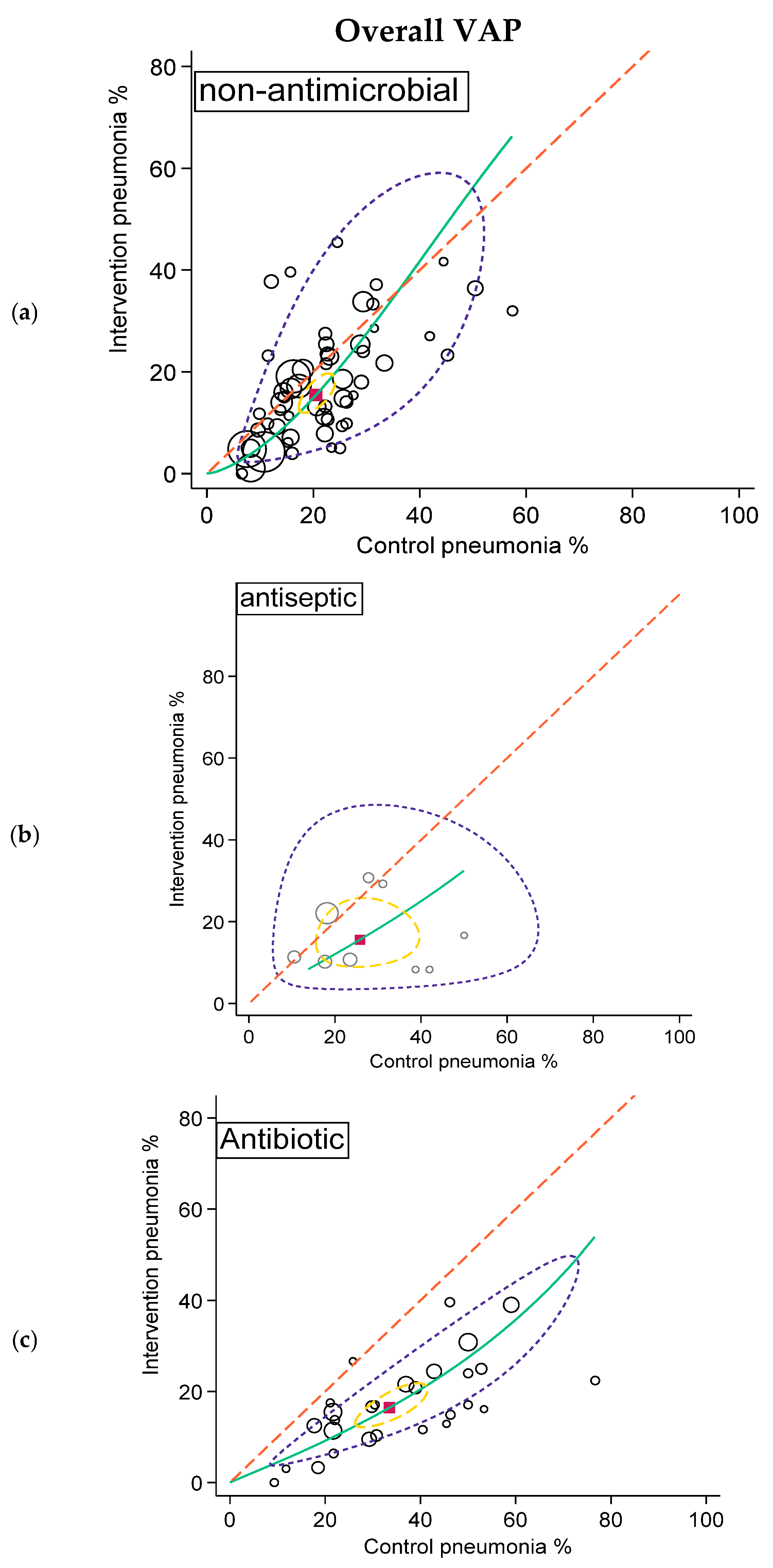
| Contrast-based odds ratio | 0.73 | 0.61 to 0.86 (56) | 0.53 | 0.34 to 0.81 (11) | 0.39 | 0.33 to 0.46 (28) |
| Arms-based (SROC) | ||||||
| 0.71 | 0.6 to 0.84 (56) | 0.52 | 0.34 to 0.8 (11) | 0.39 | 0.32 to 0.47 (28) |
| 21 | 18 to 23 | 25 | 19 to 34 | 34 | 28 to 39 |
| 15 | 13 to 19 | 16 | 11 to 22 | 16 | 13 to 20 |
| Pseudomonas VAP c | ||||||
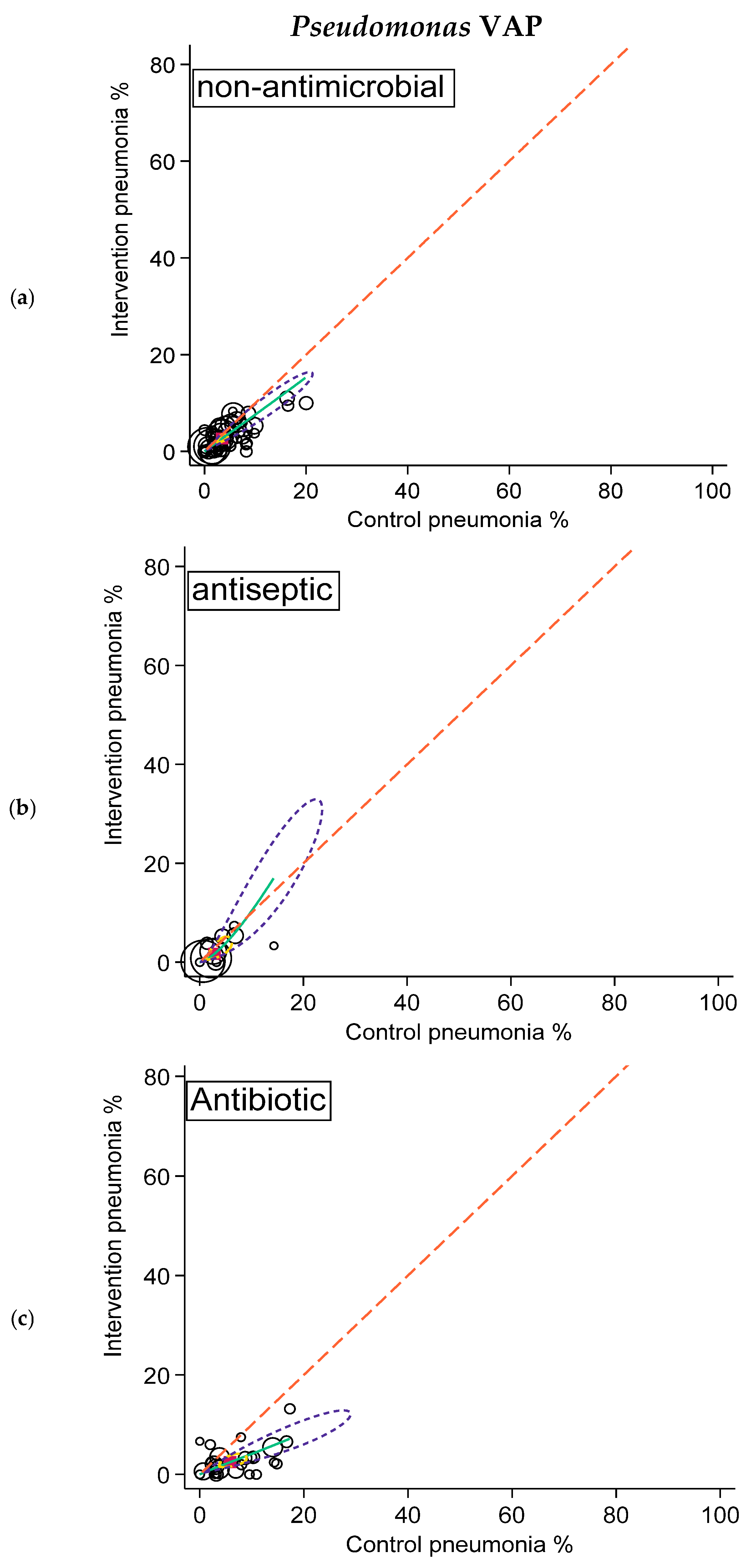
| Contrast-based odds ratio | 0.8 | 0.67 to 0.95 (54) | 0.65 | 0.42 to 1.01 (11) | 0.43 | 0.31 to 0.6 (25) |
| Arms-based (SROC) | ||||||
| 0.77 | 0.62 to 0.96 (54) | 0.59 | 0.36 to 0.98 (11) | 0.41 | 0.28 to 0.59 (25) |
| 3.5 | 2.7 to 4.5 | 2.8 | 1.6 to 4.9 | 5.8 | 4.2 to 8.1 |
| 2.7 | 1.9 to 3.5 | 1.7 | 0.8 to 3.5 | 2.4 | 1.6 to 3.6 |
| Acinetobacter VAP d | ||||||
| Contrast-based odds ratio | 0.85 | 0.62 to 1.16 (40) | 0.73 | 0.34 to 1.54 (7) | 0.6 | 0.38 to 0.93 (17) |
| Arms-based (SROC) | ||||||
| NA | NA | 0.61 | 0.31 to 1.2 (17) | ||
| 2.3 | 1.3 to 4.2 | ||||
| 1.4 | 0.7 to 2.7 | ||||
| S. aureus VAP e | ||||||
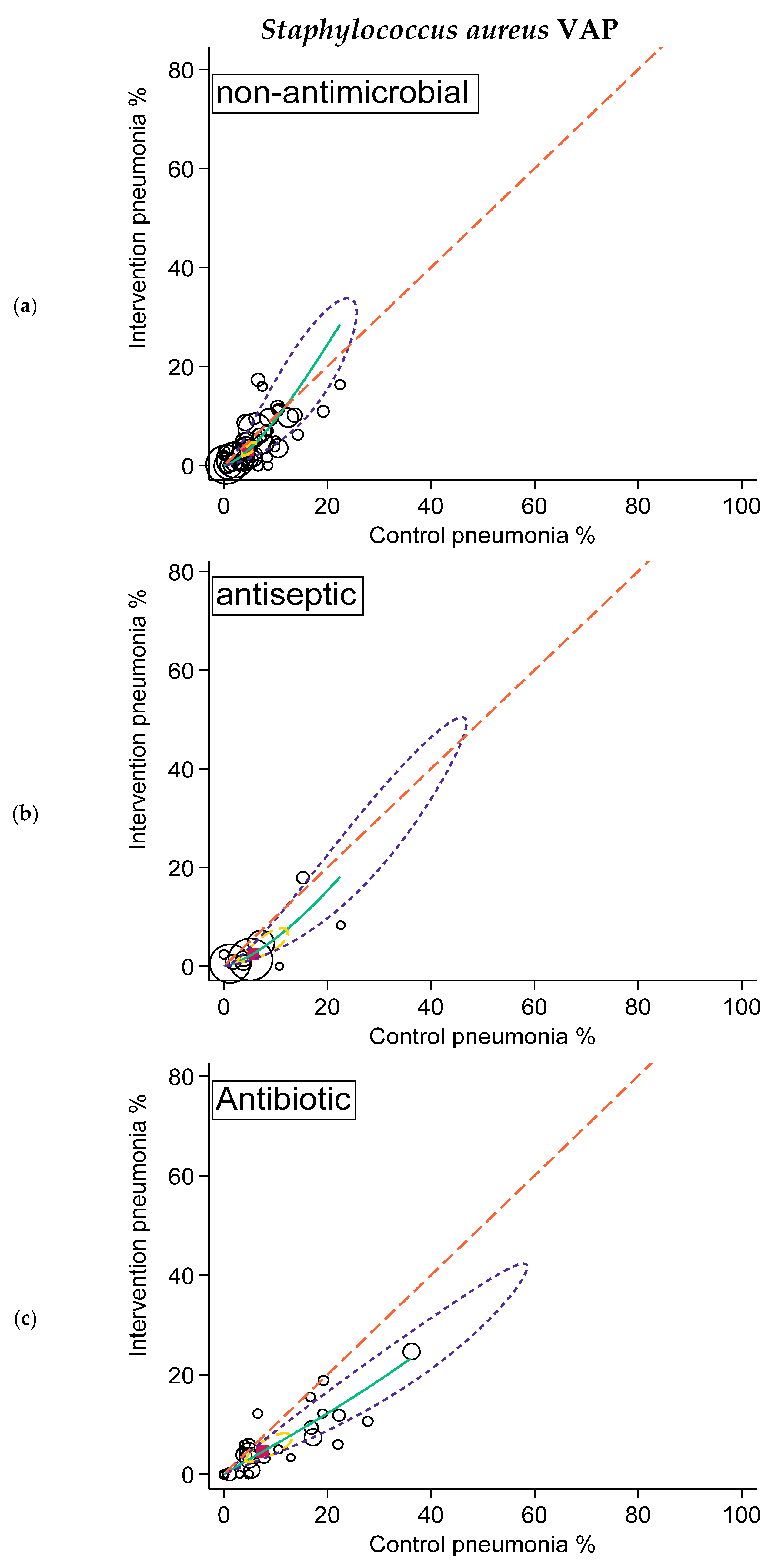
| Contrast-based odds ratio | 0.79 | 0.65 to 0.95 (53) | 0.48 | 0.31 to 0.74 (11) | 0.55 | 0.45 to 0.69 (27) |
| Arms-based (SROC) | ||||||
| 0.65 | 0.51 to 0.83 (53) | 0.43 | 0.29 to 0.64 (11) | 0.58 | 0.43 to 0.79 (27) |
| 4.7 | 3.7 to 5.9 | 5.6 | 3.3 to 9.7 | 7.6 | 4.9 to 11.4 |
| 3.1 | 2.2 to 4.3 | 2.4 | 1.1 to 5.3 | 4.5 | 2.9 to 7.1 |
| Unadjusted Model | Model Adjusted for Mean LOS b | |||||
|---|---|---|---|---|---|---|
| Coefficient | 95% CI | p | Coefficient | 95% CI | p | |
| Overall VAP | ||||||
| Constant | −1.34 | −1.53 to −1.15 | <0.01 | −2.64 | −3.38 to −1.91 | <0.01 |
| Non-antimicrobial Intervention | −0.32 | −0.57 to −0.06 | 0.02 | −0.31 | −0.56 to −0.07 | 0.01 |
| Antiseptic Control | 0.3 | −0.23 to 0.82 | 0.27 | 0.12 | −0.39 to 0.63 | 0.64 |
| Antiseptic Intervention | −0.65 | −1.14 to −0.16 | 0.01 | −0.41 | −0.94 to −0.11 | 0.12 |
| Antibiotic Control | 0.67 | 0.33 to 1.01 | <0.01 | 0.47 | 0.14 to 0.81 | 0.01 |
| Antibiotic Intervention | −0.16 | −0.5 to 0.19 | 0.37 | −0.3 | −0.64 to 0.08 | 0.13 |
| Year of Publication c | 0.01 | −0.01 to 0.02 | 0.11 | |||
| Majority Quality Score d | 0.03 | −0.21 to 0.22 | 0.83 | |||
| LOS (log transformed) | 0.54 | 0.31 to 0.77 | <0.01 | |||
| Pseudomonas VAP | ||||||
| Constant | −3.13 | −3.36 to −2.89 | <0.01 | −3.94 | −4.8 to −3.1 | <0.01 |
| Non-antimicrobial Intervention | −0.34 | −0.68 to 0.00 | 0.05 | −0.28 | −0.58 to −0.02 | 0.07 |
| Antiseptic Control | 0.02 | −0.63 to 0.66 | 0.96 | 0.03 | −0.58 to 0.64 | 0.93 |
| Antiseptic Intervention | −0.67 | −1.28 to −0.06 | 0.03 | −0.3 | −0.94 to 0.34 | 0.36 |
| Antibiotic Control | 0.5 | 0.08 to 0.88 | 0.01 | 0.42 | 0.03 to 0.82 | 0.04 |
| Antibiotic Intervention | −0.39 | −0.84 to 0.06 | 0.09 | −0.52 | −0.95 to −0.09 | 0.02 |
| Year of Publication c | −0.01 | −0.02 to 0.01 | 0.16 | |||
| Majority Quality Score d | −0.07 | −0.36 to 0.23 | 0.66 | |||
| LOS (log transformed) | 0.42 | 0.15 to 0.69 | <0.01 | |||
| Acinetobacter VAP | ||||||
| Constant | −4.01 | −4.4 to −3.62 | <0.01 | −2.56 | −4.03 to −1.08 | <0.01 |
| Non-antimicrobial Intervention | −0.02 | −0.57 to 0.54 | 0.95 | −0.04 | −0.55 to 0.46 | 0.86 |
| Antiseptic Control | 0.66 | −0.46 to 1.79 | 0.25 | 1.05 | −0.03 to 2.13 | 0.06 |
| Antiseptic Intervention | −0.43 | −1.44 to 0.59 | 0.41 | 0.51 | −0.61 to 1.63 | 0.37 |
| Antibiotic Control | 0.68 | 0.16 to 1.46 | 0.01 | 1.12 | 0.42 to 1.82 | <0.001 |
| Antibiotic Intervention | 0.06 | −0.66 to 0.78 | 0.87 | 0.32 | −0.41 to 1.06 | 0.39 |
| Year of Publication c | 0.02 | −0.01 to 0.04 | 0.1 | |||
| Majority Quality Score d | −0.71 | −1.23 to −0.2 | 0.01 | |||
| LOS (log transformed) | −0.17 | −0.65 to 0.30 | 0.47 | |||
| S. aureus VAP | ||||||
| Constant | −2.91 | −3.2 to −2.65 | <0.01 | −4.96 | −5.98 to −3.95 | <0.01 |
| Non-antimicrobial Intervention | −0.36 | −0.72 to −0.01 | 0.05 | −0.36 | −0.71 to −0.02 | 0.04 |
| Antiseptic Control | 0.43 | −0.25 to 1.1 | 0.22 | 0.05 | −0.64 to 0.73 | 0.89 |
| Antiseptic Intervention | −0.62 | −1.27 to 0.04 | 0.06 | −0.76 | −1.49 to −0.03 | 0.04 |
| Antibiotic Control | 0.57 | 0.12 to 1.02 | 0.01 | 0.22 | −0.23 to 0.68 | 0.33 |
| Antibiotic Intervention | 0.28 | −0.16 to 0.73 | 0.21 | −0.18 | −0.63 to 0.27 | 0.44 |
| Year of Publication c | 0.01 | −0.01 to 0.02 | 0.84 | |||
| Majority Quality Score d | 0.34 | 0.01 to 0.66 | 0.04 | |||
| LOS (log transformed) | 0.71 | 0.39 to 1.03 | <0.01 | |||
| Antiseptic-Based | Antibiotic-Based | |||||||
|---|---|---|---|---|---|---|---|---|
| Coefficient | 95% CI; | n a | Ref. | Coefficient | 95% CI; | n a | Ref. | |
| VAP or RTI (Overall) | ||||||||
| RTI | RR: 0.76 | 0.62 to 0.91 | 18 | [98,99] | OR: 0.28 | 0.2 to 0.38 | 16 | [100] |
| VAP | OR: 0.68 | 0.53 to 0.87 | 21 | [122] | RR: 0.43 | 0.35 to 0.53 | 17 | [101] |
| NP/RTI | RR: 0.73 | 0.58 to 0.92 | 16 | [126] | RR: 0.44 | 0.36 to 0.54 | 22 | [118] |
| VAP | OR: 0.53 | 0.34 to 0.81 | 11 | This study | OR: 0.39 | 0.33 to 0.46 | 28 | This study |
| VAP | DOR: 0.52 | 0.34 to 0.8 | 11 | This study | DOR: 0.39 | 0.32 to 0.47 | 28 | This study |
Disclaimer/Publisher’s Note: The statements, opinions and data contained in all publications are solely those of the individual author(s) and contributor(s) and not of MDPI and/or the editor(s). MDPI and/or the editor(s) disclaim responsibility for any injury to people or property resulting from any ideas, methods, instructions or products referred to in the content. |
© 2026 by the author. Licensee MDPI, Basel, Switzerland. This article is an open access article distributed under the terms and conditions of the Creative Commons Attribution (CC BY) license.
Share and Cite
Hurley, J.C. Arms-Based Meta-Analysis of Microbiological Endpoints of 88 VAP Prevention Studies Using Antimicrobial Versus Non-Antimicrobial Strategies—Towards ‘VAP-Zero’? Antibiotics 2026, 15, 221. https://doi.org/10.3390/antibiotics15020221
Hurley JC. Arms-Based Meta-Analysis of Microbiological Endpoints of 88 VAP Prevention Studies Using Antimicrobial Versus Non-Antimicrobial Strategies—Towards ‘VAP-Zero’? Antibiotics. 2026; 15(2):221. https://doi.org/10.3390/antibiotics15020221
Chicago/Turabian StyleHurley, James C. 2026. "Arms-Based Meta-Analysis of Microbiological Endpoints of 88 VAP Prevention Studies Using Antimicrobial Versus Non-Antimicrobial Strategies—Towards ‘VAP-Zero’?" Antibiotics 15, no. 2: 221. https://doi.org/10.3390/antibiotics15020221
APA StyleHurley, J. C. (2026). Arms-Based Meta-Analysis of Microbiological Endpoints of 88 VAP Prevention Studies Using Antimicrobial Versus Non-Antimicrobial Strategies—Towards ‘VAP-Zero’? Antibiotics, 15(2), 221. https://doi.org/10.3390/antibiotics15020221