
A New Antibacterial Protocol Based on Cymbopogon nardus (L.) Rendle Essential Oil and UV-C Radiation with Potential Application for Hatching Eggs
 ,
,  ,
,  ,
, 
Abstract
1. Introduction
2. Results and Discussion
2.1. Bacterial Count on Eggshells
2.2. Physical Characteristics of Eggshells
2.3. Chemical Composition Analysis of C. nardus Essential Oil Before and After Exposure to UV-C Radiation
3. Materials and Methods
3.1. Obtaining C. nardus Essential Oil
3.2. Minimum Inhibitory Concentration of C. nardus Essential Oil
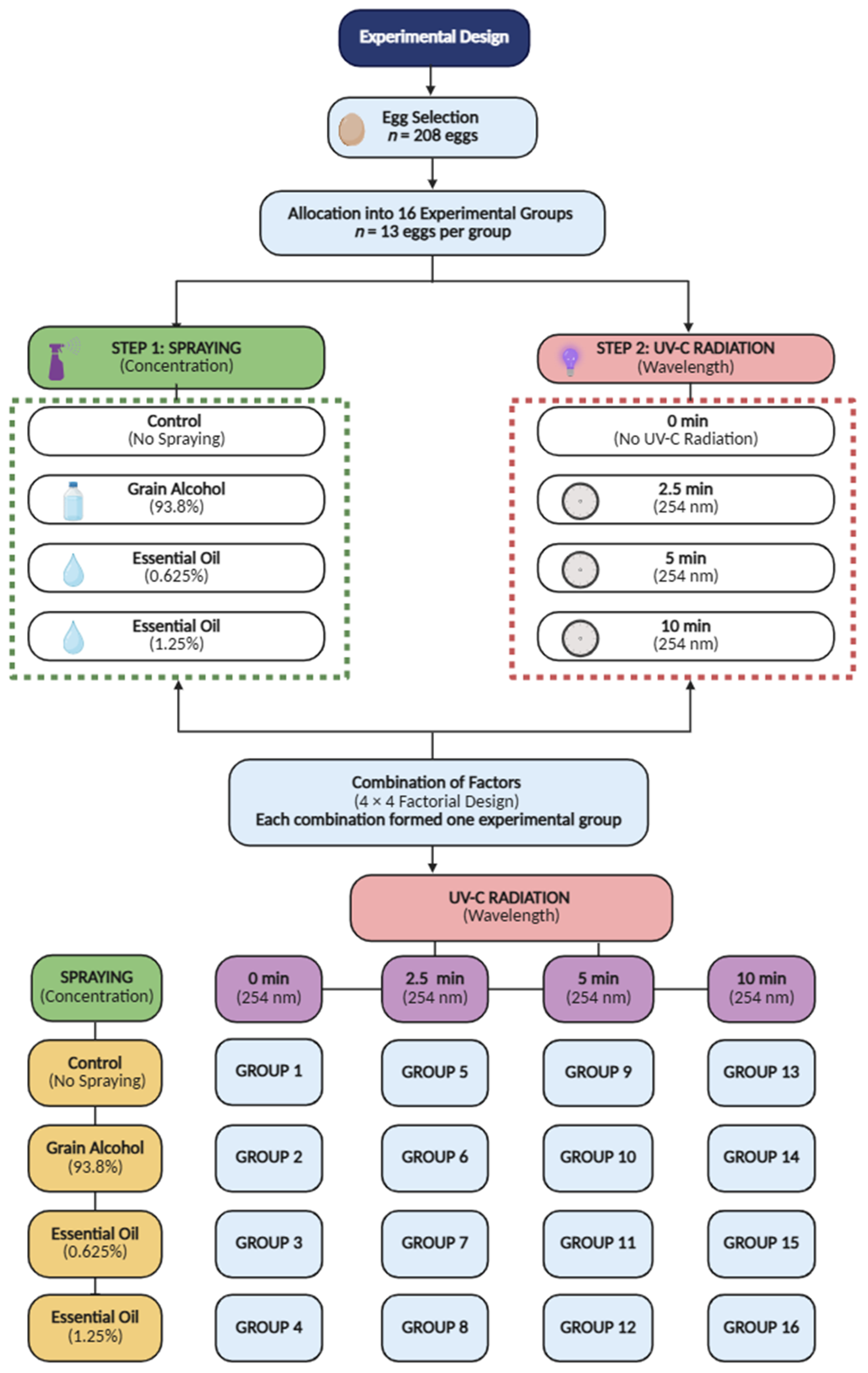
3.3. Experimental Design and Application of C. nardus Essential Oil and UV-C Radiation on Eggs
3.4. Bacterial Count on Eggshells
3.5. Physical Characteristics of Eggshells
3.6. Chemical Composition Analysis of C. nardus Essential Oil
3.7. Exposure of C. nardus Essential Oil to UV-C Radiation
3.8. Statistical Analysis
4. Conclusions
Author Contributions
Funding
Institutional Review Board Statement
Informed Consent Statement
Data Availability Statement
Conflicts of Interest
References
- Amer, M.M.; Elbayoumi, K.M.; Amin Girh, Z.M.S.; Mekky, H.M.; Rabie, N.S. A Study on Bacterial Contamination of Dead in Shell Chicken Embryos and Culled One Day Chicks. Int. J. Pharm. Clin. Res. 2017, 7, 5–11. [Google Scholar]
- Santos, P.H.G.d.S.; Oliveira, G.d.S.; Cerqueira, L.d.A.; Jivago, J.L.d.P.R.; Paixão, S.S.R.M.; de Castro, M.B.; McManus, C.; dos Santos, V.M. Formaldehyde Fumigation: Antibacterial Profile and Toxic Effects on Hatching Eggs. Toxics 2025, 13, 851. [Google Scholar] [CrossRef] [Scilit] [PubMed]
- World Health Organization. WHO Guidelines for Indoor Air Quality: Selected Pollutants; World Health Organization: Geneva, Switzerland, 2010; pp. 103–156. [Google Scholar]
- Castellani, F.; Vitali, M.; Antonucci, A.; Cofone, L.; D’Ancona, G.; Pindinello, I.; Buomprisco, G.; Petyx, M.; Ursini, C.L.; Protano, C. Effective Mitigation Strategies for Reducing Workers’ Exposure to Formaldehyde: A Systematic Review. Air Qual. Atmos. Health 2024, 17, 877–890. [Google Scholar] [CrossRef] [Scilit]
- Oliveira, G.d.S.; Vale, I.R.R.; McManus, C.; dos Santos, V.M. Ultraviolet Light, Hydrogen Peroxide, Peracetic Acid, and Ozone as Sanitizers for Hatching Eggs: A Review. Animals 2026, 16, 2108. [Google Scholar] [CrossRef] [Scilit] [PubMed]
- Pereira, F.M.A.M.; de Sousa, L.P.V.G.; Rama, J.D.; Dallago, B.S.L.; Perecmanis, S.; Bernal, F.E.M. Efeito da Luz Ultravioleta na Eclodibilidade e Viabilidade de Pintos Provenientes de Ovos Férteis Sujos. Rev. Bras. Ciênc. Vet. 2018, 25, 87–92. [Google Scholar] [CrossRef] [Scilit]
- Mattioli, S.; Ortenzi, R.; Scuota, S.; Mancinelli, A.C.; Dal Bosco, A.; Cotozzolo, E.; Castellini, C. Impact of Ozone and UV Irradiation Sanitation Treatments on the Survival of Salmonella and the Physical–Chemical Characteristics of Hen Eggs. J. Appl. Poult. Res. 2020, 29, 409–419. [Google Scholar] [CrossRef] [Scilit]
- Clímaco, W.L.D.S.; Melo, É.D.F.; Vaz, D.P.; Saldanha, M.M.; Pinto, M.F.V.D.S.; Fernandes, L.C.C.; Baião, N.C.; Oliveira, L.G.D.; Sant’Anna, F.M.D.; Souza, M.R.D.; et al. Eggshell Microbiology and Quality of Hatching Eggs Subjected to Different Sanitizing Procedures. Pesq. Agrop. Bras. 2018, 53, 1177–1183. [Google Scholar] [CrossRef] [Scilit]
- Coulibaly, F.; Onbaşılar, E.E.; Bakır, B.; Sarıçam İnce, S. The Effects of Using UV Light Instead of Formaldehyde in Disinfection of Hatching Eggs on Shell Microbial Load, Embryo Development, Hatchability, and Chick Characteristics. Int. J. Environ. Health Res. 2024, 34, 2852–2862. [Google Scholar] [PubMed]
- Melo, E.F.; Clímaco, W.L.S.; Triginelli, M.V.; Vaz, D.P.; de Souza, M.R.; Baião, N.C.; Pompeu, M.A.; Lara, L.J.C. An Evaluation of Alternative Methods for Sanitizing Hatching Eggs. Poult. Sci. 2019, 98, 2466–2473. [Google Scholar] [CrossRef] [Scilit] [PubMed]
- Yu, H.-C.; Chen, I.-C.; Tan, F.-J. Evaluation of Washing with Sodium Hypochlorite, Ultraviolet Irradiation, and Storage Temperature on Shell Egg Quality During Storage. Foods 2025, 14, 2156. [Google Scholar] [CrossRef] [Scilit] [PubMed]
- El-Soufi, A.; Al Khatib, A.; Khazaal, S.; El Darra, N.; Raafat, K. Evaluation of Essential Oils as Natural Antibacterial Agents for Eggshell Sanitization and Quality Preservation. Processes 2025, 13, 224. [Google Scholar] [CrossRef] [Scilit]
- Vicil, S.; Özbaşer Bulut, F.T.; Gürgan Eser, M.; Bulut, H. Thyme Essential Oil and Hyaluronic Acid as Natural Disinfectant Alternatives for Broiler Breeder Fertile Eggs: Effects on Eggshell Microbial Load, Embryonic Viability and Hatchability. Vet. Med. Sci. 2026, 12, e71049. [Google Scholar] [CrossRef] [Scilit] [PubMed]
- De Silva, G.B.V.U.; Dharmadasa, R.M.; Senanayake, R.A.S.P.; Lintha, A. Selection of Superior Quality Cymbopogon nardus (L.) Rendle (Poaceae) Populations by Means of Quantity and Quality of Essential Oils. World J. Agric. Res. 2021, 9, 1–8. [Google Scholar]
- Vale, I.R.R.; Oliveira, G.d.S.; de Jesus, L.M.; de Castro, M.B.; McManus, C.; dos Santos, V.M. Sustainable Bacterial Control of Hatching Eggshells Using Essential Oils. Antibiotics 2024, 13, 1025. [Google Scholar] [CrossRef] [Scilit] [PubMed]
- Phothisuwan, S.; Preechatiwong, W.; Matan, N. Enhancement of Antibacterial Activity of Essential Oil Vapor Released from a Paper Egg Tray in Combination with UV-C Radiation against Pathogenic Bacteria on Chicken Eggs. J. Food Process. Preserv. 2020, 44, e14794. [Google Scholar] [CrossRef] [Scilit]
- Pontes, E.K.U.; Melo, H.M.; Nogueira, J.W.A.; Firmino, N.C.S.; de Carvalho, M.G.; Catunda, F.E.A., Jr.; Cavalcante, T.T.A. Antibiofilm Activity of the Essential Oil of Citronella (Cymbopogon nardus) and Its Major Component, Geraniol, on the Bacterial Biofilms of Staphylococcus aureus. Food Sci. Biotechnol. 2019, 28, 633–639. [Google Scholar] [PubMed]
- Silva-Espinoza, B.A.; Palomares-Navarro, J.J.; Tapia-Rodriguez, M.R.; Cruz-Valenzuela, M.R.; González-Aguilar, G.A.; Silva-Campa, E.; Pedroza-Montero, M.; Almeida-Lopes, M.; Miranda, R.; Ayala-Zavala, J.F. Combination of Ultraviolet Light-C and Clove Essential Oil to Inactivate Salmonella Typhimurium Biofilms on Stainless Steel. J. Food Saf. 2020, 40, e12788. [Google Scholar] [CrossRef] [Scilit]
- Xu, L.; Zhang, C.; Xu, P.; Wang, X.C. Mechanisms of Ultraviolet Disinfection and Chlorination of Escherichia coli: Culturability, Membrane Permeability, Metabolism, and Genetic Damage. J. Environ. Sci. 2018, 65, 356–366. [Google Scholar] [CrossRef] [Scilit]
- Stange, C.; Sidhu, J.P.S.; Toze, S.; Tiehm, A. Comparative Removal of Antibiotic Resistance Genes During Chlorination, Ozonation, and UV Treatment. Int. J. Hyg. Environ. Health 2019, 222, 541–548. [Google Scholar] [CrossRef] [Scilit]
- Majewska-Smolarek, K.; Kowalewska, A. Essential Oils as Green Antibacterial Modifiers of Polymeric Materials. Polymers 2025, 17, 2924. [Google Scholar] [CrossRef] [Scilit] [PubMed]
- Kang, K.; Liu, X.; Li, P.; Yang, S.; Lei, Y.; Lv, Y.; Hu, Y. Exploring Citronella’s Inhibitory Mechanism Against Listeria monocytogenes and Its Utilization in Preserving Cheese. Food Microbiol. 2024, 122, 104550. [Google Scholar] [CrossRef] [Scilit] [PubMed]
- Sharaf Eddin, A.; Tahergorabi, R. Efficacy of Sweet Potato Starch-Based Coating to Improve Quality and Safety of Hen Eggs during Storage. Coatings 2019, 9, 205. [Google Scholar] [CrossRef] [Scilit]
- Abdallah, A.G.; Harms, R.H.; El-Husseiny, O. Various Methods of Measuring Shell Quality in Relation to Percentage of Cracked Eggs. Poult. Sci. 1993, 72, 2038–2043. [Google Scholar] [CrossRef] [Scilit]
- Wisocki, P.A.; Kennelly, P.; Rojas Rivera, I.; Cassey, P.; Burkey, M.L.; Hanley, D. The Global Distribution of Avian Eggshell Colours Suggest a Thermoregulatory Benefit of Darker Pigmentation. Nat. Ecol. Evol. 2020, 4, 148–155. [Google Scholar] [PubMed]
- Moreau, T.; Gautron, J.; Hincke, M.T.; Monget, P.; Réhault-Godbert, S.; Guyot, N. Antimicrobial Proteins and Peptides in Avian Eggshell: Structural Diversity and Potential Roles in Biomineralization. Front. Immunol. 2022, 13, 946428. [Google Scholar] [CrossRef] [Scilit] [PubMed]
- Acree, W.E., Jr.; Chickos, J.S. Phase Transition Enthalpy Measurements of Organic and Organometallic Compounds. In NIST Chemistry WebBook, NIST Standard Reference Database Number 69; Linstrom, P.J., Mallard, W.G., Eds.; National Institute of Standards and Technology: Gaithersburg, MD, USA, 2026. Available online: https://webbook.nist.gov/ (accessed on 18 May 2026).
- Ramadhan, D.S.; Warsito, W.; Silvianti, R.; Cahayo, M.; Azzahra, V.O. Chemical Composition and Quality Parameters of Citronella (Cymbopogon nardus) Essential Oil Based on GC–MS and Physicochemical Analysis. Indones. J. Chem. Sci. Technol. 2026, 9, 150–157. [Google Scholar] [CrossRef] [Scilit]
- Barra, A. Factors Affecting Chemical Variability of Essential Oils: A Review of Recent Developments. Nat. Prod. Commun. 2009, 4, 1147–1154. [Google Scholar] [CrossRef] [Scilit] [PubMed]
- Rahman, M.M.; Wills, R.B.H.; Bowyer, M.C.; Golding, J.B.; Kirkman, T.; Pristijono, P. Efficacy of Orange Essential Oil and Citral after Exposure to UV-C Irradiation to Inhibit Penicillium digitatum in Navel Oranges. Horticulturae 2020, 6, 102. [Google Scholar] [CrossRef] [Scilit]
- Pankey, G.A.; Sabath, L.D. Clinical Relevance of Bacteriostatic Versus Bactericidal Mechanisms of Action in the Treatment of Gram-Positive Bacterial Infections. Clin. Infect. Dis. 2004, 38, 864–870. [Google Scholar] [CrossRef] [Scilit] [PubMed]
- Domingues, J.; Goulão, M.; Delgado, F.; Gonçalves, J.C.; Gonçalves, J.; Pintado, C.S. Essential Oils of Two Portuguese Endemic Species of Lavandula as a Source of Antifungal and Antibacterial Agents. Processes 2023, 11, 1165. [Google Scholar] [CrossRef] [Scilit]


| Spraying Treatment | UV-C Radiation (min) | |||
|---|---|---|---|---|
| 0 | 2.5 | 5 | 10 | |
| Mesophilic Bacteria (log10 CFU/mL) ± Standard Deviation | ||||
| No Spraying | 3.73 ± 0.18 A,a | 3.66 ± 0.24 A,a | 2.52 ± 0.15 A,b | 1.64 ± 0.27 A,c |
| Grain Alcohol (93.8%) | 3.18 ± 0.37 A,a | 2.99 ± 0.15 B,a | 1.93 ± 0.12 A,b | 1.58 ± 0.13 A,b |
| C. nardus Essential Oil (0.625%) | 1.23 ± 0.35 B,a | 1.31 ± 0.35 C,a | <1.00 *B,b | <1.00 B,b |
| C. nardus Essential Oil (1.25%) | 1.37 ± 0.26 B,a | 1.11 ± 0.20 C,a | <1.00 B,b | <1.00 B,b |
| p-value | ||||
| Spraying | <0.0001 | |||
| UV-C Radiation | <0.0001 | |||
| Spraying × UV-C Radiation | 0.0166 | |||
| Spraying Treatment | UV-C Radiation | |||
|---|---|---|---|---|
| 0 | 2.5 | 5 | 10 | |
| L* | ||||
| No Spraying | 64.37 ± 3.02 A,a | 61.04 ± 3.62 A,a | 62.09 ± 3.96 A,a | 64.42 ± 4.94 A,a |
| Grain Alcohol (93.8%) | 61.38 ± 4.23 A,a | 62.44 ± 3.25 A,a | 61.19 ± 3.25 A,a | 63.78 ± 3.79 A,a |
| C. nardus Essential Oil (0.625%) | 62.20 ± 3.68 A,a | 62.99 ± 3.20 A,a | 64.75 ± 3.98 A,a | 64.85 ± 3.17 A,a |
| C. nardus Essential Oil (1.25%) | 63.02 ± 4.10 A,a | 62.94 ± 3.63 A,a | 64.04 ± 3.45 A,a | 61.67 ± 3.43 A,a |
| p-value | ||||
| Spraying | 0.3538 | |||
| UV-C Radiation | 0.4346 | |||
| Spraying × UV-C Radiation | 0.1996 | |||
| Spraying Treatment | UV-C Radiation | |||
| 0 | 2.5 | 5 | 10 | |
| a* | ||||
| No Spraying | 13.19 ± 1.66 A,a | 15.32 ± 1.91 A,a | 15.16 ± 1.91 A,a | 13.12 ± 2.93 A,a |
| Grain Alcohol (93.8%) | 14.98 ± 2.13 A,a | 14.70 ± 1.77 A,a | 15.69 ± 2.17 A,a | 13.49 ± 2.23 A,a |
| C. nardus Essential Oil (0.625%) | 14.36 ± 2.54 A,a | 14.59 ± 1.97 A,a | 13.27 ± 2.08 A,a | 14.24 ± 2.28 A,a |
| C. nardus Essential Oil (1.25%) | 13.75 ± 2.46 A,a | 13.74 ± 2.19 A,a | 13.94 ± 2.04 A,a | 14.70 ± 1.52 A,a |
| p-value | ||||
| Spraying | 0.4803 | |||
| UV-C Radiation | 0.3856 | |||
| Spraying × UV-C Radiation | 0.0862 | |||
| Spraying Treatment | UV-C Radiation (min) | |||
| 0 | 2.5 | 5 | 10 | |
| b* | ||||
| No Spraying | 25.76 ± 2.88 A,a | 27.27 ± 2.60 A,a | 27.23 ± 2.75 A,a | 24.34 ± 3.93 A,a |
| Grain Alcohol (93.8%) | 25.27 ± 2.99 A,a | 24.79 ± 3.09 A,a | 27.27 ± 3.46 A,a | 24.38 ± 3.61 A,a |
| C. nardus Essential Oil (0.625%) | 26.81 ± 2.46 A,a | 27.04 ± 2.68 A,a | 25.33 ± 3.12 A,a | 25.75 ± 2.91 A,a |
| C. nardus Essential Oil (1.25%) | 27.17 ± 2.69 A,a | 27.51 ± 2.44 A,a | 24.88 ± 1.65 A,a | 26.09 ± 1.52 A,a |
| p-value | ||||
| Spraying | 0.4364 | |||
| UV-C Radiation | 0.1131 | |||
| Spraying × UV-C Radiation | 0.1112 | |||
| Spraying Treatment | UV-C Radiation (min) | |||
|---|---|---|---|---|
| 0 | 2.5 | 5 | 10 | |
| Egg Weight (g) | ||||
| No Spraying | 58.49 ± 3.76 A,a | 57.70 ± 4.03 A,a | 57.97 ± 3.01 A,a | 58.96 ± 4.24 A,a |
| Grain Alcohol (93.8%) | 58.94 ± 3.03 A,a | 57.65 ± 3.58 A,a | 58.37 ± 4.46 A,a | 58.92 ± 4.60 A,a |
| C. nardus Essential Oil (0.625%) | 58.45 ± 3.63 A,a | 59.22 ± 3.50 A,a | 58.18 ± 3.39 A,a | 57.86 ± 4.00 A,a |
| C. nardus Essential Oil (1.25%) | 58.75 ± 3.09 A,a | 58.59 ± 4.68 A,a | 58.89 ± 4.30 A,a | 58.41 ± 3.63 A,a |
| p-value | ||||
| Spraying | 0.9777 | |||
| UV-C Radiation | 0.9725 | |||
| Spraying × UV-C Radiation | 0.9921 | |||
| Spraying Treatment | UV-C Radiation (min) | |||
| 0 | 2.5 | 5 | 10 | |
| Absolute Eggshell Weight (g) | ||||
| No Spraying | 6.42 ± 0.65 A,a | 6.42 ± 0.62 A,a | 6.55 ± 0.58 A,a | 6.75 ± 0.48 A,a |
| Grain Alcohol (93.8%) | 6.90 ± 0.36 A,a | 6.34 ± 0.56 A,a | 6.51 ± 0.74 A,a | 6.55 ± 0.46 A,a |
| C. nardus Essential Oil (0.625%) | 6.50 ± 0.38 A,a | 6.46 ± 0.49 A,a | 6.32 ± 0.35 A,a | 6.63 ± 0.51 A,a |
| C. nardus Essential Oil (1.25%) | 6.58 ± 0.79 A,a | 6.83 ± 0.64 A,a | 6.71 ± 0.50 A,a | 6.50 ± 0.73 A,a |
| p-value | ||||
| Spraying | 0.5615 | |||
| UV-C Radiation | 0.8185 | |||
| Spraying × UV-C Radiation | 0.3662 | |||
| Spraying Treatment | UV-C Radiation (min) | |||
| 0 | 2.5 | 5 | 10 | |
| Relative Eggshell Weight (%) | ||||
| No Spraying | 10.99 ± 1.01 A,a | 11.12 ± 0.69 A,a | 11.31 ± 0.98 A,a | 11.48 ± 0.87 A,a |
| Grain Alcohol (93.8%) | 11.72 ± 0.59 A,a | 11.01 ± 0.95 A,a | 11.15 ± 0.97 A,a | 11.17 ± 1.04 A,a |
| C. nardus Essential Oil (0.625%) | 11.13 ± 0.44 A,a | 10.91 ± 0.47 A,a | 10.88 ± 0.61 A,a | 11.47 ± 0.73 A,a |
| C. nardus Essential Oil (1.25%) | 11.18 ± 1.00 A,a | 11.65 ± 0.49 A,a | 11.42 ± 0.80 A,a | 11.11 ± 0.79 A,a |
| p-value | ||||
| Spraying | 0.5945 | |||
| UV-C Radiation | 0.8712 | |||
| Spraying × UV-C Radiation | 0.2061 | |||
| Spraying Treatment | UV-C Radiation (min) | |||
| 0 | 2.5 | 5 | 10 | |
| Eggshell Weight per Unit Surface Area (mg/cm2) | ||||
| No Spraying | 91.45 ± 8.24 A,a | 92.24 ± 6.17 A,a | 93.90 ± 7.90 A,a | 95.71 ± 6.38 A,a |
| Grain Alcohol (93.8%) | 97.77 ± 4.39 A,a | 91.26 ± 7.51 A,a | 92.76 ± 8.38 A,a | 93.01 ± 7.40 A,a |
| C. nardus Essential Oil (0.625%) | 92.62 ± 3.35 A,a | 91.13 ± 4.40 A,a | 90.40 ± 4.46 A,a | 95.16 ± 5.76 A,a |
| C. nardus Essential Oil (1.25%) | 93.26 ± 8.97 A,a | 97.05 ± 4.86 A,a | 95.17 ± 6.01 A,a | 92.49 ± 7.50 A,a |
| p-value | ||||
| Spraying | 0.5240 | |||
| UV-C Radiation | 0.8294 | |||
| Spraying × UV-C Radiation | 0.1689 | |||
| Spraying Treatment | UV-C Radiation (min) | |||
| 0 | 2.5 | 5 | 10 | |
| Eggshell Thickness (mm) | ||||
| No Spraying | 0.41 ± 0.02 A,a | 0.41 ± 0.01 A,a | 0.42 ± 0.03 A,a | 0.41 ± 0.03 A,a |
| Grain Alcohol (93.8%) | 0.40 ± 0.02 A,a | 0.41 ± 0.02 A,a | 0.41 ± 0.03 A,a | 0.40 ± 0.02 A,a |
| C. nardus Essential Oil (0.625%) | 0.42 ± 0.01 A,a | 0.42 ± 0.02 A,a | 0.43 ± 0.03 A,a | 0.40 ± 0.02 A,a |
| C. nardus Essential Oil (1.25%) | 0.40 ± 0.03 A,a | 0.40 ± 0.02 A,a | 0.41 ± 0.03 A,a | 0.40 ± 0.04 A,a |
| p-value | ||||
| Spraying | 0.0513 | |||
| UV-C Radiation | 0.1036 | |||
| Spraying × UV-C Radiation | 0.8325 | |||
| Identified Compound | R.T. (min.) | RIexp | RIlit | Percentage in the Samples (%) | |
|---|---|---|---|---|---|
| C. nardus | C. nardus + UV-C Radiation | ||||
| 6-Methyl-5-heptene-2-one | 10.04 | 966 | 966 | 0.1 ± 0.0 | 0.1 ± 0.0 |
| 10.13 | 968 | 0.0 ± 0.0 | 0.0 ± 0.0 | ||
| Octanal | 10.62 | 981 | 987 | 0.0 ± 0.0 | 0.0 ± 0.0 |
| Limonene | 11.66 | 1007 | 1028 | 1.9 ± 0.0 | 1.8 ± 0.1 |
| 11.74 | 1008 | - | 0.0 ± 0.0 | ||
| trans-β-Ocimene | 12.18 | 1019 | 1039 | 0.2 ± 0.0 | 0.2 ± 0.0 |
| β-Ocimene | 12.63 | 1030 | 1043 | 0.1 ± 0.0 | 0.1 ± 0.0 |
| 2,6-Dimethyl-5-heptenal | 12.89 | 1037 | 1044 | 0.2 ± 0.0 | 0.1 ± 0.0 |
| 4-Nonanone | 13.76 | 1059 | 1053 | 0.3 ± 0.0 | 0.3 ± 0.0 |
| Linalool | 15.00 | 1089 | 1098 | 0.8 ± 0.0 | 0.8 ± 0.0 |
| trans-Rose oxide | 15.49 | 1101 | 1115 | 0.1 ± 0.0 | 0.1 ± 0.0 |
| 2,6-Dimethyl-5-hepten-1-ol | 16.36 | 1123 | 0.1 ± 0.0 | 0.1 ± 0.0 | |
| Isopulegol | 16.98 | 1139 | 1146 | 0.5 ± 0.0 | 0.4 ± 0.0 |
| 17.21 | 1144 | 0.1 ± 0.0 | 0.1 ± 0.0 | ||
| Citronellal | 17.42 | 1149 | 1153 | 27.7 ± 0.3 | 26.6 ± 0.1 |
| 17.94 | 1162 | 0.0 ± 0.0 | 0.0 ± 0.0 | ||
| 3,7-Dimethyl-3,6-octadienal | 18.81 | 1184 | 1184 | 0.1 ± 0.0 | 0.1 ± 0.0 |
| Decanal | 19.84 | 1210 | 1207 | 0.5 ± 0.0 | 0.4 ± 0.0 |
| Citronellol | 20.88 | 1235 | 1232 | 13.5 ± 0.2 | 13.9 ± 0.1 |
| Neral | 21.41 | 1248 | 1248 | 3.8 ± 0.0 | 3.8 ± 0.0 |
| Geraniol | 22.08 | 1265 | 1267 | 39.1 ± 0.3 | 39.9 ± 0.0 |
| α-Citral | 22.76 | 1282 | 1287 | 5.1 ± 0.0 | 5.1 ± 0.1 |
| 24.17 | 1317 | - | 0.0 ± 0.0 | ||
| 25.42 | 1348 | - | 0.0 ± 0.0 | ||
| Citronellol acetate | 26.42 | 1373 | 1376 | 0.9 ± 0.0 | 0.9 ± 0.0 |
| β-Bourbonene | 27.62 | 1403 | 1384 | 0.0 ± 0.0 | 0.1 ± 0.0 |
| Geranyl acetate | 27.73 | 1405 | 1392 | 1.5 ± 0.0 | 1.6 ± 0.1 |
| 27.97 | 1411 | 0.1 ± 0.0 | 0.1 ± 0.0 | ||
| Caryophyllene | 29.06 | 1438 | 1444 | 1.7 ± 0.0 | 1.7 ± 0.1 |
| Humulene | 30.46 | 1473 | 1477 | 0.2 ± 0.0 | 0.2 ± 0.0 |
| Germacrene D | 31.60 | 1502 | 1503 | 0.2 ± 0.0 | 0.1 ± 0.0 |
| 32.39 | 1521 | - | 0.0 ± 0.0 | ||
| 32.54 | 1525 | - | 0.0 ± 0.0 | ||
| γ-Muurolene | 32.94 | 1535 | 1526 | 0.7 ± 0.0 | 0.7 ± 0.0 |
| δ-Cadinene | 33.33 | 1544 | 1541 | 0.3 ± 0.0 | 0.3 ± 0.0 |
| 34.31 | 1569 | - | 0.0 ± 0.0 | ||
| Caryophyllene oxide | 35.58 | 1601 | 1617 | 0.1 ± 0.0 | 0.1 ± 0.0 |
| Total identified compounds (%) | 99.8 | 99.6 | |||
| C. nardus Essential Oil Concentration (%) | Bacterial Strain | |
|---|---|---|
| Staphylococcus aureus | Escherichia coli | |
| 1.25 | + | + |
| 0.625 | + | + |
| 0.313 | + | − |
| 0.156 | − | − |
| 0.078 | − | − |
| 0.039 | − | − |
| 0.020 | − | − |
| 0.010 | − | − |
Disclaimer/Publisher’s Note: The statements, opinions and data contained in all publications are solely those of the individual author(s) and contributor(s) and not of MDPI and/or the editor(s). MDPI and/or the editor(s) disclaim responsibility for any injury to people or property resulting from any ideas, methods, instructions or products referred to in the content. |
© 2026 by the authors. Licensee MDPI, Basel, Switzerland. This article is an open access article distributed under the terms and conditions of the Creative Commons Attribution (CC BY) license.
Share and Cite
Oliveira, G.d.S.; McManus, C.; Delgado, F.; Domingues, J.; Oliveira Filho, J.G.d.; Salgado, C.B.; Sousa, H.A.d.F.; dos Santos, V.M. A New Antibacterial Protocol Based on Cymbopogon nardus (L.) Rendle Essential Oil and UV-C Radiation with Potential Application for Hatching Eggs. Antibiotics 2026, 15, 740. https://doi.org/10.3390/antibiotics15080740
Oliveira GdS, McManus C, Delgado F, Domingues J, Oliveira Filho JGd, Salgado CB, Sousa HAdF, dos Santos VM. A New Antibacterial Protocol Based on Cymbopogon nardus (L.) Rendle Essential Oil and UV-C Radiation with Potential Application for Hatching Eggs. Antibiotics. 2026; 15(8):740. https://doi.org/10.3390/antibiotics15080740
Chicago/Turabian StyleOliveira, Gabriel da Silva, Concepta McManus, Fernanda Delgado, Joana Domingues, Josemar Gonçalves de Oliveira Filho, Cristiane Batista Salgado, Heloisa Alves de Figueiredo Sousa, and Vinícius Machado dos Santos. 2026. "A New Antibacterial Protocol Based on Cymbopogon nardus (L.) Rendle Essential Oil and UV-C Radiation with Potential Application for Hatching Eggs" Antibiotics 15, no. 8: 740. https://doi.org/10.3390/antibiotics15080740
APA StyleOliveira, G. d. S., McManus, C., Delgado, F., Domingues, J., Oliveira Filho, J. G. d., Salgado, C. B., Sousa, H. A. d. F., & dos Santos, V. M. (2026). A New Antibacterial Protocol Based on Cymbopogon nardus (L.) Rendle Essential Oil and UV-C Radiation with Potential Application for Hatching Eggs. Antibiotics, 15(8), 740. https://doi.org/10.3390/antibiotics15080740