


Abstract
Background/Objectives: Cefiderocol (FDC) is a siderophore-containing cephalosporin that retains activity against many β-lactamase-producing bacteria, such as New Delhi metallo-β-latamase-producing (NDM) K. pneumoniae. Its use in critically ill patients is still limited, since the recommended dosing regimens are mainly derived from studies on healthy subjects, while critical illness is often associated with critical alterations in drug pharmacokinetics. Therefore, the aim of this study was to investigate FDC pharmacokinetic/pharmacodynamic (PK/PD) parameters in real-life patients based on their body weight and renal function. Methods: Patients with K. pneumoniae infections and indications for FDC were enrolled. Drug quantification in plasma was performed at the steady state at different timings. PK/PD targets of fCmin > 4 mg/L (most common) and more stringent targets of fCmin > 8 and 12 mg/L (4× and 6× the EUCAST breakpoint MIC) were considered in relation to patients’ characteristics, 14 days of microbiological eradication and 30-day mortality. Results: Ten patients were enrolled in this study. Mortality, as well as the failure to achieve microbiological eradication, increased with BMI. In a PK/PD point of view, all patients reached the PK/PD targets of fCmin > 4 mg/L and > 8 mg/L, while only 20% reached a fCmin > 12 mg/L, with a key influence of renal function. However, no significant association was found between PK/PD target attainment and treatment outcomes. Conclusions: Our study may be useful for the real-world use of FDC, highlighting the impact of renal function on the achievement of ideal PK/PD thresholds. Nevertheless, the lack of a significant association between PK/PD and outcomes, partially due to the small sample size, highlights the complex impact of patients’ clinical conditions other than drug PK.
1. Introduction
Cefiderocol (FDC) is a new siderophore cephalosporin that is highly effective for Gram-negative bacilli, including carbapenemase-producing and some metal-β-lactamase-producing forms of Enterobacterales [1]. Among the clinical trials that have explored the efficacy of FDC, CREDIBLE-CR focused on ventilator-associated and hospital-acquired pneumonia (VAP and HAP, respectively) [2]. This study highlighted the noninferiority of FDC to the standard of care in terms of microbial eradication, even though a numerically higher mortality was observed in the FDC arm, suspected to be due to differences in the infection characteristics in that trial (e.g., a higher proportion of A. baumanii infections) [2]. Indeed, this molecule is a good option, among the new β-lactams (NBLs), for the treatment of pneumonia caused by carbapenem-resistant Gram-negative bacilli [3,4].
Therefore, FDC is being used to fight Gram-negative bacilli with difficult-to-treat resistance (DTR), such as carbapenemase-metallo-β-lactamase-producing and other non-fermenting multidrug-resistant (MDR) bacilli with limited therapeutic choices [5]. In particular, some studies have validated FDC as a possible option for use against Enterobacterales, Pseudomonas aeruginosa, Acinetobacter baumannii, Burkholderia spp., Stenotrophomonas maltophilia and carbapenemase-producing Klebsiella pneumoniae (KPC) [5,6].
Different PK/PD studies reported the dosing and probability of the target attainment (PTA) of FDC in critical illness [7,8], but some conditions that deserve special consideration, including obesity, augmented renal clearance (ARC), renal replacement therapy (RRT) and ECMO, were not comprehensively considered [9,10].
Kobic et al. described a patient with pneumonia and a blood stream infection (BSI) caused by P. aeruginosa, considering the PD target of 82% fT > MIC (breakpoint MIC of 4 mg/L), and administered with a dosage of 2 g q8h (over 3 h) [11]. The achieved target was higher than 90% fT > MIC4 mg/L, and the therapy led to a clinical cure [12]. Konig et al. reported a case series of five patients affected by pneumonia and/or blood stream infections (BSIs): four were administered with 2 g q8h and one with 1 g q8h, all with 3 h infusions. Both schemes achieved both the targets of 100% fT > MIC ≤ 2 mg/L and fT > 4 × MIC ≤ 2 mg/L. Nevertheless, only 3/5 achieved microbiological cures, and 2/5 died. This suggests that, depending on the clinical context, the proposed PK/PD targets are questionable [13].
This issue is even more complex, considering that the FDC susceptibility breakpoints differ markedly across regulatory bodies: in detail, FDA indicates a susceptibility breakpoint of ≤1 mg/L, EUCAST of ≤2 mg/L, and CLSI of ≤4 mg/L [12,14,15]. Moreover, in some previous works it has been suggested that critically ill patients, particularly when infected with bacteria with borderline susceptibility, the pharmacokinetic/pharmacodynamic (PK/PD) targets may be increased to multiples of the MIC, such as a 4 × MIC [12,16]. The rationale for adopting a 4 × MIC threshold as an aggressive PK/PD target for beta-lactams in critically ill patients is supported by a growing body of evidence, including a recent systematic review and meta-analysis demonstrating that the attainment of a 100% fT > 4 × MIC was independently associated with higher clinical cure rates and a lower risk of microbiological failure in critically ill patients with Gram-negative infections [9,17]. In particular critical contexts, such as infections caused by pathogens at the upper boundary of susceptibility, even more stringent PD targets could be hypothesized and explored, such as 6 × MIC (fCmin > 12 mg/L), based on the EUCAST breakpoint of 2 mg/L for Enterobacterales.
In this observational prospective case series, we aimed to study the relationship between PK/PD parameters, patient characteristics (obesity, renal function, infection site) and clinical and microbiological outcomes in a real-life clinical context.
2. Results
Ten patients with KP infections met inclusion criteria and were included in this analysis; the infection sites, bacterial isolates, FDC posology and RRT are reported in Table 1. Two patients received continuous veno-venous hemodialysis (CVVHD), and two received continuous venous hemofiltration (CVVH). The overall daily dose was significantly correlated with body weight (r = 0.755; p = 0.012).
Table 1.
Demographic and clinical characteristics of enrolled patients. KPC NDM = New Delhi metallo-beta-lactamase-producing Klebsiella pneumoniae; BID = twice a day; TID = three times a day; QID = four times a day.
The median age, BMI, eGFR (CKD-EPI formula), anthropometric and demographic characteristics, and clinical and microbiological outcomes, in the general group and stratified by BMI classes, are outlined in Table 2. All the enrolled patients were Caucasian.
Table 2.
Characteristics of enrolled subjects. Continuous variables are described as mean values and interquartile range, IQR; dichotomic variables are reported as percentage (%). BMI = body mass index; PK/PD = pharmacokinetics/pharmacodynamics; Cr = creatinine; ClCr = creatinine clearance; ARC = augmented renal clearance; eGFR = estimated glomerular filtration rate; MIC = minimum inhibitory concentration.
PK/PD characteristics of the studied population, divided by BMI classes, are described in Table 3. Reported concentrations are intended as the estimated unbound plasma concentration. No statistically significant difference was highlighted for calculated PK/PD parameters between healthy-weight and non-healthy-weight groups.
Table 3.
PK/PD parameters of considered patients stratified by BMI. fConc = free concentration; K of elimination = elimination constant; fCmin = free minimum concentration; fCmax = free peak concentration; AUC0–8 = area under the concentration time curve during dosing interval; Clss = clearance at the steady state; Vd = distribution volume; IQR = interquartile range.
2.1. Body Mass Index and Clinical Outcomes
Among the enrolled patients, an analysis of the impact of BMI on clinical outcomes was performed, merging the overweight and obese subgroups, due to the small sample size.
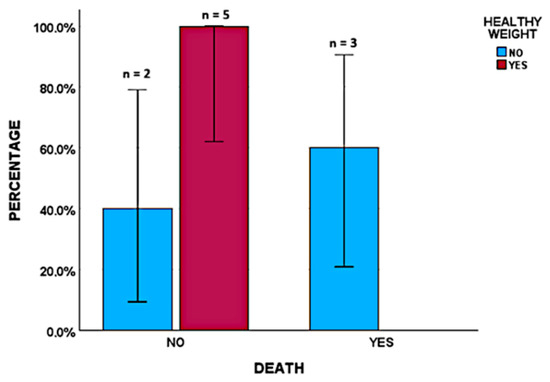
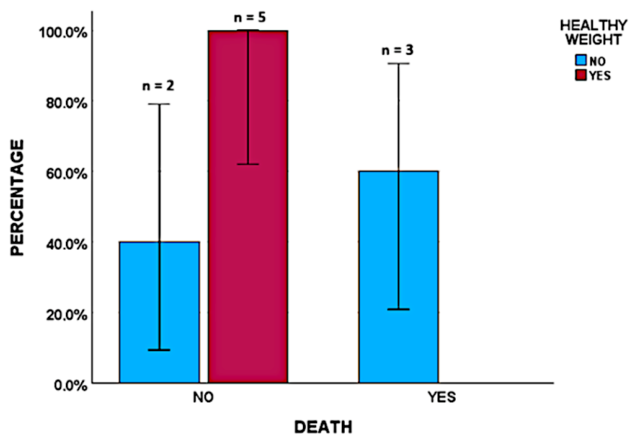
A significant association between weight groups and 30-day mortality was highlighted (χ2 = 4.286, p = 0.038), as illustrated in Figure 1. Notably, no deaths were observed among the healthy-weight group, while one (out of two cases, 50%) and two deaths (out of three cases, 66.6%) were observed in overweight and obese patients, respectively.
Figure 1.
Relation between weight characterization and 30-day mortality (p = 0.038).
Similarly, a healthy BMI was positively associated with the microbiological outcome, with four out of five (80%) patients reaching eradication (χ2 = 6.667, p = 0.010). Strikingly, all overweight and obese patients failed to achieve microbiological eradication in the observation period.
2.2. PK/PD, Clinical and Microbiological Outcomes
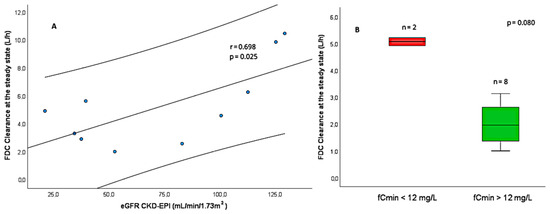
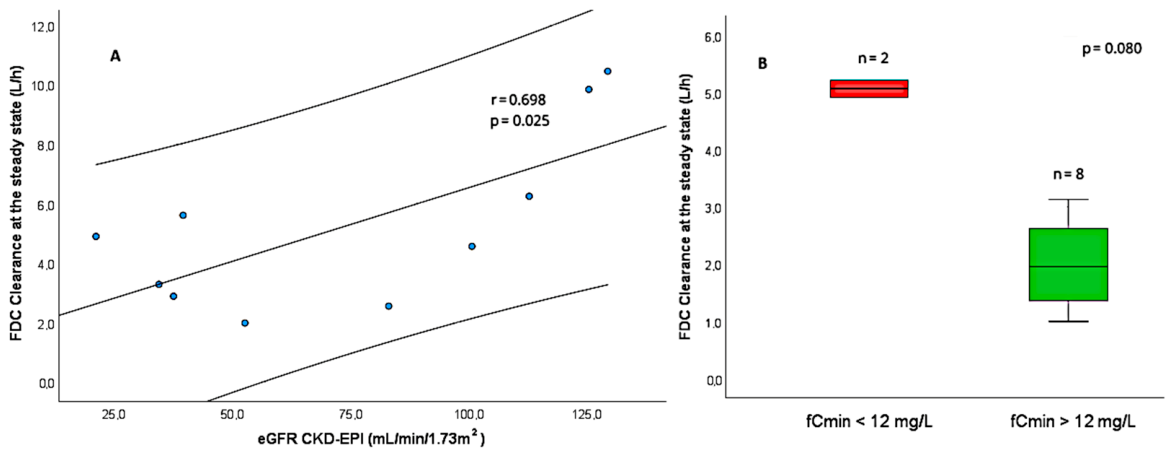
All patients reached the conventional PK/PD target of fCmin > 4 mg/L and the more aggressive target of fCmin > 4 × MIC (8 mg/L), while eight patients achieved the exploratory fCmin > 6 × MIC (12 mg/L) target. The two patients who did not reach the highest fCmin target had a fT > 12 mg/L of 78% and 98%. The patients’ weight was significantly and positively correlated with patients’ fCmin (r = 0.661; p = 0.038), suggesting that the weight-adjusted dose yielded a more than proportional increase in the plasma exposure. In fact, the patients’ weight was not significantly correlated with the Vd (r = 0.192; p = 0.594). In turn, the eGFR appeared to be significantly correlated with FDC CLss (r = 0.698; p = 0.025, Figure 2). Accordingly, a borderline relationship between FDC Clss and the most aggressive PK/PD target attainment was observed (p = 0.08). Patients with a drug Clss higher than 4.92 L/h did not reach the PK/PD target.
Figure 2.
Association between eGFR and drug CLss (panel (A)) and the most aggressive PK/PD target attainment (6 × MIC EUCAST, 12 mg/L, panel (B)) (p = 0.08). FDC = cefiderocol; fCmin = free minimum drug concentration.
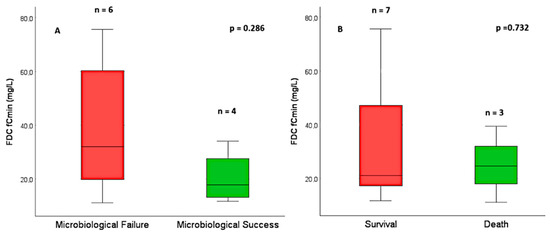
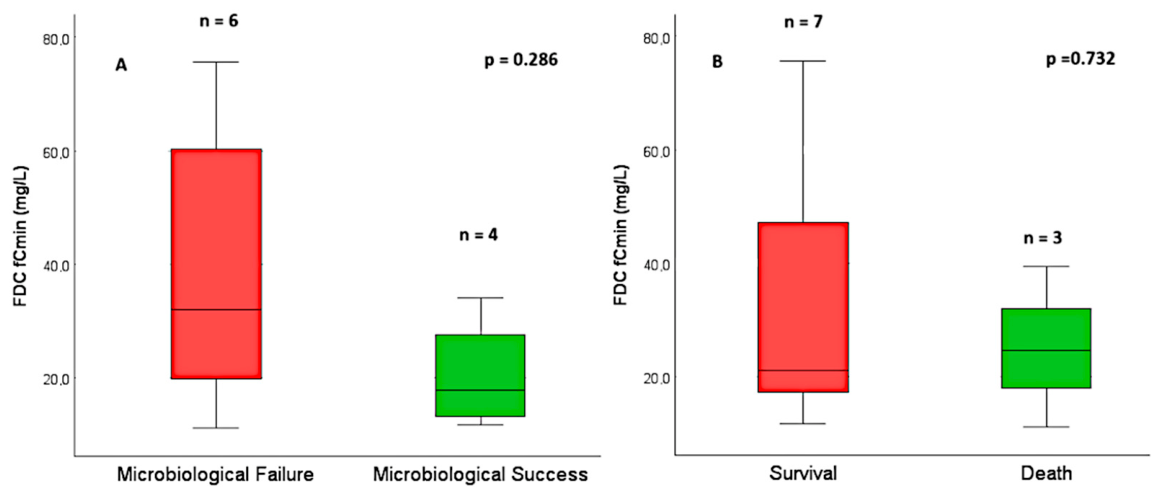
Nevertheless, no significant differences in PK or PK/PD and microbiological eradication or death/survival were observed, as shown in Figure 3.
Figure 3.
Differences in free FDC plasma minimum concentrations according to microbiological and clinical outcomes in terms of eradication (panel (A)) and survival at 30 days (panel (B)). FDC = cefiderocol; fCmin = minimum free drug concentration.
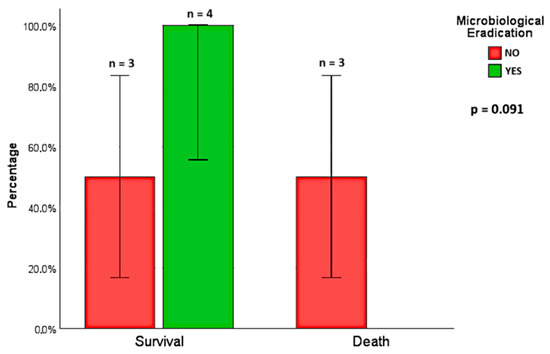
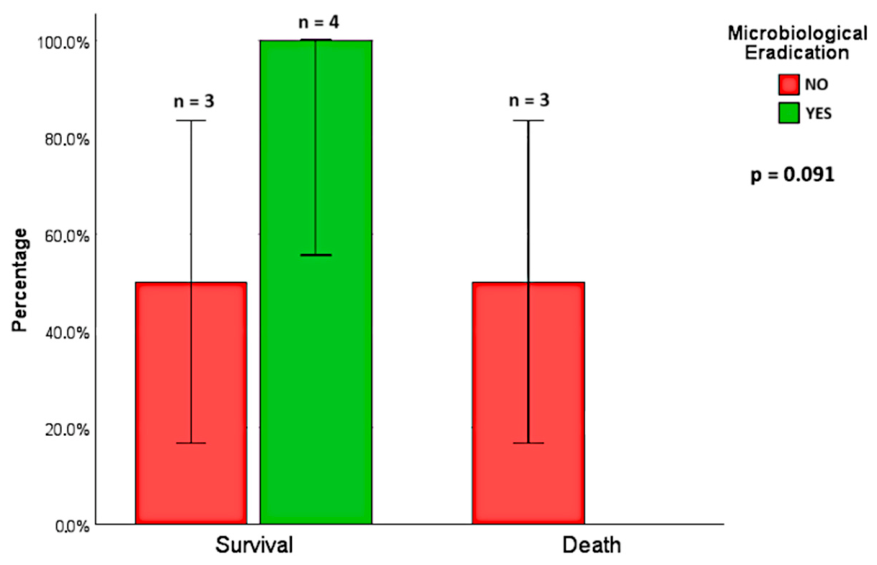
It is worth noting that the patients’ survival/death and microbiological eradication had only a borderline association (χ2 = 2.857, p = 0.091), as shown in Figure 4.
Figure 4.
Association between patients’ survival and microbiological eradication. Whiskers indicate 95% error bars.
Finally, we tested the association between the infection site and the microbiological and clinical outcomes: patients with respiratory infections appeared slightly more likely to eradicate the infection (χ2 = 3.403, p = 0.063) and to survive (χ2 = 2.857, p = 0.091), compared to BSIs and abdominal infections.
3. Discussion
To date, the emergent issue of multidrug-resistant infections in ICUs, with the associated limited therapeutic choices, has increased the interest in the dose optimization of NBLs [18]. In fact, the recommended doses, based on PK/PD models, may not be adequate for ICU patients, particularly with concomitant conditions. Previous works investigated this issue associated with NBLs, all characterized by small sample sizes and heterogenicity [9,11,19].
The heterogeneity of the enrolled population, including variability in the infection site, renal replacement modality, administered dosing regimen, and resistance phenotype, constitutes a relevant limitation. These factors are recognized independent determinants of both PK/PD parameters and clinical outcomes, and their concurrent presence in a small cohort prevents any robust multivariate adjustment or causal inference regarding the independent contribution of BMI or drug exposure to treatment success. In 2021, Gatti et al. described 13 patients affected by pneumonia and/or BSIs treated with a FDC dosage of 2 g q8h and 1.5 g q8h (3 h infusion), and despite the fact that 77% reached quasi-optimal or optimal PK/PD targets (considering “quasi-optimal” a fCmin > 1 mg/L and “optimal” a fCmin above 4 mg/L), microbiological failure occurred in 54% of patients [9]. It appeared evident that other factors, irrespective of FDC concentrations, are involved in defining treatment success.
In this context, the aim of our study was to investigate possible associations between treatment outcomes, PK/PD perturbations and patients’ characteristics, particularly weight and renal function.
The apparently paradoxical finding of higher AUC and lower clearance levels in overweight patients alongside worse clinical outcomes is likely explained by several concurrent factors. First, the overweight subgroup comprised only two patients, making any group-level inference highly unreliable. Second, higher drug exposure in these patients also reflects the weight-based dosing rather than a true pharmacokinetic advantage, as FDC, like most beta-lactams, distributes primarily in extracellular water, generating a non-linear relationship between the weight-adjusted dose and the observed PK exposure. Third, and most importantly, BMI-associated comorbidities and greater baseline disease severity likely exerted a dominant effect on outcomes, overriding any potential benefit of the higher drug exposure.
In our study, the most significant data concerns the association between the BMI and outcome. All deaths (3/10) occurred in overweight or obese patients, while all healthy-weight patients survived (p = 0.038). Similarly, microbiological eradication was achieved in 80% of healthy-weight patients, while it was never achieved in overweight or obese patients (p = 0.036). The observed worst prognosis in overweight/obese patients was in contrast with the observed positive correlation between body weight and fCmin (r = 0.661): this is partially explained by the increased FDC dose in patients with higher body weight (r = 0.755; p = 0.012), while FDC, as many other beta-lactams, has a limited distribution in extracellular water. This hypothesis seems to be confirmed by the lack of a correlation between the weight and volume of distribution (r = 0.192; p = 0.594) in our patients.
The borderline association between FDC clearance and failure to reach the highest target (p = 0.08), with a critical threshold of CLss > 4.92 L/h, suggests that patients with preserved or increased renal function could benefit from higher doses or shorter dosing intervals in order to achieve the PK/PD targets. In fact, the significant correlation between the eGFR and CLss (r = 0.698; p = 0.025) confirms the predominant role of renal function in drug kinetics. In a PK/PD point of view, all patients reached the conventional targets (fCmin > 4 mg/L and > 4 × MIC), while the most aggressive target (100% fT > 6 × MIC) was achieved in 80% of cases.
Nevertheless, in this study, no statistically significant differences were observed between FDC kinetics between patients who achieved microbiological eradication or not, and, accordingly, no significant association was observed between PK/PD target attainment and both microbiological and clinical outcomes. This suggests that the main driver of microbiological and clinical outcomes in critical patients may be the clinical characteristics (e.g., body weight) and the infection site, while FDC PK could have a secondary role. The observed associations between BMI and outcomes, while statistically significant, should be interpreted cautiously in light of the small sample size and are intended to generate hypotheses for confirmation in larger, prospective studies.
This finding is in accordance with the previous evidence described by Gatti et al. [9]. This interpretation is further confirmed by the tendency to achieve better outcomes in patients with respiratory infections (eradication p = 0.063; survival p = 0.091) compared to those with BSIs or abdominal infections. This observation, despite not reaching statistical significance, is concordant with the good pulmonary penetration of FDC documented in the literature, as well as the different severities of patients’ clinical conditions at the baseline. Despite these observations, the results from this study have to be considered with caution, due to intrinsic limitations related to the exploratory nature of a monocentric case series, which limits the generalizability of the observed findings; the consequential small sample size, which limits our ability to overcome the masking effect of the different infection sites and resistance mechanisms (e.g., NDM vs KPC); and the absence of quantitative MIC determination, which could be useful for determining specific PK/PD targets for each patient.
4. Materials and Methods
This study was designed as an exploratory, hypothesis-generating investigation; no a priori sample size calculation was performed, and the findings should not be interpreted as statistically powered to confirm or exclude specific associations.
This was a prospective, single-center case series, designed to explore PK/PD parameters and their association with clinical and microbiological outcomes in critically ill patients receiving FDC.
4.1. Enrolled Patients
Patients with K. pneumoniae infections treated with FDC administered in 3 h infusion, who provided written informed consent, were enrolled. Exclusion criteria were pregnancy or age under 18 y.o. This study was performed in compliance with the Declaration of Helsinki and local review board regulations; all patients provided written informed consent, according to the local ethics committee standards (“Appropriatezza farmacologica della terapia anti-infettiva”, approved by Ethical Committee “A.O.U. CITTA’ DELLA SALUTE E DELLA SCIENZA DI TORINO—A.O. ORDINE MAURIZIANO DI TORINO—A.S.L. CITTÀ DI TORINO”, n° 456/2022). As microbiological and clinical endpoints, respectively, microbial eradication was evaluated after 14 days of treatment, while mortality was evaluated after 30 days.
The dosage of FDC in patients with obesity and renal insufficiency and in CRRT was determined by following the manufacturer’s indications [20,21].
Patients were stratified in 3 groups based on Body Mass Index (BMI): healthy weight (18.5–24.9); overweight (25–29.9); and obese (BMI of 30 or greater) [7].
Estimated GFR was calculated by CKD-EPI formula [22]: renal insufficiency was considered as an eGFR < 60 mL/min/1.73 m2.
4.2. Pharmacokinetic Analysis
Quantification of FDC was performed at the steady state (SS, after at least 5 days of treatment, according to the maximum half-life of 10 h in end-stage renal disease) before the infusion, at the end of infusion (3 h, Cmax) and then at 1 h; 3; and 5 h post-infusion. Steady-state sampling was performed after a minimum of 5–6 days of treatment, consistent with the pharmacokinetic profile of FDC in critically ill patients as reported in the literature [13,23].
FDC total plasma concentration was evaluated with a validated LC-MS/MS kit by CoQua lab (Turin, Italy) [24].
PK parameters were calculated using Phoenix WinNonLin® software (ver. 32): free (f) concentrations were estimated considering a theoretical plasma protein binding of 58% [23].
PK/PD target of fCmin > MIC 4 mg/L (CLSI defined MIC) and more stringent targets of fCmin > 8 mg/L and fCmin > 12 mg/L (4 × and 6 × MIC 2 mg/L, EUCAST breakpoint for Enterobacterales, respectively) were considered [12,16]. The evaluated clinical outcomes were microbiological eradication and all causes of hospital 30-day mortality in hospital [9].
fAUC0–8 and drug clearance (Clss) were calculated through non-compartmental analysis (NCA) with a “linear up log down” fitting to describe the overall plasma exposure of FDC.
4.3. Statistical Analysis
IBM SPSS Statistics software 28.0 for Windows (Chicago, IL, USA) was used for statistical analysis. The Shapiro–Wilk test was used to test data for normal distribution. Non-normal variables were described as median values and interquartile range (IQR); categorical variables were described as numbers and percentages. Kruskal–Wallis and Mann–Whitney tests were used to test differences in continuous variables between groups considering the level of statistical significance (p-value) < 0.05. Correlations between continuous variables were tested with the Pearson test, while associations between categorical variables were tested through the chi-square test.
5. Conclusions
Overall, the results from this study suggest that FDC kinetics are mainly based on renal function, though the microbiological and clinical outcomes seemed to be mainly related to patients’ weight and clinical conditions, particularly related to the site of infection, overcoming the impact of PK/PD target attainment. In fact, the most conventional targets of fCmin above 4 mg/L and 8 mg/L were reached in all the patients. Our findings suggest an association between a higher BMI and worse microbiological and clinical outcomes in this small real-world cohort; however, given the observational design and limited sample size, no definitive causal inference can be drawn. These results should be regarded as preliminary and hypothesis-generating, warranting confirmation in larger, prospective, multicenter studies. These future studies should be adequately powered to investigate the different contributions of PK/PD target attainment and clinical/anthropometric characteristics to treatment success.
Author Contributions
Conceptualization, A.M., A.P. and A.D.; methodology, A.M., A.P. and J.C.; software, G.M.; validation, A.M., A.P., J.C. and C.G.; formal analysis, G.M. and A.P.; investigation, J.C., C.G., S.C., C.R., G.G.M., S.S. and F.M.; resources, S.C., G.G.M., F.M. and F.G.D.R.; data curation, G.M. and A.P.; writing—original draft preparation, A.M. and A.P.; writing—review and editing, J.C., A.D.N., F.G.D.R. and A.D.; visualization, G.G.M. and A.P.; supervision, A.D.N., F.G.D.R. and A.D.; project administration, F.G.D.R. and A.D.; funding acquisition, A.D. and F.G.D.R. All authors have read and agreed to the published version of the manuscript.
Funding
This research received no external funding.
Institutional Review Board Statement
This study was performed in accordance with the Declaration of Helsinki, with the approval of the local Ethics Committee (A.O.U. CITTA’ DELLA SALUTE E DELLA SCIENZA DI TORINO—A.O. ORDINE MAURIZIANO DI TORINO—A.S.L. CITTÀ DI TORINO) according to the protocol “Appropriatezza farmacologica della terapia anti-infettiva”, protocol n° 456/2022, 28 October 2022.
Informed Consent Statement
Informed consent was obtained from all subjects involved in this study.
Data Availability Statement
Data are available upon request.
Acknowledgments
The authors have reviewed and edited the output and take full responsibility for the content of this publication.
Conflicts of Interest
The authors declare no conflicts of interest.
References
- Russo, A.; Serapide, F. From Clinical Trials to Real-World Experiences: Evidence About Cefiderocol Use and Potential Role in Empirical Therapy. Infect. Dis. Ther. 2025, 14, 897–909. [Google Scholar] [CrossRef] [Scilit] [PubMed]
- Bassetti, M.; Echols, R.; Matsunaga, Y.; Ariyasu, M.; Doi, Y.; Ferrer, R.; Lodise, T.P.; Naas, T.; Niki, Y.; Paterson, D.L.; et al. Efficacy and Safety of Cefiderocol or Best Available Therapy for the Treatment of Serious Infections Caused by Carbapenem-Resistant Gram-Negative Bacteria (CREDIBLE-CR): A Randomised, Open-Label, Multicentre, Pathogen-Focused, Descriptive, Phase 3 Trial. Lancet Infect. Dis. 2021, 21, 226–240. [Google Scholar] [CrossRef] [Scilit] [PubMed]
- Wunderink, R.G.; Matsunaga, Y.; Ariyasu, M.; Clevenbergh, P.; Echols, R.; Kaye, K.S.; Kollef, M.; Menon, A.; Pogue, J.M.; Shorr, A.F.; et al. Cefiderocol versus High-Dose, Extended-Infusion Meropenem for the Treatment of Gram-Negative Nosocomial Pneumonia (APEKS-NP): A Randomised, Double-Blind, Phase 3, Non-Inferiority Trial. Lancet Infect. Dis. 2021, 21, 213–225. [Google Scholar] [CrossRef] [Scilit] [PubMed]
- Portsmouth, S.; van Veenhuyzen, D.; Echols, R.; Machida, M.; Ferreira, J.C.A.; Ariyasu, M.; Tenke, P.; Nagata, T.D. Cefiderocol versus Imipenem-Cilastatin for the Treatment of Complicated Urinary Tract Infections Caused by Gram-Negative Uropathogens: A Phase 2, Randomised, Double-Blind, Non-Inferiority Trial. Lancet Infect. Dis. 2018, 18, 1319–1328. [Google Scholar] [CrossRef] [Scilit] [PubMed]
- Vincent, J.-L.; Rello, J.; Marshall, J.; Silva, E.; Anzueto, A.; Martin, C.D.; Moreno, R.; Lipman, J.; Gomersall, C.; Sakr, Y.; et al. International Study of the Prevalence and Outcomes of Infection in Intensive Care Units. JAMA 2009, 302, 2323–2329. [Google Scholar] [CrossRef] [Scilit] [PubMed]
- Cosgrove, S.E. The Relationship between Antimicrobial Resistance and Patient Outcomes: Mortality, Length of Hospital Stay, and Health Care Costs. Clin. Infect. Dis. 2006, 42, S82–S89. [Google Scholar] [CrossRef] [Scilit] [PubMed]
- Shiozawa, M.; Kaneko, H.; Itoh, H.; Morita, K.; Okada, A.; Matsuoka, S.; Kiriyama, H.; Kamon, T.; Fujiu, K.; Michihata, N.; et al. Association of Body Mass Index with Ischemic and Hemorrhagic Stroke. Nutrients 2021, 13, 2343. [Google Scholar] [CrossRef] [Scilit] [PubMed]
- Mikami, R.; Hayakawa, M.; Imai, S.; Sugawara, M.; Takekuma, Y. Onset Timing and Duration of Augmented Renal Clearance in a Mixed Intensive Care Unit. J. Intensive Care 2023, 11, 13. [Google Scholar] [CrossRef] [Scilit] [PubMed]
- Gatti, M.; Pea, F. Pharmacokinetic/Pharmacodynamic Target Attainment in Critically Ill Renal Patients on Antimicrobial Usage: Focus on Novel Beta-Lactams and Beta Lactams/Beta-Lactamase Inhibitors. Expert Rev. Clin. Pharmacol. 2021, 14, 583–599. [Google Scholar] [CrossRef] [Scilit] [PubMed]
- Gorham, J.; Taccone, F.S.; Hites, M. Drug Regimens of Novel Antibiotics in Critically Ill Patients with Varying Renal Functions: A Rapid Review. Antibiotics 2022, 11, 546. [Google Scholar] [CrossRef] [Scilit] [PubMed]
- Kobic, E.; Gill, C.M.; Mochon, A.B.; Nicolasora, N.P.; Nicolau, D.P. Cefiderocol Pharmacokinetics in a Patient Receiving Continuous Venovenous Hemodiafiltration. Open Forum Infect. Dis. 2021, 8, ofab252. [Google Scholar] [CrossRef] [Scilit] [PubMed]
- Yamano, Y.; Takemura, M.; Longshaw, C.; Echols, R. 1269. Differences in Interpretative Breakpoints Between CLSI, FDA and EUCAST Impact Reporting of Susceptibility and Resistance to Cefiderocol. Open Forum Infect. Dis. 2020, 7, S651. [Google Scholar] [CrossRef] [Scilit]
- König, C.; Both, A.; Rohde, H.; Kluge, S.; Frey, O.R.; Röhr, A.C.; Wichmann, D. Cefiderocol in Critically Ill Patients with Multi-Drug-Resistant Pathogens: Real-Life Data on Pharmacokinetics and Microbiological Surveillance. Antibiotics 2021, 10, 649. [Google Scholar] [CrossRef] [Scilit] [PubMed]
- U.S. Food and Drug Administration. FDA Rationale for Recognition Decision: Cefiderocol; FDA: Silver Spring, MD, USA, 2025.
- V_16.0_Breakpoint_Tables.Pdf. Available online: https://www.eucast.org/fileadmin/eucast/pdf/breakpoints/v_16.0_Breakpoint_Tables.pdf (accessed on 28 April 2026).
- Gatti, M.; Pea, F. Raising the Bar of PK/PD Target Attainment of Beta-Lactams in Daily Clinical Practice: An Effective Strategy to Overcome Resistance Development to Novel Beta-Lactams? Infect. Dis. Rep. 2026, 18, 3. [Google Scholar] [CrossRef] [Scilit]
- Gatti, M.; Cojutti, P.G.; Pea, F. Impact of Attaining Aggressive vs. Conservative PK/PD Target on the Clinical Efficacy of Beta-Lactams for the Treatment of Gram-Negative Infections in the Critically Ill Patients: A Systematic Review and Meta-Analysis. Crit. Care 2024, 28, 123. [Google Scholar] [CrossRef] [Scilit] [PubMed]
- Bakdach, D.; Elajez, R.; Bakdach, A.R.; Awaisu, A.; De Pascale, G.; Ait Hssain, A. Pharmacokinetics, Pharmacodynamics, and Dosing Considerations of Novel β-Lactams and β-Lactam/β-Lactamase Inhibitors in Critically Ill Adult Patients: Focus on Obesity, Augmented Renal Clearance, Renal Replacement Therapies, and Extracorporeal Membrane Oxygenation. J. Clin. Med. 2022, 11, 6898. [Google Scholar] [CrossRef] [Scilit] [PubMed]
- Fratoni, A.J.; Kuti, J.L.; Nicolau, D.P. Optimised Cefiderocol Exposures in a Successfully Treated Critically Ill Patient with Polymicrobial Stenotrophomonas Maltophilia Bacteraemia and Pneumonia Receiving Continuous Venovenous Haemodiafiltration. Int. J. Antimicrob. Agents 2021, 58, 106395. [Google Scholar] [CrossRef] [Scilit] [PubMed]
- AIFA. Fetcroja, INN-Cefiderocol. Available online: https://api.aifa.gov.it/aifa-bdf-eif-be/1.0.0/organizzazione/5017/farmaci/48722/stampati?ts=RCP (accessed on 10 June 2026).
- Fouad, A.; Kobic, E.; Nicolasora, N.P.; Bastin, M.L.T.; Adams, P.M.; Shen, Y.; Fratoni, A.J.; Ye, X.; Kuti, J.L.; Nicolau, D.P.; et al. Validation of Cefiderocol Package Insert Dosing Recommendation for Patients Receiving Continuous Renal Replacement Therapy: A Prospective Multicenter Pharmacokinetic Study. Open Forum Infect. Dis. 2024, 11, ofae451. [Google Scholar] [CrossRef] [Scilit] [PubMed]
- Bouchard, J.; Macedo, E.; Soroko, S.; Chertow, G.M.; Himmelfarb, J.; Ikizler, T.A.; Paganini, E.P.; Mehta, R.L. Comparison of Methods for Estimating Glomerular Filtration Rate in Critically Ill Patients with Acute Kidney Injury. Nephrol. Dial. Transplant. 2010, 25, 102–107. [Google Scholar] [CrossRef] [Scilit] [PubMed]
- Mornese Pinna, S.; Corcione, S.; De Nicolò, A.; Montrucchio, G.; Scabini, S.; Vita, D.; De Benedetto, I.; Lupia, T.; Mula, J.; Di Perri, G.; et al. Pharmacokinetic of Cefiderocol in Critically Ill Patients Receiving Renal Replacement Therapy: A Case Series. Antibiotics 2022, 11, 1830. [Google Scholar] [CrossRef] [Scilit] [PubMed]
- Mula, J.; Chiara, F.; Manca, A.; Palermiti, A.; Maiese, D.; Cusato, J.; Simiele, M.; De Rosa, F.G.; Di Perri, G.; De Nicolò, A.; et al. Analytical Validation of a Novel UHPLC-MS/MS Method for 19 Antibiotics Quantification in Plasma: Implementation in a LC-MS/MS Kit. Biomed. Pharmacother. 2023, 163, 114790. [Google Scholar] [CrossRef] [Scilit] [PubMed]

Disclaimer/Publisher’s Note: The statements, opinions and data contained in all publications are solely those of the individual author(s) and contributor(s) and not of MDPI and/or the editor(s). MDPI and/or the editor(s) disclaim responsibility for any injury to people or property resulting from any ideas, methods, instructions or products referred to in the content. |
© 2026 by the authors. Licensee MDPI, Basel, Switzerland. This article is an open access article distributed under the terms and conditions of the Creative Commons Attribution (CC BY) license.