Article

Synthesis of α-Santonin Derivatives Linked to N-, S-, and O-Heterocycles via 1,2,3-Triazole-Linker: Investigation of Antimicrobial Effects


1
Institute of Pharmaceutical Chemistry, University of Szeged, Eötvös utca 6, H-6720 Szeged, Hungary
2
Department of Biotechnology and Microbiology, University of Szeged, Közép fasor 52, H-6726 Szeged, Hungary
3
Institute of Pharmacodynamics and Biopharmacy, University of Szeged, Eötvös utca 6, H-6720 Szeged, Hungary
4
HUN-REN-SZTE Stereochemistry Research Group, Hungarian Research Network, University of Szeged, Eötvös utca 6, H-6720 Szeged, Hungary
*
Author to whom correspondence should be addressed.
Antibiotics 2026, 15(6), 611; https://doi.org/10.3390/antibiotics15060611
Submission received: 30 April 2026 / Revised: 4 June 2026 / Accepted: 13 June 2026 / Published: 16 June 2026

Abstract

Background/Objectives: Resistant pathogenic bacteria and fungi are a growing problem worldwide; therefore, the discovery of new active ingredients is an important challenge for which the functionalization of natural terpenes with biologically active heterocycles can provide a basis. To reach this goal, a series of 1,4-disubstituted-1,2,3-triazole conjugates was designed and synthesized starting from commercially available α-santonin. Methods: The key azido derivative intermediate was prepared according to literature procedures via Michael addition between dehydrosantonin and the TMSN3/AcOH/Et3N system at its highly reactive α-methylene-γ-lactone motif. Subsequently, the obtained azide was applied to regioselective Huisgen 1,3-dipolar cycloaddition reaction with a wide range of terminal alkynes bearing N-, S- and O-heterocycles. These include pyridine, pyrimidine, purine, quinoline, indol, or coumarin to afford the sesquiterpene–heterocycle chimaeras. All triazole conjugates were screened for in vitro antiproliferative activity by MTT assay against HeLa, MDA-MB231, SiHa, MCF-7 and A2780 human cancer cell lines compared with fibroblast cells (NIH/3T3) to check their cytotoxicity and antimicrobial effects on two Gram-positive (B. subtilis, S. aureus) pathogenic bacteria, two Gram-negative (E. coli and P. aeruginosa) pathogenic bacteria, and two yeasts (C. krusei and C. albicans). Results: The results indicated that most of the examined compounds expressed weak activity against human cell lines, while some of them showed moderate activity against S. aureus (up to 99% inhibition at 100 µg/mL conc.), C. krusei (up to 51% inhibition at 10 µg/mL conc.) and C. albicans (up to 52% inhibition at 10 µg/mL conc.). Conclusions: Further structural modification of the best, selective antibacterial and antifungal compounds may open the possibility to the development of effective natural sesquiterpene-based selective antimicrobial agents.

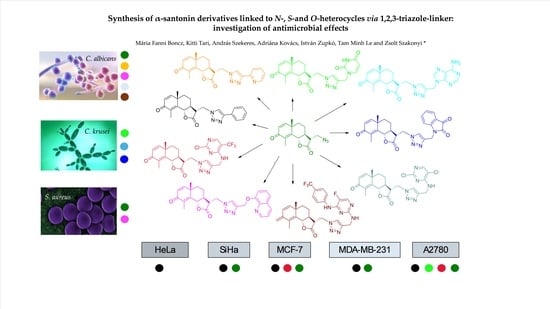
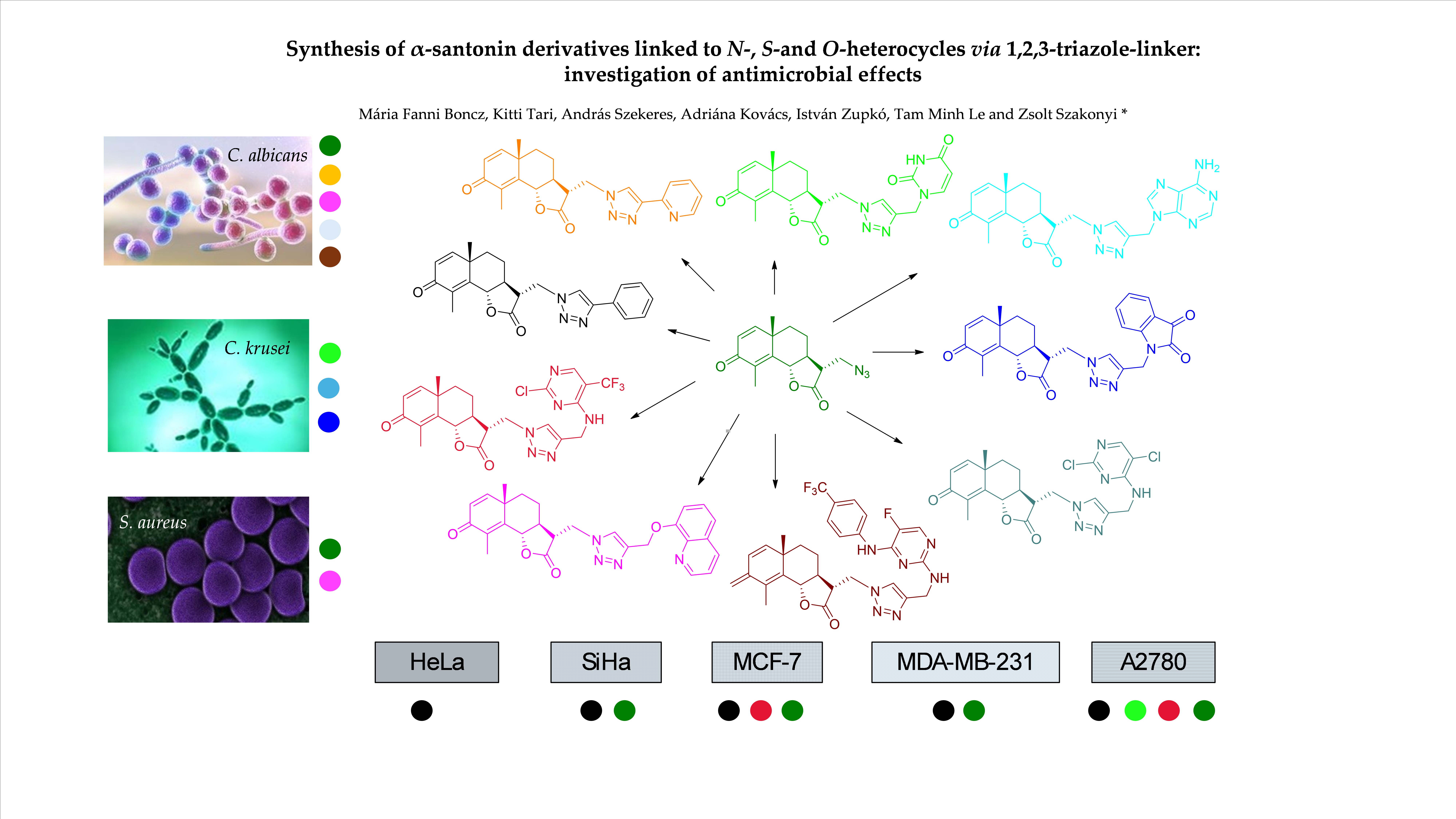
Graphical Abstract

1. Introduction

Antimicrobial resistance (AMR) and cancer today rank among the biggest global health problems in terms of both prevalence and treatment costs. These threats urgently necessitate the development of new, affordable and easily implementable therapeutic strategies and pharmacological agents. According to a WHO report, AMR directly caused about 1.3 million deaths and contributed to another 5 million cases in 2019. These huge numbers clearly demonstrate that infections are becoming increasingly difficult to treat, especially due to emerging superbugs and resistant fungi, thereby undermining the safety of essential medical interventions such as surgeries [1,2,3].
Sesquiterpene lactones (SLs) constitute a large and structurally diverse group of secondary metabolites produced mainly by plants [4,5,6]. These diverse compounds exhibit a wide range of biological activities, including antitumor, antimicrobial, anti-inflammatory, anti-ulcer and antiviral activities [7]. Concerning the structure–activity relationships (SAR), the observed biological effects of SLs are mainly attributed to the α-methylene-γ-lactone group, which acts as an alkylating agent on cellular proteins via Michael addition, particularly targeting their thiol groups [8]. However, the SLs typically have poor water solubility, and the α-methylene-γ-lactone moiety can exhibit non-selective binding as a Michael acceptor with undesired targets [9]. Therefore, a semi-synthetic strategy has been widely applied in which the reactive α,β-unsaturated enone is masked; additionally, it can enhance aqueous solubility, improve the pharmacokinetic profile by modifying polarity, and maintain or even augment the biological activity of the parent molecule [10]. In addition, structural modification has enabled an in-depth understanding of their chemical properties and the establishment of structure–activity relationships.
Semi-synthesis is a class of chemical synthesis that transforms a parent bioactive natural compound into a more bioactive or a new compound by incorporating heteroatoms (N, O and/or S), and it has become a modern approach to drug development [11,12,13,14,15]. Among the functional groups in the semi-synthetic precursors useful for such transformation, α,β-unsaturated carbonyl compounds with the Michael acceptor property are important. They allow both the easy extension of the reaction and the variability of the newly introduced functional groups [16].
α-Santonin, a sesquiterpene lactone, has been reported to be an anticancer, antifungal, antipyretic and anti-inflammatory agent. Interestingly, many α-santonin derivatives presented stronger and better bioactivities, such as anticancer, herbicidal immunosuppressant, phytotoxic and anti-angiogenic properties [17,18,19,20].
To combine two chemically different motifs, the Huisgen 1,3-dipolar cycloaddition reaction (click reaction) between alkynes and azides is an excellent process to build up 1,4-disubstituted 1,2,3-triazoles, which often bear remarkable antiproliferative or antimicrobial effects [21,22,23,24].
Based on our former results on terpene lactones and in a continuation of interest in the synthesis of nitrogen-containing heterocycles with various biological activities [25,26,27], a series of novel and potentially biologically active saturated and unsaturated heterocyclic agents is planned to be prepared from (–)-α-santonin (1) [20,28] by the various semi-synthetic modifications employing Huisgen 1,3-dipolar cycloaddition. To the best of our knowledge, triazole-functionalized santonin derivatives are known only with rearranged A-ring or by ring opening of the lactone ring system possessing inhibition effects on T- and B-cell proliferation [18,19], while in this paper, the antimicrobial activity of sesqiterpene-based heterocyclic compounds was in focus. The planned C-3 hetero modification seemed interesting based on the antiproliferative activities of similar amine adducts obtained by Aza-Michael addition [29].

2. Results

2.1. Synthesis of Key Intermediate Santonin-Based Azide 3

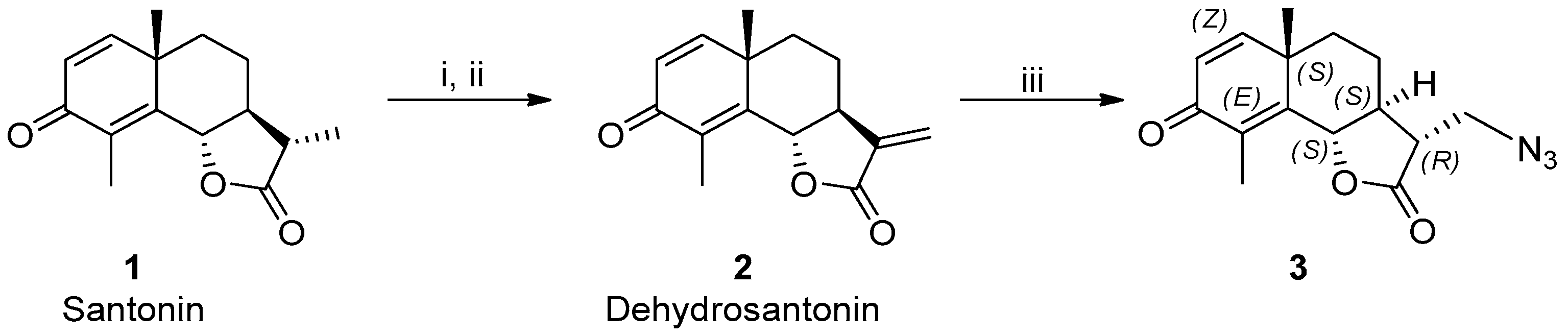
Azido derivative 3 was obtained from (–)-α-santonin by a three-step sequence as shown in Scheme 1. Initially, the treatment of (–)-α-santonin (1) with lithium diisopropyl amide (LDA) followed by the capture of the organolithium with Ph2Se2 [20,30] and subsequent elimination of the resulting PhSe-product with hydrogen peroxide in the presence of acetic acid gave dehydrosantonin (2) [31]. Dehydrosantonin 2 was subjected to Michael addition using trimethylsilyl azide at its highly reactive α-methylene-γ-lactone motif to give corresponding azide 3, which is a single diastereoisomer, as determined by NMR analysis of the crude product.
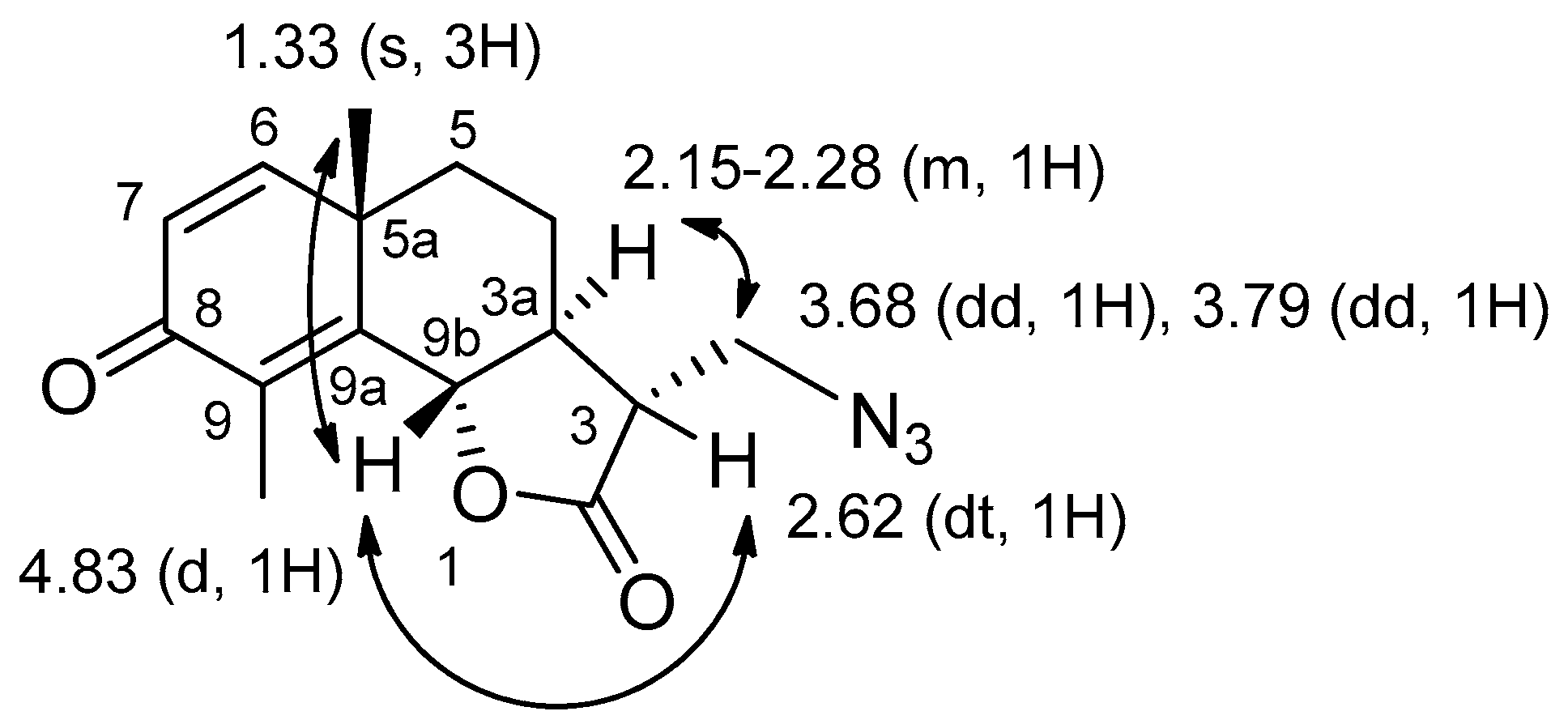
The configuration of the new stereocenter at position C-3 was confirmed by three clear NOE signals recorded between H-3 and H-9b, CH3-5a and H-9b and along with H-3a and CH2-N3 (Figure 1). Since the Huisgen 1,3-dipolar cycloaddition reaction (Figure 2, Scheme 2 and Table 1) does not affect the absolute configuration, the relative configuration of the chiral centers of 3459 (Scheme 3, Table 1) is known to be the same as that of azide 3. The excellent stereoselectivity of the azide addition can be explained by the steric hindrance of Me-5a and H-9b (Figure 1).

2.2. Synthesis of Key-Intermediate Alkynes

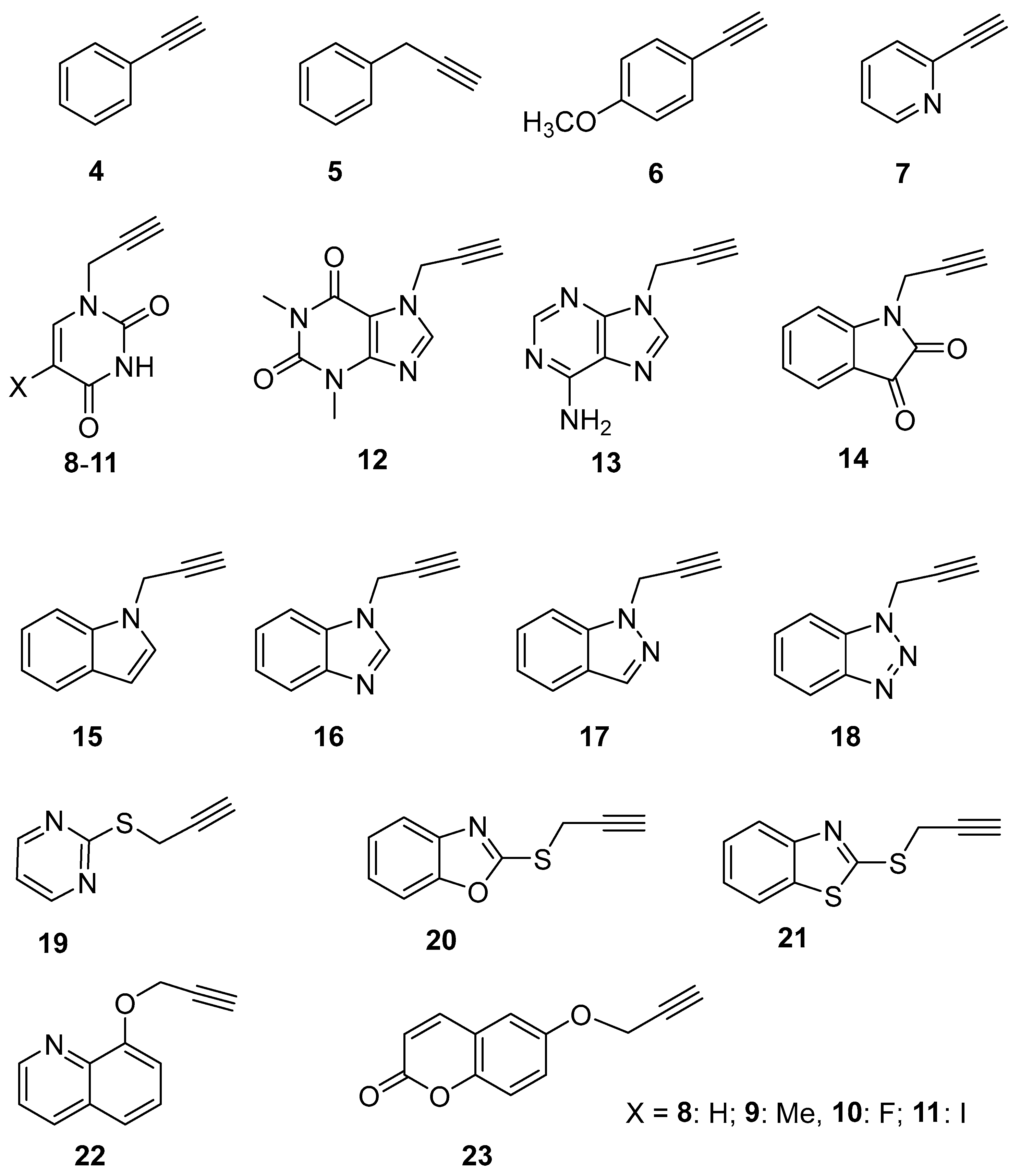
The alkynes, used in the synthesis of the target compounds linked with the 1,2,3-triazole linker, were partly commercially available compounds (phenylacetylene 4, benzylacetylene 5, 4-ethynylanisole 6 and 2-ethynylpyridine 7) and partly obtained by the reaction of heterocycles containing the appropriate NH, SH and OH functions with propargyl bromide (compounds 823) according to the literature methods [32,33].
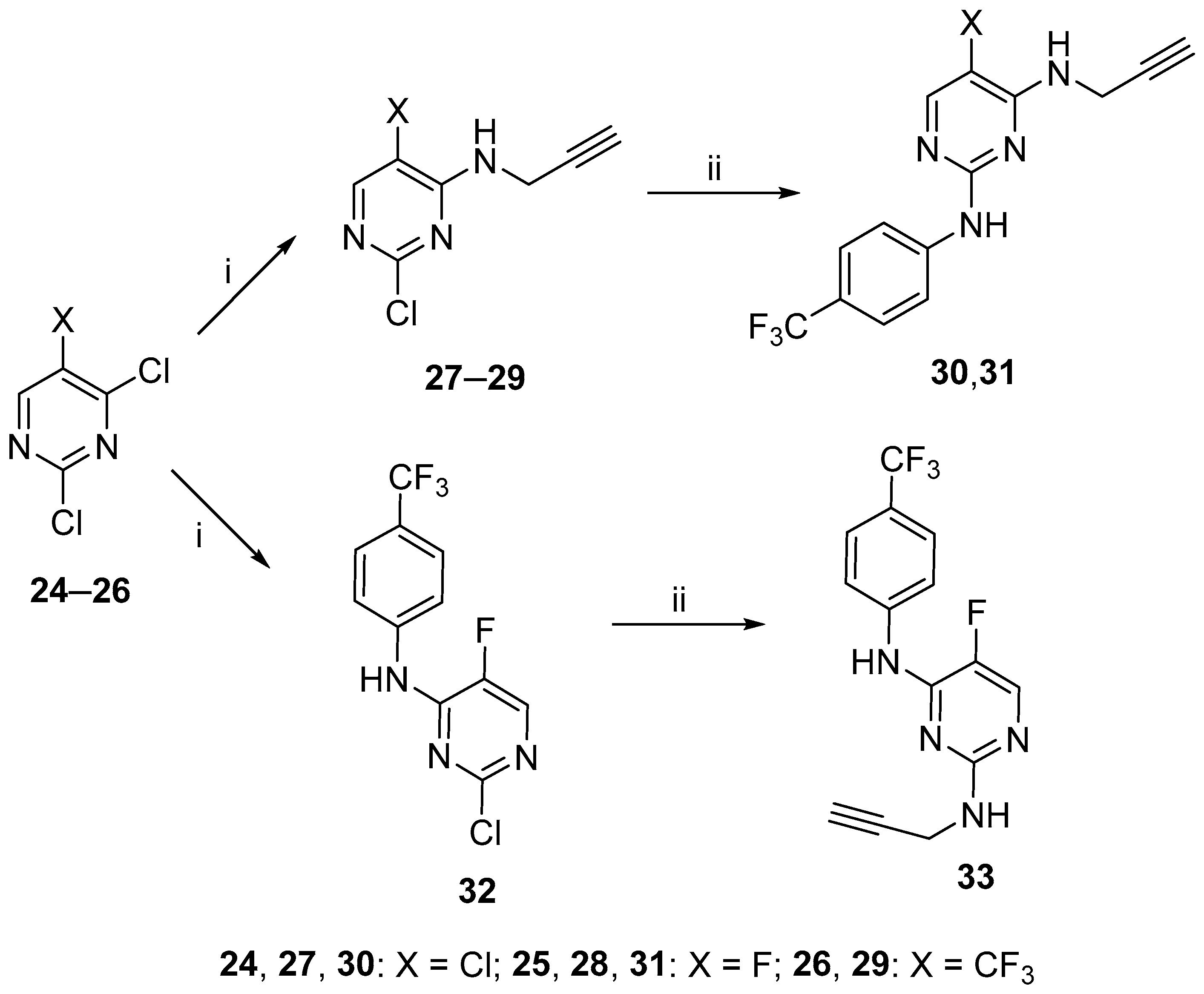
The preparation of 2,4-diaminopyrimidine-based alkynes 30 and 31 was also carried out by coupling 2,4,5-trichloro-, 5-fluoro-2,4-dichloro- and 5-trifuoromethyl- 2,4-dichloropyrimidine with propargylamine, resulting in 2729, which was followed by the reaction of intermediates 27 and 28 with 4-trifluoromethylaniline according to the literature procedure (Scheme 2) [34]. The synthesis of regioisomeric 4-aniline-substituted pyrimidines 32 and 33 was accomplished via an alternative pathway. In the first step, 2-chloro-5-fluoro-6-(4-(trifluoromethyl)phenylamino)pyrimidine 32 was prepared and transferred to 33 in good yields (Scheme 2) [7].

2.3. Coupling of the Sesquiterpene Moiety with Alkyne-Functionalized Heterocycles via Click Reaction

To achieve our goal, the synthesis of santonin–heterocycle chimaeras coupling with 1,2,3-triazolo linker, azide 3 was reacted with diverse propargyl-substituted heterocycles (see Section 2.2). The reason is that the 1,2,3-triazole motif can not only serve as a pharmacophore bearing diverse biological properties, it can also act as a linker to connect different pharmacophores. There are even diverse synthetic methodologies for constructing triazoles and, consequently, the CuAAC reaction (copper-catalyzed azide–alkyne cycloaddition, the Huisgen 1,3-dipolar cycloaddition) has gained significant attention, and it was applied extensively to synthesize a broad range of 1,2,3-triazoles [35,36].
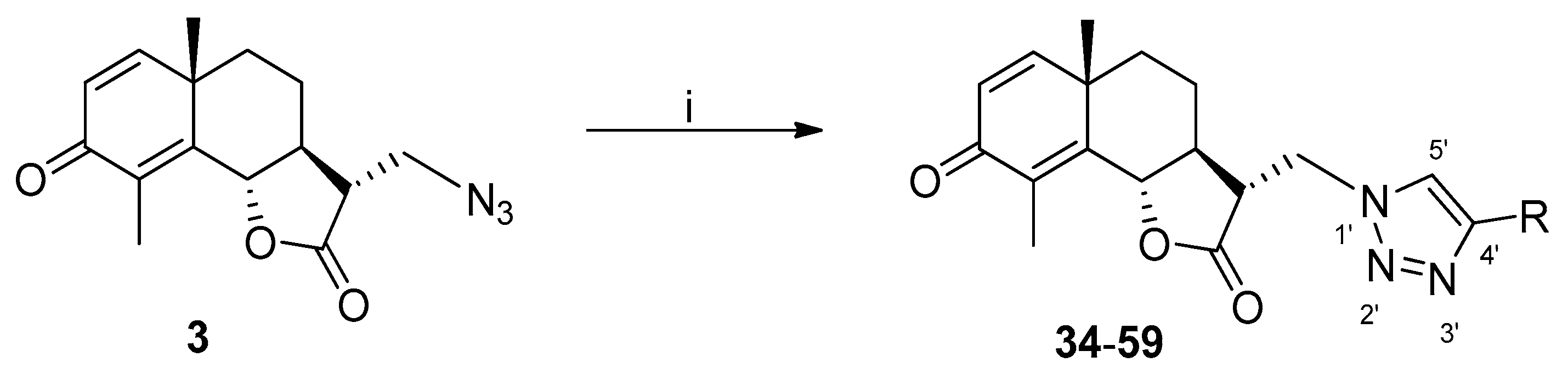
Two similar methods were applied to compare them: in method A, CuI was utilized as a catalyst in dry THF solution [32], while in method B, the Cu(OAc)2/sodium ascorbate system in CH2Cl2–H2O was used [37]. All reactions proceeded well within 24 h, affording the target products in moderate to good yields. The azide–alkyne cycloaddition reaction using copper(I)-containing catalysts (the CuAAc reaction) proceeds with the predominant formation of 1,4-regioisomers (Scheme 3, Table 1). The regioselectivity of the click reaction was determined by HMBC NMR measurements, whereas clear long-range correlations were observed between the bridge CH2 and CH-5’ as well as between Cq-4’ and the first carbon of R substituent at position 4 (see Figure 1 and Supporting Information). The coupling constants of H-9b and H-3a, and the NOESY experiments, clearly proved that the click reactions did not change the configuration of the stereocenters. Due to biologically undesirable by-products such as dehydroascorbic acid, method B was only used in cases of low yields after applying method A. The reason for some low yields (Table 1) was that contaminating by-products appeared during the reactions, which required purification of the products by multiple recrystallizations or repeated chromatography.
Although method B provided significantly better yields in Entries 1, 17, 23, 24 and 25, its general application was hindered by the fact that in many cases, the solubility of the starting material was inadequate in the mixture used therein.

2.4. In Vitro Antiproliferative Studies of 1,4-Disubstituted-1,2,3-triazole–santonin Conjugates

The in vitro antiproliferative potential of the synthesized azide 3 and santonin 1,2,3-triazolo-coupled heterocycles 3559 against a panel of different human cancer cell lines, including cervical (SiHa and HeLa), breast (MCF-7 and MDA-MB-231), and ovarian (A2780) cancers, as well as non-cancerous fibroblast cells, was assayed by the MTT method [38]. Selected results are presented in Table 2, while data for all examined products are presented in Table S1 and Figure S1 in the Supplementary Materials. Analysis of the observed activities showed that most compounds exhibit little or no cytotoxicity. The best and selective antiproliferative effect was observed with azide 3 in SiHa, MCF-7, MDA-MB-231, and A2780 cells without any toxic effect on fibroblast cells (NIH/3T3). Compound 3 exhibited antiproliferative activity with a relatively high IC50 value against HeLa cells, but lower values were observed for the other cancer cell lines. This is not a surprising result, since it is well known that in cancer therapy, azido derivatives exhibit anticancer activity through multiple, interconnected mechanisms primarily involving DNA synthesis interference, oxidative stress generation, enzyme inhibition, and apoptosis activation [39,40,41].
Interestingly, compound 34 showed moderate antiproliferative activity against all cancer cell lines but weak activity against fibroblast cells. Between purine- and pyrimidine-based compounds, only uracil 38 (against A2780) and iodouracil 41 (against SiHa) showed weak activity. From the pyrimidine series, 2-chloro-5-trifluoromethyl derivative 56 expressed moderate activity against MCF-7 and A2780 cancer cell lines.

2.5. In Vitro Studies of Antibacterial Effects of 1,4-Disubstituted-1,2,3-triazole–santonin Conjugates

Since sesquiterpenes possess remarkable antibacterial and/or antifungal activity [42], and pyrimidine-, purine-, benzimidazole- or even benzothiazole-coupled derivatives also exerted remarkable antimicrobial activities against several bacteria and yeasts [34,43,44,45], the antimicrobial activities of the analogues were tested against two Gram-positive and two Gram-negative bacteria as well as two yeasts (Table 3 and Table S2).
Some of the examined compounds exhibit moderate to good inhibitory activities against Staphylococcus aureus, Candida albicans and Candida krusei. The obtained results clearly show that a heteroatom (even N, O or S) next to the bridge methylene function is essential for the antimicrobial effect—most notably for the antifungal activity. Only compound 52 bearing a quinoline ring system possesses moderate inhibition against both S. aureus and C. albicans at 100 μg/mL concentration with MIC values of 4 and 16 μg/mL, respectively. Interestingly, five compounds (37, 50, 53, 54, and 59) bearing diverse heterocyclic ring systems exhibited moderate but selective antifungal activity against C. albicans at 10 μg/mL, achieving up to 51.8% growth inhibition. Among these, compounds 54 and 59 displayed MIC values of 64 and 2 μg/mL, respectively. In addition, three derivatives (38, 43, and 44) showed selective antifungal activity against C. krusei, resulting in up to 61.1% growth inhibition, while compounds 43 and 44 exhibited MIC values of 8 μg/mL and 2 μg/mL, respectively. These preliminary results clearly showed that ethereal or thioethereal linking is not the reason for obtaining the rich remarkable antibacterial or antifungal activity from the presented library of santonine derivatives.
Furthermore, several examples of the antibacterial, antifungal or even antiviral activities of alicyclic or heterocyclic compounds bearing an azido function were indicated in the literature [33,44,45,46]. Hence, intermediate azide 3 was also applied to the antimicrobial assay. Interestingly, it exhibited moderate and selective antimicrobial activity against both S. aureus and C. albicans at a concentration of 100 μg/mL with an MIC value of 8 μg/mL against S. aureus.
None of these compounds shows cytotoxicity against human cancer or even fibroblast cells (NIH/3T3; see Table 2 and Table S1 in Supplementary Materials). This antibacterial and antifungal activity is in good agreement with our previous results, which were observed for azidodiol-type monoterpenes and diterpenes [27,47].
In the case of the indole (45) derivative, the benzimidazole (46) derivative, and the benzoxazole (50) and benzothiazole (51) derivatives, the poor solubility of the compounds did not allow for studies planned at higher concentrations (Supporting Information, Table S2). The same solubility problem also limited the study of the aminopyrimidine derivatives (5659).

3. Discussion

A series of 1,4-disubstituted-1,2,3-triazole-sesquiterpene conjugates was designed and synthesized starting from commercially available α-santonin via stereoselective Michael addition followed by regioselective Cu(I)-catalyzed alkyne−azide [3 + 2] cycloaddition with a wide range of terminal alkynes bearing N-, S- and O-heterocycles. All triazole conjugates were screened for in vitro antiproliferative activity by MTT assay against human cancer cell lines compared with fibroblast cells (NIH/3T3) and antimicrobial effects on Gram-positive, Gram-negative pathogenic bacteria and yeasts. These preliminary results indicated that most of the examined compounds expressed weak activity against human cell lines, while some of them showed promising activity against S. aureus (up to 99% inhibition at 100 µg/mL conc.), C. krusei (up to 51% inhibition at 10 µg/mL conc.) and C. albicans (up to 52% inhibition at 10 µg/mL conc.).
Among the synthesized derivatives, compounds containing larger aromatic heterocycles generally displayed higher antimicrobial activity than many of the simpler heterocyclic analogues. In particular, the quinoline-containing derivative 52 exhibited the highest antimicrobial activity within the tested series and was one of the few compounds for which MIC values could be determined against both S. aureus and C. albicans. This observation suggests that the incorporation of fused aromatic heterocycles may be beneficial for antimicrobial activity within this scaffold. Several pyrimidine- and purine-containing derivatives exhibited species-dependent antimicrobial effects. For example, compounds 38, 43, and 44 showed inhibitory activity against C. krusei, whereas compounds 54 and 59 displayed activity primarily against C. albicans. These findings indicate that the heterocyclic moiety influences not only the level of activity but also the microbial selectivity of the resulting conjugates.
Further structural modification of the best, selective antibacterial and antifungal compounds may open the door to the development of effective natural sesquiterpene-based selective antimicrobial agents. The results are an indicative of the fact that compound 52 proved to be the best analog against S. aureus and C. albicans, which can be explained by the known chelating property of the 8-quinoline (8HQ) scaffold. The mechanism of antimicrobial action of the majority of 8HQ derivatives involves metalloproteins, which are metal ion-dependent proteins, emerging as the main targets in the development of 8HQ derivatives as antimicrobial agents [48]. However, further studies need to be carried out to improve the biological activities of these through revealing the exact mechanism of action, which will be taken up in the future in our research. The rearrangement of the α-santonin A and B ring into an aromatic ring system [17] may serve as an interesting parallel bioactive library in the next paper. The interesting antiproliferative activity of azido intermediate 3 can be explained by that general behavior of azido derivatives, which exhibits promising dual-action profiles targeting both resistant microbes and cancer cells. They primarily target bacterial survival, replication, and membrane integrity through several key pathways such as cell membrane disruption [49].

4. Materials and Methods

4.1. General Methods

Commercially available reagents were used as obtained from suppliers (Oqema Co., 1089 Budapest, Hungary, Orczy út 6.; Merck Ltd., Budapest, Hungary; and VWR International Ltd., Debrecen, Hungary), while solvents were dried according to standard procedures. Chromatographic separations and reaction monitoring were performed on Merck Kieselgel 60 (Merck Ltd., Budapest, Hungary). Optical rotations were measured in MeOH at 25 °C with a PerkinElmer 341 polarimeter (PerkinElmer Inc., Shelton, CT, USA). Melting points were determined with a Kofler apparatus (Nagema, Dresden, Germany). HRMS flow injection analysis was performed with a Thermo Scientific Q Exactive Plus hybrid quadrupole-Orbitrap (Thermo Fisher Scientific, Waltham, MA, USA) mass spectrometer coupled to a Waters Acquity I-Class UPLC™ (Waters, Manchester, UK). 1H-, 13C J-MOD- and 19F-NMR spectra were recorded on a Bruker Avance DRX 500 spectrometer (Bruker Biospin, Karlsruhe, Baden-Württemberg, Germany) [500 MHz (1H), 125 MHz (13C J-MOD) and 470 MHz (19F) δ = 0 (TMS)]. Chemical shifts are expressed in ppm (δ) relative to TMS as an internal reference. J values are given in Hz. All 1H-, 13C, J-MOD-, 19F-NMR, COSY, NOESY, 2D-HMBC and 2D-HSQC spectra are available in the Supporting Information files. In CDCl3, hexane residual (δH = 1.15), water (δH = 1.56) and CH2Cl2H = 5.30, δC = 53.5) were preferred as impurities in the NMR spectra, while in the case of DMSO-d6, water (δH = 3.33) and residual CH2Cl2H = 5.76, δC = 84.8) were obtained as impurities in the NMR spectra.

4.2. Starting Materials

α-Santonin is commercially available from Merck Co. with ee% > 99% ([α]D25 = −170 (c 1, EtOH)). All propargyl-functionalized heterocycles were prepared as prescribed in the literature, starting from nucleobases (uracil, 5-fluorouracil, 5-iodouracil, thymine, adenine) or other heterocycles (theophylline, indole, indazole, isatin, benzotriazole, benzimidazole, 8-hydroxyquinoline, 7-hydroxycoumarin, 2-mercaptobenzoxazole, 2-mercaptobenzothiazol, 2-mercaptopyrimidine) and propargyl bromide applying K2CO3 or Cs2CO3 as bases [32,33]. The synthesis of 2,4,5-disubstututed pyrimidines was accomplished according to our former results and literature methods [7,34]. All physical–chemical and spectroscopic data were similar to those described therein. In the Section 4, in addition to azide 3 and the newly prepared diaminopyrimidine compound 33, the synthesis and characterization of compounds 3436 are presented as examples of methods A and B, while a detailed description of compounds 3757 is included in the Supporting Information.
  • (3R,3aS,5aS,9bS)-3-(Azidomethyl)-5a,9-dimethyl-3a,4,5,5a-tetrahydronaphtho[1,2-b]furan-2,8(3H,9bH)-dione (3)
To a stirred solution of trimethylsilylazide (0.269 mL, 5 eq.) in dry CH2Cl2 (5 mL), glacial AcOH (0.117 mL, 5 eq.) was added, and the mixture was stirred at 25 °C for 30 min before a solution of 11-exo-metylene-santonin (100 mg, 0.41 mmol) in dry CH2Cl2 (1.5 mL) was added. A catalytic amount of triethylamine (0.285 mL, 5 eq.) was then added dropwise to the reaction; then, the mixture was stirred at 40 °C for 18 h. When the reaction was complete (as indicated by TLC), the mixture was poured into water (15 mL) and then extracted with CH2Cl2 (3 × 10 mL). The combined organic layer was combined and washed with saturated NaHCO3 solution (3 × 10 mL) and brine (3 × 10 mL); then, it was dried over dry Na2SO4, filtered and evaporated to dryness. The resulting crude product was purified on silica gel column eluting with CHCl3/MeOH 19:1 mixture to afford the product as yellow crystals.
The reaction yield was 70.4 mg (60%); yellow crystals; m.p.: 111.3–115.5 °C; [α]D20 = −87 (c 0.160 MeOH); 1H-NMR (500 MHz, CDCl3) δ (ppm): 1.33 (s, 3H), 1.51–1.60 (m, 1H, overlapping with water), 1.74 (ddd, 1H, J = 3.6, 13.0, 26.3 Hz), 1.87–1.93 (m, 1H), 2.10–2.18 (m, 5H), 2.62 (dt, 1H, J = 5.8, 12.2 Hz), 3.68 (dd, 1H, J = 6.2, 12.8 Hz), 3.79 (dd, 1H, J = 4.0, 12.8 Hz), 4.83 (d, 1H, J = 11.2 Hz), 6.26 (d, 1H, J = 9.9 Hz), 6.69 (d, 1H, J = 9.9 Hz); 13C-NMR (125 MHz, CDCl3) δ (ppm): 10.9 (CH3), 23.3 (CH2), 25.2 (CH3), 37.8 (CH2), 41.2 (Cq), 46.0 (CH), 49.0 (CH2), 49.5 (CH), 81.4 (CH), 126.0 (CH), 129.2 (Cq), 150.0 (Cq), 154.6 (CH), 174.0 (Cq), 186.0 (Cq); HRMS (ESI+): m/z calcd. for C15H18N3O3+ [M + H]+ 288.13427 found 288.13395.
  • 5-Fluoro-N2-(prop-2-yn-1-yl)-N4-(4-(trifluoromethyl)phenyl)pyrimidine-2,4-diamine (33)
To the solution of pyrimidine 32 (50 mg, 0.17 mmol) in i-PrOH (4 mL), propargylamine (0.327 mL, 3 eq.) and triethylamine (0.120 mL, 5 eq.) were added. The mixture was heated in a microwave reactor at 150 °C, 200 W, 19 bar for 4 h. The formed precipitate was filtered off to afford the desired product in pure form without further purification. The reaction mixture was evaporated to dryness, and the resulting crude product was purified on a silica gel column eluting with n-hexane/EtOAc 3:1 mixture to afford the product as brown crystals.
The reaction yield was 27%; brown crystals; m.p.: 155.3–160.1 °C; 1H-NMR (500 MHz, (CD3)2SO) δ (ppm): 3.03 (s, 1H), 3.95–4.00 (m, 2H), 7.26 (t, 1H, J = 5.8 Hz), 7.63 (d, 2H, J = 8.6 Hz), 8.07 (d, 1H, J = 3.7 Hz), 8.14 (d, 2H, J = 8.5 Hz), 9.60 (s, 1H); 13C-NMR (125 MHz, (CD3)2SO) δ (ppm): 31.3 (CH2), 72.4 (CH), 82.9 (Cq), 120.4 (2 × CH2), 122.7 (Cq, J = 31.9 Hz), 125.0 (Cq, J = 271.4 Hz), 126.0 (2 × CH, J = 3.7 Hz), 140.5 (Cq, J = 245.8 Hz), 142.1 (CH), 143.6 (Cq), 149.6 (Cq, J = 10.8 Hz), 158.0 (Cq); 19F-NMR (470 MHz, (CD3)2SO) δ (ppm): −166.6, −60.1; HRMS (ESI+): m/z calcd. for C14H11F4N4+ [M + H]+ 311.09198; found 311.09080.

4.3. General Procedures for the Preparation of 1,2,3-Triazol Derivatives

Method A: To a solution of compound 3 (50 mg, 0.17 mmol) in dry THF (2 mL), the appropriate terminal alkynes (0.26 mmol) followed by a catalytic amount of CuI (39 mg) under inert atmosphere was added. The resulting mixture was stirred at 70 °C for 24 h. The reaction mixture was poured into brine (20 mL) and was extracted with ethyl acetate (3 × 10 mL). The combined organic layer was dried over anhydrous Na2SO4, filtered, and concentrated under reduced pressure. The residue was purified with chromatography on silica gel with CHCl3/MeOH 19:1 to afford the products.
Method B: Alkyne (0.19 mmol), sodium ascorbate (3.5 mg) and a solution of Cu(OAc)2.H2O (3.5 mg) in H2O (5.0 mL) were successively added to a stirred solution of azide 3 (50 mg, 0.17 mmol) in CH2Cl2 (10 mL). The reaction mixture was stirred at 40 °C for 24 h (TLC control). After the completion of the reaction, H2O (20 mL) was added to the mixture, and the products were extracted with CH2Cl2 (3 × 20 mL). The combined organic layers were dried over MgSO4, and evaporated. The residue (compounds 34, 50, 56, 58 and 59) was loaded onto a silica gel column (eluent CHCl3/MeOH = 19:1).
  • (3R,3aS,5aS,9bS)-5a,9-Dimethyl-3-((4-phenyl-1H-1,2,3-triazol-1-yl)methyl)-3a,4,5,5a-tetrahydronaphtho[1,2-b]furan-2,8(3H,9bH)-dione (34)
The reaction was implemented using phenylacetylene (4) according to the general procedures A and B. Yield: 33.0 mg (49%, method A) and 48.0 mg (71%, method B); yellowish white crystals; m.p.: 218.7–219.5 °C; [α]D20 = −5 (c 0.148 MeOH); 1H-NMR (500 MHz, CDCl3) δ (ppm): 1.29 (s, 3H), 1.48 (dt, 1H, J = 4.3, 13.3 Hz), 1.67 (ddd, 1H, J = 3.4, 12.5, 25.4 Hz), 1.80–1.98 (m, 3H), 2.05 (s, 3H), 3.02 (dt, 1H, J = 5.0, 12.5 Hz), 4.75 (dd, 1H, J = 5.5, 14.5 Hz), 4.87 (dd, 1H, J = 4.5, 14.5 Hz), 4.88 (s, 1H), 6.23 (d, 1H, J = 9.9 Hz), 6.64 (d, 1H, J = 9.9 Hz), 7.34 (t, 1H, J = 7.3 Hz). 7.43 (t, 2H, J = 7.4 Hz), 7.82 (d, 2H, J = 7.8 Hz), 7.89 (s, 1H). 13C-NMR (125 MHz, CDCl3) δ (ppm): 10.9 (CH3), 22.8 (CH2), 25.2 (CH3), 37.4 (CH2), 41.1 (Cq), 47.1 (CH), 47.4 (CH2), 49.4 (CH), 81.6 (CH), 120.6 (CH), 125.8 (2 × CH), 126.0 (CH), 128.5 (CH), 128.9 (2 × CH), 129.3 (Cq), 130.1 (Cq), 148.5 (Cq), 149.5 (Cq), 154.5 (CH), 174.0 (Cq), 185.9 (Cq). HRMS (ESI+): m/z calcd. for C23H24N3O3+ [M + H]+ 390.18122.; found 390.18062.
  • (3R,3aS,5aS,9bS)-3-((4-benzyl-1H-1,2,3-triazol-1-yl)methyl)-5a,9-dimethyl-3a,4,5,5a-tetrahydronaphtho[1,2-b]furan-2,8(3H,9bH)-dione (35)
The reaction was implemented using benzylacetylene (5) according to the general procedure A. Yield: 37.3 mg (53%); white crystals; m.p.: 80.2–80.6 °C; [α]D20 = −27 (c 0.152 MeOH); 1H-NMR (500 MHz, CDCl3) δ (ppm): 1.28 (s, 3H), 1.44 (dt, 1H, J = 3.5, 13.5 Hz), 1.61 (dd, 1H, J = 14.0, 24.4 Hz), 1.72–1.90 (m, 3H), 2.04 (s, 3H), 2.94 (dt, 1H, J = 4.8, 12.4 Hz), 4.07 (s, 2H), 4.62 (dd, 1H, J = 5.5, 12.5 Hz), 4.76–4.85 (m, 2H), 6.24 (d, 1H, J = 9.9 Hz), 6.65 (d, 1H, J = 10.0 Hz), 7.18–7.33 (m, 6H, overlapping with CDCl3). 13C-NMR (125 MHz, CDCl3) δ (ppm): 10.8 (CH3), 22.8 (CH2), 25.1 (CH3), 32.2 (CH2), 37.4 (CH2), 41.1 (Cq), 47.0 (CH), 47.2 (CH2), 49.3 (CH), 81.5 (CH), 122.5 (CH), 126.0 (CH), 126.6 (CH), 128.5 (2 × CH), 128.7 (2 × CH), 129.2 (Cq), 138.8 (Cq), 148.5 (Cq), 149.6 (Cq), 154.6 (CH), 174.0 (Cq), 185.9 (Cq). HRMS (ESI+): m/z calcd. for C24H26N3O3+ [M + H]+ 404.19687; found 404.19625.
  • (3R,3aS,5aS,9bS)-3-((4-(4-methoxyphenyl)-1H-1,2,3-triazol-1-yl)methyl)-5a,9-dimethyl-3a,4,5,5a-tetrahydronaphtho[1,2-b]furan-2,8(3H,9bH)-dione (36)
The reaction was implemented applying 1-ethynyl-4-methoxybenzene (6) according to the general procedure method A. Yield: 46.5 mg (64%); white crystals; m.p.: 191.6–191.8 °C; [α]D20 = −4 (c 0.146 MeOH); 1H-NMR (500 MHz, CDCl3) δ (ppm): 1.29 (s, 3H), 1.48 (dt, 1H, J = 4.2, 13.5 Hz), 1.67 (ddd, 1H, J = 3.2, 12.5, 25.3 Hz), 1.78–1.99 (m, 3H), 2.05 (s, 3H), 3.01 (dt, 1H, J = 5.0, 12.3 Hz), 3.84 (s, 3H), 4.73 (dd, 1H, J = 5.5, 14.7 Hz), 4.83–4.91 (m, 2H), 6.23 (d, 1H, J = 9.9 Hz), 6.64 (d, 1H, J = 9.9 Hz), 6.96 (d, 2H, J = 8.1 Hz), 7.74 (d, 2H, J = 8.0 Hz), 7.80 (s, 1H). 13C-NMR (125 MHz, CDCl3) δ (ppm): 10.9 (CH3), 22.8 (CH2), 25.2 (CH3), 37.4 (CH2), 41.1 (Cq), 47.1 (CH), 47.3 (CH2), 49.3 (CH), 55.4 (CH3), 81.6 (CH), 114.3 (2 × CH), 119.8 (CH), 122.8 (Cq), 126.0 (CH), 127.1 (2 × CH), 129.3 (Cq), 148.3 (Cq), 149.5 (Cq), 154.6 (CH), 159.9 (Cq), 174.1 (Cq), 185.9 (Cq). HRMS (ESI+): m/z calcd. for C24H26N3O4+ [M + H]+ 420.19178; found 420.19111.

4.4. Determination of the Antiproliferative Properties

The growth-inhibitory effects of the isosteviol-based 1,3-aminoalcohols were determined by a standard MTT (3-(4,5-dimethylthiazol-2-yl)-2,5-diphenyltetrazolium bromide) assay on a panel containing five cell lines, including HeLa, SiHa (cervical cancer), MDA-MB-231 and MCF-7 (breast cancers) and A2780 ovarian cancer cells. NIH/3T3 fibroblasts were additionally used to obtain preliminary information on the cancer selectivity. All cell lines were purchased from the European Collection of Cell Cultures (Salisbury, UK) except for SiHa (American Type Culture Collection (ATCC), Manassas, VA, USA). The cells were maintained in a minimal essential medium supplemented with 10% fetal bovine serum, 1% non-essential amino acids and 1% penicillin–streptomycin at 37 °C in a humidified atmosphere containing 5% CO2. All media and supplements were obtained from Lonza Group Ltd. (Basel, Switzerland). Cancer cells were seeded into 96-well plates (5000 cells/well); after an overnight incubation, the test compound was added at two concentrations (10 µM and 30 µM) and incubated for another 72 h under cell-culture conditions. In the next step, 20 μL of 5 mg/mL MTT solution was added to each well and incubated for a further 4 h. The medium was removed, and the precipitated formazan crystals were dissolved in DMSO after 60 min of shaking at 37 °C. As a final step, the absorbance was measured at 545 nm by using a microplate reader. Untreated cells were included as controls. Two independent experiments were performed with five wells per condition in each. For the most effective compound (3), the assays were repeated using a dilution series (0.1–30 µM) to determine the IC50 values. Calculations were performed using GraphPad Prism 10.0 (GraphPad Software, Inc., San Diego, CA, USA).

4.5. Antimicrobial Analyses Method

Stock solutions of the synthesized compounds were prepared in MeOH and subsequently diluted with H2O to final concentrations of up to 100 µg/mL and 10 µg/mL, maintaining a final MeOH content of 10%. Complete dissolution was visually confirmed in all cases.
The resulting solutions were evaluated using a microdilution assay against a panel of bacterial and yeast strains, including Bacillus subtilis SZMC 0209 (Gram-positive), Staphylococcus aureus SZMC 14611 (Gram-positive), Escherichia coli SZMC 6271 (Gram-negative), Pseudomonas aeruginosa SZMC 0568 (Gram-negative), as well as Candida albicans SZMC 1533 and Candida krusei SZMC 1352. Fresh overnight cultures were grown at 37 °C in bacterial medium (10 g/L peptone, 5 g/L NaCl, 5 g/L yeast extract) or yeast medium (20 g/L peptone, 10 g/L yeast extract, 20 g/L glucose). Microbial suspensions were prepared and adjusted with sterile medium to a cell density previously optimized in antimicrobial assays.
For the assay, 100 µL of microbial suspension, 50 µL of sterile broth, and 50 µL of the test solution were added to each well of a 96-well microplate. Plates were incubated for 24 h at 37 °C.
The blank consisted of 150 µL broth and 50 µL of test solution and was used for background correction. The negative control contained 100 µL microbial suspension, 50 µL sterile broth, and 50 µL of 10% MeOH. Ampicillin and nystatin were used as positive controls for bacteria and fungi, respectively, at final concentrations of 100 µg/mL and 10 µg/mL.
The inhibitory effect was expressed as a percentage relative to the negative control after blank correction, according to the following equation: inhibitory effect (%) = 100 − ((ODtest − ODblank)/(ODnegative − ODblank) × 100), where ODtest, ODnegative and ODblank represent optical density values of the test samples, negative control and blank, respectively.
The MIC was also determined for certain compounds, which were based on the broth microdilution method described above and in the M07-A10 CLSI guideline [50]. The compounds were prepared in two-fold dilutions in 10% MeOH covering the final concentration range of 1–64.00 µg/mL. The MIC was observed as the lowest concentration level of the compound that completely inhibits the growth of the organism in microdilution wells. All experiments were repeated three times.

Supplementary Materials

The following supporting information can be downloaded at https://www.mdpi.com/article/10.3390/antibiotics15060611/s1, Figure S1: Determination of IC50 values of azide 3 on HeLa, MDA-MB231, SiHa, MCF-7 and A2780 human cancer cell and NIH/3T3 fibroblast cell tissues, Figures S2–S100: 1H, 13C, 19F NMR, COSY, NOESY, HSQC, HMBC and HRMS spectra of new compounds; Table S1: The antiproliferative effect and IC50 values of the prepared new compounds; Table S2: Investigation of antibacterial and antifungal activity.

Author Contributions

Z.S., A.S. and I.Z. conceived and designed the experiments; K.T. (microbiological assay), A.K. (MTT assay) and M.F.B. (chemistry, synthesis and writing the paper) performed the experiments, analyzed the data and wrote the experimental part; Z.S., A.S., I.Z. and T.M.L. discussed the results and contributed to writing the paper. All authors have read and agreed to the published version of the manuscript.

Funding

We are grateful for the Hungarian Research Foundation (OTKA No. K-138871) and the project no. TKP2021-EGA-32 has been implemented with the support provided by the Ministry of Innovation and Technology of Hungary from the National Research, Development and Innovation Fund, financed under the TKP2021-EGA funding scheme, and EKÖP-191-SZTE for M.F.B. We are grateful also for the University of Szeged Open Access Fund, Grant ID: 8678.

Institutional Review Board Statement

Not applicable.

Informed Consent Statement

Not applicable.

Data Availability Statement

The original contributions presented in this paper are included in the body of the paper and the Supplementary Materials. Further inquiries can be directed to the corresponding author.

Acknowledgments

The high-resolution mass spectrometric analysis was performed by Robert Berkecz.

Conflicts of Interest

The authors declare no conflicts of interest. The funders had no role in the design of the study; in the collection, analyses, or interpretation of data; in the writing of the manuscript; or in the decision to publish the results.

Abbreviations

The following abbreviations are used in this manuscript:
AMRAntimicrobial resistance
HMPAHexamethylphosphoramide
LDALithium diisopropyl amide
MWMicrowave
TEATriethylamine

References

  1. Ho, C.S.; Wong, C.T.H.; Aung, T.T.; Lakshminarayanan, R.; Mehta, J.S.; Rauz, S.; McNally, A.; Kintses, B.; Peacock, S.J.; De La Fuente-Nunez, C.; et al. Antimicrobial Resistance: A Concise Update. Lancet Microbe 2025, 6, 100947. [Google Scholar] [CrossRef] [Scilit] [PubMed]
  2. Ahmed, S.K.; Hussein, S.; Qurbani, K.; Ibrahim, R.H.; Fareeq, A.; Mahmood, K.A.; Mohamed, M.G. Antimicrobial Resistance: Impacts, Challenges, and Future Prospects. J. Med. Surg. Public Health 2024, 2, 100081. [Google Scholar] [CrossRef] [Scilit]
  3. Oliveira, M.; Antunes, W.; Mota, S.; Madureira-Carvalho, Á.; Dinis-Oliveira, R.J.; Dias Da Silva, D. An Overview of the Recent Advances in Antimicrobial Resistance. Microorganisms 2024, 12, 1920. [Google Scholar] [CrossRef] [Scilit] [PubMed]
  4. Santana, A.; Molinillo, J.M.G.; Macías, F.A. Trends in the Synthesis and Functionalization of Guaianolides. Eur. J. Org. Chem. 2015, 2015, 2093–2110. [Google Scholar] [CrossRef] [Scilit]
  5. Williams, R.B.; Norris, A.; Slebodnick, C.; Merola, J.; Miller, J.S.; Andriantsiferana, R.; Rasamison, V.E.; Kingston, D.G.I. Cytotoxic Sesquiterpene Lactones from Vernonia pachyclada from the Madagascar Rainforest. J. Nat. Prod. 2005, 68, 1371–1374. [Google Scholar] [CrossRef] [Scilit] [PubMed]
  6. Frey, M.; Gohr, S.T.; Köllner, T.G.; Bathe, U.; Lackus, N.D.; Padilla-Gonzalez, F.; Ro, D.-K.; O’Connor, S.E.; Degenhardt, J.; Tissier, A. Biosynthesis of Biologically Active Terpenoids in the Mint Family (Lamiaceae). Nat. Prod. Rep. 2025, 42, 1887–1908. [Google Scholar] [CrossRef] [Scilit] [PubMed]
  7. Moujir, L.; Callies, O.; Sousa, P.M.C.; Sharopov, F.; Seca, A.M.L. Applications of Sesquiterpene Lactones: A Review of Some Potential Success Cases. Appl. Sci. 2020, 10, 3001. [Google Scholar] [CrossRef] [Scilit]
  8. Amen, Y.; Abdelwahab, G.; Heraiz, A.A.; Sallam, M.; Othman, A. Exploring Sesquiterpene Lactones: Structural Diversity and Antiviral Therapeutic Insights. RSC Adv. 2025, 15, 1970–1988. [Google Scholar] [CrossRef] [Scilit] [PubMed]
  9. Cutter, L.R.; Ren, A.R.; Banerjee, I.A. Advances in Naturally and Synthetically Derived Bioactive Sesquiterpenes and Their Derivatives: Applications in Targeting Cancer and Neurodegenerative Diseases. Molecules 2025, 30, 4302. [Google Scholar] [CrossRef] [Scilit] [PubMed]
  10. Woods, J.R.; Mo, H.; Bieberich, A.A.; Alavanja, T.; Colby, D.A. Amino-Derivatives of the Sesquiterpene Lactone Class of Natural Products as Prodrugs. Med. Chem. Commun. 2013, 4, 27–33. [Google Scholar] [CrossRef] [Scilit]
  11. Amslinger, S. The Tunable Functionality of α,β-Unsaturated Carbonyl Compounds Enables Their Differential Application in Biological Systems. ChemMedChem 2010, 5, 351–356. [Google Scholar] [CrossRef] [Scilit] [PubMed]
  12. Lee, K.-H. Discovery and Development of Natural Product-Derived Chemotherapeutic Agents Based on a Medicinal Chemistry Approach. J. Nat. Prod. 2010, 73, 500–516. [Google Scholar] [CrossRef] [Scilit] [PubMed]
  13. Sghyar, R.; Lahyaoui, M.; Rhazi, Y.; Aflak, N.; Moussaoui, O.; Chda, A.; Alanazi, M.M.; Kabra, A.; El Hadrami, E.M.; Mabrouk, E.H.; et al. Novel D-Ribofuranosyl Tetrazoles: Synthesis, Characterization, In Vitro Antimicrobial Activity, and Computational Studies. ACS Omega 2025, 10, 2116–2129. [Google Scholar] [CrossRef] [Scilit] [PubMed]
  14. Filali, M.; Lahyaoui, M.; Bahsis, L.; Kandri Rodi, Y.; El Hadrami, E.M. Novel Triazole-Pyrazine as Potential Antibacterial Agents: Synthesis, Characterization, Antibacterial Activity, Drug-Likeness Properties and Molecular Docking Studies. Moroc. J. Chem. 2024, 12, 1367–1379. [Google Scholar] [CrossRef] [Scilit]
  15. Lahyaoui, M.; Sghyar, R.; Benamar, K.; Filali, M.; Fikri-Benbrahim, K.; Kartah, B.E.; Mazzah, A.; Kandri Rodi, Y.; Sebbar, N.K. Novel 1, 2, 3-Triazolic Compounds Derived from Cytosine: Synthesis, Spectroscopic Characterization, In Vitro Antimicrobial Activity and Molecular Docking Studies. Results Chem. 2024, 7, 101410. [Google Scholar] [CrossRef] [Scilit]
  16. Singh, M.; Ravichandiran, V.; Bharitkar, Y.P.; Hazra, A. Natural Products Containing Olefinic Bond: Important Substrates for Semi-Synthetic Modification Towards Value Addition. Curr. Org. Chem. 2020, 24, 709–745. [Google Scholar] [CrossRef] [Scilit]
  17. Wang, J.; Su, S.; Zhang, S.; Zhai, S.; Sheng, R.; Wu, W.; Guo, R. Structure-Activity Relationship and Synthetic Methodologies of α-Santonin Derivatives with Diverse Bioactivities: A Mini-Review. Eur. J. Med. Chem. 2019, 175, 215–233. [Google Scholar] [CrossRef] [Scilit] [PubMed]
  18. Dangroo, N.A.; Singh, J.; Dar, A.A.; Gupta, N.; Chinthakindi, P.K.; Kaul, A.; Khuroo, M.A.; Sangwan, P.L. Synthesis of α-Santonin Derived Acetyl Santonous Acid Triazole Derivatives and Their Bioevaluation for T and B-Cell Proliferation. Eur. J. Med. Chem. 2016, 120, 160–169. [Google Scholar] [CrossRef] [Scilit] [PubMed]
  19. Dangroo, N.A.; Singh, J.; Gupta, N.; Singh, S.; Kaul, A.; Khuroo, M.A.; Sangwan, P.L. T- and B-Cell Immunosuppressive Activity of Novel α-Santonin Analogs with Humoral and Cellular Immune Response in Balb/c Mice. Med. Chem. Commun. 2017, 8, 211–219. [Google Scholar] [CrossRef] [Scilit]
  20. Rossi, C.; Ambrogi, V.; Grandolini, G.; Scarcia, V.; Furlani, A. Synthesis and In Vitro Cytotoxic Activity of Semisynthetic Derivatives in the Santonin Series. J. Pharm. Sci. 1986, 75, 784–786. [Google Scholar] [CrossRef] [Scilit] [PubMed]
  21. Bozorov, K.; Zhao, J.; Aisa, H.A. 1,2,3-Triazole-Containing Hybrids as Leads in Medicinal Chemistry: A Recent Overview. Bioorg. Med. Chem. 2019, 27, 3511–3531. [Google Scholar] [CrossRef] [Scilit] [PubMed]
  22. Ragab, S.S. Recent Advancements in CuAAC Click Approaches for the Synthesis of 1,2,3-Triazole Hybrid Compounds as Anticancer Agents. Chem. Biodivers. 2025, 22, e202403462. [Google Scholar] [CrossRef] [Scilit] [PubMed]
  23. Haroun, M.; Tratrat, C.; Kochkar, H.; Nair, A.B. Recent Advances in the Development of 1,2,3-Triazole-Containing Derivatives as Potential Antifungal Agents and Inhibitors of Lanoster Ol 14α-Demethylase. Curr. Top. Med. Chem. 2021, 21, 462–506. [Google Scholar] [CrossRef] [Scilit] [PubMed]
  24. Chathangad, S.N.; Vijayan, V.N.; George, J.A.; Sadhukhan, S. Mitigating Antimicrobial Resistance through Strategic Design of Multimodal Antibacterial Agents Based on 1,2,3-Triazole with Click Chemistry. ACS Bio. Med. Chem. Au 2025, 5, 486–504. [Google Scholar] [CrossRef] [Scilit] [PubMed]
  25. Bai, D.; Schelz, Z.; Boncz, M.F.; Zupkó, I.; Szakonyi, Z. Stereoselective Synthesis and Antiproliferative Activity of Steviol-Based Diterpene 1,3-Aminoalcohol Regioisomers. Molecules 2023, 28, 7962. [Google Scholar] [CrossRef] [Scilit] [PubMed]
  26. Khdar, Z.A.; Le, T.M.; Schelz, Z.; Zupkó, I.; Szakonyi, Z. Aminodiols, Aminotetraols and 1,2,3-Triazoles Based on Allo-Gibberic Acid: Stereoselective Syntheses and Antiproliferative Activities. RSC Adv. 2024, 14, 36698–36712. [Google Scholar] [CrossRef] [Scilit] [PubMed]
  27. Depp, D.; Tari, K.; Szekeres, A.; Kovács, A.; Zupkó, I.; Szakonyi, Z. 1,2,3-Triazolo-Bridged Click Coupling of Pinane-Based Azidodiol Enantiomers with Pyrimidine- and Purine-Based Building Blocks: Synthesis, Antiproliferative, and Antimicrobial Evaluation. Int. J. Mol. Sci. 2025, 26, 11705. [Google Scholar] [CrossRef] [Scilit] [PubMed]
  28. Minh Le, T.; Szakonyi, Z. Enantiomeric Isopulegol as the Chiral Pool in the Total Synthesis of Bioactive Agents. Chem. Rec. 2022, 22, e202100194. [Google Scholar] [CrossRef] [Scilit] [PubMed]
  29. Yang, R.; Xue, Z.; Zhang, M.; Li, X.; Guo, Y. Non-Food Natural Sesquiterpene Lactone α-Santonin: Chemistry and Biology. Ind. Crops Prod. 2024, 220, 119169. [Google Scholar] [CrossRef] [Scilit]
  30. Chen, H.; Wu, G.; Gao, S.; Guo, R.; Zhao, Z.; Yuan, H.; Liu, S.; Wu, J.; Lu, X.; Yuan, X.; et al. Discovery of Potent Small-Molecule Inhibitors of Ubiquitin-Conjugating Enzyme UbcH5c from α-Santonin Derivatives. J. Med. Chem. 2017, 60, 6828–6852. [Google Scholar] [CrossRef] [Scilit] [PubMed]
  31. Chen, H.; Yang, X.; Yu, Z.; Cheng, Z.; Yuan, H.; Zhao, Z.; Wu, G.; Xie, N.; Yuan, X.; Sun, Q.; et al. Synthesis and Biological Evaluation of α-Santonin Derivatives as Anti-Hepatoma Agents. Eur. J. Med. Chem. 2018, 149, 90–97. [Google Scholar] [CrossRef] [Scilit] [PubMed]
  32. Pavan Kumar, C.; Devi, A.; Ashok Yadav, P.; Rao Vadaparthi, R.; Shankaraiah, G.; Sowjanya, P.; Jain, N.; Suresh Babu, K. “Click” Reaction Mediated Synthesis of Costunolide and Dehydrocostuslactone Derivatives and Evaluation of Their Cytotoxic Activity. J. Asian Nat. Prod. Res. 2016, 18, 1063–1078. [Google Scholar] [CrossRef] [Scilit] [PubMed]
  33. Lazrek, H.; Taourirte, M.; Oulih, T.; Barascut, J.; Imbach, J.; Pannecouque, C.; Witrouw, M.; De Clercq, E. Synthesis and Anti-HIV Activity of New Modified 1,2,3-Triazole Acyclonucleosides. Nucleosides Nucleotides Nucleic Acids 2001, 20, 1949–1960. [Google Scholar] [CrossRef] [Scilit] [PubMed]
  34. Sheng, C.; Yang, W.; Li, Z.; Tu, J.; Liu, N.; Huang, Y. Aminopyrimidine Derivative with Antifungal Activity and Application Thereof. CN 118108708 A, 31 May 2024. [Google Scholar]
  35. Rostovtsev, V.V.; Green, L.G.; Fokin, V.V.; Sharpless, K.B. A Stepwise Huisgen Cycloaddition Process: Copper(I)-Catalyzed Regioselective “Ligation” of Azides and Terminal Alkynes. Angew. Chem. 2002, 114, 2708–2711. [Google Scholar] [CrossRef] [Scilit]
  36. Zhu, L.; Brassard, C.J.; Zhang, X.; Guha, P.M.; Clark, R.J. On the Mechanism of Copper(I)-Catalyzed Azide-Alkyne Cycloaddition. Chem. Rec. 2016, 16, 1501–1517. [Google Scholar] [CrossRef] [Scilit] [PubMed]
  37. Patrushev, S.S.; Rybalova, T.V.; Shults, E.E. Synthetic Transformations of Sesquiterpene Lactones. Controllable Synthesis of 11,13-Dihydroisoalantolactone Azides and 13-(1,2,3-Triazolyl)Eudesmanolides Based on Sesquiterpene Lactones. Chem. Heterocycl. Comp. 2021, 57, 1116–1129. [Google Scholar] [CrossRef] [Scilit]
  38. Mosmann, T. Rapid Colorimetric Assay for Cellular Growth and Survival: Application to Proliferation and Cytotoxicity Assays. J. Immunol. Methods 1983, 65, 55–63. [Google Scholar] [CrossRef] [Scilit] [PubMed]
  39. Lewandowska, M.; Ruszkowski, P.; Baraniak, D.; Czarnecka, A.; Kleczewska, N.; Celewicz, L. Synthesis of 3′-Azido-2′,3′-Dideoxy-5-Fluorouridine Phosphoramidates and Evaluation of Their Anticancer Activity. Eur. J. Med. Chem. 2013, 67, 188–195. [Google Scholar] [CrossRef] [Scilit] [PubMed]
  40. Sharma, R.; Dhaker, S.K.; Singh, R.; Nidhar, M. Alkylating Agents in Cancer: Current Developments. Lett. Drug Des. Discov. 2025, 22, 100317. [Google Scholar] [CrossRef] [Scilit]
  41. Reyes, Y.; Larrey, E.K.; Pathak, R.; Veisaga, M.L.; Barbieri, M.A.; Ward, S.; Kumar, A.; Sevilla, M.D.; Adhikary, A.; Wnuk, S.F. Azido Derivatives of Sesquiterpene Lactones: Synthesis, Anticancer Proliferation, and Chemistry of Nitrogen-Centered Radicals. Results Chem. 2024, 9, 101643. [Google Scholar] [CrossRef] [Scilit] [PubMed]
  42. Li, H.-Y.; Yang, W.-Q.; Zhou, X.-Z.; Shao, F.; Shen, T.; Guan, H.-Y.; Zheng, J.; Zhang, L.-M. Antibacterial and Antifungal Sesquiterpenoids: Chemistry, Resource, and Activity. Biomolecules 2022, 12, 1271. [Google Scholar] [CrossRef] [Scilit] [PubMed]
  43. Peterson, E.M.; Brownell, J.; Vince, R. Synthesis and Biological Evaluation of 5′-Sulfamoylated Purinyl Carbocyclic Nucleosides. J. Med. Chem. 1992, 35, 3991–4000. [Google Scholar] [CrossRef] [Scilit] [PubMed]
  44. Ibrahim, A.A.; Said, E.G.; AboulMagd, A.M.; Amin, N.H.; Abdel-Rahman, H.M. Synthesis and SARs of Benzimidazoles: Insights into Antimicrobial Innovation (2018–2024). RSC Adv. 2025, 15, 22097–22127. [Google Scholar] [CrossRef] [Scilit] [PubMed]
  45. Kashyap, P.; Verma, S.; Gupta, P.; Narang, R.; Lal, S.; Devgun, M. Recent Insights into Antibacterial Potential of Benzothiazole Derivatives. Med. Chem. Res. 2023, 32, 1543–1573. [Google Scholar] [CrossRef] [Scilit] [PubMed]
  46. Gupta, Y.K.; Gupta, V.; Singh, S. Synthesis, Characterization and Antimicrobial Activity of Pyrimidine Based Derivatives. J. Pharm. Res. 2013, 7, 491–495. [Google Scholar] [CrossRef] [Scilit]
  47. Depp, D.; Sebők, N.R.; Szekeres, A.; Szakonyi, Z. Stereoselective Synthesis and Antimicrobial Studies of Allo-Gibberic Acid-Based 2,4-Diaminopyrimidine Chimeras. Pharmaceuticals 2025, 18, 168. [Google Scholar] [CrossRef] [Scilit] [PubMed]
  48. Joaquim, A.R.; Gionbelli, M.P.; Gosmann, G.; Fuentefria, A.M.; Lopes, M.S.; Fernandes De Andrade, S. Novel Antimicrobial 8-Hydroxyquinoline-Based Agents: Current Development, Structure–Activity Relationships, and Perspectives. J. Med. Chem. 2021, 64, 16349–16379. [Google Scholar] [CrossRef] [Scilit] [PubMed]
  49. Kritchenkov, A.S.; Egorov, A.R.; Kurasova, M.N.; Volkova, O.V.; Meledina, T.V.; Lipkan, N.A.; Tskhovrebov, A.G.; Kurliuk, A.V.; Shakola, T.V.; Dysin, A.P.; et al. Novel Non-Toxic High Efficient Antibacterial Azido Chitosan Derivatives with Potential Application in Food Coatings. Food Chem. 2019, 301, 125247. [Google Scholar] [CrossRef] [Scilit] [PubMed]
  50. Weinstein, M.P. Methods for Dilution Antimicrobial Susceptibility Tests for Bacteria That Grow Aerobically. In Clinical and Laboratory, 11th ed.; Clinical and Laboratory Standards Institute: Wayne, PA, USA, 2018. [Google Scholar]
Scheme 1. Stereoselective synthesis of azide key intermediate. (i) Diphenyl diselenide (Ph2Se2, 1.2 eq.), lithium diisopropyl amide (LDA, 2.4 eq., 2 M in THF), hexamethylphosphoramide (HMPA, 1.2 eq.), THF, −78 °C, Ar atm., 3 h, 30% (ii) H2O2 (6.5 eq., 30%), AcOH (3 eq.), THF, 2 h, 0 °C, 85% (iii) (1) TMSN3 (5 eq.), AcOH (5 eq.), CH2Cl2, 25 °C, 30 min; (2) TEA (5 eq.), CH2Cl2, 40 °C, 18 h, 60% (two steps).
Antibiotics 15 00611 sch001
Scheme 2. Synthesis of 2,4-diaminopyrimidine building blocks 2733. (i) Propargylamine or 4-trifluoromethylaniline (1 eq.), TEA (5 eq.), CH3CN, 100 °C, 5 h, 54–81%; (ii) 4-Trifluoromethylaniline (1 eq.); EtOH, MW, 200 W, 150 °C, 1.5 h for 30 and 31 or propargylamine (1 eq.), i-PrOH, MW, 200 W, 150 °C, 4 h for 33, 27–82%.
Antibiotics 15 00611 sch002
Figure 1. Relative configuration of azido derivative 3 based on NOESY measurement.
Antibiotics 15 00611 g001
Figure 2. Alkynes, 823 prepared via N-, S- and O-alkylation by propargyl bromide in the presence of Cs2CO3 in DMF at 40 °C.
Antibiotics 15 00611 g002
Scheme 3. Regioselective Huisgen 1,3-dipolar cycloaddition with diverse heterocyclic alkynes. (i) method A: CuI (1.2 eq.), dry THF, alkyne 823 and 2733 (1.5 eq.), 70 °C, 24 h; 16–82%; method B: Cu(OAc)2. H2O (0.1 eq.), sodium ascorbate (0.1 eq.), CH2Cl2/H2O 2:1, alkyne 823 and 2733 (1.1 eq.), 40 °C, 24 h, 40–71%.
Antibiotics 15 00611 sch003
Table 1. “Click” reaction mediated synthesis of santonin conjugates 3459.
EntryAlkyneProductYield (%) a
143449/71 b
253553
363664
473768
583867
693975
7104044
8114156
9124240
10134350
11144440
12154563
13164649
14174773
15184870
16194959
17205022/47 b
18215168
19225247
20235382
21275474
22285569
23295641/48 b
24305741
25315816/48 b
26335921/40 b
a Isolated yield after purification. b Method B, see Scheme 3.
Table 2. Selected data of the most active derivatives 3, 38, 41 and 56.
Comp.Conc.
(μM)
Growth Inhibition (%) ± SEM 1
HeLaSiHaMCF-7MDA-MB-231A2780NIH/3T3
31023.95 ± 2.9551.53 ± 2.0940.14 ± 2.9944.44 ± 2.3013.61 ± 3.012
3053.74 ± 2.0376.31 ± 0.8988.08 ± 0.9589.60 ± 0.8284.28 ± 0.3040.02 ± 3.18
Calculated IC50 (μM) 325.6110.2111.8911.1917.64>30
341017.18 ± 2.96
3055.50 ± 1.3742.69 ± 0.6856.82 ± 0.7950.62 ± 1.2766.54 ± 2.5926.80 ± 3.15
3810
3021.24 ± 3.0645.64 ± 1.58
411011.43 ± 2.1227.08 ± 2.6824.83 ± 2.3913.13 ± 2.07
3023.17 ± 1.3541.48 ± 2.5433.45 ± 3.0310.48 ± 2.9120.21 ± 3.3715.32 ± 2.82
561015.64 ± 1.9517.44 ± 2.46
3037.31 ± 1.6426.91 ± 1.1149.80 ± 2.5020.20 ± 1.9670.17 ± 1.45
1: Mean ± SEM values from two determinations with five parallel wells in each. 2: Inhibition values less than 10% are regarded as negligible and are not given numerically. 3: Calculated from viability results of experiments applying a broad range of concentrations (0.1–30 μM).
Table 3. Antimicrobial activities of selected compounds according to Figure 2.
Comp. 1,2Conc. (µg/mL)Growth Inhibition (%) 2 ± SEM 3
B. subtilis
SZMC 0209
S. aureus
SZMC 14611
E. coli
SZMC 6271
P. aeruginosa
SZMC 0568
C. albicans
SZMC 1533
C. krusei
SZMC 1352
Amp10099.7 ± 1.7100 ± 5.4100.2 ± 4.1100 ± 6.7--
1088.8 ± 9.899.6 ± 8.572.4 ± 15.827.5 ± 6.5--
Nyst100----98.9 ± 0.999.3 ± 1
10----99.4 ± 1.599 ± 1.9
31003.2 ± 13.299.2 ± 14.38.3 ± 3.2045.4 ± 16.810.9 ± 8.6
1015.3 ± 5.119.6 ± 6.51 ± 1.105.1 ± 15.72.5 ± 16.6
371007.3 ± 15.913.9 ± 8.90045.9 ± 14.28.5 ± 9.6
108.6 ± 9.616.3 ± 6.82.8 ± 3.1049.1 ± 13.78.6 ± 7.9
381002.9 ± 4.112.6 ± 6.80020.5 ± 14.445.9 ± 27.9
1018.5 ± 4.28.8 ± 3.70000
4310014.5 ± 9.532.2 ± 5.70040.9 ± 7.761.3 ± 15.1
1023.6 ± 5.913.8 ± 5.700022.5 ± 6.6
4410030.6 ± 12.42.2 ± 9.512 ± 5.101.8 ± 11.90
1028.1 ± 6.91.4 ± 9.311.7 ± 3.80051.4 ± 17.3
50100------
106.8 ± 7.49.4 ± 7.119 ± 2.114.6 ± 2.346.8 ± 14.50
5210025.3 ± 12.998.9 ± 17.925.4 ± 4.75.5 ± 7.573.5 ± 21.219.6 ± 4.7
1035.2 ± 9.97.9 ± 4.715.7 ± 2.29.5 ± 6.23.3 ± 12.90
531002.2 ± 17.58.9 ± 10.514.9 ± 6.418.1 ± 4.626.7 ± 16.76.4 ± 22.9
1013.2 ± 5.35.1 ± 7.520.5 ± 4.322.2 ± 3.145.7 ± 19.60
541007.9 ± 12.87.1 ± 5.90051.8 ± 10.62.1 ± 8.7
1016.0 ± 6.313.4 ± 3.68.3 ± 3010.4 ± 14.25.1 ± 5.5
59100------
102.6 ± 4.912.4 ± 86.3 ± 0.9050.1 ± 20.617.1 ± 10.4
1: Amp: ampicillin, Nys: nystatin; numerical values for all prepared compounds are given in Table S2 in the Supplementary Materials. 2: Solutions, which were not tested due to solubility problems, are marked with a hyphen (-). 3: Mean ± SEM values from two determinations with 3 parallel wells in each.
Disclaimer/Publisher’s Note: The statements, opinions and data contained in all publications are solely those of the individual author(s) and contributor(s) and not of MDPI and/or the editor(s). MDPI and/or the editor(s) disclaim responsibility for any injury to people or property resulting from any ideas, methods, instructions or products referred to in the content.