Review

Current State of the Fight Against Antimicrobial Resistance: What Are the Different Strategies for Tomorrow?


by
Hicham Wahnou
1,*,
Riad El Kebbaj
1,2,
Béatrice Demoré
3,4,
Youness Limami
1 and
Raphaël Emmanuel Duval
5,*
1
Sciences and Engineering of Biomedicals, Biophysics and Health Laboratory, Higher Institute of Health Sciences, Hassan First University, Settat 26000, Morocco
2
Mohammed VI Center for Research & Innovation (CM6RI), Rabat 10112, Morocco
3
Pharmacy Department, University Hospital, Allée du Morvan, 54511 Vandœuvre-lès-Nancy, France
4
INSPIIRE, Inserm, Université de Lorraine, 54000 Nancy, France
5
Université de Lorraine, 54000 Nancy, France
*
Authors to whom correspondence should be addressed.
Antibiotics 2026, 15(6), 564; https://doi.org/10.3390/antibiotics15060564
Submission received: 19 April 2026 / Revised: 27 May 2026 / Accepted: 28 May 2026 / Published: 1 June 2026

Abstract

Antimicrobial resistance (AMR) is a leading global cause of death, with recent World Health Organization (WHO) data revealing that one in six laboratory-confirmed bacterial infections shows resistance to at least one antibiotic treatment. This review comprehensively analyzes the AMR landscape in 2026, detailing its evolution, mechanisms, and the innovative strategies being deployed to combat it. Driven by Darwinian selection and accelerated by factors like antibiotic overuse during the Coronavirus Disease 2019 (COVID-19) pandemic (predominantly in hospitalized patients with suspected bacterial co-infection), AMR is propelled by a diverse molecular arsenal in bacteria. Key mechanisms include enzymatic drug inactivation (e.g., the diversifying β-lactamase superfamily), target site modification (e.g., mcr genes conferring colistin resistance), efflux pumps, and biofilm formation. The rapid global spread of these traits is facilitated by a dynamic “mobilome”, a network of plasmids and transposons that shuttle resistance genes between species. This crisis has sparked a major scientific mobilization. Advances include the discovery of novel antibiotic scaffolds like lariocidin and the regulatory approval of critical new antibiotic/inhibitor combinations such as sulbactam/durlobactam and aztreonam/avibactam, which target highly resistant Gram-negative bacteria. Moreover, the first-in-class antibiotic gepotidacin offers a new option for urinary tract infections. Beyond traditional drugs, the pipeline is diversifying to include phage therapy, antivirulence strategies, and artificial intelligence-guided drug discovery. This diversification is critical as it helps preserve the effectiveness of existing Medically Important Antimicrobials (MIAs), those deemed essential for human medicine, by providing alternative or adjunctive treatment options. However, scientific innovation alone is insufficient. This review argues that lasting success requires parallel progress in global policy and infrastructure. Strategic priorities beyond 2026 must include finalizing and funding updated global action plans, strengthening real-time surveillance and diagnostic capacity, especially in low-resource settings, and implementing new economic models to de-risk antibiotic development. Embedding effective antimicrobial stewardship within universal health coverage and pandemic preparedness plans is crucial. Ultimately, defeating AMR demands an unprecedented, coordinated global effort that outpaces the relentless adaptability of bacterial pathogens.

1. Introduction

Since the introduction of penicillin in 1941, antibiotics have revolutionized clinical medicine, dramatically reducing morbidity and mortality from bacterial infections. Yet, only a few years after its deployment, Staphylococcus aureus isolates exhibiting penicillinase activity (i.e., penicillin resistance) emerged, an early warning of bacterial adaptability [1]. The following decades witnessed successive waves of resistance, each following the introduction of a new antibiotic class (Figure 1). The phenomenon is driven by Darwinian selection: exposure to antimicrobial compounds imposes selective pressure, allowing resistant genotypes to proliferate within bacterial populations [2].
Antimicrobial resistance (AMR) is now recognized as a leading cause of death worldwide. The 2025 WHO report revealed that resistant infections cause an estimated 1.3 million direct deaths each year, and indirectly contribute to over 5 million more. This figure is comparable to the number of deaths caused by cancer [3]. Particularly alarming is the rise of resistance among the “ESKAPE” pathogens, Enterococcus faecium, Staphylococcus aureus, Klebsiella pneumoniae, Acinetobacter baumannii, Pseudomonas aeruginosa, and Enterobacter spp., which collectively account for the majority of healthcare-associated infections (HAIs) [4,5]. Multidrug-resistant (MDR) and extensively drug-resistant (XDR) strains now complicate treatment of community and hospital infections alike, escalating healthcare costs and hospital stays [3].
The mechanistic basis of resistance is multifactorial. Bacteria may enzymatically inactivate antibiotics (e.g., β-lactamases), modify drug targets (e.g., methylation of 23S rRNA), reduce intracellular drug accumulation via efflux pumps, or develop biofilm-based protection [6]. Gene exchange through MGEs (mobile genetic elements, e.g., plasmids, transposons, and integrons) accelerates the dissemination of resistance determinants, forming vast “resistomes” within microbial communities [7]. Genomic surveillance over the past five years has revealed that such genetic plasticity is not confined to hospitals: resistant determinants are now widespread in commensal and environmental microbiota [8].
The COVID-19 pandemic left a lingering legacy of antibiotic overuse. Between 2020 and 2023, more than 70% of hospitalized COVID-19 patients received empirical antibiotics, despite the viral etiology of the primary infection, accelerating selective pressure in both community and healthcare settings [9]. By 2025, surveillance data confirmed rising resistance to fluoroquinolones, macrolides, and third-generation cephalosporins in multiple regions [10,11]. The persistence of these prescribing behaviours underscores systemic weaknesses in antimicrobial stewardship programs.
The past two years have seen unprecedented scientific and institutional mobilization. On the research front, new antibiotic scaffolds such as lariocidin, a lasso peptide characterized in 2025 with a novel mechanism of action against Gram-negative bacteria (GNB), signal renewed interest in non-traditional molecules [12]. Artificial intelligence and genome mining have accelerated the identification of cryptic biosynthetic gene clusters, reviving natural-product discovery [13]. Meanwhile, synthetic biology and Clustered Regularly Interspaced Short Palindromic Repeats (CRISPR)-based strategies are being developed to selectively disable resistance genes or re-sensitize pathogens to existing drugs [14].
On the policy front, WHO’s Global Action Plan on AMR entered a new revision cycle (2025–2027), reinforcing multisectoral coordination under the One Health framework. The 2025 edition of the Tracking Antimicrobial Resistance Country Self-Assessment Survey (TrACSS) achieved record participation from 163 countries, signalling improved surveillance capacity [3]. Additionally, the updated AWaRe classification emphasizes shifting national antibiotic consumption toward “Access” agents, discouraging overuse of “Watch” and “Reserve” groups [15].
This review aims to synthesize these scientific, clinical, and policy developments to assess whether the global response to AMR is truly accelerating. It will evaluate if recent progress in novel antibiotic discovery, alternative therapies, and strengthened global governance represents a decisive turning point, or if the relentless evolution of bacterial resistance continues to outpace our collective efforts.

2. Evolution of Antibiotic Resistance Mechanisms

2.1. Overview of Adaptive and Genetic Evolution

Antibiotic resistance emerges through both vertical evolution, where spontaneous mutations provide a selective advantage under drug pressure, and horizontal gene transfer (HGT), which disseminates resistance determinants across species boundaries [16]. While mutation-driven adaptation is dominant in chronic infections where a single bacterial strain persists and evolves within a host, such as in P. aeruginosa populations in the lungs of people with cystic fibrosis, or in M. tuberculosis during tuberculosis treatment, where resistance to key drugs like rifampicin often arises from point mutations in the target genes (e.g., rpoB); HGT through MGEs has been the principal driver of the rapid global proliferation of resistance genes across diverse bacterial populations and settings [7]. Classical examples of mutation-mediated resistance also include fluoroquinolone resistance resulting from mutations in genes encoding DNA topoisomerases (e.g., gyrA, parC), and oxazolidinone resistance linked to 23S rRNA gene mutations [17,18]. Since 2020, genomic and metagenomic analyses have shown that most clinically significant resistance determinants originate in environmental and commensal reservoirs, including soil, aquatic microbiomes, and the human gut [19].
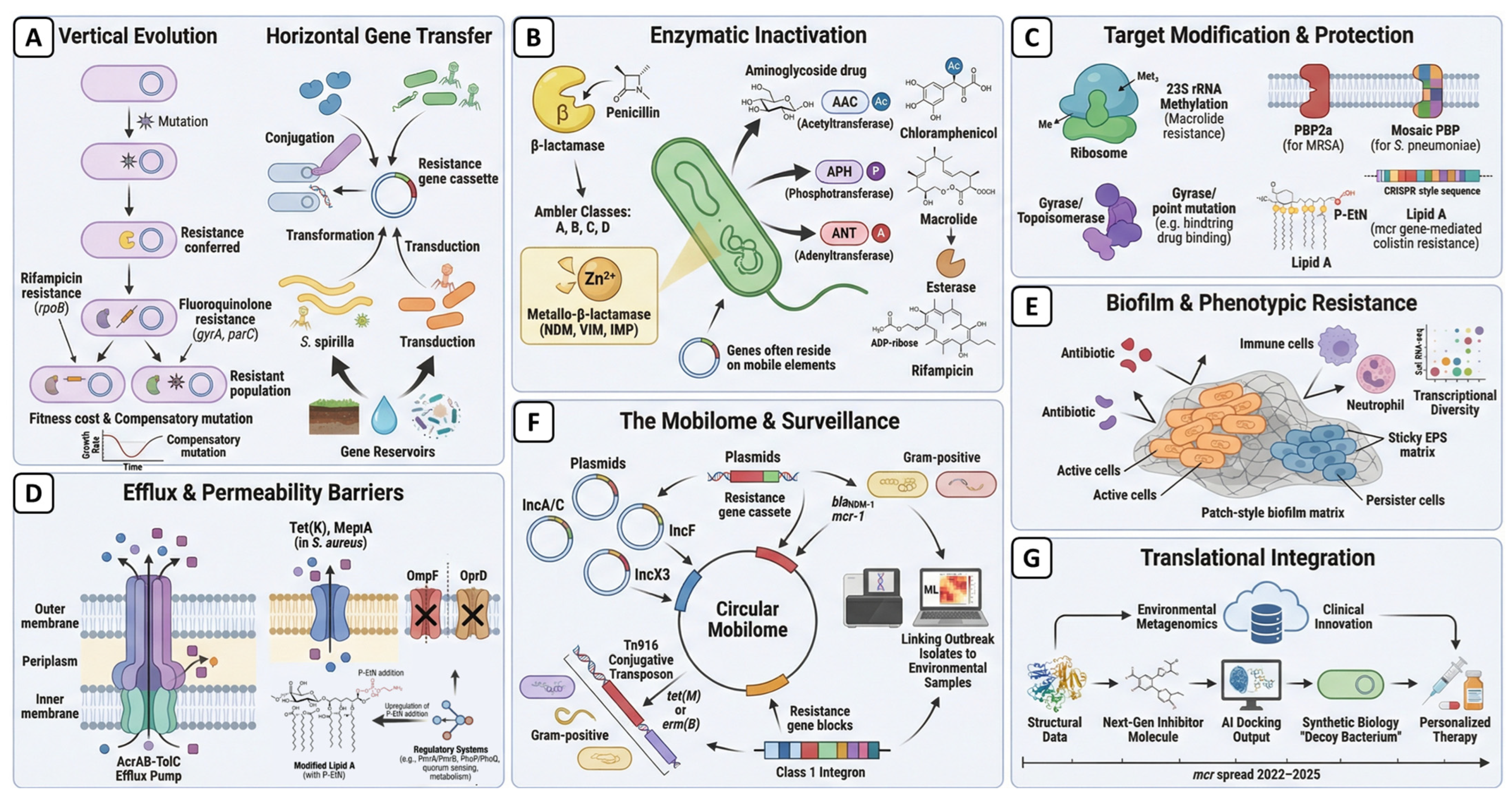
The evolutionary dynamics of resistance are further shaped by fitness costs and compensatory mutations. Although resistance mutations often reduce bacterial fitness, compensatory changes can restore growth rates while retaining resistance, stabilizing these traits even in the absence of antibiotics [20]. Experimental evolution and long-term sequencing of resistant Escherichia coli and K. pneumoniae populations from 2017–2021 demonstrated that compensatory epistasis has become a crucial factor sustaining multidrug resistance [21] (Figure 2A).

2.2. Enzymatic Degradation: The Expanding β-Lactamase Family and Beyond

Among enzymatic mechanisms, β-lactamases remain the most clinically consequential. These enzymes hydrolyse the β-lactam ring, neutralizing penicillins, cephalosporins, carbapenems, and monobactams (Figure 2B). They are classified into Ambler classes A–D based on molecular structure and catalytic activity [22]. The last decade has witnessed a diversification of Metallo-β-Lactamases (MβLs) such as New Delhi Metallo-β-lactamase (NDM), Verona Integron-encoded Metallo-β-lactamase (VIM), and Imipenemase Metallo-β-lactamase (IMP) variants, which use zinc to catalyse hydrolysis and are unaffected by most commercial inhibitors [23]. The emergence of NDM-33, first detected in 2024 in India and now widespread across South Asia and the Middle East, represents a particularly troubling adaptation [3,10]. Mechanistically, NDM-33 differs from the prevalent NDM-5 variant by a single amino acid substitution (A72T) [24]. Biochemical characterization reveals that NDM-33 exhibits enhanced hydrolytic activity against meropenem, with a kcat/Km of 3.24 μM−1 s−1 compared to 1.96 μM−1 s−1 for NDM-5, while showing reduced activity against ceftazidime and cefepime [24]. The blaNDM-33 gene is carried on an IncX3-type plasmid within a Tn125-related genetic context, facilitating horizontal transfer [24]. To date, high-resolution crystallographic data for NDM-33 have not been published, limiting detailed structural comparison with NDM-1 or NDM-5.
Among Gram-positive bacteria (GPB), the acquisition of staphylococcal penicillinases (blaZ) remains a cornerstone of penicillin resistance in S. aureus, while altered Penicillin-Binding Proteins (PBPs), particularly PBP2a in methicillin-resistant S. aureus (MRSA) and mosaic PBPs in ceftriaxone-resistant Streptococcus pneumoniae, exemplify target-based resistance mechanisms that are often plasmid-encoded or arise through homologous recombination [25].
Class D enzymes, notably OXA-type carbapenemases, have also expanded in A. baumannii and Enterobacterales, often carried on mobile plasmids with hybrid resistance modules combining β-lactamase and efflux pump genes [26]. Even in the face of new inhibitors such as avibactam or relebactam, bacteria are evolving substitutions that restore enzyme function, an example of evolutionary reversibility under drug pressure [23].
Beyond carbapenemase production (e.g., OXA-23, OXA-24/40), Carbapenem-resistant Acinetobacter baumannii (CRAB) resistance is driven by (i) upregulation of the AdeABC efflux pump system, which extrudes tigecycline and fluoroquinolones; (ii) loss or downregulation of CarO and OprD porins, reducing carbapenem influx; and (iii) lipid A modifications via LpxL/LpxM mutations, conferring colistin resistance. These mechanisms frequently co-occur, creating a synergistic multidrug-resistant phenotype [27,28]. (See also Section 4.2 for therapeutic implications.)
While β-lactamases represent the most diverse and clinically dominant family of resistance enzymes, they are by no means the only enzymatic route for antibiotic inactivation. Bacteria have evolved a vast arsenal of transferases and modifying enzymes that specifically target other major antibiotic classes, further limiting therapeutic options.
Aminoglycoside-modifying enzymes (AMEs) are a prime example. These enzymes inactivate aminoglycosides (e.g., gentamicin, amikacin) through three principal mechanisms: acetylation (acetyltransferases, AACs), phosphorylation (phosphotransferases, APHs), and adenylation (nucleotidyltransferases, ANTs) [29]. The genes encoding these enzymes are frequently located on MGEs, facilitating their rapid spread among GNB and GPB [29,30]. The increasing prevalence of AMEs contributes significantly to the loss of efficacy of this important antibiotic class, particularly in hospital-acquired infections.
Another major group comprises chloramphenicol acetyltransferases (CATs), which inactivate chloramphenicol by acetylation, and esterases that target macrolides (e.g., Ere enzymes conferring resistance to erythromycin) [31]. Furthermore, rifampicin-modifying enzymes such as rifampin ADP-ribosyltransferases (e.g., Arr) can chemically modify and inactivate this key anti-tuberculosis drug, posing a threat to treatment of mycobacterial infections [32].
The diversity of these enzymatic mechanisms, often operating in concert within the same bacterial cell, underscores the immense adaptive capacity of bacteria and highlights the need for combination therapies and inhibitors with broader specificity.

2.3. Target Modification and Protection

Target modification confers resistance by altering or shielding the molecular binding site of antibiotics. Common examples include methylation of 23S rRNA (macrolides, lincosamides), mutation of gyrA/parC genes (fluoroquinolones), and alteration of penicillin-binding proteins (β-lactams) [33]. Since 2023, genomic surveillance has revealed new mosaic PBPs in S. pneumoniae that confer reduced susceptibility to ceftriaxone without incurring major fitness costs [34].
A particularly concerning trend is the global spread of mobilized colistin resistance (mcr) genes, which modify lipid A via phosphoethanolamine transferases, conferring resistance to colistin, an antibiotic of last resort [35]. Between 2022 and 2025, ten distinct mcr variants (mcr-1 to mcr-10) were reported, with mcr-9 now endemic in several European hospital networks [3]. This exemplifies the continuing adaptability of bacterial cell envelope targets under intense pharmacological pressure (Figure 2C).

2.4. Efflux Pumps and Permeability Barriers

Efflux-mediated resistance, particularly in GNB, represents a formidable barrier to antibiotic efficacy. These multidrug efflux systems, such as AcrAB-TolC (Enterobacterales) and MexAB-OprM (P. aeruginosa), actively export structurally diverse compounds including β-lactams, macrolides, tetracyclines, and fluoroquinolones [36]. In GPB, efflux pumps also play a significant role. The Tet(K) and Tet(L) proteins, for example, are tetracycline-specific exporters commonly found in staphylococci and enterococci [37]. Similarly, the MepA pump in S. aureus contributes to reduced susceptibility to tigecycline and fluoroquinolones [37]. Recent proteomic studies (2024–2025) have elucidated regulatory networks linking efflux expression with quorum sensing and metabolic state, indicating that efflux is not merely a defensive trait but part of a broader adaptive physiology [38,39,40] (Figure 2D).
Parallel to efflux, porin loss and membrane remodelling reduce antibiotic entry. In fact, the deletion or mutation of porins, such as OmpF and OprD drastically decreases antibiotic uptake. In A. baumannii and K. pneumoniae, OprD loss specifically reduces carbapenem uptake, while modification to lipid A reduces polymyxin binding [41,42,43]. Combined with efflux, these mechanisms create formidable “permeability shields” (Figure 2D).

2.5. Genomic Surveillance and the Rise of the “Mobilome”

In recent years, metagenomic and plasmidomic surveillance reshaped our understanding of AMR evolution. Whole-genome sequencing (WGS) data integrated into the Global Antimicrobial Resistance Surveillance System (GLASS) and regional networks (e.g., EARS-Net, Africa CDC AMRS) revealed that most resistance genes circulate within complex mobile gene cassettes shared among environmental and clinical bacteria [3]. The term “mobilome” now encapsulates this dynamic ensemble of MGEs mediating gene flow across species [44] (Figure 2E).
For example, the global dissemination of NDM-1, first identified in 2008, was driven almost entirely by promiscuous Inc-type plasmids (e.g., IncA/C, IncF, IncX3) that shuttled the blaNDM-1 gene across Enterobacterales species and into diverse geographic regions [45]. Similarly, the mcr-1 gene conferring colistin resistance emerged on an IncI2 plasmid in China before rapidly spreading to five continents via multiple plasmid backbones [46]. In GPB, the Tn916 family of conjugative transposons has played a central role in disseminating tetracycline (tet(M)) and macrolide (erm(B)) resistance genes among streptococci, staphylococci, and enterococci [47]. Integrons, particularly class 1 integrons, act as gene capture and expression systems, assembling resistance gene cassettes (e.g., aadB, dfrA) into arrays that can be mobilized by insertion sequences and transposons [48].
This ever-expanding mobilome blurs the boundaries between environmental, animal, and clinical resistomes, creating a shared genetic reservoir that fuels the rapid adaptation of pathogens to antimicrobial pressure.
Novel computational pipelines, including machine learning classifiers trained on metagenomic datasets, have enabled prediction of resistance determinants from uncharacterized microbiomes [49]. Such tools have already been deployed in hospitals for real-time outbreak tracing, linking resistance plasmids between wastewater and patient isolates [50]. This represents a major advance in containment strategies, providing molecular epidemiology capable of anticipating rather than reacting to AMR dissemination.

2.6. Biofilm-Mediated and Phenotypic Resistance

The extracellular polymeric substance (EPS) matrix, composed of polysaccharides, eDNA, and proteins, acts as a diffusion barrier and sequesters antibiotics [51]. Metabolic heterogeneity within biofilms, driven by oxygen and nutrient gradients, generates persister subpopulations that tolerate high antibiotic concentrations [51]. Biofilm formation provides collective protection, creating physical barriers and metabolic heterogeneity that reduce antibiotic penetration [52]. Within biofilms, subpopulations known as persister cells enter dormant states refractory to most antibiotics [53]. This phenomenon is particularly problematic in GNB such as P. aeruginosa, a classic model organism for biofilm research, where alginate-overproducing mucoid strains in the lungs of cystic fibrosis patients create chronic, virtually impenetrable biofilm communities that resist both antibiotics and host immune clearance [54]. Similarly, biofilms formed by A. baumannii on medical devices contribute to its persistence in hospital environments [54]. Furthermore, recent single-cell RNA-seq studies revealed extensive transcriptional heterogeneity within S. aureus biofilms, uncovering distinct metabolic, stress-response, and virulence-related subpopulations and mapping regulatory trajectories from planktonic to biofilm states, thereby highlighting persistence-associated adaptations under immune and environmental pressures [55]. Furthermore, P. aeruginosa employs quorum sensing to coordinate biofilm maturation and virulence factor expression [56]. These insights underscore that eradicating infection requires not only targeting active resistance genes but also disrupting bacterial dormancy networks. Clinical data further corroborate these findings. The previous study reported that clinical E. coli isolates from urinary tract infections were capable of biofilm formation, with over 44% exhibiting strong biofilm production. Importantly, strong biofilm producers showed significantly higher resistance rates to various antibiotics, empirically establishing a quantitative relationship between biofilm strength and antibiotic resistance profiles at the clinical level [57] (Figure 2F).

2.7. Integrating Molecular Mechanisms into Therapeutic Design

Understanding the molecular basis of resistance has direct translational value. Structure-guided design of next-generation inhibitors (e.g., zidebactam, nacubactam) specifically targets resistant β-lactamases, while AI-guided molecular docking predicts efflux avoidance profiles [58,59,60]. Synthetic biology platforms have begun engineering bacterial “decoy” systems that competitively sequester resistance genes, though these remain experimental [61]. The intersection of genomics, structural biology, and computational design thus marks a new era of precision antimicrobial therapy, moving beyond empirical regimens toward personalized infection management (Figure 2G).
Recent advances in bioinformatics and large-scale genomic data mining have significantly enhanced our understanding of the evolutionary origins and dissemination pathways of antimicrobial resistance genes (ARGs) [62]. Metagenomic analyses have revealed that many clinically relevant resistance determinants predate the antibiotic era and originated in environmental bacteria before being mobilized into pathogenic species [63]. For instance, extended-spectrum β-lactamase genes such as blaCTX-M have been traced back to environmental Kluyvera sp., highlighting the importance of ecological reservoirs in shaping modern resistance patterns [64]. Furthermore, computational surveillance of environmental matrices, including wastewater metagenomes, has enabled the early identification of emerging resistance genes such as mcr-9 prior to widespread clinical dissemination [65]. Integrating data mining approaches with mechanistic microbiology therefore provides a predictive framework for anticipating resistance evolution and rationally guiding the design of next-generation antimicrobials and resistance inhibitors [66].

3. The Global State of Antimicrobial Resistance in 2025

3.1. Headline Finding: “One in Six” Infections Resistant (GLASS 2025)

The WHO Global Antibiotic Resistance Surveillance Report 2025 (GLASS) synthesized > 23 million bacteriologically confirmed infections reported by 104 countries in 2023 and 110 countries across 2016–2023. The central result is stark: ~1 in 6 laboratory-confirmed bacterial infections in 2023 were resistant to antibiotic treatments, with resistance increasing in >40% of pathogen–antibiotic combinations tracked since 2018 (average rise 5–15%/year) [3]. Independent coverage and summaries from British Medical Journal, Financial Times, and Reuters echoed the same toplines and highlighted geographic heterogeneity (see Section 3.3) [67]. Nevertheless, GLASS data are likely underestimated due to limited laboratory capacity and underreporting in low-resource settings. Conversely, hospital-based surveillance may overestimate resistance in community populations. WHO acknowledges these biases as directional but stable for trend monitoring. Moreover, the “one in six” figure represents resistance prevalence (proportion of tested infections showing resistance), not incidence (rate of new resistant infections per population); the latter requires denominator data on infection rates, which GLASS does not uniformly capture.

3.2. Burden: Mortality, Disability-Adjusted Life Years (DALYs), and Health-System Impact

GLASS aggregates resistance prevalence (not mortality) but triangulating with prior Global Burden of Disease-style burden estimates and WHO briefings suggests > 1 million deaths directly attributable to drug-resistant bacterial infections annually and ~5 million associated deaths when considering indirect contributions. These figures remain consistent with earlier global burden modelling and are invoked in WHO’s 2025 communications [67]. While point estimates vary by methodology and input coverage, the directional trend is unambiguous: AMR remains a top-tier cause of death globally and a driver of extended hospital stays and costs, pressures that mount where empiric therapy fails due to resistance to 3rd-generation cephalosporins (3GC), carbapenems, and fluoroquinolones [68]. Resistance to last-line antibiotics (specialized drugs, such as colistin and carbapenems, reserved for treating severe, MDR infections when all other options fail) has reached a critical point in some regions, with rates exceeding 70% for common bacterial pathogens. This alarming finding comes from the WHO GLASS 2025, which identified E. coli and K. pneumoniae resistant to 3GC as the most pervasive threats in bloodstream and urinary tract infections [3,69]. While global resistance rates were already high, at 44.8% for E. coli and 55.2% for K. pneumoniae, the African Region faces the direst situation, with over 70% of these infections demonstrating resistance to these essential drugs [3].

3.3. Regional Patterns in 2025: Persistent Heterogeneity

GLASS 2025 indicates the highest resistance proportions in South-East Asia and the Eastern Mediterranean (approx. ~1 in 3 infections resistant), while Europe and the Western Pacific are lower (~1 in 10 to ~1 in 11)—though still clinically significant. Africa shows very high resistance to first-line options for certain bloodstream infections, with some settings reporting >70% resistance [3]. Country-level variation is substantial: South Africa (~40% 3GC-R E. coli) versus Niger (~70%), reflecting differences in laboratory capacity and antibiotic access. Complementary European surveillance (EARS-Net/Central Asian and European Surveillance of Antimicrobial Resistance (CAESAR)) for 2023 data confirms high and in many cases increasing resistance across key pathogens (e.g., 3GC-resistant (3GC-R) E. coli/K. pneumoniae, carbapenem-non-susceptible Acinetobacter), sustaining pressure on 2025 front-line practice [3,70]. In Africa, Africa Centres for Disease Control and Prevention (Africa CDC) reports (2024–2025) underscore widespread drug resistance across multiple countries and continued investment in networked surveillance capacity (AMRSNET) [71]. Key drivers include: antibiotic dispensing without prescription, varying infection control standards, sanitation quality, livestock antibiotic use, healthcare funding, and surveillance completeness [72].
A recent hospital-based study from the Middle East confirmed that imipenem-resistant P. aeruginosa infection rates in the region are alarmingly high, consistent with global surveillance data [73]. Encouragingly, the same study showed that a structured set of infection control measures, including regular surveillance and stricter isolation protocols, cut those rates by nearly 60%, proving that such resistance, while serious, can be meaningfully controlled with the right institutional response to 76% over a single calendar year [73].

3.4. Pathogen–Drug Combinations of Greatest Concern (2025 View)

The Enterobacterales (notably E. coli and K. pneumoniae) with resistance to 3GC and carbapenems dominate the global clinical signal, narrowing empiric choices for urinary tract and bloodstream infections. GLASS 2025 and contemporaneous syntheses highlight escalating challenges with GNB, including carbapenem-resistant A. baumannii and fluoroquinolone-resistant Salmonella spp. (e.g., S. typhi, S. paratyphi) in several regions [3]. These trends align with the WHO 2024/2025 priority pathogen updates that continue to flag critical-priority GNB (for clinical relevance, see Section 4 for pipelines and non-traditional interventions).

3.5. Surveillance Ecosystem Upgrades in 2025

A notable 2025 systems change is the splitting of the U.S. National Healthcare Safety Network, Antimicrobial Use and Resistance (NHSN AUR) measure into two separate measures, Antimicrobial Use and Antimicrobial Resistance, for the 2025 EHR reporting period, as reflected in Centres for Medicare & Medicaid Services (CMS) and CDC updates and NHSN office-hours materials. The change clarifies reporting expectations and may improve data quality and stewardship feedback loops at facility level [71]. Globally, GLASS participation rose in recently, though WHO notes variable data completeness, particularly in regions with constrained laboratory infrastructure—a core target for international investment [3].

3.6. Interpreting the Numbers: Caveats and Modelled Synthesis

While the “one in six” headline is robust, several caveats apply for scientific interpretation:
  • Case-mix and testing intensity differ across countries and care levels; under-testing can bias prevalence downward or upward depending on sampling frames.
  • Resistance definitions and Antimicrobial Susceptibility Testing (AST) breakpoints are not fully harmonized in all contributing labs.
  • Denominator effects (e.g., shifts in care-seeking or culture practices post-COVID) may influence year-over-year trends.
  • Modelled burden estimates (mortality/DALYs) depend on counterfactual assumptions about treatment/failure risks.
Even with these caveats, triangulating GLASS prevalence, regional surveillance, and modelled burden supports the conclusion that AMR prevalence increased globally from 2018–2023, with highest proportions in South-East Asia/Eastern Mediterranean, substantial challenges in Africa, and continued but comparatively lower levels in Europe/Western Pacific (Table 1).
Interpreting global AMR trends requires a nuanced approach, as several technical and geographic disparities can significantly skew the accuracy and comparability of surveillance data [3,11,74]:
  • Infection types and pathogen inclusion criteria vary by country
  • Uneven coverage creates systematic bias (high-income overrepresented)
  • AST standards: 68% use EUCAST, 32% CLSI, cross-comparison limited
  • Post-COVID denominator shifts (reduced routine testing) inflate resistance percentages
  • DALY/mortality estimates rely on counterfactual assumptions; uncertainty ranges ±20–30%
  • NHSN AUR decoupling disrupted historical trends; transitional data require caution
The description of Africa is overly generalized and would benefit from country-level differentiation.

3.7. Clinical Implications in 2025

Clinicians face shrinking empiric windows, defined as the period during which first-line therapy is likely effective before susceptibility results return, currently 12–48 h [75], for severe community and hospital infections, particularly Urinary Tract Infections (UTIs) and Bloodstream Infections (BSIs) caused by Extended-Spectrum Beta-Lactamase-producing Enterobacterales (ESBL-E) and carbapenem-resistant Non-fermenting GNB [76,77]. The mismatch between rising resistance and limited access to new or last-resort agents (and to rapid diagnostics) remains acute in high-burden regions [3,78]. These pressures justify the Antimicrobial Use/Antimicrobial Resistance decoupling (U.S.) for sharper stewardship feedback and underscore the WHO call for equitable access to effective antibiotics and diagnostics [3].

4. Antibiotic Innovation

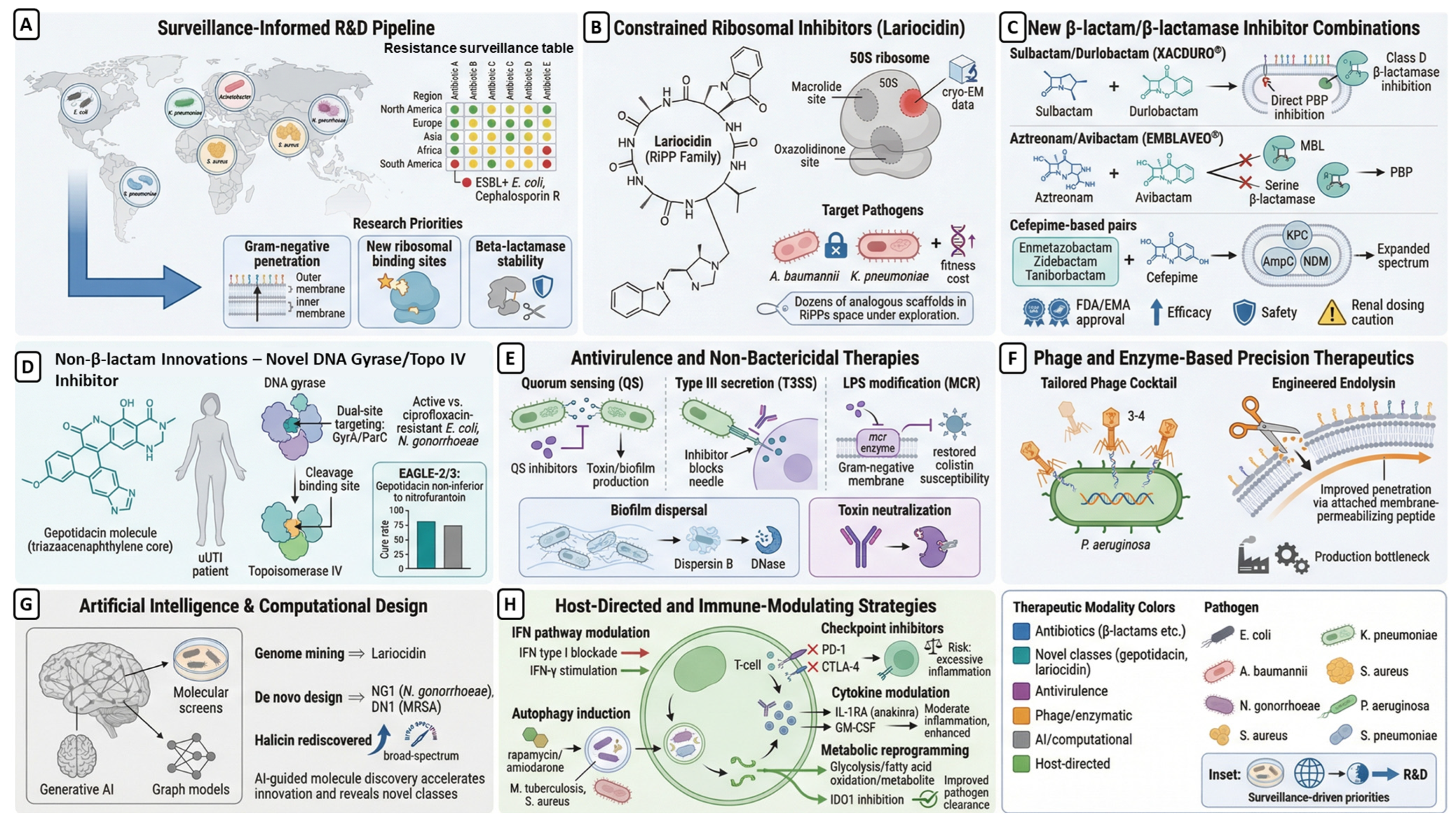
Despite the persistent stagnation that characterized the early 2020s, the last years have seen a modest reawakening of antibiotic innovation. This shift did not occur spontaneously: it has been propelled by parallel developments in genomic discovery platforms, structure-guided drug design, and the maturation of AI-based molecule screening systems. Industry participation remains thin, yet a growing number of academic–industry consortia have begun to fill this void, accelerating early-stage discovery of compounds directed at the most urgent threats identified in global surveillance [3]. As resistance rates continue to rise across Enterobacterales and non-fermenters (see Section 3), research priorities have pivoted decisively toward agents with improved Gram-negative cell wall penetration, novel ribosomal binding sites, and β-lactamase stability [79] (Figure 3).
These shifts in scientific priorities closely mirror the resistance patterns captured through international monitoring systems, particularly the pathogen–antibiotic combinations most under pressure between 2016 and 2023, as summarized in Table 2. The concentration of surveillance efforts on carbapenems, advanced cephalosporins, and key fluoroquinolones underscores the escalating threat posed by multidrug-resistant GNB and directly informs the strategic emphasis of the discovery programs discussed below (Figure 3).
The renewed momentum is nonetheless fragile. Economic analyses published, consistently reaffirm that antibiotic R&D remains financially unattractive without pull incentives or subscription-style reimbursement models [80]. Thus, the scientific progress summarized in this section must be interpreted within the broader constraints of global access, stewardship, and policy, issues revisited in subsequent sections.

4.1. Lariocidin and the Rise of Constrained Ribosomal Inhibitors

One of the most consequential findings is the characterization of lariocidin, a structurally constrained lasso peptide isolated from Brevibacillus sp. and described in Nature in early 2025 [12]. Lariocidin belongs to the expanding family of Ribosomally synthesized and Post-translationally modified Peptide (RiPP)-derived antibiotics whose stability and protease resistance arise from their unique macrolactam “lasso” conformation [12] (Figure 3).
Unlike classical ribosomal inhibitors, lariocidin binds a previously uncharacterized pocket on the 50S subunit, distinct from macrolide and oxazolidinone sites. Structural work using Cryo-Electron Microscopy (cryo-EM) has shown that this binding event disrupts peptidyl-transferase center dynamics without inducing the conformational rearrangements typical of existing drugs [12]. Functionally, the compound exhibits potent activity against CR A. baumannii and K. pneumoniae, pathogens that drive some of the highest mortality signals in GLASS 2025 [3,81]. Laboratory evolution assays indicate a comparatively high barrier to resistance, likely because mutations in the targeted pocket incur substantial fitness penalties [82].
Lariocidin has therefore drawn intense interest not simply as a lead molecule but as a representative of a much broader, and previously underexplored, chemical space. Computational mining of RiPP biosynthetic gene clusters suggests dozens of analogous scaffolds with pharmaceutical potential, pointing toward a new generation of ribosomal inhibitors [12] (Figure 3).
Quantitatively, lariocidin MIC90 ranges 0.5–4 µg/mL against A. baumannii and K. pneumoniae, comparable to colistin but with narrower therapeutic index [12]. Resistance emergence frequency ~10−9 (versus ~10−8 for rifampin). Pharmacodynamic studies indicate time-dependent killing [12]; clinical translation remains early-stage (Phase I pending).

4.2. New Inhibitors

Recent progress in antimicrobial development has generated several promising small-molecule agents and β-lactam/β-lactamase inhibitor combinations aimed at countering the rising prevalence of Extended-Spectrum β-Lactamase (ESBL)-producing Enterobacterales and metallo-β-lactamases (Section 3). Among these innovations, sulbactam/durlobactam (XACDURO®, Waltham, MA, USA) represents a major achievement, revitalizing the long-standing β-lactamase inhibitor sulbactam, already known for intrinsic activity against Acinetobacter [83,84] through its pairing with durlobactam, a next-generation diazabicyclooctane inhibitor specifically engineered to protect sulbactam from degradation by modern β-lactamase-producing A. baumannii [85,86,87]. This complementary mechanism, whereby sulbactam directly binds PBPs while durlobactam neutralizes a broad spectrum of serine β-lactamases, notably Class D enzymes [85,86,88], restores potent activity against carbapenem-resistant A. baumannii. Clinical validation came from randomized trials in severe infections such as Hospital-Acquired Pneumonia/Ventilator-Associated Pneumonia HAP/VAP, showing improved clinical and microbiologic outcomes compared with best available therapy [89,90]. With safety concerns limited primarily to infusion reactions, hypersensitivity, and renal dosing considerations [3,90], the Food and Drug Administration (FDA) approved XACDURO® in May 2023 for infections caused by the A. baumannii–calcoaceticus complex [84,86,89].
A similar rational design underlies aztreonam/avibactam (EMBLAVEO®): aztreonam is naturally stable to MBLs but vulnerable to serine β-lactamases [91], while avibactam inhibits serine enzymes, Klebsiella pneumoniae carbapenemase (KPC), AmpC, and Extended-Spectrum β-Lactamases (ESBLs), yet lacks MBL activity [92]. Their combination therefore provides dual protection, enabling aztreonam to retain activity against organisms that co-produce MBLs and additional β-lactamases [92,93]. This mechanistic logic was corroborated by phase II/III programs and real-world compassionate-use data (NCT03329092; NCT03580044), which demonstrated strong clinical and microbiologic responses in cIAI, cUTI, and HAP/VAP due to difficult-to-treat GNB, including MBL producers [92,93]. With a favourable safety profile and a need for stewardship emphasized in product labelling, the EMA authorized EMBLAVEO® in 2024, followed by FDA approval in early 2025 [92,94].
Parallel development efforts revitalized cefepime through combination strategies. Cefepime/enmetazobactam (EXBLIFEP®, London, UK.), pairing a 4th-generation cephalosporin with a novel sulfone-based β-lactamase inhibitor, expands activity against ESBL- and some carbapenemase-producing Enterobacterales [95,96]. Global phase II/III trials demonstrated non-inferiority to meropenem and favourable eradication and cure rates in resistant subgroups [96,97], supporting regulatory approval in 2024. Its safety profile aligns with that of cefepime, particularly neurotoxicity risks in renal impairment, without unexpected effects from enmetazobactam [97,98]. Additional agents include cefepime–zidebactam, which combines β-lactamase inhibition with high-affinity PBP2 binding; phase III trials (NCT04979806) completed in 2024–2025 show promise against KPC- and AmpC-producing Enterobacterales [97,98,99]. Cefepime–taniborbactam, targeting both serine and metallo-β-lactamases including NDM [100], remains under extended regulatory review due to the complexity of demonstrating consistent efficacy across evolving MβL variants [101].
Beyond β-lactams, gepotidacin (BLUJEPA®, London, UK) offers a first-in-class triazaacenaphthylene scaffold, representing the first new chemical class of oral antibiotics for uncomplicated urinary tract infections (uUTIs) in over two decades [102,103]. Unlike fluoroquinolones, which target a single binding site on DNA gyrase and topoisomerase IV, gepotidacin exhibits a unique dual-targeting mechanism: it binds with equal affinity to both enzymes at a distinct site (the GyrA/ParC cleavage junction), stabilizing double-stranded DNA breaks and blocking bacterial DNA replication [102,103]. This distinct binding mode circumvents common fluoroquinolone resistance mutations (e.g., in gyrA or parC), explaining its retained activity against ciprofloxacin-resistant E. coli and N. gonorrhoeae clinical isolates.
The clinical development program was robust. In the pivotal phase 3 trials, EAGLE-2 and EAGLE-3, gepotidacin (1500 mg twice daily for 5 days) was compared to nitrofurantoin (100 mg twice daily for 5 days) in over 3000 women with uncomplicated UTIs. Both trials met the primary endpoint of therapeutic non-inferiority, with gepotidacin demonstrating composite cure rates (clinical + microbiological response) of 62.5% and 61.7%, respectively, compared to 59.6% and 57.9% for nitrofurantoin [104,105]. Notably, in the EAGLE-3 trial, gepotidacin showed superior efficacy in a prespecified subgroup analysis against pathogens resistant to first-line antibiotics [105]. The safety profile was favourable, with most adverse events being mild to moderate gastrointestinal symptoms (i.e., diarrhoea, nausea), and no evidence of tendon toxicity or QT prolongation observed with fluoroquinolones.
Based on these results, the FDA approved gepotidacin in March 2025 for the treatment of adult women with uncomplicated UTIs caused by susceptible isolates of E. coli, K. pneumoniae, and S. saprophyticus [105]. Regulatory submissions to other agencies (EMA, UK MHRA) are pending. Beyond uUTIs, gepotidacin is under investigation for uncomplicated urogenital gonorrhoea (phase 3 EAGLE-1 trial), where its oral formulation and activity against resistant N. gonorrhoeae could offer a much-needed alternative to injectable ceftriaxone [106]. A paediatric formulation is also in development (NCT07371429).
Quantitatively, the antibacterial development pipeline remains critically insufficient despite recent advances. According to the World Health Organization 2025 antibacterial pipeline analysis, approximately 90 antibacterial agents are currently in preclinical or clinical development; however, only a limited number target WHO priority multidrug-resistant pathogens, and even fewer are considered truly innovative [107]. WHO emphasized in 2026 the urgent need for “new antibacterial agents that are innovative, affordable, and accessible to all those who need them,” particularly against severe multidrug-resistant Gram-negative infections caused by carbapenem-resistant Acinetobacter baumannii, Pseudomonas aeruginosa, and Enterobacterales [108]. Within this context, lariocidin has emerged as a promising candidate due to its novel mechanism of action [109]. The compound demonstrated potent antibacterial activity against multidrug-resistant Gram-negative pathogens, including carbapenem-resistant A. baumannii and Klebsiella pneumoniae, with low MIC values reported across susceptible strains and a very low frequency of spontaneous resistance emergence (<10−9) [109]. Mechanistically, lariocidin binds to a previously unexploited site on the 30S ribosomal subunit, thereby inhibiting bacterial protein synthesis through a distinct translational interference mechanism. In vivo efficacy was confirmed in murine models of A. baumannii infection, while minimal mammalian cytotoxicity was observed in preclinical evaluations [110]. Nevertheless, despite its strong therapeutic potential, lariocidin remains at the preclinical stage, highlighting the persistent gap between antibacterial discovery and clinical translation.

4.3. Antivirulence and Non-Bactericidal Modalities

Parallel to classical small-molecule discovery, research broadened into antivirulence therapies, agents that disable pathogenic mechanisms while exerting weaker selective pressure for resistance. Current pipelines include inhibitors of Quorum-Sensing (QS) circuits [111], Type III Secretion Systems (T3SS) [112], and lipopolysaccharide (LPS) modification pathways [113,114].
Of particular relevance to global surveillance trends is the effort to counteract colistin resistance mediated by mcr genes [115,116]. Several groups have identified compounds that inhibit phosphoethanolamine transferases, partially restoring colistin susceptibility in mcr-positive Enterobacterales [117,118,119]. Although these approaches remain preclinical, they exemplify a shift toward therapeutics aimed at resistance reversal rather than direct bactericidal activity.
Parallel to classical small-molecule discovery, research has broadened into antivirulence therapies, an approach that disables bacterial pathogenic mechanisms without directly killing the pathogen. By disarming bacteria rather than exerting bactericidal pressure, these strategies aim to perturb infection establishment and progression while applying weaker selective pressure for resistance development, potentially preserving the host microbiota [120].
Several virulence pathways are under active investigation as therapeutic targets. QS inhibitors disrupt bacterial cell-to-cell communication, preventing the coordinated expression of virulence factors such as toxins, proteases, and biofilm formation. In P. aeruginosa, for instance, inhibitors of the LasR and RhlR QS systems have shown promise in preclinical models, attenuating virulence and enhancing bacterial clearance by host immunity [121]. T3SS inhibitors block the injection of effector proteins directly into host cells, a critical virulence mechanism for pathogens like P. aeruginosa, Salmonella, and enteropathogenic E. coli. Small molecules targeting the T3SS apparatus or its ATPase have demonstrated efficacy in reducing tissue damage and inflammation in animal models [121].
Another major focus is the inhibition of LPS modification pathways, particularly those conferring resistance to last-resort polymyxins [122]. The MCR enzymes (phosphoethanolamine transferases) responsible for colistin resistance are attractive targets: several research groups have identified small-molecule inhibitors that block MCR activity, partially restoring colistin susceptibility in mcr-positive Enterobacterales in vitro and in vivo [122]. While these remain preclinical results, they exemplify a “resistance reversal” strategy that could extend the clinical lifespan of existing antibiotics.
Biofilm dispersal agents represent another antivirulence avenue. Enzymes such as dispersin B (targeting poly-N-acetylglucosamine in S. aureus and E. coli biofilms) and DNases that degrade extracellular DNA in the biofilm matrix have been shown to enhance antibiotic penetration and efficacy in experimental models [123]. In contrast to these matrix-disrupting enzymes, which physically dismantle biofilm structures, toxin neutralization strategies operate through a different mechanism: monoclonal antibodies or small-molecule inhibitors are being developed against key virulence factors such as C. difficile toxins TcdA/TcdB and S. aureus alpha-hemolysin, with some candidates advancing into clinical trials [124].
Nevertheless, it is important to note that long-term effectiveness data are absent; antivirulence agents may still select for resistance via alternative pathways (e.g., virulence factor upregulation or compensatory mutations). No clinical studies have yet demonstrated durability beyond 6 months.

4.4. Phage-Based and Enzyme-Based Precision Therapeutics

Phage therapy continued its transition from experimental to semi-formalized clinical evaluation. Multiple compassionate-use successes prompted controlled trials investigating tailored phage cocktails for P. aeruginosa and A. baumannii infections [125,126,127,128]. In parallel, engineered endolysins, peptidoglycan hydrolases linked to membrane-permeabilizing peptides, have demonstrated activity against GNB previously considered inaccessible to lysins [129,130,131]. These biologics provide advantages such as specificity and a reduced likelihood of off-target microbiome disruption, though production scalability remains a major barrier.
Key barriers remain: narrow host range requiring personalized matching, bacterial phage resistance, regulatory uncertainty (no standardized approval pathway), manufacturing reproducibility, and immunogenicity with repeated dosing. In fact, phage therapy remains limited by regulatory fragmentation: Belgium and the USA allow compassionate use, but no phage product has received full FDA/EMA approval for systemic bacterial infections. Controlled trials (e.g., PhagoBurn, NCT04682964) showed mixed efficacy and no superiority over standard antibiotics in some endpoints [132]. Safety concerns include immunogenicity, endotoxin release, and horizontal transfer of resistance genes. Most published evidence comes from compassionate use case series, lacking randomization or blinding. Until phase III data emerge, phage therapy should be viewed as an adjunctive, not standalone, strategy.

4.5. Artificial Intelligence and Computational Design

AI has rapidly evolved from a screening adjunct to a central driver of early-stage antibiotic discovery. Deep neural networks trained on antimicrobial activity datasets now predict membrane permeation, efflux susceptibility, and toxicity with unprecedented accuracy (Figure 3). Generative models have produced novel peptide antibiotics with enhanced serum stability, while graph-based models have identified small molecules structurally divergent from existing classes. In multiple cases, computational predictions have outpaced traditional wet-lab screening, significantly reducing discovery timescales [133,134,135].
Importantly, AI-guided genome mining was instrumental in the identification of lariocidin, underscoring how computational approaches can reveal cryptic natural products previously invisible to classical cultivation-based methods [109]. Furthermore, over the past two years, generative AI has accelerated antibiotic discovery, with a Massachusetts Institute of Technology (MIT)-led study in Cell describing the design of millions of hypothetical compounds and identification of two leads, NG1, active against drug-resistant Neisseria gonorrhoeae, and DN1, effective against methicillin-resistant Staphylococcus aureus (MRSA) in mouse models, generated via fragment-based and unconstrained de novo AI models exploring novel chemical space [136]. Early AI-based antimicrobial discovery predates this work, with deep learning-identified halicin rediscovered as a broad-spectrum antibiotic capable of killing multiple drug-resistant bacteria, highlighting the potential of computational approaches for identifying non-traditional mechanisms of action.
Despite these remarkable advances, a substantial translational gap remains between AI-driven discovery and clinical application. The vast majority of AI-identified antibiotic candidates, including halicin and many generative model outputs, have been validated only in preclinical in vitro or murine models, with very few progressing to human trials [135]. Key barriers include limited assessment of safety profiles (e.g., cytotoxicity, hemolytic activity, off-target effects), unpredictable pharmacokinetics and bioavailability in humans, and a lack of standardized pipelines for the clinical validation of computationally derived molecules [137,138]. Furthermore, the “black box” nature of some deep learning models complicates mechanistic understanding and regulatory acceptance. Addressing these gaps will require integrated efforts between computational biologists, medicinal chemists, and clinicians to establish robust preclinical-to-clinical translation frameworks specifically tailored for AI-generated antibiotics [138].

4.6. Host-Directed and Immune-Modulating Strategies

A smaller but rapidly growing part of the pipeline targets host pathways rather than bacterial viability. These host-directed therapies (HDTs) aim to enhance the innate and adaptive immune response, modulate inflammation, or create a cellular environment unfavourable to pathogen persistence [139,140]. By acting on host factors rather than bacterial targets, HDTs theoretically apply less selective pressure for resistance and may be effective across multiple pathogens sharing similar intracellular niches [139,140].
Several strategies are under active investigation. Modulation of interferon responses has emerged as a promising approach to enhance intracellular bacterial clearance. Type I interferons, while essential for antiviral defence, can be detrimental during bacterial infections by suppressing protective immune responses [141]. In preclinical models of tuberculosis, blockade of the type I interferon pathway using neutralizing antibodies or small-molecule inhibitors of the Interferon-Alpha/Beta (IFNAR) receptor improved bacterial control and reduced pathology [142]. Conversely, stimulation of type II interferon (IFN-γ) with recombinant IFN-γ has been used as adjunctive therapy in chronic granulomatous disease and nontuberculous mycobacterial infections, though its use remains limited by toxicity and variable efficacy (Figure 3).
Pharmacologic activation of autophagy, a cellular degradation pathway that eliminates intracellular pathogens, represents another major HDT avenue [143]. Autophagy inducers such as rapamycin (mTOR inhibitor) and its analogues have shown promise in preclinical models of tuberculosis, salmonellosis, and S. aureus infections, enhancing bacterial clearance and reducing inflammatory damage [144]. More recently, the antiarrhythmic drug amiodarone was identified through a phenotypic screen as a potent autophagy enhancer capable of restricting mycobacterial growth in macrophages and zebrafish models, demonstrating the potential for repurposing approved drugs for host-directed effects [139]. Clinical trials are now evaluating the autophagy inducer everolimus as adjunctive therapy in pulmonary tuberculosis (NCT number: NCT02968927).
Immune checkpoint inhibitors, best known in oncology, are being explored for their potential to reverse immune exhaustion in chronic infections [145]. Programmed cell death protein 1 (PD-1) and cytotoxic T-lymphocyte-associated protein 4 (CTLA-4) blockade has been shown to enhance T-cell responses against M. tuberculosis and S. aureus in animal models, though concerns about excessive inflammation and immune-related adverse events remain significant [146].
Cytokine modulation strategies aim to fine-tune the inflammatory response to achieve optimal bacterial clearance while minimizing tissue damage [147]. Interleukin-1 receptor antagonists (e.g., anakinra) have been evaluated in septic shock and severe pneumonia to temper hyperinflammation, with mixed results [148]. Conversely, administration of granulocyte-macrophage colony-stimulating factor (GM-CSF) has been used to enhance neutrophil and macrophage function in immunocompromised hosts with refractory infections [149].
Metabolic reprogramming of immune cells is an emerging frontier. Pathogens often exploit host metabolic pathways to establish persistent infection [150]. Small molecules that modulate glycolysis, fatty acid oxidation, or amino acid metabolism in macrophages and T cells are being explored for their ability to create a hostile metabolic environment for intracellular pathogens [151]. For example, inhibition of the enzyme IDO1 (indoleamine 2,3-dioxygenase), which depletes tryptophan and suppresses T-cell responses, has shown benefit in preclinical models of tuberculosis and sepsis [152].
An emerging complement to classical host-directed therapy involves the microbiome. The resident microbial community influences infection outcomes through colonization resistance (competing with pathogens for nutrients and niches), immune signalling modulation (e.g., short-chain fatty acids that enhance regulatory T cell function), and direct effects on immunotherapy efficacy [153,154]. Disruption of the gut microbiota by broad-spectrum antibiotics increases susceptibility to infections such as Clostridioides difficile [155]. Accordingly, microbiome-targeted interventions, including probiotics, faecal microbiota transplantation (FMT), and microbiome-sparing antibiotics, are gaining traction as adjunctive host-directed strategies, though standardization and safety remain challenges [156].
While unlikely to replace antibiotics, these host-directed agents may function as adjunct therapies that reduce relapse rates, shorten treatment durations, or improve outcomes in hard-to-treat infections, particularly those involving intracellular pathogens (tuberculosis, salmonellosis, listeriosis) or biofilm-associated chronic infections where conventional antibiotics often fail to eradicate persistent reservoirs.

5. Are We Finally Learning to Run Faster? Strategic Priorities Beyond 2025

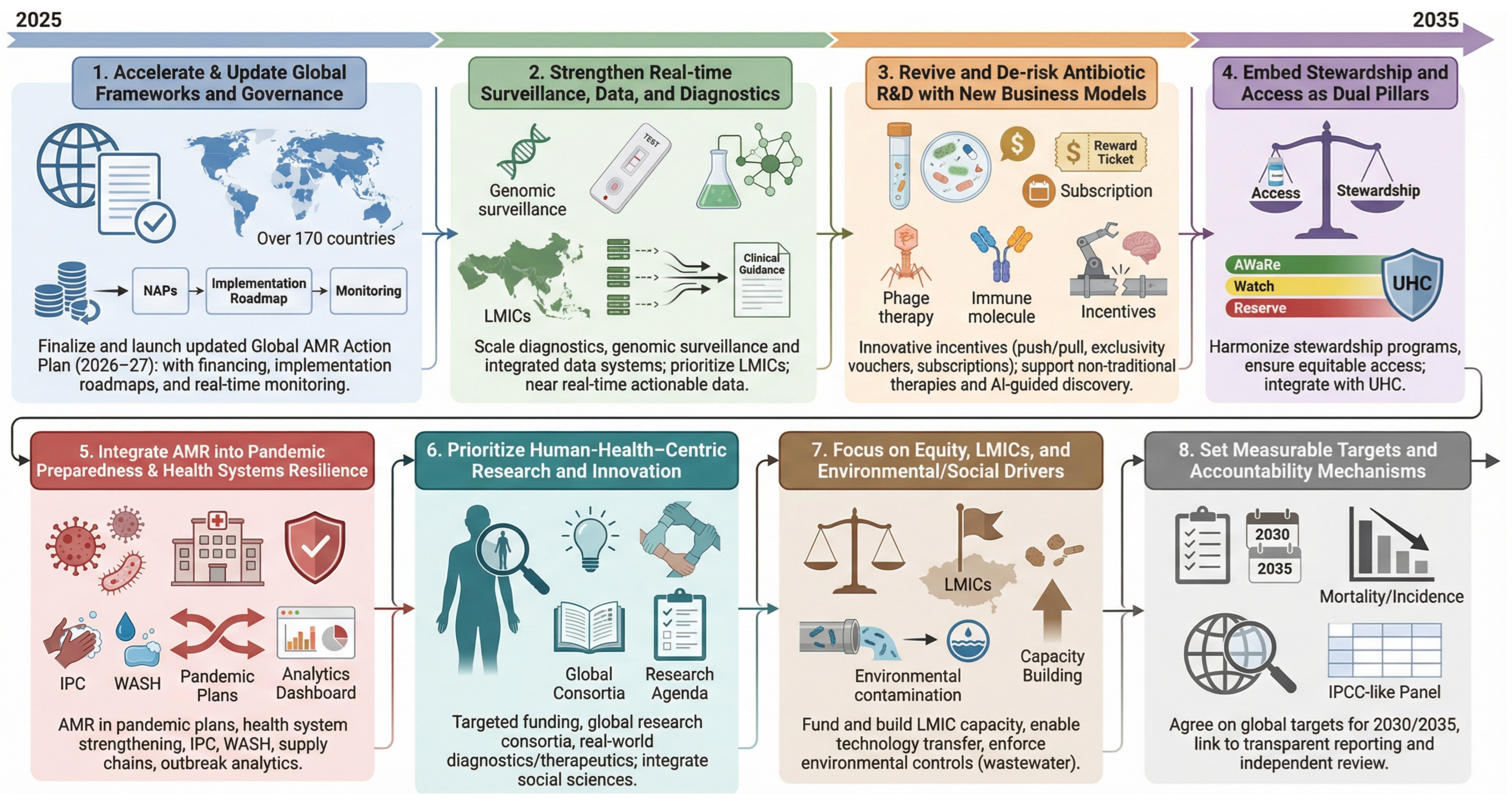
In recent years, the discourse around AMR has shifted from recognition of the problem toward action frameworks and strategic priority-setting. While progress has been made, to truly outpace the accelerating emergence of resistant pathogens requires not just incremental improvements but a marked increase in speed, coordination and innovation. As we cross the midpoint of the 2020s, several strategic priorities stand out if we are to run faster and meaningfully reverse or mitigate the projected trajectory of resistance (Figure 4).

5.1. Accelerate and Update Global Frameworks & Governance

WHO in May 2025 announced that the 78th World Health Assembly approved a decision to update the Global Action Plan on Antimicrobial Resistance (GAP-AMR) (2015) for the next decade, emphasizing multisectoral “One Health” integration and stronger implementation support for countries [157]. The justification for this update is grounded in the widening gap between policy commitments and realized outcomes: though over 170 countries have NAPs (National Action Plans) aligned to GAP-AMR, many lack full implementation, finance, monitoring and evaluation systems [158].
Strategic priority #1 thus is: finalize and launch the updated global framework by 2026–2027, with built-in financing mechanisms, implementation roadmaps, and real-time monitoring dashboards.

5.2. Strengthen Real-Time Surveillance, Data, Diagnostics

The newly released Global Antibiotic Resistance Surveillance Report 2025 (based on over 23 million infections from 104 countries) demonstrates both how far surveillance has progressed and how much remains to be done [158]. Key gaps include: delayed data feeds, lack of diagnostics in low-resource settings, limited pathogen coverage, and insufficient linkage between surveillance and clinical decision-making.
Strategic priority #2: Invest in and scale rapid diagnostics, genomic surveillance, integrated data systems, particularly in Low- and Middle-Income Countries (LMICs). This includes deploying point-of-care AMR diagnostics, strengthening laboratory networks, and creating interoperable data that inform stewardship in near real time. Furthermore, addressing the diagnostic gap requires technologies that deliver actionable results within clinically relevant timeframes. Recent advances in rapid antimicrobial susceptibility testing (AST) now enable single-bacterial response measurement within 30 min using fluorescent or functional probes [159,160]. Complementary platforms targeting cell-activity-related molecular determinants offer on-site feasibility [161]. When deployed at point-of-care, such rapid ASTs can guide empiric therapy, reduce inappropriate antibiotic use, and strengthen real-time stewardship, directly addressing the surveillance priorities highlighted by GLASS 2025.

5.3. Revive and De-Risk Antibiotic R&D with New Business Models

One of the most persistent bottlenecks remains the antibiotic pipeline: despite scientific advances, economic incentives are often misaligned (low return on investment, short durations of use, high risk). The World Economic Forum’s Davos Compact 2025 calls for “sustainable antimicrobial R&D ecosystems” that combine push funding, pull incentives, appropriate access and stewardship [162].
Strategic priority #3: Implement innovative funding models—e.g., market-entry rewards, transferable exclusivity vouchers, subscription models—to stimulate early- and late-stage antibiotic development. In parallel, non-traditional therapies (phages, immune modulation, adjuvants) and AI-guided discovery should receive scaled support.

5.4. Embed Stewardship and Access as Dual Pillars

A key tension continues: ensuring access to effective antibiotics for all, while conserving their utility through strong stewardship. The 2025 WHO fact-sheet emphasizes that misuse across human, animal, plant and environmental sectors remains the driver of resistance [162,163].
Strategic priority #4: Implement globally harmonized stewardship programs aligned with the Access, Watch, Reserve (AWaRe) classification, and ensure equitable access to quality assured antibiotics and diagnostics. Integration of stewardship into Universal Health Coverage (UHC) financing is also essential. AWaRe implementation faces substantial challenges, particularly in LMICs. Supply security remains a key barrier: only 29 of 39 AWaRe-listed antibiotics are available in some countries, with no Reserve group agents accessible [164]. Diagnostic dependence further complicates appropriate Watch/Reserve use, as many LMIC facilities lack laboratory capacity to identify resistant infections requiring these agents [164]. Without rapid diagnostics, even well-intentioned AWaRe adherence may default to empirical broad-spectrum prescribing, undermining stewardship goals.

5.5. Integrate AMR into Pandemic-Preparedness and Health-System Resilience

COVID-19 exposed a deadly synergy: fragile health systems amplify threats like AMR. Integrating AMR containment into UHC and pandemic preparedness is now a non-negotiable pillar of health security [165,166].
Strategic priority #5: Embed AMR monitoring, response and innovation into national pandemic-preparedness plans and health-systems strengthening efforts. This means cross-linking AMR with Infection Prevention & Control (IPC), Water, Sanitation, Hygiene (WASH) infrastructure, supply-chain resilience, and outbreak analytics.

5.6. Prioritize Human-Health–Centric Research and Innovation

While the One Health approach remains vital, the human-health domain warrants renewed focus: the WHO Global Research Agenda for Antimicrobial Resistance in Human Health has identified 40 research priorities by 2030 covering prevention, diagnosis, treatment and policy translation [167].
Strategic priority #6: Allocate targeted funding and build global consortia around the research agenda—especially for rapid diagnostic validation, therapeutic adversarial resistance design, real-world stewardship implementation science. Cross-disciplinary work (e.g., social sciences) is also key, as a recent 2025 virtual dialogue emphasized [168].

5.7. Focus on Equity, LMICs, and Environmental/Social Drivers

AMR is both a medical and a social challenge. Structural issues—limited diagnostics in LMICs, lack of sanitation, antimicrobial contamination of environments—underlie persistent transmission and selection of resistance. Ahmed et al. emphasize that this is a “tragedy of the commons” problem requiring global shared responsibility [169].
Strategic priority #7: Ensure LMIC-tailored funding, capacity building, technology transfer, and environmental controls (e.g., antibiotic residues in wastewater). This is foundational for sustainable AMR control.

5.8. Set Measurable Targets and Accountability Mechanisms

At the United Nations General Assembly High-Level Meeting on AMR, world leaders committed to a 10% reduction in AMR-associated deaths by 2030 [170,171]. However, without robust accountability, monitoring and enforcement mechanisms, such targets risk becoming aspirational.
Strategic priority #8: Agree on global targets for 2030/2035 (e.g., incidence, mortality, pipeline delivery, stewardship coverage), linked to transparent reporting and independent review (similar to the Intergovernmental Panel on Climate Change (IPCC) model for climate).

6. Conclusions

The fight against antimicrobial resistance is a race against bacterial evolution, one that humanity is not yet winning. While scientific breakthroughs in drug discovery, diagnostics, and alternative therapies offer a renewed sense of hope, they are insufficient alone. Turning the tide requires a durable, globally coordinated strategy that marries innovation with implementation. Strengthening health systems, ensuring equitable access to existing and new antibiotics, and embedding robust stewardship into the fabric of healthcare are no longer optional but essential. The future of modern medicine depends on our collective ability to outpace adaptation with smarter, faster, and more unified action.

Author Contributions

Conceptualization, H.W. and R.E.D.; data curation, H.W.; writing—original draft preparation, H.W.; figures conception, H.W.; writing—review and editing, R.E.K., B.D., Y.L. and R.E.D.; supervision, R.E.D. All authors have read and agreed to the published version of the manuscript.

Funding

This research received no external funding.

Institutional Review Board Statement

Not applicable.

Informed Consent Statement

Not applicable.

Data Availability Statement

No new data were created or analyzed in this study. Data sharing is not applicable.

Conflicts of Interest

The authors declare no conflicts of interest.

Abbreviations

The following abbreviations are used in this manuscript:
3GC-R3rd-generation cephalosporin resistant
AIArtificial Intelligence
AMRAntimicrobial Resistance
AMRSNETAntimicrobial Resistance Surveillance Network
AmpCAmpC Beta-Lactamase
ASTAntimicrobial Susceptibility Testing
AUAfrican Union
AWaReAccess, Watch, Reserve
BSIBloodstream infection
CDCCentre of Disease Control and Prevention
cIAIComplicated Intra-Abdominal Infection
CMSCenters for Medicare & Medicaid Services
COVID-19Coronavirus Disease 2019
CRCarbapenem-resistant
CRISPRClustered Regularly Interspaced Short Palindromic Repeats
cryo-EMCryo-Electron Microscopy
cUTIComplicated Urinary Tract Infection
DALYsDisability-Adjusted Life Years
DBODiazabicyclooctane
EARS-NetEuropean Antimicrobial Resistance Surveillance Network
EHRElectronic Health Record
EMAEuropean Medicines Agency
ESKAPEEnterococcus faecium, Staphylococcus aureus, Klebsiella pneumoniae, Acinetobacter baumannii, Pseudomonas aeruginosa, and Enterobacter spp.
ESBLExtended-Spectrum Beta-Lactamase
FDAFood and Drug Administration
FQ-RFluoroquinolone resistant
GAP AMRGlobal Action Plan on Antimicrobial Resistance
GLASSGlobal Antimicrobial Resistance Surveillance System
HAP/VAPHospital-Acquired Pneumonia/Ventilator-Associated Pneumonia
HGTHorizontal gene transfer
IPCInfection prevention & control
KPCKlebsiella pneumoniae Carbapenemase
LMICsLow- and middle-income countries
MBLsMetallo-β-lactamases
mcrMobilized Colistin Resistance
MDRMultidrug-resistant
MRSAMethicillin-Resistant Staphylococcus aureus
NAPsNational Action Plans
NDMNew Delhi Metallo-beta-lactamase
NHSNNational Healthcare Safety Network
PBPsPenicillin-binding proteins
RiPPRibosomally synthesized and Post-translationally modified Peptide
TrACSSTracking Antimicrobial Resistance Country Self-Assessment Survey
UHCUniversal health coverage
UTIsUrinary Tract Infections
WASHWater, sanitation, hygiene
WGSWhole-genome sequencing
WHOWorld Health Organization
XDRExtensively drug-resistant

References

  1. Gaynes, R. The Discovery of Penicillin—New Insights After More Than 75 Years of Clinical Use. Emerg. Infect. Dis. 2017, 23, 849–853. [Google Scholar] [CrossRef]
  2. Munita, J.M.; Arias, C.A. Mechanisms of Antibiotic Resistance. Microbiol. Spectr. 2016, 4. [Google Scholar] [CrossRef]
  3. WHO. Global Antibiotic Resistance Surveillance Report 2025; World Health Organization: Geneva, Switzerland, 2025; p. 110. [Google Scholar]
  4. Rice, L.B. Federal funding for the study of antimicrobial resistance in nosocomial pathogens: No ESKAPE. J. Infect. Dis. 2008, 197, 1079–1081. [Google Scholar] [CrossRef] [PubMed]
  5. Miller, W.R.; Arias, C.A. ESKAPE pathogens: Antimicrobial resistance, epidemiology, clinical impact and therapeutics. Nat. Rev. Microbiol. 2024, 22, 598–616. [Google Scholar] [CrossRef]
  6. Egorov, A.M.; Ulyashova, M.M.; Rubtsova, M.Y. Bacterial Enzymes and Antibiotic Resistance. Acta Naturae 2018, 10, 33–48. [Google Scholar] [CrossRef]
  7. Partridge, S.R.; Kwong, S.M.; Firth, N.; Jensen, S.O. Mobile Genetic Elements Associated with Antimicrobial Resistance. Clin. Microbiol. Rev. 2018, 31. [Google Scholar] [CrossRef]
  8. Boumasmoud, M.; Dengler Haunreiter, V.; Schweizer, T.A.; Meyer, L.; Chakrakodi, B.; Schreiber, P.W.; Seidl, K.; Kühnert, D.; Kouyos, R.D.; Zinkernagel, A.S. Genomic Surveillance of Vancomycin-Resistant Enterococcus faecium Reveals Spread of a Linear Plasmid Conferring a Nutrient Utilization Advantage. mBio 2022, 13, e0377121. [Google Scholar] [CrossRef] [PubMed]
  9. Sili, U.; Tekin, A.; Bilgin, H.; Khan, S.A.; Domecq, J.P.; Vadgaonkar, G.; Segu, S.S.; Rijhwani, P.; Raju, U.; Surapaneni, K.M.; et al. Early empiric antibiotic use in COVID-19 patients: Results from the international VIRUS registry. Int. J. Infect. Dis. 2024, 140, 39–48. [Google Scholar] [CrossRef]
  10. CDC. National Healthcare Safety Network (NHSN): Antimicrobial Use and Resistance (AUR) Module. Available online: https://www.cdc.gov/nhsn/psc/aur/index.html (accessed on 26 February 2026).
  11. ECDC. Antimicrobial Resistance Targets, How Can We Reach Them by 2030? Available online: https://www.ecdc.europa.eu/assets/amr-targets-2025/index.html (accessed on 26 February 2026).
  12. Jangra, M.; Travin, D.Y.; Aleksandrova, E.V.; Kaur, M.; Darwish, L.; Koteva, K.; Klepacki, D.; Wang, W.; Tiffany, M.; Sokaribo, A.; et al. A broad-spectrum lasso peptide antibiotic targeting the bacterial ribosome. Nature 2025, 640, 1022–1030. [Google Scholar] [CrossRef]
  13. David, L.; Brata, A.M.; Mogosan, C.; Pop, C.; Czako, Z.; Muresan, L.; Ismaiel, A.; Dumitrascu, D.I.; Leucuta, D.C.; Stanculete, M.F.; et al. Artificial Intelligence and Antibiotic Discovery. Antibiotics 2021, 10, 1376. [Google Scholar] [CrossRef]
  14. Tao, S.; Chen, H.; Li, N.; Liang, W. The Application of the CRISPR-Cas System in Antibiotic Resistance. Infect. Drug Resist. 2022, 15, 4155–4168. [Google Scholar] [CrossRef]
  15. Saleem, Z.; Sheikh, S.; Godman, B.; Haseeb, A.; Afzal, S.; Qamar, M.U.; Imam, M.T.; Abuhussain, S.S.A.; Sharland, M. Increasing the use of the WHO AWaRe system in antibiotic surveillance and stewardship programmes in low- and middle-income countries. JAC-Antimicrob. Resist. 2025, 7, dlaf031. [Google Scholar] [CrossRef]
  16. Galgano, M.; Pellegrini, F.; Catalano, E.; Capozzi, L.; Del Sambro, L.; Sposato, A.; Lucente, M.S.; Vasinioti, V.I.; Catella, C.; Odigie, A.E.; et al. Acquired Bacterial Resistance to Antibiotics and Resistance Genes: From Past to Future. Antibiotics 2025, 14, 222. [Google Scholar] [CrossRef]
  17. Ruiz, J. Mechanisms of resistance to quinolones: Target alterations, decreased accumulation and DNA gyrase protection. J. Antimicrob. Chemother. 2003, 51, 1109–1117. [Google Scholar] [CrossRef]
  18. González, I.; Georgiou, M.; Alcaide, F.; Balas, D.; Liñares, J.; de la Campa, A.G. Fluoroquinolone resistance mutations in the parC, parE, and gyrA genes of clinical isolates of viridans group streptococci. Antimicrob. Agents Chemother. 1998, 42, 2792–2798. [Google Scholar] [CrossRef]
  19. Li, X.; Zhang, L.; Chen, J. Metagenomic profiling of microbial community, antibiotic resistance genes and co-occurrence pattern in megacity rail transit system. Hyg. Environ. Health Adv. 2025, 15, 100142. [Google Scholar] [CrossRef]
  20. Hughes, D.; Andersson, D.I. Evolutionary consequences of drug resistance: Shared principles across diverse targets and organisms. Nat. Rev. Genet. 2015, 16, 459–471. [Google Scholar] [CrossRef]
  21. Mączyńska, B.; Frej-Mądrzak, M.; Sarowska, J.; Woronowicz, K.; Choroszy-Król, I.; Jama-Kmiecik, A. Evolution of Antibiotic Resistance in Escherichia coli and Klebsiella pneumoniae Clinical Isolates in a Multi-Profile Hospital over 5 Years (2017–2021). J. Clin. Med. 2023, 12, 2414. [Google Scholar] [CrossRef] [PubMed]
  22. Bonomo, R.A. β-Lactamases: A Focus on Current Challenges. Cold Spring Harb. Perspect. Med. 2017, 7, a025239. [Google Scholar] [CrossRef] [PubMed]
  23. Bush, K.; Jacoby, G.A. Updated functional classification of beta-lactamases. Antimicrob. Agents Chemother. 2010, 54, 969–976. [Google Scholar] [CrossRef] [PubMed]
  24. Wang, T.; Zhou, Y.; Zou, C.; Zhu, Z.; Zhu, J.; Lv, J.; Xie, X.; Chen, L.; Niu, S.; Du, H. Identification of a Novel bla(NDM) Variant, bla(NDM-33,) in an Escherichia coli Isolate from Hospital Wastewater in China. mSphere 2021, 6, e0077621. [Google Scholar] [CrossRef]
  25. Fishovitz, J.; Hermoso, J.A.; Chang, M.; Mobashery, S. Penicillin-binding protein 2a of methicillin-resistant Staphylococcus aureus. IUBMB Life 2014, 66, 572–577. [Google Scholar] [CrossRef]
  26. Walther-Rasmussen, J.; Høiby, N. OXA-type carbapenemases. J. Antimicrob. Chemother. 2006, 57, 373–383. [Google Scholar] [CrossRef]
  27. Yang, X.; He, N.; Haque, A.; Mai, Y.; Wang, J.; Xiao, S.; Zhuo, C. Transient AdeABC-mediated eravacycline resistance in carbapenem-resistant Acinetobacter baumannii ST2: A mutation-independent efflux pump adaptation. Ann. Clin. Microbiol. Antimicrob. 2026, 25, 8. [Google Scholar] [CrossRef]
  28. Grall, N.; Andremont, A.; Armand-Lefèvre, L. Résistance aux carbapénèmes: Vers une nouvelle impasse ? J. Des. Anti-Infect. 2011, 13, 87–102. [Google Scholar] [CrossRef]
  29. Thacharodi, A.; Lamont, I.L. Aminoglycoside-Modifying Enzymes Are Sufficient to Make Pseudomonas aeruginosa Clinically Resistant to Key Antibiotics. Antibiotics 2022, 11, 884. [Google Scholar] [CrossRef]
  30. Ramirez, M.S.; Tolmasky, M.E. Aminoglycoside modifying enzymes. Drug Resist. Updates 2010, 13, 151–171. [Google Scholar] [CrossRef]
  31. Biswas, T.; Houghton, J.L.; Garneau-Tsodikova, S.; Tsodikov, O.V. The structural basis for substrate versatility of chloramphenicol acetyltransferase CATI. Protein Sci. 2012, 21, 520–530. [Google Scholar] [CrossRef] [PubMed]
  32. Baysarowich, J.; Koteva, K.; Hughes, D.W.; Ejim, L.; Griffiths, E.; Zhang, K.; Junop, M.; Wright, G.D. Rifamycin antibiotic resistance by ADP-ribosylation: Structure and diversity of Arr. Proc. Natl. Acad. Sci. USA 2008, 105, 4886–4891. [Google Scholar] [CrossRef]
  33. Lambert, P.A. Bacterial resistance to antibiotics: Modified target sites. Adv. Drug Deliv. Rev. 2005, 57, 1471–1485. [Google Scholar] [CrossRef] [PubMed]
  34. Eriksen, H.B.; Fuursted, K.; Jensen, A.; Jensen, C.S.; Nielsen, X.; Christensen, J.J.; Shewmaker, P.; Rebelo, A.R.; Aarestrup, F.M.; Schønning, K.; et al. Predicting β-lactam susceptibility from the genome of Streptococcus pneumoniae and other mitis group streptococci. Front. Microbiol. 2023, 14, 1120023. [Google Scholar] [CrossRef] [PubMed]
  35. Gaballa, A.; Wiedmann, M.; Carroll, L.M. More than mcr: Canonical plasmid- and transposon-encoded mobilized colistin resistance genes represent a subset of phosphoethanolamine transferases. Front. Cell. Infect. Microbiol. 2023, 13, 1060519. [Google Scholar] [CrossRef]
  36. Li, X.Z.; Plésiat, P.; Nikaido, H. The challenge of efflux-mediated antibiotic resistance in Gram-negative bacteria. Clin. Microbiol. Rev. 2015, 28, 337–418. [Google Scholar] [CrossRef] [PubMed]
  37. Gaurav, A.; Bakht, P.; Saini, M.; Pandey, S.; Pathania, R. Role of bacterial efflux pumps in antibiotic resistance, virulence, and strategies to discover novel efflux pump inhibitors. Microbiology 2023, 169, 001333. [Google Scholar] [CrossRef]
  38. Whittle Emily, E.; Orababa, O.; Osgerby, A.; Siasat, P.; Element Sarah, J.; Blair Jessica, M.A.; Overton Tim, W. Efflux pumps mediate changes to fundamental bacterial physiology via membrane potential. mBio 2024, 15, e02370-24. [Google Scholar] [CrossRef]
  39. Sharma, S.; Kumar, S.; Kumar, P.; Tripathi, V.N. Quorum sensing in Gram-negative pathogens, a fresh look. Microbe 2024, 4, 100108. [Google Scholar] [CrossRef]
  40. Mazza, L.; Bory, A.; Luscher, A.; Kloehn, J.; Wolfender, J.-L.; van Delden, C.; Köhler, T. Multidrug efflux pumps of Pseudomonas aeruginosa show selectivity for their natural substrates. Front. Microbiol. 2025, 15, 1512472. [Google Scholar] [CrossRef]
  41. Tarasenko, A.; Papudeshi, B.N.; Grigson, S.R.; Mallawaarachchi, V.; Hutton, A.L.K.; Warner, M.S.; Barr, J.J.; Iredell, J.; Eijkelkamp, B.; Edwards, R.A. Reprogramming resistance: Phage-antibiotic synergy targets efflux systems in ESKAPEE pathogens. mBio 2025, 16, e0182225. [Google Scholar] [CrossRef]
  42. Amisano, F.; Mercuri, P.; Fanara, S.; Verlaine, O.; Motte, P.; Frère, J.M.; Hanikenne, M.; Galleni, M. Outer membrane permeability of Pseudomonas aeruginosa through β-lactams: New evidence on the role of OprD and OpdP porins in antibiotic resistance. Microbiol. Spectr. 2025, 13, e00495-24. [Google Scholar] [CrossRef]
  43. Mukhopadhyay, H.; Bairagi, A.; Mukherjee, A.; Prasad, A.K.; Roy, A.D.; Nayak, A. Multidrug resistant Acinetobacter baumannii: A study on its pathogenesis and therapeutics. Curr. Res. Microb. Sci. 2025, 8, 100331. [Google Scholar] [CrossRef]
  44. Siefert, J.L. Defining the mobilome. Methods Mol. Biol. 2009, 532, 13–27. [Google Scholar] [CrossRef]
  45. Walsh, T.R. New Delhi metallo-β-lactamase-1: Detection and prevention. CMAJ 2011, 183, 1240–1241. [Google Scholar] [CrossRef][Green Version]
  46. Wang, R.; van Dorp, L.; Shaw, L.P.; Bradley, P.; Wang, Q.; Wang, X.; Jin, L.; Zhang, Q.; Liu, Y.; Rieux, A.; et al. The global distribution and spread of the mobilized colistin resistance gene mcr-1. Nat. Commun. 2018, 9, 1179. [Google Scholar] [CrossRef]
  47. Rice, L.B. Tn916 family conjugative transposons and dissemination of antimicrobial resistance determinants. Antimicrob. Agents Chemother. 1998, 42, 1871–1877. [Google Scholar] [CrossRef]
  48. Tetu, S.G.; Holmes, A.J. A family of insertion sequences that impacts integrons by specific targeting of gene cassette recombination sites, the IS1111-attC Group. J. Bacteriol. 2008, 190, 4959–4970. [Google Scholar] [CrossRef]
  49. Kim, J.I.; Maguire, F.; Tsang, K.K.; Gouliouris, T.; Peacock, S.J.; McAllister, T.A.; McArthur, A.G.; Beiko, R.G. Machine Learning for Antimicrobial Resistance Prediction: Current Practice, Limitations, and Clinical Perspective. Clin. Microbiol. Rev. 2022, 35, e0017921. [Google Scholar] [CrossRef] [PubMed]
  50. Parkins, M.D.; Lee, B.E.; Acosta, N.; Bautista, M.; Hubert, C.R.J.; Hrudey, S.E.; Frankowski, K.; Pang, X.L. Wastewater-based surveillance as a tool for public health action: SARS-CoV-2 and beyond. Clin. Microbiol. Rev. 2024, 37, e0010322. [Google Scholar] [CrossRef]
  51. Shree, P.; Singh, C.K.; Sodhi, K.K.; Surya, J.N.; Singh, D.K. Biofilms: Understanding the structure and contribution towards bacterial resistance in antibiotics. Med. Microecol. 2023, 16, 100084. [Google Scholar] [CrossRef]
  52. Uruén, C.; Chopo-Escuin, G.; Tommassen, J.; Mainar-Jaime, R.C.; Arenas, J. Biofilms as Promoters of Bacterial Antibiotic Resistance and Tolerance. Antibiotics 2020, 10, 3. [Google Scholar] [CrossRef]
  53. Wood, T.K.; Knabel, S.J.; Kwan, B.W. Bacterial persister cell formation and dormancy. Appl. Environ. Microbiol. 2013, 79, 7116–7121. [Google Scholar] [CrossRef] [PubMed]
  54. Hentzer, M.; Teitzel, G.M.; Balzer, G.J.; Heydorn, A.; Molin, S.; Givskov, M.; Parsek, M.R. Alginate overproduction affects Pseudomonas aeruginosa biofilm structure and function. J. Bacteriol. 2001, 183, 5395–5401. [Google Scholar] [CrossRef] [PubMed]
  55. Korshoj, L.E.; Kielian, T. Bacterial single-cell RNA sequencing captures biofilm transcriptional heterogeneity and differential responses to immune pressure. Nat. Commun. 2024, 15, 10184. [Google Scholar] [CrossRef] [PubMed]
  56. Miranda, S.W.; Asfahl, K.L.; Dandekar, A.A.; Greenberg, E.P. Pseudomonas aeruginosa Quorum Sensing. Adv. Exp. Med. Biol. 2022, 1386, 95–115. [Google Scholar] [CrossRef]
  57. Mohammed, N.S.; Obaid, M.M.; Jasem, M.A.; Noaman, T.M. Impact of Biofilm Formation on Antibiotic Resistance in Escherichia coli. World J. Exp. Biosci. 2024, 12, 44–48. [Google Scholar] [CrossRef]
  58. Arnold, A.; McLellan, S.; Stokes, J.M. How AI can help us beat AMR. npj Antimicrob. Resist. 2025, 3, 18. [Google Scholar] [CrossRef]
  59. Outeda-García, M.; Arca-Suárez, J.; Lence, E.; Rodriguez-Coello, A.; Maceiras, R.; Blanco-Martin, T.; Guijarro-Sánchez, P.; Gonzalez-Pinto, L.; Alonso-Garcia, I.; García-Pose, A.; et al. Advancements in the fight against globally distributed OXA-48 carbapenemase: Evaluating the new generation of carbapenemase inhibitors. Antimicrob. Agents Chemother. 2025, 69, e01614–e01624. [Google Scholar] [CrossRef]
  60. Kaushik, A.; Ammerman, N.C.; Parrish, N.M.; Nuermberger, E.L. New β-Lactamase Inhibitors Nacubactam and Zidebactam Improve the In Vitro Activity of β-Lactam Antibiotics against Mycobacterium abscessus Complex Clinical Isolates. Antimicrob. Agents Chemother. 2019, 63. [Google Scholar] [CrossRef]
  61. Cook, G.D.; Stasulli, N.M. Employing synthetic biology to expand antibiotic discovery. SLAS Technol. 2024, 29, 100120. [Google Scholar] [CrossRef]
  62. Sherry, N.L.; Lee, J.Y.H.; Giulieri, S.G.; Connor, C.H.; Horan, K.; Lacey, J.A.; Lane, C.R.; Carter, G.P.; Seemann, T.; Egli, A.; et al. Genomics for antimicrobial resistance-progress and future directions. Antimicrob. Agents Chemother. 2025, 69, e0108224. [Google Scholar] [CrossRef]
  63. de Abreu, V.A.C.; Perdigão, J.; Almeida, S. Metagenomic Approaches to Analyze Antimicrobial Resistance: An Overview. Front. Genet. 2020, 11, 575592. [Google Scholar] [CrossRef]
  64. He, Z.; Yang, S.; Ma, Y.; Zhang, S.; Cao, Z. Detection of CTX-M-15 Extended-Spectrum β-Lactamases Producing Escherichia coli Isolates from Colostrum and Faeces of Newborn Dairy Calves in China. Pathogens 2021, 10, 1162. [Google Scholar] [CrossRef]
  65. Prieto Riquelme, M.V.; Garner, E.; Gupta, S.; Metch, J.; Zhu, N.; Blair, M.F.; Arango-Argoty, G.; Maile-Moskowitz, A.; Li, A.D.; Flach, C.F.; et al. Demonstrating a Comprehensive Wastewater-Based Surveillance Approach That Differentiates Globally Sourced Resistomes. Environ. Sci. Technol. 2022, 56, 14982–14993. [Google Scholar] [CrossRef] [PubMed]
  66. Wang, Y.; Zhao, L.; Li, Z.; Xi, Y.; Pan, Y.; Zhao, G.; Zhang, L. A generative artificial intelligence approach for the discovery of antimicrobial peptides against multidrug-resistant bacteria. Nat. Microbiol. 2025, 10, 2997–3012. [Google Scholar] [CrossRef]
  67. Wise, J. One in six bacterial infections worldwide are now resistant to antibiotics, WHO warns. BMJ 2025, 391, r2165. [Google Scholar] [CrossRef] [PubMed]
  68. Ungcharoen, R.; Ponyon, J.; Yongyod, R.; Kerdsin, A. Predisposing Factors Associated with Third-Generation Cephalosporin-Resistant Escherichia coli in a Rural Community Hospital in Thailand. Antibiotics 2025, 14, 790. [Google Scholar] [CrossRef] [PubMed]
  69. Song, H.W.; Lin, Y.; Wan, T.E.; Yang, G.H.; Jiang, M.T.; Fu, B.H.; Pan, J.S. Global burden of Klebsiella pneumoniae infections and antimicrobial resistance in 2019. BMC Infect. Dis. 2025, 25, 1773. [Google Scholar] [CrossRef]
  70. ECDC. Antimicrobial Resistance in the EU/EEA (EARS-Net)—Annual Epidemiological Report 2023; ECDC: Stockholm, Sweden, 2023.
  71. Africa Center for Disease Control and Prevention. African Union AMR Landmark Report: Voicing African Priorities on the Active Pandemic; Africa Center for Disease Control and Prevention: Addis Ababa, Ethiopia, 2024.
  72. Torres, N.F.; Solomon, V.P.; Middleton, L.E. Pharmacists’ practices for non-prescribed antibiotic dispensing in Mozambique. Pharm. Pract. 2020, 18, 1965. [Google Scholar] [CrossRef]
  73. Chandra Kanta, B.; Hanaa Jabbar, R. Controlling Imipenem-Resistant Pseudomonas aeruginosa in Hospitals: Effect of Improved Infection Control Measures from an Interrupted Time-Series Study: Control of Imipenem-Resistant Pseudomonas aeruginosa in Hospitals. World J. Exp. Biosci. 2026, 14, 10–15. [Google Scholar] [CrossRef]
  74. Africa Center for Disease Control and Prevention. New Study Reveals Widespread Drug Resistance Across 14 African Countries; Africa Center for Disease Control and Prevention: Addis Ababa, Ethiopi, 2025.
  75. MacFadden, D.R.; Leis, J.A.; Mubareka, S.; Daneman, N. The opening and closing of empiric windows: The impact of rapid microbiologic diagnostics. Clin. Infect. Dis. Off. Publ. Infect. Dis. Soc. Am. 2014, 59, 1199–1200. [Google Scholar] [CrossRef]
  76. Haimerl, B.J.; Encinas, R.; Justo, J.A.; Kohn, J.; Bookstaver, P.B.; Winders, H.R.; Al-Hasan, M.N. Optimization of Empirical Antimicrobial Therapy in Enterobacterales Bloodstream Infection Using the Extended-Spectrum Beta-Lactamase Prediction Score. Antibiotics 2023, 12, 1003. [Google Scholar] [CrossRef]
  77. Chotiprasitsakul, D.; Trirattanapikul, A.; Namsiripongpun, W.; Chaihongsa, N.; Santanirand, P. From Epidemiology of Community-Onset Bloodstream Infections to the Development of Empirical Antimicrobial Treatment-Decision Algorithm in a Region with High Burden of Antimicrobial Resistance. Antibiotics 2023, 12, 1699. [Google Scholar] [CrossRef] [PubMed]
  78. Gargate, N.; Laws, M.; Rahman, K.M. Current economic and regulatory challenges in developing antibiotics for Gram-negative bacteria. npj Antimicrob. Resist. 2025, 3, 50. [Google Scholar] [CrossRef] [PubMed]
  79. Tabcheh, J.; Vergalli, J.; Davin-Régli, A.; Ghanem, N.; Pages, J.-M.; Al-Bayssari, C.; Brunel, J.M. Rejuvenating the Activity of Usual Antibiotics on Resistant Gram-Negative Bacteria: Recent Issues and Perspectives. Int. J. Mol. Sci. 2023, 24, 1515. [Google Scholar] [CrossRef]
  80. Anderson, M.; Panteli, D.; van Kessel, R.; Ljungqvist, G.; Colombo, F.; Mossialos, E. Challenges and opportunities for incentivising antibiotic research and development in Europe. Lancet Reg. Health Eur. 2023, 33, 100705. [Google Scholar] [CrossRef]
  81. Kumar, G. Natural peptides and their synthetic congeners acting against Acinetobacter baumannii through the membrane and cell wall: Latest progress. RSC Med. Chem. 2025, 16, 561–604. [Google Scholar] [CrossRef]
  82. de Souza, J.; D’Espindula, H.R.S.; Ribeiro, I.F.; Gonçalves, G.A.; Pillonetto, M.; Faoro, H. Carbapenem Resistance in Acinetobacter baumannii: Mechanisms, Therapeutics, and Innovations. Microorganisms 2025, 13, 1501. [Google Scholar] [CrossRef]
  83. Petropoulou, D.; Siopi, M.; Vourli, S.; Pournaras, S. Activity of Sulbactam-Durlobactam and Comparators Against a National Collection of Carbapenem-Resistant Acinetobacter baumannii Isolates From Greece. Front. Cell. Infect. Microbiol. 2022, 11, 814530. [Google Scholar] [CrossRef]
  84. Keam, S.J. Sulbactam/Durlobactam: First Approval. Drugs 2023, 83, 1245–1252. [Google Scholar] [CrossRef]
  85. Watkins, R.R.; Bonomo, R.A. Sulbactam-durlobactam: A Step Forward in Treating Carbapenem-Resistant Acinetobacter baumannii (CRAB) Infections. Clin. Infect. Dis. 2023, 76, S163–S165. [Google Scholar] [CrossRef] [PubMed]
  86. Anand, A.; Verma, A.; Kaur, S.; Kathayat, P.; Manoj, R.M.; Aakanksha, A.; Turzin, J.K.; Satapathy, P.; Khatib, M.N.; Gaidhane, S.; et al. An overview of sulbactam-durlobactam approval and implications in advancing therapeutics for hospital-acquired and ventilator-associated pneumonia by acinetobacter baumannii-calcoaceticus complex: A narrative review. Health Sci. Rep. 2024, 7, e70066. [Google Scholar] [CrossRef]
  87. McLeod, S.M.; O’Donnell, J.P.; Narayanan, N.; Mills, J.P.; Kaye, K.S. Sulbactam–durlobactam: A β-lactam/β-lactamase inhibitor combination targeting Acinetobacter baumannii. Future Microbiol. 2024, 19, 563–576. [Google Scholar] [CrossRef]
  88. Kaye, K.S.; McLeod, S.M.; O’Donnell, J.P.; Altarac, D. Sulbactam–durlobactam for infections caused by Acinetobacter baumannii–calcoaceticus complex–Authors’ reply. Lancet Infect. Dis. 2023, 23, e275–e276. [Google Scholar] [CrossRef] [PubMed]
  89. Kaye, K.S.; Shorr, A.F.; Wunderink, R.G.; Du, B.; Poirier, G.E.; Rana, K.; Miller, A.; Lewis, D.; O’Donnell, J.; Chen, L.; et al. Efficacy and safety of sulbactam–durlobactam versus colistin for the treatment of patients with serious infections caused by Acinetobacter baumannii–calcoaceticus complex: A multicentre, randomised, active-controlled, phase 3, non-inferiority clinical trial (ATTACK). Lancet Infect. Dis. 2023, 23, 1072–1084. [Google Scholar] [CrossRef]
  90. Beninger, P. Sulbactam/Durlobactam. Clin. Ther. 2024, 46, 82–83. [Google Scholar] [CrossRef]
  91. Daikos, G.L.; Cisneros, J.M.; Carmeli, Y.; Wang, M.; Leong, C.L.; Pontikis, K.; Anderzhanova, A.; Florescu, S.; Kozlov, R.; Rodriguez-Noriega, E.; et al. Aztreonam-avibactam for the treatment of serious infections caused by metallo-β-lactamase-producing Gram-negative pathogens: A Phase 3 randomized trial (ASSEMBLE). JAC-Antimicrob. Resist. 2025, 7, dlaf131. [Google Scholar] [CrossRef] [PubMed]
  92. Al Musawa, M.; Bleick, C.R.; Herbin, S.R.; Caniff, K.E.; Van Helden, S.R.; Rybak, M.J. Aztreonam-avibactam: The dynamic duo against multidrug-resistant gram-negative pathogens. Pharmacotherapy 2024, 44, 927–938. [Google Scholar] [CrossRef] [PubMed]
  93. Carmeli, Y.; Cisneros, J.M.; Paul, M.; Daikos, G.L.; Wang, M.; Torre-Cisneros, J.; Singer, G.; Titov, I.; Gumenchuk, I.; Zhao, Y.; et al. Aztreonam–avibactam versus meropenem for the treatment of serious infections caused by Gram-negative bacteria (REVISIT): A descriptive, multinational, open-label, phase 3, randomised trial. Lancet Infect. Dis. 2025, 25, 218–230. [Google Scholar] [CrossRef]
  94. Xie, R.; Rogers, H.; Chow, J.W.; Soto, E.; Raber, S.R. Population pharmacokinetic/pharmacodynamic modeling to optimize aztreonam-avibactam dose regimens for adult patients. Antimicrob. Agents Chemother. 2025, 69, e0195024. [Google Scholar] [CrossRef]
  95. Morrissey, I.; Magnet, S.; Hawser, S.; Shapiro, S.; Knechtle, P. In Vitro Activity of Cefepime-Enmetazobactam against Gram-Negative Isolates Collected from U.S. and European Hospitals during 2014–2015. Antimicrob. Agents Chemother. 2019, 63, 10-1128. [Google Scholar] [CrossRef]
  96. Keam, S.J. Cefepime/Enmetazobactam: First Approval. Drugs 2024, 84, 737–744. [Google Scholar] [CrossRef]
  97. Kaye, K.S.; Belley, A.; Barth, P.; Lahlou, O.; Knechtle, P.; Motta, P.; Velicitat, P. Effect of Cefepime/Enmetazobactam vs Piperacillin/Tazobactam on Clinical Cure and Microbiological Eradication in Patients With Complicated Urinary Tract Infection or Acute Pyelonephritis: A Randomized Clinical Trial. JAMA 2022, 328, 1304–1314. [Google Scholar] [CrossRef] [PubMed]
  98. Vollmer, J.; Belley, A.; Velicitat, P.; Machacek, M. 2529. Population pharmacokinetic models for cefepime and enmetazobactam derived from pooled Phase 1 to Phase 3 clinical studies. Open Forum Infect. Dis. 2023, 10, ofad500.2147. [Google Scholar] [CrossRef]
  99. Alarcia-Lacalle, A.; Canut-Blasco, A.; Solinís, M.Á.; Isla, A.; Rodríguez-Gascón, A. Clinical efficacy, safety and pharmacokinetics of novel β-lactam/β-lactamase inhibitor combinations: A systematic review. JAC-Antimicrob. Resist. 2025, 7, dlaf096. [Google Scholar] [CrossRef] [PubMed]
  100. Van Helden, S.R.; Al Musawa, M.; Bleick, C.R.; Herbin, S.R.; Rybak, M.J. Cefepime-taniborbactam: Ushering in the era of metallo-β-lactamase inhibition. Pharmacotherapy 2025, 45, 448–461. [Google Scholar] [CrossRef]
  101. Boattini, M.; Gaibani, P.; Comini, S.; Costa, C.; Cavallo, R.; Broccolo, F.; Bianco, G. In vitro activity and resistance mechanisms of novel antimicrobial agents against metallo-β-lactamase producers. Eur. J. Clin. Microbiol. Infect. Dis. 2025, 44, 1041–1068. [Google Scholar] [CrossRef]
  102. Biedenbach, D.J.; Bouchillon, S.K.; Hackel, M.; Miller, L.A.; Scangarella-Oman, N.E.; Jakielaszek, C.; Sahm, D.F. In Vitro Activity of Gepotidacin, a Novel Triazaacenaphthylene Bacterial Topoisomerase Inhibitor, against a Broad Spectrum of Bacterial Pathogens. Antimicrob. Agents Chemother. 2016, 60, 1918–1923. [Google Scholar] [CrossRef] [PubMed]
  103. Watkins, R.R.; Thapaliya, D.; Lemonovich, T.L.; Bonomo, R.A. Gepotidacin: A novel, oral, ‘first-in-class’ triazaacenaphthylene antibiotic for the treatment of uncomplicated urinary tract infections and urogenital gonorrhoea. J. Antimicrob. Chemother. 2023, 78, 1137–1142. [Google Scholar] [CrossRef]
  104. Perry, C.; Hossain, M.; Powell, M.; Raychaudhuri, A.; Scangarella-Oman, N.; Tiffany, C.; Xu, S.; Dumont, E.; Janmohamed, S. Design of Two Phase III, Randomized, Multicenter Studies Comparing Gepotidacin with Nitrofurantoin for the Treatment of Uncomplicated Urinary Tract Infection in Female Participants. Infect. Dis. Ther. 2022, 11, 2297–2310. [Google Scholar] [CrossRef]
  105. GSK. Gepotidacin Accepted for Priority Review by US FDA for Treatment of Uncomplicated Urinary Tract Infections in Female Adults and Adolescents; GSK: London, UK, 2024. [Google Scholar]
  106. Wagenlehner, F.; Perry, C.R.; Hooton, T.M.; Scangarella-Oman, N.E.; Millns, H.; Powell, M.; Jarvis, E.; Dennison, J.; Sheets, A.; Butler, D.; et al. Oral gepotidacin versus nitrofurantoin in patients with uncomplicated urinary tract infection (EAGLE-2 and EAGLE-3): Two randomised, controlled, double-blind, double-dummy, phase 3, non-inferiority trials. Lancet 2024, 403, 741–755. [Google Scholar] [CrossRef]
  107. WHO. Antibacterial Products in Clinical Development for Bacterial Priority Pathogens; WHO: Geneva, Switzerland, 2025. [Google Scholar]
  108. WHO. WHO Releases New Target Product Profiles for Urgently Needed Antibiotics; WHO: Geneva, Switzerland, 2026. [Google Scholar]
  109. Mucha, P.; Ruczyński, J.; Prochera, K.; Rekowski, P. Lasso Peptides—A New Weapon Against Superbugs. Int. J. Mol. Sci. 2025, 26, 8184. [Google Scholar] [CrossRef]
  110. Vanachayangkul, P.; Ruamsap, N.; Caridha, D.; Imerbsin, R.; Ball, E.; Chattagul, S.; Tungtang, A.; Gonwong, S.; Kodchakorn, C.; Lertsethtakarn, P.; et al. Preclinical in vitro and in vivo evaluation of omadacycline against multidrug-resistant Acinetobacter baumannii. Antimicrob. Agents Chemother. 2025, 69, e0093225. [Google Scholar] [CrossRef]
  111. Shen, Y.; Gao, S.; Fan, Q.; Zuo, J.; Wang, Y.; Yi, L.; Wang, Y. New antibacterial targets: Regulation of quorum sensing and secretory systems in zoonotic bacteria. Microbiol. Res. 2023, 274, 127436. [Google Scholar] [CrossRef] [PubMed]
  112. Su, T.; Zhang, L.; Shen, J.; Qian, D.; Guo, Y.; Li, Z. Beyond pathogenicity: Applications of the type III secretion system (T3SS) of Pseudomonas aeruginosa. Front. Microbiol. 2025, 16, 1663945. [Google Scholar] [CrossRef]
  113. Maldonado, R.F.; Sá-Correia, I.; Valvano, M.A. Lipopolysaccharide modification in Gram-negative bacteria during chronic infection. FEMS Microbiol. Rev. 2016, 40, 480–493. [Google Scholar] [CrossRef]
  114. Sabnis, A.; Edwards, A.M. Lipopolysaccharide as an antibiotic target. Biochim. Biophys. Acta (BBA)-Mol. Cell Res. 2023, 1870, 119507. [Google Scholar] [CrossRef]
  115. Bastidas-Caldes, C.; de Waard, J.H.; Salgado, M.S.; Villacís, M.J.; Coral-Almeida, M.; Yamamoto, Y.; Calvopiña, M. Worldwide Prevalence of mcr-mediated Colistin-Resistance Escherichia coli in Isolates of Clinical Samples, Healthy Humans, and Livestock-A Systematic Review and Meta-Analysis. Pathogens 2022, 11, 659. [Google Scholar] [CrossRef]
  116. Singh, S.; Sahoo, R.K.; Sahu, M.C. Understanding Recent Developments in Colistin Resistance: Mechanisms, Clinical Implications, and Future Perspectives. Antibiotics 2025, 14, 958. [Google Scholar] [CrossRef] [PubMed]
  117. Thai, V.C.; Stubbs, K.A.; Sarkar-Tyson, M.; Kahler, C.M. Phosphoethanolamine Transferases as Drug Discovery Targets for Therapeutic Treatment of Multi-Drug Resistant Pathogenic Gram-Negative Bacteria. Antibiotics 2023, 12, 1382. [Google Scholar] [CrossRef]
  118. Miftode, I.-L.; Vâţă, A.; Miftode, R.-Ş.; Oancea, A.F.; Pasăre, M.-A.; Parângă, T.G.; Miftode, E.G.; Mititiuc, I.L.; Radu, V.D. The Gut Microbiome and Colistin Resistance: A Hidden Driver of Antimicrobial Failure. Int. J. Mol. Sci. 2025, 26, 8899. [Google Scholar] [CrossRef] [PubMed]
  119. Zhou, Y.; Wang, J.; Guo, Y.; Liu, X.; Liu, S.; Niu, X.; Wang, Y.; Deng, X. Discovery of a potential MCR-1 inhibitor that reverses polymyxin activity against clinical mcr-1-positive Enterobacteriaceae. J. Infect. 2019, 78, 364–372. [Google Scholar] [CrossRef]
  120. Johnson, B.K.; Abramovitch, R.B. Small Molecules That Sabotage Bacterial Virulence. Trends Pharmacol. Sci. 2017, 38, 339–362. [Google Scholar] [CrossRef]
  121. Rutherford, S.T.; Bassler, B.L. Bacterial quorum sensing: Its role in virulence and possibilities for its control. Cold Spring Harb. Perspect. Med. 2012, 2, a012427. [Google Scholar] [CrossRef]
  122. Schumann, A.; Gaballa, A.; Wiedmann, M. The multifaceted roles of phosphoethanolamine-modified lipopolysaccharides: From stress response and virulence to cationic antimicrobial resistance. Microbiol. Mol. Biol. Rev. MMBR 2024, 88, e0019323. [Google Scholar] [CrossRef]
  123. Kaplan, J.B. Biofilm dispersal: Mechanisms, clinical implications, and potential therapeutic uses. J. Dent. Res. 2010, 89, 205–218. [Google Scholar] [CrossRef]
  124. Qiu, H.; Cassan, R.; Johnstone, D.; Han, X.; Joyee, A.G.; McQuoid, M.; Masi, A.; Merluza, J.; Hrehorak, B.; Reid, R.; et al. Novel Clostridium difficile Anti-Toxin (TcdA and TcdB) Humanized Monoclonal Antibodies Demonstrate In Vitro Neutralization across a Broad Spectrum of Clinical Strains and In Vivo Potency in a Hamster Spore Challenge Model. PLoS ONE 2016, 11, e0157970. [Google Scholar] [CrossRef]
  125. Sawa, T.; Moriyama, K.; Kinoshita, M. Current status of bacteriophage therapy for severe bacterial infections. J. Intensive Care 2024, 12, 44. [Google Scholar] [CrossRef]
  126. Eiferman, V.; Vion, P.A.; Bleibtreu, A. Phage Therapy as a Rescue Treatment for Recurrent Pseudomonas aeruginosa Bentall Infection. Viruses 2025, 17, 123. [Google Scholar] [CrossRef] [PubMed]
  127. Edwards, S.J.L.; Tao, Y.; Elias, R.; Schooley, R. Considerations for prioritising clinical research using bacteriophage. Essays Biochem. 2024, 68, 679–686. [Google Scholar] [CrossRef] [PubMed]
  128. Alipour-Khezri, E.; Skurnik, M.; Zarrini, G. Pseudomonas aeruginosa Bacteriophages and Their Clinical Applications. Viruses 2024, 16, 1051. [Google Scholar] [CrossRef] [PubMed]
  129. Zheng, T.; Zhang, C. Engineering strategies and challenges of endolysin as an antibacterial agent against Gram-negative bacteria. Microb. Biotechnol. 2024, 17, e14465. [Google Scholar] [CrossRef]
  130. Wojciechowska, M. Endolysins and membrane-active peptides: Innovative engineering strategies against gram-negative bacteria. Front. Microbiol. 2025, 16, 1603380. [Google Scholar] [CrossRef] [PubMed]
  131. Islam, M.M.; Kim, D.; Kim, K.; Park, S.-J.; Akter, S.; Kim, J.; Bang, S.; Kim, S.; Kim, J.; Lee, J.C.; et al. Engineering of lysin by fusion of antimicrobial peptide (cecropin A) enhances its antibacterial properties against multidrug-resistant Acinetobacter baumannii. Front. Microbiol. 2022, 13, 988522. [Google Scholar] [CrossRef]
  132. Jault, P.; Leclerc, T.; Jennes, S.; Pirnay, J.P.; Que, Y.A.; Resch, G.; Rousseau, A.F.; Ravat, F.; Carsin, H.; Le Floch, R.; et al. Efficacy and tolerability of a cocktail of bacteriophages to treat burn wounds infected by Pseudomonas aeruginosa (PhagoBurn): A randomised, controlled, double-blind phase 1/2 trial. Lancet. Infect. Dis. 2019, 19, 35–45. [Google Scholar] [CrossRef] [PubMed]
  133. Wong, F.; Zheng, E.J.; Valeri, J.A.; Donghia, N.M.; Anahtar, M.N.; Omori, S.; Li, A.; Cubillos-Ruiz, A.; Krishnan, A.; Jin, W.; et al. Discovery of a structural class of antibiotics with explainable deep learning. Nature 2024, 626, 177–185. [Google Scholar] [CrossRef]
  134. Brizuela, C.A.; Liu, G.; Stokes, J.M.; de la Fuente-Nunez, C. AI Methods for Antimicrobial Peptides: Progress and Challenges. Microb. Biotechnol. 2025, 18, e70072. [Google Scholar] [CrossRef]
  135. Stokes, J.M.; Yang, K.; Swanson, K.; Jin, W.; Cubillos-Ruiz, A.; Donghia, N.M.; MacNair, C.R.; French, S.; Carfrae, L.A.; Bloom-Ackermann, Z.; et al. A Deep Learning Approach to Antibiotic Discovery. Cell 2020, 180, 688–702.e13. [Google Scholar] [CrossRef] [PubMed]
  136. Krishnan, A.; Anahtar, M.N.; Valeri, J.A.; Jin, W.; Donghia, N.M.; Sieben, L.; Luttens, A.; Zhang, Y.; Modaresi, S.M.; Hennes, A.; et al. A generative deep learning approach to de novo antibiotic design. Cell 2025, 188, 5962–5979.e22. [Google Scholar] [CrossRef]
  137. Sanapalli, B.K.R.; Palit, S.; Deshpande, A.; Tokala, R.; Sigalapalli, D.K.; Sanapalli, V. Artificial Intelligence and the Discovery of Antibiotics: Reinventing with Opportunities, Challenges, and Clinical Translation. Antibiotics 2026, 15, 233. [Google Scholar] [CrossRef]
  138. Xu, J.; Li, C.; Wang, X.; Peleg, A.Y.; Li, F.; Song, J.; de la Fuente-Nunez, C. Artificial intelligence in antibiotic discovery: Applications, challenges, and future outlook. Cell Biomater. 2026, 100445. [Google Scholar] [CrossRef]
  139. Kilinç, G.; Boland, R.; Heemskerk, M.T.; Spaink, H.P.; Haks, M.C.; van der Vaart, M.; Ottenhoff, T.H.M.; Meijer, A.H.; Saris, A. Host-directed therapy with amiodarone in preclinical models restricts mycobacterial infection and enhances autophagy. Microbiol. Spectr. 2024, 12, e0016724. [Google Scholar] [CrossRef]
  140. Llibre, A.; Dedicoat, M.; Burel, J.G.; Demangel, C.; O’Shea, M.K.; Mauro, C. Host Immune-Metabolic Adaptations Upon Mycobacterial Infections and Associated Co-Morbidities. Front. Immunol. 2021, 12, 747387. [Google Scholar] [CrossRef] [PubMed]
  141. McNab, F.; Mayer-Barber, K.; Sher, A.; Wack, A.; O’Garra, A. Type I interferons in infectious disease. Nat. Rev. Immunol. 2015, 15, 87–103. [Google Scholar] [CrossRef]
  142. Ji, D.X.; Yamashiro, L.H.; Chen, K.J.; Mukaida, N.; Kramnik, I.; Darwin, K.H.; Vance, R.E. Type I interferon-driven susceptibility to Mycobacterium tuberculosis is mediated by IL-1Ra. Nat. Microbiol. 2019, 4, 2128–2135. [Google Scholar] [CrossRef] [PubMed]
  143. Umar, S.A.; Shahid, N.H.; Nazir, L.A.; Tanveer, M.A.; Divya, G.; Archoo, S.; Raghu, S.R.; Tasduq, S.A. Pharmacological Activation of Autophagy Restores Cellular Homeostasis in Ultraviolet-(B)-Induced Skin Photodamage. Front. Oncol. 2021, 11, 726066. [Google Scholar] [CrossRef] [PubMed]
  144. Mathieu, J. Interactions between Autophagy and Bacterial Toxins: Targets for Therapy? Toxins 2015, 7, 2918–2958. [Google Scholar] [CrossRef]
  145. Shiravand, Y.; Khodadadi, F.; Kashani, S.M.A.; Hosseini-Fard, S.R.; Hosseini, S.; Sadeghirad, H.; Ladwa, R.; O’Byrne, K.; Kulasinghe, A. Immune Checkpoint Inhibitors in Cancer Therapy. Curr. Oncol. 2022, 29, 3044–3060. [Google Scholar] [CrossRef]
  146. Cho, H.; Kang, H.; Lee, H.H.; Kim, C.W. Programmed Cell Death 1 (PD-1) and Cytotoxic T Lymphocyte-Associated Antigen 4 (CTLA-4) in Viral Hepatitis. Int. J. Mol. Sci. 2017, 18, 1517. [Google Scholar] [CrossRef]
  147. Obeagu, E.I. Role of cytokines in immunomodulation during malaria clearance. Ann. Med. Surg. 2024, 86, 2873–2882. [Google Scholar] [CrossRef] [PubMed]
  148. Shakoory, B.; Carcillo, J.A.; Chatham, W.W.; Amdur, R.L.; Zhao, H.; Dinarello, C.A.; Cron, R.Q.; Opal, S.M. Interleukin-1 Receptor Blockade Is Associated with Reduced Mortality in Sepsis Patients with Features of Macrophage Activation Syndrome: Reanalysis of a Prior Phase III Trial. Crit. Care Med. 2016, 44, 275–281. [Google Scholar] [CrossRef]
  149. Khatami, S.; Brummer, E.; Stevens, D.A. Effects of granulocyte-macrophage colony stimulating factor (GM-CSF) in vivo on cytokine production and proliferation by spleen cells. Clin. Exp. Immunol. 2001, 125, 198–201. [Google Scholar] [CrossRef]
  150. Hu, T.; Liu, C.-H.; Lei, M.; Zeng, Q.; Li, L.; Tang, H.; Zhang, N. Metabolic regulation of the immune system in health and diseases: Mechanisms and interventions. Signal Transduct. Target. Ther. 2024, 9, 268. [Google Scholar] [CrossRef]
  151. Acierno, C.; Barletta, F.; Nevola, R.; Rinaldi, L.; Sasso, F.C.; Adinolfi, L.E.; Caturano, A. Metabolic Rewiring of Bacterial Pathogens in Response to Antibiotic Pressure-A Molecular Perspective. Int. J. Mol. Sci. 2025, 26, 5574. [Google Scholar] [CrossRef]
  152. Singh, B.; Moodley, C.; Singh, D.K.; Escobedo, R.A.; Sharan, R.; Arora, G.; Ganatra, S.R.; Shivanna, V.; Gonzalez, O.; Hall-Ursone, S.; et al. Inhibition of indoleamine dioxygenase leads to better control of tuberculosis adjunctive to chemotherapy. JCI Insight 2023, 8, e163101. [Google Scholar] [CrossRef]
  153. Belkaid, Y.; Hand, T.W. Role of the microbiota in immunity and inflammation. Cell 2014, 157, 121–141. [Google Scholar] [CrossRef]
  154. Litvak, Y.; Bäumler, A.J. Microbiota-Nourishing Immunity: A Guide to Understanding Our Microbial Self. Immunity 2019, 51, 214–224. [Google Scholar] [CrossRef]
  155. Johanesen, P.A.; Mackin, K.E.; Hutton, M.L.; Awad, M.M.; Larcombe, S.; Amy, J.M.; Lyras, D. Disruption of the Gut Microbiome: Clostridium difficile Infection and the Threat of Antibiotic Resistance. Genes 2015, 6, 1347–1360. [Google Scholar] [CrossRef] [PubMed]
  156. Sahle, Z.; Engidaye, G.; Shenkute Gebreyes, D.; Adenew, B.; Abebe, T.A. Fecal microbiota transplantation and next-generation therapies: A review on targeting dysbiosis in metabolic disorders and beyond. SAGE Open Med. 2024, 12, 20503121241257486. [Google Scholar] [CrossRef] [PubMed]
  157. WHO. Seventy-Eighth World Health Assembly—Daily Update: 27 May 2025; WHO: Geneva, Switzerland, 2025. [Google Scholar]
  158. WHO. Updating the Global Action Plan on AMR; WHO: Geneva, Switzerland, 2025. [Google Scholar]
  159. Wu, W.; Zhang, B.; Yin, W.; Xia, L.; Suo, Y.; Cai, G.; Liu, Y.; Jin, W.; Zhao, Q.; Mu, Y. Enzymatic Antimicrobial Susceptibility Testing with Bacteria Identification in 30 min. Anal. Chem. 2023, 95, 16426–16432. [Google Scholar] [CrossRef]
  160. Wu, W.; Zhao, Q.; Cai, G.; Zhang, B.; Suo, Y.; Liu, Y.; Jin, W.; Mu, Y. All-In-One Escherichia coli Viability Assay for Multi-dimensional Detection of Uncomplicated Urinary Tract Infections. Anal. Chem. 2022, 94, 17853–17860. [Google Scholar] [CrossRef] [PubMed]
  161. Schoepp, N.G.; Schlappi, T.S.; Curtis, M.S.; Butkovich, S.S.; Miller, S.; Humphries, R.M.; Ismagilov, R.F. Rapid pathogen-specific phenotypic antibiotic susceptibility testing using digital LAMP quantification in clinical samples. Sci. Transl. Med. 2017, 9, eaal3693. [Google Scholar] [CrossRef] [PubMed]
  162. World Economic Forum. Davos Compact on Antimicrobial Resistance 2025; World Economic Forum: Geneva, Switzerland, 2025. [Google Scholar]
  163. Murray, C.J.L.; Ikuta, K.S.; Sharara, F.; Swetschinski, L.; Robles Aguilar, G.; Gray, A.; Han, C.; Bisignano, C.; Rao, P.; Wool, E.; et al. Global burden of bacterial antimicrobial resistance in 2019: A systematic analysis. Lancet 2022, 399, 629–655. [Google Scholar] [CrossRef] [PubMed]
  164. Chansamouth, V.; Inlorkham, P.; Keohavong, B.; Bellingham, K.; van Doorn, H.R.; Mayxay, M.; Newton, P.N.; Turner, P.; Day, N.P.J.; Ashley, E.A. Implementing the WHO AWaRe antibiotic book guidance in lower-resource settings: The case of the Lao PDR. JAC-Antimicrob. Resist. 2024, 6, dlae004. [Google Scholar] [CrossRef] [PubMed]
  165. Gulumbe, B.H.; Sahal, M.R.; Abdulrahim, A.; Faggo, A.A.; Yusuf, Z.M.; Sambo, K.H.; Usman, N.I.; Bagwai, M.A.; Muhammad, W.N.; Adamu, A.; et al. Antibiotic resistance and the COVID-19 pandemic: A dual crisis with complex challenges in LMICs. Health Sci. Rep. 2023, 6, e1566. [Google Scholar] [CrossRef]
  166. Coque, T.M.; Cantón, R.; Pérez-Cobas, A.E.; Fernández-de-Bobadilla, M.D.; Baquero, F. Antimicrobial Resistance in the Global Health Network: Known Unknowns and Challenges for Efficient Responses in the 21st Century. Microorganisms 2023, 11, 1050. [Google Scholar] [CrossRef]
  167. Bertagnolio, S.; Dobreva, Z.; Centner, C.M.; Olaru, I.D.; Donà, D.; Burzo, S.; Huttner, B.D.; Chaillon, A.; Gebreselassie, N.; Wi, T.; et al. WHO global research priorities for antimicrobial resistance in human health. Lancet. Microbe 2024, 5, 100902. [Google Scholar] [CrossRef]
  168. WHO. Using Social Science to Inform the Global Action Plan on AMR—Insights from the Global Strategy Lab and the AMR Partnership Platform Virtual Dialogue; WHO: Geneva, Switzerland, 2025. [Google Scholar]
  169. Ahmed, S.K.; Hussein, S.; Qurbani, K.; Ibrahim, R.H.; Fareeq, A.; Mahmood, K.A.; Mohamed, M.G. Antimicrobial resistance: Impacts, challenges, and future prospects. J. Med. Surg. Public Health 2024, 2, 100081. [Google Scholar] [CrossRef]
  170. Hsu, L.Y.; Legido-Quigley, H.; Chua, A.Q. High-level political commitment to action against AMR: What is next? BMJ Public Health 2025, 3, e002351. [Google Scholar] [CrossRef]
  171. Iacobucci, G. World leaders commit to reduce deaths from antimicrobial resistance by 10% by 2030. BMJ 2024, 386, q2122. [Google Scholar] [CrossRef] [PubMed]
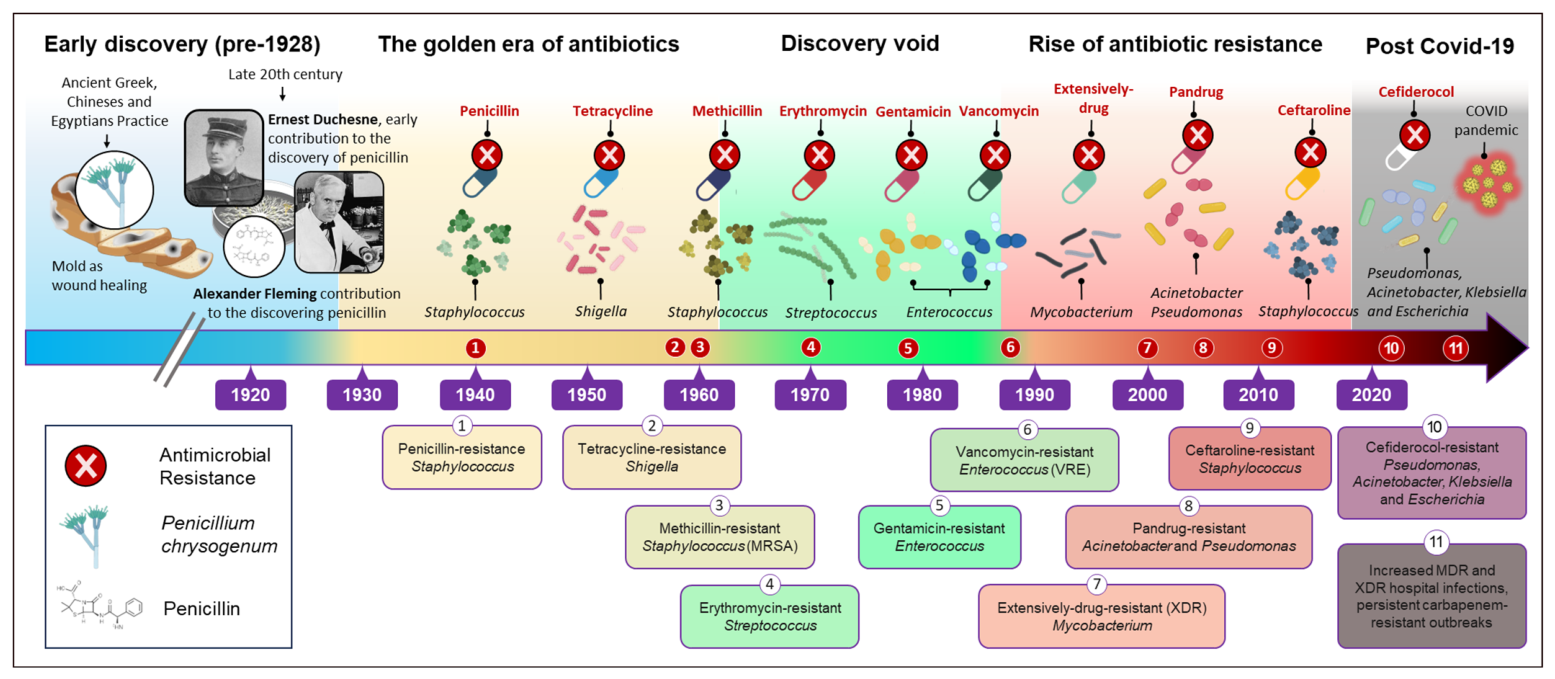
Figure 1. Presentation of a dual-axis timeline illustrating the parallel evolution of antibiotic discovery (top axis, from ancient practices to modern drugs) and the corresponding emergence of antimicrobial resistance (bottom axis, from early resistance to modern pandrug resistance). It visually maps the historical relationship between key therapeutic milestones, such as the discovery of penicillin, tetracycline, and vancomycin; and the subsequent development of resistant bacterial pathogens, including Methicillin-Resistant Staphylococcus aureus (MRSA), Vancomycin-Resistant Enterococcus (VRE), and Extensively Drug-Resistant/Pandrug-Resistant (XDR/PDR) strains of Pseudomonas, Acinetobacter, and Mycobacterium tuberculosis. The graphic highlights the ongoing challenge of antimicrobial resistance, extending into the post-COVID-19 era with newer agents and persistent multidrug-resistant outbreaks.
Antibiotics 15 00564 g001
Figure 2. The multifaceted mechanisms of antimicrobial resistance, organized into thematic panels. (A) Vertical evolution through mutation and selection, and Horizontal gene transfer via mobile genetic elements. (B) Enzymatic inactivation of drugs. (C) Target modification and protection. (D) Efflux pumps and permeability barriers. (E) The mobilome and outbreak surveillance. (F) Phenotypic resistance in biofilms. (G) Translational integration of environmental data into clinical innovation.
Antibiotics 15 00564 g002
Figure 3. Overview of next-generation antibacterial innovation strategies integrating surveillance-informed R&D, novel target discovery, and precision therapeutics. The schematic highlights: (A) global resistance surveillance guiding research priorities (Gram-negative penetration, new ribosomal binding sites, β-lactamase stability); (B) constrained ribosomal inhibitors (e.g., lariocidin) targeting the 50S subunit; (C) new β-lactam/β-lactamase inhibitor combinations; (D) non-β-lactam innovations such as DNA gyrase/topoisomerase IV inhibitors; (E) antivirulence approaches including quorum sensing inhibition, T3SS blockade, LPS modification targeting, biofilm dispersal, and toxin neutralization; (F) phage and enzyme-based precision therapeutics; (G) artificial intelligence–driven molecular discovery and (H) host-directed immunomodulatory strategies. Therapeutic modalities and key target pathogens are indicated.
Antibiotics 15 00564 g003
Figure 4. Strategic global roadmap (2025–2035) to combat antimicrobial resistance (AMR), outlining eight coordinated pillars: (1) accelerating and updating global governance frameworks; (2) strengthening real-time genomic surveillance, diagnostics, and integrated data systems—particularly in LMICs; (3) revitalizing and de-risking antibiotic R&D through innovative business models and incentives; (4) embedding stewardship and equitable access within Universal Health Coverage (UHC); (5) integrating AMR into pandemic preparedness and health system resilience (IPC, WASH, analytics); (6) prioritizing human-health–centric research and global innovation consortia; (7) advancing equity, capacity building, and environmental controls; and (8) establishing measurable 2030/2035 targets with transparent accountability mechanisms to reduce AMR-related mortality and incidence.
Antibiotics 15 00564 g004
Table 1. Global AMR situation in 2025: synthesized view from GLASS and regional systems [3,11,74]. Non-participants (GLASS 2023): Africa (20/47 countries), Eastern Mediterranean (5/21), South-East Asia (1/11), Europe (22/53), Western Pacific (17/37), Americas (28/35).
Region Approx. Proportion of Lab-Confirmed Infections Resistant (All-Pathogen Aggregate)Notable High-Concern CombinationsSurveillance Notes
South-East Asia~1 in 33GC-R E. coli/K. pneumoniae;
FQ-R Salmonella;
CR-A. baumannii
GLASS 2025
Eastern Mediterranean~1 in 33GC-R Enterobacterales;
CR-Acinetobacter/Pseudomonas (Non-fermenting GNB)
GLASS 2025
AfricaHeterogeneous; very high in several settings; >70% resistance to first-line agents for some BSIs reported3GC-R Enterobacterales;
CR-A. baumannii
GLASS 2025; Africa CDC briefs/studies.
Europe~1 in 10 (aggregate), but rising signals for key pathogens3GC-R E. coli/K. pneumoniae;
CR-Acinetobacter in select countries
EARS-Net/CAESAR 2023 data; GLASS regional summary
Western Pacific~1 in 11Enterobacterales (3GC-R);
variable MRSA
GLASS 2025 summaries/coverage
AmericasMixed; pockets of high resistance in hospital networksESBL-E;
CR-Enterobacterales;
rising Acinetobacter signals
GLASS 2025; NHSN AUR upgrade context (data quality)
Abbreviations: 3GC-R: 3rd-generation cephalosporin resistant; FQ-R = fluoroquinolone resistant; CR = carbapenem-resistant; MRSA: Methicillin Resistant Staphylococcus aureus; ESBL-E: Extended-spectrum beta-lactamase-producing Enterobacterales; GLASS: Global Antimicrobial Resistance Surveillance System; NHSN AUR: U.S. National Healthcare Safety Network, Antimicrobial Use and Resistance; EARS-Net: European Antimicrobial Resistance Surveillance Network.
Table 2. Infection type, bacterial pathogen and antibiotic combinations under surveillance between 2016 and 2023 and included in Global antibiotic resistance surveillance report 2025 [3].
Acinetobacter spp.E. coliK. pneumoniaeN. gonorrhoeaeSalmonella spp. 2Shigella spp.S. aureusS. pneumoniae
Aminoglycosides
AmikacinBSI
GentamicinBSI STI
Spectinomycin STI
Carbapenems
DoripenemBSIBSI
UTI
BSI
UTI
BSI
GTI
Ertapenem BSI
UTI
BSI
UTI
BSI
GTI
ImipenemBSI 1BSI 1
UTI 1
BSI 1
UTI 1
BSI
GTI
MeropenemBSIBSI
UTI
BSI
UTI
BSI
GTI
2nd-generation Cephalosporins
Cefoxitin 3 BSI
3rd-generation Cephalosporins
Ceftriaxone BSI
UTI
BSI
UTI
BSI
GTI
GTI BSI
Ceftazidime BSI
UTI
BSI
UTI
BSI
GTI
GTI
Cefotaxime BSI 1
UTI 1
BSI 1
UTI 1
BSI
GTI
GTI BSI
Cefixime STI
4th-generation Cephalosporins
Cefepime BSI
UTI
BSI
UTI
Fluoroquinolones
Ciprofloxacin BSI
UTI
BSI
UTI
STIBSI 1
GTI 1
GTI 1
Levofloxacin BSI
UTI
BSI
UTI
BSI
GTI
GTI
Macrolides
Azithromycin STI GTI
Penicillins
Oxacillin 3,4 BSIBSI
Penicillin G BSI 1
Polymyxins
ColistinBSIBSI
UTI
BSI
UTI
Sulfonamides and trimethoprim
Co-trimoxazole BSI
UTI
BSI
UTI
BSI
Tetracyclines
MinocyclineBSI
TigecyclineBSI
1: Marks selected pathogen–antibiotic combinations for which national percentage resistance estimates and 2018–2023 resistance trends are reported. These are also presented for MRSA and 3GC-R E. coli. 2: S. Typhi and S. Paratyphi are not included in this report. 3: Both cefoxitin and oxacillin are penicillinase-stable beta-lactams. The Clinical and Laboratory Standards Institute (CLSI) and the European Committee on Antimicrobial Susceptibility Testing (EUCAST) recommend use of cefoxitin instead of oxacillin for disc diffusion testing to determine methicillin resistance in S. aureus. Cefoxitin is used as a surrogate for assessing susceptibility to oxacillin (as well as methicillin and nafcillin). As countries reported results for either or both agents, in this report, MRSA is calculated from AST results for oxacillin and/or cefoxitin. 4: Oxacillin AST can be used as a surrogate for benzylpenicillin susceptibility in S. pneumoniae. A susceptible oxacillin result indicates penicillin susceptibility, but an oxacillin-resistant result may not reflect true resistance to benzylpenicillin or other beta-lactams and may lead to overestimation of penicillin resistance. In such cases, targeted AST for benzylpenicillin is required to confirm resistance. Abbreviations: BSI: Bloodstream infection; STI: Sexual Transmitted Infection (i.e., urogenital gonorrhoea); UTI: Urinary tract infection; GTI: Gastrointestinal tract infection.
Disclaimer/Publisher’s Note: The statements, opinions and data contained in all publications are solely those of the individual author(s) and contributor(s) and not of MDPI and/or the editor(s). MDPI and/or the editor(s) disclaim responsibility for any injury to people or property resulting from any ideas, methods, instructions or products referred to in the content.