Review

Role of Mobilome in Carbapenem Resistance
1
Department of Microbiology, The University of Haripur, Haripur 22620, Pakistan
2
National Center for Respiratory Medicine, State Key Laboratory of Respiratory Health and Multimorbidity, New Cornerstone Science Laboratory, National Clinical Research Center for Respiratory Diseases, Institute of Respiratory Medicine, Chinese Academy of Medical Sciences, Department of Pulmonary and Critical Care Medicine, Center of Respiratory Medicine, China-Japan Friendship Hospital, Beijing 100029, China
3
Department of Pulmonary and Critical Care Medicine, Capital Medical University, Beijing 100069, China
*
Authors to whom correspondence should be addressed.
These authors contributed equally to this work.
Antibiotics 2026, 15(6), 542; https://doi.org/10.3390/antibiotics15060542
Submission received: 4 February 2026 / Revised: 20 May 2026 / Accepted: 22 May 2026 / Published: 28 May 2026

Abstract

Growing resistance to carbapenem antibiotics is a major public health problem as these antibiotics are considered the last line of therapy for infections caused by multidrug-resistant (MDR) Gram-negative bacteria. The rapid emergence and dissemination of carbapenem-resistant bacterial strains are mainly due to horizontal gene transfer (HGT) within or between bacterial cells via the mobilome. The aim of this article is to discuss the role of mobile genetic elements (MGEs) that capture and disseminate resistance determinants of carbapenem antibiotics, as a comprehensive review integrating the combined role of plasmids, transposons and integrons. It attempts to systematically fill the gap by investigating the role of these MGEs in the acquisition, mobilization and dissemination of genes encoding carbapenemases across clinically important bacteria. Various types of plasmids such as IncF and IncH in Klebsiella pneumoniae, IncL/M in Enterobacter cloacae, IncX3 in Escherichia coli and IncA/C2 in Salmonella enterica carry important genes encoding carbapenemases. The rapid distribution of transposons among bacterial species is one of the main contributing factors in the dissemination of carbapenem-resistant isolates. Transposons including Tn4401 carrying blaKPC in K. pneumoniae and Tn1721 carrying blaKPC in E. coli; Tn2006, Tn2007, Tn2008 and Tn2009 carrying blaOXA-23 in Acinetobacter baumannii; Tn1696 carrying blaIMP-4 in Pseudomonas aeruginosa; Tn125 carrying blaNDM in E. coli; and Tn6306 carrying blaIMI in Raoultella ornithinolytica encode different types of carbapenemases. Integrons mainly belonging to class 1 capture resistance determinants for metallo-carbapenemases such as NDM-, VIM-, SIM- and IMP-type enzymes in P. aeruginosa, A. baumannii, K. pneumoniae and E. coli and can promote the transcription and expression of these determinants. These findings are useful for understanding the genetics of carbapenem resistance and additional knowledge on MGEs may provide avenues for screening of resistance to these antibiotics in clinical settings.

1. Introduction

Multidrug-resistant (MDR) bacterial strains are a major health-associated problem all over the world. The evolutionary change encountered by both Gram-positive and Gram-negative bacteria has an important role in combating antimicrobial treatment for serious infections [1]. This is mainly achieved through the acquisition of pre-existing determinants of resistance from the gene pool of bacteria followed by amplification to selection response, meaning that bacterial populations increase rapidly under antibiotic pressure due to the presence of resistance genes. The capture, dissemination and accumulation of resistance genes is mainly due to mobile genetic elements (MGEs) such as transposons (Tn), integrons (Int), insertion sequences (ISs) and plasmids, commonly referred to as the mobilome [2]. These elements are responsible for horizontal gene transfer (HGT), which is defined as the exchange or transfer of genetic material from one bacterial cell to another as between donor cell and recipient respectively, which is further transferred to their offspring through cell division [3]. For example, in clinical settings transposable elements are the main source of the evolution of pathogenic antibiotic-resistant bacteria such as Acinetobacter baumannii (A. baumannii), which acquire resistance determinants by MGEs, making treatment complicated and challenging [4].
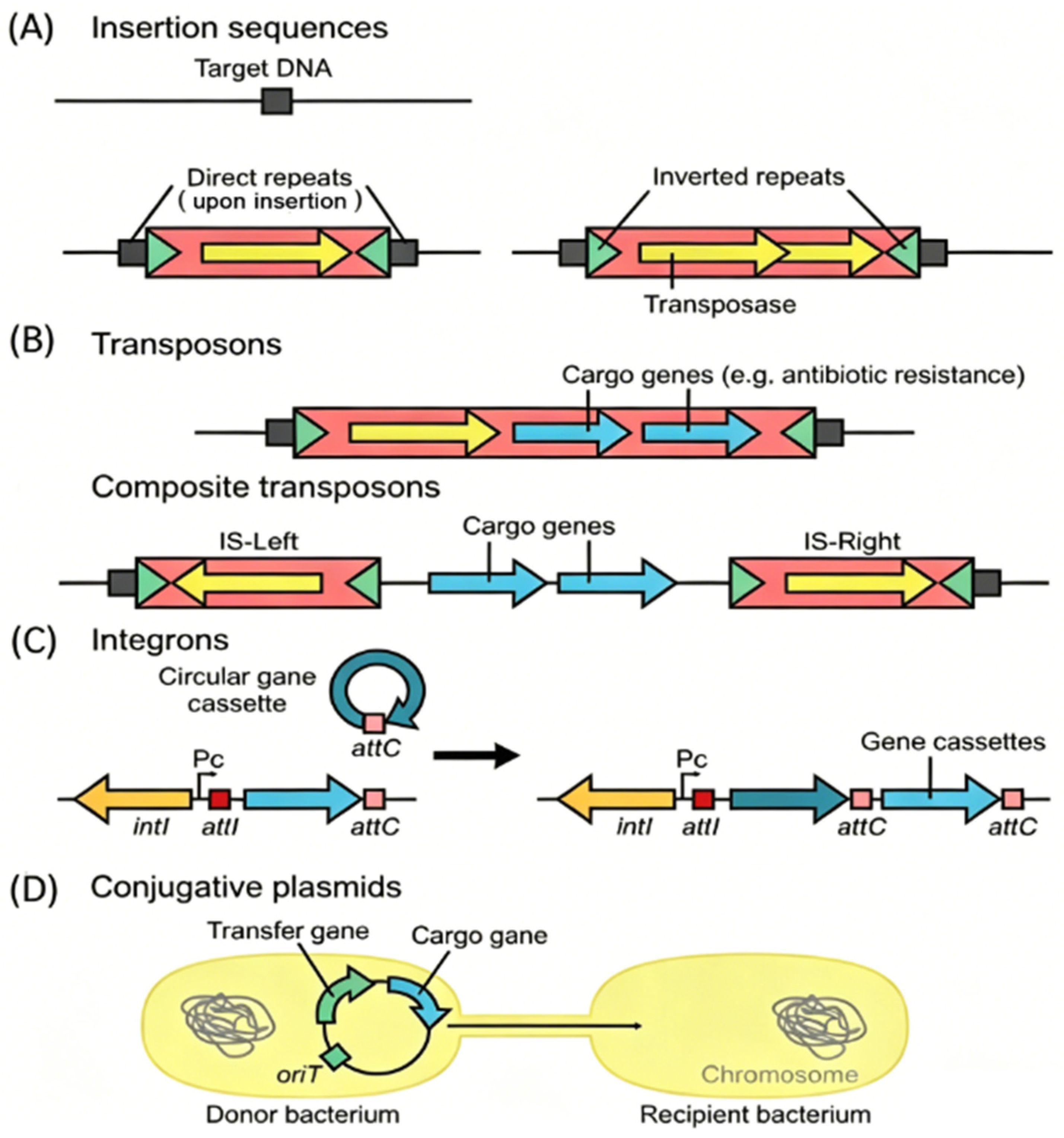
Plasmids act as vectors for intercellular mobilization of resistance genes [2]. Transposons and insertion sequences are discrete segments of DNA that move resistance genes associated with them randomly and non-randomly to a new location in distinct or the same DNA molecules [5]. Integrons use the mechanism of site-specific recombination for moving genes of resistance between defined sites [3]. Interaction between different types of MGEs may result in rapid evolution of MDR strains which are even resistant to antibiotics considered as a last resort of treatment such as carbapenem and colistin in the era of antimicrobial chemotherapy [5,6]. Structures of different types of mobile genetic elements are shown on Figure 1.
This narrative review article focuses on presenting updated information on the important role of MGEs in the evolution and spread of carbapenem resistance genes. Since antibiotic resistance in general and MGEs in particular are very broad areas, the authors have specifically focused on the role of MGEs in carbapenem resistance. Literature searches were carried out by searching various key words such as mobile genetic elements + carbapenem resistance, integrons + carbapenem resistance, transposons + carbapenem resistance, insertion sequence + carbapenem resistance, etc. Search engines and databases such as Google, NCBI PubMed (https://pubmed.ncbi.nlm.nih.gov/), and Sciencedirect.com were searched to gather updated information. In addition to that the authors have also paid attention to the role of high-risk clones of certain bacterial species in the dissemination of MGEs and carbapenem resistance.

2. Carbapenems and Their Key Mechanism of Resistance

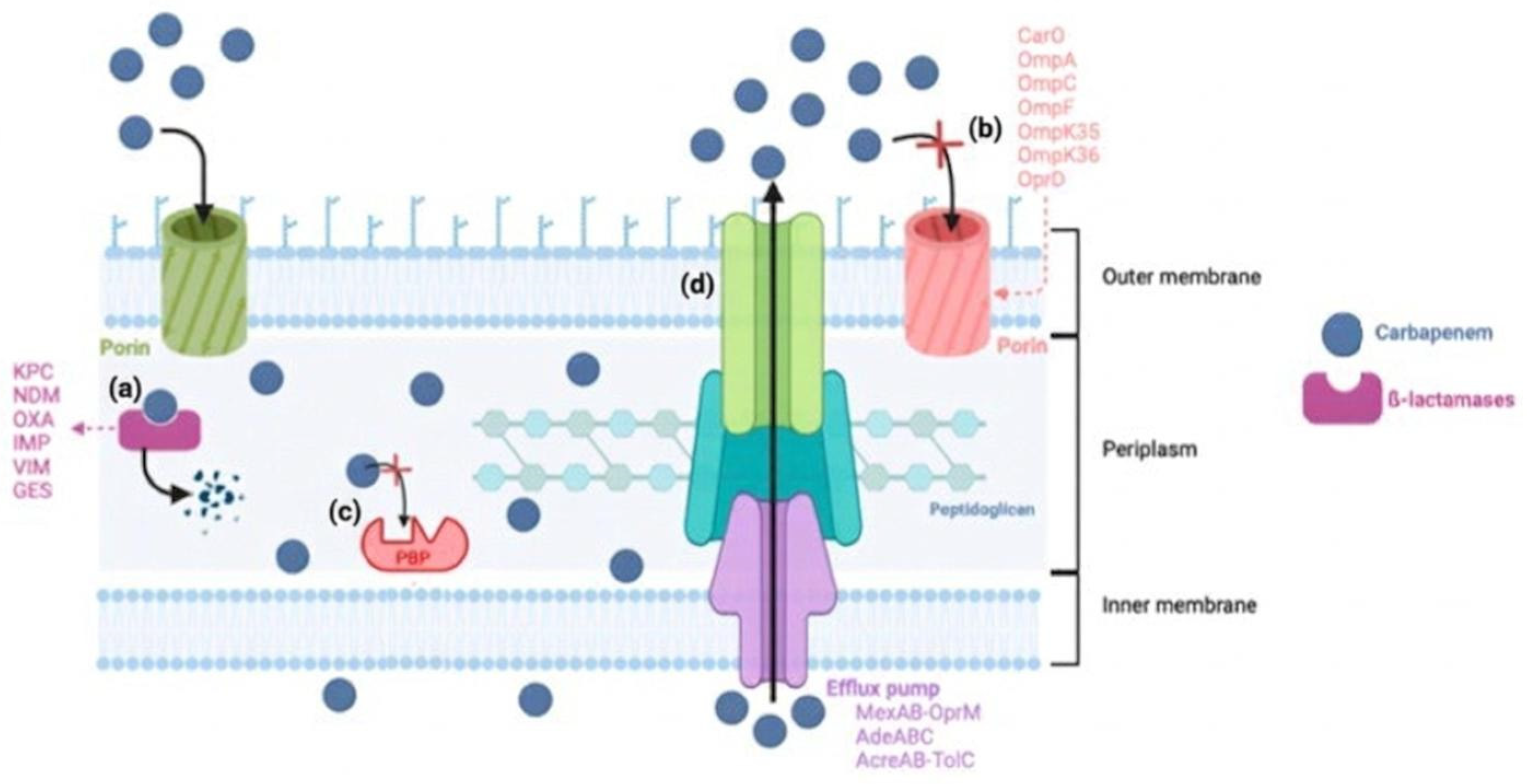
Carbapenems are β-lactam antibiotics with proven effectiveness in severe bacterial infections caused by extended spectrum β-lactamase (ESBL) producing, mostly against Gram-negative bacteria [8]. Carbapenem antibiotics have a broad spectrum of bactericidal activity. Examples of carbapenem antibiotics include meropenem, imipenem, ertapenem, doripenem, biapenem and panipenem which are used globally because of increasing resistance to cephalosporin antibiotics in the Enterobacterales bacteria [9]. Extended use of carbapenems have resulted in mediating carbapenem resistance among bacterial species. Resistance to carbapenems is acquired by mutational changes or acquisition of resistance genes through HGT [10]. Figure 2 shows the different mechanisms of carbapenem resistance.
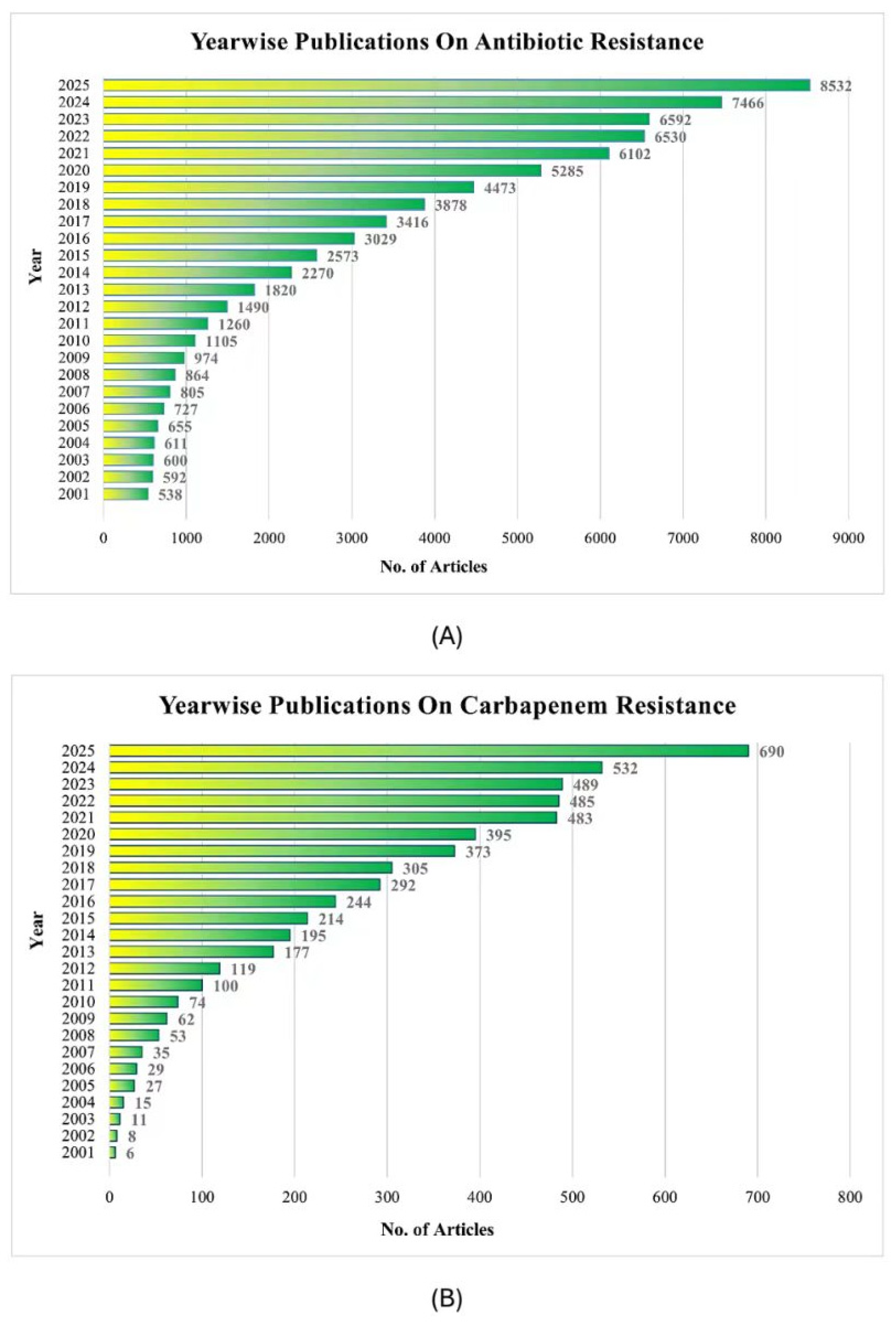
Enzyme-mediated carbapenem resistance is the key resistance mechanism which occurs through production of carbapenemase enzymes hydrolyzing carbapenems as well as other b-lactam antibiotics. Carbapenemases are encoded by genes which transfer horizontally by MGEs such as transposons or plasmids. These MGEs may also carry other determinants of resistance [12]. A study conducted in Europe has shown the rapid spread of K. pneumoniae (K. pneumoniae) strain ST323 carrying a plasmid encoding gene for carbapenemase, i.e., blaKPC-2, into six different hospitals in Greece, potentially increasing the number of resistant strains [13]. Similarly, the emergence of hypervirulent carbapenemase-producing K. pneumoniae strains harbouring genes encoding either New Delhi MBL (NDM), Klebsiella pneumoniae carbapenemase (KPC), or Oxacillinase-48 (OXA-48) have been reported from Switzerland, representing a threat to public health all over the world [14]. There have been increasing reports of carbapenem resistance from all over the world in the last two decades, more notably from Asian countries (Figure 3).

Carbapenemases and Their Classification

Carbapenemases are hydrolytic enzymes that break down the carbapenem drug, leading to antibiotic resistance in bacterial species. The carbapenemase genes mainly spread through mobilomes including plasmids, integrons and transposons [15].
B-lactamases are mainly classified into two major systems. The first one is the Ambler classification system which categorizes B-lactamases into classes A-D on the basis of their structure, including homology in amino acid sequences, which share characteristic protein folds within each class of enzymes and conserved catalytic domains; however, the substrate preference is all over the board, whereas the second one is the Bush-Jacoby-Medeiros classification system which categorizes B-lactamases on the basis of their functional properties, including the hydrolysis pattern of substrates and susceptibility pattern of inhibitors. For example, extended-spectrum beta-lactamases (ESBLs) including TEM, SHV, and CTX-M mainly hydrolyze extended-spectrum cephalosporins and are commonly inhibited by clavulanic acid. Carbapenemases such as NDM-, KPC-, IMP-, VIM-, and OXA-type enzymes hydrolyze carbapenems, whereas AmpC B-lactamases typically hydrolyze cephalosporins and are generally resistant to inhibitors of ẞ-lactamase such as clavulanic acid [16,17].
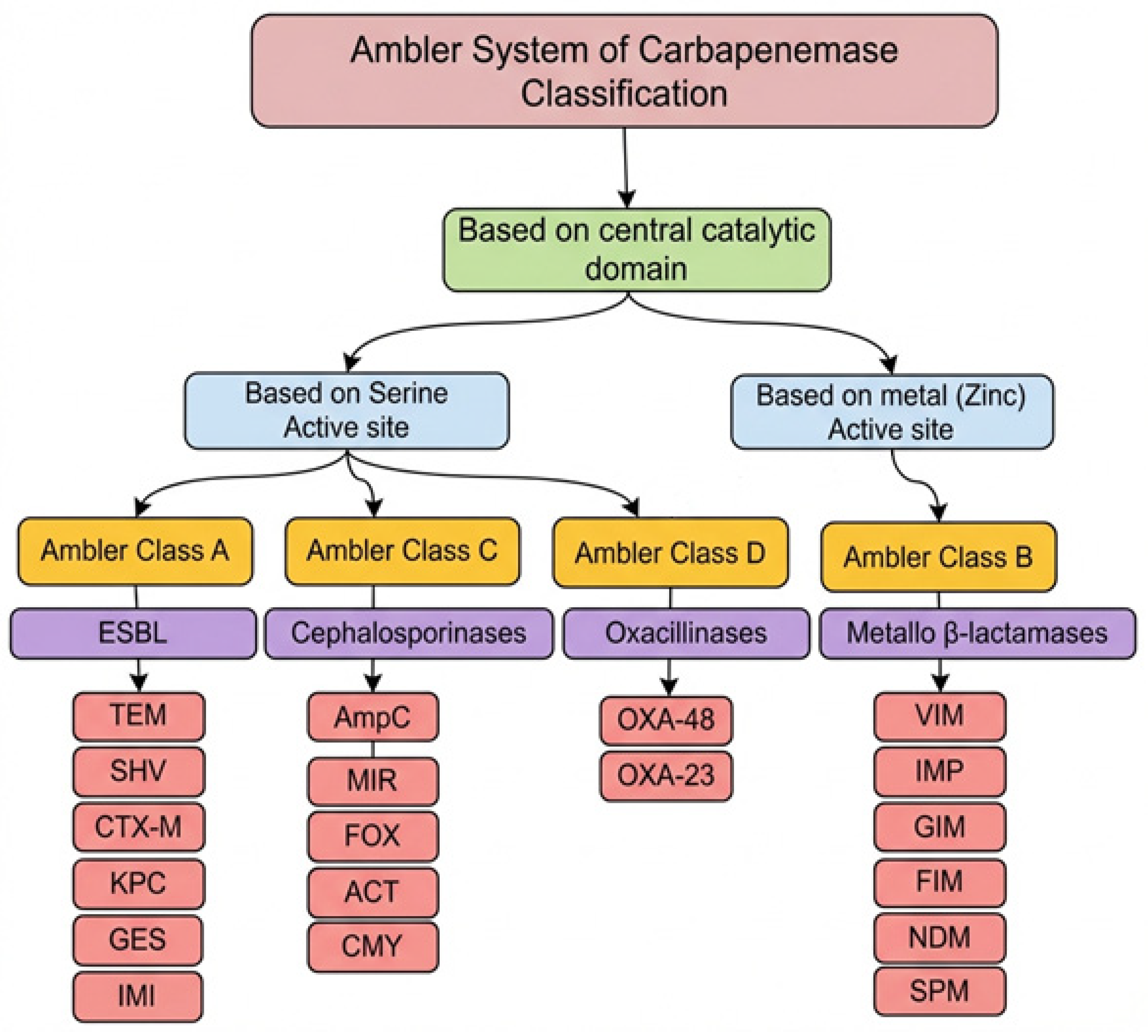
According to the Ambler classification system, carbapenemases are included in classes A, B, and D, while enzymes belonging to class C mainly hydrolyze cephalosporins (Figure 4). The active catalytic sites of enzymes belonging to the A, C, and D classes have serine, whereas class B enzymes have zinc in their active catalytic site [16]. ẞ-lactamases included in class A consist of very diverse and continuously increasing variants of enzyme identified across various species of bacteria and mobile genetic elements. However, most common enzymes that are epidemiologically and clinically important representative enzymes include KPC [18], SME (Serratia marcescens enzyme) [19], GES (Guiana extended-spectrum β-lactamase) [20], SHV (sulfhydryl variable lactamase) [21], SFC (Serratia fonticola carbapenemase) [22], and IMI/NMC-A (imipenemase/non-metallo-carbapenemase-A) [23]. The most representative enzyme of class A carbapenemase is the KPC-type enzyme, which is transmitted through plasmids, for example, the IncP-type plasmid [24]. The blaKPC gene, responsible for KPC enzyme production, is mostly found on transposon Tn4401 which facilitates the dissemination of the resistance gene mainly in Enterobacteriacae [25]. The overall structure of the KPC-type beta-lactamases is like other members of class A beta-lactamases. It consists of two sub-domains: one is mainly α helical, while the other has five beta sheets, flanked by α helices. The cleft found between two domains harbours an active site at S70 and E166, essential for catalysis. The active site is surrounded by three loops: the Ω loop containing R164 and D179 residues, the loop between α3 and α4 helices where W105 is located and a third loop that lies opposite to the Ω loop. Mutagenesis analysis has revealed that W105 plays a crucial role in ligand recognition by KPC-2 [26].
Class B β-lactamases are metallo-β-lactamases. Like class A, β-lactamases included in class B consist of very diverse and continuously increasing variants of enzymes identified across various species of bacteria and mobile genetic elements. However, most common enzymes that are epidemiologically and clinically important representative enzymes include Verona integrated-encoded MBL (VIM) [27], imipenemase (IMP) [28], Germany imipenemase (GIM) [29], Florence imipenemase (FIM) [30], NDM [31], and Sao Paulo MBL (SPM) [32]. The genes encoding these enzymes can reside on plasmids, transposons, integrons, the chromosome or other genetic elements. NDM encoded by the blaNDM gene is mainly associated with MGEs such as plasmids and transposon Tn125 that spread the resistance gene among various bacterial species [14]. Among MBLs, NDM is clinically one of the most significant families. The structure of NDM-type metallo-β-lactamases is composed of two domains; domain A consists mainly of β-sheets, while domain B possesses a mixture of α-helices and β-sheets. NDM is a divalent metal ion-dependent metallo-B-lactamase that mainly utilizes zinc ions for catalytic activity. The hydrolysis of the β-lactam ring involves activation of the water molecule facilitated by these metal ions which do not form any covalent intermediate. NDM-type enzymes exhibit a broad range of resistance to beta-lactam antibiotics, including carbapenems. These beta-lactamase enzymes are not inhibited by classical inhibitors but metal chelating agents such as EDTA can inhibit them [17,33].
Class C β-lactamases (AmpC-type enzymes) are generally not included in carbapenemases as they typically do not exhibit resistance to carbapenems [34]. However, a rare variant, CMY-10, has been reported to confer limited resistance which hydrolyzes carbapenem when combined with other mechanisms of resistance such as porin loss, so it has a supplementary role in conferring resistance [35].
β-lactamases belonging to class D are known as OXA enzymes. The OXA genes are frequently located on integrons and/or plasmids allowing wide dissemination of these genes [36]. For example, blaOXA-23 is associated with a higher rate of resistance to carbapenems in A. baumannii that is commonly found on MGEs [37]. OXA-type beta-lactamases have a typical two-domain structure. Their structure is composed of two domains; domain A consists of αhelices, while domain B possesses a mixture of αhelices and βsheets. The active site is situated in the cleft between the two domains. OXA-type ẞ-lactamases have conserved active-site residues consisting of Ser70 and the carboxylated Lys73 particularly. These residues form the core of the catalytic centre responsible for the hydrolysis of β-lactam, including carbapenems in certain variants of OXA. The acylation and deacylation steps of drug degradation take place in the active site of the enzyme [38,39,40]. The flow chart given in Figure 4 shows the classification of beta-lactamases.

3. Role of Plasmids in Carbapenem Resistance

Plasmids are transferred between bacteria horizontally by conjugation and transformation. Conjugative plasmids are the most important carriers of AMR in bacterial families like Enterobacteriaceae including some of the most important bacterial pathogens causing nosocomial infection [41,42]. Similarly, plasmids play a significant role in the dissemination of multiple genes of carbapenem resistance among bacterial cells [43,44]. An important example is plasmid pOXA-48 (carrying the carbapenemase gene blaOXA-48) in K. pneumoniae [45]. Carbapenem resistance in bacteria is mainly due to genes encoding hydrolyzing enzymes of carbapenem belonging to either class A carbapenemases, class B (metallo-ß-lactamases) or Ambler class D (oxacillinases) that are acquired horizontally [46] (Table 1).
The most serious resistance to carbapenems is caused by acquiring MBLs, as compared to other mechanisms of resistance, because these enzymes can hydrolyze almost all β-lactam drugs except monobactam [47]. MBLs belong to class B carbapenemases, and the genes encoding MBLs are located on mobile genetic elements such as integrons and plasmids and can easily spread among bacteria through HGT, causing serious problems in treating MDR bacteria [48].
Different types of carbapenemases such as NDM-1 in K. pneumoniae, (E. coli), C. freundii, Enterobacter cloacae (E. cloacae), A. baumannii, and Pseudomonas aeruginosa (P. aeruginosa); OXA-48 in K. pneumoniae, Escherichia coli (E. coli), Enterobacter cloacae (E. cloacae), Citrobacter freundii (C. freundii), Serratia marcescens (S. marcescens), and Proteus mirabilis (P. mirabilis); OXA-23 in A. baumannii, Acinetobacter nosocomialis (A. nosocomialis), and Acinetobacter pittii (A. pittii); KPC in K. pneumoniae, E. coli, E. cloacae, S. marcescens, and P. aeruginosa; IMP in P. aeruginosa, A. baumannii, E. coli, K. pneumoniae, and Providencia spp.; Australian imipenemase (AIM) in P. aeruginosa and Pseudomonas fluorescens (P. fluorescens); SPM in P. aeruginosa; Seoul imipenemase (SIM) in A. baumannii and P. aeruginosa; VIM in P. aeruginosa, K. pneumoniae, E. coli, and Enterobacter cloacae; GIM in P. aeruginosa; and Japan, Kyorin University Hospital imipenemase (KHM) in C. freundii and Enterobacter spp. have been identified all over the world [23,49]. In the following paragraphs examples of plasmids encoding some important types of carbapenemases are discussed.

3.1. Plasmids Encoding OXA-Type Carbapenemases

Carbapenem-hydrolyzing class D β-lactamases (CHDLs) comprise oxacillinases which is a highly diverse group, with more than 1400 OXA variants identified to date. Only a few variants of carbapenem-associated OXA families which are epidemiologically and clinically significant are highlighted. The predominant CHDLs include OXA-23-like, OXA-24/40-like, OXA-51-like, and OXA-58-like enzymes, which are associated with carbapenem resistance and have been identified in Acinetobacter species such as the blaOXA-23-like gene in A. baumannii, Acinetobacter radioresistens (A. radioresistens), A. pittii, and A. johnsonii; the blaOXA-24-like gene in A. baumannii, A. pittii, and A. calcoaceticus; the blaOXA-51-like gene in A. baumannii; and the blaOXA-58-like gene in A. baumannii, A. pittii, and A. nosocomialis. including A. baumannii, A. pittii, A. johnsonii, A. radioresistens, A. johnsonii, A. nosocomialis and A. calcoaceticus. The carbapenem-hydrolyzing activity of CHDLs is weak; however, a high level of resistance to carbapenem is acquired by the overexpression of these genes which is mostly driven by promotors found in their upstream ISs [50]. The blaOXA-51-like gene containing an ISAba1 element (ISAba1-blaOXA-51-like gene) found upstream of this gene was initially located on a chromosome of isolates of A. baumannii [51,52]. A plasmid-borne ISAba1-blaOXA-51-like gene has been identified in several carbapenem-resistant isolates of A. baumannii. The high level of resistance to carbapenem is occasionally caused by the overexpression of genes encoding CHDLs, mainly when the determinants of resistance are found on a plasmid, and this is possibly due to the plasmids with a higher copy number providing increased gene copies [53]. In addition to the spread of the blaOXA-51-like gene with upstream ISAba1 sequence by plasmids, the other extrinsic CHDL genes, such as the blaOXA-58-like, the blaOXA-24-like, and the blaOXA-23-like genes, were also apparently disseminated through plasmids in A. baumanni [54]. The dissemination of genes encoding CHDLs further complicate the control and treatment of infections caused by A. baumannii [53].
In Enterobacterales, OXA-48-like carbapenemases are another clinically significant subgroup of CHDLs. Among these, emerging variants such as OXA-484 have recently attracted attention due to their plasmid-mediated dissemination (pOXA-484), and association with multidrug resistance determinants, including qnrS1-mediated fluoroquinolone resistance in E. coli. However, OXA-484 represents an emerging OXA-48-like variant rather than as a uniquely important OXA enzyme [55]. Similarly, two plasmids harbouring the blaOXA-48 gene were identified in a research study conducted in Malawi. These plasmids, pEc_MW04_OXA in E. coli and pKv_MW05_OXA in Klebsiella variicola (K. variicola), share more than 99% similarity with the nucleotide sequence of the pandemic plasmid pOXA-48a, exhibiting worldwide spread across different bacterial species [56].
These findings highlight the significance of plasmids in the dissemination of OXA-type carbapenemases posing challenges for antibiotic therapy and infection control.
Table 1. A list of the important plasmids that are known to carry resistant genes for carbapenemases along with their associated class, incompatibility group, mechanism, and examples of host organisms.
Plasmid(s)ClassInc GroupResistance GeneMechanismOrganism
Examples
Reference
pKPC2Class A (Serine carbapenemase)IncFII, IncFIB,blaKPC-2Hydrolyzes carbapenems&other β-lactamsK. pneumoniae[57]
pNDM-BJ01Class B (MBL)Various (IncA/C, IncF, IncL/M, IncX3)blaNDM-1Zinc-dependent hydrolysis of carbapenemsE. coli,
P. aeruginosa, A. baumannii
[58]
pKpQILClass B (MBLIncFIIKblaNDM-1Carbapenem hydrolysisK. pneumoniae[59]
p23045-NDM5Class B (MBL)IncHI2blaNDM-5Enhanced hydrolysis and resistanceSalmonella enterica
(S. enterica)
[60]
pSXRJ10–250 KClass B (MBL)IncHI2blaNDM-5Enhanced hydrolysis and resistanceEscherichia fergusonii
(E. fergusonii)
[61]
pPA166-2-MDRClass B (MBL)IncP-2blaIMP-45Carbapenem hydrolysisP. aeruginosa[62]
pIMP-4-BKP19Class B (MBL)IncNblaIMP-4Carbapenem hydrolysisK. pneumoniae[63]
pA52-OXA-72Class D (Oxacillinase)Un-classifiedblaOXA-72Carbapenem hydrolysisA. baumannii[64]

3.2. Plasmids Encoding NDM-Type Carbapenemases

This MBL type was first identified in two E. coli and K. pneumoniae strains from a Swedish patient admitted to a hospital in New Delhi, India. Recently, NDM-1-producing bacteria such as K. pneumoniae, E. coli, Enterobacter cloacae, P. aeruginosa, A. baumannii, C. freundii, S. marcescens, S. enterica, Morganella morganii (M. morganii) and Providencia rettgeri (P. rettgeri) have emerged and disseminated in various countries [65]. These bacteria which produce NDM are usually resistant to almost all antibiotic groups such as aminoglycosides, fluoroquinolones, and beta-lactams (mainly carbapenems), but show susceptibility to colistin and occasionally tigecycline [66]. The gene encoding NDM has been found on large plasmids such as pNDM-BJO1 in Acinetobacter lwoffii (A. lwoffii) and pNDM-SAL in S. enterica which can easily transfer and disseminate among bacteria causing a serious threat to public health [67]. Apart from this, blaNDM genes are located on a variety of plasmid types, including IncF in E. coli and K. pneumoniae, IncH in K. pneumoniae and S. enterica, IncL/M in E. cloacae and K. pneumoniae, and IncX3 in E. coli and K. pneumoniae, as well as in a broad-host-range plasmid such as IncA/C2 in S. enterica and E. coli [68]. Plasmids such as IncHI2 and IncB/O/K/Z carrying blaNDM-9 have been identified in Carbapenem-resistant Escherichia coli (CREC) in 2025 in China [69].

3.2.1. IncA/C2 Plasmids

IncA/C2 plasmids have a broad host range and usually carry NDM-1 in K. pneumoniae, E. coli, S. enterica, E. cloacae, V. cholerae, etc. [70]. The plasmid-encoding blaNDM-1 gene is found in the region of ARI-A, an island of resistance designated for IncA/C2 [71]. The resistance island has two parts, a Tn1548-like transposon and an ISAba125-mediated composite transposon (Tn125) in pM214_A/C2 in A. baumannii, E. coli, and K. pneumoniae as designated in a previous study [72]. For example, IncA/C2 is associated with blaNDM-1 as identified in K. pneumoniae, resistant to carbapenems, also carries other resistance genes, and reported to be transferable to other bacterial species such as E. coli, S. enterica, E. cloacae, and V. cholerae [73].

3.2.2. IncX3 Plasmids

IncX3 plasmids encode different variants of NDM by beta-lactamase genes such as blaNDM-4 in E. coliblaNDM-5 in E. coli and K. pneumoniae, and blaNDM-7 in E. coli [74,75,76]. Generally, the IncX3 plasmids do not contain antimicrobial resistance genes other than blaNDM, which plays an important role in the spread and evolution of the blaNDM gene [75]. As IncX3 plasmids encode distinct variants of NDM, this suggests that these variants are most likely to have evolved through substitutions of nucleotides within the IncX3 plasmid [74]. This process for selection of different variants might be due to stronger β-lactamase activity of NDM-4, -5, and -7 exhibiting higher resistance than NDM-1 [77]. A study found that IncX3 is the most common single replicon plasmid carrying blaNDM-5 in the US and East Asia, mainly associated with the ST48, ST167 and ST410 sequence types of E. coli [78].

3.2.3. IncH Plasmids

The IncHI1B plasmid was identified in K. pneumoniae carrying blaNDM-1 as revealed by comprehensive analysis of its genome. The plasmid was also carrying other heavy metal and antibiotic resistance genes, highlighting its adaptability and complexity [79].

3.2.4. IncFII Plasmids

The most predominant plasmid type containing blaNDM was IncFII in E. coli, K. pneumoniae, C. freundii, and Enterobacter cloacae. In addition to genes for other β-lactamases, these plasmids also carry resistance genes for various antibiotics including sulfonamides, macrolides, trimethoprim, and aminoglycosides which contrast with IncX3 plasmids [80]. Also, the genetic structure of the IncFII plasmids is comparatively diverse, containing various insertion/deletion sequences and clear genetic mobilization traces through IS26 [72]. IncF is a multi-replicon plasmid frequently carrying blaNDM-5 in E. coli that may be a conjugative or non-conjugative plasmid. The conjugative type was mainly found in E. coli ST167, contributing to worldwide dissemination including India, East Asia, the US and many European countries [78]. A novel multi-replicon IncFIB-HI1B plasmid harbouring blaNDM-5 has been characterized in Enterobacteriales in a study conducted in Argentina. The blaNDM-5 gene was found along with other antimicrobial resistance markers such as blaCTX-M-15 in an antimicrobial resistance island [81].

3.3. Plasmids Encoding KPC-Type Carbapenemases

KPC is a β-lactamase which can hydrolyze all b-lactam antibiotics such as penicillins, cephalosporins, monobactams, and carbapenems resulting in worse therapeutic outcomes by leaving fewer therapeutic options for infected patients [82]. The reports of blaKPC gene detection, mostly K. pneumoniae multilocus sequence type 258 (ST258) carried by IncF type plasmid has been detected worldwide which shows that clonal spread of this resistant lineage is the main factor in the dissemination of blaKPC [83,84,85]. A novel ST1076 sequence type of P. aeruginosa producing KPC-3 reported in China facilitates clonal dissemination of KPC-mediated carbapenem resistance. The blaKPC-3 gene is carried by a unique mega plasmid, and IncP-2. blaKPC has also been detected in other lineages of K. pneumoniae, as well as other Enterobacteriaceae species, indicating that HGT of blaKPC plays an important role in the dissemination of AMR [86]. blaKPC is most often detected on conjugative plasmids in multiple species or strains such as K. pneumoniae, E. coli, S. marcescens, P. aeruginosa and E. cloacae providing a likely mechanism for HGT [87].
A study conducted in Israel detected the presence of a 105 kb plasmid encoding KPC-3- and TEM-1 in an extremely drug-resistant (XDR) K. pneumoniae strain. This strain emerged in 2006 causing an outbreak all over the region. This plasmid was termed as pKpQIL which was identified in all isolates during 2006–2008 belonging to an extensive β-lactam resistance clone which was highly epidemic. The carbapenem resistance in these K. pneumoniae isolates was mainly due to this single self-transmissible plasmid [88,89].

3.4. Plasmids Encoding VIM-Type Carbapenemases

The VIM enzyme is one of the most identified MBLs, which are predominant in Europe and Asia. Although many variants of VIM have been identified all over the world, among which VIM-1-like and VIM-2-like are the predominant plasmid-associated enzymes and are clinically and epidemiologically significant subgroups. VIM-1 has been identified in P. aeruginosa, K. pneumoniae, E. coli, E. cloacae, and Pseudomonas putida (P. putida), whereas VIM-2 has been reported in P. aeruginosa, A. baumannii, K. pneumoniae, and Enterobacter spp. [90,91]. Genes encoding VIM-1 carbapenemase have been detected on plasmids. Two plasmids (pAMBL1 and pAMBL2) carrying blaVIM-1 have been recovered from clinical isolates of P. aeruginosa. pAMBL1 is a 26,440 bp plasmid which carries a replication protein belonging to the RepA_C family. The plasmid pAMBL1 is like the pAX22 plasmid from Achromobacter xylosoxidans (A. xylosoxidans) and the pKLC102 and pNOR-2000 plasmids from P. aeruginosa, which also carry genes for VIM-type carbapenemases. The plasmid pAMBL2 is 24,133 bp with a replication protein belonging to the Rep_3 family. This plasmid shows a higher degree of similarity to a fragment of the plasmid pPC9 bearing blaVIM-1 from P. putida. The plasmid pAMBL2 confers a high level of carbapenem resistance as compared to pAMBL1 by carrying the blaVIM-1 cassette with three copies in class 1 integron In70 [92].
Similarly, plasmids such as pP6VIM-11 and pPOta2VIM-11 carrying blaVIM-11 genes have been identified in clinical isolates of P. aeruginosa. These plasmids belong to the IncP-1β group. The gene was found to be located on the class-1 integron which was flanked by different insertion sequences exhibiting its key role in integrating resistance genes into plasmids [93].

3.5. Plasmids Encoding IMP-Type Carbapenemases

Imipenemase enzymes, discovered first in Japan in P. aeruginosa, are the key drivers of carbapenem resistance in bacteria. Imipenemases are endemic in Asia and Australia, the genes of which are found on diverse types of plasmids facilitating the spread of imipenemases. Molecular epidemiological analysis of bacterial genomes suggests that the IncHI2A, IncC and IncN plasmids collectively account for 56.0% of all plasmid types carrying blaIMP genes, each carrying four, two and five IMP variants [94,95]. These blaIMP carrying Inc types were found to be endemic in Asia and Australia, while sporadic in Europe [94,96]. A study conducted in UK hospitals on the characterization of imipenemase-enzyme-producing bacteria at local hospitals revealed that 10 out of 18 imipenemases produced by Enterobacterales strains (mostly belonging to K. pneumoniae and E. clocae) were IMP-1, carried on IncN plasmid and in In1763 class 1 integron [96]. IncN group plasmids are a class of plasmids, that may be transferred to other bacterial communities including members of Enterobacteriales through transconjugation [97]. A recent study carried out in China on WGS analysis of 61 imipenemase (IMP)-producing strains of K. pneumoniae reported that the blaIMP gene was harboured by IncN-IncR1 plasmid in 10 out of 61 strains [98]. All strains belonged to different sequence types (STs). Nevertheless, the volume of available data is still insufficient.
A recent study from China by Qu et al. (2026) reported the co-existence of blaNDM-1 and blaIMP-4 in transposon TnAS3 of plasmid IncHI5 harboured by carbapenem-resistant Raoultella ornithinolytica (R. ornithinolytica) [99]. IncHI5 plasmids are a group of large plasmids (~200 kb) carrying a number of resistance genes that have a broad host range including enterobacterales and some other species of Gram-negative bacteria [100].

4. Role of Transposons in Carbapenem Resistance

Transposons are mobile sequences of DNA in the genome that can jump into various locations; therefore, they are termed “jumping genes” and are grouped into MGEs [101,102]. A study conducted in 2021 showed that transposons can also cause resistance to carbapenems by preventing the entry of antibiotic through outer membrane porins by disrupting their genes. This disruption is caused by transposon insertion in porin genes at high frequency leading to reduced susceptibility of carbapenem in bacterial cells. This mechanism of transposon action underscores its role in carbapenem resistance by rapid adaptations to its genetics under increased antibiotic pressure [103]. Several transposon types carry important genes causing resistance to carbapenems and play an important role in the dissemination of these genes.

4.1. Transposon Tn4401 Carrying blaKPC Genes

blaKPC is commonly present on the Tn4401 transposon, a 10 kb mobile genetic element belonging to the Tn3 family. This element contains two ISs, such as ISKpn6 and ISKpn7, and is flanked by inverted repeats of 38 bp [104]. There are five isoforms of Tn4401, a–e, which are differentiated by upstream deletions from the KPC gene [105]. The Tn4401 transposons have been detected in various chromosomal insertions and in plasmids [106]. blaKPC-2 associated with Tn4401a located on plasmid pKPC-484 and blaKPC-3 associated with Tn4401b located on plasmid p34399-43.500kb were each detected in two patients having no obvious connection of epidemiology. blaKPC-2-associated Tn4401a has been found in K. pneumoniae, E. coli, and E. cloacae and blaKPC-3-associated Tn4401b found in K. pneumoniae (major host), P. aeruginosa, and Enterobacter spp. The IncI-type plasmid, pBK15692, was first detected in a strain of K. pneumoniae from a patient in a New Jersey hospital in 2005 carrying a KPC-3 gene associated with the Tn4401b transposon [104] (Table 2).

4.2. Transposons Tn2006, Tn2007, Tn2008 and Tn2009 Carrying blaOXA Genes

One of the most important carbapenem resistance genes is blaOXA-23 in A. baumannii, which is harboured by transposons. The mobilization of blaOXA-23 occurs by Tn2006, Tn2007, Tn2008 and Tn2009 transposons in A. baumannii causing the spread of the blaOXA-23 gene by a transposon-mediated mechanism instead of clonal spreading of resistance genes [107]. Three transposons Tn2006, Tn2008 and Tn2009 have IS upstream of blaOXA-23, while in Tn2007, a copy of ISAba4 is located upstream to blaOXA-23 [108,109]. In Tn2006, two IS copies of ISAba1 surround blaOXA-23 at both ends in opposite directions. Tn2008 is the same as Tn2006, but the second ISAba1 copy is absent in it. Many studies have reported that currently Tn2006 is the most common carbapenem resistance determinant, which mainly spreads among isolates of A. baumannii [108].
Table 2. List of the important transposons that are known to carry resistant genes for carbapenem along with their associated class or family, mechanism, and examples of host organisms.
TransposonTransposon Class/FamilyResistance GeneType of CarbapenemaseOrganism ExamplesReferences
Tn3000IS26-based compositeblaNDMMetallo-β-lactamaseK. pneumoniae,
E. coli
[110]
Tn125ISAba125-associatedblaNDM-1Metallo-β-lactamaseE. coli,
A. baumannii
[111]
Tn4401Tn3-likeblaKPC-2Serine β-lactamaseE. coli,
K. pneumoniae
[112]
Tn4401a/b/cTn3-likeblaKPC-3Serine β-lactamaseK. pneumoniae ST258[113]
Tn402Class 1 integron platformblaVIM-1Metallo-β-lactamaseP. aeruginosa, Enterobacteriaceae[114]
Tn2008IS26-based compositeblaOXA-23, blaOXA-72Serine β-lactamaseA. baumannii[115]
Tn2006Composite transposon (ISAbal)blaOXA-23Serine β-lactamaseA. johnsonii
A. baumannii
[116]
Tn7493Tn1403-like transposonblaOXA-10Serine β-lactamaseP. asiatica[117]
Tn1999.7Composite transposon (IS1999)blaOXA-48Serine β-lactamaseE. coli[118]
A study reported association of blaOXA-23 with the Tn2006 transposon in A. baumannii (major host), A. nosocomialis and A. pittii. A blaOXA-23 variant was identified in the Tn2008-like transposon (submitted as Tn2008VAR with GenBank accession number KT852972) from GC2 isolates of A. baumannii. This transposon is flanked by target site duplications of 9 bp, comprising ISAba1 and ISAba33, a novel insertion sequence for transposition as mobilization of blaOXA-23 carrying transposons occurs via insertion sequences. ISAba1 insertions were indicated to be chromosomal by the assembly data. The copy number of blaOXA-23 carried by the Tn2006 transposon was low within GC1 isolates carrying AbaR4 on a Aci6-type plasmid within which a single copy of ISAba1 was found [119]. OXA-23 carbapenemase production is among the most common causes for increasing carbapenem resistance among bacterial species, primarily Acinetobacter baumannii, which represents its main epidemiological reservoir [120]. For example, a study conducted in 2022 in southwestern Iran isolated 170 A. baumannii from clinical samples, which were resistant to carbapenems. Genomic analysis indicated the high prevalence of blaOXA-23 in A. baumannii (41.7%) and blaOXA-24 (55.3%) carried by Tn2009 in A. baumannii and A. pittii and ISAba1 highlighting the role of transposable elements in spreading carbapenem resistance [121]. Although sporadic reports have shown the presence of blaOXA-23 in non-Acinetobacter species such as Proteus mirabilis and a few other Enterobacterales, such reports are rare and do not show sustained dissemination in these organisms [122].

4.3. Transposon Tn1696 Carrying blaIMP-4

The main contributor involved in dissemination of the carbapenem resistance blaIMP-4 gene is the Tn1696 transposon in E. coli, K. pneumoniae, C. freundii, E. cloacae, and P. aeruginosa and it is surrounded by IS5075 elements. This transposon is inserted into the class I integron In2 to constitute its main structure. Tn1696 transposons belong to the family of Tn3 transposons, which are usually reported in E. cloacae and K. pneumoniae. Tn1696 transposons may gain increasing attention in the future for their role in the dissemination of the carbapenem blaIMP-4 gene [123].

4.4. Transposon Tn1721 Carrying blaKPC-2

It is reported that the Tn1721 transposon is the main transposon carrying blaKPC-2 in bacterial species of the Enterobacteriaceae family such as E. coli, K. pneumoniae, Enterobacter cloacae, S. marcescens and C. freundii [124]. The blaKPC-2 gene for carbapenemase is located between insertion sequences ISKpn8 and ISKpn6, forming the region “ISKpn8-blaKPC-2-ISKpn6,” which is downstream inserted in Tn3 transposase to constitute a Tn1721-based transposon. This transposon can mediate the blaKPC-2 gene transmission between various bacterial species; therefore, the Tn1721 transposon may be further transmitted to other bacterial strains [123].

4.5. Transposon Tn125 Carrying blaNDM-1

Many studies reported that composite transposon Tn125 is formed by the presence of the blaNDM gene between two IS copies such as the ISAba125 elements which carry blaNDM-1. Transposon Tn125 carrying the blaNDM gene has been found in A. baumannii, K. pneumoniae, E. coli, P. aeruginosa, and Raoultella planticola (R. planticola). In Tn125, a hybrid promoter sequence is present at -35 in the ISAba125 element which is responsible for the blaNDM gene expression. Tn125 has been identified in P. aeruginosa and Enterobacteriaceae [125]. The transposon Tn125 carries the blaNDM-1 carbapenemase gene located between blaMBL and insertion sequence ISAba125 forming the main structure of this transposon. The gene structure “ISAba125-blaNDM-1-blaMBL” is mainly stable in the transposon Tn125. Almost all of the carbapenemases encoded by blaNDM-1 genes reported worldwide are found in this structure. The transposon Tn125 is mainly located on a conjugated plasmid due to which the blaNDM-1 gene transmission becomes easier [126]. It is considered that the origin of Tn125 is A. baumannii which was disseminated in this strain [127]. Later, a mobile sequence element was inserted in this transposon, e.g., the ISCR insertion sequence, as a result of which the novel Tn125 transposon was particularly disseminated in Enterobacteriaceae species, especially E. coli and K. pneumoniae [128]. Tn125 was also identified in the Raoultella spp. showing that the resistance genes in these species might have been acquired from bacterial isolates of Enterobacteriaceae [123]. Transposon Tn125 and transposon Tn3000 flanked by insertion sequence IS26 are composite transposons which play an important role in the global dissemination of blaNDM causing carbapenem resistance [129]. In a recent study, the Tn125 transposon carrying blaNDM-1 was identified in K. pneumoniae along with the co-existence of blaIMP-4 located on a class 1 integrons suggesting the role of mobilomes in transferring multiple genes of carbapenem resistance together [130].

4.6. Transposon Tn6306 Carrying blaIMI

A retrospective study conducted in China identified a novel Tn6306 composite transposon harbouring blaIMI in an IMI-2-producing strain of E. coli RJ18 and the IMI-3-producing strain of (R. ornithinolytica) RJ46C. These strains were resistant to carbapenems. The Tn6306 transposon was totally inverted between plasmids pGA45 and pRJ46C indicating that this novel transposon may play important roles in the mobilization and dissemination of blaIMI genes [131]. The blaIMI identification in E. coli and (R. ornithinolytica) indicated the diversity of disseminating carbapenemases in bacterial species of Enterobacteriaceae between the environment and hospitals in China [102].
Other carbapenemase-encoding genes have been found to be associated with various other transposons such as transposon Tn1999 carrying the blaOXA-48 gene in E. coli, K. pneumoniae, and E. cloacae [132].
A novel transposon, Tn7722, was identified in a recent study conducted in 2024 from NDM-1-producing K. pneumoniae strains resistant to carbapenem. The Tn7722 transposon was a composite transposon relating to the IS6 family and measuring 16,246 bp. It was found on IncR and IncF plasmids. This transposon also carried resistance genes such as aph (3′)-VI and qnrS1 for aminoglycoside and fluoroquinolone resistance, respectively. The presence of this transposon in bacterial cells from different continents underscores its role in the global dissemination of carbapenem resistance mediated by blaNDM-1 [133].

4.7. Role of Transposons in the Emergence and Spread of Carbapenem-Resistant High-Risk Clones

High-risk clones of Gram-negative bacteria are MDR or XDR strains, such as P. aeruginosa ST235 and E. coli ST131, which spread globally due to high tenacity and flexibility in accumulating resistance genes. The emergence and spread of high-risk clones of bacteria in general and Gram-negative bacteria in particular present a serious global challenge. Genetic plasticity and metabolic diversity of some bacterial species (e.g., E. coli, P. aeruginosa) enable them to become MDR and XDR and facilitate their spread in different environments [134]. High-risk clones of P. aeruginosa belonging to the ST235 and ST654 carrying blaKPC-2 located in the Tn4401b transposon have been identified from Latin America [135]. As discussed in the preceding sections, transposons play a key role in the spread of carbapenem resistance genes. Likewise, their role in the emergence of high-risk clones of different Gram-negative bacterial species is obvious. For example, the MDR high-risk clone of ST235 of P. aeruginosa was reported to carry Tn4401b-blaKPC-2 from a study in Columbia [136]. Similarly, a recent study from China reported a novel transposon Tn6485f encoding blaIMP-45 and blaAFM-1 carried by XDR P. aeruginosa ST463 [137]. Another study reported a high-risk clone of XDR P. aeruginosa ST111 carrying Tn4401b associated with blaKPC-2 [138].
Several high-risk clones of E. coli are also associated with widespread carbapenem resistance. For instance, E. coli ST410 is a global clone showing resistance to fluoroquinolones, cephalosporins and carbapenems [139]. A recent study from Greece reported MDR E. coli ST410 carrying blaKPC-2 in the Tn4401 transposon of IncX3 plasmid [140]. E. coli ST131 is also a global high-risk clone. A study conducted in China reported that blaKPC-2 was located in Tn3 transposon. A study from Brazil reported high-risk clone E. coli ST167 carrying blaOXA-181 flanked by Tn3-like IS3000 composite transposons [141].
K. pnuemoniae is a medically significant bacterial species causing a range of health-care-associated infections. Several sequence types such as ST258, ST11, ST437, ST307, ST147, etc., belong to high-risk clones [142]. Transposons have been a key factor in the dissemination of carbapenem resistance genes in these strains. For examples, a study from Ecuador found that K. pneumoniae ST258 harboured the blaKPC-2 gene in Tn4401a inserted in transferable pKpQIL-like IncFIIK2 plasmid [143]. Similarly, K. pneumoniae ST307 is a high-risk clone widespread in European countries. A recent study from China reported K. pneumoniae ST307 carrying blaIMP-38 in Tn6363 located on IncHI5 plasmid [144]. Another study on genetic analysis of an XDR high-risk K. pneumoniae ST11 clone from Brazil reports carriage of blaKPC-2 in Tn4401a [145]. Such findings suggest a key role played by Tn4401 in the spread of the blaKPC-2 gene in high-risk clones as well as other strains.
Carbapenem-resistant Acinetobacter baumannii (A. baumannii) infections are of great concern in health care settings, with the death toll surpassing 40% in critically ill patients. Here too certain high-risk clones exist that spread highly resistant infections and have global distribution. One such extremely concerning global clone is ST2, notorious for carbapenem resistance and carriage of blaOxa-23. A study from China on A. baumannii ST2 reported its presence on Tn2006 transposon [116]. A. baumannii ST25 is another high-risk clone belonging to International Clone-7 (IC 7). According to a Nigerian study on high-risk clone A. baumannii ST25, blaOXA-23 was carried by Tn2006 [111]. Taking together, Tn2006 seems to be a major type of transposon associated with the occurrence and spread of high-risk clones in A. baumannii.

5. Role of Integrons in Carbapenem Resistance

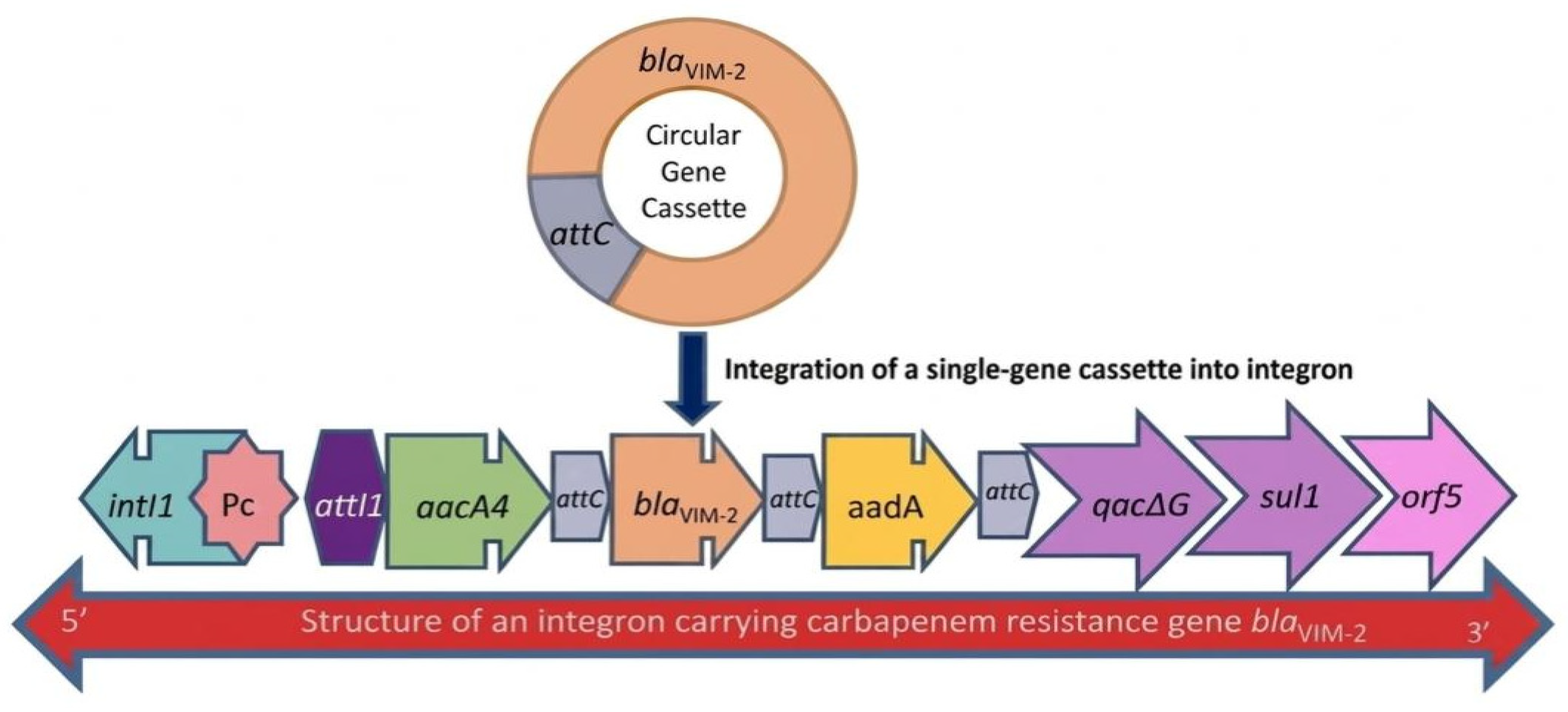
Integrons are genetic elements of dsDNA defined by the presence of a gene, which encodes the enzyme integrase called IntI. Integrons are classified as MGEs and are located in bacterial chromosomes, plasmids and transposons. Integrons carry the resistance genes that are located within the gene cassette in integons. The most successful method for the spread of resistance genes is the horizontal transfer of resistance integrons, which results in the emergence of MDR strains [146]. Integrons capture resistance determinants of antibiotics and can promote the transcription and expression of these determinants [147]. Recently, it has been recognized that class 1 and class 2 integrons play an important role in acquiring and disseminating carbapenem resistance genes such as blaIMP, mainly among Gram-negative bacteria. For example, in imipenem-resistant A. baumannii, class 1 integrons carry blaIMP-5; similarly in P. aeruginosa and E. cloacae, blaIMP is commonly found in class 1 integron [148]. VIM and IMP carbapenemases are commonly encoded on class I integrons containing an integrase gene, intlI, linked with a transposase tnpA found upstream of this integron. blaVIM is carried by class 1 integron in P. aeruginosa and K. pneumoniae. These metallo-β-lactamase genes are mostly associated with aminoglycoside resistance genes (aadA1, aacA4 and/or aadB), class D β-lactamases (blaOXA genes), antiseptic resistance (qacΔG), and chloramphenicol resistance (catB) [149]. The class 1 integrons belong to mobile integrons which are classified into five groups and always carried by plasmids; however, superintegrons are large integrons (approximately 126 kb) which have been found on chromosomes [150]. A genomic study revealed that genes encoding metallo-β-lactamase are responsible for carbapenem resistance and its spread through gene exchange mediated by integrons [151]. Metallo-β-lactamases such as VIM-, SIM- and IMP-type enzymes are reported to be important carbapenemases among clinical isolates of A. baumannii, the genes for which are carried by class 1 integrons. The studies of Da Silva et al. detected the class 1 integron carrying blaIMP-5 in A. baumannii resistant to imipenem [152]. Class 1 integrons carrying blaSIM-1 for carbapenemase among A. baumannii clinical isolates has been reported from Korea [153]. In another study, class 1 integrons conferring resistance to carbapenems have been identified in A. baumannii carrying gene cassettes (blaNDM-1, blaOXA-23 and blaOXA-5) that encode carbapenemases for carbapenem degradation, thereby impairing antibiotic effectiveness and facilitating resistance dissemination by HGT [154]. Class I integrons are associated with the dissemination of resistance genes of antibiotics in Enterobacter species along with their widespread role of carrying blaVIM and blaIMP genes [155].
blaNDM-1 was found on a 4.3 kb region in a plasmid associated with the 4.8 kb complex class I integron. The same blaNDM-1 genetic structure, as identified in the Enterobacteriaceae, has also been detected in P. aeruginosa, where the similar genetic structure is found in the variable region carrying the insertion sequence ISCR1 complex class I integron inserted into the chromosome of bacteria [124]. The relation between molecular forms of VIM-carrying P. aeruginosa and the genetic context was assessed in another study conducted during 2011 in Thessaly. Forty-six percent of MDR VIM-producing P. aeruginosa belonging to ST111 and ST235 clusters were reported previously to carry blaVIM-2 and blaVIM-4 enzymes encoding gene cassettes. Novel VIM-2-encoding integrons were detected among sporadic isolates. A novel P. aeruginosa ST (ST1457) isolate carrying a VIM-17-encoding integron was also detected in a study. These findings show the high prevalence of P. aeruginosa resistant to carbapenems producing VIM-type enzymes along with their growing evolution [156]. Similarly, a study conducted in Iran has shown 64% of class 1 integrons and 20% of class 2 integrons in carbapenem resistance P. aeruginosa. These integrons carry gene cassettes such as IMP and VIM metallo-β-lactamases which degrade carbapenems showing their correlation with MDR [18].
A study conducted in Nigeria reported the presence of carbapenemase genes such as blaVIM-5 in the P. putida group (P. guariconensis and P. plecoglossicida) isolated from environmental sources. Whole genome sequencing revealed the presence of blaVIM-5 in three novel Tn402-like structures of class 1 integron carrying the cassette arrays blaVIM-5|aadB|tnpA|blaPSE-1|smr2|tnpA, aadB|blaVIM-5|aadB|blaPSE-1, and aadB|blaVIM-5|blaPSE-1 [149].
Klebsiella species also contain genes for MBLs such as IMP-type and VIM carbapenemases associated with class I integrons. Isolates of K. pneumoniae carried the intI1 gene (36.6%) in the study results conducted in 2011 and 2015 in which the blaVIM-1 gene cassette prevalence was 30% [150,151]. In another study on plasmids of K. pneumoniae, researchers identified integrons associated with IS26 elements. These elements carried gene cassettes for carbapenemases such as KPC-2 enabling bacteria to survive in the presence of carbapenem antibiotics [152].
The class 1 integrons associated with MBLs play an important role in the dissemination of these resistance genes in nosocomial infections caused by pathogens. Integron- and plasmid-borne variants of IMP have also been detected in many other enteric bacteria [153]. Carbapenemase genes such as blaKPC, blaNDM, and blaVIM have been found mostly in Int-1 but few in Int-2 from E. coli isolated from patients with UTI [154]. The structure of integron carrying a carbapenem resistance gene is shown in Figure 5. Thus, integrons play an important role in the assembly and spreading of carbapenem resistance genes among Enterobacteriaceae. Integrons enable these bacterial species to resist antibiotic pressure exerted by carbapenems by expressing carbapenemase genes [155].

6. Carbapenem Resistance in Food, Livestock and Aquaculture

As discussed previously, increasing bacterial resistance to carbapenems, a valuable class of antibiotics against Gram-negative bacteria, is alarming for health care professionals globally. A rational approach of investigation and management of ABR is the One Health strategy. Collaboration and cooperation between different sectors aimed at integrating health involving plants, animals, humans and the environment can give synergistic output. The One Health approach is considered an essential strategy to deal with emerging infectious diseases as well as the spread of antibiotic resistance [156,157].
The presence of MDR bacteria in food and livestock, agriculture and associated environment is alarming. Since there has been an overall increase in the use of carbapenem, resistance and the rate of antibiotic resistance have been increasing; the food and agriculture sectors also seem to be badly impacted. European countries usually restrict the use of carbapenems in livestock, while other countries do not have any regulations. The results of studies conducted across the globe reveal the presence of carbapenem resistance from food, dairy, and livestock as well as associated products with varying degree of prevalence. Despite the ban on the use of carbapenems, there is a relatively low prevalence of CRB being reported from livestock, food and dairy products [157,158,159,160,161,162].
Mobile genetic elements play a key in driving resistance to carbapenems in the food sector. For example, conjugative plasmids such as IncA/C, IncF, IncHI, IncL/M and IncX spread genes encoding carbapenemases among food pathogens including K. pneumoniae, E. coli, A. baumannii and S. Enterica in animal food and products using the antibiotic in agriculture, increasing their persistence [2,163]. Class 1 integrons further enhance the dissemination of carbapenem resistance by capturing multiple gene cassettes and promoting co-selection when integrated in transposons or plasmids [164]. In addition, insertion sequences and transposons such as ISAba1 and Tn4401 accelerate the expression and mobilization of carbapenemase genes like blaKPC and blaOXA, enhancing dissemination and stability in food-associated bacteria [2,161].
The presence of ARB strains of bacterial pathogens such as Salmonella, Klebsiella, E. coli, Shigella spp., etc., in water and the food supply chain poses a significant threat to human health, since food is a major necessity of human life and the food supply chain may involve travel to different cities or even countries. Pathogenic bacteria constitute a small portion of the overall microbial population in food, livestock and agricultural products, since most of the microbial population is non-pathogenic. Nevertheless, the presence of resistant bacteria may disseminate antibiotic resistance genes to the non-pathogenic population through horizontal gene transfer. For instance, the bacteria of normal flora of fish, poultry and domestic cattle may acquire ABR and hence become a major source of spread to humans through animal contact and food consumption [160,161].
In the livestock sector, mobile genetic elements (MGEs) mainly spread carbapenem resistance through conjugative plasmids, integrons, transposons and insertion sequences, enabling horizontal gene transfer of carbapenemase (e.g., blaNDM, blaKPC, blaOXA48-like) among Gram-negative microbiota in animal gut [2,163]. Broad-host-range plasmids such as IncA/C, IncF, and IncX3 act as major gene transfer vehicles for interspecies [164], while elements like Tn4401, Tn125, IS26, and ISAba125 promote the integration and mobilization of resistance determinants [2]. Although carbapenems are rarely used in animals, co-selection by using other antimicrobials stabilize these MGEs, allowing the spread and persistence of genes through food supply, manure, and the environment [165], thereby linking livestock reservoirs with human infections under a One Health framework [163].
In recent years, several studies have been carried out on the detection and molecular characterization of carbapenem-resistant bacteria (CRB) from cattle, poultry, sea food and their products. For instance, a study conducted in Texas USA on cattle feces, detected several carbapenem-resistant strains. They identified A. baumannii producing blaOX-497 and Pseudomonas spp. producing conserved domains of blaIMI and blaOXA, indicating the role of these genes in horizontal gene transfer among bacteria in cattle normal flora [166].
Meat and dairy products like raw milk may also contribute to dissemination of ABR. Raw milk is still consumed in several countries of the world; hence it may be a significant source of transmission of AMR. A study conducted in Turkey, reported detection of blaNDM, blaKPC, blaVIM and blaOXA-48 genes from E. coli and K. pneuminiae strains isolated from raw milk samples, underscoring the importance of continued surveillance of ABR in food and dairy products as well as pasteurization [167].
Poultry farms, live poultry markets and their environment appear to be a major source of transmission of antibiotic-resistant strains, underscoring the importance of the One Health aspect of investigation. Results of several recent studies conducted on poultry and poultry environment have published alarming results with high prevalence of carbapenem resistance genes such as blaNDM in the isolated bacterial strains. A mention-worthy study recently conducted in China reported up to 72% detection of blaNDM genes in poultry feces at Live Poultry markets in bacterial species including E. coli, Enterobacter cloacae, Proteus mirablis (P. mirablis), K. pneumoniae, etc. Poultry meat may be an important means of transmission of ABR strains, since it is one of the most consumed food types all over the world, equally both in developed as well as developed countries. Antibiotics [if present] may persist in the poultry meat even after washing and continue exerting selection pressure on bacteria [168]. A study conducted in India on detection and characterization of CRB in poultry meat reported presence 36.8% carbapenem resistance in different bacterial species, i.e., Morganella morganii (M. morganii), Providencia alcalifaciens (P. alcalifaciens), Stenotrophomonas pavanii (S. pavanii), Klebsiella aerogenes (K. aerogenes), P. mirabilis, Providencia huaxiensis (P. huaxiensis), Proteus terrae (P. terrae), Stenotrophomonas maltophilia (S. maltophilia) and K. pneumoniae. They have been able to detect blaOXA-48 like blaIMI blaKPC genes from these strains with varying degree of occurrence [169].
Water reservoirs offer a key source of antibiotic ARB, especially in the towns and communities where sewerage water is not appropriately decontaminated and broken drinking water supply lines are contaminated with it. In addition to this, fresh water and marine sources offer an ideal environment for the transmission of pathogens to human population, whereas favourable habitat of these environments facilitate horizontal gene transfer of ARGs. Furthermore, use of recycled human wastewater poses a significant heath challenge nowadays. Quality of treatment performance and post treatment practices need to be strictly monitored in order to ensure overall human and environmental safety. Disposal of wastewater into freshwater reservoirs is a common practice in less developed countries, risking the overall health of aquatic life and also transmission of contaminated food through food chains including fish [170]. A few recent articles have reported detection of CRB from fish and other sea food from both fresh water and marine sources.
Carbapenem resistance in aquaculture disseminate mainly via MGEs that enable horizontal transfer of carbapenemase genes among aquatic pathogenic bacteria. Broad-host-range conjugative plasmids, mainly IncA/C, IncHI2, IncF, IncL/M, and IncX3, carry carbapenemase genes such as blaNDM-1, blaNDM-5, blaKPC-2, blaOXA-48-like which facilitate rapid spread in fish farming environments under antimicrobial pressure. Transposons such as Tn125 (blaNDM), Tn4401 (blaKPC), and derivatives of Tn21/Tn3 help in mobilizing these genes between plasmids and chromosomes, increasing their stability and dissemination in aquaculture [171,172]. Class 1 integrons further integrate resistance gene cassettes (e.g., aadA, qnr, and blaVIM-associated arrays), promoting multidrug resistance in dense aquatic microbial communities such as Aeromonas spp. and Shiwanella spp. [173,174]. An interesting study in India carried out on detection and analysis of carbapenem-resistant E. coli identified high-risk clones of ST167 and ST361 from freshwater fish samples carrying blaNDM-5. It may be mentioned here that Indian sub-continent is considered hot region for NDM, with higher prevalence rate of carbapenem resistance [175].
In recent decades aqua culture has been developed significantly to meet consumer demands. Aqua culture accounts for 50% of sea food production. Sea food contamination with pathogenic microorganisms, including CRB, has also been reported. A US study reported the presence of blaIMI-2 in Enterobacter spp. and blaNDM-1 in Acinetobacter spp. from retail fish samples [176].

7. Future Perspective

Despite significant advancements and ongoing dedicated efforts in understanding the vital role of mobile genetic elements in the evolution and dissemination of carbapenem resistance, the dynamic interplay between bacterial hosts, MGEs and diverse environments of clinical settings as well non-clinical habitats continue to pose a continues challenge. Keeping in view the seriousness of the issue, future research must shift from retrospective characterization to a prospective, predictive, and therapeutic framework, alongside applying advanced analytical approaches [177,178].
Whole genome sequencing (WGS) has become a cornerstone in infectious disease research and surveillance. The field is now poised to extend its focus from descriptive genomics to predictive modelling. Multi-omics approaches integrated with the power of computation and bioinformatics may enable prediction of the likelihood of transmission of particular MGEs to high-risk clones or other members of bacterial species based on the sequence features. In addition to this, investigation of MGE transfer within complex communities (e.g., human gut) using sequence-based techniques, combined with artificial intelligence/machine learning (AI/ML), may identify the hotspots of gene transfer and predict how antibiotic use may shape up the mobilome of bacteria in a given habitat or a person and accelerate the rate of emergence of drug resistance [178,179].
Since most of the research studies on drug resistance are carried out under in vitro settings, which fail to recapitulate the complexity of the in vivo conditions, in vivo gut models may be employed to systematically understand the transmission dynamics of MGEs during clinical treatment, co-infection with bacteriophages or in the presence of immune response. Furthermore, applying advanced technologies such as long-read sequencing (Nanopore sequencing) of the bacterial strains directly from the patient’s sample would better help us understand the mechanism of gene transfer, without the biases of laboratory culturing.
The One Health approach is becoming a cornerstone of infectious disease surveillance research. The mobilization and spread of carbapenem resistance genes occur across human, animal and environmental sectors. It has now become inevitable to monitor drug resistance by phenotypic methods or detection of ARGs by molecular methods such as polymerase chain reaction (PCR). Surveillance and intervention research related to carbapenem resistance must involve the One Health framework. There is a need of unified, global surveillance networks with standard operating procedures and willingness to dedicate efforts to combat antibiotic resistance. This all requires standardized protocols to carry out metagenomic analyses of water, food, agricultural runoff, and wildlife to identify environmental reservoirs and transmission corridors that link to clinical outbreaks [180].

8. Conclusions

Increasing antibiotic resistance levels among bacterial pathogens constitute a major challenge to global health, with carbapenem resistance being a specifically concerning problem as these antibiotics are the last line of therapy for serious infections. The MGEs such as plasmids, transposons and integrons form a complex mobilome which plays a significant role in the horizontal gene transfer of carbapenem resistance determinants among various bacterial species, underpinning the intimidating adaptive potential to carbapenem resistance. MGEs are one of the significant contributors in the dissemination of antibiotic resistance that can be shared by various strains and species of bacterial genera, making them one of the largest concerns for public health. MGEs can facilitate the rapid spread of carbapenemase genes within bacterial species and geographical areas due to rapid diffusion of plasmids, integrons and transposons. These elements play an important role in bacterial evolution and adaptation including antibiotic resistance which results in the emergence of carbapenem-resistant bacteria. Understanding the role of MGEs in the dissemination of carbapenem resistance and more knowledge on the mobilome is useful as it may open ways for screening of resistance to these antibiotics in clinical settings.

Author Contributions

Conceptualization: M.A.S., B.C., J.Z. and B.L.; methodology: L.H., M.A.S. and B.L., formal analysis: B.L., J.Z. and M.A.S.; investigation: L.H., M.A.S. and J.Z.; resources: J.Z. and B.C.; data curation: L.H., M.A.S. and B.L.; writing—original draft: L.H., M.A.S. and J.Z.; preparation: L.H. and M.A.S.; writing—review and editing: J.Z., B.L. and B.C.; supervision and project administration: J.Z. and B.C.; funding acquisition: J.Z. and B.C. All authors have read and agreed to the published version of the manuscript.

Funding

This work was supported by the Elite Medical Professionals Project of China-Japan Friendship Hospital [ZRJY2023-QM32], National Natural Science Foundation of China (NSFC) [82530002, 82102456], and Chinese Academy of Medical Sciences (CAMS) Innovation Fund for Medical Sciences (CIFMS2021-12M-1-048) and Horizontal Research Foundation of China-Japan Friendship Hospital (2025-HX-211).

Data Availability Statement

No new data were created or analyzed in this study. All sources of information have been cited in the article. Data sharing is not applicable to this article.

Acknowledgments

Authors are grateful to their host institutions for providing them with the infrastructure and support in writing up of the manuscript. During the preparation of this manuscript, the author used Doubao 2.11.7 for the purposes of enhancing the resolution of figure. The authors have reviewed and edited the output and take full responsibility for the content of this publication.

Conflicts of Interest

Authors declare no conflict of interest.

Abbreviations

MGEMobile genetic element
HGTHorizontal genen transfer
TnTransposon
ISInsertion sequence
ESBLExtended-spectrum beta-lactamase
PBPPenicillin binding protein
MBLMetallo beta-lactamase
FDAFood and drug administration
LPSLipopolysaccharide
CHDLsCarbapenem hydrolyzing class-D beta-lactamase.
PetNPhosphoethanol amine
XDRExtensively drug resistance
PDRPan drug resistance
KPCKlebsiella pneumoniae carbapenemase
SMESerratia marcescens enzyme
GESGuiana extended-spectrum β-lactamase
SHVSulfhydryl variable lactamase
SFCSerratia fonticola carbapenemase
IMI/NMC-AImipenemase/non-metallo-carbapenemase-A
VIMVerona integrated-encoded MBL
IMPImipenemase
GIMGermany imipenemase
FIMFlorence imipenemase
NDMNew Delhi MBL
SPMSao Paulo MBL
OXAOxacillinases

References

  1. Algammal, A.; Hetta, H.F.; Mabrok, M.; Behzadi, P. Emerging multidrug-resistant bacterial pathogens “superbugs”: A rising public health threat. Front. Microbiol. 2023, 14, 1135614. [Google Scholar] [CrossRef] [PubMed]
  2. Partridge, S.R.; Kwong, S.M.; Firth, N.; Jensen, S.O. Mobile genetic elements associated with antimicrobial resistance. Clin. Microbiol. Rev. 2018, 31, e00088-17. [Google Scholar] [CrossRef]
  3. Khedkar, S.; Smyshlyaev, G.; Letunic, I.; Maistrenko, O.M.; Coelho, L.P.; Orakov, A.; Forslund, S.K.; Hildebrand, F.; Luetge, M.; Schmidt, T.S.; et al. Landscape of mobile genetic elements and their antibiotic resistance cargo in prokaryotic genomes. Nucleic Acids Res. 2022, 50, 3155–3168. [Google Scholar] [CrossRef]
  4. Cerezales, M.; Xanthopoulou, K.; Wille, J.; Krut, O.; Seifert, H.; Gallego, L.; Higgins, P.G. Mobile genetic elements harboring antibiotic resistance determinants in Acinetobacter baumannii isolates from Bolivia. Front. Microbiol. 2020, 11, 919. [Google Scholar] [CrossRef] [PubMed]
  5. Popa, L.I.; Barbu, I.C.; Chifiriuc, M.C. Mobile genetic elements involved in the horizontal transfer of antibiotic resistance genes. Roum. Arch. Microbiol. Immunol. 2018, 1, 77. [Google Scholar]
  6. Gajic, I.; Tomic, N.; Lukovic, B.; Jovicevic, M.; Kekic, D.; Petrovic, M.; Jankovic, M.; Trudic, A.; Mitic Culafic, D.; Milenkovic, M.; et al. A comprehensive overview of antibacterial agents for combating Multidrug-Resistant bacteria: The current landscape, development, future opportunities, and challenges. Antibiotics 2025, 14, 221. [Google Scholar] [CrossRef]
  7. Noel, H.R.; Petrey, J.R.; Palmer, L.D. Mobile genetic elements in Acinetobacter antibiotic-resistance acquisition and dissemination. Ann. N. Y. Acad. Sci. 2022, 1518, 166–182. [Google Scholar] [CrossRef] [PubMed]
  8. Hawkey, P.M.; Livermore, D.M. Carbapenem antibiotics for serious infections. Br. Med. J. 2012, 344, e3236. [Google Scholar] [CrossRef]
  9. Kimani, R. A review of Carbapenems Resistance in the Current World. J. Med. Biomed. Lab. Sci. Res. 2024, 4, 1. [Google Scholar]
  10. Aurilio, C.; Sansone, P.; Barbarisi, M.; Pota, V.; Giaccari, L.G.; Coppolino, F.; Barbarisi, A.; Passavanti, M.B.; Pace, M.C. Mechanisms of action of carbapenem resistance. Antibiotics 2022, 11, 421. [Google Scholar] [CrossRef]
  11. Gillings, M.R. Integrons: Past, present, and future. Microbiol. Mol. Biol. Rev. 2014, 78, 257–277. [Google Scholar] [CrossRef] [PubMed]
  12. Patel, G.; Bonomo, R.A. ‘Stormy waters ahead’: Global emergence of carbapenemases. Front. Microbiol. 2013, 4, 48. [Google Scholar] [CrossRef] [PubMed]
  13. Tryfinopoulou, K.; Linkevicius, M.; Pappa, O.; Alm, E.; Karadimas, K.; Svartström, O.; Polemis, M.; Mellou, K.; Maragkos, A.; Brolund, A.; et al. Emergence and persistent spread of carbapenemase-producing Klebsiella pneumoniae high-risk clones in Greek hospitals, 2013 to 2022. Euro Surveill. 2023, 28, 2300571. [Google Scholar] [CrossRef] [PubMed]
  14. Raro, O.H.F.; Nordmann, P.; Dominguez, P.M.; Findlay, J.; Poirel, L. Emergence of carbapenemase-producing hypervirulent Klebsiella pneumoniae in Switzerland. J. Antimicrob. Agents Chemother. 2023, 67, e01424-22. [Google Scholar] [CrossRef]
  15. Acman, M.; Wang, R.; van Dorp, L.; Shaw, L.P.; Wang, Q.; Luhmann, N.; Yin, Y.; Sun, S.; Chen, H.; Wang, H.; et al. Role of mobile genetic elements in the global dissemination of the carbapenem resistance gene blaNDM. Nat. Commun. 2022, 13, 1131. [Google Scholar] [CrossRef]
  16. Ambler, R.P. The structure of β-lactamases. Philos. Trans. R. Soc. Lond. B Biol. Sci. 1980, 289, 321–331. [Google Scholar] [CrossRef]
  17. Bush, K.; Jacoby, G.A. Updated functional classification of β-lactamases. J. Antimicrob. Agents Chemother. 2010, 54, 969–976. [Google Scholar] [CrossRef]
  18. Arnold, R.S.; Thom, K.A.; Sharma, S.; Phillips, M.; Johnson, J.K.; Morgan, D.J. Emergence of Klebsiella pneumoniae carbapenemase-producing bacteria. J. South. Med. 2011, 104, 40–45. [Google Scholar] [CrossRef]
  19. Naas, T.; Vandel, L.; Sougakoff, W.; Livermore, D.M.; Nordmann, P. Cloning and sequence analysis of the gene for a carbapenem-hydrolyzing class A β-lactamase, SME-1, from Serratia marcescens S6. Antimicrob. Agents Chemother. 1994, 38, 1262–1270. [Google Scholar] [CrossRef]
  20. Poirel, L.; Le Thomas, I.; Naas, T.; Karim, A.; Nordmann, P. Biochemical sequence analyses of GES-1, a novel class A extended-spectrum β-lactamase, and the class 1 integron In52 from Klebsiella pneumoniae. J. Antimicrob. Agents Chemother. 2000, 44, 622–632. [Google Scholar] [CrossRef]
  21. Barthélémy, M.; Peduzzi, J.; Verchère-Beaur, C.; Ben Yaghlane, H.; Labia, R. Purification and biochemical properties of Pitton’s type 2 β-lactamase (SHV-1). Ann. Inst. Pasteur Microbiol. 1986, 137B, 19–27. [Google Scholar] [CrossRef]
  22. Henriques, I.; Moura, A.; Alves, A.; Saavedra, M.J.; Correia, A. Molecular characterization of a carbapenem-hydrolyzing class A β-lactamase, SFC-1, from Serratia fonticola UTAD54. Antimicrob. Agents Chemother. 2004, 48, 2321–2324. [Google Scholar] [CrossRef] [PubMed]
  23. Logan, L.K.; Weinstein, R.A. The epidemiology of carbapenem-resistant Enterobacteriaceae: The impact and evolution of a global menace. J. Infect. Dis. 2017, 215, S28–S36. [Google Scholar] [CrossRef]
  24. Cai, M.; Song, K.; Wang, R.; Wang, S.; Chen, H.; Wang, H. Tracking intra-species and inter-genus transmission of KPC through global plasmids mining. Cell Rep. 2024, 43, 114351. [Google Scholar] [CrossRef]
  25. Yang, X.; Dong, N.; Chan, E.W.; Zhang, R.; Chen, S. Carbapenem resistance-encoding and virulence-encoding conjugative plasmids in Klebsiella pneumoniae. Trends Microbiol. 2021, 29, 65–83. [Google Scholar] [CrossRef]
  26. Galdadas, I.; Lovera, S.; Pérez-Hernández, G.; Barnes, M.D.; Healy, J.; Afsharikho, H.; Woodford, N.; Bonoma, R.A.; Gervasion, F.L.; Haider, S. Defining the architecture of KPC-2 Carbapenemase: Identifying allosteric networks to fight antibiotics resistance. Sci. Rep. 2018, 8, 12916. [Google Scholar] [CrossRef]
  27. Lauretti, L.; Riccio, M.L.; Mazzariol, A.; Cornaglia, G.; Amicosante, G.; Fontana, R.; Rossolini, G.M. Cloning and characterization of blaVIM, a new integron-borne metallo-β-lactamase gene from a Pseudomonas aeruginosa clinical isolate. Antimicrob. Agents Chemother. 1999, 43, 1584–1590. [Google Scholar] [CrossRef] [PubMed]
  28. Arakawa, Y.; Murakami, M.; Suzuki, K.; Ito, H.; Wacharotayankun, R.; Ohsuka, S.; Kato, N.; Ohta, M. A novel integron-like element carrying the metallo-β-lactamase gene blaIMP. J. Antimicrob. Agents Chemother. 1995, 39, 1612–1615. [Google Scholar] [CrossRef] [PubMed]
  29. Castanheira, M.; Toleman, M.A.; Jones, R.N.; Schmidt, F.J.; Walsh, T.R. Molecular characterization of a β-lactamase gene, blaGIM-1, encoding a new subclass of metallo-β-lactamase. Antimicrob. Agents Chemother. 2004, 48, 4654–4661. [Google Scholar] [CrossRef]
  30. Pollini, S.; Maradei, S.; Pecile, P.; Olivo, G.; Luzzaro, F.; Docquier, J.D.; Rossolini, G.M. FIM-1, a new acquired metallo-β-lactamase from a Pseudomonas aeruginosa clinical isolate from Italy. Antimicrob. Agents Chemother. 2013, 57, 410–416. [Google Scholar] [CrossRef]
  31. Yong, D.; Toleman, M.A.; Giske, C.G.; Cho, H.S.; Sundman, K.; Lee, K.; Walsh, T.R. Characterization of a new metallo-β-lactamase gene, blaNDM-1, and a novel erythromycin esterase gene carried on a unique genetic structure in Klebsiella pneumoniae sequence type 14 from India. Antimicrob. Agents Chemother. 2009, 53, 5046–5054. [Google Scholar] [CrossRef]
  32. Toleman, M.A.; Simm, A.M.; Murphy, T.A.; Gales, A.C.; Biedenbach, D.J.; Jones, R.N.; Walsh, T.R. Molecular characterization of SPM-1, a novel metallo-β-lactamase isolated in Latin America: Report from the SENTRY antimicrobial surveillance programme. J. Antimicrob. Chemother. 2002, 50, 673–679. [Google Scholar] [CrossRef]
  33. Timothy, R.; Walsh, T.R.; Weeks, J.; Livermore, D.M.; Toleman, M.A. Dissemination of NDM-1 positive bacteria in the environment, New Delhi, India. Lancet Infect. Dis. 2011, 11, 355–362. [Google Scholar]
  34. Thomson, K.S. Extended-spectrum-β-lactamase, AmpC, and carbapenemase issues. J. Clin. Microbiol. 2010, 48, 1019–1025. [Google Scholar] [CrossRef]
  35. Kunitoshi Wachino, K.; Kimura, K.; Shibata, N.; Suzuki, S.; Yamane, K.; Kato, H.; Shibayama, K.; Arakawa, Y. Novel plasmid-mediated CMY-10 β-lactamase with increased carbapenem-hydrolyzing activity. Antimicrob. Agents Chemother. 2006, 50, 791–795. [Google Scholar]
  36. Sawa, T.; Kooguchi, K.; Moriyama, K. Molecular diversity of extended-spectrum β-lactamases and carbapenemases, and antimicrobial resistance. J. Intensive Care 2020, 8, 13. [Google Scholar] [CrossRef] [PubMed]
  37. Vijayakumar, S.; Jacob, J.J.; Vasudevan, K.; Mathur, P.; Ray, P.; Neeravi, A.; Baskaran, A.; Kirubananthan, A.; Anandan, S.; Biswas, I.; et al. Genomic characterization of mobile genetic elements associated with carbapenem resistance of Acinetobacter baumannii from India. Front. Microbiol. 2022, 13, 869653. [Google Scholar] [CrossRef]
  38. Sommer, J.; Gerbracht, K.M.; Krause, F.F.; Wild, F.; Tietgen, M.; Riedel-Christ, S.; Sattler, J.; Hamprecht, A.; Kempf, V.A.; Göttig, S. OXA-484, an OXA-48-type carbapenem-hydrolyzing class D β-lactamase from Escherichia coli. Front. Microbiol. 2021, 12, 660094. [Google Scholar] [CrossRef]
  39. Kumwenda, G.P.; Sugawara, Y.; Akeda, Y.; Matsumoto, Y.; Motooka, D.; Tomono, K.; Hamada, S. Genomic features of plasmids coding for KPC-2, NDM-5, or OXA-48 carbapenemases in Enterobacteriaceae from Malawi. J. Antimicrob. Chemother. 2021, 76, 267–270. [Google Scholar] [CrossRef]
  40. June, C.M.; Vallier, B.C.; Bonomo, R.A.; Leonard, D.A.; Powers, R.A. Structural origins of oxacillinase specificity in class D β-lactamases. Antimicrob. Agents Chemother. 2014, 58, 333–341. [Google Scholar] [CrossRef]
  41. Rozwandowicz, M.; Brouwer, M.S.M.; Fischer, J.; Wagenaar, J.A.; Gonzalez-Zorn, B.; Guerra, B.; Hordijk, J. Plasmids carrying antimicrobial resistance genes in Enterobacteriaceae. J. Antimicrob. Chemother. 2018, 73, 1121–1137. [Google Scholar] [CrossRef]
  42. Svara, F.; Rankin, D.J. The evolution of plasmid-carried antibiotic resistance. BMC Evol. Biol. 2011, 11, 130. [Google Scholar] [CrossRef] [PubMed]
  43. Oteo, J.; Ortega, A.; Bartolomé, R.; Bou, G.; Conejo, C.; Fernández-Martínez, M.; Campos, J. Prospective multicenter study of carbapenemase-producing Enterobacteriaceae from 83 hospitals in Spain reveals high in vitro susceptibility to colistin and meropenem. Antimicrob. Agents Chemother. 2015, 59, 3406–3412. [Google Scholar] [CrossRef] [PubMed]
  44. Millan, S.A. Evolution of plasmid-mediated antibiotic resistance in the clinical context. Trends Microbiol. 2018, 26, 978–985. [Google Scholar] [CrossRef] [PubMed]
  45. Dimou, V.; Dhanji, H.; Pike, R.; Livermore, D.M.; Woodford, N. Characterization of Enterobacteriaceae producing OXA-48-like carbapenemases in the UK. J. Antimicrob. Chemother. 2012, 67, 1660–1665. [Google Scholar] [CrossRef]
  46. Hamidian, M.; Nigro, S.J. Emergence, molecular mechanisms, and global spread of carbapenem-resistant Acinetobacter baumannii. Microb. Genom. 2019, 5, e000306. [Google Scholar] [CrossRef]
  47. Roodsari, M.R.; Fallah, F.; Taherpour, A.; Hakemi Vala, M.; Hashemi, A. Carbapenem-resistant bacteria and laboratory detection methods. Arch. Pediatr. Infect. Dis. 2014, 2, 188–191. [Google Scholar] [CrossRef]
  48. Noori, M.; Karimi, A.; Fallah, F.; Hashemi, A.; Alimehr, S.; Goudarzi, H.; Aghamohammad, S. High prevalence of metallo-β-lactamase-producing Acinetobacter baumannii isolated from two hospitals of Tehran, Iran. Arch. Pediatr. Infect. Dis. 2014, 2, 15439. [Google Scholar] [CrossRef]
  49. Cornaglia, G.; Giamarellou, H.; Rossolini, G.M. Metallo-β-lactamases: A last frontier for β-lactams? Lancet Infect. Dis. 2011, 11, 381–393. [Google Scholar] [CrossRef]
  50. Hu, W.S.; Yao, S.M.; Fung, C.P.; Hsieh, Y.P.; Liu, C.P.; Lin, J.F. An OXA-66/OXA-51-like carbapenemase and possibly an efflux pump is associated with resistance to imipenem in Acinetobacter baumannii. Antimicrob. Agents Chemother. 2007, 51, 3844–3852. [Google Scholar] [CrossRef]
  51. Turton, J.F.; Woodford, N.; Glover, J.; Yarde, S.; Kaufmann, M.E.; Pitt, T.L. Identification of Acinetobacter baumannii by detection of the blaOXA-51-like carbapenemase gene intrinsic to this species. J. Clin. Microbiol. 2006, 44, 2974–2976. [Google Scholar] [CrossRef]
  52. Dijkshoorn, L.; Nemec, A.; Seifert, H. An increasing threat in hospitals: Multidrug-resistant Acinetobacter baumannii. Nat. Rev. Microbiol. 2007, 5, 939–951. [Google Scholar] [CrossRef]
  53. Chen, T.L.; Wu, R.C.; Shaio, M.F.; Fung, C.P.; Cho, W.L. Acquisition of a plasmid-borne blaOXA-58 gene with an upstream IS1008 insertion conferring a high level of carbapenem resistance to Acinetobacter baumannii. Antimicrob. Agents Chemother. 2008, 52, 2573–2580. [Google Scholar] [CrossRef]
  54. Peleg, A.Y.; Seifert, H.; Paterson, D.L. Acinetobacter baumannii: Emergence of a successful pathogen. Clin. Microbiol. Rev. 2008, 21, 538–582. [Google Scholar] [CrossRef] [PubMed]
  55. Khan, F.; Chaudhary, B.; Khan, A.U. Class D Type Beta-Lactamases. In Beta-Lactam Resistance in Gram-Negative Bacteria; Shahid, M., Singh, A., Sami, H., Eds.; Springer: Singapore, 2022. [Google Scholar]
  56. Santillana, E.; Beceiro, A.; Bou, G.; Romero, A. Crystal structure of the carbapenemase OXA-24 reveals insights into the mechanism of carbapenem hydrolysis. Proc. Natl. Acad. Sci. USA 2007, 104, 5354–5359. [Google Scholar] [CrossRef]
  57. Han, X.; Zhou, J.; Yu, L.; Shao, L.; Cai, S.; Hu, H.; Shi, Q.; Wang, Z.; Hua, X.; Jiang, Y.; et al. Genome sequencing unveils blaKPC-2-harboring plasmids as drivers of enhanced resistance and virulence in nosocomial Klebsiella pneumoniae. mSystems 2024, 9, e00924-23. [Google Scholar] [CrossRef]
  58. Grenier, F.; Baby, V.; Allard, S.; Lévesque, S.; Papale, F.; Sullivan, R.; Landecker, H.L.; Higgins, P.G.; Rodrigue, S.; Haraoui, L.P. Isolation of a blaNDM-1-positive strain in Israel predating the earliest observations from India. Microbiol. Spectr. 2024, 12, e01002-24. [Google Scholar] [CrossRef] [PubMed]
  59. Hammad, H.A.; Mohamed, I.S.; El-Badawy, O.; Zakaria, A.M.; Shabaan, L.; Aly, S.A. pKpQIL-like plasmid contributes to the dissemination of blaNDM-1 and plasmid mediated quinolone resistance determinants among multidrug resistant Klebsiella pneumoniae in Assiut University Hospital, Egypt. Iran. J. Microbiol. 2023, 15, 208. [Google Scholar]
  60. Li, P.; Yuan, Y.; Yan, Y.; Jia, M.; Gao, L.; Liu, X.; Sun, Y.; Zhu, G.; Chen, Z. Characterization of bla NDM–5-carrying plasmids in two clinical Salmonella isolates from Jiaxing city, China. Front. Microbiol. 2025, 16, 1620907. [Google Scholar]
  61. Shi, Y.; Yang, Y.; Song, Y.; Zhu, Y.; Zhao, G.; Tang, B. Characterisation of blaNDM-5-bearing IncHI2 plasmid from Escherichia fergusonii in China. J. Glob. Antimicrob. Resist. 2025, 42, 222–228. [Google Scholar] [CrossRef]
  62. Dong, N.; Liu, C.; Hu, Y.; Lu, J.; Zeng, Y.; Chen, G.; Chen, S.; Zhang, R. Emergence of an extensive drug-resistant Pseudomonas aeruginosa strain of chicken origin carrying blaIMP-45, tet (X6), and tmexCD3-toprJ3 on an IncpRBL16 plasmid. Microbiol. Spectr. 2022, 10, e02283-22. [Google Scholar] [CrossRef]
  63. Xu, J.; Lin, W.; Chen, Y.; He, F. Characterization of an IMP-4-producing Klebsiella pneumoniae ST1873 strain recovered from an infant with a bloodstream infection in China. Infect. Drug. Resist. 2020, 13, 773–779. [Google Scholar] [CrossRef] [PubMed]
  64. Jia, H.; Sun, Q.; Ruan, Z.; Xie, X. Characterization of a small plasmid carrying the carbapenem resistance gene blaOXA-72 from community-acquired Acinetobacter baumannii sequence type 880 in China. Infect. Drug Resist. 2019, 12, 1545–1553. [Google Scholar] [CrossRef]
  65. Fallah, F.; Taherpour, A.; Hakemi Vala, M.; Hashemi, A. Global spread of New Delhi metallo-β-lactamase-1 (NDM-1). Iran. J. Clin. Infect. Dis. 2011, 6, 171–177. [Google Scholar]
  66. Chen, Y.; Zhou, Z.; Jiang, Y.; Yu, Y. Emergence of NDM-1-producing Acinetobacter baumannii in China. J. Antimicrob. Chemother. 2011, 66, 1255–1259. [Google Scholar] [CrossRef]
  67. Fallah, F.; Noori, M.; Hashemi, A.; Goudarzi, H.; Karimi, A.; Erfanimanesh, S.; Alimehr, S. Prevalence of blaNDM, blaPER, blaVEB, blaIMP, and blaVIM genes among Acinetobacter baumannii isolated from two hospitals of Tehran, Iran. Scientifica 2014, 2014, 245162. [Google Scholar] [CrossRef]
  68. Partridge, S.R.; Iredell, J.R. Genetic contexts of blaNDM-1. Antimicrob. Agents Chemother. 2012, 56, 6065–6067. [Google Scholar] [CrossRef] [PubMed]
  69. Sheng, J.; Lan, H.; Wang, X.; Yao, J.; Hu, Y.; Guo, J.; Zhou, L.; Tang, X.; Xu, H.; Yu, Y.; et al. Global geographic and genomic epidemiology analysis of carbapenem-resistant Escherichia coli carrying blaNDM-9. mSphere 2025, 10, e00704-25. [Google Scholar] [CrossRef]
  70. Liu, X.; Liu, Z.; Yu, K.; Huang, Z.; Gao, H.; Bai, X.; Sun, Z.; Wei, Q.; Wang, D. Global genomic epidemiology and plasmid-mediated dissemination of blaKPC and blaNDM in the Serratia marcescens complex. Curr. Res. Microb. Sci. 2025, 100436. [Google Scholar] [CrossRef] [PubMed]
  71. Harmer, C.J.; Hall, R.M. pRMH760, a precursor of A/C2 plasmids carrying blaCMY and blaNDM genes. Microb. Drug Resist. 2014, 20, 416–423. [Google Scholar] [CrossRef]
  72. Sugawara, Y.; Akeda, Y.; Sakamoto, N.; Takeuchi, D.; Motooka, D.; Nakamura, S.; Hagiya, H.; Yamamoto, N.; Nishi, I.; Yoshida, H.; et al. Genetic characterization of blaNDM-harboring plasmids in carbapenem-resistant Escherichia coli from Myanmar. PLoS ONE 2017, 12, e0184720. [Google Scholar] [CrossRef]
  73. Elshamy, A.A.; Saleh, S.E.; Aboshanab, K.M.; Aboulwafa, M.M.; Hassouna, N.A. Transferable IncX3 plasmid harboring blaNDM-1, bleMBL, and aph (3′)-VI genes from Klebsiella pneumoniae conferring phenotypic carbapenem resistance in E. coli. Mol. Biol. Rep. 2023, 50, 4945–4953. [Google Scholar] [CrossRef]
  74. Espedido, B.A.; Dimitrijovski, B.; van Hal, S.J.; Jensen, S.O. The use of whole-genome sequencing for molecular epidemiology and antimicrobial surveillance: Identifying the role of IncX3 plasmids and the spread of blaNDM-4-like genes in the Enterobacteriaceae. J. Clin. Pathol. 2015, 68, 835–838. [Google Scholar] [CrossRef] [PubMed]
  75. Krishnaraju, M.; Kamatchi, C.; Jha, A.K.; Devasena, N.; Vennila, R.; Sumathi, G.; Vaidyanathan, R. Complete sequencing of an IncX3 plasmid carrying blaNDM-5 allele reveals an early stage in the dissemination of the blaNDM gene. Indian J. Med. Microbiol. 2015, 33, 30–38. [Google Scholar] [CrossRef]
  76. Chen, L.; Peirano, G.; Lynch, T.; Chavda, K.D.; Gregson, D.B.; Church, D.L.; Conley, J.; Kreiswirth, B.N.; Pitout, J.D. Molecular characterization by using next-generation sequencing of plasmids containing blaNDM-7 in Enterobacteriaceae from Calgary, Canada. Antimicrob. Agents Chemother. 2015, 60, 1258–1263. [Google Scholar] [CrossRef] [PubMed]
  77. Kim, J.S.; Jin, Y.H.; Park, S.H.; Han, S.; Kim, H.S.; Yu, J.K.; Jang, J.I.; Kim, J.; Hong, C.-K.; Lee, J.H.; et al. Horizontal transfer of blaNDM-1-carrying IncX3 plasmid between carbapenem-resistant Enterobacteriaceae in a single patient. J. Infect. 2020, 81, 816–846. [Google Scholar] [CrossRef]
  78. Zhang, Z.; Guo, H.; Li, X.; Li, W.; Yang, G.; Ni, W.; Zhan, M.; Lu, L.; Zhang, Z.; Li, X.; et al. Genetic diversity and characteristics of blaNDM-positive plasmids in Escherichia coli. Front. Microbiol. 2021, 12, 729952. [Google Scholar] [CrossRef]
  79. Arcari, G.; Carattoli, A. Global spread and evolutionary convergence of multidrug-resistant and hypervirulent Klebsiella pneumoniae high-risk clones. Pathog. Glob. Health 2023, 117, 328–341. [Google Scholar] [CrossRef]
  80. Fiett, J.; Baraniak, A.; Izdebski, R.; Sitkiewicz, I.; Żabicka, D.; Meler, A.; Filczak, K.; Hryniewicz, W.; Gniadkowski, M. The first NDM metallo-β-lactamase-producing Enterobacteriaceae isolate in Poland: Evolution of IncFII-type plasmids carrying the blaNDM-1 gene. Antimicrob. Agents Chemother. 2014, 58, 1203–1207. [Google Scholar] [CrossRef] [PubMed]
  81. González-Espinosa, F.; Di Pilato, V.; Calabrese, L.; Costa, E.; Costa, A.; Gutkind, G.; Cejas, D.; Radice, M. Integral genomic description of blaNDM-5-harbouring plasmids recovered from Enterobacterales in Argentina. J. Glob. Antimicrob. Resist. 2024, 39, 224–226. [Google Scholar] [CrossRef]
  82. Yigit, H.; Queenan, A.M.; Anderson, G.J.; Domenech-Sanchez, A.; Biddle, J.W.; Steward, C.D.; Alberti, S.; Bush, K.; Tenover, F.C. Novel carbapenem-hydrolyzing beta-lactamase, KPC-1, from a carbapenem-resistant strain of Klebsiella pneumoniae. Antimicrob. Agents Chemother. 2001, 45, 1151–1161. [Google Scholar] [CrossRef]
  83. Tzouvelekis, L.S.; Miriagou, V.; Kotsakis, S.D.; Spyridopoulou, K.; Athanasiou, E.; Karagouni, E.; Tzelepi, E.; Daikos, G.L. KPC-producing, multidrug-resistant Klebsiella pneumoniae sequence type 258 as a typical opportunistic pathogen. Antimicrob. Agents Chemother. 2013, 57, 5144–5146. [Google Scholar] [CrossRef]
  84. Krestetska, S.; Peretyatko, O.; Sklyar, N.; Yagnuk, Y. Carbapenem resistance shapes the population structure of Klebsiella pneumoniae. Ann. Mechnikov’s Inst. 2025, 1, 3–9. [Google Scholar]
  85. Frydas, I.S.; Kouklakis, E.; Meletis, G.; Malousi, A.; Kyriazidi, M.A.; Chatzopoulou, F.; Amargianitaki, I.; Kalinderi, K.; Mavridou, M.; Mitka, S.; et al. Genomic and Phenotypic Characterization of Two High-Risk Klebsiella pneumoniae Clones (ST258-blaKPC-2 and ST11-blaNDM-1) from a Greek Tertiary Hospital. Antibiotics 2025, 14, 1146. [Google Scholar] [CrossRef]
  86. Ge, H.; Qiao, J.; Zheng, J.; Xu, H.; Liu, R.; Zhao, J.; Chen, R.; Li, C.; Guo, X.; Zheng, B. Emergence and clonal dissemination of KPC-3-producing Pseudomonas aeruginosa in China with an IncP-2 megaplasmid. Ann. Clin. Microbiol. Antimicrob. 2023, 22, 31. [Google Scholar] [CrossRef] [PubMed]
  87. Hazen, T.H.; Mettus, R.; McElheny, C.L.; Bowler, S.L.; Nagaraj, S.; Doi, Y.; Rasko, D.A. Diversity among blaKPC-containing plasmids in Escherichia coli and other bacterial species isolated from the same patients. Sci. Rep. 2018, 8, 10291. [Google Scholar] [CrossRef] [PubMed]
  88. Chen, L.; Chavda, K.D.; Melano, R.G.; Jacobs, M.R.; Koll, B.; Hong, T.; Rogtman, A.D.; Levi, M.H.; Bonomo, R.A.; Kreiswirth, B.N. Comparative genomic analysis of KPC-encoding pKpQIL-like plasmids and their distribution in New Jersey and New York hospitals. Antimicrob. Agents Chemother. 2014, 58, 2871–2877. [Google Scholar] [CrossRef]
  89. Leavitt, A.; Chmelnitsky, I.; Ofek, I.; Carmeli, Y.; Navon-Venezia, S. Plasmid pKpQIL encoding KPC-3 and TEM-1 confers carbapenem resistance in an extremely drug-resistant epidemic Klebsiella pneumoniae strain. J. Antimicrob. Chemother. 2010, 65, 243–248. [Google Scholar] [CrossRef]
  90. Curtoni, A.; Fonnesu, R.; Piazza, A.; Signoretto, C.; Piccinini, G.; Sassera, D.; Gaibani, P. Epidemiology and genetic traits of carbapenemase-producing enterobacterales: A global threat to human health. Antibiotics 2025, 14, 141. [Google Scholar] [CrossRef]
  91. Tato, M.; Coque, T.M.; Baquero, F.; Canton, R. Dispersal of carbapenemase blaVIM-1 gene associated with different Tn402 variants, mercury transposons, and conjugative plasmids in Enterobacteriaceae and Pseudomonas aeruginosa. Antimicrob. Agents Chemother. 2010, 54, 320–327. [Google Scholar] [CrossRef]
  92. San-Millan, A.; Toll-Riera, M.; Escudero, J.A.; Cantón, R.; Coque, T.M.; MacLean, R.C. Sequencing of plasmids pAMBL1 and pAMBL2 from Pseudomonas aeruginosa reveals a blaVIM-1 amplification causing high-level carbapenem resistance. J. Antimicrob. Chemother. 2015, 70, 3000–3003. [Google Scholar]
  93. Elena, A.; Cejas, D.; Gutkind, G.; Radice, M. Genomic characterization of blaVIM-11-harbouring plasmids recovered from Pseudomonas aeruginosa. J. Glob. Antimicrob. Resist. 2024, 36, 190–192. [Google Scholar]
  94. Pongchaikul, P.; Mongkolsuk, P. Comprehensive analysis of imipenemase (IMP)-type metallo-β-lactamase: A global distribution threatening Asia. Antibiotics 2022, 11, 236. [Google Scholar]
  95. Vezina, B.; Morampalli, B.R.; Nguyen, H.A.; Gomez-Sommnds, A.; Peleg, A.Y.; Macesic, N. The rise and global spread of IMP carbapenemases (1996–2023): A genomic epidemiology study. Nat. Commun. 2026, 17, 183. [Google Scholar]
  96. Turton, J.F.; Davies, F.; Taori, S.K.; Turton, J.A.; Smith, S.L.; Sajedi, N.; Wooton, M. IncN3 and IncHI2 plasmids with an In1763 integron carrying blaIMP-1 in carbapenem-resistant Enterobacterales clinical isolates from the UK. J. Med. Microbiol. 2020, 69, 739–747. [Google Scholar] [CrossRef] [PubMed]
  97. Yu, Z.; Wang, Q.; Pinilla-Redondo, R.; Madsen, J.S.; Clasen, K.A.D.; Ananbeh, H.; Olesen, A.K.; Gong, Z.; Yang, N.; Dechesne, A.; et al. Horizontal transmission of a multidrug-resistant IncN plasmid isolated from urban wastewater. Ecotoxicol. Environ. Saf. 2024, 271, 115971. [Google Scholar]
  98. Liu, C.; Dong, N.; Zhang, Y.; Sun, Q.; Huang, Y.; Cai, C.; Chen, G.; Zhang, R. Phenotypic and genomic characteristics of clinical IMP-producing Klebsiella spp. Isolates in China. Commun. Med. 2024, 4, 25. [Google Scholar] [CrossRef]
  99. Qu, Y.; Xiao, W.; Chang, Y.; Sun, M.; Li, W.; Xu, Q. Coexistence of blaNDM-1 and blaIMP-4 in an IncHI5 Plasmid Harboured by Carbapenem-resistant Raoultella ornithinolytica. Front. Microbiol. 2026, 17, 1744139. [Google Scholar] [CrossRef] [PubMed]
  100. Liang, Q.; Jiang, X.; Hu, L.; Yin, Z.; Gao, B.; Zhao, Y.; Jinag, L.; Zhou, D. Sequencing and Genomic Diversity Analysis of IncHI5 Plasmids. Front. Microbiol. 2019, 9, 3318. [Google Scholar] [CrossRef] [PubMed]
  101. Babakhani, S.; Oloomi, M. Transposons: The agents of antibiotic resistance in bacteria. J. Basic Microbiol. 2018, 58, 905–917. [Google Scholar] [CrossRef]
  102. Zhang, F.; Wang, X.; Xie, L.; Zheng, Q.; Guo, X.; Han, L.; Sun, J. A novel transposon, Tn6306, mediates the spread of blaIMI in Enterobacteriaceae in hospitals. Int. J. Infect. Dis. 2017, 65, 22–26. [Google Scholar] [CrossRef]
  103. Ma, P.; He, L.L.; Pironti, A.; Laibinis, H.H.; Ernst, C.M.; Manson, A.L.; Bhattacharyya, R.P.; Earl, A.M.; Livny, J.; Hung, D.T. Genetic determinants facilitating the evolution of resistance to carbapenem antibiotics. eLife 2021, 10, e67310. [Google Scholar] [CrossRef]
  104. Chen, L.; Mathema, B.; Chavda, K.D.; DeLeo, F.R.; Bonomo, R.A.; Kreiswirth, B.N. Carbapenemase-producing Klebsiella pneumoniae: Molecular and genetic decoding. Trends Microbiol. 2014, 22, 686–696. [Google Scholar] [CrossRef]
  105. Pecora, N.D.; Li, N.; Allard, M.; Li, C.; Albano, E.; Delaney, M.; Dubois, A.; Onderdonk, A.B.; Bry, L. Genomically informed surveillance for carbapenem-resistant Enterobacteriaceae in a health care system. mBio 2015, 6, e01030. [Google Scholar] [CrossRef]
  106. Conlan, S.; Thomas, P.J.; Deming, C.; Park, M.; Lau, A.F.; Dekker, J.P.; Snitkin, E.S.; Clark, T.A.; Luong, K.; Song, Y.; et al. Single-molecule sequencing to track plasmid diversity of hospital-associated carbapenemase-producing Enterobacteriaceae. Sci. Transl. Med. 2014, 6, 254ra126. [Google Scholar] [CrossRef]
  107. Lee, M.H.; Chen, T.L.; Lee, Y.T.; Huang, L.; Kuo, S.C.; Yu, K.W.; Hsueh, P.R.; Dou, H.Y.; Su, I.J.; Fung, C.P. Dissemination of multidrug-resistant Acinetobacter baumannii carrying blaOXA-23 from hospitals in central Taiwan. J. Microbiol. Immunol. Infect. 2013, 46, 419–424. [Google Scholar] [CrossRef]
  108. Lee, H.Y.; Chang, R.C.; Su, L.H.; Liu, S.Y.; Wu, S.R.; Chuang, C.H.; Chen, C.L.; Chiu, C.H. Widespread Tn2006 in an AbaR4-type resistance island among carbapenem-resistant Acinetobacter baumannii clinical isolates in Taiwan. Int. J. Antimicrob. Agents 2012, 40, 163–167. [Google Scholar] [CrossRef]
  109. Hua, X.; Shu, J.; Ruan, Z.; Yu, Y.; Feng, Y. Multiplication of blaOXA-23 is common in clinical Acinetobacter baumannii, but does not enhance carbapenem resistance. J. Antimicrob. Chemother. 2016, 71, 3381–3385. [Google Scholar] [CrossRef]
  110. Finianos, M. Microbial Genomics for Population Studies of Multiresistant Gram-Negative Bacteria. Ph.D. Thesis, Charles University, Prague, Czech Republic, 2024. Available online: https://dspace.cuni.cz/handle/20.500.11956/195686 (accessed on 24 October 2024).
  111. Odih, E.E.; Oaikhena, A.O.; Underwood, A.; Hounmanou, Y.M.; Oduyebo, O.O.; Fadeyi, A.; Aboderin, A.O.; Ogunleye, V.O.; Argimón, S.; Akpunonu, V.N.; et al. High Genetic Diversity of Carbapenem-Resistant Acinetobacter baumannii Isolates Recovered in Nigerian Hospitals in 2016 to 2020. mSphere 2023, 8, e00098. [Google Scholar] [CrossRef]
  112. Wozniak, A.; Figueroa, C.; Moya-Flores, F.; Guggiana, P.; Castillo, C.; Rivas, L.; Munita, J.M.; García, P.C. A multispecies outbreak of carbapenem-resistant bacteria harboring the blaKPC gene in a non-classical transposon element. BMC Microbiol. 2021, 21, 107. [Google Scholar] [CrossRef]
  113. Di Pilato, V.; Principe, L.; Andriani, L.; Aiezza, N.; Coppi, M.; Ricci, S.; Giani, T.; Luzzaro, F.; Rossolini, G.M. Deciphering variable resistance to novel carbapenem-based β-lactamase inhibitor combinations in a multi-clonal outbreak caused by Klebsiella pneumoniae carbapenemase (KPC)-producing Klebsiella pneumoniae resistant to ceftazidime/avibactam. Clin. Microbiol. Infect. 2023, 29, 537.e1. [Google Scholar]
  114. Ruedas-López, A.; Alonso-García, I.; Lasarte-Monterrubio, C.; Guijarro-Sánchez, P.; Gato, E.; Vázquez-Ucha, J.C.; Vallejo, J.A.; Fraile-Ribot, P.A.; Fernández-Pérez, B.; Velasco, D.; et al. Selection of AmpC β-lactamase variants and metallo-β-lactamases leading to ceftolozane/tazobactam and ceftazidime/avibactam resistance during treatment of MDR/XDR Pseudomonas aeruginosa infections. Antimicrob. Agents Chemother. 2022, 66, e02067-21. [Google Scholar] [CrossRef]
  115. Luo, T.L.; Martin, M.J.; Kovalchuk, V.; Kondratiuk, V.; Trapaidze, N.; Metreveli, M.; Hulseberg, C.E.; Dao, H.D.; Kwak, Y.I.; Maybank, R.; et al. Detection of carbapenemase producing Acinetobacter baumannii ST19 from Georgia and Ukraine carrying blaOXA-23, blaOXA-72, and/or blaNDM-5, December 2019 to June 2023. Euro Surveill. 2024, 29, 2400259. [Google Scholar]
  116. Ying, S.; Zhang, Z.; Xiang, R. Metagenomic and whole-genome characterization of carbapenem-resistant Acinetobacter baumannii carrying blaOXA-23 gene within the Tn2006 transposon among ICU patients. J. Glob. Antimicrob. Resist. 2025, 33, 100982. [Google Scholar] [CrossRef]
  117. Li, Q.; Chen, Q.; Liang, S.; Wang, W.; Zhang, B.; Martín-Rodríguez, A.J.; Liang, Q.; Zhang, F.; Guo, L.; Xiong, X.; et al. Coexistence of tmexCD3-toprJ1b tigecycline resistance genes with two novel blaVIM-2-carrying and blaOXA-10-carrying transposons in a Pseudomonas asiatica plasmid. Cell Infect. Microbiol. 2023, 13, 1130333. [Google Scholar]
  118. Sattler, J.; Tsvetkov, T.; Stelzer, Y.; Schäfer, S.; Sommer, J.; Noster, J.; Göttig, S.; Hamprecht, A. Emergence of Tn1999.7, a new transposon in blaOXA-48-harboring plasmids associated with increased plasmid stability. Antimicrob. Agents Chemother. 2022, 66, e00787-22. [Google Scholar]
  119. Hamidian, M.; Kenyon, J.J.; Holt, K.E.; Pickard, D.; Hall, R.M. A conjugative plasmid carrying the carbapenem resistance gene blaOXA-23 in AbaR4 in an extensively resistant GC1 Acinetobacter baumannii isolate. J. Antimicrob. Chemother. 2014, 69, 2625–2628. [Google Scholar]
  120. Schultz, M.B.; Thanh, D.P.; Do Hoan, N.T.; Wick, R.R.; Ingle, D.J.; Hawkey, J.; Edwards, D.J.; Kenyon, J.J.; Lan, N.P.; Campbell, J.I.; et al. Repeated local emergence of carbapenem-resistant Acinetobacter baumannii in a single hospital ward. Microb. Genom. 2016, 2, e000050. [Google Scholar] [CrossRef]
  121. Hashemizadeh, Z.; Hatam, G.; Fathi, J.; Aminazadeh, F.; Hosseini-Nave, H.; Hadadi, M.; Shakib, N.H.; Kholdi, S.; Bazargani, A. The spread of insertion sequences and transposons in carbapenem-resistant Acinetobacter baumannii in a hospital setting in Southwestern Iran. Infect. Chemother. 2022, 54, 275. [Google Scholar] [CrossRef]
  122. La, M.V.; Jureen, R.; Lin, R.T.P.; Teo, J.W.P. Detection of blaOXA-23 in Proteus mirabilis. J. Clin. Microbiol. 2014, 52, 3792–3793. [Google Scholar]
  123. Rui, Y.; Lu, W.; Li, S.; Cheng, C.; Sun, J.; Yang, Q. Detection of common mobile genetic elements and genotyping of multidrug-resistant Gram-negative bacilli in blood specimens from septicemia patients in southern China. Infect. Drug Resist. 2018, 11, 1741–1750. [Google Scholar] [CrossRef]
  124. Fu, P.; Tang, Y.; Li, G.; Yu, L.; Wang, Y.; Jiang, X. Pandemic spread of blaKPC-2 among Klebsiella pneumoniae ST11 in China is associated with horizontal transfer mediated by IncFII-like plasmids. Int. J. Antimicrob. Agents 2019, 54, 117–124. [Google Scholar] [CrossRef]
  125. Poirel, L.; Bonnin, R.A.; Nordmann, P. Analysis of the resistome of a multidrug-resistant NDM-1-producing Escherichia coli strain by high-throughput genome sequencing. Antimicrob. Agents Chemother. 2011, 55, 4224–4229. [Google Scholar] [CrossRef]
  126. Du, J.; Li, B.; Cao, J.; Wu, Q.; Chen, H.; Hou, Y.; Zhang, E.; Zhou, T. Molecular characterization and epidemiologic study of NDM-1-producing extensively drug-resistant Escherichia coli. Microb. Drug Resist. 2017, 23, 272–279. [Google Scholar] [CrossRef]
  127. Din, N.S.; Mohd Rani, F.; Alattraqchi, A.G.; Ismail, S.A.; Rahman, N.I.; Cleary, D.W.; Clarke, S.C.; Yeo, C.C. Whole-genome sequencing of Acinetobacter baumannii clinical isolates from a tertiary hospital in Terengganu, Malaysia (2011–2020), revealed the predominance of the Global Clone 2 lineage. Microb. Genom. 2025, 11, 001345. [Google Scholar] [CrossRef]
  128. Deng, Y.; Zeng, Z.; Liu, J.; Chen, Z. Insertion sequence common region element: A novel gene-capturing system in bacteria—A review. Wei Sheng Wu Xue Bao 2009, 49, 987–993. [Google Scholar]
  129. Qamar, M.U.; Sierra, R.; Jabeen, K.; Rizwan, M.; Rashid, A.; Dar, Y.F.; Andrey, D.O. Genomic characterization of plasmids harboring blaNDM-1, -5, -7 carbapenemase alleles in clinical Klebsiella pneumoniae in Pakistan. mSphere 2025, 13, e02359-24. [Google Scholar]
  130. Jia, X.; Jia, P.; Zhu, Y.; Yu, W.; Li, X.; Xi, J.; Liu, X.; Liao, K.; Xu, Y.; Cheng, B.; et al. Coexistence of blaNDM-1 and blaIMP-4 in one novel hybrid plasmid confers transferable carbapenem resistance in an ST20-K28 Klebsiella pneumoniae. Front. Microbiol. 2022, 13, 891807. [Google Scholar] [CrossRef]
  131. Roberts, A.P.; Chandler, M.; Courvalin, P.; Guédon, G.; Mullany, P.; Pembroke, T.; Rood, J.I.; Smith, C.J.; Summers, A.O.; Tsuda, M.; et al. Revised nomenclature for transposable genetic elements. Plasmid 2008, 60, 167–173. [Google Scholar] [CrossRef]
  132. Han, B.; Feng, C.; Jiang, Y.; Ye, C.; Wei, Y.; Liu, J.; Zeng, Z. Mobile genetic elements encoding antibiotic resistance genes and virulence genes in Klebsiella pneumoniae: Important pathways for the acquisition of virulence and resistance. Front. Microbiol. 2025, 16, 1529157. [Google Scholar] [CrossRef]
  133. Vo, H.N.; Hamieh, A.; Levy, M.; Pontarotti, P.; Rolain, J.M.; Merhej, V. Genomic features of carbapenem-resistant Klebsiella pneumoniae isolated in French Polynesia and description of a novel transposon Tn7722 responsible for NDM-1 dissemination. J. Glob. Antimicrob. Resist. 2024, 39, 15–16. [Google Scholar] [CrossRef]
  134. Egyir, B.; Tagoe, R.; Dayie, N.T.K.D.; Bentum, J.; Owusu-Nyantakyi, C.; Baka, D.K.; Tabi, B.K.A.; Labi, A.-K.; Obeng-Nkrumah, N.; Behene, E.; et al. Global high-risk clones and multidrug-resistant serotype strains of Pseudomonas aeruginosa from surgical site infections in low-resource settings. Microbiol. Spectr. 2025, 13, e00314-25. [Google Scholar]
  135. Cejas, D.; Elena, A.; E González-Espinosa, F.; Pallecchi, L.; Vay, C.; Rossolini, G.M.; Gutkind, G.; Di Pilato, V.; Radice, M. Characterisation of blaKPC-2–harbouring plasmids recovered from Pseudomonas aeruginosa ST654 and ST235 high-risk clones. J. Glob. Antimicrob. Resist. 2022, 29, 310–312. [Google Scholar] [CrossRef]
  136. Abril, D.; Marquez-Ortiz, R.A.; Castro-Cardozo, B.; Moncayo-Ortiz, J.I.; Olarte Escobar, N.M.; Corredor Rozo, Z.L.; Reyes, N.; Tovar, C.; Sanchez, H.F.; Castellanos, J.; et al. Genome plasticity favours double chromosomal Tn4401b-blaKPC-2 transposon insertion in the Pseudomonas aeruginosa ST235 clone. BMC Microbiol. 2019, 19, 45. [Google Scholar] [CrossRef]
  137. Fang, Y.; Wang, N.; Wu, Z.; Zhu, Y.; Ma, Y.; Li, Y.; Cai, H.; Zhang, P.; Leptihn, S.; Yu, Y.; et al. An XDR Pseudomonas aeruginosa ST463 Strain with an IncP-2 Plasmid Containing a Novel Transposon Tn6485f Encoding blaIMP-45 and blaAFM-1 and a Second Plasmid with Two Copies of blaKPC-2. Microbi. Spectr. 2023, 11, e0446222. [Google Scholar] [CrossRef]
  138. Correa, A.; delCampo, R.; Perenguez, M.; Blanco, V.M.; Rodríguez-Baños, M.; Perez, F.; Maya, J.J.; Rojas, L.; Cantón, R.; Arias, C.A.; et al. Dissemination of High-Risk Clones of Extensively Drug-Resistant Pseudomonas aeruginosa in Colombia. Antimicrob. Agents Chemother. 2015, 59, 2421–2525. [Google Scholar] [CrossRef]
  139. Roer, L.; Overballe Petersen, S.; Hansen, F.; Schønning, K.; Wang, M.; Røder, B.L.; Hansen, D.S.; Justesen, U.S.; Andersen, L.P.; Fulgsang-Damgaard, D.; et al. Escherichia coli Sequence Type 410 Is Causing New International High-Risk Clones. mSphere 2018, 3, e00337-18. [Google Scholar] [CrossRef]
  140. Chatzidimitriou, M.; Tsolakidou, P.; Kyriazidi, M.A.; Mitka, S. Detection of KPC-3 producing Escherichia coli ST410 in Volos, Greece. AMicr 2024, 71, 285–288. [Google Scholar] [CrossRef]
  141. Santos Tufic-Garutti, S.; de Araújo Longo, L.G.; Fontana, H.; Garutti, L.H.G.; de Carvalho Girão, V.B.; Fuga, B.; Lincopan, N.; de Pinho Rodrigues, K.M.; Moreira, B.M. OXA-181 carbapenemase carried on an IncX3 plasmid in high-risk Escherichia coli ST167 isolated from a traveler returning from Sub-Saharan Africa to Brazil. Diagn. Microbiol. Infect. Dis. 2021, 102, 115570. [Google Scholar] [CrossRef]
  142. Krul, D.; Rodrigues, L.S.; Siqueira, A.C.; Mesa, D.; Dos Santos, É.M.; Vasconcelos, T.M.; Spalanzani, R.N.; Cardoso, R.; Ricieri, M.C.; de Araújo Motta, F.; et al. High-risk clones of carbapenem resistant Klebsiella pneumoniae recovered from pediatric patients in Southern Brazil. Braz. J. Microbiol. 2024, 55, 1437–1443. [Google Scholar] [CrossRef]
  143. Reyes, J.; Cárdenas, P.; Tamayo, R.; Villavicencio, F.; Aguilar, A.; Melano, R.G.; Trueba, G. Characterization of blaKPC-2 -Harboring Klebsiella pneumoniae Isolates and Mobile Genetic Elements from Outbreaks in a Hospital in Ecuador. Microb. Drug Resist. 2021, 27, 752–759. [Google Scholar] [CrossRef]
  144. Wang, S.; Zhao, J.; Liu, N.; Yang, F.; Zhong, Y.; Gu, X.; Jian, Z.; Yan, Q.; Liu, Q.; Li, H.; et al. IMP-38-Producing High-Risk Sequence Type 307 Klebsiella pneumoniae Strains from a Neonatal Unit in China. mSphere 2020, 5, e00407-20. [Google Scholar] [CrossRef] [PubMed]
  145. Andrade, L.N.; Vitali, L.; Gaspar, G.G.; Bellissimo-Rodrigues, F.; Martinez, R.; Darini, A.L.C. Expansion and Evolution of a Virulent, Extensively Drug-Resistant (Polymyxin B-Resistant), QnrS1-, CTX-M-2-, and KPC-2-Producing Klebsiella pneumoniae ST11 International High-Risk Clone. J. Clin. Microbiol. 2014, 52, 2530–2535. [Google Scholar] [CrossRef] [PubMed]
  146. Zhu, Y.; Wang, T.; Zhu, W.; Wei, Q. Molecular characterization of class 1 integrons and carbapenem-resistant genes in enterobacter cloacae complex isolates. Curr. Microbiol. 2024, 81, 158. [Google Scholar] [CrossRef] [PubMed]
  147. Liakopoulos, A.; Mavroidi, A.; Katsifas, E.A.; Theodosiou, A.; Karagouni, A.D.; Miriagou, V.; Petinaki, E. Carbapenemase-producing Pseudomonas aeruginosa from central Greece: Molecular epidemiology and genetic analysis of class 1 integrons. BMC Infect. Dis. 2013, 13, 505. [Google Scholar] [CrossRef]
  148. Yalda, M.; Sadat, T.Z.; Elham, R.M.; Mohammad, T.S.; Neda, M.; Mohammad, M. Distribution of class 1–3 integrons in carbapenem-resistant Pseudomonas aeruginosa isolated from inpatients in Shiraz, South of Iran. Ethiop. J. Health Sci. 2021, 31, 1–8. [Google Scholar]
  149. Adelowo, O.O.; Vollmers, J.; Mäusezahl, I.; Kaster, A.K.; Müller, J.A. Detection of the carbapenemase gene blaVIM-5 in members of the Pseudomonas putida group isolated from polluted Nigerian wetlands. Sci. Rep. 2018, 8, 15116. [Google Scholar] [CrossRef]
  150. Molana, Z.; Ferdosi, S.E.; Gharavi, S.; Shafii, M.; Norkhomami, S.; Ahangarkani, F.; Rajabnia, R. Molecular investigation of class 1 integron in Klebsiella pneumoniae isolated from intensive care unit (Shahid Beheshti Hospital of Babol 2010). J. Babol. Univ. Med. Sci. 2011, 13, 7–13. [Google Scholar]
  151. Rajabnia, R.; Asgharpour, F.; Shahandashti, E.F.; Moulana, Z. Nosocomial emergence of VIM-1 carbapenemase-producing isolates of Klebsiella pneumoniae in North of Iran. Iran. Microbiol. 2015, 7, 88–93. [Google Scholar]
  152. Tseng, C.-H.; Huang, Y.-T.; Mao, Y.-C.; Lai, C.-H.; Yeh, T.-K.; Ho, C.-M.; Liu, P.-Y. Insight into the mechanisms of carbapenem resistance in Klebsiella pneumoniae: A study on IS26 integrons, beta-lactamases, porin modifications, and plasmidome analysis. Antibiotics 2023, 12, 749. [Google Scholar] [CrossRef]
  153. Kaushik, M.; Kumar, S.; Kapoor, R.K.; Virdi, J.S.; Gulati, P. Integrons in Enterobacteriaceae: Diversity, distribution and epidemiology. Int. J. Antimicrob. Agents 2018, 51, 167–176. [Google Scholar] [CrossRef]
  154. Ahmed, Z.S.; Abdulkadhim, D.S.; Abdulzahra, A.A. Evaluation of the Relationship Between Integrons and Class A and B Carbapenem Resistance Genes in Escherichia coli Isolated from Patients with Urinary Tract Infections. Karbala J. Pharm. Sci. 2025, 16, 89–102. [Google Scholar] [CrossRef]
  155. Bhat, B.A.; Mir, R.A.; Qadri, H.; Dhiman, R.; Almilaibary, A.; Alkhanani, M.; Mir, M.A. Integrons in the development of antimicrobial resistance: Critical review and perspectives. Front. Microbiol. 2023, 14, 1231938. [Google Scholar] [CrossRef]
  156. Jayathilaka, N.; Shehana, S.; Nakkawita, D.; Senaratne, T. Prevalence and molecular epidemiology of carbapenem resistance in Asia: A systematic review and meta-analysis. Syst. Rev. 2025, 14, 123. [Google Scholar] [CrossRef] [PubMed]
  157. Kyung, S.M.; Yoo, H.S. Awareness on the spread of carbapenem-resistant Enterobacterales in animals as One Health. J. Vet. Sci. 2024, 25, e83. [Google Scholar] [CrossRef]
  158. Huang, E.; Yang, X.; Leighton, E.; Li, X. Carbapenem resistance in the food supply chain. J. Food Prot. 2023, 86, 100108. [Google Scholar] [CrossRef]
  159. Nuraini, D.M.; Andityas, M.; Sukon, P.; Phuektes, P. Carbapenem-resistant Enterobacteriaceae from dairy cattle milk: A systematic review and meta-analysis. Res. Vet. Sci. 2025, 183, 105497. [Google Scholar] [CrossRef] [PubMed]
  160. Al, S.; Hızlısoy, H.; Ertaş Onmaz, N.; Karadal, F.; Barel, M.; Yıldırım, Y.; Gönülalan, Z. A molecular investigation of carbapenem resistant Enterobacteriaceae and blaKPC, blaNDM and blaOXA-48 genes in raw milk. Kafkas Univ. Vet. Fak. Derg. 2020, 26, 391–396. [Google Scholar]
  161. Da Silva, G.J.; Domingues, S. Mobile genetic elements related to carbapenem resistance in Acinetobacter baumannii. Braz. J. Microbiol. 2016, 47, 785–792. [Google Scholar] [CrossRef]
  162. Mazel, D. Integrons: Agents of bacterial evolution. Nat. Rev. Microbiol. 2006, 4, 608–620. [Google Scholar] [CrossRef] [PubMed]
  163. Van Duin, D.; Doi, Y. The global epidemiology of carbapenemase-producing Enterobacteriaceae. Virulence 2017, 8, 460–469. [Google Scholar] [CrossRef]
  164. Carattoli, A. Plasmids and the spread of resistance. Clin. Microbiol. Infect. 2013, 19, 36–43. [Google Scholar]
  165. Diene, S.M.; Rolain, J.M. Carbapenemase genes and mobile genetic elements in Gram-negative bacteria. Front. Microbiol. 2014, 5, 563. [Google Scholar]
  166. Webb, H.E.; Bugarel, M.; den Bakker, H.C.; Nightingale, K.K.; Granier, S.A.; Scott, H.M.; Grainer, S.A.; Scott, H.M.; Loneragen, G.H. Carbapenem-Resistant Bacteria Recovered from Faeces of Dairy Cattle in the High Plains Region of the USA. PLoS ONE 2016, 11, e0147363. [Google Scholar] [CrossRef] [PubMed]
  167. Uyanik, T.; Çadirci, Ö.; Gücükoğlu, A.; Can, C. Investigation of major carbapenemase genes in ESBL-producing Escherichia coli and Klebsiella pneumoniae strains isolated from raw milk in Black Sea region of Turkey. Int. Dairy J. 2022, 128, 105315. [Google Scholar] [CrossRef]
  168. Xin, X.; Yin, Y.; Kong, J.; Wang, M.; Wang, Z.; Li, R. Genomic Insights into Carbapenem-Resistant Organisms Producing New Delhi Metallo-β-Lactamase in Live Poultry Markets. Microorganisms 2025, 13, 1195. [Google Scholar] [CrossRef]
  169. Kamouh, H.M.; Abdallah, R.; Kirrella, G.A.; Mostafa, N.Y.; Shafik, S. Assessment of antibiotic residues in chicken meat. Open Vet. J. 2024, 14, 438–448. [Google Scholar] [CrossRef] [PubMed]
  170. Sivasankar, S.; Grobusch, M.P.; Schaumburg, F.; Jeyaraj, S. Prevalence and characterization of carbapenem-resistant gram-negative bacteria from poultry in Tamil Nadu, India. One Health 2025, 21, 101192. [Google Scholar] [CrossRef] [PubMed]
  171. Martínez-Ruiz, M.; Hernández-Porto, M.; Hernández-Sánchez, C.; Arias, Á.; de Gracia, J.C.; Perdomo-González, A.; Pérez-Reverón, R.; Peña, F.J.D. A One Health Perspective: Occurrence Study of Carbapenem-Resistant Bacteria and Other Emerging Pathogens from Recycled Wastewater Used in Agriculture. Microbiol. Res. 2026, 17, 20. [Google Scholar] [CrossRef]
  172. Memesh, R.; Yasir, M.; Ledder, R.G.; Zowawi, H.; McBain, A.J.; Azhar, E.I. An update on the prevalence of colistin and carbapenem-resistant Gram-negative bacteria in aquaculture: An emerging threat to public health. J. Appl. Microbiol. 2024, 135, lxad288. [Google Scholar] [CrossRef]
  173. Cabello, F.C.; Godfrey, H.P.; Buschmann, A.H.; Dölz, H.J. Aquaculture as yet another environmental gateway to the development and globalisation of antimicrobial resistance. Lancet Infect. Dis. 2016, 16, e127–e133. [Google Scholar] [CrossRef]
  174. Deng, Y.; Tan, A.; Zhao, F.; Wang, F.; Gong, H.; Lai, Y.; Huang, Z. Global distribution of antimicrobial resistance genes in aquaculture. One Health Adv. 2025, 3, 6. [Google Scholar] [CrossRef]
  175. Dwivedi, A.; Kumar, C.B.; Kumar, A.; Soni, M.; Sahu, V.; Awasthi, A.; Rathore, G. Molecular characterization of carbapenem resistant E. coli of fish origin reveals the dissemination of NDM-5 in freshwater aquaculture environment by the high risk clone ST167 and ST361. Environ. Sci. Pollut. Res. Int. 2023, 30, 49314–49326. [Google Scholar] [CrossRef]
  176. Tate, H.; Ayers, S.; Nyirabahizi, E.; Li, C.; Borenstein, S.; Young, S.; Rice-Trujillo, C.; Saint Fleurant, S.; Bodeis-Jones, S.; Li, X.; et al. Prevalence of Antimicrobial Resistance in Select Bacteria From Retail Seafood—United States, 2019. Front. Microbiol. 2022, 13, 928509. [Google Scholar] [CrossRef] [PubMed]
  177. Cross, B.J.; Partridge, S.R.; Sheppard, A.E. Impacts of mobile genetic elements on antimicrobial resistance genes in gram-negative pathogens: Current insights and genomic approaches. Microbiol. Res. 2026, 302, 128340. [Google Scholar] [CrossRef] [PubMed]
  178. Wang, B.; Meng, R.; Li, Z.; Hu, M.; Wang, X.; Zhao, Y.; Chai, Z.; Jin, Y.; Yue, J.; Chen, W.; et al. Predicting antibiotic resistance genes and bacterial phenotypes based on protein language models. Front. Microbiol. 2025, 16, 1628952. [Google Scholar] [CrossRef]
  179. Kumavath, R.; Gupta, P.; Tatta, E.R.; Mohan, M.S.; Salim, S.A.; Busi, S. Unraveling the role of mobile genetic elements in antibiotic resistance transmission and defense strategies in bacteria. Front. Syst. Biol. 2025, 5, 1557413. [Google Scholar] [CrossRef] [PubMed]
  180. Mó, I.; da Silva, G.J. Tackling Carbapenem Resistance and the Imperative for One Health Strategies—Insights from the Portuguese Perspective. Antibiotics 2024, 13, 557. [Google Scholar] [CrossRef]
Figure 1. Structure of mobile genetic elements. (A) Insertion sequences: inverted repeats flank transposase gene in IS, which generates direct repeats after insertion into target DNA (also called transposition site duplication). (B) Transposons: same as IS but also contain cargo genes such as antibiotic resistance genes. Composite transposons: generated when IS elements flank cargo genes. (C) Integrons: contain intI gene which encode integrate gene cassettes at att sites. (D) Conjugative plasmids: origin of transfer (oriT) in conjugative plasmids transfer MGEs and cargo genes present in the plasmid from donor to recipient bacterium. Note: This figure is adapted from another research article [7] with permission.
Antibiotics 15 00542 g001
Figure 2. Mechanism of carbapenem resistance in Gram-negative bacteria. (a) Carbapenemase production by carbapenem-resistant bacteria, (b) decreased permeability of porins, (c) reduced binding of PBPs to the drug, (d) increased activity of efflux pumps (reproduced from [11]).
Antibiotics 15 00542 g002
Figure 3. Number of published articles on antibiotic resistance (A) and carbapenem resistance (B). Searched using https://pubmed.ncbi.nlm.nih.gov on 22 March 2026. Note: This figure was generated by using MS Word and Excel.
Antibiotics 15 00542 g003
Figure 4. The Ambler system of beta-lactamase classification. Note: This figure is the authors’ own creation generated by using PowerPoint.
Antibiotics 15 00542 g004
Figure 5. The structure of an integron and its role in the spread of the antibiotic resistance gene. Integrons comprise integrases encoding gene intI that catalyzes the recombination process between attI recombination site (on the integron) and attC site (on the circular gene cassette), resulting in the integration of multiple different gene cassettes, including the carbapenem resistance gene, sequentially to create a tandem array of a gene cassette containing hundreds of genes. A promotor, Pc, encoded by the integron expresses the integrated genes. Note: Figure developed using MS PowerPoint.
Antibiotics 15 00542 g005
Disclaimer/Publisher’s Note: The statements, opinions and data contained in all publications are solely those of the individual author(s) and contributor(s) and not of MDPI and/or the editor(s). MDPI and/or the editor(s) disclaim responsibility for any injury to people or property resulting from any ideas, methods, instructions or products referred to in the content.