Article

Multicenter Genomic Analysis of Carbapenem-Resistant Pseudomonas aeruginosa in Austrian Community Hospitals Reveals Limited Carbapenemase Prevalence and Absence of Interhospital Clonal Spread


by
Magda Diab-Elschahawi
1,
Tim Kirk
2,
Susanne Häussler
2,3,4,
Elisabeth Presterl
1,* and
the PSPS Working Group
1
Department of Hospital Epidemiology and Infection Control, Medical University, 1090 Vienna, Austria
2
Institute of Molecular Bacteriology, Twincore Centre of Experimental and Clinical Infection Research, a joint venture of the Hannover Medical School and the Helmholtz Centre for Infection Research, 30625 Hannover, Germany
3
Department of Molecular Bacteriology, Helmholtz Centre for Infection Research, 38124 Braunschweig, Germany
4
Department of Clinical Microbiology, Copenhagen University Hospital–Rigshospitalet, 2100 Copenhagen, Denmark
*
Author to whom correspondence should be addressed.
Details on the PSPS Working Group Name are provided in the Acknowledgments.
Antibiotics 2026, 15(5), 516; https://doi.org/10.3390/antibiotics15050516
Submission received: 13 March 2026 / Revised: 6 May 2026 / Accepted: 14 May 2026 / Published: 20 May 2026

Abstract

Background/Objectives: In Europe, Pseudomonas aeruginosa is the second most common cause of ventilator-associated pneumonia in intensive care units. Intrinsic antibiotic resistance and acquired carbapenemases can lead to high mortality. To guide more targeted antimicrobial therapy and adequate infection control measures, we performed a multicenter study on the prevalence and genetic basis of carbapenem resistance among P. aeruginosa (CR-PA) across 17 community hospitals in Austria. Methods: During a 3-month period, we collected 621 P. aeruginosa isolates from 560 patients. Antibiotic susceptibility testing was performed according to EUCAST guidelines, and all CR-PA isolates were subjected to whole genome sequencing. Results: Antibiotic susceptibility testing revealed carbapenem resistance in 5.41% (36/621) of the investigated P. aeruginosa isolates. Only 3 produced a carbapenemase (2 Verona Integron-encoded Metallo- ß-lactamases and 1 Imipenemase Metallo-ß-lactamase) and carried a carbapenemase-encoding gene. Among the studied P. aeruginosa isolates there was a high genetic diversity, excluding a single driving epidemic lineage in the included Austrian hospitals. Conclusions: The absence of interhospital clonal dominance suggests that carbapenem resistance emerged independently in different centers, likely driven by local antibiotic selection pressures rather than regional clonal spread.

1. Introduction

According to biannual point prevalence surveys (PPS) on hospital-acquired infections (HAI) and antimicrobial use in acute care hospitals in Austria, about one-third of patients receive antimicrobials [1]. High antimicrobial consumption is often linked to the prevalence of specific resistant gram-negative bacteria, such as P. aeruginosa [2]. P. aeruginosa, a Gram-negative rod-shaped bacterium, is an opportunistic pathogen commonly found in moist environments. P. aeruginosa may colonize water systems not only in healthcare institutions but in any poorly maintained water infrastructure [3,4]. It may also colonize human mucous membranes, particularly those of the respiratory tract. Damage of the mucociliary system, e.g., in cystic fibrosis or chronic obstructive pulmonary diseases, enhances the building of complex biofilms and bacterial persistence despite antimicrobial treatment [5,6].
Patients with chronic respiratory disease, severe immunosuppression, including leukemia, cancer, and organ transplantation, severe burns, and polytrauma requiring long-term admittance to intensive care are at highest risk for acquiring a HAI with a multidrug-resistant P. aeruginosa, particularly in tertiary care hospitals [7]. HAI due to P. aeruginosa encompasses both life-threatening acute and persistent chronic biofilm-associated infections with limited treatment options, such as ventilator-associated pneumonia, wound infections, and catheter-associated urinary tract infections [8,9]. In Europe, P. aeruginosa is the second most common cause of VAP in intensive care units [1].
High intrinsic antibiotic resistance and acquired resistance against many antibiotics are of major concern, as they can limit the available treatment options, leading to high mortality [10]. Resistance mechanisms in P. aeruginosa include intrinsic chromosomally encoded class C (blaPDC) and D (blaOXA-50 family) β-lactamases, overexpression of efflux pumps, porin channel alterations, and the acquisition of additional β-lactamases, including carbapenemases, via horizontal gene transfer. While carbapenems are often used to treat infections caused by P. aeruginosa, resistance to these broad-spectrum antibiotics has been increasingly reported [1,2,3,4,5,6,7,8,9,10,11,12,13].
In Austria, 15% of invasive P. aeruginosa isolates tested are carbapenem-resistant [14]. There are several mechanisms of carbapenem resistance, including the production of carbapenemases [5,15,16]. Studies have shown that infections caused by carbapenemase-producing P. aeruginosa are associated with higher mortality and longer hospital stays. Carbapanenemases further limit the available treatment options, as newer antimicrobial agents such as ceftolozan-tazobactam, cefiderocol, and other antibiotic combinations are rendered ineffective. To use these new antimicrobials appropriately, knowledge about the prevalence of carbapenemases among carbapenem-resistant P. aeruginosa (CR-PA) will guide a more targeted, effective antimicrobial therapy, improving patient outcome.
Moreover, carbapenemases are frequently located on plasmids, which are mobile, horizontally transmissible genetic elements. From an infection prevention and control (IPC) perspective, the identification of such mobile carbapenemases among CR-PA is essential for appropriate action; i.e., to prevent their horizontal spread in the hospital setting [17]. However, because CR-PA isolates are not routinely screened for carbapenemases in many clinical laboratories, the exact proportion of carbapenemase-producing P. aeruginosa among CR-PA is unknown [17].
Although there are many studies on P. aeruginosa infections in tertiary care hospitals [7], little is known about the epidemiology and clonality of P. aeruginosa isolates in community hospitals. To investigate the prevalence and genetic basis of carbapenem resistance, we performed a prospective multicenter study of P. aeruginosa isolates from patients in community hospitals in different geographical regions of Austria, sequencing P. aeruginosa isolates to identify the acquisition of carbapenemase-encoding genes and explore potential associations with local antimicrobial usage. Specifically, we sought to assess: (a) the proportion of CR-PA among patients from whom P. aeruginosa was isolated from clinical cultures; (b) the proportion of carbapenemase-producing P. aeruginosa and the identification of carbapenemase-encoding genes among patients with CR-PA isolated from both screening and clinical cultures; (c) the antimicrobial susceptibility profiles of CR-PA to ceftolozane–tazobactam, ceftazidime–avibactam, cefiderocol, and imipenem–relebactam; (d) the clinical characteristics of patients with CR-PA isolates; and (f) the phylogenetic clustering patterns of the P. aeruginosa isolates based on whole-genome sequencing data.

2. Results

2.1. Description of the Hospitals Participating in the Study

In this prospective study, 34% (17/50) of invited Austrian network hospitals from our surveillance network participated, all of them community hospitals. The total number of beds across participating hospitals ranged from 106 to 1043, with a median of 233 beds. General care beds ranged from 100 to 1023 (median = 227). The number of intensive care beds varied between 0 and 40 (median = 6). Annual hospital admissions ranged from 4905 to 27,173 (median = 14,941). Patient days per year ranged from 19,548 to 247,947 (median = 60,142). The regional distribution of the participating hospitals comprised 7 of the 9 Austrian provinces (except for Vorarlberg and Burgenland). Of these, 5 (Salzburg, Styria, Tyrole, Upper Austria, and Vienna) supplied P. aeruginosa isolates and epidemiological data. Table 1 summarizes structural capacity and utilization data for the 17 participating Austrian hospitals.
Between April and June 2024, we received 751 P. aeruginosa isolates from 560 patients. Of those 751 isolates, only 621 were further analyzed in the laboratory (Figure S1: Selection workflow for P. aeruginosa isolates analyzed in the current study). Forty-three patients had more than one P. aeruginosa isolate with varying antimicrobial resistance patterns. Demographic characteristics and clinical information of the patients are summarized in Table 2. In total, 56.43% (316/560) of the patients were colonized with P. aeruginosa, while 43.57% (244/560) of patients had an infection with P. aeruginosa.

2.2. Results of Minimum Inhibitory (MIC) Concentration Testing of 181 Selected P. aeruginosa Isolates Are Shown in Table 3

MIC testing was performed in 181 P. aeruginosa isolates, results are given in Table 3.
Table 3. In vitro susceptibility testing results (MICs) for the selected 181 P. aeruginosa isolates.
P. aeruginosa Isolates (n = 181)CeftazidimCefepimeImi-penemMeropenemCiprofloxacinCeftolozane–TazobactamCeftazidime–AvibactamCefiderocolImipenem–Relebactam
MIC 502410.50.25110.251
MIC 9064321684161628
Range1–640.25–640.5–640.25–1280.25–41–641–640.03–641–64

2.3. Prevalence of Carbapenem-Resistant P. aeruginosa Isolates in a Network of Austrian Hospitals

Of the 621 P. aeruginosa isolates, 36 (5.41%) were carbapenem-resistant, and only 3 (0.48%) produced a carbapenemase; 2 Verona Integron-encoded Metallo-ß-lactamases (VIM) and 1 Imipenemase Metallo-ß-lactamase (IMP). A total of 36 (5.8%) were classified as 3 MRGN, showing resistance against three of the following antimicrobial agent groups (piperacillin, ceftazidim/cefepim, imipenem/meropenem, and ciprofloxacin). Demographic characteristics and clinical information of the 36 patients with CR-PA are summarized in Table 4. Of the patients, 61% (22/36) were colonized with CR-PA, while 39% (14/36) had an acute infection with CR-PA.
Among the 36 CR-PA isolates, 50% (18/36) were resistant against imipenem/relebactam, 8% (3/36) were resistant against cefiderocol, 44% (16/36) were resistant against ceftazidim/avibactam, and 45% (20/36) were resistant against ceftolozane/tazobactam. Among the 3 carbapenemase-producing CR-PA isolates, the 2 VIM-positive isolates were only sensitive to cefiderocol, while the single IMP-positive isolate was sensitive to all antimicrobials tested.

2.4. Phylogenetic Relationships Among P. aeruginosa Isolates Collected over a Defined Time Period Within a Network of Austrian Hospitals

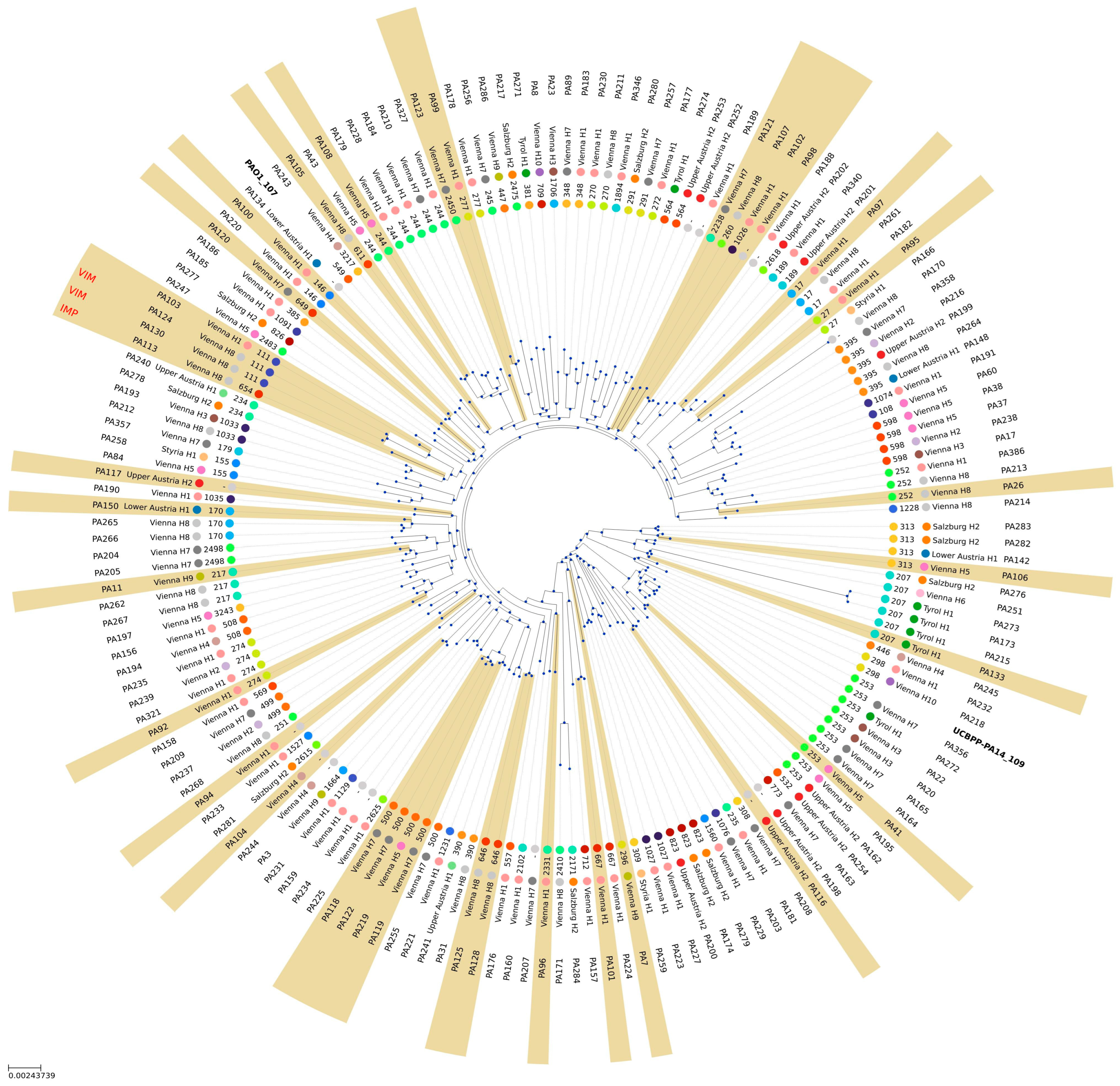
Of the 621 P. aeruginosa isolates included in this study, 181 were subjected to whole-genome sequencing, and only 165 of those were revealed to be P. aeruginosa. Figure 1 illustrates the phylogenetic relatedness of these 165 clinical isolates. We observed a broad distribution of P. aeruginosa MLST types across the population and the Austrian provinces, with carbapenem-resistant isolates dispersed throughout the phylogenetic tree.
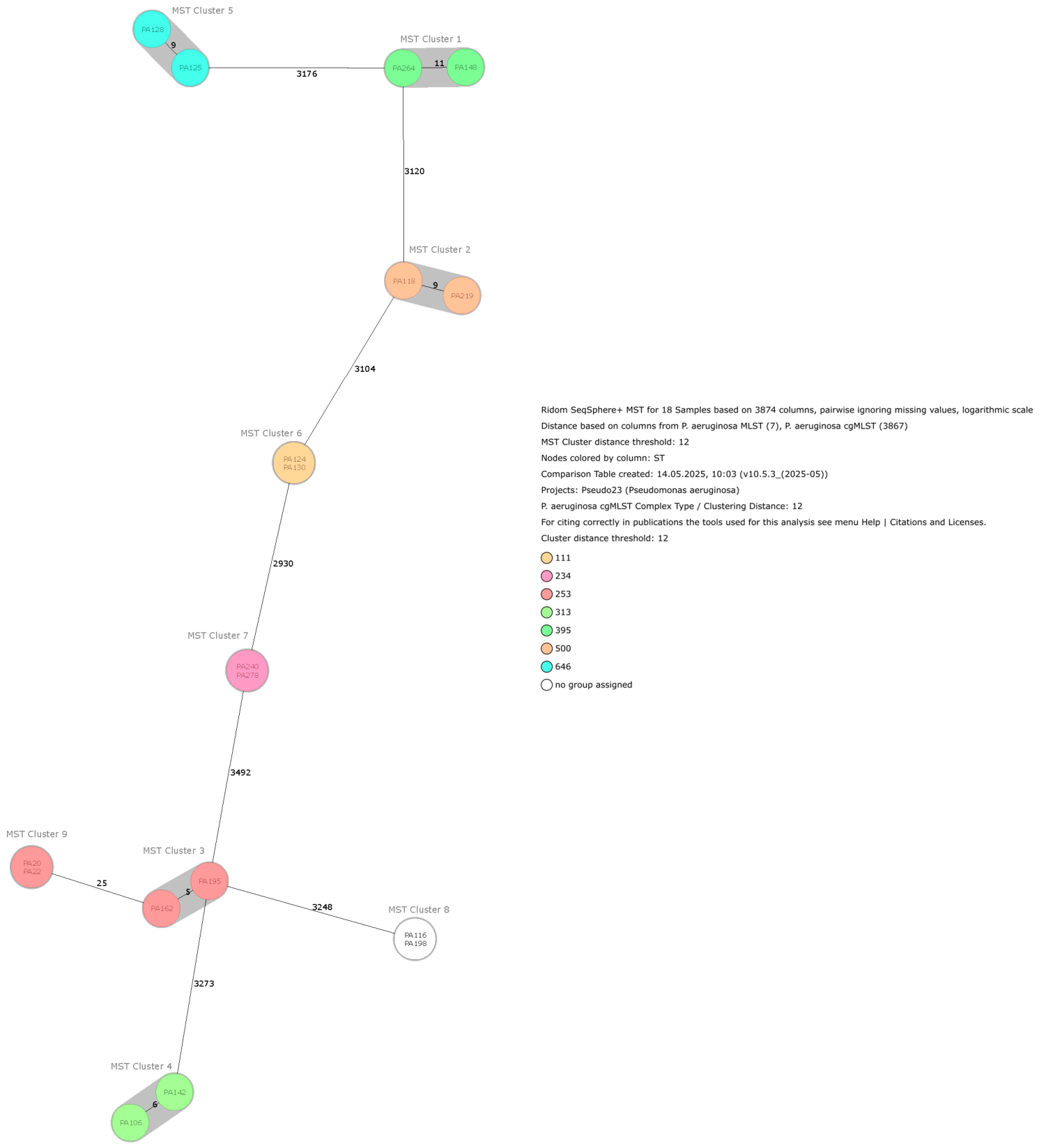
Application of AMRFinderPlus on the whole-genome sequencing data confirmed the results of the immunochromatographic test and identified three isolates carrying acquired β-lactamases: two harboring a VIM and one carrying an IMP carbapenemase-encoding gene. The two VIM-positive isolates were phylogenetically closely related and originated from patients within the same hospital. In addition to the two closely related VIM-positive isolates, we identified eight further clusters using the SeqSphere+ software version 12, each comprising two closely related isolates. Figure 2 shows the minimum spanning tree, including SNP distances between and among these nine pairs of closely related isolates. Table S1 contains the MST cluster description including the number of patients per cluster (n = 2), isolate identification code within the MST cluster, sequence (ST) type, cluster (CT) type, type of hospital admission of the patient harboring the isolate (outpatient clinic = OC, general ward = GW, intensive care unit = ICU), and antibiotic resistance profile of the P. aeruginosa isolates. Clusters 6 (ST 111), 7 (ST 234), 8, and 9 (ST 253) always contained 2 patients harboring identical genotypes with no clustering distance at all, with patients from respective clusters 6, 8, and 9 being admitted to the same hospitals. MST cluster 6 (ST 111) contains the VIM-positive isolates. In contrast, patients belonging to cluster 7 had no geographical overlap within the same hospital during their admission. The two patients in cluster 5 (ST 146) were admitted to the same hospital within 6 days of each other, but were treated on different wards. Patients corresponding to clusters 1–4 (ST 395, 500, 253, and 313, respectively) were admitted to hospitals located in different provinces.

3. Discussion

Antimicrobial resistance to carbapenems among P. aeruginosa isolates from patients in Austrian community hospitals was low, particularly when compared with the 13.8% resistance rate reported by EARS-Net in 2024, which includes invasive isolates from hospitals nationwide [14]. Carbapenem use is a well-recognized driver of the emergence of carbapenem-resistant Enterobacterales [18]. Although antimicrobial stewardship programs have been shown to reduce overall antimicrobial consumption, their specific impact on carbapenem resistance remains uncertain [19]. In our study population, carbapenem resistance among P. aeruginosa isolates was low (5.41%), and carbapenemase genes were detected in only 0.48% of isolates. The molecular epidemiology analysis identified several internationally recognized P. aeruginosa high-risk clones, namely ST111, ST234, ST253, ST395, ST313, and ST146. These sequence types are of clinical and epidemiological interest because they are found to be associated with multidrug resistance, hospital outbreaks, persistence in healthcare environments, and the dissemination of carbapenemase genes [20].
Even though the detection of theses clones in some of our isolates supports the circulation of epidemic multidrug-resistant lineages in the study setting, overall, the sampled P. aeruginosa showed a high genetic diversity, excluding a single driving epidemic lineage in the included Austrian community hospitals. Only 4 of the 9 clusters were among patients of the same hospital. A nosocomial transmission is probable in at least one of the clusters, as the two patients were admitted to the same ward of the same hospital within 5 days of each other. In two other clusters, the two patients were admitted to the same hospital but on separate wards and at least one month apart, and the last cluster, taking place in the same hospital, concerned an outpatient and an admitted patient with no likely overlap, thus making nosocomial transmissions very unlikely. As our study also includes isolates with indistinguishable genetic profiles despite the absence of documented hospital overlap among affected individuals, this finding raises the possibility of transmission pathways beyond direct healthcare-associated contact. In particular, community-based sources or indirect transmission routes—such as asymptomatic carriers or contaminated surfaces—may contribute to the observed genetic clustering. Even though a more detailed investigation of these potential links would strengthen the interpretation of transmission dynamics, a limitation of our study is that our data does not allow for this further analysis. Outbreak investigations are generally carried out by the mandatory infection control teams, even in community hospitals. However, the presence of only two isolates, coupled with the delayed availability of comprehensive antimicrobial susceptibility testing in the routine setting, will draw attention but may not justify immediate action or an investigation.
All hospitals included in this study have established antimicrobial stewardship programs, and data from the most recent Austrian point prevalence survey in 2023 indicate that carbapenem consumption in community hospitals remains low compared with tertiary care centers. This restricted use likely contributes to the very low prevalence of carbapenemase-producing CR-PA observed in our cohort.
Overall, the coexistence of several high-risk clones in our study is an important finding because it reflects the circulation of internationally disseminated multidrug-resistant lineages with significant epidemic potential. However, epidemiologically linked cases were confined to individual hospitals, with no evidence of dominant clones spreading across multiple hospitals or Austrian provinces. The heterogeneous distribution observed in our dataset may reflect some local selective pressures, such as differences in antibiotic use and infection control practices. These results emphasize the importance of continuous molecular surveillance and infection-control strategies to limit the spread of these clinically relevant clones.
CR-PA presents a challenge when it comes to antibiotic treatment, and carbapenemase production even more so [10]. Carbapenemase production can significantly alter not only the efficacy of conventionally used antipseudomonal antibiotic agents but also the efficacy of newly introduced beta-lactam/beta-lactamase inhibitor combinations advertised for use against P. aeruginosa, such as ceftolozane–tazobactam, imipenem–relebactam, and ceftazidime–avibactam [21]. In our study, we found unexpected resistance to ceftolozane–tazobactam and ceftazidime–avibactam among the 36 CR-PA isolates. Thus, to ensure their continued efficacy, either routinely assessing the susceptibility of CR-PA to newly introduced β-lactam/β-lactamase inhibitor combinations or periodically assessing all P. aeruginosa isolates, particularly in community hospitals, is essential even within standard clinical settings. Due to improved diagnostic and therapeutic options, as well as the outsourcing of patients to outpatient care, we see a general increase in vulnerable patient groups among hospital admissions [7]. Therefore, infections due to CR-PA are likely to become more frequent. Treatment failure due to unrecognized antibiotic resistance among CR-PA will furtively increase, leading to early treatment failure and inevitably to rising infection control challenges pertaining to healthcare-associated infection transmission and multidrug-resistant microorganisms.
Knowing the percentage of carbapenemase producers among CR-PA is crucial for clinical, epidemiological, and public health reasons. It will help infection control personnel in hospitals identify high-risk isolates, leading to the implementation of enhanced infection control measures, including targeted screening and containment. Combining both phenotypic and genotypic laboratory methods may help shorten time to identify these multidrug-resistant microorganisms and improve therapeutic options. Additionally, early detection of clusters and transmission chains within and outside the hospital setting will improve infection transmission prevention and detect potential public health threats. Therefore, from a public health point of view, the surveillance of the proportion of Ccarbapenemase-positive CR-PA helps monitor regional and global trends, detect early emerging threats or outbreaks, and finally inform policy decisions on antimicrobial stewardship.

4. Materials and Methods

4.1. Hospital Recruitment

The National Reference Center for Healthcare-Associated Infections and Infection Control (NRCHAIIC) is hosted by the Department of Infection Control and Hospital Epidemiology of the Medical University of Vienna, which has been running the national Austrian Nosocomial Infection Surveillance System (ANISS) since 2008. As such, it is responsible for coordinating the biannual point prevalence survey (PPS) on HAI in acute care hospitals, compiling the data of approximately 100 participating Austrian hospitals according to protocols from the European Centre for Disease Prevention and Control (ECDC) [22]. All network hospitals were contacted to take part in this multicenter study using the ECDC PPS criteria for national sample representativeness. We aimed to include 30 community hospitals to achieve good coverage across Austria [23].

4.2. Patients and Samples

The microbiological laboratories of participating hospitals were asked to collect all P. aeruginosa isolates from any type of clinical specimen (e.g., rectal swab, blood, respiratory samples) obtained from included patients (inclusion criteria for the study were being a male or female patient aged 18–99 years) receiving in- or outpatient care at the respective hospital over a period of three months (April to June 2024). Only the first P. aeruginosa culture episode per patient was included for further analysis, unless additional isolates of the same patient showed newly acquired resistance patterns (e.g., development of AMR under antimicrobial therapy) on the basis of broth microdilution testing.

4.3. Clinical Epidemiological Data

All electronic medical records of patients with CR-PA were reviewed. For patients with an infection caused by CR-PA, the following additional data was recorded using a questionnaire: (1) age and sex, (2) McCabe score, (3) clinical specimen where CR-PA was detected (e.g., blood), (4) diagnosis, (5) comorbidities, (6) antimicrobial treatment, and (7) length of hospital stay and outcome (discharged alive or in-hospital death). The severity of disease was evaluated using the Mc Cabe Score [24].

4.4. Data Collection and Statistical Analysis

Each isolate was allocated a consecutive study number and thereby pseudo-anonymized. Different isolates pertaining to the same patient received an additional unique identifier (e.g., letters of the alphabet). The study number was noted on the questionnaire, and the microbiological sample sent to us. Results of microbiological analyses and additional clinical patient data, if an infection with CR-PA was present, were compiled in an excel sheet. Only authorized persons, i.e., the investigator and the study staff, had access to the original data. Only aggregated data was provided to the sponsor.
Descriptive statistical data analysis was performed using SPSS Statistics 31.0 (IBM Corp, Armonk, NY, USA).

4.5. Antimicrobial Resistance Analysis

P. aeruginosa isolates were identified using standard microbiological methodology. eSwab™ swabs (Copan Liquid Amies Elution Swab, Hain Lifescience GmbH, Nehren, Germany) were used to transport specimens. Prior to and following analysis, the P. aeruginosa isolates were preserved in a bacterial storage system (MastGroup Diagnostica GmbH, Reinfeld, Germany). Upon receipt, the samples were re-cultured and the species was confirmed by standard microbiological techniques.
Antimicrobial susceptibility testing was performed according to EUCAST guidelines [25]. EUCAST breakpoints were used to define resistance profiles and were interpreted to assign microorganisms to “Multidrug-resistant gram-negative (MRGN)” categories according to the criteria of the German Commission for Hospital Hygiene and Infection Prevention (KRINKO). This classification defines MRGN organisms as gram-negative bacteria resistant to three or four of four key antibiotic classes. Bacteria resistant to three (3MRGN) or four (4MRGN) of the following antibiotic groups were defined as MRGN: acylureidopenicillins (e.g., piperacillin), third-generation cephalosporins (e.g., cefotaxime or ceftazidime), fluoroquinolones (e.g., ciprofloxacin), and carbapenems (e.g., meropenem or imipenem). For MRGN classification, antimicrobial susceptibility testing of all isolates was performed using Mastdisks AST (MastGroup Ltd., Bootle, UK). Two Mueller–Hinton agar plates per isolate were used. The following antibiotic disks (concentration in µg; abbreviation) were tested: Plate 1 included piperacillin (30; PRL), ceftazidime (10; CAZ), cefepime (30; CPM), imipenem (10; IMI), meropenem (10; MEM), and ciprofloxacin (5; CIP). Further testing on plate 2 included ceftolozane–tazobactam (30/10; C/T), ceftazidime–avibactam (10/4; CZA), cefiderocol (30; FDC), and imipenem–relebactam (10/25; IMR). The plates were incubated aerobically at 35 ± 1 °C for 18 h. Inhibition zone diameters were measured in millimeters and interpreted according to EUCAST clinical breakpoints as susceptible (S), susceptible increased exposure (I), or resistant (R).

4.6. Minimum Inhibitory Concentration (MIC)

A total of 181 out of 621 clinical and screening non-repeat study isolates, including all CR-PA isolates, were selected for further MIC analysis. The selection process aimed to ensure that the sequenced subset represented the overall diversity of the study collection. Therefore, antimicrobial resistance profiles, as well as the regional and temporal distribution of the P. aeruginosa isolates, were taken into account when choosing isolates for sequencing. For the selected 181 isolates, 4MRGN (n = 36), 3MRGN (n = 37) and susceptible (n = 108), the susceptibility test was verified and completed by the MIC method, using MICRONAUT-S Labor Berlin MDR MIC-GN 2 microplates (SF-M/E1-349-100) and Mueller–Hinton Broth, cation-adjusted (CAMHB) (Bruker Daltonics GmbH & Co. KG, Bremen, Germany). Subsequently, the results were read and recorded using the microplate absorbance reader Sunrise (Tecan GmbH, Grödig, Austria). The following antibiotics were tested by MIC: amikacin, aztreonam, aztreonam/avibactam (RUO), cefepim, ceftazidim, ceftazidime/avibactam (RUO), tigecycline, ertapenem, fosfomycin, imipenem, imipenem/relebactam (RUO), meropenem, tigecycline, and tobramycin. For cefiderocol susceptibility testing, MIC determination was performed separately using UMIC Cefiderocol strips (UM-CID-040; Bruker Daltonics, Bremen, Germany) and iron-depleted CAMHB. Fresh bacterial colonies were suspended in sterile 0.9% saline and adjusted to 0.5 McFarland. Subsequently, the suspension was diluted in ID-CAMHB at a ratio of 1:200, and 100 µL of the inoculated broth were dispensed into each well of the UMIC strip. The strips were incubated in a humid environment under aerobic conditions at 35 ± 1 °C for 18 ± 2 h. MIC values were read visually.

4.7. Detection of Carbapenemase Production

Thirty-six isolates with increased MIC were analyzed for the presence of KPC, NDM, IMP, VIM, and OXA-48 carbapenemases. This analysis was conducted using the Carbapenem-resistant K.N.I.V.O. Detection K-Set (Lateral Flow Assay) (Era Biology Group, Tianjin, China).

4.8. Molecular Typing Using Whole Genome Sequencing (WGS)

The 181 out of 621 study isolates selected for the MIC analysis were further analyzed using WGS. Antimicrobial resistance gene detection was performed using AMRFinderPlus on assembled whole genome sequences. Specifically, de novo genome assemblies generated with Shovill were used as input for AMRFinderPlus, which identifies acquired resistance genes and relevant chromosomal resistance determinants by comparison against the curated NCBI AMR reference database. In more detail: DNA extraction, Hackflex library preparation, and 150 bp paired-end sequencing on NextSeq 500 or NovaSeq 6000 sequencing systems was performed as previously described [26]. Raw reads were subjected to adapter trimming and quality filtering using BBTools v38.93 [27] to remove sequencing adapters and low-quality bases. Taxonomic classification was performed with Kraken2 v2.1.2 [28], which applies an exact k-mer matching strategy against a reference database for read-level assignment, and only samples consistent with P. aeruginosa were retained for further analysis. Sequencing achieved a median coverage of 122× with approximately one million reads per sample. Additional quality control included assessment of assembly size (6.0–7.3 Mbp) and GC content (65–67%), consistent with reference P. aeruginosa genomes. Multilocus sequence types were determined using MLST v2.19.0 [29] with PubMLST schemes. De novo assemblies were generated using Shovill v1.1.0 [30], which integrates SPAdes [31] for short-read genome assembly. Genome annotation was performed using Prokka v1.14.6 [32] to predict coding sequences, ribosomal RNA genes, transfer RNAs, and additional genomic elements. The phylogeny of the sequenced P. aeruginosa strains was inferred from their assembled genomes using Mashtree v1.4.6 [33]. Tree visualization was performed with the ete3 toolkit v3.1.3 for python [34].
WGS data interpretation and outbreak analysis were additionally performed using Ridom SeqSphere+, applying a predefined cluster threshold of <12 allelic differences and constructing minimum spanning trees (MSTs).

5. Conclusions

Resistance to carbapenems due to the presence of carbapenemases is yet very low in Austrian community hospitals. The absence of interhospital clonal dominance suggests that carbapenem resistance emerged independently in different centers, likely driven by local antibiotic selection pressures rather than regional clonal spread. However, given the worldwide emergence of resistance to broad-spectrum antibiotics, easy availability of comprehensive susceptibility testing and periodical surveillance for the presence and types of carbapenemases in P. aeruginosa isolates are warranted as an early indicator of emerging antimicrobial resistance in community hospitals.

Supplementary Materials

The following supporting information can be downloaded at: https://www.mdpi.com/article/10.3390/antibiotics15050516/s1, Figure S1: Selection workflow for Pseudomonas aeruginosa isolates analyzed in the current study. Table S1: MST cluster description including number of patients.

Author Contributions

M.D.-E. and E.P. were equal participants in the concept, design, collection, and analysis of the data, and both authors contributed to preparing the first and all subsequent drafts of the manuscript. S.H. and T.K. performed the whole genome and phylogenetic analysis, providing comprehensive data and insights critical to the study. The PSPS Working Group for their contribution of the epidemiological data for this study. All authors have read and agreed to the published version of the manuscript.

Funding

This research was supported by a Pfizer General Research Grant 77569751 (10 July 2023) and the Deutsche Forschungsgemeinschaft (DFG, German Research Foundation) under Germany’s Excellence Strategy—EXC 2155 “RESIST”—Project ID 390874280. S.H. received funding within the SFB/TRR-298-SIIRI—Project-ID 426335750, and from the Novo Nordisk Foundation (NNF 18OC0033946).

Institutional Review Board Statement

This study was performed in accordance with the ethical standards as laid down in the 1964 Declaration of Helsinki and its later amendments and was approved by the institutional ethical review board of the Medical University of Vienna (EK Nr.: 1207/2023, date: 8 March 2023).

Informed Consent Statement

Patient consent was waived by the institutional ethical review board of the Medical University of Vienna (EK Nr.: 1207/2023) due to the study being an epidemiological study without personal involvement of human participants. Only basic aggregated epidemiological data of human participants was used, and no human participant can be identified.

Data Availability Statement

The original data presented in this study have been deposited in GenBank with links to BioProject accession number PRJNA1452886.

Acknowledgments

PSPS Working Group: Jutta Berger, Regina Breinbauer, Martina Dostal, Karin Feuchter, Monika Gilhofer, Christoph Gradnig, Markus Hell, Monika Janka, Sonja Joachimbauer, Silvia Kasper, Andreas Kiendler, Dieter Mitteregger, Barbara Oehlinger, Bettina Penniger, Thomas Platter, Peter Roland, Richard Rosar, Doris Schank, Verena Schliesser, Josef Schnell, Heidelinde Schöll, Christian Steiner, Brigitte Stoiser, Maria Wolf-Lechner. The authors would like to thank Julia Willesberger for her diligent technical assistance with laboratory experiments and maintenance. We also acknowledge and thank the infection prevention and control teams of the participating hospitals A.ö. BKH Lienz, A.ö. Krankenhaus St, Josef Braunau, Herz-Jesu Krankenhaus, Kardinal Schwarzenberg Klinikum, Klinik Diakonissen Schladming, Klinik Floridsdorf, Klinik Landstrasse, Krankenhaus Bamherzige Schwestern Wien, Krankenhaus Göttlicher Heiland, Krankenhaus Hietzing mit NRZ, Landesklinikum Scheibbs, Orthopädisches Spital Speising, Privatklinik Rudolfinerhaus, Salzkammergut Klinikum Bad Ischl, Sankt Josef Krankenhaus Wien, UKH Salzburg, Wiener Privatklinik for their contribution of the epidemiological data for this study.

Conflicts of Interest

The authors declare no conflicts of interest. The funders had no role in the design of the study; in the collection, analyses, or interpretation of data; in the writing of the manuscript; or in the decision to publish the results.

Abbreviations

The following abbreviations are used in this manuscript:
CR-PA Carbapenem-resistant Pseudomonas aeruginosa
HAIHospital-acquired infection
IPCInfection prevention and control
PPSPoint prevalence survey
VAPVentilator associated pneumonia

References

  1. European Centre for Disease Prevention and Control. Point Prevalence Survey of Healthcare-Associated Infections and Antimicrobial Use in European Acute Care Hospitals; ECDC: Stockholm, Sweden, 2024. [Google Scholar]
  2. Yuan, Q.; Zhu, W.; Yuan, Z.; Zeng, O. Joint surveillance and correlation analysis of antimicrobial resistance and consumption of seven targeted bacteria, 2017–2023. Sci. Rep. 2025, 15, 31381. [Google Scholar] [CrossRef]
  3. Salm, F.; Deja, M.; Gastmeier, P.; Kola, A.; Hansen, S.; Behnke, M.; Gruhl, D.; Leistner, R. Prolonged outbreak of clonal MDR Pseudomonas aeruginosa on an intensive care unit: Contaminated sinks and contamination of ultra-filtrate bags as possible route of transmission? Antimicrob. Resist. Infect. Control 2016, 5, 53. [Google Scholar] [CrossRef]
  4. Tissot, F.; Blanc, D.; Basset, P.; Zanetti, G.; Berger, M.; Que, Y.-A.; Eggimann, P.; Senn, L. New genotyping method discovers sustained nosocomial Pseudomonas aeruginosa outbreak in an intensive care burn unit. J. Hosp. Infect. 2016, 94, 2–7. [Google Scholar] [CrossRef]
  5. Tsao, H.F.; Scheikl, U.; Herbold, C.; Indra, A.; Walochnik, J.; Horn, M. The cooling tower water microbiota: Seasonal dynamics and co-occurrence of bacterial and protist phylotypes. Water Res. 2019, 159, 464–479. [Google Scholar] [CrossRef] [PubMed] [PubMed Central]
  6. Antoniu, S. Novel inhaled combined antibiotic formulations in the treatment of Pseudomonas aeruginosa airways infections in cystic fibrosis. Expert Rev. Anti Infect. Ther. 2015, 13, 897–905. [Google Scholar] [CrossRef] [PubMed]
  7. Wolford, H.; McCarthy, N.L.; Baggs, J.; Hatfield, K.M.; Maillis, A.; Olubajo, B.; Bishop, J.; Ferretti, M.; Craig, M.R.; Magill, S.S.; et al. Antimicrobial-Resistant Infections in Hospitalized Patients. JAMA Netw. Open 2025, 8, e2462059. [Google Scholar] [CrossRef] [PubMed]
  8. National Nosocomial Infections Surveillance System. System Report, data summary from January 1992 through June 2004, issued October 2004. Am. J. Infect. Control 2004, 32, 470–485. [CrossRef]
  9. Thoming, J.G.; Haussler, S. Transcriptional Profiling of Pseudomonas aeruginosa Infections. Adv. Exp. Med. Biol. 2022, 1386, 303–323. [Google Scholar] [PubMed]
  10. Kitaya, S.; Kanamori, H.; Katori, Y.; Tokuda, K. Impact of Persistent Multidrug-Resistant Gram-Negative Bacteremia on Clinical Outcome and Mortality. Antibiotics 2023, 12, 313. [Google Scholar] [CrossRef]
  11. Al-Orphaly, M.; Hadi, H.A.; Eltayeb, F.K.; Al-Hail, H.; Samuel, B.G.; Sultan, A.A.; Skariah, S. Epidemiology of Multidrug-Resistant Pseudomonas aeruginosa in the Middle East and North Africa Region. mSphere 2021, 6, e00202-21. [Google Scholar] [CrossRef]
  12. Horcajada, J.P.; Montero, M.; Oliver, A.; Sorlí, L.; Luque, S.; Gómez-Zorrilla, S.; Benito, N.; Grau, S. Epidemiology and Treatment of Multidrug-Resistant and Extensively Drug-Resistant Pseudomonas aeruginosa Infections. Clin. Microbiol. Rev. 2019, 32, e00031-19. [Google Scholar] [CrossRef]
  13. Wang, M.-G.; Liu, Z.-Y.; Liao, X.-P.; Sun, R.-Y.; Li, R.-B.; Liu, Y.; Fang, L.-X.; Sun, J.; Liu, Y.-H.; Zhang, R.-M. Retrospective Data Insight into the Global Distribution of Carbapenemase-Producing Pseudomonas aeruginosa. Antibiotics 2021, 10, 548. [Google Scholar] [CrossRef] [PubMed]
  14. European Centre for Disease Prevention and Control. Surveillance Atlas of Infectious Diseases; ECDC: Stockholm, Sweden, 2023; Available online: https://atlas.ecdc.europa.eu/public/index.aspx (accessed on 5 February 2026).
  15. Davies, T.A.; Marie Queenan, A.; Morrow, B.J.; Shang, W.; Amsler, K.; He, W.; Lynch, A.S.; Pillar, C.; Flamm, R.K. Longitudinal survey of carbapenem resistance and resistance mechanisms in Enterobacteriaceae and non-fermenters from the USA in September 2007. J. Antimicrob. Chemother. 2011, 66, 2298–2307. [Google Scholar] [CrossRef] [PubMed]
  16. Hirsch, E.B.; Tam, V.H. Impact of multidrug-resistant Pseudomonas aeruginosa infection on patient outcomes. Expert Rev. Pharmacoecon. Outcomes Res. 2010, 10, 441–451. [Google Scholar] [CrossRef]
  17. Tenover, F.C.; Nicolau, D.P.; Gill, C.M. Carbapenemase-producing Pseudomonas aeruginosa–an emerging challenge. Emerg. Microbes Infect. 2022, 11, 811–814. [Google Scholar] [CrossRef]
  18. Richter, S.E.; Miller, L.; Needleman, J.; Uslan, D.Z.; Bell, D.; Watson, K.; Humphries, R.; McKinnell, J.A. Risk Factors for Development of Carbapenem Resistance Among Gram-Negative Rods. Open Forum Infect. Dis. 2019, 6, ofz027. [Google Scholar] [CrossRef]
  19. López-Viñau, T.; Peñalva, G.; García-Martínez, L.; Castón, J.J.; Muñoz-Rosa, M.; Cano, Á.; Recio, M.; Cisneros, J.M.; Pérez-Nadales, E.; Rumbao Aguirre, J.; et al. Impact of an Antimicrobial Stewardship Program on the Incidence of Carbapenem Resistant Gram-Negative Bacilli: An Interrupted Time-Series Analysis. Antibiotics 2021, 10, 586. [Google Scholar] [CrossRef]
  20. Del Barrio-Tofiño, E.; López-Causapé, C.; Oliver, A. Pseudomonas aeruginosa epidemic high-risk clones and their association with horizontally-acquired β-lactamases: 2020 update. Int. J. Antimicrob. Agents 2020, 56, 106196. [Google Scholar] [CrossRef] [PubMed]
  21. Sartori, M.; Toppo, S.; Lavezzo, E. Molecular resistance mechanisms to newly approved antibiotics (2017–2025) in WHO priority pathogens. Front. Microbiol. 2026, 16, 1719798. [Google Scholar] [CrossRef]
  22. European Centre for Disease Prevention and Control. Healthcare-Associated Infections Surveillance Network (HAI-Net). Available online: https://www.ecdc.europa.eu/en/about-us/partnerships-and-networks/disease-and-laboratory-networks/hai-net (accessed on 10 November 2022).
  23. European Centre for Disease Prevention and Control. Sample Size Guidance for Surveillance Data; ECDC: Stockholm, Sweden, July 2023; ISBN 978-92-9498-645-0. [Google Scholar] [CrossRef]
  24. McCabe, W.R.; Jackson, G.G. Gram-negative bacteremia. I. Etiology and ecology. Arch. Intern. Med. 1962, 110, 847–853. [Google Scholar] [CrossRef]
  25. European Committee on Antimicrobial Susceptibility Testing. EUCAST. Available online: https://www.eucast.org/bacteria/guidance-documents/ (accessed on 27 February 2026).
  26. Gaio, D.; Anantanawat, K.; To, J.; Liu, M.; Monahan, L.; Darling, A.E. Hackflex: Low-cost, high-throughput, Illumina Nextera Flex library construction. Microb. Genom. 2022, 8, 000744. [Google Scholar] [CrossRef]
  27. Bushnell, B. BBTools: A Suite of Fast, Multithreaded Bioinformatics Tools. 2014. Available online: https://sourceforge.net/projects/bbmap/ (accessed on 27 February 2026).
  28. Wood, D.E.; Lu, J.; Langmead, B. Improved metagenomic analysis using Kraken 2. Genome Biol. 2019, 20, 257. [Google Scholar] [CrossRef] [PubMed]
  29. Seemann, T. MLST: Scan Contig Files Against PubMLST Typing Schemes. 2020. Available online: https://github.com/tseemann/mlst (accessed on 27 February 2026).
  30. Seemann, T. Shovill Github. 2016. Available online: https://github.com/tseemann/shovill (accessed on 27 February 2026).
  31. Bankevich, A.; Nurk, S.; Antipov, D.; Gurevich, A.A.; Dvorkin, M.; Kulikov, A.S.; Lesin, V.M.; Nikolenko, S.I.; Pham, S.; Prjibelski, A.D.; et al. SPAdes: A new genome assembly algorithm and its applications to single-cell sequencing. J. Comput. Biol. 2012, 19, 455–477. [Google Scholar] [CrossRef]
  32. Seemann, T. Prokka: Rapid annotation of prokaryotic genomes. Bioinformatics 2014, 30, 2068–2069. [Google Scholar] [CrossRef]
  33. Katz, L.; Griswold, T.; Morrison, S.; Caravas, J.; Zhang, S.; Bakker, H.; Deng, X.; Carleton, H. Mashtree: A rapid comparison of whole genome sequence files. J. Open Source Softw. 2019, 4, 1762. [Google Scholar] [CrossRef]
  34. Huerta-Cepas, J.; Serra, F.; Bork, P. ETE 3: Reconstruction, Analysis, and Visualization of Phylogenomic Data. Mol. Biol. Evol. 2016, 33, 1635–1638. [Google Scholar] [CrossRef] [PubMed]
Figure 1. Phylogenetic tree of the sequenced P. aeruginosa strains and reference strains based on k-mer usage. If applicable, additional information about hospital of origin, MLST, and presence of carbapenemases (VIM, IMP) was added, and 4-MGRN isolates were indicated in light brown.
Antibiotics 15 00516 g001
Figure 2. Minimum Spanning Tree for 19 P. aeruginosa samples based on 3874 columns, using pairwise distances while ignoring missing values and logarithmic scaling. The distance matrix was calculated using P. aeruginosa MLST (7 loci) and cgMLST (3867 loci). Sequence types (STs) and complex types (CTs) were assigned, with CTs used for cluster analysis and epidemiological investigation. WGS data interpretation and outbreak analysis were performed using Ridom SeqSphere+, applying a predefined cluster threshold of <12 allelic differences and constructing minimum spanning trees (MSTs). Nodes are colored according to Sequence Type (ST), and clusters are colored in grey.
Antibiotics 15 00516 g002
Table 1. Summary of structural capacity and utilization data for 17 participating Austrian hospitals.
Hospital IDTotal Number of BedsNumber of General Care Beds/Intensive Care BedsAdmissions/YearPatient Days/Year
A183177/6837346,919
B10431023/2027,173224,308
C138126/12490524,499
D280274/616,04460,142
E233227/6915548,129
F156156/012,03436,052
G183183/0879245,699
H284254/1612,84576,728
I226220/615,76554,928
J382366/1617,677101,131
K645625/2023,494152,237
L106100/6570819,548
M748672/4025,875247,947
N364353/1114,94174,819
O505480/2525,735109,541
P145145/0735132,127
Q215209/616,87765,601
Table 2. Demographic data and clinical characteristics of the study population.
VariablesPatients (n)Patients (%)
Gender
male30654.64%
female25445.36%
Age
<1871.25%
18–24173.04%
25–34335.89%
35–44295.18%
45–54325.71%
55–64549.64%
65–7411220%
75–8418232.5%
≥859316.61%
McCabe Score
Non-fatal21638.57%
Ultimately fatal14325.54%
Rapidly fatal 346.07%
unknown15828.21%
Patient receives antimicrobial therapy
Yes36064.29%
no20035.71%
Table 4. Demographic data and clinical characteristics of the 36 patients with CR-PA isolates.
VariablesPatients (n)Patients (%)
Gender
Male2569.44%
Female1130.56%
Age
18–2400%
25–3438.33%
35–44513.89%
45–5412.78%
55–64411.11%
65–741130.56%
75–84925%
≥8538.33%
McCabe Score
Non-fatal disease1336.11%
Ultimately fatal disease1233.33%
Rapidly fatal disease38.33%
unknown822.22%
Disclaimer/Publisher’s Note: The statements, opinions and data contained in all publications are solely those of the individual author(s) and contributor(s) and not of MDPI and/or the editor(s). MDPI and/or the editor(s) disclaim responsibility for any injury to people or property resulting from any ideas, methods, instructions or products referred to in the content.