Real-World Experience on the Use of Eravacycline at Doses of 1 mg/kg Bodyweight and Fixed Dose Strategy in Two European Tertiary Centers

 , , ,
, , ,
Abstract
1. Introduction
2. Results
2.1. Pathogens and Infection Sites
2.2. Therapy
2.3. Outcome
3. Discussion
4. Limitations
5. Material and Methods
Statistical Analysis
6. Conclusions
Author Contributions
Funding
Institutional Review Board Statement
Informed Consent Statement
Data Availability Statement
Conflicts of Interest
References
- Alosaimy, S.; Abdul-Mutakabbir, J.C.; Kebriaei, R.; Jorgensen, S.C.J.; Rybak, M.J. Evaluation of Eravacycline: A Novel Fluorocycline. Pharmacotherapy 2020, 40, 221–238. [Google Scholar] [CrossRef]
- Xiao, X.Y.; Hunt, D.K.; Zhou, J.; Clark, R.B.; Dunwoody, N.; Fyfe, C.; Grossman, T.H.; O’bRien, W.J.; Plamondon, L.; Rönn, M.; et al. Fluorocyclines. 1. 7-fluoro-9-pyrrolidinoacetamido-6-demethyl-6-deoxytetracycline: A potent, broad spectrum antibacterial agent. J. Med. Chem. 2012, 55, 597–605. [Google Scholar] [CrossRef]
- Rusu, A.; Buta, E.L. The Development of Third-Generation Tetracycline Antibiotics and New Perspectives. Pharmaceutics 2021, 13, 2085. [Google Scholar] [CrossRef] [PubMed]
- Zhanel, G.G.; Cheung, D.; Adam, H.; Zelenitsky, S.; Golden, A.; Schweizer, F.; Gorityala, B.; Lagacé-Wiens, P.R.S.; Walkty, A.; Gin, A.S.; et al. Review of Eravacycline, a Novel Fluorocycline Antibacterial Agent. Drugs 2016, 76, 567–588. [Google Scholar] [CrossRef] [PubMed]
- European Medicines Agency (EMA). Tygacil|European Medicines Agency (EMA). 4 April 2007. Available online: https://www.ema.europa.eu/en/medicines/human/EPAR/tygacil (accessed on 2 September 2024).
- Haeili, M.; Aghajanzadeh, M.; Moghaddasi, K.; Omrani, M.; Ghodousi, A.; Cirillo, D.M. Emergence of transferable tigecycline and eravacycline resistance gene tet(X4) in Escherichia coli isolates from Iran. Sci. Rep. 2025, 15, 16581. [Google Scholar] [CrossRef]
- European Medicines Agency (EMA). Xerava, INN-Eravacycline. Available online: https://www.ema.europa.eu/en/medicines/human/EPAR/xerava (accessed on 2 September 2024).
- Solomkin, J.S.; Sway, A.; Lawrence, K.; Olesky, M.; Izmailyan, S.; Tsai, L. Eravacycline: A new treatment option for complicated intra-abdominal infections in the age of multidrug resistance. Future Microbiol. 2019, 14, 1293–1308. [Google Scholar] [CrossRef] [PubMed]
- Solomkin, J.; Evans, D.; Slepavicius, A.; Lee, P.; Marsh, A.; Tsai, L.; Sutcliffe, J.A.; Horn, P. Assessing the Efficacy and Safety of Eravacycline vs Ertapenem in Complicated Intra-abdominal Infections in the Investigating Gram-Negative Infections Treated With Eravacycline (IGNITE 1) Trial: A Randomized Clinical Trial. JAMA Surg. 2017, 152, 224–232. [Google Scholar] [CrossRef]
- Solomkin, J.S.; Gardovskis, J.; Lawrence, K.; Montravers, P.; Sway, A.; Evans, D.; Tsai, L. IGNITE4: Results of a Phase 3, Randomized, Multicenter, Prospective Trial of Eravacycline vs Meropenem in the Treatment of Complicated Intraabdominal Infections. Clin. Infect. Dis. 2019, 69, 921–929. [Google Scholar] [CrossRef]
- Kunz Coyne, A.J.; Alosaimy, S.; Lucas, K.; Lagnf, A.M.; Morrisette, T.; Molina, K.C.; DeKerlegand, A.; Schrack, M.R.; Kang-Birken, S.L.; Hobbs, A.L.; et al. Eravacycline, the first four years: Health outcomes and tolerability data for 19 hospitals in 5 U.S. regions from 2018 to 2022. Microbiol. Spectr. 2024, 12, e0235123. [Google Scholar] [CrossRef]
- McCarthy, M.W. Clinical Pharmacokinetics and Pharmacodynamics of Eravacycline. Clin. Pharmacokinet. 2019, 58, 1149–1153. [Google Scholar] [CrossRef]
- Luo, Z.; Liu, Z.; Lu, M.; Zhang, L.; Xu, Y.; Zhou, M. The efficacy and safety of eravacycline in the treatment of patients with pneumonia in respiratory departments: A real-world multicenter retrospective study. J. Glob. Antimicrob. Resist. 2025, 45, 196–201. [Google Scholar] [CrossRef]
- Solomkin, J.S.; Ramesh, M.K.; Cesnauskas, G.; Novikovs, N.; Stefanova, P.; Sutcliffe, J.A.; Walpole, S.M.; Horn, P.T. Phase 2, randomized, double-blind study of the efficacy and safety of two dose regimens of eravacycline versus ertapenem for adult community-acquired complicated intra-abdominal infections. Antimicrob. Agents Chemother. 2014, 58, 1847–1854. [Google Scholar] [CrossRef]
- Ji, X.W.; Mak, W.Y.; Xue, F.; Yang, W.-Y.; Kuan, I.H.-S.; Xiang, X.-Q.; Li, Y.; Zhu, X. Population pharmacokinetics and pulmonary modeling of eravacycline and the determination of microbiological breakpoint and cutoff of PK/PD. Antimicrob. Agents Chemother. 2025, 69, e0106524. [Google Scholar] [CrossRef] [PubMed]
- Scott, C.J.; Zhu, E.; Jayakumar, R.A.; Shan, G.; Viswesh, V. Efficacy of Eravacycline Versus Best Previously Available Therapy for Adults With Pneumonia Due to Difficult-to-Treat Resistant (DTR) Acinetobacter baumannii. Ann. Pharmacother. 2022, 56, 1299–1307. [Google Scholar] [CrossRef] [PubMed]
- Bassetti, M.; Vena, A.; Castaldo, N.; Righi, E.; Peghin, M. New antibiotics for ventilator-associated pneumonia. Curr. Opin. Infect. Dis. 2018, 31, 177–186. [Google Scholar] [CrossRef]
- FDA U.S. Food and Drug Administration. Xerava Prescribing Information. 2018. Available online: https://www.accessdata.fda.gov/drugsatfda_docs/label/2018/211109lbl.pdf (accessed on 24 October 2025).
- Dosing & Administration|XERAVA® (Eravacycline). Available online: https://www.xerava.com/dosing (accessed on 14 November 2025).
- Lee, Y.R.; Burton, C.E. Eravacycline, a newly approved fluorocycline. Eur. J. Clin. Microbiol. Infect. Dis. 2019, 38, 1787–1794. [Google Scholar] [CrossRef] [PubMed]
- Van Hise, N.; Petrak, R.M.; Skorodin, N.C.; Fliegelman, R.M.; Anderson, M.; Didwania, V.; Han, A.; Shah, K.; Chundi, V.; Hines, D.; et al. A Real-World Assessment of Clinical Outcomes and Safety of Eravacycline: A Novel Fluorocycline. Infect. Dis. Ther. 2020, 9, 1017–1028. [Google Scholar] [CrossRef] [PubMed]
- Alosaimy, S.; Molina, K.C.; Claeys, K.C.; Andrade, J.; Truong, J.; King, M.A.; Pullinger, B.M.; Huang, G.; Morrisette, T.; Lagnf, A.M.; et al. Early Experience With Eravacycline for Complicated Infections. Open Forum. Infect. Dis. 2020, 7, ofaa071. [Google Scholar] [CrossRef]
- Carlson, T.J.; Gonzales-Luna, A.J.; Garey, K.W. Fulminant Clostridioides difficile Infection: A Review of Treatment Options for a Life-Threatening Infection. Semin. Respir. Crit. Care Med. 2022, 43, 028–038. [Google Scholar] [CrossRef]
- Tsai, M.H.; Chen, C.L.; Chang, H.J.; Chuang, T.C.; Chiu, C.H. Antimicrobial activity of eravacycline and other comparative agents on aerobic and anaerobic bacterial pathogens in Taiwan: A clinical microbiological study. J. Glob. Antimicrob. Resist. 2024, 37, 93–99. [Google Scholar] [CrossRef]
- Prehn Jvan Reigadas, E.; Vogelzang, E.H.; Bouza, E.; Hristea, A.; Guery, B.; Krutova, M.; Norén, T.; Allerberger, F.; Coia, J.E.; Goorhuis, A. European Society of Clinical Microbiology and Infectious Diseases: 2021 update on the treatment guidance document for Clostridioides difficile infection in adults. Clin. Microbiol. Infect. 2021, 27, S1–S21. [Google Scholar] [CrossRef] [PubMed]
- Li, L.; Zinger, J.; Sassen, S.D.T.; Juffermans, N.P.; Koch, B.C.P.; Endeman, H. The relation between inflammatory biomarkers and drug pharmacokinetics in the critically ill patients: A scoping review. Crit. Care 2024, 28, 376. [Google Scholar] [CrossRef] [PubMed]


| Patient Characteristics | |
|---|---|
| Treatment center | n [%] |
| University of Udine | 15 [19.2] |
| Medical University of Vienna | 63 [80.8] |
| Treatment Unit | n [%] |
| Outpatient clinic | 1 [1.3] |
| Intensive care unit | 38 [48.7] |
| Ward | 39 [50] |
| Gender | n [%] |
| Male | 50 [64.1] |
| Female | 28 [35.9] |
| Age | Mean [SD] |
| 59.35 [17.4] | |
| Outcome | |
| n [%] | |
| Clinical cure | 51 [65.4] |
| Microbiological cure | 36 [46.2] |
| Source control | 38 [48.7] |
| Death | 13 [16.7] |
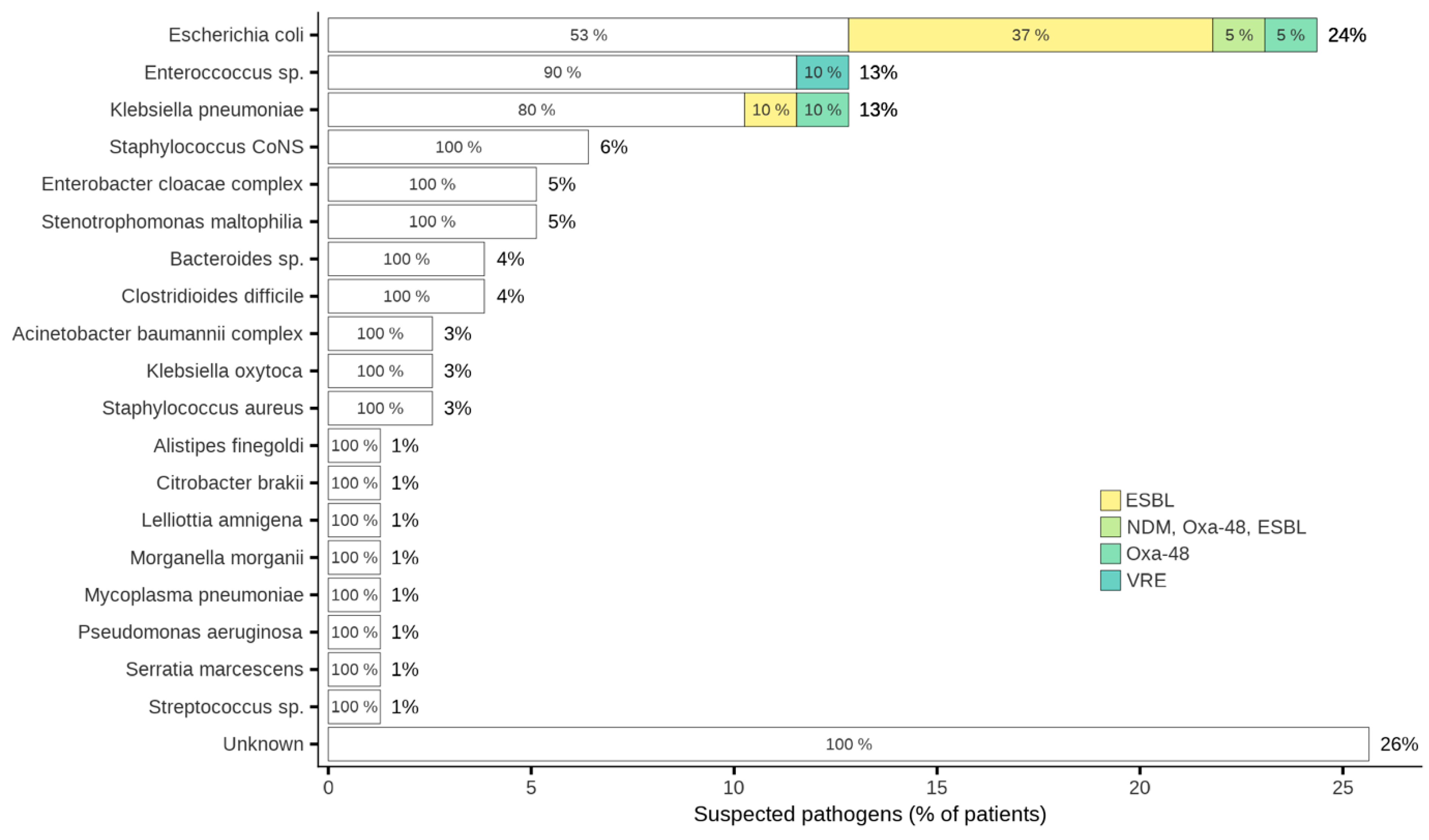
| Identified Pathogens | n | [%] |
|---|---|---|
| Escherichia coli | 19 | 24.3 |
| ESBL | 7/19 | |
| NDM, Oxa-48, ESBL | 1/19 | |
| Oxa-48 | 1/19 | |
| MRGN (not otherwise specified) | 1/19 | |
| Enteroccoccus spp. | 10 | 12.8 |
| VRE | 1/10 | |
| Klebsiella pneumoniae | 10 | 12.8 |
| ESBL | 1/10 | |
| 4 MRGN | 1/10 | |
| OXA48 | 1/10 | |
| Staphylococcus coagulase negative | 5 | 6.4 |
| Enterobacter cloacae complex | 4 | 5.1 |
| Stenotrophomonas maltophilia | 4 | 5.1 |
| Bacteroides spp. | 3 | 3.9 |
| Pseudomonas aeruginosa | 1 | 1.3 |
| 3-MRGN | 1/1 | |
| Staphylococcus aureus | 1 | 1.3 |
| MRSA | 1/1 | |
| Clostridioides difficile | 3 | 3.9 |
| Acinetobacter baumannii complex | 2 | 2.6 |
| 4-MRGN | 2/2 | |
| Citrobacter koseri | 1 | 1.3 |
| Klebsiella oxytoca | 2 | 2.6 |
| VIM | 1/2 | |
| Morganella morganii | 1 | 1.3 |
| Serratia marcescens | 1 | 1.3 |
| Streptococcus sp. | 1 | 1.3 |
| Alistipes finegoldi | 1 | 1.3 |
| Citrobacter brakii | 1 | 1.3 |
| Lelliottia amnigena | 1 | 1.3 |
| Mycoplasma pneumoniae | 1 | 1.3 |
| Unknown | 20 | 25.6 |
| Total Dose Per Day (mg) | n (%) | n (%) Vienna | n (%) Udine |
|---|---|---|---|
| 100 | 8 (10.26) | 6 (9.52) | 2 (13.33) |
| 120 | 2 (2.56) | 1 (1.59) | 1 (6.67) |
| 130 | 1 (1.28) | - | 1 (6.67) |
| 140 | 3 (3.85) | 1 (1.59) | 2 (13.33) |
| 150 | 7 (8.97) | 3 (4.76) | 4 (26.67) |
| 160 | 3 (3.85) | 1 (1.59) | 2 (13.33) |
| 170 | 1 (1.28) | 1 (1.59) | - |
| 180 | 3 (3.85) | - | 3 (20) |
| 200 | 44 (56.41) | 44 (69.84) | - |
| 240 | 1 (1.28) | 1 (1.59) | - |
| 300 | 5 (6.41) | 5 (7.94) | - |
| Dose per administration | n (%) | n (%) Vienna | n (%) Udine |
| 100 | 30 (38.46) | 30 (47.62) | - |
| 120 | 1 (1.28) | 1 (1.59) | - |
| 150 | 3 (3.85) | 3 (4.76) | - |
| 200 | 16 (20.51) | 16 (25.4) | - |
| 300 | 3 (3.85) | 3 (4.76) | - |
| 50 | 7 (8.97) | 5 (7.94) | 2 (13.33) |
| 60 | 2 (2.56) | 1 (1.59) | 1 (6.67) |
| 65 | 1 (1.28) | - | 1 (6.67) |
| 70 | 3 (3.85) | 1 (1.59) | 2 (13.33) |
| 75 | 5 (6.41) | 1 (1.59) | 4 (26.67) |
| 80 | 3 (3.85) | 1 (1.59) | 2 (13.33) |
| 85 | 1 (1.28) | 1 (1.59) | - |
| 90 | 3 (3.85) | - | 3 (20) |
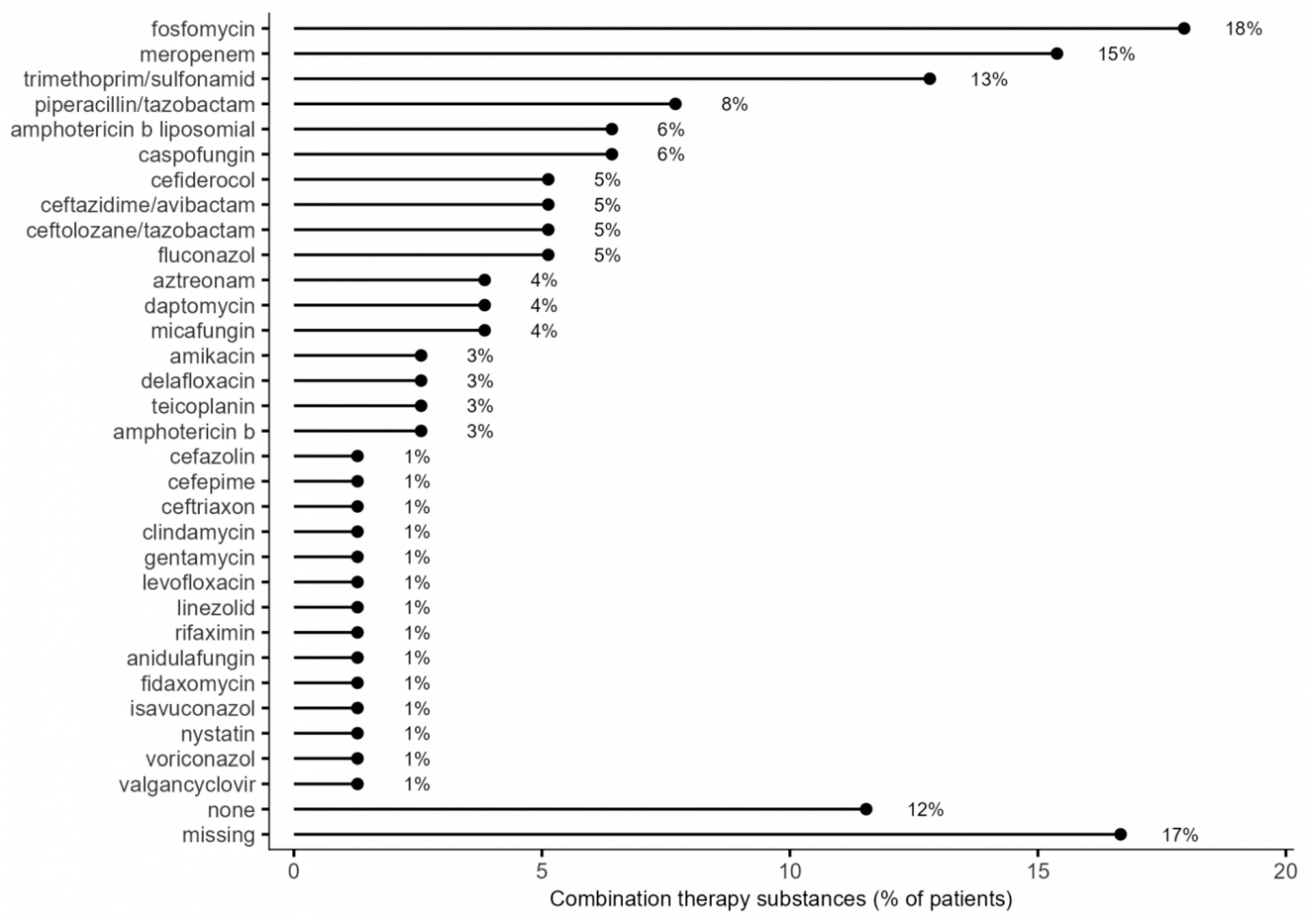
| Combination Therapy | n (%) |
|---|---|
| One combination partner | 29 (37.18) |
| PiperacillinTazobactam | 5 (6.41) |
| Fosfomycin | 4 (5.13) |
| Trimethoprim/Sulfonamid | 3 (3.84) |
| Cefiderocol | 2 (2.56) |
| Ceftazidime/Avibactam | 2 (2.56) |
| Ceftolozane/Tazobactam | 2 (2.56) |
| Daptomycin | 2 (2.56) |
| Meropenem | 2 (2.56) |
| Aztreonam | 1 (1.28) |
| Caspofungin | 1 (1.28) |
| Cefepime | 1 (1.28) |
| Ceftriaxon | 1 (1.28) |
| Delafloxacin | 1 (1.28) |
| Fluconazol | 1 (1.28) |
| Teicoplanin | 1 (1.28) |
| Two combination partners | 18 (23.08) |
| Amphotericin b liposomial and Meropenem | 2 (2.56) |
| Fosfomycin and Meropenem | 2 (2.56) |
| Fosfomycin and Trimethoprim/Sulfonamid | 2 (2.56) |
| Amphotericin b liposomial and Cefiderocol | 1 (1.28) |
| Amphotericin b liposomial and Ceftolozane/Tazobactam | 1 (1.28) |
| Anidulafungin and Cefiderocol | 1 (1.28) |
| Caspofungin and Ceftazidime/Avibactam | 1 (1.28) |
| Caspofungin and Linezolid | 1 (1.28) |
| Caspofungin and Trimethoprim/Sulfonamid | 1 (1.28) |
| Clindamycin and Fosfomycin | 1 (1.28) |
| Fluconazol and Fosfomycin | 1 (1.28) |
| Fosfomycin and Voriconazole | 1 (1.28) |
| Levofloxacin and Piperacillin/Tazobactam | 1 (1.28) |
| Meropenem and Teicoplanin | 1 (1.28) |
| Meropenem and Trimethoprim/Sulfonamid | 1 (1.28) |
| Three combination partners | 6 (7.69) |
| Amikacin, Amphotericin b and Nystatin | 1 (1.28) |
| Amphotericin b liposomial, Ceftolozane/Tazobactam and Meropenem | 1 (1.28) |
| Aztreonam, Fidaxomycin and Micafungin | 1 (1.28) |
| Aztreonam, Micafungin and Trimethoprim/Sulfonamid | 1 (1.28) |
| Fluconazol, Fosfomycin and Micafungin | 1 (1.28) |
| Daptomycin, Delafloxacin and Meropenem | 1 (1.28) |
| Four combination partners | 1 (1.28) |
| Fosfomycin, Isavuconazol, Trimethoprim/Sulfonamid and Valgancyclovir | 1 (1.28) |
| Six combination partners | 2 (2.56) |
| Amikacin, Cefazolin, Fluconazol, Fosfomycin, Gentamycin and Meropenem | 1 (1.28) |
| Amphotericin b, Caspofungin, Ceftazidime/Avibactam, Meropenem, Rifaximin and Trimethoprim/Sulfonamid | 1 (1.28) |
| Clinical Cure | Microbiological Cure | Death | ||||
|---|---|---|---|---|---|---|
| Variable | OR (95% CI) | p | OR (95% CI) | p | OR (95% CI) | p |
| Intensive care unit | 0.82 (0.66–1.03) | 0.088 | 1.13 (0.85–1.49) | 0.4 | 1 (0.8–1.25) | 0.996 |
| Source control | 1.7 (1.38–2.08) | <0.001 | 1.79 (1.38–2.31) | <0.001 | 0.82 (0.66–1.01) | 0.064 |
| Eravacycline Monotherapy | 0.92 (0.69–1.23) | 0.585 | 1.25 (0.89–1.77) | 0.208 | 0.99 (0.74–1.32) | 0.931 |
| Abdominal infection | 1.11 (0.92–1.34) | 0.293 | 0.91 (0.72–1.14) | 0.41 | 0.97 (0.8–1.18) | 0.779 |
| Positive blood culture | 1.02 (0.83–1.24) | 0.884 | 1.37 (1.08–1.74) | 0.013 | 1.08 (0.88–1.33) | 0.476 |
| Outcome, n (%) | All Patients (n = 78) | ICU (n = 38) | Ward/Outpatient (n = 40) | p | Intra-Abdominal (n = 35) | Off-Label (n = 43) | p | Positive Blood Culture (n = 24) | No Positive Blood Culture (n = 54) | p | Source Control (n = 38) | No Source Control (n = 38) | p |
|---|---|---|---|---|---|---|---|---|---|---|---|---|---|
| Clinical cure | 51 (65.4) | 18 (47.4) | 33 (82.5) | 0.002 | 24 (68.6) | 27 (62.8) | 0.768 | 17 (70.8) | 34(63) | 0.610 | 36 (94.7) | 14 (36.8) | <0.001 |
| Microbiological cure | 36 (46.2) | 16 (42.1) | 20 (50) | 0.159 | 15 (42.9) | 21 (48.8) | 0.905 | 18 (75) | 18 (33.3) | 0.150 | 25 (65.8) | 11 (28.9) | <0.001 |
| Source control | 38 (48.7) | 12 (31.6) | 26 (65) | 0.006 | 17 (48.6) | 21 (48.8) | 1.000 | 12 (50) | 26 (48.1) | 1.000 | - | - | - |
| Death | 13 (16.7) | 8 (21.1) | 5 (12.5) | 0.478 | 6 (17.1) | 7 (16.3) | 1.000 | 5 (20.8) | 8 (14.8) | 0.524 | 3 (7.9) | 10 (26.3) | 0.068 |
| Outcome, n (%) | Eravacycline Monotherapy (n = 9) | Any Kind of Combination (n = 56) | p-Value | 1 Combination Partner (n = 29) | 2 Combination Partners (n = 18) | ≥3 Combination Partners (n = 9) |
|---|---|---|---|---|---|---|
| Clinical cure | 7 (77.8) | 35 (62.5) | 0.47 | 19 (65.5) | 13 (72.2) | 3 (33.3) |
| Microbiological cure | 6 (66.7) | 25 (44.6) | 0.24 | 11 (37.9) | 10 (55.6) | 4 (44.4) |
| Source control | 6 (66.7) | 24 (42.9) | 0.29 | 11 (37.9) | 10 (55.6) | 3 (33.3) |
| Death | 1 (11.1) | 10 (17.9) | 1.00 | 7 (24.1) | 2 (11.1) | 1 (11.1) |
Disclaimer/Publisher’s Note: The statements, opinions and data contained in all publications are solely those of the individual author(s) and contributor(s) and not of MDPI and/or the editor(s). MDPI and/or the editor(s) disclaim responsibility for any injury to people or property resulting from any ideas, methods, instructions or products referred to in the content. |
© 2026 by the authors. Licensee MDPI, Basel, Switzerland. This article is an open access article distributed under the terms and conditions of the Creative Commons Attribution (CC BY) license.
Share and Cite
Oberreiter, K.; Moser, M.M.; Schneider, L.; Burgmann, H.; Moreal, C.; Giuliano, S.; Angelini, J.; Tascini, C.; Vossen, M.G. Real-World Experience on the Use of Eravacycline at Doses of 1 mg/kg Bodyweight and Fixed Dose Strategy in Two European Tertiary Centers. Antibiotics 2026, 15, 421. https://doi.org/10.3390/antibiotics15040421
Oberreiter K, Moser MM, Schneider L, Burgmann H, Moreal C, Giuliano S, Angelini J, Tascini C, Vossen MG. Real-World Experience on the Use of Eravacycline at Doses of 1 mg/kg Bodyweight and Fixed Dose Strategy in Two European Tertiary Centers. Antibiotics. 2026; 15(4):421. https://doi.org/10.3390/antibiotics15040421
Chicago/Turabian StyleOberreiter, Karin, Miriam M. Moser, Lisa Schneider, Heinz Burgmann, Chiara Moreal, Simone Giuliano, Jacopo Angelini, Carlo Tascini, and Matthias G. Vossen. 2026. "Real-World Experience on the Use of Eravacycline at Doses of 1 mg/kg Bodyweight and Fixed Dose Strategy in Two European Tertiary Centers" Antibiotics 15, no. 4: 421. https://doi.org/10.3390/antibiotics15040421
APA StyleOberreiter, K., Moser, M. M., Schneider, L., Burgmann, H., Moreal, C., Giuliano, S., Angelini, J., Tascini, C., & Vossen, M. G. (2026). Real-World Experience on the Use of Eravacycline at Doses of 1 mg/kg Bodyweight and Fixed Dose Strategy in Two European Tertiary Centers. Antibiotics, 15(4), 421. https://doi.org/10.3390/antibiotics15040421