Gut Microbiota and Acute Myeloid Leukemia: State of the Art, Clinical Signals, and Translational Opportunities

 , ,
, ,  , and
, and
Abstract
1. Introduction
Literature Search Strategy
2. Microbiota Alterations at AML Diagnosis: Dysbiosis Before Therapy
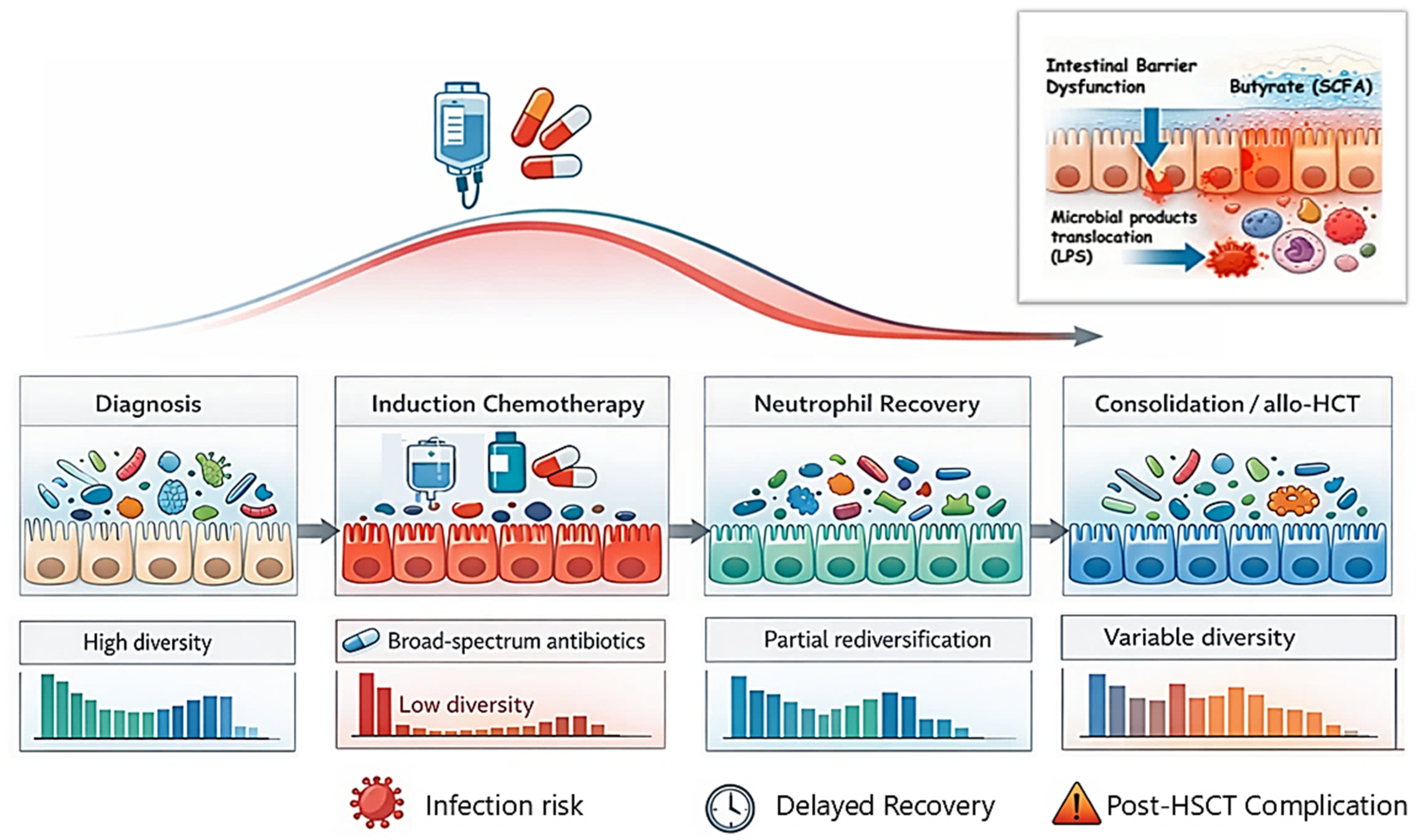
3. Induction Chemotherapy as an Ecological Stress Test: Diversity Loss, Domination, and Persistent Shifts
4. Mechanistic Links: Barrier Integrity, Microbial Metabolites, and Inflammatory Translocation
4.1. SCFAs and Butyrate as Barrier-Protective Signals
4.2. Colonization Resistance and Domination States
5. Clinical Translation: Infections and Hematologic Recovery as Microbiome-Linked Endpoints
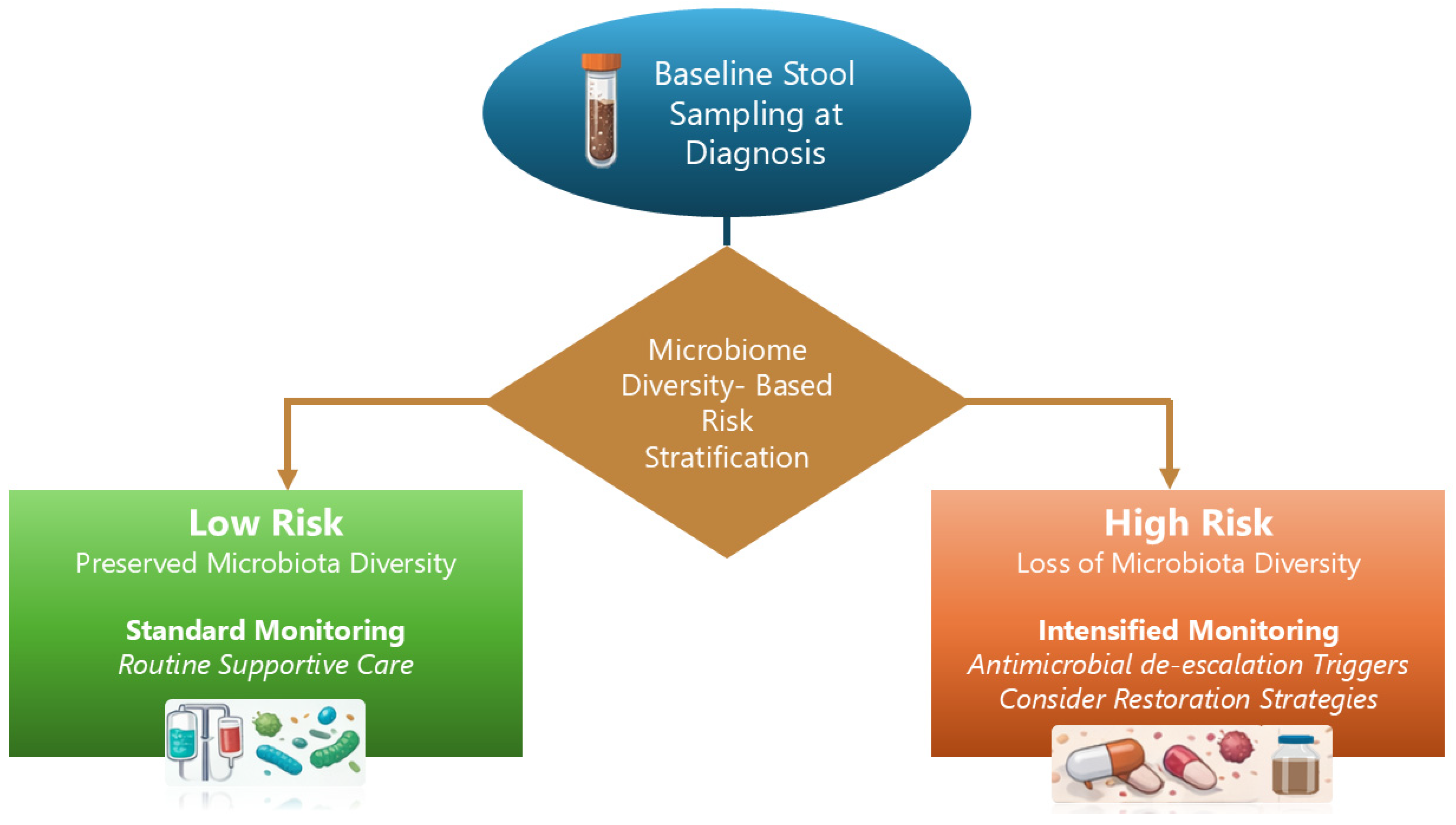
5.1. Infectious Risk Stratification
5.2. Hematologic Recovery
6. Microbiome-Targeted Interventions: From Stewardship to Ecosystem Repair
6.1. Antibiotic Stewardship as a Microbiome Intervention
6.2. Fecal Microbiota Transfer and Autologous Approaches
6.3. Postbiotics and Metabolite Replacement
6.4. Diet and Supportive Measures
7. Microbiome–Drug Interactions and Treatment Response
8. Methodological Pitfalls and Priorities for the Next Generation of AML Microbiome Trials
9. Conclusions
Author Contributions
Funding
Institutional Review Board Statement
Informed Consent Statement
Data Availability Statement
Conflicts of Interest
References
- Visconti, A.; Le Roy, C.I.; Rosa, F.; Rossi, N.; Martin, T.C.; Mohney, R.P.; Li, W.; de Rinaldis, E.; Bell, J.T.; Venter, J.C.; et al. Interplay between the human gut microbiome and host metabolism. Nat. Commun. 2019, 10, 4505. [Google Scholar] [CrossRef]
- Fan, Y.; Pedersen, O. Gut microbiota in human metabolic health and disease. Nat. Rev. Microbiol. 2021, 19, 55–71. [Google Scholar] [CrossRef]
- Zhang, Y.J.; Li, S.; Gan, R.Y.; Zhou, T.; Xu, D.P.; Li, H.B. Impacts of gut bacteria on human health and diseases. Int. J. Mol. Sci. 2015, 16, 7493–7519. [Google Scholar] [CrossRef]
- Ray, S.; Shankaran, P. Nutrition and the gut microbiome: A symbiotic dialogue influencing health and disease. Front. Nutr. 2026, 13, 1761992. [Google Scholar] [CrossRef]
- Ling, Z.; Ding, W.; Liu, X.; Zhang, J.; Cheng, Y.; Zhu, Z.; Wu, L.; Xu, X.; Gao, Y.; Jiang, R. Gut microbiota dysbiosis and systemic immune dysfunction in critical ill patients with multidrug-resistant bacterial colonization and infection. J. Transl. Med. 2025, 23, 981. [Google Scholar] [CrossRef]
- Li, Y.; Zhang, B.; Jiang, L.; Cheng, T.; Cheng, H.; Qian, P. Gut microbiota plays pivotal roles in benign and malignant hematopoiesis. Blood Sci. 2024, 6, e00200. [Google Scholar] [CrossRef]
- Ji, M.; Ji, M.; Zhong, Y.; Shao, L. Gut Microbiota in Acute Myeloid Leukemia: From Biomarkers to Interventions. Metabolites 2025, 15, 568. [Google Scholar] [CrossRef]
- Pötgens, S.A.; Havelange, V.; Lecop, S.; Li, F.; Neyrinck, A.M.; Bindels, F.; Neveux, N.; Demoulin, J.B.; Moors, I.; Kerre, T.; et al. Gut microbiome alterations at acute myeloid leukemia diagnosis are associated with muscle weakness and anorexia. Haematologica 2024, 109, 3194–3208. [Google Scholar] [CrossRef] [PubMed]
- Lagunas-Rangel, F.A.; Chávez-Valencia, V.; Gómez-Guijosa, M.Á.; Cortes-Penagos, C. Acute Myeloid Leukemia-Genetic Alterations and Their Clinical Prognosis. Int. J. Hematol. Oncol. Stem Cell Res. 2017, 11, 328–339. [Google Scholar] [PubMed]
- Shimony, S.; Stahl, M.; Stone, R.M. Acute Myeloid Leukemia: 2025 Update on Diagnosis, Risk-Stratification, and Management. Am. J. Hematol. 2025, 100, 860–891. [Google Scholar] [CrossRef] [PubMed]
- Fattizzo, B.; Cavallaro, F.; Folino, F.; Barcellini, W. Recent insights into the role of the microbiome in malignant and benign hematologic diseases. Crit. Rev. Oncol. Hematol. 2021, 160, 103289. [Google Scholar] [CrossRef] [PubMed]
- Nowicka, A.; Tomczak, H.; Szałek, E.; Karbownik, A.; Gil, L. Microbial Crosstalk with Therapy: Pharmacomicrobiomics in AML—One Step Closer to Personalized Medicine. Biomedicines 2025, 13, 1761. [Google Scholar] [CrossRef]
- D’Angelo, C.R.; Sudakaran, S.; Callander, N.S. Clinical effects and applications of the gut microbiome in hematologic malignancies. Cancer 2021, 127, 679–687. [Google Scholar] [CrossRef]
- Yu, D.; Yu, X.; Ye, A.; Xu, C.; Li, X.; Geng, W.; Zhu, L. Profiling of gut microbial dysbiosis in adults with myeloid leukemia. FEBS Open Bio 2021, 11, 2050–2059. [Google Scholar] [CrossRef]
- An, S.; Gong, X.; Zhao, L.; Jian, J.; Guo, Y.; Yang, X.; Sun, H.; Li, Y.; Liu, B. Significant changes in gut microbiota and SCFAs among patients with newly diagnosed acute myeloid leukemia. Front. Microbiol. 2025, 16, 1559033. [Google Scholar] [CrossRef]
- Nireeksha; Maniangat Luke, A.; N Kumari, S.; Hegde, M.N.; Hegde, N.N. Metabolic interplay of SCFA’s in the gut and oral microbiome: A link to health and disease. Front. Oral Health 2025, 6, 1646382. [Google Scholar] [CrossRef] [PubMed]
- Martín, R.; Rios-Covian, D.; Huillet, E.; Auger, S.; Khazaal, S.; Bermúdez-Humarán, L.G.; Sokol, H.; Chatel, J.M.; Langella, P. Faecalibacterium: A bacterial genus with promising human health applications. FEMS Microbiol. Rev. 2023, 47, fuad039. [Google Scholar] [CrossRef] [PubMed]
- Facchin, S.; Bertin, L.; Bonazzi, E.; Lorenzon, G.; De Barba, C.; Barberio, B.; Zingone, F.; Maniero, D.; Scarpa, M.; Ruffolo, C.; et al. Short-Chain Fatty Acids and Human Health: From Metabolic Pathways to Current Therapeutic Implications. Life 2024, 14, 559. [Google Scholar] [CrossRef]
- Galloway-Peña, J.R.; Shi, Y.; Peterson, C.B.; Sahasrabhojane, P.; Gopalakrishnan, V.; Brumlow, C.E.; Daver, N.G.; Alfayez, M.; Boddu, P.C.; Khan, M.A.W.; et al. Gut Microbiome Signatures Are Predictive of Infectious Risk Following Induction Therapy for Acute Myeloid Leukemia. Clin. Infect. Dis. 2020, 71, 63–71. [Google Scholar] [CrossRef]
- Zeng, L.; Qian, Y.; Cui, X.; Zhao, J.; Ning, Z.; Cha, J.; Wang, K.; Ge, C.; Jia, J.; Dou, T.; et al. Immunomodulatory role of gut microbial metabolites: Mechanistic insights and therapeutic frontiers. Front. Microbiol. 2025, 16, 1675065. [Google Scholar] [CrossRef]
- Pötgens, S.A.; Lecop, S.; Havelange, V.; Li, F.; Neyrinck, A.M.; Neveux, N.; Maertens, J.; Walter, J.; Schoemans, H.; Delzenne, N.M.; et al. Gut microbiota alterations induced by intensive chemotherapy in acute myeloid leukaemia patients are associated with gut barrier dysfunction and body weight loss. Clin. Nutr. 2023, 42, 2214–2228. [Google Scholar] [CrossRef]
- Ubeda, C.; Bucci, V.; Caballero, S.; Djukovic, A.; Toussaint, N.C.; Equinda, M.; Lipuma, L.; Ling, L.; Gobourne, A.; No, D.; et al. Intestinal microbiota containing Barnesiella species cures vancomycin-resistant Enterococcus faecium colonization. Infect. Immun. 2013, 81, 965–973. [Google Scholar] [CrossRef]
- Istivan, T.S.; Smith, S.C.; Fry, B.N.; Coloe, P.J. Characterization of Campylobacter concisus hemolysins. FEMS Immunol. Med. Microbiol. 2008, 54, 224–235. [Google Scholar] [CrossRef]
- Carvalho, A.S.; Lagana, D.; Catford, J.; Shaw, D.; Bak, N. Bloodstream infections in neutropenic patients with haematological malignancies. Infect. Dis. Health 2020, 25, 22–29. [Google Scholar] [CrossRef]
- Rashidi, A.; Ebadi, M.; Rehman, T.U.; Elhusseini, H.; Halaweish, H.F.; Kaiser, T.; Holtan, S.G.; Khoruts, A.; Weisdorf, D.J.; Staley, C. Lasting shift in the gut microbiota in patients with acute myeloid leukemia. Blood Adv. 2022, 6, 3451–3457. [Google Scholar] [CrossRef]
- Wang, R.; Yang, X.; Liu, J.; Zhong, F.; Zhang, C.; Chen, Y.; Sun, T.; Ji, C.; Ma, D. Gut microbiota regulates acute myeloid leukaemia via alteration of intestinal barrier function mediated by butyrate. Nat. Commun. 2022, 13, 2522. [Google Scholar] [CrossRef]
- Shen, Y.; Fan, N.; Ma, S.X.; Cheng, X.; Yang, X.; Wang, G. Gut Microbiota Dysbiosis: Pathogenesis, Diseases, Prevention, and Therapy. MedComm 2025, 6, e70168. [Google Scholar] [CrossRef]
- Takiishi, T.; Fenero, C.I.M.; Câmara, N.O.S. Intestinal barrier and gut microbiota: Shaping our immune responses throughout life. Tissue Barriers 2017, 5, e1373208. [Google Scholar] [CrossRef]
- Fusco, W.; Lorenzo, M.B.; Cintoni, M.; Porcari, S.; Rinninella, E.; Kaitsas, F.; Lener, E.; Mele, M.C.; Gasbarrini, A.; Collado, M.C.; et al. Short-Chain Fatty-Acid-Producing Bacteria: Key Components of the Human Gut Microbiota. Nutrients 2023, 15, 2211. [Google Scholar] [CrossRef]
- Di Vincenzo, F.; Del Gaudio, A.; Petito, V.; Lopetuso, L.R.; Scaldaferri, F. Gut microbiota, intestinal permeability, and systemic inflammation: A narrative review. Intern. Emerg. Med. 2024, 19, 275–293. [Google Scholar] [CrossRef] [PubMed]
- Caballero-Flores, G.; Pickard, J.M.; Núñez, G. Microbiota-mediated colonization resistance: Mechanisms and regulation. Nat. Rev. Microbiol. 2023, 21, 347–360. [Google Scholar] [CrossRef] [PubMed]
- Stein-Thoeringer, C.K.; Nichols, K.B.; Lazrak, A.; Docampo, M.D.; Slingerland, A.E.; Slingerland, J.B.; Clurman, A.G.; Armijo, G.; Gomes, A.L.C.; Shono, Y.; et al. Lactose drives Enterococcus expansion to promote graft-versus-host disease. Science 2019, 366, 1143–1149. [Google Scholar] [CrossRef]
- Salvestrini, V.; Conti, G.; D’Amico, F.; Cristiano, G.; Candela, M.; Cavo, M.; Turroni, S.; Curti, A. Gut Microbiome as a Potential Marker of Hematologic Recovery Following Induction Therapy in Acute Myeloid Leukemia Patients. Cancer Med. 2025, 14, e70501. [Google Scholar] [CrossRef]
- Malard, F.; Vekhoff, A.; Lapusan, S.; Isnard, F.; D’incan-Corda, E.; Rey, J.; Saillard, C.; Thomas, X.; Ducastelle-Lepretre, S.; Paubelle, E.; et al. Gut microbiota diversity after autologous fecal microbiota transfer in acute myeloid leukemia patients. Nat. Commun. 2021, 12, 3084. [Google Scholar] [CrossRef]
- van Lier, Y.F.; Vos, J.; Blom, B.; Hazenberg, M.D. Allogeneic hematopoietic cell transplantation, the microbiome, and graft-versus-host disease. Gut Microbes 2023, 15, 2178805. [Google Scholar] [CrossRef] [PubMed]
- Zhang, Q.L.; Dong, L.L.; Zhang, L.L.; Wu, Y.J.; Li, M.; Bo, J.; Wang, L.L.; Jing, Y.; Dou, L.P.; Liu, D.H.; et al. Characteristics of Gut Microbiota Changes and Their Relationship with Infectious Complications During Induction Chemotherapy in AML Patients. Zhongguo Shi Yan Xue Ye Xue Za Zhi 2025, 33, 738–744. [Google Scholar] [PubMed]
- Li, S.; Liu, J.; Zhang, X.; Gu, Q.; Wu, Y.; Tao, X.; Tian, T.; Pan, G.; Chu, M. The Potential Impact of Antibiotic Exposure on the Microbiome and Human Health. Microorganisms 2025, 13, 602. [Google Scholar] [CrossRef]
- Tian, M.; Soleimani Samarkhazan, H.; Alemohammad, S.S.; Manesh, M.F.; Tavakoli, F.; Shams, A.; Zeynalabadi, A. Microbiome dysbiosis and chemotherapy resistance in acute myeloid leukemia (AML). npj Biofilms Microbiomes 2025, 12, 50. [Google Scholar] [CrossRef]
- Adel, M.; Khedr, R.A.; Sayed, A.A.; Shalaby, L.; Diab, A.A.; Yahia, A.; Elanany, M.; Lehmann, L.E.; Ahmed, S.; Aziz, R.K.; et al. Changes in Gut Microbial Diversity and Correlation with Clinical Outcome in Children with Acute Myeloid Leukemia Receiving Induction Chemotherapy. Children 2025, 12, 1176. [Google Scholar] [CrossRef]
- Rashidi, A.; Ebadi, M.; Rehman, T.U.; Elhusseini, H.; Halaweish, H.; Kaiser, T.; Holtan, S.G.; Khoruts, A.; Weisdorf, D.J.; Staley, C. Compilation of longitudinal gut microbiome, serum metabolome, and clinical data in acute myeloid leukemia. Sci. Data 2022, 9, 468. [Google Scholar] [CrossRef]
- Patangia, D.V.; Anthony Ryan, C.; Dempsey, E.; Paul Ross, R.; Stanton, C. Impact of antibiotics on the human microbiome and consequences for host health. MicrobiologyOpen 2022, 11, e1260. [Google Scholar] [CrossRef] [PubMed]
- Theodosiou, A.A.; Bogaert, D.; Cleary, D.W.; Fady, P.E.; Feehily, C.; Gilbert, J.A.; Greenhough, B.; Guardabassi, L.; Hall, L.J.; Harman, T.; et al. Microbiome research in practice: Priorities for clinical translation and impact. Clin. Microbiol. Infect. 2026. Epub ahead of print. [Google Scholar] [CrossRef] [PubMed]
- Taur, Y.; Coyte, K.; Schluter, J.; Robilotti, E.; Figueroa, C.; Gjonbalaj, M.; Littmann, E.R.; Ling, L.; Miller, L.; Gyaltshen, Y.; et al. Reconstitution of the gut microbiota of antibiotic-treated patients by autologous fecal microbiota transplant. Sci. Transl. Med. 2018, 10, eaap9489. [Google Scholar] [CrossRef]
- Cao, Z.; Gao, T.; Bajinka, O.; Zhang, Y.; Yuan, X. Fecal microbiota transplantation-current perspective on human health. Front. Med. 2025, 12, 1523870. [Google Scholar] [CrossRef]
- Kalkan, A.E.; BinMowyna, M.N.; Raposo, A.; Ahmad, M.F.; Ahmed, F.; Otayf, A.Y.; Carrascosa, C.; Saraiva, A.; Karav, S. Beyond the Gut: Unveiling Butyrate’s Global Health Impact Through Gut Health and Dysbiosis-Related Conditions: A Narrative Review. Nutrients 2025, 17, 1305. [Google Scholar] [CrossRef]
- Nowicka, A.; Gil, L. Microbial metabolomics in acute myeloid leukemia: From pathogenesis to treatment. Adv. Clin. Exp. Med. 2025, 34, 1201–1212. [Google Scholar] [CrossRef]
- Furci, F.; Cicero, N.; Allegra, A.; Gangemi, S. Microbiota, Diet and Acute Leukaemia: Tips and Tricks on Their Possible Connections. Nutrients 2023, 15, 4253. [Google Scholar] [CrossRef]
- Zhou, Y.; Zhou, C.; Zhang, A. Gut microbiota in acute leukemia: Current evidence and future directions. Front. Microbiol. 2022, 13, 1045497. [Google Scholar] [CrossRef]
- Hueso, T.; Ekpe, K.; Mayeur, C.; Gatse, A.; Joncquel-Chevallier Curt, M.; Gricourt, G.; Rodriguez, C.; Burdet, C.; Ulmann, G.; Neut, C.; et al. Impact and consequences of intensive chemotherapy on intestinal barrier and microbiota in acute myeloid leukemia: The role of mucosal strengthening. Gut Microbes 2020, 12, 1800897. [Google Scholar] [CrossRef]
- Renga, G.; Nunzi, E.; Stincardini, C.; Pariano, M.; Puccetti, M.; Pieraccini, G.; Di Serio, C.; Fraziano, M.; Poerio, N.; Oikonomou, V.; et al. CPX-351 exploits the gut microbiota to promote mucosal barrier function, colonization resistance, and immune homeostasis. Blood 2024, 143, 1628–1645. [Google Scholar] [CrossRef] [PubMed]
- Dong, F.; Perdew, G.H. The aryl hydrocarbon receptor as a mediator of host-microbiota interplay. Gut Microbes 2020, 12, 1859812. [Google Scholar] [CrossRef] [PubMed]



| Domain | Study (Year) | Population/Design | Methods | Main Findings | Clinical Link |
|---|---|---|---|---|---|
| Infection risk during induction | Galloway-Peña et al. (2020) [19] | 97 AML pts, longitudinal during induction to neutrophil recovery | 16S rRNA on stool + oral, serial sampling | Baseline higher Shannon diversity and higher Porphyromonadaceae associated with remaining infection-free; prolonged carbapenem exposure associated with lower diversity at recovery and higher later infections | Association with infection-free course during neutropenia; hypothesis-generating threshold and stewardship signal |
| Hematologic recovery | Salvestrini et al. (2025) [33] | 27 newly diagnosed AML pts, baseline and post-induction | 16S rRNA | Higher alpha diversity and enrichment of Faecalibacterium/Ruminococcus/Blautia/Butyricimonas at diagnosis associated with better recovery indicators | Exploratory association with hematologic recovery indices |
| Dysbiosis + barrier/cachexia during therapy | Pötgens et al. (2023) [21] | AML pts, longitudinal multi-omics across induction/discharge | Microbiome + metabolomics + barrier markers | Loss of diversity, long-lasting compositional change; signals consistent with transient barrier impairment and weight loss | Supportive care implications |
| Baseline dysbiosis + functional phenotype | Pötgens et al. (2024) [8] | 30 antibiotic-free AML at diagnosis vs. controls | Shotgun metagenomics + multi-compartment metabolomics | Microbiome functional shifts; associations with anorexia and muscle weakness; increase in oral bacteria | Links to functional status |
| Mechanism: butyrate–barrier–LPS | Wang et al. (2022) [26] | AML pts + murine AML models | Microbiome + interventions (ABX, FMT, butyrate) | Antibiotic-induced dysbiosis accelerates AML in mice; FMT reverses; butyrate/Faecalibacterium mitigates barrier damage and LPS leakage | Preclinical mechanistic support (murine; ABX/FMT/butyrate interventions) |
| Microbiome restoration | Malard et al. (2021) [34] | 25 AML pts, phase II single-arm AFMT | Microbiome ecology metrics | AFMT restores alpha diversity and community similarity; feasibility and safety signals | Basis for randomized trials |
| HCT/GvHD context | van Lier et al. (2023) [35] | Review (allo-HCT) | Synthesis | Post-HCT dysbiosis: low diversity, loss of anaerobes, Enterococcus domination; links to GvHD; microbiome interventions under study | Continuum AML → HCT |
| Strategy | Target/Rationale | Current Evidence in AML | Suggested Trial Endpoints | Key Safety/ Implementation Considerations |
|---|---|---|---|---|
| Antibiotic stewardship (“microbiome-sparing”) | Reduce collateral diversity loss; prevent domination/resistome expansion | Observational induction cohorts link antibiotic burden and carbapenems to diversity loss and later infections | Diversity preservation; domination events; MDR colonization; infection rates; antibiotic days; ICU transfer; early mortality | Must not compromise sepsis management; requires prespecified de-escalation rules and safety monitoring |
| Autologous fecal microbiota transfer (AFMT) | Ecosystem repair after deep antibiotic/chemo injury | Phase II multicenter single-arm AFMT in AML shows restoration toward baseline ecology and feasibility | α-diversity recovery; community similarity indices; MDR colonization; BSI incidence; mucositis severity; antibiotic utilization; readiness for consolidation/allo-HCT | Donor/autologous sample logistics; timing vs. neutropenia; infection screening; regulatory pathway |
| FMT/consortia-based restoration (non-autologous) | Rebuild colonization resistance; restore anaerobic networks | Conceptually supported; extrapolations from hematologic settings (incl. HCT literature) | Domination clearance (e.g., Enterococcus); resistome contraction; infection endpoints; inflammatory markers | Higher biosafety/regulatory burden; donor screening; product standardization |
| Postbiotics/metabolite replacement (e.g., butyrate) | Barrier support; mitigate inflammatory translocation (LPS); immunomodulation | Translational preclinical evidence: butyrate/Faecalibacterium improves barrier metrics and reduces LPS with disease attenuation in vivo | Barrier biomarkers; plasma LPS surrogates; inflammatory panels; SCFA quantification; clinical infection endpoints | Formulation/tolerability during mucositis; dosing; interactions with nutrition; safety in profound neutropenia |
| Nutrition-informed supportive care (diet quality, substrates for SCFA producers) | Support resilience and recovery of beneficial fermenters | Clinical associations between microbiome and cachexia-like phenotypes at diagnosis/induction; diet reviews in acute leukemia | Dietary adequacy; body composition; SCFA profiles; diversity trajectories; patient-reported outcomes; inflammation | Intake variability (anorexia/nausea); avoids restrictive diets that reduce calories/protein; standardized dietary capture required |
| Regimen-aware microbiome preservation (e.g., CPX-351 vs. 7 + 3) | Differential mucosal injury and microbiome disruption may influence downstream toxicity | Translational work suggests CPX-351 better preserves barrier/colonization resistance via host–microbe pathways (AhR/IL-22/IL-10) | Barrier function readouts; dysbiosis indices; endotoxin markers; infection rates; recovery kinetics | Confounding by indication; needs controlled clinical validation alongside efficacy endpoints |
Disclaimer/Publisher’s Note: The statements, opinions and data contained in all publications are solely those of the individual author(s) and contributor(s) and not of MDPI and/or the editor(s). MDPI and/or the editor(s) disclaim responsibility for any injury to people or property resulting from any ideas, methods, instructions or products referred to in the content. |
© 2026 by the authors. Licensee MDPI, Basel, Switzerland. This article is an open access article distributed under the terms and conditions of the Creative Commons Attribution (CC BY) license.
Share and Cite
Alvaro, M.E.; Caserta, S.; Martino, E.A.; Skafi, M.; Bruzzese, A.; Amodio, N.; Lucia, E.; Olivito, V.; Labanca, C.; Mendicino, F.; et al. Gut Microbiota and Acute Myeloid Leukemia: State of the Art, Clinical Signals, and Translational Opportunities. Antibiotics 2026, 15, 417. https://doi.org/10.3390/antibiotics15040417
Alvaro ME, Caserta S, Martino EA, Skafi M, Bruzzese A, Amodio N, Lucia E, Olivito V, Labanca C, Mendicino F, et al. Gut Microbiota and Acute Myeloid Leukemia: State of the Art, Clinical Signals, and Translational Opportunities. Antibiotics. 2026; 15(4):417. https://doi.org/10.3390/antibiotics15040417
Chicago/Turabian StyleAlvaro, Maria Eugenia, Santino Caserta, Enrica Antonia Martino, Mamdouh Skafi, Antonella Bruzzese, Nicola Amodio, Eugenio Lucia, Virginia Olivito, Caterina Labanca, Francesco Mendicino, and et al. 2026. "Gut Microbiota and Acute Myeloid Leukemia: State of the Art, Clinical Signals, and Translational Opportunities" Antibiotics 15, no. 4: 417. https://doi.org/10.3390/antibiotics15040417
APA StyleAlvaro, M. E., Caserta, S., Martino, E. A., Skafi, M., Bruzzese, A., Amodio, N., Lucia, E., Olivito, V., Labanca, C., Mendicino, F., Vigna, E., Morabito, F., & Gentile, M. (2026). Gut Microbiota and Acute Myeloid Leukemia: State of the Art, Clinical Signals, and Translational Opportunities. Antibiotics, 15(4), 417. https://doi.org/10.3390/antibiotics15040417