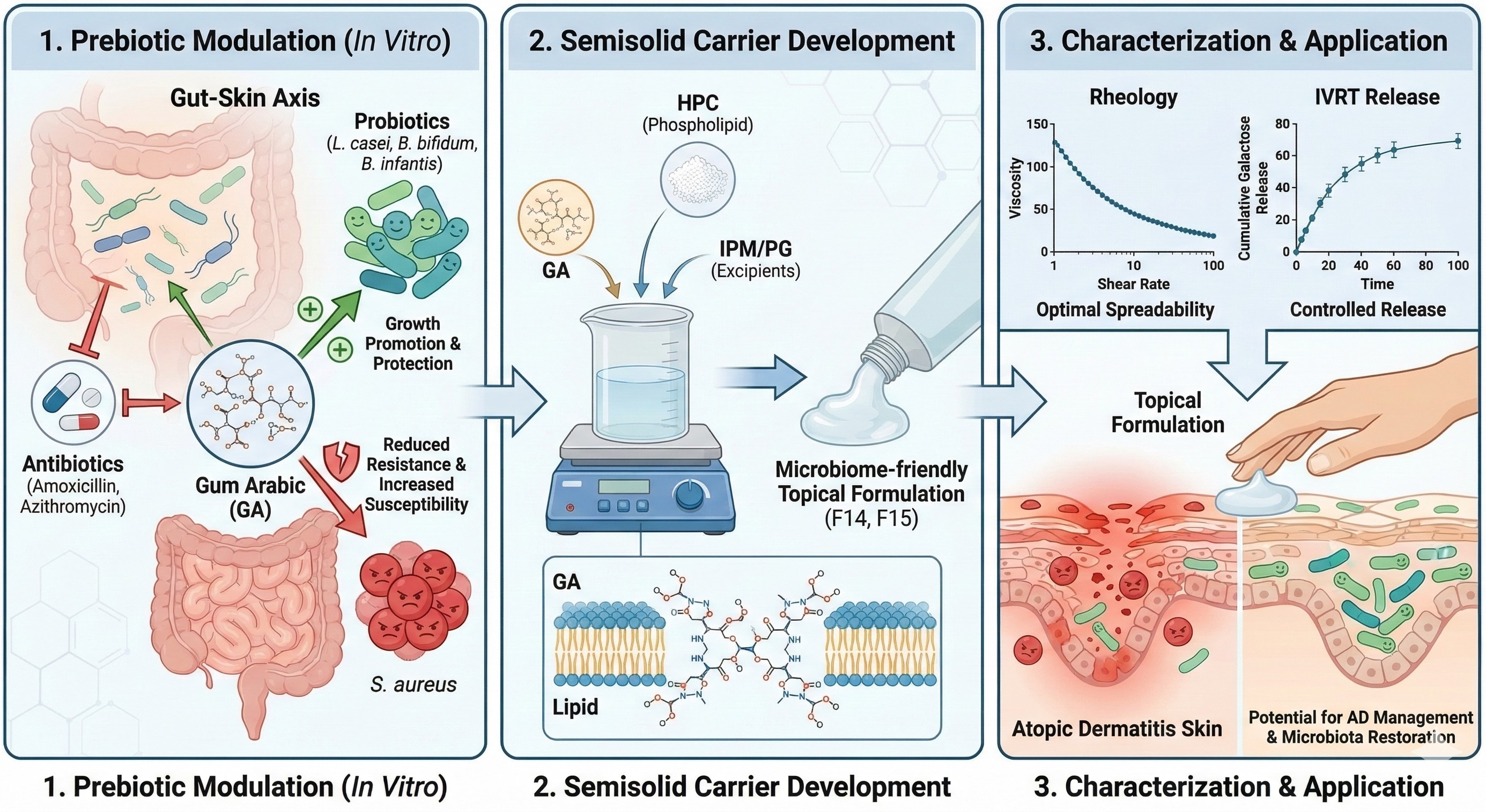
Effects of Prebiotic Gum Arabic Under Antibiotic-Containing Conditions in Atopic Dermatitis-Associated Bacteria: In Vitro Evaluation and Development of Semisolid Topical Carriers
 , , , , , , , , , , , , and
Abstract
1. Introduction
2. Results
2.1. Interaction of Gum Arabic and Antibiotics on Atopic Dermatitis-Associated Microbiota
2.1.1. Prebiotic Promotion and Protection of Probiotic Viability
2.1.2. Interaction of GA with Antibiotic-Associated CFU Changes in S. aureus
2.2. Rheological and Structural Characterization of the Designed Semisolid Carriers
2.3. In Vitro Release Kinetics and Galactose Release Profiles
3. Discussion
4. Materials and Methods
4.1. Microorganisms and Culture Conditions
4.2. Antibiotics and Concentrations
- For L. casei: amoxicillin 4 mg/L, azithromycin 1 mg/L.
- For B. bifidum: amoxicillin 2 mg/L, azithromycin 1 mg/L.
- For B. infantis: amoxicillin 2 mg/L, azithromycin 1 mg/L.
- For S. aureus: amoxicillin 4 mg/L, azithromycin 1 mg/L.
4.3. Preparation of Gum Arabic and Culture Media
4.4. Quantitative Analysis and Spread Plate Method
4.5. Translational Additional Studies: Semisolid Carrier System Development and Performance Tests
4.5.1. Materials
4.5.2. GA Stock Solution and Working Concentrations
4.5.3. Formulation Design (DoE) and Selection of Variables
- Factor A (GA, %): 1, 2, 3, 5.
- Factor B (Enhancer type; block): PG or IPM.
- Factor C (Enhancer level; nested within type): PG block at 5% (low) and 10% (high). IPM block at 3% (low) and 7% (high).
- Fixed component: HPC = 2.5% (w/w); made up to 100% with water (q.s.).
4.5.4. Preparation of Preformulations
4.5.5. Short-Term Physical Screening and Stability Observation
4.5.6. Rheological Characterization: Apparent Viscosity-Shear Rate Profile
4.5.7. In Vitro Release Test (IVRT) and HPLC Quantitative Analysis Using GA-Marker (Galactose Equivalent)
4.5.8. Statistical Approach
5. Conclusions
Supplementary Materials
Author Contributions
Funding
Institutional Review Board Statement
Informed Consent Statement
Data Availability Statement
Acknowledgments
Conflicts of Interest
Abbreviations
| AD | Atopic Dermatitis |
| BHI | Brain Heart Infusion |
| CFU | Colony-Forming Unit |
| DoE | Design of Experiments |
| FDA | U.S. Food and Drug Administration |
| FLG | Filaggrin |
| GA | Gum Arabic (Acacia gum) |
| HDAC | Histone Deacetylase |
| HPC | Hydrogenated Phosphatidylcholine |
| HPLC | High-Performance Liquid Chromatography |
| IPM | Isopropyl Myristate |
| IVRT | In Vitro Release Testing |
| MDR | Multidrug-Resistant |
| MIC | Minimum Inhibitory Concentration |
| MRS | De Man-Rogosa-Sharpe |
| NA | Nutrient Agar |
| NF-κB | Nuclear Factor kappa-light-chain-enhancer of activated B cells |
| OA | Oleic Acid |
| PG | Propylene Glycol |
| PMP | 1-phenyl-3-methyl-5-pyrazolone |
| SCFA | Short-Chain Fatty Acid |
References
- Tang, H.; Li, W.; Xu, Y.; Zhou, Y.; Hamblin, M.R.; Wen, X. Gut microbiota modulation: A key determinant of atopic dermatitis susceptibility in children. Front. Microbiol. 2025, 16, 1549895. [Google Scholar] [CrossRef] [Scilit]
- Wrześniewska, M.; Wołoszczak, J.; Świrkosz, G.; Szyller, H.; Gomułka, K. The role of the microbiota in the pathogenesis and treatment of atopic dermatitis—A literature review. Int. J. Mol. Sci. 2024, 25, 6539. [Google Scholar] [CrossRef] [Scilit]
- Al-Behadliy, N.K.; Al-Wazni, W.S.; Alwan, A.H. Evaluation of some biological activities of Arabic gum (Sengalia senegal) aqueous extract in vivo and in-vitro. AIP Conf. Proc. 2020, 2290, 020021. [Google Scholar] [CrossRef] [Scilit]
- Hoskinson, C.; Medeleanu, M.V.; Reyna, M.E.; Dai, D.L.; Chowdhury, B.; Moraes, T.J.; Mandhane, P.J.; Simons, E.; Kozyrskyj, A.L.; Azad, M.B.; et al. Antibiotics taken within the first year of life are linked to infant gut microbiome disruption and elevated atopic dermatitis risk. J. Allergy Clin. Immunol. 2024, 154, 131–142. [Google Scholar] [CrossRef] [Scilit] [PubMed]
- Azad, M.B.; Konya, T.; Maughan, H.; Guttman, D.S.; Field, C.J.; Chari, R.S.; Sears, M.R.; Becker, A.B.; Scott, J.A.; Kozyrskyj, A.L.; et al. Gut microbiota of healthy Canadian infants: Profiles by mode of delivery and infant diet at 4 months. CMAJ 2013, 185, 385–394. [Google Scholar]
- Jernberg, C.; Lofmark, S.; Edlund, C.; Jansson, J.K. Long-term impacts of antibiotic exposure on the human intestinal microbiota. Microbiology 2010, 156, 3216–3223. [Google Scholar] [CrossRef] [Scilit] [PubMed]
- Round, J.L.; Mazmanian, S.K. The gut microbiota shapes intestinal immune responses during health and disease. Nat. Rev. Immunol. 2009, 9, 313–323. [Google Scholar] [CrossRef] [Scilit]
- Thaiss, C.A.; Zmora, N.; Levy, M.; Elinav, E. The microbiome and innate immunity. Nature 2016, 535, 65–74. [Google Scholar] [CrossRef] [Scilit]
- Russell, S.L.; Gold, M.J.; Hartmann, M.; Willing, B.P.; Thorson, L.; Wlodarska, M.; Gill, N.; Blanchet, M.-R.; Mohn, W.W.; McNagny, K.M.; et al. Early life antibiotic-driven changes in microbiota enhance susceptibility to allergic asthma. EMBO Rep. 2012, 13, 440–447. [Google Scholar] [CrossRef] [Scilit]
- Lee, E.; Lee, S.Y.; Kang, M.J.; Kim, K.; Won, S.; Kim, B.J.; Choi, K.Y.; Kim, B.S.; Cho, H.J.; Kim, Y.; et al. Clostridia in the gut and onset of atopic dermatitis via eosinophilic inflammation. Ann. Allergy Asthma Immunol. 2016, 117, 91–92.e1. [Google Scholar] [CrossRef] [Scilit]
- Metsälä, J.; Lundqvist, A.; Virta, L.J.; Kaila, M.; Gissler, M.; Virtanen, S.M. Mother’s and offspring’s use of antibiotics and infant allergy to cow’s milk. Epidemiology 2013, 24, 303–309. [Google Scholar] [CrossRef] [Scilit]
- Penders, J.; Kummeling, I.; Thijs, C. Infant antibiotic use and wheeze and asthma risk: A systematic review and meta-analysis. Eur. Respir. J. 2011, 38, 295–302. [Google Scholar] [CrossRef] [Scilit] [PubMed]
- Brown, S.J.; McLean, W.H.I. One remarkable molecule: Filaggrin. J. Investig. Dermatol. 2023, 143, 795–803. [Google Scholar] [CrossRef] [Scilit]
- Langan, S.M.; Irvine, A.D.; Weidinger, S. Atopic dermatitis. Lancet 2024, 403, 345–357. [Google Scholar] [CrossRef] [Scilit] [PubMed]
- Paller, A.S.; Kong, H.H.; Seed, P.; Naik, S.; Scharschmidt, T.C.; Gallo, R.L.; Luger, T.; Irvine, A.D. The microbiome in patients with atopic dermatitis. J. Allergy Clin. Immunol. 2023, 151, 30–40. [Google Scholar] [CrossRef] [Scilit] [PubMed]
- Weidinger, S.; Novak, N. Atopic dermatitis. Lancet 2016, 387, 1109–1122. [Google Scholar] [CrossRef] [Scilit]
- Furusawa, Y.; Obata, Y.; Fukuda, S.; Endo, T.A.; Nakato, G.; Takahashi, D.; Nakanishi, Y.; Uetake, C.; Kato, K.; Kato, T.; et al. Commensal microbe-derived butyrate induces the differentiation of colonic regulatory T cells. Nature 2013, 504, 446–450. [Google Scholar] [CrossRef] [Scilit]
- Arpaia, N.; Campbell, C.; Fan, X.; Dikiy, S.; van der Veeken, J.; deRoos, P.; Liu, H.; Cross, J.R.; Pfeffer, K.; Coffer, P.J.; et al. Metabolites produced by commensal bacteria promote peripheral regulatory T-cell generation. Nature 2013, 504, 451–455. [Google Scholar] [CrossRef] [Scilit]
- Pessôa, R.; Clissa, P.B.; Sanabani, S.S. The Interaction between the Host Genome, Epigenome, and the Gut–Skin Axis Microbiome in Atopic Dermatitis. Int. J. Mol. Sci. 2023, 24, 14322. [Google Scholar] [CrossRef] [Scilit]
- Trompette, A.; Gollwitzer, E.S.; Yadava, K.; Sichelstiel, A.K.; Sprenger, N.; Ngom-Bru, C.; Blanchard, C.; Junt, T.; Nicod, L.P.; Harris, N.L.; et al. Gut microbiota metabolism of dietary fiber influences allergic airway disease and hematopoiesis. Nat. Med. 2014, 20, 159–166. [Google Scholar] [CrossRef] [Scilit] [PubMed]
- Salem, I.; Ramser, A.; Isham, N.; Ghannoum, M.A. The gut microbiome as a major regulator of the gut-skin axis. Front. Microbiol. 2018, 9, 1459. [Google Scholar] [CrossRef] [Scilit]
- Di Domenico, E.G.; Cavallo, I.; Bordignon, V.; Prignano, G.; Sperduti, I.; Gurtner, A.; Trento, E.; Toma, L.; Pimpinelli, F.; Capitanio, B.; et al. Inflammatory cytokines and biofilm production sustain Staphylococcus aureus outgrowth and persistence: A pivotal interplay in the pathogenesis of atopic dermatitis. Sci. Rep. 2018, 8, 9573. [Google Scholar] [CrossRef] [Scilit]
- De Marco, S.; Piccioni, M.; Muradyan, D.; Zadra, C.; Pagiotti, R.; Pietrella, D. Antibiofilm and Antiadhesive Activities of Different Synbiotics. J. Prob. Health 2017, 5, 182–191. [Google Scholar]
- Elnour, A.A.M.; Nour, A.H.; Ishag, K.E.A. Biological Applications of Secondary Metabolites Extract (SME) from Acacia Gums (AGs). In Gum Arabic and Breast Cancer Biology; Springer Nature: Singapore, 2025; pp. 117–167. [Google Scholar]
- Adhikari, D.; Rangra, N.K. Antimicrobial activities of the Acacia genus: A review. Asian Pac. J. Trop. Biomed. 2023, 13, 45–59. [Google Scholar] [CrossRef] [Scilit]
- Cebeci, E.; Yüksel, B.; Aliusta, R.; Yılmaz, Ş.; Bursalıoğlu, E.O.; Bozyel, M.E.; Gökçe, H.B.; Kalay, Ş.; Kurtuluş, Ş.Ö.; Kurt, A.A.; et al. Gum Arabic modulates redox–ionic microenvironments via rheology and kinetics to induce selective cytotoxicity in colorectal cancer cells. Gels 2026, 12, 139. [Google Scholar] [CrossRef] [Scilit]
- Safia, K.; Amina, B.; Houda, T.; Hamdi, I. The biological activities and phytochemical investigations of acacia Senegal’s aqueous extracts of gum Arabic. Braz. Appl. Sci. Rev. 2024, 8, e73147. [Google Scholar] [CrossRef] [Scilit]
- Al Alawi, S.M.; Hossain, M.A.; Abusham, A.A. Antimicrobial and cytotoxic comparative study of different extracts of Omani and Sudanese Gum acacia. Beni-Suef Univ. J. Basic Appl. Sci. 2018, 7, 22–26. [Google Scholar] [CrossRef] [Scilit]
- Mahendran, T.; Williams, P.A.; Phillips, G.O.; Al-Assaf, S.; Baldwin, T.C. New insights into the structural characteristics of the arabinogalactan-protein (AGP) fraction of gum Arabic. J. Agric. Food Chem. 2008, 56, 9269–9276. [Google Scholar]
- Mohamed, S.A.; Elsherbini, A.M.; Alrefaey, H.R.; Adelrahman, K.; Moustafa, A.; Egodawaththa, N.M.; Crawford, K.E.; Nesnas, N.; Sabra, S.A. Gum Arabic: A commodity with versatile formulations and applications. Nanomaterials 2025, 15, 290. [Google Scholar] [CrossRef] [Scilit]
- Ahallil, H.; Maskat, M.Y.; Abdullah, A.; Sarbini, S.R. The effect of Acacia senegal as a potential prebiotic on obese gut microbiota. Food Res. 2020, 4, 814–822. [Google Scholar] [CrossRef] [Scilit]
- Bhola, J.; Bhadekar, R. Enhancing antimicrobial efficacy: Gum acacia-enriched Lactobacillus consortium against multidrug-resistant pathogens. Med. Microecol. 2025, 25, 100132. [Google Scholar] [CrossRef] [Scilit]
- Mohammad, S.; Karim, M.R.; Iqbal, S.; Lee, J.H.; Mathiyalagan, R.; Kim, Y.J.; Yang, D.U.; Yang, D.C. Atopic dermatitis: Pathophysiology, microbiota, and metabolome—A comprehensive review. Microbiol. Res. 2024, 281, 127595. [Google Scholar] [CrossRef] [Scilit]
- Avşar, İ.S.; Doğanay, D.; Mertoğlu, E. Investigation of the combinatorial effects of metformin and selected antibiotics on Klebsiella pneumoniae. J. Immunol. Clin. Microbiol. 2025, 10, 85–93. [Google Scholar] [CrossRef] [Scilit]
- Fleming-Dutra, K.E.; Demirjian, A.; Bartoces, M.; Roberts, R.M.; Taylor, T.H., Jr.; Hicks, L.A. Variations in antibiotic and azithromycin prescribing for children by geography and specialty—United States, 2013. Pediatr. Infect. Dis. J. 2018, 37, 52–58. [Google Scholar] [CrossRef] [Scilit]
- Oldenburg, C.E.; Sié, A.; Coulibaly, B.; Ouermi, L.; Dah, C.; Tapsoba, C.; Bärnighausen, T.; Ray, K.J.; Zhong, L.; Cummings, S.; et al. Effect of commonly used pediatric antibiotics on gut microbial diversity in preschool children in Burkina Faso: A randomized clinical trial. Open Forum Infect. Dis. 2018, 5, ofy289. [Google Scholar] [CrossRef] [Scilit]
- Odds, F.C. Synergy, antagonism, and what the chequerboard puts between them. J. Antimicrob. Chemother. 2003, 52, 1. [Google Scholar] [CrossRef] [Scilit]
- Aslan, İ.; Tarhan Çelebi, L. Postbiotics cosmetic formulation: In vitro efficacy studies on a microbiome friendly antiperspirant. J. Res. Pharm. 2023, 27, 2095–2105. [Google Scholar] [CrossRef] [Scilit]
- Gökçe, H.B.; Aslan, İ. Novel liposome–gel formulations containing a next generation postbiotic: Characterization, rheological stability, release kinetics, and in vitro antimicrobial activity studies. Gels 2024, 10, 746. [Google Scholar] [CrossRef] [Scilit] [PubMed]
- Aslan, İ.; Aytekin, A.F. Production and characterization of newly developed alcohol-free topical liposome-gel transdermal drug delivery systems containing estradiol (E2)/estriol (E3) for post-menopausal women. J. Res. Pharm. 2023, 27, 2190–2198. [Google Scholar] [CrossRef] [Scilit]
- Özdemir, M.N.; Bursalıoğlu, E.O.; Doğanay, D.; Kurt, A.A.; Aslan, İ. Antimicrobial activity studies of encapsulated hemp seed oil. J. Immunol. Clin. Microbiol. 2025, 10, 94–107. [Google Scholar] [CrossRef] [Scilit]
- Kalay, Ş.; Güler, G.; Şallı, E.; Bozyel, M.E. Development, characterization and antimicrobial potential of a new natural based sunscreen formulation. J. Immunol. Clin. Microbiol. 2025, 10, 108–120. [Google Scholar] [CrossRef] [Scilit]
- U.S. Food and Drug Administration. In Vitro Release Test Studies for Topical Drug Products Submitted in ANDAs: Guidance for Industry (Draft Guidance); Center for Drug Evaluation and Research: Silver Spring, MD, USA, 2022.
- United States Pharmacopeia. <1724> Semisolid Drug Products—Performance Tests; USP–NF; United States Pharmacopeia: Rockville, MD, USA, 2023. [Google Scholar]
- Kanfer, I.; Rath, S.; Purazi, P.; Mudyahoto, N.A. In vitro release testing of semi-solid dosage forms. Dissolution Technol. 2017, 24, 52–60. [Google Scholar] [CrossRef] [Scilit]
- Leylak, C.; Özdemir, K.S.; Gurakan, G.C.; Ogel, Z.B. Optimisation of spray drying parameters for Lactobacillus acidophilus encapsulation in whey and gum Arabic: Its application in yoghurt. Int. Dairy J. 2021, 112, 104865. [Google Scholar] [CrossRef] [Scilit]
- Alhssan, E.; Ercan, S.Ş.; Bozkurt, H. Effect of flaxseed mucilage and gum Arabic on probiotic survival and quality of kefir during cold storage. Foods 2023, 12, 662. [Google Scholar] [CrossRef] [Scilit]
- Cherbut, C.; Michel, C.; Raison, V.; Kravtchenko, T.; Severine, M. Acacia gum is a bifidogenic dietary fibre with high digestive tolerance in healthy humans. Microb. Ecol. Health Dis. 2003, 15, 43–50. [Google Scholar]
- Calame, W.; Weseler, A.R.; Viebke, C.; Flynn, C.; Siemensma, A.D. Gum arabic establishes prebiotic functionality in healthy human volunteers in a dose-dependent manner. Br. J. Nutr. 2008, 100, 1269–1275. [Google Scholar] [CrossRef] [Scilit]
- Sasaki, Y.; Horigome, A.; Odamaki, T.; Xiao, J.Z.; Ishiwata, A.; Ito, Y.; Kitahara, K.; Fujita, K. Novel 3-O-α-D-galactosyl-α-L-arabinofuranosidase for the assimilation of gum arabic arabinogalactan protein in Bifidobacterium longum subsp. longum. Appl. Environ. Microbiol. 2021, 87, e02690-20. [Google Scholar] [CrossRef] [Scilit]
- Moubareck, C.; Gavini, F.; Vaugien, L.; Butel, M.-J.; Doucet-Populaire, F. Antimicrobial susceptibility of bifidobacteria. J. Antimicrob. Chemother. 2005, 55, 38–44. [Google Scholar] [PubMed]
- Mancabelli, L.; Mancino, W.; Lugli, G.A.; Argentini, C.; Longhi, G.; Milani, C.; Viappiani, A.; Anzalone, R.; Bernasconi, S.; van Sinderen, D.; et al. Amoxicillin-clavulanic acid resistance in the genus Bifidobacterium. Appl. Environ. Microbiol. 2021, 87, e03137-20. [Google Scholar] [CrossRef] [Scilit] [PubMed]
- Klewicka, E.; Cukrowska, B.; Libudzisz, Z.; Slizewska, K.; Motyl, I. Changes in gut microbiota in children with atopic dermatitis administered the bacteria Lactobacillus casei DN–114001. Pol. J. Microbiol. 2011, 60, 329. [Google Scholar] [CrossRef] [Scilit]
- Tan-Lim, C.S.C.; Esteban-Ipac, N.A.R.; Mantaring, J.B.V., III; Chan Shih Yen, E.; Recto, M.S.T.; Sison, O.T.; Alejandria, M.M. Comparative effectiveness of probiotic strains for the treatment of pediatric atopic dermatitis: A systematic review and network meta-analysis. Pediatr. Allergy Immunol. 2021, 32, 124–136. [Google Scholar] [CrossRef] [Scilit]
- ASTM D2196-20; Standard Test Methods for Rheological Properties of Non-Newtonian Materials by Rotational (Brookfield-Type) Viscometer. ASTM International: West Conshohocken, PA, USA, 2020.
- Zueva, O.S.; Klimovitskaya, M.A.; Skvortsova, P.V.; Khair, T.; Kazantseva, D.A.; Abakumova, Y.; Gromova, N.R. Supramolecular structure and complexation of gum Arabic in aqueous solutions: What determines its protective functions in nature and technologies? Macromol 2025, 5, 49. [Google Scholar] [CrossRef] [Scilit]
- Vojvodić Cebin, A.; Komes, D.; Ralet, M.-C. Development and validation of HPLC-DAD method with pre-column PMP derivatization for monomeric profile analysis of polysaccharides from agro-industrial wastes. Polymers 2022, 14, 544. [Google Scholar] [CrossRef] [Scilit]
- Mankarios, A.T.; Jones, C.F.G.; Jarvis, M.C.; Threlfall, D.R.; Friend, J. Hydrolysis of plant polysaccharides and GLC analysis of their constituent neutral sugars. Phytochemistry 1979, 18, 419–422. [Google Scholar] [CrossRef] [Scilit]
- Arellano, A.; Santoyo, S.; Ygartua, P. Influence of propylene glycol and isopropyl myristate on the in vitro percutaneous penetration of diclofenac sodium from carbopol gels. Eur. J. Pharm. Sci. 1999, 7, 129–135. [Google Scholar] [CrossRef] [Scilit] [PubMed]
- CLSI Supplement M100; Performance Standards for Antimicrobial Susceptibility Testing. Clinical and Laboratory Standards Institute (CLSI): Wayne, PA, USA, 2023.
- Fujii, M.; Shiozawa, K.; Watanabe, Y.; Matsumoto, M. Effect of phosphatidylcholine on skin permeation of indomethacin from gel prepared with liquid paraffin and hydrogenated phospholipid. Int. J. Pharm. 2001, 222, 57–64. [Google Scholar] [CrossRef] [Scilit] [PubMed]
- Manca, M.L.; Cencetti, C.; Matricardi, P.; Castangia, I.; Zaru, M.; Diez-Sales, O.; Nacher, A.; Valenti, D.; Maccioni, A.M.; Fadda, A.M.; et al. Glycerosomes: Use of hydrogenated soy phosphatidylcholine mixture and its effect on vesicle features and diclofenac skin penetration. Int. J. Pharm. 2016, 511, 198–204. [Google Scholar] [CrossRef] [Scilit] [PubMed]
- Naik, A.; Pechtold, L.A.R.M.; Potts, R.O.; Guy, R.H. Mechanism of oleic acid-induced skin penetration enhancement in vivo in humans. J. Control. Release 1995, 37, 299–306. [Google Scholar] [CrossRef] [Scilit]
- Rowat, A.C.; Kitson, N.; Thewalt, J.L. Interactions of oleic acid and model stratum corneum membranes as seen by 2H NMR. Int. J. Pharm. 2006, 307, 225–231. [Google Scholar] [CrossRef] [Scilit] [PubMed]
- Haque, T.; Talukder, M.M.U. Chemical enhancer: A simplistic way to modulate barrier function of the stratum corneum. Adv. Pharm. Bull. 2018, 8, 169–179. [Google Scholar] [CrossRef] [Scilit]



| Lactobacillus casei | |||||
| MRS | MRS %1 GA | MRS %2 GA | MRS %3 GA | MRS %5 GA | |
| Non-Antibiotic | 8.3 × 10⁵ | 8.4 × 10⁵ | 5.1 × 10⁷ | 5.1 × 10⁷ | 5.1 × 10⁵ |
| Azithromycin | - | - | - | - | - |
| Amoxicillin | - | - | - | - | - |
| Bifidobacterium infantis | |||||
| BHI | BHI %1 GA | BHI %2 GA | BHI %3 GA | BHI %5 GA | |
| Non-Antibiotic | 1.9 × 10⁷ | 6.0 × 10⁷ | 6.4 × 10⁷ | ND | ND |
| Azithromycin | 5.5 × 10⁶ | 8.0 × 10⁶ | 1.3 × 10⁷ | ND | ND |
| Amoxicillin | - | - | - | ND | ND |
| Bifidobacterium bifidum | |||||
| BHI | BHI %1 GA | BHI %2 GA | BHI %3 GA | BHI %5 GA | |
| Non-Antibiotic | 6.7 × 10⁷ | 8.6 × 10⁸ | 9.0 × 10⁸ | ND | ND |
| Azithromycin | - | - | - | ND | ND |
| Amoxicillin | - | - | - | ND | ND |
| Staphylococcus aureus ATCC 29213 | |||||
| NA | NA %1 GA | NA %2 GA | NA %3 GA | NA %5 GA | |
| Non-Antibiotic | 3.1 × 10⁹ | 5.7 × 10⁹ | 5.7 × 10⁹ | 5.9 × 10⁹ | ND |
| Azithromycin | 4.8 × 10⁹ | 4.8 × 10⁹ | 4.5 × 10⁹ | 4.7 × 10⁹ | ND |
| Amoxicillin | 6.1 × 10⁹ | 3.4 × 10⁹ | 1.4 × 10⁹ | 3.1 × 10⁹ | ND |
| Formulation Code | Formulation Components (Single Column) | s−1 | η (mPa·s) (3 Replicates ± SD) | Comment |
|---|---|---|---|---|
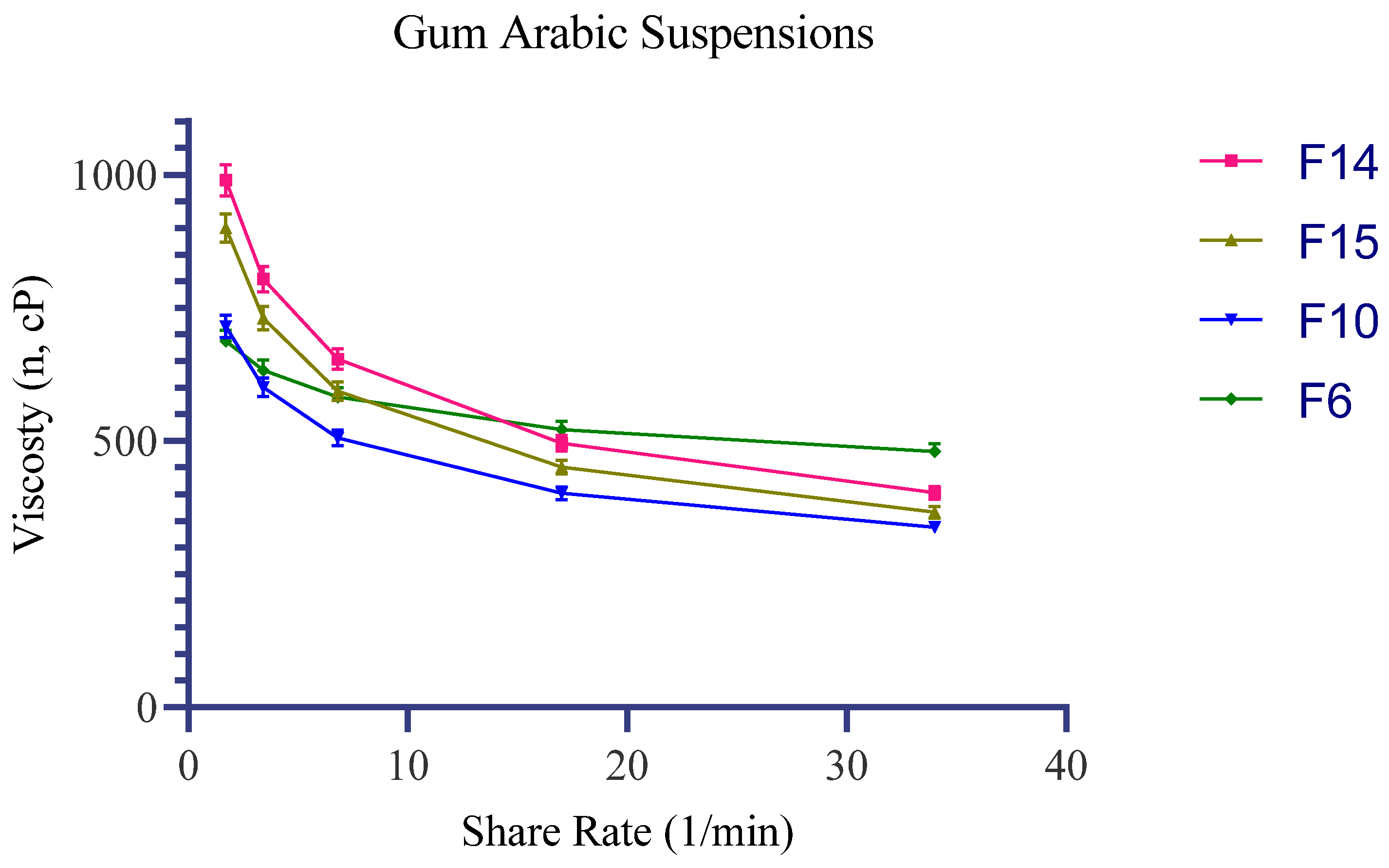
| F14 | GA 2% + IPM 7% + HPC 2.5% + water q.s. | 1.7 | 990.0 ± 29.7 | Highest “rest” viscosity with strong shear-thinning; supports retention and good spreadability during application. |
| F14 | GA 2% + IPM 7% + HPC 2.5% + water q.s. | 3.4 | 804.0 ± 24.1 | |
| F14 | GA 2% + IPM 7% + HPC 2.5% + water q.s. | 6.8 | 653.5 ± 19.6 | |
| F14 | GA 2% + IPM 7% + HPC 2.5% + water q.s. | 17.0 | 496.0 ± 14.9 | |
| F14 | GA 2% + IPM 7% + HPC 2.5% + water q.s. | 34.0 | 403.0 ± 12.1 | |
| F15 | GA 3% + IPM 7% + HPC 2.5% + water q.s. | 1.7 | 900.0 ± 27.0 | Similar to F14; slightly higher GA may increase film formation/adhesion while maintaining spreadability. |
| F15 | GA 3% + IPM 7% + HPC 2.5% + water q.s. | 3.4 | 731.0 ± 21.9 | |
| F15 | GA 3% + IPM 7% + HPC 2.5% + water q.s. | 6.8 | 593.8 ± 17.8 | |
| F15 | GA 3% + IPM 7% + HPC 2.5% + water q.s. | 17.0 | 451.1 ± 13.5 | |
| F15 | GA 3% + IPM 7% + HPC 2.5% + water q.s. | 34.0 | 366.4 ± 11.0 | |
| F10 | GA 2% + IPM 3% + HPC 2.5% + water q.s. | 1.7 | 715.0 ± 21.5 | Moderate viscosity with pronounced shear-thinning; balanced candidate for a lighter sensory profile. |
| F10 | GA 2% + IPM 3% + HPC 2.5% + water q.s. | 3.4 | 601.2 ± 18.0 | |
| F10 | GA 2% + IPM 3% + HPC 2.5% + water q.s. | 6.8 | 505.4 ± 15.2 | |
| F10 | GA 2% + IPM 3% + HPC 2.5% + water q.s. | 17.0 | 401.9 ± 12.1 | |
| F10 | GA 2% + IPM 3% + HPC 2.5% + water q.s. | 34.0 | 338.1 ± 10.1 | |
| F6 | GA 2% + PG 10% + HPC 2.5% + water q.s. | 1.7 | 687.5 ± 20.6 | Highest viscosity within the PG-series; weaker shear-thinning but good applicability in homogeneous aqueous-based systems (reference for PG vs. IPM). |
| F6 | GA 2% + PG 10% + HPC 2.5% + water q.s. | 3.4 | 632.7 ± 19.0 | |
| F6 | GA 2% + PG 10% + HPC 2.5% + water q.s. | 6.8 | 582.2 ± 17.5 | |
| F6 | GA 2% + PG 10% + HPC 2.5% + water q.s. | 17.0 | 521.5 ± 15.6 | |
| F6 | GA 2% + PG 10% + HPC 2.5% + water q.s. | 34.0 | 479.9 ± 14.4 |
| Formulation | Q6h (%; Mean ± SD) | Q12h (%; Mean ± SD) | kH (%·h−1/2) | R2 (0.5–6 h) |
|---|---|---|---|---|
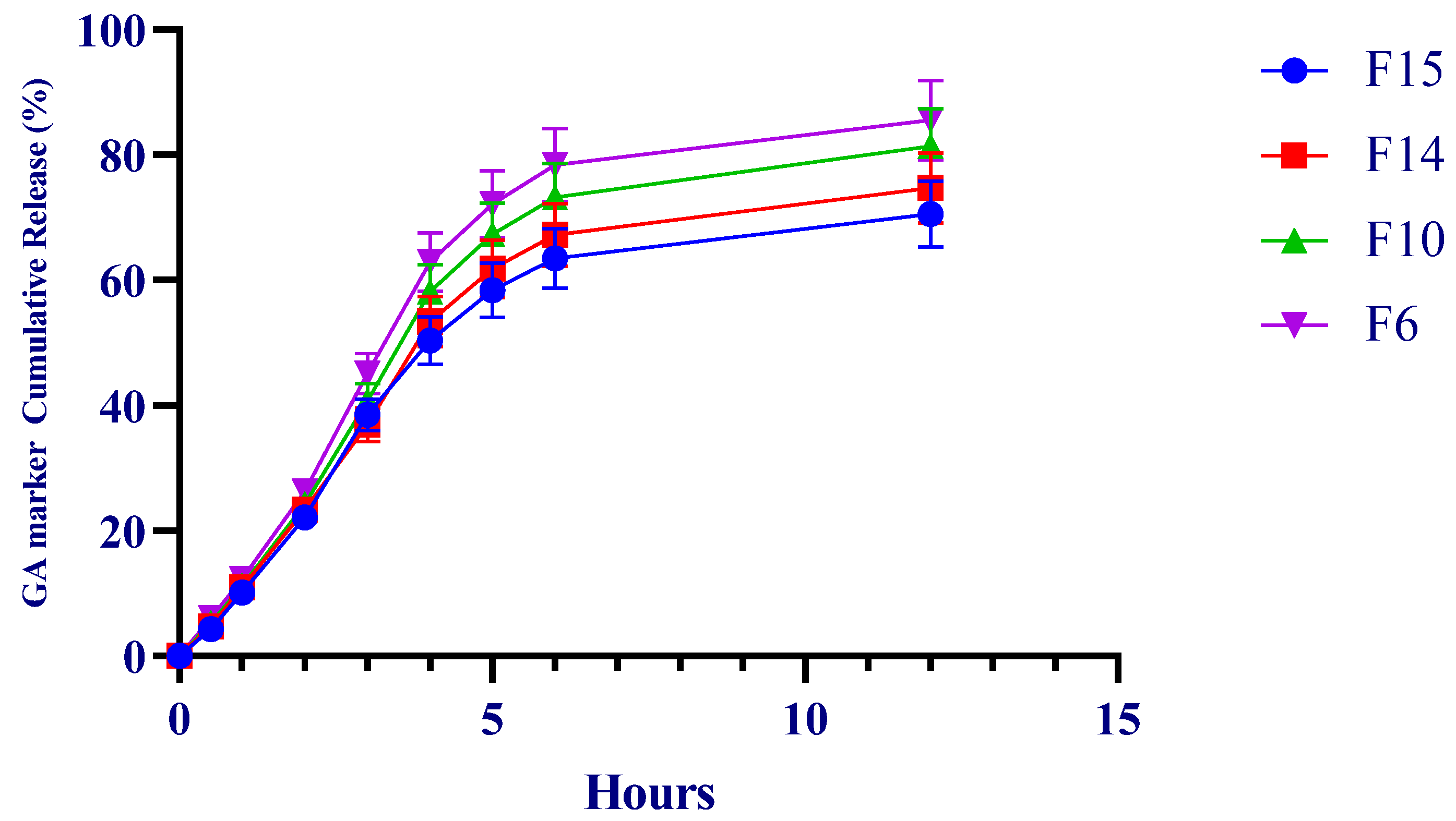
| F6 | 78.414 ± 2.352 | 85.500 ± 2.565 | 44.872 | 0.981–0.987 |
| F10 | 73.186 ± 2.196 | 81.350 ± 2.440 | 42.017 | 0.981–0.987 |
| F14 | 67.212 ± 2.016 | 74.709 ± 2.241 | 38.330 | 0.981–0.987 |
| F15 | 63.478 ± 1.904 | 70.559 ± 2.117 | 36.433 | 0.981–0.987 |
| Code | Block | GA (%) | PG (%) | IPM (%) | HPC (%) |
|---|---|---|---|---|---|
| F1 | PG | 1 | 5 | 0 | 2.5 |
| F2 | PG | 2 | 5 | 0 | 2.5 |
| F3 | PG | 3 | 5 | 0 | 2.5 |
| F4 | PG | 5 | 5 | 0 | 2.5 |
| F5 | PG | 1 | 10 | 0 | 2.5 |
| F6 | PG | 2 | 10 | 0 | 2.5 |
| F7 | PG | 3 | 10 | 0 | 2.5 |
| F8 | PG | 5 | 10 | 0 | 2.5 |
| F9 | IPM | 1 | 0 | 3 | 2.5 |
| F10 | IPM | 2 | 0 | 3 | 2.5 |
| F11 | IPM | 3 | 0 | 3 | 2.5 |
| F12 | IPM | 5 | 0 | 3 | 2.5 |
| F13 | IPM | 1 | 0 | 7 | 2.5 |
| F14 | IPM | 2 | 0 | 7 | 2.5 |
| F15 | IPM | 3 | 0 | 7 | 2.5 |
| F16 | IPM | 5 | 0 | 7 | 2.5 |
Disclaimer/Publisher’s Note: The statements, opinions and data contained in all publications are solely those of the individual author(s) and contributor(s) and not of MDPI and/or the editor(s). MDPI and/or the editor(s) disclaim responsibility for any injury to people or property resulting from any ideas, methods, instructions or products referred to in the content. |
© 2026 by the authors. Licensee MDPI, Basel, Switzerland. This article is an open access article distributed under the terms and conditions of the Creative Commons Attribution (CC BY) license.
Share and Cite
Doğanay, D.; Mertoğlu, E.; Kurt, A.A.; Özkan, B.C.; Bursalıoğlu, E.O.; Bozyel, M.E.; Aliusta, R.; Türkoğlu, Ö.; Gökçe, H.B.; Kızılay, E.; et al. Effects of Prebiotic Gum Arabic Under Antibiotic-Containing Conditions in Atopic Dermatitis-Associated Bacteria: In Vitro Evaluation and Development of Semisolid Topical Carriers. Antibiotics 2026, 15, 378. https://doi.org/10.3390/antibiotics15040378
Doğanay D, Mertoğlu E, Kurt AA, Özkan BC, Bursalıoğlu EO, Bozyel ME, Aliusta R, Türkoğlu Ö, Gökçe HB, Kızılay E, et al. Effects of Prebiotic Gum Arabic Under Antibiotic-Containing Conditions in Atopic Dermatitis-Associated Bacteria: In Vitro Evaluation and Development of Semisolid Topical Carriers. Antibiotics. 2026; 15(4):378. https://doi.org/10.3390/antibiotics15040378
Chicago/Turabian StyleDoğanay, Derya, Esra Mertoğlu, Ahmet Arif Kurt, Batuhan Cenk Özkan, Ertuğrul Osman Bursalıoğlu, Mustafa Eray Bozyel, Reyhan Aliusta, Özlem Türkoğlu, Halise Betül Gökçe, Emine Kızılay, and et al. 2026. "Effects of Prebiotic Gum Arabic Under Antibiotic-Containing Conditions in Atopic Dermatitis-Associated Bacteria: In Vitro Evaluation and Development of Semisolid Topical Carriers" Antibiotics 15, no. 4: 378. https://doi.org/10.3390/antibiotics15040378
APA StyleDoğanay, D., Mertoğlu, E., Kurt, A. A., Özkan, B. C., Bursalıoğlu, E. O., Bozyel, M. E., Aliusta, R., Türkoğlu, Ö., Gökçe, H. B., Kızılay, E., Hacımustafaoğlu, F., Kalay, Ş., Hamdemir, R., Bayır, I., & Aslan, I. (2026). Effects of Prebiotic Gum Arabic Under Antibiotic-Containing Conditions in Atopic Dermatitis-Associated Bacteria: In Vitro Evaluation and Development of Semisolid Topical Carriers. Antibiotics, 15(4), 378. https://doi.org/10.3390/antibiotics15040378