Article

Antibiotic Adjuvant Potential of Selected Essential Oil Components Against Respiratory Pathogens: From Planktonic Synergy to Early-Stage Biofilm Inhibition


1
Department of Pharmacognosy, Faculty of Pharmacy, University of Pécs, 7624 Pécs, Hungary
2
Department of Medical Microbiology, Medical School, University of Pécs, 7624 Pécs, Hungary
3
Department of Biotechnology and Microbiology, Faculty of Science and Informatics, University of Szeged, 6726 Szeged, Hungary
4
Department of Agricultural Biology, Institute of Biology, University of Pécs, 7624 Pécs, Hungary
*
Author to whom correspondence should be addressed.
These authors contributed equally to this work.
These authors also contributed equally to this work.
Antibiotics 2026, 15(4), 403; https://doi.org/10.3390/antibiotics15040403
Submission received: 18 March 2026 / Revised: 12 April 2026 / Accepted: 14 April 2026 / Published: 16 April 2026

Abstract

Background: Respiratory tract infections remain among the most common indications for antibiotic therapy and represent a major driver of antimicrobial resistance. The ability of respiratory pathogens to form biofilms further contributes to treatment failure and recurrence. This study aimed to evaluate the antibiotic adjuvant potential of selected essential oil components against clinically relevant respiratory bacteria and to determine whether planktonic synergistic interactions translate into early-stage antibiofilm efficacy. Thymol, eugenol, trans-cinnamaldehyde, and terpinen-4-ol were tested against Streptococcus pneumoniae, Streptococcus pyogenes, Haemophilus influenzae, Haemophilus parainfluenzae, Moraxella catarrhalis, methicillin-resistant Staphylococcus aureus (MRSA), and Pseudomonas aeruginosa. Methods: Minimum inhibitory concentrations were determined by broth microdilution. Synergistic interactions with clinically relevant antibiotics were assessed using the checkerboard method and fractional inhibitory concentration index (FICI) analysis. Selected combinations were further evaluated in a 6 h crystal violet-based early-stage biofilm model. Gram-positive strains generally exhibited higher susceptibility to the tested components than Gram-negative bacteria. Results: Synergistic interactions (FICI ≤ 0.5) were most frequently observed between β-lactam antibiotics and phenolic components, particularly thymol and trans-cinnamaldehyde. Strong synergy was detected for vancomycin-eugenol against MRSA and for amoxicillin/clavulanic acid–cinnamaldehyde against M. catarrhalis. Importantly, synergistic combinations translated into significantly enhanced inhibition of early biofilm formation, increasing inhibition rates by 15–40% compared to antibiotic monotherapy (p < 0.05). Selected essential oil components enhanced the antibacterial activity of clinically relevant antibiotics and effectively potentiated early-stage biofilm inhibition. Conclusions: These findings support further investigation of phytochemical-antibiotic combinations as potential adjunct strategies in respiratory infection management.

1. Introduction

Respiratory tract infections (RTIs), including both upper respiratory tract infections (URTIs) and lower respiratory tract infections (LRTIs), represent a significant global health burden, ranking among the leading reasons for outpatient visits and antimicrobial prescriptions [1,2]. While many RTIs are self-limiting due to their viral etiology, bacterial respiratory infections can lead to severe complications, prolonged morbidity, and substantial healthcare costs [3,4]. Of particular concern, the widespread use of antibiotics for RTIs exerts a selective pressure that fosters the development and dissemination of antimicrobial resistance, thereby compromising treatment efficacy and intensifying the need for antibiotic-sparing and combination strategies [5,6,7,8]. A broad spectrum of bacterial pathogens has been implicated in URTIs and respiratory complications. Key players include Streptococcus pneumoniae, Haemophilus influenzae, and Moraxella catarrhalis, which frequently colonize the upper airway and are major causes of acute otitis media and sinusitis [9]. Additionally, Streptococcus pyogenes is the primary bacterial pathogen responsible for pharyngitis and tonsillitis, while Staphylococcus aureus (including methicillin-resistant strains, MRSA) and Pseudomonas aeruginosa are crucial in complicated respiratory infections and persistent airway colonization [3,10,11]. These microorganisms have developed mechanisms to adhere to mucosal surfaces and medical devices, persist within the respiratory tract, and evade host immune responses, contributing to recurrent and chronic infections, especially in susceptible populations [12,13,14,15,16]. A key factor underlying persistence and therapeutic failure in these infections is the formation of bacterial biofilms. Biofilms are highly organized microbial communities embedded within a self-produced extracellular matrix, which confers substantial protection against both host immune defenses and antimicrobial agents [12,17,18]. Within this protected environment, bacteria adopt altered metabolic states and gene expression profiles, further enhancing their tolerance to antibiotics and promoting the development of chronic infections [19,20]. Notably, early-stage biofilms are clinically significant since the processes of bacterial adherence and microcolony formation are crucial for colonization and infection establishment. Interventions that can prevent or disrupt biofilm development at this critical point may offer considerable therapeutic advantages [21,22,23,24,25].
In this context, essential oils (EOs) and their major components have garnered significant interest as natural antimicrobial agents and potential antibiotic adjuvants in contemporary medical research [8,26,27]. Unlike conventional antibiotics that often target specific bacterial pathways, components of EOs generally exhibit multi-target effects, disrupting cellular membranes, enhancing permeability, interfering with bacterial stress responses, and modulating virulence factors, including biofilm formation [28,29]. Moreover, accumulating evidence indicates that combinations of EO components with antibiotics may enhance antibacterial efficacy, reduce the required antibiotic dose, and potentially expand antimicrobial spectra, thereby supporting their potential role in adjuvant-based strategies for the management of respiratory infections [8,30]. For example, a study on Geophila repens EO reported that its combinations with conventional antibiotics exerted broad-spectrum antibacterial effects, including activity against P. aeruginosa and Escherichia coli, with synergistic interactions frequently observed across multiple pathogen–antibiotic pairings [31]. From a component-focused perspective, thymol, eugenol, trans-cinnamaldehyde, and terpinen-4-ol are all small, lipophilic, plant-derived antimicrobials common in EOs, and their antibacterial action is largely membrane-centric [32,33]. They share hydrophobicity that promotes rapid partitioning into bacterial lipid bilayers, with functional groups (phenolic in thymol and eugenol; aldehyde in trans-cinnamaldehyde; alcohol in terpinen-4-ol) that enable membrane perturbation, disruption of membrane integrity, and perturbation of energy metabolism [32,34]. This membrane targeting is frequently accompanied by intracellular stress and increased permeability, facilitating synergistic interactions with other EO components or antibiotics [32,33]. Despite these encouraging findings, limited information is available regarding whether the synergistic antibacterial effects of EO components with antibiotics can be consistently translated into clinically relevant respiratory pathogens. Accordingly, the primary aim of this study was to evaluate the antibiotic adjuvant potential of thymol, eugenol, trans-cinnamaldehyde, and terpinen-4-ol against respiratory pathogens in both planktonic and early-stage biofilm forms. The four investigated components were selected based on the previously demonstrated strong antimicrobial and antibiofilm activities of EOs in which these compounds are the major constituents, including thyme, clove, Ceylon cinnamon bark, and tea tree oils [8,26,30,35,36].

2. Results

2.1. Antibiotic Susceptibility Profile

Disk diffusion-based antibiotic susceptibility testing was performed to determine the sensitivity of the respiratory bacteria included in this study to various antibiotics (Table 1). H. influenzae and H. parainfluenzae exhibited resistance to ampicillin while remaining susceptible to ceftriaxone and ciprofloxacin. This resistance pattern is consistent with the production of β-lactamase enzymes that hydrolyze ampicillin, whereas susceptibility to clavulanate indicates inhibition of β-lactamase activity [37,38]. Similarly, M. catarrhalis showed resistance to ampicillin but remained susceptible to amoxicillin/clavulanic acid, which is in agreement with its well-known β-lactamase production [39]. The MRSA strain demonstrated the expected resistance profile, characterized by resistance to oxacillin and penicillin, while remaining susceptible to vancomycin. This observation is consistent with the mecA-mediated resistance mechanism, which results in penicillin-binding proteins with reduced affinity for β-lactam antibiotics while preserving susceptibility to non-β-lactam agents [40,41]. P. aeruginosa was susceptible to antipseudomonal agents, including ceftazidime and piperacillin/tazobactam, confirming the clinical relevance of these antibiotics in the treatment of infections caused by this intrinsically resistant pathogen [42,43]. Both S. pneumoniae and S. pyogenes were susceptible to penicillin, consistent with their typical susceptibility profiles in clinical settings [37].

2.2. Minimum Inhibitory Concentrations

To quantitatively evaluate the antimicrobial activity of the tested antibiotics and EO components, minimum inhibitory concentration (MIC) determinations were performed against the investigated respiratory pathogens (Table 2). Among the tested strains, S. pyogenes showed the highest overall susceptibility, whereas P. aeruginosa was the most resistant species. Gram-positive bacteria demonstrated greater sensitivity compared to Gram-negative strains, which may be attributed to the presence of an outer membrane in Gram-negative bacteria acting as an additional permeability barrier [44,45].
Terpinen-4-ol showed the strongest antibacterial activity against streptococci, with particularly low MIC values against S. pyogenes (e.g., 19 µg/mL) and S. pneumoniae. Thymol demonstrated pronounced activity against MRSA (e.g., 156 µg/mL) and M. catarrhalis, while trans-cinnamaldehyde exhibited relatively enhanced activity against Haemophilus spp. In contrast, eugenol generally showed comparatively weaker antibacterial activity across most tested strains, while trans-cinnamaldehyde demonstrated variable but notably strong activity against certain respiratory pathogens, particularly Haemophilus spp.

2.3. Synergistic Interactions Between Antibiotics and Essential Oil Components

Checkerboard microdilution assays were performed to evaluate synergistic interactions between antibiotics and EO components against respiratory bacterial pathogens (Table 3). Synergy (FICI ≤ 0.5) was observed for multiple combinations, while antagonism was not detected. In H. influenzae and H. parainfluenzae, cinnamaldehyde–ceftriaxone combinations consistently showed synergy (FICI = 0.50), with additional synergy noted for thymol–ceftriaxone in H. parainfluenzae (FICI = 0.37). MRSA displayed pronounced synergy with eugenol–vancomycin (FICI = 0.18) and thymol–vancomycin (FICI = 0.25). In M. catarrhalis, cinnamaldehyde–amoxicillin/clavulanic acid (FICI = 0.18) and thymol–amoxicillin/clavulanic acid (FICI = 0.31) were synergistic.
In the case of P. aeruginosa, synergy was limited to thymol–amikacin and terpinen-4-ol–amikacin (both FICI = 0.37), whereas most combinations were additive. In Gram-positive S. pneumoniae and S. pyogenes, thymol and terpinen-4-ol combinations with β-lactam antibiotics consistently exhibited synergy (FICI 0.31–0.37).

2.4. Antibiofilm Assay

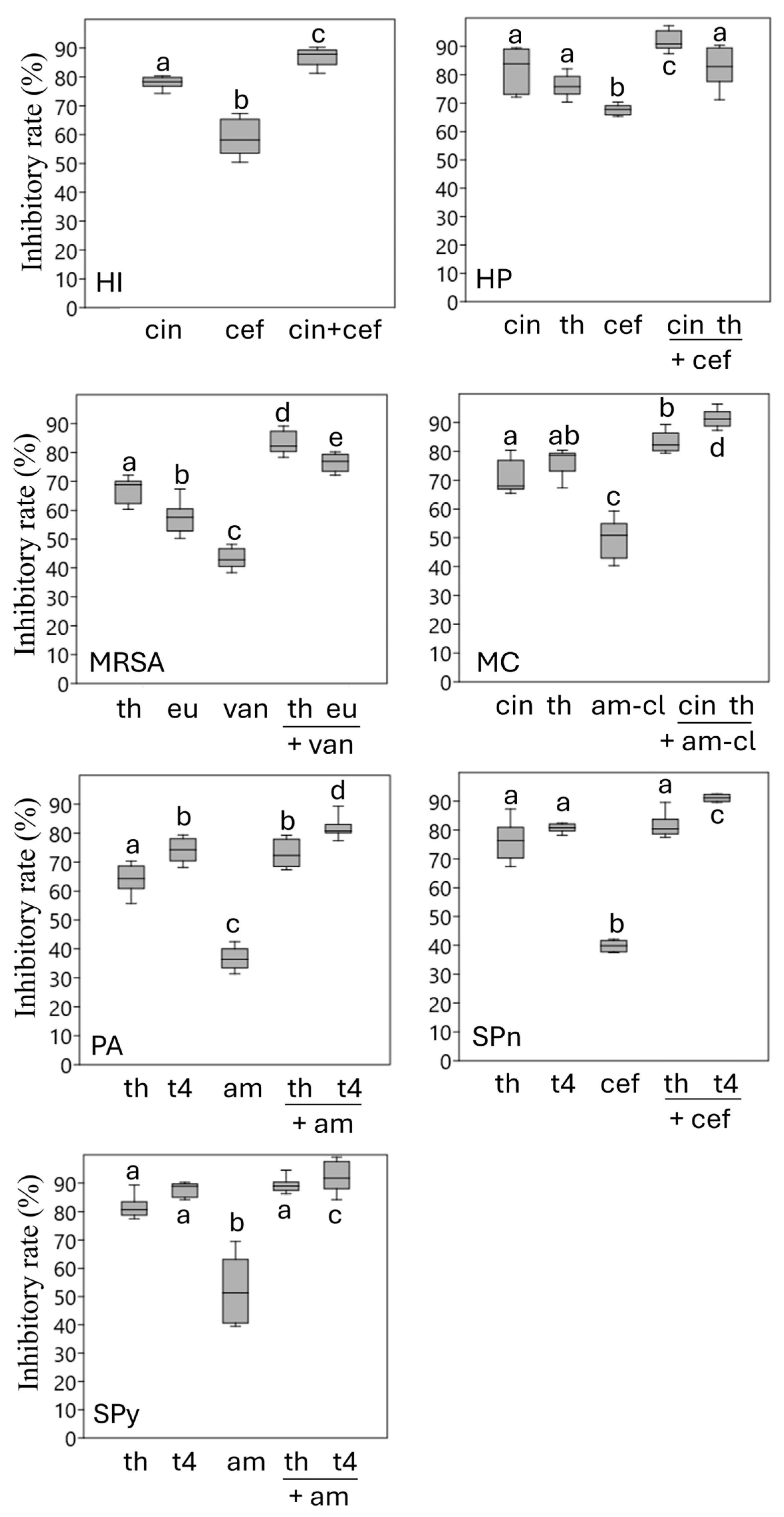
To assess the effects of the selected antibiotic-EO component combinations beyond planktonic cultures, we performed biofilm inhibition assays. Essential oil components alone exhibited moderate to strong antibiofilm activity, with inhibition ranging from approximately 65% to 85%. In contrast, antibiotic monotherapy showed variable and, in some cases, limited efficacy. For example, ceftriaxone inhibited S. pneumoniae biofilm formation by ~39%, while amoxicillin–clavulanic acid reduced M. catarrhalis biofilm biomass by ~50%.
Notably, combinations identified as synergistic in planktonic checkerboard assays produced significantly greater biofilm inhibition than antibiotic monotherapy (p < 0.05). In H. influenzae and H. parainfluenzae, cinnamaldehyde combined with ceftriaxone increased biofilm inhibition to over 85–90%. In M. catarrhalis, the cinnamaldehyde–amoxicillin/clavulanic acid combination enhanced inhibition from ~50% to >80%. Among Gram-positive pathogens, potentiation was particularly pronounced: in S. pneumoniae, ceftriaxone combined with thymol or terpinen-4-ol increased inhibition from ~39% to >85–90%, and in S. pyogenes, thymol- or terpinen-4-ol-based combinations improved amoxicillin-mediated inhibition from ~52% to nearly 90%. Among the tested combinations, thymol combined with amoxicillin–clavulanic acid exhibited the highest antibiofilm activity against M. catarrhalis, reaching an inhibition rate of 91.42% (Figure 1).

3. Discussion

The increasing incidence of antimicrobial resistance in respiratory tract infections necessitates the development of alternative therapeutic strategies capable of enhancing antibiotic efficacy while potentially reducing the required doses. In this context, selected EO components, namely thymol, eugenol, trans-cinnamaldehyde, and terpinen-4-ol, were chosen based on the previously demonstrated strong antibacterial and antibiofilm activities of their corresponding EOs and represent promising adjuvant candidates due to their multi-target mechanisms of action and their relatively low propensity to induce resistance [36,46]. The present study systematically evaluated the antibiotic-adjuvant potential of four major EO components against clinically relevant respiratory bacterial pathogens by integrating planktonic susceptibility testing, checkerboard synergy analysis, and early-stage biofilm validation. The checkerboard microdilution assays demonstrated notable synergistic interactions between EO components and conventional antibiotics against several respiratory pathogens. A consistent synergistic effect was observed for the cinnamaldehyde–ceftriaxone combination (FICI = 0.50) in Haemophilus species. This interaction may be explained by the ability of cinnamaldehyde to disrupt bacterial cell envelopes, thereby increasing membrane permeability and facilitating ceftriaxone penetration, which may help overcome bacterial resistance mechanisms [47]. Notably, pronounced synergistic interactions were also observed in MRSA when combined with eugenol (FICI = 0.18) and thymol (FICI = 0.25). These findings corroborate previous reports demonstrating enhanced antibacterial activity of EO components against MRSA [48,49]. Such combined strategies may exploit not only the intrinsic antibacterial properties of these components but also their ability to modulate bacterial resistance-related processes, including mechanisms such as efflux activity, thereby enhancing the efficacy of conventional antibiotics [50]. In the case of M. catarrhalis, the synergistic interactions observed for cinnamaldehyde combined with amoxicillin/clavulanic acid (FICI = 0.18) and thymol combined with amoxicillin–clavulanic acid (FICI = 0.31) are particularly noteworthy. These results are consistent with the well-documented resistance patterns of M. catarrhalis, where β-lactamase production frequently limits the effectiveness of standard therapies. The use of EO components in combination with β-lactams may contribute to the modulation of resistance-related mechanisms [51,52]. In contrast, only limited synergistic effects were observed for P. aeruginosa, primarily restricted to the thymol–amikacin (FICI = 0.37) and terpinen-4-ol–amikacin combinations. These observations likely reflect the multifactorial intrinsic resistance mechanisms of P. aeruginosa, including reduced outer membrane permeability and active efflux systems, which may limit the efficacy of EO-based adjuvant strategies. Previous studies have demonstrated that the outer membrane of P. aeruginosa acts as a significant permeability barrier to numerous antimicrobial agents, including EO components and antibiotics [53,54]. In Gram-positive pathogens, such as S. pneumoniae and S. pyogenes, consistent synergistic effects were observed for combinations of thymol and terpinen-4-ol with β-lactam antibiotics (FICI range: 0.31–0.37). These findings further support the potential of EO components as adjunctive agents in the treatment of infections where β-lactam resistance is of increasing concern. The ability of these components to enhance the bactericidal activity of β-lactams provides a compelling basis for future investigations aimed at elucidating their combined therapeutic potential and underlying mechanisms of action.
In this context, it should be noted that, although a broader panel of antibiotics was included in the initial susceptibility screening, only selected antibiotics were further evaluated in MIC and checkerboard assays. This targeted selection was based on their clinical relevance for the investigated pathogens, as well as their therapeutic importance in respiratory infection management, allowing for a focused assessment of synergistic interactions with EO components. For example, vancomycin was prioritized for MRSA due to its established role as a clinically relevant therapeutic option, while β-lactam antibiotics and amikacin were selected for other strains based on their relevance in current treatment practice.
The results of the biofilm inhibition assays further highlight the potential of combining EO components with antibiotics to combat biofilm-forming respiratory pathogens. Essential oil components alone demonstrated considerable antibiofilm activity, achieving inhibition rates between 65% and 85%. In contrast, antibiotic monotherapy showed variable and often limited efficacy. For example, ceftriaxone inhibited S. pneumoniae biofilm formation by only 39%, while amoxicillin–clavulanic acid reduced M. catarrhalis biofilm biomass by approximately 50%. These observations are consistent with previous reports emphasizing the limited effectiveness of conventional antibiotics against biofilm-associated infections [55,56]. In contrast, synergistic combinations resulted in significantly greater biofilm inhibition (p < 0.05). Notably, the cinnamaldehyde–ceftriaxone combination achieved high inhibition rates (>85–90%) against H. influenzae and H. parainfluenzae, supporting earlier findings that natural components can disrupt biofilm structure and enhance antibiotic penetration [57,58]. A comparable enhancement was observed for M. catarrhalis, where the addition of cinnamaldehyde increased the activity of amoxicillin/clavulanic acid from approximately 50% to over 80%, suggesting a potential restoration of β-lactam efficacy in β-lactamase-producing strains [59,60]. Similarly, in Gram-positive pathogens, marked potentiation was detected: combinations of ceftriaxone with thymol or terpinen-4-ol resulted in substantial biofilm inhibition (>85–90%) in S. pneumoniae, while in S. pyogenes these combinations increased inhibition from roughly 52% to nearly 90%. Collectively, these data support the concept that selected EO components may function as biofilm-targeting adjuvants, improving antibiotic performance under biofilm-associated growth conditions [61,62]. Among the evaluated combinations against MRSA, the thymol–vancomycin pairing yielded the most pronounced potentiation effect, reflected by markedly reduced MIC values and consistent synergistic interaction patterns.
Despite the promising in vitro findings, translation into clinical application requires careful evaluation. Comprehensive toxicological profiling, pharmacokinetic characterization, and validation in relevant in vivo infection models are necessary to determine safety, therapeutic window, and feasibility. Future studies should also address formulation strategies to optimize the stability, bioavailability, and controlled delivery of EO components when used as antibiotic adjuvants.

4. Materials and Methods

4.1. Bacterial Strains and Culture Conditions

The following clinically relevant respiratory pathogens were included in this study (Table 4): Haemophilus influenzae DSM 4690, Haemophilus parainfluenzae DSM 8978, Moraxella catarrhalis DSM 9143, methicillin-resistant Staphylococcus aureus (MRSA) ATCC 700698, Pseudomonas aeruginosa ATCC 27853, Streptococcus pneumoniae ATCC 20566, and Streptococcus pyogenes DSM 20565. All strains were stored at −80 °C in appropriate cryopreservation medium and subcultured twice prior to experiments. Bacterial strains were cultivated in Brain Heart Infusion (BHI) broth (Sigma-Aldrich, Darmstadt, Germany) as the primary liquid growth medium. Cultures were incubated at 37 °C for 12 h in a shaking incubator (C25 Incubator Shaker, New Brunswick Scientific, Edison, NJ, USA) at 60 rpm to obtain actively growing bacterial suspensions. For H. influenzae (DSM 4690) and H. parainfluenzae (DSM 8978), BHI broth was supplemented with 1% (v/v) Supplement B (Diagon Kft., Budapest, Hungary) and 15 µg/mL nicotinamide adenine dinucleotide (NAD) (NAD; Sigma-Aldrich, Darmstadt, Germany) to ensure optimal growth conditions. These cultures were incubated under identical temperature and shaking conditions.

4.2. Determination of Antibiotic Susceptibility Profile

The antibiotic susceptibility of the investigated respiratory pathogens was determined using the Kirby–Bauer disk diffusion method in accordance with Clinical and Laboratory Standards Institute (CLSI) guidelines (M02, [63]). Bacterial suspensions were adjusted to the turbidity of a 0.5 McFarland standard and uniformly spread onto agar plates. Mueller–Hinton agar (Oxoid Ltd., Hampshire, UK) was used for all strains except H. influenzae and H. parainfluenzae, for which chocolate agar supplemented with appropriate growth factors was applied. After drying, antibiotic disks (Oxoid Ltd., Hampshire, UK) were placed onto the agar surface. The following antibiotic disks were tested: amikacin (30 µg), ampicillin (10 µg), amoxicillin (10 µg), amoxicillin–clavulanic acid (20/10 µg), ceftazidime (10 µg), ceftriaxone (30 µg), ciprofloxacin (5 µg), erythromycin (15 µg), gentamicin (30 µg), imipenem (10 µg), levofloxacin (5 µg), oxacillin (1 µg), penicillin (1 µg), piperacillin–tazobactam (100/10 µg), and vancomycin (5 µg). Plates were incubated at 35–37 °C for 16–18 h. Inhibition zone diameters were measured in millimeters and interpreted according to CLSI breakpoint criteria. All tests were performed in triplicate.

4.3. Antibiotics and Essential Oil Components

The antibiotics evaluated in this study were selected based on their clinical relevance in respiratory tract infections. Amikacin (Likacin 250 mg/mL solution for injection; Lisapharma S.p.A, Erba, Italy), vancomycin (500 mg powder for solution for infusion; TEVA, Debrecen, Hungary), amoxicillin (powder for solution; specify manufacturer if applicable), amoxicillin–clavulanic acid (Amoxicillin/Clavulanic Acid Sandoz 1000 mg/200 mg powder for solution for injection; Sandoz GmbH, Kundl, Austria), and ceftriaxone (CEFTRIAXONE KABI 2 g powder for solution for infusion; Fresenius Kabi Deutschland GmbH, Bad Homburg, Germany) were used. Antibiotic stock solutions were prepared in sterile distilled water according to the declared active substance content and further diluted in the appropriate test medium to obtain the required concentrations for susceptibility testing. The EO components investigated included thymol (≥99% purity), eugenol (≥99%), trans-cinnamaldehyde (≥98%), and terpinen-4-ol (≥97%), all purchased from Sigma-Aldrich Ltd. (Darmstadt, Germany). Stock solutions were prepared using Tween 40 as a solubilizing agent. Following dilution in the microdilution assay, the final concentration of Tween 40 did not exceed 0.5% (v/v). Control wells containing 0.5% Tween 40 without active components were included in all experiments to confirm the absence of intrinsic antimicrobial activity.

4.4. Determination of Minimum Inhibitory Concentration (MIC)

Minimum inhibitory concentrations (MICs) of antibiotics and EO components were determined using the broth microdilution method in accordance with CLSI guidelines (CLSI M02; [63]). Based on the initial susceptibility profiles, one clinically relevant antibiotic per bacterial strain was selected for subsequent MIC and checkerboard assays. The selection was guided by their therapeutic relevance in respiratory tract infections and their established clinical use against the respective pathogens. Bacterial suspensions were prepared from fresh overnight cultures and adjusted spectrophotometrically to a 0.5 McFarland standard. The inoculum was subsequently diluted in the appropriate test medium to obtain a final bacterial concentration of approximately 1 × 10⁵ CFU/mL in each well of a sterile 96-well microtiter plate. Two-fold serial dilutions of antibiotics and components were prepared in BHI broth, with strain-specific supplements applied as described above. Each well contained 100 µL of the test compound dilution and 100 µL of bacterial suspension, resulting in a total volume of 200 µL. Tween 40 was used as a solubilizing agent. After dilution in the assay system, the final concentration of Tween 40 did not exceed 0.5% (v/v). Control wells containing medium only, inoculum only, and 0.5% Tween 40 without active components were included in all experiments. Microplates were incubated at 37 °C for 24 h under strain-specific atmospheric conditions. The MIC was defined as the lowest concentration of the tested component that showed no visible bacterial growth. All experiments were performed in triplicate and repeated at least three times independently.

4.5. Checkerboard Titration

Synergistic interactions between antibiotics and EO components were evaluated using the checkerboard broth microdilution method in sterile 96-well microtiter plates. Two-fold serial dilutions of each antibiotic were prepared along one axis, and two-fold serial dilutions of each EO component (thymol, eugenol, trans-cinnamaldehyde, and terpinen-4-ol) were prepared along the other axis. For both agents, the tested concentration range corresponded to 8 × MIC, 4 × MIC, 2 × MIC, 1 × MIC, 1/2 × MIC, 1/4 × MIC, and 1/8 × MIC, based on the MIC values determined for each strain. Each well contained 100 µL of the antibiotic–component mixture and 100 µL of the standardized bacterial inoculum, resulting in a final volume of 200 µL per well and a final inoculum of approximately 105 CFU/mL. Plates were incubated at 37 °C for 24 h under strain-specific atmospheric conditions. Growth controls (medium + inoculum) and solvent controls (Tween 40 at a final concentration of 0.5% v/v) were included on each plate. Bacterial growth was quantified by measuring optical density at 600 nm (OD600) using a microplate reader. Growth inhibition was calculated relative to the untreated growth control [64] as
% inhibition = [1 − (OD_treated/OD_control)] × 100
For endpoint determination, the combination MIC was defined as the lowest antibiotic–component concentration pair resulting in ≥90% growth inhibition compared to the growth control. The fractional inhibitory concentration index (FICI) was calculated as
FICI = FIC_A + FIC_B,
where FIC_A = (MIC of the antibiotic in combination)/(MIC of the antibiotic alone), and FIC_B = (MIC of the component in combination)/(MIC of the component alone).
Interactions were interpreted as synergy (FICI ≤ 0.5), additive (0.5 < FICI ≤ 1.0), indifferent (1.0 < FICI ≤ 4.0), or antagonistic (FICI > 4.0) [65]. All checkerboard assays were performed in triplicate and repeated at least three times independently.

4.6. Early-Stage Biofilm Formation Assay

The effect of selected antibiotic–component combinations on early-stage biofilm formation was evaluated using a crystal violet microtiter plate assay. Fresh bacterial suspensions were prepared from overnight cultures and adjusted to the required inoculum density in the appropriate growth medium (1 × 10⁸ CFU/mL). Aliquots of 100 µL of bacterial suspension were added to sterile 96-well flat-bottom polystyrene microplates together with 100 µL of the test solutions, resulting in a final volume of 200 µL per well. The following conditions were tested: untreated control (growth control), antibiotic alone, component alone, and the selected antibiotic–component combinations identified as synergistic in the checkerboard assay. Solvent controls containing 0.5% Tween 40 were included in all experiments. Plates were incubated statically at 37 °C for 6 h under strain-specific atmospheric conditions to allow initial bacterial adhesion and early biofilm development. After incubation, non-adherent cells were gently removed, and wells were washed three times with sterile physiological saline. The attached biomass was fixed with methanol, followed by staining with 0.1% (w/v) crystal violet solution. Excess stain was removed by washing with distilled water, and the plates were air-dried. Bound crystal violet was solubilized with 33% (v/v) acetic acid, and absorbance was measured at 595 nm using a microplate reader. Antibiofilm activity is expressed as the inhibitory rate calculated according to the following equation:
Inhibitory rate (%) = (1 − S/C) × 100,
where C and S represent the mean absorbance values of the untreated control and treated sample groups, respectively [64]. All experiments were performed using eight parallel replicates.

4.7. Statistical Analysis

Statistical analyses were conducted using PAST software version 3.11 [66]. Differences in biofilm inhibition rates between treatment groups were evaluated by one-way analysis of variance (ANOVA). Upon detection of a significant overall effect, pairwise comparisons were performed using Tukey’s honestly significant difference (HSD) post hoc test. Statistical significance was set at p < 0.05.

5. Conclusions

The present study demonstrates that selected EO components enhance the antibacterial efficacy of clinically relevant antibiotics against respiratory pathogens. Importantly, planktonic synergistic interactions translated into improved inhibition of early-stage biofilm formation. These findings highlight the potential of EO components as antibiotic adjuvants and support further investigation of their translational applicability in respiratory infection management.

Author Contributions

Conceptualization, V.L.B., R.F. and L.R.; methodology, V.L.B. and E.O.; software, M.K.; validation, M.K., V.L.B. and E.K.; formal analysis, V.L.B. and R.F.; investigation, V.L.B. and L.R.; resources, B.K.; data curation, R.F. and B.K.; writing—original draft preparation, V.L.B. and R.F.; writing—review and editing, M.K. and E.K.; visualization, M.K.; supervision, V.L.B.; project administration, V.L.B. and E.K.; funding acquisition, V.L.B. and E.K. All authors have read and agreed to the published version of the manuscript.

Funding

This research work was supported by the Development and Innovation Office NKFIH PD 147156 (Balázs V.L.), NKFIH PD 142122 (Kerekes E.), 2021-1.2.6-TÉT-IPARI-MA-2022-00015, and 2024-2.1.3-POC-2025-00004 and was carried out with the support provided by the Ministry of Culture and Innovation of Hungary from the National Research, Development and Innovation Office, financed under the 2024-2.1.3-POC funding scheme.

Institutional Review Board Statement

Not applicable.

Informed Consent Statement

Not applicable.

Data Availability Statement

The data supporting the findings of this study are available from the corresponding author upon reasonable request.

Conflicts of Interest

The authors declare no conflicts of interest.

References

  1. Fahmi, A.; Yang, Y.-T.; Zhong, X.; Pate, A.; Sharma, A.; Watts, S.; Ashcroft, D.M.; Goldacre, B.; MacKenna, B.; Massey, J.; et al. Antibiotics for Common Infections in Primary Care before, during and after the COVID-19 Pandemic: Cohort Study of Extent of Prescribing Based on Risks of Infection-Related Hospital Admissions. J. R. Soc. Med. 2025, 118, 126–137. [Google Scholar] [CrossRef] [PubMed]
  2. Fahmi, A.; Palin, V.; Zhong, X.; Yang, Y.-T.; Watts, S.; Ashcroft, D.M.; Goldacre, B.; MacKenna, B.; Fisher, L.; Massey, J.; et al. Evaluation of the Impact of COVID-19 Pandemic on Hospital Admission Related to Common Infections: Risk Prediction Models to Tackle Antimicrobial Resistance in Primary Care. PLoS ONE 2024, 19, e0311515. [Google Scholar] [CrossRef] [PubMed]
  3. Vaezi, A.; Healy, T.; Ebrahimi, G.; Rezvankhah, S.; Shahraki, A.H.; Mirsaeidi, M. Phage Therapy: Breathing New Tactics into Lower Respiratory Tract Infection Treatments. Eur. Respir. Rev. 2024, 33, 240029. [Google Scholar] [CrossRef] [PubMed]
  4. Miriti, D.M.; Muthini, J.M.; Nyamache, A.K. Study of Bacterial Respiratory Infections and Antimicrobial Susceptibility Profile among Antibiotics Naive Outpatients Visiting Meru Teaching and Referral Hospital, Meru County, Kenya in 2018. BMC Microbiol. 2023, 23, 172. [Google Scholar] [CrossRef]
  5. Ángyán, V.D.; Balázs, V.L.; Kocsis, M.; Kocsis, B.; Horváth, G.; Farkas, Á.; Nagy-Radványi, L. Synergistic Antibiofilm Effects of Chestnut and Linden Honey with Lavender Essential Oil Against Multidrug-Resistant Otitis Media Pathogens. Antibiotics 2025, 14, 146. [Google Scholar] [CrossRef]
  6. Arena, C.J.; Frost, H.M.; Willis, P.; Raux, B.; Wungwattana, M.; Veve, M.P. Current Evidence and Gaps for Outpatient Respiratory Tract Infection Diagnostics: A Call to Action. Open Forum Infect. Dis. 2025, 12, S1413–S1417. [Google Scholar] [CrossRef]
  7. Llor, C.; Hansen, M.P.; Lykkegaard, J.; Olsen, J.; Lindberg, B.H.; Rebnord, I.K.; Touboul Lundgren, P.; Bruno, P.; Kowalczyk, A.; Lionis, C.; et al. Duration of Antibiotic Treatment for Respiratory Tract Infections in Primary Care. JAC Antimicrob. Resist. 2025, 7, dlaf028. [Google Scholar] [CrossRef]
  8. Ormai, E.; Bordás, B.; Kocsis, M.; Kerekes, E.; Biró, V.; Kocsis, B.; Szilágyi-Utczás, M.; Nagy, A.; Ollmann, T.; Horváth, G.; et al. Anti-Biofilm Activity of Tea Tree, Peppermint, Clove, Thyme Essential Oils and the Combination of the Most Effective Oils with Antibiotics against Bacteria Associated with Nosocomial Infections. J. Essent. Oil Res. 2025, 37, 469–486. [Google Scholar] [CrossRef]
  9. Gergova, R.T.; Petrova, G.; Gergov, S.; Minchev, P.; Mitov, İ.; Strateva, T. Microbiological Features of Upper Respiratory Tract Infections in Bulgarian Children for the Period 1998-2014. Balk. Med. J. 2016, 33, 675–680. [Google Scholar] [CrossRef]
  10. Zumla, A.; Memish, Z.A.; Maeurer, M.; Bates, M.; Mwaba, P.; Al-Tawfiq, J.A.; Denning, D.W.; Hayden, F.G.; Hui, D.S. Emerging Novel and Antimicrobial-Resistant Respiratory Tract Infections: New Drug Development and Therapeutic Options. Lancet Infect. Dis. 2014, 14, 1136–1149. [Google Scholar] [CrossRef]
  11. Noviello, S.; Huang, D.B. The Basics and the Advancements in Diagnosis of Bacterial Lower Respiratory Tract Infections. Diagnostics 2019, 9, 37. [Google Scholar] [CrossRef]
  12. Yin, R.; Cheng, J.; Wang, J.; Li, P.; Lin, J. Treatment of Pseudomonas aeruginosa Infectious Biofilms: Challenges and Strategies. Front. Microbiol. 2022, 13, 955286. [Google Scholar] [CrossRef]
  13. Yeu, J.-E.; Lee, H.-G.; Park, G.-Y.; Lee, J.; Kang, M.-S. Antimicrobial and Antibiofilm Activities of Weissella cibaria against Pathogens of Upper Respiratory Tract Infections. Microorganisms 2021, 9, 1181. [Google Scholar] [CrossRef]
  14. Blumer, J. Clinical Perspectives on Sinusitis and Otitis Media. Pediatr. Infect. Dis. J. 1998, 17, S68–S72. [Google Scholar] [CrossRef] [PubMed]
  15. Ngo, C.C.; Massa, H.M.; Thornton, R.B.; Cripps, A.W. Predominant Bacteria Detected from the Middle Ear Fluid of Children Experiencing Otitis Media: A Systematic Review. PLoS ONE 2016, 11, e0150949. [Google Scholar] [CrossRef] [PubMed]
  16. Silva, M.D.; Lima, A.; Marçal, N.; Dias, L.; Gama, M.; Sillankorva, S. Identification of the Bacterial Pathogens in Children with Otitis Media: A Study in the Northwestern Portuguese District of Braga. Microorganisms 2022, 10, 54. [Google Scholar] [CrossRef] [PubMed]
  17. Zhang, L.; Bera, H.; Wang, H.; Wang, J.; Guo, Y.; Shi, C.; Cun, D.; Moser, C.; Høiby, N.; Yang, M. Combination and Nanotechnology Based Pharmaceutical Strategies for Combating Respiratory Bacterial Biofilm Infections. Int. J. Pharm. 2022, 616, 121507. [Google Scholar] [CrossRef]
  18. Michael; Waturangi, D.E. Antibiofilm Activity from Endophyte Bacteria, Vibrio Cholerae Strains, and Actinomycetes Isolates in Liquid and Solid Culture. BMC Microbiol. 2023, 23, 83. [Google Scholar] [CrossRef]
  19. Pumirat, P.; Sripraphot, S.; Nilchan, N.; Jiarpinitnun, C. Squaramide Homoserine Lactone Derivatives and Their Abilities to Modulate Pseudomonas aeruginosa Biofilm Formation. Synlett 2025, 36, 2890–2894. [Google Scholar] [CrossRef]
  20. Subramanian, S.; Tolstaya, E.I.; Winkler, T.E.; Bentley, W.E.; Ghodssi, R. An Integrated Microsystem for Real-Time Detection and Threshold-Activated Treatment of Bacterial Biofilms. ACS Appl. Mater. Interfaces 2017, 9, 31362–31371. [Google Scholar] [CrossRef]
  21. Gilmore, B.F.; McDougald, D.; Beloin, C. Editorial: Insights in Biofilms: 2021. Front. Cell. Infect. Microbiol. 2022, 12, 1093692. [Google Scholar] [CrossRef]
  22. Karygianni, L.; Ren, Z.; Koo, H.; Thurnheer, T. Biofilm Matrixome: Extracellular Components in Structured Microbial Communities. Trends Microbiol. 2020, 28, 668–681. [Google Scholar] [CrossRef] [PubMed]
  23. Ciofu, O.; Moser, C.; Jensen, P.Ø.; Høiby, N. Tolerance and Resistance of Microbial Biofilms. Nat. Rev. Microbiol. 2022, 20, 621–635. [Google Scholar] [CrossRef] [PubMed]
  24. Coenye, T. Biofilm Antimicrobial Susceptibility Testing: Where Are We and Where Could We Be Going? Clin. Microbiol. Rev. 2023, 36, e0002423. [Google Scholar] [CrossRef] [PubMed]
  25. Liu, H.Y.; Prentice, E.L.; Webber, M.A. Mechanisms of Antimicrobial Resistance in Biofilms. npj Antimicrob. Resist. 2024, 2, 27. [Google Scholar] [CrossRef] [PubMed]
  26. Balázs, V.L.; Bordás, B.; Nagy-Radványi, L.; Ormai, E.; Kocsis, M.; Kocsis, B.; Farkas, Á.; Micalizzi, G.; Mondello, L.; Ángyán, V.; et al. Efficacy of Lavender Essential Oil against Respiratory Tract Bacteria Is Influenced by Harvesting Time. J. Essent. Oil Res. 2025, 37, 428–440. [Google Scholar] [CrossRef]
  27. Filep, R.; Nagy, D.U.; Ormai, E.; Kocsis, B.; Szilágyi-Utczás, M.; Purger, D.; Balázs, V.L. Geographical Variation in the Chemical Profile and Antimicrobial Activity of Solidago Gigantea Essential Oils. Front. Microbiol. 2026, 17, 1740133. [Google Scholar] [CrossRef]
  28. Kong, A.S.-Y.; Lim, S.-H.E.; Cheng, W.-H.; Yuswan, M.H.; Tan, N.-P.; Lai, K.-S. Harnessing Monoterpenes and Monoterpenoids as Weapons against Antimicrobial Resistance. Pol. J. Microbiol. 2025, 74, 1–18. [Google Scholar] [CrossRef]
  29. Adegoke, A.A.; Stenström, T.A.; Okoh, A.I. Stenotrophomonas maltophilia as an Emerging Ubiquitous Pathogen: Looking Beyond Contemporary Antibiotic Therapy. Front. Microbiol. 2017, 8, 2276. [Google Scholar] [CrossRef]
  30. Kavanaugh, N.L.; Ribbeck, K. Selected Antimicrobial Essential Oils Eradicate Pseudomonas Spp. and Staphylococcus aureus Biofilms. Appl. Environ. Microbiol. 2012, 78, 4057–4061. [Google Scholar] [CrossRef]
  31. Rao, H.; Lai, P.; Gao, Y. Chemical Composition, Antibacterial Activity, and Synergistic Effects with Conventional Antibiotics and Nitric Oxide Production Inhibitory Activity of Essential Oil from Geophila repens (L.) I.M. Johnst. Molecules 2017, 22, 1561. [Google Scholar] [CrossRef]
  32. Wińska, K.; Mączka, W.; Łyczko, J.; Grabarczyk, M.; Czubaszek, A.; Szumny, A. Essential Oils as Antimicrobial Agents—Myth or Real Alternative? Molecules 2019, 24, 2130. [Google Scholar] [CrossRef] [PubMed]
  33. Mahizan, N.A.; Yang, S.-K.; Moo, C.-L.; Song, A.A.-L.; Chong, C.-M.; Chong, C.-W.; Abushelaibi, A.; Lim, S.-H.E.; Lai, K.-S. Terpene Derivatives as a Potential Agent against Antimicrobial Resistance (AMR) Pathogens. Molecules 2019, 24, 2631. [Google Scholar] [CrossRef] [PubMed]
  34. Joshi, R.K.; Satyal, P.; Setzer, W.N. Himalayan Aromatic Medicinal Plants: A Review of Their Ethnopharmacology, Volatile Phytochemistry, and Biological Activities. Medicines 2016, 3, 6. [Google Scholar] [CrossRef] [PubMed]
  35. García-Salinas, S.; Elizondo-Castillo, H.; Arruebo, M.; Mendoza, G.; Irusta, S. Evaluation of the Antimicrobial Activity and Cytotoxicity of Different Components of Natural Origin Present in Essential Oils. Molecules 2018, 23, 1399. [Google Scholar] [CrossRef]
  36. Iskandar, K.; Ahmed, N.; Paudyal, N.; Ruiz Alvarez, M.-J.; Balasubramani, S.P.; Saadeh, D.; Ullah Baig, S.; Sami, H.; Hammoudi Halat, D.; Pavlović, N.; et al. Essential Oils as Antimicrobial Agents Against WHO Priority Bacterial Pathogens: A Strategic Review of In Vitro Clinical Efficacy, Innovations and Research Gaps. Antibiotics 2025, 14, 1250. [Google Scholar] [CrossRef]
  37. Low, D.E.; Brown, S.; Felmingham, D. Clinical and Bacteriological Efficacy of the Ketolide Telithromycin against Isolates of Key Respiratory Pathogens: A Pooled Analysis of Phase III Studies. Clin. Microbiol. Infect. 2004, 10, 27–36. [Google Scholar] [CrossRef][Green Version]
  38. Koeth, L.M.; Jacobs, M.R.; Good, C.E.; Bajaksouzian, S.; Windau, A.; Jakielaszek, C.; Saunders, K.A. Comparative in Vitro Activity of a Pharmacokinetically Enhanced Oral Formulation of Amoxicillin/Clavulanic Acid (2000/125 Mg Twice Daily) against 9172 Respiratory Isolates Collected Worldwide in 2000. Int. J. Infect. Dis. 2004, 8, 362–373. [Google Scholar] [CrossRef]
  39. Bradford, P.A.; Petersen, P.J.; Tuckman, M.; Jones, C.H. In Vitro Activity of Tigecycline and Occurrence of Tetracycline Resistance Determinants in Isolates from Patients Enrolled in Phase 3 Clinical Trials for Community-Acquired Pneumonia. Clin. Microbiol. Infect. 2008, 14, 882–886. [Google Scholar] [CrossRef]
  40. Karlowsky, J.A.; Steenbergen, J.; Zhanel, G.G. Microbiology and Preclinical Review of Omadacycline. Clin. Infect. Dis. 2019, 69, S6–S15. [Google Scholar] [CrossRef]
  41. Dien Bard, J.; McElvania, E. Panels and Syndromic Testing in Clinical Microbiology. Clin. Lab. Med. 2020, 40, 393–420. [Google Scholar] [CrossRef]
  42. Bassetti, M.; Merelli, M.; Temperoni, C.; Astilean, A. New Antibiotics for Bad Bugs: Where Are We? Ann. Clin. Microbiol. Antimicrob. 2013, 12, 22. [Google Scholar] [CrossRef]
  43. Ge, Y.; Biek, D.; Talbot, G.H.; Sahm, D.F. In Vitro Profiling of Ceftaroline against a Collection of Recent Bacterial Clinical Isolates from across the United States. Antimicrob. Agents Chemother. 2008, 52, 3398–3407. [Google Scholar] [CrossRef][Green Version]
  44. Leus, I.V.; Adamiak, J.; Chandar, B.; Bonifay, V.; Zhao, S.; Walker, S.S.; Squadroni, B.; Balibar, C.J.; Kinarivala, N.; Standke, L.C.; et al. Functional Diversity of Gram-Negative Permeability Barriers Reflected in Antibacterial Activities and Intracellular Accumulation of Antibiotics. Antimicrob. Agents Chemother. 2023, 67, e0137722. [Google Scholar] [CrossRef]
  45. Nikaido, H. Molecular Basis of Bacterial Outer Membrane Permeability Revisited. Microbiol. Mol. Biol. Rev. 2003, 67, 593–656. [Google Scholar] [CrossRef]
  46. Soulaimani, B. Comprehensive Review of the Combined Antimicrobial Activity of Essential Oil Mixtures and Synergism with Conventional Antimicrobials. Nat. Product. Commun. 2025, 20, 1934578X251328241. [Google Scholar] [CrossRef]
  47. Yin, L.; Gou, Y.; Dai, Y.; Wang, T.; Gu, K.; Tang, T.; Hussain, S.; Huang, X.; He, C.; Liang, X.; et al. Cinnamaldehyde Restores Ceftriaxone Susceptibility against Multidrug-Resistant Salmonella. Int. J. Mol. Sci. 2023, 24, 9288. [Google Scholar] [CrossRef]
  48. Nasir, S.; Vohra, M.S.; Gul, D.; Swaiba, U.E.; Aleem, M.; Mehmood, K.; Andleeb, S. Novel Antibiotic Combinations of Diverse Subclasses for Effective Suppression of Extensively Drug-Resistant Methicillin-Resistant Staphylococcus aureus (MRSA). Int. J. Microbiol. 2020, 2020, 8831322. [Google Scholar] [CrossRef] [PubMed]
  49. Sreepian, A.; Popruk, S.; Nutalai, D.; Phutthanu, C.; Sreepian, P.M. Antibacterial Activities and Synergistic Interaction of Citrus Essential Oils and Limonene with Gentamicin against Clinically Isolated Methicillin-Resistant Staphylococcus aureus. Sci. World J. 2022, 2022, 8418287. [Google Scholar] [CrossRef] [PubMed]
  50. Dassanayake, M.K.; Khoo, T.-J.; An, J. Antibiotic Resistance Modifying Ability of Phytoextracts in Anthrax Biological Agent Bacillus anthracis and Emerging Superbugs: A Review of Synergistic Mechanisms. Ann. Clin. Microbiol. Antimicrob. 2021, 20, 79. [Google Scholar] [CrossRef]
  51. Karadağ, A.E.; Çaşkurlu, A.; Demirci, B.; Demirci, F. Binary Synergistic Combinations of Lavender and Fennel Essential Oils with Amoxicillin. Planta Med. 2023, 89, 800–807. [Google Scholar] [CrossRef]
  52. Saleh, N.M.; Ezzat, H.; El-Sayyad, G.S.; Zedan, H. Regulation of Overexpressed Efflux Pump Encoding Genes by Cinnamon Oil and Trimethoprim to Abolish Carbapenem-Resistant Acinetobacter Baumannii Clinical Strains. BMC Microbiol. 2024, 24, 52. [Google Scholar] [CrossRef]
  53. Grădinaru, A.C.; Trifan, A.; Şpac, A.; Brebu, M.; Miron, A.; Aprotosoaie, A.C. Antibacterial Activity of Traditional Spices against Lower Respiratory Tract Pathogens: Combinatorial Effects of Trachyspermum Ammi Essential Oil with Conventional Antibiotics. Lett. Appl. Microbiol. 2018, 67, 449–457. [Google Scholar] [CrossRef]
  54. Shahi, A.; Manhas, R.; Bhattacharya, S.; Rathore, A.; Kumar, P.; Samanta, J.; Sharma, M.K.; Mahapa, A.; Gupta, P.; Anal, J.M.H. Synthesis and Antibacterial Potential of Novel Thymol Derivatives against Methicillin-Resistant Staphylococcus aureus and P. Aeruginosa Pathogenic Bacteria. Front. Chem. 2024, 12, 1482852. [Google Scholar] [CrossRef]
  55. Harrington, N.E.; Sweeney, E.; Alav, I.; Allen, F.; Moat, J.; Harrison, F. Antibiotic Efficacy Testing in an Ex Vivo Model of Pseudomonas aeruginosa and Staphylococcus aureus Biofilms in the Cystic Fibrosis Lung. J. Vis. Exp. 2021, 167, e62187. [Google Scholar] [CrossRef]
  56. Haines, R.R.; Putsathit, P.; Tai, A.S.; Hammer, K.A. Antimicrobial Effects of Melaleuca alternifolia (Tea Tree) Essential Oil against Biofilm-Forming Multidrug-Resistant Cystic Fibrosis-Associated Pseudomonas aeruginosa as a Single Agent and in Combination with Commonly Nebulized Antibiotics. Lett. Appl. Microbiol. 2022, 75, 578–587. [Google Scholar] [CrossRef]
  57. Chimi, L.Y.; Bisso, B.N.; Njateng, G.S.S.; Dzoyem, J.P. Antibiotic-Potentiating Effect of Some Bioactive Natural Products against Planktonic Cells, Biofilms, and Virulence Factors of Pseudomonas aeruginosa. Biomed. Res. Int. 2023, 2023, 9410609. [Google Scholar] [CrossRef] [PubMed]
  58. Gupta, A.; Makabenta, J.M.V.; Schlüter, F.; Landis, R.F.; Das, R.; Cuppels, M.; Rotello, V.M. Functionalized Polymers Enhance Permeability of Antibiotics in Gram-Negative MDR Bacteria and Biofilms for Synergistic Antimicrobial Therapy. Adv. Ther. 2020, 3, 2000005. [Google Scholar] [CrossRef]
  59. Huang, Y.-L.; Huang, C.-H.; Huang, Y.-C.; Yen, C.-L.; Hsu, C.-R. Anti-Biofilm Activities and Antibiotic Synergy of Naturally Occurring Compounds against Drug-Resistant Rapidly Growing Mycobacteria. Microbiol. Spectr. 2024, 12, e00199-24. [Google Scholar] [CrossRef]
  60. Ribeiro, M.; Malheiro, J.; Grenho, L.; Fernandes, M.H.; Simões, M. Cytotoxicity and Antimicrobial Action of Selected Phytochemicals against Planktonic and Sessile Streptococcus Mutans. PeerJ 2018, 6, e4872. [Google Scholar] [CrossRef]
  61. Kuaté Tokam, C.R.; Bisso Ndezo, B.; Boulens, N.; Allémann, E.; Delie, F.; Dzoyem, J.P. Antibiofilm Activity and Synergistic Effects of Thymol-Loaded Poly (Lactic-Co-Glycolic Acid) Nanoparticles with Amikacin against Four Salmonella enterica Serovars. Can. J. Infect. Dis. Med. Microbiol. 2023, 2023, 7274309. [Google Scholar] [CrossRef]
  62. Ming, X.; Yin, M.; Liyan, W. Antibacterial and Anti-Inflammatory Potential of Chinese Medicinal Herbs: Lonicerae flos, Lonicerae japonicae flos, Scutellaria baicalensis georgi, and Forsythia suspensa. Nat. Product. Commun. 2022, 17, 1934578X221136673. [Google Scholar] [CrossRef]
  63. CLSI. Performance Standards for Antimicrobial Disk Susceptibility Tests, 14th ed.; CLSI Standard M02; Clinical and Laboratory Standards Institute: Wayne, PA, USA, 2023. [Google Scholar]
  64. Sun, Y.; Chen, S.; Zhang, C.; Liu, Y.; Ma, L.; Zhang, X. Effects of Sub-Minimum Inhibitory Concentrations of Lemon Essential Oil on the Acid Tolerance and Biofilm Formation of Streptococcus mutans. Arch. Oral. Biol. 2018, 87, 235–241. [Google Scholar] [CrossRef] [PubMed]
  65. Odds, F.C. Synergy, Antagonism, and What the Chequerboard Puts between Them. J. Antimicrob. Chemother. 2003, 52, 1. [Google Scholar] [CrossRef] [PubMed]
  66. Hammer, Ø.; Harper, D.A.T.; Ryan, P.D. PAST: Paleontological Statistics Software Package for Education and Data Analysis. Palaeontol. Electron. 2001, 4, 1–9. [Google Scholar]
Figure 1. Early-stage (6 h) biofilm inhibition by antibiotic-essential oil component combinations against respiratory bacterial pathogens. Data were expressed using box plots with minimum to maximum values presented by vertical lines, with the median in the plot as a horizontal line. Different lowercase letters above or below the bars indicate significant differences between the means of the biofilm inhibition effect of the components according to Tukey’s test (p < 0.05), based on results of 8 parallel measurements (n = 8). Abbreviations: am (amoxicillin); am-cl (amoxicillin/clavulanic acid); cef (ceftriaxone); cin (cinnamaldehyde); eu (eugenol); t4 (terpinen-4-ol); th (thymol); van (vancomycin); HI (H. influenzae); HP (H. parainfluenzae); MRSA (methicillin-resistant S. aureus); MC (M. catarrhalis); PA (P. aeruginosa); SPn (S. pneumoniae); SPy (S. pyogenes).
Antibiotics 15 00403 g001
Table 1. Disk diffusion-based antibiotic susceptibility profiles of clinically relevant respiratory bacterial pathogens.
AntibioticsHIHPMRSAMCPASPnSPy
AmikacinSS--S--
Amoxicillin--R---S
Amoxicillin/clavulanic acid--RSSSS
AmpicillinRRRR---
CeftriaxoneSSR----
Ceftazidime--R-S--
CiprofloxacinSSRRSSS
Erythromycin-----R-
Gentamicin--S-S--
ImipenemSS-SSSS
Levofloxacin-------
Oxacillin--R----
Penicillin--R--SS
Piperacillin/tazobactam----S--
Vancomycin--S----
R (resistant); S (susceptible); “-” (not tested/not applicable due to limited clinical relevance for the given bacterial strain); HI (H. influenzae); HP (H. parainfluenzae); MRSA (methicillin-resistant S. aureus); MC (M. catarrhalis); PA (P. aeruginosa); SPn (S. pneumoniae); SPy (S. pyogenes).
Table 2. Minimum inhibitory concentrations (MICs) of antibiotics and essential oil components against clinically relevant respiratory bacterial pathogens.
HIHPMRSAMCPASPnSPy
amikacin----8--
amoxicillin------0.006
amoxicillin–clavulanic acid---0.5---
ceftriaxone0.50.5---1-
vancomycin--2----
cinnamaldehyde19196253136257839
eugenol787831315662515678
thymol3919156781567819
terpinen-4-ol78393133133133919
MIC values are expressed in µg/mL. Amoxicillin/clavulanic acid was tested at a fixed 5:1 ratio (as in the clinical formulation). MIC values are reported as the total concentration of the combination. HI (H. influenzae); HP (H. parainfluenzae); MRSA (methicillin-resistant S. aureus); MC (M. catarrhalis); PA (P. aeruginosa); SPn (S. pneumoniae); SPy (S. pyogenes).
Table 3. Fractional inhibitory concentration index (FICI) values of antibiotic–essential oil component combinations against respiratory bacterial pathogens.
Bacterial StrainComponentsMIC CombinationFICIInteraction
HIcinnamaldehyde4.80.50SYN
ceftriaxone0.1
eugenol19.50.75ADD
ceftriaxone0.3
thymol9.80.75ADD
ceftriaxone0.3
terpinen-4-ol19.50.75ADD
ceftriaxone0.3
HPcinnamaldehyde4.90.50SYN
ceftriaxone0.2
eugenol391.00ADD
ceftriaxone0.3
thymol2.40.37SYN
ceftriaxone0.1
terpinen-4-ol9.80.75ADD
ceftriaxone0.3
MRSAcinnamaldehyde156.20.75ADD
vancomycin1.0
eugenol19.50.18SYN
vancomycin0.3
thymol19.50.25SYN
vancomycin0.5
terpinen-4-ol0.15620.75ADD
vancomycin0.5
MCcinnamaldehyde19.50.18SYN
amoxicillin–clavulanic acid0.0625
eugenol390.75ADD
amoxicillin-clavulanic acid0.25
thymol4.80.31SYN
amoxicillin–clavulanic acid0.125
terpinen-4-ol780.75ADD
amoxicillin–clavulanic acid0.25
PAcinnamaldehyde156.20.75ADD
amikacin4
eugenol312.50.63ADD
amikacin1
thymol190.37SYN
amikacin2
terpinen-4-ol780.37SYN
amikacin1
SPncinnamaldehyde391.00ADD
ceftriaxone0.5
eugenol19.50.63ADD
ceftriaxone0.5
thymol9.750.37SYN
ceftriaxone0.25
terpinen-4-ol4.80.37SYN
ceftriaxone0.25
SPycinnamaldehyde19.51.00ADD
amoxicillin0.003
eugenol19.50.75ADD
amoxicillin0.003
thymol2.430.37SYN
amoxicillin0.0015
terpinen-4-ol1.210.31SYN
amoxicillin0.0015
SYN (synergistic effect); ADD (additive effect); HI (H. influenzae); HP (H. parainfluenzae); MRSA (methicillin-resistant S. aureus); MC (M. catarrhalis); PA (P. aeruginosa); SPn (S. pneumoniae); SPy (S. pyogenes). Combination MIC values are expressed in µg/mL. Bold values indicate synergistic interactions (FICI ≤ 0.5).
Table 4. Bacterial strains used in the study and their strain identifiers.
Bacterial StrainStrain Identifier
Haemophilus influenzaeDSM 4690
Haemophilus parainfluenzaeDSM 8978
Methicillin-resistant Staphylococcus aureus (MRSA)ATCC 700698
Moraxella catarrhalisDSM 9143
Pseudomonas aeruginosaATCC 27853
Streptococcus pneumoniaeATCC 20566
Streptococcus pyogenesDSM 20565
Disclaimer/Publisher’s Note: The statements, opinions and data contained in all publications are solely those of the individual author(s) and contributor(s) and not of MDPI and/or the editor(s). MDPI and/or the editor(s) disclaim responsibility for any injury to people or property resulting from any ideas, methods, instructions or products referred to in the content.